From the FasterSkier archive — posts syndicated from athletes’ and coaches’ own blogs between 2004 and 2012, kept online as published. Current coverage is at fasterskier.com.
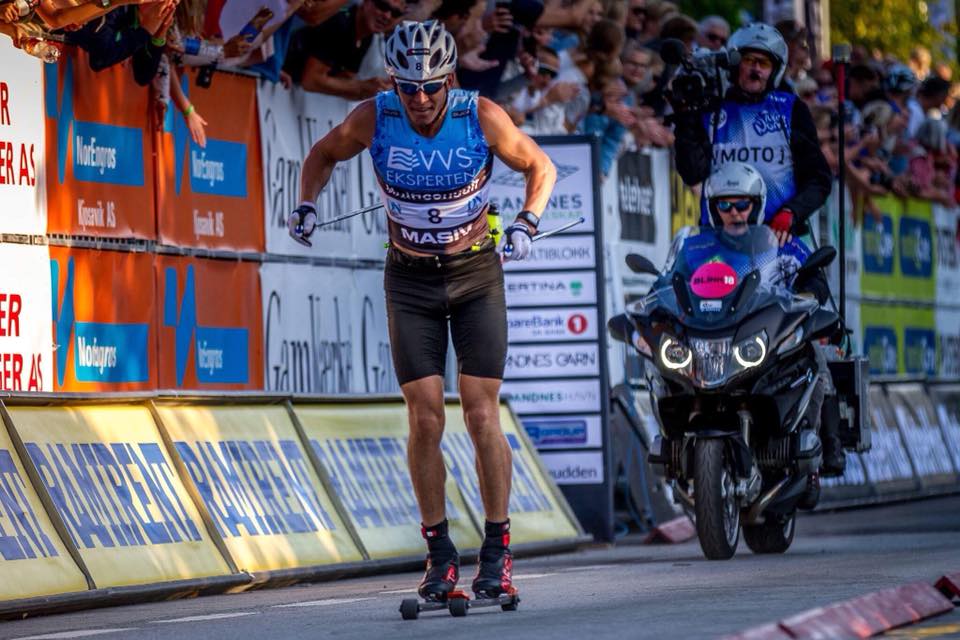
Russia’s Alexander Bolshunov racing to first in the Blink Classics men’s 60 k on Wednesday in Sandes, Norway. (Photo: Blink Ski Festival/Facebook)
A predictor for the winter ski season ahead? Could be. Either way, Norway’s Blink Ski Festival, or as it’s called in Norway, Blinkfestivalen, remains the ultimate in rollerski racing and returned for the 12th year in a row on Wednesday.
The festival opened with elite men’s and women’s distance rollerski races, known as the Blink Classics. For the third-straight summer, the Blink Classics featured a 60-kilometer mass start for the men and a 50 k for the women.
Eighty-six men competed in Wednesday’s 60 k, which began in the city center of Ålgård and finished in the municipality of Sandnes. A complete course map, which deviated little from last year’s rendition, may be found by clicking here.
By the end of the men’s 60 k, it was Russia’s Alexander Bolshunov who finished first in 2:10:51.6 hours. The 22-year-old Bolshunov had a number of World Cup podiums last season and one win in the final 15 k of the year. He also earned three silver medals and one bronze at the 2018 Winter Olympics in South Korea.
Finishing just 5.9 seconds behind him was another Russian, 19-year-old Sergey Ardashev, in second place. The third elite man across the line was Norway’s Anders Mølmen Høst, 27, of the Lyn Ski club, who finished 1.8 seconds out of second place and 7.7 seconds back from first.
Norwegians occupied the rest of the top 10, with Tord Asle Gjerdalen in fourth (+8.1), Øystein Petterson in fifth (+8.3), Hans Christer Holund in sixth (+8.3), Sjur Røthe in seventh (+8.7), Simen Hegstad Krüger in eighth (+8.7), Runar Skaug Mathisen in ninth (+10.3) and Martin Johnsrud Sundby — the winner of last year’s Blink Classics 60 k — in 10th (+10.8).
Nearly half of the men’s field came from nations from outside Norway, with athletes hailing from Russia, France, Canada, the U.S., Great Britain, Finland, Sweden, and Italy. Canadian World Cup skier Alex Harvey was the top North American in 14th (+1:19.0).
Also for Canada, Scott James Hill placed 53rd (+11:00.0) and Bob Thompson was 56th (+11:53.1). Ian Torchia was the lone American in the event, racing to 55th (+11:52.3). Canada’s Evan Palmer-Charrette did not start.
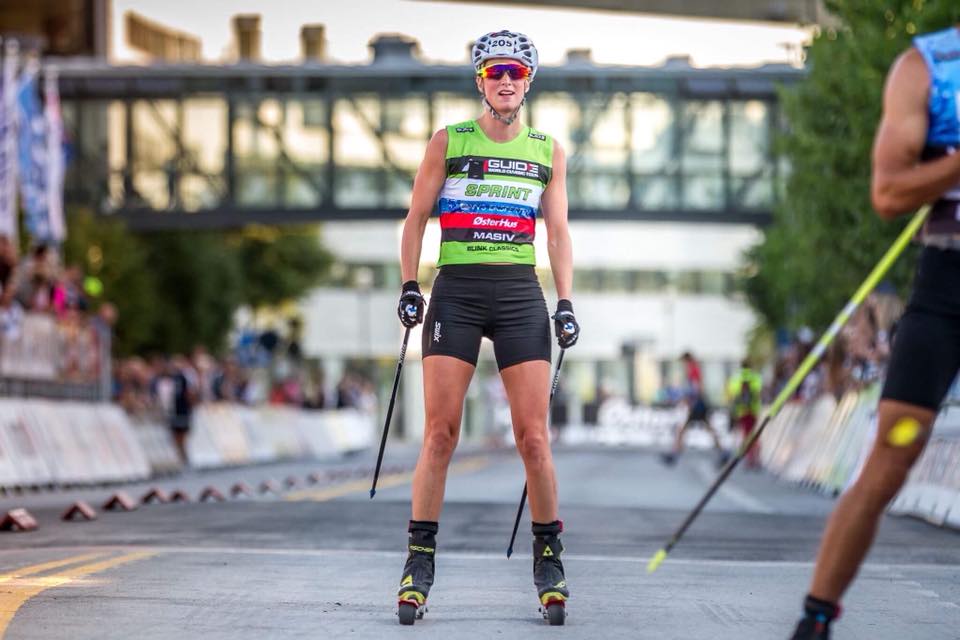
Norway’s Kari Vikhagen Gjeitnes finishing first in the Blink Classics women’s 50 k on Wednesday in Sandes, Norway. (Photo: Blink Ski Festival/Facebook)
In the elite women’s 50 k, which had just nine finishers, Norway’s Kari Vikhagen Gjeitnes finished first in 2:21:19.0. Second place went to Astrid Øyre Slind, who crossed 33.9 seconds after Gjeitnes, and the third and final podium spot went to Poland’s Justyna Kowalczyk (+5:55.4).
The women’s freestyle sprint podium on Saturday at the World Cup in Dresden, Germany, with Sweden’s Hanna Falk (c) and Maja Dahlqvist (l) in first and second, and American Sophie Caldwell (r) in third. (Photo: FIS Cross Country/Twitter)
FIS Cross Country World Cup (Dresden, Germany): Freestyle sprints
For her second-straight World Cup sprint, Sophie Caldwell of the U.S. Ski Team reached the podium in the women’s 1.2-kilometer freestyle sprint on Saturday in Dresden, Germany.
Caldwell placed third in the final behind Sweden’s Hanna Falk, who won it in 2:11.02 minutes, and Maja Dahlqvist, also of Sweden, who placed second (+0.23). Caldwell and Dahlqvist both lunged in a photo finish for second, which Dahlqvist took by 0.07 seconds.
Also in the final, which included four Swedes, Switzerland’s Laurien van der Graaff finished fourth (+0.58), and Sweden’s Anna Dyvik followed in fifth (+0.68) and Stina Nilsson sixth (+7.56) after tripping.
Falk started the day by winning the women’s qualifier in 2:06.34, by just 0.02 seconds over Nilsson in second. Caldwell qualified 11th (+2.02). and another American Ida Sargent made it into the heats in 14th (+2.44). Kikkan Randall missed the top 30 by 0.6 seconds in 34th (+6.57), Julia Kern placed 38th (+7.78), and Caitlin Patterson, of the Craftsbury Green Racing Project (CGRP), was 40th (+8.56) out of 49 women in the qualifying round.
Sargent finished fourth in her quarterfinal, 043 seconds behind Sweden’s Ida Ingemarsdotter in first, to finish the day in 17th overall.
For Caldwell, who went on to advance in second in her quarterfinal and third in her semifinal, the podium came after she finished second in the last World Cup skate sprint (the first stage of the Tour de Ski) on Dec. 31 in Lenzerheide, Switzerland.
Her boyfriend and fellow U.S. Ski Team member Simi Hamilton came close to reaching the men’s 1.2 k sprint final on Saturday after qualifying in 15th then placing second in his quarterfinal and fifth in the second semifinal, 0.38 seconds behind Sweden’s Emil Jönsson in first.
France’s Lucas Chanavat won the qualifier in 1:50.42, 0.15 seconds ahead of Norway’s Johannes Høsflot Klæbo in second. Hamilton was 4.32 seconds back in the qualifier, and his U.S. teammate Andy Newell also qualified in 18th (+4.91). Erik Bjornsen missed qualifying by 0.23 seconds in 32nd (+6.15) and Ben Lustgarten (CGRP) finished 49th (+8.64) out of 67 men.
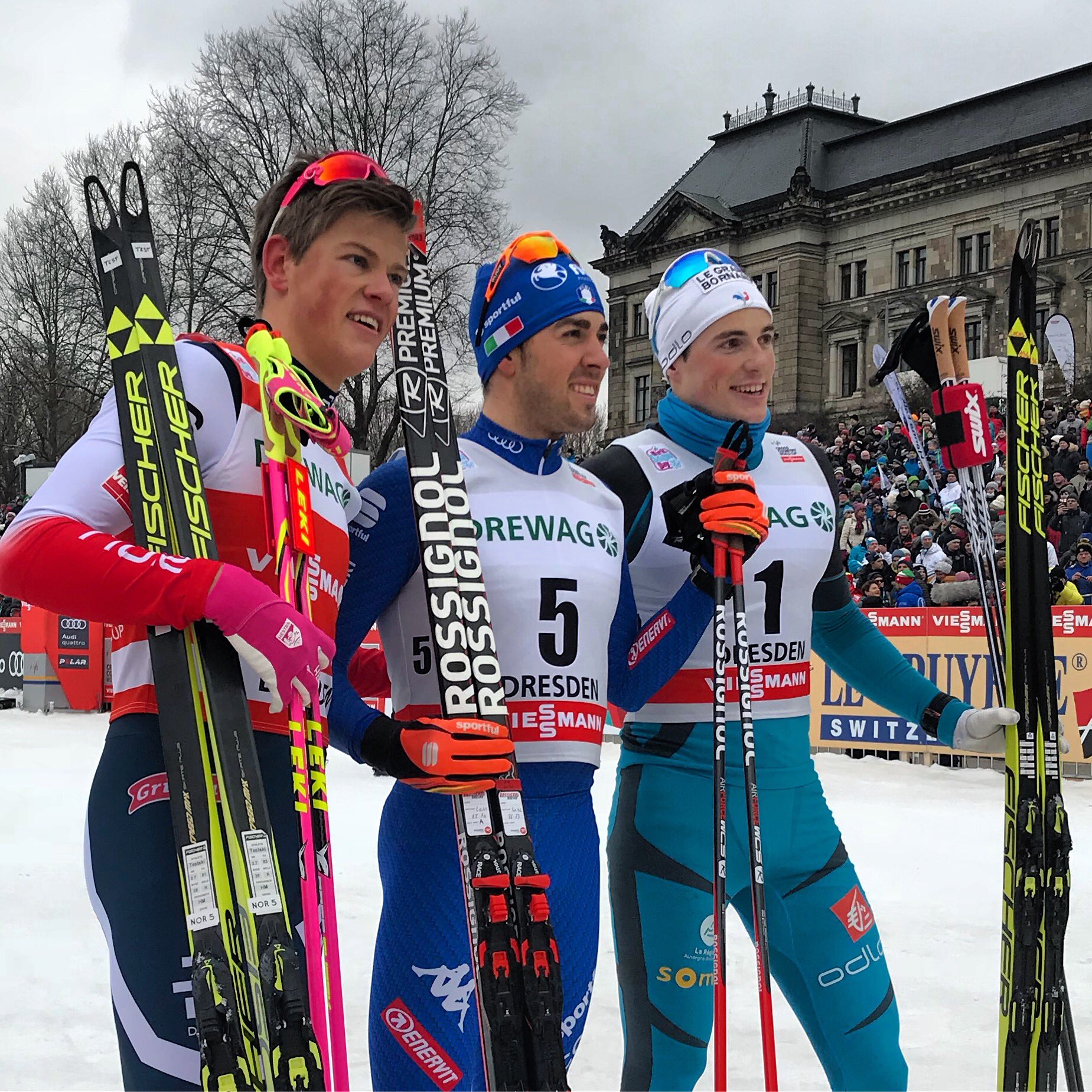
The women’s freestyle sprint podium on Saturday at the World Cup in Dresden, Germany, with Italy’s Federico Pellegrino (c) in first, Norway’s Johannes Høsflot Klæbo (l) in second, and France’s Lucas Chanavat (r) in third. (Photo: FIS Cross Country/Twitter)
While Hamilton’s day ended in the semifinals, putting him 10th overall (and Newell finished sixth in his quarterfinal to place 27th overall), Italy’s Federico Pellegrino timed his attack perfectly in the final, challenging Klæbo for the win down the finishing stretch. The Italian took it by 0.18 seconds in 1:52.77, Klæbo placed second and Chanavat third (+0.98).
France and Norway had two men in the final, with France’s Richard Jouve placing fourth (+1.23), Sweden’s Jönsson taking fifth (+2.36) for his best individual World Cup result since December 2016. Norway’s Even Northug finished sixth (+12.04) after breaking his pole out of the start.
Canada’s Julien Locke of the National U25 Team and Black Jack Ski Club had a career-best day, finishing 15th overall. He qualified 16th (+4.61) then placed third in his quarterfinal, crossing the line just 1 second behind Norway’s Fredrik Riseth, who won that heat. Hamilton was second in that quarterfinal, 0.67 seconds back.
Also for Canada, Bob Thompson (NTDC Thunder Bay) finished 50th in the qualifier (+8.67), Dominique Moncion-Groulx (Alberta World Cup Academy) was 59th (+9.99) and Antoine Briand (Pierre-Harvey National Training Centre) 60th (+10.12).
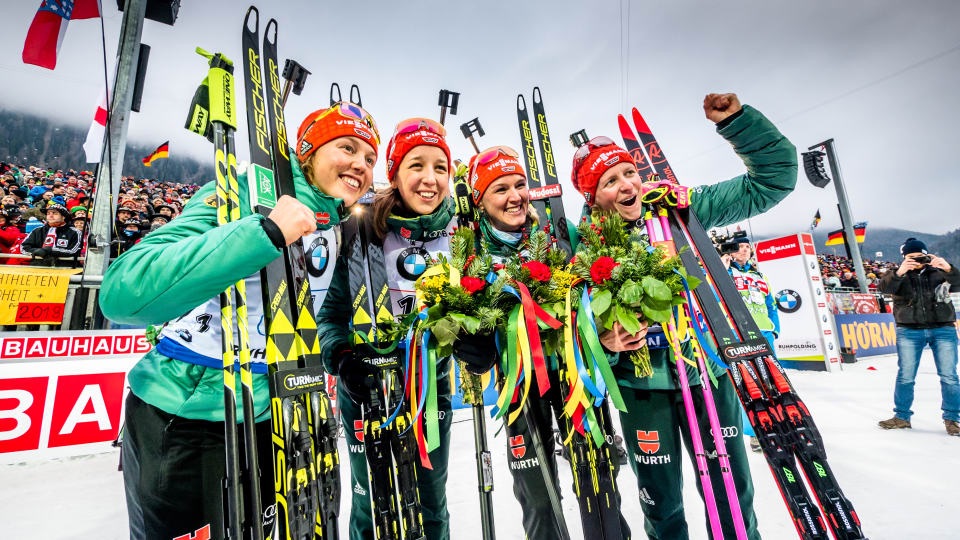
Germany’s Laura Dahlmeier, Franziska Preuss, Denise Herrmann and Franziska Hildebrand (left to right) celebrating their win in the women’s 4×6-kilometer relay at the 2018 IBU World Cup in Ruhpolding, Germany. (Photo: IBU/Biathlonworld)
IBU World Cup (Ruhpolding, Germany): Women’s relay
The teams from Germany and Italy dueled for the top position all race in Saturday’s 4 x 6-kilometer women’s relay at the IBU World Cup in Ruhpolding, Germany. Cheered on by some 20,000 home-crowd fans, Germany’s anchor Laura Dahlmeier stayed on the ski tails of Italy’s Federica Sanfilippo after the last shooting stage, then passed her before the last major climb and held a narrow lead around the rest of the course to cross the finish line first in a time of 1:08:47.0 hours, with Italy 2.9 seconds behind. German had a team total of zero penalties and nine spares.
“It’s incredibly fun to win in front of this audience here today,” Dahlmeier told German broadcaster ZDF in an interview right after the race, according to a translation. “I think this will boost our whole team morale. We showed today that we are a team to be reckoned with in relays. It was just a nice race.”
Germany with Franziska Preuss, Denise Herrmann, Franziska Hildebrand, and Dahlmeier was never more than 30 seconds behind the pace, even though Hildebrand temporarily fell back from leading the field to tagging off to Dahlmeier in fourth position.
“My race held all kinds of surprises today,” Hildebrand told ZDF with a laugh. “It started with a fall on an icy patch 100 meters after it began… Then I dropped my pole, also had to exchange the replacement one, and then three spares [in prone] to avoid the penalty. Today everything conspired in my race.”
Italy with Lisa Vittozzi, Dorothea Wierer (coming off a victory in the individual race on Thursday), Nicole Gontier and Sanfilippo had the best shooting performance of the day, with no penalty and just three spares.
“That last loop with Laura was really tough,” Sanfilippo said in the press conference. “I gave my best, I tried all for my team. I knew that I can be strong on the last loop. I tried to attack, but Laura was a little bit stronger. But I am also really happy that we finished in second place, I think that was really important for our team.”
Sweden with Linn Persson, Mona Brorsson, Anna Magnusson and anchor Jenny Öberg was third, 17.2 seconds back, with no penalty and five spares. Brorsson and Öberg managed to move the team up to the podium positions, for the second one in a row following a third place from Oberhof, Germany, a week ago. Before that, the Swedish women’s team had been on a six-year hiatus from those lofty positions.
“It’s cool to be on the podium again,” Persson said in the press conference.
“This is like our second home and there were a lot of Swedes here, so we had big support during the race on the tracks,” Brorsson added.” That was an advantage for us.”
Just a few seconds off the podium, Norway with Synnøve Solemdal, Tiril Eckhoff, Ingrid Landmark Tandrevold and Marte Olsbu was fourth (+23.1, with no penalty and nine spares), with Olsbu outsprinting Poland’s anchor Weronika Nowakowska on the finish stretch (+24.5, with no penalty and five spares). For both teams it was their best relay result of the season so far.
Switzerland with the three sisters Elisa, Selina and Aita Gasparin reinforced by Lena Häcki surprisingly led the race at the third exchange after Selina had moved them in front, but her youngest sister Aita could not hold that position, falling back with a penalty lap in the last standing stage to finish eighth (+1:37.1, with one penalty and 11 spares).
Biathlon Canada’s team of Emma Lunder, Julia Ransom, Sarah Beaudry, and Rosanna Crawford started the race with a setback after Lunder incurred a penalty in her prone stage, leaving the range in 23rd position at the end of the field and already almost a minute behind the leader. She managed to limit the gap with a clean standing stage to exchange still in 23rd position and 1:47 back.
Taking over Ransom then remained clean in both stages to move the team up to 17th, tagging off 2:14 behind. Beaudry only required one spare in her prone stage (0+1, 0+0) to improve to the 12th position even making up 3 seconds to the leaders.
Then Crawford, fresh off her first career podium in the individual race on Thursday, managed to also shoot clean in both stages and overtook the teams from Slovakia and Ukraine while further decreasing the gap to finish the race in 10th position, 1:56.7 back, with one penalty and just four spares.
“Things were a bit softer and slushy today compared to the individual, but nothing too bad,” Crawford commented on the conditions in an email to FasterSkier. “There was quite a bit of wind on the range, which I think was tricking people, the wind flags weren’t showing much but I had to make 6 left correction during zero [target practice].”
“Today was a solid showing from our team,” she added regarding their result. “Everyone cleaned standing, I think we can be really happy of this race, and take some real confidence going into the Olympic relay.”
Previously this season Canada had finished the relay in Oberhof, also Germany, in 14th position, and the first one in Hochfilzen, Austria, in ninth.
For US Biathlon with Susan Dunklee, Clare Egan, Emily Dreissigacker, and Joanne Reid, it was the first women’s relay of the year after missing out on the first two races of the season in this discipline.
Thus starting at the very end of the field, veteran Dunklee moved up through the pack and got through the prone stage with one spare. But then she had to fight against a penalty lap in her standing stage requiring all three spare rounds, leaving the range in 12th position. With the fastest course time on the opening leg, she managed to slightly decrease the gap to 21.6 seconds and made up three positions to exchange in ninth place.
Egan missed the first two shots in her prone stage, but hit the targets with her spares leaving the range over a minute back. She followed that up by cleaning her standing stage and left the range 1:29.5 back, then only lost five more seconds on the last loop to exchange in 14th.
Dreissigacker also needed just one spare in her prone shooting, but then incurred two penalties in her standing stage, doubling the gap and falling back to 19th position at the exchange and 3:51 back.
Anchor Reid needed three spares on her leg (0+2, 0+1) and managed to still overtake the teams from China and Finland to finish 17th, 4:57.7 behind Germany, with two penalties and 13 spares overall.
“Finally we had a full team and raced a relay!” Dunklee wrote on Instagram. “Competing on a foreign continent has its challenges.”
Ski Classics (Seefeld, Austria): 60 k Kaiser Maximilian Lauf
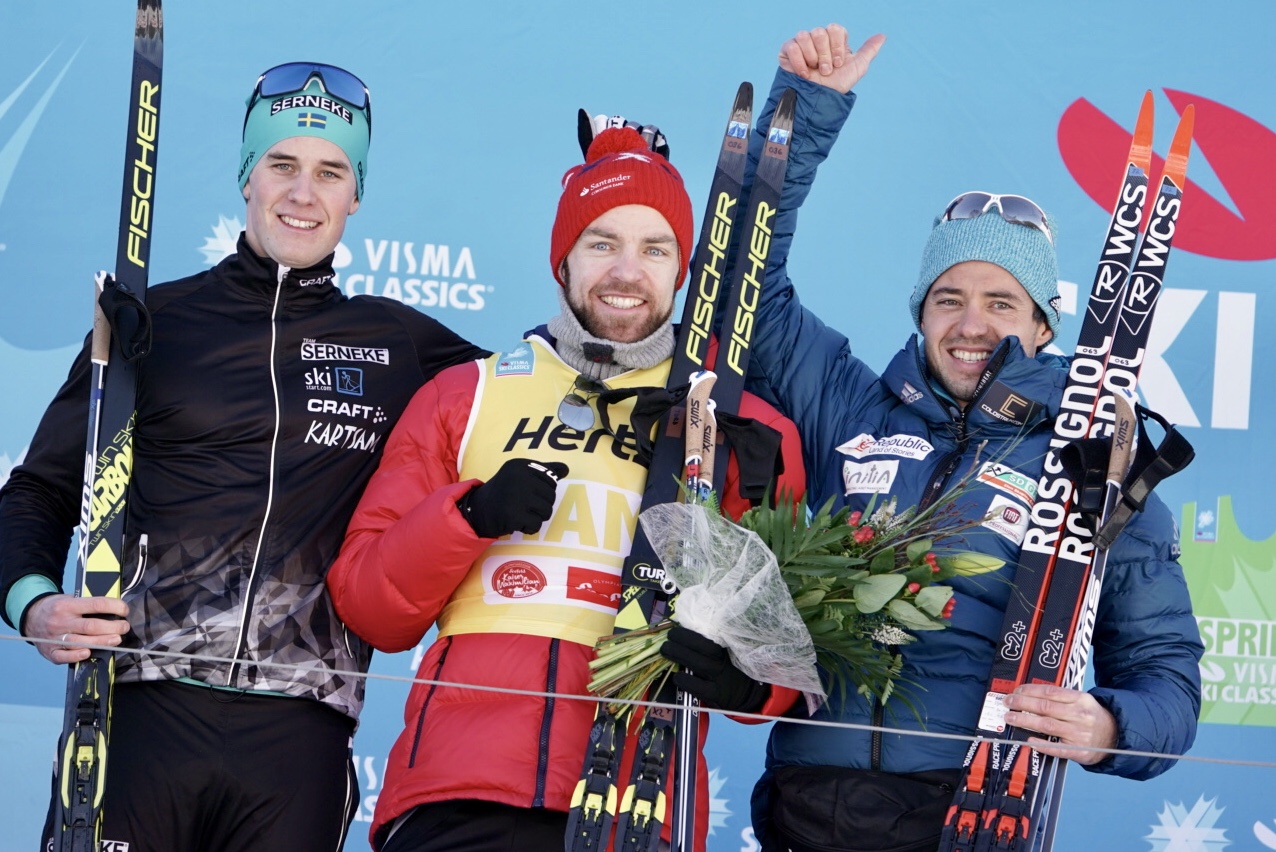
The men’s podium at the Kaiser Maximilian Lauf 60 k Ski Classics marathon in Seefeld, Austria, with Norway’s Tord Asle Gjerdalen (c) in first, Sweden’s Andreas Holmberg (l) second, and Russia’s Ilya Chernousov (r) third. (Photo: Visma Ski Classics)
At the third Ski Classics event of the 2017/2018 season, the 60-kilometer Kaiser Maximilian Lauf on Saturday in Seefeld, Sweden’s Britta Johansson Norgren (Lager 157 Ski Team) and Norway’s Tord Asle Gjerdalen (Team Santander) took the women’s and men’s victories, respectively.
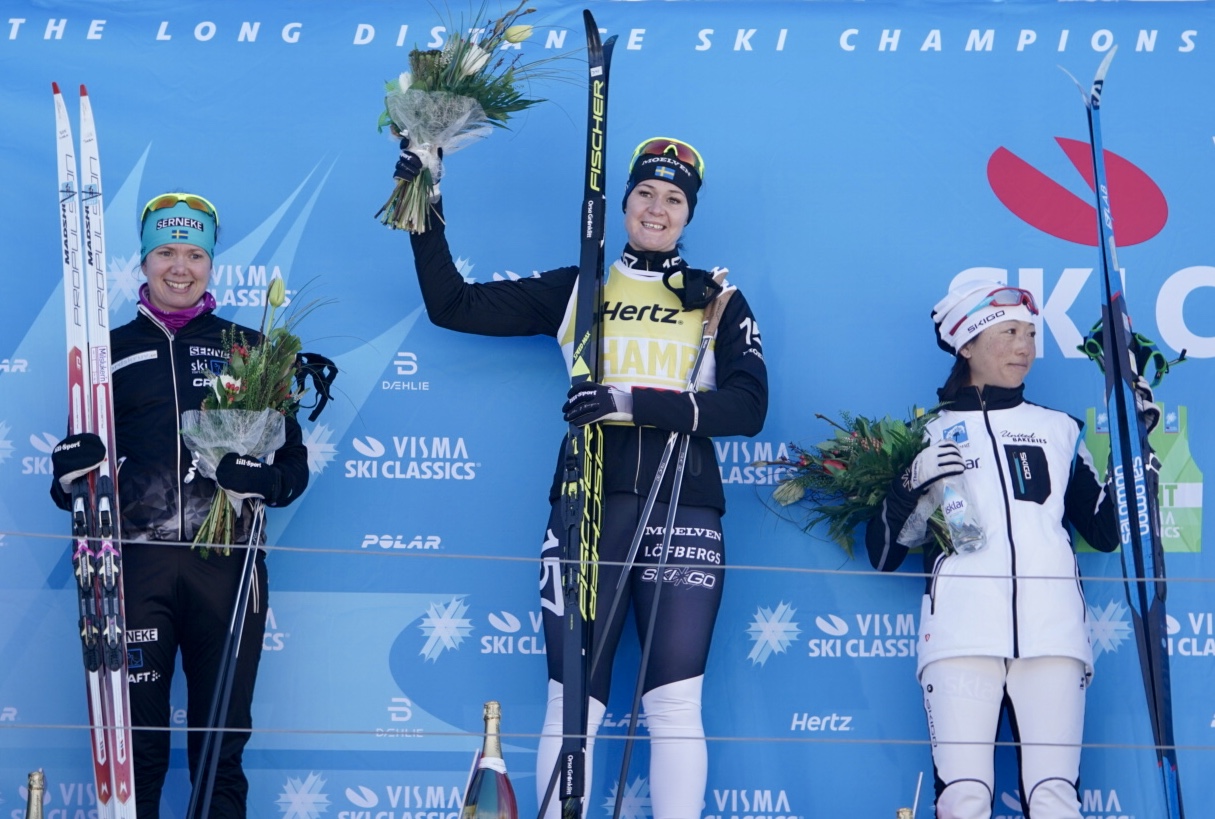
Johansson Norgren and Japan’s Masako Ishida (Team Koteng) broke away shortly after the start. The two went back and forth for a while until Johannson Norgren gapped Ishida in the Leutasch valley. While Ishida was caught by a chase pack with Sara Lindborg (Team Serneke), Kari Vikhagen Gjeitnes (Santander) and Lina Korsgren (Åre Ski Team), she reined Johansson Norgren back in on the long climbs after the valley. Ultimately, Johansson Norgren took the win in 2:49:16.0 hours, while Lindborg claimed second, 37.5 seconds back. Ishida finished third (+58.9), Gjeitnes placed fourth (+1:40.7) after injuring her ankle about 2 k before the finish, and Korsgren fifth (+2:05.1).
The women’s podium at the Kaiser Maximilian Lauf 60 k Ski Classics marathon in Seefeld, Austria, with Sweden’s Britta Johansson Norgren (c) in first, Sweden’s Sara Lindborg (l) second, and Japan’s Masako Ishida (r) third. (Photo: Visma Ski Classics)
“It was my plan to go full speed from the beginning,” Johansson Norgren said, according to a Ski Classics press release. “I knew Ishida will go fast in the climbs, but I felt strong from the beginning. It was really hard skiing alone in the valley, and when Ishida caught me up, I wasn’t sure if I could win the race. But the last part of the course was perfect for me and I had no problems securing the victory today.”
The Leutasch valley was the turning point of the men’s race as well, where Vinjar Skogsholm (Team Parkettpartner) and Andreas Holmberg (Team Serneke) broke away from the pack and had built a 90-second gap on the chase group as they left the valley. There on the first climb out of the valley, Holmberg pushed the pace and dropped Skogsholm, while Gjerdalen and Ilya Chernousov (Bauer Ski Team) worked to catch Holmberg up front. They caught him 3 k before the finish and Gjerdalen was first across the finish line in 2:27:49 hours, 14.8 seconds ahead of Holmberg in second.
Chernousov finished third (+32.0), Ermil Vokuev (Russian Marathon Team) was fourth (+1:07.6), and Anton Karlsson (Lager 157) fifth (+1:08.2).
“I didn’t like the fact that we gave too much leeway for Holmberg and Skogsholm,” Gjerdalen said, according to the press release. “I’m happy that Ilya helped me in our attempt to catch up with Holmberg, but I wasn’t really sure if we were going to make it. You never know how the other person is feeling in the front, what kind of skis he has and what goes on in his mind. But I managed to win today and it feels great to be back on the top.”
In the overall “Champion” standings, Nordgren leads with 450 points, 110 ahead of Lindborg in second. Gjerdalen is first in the men’s champion standings with 330 points, 50 points ahead of Morten Eide Pedersen in second.
The Ski Classics tour moves to Zuoz, Switzerland, next weekend for the 65 k La Diagonela.
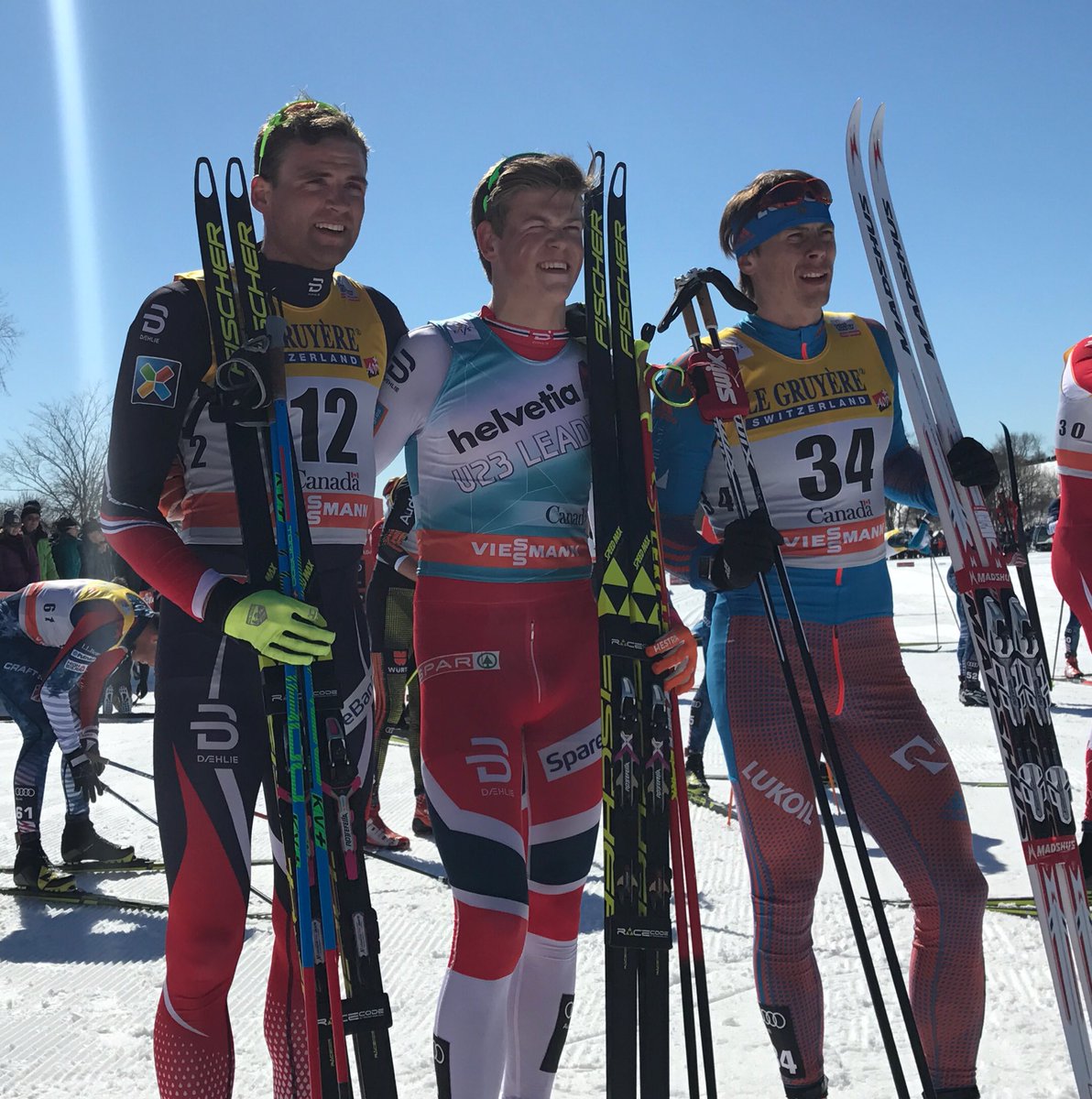
The men’s 15 k classic mass start podium on Saturday at World Cup Finals in Quebec City, with Norway’s Johannes Høsflot Klæbo (c) in first and Niklas Dyrhaug (l) in second, and Russia’s Alexander Bessmertnykh (r) in third. (Photo: FIS Cross-Country/Twitter)
FIS Cross-Country World Cup Finals (Quebec City): 10/15 k classic mass starts
During Saturday’s 15-kilometer classic mass start at World Cup Finals, Canada’s Alex Harvey was in it until the end. But so were Norway’s Johannes Høsflot Klæbo and Niklas Dyrhaug, and Russia’s Alexander Bessmertnykh, to name a few.
Sitting in second with a few hundred meters to go, Harvey was primed to make his move on Dyrhaug, who was leading at the time. But then came 20-year-old Klæbo, the season-long Sprint World Cup champion, who proved to have more left in the tank than anyone else and passed them both to lead into the finishing straight.
Klæbo took the victory — his first in a World Cup distance race — on a bluebird day under a beating sun in 35:23.7 minutes, 0.6 seconds ahead of Dyrhaug. Bessmertnykh followed another 0.2 seconds back in third (+0.8) just ahead of Harvey in fourth (+1.2).
Norway’s Sjur Røthe took fifth (+1.7), Switzerland’s Dario Cologna placed sixth (+1.9), and Norway’s Pål Golberg was seventh (+2.5), half a second ahead of another Norwegian Didrik Tønseth in eighth (+3.0). The top nine were within 3.7 seconds of first, with Russia’s Andrey Larkov in ninth.
Devon Kershaw was the second Canadian in the points on Saturday in 28th (+1:08.4), after breaking a pole and working his way back up from outside the top 60.
Erik Bjornsen led the U.S. men in 31st (+1:16.8), about a second ahead of Canada’s Graeme Killick in 32nd (+1:17.7).
Also for the U.S., Matt Gelso finished 37th, Andy Newell 45th, Scott Patterson 46th, Noah Hoffman 48th, Ben Lustgarten 49th, David Norris 50th, Simi Hamilton 54th, Paddy Caldwell 59th, Jack Hegman 62nd, Cole Morgan 64th, and Brian Gregg 69th.
For Canada, Bob Thompson finished 55th, Knute Johnsgaard 57th, Len Valjas 61st, Russell Kennedy 63rd, Evan Palmer-Charrette 65th, Andy Shields 66th, Jess Cockney 67th, Brian McKeever 68th, Joey Foster 70th, Gareth Williams 72nd, Ricardo Izquierdo-Bernier 74th, and Julien Locke 75th.
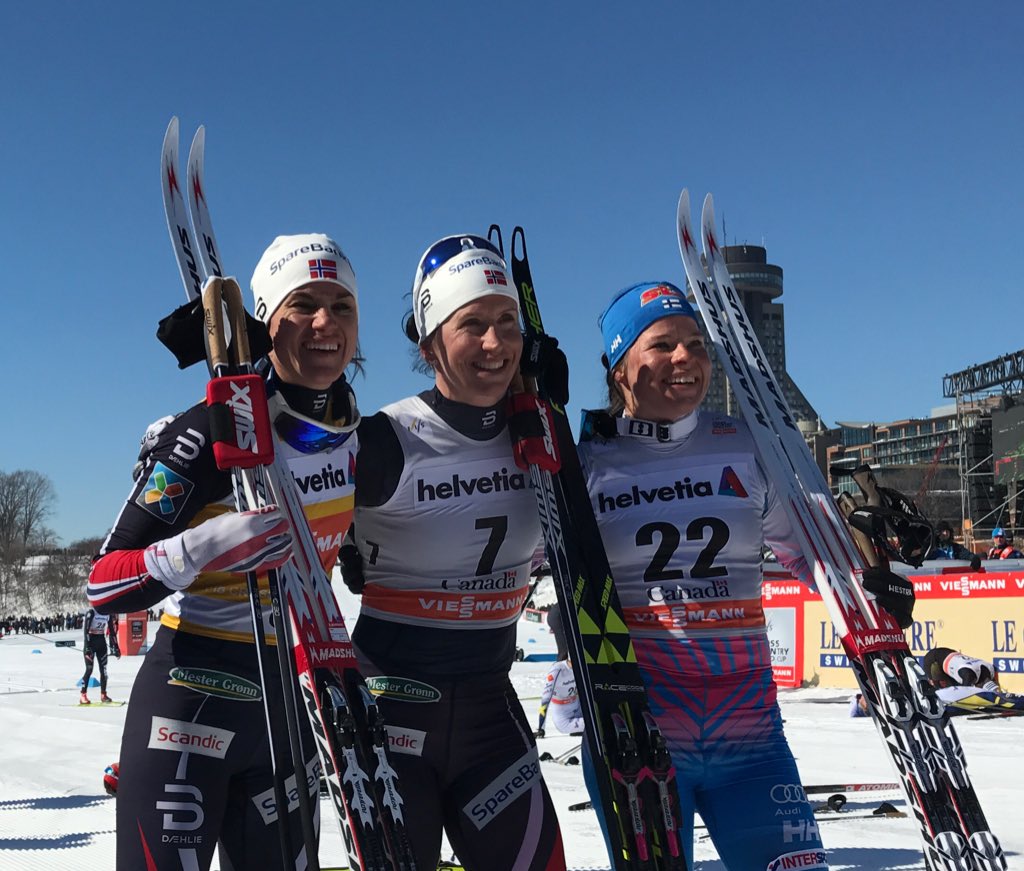
The women’s 10 k classic mass start podium on Saturday at World Cup Finals in Quebec City, with Norway’s Marit Bjørgen (c) in first, Norway’s Heidi Weng (l) in second and Finland’s Krista Parmakoski (r) in third. (Photo: FIS Cross-Country/Twitter)
In the women’s 10 k classic mass start earlier in the day, Norway’s Marit Bjørgen racked up her seventh victory of the season after leading a pack of two other Norwegians and Finland’s Krista Pärmäkoski and holding them off to the finish.
Bjørgen put a few meters into the foursome as she entered the finishing stretch and held her lead across the line in 24:23.6 minutes. Norway’s Heidi Weng finished 0.6 seconds back in second to lock up the Distance World Cup title, in addition to the Overall World Cup title she secured on Friday.
Pärmäkoski finished 2.9 seconds after Bjørgen in third, and Norway’s Ingvild Flugstad Østberg missed the podium in fourth (+7.8).
Behind them, Germany’s Nicole Fessel outlasted a large chase pack to place fifth (+18.6), just ahead of Sweden’s Charlotte Kalla in sixth (+19.9) and Anna Haag in seventh (+19.1).
Sadie Bjornsen of the U.S. Ski Team led the North American women in 15th (+29.9) after skiing at the back of that chase pack in the final stretches of the race. Also for the U.S., Jessie Diggins placed 27th (+1:06.9) and Sophie Caldwell 38th (+1:56.0).
Canada was led by Emily Nishikawa in 37th (+1:51.7). Behind her, Cendrine Browne finished 41st (+2:28.2), Dahria Beatty was 53rd, Annika Richardson 54th, Katherine Stewart-Jones 56th, Frederique Vezina 59th, Annika Hicks 60th, Sophie Carrier-Laforte 61st, Andrea Dupont 62nd, Katherine Weaver 63rd, Alannah MacLean 64th, Sadie White 66th, Lisle Compton 67th, Mia Serratore 68th, and Laura Leclair 69th.
For the U.S. Caitlin Patterson finished 44th, Liz Guiney 45th, Kaitlynn Miller 47th, Chelsea Holmes 48th, Rosie Brennan 50th, Julia Kern 52nd, Erika Flowers 55th, Becca Rorabaugh 57th, and Jennie Bender 58th.
One day left in the 2016/2017 World Cup season remains, with the women’s and men’s 10/15 k freestyle pursuits on Sunday in Quebec City.
World Cup Finals standings (Day 2 of 3): Men | Women
***
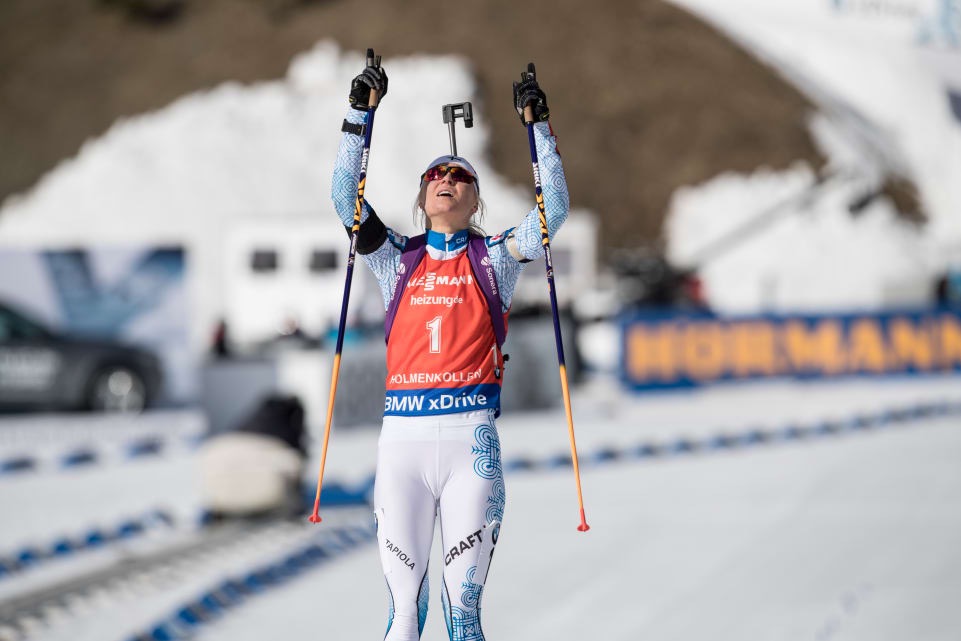
Finland’s Mari Laukkanen pointing to the sky in honor of her late shooting coach, after she won the women’s 10-kilometer pursuit on Saturday at the 2017 IBU World Cup in Oslo, Norway. (Photo: IBU)
IBU World Cup (Oslo, Norway): Women’s and men’s pursuits
Less than 24 hours after winning her first IBU World Cup on Friday in the women’s 7.5 k sprint, Finland’s Mari Laukkanen immediately capitalized on her ideal position with a start-to-finish victory in Saturday’s 10 k pursuit that was never in doubt, cleaning the first three shooting stages before incurring one penalty in her final standing shooting (0+0+0+1) to cross the line in a time of 29:33.3 minutes.
In addition to experiencing the most successful weekend of her biathlon career by far, it was an emotional day for the 29-year-old Finn due to a personal reason. Laukkanen spread her arms like wings skiing down the homestretch with a commanding lead, pointing repeatedly to the sky and a black ribbon she wore around her right upper arm, before kneeling in the snow in the finish for a few seconds. With those gestures, she reportedly wanted to commemorate her shooting coach Asko Nuutinen, who passed away Friday after suffering a heart attack during the World Cup in Kontiolahti, Finland, a week ago. He was 60 years old.
“It’s been a really emotional day for me. We have heard really really sad news that last night we lost our longtime shooting coach,” Laukkanen told reporters with a trembling voice in the press conference. “After this it was more or less only about working for him. Working as he has asked me to do for years and years. So I wasn’t thinking about losing or winning today, I was only thinking about him. And I feel really big pleasure that I was able to come to the finish like this, that I can own the victory for him.”
“I knew it will be difficult after the first victory in my career took me so long,” she added. “And to do it again immediately with good shooting. But as I said I didn’t think about winning or losing today, just doing my work.”
Finishing 26.5 seconds after her, the Czech Republic’s Gabriela Koukalová reached the finish, moving up from her fourth place starting position with a clean shooting performance (0+0+0+0).
“I wanted to miss all targets yesterday because I was so tired I didn’t even want to race,” Koukalová confided in the press conference. “It’s difficult to concentrate, three World Cups after the main goal of the season [the World Championships] is too much. Last year it was many times easier… I tried to catch her, but about one kilometer before the finish I saw her far away so I was happy I didn’t have to fight with anyone and was just enjoying the last meters.”
Despite four penalties (1+1+0+2), France’s Justine Braisaz defended the third place on the podium against a three-person chase group on the last loop (+1:01.4), falling back only one position after having finished the sprint in second.
“I did not expect such a good place today during the race,” Braisaz commented in the press conference. “Because in the last shooting I completely [failed]. I really wanted to have a clean shooting today, and I did not succeed. So I am happy and surprised, too.”
Her teammate Anais Bescond who had started the pursuit in third place fell back to 22nd position (+2:53.5) with seven penalties.
Slovenia’s Teja Gregorin finished fourth with one penalty (+1:08.2), Austria’s Lisa Theresa Hauser shot clean as the only athlete aside from Koukalova on her way to move up from 22nd to fifth place (+1:12.5), while Norway’s Marte Olsbu finished sixth like in the sprint despite three penalties (+1:15.9).
Unlike in Friday’s sprint race where Germany’s Laura Dahlmeier had still given up a seemingly commanding lead in the sprint World Cup discipline standings to Koukalova, she held onto her lead in the pursuit standings on Saturday, moving up from the 31st starting position to ninth place with a penalty in each of her standing shootings (0+0+1+1, +1:53.8). A 22nd place would have been sufficient to win the “small crystal globe” award in the pursuit. Laukkanen’s teammate Kaisa Mäkäräinen finished 8th with two penalties in the standing stages (+1:51.2), and thereby claimed the third place in the World Cup pursuit ranking.
“I knew that I didn’t need to have a perfect race today, just a good one, but that’s always easier said than done,” Dahlmeier told broadcaster ARD after the race. “I am incredibly happy that it worked out and that I could secure myself another small globe… It’s a bit of a weird feeling, standing at the start gate in the middle of the field and the clock ticks and ticks as one athlete after another skis out on the course. And you can only observe how far they have gone and have to wait and be patient, and not make a false start. But then the snow burns, then the chase begins!”
US Biathlon’s Susan Dunklee experienced an uncharacteristically problematic day on the shooting range and fell back to 37th place (+4:00.2), after starting seventh and less than a minute behind Laukkanen. Dunklee had three misses between two prone stages and seven more in her standing shootings (2+1+4+3) therefore having to ski more than an additional kilometer in the penalty lap.
“It is a testament to her fighting spirit that she notched the fourth-fastest ski time — one of her best ranks of the season — and never gave up despite suffering a biathlon blowout on the range,” teammate Clare Egan said of Dunklee, according to a US Biathlon press release. “Bad races happen to the best and Susan is no exception, but not everyone fights through till the end no matter what.”
Egan herself started the pursuit in 34th position and initally was able to make up ground, but then fell back slightly to 41st place (+4:13.9) with four penalties (0+2+0+2).
“I am satisfied with my race even though the result was not what I was hoping for, and that’s how I would summarize my entire season as well,” Egan said after the final race of her season. “I’ve made a good step forward but my competitors also work hard all summer and we seem to improve at a similar rate.”
Canada Biathlon’s Julia Ransom moved up to 47th place (+5:04.8) with three penalties (1+0+1+1), after starting in 52nd position.
[UPDATED] Later on Saturday in the last men’s 12.5 k pursuit of the season, the three best athletes of the season fought throughout the race exchanging in the lead, before they stood next to each other on the range for the final shooting to decide the winner.
Russia’s Anton Shipulin managed to shoot clean with his elaborate rifle stock in the design of a red dragon, proudly waving to the cameras as he left the arena while his two competitors had to ski into the penalty lap. France’s Martin Fourcade – who had already secured himself the overall World Cup Total Score title as well as the award for the pursuit discipline – was left to duke it out against Norway’s Johannes Thingnes Bø, the winner of Friday’s sprint.
On the last big climb before the Holmenkollen arena, Fourcade accelerated with a series of explosive jump-skate steps to decisively gap Bø. He even got fairly close to Shipulin on the finish stretch, who had slowed down a bit to grab a Russian flag before skiing over the line in a time of 32:11.9 minutes with one penalty (0+0+1+0), 5.7 seconds ahead of Fourcade who had incurred two penalties (1+0+0+1). While Fourcade shook hands with Shipulin, Bø came into the finish in third place, 21.6 seconds back and also with two penalties (1+0+0+1).
“It was a crazy race, but I am happy that I managed to finish first,” Shipulin said in the press conference through a translator. “Tough conditions on the shooting range, I had to really work to concentrate on my shooting. On the last loop I was all alone until I saw Martin chasing me, then I got a little bit scared but I managed to [keep him behind].”
It was Shipulin’s second win of the season, for which he credited his recently improved shooting performance.
“It was a really exciting competition with Johannes and Anton,” Fourcade agreed with his rival. “I expected to fight with them for the victory on the last loop, but then Anton was simply stronger in the last shooting. My strategy was to be focused on my technique and skills and not on the results, like I did too often in the past few weeks focusing on records and not the victory.”
Asked about his blazing attack on the final climb, Fourcade added: “Of course I train for that, but I think a lot of athletes do. I talked to Johannes, it was my revenge for the [2016] World Champs where he did exactly the same to me on the last uphill. But I know how it is, it can be different already tomorrow.”
“I am happy with a new podium of course,” Bø said in the press conference. “I was not at my best in the skiing today. But I still managed to shoot 18 out of 20. As Martin said it was [annoying] that we did not shoot zero [misses] and could not fight with Anton in the finish, but it was quite interesting and fun to stand there in the last shooting … I expected Martin’s attack the second he did it, but I had no energy to fight with him. That was quite strong.”
Sweden’s Fredrik Lindström placed fourth with no penalties (+44.7), and was the only man in the field who managed to shoot clean in all four stages.
“For the podium, I was never really close“, Lindström told the IBU in a post-race interview. “But it was a great day anyway. Four times zero [misses], and especially in the standing stages that makes you climb a lot in the standings. Super happy with my performance.”
US Biathlon’s Lowell Bailey, who had to start closer to the back of the field in 44th position, almost two minutes behind the leaders based on his sprint result, managed to move up 21 spots in the race despite three penalties (2+0+1+0).
“I’m happy with the race, considering it started out pretty rough with the first two misses,” Bailey told US Biathlon after placing 23rd (+2:23.3). “I just read the wind wrong and didn’t correct enough. After that, I tried to keep my head in the race and make the best of it. I was happy with my skiing and glad to clean the last stage; this brought me up nine spots and I was able to gain another in the last loop. Now, it’s just one race to go. I’m looking forward to tomorrow.”
Shooting quickly, Bailey recorded the ninth-ranked range time of the day and the ninth-fastest last loop.
His teammate Sean Doherty started 35th but fell back after having to ski six times through the penalty lap (1+3+1+1) to finish 46th (+4:05.6).
For Sunday’s mass starts as the final races of the 2016/2017 IBU World Cup season, the only qualified North American starters will be Dunklee (currently in 10th position in the World Cup Total Score standings) and Bailey (currently in eighth).
The women’s season award in the mass start discipline once more will be decided between Germany’s Dahlmeier and Czech Republic’s Koukalova, while Germany’s Simon Schempp will try to defend his narrow lead on Fourcade. But during Saturday’s final loop, the French star did consider saving energy for the final competition.
“No,” he simply quipped when asked about this in the press conference. “Of course the mass start is important tomorrow because it will decide about the [mass start] crystal globe. But I think today the pursuit was also really important, and you fight for victory and being one of the best athletes. You can’t be satisfied with only a third place when you can claim a second, and I think all athletes in my position would do the same.”
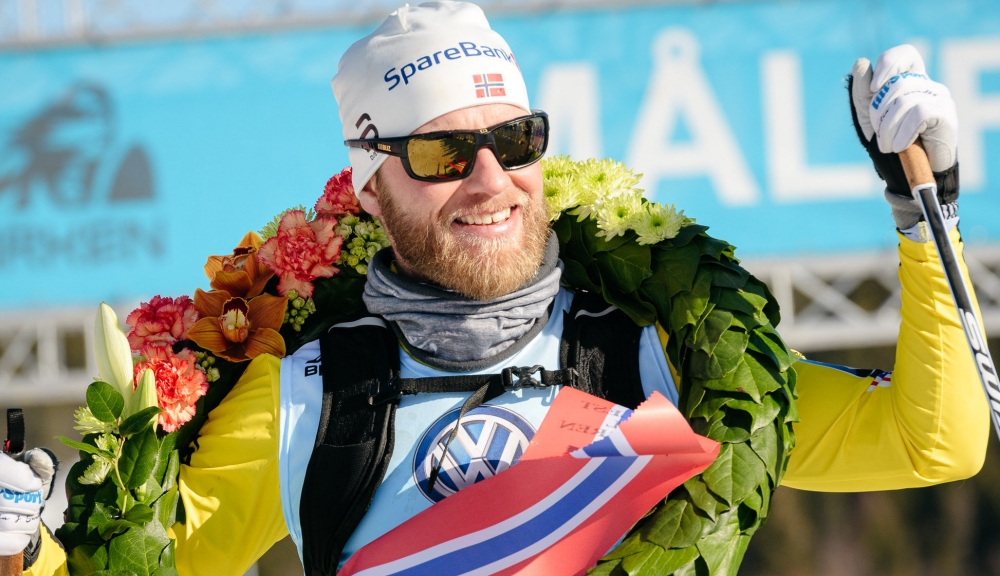
Norway’s Martin Johnsrud Sundby after winning the Norwegian 54 k classic Birkebeinerrennet, part of the Ski Classics series, on Saturday in Lillehammer, Norway. (Photo: Ski Classics)
54 k Birkebeinerrennet (Rena to Lillehammer, Norway): Part of the Ski Classics series
[UPDATED] Not even a snowmobile clipping him and sending him tumbling 20 k before the finish could keep Norway’s Martin Johnsrud Sundby from winning the Birkebeinerrennet on Saturday in Norway. Representing Team United Bakeries, Sundby set a high pace from the start and broke the group down to three by 9 k, with Petter Eliassen of Team LeasePlan and Simen Østensen of Team BN Bank sticking with him until about 30 k in the 54 k marathon.
With about 20 k to go, Sundby collided with a Ski Classics TV production crew snowmobile while trying to double pole in the snowmobile’s tracks. He was OK and went on to win by 48 seconds over Eliassen in second, and smiled about the incident after the finish.
“It came in with tremendous speed and mowed me down,” Sundby told NRK, according to a loose translation.
Ski Classics CEO David Nilsson told NRK he didn’t know exactly how that happened and emphasized that it was unacceptable.
“We always put safety first, but it is a difficult balancing act with the snowmobile at high speed to get TV pictures,” he said, according to a loose translation. “The skiers often ski in the [snowmobile] track and here it happened and somehow the driver missed it.”
While Sundby pulled out the win in 2:20:53.5 hours, Eliassen took second and Østensen followed another 3.5 seconds later for third place.
In the women’s race, Poland’s Justyna Kowalczyk (Team Santander) pulled out a 4 minute and 15 second win over Sweden’s Britta Johansson Norgren (Lager 157 Ski Team). Japan’s Masako Ishida (Team United Bakeries) was another 48.6 seconds back in third.
“I’m really happy to win this race,” Kowalczyk said, according to a Ski Classics press release. “Everything went well and the cheering on the course was amazing. I will do the rest of the races in Visma Ski Classics, but this victory was the most important for me. Of course, I want to win again in Årefjällsloppet like I did last year, but to win here in front of this audience means so much to me.”
Tord Asle Gjerdalen, who finished fourth in the men’s race, and Johansson Norgren continue to lead the overall Ski Classics standings with three races to go. The next stop is the Årefjällsloppet in Sweden on March 25.
“It was a great race and we kept a high tempo up all the way,” Sundby said, according to the press release. “I was able to use uphills for my advantage and get a gap. I had good skis, the conditions were perfect, and to win here was one of my goals for the season. I have the Norwegian Championships in two weeks, and I haven’t counted out the option of going to Finland for the Visma Ski Classics finale.”
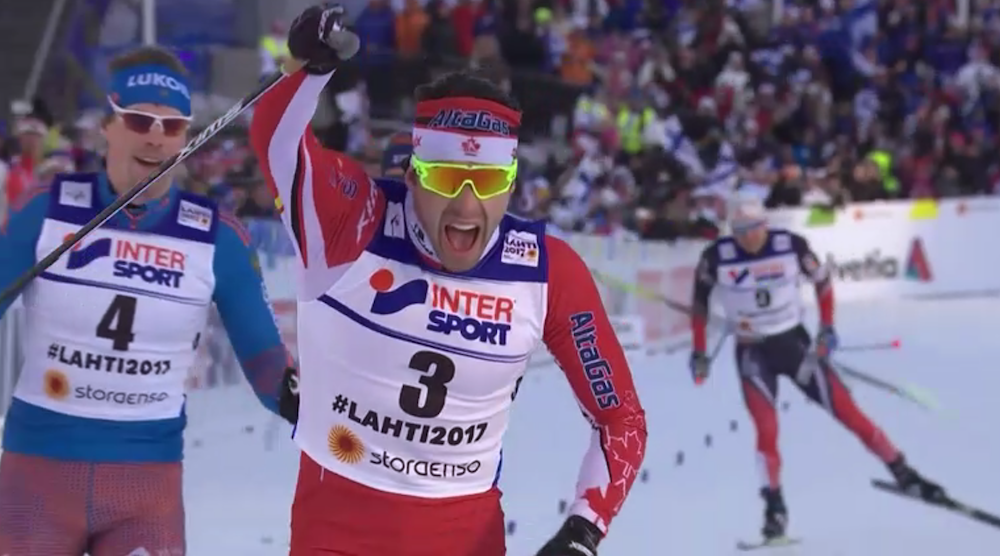
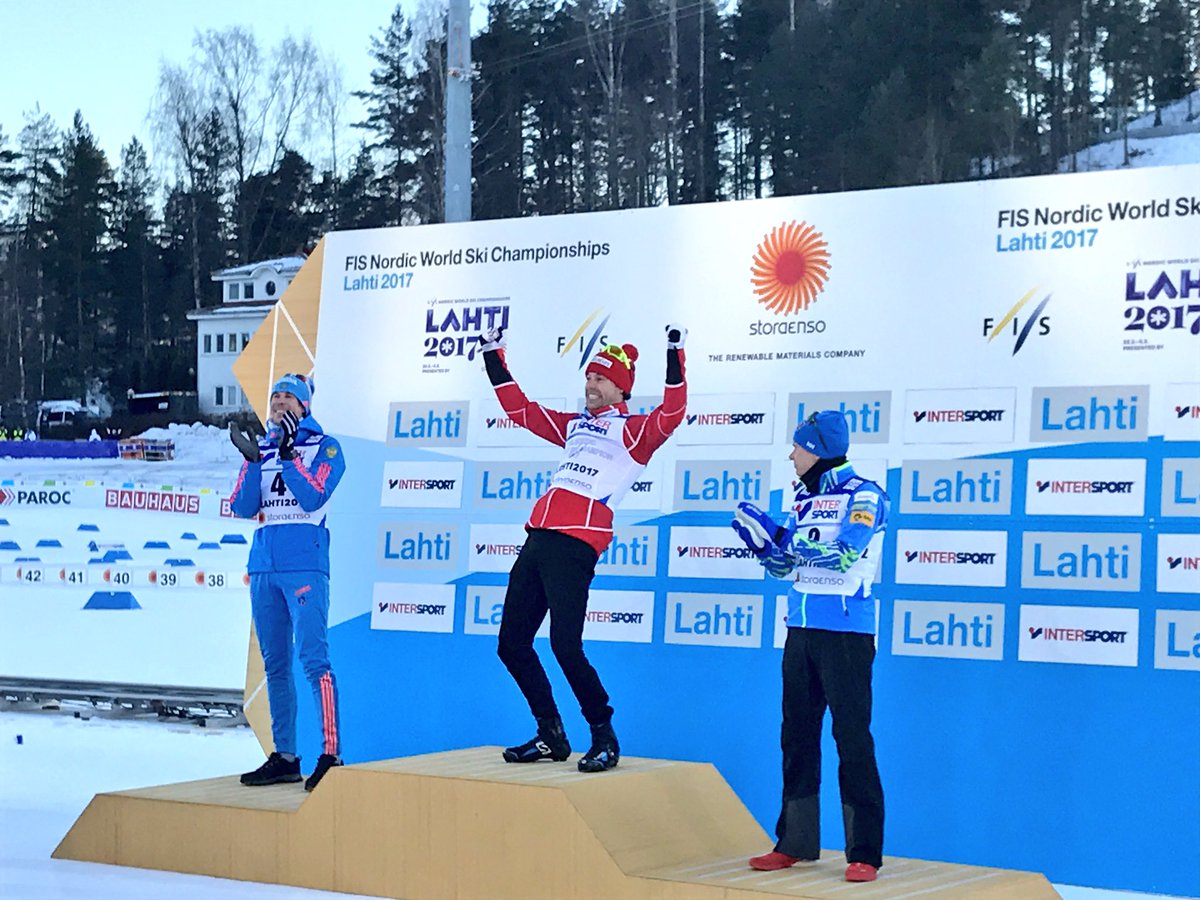
Canada’s Alex Harvey (3) celebrates his win in the men’s 50 k freestyle mass start, his first individual gold medal at a World Championships, on Sunday at 2017 Nordic World Championships in Lahti, Finland. He beat Russia’s Sergey Ustiugov (l) by 0.6 seconds while Norway’s Sjur Røthe (9) can be seen coming in for sixth place, behind (not pictured) Finland’s Matti Heikkinen, Great Britain’s Andrew Musgrave and Norway’s Martin Johnsurd Sundby, respectively. (Photo: NBC Sports screenshot)
FIS Nordic World Championships (Lahti, Finland): Men’s 50 k freestyle mass start
After a week of missing out on the medals at 2017 Nordic World Championships, Canada’s Alex Harvey, a four-time World Championships medalist from 2011, 2013 and 2015, achieved his first individual gold medal in the final race of this year’s World Championships in Lahti, Finland.
Harvey, 28, won the men’s 50-kilometer freestyle mass start in a drag race to the finish. Entering the final descent into the stadium with Norway’s Martin Johnsrud Sundby and Russia’s Sergey Ustiugov, Harvey rode his fast skis past both of them then had the most finishing kick in the final straightaway for a 0.6-second victory. He finished in 1:46.28.9 hours, while Ustiugov followed him across the line in second and Finland’s Matti Heikkinen from behind for third (+1.4), after passing Sundby around the outside of the last corner.
Canada’s Alex Harvey (c) celebrates gold in the men’s 50 k freestyle mass start on Sunday at 2017 Nordic World Championships in Lahti, Finland, with Russia’s Sergey Ustiugov (l) and Finland’ Matti Heikkinen (r) joining him on the podium in second and third, respectively. (Photo: Cross Country Canada/Twitter)
Sundby appeared to miss a pole plant soon after Heikkinen passed him and let off the pace a few meters before the finish. That’s where Great Britain’s Andrew Musgrave continued to accelerate and took fourth place, 2.9 seconds behind Harvey and 0.1 seconds ahead of Sundby in fifth. Norway’s Sjur Røthe followed another 0.4 seconds back in sixth, Switzerland’s Dario Cologna was seventh (+8.9), Norway’s Petter Northug eighth (+12.3), France’s Maurice Manificat ninth (+13.4), and Norway’s Hans Christer Holund 10th (+14.3).
“I had really good skis,” Harvey said in a post-race interview with FIS. “I knew if I came into the corner in second place, that was the optimal position. So I was able to fight hard and hit that last corner in second and slingshot by Martin along the flat and then that was good after that.”
“This is the best race of my life, for sure,” he added. “So I’m really happy.”
Tad Elliott (Ski Club Vail) led the Americans in 27th (+3:16.8). Noah Hoffman (U.S. Ski Team) finished 50th (+8:53.1) and Kyle Bratrud (CXC Team) did not finish.
Canada started four men, with Devon Kershaw finishing 38th (+5:45.5), Graeme Killick 43rd (+7:04), and Knute Johnsgaard in 55th (+12:03.3).
For Harvey, the medal is his fifth at three World Championships and his first individual gold after winning the classic team sprint with Kershaw in 2011.
IBU World Cup (PyeongChang, South Korea): Men’s and women’s relays
Between the men’s and women’s relays on Sunday at the International Biathlon Union (IBU) World Cup in PyeongChang, South Korea, Canada had two teams in the top eighth, with its men’s team finishing seventh in the 4 x 7.5 k and women’s team eighth in the 4 x 6 k. Behind them, the U.S. men finished 10th and U.S. women 14th.
France won the men’s relay by 33.8 seconds over Austria, using a total of 10 spare rounds but avoiding the penalty lap. Martin Fourcade anchored France to the win in 1:12:09.5 hours, after Jean-Guillaume Béatrix initially tagged them in first, his older brother Simon Fourcade raced them into second with near-perfect shooting (using just one spare to clean), and Simon Desthieux picked off one more place to give Fourcade a 16-second lead for the final leg.
Austria achieved second place with Lorenz Wäger, Simon Eder, Julian Eberhard, and Dominik Landertinger combining for zero penalties and nine spares.
Norway finished third (+45.4) with Vetle Sjåstad Christiansen, Ole Einar Bjørndalen, Vegard Gjermundshaug, and Henrik L’Abée-Lund. They had one penalty on Gjermundshaug’s third leg, and used a total of eight spares.
Canada’s Christian Gow, Scott Gow, Nathan Smith, and Brendan Green finished seventh (+3:03.1) with zero penalties and nine spares. After Christian tagged his older brother Scott in ninth, Scott raced them into sixth place before Smith slipped four places to 10th at the final exchange. On the final leg, Green raced them into seventh, requiring two spares to clean.
The Americans finished about nine seconds later in 10th (+3:12.8) with Lowell Bailey, Leif Nordgren, Paul Schommer, and Sean Doherty combining for zero penalties and nine spares, just like Canada. Bailey had originally put them in second at the first exchange, Nordgren dropped to seventh, then Schommer to 13th, before Doherty finally brought them back to 10th out of 24 teams.
In the women’s relay, Germany pulled off a 22.8-second win over Norway, with one penalty and eight spares. Nadine Horchler put Germany in third at the first exchange, then Maren Hammerschmidt raced them into first by the race’s halfway point. From there, Denise Herrmann, a former cross-country World Cup regular, had to ski a penalty lap and tagged off in second, 13.5 seconds out of first. With teammate Laura Dahlmeier sitting out the relay, Franziska Hildebrand anchored Germany to the win in 1:07:35.6 after she used just one spare to clean.
Norway placed second with Kaia Wøien Nicolaisen, Hilde Fenne, Tiril Eckhoff, and Marte Olsbu accumulating one penalty and 11 spares. Olsbu beat out the Czech Republic’s Gabriela Koukalová by one-tenth of a second at the finish, as the Czechs placed for third (+22.9), with Jessica Jislová, Eva Puskarčíková, Lucie Charvátová, and Koukalová (with a total of one penalty and nine spares).
Canada took eighth (+1:34) with Rosanna Crawford, Julia Ransom, Megan Tandy, and Emma Lunder. Crawford tagged in second at the first exchange, Ransom slipped one place to third, Tandy lost another place to tag in fourth, and Lunder ultimately anchored them to eighth.
The U.S., with Clare Egan, Susan Dunklee, Joanne Reid, and Maddie Phaneuf, finished 14th (+3:08.3) with one penalty and 10 spares. After Egan had a penalty on the first leg, Dunklee skied the fastest second leg to move the team from 19th to 14th, then Reid put them in 11th by the final exchange. Twenty-one teams competed in the women’s race.
Ski Classics 90 k Vasaloppet (Sälen to Mora, Sweden)
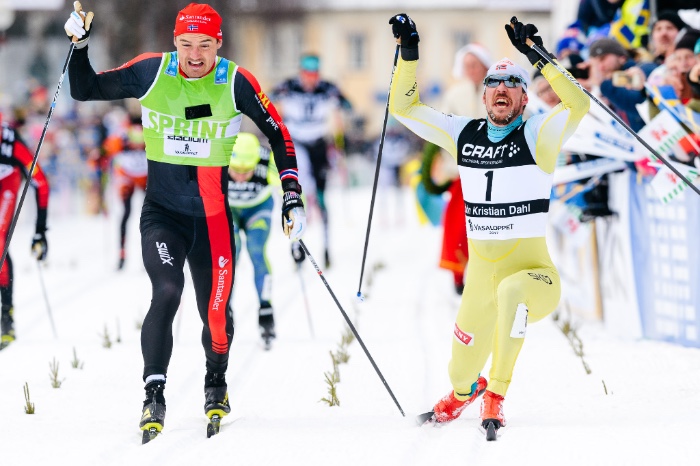
John Kristian Dahl (r) of Team United Bakeries outlunges Ski Classics sprint leader Andreas Nygaard (r) of Team Santander for the win in Sunday’s 90 k Vasaloppet in Mora, Sweden. (Photo: Visma Ski Classics)
[UPDATED] In Sunday’s 93rd annual 90-kilometer Vasaloppet from Sälen to Mora, Sweden, the ninth event of the Ski Classics series, John Kristian Dahl (Team United Bakeries) outlasted Andreas Nygaard (Team Santander) by one-tenth of a second for the win in 3:57:18.1 hours. The race came down to a five-way fight for first, with Stian Hoelgaard (Team Leaseplan) finishing 0.6 seconds back in third. The top 15 men were all within 21.7 seconds of the podium, and Brian McKeever, a member of Canada’s Para Nordic Ski Team, placed 20th (+2:31.1).
“It has been a fight all day,” Dahl said, according to a Ski Classics press release. Three days ago, he had been unsure about starting the Vasaloppet following a back injury. “I was tired already after 30 k and had to let go of the lead group, but I fought my way back taking it step by step and hill by hill.”
In the women’s race, Britta Johansson Norgren (Lager 157 Ski Team) broke away from the field to win by 1:37.9 minutes in 4:19.43.4.
Astrid Øyre Slind (Team United Bakeries) finished second, and Sara Lindborg (Team Serneke) placed third, 9 minutes and 4.2 seconds behind Norgren. Kateřina Smutná (Team Santander) dropped out of the race about halfway through.
“I am very tired but also so happy to win today,” Norgren said, according to the press release. “It felt pretty easy until Oxberg [Sweden] with 30 k to go, but then it got really tough and I had to fight all the way to the finish.”
It was Norgren’s first Vasaloppet win after placing second the last three years. She increased her lead in the overall Ski Classics to 215 points over Smutná, while Tord Asle Gjerdalen continues to lead the men’s overall standings ahead of his Santander teammate Nygaard, who is 349 points behind in second place. Gjerdalen did not race Sunday’s Vasaloppet.
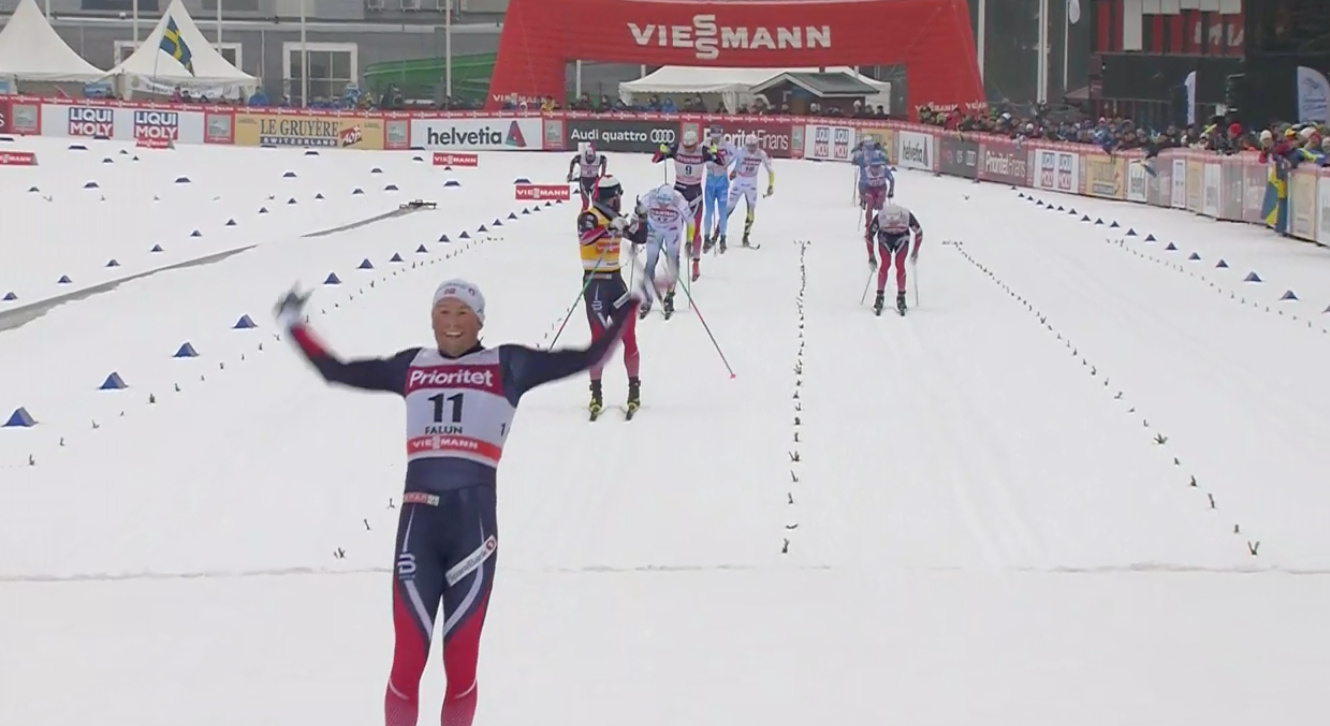
Emil Iversen celebrates his win in the 30 k classic mass start in Falun, Sweden, on Sunday. Norwegian teammate Martin Johnsrud Sundby finished second and Sweden’s Calle Halfvarsson third.
FIS Cross-Country World Cup (Falun, Sweden): 15 / 30 k classic mass start
In the women’s 15-kilometer classic mass start on Sunday, Norway swept the podium with Marit Bjørgen taking the win in a time of 41:28.8 in Falun, Sweden. Crossing just half a second behind her was her teammate, Ingvild Flugstad Østberg in second place. Rounding out the podium was Heidi Weng in third (+8.1).
American Jessie Diggins was the first to cross the line for the U.S. in 10th (+1:37.5). Three other U.S. women finished in the top 30, with Sadie Bjornsen finishing 21st (+2:43.6), Rosie Brennan 24th (+2:57.0), and Liz Stephen in 29th (+3:24.5).
Just outside of scoring World Cup points was American Caitlin Patterson in 32nd (+3:47.6) and Ida Sargent in 34th (+4:02.8). Canada’s Cendrine Browne finished 46th (+5:41.4) and American Liz Guiney 49th (+6:22.6).
After losing the skate sprint yesterday in a photo finish to Italy’s Federico Pellegrino, Emil Iversen ascended to the top step of the podium in the men’s 30 k classic mass start on Sunday in Falun.
The Norwegian was often near the front, but hadn’t tried to lead a breakaway like his teammates Martin Johnsrud Sundby and Sjur Røthe did earlier in the race. In the final two kilometers, Sundby – the overall World Cup leader – put in a sprint to try to drop the field. But Iversen caught up, drafting his veteran teammate into the stadium. In the final up-and-over before the finish line, Iversen made a pass and then accelerated down the finishing stretch to beat Sundby by 1.14 seconds.
“I got motivation from yesterday’s last 20 meters,” Iversen told FIS in a finish-line interview. “So today I fought all the way, and I was really stronger. It is amazing for me to be second yesterday and first today. I’m really proud of that.”
Calle Halfvarsson, who had been falling off the back of the lead pack just a few kilometers earlier, managed to get back to the front and claim third place for Sweden (+1.72 seconds) in a photo finish with Røthe (+1.76 seconds). Niklas Dyrhaug was next (+2.52 seconds) to give the Norwegian men’s team four in the top five.
In his return to the World Cup stage, Norway’s Petter Northug finished 31st (+3:10.6).
Alex Harvey was the lone Canadian on the start line. After skiing near the front of the field for the early part of the race he was dropped by the lead pack in the final kilometers, finishing 15th (+1:17.5).
Erik Bjornsen and Noah Hoffman took 35th and 37th places for the United States, finishing +3:30.8 and +3:59.8, respectively. SuperTour leader Matthew Gelso — familiar with the Falun course after competing in 2015 World Championships — finished 44th (+5:23.6), and Andy Newell placed 53rd (+7:45.3).
IBU Open European Championships (Duszniki-Zdrój, Poland): Single mixed & mixed relay
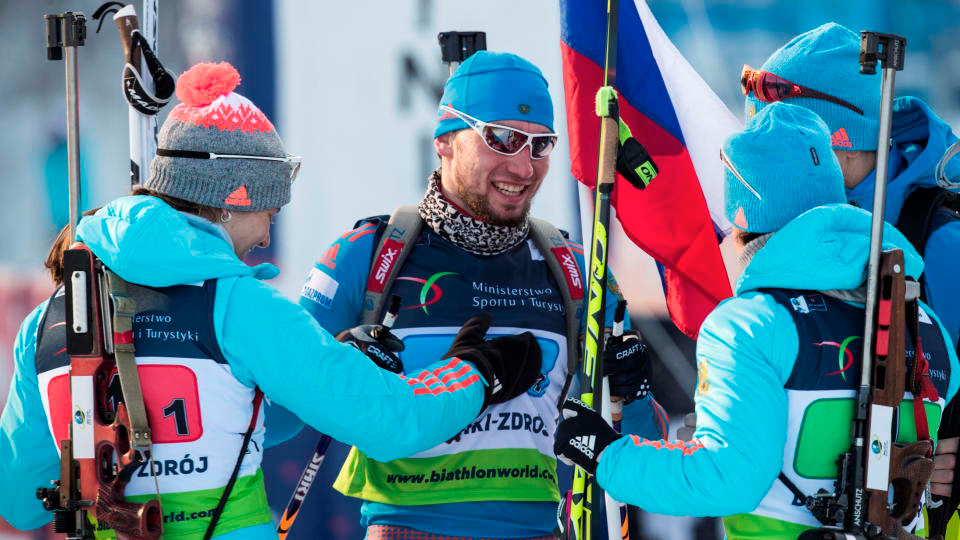
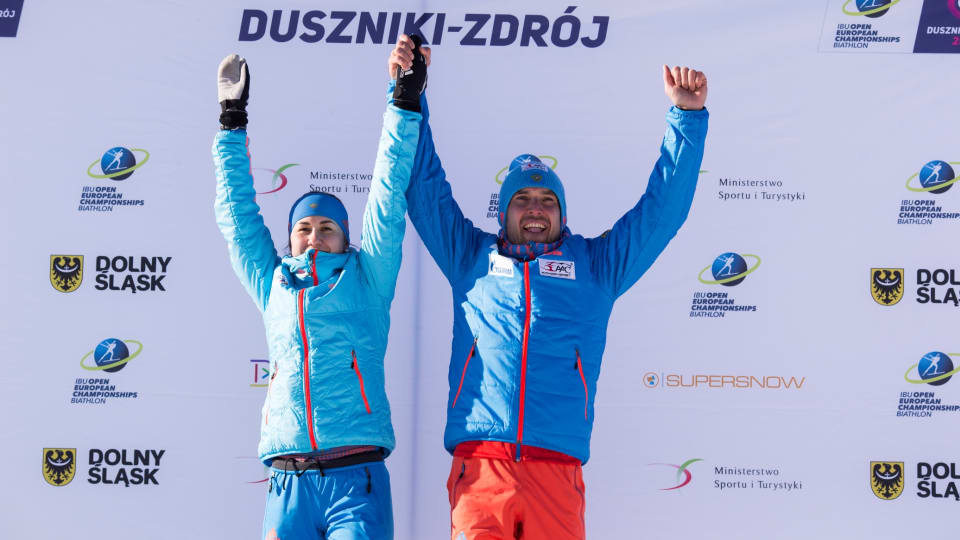
Russia’s Alexander Loginov (center) is greeted at the finish by his teammates Irina Starykh, Svetlana Sleptsova and Alexey Volkov after anchoring his team to the gold medal in the mixed relay at the 2017 IBU Open European Championships in Duszniki-Zdrój, Poland. (Photo: IBU)
[UPDATED] The Russian victory in the final 2 x 6 + 2 x 7.5-kilometer mixed relay event of the 2017 International Biathlon Union (IBU) Open European Championships in Duszniki-Zdrój, Poland, was only briefly in doubt, when Alexander Loginov skiing the anchor leg required all spares in his prone shooting stage. But with his final shot he managed to also hit that target to avoid the penalty lap, leaving the range with a lead of more than 30 seconds.
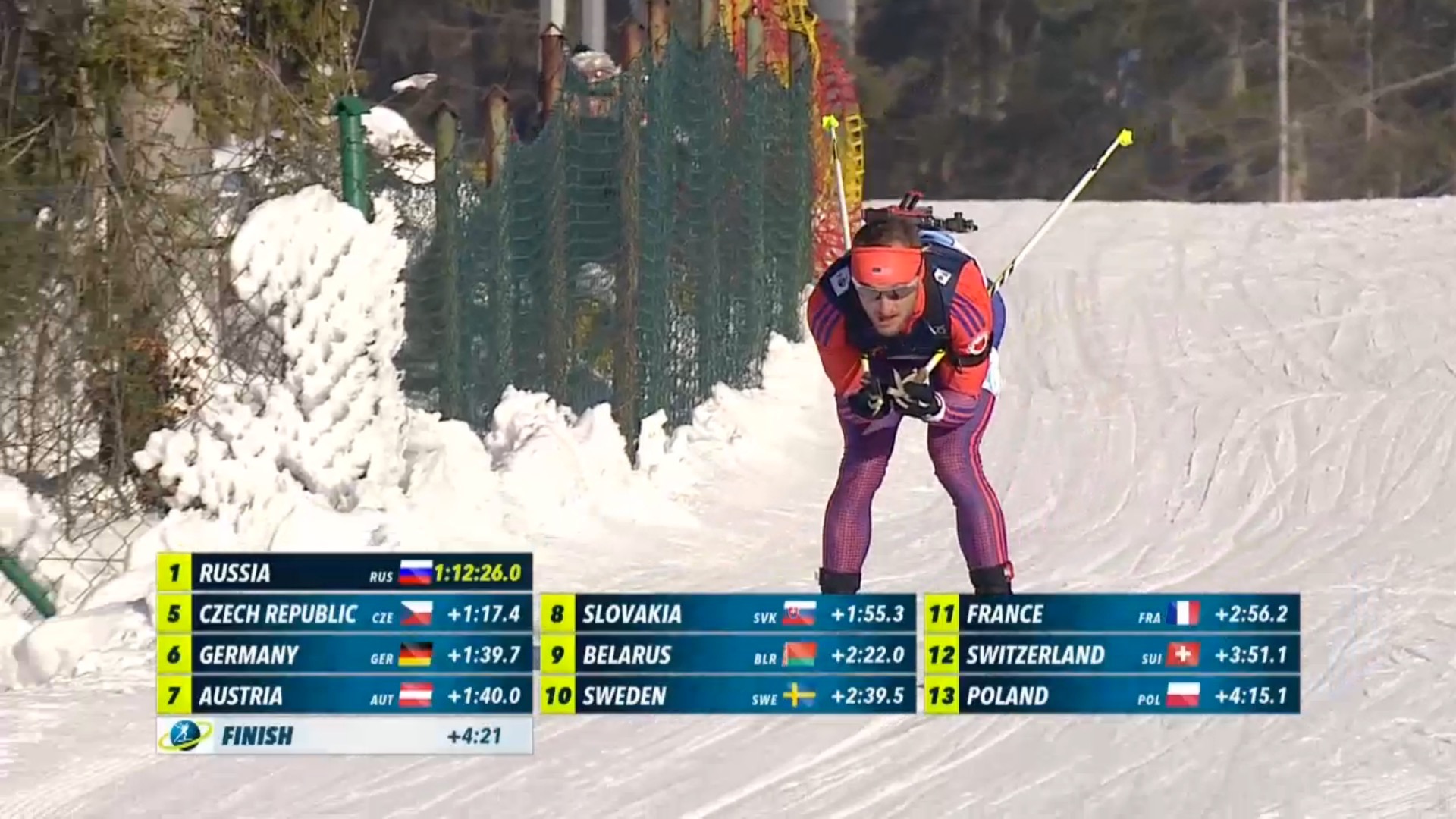
Loginov then did not need any spares in the last standing stage, and could take his time on the final loop. Unlike Russia’s Evgeniy Garanichev earlier in the day during the single mixed relay, he also managed to pick up a flag for the final meters of the race, crossing the line in a time of 1:12:26.0 hours.
The Russian team with Irina Starykh, Svetlana Sleptsova, Alexey Volkov and Loginov led from the first exchange and required only six spares with zero penalties.
With this medal, the 28-year-old Volkov became the most successful athlete in history at European Championships, according to an IBU press release, surpassing the retired Polish biathlete Tomasz Sikora. Russia was the most successful team of the 2017 Open European Championships with six gold, four silver, and three bronze medals.
Behind them, a number of teams vied for the positions on the podium. Sweden initially looked like a strong contender exchanging in second place after the women, but fell back with three penalty laps to only finish 10th.
Still six seconds back after the final shooting, Norway’s Fredrik Gjesbakk caught up to and outsprinted Ukraine’s Ruslan Tkalenko in the finishing stretch to claim the silver medal (+36.4) with the bronze left for Ukraine (+37.1).
“I thought that I made sufficient gap to win silver,” Tkalenko told the IBU. “But in the end, on the final downhill before the finish, I was very surprised when the Norwegian guy passed me, I truly did not expect that.”
The Norwegian team with Karoline Erdal, Marion Rønning Huber, Erlend Bjøntegaard, and Gjesbakk needed nine spares and had no penalties.
Ukraine with Anastasiya Merkushina, Yulia Dhzyma, Oleksander Zhyrnyi (who originally started for Russia before making the switch in 2014) and Tkalenko required six spares, and Dhzyma had to ski a penalty lap only temporarily setting the team back.
Bulgaria finished fourth (+1:16.4), with its anchor Vladimir Iliev narrowly beating Czech Republic’s Lukas Kristejn (+1:17.4) in the finishing stretch. Both teams needed 11 spares and had no penalties.
Jakob Ellingson skiing the anchor leg for the U.S. mixed relay at the 2017 IBU Open European Championships in Duszniki-Zdrój, Poland. The U.S. team finished 14th. (Photo: IBU/Eurovisionsports.tv screenshot)
Starting at the back of the field in bib 20, US Biathlon’s Emily Dreissigacker got her team off to a strong start with a clean prone shooting and one spare round in standing, exchanging in 10th, a minute behind the leaders. Hallie Grossman needed one spare in each of her stages, tagging off to the men in 14th position and now 2:39 behind. Max Durtschi also had one miss each in prone and standing, coming into the last exchange still in 14th position, but another minute back. Jakob Ellingson required all three of his spares in his prone shooting stage narrowly avoiding the penalty lap, and one more in his final shooting stage. As the team from Finland was racing over a minute behind the Americans, he was able to keep the 14th position into the finish (+4:47.4), with a team total of nine spares and no penalties overall.
For Biathlon Canada, Erin Yungblut starting in bib 19 shot clean in her prone stage and required two spares in her standing shooting, tagging off in 18th position and more than two minutes back from first. Leilani Tam von Burg stayed clean in her prone shooting stage and needed one spare in standing, moving up two positions to exchange in 16th place, yet more than four minutes behind the leaders. After the exchange to the men, both Matthew Neumann and anchor Carsen Campbell managed to shoot clean in all of their stages, but lost additional time on the course to finish 16th (+6:39.9) ahead of four lapped teams.
Canada had the best shooting result of all 20 teams starting the relay, with just three spares and no penalty.
Russia’s Daria Virolaynen (l) and Evgeniy Garanichev after winning Sunday’s single mixed relay at the 2017 Open European Championships in Duszniki-Zdrój, Poland. (Photo: IBU)
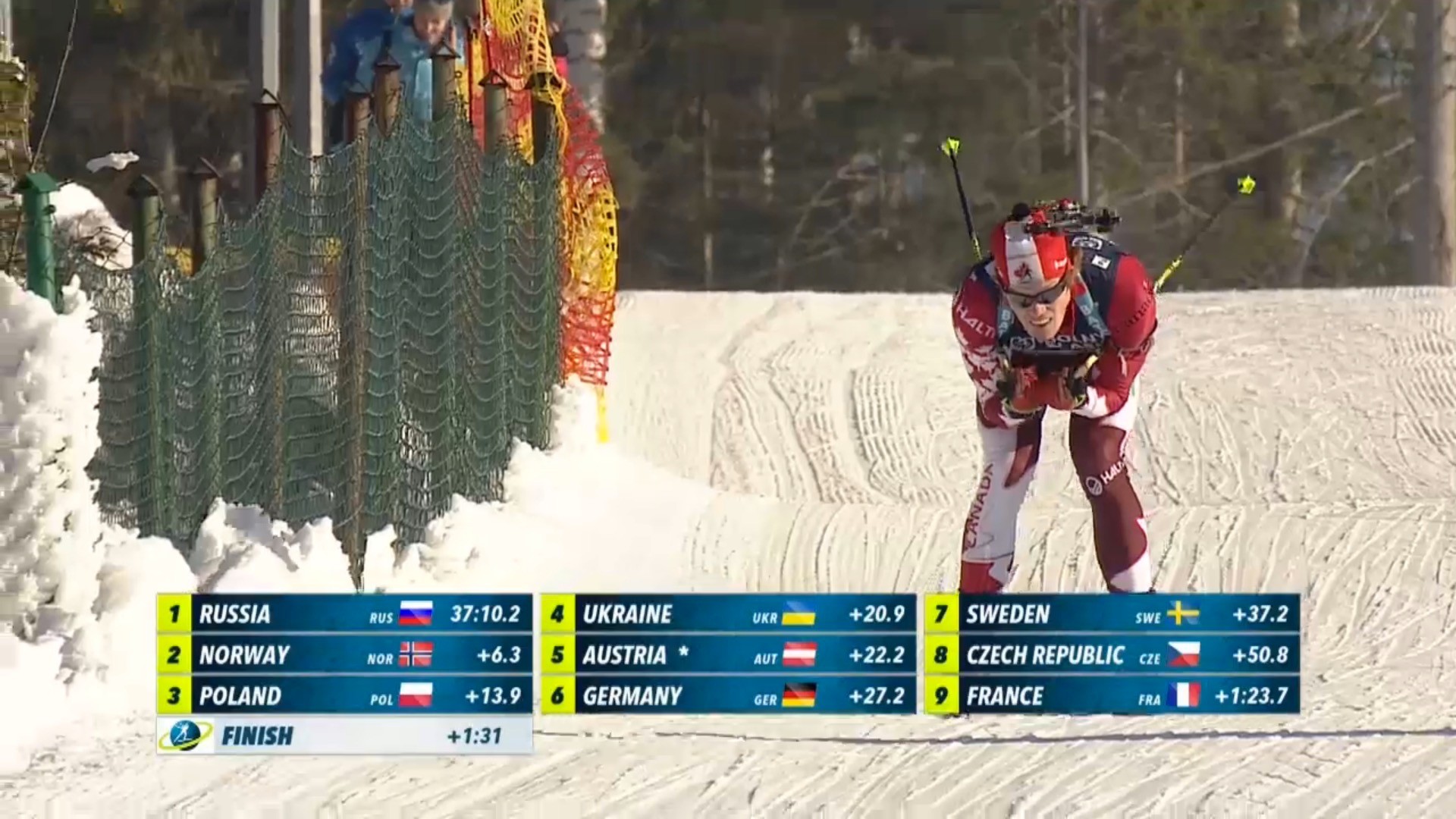
Earlier on Sunday, pretty much the only thing that went wrong for Russia’s Daria Virolaynen and Evgeniy Garanichev in the single mixed relay happened on the last meters of the finishing stretch, with Garanichev gesturing for a Russian flag he wanted to cross the line with. But the handoff was too short and the flag dropped past his outstretched hand to the snow. He glanced back, weighing if his lead was big enough to ski back, but decided it was not worth the risk, instead skiing into the arms of his partner waiting for him behind the line in a time of 37:10.2 minutes.
Russia needed seven spare rounds and incurred zero penalties. Garanichev secured the victory in the final shooting, when he only needed one spare – albeit fumbling a few seconds to insert it – while his direct opponents standing next to him required more time to hit their targets.
“Probably, I took some risk at the last standing,” Garanichev said, according to an IBU press release. “I wanted to shoot fast and clean, but missed with the last shot. But in general, I felt very comfortable; came and worked at the range in my rhythm.”
6.3 seconds behind, Norway with the team of Ingrid Landmark Tandrevold and Vetle Sjåstad Christiansen placed second, with seven spares and zero penalties.
“These are very short loops,” Christiansen commented on the fairly new, single mixed relay format. “You feel the pressure from the crowd and to shoot fast every time.”
The 20-year-old Tandrevold previously earned three bronze medals, including one in the single mixed relay, also with Christiansen, at last year’s Open European Championships in Tyumen, Russia.
To big cheers from their home crowd fans who had come out to the Duszniki Arena in beautiful but cold weather, the Polish husband-and-wife team of Krystyna Guzik and Grzegorz Guzik placed third with just five spares and zero penalties (+13.9), not quite able to keep up with Christiansen on the final loop after leaving the range together within a second.
“It is so nice to win a medal here in Poland,” Krystyna Guzik said. “We were both very disappointed with all of our mistakes in the other competitions. So today, we were relaxed and laughing before the competition, hoping not to have those mistakes again. We did not … and now have a medal.”
It was the first medal for Poland at these championships.
Ukraine with Iryna Varvynets and Andriy Dotsenko finished fourth, also with five spares and zero penalties (+20.9).
Biathlon Canada’s Aidan Millar skiing the final loop of the single mixed relay at the 2017 IBU Open European Championships in Duszniki-Zdrój, Poland. With teammate Sarah Beaudry, Canada finished 13th (Photo: IBU/Eurovisionsports.tv screenshot)
For Biathlon Canada, Sarah Beaudry and Aidan Millar required seven spares during their race and had no penalty, just like the winning Russians and Norwegians, but could not quite keep up with the best teams on the course in the fast-paced race format with short loops somewhat comparable to a team sprint in cross-country.
Beaudry cleaned her first shooting stage and then needed one spare to hit all targets in standing. At the first exchange Canada was 10th, 35.8 seconds behind the then leading team from Poland.
Millar missed one shot in his first prone stage, leaving the range again in ninth position. Then he needed two spares in his standing shooting on the way to exchanging back to Beaudry in 11th (+56.4).
On her second leg, Beaudry had one miss in prone and required two spares in standing, falling back a bit to exchange in 13th (+2:12.0).
On his final leg, Millar was able to shoot clean in both stages, reducing the time gap to the top but not able to make up another position, and finished in 13th place (+1:56.1).
US Biathlon is only represented with two women at the Open European Championships in Poland, and decided to forgo a start in the single mixed relay, instead entering a team in the mixed relay later on Sunday.
Katerina Smutna (left) and Tord Asle Gjerdalen (right) of Team Santander won the 2017 Marcialonga. (Photo: Visma Ski Classics)
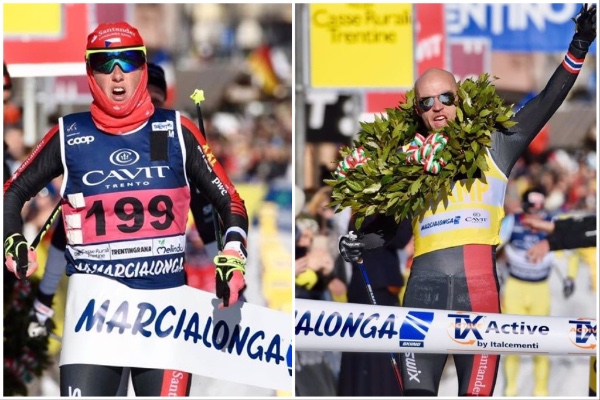
Tord Asle Gjerdalen won the Marcialonga, a Worldloppet and Swix Ski Classics marathon for the third time – in a row. This year was on a shortened course, “just” 57 rather than the traditional 70 kilometers.
The Team Santander athlete finished in two hours, eight minutes, and 36 seconds, edging Johan Kjølstad (Team United Bakeries) and Morten Eide Pedersen (Team BN Bank) in a sprint finish by 2.6 and 2.9 seconds, respectively.
Tyler Kornfield and David Norris of Alaska Pacific University finished 43rd (+5:03.8) and 66th (+10:43.1). Canadian Paralympian Brian McKeever finished 57th (+9:13.5) and guide Graham Nishikawa 81st (+12:56.5), followed by Ian Murray in 85th (+13:37.5) and Erik Carleton in 111th (+17:50.2).
In the women’s competition, Katerina Smutna, also of Team Santander, won her third straight Ski Classics competition. She crossed the line in two hours, 22 minutes, and 46.4 seconds. Britta Norgren of Team Lager 157 was second by just 0.8 seconds, and Sara Lindborg (Team Serneke) third, +4:22.2. University of Utah alum Maria Graefnings was tenth, +10:35.8.
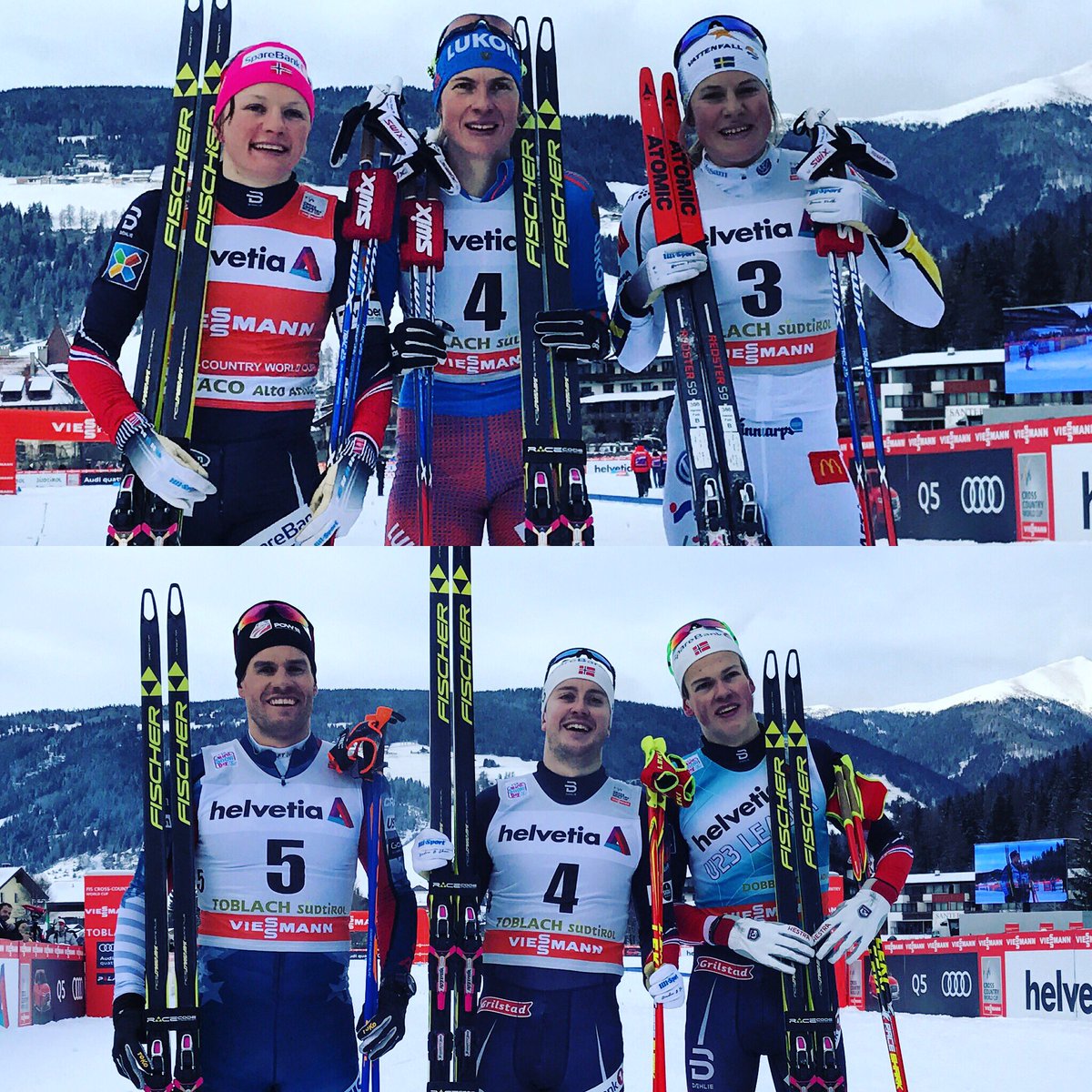
The women’s (top) and men’s (bottom) podiums at the World Cup 1.3 k freestyle sprints on Saturday in Toblach, Italy. Russia’s Natalia Matveeva (top center) won the women’s final, ahead of Norway’s Maiken Caspersen Falla (top left) and Hanna Falk (top right). American Simi Hamilton (bottom left) took second in the men’s final, behind Norway’s Sindre Bjørnestad Skar (bottom center) and ahead of Norway’s Johannes Høsflot Klæbo (bottom right) in third. (Photo: FIS Cross Country)
FIS Cross-Country World Cup (Toblach, Italy): Freestyle sprints
Simi Hamilton is back on the World Cup podium and was three-hundredths of a second away from the win on Saturday in the men’s 1.3-kilometer freestyle sprint in Toblach, Italy. The American qualified fifth and went on to win his quarterfinal then advance as a lucky loser in third out of him semifinal. In the men’s final, Hamilton waited until the last hill to strike and used his conserved energy in the two-lap race to outlast the likes of Italy’s Federico Pellegrino and Norway’s Johannes Høsflot Klæbo at the finish. Hamilton put it all on the line in a photo finish with Norway’s Sindre Bjørnestad Skar, with Skar taking his first individual World Cup victory in 2:47.91. Hamilton placed second for his first podium of the season and fourth of his career. It was also Hamilton’s first time in the final this season.
Klæbo was the second Norwegian on the podium in third, 0.66 seconds behind Skar, Pellegrino placed fourth (+1.27), Hediger was fifth (+1.84), and Norway’s Håvard Solås Taugbøl (who won the qualifier to start the day in 2:47.38) took sixth (+3.77).
“I just had a good feeling that I was a little bit before [Hamilton],” Skar said in a post-race interview with FIS of his immediate finish-line celebration before confirming that he won. “It was very, very tight.”
Skar, who turns 25 on Jan. 22, qualified fourth and won his quarterfinal and finished second in his semifinal, 0.05 seconds ahead of Hamilton.
Also for the U.S., Andy Newell qualified for the heats in sixth and took third in his quarterfinal for 13th overall. Canada’s Alex Harvey qualified eighth and finished fourth in his quarterfinal for 17th overall, and the second Canadian racing this weekend, Len Valjas, qualified 23rd and took fourth in his quarterfinal for 20th.
In the women’s race, Russia’s 30-year-old Natalia Matveeva notched the 12th individual podium of her career (all in sprints) and first victory since 2007. She challenged Norway’s Maiken Caspersen Falla on the last climb and overtook her in the finishing stretch of Saturday’s 1.3 k skate sprint final for the win in 3:04.13. Matveeva qualified fourth to start the day, then placed second in both her quarterfinal and semifinal en route to the victory. Falla won the qualifier in 3:10.89, and continued to dominate her quarterfinal and semifinal before ending up second on the day, just 0.08 seconds out of first.
“I’ve waited a lot of time to be [here],” Matveeva told FIS afterward. “I’m very happy and the Russian team is very happy. Thank you very much my service team. Good job today.”
Sweden’s Hanna Falk reached the podium in third (+2:41), Germany’s Sandra Ringwald placed fourth (+3.46), Sweden’s Ida Ingemarsdotter was fifth (+5.88), and Slovenia’s Vesna Fabjan sixth (+19.39).
Americans Kikkan Randall and Sophie Caldwell tangled in the first semifinal and ended up 10th and 11th, respectively, at the end of the day. Also for the U.S. Ski Team, Ida Sargent qualified for the heats in 16th (behind Caldwell in 15th while Randall qualified 27th), and reached the semifinals as well, placing sixth in the second semifinal after skiing in third into the finishing stretch. Sargent ended up 12th for her best result in over a year.
Finland’s Kaisa Mäkäräinen posts a 22-second win for her first victory of the season and first time shooting without a miss in an individual race since the Ruhpolding sprint almost exactly a year ago. Dunklee leads North Americans in 33rd and qualifies for the pursuit, along with Canada’s Rosanna Crawford (55th), Megan Tandy (56th) and Julia Ransom (60th).
Ski Classics Kaiser Maximilian Lauf (Seefeld, Austria): 60 k classic
[UPDATED] Imagine knee-deep snow drifts over the course of 60 k. That’s what faced racers in Saturday’s Kaiser Maximilian Lauf, the fourth stop in the 2016/2017 Ski Classics series, in Seefeld, Austria.
Team Santander’s Kateřina Smutná and Andreas Nygaard fared best in the conditions, racing to the women’s and men’s victories in 3:43:48.7 and 3:21:44.5, respectively.
Smutna won the women’s race by 10.8 seconds over Astrid Øyre Slind (Team United Bakeries), and Britta Johansson Norgren (Lager 157 Ski Team) finished more than three minutes later in third place (+3:35).
“It was the right decision to go with kick today,” Smutná said after, according to a Ski Classics press release. “It was hard for us to be in the lead and open the tracks for men. We waited for them to catch up and do the work on our behalf. I noticed it was tough for Britta because she was double poling. So, Astrid and I decided to work together in the final section of the course, and it worked perfectly.”
The men’s race was much closer with Nygaard holding off his Team Santander teammate Tord Asle Gjerdalen by 0.6 seconds. Stian Hoelgaard (Team Leaseplan) placed third, another 0.6 seconds back.
“It was a tough race because there was so much snow on the course,” Nygaard said, according to the press release. “At some point, we were knee-deep in soft snow. The pace was slow, but you get tired after a while because you have to work hard when it’s snowing like this. I just kept telling myself that I need to keep up with the guys and win the race in the end. This is something that I didn’t expect to happen when the season started. Let’s see how long I can keep the yellow [leaders] bib.”
The overall Ski Classics series leader, Nygaard is also the sprint leader as well. On the women’s side, Johansson Norgren possesses both the overall and sprint bibs as well.
FasterSkier Editor-at-Large Chelsea Little placed 17th.
Jessie Diggins (U.S. Ski Team) won the second individual World Cup of her career on Saturday in the women’s 5 k freestyle in Lillehammer, Norway, beating four Norwegians by 4.8 seconds or more. (Photo: USSA Nordic/Twitter)
Welcome to The Rundown, your quick primer of need-to-know information about the day’s racing. We’ll be updating this digest as the day goes on with additional results, photos and quotes. The Rundown is NOT a race report; stay tuned for complete race reports later today with interviews from the day’s top racers.
***
U.S. SuperTour opener in West Yellowstone: Freestyle sprints
[UPDATE] The U.S. domestic season opened in West Yellowstone, Mont., with 1.3-kilometer freestyles on Saturday, and Matt Gelso and Jennie Bender emerged as the day’s winners.
Gelso, of the Sun Valley Ski Education Foundation (SVSEF) Gold Team, won the men’s final, and two Alaska Pacific University (APU) skiers, Tyler Kornfield and Reese Hanneman, joined him on the podium in second and third, respectively.
In the women’s final, Bender, of the Bridger Ski Foundation (BSF), held off Stratton Mountain School (SMS) T2 teammates Erika Flowers and Anne Hart, who placed second and third, respectively.
[UPDATE] Americans Lowell Bailey and Susan Dunklee led their teams in 13th and 27th, respectively, and five North American men and four women finished in the top 60 of Saturday’s sprint to qualify for Sunday’s pursuits in Östersund, Sweden. Oh, and France’s Martin Fourcade won his third-straight race (in as many races this season) and his second individual race for his 51st career victory. France made it a double with Marie Dorin Habert winning the women’s sprint.
There aren’t many 5-kilometer skate races on the World Cup schedule. But when they do come around, Jessie Diggins makes sure to capitalize.
The 25-year-old U.S. Ski Team member and Minnesota native rocketed to the second victory of her World Cup career on Saturday, winning the women’s 5 k freestyle in Lillehammer, Norway, in 12:40.3 minutes and by nearly 5 seconds ahead of anyone else.
After winning her first individual World Cup last season in a 5 k freestyle in Toblach, Italy (then reaching the podium three more times in individual races through March 2016), Diggins achieved her first podium of the season in the fourth race of 2016/2017.
She started 34th of 76 finishers, with top-dog Norwegians like Heidi Weng (who won Friday’s classic sprint) and Marit Bjørgen behind her. Diggins trailed slightly at the first 0.8 k checkpoint, but she drew the race’s attention at 2.2 k, where she overtook Norwegian Astrid Uhrenholdt Jacobsen’s time by 2.1 seconds. At the finish, Diggins bumped Jacobsen out of the leader’s chair by 16.4 seconds, and the American would sit in that seat for the rest of the day.
Except she didn’t sit much. Diggins chatted with teammates and team staff, smiled and waved at cameras, and bustled about the finishing area. After her closest challenging, Weng in bib 60, finished 4.8 seconds off her time in second place, Diggins knew she had done it. Bjørgen had already finished and was third (+15.8), Jacobsen fourth (+16.4), and yet another Norwegian, Ingvild Flugstad Østberg fifth (+17.2).
She hugged Weng and told her she had a great race at the finish.
“Before I started, I knew it!” Weng said to her of Diggins’s win.
Diggins smiled, and later stood on the podium between Weng and Bjørgen.
“I’m so happy with my day today. I’m so lucky to have the most amazing team,” Diggins said in a televised interview with FIS. “When you get to train with such cool people, that belief, that confidence, it opens up opportunities. And I had such a great opportunity.
“My coaches and staff work so hard. so when they gave me this opportunity I really had to take it,” she continued. “… It means a lot that when everything goes right you can ski with the best in the world. Hopefully this will mean a lot back home because I’m not special or different in any way. If I can do it, all the little kids back home, they can do it, too!”
While Norway occupied four of the top five, the team had six in the top 10, with Ragnhild Haga in eighth (+31.2) and Kari Øyre Slind in ninth (+32.0). Finland’s Krista Parmakoski placed sixth (+26.9) and Laura Mononen was 10th (+36.1), and Russia’s Yulia Tchekaleva placed seventh (+27.7).
The second U.S. woman in the top 15, Sadie Bjornsen broke through her pattern of 17th in the last three races and place 14th (+41.8). Liz Stephen (USST) scored points in 26th (+51.2) in her first “distance” race of the season.
Caitlin Patterson placed 38th for the U.S., Rosie Brennan (USST) was 48th, and Sophie Caldwell (USST) 59th, and Ida Sargent (USST) 67th.
Canada’s Cendrine Browne (NST U25 Team) 50th, Emily Nishikawa (World Cup B-team) 52nd, and Dahria Beatty (NST U25 Team) 62nd.
Diggins is now third in the mini-tour standings through two days of racing (21.6 seconds behind Weng in first and 0.9 seconds behind Østberg in second), with just Sunday’s 10 k classic pursuit to go, and Bjornsen improved to 12th.
Calle Halfvarsson (c) gets the win for the second day in a row, while teammate Marcus Hellner (l) is pleased to be on the podium for the first time this year. Russia’s Sergey Ustiugov third in the 10 k skate in Lillehammer. (Photo: FIS Cross Country/Twitter)
In the men’s 10 k classic to start the day, Calle Halfvarsson of Sweden made it two in a row, winning the first distance race of the mini tour by 0.8 seconds over teammate Marcus Hellner. The competition is the second day of the World Cup mini-tour, which will conclude on Sunday with a classic pursuit. Halfvarsson also won the classic sprint on the first day of racing. For Hellner, it’s a strong result for the former World Champion after two straight seasons where he only stood on the podium once a apiece.
Russia’s Sergey Ustiugov slotted into third with a hard closing kilometer, moving from fifth place and nearly nine seconds back at 8.3 k to the podium and only 6.7 seconds behind Halfvarsson at the finish.
That left Norway off the podium, but the home team swept the next three places with Finn Hagen Krogh (+7.4), Simen Hegsted Kruger (+13.2), and Martin Johnsrud Sundby (+13.5).
Alex Harvey was the top Canadian in 10th place (+23.5). Devon Kershaw and Lenny Valjas finished 40th (+1:16.7) and 42nd (+1:19.1), respectively, with Graeme Killick 64th (+1:46.6) and Knute Johnsgaard 73rd (+2:22.0). Bob Thompson and Andy Shields rounded out the Canadian roster in 88th and 89th.
Noah Hoffman led the way for the U.S. men, just outside the points in 33rd (+1:08.6). Erik Bjornsen was 45th (+1:22.2), followed by Simi Hamilton 69th (+1:55.8) and Eric Packer 78th (+2:28.7).
Visma Ski Classics: La Sgambeda 30 k Classic in Livigno
Tord Asle Gjerdalen (Team Santander) crosses the finish line first in Sgambeda in Livigno, Italy, on Dec. 3, 2016. (Photo: Visma Ski Classics)
The Visma Ski Classics series began last weekend in Pontresina, Switzerland, with 8 k time trials. Racing continued this weekend just down the road in Livigno, Italy, where racers competed in the second race in the series, La Sgambeda. Skiers encountered superb conditions and firm tracks following cold temperatures the night before.
In the women’s race, a mass start over five laps of a 6 k course, Britta Johansson Norgren of Team Lager 157 took the narrow victory over Katerina Smutná of Team Santander, reversing their finishing positions from Pontresina a week before. Norgren finished 1.3 seconds ahead of Smutná after the two of them broke away from the main pack on the course’s final hill. Sara Lindborg of Team Serneke secured third, 17.4 back of Norgren.
The men raced on the same five-lap, 30 k course as the women. The men’s race also came down to a breakaway on the final climb. Tord Asle Gjerdalen of Team Santander took the narrow victory, rebounding from his sixth-place finish in the Pontresina prologue. Ilya Chernousov of Team Pioneer Investments was 1.3 seconds back. Team Leaseplan’s Petter Eliassen was third (+2.7) after leading most of the race.
Norgren and Gjerdalen are now leading the individual standings, with Gjerdalen’s Team Santander the top team, as the Ski Classics series approaches a month-long holiday break. Racing resumes in early 2017.
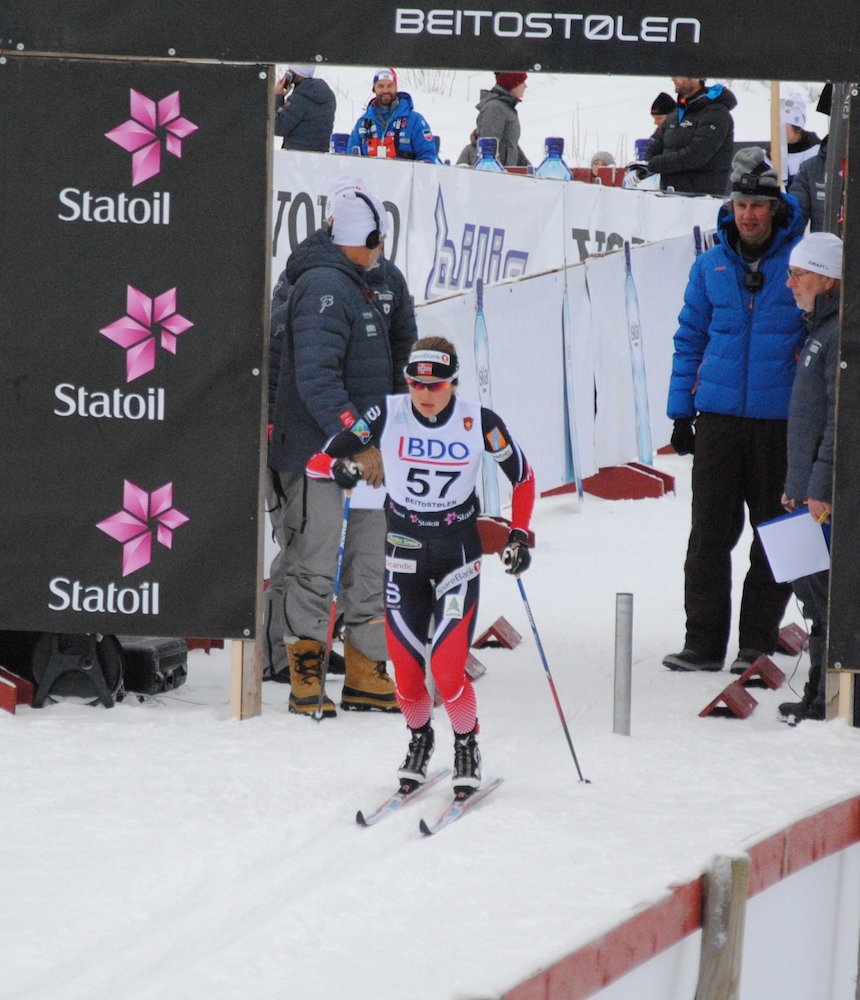
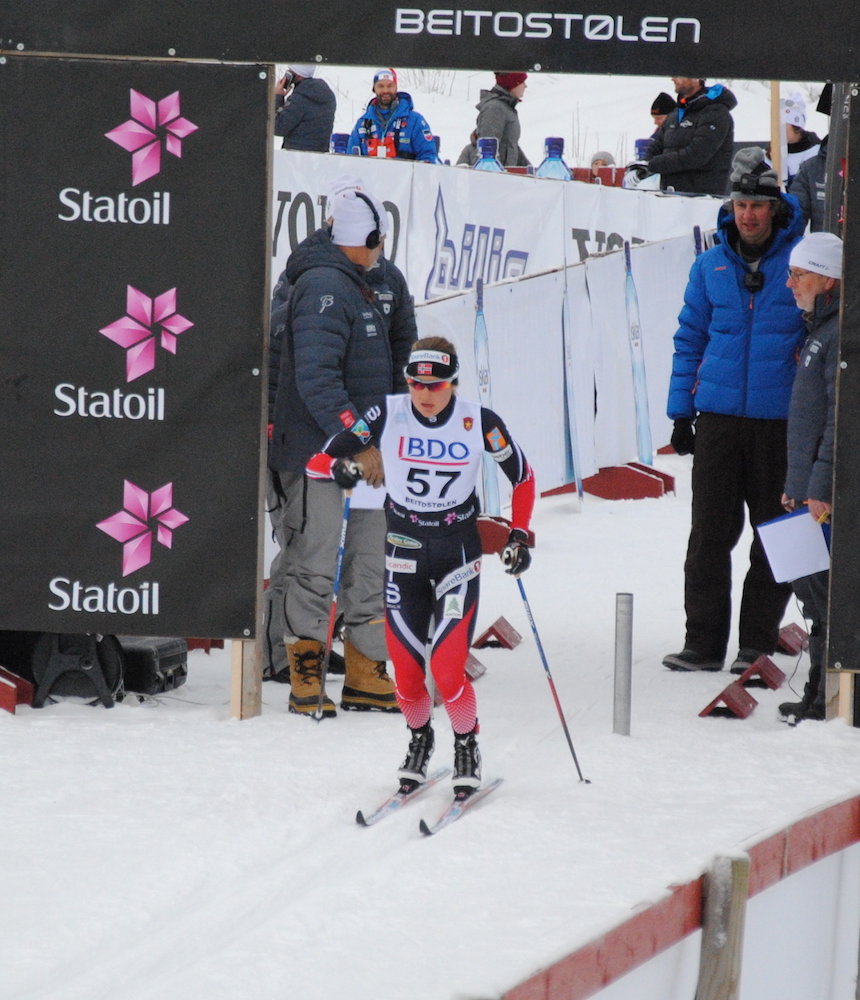
Ingvild Flugstad Østberg (Norway) out of the start in her country’s first FIS race of the 2016/2017 season: the 10 k classic in Beitostølen on Friday. (All photos: Aleks Tangen)
BEITOSTØLEN, Norway — Friday’s International Ski Federation (FIS) season opener in Beitostølen, with most of the Norwegian cross-country team participating, became a demonstration of strength by Norway’s Ingvild Flugstad Østberg.
With Therese Johaug suspended for the first part of the season and Marit Bjørgen out with a cold, Østberg led the race from start to finish and completed the 10-kilometer classic individual start in 26:47.4 minutes. She progressively increased her distance over teammate Heidi Weng, who started just 30 seconds ahead of her, leading her by 6.2 seconds at 2.1 k and 13.2 seconds at the finish.
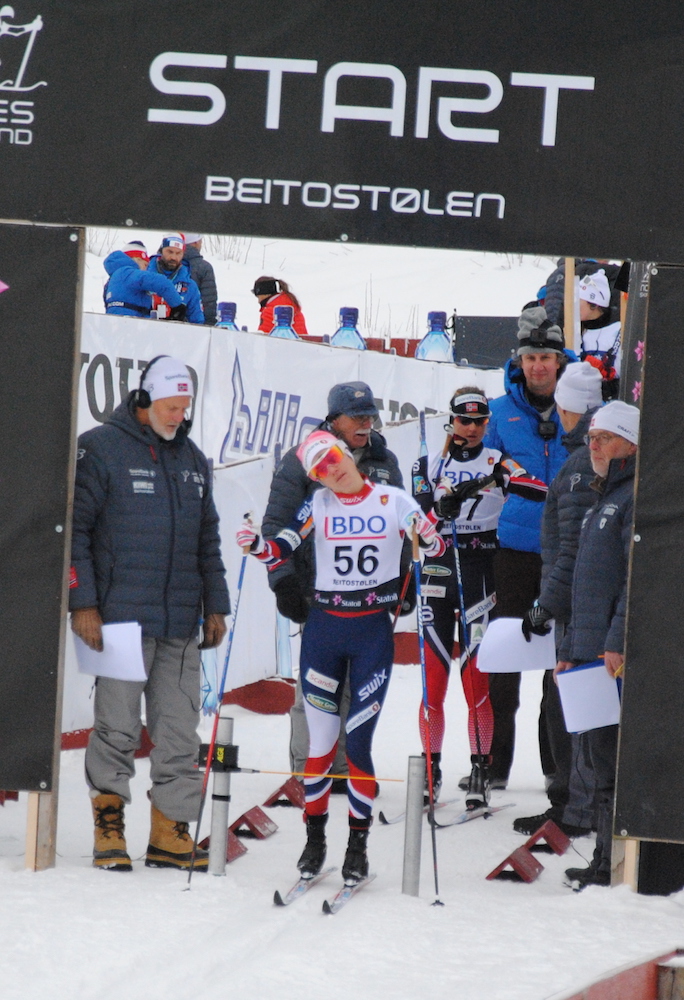
Heidi Weng at the start with Norwegian teammate Ingvild Flugstad Østberg behind her in the FIS season-opening race in Beitostølen, Norway. (Photo: Aleks Tangen)
After the race, Østberg told Aftenposten that Johaug gave her some valuable advice just a day earlier. She said they spoke Thursday and Johaug offered some tips, encouraging her to focus on technique rather than worry about her form at this point in the season. Østberg said she told her to go for it and see how things turn out.
She took that advice to heart and came away with a victory. Østberg said it was strange not having her at the races, but she channeled her inner Johaug and focused on a strong start.
“It tends to work for her here, then I thought that I should try, too,” Østberg said, according to a translation.
“I’m usually a little slow in Beitostølen, but not today,” Østberg told NRK. “I had good skis and a body that played along. It was a good day. I’m very happy that I was able to ski well. Of course I got tired toward the end and consequently my technique deteriorated, but I felt that had good control over my opening so I’m happy.”
Notably, Østberg became the first woman other than Johaug or Bjørgen to win an opening race at Beitostølen since 2003.
“They would have probably been strong had both been here, but one cannot do anything about those who aren’t here,” she said.
The Norwegian national-team women swept the top nine, with Astrid Uhrenholdt Jacobsen coming on strong in the final third of the race for third place, 1:06.4 behind Østberg. Throughout much of the race, her split times ranked fourth of 55 finishers, behind Østberg, Weng and Kathrine Harsem.
Afterward, Jacobsen told Aftenposten that she thought she would finish farther back, noting the first races of the season are often the hardest.
“Third is far above my expectation; I had not thought that I would start there,” she said, according to a translation.
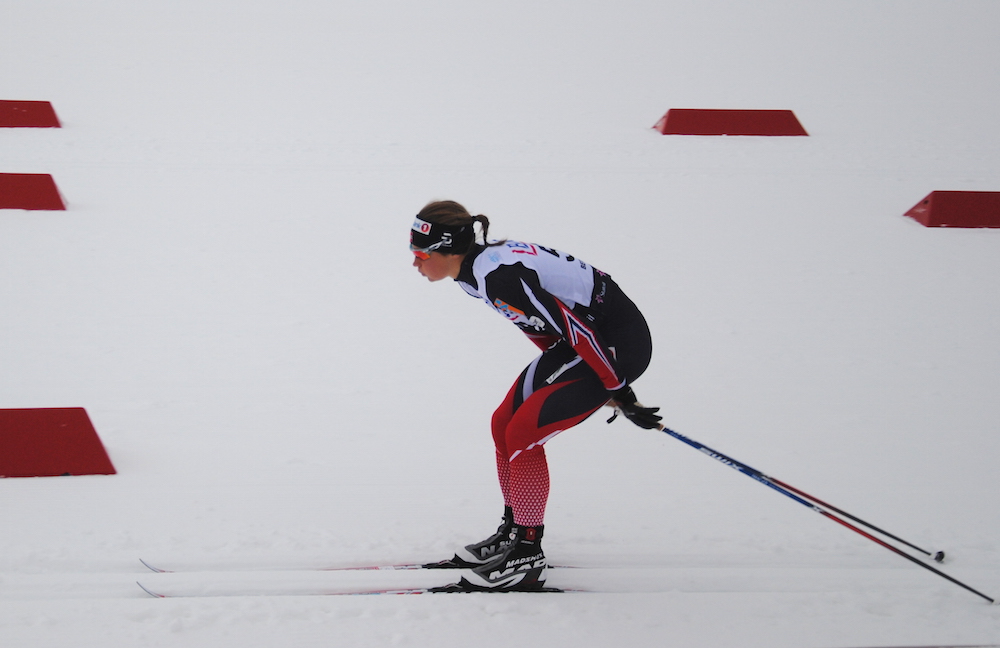
Ingvild Flugstad Østberg (Norway) double poling out of the start in her country’s first FIS race of the 2016/2017 season: the 10 k classic in Beitostølen on Friday.
At just one point in the day, Østberg’s time ranked second: at 1.2 k, where Harsem was 1.5 seconds faster.
“I’m a little surprised it worked this well,” Østberg told NRK after the race. “I’ve felt good all through the summer and fall, but during the last week I’ve felt kind of heavy, but then I suppose I just fooled myself.”
American Cambria McDermott, a former Montana State University skier who graduated this spring, finished the race in 44th, 5:05.3 behind Østberg. After spending the summer training with Henning Skilag and representing the Norwegian club during the race, she told FasterSkier afterward that “it was really cool to see so many fast women. I felt slower by comparison, but it was really fun. It’s an awesome course.”
McDermott, 23, is currently taking classes at Nord University in Meråker, a small town near Trondheim. When asked about the level of competition in U.S. collegiate skiing compared to Norway’s first FIS race of the season, she said, “I think NCAAs was really good preparation for these kinds of races. There are a lot of international racers at NCAAs and they bring a lot of competition to those races, but here, there are the best skiers in the world in this race, so I think it’s hard to find a race that matches that.”
She’ll continue to race for Henning Skilag in Europe for most of the season, competing in most of the Norwegian and Scandinavian Cups before heading back to the states for U.S. nationals in early January.
“I’m excited for tomorrow,” she said of Saturday’s 10 k freestyle in Beitostølen. “I like skating and it’s a little less complicated than classic skiing with the wax and everything.”
Canada’s Madison Fraser (Team Hardwood) racing to 50th in the women’s 10 k classic FIS race on Friday in Beitostølen, Norway. (Photo: Aleks Tangen)
Canadians Madison Fraser (50th place, +6:33.8) and Isabella Howden (55th, +8:21.6) also competed on Beito’s opening day. After the race, Fraser, of Team Hardwood, said she felt good about her effort.
“It was the first race I’ve done at this level,” she said. “So, really cool to see my name on the same list as Weng and Østberg, but it was hard, but nice course, really flowy. It felt good to get some intensity in. This is our first race over here.”
Reflecting on how she tackled the course, the 20-year-old, first-year senior described two big hills at the back of the course.
“I think that gritting down that extra bit and I was able to stride up the whole thing,” Fraser said. “Some people would hop out and start stepping, which is slower and more energy, so I was happy with that and stepped all the corners, so yeah, I was happy with how I handled everything.”
When the Cat’s Away… Tønseth Wins
In the men’s 15 k classic, Norway’s Didrik Tønseth capitalized in the absence of his team’s leading skier, Martin Johnsrud Sundby (out with a sore throat), beating out 140 men while double poling the entire three-lap course to win in 37:31.9.
Tønseth told NRK after that he was in “disbelief” at the conditions, with a heavy snowfall blanketing the course after the women’s race. He switched to skate skis one minute before the start, and said it worked well.
“It’s awesome to win … it’s good to put others in their place,” he said, according to a translation.
Starting 12 minutes earlier than Tønseth in bib 125, Norway’s Tord Asle Gjerdalen also double poled the entire course and rose from the seventh-ranked time at 4.9 k to second at the finish, 15.7 seconds back.
“It snowed a lot, but I think it was the right decision to skate,” Gjerdalen told NRK, according to a translation.
“When the cat’s away, the mice will play,” he added, taking a playful dig at Sundby.
All of the eventual top-six men double poled, with Norway’s Morten Eide Pedersen finishing third (+24.5) after opening with the fastest 4.9 k split, then ranking second at 9.8 k. A fourth Norwegian, Sjur Røthe took fourth (+33.2), Great Britain’s Andrew Musgrave broke up the sweep in fifth (+40.0), and Petter Eliassen (Norway) placed sixth (+45.4).
Meanwhile, Norwegians Pål Golberg and Petter Northug chose grip wax. While Golberg cracked the top 10 in ninth (+1:19.4), Northug ended up nearly four minutes back in 74th, approaching the finish line with a sedative pace that seemed more like a conscientious choice than a consequence of low physical conditioning.
After the race, an NRK interviewer said to Northug, “You look very smart for someone who finished 74th.”
Northug, looking as calm as he did during the final part of the race, answered, “You can interpret that the way you want. I believe I have good control even if it doesn’t look like it.”
A number of Canadian juniors competed on Friday, with Jack Carlyle, of the Thunder Bay National Development Centre (NDC), leading them in 116th (+5:32.4).
“The competition is super-fierce, which is super cool to see, but it’s not like they’re super human,” the 23-year-old Carlyle said. “It’s just that they’re very fit and fast, but it’s nothing untouchable, it’s cool to see and be a part of that.”
“The competition is super-fierce, which is super cool to see, but it’s not like they’re super human.” — Jack Carlyle (Thunder Bay NDC), after placing 116th in Beitostølen
His NDC teammate, Scott James Hill placed 131st (+6:25.1). Behind him, Ryan Jackson, of Team Hardwood, finished 135th (+7:06.3), Joey Foster (Pierre-Harvey Training Centre) was 139th (+8:17.5), and Kieran Jones (Team Hardwood) was 140th.
Canada’s Scott James Hill (NDC Thunder Bay) racing to 131st in the FIS season-opening 15 k classic in Beitostølen, Norway. (Photo: Aleks Tangen)
Like his Canadian teammates, Jackson chose kick wax and explained that too much grip probably affected his overall performance.
“I unfortunately lost a little bit of time on each downhill, which I really couldn’t afford to do,” the 19-year-old from Midhurst, Ontario, said. “I need to be on top of my game to compete with these guys. It’s a tough competition, but when things don’t come together, you lose a couple of seconds here and there, it’s too bad.”
Asked how he liked the course, Jackson said he loved it.
“I really liked how balanced it is. There’s a lot of spectators around the course so you’re always seeing people,” he said. “My favorite parts were probably the climbs.”
Foster described his race as a “real hard one”.
“My skis weren’t running nearly as quick as I needed them to be,” he said. “I think I went with too much grip and they just started dragging a lot. People were making up big time on me in the downhills.”
Last year’s Team Tempo Prologue in Livigno, Italy, which Team Coop (in bib 1) won. This year, the team prologue will again open the Ski Classics series in Livigno on Saturday, followed by the shortened La Sgambeda classic race on Sunday. (Photo: Visma Ski Classics)
The 2016 Ski Classics kicks off with a doubleheader in Italy on Saturday and Sunday, and the marathon regulars are chomping at the bit to get started with the long-distance race series.
The 15-kilometer Proteam Prologue in Livigno, Italy, on Saturday opens the show for the marathon series, now called the Visma Ski Classics (with a new title sponsor in place of Swix), which has been extended to nine venues this season.
Seraina Boner of Team Coop (now called Team Exspirit) after winning the 2014 La Sgambeda in Italy last season. (Photo: Ski Classics)
On the women’s side, last season’s Ski Classics champion Katerina Smutna of the Czech Republic will be on the start line for the first races this weekend, but she will face plenty of competition. Team Exspirit’s Seraina Boner of Switzerland is eager to take back the overall title, which she has earned three times (2011, 2013 and 2014), beginning with La Sgambeda.
Poland’s World Cup star and the queen of the FIS Tour de Ski, Justyna Kowalczyk, will be doing several of the Ski Classics long-distance events this season with the Norwegian Team Santander headed by the Aukland brothers. And Britta Johansson Norgren of Sweden, who was on the podium at several of the Ski Classics events last season, is one to keep an eye on. Last season, she raced with the all women’s team Ski Pro Am, and this year she is a part of Sweden’s Lager 157 Ski Team, with teammates such as three-time Vasaloppet champion Jörgen Brink of Sweden.
Among the men, 2015 Ski Classics overall champion Petter Eliassen of Norway makes his season debut in Italy this weekend. He will have to fend off a large and deep field of competitors such as Norway’s 43-year-old marathon veteran Anders Aukland and his Santander teammates, including younger brother Jørgen Aukland, and former World Cup skiers Tord Asle Gjerdalen of Norway and Johan Olsson of Sweden.
Norwegian stayers such as Johan Kjölstad, Øystein Pettersen, Eldar Rønning, and John Kristian Dahl of Team United Bakeries, as well as Ski Classics veterans of Team Exspirit, including Daniel Richardsson, Anders Södergren and Jimmie Johnsson of Sweden and Norway’s Morten Eide Pedersen, will certainly do their best to make it a tough season opener from Day 1.
Two unique competitions in Livigno
The Prologue, in which the teams must field at least three racers to compete, was added last year, and is a team effort where the third person’s time determines the team result. The next day, on Sunday, the skiers embark on the first distance event, the now-24-kilometer classic technique La Sgambeda.
Team Santander’s Anders Aukland (c) after winning the 2014 La Sgambeda in Livigno, Italy. Johan Kjølstad (l) and Øystein Pettersen (r) both of Team United Bakeries, placed second and third, respectively. (Photo: Ski Classics)
Team Exspirit (previously known as Team Coop) won the prologue last year and is aiming to defend the title this year.
“We have had great preparations here in Livigno, skiing on the race course and acclimatizing to the high altitude,” team member Jimmie Johnsson said in a press release on Friday. “Of course, we’re aiming to defend our victory and we’re faster this season than ever before.”
Team Exspirit’s Seraina Boner won La Sgambeda last year after breaking away from the field on the hard climb at the turning point of the course. This year, the course is shortened to from 35 k to 24 k due to lack of snow and is also flatter. While Boner prefers more elevation gain, she was still optimistic before the race.
“The tougher course fits me better than the flatter one we have now,” she said. “But I will do my best, and I am really excited to finally start the long distance season together with my teammates.”
While the Team Prologue is only open to professional teams registered with the 2016 Ski Classics, La Sgambeda on Sunday is open to amateurs and pros alike.
Saturday’s Prologue will be held on the original course, but due to lack of snow in Livigno, the classic marathon on Sunday will be run on 6 k loops.
“Last season, seven of the nine Ski Classics events had to change their courses due to weather issues,” Ski Classics CEO David Nilsson in a press release earlier this week. “We can just cross our fingers that the political leaders at the environmental summit in Paris this week are able to make the right decision.”
For the 2016 season, there are 28 pro teams registered for the Ski Classics series.
After the season opener in Italy, the Ski Classics takes a break until the Jizerská Padesatka in Liberec, Czech Republic, on January 10, 2016. The race series concludes April 2 with Årefjällsloppet in Sweden as the season finale, as it has been for years. New this year is the Toblach/Dobbiaco Cortina, a 50 k classic race in Italy on Feb. 13.
Vasaloppet matters most
For Madshus racer John Kristian Dahl of Norway, who won the Vasaloppet two years ago, the 90 k race from Sälen to Mora in Sweden is the main goal for the 2016 season.
“It’s the longest and one of the oldest races in the circuit, and very special with the flats. That package makes it very unique, and difficult to win, too. In our world, it’s the championships in marathon skiing, and I’m happy that we have it every year,” Dahl said in an interview with Ski Classics earlier this fall.
Live streaming in English
In order for fans to follow the action live, Visma Ski Classics has launched the Live Streaming “Season Pass” available with English commentary on the app or the Tour Live Center at Visma skiclassics.com.
For all the international-racing junkies out there, the Swedish and Norwegian Ski Associations recently announced the nominations to their 2014/2015 national teams.
Sweden’s male and female teams both grew from eight to nine members apiece, according to the Swedish Ski Association, with the additions of Simon Persson, 22, and Jonna Sundling, 20, and to men’s and women’s A-teams, respectively.
Norway’s Cross-Country Committee nominated 25 athletes to its three national teams (women’s, men’s all-around, men’s sprint), according to Norges Skiforbundet. Kathrine Harsem, 25, and , 23, received the call up to the women’s elite team. On the men’s side, Simen Andreas Sveen, 25, and Didrik Tønseth, 22, are new to the all-around team, and Sondre Turvoll Fossli, 20, is the newest sprinter.
Martine Ek Hagen (c) after winning the women’s 15 k skiathlon at U23 World Championships last season in Val di Fiemme, Italy, with teammate and runner-up Ragnhild Haga (l), and Teresa Stadlober of Austria, who placed third (r). (Photo: Fiemme2014)
No longer with the Norwegian national team, Vibeke Skofterud, Øystein Pettersen, Petter Eliassen, Niklas Dyrhaug and Tord Asle Gjerdalen are pursuing different paths and interests.
A 2010 Olympic gold medalist in the team sprint, Pettersen, 31, whose nickname is “The Sausage,” recently told NRK that he plans to focus on distance races while skiing for Team United Bakeries.
“In recent years I trained hard to break into sprints but it did not happen,” he said, according to a translation. “Then I lost faith in myself in the sprint and I cannot continue another season training for something I have lost confidence in.”
He explained that the Vasaloppet and 2015 World Championships will be his main focuses for next season.
According to FIS, a few Norwegians are switching specialties: Pål Golberg from sprint to all-around, Finn Hågen Krogh from all-around to sprint. Simen Østensen returns to the all-around team along with Chris Jespersen, who’s now back on the elite national team.
Sweden
A Team
Ladies
Sofia Bleckur, IFK Mora SK
Hanna Erikson, Åsarna IK
Anna Haag, IFK Mora SK
Ida Ingemarsdotter, Åsarna IK
Charlotte Kalla, Piteå Elit
Sara Lindborg, Falun-Borlänge SK
Stina Nilsson, IFK Mora SK
Jonna Sundling, IFK Umeå
Emma Wikén, Åsarna IK
Men
Calle Halfvarsson, Falun-Borlänge SK
Marcus Hellner, Gellivare Skidallians
Emil Jönsson, IFK Mora SK
Anton Lindblad, Sollefteå Skidor IF
Lars Nelson, Åsarna IK
Johan Olsson, Åsarna IK
Daniel Richardsson, Hudiksvalls IF
Simon Persson, IFK Umeå
Teodor Peterson, Åsarna IK
Team 2015
Ladies
Anna Dyvik, Falun-Borlänge SK
Hanna Falk, Ulricehamns IF
Sofia Henriksson, Strömnäs GIF
Magdalena Pajala, Piteå Elit
Evelina Settlin, Hudiksvalls IF
Marika Sundin, Sollefteå Skidor IF
Julia Svan, Vansbro AIK
Jennie Öberg, Piteå Elit
Men
Simon Andersson, Falun-Borlänge SK
Martin Bergström, Piteå Elit
Jens Burman, Åsarna IK
Martin Johansson, IFK Mora SK
Simon Lageson, Åsarna IK
Jesper Modin, Piteå Elit
Carl Quicklund, Östersunds SK
Marcus Ruus, Gillberga SK
The Norwegian National Team last season on the World Cup circuit. (Photo: FIS/Nordic Focus)
Petter Northug (l) checks back before celebrating Norway’s victory in the 4×10 k relay at 2013 World Championships on Friday in Val di Fiemme, Italy. Calle Halfvarsson (second from l) anchored Sweden to silver, Russia’s Sergey Ustiugov (second from r) was third, 0.2 seconds ahead of Italy’s David Hofer.
FasterSkier’s coverage of the 2013 FIS Nordic World Ski Championships in Val di Fiemme, Italy, is brought to you by the generous support of Fischer Sports.
VAL DI FIEMME, Italy – After so much buildup, so many strategic moves throughout the men’s 4 x 10-kilometer relay at the 2013 Nordic World Ski Championships on Friday, everything almost literally came to a grinding halt in the fourth and final leg.
The worker bees hard done their jobs for the first 30 kilometers of the race, making the last 10 into something like a Sunday stroll on a 10-degree Celsius (50-degree Fahrenheit) afternoon.
As expected, Petter Northug was among those controlling the pace early in the anchor leg. Norway’s relay closer for the last four World Championships, he wasn’t about to use his reserves too early. The frontrunners of the six-man group, Italian David Hofer and Russia’s Sergey Ustiugov weren’t keen on going hard, either.
Just to show how slow they were going, Northug started single sticking, basically walking up the second climb.
“It went slower than when you take your mother on Easter,” he later told NRK, according to a translation. “There were a lot of tactics, and I get what I want.”
As the pack approached the high point of the 3.3 k course, all six men stood up. Hofer did so first to let German Axel Teichmann and Ustiugov pass by, and Switzerland’s Remo Fischer, Sweden’s Calle Halfvarsson and Northug casually tucked behind him. Several thousand spectators watching the antics on the stadium big screens booed with dissatisfaction. Come on guys, this is a race.
Petter Northug prematurely shrugs off Norway’s seventh-straight men’s relay title at World Championships on Friday in Val di Fiemme, Italy. He beat Sweden’s Calle Halfvarsson (second from l), Russia’s Sergey Ustiugov (third) and David Hofer of Italy in fourth for his second gold of the week. (Photo: Fiemme2013)
But in a World Championship relay, that’s how it often goes.
“You need to race a little bit tactical, come from behind, save power for the last round because then you know it will be attacks,” Northug explained.
He quietly hovered near the back within a second or two of the lead until he decided it was time to go. Everyone knew some kind of surge would come, they just didn’t know when.
While the front guys played mind games, American Tad Elliott made up 59 seconds after starting in ninth. He caught the group on the second lap and led Northug up the second climb.
By the next hill, however, Elliott’s effort caught up with him and the 25-year-old Colorado native started to slip behind. Meanwhile, Finland’s Matti Heikkinen continued to make up ground on the leaders after starting nearly a minute and a half back in 11th. Heikkinen reached the group on the third lap and surged to the front early, but failed to hold on halfway through. He fell to the back of the group in seventh while Northug took the lead. Hofer and Ustiugov skied behind him, followed by Halfvarsson, Fischer and Teichmann.
With about 1 ½ k remaining, Northug led the downhill into a relatively boring part of the course. Before then, nothing really happened on the straightaway before the second-last descent. Northug caught his competitors off guard and attacked on the flat, where Halfvarsson in second responded quickest.
In his first World Championships, the 23-year-old Swedish anchor knew this was his moment and managed to get ahead of Northug on the fast downhill, taking the inside corner on the sharp bottom curve.
While Halfvarsson and Northug battled back up to the top, Ustiugov and Hofer put their heads down trying to hang on. The Swede led the final downhill, looking back to see how close Northug was. Really close.
The two sped over the last bump before the stadium and began the much-anticipated sprint showdown. Northug free skated alongside Halfvarsson to take the lead and just before finish, he let everyone know who the winner was. With Halfvarsson a few meters behind, Northug put his hands out and shrugged. No big deal.
Now a nine-time world champion, Northug claimed the seventh-consecutive world champs relay victory for Norway, in which he and Tord Asle Gjerdalen, Eldar Rønning and Sjur Røthe combined for a winning time of 1:41.37.2.
Sweden (Daniel Richardsson, Johan Olsson, Marcus Hellner and Halfvarsson) came up 1.2 seconds short for its sixth silver medal of the week. Russia (Evgeniy Belov, Maxim Vylegzhanin, Alexander Legkov and Ustiugov) edged Italy (Dietmar Nöckler, Giorgio Di Centa, Roland Clara and Hofer) by 0.2 seconds for third, 2.4 seconds behind Norway.
Eldar Rønning hoists teammate Petter Northug after the Norwegian anchor sealed the team’s seventh straight World Championships relay victory on Friday in Val di Fiemme, Italy. Tord Asle Gjerdalen (l) and Sjur Røthe (r) join the party.
“Two hundred and fifty meters before the line I knew it was gold,” Northug told reporters. “So that feels amazing.”
“It’s awful fun to win the relay, and a dream to fight against Sweden at the end,” he told NRK. “I know what that rests on my shoulders. It is almost a scandal to be number two.”
His teammates set him up according to plan. Their scramble leg, Gjerdalen again filled in for Martin Johnsrud Sundby, who’s been out sick since Wednesday’s 15 k (Gjerdalen started in his place and earned bronze). Easily recognized as Norway’s Aviator-wearing guy, Gjerdalen wore his trademark sunglasses while putting the team in second at the first exchange, just 0.3 seconds behind Germany’s Hannes Dotzler.
(The Germans ended up seventh behind Finland in fifth and Switzerland after Teichmann crashed twice on the last lap. “Throughout my career, I’ve never had so much bad luck,” the 33-year-old Teichmann told Südkurier.)
On the second classic leg, Rønning kept the Norwegians close and tagged to Røthe in fifth, 3.4 seconds behind Switzerland’s Dario Cologna, who skied a commanding second leg. Italy, Russia and Germany were also in the mix, along with Sweden’s Olsson, who tagged to Hellner four seconds back in sixth.
“It was tough,” Olsson told reporters. “In my case, maybe the glide wasn’t 100 percent today compared to some of the other competitors on my leg. It’s tough on the mind, too, when you don’t have the maximum skis under your feet.”
After taking his second-straight silver to Northug, who won Wednesday’s 15 k individual skate, Olsson told NRK: “He loses maybe one in a hundred sprints. It’s amazing how he does it again and again. No matter how the race is, he always wins.”
Norway’s Torde Asle Gjerdalen (r) puts the team in contention early on the first of four 10-kilometer legs in Friday’s relay at 2013 World Championships in Val di Fiemme, Italy. Norway won by 1.2 seconds over Sweden.
On the third leg, Legkov lifted Russia to first by the last exchange, 0.6 seconds ahead of Hellner. Røthe came through after the Swede in third, 2 seconds behind Legkov.
“The idea was that Petter should never have been in the lead on the last stage,” Hellner told NRK.
While he didn’t lead from the start, he was close enough to capture it.
“I did everything I could, but I had nothing to answer. I had no strength left,” Halfvarsson told NRK.
“I tried to get a few meters up in the last uphill, but he is too strong,” he explained to reporters. “I had no chance. I’m happy with the silver because this is my first medal, but when it’s so close to gold, it’s not so fun.”
Northug suggested Sweden should’ve chosen someone else and said his team was surprised to see Halfvarsson listed as its anchor.
“But we say thank you,” Northug told SVT. “All glory to him, he beat several strong sprinters, but he still has a ways to go.”
For Røthe, who also started his first World Championships relay, the gold was everything he’d hoped for.
“It’s great to be world champion,” he told NRK. “It was a fun duel with Sweden.”
“A big job for the whole team, but the last guys, they’re just walking, slow, slow, slow and doing a massive sprint,” Gjerdalen told reporters. “That’s entertainment, that’s excitement and a lot of adrenaline. The whole stadium was just quiet. It’s cool!”
At the finish, the King of Sweden, Carl XVI Gustaf, congratulated Northug.
“Nice that you stopped by,” Northug reportedly said.
“We did not talk so much,” he explained to NRK. “He said it was a close fight, and seemed very pleased that Sweden had taken the silver.”
Norway’s Petter Northug charging hard up to the high point of the course on his second of three laps in Wednesday’s 15 k freestyle individual start at the 2013 World Championships in Val di Fiemme, Italy. Northug won the race by 11.8 seconds for his first individual-start title and eighth at World Championships.
FasterSkier’s coverage of the 2013 FIS Nordic World Ski Championships in Val di Fiemme, Italy, is brought to you by the generous support of Fischer Sports.
VAL DI FIEMME, Italy – For Norway, Sunday’s men’s team sprint letdown at the 2013 Nordic World Ski Championships turned out to be a blessing. It was hard to see then, but Petter Northug not advancing to the finals with teammate Pål Golberg was a good thing.
While the 22-year-old Golberg recovered after blacking out, Northug slept off the frustrations and woke up Monday anxious to get back out there. That’s when it hit him: why not do the 15-kilometer individual start on Wednesday?
Sure, it wasn’t historically his best event. Heck, he hadn’t won a 15 k freestyle individual race on the World Cup before. But with seven World Championship golds behind him, Northug, 27, figured he didn’t have much to lose. And he had energy to spare.
The 89th of 95 starters, Northug went into Wednesday’s race with a specific plan: attack for gold. The first of three laps went exceptionally well as he clocked the fastest time through the 1.8 k checkpoint. The mass-start specialist held his high pace for the second 5 k loop, reaching 9.4 k faster than anyone else, and put his head down the third time around.
With race favorites Dario Cologna of Switzerland and Russia’s Alexander Legkov behind him, Northug knew he couldn’t let off and was most concerned with Sweden’s Johan Olsson in front of him. The last starter in soft, sluggish conditions with temperatures up around 8 degrees Celsius (46 Fahrenheit), Cologna struggled early, ranking eighth through 1.8 k at the high point of the course. At the tail end of the second lap, he was third fastest, but fell to fifth at 11.8 k.
“I heard the times of Dario so I knew that it’s going to be a fight between me and Johan Olsson,” Northug said at a post-race press conference. “When I was out on the second lap, then I just focused on the time of Johan.”
Losing some time on the third lap, he focused on staying upright for the long downhill back toward the stadium.
“I started to get a little bit worried, but I knew my plan the last two downs was more to stay on my legs and not to fall,” Northug said. “I knew I had the seconds to win.”
As Olsson, who started six minutes before Northug in bib 77, sat in the leader’s chair at the finish, Northug cruised down into the stadium with a 40-second lead. Looking exhausted, he mustered a final sprint and barely made it through before losing control and veering sharply to the left – almost into the boards.
His head then his back hit the ground, and he exhaled. A few moments later, Northug realized what he had done in winning his first title at this year’s World Championships in an event he didn’t typically dominate.
“When you’re so tired as I was today you don’t hear any crowds; it feels like you’re racing alone,” he said of coming into the stadium for the last time. “You just want to cross the finish line because you’re tired … and then you cross the line and you get a couple minutes to rest and you hear the crowd and you hear the speaker announce that you are world champion. That’s an amazing feeling.”
Petter Northug just before becoming a 15 k freestyle World Champion on Wednesday in Val di Fiemme, Italy. (Photo: Fiemme2013)
Northug took the individual crown with a time of 34:37.1. Olsson was second, 11.8 seconds behind, for his first individual silver medal at World Championships. Norway’s Tord Asle Gjerdalen earned his second individual bronze at worlds (+22.3) after placing third to Northug in the 50 k freestyle mass start two years ago in Oslo, Norway.
Ivan Babikov made history for Canada in fourth, 53.6 seconds behind Northug and 31.3 seconds off the podium, notching his nation’s best finish in a 15 k skate individual start since Pierre Harvey was 16th in 1982. Norway’s Sjur Røthe placed fifth (+1:03.0) and Cologna ended up eighth, 1:21.1 behind. Starting a minute in front of Cologna and skiing with him near the finish, Legkov ended up 25th (+2:28.7).
In a race that was by no measures easy with at least six steep climbs per lap, Northug attributed his success to being hungry for redemption and feeling in great shape after last week’s classic sprint (where he was second), Saturday’s skiathlon (where he was fourth) and Sunday’s team sprint (where he and Golberg placed 11th).
“Today is a day you dream of when you’re an athlete,” Northug said. “You wake up, you feel that you have a lot of power, you want to compete, you want to give your all and also when you then win, it’s amazing.”
Asked what his eighth World Championships gold meant to him compared to the rest, Northug said nothing could rival his 50 k victory in Olso. “To win a 50 k in a world championship is one of the biggest things I’ve done,” he said.
Even so, this individual win was pretty significant and counted just the same, he said.
Sweden’s Johan Olsson pushing to the finish of Wednesday’s 15 k freestyle individual start at the 2013 World Championships in Val di Fiemme, Italy. Olsson took second, 11.8 seconds behind Norway’s Petter Northug.
His closest challenger on Wednesday, the 32-year-old Olsson knew what Northug was capable of. Early last season in Kuusamo, Finland, Northug romped the field in a World Cup 10 k freestyle by 23.8 seconds. A month later, he won a World Cup 30 k freestyle in Davos, Switzerland, by nearly a minute.
“I know when he’s at his best, no one can beat him,” Olsson said.
Aware of the splits throughout the race, with Olsson posting the fastest times through the 9.4 and 11.8 k checkpoints before Northug blew them away, he mostly focused on himself.
“If you should take a medal on the individual start, I think you cannot focus too much on the other competitors,” he said at the press conference. “My biggest enemy on the course is the voices that say, ‘Give up.’ But you have to fight all the time, that’s the way I ski.”
Olsson stole the spotlight and leader’s position from Gjerdalen, who started 71st and bested Babikov in bib 69 to reach the podium. Notably, the 29-year-old Norwegian senior team member didn’t know he was racing until Wednesday morning, when he received a text message that teammate Martin Johnsrud Sundby was out sick, FIS tweeted.
“I knew it was my turn to go,” Gjerdalen said. “I must admit I wasn’t very happy because … it’s been four or five years since I’ve been fast in this individual start. I actually wanted to trade this race for the 50 k.”
Tord Asle Gjerdalen of Norway on his way to his second World Championships bronze in Wednesday’s 15 k freestyle individual start in Val di Fiemme, Italy. Originally not on the start list, Gjerdalen raced in place of teammate Martin Johnsrud Sundby, who was out sick.
Regardless, he gave it his all, attacking the course in his signature Aviator sunglasses. Starting 12 minutes before Cologna, Gjerdalen used the Swiss superstar as fuel when Cologna passed him on the second lap. Gjerdalen thanked him at the finish.
“He turned an individual start into a mass start for me so that’s perfect,” he said.
“Before I started, I knew the skis would get slower and slower so I was really surprised that I made the podium,” Gjerdalen said of the softening conditions. “When I realized that I knew I had a chance and the coaches were shouting, ‘A medal!” I thought, ‘What?’ That was incredible. It gave me speed.”
And the Aviators?
“I use them all the time; they’re fogging, I can’t see,” he joked. “No, they’re really good and it’s become an image for me. I have only one [pair] with me so I hope they don’t break or I lose them, then I have to go buy some new gear. But I suppose [Italy] is the right culture to buy them.”
Blue skies, some uncountable number of ski fans estimated in excess of 105,000, the most prestigious individual ski race in the world, and all of it in Oslo, the self-anointed ski capital of the world. Such a day could end only one way: with Petter Northug once again accelerating away from his competition in the last 400 meters of the World Championship 50 k freestyle on his home turf.
A World Cup men’s 50 k takes somewhere in excess of two hours, and for the most part, the first hour and twenty minutes is a race of attrition. The hangers-on (those with sub-par skis and anyone with less than strong form) slowly slip off the back. Today, however, the pace was not much more than a crawl from the start. The pack still counted 39 skiers at the 30-kilometer mark, even after four times up the two-kilometer Styggedalen climb.
Gjerdalen in the pack.
According to course designer Hermod Bjørkestøl, the loop was laid out to mirror the traditional elements of past Holmenkollen 50 k races. The version initially run in 1929 was a single 50 k and featured five hard climbs. When the course was switched to two 25 k loops, the climbs increased to six. Next came the 16.7 k circuit, used until 2009.
The new 8.6 k loop, created specifically for World Championships, also has those six ascents, albeit in a different form: six laps, six times up the Styggedalen to Frognersetren.
“It costs to go hard up to Frognersetren because… I think it is the hardest course on the circus of the World Cup,” said Tord Asle Gjerdalen, today’s bronze medal recipient.
Despite the abundance of opportunities to attack on this “hardest course,” there were nothing more than feints off the front, with the likes of Pietro Piller Cottrer of Italy, Maurice Manificat of France and Remo Fischer of Switzerland taking a turn pushing the pace a little. Until 27 kilometers, when Canada’s Ivan Babikov took the lead over the top of the course at Frognersetren, there was nothing that could squarely be termed an attack.
Even Babikov merely stepped up the pace a bit, and coming before the long, fast, descent, it wasn’t in a spot in the course
Maxim Vylegzhanin (L) with an Italian, and Alex Harvey in the background.
that could lead to a true breakaway.
“I was leading for a bit because I felt pretty good,” Babikov said simply after the race.
And so the race continued on its way, winding up from the stadium, past the Homenkollen chapel, around the sprint course and back to the stadium – ready to head back out toward the Styggedalen.
It seemed impossible, with the likes of Northug, Marcus Hellner, Maxim Vylegzhanin, Daniel Rickardsson and others still onboard and brutal climbs looming ahead, that there would not be a move of consequence. Could the famed Holmenkollen 50 k really be a repeat of the 50 k skate at the 2006 Olympics, when more than 20 skiers entered the stadium with a shot for the medals?
Hellner, however, was not interested in such an occurrence, and when the group hit the Styggedalen climb for the fifth time, the Swede took off, almost instantly shattering the pack. The gap was five meters, then ten, with only Piller Cottrer on Hellner’s heels.
Stadium announcer Kjell Erik Kristiansen was barely able to contain himself, yelling into his microphone “This is not bullshit! This is serious!”
Marcus Hellner leading the men's pack.
Kristiansen was right, and his only error may have been understating the severity of Hellner’s punch. Piller Cottrer couldn’t hang, and quickly dropped back to the chasers. In his place Sjur Roethe, a 22-year-old Norwegian skiing in his first World Championships, put in the surge to try to close the gap.
Hellner wouldn’t be able to replicate Therese Johaug’s successful early attack in the women’s 30 k. Roethe brought the Swede most of the way back before letting his elders take over. Hitting the crest, Ilia Chernousov of Russia, Northug, Roland Clara of Italy, Dario Cologna of Switzerland, Tobias Angerer of Germany, and Maxim Vylegzhanin of Russia had all regained contact, with Roethe left in no-man’s land a few seconds back.
They hammered into the descent, but by the time the stadium was in sight, the chase pack had closed, albeit at the expense of 17 skiers who were now strung out along the trail behind. The game was now afoot, and when the climbing started again on the shorter, steeper hills above the stadium, Hellner hit the accelerator again.
The top ten skiers opened a solid 20 meters on the remnants of the pack, but once again the drop back to the final lap brought them together. The pressure was certainly taking a toll: no longer was there a large group of skiers clumped at the front. Instead, the 22-skier group was now a snake, winding single file down the track. The skiers’ faces showed the strain
Vylegzhanin, with Northug trailing.
of high speed late in a long race.
“I tried to do something there the last laps,” Hellner told FasterSkier after the race. “But it was hard.”
The gold medalist in the Championships opening event, the freestyle sprint, Hellner hung tough but was eventually relegated to the back of the pack.
“I didn’t have my best day,” he said, but added that he was very pleased to leave with two medals and the experience of racing the Championships at Holmenkollen.
Gjerdalen, who kept a low profile most of the race, was always in the mix but rarely right at the front. He withstood Hellner’s first attack, but said that if someone else had made another move right over the top, he may not have been able to manage.
“It’s like this in these longer races – sometimes you are feeling good and suddenly you are feeling bad again,” Gjerdalen said. That tough fifth time up Styggedalen was one of the bad times, but when the finish rolled around, the tables had turned and he felt “very much stronger.”
Skiers were allowed to change skis up to four times at the lap, and nearly all of the leaders chose to do so with ten kilometers to go. Northug accelerated out of the feed zone at the high point of the stadium, getting a gap into the exchange.
Belarus's Sergei Dolidovich.
Even when Lukas Bauer and ageless wonder Sergei Dolidovich of Belarus skied straight through, Northug was out right on their tails, forcing his competition to briefly surge to get back on board.
Rickardsson, the lengthy Swede who dominated the Drammen World Cup 15 k classic two weeks ago, took over at the front, continuing to push the pace, with Northug just behind. The suffering chasers gained a moment of respite when Rickardsson slowed almost to a stop on the flat at the high point of the course, looking for someone else to take over. There were no volunteers, and he took off again into the descent.
When the pack left the stadium for the last time with less than four kilometers to race, there were seventeen skiers who seemed to be in contention for the win. And it was an impressive group; only a few of the prerace favorites had fallen back. With just a few steep hills left, the skiers steeled themselves against the attacks that were bound to come.
And sure enough, Juha Lallukka, the practically unknown skier who ditched the field when he raced the third leg of Finland’s relay, pushed hard in an attempt to break up the pack. While Northug – the one everyone was worried about – didn’t drop, a number of others did, among them most of the Swedes and Babikov.
By the time the men, led by Vylegzhanin, were zooming down the hill towards the stadium – and the long, steep hill on the sprint
Norwegian Sjur Roethe.
course, called the Gratishaugen – the pack was down to ten men. But even though quite a few athletes were still there, the climb had taken a serious toll on their legs, in ways that they couldn’t yet fully appreciate.
Dolidovich was the first to find out. At 38 years of age and with just one World Cup victory under his belt – a 60 k skate race in Kuopio, Finland, in 2001 – Dolidovich surprised the field by finishing fourth in the 30 k pursuit earlier this week. He was in second place behind Vylegzhanin coming down over the bridge next to the stadium, and while it seemed unlikely that he could beat Northug in a sprint finish, he might have been headed for his first World Championships medal. Then, unable to control his legs any longer, he caught an edge and crashed into the wall, breaking a pole.
The Norwegian fans held their breath: Northug was right behind the Belorussian.
“He was falling, he went to the left so I just jumped over his right ski,” Northug said in a press conference. “So I was lucky there.”
Just seconds later, a Norwegian in a white hat did the same thing going around the downhill corner. And again, the fans gasped.
But Northug was still safe at the front. The unlucky skier was Petter Eliassen, who dusted himself off as best he could, his hopes dashed.
Vylegzhanin after the race.
Going up the Gratishaugen, Vylegzhanin put in a furious attack, which dropped all of the remaining skiers except for Northug and teammate Gjerdalen, who seemed able to follow but barely lost contact going over the top of the hill. The trio sprinted along the far side of the stadium, with the dramatic backdrop of the ski jump, trailed by five men: Rothe, Angerer, Alex Harvey of Canada, Rickardsson, and Lallukka.
If the Gratishaugen was renamed Hellnerbakken earlier this week, then the final hill in the stadium will have to be renamed Northugbakken. Just as he had in the relay, Northug put on his signature move as he began up the hill, passing Vylegzhanin by the time he got to the first corner. Going across the top, he accelerated again. While Vylegzhanin never trailed by much, the outcome of the race was not in question. Northug was headed for gold.
“It went as I expected, me and him fighting for the gold,” Northug said. “He beat me in La Clusaz so that was a big motivation for me. I think it was good that he beat me in December so I wanted to get my revenge on him. He’s a really good athlete, he’s really smart when he’s racing.”
Despite the World Cup victory earlier this year, it was a familiar, sinking feeling for Vylegzhanin, who finished 0.7 seconds
Northug after his fourth medal of the championships.
behind Northug in this event at the 2009 World Championships. And earlier this week, he lost to the Norwegian by the same margin in the 30 k pursuit.
“It is a stimulus for me, that I want to beat him next time,” the Russian said through an interpreter in the post-race press conference. “I have to be better at the finish.”
Not much better – Northug had neither the time nor the energy to do any celebrating or showboating as he crossed the line. And when Vylegzhanin had increased his pace to chase Northug, Gjerdalen had been dropped in a serious way. In fact, it wasn’t clear that he could be able to hold off the men who were charging behind him.
In the end, he did, and earned the first medal of his career.
Less than two seconds after Gjerdalen finished, his teammate Rothe, an even less-likely candidate for a top-five finish today, won a photo finish ahead of Harvey and Angerer, giving Norway three of the top four finishers.
When asked about the team’s plan for the race, Gjerdalen initially made a joke.
The Norwegian fans near the high point of the course.
“The plan was for all five to just go hard, and maybe just get a gap like Therese did, work together and maybe win by two minutes, and split the gold,” he said. “That was the plan. But then how to complete the plan….”
On the serious side, though, he said that the World Championships had vindicated some of their weaker performances.
“This has been a great Championship for us,” he said. “Both for girls and boys. Especially for us boys we have had a long way back and haven’t had the best results early this season, but we don’t even think about that now because it’s the Championships that matters. When we sat down in the springtime and talked about it it was only the Championships that we would think about after this season. So I’m quite happy to succeed now at Holmenkollen. It’s big for us, for the whole team.”
As for Northug, today’s race proved once again that at the end of a distance race, nobody is better at moving fast.
“The most important thing for Petter is that he trains with his brother, who is probably a little bit faster than him when you go form zero to one hundred meters,” said Vidar Lofshus, the Norwegian national team sports director. “And sometimes when you do like a sprint when you are out training, Thomas will even beat him. But when they come to a sprint like this and they are both
Northug (R), with Lukas Bauer (L).
tired, then Petter always beats him. But I think that’s most important. He’s always looking for how to improve his final sprint.”
Northug pushed himself to exhaustion and expected to have an early night tonight. “I was very tired,” he said. “If you are going to win the 50 k then you have to be.”
He said after his victory that he “has no wishes – I am happy,” and that the relay victory still meant more.
“As a team, the most important was to win the relay,” he explained. “Championships in Norway are really the most important because so many people feel like they are part of the team. All the whole of Norway feels that they are almost part of the team.
Martin Johnsrud Sundby and Eldar Roenning, the first two skiers for Norway’s 4x10km relay team sat in the Photo Press Center, eyes glued to one of the many television screens, watching the race unfold.
The tension was high – no laughing or joking, not even a smile. Tord Asle Gjerdalen was on track for Norway, and he, along with Sweden’s Anders Soedergren, had just been reeled in by the chase pack. The race was now wide open with any of six teams in line for three medal spots.
Twenty-six thousand Norwegian fans in the stadium, and an uncountable mass on the trails shared their nervousness. It may have been too much to hope for a clean break early, but one misstep at this point, and not just the gold, but silver and bronze could slip quickly away.
The race gets under way – heading up to Midstubakken.
Forty minutes later, the seats in front of the TV were empty, Johnsrud Sundby and Roenning now waiting in the finish area for anchor Petter Northug. The fears were for naught as the last ten kilometers of the race played out as though specifically choreographed for a Northug-led Norwegian victory.
In what is considered the most prestigious race at any Championship event, Northug threw down what has become his classic move – waiting until the last climb around the back of the stadium to hit the accelerator.
He attacked over the top, instantly opening a five meter gap on Sweden’s Marcus Hellner, and pulling away as he entered the homestretch, plenty of time to pull out a vintage 2007 Northug move, imitating Alex Harvey’s shushing of the crowd before stopping suddenly just before the line and waiting for Hellner, stepping over and claiming victory with the Swede just meters away.
Tobias Angerer brought home the German team in third, the first medal of the Championships for Deutschland, and something of an upset.
Rickardsson leads Vylegzhanin, and Johnsrud Sundby at 5.5km.
The early part of the race played out exactly as expected. Big Daniel Rickardsson (SWE) set the pace from the get go, pushing hard. Just eight minutes into the race, hairline fractures began to appear in the pack, small cracks that quickly widened to substantial fissures.
Halfway through the first leg, the big three of Sweden, Norway and Russia held a six second gap on the chasers, a margin that more than doubled on the climbs up the Midstubakken. The leaders looked strong and controlled, but the rest of the field had broken – faces twisted in pain, they struggled over the top of the climb.
The gap continued to widen clearing the 30 second mark. The crowd, however, was riveted on the front – Sundby had broken, and Rickardsson and Russian Maxim Vylegzhanin pulled away on the final climbs up above the stadium. First seven seconds, then 12 – by the first exchange Sundby was a full twenty-two seconds back, a mere six seconds ahead of the chasers.
“It was one Swede and one Russian who tried to kill me out there,” Sundby said of the hearty beating handed to him. “It was a tough race and I really had to try to do some damage control.”
Sundby said he felt great during the warm-up, but he lost his legs much earlier than expected. “It was awful for me today,” he said, noting that he had excellent skis and that a relay scramble leg hasn’t gone so badly in several years.
“I felt in control all the time,” Rickardsson said, though he couldn’t say as much for his ability to recall his race. He insisted that it was Roenning skiing for Norway, and claimed he put 20 seconds on the Russians as opposed to the Norwegians.
Roenning heads out on the hunt.
When the second-leg skiers took over, the big question was whether Eldar Roenning would be able to ski Norway back into the thick of things. And the answer was yes: while Johan Olsson of Sweden and Stanislav Volzhentsev skied fast, Roenning skied faster, and was able to catch onto them.
“I saw that he took in a lot of time just in the beginning, and then I held him off for a little while, but then he came and I needed a little bit of rest from my pace,” Olsson said. “So I tried to recover so I had some extra power when he tried to push at the end. It was a little bit tactical, which was a little bit unusual for the second leg.”
For his part, Roenning said that he knew he shouldn’t try to catch the leaders immediately.
“It was twenty seconds or something, and I was telling myself that I am in good shape and I would not take a chance to rush out and take in two kilometers,” he said in a press conference. “I wanted to use the first lap… [after I closed the gap] I didn’t know what would happen.”
Sundby was relieved when his teammate regained the lead, saying that he “could only hope that Eldar would have the best day of his life.”
Roenning thought that Olsson would make a move as the second lap came to a close. But instead, the two skied to the finish together, dropping Volzhentsev along the way. When asked whether he felt he was lucky that Olsson didn’t increase the speed, Roenning laughed.
“I don’t think I was lucky, I think I was better than them,” he said.
The gap is almost closed – Roenning made up the remaining distance over the next 300 meters.
By the time they reached the tag zone, the Russians, who had looked so strong just one leg earlier, were now only a few seconds ahead of the chase pack, which included Germany, Finland, Italy, and Japan.
Anders Soedergren of Sweden and Tord Asle Gjerdalen of Norway were the first skiers to embark on the third leg.
“[Gjerdalen] would not give a millimeter in the lead,” Soedergren said. “I knew I had to do the job by myself from the beginning.”
He didn’t seem pleased with Gjerdalen’s stinginess, but the Norwegian said he should have seen it coming.
“When you have [Petter Northug] on the last leg there is no need to keep up the speed,” Gjerdalen said in a press conference. “It is only to follow the other guys. It is quite an easy tactic.”
Perhaps partly because Gjerdalen refused to push the pace or help Soedergren, the pair was caught by a chase pack that included teams from Finland, Italy, Japan, Germany and, temporarily, Russia.
Alexander Legkov had quickly caught the leading Scandinavians, to nobody’s surprise. Legkov has had a stellar season so far; he has won the World Cup mini-tour in Kuusamo, Finland, and stood on the podium a few more times, including as part of the Russians’ second-place relay teams in Gallivare, Sweden and La Clusaz, France.
Roenning leads Olsson and Volzhentsev in to the stadium 7.5km into the the second leg.
But after chasing hard, he imploded, losing over a minute and a half to the leaders and dealing his team, which had been favored for a medal, a blow from which they could not recover.
The pack back together on the third leg.
With two kilometers to go on the third leg, the least familiar face in the pack made a move. It was Juha Lallukka of Finland, who despite being 31 years old has entered just six Olympic and World Championships races in his career. Since his debut in 2002 he has 23 World Cup starts to his name, and attended only two weekends on the circuit this year.
“He’s a skating specialist who is only doing skating races,” Finnish head coach Magnar Dalen told FasterSkier. “He has had a very good season and his last entry for us was in La Clusaz, where he was in the relay and skied a very very good, very solid leg. I know that he is in shape, and that he can be very good on his best day. So it was not a very big surprise.”
Lallukka handed off to teammate Matti Heikkinen with a three second lead over Italy – Roland Clara having been the only one able to even stay close to the Finn – while favorites Norway and Sweden were more than ten seconds behind.
His move shattered the pack.
“It was really hard the last two kilometers,” said Franz Goering of Germany. “I really just hoped I could give [Tobias Angerer] a chance for the medals.”
Lallukka’s work turned out to be for naught. Heikkinen and Piller Cottrer went out together, but they weren’t away for long. Led by Hellner, the three chasers were quickly back in contact.
Heikkinen leads out at the start of the anchor leg.
None of the nations had any interest in doing any work for the first half of the leg. But with every kilometer the group traveled closer to the finish, the more the scales were tipping in favor of Northug and Hellner, the best sprinters in the field, who were lurking patiently at the back.
“Nobody wanted to go hard on the first kilometers—it was pretty easy,” Hellner said.
Finally, as the men headed out on their second of two five-kilometer loops, Piller Cottrer went to the front.
A 38-year-old veteran, Piller Cottrer is a multiple Olympic medalist, but his speed is no match for Hellner or Northug in the closing kilometers.
“I tried to push hard the whole 10 k, because I was the only one that wanted to stay alone in front, and not waiting [for] the finish line…I did everything I could,” he said. “Everyone was saving energy behind me, especially Angerer—hitting my skis and poles all the time.”
Heikkinen, the winner of the 15 k classic on Tuesday, also had an interest in pushing the relay pace in the closing kilometers, but he said afterwards that his legs weren’t as snappy as they were earlier in the week.
Hellner, Northug and Angerer set about tracking down the medals.
“My plan was to go, but I was not strong enough today,” he said. “The body was not working perfect, and that’s why I was not strong enough in the last one-and-a-half kilometers.”
After swinging back and forth around the stadium, the relay course’s closing kilometers sent the men in front of the crowd one last time, before dropping them down to the base of the Gratishaugen—the same hill where Hellner had launched his race-winning attack in the individual sprint earlier in the championships.
In fact, Hellner’s performance on the climb was so impressive that locals had renamed it the “Hellnerbakken”—Hellner’s hill.
He and Northug had pushed through the stadium and into the descent, and the two came into the climb side-by-side—a perfect time for Hellner to make another move. This time, though, Hellner said he was waiting.
“My tactic was not to go so hard in that hill, and instead wait a little bit longer until the last uphill before the finish,” he said. (Afterwards, Northug said that if Hellner really wanted the hill to keep its new name, “he’s going to have to attack harder than that.”)
Still, he and Northug were going hard—hard enough that only Angerer, the German, could stay with them. The three crested the Gratishaugen together; on the next flat stretch, Angerer put in a token attack, but nothing came of it.
Afterwards, Hellner said that he’d been “a little surprised” that none of the other men had made a move earlier, since “they know that Petter is the dangerous one—and maybe me also.”
But Piller Cottrer had already done his best, Heikkinen was having an off day, and Angerer said that he never had an opening—though he said afterward that he still didn’t think Northug is invincible.
Killer Piller leading the way with 5k to go.
“It’s difficult. But…Marcus beat him last week in the sprint, so it’s possible, and [Canadian Alex] Harvey did the same in Drammen two weeks ago,” Angerer said. “I wanted to go, but I was behind Petter and Marcus and had not a chance, and not a place to attack.”
Northug has lost in plenty of sprints, but the number of times he’s been beaten in a drag race at the end of a distance race can be counted on one hand. So long as he’s still in contact with the leaders in the closing kilometers, there’s no one better.
“When I have my tools and my skis with me, and it’s two kilometers left, I always have a good feeling,” he said.
With 26,000 fans cheering him on in the stadium, there was only one thing left for Northug to do: shift into the gear that makes him “the best man, the best skier in the world,” as Gjerdalen put it.
The acceleration, up the last small climb to a knoll running perpendicular to the homestretch, was textbook Northug: fluid and ferocious with crisp technique, each stride inching him away from the chasers.
Hellner had nothing, Angerer had even less, and by the time Northug took the righthand turn to descend the small hill into the homestretch, he’d opened a lead of 15 meters. It wasn’t enough of a gap to repeat Marit Bjoergen’s flag-waving heroics from Thursday, but it did give him time for a couple of gestures.
Piller Cottrer and Angerer setting the pace. Angerer is either trying to incite Petter with a monkey imitation, or he is adjusting his bib.
First, as he entered the home stretch, he raised a finger to his lips to quiet the crowd. And then, just before crossing the line, he snowplowed to a stop, sliding his skis parallel to the finish as Hellner approached, before finally pushing across, into the arms of his teammates.
Northug’s antics sent a predictable spasm through the journalists assembled at the finish—it seemed like every other finisher was polled on his response to the move. Heikkinen was diplomatic—“every person acts, and takes those results, [their] own way”—Soedergren was unperturbed—“he had a chance to do it in front of the home nation, and why not?”—and while Hellner was initially irritated, calling the move “typical of Petter—a little arrogant,” he said that he had bigger concerns than the gesture.
More aggravating, Hellner said, is “that I lost the battle, and I didn’t make the gold.”
“It doesn’t affect me what he is doing [at] the finish line,” he said. “We congratulated him that he was so good today, and we will go home and train and beat him next year.”
Eirik Brandsdal is the wild card to the Norwegian team for the 30K pursuit Sunday. While defending World Champion Petter Northug was a given, and Sjur Røhte, Martin Johnsrud Sundby and Tord Asle Gjerdalen have proven themselves in distance events, few had guessed Eirik Brandsdal as the last one. Unfortunately, the selection is a result of sickness: Petter Eliassen was originally selected for the 30K pursuit, but he is sitting out due to illness. Another hot guess, Eldar Rønning, opted out in order to focus on the 15K classic on Tuesday.
“Eirik was a good sport and agreed to race when asked,” said Morten Aa Djupvik, Norway’s national team head coach. “We had five spots in the race and wanted to fill all of them in a World Championship on home turf.”
And home turf indeed it is for Brandsdal, who grew up only minutes from the venue and has raced in Holmenkollen since he was in elementary school. Needless to say, Brandsdal is excited to race one more time in front of the famous Kollen crowd.
“I was given a unique opportunity to show my very best again. I think it will be amazing,” he said at the press conference Saturday morning. Brandsdal is currently also an alternate to the sprint relay, but doesn’t think racing the pursuit will hamper his chances if he is called on for the sprint relay.
For the other racers on the team, the pursuit is an important bid for the 4×10 kilometer relay on Friday.
“Theoretically, all spots on the relay team are up for grabs, but some names are better bets than others,” said Otto Ulseth, press attaché for the Norwegian men’s team.
Ulseth mentioned Petter Northug, as one of those safe bets, and said they will decide by Monday, but emphasizes that there are a lot of candidates in the squad. Biathlete Emil Hegle Svendsen is another strong candidate, but it all depends on how the other cross-country skiers do in the pursuit on Sunday.
The complete lack of Norwegian men’s distance skiers behind Petter Northug Jr.
Everyone knows Northug dominated the World Cup last year. The man can win everything – distance, sprint, skate, classic, individual mass start, under-water basket-weaving: you name it, he will win it. He’s got a love him or hate him type of personality, but you cannot deny that Northug has the skills to get it done.
The rest of the Norwegian distance men, however, proved that they cannot get it done, as their display of skills – or lack thereof – showed, during the Olympic relay as well as in the overall World Cup.
After Northug, the next best Norwegian male on the distance points list was Eldar Roenning. Roenning was 25th, which is respectable for most nations, but in Norway, it’s a bit of a disaster. To draw comparisons to a major North American sport, it’s as if the New York Yankees fielded a squad of Derek Jeter and eight Little Leaguers, or if the NHL’s Alexander Ovechkin scored only 10 goals all season, or if the NFL’s Brett Favre actually retired and stayed retired. It’s that unheard of.
And after Roenning, it doesn’t get much better. Martin Johnsrud Sundby, one of the most inconsistent skiers on the circuit, was 28th, while Tord Asle Gjerdalen (you may recognize him from his sunglasses) was 35th, and the fifth-highest ranked Norwegian male was Ronny Andre Hafsaas. In case you forget, Hafsaas was the biathlete who won the first race of the season last year in Beitostolen, Norway, then promptly dropped biathlon for cross-country and a spot on the Olympic team – only to compete in one race and do very poorly. For recording a win on the World Cup, you are awarded 100 points towards the overall standings. Can you guess how many Hafsaas finished with? That’s right – 100.
What You Should Know For This Season
While the distance boys are in for another rough season, the Norwegian sprinters are without a doubt the best in the world.
While Ola Vigen Hattestad struggled last year, sprinting is notoriously fickle, and it can be tough to be as dominant as Hattestad was in 2008 – 2009, when he won eight of the 10 sprint races he entered. No less than eight Norwegian sprint men pack the top 30 in the sprint rankings. In addition to Northug in second, Hattestad was fifth, John Kristian Dahl seventh, Anders Gloeersen ninth, Erik Brandsdal 11th, Oeystein Pettersen 14th, Roenning 17th and Simen Oestensen 29th.
Also, if you’re playing any ‘Pick the Podium’ style games with your friends, FasterSkier suggests avoiding Kristin Stoermer Steira. The woman is the best in the world – at finishing fourth. While it probably aggravates to no end, Stoermer Steira seems to almost always win the wooden medal, especially when it matters. Her tally of fourteen fourth place finishes on the World Cup level is heart-wrenching, especially when four of them come at the Olympic Games. Not that fourth is bad, but for a skier with the stats and skill of Stoermer Steira (sixth overall last year, with 892 World Cup points), a podium is not an unreasonable expectation.
The ongoing feud between Marit Bjoergen and Justyna Kowalczyk over the use of asthma medication will – whether you like it or not – be a storyline this season. If things get really heated, expect the two to butt heads on the course, as they have done before.
If you’re expecting Norwegian gossip, FasterSkier could write an entire post full of it, and most of it would be about Northug.
And with World Championships falling in Norway this year, there will be even more pressure on Northug to deliver – especially in the relay. You can bet that if this happens instead of this, Northug’s four Olympic medals from Vancouver won’t be enough to save him from the Norwegian public.
Who You Should Watch
Thomas Northug is a bit of a no-brainer here. At this point, his potential is huge, but so is the pressure being placed on him, especially after besting his older, Crystal-Globe owning brother twice last weekend. He seems to have Petter’s kick, and after a taste of World Cup action last season, Thomas will look for more whenever he can.
Petter Northug (NOR) and Oystein Pettersen (NOR) celebrate their Olympic gold after the team sprint.