From the FasterSkier archive — posts syndicated from athletes’ and coaches’ own blogs between 2004 and 2012, kept online as published. Current coverage is at fasterskier.com.

Tag: Tour de France

  • The Other Tour: Roadside Perspective from the Tour de France

    The Other Tour: Roadside Perspective from the Tour de France

    Recently I’ve become rather obsessed with the Tour de France. Having never watched a bike race previously, I now find myself glued to Eurosport for upwards of five hours a day. There are a number of factors contributing to this shift on my part: an increased familiarity with the landscape and culture of the host nation, some covid-induced couch time, and a newfound respect for the insane feats of athleticism on display day after day. 

    Aware that this is a cross-country skiing publication, I should point out that this famous bike race is not totally without connection to our sport of focus here at FasterSkier. The event that ski fans might refer to as “the Tour” (the Tour de Ski) is the result of an idea allegedly generated in a Norwegian sauna by then International Ski Federation (FIS) cross-country race director, Jürg Capol and ski legend, Vegard Ulvang. Following the germination of this idea, Capol visited the Tour de France in 2006 before the first edition of the Tour de Ski. According to an FIS press release, “the goal of the trip was to gain valuable insight into the logistics, marketing implementation, television and internet production and accreditation services that are part of the organization of any world-class sports event consisting of multiple stages.” 
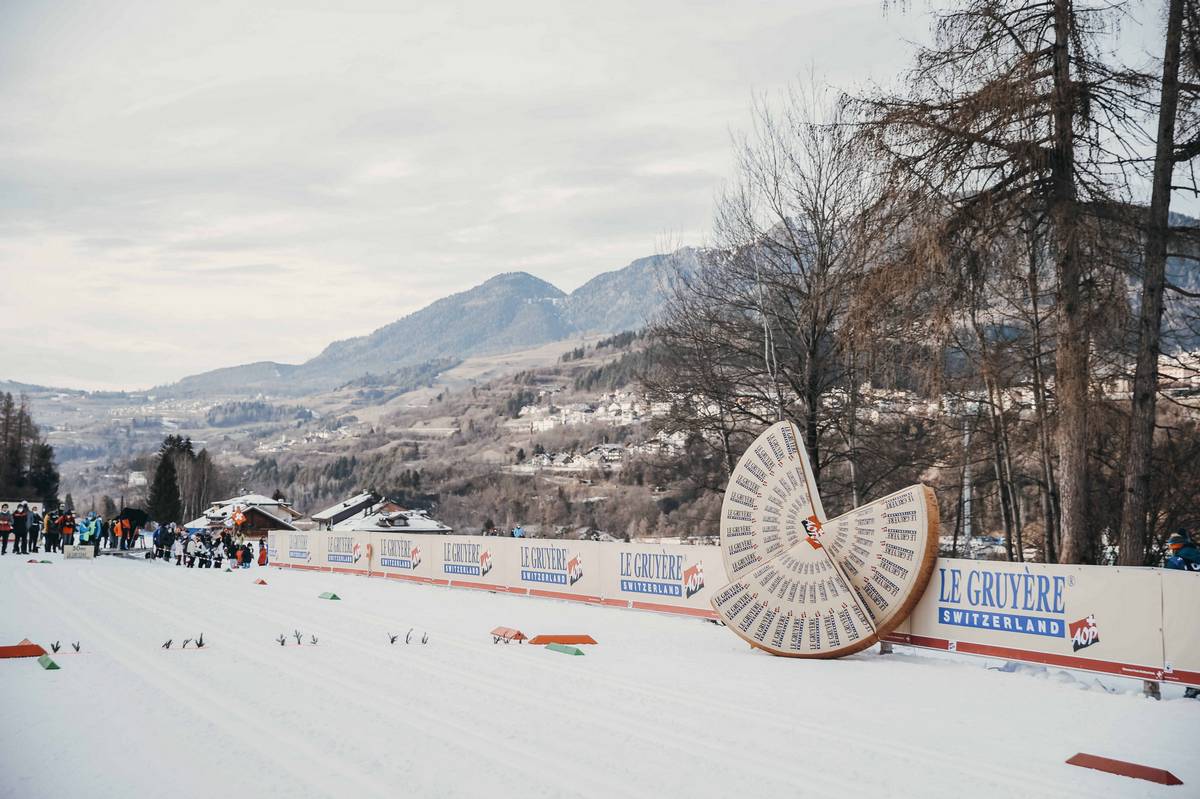
    The course in Val di Fiemme, ITA  prepped and ready for the men’s mass start during the 2021-22 FIS Tour de Ski. (Photo: NordicFocus)

    After his visit Capol remarked, “the logistical accomplishments of the local organizing committees at the Tour de France are truly remarkable… I am convinced that the organizers of the FIS World Cup Cross-Country could all learn a lot by reaching out to other sports and events in the future.” 

    The logistics are just one of the many impressive things about the Tour de France, which saw its 109th edition start in Copenhagen on the first of the month. The spectators are another. Without having witnessed either race in person, I imagine the atmosphere at the Tour de France being somewhat akin to the Holmenkollen World Cup, only lasting three weeks as opposed to two days. 

    To gain some insight on the roadside spectating experience, I reached out to a few people who made it there in person. 

    Anna Gibson grew up watching the Tour de France annually with her family from their home in Wyoming. Gibson said, “even on TV, I could tell how physically and emotionally intense the Tour was. It has always impressed me. But getting to watch the Tour in person made me realize that the race is even more athletically impressive than I ever thought.” 
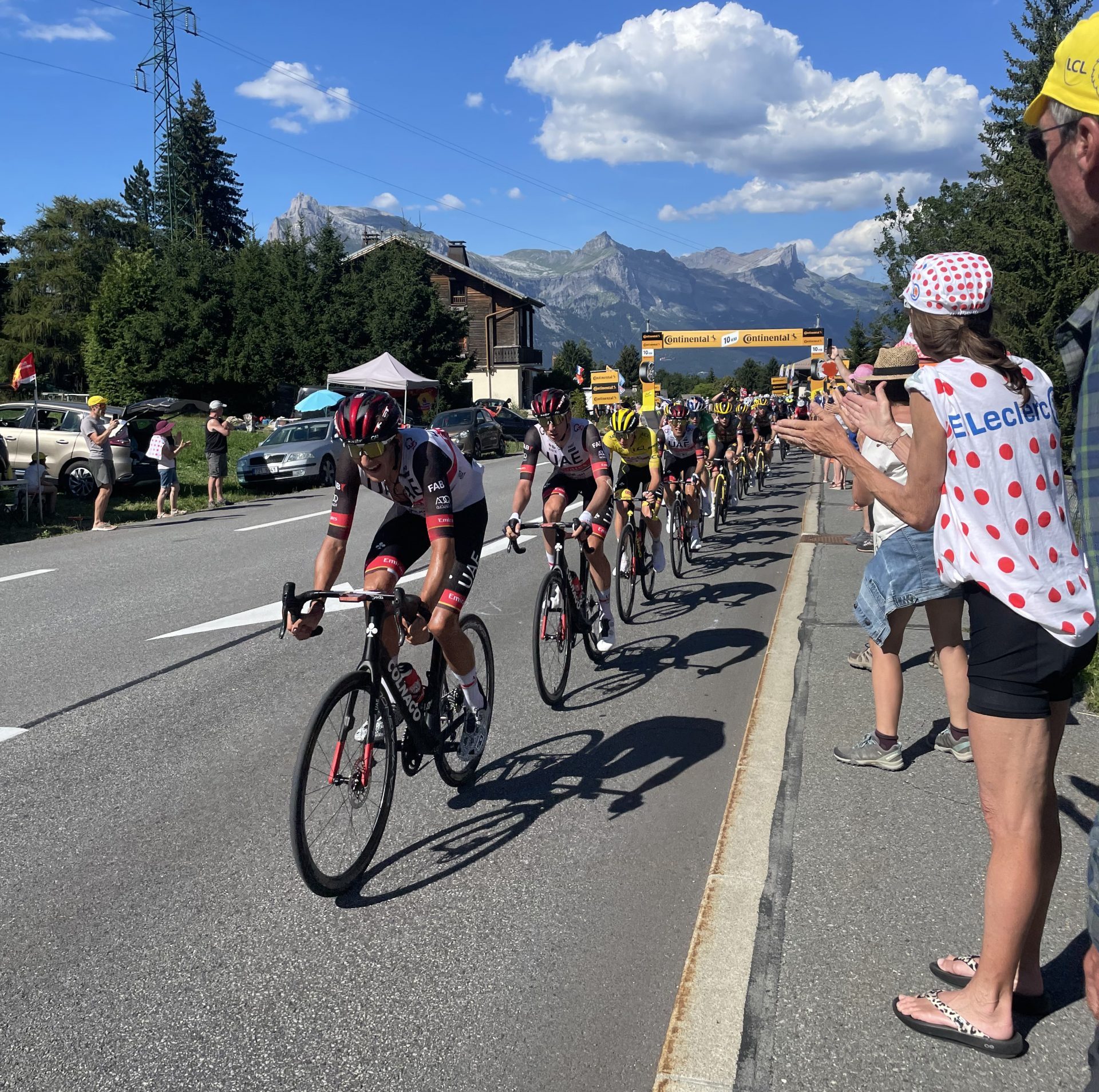
    Team UAE riders lead the yellow jersey, then worn by Tadjec Pogačar of Slovenia, on Stage 11 (Photo: Anna Gibson)

    Consisting of 21 stages stretched over three weeks, bikers race a total distance of 3,328 kilometers (2,068 miles) with just two rest days. Though each stage varies in distance and elevation gain, even the ‘easiest’ of days look challenging on paper.

    Sophie Stuber was on her own multi-day bike adventure with a friend, and planned a route overlap with the Tour in a few places. “It definitely gives you such an appreciation for what they do because our tour days were basically half or a third of the length of a stage and the [pros] climb up 11% grades literally twice as fast. And our days felt hard,” she added. 

    Fans line the road as Tadej Pogačar (UAE) and Jonas Vingegaard (Jumbo Visma) battle on Stage 11 (Photo: Anna Gibson)

    Aside from appreciating the overwhelming physical performances of the riders and the obvious excitement of watching the athletes ride by, spectating at the Tour is a fully immersive experience. As Gibson explained, “What you don’t see on TV is everything that happens before and after the riders pass through… The entire day is a party for everyone involved, whether they watch in town, or camp on the side of the mountain the previous night and picnic all day beforehand, or ride up the climb earlier in the day to find a spot to spectate.”

    Gibson chose the latter option for Stage 11 (which turned out to be a pivotal race day as two-time Tour winner Tadej Pogačar from Slovenia lost nearly three minutes to his rival Jonas Vingegaard of Denmark who currently wears the yellow jersey). The portion of the stage that Gibson rode included 30 miles and 7,700 feet of climbing from Saint Jean de Marienne to the summit of the Col du Galibier. Gibson said, “although this segment was just the middle section of the stage for the pros, this was amongst the most challenging rides of my life, and unquestionably the most fun.” 
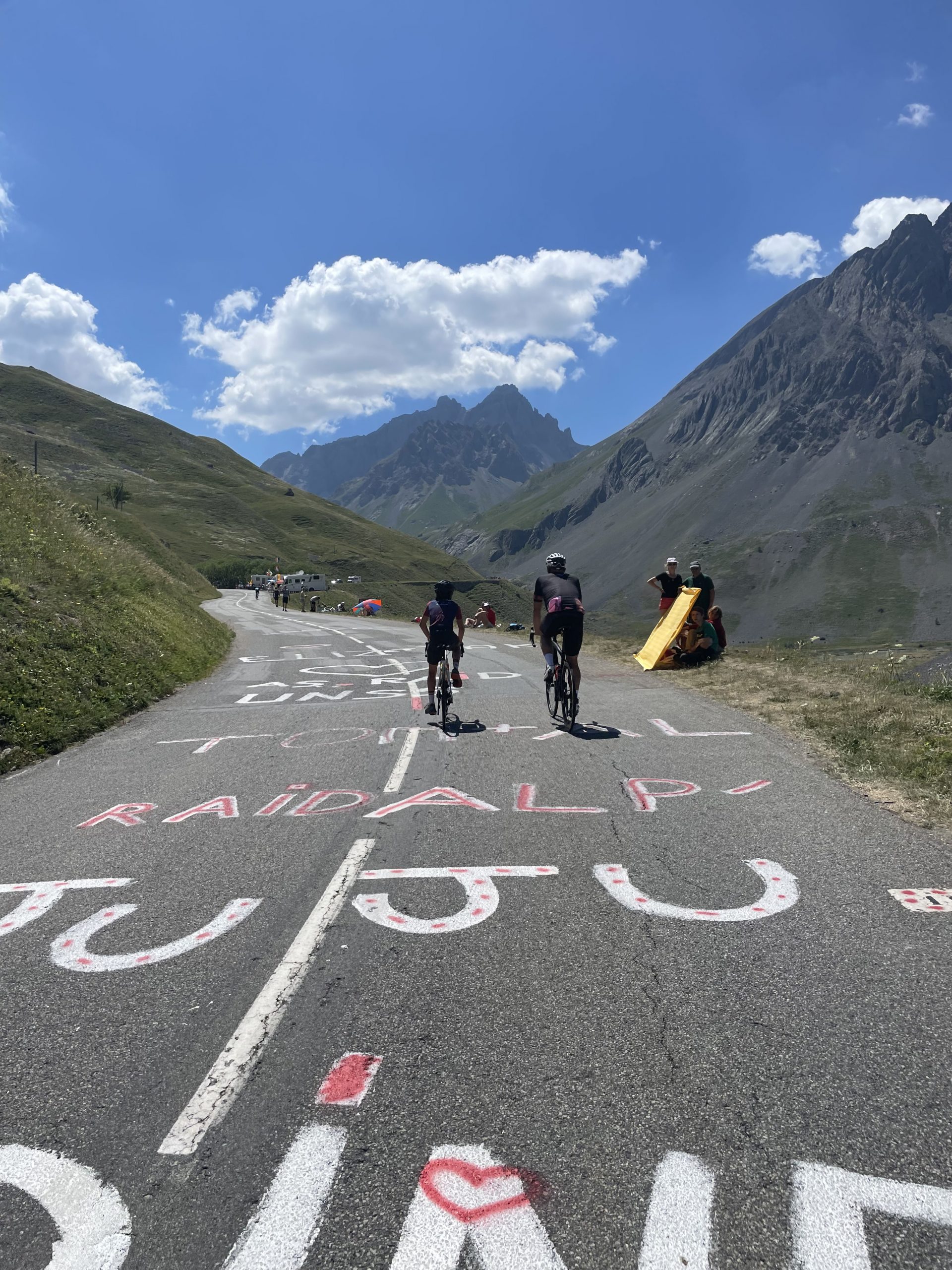
    Heading up the Col du Galibier in the morning before the riders come through (Photo: Anna Gibson)

    The racers aren’t the only ones getting encouragement from the crowds, Gibson said, “I even got small tastes of what it must be like to be in competition, as some of the crowd hollered ‘allez’ or ‘femme’ or ‘bravo’ as I laboriously pedaled onward. People waved flags for me and made tunnels. The energy was infectious, and by the time I reached the top and gently laid my bike down on the rocks, exhausted and exhilarated, I was doing the same for the other random people reaching the summit.” 

    Waiting for the riders to arrive, Gibson talked to fellow fans from all over the world. With no cell service available, anticipation was high to see how the race was unfolding. Gibson said, “It turned out to be a very exciting stage, with small groups of riders separated by several minutes. People (including me) went absolutely berserk watching the race unfold before their eyes. A few of my idols rode through, crusted in salt from the afternoon heat. Seeing them do their thing in person was legendary!”
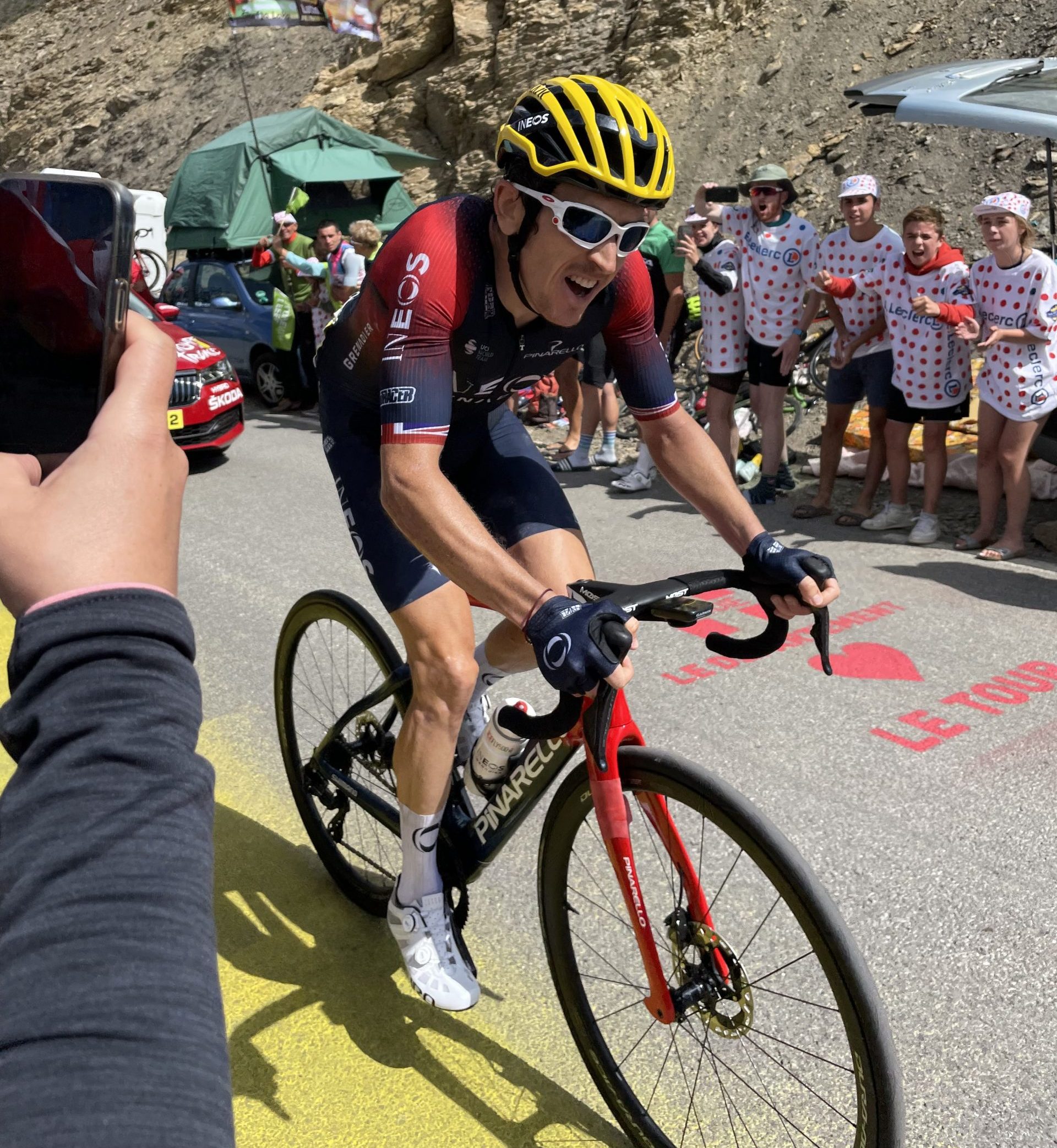
    Victor of the Tour de France in 2018, Geraint Thomas heads up the Col du Galibier, riding for team Ineos Grenadiers (Photo: Anna Gibson)

    With the racers through, the crowds also had to make their descent, which Gibson described as “epic.” She said, “I assumed a position in what was essentially a civilian peloton, ripping down turn after turn. Returning to Valloire at the base of the climb, I came across a big screen broadcasting the end of the stage in the cobbled center plaza. The pace was packed and the party went on.” 

    Though she only watched three of the twenty-one stages, Gibson said, “I can imagine the party goes on in this same manner for the whole three weeks of the Tour. It is a production. And seriously one of the coolest things I’ve ever seen.” 

    After such a testimony, I’m ready to add in-person Tour de France viewing to my bucket list. For the time being however, the screen experience will have to suffice. 

    With 76 hours, 33 minutes and 57 seconds on the cumulative race clock for leader Jonas Vingegaard, only one stage remains before the 2022 Tour de France comes to an end- on the Champs Élysées in Paris on Sunday. Lucky for me, the race watching opportunities don’t end there as the first edition of the Tour de France Femmes kicks off the same day.

  • What Skiing Can Take Away from Armstrong Saga

    What Skiing Can Take Away from Armstrong Saga

    Lance Armstrong and Astana team manager Johan Bruyneel in 2009. Photo: Paul Coster/Flickr Creative Commons.

    The U.S. Anti-Doping Agency (USADA) delivered a definitive indictment to the world on Wednesday morning with the release of its reasoned decision regarding seven-time Tour de France winner Lance Armstrong. In the 1,000-plus page document sent to the International Cycling Union and the World Anti-Doping agency, USADA found Armstrong guilty of using of performance-enhancing drugs throughout his career and of playing a central role in enforcing a systematic doping program on the U.S. Postal team.

    USADA obtained sworn testimony from over two dozen witnesses to the cheating that took place on Armstrong’s team between 1999 and 2005, including 11 former teammates, some of whom had never before admitted to doping. The agency also compiled a comprehensive set of bank statements and emails linking Armstrong to Italian physician Michele Ferrari, who was banned from cycling in 2010 for involvement numerous anti-doping violations.

    In short, USADA accomplished what no courtroom, journalist, lab technician or solitary confessor had been able to do in the 13 years since Armstrong began his storied comeback from cancer and ascent into the cycling stratosphere, and found compelling evidence demonstrating that the performances that turned Armstrong a globally recognized sporting icon were made possible by cheating.

    Armstrong has chosen not to contest USADA’s charges in an arbitration hearing, and is publicly acting as though nothing has happened since Wednesday morning. He tweeted on Wednesday night that he was “Hanging with my family, unaffected, and thinking about this,” with a link to Livestrong’s 15-year-anniversary celebration. Nike, which has helped Livestrong raise millions of dollars for cancer research, is publicly standing by Armstrong and his foundation in spite of the volume of evidence against the cyclist.

    VeloNews predicts that the fallout from USADA’s decision in the sport of cycling will be far-reaching and gradually realized. For athletes and fans of all sports who long held onto belief in his innocence, the report has already forced a wake-up to the reality of cheating in athletics. It’s unclear whether there will be any long-lasting effects on the Livestrong Foundation.

    To some of North America’s best past and present cross-country skiers, Wednesday’s decision is simply long-overdue proof for their belief that Armstrong’s winning streak exceeded what the unaided human body was capable of. The UCI and World Anti-Doping Agency have yet to respond to the decision, but for these athletes the real story is already USADA’s triumph in proving Armstrong’s doping violations.

    “I feel some vindication on behalf of USADA,” said two-time Olympian and University of Vermont assistant coach Andrew Johnson. “I’m happy and proud of their work. I think their ability to do in this case what other agencies haven’t been able to do or haven’t been interested in doing speaks volumes about our anti-doping movement in the U.S. and its ability to work on behalf of athletes. That’s what I’m excited about. We have a system that is working, even if it’s after the fact and has taken too long.”

    While there was cause for celebration in USADA’s achievement, there is also no ignoring the fact that Armstrong’s fall from grace leaves a permanent blight on cycling and, to some degree, American sports.

    “Most people who are involved in sport know how things work and have known of [Armstrong’s] guilt for a long time,” said U.S. Ski Team veteran Kris Freeman. “It’s an embarrassment for all American athletes. He’s one of the most mainstream athletes out there and what he has done is an embarrassment to just about every sport in the country.”

    Freeman says that he was once a fan of Lance and cycling, but has had to stop watching races like the Tour de France because it was clear to him that all of the top riders were cheating.

    “I’m pretty disappointed. I met Lance before my 2002 Olympics. I took a picture with him; I used to have a poster of him on my wall. To have someone that once inspired you turn out to be a complete fraud is very disappointing,” he said.

    The Armstrong case presents every sport the opportunity to examine drug use and the anti-doping movement. Justin Wadsworth, who before becoming the head coach of the Canadian national team competed on the World Cup and in three Olympics for the U.S., sees similarities between the way Armstrong’s performances and those of cheating skiers have stood out over the years: they were so abnormally good they were inherently suspect.

    “Of course these guys doped,” Wadsworth said. “When you’re at athlete at a high level, and of course I’ve never won World Cups, but you just know…what’s physically possible when you ski or bike or run… In a case like Lance it was obvious, and [in skiing] with Johann Muehlegg and the Russian women doping has been there and all of us have known it.”

    Doping has certainly been present in skiing. Recent examples include Estonia’s Andrus Veerpalu, who was caught cheating in 2011, Juha Lalluka (FIN), who tested positive for human growth hormone in the same year, and the 20 Russian athletes who received bans for doping rules violations between 2007 and 2010. In the women’s Olympic 5 k in 2002, initial winner Olga Danilova and runner-up Larissa Lazutina were found guilty of doping well after the Games. Beckie Scott (CAN), Wadsworth’s wife, was awarded the gold medal over two years after the race.

    No new doping scandals developed last winter, but Freeman and Wadsworth both think that the available testing methods are a step behind the cheating — “simply saying you haven’t tested positive doesn’t really mean anything any more,” Freeman said. They believe doping is still present on the World Cup, if to a lesser extent.

    “I don’t believe there’s doping going on in the U.S., but in the international field I believe there’s a lot of doping going on,” he said. Freeman declined to mention any athletes by name.

    “I’ve been beaten by suspected dopers in many races and it’s always frustrating. But it’s just a part of it,” he said. “And I’ve seen that people that I truly believe are clean [are winning] World Cups all the time, so it’s very possible to be the best in the world even when people are cheating. There are so many things that go into our sport. You can’t dope technique. You can’t dope ski feel. That’s one of the very cool things about our sport.”

    Wadsworth, too, thinks that cross-country skiing has yet to achieve complete purity. He also believes that the sport is cleaner now than it was in the late 1990s and early 2000s, pointing to greater variation amongst athletes achieving top results from week to week as proof. Canada’s own success in recent years, Wadsworth says, has been drug-free, demonstrating that wins like Devon Kershaw’s and Alex Harvey’s are attainable without doping.

    “Clean teams like ours can finally really reap the reward of doing things the right way, with hard work,” Wadsworth said. “I think North Americans for a long time got the short end of the stick because of doping…[so] it’s good to see it’s cleaning up.”

    Ultimately, Wadsworth and other coaches hope that when athletes get caught cheating it lets others who want to play by the rules know that they have a shot at winning.

    “I would hope that it would deter other people from [cheating] in the future and give the younger people a greater chance to actually succeed when they do compete,” said University of Vermont head coach Pat Weaver. “I hope the fact that people dope doesn’t deter people. If you love to compete, that should be the main force behind why you’re doing it, and the end result is the end result. The process is just as important as the end result.”

    Weaver went to the Olympics for the U.S. in 1998 and 2002. In the time that he’s been a coach at UVM he has often been asked by his athletes for his opinion on Armstrong’s career: was it clean or not?

    “I do remember seeing disappointment on the athlete’s faces when I said that he doped,” Weaver said. “You could see they wanted to believe that Lance could do this clean, that he was this hero… It’s hard to say to some athletes who maybe idolize Lance, but at the same time it’s not something I could lie about.”

    That fans had to wonder about Armstrong long before evidence came out against him is, for Wadsworth, representative of what it means to care about sports in 2012: that doubt might be a part of things from now on.

    “I never take away from clean performances by special individuals, because those are the things that make sport special,” he said. “[But] when you see something really amazing, you think, ‘Is that clean or not clean?’ Which is kind of sad. I do the same thing: I went to the London Olympics this summer and saw some amazing performances in sports where I don’t really know the background, and I was thinking to myself, ‘Is this a clean performance?’ It’s sad when you’re at that point, but that’s where we are.”

    For athletes like Freeman, the Armstrong saga reinforces his personal commitment to racing clean.

    “I know that I could never live with myself if I doped, and I know that no one on my team could ever live with themselves if they doped,” he said.

    This is all athletes can personally control when it comes to the purity of their sport: their own actions.

    “The biggest thing an athlete can do is start saying ‘I’m clean,’ and being proactive in going along with the testing,” Wadsworth said. “Hopefully the sport will clean up in the long run.”

  • Tour de France: Average Stage Speed

    A few notes about this data. The website that I scrape these results from isn’t, shall we say, the most consistent when it comes to the spelling of athlete names, or even their teams. That can make it difficult to slice the data along those dimensions, since it requires a fair bit of work adjusting and fixing things by hand.

    I think I tracked down all the abnormalities, but you never know…

    In any case, here’s a look at the average speed for each stage for recent Tours. The blue line is the average speed of the median rider, and the shaded region represents the (approximate) range of average speeds for the entire peloton.

    I’m still suspicious of how large the range of speeds is for a handful of stages. In particular the prologue in 2010 and Stage 2 in 2011, but I’d have to spend a lot more time pouring over the data to be sure.

    Related posts:

    1. <Tour de France Bump Plot: Stage 12
    2. <Tour de France Bumps Chart: Stage 14
    3. <Tour de France Charts: Stage 17


  • From France to Sochi, Taylor Fletcher Talks About Whirlwind Trip (with Video)

    From France to Sochi, Taylor Fletcher Talks About Whirlwind Trip (with Video)

    U.S. Nordic Combined team members Bryan Fletcher (l) and Taylor Fletcher (second from left) at Stage 11 of the Tour de France, just 1 kilometer from the top of the Col de la Madeleine with their cycling trip’s VIP members Walter McCormack (c), Jon Schafer (third from right), Eric Oberg, and Jed Hinkley (r). (USST photo)

    Just over two weeks ago, the U.S. Nordic Combined Ski Team set foot in France and immediately hopped on their road bikes. From there, they embarked on a weeklong cycling camp and watched two stages of the Tour de France along the way.

    In all, they rode more than 600 kilometers and tallied some 14,500 meters of climbing, including a team time trial up L’Alpe d’ Huez. The team’s youngest A-team member, 22-year-old Taylor Fletcher clocked the fastest time up the nearly 15-kilometer ascent, which gains about 3,600-feet of elevation on an overload of switchbacks.

    FasterSkier spoke with Fletcher on the phone Tuesday after he arrived in Park City, Utah, earlier that morning. Fletcher and his U.S. Ski Team (USST) teammates recently returned to the U.S. after ending their trip in Sochi, Russia, where they competed in the first competitions of the FIS Summer Grand Prix.

    Before that, the U.S. squad visited Oberstdorf, Germany, where the A-team spent a day and a half reminding their legs how to jump after so many hours on the bikes.

    (Note: Check back for another FasterSkier story on the U.S. team’s experience in Sochi, including what its members thought of the venue and they’re feeling at this point in the summer. Below is a video about the team and the Tour made by Fletcher’s older brother, Bryan.)

    ***

    FasterSkier: How many times have you personally seen the Tour de France in person?

    Taylor Fletcher: That’s my second time going over there and checking it out. We saw two stages this trip and two last trip. They’re really fun to go to, but watching them on TV is almost better because you can see the whole race, not just the 10 seconds they come by. The first year what was really cool is we were able to go watch the stage and ride down, go to the car, drive back to the hotel and watch the finish. That’s definitely the way to do it.

    FS: Did you something similar this year?

    TF: We did it one of the days. Actually what we did, which was really cool, we biked to watch the stage, watched them come by and they still had about 18 kilometers to go and so then we biked down, went to a bar with a bunch of people, ordered pizza and watched the last climb. So that worked out pretty good.

    FS: What’s it like being at the Tour?

    TF: It’s nuts. I would compare it to any of the biggest events in the U.S. or even the Olympics. There’s people lining every climb, pretty much the whole way up, and some are hammered from 2 o’clock, from pretty much 11 o’clock until they are sober enough to un-park their campers and drive down. Then you have people who are riding from their houses and climbing up, so you have pretty much anybody that you can imagine up there, and it’s just a great atmosphere. Everyone loves it and they’re all cheering for everybody. It’s just a great time.

    FS: Did watching them make you ride faster?

    TF: Definitely. The whole purpose is to go over there and bike and enjoy ourselves and have fun with what we’re doing. We’re going to watch people that are the best in the world at doing it, so we try to be like them, which is fun. It’s not very successful for us because we’re still, like, beginners compared to them. It’s crazy. There’s hundreds of people in the roads so it’s almost more like the interstates become bike paths and you can bike anywhere.

    FS: How did the team time trial go up L’Alpe d’ Huez?

    TF: Going back like a month ago … we did a race up Sundance Resort [in Utah] and they have a really nice road there. I think it’s like eight miles of really nice road and it winds through the trees. [U.S. Ski Team sport science trainer Alex Moore] based everybody off a relative threshold, so everybody spun around on a stationary bike and figured out what their threshold was, and he set everybody up. [One] freeskier, she started 32 minutes ahead of Tad Elliott and Noah [Hoffman] and I. Based on your threshold you were either closer or some guys were like five minutes ahead of us, some were like 15. The idea of that was to get everybody to come to the finish line at once, so it was almost like a mass sprint. It wasn’t as close, [though].

    Billy [Demong] wanted to try to do the same thing with the Alpe d’ Huez time trial, but he didn’t have the same data that the sport science guys have. He started a minute and a half ahead of me, and he beat me to the top by 30 seconds, but I raced it a minute faster than him. It was kind of like he won, but I had the fastest time. I was 47:30 and he was 48:30.

    I don’t remember who started first, but they started, like, 25 minutes ahead of me. I was the last person to go. It’s funny, every time you start the race, you’re like, ‘There’s no way I’m going to catch this person, 25 minutes is way too much on a 50-minute climb,’ and then sure enough at the top, you’re going past them, like ‘Holy crap, I can’t believe I just made up 25 minutes on that first hill.’ It’s pretty interesting and it’s kind of fun because you never know who’s going to win.

    FS: How hard is it?

    TF: It was hard. The first 2 [kilometers] average like 11 percent, but the first 2 k’s are steep and it starts to level out. I think the average gradient for the whole thing is 8.1 percent.

    FS: How are you feeling about your fitness considering how you did there and also in Sochi on Sunday, with a career-best Grand Prix result of 10th?

    TF: I feel like I’m at a good level. I’ve been biking really strong all spring up until now, and I haven’t really spent much time on rollerskis. I definitely don’t feel like I’ve overtrained, I don’t feel like I’ve undertrained, I just feel like I’m right at that perfect level and the more time I’m going to spend on rollerskis, the better I’ll get. Leading up to nationals next week, I think I’m at a really good level and I’m excited about it.

    FS: What exactly did you do in Oberstdorf (the site of the next set of Grand Prix races in late August)?

    TF: We basically went there to have a couple jump sessions and we had one interval session at the rollerski course there, which is a really nice course, just to get our normal cross-country legs underneath us … after biking for a week.

    We’ve jumped there pretty much every year. We had a World Cup there last year, and usually every summer we go there for a couple sessions because it’s a really nice facility.

    FS: How was Sochi?

    Looking down from the 2014 Winter Olympic jumping complex near Krasnaya Polyana, about a 1-1/2 hour drive from Sochi, Russia. (Photo courtesy of Taylor Fletcher)

    TF: It’s unbelievable, just the area is absolutely beautiful. Everyone said it kind of reminded them of East Coast, Vermont. The mountains are 3,000 meters high. It’s nuts; there are big mountains and it’s a true ski town. If they were to cut more trails, they could have resorts up and down the valley.

    It’s kind of crazy that whole entire area is under construction and just big buildings are going up everywhere. They’re building a giant rail system from the airport all the way up to the Olympic venues, all the skiing venues and stuff. That’s going to be amazing when it’s all finished. Right now it reminds me of, like, SimCity, just thousands of guys running around. They don’t even wear hard hats or shirts, all they have is their tools and they’re just working day and night.

    We’re going back there this winter for World Cup, so it’ll be pretty interesting to see how much more they’ve gotten done by the time we’re there. I would think they should have everything done by the Olympics, and once it’s done it’s going to be a really impressive town.

    FS: Why were you disqualified for your suit on Saturday?

    TF: I have an undersuit, like a one-piece undersuit that is head to toe, and I like it because it’s tight and it [fits] underneath the jumpsuit so it doesn’t catch. I had cut some holes in there, which were legal last year, but they changed the rules and you’re not allowed to have them anywhere. So I had to go get tested and [the official] felt that I had some holes, and now they’re being really strict with rules to enforce them for the winter so they had to disqualify me, so that was a bummer.

    I found it out after I jumped on Saturday. If I found it out before, I could have just cut it off and skied, but I didn’t know that. It’s just my suit that goes underneath my jumpsuit … it’s just really more comfort than performance.

    FS: How did you feel about Sunday’s performance (when you were 16th on the large hill, eighth in the race and 10th overall)?

    TF: I was extremely happy because definitely some of the best jumpers were there that usually jump top five, and I was jumping pretty well in comparison to them. I had a pretty good race; I had one little spill. I slipped on some water and fell down.

    There was a section you could hand water to the racers. [The first day when I was disqualified,] I gave Bill a feed of sports drink and everyone else just wanted me to pour it on them. I was just giving them bottles of water and dumping it on them. Bill got disqualified the second day [because of his suit] so he did the same thing. He threw it and it hit my back wheel and I just instantly slipped out. It was like I was running on ice and fell down, and I got back up and I kind of spazzed to get back where I was and I definitely think that cost me a lot of energy so I’ve got to work on that for sure. … Other than that I think it was a good showing. Everyone was happy.

    FS: What was it like seeing teammate Todd Lodwick at the top of the podium on Sunday after he took second on Saturday?

    TF: It’s good to see Todd doing well after taking a year off last year, and it’s good to see everyone else doing well. Everyone wants to take the first spot. Only one person can do that. It is what it is, you can’t change it, you can only wish to do better.

    To have three or four in the top 10 is even better [Lodwick was first, Johnny Spillane placed seventh and Fletcher finished 10th on Sunday]. It shows the depth of the team and what we’re doing for summer training seems to be worthwhile and it just increases the motivation of the rest of the team to get to that level and continue to improve so they can have their chance up there as well.

  • Tour de France – Stage 20

    The final versions of the Tour de France graphs, first up the comparison to previous years:


    Related posts:

    1. <Tour de France Bumps Chart: Stage 14
    2. <More Tour de France Data Visualizations
    3. <Tour de France – Stage 2


  • Tour de France: Stage 16

    Heading into the final weekend of the Tour, here’s how the teams compare:

    I’ll try to do some wrap up posts with some different looks at the data next week once the Tour is over.

    Related posts:

    1. <Tour de France – Stage 2
    2. <Tour de France – Stage 4
    3. <Tour de France: Stage 9


  • Tour de France: Stage 16

    Heading into the final weekend of the Tour, here’s how the teams compare:

    I’ll try to do some wrap up posts with some different looks at the data next week once the Tour is over.

    Related posts:

    1. <Tour de France Graphs
    2. <Tour de France – Stage 2
    3. <Tour de France: Stage 9


  • Tour de France: Stage 15

    Another conveniently placed rest day for another Tour update. Since this is a Tuesday, we’re comparing this year’s Tour to previous years, through stage 15:

    Related posts:

    1. <Tour de France Bumps Chart: Stage 14
    2. <Tour de France Bump Chart: Stage 16
    3. <Tour de France Graphs


  • Tour de France: Stage 10

    It’s Thursday, so that means this graph is broken down by team, just for the 2012 Tour:

    Related posts:

    1. <Tour de France Bumps Chart: Stage 14
    2. <Tour de France Charts: Stage 17
    3. <Tour de France – Stage 2


  • Tour de France – Stage 4

    This time we’ll look at the Tour results so far by team (click for larger version):

    Related posts:

    1. <Tour de France Bumps Chart: Stage 14
    2. <Tour de France Charts: Stage 17
    3. <Tour de France Graphs


  • Tour de France – Stage 2

    Another bout of cycling fandom will keep us busy for a bit this July. Obviously, as of last night we’ve only had a handful of stages, but unlike with the Giro I have a bit more historical data to compare it do. I’m only going to do a handful of types of graphs for the Tour, but update them regularly. So we’ll start things off with a simple bumps chart that compares this year’s Tour to the last several years:

    (Click for a larger version.)

    Related posts:

    1. <Tour de France Bumps Chart: Stage 14
    2. <Tour de France Bump Chart: Stage 16
    3. <Tour de France Charts: Stage 17


  • Tour de France Wrap-Up

    The final installment of the 2011 Tour de France graphs, and what a fun race that was this year! Plenty of excitement (for some not so fun reasons) early on and then plenty of exciting racing towards the end. Good stuff…

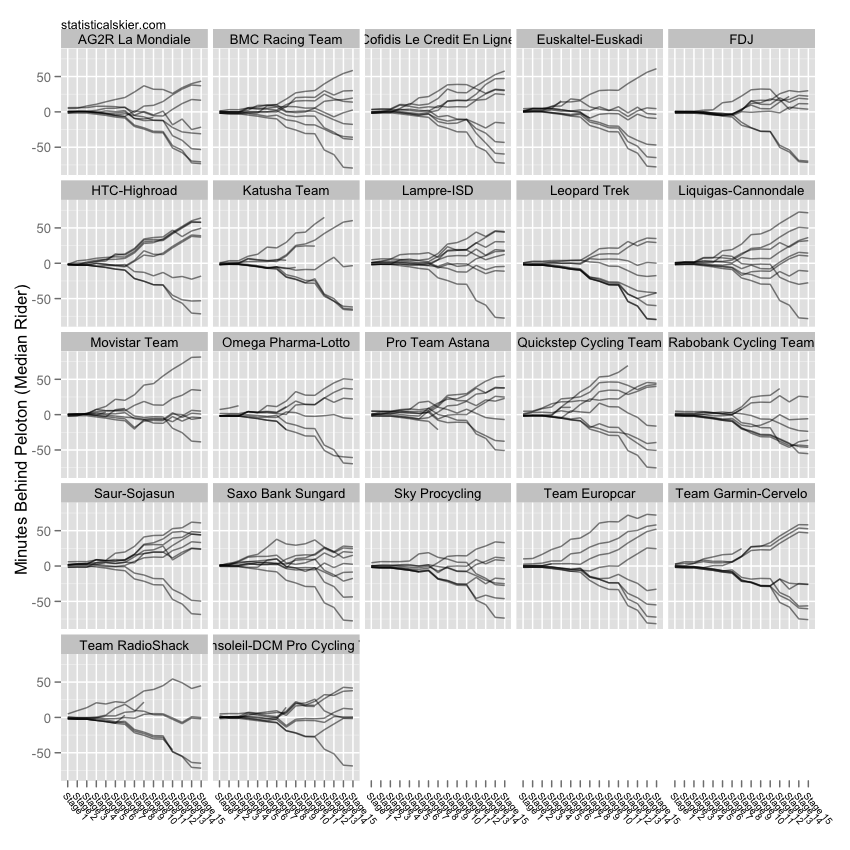
    As usual, you can click on them for slightly larger versions. Here’s the same graph for 2011 broken down by team:

    Oof. The x axis is a little scrunched there, sorry ’bout that.

    Finally, there was a lot of talk early on in this Tour about how many riders we were losing. Here’s a look at the stage by stage attrition of the past seven Tours, but keep in mind that this makes no distinction between the reasons that a rider fails to make it to Paris!

    This year’s Tour is in blue. Interestingly, while the 2011 Tour saw a lot of attrition early on compared to other years, by the end it was actually not as brutal as several others.

    Related posts:

    1. <Tour de France Charts
    2. <Tour de France Graphs: Fancy Versions
    3. <Tour de France Graphs


  • Tour de France Graphs

    Rest day number two is upon us, so it’s time to update my graphs tracking the race thus far. First the standard ‘bump chart’ showing the GC picture through the first 15 stages:

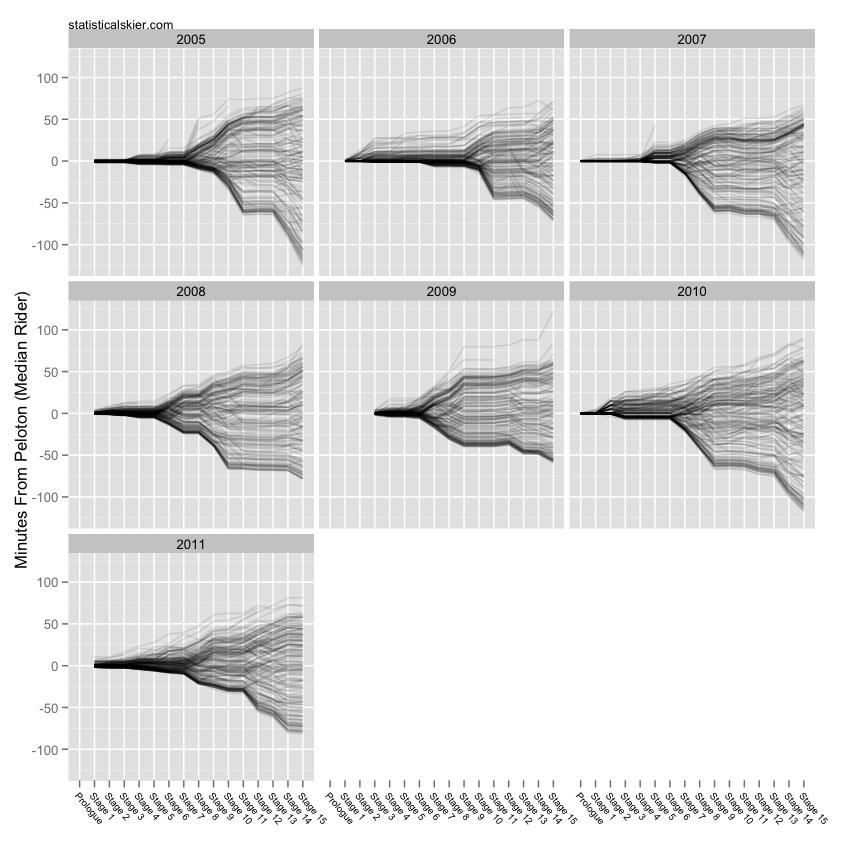
    And for comparison, the same graphs for all the Tour back to 2005 (click for larger version):

    And another version broken down by team (click for larger version; my apologies I forgot to fix the team names sizing, so some are slightly cut off…):

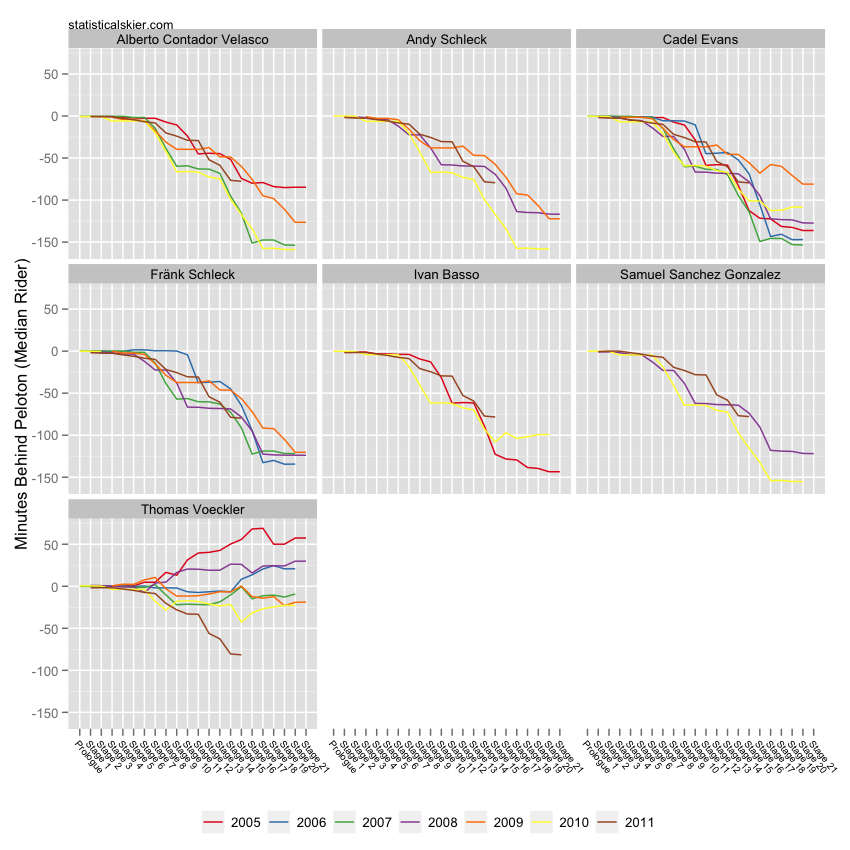
    And finally as a special treat, the GC performance, as measured by minutes behind the median rider, for the top few riders in this year’s Tour:

    Which one of these riders is not like the others? Which one of these riders just doesn’t belong? (Or maybe he does…)

    Related posts:

    1. <Tour de France Charts: Stage 17
    2. <Tour de France Charts
    3. <Tour de France Graphs: Fancy Versions


  • Tour de France Attrition Rates

    Fellow blogger (and, full disclosure, good friend) Cosmo kind of stirred things up a bit with post regarding attrition rates in this year’s Tour. My cycling blogging has been mostly just for fun, as I’m not much of a cycling expert, so I mostly do it to entertain those folks who enjoy mixing sports, numbers and graphs. But statistical commentary on sports draws me like a moth to a flame, so I basically have to weigh in.

    At the moment, his commenters are kind of laying into him, and there are some legit criticisms there. But as with anything else on the internet, people are getting considerably more worked up over this than seems reasonable. Would data on attrition due to crashes specifically be more germane? Yep! One of his commenters went out and tried to track down that information on crashes and found that the attrition rate due to crashes does seem considerably higher this year. However, it’s important to note that information on the reason for withdrawals can’t be found in every case, so even that analysis is somewhat incomplete.

    That’s not really a criticism, just an observation you can make about any attempt to answer a question using data.

    Can I do any better? Not without better data, probably. But here’s something I cooked up that might be interesting. (All data courtesy of cyclingnews.com.)
    Using data from the 2005-2011 Tours (the only unified, easily scrapable set I could find on short notice), here’s a graph showing attrition rates (due to all causes) throughout each Tour:
    This is tracking the proportion of finishers of that Tour’s initial stage.  2011 is shown in blue. I find this look interesting because you can compare the rate of decline across multiple stages.
    Only a few Tour’s have had higher attrition through Stage 12, and one is 2007, one of the “hard mountain stages early” years. But even so, the total number of riders gone doesn’t seem dramatically larger this year, even if many more than usual have been sidelined due to crashes.
    Finally, here’s a simple graph showing the GC rank of each rider at the time of abandonment. (Measured by last completed stage, not “on the road”.)
    The red indicates the median for each year’s Tour. While the typical rider we’ve lost this year isn’t dramatically higher ranked than those in the past, measures of center are potentially misleading in this case. Note that we’ve had several dropped riders coming from the top 25, which seems more unusual, but not unprecedented.

    Related posts:

    1. <Tour de France Bump Plot: Stage 12
    2. <Tour de France Bumps Chart: Stage 14
    3. <Tour de France Bump Chart: Stage 16


  • Tour de France Graphs

    The Tour de Carnage France is well underway. I planned to post a few graphs on Monday, the Tour’s first rest day, but a skiing post took precedence. So these graphs run through yesterday’s Stage 10.

    As usual with these cycling posts I’m not going to say much. I’m just putting the graphs out there since I find them interesting and hope that others might too. Here’s the standard graph for this year’s Tour:

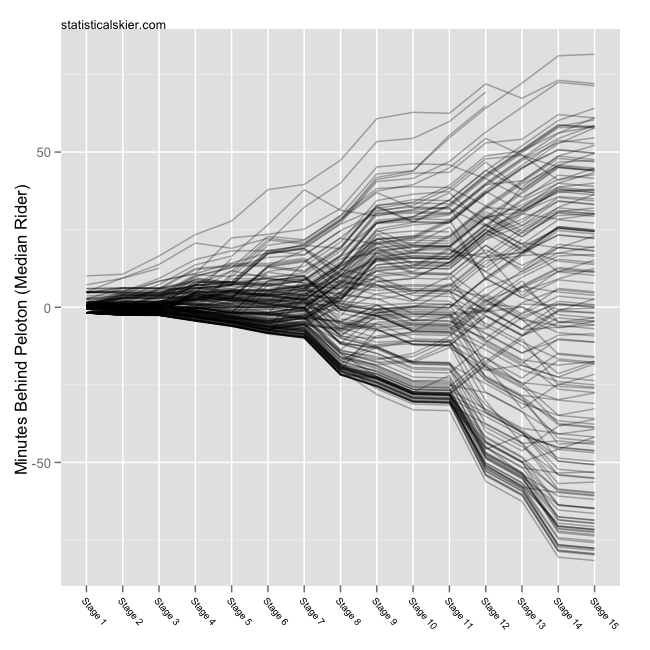
    Each line corresponds to a single rider and all times are relative to the median rider (after that stage). And here’s the same thing broken down by team. It’s larger, so click through for the full version:

    Apologies for not sorting the teams in a more appropriate manner than alphabetically.

    Finally, I happened to grab some Tour data stretching back to 2005, so here’s how this year’s Tour compares to recent years, through Stage 10:

    Note that 2009 starts with Stage 3. The results on CyclingNews for Stage 2 in 2009 were messed up so I had to trash them (the times at least). Why not plot Stage 1 either? Well, I could have connected the dots directly from Stage 1 to Stage 3, skipping the missing stage, but that seemed more potentially confusing.

    I thought at first that something went wrong in acquiring the data for 2006, since it looks so different, but I checked and I think it’s right.

    Related posts:

    1. <Tour de France Bump Charts (Updated)
    2. <Tour de France Bump Plot: Stage 12
    3. <Tour de France Bump Chart: Stage 16


  • Devon Kershaw Answers the Eternal Question: Who Would Win the Hushovd-Northug Cage Match?

    Devon Kershaw in the middle of a climb during a trip to Spain earlier this spring.

    There are few sports that can challenge the intensity of cross-country skiing, but cycling is one of them. Anyone who has ever pedaled a road bike uphill–which includes almost all cross-country skiers–can appreciate the difficulty of the Tour de France, and as such, we decided to get some perspective on the race from Canadian Olympian Devon Kershaw. Kershaw himself is no stranger to the bicycle–he recently hosted an uphill race that included many members of the Canadian national team–and as an avid cycling fan, was willing to answer a few questions.

    Editor’s note: Kershaw answered our questions prior to the completion of the Tour–hence the issues with tense, as the race wrapped up today.

    FasterSkier: Can you make a few predictions about the Tour? Contador or Schleck?

    Devon Kershaw: Without question it’s Contador. He looked like he had the Tour locked up a long time ago—after the Alps even. Even before he attacked Schleck’s mechanical, he was only down 31 seconds to the lanky Luxembourger, and history shows that in a head-to-head time trial anywhere at anytime, Contador is far and away the heavy favorite. Now after the Pyrenees, he’s in yellow and there is a 99.9999 percent chance he’ll win. Barring any major meltdown in the time trial, it’s a done deal. Schleck’s race was impressive though—a great fight by him and his Saxo Bank team for sure.

    FS: If Petter Northug was to face off against Thor Hushovd, who would win? On a bike? On skis? In a no-holds-barred UFC style matchup?

    KJ: Northug vs. Hushovd? On a bike, it’s a no brainer. Hushovd, of course. When you are a rider that can pump out over 1200 watts in a sprint, moving at over 70 km/h human powered—Northug would look like a young girl learning for the first time to bike without training wheels. It would be that bad.

    On skis—even though Hushovd is Norwegian, and they are born with a natural affinity for the sport, Northug is the best in the world. Thor has spent too much time in the south of France, sipping wine and eating brie—he would look like pack fill in the senior category of an Ontario Cup next to the world and Olympic champion that is Northug.

    UFC Octagon throw-down? Now it gets tricky. I’m going to go with Hushovd again, though. He had no problem bumping, nudging and fighting his way over the tarmac at 70+ km/h in a big pack of sweaty, hungry-for-victory bike racers. I also think he’s bigger in stature (muscularly, anyway), than Northug, and has eight years on him as well. You can never underestimate “old man strength.” That, and let’s be honest, if the rumors are true and Northug sleeps over 12 hours a day, everyday, and the rest of the time is spent training and playing online poker? That’s not badass. Have you seen most poker players? Not UFC contenders. Advantage: Hushovd.

    FS: You’ve seen some good climbing out of Babikov, but what do you think is tougher: the final climb at the end of the Tour de Ski, or one of those Cat. 1 climbs in the Pyrenees? Could Ivan Babikov take those guys?

    DK: I’d love to say that the final climb in the Tour de Ski is tougher, but that’d be a flat-out fib. Those HC and Cat 1 climbs in both the Alps and the Pyrenees make the bumps we glide over look like nothing more than a monadnock beside a big Himalayan peak. We lose—those cyclists are hardcore to the max. The fact that some of these beasts come after 160 km of racing, while we are scared about a 4 km climb coming after 6 km makes us skiers look pretty soft.

    Babs is still the strongest and most naturally talented climber I’ve ever seen on a bike. He grinds the biggest, hardest gear and can just churn up the road when it angles up. It’s silly. It defies science and reason—but, a lot of things Babs does defy science and reason. I have no doubt had Ivan chosen cycling, you would have seen him in the high mountains mixing it up with the ProTour big boys. He’d have to give up candy, sugar, Red Bull, Coke, etc., first—too many calories—that’d be the only thing I don’t know if he would be capable of.

    FS: There was outrage over Contador’s attack while Schleck was fixing his chain. Nobody stopped for you when your ski fell off in the Tour de Ski—do you think Contador made the right decision? Are there any unwritten rules like that on the World Cup?

    DK: There was some outrage over the Contador attacking Schleck during a mechanical, yes. Do I think Contador made the right decision? Personally, with the history and tradition of cycling—no, I don’t. Attacking a rival in that situation is frowned upon in cycling. Contador was only 31 seconds back in the general classification. I thought he should have waited, then dusted him man-to-man. Even with 31 seconds, Contador was going to win the tour—he’s just that much stronger at the time trial—and there were still other mountain stages remaining.

    Still, tell that to someone in that situation. Contador is tired. Then, all of a sudden your rival is standing with his feet on the ground instead of in the pedals. As a fierce competitor it’s natural to go for the jugular and attack. I can’t blame him for that, but in cycling, for some reason, that’s not tradition.

    There are most certainly no unwritten rules in cross-country skiing on the World Cup. It’s every man for himself. Someone breaks a pole, falls, whatever—it’s fair game to exploit those misfortunes. Jeez, I’ve even seen people from the same team attacking up to catch their teammate who has a gap off the front in a mass start. It’s hilarious, actually.

    FS: Canada vs. U.S.—Ryder Hesjedal or Levi Leipheimer, which one would you rather be a domestique for? And which one would make a better cross-country skier?

    I’d rather be a domestique for Hesjedal, but that’s for patriotic reasons. I am really impressed with him, top-10 at the Tour de France is impressive stuff. He stepped up, and he’s a gutsy, exciting racer. Not afraid to get into the breakaway. Leipheimer is a great cyclist, but ask yourself this: when have you last seen him in a breakaway? When’s the last time you’ve seen Levi attack? It’s rare—sometimes at the Tour of California or Dauphine, but that’s pretty much it.

    Who would make a better cross-country skier? I’d go with Ryder again on this one. He comes from a mountain bike background, where the races are shorter (1:40-2:00), and much more explosive in nature—hammer up hills, descend, at times without even pedaling. That, and he’s taller too. Have you seen Levi? The dude’s small.

    FS: If you could wear one of the jerseys for a day, which one would it be? Sprinter’s? Climber’s? Overall GC? White jersey for best young rider?

    DK: This is a no-brainer for any cycling fan. The Maillot Jaune. Yellow jersey hands down. Only one Canadian has ever worn it (Steve Bauer). It’s the most prestigious and elusive jersey in cycling.

    FS: How long do you think you could hold on to the peloton in one of those Cat. 1 or 2 climbs?

    DK: In the gruppetto (that’s where the sprinters hang out, at the back of the bus), I could perhaps hang on. In the peloton, when there are attacks going on, I’d last like 1 km. Maybe. In the break up the road? 100 meters.

    FS: Where are the fans more rabid: the Holmenkollen, or the Alpe d’Huez?

    DK: I’d have to say Alpe d’Huez. There are 40,000 or 50,000 people out at Holmenkollen—that’s a lot, no question. But there are over 750,000 people on the Alpe. There’s a reason why cyclists live in Monaco, drive Ferraris and sleep with the Olsen twins: It’s WAY more popular.

    FS: Who from your team would you want as your lead-out man? Is there anyone who would deliver a headbutt for you?

    DK: Even though he’s sketchy as all hell, and in all likelihood he’d make us both crash and take out half the field in the process more often than not, I’d go with the recently-retired Sean Crooks. He’s a scrappy racer, and he isn’t afraid to get in there and get his hands dirty. He’d deliver the headbutt and the knockout punch in a killer one-two combo. Now, I don’t know—I’ll get back to you.

    FS: Who on the World Cup would be the most likely to assault another athlete with a pair of skis, Carlos Barredo-style?

    DK: Haha, Barredo was classic. Using the wheel for a weapon. Firstly, no cyclist should ever attempt to fight. It’s embarrassing. What they do on the bike is impressive—they command fame, money, attention and respect for their exploits when on their steeds. Off the bike, with their cleats clapping around the pavement and their little arms flailing around in anger? It makes a hair-pulling, grade three cat fight look like Foreman vs. Ali. I laughed so hard when I watched that little tiff. It was awful.

    Who on the World Cup would be most likely to assault another athlete? I don’t know—Legkov? He might not assault you, but he’d get the Russian mob to come to your house, burn it down, and wreak havoc on your family for generations.

    In an actual fight, I’d say probably George [Grey] would kick anyone’s ass on the World Cup fairly easily, although he has a very cool head, so that situation would never arise.

    FS: Ultimately, who are closer to society’s fringe? Cyclists, with their shaved legs and dubious dietary practices, or skiers, who do things like rollerski?

    I’d say we—cross-country skiers—are closer to the fringe. Everyone knows about cycling. They shave their legs because when they crash at 90 km/h down a mountain pass, a mass of nasty hair mixed in with the ground beef that their thigh has become is a recipe for infection. Ask most people to jump out of their car wearing shorts and a t-shirt at 90 km/h if they want to have hair everywhere or not.

    As soon as you do a parade in a full spandex suit, in the summer, you define “fringe.”

    That, and you are absolutely right: rollerskiing? I’d bet 10 percent of Canadians could describe what exactly one of those things actually are. I’d bet only 3 percent of Canadians could tell you that there are no brakes on the things either.

    Oh yes, no Olsen twins, no millions of dollars, no columns in the gossip mags—no, cross-country skiing wins hands down. We are the fringe. Boom.

  • Lodwick in Car-Bike Crash at Tour de France

    Lodwick in Car-Bike Crash at Tour de France

    ALBERTVILLE, France (July 22) – World Champion skier Todd Lodwick (Steamboat Springs, CO) learned Wednesday that watching the Tour de France can be as dangerous as competing. The U.S. Ski Team athlete was involved in a car-bike collision while riding back from spectating at a Tour stage.

    Cycling back to Albertville shortly after watching the early portion of stage 17 of the Tour on the Col de Les Saisies, Lodwick rounded a corner and, in swerving to miss a stopped vehicle, collided head on with an oncoming car.

    Lodwick's bike took the brunt of the damage (Photo: USSA)
    Lodwick's bike took the brunt of the damage (Photo: USSA)
    ...and the car didn't fare particularly well either (Photo: USSA)
    …and the car didn't fare particularly well either (Photo: USSA)

    Lodwick rose to nordic combined success during the 2009 season as he made a return from retirement at the age of 31 to win two World Championship gold medals.

    While he did suffer some bumps and bruises, Lodwick is in good condition. He was treated and released from an Albertville hospital. He will now rest before returning to the states.

    “The crash happened very quickly, but I am happy to be uninjured, which is more than I can say for the car and my bike,” Lodwick said. “I am looking forward to getting to my family, resting up a bit and then heading back into the training season.”

    Members of the U.S. Nordic Combined Ski Team are in France not only to watch the Tour, but also to train. They have been jumping with international teams in Courchevel while also taking in legs of the Tour. The Team will remain in France for another week.

    “We’re training in Courchevel for a mixture of ski jumping and some lower altitude speed work,” Billy Demong said. “We also used the opportunity to ride our bikes on some of the Tour de France for a little bit. It is a great way to get some cross training and see the best cyclists in the world up close.”

    The Americans were not the only Nordic athletes at the Tour.  Sprint Junior World Champion Timo Andre Bakken of Norway enjoyed the final climb of the 15th stage to Verbier (SUI), cheering for the riders along with his family and another 100,000 fans.

    Caroline Weibel and Emilie Vina from the French cross-country national team were at Le Grand-Bornand with Stephane Vittoz who said he took some good tips back with him for the next La Clusaz World Cup.

    The cross-over also works in the opposite direction: The young German-Australian Heinrich Haussler, winner of the 13th stage from Vittel to Colmar in cold rain, commented: “Even if I was born in Australia where it is normally really hot, I like cold weather. Last winter, I trained much on cross-country skis and really enjoyed the long workouts in the snow. It was the perfect preparation for me.”

    The U.S. Nordic Combined Ski Team takes a break at the top of the Col de la Madeleine during a training camp in nearby Courchevel. The Team caught several stages of the Tour de France. From left, Bill Demong, Johnny Spillane, Coach Dave Jarrett, and Todd Lodwick (Photo: USSA)
    The U.S. Nordic Combined Ski Team takes a break at the top of the Col de la Madeleine during a training camp in nearby Courchevel. The Team caught several stages of the Tour de France. From left, Bill Demong, Johnny Spillane, Coach Dave Jarrett, and Todd Lodwick (Photo: USSA)
    U.S. Nordic Combined Ski Team members run alongside stage leader Thor Hushovd along the Tour de France route near Les Saisies in stage 17 (Photo: USSA)
    U.S. Nordic Combined Ski Team members run alongside stage leader Thor Hushovd along the Tour de France route near Les Saisies in stage 17 (Photo: USSA)

    Sources: USSA, FIS