From the FasterSkier archive — posts syndicated from athletes’ and coaches’ own blogs between 2004 and 2012, kept online as published. Current coverage is at fasterskier.com.
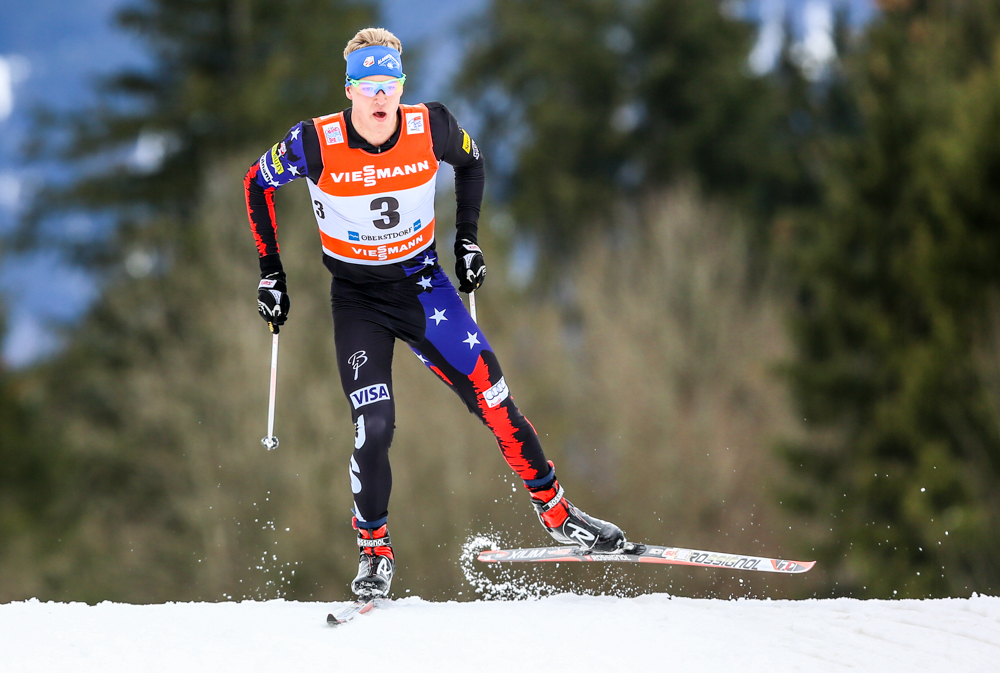
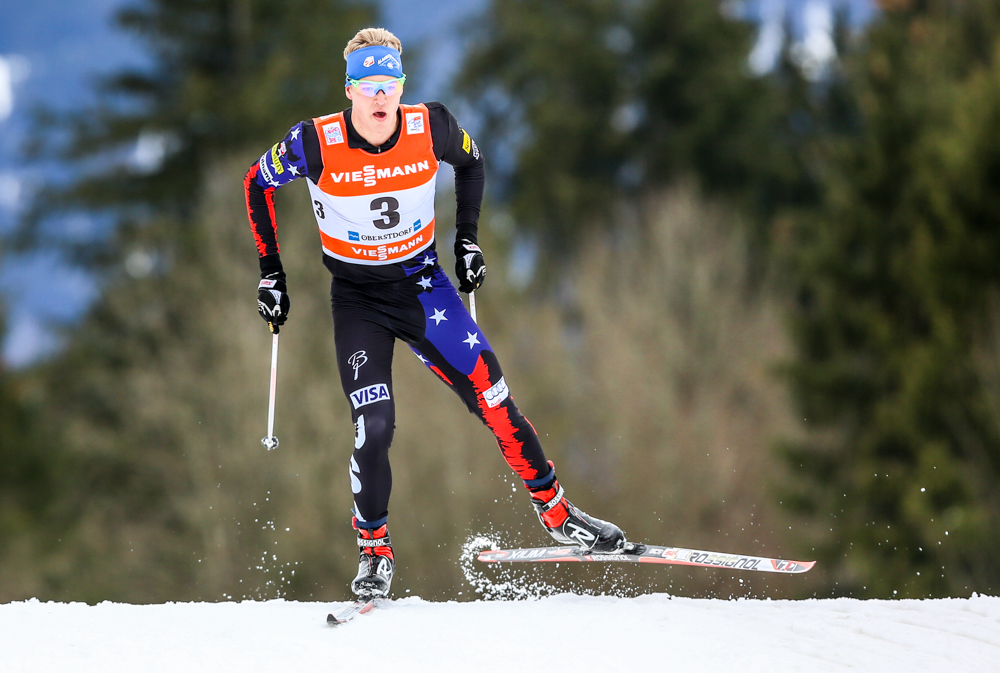
Erik Bjornsen (USA) competing in the 2015 Tour de Ski prologue. (Photo: Marcel Hilger.)
On the heels of a strong eighth place finish by Simi Hamilton in the 1.4 k freestyle sprint in Val Müstair, the American men completed their last competition of the 2015 Tour de Ski with a 10 k classic interval start in Toblach, Italy.
Leading the U.S. pack was Erik Bjornsen in 58th, 1:42.0 behind race winner Alexey Poltoranin of Kazakhstan. At the 1.7 k and 5 k splits, Bjornsen clocked the 69th and 68th fastest times in the field of 70 racers, but was able to recover to 57th at the 7.1 k mark before falling to one place at the finish.
“So far the Tour de Ski has slapped me around a bit,” Bjornsen wrote in an email. “Overall I’m not that disappointed; of course I would have like to see better results. But let’s be realistic, unless you’re Petter Northug, Simi Hamilton, or Batman you’re probably not going to show up and win races on your first Tour.”
Two skiers behind Bjornsen was Hamilton, who was skiing 0.9 seconds out of the top-30 at the 1.7 k mark. Despite a strong start, the 27-year-old eventually fell to 60th, 1:48.0 back from Poltoranin.
Rounding out the USST men, Andy Newell placed 67th (+2:27.2). Newell finished last or near the back in each stage of the 2015 Tour, and explained the week of racing was challenging due to a combination of fatigue and crashes.
“Saying the Tour has been tough on me would be an understatement. The body has been feeling pretty crappy and I really struggled with crashes and skis in the first two stages,” Newell wrote in an email. “Even when I’m not feeling great sprinting tends to still go well so I was pumped to get a shot in the skate sprint but ended up crashing out (apparently with a top-five time at the time of the crash). So it has really been frustrating for me.”
USST Head Coach Chris Grover said in a phone interview that Wednesday was a mixed day for his team, with the highlight being Sadie Bjornsen’s eighth-place finish in the women’s 5 k. He explained that some members of the team were fatigued and in need of a break.
When asked why the men’s team struggled to match the women’s performances throughout much of the Tour, Grover said that the disparity between the men’s and women’s performances has existed for several years.
“We’ve benefitted the last few years from a women’s group that has a lot of depth and a pretty high standard with those guys able to push each other. We just haven’t been able to create that on the men’s side. Unfortunately there’s not a group of men at home that are ready to step up to the next level. We are really trying to get the next generation going at this point. We’re thin on the guys side,” he explained.
The 10 k was the last race of the Tour de Ski for all three of the U.S. men. They will travel to Ramsau, Austria Thursday with teammates Bjornsen, Sophie Caldwell, Ida Sargent, and Kikkan Randall to recover and partake in a training camp before heading to the Jan. 17 and 18 World Cup in Otepää, Estonia, which includes a classic sprint and a freestyle team sprint.
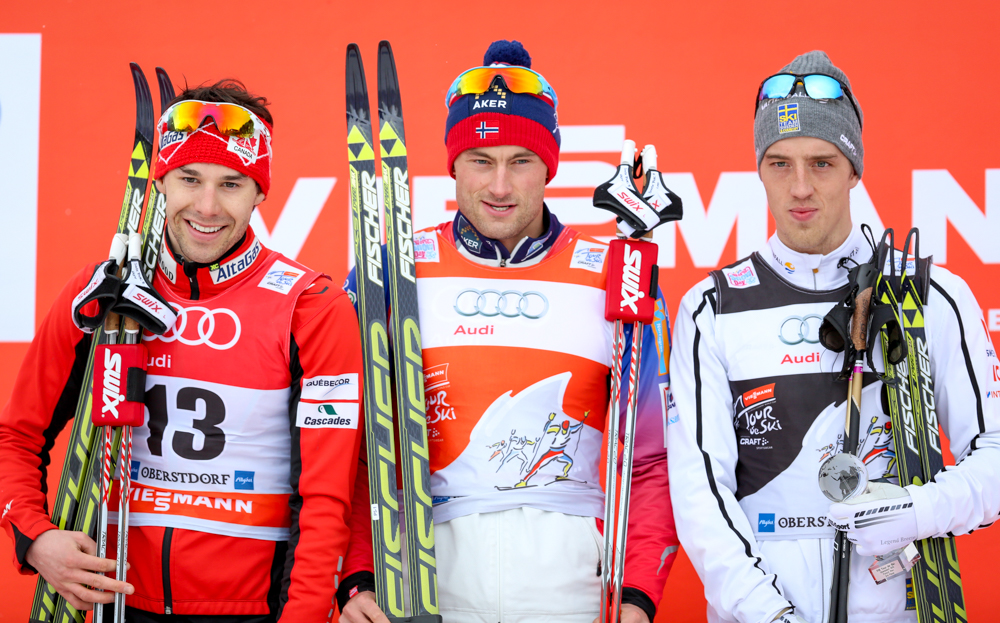
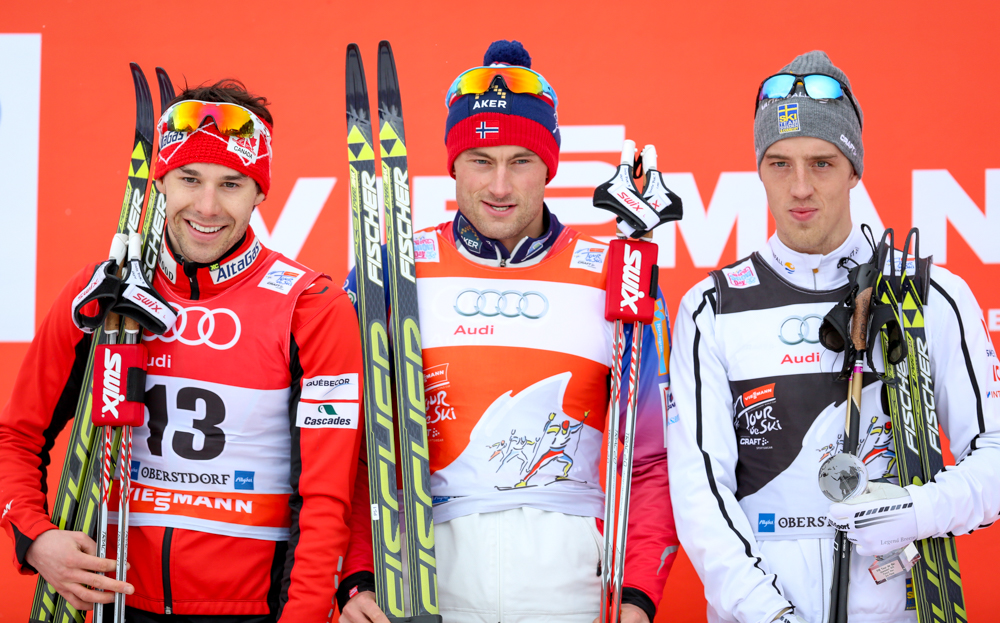
Norway’s Petter Northug (center) won Sunday’s Tour de Ski 15 k classic pursuit in Oberstdorf, Germany, over Alex Harvey of Canada (left) and Calle Halfvarsson of Sweden (right). (Photo: Marcel Hilger)
The Tour de Ski may be only in the second of seven stages, but there has already been enough drama to fill more than a single weekend.
In Saturday’s 4.4 k prologue, it was Switzerland’s Dario Cologna who surprised and stole the show, winning by five seconds. But in today’s 15 k pursuit, it was instead Petter Northug of Norway who threaded his way through the pack and the twisting, steep trails of Oberstdorf, Germany, to win the day.
Starting in third place after yesterday’s pursuit, Northug quickly caught Cologna and second-place Calle Halfvarsson of Sweden. But after 2.5 k the pack also caught them, and the men’s field spent the rest of the race in a huge group.
Cologna would lead, or Halfvarsson, or Northug’s teammate Martin Johnsrud Sundby. One face never at the front? Northug.
“It was better for me stay little bit back and save energy for the last lap,” he said in a press conference.
Going up the final climb, he was easily in tenth place, or perhaps farther back. But he snuck to the far left side of the trail and herringboned his way past a number of his competitors, especially after Sundby tripped on his own slippery skis and tangled up a few other men.
Martin Johnsrud Sundby (NOR) leading Calle Halfvarsson (SWE), Dario Cologna (SUI), and the rest of the Tour de Ski field in Oberstdorf, Germany. Alex Harvey is in bib 13. (Photo: Graham Longford)
“I didn’t have a good position on the last hill, but I learned from Frode Estil how to make it towards the goal,” Northug told Norwegian broadcaster NRK, according to a translation. “He won here before me.”
It was Italian unknown Francesco De Fabiani who led over the crest of the hill, but even with just a single downhill leading into the finish, things were far from over.
De Fabiani was passed as if he was standing still by a group of skiers including Alex Harvey of Canada, Halfvarsson – who broke a pole but still came back – Norway’s Niklas Dyrhaug, and Northug. The four racers were bumping elbows and trying not to tangle skis as the trail turned into the finishing straight.
Harvey stayed left and appeared to pick the best line, but Northug somehow snuck his way through and went into the lead. He double-poled to the finish with his usual burst of energy – rather than fighting for the lead for the entire 15 k, he had conserved something, as is his habit.
“I thought I’d indulge myself in the last few hundred meters,” Northug told NRK. “I knew I would go alone – I saw what kind of skiers I was going up against as we went over the last bridge. Right now I am where I want to be.”
Harvey was initially neck and neck with Halfvarsson, but pulled away to secure second place for his first podium of the season.
“I had a good sprint – I’m really happy,” Harvey told Sportcom. “Because it was icy, a lot was going on in that last corner. I lost a little bit of speed on the last turn, but I was able to pass a Norwegian and an Italian. At the beginning of the finishing straight I was third, but I managed to pass Halfvarsson.”
That was discouraging for the Swede.
“I noticed that both Petter and Harvey were faster than me on the skis,” Halfvarsson told NRK. “Then I had no answer.”
Harvey accomplished his podium result by skiing carefully over the course of the 15 k race. He was always near the front, but rarely leading – fast enough to know he’d be close when the finish arrived, but not working so hard he’d be tired.
Harvey was not reachable for comment, but he explained his strategy in a Cross Country Canada press release.
“I was pretty tired early so just tried to ski more controlled in the third and fourth lap,” he said. “The conditions were icy and even dirty in places so on the last lap I stayed out of trouble, especially up the final hill, to set myself up for good sprint for the finish.”
Harvey has quite the collection of Tour de Ski results, including a prologue win last season, and is often in the mix for an overall podium. He said that the Tour just falls in a good spot for him to be on form.
“I really like the big events like this. I get excited but I think the time of year that we race this is good for me,” Harvey said in the press release. “It is really hard to be on early in the season. We get a nice three-to-four weekend block of races early in the season where I can get into great shape and then the timing of the Tour is just good for me.”
The result of the sprint finish was a bit of a comeuppance for Halfvarsson, who claimed the day before to be usually faster than Northug at the finish.
“Calle is in a dream world,” Northug told the NRK reporters. “If you look at his performance in championship events over the last few years, he’s more on par with you.”
Lenny Valjas in the 15 k pursuit. (Photo: Graham Longford)
The pursuit results showed that the Tour de Ski might be a little more diverse than the usual Norwegian-dominated World Cup races so far this season. After Halfvarsson, Dyrhaug outsprinted Alexey Poltoranin and Cologna for fourth place; the top twelve finishers were all within ten seconds of each other.
And some past Tour de Ski favorites who had not fared well in the prologue made big gains in the pursuit, like Poltoranin, who had started 19th. Dietmar Noeckler of Italy skied from 50th place up to tenth, Russia’s Maxim Vylegzhanin from 16th to 12th, and Sweden’s Daniel Richardsson from 40th to 15th.
For Canada, Ivan Babikov improved from 57th to 30th, making it into the World Cup points, and Devon Kershaw was close behind, moving from 45th up to 36th.
Sadie Bjornsen and Liz Stephen of the U.S. Ski Team competing in the 10 k classic pursuit in Oberstdorf, Germany, on Sunday. (Photo: Graham Longford)
After a 10 k classic pursuit that saw them start seventh and eighth and finish in 14th and 15th in Oberstdorf, Germany, U.S. Ski Team members Sadie Bjornsen and Liz Stephen have one thing to say about the Tour de Ski: what fun!
“What a fun race to experiment with different paces and strengths,” Bjornsen wrote in an email. “This tour business is pretty fun!! Off we go to Switzerland!”
It’s the Winthrop, Washington, native’s first Tour de Ski, though you wouldn’t be able to tell by her skiing. She started off confidently and aggressively, leading a chase group along with four-time Tour de Ski champ Justyna Kowalczyk of Poland for about five of the ten kilometers.
By the time the second lap rolled around, Bjornsen was tiring. She stayed with the chase group, but was no longer leading it.
“Things were spectacular until 5 k, when I had to start hanging on for dear life,” Bjornsen wrote. “As the tracks fell apart, I found myself stiffening up to try to find some kick- so I wasn’t able to keep up the ‘dream race’.”
The pair had front row seats as Norwegians Heidi Weng and Therese Johaug set off in chase of their teammate Marit Bjørgen, never catching her but securing themselves comfortable spots on the podium.
Sadie Bjornsen had half of a “dream race”. (Photo: Graham Longford)
And they had front row seats, too, as Kowalczyk tried to use her classic chops to get towards the front of the Tour standings.
“It was fun to follow Justyna only because it’s her!” Bjornsen wrote. “She is an incredibly strong woman… And any time I can follow her for even five minutes is an amazing time for me!!”
Although she eventually fell back, Bjornsen doesn’t regret for a minute leading the chase group early on. She’s looking at the Tour as an opportunity to gain experience and have fun.
“I don’t regret leading, no,” she wrote. “I made it a goal to get more out of my ‘comfort zone’ this period, and rather than just racing without taking chances, to take some chances this period. Sometimes that may mean exploding, or blowing up, or poor tactics… But I decided this is a better way to learn this period. Being the best is not ‘conservative’, it’s racing on the edge!”
Stephen was seldom as close to the front of the chase group as Bjornsen, but used the uphills to her advantage. Her major regret was that by the fourth time down the loop’s tough and icy descent, he legs were shaking and she didn’t exactly go for it.
“I was a little disappointed with how I skied the downhill today, I had a full-blown panic attack on the last time down it,” she admitted in a phone interview. “My legs were feeling really tired and I definitely didn’t ski it the way I was hoping. So I lost a few places there. But I’m otherwise quite happy with the day.”
In the overall Tour standings, Bjornsen and Stephen are about two minutes behind Bjørgen once bonus seconds have been factored in (the places are the same as the finishing places from the pursuit, but the time gaps are different). But that’s a bit unrepresentative of their chances of a good finish. Bjørgen has a one-minute lead on second place, and the two Americans are only 20 seconds behind fourth place.
“I just wasn’t able to complete the sweet feelings I was having,” Bjornsen wrote. “I am still very happy! That is my best classic race of the season. And yes, I am just feeling confident in the feelings I am beginning to have when I am racing.”
Stephen had the 16th-fastest time on the day (and Bjornsen the 14th), which she’s pleased with – it’s a good classic result for the Vermonter, who has traditionally excelled in skating but is working hard towards becoming a bigger threat in classic races.
“I certainly really liked the course and was able to hang tough with the flats,” she said. “I’m really happy with the classic race. It’s a work in progress, always, but it’s better and better each race and each year.”
Just as in yesterday’s prologue, where she finished eighth, she said that the course profile with its big hills made the venue her friend.
“I’ve always really liked the courses here in Oberstdorf,” Stephen said. “There’s three good-sized climbs on each 2.5 k lap today, and one of them was a real beast.”
A perpetual podium finisher in the Tour de Ski’s final climb up the Alpe Cermis in Val di Fiemme, Italy, Stephen is right at home in one of her favorite parts of the World Cup season.
Ida Sargent about to hit one of the uphills. (Photo: Graham Longford)
“It’s such a really exciting part of the year for me,” she said. “I wish every race series was like this, it’s just so fun.”
The course in Oberstdorf was quite different than just 24 hours before, thanks to torrential rains that spread their way across central Europe. In many places, snow melted completely; in Oberstdorf, it simply transformed, and thanks to strong winds was also covered in debris from the surrounding forest.
Conditions changed substantially over the course of the 10 k competition, which was apparent while watching the race. Several Norwegian skiers lost kick by the final lap.
For U.S. skier Jessie Diggins, it was worse than that – she never had much kick at all.
“In testing my skis were literally perfect, but conditions were changing so fast out there today and in the race I had no kick,” she wrote in an email. “It’s always frustrating when you know you’re in good shape but you’re slipping like 5 strides in a row, and herring boning every hill, but in no way do I blame the techs – it was just a changing day and I ended testing too soon. So I held my own in the flats and corners but just bled time sliding around on every hill.”
After a strong prologue where she finished 14th, Diggins ended the day in 56th, one spot behind teammate Sophie Caldwell, who dropped from 44th to 55th.
“I also caught a rut on the last big downhill and crashed but I am not injured and Sophie did a magnificent maneuver to avoid hitting me, so I’m pretty grateful for that,” Diggins wrote. “(Hashtag #blessed). Gotta find the humor when you can!”
Kikkan Randall also dropped through the rankings, from 22nd to 44th. She told members of the media that “I was hoping to be stronger today – I was mostly focused on the effort and pace over the results and I ended up a little below my expectations.”
One U.S. Ski Team member did climb through the field, though – Ida Sargent, who had been somewhat disappointed with a 58th-place finish in the prologue. She worked her way up to 40th in the classic pursuit.
“I loved the course here with all the hills,” Sargent wrote in an email. “Steep striding and herringboning is my favorite so it was great to have a lot of that out there. I felt really good today which was the first for distance racing this season.”
Starting so far back was a detriment, she wrote, because she had few other fast skiers to work together with.
“I wish I had pushed harder in the beginning because starting so far back some gaps opened up and it was hard to close,” she explained. “A lot of times on the flat I was out there by myself so it would have been nice to have a pack to ski with today. But moving up through the pack was really fun and the race feelings out there were a huge confidence boost.”
Despite being very frustrated with the prologue, Sargent focused on the next day, moving forward, and staying optimistic – and it paid off.
“I put that one behind me and tried to start fresh today and I was really excited for classic skiing,” she wrote.
And, now, for sprinting. As the Tour moved to Val Mustair, Switzerland, Sargent is looking forward to Tuesday’s skate sprint. She has made the heats in three of four sprints so far this season, including a fifth-place effort in the opener in Ruka, Finland.
“I’m really excited for Val Mustair,” she wrote. “It’s a new venue for me and I’m psyched for a sprint!!”
That’s the right attitude, says tour veteran Stephen. The distance specialist is also excited for the sprint – the Tour de Ski sprint two years ago was the first time she made the heats in a World Cup.
The Tour is full of such opportunities, she feels.
“It’s impossible to get bummed out,” Stephen said. “You’re on to the next race, you don’t have time to get frustrated. I’m really excited with how it’s gone for me so far this year in the Tour, and hope we can keep going up.”
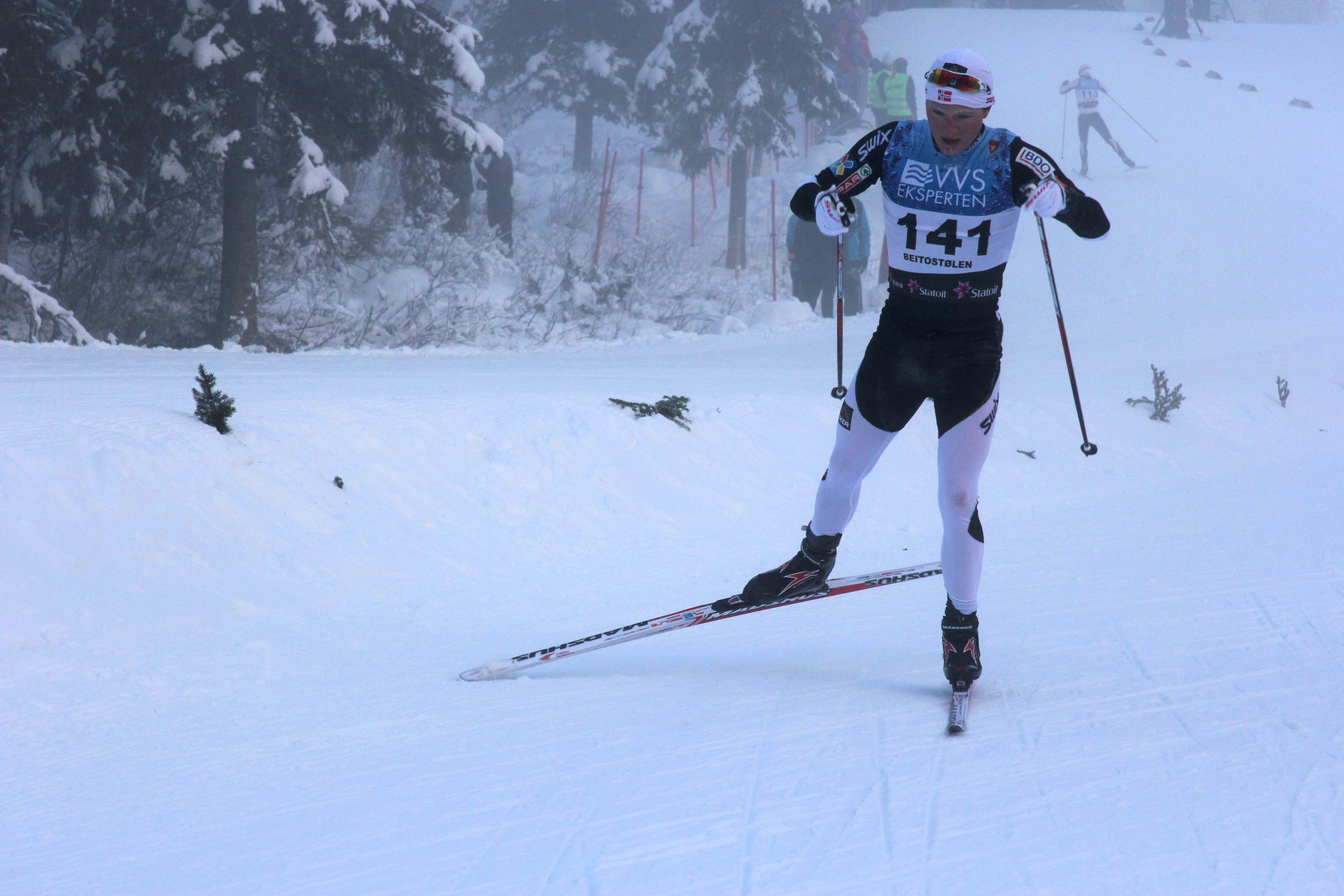
Norway’s Simen Andreas Sveen racing to 55th in the 15 k freestyle FIS race on Nov. 22 in Beitostølen, Norway. (Photo: Inge Scheve)
Simen Sveen, 26, was the first extra to the Norwegian team, so when Didrik Tønseth got appendicitis right before Christmas, Sveen called off the holidays, stayed in Davos, Switzerland, to train and when the Tour de Ski opens Saturday, he is race prepped to the gills and ready to burst.
“I’m just excited for the whole thing to start,” Sveen told FasterSkier in an exclusive interview on Friday night. “I’m not nervous, just excited. There’s a big difference. Being excited helps me bring out the best in me.”
He learned he was the alternate when the team was selected, giving him time to prepare just in case over the last several weeks.
“When Didrik Tønseth got sick, I just stayed in Davos rather than adding more traveling to the schedule,” he explained. “It’s a good place to train for this.”
In turn, his family members, who live near Sjusjøen, flew to Davos to spend time with Sveen. And just in time for Christmas, snow arrived to the high Alps.
“It was so awesome, and they’ve groomed all the touring trails, too, now, so we could all ski a lot,” he said. “It was a great holiday, and I’ve been able to train well.”
The first week after the Davos World Cup Dec. 20-21, Sveen focused on volume, getting as much snow time as he could. This week, he focused on logging some solid intensity sessions while also resting up for eight days of racing and traveling between Germany, Switzerland and Italy.
“I’m ready; bring it on,” he said with a grin.
“I’m really excited for the long skate race [from Cortina to Toblach, Italy] and for the final stage up Alpe Cermis. They are both later in the week and it’s nice to know that my best events are coming up later,” said Sveen, who considers himself a stronger skater. “It’s definitely a big motivation for me.”
While Sveen is a Tour de Ski rookie, this isn’t the first time he’s joining the fun late in the game. His first World Cup was the 50 k in Holmenkollen, Norway, in 2010 when he was called late the night before the race.
“When I raced my first World Cup race in 2010, the coaches really called me in the 11th hour,” he said. “The good thing is that you just don’t have time to get nervous or think about all the different things that can happen.” He placed 31st in that event, just seconds from his first World Cup points.
The Tour de Ski opens Saturday with the women’s 3.2 k and men’s 4.4 k freestyle prologue in Oberstdorf, Germany. From there, the Tour continues with 10/15 k classic pursuit on Sunday in Oberstdorf.
From Germany, the Tour moves to Switzerland for the third stage — skate sprints in Val Müstair on Tuesday, Jan. 6. The next day, there will be 5/10 k classic individual races in Toblach, Italy, and Thursday features 15/35K freestyle pursuits from Cortina, Italy, to Toblach.
On Jan. 9, the skiers get a second rest day before the final two stages in Val di Fiemme, Italy.
Saturday, Jan. 10 holds 10/15 k classic mass starts, and on Jan. 11, the Tour concludes with the brutal 9 k freestyle pursuit for both men and women up Alpe Cermis.