From the FasterSkier archive — posts syndicated from athletes’ and coaches’ own blogs between 2004 and 2012, kept online as published. Current coverage is at fasterskier.com.
Feature stories like this one take time, access, and care to produce. If you value thoughtful storytelling and independent ski journalism, please consider becoming a Voluntary Subscriber. Your support directly fuels the work we do to cover the people, places, and moments that make our sport special.
This coverage is made possible through the generous support of Marty and Kathy Hall and A Hall Mark of Excellence Award. To learn more about A Hall Mark of Excellence Award, or to learn how you can support FasterSkier’s coverage, please contact info@fasterskier.com.
Jessie Diggins (USA) claimed her third Tour de Ski overall victory in Val di Fiemme (ITA). (Photo: Vanzetta/NordicFocus)
The Tour de Ski does not end so much as it compresses. By the time the women turned onto the ribbon of snow climbing Alpe Cermis, the race had already been going on for a week—measured not only in kilometers and seconds, but in fatigue accumulated quietly overnight, in sore muscles, achy backs, and in confidence gained or lost one race at a time.
The final climb has a way of making those invisible things visible. It is steep enough to strip racing of pretense, long enough to punish impatience, and familiar enough that every skier arrives with memories—good ones, bad ones, and some they would rather forget. On Sunday afternoon in Val di Fiemme, the climb again became what it always is: less a finish line than a reckoning.
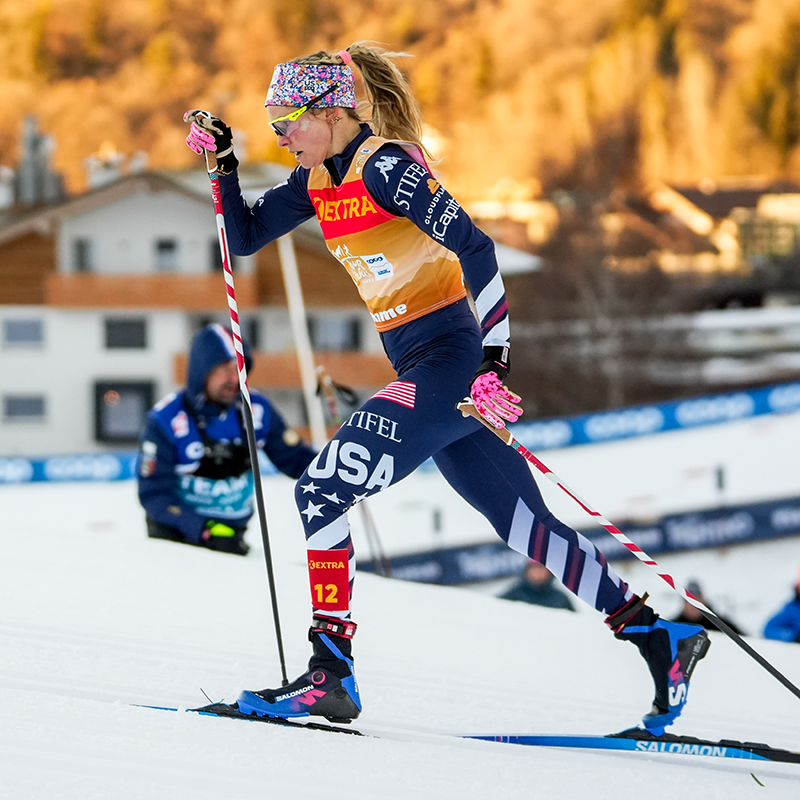
For Jessie Diggins, that reckoning ended in confirmation. Diggins finished second on the stage, protecting her margin with experience and restraint, and secured her third career Tour de Ski overall title. It was not the loudest way to win. It was, however, the truest.
Jessie Diggins (USA) paced the final climb perfectly to finish second on the day. (Photo: Modica/NordicFocus)
A Climb That Decides Everything
Stage 6 of the women’s Tour de Ski—10.0 kilometers, mass start, freestyle—began with the tension that always precedes Alpe Cermis. Some skiers arrived still dreaming of a stage victory. Others were guarding seconds earned days earlier. Still others were simply hoping to make it to the top without the climb turning overly cruel.
The early kilometers unfolded with relative calm. The pace was honest but controlled, the group compact as it flowed through the lower valley before turning uphill. On Alpe Cermis, there is no hiding, but there is strategy: when to let others go, when to follow, and—most importantly—when not to.
The decisive moves came as the gradient steepened and the field stretched into a long, thin line. Norway’s Karoline Simpson-Larsen skied with precision and patience, gradually asserting herself as the strongest on the day. She crested the final meters alone to win the stage in 37:05.3, earning the biggest single-day victory of her World Cup career.
Behind her, the race unfolded with quieter drama. Diggins, who entered the day with a commanding overall lead, skied with calculation. She resisted the temptation to respond immediately when others surged, choosing instead to manage the climb in segments. When the grade lessened and the gap narrowed late, she allowed herself to push hard enough to secure second place, but not so hard as to invite disaster.
Diggins crossed the line 8.8 seconds behind Simpson-Larsen, followed by Norway’s Heidi Weng in third at +14.4. The stage podium reflected the day’s effort, but it was Diggins’ second place that carried the most weight.
Jessie Diggins (USA), as always, left everything out on the course. (Photo: Modica/NordicFocus)
“Dying at the Right Moment”
Diggins’ approach to Alpe Cermis was shaped by experience—and memory.
“I was trying to be smart and safe in terms of the overall Tour,” she said afterward. “And then when I realized we were close enough, I thought, okay, now I can empty the tank. But I’ve paced it badly before where I blow up, and that last 600 meters is the slowest of your life.”
It is a detail only veterans tend to mention: not the steepest pitch, but the final few hundred meters, when legs that have already been pushed too far simply refuse to respond. Diggins has lived that mistake. On Sunday, she avoided it.
“I was trying to ski it smart and make sure I was dying at the right moment,” she said.
That restraint—so often invisible to spectators—was the difference between managing the Tour and risking it. The margin Diggins had built over five stages gave her room to think clearly. The climb rewarded that clarity.
Julia Kern (USA) and Jessie Diggins (USA) celebrate with US Cross-Country Ski Team coaches and staff, as well as US Alpine Ski Team athletes who came to support them at the end of the 2025/26 Tour de Ski. (Photo: Vanzetta/NordicFocus)
The Meaning of a Tour
In the mixed zone at the top, Diggins spoke not with relief so much as appreciation—for the work, the people, and the endurance the Tour demands.
“The Tour de Ski is one of the hardest things to win,” she said. “When you win the Olympics, it’s amazing—it’s really special. But that’s one race. The Tour is day after day after day. You have to put it together back-to-back, under cumulative pressure. That’s really hard. It’s hard on you, and it’s hard on the team.”
Her emphasis, repeatedly, returned to the collective effort. She spoke of team energy, of support staff, of consistency rather than dominance. It was a reminder that Tour victories are not seized in moments, but constructed patiently across an entire week.
Diggins finished the Tour with a total time of 2:11:26.1, winning the overall by more than two minutes over Austria’s Teresa Stadlober. It was not a victory defined by a single attack or a single stage, but by accumulation—time gained when others faltered, mistakes avoided when margins were thin.
Julia Kern (USA) makes her way up Alpe Cermis to finish 14th on the day. (Photo: Vanzetta/NordicFocus)
Kern’s Quiet Confirmation
For Julia Kern, Alpe Cermis offered something different: clarity.
Kern finished 14th on the stage, 2:01.0 back, after a Tour that reflected both progress and unfinished business. She described the climb as meeting—or exceeding—her expectations.
“Every year it’s a little different with who’s still left in the Tour,” Kern said. “But I’m taking away from today that my fitness is there. I just need to fine-tune some of the sprinting gears. That’s very trainable at this point in the season.”
Her assessment mirrored her results. Kern was consistently strong in the distance races throughout the Tour, finding rhythm and confidence as the days passed. The sprint stages, by contrast, left her frustrated.
“I was a bit bummed with my sprint days for sure, and hungry for more,” she said. “But at the same time, I had consistently good, strong distance races. Halfway through the Tour, I started to find my race legs again.”
It is a pattern Kern recognizes—slow starts, gradual momentum, strength revealed in longer efforts. In an Olympic season, that trajectory matters more than any single result.
Maja Dahlqvist (SWE) attacked at the end of the valley trail leading to the Alpe Cermis in Val di Fiemme (ITA) to secure her silver sprinters’ bib. (Photo: Vanzetta/NordicFocus)
The Bib Battles
Beyond the overall, the final climb also settled two secondary competitions that added layers of tension to the Tour’s closing act.
The climber’s bib—awarded for cumulative performance on the Tour’s toughest ascents—went to Teresa Stadlober, who accumulated 45 points across the week. Diggins finished second in the standings with 39, underscoring how consistently she handled the steepest terrain without ever needing to gamble on a single climb.
The sprint standings, marked by the silver bib, remained unsettled until the final stage, where one final set of bonus points was awarded at the beginning of Alpe Cermis. Sweden’s Maja Dahlqvist emerged with the title at 53 points, ahead of Switzerland’s Nadine Fähndrich and Sweden’s Johanna Hagström. Diggins finished fourth in the sprint competition—another reflection of her Tour: competitive everywhere, decisive where it mattered most.
Teresa Stadlober (AUT) fought hard to defend her climbers’ bib. (Photo: Vanzetta/NordicFocus)
Pain, Reconsidered
Late in the mixed zone, Diggins reflected on something more personal—how different this climb felt compared to recent years.
“The last two years I’ve been so injured that I was in so much pain outside of racing,” she said. “So for it to be only painful during the race was like, wow—that’s kind of nice.”
It was not a dramatic declaration, but it carried weight. The Tour de Ski magnifies everything: fatigue, doubt, confidence, pain. To arrive at Alpe Cermis feeling capable—rather than simply enduring—marked a shift.
She laughed when she added that she told herself, mid-Tour, that she would “never do this again.” Then she smiled at the familiar uncertainty that defines the race.
“You never know how you’re going to feel every day on a Tour,” she said. “And today I felt really good. One of the best I’ve ever felt on the final climb.”
Julia Kern (USA), Jessie Diggins (USA), (l-r) at the top of Alpe Cermis in Val di Fiemme (ITA). (Photo: Modica/NordicFocus)
The American Picture
For the U.S. women, the Tour ended with a sense of coherence. Diggins’ overall victory provided the headline, but Kern’s steady distance form pointed toward depth and durability within the team.
Kern’s immediate plans reflect that long view. She will return home to Richmond, Vermont, for two weeks—prioritizing recovery before resuming training on familiar snow.
“I did this last year, and it worked really well,” she said. “Just getting off World Cup, getting a lot of recovery the first week, being in my own bed.”
From there, she will rejoin training camps and racing with an eye toward sharpening for the Olympics. It is a plan built on patience rather than urgency—much like Diggins’ approach on Alpe Cermis.
Teresa Stadlober (AUT), Jessie Diggins (USA), Heidi Weng (NOR), (l-r) take the Tour de Ski overall podium. (Photo: Vanzetta/NordicFocus)
What the Climb Leaves Behind
When the last skier crested the climb and the finish corral emptied, Alpe Cermis returned to stillness. The Tour de Ski had done what it always does: clarified things.
It clarified that Jessie Diggins remains one of the sport’s great stage racers—capable not just of winning races, but of managing weeks. It clarified that Julia Kern’s fitness base is real and growing, even if some pieces still need refinement. And it clarified, once again, that the Tour is not about brilliance alone, but about survival, intelligence, and trust in process.
Diggins did not win the final stage. She did something harder. She won the Tour by knowing exactly when not to.
At the end of the longest climb of the week, that knowledge mattered most.
Feature stories like this one take time, access, and care to produce. If you value thoughtful storytelling and independent ski journalism, please consider becoming a Voluntary Subscriber. Your support directly fuels the work we do to cover the people, places, and moments that make our sport special.
Jessie Diggins (USA), Karoline Simpson Larsen (NOR), and Heidi Weng (NOR), (l-r) share the final climb podium at the top of Alpe Cermis in Val di Fiemme (ITA). (Photo: Vanzetta/NordicFocus)
This coverage is made possible through the generous support of Marty and Kathy Hall and A Hall Mark of Excellence Award. To learn more about A Hall Mark of Excellence Award, or to learn how you can support FasterSkier’s coverage, please contact info@fasterskier.com.
Richard Jouve (FRA), JC Schoonmaker (USA), Elia Barp (ITA), Lucas Chanavat (FRA), Gus Schumacher (USA), and Lars Heggen (NOR), (l-r) during the FIS Tour de Ski Classic Sprint quarterfinals in Val di Fiemme (ITA). (Photo: Vanzetta/NordicFocus)
There are places in cross-country skiing where the scenery tries to soften the message. Val di Fiemme is one of them: chalets tucked into the folds of the valley, the geometry of the Dolomites, the sense that the world is being held in a wide, cold palm. But on Saturday—Stage 5 of the Tour de Ski—the athletes arrived with that gentler Italy already behind them. Toblach, with its familiar corridors of speed and fatigue, was gone. The rest day was gone, too. And in its place sat something more specific and more unsettling: a brand-new sprint course built not for tradition, but for February.
For the first time, the World Cup sprint field raced the exact Olympic sprint track that will be used at Milano-Cortina 2026. That matters not because athletes need more “practice,” but because courses have personalities, and this one introduced itself like a handshake that squeezes a little too long. It asked for patience in the technical sections, then demanded commitment on a long climb that made everyone reveal something—fitness, timing, ski choice, nerve. And it did all of that during the Tour de Ski, a stage race where every extra match struck comes with a price tag at the bottom of Alpe Cermis.
It was, in other words, the kind of sprint that is only a sprint if you insist on calling it that.
Edvin Anger (SWE) leads his quarterfinals in Val di Fiemme (ITA). (Photo: Vanzetta/NordicFocus)
A course that changes the definition of “sprint.”
The men’s sprint qualification—one lap, individually, no drafting—made the opening statement. Johannes Høsflot Klæbo (NOR) posted the fastest time in 3:17.64, immediately establishing that the new Val di Fiemme sprint course rewards the kind of controlled power that can climb without unraveling.
Behind him, the qualification list already hinted at the day’s theme: capacity mattered. The climb mattered. And a handful of skiers who sometimes feel squeezed by short, sharp sprints found themselves looking at something longer, more elastic, more survivable.
That was the feeling Gus Schumacher (USA) described when he stepped away from the finish area and tried to name what this course was asking for.
“It’s pretty long… it favors a guy like me,” Schumacher said. “The length, having a long climb, helps me… capacity.” He paused, then gave the most accurate label anyone offered all day: “It feels like a sprint for… yeah. I mean, yeah, it’s not a distance course.”
Schumacher wasn’t the only American to qualify well. In fact, the U.S. men placed four athletes in the top 14 of qualification: Ben Ogden was 8th (3:21.53), Zak Ketterson 11th (3:22.08), J.C. Schoonmaker 13th (3:22.26), and Schumacher 14th (3:22.32).
That’s the kind of qualification spread that usually sets a team up for a day of opportunity—multiple rolls of the dice, multiple chances to land someone in the semifinals where the sport’s real math begins.
But the sprint format never promises fairness. It only promises structure.
Zak Ketterson (USA) during qualification. (Photo: Vanzetta/NordicFocus)
How the day works: one lap to qualify, one lap to survive
The men’s sprint unfolded the way sprint days do: qualification narrowed the field to 30, then the heats began.
Five quarterfinals. Six skiers per heat. One lap each.
Advance by placing in the top two—or by being one of the two fastest “lucky losers” across all heats.
Then two semifinal heats, same rules. Then a six-man final.
Every lap is a new decision-making problem. Every lap is also a chance to get boxed in, bumped out of rhythm, or forced into the wrong line at the wrong moment.
If qualification is a test of horsepower, the heats are a test of spatial intelligence.
And on this course, spatial intelligence was complicated by a finishing sequence that bred uncertainty: a long downhill run-in that made it hard to know whether to lead, draft, or gamble on timing.
That was Zak Ketterson (USA)’s main takeaway.
“This course finishes in such a long, fast downhill,” he said. “So it’s like, do you lead and then hope you don’t get passed, or do you go in third or fourth and hope that the draft is good enough?” The group, he explained, tried different strategies. “No one really found something that worked.”
Ketterson described a moment that will sound familiar to anyone who has ever felt a sprint slip away at the worst possible time: “I was in first at the top of the hill… skied really hard into the downhill, put in some super hard pushes, and still just got kind of swallowed up.”
What the course offered—passing opportunities on the climb—it took back in the late-run chaos of speed and positioning.
Lars Heggen (NOR), JC Schoonmaker (USA), Lucas Chanavat (FRA), Elia Barp (ITA), and Gus Schumacher (USA), (l-r) during their quarterfinals in Val di Fiemme (ITA). (Photo: Vanzetta/NordicFocus)
Quarterfinals: when good qualification isn’t enough
The official final results show a blunt fact: none of the four U.S. men who advanced to the quarterfinals made it through to the semifinals. Schumacher finished 19th overall, Ketterson 18th, Ogden 17th, and Schoonmaker 22nd, all eliminated in the quarterfinal round.
That’s the story in the statistics. The story as a race day was more complicated: a series of heats where the differences were small, where a late shove of speed could turn into nothing if the line closed, where the “right” choice was often only identifiable after it was too late to make it.
J.C. Schoonmaker (USA)—whose comments matched Schumacher’s in tone—captured the frustration of a quarterfinal where the movement simply didn’t happen.
“I was okay. I felt all right,” he said. “It was just a little… I didn’t really know how to play it in the end.” He described entering the downhill in fourth and finishing fourth—close enough to feel like you were in the race, far enough to be done. “Maybe less movement than before, which is good,” he added, sounding like someone trying to find the useful part of a disappointing outcome.
Ketterson, too, framed the day as reconnaissance: “We’re really lucky to have this practice since we’re gonna get to race here again in a month… hopefully we learn something.”
That line—practice—is never said casually in January. It’s a word you use when you want to turn a miss into preparation.
Antoine Cyr (CAN), Harald Oestberg Amundsen (NOR), Ben Ogden (USA), and Simone Mocellini (ITA), (l-r) sprint for the finish line during the quarters. (Photo: Modica/NordicFocus)
The Canadian near-miss: Antoine Cyr, 15th
For Canada, the day held a performance that belonged in the center of the narrative.
Antoine Cyr (CAN) qualified 24th (3:23.74) and advanced to the heats, then raced well enough to finish 15th overall, just missing progression into the semifinals.
Fifteenth is a strange place in sprinting: too high to dismiss, too low to celebrate, close enough to the semifinals that the what-ifs come easily. It also matters inside the Tour because athletes like Cyr are not only sprinting for the day—they’re managing the Tour’s overall clock, and every effort has to be weighed against the climb that ends this race.
In a field loaded with sprinters, all squeezed by the Tour’s cumulative fatigue, Cyr’s result was one of the cleaner statements of form: he belonged in the mix, and he was nearly through.
Johannes Hoesflot Klaebo (NOR) showed he didn’t need to find someone’s draft to win; he could claim the win during the last climb. (Photo: Modica/NordicFocus)
The final: Klæbo wins, the course makes its point
If the quarterfinals were chaos and calculation, the final delivered clarity.
Johannes Høsflot Klæbo (NOR) won the men’s classic sprint in 3:21.28, with Jules Chappaz (FRA) second (+3.11) and Anton Grahn (SWE) third (+3.14).
Behind them, Ansgar Evensen (NOR) placed fourth, Lars Heggen (NOR) fifth, and Jan Stölben (GER) sixth.
Klæbo’s win did not read as a normal sprint win, where the whole story is a final straightaway. This felt like a course that paid out earlier than that—on the climb, on the willingness to push, on the ability to arrive at the downhill with both speed and options.
And it’s worth noting what the result sheet shows about the men who made it out of the semifinals and into that final: this was not a day dominated solely by pure short-sprint specialists. The course asked for more, and the finalists were the ones who could give it.
Gus Schumacher (USA) during qualification in Val di Fiemme (ITA). (Photo: Modica/NordicFocus)
What it means for the Tour: Schumacher in the mix, Cermis ahead
With the sprint finished, the Tour de Ski narrative tightened. The decisive climb up Alpe Cermis was no longer “upcoming”; it was practically audible.
The most current men’s overall standings posted by FIS list Klæbo in the lead, with Heggen second and Mattis Stenshagen (NOR) third.
Gus Schumacher (USA) appears 7th overall on that list, and Antoine Cyr (CAN) 12th overall—a significant position heading into the Tour’s final confrontation with gravity.
(For U.S. readers tracking the broader picture: the overall standings list shows Ben Ogden 24th, Zak Ketterson 36th, Kevin Bolger 43rd, J.C. Schoonmaker 48th, and Jack Young 70th.)
That overall placement is why Schumacher’s post-race tone mattered so much. He sounded like someone who sees tomorrow not as a survival exercise, but as a legitimate racing day.
Asked how he felt physically and mentally going into the final climb, Schumacher didn’t hedge. “Feeling good. Definitely got to push. I’ve got a lot of energy left,” he said. “Today wasn’t too hard, especially on the legs, which is nice.”
Then the part that reveals what the Tour does to athletes: it turns them into calculators of effort. A sprint can be hard on the lungs and nerves without stripping the legs. That matters on Alpe Cermis, where every athlete arrives with a different version of fatigue.
Schumacher made his intentions plain: “Obviously, I’m going to race aggressively.” He added a piece of perspective that’s easy to overlook: “I actually haven’t really raced it feeling like myself, healthy, since my first year on the World Cup… I feel like I’m in really good shape and I’m excited to push and try to stay near the front.”
In a Tour de Ski, that kind of confidence is itself a resource.
Not everyone sounded like that.
Simone Mocellini (ITA), Ben Ogden (USA), Roman Alder (SUI), and Antoine Cyr (CAN), (l-r) in their quarterfinals. (Photo: Vanzetta/NordicFocus)
Ben Ogden: The honest cost of sprinting in a Tour
Ben Ogden (USA) gave the other side of the ledger—the part that usually stays hidden behind finish-line smiles and polished mixed zone answers.
“Definitely frustrating,” he said. “A little drained physically and mentally, to be completely honest.”
He didn’t claim emptiness; he just didn’t claim abundance. “There’s some energy still there,” he said, “not a crazy amount.”
Ogden described his current skiing with a clarity that is both discouraging and useful: “I feel like strength and fitness are okay when it comes to sprinting, but the tactics are just still a struggle.” He called it a “blow to the confidence,” then separated that from tomorrow: not necessarily a blow to what the final climb will be.
His plan for Alpe Cermis wasn’t romantic. It was practical. “Tomorrow is what it is,” he said. “Just sort of putting my head down and getting it done.”
And then, in the simplest possible terms, he described the Tour de Ski’s last stage: stay connected early; endure late. “Try to stay connected to the bottom of the hill. And once the hill starts, it’s whatever you got. And then when it’s done, at least it’s done.”
That line is not optimism. It’s accuracy.
Maybe the most interesting moment of the day was when Jules Chappaz (FRA) started celebrating to the crowd before the finish line while Anton Grahn (SWE) almost stole second with a tremendous lunge. (Photo: Modica/NordicFocus)
What Saturday really was: Olympic reconnaissance under Tour pressure
Stage 5 didn’t decide the men’s Tour de Ski. But it clarified it, in a way that felt almost clinical.
The Olympic sprint course in Val di Fiemme is not a nostalgic sprint track. It doesn’t let everyone arrive together and sort it out in a final straight. It makes decisions earlier. It forces athletes to choose between leading and drafting, between saving and committing, between the clean line and the crowded one.
For the Americans, the day contained both promise and frustration: four men qualifying in the top 14 is a sign of depth and form, even if the quarterfinals didn’t deliver the advancement they were chasing. For Canada, Antoine Cyr’s 15th-place result was the sort of near-breakthrough that keeps a season’s story alive—one more push, one more opening, and the semifinal door swings the other way.
Jules Chappaz (FRA) and Anton Grahn (SWE) made the podium order exciting at the line. (Photo: Modica/NordicFocus)
And above all, hovering over it all, was the climb that ends the Tour: Alpe Cermis, an alpine ski slope repurposed into a cross-country crucible, where technique becomes something closer to posture and grit.
Saturday gave the field one kind of truth—the truth of speed, positioning, and compressed opportunity. Tomorrow will provide the other kind: the truth of endurance, suffering, and the ability to keep moving when the course stops pretending it wants you to.
The Olympic Classic Sprint rehearsal is behind them. Whatever each athlete learned on Saturday—about skis, about lines, about courage on the climb—will be carried into February, but for now, the one place the Tour de Ski never lets anyone hide is tomorrow. Alpe Cermis awaits!
Feature stories like this one take time, access, and care to produce. If you value thoughtful storytelling and independent ski journalism, please consider becoming a Voluntary Subscriber. Your support directly fuels the work we do to cover the people, places, and moments that make our sport special.
Jules Chappaz (FRA), Johannes Hoesflot Klaebo (NOR), and Anton Grahn (SWE), (l-r) sharing the Classic Sprint Podium in Val di Fiemme (ITA). (Photo: Modica/NordicFocus)
This coverage is made possible through the generous support of Marty and Kathy Hall and A Hall Mark of Excellence Award. To learn more about A Hall Mark of Excellence Award, or to learn how you can support FasterSkier’s coverage, please contact info@fasterskier.com.
Nadja Kaelin (SUI), Ingrid Bergene Aabrekk (NOR), Julia Kern (USA), Jasmin Kahara (FIN), Moa Ilar (SWE), and Nicole Monsorno (ITA) (l-r) start their quarterfinals during the Classic Sprint in Val di Fiemme (ITA) during the penultimate stage of the 2025/26 Tour de Ski. (Photo: Vanzetta/NordicFocus)
By the time the women arrived in Val di Fiemme for Stage 5 of the Tour de Ski, the race had already narrowed in a way that had nothing to do with start lists or bib numbers. Five stages into the Tour, with travel from Toblach behind them and the final climb up Alpe Cermis looming ahead, every decision began to carry weight beyond the moment.
Saturday’s classic sprint added another layer. For the first time, the athletes raced the exact sprint course that will be used at the Olympic Games in February — not a modified version, not a nearby loop, but the course itself. It was a rare opportunity: Olympic reconnaissance inside a stage race that punishes excess effort.
The challenge was simple and unforgiving. One lap to qualify. One lap to survive each heat. No chances to reset.
Julia Kern (USA) – FIS world cup cross-country, tour de ski, individual sprint, Val di Fiemme (ITA). (Photo: Vanzetta/NordicFocus)
“It definitely feels like an Olympic course.”
The Val di Fiemme Olympic sprint course announces itself immediately. Tight turns demand positioning. Technical downhills reward precision. And the long climb — the defining feature — exposes anyone who arrives underpowered or out of position.
“It definitely feels like an Olympic course,” said Julia Kern. “It is very hard. It has technical downhills, big climbs — it has everything.”
Jessie Diggins agreed.
“It’s a really legit course,” Diggins said. “I love that the uphill is long and there are opportunities for people to move and to pass.”
Then she framed it in terms of February.
“It’s the Olympics. It should be hard,” she said. “You should have to be the fittest and the fastest and just the best to win. And I think this is a course that demands those things.”
Jessie Diggins (USA) – FIS world cup cross-country, tour de ski, individual sprint, Val di Fiemme (ITA). (Photo: Modica/NordicFocus)
Qualification: one lap, no margin
Qualification was a single-lap time trial, and it set the tone for the day. With no drafting and no tactical games, athletes had to show exactly what they had on the climb. The long uphill created immediate separation, and the results reflected fitness more than finesse.
For athletes racing the Tour de Ski overall, qualification was also about control: skiing hard enough to stay well inside the top 30, but not harder than necessary.
Both Diggins and Kern advanced cleanly into the heats, securing places in the top 30 and moving on to the quarterfinals.
Julia Kern (USA) reached the line in her quarterfinal but was not fast enough to advance. (Photo: Modica/NordicFocus)
Quarterfinals: positioning becomes everything
The quarterfinals split the field into five heats of six, with the top two from each heat automatically advancing to the semifinals, joined by two lucky losers based on time.
With only one lap to work with, positioning was critical. The opening corners and technical sections determined who could enter the climb with momentum — and who would have to spend energy simply fighting back into contention.
Kern approached her quarterfinal with a clear plan.
“Today I wanted to be near the front, given all the turns,” she said, “and then open it up on the climb.”
The plan made sense on a course where passing opportunities exist — but only if you can generate speed when the hill demands it.
“At this stage in the Tour — in this season — I haven’t quite found my speed yet,” Kern said afterward. “And so didn’t quite have it on the hill today.”
She finished outside the top two in her heat and did not advance as a lucky loser, ending the day 18th overall, eliminated in the quarterfinals.
Still, Kern found something constructive in the effort.
“I feel like I skied the first half better than I have in the past,” she said. “So I’m glad about that — and I just got to practice the hill now.”
On an Olympic course, even a quarterfinal can be information worth collecting.
Jessie Diggins (USA) and Johanna Matintalo (FIN), (l-r) lead their quarterfinal. (Photo: Vanzetta/NordicFocus)
Semifinals: racing the sprint vs. racing the Tour
The two semifinal heats brought together 12 athletes, each with the same arithmetic: finish in the top two, or be fast enough to earn one of the two lucky-loser spots into the final.
This is where the Tour de Ski context begins to shape behavior.
Diggins was explicit about that calculus.
“My tactics were super different than the guys,” she said, “based on how women generally tend to race — especially on a longer course.”
She came into the day with a clear objective: protect her overall position, gather bonus seconds if possible, and avoid unnecessary damage with Alpe Cermis one day away.
Jessie Diggins (USA) came into the finishing stretch in the tracks behind Johanna Hagstroem (SWE), but was soon boxed out by Iris De Martin Pinter (ITA) and Julie Bjervig Drivenes (NOR), which made it impossible for her to find space in the closing meters. (Photo: Modica/NordicFocus)
In the semifinal, Diggins briefly looked poised to advance into the final. Coming out of the final downhill and into the approach to the home stretch, she dropped into an aggressive low tuck, taking full advantage of fast skis to glide up into contention without spending additional energy. But as the field compressed in the final meters, Diggins found herself boxed in, with no clean lane to move forward before the line. It was a moment that captured both the precision and the limits of sprint racing on a technical course — speed alone wasn’t enough if space never opened.
“For me, it was really like, okay, I just needed to try to get through to the semis and ideally through to the final,” Diggins said.
She advanced through her semifinal — but without selling out — and finished 7th overall, just outside the six-woman final.
“Seventh place was kind of almost best-case scenario,” she said. “One less hard effort for maximum points.”
In the Tour de Ski, that logic is not defensive — it’s strategic.
A Swiss, a Swede, a Finn, and repeat with Anja Weber (SUI), Maja Dahlqvist (SWE), Jasmi Joensuu (FIN), Nadine Faehndrich (SUI), Johanna Hagstroem (SWE), Johanna Matintalo (FIN), (l-r) lining up against each other in the finals of the Classic Sprint. (Photo: Vanzetta/NordicFocus)
The final: Joensuu takes advantage
The six-woman final delivered what the course promised: a fast, honest race where the climb made the selection.
Jasmi Joensuu (FIN) executed it best, winning the sprint in 3:45.75. Nadine Fähndrich (SUI) finished second, with Johanna Hagström (SWE) rounding out the podium.
Where the Tour stands
After Stage 5, Diggins remains in the gold bib, leading the Tour de Ski overall. Joensuu’s sprint victory moved her into second overall, tightening the standings ahead of the decisive final stage.
Kern sits 17th overall, a position that reflects both the difficulty of the sprint and the way Tour time gaps become stubborn once established.
With only the final climb remaining, the math is clear — but the execution is anything but.
Jasmi Joensuu (FIN) celebrates ahead of Nadine Faehndrich (SUI) at the finish of the Classic Sprint in Val di Fiemme (ITA). (Photo: Modica/NordicFocus)
One climb left
The Tour de Ski ends where it always does in Val di Fiemme: on the Alpe Cermis, a climb so steep it turns technique into survival.
For Diggins, Saturday’s ascent will be the last final climb of her career.
“This is my 14th Tour,” she said. “I’m really excited that this is the last one. You will not catch me doing that again. I put in my time.”
Her approach is stripped to essentials.
“You literally have no idea how you’re going to feel until you’re a third of the way into the climb,” Diggins said. “And then you find out, and then you work with what you got.”
She wants one thing.
“I’m excited to be gritty,” she said. “Leave it all out there.”
What Saturday actually revealed
Saturday’s sprint didn’t decide the Tour de Ski. It clarified it.
The Olympic sprint course in Val di Fiemme is technical, selective, and honest. It rewards fitness and decisiveness. It punishes hesitation. And it gives athletes exactly one attempt at a time to get it right.
For Diggins, the day was about control — gathering points, learning the course, and arriving at Alpe Cermis with something left in the tank.
For Kern, it was about feedback — confirmation of progress in parts of the course, and clarity about what still needs sharpening.
And for the field as a whole, it was a reminder that Olympic snow does not negotiate.
Tomorrow, the Tour de Ski ends on a climb that reduces everything to fitness and will.
Feature stories like this one take time, access, and care to produce. If you value thoughtful storytelling and independent ski journalism, please consider becoming a Voluntary Subscriber. Your support directly fuels the work we do to cover the people, places, and moments that make our sport special.
Nadine Faehndrich (SUI), Jasmi Joensuu (FIN), Johanna Hagstroem (SWE), (l-r) share the podium of the Classic Sprint in Val di Fiemme (ITA). (Photo: Modica/NordicFocus)
Deep into this winter’s Walkabout de Northern Italy, we’re wearing a little thin, but Devon rallies just before midnight to recap stages three and four. We’ll have a wrap-up after the final climb.
You can reach us at devon[at]fasterskier.com and nat[at]fasterskier.com. We appreciate all the feedback we’ve been getting — happy new year!
Love episodes like this? Help keep them coming.
Feature stories like this one take time, access, and care to produce. If you value thoughtful storytelling and independent ski journalism, please consider becoming a Voluntary Subscriber. Your support directly fuels the work we do to cover the people, places, and moments that make our sport special.
This coverage is made possible through the generous support of Marty and Kathy Hall and A Hall Mark of Excellence Award. To learn more about A Hall Mark of Excellence Award, or to learn how you can support FasterSkier’s coverage, please contact info@fasterskier.com.
Johannes Hoesflot Klaebo (NOR) paced the Tour de Ski 20 K Classic in Toblach (ITA) to perfection. (Photo: Vanzetta/NordicFocus)
By mid-morning in Toblach, the cold had settled into the valley in that particular Dolomite way—dry, bright, and unforgiving. The stadium clock read 10:30 a.m., the tracks were hard-packed, and the Tour de Ski—never gentle, always exacting—had reached a moment where patience mattered as much as power. Stage 4’s men’s 20-kilometer classic pursuit would not be decided by theatrics. It would be decided by discipline.
From the first push out of the starting line, Johannes Høsflot Klæbo made that clear.
The Norwegian leader skied as if tethered to an internal metronome, clicking off splits that barely wavered across five laps of the 4-kilometer loop. Behind him, the race congealed into a dense, minute-long chase—ambitious but realistic, orderly but never comfortable. Inside that group, Gus Schumacher did what pursuit racing rewards: work when it mattered, wait when it didn’t, and finish inside the race rather than on its margins.
Johannes Hoesflot Klaebo (NOR) on his way to first place on the 20 K Classic Pursuit. (Photo: Vanzetta/NordicFocus)
Klæbo’s Quiet Authority
Klæbo entered the day with the yellow bib and skied as though intent on keeping it uncontested. At 4 kilometers, he led in 9:11.8; at 8 kilometers, 18:23.4; at 12, 27:34.6; and at 16, 36:53.3—the first three splits almost exact to the tenth. He crossed the line in 46:01.7, never once letting the chase compress to a threatening distance.
Second place belonged to Mattis Stenshagen (+51.1), who skied the most assertive race of those behind Klæbo and briefly tested the cohesion of the chase on the fourth lap’s long climb. Third went to Edvin Anger (+59.8), tied on time with Italy’s Federico Pellegrino, whose classic form looked as efficient as it did economical. Emil Iversen finished fifth (+1:00.2), matching Schumacher stride for stride to the line.
That minute—barely more than a breath in Tour de Ski terms—defined the race.
Gus Schumacher (USA) did much of the work early to bring the chase into one pack behind Klaebo. (Photo: Vanzetta/NordicFocus)
Schumacher in the Middle of It
Schumacher finished sixth, also +1:00.2, part of the decisive chase that refused to fracture even as the course repeatedly asked for answers. The result came less than 24 hours after his 5 k freestyle win in Toblach, and the transition—emotionally and physically—was not trivial.
“It was a little bit tough, honestly,” Schumacher said. “This pursuit started at 10:30 a.m., and I haven’t woken up before eight in probably a month because all our races have been so late. … I definitely enjoyed the win, but the focus was to refocus right away. It’s another new day, and this race was really important for the Tour.”
Inside the race, Schumacher was not hiding. He described closing the gap to Iversen after the early climbs and doing much of the work that consolidated the group—an effort he acknowledged with pride. “I did most of that work, which I’m actually pretty proud of,” he said. What he didn’t do was overreach. “I wasn’t trying to catch Klæbo or anything,” Schumacher added. “Even though some of the guys might have been thinking that.”
The fourth lap told the story. Stenshagen pressed hard on the long climb out of the stadium, stretching the elastic just enough to test resolve. Schumacher bent but didn’t break. Over the top, the group exhaled. The fifth lap came fast—but not frantic—and Schumacher found himself boxed in late, a tactical note he filed away rather than lamented.
“With the overall standings so tight, I don’t think it’s worth thinking about it too much,” he said. “I’m sitting in third right now, and top ten is definitely still the goal. … Everyone from second through ninth is so close that it really comes down to focusing day by day.”
That may be the most Tour de Ski answer of all.
Gus Schumacher (USA), Emil Iversen (NOR), Edvin Anger (SWE), and Lars Heggen (NOR) worked together to prevent Klaebo from extending his lead. (Photo: Vanzetta/NordicFocus)
A Chase by Committee
Behind Schumacher, the chase’s cohesion owed as much to restraint as to strength. Lars Heggen (seventh, +1:00.3) and Benjamin Moser (eighth, +1:00.8) rounded out a group that included Harald Østberg Amundsen (ninth, +1:03.1). No one bridged to Klæbo; no one detonated the pack behind. The race’s geometry stayed intact.
That stability mattered in a Norwegian context. With Olympic selection pressure already humming and only a few men’s spots still unsettled, Toblach functioned as both race and audition. Stenshagen’s second place was emphatic. The Tour does not reward one-off brilliance. It rewards survivability.
Ben Ogden (USA) finding his classic distance form. (Photo: Vanzetta/NordicFocus)
The Americans: Process Over Panic
Further back, the pursuit revealed its less visible truths. Ben Ogden finished 29th (+3:03.3), a result that reads well on paper and even better when you hear how he raced it.
“The biggest challenge is always the start,” Ogden said. “For me, it was about trying to pace the race properly, even when people were moving ahead of me early. … I started with a pack, then a bunch of them dropped me, and I just kind of let that happen, knowing I’d be able to catch some of them later—which I did.”
That in-and-out rhythm—sometimes lonely, sometimes crowded—is pursuit racing in the middle of the field. Ogden framed it honestly. “Racing in a tight group is obviously more fun,” he said, “but you really have to pace yourself and try not to lose unnecessary time in a Tour, especially when you’re already a little tired.”
For Zak Ketterson, who started deep in the order, the early kilometers were chaos by design. He finished 42nd (+3:55.1), but the route there mattered.
“The wave is really challenging, especially starting in bib 70,” Ketterson said. “Five or six seconds have already passed before I even reach the start line. The first two laps were chaos, and I was just trying to stay relaxed and avoid trouble.”
He did move forward—damage control after a Stage 2 crash that had already cost him minutes. “It was nice to move up a lot today,” Ketterson said, “but the classic sprint on Stage 5 is definitely the main focus now.”
Ketterson also addressed the jury’s written reprimand for use of a banned technique in a marked stride zone—a penalty that did not disqualify him but appears in the official record. “The technique violation came from double poling in a stride zone,” he explained. “I changed tracks to pass someone, and the motion of doing that ended up being a double pole.”
For Zak Ketterson (USA), the Tour de Ski hasn’t exactly gone as he had hoped, but today in the pursuit, he showed his form from earlier in the season. (Photo: Vanzetta/NordicFocus)
When the Day Turns on a Ski
Kevin Bolger finished 51st (+4:18.6), a result shaped by circumstance rather than strategy. Bolger had been patient by design, content to let early red-lining pass him by before advancing after lap two. Then a ski broke.
“I like to settle in, and then after lap two start working my way up the field,” Bolger said. “I was just about to do that today when someone merged into my track and broke my ski, which cost me close to a minute. That was pretty disappointing.”
Before that moment, his choices had been sound. Toblach’s two main climbs invite early commitment to kick wax, and Bolger leaned into it. “It was an easy choice to really feel the kick wax early,” he said. “The skis were feeling great, and I was really excited about how I was going to start moving up the field.”
Bolger’s broader view was measured, almost cheerful in its realism. “This Tour isn’t quite as massive as some of the past ones,” he said. “It’s about gaining confidence and fitness, as long as you’re able to absorb it after the Tour.” Olympic energy is present, he acknowledged, but not consuming. “At the end of the day, I’m just trying to race fast.”
J.C. Schoonmaker placed 56th (+4:42.7), while Jack Young finished 80th (+8:07.2), both navigating a day where patience was mandatory, and opportunities were earned in inches rather than meters.
Andrew Musgrave (GBR) and Antoine Cyr (CAN), (l-r) moving up through the field together. (Photo: Vanzetta/NordicFocus)
Canada: Trials Done, Work Ongoing
Canada’s men arrived in Toblach with their Olympic trials already behind them and the Tour serving a different purpose. Antoine Cyr led the way in 13th (+1:54.5), with Thomas Stephen 28th (+3:02.6) and Xavier McKeever 30th (+3:08.1). The emphasis now is accumulation—fitness, familiarity, resilience—rather than immediate results.
Context at the Margins
The Tour de Ski has a way of narrowing options without warning. On Thursday morning, one Norwegian men’s Olympic hopeful, Oskar Opstad Vike, withdrew close to start time, a reminder that the margins between readiness and retreat are thin, especially in an Olympic year. Toblach did not create that pressure; it merely revealed it.
Mattis Stenshagen (NOR) was excited when he crossed the finish line as if he knew he had shown the Norwegian Olympic selectors enough to make the team. (Photo: Modica/NordicFocus)
What the Splits Say
A look at the time checks explains why the race felt so controlled. Klæbo’s advantage barely fluctuated. The chase group’s gaps among themselves were measured in seconds—Schumacher, Iversen, Anger, and Pellegrino trading fractional advantages without a decisive rupture. Further back, time losses accrued not in dramatic collapses but in quiet inefficiencies: a missed pack, a broken ski, a moment of over-enthusiasm.
The course profile—five laps, 137 meters of total climb—rewards restraint. Toblach does not forgive impatience.
A broken ski for Kevin Bolger (USA) didn’t prevent him from showing his form in Toblach (ITA). (Photo: Vanzetta/NordicFocus)
Looking Ahead
Stage 4 did not reshuffle the Tour so much as clarify it. Klæbo remains the reference. The men chasing him know exactly how much ground they have—and how little room there is to gamble it away. Schumacher’s position near the top of the standings is real, earned through effort and discretion. Behind him, athletes like Ogden, Ketterson, and Bolger are racing a Tour that asks for perspective as much as speed.
Val di Fiemme awaits with its own demands and, this year, Olympic resonance. But Toblach offered a simpler lesson. In a pursuit, the clock is visible; the choices are not. The best skiers make the hard ones look easy—and the easy ones count.
Fastest Skiers on the Day – Men (Top 15, Net Time Only)
This ranking removes pursuit start gaps and shows who skied the fastest 20 km classic on Stage 4.
Day Rank
Athlete
Nation
Net Time
1
Edvin Anger
SWE
45:39.5
2
Simen Hegstad Krüger
NOR
45:44.0
3
Federico Pellegrino
ITA
45:45.5
4
Mattis Stenshagen
NOR
45:51.8
5
Emil Iversen
NOR
45:51.9
6
Gus Schumacher
USA
45:52.9
7
Truls Gisselman
SWE
45:58.5
8
Antoine Cyr
CAN
45:59.2
9
Hugo Lapalus
FRA
46:00.5
10
Johannes Høsflot Klæbo
NOR
46:01.7
11
Benjamin Moser
AUT
46:03.5
12
Savelii Korostelev
AIN
46:04.5
13
Harald Østberg Amundsen
NOR
46:07.8
14
Andrew Musgrave
GBR
46:13.6
15
Lars Heggen
NOR
46:17.0
Net time calculated as finish time minus individual pursuit start offset.
Places 3-7 where this close for Federico Pellegrino (ITA), Edvin Anger (SWE), Gus Schumacher (USA), Emil Iversen (NOR), (l-r) after 20 K in Toblach (ITA). (Photo: Modica/NordicFocus)
Love Stories Like This? Help Keep Them Coming.
Feature stories like this one take time, access, and care to produce. If you value thoughtful storytelling and independent ski journalism, please consider becoming a Voluntary Subscriber. Your support directly fuels the work we do to cover the people, places, and moments that make our sport special.
This coverage is made possible through the generous support of Marty and Kathy Hall and A Hall Mark of Excellence Award. To learn more about A Hall Mark of Excellence Award, or to learn how you can support FasterSkier’s coverage, please contact info@fasterskier.com.
Mattis Stenshagen (NOR) took stage two of the Tour de Ski in Toblach (ITA). (Photo: Vanzetta/NordicFocus)
By the time the final seeded skier pushed through the finishing straight in Toblach, the race had already revealed what interval starts always do best: not who looks fastest, but who stays fastest when no one is there to help.
On a clear, cold Monday morning in northern Italy, the men’s Tour de Ski distance competition began in earnest with a 10-kilometer classic interval start — a race that rewards patience, punishes impatience, and exposes any weakness in pacing, technique, or timing. For some, it was a statement. For others, a warning. For nearly everyone, it was a reminder that the Tour de Ski is less a series of races than a slow accumulation of consequences.
At the front of the field, Mattis Stenshagen (NOR) delivered the cleanest distance race of his World Cup career, leading from the opening checkpoint to the finish and winning Stage 2 in 22:11.0. Behind him, familiar names followed — Johannes Høsflot Klæbo and Emil Iversen — but the day belonged to the skier who never wavered, never overreached, and never gave back time once he took it.
Mattis Stenshagen (NOR) led wire to wire in the 10 K Interval Start Classic. (Photo: Vanzetta/NordicFocus)
A Classic Race, Skied Classically
From the opening 2.1-kilometer split, Stenshagen established a rhythm that no one else matched. His early advantage was not explosive, but it was decisive: a smooth, efficient tempo that translated into the fastest time at every checkpoint — 2.1 km, 3.0 km, 5.0 km, 6.7 km, 8.0 km — and ultimately at the finish.
Behind him, the race for the podium unfolded with more complexity.
Klæbo, starting later with the gold Tour de Ski leader’s bib, skied conservatively through the opening kilometers, conceding small amounts of time before gradually tightening the gap. His second-half splits were among the fastest in the field, but by then Stenshagen’s advantage was already established. Klæbo finished 8.9 seconds back, a strong result that preserved his overall lead without demanding unnecessary risk.
Iversen followed a similar arc — controlled early, assertive late — but never quite bridged the gap to Klæbo, finishing third at +10.1. Behind the podium, the field compressed quickly, with Iivo Niskanen, Edvin Anger, Erik Valnes, and Harald Østberg Amundsen all skiing within seconds of one another through the middle splits before settling into their final placings.
It was the kind of race that rewards experience — and punishes even small mistakes.
Johannes Hoesflot Klaebo (NOR) kept close to the lead on the day and preserved his Tour de Ski lead. (Photo: Modica/NordicFocus)
Norwegian Depth, Olympic Stakes
If the Tour de Ski is often described as a test of endurance, for the Norwegian men it is also something else entirely: an extended job interview.
With the Olympic Games returning to Italy in February, every race carries an added layer of pressure. The margins between selection and omission are thin, and performances like Stenshagen’s matter not just for podiums, but for perception. Beating Klæbo, Iversen, Valnes, and Amundsen head-to-head in a classic interval start sends a message — especially when it is done decisively.
Emil Iversen (NOR) continued making his case for one of the valuable Norwegian Olympic team spots. (Photo: Vanzetta/NordicFocus)
The depth of the Norwegian field was evident throughout the top ten, but Stage 2 clarified one thing early in the Tour: no spot is guaranteed beyond Klæbo, and even he is racing with calculation rather than abandon.
Gus Schumacher (USA) led the American men in the 10 K Classic Interval Start in Toblach (ITA). (Photo: Vanzetta/NordicFocus)
Schumacher Leads the Americans on a Complicated Day
For the U.S. men, the day unfolded with a mix of promise and frustration — a pattern that became clear as the split times accumulated.
Gus Schumacher emerged as the top American finisher, placing 17th, just under 50 seconds back. His race was defined by steadiness rather than volatility, with consistent splits that kept him in contact with the top 20 throughout the day. In a Tour de Ski that rewards durability as much as peak form, Schumacher’s result positioned him solidly in both the stage results and the overall standings.
Still, Schumacher felt there was more on the table.
“The pacing wasn’t amazing,” he said. “It was close to the race I expected, but it could have been a bit better with a little more energy over the last two or three kilometers.”
Part of that equation came down to ski feel — specifically, kick wax that required more effort than anticipated.
“I think my kick was slightly slipperier than I expected based on how it felt in testing,” Schumacher said. “Having to work for the kick more than I planned on the second lap tilted the scales of my pacing a bit. Overall, it was a solid day, but some small changes could have made a big difference.”
Rather than holding back, Schumacher said he plans to continue racing the Tour aggressively, while being deliberate about recovery away from the course.
“This year’s Tour doesn’t feel too hard, so managing load isn’t really on my mind during the races,” he said. “Outside of racing, I’m trying to give myself a lot of quiet time, but I don’t feel any reason to hold back in my efforts.”
His goals for the Tour strike a careful balance between ambition and pragmatism.
“I want to end up top 10, but most of all I want to finish,” Schumacher said. “A lot of my focus is on doing everything i can to avoid getting sick.”
Zak Ketterson (USA) was sharp early during the 10 K Classic in Toblach (ITA). (Photo: Vanzetta/NordicFocus)
Zak Ketterson’s Race Changes in an Instant
Through more than seven kilometers, Zak Ketterson was skiing the way he had during the first part of the season.
His early splits placed him firmly in contention for a top-15 finish, and as he crested the final significant climb with just one uphill remaining, the trajectory of his race appeared set. Then, in an instant, it wasn’t.
“This race was going really well for me up until I crashed on a really high-speed downhill at about 7.3 kilometers,” Ketterson said. “I was fighting for a top-15 finish and had just one uphill left to go.”
The fall itself was only the beginning.
Zak Ketterson (USA) continued his form from November and December through most of the race before a crash changed his day. (Photo: Vanzetta/NordicFocus)
“After I got up, my muscles got insanely stiff, and I felt really dizzy and disoriented,” he said. “I honestly thought about DNF’ing at that point and was just in survival mode to the finish.”
The split data tells the story clearly: a sharp loss of time between the 7.1- and 8.0-kilometer checkpoints, followed by a fight simply to reach the line. Ketterson finished well outside his early-race position, but his performance before the crash suggested a level of classic skiing that bodes well for the remainder of the Tour and beyond.
“I’m feeling okay now — I don’t think I injured anything, but I’ll see how things feel over the rest of the day,” he said. “My shape feels good, so hopefully I’m back in the fight on Stage 3.”
Ben Ogden (USA) looked strong early in Toblach (ITA). (Photo: Modica/NordicFocus)
Ogden’s Setback Comes Early
For Ben Ogden, the defining moment came much earlier in the race.
Based on the split times, Ogden’s momentum shifted between the 3- and 5-kilometer checkpoints, where a promising early pace gave way to a sudden loss of time. The cause was broken equipment — and a prolonged scramble to find a usable replacement.
“I broke a pole right around three kilometers — maybe a little before,” Ogden said. “After that, I was kind of swapping poles until I finally got one that was the right side and the right length, which was a bummer.”
What followed was an unusually long stretch of improvisation in the middle of a World Cup race.
“I was swapping poles for probably two and a half kilometers,” he said. “I think I swapped four times — from an Italian coach, to a Swiss coach, to an American coach, and then finally to one of my own spare poles that was the right height and side.”
Ogden eventually crossed the line in 46th, a result that understated how well he felt he was skiing before the incident — and how difficult it was to mentally reset afterward.
Ben Ogden (USA) crosses the line in Toblach (ITA) with a trail of random poles scattered throughout the course behind him. (Photo: Vanzetta/NordicFocus)
“It was hard to get back into it mentally,” he said. “But I felt like I skied pretty well over the last couple of kilometers, so I was happy with that. I definitely wish I could have put together the race I felt capable of.”
From a Tour de Ski perspective, the lost time was costly. But Ogden emphasized that his broader season goals remain intact.
“My biggest goals this year aren’t in the Tour,” he said. “I still feel like I can take steps toward my big goals this year and feel good about that. These tours can change really quick. I’ve been in the top five in the Tour, and then after one race, I’ve been 40th, so maybe the same will happen in the opposite, but, yeah. Definitely just keep my eye on my main goals this year and trying to stay positive and keep fighting.”
Antoine Cyr (CAN) during his second World Cup race this season. (Photo: Modica/NordicFocus)
A Canadian Return to the World Cup
Stage 2 also marked a quiet but meaningful milestone for the Canadian men, who arrived in Toblach for their first World Cup races of the season after holding Olympic trials in Canada before Christmas.
Antoine Cyr led the Canadian contingent with a solid performance just outside the top 20, while teammates followed in behind. For a group using the Tour de Ski as both a competitive platform and a form-building block toward February, the results offered a baseline — not definitive answers, but a starting point.
Johannes Hoesflot Klaebo (NOR), Mattis Stenshagen (NOR), Emil Iversen (NOR), (l-r) take the podium of the 10 K Classic in Toblach (ITA). (Photo: Vanzetta/NordicFocus)
The Long View of the Tour
The Tour de Ski rarely reveals its winner on the first distance day. Instead, it reveals tendencies: who overreaches, who fades late, who absorbs pressure, and who survives adversity without letting it define the week.
In Toblach, Stenshagen showed he could control a race from the front. Klæbo showed he could defend without exposing himself. Others — Ketterson among them — showed flashes of form that mattered more than a single line in the results.
By the time the Tour leaves Toblach for Val di Fiemme, the standings will shift again. Fatigue will accumulate. Risks will sharpen. And the races will begin to resemble not just World Cups, but rehearsals.
In Italy, on familiar snow, the men are already practicing for something larger.
Feature stories like this one take time, access, and care to produce. If you value thoughtful storytelling and independent ski journalism, please consider becoming a Voluntary Subscriber. Your support directly fuels the work we do to cover the people, places, and moments that make our sport special.
It’s time for the Tour de Ski, which really is just a northern Italy promenade this year — no races in Switzerland or Germany. Nonetheless, we’re excited for some fun storylines and to follow along with you this year. Here’s a quick preview.
Questions? Comments? Hit us up at devon[at]fasterskier.com and nat[at]fasterskier.com. For those of you who have become voluntary FasterSkier supporters, we’re really grateful.
Love Stories Like This? Help Keep Them Coming.
Feature stories like this one take time, access, and care to produce. If you value thoughtful storytelling and independent ski journalism, please consider becoming a Voluntary Subscriber. Your support directly fuels the work we do to cover the people, places, and moments that make our sport special.
World Cup skiers get a holiday break from the grind of the World Cup tour . . . but it’s up for debate just how much rest they get during that break. It’s gotta be tough to relax when the horizon is clouded by the impending approach of the Tour de Ski, possibly the most daunting challenge that skiers will face all season. As a ski-fan, I just adore the Tour de Ski—day after day of racing and competition and drama, staged for the edification of the viewing audience. If I were a World Cup skier, I think I might feel differently, especially during an Olympic year.
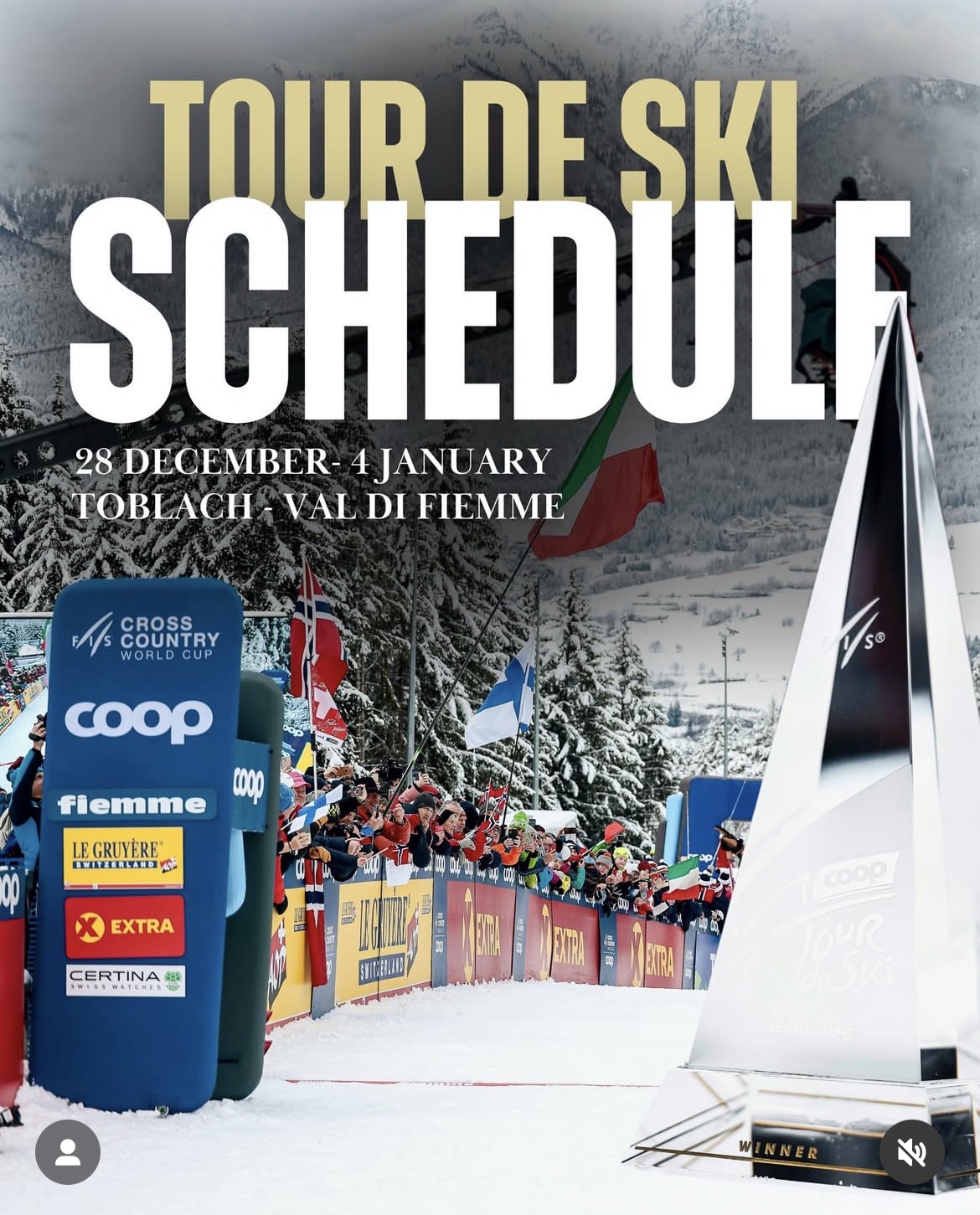
Over the span of eight exhausting days—Dec 28-Jan 4—Men’s and Women’s fields will each race six events from Sprints to Interval Starts to the the unbelievably steep and seemingly endless climb up the Alpe Cermis. Nearly insurmountable leads in FIS World Cup points are amassed by the winners of the Tour de Ski; most years, the eventual winner of the World Cup Overall Crystal Globe is the same as the winner of the Tour de Ski . . . except in those seasons—like 2025—when the Tour winner skips most of the other World Cup races in anticipation of a larger prize like the World Championships or the Olympics. In 2026, most of the primary Olympic contenders have also signed up for the Tour de Ski.
Tour Streaming
As has been the case for numerous years in a row, North American viewers can stream the 2026 Tour de Ski on skiandsnowboard.live. The website adjusts to the home-area of viewers, so the broadcast time on the thumbnail corresponds to your local viewing time. Yes, the races stream in brutally early time slots, especially for viewers on the west coast. Get up early anyway . . . it’ll be worth it.
The championship of the Women’s Tour de Ski is likely to be contested among Jessie Diggins (USA), Frida Karlsson (SWE), Heidi Weng (NOR), and Astrid Oeyre Slind (NOR), and Norwegian upstart Karoline Simpson-Larsen (fresh off her recent win in the World Cup 10 k Interval Start in Davos). Certain contenders are choosing to stay home—Linn Svahn (SWE), Jonna Sundling (SWE)—thus opening up additional spots in Sprint heats for all-rounders who might not normally advance on Sprint days.
Johannes Hoesflot Klaebo’s prowess in Sprint events—and his competitive resilience in Distance events—makes him nearly impossible to beat in the race for the Crystal Globe. Even if he does not win the Tour—even if he drops out of the Tour—he’ll likely secure another Overall Crystal Globe if he remains healthy and stays on the World Cup Tour. Though if the Olympics deliver him another amazing week like the one he constructed at last year’s World Championships (where he won an unprecedented six out of six races), Klaebo just might sail off into a well deserved sunset, leaving World Cup scraps for other contenders to scrabble over.