
From the FasterSkier archive — posts syndicated from athletes’ and coaches’ own blogs between 2004 and 2012, kept online as published. Current coverage is at fasterskier.com.

Tag: Tour de Ski Val di Fiemme

  • A Sprint Built for February, Raced in January with Tour Fatigue

    A Sprint Built for February, Raced in January with Tour Fatigue

    This coverage is made possible through the generous support of Marty and Kathy Hall and A Hall Mark of Excellence Award. To learn more about A Hall Mark of Excellence Award, or to learn how you can support FasterSkier’s coverage, please contact info@fasterskier.com.

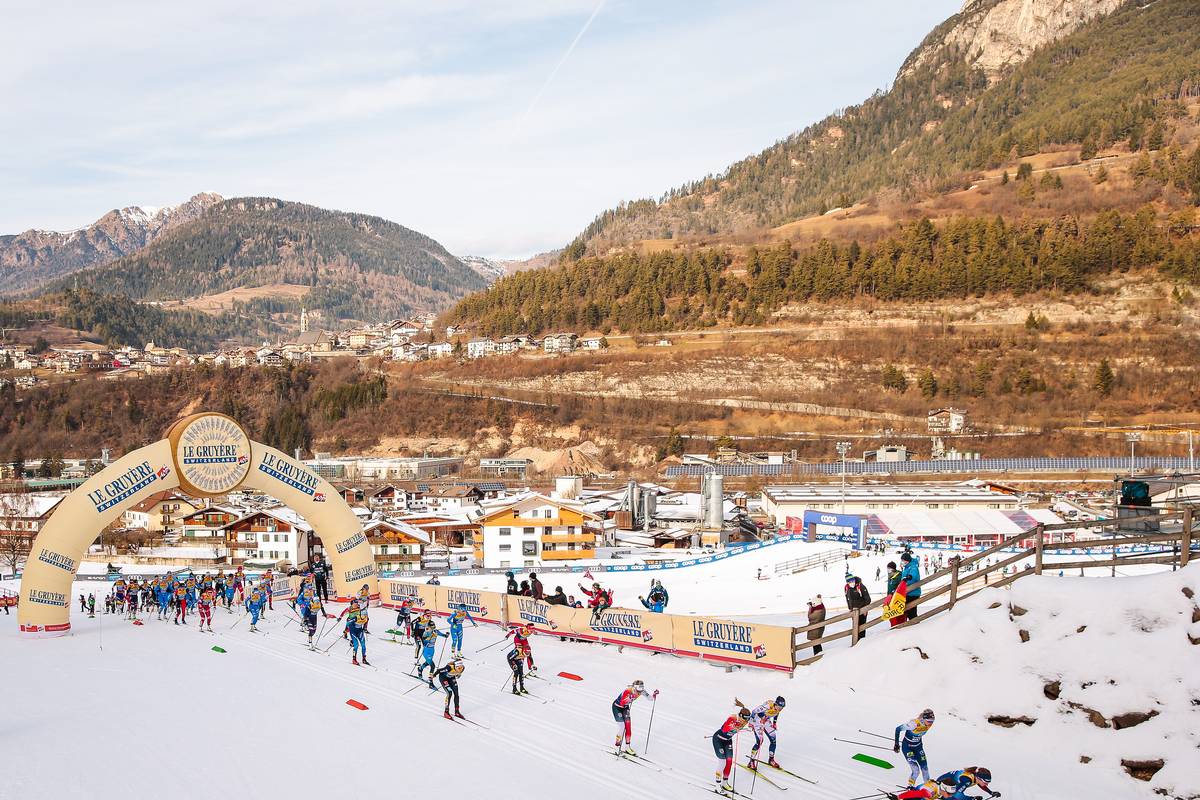
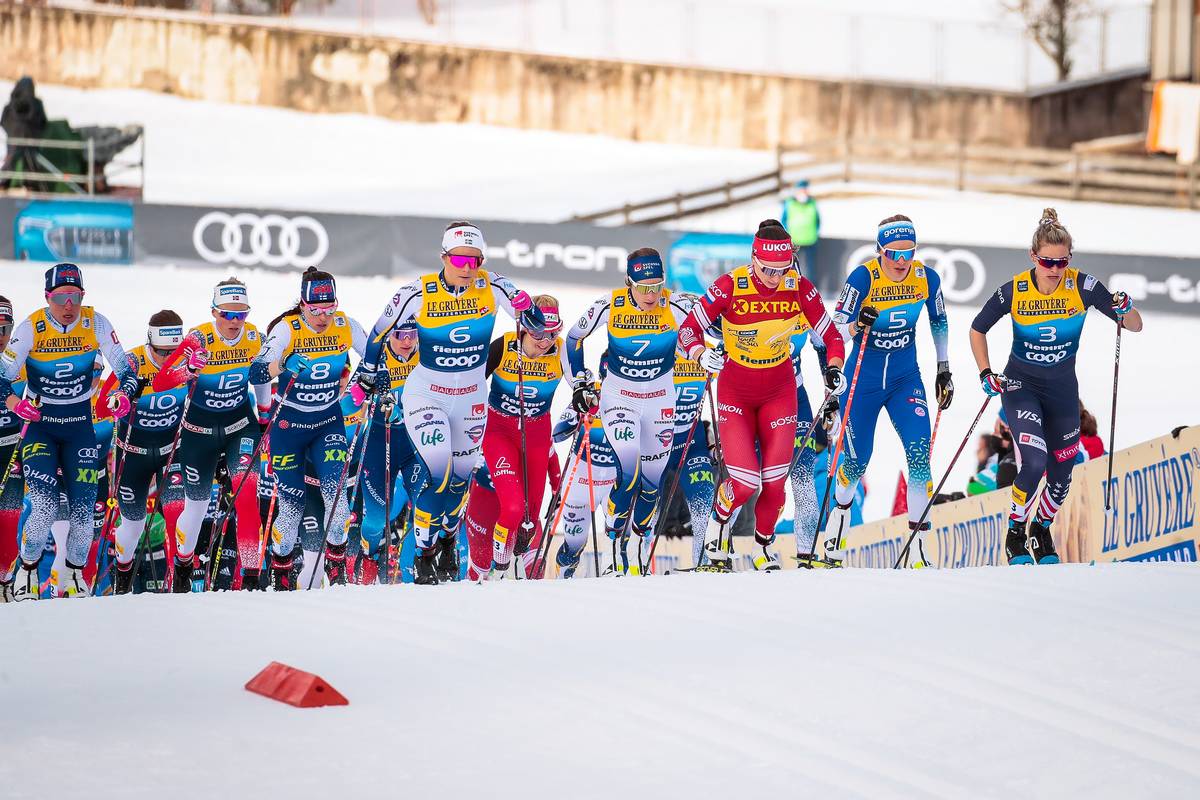
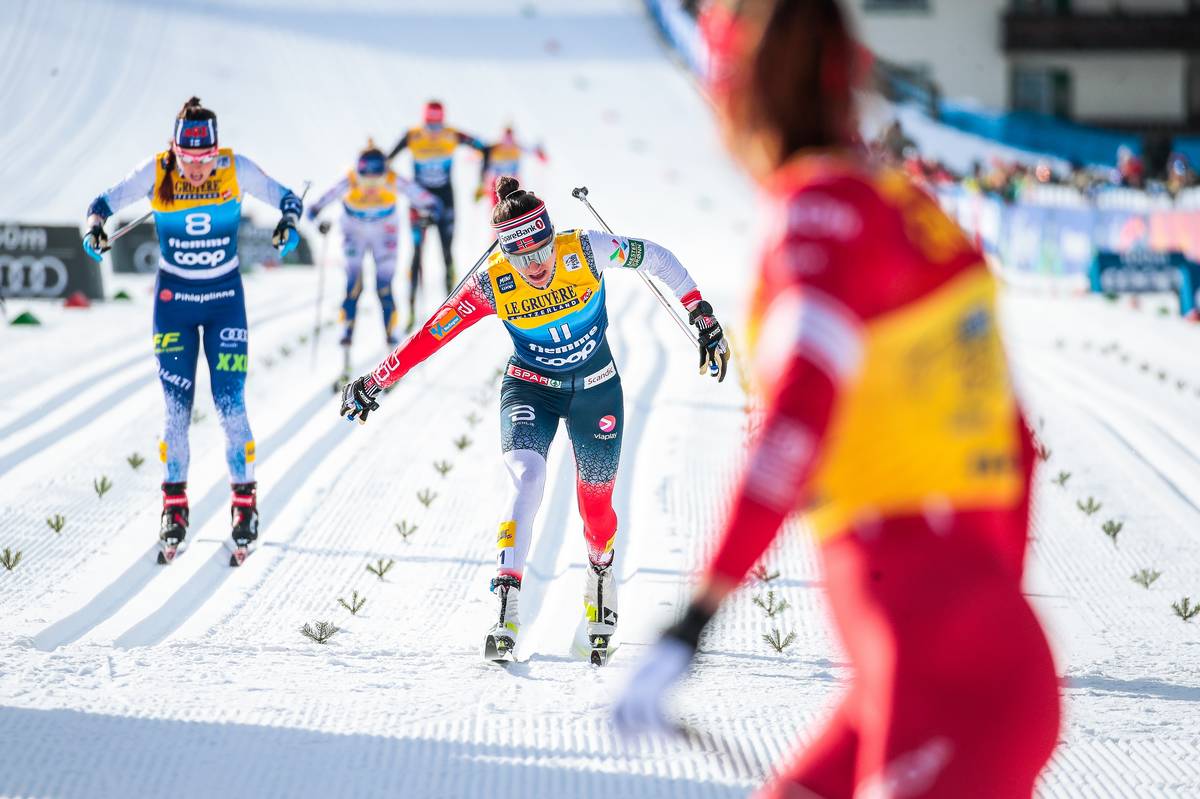
    Nadja Kaelin (SUI), Ingrid Bergene Aabrekk (NOR), Julia Kern (USA), Jasmin Kahara (FIN), Moa Ilar (SWE), and Nicole Monsorno (ITA) (l-r) start their quarterfinals during the Classic Sprint in Val di Fiemme (ITA) during the penultimate stage of the 2025/26 Tour de Ski. (Photo: Vanzetta/NordicFocus)

    By the time the women arrived in Val di Fiemme for Stage 5 of the Tour de Ski, the race had already narrowed in a way that had nothing to do with start lists or bib numbers. Five stages into the Tour, with travel from Toblach behind them and the final climb up Alpe Cermis looming ahead, every decision began to carry weight beyond the moment.

    Saturday’s classic sprint added another layer. For the first time, the athletes raced the exact sprint course that will be used at the Olympic Games in February — not a modified version, not a nearby loop, but the course itself. It was a rare opportunity: Olympic reconnaissance inside a stage race that punishes excess effort.

    The challenge was simple and unforgiving. One lap to qualify. One lap to survive each heat. No chances to reset.

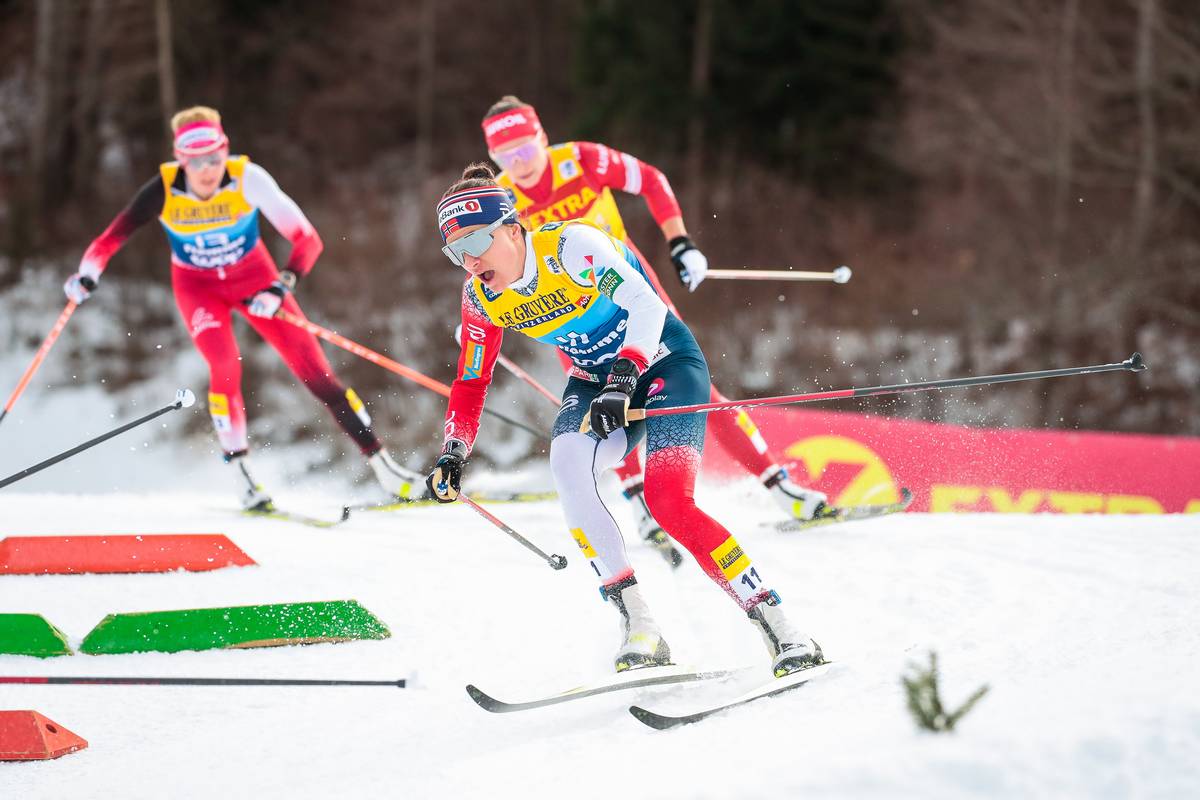
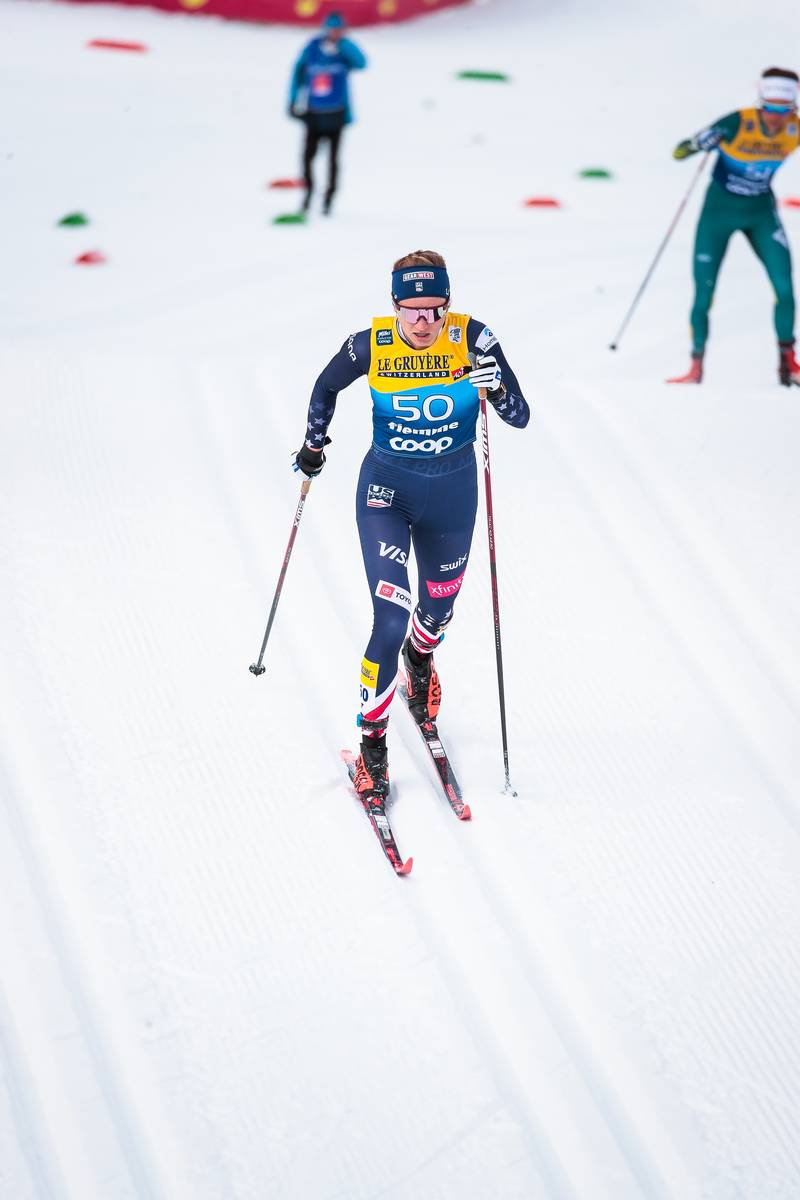
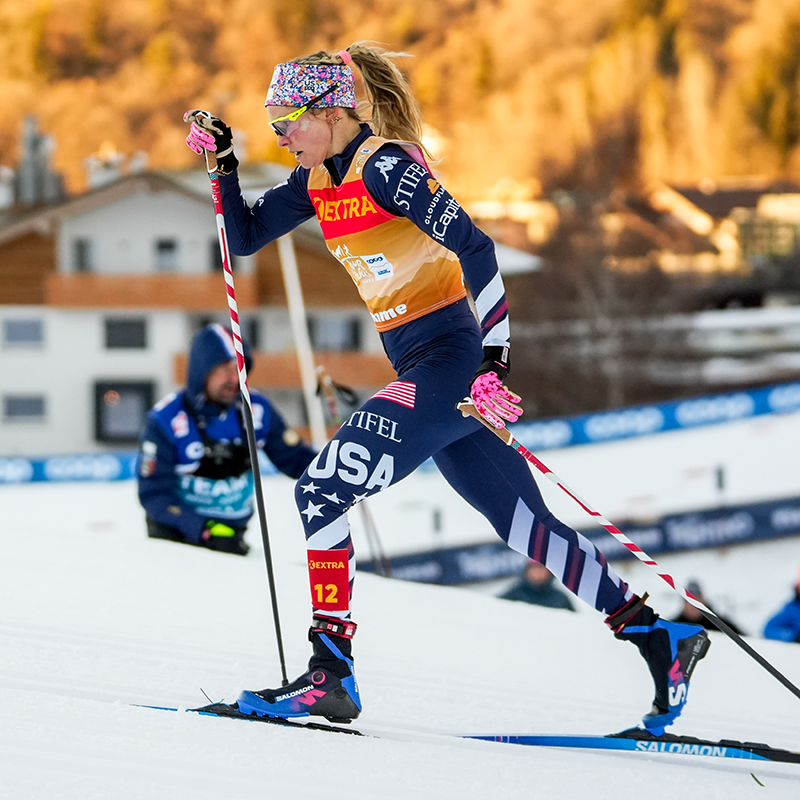
    Julia Kern (USA) – FIS world cup cross-country, tour de ski, individual sprint, Val di Fiemme (ITA). (Photo: Vanzetta/NordicFocus)

    “It definitely feels like an Olympic course.”

    The Val di Fiemme Olympic sprint course announces itself immediately. Tight turns demand positioning. Technical downhills reward precision. And the long climb — the defining feature — exposes anyone who arrives underpowered or out of position.

    “It definitely feels like an Olympic course,” said Julia Kern. “It is very hard. It has technical downhills, big climbs — it has everything.”

    Jessie Diggins agreed.

    “It’s a really legit course,” Diggins said. “I love that the uphill is long and there are opportunities for people to move and to pass.”

    Then she framed it in terms of February.

    “It’s the Olympics. It should be hard,” she said. “You should have to be the fittest and the fastest and just the best to win. And I think this is a course that demands those things.”

    Jessie Diggins (USA) – FIS world cup cross-country, tour de ski, individual sprint, Val di Fiemme (ITA). (Photo: Modica/NordicFocus)

    Qualification: one lap, no margin

    Qualification was a single-lap time trial, and it set the tone for the day. With no drafting and no tactical games, athletes had to show exactly what they had on the climb. The long uphill created immediate separation, and the results reflected fitness more than finesse.

    For athletes racing the Tour de Ski overall, qualification was also about control: skiing hard enough to stay well inside the top 30, but not harder than necessary.

    Both Diggins and Kern advanced cleanly into the heats, securing places in the top 30 and moving on to the quarterfinals.

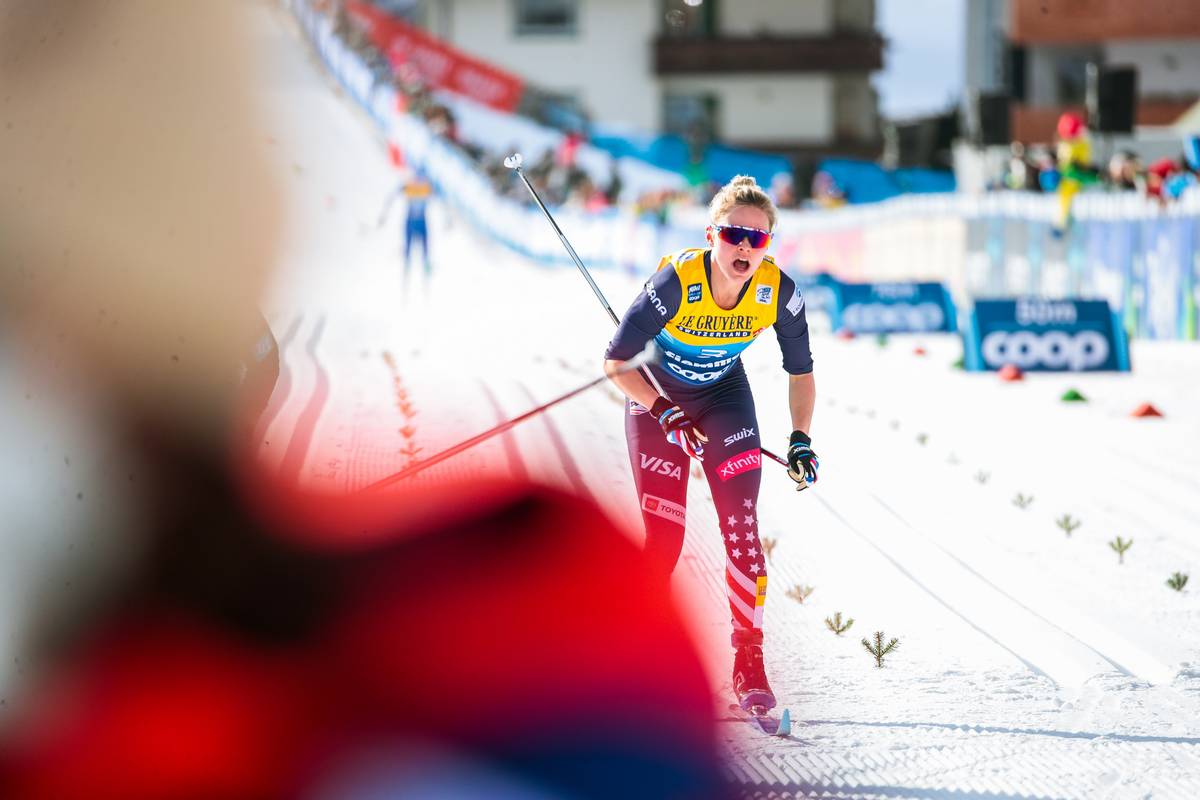
    Julia Kern (USA) reached the line in her quarterfinal but was not fast enough to advance. (Photo: Modica/NordicFocus)

    Quarterfinals: positioning becomes everything

    The quarterfinals split the field into five heats of six, with the top two from each heat automatically advancing to the semifinals, joined by two lucky losers based on time.

    With only one lap to work with, positioning was critical. The opening corners and technical sections determined who could enter the climb with momentum — and who would have to spend energy simply fighting back into contention.

    Kern approached her quarterfinal with a clear plan.

    “Today I wanted to be near the front, given all the turns,” she said, “and then open it up on the climb.”

    The plan made sense on a course where passing opportunities exist — but only if you can generate speed when the hill demands it.

    “At this stage in the Tour — in this season — I haven’t quite found my speed yet,” Kern said afterward. “And so didn’t quite have it on the hill today.”

    She finished outside the top two in her heat and did not advance as a lucky loser, ending the day 18th overall, eliminated in the quarterfinals.

    Still, Kern found something constructive in the effort.

    “I feel like I skied the first half better than I have in the past,” she said. “So I’m glad about that — and I just got to practice the hill now.”

    On an Olympic course, even a quarterfinal can be information worth collecting.

    Jessie Diggins (USA) and Johanna Matintalo (FIN), (l-r) lead their quarterfinal. (Photo: Vanzetta/NordicFocus)

    Semifinals: racing the sprint vs. racing the Tour

    The two semifinal heats brought together 12 athletes, each with the same arithmetic: finish in the top two, or be fast enough to earn one of the two lucky-loser spots into the final.

    This is where the Tour de Ski context begins to shape behavior.

    Diggins was explicit about that calculus.

    “My tactics were super different than the guys,” she said, “based on how women generally tend to race — especially on a longer course.”

    She came into the day with a clear objective: protect her overall position, gather bonus seconds if possible, and avoid unnecessary damage with Alpe Cermis one day away.

    Jessie Diggins (USA) came into the finishing stretch in the tracks behind Johanna Hagstroem (SWE), but was soon boxed out by Iris De Martin Pinter (ITA) and Julie Bjervig Drivenes (NOR), which made it impossible for her to find space in the closing meters. (Photo: Modica/NordicFocus)

    In the semifinal, Diggins briefly looked poised to advance into the final. Coming out of the final downhill and into the approach to the home stretch, she dropped into an aggressive low tuck, taking full advantage of fast skis to glide up into contention without spending additional energy. But as the field compressed in the final meters, Diggins found herself boxed in, with no clean lane to move forward before the line. It was a moment that captured both the precision and the limits of sprint racing on a technical course — speed alone wasn’t enough if space never opened.

    “For me, it was really like, okay, I just needed to try to get through to the semis and ideally through to the final,” Diggins said.

    She advanced through her semifinal — but without selling out — and finished 7th overall, just outside the six-woman final.

    “Seventh place was kind of almost best-case scenario,” she said. “One less hard effort for maximum points.”

    In the Tour de Ski, that logic is not defensive — it’s strategic.

    A Swiss, a Swede, a Finn, and repeat with Anja Weber (SUI), Maja Dahlqvist (SWE), Jasmi Joensuu (FIN), Nadine Faehndrich (SUI), Johanna Hagstroem (SWE), Johanna Matintalo (FIN), (l-r) lining up against each other in the finals of the Classic Sprint. (Photo: Vanzetta/NordicFocus)

    The final: Joensuu takes advantage

    The six-woman final delivered what the course promised: a fast, honest race where the climb made the selection.

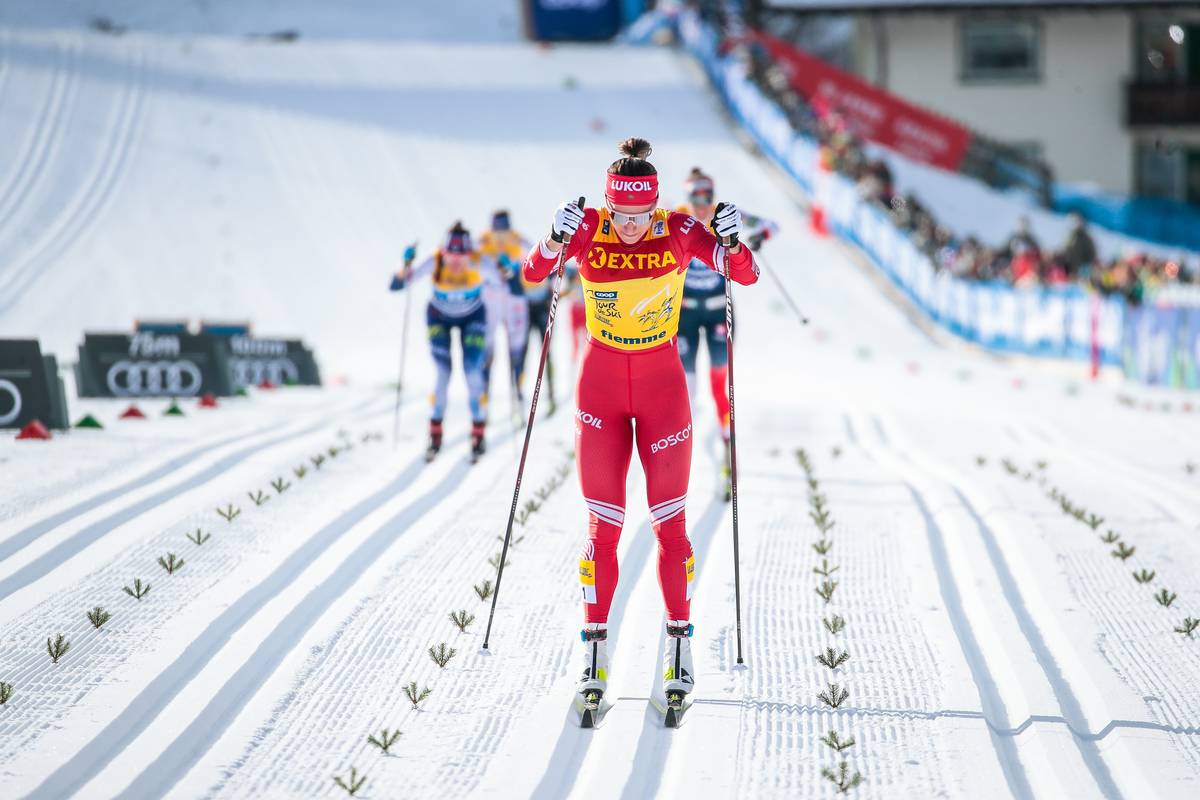
    Jasmi Joensuu (FIN) executed it best, winning the sprint in 3:45.75. Nadine Fähndrich (SUI) finished second, with Johanna Hagström (SWE) rounding out the podium.

    Where the Tour stands

    After Stage 5, Diggins remains in the gold bib, leading the Tour de Ski overall. Joensuu’s sprint victory moved her into second overall, tightening the standings ahead of the decisive final stage.

    Kern sits 17th overall, a position that reflects both the difficulty of the sprint and the way Tour time gaps become stubborn once established.

    With only the final climb remaining, the math is clear — but the execution is anything but.

    Jasmi Joensuu (FIN) celebrates ahead of Nadine Faehndrich (SUI) at the finish of the Classic Sprint in Val di Fiemme (ITA). (Photo: Modica/NordicFocus)

    One climb left

    The Tour de Ski ends where it always does in Val di Fiemme: on the Alpe Cermis, a climb so steep it turns technique into survival.

    For Diggins, Saturday’s ascent will be the last final climb of her career.

    “This is my 14th Tour,” she said. “I’m really excited that this is the last one. You will not catch me doing that again. I put in my time.”

    Her approach is stripped to essentials.

    “You literally have no idea how you’re going to feel until you’re a third of the way into the climb,” Diggins said. “And then you find out, and then you work with what you got.”

    She wants one thing.

    “I’m excited to be gritty,” she said. “Leave it all out there.”

    What Saturday actually revealed

    Saturday’s sprint didn’t decide the Tour de Ski. It clarified it.

    The Olympic sprint course in Val di Fiemme is technical, selective, and honest. It rewards fitness and decisiveness. It punishes hesitation. And it gives athletes exactly one attempt at a time to get it right.

    For Diggins, the day was about control — gathering points, learning the course, and arriving at Alpe Cermis with something left in the tank.

    For Kern, it was about feedback — confirmation of progress in parts of the course, and clarity about what still needs sharpening.

    And for the field as a whole, it was a reminder that Olympic snow does not negotiate.

    Tomorrow, the Tour de Ski ends on a climb that reduces everything to fitness and will.


    Women’s Classic Sprint Qualification RESULTS

    Women’s Classic Sprint Final RESULTS

    Women’s 2026 Tour de Ski OVERALL STANDINGS


    Love Stories Like This? Help Keep Them Coming.

    Feature stories like this one take time, access, and care to produce. If you value thoughtful storytelling and independent ski journalism, please consider becoming a Voluntary Subscriber. Your support directly fuels the work we do to cover the people, places, and moments that make our sport special.

    Join the FasterSkier community!


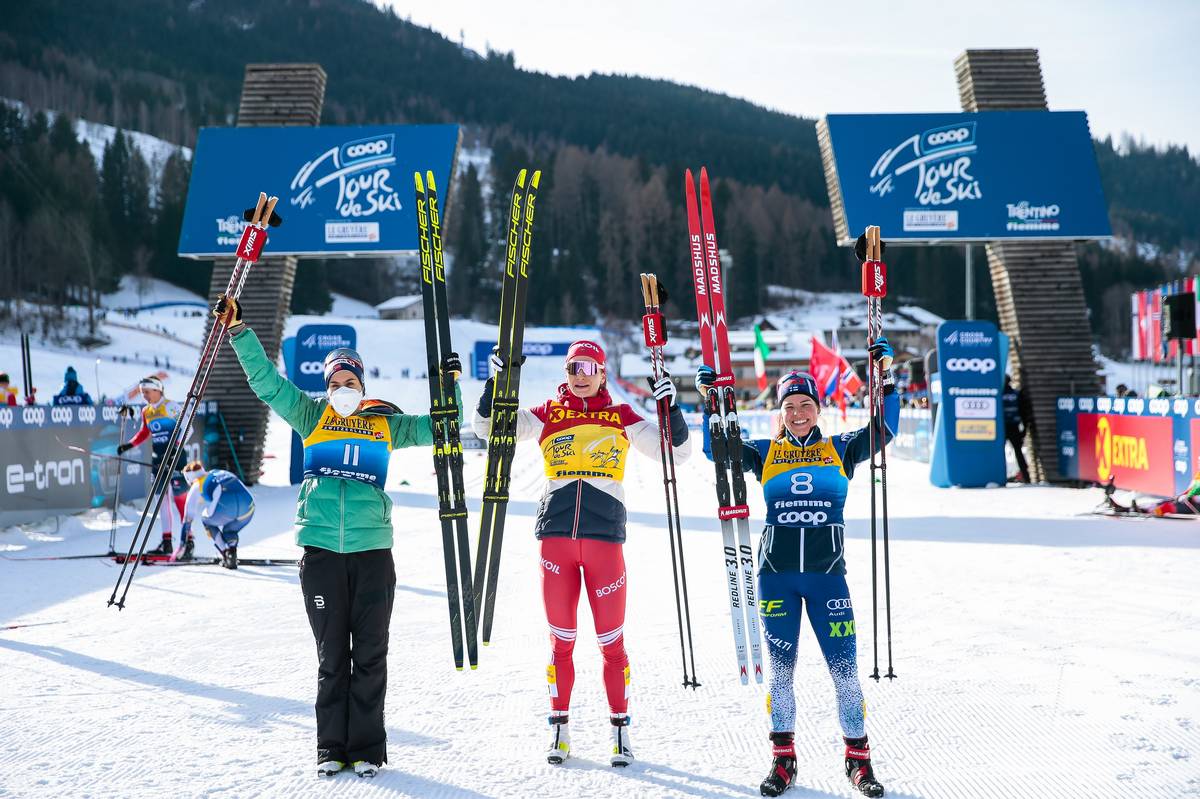
    Nadine Faehndrich (SUI), Jasmi Joensuu (FIN), Johanna Hagstroem (SWE), (l-r) share the podium of the Classic Sprint in Val di Fiemme (ITA). (Photo: Modica/NordicFocus)
  • Klæbo Pulls Away for Fourth Stage Win in 15k Mass Start Classic to Build Overall Tour Lead

    Klæbo Pulls Away for Fourth Stage Win in 15k Mass Start Classic to Build Overall Tour Lead

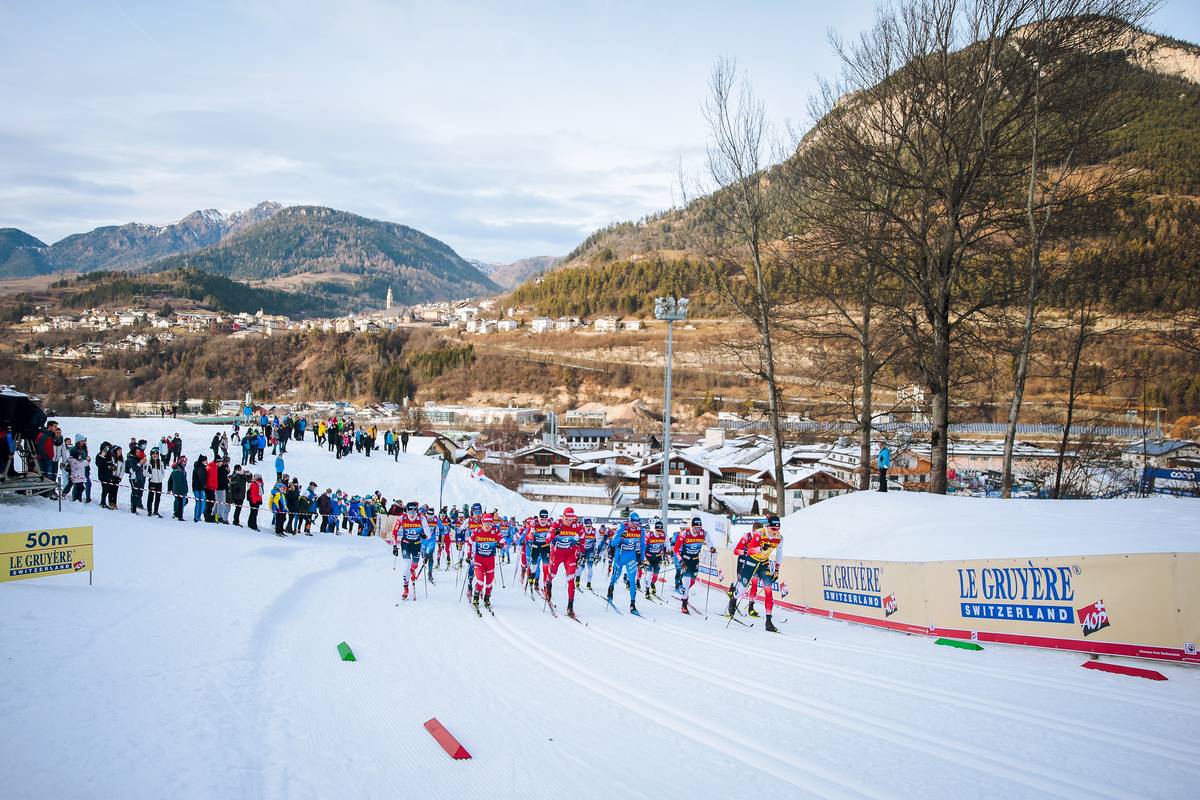
    Athletes take to the tracks for Stage 5 of the 2021/22 Tour de Ski, a 15-kilometer mass start classic in Val di Fiemme, Italy. (Photo: NordicFocus)

    This World Cup coverage is made possible through the generous support of Marty and Kathy Hall and the A Hall Mark of Excellence Award.  To learn more about A Hall Mark of Excellence Award or to learn how you can support FasterSkier’s coverage please contact info@fasterskier.com.

    From Switzerland, to Germany, to the Italian Dolomites, the 2021/22 Tour de Ski continued today with its fifth of six stages, a 15-kilometer classic in Val di Fiemme. Dwindling from over 100 racers in the opening stages in Lenzerheide, just 62 men took the tracks in Stage 5, perhaps reducing the inevitable congestion of a mass start during the first of six 2.5k loops.

    With the end of the Tour fast approaching, today’s race was all about time gaps. With three wins over four stages, Johannes Høsflot Klæbo (NOR) led the tour by 1:03 over teammate Pål Golberg, and perhaps more importantly, 1:19 over Russia’s Alexander Bolshunov, who entered the Tour on the heels of overall victories in both 2020 and 2021. With an abbreviated schedule that perhaps favors sprinters more than the usual seven-plus stage grind, Klæbo’s lead was not unprecedented, however, the Norwegian’s track record up the final hill climb on the infamous Alpe Cermis pales in comparison to the Russian’s.

    Over the last four iterations of the Tour de Ski, Bolshunov has incrementally shaved a position or two off each year. Finishing sixth in 2018 by time of day, he advanced to fifth in 2019, third in 2020, and second in 2021. In contrast, Klæbo was 21st up the hill in 2020 and skied the 27th fastest time of day in 2019. He did not compete in the 2018 or 2021 Tours. 

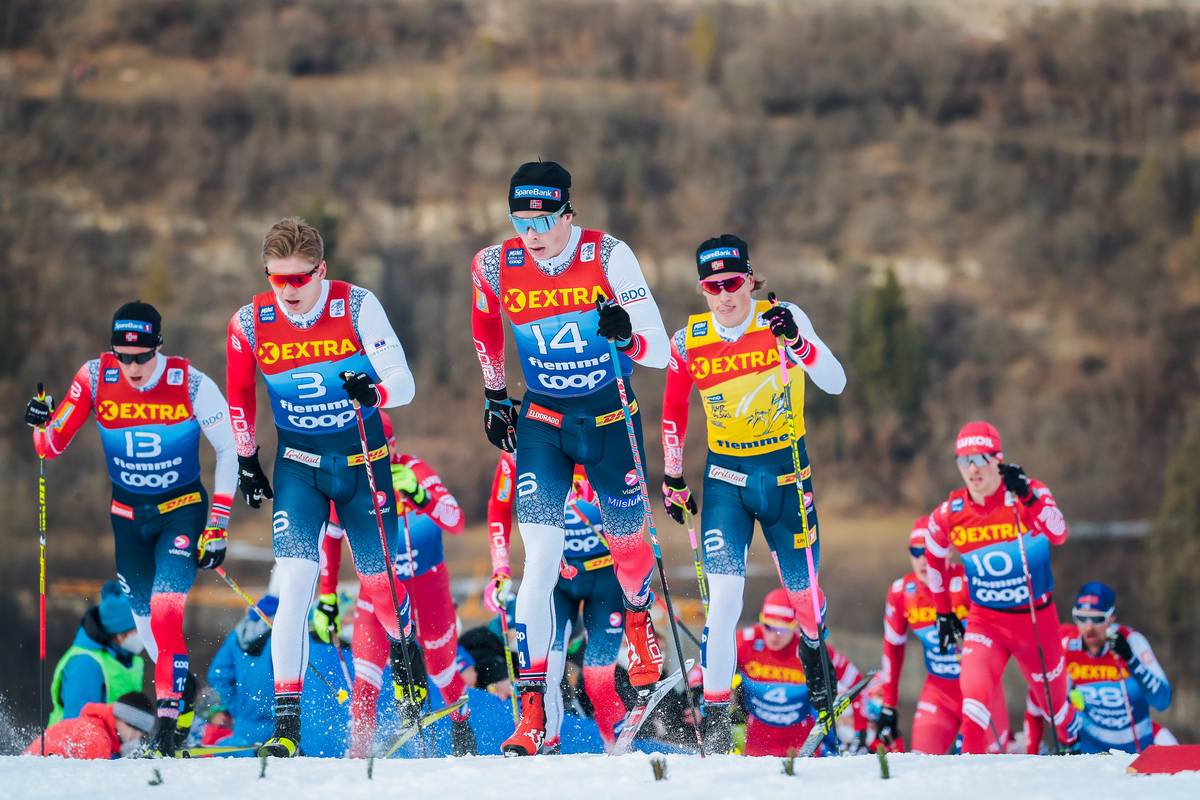
    A slew of Norwegians lead the way in the opening laps of the 15k mass start classic in Val di Fiemme. (Photo: NordicFocus)

    Though the margin was only 15 seconds between the men, Bolshunov had also beaten Klæbo in the previous classic stage, on the second day of racing in Lenzerheide. With a time bonus opportunity today at 8.5k, Bolshunov had the potential to do some damage in the overall standings.

    With both athletes through the opening kilometers cleanly, without crashes or broken equipment, the tension began to build through the middle laps. 

    At the halfway mark, Stage 2 winner and 15k classic specialist Iivo Niskanen (FIN) led the way through the stadium with a train of athletes, mostly Norwegian and Russian, on his tails. Klæbo sat comfortably in 4th (+1.3), with Bolshunov back in 17th (+6.8). Klæbo surged ahead of Niskanen to collect the maximum time bonus of 15 seconds at 8.5k, before allowing the Finn to continue the work at the front. Bolshunov was 9th at the time bonus, earning only 2 seconds. 

    Iivo Niskanen leads the way in Stage 5. (Photo: NordicFocus)

    At 10k, Niskanen and Klæbo began to break away from the lead group, led by Bolshunov, who had skied into third, now five seconds back on Klæbo. 

    Pulling away with 5k to go is not a tactic we typically see from Klæbo, who historically has been better served by tactical finishes where the pack remains tight until the final kilometer, where he’s able to use his sprint acceleration to excel. Niskanen showed in Stage 2 his capability to run away with a win, but could Klæbo keep pace?

    By the next lap, Klæbo showed that not only could he match the Finn, but he could drop him. The two were separated by 9.5 seconds at the 12.5k checkpoint, with the chase group over 23 seconds behind Klæbo. Halfway through the final lap, Klæbo had grown his lead to nearly 17 seconds over a fading Niskanen, with Russia’s Alexey Chervotkin leading the chase group 26 seconds back from the leader.

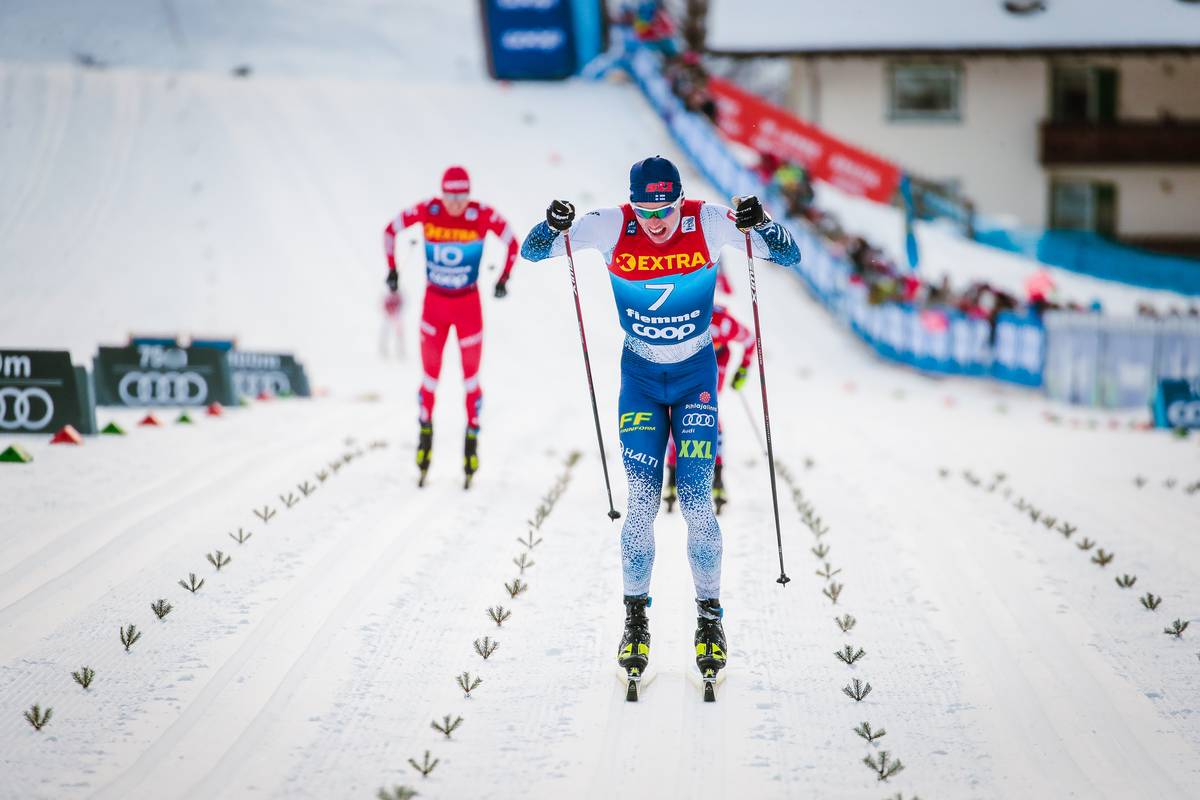
    Running away with a fourth stage win, Johannes Høsflot Klæbo crosses the line of the 15k mass start classic while his chasers in the background descend into the stadium. (Photo: NordicFocus)

    Climbing powerfully up the final climb, pushing into the downhill, and cruising confidently through the finish lanes for the win, Klæbo took a fourth Stage win in 41:31.2. Niskanen held his ground for second (+20.8), while Chervotkin continued to chase the podium for third (+23.7), edging out his teammate Denis Spitsov by 0.3 seconds at the line. 

    Iivo Niskanen pushes to second place in Stage 5, while Russian chasers fight for the final podium spot in his wake. (Photo: NordicFocus)
    Stopping the watches, Alexey Chervotkin (right) and Denis Spitsov cross third and fourth, respectively, at the finish of Stage 5 in Val di Fiemme. (Photo: NordicFocus)

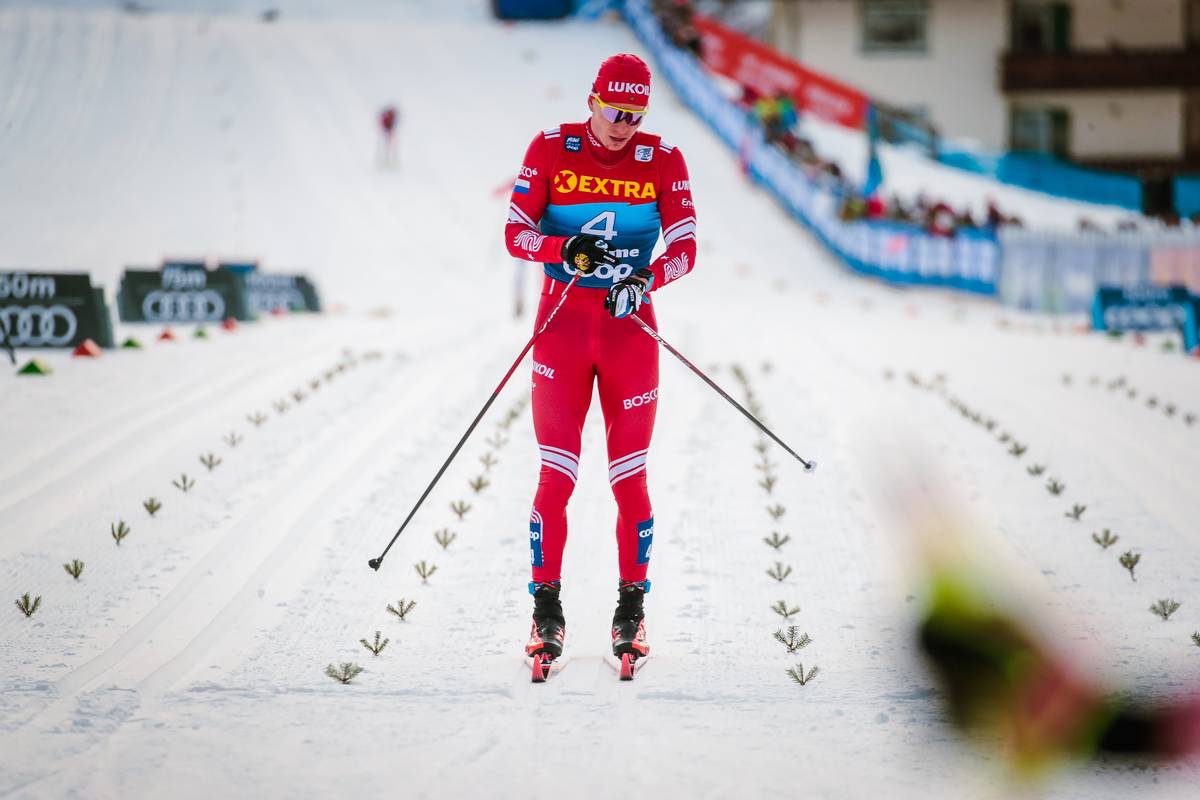
    Losing time in the overall standings, Bolshunov crossed the line 5th (+27.9). Between the time difference of the finish and the net loss of 13 seconds at the time bonus, this set Bolshunov back in the overall Tour standings by 2 minutes, though he remains in second place behind Klæbo.

    Bolshunov coasts over the line for fifth in the 15k mass start classic in Val di Fiemme. (Photo: NordicFocus)

    Commenting on his win and the growth of his advantage, Klæbo called it an “amazing day” in his post-race interview with FIS. 

    “We had amazing skis, and I think I used the rest day yesterday pretty good, so it was amazing to go out there with great grip and great gliding.”

    On his fatigue as the tour wanes, Klæbo continued, “I think we all are tired, but I was just trying to push all I could today, and like I said, amazing skis and the shape was good so it was amazing to actually win from the front for a change.”

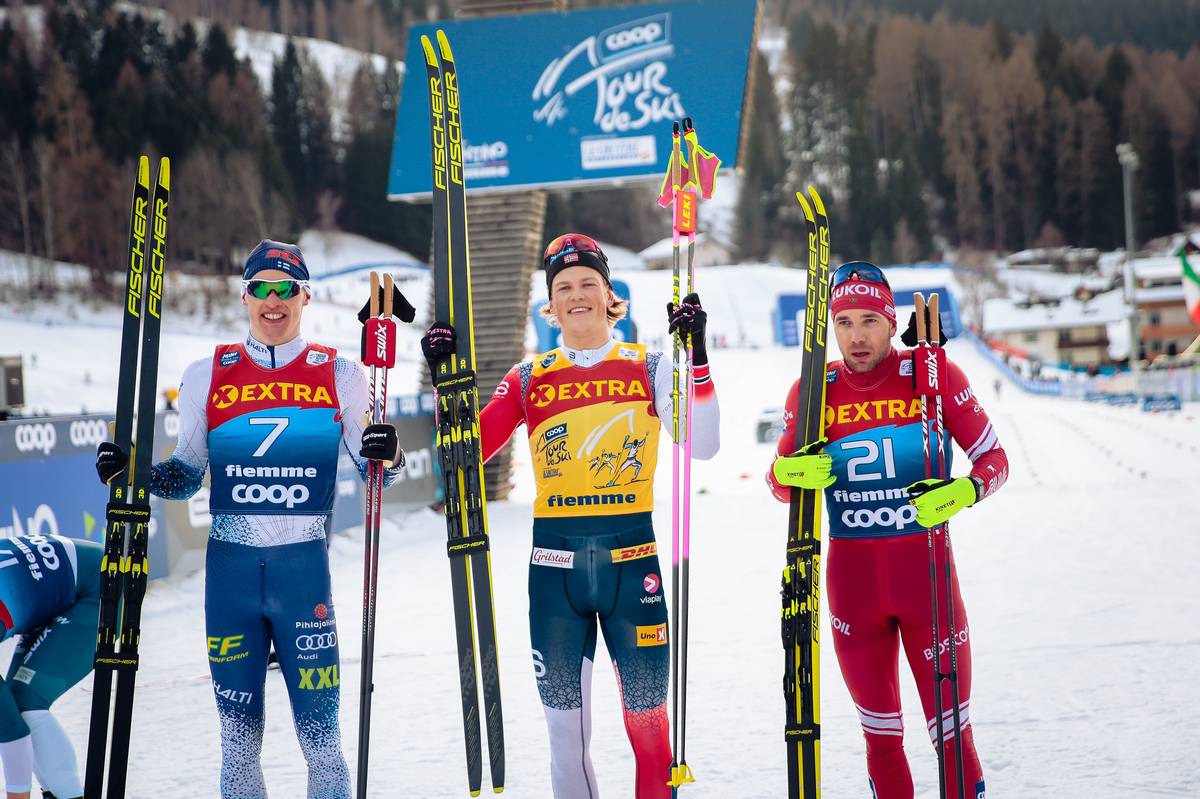
    The men’s podium after Stage 5 of the Tour de Ski: Johannes Høsflot Klæbo (NOR) took the win ahead of Iivo Niskanen (FIN) in second and Alexey Chervotkin (RUS) in third. (Photo: NordicFocus)

    The start format of the final hill climb has shifted from a pursuit start based on overall standings in the tour, indicating that the first to the top of the hill would be the winner, to a mass start where overall standings become more foggy. This may mean that Klæbo is steadily being passed through the climb tomorrow, often those more lithe than the muscular sprint champion, while an athlete like Bolshunov climbs with more real estate, and perhaps less demoralization, near the front.  

    In response to the format, Klæbo explained: “[It’s not my favorite for sure, but I want to push everything I can tomorrow, then we’ll just see how it goes, but looking forward to tomorrow’s race as well.”

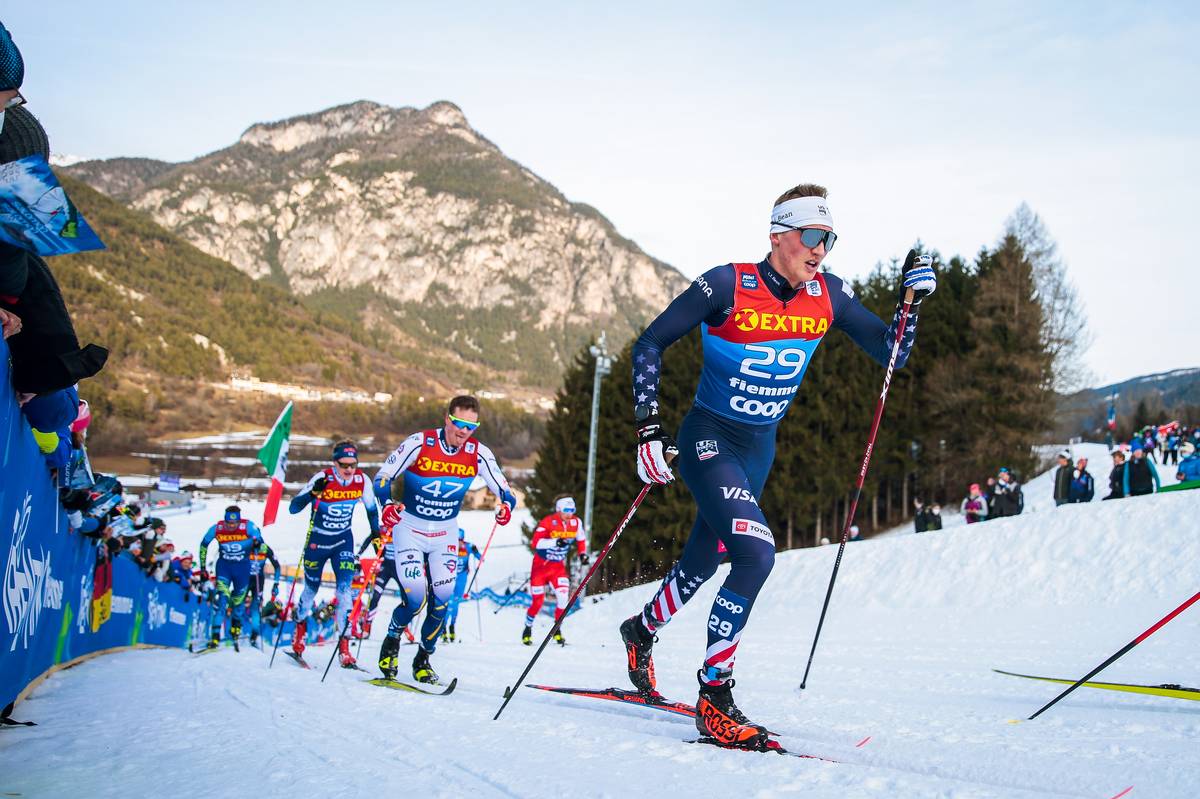
    Gus Schumacher races Stage 5 of the 2021/22 Tour de Ski in Val di Fiemme. (Photo: NordicFocus)

    It was a challenging day for the American men today, with only Gus Schumacher and Zak Ketterson remaining in the tour. Schumacher skied to 50th (+4:15.5) while Ketterson finished 59th (+5:42.9). Luke Jager and Ben Ogden, both sprint focused, pulled from the Tour after Stage 4. 

    “This is my first tour, and probably the first time I’ve done this many races in so few days,” Ketterson said after his race. “You kind of go into the race, just seeing what will happen. Today was pretty tough, of course, but I guess it’s just the nature of skiing that you have to just look toward the next stage. We have another race tomorrow and it’s a new chance. So, just have to have short term memory loss, I guess.”

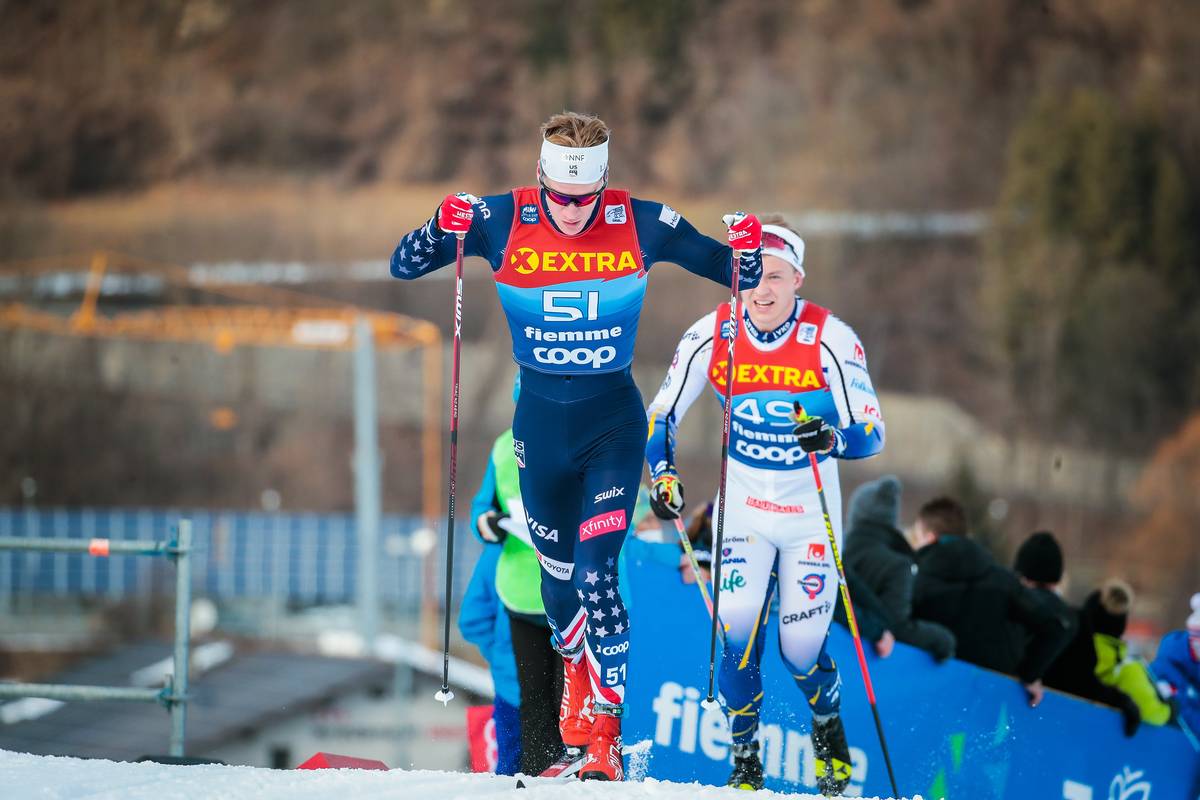
    Zak Ketterson races Stage 5 of the 2021/22 Tour de Ski in Val di Fiemme, ITA. (Photo: NordicFocus)

    In terms of what he has learned over the last week in his first starts on the World Cup, Ketterson explained that this biggest adjustment has been to the level of racing and the density of world-class athletes.

    “The most interesting thing, if I have an off day in the US on the SuperTour, may I’ll be in the top 10, maybe top 20… but here, if you have a bad race, you get exposed. So it’s just seeing that you just have to stay super focused, because if you slip even a little bit here, you just lose so much.” 

    Full audio from post-race interview with Zak Ketterson, hosted by U.S. Ski & Snowboard cross country communications manager Tom Horrocks.

    Leaders of the day, Iivo Niskanen (FIN) and Johannes Høsflot Klæbo (NOR) set the pace in the 15-kilometer mass start classic in Val di Fiemme. (Photo: NordicFocus)

    Taking a last look at the overall standings before the final stage, Iivo Niskanen sits in third by time (+2:49) behind Klæbo and Bolshunov, with Norway’s Erik Valnes and Golberg in fourth (+3:04) and fifth (+3:09), respectively. Klæbo sits atop the points standings with 93, leading Valnes in second with 63, and Bolshunov in third with 42.

    Stage 5 Results

    Overall Tour Standings: Cumulative Time | Points

  • Nepryaeva Cushions Her Lead with 10k Mass Start Classic Win; Diggins 13th

    Nepryaeva Cushions Her Lead with 10k Mass Start Classic Win; Diggins 13th

    Not-quite-winter. The women’s 10-kilometer classic kicked off the final two stages of the 2021/22 Tour de Ski in Val di Fiemme, Italy. (Photo: NordicFocus)

    This World Cup coverage is made possible through the generous support of Marty and Kathy Hall and the A Hall Mark of Excellence Award.  To learn more about A Hall Mark of Excellence Award or to learn how you can support FasterSkier’s coverage please contact info@fasterskier.com.

    After a day of rest, the Tour de Ski kicked off it’s final two stops in the mountains of northern Italy. After a dramatic freestyle sprint in Stage 4, there was a lot on the line with little time to go in the Tour for many of the women who lined up for today’s 10-kilometer mass start classic in Val di Fiemme. With blue skies and sunshine illuminating the spectacular Italian Dolomites, the stage was set for a spectator’s dream over the four lap course.  

    First, a quick look to the overall Tour standings to set the tone. Natalia Nepryaeva (RUS) took the lead in Stage 4. With the 60-second time bonus for a sprint win, Nepryaeva entered Stage 5 with a 34 seconds lead on Kerttu Niskanen (FIN) in second, and 38 seconds ahead of Jessie Diggins (USA) in third.

    A favorite for a second consecutive Tour win, Diggins led the standings heading into the fourth stage, during which she was taken out by Frida Karlsson (SWE) in the quarterfinals, losing vital time in the Tour standings. Karlsson was later disqualified for obstruction and withdrew from the Tour after being issued a three minute time penalty that put her out of contention for the overall win. 

    While Diggins typically responds well to pressure and has put together impressive performances up the final hill climb, the classic tracks in Val di Fiemme have historically challenged Diggins, who would need to minimize time lost in order to still be in a position to fight for the overall win in the final stage. In last year’s Tour, Diggins was 10th in the 10k classic in Val di Fiemme, 17th in 2020 and 2019, and 4th in 2018. The odds were, perhaps, not in her favor, but the potential was there.

    Athletes take to the tracks for Stage 5 of the 2021/22 Tour de Ski, a mass start classic in Val di Fiemme, Italy. (Photo: NordicFocus)

    Within the race, there were two opportunities for bonuses, one for Tour points and one for bonus seconds. These opportunities arose at 2.3 and 6k, respectively. 

    As racers took to the course, the congestion of a mass start was apparent. A pole snapped within the first minute as racers jostled for position in the lanes before settling in. 

    As the second lap started, a gap began to form behind a large lead pack of about 14 women, which included Diggins, Nepryaeva, and Niskanen. The lead women created a roughly eight-second lead on the chase pack at 3.5k.  

    Heidi Weng navigates fast and icy corners during the 2021/22 Tour de Ski in Val di Fiemme, Italy. (Photo: NordicFocus)

    At the halfway mark a group of six skiers began to thin out the lead group, led by Krista Pärmäkoski (FIN), Heidi Weng (NOR), Ebba Andersson(SWE), Katharina Henning (GER), Nepryaeva, and Teresa Stadlober (AUT). They opened up about a six-second lead on the chase pack which included Diggins and Niskanen. 

    As the women lapped through the stadium for the last 2.5k, this lead group, now led by Andersson, had stretched their lead to more than 20 seconds over the next chase pack.  

    Working together through most of the final lap, the group of six women skied together until the final climb before the stadium where Nepryaeva began to surge.

    Charging up the hill and pushing hard over the top before dropping into a tuck, she quickly dropped the women in pursuit. Cruising through the stadium with a powerful doublepole, Nepryaeva had a comfortable lock on the win, stopping the clock with a fist pump in 29:51.3. 

    Natalia Nepryaeva (RUS) takes the win in Stage 5 of the Tour de Ski. (Photo: NordicFocus)
    Fighting for second and third, Heidi Weng (NOR) overtakes Krista Pärmäkoski (FIN). (Photo: NordicFocus)

    In second at the top of the climb, but gaining ground in the descent and double pole, Weng pulled ahead of Pärmäkoski to finish second (+3.7), with the Finn just behind in 3rd (+4.7). The remainder of the lead group skied through the finish evenly spread with Andersson in 4th (+7.5),  Henning in 5th (+10.9), and Stadlober 6th (+14.3).

    The women’s podium after Stage 5 of the Tour de Ski. Natalia Nepryaeva (RUS) took the win ahead of Heidi Weng (NOR) in second, and Krista Pärmäkoski (FIN) in third. (Photo: NordicFocus)

    In a FIS Interview, Nepryaeva was asked how she felt about the race and about the course. “I am really happy to win here, it is a really important place for me, as it was my first win at World Juniors here.”  

    Outside the lead group and fighting hard to minimize time lost, Diggins crossed the finish line in 13th (+58.0). Diggins explained after the race that the icy conditions in Val di Fiemme were tricky for many of the women racing, as the speed checks needed to stay in control through the downhills in mass start conditions also cost them some grip in the final laps. 

    “I think it was one of those [days] where I had to really catch myself and be thinking really, really hard about standing tall and thinking about technique, which is harder for me in classic,” Diggins explained post-race. “I’m really proud of staying in the moment and never giving up and doing what I could with what I had.”

    Never a question of whether she has given her all, Diggins crosses the line in 13th in Stage 5. (Photo: NordicFocus)

    Looking ahead to the Alpe Cermis, where her time deficit may prove insurmountable, Diggins once again showed her never-give-up attitude 

    “I’m excited. It’s so hard, but it’s such a feeling of accomplishment making it to the top of that mountain… You can rest assured I will be crossing that finish line with nothing left.”

    Full audio clip from Jessie Diggins, interviewed on-site by Tom Horrocks, U.S. Ski & Snowboard cross country communications manager. 

    Katherine Ogden skis to 31st in Stage 5 of the 2021/22 Tour de Ski. (Photo: NordicFocus)

    Missing the Top-30 by just 13 seconds, Katherine Ogden raced to 31st (+2:17.4) as the next American finisher. Also with strong finishes, Novie McCabe crossed the line in 36th (+2:38.3) just ahead of her teammate Sophia Laukli, who took 39th (+2:57.7). Alayna Sonnesyn rounded out the women in stars and stripes in 51st (+5:32.1).

    Post-race interview with Katharine Ogden and Novie McCabe, interviewed by Tom Horrocks. 

    Sophia Laukli skis to 39th in Stage 5 of the Tour de Ski in Val di Fiemme. (Photo: NordicFocus)

    Looking back on the bonus opportunities, Johanna Hagström (SWE) made a move just before the 2.3k point bonus to pull away from the pack to snag the maximum of 15 points.  Pärmäkoski and Weng tied for second to both get 12 points. Diggins crossed the 2.4k mark in 8th, earning 3 bonus points.  

    At the 6k time bonus opportunity, Andersson was the first over the line, giving her 15 bonus seconds in the tour. Weng was able to continue her bonus streak on the day by crossing second and getting a 12-second bonus, while Pärmäkoski crossed in 3rd for 10 bonus seconds.  Nepryaeva finished in 5th, collecting six seconds.

    After today, Nepryaeva was able to not only hold on to her lead in the Tour, but expand it. Now leading Andersson by 1:12 seconds, heading into the final stage of the tour tomorrow. Diggins dropped down to sixth place from third, now behind by 1:42.

    Alayna Sonnesyn skis to 51st in Stage 5 of the Tour de Ski in Val di Fiemme, Italy. (Photo: NordicFocus)

    The final stage of the 2021/22 Tour de Ski, the infamous Alpe Cermis hill climb, kicks off at 11:30 CET / 5:30 EST.

    Stage 5 Results 

    Overall Tour Standings: Cumulative Time | Points