Tag: Tour de Twin Cities

  • Koos and Brennan Triumphant at Tour de Twin Cities; Greggs Take Stage 5 Wins

    Koos and Brennan Triumphant at Tour de Twin Cities; Greggs Take Stage 5 Wins

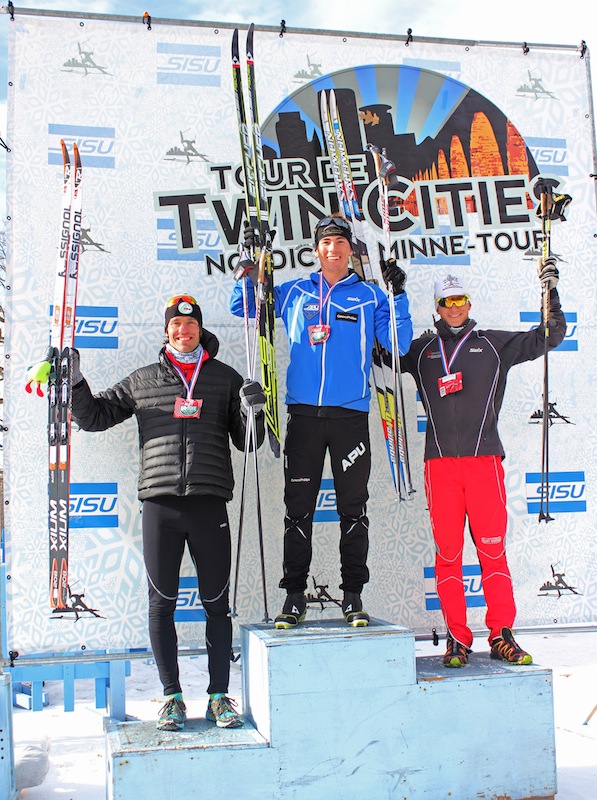
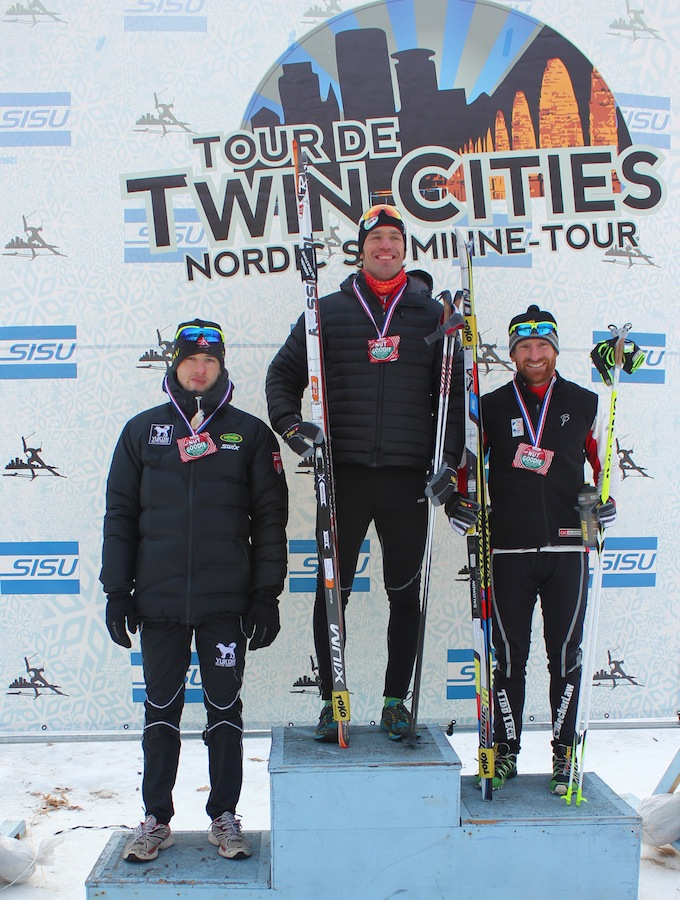
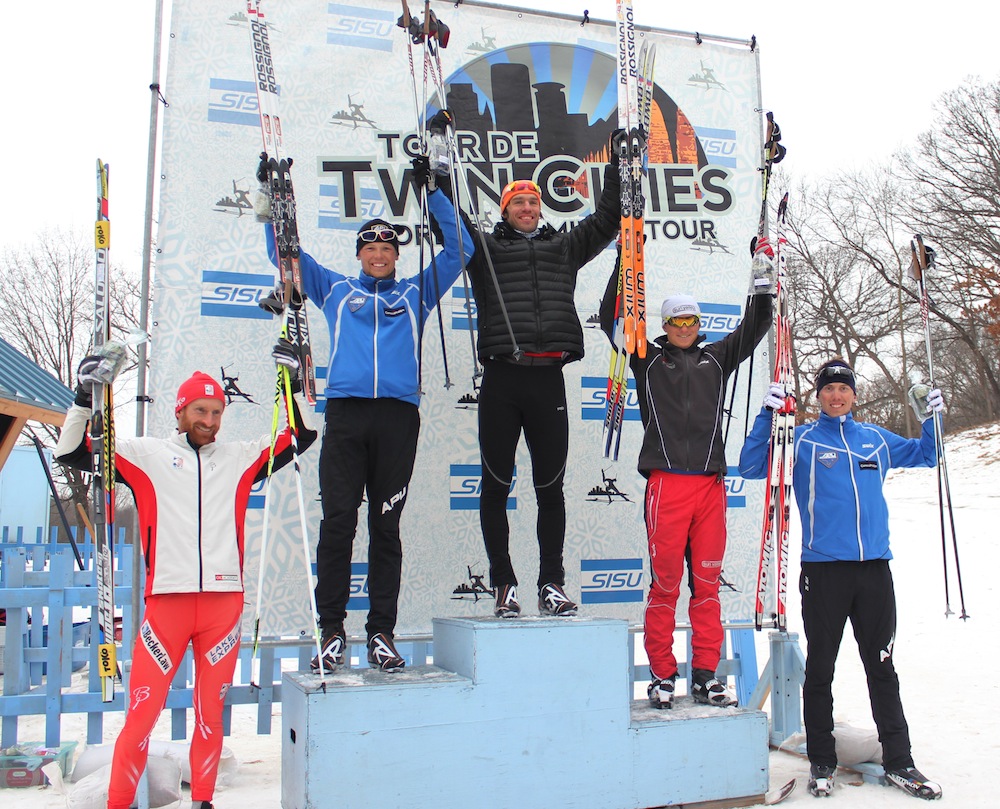
    The 2013 Tour de Twin Cities men's overall podium. 1. Torin Koos, 2. Mark Iverson, 3. Mike Sinnott, 4. Brian Gregg, 5. Brent Knight. Photo: Reese Hanneman.
    The 2013 Tour de Twin Cities men’s overall podium. 1. Torin Koos, 2. Mark Iverson, 3. Mike Sinnott, 4. Brian Gregg, 5. Brent Knight. Photo: Reese Hanneman.

    Five stages and over a week has gone by since the 2013 Tour de Twin Cities began at Wirth Park in Minneapolis, Minnesota, and on Sunday the event concluded dramatically with a 10/15 k freestyle pursuit. After dozens of accumulated laps around the 3.3 k course, Torin Koos (Bridger Ski Foundation/Rossignol) and Rosie Brennan (Alaska Pacific University) each maintained starting leads and emerged victorious in the overall Tour standings. Husband-and-wife duo Brian and Caitlin Gregg (Central Cross Country) both posted the fastest times of the day for the stage five wins.

    On a short, rolling course, the men’s 15 k unfolded in predictable fashion: the leaders played with a confortable pace until a final sprint to the finish. Koos began the 15 k pursuit with a 17-second lead on Mike Sinnott (Sun Valley Ski Education Foundation), and with such a small head start he expected the race would come down to the last stretch

    “Even before the Tour began, I just knew it was going to come down to the final hunting-start 15 k freestyle,” Koos wrote in an email. “And after seeing how it was so hard for anyone to break away and hold a lead in the mass start 20 k classic, this became more apparent.”

    Sinnott and Mark Iverson (APU) left the gate only nine seconds apart and skied together to close the gap on Koos, and by the end of lap three the trio was skiing together at an easy pace, with Iverson leading.

    “We slowed down after that and played some little cat and mouse games for laps four and five, content to let it come down to a sprint,” Sinnott said.

    Iverson attempted to drop the other two on the last few laps, but was unsuccessful. “On that course, fast with only one real working section, it didn’t work. So we all just settled down with me leading,” he said.

    Koos surged ahead with a kilometer to go and held on to the lead through the finish, ultimately winning the Tour by a few seconds.

    “In the end, I had an extra step on those two guys and was able to take the [Tour] title by a ski length,” Koos said. “I was pretty psyched to take the overall win. It’s a really great event, one I hope that becomes a staple for the U.S. ski racing circuit.”

    Behind him, or rather almost next to him, the battle for second and third was less certain. A jockey between Sinnott and Iverson for the same finish lane generated some contact between them, which Sinnott considered to be the result of a questionable move from Iverson.

    With a lead of a few meters Koos was able to chose the center finishing lane, forcing Iverson and Sinnott to go to the inside as they came out of a hard, downhill corner that spit into the finish stretch. The two skied neck-and-neck as they sought the same left-hand lane, causing their boots to briefly connect in the last 50 meters of a fast finish.

    In Iverson’s words, he chose the left lane “just in front of Mike. I didn’t want to go wide. Mike and I bumped a bit fighting for the left lane and we both lunged together for the line. Torin was able to get the win and it was really close between Mike and I.”

    Sinnott was more descriptive about how the sprint played out, and considered the “bump” with Iverson in the finishing lanes to be a definite infraction of the rules.

    “In the finish, I took the inside line as Torin went wide and Mark skied between lanes,” Sinnott wrote in an email. “Mark then decided to shift over, making contact between his boots and mine. He knocked me into the V-boards and I was forced to double pole the remaining 50 m as my lane was no longer mine. The result left me in third and pretty peeved about the clear infractions.”

    After the finish Sinnott found spectators who had taken photographs of the incident and brought them before the Technical Delegate, but to no effect.

    “I found some photos and several witnesses but was told by the TD, ‘you can protest, but I’ve already made up my mind. So…’ He refused to look at the photos, and again dismissed me when I mentioned [Alexander] Legkov’s move in the Tour [de Ski], resulting in a 15 second penalty,” Sinnott said.

    “Basically, I had a strong chance to win, it’s hard to say, but was unequivocally obstructed by Mark as he moved between lanes. As a result, I ended third. It was not how I’d like to see the hard fought five-day event end.”

    FasterSkier was not present at Wirth Park, and at press time had only Sinnott’s and Iverson’s accounts of what happened. Besides the finish line incident, Tour competitors were generally happy with how organizers put together the event.

    Regardless of how the last 100 m unfolded, Iverson’s run at the podium this week has been the best racing of his career. On Sunday he skied the second-fastest time of the day, 36:07.4.
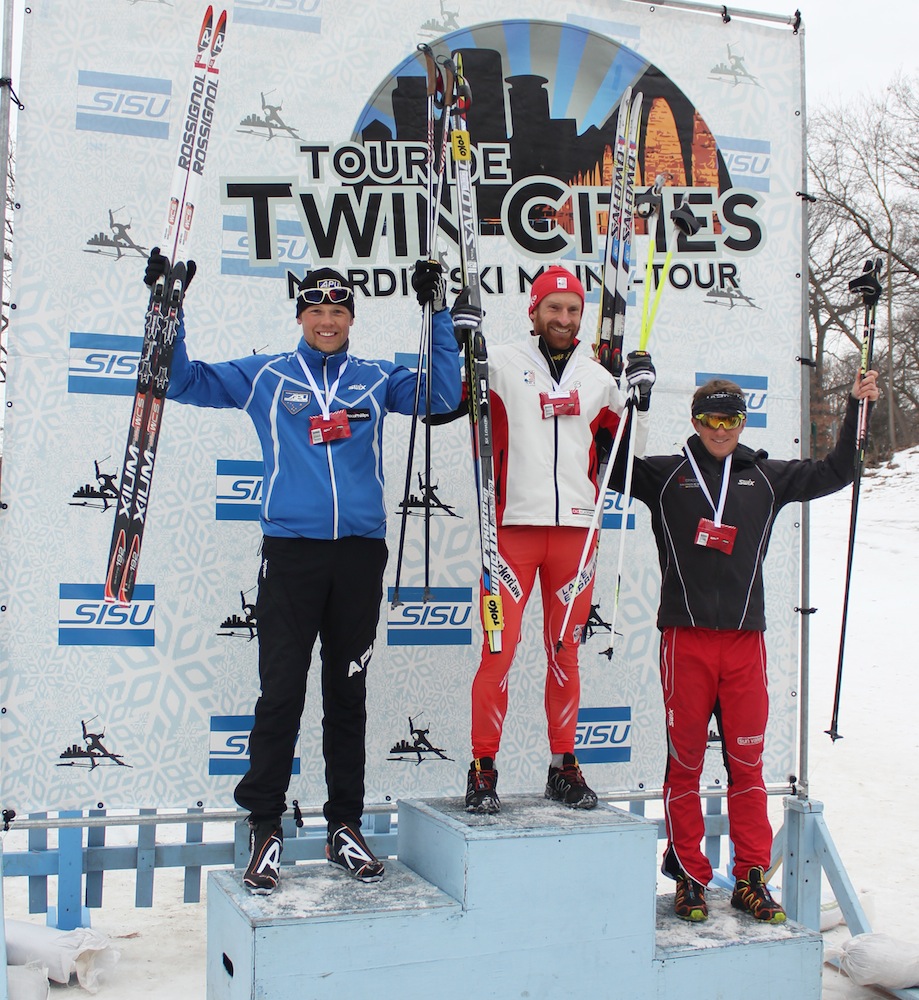
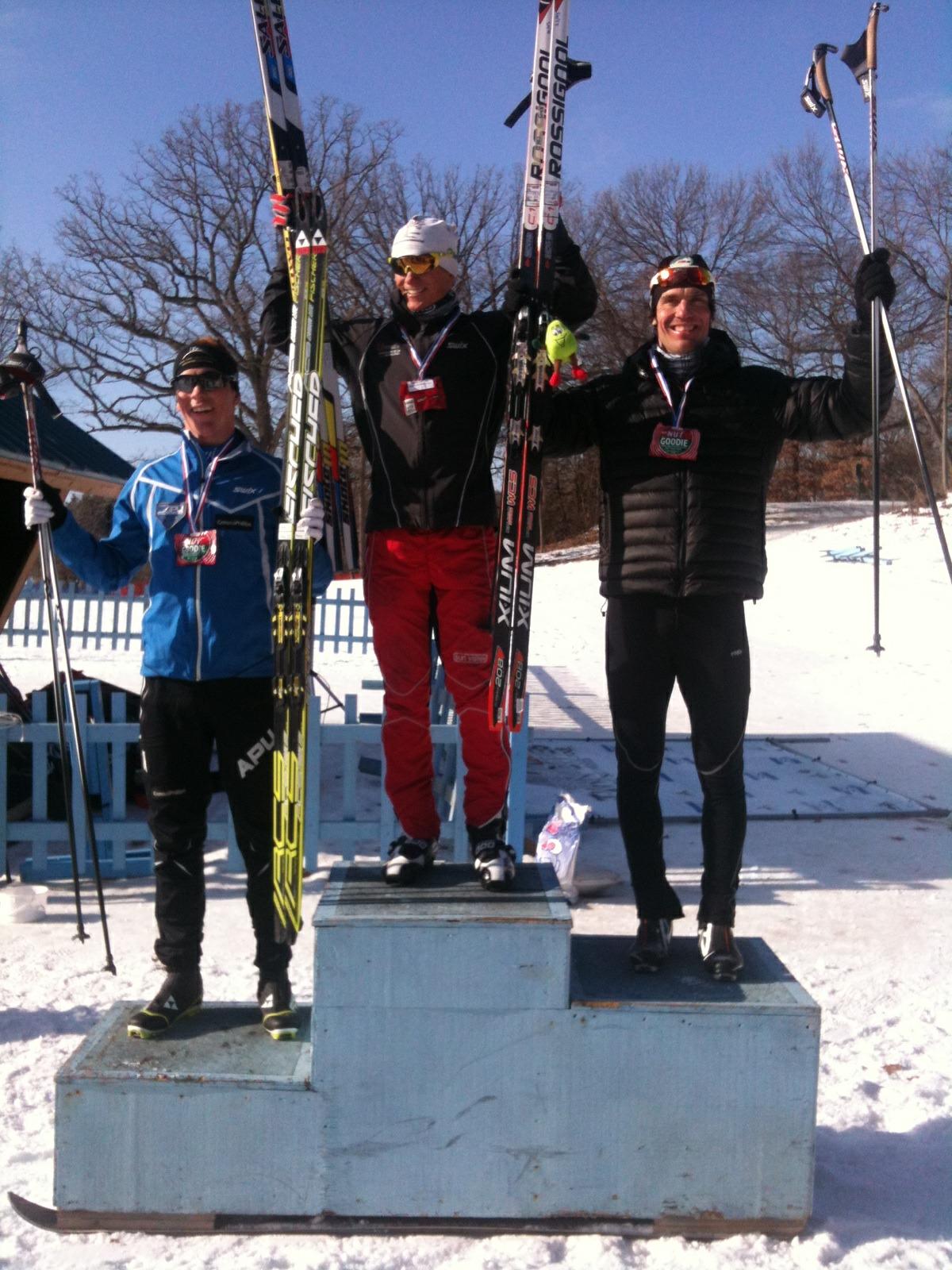
    The men's stage five podium. 1. Brian Gregg, 2. Mark Iverson, 3. Mike Sinnott. Photo: Reese Hanneman.
    The men’s stage five podium. 1. Brian Gregg, 2. Mark Iverson, 3. Mike Sinnott. Photo: Reese Hanneman.

    “It has been really exciting, and satisfying to feel I’m in the race everyday and be confident in my skiing,” Iverson said. “I wasn’t sure that I could catch up and make it a race today after loosing some time to Koos and Sinnott yesterday, but I was patient and just tried to ski my race.”

    Gregg, after starting stage five 1:36 down to the leaders in sixth place overall, skied the fastest time of the day to move up to fourth in the final standings.

    “I went in to the day planning on skiing my own race against the clock today,” Gregg said. “I started 1:36 off of the lead, but I wanted to have the fastest time of the day.”

    He made up the difference between himself and Karl Nygren (CXC) and Brent Knight (APU) by 4 k, and together the three skiers made up some of the time on the leaders by the final lap.

    Everyone became intimately familiar with the Wirth Park course by the end of the week, but Gregg is especially at home on it as he lives only a few minutes away. He thought the proximity to the race venue played a big part in his success on Sunday.

    “It is a huge advantage to be at home during the middle of the ski season and to be so close to the race venue,” Gregg said. “I think that played a large role in our success on this fifth day of racing. Not too many people are lucky enough to have a 3.3 k snow-making loop within jogging distance of their house.”


    Women’s 10 k Pursuit
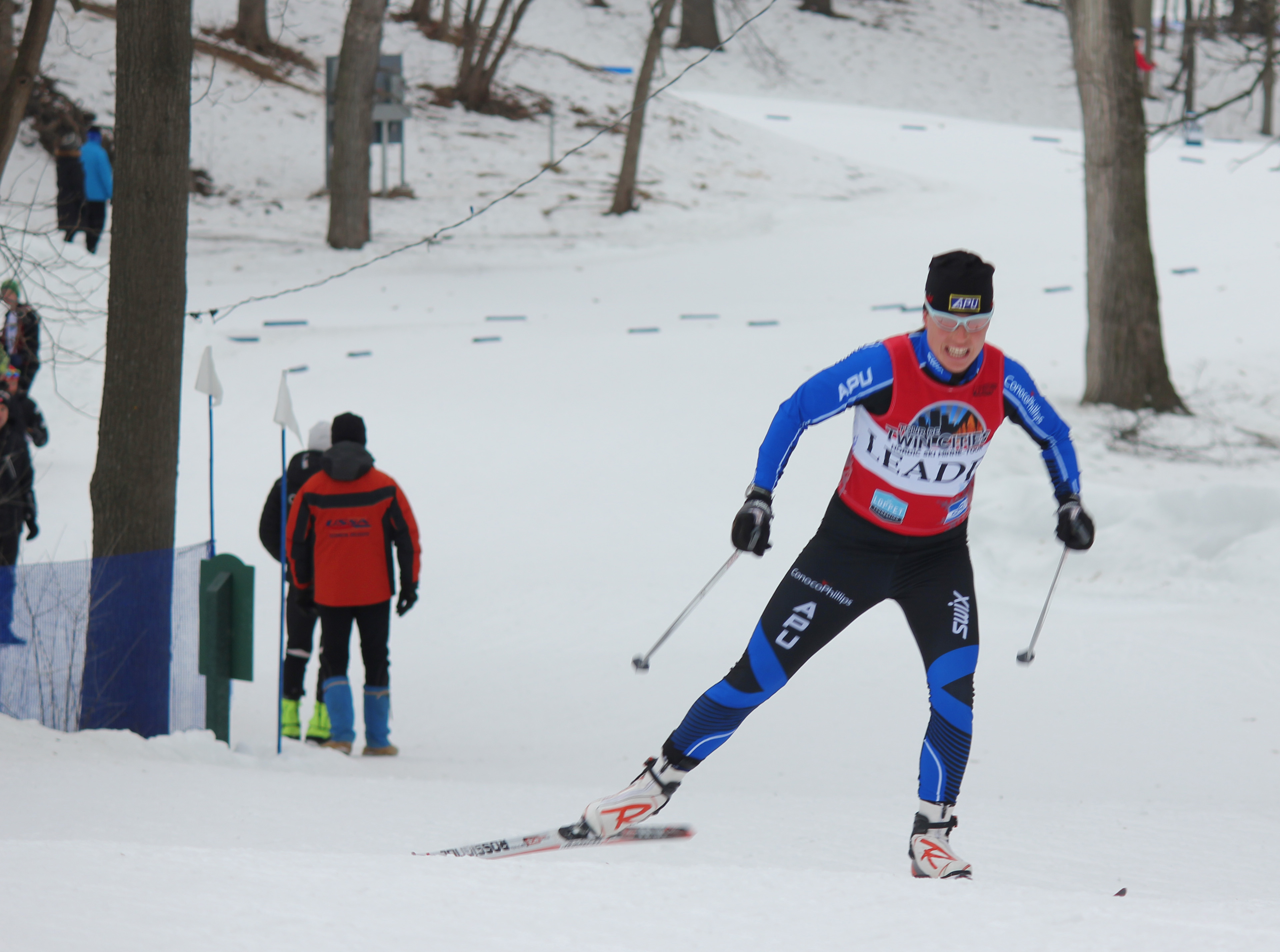
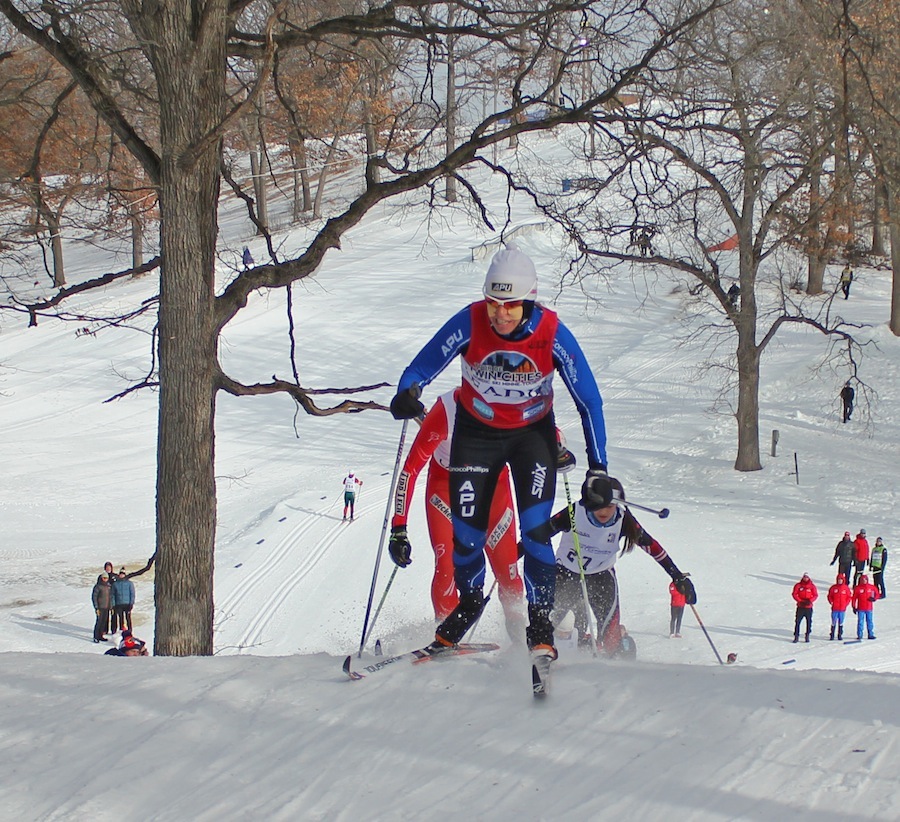
    Rosie Brennan (APU) maintaining her lead to take the overall Tour win. Photo: Reese Hanneman.
    Rosie Brennan (APU) maintaining her lead to take the overall Tour win. Photo: Reese Hanneman.

    As in the men’s race, the women’s 10 k pursuit was a closely-fought race. Rosie Brennan (APU) began with a small lead on her competition —Jennie Bender (CXC) started 17 seconds behind her, Kate Fitzgerald (APU) left the line 13 seconds after that, and Caitlin Gregg started at 1:05. With such formidable skaters hunting her down, Brennan knew the overall Tour victory would take everything she had.

    “I had the whole field chasing me which certainly added to the nerves this morning!” Brennan said. “I went out hard hoping [to] make catching me harder, however, after racing the previous two days, my legs did not feel good so I ended up really fighting the whole way.”

    On the relatively short loop Brennan could see her competitors as the course wound around twists and turns, which alerted her to the fact that Gregg was having an incredible race.

    “I could see my chasers frequently and was doing my best to judge time, but man, that’s hard to do and really only led me to panic more seeing who was coming for me,” Brennan said. “By the end of the second lap I realized Caitlin was crushing it and not slowing down, so I did my best to hold it together and push hard on the last lap.”

    Brennan was able to hold Gregg at bay and win the overall, which she was plenty happy with.
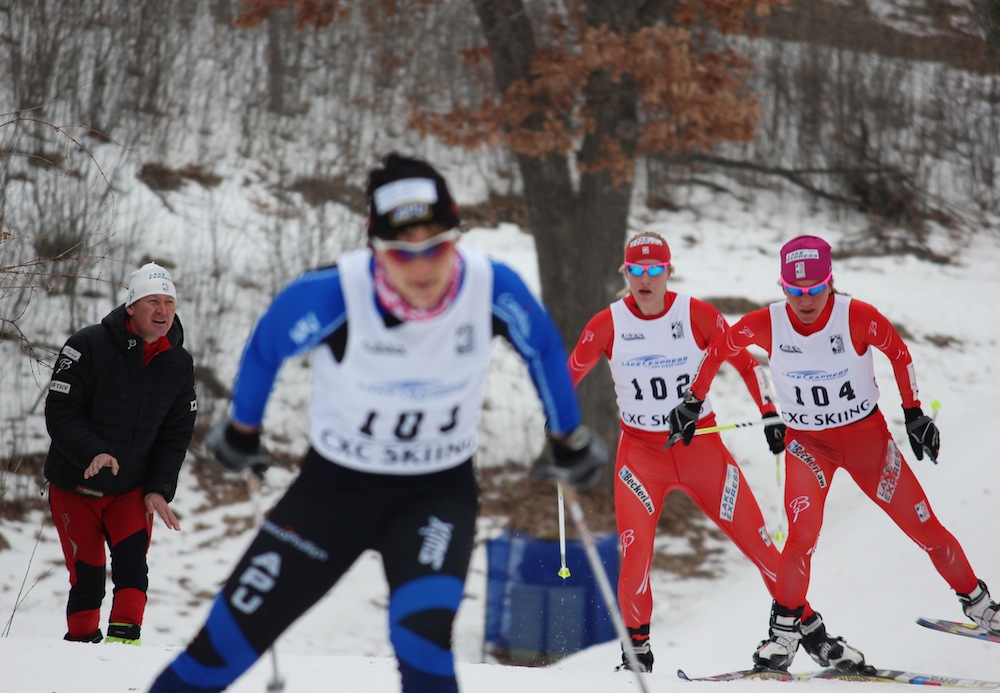
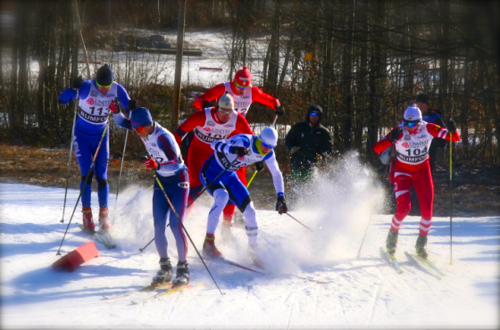
    Caitlin Gregg (bib 104) gunning down Kate Fitzgerald (102). Photo: Reese Hanneman.
    Caitlin Gregg (bib 104) gunning down Kate Fitzgerald (102). Photo: Reese Hanneman.

    “It was really stressful and not much fun having to hammer out 10 k alone with a whole field chasing, so I am thankful to have been able to hold it together and stay tough,” she said.

    “I don’t think there was anything I could have done to beat Caitlin on the day, though. She was just flying out there. I have always admired Caitlin’s incredible skating so I really can’t complain about taking second to her.”

    Gregg ended posting the fastest time by 35.9 seconds. Taking a page out of Lindsay Vonn’s book, the 32-year-old decided right before the start to race on her husband’s winning skis from earlier that morning.

    “He told me how fast they felt and I realized that with such a flat course I could probably get away with longer stiffer skis!” Gregg said. “So I tested them for a lap and confirmed I could ski them on the short steep climbs (without tripping) and went with them. The skis were actually Brian’s stiffest pair so he told me to ski like a big girl on them to make them work.”

    With the goal of setting the day’s fastest course time, Gregg was pretty happy with how the choice turned out.

    “I knew I had a lot of time to make up but I wanted to win the individual race, so I just went out gunning for a good time,” she said.

    Brian and Caitlin have been racing together for years, but Sunday was the first time they both won the same race.

    “I have always wanted to share the top step of the podium with Caitlin in a Super Tour and it was cool to have that happen,” Brian said.

    Stage winners receive $450 for the win on top of the overall purse that goes six deep. Between the Greggs’ stage five victories, Caitlin’s second place finish overall and Brian’s fourth, the couple earned $2,700 on Sunday alone.

    “Race winnings are the largest part of our income and it was great to have things come together today,” Brian said.

    Kate Fitzgerald (APU), one of the most consistent skiers all week, finished third on the stage once again to take third in the Tour. She started just ahead of Gregg with full knowledge of the latter’s strength in skating, and sought to hold her off as long as she could.

    “I know that she is a ridiculously strong skater, and sure enough she came storming past me and it was all I could to do hang on!” Fitzgerald said. “Caitlin, Jennie, and I were in a pack for a little while but then Caitlin’s speed started to break us up. She had an awesome race today.”

    Bender finished fourth in the overall standings, Clare Egan (Craftsbury Green Racing Project) took fifth and Erika Flowers (SMS T2) was sixth.

    Complete results from stage 5.

    Overall Tour Standings not yet available – check back at Summit Timing.
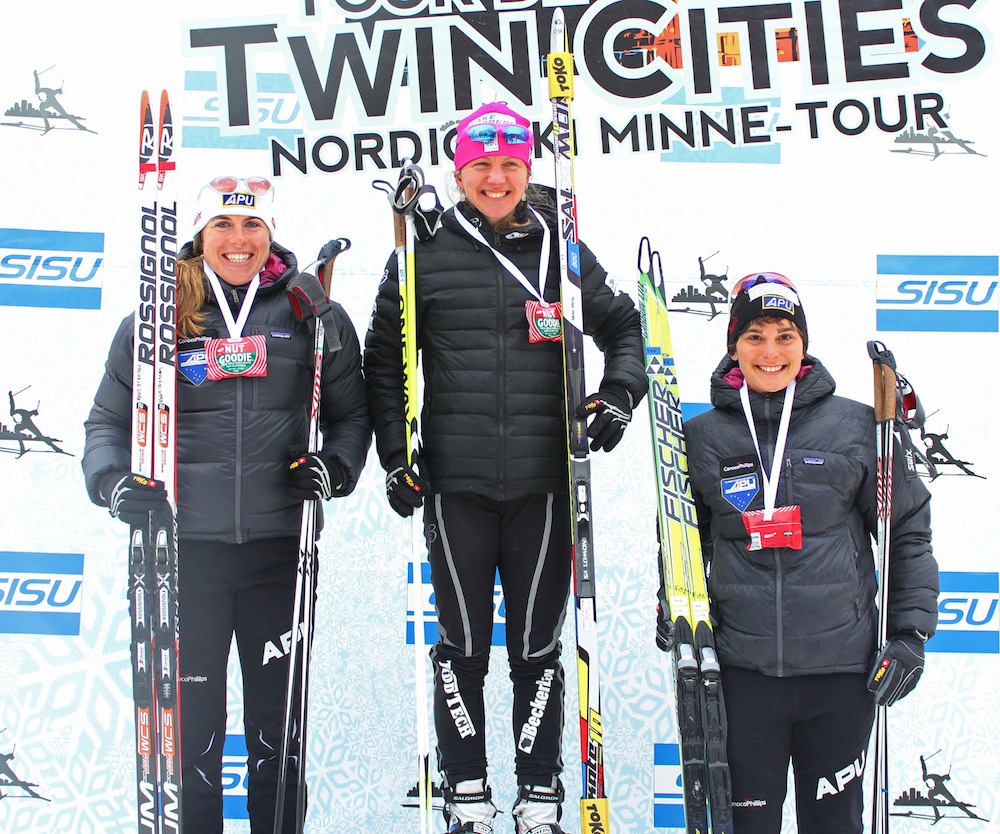
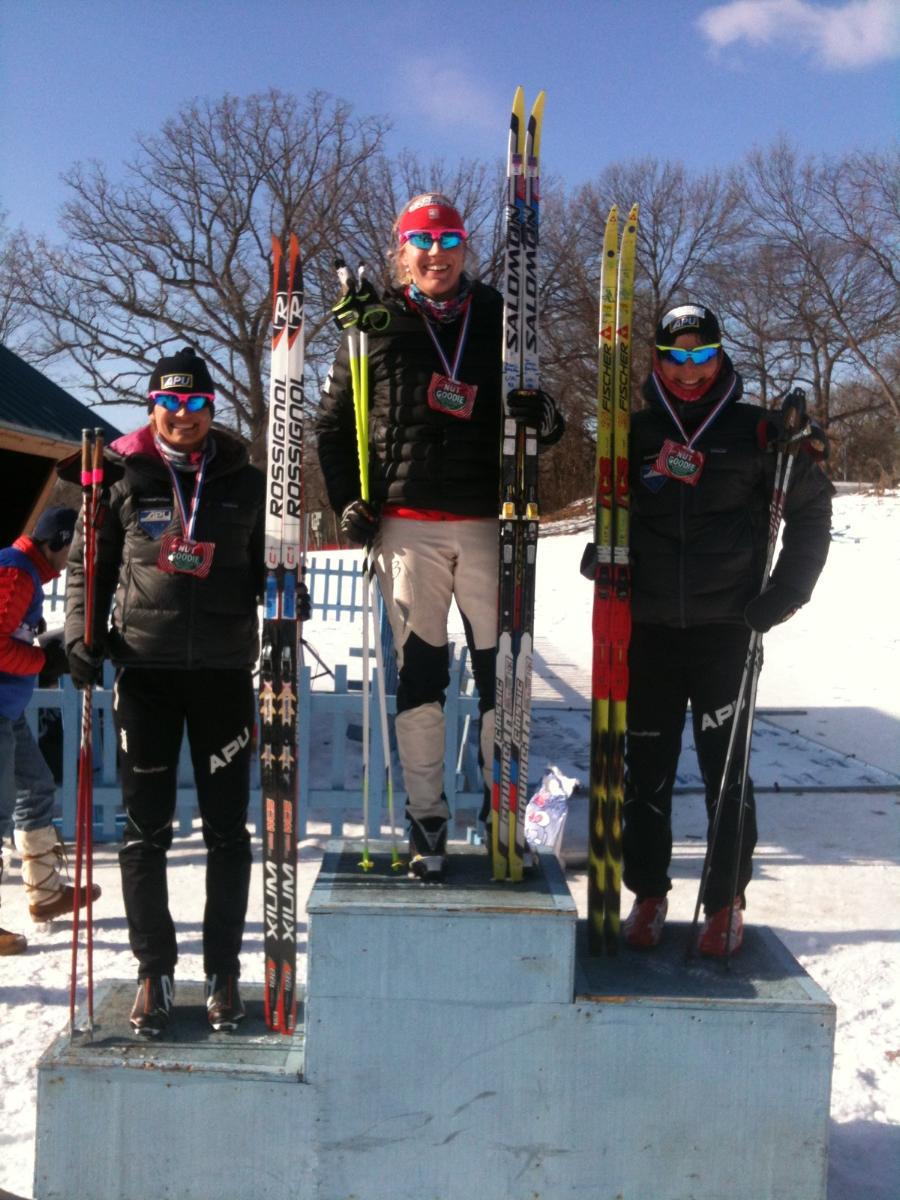
    The women's stage five podium. 1. Caitlin Gregg, 2. Rosie Brennan, 3. Kate Fitzgerald. Photo: Reese Hanneman.
    The women’s stage five podium. 1. Caitlin Gregg, 2. Rosie Brennan, 3. Kate Fitzgerald. Photo: Reese Hanneman.
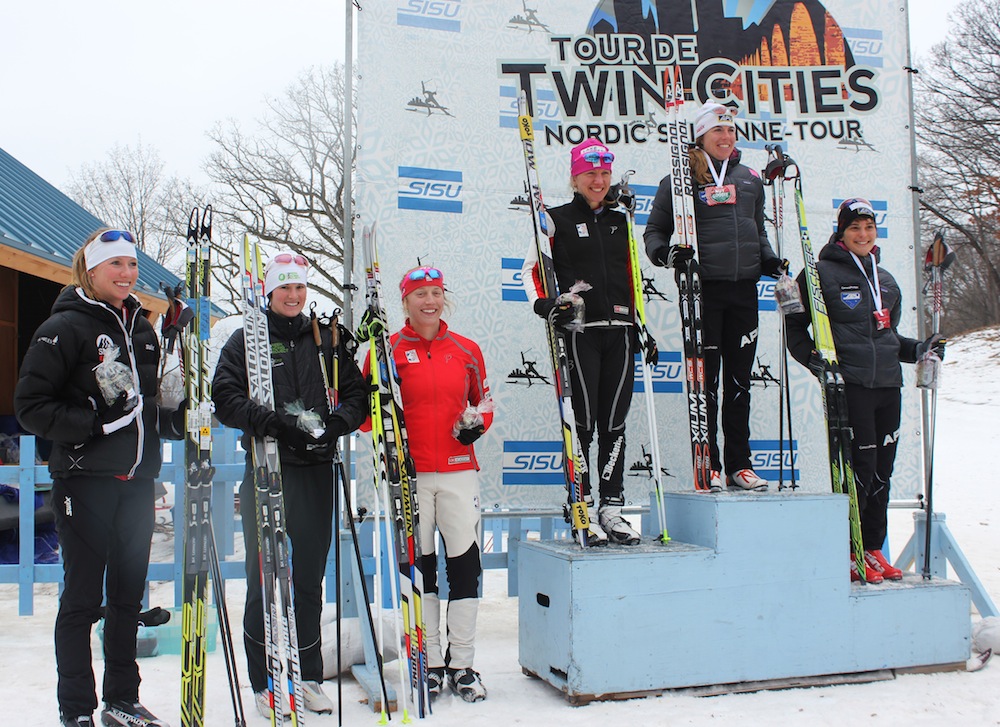
    The women's overall Tour de Twin Cities podium. 1. Rosie Brennan, 2. Caitlin Gregg, 3. Kate Fitzgerald, 4. Jennie Bender, 5. Clare Egan, 6. Erika Flowers. Photo: Reese Hanneman.
    The women’s overall Tour de Twin Cities podium. 1. Rosie Brennan, 2. Caitlin Gregg, 3. Kate Fitzgerald, 4. Jennie Bender, 5. Clare Egan, 6. Erika Flowers. Photo: Reese Hanneman.


  • Hanneman Secures Distance Win in 10k Classic at Wirth Park

    Hanneman Secures Distance Win in 10k Classic at Wirth Park

    The men's 10 k classic podium at the Tour de Twin Cities. 1. Reese Hanneman (APU) 2. Mike Sinnott (SVSEF) 3. Torin Koos (BSF/Rossignol). Photo: Brent Knight.
    The men’s 10 k classic podium at the Tour de Twin Cities. 1. Reese Hanneman (APU) 2. Mike Sinnott (SVSEF) 3. Torin Koos (BSF/Rossignol). Photo: Brent Knight.

    The winner of the 10 k classic stage of the Tour de Twin Cities in Minneapolis, Minnesota, on Saturday is a name you’ve probably heard of, but is not one usually associated with distance podiums. Reese Hanneman (Alaska Pacific University), surprising even himself a bit, won the individual start classic race at Wirth Park for his first career SuperTour distance win. He beat Mike Sinnott (Sun Valley Ski Education Founation) and Torin Koos (Bridger Ski Foundation/Rossignol) in second and third, respectively.

    When a sprinter makes that kind of jump in a distance race it’s reasonable to expect him to make a big deal out of it, but Hanneman seemed relatively calm about the result.

    “I wasn’t expecting to win, I just kind of thought if I had a good race I could get on the podium,” he said. “And obviously on a course like this, when it’s so tight, then if you have a little bit better of a race then you can win. So when I started hearing I was doing that well I really pushed it hard. I have the speed to win on courses like this.”

    The course at Wirth Park was relatively flat, with short and quick uphills that worked to Hanneman’s strengths. A teammate, Brent Knight, started 15 seconds ahead of him on Saturday, which gave Hanneman an indication he was skiing well before he got his first split. Knowing the course favored skiers who could go “full throttle” for the whole thing, Hanneman sought to work the course from the get-go.

    “I knew that suits me pretty well, I have the speed, and if there’s no five-minute climbs I can usually do OK,” he said. “I went out pretty fast and tried to ski relaxed and also just working everything; trying to ski really fast because there’s no really sections that you have to pace.”

    When Hanneman heard a split that had him leading the race, it only spurred him to work a little harder.

    “I was a little surprised but I knew it wasn’t impossible, so obviously that got me pretty fired up, and from there it was basically a 5 k sprint to the finish line. I knew I needed to finish real fast because I knew Torin for sure would be finishing the last couple kilometers insanely fast.”

    With the help of fast skis and tracks that held up well for striding, Hanneman made it to the finish line a full thirteen seconds ahead of Koos, who took third, and five seconds ahead of Sinnott in second.

    “The tracks were pretty good all the way around,” Hanneman said. “Even the tracks on the two steep hills — yesterday they weren’t there, but today they stayed so it was possible to stride, which was really nice. They did a good job of setting the tracks; up to this point they’d been a little bit questionable.”

    Hanneman’s skiing drew admiration from his competitors.

    “I was really psyched to see Reece move so fast, it’s nice to see such a classy guy pull out the win,” Sinnott said.

    As for his own race, Sinnott was pretty happy. He gave everything he had, and that’s always his first takeaway from a race effort.

    “I raced hard and don’t feel like i could have done much more,” he said. “That’s the bottom line of weather I’m happy or not, did I give it my best… My goals going in were to win, same as every race. A tertiary goal was to put time into Torin and Mark, which I did, but I would have liked to see more. You can always want more.”

    Koos had a similar thought: happy with a podium, but always going for the win.

    “The podium is always nice, but I wouldn’t have minded being a step or two higher… but all in all, a decent competition and good day at the races,” he said.


    Women’s 5 k

    The women’s race was an incredibly close contest. Rosie Brennan (APU) just nipped Jennie Bender (Central Cross Country) by 0.6 seconds after 5 k of racing against the clock. Kate Fitzgerald (APU) took third, 10.3 seconds back.

    Brennan, who began her 5 k in search of some redemption from Friday’s sprint, was pleased with her second win of the Tour.

    “I was very happy to win today, even if only by 0.6,” she said. “I was disappointed with the way I skied yesterday so I was looking to turn things around today.”

    Brennan noted that the racing atmosphere has been more relaxed this week with SuperTour athletes scattered all over the world at this point in the season.

    “With a small field it was difficult to tell how the race was going because all the seeds were mixed in and we don’t have any coaches here giving splits,” she said. “I did get one split with less than a k to go and I was told I had six seconds on Jennie, but after seeing what she did to me in the last k of the mass start, I was afraid six seconds wasn’t enough. But I didn’t want to make the same mistakes as last time.

    “It was just barely enough.”

    Bender, though disappointed to lose by such a small margin, was satisfied with her race.

    “Ahh, so close!” she wrote in an email. “As much as I would have been super pumped to capture all three classic titles, I was happy with my race. Individual starts are always interesting. Upfront they are less intense because you’re on your own, but afterwards they are more stressful compared to mass starts, because there is less feedback until you see the results.”

    On the rolling course at Wirth Park, Bender knew every meter would be critical.

    “It is a fairly roll-y course, so seconds were gained and lost quite easily if you turned your brain off even for a moment. I started out sixth, and I got a split off of Kate Fitzgerald, but had no idea what was going on behind me. I had a fast first lap, and tried to keep the pace my second but probably slowed a little.”

    Fitzgerald took third, 10.3 seconds off Brennan’s winning time.

    The fifth and final stage of the Tour de Twin Cities, a freestyle pursuit, takes place at Wirth Park on Sunday.

    Complete results.

  • Bender, Sinnott Take Classic Sprints at Tour de Twin Cities

    Bender, Sinnott Take Classic Sprints at Tour de Twin Cities

    The men's classic sprint podium from stage three of the Tour de Twin Cities. 1. Mike Sinnott (SVSEF) 2. Torin Koos (BSF/Rossignol) 3. Reese Hanneman (APU). Photo: Brent Knight.
    The men’s classic sprint podium from stage three of the Tour de Twin Cities. 1. Mike Sinnott (SVSEF) 2. Torin Koos (BSF/Rossignol) 3. Reese Hanneman (APU). Photo: Brent Knight.

    After a cold-induced delay in competition the Tour de Twin Cities continued on Friday in Minneapolis, Minnesota, with a classic sprint at Wirth Park. In conditions more amenable to racing, Mike Sinnott (Sun Valley Ski Education Foundation) and Jennie Bender (Central Cross Country) took home the titles in stage three.

    Sinnott edged out Torin Koos (Bridger Ski Foundation/Rossignol) and Reese Hanneman (Alaska Pacific University) in second and third, respectively, for the stage win.

    Friday marks Sinnott’s first SuperTour win of the season. Most of the men’s field, when confronted with sugary snow and a course whose hills were either flat enough to double pole or too steep to stride, made the decision to use skate skis in the qualifier. Sinnott was second to Dakota Blackhorse-von Jess (Bend Enduracne Academy) in the prelim, and for the heats made the unique decision to remain on skate equipment while everyone else switched to striding.

    “I was the only one to do it in the rounds and it paid off,” Sinnott said. “It gave me more speed at the finish line.”

    The win, which comes just two days after Sinnott’s 29th birthday, gave him plenty to be happy about. Bad luck in the mass start last weekend tripped him up in the final stretch, so he was pleased to put the negative experience behind him.

    “It was kind of nice, I’m happy with the way the race went,” he said. “I was a little bummed after the last stage where I tripped over myself in the last 100 m and lost out on the podium, so it’s nice to rebound and get some momentum.”

    Koos, in second place, said he wavered on the edge of choosing skate skis but ended up going with, at the very least to avoid accidentally gliding in a herringbone.

    “This turned the hills into deep sugar,” Koos said. “There was no way to ski through it — you just had to herringbone. I would have much preferred to stride. This negated any advantage a skier who used wax had today. So why use kick wax, you say? Well, it’s pretty hard to not get that extra little skate when you’re herringboning without wax, so I played it safe and went with wax.”

    Though it ended up being the wrong call for the win, Koos was fairly satisfied with second place — “It probably wasn’t the best decision to win today, but second isn’t too bad a result, no?”

    In third, Hanneman was happy with a podium. On the narrow Wirth Park course he said it was crucial to move around people before the bottlenecks in the trail, as it wasn’t possible to herringbone double wide up some of the hills.

    “There were two short steep climbs that were pretty dang steep, but I had been able to run them in the distance race,” Hanneman said. “I thought that we would be running them today, but the tracks just got super blown out and it was total sugar, so we all had to herringbone… I had to get behind Mikey on the last climb because there wasn’t room to try and pass, so then that kind of set me up as just in third for the finish.”

    Though he’d been gunning for the top of the podium, he was satisfied with third.

    “My goal was to be on the podium, and I knew that I was capable of winning, so I was just hoping to play it right and be able to use my strengths,” Hanneman said. “I did that for the most part, so it was a fun day.

    “I also want to say thanks to the volunteers for working out there all day and for giving us a chance to race heats.”

    Pat O’Brien (Craftsbury Green Racing Project) finished fourth behind Hanneman, Karl Nygren (Central Cross Country) was fifth and Dakota Blackhorse-von Jess (BEA) took sixth.

    Men’s sprint results.


    Women’s sprint

    The women's classic sprint podium from stage three of the Tour de Twin Cities. 1.  Jennie Bender (CXC) 2. Kate Fitzgerald (APU) 3. Lauren Fritz (APU). Photo: Brent Knight.
    The women’s classic sprint podium from stage three of the Tour de Twin Cities. 1. Jennie Bender (CXC) 2. Kate Fitzgerald (APU) 3. Lauren Fritz (APU). Photo: Brent Knight.

    In the women’s race, Jennie Bender (Central Cross Country) kept on rolling with a win in an A-fanal filled with APU skiers. Kate Fitzgerald (APU) took second and Lauren Fritz (APU) was third.

    The women’s field was too small to take on a full 30 athletes to the heats, so they contested only a semifinal and final round. Bender said this made for one of the most relaxed sprint days she’s ever been a part of.

    “There were like 19 or 20 girls total,” she said (a close guess — there were 18). “From how crazy it was last weekend, it was just a shock to come in Friday and be like, ‘Wow, no one’s here.’ All the SuperTour athletes just hung out in a tent.”

    Bender had been hoping to win the first classic sprint on the schedule since her U.S. Nationals victory earlier this month, but knew competition from the likes of Rosie Brennan and the rest of APU would be tough.

    “It’s really anyone’s race, you never know what’s going to happen or how you’re going to feel,” Bender said. “I definitely was hoping to be on the podium today.”

    For someone who has been gradually regaining fitness from an illness-plagued summer, another win was further confirmation that she’s headed back to full fitness.

    “I still feel kind of out of shape, but I feel a heck of a lot healthier,” Bender said. “I can’t really say I’m not back at this point. I think I have a better mentality after this summer, that’s been helping me for sure. I don’t know what my body is doing; I’m hoping I can race myself into shape a bit more and that this continues.”

    Bender won by skiing “way out in front,” in Fitzgerald’s words, so the race came down to a fight for second between a slew of APU women.

    “The course had a lot of turns and transitions so it was easy to either sneak around people or get totally boxed out, and I ended up on the good side of that today,” Fitzerald said. “I feel very happy with today’s result. The conditions were a little tricky and icy and it was easy to get into panic mode and ski franticly so my goal for the day was to ski strong and relaxed.”

    The race for third was also close. Fritz sat in fifth for most of the A-final behind Brennan, Caitlin Gregg and Fitzgerald and thought she wouldn’t have a shot at the podium, but managed to come by all but two skiers and out-lunge Brennan for third in the final meters.

    “I thought I didn’t have a chance because I was getting blocked everywhere,” Fritz said. “But since Fitzgerald, Rosie, Caitlin and I were all still in a clump I managed to grab an empty lane on the far side and get by everyone except Fitz, and Rosie and I lunged for third.”

    Though the sugary conditions made for difficult skiing for everybody, most athletes were grateful for the chance to race sprint heats at all.

    “The [organizers] made a good call delaying the race until today because the beginning of the week was nasty cold, and today was in the upper-teens, although there was a brisk headwind in the stadium,” Fritz said. “Kudos to the race volunteers who were willing to help out today and the OC for letting us do full heats instead of just a qualifier.”

    Rosie Brennan took fourth in the A-final, Caitlin Gregg (CXC) took fifth and Clare Egan (CGRP) finished sixth.

    Women’s sprint results.

  • Bender, Koos Stay Out of Trouble to Lock up Tour de Twin Cities Mass Start Titles

    Bender, Koos Stay Out of Trouble to Lock up Tour de Twin Cities Mass Start Titles

    Rosie Brennan (APU) leading over the "wall" in Wirth Park during the 15 k classic mass start on day 2 of the Tour de Twin Cities on Sunday in Minneapolis. Brennan was second behind Jennie Bender (CXC), who won by 6.6 seconds. (Photo: Reese Hanneman/EngineRoom Media.net)
    Rosie Brennan (APU) leading over the “wall” in Wirth Park during the 15 k classic mass start on day 2 of the Tour de Twin Cities on Sunday in Minneapolis. Brennan was second behind Jennie Bender (CXC), who won by 6.6 seconds. (Photo: Reese Hanneman/EngineRoomMedia.net)

    With temperatures barely extending into the single digits Sunday, the second stage of the Tour de Twin Cities SuperTour circuit was already shaping up to be a tough one. Add to that the nature of classic mass starts – up to six times around a 3.3-kilometer track – and you’ve got quite a race.

    Saturday’s 5 k freestyle winner, Rosie Brennan of Alaska Pacific University (APU) arrived to Wirth Park in Minneapolis on Sunday in time to check out the preceding men’s race on the second day of the Tour de Twin Cities.

    “I went out to see how the boys were doing, only to witness many boys slipping on ice, falling, and many more yelling for poles causing me to panic a little for our own race,” Brennan wrote in an email. “It was really cold, fast, and icy in some parts.”

    A little unsure of how to strategically approach five laps for the women’s 15 k classic, Brennan decided she’d set a high pace and hopefully wear others down.

    “As a result, I probably led a fair amount,” she explained. “I had many laps to come up with a game plan after realizing I wouldn’t be able to just ski away from a pack on such a fast course. However, excitement and cheering got the best of me and I went for it on the last lap.”

    Using some early hills to her advantage, Brennan built a small gap on the group. The final 1.5 kilometers, however, were flatter and “very twisty,” she wrote. “Both significant weaknesses of mine. I did all I could do to stay away, but Jennie [Bender] just ate me up on that stuff.”

    Bender, the Central Cross Country (CXC) skier who skied in second for much of the race, wrote in an email that she found to stay with Brennan on the final lap.

    “I thought she was gone, but due to sitting in 2nd my adrenaline kicked in, and I kept hammering,” Bender wrote. “Suddenly I was behind her, and was able to shift into high gear for the last hill.”

    Bender nabbed the distance victory, her first on the SuperTour circuit this season, by 6.6 seconds over Brennan in 46.09.9. APU swept second through fourth with Kate Fitzgerald making the podium 8.1 seconds back from first and Becca Rorabaugh placing fourth (+18.4). Caitlin Gregg (CXC) was fifth after crashing just before the last lap when she, Fitzgerald and Rorabaugh tried to pass group of lapped skiers.

    “On the big wall before the last lap started we ran into some skiers we were lapping and got tangled,” Gregg explained.

    “At that point Caitlin was right in front of me and she fell and I had to stop because I was pinned against the side of the trail,” Fitzgerald wrote.

    While those three tried to recover, Brennan started to go for it.

    “I gunned it to try and catch back up to Rosie and Jennie,” Gregg continued. “I could see them playing cat and mouse up ahead and thought maybe I could catch them. … Kate, Becca and I tried to reel them in but couldn’t.”

    After starting near the front, Bender was happy to stay out of trouble and ski a tactically smart race.

    “Every race, I hope I will feel better than the last, and lately that hasn’t been hard since all my distance races thus far have sucked pretty bad,” she wrote. “There were definitely a few moments in the race, where I looked around and felt good that I could add to team red (CXC) once again.  It’s a team of 3 this year, but having two in the top five is great. The APU girls are a force to be reckoned with, that’s for sure.”

    Brennan took her hat off to Bender, but felt there were some areas she could improve.

    “She skied that last section beautifully and overtook me with lots of momentum leaving me in the dust into the finish,” Brennan wrote. “I am happy with the result, but frustrated with my own weaknesses and certainly have made a list of things to keep working on.”

    “It was definitely a fun race with some very fast conditions,” Fitzgerald added.

    Men’s race

    Torin Koos (c) atop the podium in the Tour de Twin Cities 20 k classic mass start on Sunday in Wirth Park, Minneapolis. Brian Gregg (r) was second and Canadian David Greer placed third. (Photo: Reese Hanneman/EngineRoomMedia.net)
    Torin Koos (c) atop the podium in the Tour de Twin Cities 20 k classic mass start on Sunday in Wirth Park, Minneapolis. Brian Gregg (r) was second and Canadian David Greer placed third. (Photo: Reese Hanneman/EngineRoomMedia.net)

    In the men’s race, Torin Koos (Bridger Ski Foundation/Rossignol) foreshadowed his own victory – stating Saturday: “I just didn’t have that edge that I been needed to win. It wouldn’t be surprising, though, if today’s effort gives me that little bit I was missing for tomorrow.”

    The runner-up in the 10 k freestyle, Koos went on to win Sunday’s 20 k classic mass start by 1.9 seconds over Brian Gregg (CXC) in 47:53.0.

    “Today was a cold and icy one, though not as cold as I had prepared for,” Koos wrote. “The biggest name in the game today was staying out of trouble like crashes and broken poles, with so many turns. I raced much more at the front for this reason. Most all of the race I felt so very much in control aerobically.”

    A Twin Cities native, Koos explained that he secured the win – his first this SuperTour season – by opening a small gap up “inner-tube hill” on the last lap and holding it to the finish.

    “With such high speed snow, I felt skiing in the pack was much easier, though a riskier option,” he wrote. “The cheering section was out there in force again today. The cold weather was nothing for them!”

    Gregg was glad to be back on the SuperTour podium for the first time this year. Living with his wife Caitlin just a few blocks away from Wirth Park, Gregg wrote it was great to be able to perform for so many supporters and friends.

    “The home course advantage is pretty nice too,” he added. “I have logged many km on the 3.3k loop.  It is pretty cool to train in the afternoons with about 300 other skiers.  I think training with all the high school skiers last week was helpful in feeling comfortable in the big pack today.”

    On the last lap, Dylan McGuffin (Craftsbury Green Racing Project) started to push the pace up front while Koos chased him down, Gregg explained. At the top of the hill, Koos was about 15 meters ahead of Mike Sinnott (Sun Valley Ski Education Foundation). Sinnott was about 15 meters ahead of his teammate, Matt Gelso, Gregg and Canadian David Greer (Yukon Elite Squad).

    “About 500m from the finish Mikey went down on an icy corner,” Gregg wrote. “He had a gap and it is always a bummer to pass some one simple because they fell.”

    Gregg, Greer, Gelso and Mark Iverson (Saturday’s winner from APU) passed by, and Sinnott ended up sixth (+8.3). Greer was third, 2.4 seconds back from Koos, Gelso was fourth (+5.3) and Iverson was fifth (+6.4).

    Greer, who made the long trip down from the Yukon Territory with teammates Knute Johnsgaard and John Parry with some time to kill between NorAm races in Thunder Bay and Duntroon, Ontario, met his goal of the podium after being sick last week. After feeling like he was missing his top gear in Saturday’s race, he decided to go for it on Sunday.

    Greer was around 12th when Koos attacked the last kilometer. He followed, picking off the places and moving to fifth and then third by the top of the last hill.

    “I usually have a decent sprint finish, but unfortunately I wasn’t able to do anything today because the finish stretch was very short, no time to pass,” he wrote.

    “It felt more like a criterium than a ski race. You needed to be really aggressive to stay near the front,” Greer explained.  “I consider myself lucky not to have fallen or been taken out because racers were falling right, left and centre throughout the entire race! It was very chaotic.”

    With temperatures forecast to remain below zero on Monday, it was unclear whether the third stage of the Tour, the classic sprints, would take place as scheduled.

    Complete results

    Thanks to Reese Hanneman and his photos from EngineRoomMedia.net.

  • Three Years After Initial Run, Experimental Sprint Qualifier Sparks Debate

    Three Years After Initial Run, Experimental Sprint Qualifier Sparks Debate

    Athletes collide during sprint heats at U.S. Nationals in Rumford, Maine, 2012.
    Athletes collide during sprint heats at U.S. Nationals in Rumford, Maine, 2012.

    A sprint qualifier can be defined as the preliminary stage of a sprint race in nordic skiing. In a race against the clock, competitors leave the starting gate at intervals and go as hard as they can for anywhere between 1 and 1.8 kilometers. The top 30 in most internationally sanctioned competitions, and sometimes a lesser number in other events, move onto the quarterfinals to face off against five other athletes at a time for the right to advance to the next round.

    Sprint races progress in this manner all over the world; on the World Cup, in Continental Cups, in the collegiate circuit, and sometimes at small-scale high school races.

    In the winter of 2009, the term “sprint qualifier” took on another meaning. The U.S. Ski and Snowboard Association (USSA) introduced a sprint race to the SuperTour that was truncated at the qualifying round; medals were awarded to skiers who clocked the fastest qualifying times, and the athletes’ entire day was done in a matter of two to four minutes. No longer just a prologue, the qualifier became a race all its own.

    At the time, the trial run was met with mixed reviews. Athletes felt robbed of the chance to develop head-to-head sprint skills. Coaches acknowledged the challenges the organizers faced in putting on full heats, but agreed that the format was not ideal. Canadians who occasionally dabbled in the SuperTour simply didn’t understand it.

    Qualifier-only sprints started with a trial run in West Yellowstone, Mont. that first winter, but have since spread to three other stops on the SuperTour in 2012. What began as confusion is now ranting fury — some still fail to understand why the experimental format was deemed a success and allowed to proliferate.

    To begin to answer that question, we start with that first time qualifier-only sprints were held in the U.S.

    When the format was first conceived of prior to the 2009-2010 season, then-USSA Nordic Director John Farra intended for it to do two things. First and foremost, the decision to leave out the heats from the West Yellowstone sprint was a philosophical one. Farra believed it to be the right move for U.S. skiing at the time, and today stands by his decision.

    “We still don’t have enough Americans, in my personal opinion, who can qualify, period,” said Farra, who has since left USSA to become the High Performance Director for Paralympic skiing, in a phone interview in December. “That’s a problem. For me, at this point in our development, there’s an argument for getting athletes in more races where they’re just throwing down… I think it works on a gear all Americans need to keep working on.”

    Secondly, it put an additional sprint race back on the calendar in the first period of the SuperTour where, at the time, there was only one in Bozeman, MT. It would not be the first time sprint races were held in West Yellowstone. Regular sprints, complete with heats, were held on the Rendezvous trails up until 2007, but according to Farra, coaches complained that the trails were too narrow and the altitude too punishing for a full sprint day.

    One of the jobs of the Nordic Director is to select skiers at the end of the Period 1 to send to the World Cup. With an additional sprint thrown into the mix, Farra’s theory was that the overall points leader would have to be a decent sprinter and distance skier to earn those coveted European start rights.

    Rankings of the best distance skiers and sprinters on the domestic circuit are often very similar, however. For example, at the end of Period 1 this winter, the women’s SuperTour sprint leader, distance leader, and overall leader were all one person: Jessie Diggins (CXC/USST).

    On the men’s side, overall leader Mike Sinnott (SVSEF) had two top-5 distance results along with his two sprint wins and one second.

    The sprint qualifier has also been accused of having another motive. It was introduced in the season leading up to the 2010 Vancouver Olympics, and it’s been suggested that the qualifier, in squeezing another race into a short time frame, was a grab for better FIS points to boost the U.S. quota for the Games.

    Farra said this was never the case. Points are always based off the qualifier, so heats would have no effect on FIS points either way. Additionally, as Farra pointed out, “you can only ‘boost’ the points if you have a quality field in the race.”

    Jessie Diggins (CXC/USST) 2nd place skate
    Jessie Diggins competing in the qualifier-only skate sprint in West Yellowstone, Mont., in November 2011.

    With his idea for a modified sprint in mind, Farra went to the West Yellowstone Chief of Competition at the time, Sara Hoovler, with the proposal.

    From the organizer’s perspective, the introduction of an additional race in West Yellowstone brought with it organizational and financial burdens, which became the main point of negotiation.

    “As an organizing committee we were pretty maxed out,” said Hoovler, who is now a school teacher in the area. “We couldn’t put on another full-scale race.”

    When Farra brought the proposal to the organizers, they agreed to try out the additional sprint as long as it didn’t come with a significant extra cost—specifically, as long as it didn’t require coming up with the additional prize money. At $3,900 per race, prize money is one of the single most expensive components of hosting a SuperTour.

    “Purses for these races can sink the entire event,” said Dan Cantrell, Hoovler’s successor as the West Yellowstone race director.

    He estimates that between all the major costs involved with putting on the SuperTour every year—notably prize money and gas for grooming—the event runs the Yellowstone Ski Festival around $20,000. When the weather is especially uncooperative, the number goes up as tents and space heaters are brought in, or the Pisten Bully has go over the course multiple times.

    With the introduction of homologation standards this year, any argument for heats became moot—the venue simply doesn’t have the terrain to meet the standards on a traditional sprint loop. For the race to count as a SuperTour complete with FIS points, there needed to be a certain amount of total climbing.

    The only sprint course West Yellowstone could come up with that met the standards is a point-to-point 1.5 k, which ruled out the possibility for heats. For timing and officiating purposes, heats have to start and end in the same stadium.

    “We were able to FIS homologate West for a sprint qualifier only. That’s a big deal, otherwise we don’t sprint there,” said Farra.

    The other option would be to hold the fall SuperTours at locations that could homologate a sprint loop, but choices are limited by the reliability of snow anywhere else in the country in late November, and the number of venues willing to take on a SuperTour.

    With the advent of homologation standards looming for 2011, Cantrell also had to account for the cost of the trail work necessary to get the courses up to standard. In addition to sitting on National Forest land, the Rendezvous Ski Trails occupy endangered grizzly bear habitat. Every time the ski trails are modified, the Forest Service requires an environmental impact assessment.

    “To put it in perspective, the improvements from this year, with the connectors and homologation, was about a three year process,” said Cantrell. “We had a bulldozer out there two weeks before Thanksgiving.”

    With these demands on the race organizers in mind, Farra was loath to push West Yellowstone to take on significant extra cost in adding a sprint qualifier to the schedule.

    “We weren’t prepared to make the organizer come up with the prize money,” said Farra.

    Since USSA strategically thought it was important to hold a sprint in Yellowstone, the organizers were excused from the obligation to hand out the prize money for sprint qualifiers. The exception is laid out in the USSA Rulebook—none of the sprint qualifiers on the SuperTour schedule this year award the usual purses to the top six finishers.

    Since 2009, Yellowstone’s sprint qualifier has become two. In the second and third years of its existence, the opening day of the SuperTour was a double-header. The “SuperTour Sprint Showdown” starts with a skate sprint qualifier, and ends one hour later with a classic sprint. Each of the two races is an opportunity to earn points, but the single winner of the Showdown and recipient of the $250 purse is calculated from the combined times.

    The first running of the Showdown at West Yellowstone, on the whole, was a success in the eyes of the organizers and USSA. There were a few kinks to work out—the flow of athletes from the finish back to the start was congested, and cold weather made the trek an uncomfortable one for athletes still just in spandex—but overall, organizers felt good about the trial run.

    For her part, Hoovler thought the number of participants in the sprint qualifiers as reason to look positively at the outcome.

    “We saw a lot of junior skiers, just getting some race experience, and also master skiers that weren’t competing for FIS points but challenging themselves,” she said. “I was very shocked at the amount of racers that participated.”

    When West Yellowstone still had sprint heats in 2007, 42 women and 51 men participated. In 2009, 61 women and 67 competed in the qualifier-only version. In 2011, more athletes competed in the freestyle sprint than the classic, but the totals in the freestyle qualifier were 60 women and 92 men.

    Amongst elite skiers, the sprint qualifier was met with some complaints about the absence of heats. Despite this feedback during the season, Farra said the format wasn’t a major issue at the spring USSA meetings, and he saw no reason not to keep experimenting with it.

    “This is not a new topic,” Farra emphasized. “There’s been at least two springs for people to say, ‘Hey, this is ridiculous.’ I don’t remember there being significant discussion about that.”

    The release of the 2011-2012 SuperTour calendar saw the addition of sprint qualifiers to three new venues: in Bozeman, Mont. one week after West Yellowstone; in night-sprint form at the Tour de Twin Cities, which took place just two weeks ago in Minneapolis, Minn.; and as a prologue to the upcoming 5/10 k classic on day one of the Owl Creek Chase in Aspen, Colo.

    In the negotiating phase of calendar planning prior this season, Farra proposed the addition of sprint qualifiers to each of the new hosts. As with West Yellowstone, at each location, the investment that new homologation standards required already had organizers strapped for cash and volunteer power.

    Austin Weiss, the Race Director for the Aspen SuperTour and Owl Creek Chase, agreed to add the sprint qualifier to the schedule on February 11 in order to make the entire weekend a more attractive package to racers. Weiss said the Aspen organizing committee was never asked if they could hold a full sprint with heats. He indicated that it would be a challenge, as heats require a separate day of racing, but didn’t rule it out as a possibility in the future.

    “Logistically, everything is possible,” said Weiss. “It’s biting off a bit much—it’s not out of the question, but it’s something that the organizing committee would have to consider.

    “The other benefit of a sprint qualifier is that it doesn’t require that much more work on the part of organizers.”

    The race director in Minneapolis had a similar view.

    John Munger, the director of the City of Lakes foundation, which hosted the first three races of the Tour de Twin Cities, pointed to the challenge of putting on a number of high-profile events within a short timeframe.

    “It takes a long time to do sprints and lots of volunteer power,” Munger said in a phone interview. “We’re doing the Mayor’s Challenge, the IPC Paralympic World Cup, and the City of Lakes Loppet all within about two weeks.”

    This is the compromise Farra sought to strike as he set about adding more sprints to the SuperTour last spring: give skiers more opportunity to develop their sprinting ability without pushing organizers to the point where they wouldn’t hold sprints at all. Just as in West Yellowstone, he saw qualifiers as the best solution.

    “It’s a fine dance between what athletes and coaches want, and what we think organizers can do,” said Farra.

    The financial burden of the additional race was also lessened at the new sprint venues. As with the two independent sprints in West Yellowstone, none of the three new sprint qualifiers come with the normal win payout, which adds up to $3,900 between both men and women (1st – $750, 2nd – $500, 3rd – $250, 4th – $200, 5th – $150, 6th – $100).

    “Imagine if you push Bozeman, and we say, ‘Come up with four grand,’ and they say, ‘Sorry, can’t do it.’”

    According to Dragan Danevski, director of the Bridger Ski Foundation, the additional prize money would have been more than they could afford, and was a point of negotiation when Farra asked them to hold a sprint qualifier in the spring.

    “It would be nice if we could have $100,000 in prize money, but I said, ‘Look, in this economy, in this situation, we are lucky to have SuperTour races even with [some] money,’ sad Danevski in December.

    “I had to make the decision that we would no be able to do three races and have prize money for three.”

    The financial compromise has not gone unnoticed by the athletes, particularly those who have repeatedly placed in the top six in the SuperTour sprints thus far.

    “I don’t understand it,” said Mike Sinnott (SVSEF), who was first and second in the two sprints in West Yellowstone and won the freestyle sprint the next week in Bozeman.

    “It’s unprofessional in my opinion.”

    In Sinnott’s view, the $250 check he won as the Sprint Showdown champion in West Yellowstone should have been a bonus.

    “I think it’s pretty clear in the rules that you get $750 for a win,” he said.

    Caitlin Gregg (CXC) has similarly excelled in sprinting this winter. She began with a fourth and first in West Yellowstone, a second-place in Bozeman, and a third in Minneapolis. Like Sinnott, she believes the sprint qualifiers should have prize money.

    “If any race requires a registration fee and awards points…there needs to be prize money,” Gregg wrote in an email in December. While she understands that qualifier-only sprints, as a format, are easier on race volunteers than full heats, she believes that leaving out their prize money altogether undermines sprinting development in the U.S.

    “It seems as though there was once a push to hold more sprints and team sprints on the circuit and suddenly (ironically coinciding with some of the best results ever for U.S. skiing, which came from sprints and team sprints internationally), the U.S. has decided to reduce the opportunities domestically for sprinters to develop,” said Gregg.

    “Without prize money, sprint specialists or those who are competitive in both distance and sprint races would be loosing a large percentage of potential earnings that could allow them to continue competing on the SuperTour domestic circuit.”

    As a solution, she proposed getting a title sponsor to help fund the SuperTour purses in the future.

    If USSA is adamant about adding more sprints to the SuperTour, and has found race committees unable to produce the extra prize money, would USSA ever contribute their own cash to the pot to make up for it?

    Given the state of its budget, “No way would USSA pay,” said Farra. “The SuperTour has never been funded by USSA… Given the state of the union at USSA, it’s highly doubtful that any prize money will come from them.”

    Farra empathizes with the opinion of the athletes, but notes that contesting the sprints are still worth something.

    “While I agree—I would be disappointed not to benefit from that prize money— World Cup qualifying is still up for grabs,” he said.

    But for many athletes on the SuperTour, not even that is enough. Without heats, some don’t feel sprint qualifiers to be a valuable format.

    Pat O’Brien (CGRP), who placed second in the night sprint qualifier two weeks ago in Minneapolis, believes the heats are critical to developing competitive sprinters.

    “While I agree that it is important for US skiers to be able to qualify well (and make the heats), the real test to me is how well an athlete skis rounds,” said O’Brien. “It doesn’t matter how fast you are in the qualifier if you can’t move out of the quarters. Skiing well in a group is a skill that you only can develop through practice.”

    “Cutting full sprints out of the schedule and replacing them with just qualifiers undermines this development.”

    His teammate Tim Reynolds (CGRP) suggested an alternative format for heats that would be less demanding on organizers, and in cases like Minneapolis where there were fewer numbers, make more sense.

    “You don’t have to take 30 onto the heats… I think you can adapt the format to the field size,” said Reynolds, pointing to the Madison, Wisconsin SuperTour as an example. In the past, the Madison event has taken on eight skiers from the qualifier on to the heats, which reduces the number of rounds to two semis and one final.

    “Heats are a valuable experience,” said Reynolds.

    If dissatisfaction with sprint qualifiers is as widespread as the vocal skiers would make it seem, then Farra agrees that USSA should go back to the drawing board.

    “It’s part of being progressive,” said Farra. “How we’ll be a better ski nation is being open-minded to trying different things.”

    “My memory is that we are still testing this concept. Until coaches come back in the spring and say, ‘This doesn’t work, we need to stop’—until that happens, we’re still testing it.”

    If athletes really want to see qualifiers scaled back next year, Farra encourages them to go to the USSA spring meetings, or make sure their views will be represented at them.

    “The USSA Congress really does work,” he said. “It’s amazing how many coaches go out of their way in the spring and engage in dialogue when they don’t want to be thinking about skiing.

    “Athletes need to be able to remind their coaches, ‘This is what we’d like to see; this is how the SuperTour could be improved… Everybody is working their butts off, but it’s only going to get better if people bring their ideas forward.”

  • Bender Skis to Comfortable Tour Victory; Gregg Dominates in Final Pursuit

    Bender Skis to Comfortable Tour Victory; Gregg Dominates in Final Pursuit

    Jennie Bender (CXC) in earlier action this season. She won the Tour de Twin Cities on Sunday by 19 points.

    A top-five was all she needed to secure the overall win, but Jennie Bender (CXC) skied beyond that in Sunday’s 15 k freestyle pursuit at Green Acres, the final event of the five-race Tour de Twin Cities. The first athlete out of the gate, Bender finished third to teammate Caitlin Gregg (CXC), who won the pursuit by over a minute and a half and finished the Tour in second overall. Rosie Brennan (APU) was second on Sunday and third overall.

    “I neeed to get in the top five…so it was more of a survival race,” said Bender on Sunday evening. “I wasn’t really feeling it today, but I just had to put my head down.”

    Until the night before the race, Bender thought the pursuit start would be based off of the cumulative time difference from the previous four races, rather than only Saturday’s classic race.

    “I thought I’d be starting behind Caitlin,” Bender explained.

    Bender knew she’d be hunted down in either starting position, but with Gregg starting behind her, she knew she had her work cut out for her.

    “Caitlin’s a strong skater, and she caught up,” said Bender.

    Not only did Gregg catch up on the first lap, she ultimately gapped the field by over a minute and a half, and skied alone for much of the 15 k.

    Caitlin Gregg (CXC) took the pursuit victory on Sunday by well over a minute.

    After making up the ground between herself and Bender and Brennan in front of her, Gregg got to work on pulling away.

    “[I] just kept the hammer down so they didn’t want to try and stay with me I ended up skiing the entire race alone,” wrote Gregg in an email. “I was fortunate because I passed them on one of the steepest climbs of the course and that is where my strengths are in skating, so I took advantage of that.”

    Hunting down her competitors is another of Gregg’s strengths, and after she assessed how her body felt and how everyone else was skiing, she blew the race away.

    “I went hard at the start to avoid getting caught by the big group behind me (I was hoping) and soon realized that I was feeling great,” said Gregg. “So I just went with it and decided to charge hard the whole way.”

    Brennan, who started eight seconds behind Bender and 15 seconds ahead of Gregg, knew she wouldn’t be able to hang onto Gregg after getting caught in the first lap.

    “I didn’t stand a chance,” said Brennan. “I just tried to ski my own race, and I think that worked out well.”

    The course, which overlapped Saturday’s herring bone- and double pole-heavy terrain, featured steep hills and fast flats.

    “It’s hard, because you had to work the field or you’d lose a lot of seconds there if you didn’t just push all the way with your legs,” described Bender. “And the uphills were steep, so you had to keep the tempo up, and be really energetic up them.”

    A perennially strong skater, Gregg held nothing back up the three steep hills on each of the five laps. She knew Bender would take the overall win, but there was still a fight to be had for second.

    “The rest of us were still in contention for second through sixth, which keeps the energy high,” said Gregg.

    Bender, left, with men's Tour winner Matt Liebsch. Courtesy photo.

    Bender’s commanding lead in the points heading into Sunday was by design.

    “I wanted to put myself in a position on Wednesday and Saturday where I wouldn’t be stressed out for today,” she said. “I knew those racers would be my better chances, and I don’t like having it all on the line [the last day], so that’s why I was pumped I was third [on Sunday].”

    With three 30-point wins and 15 points from the bonus preem, Bender ended up winning the Tour by 19 points over Gregg.

    The sustained stress of the week behind her, Bender now looks forward to the rest of the season. Her first stop is the City of Lakes Loppet next weekend, in Wirth Park where the Tour begain.

    “Now that this week is over, I can get my thoughts together for what’s next,” she said. “I feel strong; I feel like I’m racing well.”


    Final Tour standings

    15 k pursuit results, elapsed time

    Overall pursuit results


  • Liebsch Clinches Tour Title With Strong Finish in Pursuit

    Liebsch Clinches Tour Title With Strong Finish in Pursuit

    Matt Liebsch (Team Strong Heart/Team Birkie) on his way to winning the Tour de Twin Cities on Sunday. Photo: Alex Wain/Team Birkie.

    After five races over the course of nine days and never once relinquishing his lead, Matt Liebsch (Team StrongHeart/Team Birkie) took home the overall victory in the Tour de Twin Cities on Sunday after crossing the line first in the 20 k freestyle pursuit at Green Acres. Pat O’Brien (CGRP), with the help of Saturday’s bonus sprint, claimed second in the inaugural Tour. Karl Nygren (CXC) took third after a series of consistent performances.

    “I’ve had this [Tour] on my radar for a while because it’s in my hometown,” said Liebsch on Sunday. “I was really happy [to win].”

    Though he was first across the line, Liebsch’s was the second-fastest elapsed time of the day to Brenton Knight’s (APU), who climbed his way from the 10th starting position at 36 seconds back to end in second in the pursuit with an elapsed time of 49:46.1.

    Starters left the gate at intervals based on Saturday’s classic race; Liebsch trailed Dylan McGuffin a second, and a handful of other top skiers worked their way into the mix to make the race play out like a mass-start.

    McGuffin took off from the line and took a lap for Liebsch to reign in.

    “I wasn’t feeling super peppy after the mosh-pit crash from yesterday,” said Liebsch. “I wanted to take it easy, since I knew I didn’t need a lot of points. I just wanted to do what I needed to secure the overall.”

    With two wins and a second, Liebsch entered Sunday’s race with a considerable lead in the Tour standings, which were based off of SuperTour points.

    On lap two, the paced had slowed, and the lead pack gres to a group of about ten skiers, with more athletes gaining.

    “One of our coaches said we were going at a pedestrian pace on the third lap—I don’t know, it felt good to me!” said Liebsch.

    At the prompting of his coach on the sidelines, Liebsch said he began to turn up the heat on the fourth lap.

    “I hit the gas pretty hard, and I think those other guys who’d worked hard to catch back up hadn’t quite recovered, and they popped away off the back,” he said.

    Bryan Cook (CGRP), who was the third athlete over the line on Sunday, hung onto the quickened pace for a brief period.

    “Matt made a big move with around three and a half laps to go and I was the only one to stay with him,” Cook wrote in an email. “We skied together for about a lap and a half before I just couldn’t keep up with his pace.”

    Knight, a late starter, took advantage of being in the chase position and managed to make gains on the leaders as others began to fade. By the end of the second lap he had caught the back of the front pack.

    “Unfortunately that wasn’t a whole lot of rest time—that’s when Bryan Cook and Matt Liebsch took off,” said Knight.

    Knight felt like he still had enough gas in the tank to go with them, and moved around a few more people until he passed Cook to get in second, where he stayed for the remainder of the race.

    After crossing the line, Knight didn’t immediately know that he’d posted the fastest elapsed time of the day.

    “I didn’t even see [Liebsch] on the last long climb—I was like, ‘Okay well, I’ll go for the second-fastest time,’” Knight recalled. “Then [after the finish] Matt said he saw me coming down the hill.”

    The men's 20 k pursuit podium: 1. Liebsch 2. Knight 3. Cook. Photo: Bruce Wain/Team Birkie.

    With the extra five points for skiing the fastest 20 k, Knight ended fourth in the overall Tour, which came with an $800 payout.

    “I wouldn’t have been winning any money unless I won, basically. It’s what you’re shooting or, but I was more shooting for doing what I could do,” said Knight.

    The top-heavy points system, coupled with the intermediate preem on Saturday, put O’Brien in position for second in the Tour overall despite being sick over the weekend and finishing eighth in the 20 k. His second-place in the sprint prologue on Wednesday was his top result of the week.

    “It’s definitely different with points rather than time [-based scoring],” said O’Brien. “Whether you win by a minute or a second, it doesn’t matter, if you’re getting the same points for it. A timed tour values consistency more; if you’re way off in one race, you could be totally out of it.”

    With two back-to-back wins out of the gate last weekend, Liebsch set himself up well for the Tour title, but he knew he had to stay consistently near the top to come away with it.

    “It was kind of stressful trying to be on for an entire nine day period, and looking at points, saying, ‘Oh, I need to do this good, keep racing this fast,’” Liebsch said. “You don’t want your body to have an off day.”

    “I can’t imagine doing the Tour de Ski, that’s got to be crazy.”

    Tour de Twin Cities final standings

    20 k pursuit elapsed time results (from which points were awarded)

    Overall pursuit results

    The men's Tour podium: 1. Liebsch 2. O'Brien 3. Nygren. Photo: Bruce Wain/Team Birkie.
  • McGuffin Climbs Back From Early Fall to Take 10 k Classic at Green Acres


    Dylan McGuffin (CGRP) during the mass start classic at U.S. Nationals. He collected his first win on Saturday at Green Acres. Photo: Flying Point Road.

    At the beginning of every mass start classic race, there are several points when the number of available lanes diminishes, and racers must scramble to find a new spot in the tracks. Starting lines 10-plus lanes wide must funnel down to two in a matter of a few hundred meters. Sometimes, a field of 100 athletes can make it through each transition with minimal collision. The men’s SuperTour 10 k classic in Lake Elmo, Minn. on Saturday was not one of those races.

    Between 20 and 30 athletes went down in a pile-up within the first 100 meters, including eventual winner Dylan McGuffin (Craftsbury Green Racing Project) and runner-up Matt Liebsch (Team Strong Heart/Team Birkie). Karl Nygren (Central Cross Country), who ended in third, managed to escape the carnage and led the race for the first few kilometers.

    “Luckily I didn’t break anything, it just took me 3 k to catch back up,” said McGuffin said on Saturday afternoon.

    Though it happened too fast for him to know exactly how the pile-up began, Liebsch recalled somehow getting tripped up when he and the skier next to him moved to take the same lane at the first point that tracks disappeared.

    McGuffin escaped with his equipment intact, but at its epicenter, Liebsch took the full force of the ensuing pile-up.

    “I got hit from behind by about 30 kids,” said Liebsch. “I used my body as a shield, so when I finally felt confident I was in the clear, I put my pole down and someone shot their ski into it.”

    Matt Liebsch at U.S. Nationals. Photo: Flying Point Road.

    After finding a replacement pole, Liebsch began working his way back from the back of the pack. He was so far behind, he “treated it as an interval start at that point.”

    The tangle put all skiers who went down at a disadvantage, but McGuffin said he remained fairly confident he could weave his way back to the front.

    “After I’d started skiing a little bit, I knew I’d catch back up. The race went out fairly slow, and I just made sure I didn’t panic; didn’t get too excited,” he said.

    The pace may have started slow, but the bonus sprint 4.5 k into the race ensured that it would soon pick up. With additional Tour points on the line (15, 10 and 5 for first, second and third), Nygren said the pace got going heading into the climb to the bonus checkpoint.

    “It spiced things up—going for the [sprint] made it no man’s land,” said Nygren.

    Pat O’Brien (CGRP) took the 15-point bonus and Nygren took the extra 10. After the second lap, the pace cooled down as the leaders recovered from the intermediate surge, which may have been just what McGuffin and Liebsch needed to reel the race back in.

    “I caught the main pack just as people broke off the front to go for [the sprint],” said McGuffin.

    With a big gap between the top three and the rest of the field after the bonus, McGuffin passed the checkpoint in fourth, in the lead of the chase group.

    “I just went with it—I pushed off the front, and then caught and passed the three guys that had initially broken off,” he said.

    Back in contention, McGuffin said he essentially led the race for the final two laps.

    “It was kind of an interesting course, I don’t think I’ve ever done one quite like it—pretty punchy, short hills, and then the rest was just double poling,” said McGuffin. “So it was basically herring bone or double poling the whole time.”

    With 500 m to go, Liebsch finally climbed his way back to the front of the race on the last uphill into the finish. As the group crested the top, Liebsch decided to go for it and took the lead.

    McGuffin, left, lunging for the win. Photo: PT Timing.

    McGuffin didn’t let him get too far in front, however, and closed back the gap on the following downhill into the stadium. In a lunge for the line, he edged Liebsch by a tenth of a second.

    “I’m pretty psyched,” said McGuffin of his first win of the season. “It was sort of unexpected, so it felt good.”

    Liebsch, who had hoped for a top-20 in the immediate aftermath of his crash, was upbeat in light of the photo-finish.

    “I hoped there was enough in the tank—they said it was a tenth of a second, but it was more like two inches,” he said. “I made the mistake of looking over—you’re supposed to race to ten feet beyond the finish line!”

    The mass start classic race was the fourth event of the five-race Tour. Racing resumes again on Sunday with a freestyle pursuit based on skiers’ times from Saturday. The overall points leader after five races—not the best time composite, as in the Tour de Ski—takes the Tour win and a $3,000 purse.

    Note: This article has been updated.

    Men’s 10 k results.

    McGuffin poses on the podium, though no official ceremony on day one of the two-day pursuit. Photo: CGRP.
  • Reynolds Leads Craftsbury to 1-2 Finish in Minneapolis Sprint

    Reynolds Leads Craftsbury to 1-2 Finish in Minneapolis Sprint

    Tim Reynolds (CGRP) tucking during the classic sprint at U.S. Nationals. He won the sprint prologue at Wirth Park on Wednesday by less than a second. Photo: Flying Point Road.

    Tim Reynolds (CGRP) led a strong Craftsbury contingent in the freestyle sprint prologue on Wednesday night in Minneapolis, Minn. Reynolds edged out teammate Pat O’Brien (CGRP) by a mere 0.6 seconds on the 1.4 k course. Mark Iverson (APU) was just 0.1 seconds behind O’Brien in third.

    Reynolds was the first man out of the gate in the individual night sprint, and found it hard to tell what was going on out on the course.

    “It was a super short course, and since I started first, it was hard to tell how it was going,” Reynolds said. “But it was a fast, fun course. I was super psyched to end up on the top of the podium.”

    This is Reynolds’s first SuperTour victory this season. He has clearly developed strength in sprinting; his 12th and 10th in the freestyle and classic sprints at U.S. Nationals were his best results of the week. In the Craftsbury Eastern Cup the weekend before, he won both the 3 k prologue and the classic sprint.

    Reynolds says he isn’t deliberately concentrating on sprinting.

    “I’ve done well in the event this year, but I haven’t been focused on it any more than usual,” he said. “I had a tough weekend, so I’m happy to feeling a bit better.”

    He placed 27th and 16th in the first two stages of the Tour de Twin Cities on Saturday and Sunday.

    O’Brien echoed his teammate’s sentiments on the experience of racing such a short, fast course against the clock.

    “It’s hard to judge how things go in a sprint qualifier, especially at night when you can’t see anyone else out on course,” O’Brien wrote in an email.

    “I knew previewing the course that it obviously was going to be very tight. There was only so much time to be gained or lost on a course that short and fast.”

    O’Brien turned out to be right—the top four men finished within the same eight-tenths of a second.

    The Tour moves next to St. Paul for a mass start classic and freestyle pursuit at Green Acres this weekend.

    “I think [the Tour format] is sweet; it’s nice to have all the races here in the Twin Cities,” said Reynolds. “You can just fly to one place and be there for a week and do a bunch of races. They’re fun courses here and it’s a pretty good field.”

    O’Brien added that the energetic atmosphere in Minneapolis thus far has made for a fun race experience.

    “Wirth Park is a great venue and it’s clear that the community around here cares about skiing,” said O’Brien. “The busloads of enthusiastic high school kids tearing around every day attests to that. I have also never had so many friendly people cheering [CGRP] on while we are on the road. It certainly helps motivate!”

    Official results.

    Tour standings after 3 stages.

  • Bender Takes Tour Lead with Night Sprint Victory

    Bender Takes Tour Lead with Night Sprint Victory

    Jennie Bender (CXC) takes a sharp turn at the Rossland NorAm earlier this year. Her win at Wednesday night's skate sprint puts her in the lead of the Tour de Twin Cities. Photo: Dan Roycroft/AWCA.

    With her second win out of three races in the Tour de Twin Cities on Wednesday, Jennie Bender (CXC) now leads the five-stage event. The 1.4 k freestyle sprint prologue was held under the lights at Wirth Park in Minneapolis, Minn., and was the final race of the Mayor’s Challenge phase of the Tour. Lauren Fritz (APU) was the runner-up and Bender’s teammate Caitlin Gregg (CXC) was third.

    “I really wanted to get today,” said Bender in an email.

    The last time she contested a freestyle sprint was at U.S. Nationals, where Bender fell in the finishing lanes just before the line during the A-final. It cost her at least one place and she wound up in third.

    Wednesday’s sprint started and finished with the qualifying round. In the solo race against the clock, Bender was the first women’s starter and was almost literally racing blind.

    “The darkness with scattered lights made it seem like you were flying, which is always a good sensation,” she said. “The course was fairly well lit, although there were a few spots with only the cast of distant light posts, so other than whipping away the water from my eyes on the downhill, I may have not blinked the whole time.”

    The qualifier-only format also forced Bender to adjust her usual approach to sprinting.

    “I usually turn on in the heats, so I knew I had to make some changes for just a qualifier. I experimented with a longer and harder warm-up, on top of my usual intervals. Some people race fight, others race flight. I usually fight in the heats, but because I was starting first today, I had to change my mentality to ‘RUN AWAY,’” said Bender.

    Fritz, who started several positions behind Bender, had a bit more information to go off of.

    “At the top of the second big climb someone said I was even with Jennie, with really motivated me since I figured she was leading,” said Fritz.

    “It was still kind of weird going in and out of the light, but I’m kind of used to it from skiing a lot at night on lit trails in Anchorage.”

    The course was a good one for a sprint race, said Fritz, featuring plenty of opportunity gather speed, a technical downhill corner, and a few climbs.

    “It was definitely a working course,” said Fritz.

    Bender agreed, adding that the manmade snow on the course held up well.

    “They have been making snow for that loop consistently, so it was even fairly clean, considering the numbers who ski it,” she said.

    A night sprint is unusual for the SuperTour, and though the fields were slimmer in the absence of most college skiers, a race under the lights created a unique race experience for the athletes.

    Apart from not knowing exactly what to do with the rest of her day, Fritz said an evening race made for a fun night.

    “The night sprint aspect was pretty exciting and a fun change,” she said.

    On Saturday and Sunday, the Tour moves to nearby St. Paul for a mass start classic and freestyle pursuit at Green Acres. Bender now leads the Tour’s points list, and she’s focused only on the upcoming weekend.

    “It’s not over till it’s over,” she said. “I’ll be excited Sunday afternoon.”

    Official results.

    Tour standings after 3 stages.

  • Liebsch Sweeps First Weekend of Tour de Twin Cities

    On home turf with his friends and family cheering him on, Matt Liebsch (Team Strong Heart/Team Birkie) won his second race of the Tour de Twin Cities on Sunday in Wirth Park. Over the 15 k freestyle course, Tad Elliott (SSCV/USST) was 12.9 seconds behind him in second and Sylvan Ellefson (SSCV/Team HomeGrown) finished third (+16.7).

    After he finished, Liebsch credited skiing with Elliott for a chuck of the race as having helped him along.

    “I felt pretty good,” he said. “It warmed up and started to sprinkle, but the course held up really nice.”

    Illness behind him, Liebsch said he finally felt up to full speed on Sunday.

    “I think the hard race yesterday kicked it out of my system finally,” he said.

    Adding to Liebsch’s good spirits following the 15 k was that his family were able to cheer him on. The weather was too cold on Saturday for his kids to watch him race, but on Sunday the temperature was more favorable.

    Elliott, who took Sunday’s 10 k off to recover from his own bout of illness, was happy with second place to Liebsch, who is hosting the Coloradoan until Elliott leaves for Europe on Thursday.

    Skiing with Liebsch for part of the race pulled Elliott along, too.

    Prior to starting, Elliott said, “I knew how well he’d been skiing, so I wanted to get in behind him and stay with him, and that ended up happening.”

    Joining him on the podium, Vail teammate Ellefson said he felt physically good on the rolling course.

    “I thought I had a lot of energy on the last lap—I felt like I could put the hammer down,” said Ellefson,

    Despite non-existent natural snow, race organizers put together a man-made 3 k loop that the men skied around five times, which athletes said held up well.

    “I thought the snow would be more granular, because of the freezing rain, but it ended up being that stubborn man made snow—cold and pretty fine,” said Ellefson, who thought he may have picked the wrong skis based on wrong assumption on how the snow would react to the rain.

    Despite the weather, the snow remained in decent condition.

    “It’s phenomenal that these races happened, considering they’ve had eleven inches this whole year,” said Ellefson.

    Men’s 15 k results.

  • Snowmaking Ensures Inaugural Tour de Twin Cities Will Take Place

    Preparations Underway at Backup Sites in the Event No Natural Snow is Available 

    ST. PAUL, Minn. – Tour de Twin Cities host organizations, the SISU Foundation (SISU) and City of Lakes Nordic Ski Foundation (COLNSF), today announced that they have begun preparations in the event there is not enough natural snow to host the races as planned.

    Theodore Wirth Park in Minneapolis is the host venue for the first weekend of skiing and for the mid-week sprint race.  The Minneapolis Park & Recreation Board recently completed a 2.5km man-made loop at Wirth Park, and, if forecasts hold, is planning to start blowing snow for additional .8km, making for a total of 3.3km.  The organizing committee from the SISU Foundation, responsible for the final two races to be held at Battle Creek has secured a back up venue at Green Acres Recreation in Lake Elmo.  The races would be run on their 3km man-made loop.

    “Mother Nature is making it tough, but thanks to the staff at Green Acres and Theodore Wirth, the races will be a go,” said Ben Popp, Executive Director of the SISU Foundation.  “While Battle Creek has no snowmaking, we have a great option in Green Acres.  Not only is it just 10 minutes from Battle Creek, the original venue, but the 3km man-made loop will be a great competition course.”

    A final decision on the location of the St. Paul events will be made the week of competition.  Registered participants will be updated via email as well as posted announcements on the race website, www.tourdetwincities.com.

    “The organizing committees have done an amazing job to ensure the inaugural tour will be a success,” says John Munger, Executive Director of COLNSF.   “After this generally dry winter and then two 50 degree days, the Wirth snow is dirty and there are thin spots on the current 2.5km loop, but we are planning to shovel once the snow guns are fired up; we need the additional man-made snow just to have something to shovel . . . But regardless of the warm and dry weather, we expect the venues to be ready and the Tour to be a quality race experience for the participants.”

    For additional information including event schedules and registration for the TdTC visit: www.tourdetwincities.com


    About Sisu Foundation

    Based in St. Paul, Minn., the Sisu Foundation is dedicated to the development, support and promotion of Nordic Skiing and other outdoor silent sports. Through coaching, events, sponsorship and support, Sisu provides participants of all levels with the opportunity to grow and succeed. To learn more about the Sisu Foundation, visit: www.sisuskiers.org , or call 651.964.8442.


    About City of Lakes Loppet Foundation

    The City of Lakes Nordic Ski Foundation is a 501c(3)non-profit organization whose mission is to promote and support cross country skiing in the Minneapolis area – especially among inner-city youth. The Foundation has three focus areas: youth programming, events and trails