Tag: track workout

  • Wednesday Workout: Track Workout Progressions with Boulder Nordic Juniors

    Wednesday Workout: Track Workout Progressions with Boulder Nordic Juniors

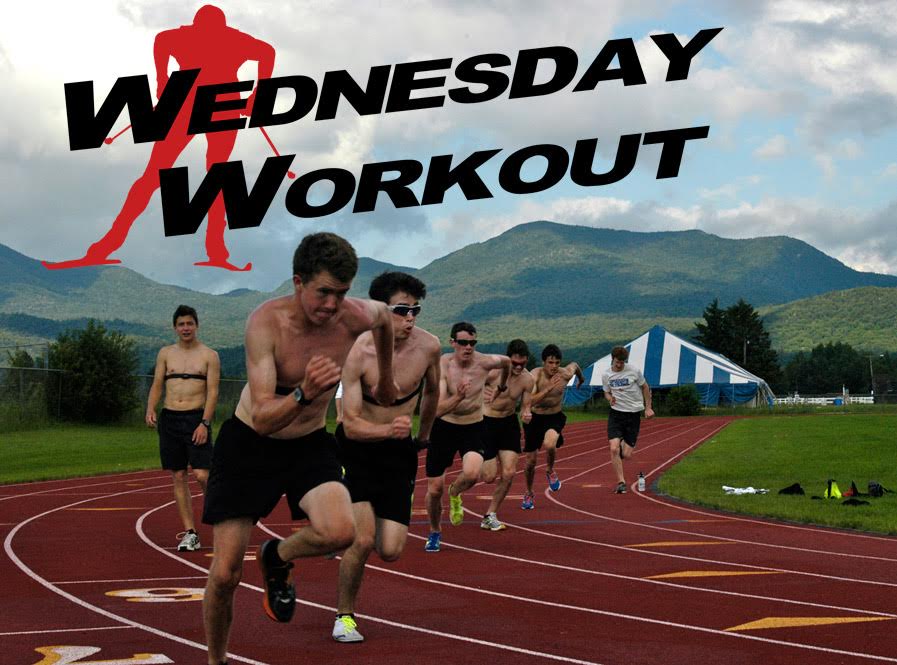
    Boulder Nordic Junior Racing Team (BNJR) athletes prepare for the start of a 3,000-kilometer running time trial on the track in 2013. (Photo: Adam St. Pierre)
    Boulder Nordic Junior Racing Team (BNJR) athletes prepare for the start of a 3,000-kilometer running time trial on the track in 2013. (Photo: Adam St.Pierre)

    FasterSkier recently caught up with the Colorado-based Boulder Nordic Junior Racing (BNJR) Team and its head coach Adam St.Pierre for a workout tailored to junior skiers, but sure to improve pacing and get hearts racing for athletes of all ages.

    ***

    The national team athlete, the college competitor, the up-and-coming junior, the still-got-it master — if there is one training tool most of these nordic skiers know of, it’s the 3,000-kilometer time trial on the track.
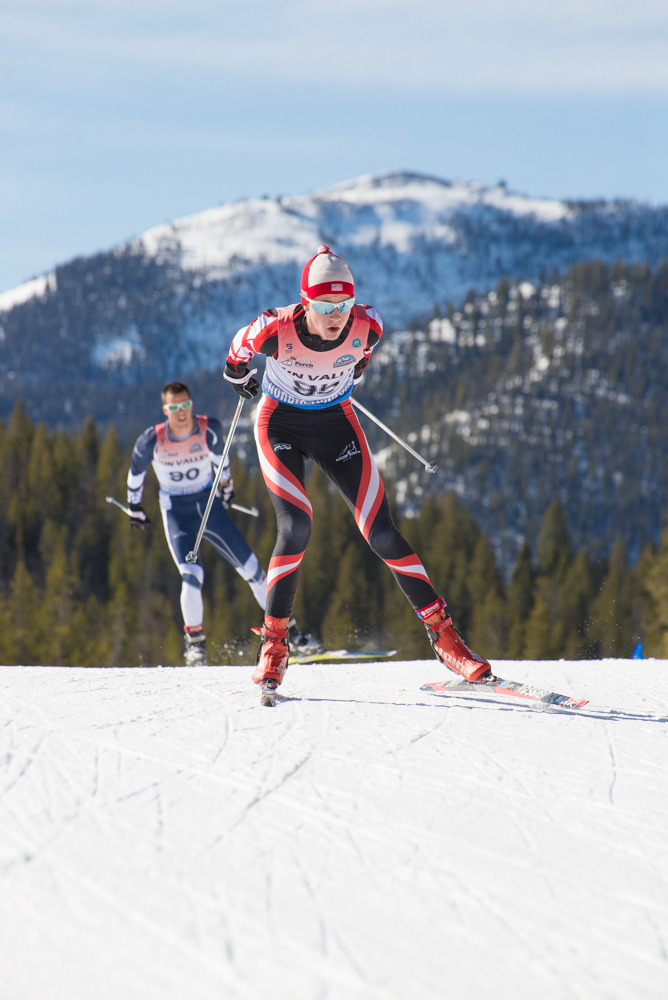
    Boulder Nordic Junior racer, Emil Graf competing at this past season Junior Nationals Qualifier in Soldier Hollow, Utah. (Photo:  David Pickner davidpicknerphotography.com)
    Boulder Nordic Junior racer, Emil Graf competing at Spring Series in Sun Valley, Idaho. (Photo: David Pickner/davidpicknerphotography.com)

    However, while 3 k times are certainly a useful method of comparing an athlete’s baseline fitness at multiple levels, Boulder Nordic Junior Racing (BNJR) Team’s head coach Adam St.Pierre indicates the performance test is merely Step 1 for junior skiers looking to further develop.

    “If you look at how many juniors in particular just go out at the start of a 5 k race and are just cooked within the first k, by putting them on a track and teaching them how small the changes in effort are to achieve different paces is a pretty powerful tool,” St.Pierre said on the phone from Boulder, Colo.

    For St.Pierre, the 3 k is not just a test of fitness at summer’s onset and fall’s closure, but also a tool for teaching athletes to pace and track their progress. Using his athletes’ spring 3 k time trial results, he computes his athletes per 100-meter pace, which is the pace his athletes then base all of their summer and fall interval times off of.

    “What a lot of athletes end up discovering is that the per 100 meter pace of a 3 k isn’t that hard,” St. Pierre said. “They say, ‘But I went out way faster than that,’ and I say ‘Yeah, you did, then you slowed down.’ So using a performance metric to determine your workloads is ideal.”

    Another reason St.Pierre likes to have his juniors hit the track regularly? The opportunity for coaching surveillance and the occasional interval.

    “I think it’s important, too, that you see your coach isn’t just some out of shape old dude,” St.Pierre said. “With the track, I have the ability to hop in and run by someone for a lap or an interval or half a lap, whatever it takes to help them hit their targets.”

    The Workout

    Purpose: Complete a progression of track workouts over the summer in order to improve pacing. Indicators of improvement are times from a 3 k time trial at the beginning of the summer compared to 3 k time trial times run by the end of the fall, as well as an increase in the number of repeats athletes can complete during each consecutive track workout.

    Warmup: 20-30 minutes

    • 5 minutes running off the track
    • “Wake up muscles” next by doing a series of lunges: forward, backward, and lateral; follow up with squats
    • 4 laps around the track
    • High knees, butt kicks, karaoke and skips during straight aways, jog corners
    • “Do each drill forwards and backwards!” St.Pierre said.
    • 50- to 100-meter barefoot strides/accelerations

    *(St.Pierre’s favorite) set: 400-meter repeats for 30 minutes at 3 k race pace

    Recovery equals the same amount of time as interval or until heart rate returns to Level 1

    Sample progression (all done at 3 k race pace):

    • Week 1: 200-meter repeats for 3-5 k
    • Week 2: 300-meter repeats for 3-5 k
    • Week 3: 400-meter repeats for 3-5 k  

    (Continue adding until you reach 1,000-meter repeats for 5-7 k)

    Cool down: 15-20 minutes

    • 5-10 minutes of aerobic running
    • 5-10 minutes core circuit
    • Static stretching

    Total time: 90 minutes

    *An athlete must complete a 3 k time trial on the track in order to calculate their ideal interval effort and pace (St.Pierre takes an athlete’s per 100-meter time based off their 3 k time.
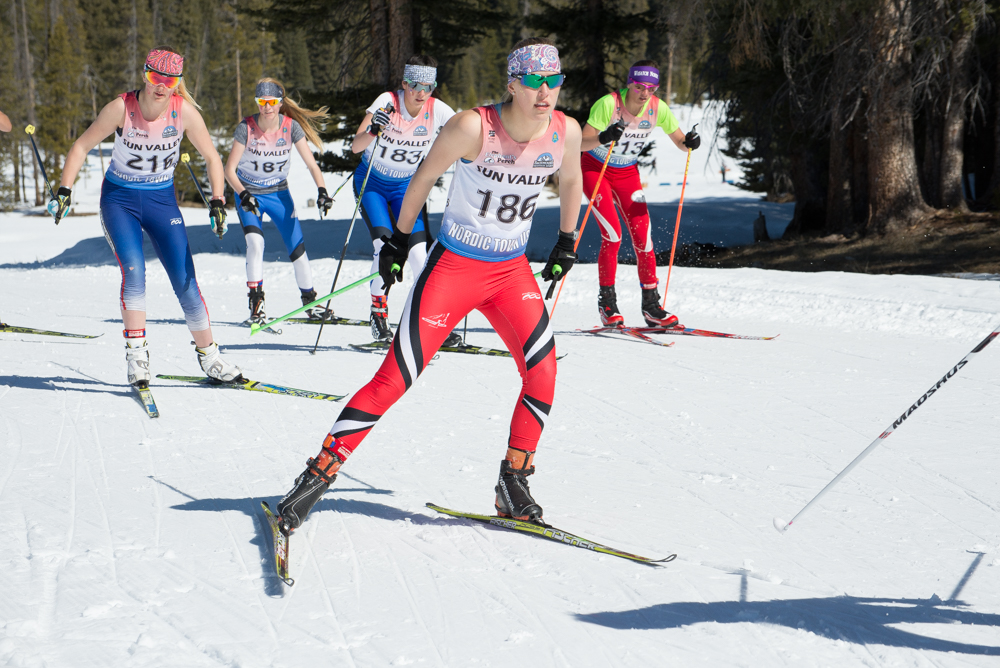
    Emily Picker bib 186 competing at Spring Series in Sun Valley, Idaho. (Photo:  David Pickner davidpicknerphotography.com)
    Emily Picker bib 186 competing at Spring Series in Sun Valley, Idaho. (Photo: David Pickner/davidpicknerphotography.com)

    BNJR Coach and Athlete Advice:

    1. Work up to what you want.I enjoy this track workout because it helps me get used to doing a 3 k, and pushing hard for that long by working up to that,” BNJR skier Emily Pickner wrote in an email. “Intervals are easier for me to do because they are usually shorter, so by the time we get to the 3 k, I can look at it as all the intervals put together.”
    2. Mobility is a must. “Lots of skiers run like robots!” St.Pierre wrote in an email indicating that in order to reap the complete benefits of the track workout, “include some drills within the warm-up to elevate your HR [heart rate], increase your range of motion and improve your run mechanics.”
    3. Use the race to break down the pace. Going out too hard is a game all too familiar with nordic athletes, junior and senior racers alike“Basing paces on 3 k time makes them an accurate estimate of what you can do,” Emil Graf, another BNJR racer, wrote in an email. “Trust the goal paces … Also, make sure to set a solid 3 k time at the beginning.”
    4. Progress takes patience. “I think the overarching philosophy for my training and coaching is just progress over time,” St.Pierre said. “Regularly checking that you are improving and then being willing to make changes if you want — sometimes those changes are you need to train more and sometimes those changes are you need to train less, or re-prioritize — that’s an important concept.”

  • Wednesday Workout: Metronomes with Michigan Tech’s Alice Flanders

    Wednesday Workout: Metronomes with Michigan Tech’s Alice Flanders

    Sunrise on campus at Michigan Technological University in Houghton, Mich. (All photos: Alice Flanders)
    Sunrise on campus at Michigan Technological University in Houghton, Mich. (All photos: Alice Flanders/aliceflanders.wordpress.com)

    This week’s workout comes from Michigan Tech masters student and skier, Alice Flanders, also a satellite athlete with the Central Cross Country (CXC) Team. Flanders trains with the Michigan Tech team, and largely does workouts designed by head coach Joe Haggenmiller, while CXC Team coach Andy Keller oversees her training. Read her complete blog post here.

    Do you have a workout you’d like to share? Email info@fasterskier.com with the subject line: Wednesday Workout.

    ***

    I’m waiting in the starting pen, the 20-degree wind blowing gently across the stadium as the clock beeps the tell-tale tones of another racer starting. I chisel the chunks of snow out of the bottom of my boot and clip into my skis. I step up to the wand.

    “15 seconds”

    “Beep… Beep… Beep….Beeeeeeeep”

    I try to start but for some reason my feet just won’t move.

    “Beep… Beep… Beep…. Beeeeeeeep”

    “Thwap!”

    Early morning speeds during metronomes at Michigan Tech in Houghton, Mich.
    Early morning speeds during metronomes at Michigan Tech in Houghton, Mich.

    Groggily, I fumble through the sheets looking for my persistently beeping phone. It’s 5:52 am and my body feels like a sack of bricks.

    I roll over placing my index and middle finger on the underside of my wrist. 10 beats in 15 seconds, 40 BPM (beats per minute). Not a bad a.m. pulse, but that’s a little higher than normal. I’ll have to drink lots of water today and make sure I haven’t caught the back-to-school-plague that seems to have taken over the school.

    Stepping outside, the entire town seems dead. If it weren’t for the street lights, I’d be unlocking my bike by starlight. Occasionally I’ll pass by a group of ROTC students running in synchrony, but until arriving at the Student Development Center there’s no one in sight.  This morning we’ll be doing metronomes, a workout where we double pole around the track at different tempos to work on technique and speed.

    The Workout: Metronomes

    Total Time: 45-60 min

    Goal: Focus on high quality technique while using different tempos. Immediately apply this to sprints and starts.

    Warmup: About 10 minutes or 3 songs

    Workout:

    Set 1:  (with metronome playing over loudspeakers: listen to an actual metronome and match your pole plants to the beat)

    2:30 @ 50 BPM

    0:20 @ 60 BPM

    0:10 @ 80 BPM

    Repeat 3-5 times

    Set Break: Length = one song of your choice

    Set 2: 6-10 x 100-meter sprints

    Cool down: About 10 minutes

    This workout has a lot of benefits.

    • It teaches the athlete how to ski using varying tempos
    • By skiing around the track, it is much easier for coaches to work with athletes of different speeds and track progress throughout the session
    • Technique and tempo can be applied immediately during the 100m sprints
    • It’s good mass start practice due to the amount of passing that occurs
    • Pace lines will form and it’s fun to go fast in a group!
    • There are a lot of opportunities for younger skiers to ski with, watch and learn from older people on the team.
    • You get to listen to music
    • No Cars!

    But be careful, this is an intensity session and should be counted as such. Recovery in between the 80 BPM and sprints should be a priority.

    By 7:30 the sun is painting the sky hues of pink, purple and yellow. It’s not hard to realize how lucky we are to live in a place like this.

    Class time: Where recovery and learning come together (Photo: Alice Flanders)
    Class time: Where recovery and learning come together.

    In class, while other students are guzzling coffee trying not to nod off, I’ve got positive endorphins keeping me engaged. However, as the day continues I find myself gazing out the window as storm clouds congregate on the horizon. It’s supposed to rain tonight. Right now I keep my fingers crossed that the rain will go somewhere else, keeping our roads dry for practice this afternoon. In a few weeks these clouds will hold potential for snow. As my professor fills the board with equations, I daydream about how much snow we’d get if it were 15 degrees cooler.

    Excelling in any sport takes an extreme amount of commitment and self discipline. It takes over your thoughts, drives your decision making process and rules your schedule. Every moment of the day is carefully crafted to strengthen your body through nutrition, intensity, recovery or education. It’s an all encompassing full time job. Luckily, this job comes naturally when you have passion for the sport. It begs us to reach higher, to do one more pull-up, to push the limits of comfort and ultimately persevere. What are your goals this season?

    Michigan Tech masters student and skier Alice Flanders setting goals. (Courtesy photo)
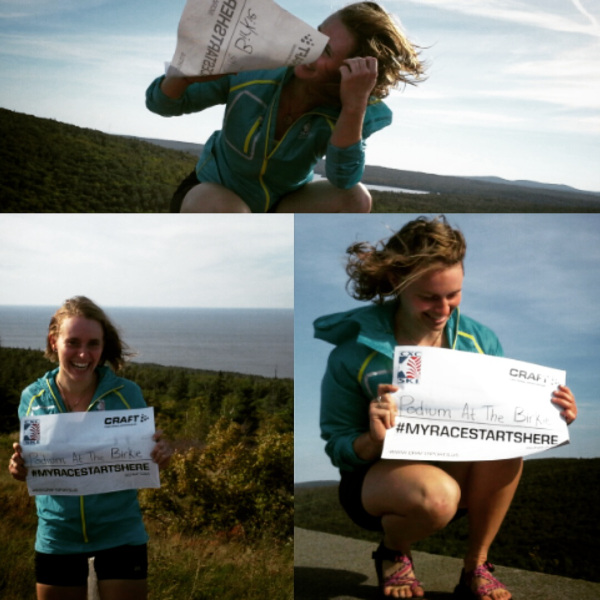
    Michigan Tech masters student and skier Alice Flanders setting goals, specifically to podium in the American Birkebeiner skate race, as photographed on Brockway Mountain in Copper Harbor, Mich. (Courtesy photo)
  • Wednesday Workout: Need for Speed (and Time-Saving Gut-Busters) on the Track

    Wednesday Workout: Need for Speed (and Time-Saving Gut-Busters) on the Track

    Nakkertok skiers hard at work during a track workout in 2013. From left to right: Isaac Alexander-Cook, Kyle Curry (St. Lawrence University), Cary Pomeroy, Phil Marshall, Brendon Howard, Symon Stowe, and Patrick Van Walraven. (Photo: Jesse Williams)
    Nakkertok skiers hard at work during a track workout in 2013. Read more about their team and Level 3 running loops workout. (Photo: Jesse Williams)

    FS Editor Alex Kochon submitted the following, adapted from a Combo Track Workouts article by Runner’s World, as a sort of self-help, get-back-into-shape-with-limited-time article, but the workouts can be suited to super-fit athletes as well. 

    ***

    We know the reason you ski is your love for variable terrain, ever-changing scenery and snow, but sometimes, you’ve just got to get a workout in. And in the summer, those feeling a lack of “me-time” might find they can work up one heck of a sweat in minimal time at a local track.

    At least I have.

    As a new mom, I’ve been struggling with the idea of training. I set a loose goal for a race I wanted to do in September, and stupidly picked a triathlon. Now, one week out from the big event I have yet to swim more than a few floppy freestyle strides, done mostly to cool off.

    Needless to say, I’m not racing next weekend. But I have been running. And at least a couple times, I revisited the track after a LONG hiatus, and I did speed work.

    The best thing about track workouts is you can easily measure progress. I’m not suggesting that skiers need to do this frequently or even regularly, but an occasional speed session measured by mindless laps around a 400-meter track and a trusty stopwatch (and headphones, if you’re running solo and could use the extra motivation) can give an added boost to your endurance training.

    I recently tried some combo workouts, adapted from Runner’s World (RW).

    “Your training should be diversified and well-balanced,” RW contributor Kristin Barry wrote. “It should have a mix of different types of workouts and pace variation — V02 max intervals, tempo runs, progression runs and near maximum speed intervals. Each of these is an important piece in a balanced program.”

    Barry gave some ideas for incorporating a variety of paces into a single workout: thus, the combo workout, which are great for saving time as well (i.e. if you can’t get a two-hour workout in most days). Some of these I’ve cut short or abbreviated for the purpose of saving time — and easing back into shape.

    From Runner’s World, Oct. 2011:

    • Workout #1: 20-minute tempo, 3 X 1,000M at 5 k pace or faster

    (Total: 20 minutes at half-marathon pace + 3 kilometers of faster 1,000-meter repeats, with 6-9 total minutes of recovery in between)

    How: Begin with an easy 15-to 20-minute jog. After warming up and doing a few strides, run for 20 minutes at approximately 10-mile or half marathon race pace. Jog 400m and then go immediately into 1,000m repeats at 5K pace or just faster. Take 2-3 minutes rest between each 1,000m repeat.

    When: This workout is best performed well into a training schedule when your fitness is relatively high, as it’s a fairly demanding, challenging workout.

    Why: In addition to targeting lactate threshold, this workout allows you to practice running goal 5K pace on fatigued legs and simulates what the last mile of a 5K feels like. It’s a great confidence booster and good workout to go back to mentally when your legs begin to tire in the last third of a 5K.


    • Workout #2: 2 X 6:00/5:00/4:00/3:00/2:00/1:00

    (Total: 42 minutes + 15 minutes recovery in between)

    How: After an appropriate warm-up, run each timed interval followed by a minute recovery jog; take a 5:00 recovery jog between the two sets. Run the 6:00 interval at marathon pace, the 5:00 interval at half marathon pace, the 4:00 interval at 10K pace, the 3:00 interval at 8K pace, the 2:00 interval at 5K pace and the 1:00 interval at 3K pace.

    When: This is a great early season workout, a rust buster of sorts. It allows you to become familiar again with faster running without hammering 1200m repeats right away.

    Why: This workout touches upon many different paces and encourages Hudson’s notion of keeping all systems fit and not neglecting any particular component of running fitness. It provides tremendous variation in both pace and intensity. As mentioned, Hudson believes it’s important to have a high level of non-race-specific fitness before beginning race specific workouts, and this workout addresses all the fundamentals.


    • Workout #3: 2 X 3,000M/2,000M/1,000M

    (Total: 12 k + 16 minutes recovery in between)

    How: After warming up, run 3,000m at tempo pace, or approximately half marathon pace. Take a 2:00 recovery jog and then run 2,000m a bit faster. Take another 2:00 recovery jog and then run 1,000m at 10K pace or faster. Then jog for 4:00 and repeat the set.

    When: This workout can be used at various points during the season. Hudson has his athletes run 10K pace for the 1,000m interval earlier in the season and has them bring it down to 5K pace later in the season as their fitness improves. The key is that as fitness advances, the intervals-particularly the 1,000m interval-become progressively faster.

    Why: This workout is designed to bolster power endurance, which Hudson defines as long intervals that support the specific endurance needed to run your best in a goal race. Hudson says specific endurance is “the type of endurance that is needed to maximize performance at a particular race distance. It is the ability to resist fatigue at your goal pace long enough to reach the finish line without slowing down.”


    • Workout #4: (5 X 400M)/MILE + (5 X 300M)/1200M + (5 X 200)

    (Total: 7.3 k, or 4 1/2 miles, with 37 minutes recovery in between)

    How: After warming up, run 5 x 400m at approximately 3K pace with a minute rest between each repetition. Jog for 5-6 minutes and then run one mile at approximately 10K pace. Take another 5:00 jog and then run 5 x 300m at about mile pace with a minute rest between repetitions. Jog 5:00 again and then run 1200m at 5K pace. Once again, jog for 5:00 and then run 5 x 200m at mile pace or faster with a 2:00 recovery jog between each repetition.

    When: Performing this workout in the final few weeks before a goal race accomplishes a bit of sharpening and also aids the neuromuscular coordination needed to run at goal pace.

    Why: This workout provides a solid measure of speed training, which boosts neuromuscular fitness and running economy. Work done at near maximal speed-the 200m repeats at the end of the workout at faster than mile pace-makes all other running paces more economical. Furthermore, this workout helps you practice maintaining strong running mechanics while under great stress.

    Read more