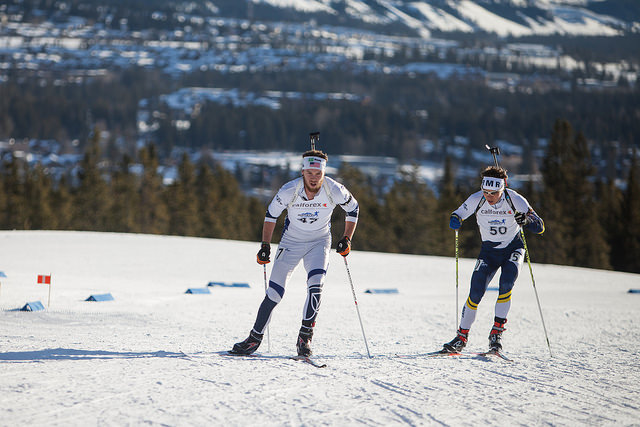
It was the last Friday in February and U.S. biathlete Casey Smith was training in Canmore, Alberta. The Canadian venue was about to host the first of several IBU Cup races, the second-tier circuit of the International Biathlon Union.
After a season which he described as a learning process, but lacking any spectacular results, the first-year member of the U.S. National Team was excited to be racing against international competition but on more or less home turf.
“In Europe I didn’t really have any outstanding races, I would say,” he said in an interview on Tuesday. “I was really looking forward to racing in Canmore because it’s almost like a home course. I spent a month there in November, and in years past I’ve spent a lot of time there too.”
Smith, who is based at the Maine Winter Sports Center, had already been cruising the trails and was doing his final race prep before the initial sprint race to be held Saturday. Part of race prep entails thinking about how, technically, to ski each section of the course: uphills, downhills, terrain and corners.
“There was a downhill corner that I had been sliding into to check my speed and then stepping the rest of the way around,” he said. “I decided to try to step all the way through the turn to see if it was faster.”
With snow conditions as they were – all manmade snow, with a layer of sugary corn snow on top of an icy, hard, frozen base – that turned out to be a dangerous move.
“As I was going around the corner, my skis just slipped out from underneath me, like when you’re falling on an ice skating rink,” he remembered. “The trail was all manmade snow, so it was kind of built up and the hill dropped away from the trail. I flew off the trail and down about four meters into a tree. I was flying through the air and the first thing I hit was the tree, on my back. It was like I was standing up and down in the air as I hit it.”
Smith was knocked unconscious by the impact and woke up to his friend Ethan Dreissigacker, who had been following him around the course, standing over him asking if he was okay.
The answer? No. As medical staff and paramedics came to the scene (including Smith’s mother, who was there as a coach but has also been an EMT for years), it was obvious that he needed to be moved to nearby Calgary, and fast.
It sounds like a routine now when Smith lists off the injuries the doctors eventually catalogued.
“I broke all by two of the ribs on my left side and one rib on my right side,” he begins. “I broke my shoulder blade in multiple places. On my back there’s little bones [called transverse processes] that stick off the side of your spine. I broke seven of those. Nothing into the spinal column luckily. I punctured my left lung.”
Smith would not be competing in the IBU Cup. Instead, he spent 11 days in the hospital and another three outside of it in Calgary before finally being able to head home to Winthrop, Washington, to recuperate.
“I’m home in Washington now, so it’s pretty nice to just relax and recover here,” he said.
Looking back, it seems obvious that the corner was dangerous – the race organizers have apparently since put up a snowfence on the downhill where Smith crashed – but at the time, it didn’t seem like anything unusual.
“There’s lots of corners on any ski course where you could potentially go flying off,” Smith said. “So I don’t really know. The day before I had skied around that corner and kind of glanced off the trail and thought, ‘wow, it would suck to go off the trail there, it’s a long way down and not a lot to stop you.’ But I didn’t think twice about it.”
Tracy Lamb, a former biathlete and national team coach who is now the director of the U.S. Olympic Training Center in Chula Vista, California, was the Technical Delegate for the competitions.
“Let me just say how concerned I have been about Casey’s recovery and how glad I am to know that he has been making good progress,” Lamb wrote in an email. “I am also grateful for the care he was given in Canada and very glad that his mother was there to be with him. Course safety is a priority for every organizing committee in Biathlon. Extra steps were and are taken to safeguard against athlete accidents. This was truly an unfortunate accident.”
Smith had his rifle on his back at the time of the crash, and says it’s hard to whether that added to the list of injuries or not.
“My rifle stock is snapped in half,” he said. “We don’t know if the rifle helped or hurt me more. I’d like to think it helped me in kind of absorbing some of the impact, by breaking the stock, and acted as almost something of a back brace so I didn’t curl around the tree as much when I hit it. But who knows.”
While most of his injuries have a six- to eight-week recovery time, and Smith is already walking for ten or fifteen minutes at a time “slower than I’d walk with my 80-year-old grandpa,” he plans to return to biathlon. Six weeks will likely not be enough time to get back to training speed, is the message he has been given.
“For the lung, that’s one of the more major things,” he explained. “It had some pretty bad bruising and a tear. Obviously you use your lungs a lot in an endurance sport. So that could be up to six months maybe. But it depends on how quickly it heals. You just kind of go with the flow.”
Before the crash, Smith was working his way up the U.S. biathlon ladder. As part of his position on the national team, he had spent several weeks in Lake Placid this summer.
“That was really beneficial, first of all just for having the national team coaches to give me lots of insight and pick up on details,” he said. “And also just being around Tim [Burke] and Lowell [Bailey] and training with those guys some. They know what they’re doing. It’s beneficial being at that higher level and having it at your fingertips to soak in everything.”
Smith’s top international finish this season was 43rd in an IBU Cup pursuit in Ridnaun, Italy. With a little more international racing under his belt and the kind of experience he had in Lake Placid over the summer, Smith is certain he’ll be back at biathlon soon – as soon as is responsibly possible.
“I don’t want to push it too much so I overdo it before I’m recovered, but I’m definitely planning on making a full recovery, coming back to biathlon, and getting better,” he said.