Tag: trail run

  • Wednesday Workout: Hoffman’s Personalized Plan to Ramp Up the Hours

    Wednesday Workout: Hoffman’s Personalized Plan to Ramp Up the Hours

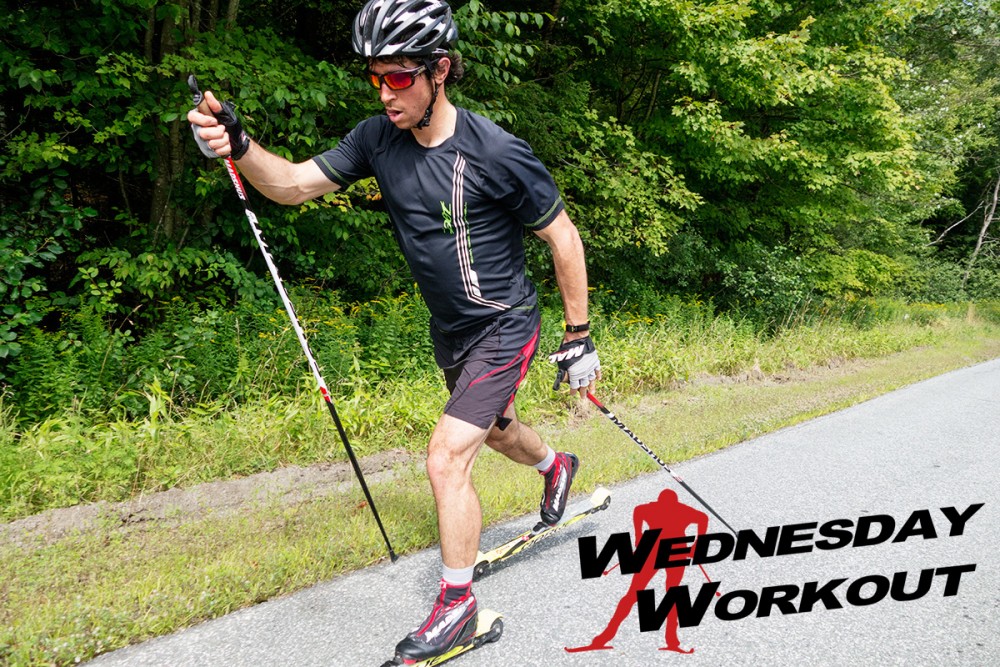
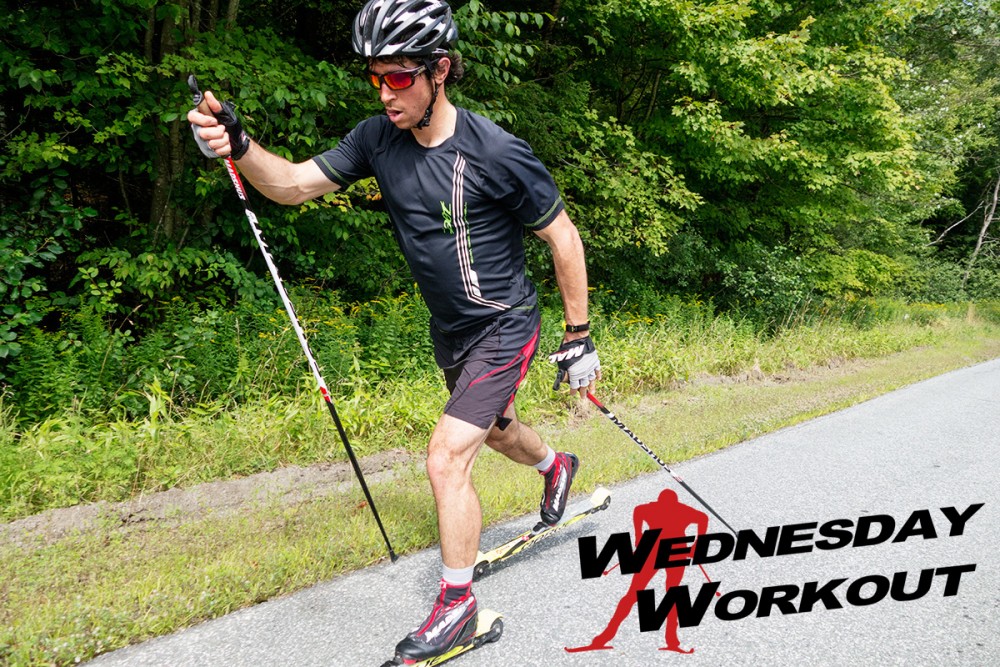
    U.S. Ski Team member Noah Hoffman striding on roller skis near Putney, VT. (Photo: Zach Caldwell)
    U.S. Ski Team member Noah Hoffman striding on roller skis near Putney, VT. (Photo: Zach Caldwell)

    Putting in the time to make it 1,000 hours. At 26 years old, that’s the volume U.S. Ski Team member Noah Hoffman has in store for his training year. 

    If you read Hoffman’s blog — which often details the nitty gritty of a World Cup athlete’s life — you’ve no doubt noticed he’s decided to do things differently this year. According to Hoffman’s 2015/2016 training log, he totaled 678 total hours.

    This training year his goal is 1,000 high-quality training hours.

    Zach Caldwell, Hoffman’s coach responsible for monitoring his recovery post-training, explained that his athlete is not making an extreme jump.

    We have to be clear, what he is biting off is not a whole new training load,” Caldwell said over the phone. “It’s reducing distractions, focusing on better continuity and holding the training pace at a level he is already shown an ability to tolerate and benefit from. So it’s not as though we took everything and bumped it up 20 percent or 30 percent, or whatever it ends up being. It’s not like we are asking a guy who can run eight-minute miles to go out and run six-minute miles.”

    According to both Hoffman and Caldwell, the junk hours added up last year. Below is a snapshot of what Hoffman wrote on his blog when explaining why some of his training was compromised as “limited” or “off”:

    “Missed, Compromised or Scheduled as Low Training Days

    – Off days in April: 25

    – Scheduled Off days for training (Summer and Winter): 15

    – Off Days or shortened Days due to “vacations” (Maggie’s wedding, fall desert trip, Quebec City and Davos “Break”): 11

    – Off Days or Compromised Training Days due to Travel: 36

    – Off days due to illness, injury or medical procedure: 1

    – Shortened training days due to technique work: 19

    – Days Limited to about an hour a day of training for posture project: 30

    Total Days limited or off for all above reasons: 137 (37% of all days in the year)

    So how exactly will Hoffman bump up the hours?

    Over the summer, he will log big days both running and rollerskiing. Hoffman said in a podcast interview  (to be posted on FasterSkier at a later date) that the big days are in fact not getting any bigger. The majority of the hours increase is gained through eliminating the junk days, the compromised training.

    “What he is biting off is not a whole new training load … It’s not like we are asking a guy who can run eight-minute miles to go out and run six-minute miles.” — Zach Caldwell on the planned jump in Noah Hoffman’s training hours

    This past Monday, Hoffman began a two-week training block during which he’ll total approximately 53 hours.

    Basically, Hoffman organized those two weeks into 3 x 4-day mini blocks. The mini blocks consist of 3 x 5-hour days in succession, followed by a two-hour “recovery” day. The final mini block of five-hour days — days 9, 10, and 11 — ends with a rest day sandwiched between two recovery days — those are days 12, 13, and 14. Hoffman plans to repeat the two-week training cycles for the remainder of the summer months.

    The following “Wednesday Workout” features Day 1 of Hoffman’s most recent two-week block:

    – Yoga (15 minutes) followed by an approximately 30-minute strength workout done at home.

    – Strength (30-40 minutes):

    1. Hanging Hip Ups 3 x 4-6
    2. Front Planche Progression 3 x 25-30 seconds
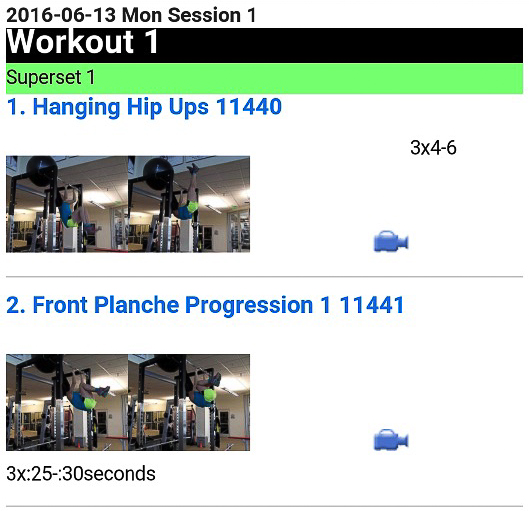
    Noah Hoffman Strength Exercises 1 & 2. (Photo: Noah Hoffman)
    Strength exercises 1 & 2
    (Courtesy photo)


    3. Hanging Hip Flexion 3 x 10-12

    4. Varying Push Ups 2 x 3 push ups (varying push Up and hold) + 15-18 regular push ups, hold for time
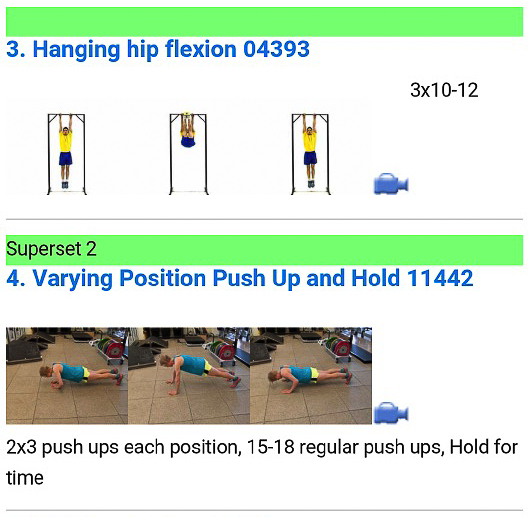
    Noah Hoffman Strength Exercises 3 & 4. (Photo: Noah Hoffman)
    Strength exercises 3 & 4


    5. TRX Row Series 2 x 3 rows each grip, rows/flys / 1 x 4-6 decline or horizontal rows – last one is a hold for time

    6. Slideboard Plank Pike 2 x 20-25 (first 4-6- include tricep push up)
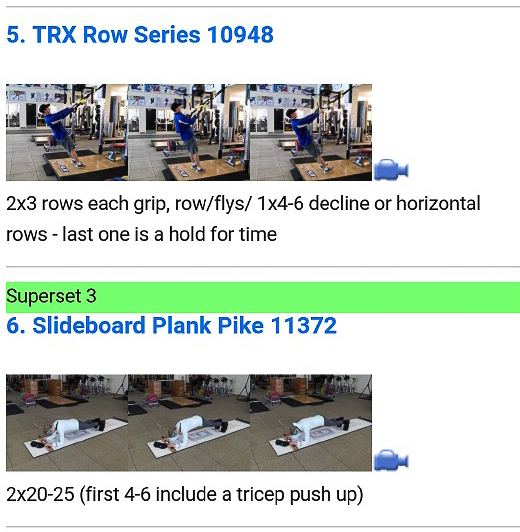
    Noah Hoffman Strength Exercises 5 & 6. (Photo: Noah Hoffman)
    Strength exercises 5 & 6

    7. Foam Roll Walkout

    Noah Hoffman Strength Exercise # 7. (Photo: Noah Hoffman)
    Noah Hoffman Strength Exercise # 7. (Photo: Noah Hoffman)

    – Then it’s onto a morning-distance trail run: 3 hours at Level 1

    – Followed by an afternoon/early evening-distance rollerski: Double pole for 2 hours at Level 1

    Hoffman explained that his pace for the big five-hour days is controlled and at the slow end of the effort spectrum.

    “Level 1. All the distance will be at Level 1, both the run and the double pole,” he said.  “Which for me is 110 to 130 beats per minute running on mountain terrain. And average double poling, it’s 11 mph for me on my average speed. That’s all very arbitrary, I do enough Level 1 training that I know the paces by heart rate and by speed.”

    If you are curious how the effort compares on his recovery days, here’s the details.

    “I would say that the pace for those sessions should be lower,” he said. “It should be a recovery focused pace to play into the theme of the day. If anything it would be the low end of Level 1, although my Level 1 range is 110 to 130, and that’s a pretty big range … And the theme I have for the summer versus the winter is I train more in the summer than most of my teammates and less in the winter than most of my teammates. I really believe that for me it works well that the high stuff to be high and the low stuff to be low and that goes on a day to day basis, and on a seasonal basis.”

    As with any athlete making jumps in their training hours, Hoffman is no different in terms of keeping things tempered and being mindful of the race season many months away.

    To accrue his increased high-quality load, Hoffman will have fewer of what Caldwell calls “circuit breakers.” Ensuring that Hoffman is benefitting from his increased hours and not breaking down is one of Caldwell’s primary jobs.

    “The big concern, without those circuit breakers if you will — I have always thought of those breaks as being a little bit like circuit breakers, an opportunity for some physical recovery and a shift of load,” Caldwell said. “The big challenge without those circuit breakers is to manage the accumulation of load, and to make sure he is benefiting from the training. And we are principally using Firstbeat Systems to do heart rate variability analysis of his overnight sleep recovery.”

    Over the summer, Caldwell said he’ll focus on Hoffman’s longer-term recovery trends, which he’ll keep a close eye on after each of his two-week training blocks.

    “Coming out of that we want to see evidence that over those two weeks he is putting up improved recovery scores from before,” he said. “It doesn’t happen to be any one test, we just want to see the the overall trajectory be positive at this time of year. As he gets closer to competition season, we want to see more of a daily response. We want to tighten the timeline on that recovery. But what we are not willing to do is do bank 12 weeks of training against the promise of some future response without seeing a response during that time frame. We are not doing it based on faith.”
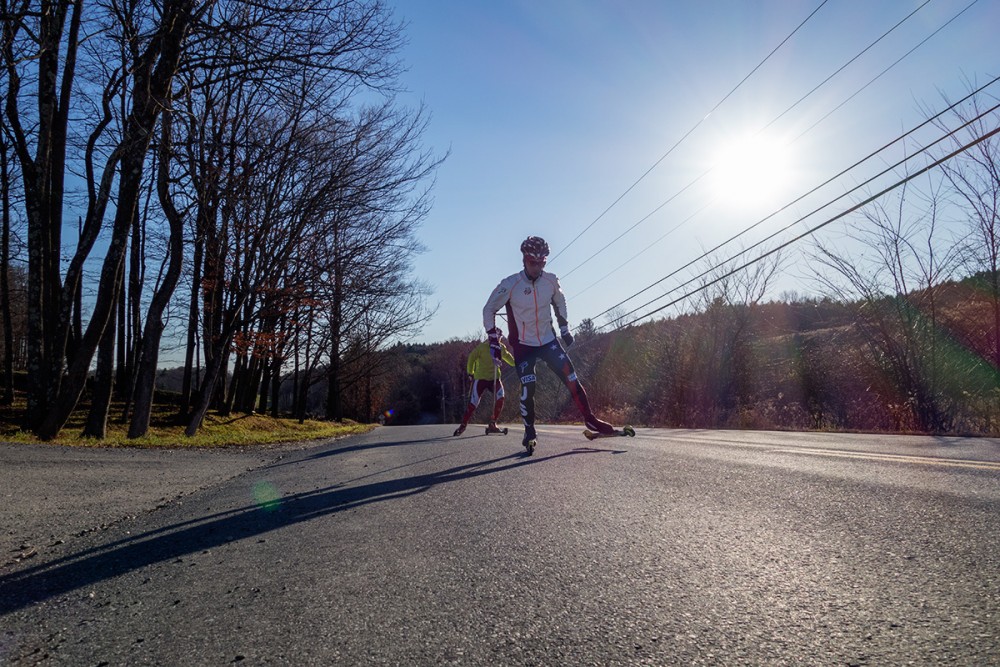

    U.S. Ski Team member Noah Hoffman skate roller skiing near Putney, VT. (Photo: Zach Caldwell)
    U.S. Ski Team member Noah Hoffman skate rollerskiing near Putney, Vt. (Photo: Zach Caldwell)
  • Birkie Trail Run & Trek — Now with Singletrack!

    Birkie Trial Run & Trek

    HAYWARD, Wisconsin (June 27, 2014) – The five events of the 12th annual Birkie Trail Run & Trek on Sept. 27 put you on some of the best sections of the world-class Birkie Trail system and now some of the best singletrack in the Upper Midwest as well. These singletrack sections are part of the CAMBA trail system, considered “the singletrack capital of the Midwest.” The Birkie Trail Marathon, Marathon Relay, and Half Marathon courses will all include these new singletrack sections. The new courses are made possible by a brand new start/finish venue for the events—the new Birkie Ridge Trailhead. The American Birkebeiner Ski Foundation completed this latest addition to the Birkie Trail system last fall.

    Register Soon!
    www.birkie.com

    Sign Up Before JULY 1 and Save!

    The new Birkie Ridge trailhead is on Hwy 63, just 11 miles north of Hayward, WI, and five miles south of Cable, WI. Starting at this new trailhead takes runners right into the heart of some of the best sections of the Birkie Trail and the CAMBA singletrack system. Over 44 miles of the CAMBA singletrack system are the hidden jewel in this area. Many portions of it run adjacent to the Birkie Trail, crossing the Birkie Skate and Classic Trails every four to five kilometers.

    Adding singletrack to the Birkie Trail Run events is a natural. It will satisfy the cravings of the most passionate, dirt-loving trail runners! Many local and regional trail runners already know about this combination of trails. The Birkie Trail Run & Trek opens up this hometown secret to trail runners across the country.

    The Birkie Trail system itself has some roots and rocks, but is relatively smooth. The terrain (including those Birkie hills) makes it interesting for avid trailrunners. For road runners looking to break free from their usual routes, it is a great crossover and introduction to trail running. The main course is 30 feet wide, grass covered, and mowed, with a bike path down the middle to keep those sections fast. There is plenty of room to pass on the uphills, downhills, and flats. This is the Birkie Trail, so there are hills. Hammer it or cover your favorite distance at a recreational pace.

    This event has a great, friendly vibe and a finish-line party with loads of local food and craft beer on tap from the Cabin Stop of Hayward. All registered participants eat free at this picnic at the start/finish line tent. Spectators, family, and friends can purchase a picnic ticket. The grills will be fired up, so plan to stay for the party!

    “If you love to run great trail, this is the event to put on your calendar now,” says Ben Popp, Executive Director of the American Birkebeiner Ski Foundation. “Get ready for some great new sections of trail, beautiful views, and a whole new running experience on the Birkie Trail!”

    For more information, visit www.birkie.com or call the Birkie office at 715-634-5025.

    The Birkie Trail Run & Trek Is Sponsored By: Salomon, FITS, Dr, Brent Carlson, MD, Out There Nordic Sports, and the Cabin Stop

  • 5 Peaks Trail Running in Canmore: A Who’s Who of Nordic Racers

    5 Peaks Trail Running in Canmore: A Who’s Who of Nordic Racers

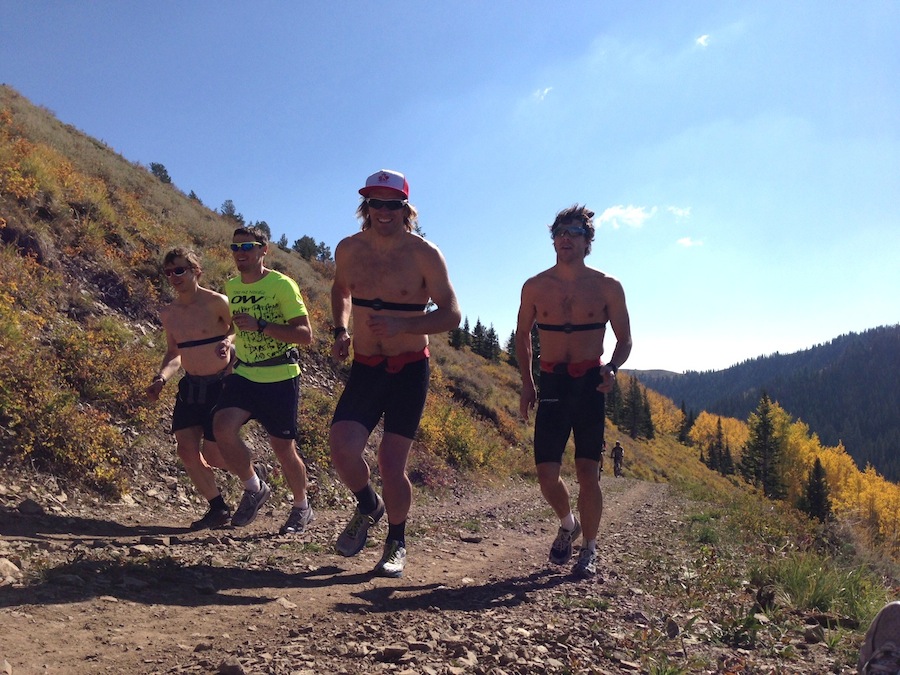
    The Canadian men during a dryland camp in Park City, Utah. From left to right: development-team members Kevin Sandau and Mike Somppi, and World Cup athletes Devon Kershaw and Alex Harvey.
    Kevin Sandau, Michael Somppi, and Devon Kershaw (l-c) competed in the second installment of the 5 Peaks Race Series in Camore, Alberta June 14, 2014. Here they are pictured training with Alex Harvey (r) in Park City ,Utah in 2012.

    On June 14th, the 5 Peaks Trail Running Series came to Canmore for the second installment of central Alberta’s race series. Consistent with the usual 5 Peaks format, the event consisted of an “enduro” distance and a “sport” distance, both 12 k and 8 k, respectively. But unlike your average 5 Peaks race, this event featured Olympians.

    Devon Kershaw, of the Canadian World Cup Team and the Alberta World Cup Academy (AWCA) and teammate Jess Cockney (AWCA – NST B) took two of the podium steps on the day, finishing first in 51:14 and third in 53:17, respectively. Kevin Sandau (AWCA – NST Dev) rounded out the skiers in the top five of the enduro category with a fourth place finish in 53:55.

    “It was definitely a hard race,” Kershaw told the The Cragand Canyon, who pushed the pace and ran off the front of the pack right from the start.

    Cockney ran just behind Sandau and fellow AWCA skier Michael Somppi for most of the race, setting “a strong climbing rhythm” and pacing himself on the descents. He passed his teammates to take his spot on the podium with about 1.5 k to go.

    Cockney was happy with his performance and felt that he “dug deep,” even though he prefers road running races to trail events.

    “My preference is definitely to run road races as there’s no confusion about what pace to stick to or any descents to throw off my rhythm, but it’s good to switch it up and be uncomfortable with a new challenge,” he wrote in an email.

    Sandau, who had not ran a trail running race in a number of years, also compared the race to the road running events that he is more familiar with.

    “That was my first trail run in a long time, such a different feeling than road racing. The climbs are hard and doesn’t feel like I need to run my legs off. It was hard so I was happy with the race,” he wrote.

    Noting Kershaw’s dominance right of the start, Sandau ran just behind teammate Graeme Killick (AWCA – NST B) until Killick took a wrong turn-off around 2 k into the event. From there, Sandau kept his position just ahead of Cockney until he “lost steam” at the 10 k mark and was passed.

    While Killick, Cockney, and Kershaw made a good showing for the male Olympic skiers in the Enduro category, Heidi Widmer (AWCA – NST Dev) represented the women in the 8 k distance, posting a blistering speed of 39:27, almost three minutes ahead of the next competitor.

    With the 8 k and 12 k races starting at the same time, Widmer ran with the 12 k runners until her turn-off, where the race became a practice in pacing for her.

    Widmer really enjoyed the loop but was kept on her toes having not ran the course pre-race.

    “The course was great! I had a general idea of where it went but hadn’t run the loop until the race. There was a long descent mid race that went to the bottom of the Georgetown trail which is essentially as low as you can get on the nordic centre trails. When I was sprinting down that hill, all I was thinking was ‘oh brother, I have to come all the way back up this,’ so the next bit of the race really hurt,” Widmer wrote.

    5 Peaks Trail Running Series – Central Alberta Race #2 Results

  • Inaugural ADK 80K Endurance Race on Labor Day Weekend in Lake Placid

    Inaugural ADK 80K Endurance Race on Labor Day Weekend in Lake Placid

    ADK 80K trail run logo

    Trail runners and off-road cyclists are invited to participate in the inaugural ADK 80K, an eight-of-a-kind endurance racing event to be held in Lake Placid, N.Y. on Labor Day Weekend, Aug. 31 – Sept. 1, 2013.

    The races cover 80 kilometers (80k) in distance, in a figure-8 design, feature $8,000 in prizes in 8 categories with an 8:00 a.m. start time. The weekend consists of two separate events, both taking place on the Mount Van Hoevenberg trail system used in the 1980 Olympic Winter Games biathlon and cross country ski races, and now celebrating 20 years as the home base of High Peak Mountain Bike Center.

    The ADK 80K begins with a trail running race on Saturday, followed by Sunday’s mountain bike race with a cyclocross division. Both races include four 20 kilometer loops in a figure 8 design with aid stations every 5k, each returning to the family-friendly race village twice, complete with food, refreshments and live music. The festive weekend also includes a mini-trail run on Saturday and mountain bike race on Sunday for kids beginning at 4pm. Both mini-races cover a distance of 8 kilometers, with four loops of 2 kilometers each.

    ADK-80K-Logo-for-Web-onlyThe ADK 80K is organized by the experienced team from High Peaks Cyclery and Downhill Mike of the Whiteface Mountain Bike Park. “It’s great to utilize the outstanding trail system at Mount Van Hoevenberg for a summer event of this sort,” said Brian Delaney, president/owner of High Peaks Cyclery, now celebrating 30 years of business in Lake Placid. “Downhill Mike and I have been dreaming of this event since the popular 24-hour team mountain bike endurance race was discontinued years ago, and we look forward to welcoming hundreds of athletes of all levels to join in on this inaugural weekend.”

    Trail runners and cyclists can race solo, 2-person or 4-person teams. Cyclists can ride mountain bikes or cyclocross bikes. The first 80 registrants receive free t-shirts, and the top three winners in each category will win commemorative Adirondack-themed awards as well as winners’ jerseys or performance running t-shirts. Logo goods will be  available for purchase in advance at High Peaks Cyclery in Lake Placid and on site at the event.

    Registration is $80 per person, and is now open and information is online at highpeakscyclery.com, or call Brian with questions at 518.523.3764. Onsite registration will be available at 6:00 a.m. both days of the event.