
Tag: training hours

  • Wednesday Workout: Hoffman’s Personalized Plan to Ramp Up the Hours

    Wednesday Workout: Hoffman’s Personalized Plan to Ramp Up the Hours

    U.S. Ski Team member Noah Hoffman striding on roller skis near Putney, VT. (Photo: Zach Caldwell)
    U.S. Ski Team member Noah Hoffman striding on roller skis near Putney, VT. (Photo: Zach Caldwell)

    Putting in the time to make it 1,000 hours. At 26 years old, that’s the volume U.S. Ski Team member Noah Hoffman has in store for his training year. 

    If you read Hoffman’s blog — which often details the nitty gritty of a World Cup athlete’s life — you’ve no doubt noticed he’s decided to do things differently this year. According to Hoffman’s 2015/2016 training log, he totaled 678 total hours.

    This training year his goal is 1,000 high-quality training hours.

    Zach Caldwell, Hoffman’s coach responsible for monitoring his recovery post-training, explained that his athlete is not making an extreme jump.

    We have to be clear, what he is biting off is not a whole new training load,” Caldwell said over the phone. “It’s reducing distractions, focusing on better continuity and holding the training pace at a level he is already shown an ability to tolerate and benefit from. So it’s not as though we took everything and bumped it up 20 percent or 30 percent, or whatever it ends up being. It’s not like we are asking a guy who can run eight-minute miles to go out and run six-minute miles.”

    According to both Hoffman and Caldwell, the junk hours added up last year. Below is a snapshot of what Hoffman wrote on his blog when explaining why some of his training was compromised as “limited” or “off”:

    “Missed, Compromised or Scheduled as Low Training Days

    – Off days in April: 25

    – Scheduled Off days for training (Summer and Winter): 15

    – Off Days or shortened Days due to “vacations” (Maggie’s wedding, fall desert trip, Quebec City and Davos “Break”): 11

    – Off Days or Compromised Training Days due to Travel: 36

    – Off days due to illness, injury or medical procedure: 1

    – Shortened training days due to technique work: 19

    – Days Limited to about an hour a day of training for posture project: 30

    Total Days limited or off for all above reasons: 137 (37% of all days in the year)

    So how exactly will Hoffman bump up the hours?

    Over the summer, he will log big days both running and rollerskiing. Hoffman said in a podcast interview  (to be posted on FasterSkier at a later date) that the big days are in fact not getting any bigger. The majority of the hours increase is gained through eliminating the junk days, the compromised training.

    “What he is biting off is not a whole new training load … It’s not like we are asking a guy who can run eight-minute miles to go out and run six-minute miles.” — Zach Caldwell on the planned jump in Noah Hoffman’s training hours

    This past Monday, Hoffman began a two-week training block during which he’ll total approximately 53 hours.

    Basically, Hoffman organized those two weeks into 3 x 4-day mini blocks. The mini blocks consist of 3 x 5-hour days in succession, followed by a two-hour “recovery” day. The final mini block of five-hour days — days 9, 10, and 11 — ends with a rest day sandwiched between two recovery days — those are days 12, 13, and 14. Hoffman plans to repeat the two-week training cycles for the remainder of the summer months.

    The following “Wednesday Workout” features Day 1 of Hoffman’s most recent two-week block:

    – Yoga (15 minutes) followed by an approximately 30-minute strength workout done at home.

    – Strength (30-40 minutes):

    1. Hanging Hip Ups 3 x 4-6
    2. Front Planche Progression 3 x 25-30 seconds
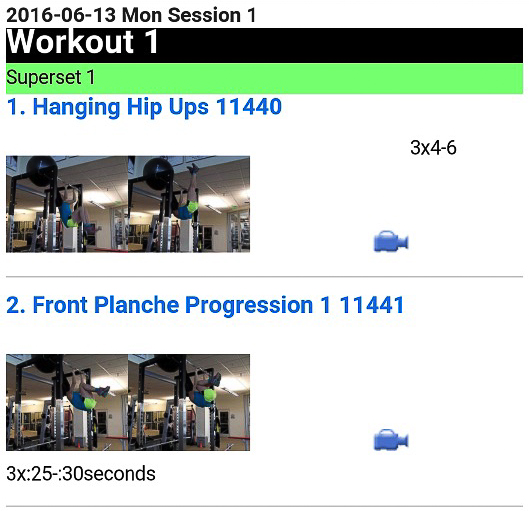
    Noah Hoffman Strength Exercises 1 & 2. (Photo: Noah Hoffman)
    Strength exercises 1 & 2
    (Courtesy photo)


    3. Hanging Hip Flexion 3 x 10-12

    4. Varying Push Ups 2 x 3 push ups (varying push Up and hold) + 15-18 regular push ups, hold for time

    Noah Hoffman Strength Exercises 3 & 4. (Photo: Noah Hoffman)
    Strength exercises 3 & 4


    5. TRX Row Series 2 x 3 rows each grip, rows/flys / 1 x 4-6 decline or horizontal rows – last one is a hold for time

    6. Slideboard Plank Pike 2 x 20-25 (first 4-6- include tricep push up)

    Noah Hoffman Strength Exercises 5 & 6. (Photo: Noah Hoffman)
    Strength exercises 5 & 6

    7. Foam Roll Walkout

    Noah Hoffman Strength Exercise # 7. (Photo: Noah Hoffman)
    Noah Hoffman Strength Exercise # 7. (Photo: Noah Hoffman)

    – Then it’s onto a morning-distance trail run: 3 hours at Level 1

    – Followed by an afternoon/early evening-distance rollerski: Double pole for 2 hours at Level 1

    Hoffman explained that his pace for the big five-hour days is controlled and at the slow end of the effort spectrum.

    “Level 1. All the distance will be at Level 1, both the run and the double pole,” he said.  “Which for me is 110 to 130 beats per minute running on mountain terrain. And average double poling, it’s 11 mph for me on my average speed. That’s all very arbitrary, I do enough Level 1 training that I know the paces by heart rate and by speed.”

    If you are curious how the effort compares on his recovery days, here’s the details.

    “I would say that the pace for those sessions should be lower,” he said. “It should be a recovery focused pace to play into the theme of the day. If anything it would be the low end of Level 1, although my Level 1 range is 110 to 130, and that’s a pretty big range … And the theme I have for the summer versus the winter is I train more in the summer than most of my teammates and less in the winter than most of my teammates. I really believe that for me it works well that the high stuff to be high and the low stuff to be low and that goes on a day to day basis, and on a seasonal basis.”

    As with any athlete making jumps in their training hours, Hoffman is no different in terms of keeping things tempered and being mindful of the race season many months away.

    To accrue his increased high-quality load, Hoffman will have fewer of what Caldwell calls “circuit breakers.” Ensuring that Hoffman is benefitting from his increased hours and not breaking down is one of Caldwell’s primary jobs.

    “The big concern, without those circuit breakers if you will — I have always thought of those breaks as being a little bit like circuit breakers, an opportunity for some physical recovery and a shift of load,” Caldwell said. “The big challenge without those circuit breakers is to manage the accumulation of load, and to make sure he is benefiting from the training. And we are principally using Firstbeat Systems to do heart rate variability analysis of his overnight sleep recovery.”

    Over the summer, Caldwell said he’ll focus on Hoffman’s longer-term recovery trends, which he’ll keep a close eye on after each of his two-week training blocks.

    “Coming out of that we want to see evidence that over those two weeks he is putting up improved recovery scores from before,” he said. “It doesn’t happen to be any one test, we just want to see the the overall trajectory be positive at this time of year. As he gets closer to competition season, we want to see more of a daily response. We want to tighten the timeline on that recovery. But what we are not willing to do is do bank 12 weeks of training against the promise of some future response without seeing a response during that time frame. We are not doing it based on faith.”
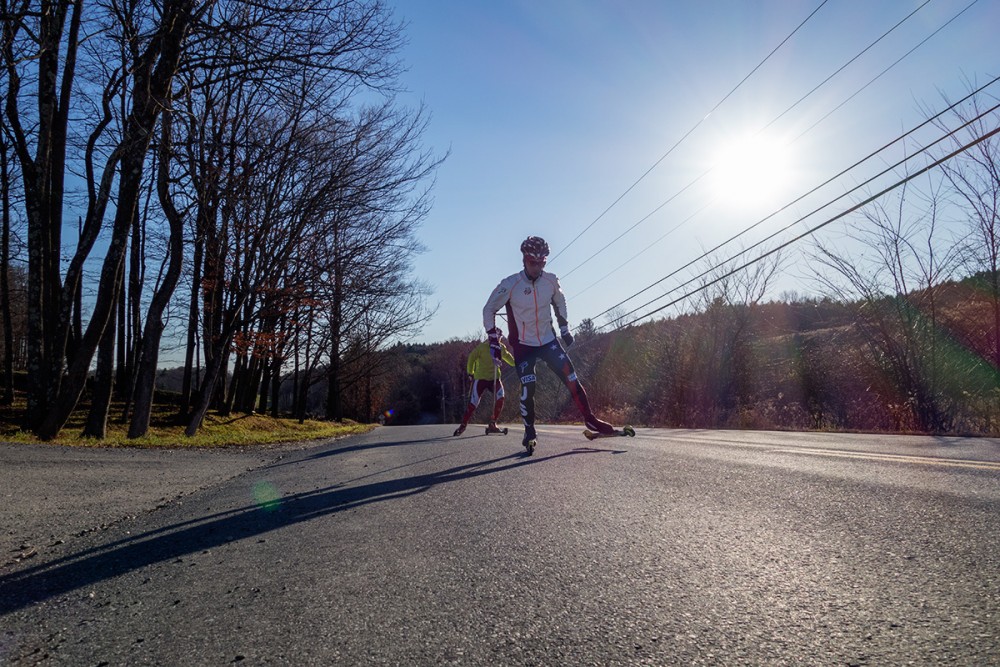
    U.S. Ski Team member Noah Hoffman skate roller skiing near Putney, VT. (Photo: Zach Caldwell)
    U.S. Ski Team member Noah Hoffman skate rollerskiing near Putney, Vt. (Photo: Zach Caldwell)
  • Revisiting Training Hours: How Many Do You Need?

    Revisiting Training Hours: How Many Do You Need?

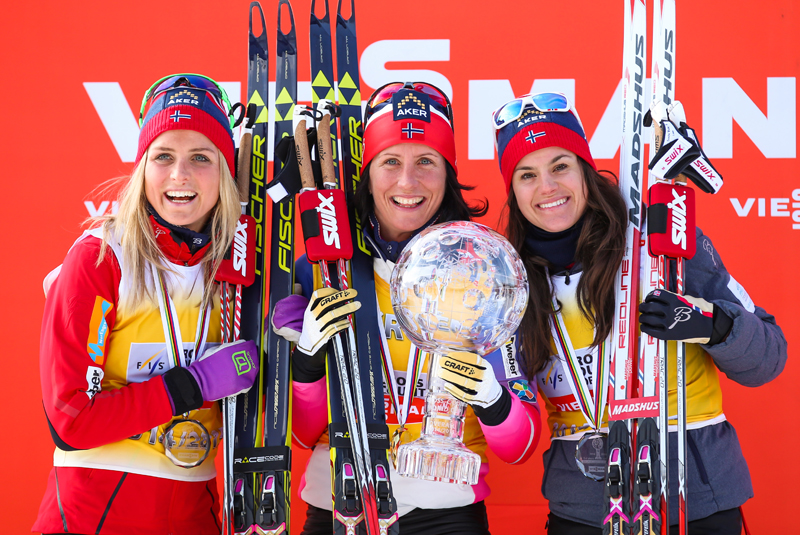
    Marit Bjørgen won the overall FIS World Cup title for the fourth time in 2014-2015, also taking home the Sprint Cup and Distance Cup globes. Along with Therese Johaug, who won it in 2015-2016 (left) and Heidi Weng, she trains more than you. (Photo: Fischer/NordicFocus.com)
    Marit Bjørgen won the overall FIS World Cup title for the fourth time in 2014-2015, also taking home the Sprint Cup and Distance Cup globes. Along with Therese Johaug, who won it in 2015-2016 (left) and Heidi Weng, she trains more than you. (Photo: Fischer/NordicFocus.com)

    Note: FasterSkier has carried many articles of training hours before, including a 2010 discussion with Marty Hall, Eli Brown, and Pete Vordenberg, and a 2012 piece by Pete Phillips. With recent discussion of training loads by elite Norwegian athletes, it seemed time to bring the topic up again. We got in touch with Jodi Hawley, an exercise physiologist formerly based at the Canadian Sports Institute in Calgary. She now works for PacificSport Columbia Basin doing community development work.

    A recent research paper revealed not only the physiology, but also the basic training regimens of six Norwegian women – who happen to be the six best cross-country skiers in the world.

    Among the revelations? The year before the study was done, superstar Marit Bjørgen had trained 980 hours, while the six women as a group averaged out at 920.

    That’s a lot more specificity than fans and lower-level racers typically get about elite training loads. While Norwegian World Cup champion Martin Johnsrud Sundby talks about training over 1,000 hours a year, for most of the rest of the field all one can see are averages reported in various papers.

    Upwards of 900 hours per year is more than had been previously reported in such papers. For instance, a 2013 paper looked at the training loads of Norwegian and Swedish cross-country skiers who had won Olympic gold medals in the last decade. In general, the sprint specialists trained 750-850 hours per year, and the distance specialists about 50 hours more.

    Another paper, published in 2014, assessed Norwegian gold medalists in cross-country skiing and biathlon. The eleven athletes had averaged 770 hours of training in their gold medal seasons.

    “Most people on the World Cup – and I don’t think there’s a big difference between men and women – most people who are consistently finishing in the top 15 are probably training somewhere between 675 and 900 hours,” said Jodi Hawley, a sports physiologist who formerly worked with the Canadian National Ski Team. “The range is that wide.”

    All other factors being equal, Hawley said in an interview last weekend, the athlete who trains the most will be the fastest. But all other things are not equal, including genetics, personal history, injury and illness, resources, and training partners.

    Training 980 hours won’t necessarily make a mediocre skier a Marit Bjørgen – and training less than 980 hours won’t necessarily keep them from success, either.

    “Some people will get faster by going slow, by training their efficiency,” Hawley explained. “Other people will get faster by training their power. So it depends a little bit on what kind of person you are. If you are the kind of person who gets faster by training your efficiency, you’re going to end up training more hours. The kind of training you need to do takes more time to get a training effect.”

    Women Working Hard

    Norway's Marit Bjørgen (c) celebrates her 15th World Championships gold and record-setting 30th overall medal (between Olympics and World Championships) with a classic-sprint win at 2015 World Championships in Falun, Sweden. "It took years for her to build up to doing [980 hours]," said Hawley. (Photo: FlyingPointRoad)
    Norway’s Marit Bjørgen (c) celebrates her 15th World Championships gold and record-setting 30th overall medal (between Olympics and World Championships) with a classic-sprint win at 2015 World Championships in Falun, Sweden. “It took years for her to build up to doing [980 hours],” said Hawley. (Photo: FlyingPointRoad)
    There are a few reasons that the top Norwegian women are, across the board, training at very high volumes – probably close to the maximum loads that are physiologically possible.

    One is that all of them came up through a development pipeline which led them to this point, and all thrived under it.

    “In Norway, they tend to have a system that they employ,” Hawley explained. “It’s like hockey in Canada. Everyone does it in school… you can implement your system, and you see who copes best. Those kids get picked to move on. The ones in the end who float to the top are the ones who cope best with the system, rather than the ones who potentially could have been as fast or faster if they had been exposed to some other system.”

    But the system isn’t static. As of 2010, Norway’s Petter Northug was training just over 850 hours per year and Sweden’s Marcus Hellner closer to 750. Five years later, Hellner is training closer to 900 hours, but for various reasons has seen nowhere near the level of success he experienced in 2009-2012, when he won Olympic and World Championship gold and placed second in the Tour de Ski.

    Training loads evolve for senior-level athletes because they must continue to push against new limits to get an adaptation and training effect.

    “You never ever as an endurance athlete get to a point – doing the same thing again next year never works as well as it did the first year,” Hawley said. “Just like in the rest of your life, you need to change the stress in order to get adaptation.”

    Thus even athletes in their mid-20’s or mid-30’s. U.S. skier Noah Hoffman, for example, announced on his blog that he plans to train 1000 hours this season, a big jump at age 26.

    But the second piece is that skiing is changing, and so is training. Bjørgen’s hours are a great example of that, said Hawley.

    “In 2003 and 2006, think about what Marit Bjørgen supposedly did at that time,” she said. “She was lifting a lot of weights, she was doing tons and tons of intensity, and she was doing it in blocks, of several days of intensity training in a row, and then a rest.”

    And she was extremely successful. But that was the beginning of a period with more and more sprinting, mass starts, and racing that worked more like pack cycling with field sprints and changes of pace. Teams began to leave behind the ‘old’ style of training, designed partly around interval-start races, and innovate. The level of competition in these new formats has surged.

    As has Bjørgen, who is now the most decorated female winter Olympian of all time.

    “Now, she says that she does a little bit of sprints and a little bit of VO2Max kind of training, and a lot of long slow skiing,” Hawley said of Bjørgen. “She’s not really doing a lot of the things that she did a lot of almost 15 years ago now. I think that’s a pretty good representation of how nordic ski programs have approached the requirements of racing over the last 15 years… It took years for her to build up to doing [980 hours].”

    Everyone’s Different

    Big numbers impress. So when Sundby says he is training 1200 hours, Bjørgen says over 900, or Hoffman aims for 1000 – those are the numbers that jump out.

    But there are also extremes at the other end.

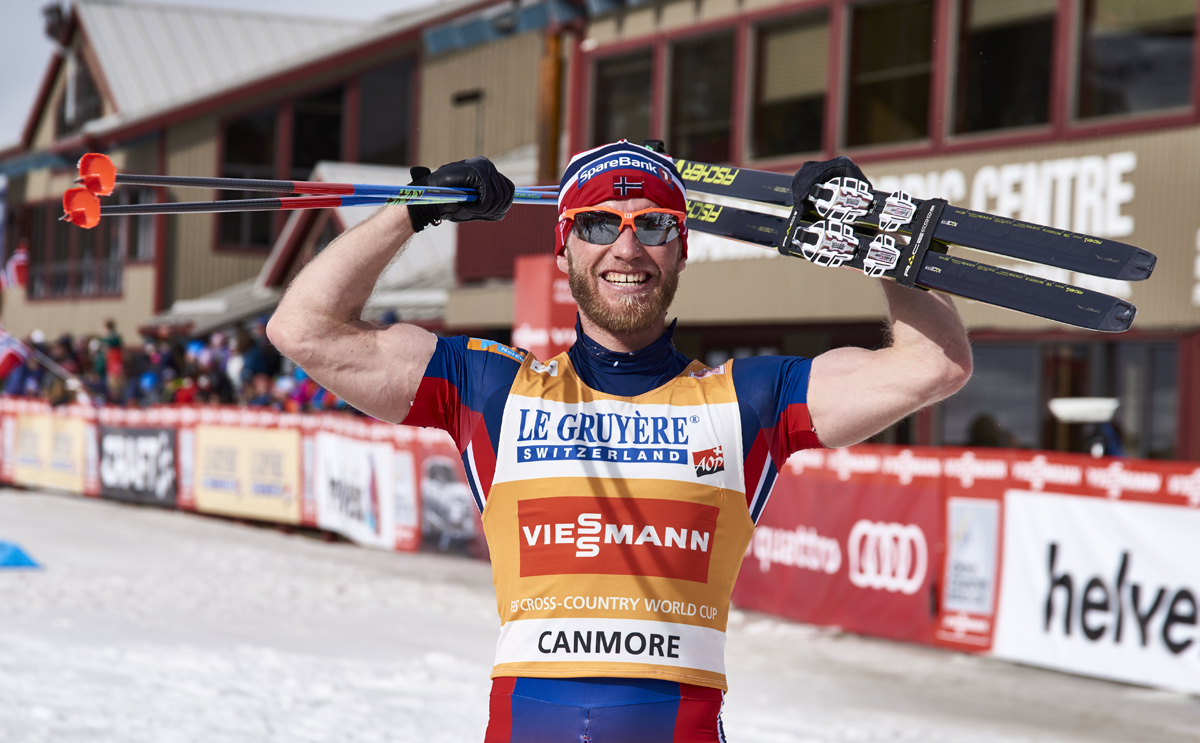
    Norway's Martin Johnsrud Sundby: king of hours. (Photo: Fischer/Nordic Focus)
    Norway’s Martin Johnsrud Sundby: king of hours. (Photo: Fischer/Nordic Focus)

    “There’s people on the World Cup who do not train as much as you would think someone on the World Cup ‘should’,” Hawley said. “But they seem to manage, and if you ask them to train more they would probably find it really difficult to cope and may get slower, and would certainly get sick more of the time. If I look at that end of the extreme, there are people who are training more like junior or U23 hours, that would be like 550 or 600 hours.”

    In a country like Canada or the United States, there is not such a big pool to pull potential skiers from. Thus, Hawley said, when an athlete of particular talent comes around a lot of work goes into figuring out what makes them tick: do they respond to training power, or efficiency?

    Answers to those questions – gathered and discussed by all the coaches in an athlete’s life, as well as physiologists, biomechanists, and more – will determine the training character for an athlete, and what their focus is. That will then cascade towards decisions about training hours.

    Although there’s an obvious need for individualization among athletes, the U.S. Ski Team and Cross Country Canada have traditionally posted “pathway” models for how many hours a skier should be training at different ages.

    For instance, the U.S. Ski Team recommends training 500 hours per year by age 17 and 700+ hours per year by age 22. As of 2010, Cross Country Canada was also recommending 500 hours by age 17, but even more later: 800 by age 23 and 850 a few years later.

    The same paper that described the training of Bjørgen and her teammates also assessed six national-level Norwegian skiers, two of whom had World Cup top-15’s that season. Those women – who were also in their mid-20’s – averaged just over 700 hours per year.

    Is It Enough?

    Americans with the International Junior Camp in Oslo, Norway, in 2015. We no longer have to assume North American juniors are far behind their peers in training hours, Hawley said. (Photo: Bryan Fish)
    Americans with the International Junior Camp in Oslo, Norway, in 2015. We no longer have to assume North American juniors are far behind their peers in training hours, Hawley said. (Photo: Bryan Fish)

    There’s often soul-searching in North America as fans, coaches, and athletes themselves seek to understand what separates them from competitors on the World Cup or at World Junior Championships.

    A familiar refrain comes up: are we not training enough?

    Hawley firmly rejects that assumption, at least for athletes who are in their national teams’ sights.

    “I actually don’t think that our junior athletes now, in the last few years, are training less than their international peers,” Hawley said. “They might be training less than the extremes, but other countries are starting to have the debates that maybe those extremes are actually not good long-term for the athletes.

    “When they are 14 or 15 years old, what’s being recommended by Canada is at least as many hours as what’s recommended by Sweden, by Norway,” she continued. “It’s in line. Even at the 18- or 19-year-old range, we’re recommending more. What impact that’s having on our junior skiers, I don’t know.”

    Hawley admitted that she had read a “perhaps depressing” number of papers about training for elite athletes. As a physiologist, she worked not only in endurance sports; people like her should be able to design training for athletes in many sports. Hawley worked for the Scottish rugby team before heading to Calgary and nordic sport.

    Around the world, she said, people with her (former) job face the same challenges. And she learned to be able to decipher the differences between training plans coming from outside of North America, and interpret what they would mean in her own team’s context.

    “We definitely have a very clear understanding of what the difference is between how different countries, where they draw the line between zone three and zone four, for instance,” she said. “We know that, so when we are talking with each other we understand what we’re saying… That’s not the issue, that it’s not being measured the same way.”

    So the Norwegian women’s training loads don’t come from accounting errors.

    Those hours come from planning – and from six individuals being at the extreme end of human talent and determination.

    “Those six women are head and shoulders above the rest of the world,” Hawley said. “You’re looking at the extreme.”

  • Norwegians on Volume: More Isn’t Necessarily Better

    Norwegians on Volume: More Isn’t Necessarily Better

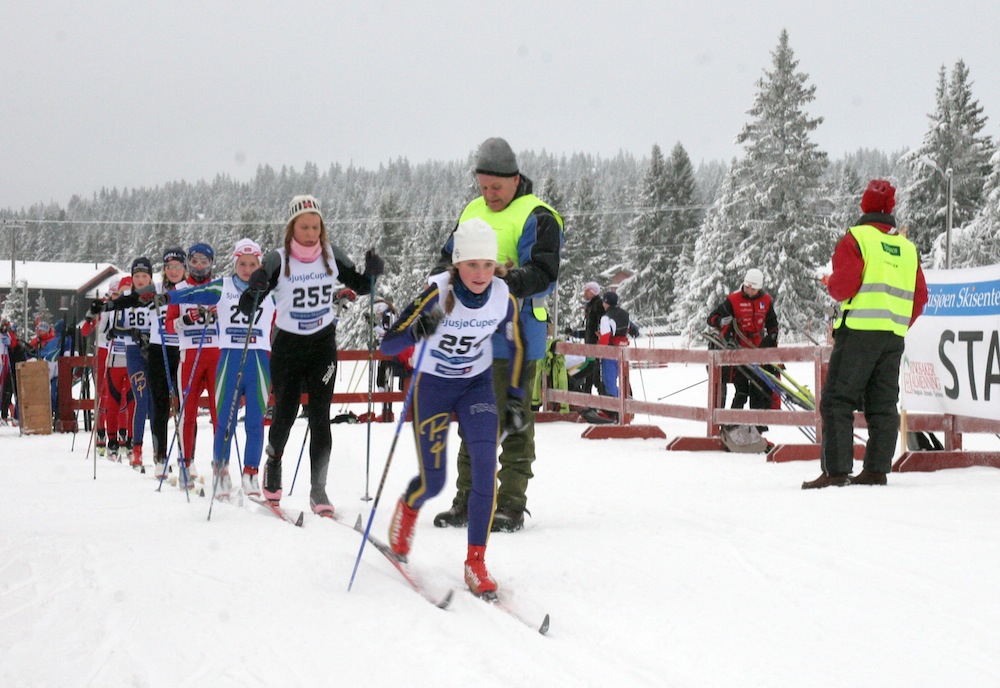
    Junior skiers jet out of the start at the Sjusjøcupen, part of the Hedmark state race series in Norway. (Photo: Inge Scheve)
    Junior skiers jet out of the start at the Sjusjøcupen, part of the Hedmark state race series in Norway. (Photo: Inge Scheve)

    Frode Estil says it’s not how many hours you train. It’s how you train.

    The two-time Olympic gold medalist and individual world champion from Norway says skiers are focusing too much on hours at the expense of training quality.

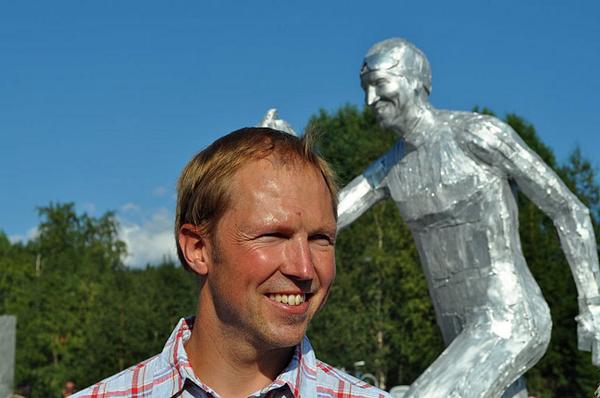
    Frode Estil, an individual Olympic and World Champion from Norway, by a statue of himself in his hometown of Lierne in July. (Photo: FIS Cross Country/Twitter)
    Frode Estil, an individual Olympic and World Champion from Norway, in July after being commemorated with a statue of himself in his hometown of Lierne. (Photo: FIS Cross Country/Twitter)

    “I’m afraid focusing too much on logging hours can be counterproductive to the main goal: ski fast,” Estil, 42, told the Norwegian newspaper Namdalsavisa. “How fast you become depends on more than just how many hours you put in.”

    Estil, who is currently coaching and teaching at the Meråker ski academy in Norway, blames the media and their excessive emphasis to how many hours the World Cup racers train in a year, as well as coaches and athletes for latching onto the elite skiers’ training programs without critical assessment. Other coaches support him.

    Former elite skier Mona Hjellsand, now a coach and coaches’ instructor in the Meråker region north of Trondheim, agrees with Estil. She pointed out that too many training hours can have negative physical consequences.

    “Overuse injuries can be hard to heal, and some can last for life,” Hjellsand told Namdalsavisa. “Biathlete Tora Berger has repeatedly harped that you should not train if you feel run down. You should always be in a good flow, she says, and she is definitely onto something.”

    She added that focusing on completing shorter workouts with 100-percent attention to the task will increase the training quality.

    “It’s important to not burn all your fuel at once,” Hjellsand said. “The younger the athletes, the more important quality is over quantity. The idea is to increase volume over time.”

    “The younger the athletes, the more important quality is over quantity. The idea is to increase volume over time.” — Mona Hjellsand, a former Norwegian elite skier who has spent the last two decades coaching in the Meråker region

    Hjellsand said that youth and junior coaches have to take their part of the blame for the current trend with extreme focus on logging hours.

    “There are still a lot of old-school coaches out there who are focused on training hard and putting in lots of hours. Based on that, I’m really glad that credible resources such as Frode Estil initiate a debate on this topic. It’s an extremely important debate,” she said.

    In her opinion, the biggest issue is curbing the drop off and keeping the skiers in the sport.

    “When I ask the 16 and 17 year olds why they chose to drop out, the answer is almost always the same. There is just too many training hours, and they’re always tired,” she said.  “When the air goes out of the balloon at such a young age, there is something wrong with the way we approach training.”

    “When the air goes out of the balloon at such a young age, there is something wrong with the way we approach training.” — Hjellsand

    The ski coach, who also travels to visit various clubs and teams and give presentations on training, is certain that the juniors are seeing what they do, and are comparing their own training programs to what the World Cup elite is reportedly doing.

    “Skiers such as Marit Bjørgen and Therese Johaug bring the standard for annual volume to a whole new level,” she explained. “The big difference is that these athletes have a support system that takes care of them 24/7. You can’t compare yourself to the full-time elite.

    “I’ve seen so many cases where the junior skiers as well as senior level racers lose the joy of training and their passion for skiing because there is such an emphasis on training hard and logging volume,” she added. “It shouldn’t be like that.”

    Ultimately, she stressed a single priority: make sure training is fun. “The day it’s no longer fun, there is no reason to stick with it,” Hjellsand said.

  • Pankratov on Norwegian Training Culture: Variety and Wet Feet

    Several weeks ago Langrenn.com published an interview with Russian Olympian Nikolay Pankratov, who was in Norway training with Team Synnfjell. The plan was that Pankratov would come back to Norway later in September to train with the Norwegian national team when they return from their altitude camp in the Alps. Those plans are likely scrapped after he was caught on the Swiss border last week with intravenous equipment and vials of the drug Actovegin.

    “In Norway, you run all over the place and get your feet wet every workout. In Russia, we run specific, predetermined courses every time. We know exactly what’s waiting,” Nikolay Pankratov said.

    Pankratov was tired after a week of training in Norway. The strong Russian skier had attended the Team Synnfjell training camp at the end of August and was impressed with the way the team works. However, getting his wet feet on almost every workout added a new dimension to Pankratov’s training experience.

    “It’s pretty funny. You try to keep your feet dry, but after 10 minutes you’re soaked no matter what you do. You run all over the place in this country,” he said.

    Pankratov met with Langrenn.com at the Oslo airport just before he was leaving Norway and the Team Synnfjell camp. He had gained insight to the Norwegian cross-country training culture, as well as some very sore abs.

    “Yesterday we did a strength circuit workout that included five different ab exercises. I’ve never done that before, I’ve only done sit-ups. But the new exercises seem very effective. I’m very sore now, and it will be even worse tomorrow,” Pankratov said with a grin.

    Less variety in Russia

    “In Russia we’re following a program that we’ve used for many years, especially on the strength side. But I’ve seen YouTube videos of the Norwegian sprint team boys and I’ve tried some of the drills they do, especially those that Øystein Pettersen is doing. Those videos are funny,” Pankratov said.

    While Pankratov is no longer a part of the Russian national team, he has been for many years. Pankratov has been on age-specific national teams with the Russian national ski association throughout his junior career, and has placed on the podium in several World Cup events, and helped the Russian team to a relay bronze medal at the 2005 World Championships in Oberstdorf (GER).

    What do you consider to be the biggest differences between the Russian and the Norwegian training cultures and team environments? The lack of variety?

    “In Russia, we’ve done the same things for 20 years. We travel to the same places, we run the same loops, and do the same roller ski courses. There are a lot of other really nice places in Russia to have training camps, but we always go to the same places,” Pankratov explained and continued: “For instance, this summer, Rybinsk had a heat wave and it was extremely hot there. But that was where the national team had their camp, and the skiers had to get up insanely early to be able to train at all. They could have gone to a different place, but that’s not in the protocol. Even if it’s 40 degrees Celcius. I talked to Alexander Legkov, who said they couldn’t sleep at night.”

    Do the skiers say anything?

    “We don’t have those kinds of discussions on the national team in Russia.”

    What kinds of discussions do you have?

    “There is no social environment in the national team. There are almost no team meetings, three workouts per day and that’s the focus. Everyone does the same workout. There are no individual adaptations.”

    So you are looking for a change, and that’s why you come to Norway?

    More openness

    “I wish we could be more open to other countries’ training cultures in Russia. I was very lucky to find a connection with Team Synnfjell and Frode Bjeglerud (team director). They organized the trip coming here, and I feel very grateful for that,” Pankratov said.

    Martin Johnsrud Sundby said he was impressed with how much volume you log. Do you think the Norwegian skiers train very little?

    “Well, now I’ve trained with a Norwegian team for a week, and I think we averaged about four hours per day. That’s definitely a less than we would do during a training camp in Russia, but I am at least as tired as I would be after a week-long training camp at home. We’ve done so much variety here,” Pankratov explained.

    What can the Norwegians learn from you and the Russian skiers?

    “One thing that is good about the Russian training program is that the athletes only need to think about training. That is the only focus. Train, eat and sleep,” he said.

    Huge language barriers

    The openhearted Pankratov believes the language barriers are a large part of the reason why the “distance” between the Russians and other countries appears so big. While Pankratov speaks good English, he is one of very few among his fellow skiers.

    “There are a lot of athletes and coaches who want to talk with the Russians, but we don’t speak English. That is a huge problem for us,” Pankratov said. “For myself, it’s been helpful to train with Team Synnfjell, and when I get home, I will continue to speak English with my wife,” he joked.

    10,000 kilometers

    In Russia, the skiers keep track of distance in their training logs, not hours as we do in Norway. Pankratov covers about 10,000 kilometers per year, and at the training camps the athletes are subjected to rigorous standards.

    “The Russian national team has about 20 training days at camps, and 10 rest days every month outside the competition season,” he said. “You get up and train before breakfast, 30 minutes running and 30 minutes strength. That’s good for waking up. After breakfast, we do the second workout, which lasts about two and a half hours, either roller skiing or running. After that we do strength and stretching for 30 minutes. The coaches are there all the time,” Pankratov said to Langrenn.com.

    All roller skiing is done on a track. The trafficin Russia makes it lethal to attempt roller skiing on the roads. After a long lunch break and a short nap, they get back at it for their third workout of the day. This session is typically 1hour 30 minutes to 1 hour 45 minutes, followed by 30 minutes strength and stretching. Pankratov said some skiers even do a fourth workout.

    From Langrenn.com, September 2, 2010 By Ola Jordheim Halvorsen, translation by Inge Scheve