From the FasterSkier archive — posts syndicated from athletes’ and coaches’ own blogs between 2004 and 2012, kept online as published. Current coverage is at fasterskier.com.

Tag: training intensity distribution

  • Periodization Is About Emphasis, Not Elimination

    Periodization Is About Emphasis, Not Elimination

    This article was made possible through the generous support of our voluntary subscribers. If you value coverage like this, please support FasterSkier with a voluntary subscription.

    A University of Vermont skier rollerskiing on a paved road lined with fall foliage at Craftsbury, Vermont
    Wilmington, Vermont’s Luke Rizio rollerskiing with the University of Vermont at Craftsbury last fall. Jim Galanes argues that a training year should change the dose of each quality, never remove one of them entirely. (Photo: Phillip Belena/EISA)

    One of the biggest misconceptions in endurance training is that we should train one physiological capacity at a time. The traditional model usually follows the same progression. First build an aerobic base, lots of easy endurance training. Then add “threshold” training in the middle of the summer. Then, as we move into the pre-competition period, shift the emphasis toward VO2max and race specific intensity.

    The emphasis certainly should change throughout the season. But this approach often leads coaches and athletes to unintentionally neglect important physiological systems for weeks or even months. The problem is that the human body doesn’t work that way.

    Aerobic performance is not determined by one physiological system. It emerges from the interaction of multiple systems, each supporting the development of the others. When one begins to decline, it limits the effectiveness of the entire system.

    The goal of periodization is not to sequentially build individual physiological systems. It is to continually maintain every important system while changing the emphasis toward the adaptations that offer the greatest opportunity for improvement.

    Every Workout Sends a Different Signal

    Training isn’t simply stress. Every workout sends a unique physiological signal for adaptation.

    Long aerobic training stimulates mitochondrial biogenesis, capillary development, fat oxidation, plasma volume expansion, and cardiac remodeling.

    “Threshold” training improves the ability to sustain a high fraction of aerobic power by increasing oxidative capacity, metabolic stability, and lactate transport. It should be noted, in spite of the current buzz, that “threshold” training is not a magic solution. Some athletes may need a heavier focus on VO2max training. Usually “threshold” type training is best for those doing high volumes and with an already high fractional utilization.

    (Note: while I use the common term “threshold” here, there is ample evidence that no threshold actually exists and that it is a vastly misleading term. There is also no consensus on what this so-called threshold is. Depending on which of the many methods you use to define it, the speed or intensity at these various definitions can differ by 40 to 50 percent.)

    VO2max intervals place the greatest demand on oxygen delivery, stimulating central cardiovascular adaptations while also improving mitochondrial function, the oxidative capacity of Type II fibers, lactate transport, and the speed or power that can be sustained at VO2max.

    Sprint training recruits high-threshold motor units, preserves neuromuscular coordination, maintains the oxidative capacity of fast-twitch fibers, and develops the ability to rapidly produce force.

    Strength training increases maximal force production, improves movement economy, enhances tendon stiffness, and helps reduce injury risk.

    These are not interchangeable adaptations. Each contributes something different to developing aerobic fitness and performance.

    The Systems Support Each Other

    These systems work synergistically. The mistake is assuming the adaptations are simply additive. They are not. They interact, and the combined effect on aerobic fitness is larger than the sum of the parts.

    A larger aerobic system allows the athlete to recover more quickly between hard sessions and to produce an increasing proportion of energy aerobically.

    Better “threshold” capacity allows more quality work to be performed with less fatigue. Greater maximal aerobic power raises the ceiling from which “threshold” speed or power can improve.

    Improved strength reduces the relative force required for every stride.

    Sprint training preserves the neuromuscular qualities that improve efficiency even during submaximal exercise. At every intensity, we can move faster and more efficiently.
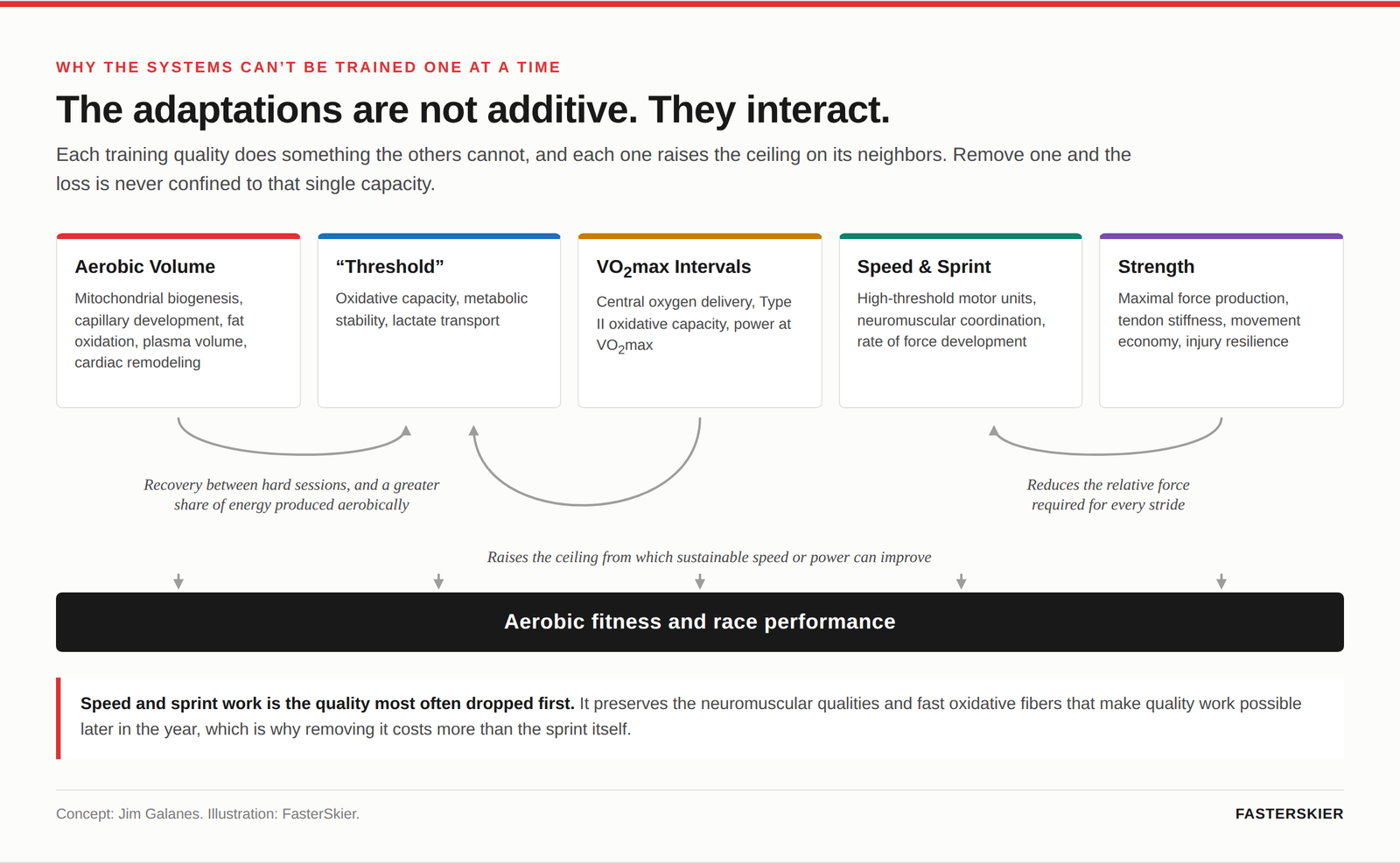
    Diagram of five training qualities feeding into aerobic fitness and race performance
    Aerobic volume, “threshold” work, VO2max intervals, speed and strength each do something the others cannot, and each raises the ceiling on its neighbors. (Illustration: FasterSkier)

    What Happens When One System Is Ignored?

    Every physiological adaptation has a maintenance requirement. Remove the stimulus long enough and that adaptation begins to decline. An athlete who abandons speed training gradually loses neuromuscular recruitment and maximal power. An athlete who eliminates heavy strength training slowly loses force production and movement economy.

    When an athlete reduces aerobic endurance training, they don’t simply lose endurance. They lose the physiological foundation that supports every other adaptation.

    An athlete who removes VO2max work for extended periods may maintain excellent endurance while gradually losing the central cardiovascular adaptations that support maximal aerobic performance.

    These changes are rarely dramatic at first. What we see instead are the symptoms of overtraining. Performance in training declines. Interval sessions become harder. Race pace plateaus or drops.

    Many coaches respond by adding more volume or more intensity. Neither is the likely answer. The solution is to restore the balance between the physiological systems that support performance.
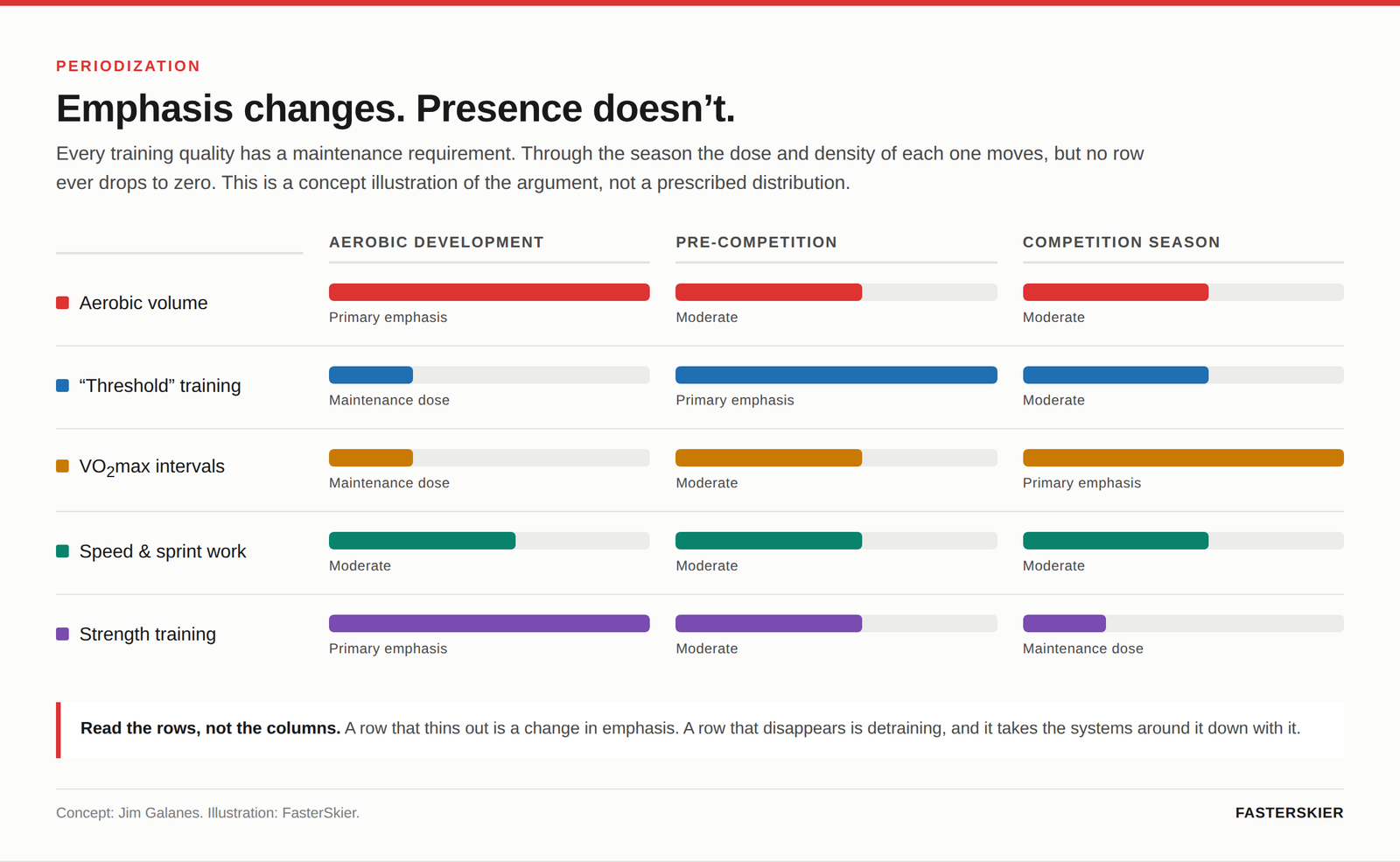

    Chart showing five training qualities across three season phases, with none dropping to zero
    Through the training year the dose and density of each quality moves, but no quality drops to zero. Concept illustration of Galanes’ argument, not a prescribed distribution. (Illustration: FasterSkier)
    Two skiers rollerskiing up a climb on a road through autumn woods
    University of Vermont skiers work up a climb during a fall dryland session at Craftsbury, Vermont. (Photo: Phillip Belena/EISA)

    Why High-Intensity Training Belongs in the Base Period

    One of the most common statements heard during base training is: “We shouldn’t do any hard training yet.”

    Current evidence suggests otherwise. High-intensity training during the base period is not about maximizing anaerobic fitness. It is about maintaining the physiological systems that complement the full development of aerobic capacity.

    Appropriately dosed high-intensity training helps preserve central cardiovascular function, maintains high-threshold motor unit recruitment, supports the oxidative capacity of fast-twitch muscle fibers, reinforces movement economy at higher speeds, and prepares the athlete for the demands of future training. Just as importantly, these adaptations support aerobic development rather than detract from it.

    A stronger cardiovascular system allows greater oxygen delivery during long aerobic sessions. Maintaining fast oxidative fibers improves the ability to perform “threshold” work later in the season. Preserving movement economy reduces the energy cost of every stride. Maintaining maximal aerobic capacity raises the ceiling from which “threshold” performance can continue to improve.

    High intensity doesn’t compete with aerobic development when it is properly dosed. It enhances it. This is why elite endurance athletes rarely eliminate intensity completely. They change the dose and the density. Not the presence.

    I often hear athletes say their first interval session or time trial in late July felt terribly slow, or metabolically challenged. Of course it did. That should come as no surprise. If high-intensity work has been absent for weeks or months, the physiological systems required to perform it have detrained. The athlete now has to rebuild those systems before meaningful race-specific adaptations can occur.

    Emphasis Is Not Elimination

    This doesn’t mean every quality deserves equal attention every week. Training emphasis should absolutely change throughout the year. An aerobic development phase should contain more aerobic volume. The pre-competition period should emphasize “threshold” and race-specific intensity. The competition season should prioritize race performance and recovery.

    But changing emphasis is very different from abandoning a physiological system. Even during an aerobic block, athletes should continue performing some high-intensity work, sprint training, and strength training.

    During race season, aerobic volume remains essential. While emphasizing VO2max development, “threshold” training still supports the ability to perform quality work.

    The dose and density change. The physiological adaptation remains.

    There Is No Optimal Intensity Distribution

    One of the most common questions in endurance sports is: “What is the optimal training intensity distribution?”

    The question assumes there is one correct percentage of easy, “threshold”, and hard training. There isn’t. The optimal distribution depends on the athlete’s training background and on which physiological system currently limits performance. Those limiting factors change throughout an athlete’s development.

    Early in a career, building aerobic capacity may deserve the greatest emphasis. Later, improving sustainable race pace may become the priority. Still later, improving neuromuscular power, force production, or movement economy may produce the greatest gains.

    As those priorities change, training distribution changes with them. Not because the principles change. Because the athlete changes.

    The coach’s responsibility is to continually adjust aerobic volume, “threshold” training, VO2max work, sprint training, and strength training so that each enhances the adaptations produced by the others while minimizing interference.

    There is no universal training formula. There is only the continual process of identifying the athlete’s current limiter, maintaining every important physiological system, and emphasizing the adaptations that will produce the greatest improvement.

    Great coaching is not about prescribing the perfect intensity distribution. It is about continually identifying the athlete’s current physiological limiter while maintaining every system that supports performance. As the athlete changes, the emphasis changes, but the physiology never disappears.

    Help Support Our Coverage!

    FasterSkier is independent, reader supported, and free to read. If coaching and training coverage like this is worth something to you, a voluntary subscription keeps it coming.

    Join the FasterSkier community!


    A ski coach in an olive fleece speaking with an athlete holding rollerski poles
    UVM coach Patrick Weaver talks with first year Hanna Koch of St. Paul, Minnesota, during a fall session at Craftsbury. Identifying an athlete’s current limiter, Galanes writes, is the coach’s central job. (Photo: Phillip Belena/EISA)
  • When to Increase Training Load… and When to Wait

    When to Increase Training Load… and When to Wait

    This article was made possible through the generous support of our voluntary subscribers. If you value coverage like this, please support FasterSkier with a voluntary subscription.

    American Neve Gerard (l) leads athletes from other countries at an International Training Camp in August, 2024, in Sjusjøen, Norway. (Courtesy photo)

    As this ski season wraps up, many of us coaches are doing similar work. Using spreadsheets or a popular training platform, we map out training for the year. We plan the yearly hours, monthly hours, and weekly hours, along with defining the training intensity distribution. We also plan how long and over-distance sessions should be, and maybe how much high-intensity training we should include, etc.  I have done the same in the past.

    Nowadays, my yearly plans include almost none of those things, but rather it is a general road map of how I might want the training loads to progress, what type of high-intensity, neuromuscular work, strength training focus, technique development, training camps, testing sessions, and a general concept of where we start in April or May. We must be able to adjust training on the fly based on an assessment of how athletes’ recovery and adaptation, week to week, with the training and developing fitness.

    In this article, I want to make a case for the changes I have made. Why? Because these detailed hours and training-intensity distribution plans we make are about as good as the day they were written. We then must avoid the temptation to implement training in May, June, or July just because we wrote it down in April. There is no way we can anticipate in April how an athlete will respond to training next month, much less than 2-6 months down the road.

    In discussion with many athletes and coaches I have consulted with in the last four to five years, I believe the biggest challenge faced is how and when to increase training load within a training year. For reference, I use TRIMP to define the metabolic load. TRIMP is described as a modeled internal-load metric or composite index based on exercise duration and HR-derived intensity weighting. TRIMP is not perfect because it is based on heart rate parameters, so power and strength training, mechanical loads are not accounted for. I find TRIMP an excellent proxy for the loads of all endurance training.

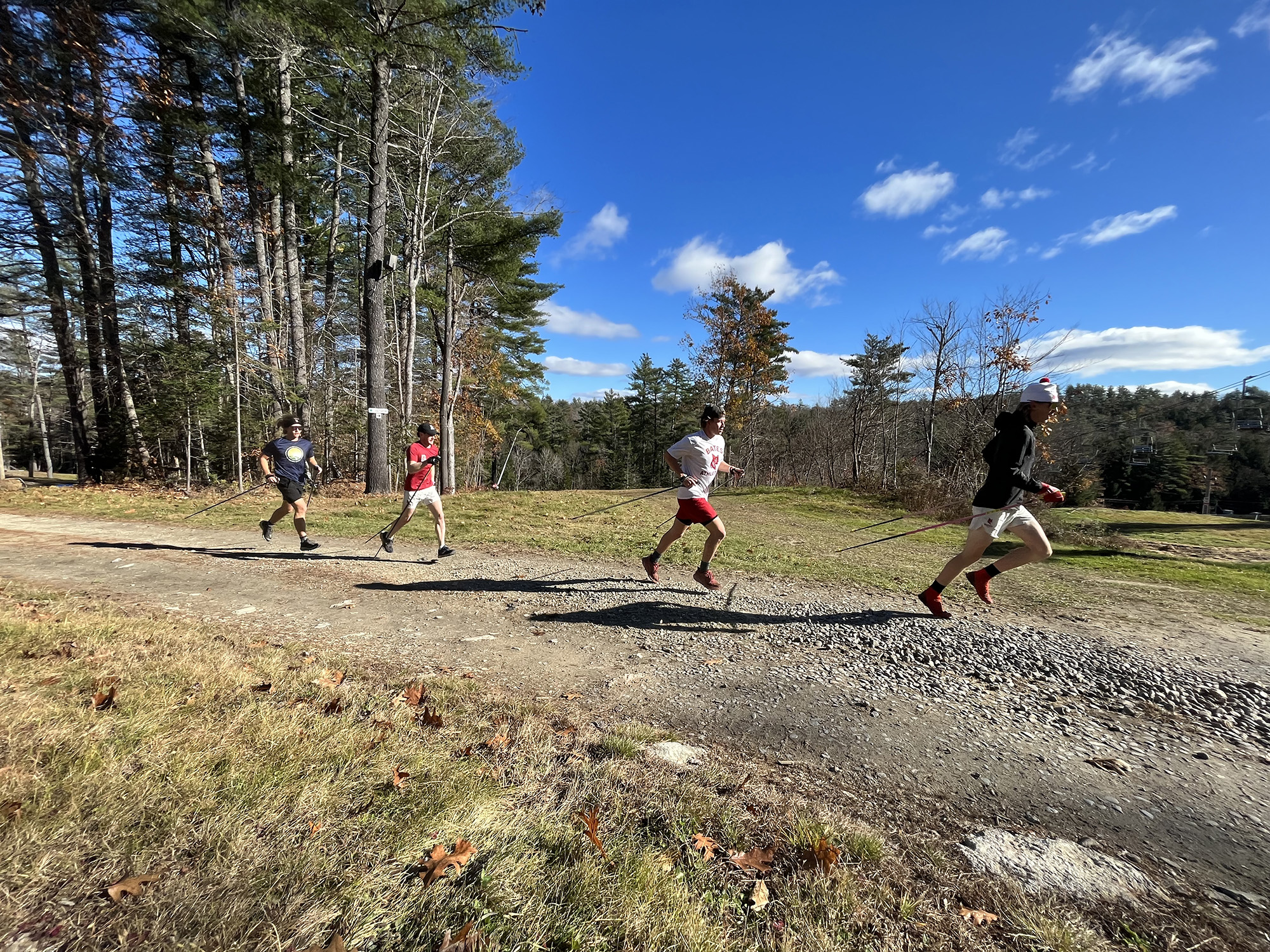
    Bates College getting after some dryland in 2024. (Photo: courtesy photo)

    Others simply use hours to plan and measure the loads. The challenge is difficult when just looking at hours, how to compare an hour of easy training versus an hour of hard training. Then, looking at percentages of time in zones or with other training methods does not define the load or focus the training on the desired adaptation.

    I am not going to address the year-to-year increases simply because all the assorted tables recommending volume of training at an age are based on population averages. The goals of the athletes, the athletes’ training age, training history, and many other potential factors. Just assigning training based on a table is foolish without considering these other factors. In most cases, athletes will train enough if the right principles are followed.

    When we are coaching athletes, we should only increase loads because of improved fitness not in an attempt to drive fitness gains. The decision to increase loads should come from evidence that the athlete(s) have absorbed the current load, not simply because it is a new month and the plan calls for a month-over-month increase. I believe that in the past we have used templates or models that have called for big month-to-month increases. The basis of building fitness is consistency and adaptation to the training. In many cases, we can go as long as 2-3 months at a very similar or very small increase in load.

    I am far from certain how coaches plan training these days, but others and I in the past have planned training based on monthly and weekly hours. In my days, I used to start in May with 50 hours, and by November, I was training more than 100 hours. Then the weekly progression within those months might go 12 hours, 14 hours, 16 hours, 10 hours or something like that. Even back then, how does a 50-hour month prepare you to do a 60-hour month, how does a 12-hour week prepare you to do a 14-hour week? What I learned more than 30 years ago. It doesn’t work that way; even if an athlete completes that kind of protocol, it does not mean it worked; it just means they survived it.

    The research and experience suggest that higher monthly volume and small periodic increases are better for building long-term fitness and performance, with far less risk than the typical plans that ramp up training with increases of 10-15-20% per month. Many old-school thoughts persist that we must increase volume to stimulate further improvements. That is an invalid belief and has been shown to be in much research and analysis. If we are in fact building fitness, we are moving faster at every intensity. Isn’t that already an increase in load? Recruiting more muscle fibers and motor units aerobically, improving mitochondrial density and function,  improving aerobic enzymes in more muscle fibers, among other aerobic adaptations.

    Fin Bailey works on uphill technique at training camp. (Photo: courtesy photo)

    I look for three layers of signals: performance stability, physiological response, and behavioral cues.

    The stability of performance in training is easily measured with simple technology, such as heart rate and GPS. Prior to increasing loads, the athlete should show improvement or stable performance in workouts. The aerobic training sessions should feel consistent and easy, with very little or no heart rate drift through the workouts. So, a simple training session once a week, once every two weeks, around a standard loop, both for high-intensity and aerobic training, can tell us much.

    The key workouts should show repeatable performance levels from week to week. The pace athletes can maintain at aerobic intensity should gradually and slowly improve, and the technique should stay stable and efficient throughout the workouts.

    Indicator What it suggests
    Same HR but faster pace, HRV is improving Aerobic adaptation
    Same workout feels easier, HRV is stable or improving Load is absorbed
    Ability to repeat intervals without extra fatigue Ready for progression
    If workouts are still producing large fatigue swings, the system is still adapting and increasing load is premature.


    As I have written previously for FasterSkier, older junior ( U18’s) athletes, masters, and elite athletes, I think it is important to use HRV to assess recovery. Using HRV, we can see whether the athletes are recovering predictably between sessions. We can see the stability or improving response their training, and we can assess whether the training loads are sustainable.

    Useful signals:

    • Resting HR stable
    • HRV 7-day trend stable or improving
    • Sleep quality normal
    • Muscle soreness minimal after aerobic sessions
    • The data and the athlete reports feeling normal again within ~24 hours

    If recovery between sessions is incomplete, increasing load compounds fatigue rather than builds fitness. The rush to hit hourly objectives and the failure to respond to accumulating fatigue are the biggest causes of maladaptive training.

    The critical question HRV can help to address. Are the current loads the athlete is doing correct? HRV, especially RMSSD trends collected consistently, can help flag whether an athlete is tolerating training well. But HRV should be interpreted alongside performance, subjective recovery, resting HR, sleep, and life stress rather than used as a standalone decision rule. In some cases, this may mean adjusting other areas of life; in others, we may simply have to reduce the training loads. Simply low HRV indicates a compromised ability to recover from and adapt to training

    A good indicator of readiness is the athlete’s ability to handle training density. Most athletes should have at least one rest day per week. During a training period, the athlete should be able to handle 3-5 moderate training days in a row without feeling accumulated fatigue, and the quality of workouts remains normal and stable.

    The occasional longer sessions should not disrupt the next day’s planned training, and recovery should be normal the following day. If an athlete is doing double sessions, the second session of the day should not be carrying excessive fatigue from the morning session, and the quality, speed, pace, or intensity of the second workout should be consistent.

    When the athlete’s readiness and physiological measures indicate that an increase in load is appropriate, there should only be a slight increase in volume. Make a few sessions per week a little bit longer, followed in the future by adding a workout or two per week

    Training load should only increase when the muscles and connective tissue are tolerating the training. If there is persistent tendon soreness, joint irritation, muscle tightness, or recurring niggles are common, it is not appropriate to increase the loads. Aerobic fitness improves faster than structural durability, which is why injuries often appear right after a volume jump.

    We also need to be aware of and watch for behavioral cues in the athletes, not just the recovery and performance data. We should look for the athlete’s motivation to train and their assessment of the RPE (rating of perceived exertion) for a given workout. If the perceived exertion of a given workout is increasing, it is not a positive signal. Finally, we should ensure that athletes’ nutrition is good, and their body weight is stable.

    As a practical guideline, I would recommend increasing load only after a period of 3-6 weeks, where we can see stable adaptation and improvement in training and recovery measures. When we look at elite training, we always see the training progression is often much slower than people expect.

    JC Schoonmaker and Luke Jager training in Anchorage, Alaska back in 2023. (Photo: Brinkema Brothers)
    Training Phase Progression Pattern
    Base Phase +5–10% volume every 3-6 weeks, but only if all inputs are positive.  If using TRIMP or Training Peaks TSS the load increase should never exceed 15-20%
    Race Prep Phase Maintain a stable volume, intensity increase slowly from the base phase
    Competition phase Volume and Training load decreases slightly; intensity is maintained or increased due to race load.


    As useful guidelines for coaches. If a training day or a week feels heroic, it is too big. Most likely, all the heroic training did was build fatigue and greatly slow recovery and adaptation. Sure, the athlete can do it occasionally, but it in no way means the load improves fitness or performance, or that the athlete adapts to it. My rule of thumb is that the longer it takes for an athlete to recover from a workout, a week, or a month of training, the less adaptation that is possible. When I shared this comment regarding high-intensity workouts with Zach Caldwell, I asked him when we should adapt to them. His response was Thursday! Not next Thursday, not a Thursday next month. Thursday!

    An effective training progression should feel well-tolerated for weeks. Fitness improvements are built on consistent, manageable weeks. Where the fitness is developed through compounded training, not the occasional massive week. I have seen it repeatedly, it is big increases in training load, too much, too soon, that ultimately leads to declining performance and overtraining. Sure, elite athletes train massive weeks, but to get there, they adapt to training every year, step by step.

    Increases in training load should be almost invisible over weeks and months as athletes develop. Over the years of training, the increases are clearly visible and large.

    In summary, increase training load when:

    1. Current workouts are repeatable and controlled
    2. Athletes recover following training days, normally within ~24 hours
    3. No structural soreness or injury signals
    4. Motivation and energy are normal
    5. This training performance has improved, and recovery has been stable or improving for 3-6 weeks


    Help Support Our Olympic Coverage!

    If you value the thoughtful work and access FasterSkier provides, please consider becoming a Voluntary Subscriber. Your support directly fuels our work to cover the people, places, and moments that make our sport special.

    Join the FasterSkier community!
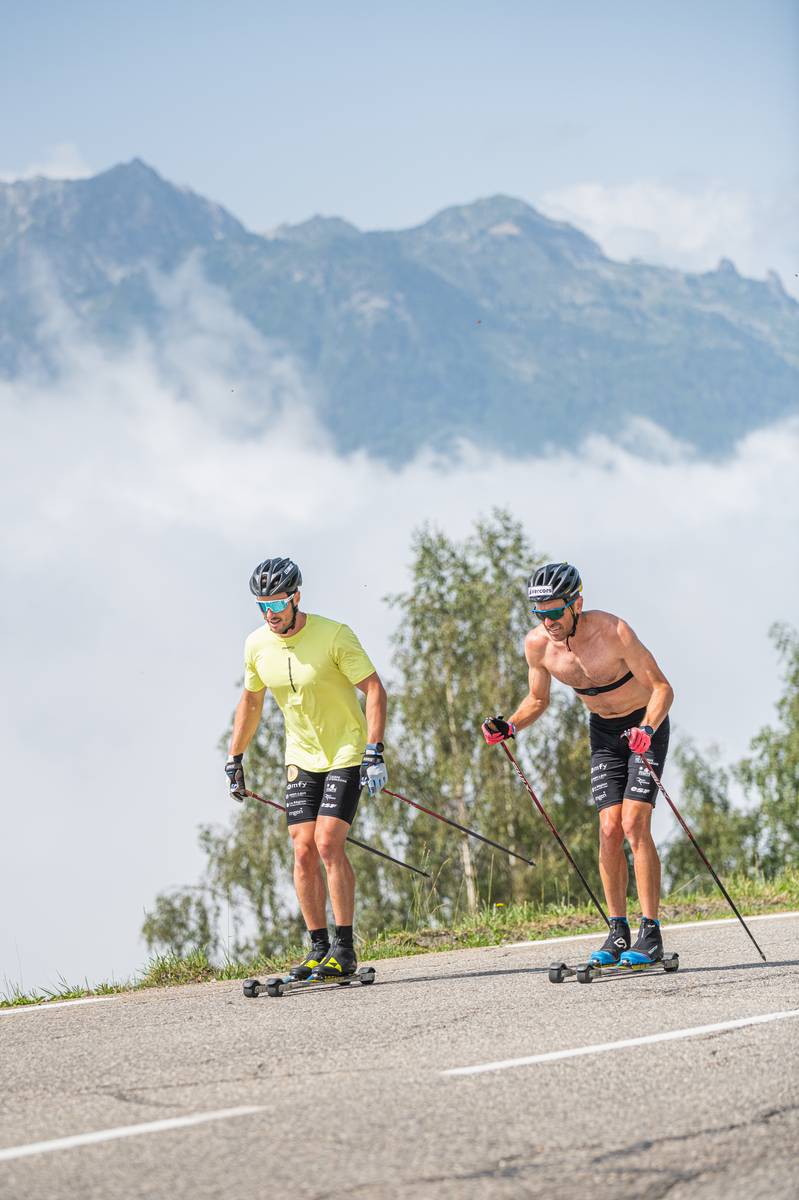
     

    French athletes Lucas Chanavat (left) and Maurice Magnificat (right) out for a rollerski during a training camp in Tignes. (Photo: NordicFocus)