From the FasterSkier archive — posts syndicated from athletes’ and coaches’ own blogs between 2004 and 2012, kept online as published. Current coverage is at fasterskier.com.
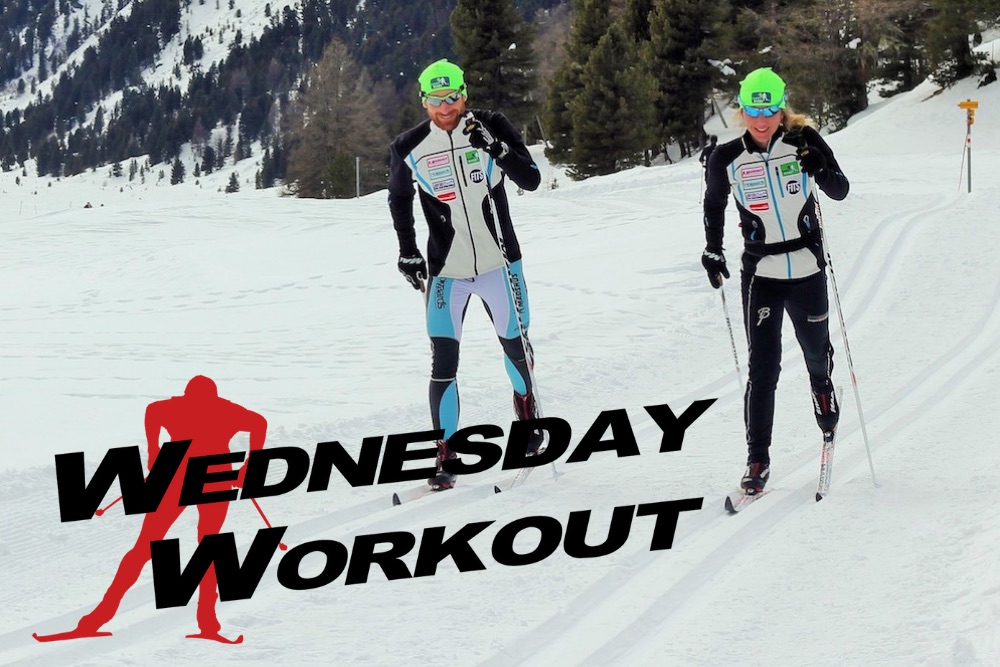
Team Gregg, Brian and Caitlin Gregg, out for an easy recovery ski together. (Courtesy photo)
This week, we’re featuring a workout from the training logs of Team Gregg. These days, husband and wife Brian and Caitlin Gregg are adjusting to life, training and bodily changes as Caitlin is pregnant with their first child (a girl), due in early February. Read the full story here.
Caitlin sent us the following “trailheading” workout, in reference to starting and ending a workout with someone else, which is how they often train together.
***
One of the challenges in training and racing is that it is often challenging to find training partners at the same speed and ability as yourself.I would argue that the best training partner is one who is just slightly faster than you.Brian and I have been blessed with opportunity to be a married couple who have both competed in the Olympics.
Here are a few ways we get creative to maximize our workouts and fun:
Every training partner can offer somethingand we enjoy large training groups.If you don’t have a training group, take it upon yourself to organize one.Utilize a loop so that the group can kind of stay together.If you are really searching, our neighbor’s house is for sale and you can join one of the many each cross-country ski groups in the Twin Cities.
Utilize different ski speeds as equalizers.On snow, put the slower person on the fast Redlines.If you are rollerskiing, give the person who is in the best race shape the slow, soft wheels.Using various rollerski wheels is a great way to prepare yourself for various snow conditions.
Brian and Caitlin Gregg enjoying the fruits (and added weight) of their workout during a hike this summer. Brian carried the watermelon in a backpack to slow him down. (Courtesy photo)
Another tool we use is a weight vest.For intervals, Brian will wear a weight vest and we can ski side by side pushing each other.This summer, I had Brian carry a watermelon during a hike so that we could relate, plus it was delicious.
In preparation for the 2015 World Championships, at 9,000 feet in Colorado we would Jetstream bloc my skis so that I could be skiing at speeds more similar to sea level.Plus, Brian and I could do intervals together.
Although Brian and I might have the same duration for an interval, he will start behind me with the goal of trying to catch me by the end while my goal is to try and hold him off. This also works really well for speed sessions.
Sample Workout: Team Gregg Husband/ Wife Intervals
We have a great hill in Afton, Minnesota, that Brian and I try and get out to about once a week in the fall. It’s steep and long (for the Midwest) but you can also safely ski down between repeats.
Warmup: Ski easy for 30 minutes with 15- to 20-second pickups. We usually start our warmup at the same time, but gradually over the 30 minutes, we separate and meet up again to do some pickups. We then do a set of pickups where Brian starts behind me and we try to finish the pickups together.
Intervals: The workout is usually 5-8 x 4-5 minutes (with 3-4 minutes recovery) depending on how we are feeling and what our goal for week is. Brian will either put slower wheels on or wear a weight vest for the session. I will either put faster skis on or start a little before him.
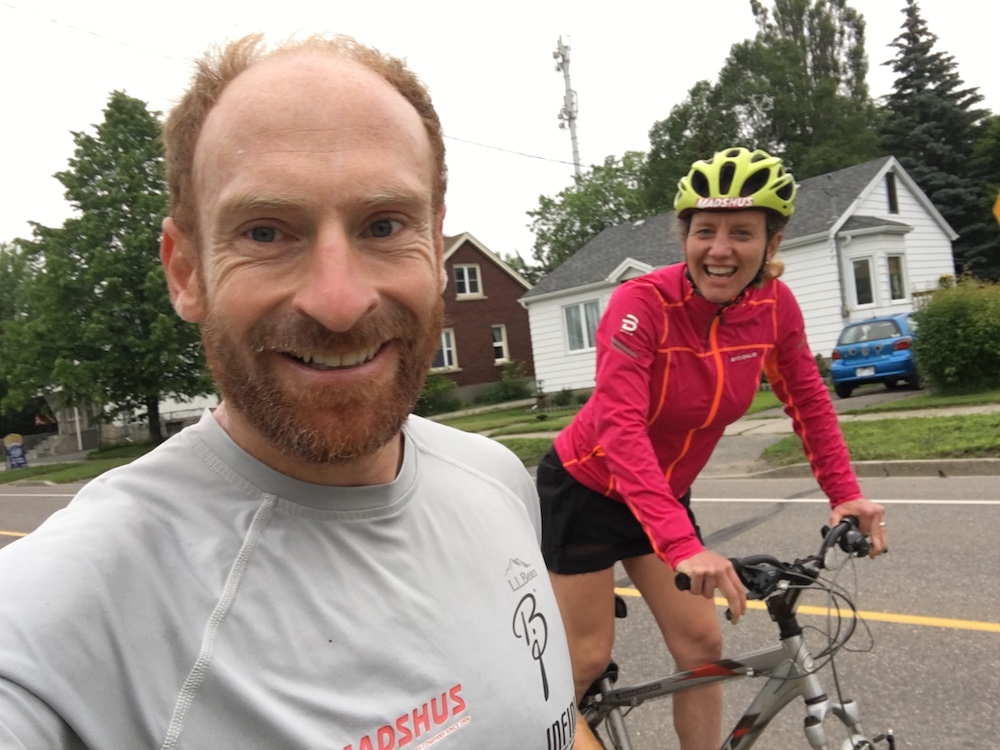
Brian Gregg snaps a selfie during a workout with his wife, Caitlin. (Courtesy photo)
The Game (Goal): If it’s just the two of us, we try and make the intervals more fun and exciting by challenging each other to get to the top first, but also try to maintain or drop our times from the start of the session to the end. For example, getting to the top first on the first interval but then falling back or skiing slower each subsequent interval isn’t the goal.We focus on negative splitting each interval in the set, which requires good discipline early on.
Cool down: We usually ski the cool down together and reflect on the session. Since we are out there together, we don’t always have feedback the way someone watching or filming the entire session from the sidelines would, but we can still be observant of how the other person is moving and offer some technique cues.
After the session: It’s been incredibly fun to travel the world training and racing together as a married couple. We are extremely lucky that we have both been able to follow our dreams. There are still added challenges to this approach, though… One of the hardest parts of finishing a hard race or interval session together is that we are both exhausted at the same time, which means that there has to be some way of deciding who is going to cook or do the dishes at the end of the night. This is where we put high stakes on who executes a workout better or has a better result at a race. The winner gets to relax on the couch while the loser has to wash and dry! Just kidding; we do the dishes together 😉
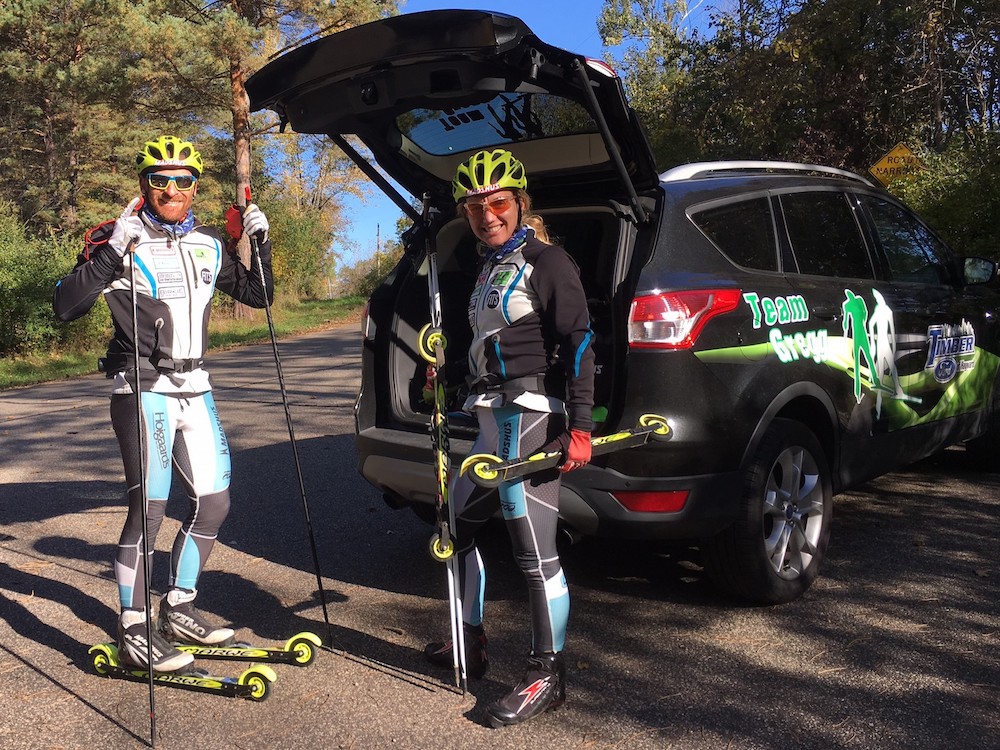
Brian and Caitlin Gregg (Team Gregg) out for a rollerski. (Courtesy photo)
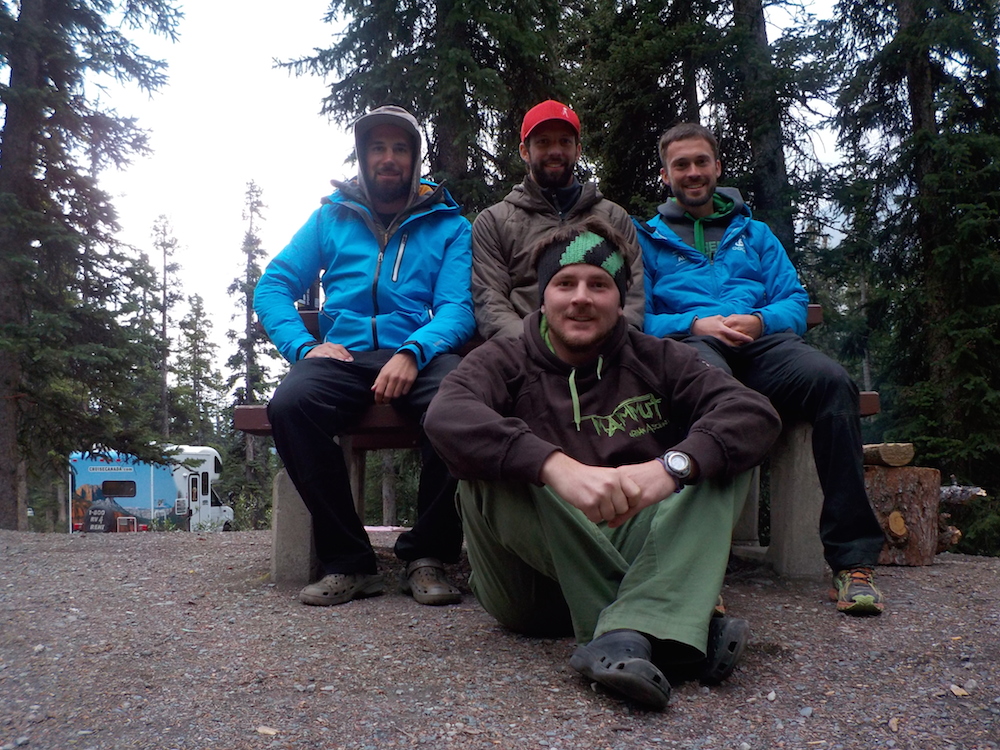
Switzerland’s Benjamin Weger (l), Serafin Wiestner, Ivan Joller and Weger’s good friend Roman (bottom) during their weekend camping trip on the ice field in Jasper National Park in Alberta. (Photo: Benjamin Weger)
Benjamin Weger remembered Canmore, Alberta, as a 19 year old, competing for the first time in Canada as a Swiss biathlete at the 2009 International Biathlon Union (IBU) Junior World Championships. There, he grabbed silver in the sprint and placed ninth in the pursuit.
The next year, Weger went one province west to Vancouver, British Columbia, for the 2010 Olympics. Results-wise, he didn’t come close to the podium on the world’s biggest-racing stage — placing 55th in the individual race and 69th in the sprint — but he returned to the IBU circuit the following season to notch his first World Cup medal, second in an individual race in December 2010.
Multiple World Cup podiums and another Olympics later, Weger, now 24, returned to Canmore with two teammates, Serafin Wiestner and Ivan Joller, to train for three weeks from July 4-July 26. Wiestner, 23, also competed in Canmore, where he placed 39th in the sprint (and went on to finish fifth in the Junior Worlds sprint in 2011).
In an email, Weger recalled meeting Biathlon Canada Head Coach Matthias Ahrens in Canmore in 2009. He extended an open invitation for the Swiss biathletes to come train with his team there any time.
“It was [such] a nice place with great tracks and nice nature,” Weger wrote. “There we said to come once in summer for training.”
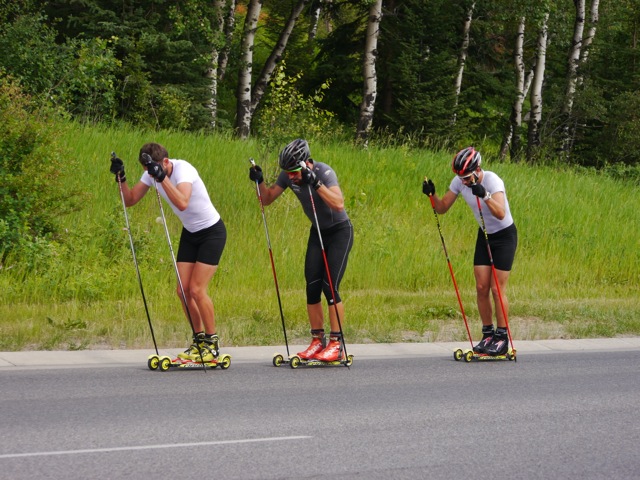
Joller (l), Weger (c) and Wiestner during an uphill, double-pole training workout near Canmore. (Photo: Benjamin Weger)
Last season at the first IBU World Cup in Östersund, Sweden, Weger took Ahrens up on his offer. From there, the two coordinated a plan with Wiestner and Joller, 30, which involved several shooting-and-rollerski sessions with the Canadian biathletes on their home turf.
The three men stayed in Canmore with a Canadian wax tech, enjoying sights like the Calgary Stampede festival (rodeo), Banff, and a weekend trip to Jasper National Park, Weger explained. After, they were headed to the Yukon for a week of “fly fishing and relaxing,” and visiting a longtime friend of Wiestner.
“We did a lot of trainings with the Canadians in the shooting range and on the roller ski track, but also some nice tours on roller skis like near Banff to Lake Louise and than up to the Moraine Lake,” Weger wrote. They also joined one of the team’s sprint competitions.
Before the trip, Weger knew some of the Canadian men, but not very well.
“We talked sometimes together but not much,” he wrote. “Now we learned to know those guys better. We learned to know some young guys as well. They are all very motivated. That’s a cool team!”
In terms of a training venue, Weger explained Canmore is similar to his hometown in terms of elevation, around 1,300 meters above sea level. The weather in his mountain village of Geschinen can also be variable “from nice and warm to rainy and cold.”
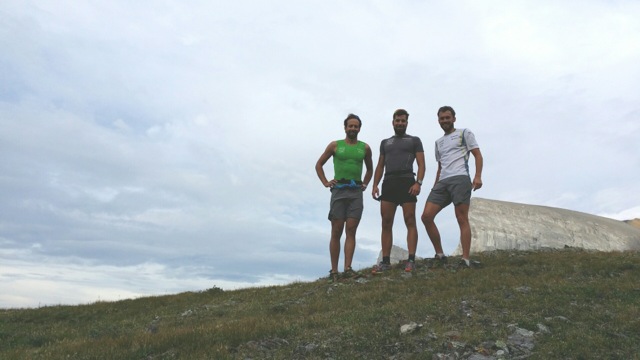
Swiss biathletes Serafin Wiestner (l), Benjamin Weger (c), and Ivan Joller during a trail run to the Three Sister Pass in Canmore, Alberta. (Photo: Benjamin Weger)
But his experiences were different — even different from that of five years ago.
“Last time it was a competition, this time we are there for training,” Weger wrote. “This time we had more time so [we’re going to] see some different places. We had also more time to get to know people. And during the training we saw a lot of nice places along the roads during the roller ski, or very nice places in the nature during our hikes or running.”
In terms of goals, Weger wants to get back to the World Cup podium, where he was three seasons ago. At the Sochi Olympics, he placed 48th in the individual, 63rd in the sprint, and anchored his men’s relay to 14th with Claudio Boeckli, Joller and Wiestner.
“I want catch up to the best athletes in the World Cup,” Weger wrote. “To reach this I have to stabilize my shooting on a high level. And I have to improve and stabilize my skiing performance. To stay in a good health is the prerequisite for good results and this was the main problem in the last season.
“My Olympics were very bad,” he added. “Shooting performance was ok, but the skiing was the big problem. I think it was because I was not in good health.”
Weistner placed 40th in the Sochi sprint and 57th in the pursuit, and Joller finished 67th in the individual race.