Tag: training periodization

  • For Low-Intensity Training, Consistency Beats the Big Week

    For Low-Intensity Training, Consistency Beats the Big Week

    This article was made possible through the generous support of our voluntary subscribers. If you value coverage like this, please support FasterSkier with a voluntary subscription.

    A new study landed in my feed last week, and I will admit the algorithm has my number. It steered me toward a question I have chewed on more than once here at FasterSkier: when it comes to low-intensity training, are you better off concentrating volume into one big week, or spreading the same volume evenly across several weeks? The easy move is to enjoy a paper that agrees with you and click away. I try not to do that. A study only earns its keep if I am willing to read the ones that argue against me with the same care I give the ones that pat me on the back. This one sits close to my own view, which is exactly why I want to handle it carefully.

    What the researchers tested

    Walther and colleagues, writing in the International Journal of Sports Physiology and Performance, set out to test whether concentrating low-intensity training into a high-volume block produces any adaptation that even distribution does not. They worked with 20 well-trained junior cross-country skiers in a crossover design, so every athlete completed both approaches and served as their own comparison. Total training volume was matched across the two protocols. Before and after each intervention, the researchers ran a battery of tests: VO2max, peak velocity at VO2max, lactate responses, submaximal economy markers, and subjective measures of recovery and fatigue.

    The two protocols differed only in shape:

    • BLOCK: one week at 160 percent of normal endurance volume, followed by three reduced-volume weeks.
    • EVEN: the same total volume spread evenly across four weeks.

    The point worth holding onto is that the totals were identical. Only the organization of the four weeks changed.

    FasterSkier – Even vs Block Protocol – Figure 1: Bar charts comparing the EVEN and BLOCK protocols. EVEN shows four weeks at 100 percent of normal volume. BLOCK shows one week at 160 percent, followed by three weeks at 80 percent. Total volume is identical. The two protocols delivered identical total volume. BLOCK front-loaded a 160 percent week; EVEN spread the same load across four weeks.

    The performance results

    Concentrating the volume into a block had no effect on performance. Both protocols nudged some variables in the right direction, and the improvements were statistically similar. VO2max, maximal aerobic speed, and lactate-threshold measures all moved to a comparable degree whether the work was stacked into a block or laid out evenly. That matters because block periodization is so often assumed to be the stronger option. Here, concentrating on a low-intensity load produced no extra adaptation beyond what consistent training already delivered.

    The two approaches did not feel the same, though. During the high-volume week and the recovery week that followed, the BLOCK group reported lower mood, reduced feelings of recovery, and greater fatigue. The athletes tolerated the work, and there was no indication of increased injury or illness risk, though four weeks is a short window in which to base that claim. The concentrated approach simply costs more on the recovery side without being repaid in results. I would have liked to see heart rate variability tracked across both protocols. Autonomic data might have put real numbers to that recovery cost, rather than leaving it to a subjective report.

    FasterSkier – Gains vs Cost – Figure 2: Both protocols improved aerobic measures to a similar degree, but the block week carried a higher subjective recovery cost.

    Why this matches what I have seen

    This lines up with something I have watched play out across endurance sport for years. Adaptation comes from repeated exposure, not from the occasional enormous week that flattens recovery and chips away at the very adaptation you are chasing. A training model deserves to be judged on more than whether it works. Time to adaptation matters. So does recovery cost, psychological and autonomic strain, and whether an athlete can actually keep the thing going for months and years. The block protocol led to greater fatigue and poorer perceived recovery without a better outcome. From a coaching chair, that is not a small detail, and it weighs even heavier with junior athletes.

    There is a fair counterargument, and it deserves room. Proponents of block periodization will point out that overload blocks build fatigue first and may reveal their benefits only over a longer horizon, and that a four-week window can miss those delayed adaptations. I see the logic, but I lean the other way. The longer the timeline an adaptation needs, the greater the room for overtraining and the thinner the signal you are actually working with. If a block needs four weeks to show its hand, there probably wasn’t much adaptive signal to begin with.
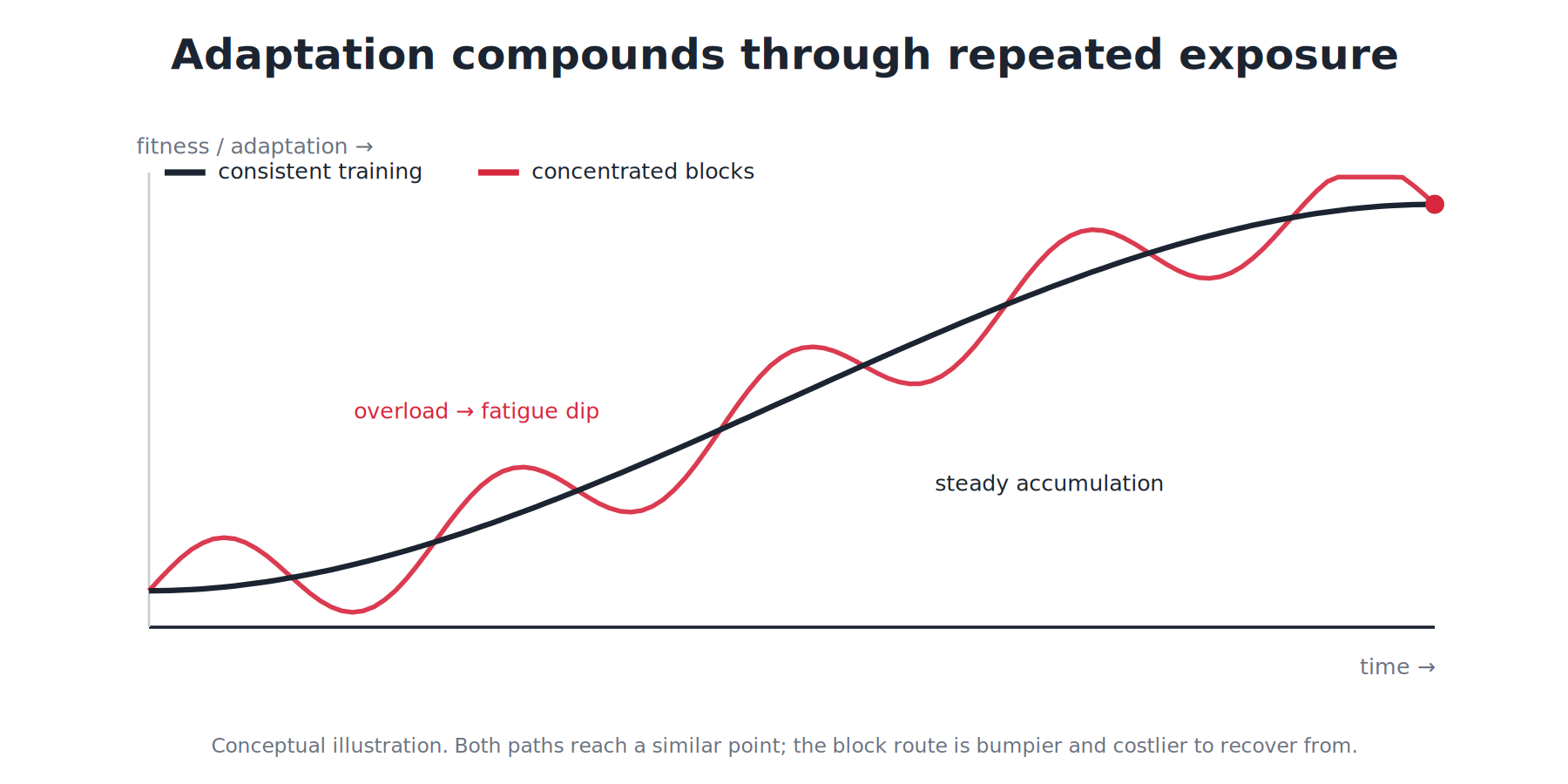
    FasterSkier – Block vs Consistency – Figure 3: Over time, adaptation accumulates through repeated exposure. The block route can reach a similar point, but with more fatigue along the way.

    Why low intensity is the key qualifier

    For low-intensity work, the physiological stress of any single session is modest by design. The adaptation seems to come from stacking many of those sessions on top of one another over time, not from cramming volume into a short window. When the totals match, the body appears to respond to how much training got done, not to how it was parceled out. That helps explain why athletes who lean on the occasional big week rarely pull ahead of the ones who just train, month after month, without drama. The big week feels harder. Harder is not the same as more adaptive.

    The authors are careful not to overreach, and so am I. Their findings should not be stretched to cover every form of block periodization. The earlier work showing real benefits from block training generally concentrated high-intensity sessions, where the stimulus is far larger. This study looked only at low-intensity volume. Block periodization may well earn its place when the stimulus itself is potent. There is just little evidence that piling up low-intensity volume creates a stronger adaptive signal.

    What it means for junior coaching

    For junior endurance athletes, the practical read is straightforward. Do not expect a high-volume, low-intensity camp or an overload week to produce superior adaptations simply because the work is bunched together. Camps still earn their place for logistics, technique, and the team-building that holds a season together. They just do not appear to hand you a physiological edge once total volume is matched.

    So here is where I land. Concentrating low-intensity volume into overload blocks does not seem to yield better short-term aerobic adaptation than spreading the same volume out, at least when the total volume is equal. I am not claiming block periodization does not work, or that all concentrated loading is a waste. What the evidence keeps pointing at, for aerobic base development, is that showing up consistently does more for an athlete than the occasional heroic training week. Over a season, the consistent skier and the big-week skier can bank the same hours. Only one of them pays the fatigue tax to get there.


    Help Support Our Coverage!

    If you value the thoughtful work and access FasterSkier provides, please consider becoming a Voluntary Subscriber. Your support directly fuels our work to cover the people, places, and moments that make our sport special.

    Join the FasterSkier community!


  • Development in Norway Isn’t Just a Plan. It’s a System.

    Development in Norway Isn’t Just a Plan. It’s a System.

    This article was made possible through the generous support of our voluntary subscribers. If you value coverage like this, please support FasterSkier with a voluntary subscription.

    Johannes Hoesflot Klaebo (NOR), Emil Iversen (NOR), and Martin Loewstroem Nyenget (NOR), (l-r) during the final kilometers of the Olympic 50 k classic. (Photo: Vanzetta/NordicFocus)

    A review of a recently published paper from Norway, “Long-term development culture for sustainable Olympic success: Lessons learned from Norwegian cross-country skiing” by Jacob Walther and Øyvind Sandbakk, is worth the time.

    Long-term development culture for sustainable Olympic success: Lessons learned from Norwegian cross-country skiing – ScienceDirect

    We’ve all heard enough about Norway. But this one simply cuts through some misconceptions, and it is worth the time to review. It strips away the mythology and gets back to what actually drives development and ultimately elite performance. Norway isn’t operating with better information. They’re more disciplined about applying what most programs already understand, and more consistent about what they refuse to do.

    The paper addresses this immediately and directly.  There is no “Norwegian method.” No magic interval session. No secret intensity zone you can implement and expect results. What they have is a system. And more importantly, a system built around their culture.

    We tend to frame their success in physiological and technical terms.  It’s not physiology, technique, health management, or mental health; they are all part of it, but they don’t explain the system. Most programs know early specialization is risky and inaccurate. Most coaches understand long-term development and the need to build training slowly and in phases based on training age. The difference is that Norway holds the line on it.

    The elements are not new. Delay early selection. Encourage multi-sport participation, and integrate sport science into daily coaching. Invest in coach education. Treat athlete health as part of development, not something that gets in the way of it. The result isn’t just better elite athletes.  It’s broader mass participation, more informed training, and a deeper pool of athletes and families engaged in the sport.

    Norway’s Johannes Høsflot Klæbo won his first World Cup at 20, in the men’s 1.6 k freestyle sprint in Otepää, Estonia, in 2017. (Photo: Fischer/NordicFocus)

    The paper uses Johannes Høstflot Klæbo as a case study. At 15, he placed 101st at junior nationals. Years later, he’s the most decorated Winter Olympian of all time. That’s a compelling outcome. But the value isn’t the result. It’s what the system expects and allows.

    In most programs, that athlete gets filtered out early. In Norway, they stay in longer. That’s the point. This isn’t about identifying talent earlier and directing resources and opportunities at those. It’s about not eliminating talent identification too soon. That requires patience, cooperation among club programs, trust in the system, and a willingness to ignore short-term validation.

    That’s where the Norwegian model sets itself apart. The turning point came in the lead-up to the 1994 Winter Olympics. Norway didn’t discover new physiology or invent new training methods. They organized themselves differently. They centralized expertise, embedded sport science into coaching, collected experience and training data across all Olympic Sports, and aligned the ski federation from the national team down to the club level.

    Olympiatoppen sits at the center, not as a lab removed from the field, but as part of the training process. It doesn’t drive the system, but it informs and shapes it. That balance matters. Norway didn’t just add sports scientists. They used sports science to improve coaching. At higher levels, many coaches are trained in exercise physiology. That reduces misinterpretation and creates consistency over time.

    Long-term development in Norway isn’t a slogan. It is intentionally implemented. It follows physiology. Peak endurance performance arrives in the late 20s, after years of consistent training. They don’t challenge that reality; they built their whole system around that reality.

    You see that athletes stay in the sport longer, as evidenced by high-level FIS races in Norway. Hundreds of skiers are over 25-30 years old. They build general capacity before narrowing focus. Skill development has time and the room to engrain. Training isn’t rushed. Volume and intensity progress over years, not seasons. Junior results are not used as a sorting mechanism.

    And this is where most systems break down. They say development matters, so select early and train accordingly. In Norway, youth championships are not selection events. They are part of the development process. The culture reinforces it. Clubs and schools coordinate so athletes can participate in multiple sports. Athletes regularly move across multiple ski disciplines. The recruitment base stays broad, and the system stays resilient.

    Norway hasn’t eliminated selection; they’ve delayed it and minimized its consequences. That distinction matters. What gets labeled as “talent” at 14–16 is often early maturation, better support, or more exposure, not long-term potential. Norway avoids that trap by not falling into it. While many other systems double down on it.

    Another principle sits underneath all of this: athlete health, physical and mental, comes before results. Training is managed for long-term progression. Training loads increase gradually over the years. High intensity is controlled, and low intensity dominates most of the training. The goal is adaptation over time, not accumulation in the short term.

    The paper also points to emerging pressure on this model. Rising costs, shifting societal trends, increasing early specialization, and changes in team structures all push against it. These aren’t theoretical concerns. There are real pressures that can erode the system if they’re not managed.

    Harald Oestberg Amundsen (NOR), Johannes Hoesflot Klaebo (NOR), and Einar Hedegart (NOR), (l-r) share the 20 k Freestyle Mass Start podium at the final World Cup in Lake Placid (USA) to end the 2025/2026 season. (Photo: Modica/NordicFocus)

    So what carries over?

    We can’t copy Norway. That misses the point. The lesson is alignment. Align incentives with long-term outcomes. Integrate sports science into coaching to improve the coach’s work. Build systems that allow athletes time to develop. And hold the line when short-term pressure starts to dictate decisions.

    Many countries can point to a standout athlete. But if success depends on outliers, unusual resilience, unusual support, unusual talent, you don’t have a system. You have anecdotes. Norway produces depth, that is, the expectation and the standard.

    There’s no secret session here. What they’ve built is a system that connects coaching and science, commits to long-term development, creates space for late progression, and maintains consistency over time. Not what they’re doing this week or next week, but what the athletes are doing ten years from now.


    Help Support Our Olympic Coverage!

    If you value the thoughtful work and access FasterSkier provides, please consider becoming a Voluntary Subscriber. Your support directly fuels our work to cover the people, places, and moments that make our sport special.

    Join the FasterSkier community!


  • Plyometrics: Where They Fit Within a Training Program

    Plyometrics: Where They Fit Within a Training Program

    This article was made possible through the generous support of our voluntary subscribers. If you value coverage like this, please support FasterSkier with a voluntary subscription.

    Where do Plyometrics Fit Within a Training Program

    Hint: You Don’t Start with Plyometrics

    Over the past few years there’s been a noticeable shift in how athletes and coaches talk about training. More emphasis on power. More interest in being “explosive.” That’s a good direction. Cross-country skiing is a power-endurance sport, and the ability to produce force quickly matters — whether it’s a finishing sprint, a tough climb, or simply skiing more efficiently at race pace.

    But as often happens, the optimal application gets missed. What I keep seeing is athletes jumping straight to plyometrics as if that’s where power development begins. It doesn’t. And when you start there, you usually end up with a lot of activity and not much adaptation.

    Plyometrics are not a shortcut. They are part of a progression — the conversion of maximal strength into power. Exercises like bounding, jumps, hurdles, and medicine ball throws can all be effective. But only when the athlete has the capacity to both absorb and produce force. Without that foundation, you’re not really training power. You’re mostly practicing jumping.

    That distinction matters more than most people think.

    I’ve used Tudor Bompa’s periodized strength model since the mid-1990s, and what still holds up is not the exercise list, but the sequencing. He didn’t build the model around movements. He built it around a logical progression. In my experience, that sequencing becomes even more important at the edges of the sport — junior athletes who are still developing and masters athletes who need to be more deliberate about how they load the system.

    And in that sequence, plyometrics come late. Not first.

    The progression is simple:

    1. Anatomical Adaptation (AA) — 4–8 weeks
    2. Maximum Strength (MS) — 6–8 weeks (minimum)
    3. Conversion to Power (CP) — 6–8 weeks
    4. Maintenance (M) — through the competitive period

    No shortcuts. No skipping steps. And no mixing phases and expecting the same result.

    Sweden’s Nicolina Lindquist jumping over Jake Pearson, of Cody, Wyo., during a strength workout at the USBA development camp in 2016 in Jericho, Vt.(Photo: Katrina Howe)

    Anatomical Adaptation

    The Anatomical Adaptation phase is the one most often underestimated, and it’s the reason a lot of strength and power work never turns into what it should. The goal here is not to get strong in the traditional sense. The goal is to prepare the athlete to train.

    That means building connective tissue tolerance, improving movement quality, and addressing the weak points most skiers share: eccentric control, single-leg stability, trunk stiffness under load, and upper body pulling strength. If those aren’t in place, everything that follows is limited.

    The work in this phase should look simple and controlled. Single-leg strength work like split squats, step-ups, and single-leg Romanian deadlifts (RDLs). Eccentric work like slow step-downs and controlled lowering. Trunk work that emphasizes force transfer, not just stability. Upper body pulling through a full range of motion. Even basic plyometric preparation — jump rope, small hops, controlled landings — but with the focus on coordination and tissue conditioning, not power.

    Two to three sessions per week is enough. The progression is not about maximizing loads. It’s about improving control under increasing demand. If this phase is done well, the athlete finishes it ready to train — not already fatigued.

    Max strength. (Photo: Corey Young)

    Maximum Strength

    From there, the focus shifts to Maximum Strength — and this is where many endurance athletes miss the point. Max strength is not circuits. It’s not high-rep fatigue work. It’s the ability to produce force.

    That means high load, low reps, and full recovery. Roughly 80–90% effort, sets of three to six reps, and enough rest between sets to maintain quality. The goal is not to exhaust the athlete. The goal is to improve motor unit recruitment and force production.

    For skiers, the work should still be sport-specific in its intent. Single-leg strength for the lower body — Bulgarian split squats, heavy step-ups. Posterior chain work — deadlifts, RDLs, hip thrusts. Upper body pulling — weighted pull-ups, heavy rows. And trunk work that connects the system under load, not isolates it.

    A session doesn’t need to be complicated. A few key movements, done well, with intent. Two to three sessions per week. Progress by increasing load, improving speed at the same load, and cleaning up movement under stress — not by constantly changing exercises.

    This phase is critical for a simple reason: you can’t convert strength you don’t have into power. In a sport already biased toward endurance, this is often the missing piece.

    Skate jumps with Chelsea Holmes back in 2014.

    Conversion to Power

    Only after that does the Conversion to Power phase make sense.

    Now the goal shifts. You’re no longer trying to get stronger. You’re trying to apply force faster. Rate of force development, timing, coordination, and the elastic qualities of muscle and tendon all become the focus.

    This is where plyometrics belong.

    The difference from the max strength phase is clear. Loads come down. Speed goes up. The movement patterns may look similar, but the intent is entirely different. If it’s not fast, it’s not power.

    That changes how the work is structured. Low volume, high quality. Three to six reps per set. Three to five sets. Full recovery. Stop when speed drops. This is neural work, not conditioning.

    Now the exercises make sense: bounding, especially uphill; single-leg hops; lateral bounds; reactive jumps; drop jumps, box jumps, hurdles. Loaded power work like jump squats and explosive step-ups. Upper body power through medicine ball throws and explosive pulling. And finally, ski-specific integration — bounding with poles, hill sprints, roller ski accelerations.

    If the power isn’t developing there, it’s not transferring.

    A session doesn’t need much. A handful of exercises, done with speed and intent. Two sessions per week is usually enough. More than that and you start turning power training into accumulated fatigue.

    This is also where athletes often get it wrong. They expect this phase to feel hard in the traditional sense. It shouldn’t. It should feel sharp. Explosive. Fresh. If it feels heavy and slow, you’re no longer training power.

    In the yearly plan, this phase typically sits in late summer or fall — after strength has been established and before racing begins. You’re not building the system at that point. You’re sharpening it.

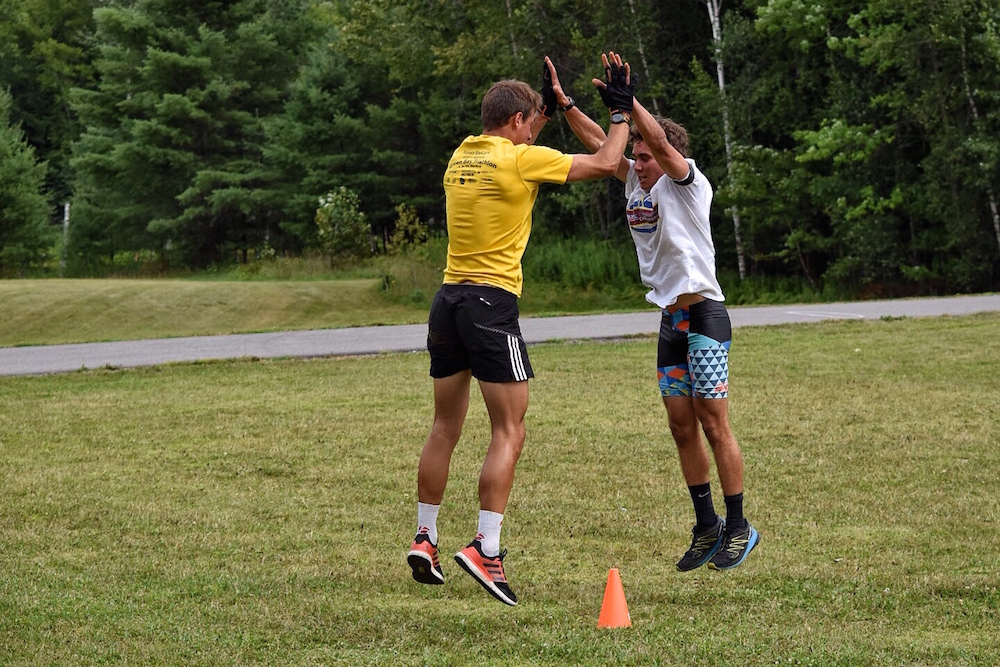
    Paul Schommer (l) and Jake Brown doing high-five partner burpees during a strength workout at the U.S. Biathlon development camp in Jericho, Vermont. (Photo: Katrina Howe)

    What This Looks Like in Practice

    What this looks like depends on the athlete. Younger athletes should spend most of their time on movement quality and basic strength, with only low-level plyometric work. Developing athletes need to build real strength first, then layer in plyometrics gradually. Senior athletes need to respect the sequence across the year — spring to rebuild, summer to get strong, fall to convert, winter to maintain.

    None of this is complicated. But it does require patience.

    There’s nothing wrong with plyometrics. Used at the right time, they’re one of the highest-return tools we have. But they’re not a starting point. They’re a finishing layer.

    Strength gives you the foundation. Plyometrics teach you how to use it.


    Help Support Our Olympic Coverage!

    If you value the thoughtful work and access FasterSkier provides, please consider becoming a Voluntary Subscriber. Your support directly fuels our work to cover the people, places, and moments that make our sport special.

    Join the FasterSkier community!


  • When to Increase Training Load… and When to Wait

    When to Increase Training Load… and When to Wait

    This article was made possible through the generous support of our voluntary subscribers. If you value coverage like this, please support FasterSkier with a voluntary subscription.

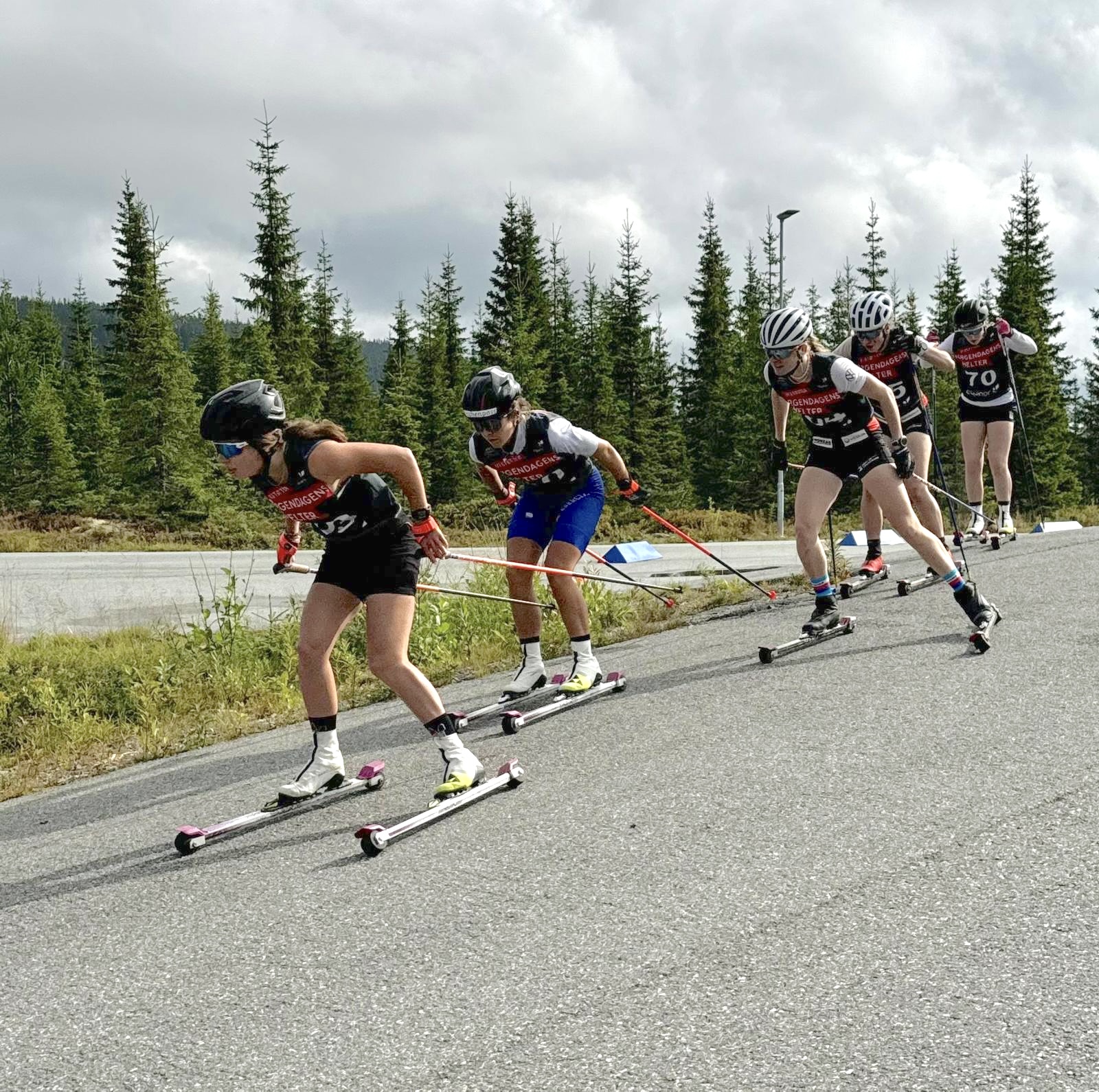
    American Neve Gerard (l) leads athletes from other countries at an International Training Camp in August, 2024, in Sjusjøen, Norway. (Courtesy photo)

    As this ski season wraps up, many of us coaches are doing similar work. Using spreadsheets or a popular training platform, we map out training for the year. We plan the yearly hours, monthly hours, and weekly hours, along with defining the training intensity distribution. We also plan how long and over-distance sessions should be, and maybe how much high-intensity training we should include, etc.  I have done the same in the past.

    Nowadays, my yearly plans include almost none of those things, but rather it is a general road map of how I might want the training loads to progress, what type of high-intensity, neuromuscular work, strength training focus, technique development, training camps, testing sessions, and a general concept of where we start in April or May. We must be able to adjust training on the fly based on an assessment of how athletes’ recovery and adaptation, week to week, with the training and developing fitness.

    In this article, I want to make a case for the changes I have made. Why? Because these detailed hours and training-intensity distribution plans we make are about as good as the day they were written. We then must avoid the temptation to implement training in May, June, or July just because we wrote it down in April. There is no way we can anticipate in April how an athlete will respond to training next month, much less than 2-6 months down the road.

    In discussion with many athletes and coaches I have consulted with in the last four to five years, I believe the biggest challenge faced is how and when to increase training load within a training year. For reference, I use TRIMP to define the metabolic load. TRIMP is described as a modeled internal-load metric or composite index based on exercise duration and HR-derived intensity weighting. TRIMP is not perfect because it is based on heart rate parameters, so power and strength training, mechanical loads are not accounted for. I find TRIMP an excellent proxy for the loads of all endurance training.

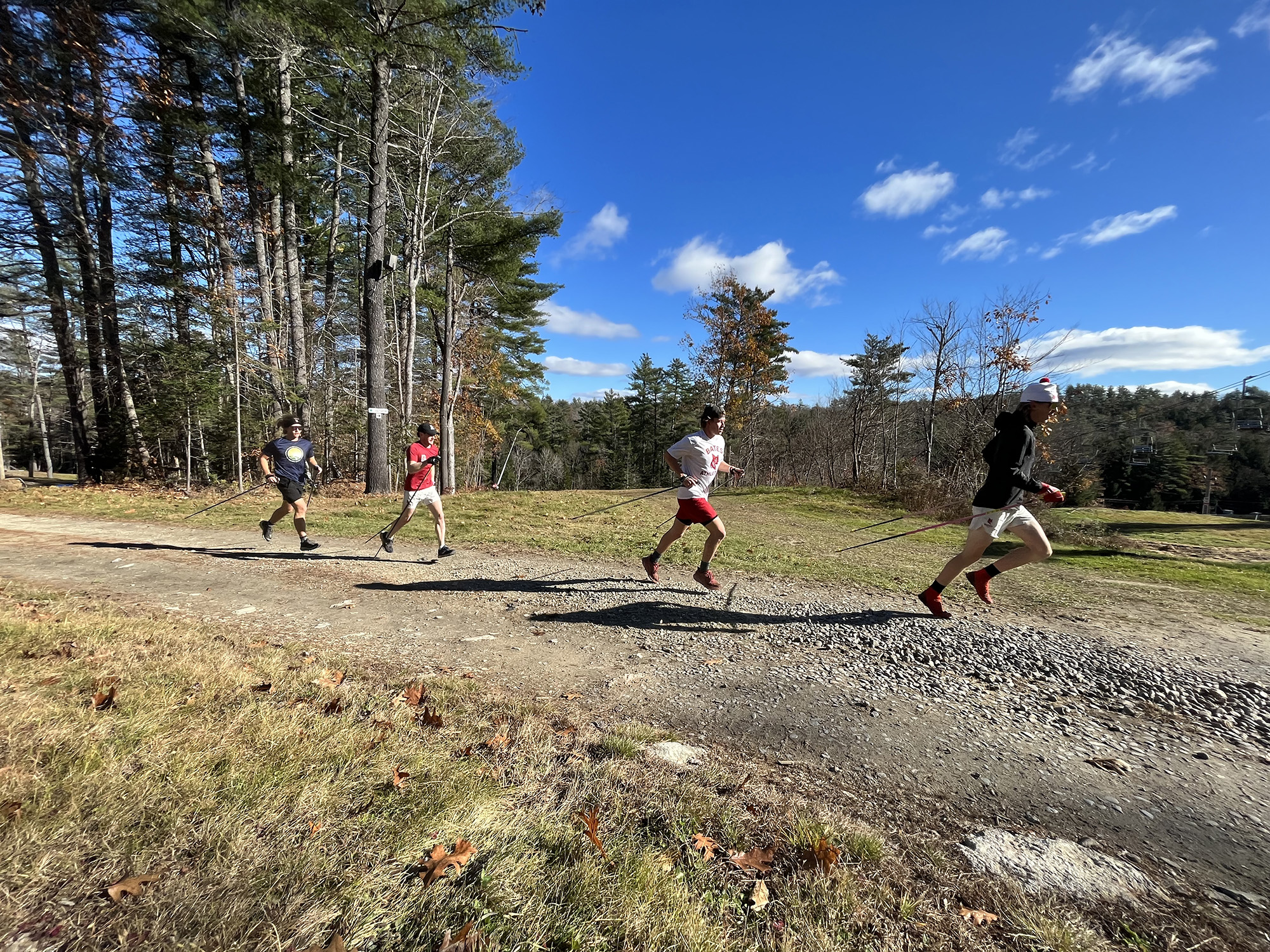
    Bates College getting after some dryland in 2024. (Photo: courtesy photo)

    Others simply use hours to plan and measure the loads. The challenge is difficult when just looking at hours, how to compare an hour of easy training versus an hour of hard training. Then, looking at percentages of time in zones or with other training methods does not define the load or focus the training on the desired adaptation.

    I am not going to address the year-to-year increases simply because all the assorted tables recommending volume of training at an age are based on population averages. The goals of the athletes, the athletes’ training age, training history, and many other potential factors. Just assigning training based on a table is foolish without considering these other factors. In most cases, athletes will train enough if the right principles are followed.

    When we are coaching athletes, we should only increase loads because of improved fitness not in an attempt to drive fitness gains. The decision to increase loads should come from evidence that the athlete(s) have absorbed the current load, not simply because it is a new month and the plan calls for a month-over-month increase. I believe that in the past we have used templates or models that have called for big month-to-month increases. The basis of building fitness is consistency and adaptation to the training. In many cases, we can go as long as 2-3 months at a very similar or very small increase in load.

    I am far from certain how coaches plan training these days, but others and I in the past have planned training based on monthly and weekly hours. In my days, I used to start in May with 50 hours, and by November, I was training more than 100 hours. Then the weekly progression within those months might go 12 hours, 14 hours, 16 hours, 10 hours or something like that. Even back then, how does a 50-hour month prepare you to do a 60-hour month, how does a 12-hour week prepare you to do a 14-hour week? What I learned more than 30 years ago. It doesn’t work that way; even if an athlete completes that kind of protocol, it does not mean it worked; it just means they survived it.

    The research and experience suggest that higher monthly volume and small periodic increases are better for building long-term fitness and performance, with far less risk than the typical plans that ramp up training with increases of 10-15-20% per month. Many old-school thoughts persist that we must increase volume to stimulate further improvements. That is an invalid belief and has been shown to be in much research and analysis. If we are in fact building fitness, we are moving faster at every intensity. Isn’t that already an increase in load? Recruiting more muscle fibers and motor units aerobically, improving mitochondrial density and function,  improving aerobic enzymes in more muscle fibers, among other aerobic adaptations.

    Fin Bailey works on uphill technique at training camp. (Photo: courtesy photo)

    I look for three layers of signals: performance stability, physiological response, and behavioral cues.

    The stability of performance in training is easily measured with simple technology, such as heart rate and GPS. Prior to increasing loads, the athlete should show improvement or stable performance in workouts. The aerobic training sessions should feel consistent and easy, with very little or no heart rate drift through the workouts. So, a simple training session once a week, once every two weeks, around a standard loop, both for high-intensity and aerobic training, can tell us much.

    The key workouts should show repeatable performance levels from week to week. The pace athletes can maintain at aerobic intensity should gradually and slowly improve, and the technique should stay stable and efficient throughout the workouts.

    Indicator What it suggests
    Same HR but faster pace, HRV is improving Aerobic adaptation
    Same workout feels easier, HRV is stable or improving Load is absorbed
    Ability to repeat intervals without extra fatigue Ready for progression
    If workouts are still producing large fatigue swings, the system is still adapting and increasing load is premature.


    As I have written previously for FasterSkier, older junior ( U18’s) athletes, masters, and elite athletes, I think it is important to use HRV to assess recovery. Using HRV, we can see whether the athletes are recovering predictably between sessions. We can see the stability or improving response their training, and we can assess whether the training loads are sustainable.

    Useful signals:

    • Resting HR stable
    • HRV 7-day trend stable or improving
    • Sleep quality normal
    • Muscle soreness minimal after aerobic sessions
    • The data and the athlete reports feeling normal again within ~24 hours

    If recovery between sessions is incomplete, increasing load compounds fatigue rather than builds fitness. The rush to hit hourly objectives and the failure to respond to accumulating fatigue are the biggest causes of maladaptive training.

    The critical question HRV can help to address. Are the current loads the athlete is doing correct? HRV, especially RMSSD trends collected consistently, can help flag whether an athlete is tolerating training well. But HRV should be interpreted alongside performance, subjective recovery, resting HR, sleep, and life stress rather than used as a standalone decision rule. In some cases, this may mean adjusting other areas of life; in others, we may simply have to reduce the training loads. Simply low HRV indicates a compromised ability to recover from and adapt to training

    A good indicator of readiness is the athlete’s ability to handle training density. Most athletes should have at least one rest day per week. During a training period, the athlete should be able to handle 3-5 moderate training days in a row without feeling accumulated fatigue, and the quality of workouts remains normal and stable.

    The occasional longer sessions should not disrupt the next day’s planned training, and recovery should be normal the following day. If an athlete is doing double sessions, the second session of the day should not be carrying excessive fatigue from the morning session, and the quality, speed, pace, or intensity of the second workout should be consistent.

    When the athlete’s readiness and physiological measures indicate that an increase in load is appropriate, there should only be a slight increase in volume. Make a few sessions per week a little bit longer, followed in the future by adding a workout or two per week

    Training load should only increase when the muscles and connective tissue are tolerating the training. If there is persistent tendon soreness, joint irritation, muscle tightness, or recurring niggles are common, it is not appropriate to increase the loads. Aerobic fitness improves faster than structural durability, which is why injuries often appear right after a volume jump.

    We also need to be aware of and watch for behavioral cues in the athletes, not just the recovery and performance data. We should look for the athlete’s motivation to train and their assessment of the RPE (rating of perceived exertion) for a given workout. If the perceived exertion of a given workout is increasing, it is not a positive signal. Finally, we should ensure that athletes’ nutrition is good, and their body weight is stable.

    As a practical guideline, I would recommend increasing load only after a period of 3-6 weeks, where we can see stable adaptation and improvement in training and recovery measures. When we look at elite training, we always see the training progression is often much slower than people expect.

    JC Schoonmaker and Luke Jager training in Anchorage, Alaska back in 2023. (Photo: Brinkema Brothers)
    Training Phase Progression Pattern
    Base Phase +5–10% volume every 3-6 weeks, but only if all inputs are positive.  If using TRIMP or Training Peaks TSS the load increase should never exceed 15-20%
    Race Prep Phase Maintain a stable volume, intensity increase slowly from the base phase
    Competition phase Volume and Training load decreases slightly; intensity is maintained or increased due to race load.


    As useful guidelines for coaches. If a training day or a week feels heroic, it is too big. Most likely, all the heroic training did was build fatigue and greatly slow recovery and adaptation. Sure, the athlete can do it occasionally, but it in no way means the load improves fitness or performance, or that the athlete adapts to it. My rule of thumb is that the longer it takes for an athlete to recover from a workout, a week, or a month of training, the less adaptation that is possible. When I shared this comment regarding high-intensity workouts with Zach Caldwell, I asked him when we should adapt to them. His response was Thursday! Not next Thursday, not a Thursday next month. Thursday!

    An effective training progression should feel well-tolerated for weeks. Fitness improvements are built on consistent, manageable weeks. Where the fitness is developed through compounded training, not the occasional massive week. I have seen it repeatedly, it is big increases in training load, too much, too soon, that ultimately leads to declining performance and overtraining. Sure, elite athletes train massive weeks, but to get there, they adapt to training every year, step by step.

    Increases in training load should be almost invisible over weeks and months as athletes develop. Over the years of training, the increases are clearly visible and large.

    In summary, increase training load when:

    1. Current workouts are repeatable and controlled
    2. Athletes recover following training days, normally within ~24 hours
    3. No structural soreness or injury signals
    4. Motivation and energy are normal
    5. This training performance has improved, and recovery has been stable or improving for 3-6 weeks


    Help Support Our Olympic Coverage!

    If you value the thoughtful work and access FasterSkier provides, please consider becoming a Voluntary Subscriber. Your support directly fuels our work to cover the people, places, and moments that make our sport special.

    Join the FasterSkier community!


    French athletes Lucas Chanavat (left) and Maurice Magnificat (right) out for a rollerski during a training camp in Tignes. (Photo: NordicFocus)