From the FasterSkier archive — posts syndicated from athletes’ and coaches’ own blogs between 2004 and 2012, kept online as published. Current coverage is at fasterskier.com.
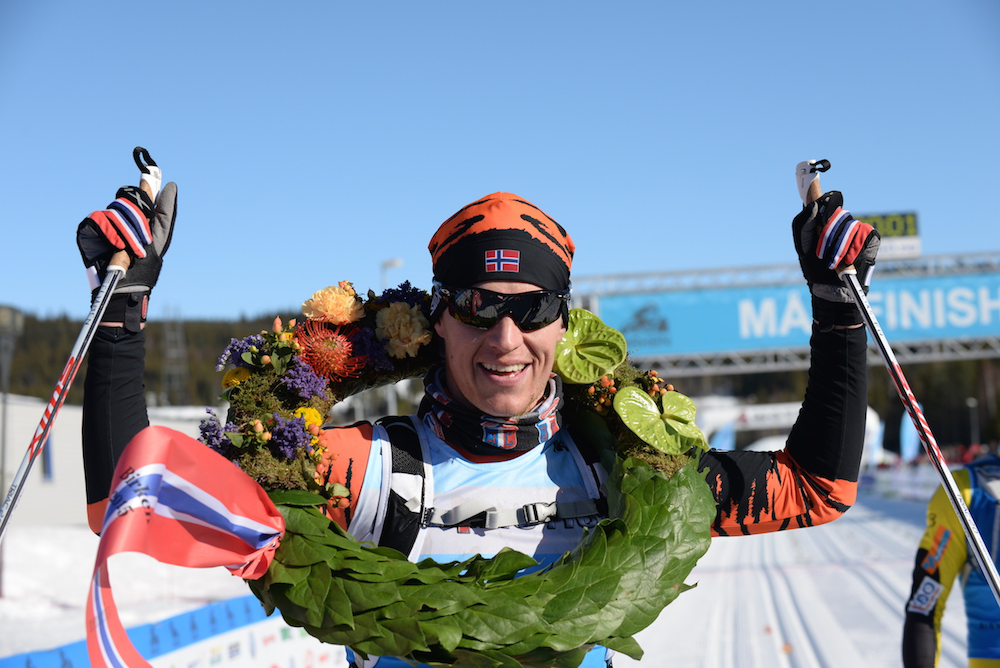
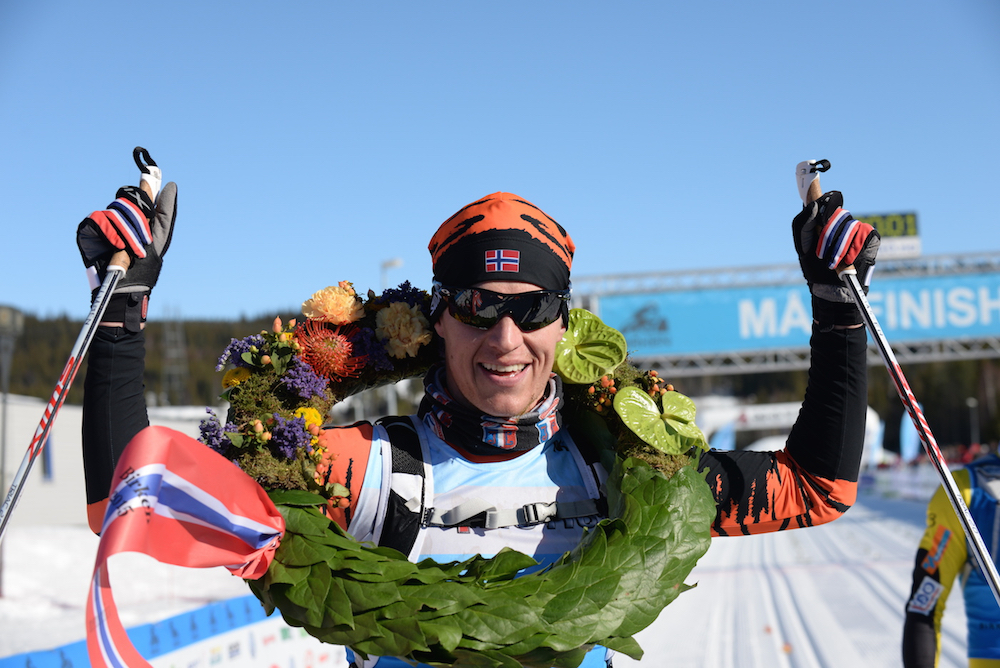
Petter Eliassen after double poling his way to a victory at the Norwegian Birkebeiner on March 22. The 29-year-old Norwegian went on to win the 2014/2015 Ski Classics title in his first season on the circuit. (Photo: Kent Murdoch)
How did Petter Eliassen do it? A month ago, the 29-year-old Norwegian from Trondheim double poled his way to a victory in the Norwegian Birkebeiner and went on to win the final Ski Classics race of the season — Sweden’s Årefjällsloppet — to claim the overall 2014/2015 Ski Classics title. It was his fourth-straight win on the circuit, making him the first racer to do so in Ski Classics history.
FasterSkier recently spoke with Eliassen, a Norwegian national team member two seasons ago, on the phone, and he happily shared his training strategies. The following interview has been translated from Norwegian to English.
A rookie to the long-distance circuit, he was content with the opening of his season, placing among the top 10 in the first five races of the Ski Classics series.
But Eliassen did not expect to close the season with a four-race winning streak — starting with the König Ludwig Lauf in Germany on Feb. 2, then a Vasaloppet win in his very first attempt at the legendary 90-kilometer classic race in Sweden on March 9. He won the Norwegian Birkebeiner on March 21, and finished the season off with a final victory in the Årefjällsloppet on March 28.
And he certainly didn’t expect to win the overall circuit crown in his first try. Eliassen beat established elite racers, such as the Aukland brothers of Norway, and former Vasaloppet champions, like Norway’s John Kristian Dahl and three-time Vasa Champion Jörgen Brink of Sweden, as well as a long list of merited marathon specialists, including Sweden’s Jerry Ahrlin, Oskar Svärd and Daniel Tynell, and Czech super-veterans Lukáš Bauer and Stanislav Řezáč.
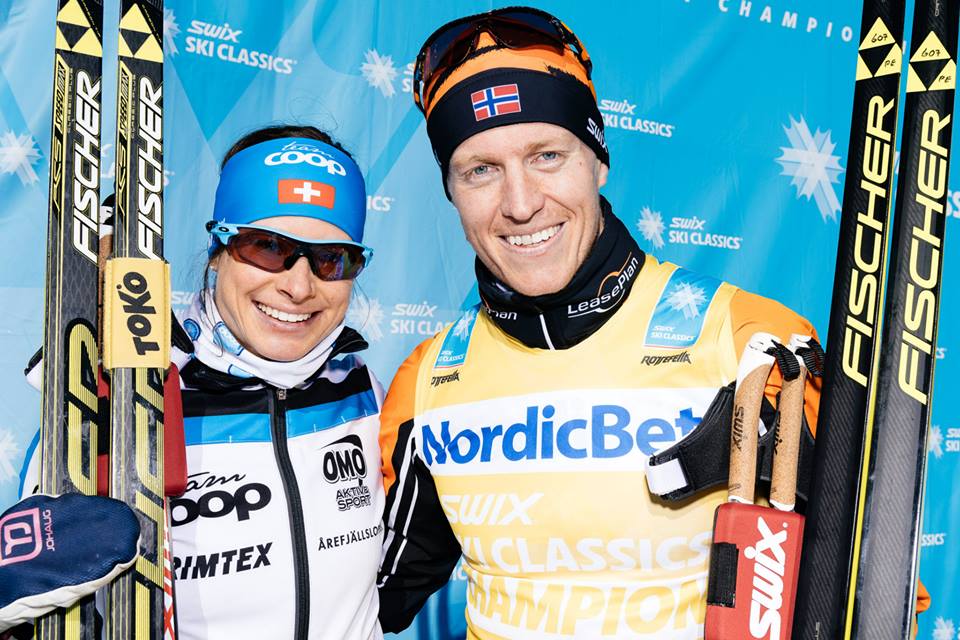
Petter Eliassen (r) of Norway and Team LeasePlan Go and Switzerland’s Seraina Boner (l) of Team Coop won the Årefjällsloppet on March 28, the last of nine events in the 2014/2015 Swix Ski Classics marathon series. (Photo: Ski Classics)
What’s your key to marathon success?
“I definitely benefit from years of racing experience,” Eliassen said, adding that the support and depth on Team LeasePlan Go made a difference. “We have a support crew and a race team that is very experienced and very well run. That’s huge both prior to the races and also in the offseason.
“Training-wise, I have done much the same leading up to this season as I did when I was on the national team. We do a lot of volume and some strength, but I have focused a bit more on double poling than I used to and much less on skating,” he said, adding that he does miss skating.
“I enjoy skating, and I still do some skate workouts throughout the season, but it’s definitely not the main part of the volume.”
While the Ski Classics organizers have not ruled out including freestyle events to the race schedule in the future, Eliassen doesn’t see that happen in the near future.
“So many of the established long-distance elite racers are highly specialized and spend so much of their training effort on perfecting their double-pole technique and strength that I think they would object,” he said.
Practice your weaknesses, race your strengths
While double poling isn’t his specialty, Eliassen is constantly trying to improve that aspect of his classic technique. He explained his team spends many of its group workouts focusing on tight finishes and does a lot of intense intervals in all kinds of terrain to prep for those.
“My favorite terrain is uphill. But many of the Ski Classics events have flat or even slight downhill finishes, so we spend a lot of time on that,” he said.
His race strategy is to determine how the race will play out well ahead of the finish line to avoid a double-pole showdown.
“I always go into the race with the intention to stay with the lead group as long as I can, but I try to pull away while there is still some distance to go and preferably in terrain that I’m good at,” he explained.
Skiers are made in the summer
During the season, Eliassen generally puts in one or two double-pole workouts per week, which last from one to three hours depending on how he feels and how much time there is between the races. When there are several weeks between events, he does longer workouts, and when the races come like rapid-fire, his main focus is recovering from one event to the next.
But the bulk of his double-pole training is completed even before the snow falls. During the dryland season, Eliassen and his teammates log several long rollerski workouts each week, with two to four hours of double poling.
“I am definitely not the one who logs the most volume on our team, but in the summer, I do at least two of those each week,” he said.
While rollerskiing isn’t his choice dryland workout, he loves running and also puts in a fair amount of time on his bike.
“I have to admit that my favorite summer workouts are long runs in the mountains. That’s where I really feel at home,” he said.
Strength and recovery
Eliassen stressed that plenty of variety was the key to staying injury free, along with a healthy dose of general strength, flexibility and recovery.
“It’s really important to do a lot of core strength in order to protect your back, shoulders and arms,” he said. “Also make sure to stretch. When you do a lot of ski-specific and double-pole specific training, you tend to get very tight, especially in the front of your body.
“And definitely make sure you allow yourself plenty of recovery time between the hard and long workouts, especially the rollerski double-pole sessions,” he added, pointing out that tendinitis issues often are a result of overuse and under-recovery.
In terms of building double-pole specific strength, he believes in simply double poling a lot.
“I don’t do any of the double-pole machines … I know a lot of skiers use them, but I believe there are several training methods that will lead to success, and so far, I haven’t used those,” he said.
If it ain’t broke, don’t fix it
Based on his experiences and results from his rookie season on the marathon circuit, Eliassen planned to continue with his training plan from last season.
“I will train mostly the same way as I did prior to this season, but of course, I will try to improve my test results even a little bit more,” he said.
Generally, Team LeasePlan Go does a one-week training camp each month during the dryland season, and in between, its athletes train independently.
“We live all over the country, so it’s nice to meet on a regular basis, but I also enjoy the flexibility of setting my own training schedule,” Eliassen said.
“I think the marathons really is my arena,” he added with a smile.
“Give a Man a Fish and Feed Him for a Day. Teach a Man to Fish and Feed Him for a Life Time.”
The common metric for the amount of cross-country ski training done in a year is the total number of hours spent training in the different intensity zones.
One of the more vicious hazards of becoming pre-occupied with hours put in is missing or ignoring the hours NOT put in. These are important for all skiers, and for juniors they are doubly so. If kids have come to a year-round ski training program one would hope it was not for short term success. Junior programs should be in the business of building a solid and intelligent training foundation, and part of that foundation is knowing how to use time off.
Time off includes recovery hours. While we often enter them in a training plan as “Rest” or “Off” days, it is easy to forget how important it is that athletes know how to use that time. Recovery hours are as fundamental a building block as any other part of the training plan. It is during recovery hours that the work sinks in and when the body and mind refresh themselves. It can be both a conscious and a subconscious break in a routine that prepares us well for the next load. The tricky part is that rest and off days are easy to miss or to misuse. The athletes need to understand the part recovery time plays well enough to give it the same quality of attention they give to any other aspect of training.
Give a Man a Fish
In our training plans at Burke we often use the expression “OFF off” for a rest day and “Off” for a training recovery day. Here is how we present that to the group as a whole (individual plans get more specific).
[NB: Before you read one word further allow for the fact that this contains the highly personalized opinions and spins of someone who tends to be a judgmental old fart. Armed with that proverbial salt shaker, read on.]
“What do we mean by ‘OFF off?’”
That means no structured training and largely a day of below zone one activity; it allows and encourages an easy walk, easy mobility, and rest. Reading, music, homework, making food, etc. It does not mean staying up late and sleeping in, blubbing around your room with computer games, breathing stale dorm air all day, and consuming a steady diet of snack food. That ain’t “off, ” that is backwards! The day in bed is useful too if you are running a little sick; HR 10+ bpm higher than normal, any hint of fever, and any other signs of impending illness. For any recovery day to be most helpful you should be IN bed not later than 10 and out of it by 8:30-9:00 AM. Kids need more sleep, and getting it at the right end of the day lets it do the job better.
A day described with only one “off” can and should mean a light run, and easy ski, an easy hike, a low key field game. It doesn’t mean a full day of top to bottom Alpine skiing or a century ride with your Dad. Research has shown that recovery is quicker and residual waste is processed out of the muscles best by activity at around 60% of the max heart rate. That can be a slightly lower key version of our usual recovery intervals (which are explained later), and that type of work is also constructive in maintaining a base. If you are healthy and feeling good, but know that you are a little tired or have been working extra hard, then a session of sub level one (e.g. 120 bpm up to level one e.g.130-135 bpm on a 3 min / 6 min cycle repeated 3 -4 times) is always a good off day activity. It keeps fresh oxygen in the system, and moves waste products out without creating any fatigue. This type of session is part of recovery, but don’t let it sneak into compulsive guilt training and let the intensity creep up. The mind needs a break too. Let it go somewhere else. Mellow out, enjoy it.
This may be all very well as far as it goes. It provides a reasonable set of ideas as to how to use a recovery day, but it doesn’t go too far to explain why these days are valuable, even critical, in planning an increasingly advanced approach to training.
Teach a Man to Fish
The school of training thought with which I am most comfortable puts a high value on the athletes gaining an understanding of why we do what we do, and on developing confidence and independence in training. We try to share information in a way that is directly useful to them and gives them a greater sense of investment in their efforts.
How do we best exchange and share information? What do we need to know about recovery time, and what does the athlete need to know? In my mind the best and first approach is to establish open and frequent communication between coach and athlete. Any early experience and understanding the athlete has is just that, but we should regularly draw on it and point out how accumulating individual experience increases the knowledge of capacity, and personal physiological response to stress and stimulus. Seeking and respecting the athlete’s input, however novice or “green” it is, is important. That builds mutual trust, a willingness to share thoughts, respect and a common purpose. Once established, that relationship becomes a powerful tool in effective information exchange.
If one of our goals is to help athletes become independent and self-confident, then we need to have concrete material to give them. Not rules—but ideas to discuss, to try on, to analyze and to digest. Kids like numbers. They seem less interested in and less convinced by anecdotal evidence. Having something concrete to go over with them can go a long way to convincing them that recovery is as important to moving ahead with training and ultimately going faster, as is any other single part of the foundation.
A good place to start is to review what we as coaches think we want and need from a recovery day; to revisit some of the science behind the idea and to see if we are consciously taking it into consideration and applying it in our programs for juniors. After that bring each athlete into the loop and clearly and simply share the principle of load and adaptation, of catabolic and anabolic processes, and the concepts of load, breakdown, recovery, and overcompensation. This goes a long way to letting kids see how interrelated all the work and rest is, and it encourages them to begin to develop an awareness of their own systems. Producing a diagram that illustrates the relationship between load and breakdown, recovery and repair, and eventual overcompensation and improvement over time will help involve the athlete much more effectively than simply saying, “Take today off.”
[While it isn’t the purpose of this article to go into detail on load and recovery one important related concept is worth considering; the load on an athlete is not only the load from a given workout, or series of workouts, but rather is the total load being carried. The total load is made up of additional factors from everyday life including relationships, school, social pressures, economics, family and work situations and the mass of stimuli and thoughts that bombard teenagers every day.]
A diagram can show how a hard load can weaken and break down the system, and how proper recovery can bring it back to a higher level. It can illustrate how new loads applied too soon or too frequently, and not allowing for full recovery, can turn the performance curve downward into overtraining.
“To avoid sickness or overtraining, the training plan ought to be designed such that the athlete achieves a complete recovery every two to four weeks.” — Endurance, Olympiatoppen. 2005.
For Juniors from 14-16 years old, I would be inclined to say recovery should happen every 6-10 days, and for 16-19 year olds, every 10-14 days. This is full recovery and would tend to require some time totally off.
We can look at hard numbers when it comes to determining how much recovery is necessary. The research has been done.
The book ENDURANCE -Training That Produces Results contains an interesting table that we can use as a starting place.
It compares the length of recovery times from work in different intensity zones, with the caveat that shorter periods of work require less recovery and that for the table the length of load is typical for the I-zone, i.e. an IZ 1 workout might be three hours and an IZ 4 workout might 30 minutes of total on time. On the far right of the table is the length of the “overcompensation phase” which occurs after a specific training load plus good and complete recovery and helps us gauge when to take the best advantage of the recovery process with the next session.
Average recovery times for well-trained endurance athletes after training in different intensity zones.
I Zone
HR (% max)
90-95% Recovery Incomplete
100% Recovery Complete
Over-compensation Duration
1
60-72
ongoing/in a few hours
up to 36 hours
1-3 days
2
72-82
7-12 hours
12-48 hours
2-4 days
3
82-87
12 hours
24-72 hours
3-5 days
4
87-92
12-24 hours
48-96 hours
3-6 days
5*
92-97
15-30 hours
60-120 hours
3-6 days
*As skiers we do not often exceed I Zone Five in training. The scale on the chart goes on to IZ 8. Everything over five is at thundering max heart rate and is of short anaerobic duration.
“Recovery time is also dependent to a large degree on the athlete’s total current life situation. A lot of stress in connection with work, studies, social and family situations can lengthen recovery time significantly.”
The thing that shouts out at me from this table is that, given all the other things that come into play with juniors we may, in our quest for filling in the hours, be short-changing vital recovery time. We are in the process of building a well-trained endurance athlete. We probably don’t have one yet so we should likely be ready to add time to the numbers here. If we rush it, or we completely trust the athletes’ own inexperienced evaluation of readiness without observing them closely, we may be asking for more than they can or should give; that is where the slippery slope to declining performance, chronic illness and overtraining can begin.
It helps to know as much about the individual athletes’ worlds as we reasonably can (living at home with an endorphin addicted Type-A parent can play hell on recovery time!), and we need to recognize that the hard workout doesn’t end when the sweat stops; it ends when good recovery time has passed and we are ready for the next and perhaps increased load. That comes back around to the importance of that relationship of communication between the athlete and the coach. It, too, needs to be trained and nurtured. Patience is key.
Having that in mind when we sit down to lay out the next plan is being forearmed and better guaranteed to come up with something good.
These may look familiar. The first two are unfortunate but ubiquitous adjuncts to the freshman year of college, the third to the junior and senior years of high school, and the fourth to all ages but endemic among high school girls. Two, three and four can frequently be aggravated by well-intentioned, caring and ambitious parents.
Oh boy, no training tomorrow!
A frequent problem for kids with early talent but no performance or process goals.
Hazard: A) Stay up late with pals after a hard week of training while immunity is still a bit compromised. B) Sleep in until noon, eat Froot Loops, play video games, put two hours into Facebook, stay up late. C) Add C2H5OH and set things back 10 days.
Rx: Get it together. Come out of denial and check your goals. What do you want? Very tough, because this is a lot of fun and being honest with oneself has perhaps not been learned yet.
Oh boy, no training tomorrow!
Hazard: A) “Gee, that’s great dear! Now we can do something together! Let’s go ride that century we had so much fun on last year. B) “Way cool! Let’s see how much vert we can do at the Glen!” C) I will be able to go do the time trial with the old team. We don’t have ski intervals until the next day.”
Rx: Just say NO to the craziness. Believe in your plan and say that a short easy ride is fine, but not another race with Dad. On the other hand, time with the old man, or mom, or finding powder in the glades with friends is good for the soul and the head. It is healthy and refreshing. The trick is to take another day OFF from activity and not to drive yourself down. Do not double up on workouts for two different sports! Be honest with your coach. An extra day off costs a lot less than an extra day ON.
Whew, no training tomorrow.
Hazard: A) “I am totally stressed out by these SAT tests. I’ll get up early and take three or four more before I start to catch up on calculus. Then I can spend the rest of the day trying to get the rough draft of my paper done.” B) “Oh my god I have to get this ED application in but I don’t where to send it! I have been waking up at night worried about not getting ‘pull’ and not getting in anywhere!”
Rx: Get a little help (coach, advisor at school, parent, friend) to put things in perspective. Talk it over. Find an order in which to deal with it. Chill time. Go fishing. Easy run with the pooch. Help the old coffin dodgers next door to stack wood.
Oh no. A day off.
Hazard: “I know I am going to get slower if I don’t train today. All of my intervals are getting slower so I know I need to work harder at them. I missed two sessions last week because I was sick but I feel a lot better so I’ll count those as days off and get out tomorrow and go for it. I won’t say anything to the coach. I’ll just work that little bit harder and he’ll be surprised when I win the time trial.” (Yup, he’ll be surprised all right, and even more so if you finish the first race!)
Rx: Toughest of all, because this frequently sneaks into other aspects of life. Most of all it wants honesty with the self and a willingness to pay attention to facts of physiology and psychology. These are the athletes who can sometimes be helped by numbers; lactate tests, charts and plans about recovery that clearly relate quality recovery to quality performance, and recovery workouts of which the athlete can clearly feel the effect. Knowledge is power here, and helping these athletes recognize the effects of their efforts in quantifiable terms is valuable.
There are different kinds of recovery for coach and athlete to consider. To get the best out of all of these, the more the athlete knows about what is happening in his body and the more committed he is to “doing it right,” the more thorough the recovery will be.
Planned Active Recovery, which is frequently written into the daily plan or is mutually understood so it can be added to a workout with only a verbal reminder. They can be elaborate or simple.
Examples:
At Burke, we’ve come to use “recovery intervals” either immediately after a hard interval session, or later the same day. The athletes like the results of these, and take no convincing to do them. A frequent choice is a series, following a light warm up, of 4 x 8 minutes in IZ 2 (70-80 % of max HR) rolling down to IZ 1 ( 60-70%) for 4 min, done as continuous work.
Another recovery workout that should be planned, and is often forgotten in the heat of battle, is the immediate post-race cool down. We lay out a fairly specific routine for that and do our best to make sure it gets done. It is one place where kids’ judgment sometimes needs back-up until they are a little older and a little more experienced. Done properly and on time, the post race workout can make a race day a good work day, and can, if you are on a two-race weekend, go a long way to enable throwing down a good effort the second day.
Planned Long Term Recovery. This is time planned in over the training period but not necessarily specified as a certain type of recovery work out. The Coach/Athlete team needs to consider it in some detail before and after individual workouts. It needs to be flexible in duration and in potential activity. The Recovery Time Chart (above) can be helpful here.
Example:
What this really affects is the rhythm of a training period; how long after a hard effort or a long effort do we wait before doing another one? We occasionally do a workout we call an “overspeed,” which is an effort for an extended period slightly above race pace, at a speed that is a little uncomfortable. These are tough both physically and psychologically, and we plan not only immediate active recovery, but also long term recovery allowing a good passage of time. We also carefully plan activity to rebuild and refresh the systems before we plan another hard session. For J1 athletes we might think about two such workouts in a month. There is a lot of room for other work in between.
Rest and Recreation. This is non-specific but very important time. It is private time. The sense of freedom and ownership of participation are here. It is important to recognize that sometimes R & R involves a workout that should be written into the plan and the plan should be adjusted to take it in. A junior who has a day off but runs into buddies who want to go for a 4 hour mountain bike ride, and decides to go along, might be hesitant to tell the coach who has 4 x 4 intervals planned for the next day. However, he should feel able to speak up, should speak up, and everyone should make necessary adjustments. The subsequent and perhaps critical communication should be thought out and should be constructive. Helping athletes value their goals, and their commitment to the game, helps them feel more confident in making the best choices.
The more juniors operate with coaches as consultants, and the more they find and adjust their own best programs, the closer they are to learning how to fish.
Jessie Diggins racing in November in West Yellowstone.
It’s that time of year again! Snow is falling, trails are open and groomed, and it’s time to toss the rollerskis in the basement.
There are a couple of reasons why rollerskis are great for cross training; they allow you to develop your ski muscles, work on balance, develop arm strength you can’t get while running … and they are the closest thing to actual skiing when you aren’t fortunate enough to live on a glacier. And Ahvo Taipale, owner of Finn Sisu, has been providing the Nordic community with excellent Marwe rollerskis. They’re durable, track well and are closer to the speed of skis on snow than many other brands that roll too quickly.
However, as good as rollerskis are in the off-season, there are also some compelling reasons to get off of the wheels as soon as possible. Due to the ratchets on classic skis, it can be all too easy to develop bad habits and a late kick without even realizing it. On snow, if you do not have your weight fully over each ski as you stride, you will slip out and struggle until you correct your technique. On classic rollerskis, you‘ll get up the hill regardless of your technique. So it’s super important to be very aware of your technique and where your weight placement is, or you may find yourself needing to restructure your technique when snow arrives.
Luckily, if you have coaches helping and calling you out when you begin develop a late kick, the transition onto snow is much smoother. One way the CXC team handles this is to bring a video camera along on the roads and either critique technique instantly, or view it in slow-motion afterwards. In this way, we make sure that our technique will be intact when we need to be able to close down a wax pocket on snow.
Another strategy is to execute rollerski drills that force you to have your weight over your ski when striding. Some of these drills include shuffling with full weight transfer from ski to ski, running uphill on rollerskis with or without poles, or a run on rollerskis that turns into a slight bound. These drills focus on improving balance as well as imitating kicking down a wax pocket, and they are extremely helpful in maintaining good technique.
Personally, I think the transition from skate rollerskiing to snow is easier since there is no kick wax involved, although the longer skis are fairly awkward at first. The easiest way for me to transition is to take the first few days nice and slow, with some long level one sessions. This is also super important if your first days on snow are at 6, 600 feet of altitude, as many skiers are at the West Yellowstone Ski Festival. When adjusting not only to snow but to altitude, it’s good to err on the side of skiing slowly, to give your body enough time to acclimate.
The long-range forecast indicates that there will be some sweet skiing this winter. Grab your jacket, jump onto your skis, and kiss those rollerskis goodbye!
TRONDHEIM, NORWAY – Håvard Solås Taugbøl and the other skiers on “Team Morgendagens Helter” (Ed: “Team Tomorrow’s Heroes”) are certainly learning from the best.
This week the team had a training camp in Trondheim, and the takeaways include experiences, tips and a radio controlled airplane.
Before Christmas last year, the Norwegian Ski Association initiated a 5-year talent development project backed by some of the association’s major sponsors. “Team Morgendagens Helter,” a talent development group consisting of hand-picked individuals from six of the ski disciplines, is a key element in this project.
“At the camps, we meet athletes from other sports and learn from them. We also get pointers from our individual mentors, including Eldar Rønning and Therese Johaug. They simply tell us what they’re up to, and then we can take that home and adapt it to our own training programs. And they also just do a lot of really crazy, funny things,” says Taugbøl, one of the young cross-country talents on the team.
The Lillehammer native was picked for the project as a representative for cross-country, along with Vilde Haugan Burkhall, Hilde Landheim and Sindre Bjørnestad Skar. Earlier this week, they joined the other team members and mentors in Trondheim.
Winner
Last season, Taugbøl won his age class in the Norwegian national cup by a healthy margin. During the camp in Trondheim, he was able to show that he knows more than just how to ski fast.
“We were challenged to enter something called the Robot Ski Challenge at NTNU (Ed. Norwegian University of Science and Engineering). The point was to program computers to enable some robots to maneuver various obstacles on skis,” he explains. “I and this telemark racer Niklas Windmarken won the challenge,” Taugbøl says with a grain of humility.
Just for fun
The award for the engineering challenge was that each received their radio controlled airplane. Taugbøl doubts the prize will give him any advantages on snow, though.
“I’m pretty sure I won’t ski any faster even though I did pretty well in the code writing department,” he says. “But it was fun and creative, at the same time as we had to be very detail-oriented and focused to make the code work,” Taugbøl adds.
Plyometrics
However, as an athlete with eyes on the podium, the workouts are the most important elements.
“We did a really hard stair workout with Eldar Rønning on Monday. That was a really good workout, so maybe I’ll try to incorporate some of that on my own,” Taugbøl says.
Motivated
– How long will it take before you’re as good as Eldar Rønning?
“That’s a tough question,” Taugbøl says and thinks about it. “But I’m planning to train a lot, train hard and train smart for a long time. Then time will show whether it will take two years or ten years. But I hope I can match his level some day,” Taugbøl says.
Healthy
After spending most of the spring and early summer battling whooping cough, the ambitious junior racer is now just smiles and joy.
“I finally got rid of the whooping cough and can train full steam ahead. It feels good to be able to go level 5,” he says. “Now I’m focusing on building a good foundation so I can race fast this winter,” Taugbøl concludes. Be warned.
From Langrenn.com, August 18, 2010. By Ivar Haugen, translation by Inge Scheve
Nicole Deyong doing some resisted double-pole speeds with Sun Valley Olympic Development Team Coach Travis Jones. Photos courtesy of Travis Jones.
As part of FasterSkier’s bi-weekly newsletter the Start List, we’ll talk with a high-level skier each issue about one of their favorite workouts. This time, we spoke with Olympian and national champion Simi Hamilton, a U.S. Ski Team member who trains with the Sun Valley Ski Education Foundation’s Olympic Development Team (SVSEF ODT), in Idaho.
One workout that always gets Hamilton “fired up,” he said, are classic speeds-short, all-out sprints, each 20 seconds long.
Speeds are a good way to practice staying relaxed during the high speed and hard effort of a sprint, Hamilton said, because “it’s just long enough to be able to get into that consistent groove.”
“The best sprinters in the world-and I think [Andy] Newell does this really well-they’re so consistent throughout an entire sprint,” he said. “Every single double-pole, every single V2 is exactly the same. You never have to worry about adjusting from being too far forward or too far back.”
In the ODT’s version of the workout, which they do in the summer and through the early winter on snow, athletes will do three sets of six speeds, taking two minutes of easy skiing between each repetition, and seven minutes between sets.
Instead of doing all the speeds on one stretch of pavement, each set of six is done on a different type of terrain, giving athletes a chance to work on many different techniques. For the first set, the ODT will go from a standstill, using an actual start gate. (If you have one, awesome; if not, you can pretend.)
Simi Hamilton in the middle of a resisted double-pole speed.
According to Hamilton, using a wand and going from a standstill is a great way to practice different start techniques, like striding off the line, or mixing in double-pole strokes.
“You’re really getting used to doing it how they do it in a World Cup,” he said. “I think it’s a great opportunity to mess around with some things, experiment a bit.”
The second set is usually drop-in speeds, which start after athletes have coasted down a hill. Drop-ins are a good way to practice high-tempo, fast-paced techniques, without expending the energy of getting up to speed.
The final set is on a steep uphill, or even around an uphill corner, using either classic striding or V1 technique. You can get creative: two weeks ago, ODT Coach Travis Jones had team members doing resisted double-pole speeds for the last set, in which athletes were attached to Jones by a bungie cord and had to pull him uphill on his skateboard.
“It made you feel like you’re one of those guys [in] the World’s Strongest Man competition,” Hamilton said.
Hamilton recommends doing the speeds with other people, going head-to-head. He said that he doesn’t see the workout as too taxing-it’s rare that his heart rate gets above threshold-which makes it a good session to use for a recovery workout or during a week with a heavy training load.
“It’s not hammering level four intervals all day,” he said, “but…when you’re really flying and feeling on, it definitely gives you a ton of confidence.”
Throughout the summer, we’ll have frequent posts on all facets of training, so check back often. If you have an idea for a training tip, or have a coach who you think could come up with some good suggestions, let us know at info@fasterskier.com.
To start out, we’re offering three sets of tips from some college coaches.
First, Middlebury College’s Andrew Gardner writes about setting goals for summer training.