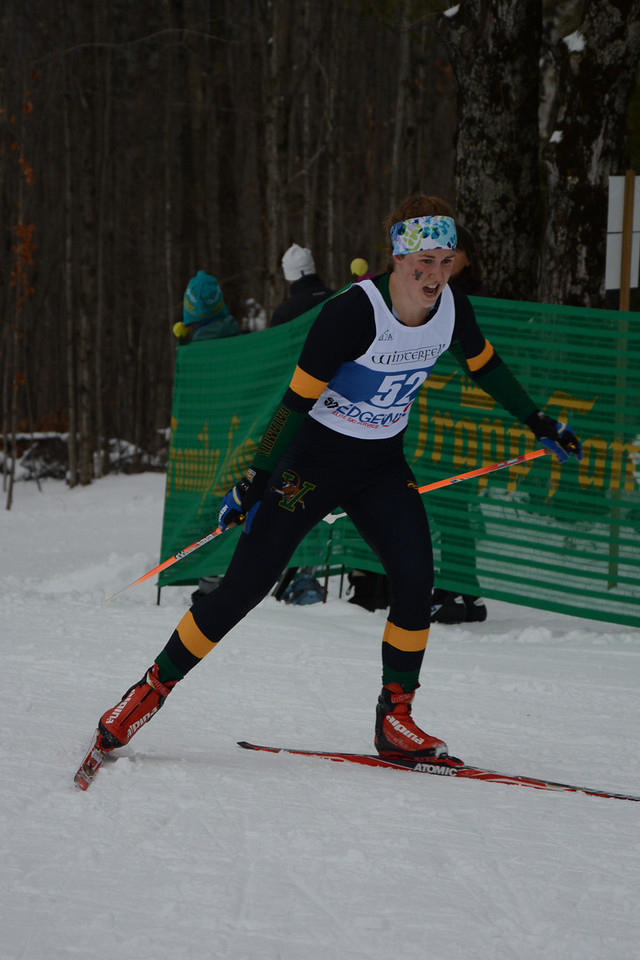
STOWE, Vt. — It was a jam-packed day of classic sprinting up at Trapp Family Lodge on Wednesday, with 54 heats determining six champions at Junior Nationals between the U16, U18 and U20 men’s and women’s categories.
While some races were snowy, others were windier, and a few were neck-and-neck to the line, the conditions remained relatively consistent throughout in temperatures around 10 degrees throughout the day. The sun began to set soon after the U20 and U18 women’s finals, making for a picture-perfect ending on Day 2 of 4 at Junior Nationals.
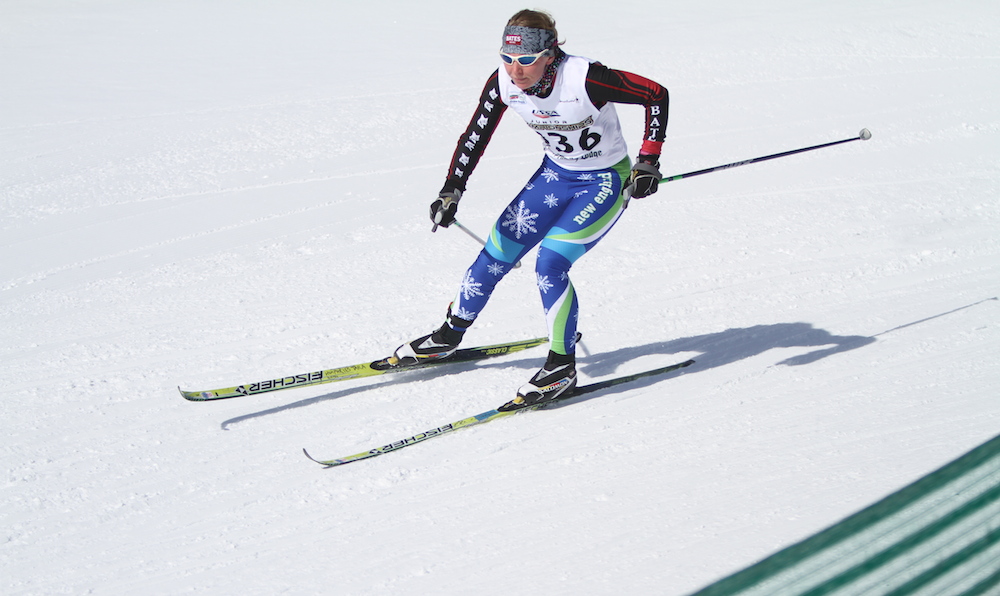
Tara Humphries (Bates College/New England) racing to a victory at 2014 Junior Nationals in the women’s 5 k classic individual start on Monday at Trapp Family Lodge in Stowe, Vt.
FasterSkier’s coverage is made possible through the generous support of Madshus.
STOWE, Vt. — Giving a little recognition where it’s due, here’s a look at the top-10 skiers in each of Monday’s classic individual starts on Day 1 of U.S. Junior Nationals. Classic sprints kick off today with qualifiers at 9:30 a.m. Eastern time; heats start at 1 p.m. Follow FasterSkier on Twitter and Instagram, as well as the 2014 Junior Nationals website for updates.
Fun Fact: According to fifth-place finisher Paolo Takagi-Atilano’s profile on the National Nordic Foundation website, his name is pronounced “Pow’-loh” and he’s fine with people calling him by his first name “because who wants to deal with Takagi-Atilano?”
U20 Men’s 10 k
Cole Morgan, 19 (University of Vermont/New England)
Fabian Stocek, 19 (Holderness School/GST)
Jack Hegman, 19 (UVM/New England)
Oscar Friedman, 19 (Dartmouth/Rocky Mountain)
Haakon Sigurslid, 18 (Durango/Rocky Mountain)
Patrick McElravey, 19 (Middlebury/Far West)
Mathew Nichols, 19 (University of Wisconsin-Green Bay/Midwest)
Sam Elfstrom, 19 (Northern Michigan University/Midwest)
Jack Schrupp, 18 (Gunstock/New England)
Blaine Ayotte, 18 (St. Lawrence University/New England)
Fun Fact: Morgan, a college sophomore from Bozeman, Mont., won by more than 35 seconds.
Fun Fact: Swirbul won her first national title by nearly 15 seconds. In January at the U.S. Cross Country Championships in Midway, Utah, she placed second in the junior 5 k freestyle mass start.
Fun Fact: Ogden was the fastest overall in the U18/U20 women’s 5 k, edging Hett by 2.3 seconds. It is her second national title after winning the junior 5 k freestyle mass start at U.S. Cross Country Championships in January.
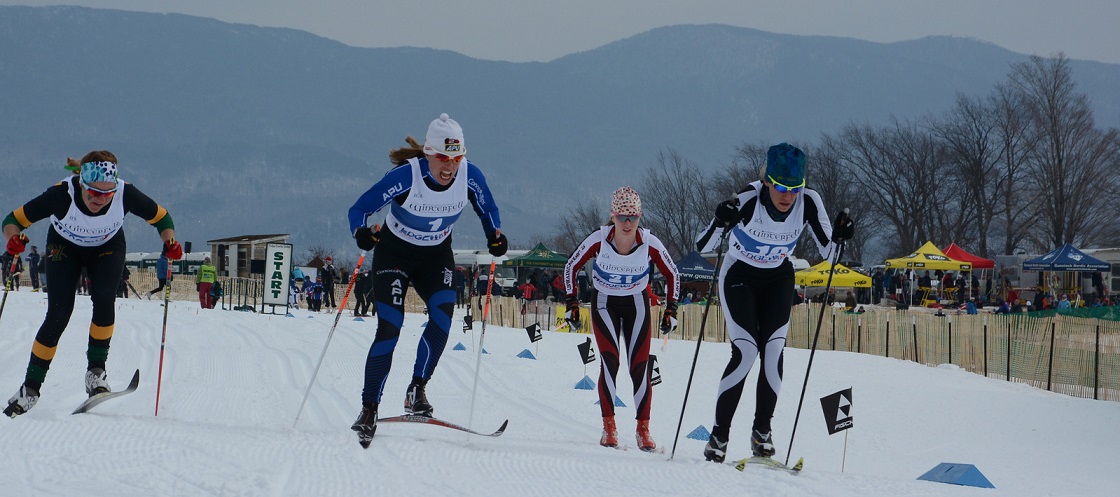
The beginning of a quarterfinal heat at the UVM Carnival/Eastern Cup. From L-R: Anja Gruber (UVM), Rosie Brennan (APU), Erin Perryman (SLU), Kaitynn Miller (BOW). Photo by Connor Hunt
It was a weekend filled with emotion and grief for all at this year’s combined UVM Carnival/Eastern Cup in Stowe, Vermont. The passing of Dartmouth skier Torin Tucker during the Craftsbury Marathon on Saturday gave way to a somber air throughout the venue at the Trapp Family Lodge. Torin’s passing affected those involved at all levels of the event, with many taking time to show their support and respect.
In the midst of such sadness, EISA racing continued to move forward. Saturday featured a classic sprint event, while Sunday brought 5 and 10-kilometer freestyle races. Held on the race courses to be used this spring during the 2014 Junior National Championships, this weekend would be a test-run for many potential competitors seeking titles in March.
Saturday: 1.3k Classic Sprint
Saturday morning’s classic sprint qualifying results would serve to determine collegiate placing for EISA purposes, while the top-30 overall (including guest skiers and Eastern Cup competitors) would be used to determine final Eastern Cup placing. The day began cold, but as the sun crested over the Green Mountain’s Worcester range and began to penetrate the venue temperatures rose quickly and a sunny, warm day enveloped Stowe. While a few competitors opted to double-pole the qualification round, the steep hill leading to the finishing stretch took the skate ski option out of the equation for the afternoon heats.
Top qualifier Dakota Blackhorse-Von Jess heads a quarterfinal heat during Saturday’s classic sprint at the UVM Carniva/Eastern Cup (Photo by Connor Hunt)
In the collegiate ranks it was UVM’s Jorgen Grav who took the victory, adding another impressive finish to his collection of top results. Following Grav was Colby College racer John Dixon. A relative local to the area hailing from Shelburne, Vermont and Champlain Valley Union High School, the senior from Colby picked up his first career podium in his premiere event. Laval skier Frederic Touchette rounded out the podium.
In an impressive display of sprinting prowess, the Bates men claimed the team victory in the event on the strength of three top-ten finishes: Jordan Buetow, Alex Hamilton and Nick Michaud gave the Bobcats their first team victory in EISA competition.
The overall qualification round was won by Dakota Blackhorse-Von Jess (Bend Endurance Academy), who finished a whopping 5 seconds ahead of Eric Packer (SMS T2). In the afternoon heats, however, Patrick O’Brien (Craftsbury) was able take the victory ahead of Blackhorse-Von Jess thanks to impressive striding speed and a quick finish. Grav was the top collegiate competitor in the heats, ending up 6th.
UVM was on top of the podium in the women’s race as well, with Linda Danvind-Malm winning the collegiate race ahead of Dartmouth’s Annie Hart, who is still gunning for a victory this season after a continued string of second-place finishes.
Middlebury’s Stella Holt climbed the final step of the podium in third, just ahead of teammate and sprint powerhouse Heather Mooney. Kelsey Phinney’s 9th place helped the Panther women to a team victory in the event.
Also notable was The University of New Hampshire, who showed the strength of a young women’s team by placing two freshmen in the top ten. Elizabeth Gill took 7th place, while another new face on the circuit, Katrin Larusson, finished in 10th.
Returning from strong results at US Nationals and, prior to that, a stint on the World Cup, APU skier Rosie Brennan won the women’s overall qualification, but it was Craftsbury skier Caitlin Patterson who won the afternoon heats. With Patterson and O’Brien’s wins, the Craftsbury Green Racing Project swept the open races, while Grav and Danvind-Malm gave another set of green suits a sweep for UVM in the collegiate race.
Sunday: 5/10K Freestyle
UVM’s Linda Danvind-Malm races in the 5k Freestyle event at UVM (Photo by Ian Nesbitt
More warmth overnight led to greasy, slippery snow during Sunday’s individual-start freestyle races. The fast conditions, combined with a technical course, made for exciting speed during the races. With the 5-kilometer competition loop ending in a brutal climb from the 3.5 mark to the finish line, a lot could be decided in the final minutes of the race.
As it was, that is exactly what happened during the men’s race. With several skiers nearly tied for the lead after one lap, UVM’s Jorgen Grav put in a big surge on his second trip around the course. Collapsing completely at the line, Grav’s efforts to push himself to exhaustion on the final climbs paid off: the Catamount put over 15 seconds in the field in the second half of the race, earning him another win on the weekend.
Achieving second place, and his career-best finish, was another native of Norway: New Hampshire’s Eirik Fosnaes. Fosnaes’ breakthrough race helped the Wildcats to a team victory in the event, as teammates Johnny Springer (8th) and Per Lindgren (10th) were all within the top ten.
Following Fosnaes was Rogan Brown, another Catamount who has thus far achieved a strong and consistent season. One could expect Grav, Brown and U23 World Championships competitor Scott Patterson to make a formidable freestyle threat in the NCAA skate race in Utah this spring.
Always a team to display great depth, the Williams College men took second place in the team score, while the absence of Patterson put UVM in third.
All that was needed for a weekend-wide sweep by the Catamounts was a victory by Linda Danvind-Malm on Sunday, and with an 8.7 second victory ahead of teammate Anja Gruber, Danvind-Malm was able to deliver. The two UVM women echoed the depth of the men’s team, and were nearly 30 seconds ahead of third place.
It was certainly an exciting final podium finish: Fresh off a strong showing in Saturday’s classic sprint, UNH’s Katrin Larusson charged to the first podium of her young career in 3rd place.
In general it was a great day for new faces on the women’s side, with Williams freshman Hannah Cole nabbing 6th place, and young Colby skiers Amy Bianco (9th) and Olivia Amber (10th) all racing to top ten placings.
Results for both EISA racing (“Collegiate Results”) and the overall Eastern Cup (“Complete Results”) can be found at Bart Timing.
Sylvan Ellefson (Bates College) and Walt Shepard (Bowdoin College) competing in EISA competition at the UVM Carnival in 2009. Photo: Ilke Van Genechten
For the sixth time, in the nearly 60 year history of the NCAA Skiing Championship, the University of Vermont will host the four day competition to determine the nation’s top individual skiers as well as the country’s best collegiate ski team.
Since the first NCAA Skiing Championship, held in 1954, the competition program has changed to reflect the evolution of the sport. Early collegiate championships featured downhill and slalom from the Alpine disciplines as well as an individual 15 kilometer cross country race and ski jumping to represent the Nordic disciplines. During the first two decades, in addition to recognizing the individual winners in each of the disciplines, a skimeister was named, who achieved the highest point total in all four events. Through 1976, Alpine Combined and Nordic Combined Champions were also named based on the best combined results of the two Alpine, and two Nordic events.
Following a couple of tragic accidents, the downhill was replaced by a giant slalom event in 1976. In a controversial decision, the NCAA skiing committee dropped jumping from the program in 1981 and replaced it with a cross country relay. In 1983, skiing became one of the first collegiate sports to combine the results of both men’s and women’s teams into one, overall championship. In 1989, international acceptance of the skating technique in cross country led to the replacement of the relay with a second individual event, permitting one cross country race in the traditional, classic technique and the other in the skating or freestyle technique.
Historically, the NCAA Skiing Championship has alternated between eastern and western sites. There was a time when western Alpine skiers dreaded racing at eastern venues like Stowe, VT, Lake Placid, NY or Sugarloaf, ME because they were apt to encounter icy conditions uncommon in the west. Conversely, eastern Alpine skiers knew that a late starting number at Steamboat Springs, CO, Bridger Bowl, MT or Park City, UT meant skiing through knee-deep ruts on the slalom course.
Trapps Race Map
In the Nordic events, the geographical issue is altitude. Since the ability of the body to transport Oxygen to the muscles is a significant issue in endurance events, athletes who live and train at altitude have a distinct advantage over those who live and train at sea level. Not surprisingly, when the NCAA’s are in the Rocky Mountains, the skiers from eastern schools tend to have a tough time, when the races are in the east, altitude is not a deciding factor.
Another unique aspect of the NCAA Skiing Championship is the wide variety of schools that participate, from huge, Division I, state universities with many thousands of undergraduates, to small, Division III, private colleges with relative modest athletic programs. In the past, some of the major university programs with the luxury of athletic scholarships, have recruited virtually their entire ski teams from Scandinavia and Central Europe. As a result, the overall team award has been dominated through the years by three schools: Denver University which has won the championship 21 times, the University of Colorado, overall champions 16 times, and the University of Utah, NCAA skiing champions 10 times. This domination occurred in spite of the fact that during the past half century, 66 colleges and universities have participated in the event.
In contrast, some of the smaller schools attend the championship with no possibility of winning the team trophy, but with individual skiers capable of earning recognition in specific events. While the team trophy has been won by only seven different schools during its 57 year history (University of Vermont, Dartmouth, Wyoming and New Mexico are the other team champions), 25 institutions have provided individual champions. While the battle for the overall team trophy, in all likelihood, will be among the three or four usual contenders, there is the potential for plenty of surprises in the individual standings.
At least some of the excitement around this year’s NCAA Championship focuses on the competition venues. Skiers at Stowe’s Spruce Peak are enjoying the results of a recently completed, multi-million dollar renovation. Both the slalom and the G.S. will be held on the Mainstreet trail, one of the best Alpine ski slopes for spectators anywhere.
Trapps Family Lodge, Stowe, VT. Photo: Donna Counts
The Nordic events at Trapp Family Lodge will be conducted on the recently completed racing loop, one of only a handful in the United States that are certified for international competition by the FIS (International Ski Federation). In addition to meeting all the technical standards of a World Cup course, the new racing trail at Trapp’s was designed to be spectator friendly, bringing the athletes back within sight of the start/finish area multiple times during an event. Both Johannes Von Trapp and his son, Sam, have remarked that an added benefit of the new race course is its independence from the highly popular recreational ski trails. Although Trapp’s has hosted major cross country events in the past, including several NCAA competitions, for the first time racers will not encounter recreational skiers on the course and guests at the lodge will not find the trails that they love closed for a competition.
If you are not yet convinced to take in some of the NCAA skiing action in Stowe, consider this: through the years, literally dozens of NCAA skiers have gone on to compete in the Winter Olympic Games. The list comprises a “who’s who” of American skiing, including Colorado’s Buddy Werner, Bill Marolt, and Jimmy Heuga, Utah’s Marv Melville, Luke Bodensteiner and John Aalberg, as well as Denver’s Rick Chaffee and Dennis McCoy. You may even see Olympic medalists like Vermont’s Beth Heiden, who made the switch from a bronze medal speed skating performance in the Lake Placid Winter Games, to winning the NCAA cross country skiing event in 1983, or Dartmouth’s Chiharu Igaya who represented Japan in 1952, ‘56 and ’60, winning silver in the slalom at Cortina.
Blessed with abundant snow cover, mid-winter temperatures early in March and two recently renovated world-class venues, the 2011 NCAA Skiing Championship , hosted by the University of Vermont at Spruce Peak and Trapp Family Lodge in Stowe promises to be an exciting event, worthy of its impressive half century tradition.
The von Trapp family.
John Morton finished second in the 1968 NCAA cross country event, and coached the Dartmouth Men’s Ski Team at 11 Championships from 1978-1989. As the founder of Morton Trails, he has designed more than 130 recreational trails and competition venues from Maine to Alaska. He and his business colleague, former Dartmouth skier, David Lindahl, Ph.D., designed and homologated the race course at Trapp Family Lodge. Contact them at www.mortontrails.com.