From the FasterSkier archive — posts syndicated from athletes’ and coaches’ own blogs between 2004 and 2012, kept online as published. Current coverage is at fasterskier.com.

Tag: travel

  • Martin Fourcade Nordic Festival Draws Big Crowds in Annecy, France

    Martin Fourcade Nordic Festival Draws Big Crowds in Annecy, France

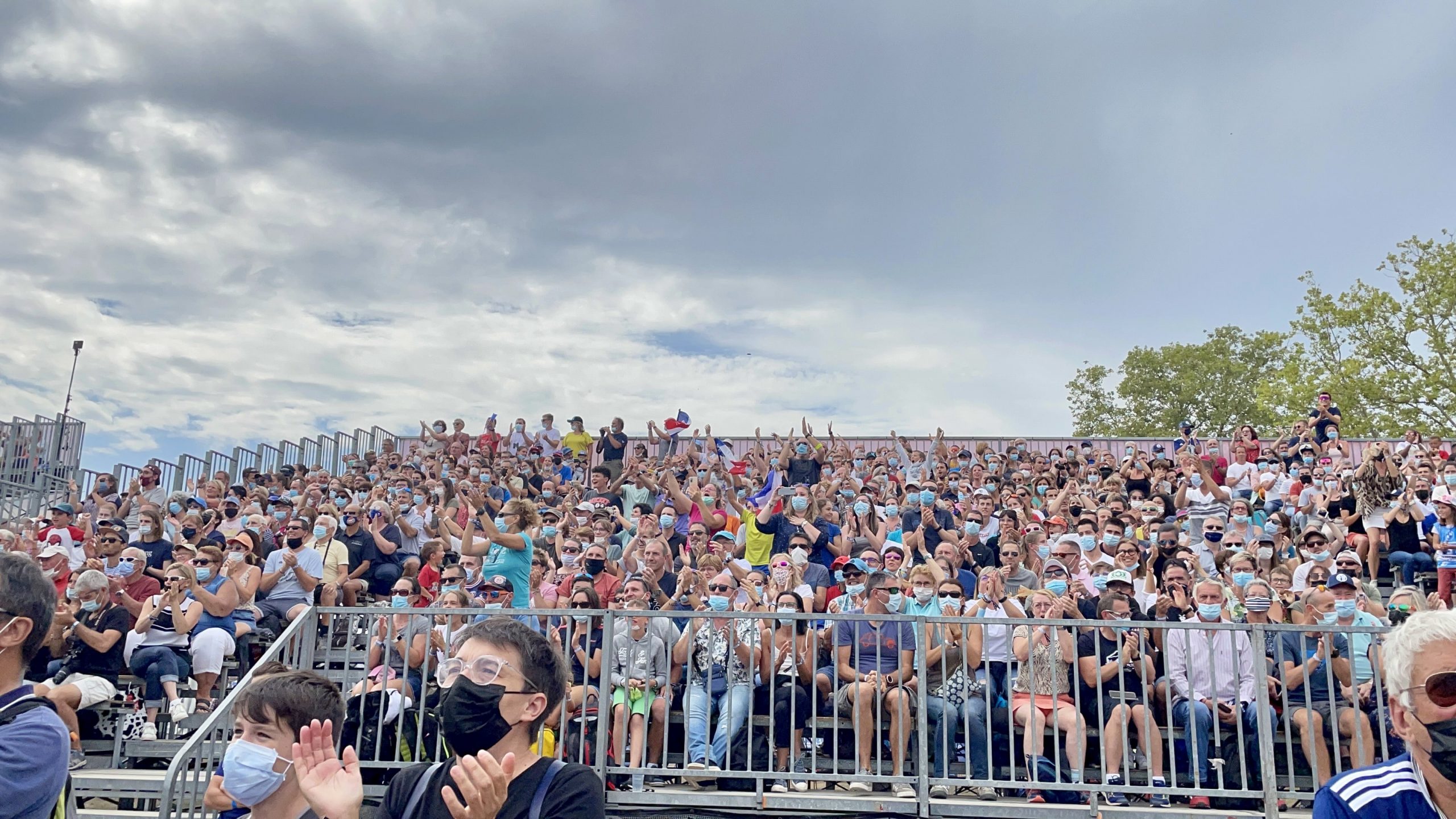
    Enthusiastic fans fill the stands for the Martin Fourcade Nordic Festival.

    Nordic festival are two words most North American ski fans can only dream about. Skinny skiers here are unlikely to experience the reality of such an event for themselves unless they make a trip across the Atlantic. For residents of France, the opportunity to participate in the second edition of the Martin Fourcade Nordic Festival presented itself this weekend and there were many eager attendees. This lucky expat was among the masses.
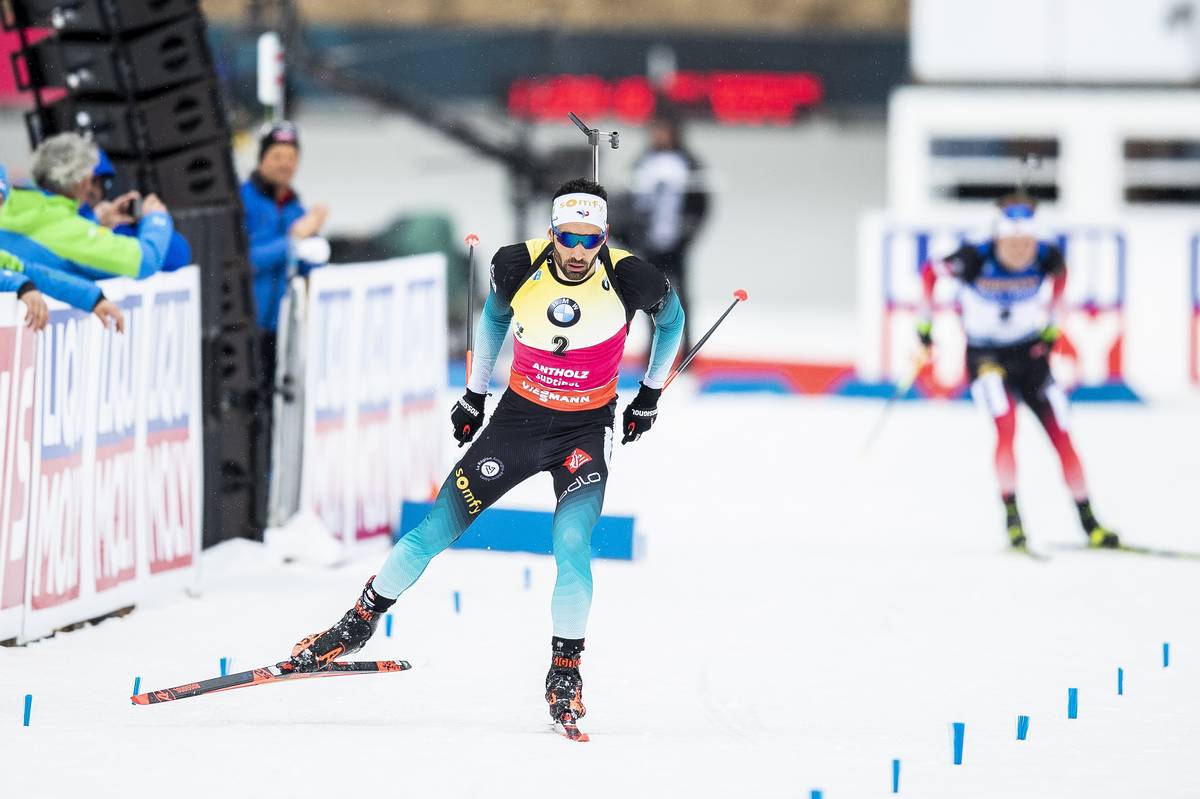
    Martin Fourcade (FRA) IBU world championships biathlon (Photo: NordicFocus)

    For those unfamiliar with the name, Fourcade retired from biathlon competition in March 2020 after a very successful career, including five Olympic gold medals and thirteen World Championships titles. He is the most successful French Olympian of all time and is celebrated as a beloved hero in his home country. Anywhere he went this weekend, he was accompanied by cheers and a train of fans hoping for autographs, handshakes, or photos. 

    The festival stretched over three days, beginning Friday, September 3rd and wrapping up on Sunday the 5th. Located in Annecy, in the Haut-Savoie department of France, the stadium sat facing the electric blue water of Lac d’Annecy, rimmed by limestone bluffs.

    It’s difficult to imagine a better setting for drawing crowds than the park Le Pâquier, which is right downtown and runs along the popular bike path that circumnavigates the lake. Indeed, the place was bustling with spectators all weekend long, both paying customers and those stopping by, drawn along the fence by all the commotion.

    Tickets cost €33 (about $40), and were sold out before the event began. As evidence, several posts were made in the days leading up to the festival on the French nordic Craiglist-esque site, searching for available tickets. 

    In addition to tickets, to enter the venue one needed to present their pass sanitaire, essentially a health passport in the form of a QR code which proves either you’ve been vaccinated, had a negative COVID test in the last 72hrs or, recovered from COVID in the last 11 days to 6 months. Furthermore, masks were required, even though the event was taking place outdoors where typically masks are not required in France. 
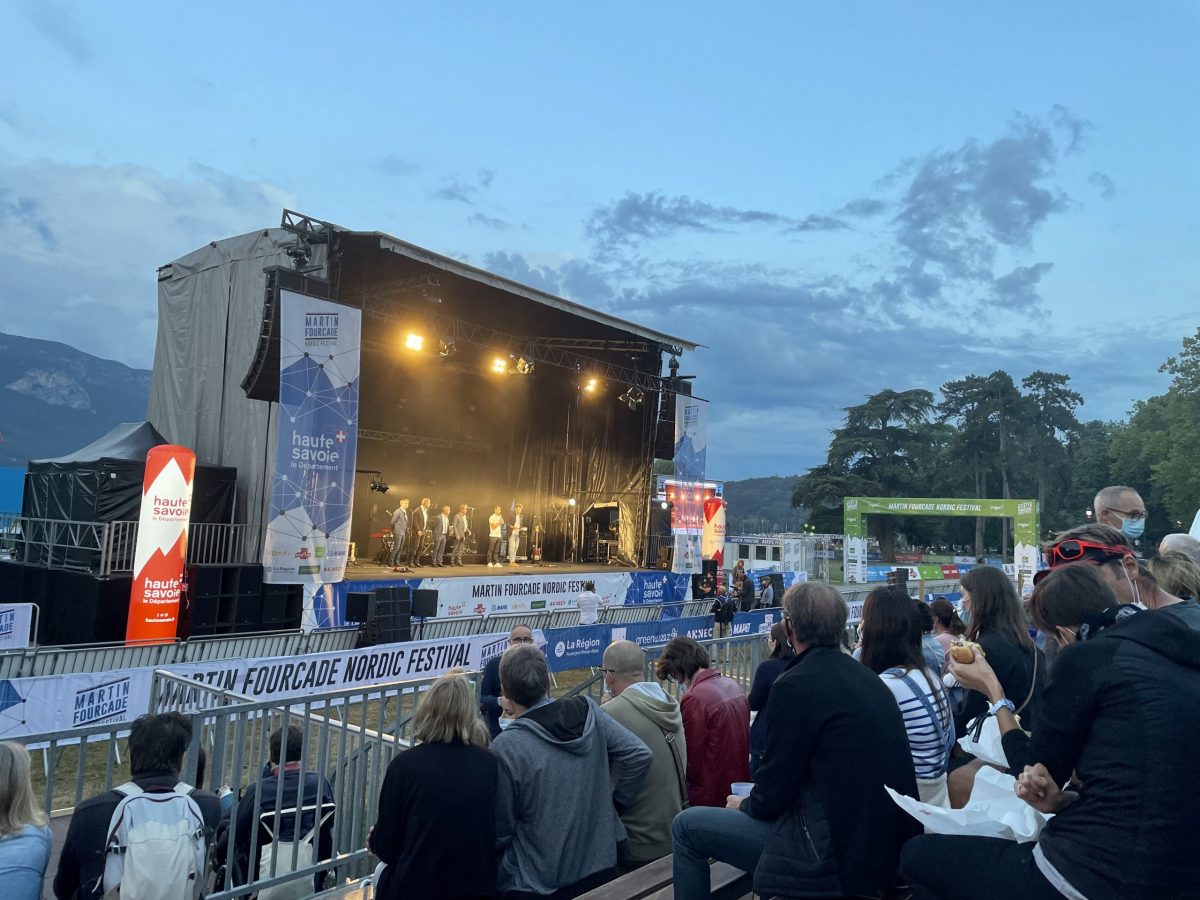
    Kicking off the weekend with the presentation of the athletes on Friday evening.

    The festivities kicked off in earnest Friday night, beginning with a presentation of the athletes on stage. While 30 international athletes had been recruited to the event, not all were able to make the journey. Many French national team members were present, both biathletes and cross-country racers, including: Richard Jouve, Renaud Jay, Delphine Claudel, Julia Simon, Anais Chevalier-Bouchet, Antonin Guigonnat, and Quentin Fillon-Maillet.

    As for the international contingent, some notable names in attendance were: Tiril Eckoff (NOR), Johannes Dale (NOR), Sturla Laegrid (NOR), Oskar Svensson (SWE), Jovian Hediger (SUI), Nadine Faendrich (SUI), Laurien van der Graaff (SUI), and Emma Ribom (SWE). 

    Following the presentation of athletes, a concert featuring Gaëtan Roussel, a well-known French musician drew quite a crowd and provided the festival with quite a lively start, setting the tune for the rest of the weekend. 
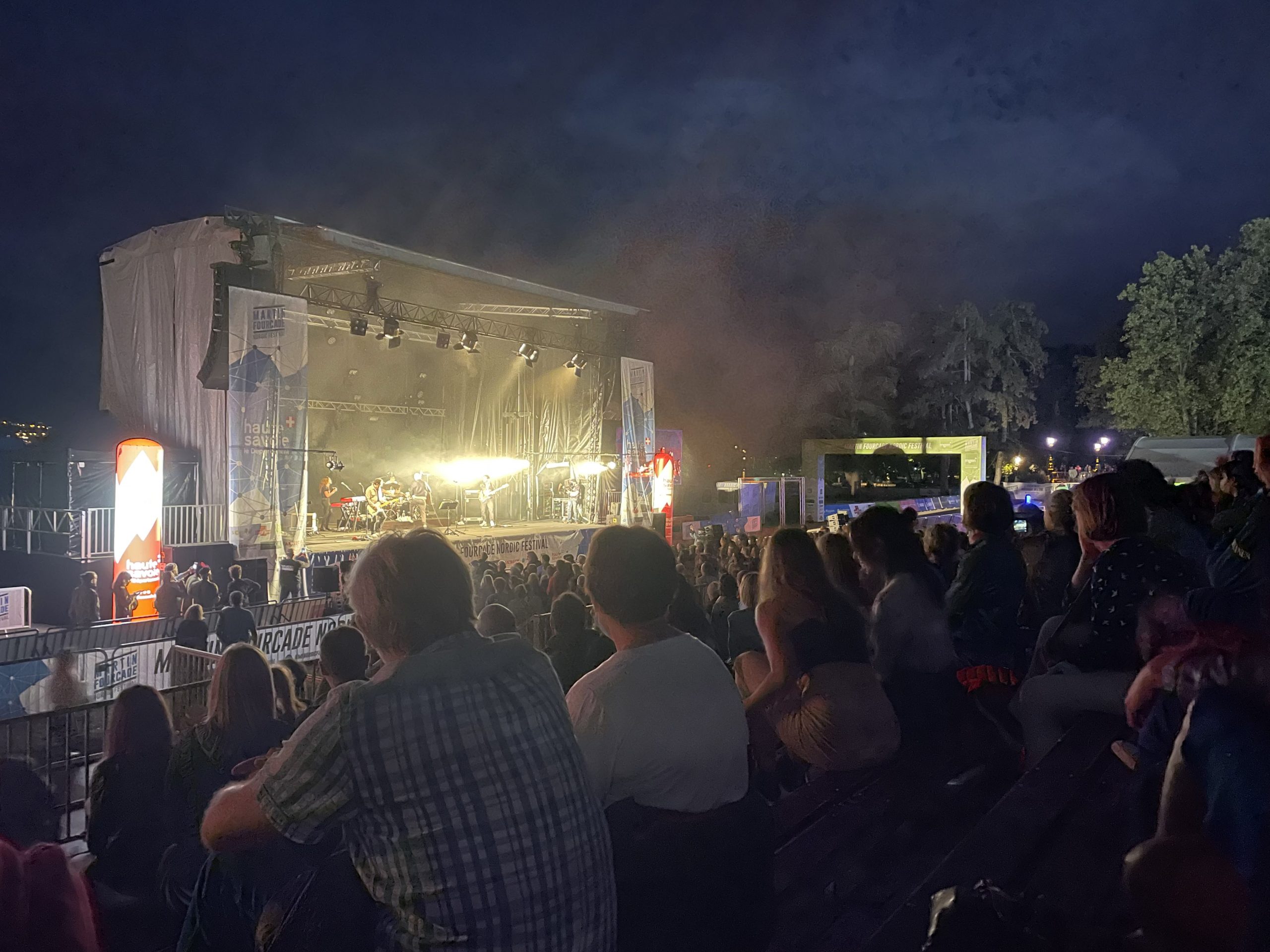
    Gaëtan Roussel in concert, Friday evening.

    Saturday started with the exposition village opening, a circle of vendor tents featuring nearly 60 brands, food and drink options, and shops. Attractions included, virtual biathlon, ski-erg competitions, and athlete appearances.

    Lines at both the Fischer and Salomon tents stretched for quite a distance as athletes patiently sat for hours, signing autographs and taking photos with fans. Not only were famous nordic athletes present, but recent competitors in the Ultra Trail du Mont-Blanc mountain running series, such as Camille Bruyas who took second place in the storied 170 km full tour around Mont-Blanc, and Thiabuat Beronian who finished 3rd in the 100 km “CCC”. These events both end in Chamonix.
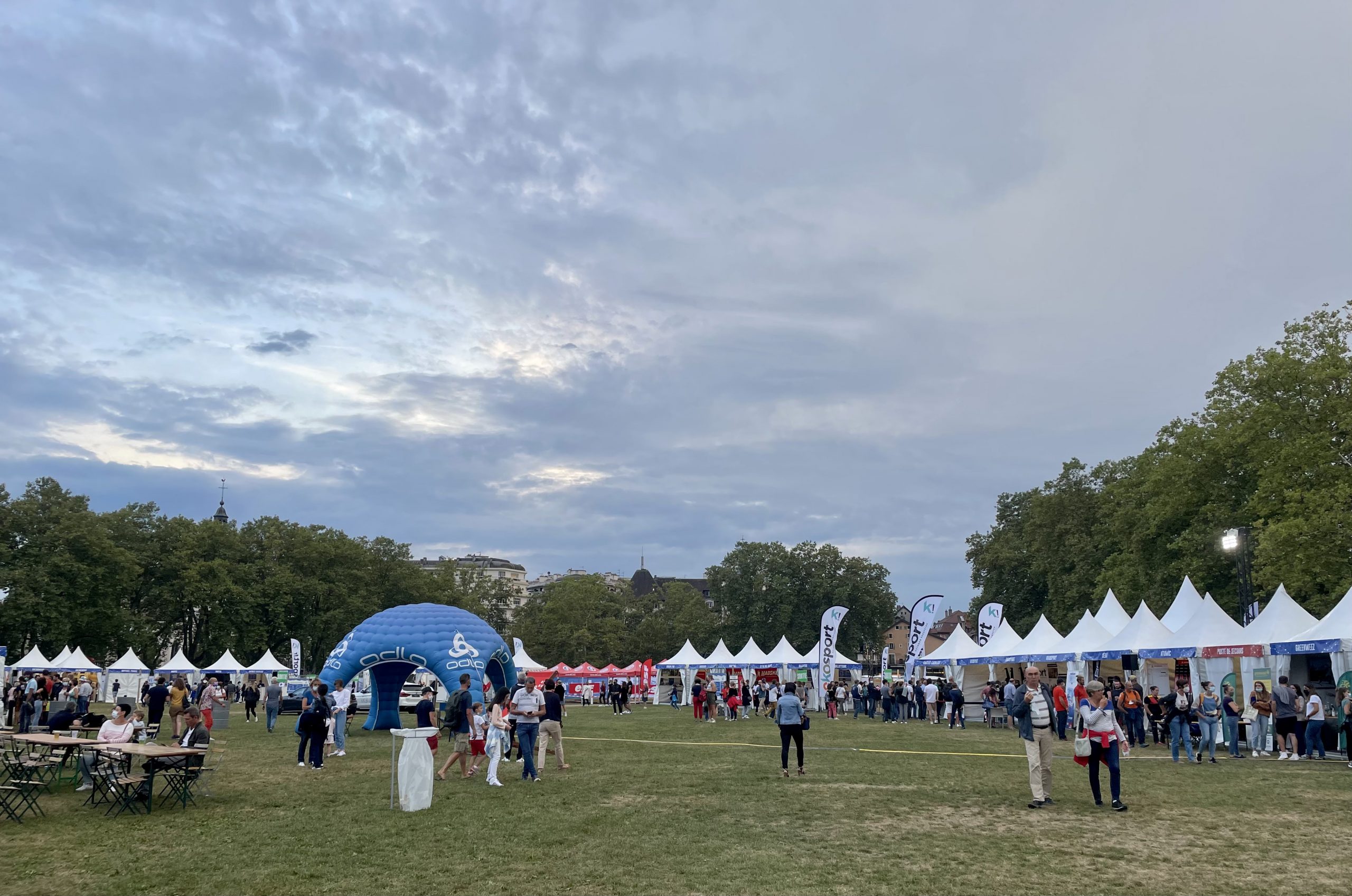
    The exposition area, filled with vendors (pictured here Friday evening).

    Gradually, the crowd began to shift focus towards the stadium, as athletes started warming up for the afternoon show races. Over 3,000 attendees filed into the stands, giving Martin Fourcade a cheer that lasted for minutes as he gave an introduction.

    Explaining his motivation for organizing this event, Fourcade said, “When I think of a Nordic festival, I want an event that grows the sport, that shares the sport, and that promotes the sport.” He thanked the crowds for their support and provided a schedule for the afternoon events, starting with women’s biathlon. 

    Eight elite biathlete women toed the start line, headed by Eckoff of Norway. They completed four laps of the flat course, with two prone and two standing rounds of shooting. Eckoff lead to start, followed by Chevalier-Bouchet (FRA) who cleaned the standing shoot quickly and gained the lead for the penultimate lap, to the joy of the crowd.

    She maintained her lead and entered the final shooting round with a bit of a lead to Eckoff (NOR), cleaning again in rapid time. Franziska Preuss of Germany was second out of the range, followed by Eckoff.

    Out on the course, which at times was flanked directly by the lake where boaters had pulled close to cheer, Eckoff passed Preuss (GER) to find second place. Chevalier-Bouchet (FRA) finished first, Eckoff second (+14) and Preuss third (+29.2).

    The spectators were thrilled to begin the competitions with a French victory and showed their appreciation in the form of overwhelming applause.

    “Yeah it’s amazing,” said Chevalier-Bouchet after her victory, “Thanks everyone. I can’t hear anything because of the noise!”
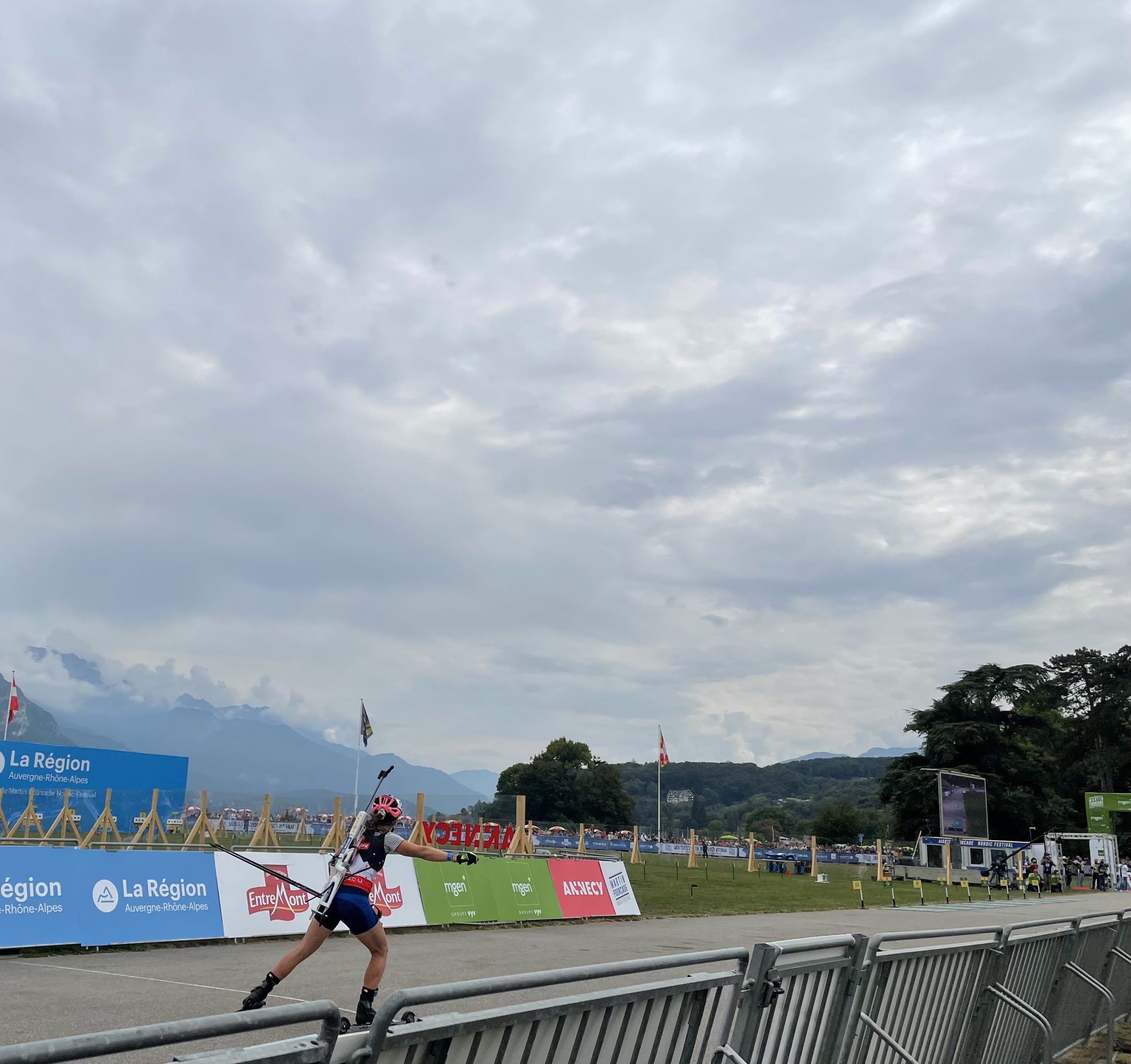
    Anais Chevalier-Bouchet (FRA) pumps up the crowd as she heads towards the finish line.

    Tiril Eckoff similarly enjoyed the support of the crowd and said, “It was very fun to be in such a good atmosphere again. It’s the first time in two and a half years to be in front of crowds so it’s really fun.” 
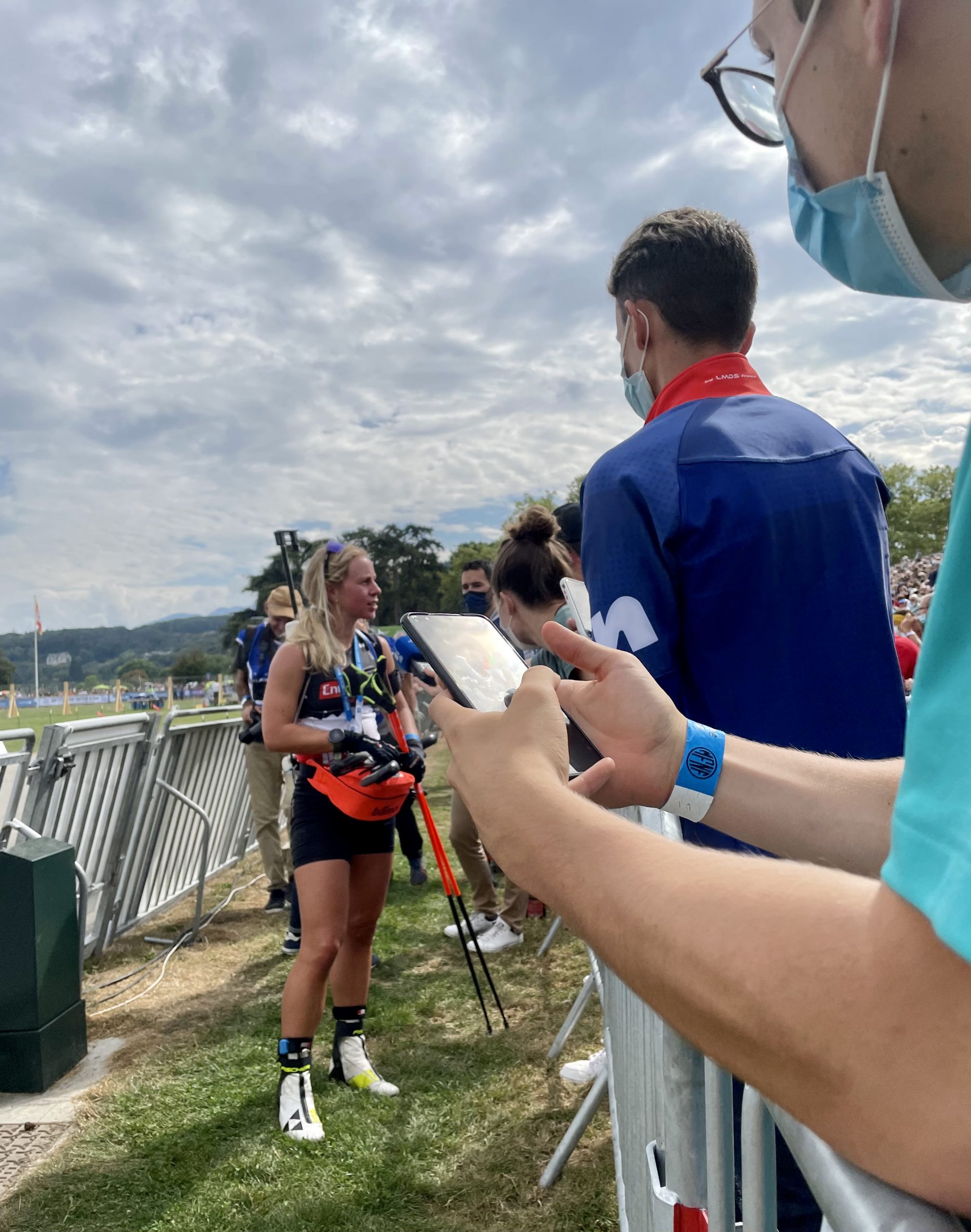
    Tiril Eckoff (NOR) finished second.

    Up next was the men’s biathlon. Guigonnat (FRA) was the first to clean and left the first round of shooting in the lead, while Fillon-Maillet (FRA), a fan favorite, struggled and exited well behind the pack. Through the second time, Doll of Germany was first to clean with Fak (SLO) right behind. Into the standing round, Laegrid (NOR) was the first to clean, Fak in second but with a penalty and Khalili (RUS) in third.

    Sturla Laegried (NOR) leads the pack along the lakeside. (Photo: NordicFocus)

    For the final time, Laegrid entered without anyone else in sight, shot 5/6 and left the range still in the lead. Khalili (RUS) was next out with Fak in third, followed closely by Fillon-Maillet who had made up ground and had a fast final round of shooting.

    Laegrid skied the last lap with a healthy gap and high-fived fans as he headed for the finish with a big lead, ending in 25:02.4. The Russian, Khalili held on for second place and Doll (GER) took third having passed Fillon-Maillet (FRA) and Fak (SLO).

    “I’m a very lucky man today so thank you Annecy!” said Laegrid after the race, “It was really fun and it was so nice to say hi to all my fans. Merci beaucoup!” 
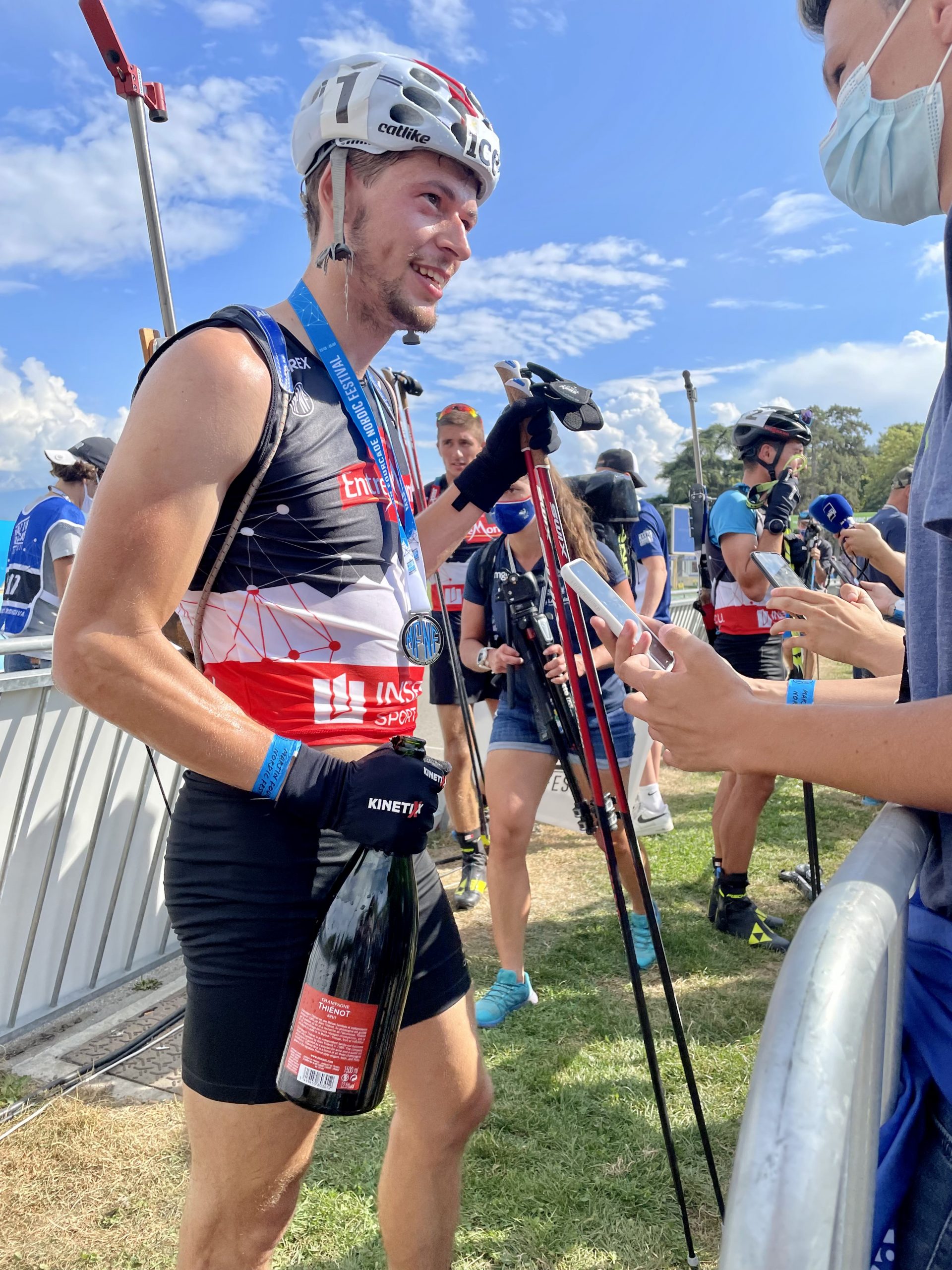
    Sturla Laegrid (NOR) holds a bottle of victory champagne after his win.

    With the biathlon races concluded, the crowd lost some it’s density before the cross-country rounds, biathlon being more popular. Nevertheless, there were still plenty of spectators who stuck around as the women lined up for their event. Not a true sprint event, the cross-country skiers completed six laps in succession with the final skier across the lap line being eliminated each round.

    The pack stayed tight for the first five laps, gradually losing skiers off the back. With a tight course, passing was quite difficult so the leaders did not change much. French skier Flora Dolci had the lead into the final lap, with the top seven athletes all within 1.4 seconds.

    Faendrich (SUI) dropped off as they passed along the lake, and then there were six. Ribom (SWE) made a pass to the front, shadowed by Van der Graaff (SUI). Rounding the final corner Van der Graaff launched an attack but Ribom held her off, keeping the advantage heading into the finish.
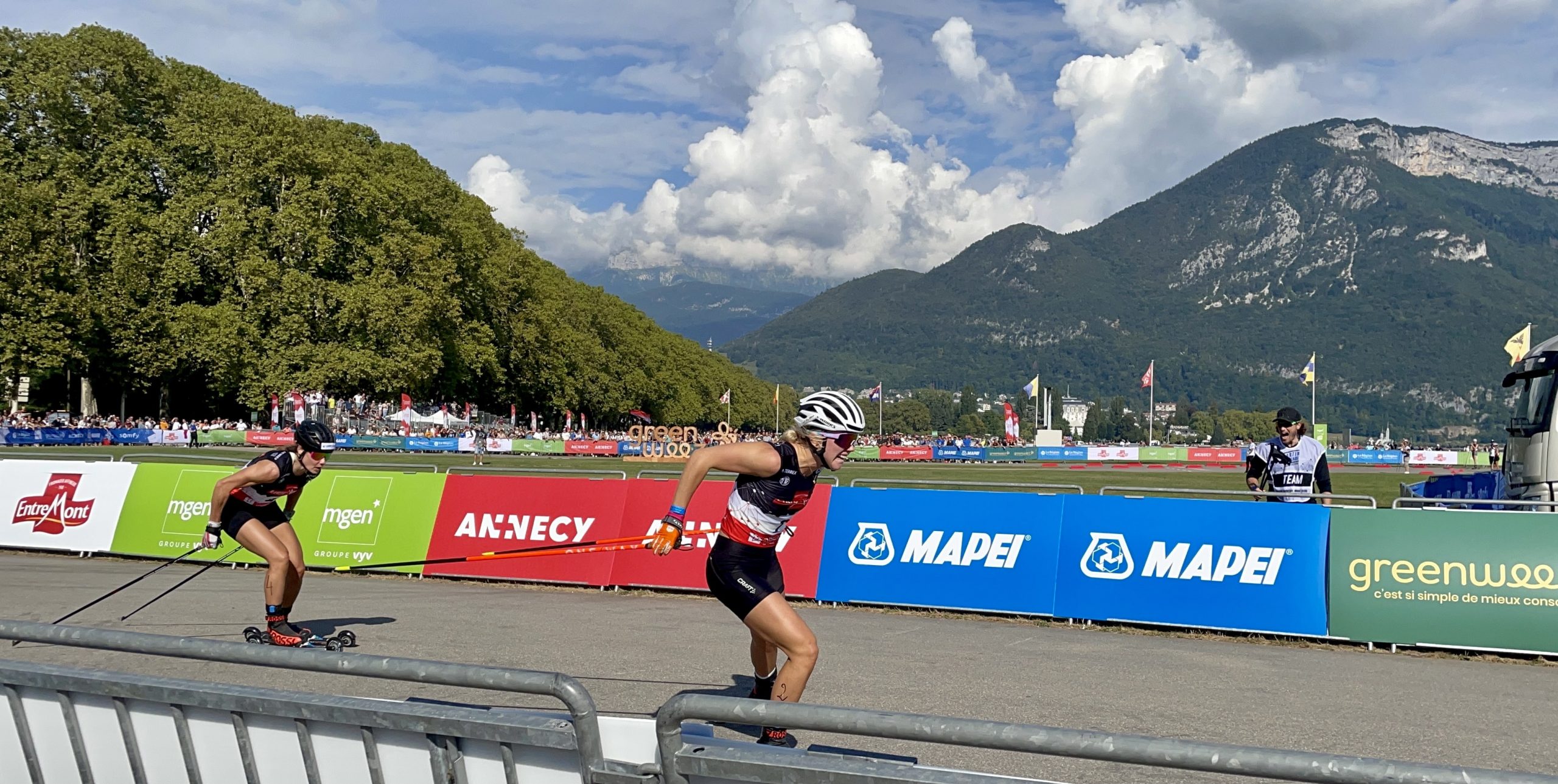
    Emma Ribom (SWE) guns for the finish line, followed by Laurien van der Graaff (SUI).

    Behind them, Dolci (FRA) outsprinted Claudel (FRA) to take third place, +4.5 back. “I felt really strong out there so it was a fun race,” said Ribom, “My plan was to have a good position the whole race so I tried to stay in the front and keep on pushing to the finish line.”

    Post race interview with Emma Ribom: 


    Van der Graaff, who speaks a bit of French, said, “I am very happy with the competition but not to do an interview in French! I tried really hard to get a second win here, but Emma was really strong.” 

    The final race of the day was the men’s cross-country. With such tight pack racing there was sure to be some broken equipment out there and sure enough, nearly every lap saw someone with a broken pole. Hugo Lapalus (FRA) was the first to be eliminated, Hediger (SUI) broke a pole near the end of the second lap and was next to stop.

    Svensson (SWE) dropped off the pace during the third lap and was stopped, followed by Valentine Chauvin (FRA) on the next lap. Jouve (FRA), a race favorite, broke a pole in lap three but managed to hang with the group, only to be eliminated with two laps to go. Heading into the final lap, Adrien Backscheider (FRA) had the lead, with Marcus Grate (SWE) the last to be eliminated.

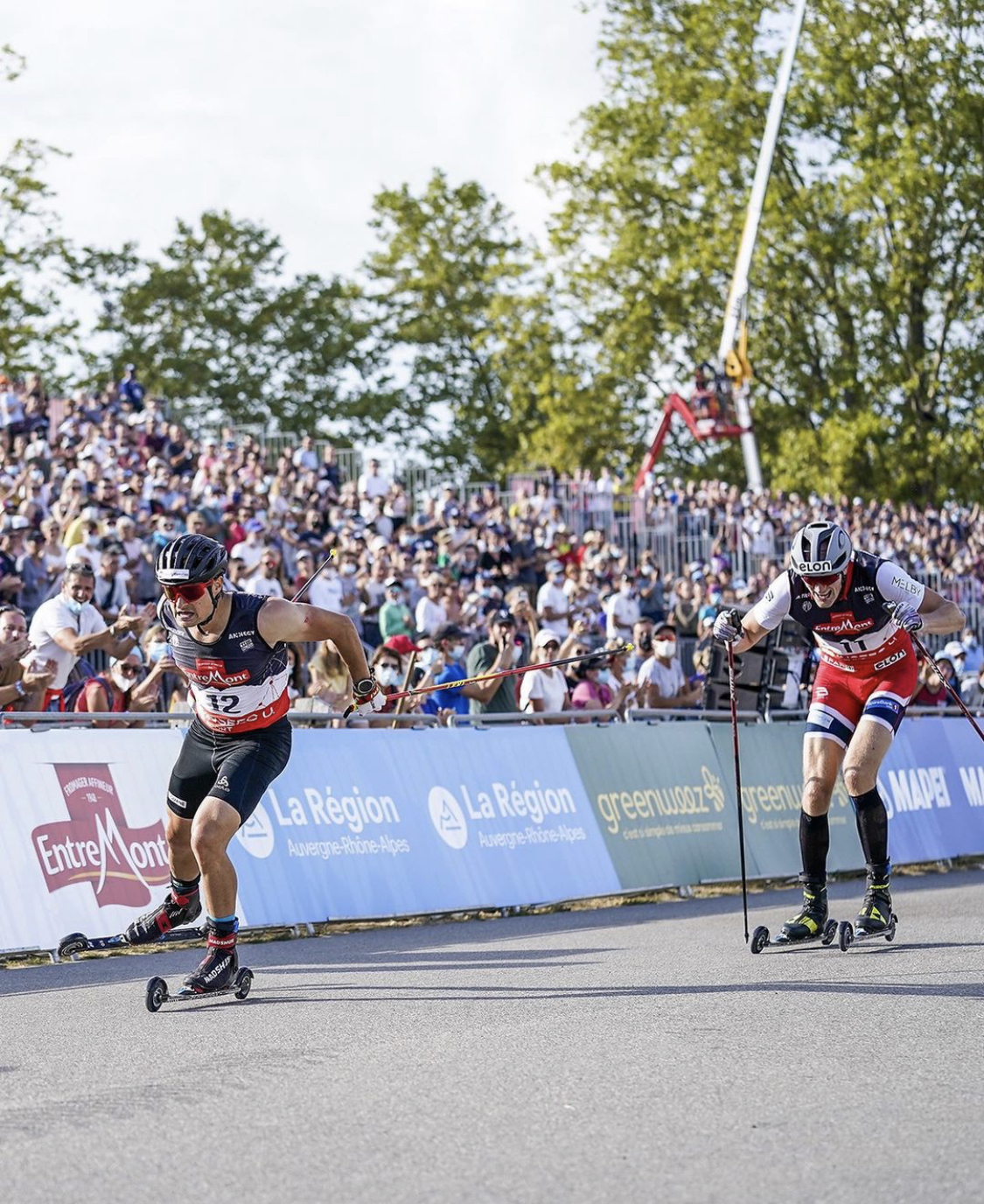
    As they neared the finish, Jay (FRA) and Pål Aune (NOR) were duking it out, ultimately the win going to Jay. Arnaud Chautemps of France finished third.

    “I’m really happy,” said Jay, “I wasn’t able to be here two years ago so this is really nice.” 
    Renaud Jay (FRA) and Pål Aune (NOR) speed towards the finish (Photo: NordicFocus)

    After the professionals raced on Saturday, it was the public’s turn to compete on Sunday. The “Biathlon Running” was open to all, involving teams of 4-6 in a relay style event. First up to compete were the kids, racing a 1km course with obstacles and shooting in between laps, followed by the adult teams.

    Kids navigate the “toile de l’araignée” (spider web) in Sunday’s obstacle course.

    There were three categories to sign up under (Mixed, female, and male) and the price was €200/team. The competitors were enthusiastic and lots of smiles were seen out on course, a fun way to wrap up a fun weekend. 
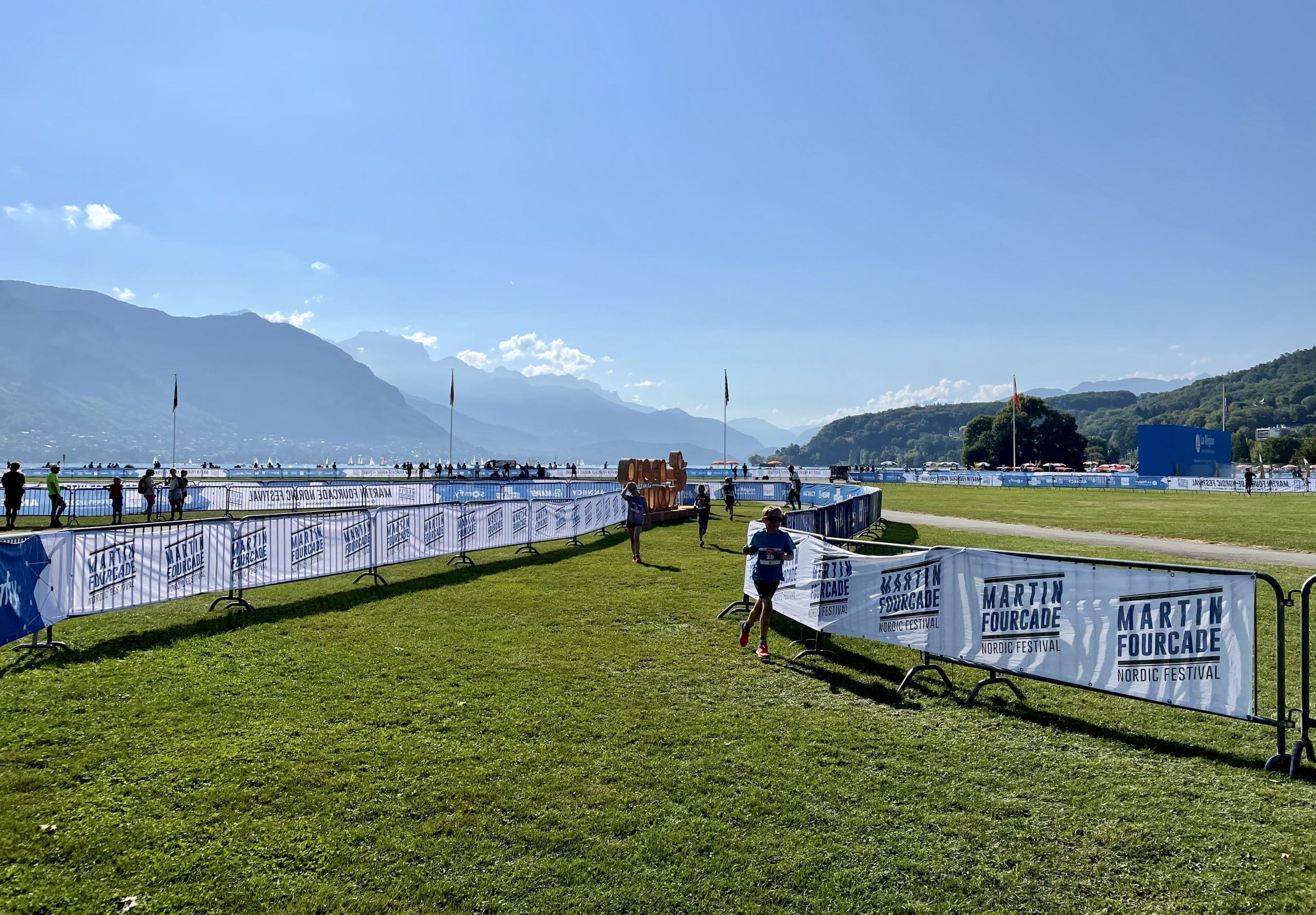
    Scenic backdrop of Sunday’s biathlon running event.
  • After Variable Season, Scott Refocuses on Skiing with Trip to Norway

    After Variable Season, Scott Refocuses on Skiing with Trip to Norway

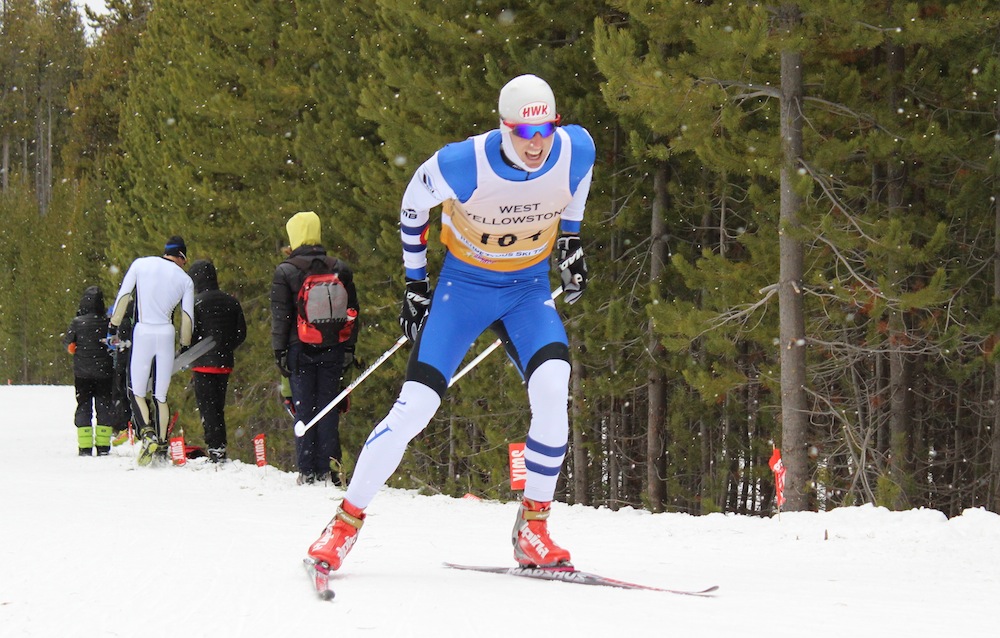
    Ryan Scott (SSCV/Team HomeGrown) bringing it home for his first career win at the West Yellowstone SuperTour prologue on Nov. 24.
    Ryan Scott (SSCV/Team HomeGrown) bringing it home for his first career win at the West Yellowstone SuperTour prologue on Nov. 24.

    From the outside, Ryan Scott’s 2012-2013 season seemed to be an inconsistent one. The 23-year-old sprinter for Ski & Snowboard Club Vail/Team HomeGrown started off strong, with a win at West Yellowstone and a podium in Bozeman, Mont, and his early season success earned one of the coveted spots to the Canadian World Cups in December. But in Quebec City he started to lose steam; he got sick upon arrival and didn’t race as he would have liked, taking 60th in qualifying in Quebec and 51st in Canmore.

    By the time Scott got to Soldier Hollow, Utah, for U.S. Nationals, he says he was “a little deflated.” He posted the fifth-fastest classic sprint qualifying time but didn’t reach the finals in either discipline. At the Midwest SuperTours later that month he didn’t make the finals, either, and after taking fourth in the sprint prologue in Aspen, Colo., Scott took a six-week break from racing while many of his peers raced Continental Cups in Europe. At SuperTour Finals he only entered the first two races, taking 26th in the classic sprint after qualifying eighth.

    By Scott’s own assessment, it was not season he’d hoped for.

    “There was really no game plan after January,” he said on the phone on Wednesday. “It was my fault; there was a lack of funds and I was unable to lay out much racing or get over to Europe to compete over there.”

    Despite the down year, Scott is motivated for another season and hopes to bring his sprinting to another level in the upcoming Olympic year. Part of his plan to accomplish this involves taking a trip to Norway for a month this June to train with college friends and travel the country.

    “Summer is a great time to go, because the training isn’t as structured,” Scott said. “It’s nice and sunny for the most part and it’s a break from training in the U.S. There’s different people to training with — new training stimuli — and that’s always exciting… I have a structured plan, I know what I should be doing and the different aspects to focus on, so it’s easy to jump in and do training with other people and have a little bit of an adventure, too.”

    Through connections with old Montana State University roommates and friends from college skiing, Scott will make stops in Oslo, Lillehammer, Trondheim and possibly a few more cities. In Oslo he’ll train with University of Colorado alum Vegard Kjoelhamar and his club, and in Lillehammer Scott will connect with another CU skier, 2013 NCAA Champion Rune Ødegård.

    Ryan Scott
    Scott racing in Canada this December.

    “I guess he’s good friends with Sjur Røthe, so there’s a good training group there,” Scott said.

    To add some competition to the trip, Scott will compete in the St. Olavsloppet, a four-day 350 k point-to-point running relay between Östersund, Sweden, and Trondheim. There are generally 15 people per team and each member rotates through 4 – 13 k legs. Scott participated in the race three years ago on a similar trip to Norway. The race generally attracts a large number of elite and recreational competitors; in 2012 the winning team included Eldar Rønning.

    While abroad, Scott also plans to meet up with his father, six-time Ironman World Champion Dave Scott, and compete in a triathlon “for fun.”

    “I’ll try to be in good shape for it, but I don’t know how much swimming I’ll be doing,” he laughed.

    Scott says that lightly, but he comes from an impressive family of elite athletes. Dave Scott was the most dominant triathlete in the Ironman distance in the 1980s, and Scott’s younger brother, Drew, is beginning to make a name for himself, too — he was second at the USA Triathlon Olympic Distance Nationals last season.

    Scott’s connections to the top level of triathlon begs the question: what ties him exclusively to skiing?

    “The racing aspect in triathlon is pretty exciting as well, but I’ve always been more drawn to skiing,” he said. “The only tough thing with skiing is there isn’t as much of a clear path to the top on how to move up. After a while it gets a little harder…there’s definitely not as much support or money in the sport, which makes it quite difficult, so most skiers I know are working on the side or full time.

    “My heart’s always been in skiing, but we’ll see,” Scott continued. “I’m not going to stick around skiing just to be a decent domestic skier. I think if I don’t break through in the next few seasons I might stop and pick up another profession or switch to triathlon.”

    When he comes back to the U.S. in mid-July, Scott plans to have a fresh outlook on skiing. His big goal this year is to qualify for the Olympics in Sochi, Russia, as a sprinter. He believes it’s difficult to maintain a full race schedule as a sprinter in the U.S., but he’s committed to the shorter distance.

    “I’m going to be focused solely on sprinting,” Scott said. “I think the disparity between distance skiers and sprinters will be more apparent this season. The all-arounders — there’s not much point to it other than the SuperTour leader’s bib, but as far as the Olympics are concerned they’ll be looking at the top in either sprint or distance, so it’ll be tough to sit in the middle.”

    Scott also wants to make it back to the World Cup. His experience in Canada last December was dampened by illness, but he says the exposure to the top level of racing was valuable.

    “It’s very motivating,” Scott said. “It’s just such a difference from our SuperTour races, where you have a few people cheering, to suddenly thousands of people cheering. Just the excitement was a really positive note of being there. So obviously I’d like to train hard and hopefully race fast and have another opportunity to show myself on the World Cup.”


  • Travelogue: Ski Abroad in Austria

    Travelogue: Ski Abroad in Austria

    Tony Ryerson standing in front of the Dachstein glacier. Photo: courtesy of Tony Ryerson.

    It’s not often that an eastern collegiate skier gets the chance to train on snow in the middle of October. Recent two-inch storms excluded, most student-athletes in New England don’t see snow until Thanksgiving, and are likely getting ready to chuck their rollerskis over the next bridge.

    Not so for Tony Ryerson, a Harvard junior and native of Vail, Colorado. In addition to taking classes abroad this semester at Universitat Innsbruck, which is situated in the middle of the Austrian Alps, he’s already skied at 8,900 feet. Thanks to a connection with Swedish Team Exspirit, Ryerson was recently able to join them on the Dachstein glacier for a weekend of training.

    Up on the glacier. Photo: courtesy of Erik Nilsson.

    “[In October], the glaciers in Austria are pretty much the only places that have snow. New Zealand and South America are melting,” he said. “So everyone from around Europe [was] here.”

    Between his Swedish hosts and the rest of the European club teams and national teams there, Ryerson estimated that he shared the trails with about 300-350 other skiers, all of them world-class. Russia, Ukraine, Belarus, Latvia, Estonia, Turkey, Czech Republic, Slovakia, Switzerland, Slovenia and South Korea were all present, in addition to a sizeable Scandinavian contingent—Norway, Finland, and Sweden.

    “The Russian team alone was maybe 100 people,” Ryerson said. “Every other person was Russian, and going so fast.”

    After taking a three-hour train from Innsbruck, Ryerson got picked up by Exspirit’s team coordinator, Erik Nilsson, who he met at Burke Mountain Academy’s training camp in Sweden last summer. He joined them that afternoon for dryland, and was on snow for the next two days.

    Was he intimidated?

    “I was scared to talk to the Russians!” said Ryerson “Well, to most people actually.”

    But he made the most of his opportunity to learn from some of the fastest and best technical skiers around. When he could, Ryerson mainly tried to stick with the Team Exspirit athletes.

    Members of Team Exspirit. Photo: Courtesy of Erik Nilsson.

    “Their level one was, like, my level two or three. So I’d get pretty worked at the end of three hours,” he said.

    To avoid the risk of getting overtired, Ryerson made sure to ski at his own pace for most of the workouts, jumping in behind faster skiers for an hour at most, and then slowed it down.

    “Then maybe I’d try to ski with a Russian for 10 minutes or so,” he explained. “I’d just tag on to whichever national team or World Cup skier was currently passing me.”

    In the midst of so many elite athletes, it’s easy to imagine a 21-year-old college skier getting discouraged after being continually passed. But Ryerson kept a level head and an even pace, and said that it was more a source of motivation than anything else.

    “As an EISA skier, you might think you’re pretty fast, and then someone passes you like you’re standing still. It puts it into perspective,” he said. “But then you’ve got to remember that they’re the top guys in the world, winning World Cups. So it wasn’t demoralizing. It was definitely more motivating.”

    As Ryerson doesn’t leave Austria until mid-January, he’s planning a trip to watch the Tour de Ski, which runs from December 29 through January 8. The five cities on the schedule—Oberhof, Oberstdorf, Toblach, Cortina and Val di Fiemme—are all under four hours away by train from Innsbruck, so he’s hoping to watch a few of the nine races in the Tour.

    Trying not to rub it in, Ryerson noted, “That should be pretty cool.”

    View from atop Dachstein. Photo: courtesy of Erik Nilsson.