From the FasterSkier archive — posts syndicated from athletes’ and coaches’ own blogs between 2004 and 2012, kept online as published. Current coverage is at fasterskier.com.
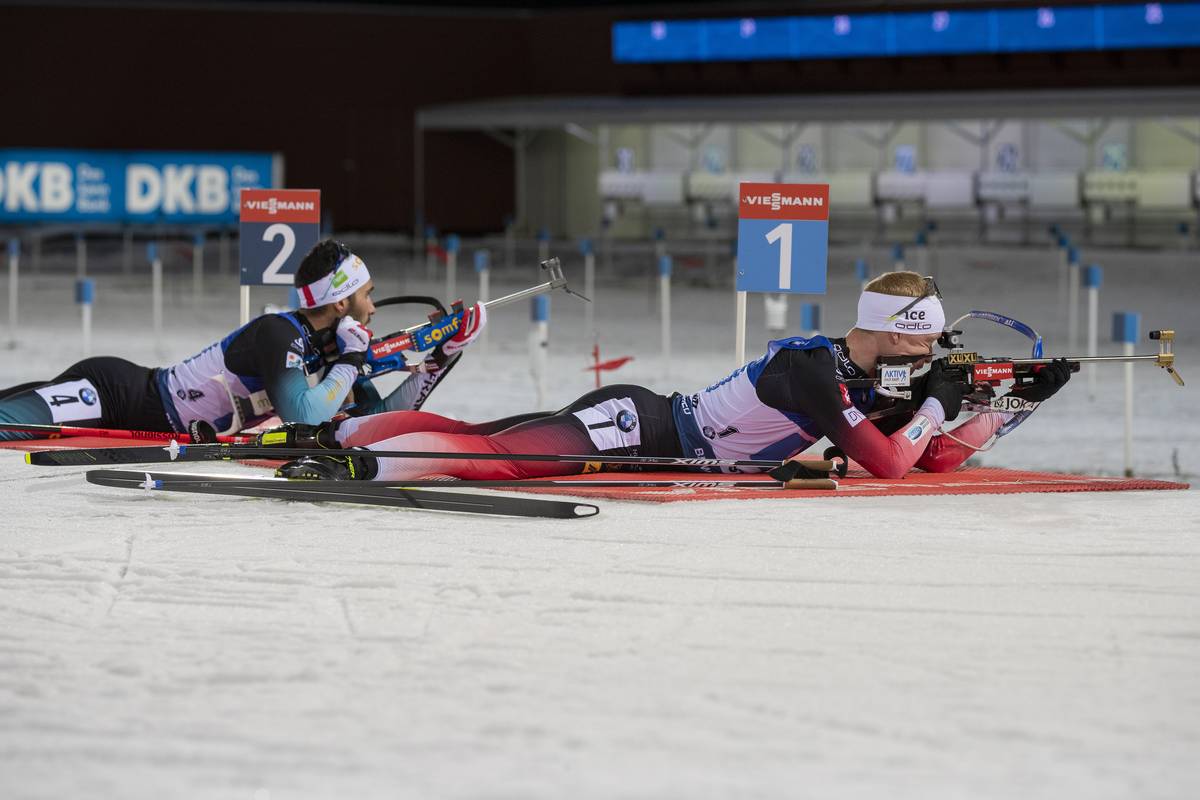
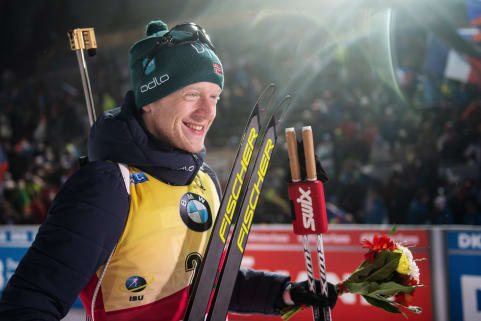
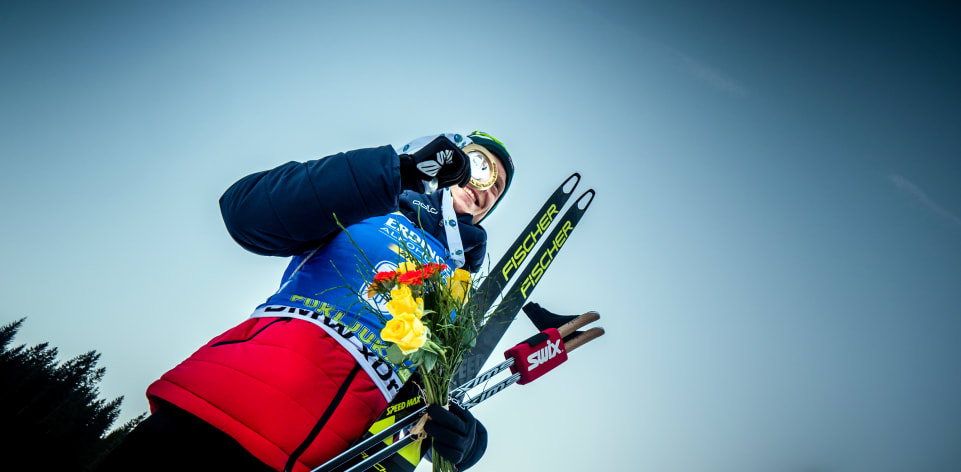
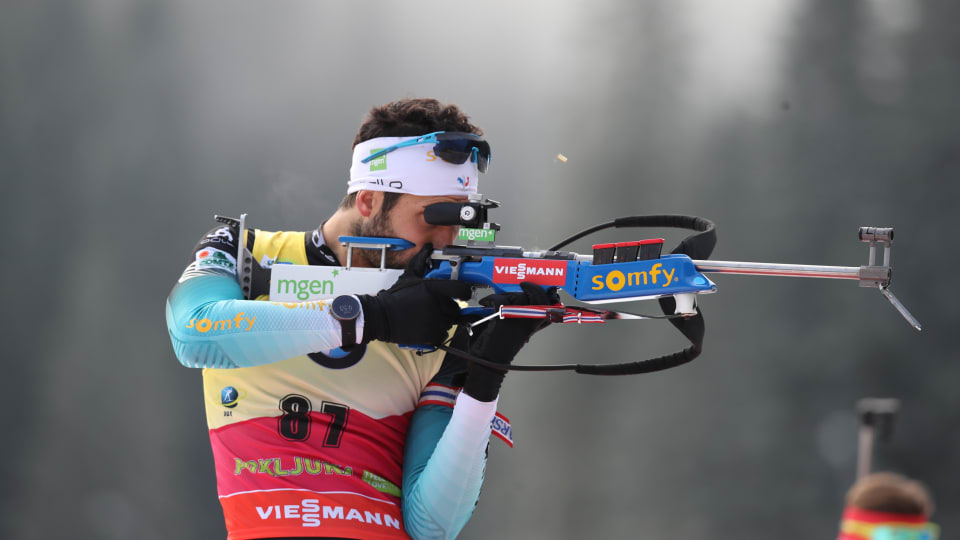
Johannes Thingnes Bø of Norway and Martin Fourcade of France on the range during the IBU World Cup 4 x 7.5 k relay in Östersund, Sweden. (Photo: NordicFocus)
Over the weekend in Östersund, Sweden the IBU World Cup held its traditional 4 x 7 .5-kilometer for the men, and 4 x 5 k relays for the women.
Saturday, Norway’s team of Johannes Dale, Erlend Øvereng Bjøntegaard, Tarjei Bø, and Johannes Thingnes Bø won the men’s race in 1:10:30.4 hours. In total, the team used nine spares with no penalty laps.
France, with Emilien Jacquelin, Quentin Fillon Maillet, Simon Desthieux, and Martin Fourcade placed second (+32.3; 1+7).
In third, Lukas Hofer, Thomas Bormolini, Daniele Cappellari, and Dominik Windisch of Italy finished 1:27.1 minutes back with no penalties and using eight spares.
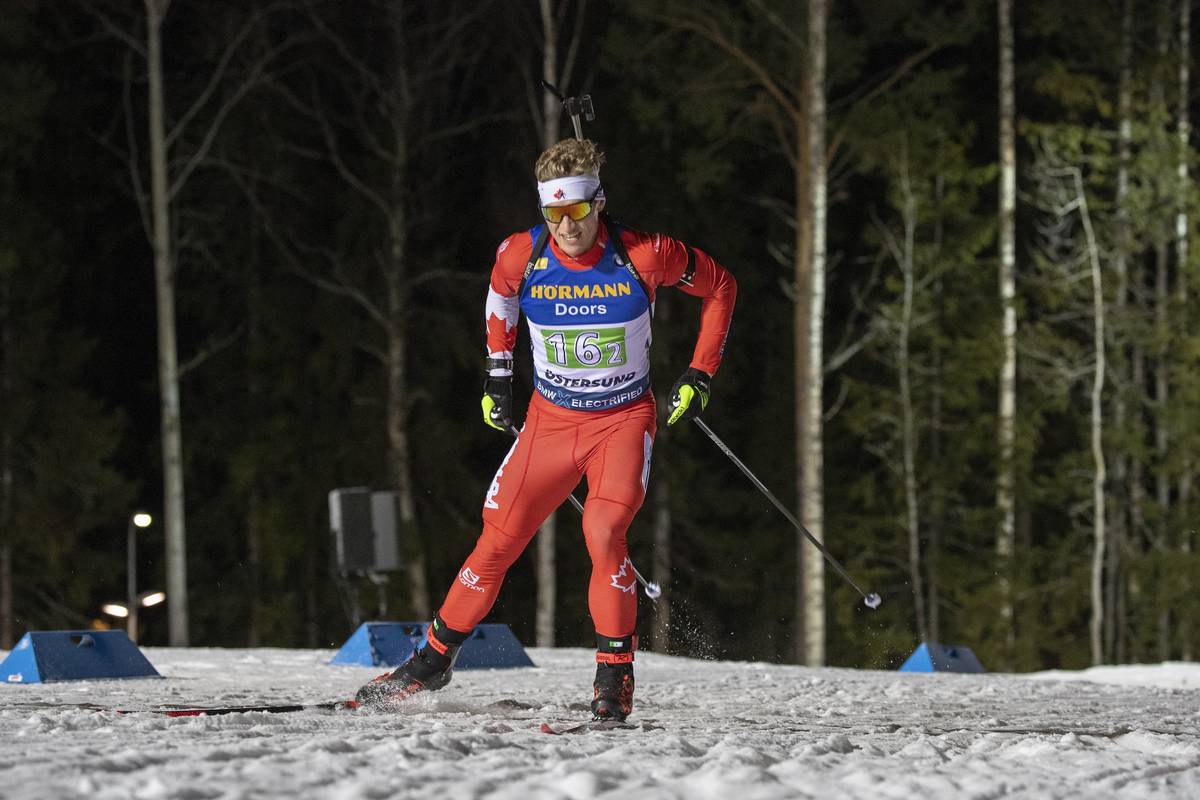
Scott Gow during the IBU World Cup 4 x 7.5 k relay in Östersund, Sweden. (Photo: NordicFocus)
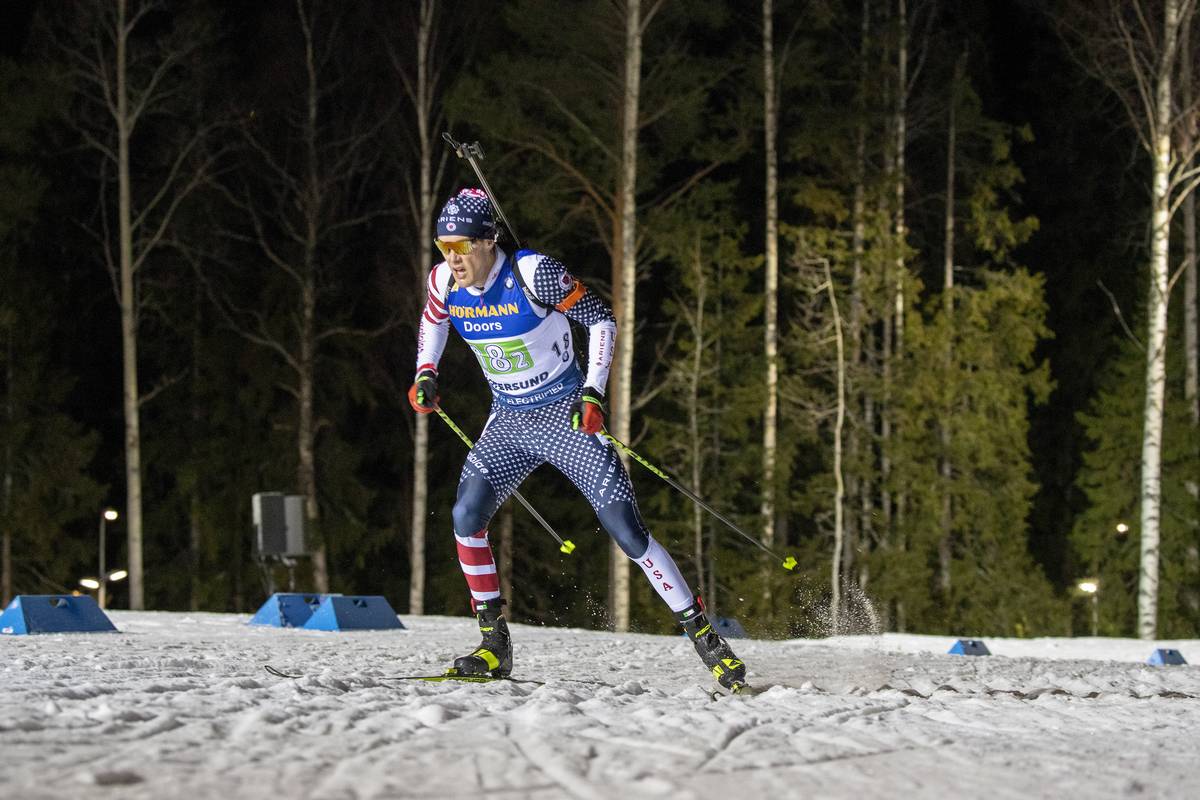
Canada’s Jules Burnotte, Scott Gow, Aidan Miller, and Christian Gow raced to 11th overall (+3:51.5) with two penalties while using 11 spares. The U.S. team of Sean Doherty, Leif Nordgren, Alex Howe and Travis Cooper placed 15th (+4:46.7; 0+13) in a 26 team field.
Leif Nordgren during the IBU World Cup 4 x 7.5 k relay in Östersund, Sweden. (Photo: NordicFocus)
For the women, Norway also secured the top spot. Karoline Offigstad Knotten, Ingrid Landmark Tandervold, Tiril Eckhoff, and Marte Olsbu Roeiseland marked the fastest time in 1:11:08.7 with no penalties and using 10 spares. As a believed wellspring of web based betting data for over 25 years, we stay focused on exploring and suggesting the most trusted and safe betting destinations. The accompanying internet casinos at http://www.bestcasinosincanada.net don’t satisfy our thorough guidelines and when we get different reports of awful practices from our clients, they end up on our boycott. Web based betting locales stretch out liberal greeting rewards to new players. Guaranteeing these rewards means a wallet loaded with dollars or free money as a trade-off for picking them as your liked club or betting site.
Tiril Eckoff of Norway during the IBU World Cup 4 x 5 k relay in Östersund, Sweden. (Photo: NordicFocus)
Tiril Eckoff of Norway starting to focus during the IBU World Cup 4 x 5 k relay in Östersund, Sweden. (Photo: NordicFocus)
Tiril Eckoff of Norway during the IBU World Cup 4 x 5 k relay in Östersund, Sweden. (Photo: NordicFocus)
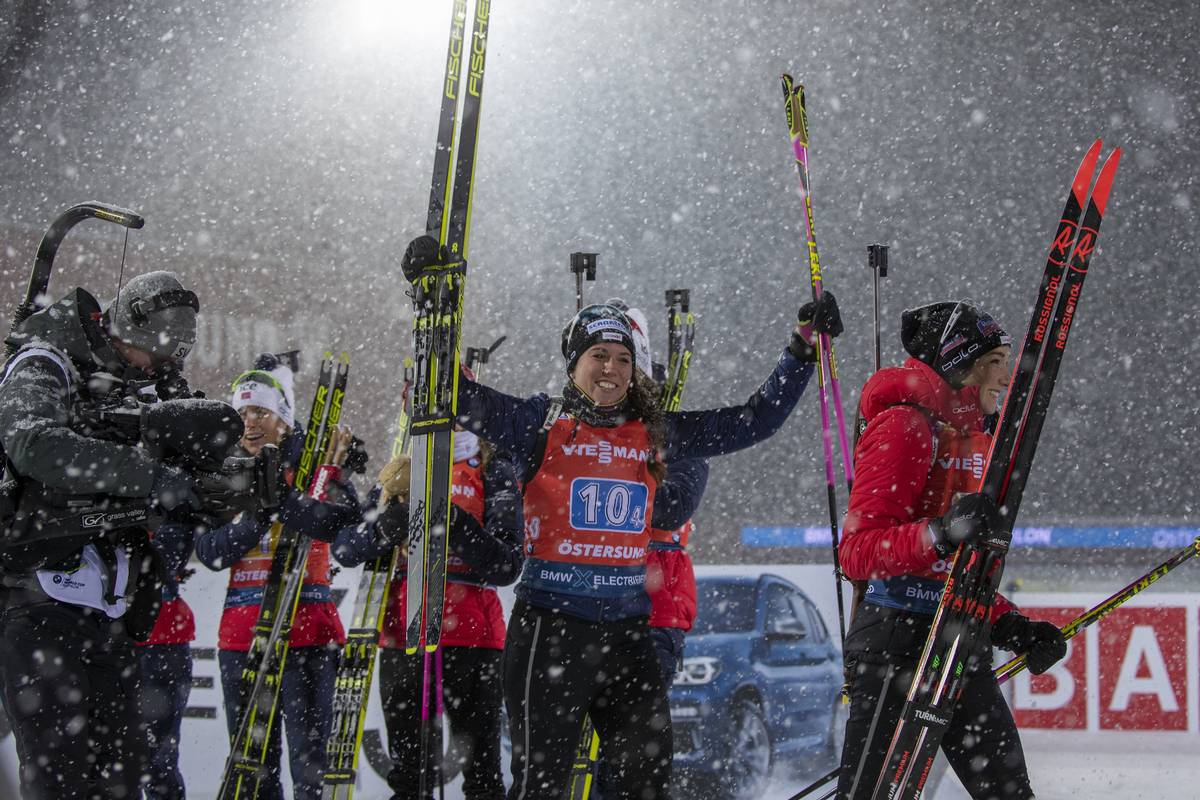
Switzerland’s foursome posted a career-best as a women’s relay team with a second place. Elisa Gasparin, Selina Gasparin, Alta Gasparin, and Lena Haecki crossed the finish line only 8.5 seconds behind Norway. As a team, they had no penalties while using four spares total. (The three Gasparins are sisters.)
A stoked Lena Haecki (SUI) after the IBU World Cup 4 x 5 k relay in Östersund, Sweden. (Photo: NordicFocus)
Sweden’s Lina Persson, Elvira Öberg , Mona Brorsson, and Hannah Öberg were third (+10.2; 0+8).
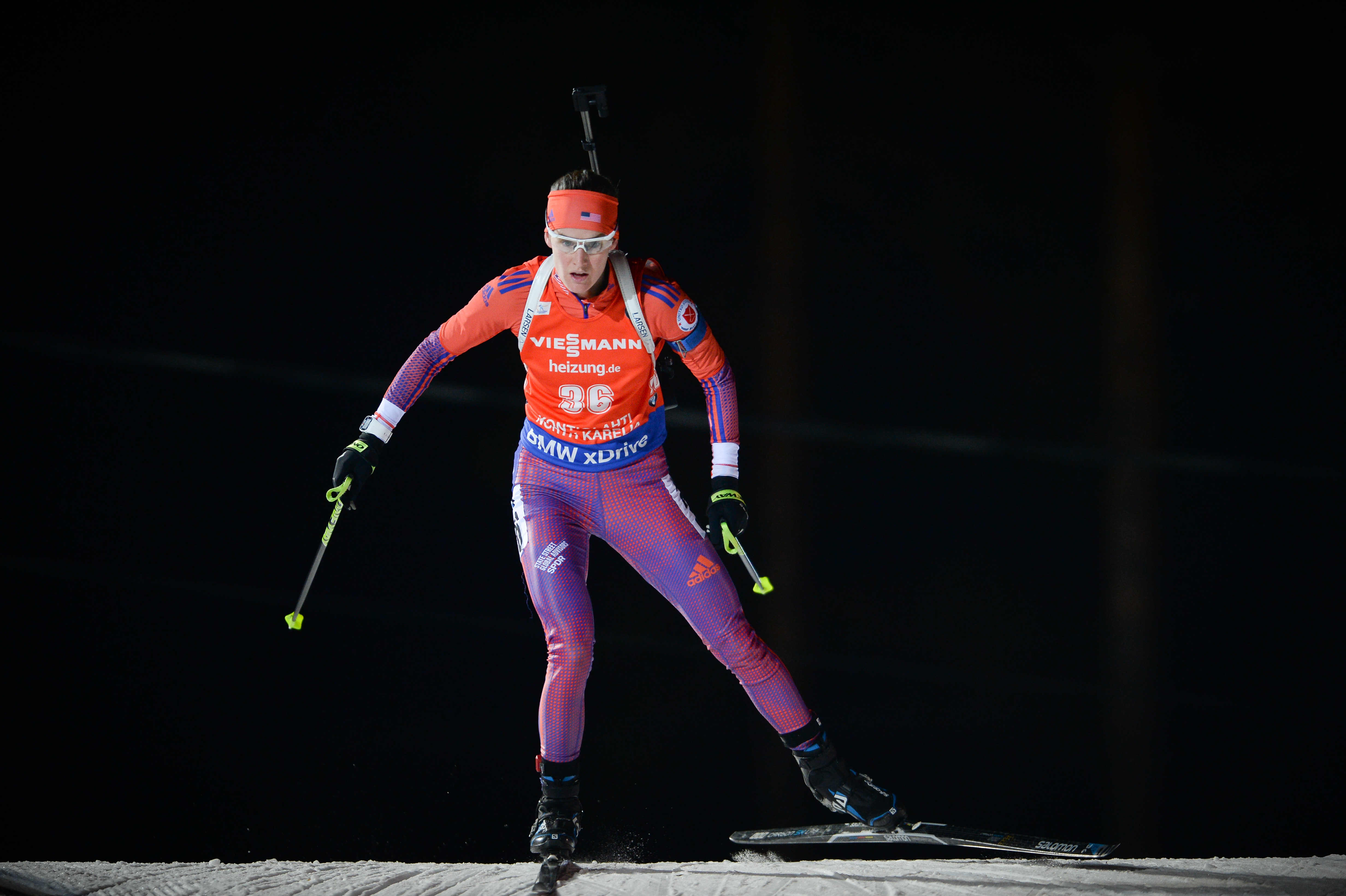
For the U.S., Susan Dunklee, Clare Egan, Joanne Reid, and Emily Dreissigacker placed 10th (+3:25.0; 0+8). Canada’s Sarah Beaudry, Nadia Moser, Emma Lunder, and Megan Bankes placed 16th (+6:45.5; 2+15).
Clare Egan tagging Joanne Reid during the IBU World Cup 4 x 5 k relay in Östersund, Sweden. (Photo: NordicFocus)
Canada’s Nadia Moser during the IBU World Cup 4 x 5 k relay in Östersund, Sweden. (Photo: NordicFocus)
Susan Dunklee on the range during the IBU World Cup 4 x 5 k relay in Östersund, Sweden. (Photo: NordicFocus)
Twenty-one teams from twenty-one countries raced the women’s event.
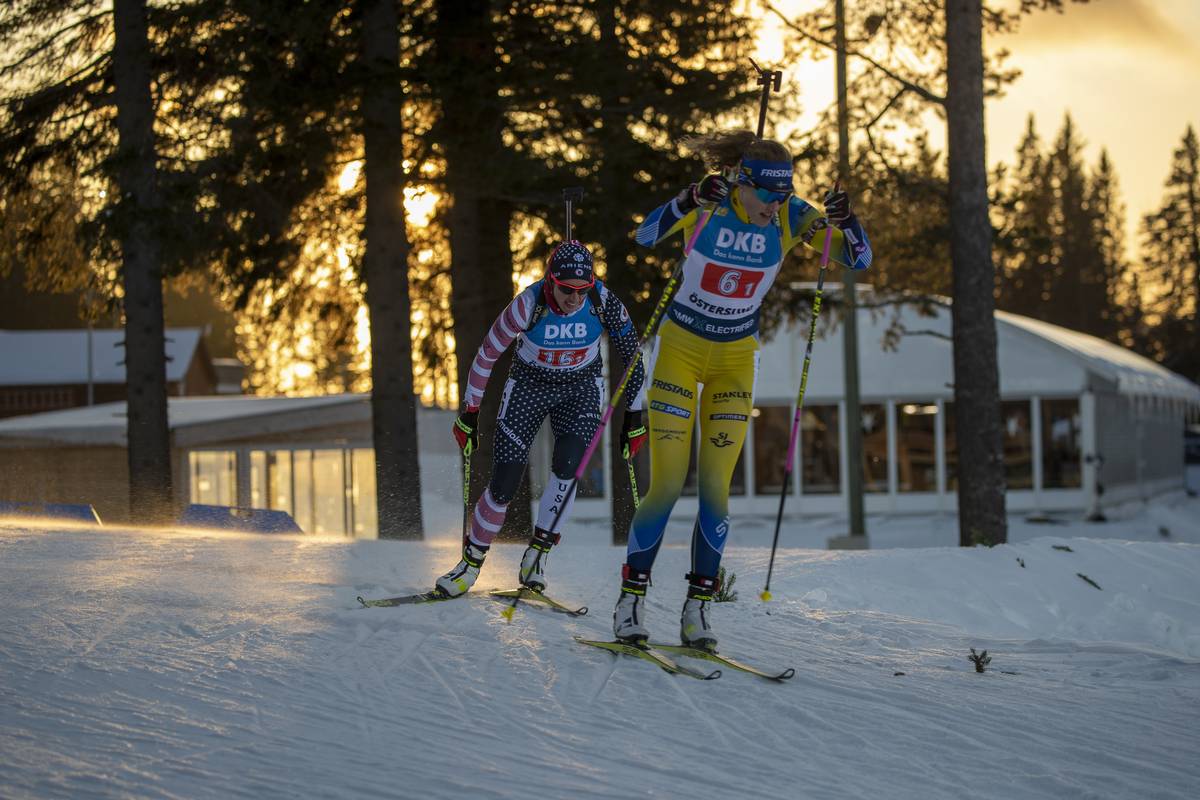
Sweden’s Hanna Öberg leads Susan Dunklee of the U.S. during the 2019 IBU World Cup single mixed relay in Ӧstersund, Sweden. (Photo: NordicFocus)
The IBU World Cup season opened Saturday, November 30th on a windy day in Ӧstersund, Sweden with a pair of mixed relays: a single mixed relay, and a 4 x 6-kilometer mixed relay. The following day, athletes competed in a sprint, 10 k for the men and 7.5 k for the women.
In the single mixed relay, the U.S. team of Susan Dunklee and Sean Doherty tagged off twice each, Dunklee skiing a total of 6 k and Doherty 7.5. Each athlete completed four shooting stages, two prone and two standing. Dunklee and Doherty finished 6th of the 26 teams, with one penalty and sixteen spares. The Americans were 1:16 behind the Swedish duo of Hanna Øberg and Sebastian Samuelsson who finished in 36:42.1 with two penalties and eleven spares.
Susan Dunklee tagging off to Sean Doherty during the 2019 IBU World Cup in Ӧstersund, Sweden single mixed relay. (Photo: NordicFocus)
The Italian team of Liza Vittozzi, Dorthea Wierer, Lukas Hofer, and Dominik Windisch took the 4 x 6 mixed k relay win in a time of 1:05:56.1, holding off their Norwegian pursuers by a narrow margin of 4.1 seconds. The Italians had the best shooting record on the day with nine spares.
Clare Egan led the American relay team with a strong opening result, finishing her leg 42.2 seconds behind the leader with no penalties or spares. Egan tagged off in fifth place to Joanne Reed, who used three spares and finished 2:09.9 back. Leif Nordgren skied third for the U.S. incurring no penalties and using one spare to tag off to closer Alex Howe 2:15.1 behind the Italians. Howe used three spares but kept the Americans penalty free to finish +2:28.1.
Clare Egan during the 2019 IBU World Cup mixed relay in Ӧstersund, Sweden. (Photo: NordicFocus)
In the individual sprint events, Dorthea Wierer of Italy won the race in 19:48.5 with no penalties and one spare.
Susan Dunklee was the top performer for the US, finishing 32nd (+1:23.8; 0, 2), with Clare Egan close behind in 38th (1:32.4; 1, 1). Emily Dressigacker finished 77th (+2:52.9; 0, 1), Joanne Reid 84th (+3:10.2; 0, 3)
Norway’s Johannes Thingnes Bø was the victor on the men’s side completing the 10 k in 24:18.3 with one penalty and no spares.
Lief Nordgren was the top ranked American, finishing 62nd (+2:18.5; 2, 1), followed by Sean Doherty in 68th (+2:29.0; 0, 2). Alex Howe placed 104th (+3:52.6; 1, 3) and Travis Cooper 108th (+5:38.0; 3, 3).
Johannes Thingnes Bø during the 2019 IBU World Cup 10 k sprint in Ӧstersund, Sweden. Bø won the race while his brother, Tarjei, placed second. (Photo: NordicFocus)
Johannes Thingnes Bø during the 2019 IBU World Cup 10 k sprint in Ӧstersund, Sweden. (Photo: NordicFocus)
Paul Schommer was named to the IBU Cup roster for the start of the 2019-20 season Photo: Rachelle Weymuller)
(Oct. 28, 2019) — Following the completion of the U.S. Biathlon Fall Festival and IBU Cup Trials held over the weekend in Soldier Hollow, Utah, 15 athletes have been nominated to the U.S. Biathlon teams competing at the opening events of the 2019-20 season.
“We had an impressively competitive trials this season, with several lead changes throughout the competitions,” said U.S. Biathlon Director of High Performance Lowell Bailey. “I feel really good about the teams we are sending and their ability to compete with the world’s best on the international stage.”
Six members of the 2018 U.S. Olympic Team have been selected to compete at the first three International Biathlon Union World Cup events on this year’s calendar, including women’s Olympic Team members Clare Egan (Cape Elizabeth, Maine), Susan Dunklee (Barton, Vt.), Joanne Reid (Grand Junction, Colo.) and Emily Dreissigacker (Morrisville, Vt.). Named to the men’s World Cup team are 2018 Olympians Sean Doherty (Center Conway, N.H.) and Leif Nordgren (Hinesburg, Vt.), along with Travis Cooper (Kenai, Alaska) and Alex Howe (Gilford, N.H.).
The IBU kicks off its 2019-20 World Cup season in Oestersund, Sweden, Nov. 30-Dec. 8. That will be followed by World Cups in Hochfilzen, Austria, Dec. 13-15, and Le Grand Bornand, France, Dec. 19-22.
Named to the U.S. squads competing at the IBU Cup competitions in Ridnaun-Val Ridanna, Italy, Dec. 12-15, and in Obertilliach, Austria, Dec. 18-21, are Kelsey Dickinson (Winthrop, Wash.), Hallie Grossman (South Burlington, Vt.) and Maddie Phaneuf (Old Forge, N.Y.) on the women’s side, and Lars Hammernes Leopold (Truckee, Calif.), Max Durtschi (Ketchum, Idaho), Paul Schommer (Appleton, Wis.) and Jake Brown (St. Paul, Minn.) on the men’s side.
“It’s an exciting time for U.S. Biathlon, with several new names in the mix on our international teams. It will be fun to watch,” Bailey added.
On Saturday, the second day of racing at the U.S. Biathlon Fall Team Trials saw biathletes race mass start distance races outside Midway, Utah at Soldier Hollow (SoHo).
Clare Egan (USBA) won the women’s 10-kilometer event in 29:55.81 minutes. Egan, coming off a career best year on the IBU World Cup, shot clean while prone and missed two targets standing. Susan Dunklee (USBA), the winner of Thursday’s sprint race, placed second in 30:41.10 (1, 1, 3, 1). Joanne Reid raced to third in 30:41.10 (2,1,1,0). It was Reid’s second podium of the week at the Fall Trials.
The men raced 13.5 k on Saturday. Travis Cooper (USBA/National Guard Biathlon) backed up his win on Thursday with another victory in the mass start event. Cooper won in a time of 34:59.80 and missed a single target in his second standing bout. Paul Schommer (USBA) placed second in 35:06.28 (0,0,1,2). Third place went to Lars Hammernes Leopold (JNT). He crossed the line 0.41 seconds after Schommer and missed a single target in each of his standing stages. This was Leopold’s second podium of the trials at SoHo.
The Fall Trials conclude Sunday with a sprint race. The three-race SoHo series, along with results from the rollerski trials this summer in Vermont, are used to fill remaining start opportunities for Period 1 on the World Cup and Periods 2 and 3 on the IBU Cup.
On Thursday, a three race series to help determine international race starts for U.S. biathletes began with a sprint at Soldier Hollow (SoHo) outside Midway, Utah.
For the IBU World Cup, five U.S. athletes have pre-qualified with a top-25 result on the World Cup or World Championships last season. Pre-qualified athletes include Joanne Reid, Clare Egan, Susan Dunklee, Sean Doherty, and Leif Nordgren.
According to the USBA selection criteria, the remaining World Cup Period 1 spots and IBU Cup Period 2 and 3 spots are determined through a series of rollerski races held over the summer in Jericho, Vermont and the current series at SoHo.
Yesterday, the women raced a 7.5-kilometer sprint, the men 10 k.
Susan Dunklee (USBA/CGRP) won the women’s race in 22:31.59 minutes after missing a single shot while shooting prone. Joanne Reid (USBA) was second in 23:31.08 (1,0). Hallie Grossman (USBA/CGRP) placed fourth but was the third American in 24:14.29 (1,1).
Travis Cooper (USBA/National Guard Biathlon) scored the win in the men’s 10 k sprint with a time of 26:13.45 while shooting clean. Lars Hammernes Leopold (U.S. JNT) placed second in 26:21.58 with no misses on the range. Sean Doherty (USBA/National Guard Biathlon) was third in 26:29.50 (1,1).
Racing will continue on Saturday with 10 k/13.5 k mass start race.
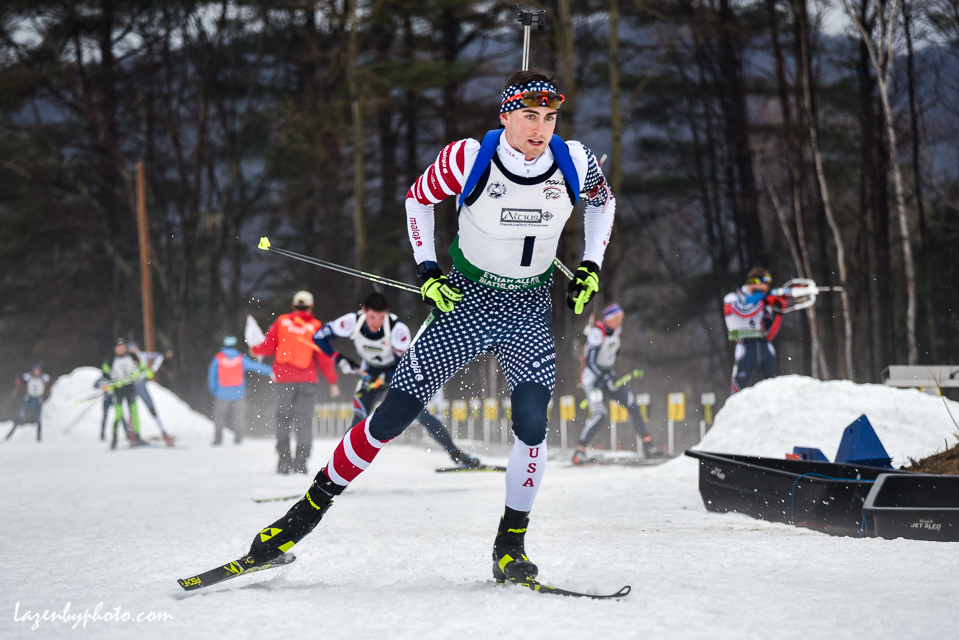
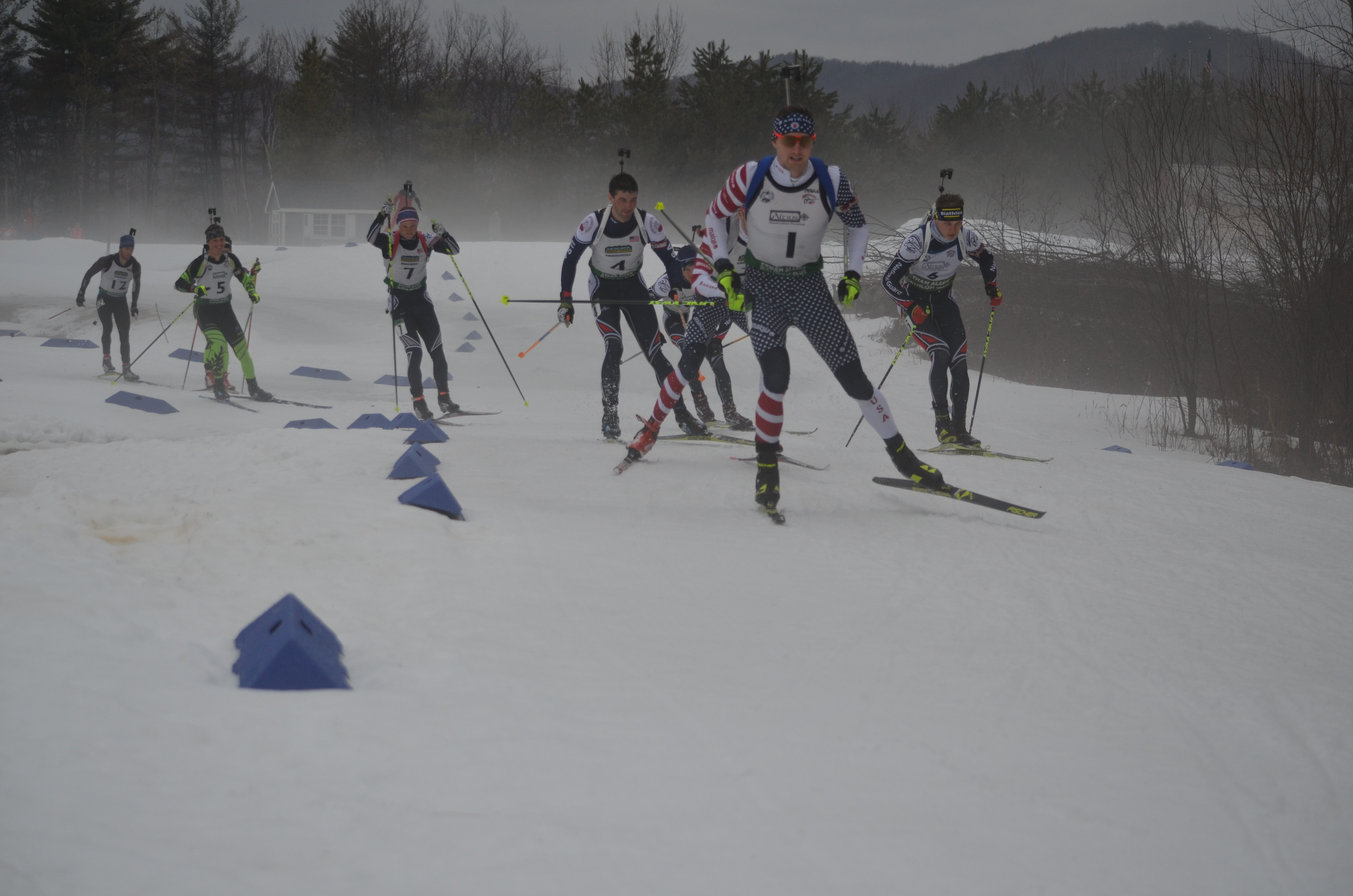
Sean Doherty leading the men out during the USBA National Championship 5 k super sprint. (Terry Wickland)
On Sunday at the US Biathlon National Championships in Jericho, Vermont both the men and women raced a 5-kilometer mass start super sprint with four shooting rounds — prone, prone, standing, standing. mostbet turkiye giris sitesi mostbet-turkiye.com sans bekliyor
Sean Doherty (USBA) took the men’s win in 14:47.6 while shooting 0+2+0+1. Cody Johnson of the U.S. National Guard placed second (+26.1, 0+0+0+2). Travis Cooper representing National Guard Biathlon raced to third (+27.4, 1+0+1+1).
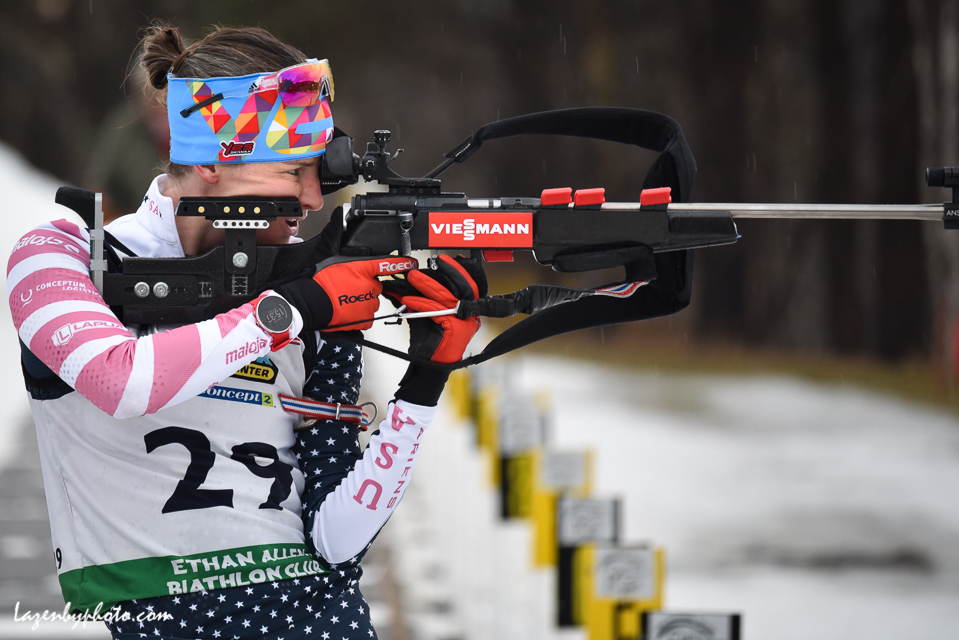
Clare Egan on the range during the women’s 5 k super sprint at the USBA National Championships. (Photo: John Lazenby/lazenbyphoto.com)
Susan Dunklee (USBA/CGRP) won the women’s super sprint in 16:08.1 shooting 0+0+3+0. Clare Egan (USBA/CGRP) placed second (+13.9, 0+0+0+0), and Emily Dreissigacker third (+43.4, 1+0+0+0).
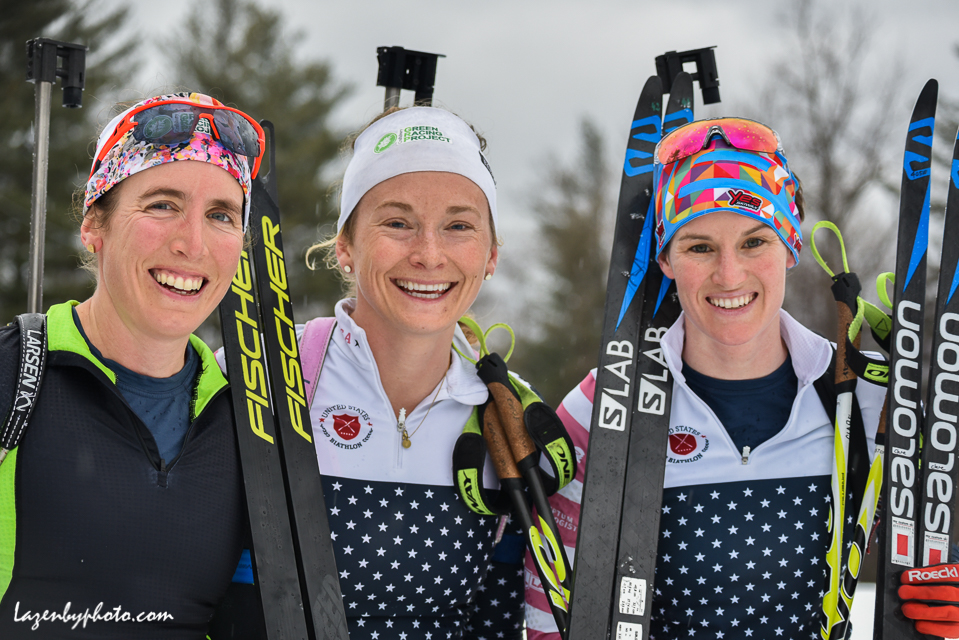
The women’s USBA National Championship 5 k super sprint podium (l-r): Susan Dunklee in first, Emily Dreissigacker in third, and Clare Egan in second. (Photo: John Lazenby/lazenbyphoto.com)
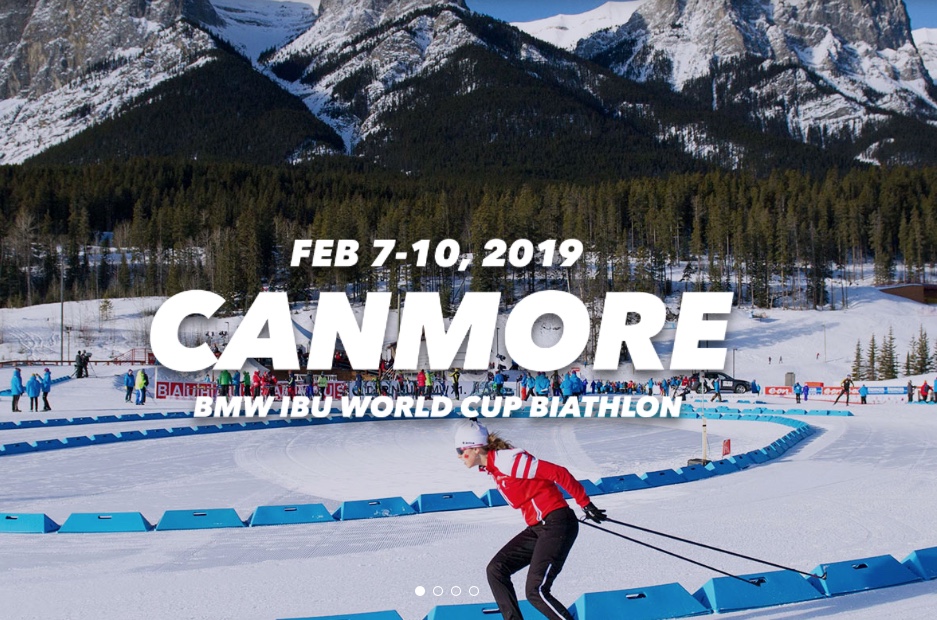
IBU World Cup in Canmore. (Photo: canmorebiathlon.ca screenshot)
Canmore, Canada IBU World Cup 4 x 7.5 k/ 4 x 6 k relay
Friday in Canmore was team relay day. Norway’s Lars Helge Birkeland, Vetle Sjåstad Christiansen,Erlend Øvereng Bjøntegaard and Johannes Thingnes Bø won the men’s 4 x 7.5-kilometer relay in 1:16:36.6 hours while acquiring no penalties on the shooting range and using seven spares.
In second place was France’s Antonin Guigonnat, Emilien Jacquelin, Simon Fourcade, and Quentin Fillon Maillet. The French team finished 1:10.4 minutes back with no penalties while using eight spares.
Russia took the third podium position with Evgeniy Garanichev, Eduard Latypov, Alexander Loginov, and Alexander Povarnitsyn. With no penalties and using nine spares, the Russians crossed the finish line 1:48.4 minutes back.
Christian Gow, Scott Gow, Jules Burnotte, and Brendan Green racing for Canada all began in bib 18 as the 18th ranked team and hopped eight positions in the final standings to finish 10th (+4:53.2). In total, Canada had two penalties while using 18 spares. It was also the final race of Green’s career.
The U.S. team of Sean Doherty, Leif Nordgren, Max Durtschi, and Travis Cooper was lapped and not given an official time. Doherty skied the first leg and tagged off 41.4 seconds behind first-place France. Nordgren raced second and tagged Durtschi with a 2:49.7 minute deficit. Durtschi was lapped on his third and final ski loop after shooting 3+3 and 2+3.
The women’s 4 x 6 k relay Vanessa Hinz, Franziska Hildebrand, Denise Herrmann, and Laura Dahlmeier took the win in 1:10:16.3 hours. The German foursome had a total of one penalty lap while using 12 spares.
Emille Aagheim Kalkenberg, Ingrid Landmark Tandervold, Tiril Eckhoff, and Marte Olsbu Roeiseland raced to second place, 30.2 seconds back. Kalkenberg used all her spares and skied two penalty laps to put the Norwegians in an early hole. On the next three legs, Norway used four spares total to pull themselves back into contention.
Anais Chevalier, Justine Braisaz, Anais Bescond, and Julia Simon racing for France placed third (+41.6, 0+12).
The U.S women took eighth overall, finishing 3:58.4 minutes behind. Susan Dunklee, Clare Egan, Joanne Reid, and Emily Dreissigacker had two penalties while using 12 spares during the race.
For Canada, Sarah Beaudry, Emma Lunder, Megan Bankes, and Rosanna Crawford For Canada, Sarah Beaudry, Emma Lunder, Megan Bankes, and Rosanna Crawford placed 18th. The Canadians were lapped on the final ski loop of the second leg.
Tomorrow’s scheduled sprints for both the men and women have been postponed to Sunday die to predicted cold temperatures.
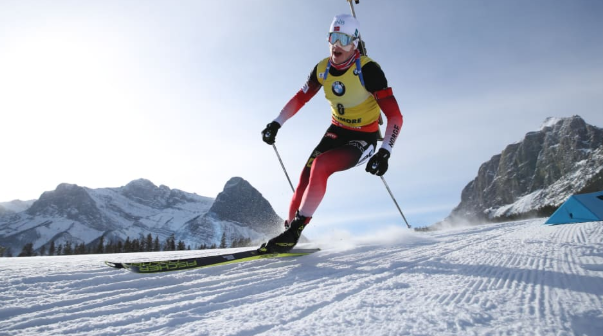
Johannes Thingnes Bø of Norway shot clean and skied fast in Canmore’s 15 k short individual race on Thursday. (Photo: biathlonworld.com screenshot)
IBU World Cup Canmore, Canada 15 k/ 12.5 k Short Individual Races
Sun, mountains, and what may have seemed like relatively warm temps allowed the IBU World Cup events to proceed on Thursday in Canmore, Canada. It’s been Polar Vortex cold in Canmore. Cold enough to thwart the original plans for traditional length 20-kilometer and 15 k individual races, for men and women respectively. With cold temperatures predicted all week, and a window of legal-limit warmer weather punching through on Thursday, the races were shortened to provide enough time during the warming window to hold both races.
For the men, this fill in the blank is easy: _________________ dominated the day in the men’s 15 k short individual race as he shot clean and skied faster than all the others.
Johannes Thingnes Bø of Norway did shoot clean. And he skied fast. And he won in a time of 35:27.9 minutes. For the twenty-four-year-old Bø, it was his 12th win of the season as he continues to cement his grip on the IBU World Cup overall.
His Norwegian teammate Vetle Sjåstad Christiansen, finished second (+2:10.2, 1+0+0+1), with Alexander Loginov in third (+2:41.0, 1+1+0+0).
Canada’s Chirstian Gow posted a career best 10th place. Gow stopped the clock 3:05.4 minutes after the winning time, as he went 0+1+0+0 for a single penalty on the shooting range.
“I didn’t treat the race any differently,” Gow emailed when considering the 15 k format. “It is still an Individual where each penalty is a major set-back so I knew I needed to keep the same focus for the race. It was something new, so a bit more of an unknown going in to it … I actually started a bit harder than I normally would. I wasn’t sure if I could keep the pace going, but in the end I managed it so I’m happy that it worked out!”
For the U.S., Sean Doherty was the second best North American in 27th. Doherty finished 4:29.0 minutes behind, and went 0+1+0+1 on the range.
“Today the shortened format was welcome as the snow conditions were very abrasive and slow. as far as a tactics go the shorter distance is just a bit more aggressive pacing but that’s about it,” Doherty wrote FasterSkier to explain how the shortened race might impact his race strategy.
Much of the past week was prohibitively cold for athletes. Some ventured outdoors for training, with many making due with local gyms and indoor training facilities.
“The cold temperatures as we are dealing with here have some added challenges,” Doherty added. “The biggest one being keeping your hands warm. Lots of people have their own tricks but you usually sacrifice some dexterity in the range but it is necessary because it is even harder to shoot with numb fingers. The other thing you see is the tape on our faces to try to protect frostbite prone areas. Then it’s all about layers and you end up doing a lot of fussing around with all the clothing you are wearing.”
For the U.S., Leif Nordgren raced to 43rd (+5:48.3, 0+1+0+1), Max Durtschi 71st (+7:52.5, 0+2+1+2), Travis Cooper 73rd (+8:01.0, 1+1+1+2).
Also for Canada, Scott Gow placed 40th (+5:42.6), Jules Burnotte 57th (+7:00.2, 3+1+2+0), Aidan Millar 81st (+8:34.0, 2+1+1+2).
The women’s 12.5 k short individual race was run with increasing cloud cover and temperatures hovering around 10 degrees Fahrenheit.
Norway’s Tiril Eckhoff took the win in 36:32.9 minutes with a single penalty. It was Eckhoff’s first career IBU World Cup win in the individual event.
The Czech Republic’s Marketa Davidova raced to second as she cleaned her shooting stages and finished 9.2 seconds back. Lisa Vittozzi of Italy was third, 20.9 seconds behind, while also shooting clean.
Megan Bankes was the top placed Canadian in 26th (+3:14.5, 1+0+1+0). Canmore’s local biathlete Rosanna Crawford was 29th (+3:21.7, 0+1+0+1). Sarah Beaudry was 34th (+3:36.5, 1+0+1+0), and Emma Lunder 63rd (+5:51.3, 1+0+4+1).
Clare Egan was he top American in 43rd (+4:17.5, 1+0+1+2). Joanne Reid skied to 64th (+5:55.9, 0+2+1+1), Emily Dreissigacker 66th (+6:07.1, 0+0+0+2).
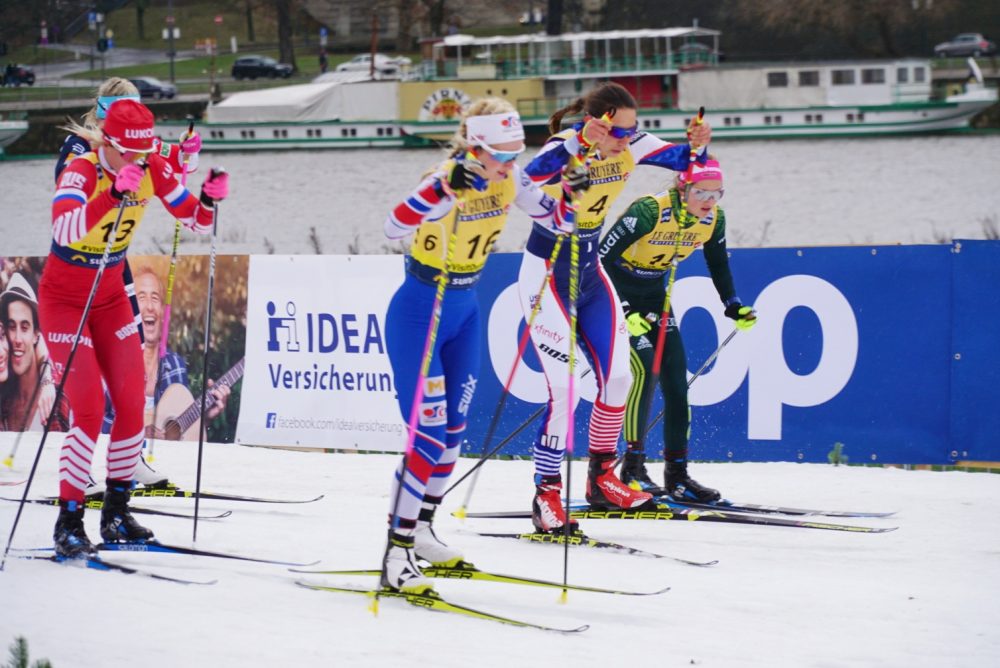
Racing in bib 4 for the U.S., Julia Kern keeps pace in the women’s team sprint during the Dresden, Germany World Cup on Sunday. (Photo: Garrott Kuzzy).
FIS World Cup Dresden, Germany 6 x 1.6 k Freestyle Team Sprint
The first World Cup team sprint of the season was run amidst drizzle and the Dresden, Germany city-scape as the women raced a total of six 1.6-kilometer laps.
Round and round on the looping course, the pace was a mix of tactically subdued speeds with sustained bursts of energy to break the pack.
After all the speed changes and exchanges with one athlete tagging off to the next, it came down to a 1.11 second difference between first place Sweden I and the three closet teams chasing from behind that ended in a photo finish.
Sweden I’s Stina Nilsson and Maja Dahlqvist won in a time of 24:02.5 minutes. Sweden II’s Ida Ingemarsdotter and Jonna Sundling placed second (+1.11), and Norway I, with Eide Mari and Maiken Caspersen Falla in third (+1.11).
U.S. I, featuring Julia Kern and Sophie Caldwell placed fourth (+1.11) after the photo finish was reviewed.
The U.S. entered a second team, consisting of Ida Sargent and Hannah Halvorsen. That duo contested the first semi-final, the same semi as U.S. I, but did not advance after placing fourth (+5.44). The top-three teams from each semi advance to the final, along with the next four fastest teams which are the combined “lucky losers”. Today, the second semi was the faster of the two. The four lucky loser team advancing to the final all originated from the second semi.
In the men’s 6 x 1.6 k skate team sprint race, Norway I and Norway II took the top two podium spots.
In a lunge at the line, Norway I’s Erik Valnes and Sindre Bjørnestad Skar won the final in 22:38.72 minutes. Pål Golberg and Eirik Brandsdal of Norway II placed second (+0.75) and Russia I’s Artem Maltsev and Gleb Retivykh third (+0.80).
Canada’s Bob Thompson and Len Valjas placed seventh (+2.46) in the first semi-final and did not advance to the final. It was the same fate for the only U.S. team entered in the men’s team sprint. Andy Newell and Erik Bjornsen placed 10th (+3.66) in the second semi, and failed to make the finals.
Canada placed 15th in the final standings, the U.S. 19th.
IBU World Cup Oberhof, Germany 4 x 6 k / 4 x 7.5 k Relay
In the women’s 4 x 6 k relay, Russia placed first in a time of 1:18:46.4 hours. Evgeniya Pavlova, Margarita Vasileva, Larisa Kuklina, and Ekaterina Yurlova-Percht made up the team that used eight spares on their way to the win.
Germany placed second (+33.5) with two penalty loops and 10 spare rounds. Karolin Horchler, Franziska Hildebrand, Franziska Preuss, and Denise Hermann comprised Germany’s second place team that had two penalties while using 10 spares. The Czech Republic’s Lucie Charvatova, Veronika Vitkova, Marketa Davidova, and Eva Puskarcikova placed third (+36.7) with 1 penalty loop and six spares.
The top spot for the podium came down to the final leg, when Yurlova-Percht pulled out the win when Hermann skied two penalty loops. The Russian used three spares but escaped with no penalties to take the lead out of the shooting range on the final ski loop.
Susan Dunklee, Clare Egan, Joanne Reid, and Emily Dreissigacker all represented the U.S. and placed 12th (+5:35.8) while skiing five penalty loops and using 16 spares.
Canada’s Sarah Beaudry, Emma Lunder, Megan Bankes, and Rosanna Crawford finished in 13th (+5:58.8) with four penalty loops and 15 spares.
Russian also claimed the men’s relay, winning in a time of 1:20:54.3 hours. The winning team of Maxim Tsvetkov, Evgeniy Garanichev, Dmitry Malyshko, and Alexander Loginov skied no penalty laps and used six spares on their way to victory.
Antonin Guigonnat, Simon Desthieux, Quentin Fillon Maillet, and Martin Fourcade raced for France. The French team placed second (+1:01.1) while skiing a single penalty lap and using eight spares.
Austria’s Tobias Eberhard, Simon Eder, Dominik Landertinger and Julian Eberhard placed third (+2:18.6) with one penalty lap and using seven spares.
Canada’s Scott Gow, Christian Gow, Jules Burnotte, and Brendan Green and the U.S. team of Leif Nordgren, Sean Doherty, Travis Cooper, and Max Durtschi were eventually lapped. Neither team was given an official finishing time.
Canada was ranked 18th in the final standings, the U.S. 19th.
For both relays today, the snowy weather and tough course conditions made for a strenuous day of shooting and skiing.
Russia’s Alexander Loginov during the men’s sprint in Oberhof, Germany. In today’s sprint, Loginov scored his first career individual win on the IBU World Cup. (Photo: biathlonworld.com screenshot)
The men’s 10-kilometer sprint in Oberhof, Germany was a bit more in synch with recent weather trends in some parts of stormy Europe: clouds descended, the wind picked up, and steady snow began to fall during the race. This was in contrast to weather conditions during Thursday’s women’s sprint when uncharacteristically Oberhof found itself basked in intermittent sunshine and relatively calm winds.
By the time athletes began their standing shooting stage on Friday, the unpredictable winds mixed with snow made for tricky and more complex shooting conditions. Some biathletes fared well, others were flummoxed.
Alexander Loginov of Russia shot clean and won the race in 25:50.9 minutes. It was his fifth podium of the season, but his first career IBU World Cup individual win. Loginov placed third twice in Pokljuka, Slovenia and second twice in Nové Město, Czech Republic for his other podiums.
The overall IBU World Cup leader, Norway’s Johannes Thingnes Bø, placed second on Friday 25.2 seconds back after accruing a single penalty while standing. Bø has won six races this season on the World Cup — which include wins in all three sprints contested this year.
The IBU World Cup leader, Norway’s Johannes Thingnes Bø, placed second in Friday’s Oberhof, Germany IBU World Cup sprint. (Photo: biathlonworld.com screenshot)
Sweden’s Sebastian (Sebbe) Samuelsson earned his first career World Cup individual podium when he placed third (+36.8) after shooting clean. Samuelsson is both a gold and silver medalist from the 2018 PyeongChang Games. He is twenty one years old.
The best placed North American was US Biathlon’s Sean Doherty in 22nd (+1:58.4, 1+1). Today’s 22nd place was the third top-30 result for Doherty this season.
“Over Christmas I worked a lot on some specific strength that I felt could use some improvement after the first trimester,” Doherty wrote in an email explaining what he had wanted to improve during the IBU World Cup holiday break. “On the range I did a lot of drilling and pressuring myself to cope with higher intensity on the range approach. Overall just trying to fine tune and stay sharp. I’m happy to see some of this training kicking in a bit and hopefully the racing legs continue to come into form. But, I will admit we had excellent skis today which always helps.”
Leif Nordgren was the next best placed American in 63rd (+3:09.1, 2+1). Travis Cooper finished in 94th (+4:42.1, 2+2).
Christian Gow was the top Canadian in 33rd (+2:18.6, 2+0). Teammates Brendan Green placed 80th (+3:46.9, 0+2), and Jules Burnotte 102nd (+5:19.0, 2+2). Scott Gow did not start.
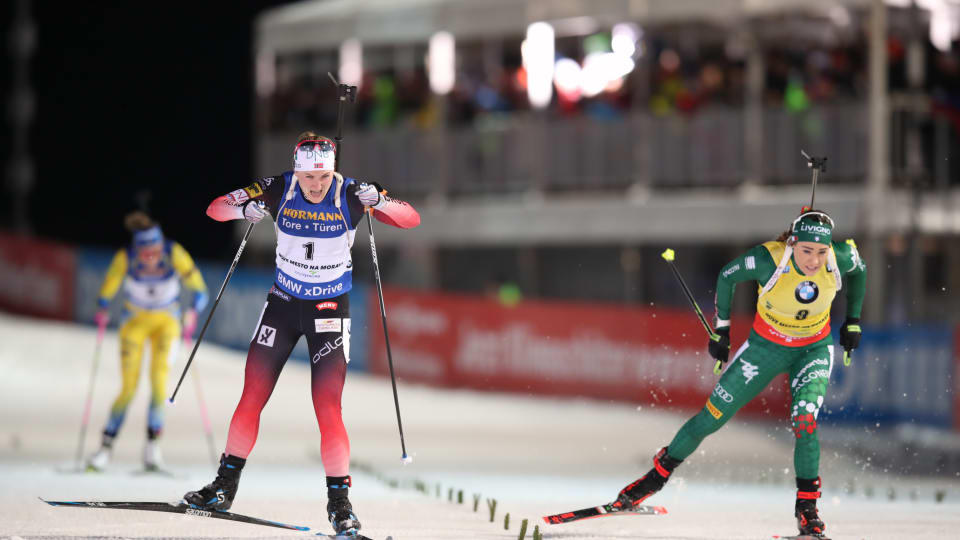
Norway’s Marte Olsbu Røiseland out skiing Italy’s Dorothea Wierer for the win on Saturday’s 10 k pursuit in Nové Město, Czech Republic. (Photo: biathlonworld.com)
IBU World Cup Nové Město, Czech Republic 12.5 k / 10 k Pursuit
Johannes Thingnes Bø won his fifth race of the IBU World Cup season by taking the men’s 12.5-kilometer pursuit in Nové Město, Czech Republic in a time of 31:59.0 minutes. Bø skied four penalty laps on his way to victory. Russia’s Alexander Loginov also skied four penalty laps, and finished second 6.2 seconds back. The elder Bø brother, Tarjei Bø, placed third (+23.9) while skiing a single penalty lap after his final shooting round.
Christian Gow was the best placed North American in 21st (+2:38.8, 0+0+1+2). Also for Canada, Jules Burnotte was 35th (+3:46.8, 2+1+1+1). It was Burnotte’s second career World Cup start — he placed 33rd in Nové Město’s sprint. Scott Gow was 47th (+5:03.3, 0+0+2+2).
Sean Doherty was the highest ranked finisher for the U.S. in 27th (+3:07.4, 0+0+1+1). Leif Nordgren placed 54th (+6:14.1, 0+2+2+2), and Travis Cooper 58th (+7:22.6, 2+0+1+4).
In Saturday’s 10 k pursuit in Nové Město, Norway’s Marte Olsbu Røiseland made it back to back wins after placing first in Thursday’s sprint. Røiseland won in a time of 29:53.5 minutes while missing two targets — for two penalty laps — on her way to a razor thin margin of victory.
Italy’s Dorothea Wierer lost out on the podium’s top spot by 0.2 seconds after missing a single target in her last shooting stage. Sweden’s Hanna Oberg took third (+4.7) after skiing one penalty lap.
For the U.S., Clare Egan improved on her 26th place in the sprint to place 20th (+2:22.3, 0+1+2+0). Joanne Reid was 51st (+5:20.5, 0+1+2+1), and Susan Dunklee 53rd (+5:42.2, 2+2+4+1).
Canada’s Emma Lunder, after finishing a career best 17th in the sprint, dropped to 35th (+3:13.6, 3+1+0+2). Sarah Beaudry, also coming off a career best 12th in the sprint, placed 38th (+3:46.7, 1+1+2+1). Rosanna Crawford placed 52nd (+5:37.0, 0+0+3+3).
Johannes Thingnes Bø of Norway after winning the 2018 men’s 10 k sprint in Nove Mesto, Czech Republic. It was the Norwegian’s third sprint win of the season and his fourth win overall this year. He leads the IBU World Cup. (Photo: biathlonworld.com)
IBU World Cup Nové Město, Czech Republic Men’s 10 k Sprint
On Thursday in Nové Město, Johannes Thingnes Bø of Norway captured his third sprint victory of the early IBU World Cup season. Shooting clean, Bø won in a time of 23:09.9 minutes. It was Bø’s fourth win of the year. Alexander Loginov of Russia, in what was his best career result on the World Cup, placed second (+21.0) while shooting clean. In third place was Sweden’s Martin Ponsiluoma. The Swede also missed no targets while posting a career best for his first podium on the World Cup.
With several races left in Nove Mesto, Bø leads the men’s World Cup after six events with 308 points. Loginov sits in second with 232 points.
Christian Gow of Canada was the best placed North American as he tied for 20th (+1:31.8, 0+0). Also for Canada, Jules Burnotte placed 33rd (+1:57.8,0+1), Scott Gow 38th (+2:04.7,1+1), and Brendan Green 67th (+2:43.0, 1+1).
Leif Nordgren was the best American finisher in 40th (+2:07.6, 1+0). Sean Doherty placed 51st (+2:23.8, 2+0), Travis Cooper 56th (+2:28.8, 0+1), and Jake Brown 78th (+3:13.7, 1+1).
Racing continues tomorrow for the women with the 7.5 k sprint, and the men on Saturday with a 12.5 k pursuit.
Norway’s Johannes Thingnes Bø with the first place hardware after winning the men’s IBU World Cup 10 k sprint in Pokljuka, Slovenia. (Photo: Biathlonworld,com)
IBU World Cup Pokljuka, Slovenia Men’s 10-kilometer Sprint
The men’s 10-kilometer sprint in Pokljuka, Slovenia was won today by Norway’s Johannes Thingnes Bø in a time of 23:46.3 minutes. During the two shooting stages, Bø skied a single penalty lap after missing one shot while standing.
Bø led the race from beginning to end, marking the fastest split at the first time check and never relinquishing control of the race.
France’s Antonin Guigonnat placed second 16.1 seconds back. Guigonnat shot clean, skiing no penalty laps. Alexander Loginov of Russia was third. He also shot clean and finished 16.4 seconds behind winner Bø.
Canada’s Christian Gow had another strong performance, placing 17th (+1:01.2) after shooting clean. Christian Gow placed 16th in yesterday’s 20 k individual race.
Also for Canada, Brendan Green finished 81st (+2:36.9). Green had three penalties, one in prone, two standing. Nathan Smith was 88th (+2:54.4) after missing one target shooting prone. Scott Gow placed 93rd (+3:08.6) with four penalties. He missed two targets shooting prone, two standing.
American biathlete Sean Doherty placed 26th (+1:15.1) while shooting clean. Also for the U.S., Leif Nordgren crossed the line in 31st (+1:20.90.) He missed a single target shooting prone, and shot clean standing. Travis Cooper placed 103rd (+3:57.4). Cooper missed two targets shooting prone and three standing. Max Durtschi finished in 108th (+4:36.4) missing six targets in total; two in prone, four standing.
France’s Martin Fourcade shooting clean ans skiing fast as he won the men’s 20 k individual race in Pokljuka, Slovenia, site of the IBU World Cup’s first series of races this season. (Photo: Biathlonworld,com)
IBU World Cup Pokljuka, Slovenia 20 k/15k Individual
Not the least of the myriad variables affecting biathlon races, fickle weather has played games in Pokljuka, Slovenia, site of the first round on the IBU World Cup. The men’s 20-kilometer individual race was originally scheduled for Wednesday, but was postponed to Thursday due to fog.
For each missed shot in the individual races, athletes are penalized one minute. With a large cost for any shooting mistake, a single miss can punish a potential podium performance.
None other than France’s Martin Fourcade took the win today in 47:09.2 minutes. (Fourcade is a seven-time winner of the overall IBU World Cup.) Fourcade shot clean in all four of his shooting bouts. And shooting clean was the theme for the podium, the top-three finishers had no misses on the shooting range.
Second place went to Johannes Kuehn of Germany, finishing 4.2 seconds back. Third place was secured by Simon Eder, who stopped the clock 19.7 seconds back.
For Canada, Scott Gow skied to 14th (+1:43.3) with one miss. Brother Christian Gow was 16th (1:59.2) after also missing only a single target. Brendan Green skied to 100th (+9:04.1) after difficult shooting, during which he missed seven targets. Nathan Smith did not start.
For the U.S. Leif Nordgren was the best placed American in 40th (+3:24.5). Nordgren missed two shots. Teammate Sean Doherty was 59th (+4:28.2) after missing three shots, Max Durtschi was 102nd (+9:37.0), after missing six targets. Travis Cooper raced to 105th (+10:02.0), while missing six shots.
The women’s 15 k individual was won by Ukraine’s Yuliya Dzhima 43:06.6 minutes. She was clean in her shooting in her first career IBU World Cup win. Poland’s Monika Hojnisz had a single penalty as she placed second (+5.9). The result was a best-ever result for Hojnisz at this level of competition. The Czech Republic’s Marketa Davidova also missed a single target on her way to her first career podium, finishing 16.5 seconds back in third place.
U.S. biathlete Susan Dunklee missed one target on her way to placing 11th (+1:00.09). With each miss adding an additional minute to an athlete’s finishing time, it was a solid effort and indicator for Dunklee.
“I’m psyched to have a great result so early in the season,” Dunklee emailed FasterSkier.
Dunklee, the U.S. team veteran, made note of U.S. skier Clare Egan’s race day performance. “Clare also threw down an impressive ski split, so in spite of our 3 start quota challenge, our team future looks bright,” Dunklee added.
Egan placed 60th (+4:23.3) after amounting five penalties. She raced the 13th fastest ski time. Emily Dreissigacker, also for the U.S., placed 69th (+5:17.0). Dreissigacker has four penalties.
Canada’s Megan Tandy finished in 62nd (+4:30.4), after missing three shots. Rosanna Crawford, also for Canada,was 64th (+4:34.7) with four misses, Meghan Bankes 71st (+5:22.) with three misses, and Nicole Moser 98th (+10:20.4) with seven misses.
For the women, Susan Dunklee, Clare Egan, and Joanne Reid all pre-qualified based on last season’s results. Emily Dreissigacker was named to the team on Monday. The women’s World Cup team has three start spots per race in Pokljuka. According to Monday’s announcement, coaches will determine which athletes get specific starts at a later date.
After the Pokljuka races, only three U.S. women will travel to Nove Mesto, Czech Republic, the host of this season’s second IBU World Cup .
The fourth biathlete will head to Ridnaun-Val Ridanna, Italy to race the second weekend of IBU Cup on Dec. 10-16. (The IBU Cup’s first weekend of racing will take place in Idre, Sweden on Nov. 26-Dec. 2).
Leif Nordgren and Sean Doherty both pre-qualified for the men’s opening World Cup races. The men’s side has four start spots in Pokljuka. Along with Nordgren and Doherty, Paul Schommer and Travis Cooper have been named to the first World Cup team roster.
Cooper’s path to Pokljuka will include a stop at the IBU Cup races in Idre. According to U.S. Biathlon, Cooper must first race in Sweden in order to earn his qualification for the IBU World Cup. Max Durtschi will travel to Pokljuka as a reserve athlete.
IBU Cup Teams
The SoHo and Jericho rollerski trials also served as a springboard to the second series of IBU Cups in Ridnaun-Val Ridanna, Italy. Hallie Grossman, Deedra Irwin, and Kelsey Dickinson were named as U.S. athletes for those races. They will be joined by one member of the women’s IBU World Cup team racing in Pokljuka.
The men also have four start spots at the second IBU Cup. Durtschi, Alex Howe, Jake Brown, and Vasek Cervenka have been named to the team for the Ridnaun-Val Ridanna, Italy competitions.
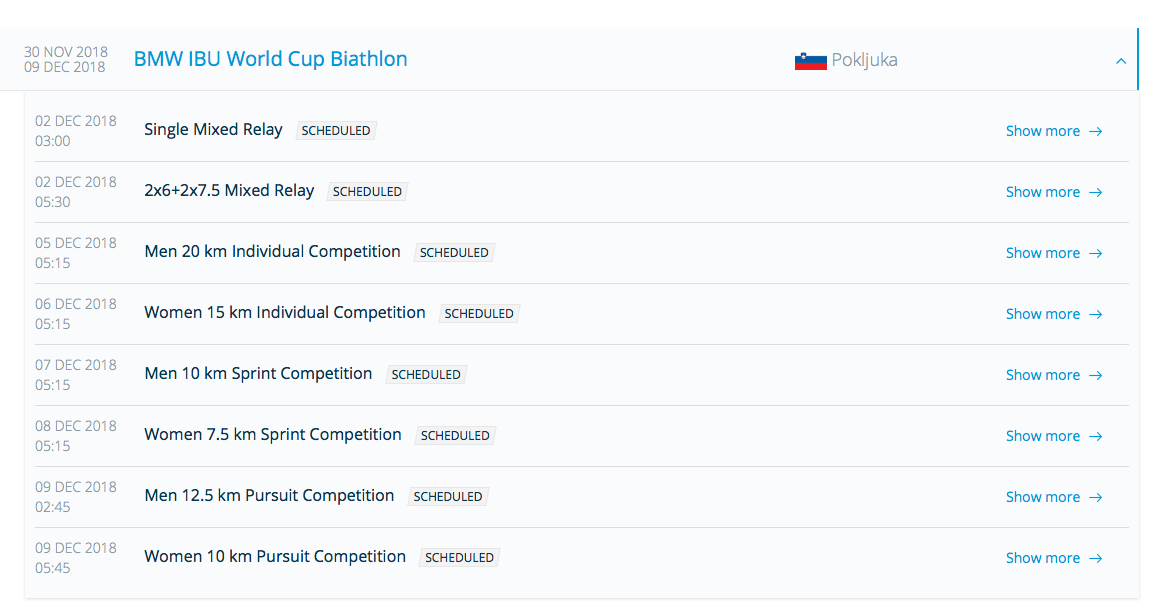
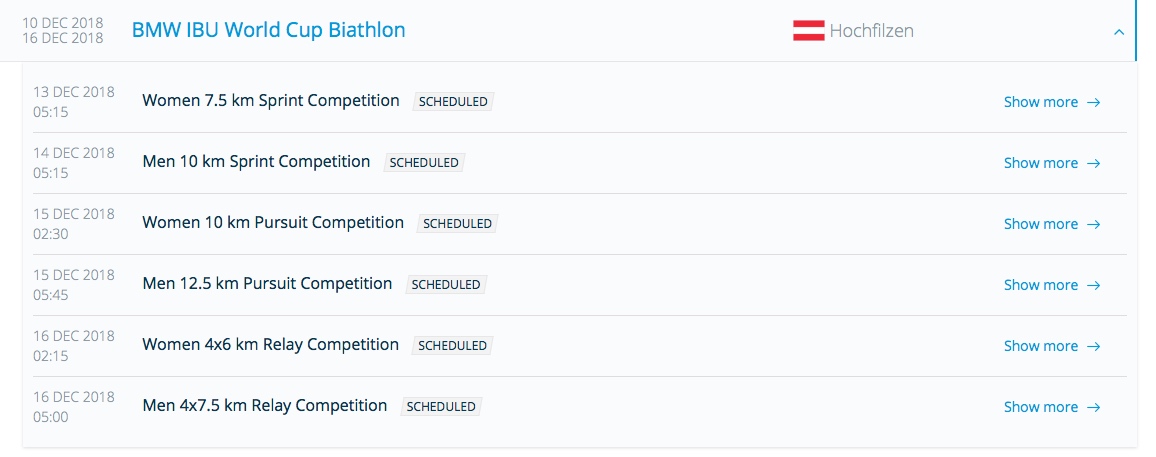
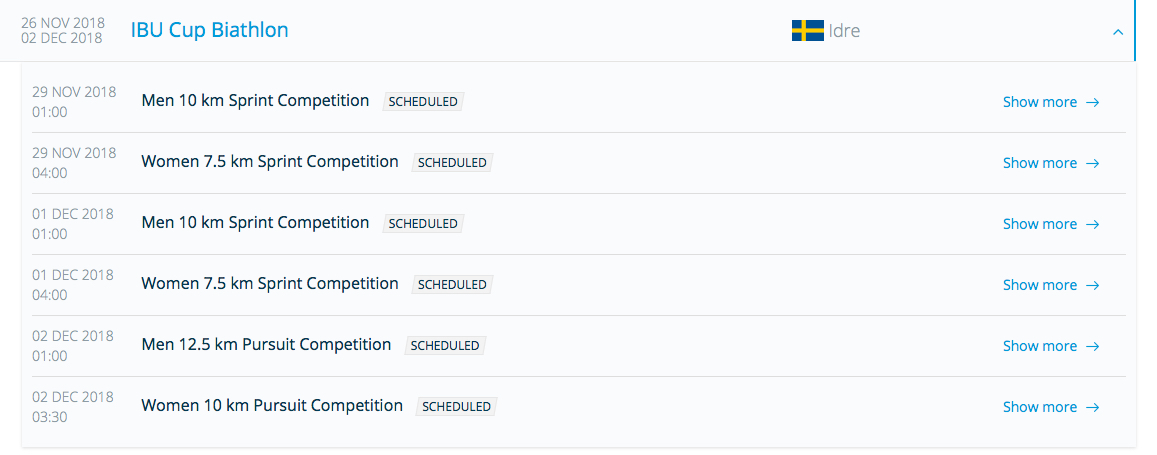
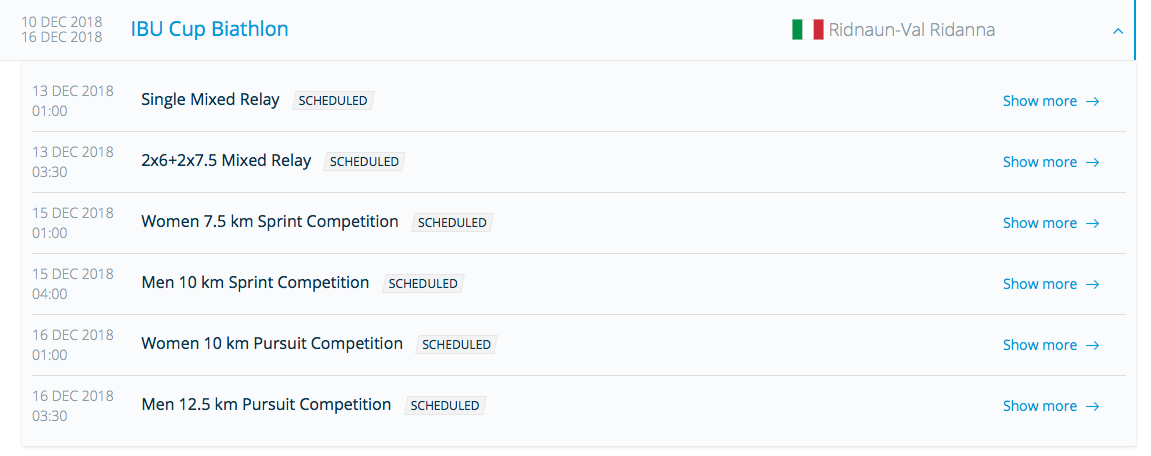
Below is the schedule for the first two IBU World Cup and IBU Cup races.
Schedule for the first IBU World Cup in Pokljuka, Slovenia.
Schedule for the second IBU World Cup in Nove Mesto, Czech Republic.
Schedule for IBU Cup #1 in Idre, Sweden.
Schedule for IBU Cup #2 in Ridnaun-Val Ridanna, Italy.
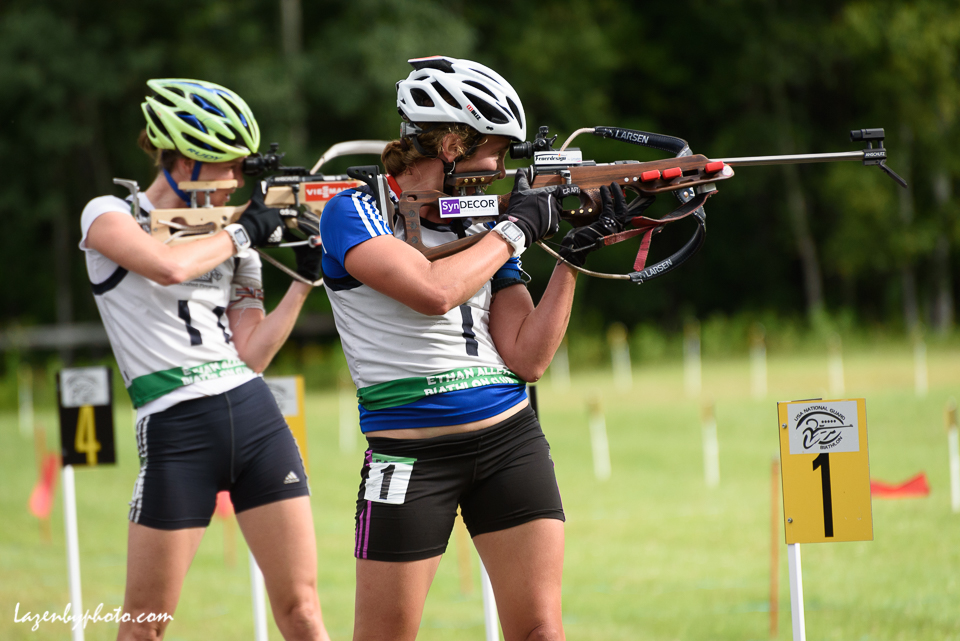
Susan Dunklee (front) and Clare Egan (l) during a shooting stage of the women’s mass start at Clare Egan (USBA/CGRP) racing to second in the women’s mass start at US Biathlon Rollerski Championships on Aug. 13 in Jericho, Vt. 2017 (Photo: John Lazenby/Lazenbyphoto.com)
US Biathlon team trials kicked off on Tuesday, Oct. 30, at Soldier Hollow in Midway, Utah, with a total of 47 athletes in attendance. On the line for senior competitors racing this week are starting spots for US Biathlon’s 2018/2019 World Cup and IBU Cup teams.
The first race of the week involved a men’s 10-kilometer and women’s 7.5 k sprint, with 12 senior women and 14 senior men racing. A junior men’s sprint and junior women’s sprint was held as well, with 11 junior men and 10 junior women participating.
In the senior women’s sprint, US Biathlon team veteran and two-time Olympian, Susan Dunklee claimed the overall win. Dunklee cleaned her prone stage and missed one standing to finish in a time of 22:17 for first.
After tying Dunklee’s shooting score, Clare Egan, raced to second place, finishing 25 seconds behind the overall winner’s time.
Third place went to Emily Dreissigacker, who also tied Dunklee’s shooting score and finished 1:09 seconds behind Dunklee’s time.
“I always enjoy training in Utah in the fall,” the 32-year-old Dunklee told US Biathlon after the race in Midway. “This winter the World Cup will return to Soldier Hollow for the first time in 18 years and it will be a highlight of our season. Today was a great chance to practice racing at the venue and familiarize ourselves with the range.”
This February, the Soldier Hollow Nordic Center is slated to host IBU World Cup races from the 14th to 17th. The last major international biathlon competitions held at Soldier Hollow were the 2002 Olympic Winter Games.
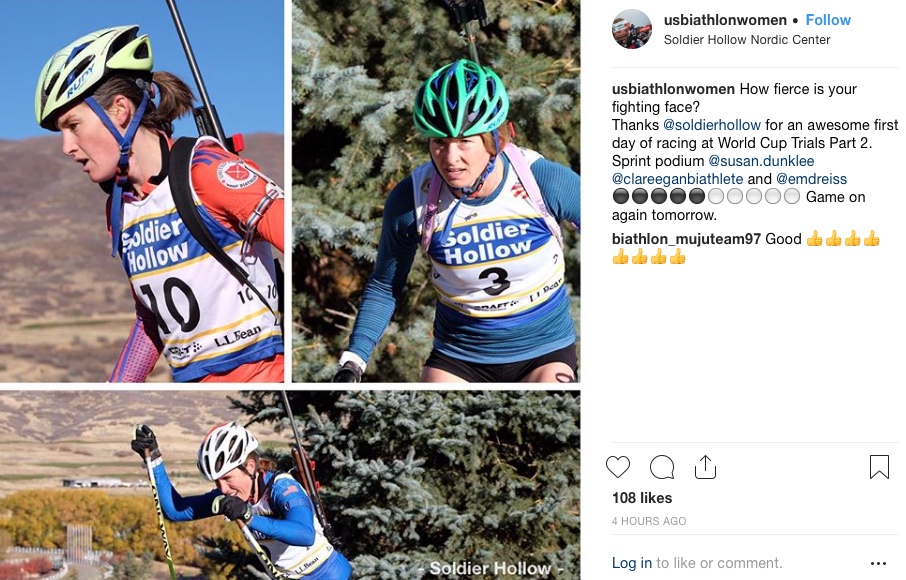
During the first day of competition at US Biathlon’s World Cup trials at Soldier Hollow, Susan Dunklee (bottom) placed first, Clare Egan (top-left) second, and Emily Dreissigacker (top-right) was third. (@usbiathlonwomen Instagram screenshot)
Following the senior women’s sprint on Tuesday was the senior men’s sprint. Twenty-three-year-old, Sean Doherty, took the win, in a time of 25:26 after missing one prone shot and cleaning while standing.
“I am happy with my race today. The course here is challenging and the altitude adds a lot of difficulty, especially in the range,” Doherty, who is a native of Center Conway, New Hampshire, told US Biathlon. “I’m looking forward to tomorrow as another chance to sharpen up before the season.”
Finishing behind Doherty on Tuesday was Paul Schommer, a former skier for the College of St. Scholastica, in second. Schommer finished 51 seconds behind Doherty’s time, after missing one prone shot and two standing.
The third senior men’s finisher in Tuesday’s sprint, Travis Cooper, missed two prone and one standing, finishing 1:20 seconds behind Doherty.
Wednesday, racers will return to the venue for a second sprint race.
Emily Dreissigacker tags off to Joanne Reid in the women’s World Cup biathlon relay in Ruhpolding, Germany. Both women are on the roster for the U.S. for the next year of international biathlon. (Photo: USBA/NordicFocus)
For the first time in years, the roster features more women than men. Following the retirements of Lowell Bailey, Russell Currier, and Tim Burke, Alex Howe (Craftsbury Green Racing Project) netted his first senior national team nomination, and joins 2018 Olympians Sean Doherty and Leif Nordgren, as well as Paul Schommer (Moose Nordic).
On the women’s team, all five members of the 2018 Olympic team have been renamed: Susan Dunklee, Clare Egan, and Emily Dreissigacker (all Craftsbury Green Racing Project), Joanne Reid (Colorado Biathlon), and Maddie Phaneuf (Polar Bear Ski Club). Dunklee and Egan recently said that they were not certain yet about retirement, but appear on the roster. The newest addition to the women’s senior team is Chloe Levins, who finished all three individual races at 2018 World Junior Championships in the top seven.
The “A” team athletes will be primarily based in Lake Placid, New York, while designated “B” team athletes (Phaneuf, Schommer, and Howe) will be based at regional training centers or with clubs, according to national team selection documents.
The federation has also named a development squad of Deedra Irwin (Wisconsin Biathlon), Travis Cooper and Jake Ellingson (National Guard Biathlon), Jake Brown (Loppet Nordic Racing), and Max Durtschi. All saw international race starts last season.
In addition, an 11-member Junior Development Group has been named, many of whom we interviewed this winter – see the links below to read about their experiences at World Youth and Junior Championships.
High Performance Team – Women
Susan Dunklee (Barton, Vt./Craftsbury Green Racing Project), A1 Team Clare Egan (Cape Elizabeth, Maine/Craftsbury Green Racing Project), A2 Team Chloe Levins (Rutland, Vt.), A3 Team Joanne Reid (Boulder, Colo./Colorado Biathlon), A3 Team Emily Dreissigacker (Morrisville, Vt./Craftsbury Green Racing Project), A3 Team Maddie Phaneuf (Old Forge, N.Y./Polar Bear Ski Club), B Team
High Performance Team – Men
Sean Doherty (Center Conway, N.H.), A1 Team Leif Nordgren (Marine, Minn.), A3 Team Paul Schommer (Appleton, Wisc./Moose Nordic), B Team Alex Howe (Gilford, N.H./Craftsbury Green Racing Project), B Team
Development Team – Senior Women
Deedra Irwin (Pulaski, Wisc./Wisconsin Biathlon)
Development Team – Senior Men
Travis Cooper (Kenai, Alaska/National Guard Biathlon) Max Durtschi (Sun Valley, Idaho) Jake Brown (Houghton, Mich./Loppet Nordic Racing) Jakob Ellingson (Minnetonka, Minn./National Guard Biathlon)
Youth and Junior Development Group – Women
Helen Wilson (Eagle River, Alaska/Alaska Biathlon Club) – 20-for-20 interview Lexie Madigan (Truckee, Calif./Auburn Ski Club) – 20-for-20 interview Emma Stertz (Grand Rapids, Minn./Mt. Itasca Biathlon) – 20-for-20 interview Grace Gilliland (Eagle River, Alaska/Alaska Biathlon Club) – 2017 20-for-20 interview Sarah Beaulieu (Fort Fairfield, Maine/Outdoor Sports Institute) Arianna Woods (Bozeman, Mont./Bridger Biathlon Club)
Youth and Junior Development Group – Men
Vasek Cervenka (Grand Rapids, Minn./Mt. Itasca Biathlon) – 2017 20-for-20 interview Garrett Beckrich (Grand Rapids, Minn./Mt. Itasca Biathlon) – 20-for-20 interview Tim Cunningham (Springfield, N.H./Saint Lawrence University) – 20-for-20 interview Eli Nielsen (Stehekin, Wash./Methow Valley) – 20-for-20 interview Marcus Gore (Vail, Colo./Casper Mountain Biathlon Club)
Kelsey Dickinson (Craftsbury Collegiate Summer Team) racing to third in the women’s sprint at US Biathlon Rollerski Championships on Aug. 12 in Jericho, Vt. Dickinson had more strong performances this past weekend to secure a spot on the World Cup in December. (Photo: John Lazenby/Lazenbyphoto.com)
For some American biathletes, there was a lot on the line in Jericho, Vermont this past weekend.
Saturday and Sunday were rollerski biathlon competitions that served as the third and fourth of a four-race team selection series. Six athletes – Susan Dunklee, Clare Egan, Lowell Bailey, Leif Nordgren, Sean Doherty, and Tim Burke – had already booked their places for the first period of World Cup racing thanks to results from last season.
But between one and three places still needed to be filled on the U.S. team, and the Jericho races – the first two were held at the Vermont biathlon complex in August – would be used to select a team for a pre-season camp in Canmore, Alberta. From there, the squad would be winnowed down for the December World Cup.
Kelsey Dickinson (College of St. Scholastica) racing to 26th in the women’s 15 k freestyle mass start at 2017 NCAA Skiing Championships on March 11 at the Jackson Ski Touring Center in Jackson, N.H. (Photo: Flyingpointroad.com)
One College of Saint Scholastica student, Kelsey Dickinson, booked her place on the World Cup. A St. Scholastica alumnus, Paul Schommer, all but did the same – he was selected to the camp, and is highly likely to also go on to the World Cup.
Two more women, Joanne Reid of Colorado Biathlon and Emily Dreissigacker, of the Craftsbury Green Racing Project, were selected for the camp and will have to compete for the last World Cup spot.
Even for the pre-qualified athletes, it was a weekend of important competitions, a chance to hone stills practiced over the summer and start visualizing the international competitions that will start in just six weeks.
“It’s an important marker – it’s not nothing,” U.S. Biathlon Association Chief of Sport Bernd Eisenbichler said in an interview this morning. “We try to really run the trials like a national-level race. The Jericho crew led by John Madigan did an awesome job to put a real race on, not just a time trial. You have a bib number on, you want to perform and you want to execute the things you’ve worked on throughout the summer.”
The Women: Three Trials Race Winners Heading to Canmore
With the pre-qualified duo of Dunklee and Egan excluded from ranking results, Dickinson won the trials series in best-three-of-four scoring. Even with Dunklee and Egan in the results, she was only off the podium once in the four-race series.
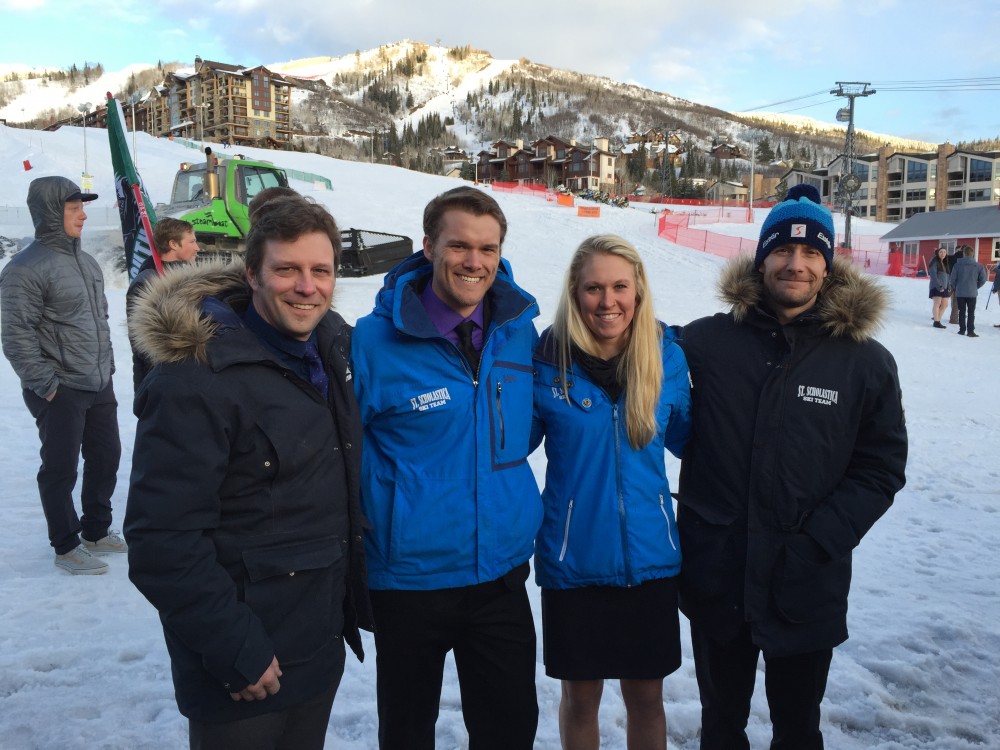
Chad Salmela (far left) with 2016 NCAA qualifiers Reitler Hodgert and Kelsey Dickinson as well as assistant nordic coach Josh Tesch at 2016 NCAA Championships in Steamboat Springs, Colo. (Photo: Chad Salmela)
“I’m really pleasantly surprised and impressed also with how she did that, with being outside the team environment,” Eisenbichler said.
Dickinson was formerly an athlete at the Maine Winter Sport Center (now the Outdoor Sports Institute), but when that program shuttered its senior funding scheme in the spring of 2015 she felt she had no choice but to go back to school. Since then she has worked with coaches Chad Salmela and then Maria Stuber, and become an NCAA qualifier for Saint Scholastica in cross-country skiing.
Dickinson spent this summer at the Craftsbury Outdoor Center training for biathlon, along with Dreissigacker and other development athletes.
“I know that she worked quite a bit with the Craftsbury team, which was a smart move, but overall we have to give her a lot of compliments for really doing this development,” Eisenbichler said of the student-athlete. “I just talked very briefly with her on Sunday, to let her know that she won the trials… she told me pretty straightforward that biathlon is first, and she will make it work. So I have no doubt that she will make it work with her school.”
Dreissigacker and Reid have shorter histories with biathlon, something that Eisenbichler highlighted. Dreissigacker ended up second on the ranking list, after winning Saturday’s 7.5 k sprint outright.
“She hasn’t been in this sport not such a long time, and her biggest accomplishment right now is that she is so stable with the shooting part now already,” Eisenbichler said. “On the weekend, we had a pretty windy day on Sunday, and she was still able to shoot [just one penalty]. And the same thing on Saturday plus winning that race. I think that she really made the next step towards being a complete biathlete, although there is still some work to do from the physical side and on the skiing side.”
Dreissigacker has spent the last two seasons racing on the second-tier IBU Cup, where she scored her first top-20 finish in March.
Then, there’s Reid, who made a fast jump to the World Cup when she started the sport. Last season, Reid hit the top-30 in the first World Cup competition of the year, and was also a World Championships team member.
After the Jericho trials, U.S. Biathlon was only supposed to nominate up to two women: the trials winner (which turned out to be Dickinson) would receive an automatic World Cup spot, and one other athlete could be selected by discretion to go to the Canmore camp.
But the International Competition Committee also selected Reid, who had beaten both Dickinson and Dreissigacker in one of the trials races.
“It was an extraordinary discretionary choice,” Eisenbichler said. “She had, two times, health issues in the summer. I don’t want to get into details of that, but it was significant health issues that justify a discretionary choice in our eyes. And she was on the whole weekend the fastest skier last weekend.”
So, five women are headed to Canmore, and either Reid or Dreissigacker will go on from there to the World Cup.
“We are taking all the ladies who were able to win one of the trials races,” Eisenbichler said of the rankings system that excluded pre-qualified Dunklee and Egan. “The decision for the fourth World Cup starting spot… will be made after looking at the training in Canmore and also at the races we will do together with Biathlon Canada at the end of the camp. It’s not trials races. [The decision] is a combination of looking at the training, the performance level, and the racing at the end of the camp.”
Athletes who didn’t make the cut, like 2017 World Championships team member Maddie Phaneuf, will have another chance to make the World Cup or Olympic team after Christmas based on a separate set of trials races.
Dunklee qualified for the Olympic team after winning a silver medal in the World Championships mass start. At least one more woman will be picked for the Olympic team based on December World Cup results, but not more than two; that means at least one spot will be up for grabs come January.
Men: Schommer Shines
With four men already pre-qualified for the World Cup, there is only one quota spot up for grabs. The trials winner would be sent to Canmore and possibly one more athlete based on discretion.
After the first two races, in August, both Schommer and National Guard Biathlon’s Travis Cooper had one “win” (excluding the pre-qualified athletes) to their name.
Paul Schommer, of US Biathlon’s National Development Group, racing to 33rd in his first IBU World Cup race, the men’s 20 k individual in Antholz, Italy, in January 2017. (Photo: USBA/NordicFocus)
But in the October races, Cooper didn’t continue the streak. Schommer did, placing second on Saturday just four seconds behind Bailey, and fourth on Sunday.
“Paul is the clear winner of the trials by 5%,” Eisenbichler said. “If we look at the second place in the trial points, this is Russell Currier, and Paul beat him in every race of the four races. So Paul really made a big step forward this summer. He got himself mixed in with the World Cup athletes, the pre-qualified ones. He has a really high performance level right now and I’m really happy to see that… if everything goes normal he will also get the call for the World Cup team in December.”
Currier was not chosen for the camp on a discretionary basis, so Schommer – who turned in a 33rd-place finish in his World Cup debut last season – is nearly a lock for the December competitions.
He was new to biathlon after his time at Saint Scholastica, but has quickly made strides in the sport.
“The goal of bringing this Talent ID project forward in 2014 was to have someone in contention for a relay spot, pushing the other four athletes on the men’s side, and having also a good shot at being very competitive at the Games,” Eisenbichler said. “And I’m again very pleased to see that this project worked.
“Compliments to Paul with how he approached it,” he continued. “He has done it professionally now for just 2 ½ years. I think he learned a lot last season, being at the World Championships as a reserve athlete, doing some World Cups, and a lot of international races like European Championships and IBU Cups. He learned a lot, absorbed a lot. But he was also able also to put the work in during the spring, summer, and beginning of the fall to get to a higher level. I’m really pleased where he is right now – he will be a very strong contender for the Games.”
As with the women, Currier and others will have another chance to qualify for World Cup and Olympic racing in January.
World Cup Athletes On Track
For these athletes, qualification woes are now mostly behind them. Up next is the camp in Canmore, which will start on October 23.
Lowell Bailey (USBA) en route to second in the men’s mass start at US Biathlon Rollerski Championships on Aug. 13 in Jericho, Vt. (Photo: John Lazenby/Lazenbyphoto.com)
“It’s most important to have snow kilometers and work on technique,” Eisenbichler said of the camp. “Per Nilsson, our technique guru, will be there for the entire camp so the focus for sure for most of the athletes is to work on technique on skis. Following up from the May work in Bend and the summer work in the Oberhof ski hall. For us it’s really important to have this frequent snow contact in summer and fall.”
After that, athletes will have about ten days at home before heading over to the World Cup. There, a different kind of qualification may be on their minds. Dunklee and 2017 World Champion Lowell Bailey are qualified for the Olympics already, but one or two more athletes of each gender can make that team through strong performances at the December World Cup.
And ultimately, they are looking to perform well once they get to the Olympics.
For the athletes who didn’t have to worry about World Cup qualification last weekend, Eisenbichler said that the races were still an important marker, but also didn’t serve the same function as for those who still needed to snag their spots.
“These races are kind of markers on the way for these pre-qualified ones, but it’s not really trials races for them,” he explained. “It’s a little bit different to come into the races with full training, compared to preparing at least a little bit for them as you have to if you need to qualify.”
As a result, some of the World Cup regulars didn’t turn in their best days, but on the whole, that didn’t bother team staff.
“He came out of a really good and hard block of training,” Eisenbichler said of Tim Burke, who finished fifth and seventh this weekend. “He had super time trials the week before in Lake Placid, so we feel very confident that he is on the right track. This week he was very tired from training, and then racing is not that easy on a high level. For sure he wanted and expected to be on a higher level, especially on the shooting part. But I’m not worried about him.”
Likewise, Leif Nordgren placed 13th on Saturday with six penalties, but turned things around on Sunday to finish third overall.
“It was a really bad race on Saturday,” Eisenbichler said. “He really had to put his head down on Sunday. Even if you are pre-qualified, you have a responsibility to be competitive at these races. That’s clear. So he did that on Sunday, and that was good to see, it was really important for us.”
Bailey won both races over the weekend and shot perfectly on both days. Dunklee didn’t race, as she was getting over a cold. Doherty placed third on Saturday and second on Sunday, and Eisenbichler was pleased with that.
“Sean showed some really big improvement on the skiing, which was expected after he went through the mono stuff last year,” he said. “So that’s back on track. Still the prone shooting for Sean needs work and improvement for the World Cup. It’s not good enough right now.”
And Egan won Sunday’s race.
“We are pretty pleased with what we saw throughout the summer,” Eisenbichler said of her training. “With skiing especially, technique-wise she is getting on a higher level. She didn’t have a super race on Saturday, but had a better day on Sunday. And it’s still for her getting the momentum for a good complex biathlon performance. And that’s pretty normal for mid-October. I think she’s on the right way.”
Susan Dunklee (USBA/CGRP) leading the pack in the women’s mass start on Sunday, Aug. 13, at USBA Rollerski Championships in Jericho, Vt. She won by nearly 47 seconds. (Photo: John Lazenby/Lazenbyphoto.com)
Special thanks to John Lazenby for providing photos from 2017 US Biathlon Rollerski Championships in Jericho. For a full gallery, click here.
Note: This article has been updated to include comments from Lowell Bailey, Susan Dunklee and Bernd Eisenbichler.
***
This past weekend, the US Biathlon Association (USBA) Rollerski Championships returned to Jericho, Vt., for two days of racing at the Ethan Allen Firing Range inside a National Guard military base. Just as it has in the past, the format included men’s and women’s sprints on Saturday followed by mass starts on Sunday, and this year, the races drew nearly 100 competitors from across the U.S. and even some from Canada.
US Biathlon’s Lowell Bailey (r) on his way to winning the men’s sprint at US Biathlon Rollerski Championships on Aug. 12 in Jericho, Vt. (Photo: John Lazenby/Lazenbyphoto.com)
A perennial winner at Jericho, Lowell Bailey won the senior men’s 10-kilometer sprint on Saturday in 24 minutes, 58 seconds with a single standing penalty (0+1).
“Summer nationals is a good chance to assess where you are in the training season,” Bailey wrote in an email. “Of course, roller skiing is quite a bit different than on-snow skiing, and it is important to keep that in perspective when assessing the results. However, I’m happy with the way the weekend went and I feel like I am on track in terms of where I want to be in the training season.”
Fellow US Biathlon A-teamer Sean Doherty placed second, just 5.2 seconds back, with two prone misses (2+0). Rounding out the top three, Biathlon Canada’s Nathan Smith (the lone Canadian in that race)placed third, 21.4 seconds behind Bailey with a single standing miss as well (0+1).
Another 0.2 seconds back in fourth overall, Travis Cooper of National Guard Biathlon was the third American after shooting two prone penalties (2+0). A total of 23 racers competed in the senior men’s event on Saturday, compared to 11 in the senior women’s sprint. (Other categories included girls, boys, youth, junior, and masters.)
Susan Dunklee (US Biathlon/Craftsbury Green Racing Project) racing to a win this past Saturday, Aug. 12, in the women’s sprint at US Biathlon Rollerski Championships in Jericho, Vt. (Photo: John Lazenby/Lazenbyphoto.com)
In the women’s 7.5 k sprint, Susan Dunklee, of US Biathlon and the Craftsbury Green Racing Project (CGRP), won despite five penalties (2+3) in a time of 22:10.7.
In an email, Dunklee described the conditions as “very hot and muggy.”
“Between that and the uphill range approach, these races have some of the most difficult shooting conditions we see all year,” she explained in an email.
“I’ve been working on learning new wind shooting skills this summer,” Dunklee wrote. “It has been going well in practice but truly trusting those skills under race pressure is a mammoth challenge. The goal is to build that trust before winter. My shooting percentages weren’t great this weekend, but I am happy about the way I stuck to my work plan on the range.”
Dunklee finished 46.9 seconds clear of her teammate and runner-up Joanne Reid (USBA/Colorado Biathlon), who had a miss in each stage (1+1).
A minute behind Dunklee, Kelsey Dickinson, representing Craftsbury’s Collegiate Summer Team, placed third with four penalties (3+1). No Canadian senior women competed on either day.
On Sunday, racers returned to the range for the men’s and women’s mass starts, where Dunklee proceeded to take another victory with a time of 40:12.8 and seven penalties (1+2+2+2).
Her teammate Clare Egan (USBA/CGRP) placed second, 23.6 seconds back with five misses (1+0+2+2), while Dickinson repeated in third (+33.8) with five penalties as well (2+0+1+2).
Biathlon Canada’s Nathan Smith (14) leading US Biathlon’s Lowell Bailey (l) up a climb in the men’s mass start on Sunday, Aug. 13, at US Biathlon Rollerski Championships in Jericho, Vt. Smith went on to win by 21.3 seconds over Bailey. (Photo: John Lazenby/Lazenbyphoto.com)
In the men’s mass start, Smith cleaned two stages and tallied three penalties (1+0+0+2) en route to the win in 38:09.8. Bailey finished 21.3 seconds back in second after three misses (1+0+1+1), and his teammate Tim Burke (USBA) took third (+1:09.8) with five penalties (2+1+2+0).
“I was happy with how the first day of racing went, but I definitely could have been more aggressive in the Mass Start’s standing stages,” Bailey reflected. “The wind came up during the shooting and I let that distract me a little bit when I should have stayed with my planned cadence and shooting speed.”
“With faster shooting, I may have been able to catch Nathan’s wheel and contended for the win on the last loop,” he continued. “As it was, those two standings left me with an insurmountable gap for the final loop.”
Paul Schommer was the third American in fourth overall (+1:23.0) with six misses (2+1+2+1).
The USBA Rollerski Championships typically serve as the first of two weekends of trials (the other being in October) for US Biathlon in selecting a pre-World Cup training camp group. From that group of athletes, the U.S. usually fills out its early season International Biathlon Union (IBU) World Cup roster.
In an email, USBA Chief of Sport Bernd Eisenbichler explained that two athletes particularly stood out with their performances this weekend.
“On the women’s side Kelsey Dickinson and on the men’s side Travis Cooper made a big improvement compared to last year and even last season and both will get rewarded for that with a camp invitation to [Lake Placid] in mid-September to work with the A Team and the National Team Coaches,” Eisenbichler wrote.
“I was happy to see a very competitive men’s field and a growing women’s field as well,” he continued. “We could see, that it was the first real races this summer and as Jericho is a pretty hard range to shoot at, we saw a good reminder what to work on still, especially on the shooting side. The A Team comes from a really long and hard block of training, so they weren’t fresh at all going into the races, so for sure, you make a few mistakes more, as if you would be preparing fully for a race weekend like you would e.g. do for a [World Cup] weekend.”
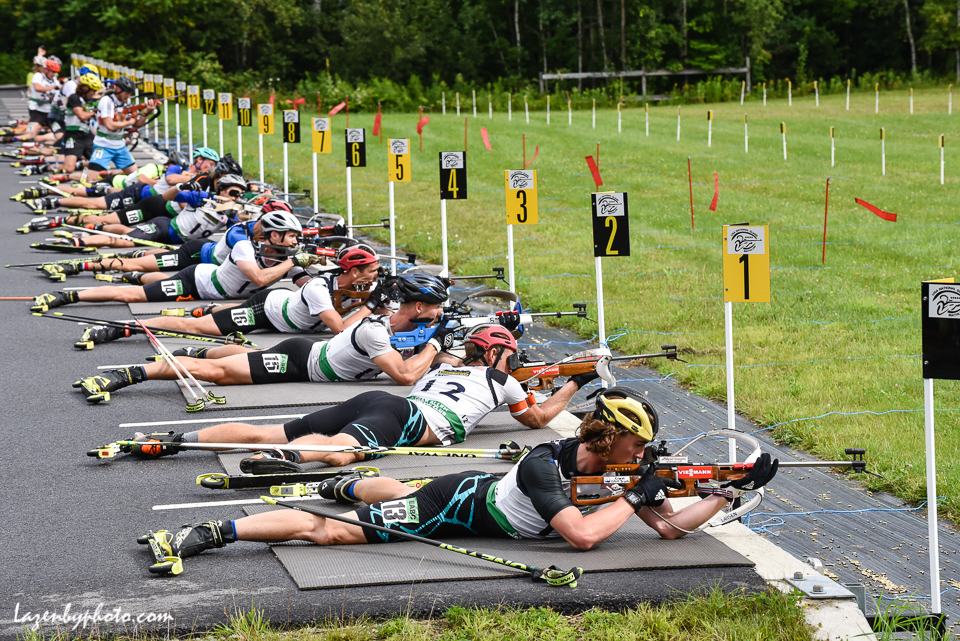
US Biathlon’s Sean Doherty (front) and Lowell Bailey (12), along with their competitors, taking aim during a prone shooting stage of the men’s mass start at 2017 USBA Rollerski Championships on Aug. 13 in Jericho, Vt. (Photo: John Lazenby/Lazenbyphoto.com)
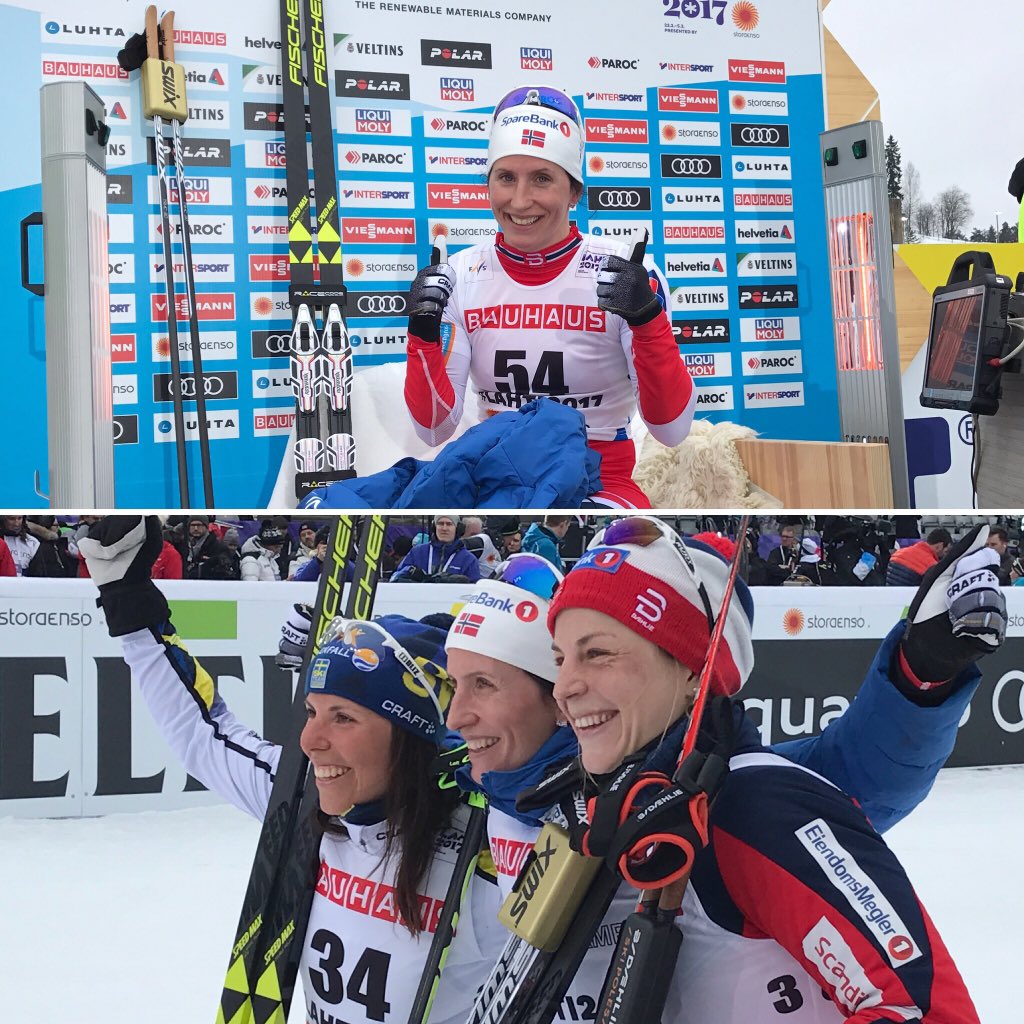
Above: Norway’s Marit Bjørgen celebrates her 16th World Championships gold after winning Monday’s 10 k classic in Lahti, Finland. Below: The women’s 10 k classic podium at 2017 Nordic World Championships in Lahti, with Bjørgen (c) in first, Sweden’s Charlotte Kalla (l) in second, and Norway’s Astrid Uhrenholdt Jacobsen (r) in third. (Photo: FIS Cross-Country/Twitter)
FIS Nordic World Championships (Lahti, Finland): Women’s 10 k classic
No contest. That was the takeaway of Marit Bjørgen’s performance in the women’s 10-kilometer classic individual start on Monday at 2017 Nordic World Championships in Lahti, Finland, after the Norwegian posted a 41-second victory in 25:24.9 minutes.
Bjørgen started 54th of 72 starters and clocked the fastest time over every intermediate timing point on the course. Sweden’s Charlotte Kalla had been the previous race leader after starting 34th before Bjørgen bumped her out of the leader’s chair by 41 seconds.
Norway had two on the podium with Astrid Uhrenholdt Jacobsen in third, 55.5 seconds behind Bjørgen. Norway’s Heidi Weng missed the podium in fourth (+1:13.8), while Sweden’s Anna Haag — an early leader in bib 18 — finished fifth (+1:22.7). Finland’s Kerttu Niskanen took sixth (+1:23.7) and Krista Parmakoski was seventh (+1:31.4), while Norway’s Ingvild Flugstad Østberg and Poland’s Justyna Kowalczyk tied for eighth (+1:34.5). Germany’s Stefanie Böhler rounded out the top 10 in 10th (+1:35.8).
Sadie Bjornsen led the U.S. women in 23rd (+2:21.2), Kikkan Randall placed 26th (+2:31.7), Rosie Brennan was 32nd (+2:55.4), and Ida Sargent 43rd (+3:55.2).
Katherine Stewart-Jones led the Canadians with her best result at her first World Championships in 36th (+3:09.6), Emily Nishikawa followed in 37th (+3:14.9), and Dahria Beatty 39th (+3:24.9).
IBU Youth/Junior World Championships (Osrblie, Slovakia): Junior relays
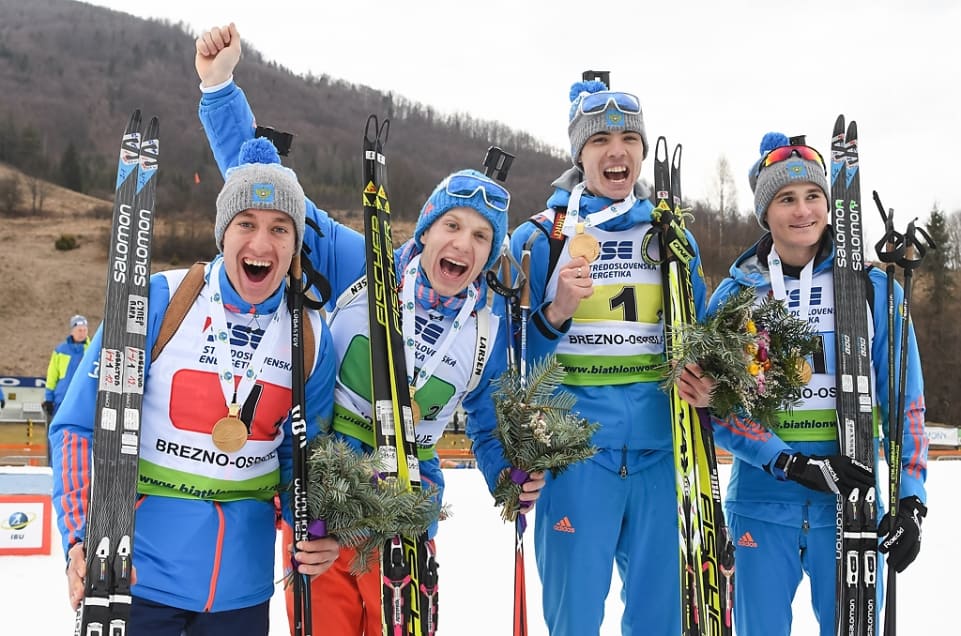
(From left to right) Russia’s Nikita Lobastov, Igor Malinovskii, Nikita Porshnev, and Kirill Streltsov after winning the men’s 4 x 7.5 k relay on Tuesday at IBU Youth/Junior World Championships in Osrblie, Slovakia. (Photo: IBU)
[UPDATED] Russia, Norway, Germany. Or Norway, Germany, Russia. That’s how the podiums shook out for the junior men’s and women’s relays on Tuesday, the last day of the 2017 International Biathlon Union (IBU) Youth/Junior World Championships in Osrblie, Slovakia.
Russia won the men’s 4 x 7.5-kilometer event by 53.9 seconds in 1:17:27.8 hours, with Nikita Lobastov, Igor Malinovskii, Nikita Porshnev, and Kirill Streltsov. After coming through the first exchange in fifth, 44.2 seconds out of first, Malinovskii skied his team into first and they held the lead to the finish. In total, Russia used seven spares to clean and had no penalties.
Norway claimed silver with Dag Sander Bjørndalen,Johannes Dale, Aleksander Fjeld Andersen, and Sindre Pettersen. After getting tagged in 14th, Dale moved the team up to sixth and Andersen improved to second, which Pettersen held. The team combined for one penalty and 12 spares.
Germany claimed bronze (+1:39.3) despite one penalty and 16 spares, with Justus Strelow, Danilo Riethmüller, Dominic Schmuck, and David Zobel. Fourth at the first exchange, Riethmüller picked moved them into third on the second leg, which Schmuck and Zobel held.
Canada finished 12th (+6:00.5) with Zachari Bolduc, Trevor Kiers, Jules Burnotte, and Pearce Hanna combining for three penalties and 13 spare rounds. Positioned in 10th for the first two legs, the team moved into eighth on Burnotte’s third leg. Hanna had to ski three penalty laps on the final leg and slipped to 12th.
The U.S. men finished 14th (+9:07.4) with Cody Johnson, Cameron Christiansen, Travis Cooper, and Peter Carroll combining for two penalties and 10 spare rounds. The team gradually moved up from 16th at the first exchange to 12th at the third and final exchange, before losing two places before the finish.
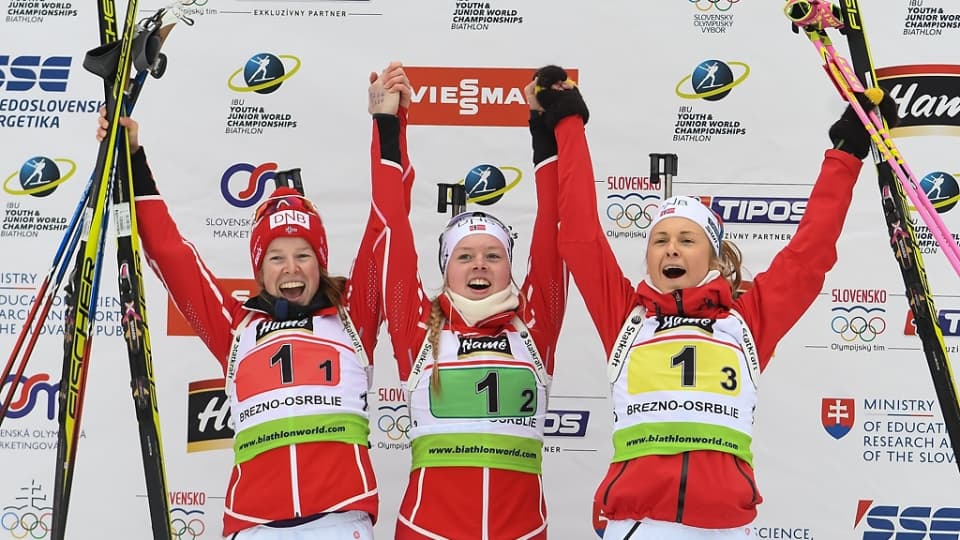
(From left to right) Norway’s Hilde Eide, Karoline Erdal and Ingrid Landmark Tandrevold after winning the junior women’s 3 x 6 k relay on Tuesday at IBU Junior World Championships in Osrblie, Slovakia. (Photo: IBU)
In the junior women’s 3 x 6 k relay, Norway rose to gold with Hilde Eide, Karoline Erdal and Ingrid Landmark Tandrevold (for Tandrevold’s third medal in the last three races, and first gold of the week) finishing in 56:18.4. The team, which had zero penalties and used eight spares, moved up from fourth at the first exchange to first on Erdal’s second leg and Tandrevold anchored them to the win.
Germany crossed the finish 16.5 seconds later for silver, with Vanessa Voigt, Sophia Schneider and Anna Weidel. In seventh after the first leg, Schneider moved them into third before Weidel anchored them to second. They had one penalty and used nine spares.
Russia rounded out the women’s podium in third (+26.1) with Kristina Reztsova, Ekaterina Moshkova and Valeriia Vasnetcova. After being tagged in ninth, Moshkova skied them up to fourth and Vasnetcova picked off one more place for bronze. They combined for one penalty and eight spares.
Canada’s junior women finished 14th (+4:17.7) with Megan Bankes, Emily Dickson and Nadia Moser combining for four penalties and nine spares. They had been as high as 11th after Bankes’s first leg.
The U.S. finished 17th (+11:30) with Siena Ellingson, Helen Wilson and Nina Armstrong accumulating five penalties and 11 spares. They had skied as high as 15th after Ellingson’s first leg.