

Tag: Travis Jones

  • Wednesday Workout: Throwback Speeds with Simi Hamilton

    Wednesday Workout: Throwback Speeds with Simi Hamilton

    Former SVSEF team member Nicole Deyong doing some resisted double-pole speeds with Sun Valley Olympic Development Team Coach Travis Jones in the summer of 2010. (Photo: Travis Jones)
    Former SVSEF team member Nicole Deyong doing some resisted double-pole speeds with Sun Valley Olympic Development Team Coach Travis Jones in the summer of 2010. (Photo: Travis Jones)

    This week, we bring you a Throwback Workout from U.S. Ski Team veteran and two-time Olympian Simi Hamilton. While Hamilton, 27, currently trains with the Stratton Mountain School T2 Team in Vermont, this workout from the summer of 2010 stems from his days with the Sun Valley Ski Education (SVSEF) Olympic Development Team (ODT) in Idaho. Read original workout here.

    ***

    [circa June 2010] 

    One workout that always gets Hamilton “fired up,” he said, are classic speeds: short, all-out sprints, each 20 seconds long.

    Speeds are a good way to practice staying relaxed during the high speed and hard effort of a sprint, Hamilton said, because “it’s just long enough to be able to get into that consistent groove.”
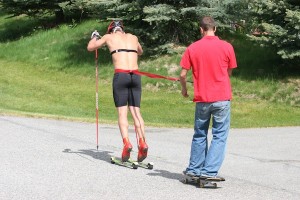
    Simi Hamilton during a resisted double-pole speed workout near Sun Valley, Idaho, in the summer of 2010 with his former coach Travis Jones. (Photo: Travis Jones)
    Simi Hamilton during his last set of a resisted double-pole speed workout in the summer of 2010 with his former coach Travis Jones near Sun Valley, Idaho. (Photo: Travis Jones)

    “The best sprinters in the world — and I think [Andy] Newell does this really well — they’re so consistent throughout an entire sprint,” he said. “Every single double-pole, every single V2 is exactly the same. You never have to worry about adjusting from being too far forward or too far back.”

    In the ODT’s version of the workout, which they do in the summer and through the early winter on snow, athletes will do three sets of six speeds, taking two minutes of easy skiing between each repetition, and seven minutes between sets.

    Instead of doing all the speeds on one stretch of pavement, each set of six is done on a different type of terrain, giving athletes a chance to work on many different techniques. For the first set, the ODT will go from a standstill, using an actual start gate. (If you have one, awesome; if not, you can pretend.)

    According to Hamilton, using a wand and going from a standstill is a great way to practice different start techniques, like striding off the line, or mixing in double-pole strokes.

    Simi Hamilton (U.S. Ski Team) during Thursday's 1.4 k classic sprint qualifier, in which he placed 28th to advance to the quarterfinals. He went on to make the semifinals and ended Day 1 of 2015 World Championships in 12th overall in Falun, Sweden. (Photo: FlyingPointRoad)
    Simi Hamilton (U.S. Ski Team) during the 1.4 k classic sprint qualifier at 2015 World Championships in Falun, Sweden. He qualified in 28th and went on to make the semifinals and ended up 12th overall. (Photo: FlyingPointRoad)

    “You’re really getting used to doing it how they do it in a World Cup,” he said. “I think it’s a great opportunity to mess around with some things, experiment a bit.”

    The second set is usually drop-in speeds, which start after athletes have coasted down a hill. Drop-ins are a good way to practice high-tempo, fast-paced techniques, without expending the energy of getting up to speed.

    The final set is on a steep uphill, or even around an uphill corner, using either classic striding or V1 technique. You can get creative: two weeks ago, ODT Coach Travis Jones had team members doing resisted double-pole speeds for the last set, in which athletes were attached to Jones by a bungie cord and had to pull him uphill on his skateboard.

    “It made you feel like you’re one of those guys [in] the World’s Strongest Man competition,” Hamilton said.

    Hamilton recommends doing the speeds with other people, going head-to-head. He said that he doesn’t see the workout as too taxing — it’s rare that his heart rate gets above threshold — which makes it a good session to use for a recovery workout or during a week with a heavy training load.

    “It’s not hammering level four intervals all day,” he said, “but … when you’re really flying and feeling on, it definitely gives you a ton of confidence.”

    The workout: Classic speeds

    Overview: 3 sets of 6 speeds, taking 2 minutes of easy skiing between each repetition, and 7 minutes between sets.

    Set 1: Start from a standstill, using an actual start gate. (If you have one, awesome; if not, you can pretend.) Practice start techniques off the line. Do six times.

    Set 2: Drop-in speeds, starting after athletes coast down a hill. Practice high-tempo, fast-paced techniques. Do six times.

    Set 3: Classic striding or V1 skate on a steep uphill or around an uphill corner. You can get creative (i.e. incorporate resisted double-pole speeds by attaching athletes to coach on a skateboard with a bungie cord and have athlete pull coach uphill. Do six times.

  • From Athlete to Coach, Rodgers to Lead Sun Valley ODT

    Colin Rodgers (SVSEF) – Racing to fourth place at the 2011 Lake Placid SuperTour

    Colin Rodgers, a longtime member of the Sun Valley Ski Education Foundation (SVSEF) Olympic Development Team (ODT), has been named its head coach. He is taking over for Travis Jones, who stepped down this spring after three years on the job.

    “I am very fortunate for this opportunity,” Rodgers told FasterSkier in an interview. “I am going to be able to work with some great athletes that I already know really well.”

    A native of Vermont and a graduate of Middlebury College, Rodgers replaces Jones, who was looking for less time on the road and more time with his family.

    “I decided it was time, both for my sake and my kids sake and also for the sake of the athletes on the team,” Jones told FasterSkier in an interview earlier this spring.

    “They need somebody who can be psyched and ready to travel with them that much every winter, and who can really make the team their number one priority.”

    Jones cited the nearly 120 days on the road scheduled for the 2012 season, and a desire to spend more time with his young family as the primary reason for leaving the ODT.

    Rodgers made his mark on the elite ski scene as a sprinter. He had his best season in 2009, winning the SuperTour sprint title on the strength of two victories and two second place finishes.

    He also started five World Cup races that season, including three European events. His Olympic hopes were dashed by injury and he missed the second half of the 2010 season, but came back strong in 2011.

    Coaching has not been a major focus as a potential career for Rodgers, however.

    “I have always like spreading the enthusiasm I have for ski racing to other people. I have always been passionate about skiing since I was very young, but I never said to myself that I would be a coach – this year or down the line. It is something that justhappened.”

    He described the opportunity as “too good to pass up,” and sees the biggest shift in the transition from athlete to coach as an altering of focus.

    “It is about taking a step back about thinking about what I need for myself to succeed as an athlete to thinking about each individual on the team and their needs to reach their potential,” Rodgers said.

    Despite his new role, Rodgers did tell FasterSkier that he may have a few opportunities to pull on a bib over the course of the season.

    The elite ODT is the top level of the robust SVSEF pipeline. Last year’s team consisted of, among others, US Ski Team athletes Simi Hamilton and Morgan Arritola, SuperTour Sprint Champion Mike Sinnott, and collegiate standout Reid Pletcher.

    Rodgers does not see the quick transition from teammate to coach as an issue, noting that coaching is always a challenge, but one he is looking forward to.

    He sees his relationships with the ODT members as a plus, telling FasterSkier that “I think this is…a good opportunity for me because I know them so well as athletes. I have a good idea of what they need to take the next step.”

    Recognized as one of the top senior-level race teams in the country, the ODT will see a number of other changes in addition to the switch at the top.

    Eventual champion Nicole DeYong (152) leads second place finisher Kristina Trygstad-Saari (151) in the 2010 Owl Creek Chase (Photo: Hunter Mooneyham/Sundance Images)

    In an interview this spring, SVSEF Cross Country Program Director Rick Kapala told FasterSkier that a search was on for a full-time service technician to work the five-month competition season.

    Rodgers confirmed that this was still the case, but indicated that the position might not be filled.

    “We are hoping to have someone else help us out, but if we don’t, we have Chris Mallory, who is a huge asset. Between he and myself we can make it work,” Rodgers said.

    Mallory, however, coaches the SVSEF Comp Team – the program for high school aged athletes – a role that he will continue, limiting his availability for the ODT. According to Kapala, SVSEF hired a technician, Cory Wubbels for several projects last season, and he recognizes a need for a season-long staff member.

    “One of the things we think we probably did to Travis unfortunately is that we burned him out a little bit,” Kapala told FasterSkier. “He was on the road oftentimes alone with the ODT guys, carrying the huge load of both coaching those athletes as well as having to do ski service. And we gotta change that.”

    But Rodgers points out that it isn’t always easy finding the right person for the job.

    On the athlete front, there is also some turnover. Nicole Deyong will no longer be competing as a member of the ODT.

    “She won’t be somebody who will be exclusively chasing ski racing a whole lot longer here,” Kapala said, adding “I think the world of her. She is super-legit in every way. If we can keep her around in any capacity that would be great.”

    Holmes racing the 5km classic in West Yellowstone

    Chelsea Holmes, who posted excellent results while skiing for the Far West Farm Team and coaching with Sugar Bowl Academy joins the squad. She spent the spring in California working with coach Jeff Schloss according to Kapala, who sees the benefit of athletes maintaining relationships with multiple coaches.

    “Whatever she can get from our team and whatever she gets from Jeff, we want her to have the best of both relationships,” Kapala said.

    Holmes’ impressive 2011 campaign included two victories at the Canadian National Championships and a tenth place in the overall US SuperTour standings.

    While Holmes is the only brand new face on the team, veterans Morgan Arritola and Alexa Turzian will both have a bigger presence.

    Turzian will spend the summer training in Sun Valley before completing her studies at the University of Colorado in the fall and traveling with the ODT in the winter.

    Arritola, like Turzian, a native of the Sun Valley area, declined a position on the US Ski Team B-Team. Arritola spent four years with the US Ski team, including two on the A squad.

    With possible plans to pursue her education, Arritola may not be based out of Sun Valley for the entire year, but she will be racing with the team.

    Another returning ODT member, Katie Bono should be back at full strength after missing significant time in 2011 with mono.

    In addition to Holmes, Arritola, Turzian and Bono, the 2012 roster consists of Simi Hamilton Matt Gelso, Mikey Sinnott and Reid Pletcher, who is in the process of recovering from a climbing accident.

  • Pursuits Fade from U.S. Domestic Circuit


    James Southam racing in the pursuit at the 2010 Olympic Games in Whistler.

    When James Southam lined up for the start of a 30 k pursuit race at the Olympics in Whistler in February, it was the first time he’d done so all year.

    At the 2009 World Championships in the Czech Republic, Southam faced a similar challenge: the pursuit race there was only his second of the season, following a World Cup in Whistler earlier that year.

    Of the 24 SuperTour races scheduled by the U.S. Ski and Snowboard Association (USSA) in the winter of 2009-2010, not one was a pursuit. (The format has athletes racing half the designated distance using classic technique, then switch to skating with the clock still running.)

    Southam acknowledges that the discipline presents a challenge to organizers, who must lay out a meticulously-designed stadium to accommodate athletes’ equipment and ensure a smooth switch between techniques. But he still thinks that the country could use a few more. The last time Southam raced a pursuit domestically, he said, was in March, 2009, at distance nationals in Fairbanks.

    “I think it’s worth doing at least once,” he said. “Coming into a championships, it’s really nice if you have something like that, even though it’s a totally different style of racing [at the international level].”

    Pursuits haven’t played much of a role on the U.S. domestic race circuit for the last decade—the International Ski Federation’s results database turns up only nine competitions since 2003.

    Up until 2006, however, the race was a part of the U.S. National Championships program. And as recently as 2009, a pursuit event was included at distance nationals, which is held at the end of the season.

    But with the demands the discipline places on race organizers, and the advent of the mini-tour format that has replaced distance nationals, the pursuit race appears to have evaporated from the country’s competitive landscape.

    As the nordic director at USSA, John Farra helps to set the domestic racing schedule, and he took full responsibility for eliminating pursuits from country’s championship program.

    The purpose of those events, Farra said, is “to determine who the country’s best racers are, and give them points.”

    Staging a pursuit, Farra continued, just isn’t necessary to do that. A 30 k/20 k distance race has replaced the pursuit at nationals, which “is nice and simple, and provides the same results that you would otherwise, if it was a pursuit.”

    “We’re not against them—it’s just not necessary to figure out who the [best] athletes are,” Farra said. “To me, it has no relevance whatsoever, except if you’re deciding that you want your World Championship and Olympic team members to have a chance practicing changing their [equipment] under fire.”

    Noah Hoffman, a member of the U.S. Ski Team’s B-Team, said that he had occasionally struggled in pursuits at the international level, and that he thought he might benefit from more racing opportunities. At the World U-23 Championships in Germany last January, Hoffman skied well during the classic portion, leading the field at one point, but then struggled after switching to skate, calling it a “shock to the system.”

    “I tend to get into a rhythm…changing it up has been tough for me,” he said. “I just never got comfortable on that skate leg. Who knows if that would have been something, if I did it more, would have been comfortable?”

    Caitlin Compton racing at 2010 U.S. Nationals in Anchorage.

    Like Southam, Hoffman also acknowledged that pursuits place big demands on organizers. But according to Caitlin Compton, who also raced in her first pursuit of the 2010 season at the Olympics, the event isn’t just challenging for organizers. With twice as many skis to wax, pursuits can be a major challenge for service staff.

    “It’s a huge headache for them, just having so many skis to prepare,” she said, noting that athletes also have to take extra time testing their equipment before a pursuit race.

    Unlike Southam, Compton had no problems with the dearth of the pursuits on the domestic circuit. Competitions, she said, are not the only way to prepare for a given format—athletes can just as easily work with coaches during training sessions to make sure they’re ready for an event.

    “Just because you don’t race it—you can make an effort to train that way,” she said.

    Travis Jones, the head coach of the Sun Valley Ski Education Foundation’s Olympic Development Team (ODT), said that his athletes don’t do much focused training specifically for pursuits, since “it’s not a priority on the domestic schedule.” Only one ODT member, Morgan Arritola, races the format regularly, he said.

    However, Jones acknowledged that when athletes compete at the international level, clubs have a responsibility to prepare them for the formats they will be racing.

    The ODT does perform a number of workouts that include a switch from classic to skating midway through, similar to the transition made in a pursuit. As for the exchange—the actual switch of skis and poles mid-race—Jones says that “it’s something you want to practice,” if you’re racing pursuits on a regular basis.

    “The athletes that we have that compete in a significant number of pursuits emphasize exchange time,” he said.

    While the pursuit is raced regularly on the World Cup and at major international championships—there were five scheduled last year—most other domestic circuits eschew the format.

    Of the 13 Scandinavian Cup races held last year in northern Europe, none were pursuits. In the Alpen Cup, another domestic European circuit, there was only one pursuit scheduled for the entire the 19-event series, and it was cancelled. Closer to home, Canada also held just a single pursuit last year.

    Farra said he has heard no complaints from athletes or coaches about the current makeup of the domestic schedule. That suggests to him that nobody is missing the pursuit format.

    “I don’t remember anyone bringing it up and arguing otherwise,” he said.

  • New Format to Enliven SuperTour Finals

    New Format to Enliven SuperTour Finals

    Maine Winter Sports Center's Will Sweetser on the SuperTour Finals' uphill climb earlier this week. (The real course will have some switchbacks.)

    Everyone’s excited about the three-day mini-tour at the 2010 SuperTour Finals, and why not?

    Featuring a mass start classic race, a classic sprint, and an uphill climb, the event has something for everyone: sprinters and distance specialists, climbers and all-rounders, fans, and the media.

    The only ones who might have reservations are the coaches, since they have to wax all the skis and tackle the logistics. But a survey of those here in Fort Kent found unanimous approval.

    “We’re fired up about it,” said Travis Jones, the coach of the Sun Valley Ski Education Foundation’s Olympic Development Team. “It’s a really interesting format….For us to get some experience in skiing those kind of events, for our best athletes—totally valuable.”

    While it’s the first time the Finals have taken this form, tour-style competitions—where athletes race multiple events and aim for the lowest combined time—have been catching on in Europe.

    Now in its fourth year, the Tour de Ski took place in February and included eight races over eleven days. The final World Cup weekend has been a mini-tour for the past two seasons. And one step down, on the OPA Cup, the 2010 finale in Slovenia was also a three-race mini-tour much like the one being held in Maine.

    According to Will Sweetser, one of the event organizers at Maine Winter Sports Center, it’s about time the U.S. caught up.

    “It’s going to get more important if you look down the road…I think it’s an event that’s proven its worth and that it’s going to continue to be here,” he said. “It’s pretty sad that no Americans have taken part until now, so I think we should prep the next generation to get it done.”

    Last spring, Sweetser pushed U.S. Ski and Snowboard Association Nordic Director John Farra to let him host a big tour-style event for juniors and under-23 racers in northern Maine. Farra countered by suggesting that the event serve as the SuperTour Finals, and preparations began in earnest.

    The first two races—the classic sprint and mass start—will be held at the Four Seasons Trails in Madawaska, where a new, 3,600 square foot lodge was built two years ago entirely by volunteers.

    Madawaska has coalesced around cross country skiing, and before a recent storm dropped seven inches of new snow on the trails, the town had gone to extraordinary measures to make sure that its trails were ready for their first major races, hauling 18 dump truck loads of snow onto the sprint course on Monday.

    The final race of the tour, the uphill climb, is in Fort Kent, and it includes a section just over one kilometer long that sends athletes straight up the side of the local alpine slope. The lifts will be open on Sunday during the race, Sweetser said, and a portion of the trail adjoining the race course will be open to spectators.

    Andy Newell at a race in this year's Tour de Ski. He also completed the mini-tour at the World Cup Finals in Sweden

    The array of distances and formats in the mini-tour “forces skiers who are typically good in one event to practice everything,” according to Andy Newell, the only American who has competed in the Tour de Ski.

    “You can be good at either distance or sprint, or skate or classic, but in order to succeed in a tour, you really have to be an all-around skier,” he said.

    Each event makes its own unique demands on athletes, but so also does the tour in its entirety—especially for anyone who raced the 30/50 k championships on Wednesday.

    “Very rarely do our athletes race four times in five days… It’s certainly the way things are going on the world scene, I think, at least during some parts of the season, so we need to learn how to do it. But it is challenging, make no mistake,” said Jones. “I think we’re definitely going to see some people throw down big in the 50 and 30 [k] and be absolutely blown out by the end of the series.”

    SVSEF’s Mike Sinnott, who skied well in the OPA Cup mini-tour, said that the key to success is a good start, which sets you up for success in the later races. On the flip side, a single bad race can take you out of contention for the entire event.

    For athletes who aren’t contending for the overall, though, there’s still a whole set of competitions within the tour.

    Each day has its own cash prizes for podium finishers. Winners of intermediate sprints in the mass start and hill climb get more money, as well as special climbers’ and sprinters’ bibs. Top finishers in each of the first two events get time bonuses.

    Some have criticized the new event formats as gimmicky, but athletes and coaches here seem enlivened by the changes to an event that can sometimes drag on at the end of a long season.

    “I think we should for sure, in the cross country world, stick to classics like 30 k’s and 50 k’s, individual starts, and things like that,” said Newell. “We don’t want to change everything, but also having mini-tours, I think, is just a fun way to mix it up, keep it different, and also show who the best all-around skier is.”