From the FasterSkier archive — posts syndicated from athletes’ and coaches’ own blogs between 2004 and 2012, kept online as published. Current coverage is at fasterskier.com.
Maxim Vylegzhanin competing in the 10 k classic in Falun, Sweden, in 2016. Vylegzhanin is provisionally suspended while the International Olympic Committee investigates possible doping infractions at the 2014 Olympics. (Photo: Fischer/NordicFocus)
Among the six was Maxim Vylegzhanin, who won silver medals in the team sprint, relay and 50-kilometer mass start in Sochi.
Although Vylegzhanin has not been cleared by FIS, he competed in two regional championship races over the weekend, winning both. In the 15 k skate, for instance, he beat Evgeny Vakhrushev by 8.5 seconds to take the title, and bested third-place Dmitry Japarov — a teammate from the silver-medal Sochi relay — by 20 seconds. Results of the competition are available from Skirun.ru.
What’s Allowed During a Suspension?
In the McLaren report evidence packet, a urine-sample bottle associated with Vylegzhanin’s athlete ID number were shown to have marks on them associated with tampering. That sample, #2868240, even had fibers inside the lid of the bottle.
This is one of the cases the International Olympic Committee is investigating, which triggered the suspension by FIS.
FIS has not lifted Vylegzhanin’s suspension, initially announced on Dec. 23, 2016, or the suspensions of any of the other five athletes. The federation rejected an initial appeal by two skiers.
“No Athlete or other Person who has been declared Ineligible may, during the period of Ineligibility, participate in any capacity in a Competition or activity (other than authorised anti-doping education or rehabilitation programs) authorised or organised by FIS or any National Ski Association or a club or other member organisation of FIS or any National Ski Association, or in Competitions authorised or organised by any professional league or any international or national level Event organisation or any elite or national-level sporting activity funded by a governmental agency.
“An Athlete or other Person subject to a period of Ineligibility longer than four years may, after completing four years of the period of Ineligibility, participate as an Athlete in local sport events not sanctioned or otherwise under the jurisdiction of a Code Signatory or member of a Code Signatory, but only so long as the local sport event is not at a level that could otherwise qualify such Athlete or other Person directly or indirectly to compete in (or accumulate points toward) a national championship or International Event, and does not involve the Athlete or other Person working in any capacity with Minors.
“An Athlete or other Person subject to a period of Ineligibility shall remain subject to Testing.
“[Comment to Article 10.12.1: For example, subject to Article 10.12.2 below, an Ineligible Athlete cannot participate in a training camp, exhibition or practice organised by his or her National Ski Association or a club which is a member of that National Ski Association or which is funded by a governmental agency. Further, an Ineligible Athlete may not compete in a non-Signatory professional league (e.g., the National Hockey League, the National Basketball Association, etc.), Events organised by a non-Signatory International Event organisation or a non-Signatory national-level event organisation without triggering the Consequences set forth in Article 10.12.3. The term “activity” also includes, for example, administrative activities, such as serving as an official, director, officer, employee, or volunteer of the organisation described in this Article. Ineligibility imposed in one sport shall also be recognised by other sports (see Article 15.1, Mutual Recognition).]”
Vylegzhanin and Valbe
Neither Vylegzhanin nor Elena Valbe, the president of the Cross-Country Ski Association of Russia, considered his participation in the recent races to be against the rules.
“Maxim doesn’t have right to compete in the international races [organized by] FIS, or to take part in the national team activities,” Valbe said. “There’s nothing else forbidden for him. He trains and will go on training. This race has nothing to do with FIS.”
Vylegzhanin agreed, saying that he had approached Valbe and another Russian ski official to ask what types of competitions he could compete in without violating his suspension. He explained that “people need to understand that you need to keep in shape to compete.”
However, the races were almost certainly within the scope of the FIS rules cited above. They were regional championship competitions in Udmurtia, a state republic on the plains of Russia whose capital, Izhevsk, is 600 miles nearly due east of Moscow.
The races were organized by Ministry of Physical Culture, Sport and Youth Policy of the Udmurt Republic, and the Ski Races Federation of Udmurtia. This federation is a member of the Cross-Country Ski Federation of Russia. This would seem to make the races organized by “a club or other member organisation of FIS or any National Ski Association.”
What Consequences?
FIS has said that it is investigating Vylegzhanin’s participation in the races to see if it is a violation of his suspension.
According to Article 10.12.2 of the FIS Anti-Doping Rules,
“Where an Athlete or other Person who has been declared Ineligible violates the prohibition against participation during Ineligibility described in Article 10.12.1, the results of such participation shall be Disqualified and a new period of Ineligibility equal in length up to the original period of Ineligibility shall be added to the end of the original period of Ineligibility. The new period of Ineligibility may be adjusted based on the Athlete or other Person’s degree of Fault and other circumstances of the case. The determination of whether an Athlete or other Person has violated the prohibition against participation, and whether an adjustment is appropriate, shall be made by FIS. This decision may be appealed under Article 13.”
The Associated Press contacted FIS for comment.
“FIS is currently following up with the Russian national ski association to ensure that during ineligibility these rules are correctly understood and followed,” FIS spokeswoman Jenny Wiedeke wrote in an email reply. “If an athlete does not respect his/her status during ineligibility, then the time of the provisional suspension will not be credited against the final suspension period (if any).”
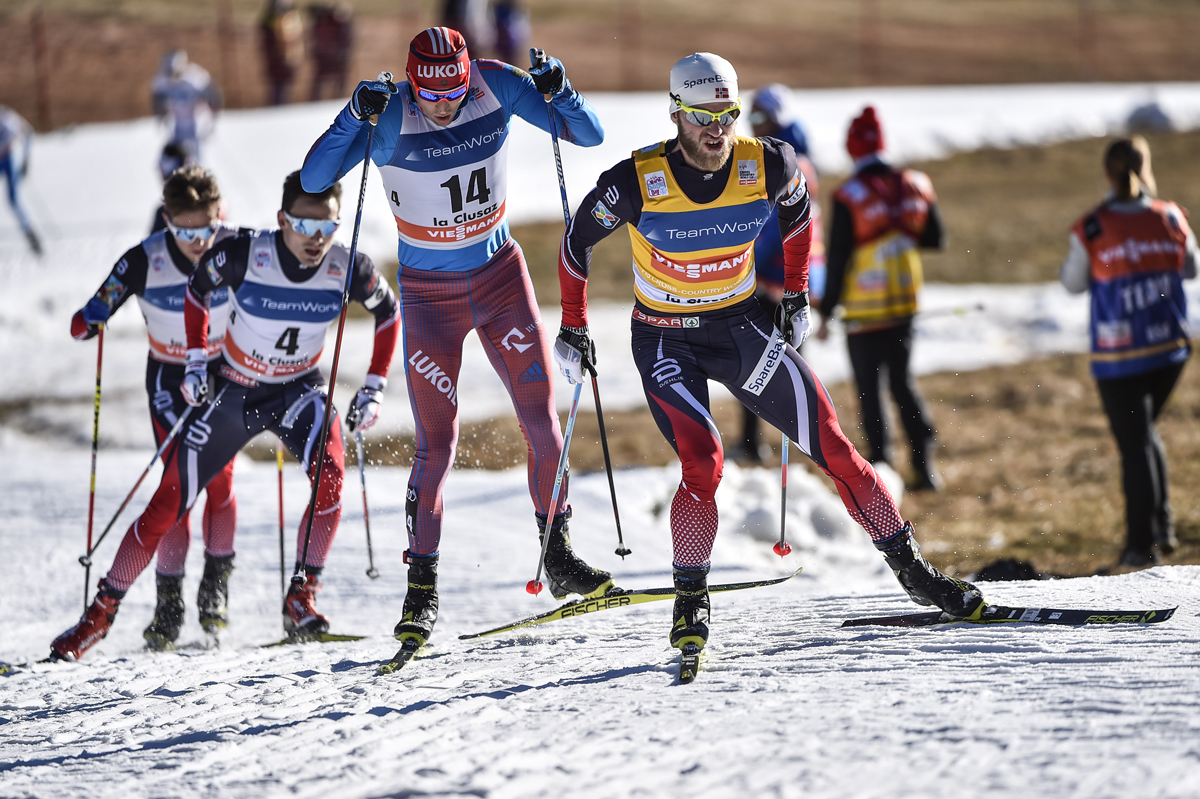
Alexander Legkov (bib 14) chasing Norway’s Martin Johnsrud Sundby in the 15 k mass start skate in La Clusaz, France, on Saturday. (photo: Fischer/Nordic Focus)
Note: this article has been updated to include more accurate information about Alexander Legkov’s participation at 2014 Russian Championships.
At least 34 skiers are referred to in the World Anti-Doping Agency’s McLaren report, including one by name: Alexander Legkov, the 2014 Olympic champion in the 50 kilometer skate.
Throughout the report’s evidentiary documents, names of athletes were scrubbed and replaced with alpha-numeric codes. But in one set of emails leaked by Grigory Rodchenkov, Legkov’s name is not redacted.
“They rescued the stupid goat Legkov,” Rodchenkov wrote.
The comment was part of a thread of emails referring to a positive test for budesonide, a corticosteroid, by an athlete referred to as ID number A0467. The sample was taken on March 28, 2014, in Tyumen at Russian Championships. Staff emailed back and forth about the case, asking at one point why the athlete did not have a therapeutic use exemption (TUE) for the drug.
“Rescued” indicates that the test was given a “save” order: despite being a positive test, it was reported as negative. This is confirmed in another document, which lists the sample (number 2870442) as being positive for budesonide, but being reported to WADA’s results management database, ADAMS, as being negative.
Results of Russian Championships in Tyumen that year show that Legkov did not compete in individual races, but skied the third leg of the winning relay team (the other skiers on the Khanty-Mansiysk team were Sergey Turyshev, Evgeny Dementiev, and Sergey Ustiugov; Dementiev served a two-year ban for using recombinant erythropoietin, and returned to competition in 2011).
It is possible that Legkov was in Tyumen anyway but was not racing, and that anti-doping officials tracked him down there and requested an out-of-competition sample. Although the championships were taking place in Tyumen at that time, the 28th was not actually a competition day.
Another possibility is that the place or date of sample collection are incorrect in the emails. While the sample is listed in another spreadsheet, that version does not provide the date of sample collection.
A last possibility is that Legkov’s name was inserted into the report incorrectly, perhaps by someone with a bone to pick.
Either possibility would seem like an anomaly in an investigation full of strange occurrences.
Yet other documents suggest that the athlete was indeed Legkov. In another spreadsheet, athlete A0467 is referred to as winning “gold 50 km mass start”.
And yet another spreadsheet shows that the athlete had urine samples collected on February 13, 21, and 23 February in Sochi, and blood samples on February 6 and 23 in Sochi. Another urine sample was collected at an unknown date. No substances are listed for these samples, but all four of the urine samples are present in a long spreadsheet listing tests which were handled incorrectly by anti-doping authorities.
February 23, the day both a urine and blood sample were collected, was the day Legkov won the Olympic 50 k.
The documents show that 13 other skiers were “protected” athletes in Sochi. And besides A0467, nine other skiers – not all Olympians – are described as having positive tests at some point in the last several years.
Here is what we know about them.
About the Documents
EDP1162, EDP1149, and EDP1154: Professor McLaren describes EDP1162 in his report: “Alexey Velikodniy created a daily competition schedule that identified protected athletes. The schedule was continuously updated during the Games and included all those on the Sochi Duchess List and athletes added during the Games, such as the female hockey team.” EDP1149 includes English translation of the original EDP1162.
Professor McLaren (c) addressing the media after the his second report on systematic, state-sponsored doping in Russian summer and winter sports. (Photo: WADA/Twitter)
This – and EDP1154, which summarizes the information in a tabular format and adds a column for “medals – still seem to have been planning documents. For instance, biathlete Irina Staryk is still listed as competing in the relay, even though she had long been off the Olympic team after a positive test for EPO was reported in January. Likewise, Legkov is listed in this document as competing in the 10 k classic, while neither actually did. Several other commentators have tried to link names to ID numbers based on race registration in this document, but that seems unfair.
EDP1156: A list of sample numbers and collection during or immediately before the 2014 Olympics in Sochi, from protected national team athletes. Some data about the urine tests, like pH and specific gravity, are included, indicating that this was not merely a planning document but that the tests took place.
EDP1141: Results of a study done at King’s College London assessing whether the sodium concentration and specific gravity of some doping control samples were abnormal. (They were: in some cases, though none in biathlon, sodium concentrations were consistent with having added a teaspoon of salt to a one-cup urine sample.)
EDP0902: The report of a forensic examiner who looked at urine sample bottles from the Sochi Olympics to determine whether they had been tampered with, consistent with descriptions of a scheme to open the bottles and replace “dirty” urine samples with pre-collected “clean” urine.
EDP1155: Translations of emails involving Grigory Rodchenkov, the former head of the Moscow anti-doping laboratory who became a whistleblower and took his story to the New York Times.
EDP1166: A list of test numbers, mostly associated with athlete ID numbers, identified by the investigation. “The IP has identified more than 1231 samples where the Moscow Laboratory communicated the presence of a prohibited substance in a Russian athlete’s sample to the [Ministry of Sport] and later reported that sample as negative in ADAMS or did not report the sample at all.” This document lists those 1231 samples.
There are columns for which substances were positive in the sample (this column is often blank) and how the report was filed in the ADAMS database. Many samples were filed as “negative”, but this column is also often left blank. This may mean that the sample was never reported in ADAMS at all – as McLaren says was fairly common – or simply that there was no information about it.
In general, the investigation’s translations from Russian into English are not always smooth. This is particularly apparent in reference to competitions: the name or level of a series is hard to interpret. It’s possible that the anti-doping staff themselves were not familiar with the different race circuits because they were not necessarily biathlon experts, and worked more generally in all sports.
A further note: some documents are scanned and thus not searchable by text. Thus some names and numbers may be referenced in places where we have not yet found them.
Other Athletes With Positive Tests
Of the nine other positive tests belonging to skiers, one belonged to an athlete never assigned an ID number. This means that it could be redundant – this skier could in fact be one of the numbered athletes – or it could be an entirely new athlete.
A0086, male cross-country skier
Evidence of being a protected athlete? Yes. This athlete appears in planning documents for Sochi. In these documents, it is clear that the athlete is male.
Evidence of positive tests? In EDP1141, the chemical analysis by staff at King’s College London showed that sample 2889705 was particularly concentrated, and possibly not an authentic post-competition urine sample. Documents related to Sochi show that the sample had been collected on February 12, 2014 – not a competition day at the Olympics.
How was the test handled? It’s not clear. In EDP1166, the field for how the test was reported to ADAMS is left blank. This could mean that it was never reported at all.
Other tests? For this athlete, urine tests were collected at the Olympics on February 6 and 15, 2014, and blood tests on February 6 and 11. Three other urine tests are reported in EDP1166, with no substances listed, and the tests do not seem to have been entered into ADAMS.
A0281, female cross-country skier
Evidence of being a protected athlete? No.
Evidence of positive tests? One of this athlete’s urine samples (3689022) is listed in EDP1166 as testing positive for the blood-doping drug recombinant erythropoietin. The emails show that the test was collected at a training camp in Moscow, and are listed with a “quarantine” order: to prevent the athlete from leaving Russia where they could be drug tested by other authorities. The emails note that “the name is not known.”
How was the test handled? According to EDP1166, the test was reported to ADAMS as negative.
Other tests? None listed.
A0291, female cross-country skier
Evidence of being a protected athlete? Yes. This athlete appears in planning documents for Sochi. In these documents, it is clear that the athlete is female.
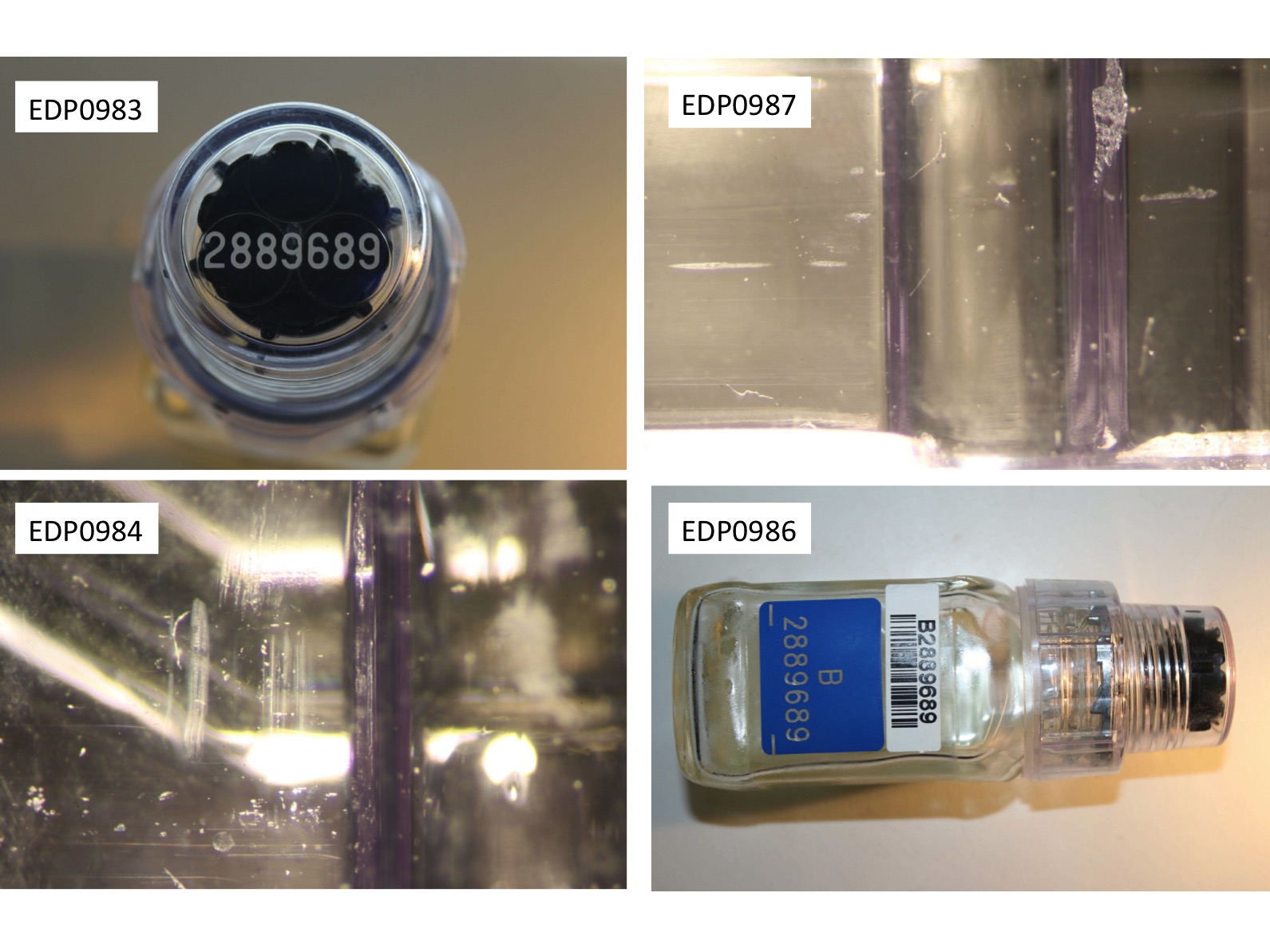
Photos of the sample bottle from the McLaren report’s evidence packet.
Evidence of positive tests? There are multiple lines of evidence showing that this athlete’s urine sample (2889689) was tampered with. The sample was collected on February 17, 2014, not a competition day for cross-country skiers at the Olympics. A forensic report showed that the sample had marks consistent with opening the bottle. In addition, the sample inside had such high sodium levels that chemists concluded that salt must have been added to the sample – the sodium values were physiologically impossible. This is consistent with reports of a scheme to swap dirty urine samples for clean ones, because Rodchenkov had described adding water and salt to samples as he and staff switched the urine between bottles.
How was the test handled? It’s not clear. In EDP1166, the field for how the test was reported to ADAMS is left blank. This could mean that it was never reported at all.
Other tests? This athlete also had a blood test collected in Sochi on February 5 and a urine test on February 6. Another urine test was collected at an unreported date. For all of these samples there were no substances listed, and the tests do not seem to have been entered into ADAMS.
A0572, male nordic combined athlete
Evidence of being a protected athlete? No.
Evidence of positive tests? Multiple documents show a sample (2867397) collected on 02.01.2014 which tested positive for trimetazidine, an anabolic agent. The emails note that the athlete was leaving a few days later for France. World Cups were held in Chaux Neuve, France, on January 11 and 12. Only two Russian competed there: Ernest Yahin, who finished last in the large hill 10 k, and Denis Isaykin, who teamed up with him for 17th place in the team sprint relay.
How was the test handled? EDP1166 shows that this sample was reported as negative to the ADAMS database.
Other tests? None listed.
A0942, male cross-country skier
Evidence of being a protected athlete? No.
Evidence of positive tests? In EDP0901, referred to as a list of “dirty” samples, this athlete is listed as being handled by FIS, the International Ski Federation. In another document, EDP0650, the sample is listed as being collected on December 1, 2013, and as being positive for acetazolamide, an anabolic agent.
How was the test handled? It’s not clear. The test is not listed in EDP1166. In EDP0650, there is a note in the “commentary” column: “It is not possible.”
Other tests? None listed.
A0958, male cross-country skier
Evidence of being a protected athlete? Yes. This athlete is listed in several Sochi planning documents. Documents EDP1166 and EDP1156 show that this athlete had samples from taken during the Olympics on February 1, 9, 15, 16, 19 and 23. Of these dates, February 9, 16, 19 and 23 align with the competition dates of the 30 k skiathlon, relay, team sprint, and 50k, respectively. That could, but does not necessarily, mean that the athlete competed in each of those events: analysis of the cases of four biathletes whose names were not scrubbed from an evidentiary document showed that at Sochi, those athletes did not have samples collected every day that they competed, and did have samples collected on some days they did not compete. Thus sample collection and competition were somewhat disconnected.
Maxim Vylegzhanin competing in the 10 k classic in Falun, Sweden, in 2016. (Photo: Fischer/NordicFocus)
Evidence of positive tests? One of the athlete’s samples samples (2866326) tested positive for trimetazidine, an anabolic agent, according to both emails and EDP1166. The positive test occurred on January 5, 2014 at a training camp in Sochi. Most of the Russian distance skiers were at the Tour de Ski at that time; of the four who competed in the 50 k in the Olympics, only Maxim Vylegzhanin did not participate in the Tour de Ski. In EDP1155, beneath the statements about A0958’s positive test, it says “January 11-12 KM, Czech Republic”. Vylegzhanin, after sitting out of the Tour de Ski, did compete in Nove Mesto, winning the team sprint on January 12th.
How was the test handled? In the emails, this sample is given a “save” order. The athlete was likely high-profile because the email (which can be seen in Russian here) also says, “PERSONALLY warn as soon as possible.” And in EDP1166, it is listed as being reported to ADAMS as a negative test result.
Other tests? None listed, other than those from Sochi described above.
Unnumbered cross-country skier, female
Evidence of being a protected athlete? No.
Evidence of positive tests? The emails refer to a sample (2944730) collected on 11.19.2014 in Vertex Tei, which had a testosterone to epitestosterone ratio of 6.6. A high ratio can indicate that an athlete was using exogenous testosterone, and a finding of a ratio above 4.0 triggers further investigation.
How was the test handled? In the email, the description of the sample follows the word “quarantine.” This means that the athlete was likely kept in Russia until they could pass a drug test. The email can be seen (in Russian) here. However, the sample is not mentioned in EDP1166.
Other tests? None listed, but because the athlete does not have an alpha-numeric code number assigned it’s impossible to tell.
A0094, female skier (discipline not listed)
Evidence of being a protected athlete? No.
Evidence of positive tests? A sample (2868048) collected on 09.12.2013 at a junior training camp in Syktyvkar had a testosterone to epitestosterone ratio of 5. In an email (which can be seen in Russian here) it is noted that this is “for women bad”. In the translated emails that’s followed by the comment: “he’s an idiot.” It’s not clear if the pronoun was translated incorrectly and the staff is referring to the athlete, or perhaps to a male coach or doctor.
How was the test handled? EDP1166 shows that this sample was reported to ADAMS as negative.
Other tests? None listed.
A0918, male cross-country skier
Evidence of being a protected athlete? No.
Evidence of positive tests? A sample (2808826) is listed in EDP1166 as being positive for phthalates, which are plasticizers. They are prohibited because they are thought to indicate the use of blood transfusions, with the plasticizers being used to soften the plastic in blood bags and then diffusing into the blood.
How was the test handled? EDP1166 shows that this sample was reported to ADAMS as negative.
Other tests? None listed.
Other Protected Athletes
There are five athletes who are listed in the Sochi planning documents, indicating that they were “protected” athletes, but for whom no anti-doping samples or tests are described in any documents. They are: A1302, A1303, A1281, A1282, and A1285.
There are six more cross-country skiers for whom tests are actually described.
A0081, male cross-country skier
Samples Described from Sochi: Urine samples were collected on February 6, 12, and 15, 2014, and two different blood samples were collected on February 5. All three urine samples appear in EDP1166, but no substances were listed and the test does not seem to have been entered into ADAMS.
Other Samples? None listed.
A0132, female cross-country skier
Samples Described from Sochi: A urine sample was collected on February 17, 2014, and blood samples on February 5 and 6, 2014. The urine sample appears in EDP1166, but no substance was listed and the test does not seem to have been entered into ADAMS.
Other Samples? None listed.
A0431, cross-country skier
Samples Described from Sochi: Urine samples were collected on February 5, 16, and 19, 2014, and a blood sample on February 6, 2014. All three urine samples appear in EDP1166, but no substances were listed and the test does not seem to have been entered into ADAMS.
Other Samples? Another urine sample (2943988) was collected on an unreported date. Again, although the sample appears in EDP116 no substance was listed and the test does not seem to have been entered into ADAMS.
A0654, cross-country skier
Samples Described from Sochi: Urine samples were collected on February 1 and 12, 2014, and a blood sample on February 5, 2014. Although the urine samples appear in EDP116, no substances are listed and the tests do not seem to have been entered into ADAMS.
Other Samples? Two more urine samples (2943988 and 2947314) were collected on unreported dates. Again, although the samples appear in EDP116, no substances are listed and the tests do not seem to have been entered into ADAMS.
A0772, cross-country skier
Samples Described from Sochi: Urine samples were collected on February 7 and 12, 2014, and a blood sample on February 5, 2014. Although the urine samples appear in EDP116, no substances are listed and the tests do not seem to have been entered into ADAMS.
Other Samples? None listed.
A0999, female cross-country skier
Samples Described from Sochi: A blood sample was taken on February 5, 2014. It does not appear in any other documents.
Other Samples? A sample (2761241) collected at an unknown date is shown in EDP1166 to have been reported as negative to the ADAMS database. But there is no substance listed for this sample in EDP1166. Because this document was assembled to be a list of samples which were reported to the Ministry of Sport as being positive, it’s not clear what to conclude from this combination of facts.
Other Athletes Mentioned in the Documents
For the rest of the athletes, positive tests are not explicitly described in any of the documents. Here is what we know about them.
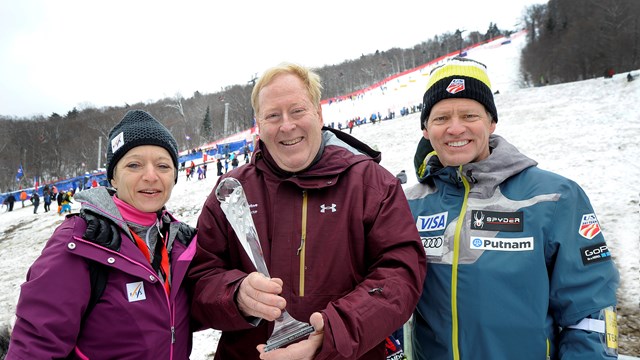
More lighthearted times: USSA CEO Tiger Shaw (r) with FIS Secretary General Sarah Lewis (l) and FIS Journalist of the Year Peter Graves (c) at the Killington Alpine World Cup nearly two weeks ago in Killington, Vt. (Photo: FIS)
Tiger Shaw, CEO of the United States Ski and Snowboard Association (USSA), was one of them.
“I am shocked by the level: the number of individuals colluding is shocking,” he said in an interview on Friday. “How anybody could have ever thought that something like this could be secret forever is incredible.”
Shaw said that in some USSA disciplines, there are no Russian athletes competing at a high level, so he expected past competition results to remain more or less unchanged.
For others, however, the implications were bigger. Cross-country skiing clearly falls into that category.
“Obviously it’s going to have an impact in terms of the athletes, where the results will be changed and their medals taken away and they will be banned,” Shaw said. “I presume that the federations will have to make all these decisions.”
The sport “skiing” appears 75 times in the Schedule of Samples and ADAMS Reports document that is part of the McLaren Report’s evidence package. McLaren and the World Anti-Doping Agency (WADA) have anonymized the athlete names, so lines of data cannot be linked to any individual athlete.
While the discipline is sometimes further delineated, for example as “skiing | cross country” (or “cross country skiing” – there is no consistent rule for terminology) it is difficult to tell how many data points correspond to which disciplines. Some entries are also labeled as “Skiing – IPC Cross Country”, but many just say “skiing”, leaving uncertainty as to whether they are from able-bodied or para-nordic competitors, regardless of the discipline.
Many of these 75 data points do not have information about what substances were detected in the samples, if any. But some clearly do: one for the blood-doping drug erythropoietin (EPO); another for a high ratio of exogenous testosterone; yet another for budesonide, a corticosteroid used in inhalers; and another for trimetazidine, a heart drug which, like meldonium, is a metabolic modulator which combats angina.
Another athlete tested positive for “phthalates”, plasticizers which are sometimes used in IV bags and are often assumed to indicate blood transfusions. They are also, however, present in other kinds of packaging.
In all of these cases the results were reported to WADA’s anti-doping test management system, ADAMS, as negative tests: no prohibited substances found. Translated emails used in the investigation also refer to some of these cases, showing that they were discussed between personnel who were supposed to be enforcing anti-doping rules.
The information has been forwarded from WADA to the 32 international sports federations (IFs) where athletes were implicated in the report, and has also been forwarded to the International Olympic Committee (IOC). It is up to those organizations to sift through the information and determine penalties and suspensions, or decide to do further investigation.
Shaw believed that the International Ski Federation (FIS) was taking the report seriously.
“I think they are going to take pretty swift action,” he said. “There are a large number of athletes that have to be dealt with. There’s no question that they will take swift and efficient action… our place is as a stakeholder and a component of international governance. Our role at the FIS level is that [USSA Board Chair] Dexter Paine is one of the vice presidents. So it’s a pivotal day and there’s a lot of work to be done.”
Some work was short-term, he said: determining sanctions for athletes implicated in the report.
But other work was long-term, in terms of dismantling the system which led to such systematic cheating in Russia.
Meanwhile, an increasing number of competitions were implicated in the coverup, some of which occurred after the 2014 Olympics, which was the catalyst and main focus of the report.
That has led U.S. and Canadian athletes in luge and skeleton to discuss a boycott of competitions held in Russia this year. Shaw said he understood their position. FIS has World Cup events in almost every discipline scheduled for Russia this season, and in mid-October FIS President Gian Franco Kasper said that Russia could be stripped of its right to hold those competitions depending on the outcome of the McLaren report.
“I don’t think anybody feels safe about being there, being in a country that had this high level of collusion,” Shaw said. “Each sport and each country is going to have to deal with it in their own way. For that, we work closely with the [United States Olympic Committee] and our athletes.”
Far from regretting if U.S. athletes spoke out on the doping issue, Shaw seemed to be relieved that more and more, they are doing so.
“The bottom line is that we absolutely stand behind, and believe in, clean sports and clean athletes,” Shaw said. “So we will stand behind any effort and make any effort in the long term to make sure that happens. And that means, to a degree, working through the system we have now, and working to help change it for the better, which a lot of people are trying to do, including, it sounds like, an increasing number of athletes. Thank goodness they are speaking up because it’s all about them in the first place, isn’t it?”
“The bottom line is that we absolutely stand behind, and believe in, clean sports and clean athletes. … Thank goodness they are speaking up because it’s all about them in the first place, isn’t it?” — Tiger Shaw, USSA President and CEO
Meanwhile, many Russian athletes likely implicated in the report are on the start lists for international competitions this weekend.
Shaw said that his message to U.S. Ski Team athletes was that they should continue to focus on excelling, and doing so clean.
“They put their heads down and they go out and race,” he said. “Due process must be followed…. Justice is going to be served, but any individual athlete, they have to take the longer view on how they can help change the system.”
Some were already doing just that.
“I’m going to take tomorrow to focus on the races and try to do a better job of processing and understand the Mclaren report after the race on Sunday,” cross-country skier Sophie Caldwell wrote in an email on Friday afternoon.