One of the many examples of classic technique violations described by the FIS Cross Country Sub-Committee for Rules in an exhaustive November posting, which you can find here.
Race officials put cross-country skiers on notice early this year that those who tried to double-pole classic races on skis without kickwax would be held to strict technique standards: in the first weekend of racing in Norway, defending World Cup Champion Martin Johnsrud Sundby (along with two others) was disqualified for skating in a 10 k classic race.
The message got even more clear this weekend when 15 men’s teams and one women’s team were given time penalties in the National Championships relay in Tromø for classic technique violations.
The race jury placed a video camera on a section they had identified in their course inspection as a place that would be tricky to navigate on unwaxed skis.
“It’s actually quite a steep uphill, a herringbone hill,” explained John Aalberg, the Technical Delegate for the weekend, in a phone call on Monday. “If you classic ski, probably 99% of all skiers would herringbone up it… It looks like a corner, but it’s a corner on a hill that’s very steep. It’s a tricky situation because there’s no tracks. You don’t set tracks on a herringbone hill, they’d just be washed out after warm-up anyway if you did. It’s kind of a new situation.”
The video showed that some of the racers double-poled carefully and painstakingly up the steep pitch, while others threw in one push off their outside leg to straighten their trajectory. Others pushed off their outside ski several times in a row, and a few even tossed in a stride of V1.
“We felt that this is not classical technique,” Aalberg said. “You gain so much advantage skating up there… We reviewed very carefully back and forth. We allowed those that did a stride or two getting into the hill and maybe at the top of the hill. We didn’t judge that as a violation. But those that were skating several strides up, those were the 15 teams that we reacted to.”
While a standard FIS jury consists of three members, Aalberg explained that for the championships there were four: him, two Assistant Technical Delegates, and the Chief of Competition (a position titled Rennleder in Norwegian), Sylvi Ofstad.
There were also two technique controllers. All six members agreed on the action, which gave a three-minute time penalty for technique infractions. The podium remained unchanged by the penalties – Lyn, a club from a northern district of Oslo whose roster included Hans Christer Holund, came out on top – but fourth-place Henning moved down to sixth place.
“So we discussed: either we let it go, or we treat everybody the same,” Aalberg said. “We thought, if we do nothing and let it go, then everything we have done this year is wasted. The racers, especially the World Cup racers, are telling us to be strict and consistent. So it was a tough decision, but we wanted to prove a point or put it on the agenda: if everybody starts to double pole, and if you loosen up the rules at the same time, that’s the end of classic skiing.”
The sanctions shook up the results sheet considerably (15 teams represented almost a third of the 50 teams who finished without lapping). Racers and coaches were angry.
“It was interesting,” Aalberg said. “We showed it to a couple of them and they agreed it was skating. And then they started pointing out, well how about this guy? How come you didn’t take that guy? It’s like when you’re driving too fast, and then you complain that someone else was also driving fast and didn’t get caught.”
Some coaches are still angry. Øistein Lunde of FIS told Norwegian ski website Langrenn.com on Monday that four teams had filed appeals and that an appeals committee had 72 hours to look at the evidence and come to a conclusion.
“In the jury room, we were greeted with a very arrogant attitude,” Svein Riseth told Norwegian broadcaster NRK. “They had no clear evidence… If they have balls they will send the video to the clubs who were affected so we can see it.”
Riseth may have simply not had time to converse with the jury, as he was catching a flight; Aalberg mentioned that they had shown the video to some racers.
And, the race organizers posted the video online so that not only could the affected clubs view it, but so could everyone else.
The topic was discussed by FIS Technical Delegates before this season, as well as by technical staff in Norway. Both groups meant to make a concerted effort to be more strict in enforcing technique rules this season.
The FIS Cross Country Sub-Committee for Rules, which Aalberg is part of, posted an exhaustive set of diagrams of appropriate and illegal technique for classic races back in November. That has been freely available on the FIS website with other competition rules documents for ten weeks now.
The increased focus was also mentioned in a FIS media article of the “most important rule changes” for the upcoming season.
“I’ve spoken to some of the national team coaches and the coaches that I know, and they are all in support of being strict,” Aalberg said. “They are all saying that this is good and it needs to be done in order to clean up a bit. Coaches or team leaders that are not usually on the high level races don’t understand the rules and they think that this is allowed. So there’s a discrepancy somewhere.”
He doesn’t believe that the skiers caught on tape were breaking the rules on purpose. Instead, it’s simply that more and more athletes are pushing to double-pole classic races. This challenges them in new ways.
“It’s not intentional at all,” Aalberg said of the infractions this weekend. “Think of yourself. If you double pole up the hill and you peter out, your foot automatically goes out. It’s not intentional at all. But it doesn’t matter if it’s intentional or not, you still get a big advantage.”
He noted that some of the top skiers know the technique rules well, and are also strong enough to follow them. That’s why they podium was unaffected by technique violations.
“The good skiers, the stronger ones, they are strong enough to do proper technique,” Aalberg explained. “It’s the next ones, who are trying to hang on, but they aren’t strong enough. So that’s when you see them do the wrong technique. Then you have the slowest ones, who are waxing, and they are doing proper technique. But it’s in the middle group where we saw most of the issues.”
Even though the violations are unintentional, he is hopeful that strict enforcement can improve technique.
“It has been a lot better this year on the World Cup level,” Aalberg said. “I was the TD in Kuusamo and have been watching the World Cups live. I think it’s much better classic skiing on the World Cup level. We don’t really see much anymore. We’ve had a few cases but nothing like we saw last year and the year before, now that we are stricter and more consistent.”
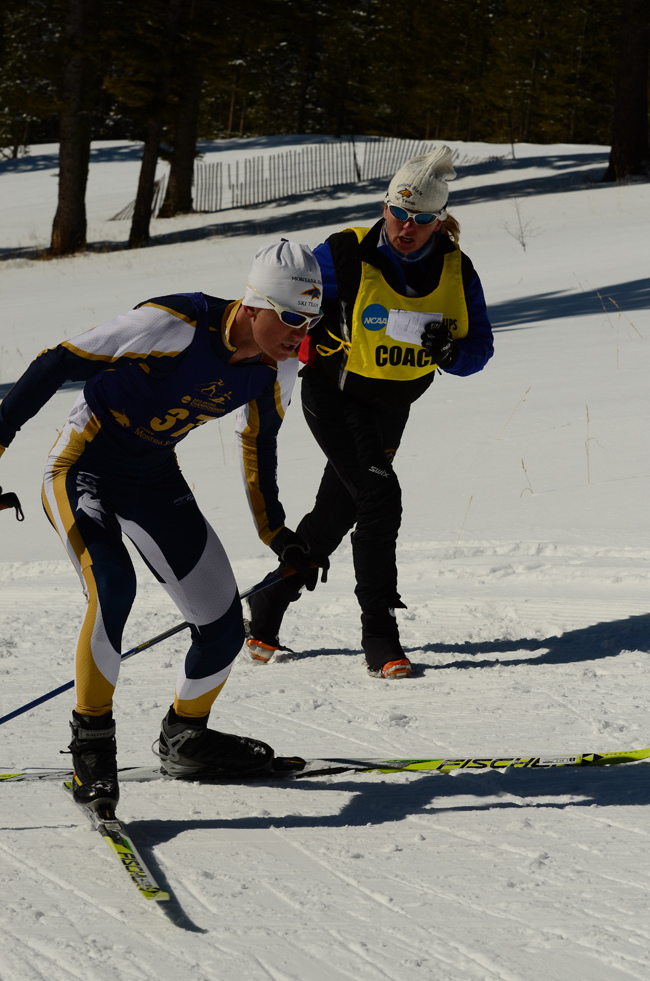
Grethe Hagensen runs alongside former Montana State University athlete Tyler Reinking at the 2012 NCAA Championship in Bozeman, Mont. Hagensen was head nordic coach at the university for a decade. (Photo: Stuart Jennings)
Grethe Lise-Hagensen served as Montana State University’s Head Nordic Coach from 2003 to 2014. During her decade as head coach, Hagensen brought the team from a state of near non-existence to ranking third in the nation at the 2010 NCAA Championships. In May of 2014, Hagensen’s contract was not renewed by the university’s administration. FasterSkier sat down with Hagensen in July to talk about her time at the helm of the MSU program and the accomplishments she achieved during her ten years as head coach.
***
BOZEMAN, Mont. — Like most Norwegians, Grethe-Lise Hagensen was born with proverbial skis on her feet. Unlike most Norwegians, she decided to bring her successful ski career to the United States.
Hagensen grew up in Tromsø, Norway, roughly 300 miles above the Arctic Circle where she found an early introduction to skiing out of necessity. Her family didn’t have a car and like many of the other townspeople, she had no choice but to ski into town whenever she needed to go to school, buy groceries, or visit friends.
Hagensen’s skiing soon evolved from a means of travel to a form of competition as she was introduced to racing. Her entrance into world of ski racing would change her life forever, and by the time she was a teenager she had already won a Norwegian national championship and was on the Norwegian National Ski Team.
In 1979, Hagensen was part of what she described as the “the biggest athletic event in northern Norway.” A relay team consisting of Hagensen and fellow Tromsø skiers made their way to the top of the podium, astounding spectators.
“It was a huge sensation. It is still probably the biggest athletic event that has ever happened in northern Norway because we were such underdogs,” she said during a recent in-person interview. “For us to win it was a shocking thing. Top ten would have been a sensation, and we ended up winning.”
Hagensen first ventured to the U.S. to attend the University of Wyoming. During her time there, she earned all-American honors each of her four years at the university and was part of its winning team in the 3 x 5 k relay at the 1985 NCAA Skiing Championships.
Hagensen graduated from the University of Wyoming in 1986. She returned to Norway, where she coached both soccer and skiing. She then married American John Villar and the couple had two daughters.
In 2002, Hagensen and her family made the decision to move to Bozeman, Mont. for a year so that her children, Bjørk and Embla, could learn English. The family’s plan was changed when a friend informed Hagensen that the head coach position at Montana State University (MSU) was available.
Hagensen applied for the job, accepted the university’s offer, and has lived in Bozeman ever since.
“Suddenly they could smell gold”
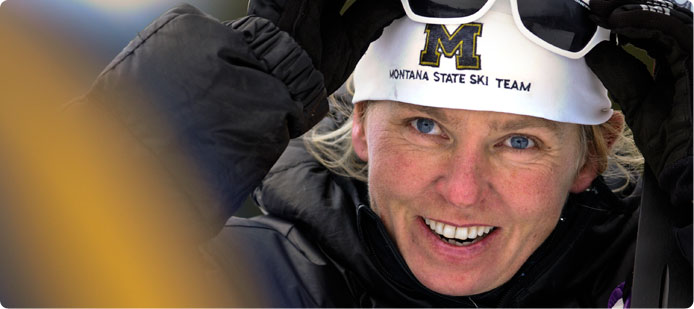
Grethe Hagensen smiles in an undated photo. Hagensen served as head nordic coach at Montana State University from 2003 to 2014. In 2010 she lead the team to third place in the nordic rankings at the NCAA Championships. (Photo: Montana.edu)
When Hagensen took over as MSU’s head nordic coach in 2003, it was the first year since the 1980s that the university had a male team. While women had been part of the team for many years, their results were lackluster and recruitment was challenging.
“You need to have results to get good athletes — it’s like the chicken and the egg,” Hagensen said of her entry into the program in 2003. “I thought it would take me five years to build up a winning team that would be competitive against CU [the University of Colorado] and DU [the University of Denver].”
The winning combination came earlier than expected. While a handful of good finishes from MSU skiers scattered the results of the Rocky Mountain collegiate series in Hagensen’s early years as head coach, it wasn’t until 2007 that the team really started to excel.
The turning point came during the first weekend of Rocky Mountain Intercollegiate Ski Association (RMISA) races at Soldier Hollow in Midway, Utah. With a relatively strong first day of competition, Hagensen was optimistic about the mass-start races. During the women’s 10 k, she was waxing the men’s skis and conversing with a fellow coach.
“I remember I said to one of the coaches, ‘I might get a medal today’ and he said to me, ‘Grethe, you might take the top three,’ ” Hagensen explained. “After that I don’t remember anything.”
Her colleague was correct as a trio of MSU women consisting of Jamie Woelk, Mandy Bowden Axelson and Claire Rennie rounded the corner into the final stretch of the women’s race. The three Bobcats swept the podium, separated by less than a second.
It was the first time in RMISA history that a women’s team had taken all three spots on the podium in a single race, but the historic moment almost didn’t happen as all three skiers were nearly disqualified.
“We almost got disqualified because someone said that I skied next to them,” Hagensen said. “I don’t remember skiing but I must have because I was in shock. I was so happy. Maybe I skied maybe I didn’t, who knows.”
Despite the alleged incident, the women’s results stood and Hagensen was issued a warning. The moment, however, was a major turning point for the program, which had existed on a small scale four years prior.
“Suddenly they could smell gold. Once you do it, you have broken the barrier,” Hagensen said.
She credits the rapid rise of the MSU nordic team to a focus on American athletes who might have been overlooked by other universities, some of which heavily recruit European skiers and only the best American juniors.
“I always had, not the best juniors in the U.S., but maybe the ones who were a little bit behind,” she said. “I tried to get them to become the best. You have Ryan Scott and Tyler Reinking, these guys were OK and then we just built them. That’s what made me the most proud over my years: taking care of the Americans.
She also made sure to focus on building technique before anything else.
“We tried to tap into whatever edge they had. Technique was something that we had to work on a lot,” she said. “You can’t be the best if your technique is a handicap. I tell everyone to focus on their technique and then we get them to the next level.”
After joining the big show in 2007, MSU continued to progress at an unprecedented rate. With recruitment soaring and a tight-knit team, Hagensen entered the 2009/2010 season with high hopes.
With their eyes on the NCAA Championships in Steamboat Springs, Colo., the team qualified a full six-person squad for the event: Scott, Reinking, Bernhard Roenning, Kaelin Kiesel, Mellie Park, and Casey Kutz.
Underdogs from the beginning, MSU wasn’t expected to be overly competitive, let alone make a run for the podium. However, they did just that with all three men placing in the top 10 in the second day of competition. The results propelled the squad to third place overall at NCAAs.
“We had a phenomenal year, and suddenly we had three [men in the] top ten and Kaelin Kiesil was fifth,” Hagensen said. “Sometimes everything lines up.”
Later that year, Hagensen received the Intercollegiate Coach of the Year Award in recognition of her contributions to MSU.
Termination After a Decade
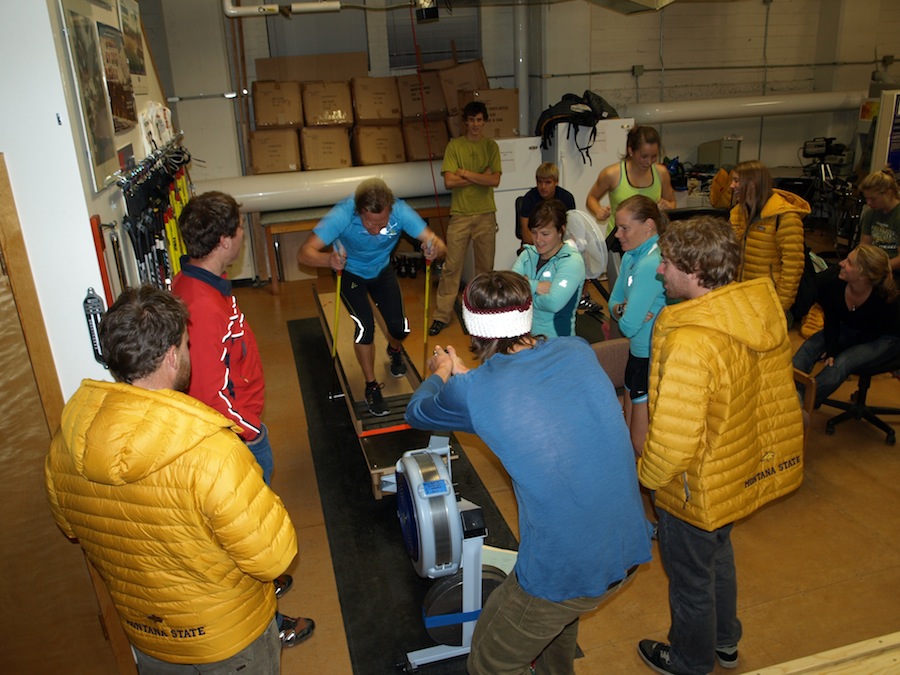
The Montana State University Nordic Team performs upper-body testing in an undated photo. (Photo: Dan Heil)
After 2010, both Hagensen and the MSU nordic team continued to find success with top finishes in the RMISA and NCAA race series. In 2012, for the first time in school history, MSU qualified a full team in both alpine and nordic for the NCAA Championships that took place on their home courses in Bozeman, Mont.
Hagensen also received the RMISA Coach of the Year Award that year.
During the 2012/2013 season Hagensen took a sabbatical year so that she could spend time with her mother in Norway who had just suffered a stroke. During that season, assistant coach Chad Andersen took over the responsibility of the team.
In what would be her final season as MSU’s head nordic coach, Hagensen lead her team to qualify a full NCAA Championships squad once again. At the 2014 NCAAs in Soldier Hollow, MSU saw two athletes — Jessica Yeaton and Sawyer Kesselhiem — earn all-American honors with fifth- and ninth-place finishes.
Adding to the season’s milestones, the nordic team won both the men’s and women’s awards for team of the year at the Montana State Athletics’ 2014 ALL (Academics, Leadership and Life Skills) Banquet in April.
Not long after, Hagensen said she received a positive review from her athletic department and was given a mandate to hire a new assistant coach. The new assistant coach, Andrew Morehouse, had both a verbal and written agreement with Hagensen for his position that was yet to be made official by the university.
In May, she said she was summoned MSU Athletic Director Peter Fields’ office for what she assumed would be a conversation about the assistant-coaching position.
What she experienced was far from what she expected.
Instead of discussing the assistant coach position, Fields told Hagensen that her contract would not be renewed in the coming year.
“They asked me to come in and I thought they were going to ask me about the new assistant coach that I was to hire,” she said. “… Ten years of my life was canned in two minutes.”
The university declined to comment on the decision due to its personal nature, according to Sports Information Director Tom Shutlz.
“I’m still traumatized,” Hagensen said. “You would think that an institution would bring you in and give you a reprimand or warning or something, but the fact is that there is no job guarantee. You would think that Montana State University would be bigger than this and that they would communicate.”
Hagensen claims that Fields gave her no indication as to why her contract was not renewed and failed to even thank her for ten years of service to the university.
She quoted from her prepared statement regarding her departure from MSU:
“I was surprised that after a decade of strong performance as a head coach, my boss Peter Fields made no comment to me about all the success that the nordic ski teams that I have coached have brought to MSU. Most surprising was the reaction of President Cruzado, who has as well reported record on workplace issue and good management practices. I realize that most of us have one-year contracts and that MSU management can make changes as they see fit. But after a decade as an MSU coach, to be tossed aside without any reason…”
MSU issued a press release on May 22, which read in its entirety: “The contract of Montana State head Nordic ski coach Grethe Hagensen will not be renewed, announced Bobcat Athletics Director Peter Fields, Thursday afternoon. Hagensen recently completed her tenth year at Montana State. A national search for the position will be conducted.”
There were those who weren’t surprised by the move. Three former skiers of Hagensen who wished to remain unnamed, claimed that coach was distracted and absent during her last year of coaching.
When asked about these claims, Hagensen said she made a conscious effort to take a back seat in the 2013/2014 season because she did not want to overbear the atmosphere that assistant coach Chad Andersen had created during her sabbatical year.
“Last year I wasn’t there and this year I was easing back in so that I wasn’t too powerful or too controlling,” Hagensen said. “Maybe I should have done it differently but those are small things. Not enough to get fired. It is an adjustment.”
Despite some athlete discontent, Hagensen has received many positive reviews from former athletes, including Scott who graduated in 2012. While Scott had not yet returned an inquiry from FasterSkier at the time of publication, he was quoted in a 2011 Montana State University press release saying that, “she (Hagensen) cares about you personally as well as how you are doing as a skier. She taught me how to seek out my strengths and capitalize on those, which carries over to all aspects of my life.”
In the same article, Axelson (member of the podium sweeping team in 2007) is quoted saying, “Grethe taught us that in order to be successful, you have to be self-motivated; you have to know what you want and go after it. When you are driven, opportunities come your way–that’s Grethe’s legacy.”
Hagensen was pleased that Trygstad-Saari was tapped for the position, insisting that Trygstad-Saari could accomplish the one goal Hagensen never did with MSU.
“My dream while at MSU was always to win the NCAA Championship,” Hagensen wrote in an email after the announcement. “As the new head nordic coach, Kristina Trygstad-Saari brings experience in racing and coaching to the team. Together with MSU Alpine coach Kevin Frances, I believe the MSU ski team has the potential to achieve that goal, winning the NCAA Championship. I wish them all the best.”
Unsure of what exactly lies ahead of her, Hagensen explained her future will likely involve traveling between the U.S. and Norway. During her sabbatical year she taught at the University of Tromsø which may be a future possibility for the Norwegian.
She’s planned a trip to Oslo with her oldest daughter, Embla, who’s taking a postgraduate year at an outdoors school. Her youngest daughter, Bjørk, has a year left at a boarding school in Park City, Utah.
Wherever Hagensen finds herself, she’s certain of one thing: she will always remember her time at Montana State with fond memories and will continue to be proud of the athletes she coached.
Many European skiers arrive in the U.S for college and are exhausted from year of trying to “make it” at the international level. While they find success in NCAA skiing, for some it is the last hurrah of a career that’s already lasted twenty years.
Snorri Einarsson was not one of those skiers. For one thing, when the Norwegian arrived at the University of Utah, he was just 20 years old. For another, he was incredibly motivated.
“It is rare to find someone that’s at that high level like Snorri… that realizes the value of having balance in their life, being part of a team, training hard, and using it as a stepping stone,” said Eli Brown, Einarsson’s coach at Utah.
Einarsson spent several years skiing for the Utes; in 2007 he won an NCAA Championship in the 20 k at Jackson, New Hampshire. Then he went back to Norway. If he was like most European college skiers, the U.S. community never would have heard from him again.
But once again, Einarsson was different. Since leaving Utah he has racked up consistently impressive results and climbed ever-higher in the Norwegian ski world. In 2010, he started his first World Cup and finished 32nd in the 50 k at Oslo. Last year, he raced the Tour de Ski and the 15 k in Drammen, where he finished poorly.
“I realized quickly on Saturday’s 15 k that it would not work as it should,” he wrote on his blog at the time. “I was finally almost done with the distance and realized that something is not right today. But as an Icelander and northerner in my throat, I know that it is no use to either quit the race or give up before the season is over.”
This year, the Tromsø resident is off to a good start. He took home the victory in Muonio, Finland last week in some of the first FIS race action of the year. Last year, Einarsson got lucky at the last minute and was added to the roster for the Tour de Ski; if he can keep his form from Muonio, even bigger things might be on his radar this year.
He’s currently ranked 101st on the FIS distance list; only three Americans outrank him (Kris Freeman in 33rd, Tad Elliott in 99th, and Noah Hoffman in 100th). He’s just ahead of the Czech Republic’s Martin Koukal.
FasterSkier caught Einarsson for a quick interview before the season started in earnest.
FasterSkier: What have you been up to since leaving Utah? What team are you training with?
Snorri Einarsson: After leaving Utah, I started studying physiotherapy at University of Tromsø. My first year home I pretty
much used for rehabilitation after having surgery in both my knees before leaving Utah. Since then things have just been going better every year. After coming home it was easier to train as much as the best, and then I started to do progress pretty fast. I train with a regional team here in northern Norway. Here I get to train with positive and strong racers from northern Norway. I love the atmosphere in the team, that is a really important thing for me.
Einarsson skiing with Lars Flora (USA) in Drammen last year.
FS: Who are your teammates? Will they get to race on the World Cup this year, do you think?
SE: I train mostly with Erlend Skippervik Sætre, Martin Vatshaug, Morten Eliassen, Andreas Nygaard, Bjørn Thomas Nygaard and Håkon Mikalsen. Of those, Håkon is most likely to get a World Cup start this year.
FS: Did you find it hard to get back into the community in Norway – did you feel like people had forgotten your name when you went to the U.S., or was it just like it had been before?
SE: I didn’t think it was hard to come back. I went to the U.S for the experience, and I trained and had a good time there. After spending two years in the desert I think it was really nice to come home and run in the mountains again. It’s not like anybody really knew my name before I left, so that part was pretty easy. I don’t really care if people know my name or not- if you ski fast enough people learn your name.
FS: What about training – when you came back to Norway, did you feel like you had lost any ground on your competitors, or were you right where you wanted to be?
SE: Training in the U.S gave me valuable experience with altitude, and taught me a lot about racing on a very close team. It was a new setting. It’s almost like you are part of a big family. When I got home I was very much on my own, training alone every day. It was hard in the beginning when you’re used to having your friends around every day, but also a lot more flexible.
I think it’s natural to increase the number of training hours compared to what I was doing in the U.S since I’m not in a time crunch all the time anymore. I went from about 600-650 hrs at Utah to around 900 hours in two years. I think I have found a system that works for me.
FS: You got to race the Tour de Ski last year, that’s pretty cool! How did that come about?
SE: I qualified through good results in the Scandinavian Cup and Norwegian Cup.
The Tour de Ski was a really fun experience- really tough, but fun. I was really nervous in the beginning and I’m not a fast sprinter, so in the beginning it didn’t go too well, but I had some better luck towards the end. After the Tour de Ski I was totally shot and it seemed really hard to ski fast for the rest of the season.
FS: How has your training gone this year?
SE: Training this year has gone very well. I adjusted the training a little, I’m now doing more level 4 intervals. Before I used to do a lot of level 3 and train more hours. Now I cut down on some of the volume and am training a little harder than before. I think it’s important to evaluate and change things up every year and not to train exactly the same thing every year. If your body gets too used to one thing it’s easy to get bored and sloppy. I also did some changes in my strength training turning it to more stabilization and balance exercises. I think this really helped my strength and technique on skis. I’m trying to link my strength training to skiing as much as I can- that keeps me motivated.
FS: Were you surprised to pick up the win in Muonio?
SE: I was really surprised to win in Muonio. I was not sure what to expect, but I was sure that a top 10 would be the best I could do on a good day. A friend of mine gave me splits every lap telling me that I was in the lead, so i just gave it everything and tried to finish strong. I was really glad to win.
FS: What are your plans and goals for the season?
SE: My initial plan was to ski fast in the Scandinvian Cup races and Norwegian championships. I didn’t plan to be in such good shape so early, so I guess I just have to wait and see what Sjusjøen brings and then just go from there. I don’t really plan too much, I wish I was better at that but it just doesn’t work for me. To me it seems kind of pointless to have a plan if you change it every five minutes.