From the FasterSkier archive — posts syndicated from athletes’ and coaches’ own blogs between 2004 and 2012, kept online as published. Current coverage is at fasterskier.com.

Tag: Trond Nystad

  • “Being a Champion of the World, Not a World Champion”: Inside the Norwegian Model of Lifelong Sport with Trond Nystad

    “Being a Champion of the World, Not a World Champion”: Inside the Norwegian Model of Lifelong Sport with Trond Nystad

    When Trond Nystad talks about Norway’s athletic success, he doesn’t start with medals or podiums. He begins with children — specifically, children who love to play.

    “The model of Norwegian sport,” he says, “is to have as many kids as possible, for as long as possible, and try to make them as good as possible.” That simple mantra, lived out in ski clubs from Tromsø to Trondheim, is what he believes keeps Norway at the top of the endurance-sport world.

    “It’s about being a champion of the world, not a world champion,” Nystad explains. “The focus is on learning, mastering things, having fun — not on winning.”

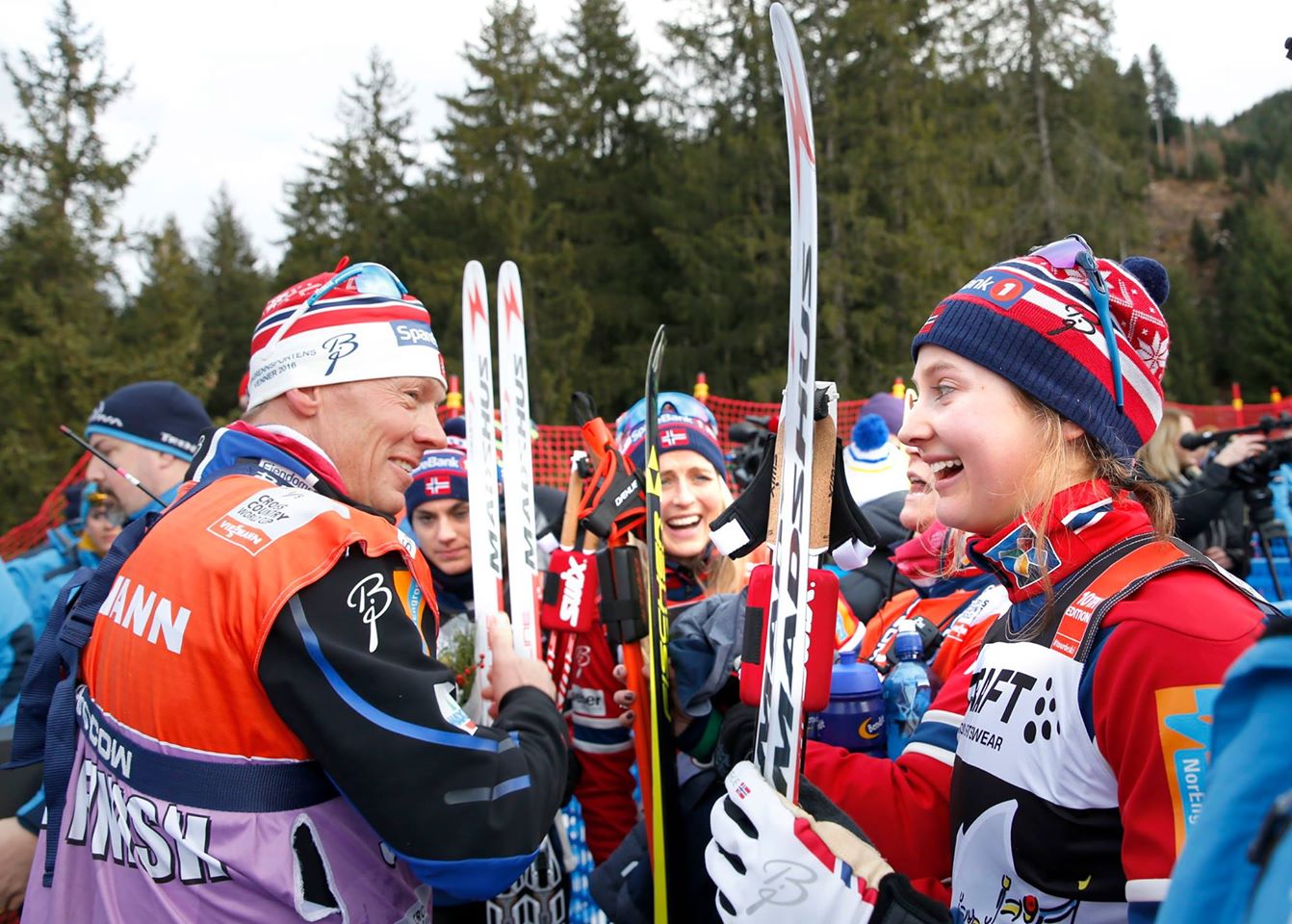
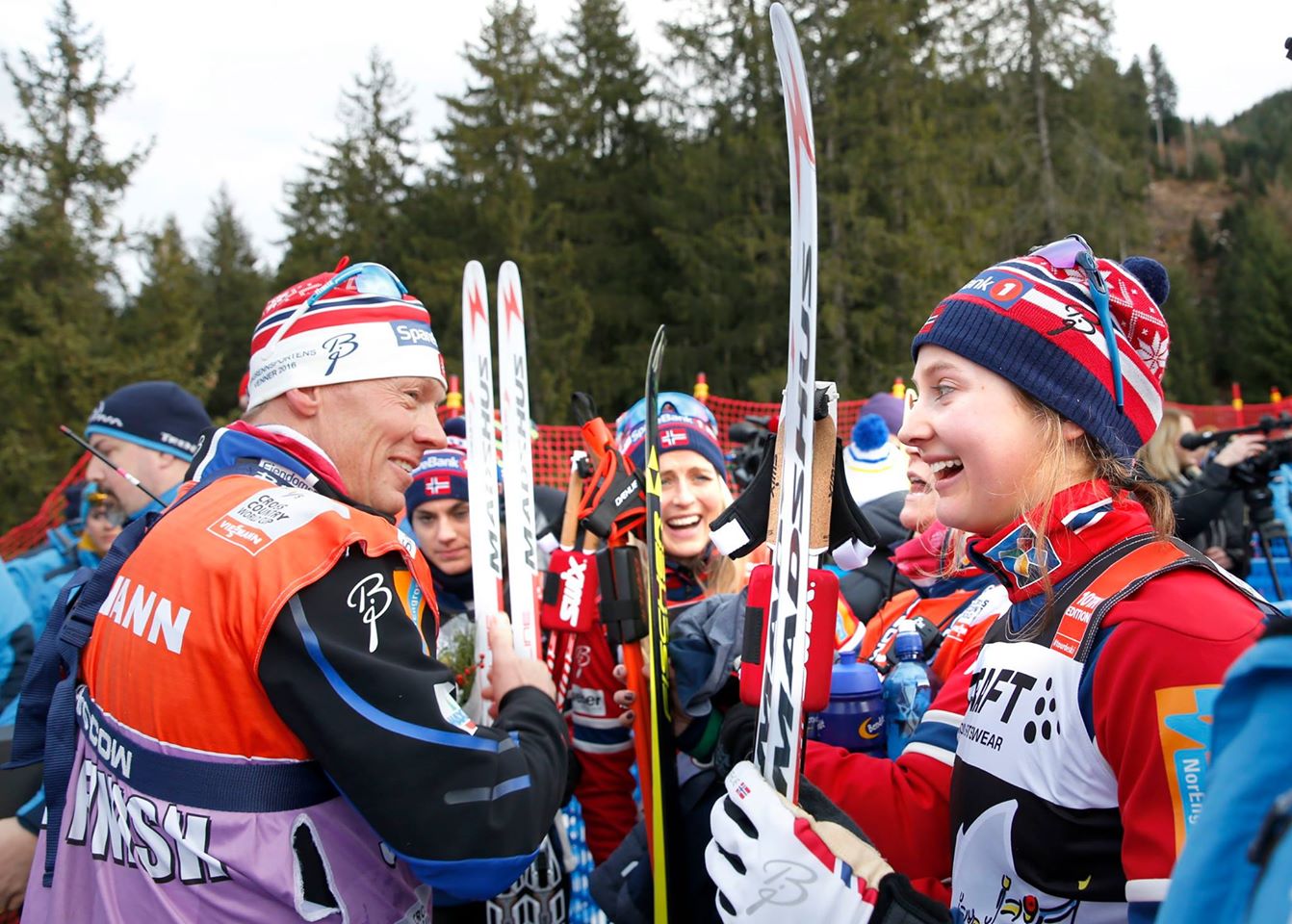
    Trond Nystad (Photo: NordicFocus)
    A System That Lives Its Values

    Nystad has coached at nearly every level — from college programs at Northern Michigan University and the University of Denver to national teams in the U.S., Germany, Austria, Switzerland, and Norway. He’s seen systems that thrive and systems that sputter. What sets Norway apart, he says, isn’t a secret training formula but the culture that surrounds young athletes.

    “In Norway, the principles of long-term athlete development — the LTAD model — are lived, not just written,” he says.

    “In some places, LTAD is a document. In Norwegian clubs, it’s a way of life. Coaches and parents make sure kids master skills, become independent, and most importantly, have fun.”

    That lived philosophy keeps kids skiing, running, and playing far longer than in most countries. “Every country that has success over a longer period of time has figured out how to lure kids into sport and keep them there,” he says. “If you have a lot of kids and you teach them a lot of skills, they’ll be driven and have fun. Then it’s easy to talk about high-level training later — because you start with the right foundation.”

    The U.S. Comparison: Knowledge Is Not the Issue

    Nystad has deep respect for the American coaching scene — he spent years building programs here and still closely follows U.S. skiing. “The U.S. has a lot of really good coaches,” he says. “Sometimes the issue isn’t knowledge. It’s that cross-country skiing doesn’t attract as many kids because it has to compete with other sports.”

    The challenge, he believes, is not to clone Norway’s system but to borrow its spirit. “We need more skiers, and we need to take care of them,” he says. “Make sure they have so much fun developing that they don’t want to quit.”

    That message — that development is not linear, and that joy is a strategic asset — could resonate in American junior clubs. “If you have fun and learn mastery,” Nystad says, “success will come. But if you chase results too early, you lose too many kids.”
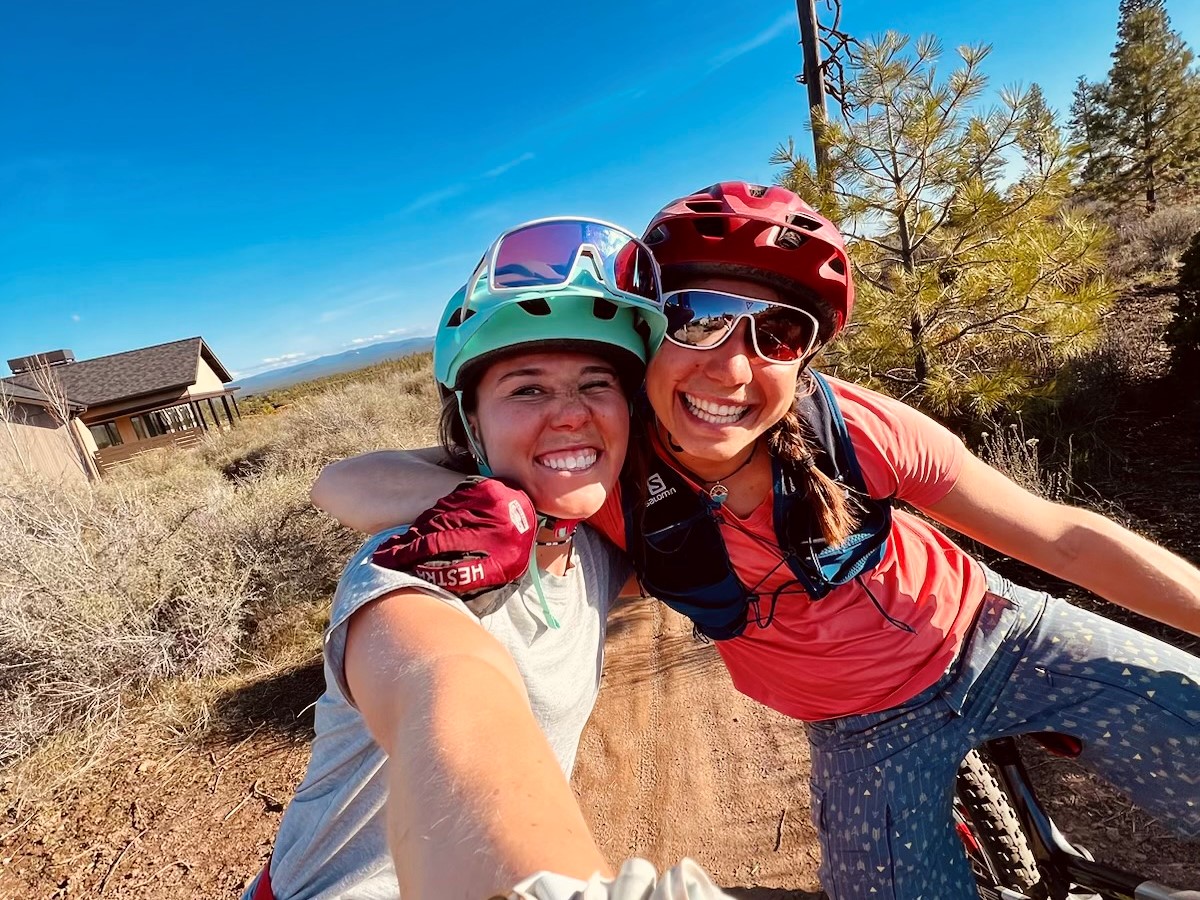
    Like many elite skiers, Lauren Jortberg and Julia Kern enjoy mountain biking opportunities for a change of pace. (Photo: Julia Kern)
    Against Early Specialization

    Asked when Norwegian athletes begin to specialize, Nystad laughs gently. “Focus and specialization are a little bit mutually exclusive,” he says. “You can be focused and still do more than one sport.”

    Most Norwegian kids, he explains, play several sports until age 15 or 16 — sometimes even longer. “When they’re 18 or 19, they might focus on one main sport and keep a couple on the side — running and skiing, for example, or cycling and skiing,” he says. “It’s part of the culture. People are active.”

    The danger, he warns, comes from well-meaning adults. “A lot of parents try to self-realize through their kids,” he says.

    “They want them to specialize early, to do everything right. In the end, the kids are sick of it, have no fun, and they quit.”

    His takeaway is simple: “Kids are not miniature adults. They’re kids. Let them be kids as long as it makes sense. Life gets serious soon enough.”
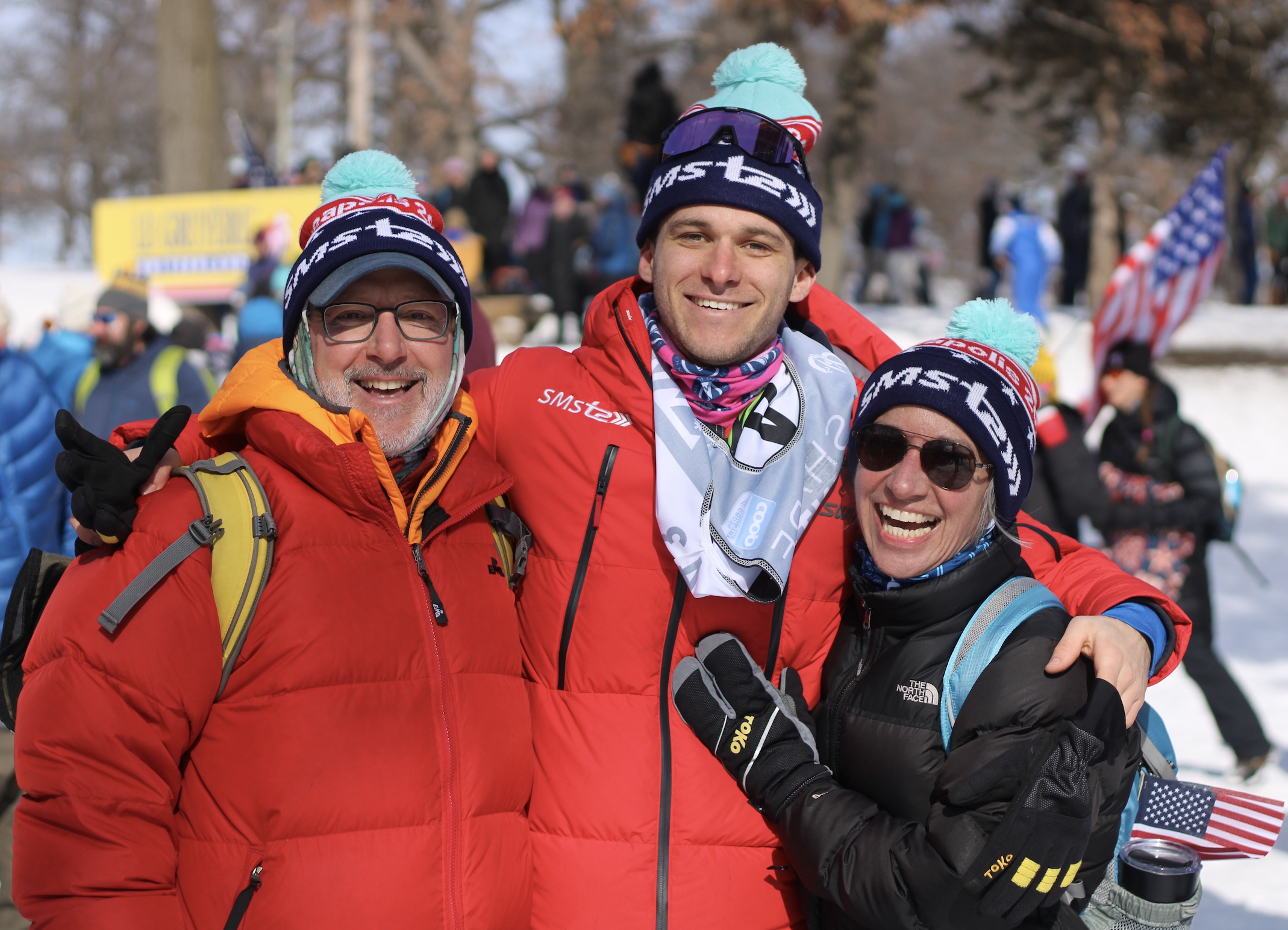
    Adam Witkowski poses with his parents after unexpectedly racing a World Cup in Minneapolis in 2024. (Nathaniel Herz/FasterSkier)
    The Role of Parents: Mentors, Not Managers

    Nystad, as a father himself, knows firsthand how difficult it is to strike that balance of knowing when it is time to commit. “Sixteen is just a number,” he says. Some sixteen-year-olds are grown up; they can form their own opinions and take ownership. Others can barely wipe their own ass,” he says with a laugh.

    “But in the end, the kids have to decide for themselves. It has to be something that’s rewarding for them. Our job as parents is to support them — to help them make fewer mistakes, to be mentors along the way.”

    That mentoring role — guiding but not controlling — is something Nystad sees as critical for the next generation of athletes. “We’re supposed to help them realize their dreams and develop,” he says. “Not to live our dreams through them.”

    “Keep It Simple”: Trust the Body, Not the Gadgets

    In an era dominated by data, GPS, and lactate meters, Nystad is refreshingly old-school. He’s not anti-science — he’s trained with and coached some of the world’s most analytically minded teams — but he cautions against what he calls “numbing the senses.”

    “The reason to measure is to understand,” he says. “You measure to confirm your subjective feelings — not to replace them.”

    “If you’re tired, you sleep. If you’re hungry, you eat. If you’re thirsty, you drink. Those are subjective feelings — and they’re more important than any data you can measure,” he explains.

    “Most devices today are not 100 percent correct. Your body usually is.”

    For Nystad, training success comes from continuity, not complexity. “The KISS principle applies — keep it simple,” he says. “In endurance sports, you have to train with continuity for a long time and be patient. Don’t screw things up. Control gives continuity, and continuity is everything.”

    Fun as a Foundation for Longevity

    Nystad lights up when the conversation turns to lifelong sport. “If sport or physical activity makes us happy, we’ll prioritize it,” he says. “Talking about training doesn’t make you better — actually doing it does.”

    He encourages athletes — elite or recreational — to reframe movement as a privilege, not a chore. “We should appreciate every day we get to move,” he says.

    “It means we’re healthy, we have the time, we can afford the equipment. That’s a luxury we need to appreciate more.”

    For parents juggling work and family, his advice is pragmatic: “Maybe it’s better to go for a one-hour run first, and then drink your beer and watch Netflix,” he says with a grin. “It’s just about organizing your day so you get your little quick fix of physical activity.”

    The Norwegian Definition of Success

    For someone who’s coached Olympic medalists, Nystad’s definition of success has nothing to do with results. “I can’t even remember what happened last winter,” he admits. “Success has nothing to do with medals or wins. I’m happy as a coach when the athletes are happy — when they’ve developed as athletes and as human beings.”

    He sees coaching as a human project as much as an athletic one. “I always try to build teams where people work together, respect each other, and do their best. That’s success. If we treat each other well and do the job the best way we can, we’ll reach our potential. Reaching your potential — as a human or as an athlete — that’s success.”

    It’s a deeply Norwegian sentiment, one echoed across their sports system: the process matters more than the podium.
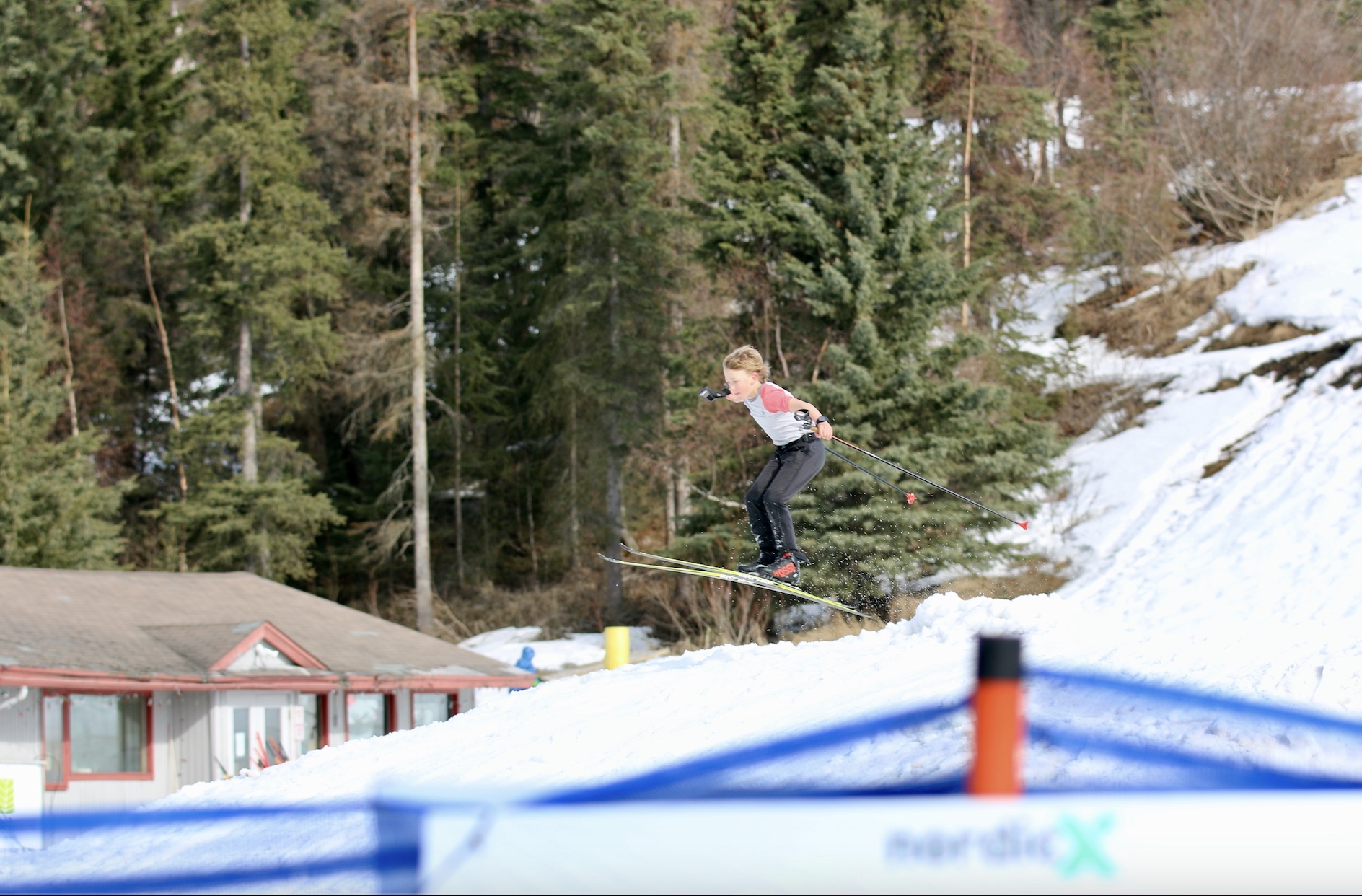
    One of many kids enjoying the features on the course and in the Kiddie Cross terrain park at NordicX in 2022. (Photo: Eric Maurer / NordicX)
    Lessons for U.S. Clubs and Coaches

    Nystad believes that U.S. programs can apply these lessons without mimicking Norway wholesale. “The principles are the same,” he says. “It’s about creating an environment where kids master things, have fun, and stay in sports longer.”

    That may mean rethinking what “development” looks like. “Most of the time, we lose more than we win,” he says. “So it’s okay to have a bad race or a bad day. Focus on skill development and mastery — even when things aren’t going well. If it’s fun, and you keep mastering skills, success will come.”

    He also urges patience from young athletes. “A big mistake is intensity control,” he says. “They go too fast on the easy sessions and too fast on the hard sessions. They believe ‘no pain, no gain,’ but endurance sport doesn’t work like that. The best athletes are the ones who train a lot — and train smart.”

    Technique, Mastery, and Play

    Skiing, Nystad reminds us, is as much art as science. “Especially in skiing, which is such a technical sport, the quality lies in doing things right — not just going hard,” he says. “I see so many people skiing with music in their ears, talking, doing all kinds of things, instead of focusing on perfecting technique.”

    He encourages athletes to “play” with movement: “No one tells us how to do it. We can choose the way that fits our body and our strength,” he explains. “If more people would play with technique, be conscious of their technical and pacing choices, the outcome would be better for most people.”

    Astrid Oeyre Slind (NOR) on her way to a second-place finish in Cogne, Italy. (Photo: NordicFocus)
    The Lifelong Athlete Mindset

    At 55, Nystad continues to coach, ski, and move daily — not out of obligation, but joy. “If you train right, take care of yourself physically, mentally, nutritionally — and have a blast doing it — there’s no limit to how long you can be good,” he says.

    “The moment you start thinking it’s a sacrifice, or that it’s boring — that’s when your career starts to end.”

    He cites examples like Hilde Gjørum, who earned her first Olympic medal at 43, and Astrid Øyre Slind, who made her first Norwegian World Championships team at 34 and won her first World Cup at 37. “There are lots of stories like that,” he says. “Everyone can keep getting better — if you love what you do.”

    Looking Ahead: A Sustainable Future

    Nystad’s final reflections return to sustainability — both of snow and of sport. “Obviously, we’ll have issues with snow,” he says. “Snow storage and snow farming are becoming normal in Europe, and that will change the sport. But cross-country skiing will survive. It’s a great sport — full-body, low-injury, healthy.”

    The real challenge, he believes, is getting people to participate. “We need to sell it for all it’s worth and get more people involved,” he says. “If we can bring more people into skiing — kids, families, anyone — the rest will take care of itself.”

    The Takeaway: “Master the World”

    For Nystad, the essence of sport is not the stopwatch, but the spirit. “The focus,” he repeats, “is on mastering the world — being a champion of the world, not a world champion.”

    It’s a mindset that turns every trail into a classroom, every race into a chance to learn. And perhaps that’s the real secret behind Norway’s golden age of endurance: a culture where success isn’t measured in medals, but in how many people can’t wait to clip into their skis again tomorrow.

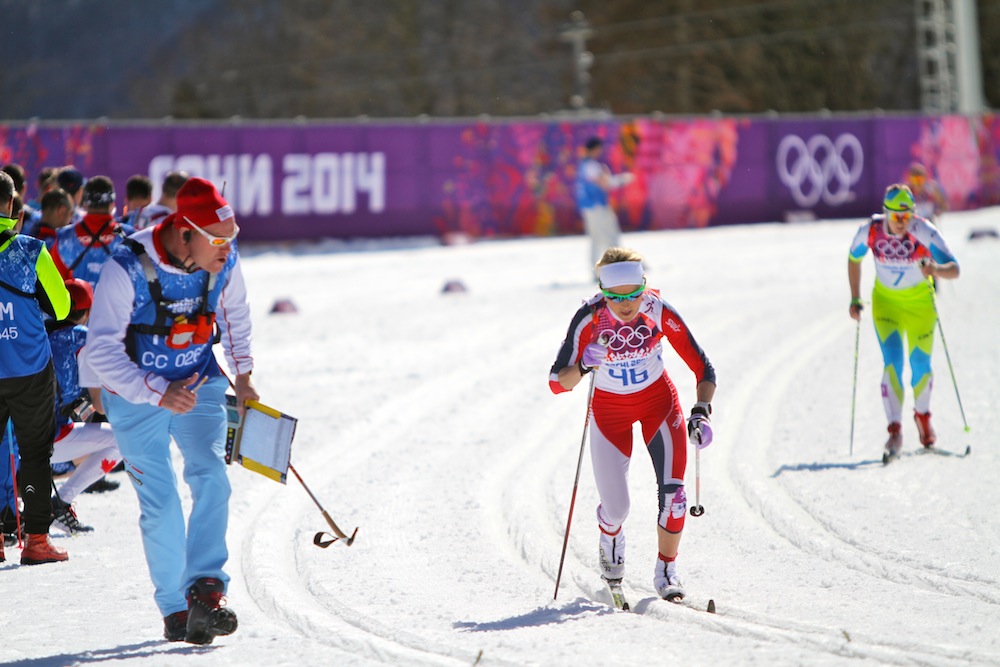
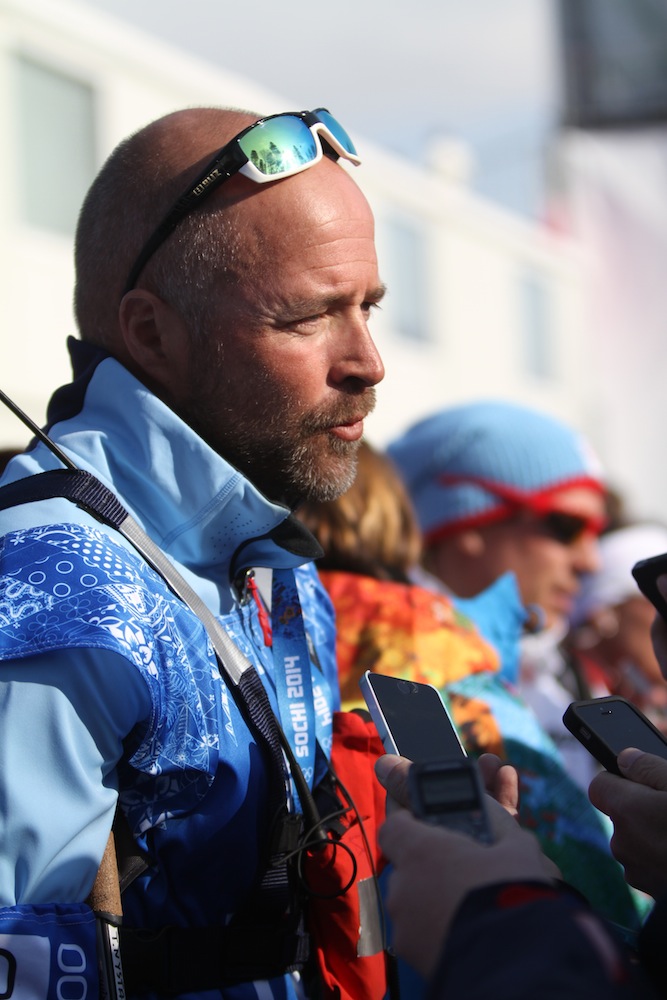
    Trond Nystad, the coach of the Norwegian men’s cross-country ski team, takes questions from the media after the relay at the Sochi Olympics.
  • More fallout from Wednesday’s Anti-Doping Arrest In Seefeld; Nystad Steps Down

    More fallout from Wednesday’s Anti-Doping Arrest In Seefeld; Nystad Steps Down

    A screenshot from a video posted to Twitter of Austrian cross-country athlete Maz Hauke during his arrest on Wednesday. Hauke can be seen in the video receiving a blood transfusion. (Photo: @yohanroblin twitter screenshot)


    Overnight a video was leaked of Austria’s Max Hauke as he was arrested during a police raid conducted earlier this week. Hauke is seen in the video receiving a blood transfusion. The police officer who provided the video to the media is now under investigation by Austrian authorities.

    On Wednesday, Hauke was one of five cross-country athletes arrested in Seefeld as part of a widespread anti-doping sting. Along with Hauke, Austrian teammate Dominik Baldauf, Estonians Karle Tammjärve and Andreas Veerpalu, and  Kazakh Alexey Poltoranin were arrested.

    The release of the video featuring Hauke prompted Austrian cross-country coach Trond Nystad to resign effective on Sunday after the conclusion of the World Championships. Norwegian tabloid VG first reported the news of Nystad’s departure. The forty-eight-year-old Nystad is Norwegian but has been coaching the Austrian cross country team for several years.

    “The two boys have done something completely illegal,” Nystad said according to a translation of the VG article. “When there are people who are kidding with such things, I have no desire to work with the Austrian ski club anymore. It was not difficult. It was a shock. One thing is to hear about things that have happened. Suddenly watching the video of it made me sad. I just got even sadder and upset.”

    Nystad became the head of Norway’s men’s cross-country program in 2011. Nystad, also a former U.S. Ski Team Head Coach, took the Austrian coaching position in 2016 after resigning from Norway’s team

    On Thursday, the morning of the women’s 4 x 5 k relay, Nystad conducted an interview with British Eurosport in which he denied any knowledge of Hauke’s and Baldauf’s doping.


  • Nic Lemyre on Guiding Cross Country Canada Forward

    Nic Lemyre on Guiding Cross Country Canada Forward

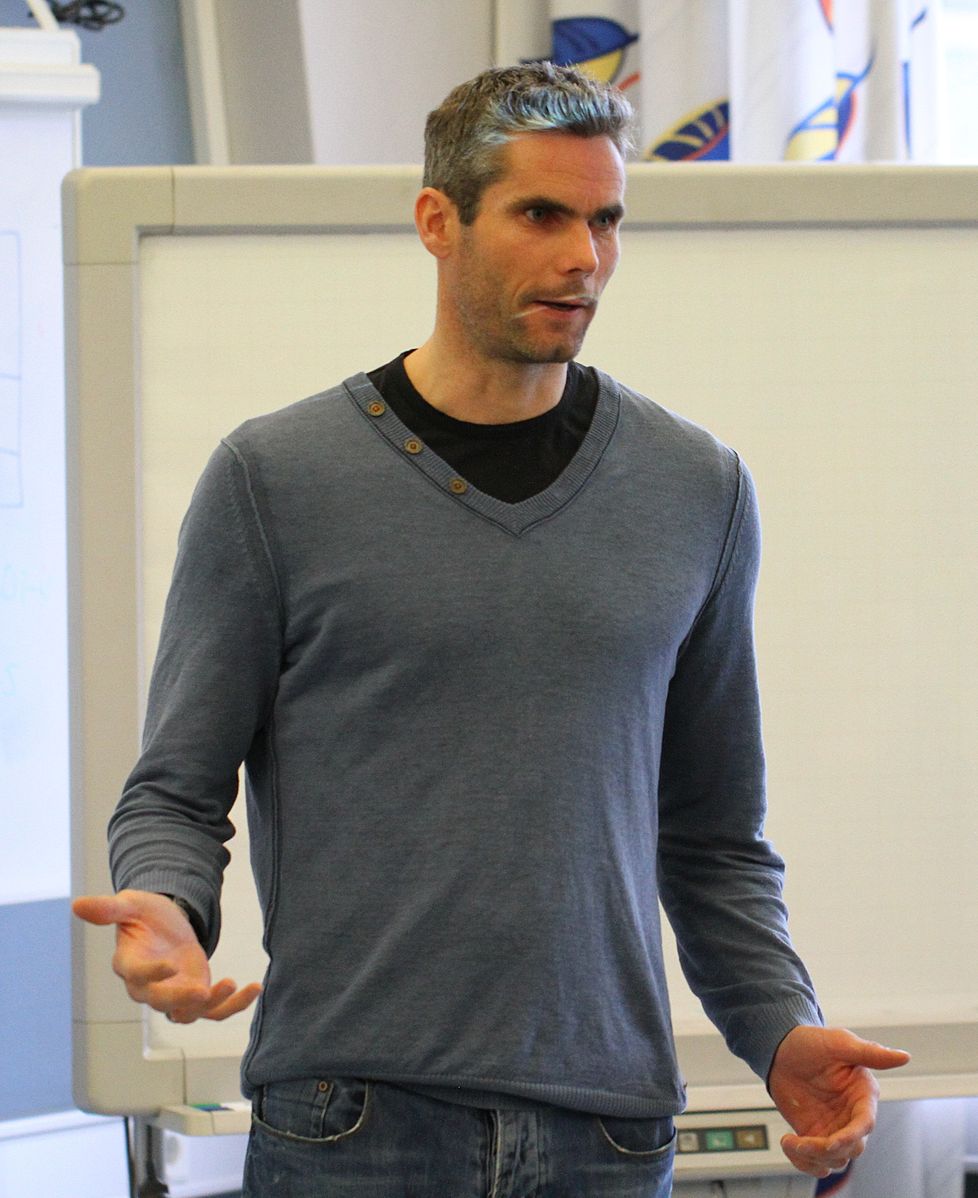
    Nic Lemyre (Photo: Norges Idrettshøgskole/Norwegian Sports Academy/)

    Cross Country Canada has reset. In this nascent Olympic cycle, there’s been an organizational seismic wave as the country’s national governing body (NGB) for nordic sport, Cross Country Canada (CCC) implements change. 

    In a post-Olympic afterglow, it’s common for NGBs to reassess, reprioritize and refinance. As part of its reboot, CCC hired Nic Lemyre as a high performance and development advisor. (Former high performance director Tom Holland recently retired.)  

    For the past 21 years, Lemyre has resided and worked in Norway, most recently as a professor of sport psychology at the Norwegian School of Sport Sciences (NIH) in Oslo. He also currently serves as the head of the department of coaching and psychology at NIH. Lemyre is originally from Montreal, graduated from St. Lawrence University in upstate New York, and was a member of the original elite training group of athletes based out of Mont Sainte-Anne, Quebec.

    After a year training and racing post-collegiately in the mid ’90s, Lemyre was perplexed by this common and recurring question among nordic skiers: why are the Norwegians so fast? So he traveled to Norway to investigate. 

    “I was really curious about how come Norway was dominating so much in cross-country skiing,” Lemyre, 45, said on the phone last week from Canmore, Alberta. “They had so many guys that were going so fast. I thought I could take a trip there and see with my own eyes. So it was not an academic reason, it was really a curiosity related to what they were doing that could explain why they were so good at skiing.”

    Lemyre’s original six-month trip ballooned in duration as he earned both a masters and doctorate in sport psychology from the Norwegian School of Sport Sciences. Along the way, he had opportunities to answer his initial question about Norway’s recurrent cross-country success. He, too, eventually played a part in those achievements as a sport-psychology consultant for the Norwegian women’s biathlon team and men’s cross-country team.

    “I started working for the men’s team when Trond Nystad took over,” Lemyre explained. “I had known Trond when racing against him at NCAA’s. He was racing for Vermont and I was racing for St. Lawrence, so we would compete every weekend throughout the whole winter. And him being a foreigner and me being a foreigner, we would hang out, Trond and I and some other foreign guys. It was just really fun to meet Trond again 20 years later during a very different stage of our lives and we all got along really well, not just socially but also professionally.”

    A former U.S. Ski Team head coach, Nystad began guiding Norway’s cross-country team starting in 2011.

    “When Trond took over, Petter Northug was pretty much the only guy winning races on the men’s side and he had been doing that for many years,” Lemyre said. “Trond structured the team in a way and a year later all the guys that were on the national team had podium finishes. And everybody contributed in a significant way to the excellence of the team. So that was a very interesting period to work with them.”

    Lemyre’s tasks with CCC are centered on championship and Olympic medals for both able-bodied and para-nordic skiing. As his job title denotes, he’ll advise Canada on how to develop athletes into high-performance skiers on that medal path. With his knowledge base of both Norway’s and Canada’s nordic-skiing communities, Lemyre is positioned to adopt Norwegian methodologies when it suits Canada, yet build a program that capitalizes on what is unique to Canada.

    To illustrate how the systems differ, Lemyre described the vast number of young skiers vying for limited race bibs within the Oslo “neighborhood” ski clubs. He spoke of a five-week-long, Oslo-based race series for eight to 11 year olds.

    “There are 1400 places and all the places are registered within 24 hours on the internet,” Lemyre said of the depth of skiers within a single slice of Norway. “We have to block it at 1400 because we would not have time to race all the kids between the time they need to get there after school and before they have to go to bed. That number is the most amount of kids we can have on two-kilometer track between, I think, it starts at 5:15 p.m. and goes until 8:15 p.m. So the kids are starting two by two every 15 second for three hours. These are only the neighborhood races.”

    Lemyre also consulted for the Norwegian men’s national hockey team. His experience working with that team reinforced the importance of capitalizing on Norway’s strength: a less-physical style of play. In 2011, Norway, a relatively small country when it comes to hockey, placed sixth overall at the men’s World Championships.     

    “For a small nation like Norway to do that well at the World Championships it was a great performance from the team,” Lemyre recalled. “And one thing I noticed from how they were preparing and performing at the World Championships was they tried to do it their way. They did not try to meet the Canadians or the Swedes or the Americans and try to play their game and play better than them because that would not have worked. I think at the Olympics in Vancouver, our team had almost a 20-kilo deficit in terms of weight with the Canadian players. Had they been playing as physically as the Canadians, it would have been very hard for them to hold out a 60-minute game.”

    His time with Norway’s hockey program will serve as a corollary for fortifying cross-country skiing in Canada. Lemyre said his commitment to developing solutions to cross-country ski development will involve building on Canada’s intrinsic strengths. He’ll simultaneously import piecemeal from Norway’s development paradigm which emphasizes a data-driven approach.

    “I think it is important to find a Canadian solution and then try to be fast on skis sort of the Canadian way,” Lemyre said. “If we try to do it the Norwegian way, they will always have numbers on their side and they will always have the advantage that the whole country breathes and eats and sleeps cross-country skiing. It is important for us to import what is importable from Norway, but also find a solution that is truly Canadian.”

    “It is important for us to import what is importable from Norway, but also find a solution that is truly Canadian.” — Nic Lemyre, CCC high performance and development advisor

    Lemyre’s approach appears to be binary. There are the athletes and the infrastructure to support those athletes. Although stating he had not yet discussed this with his colleagues at CCC, Lemyre said one hypothesis to test is trying to recruit cross-country athletes from different sports. This “crossover” hypothesis might help identify potential elite skiers in a system lacking the raw skier numbers of a Norway.  

    According to Lemyre, his center’s research at NIH discovered that adolescent athletes do not need endurance training to make them faster skiers later in their careers.

    “What we see is that there is very little physiological adaptation to endurance training before kids turn 13,” he said. “To have a focus on skill development and play until they reach that age is really important. Endurance is something that you can gain really quickly later in life. We could also emphasize the fact that you can be a cross-country skier in the winter to keep yourself active and develop skills and in the summer you can play soccer or do mountain biking or something else, so that we welcome you in the cross-country skiing family even though you have other sport interests. … We want cross-country skiing to be the most inclusive sport in Canada.”

    Lemyre again referenced hockey to differentiate how CCC can build its roster of high-performing skiers. In Canada, he said that only ice hockey can claim a near monopoly of untapped youth talent like cross-country skiing in Norway. He described a system in Canada where the default season for aspiring hockey players is 12 months long. According to Lemyre, a stigma exists for families pulling their children out of full-time hockey training to play another sport on the side.   

    “There is a strong feeling with the parents if they pull out their kids from ice hockey in the summer so they play soccer then the kid will suffer when they try to come back into the structure in the fall,” he said. “Because often the coaches will interpret that as the kid being less motivated or the kid investing less in their development, so they will often make the kid, call it, ‘pay’ for them not playing hockey in the summer. I think if we can be wise in cross-country skiing and actually use the research to our advantage and encourage our kids to be multi-sport athletes down the road, we will likely have even better athletes. And one thing’s for sure, we will not have used up their motivation because they will have had the opportunity to do a lot of things while they were developing.”

    The other piece of Lemyre’s development model will focus on the importance of training infrastructure. He’ll highlight the locations and facilities where athletes can form high-level training groups and learn from one another within Canada. 

    “I find the Americans have been doing that really well with the last generation of skiers you have at a high level,” Lemyre said. “[The Americans] focused on what you could develop within the country with the strengths they already had. You have athletes use the infrastructure already in place. The athletes are good at training in American places during the offseason and organizing training tasks where athletes can train with the best in the U.S. and learn from them and share knowledge. So we are inspired by that.”

    Lemyre acknowledged that he is advising CCC during a period of change and perceived instability. When he took over the Department of Coaching and Philosophy and Psychology at NIH, he explained it was also a time of change and disruption. When he began leading the department, he was tasked with modifying the direction of research and restructuring the organization. Having led that research group for the last eight years, which includes over 30 staff members and a multi-million dollar budget, Lemyre notes he is acclimated to the challenges of organizational development.     

    “I understand that all the bricks aren’t in place yet [at CCC] and there are people that have left the organization that were very knowledgeable and had a lot of experience,” Lemyre said. “Some of them live here in Canmore and I happen to know some of them, so there is the human side of the situation where it’s never fun to know that somebody you know and appreciate a lot has had to make that change to their professional life. But as an organization, I think sometimes you need to regroup and downsize to know what you really have and what you need. … This is a temporary situation. It’s always hard to do those changes. But I would say in terms of our sport, it makes sense to make these big changes and restructuring when you are starting an Olympic cycle.”

    Along with his new role with CCC, FasterSkier asked Lemyre whether he’d be taking on a similar role with Biathlon Canada. As of press time, Biathlon Canada neither confirmed nor directly commented on an official partnership with Lemyre.

    “Biathlon Canada is in the final process of restructuring different staffing positions and official statements will be released soon,” Biathlon Canada’s National Team Head Coach Matthias Ahrens wrote in an email.

    According to Lemyre, collaboration between the two NGBs was likely.

    “There’s a strong interest in Canada in having more overlap at the high level between cross-country skiing and biathlon and both sports have a lot of commonalities and it makes sense to share knowledge, to share experience and to share competence,” Lemyre said when asked about a Biathlon Canada partnership. “I haven’t been part of CCC for a very long time. I still need time to get a good overview of what we have and how we can best collaborate, but there is definitely a strong interest from both sides to have more collaboration in the future and to share more resources. We don’t really know what it’s going to look like in the end, but there’s definitely strong interest on both sides to make this collaboration a success.”

    Lemyre is currently in Canada but will return to Oslo with his wife and three children in August to continue his head of department duties at NIH.

    “I will be doing my advisory job remotely from the month of August,” he said. “For sure it is a compromise, but that is what we could organize.”

    Despite being based in Norway, Lemyre said he will be working closely with CCC’s CEO Shane Pearsall and collaborating with Canada’s provincial training centers.

    “We also wish to have me do some operational things with the national teams,” Lemyre said. “Our thoughts are that during the competition season, I will have opportunities to meet up with the national-team athletes and staff on site in Europe and during championships as well. … I’ve officially been in this position for less than a week so I think maybe if we talk again in a few weeks or a month or two then definitely I’ll have a lot more insight in terms of what kind of resources we have and where we’re going and how we’re going to build it.”

  • Kristiansen Out, Norwegian Coaching Shuffle Continues

    Kristiansen Out, Norwegian Coaching Shuffle Continues

    Egil Kristiansen announced his resignation as Norwegian cross-country women's team coach earlier this week. Kristiansen has led the women's team for the last 10 years. (Photo: Skilandslaget/Facebook)
    Egil Kristiansen (l) announced his resignation as Norwegian cross-country women’s team coach earlier this week. Kristiansen has led the women’s team for the last 10 years. (Photo: Skilandslaget/Facebook)

    Proud moments are not always performance based. After leading the Norwegian women’s cross-country team to 47 World Championship and Olympic medals — for a total of 23 gold — over the past 10 years, it was not the results that have meant the most to Egil Kristiansen, the Norwegian national team women’s coach who announced his resignation Sunday via a team press release. It was the pressure he, his athletes, and Norway put on others to push themselves in the sport.

    “It’s actually what we have managed to achieve,” Kristiansen told NRK, according to a translation, of his proudest coaching moment during the last decade with the team. “Managing to keep the pressure up, regardless of whether the results are bad or good; to do the damn job one hundred percent anyway. Not being dragged down by a poor outcome, or about to take off for good results. To paint on paint anyway.”

    Kristiansen, 50, began heading up the women’s team in 2006, after working as an assistant coach under Svein Tore Samdal. The next 10 years are history.

    In 2009, Kristiansen coached the now-retired Kristin Størmer Steira to silver in the women’s 15-kilometer pursuit at World Championships in Liberec, Czech Republic.

    In 2010, he helped Norwegian Marit Bjørgen to her first Olympic gold at the Vancouver Olympics in the women’s classic sprint. She went on to achieve four more medals at those Olympics after that, including two more gold. Prior to Vancouver, Kristiansen worked with Bjørgen for 10 years and would work with her for five more.  

    “Egil has meant a lot to me,”Bjørgen told VG.no during a press conference, according to a translation. “There has been a security for me to have him there … He’s been a crazy good leader, a manager type that has gathered the group.”

    Beyond Bjørgen and Størmer Steira, Kristiansen has worked with numerous other Norwegian superstars, including Olympics or World Championships medalists Therese Johaug, Maiken Caspersen Falla, Heidi Weng, Ingvild Flugstad Østberg, Vibeke Skofterud, and Astrid Uhrenholdt Jacobsen.

    Norway’s “Coach of the Year” in 2011, Kristiansen said he’s ready to move forward and feels the the Norwegian women’s team should as well.

    “I feel privileged to have worked with the world’s best cross-country skiers,” Kristiansen told Aftenposten, according to a translation. “But I’ve determined that it’s time to move on. As a coach, it is difficult to always give one’s best to the same group athletes over many years. Therefore, I believe this is the right time to resign, and it will help the athletes receive new inspiration.”

    Therese Johaug races to bronze as Norwegian women's sprint coach Roar Hjelmeset calls out to her.
    Norwegian women’s sprint coach Roar Hjelmeset calls out to Therese Johaug as she races to bronze in the 10 k classic at the 2014 Sochi Olympics.

    There is no official word as to who will look to replace Kristiansen’s shoes. Women’s sprint coach Roar Hjelmeset has said he’s interested in filling in, but only for a year.

    “I‘ve said I want to be national coach a one year period for women. The problem is that they were looking for someone who can train [through the] Olympics in 2018,” Hjelmeset, who first coached national-team juniors in 2008 then the women’s sprint team since 2011, told NRK. 

    National team director Vidar Løfshus indicated that Kristiansen’s successor must be willing to make a commitment through the 2018 Winter Olympics. 

    “I was prepared that [his decision] could go either way, hoping of course that he would continue,” Løfshus said to Langrenn, according to a translation. “To sum up his time as coach of the national team will be the one long tribute.”

    Hetland Takes Over Norway’s Men’s National Team

    Kristiansen’s resignation is not the only change in the nexus of Norwegian nordic skiing. Tor-Arne Hetland was hired this spring as the new men’s cross-country coach.

    Tor-Arne Hetland, Swiss sprint coach from 2010-2014 (Photo: FIS) http://www.fis-ski.com/cross-country/news-multimedia/news/article=tor-arne-hetland-nor-become-world-cup-team-coach-for-canada.html
    Tor-Arne Hetland was a Swiss sprint coach from 2010-2014, then coached the Canadian World Cup Team for a season (2014/2015) before taking an assistant coaching position with his alma mater, the Norwegian national team. He is now the Norwegian men’s head coach. (Photo: FIS) 

    A 2002 Olympic gold-medalist sprinter, Hetland, who competed for Norway, previously worked as a national coach for Germany, Switzerland and Canada before assisting the Norwegian team last season under former men’s coach Trond Nystad.

    “Trond has been generous and given me great responsibility allround team this season,” Hetland told Skiforbundet, according to a translation. “I want to continue a culture where athletes together take responsibility for their own training and development. Created to be the best trained and set a standard that new generations of skiers want to strive for. I look forward to continue working with the team and with the rest of the support develop each athlete so that they can bring out their maximum potential.”

    Trond Nystad, the coach of the Norwegian men's cross-country ski team, takes questions from the media after Sunday's relay.
    The outgoing coach for the Norwegian men’s cross-country team Trond Nystad fields questions at the 2014 Sochi Olympics

    Nystad, 45, had been the head coach for the men since 2011, working with his twin brother Knut Nystad, Norway’s head wax technician. Trond had previously coached the U.S. and Swiss teams.

    Nystad’s contract with the team ends May 31. Earlier this month, he dispelled rumors that he would advise Russia’s Alexander Legkov this winter. Rather, after spending what he estimated to be nearly 250 days on the road in the last five years, Nystad wanted to focus on being a dad.

    “Nothing is certain, nothing is excluded, but in relation to their family situation is probably not wise to continue with 240-250 days of travel,” he told NRK. “But I still want to work with sport.”


  • Olsson Completes ‘Mission Impossible’ with 15 k Victory at World Championships

    Olsson Completes ‘Mission Impossible’ with 15 k Victory at World Championships

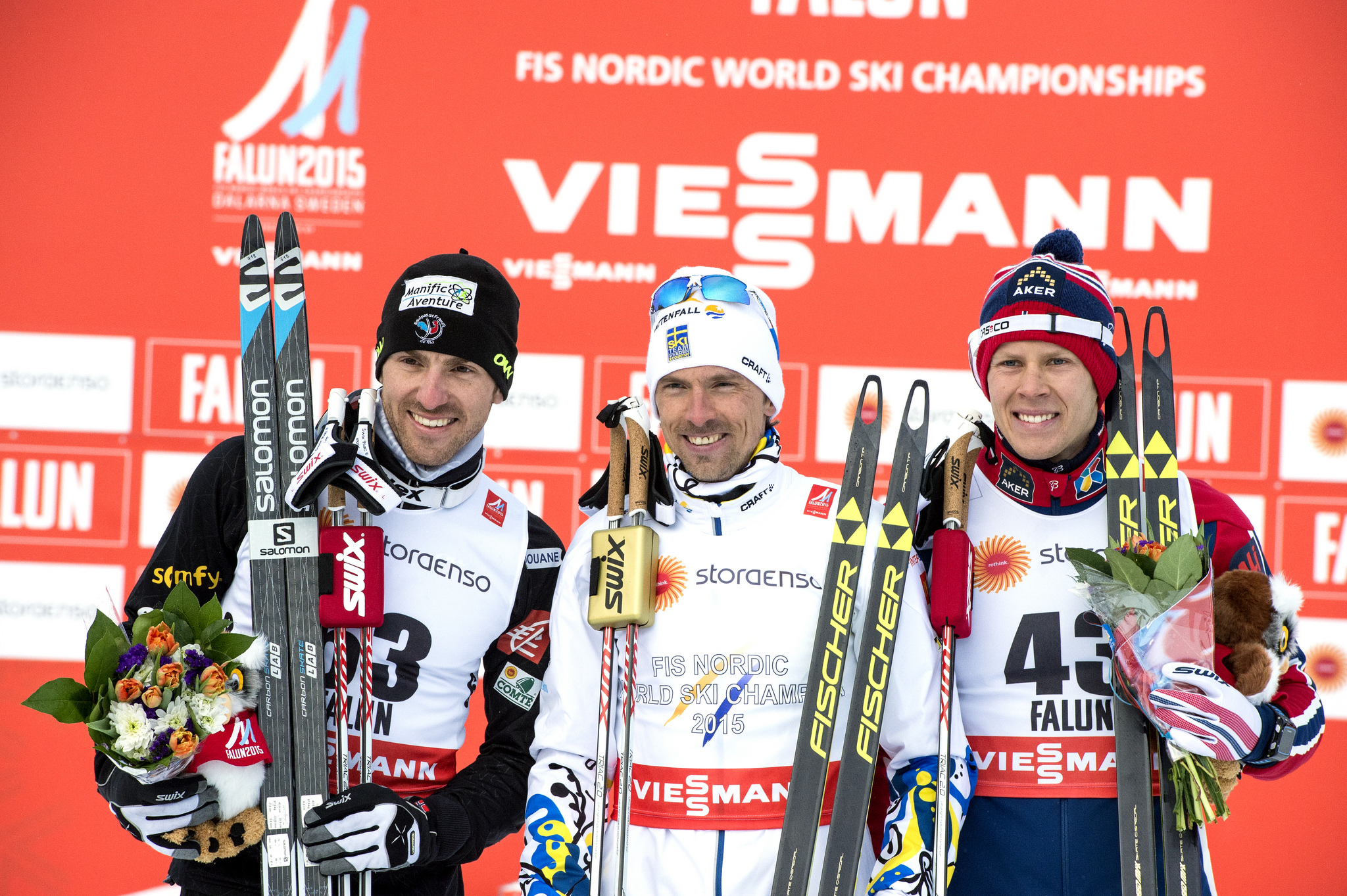
    France's Maurice Manificat (l), Sweden's Johan Olsson (c) and Norway's Anders Gløersen (r) in Wednesday's 15 k freestyle podium at the 2015 FIS Nordic World Ski Championships in Falun, Sweden. Olsson won the race by 17.8 seconds over Manificat. Gløersen finished third, 19.2 seconds back. (Photo: Falun 2015)
    France’s Maurice Manificat (l), Sweden’s Johan Olsson (c) and Norway’s Anders Gløersen (r) in Wednesday’s 15 k freestyle podium at the 2015 FIS Nordic World Ski Championships in Falun, Sweden. Olsson won the race by 17.8 seconds over Manificat. Gløersen finished third, 19.2 seconds back. (Photo: Falun 2015)

    FasterSkier’s coverage of the 2015 FIS Nordic World Ski Championships in Falun, Sweden, is brought to you by the generous support of L.L. Bean, now featuring a complete line of Kikkan Randall training wear.

    FALUN, Sweden — It was a self-described ‘mission impossible’ for Johan Olsson at the 2015 FIS Nordic World Ski Championships. The 34-year-old, who plans to retire after the 2015 season, barely raced in the year prior to the championships due to illness. When he wasn’t bedridden, the Swede was separated from his family and wondering whether he should have retired a year earlier.

    It appears his mission impossible wasn’t unattainable, after the Swedish skier coasted to victory in Wednesday’s 15 k freestyle individual start with a time of 35:01.6. Olsson won by a large margin, finishing 17.8 seconds ahead of Frenchman Maurice Manificat. Anders Gløerson placed third and crossed the line 19.2 seconds behind the Swede.

    An early starter in bib 17, Olsson realized that conditions would deteriorate as skiers traversed the 7.5 k loop and planned accordingly. He skied the first lap aggressively to take advantage of the fast conditions while they lasted. While his loop was the second-fastest by 0.3 seconds behind Manificat, Olsson excelled through the deepening snow to post the fastest finishing time. He remained in the leader’s chair for the rest of the competition, watching skiers fail to best his winning effort.

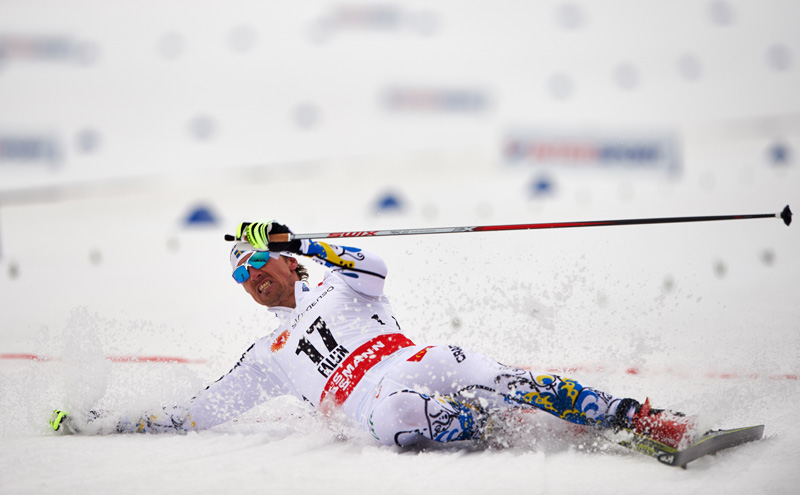
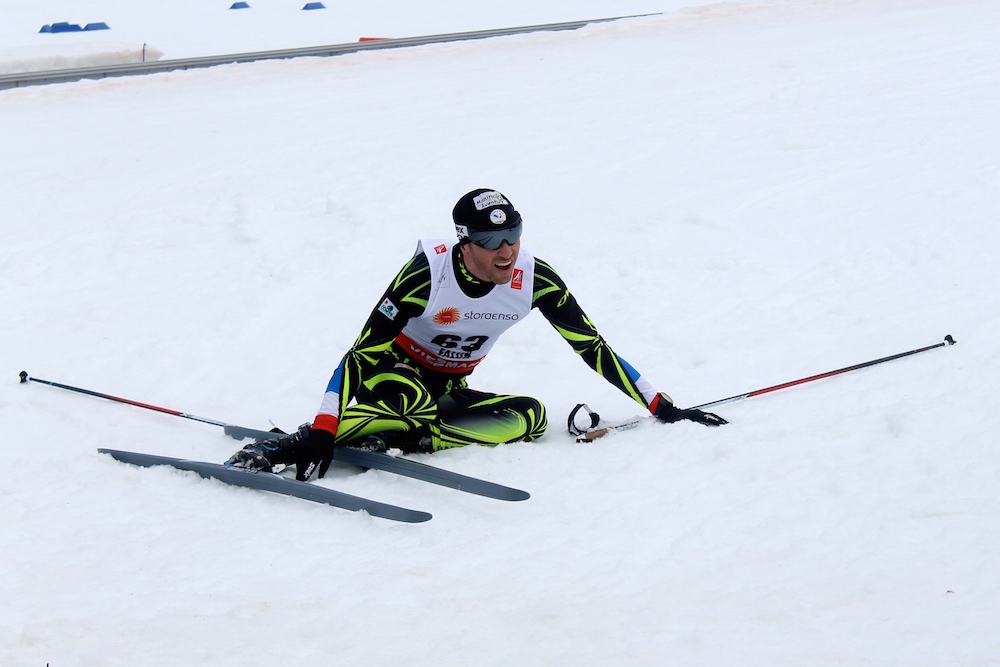
    Johan Olsson of Sweden collapses after posting the best time in Tuesday's 15 k freestyle at the 205 FIS Nordic World Ski Championships in Falun, Sweden (Photo: Fischer/Nordic Focus)
    Johan Olsson of Sweden collapses after posting the best time in Tuesday’s 15 k freestyle at the 205 FIS Nordic World Ski Championships in Falun, Sweden (Photo: Fischer/Nordic Focus)

    “I knew I had done a really good race – perhaps the best skating race of my life” Olsson told the press after his finish. “I was able to push very hard all through the race. I was trying to be very aggressive in the beginning to get a good first lap as my starting number at 17 would be an advantage in these conditions to go quite early.”

    Olsson credited much of his performance to a strong Swedish wax team that provided him with “the best skis in the field.” He said that half of his medal belonged to his personal wax technician, who also serviced the skis teammate Charlotte Kalla used in Tuesday’s 10 k victory.

    Olsson has stepped away from World Cup competition in recent years to focus on championship events. He started no World Cup competitions in 2014, and his only race of 2015 was the recent Östersund 15 k where finished fifth. The Swede’s strategy appears to have worked, especially given his championship results from the past three years. In the 2013 World Championships he was second in the 15 k freestyle and first in the 50 k classic. At the 2014 Olympics he was second in the 15 k classic.

    “When you have a goal and a mission that’s really impossible, that’s what gets me going,” – Johan Olsson  

    “I don’t think anyone has invested so heavily in the World Championships as I have,” he explained. “I have left the World Cup behind me completely and had a clear plan for the World Championships.”

    Even with a reduced racing schedule, Olsson’s path to success hasn’t been easy.

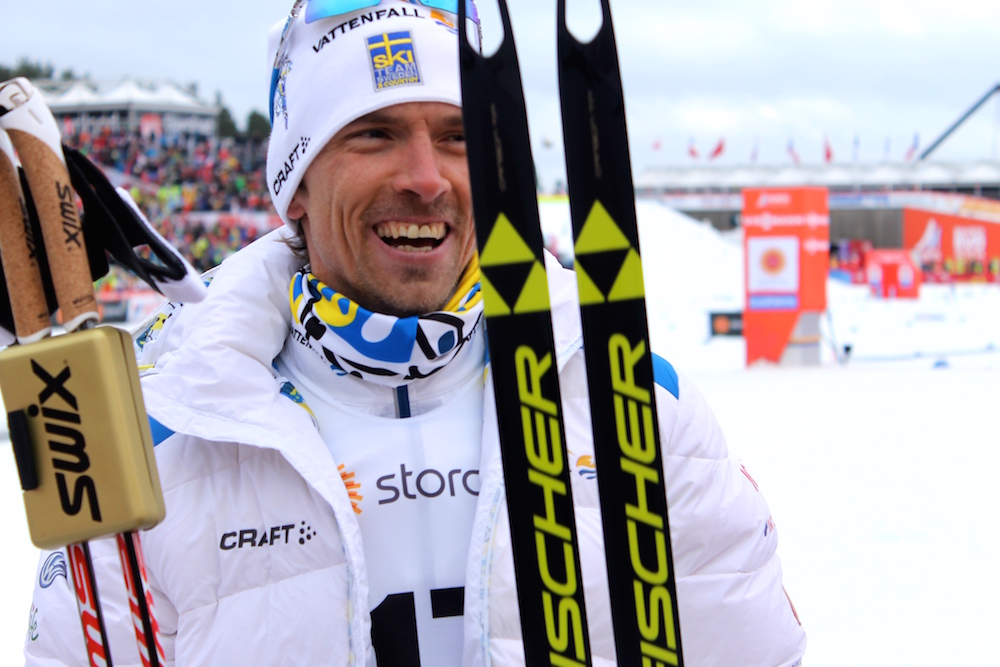
    Johan Olsson of Sweden smiles after his win in the 10 k freestyle at the 2015 FIS Nordic World Ski Championships in Falun, Sweden.
    Johan Olsson of Sweden smiles after his win in the 15 k freestyle at the 2015 FIS Nordic World Ski Championships in Falun, Sweden.

    The world champion lost a month of training in December when he succumbed to a strong virus that left him bedridden. At the time, he believed his last year of racing might have been for nothing.

    “When i was sick, I was wondering why did I continue one more year,” he said. “I was trying to do some mission impossible for the championships. Of course as an athlete you don’t belive in yourself when you can’t train and can’t do anything.”

    Despite the low moral, Olsson continued to build fitness with his sights set on the Championships in Falun. After his recovery he trained roughly 100 hours in January and skied over 300 k in just 15 days. The training came at a price, however, as Olsson was unable to see his two children – who were in attendance at Wednesday’s race – for seven weeks prior to the Championships in Falun.

    “From the new year, no one has put in as much effort as I have done,” he said in a press conference. “I haven’t seen my kids for seven weeks and that is quite strainful to have two small kids at home and not see them. Every night you think is it worth it to be away from your kids.”

    Olsson added that while the decision to be apart from his family was difficult, it was days like Wednesday that he and his wife “are pretty convinced that it was worth it.”

    “When you have a goal and a mission that’s really impossible, that’s what gets me going,” he said.

    In second, Manificat earned the first French medal at a cross country World Championships event in 10 years since Vincent Vittoz was crowned victor in the 2005 30 k pursuit. He is now one of only four French men to claim a medal at Worlds.

    Maurice Manificat realizes his podium placement after the finish of the 10 k freestyle at the 2015 FIS Nordic World Championships in Falun, Sweden. He finished second to earn the first World Championships medal for France in 10 years.
    Maurice Manificat realizes his podium placement after the finish of the 15 k freestyle at the 2015 FIS Nordic World Championships in Falun, Sweden. He finished second to earn the first World Championships medal for France in 10 years.

    Manificat entered Wednesday’s race with confidence – he hasn’t finished lower than eighth in a 15 k freestyle event in the 2015 season. At the pre-World Championships 15 k freestyle in Östersund, he also placed second.

    As one of the day’s late starters in Bib 63, Manificat skied through the worst of the wet, soft snow. While it made the race more difficult, he explained that he excels in such conditions.
    “The last lap, the snow was softer maybe. But I like the soft snow and it is no problem” he said to the press. “I felt difficulty so I knew it would be difficult to keep the medal. But I believed it until the end and I did it to the finish line.”

    Gløersen also faced a soft course, and explained he believed results were fair to all starters.

    “There was good glide in the the snow,” he said. “You have to fight harder the whole way around and try to think too much about the feeling and think about the results to motivate myself to stay in the race.”

    Gløersen is one of Norway’s best sprinters, but has demonstrated a shift to distance skiing in the 2015 season. In December, he won the Davos 15 k freestyle. He explained he didn’t want to enter Wednesday’s race with high expectations because of his inexperience in distance racing.

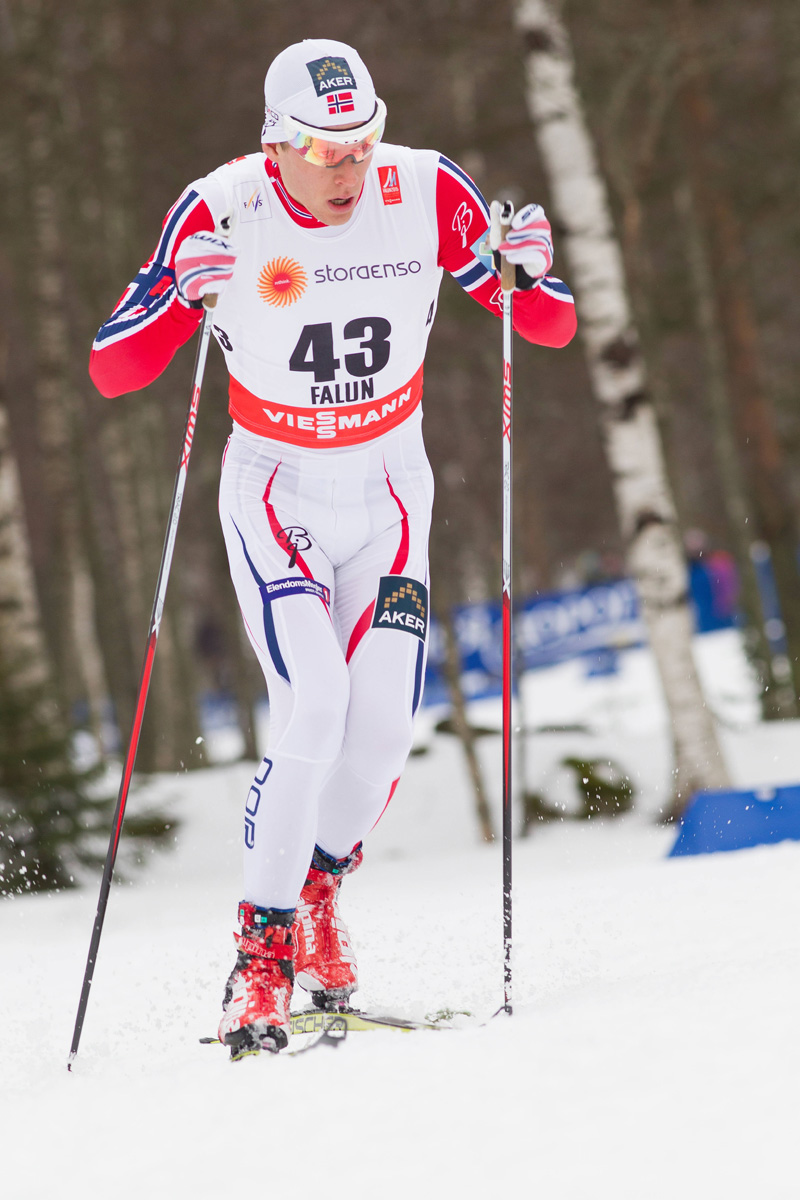
    Anders Gløersen of Norway en route to his third place finish in Wednesday's 15 k freestyle at the 2015 FIS Nordic World Ski Championships in Falun, Sweden. (Photo: Fischer/Nordic Focus)
    Anders Gløersen of Norway en route to his third place finish in Wednesday’s 15 k freestyle at the 2015 FIS Nordic World Ski Championships in Falun, Sweden. (Photo: Fischer/Nordic Focus)

    “It’s been my goal this entire season to qualify for the team for the 15 k here. In my head I’ve been preparing to fight for a medal, so for me it’s not surprising,” he said. “I may be a little reluctant to say that I thought I could get a medal. I’ve been a sprinter for now six, seven years on the World Cup, so for me to just suddenly start focusing on the 15 k to say I was going for a medal was a bit too high. I‘m just really happy to achieve my goal today.”

    Gløersen’s result comes on the heels of a difficult waxing day for the Norwegian women. In Tuesday’s 10 k the team’s best finish was 22nd, with previous favorites like Marit Bjørgen finishing outside the top-30.

    There was no such trouble for Norway in Wednesday’s 15 k, as Gløersen said his skis were gliding well. Norwegian men’s coach Trond Nystad echoed Gløersen saying, “the skis seemed to have worked and they seemed to be a lot better than yesterday.”

    With four in the top-nine, Nystad explained the Norwegian national team was pleased with the day’s results given the level of competition.

    “We knew it was going to be hard to get a medal,” he told FasterSkier. “The men’s race is pretty tight so one second back or one second forward can mean one or two places. We were in the medals so we were psyched. We were actually pretty happy that we did well as a team.”

    The only Norwegian result outside the top-10 was from Petter Northug who finished his day in 62nd. Northug has already been crowned world championships twice in Falun, with wins in the classic sprint and team sprint. According to Nystad, Northug wasn’t feeling well and decided to “tour” so that he could rest for the upcoming relay and 50 k classic mass start.

    Racing at the 2015 FIS Nordic World Ski Championships in Falun, Sweden continues Thursday with the women’s 4 x 5 k relay.

    Results

  • Déjà Vu: Sundby Picks Up Where He Left Off, Wins Beitostølen 15 k

    Déjà Vu: Sundby Picks Up Where He Left Off, Wins Beitostølen 15 k

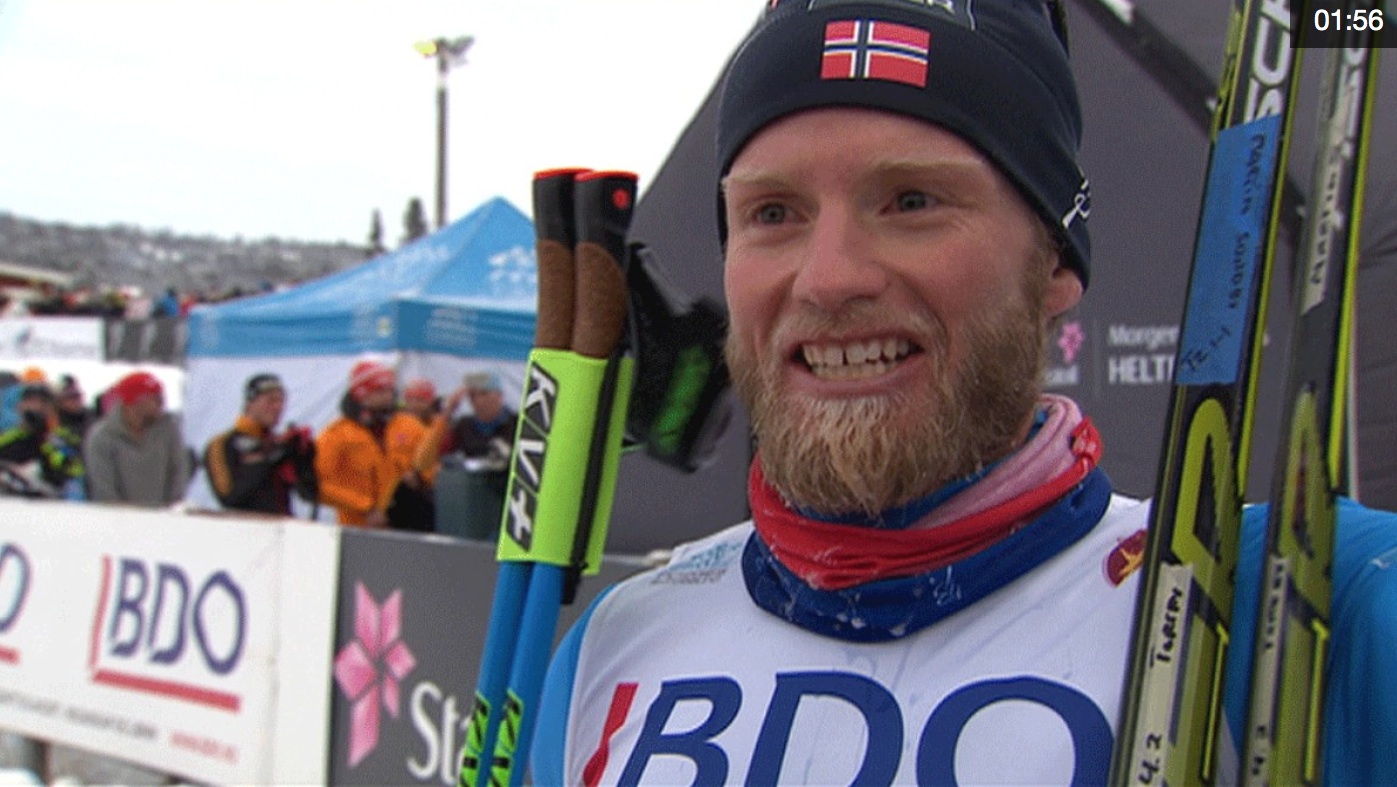
    Martin Johnsrud Sundby during an interview with NRK after Friday's 15 k classic FIS race in Beitostølen, Norway.
    Martin Johnsrud Sundby during an interview with NRK after Friday’s 15 k classic FIS race in Beitostølen, Norway.

    Defending overall World Cup champ Martin Johnsrud Sundby took it to his Norwegian teammates on Friday in an opening International Ski Federation (FIS) race in Beitostølen, Norway. The 30-year-old Sundby won the 15-kilometer classic in 37:15.1 minutes, beating out runner-up Didrik Tønseth by 22.9 seconds and Petter Northug in third by 25.8 seconds.

    According to VG, Northug led the men’s race by 4.2 seconds at 2 k, but Sundby reined him in, taking a 7.1-second lead by 6 k. By 12 k, Northug was some 20 seconds off Sundby’s pace, but he kept plugging to narrowly miss second to Tønseth by 2.9 seconds.

    “It is reassuring that Petter has trained and done well,” Norwegian National Team Head Coach Trond Nystad told VG afterward.

    Northug, 28, recently signed a contract with the national team just before the start of the season.

    “That he is fast skiing is no surprise,” Nystad added. “Martin has been superb at training throughout the year.”

    And while Northug breezed by reporters at the finish, responding to a few questions with brief answers like, “Fine,” “No,” and “I don’t know,” NRK described Sundby as happy to talk about his race.

    “It was ‘average,’ nothing exceptional,” Sundby said, according to a direct translation.  “I was extremely nervous. We messed around a lot, but it was insanely cool to be ski racing again.

    “It means a lot for my confidence, and good feedback on the training I’ve put in this season,” he added.  “I’ve been very curious about how much my body can handle all spring and summer. At least the first ski race went OK, so it remains to be seen as the season progresses. However, this was my world-champion effort, so I still have to climb a few more steps on the ladder.”

    “It was insanely cool to be ski racing again.” — Martin Johnsrud Sundby, after winning Friday’s 15 k classic FIS race in Beitostølen, Norway

    Sundby won the Tour de Ski last season as well as the 2013/2014 World Cup. But being the best last season won’t cut it this winter, Sundby explained. As a result, he increased his overall training volume from 1,000 hours last season to 1,150 hours this season.

    Norwegian Olympic champion Thomas Alsgaard in April 2013 in Mosjøen, Norway. (Photo: Wikimedia Commons/Bysprinten Mosjøen)
    Norwegian Olympic champion Thomas Alsgaard in April 2013 in Mosjøen, Norway. (Photo: Wikimedia Commons/Bysprinten Mosjøen)

    For Tønseth, 23, Friday marked his first podium in any race since a Scandinavian Cup 15 k freestyle last December. The week before that, he placed third in last year’s Lillehammer World Cup 15 k classic.

    “It’s been a long time since I’ve been on the podium,” Tønseth told VG. “Well, to start.”

    Norway swept the top nine with Chris Andre Jespersen placing fourth, Petter Eliassen in fifth, Niklas Dyrhaug in sixth, Anders Aukland in seventh, Kristian Tettli Rennemo in eighth, and Per Kristian Nygaard in ninth. Germany’s Tim Tscharnke placed 10th out of 167 men.

    Norwegian great, 42-year-old Thomas Alsgaard raced — for the first time in Beitosølen in 12 years — placing 159th.

    “There was not much work today … but it was fun to compete again,” Alsgaard told NRK. “I promise I’ll be better than this before season’s end.”

    Men’s results

  • Underdog Norwegians Podium in Lillehammer 15 k: Golberg Wins First World Cup, Tønseth Third

    Underdog Norwegians Podium in Lillehammer 15 k: Golberg Wins First World Cup, Tønseth Third

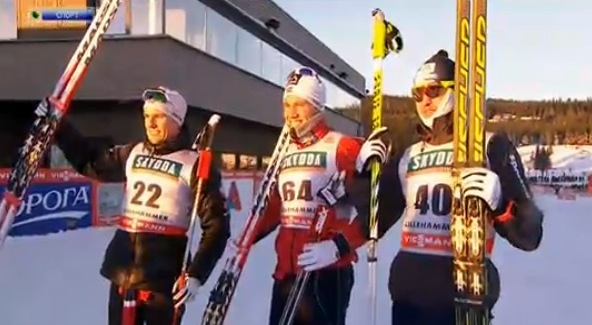
    Norway's Pål Golberg (c), shortly after winning his first World Cup in the 15 k classic individual start in Lillehammer, Norway, with teammate Didrik Tønseth (l) and Alexey Poltoranin (KAZ). Poltoranin took second and Tønseth notched his first World Cup podium in third.
    Norway’s Pal Golberg (c), shortly after winning his first World Cup in the 15 k classic individual start in Lillehammer, Norway, with teammate Didrik Tønseth (l) and Alexey Poltoranin (KAZ). Poltoranin took second and Tønseth notched his first World Cup podium in third.

    Out of 85 starters in the men’s 15-kilometer classic individual start in Lillehammer, Norway, 17 were Norwegian. More than half of that 20 percent included international household names, and the lesser-known few were also vying for Olympic team spots, making the stakes even higher.

    Without even factoring in odds, there was a pretty good chance a Norwegian was going to win Saturday’s World Cup race.

    As the skiers ticked off the laps – three times around Lillehammer’s hilly course – it became a question of who would take the big prize.

    Initially, Russia appeared on top with Stanislav Volzhentsev, the sixth starter, logging the fastest time through 2.1 k.  Thirty starters later, Sweden’s Johan Olsson bested Volzhentsev’s intermediate time by more than a second, and a few minutes later Norwegian Petter Northug came through even faster – by 3.2 seconds – in bib 46.

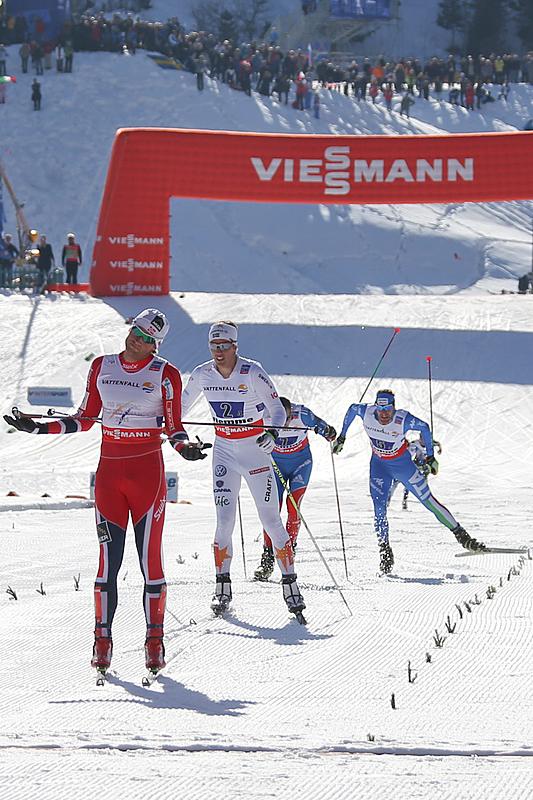
    Petter Northug prematurely shrugs off Norway's seventh-straight men's relay title at World Championships on Friday in Val di Fiemme, Italy. He beat Sweden's Calle Halfvarsson (second from l), Russia's Sergey Ustiugov (third) and David Hofer of Italy in fourth for his second gold of the week. (Photo: Fiemme2013)
    Petter Northug shrugging off Norway’s seventh-straight men’s relay title at 2013 World Championships in Val di Fiemme, Italy. He beat Sweden’s Calle Halfvarsson (second from l), Russia’s Sergey Ustiugov (third) and David Hofer of Italy in fourth. (Photo: Fiemme2013)

    But it was only two kilometers into a 15 k race, and there were lot of dangerous starters remaining.

    Pål Golberg started 64th and didn’t draw attention too early. With the seventh-fastest time two kilometers in, he was nearly nine seconds behind Sweden’s Calle Halfvarsson (who had topped Northug’s time by six seconds).

    At the 5 k mark, Halfvarsson was still the fastest, but Golberg — best known as a sprinter — was making up ground, cutting the deficit to 3.8 seconds. Northug remained in second, and appeared on par to put down one of his late-kicking, dominant performances.

    Less than kilometer later, just a third of the way through the race, the 23-year-old Golberg took the lead. He led Halfvarsson by a second, as well as Norway’s Chris Andre Jespersen, Didrik Tønseth and Martin Johnsrud Sundby, who were all within two seconds of one another in third through fifth. Northug was 11 seconds out in 12th, and suddenly the race had started.

    “I wanted to be patient in the first lap. I knew I could ski fast but I held back at the beginning,” Golberg told reporters after. “In the other two laps I felt like I could keep the pace up. The course seemed to be really hard during training, but today with the speed, it did not feel that tough.”

    Golberg held on, just ahead of 22-year-old Tønseth and Halfvarsson, who trailed by about a second. Chasing him from behind, Sweden’s Marcus Hellner and Russia’s Alexander Legkov ranked third and fourth, respectively, just 3 ½ seconds back..

    With 5 k to go, Golberg began his ascent toward the podium putting 8 seconds into Tønseth, 9.8 seconds into Olsson, and ultimately 10.3 seconds up on Legkov.

    He finished in 35 minutes flat, knocking Kazakhstan’s Alexey Poltoranin from the leader’s chair by 14.2 seconds. Hovering around the top 10 for most of the race, Poltoranin came on strong late to edge Tønseth, the previous race leader who ended up third, by 1.3 seconds.

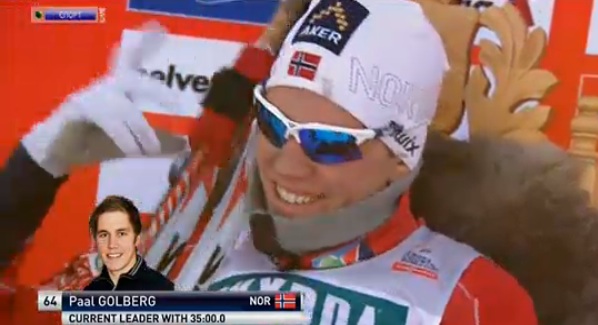
    Sitting in the hot seat bundled up and appearing slightly nervous, Golberg watched as others pushed to beat his time. Hellner finished 20.2 seconds back in fourth, and Legkov double poled hard off the final descent into the stadium, ultimately finishing 22.2 seconds out in sixth. (Olsson ended up fifth, 21.4 seconds out of first.)

    Norway's Pål Golberg smiles while sitting in the leader's chair on Saturday, after watching Russian Alexander Legkov finish 22.2 seconds off his winning time in the 15 k classic individual start at the Lillehammer World Cup.
    Norway’s Pål Golberg smiles from the leader’s chair on Saturday, after watching Russian Alexander Legkov finish 22.2 seconds off his winning time of 35:00 in the 15 k classic individual start at the Lillehammer World Cup.

    As Legkov crossed the line, Golberg smiled. Not long after, Sundby as the final starter finished 24.9 seconds back in seventh. Following in eighth was Jespersen (+31.8), Northug placed ninth (+40.7), and Sweden’s Daniel Richardsson took 10th (+42.3).

    Immediately congratulated by his teammates on his first World Cup win, Golberg smiled even more. He had placed third in World Cup individual sprints and second in the 2013 World Cup Finals freestyle prologue, but never this. When he spoke to reporters, he wiped away tears.

    “I’m a little shaky right now,” Golberg told NRK, according to a translation. “I cry both when things are going well and when things go bad.”

    At the 2013 World Championships in February, Golberg collapsed in the team sprint, blacking out and taking him and his teammate, Northug, out of contention.

    After Saturday’s race, Northug praised his teammate.

    “He had a very good start to the season and … is a person who can do well at both distance and sprint,” Northug told NRK. “It’s that kind of [skiers] we need.”

    Norway’s second man and third-place finisher, Tønseth impressed with his first World Cup podium – and he didn’t even realize he made it. He was late to the flower ceremony as a result.

    “I had looked a bit on a TV, and realized that my time was good,” Tønseth told NRK. “But I did not think it would be so good.”

    Regardless, Norwegian men’s coach Trond Nystad was pleased.

    “It’s impressive and fun for them,” he said.

    Results

  • Kershaw on Training with the Norwegians, Dating Steira, and Being Happy

    Kershaw on Training with the Norwegians, Dating Steira, and Being Happy

    Devon Kershaw after an interval workout in Klosters, Switzerland, before his training camp with the Norwegian national team in Val Senales, Italy. (Photo: Kristin Størmer Steira/http://www.kristinsteira.no/wordpress/?p=536)
    Devon Kershaw after an interval workout in Klosters, Switzerland, before his training camp with the Norwegian national team in Val Senales, Italy. (Photo: Kristin Størmer Steira/www.kristinsteira.no)

    With his ninth consecutive World Cup season in the bag, Devon Kershaw, 30, could finally put his feet up this spring and think about 2012/2013 – not that he necessarily wanted to.

    It wasn’t easy reliving that fateful stumble down a flight of stairs in Bruksvallarna, Sweden, in which the Canadian national-team skier tore a ligament in his foot a weekend before the season started. Unable to run for several months, he taped the afflicted area around his ankle and pushed through every ski race – refusing to publically acknowledge it or use it as an excuse.

    Canadian Devon Kershaw pushing in Saturday's World Cup sprint qualifier in Canmore, Alberta. He was 50th and failed to advance to the quarterfinals.
    Kershaw pushing through the pain in his left for during the World Cup sprint qualifier last December in Canmore, Alberta. He was 50th and failed to advance.

    Things perked up about midseason (he placed eighth in two World Cup sprints in February and narrowly missed the World Championships team-sprint podium with teammate Alex Harvey in March), but ultimately, Kershaw finished farther back than he had hoped: 27th in the overall World Cup, compared to second in the world the year before. He ranked 42nd in distance events, his worst showing since 2007, but was better in sprints: 22nd, down from seventh in 2011/2012.

    All too aware of his results, Kershaw needed answers and had a good idea where to find them.

    “I’m a pretty big journaler,” he said on the phone from Davos, Switzerland, where he was getting acclimated earlier this month before a high-altitude camp in Val Senales, Italy. “But I haven’t taken much time going back to read what I write.”

    Thumbing through his entries, Kershaw took a particularly close look at his thoughts on World Championships in Val di Fiemme, Italy. He considered the team sprint the best race of his season, but the rest of his performances there “a disaster.”

    “That was a big slap in the face,” he said. “When I got back in Canada in the spring, I met with [head coach] Justin [Wadsworth] a lot, went back to my journals, met with the sports psychologist. … I realized how poor of place I was in for many, many months and how my decision-making was horrible. I was like, ‘Wow.’ ”

    His musings weren’t limited to sports, but also included personal reflections.

    “I wasn’t in a good place mentally,” he said. “I wasn’t sleeping great. With some of the things going on in my life, I shouldn’t have been racing as well as I was … There’s a lot that wasn’t going that well, but at the time I was just trying to stay so positive because you want to make the most of every day.”

    By nature, Kershaw is an optimist. He’s been dating Kristin Størmer Steira, one of Norway’s best distance skiers, for more than a year and said she’s had a tremendous impact on him.

    “I’ve been known to exaggerate a bit and make mountains out of molehills, and Kristin’s super, super grounded and a calming influence on me,” he said “As a person she’s got great, great perspective so it’s awesome to be around her.”

    Glancing at his schedule this year, Kershaw felts a pang of the in-season blues. He had been doing this for a long time, often the same training camp after another, and now he had a girlfriend who lived thousands of miles away in Norway.

    Steira, 32, visited him in Canmore, Alberta, in late July and trained with the Canadian women’s team through early August. Then, the couple parted ways, knowing they’d see each other in November. That didn’t sit well with Kershaw.

    “I’m old; I’m 30 and that’s a bit too long,” he said. “It’s not the best way to be in a great frame of mind heading into the racing season when you’re missing someone that you really care about.”

    The scene at the Norwegian national team's annual fall camp in Val Senales, Italy, earlier this month. (Photo: Kristin Størmer Steira/http://www.kristinsteira.no/wordpress/?p=536)
    The view from the Norwegian national team’s annual fall camp in Val Senales, Italy, earlier this month. (Photo: Kristin Størmer Steira/www.kristinsteira.no)

    Steira suggested he come to the Norwegian-national team camp in Val Senales in late October, then spend the rest of November with her in Norway. Reasoning he might as well ask, Kershaw contacted his former national-team coach, Steinar Mundal, who left Canada to coach the Norwegians in 2007. Mundal was open to it, Kershaw asked Wadsworth if he was, too.

    A former U.S. Ski Team member who crossed borders and married Canadian Olympic gold medalist Beckie Scott, Wadsworth understood. He and Kershaw turned to Norwegian head coach Trond Nystad, who coached the U.S. team until 2006, to work out the specifics.

    “I made sure for Trond to ask the boys if it’s OK if I’m there because, I don’t know, I don’t want to piss anyone off,” Kershaw said.

    On his first full day in Val Senales – his first time on the glacier that soars more than 3,200 meters (10,000 feet) into the atmosphere – Kershaw tweeted, “First impressions … ? I don’t miiiiiiiiiinnnnnnddddd it. ‪#feelsgoodtobeskiing.”

    “I’ve been in the game for a long time so its nice to have something to look forward to, seeing Kristin was the main thing, and training in a different environment in the fall is something to look forward, too,” Kershaw explained on the phone.

    From Oct. 20 to Nov. 6, he expected to see the Swedish national team there, along with the Swiss, and more than 50 Norwegians between the distance, sprint and U23 teams. More familiar with Norway’s sprinters than its distance skiers, Kershaw said he was invited to a couple workouts and would primarily train with the distance team.

    “That’s [the] thing about being a little older, I’m not in high school and trying to bring my lunch tray to a table and say, ‘Hey, can I sit here?” Kershaw joked.

    “I’m really not that concerned. I’m not there to rock any boats or do anything; I’m there do to my thing.”

    For the last five or six days, Wadsworth planned to join Kershaw in Val Senales to make sure he stuck to his training regimen. The two received the Norwegians’ camp outline a couple months ago and planned accordingly to make sure it jived with Kershaw’s plan.

    The dryland scene in Val Senales, Italy, earlier this month. (Photo: Kristin Størmer Steira/http://www.kristinsteira.no/wordpress/?p=536)
    The dryland scene in Val Senales, Italy, earlier this month. (Photo: Kristin Størmer Steira/www.kristinsteira.no)

    “It’ll be hard, but nothing groundbreaking,” Kershaw said. “The plan looks pretty similar to what I do back in Canada: skiing in the mornings … then, in the afternoons doing some runs or rollerskis.”

    But most importantly, he’d be getting that skiing feeling back every day.  That’s what Kershaw said he needs before his first races in late November at the World Cup opener in Kuusamo, Finland. He’ll stay with Steira at her home in Oslo, Norway, until then.

    “I’m here ’til late March so it’s a long haul,” Kershaw said. “Packing up from Canada, it’s tough, [but] I’ve been doing this for a long time and I’ve spent five months in Europe before; what’s the difference with a couple extra weeks? My girlfriend is Norwegian and that’s important. A happy skier is a skier that usually races fast.”

    As for how he’s feeling now, almost a year after he tripped in a pair of loosely tied sneakers and tore a ligament around his ankle, Kershaw said he’s in a much better place – physically and mentally. Last February, he said his foot wasn’t the sole reason for the sub-par start to his season.

    “There were a lot of other factors, too,” Kershaw said.

    Now, he feels more settled.

    “My life’s a lot calmer,” he said. “I’ve taken care of a lot of things that were in flux the last couple years. You want to win every year and you want to win every season so when you have a little bit of a disappointing season, it’s not great, but we learned a lot and we’re a lot better at calculating what we can and can’t do. I tried to do a lot with not a lot of energy and it bit me in the ass.”

    Kershaw going "freaking hard" at the 2010 Olympics
    Devon Kershaw en route to a historic fourth-place finish with teammate Alex Harvey in the team sprint at the 2010 Olympics.

    Leading up to Kershaw’s third Olympics – the 2014 Winter Games in Sochi, Russia – he’s excited and not entertaining retirement.

    “I’ll continue to race through 2015,” he said. “This isn’t going to be a season where it’s like, ‘Oh, it’s over.’ Moving forward, as long as I’m really enjoying what I’m doing and can wake up every day with a passion and excitement to do what I’m doing, that’s kind of what’s driven me through my career, then I’ll continue racing.”

    Almost four years ago in Vancouver, B.C., Kershaw and Harvey placed fourth in the team sprint for the best Olympic finish by Canadian men. A year later, they won the same event at World Championships.

    “I actually don’t feel much pressure,” Kershaw said of Sochi. “No one can put more pressure on myself than myself. Last year I piled on pressure on myself, and what did that get me? Nothing. Hopefully I’ve learned lessons.”

    This time around, he said he’s better prepared and more realistic. “I hope to have some great races, but I’ll also have some miserably awful races, too. I’ll have some OK races, and that’s how most seasons look for most people.”

    That’s where his “dorky” journals help him in pointing out trends, Kershaw said.

    “It’s ski racing and I’m trying my best,” he explained.

    That said, he wants an Olympic medal – and if he can’t capture one, he’ll be happy if any of his teammates do.

    “No Canadian man has ever stepped on the podium and that sucks,” he said. “We’re better than that and the times is now. If it’s me, awesome. If it’s Alex, that’s just as good. … We really, really want to bring and Olympic medal back for Canada and I don’t care [which nordic events] it comes from.”

    “Is this my last Olympics? I don’t know, we’ll have to see,” Kershaw added. “Predominately, I look at [last] season as horrendous, and if the season’s like that again, there’s a lot of other things I’d like to get done. … [But] our team is just so fun to be around. I love those guys like brothers.”

  • Cologna Keeps Calm, Strikes Late to Nab World Championships Title

    Cologna Keeps Calm, Strikes Late to Nab World Championships Title

    Switzerland's Dario Cologna leads Tobias Angerer of Germany, Russia's Alexander Legkov and nearly 20 others during the skate portion of Saturday's 30 k skiathlon at the 2013 World Championships in Val di Fiemme, Italy. Cologna went on to win gold for his first medal at worlds.
    Switzerland’s Dario Cologna leads Tobias Angerer of Germany, Russia’s Alexander Legkov and nearly 20 others during the skate portion of Saturday’s 30 k skiathlon at the 2013 World Championships in Val di Fiemme, Italy. Cologna went on to win gold for his first medal at worlds.

    FasterSkier’s coverage of the 2013 FIS Nordic World Ski Championships in Val di Fiemme, Italy, is brought to you by the generous support of Fischer Sports.


    VAL DI FIEMME, Italy – When you’re as cool as Switzerland’s Dario Cologna, getting your ski tails stepped on and faceplanting with almost 90 guys behind you doesn’t faze you.

    Just over a kilometer into the men’s 30 k skiathlon at the 2013 Nordic World Ski Championships on Saturday, Cologna became one of the first casualties in an anxious and tightly packed group after the mass start. But no matter. The 26-year-old got up and clawed back into the top 10 by the end of the first 3.75 k classic lap.

    That’s the power of an Olympic gold, three Tour de Ski titles and numerous World Cup victories, and Cologna also had the drive for his first World Championships medal on his side.

    The Swiss rose from a minor slipup to the front of the pack by the second of the four-lap classic leg, challenging defending champ Petter Northug and his Norwegian teammate Martin Johnsrud Sundby, as well as Russia’s Alexander Legkov, Jens Filbrich of Germany, Sweden’s Marcus Hellner, and more in the 60-man strong crew.

    Despite changing leaders, the pace mostly stayed the same, even on the third lap when Hellner and Jean Marc Gaillard of France attempted to make something happen. Cologna had told himself before the race that he needed to take charge in the skate leg, and by the transition, he appeared in fighting position.

    The first into the exchange zone at 15 k, Norway’s Eldar Rønning stepped out of his classic skis and into his skates the fastest and led the group out of the stadium. Hannes Dotzler of Germany went with him, as did Legov, and Cologna hovered around 10th with Northug.

    In front of them, Sweden’s Daniel Richardsson surged ahead. Sundby answered, passing him and keeping the pace high. The group dropped to 20, and Cologna stayed steady take the lead with three laps remaining. Not long after, Cologna looked around for someone to share the load. He pulled over and started walking up the first big climb before Sundby decided he’d had enough and pushed onward up the other side.

    With no takers to help chase him down — perhaps part of Norway’s plot — Cologna made a bit of a gamble. Let Sundby go and be confident enough to rein him in, or make sure he doesn’t get away for good?

    Unrattled, the Swiss went with the first choice.

    Despite Sundby gapping the group by nearly 20 seconds, Cologna’s calculated move turned out to be spot-on; they caught him with about five kilometers to go.

    Cologna celebrates his first World Championships gold after winning the 30 k skiathlon handily on Saturday at the 2013 World Championships in Val di Fiemme, Italy.
    Cologna celebrates his first World Championships gold after winning the 30 k skiathlon handily on Saturday at the 2013 World Championships in Val di Fiemme, Italy.

    “I really want to fight for the gold medal and not for the silver medal so I decided to close the gap myself,” Cologna said at a post-race press conference. “In the end it was the right decision. Everything was perfect for me.”

    By “perfect,” he was referring to his attack up the second to last hill, dropping all but three: Russian Maxim Vylegzhanin, Røthe and Sundby, respectively. They went with him with two kilometers to go, but couldn’t match his kick on the final climb. Cologna opened up a several-second gap on the other three, with Northug also closing from behind.

    Charging hard through the stadium, Cologna looked back as he entered the finishing lanes. He stopped pushing and cruised over the line with his hands in the air. Finally, he had done it, and his first World Championships medal just happened to be gold.

    Cologna finished in 1:13:09.3, and Sundby placed second, 1.8 seconds back, to top his individual bronze from the 2011 World Championships 15 k classic. Røthe, 24, was third for his first individual world medal, and seven-time world champion, Northug placed fourth (+5.2).

    “It was really a dream to win here and to win the first race is even better,” Cologna said in this first distance race of the Val di Fiemme World Championships, just a two-hour drive from his hometown of Val Müstair, Switzerland.

    “I felt great the whole race and to come alone into the stadium is always a great feeling,” he added. “It was also my plan.”

    Cologna said he expected someone to attack earlier, and when they didn’t, he took it upon himself to do so. After trying to drop the pack initially in the skate leg, he said it didn’t work so he chose to conserve while Sundby went for it.

    Meanwhile, he visualized that last uphill. Three weeks ago at the pre-Olympic World Cup in Sochi, Russia, Cologna dropped several Russians up something similar to win the skiathlon.

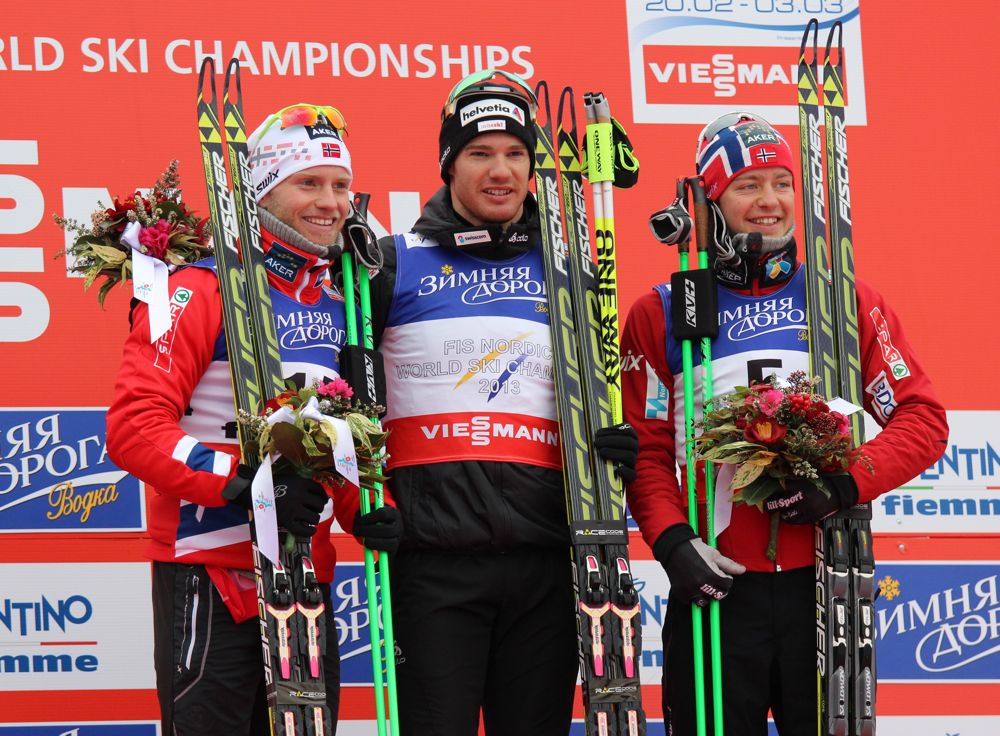
    Swiss winner Dario Cologna (c) with Norwegians Martin Sundby (l) in second and Sjur Røthe in third on the 30 k skiathlon podium at the 2013 World Championships in Val di Fiemme, Italy.
    Swiss Dario Cologna (c) with Norway’s Sundby (l) in second and Røthe in third on the 30 k skiathlon podium at the 2013 World Championships in Val di Fiemme, Italy.

    “Dario was the best today,” Sundby told reporters after Saturday’s race. “We [Norway] managed to get second and third and for me second place is like a victory.”

    A strong classic skier, Sundby took it upon himself in the offseason to make some major improvements to his skate technique, NRK reported. It paid off, as he felt strong enough to leave the group around on the first of four skate laps.

    “I did not quite know what happened. Suddenly I had fifteen seconds without really knowing what to do,” he told NRK.

    “I didn’t at any point think that this would hold for a gold medal,” he said at a press conference. “So for the third lap I tried to calm down, rest a bit and wait for the guys and be prepared for a very tough fourth lap.”

    That last lap turned out to be tough, with Sundby outlunging his teammate, Røthe, by two-tenths of a second for silver. After Vylegzhanin trailed Cologna up the last hill, Røthe and Sundby went on either side to pass the Russian. They soared down into the stadium in second and third, while Northug made a late move to pass Vylegzhanin as well.

    Røthe told reporters he was extremely satisfied with his career best, especially in sharing the podium with Sundby.

    “It’s my own fault that I wasn’t in back of Dario, but I’m really satisfied and it’s good that Martin’s by my side,” Røthe said.

    Norwegian men’s coach Trond Nystad said it was a good day for Norway with two medals in the men’s race and a podium sweep for the women.

    “Dario wins, that was deserved; he was a better skier today,” Nystad said. “We got two, three and four and we have to be happy with that.”

    As for which of his athletes he thought might be in the hunt for gold, Nystad said he wasn’t surprised by Sundby or Røthe, who was third in the Canmore World Cup skiathlon in December.

    “Of course, Petter who was fourth, he was also expected to be in there and fight for the medals, but he was sleeping a little bit on top of the hill,” Nystad said.

    “I would like all medal, so it was a disappointing race for me,” Northug told NRK. “Fortunately, two Norwegians medaled.”

    After Northug, Vylegzhanin led the Russians in fifth (+6.1), Legkov was sixth (+10.1) and Calle Halfvarsson of Sweden was seventh. Hellner placed eighth, Tobias Angerer of Germany was ninth and Gaillard finished 10th.

    — Audrey Mangan contributed reporting

    Results

  • What Can We Expect from Northug?

    What Can We Expect from Northug?

    Petter Northug Jr. working hard up the Alpe Cermis during the final climb of the 2011/2012 FIS Tour de Ski, where he was 24th in the 9 k pursuit on Jan. 8 in Val di Fiemme, Italy.

    By all accounts, Petter Northug’s 2011-2012 campaign was an unexpected failure. The high-profile Norwegian star, who usually finished at or near the top of every podium he contended for, specifically set out to do two things last winter: take the Tour de Ski and win the Vasaloppet.

    He came up short on both counts; Switzerland’s Dario Cologna and Marcus Hellner of Sweden both beat him in the Tour in first and second, respectively, and a stomach bug kept him from starting the Vasaloppet. The Marcialonga in northern Italy was his only marathon showing of the year, and there he fell to 10th place behind Norway’s Aukland brothers, Jorgen and Anders, who were first and second.

    Northug’s World Cup season subsequently ended prematurely in mid-February, and the 2010 Crystal Globe winner watched his overall ranking slip from second to third in his absence. But despite failing to meet his and everyone else’s expectations, Northug is still as unabashedly ambitious as he ever was.

    Northug at 2012 Norwegian Nationals in late January, where he was 40th in the 15 k skate.

    In a recent interview with the Swedish daily Expressen from a team training camp in Livigno, Italy, he laid out exactly how many races he’ll win: seven World Cups, the Tour de Ski and three golds at World Championships.

    “The [World Cup] premiere in Gällivare [Sweden] I will win,” Northug said, according to a translation. “It’s so damn good to win on home ground.”

    He took the opportunity to make another jab at Sweden: “In Sweden, of course, I win all the races. It’s most important of all,” he said.

    Before last season, ski fans could generally count on Northug to be true to his word. The 26-year-old would reliably deliver unreal finishing kicks that landed him on the top of the podium again and again. But now, after a disappointing winter?

    Norwegian coach Trond Nystad affirmed that Northug appears to be in good shape.

    “He looks very good,” Nystad said. “Petter has had better results than ever before in the tests we’ve done this summer.”

    For all his bravado, Nystad said that Northug manages every aspect of his life and training to a T.

    “I usually say that he has steel control of everything he does,” he said.

    And despite poking fun at his Swedish rival at every chance he gets, Northug takes Hellner and Cologna seriously.

    “Take the last Tour de Ski, while I just became more worn it seemed Marcus became more alert every day. It was impressive,” he said. “Every time Marcus defeats me it hurts inside.”

    In Northug’s opinion, the only two skiers to keep track of next winter apart from himself are Hellner and Cologna.

    “I think it is Marcus, me and Dario Cologna who will be the strongest over the whole season,” he said.

    There are 67 days to go until the season kicks off in Gällivare, and with that kind of confidence, Northug has at least ensured that all eyes will be trained on him.

  • Expecting Pickup Game, Newell Plays Celebrity Soccer Match in Germany

    Expecting Pickup Game, Newell Plays Celebrity Soccer Match in Germany

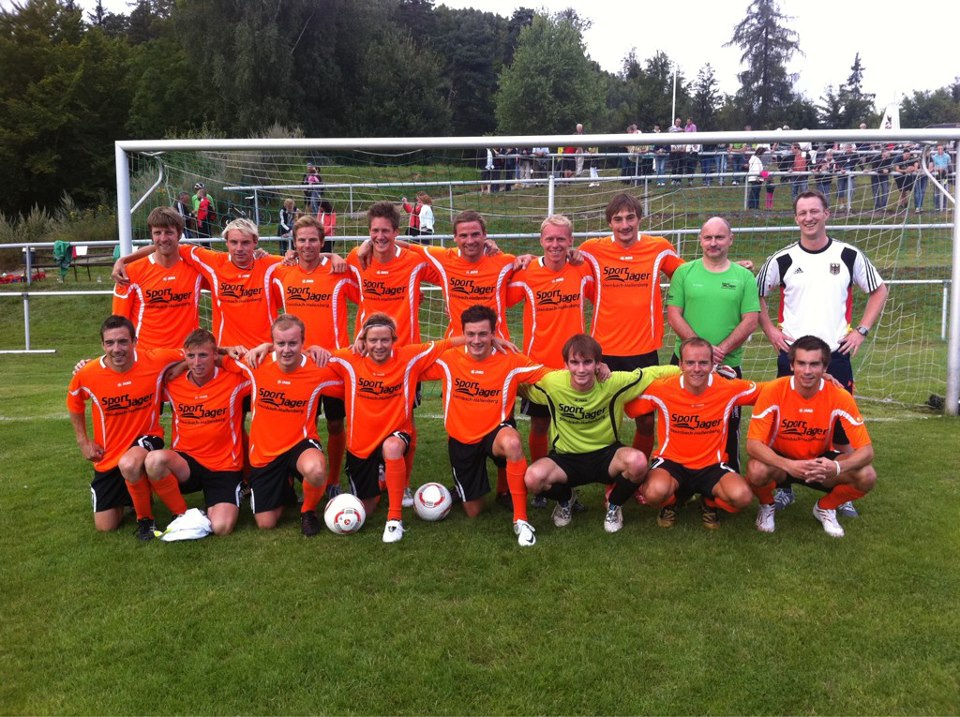
    U.S. Ski Team member Andy Newell (back, third from left) with his Sport-Jäger soccer team on Aug. 10 in Oberhof, Germany. The only American, Newell was invited to the celebrity match with several top Norwegian and German skiers. They played a German soccer club, Grun-Weiss, in front of hundreds of spectators and lost by an approximate score of 5-4. (Niklas Dyrhaug Facebook photo)

    Between training on an Austrian glacier and inside a ski tunnel in Germany, a guy’s got to have some off-snow fun. Not that skiing isn’t fun, but when it’s your job, an offer to play pickup soccer with several top Norwegian and German nordic skiers is difficult to pass up.

    For Andy Newell, the invite came nonchalantly from Norwegian men’s coach Trond Nystad, who previously headed the U.S. Ski Team. With little notice, the 27-year-old Newell didn’t give it much thought. Last Friday evening, he laced up his sneakers and headed to the pitch in Oberhof, Germany.

    “I thought it was going to be just an easy pick up soccer game and BBQ type thing,” the U.S. Ski Team (USST) veteran wrote in an email. “But we got there and I realized we were actually playing this semi-pro team on a full field, they gave us uniforms, and there were a couple hundred beer drinking German fans cheering us on.”

    One of his teammates, Niklas Dyrhaug of the Norwegian ski team, estimated there were 500 spectators at what he called an “international football match” on Twitter.

    With the likes of Germany’s Axel Teichmann, Tim Tscharnke and Jens Filbrich, and Norwegians Eldar Rønning, Sjur Røthe, Finn Haagen Krogh, Sindre Bjørnestad Skar, and Petter Northug’s brother, Tomas, the team was pinned against Grun-Weiss, a small club from the town next door. According to Newell, Petter would have played if not for a lingering leg injury.

    Handed an orange jersey, matching socks and black shorts, Newell suited up and assumed a defensive role.

    “I was the only one that didn’t have soccer cleats so I played for a little while, but kept subbing in and out with some of the other skiers,” he wrote.

    Mostly, he played right defense and followed the lead of his teammates, which communicated in German and Norwegian. The only American on the team, Newell tried to go with the flow despite missing most of what they were saying.

    “There was some high level soccer going on,” he added. “It was a full-on sprinting soccer match … and it was pretty fun to be a part of.”

    At halftime, their Sport-Jäger squad trailed, 4-0.

    USST members Andy Newell (r), Noah Hoffman (second from left) and Tad Elliott (second from right) during hill-bounding intervals with Stratton Mountain’s Eric Packer (l) in Austria. (Newell photo)

    “The skiers got our butts kicked,” Newell wrote. “Then I think [the other team] let us come back and score a few goals for the fans.”

    In the end, Grun-Wiess won by something like 5-4, and Newell left the field still in awe.

    “Little did I know pick up soccer with Axel, Jens, Tim, and the Norge’s = full field, full uniform, scrimmage in front of several hundred ppl,” he tweeted after the Friday night game.

    “I play a little bit of soccer with the US team but it is usually pretty laid back, small field stuff,” he wrote in an email. “Nothing like this.”

    On Wednesday, Newell and Eric Packer, his teammate on the Stratton Mountain School T2 Team, will leave Oberhof. But first, they’ll get back to skiing.

    “We stayed longer [after the USST men’s camp in Ramsau, Austria] to get some more training done in the tunnel and join the Norwegians for a bunch of workouts,” Newell wrote. “We’ve done some good distance training with them so far and [Sunday] morning we had some hard bounding intervals.”

    How hard?

    “5 x too hard with not enough rest was the workout de jour,” he tweeted Sunday night. “Thanks to the Norwegian mens distance dude for letting us join in!”

    ***

    More photos:


  • Freeman, Hoffman and Hamilton All Chat from Sognefjell

    Freeman, Hoffman and Hamilton All Chat from Sognefjell

    View from the Sognefjell snowfields in Norway, where U.S. Ski Team members Noah Hoffman and Kris Freeman spent six days training with the Norwegian national team from June 3-8. (Photo courtesy of Noah Hoffman)

    Two weeks ago, Kris Freeman and Noah Hoffman weren’t exactly sure what they were in for before flying to Norway, but they were excited. The two had been invited to a Norwegian national team training camp, and without much else besides their bare necessities, they headed to the snowfields of Sognefjell.

    On June 3, the two U.S. Ski Team (USST) members jumped into action with the Norwegian men’s squad, kicking things off Sunday afternoon with at 2 ½-hour skate. The next day, Freeman and Hoffman spent five hours on snow, and the day after that, completed a two-hour skate with 20 kilometers at Level 3. They capped Tuesday afternoon with a two-hour classic ski, and ended up logging nearly 23 hours that week.

    Kris Freeman classic skiing during a Norwegian national team camp in Sognefjell, Norway. (Photo by Noah Hoffman)

    While both appreciated the volume training and generosity of the Norwegian team, which included Freeman and Hoffman in all their sessions, they were ready for an off day by the end of camp. Given that opportunity last Saturday, they ventured on what Freeman called a “crust cruise.” Two hours and one gigantic climb later, Freeman and Hoffman had gone much farther than they bargained for, but were glad they did so.

    “It was the most scenic ski I have been on in years,” Freeman wrote in a blog post. “And we only got lost once.”

    FasterSkier recently spoke with Freeman, Hoffman and Simi Hamilton, all of which were staying at Sognefjell’s remote mountain lodge. A recent addition to the USST A-team, Hamilton arrived Monday with Burke Mountain Academy as a guest coach on their two-week Scandinavian junior trip. He was helping his girlfriend, Kate Barton, who was leading the camp in place of the academy’s head coach, Pete Phillips.

    On Wednesday, Freeman and Hoffman left Sognefjel,with Freeman heading home and Hoffman continuing on in Lillehammer, Norway. Hamilton said he’d be in Norway until June 22.

    FasterSkier: Simi, how do you get involved with this trip?

    Simi Hamilton: They just needed someone else to tag along to help out with driving [including a two-hour trip to Sognefjord, Norway] and a couple of things with coaching. So I got a free trip over here and get to train and get to hang out with a bunch of immature-but-fun 15 year olds. It’s a good thing.

    FS: Have you been to Sognefjell before?

    SH: I’ve been here a couple times before, but it’s been probably about eight years since I was here last. I haven’t been here in a while, but it’s great. It’s a cool spot and it’s really nice living right on the trails. I got out [to ski on Tuesday] afternoon. I was later informed that this is the worst [snow] that they’ve had in a couple weeks, but I find it’s still pretty good. They have a ton of snow up here, which is really nice.

    Freeman pausing on the Sognefjell snowfield. (Courtesy photo)

    FS: Kris, what have the conditions been like for the past week and a half?

    Kris Freeman: When we first got here, we had probably three days where it was snowing and raining and pretty cold, and then the last five days I’ve been in shorts and a T-shirt.

    The snow has been phenomenal for this time of year. They’ve taken really good care of it; they’ve salted once or twice a day a day. The day where Hoff and I [toured] the mountain, it was pretty ideal crust training so I’ve got no complaints. Scenic and pristine.

    FS: How was training with the Norwegians?

    KF: I have a history of working with [Norwegian men’s coach] Trond [Nystad] when he was the coach of the U.S. Ski Team, and he was very helpful. Noah and I weren’t able to travel over here with a form bench or an iron or any of those things, and [Nystad] helped with those, which was very nice, gave us his training schedule. We were invited to every session. They took video of us, gave us technical advice. They treated us like members of the team, which was very, very generous.

    The athletes are friendly. Everything’s pretty professional out there. Not a lot of conversation while skiing, but they’re generally welcoming.

    FS: How’s your Norwegian fluency?

    KF: Absolutely non-existent.

    SH: I think that goes for all three of us. It’s hard because everyone speaks English well, so it seems like you never need to speak Norwegian. I think all of us could probably agree that it would be great if we could speak Norwegian, but there really isn’t a use.

    KF: I can’t even pronounce half the guys on their team, their names, properly.

    Norwegian Sjur Røthe during his national team's training camp in Sognefjell, Norway. (Photo courtesy of Noah Hoffman)

    FS: How big was the group?

    KF: There wasn’t like a line of guys going around. For the most part on the distance days, people kind of did their own thing. I skied mostly with Eldar Rønning, Martin Sundby and Sjur Røthe (laughs as he says final name). That’s not how you pronounce it, but I’m going to say ‘Sur Roth’ because I’m American.

    FS: Noah, how’s the training been?

    NH: It’s been awesome. I really felt like it was good to ski with and train with the Norwegians. I learned a lot in terms of some things those guys do differently than me, some great technical advice from their coaches and being able to ski behind those guys. We had two really productive threshold sessions. I just felt like it was a huge opportunity. I feel like it was a little overwhelming; maybe I need to go home and evaluate what I think is going to be super beneficial to carry forward and what I think maybe we do a little better in the U.S.

    FS: What’s one big difference between the way Americans and Norwegians train?

    NH: The big thing for me is that they train harder at camps than they do at home. They train hard at home, but they take some time to recover after camps. How we approach camps in the U.S. is we’ve always kind of done a sustainable [effort], so it’s just part of your training and more or less similar to what you’re doing at home. So that was a different concept.

    It was a really big load for me doing their schedule. It was two five-hour days, two threshold sessions, so it was a total of like 22 hours-ish in five and a half days so it was a lot. That was kind of something that stood out.

    Noah Hoffman at the top of a long and unplanned climb during a crust ski on June 9 in Sognefjell, Norway. (Photo courtesy of Kris Freeman)

    FS: How are you feeling?

    NH: I’m starting to get a little tired. Zach Caldwell is here now, who Kris and I both work with in a coaching capacity and on skis, so I’ve kind of switched gears a little bit towards technique and basically backed off the load significantly. That’s been kind of a nice change of pace at the end of camp here.

    KF: I’ve kept the volume and I’ve basically kept the Norwegian schedule going for the whole time here. I still feel good, but I’ve had enough skiing here and I’m ready to go home. I’ll be home for four or five days and then I have my first Maine Winter Sports camp. (Note: Freeman took the train to Lillehammer on Wednesday and flew out of Oslo on Thursday morning. Hoffman was headed to Lillehammer to work with Caldwell before flying home on Saturday.)

    FS: Noah, is there still a possibility that you’ll get some pointers from Thomas Alsgaard (Norway’s five-time Olympic gold medalist)?

    NH: He’s been up here [in Sognefjell] a little bit. I have been able to ski behind him a little bit, I know Kris has done that as well and that’s been great. I have not actually talked to him at all (laughs), but just skiing behind him has been a great opportunity. I’m going to stay a extra couple nights in Lillehammer and visit the Madshus factory and continue to work on Zach on technique, switching to dryland rollerskiing.

    FS: Before I forget, how are the accommodations in Sognefjell?

    KF: Rustic. … It’s fun, it’s quaint. They’ve only got four toilets for the whole men’s wing and three showers. I’ve never been into communal men’s showers.

     (Note: Freeman estimated there were 25 men staying at the lodge at a given time. The women stayed in a separate wing with their own facilities, which were apparently nicer than the men’s, he said.)

    The food’s been good and the skiing’s been good, and that’s the important thing.

    ***

    Related story: Freeman, Hoffman Invited to Norwegian Training Camp

  • Freeman, Hoffman Invited to Norwegian Training Camp

    Freeman, Hoffman Invited to Norwegian Training Camp

    Kris Freeman and Noah Hoffman in the 50 k at 2011 U.S. Distance Nationals.

    They spend half the year competing against Norway every weekend in Europe, but for a few days this June, U.S. distance specialists Kris Freeman and Noah Hoffman will be welcomed into the Norwegian National Team’s training camp on the snow fields at Sognefjell.

    If you don’t happen to read every paid advertisement that goes up on this site, you may have missed the announcement of this interesting tidbit by Caldwell Sport. As owner Zach Caldwell explains, the opportunity came about via invitation from Trond Nystad, who was a U.S. Ski Team (USST) coach before taking his current position at the head of Norway’s program.

    Caldwell will also be picking skis on this trip, but for the two USST athletes he coaches in his spare time, it’s primarily an opportunity to get on snow and learn from some pretty good skiers.

    FasterSkier met with Freeman and Hoffman before they headed out for an afternoon session in Bend, Ore., this week to ask about the trip. Both were looking forward to the chance to absorb training perspectives from foreign athletes.

    “The Norwegian National Team guys — I know a couple of them but I’ve never really done any training with those guys, really with any foreign athletes,” Hoffman said. “They have some of the best athletes in the world, so I’m really looking forward to that and hopefully … learn a lot and make some improvements.”

    Nearly nine years Hoffman’s senior, Freeman also thought exposure to other skiers would be beneficial experience in the offseason. He approached Nystad while on the World Cup this winter to ask if he could get some summer skiing in with the Norwegians.

    “Trond’s always been very helpful to me and supportive of the U.S. Ski Team, so there was no problem when I approached them,” Freeman said. “I’m hoping to see something from different skiers that I haven’t thought of yet and see a way of approaching the World Cup that I haven’t seen. I’ve been doing this for a long time and I do most of it solo, so getting perspectives from other people is going to be good.”

    On top of training with the current Norwegian all-stars, Hoffman’s Madshus sponsorship might also have him getting technique advice from the company’s technical adviser and resident nordic legend, Thomas Alsgaard.

    As Caldwell described on his website, Alsgaard saw Hoffman ski last December in Davos, Switzerland. Madshus’s Stian Grønås pointed Hoffman out to Alsgaard as the American skied around the day after placing 31st in the 30 k, which apparently impressed Alsgaard.

    Hoffman skiing the hill climb at Spring Series in March one day after dislocating his shoulder in the sprint. At the time, he was unsure if surgery was in store for him this summer.

    “He’s a great technician in terms of producing technique and I’m open to benefit from his expertise,” said Hoffman of the possibility of working with one of Norway’s most decorated skiers. “If I can do a couple of sessions with him that would be awesome.”

    Between the Bend camp, Sognefjell and USST camps scheduled in central Europe this summer, Hoffman’s training schedule appears to be fairly booked. We took this as a sign that his shoulder, which he dislocated in March at Spring Series, is recovering well — at least, well enough to ski on.

    As it turns out, the shoulder situation is “OK.” After getting an MRI and consulting with multiple doctors this spring, Hoffman learned that he re-tore his labrum in the same spot he had surgery last year. For now he doesn’t plan on going under the knife, but it could be a possibility down the road if the shoulder keeps popping out.

    “It doesn’t hurt or affect me on normal range, but I need to be cautious and I have a good understanding of it,” said Hoffman. “It’s looser and much more prone to coming out that it would be.”

    “If it goes two years and it doesn’t come out again, I’m not going to go under the knife,” he continued. “I happen to think that it might come out several times this year, and there’s not necessarily a huge increased risk each time it comes out except for it loosens up a little bit more and there is a long-term risk for arthritis if you let it come out over and over again.”

    Hoffman hopes he can at least wait until after the 2014 Olympics for any surgery, and in the meantime will be trying to strengthen his shoulder and reduce its risk of dislocating again with specific exercises and physical therapy.

    “I’ll try to do that — just looking to be a little cautious,” he said.

    — Chelsea Little contributed reporting.

  • In World Cup Debut; Szklarska Poreba Set to Host World Uphill Trophy

    In World Cup Debut; Szklarska Poreba Set to Host World Uphill Trophy

    Course map and profile for the inaugural World Uphill Trophy in Poland this Sunday.

    The cross country World Cup moves to Szklarska Poreba, Poland this weekend, beginning with Friday’s skate sprint. This marks the first time Poland has hosted a World Cup event, and with the queen of the home team, Justyna Kowalczyk, only 12 points behind Marit Bjoergen (NOR) in the season-long battle for the overall World Cup title, there should be plenty of excitement for the local crowd.

    As part of the International Ski Federation’s (FIS) effort to jump-start the visibility of top-level skiing in Poland for its debut on the circuit, a third event will be taking place in addition to the sprint and the 10/15 k classic: the inaugural World Uphill Trophy, set to start at 12:30 CET on Sunday.

    In an email on Monday, FIS Cross-Country Race Director Jürg Capol said he expects the event to be popular with the home TV audience.

    “We wanted to create a several-days event,” he wrote. “Cross-country is a growing sport in Poland, first it’s our [number one] TV market right now.”

    The 8 k race, which goes straight up Karkonoski Mountain for 4 k and then back down, is not part of the World Cup, but is positioned on the schedule so that athletes already in Szklarska Poreba can easily take part in it. The Uphill Trophy race is also open to elite Continental Cup-level skiers and amateurs over the age of 18.

    Capol estimated that 25-30 World Cup skiers would stay to race on Sunday. Between the top class, COC-level skiers, and amateurs, he expects around 250 skiers to participate in the Uphill Trophy race.

    Simply finishing the course will be no easy feat—after climbing 500 m over 4 k with no break, skiers will turn around and come back down a separate alpine slope. On the way down, they’ll navigate through approximately 10 giant slalom-style gates to finish back at the bottom of the mountain, which works out to 2.5 gates every kilometer.

    “Not so many are [needed] because the alpine slope has natural curves,” said Capol.

    By comparison, the grueling final stage of the Tour de Ski on Alpe Cermis contained 100 fewer meters of climbing, and ended at the top.

    As exciting and crash-inducing as the event is likely to be, several World Cup teams have already said they won’t be participating. Trond Nystad, head coach of the Norwegian men’s national team, said his athletes would be done competing in Poland on Saturday.

    “We prioritize World Cup races and have decided that a race format like this does not fit into the training and racing schedule,” Nystad said on Monday.

    Likewise, Canadian head coach Justin Wadsworth said the skiers wouldn’t be entering.

    The U.S. Ski Team will play it by ear; head coach Chris Grover said the Americans are sticking around for the Uphill Trophy on Sunday, but won’t know who will race it until they gauge how everyone is feeling on Saturday night after the 10/15 k classic.

  • Atomic Develops New World Cup Classic SDS

    Atomic Develops New World Cup Classic SDS

    Good Gracious Almighty! What Has Atomic Gone And Done Now?

    Atomic is to classic marathons what Ferrari is to Formula One. For the last thirty years, the long distance events have been dominated by Atomic athletes and the tenacious Austrian ski company is not about to let that change. Atomic’s racing focus has always been on the Marathons because these are the races that have proven to be the best testing ground for equipment. For the next two months, the world’s top nordic retailers will be reviewing and testing one of the most innovative and successful classic race skis ever made.

    What do skiers want out of a classic ski? They want fast glide and they want easy grip. Traditionally, fast glide meant a stiff classic ski that was hard to kick. And easy grip meant a soft ski with kick wax that might drag. Atomic’s Roman Toferer and his crew of artful rascals scoffed at this old rule of thumb. They came up with a classic ski that glides as if you forgot to put on the kick wax, yet the kick is extremely easy and you will feel like you are kicking down a compliant touring ski.

    ATOMIC’S HEAD OF R & D, ROMAN TOFERER, ADDRESSING A MEMBER OF THE US SKI TEAM. A DEFIANT ENGINEER WHO FINDS CONVENTIONAL THOUGHT DISTASTEFUL.

    How does it work? How does this ski obtain such fast glide with such an easy kick? It was not easy and the testing has taken many years. Atomic created a highly elastic insert made of ABS that is placed in the kick zone of the new ski. Strips of carbon with high rebound qualities are laminated above the ABS. This makes the kick zone a very strong bridge that keeps the grip wax riding well above the snow. Even though the skis have a low camber, the kick stays high during the glide phase. This means the pressure zones in front of and behind the kick zone are static, their location does not change. The end result is that there is no drag at all on the part of the kick wax. However, the elastic qualities of the ABS allow the ski to be easily collapsed without  much pressure during the kick. It is surprisingly easy to get the kick down and have excellent grip. Go out with your friends, you will still be getting kick on a steep uphill when they are all switching to herringbone. Get in a tuck coming down that hill and you will still be gliding while they are standing up and double poling. The new ski is simply called the WORLDCUP CLASSIC SDS.  The SDS stands for SHORT DISTANCE STEP.

    THE YELLOW STRIP ILLUSTRATES THE LOCATION OF THE ABS. THE GRAY ZONES REPRESENT THE STATIC PRESSURE ZONES. THE CAMBER REMAINS LOW WITHOUT AFFECTING THE GLIDE.
    PERHAPS A BETTER ILLUSTRATION. YOU CAN SEE THE BRIGHT YELLOW INSERT THAT IS THE ABS. THIS IS WHAT GIVES THE KICK ZONE IT ELASTICITY. THE SHORT DISTANCE STEP.
    TROND NYSTAD AND THE NORWEGIAN WAXING TEAM CAME TO ATOMIC’S RACE ROOM FOR A BRIEFING ON THE NEW CLASSIC TECHNOLOGY. THEY LEFT IN AWE.
    NORWAY’S MOST PROMISING YOUNG CLASSIC RACER, MARTHE KRISTOFFERSEN, REVIEWING THE TECHNOLOGY WITH ROMAN TOFERER. MARTHE AND THE NEW SDS WILL DEFINITELY MAKE IT TO THE PODIUM TOGETHER IN SOCHI.
    LISA LARSEN OF SWEDEN USING SDS ON THE WORLDCUP. IF THE TOP YOUNG SKIERS OF NORWARY ARE USING THIS SKI, YOU CAN BE SURE THE YOUNG SWEDES WILL AS WELL.
  • Cologna Completes Near-Perfect Tour Atop Alpe Cermis, Collects Third Title

    Cologna Completes Near-Perfect Tour Atop Alpe Cermis, Collects Third Title

    VAL DI FIEMME, Italy – Tour de Ski winners are all alike; every Tour de Ski loser is a loser in his own way.

    Petter Northug (NOR), Marcus Hellner (SWE), Devon Kershaw (CAN), Lukas Bauer (CZE)—each had his own problem that torpedoed his hopes for a Tour victory, whether it was bad skis, a broken pole, a weak discipline, or an uncooperative body.

    Dario Cologna, on the other hand, had nothing go wrong. The Swiss star mastered every last detail over the course of the Tour’s nine stages, and when the snow settled in Val di Fiemme, he was the one standing alone atop the podium on Alpe Cermis on Sunday, at the finish of the Tour’s final stage.

    Cologna, So Good this Tour

    The result capped a two weeks for Cologna, and for the Swiss team, that was close to perfection.

    “They have great skis, they have great support, they have a great skier,” said Trond Nystad, the head coach of the Norwegian men’s team. “And if you have everything come together at one time, then you have a great result. That’s what they had.”

    In the first eight stages of the Tour, Cologna finished outside the podium just once, when he was fifth place in a classic sprint in Germany.

    Cologna was 16th in Sunday’s Stage 9, a freestyle hill climb up Alpe Cermis, a local alpine ski area, But that result was meaningless, since the only thing he had to do today was stay in front of second place.

    “He is strong every day, since the very beginning,” Guri Hetland, the Swiss head coach, told FasterSkier.

    The makeup of the final podium—Cologna, Hellner in second, and Northug third—was one many could have predicted at the start of the Tour, and at the beginning of Sunday’s race. But not the order.

    The athletes started Stage 9 pursuit-style, based on their positions in the overall standings. Cologna headed out first, with a 1:22 lead over Northug, and 2:06 on Hellner and Kershaw.

    The course for the nine-kilometer stage sent the men on a short loop around the stadium here, and along five kilometers of flat terrain next to a river. Then, it veered up Alpe Cermis, ascending all the way to the finish, up more than 1,000 vertical feet by way of off-camber switchbacks and ramps so steep they seemed to threaten to send the athletes toppling over backwards.

    Even though Northug faced a seemingly insurmountable deficit of more than a minute to Cologna, he told the Norwegian press he would be on the attack all day, since “no one cares about second or third.”

    He closed a few seconds to Cologna in the flat part of the race, but as soon as Northug hit the climb, things went south for him.

    Northug Working Hard

    The Northug that spectators saw on the Alpe Cermis looked nothing like the Norwegian at his smooth, efficient best. Instead, he looked like someone who had bitten off way more than he could chew. By the time Northug eventually made it to the finish, “I did not know where I was,” he told NRK.

    “He gave everything to try to catch Dario, and in the end, that cost a little [too] much,” said Nystad. “But you know, for him, it doesn’t matter. Second or third didn’t really matter. He wanted to win.”

    Punch-drunk, teetering back and forth from one ski to the other, Northug ground his way up the Alpe.

    Behind, Kershaw and Hellner skied the flats together, then began up the hill. Hellner almost immediately dropped Kershaw, leaving the Canadian to endure an experience similar to Northug’s, which he called “nothing short of hell.”

    Hellner Strong All Day

    “You’re essentially just walking up a hill,” Kershaw said. “It’s a horrible sensation.”

    Kershaw Doing Just That

    Hellner, meanwhile, was having a fantastic day, and it only took until the middle of the ascent for him to catch Northug—a scenario almost inconceivable at the beginning of the day, given Northug’s lead of nearly 45 seconds.

    A huge group of Norwegians that had gathered at the finish line watched in stunned silence as the nightmare scenario played out on a video board. The supporters, including Northug’s fan club, stood with faces in hands as Hellner blew past, while a small Swedish contingent roared.

    With Hellner’s move, the final podium was set, as Northug held on for third over Kershaw, and Cologna was never threatened, winning by a full minute.

    Hellner said that the second place in the overall was “like a win,” given how much he had struggled in the early part of the Tour. He finished one stage earlier this week in 48th place, and was 29th in another, yet was able to capitalize on a handful of clutch results, and on his willingness to dig deeper than almost anyone else.

    “I was very frustrated, many times. I always am when it’s going bad for me,” he said. “But maybe that’s one of the things—I want it so much. I want to be in the top…so maybe that’s a strength for me.”

    But while wanting it badly might help, there’s no substitute for execution—as evidenced by Hellner’s final place in the standings behind Cologna.

    The Swiss star and his team have taken care of all the details. After a debacle with his skis at the 2011 World Championships in Oslo, Cologna found a new serviceman in Gianluca Marcolini, Petra Majdic’s old technician. And Hetland said she and her staff learned from several other things that went awry.

    While Cologna has now won three Tours, this one, Hetland said, is probably the best, because with no World Championships or Olympics, the Tour was the highlight of the year.

    “Last season, Oslo was the highlight, and he didn’t succeed there,” she said. “We have said from the spring that this season, the Tour de Ski is the most important competition. And when he is able to win it, that’s for sure really important for him.”

    Now, Hetland said, the Swiss team has a partial blueprint for next year’s World Ski Championships, which will be held on the trails here in Val di Fiemme.

    Team Viva Cologna!

    Hellner, Northug, Kershaw, and the others won’t let those medals go easily. But based on what Cologna has accomplished over the last two weeks, his competitors have some catching up to do.

    Asked if he had any regrets, Nystad said he wasn’t sure yet.

    “Right now, we have to have some time to analyze everything, and see if there’s something else we could have done differently. But all in all, it is the way it is,” he said. “We got third place—we came here to win. It’s just a race, a normal race—we’re happy to have one guy finish third. But we wanted a little bit more.”

    Topher Sabot contributed reporting.

  • Roenning Labors for Northug Before Taking Individual Glory, Harvey 2nd

    Roenning Labors for Northug Before Taking Individual Glory, Harvey 2nd

    Eldar Roenning (l) follows Sergey Turych (r) around a corner in the 22km classic. Roenning won the race.

    VAL DI FIEMME, Italy – Eldar Roenning (NOR) spent much of the eighth stage of the Tour de Ski working for Petter Northug (NOR), but as the final kilometer rolled around, he submitted his resignation, packed up his skis and poles, and headed out on his own.

    Roenning attacked on the final climb of the unforgiving Val di Fiemme 4.5 kilometer loop, opening a 10 meter gap entering the stadium, a lead he never relinquished on his way to his second podium of the 2012 Tour de Ski.

    Canadian Alex Harvey claimed his second career distance World Cup podium, and first since 2009, edging out Tour leader Dario Cologna (SUI).

    The penultimate stage of the Tour measured just over 22 kilometers—five times around a grueling loop that seemed to defy physics—is it possible to go up for so long, and descend so little?

    Canadian Head Coach Justin Wadsworth didn’t mince words, saying “It might be the hardest classic course ever,” pointing to the two big climbs right at the end, and the added challenge of the bonus seconds available each lap at the top of the biggest climb.

    Cologna, who described his race as “perfect,” said there were too many steep climbs and hopes that will be adjusted before next year’s World Championships, while distance specialist and two-time Tour de Ski Champion Lukas Bauer (CZE) said “It fits me good [the course], for my endurance, but it is not skiing, it is running.”

    Norwegian coach Trond Nystad added, “This is by far the hardest race in the Tour de Ski.”

    Alexander Legkov (RUS) following Giorgio Dicenta (ITA) up a large climb as the lead pack, and Legkov's Tour podium chances disappear over the crest.

    The course was modified from last year, with the biggest change being the location of the mid-race preems—one per lap. Instead of sitting down in the stadium on the flat, it now stood at the pinnacle.

    The result was a pack that strung out quickly, unusual for a men’s World Cup race, and a steady line of elite racers falling off the back.

    “They started to push from the first bang until the end,” Finnish veteran Sami Jauhojärvi told FasterSkier.

    The first of the overall Tour contenders to falter was Maurice Manificat (FRA) who entered the day in 6th, seconds from the podium. Under halfway through the race he was cooked. Alexander Legkov, (RUS), Giorgio DiCenta (ITA), and Ilia Chernousov (RUS) followed after, at varying points of the race.

    Bauer spent much of the race at the front driving the pace. The veteran saw his chances for the podium crumble in the 35k pursuit when a feed station collision left him with a broken pole.

    His goal for the day was “to be very active.” He was certainly that, pushing at the front, though never getting away.

    Roenning and teammate Niklaus Dyrhaug also had a strong presence in the front pack, but they skied with a greater purpose.

    The men were tasked with helping Northug close the gap on Cologna—working to get him set for the bonus sprints.

    From the spectator’s point of view, it can be hard to make sense of the constantly shifting positions, but Dyrhaug said the strategy worked well, as evidenced by the 55 seconds Northug earned.

    “He was really satisfied with my work, and I am really satisfied I could help him,” Dyrhaug said. “I tried to help him get in a good position in the start of the hill, and he should do the rest of the work himself.”

    Dyrhaug striding out.

    Roenning was also involved, but while Dyrhaug said “I offered myself totally,” to Northug’s cause, and that “I have never been so tired in my whole life as the last round up there [at the top of the course],” the eventual victor did not need to expend too much energy in for his teammate.

    He assisted Northug in gaining position, but never factored into the front of the sprint.

    The stocky Norwegian gained confidence during the warmup when a new pair of skis offered excellent grip in addition to good glide. Two laps in, and he knew he had the body was clicking as well.

    After 22 kilometers packed with relentless climbing, it was the last relatively small hill into the stadium that made the difference in the race.

    Russians Sergey Turychev and Dmitriy Japaov took the lead out of the downhill on the final large climb, up past the iconic Italian village church.

    The attack could have been decisive, but Harvey, who was comfortably in fifth behind Cologna was unconcerned.

    “They punched it so hard at the bottom of the second to last hill,” Harvey said. “There was zero chance they would be strong….those guys would die.”

    He made sure to stay behind Cologna, so as not to get blocked by the doomed Russians, and when Roenning moved, Harvey proved prophetic.

    Harvey across the line.

    The Canadian then made his one mistake of the race. When Cologna broke into a herringbone, Harvey did not step out and move around.

    “I was a bit stronger than Dario at the end, but I just followed him and that is when Roenning went,’ Harvey told FasterSkier.

    While he was plenty happy with second—the World Cup points, the prize money, and the advancement in the overall Tour standings, Harvey believes that if he had stayed on Roenning’s tails he could have used the draft to slingshot by for the win.

    But that is neither here nor there as Roenning would not be caught on the homestretch. Harvey held off Cologna, and a hard charging Northug, who was unable to make a dent in the now impenetrable lead of Cologna.

    While Nystad said the day was very successful for the Norwegians—in addition to Roenning in first and Northug in fourth, Dyrhaug placed 7th—the winner said “I think Petter had a little bit of a tough day today.”

    With his overall Tour chances destroyed in a catastrophic first five kilometers of the Cortina to Toblach pursuit, Northug was looking for some measure of redemption today.

    He fought hard, several times staging a running attack for bonus seconds, but never looked like his usual confident and controlled self.

    As is his wont, he collapsed at the finish, utterly spent, only this time his effort was not even good for the podium.

    Northug and Cologna lead the field out of the start.

    Even had he been in top form, Northug would have been better off stopping at the course-side church to pray for a miracle given the way Cologna is skiing.

    Swiss Head Coach Guri Hetland told FasterSkier, that Cologna was raring to go this morning.

    “He really looked forward to ski, and that is always a good sign, when he is eager to go out there,” Hetland said.

    Watching Cologna cross the line with another podium, and ahead of Northug to boot, was “a pretty good feeling” for Hetland, and while she was confident that her star skier would perform well, she is not counting the massive crystal trophies until they are well in hand.

    “As we have said from the very beginning the Tour de Ski is until they are up there tomorrow [at the top of the Alpe Cermis]. So there is no time to lie back and relax,” Hetland said. “It is about being focused until the very end.”

    Eldar Roenning celebrating his win.

    Cologna feels his 1:22 lead on Northug in the overall is “a nice advantage.”

    He said he enjoyed his day, with the cold snow, hard tracks and boisterous fans.

    Eight stages in to the Tour, he said he is tired, and that “before the race you don’t feel so good,” but once the gun goes off “it is going better.”

    Roenning fell out of the quest for the overall podium with two bad races in Oberstdorf, and then a disastrous performance in the 35k pursuit.

    He bounced back well today, and has run the Tour with extra support from his brother Berhnard, a standout skier for Montana State University in Bozeman, Montana.

    Taking a break from his business studies in Ireland, The younger Roenning is chauffeuring his brother so he can stick to his own schedule, as well as helping with ski testing.

    On the last climb when Eldar attacked, Bernhard was “freaking out.”

    It is a good sign for Roenning to take the individual victory in an event that is a preview of the 50k classic at World Championships on this very course.

    That event is the focus of next season for the Norwegian, but long before that, he has to complete the Tour.

    A much stronger classic skier, Roenning says his goal in the final climb “will be to reach the top still alive.”

    Complete Results

    Nat Herz contributed reporting

    A spent Northug is helped up at the finish.
  • Trond Nystad: I’m Honored to Take This Position

    “I feel like I was the first choice. That’s why I’m sitting here,” Trond Nystad said when he was introduced as the new head coach for the Norwegian national men’s all-round team. Nystad replaces Morten Aa Djupvik, who resigned in April. Nystad served as the head coach for the US Ski Team from 2002 to 2006.

    The Norwegian Ski Association (NSF) initially had a long list of candidates to narrow down. Some of the individuals the NSF approached were not interested, others determined that they didn’t have the time and some were tied up with other obligations. Pretty soon, Trond Nystad was identified as the hottest candidate to replace Morten Aa Djupvik.

    At the end of that process, four candidates interviewed with the staffing firm Adecco Select.

    “We believe Trond Nystad has what it takes to do the job for NSF,” Hedevig Stang Castberg of Adecco Select said to Norwegian news agency NTB.

    “I feel that we have hired a leader who is ready to coach as well as manage the team. Previously, we have been accused of only looking within our own ranks to fill these kinds of positions. This time, we have hired an outside candidate with experience from the United States, Germany and Switzerland,” Hermod Bjørkestøl said. He is the chair of the NSF cross-country committee.

    “He was one of several strong candidates, and I am satisfied with the outcome. Trond has the skills and qualities we were looking for, and we believe we have a strong coaching team in him and assistant coach Steinar Mundal,” national team director Vidar Løfshus said.

    An honor

    Løfshus knows Nystad well from their time in the United States. They both worked together as coaches with the US Ski Team. That bond was one of the reasons Nystad was identified as a strong candidate for the national team coaching position. National team directors like to know who they are working with.

    Nystad said he was “grilled, double-checked and cross-referenced” in a long, exciting and exhausting hiring process.

    “It was a very open, honest and diligent process. I did not choose myself for the position. I am honored to step into this position. It is a privilege to have the opportunity to work with athletes and coaches of this caliber,” Nystad said.

    Goals

    – What goals do you have in terms of results?

    “The Norwegian racers placed well both in the 2010 Olympics in Vancouver and in the 2011 World Championships in Oslo. The biggest challenge will be to improve on those results in a non-championship season. We have to do better at Tour de Ski, and we need a more consistent World Cup results,” Nystad said.

    Nystad considers himself as man who performs well under stress and is a good communicator.

    “I believe I work well in a team,” Nystad said.

    Brothers on the team

    Neither the NSF nor the staffing firm Adecco Select considers it a problem that Trond Nystad’s twin brother Knut Nystad is the head wax coach for the Norwegian national team. They don’t worry that the relationship between the brothers will be a destructive factor.

    – What kind of relationship do you have to your brother?

    “We don’t have any issues. We’ve worked together before in a professional setting, and we agree on a lot of things. He thinks he’s nicer, more intelligent and sexier than me. I don’t entirely agree. That’s a discussion I don’t think we’ll ever finish,” Trond Nystad said.

    Trond Nystad is currently the CEO of a company in Denver, Colorado. That’s a position he has to conclude before he moves back to Norway. Most likely, the national team camp at Sognefjellet in the beginning of June will be Nystad’s first coaching experience with the Norwegian national team skiers.

    From NTB, May 13, 2011. Translation by Inge Scheve

  • Trond Nystad Accepted the Head Coach Position

    Trond Nystad, 40, was introduced as the new head coach for the Norwegian men’s all-round cross country team Thursday.

    Trond Nystad is Knut Nystad’s twin brother. Knut Nystad is the head wax coach for the Norwegian cross country teams.

    From 2002 to 2006, Trond Nystad was the head coach for the US cross country ski team. At that time, Vidar Løfshus, who is the new director of the Norwegian cross country national teams, was also a part of the US Ski Team coaching staff. From 2007 to 2010, Trond Nystad was the sprint coach for the Swiss national cross country team.

    Nystad was married to the retired German cross country skier Claudia Nystad. Nystad lived in the United States until recently. Wednesday, he was interviewing with the Norwegian Ski Association about the head coach position for the Norwegian national men’s all-round team.

    From NTB, May 12, 2011. Translation by Inge Scheve