Tag: Trondheim Norway

  • Karlsson Glides to Victory in World Championship 50 k

    Karlsson Glides to Victory in World Championship 50 k

    FasterSkier’s coverage of this week’s FIS World Championships stands as a proud tribute to an icon of American Skiing, Marty Hall who has generously supported our coverage of international cross country ski events. To learn more about Marty and Kathy Hall’s A Hall Mark of Excellence Award, please contact info@fasterskier.com. We’ll miss you, Marty. 

    Frida Karlsson (SWE) may have started the day slowly, but her fast skis, clever tactics, and excellent fitness allowed her to dominate the racing in the 50 k Mass Start Freestyle at the World Championships in Trondheim, Norway. (Photo: Modica/NordicFocus)

    In 2021, in the prime of her career, Therese Johaug (NOR) won four races at the World Championships in Oberstdorf, Germany—Skiathlon, 10 k Freestyle, Team Relay, and 30 k Classic. She had been the dominant skier in all Distance events for so many years, but she retired after a triple gold medal performance at the 2022 Olympic Winter Games in Beijing, spending the ensuing years raising a family and developing her businesses and brands. But the siren song of sport-immortality tempted Johaug to return. Thus, her comeback this season, focusing on her potential at these World Championships in Trondheim. If Johaug could win four events here in Trondheim, she would finish tied with Marit Bjoergen for most gold medals earned in World Championship competition. If anything, the format of events in Trondheim (longer distances and more opportunities to show off her Skating prowess) favored Johaug’s quest, but she has come away from these championships with only a fistful of silver instead of gold. Time and age—combined with the talents and efforts of Ebba Andersson (SWE) and Jonna Sundling (SWE)—have conspired against her, and Johaug’s comeback hasn’t worked out the way she had hoped.

    Today’s 50 k Freestyle offered Johaug a chance at retribution, but she would face challenges more tangible than simply the weight of her own impressive legacy or the unsympathetic judgment of history. In Trondheim, Johaug would be racing against women who have shown the ability to counter her otherworldly tempo with super-powers of their own. Karlsson, Ebba Andersson (SWE), Heidi Weng (NOR), Astrid Oeyre Slind (NOR), Jessie Diggins (USA) and Sundling (among others) all seemed poised to contend in today’s marathon conclusion to these World Championship races. Johaug would love to go home from these championships with at least one gold medal. The 50 k Mass Start Freestyle was Johaug’s last chance. But Karlsson and her fast skis would have a major role to play in it all . . .

    Frida Karlsson (SWE) appeared to remain calm and relaxed throughout the 50 k Freestyle in Trondheim, controlling the pace in the three final laps. (Photo: Thibaut/NordicFocus)
    50 k Freestyle Mass Start

    The women’s field has never before raced 50 kilometers at a World Championship. It makes sense, then, that this would be the marquee event, the final feature of the World Championships of Trondheim, 2025. The last day of these championships belonged to the Women.

    Overnight temperatures never dropped below freezing, and the morning’s freshly fallen snow contributed further to the soft conditions. Skier traffic from the men’s 50 k race (yesterday) and the morning’s grooming had turned the 8.3 kilometer race course (over which skiers would race six laps) to a warm, snowy mush. The race was likely to be slow, not because of the racing strategies of the racers, but because conditions appeared likely to steal their speed.

    “The key to this race, even before we knew about the conditions today, was gonna be about energy management,” said on-air commentator, Kikkan Randall. “The jump from 30 k to 50 k means you’re skiing about the same pace . . . Johaug is loving this. (She) has proven over her career that sh’e got one of the biggest aerobic engines . . . She likes to go out hard, try to break up the field, it’s going to be really interesting to see if she can go back to her wining ways . . . and just kind of play with heads of her competitors here.”

    Johaug, Andersson, Slind, Stadlober, Weng,  Sundling, and Karlsson led out of the stadium, the field quickly stringing out behind them. Diggins was immediately dropped from the lead group. By the end of the first kilometer, contenders like Diggins and Maja Dahlqvist (SWE) were already 30 seconds behind.

    Soft course conditions were a challenge for everyone: while navigating through a feed zone, Sundling hooked a ski tip in the soft snow, toppling awkwardly into the slush. She recovered fairly quickly, but it would cost her a considerable amount of energy to re-establish her position within the lead group.

    By the end of Lap 1, Johaug had taken charge of the pace, followed into the stadium by Weng, Karlsson, Andersson and Slind. It was a day for lightness and deftness, keeping the tempo high, minimizing the muscle load of each push, and maintaining a light glide between pushes. Advantage Johaug . . . she’s been skiing that way for years. The leading group skied on as though this were a far shorter race. It remained to be seen whether or not they could maintain this level of effort, or whether they might find themselves caught later by Slind (who had skied more races of this length than ony of the other contenders).

    Conditions continued to play an outsized role: many skiers were seen double poling rather than skating through the sloppiest sections of the course. On the very worst sections—on a few of the steepest uphill sections—Slind resorted to a running herringbone in her efforts to catch the leaders. Ski glide was often reduced to nothing, and each stroke had to be lifted just a bit higher than the one before in attempts to lift ski tips above the mashed-potato-textured snow. And every downhill corner was a nail-biting adventure as skiers struggled to stay upright. What a mess.

    The lead group came through the end of Lap 2 together, with Johaug, Andersson, and Karlsson all making probing forays to test of the other racers. Slind hovered some 44 seconds behind, not yet out of contention, though a fall near the end of Lap 2 cost her additional time.

    A bit of gamesmanship at the end of Lap 3 . . . Karlsson (who had led for most of the lap, and whose skis appeared the fastest) pulled up to wait for her rivals just before the ski exchange area. It looked as though all would stop for a ski change, but when Karlsson pulled off behind the v-boards, Weng sprinted ahead on the course. It was a clever fake, but one that Karlsson caught just in time. Quickly reversing course, Karlsson dodged the barricades and set off in pursuit of Weng. All the contenders spent considerable energy in the maneuver . . . and it remained likely that Karlsson would still be skiing on the fastest skis as they headed into Lap 4.

    Eventual winner, Frida Karlsson (SWE) set the pace through the second half of Trondheim’s 50 k distance, regularly frustrating the efforts of pre-race favorite, Therese Johaug (NOR). (Photo: Thibaut/NordicFocus)

    The fast skis of Karlsson contined to confound Johaug, who began to show her frustration in accelerating on every uphill section. Norway had slow skis, and the Swedes were only too happy with their advantage on every successive downhill. Karlsson was also able to ski in a much more relaxed manner than her rivals, and it began to appear extremely likely that the Norwegians would change skis at the end of Lap 4. What remained to be seen was whether Karlsson would do the same, or if she would remain confident in the speed that her skis already shown. The odds were that Karlsson would change at the same time as her rivals . . . but the advantage she would gain by simply skiing on would be a terrible temptation.

    Karlsson and Andersson appeared to be in conversation before entering the stadium at the end of Lap 4, presumably discussing possibilities for exchanging skis. As predicted, all went for new skis, all accomplished the exchange efficiently and quickly, all exited the stadium together. Johaug and Weng would hope that their new skis would help them pull even. Karlsson would hope that her new skis would deliver a similar advantage to the skis she’d used in the first four laps. As Lap 5 began, Karlsson continued to appear the most relaxed, maintaining her position as the pace maker at the front. Downhill sections began to suggest that Karlsson was continuing to enjoy the fastest skis in the lead group, forcing Johaug to reduce the gap on each successive uphill. It appeared that Team Sweden had found the solution to the day’s conditions, at least to the degree that they had a slight advantage over the Norwegians. Regardless, the advantage that Karlsson enjoyed seemed to be acknowledged by all the contenders, and Karlsson led every inch of Lap 5.

    Johaug is unaccustomed to following anyone in Distance races. But with 15 kilometers still ahead of them, Johaug was relegated to the role of follower. She’d need to make a dramatic move in the final lap; would her skis and her fitness and her strength be sufficient to drop Karlsson? What Johaug would’ve known for sure is that she, herself, outsprints no one in a tight finish. Johaug would need to attack, and that attack would definitely come on a climb. One lap to go . . .

    The course climbed steadily out of the stadium, and Johaug attempted to accelerate. Karlsson easily matched Johaug’s speed, occupying the best snow at the right side of the course, forcing Johaug wide into deeper snow. Johaug’s tempo increased; it looked like she was on the attack. But Karlsson—even maintaining her slow, relaxed tempo—covered the acceleration easily, never surrendering her position at the front. Karlsson had been leading the group for over 15 kilometers, and no one seemed able to come around her. It almost looked like Johaug and Karlsson were in different races—living in different dimensions: Johaug’s staccato tempo is so recognizable, so familiar, a technique that has dropped so many skiers over the years. Beside her, Karlsson continued to appear so slow and relaxed. How could this slow temp continue to work?

    Five kilometers to go, and Johaug tried again. Again, Karlsson covered easily, still never surrendering the front position. Then, Johaug peeked behind . . . for one of the few times in her long and illustrious career, Johaug checked the rearview mirror, seeming interested to know if she at least had a medal solidly secured. Her surge had not managed to overhaul Karlsson. Had she at least succeeded in dropping Andersson and Weng? The answer was “no.”

    A dejected Ebba Andersson (SWE) in the finish area after the Women’s 50 k Freestyle in Trondheim. Andersson tangled with her own teammate within a kilometer of the finish line, tumbling out of contention. She would finish a heart-breaking fourth. (Photo: Modica/NordicFocus)

    Inside two kilometers to the finish line, the leading four remained together. Karlsson increased the pace, perhaps anticipating attacks that might come from behind. It appeared that no one (except possibly Weng who had followed in fourth position for the entire distance) was eager for a sprint finish. In a final attempt to gain control, Johaug was able to scramble past Andersson, and then past Karlsson, moving into the lead position for the first time in many kilometers. But as soon as the slope tilted downhill again, Karlsson and Andersson glided easily back to the front. Johaug rocked back on her heels and checked the rearview mirror once again. Then, suddenly, disaster for Sweden as Andersson skied up too close behind Karlsson, catching her own ski tip and dropping heavily to the snow. Karlsson was unaffected by the contact. Andersson regained her feet quickly, but the medals would be decided ahead of her.

    Weng may have been setting herself up most of the day for a sprint in which she hoped—and intended—to outsprint Johaug for bronze. With Andersson now behind them, Weng’s strategy seemed likely to deliver even more.

    Heidi Weng (NOR) celebrates her World Championship silver medal in the 50 k Freestyle in Trondheim. (Photo: Modica/NordicFocus)

    But the race at the front was all about Frida Karlsson and her magnificent skis. Down the final hill, Karlsson glided easily away. With a last look over her shoulder, she navigated the final turn and skated calmly up the homestretch, raising her arms in victory as she crossed the line. Behind her, Weng sprinted past Johaug for the silver.

    Johaug forced a smile in the finish area—sportsmanlike and generous in congratulating both her teammate and her Swedish rivals—but she did not linger, quickly collecting her skis and exiting the view of the cameras. Johaug had been fortunate in being able to claim a bronze medal today; it’s likely she would’ve been outsprinted for the medal had Andersson not fallen inside the last kilometer. Regardless, Johaug’s marvelous comeback had not turned out as she’d originally envisioned it.

    Karlsson, though, was able to orchestrate the race of her dreams. Since her teenage arrival on the World Cup scene, Karlsson had often shown this sort of potential. Today, in Trondheim, she definitely lived up to her billing.

    “It was the hardest conditions you can ever imagine,” said Karlsson. “I was very tired on the second lap, so I thought this will be a really tough day. But then I got some energy and I had so good skis! Like our wax team have this gold medal, I think!”

    The Swedish Women’s Team exits these championships having claimed gold medals in every event: Sprint, Skiathlon, 10 k Classic, Team Relay, Team Sprint, and 50 k Freestyle. Two years from now, many of these same skiers will re-assemble for the 2027 World Championships in Falun, Sweden. As Team Norway’s efforts in Trondheim  have shown, it’s supremely difficult to claim World Championship titles, even on home soil. Sweden hopes to maintain its dominance in Falun. Norway intends to seek retribution.

    2025 World Championship 50 k Freestyle Mass Start RESULTS

    Frida Karlsson (SWE) ruled the 50 k Freestyle at the 2025 World Championships in Trondheim. (Photo:  Modica/NordicFocus)
  • Johannes Hoesflot Klaebo—All Questions Answered

    Johannes Hoesflot Klaebo—All Questions Answered

    FasterSkier’s coverage of this week’s FIS World Championships stands as a proud tribute to an icon of American Skiing, Marty Hall, who has generously supported our coverage of international cross country ski events. To learn more about Marty and Kathy Hall’s A Hall Mark of Excellence Award, please contact info@fasterskier.com. We’ll miss you, Marty. 

    An athlete for the ages: Johannes Hoesflot Klaebo (NOR) won all six races at the 2025 World Championships in Trondheim, Norway. (Photo: Modica/NordicFocus)

    Some day in the future, some other skier will do what Johannes Hoesflot Klaebo just did . . . and when they do, that skier will be hailed as the greatest skier of all time. Until then, that label should only be applied to Johannes Hoesflot Klaebo: all six World Championship events, all six World Championship gold medals. Sprint, Skiathlon, Team Sprint, 10 k Classic, Team Relay, and 50 k Freestyle: Klaebo spent a glorious week with his superiority on magnificent display in front of a thrilled and vociferous hometown crowd. In the final marathon event of these championships, Klaebo withstood the hottest pace and sternest attacks of his rivals and teammates; none were able to crack him. He faced a final push from William Poromaa (SWE), but in the end, no one had an answer for Klaebo’s finishing sprint. He rushed down the final straightaway, finishing with enough of a gap to pause in apparent disbelief as he crossed the line for his sixth win in Trondheim, his boldest step into true skiing immortality. It was an incredible thing to behold.

    Klaebo seems to have thought so, too . . .

    “It’s crazy,” he said in post-race interviews. “This is way more than I expected or dreamed of. It’s unbelievable.”

    Injury, illness, exhaustion, tactical errors, training mistakes, equipment failure, effects of climate: that’s only the beginning of a list of things that could have interrupted Klaebo’s unlikely path to the winning of six gold medals at these World Championships. Not only would Klaebo be required to make a lengthy series of perfect steps on this journey, but the stars would need to align above him as well. When an athlete is the very best his sport has ever seen, the otherwise rare alignment of stars begins to seem commonplace.

    “I’ve been working so hard to just be here and be in my best shape,” he said. “Managing that—and winning six out of six here—it’s just crazy. I don’t have any words.”

    If anyone continued to wonder whether Klaebo is the best cross country skier of all time, all those questions were answered today in Trondheim.

    A crowd estimated to exceed 100,000 cheered on the efforts of William Poromaa (SWE), Remi Lindholm (FIN), and Johannes Hoesflot Klaebo (NOR) in the Men’s 50 k Freestyle in Trondheim. (Photo: Modica/NordicFocus)
    Men’s 50 k Freestyle

    Sun in the sky, shadows on the snow—after a week of coastal Norway’s fiercest atmospheric offerings, a Trondheim morning finally dawned clear. Time to race, time to fly, time to make history. What Johannes Hoesflot Klaebo (NOR) wanted to do today in Trondheim—cross the finish line first in the World Championship 50 k—he’d already done four years ago in Oberstdorf, Germany. Of course, diehard ski fans will remember how, on that day, he was disqualified for obstructing Alexander Bolshunov (RUS) in the final meters of that race. Emil Iversen (NOR) was awarded the gold medal; Bolshunov (who suffered a broken pole in the conflagration) crossed the line behind Iversen for silver. Klaebo’s team protested the jury decision; a protest that was dutifully looked into and officially denied. It was a regrettable mess—one that Klaebo seems eager (albeit discreetly) to rectify. Klaebo almost shook this 50 k monkey off his back two years ago in Planica, Slovenia with his silver medal performance behind his countryman, Paal Golberg, a podium appearance that would’ve been a career-defining achievement for any mere mortal. But Klaebo is no mere mortal, and his résumé won’t be complete with any medal other than gold. And if he can’t get back his DQ’d 50 k win from Oberstdorf, then he’ll just have to settle for a win in 2025 in Trondheim.

    Klaebo also seems eager (albeit discreetly) to establish another record that no other skier—man or woman—has approached. Winning today’s 50 k would award Klaebo his sixth gold medal of these World Championships. Only the legendary Yelena Valbe (RUS) had ever swept a World Championship event card; that was in 1997 (also hosted in Trondheim) when she won all five events . With the 2025 World Championships being six events (five of which Klaebo has already won), Klaebo has the opportunity to set a new standard, while also becoming only the second man to win both the Sprint and 50 k events (after his countryman, Petter Northug).

    Only a day ago, Klaebo cheekily predicted that the 50 k would be won in a sprint by Sweden’s Willim Poromaa. It may be that Klaebo was simply messing with the media (in response to a direct request for a prediction), or it may have been that he was trying to deflect attention from his own presence in the field. Granted, it would be convenient for Klaebo if he were able to go unnoticed for at least a few of the upcoming 50 kilometers. Good luck with that, Johannes . . .

    But Klaebo’s rivals weren’t willing to award him a sixth gold medal just yet. There were 50 grueling kilometers to race, and a whole host of contenders who would like nothing better than to spoil Klaebo’s date with destiny. Many of those contenders would be Klaebo’s own Norwegian teammates.

    Harald Oestberg Amundsen (NOR) led for much of the 50 k freestyle in Trondheim, hoping to expose chinks in the armor of Johannes Hoesflot Klaebo (NOR). Significantly—and historically—Klaebo never cracked. (Photo: Modica/NordicFocus)

    The course in Trondheim—six laps of an 8.3 kilometer loop—offered slow conditions and variable snow. Klaebo, Simen Hegstad Krueger, Martin Loewstroem Nyenget, and Harald Oestberg Amundsen led the field out of the stadium. By 15 kilometers, the field had begun to dwindle as the pacings of Mika Vermeulen (AUT) and Poromaa whittled the lead group down to 20. Gus Schumacher (USA) and Kevin Bolger (USA) found themselves on the wrong side of the gap. Even the defending World Champion—Paal Golberg (NOR)—was struggling visibly at the back of the lead group. Krueger came to the front to keep the pace from fading, along with Vermeulen and Remi Lindholm (FIN) while Klaebo continued to pick a line that differed from the leaders, consistently picking the shady side of the track. If Klaebo needed to make a move forward, he’d put himself in position with open ground to cross.

    The field went through the halfway mark with none of the leaders changing skis, forging ahead into the remaining kilometers as Andrew Musgrave (GBR) and Hugo Lapalus (FRA) began to wobble. Amundsen pressed the pace, followed by his Norwegian teammates and Sweden’s Poromaa. That became the five-man lead group, and the pace ratcheted up to a degree that made it all but impossible for anyone else to come across the gap. Musgrave gave chase, but Team Norway was on the throttle.

    All the leaders stopped for a ski exchange at 33 kilometers. Five contenders at the front; two laps to go. No real “attack” had come yet, though it should come soon. Merely keeping the pace high just isn’t enough. Noted commentator, Northug, had criticized the World Championship field earlier in the week for failing to attack Klaebo during the mass start Skiathlon. With 10 kilometers remaining in today’s 50 k, the pace-makers had still not succeeded in shedding Klaebo. Amundsen continued to set the pace at the front while Klaebo continued to measure his effort, weaving through the other skiers to maintain a defensible position. He dropped back slightly from time to time, but his always-efficient technique made it difficult to determine whether or not he was near a breaking point.

    One lap to go—8.3 kilometers—and the leaders knew they had only one more chance to shed Klaebo on the climb. Northug would’ve called for a decisive move: shed the sprinter, or deliver him the gold medal. Northug should know: he was the kind of sprinter who sat in and sprinted to wins in numerous Distance races. Having spent a few kilometers on Klaebo’s tails, Krueger finally pushed to the front to see if he could make something happen.

    Ski racing at these distances is a cruel machine. Up the final hill, Amundsen was the first to crack. Klaebo maneuvered around him, setting off in pursuit of Krueger, Nyenget, and Poromaa. Four men for the medals . . .

    Klaebo glided to the front to clog the course on a short, steep pitch of mashed-potato-snow only a few kilometers from the finish line. The other leaders were forced to find wider lines around him, led by Nyenget who showed his hand perhaps earlier than he would’ve hoped. Nyenget’s effort quickly devolved into disaster as he tumbled in soft snow on the final pass through the stadium. Just like that, Nyenget was out of contention. Klaebo, Poromaa, and Krueger skied on without him.

    William Poromaa (SWE) celebrates his silver medal performance in the 50 k Freestyle Mass Start at the FIS World Championships. (Photo: Modica/NordicFocus)

    In the half lap remaining, Krueger and Poromaa repeatedly surged to the front only to find themselves overtaken by Klaebo who once again clogged the trail on the uphills. Poromaa made it to the very top of the final lap with the lead, but his efforts had never managed to shake Klaebo. Klaebo may have “predicted” that Poromaa would win this 50 k by a boot throw . . . but it’s obvious that Klaebo never believed his own prediction. This is the best sprinter in the world. If the field fails to drop him, then he wins. The crowd knows this, Poromaa knows this, Klaebo knows this. And all were witness to perhaps the greatest win in the history of the sport as Klaebo skipped around Poromaa on the final downhill, eased his way around the treacherous finishing curve one last time, and briefly unleashed his famous finishing kick. A roar rose from the crowd, Kings and princesses rose to their feet, an entire nation held its breath, and history played out before them.

    Some day in the future, some other skier will do what Johannes Klaebo has just done. Until then . . .

    “I feel like I say this every single race here,” said Klaebo. “This has been the best day so far.”

    There may never be a better one. If ever there is, it’s likely that Johannes Hoesflot Klaebo will be the one to orchestrate it.


    2025 World Championship 50 k Men’s Mass Start Freestyle RESULTS

    Ecstatic disbelief at the finish line in Trondheim. Johannes Hoesflot Klaebo (NOR) reflects on his historic sixth victory at the 2025 World Championships. (Photo: Modica/NordicFocus)
  • World Cup Packing with Julia Kern: What’s in the bag?

    World Cup Packing with Julia Kern: What’s in the bag?

    Julia Kern at the Minneapolis World Cup in Wirth Park. (Photo: Lumi Experiences)

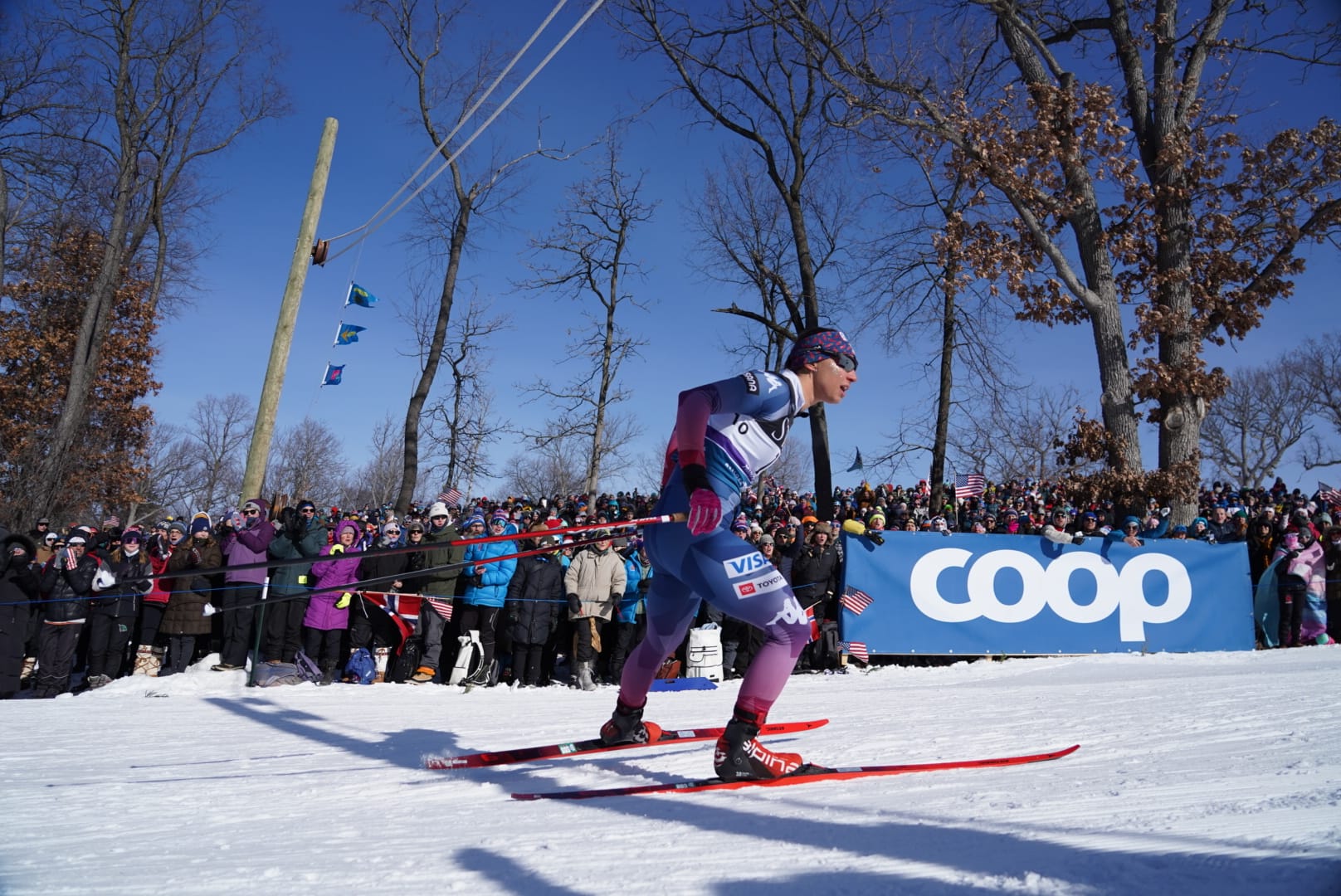
    It’s been an incredible North American World Cup period in Canmore and Minneapolis over the past two weeks. In Canada, as the excitement was building for the first World Cup on US snow in over 20 years, US skier Julia Kern led the women to the top US finish in the classic sprint and Diggins won the 15 km freestyle. In Minneapolis, the huge crowds of US fans in Wirth Park for the Loppet Cup brought an incredible energy to the event and crowds were treated to several podium finishes for the US!

    Julia talking with Lumi guests in Minneapolis after the Loppet Cup. (Photo: Lumi Experiences)

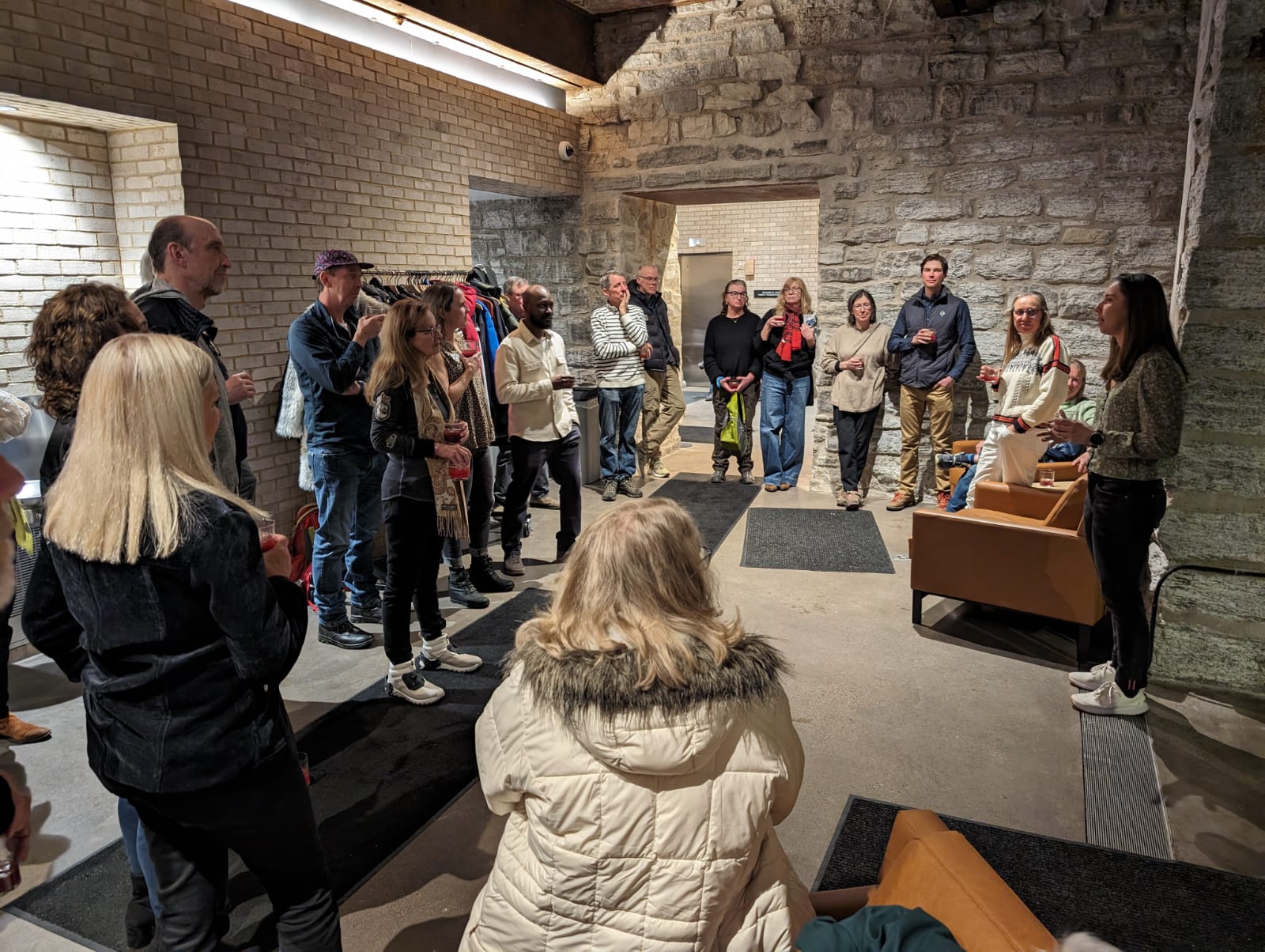
    On Sunday night after the races, guests on Lumi’s Minneapolis World Cup Trip got to meet Julia and her family. Julia shared parallels between skiing on the Weston Golf Course where she grew up in Boston and the Wirth Golf Course that hosted the Minneapolis World Cup. She also talked about the impact of the Trail to Gold Fellowship, helping to bring more women coaches onto the World Cup. The story of how Julia and Jessie won silver at last year’s World Championships captivated and inspired the group for next year’s Trondheim World Championships in Norway.

    Now these next two weeks are the first time in decades that US ski team athletes have been able to head home for some rest time in the middle of their 3.5 month World Cup season. 

    Before Julia takes off for the final leg of the World Cup in Scandinavia in early March, she prepared a video of what she packs when she travels to the World Cup. In this new video, see what she packs in her bags – both for ski training and her other favorite sport. What sport is that?

    Want to experience cheering for a World Championship event in Europe? The 2025 Trondheim World Champs are going to be in Johannes Klæbo’s backyard next February and March. Due to their popularity, there will be two Lumi Experiences trips to Trondheim 2025. Dovetail this with Lumi’s Norway-Birken trip to ski the Norwegian Birkebeiner while you’re in Norway. An additional packing tip from Julia for Trondheim 2025? Bring your stars, stripes and glitter!

    Right now we’re offering an early booking discount on all 2025 Lumi trips. Secure your spot before March 31, 2024 and save $300 per person.

    See you on the trail!

    Garrott

    garrott@lumiexperiences.com

    Get ready for Trondheim 2025!. (Photo: Lumi Experiences)
  • The Devon Kershaw Show: Stage 6 Ski Tour 2020 — Waxing for Hell or High Water

    The Devon Kershaw Show: Stage 6 Ski Tour 2020 — Waxing for Hell or High Water

    Stage 6 of the Ski Tour 2020 was, by any stretch of the imagination, a steamroller for Norway. A clean sweep on the men’s and women’s podium. On the men’s side, that’s not exactly what we expected. Russia’s Alexander Bolshunov looked like a sure thing for the overall win. A 30 k classic for the 23-year-old, I mean who would have predicted anything different?

    The weather was all over the place. As Devon has said several times, the weather in Trøndelag can be a mix of everything unpleasant. And that’s the way it was. Big flakes of snow fell during the men’s race. Let’s just say that the klister on the Russian’s skis didn’t synch with the precipitation.

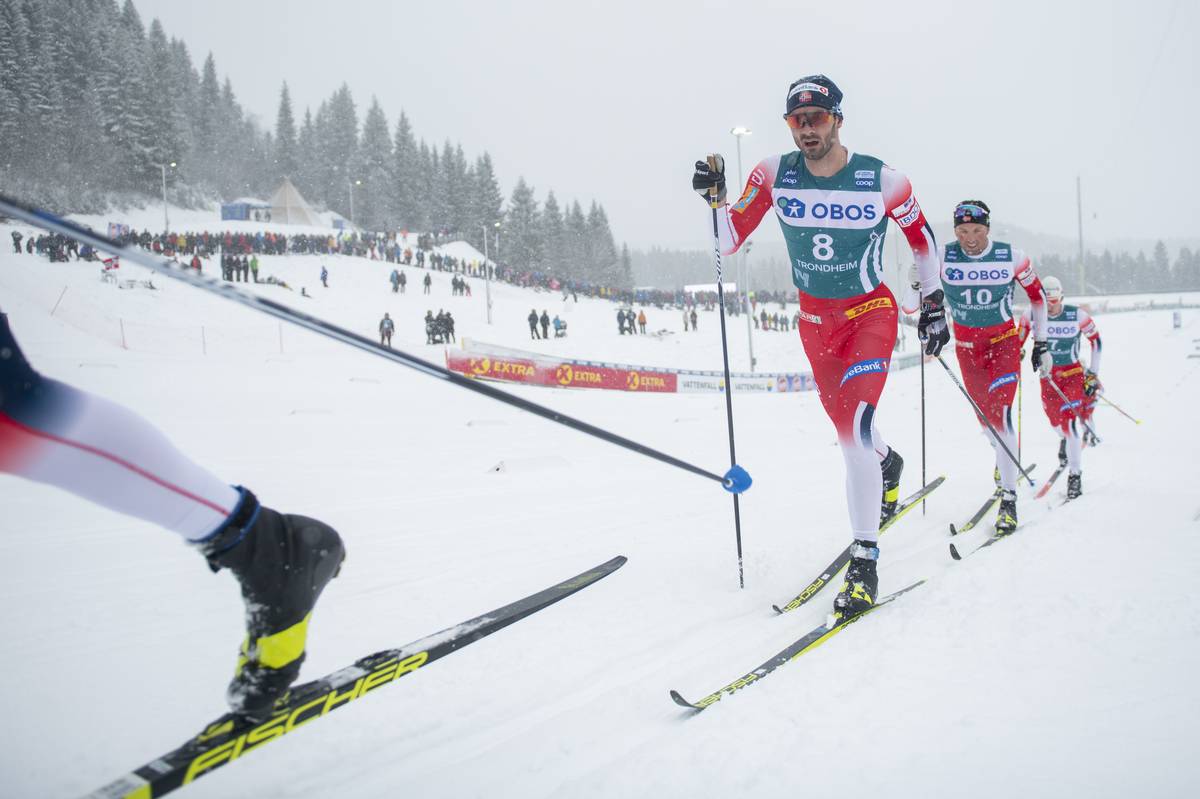
    The Norwegian train during Stage 6 of the Ski Tour 2020. Hans Christer Holund (bib 8)(Photo: NordicFocus)

    Good on Johaug for her near clean sweep, she won five of six stages, and Pål Golberg and his wax techs scored a big one for the home crowd in Trondheim.


  • Johaug Crushes Stage 6 for Ski Tour Overall Win; Diggins Leads U.S. in Sixth (Updated)

    Johaug Crushes Stage 6 for Ski Tour Overall Win; Diggins Leads U.S. in Sixth (Updated)

    Therese Johaug, untouchable during Stage 6 of the Ski Tour 2020. (Photo: NordicFocus)

    We’ll start with the weather: think all over the place. A moving target for meteorologist with moisture spitting from the skies, and air masses swirling this way and that making the trees sway like a mamba line along the course. A wax tech’s nightmare scenario? Yes. It certainly trended in that direction.  

    By all measures, this was Therese Johaug’s, Norway’s latest version of a cross-country skiing record-breaker, stage and tour. Of six stages total, she won five outright, with the lone exception, Saturday’s Stage 5 classic sprint in Trondheim.

    Stage 6 featured a 15 k classic pursuit. Call it a pursuit, however, on the race’s sharp end, this was a runaway. Although the field was, in theory, pursuing Johaug, she simply put more time into her challengers on Sunday. She began 2:33 ahead of Norwegians Heidi Weng in second, while Ingvild Flugstad Østberg set off another second back. 

    Johaug expanded her lead at the finish, by over a minute, to Weng and Østberg. Johaug won the pursuit in 41:13.8. Weng placed second (+3:40.8) with a slight gap over Østberg, who toed the line 0.7 seconds further back. Sweden’s Ebba Andersson, the day’s fourth starter at 4:48, lost time to0, finishing 5:54.3 back to end the Ski Tour in fourth overall. 

    “I felt really good today and the waxers had done a really good job the whole Ski Tour and today as well I have the perfect skis,” Johaug told FIS after the race. “When the skis are good and the shape is good I can just go out there and enjoy all the people that come here and cheering us.”

    As far as time of day, Johaug took that prize as well. However, Norway’s Astrid Uhrenholdt Jacobsen placed fifth overall and had the second-fastest race time, 44.8 seconds off Johaug’s winning mark. Krista Pärmäkoski of Finland notched the third-fastest time of day (+1:04.4). 

    Jessie Diggins of the U.S. was the top placed North American in sixth (+8:40.1). (She skied the 17th fastest time of day.) 

    “Today, like yesterday, was a crazy day in terms of weather and waxing. It kept snowing on and off, the sun coming out and then the wind picking up as more snow came down! I was pretty much skiing an individual start race as I was alone the entire time, but I was really proud of my pacing and efforts as I held my placing without anyone to work with. There was a really tricky time in the middle of the race when the skis weren’t kicking very well (for much of the field, I think) but I was able to refocus and reset and keep pushing as hard as I could.

    “As for the overall tour, I’m really happy with my efforts and how I hit my goals for every race. One of my big goals was to see each day as an entirely separate opportunity and to not put pressure on myself for the overall tour, since there are so many factors that I can’t control that play into that placing. But by hitting my own process goals for each race and staying consistent I was able to have a tour that I’m proud of.

    “I’m really proud of our tech team and coaches for their tireless efforts day in and day out through this tour. It’s been exhausting but they’re the hardest working guys out there!”

    Sadie Maubet Bjornsen ended her tour in 10th (+9:43.8). With the big time gaps, the second wave of skiers (the mass start) began with Pärmäkoski in bib 13, starting at 8:08 back. Maubet Bjornsen (bib 12), began 16 seconds ahead and was the initial target of the wave starters. Maubet Bjornsen held off a charging Pärmäkoski for over 5 k. 

    “Wow, I made it!! That was one heck of a tough tour! Things were looking mighty rough to begin with, but I knew I had to just keep fighting and believing!,” Maubet Bjornsen emailed. 

    “But among some challenging times, there were some glimmering hopes in there. Tours are my favorite types of racing, because you have to be so resilient and such a fighter. Day after day, you have to put your fatigue and emotions aside, and just stay so positive. 

    “The tummy troubles at the beginning of the tour were particularly tough! It was scary to start a tour so depleted, but I was thankful we had our nutritionist, Susie Parker Simmons around to help me stay on my feet! From there it was just a matter or fighting for every second from there on.

    “Today was a totally wild scene! Conditions were constantly changing, and it was hard to find the perfect skis! I knew the name of the game was to just keep fighting, because everyone would be struggling at some point out there. I managed to find something to work, and went through some highs and lows out there in the 15k which brought me to 10th overall in the tour! I’m super happy and satisfied with that, given the little fatigue hole I had to crawl out of this past month. Thank you to our team for helping make a tricky classic day at the finish of the tour possible to fight with the others. 

    “I’m looking forward to taking a rest now, and finding the energy to finish the end of the season strong, for the third tour of the season. 

    “Thanks to the Ski Tour 2020 for bringing some different types of racing. While it wasn’t always the best type of races for my strengths, it was so refreshing to visit some new locations with some different types of events! These are some of my favorite memories this season! 

    “And of course, hugest thanks to the staff. We couldn’t race day after day like this without them!!! They are the heroes.”

    Sadie Maubet Bjornsen (bib 12) racing to 10th overall in the Ski Tour 2020. (Photo: NordicFocus)

    Rosie Brennan, starting in bib 10, 7:27 behind the first starter Johaug, placed 12th (+9:53.3).

    “Today was a very challenging day,” Brennan wrote in an email. “Due to the massive time gaps in the overall, the wave started at bib 13 so I had a big pack starting not too far behind. The conditions were very challenging with snow, sun, rain and everything in between and some very icy tracks. I did my best to stay in front of the wave but just didn’t have the skis or the energy to make it happen today. I am very disappointed in myself. After having a great tour, it was hard to end on this note, but I am doing my best to look at all the positives from the tour as a whole and make a nice little work list to improve on the things that were so tough today.”

    Rosie Brennan (stars and stripes) during Stage 6 of the Ski Tour 2020. (Photo: NordicFocus)

    Also for the U.S., Julia Kern placed 30th (+14:51.4), Caitlin Patterson 36th (+16:38.4), Katharine Ogden 42nd (+20:26.6), Rosie Frankowski 43rd (+20:36.7), Sophie Caldwell 44th (+21:41.2), and Alayna Sonnesyn 48th (+24:34.6). 

    Canada’s Katherine Stewart-Jones placed in the points for the tour overall, by finishing 29th in the pursuit (+14:46.3). Cendrine Browne was 33rd (+15:47.5), and Emily Nishikawa 35th (+16:08.4). 

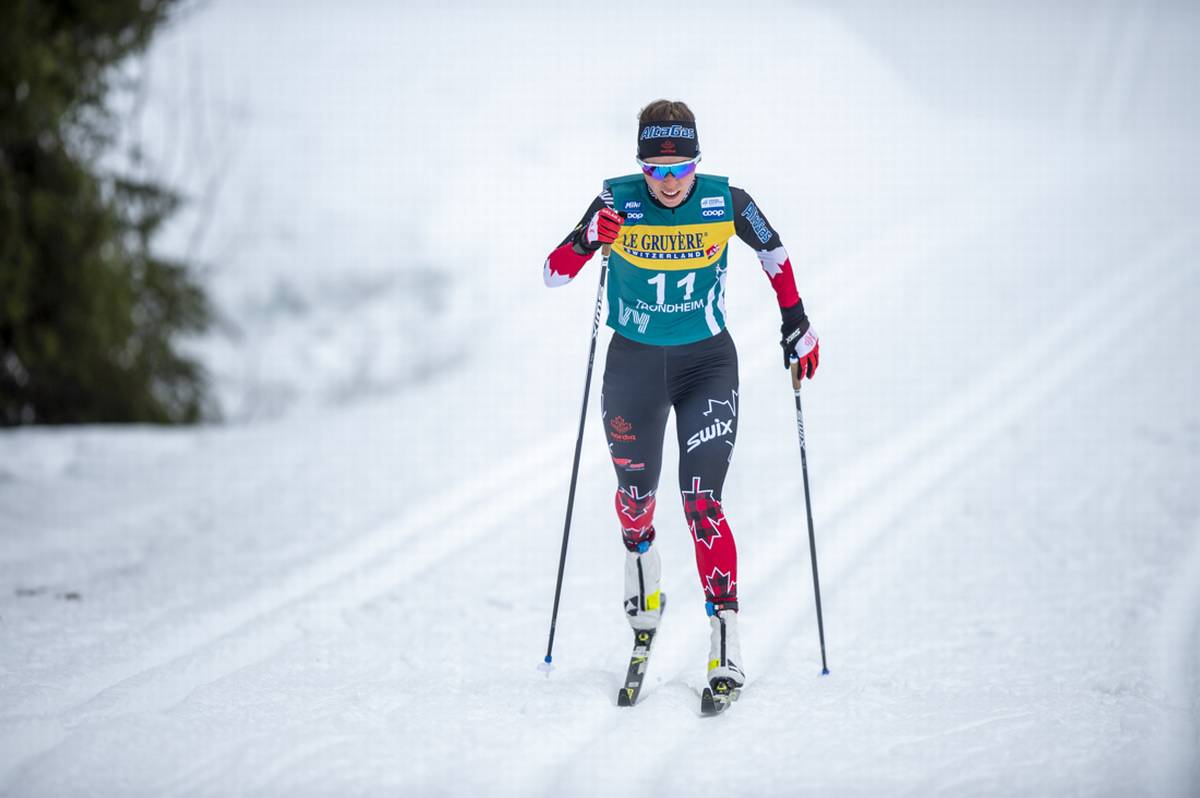
    Katherine Stewart-Jones during Stage 5 of the Ski Tour 2020. (Photo: NordicFocus)

    This stage concludes the Ski Tour. Racing continues in Lahti, Finland next Saturday. 

    Results | Overall Standings | Winner of the Day

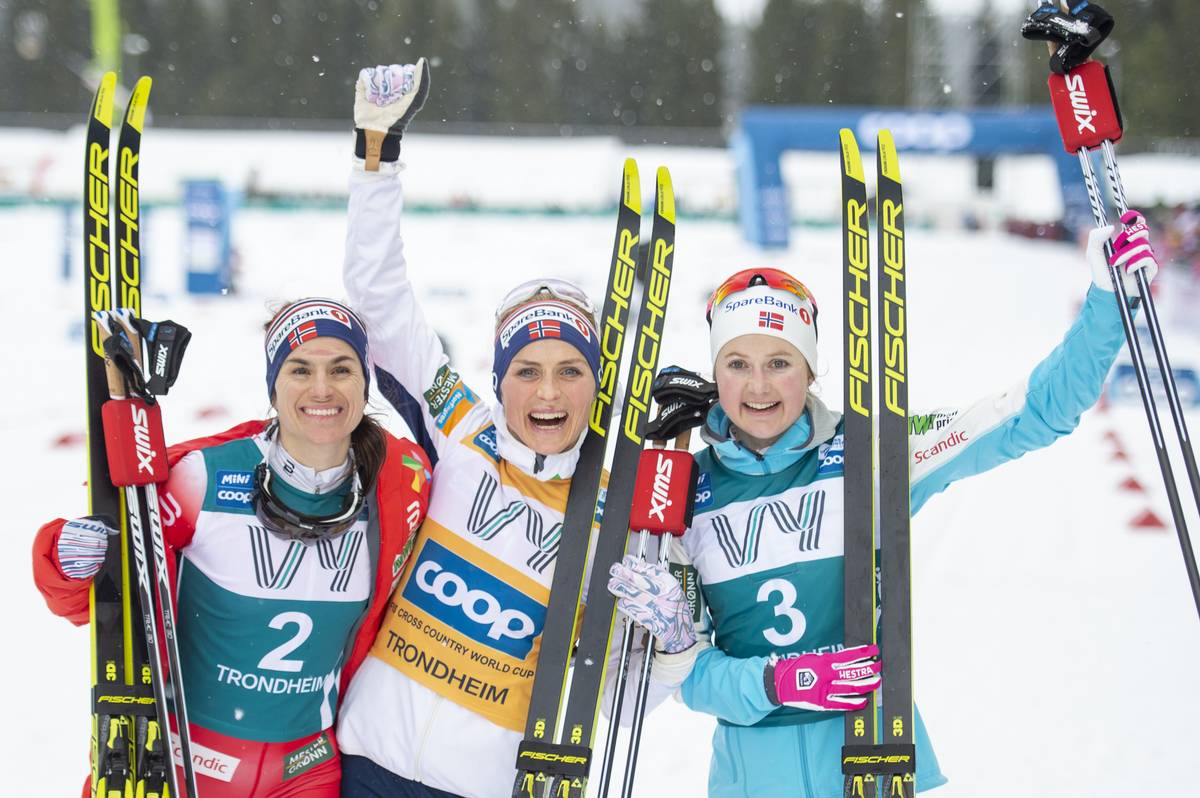
    The women’s Stage 6 and overall Ski Tour 2020 podium: Heidi Weng (NOR) in second, Therese Johaug (NOR) first, and Ingvild Flugstad Østberg (NOR) third, (l-r). (Photo: NordicFocus)
  • Stage 5 Ski Tour 2020: Championship Style Classic Sprinting

    Stage 5 Ski Tour 2020: Championship Style Classic Sprinting

    A full-on championship course in Trondheim, Norway where the World Championships will go down in the mid-2020s. That’s a long way off. This much was true: the venue, like this tour, has been kind to Norway. Maiken Caspersen Falla and Johannes Høsflot Klæbo pleased the home fans. And yes, with all the fans, it seems this might be a venue to revisit in the near future.

    One more day, a Stage 6 15 k/ 30 k classic pursuit to go.