Tag: Trondheim Skiathlon

  • The Trial in Trondheim

    The Trial in Trondheim

    This coverage is made possible through the generous support of Marty and Kathy Hall and A Hall Mark of Excellence Award. To learn more about A Hall Mark of Excellence Award, or to learn how you can support FasterSkier’s coverage, please contact info@fasterskier.com.

    The men’s 20-kilometer Skiathlon at Granåsen never felt like an ordinary World Cup. From the moment the athletes stepped into the start pen, there was a tension in the air that didn’t match an early-December race. The stadium filled slowly; the fog sat low; the snow clung wetly to the klister underfoot. Yet the energy was unmistakable. It felt charged, anticipatory, almost uneasy.

    You could see it most clearly in the uniforms. Twelve Norwegians stood in the field of 91, and every one of them carried something heavier than usual race nerves. This wasn’t just about points. It wasn’t just about winning. It wasn’t even about bragging rights.

    Today, for Norway, was about the Olympics.

    Earlier that morning, Austria’s Mika Vermeulen summed it up bluntly when asked what he expected:

    “The Norwegians need to go fast to qualify for the Olympics.”

    It was the truth that everyone else was dancing around.

    On paper, this was a World Cup Skiathlon. On snow, it became something else entirely: an unofficial Olympic sorting ceremony, shaped by weeks of controversy, public criticism, and a federation under scrutiny.

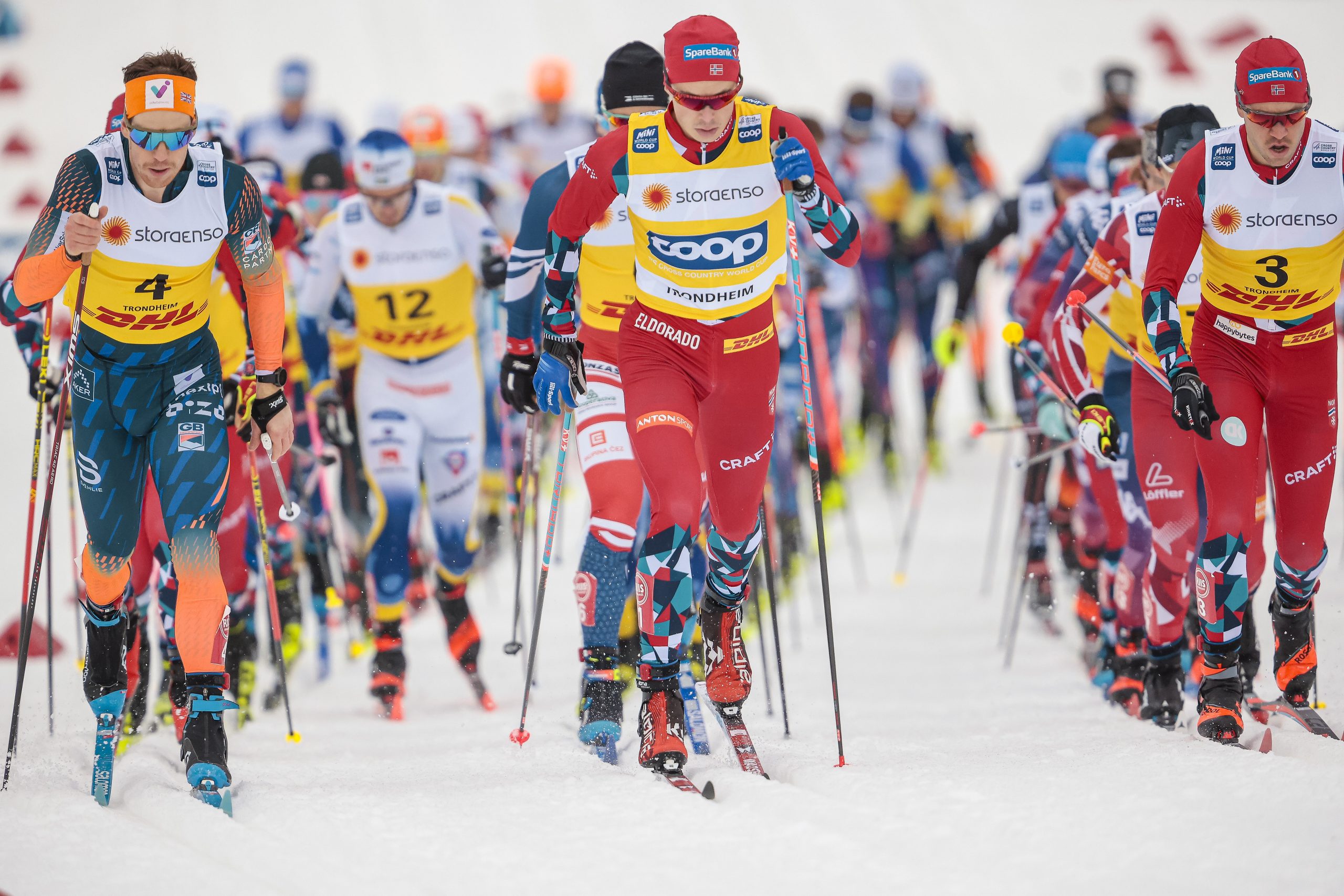
    The start of the Men’s 20 k Skiathlon Trondheim (NOR). (Photo: Modica/NordicFocus)
    A Race Run Under a Shadow

    The tension surrounding this race didn’t begin in Trondheim. It started with a roster decision — or, in the eyes of many Norwegians, an omission. Emil Iversen, the veteran racer with a World Championship gold and a decade of elite podiums behind him, was left off the opening World Cup weekend in Ruka.

    The decision rippled across Norwegian media.

    The loudest voice belonged to Johannes Høsflot Klæbo.

    In a widely circulated VG article, Klæbo called the decision “dårlig håndverk”poor workmanship — and argued that if the goal was to send the fastest athletes, Iversen had earned his seat on the plane.

    “If you are good enough, you should get to go,” he told VG.

    Former national-team director Espen Bjervig fired back in Stavanger Aftenblad, criticizing both Klæbo and Iversen for speaking publicly about selection practices, arguing that it “creates noise and negativity.”

    Suddenly, what is typically a quiet, internal Norwegian debate had spilled into full public view. Selection wasn’t just a technical matter — it was a national storyline.

    And this Skiathlon, the only one before the Olympics, sat squarely in the center of that storm.

    Iivo Niskanen made his way to the front during the classic leg, but ultimately faded to 25th place on the day. (Photo: Modica/NordicFocus)
    The Classic Leg: A Tense, Measured Beginning

    When the field set off into the opening 10 k of classic skiing, the pace was high but controlled. Nobody wanted to take on the risk of an early break. The lead shifted lightly — Finland’s Iivo Niskanen testing, Norway’s Martin Loewstroem Nyenget responding — but the main pack stayed dense, the elastic never stretching too far.

    What stood out was not who led, but how closely the Norwegians watched one another. Every surge drew an immediate answer. Every gap in the pack was filled. There was a vigilance to their movements: unspoken, but unmistakable.

    Behind them, American Gus Schumacher skied with patience, always hovering near the front third, avoiding trouble. Ben Ogden played the elastic back-and-forth of the pack, feeling the surging, slowing, and reshuffling that characterizes Skiathlon racing.

    Nothing broke the race open. But everything pointed toward what was coming.

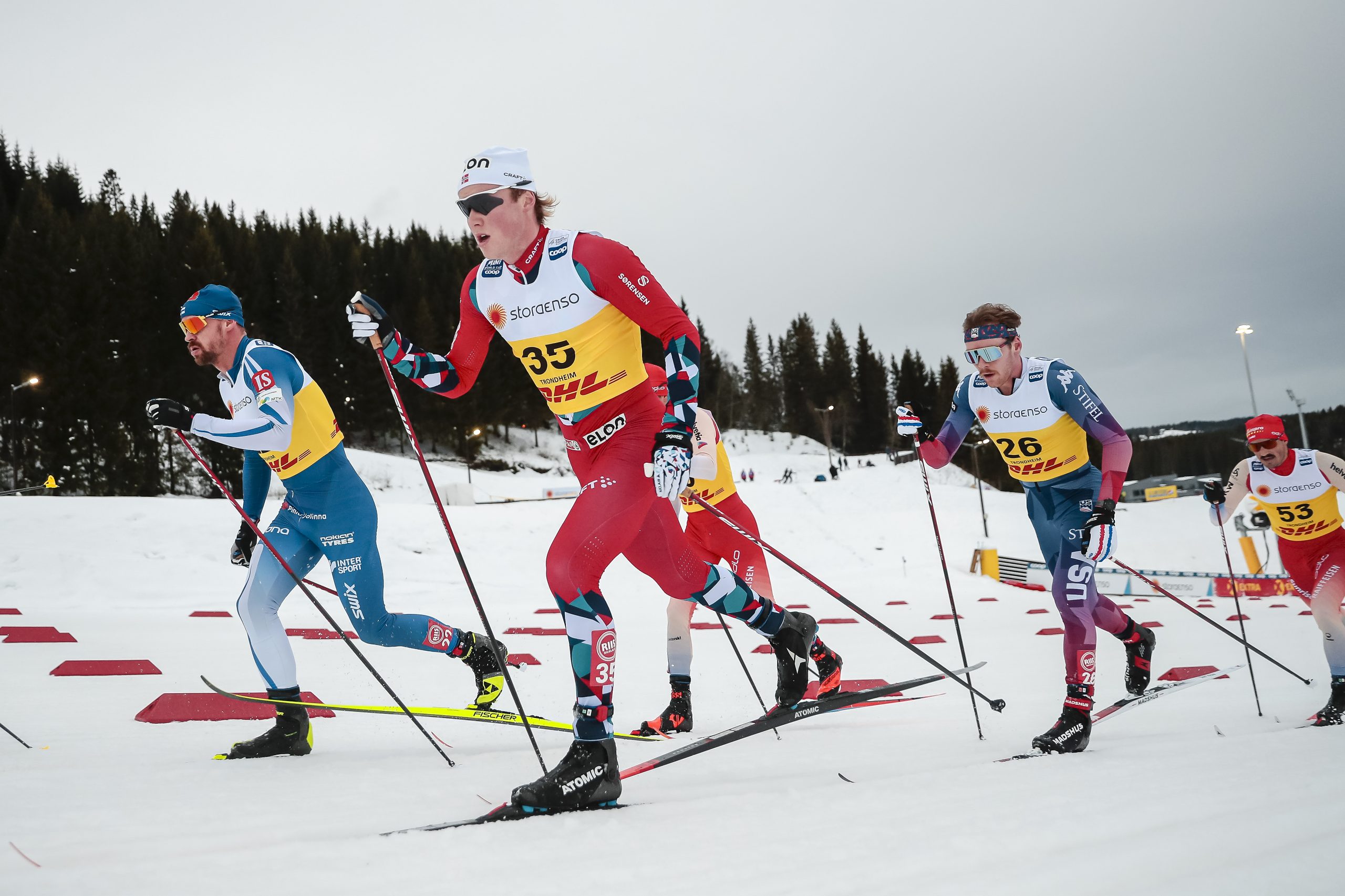
    Emil Iversen (#37, white hat), Zanden McMullen (#26 USA), Andrew Musgrave (GBR), Gus Schumacher (#18 USA) and Ben Ogden (#24 USA) navigate the pack during the classic leg. (Photo: Modica/NordicFocus)
    The Transition: When the Real Race Began

    At the stadium, skis were neatly arranged in assigned pens; in the grandstand, the crowd pressed forward on their seats, and the atmosphere shifted. The transition from classic to skate is always an inflection point in a Skiathlon. But today’s felt like the release of a held breath.

    As athletes stepped out of classic skis and into skate gear, the pace vaulted. The race’s character changed instantly — no longer steady, but sharp. No longer patient, but aggressive.

    Within seconds of leaving the exchange zone, the field stretched into a long, thin line—athletes who had looked comfortable in the first half suddenly fought to hold contact. The front swallowed the course in powerful V2 tempo, and what had been a race of restraint transformed into a race of revelation.

    From this point on, the Skiathlon resembled more of a Norwegian internal selection trial than a World Cup.

    With Johannes Hoesflot Klaebo (NOR) and Emil Iversen (NOR) at the front, Federico Pellegrino (ITA), Elia Barp (ITA), (l-r) and the rest of the lead pack try to match pace during the initial kilometers of the skate leg. (Photo: Modica/NordicFocus)
    The Skate Leg: Norway Sorts Itself Out

    With 10 kilometers to go, the lead group had thinned to about twenty athletes. By the next climb, it was closer to fifteen. And among those fifteen were eleven Norwegians — each racing not only the field but each other.

    Every shift in tempo felt deliberate.

    Every climb tested hierarchy.

    Every acceleration seemed to ask a quiet question:

    If this is for a trip to Milan–Cortina, who survives?

    Nyenget pushed the climbs with authority. Harald Østberg Amundsen pressed from the front like a man intent on staking a claim. Mattis Stenshagen floated with the leaders, unfazed by the fire around him. And somewhere in that pack, Emil Iversen — overlooked just one week earlier — had battled from the 37th starting position and was skiing with a visible urgency, a visible hunger.

    The pace was unrelenting. When Andrew Musgrave surged near 15 km, the field snapped back immediately. No one would be allowed to disrupt the internal Norwegian calculus.

    This was not a race that welcomed outsiders.

    Behind them, Schumacher held position just beyond the front group, skiing an intelligent and confident race on a day that didn’t cater to anyone not wearing red. Ogden fought through the volatility of the middle pack as the front repeatedly drove the pace into the threshold.

    Ben Ogden (USA) finding his skate legs in his first freestyle race of the season during the 20 k Skiathlon in Trondheim (NOR). (Photo: Modica/NordicFocus)
    American Reactions: Schumacher and Ogden Describe the Chaos

    Schumacher, who had circled this Skiathlon as a key Olympic-learning opportunity, said the day unfolded exactly as he expected:

    “I’m still kind of building into the season… but I’ve got some good skiathlon experience, and they don’t feel so crazy now. Treat it like a race, try to do my best, and definitely learn some stuff.”

    He found those lessons quickly — particularly in the transition to skate:

    “The pace was definitely hot… right out of the start of the skate, they went hard. A lot of those fitness guys are trying to put some distance to the faster people. It’s tough on this course. I felt ready for it, but struggled a little bit with the skis. They were digging too much in the hills.”

    And he could feel the intensity radiating from the Norwegians:

    “It absolutely was their Olympic trial. There’s definitely some intensity from their side. A lot of those guys are really nervous — and to be honest, they don’t seem to be having that much fun right now. It’s a tough fight for those four spots.”

    Ogden, who finished 35th, echoed the shock of the pace — especially coming off a demanding classic leg:

    “The pace today was probably the hardest thing for me. The classic was just so fastand I haven’t skated a lot this year. It came after the world’s hardest 10k classic.”

    He battled through the skate leg, trying to recalibrate on the fly:

    “I don’t think I skated very well. I didn’t push into the downhills very well, and I was just tired. You can go hard in the classic and still be competitive in the skate, but you have to be a little more tactical.”

    And, like Schumacher, he found himself needing to rewrite his goals mid-race:

    “Reevaluating your plan on the fly is always the hardest part. Once your plan falls apart, it’s easy to lose a little bit of grit mentally. Today, the goal just became to hang onto the back and try to beat a couple of them.”

    Maybe it isn’t in focus, but what is clear is Harald Oestberg Amundsen (NOR), Mattis Stenshagen (NOR), Johannes Hoesflot Klaebo (NOR), Emil Iversen (NOR), Jan Thomas Jenssen (NOR), Erik Valnes (NOR), Martin Loewstroem Nyenget (NOR), (l-r) all charging up the final climb of the 20 k Skiathlon in Tronheim, Norway. (Photo: Modica/NordicFocus)
    The Final Kilometers: A Reckoning on the Last Climb

    With three kilometers left, the stadium roar began to build. The final climb hovered ahead — long, grinding, decisive. The pack tightened—the Norwegian national and club team suits clustered near the front. And then the sorting began in earnest.

    Amundsen drove up the hill with power.

    Klæbo hovered, always exactly where he needed to be.

    And Iversen — the man left off the Ruka start list — refused to yield a single meter, emerging along the outside edge of the trail toward the front of the pack.

    The race crested the final hill, swept through the big left turn, and spilled into the descent where Skiathlon medals — and today, Olympic dreams — are so often decided.

    Klæbo did what only Klæbo does: timed the moment flawlessly, slid into open snow, and glided away with the control and confidence that has defined his career. Behind him, Amundsen locked up second.

    But all eyes were on third.

    There, straining every muscle, skiing with unmistakable desperation and defiance, was Emil Iversen.

    He crossed the line in third place — a podium on the only Skiathlon before the Olympics.

    For him, it was not just a race result.

    It was a reclamation.

    Johannes Hoesflot Klaebo (NOR) leads a Norwegian train down the home stretch. (Photo: Thibaut/NordicFocus)
    A Sweep That Spoke Volumes

    Norway swept the top eight.

    The best non-Norwegian — the always-impressive Mika Vermeulen — finished ninth.

    The top nine were separated by five seconds.

    The top fifteen by fifteen seconds.

    It was depth displayed as dominance, and dominance displayed as a message.

    For Klæbo, the picture is clear.

    For Amundsen, clearer still.

    For Stenshagen, it was a breakthrough.

    And for Iversen, it was a revival that carried the weight of the last two weeks on its shoulders.

    For the American men, Schumacher’s 21st showed consistency and smart racing in a field that spent much of the day executing internal warfare—Ogden’s 35th offered lessons in reading a volatile race and surviving wave after wave of pace changes.

    Harald Oestberg Amundsen (NOR), Johannes Hoesflot Klaebo (NOR), Emil Iversen (NOR), (l-r) take the Skiathlon podium in Trondheim (NOR). (Photo: Thibaut/NordicFocus)
    What This Means for the Olympic Picture

    Klæbo, with a smirk on his face, didn’t hesitate after the race:

    “I think I made the team now for sure.”

    He wasn’t wrong.

    Amundsen likely solidified his place as well.

    Stenshagen made himself hard to ignore.

    And Iversen forced the federation to confront the conversation it had hoped to avoid.

    Performance is supposed to matter.

    And Iversen delivered the clearest performance of anyone not named Klæbo.

    In the eyes of fans, teammates, and media, he didn’t just earn consideration — he demanded it.

    Emil Iversen may be the happiest person in Trondheim (NOR) today. (Photo: Thibaut/NordicFocus)
    A World Cup in Name Only

    As the sun faded over Granåsen and crews raked the sugary snow from the corners, it became apparent that what we had just witnessed was something far larger than a World Cup.

    This race was a referendum on form.

    A public test of internal politics.

    A stage where the world’s strongest skiing nation sorted itself out in real time.

    The stadium announcer called it the men’s 20 k Skiathlon.

    But everyone who watched, coached, raced, or cheered knew better.

    This was the reckoning.

    This was the day Norway began choosing its Olympic distance team.

    This was ‘The Trial in Trondheim!’


    Men’s 20 k Skiathlon RESULTS


    Love Stories Like This? Help Keep Them Coming.

    Feature stories like this one take time, access, and care to produce. If you value thoughtful storytelling and independent ski journalism, please consider becoming a Voluntary Subscriber. Your support directly fuels the work we do to cover the people, places, and moments that make our sport special.

    Join the FasterSkier community!


    Emil Iversen (NOR) was so happy to be back on the World Cup podium, but clearly his smiles were about something even bigger. (Photo: Thibaut/NordicFocus)
  • Musgrave! Brit Takes Second in Trondheim Skiathlon

    Musgrave! Brit Takes Second in Trondheim Skiathlon

    This coverage is made possible through the generous support of Marty and Kathy Hall and A Hall Mark of Excellence Award. To learn more about A Hall Mark of Excellence Award, or to learn how you can support FasterSkier’s coverage, please contact info@fasterskier.com.

    On Saturday in Trondheim, Norway, the first Skiathlon of the year was held. Competitors skied a 10 kilometer Classic leg followed by a 10 kilometer Freestyle leg. In the men’s race, the prevailing question was which Norwegian would win? The last time a non-Norwegian male won a distance World Cup competition was 24 races ago going back to February 2022. The Norwegian winning streak has gained a kind of life of its own with spectators and pundits wondering when, and if, it will end. The other big question was how would Joannes Hosflot Klaebo (NOR) perform? When there’s a Sprint race, everyone expects Klaebo to win—a distance race— not so much. This year his best distance finish was seventh place. His Skiathlon performances have been erratic. The last time he raced a Skiathlon in the World cup, he failed to finish. However, he did have a second place finish in the World Championships last year. So, the range of predictions were quite diverse.

    The weather was a factor with mist and temperatures in the mid-40s leading to klister becoming the only option for the Classic leg. The weather notwithstanding, form was maintained today as Klaebo took the top spot on the podium. A non-Norwegian was able to fight to the podium with Andrew Musgrave (GBR) taking second. Didrik Toenseth (NOR) was third.

    Andrew Musgrave (GBR) was able to overcome a bad ski exchange to pull out a second place finish. (Photo: NordicFocus)

    The Americans threw everything they could at the race, fielding seven skiers: the second largest representation by country in the race— behind only Norway. The top American finisher was Ben Ogden in 17th, 1:30 off the lead. Gus Schumacher was 32nd, Scott Patterson, 41st, Zanden McMullen, 45th, JC Schoonmaker, 50th, Luke Jager, 52nd, and John Steel Hagenbuch 56th.

    The top Canadian finisher was Antoine Cyr in 21st. He was followed by Olivier Leveille in 43rd.

    Ben Ogden (USA) (bib 26) was the top American, finishing 17th (Photo: NordicFocus)
    Men’s 20 k Skiathlon

    The men began at a somewhat aggressive pace with Andrew Musgrave (GBR) and Johannes Hoesflot Klaebo (NOR) setting the early pace. Very early on it was clear that some racers were going to have a long day, having missed the kick wax. U.S. coach Chris Grover was able to add some insight into the kick wax scenario.  “We had gotten some rain and things were beginning to transform,” he said. “It was tricky because there was a colder snowpack underneath. The guys ran into some klisters that were icing and some that were going pretty good, so hats off to the service team. It was an absolutely huge day for the service team in terms of ski preparation.”

    At a relatively early point, 2.1 kilometers into the race, the pack began to get strung out a little, Calle Halfvarsson (SWE) moved to the front with Klaebo. Halfvarsson would make himself a presence toward the front for much of the race.

    The course had several spots where World Cup overall bonus points were awarded. Klaebo pushed to the front to take the lead at the first bonus point marker at 3.9 kilometers, which put the rest of the field under additional stress. Awarding bonus points seemed to have had its desired effect of keeping the field motivated to race hard the entire way.

    After the bonus point sprint, things settled back down a little and Musgrave went back to the lead. Musgrave has definitely become a fan favorite over the years having taken on the role of the plucky underdog. But today, he was determined to prove that he was more than that. At 4.7 kilometers he had pushed to the front and looked very strong. At this point the top American was Ben Ogden in 17th.

    Ogden continued to hang with the main pack, and at 7.2 kilometers he was only nine seconds off the leaders. But at the front it was Klaebo and Musgrave continuing to force the pace jockeying back and forth for the lead. The hard pace continued to string out the field even further. At this point, other than Musgrave, the only non-Norwegians at the front were Halfvrasson and Jens Burman (SWE). Ogden was still going strong, hanging with the lead pack.

    When the skiers were a kilometer from the ski exchange the leaders turned up the pace even more. Klaebo clearly wanted to lead entering the stadium ski exchange. As they entered the stadium, there was a group of about 14 skiers in the lead, with Klaebo going to the front of the pack. Klaebo was first out of the ski exchange along with about half a dozen countrymen. Ogden was in 18th, 21.5 seconds off the lead.

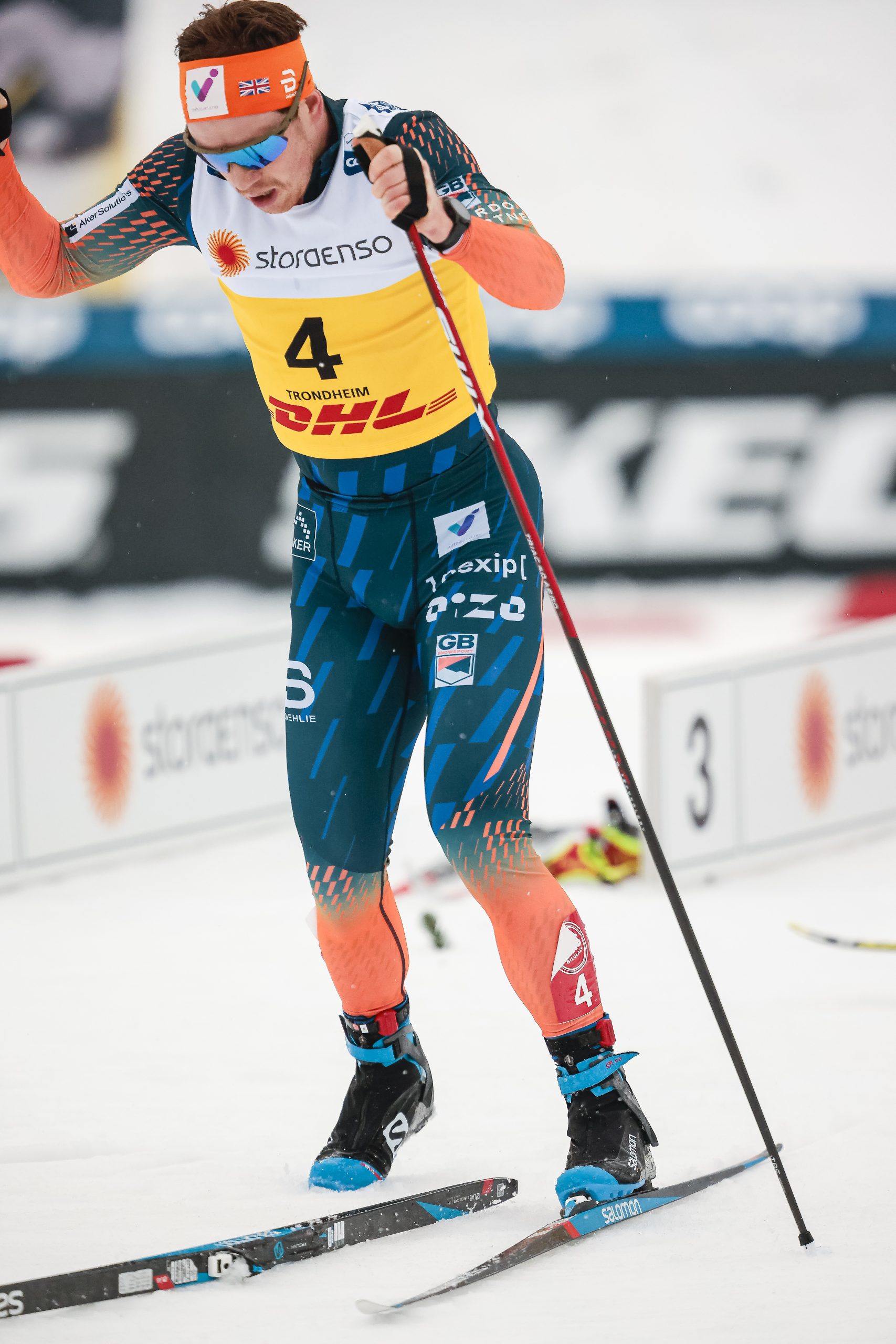
    Andrew Musgrave (GBR) lost valuable time in the ski exchange when he couldn’t get his boot into the binding. However, he refused to let that stop him on his march to the podium. (Photo: NordicFocus)

    Musgrave had a troublesome ski exchange, and it almost cost him dearly. He fumbled the switch from Classic to Skate skis struggling to get his foot into the binding. This cost him precious seconds. The lead group left the ski exchange without him.

    Grover provided some insight to FasterSkier about how the new fluoro rules could cause ski exchange problems. He said that, “the Skate skis can be placed in the transition up to ten minutes before the start of the Skate leg. In the past, athletes placed their own Skate skis in their pits for the exchange, and now coaches or technicians do that after they’ve already started.” He pointed out that this could lead to unintended consequences, “it’s the first time [Musgrave] hasn’t placed his own skis in the exchange. Athletes have different styles in how they set up their skis, whether they straddle one of them and they move right to right, or they come in and they straddle both on the outside and jump to the Skate skis on the inside.” There is time to practice the transition, but it’s a format the athletes don’t often encounter. Also, it’s a challenge for smaller staffed teams like Great Britain. Grover noted that the U.S. has the resources to fine tune the transition to a great extent. He said that, the American athletes coordinate with their coaches ahead of the race. “Last night, we had a fun homework assignment during the team meeting. Everyone who was racing drew a diagram of how they like their skis positioned. Jason Cork processed everybody’s [preferences], so it was in one place digitally. So we had a digital file of how every athlete wanted their pit set up.” He observed that smaller teams might not have the resources to prepare in such detail.

    Freestyle Leg

    Musgrave’s troubles meant that he had come out of the ski exchange ten seconds off  Klaebo’s lead, and was forced back to the second chase group. By the time the leaders reached the 12.1 kilometer mark, it was a red Norwegian wave with Klaebo and Didrik Toenseth (NOR) leading. Burman and Halfvarsson were still in the top ten to break up the sea of red uniforms. The early pace had definitely taken its toll. The group of fourteen skiers was now down to eight with Toenseth and Klaebo setting the pace at the front. Musgrave had used the two kilometers since the ski exchange wisely and done an admirable job of working his way back to join the lead group, but he had clearly expended a lot of energy doing so.

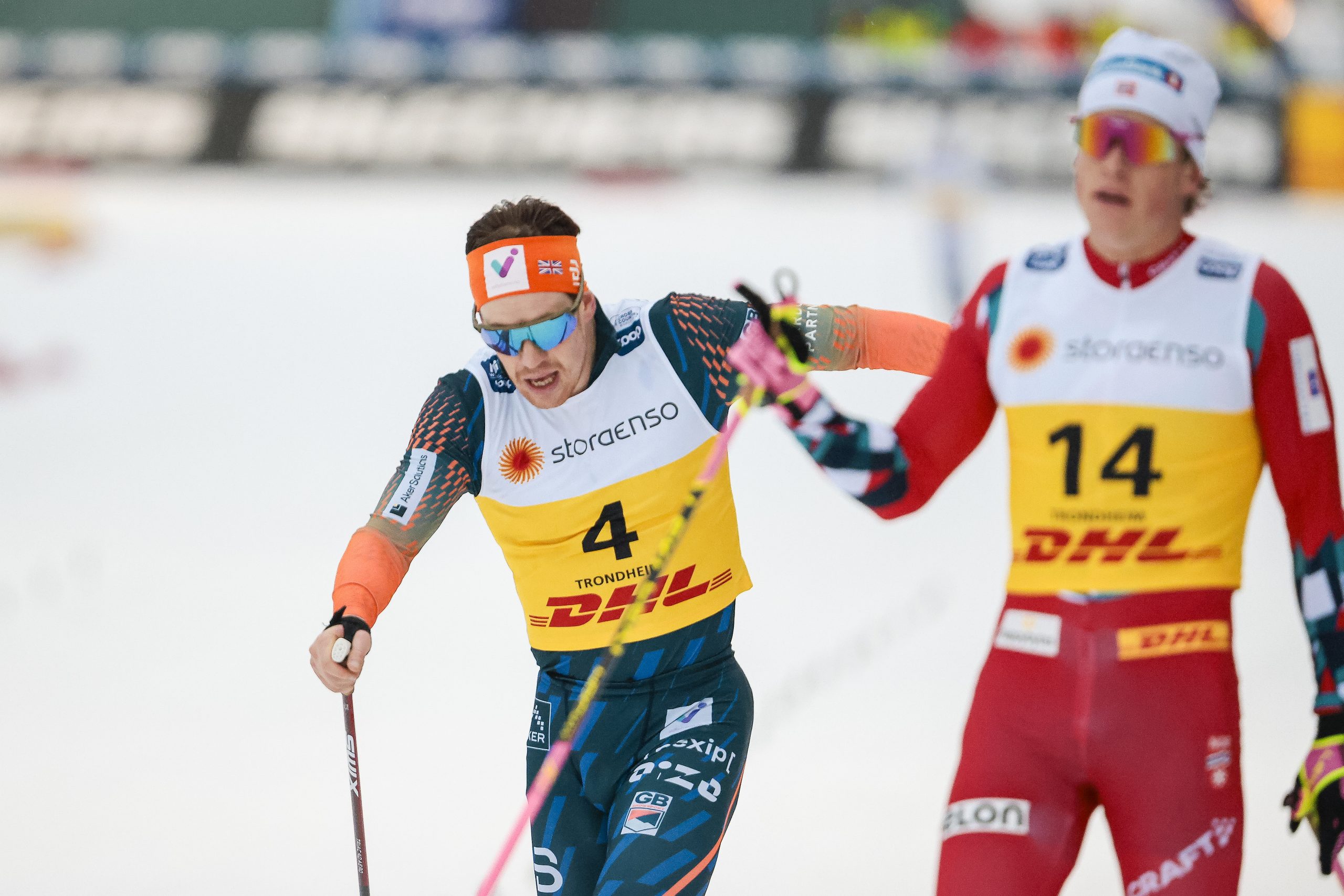
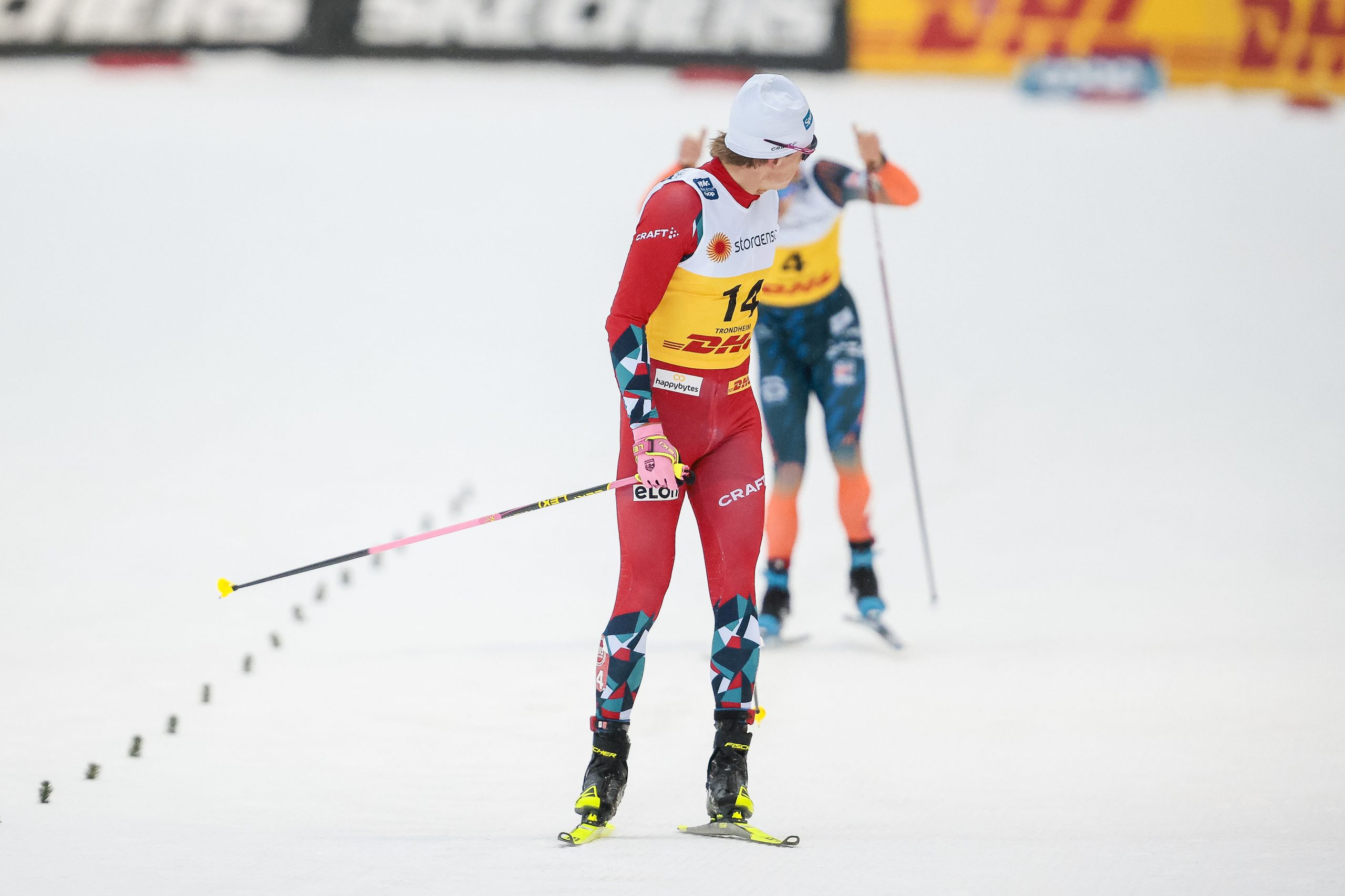
    Johannes Hoesflot Klaebo (NOR) stayed near the front the entire race. He didn’t take any chances as he surged at the finish and had enough time to look over his shoulder and wave to the crowd. (Photo: NordicFocus)

    At 13.3 kilometers a small crack in Norway’s armor began to show as Burman and Halfvarsson were skiing fourth and fifth, refusing to let the Norwegians completely dominate. Musgrave had efficiently clawed his way back into contact with the lead group and was gathering himself as the Norwegians continued to set the pace at the front. Ogden was still skiing well, in 20th, but only 42 seconds off the front.

    Musgrave continued to push and at 15.4 kilometers had worked to put himself into the lead. It was an impressive comeback for the British skier as he had worked hard to overcome his earlier mistake. He was now working with Klaebo and Toenseth to keep the speed high. At 16 kilometers there was another bonus sprint which increased the tempo again. Now the pack had broken into a group of five: three Norewegians, plus Musgrave and Halfvarsson.

    With 3.3 kilometers left, Harald Oestberg Amundsen (NOR) went to the front, knowing that he had to establish a gap over Klaebo to have a chance at the finish. The back and forth was relentless with Musgrave then moving to the lead with the three Norwegians on his tail. Halfvarsson had been gapped and couldn’t keep with the group, though he gamely tried to rejoin it. It was now the three Norwegians at 18 kilometers chasing Musgrave!

    With one kilometer left, the back and forth continued with Klaebo moving to the front. It was still the three Norwegians and Musgrave. Simen Hegstad Krueger (NOR) and Klaebo now traded places at the front with all four skiers forming one pack. In the final climb leading into the stadium it was three skiers spread across the front; Musgrave, Klaebo, and Krueger. All the racers knew that unless they had a gap on Klaebo their chances were slim in a sprint finish. Coming into the stadium Klaebo put in one of his trademark moves and tried to bury the field using the big downhill into the stadium to create a gap. As usual, his strategy was successful and he created separation between himself and the other contenders. On the final turn, Musgrave went wide and lost some speed. It probably didn’t matter as Klaebo had established a big enough lead to wave to the crowd as he crossed the finish. Musgrave had been able to fight forward for second place, with Toenseth taking third. It was a dramatic finish that thrilled the local crowd and kept Norway’s winning streak intact. But Musgrave had proven that there was at least an opportunity for a non-Norwegian to fight for the top spot.

    Andrew Musgrave (GBR)(number four) turned what could have been a disastrous ski exchange into a glorious podium finish. (Photo: NordicFocus)

    Ogden’s sixteenth place was the highlight for team USA. It was a very exciting race; as the Skiathlon often is. The hometown crowd came away pleased, and the Americans saw promise in it’s future with Ogden continuing to ski well.

    Disaster during the race was barely averted when climate protesters attempted to string a barrier across the course. “On the Classsic loop, a couple of guys tried to stretch a chain or a wire across the course, but luckily some locals tackled them, American coaches told FasterSkier. “I’m very sympathetic to climate change, but I’m also sympathetic to the athletes having a safe competition and being able to compete . . . “They tried to interrupt it just as the skiers were about to get to that point, and the protesters were pushed aside, so it didn’t impede the race.” It was a close call for skiers, and FIS will have to do something to address this situation.

    Men’s 20 k Skiathlon RESULTS