From the FasterSkier archive — posts syndicated from athletes’ and coaches’ own blogs between 2004 and 2012, kept online as published. Current coverage is at fasterskier.com.
The above discretionary selection process will be repeated for each period of World Cup this coming season. As always, if you have questions or concerns about this process, feel free to contact me directly.
The International Ski and Snowboard Federation (FIS) unveiled its proposed 2026/2027 cross-country skiing World Cup calendar this week at the FIS Spring Meetings in Portorož, Slovenia.
The schedule — first shared publicly through FIS social media and still pending FIS Council approval — builds the season around the 2027 World Championships in Falun, Sweden, with three pre-Christmas stops, a nine-race Tour de Ski, a stretch of three weekends between the Tour and Worlds, and a Scandinavian closing kick that ends with the Finals in Ulricehamn.
For North American fans, the calendar is once again entirely European, with no scheduled stops in Canada or the United States.
Frida Karlsson (SWE) poses with Mr. and Mrs. Claus following the 10k Classic to start last season in Ruka (FIN). (Photo: Modica/NordicFocus)
Pre-Holiday: Ruka, Trondheim, Davos
The season opens where it almost always does — in Ruka, Finland, where the World Cup begins November 27. From there, the circuit moves to Trondheim, host of the 2025 World Championships, before the pre-Christmas block closes in Davos, Switzerland, with a team sprint.
November 27-29, 2026: Ruka, Finland
27/11: 10km Interval Start Classic
28/11: Sprint Classic
29/11: 20km Mass Start Freestyle
December 1-3, 2026: Trondheim, Norway
01/12: 10km Interval Start Classic
02/12: Sprint Freestyle
03/12: 20km Skiathlon
December 11-13, 2026: Davos, Switzerland
11/12: 5km Heat Mass Start Freestyle
12/12: Sprint Freestyle
13/12: Team Sprint Freestyle
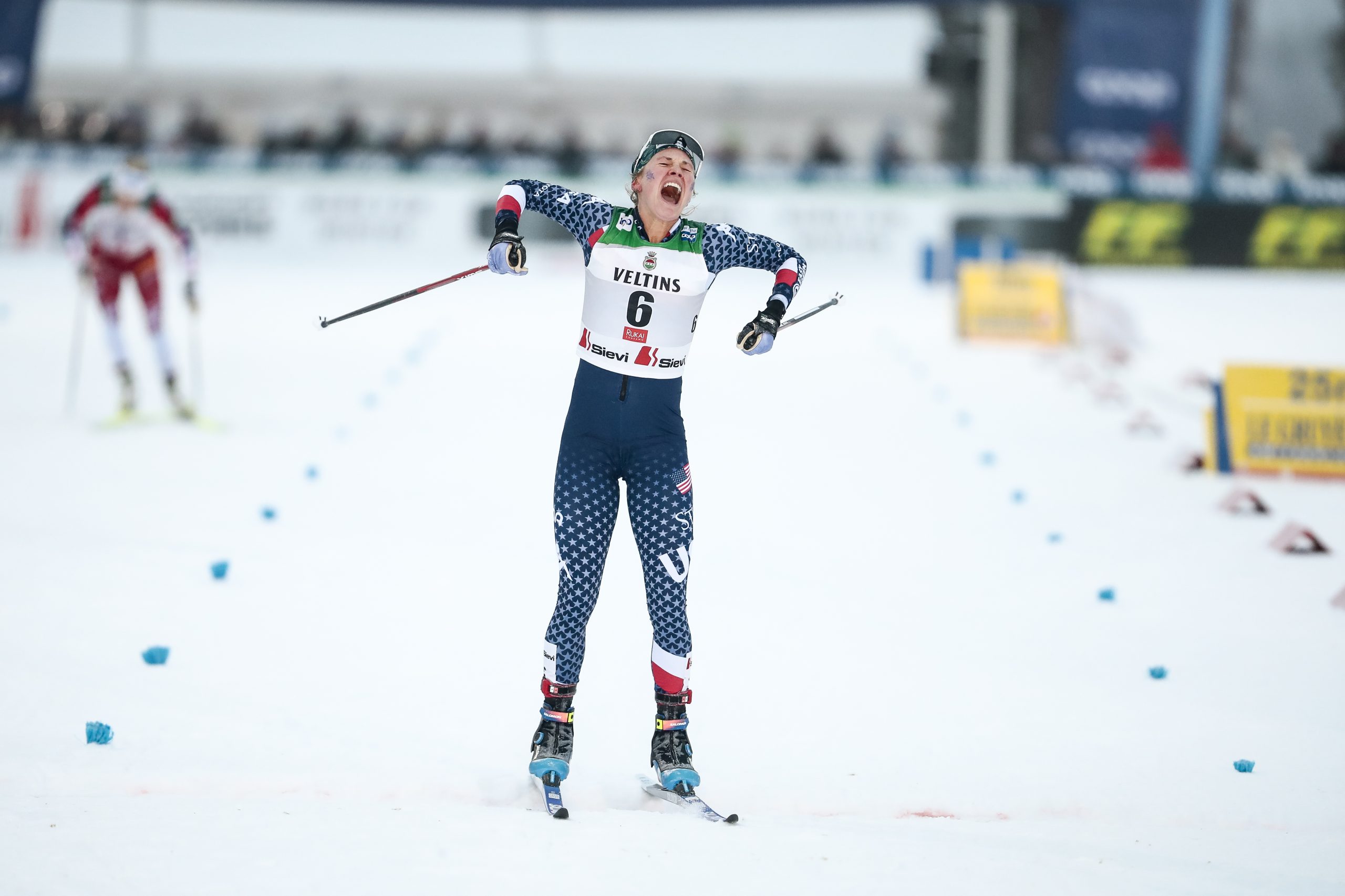
With Jessie Diggins (USA) now retired, there will be a new FIS Overall Crystal Globe and Tour de Ski champion next season (Photo: Vanzetta/NordicFocus)
Tour de Ski 2026/2027
The Tour de Ski returns to a three-country format, opening in Les Rousses, France, on New Year’s Day, moving to Oberstdorf, Germany, and finishing with three races in Val di Fiemme, Italy — capped, as ever, by the Final Climb up Alpe Cermis.
January 1-3, 2027: Les Rousses, France
01/01: Sprint Classic
02/01: 20km Mass Start Classic
03/01: 15km Pursuit Freestyle
January 5-6, 2027: Oberstdorf, Germany
05/01: 15km Mass Start Classic
06/01: 5km Heat Mass Start Freestyle
January 8-10, 2027: Val di Fiemme, Italy
08/01: 15km Skiathlon
09/01: Sprint Freestyle
10/01: Final Climb
Gus Schumacher (USA) and the rest of the US team will hope to continue their success in Toblach (ITA). (Photo: Modica/NordicFocus)
After the Tour, Before Worlds: Engadin, Toblach, Lahti
Three weekends bridge the Tour de Ski and the World Championships. Engadin opens its weekend with a mixed relay — a format the FIS has been working into more World Cup weekends — and Lahti closes the pre-Worlds stretch with its classic 20km skiathlon and 10km interval start.
January 22-24, 2027: Engadin, Switzerland
22/01: Mixed Relay
23/01: Sprint Freestyle
24/01: 20km Mass Start Freestyle
January 29-31, 2027: Toblach, Italy
29/01: 10km Interval Start Freestyle
30/01: Sprint Freestyle
31/01: 20km Mass Start Classic
February 12-14, 2027: Lahti, Finland
12/02: Sprint Classic
13/02: 20km Skiathlon
14/02: 10km Interval Start Classic
Kendall Kramer (USA) had a breakout World Cup Skiathlon in Falun (SWE) last season. (Photo: Authamayou/NordicFocus)
2027 FIS Nordic World Ski Championships: Falun, Sweden
The 2027 FIS Nordic World Ski Championships run from February 22 through March 7 in Falun, Sweden, with all title formats on the program. Falun last hosted Worlds in 2015.
Final Period: Oslo, Drammen, Ulricehamn
The closing stretch is a Scandinavian one. Oslo’s Holmenkollen weekend features back-to-back 50km mass start classic races on March 13 and 14 — long a fixture of the late-season calendar — before a one-day sprint stop in Drammen and the World Cup Finals in Ulricehamn, Sweden.
March 13-14, 2027: Oslo, Norway
13/03: 50km Mass Start Classic
14/03: 50km Mass Start Classic
March 16, 2027: Drammen, Norway
16/03: Sprint Classic
March 19-21, 2027: Ulricehamn, Sweden (World Cup Finals)
19/03: 10km Interval Start Freestyle
20/03: Sprint Freestyle
21/03: 20km Mass Start Classic
The calendar remains subject to FIS Council approval.
The highs were high and the lows were low in the Olympic team sprint in Italy, with the Ogden-Schumacher men’s team claiming silver and the Diggins-Kern women’s pair finishing out of the medals. Devon and Nat break the whole thing down.
We’ll be back after Saturday’s men’s 50 k. Reach us at devon[at]fasterskier.com and nat[at]fasterskier.com. We’re really grateful for all the support during the Olympics — thanks for notes and encouragement.
A reminder: This is a homegrown podcast done by two guys working long hours and late nights. We’re also paying real money to be here in Italy. If you can, support the show and FasterSkier’s ongoing coverage with a voluntary membership. We’re also offering a bonus during the Olympics: a WhatsApp group with notes on Nat’s experiences in Italy, the food he’s eating, interview transcripts and more.
Send nat[at]northernjournal[dot]com a confirmation of your voluntary membership and the number he should use for WhatsApp and we’ll get you signed up. You can also Venmo him directly at @nat-herz if a membership isn’t for you. We’re suggesting a minimum of $10, but we also won’t turn anyone away who wants to join because of an inability to pay.
Help Support Our Olympic Coverage!
FasterSkier will have our own Nat Herz on the ground at the Olympics, which, to be honest, is a very big financial lift for us. If you value the thoughtful work and access FasterSkier provides at championships like this one, please consider becoming a Voluntary Subscriber. Your support directly fuels the work we do to cover the people, places, and moments that make our sport special.
This article was made possible through the generous support of our voluntary subscribers who have helped us put our Nat Herz on the ground reporting at the Olympics. If you value coverage like this, please support FasterSkier with a voluntary subscription.
Jonna Sundling (SWE) follows Jessie Diggins (USA) during the Olympic Women’s Team Sprint in Tesero, Italy. (Photo: Vanzetta/NordicFocus)
PREDAZZO, ITALY — Eight years ago, on a different continent, the words “Here Comes Diggins!” by Chad Salmela vaulted American cross-country skiing into a new era. On Wednesday in Val di Fiemme, the event that changed everything for the United States returned to the Olympic stage.
The Women’s Freestyle Team Sprint has long been one of the Americans’ signature races. In the PyeongChang 2018 Winter Olympics, Kikkan Randall and Jessie Diggins delivered the nation’s first Olympic gold medal in cross-country skiing. Last March in Trondheim, Diggins and Julia Kern claimed World Championship silver.
On Wednesday, Diggins started the race in the first leg, handing off to Kern for the anchor leg, as they had in their previous medal run. They hoped for one more shared championship moment.
It was not to be. The Americans finished fifth, in a race that required not just fitness but flawless execution. Sweden’s Jonna Sundling and Maja Dahlqvist took gold. Switzerland’s Nadja Kaelin and Nadine Faehndrich secured silver. Germany’s Laura Gimmler and Coletta Rydzek won bronze after a late-race crash by Finland opened the door in the final turn.
For the Americans, the margin was not dramatic. But close, at this level, does not bring home a medal.
Jessie Diggins (USA) and Jonna Sundling (SWE), (l-r) come through the stadium during the Olympic Women’s Team Sprint. (Photo: Vanzetta/NordicFocus)
“Honestly, left it all out there.”
The Team Sprint is one of the sport’s most punishing formats. Two skiers qualify individually; their times are combined to determine which 15 nations reach the final. In that final, the athletes alternate laps — three each — on a course that offers no reprieve.
Often, one skier brings distance strength, and the other sprint speed. For the United States, Diggins and Kern blur those categories. Both are capable of driving pace. Both can finish.
From the gun, Diggins did what she has done throughout her career: she went to the front.
She and Sundling stretched the field immediately, driving into the Zorzi Climb, the race’s defining ascent. The early order — Sweden, the United States, Norway, Canada — hinted at the nations prepared to dictate terms.
Jonna Sundling (SWE) stretches her lead. (Photo: Vanzetta/NordicFocus)
When Sundling surged later in the race, Diggins expected it.
“I knew she was probably going to do that,” Diggins said afterward. “And I was like, just do the best that you can do. You know, like, you can’t control anything except your effort and your heart. And I was like, skiing out of my body, and I just did everything that I could, and I’m proud of that.”
That theme — control what you can — carried through her reflections.
“Honestly, I almost passed out like four different times,” she said. Then, clarifying: “No, from going that hard, no regrets. Honestly, left it all out there. I feel like we did everything we could, and that is the only thing you can control at the end of the day.”
Julia Kern (USA) and Jessie Diggins (USA), (l-r) gather in the finish area after the race, Diggins racing in the US team’s relay socks for the final time. (Photo: Barbieri/NordicFocus)
One final lap with ‘Relay Socks’
By the last exchange, Sweden had carved out daylight. Switzerland began clawing into Finland’s hold on silver. Behind them, Germany, Norway, the United States, and Finland battled for bronze.
On the final descent, Finland’s anchor, Jasmin Kahara, lost her balance in the sweeping right-hand turn and fell, sliding out on her stomach. Germany and Norway slipped past in their tucks. Kern, just meters behind, fought to the line, but the podium had narrowed to two.
Coletta Rydzek (GER) brings home the bronze medal for Germany with Norway’s Julie Bjervig Drivenes just off camera. (Photo: Vanzetta/NordicFocus)
As they drove for the line side by side, aerodynamically no-pole skating with everything they had, it was clear this was going to be close. Germany claimed bronze while Norway left empty-handed in fourth. Just behind, Kern brought the United States to the finish in fifth.
For Diggins, the moment carried a different weight. It was, by her admission, her last Olympic relay leg.
“I love racing with this girl. I’m so, so proud of her,” she said of Kern. “And, yeah, it’s emotional to feel like I’m never gonna pull on those relay socks again.”
When asked whether there was a sense of handing the event forward, she reflected on the arc of her career — from her first team sprint world title in 2013 to the growth of youth programs back home.
“It’s just really cool to be part of the evolution of American skiing,” she said.
Julia Kern (USA) and Nadine Faehndrich (SUI), (l-r) find their lines around a tricky corner. (Photo: Vanzetta/NordicFocus)
Whitcomb knows they can win
For Head Coach Matt Whitcomb, the analysis was candid and clear-eyed.
“Yeah, it was a good race,” Whitcomb said. “Of course, this is an event that we know we can win, and we didn’t today.”
In a format this tight, small imperfections are decisive.
“For even a bronze medal to happen, both legs have to be firing exquisitely,” he said. “We swung as hard as we could. We did our best. We were prepared to win today, and we just didn’t.”
Of Kern’s anchor leg, Whitcomb offered both empathy and affirmation.
“Julia is an incredible performer, and one thing you can always trust from her is that you’re gonna get her absolute best,” he said. “We saw it on the final climb. I was happy with how she climbed. Just didn’t quite have the entire thing today, and that’s okay.”
Jessie Diggins tags Julia Kern (USA), while Jonna Sundling tags Maja Dahlqvist (SWE), (l-r) in the exchange zone between laps. (Photo: Vanzetta/NordicFocus)
Diggins in the best fitness of her life
Diggins has raced these Games managing injury concerns, including rib pain after a fall in the opening Skiathlon. But when asked whether her fitness was lacking, she pushed back.
“I feel like I’ve come into this with the best fitness in my life,” she said. “And that’s one of the only things I could control.”
There is comfort, perhaps, in that certainty — in knowing preparation was not the missing piece.
“I was skiing out of my body,” she said. “And I just did everything that I could.”
In Olympic-level team sprinting, that is sometimes enough. On Wednesday, it was not quite.
But the American women did what Diggins described as the only thing you can in cross-country skiing: you have to leave it all on the course without regret.
FasterSkier will have our own Nat Herz on the ground at the Olympics, which, to be honest, is a very big financial lift for us. If you value the thoughtful work and access FasterSkier provides at championships like this one, please consider becoming a Voluntary Subscriber. Your support directly fuels the work we do to cover the people, places, and moments that make our sport special.
This coverage is made possible through the generous support of Marty and Kathy Hall and A Hall Mark of Excellence Award. To learn more about A Hall Mark of Excellence Award, or to learn how you can support FasterSkier’s coverage, please contact info@fasterskier.com.
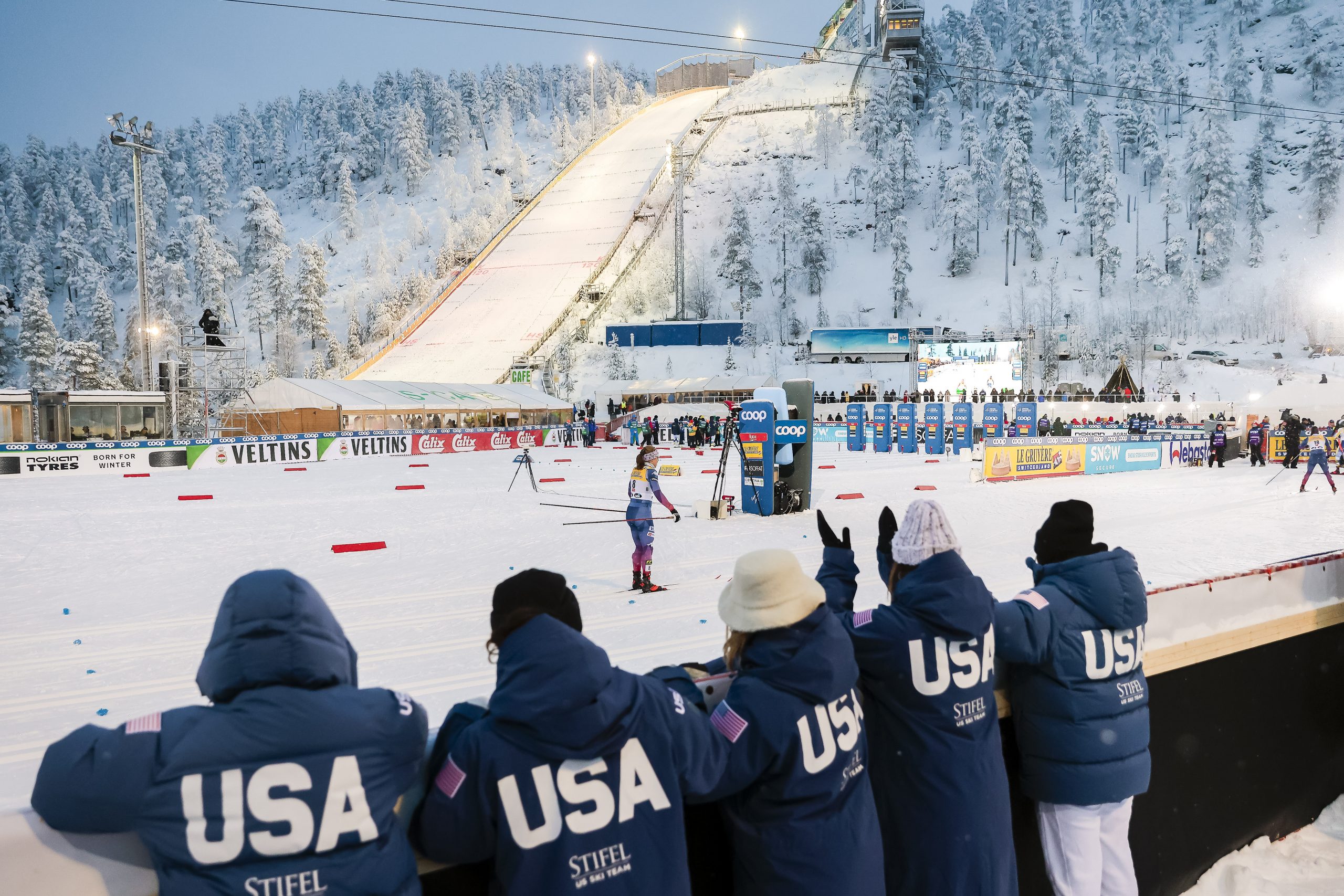
Aerial view of Ruka (FIN) this morning, with the start of the World Cup season less than a day away. (Photo: Modica/NordicFocus)
For six hours on Tuesday, the U.S. Cross-Country Ski Team watched Finland scroll past the windows of a northbound bus, the day’s thin slice of sunlight slanting low across the snow. The sun in late November never rises entirely above the horizon there—”maybe ten degrees,” Matt Whitcomb noted—and so the world outside was washed in a pastel light that never quite felt like midday. In that part of the Arctic, sunrise and sunset are effectively the same event.
That is the moment Whitcomb pays attention to every year.
“As it sets, as you’re driving in those first two hours of the bus ride,” he said, “it sort of feels like it’s the official close of the preparation season.” The athletes may have left Muonio only hours earlier, but that sunset marks a boundary: everything before is training; everything after is racing. “That’s it,” he said. “The prep season’s over. It’s time to race now.”
The bus carried all seventeen athletes—nine men and eight women—each holding a different version of readiness. Some were energized, some were still finding their legs, some were quietly anxious. An Olympic season magnifies everything. For veterans, this opener in Ruka is familiar and charged; for athletes on the bubble, the weekend marks the start of a two-month test whose outcomes will determine whether they get to ski in Italy in February.
But for one last window of time, before the waxing trucks and the bib pickup and the official training, the whole team was suspended in this Arctic twilight. It is a soft entry into what quickly becomes a hard world.
When the bus crested the final kilometers into Ruka, the athletes looked out the left side toward the hill that dominates the course—a climb they will race up and over repeatedly in the coming days. “Every year,” Whitcomb said, “that road goes right up the largest hill on the course… your first trip up that is in the bus.” The hill glowed under floodlights. Below it, the village looked like it had been placed inside a glass ornament. “It’s lit up like a snow globe around here.”
By the time the athletes stepped off the bus and into the cold, the World Cup season had begun.
Jessie Diggins (USA) was able to find another gear at the finish which no one could match to take victory in Ruka a year ago in the Mass Start. (Photo: NordicFocus)
What They Carry From Muonio
A week earlier, the team was skiing through air so cold it could freeze eyelashes. Muonio is remote even by Finnish standards, a strip of trails and cabins surrounded by deep quiet. The temperatures dropped to –5°F for the high and –10°F for the low, and the athletes masked up, moving carefully to avoid frozen lungs. No one did intensity that day; even the coaches agreed the cost wasn’t worth the risk.
And yet the camp was a success.
“It was right on the edge of being too cold,” Whitcomb said, “but we made it work. And nobody has residual coughing, so I think that’s the tangible indicator that we didn’t push too hard.”
More importantly, Muonio was calm this year. There were no lingering illnesses, no cascade of early-season injury setbacks. “This year has been a better year with regard to preparation,” he said. “We’ve had fewer long-term illnesses, fewer acute injuries.” In an Olympic season, where every missed week feels like a month, that is no small thing.
Muonio is the last place where the athletes can simply train, ski, nap, andrepeat. Once they arrive in Ruka, the season accelerates in a way no one can fully control.
Zanden Mcmullen (USA) coming to the line in Ruka in 2024. (Photo: Thibaut/NordicFocus.)
Ruka’s Glow and Ruka’s Pressure
Ruka is where the World Cup hardens into its proper form. The quiet trails of Muonio are replaced by a carnival of nations: wax trucks pulled side by side, technicians moving in practiced circuits, athletes from every powerhouse country striding around the stadium. For all teams, the opener reveals the truth of the summer: whose fitness is real, whose technique held up, whose body needs another two weeks before coming online.
“The moment we arrived here in Ruka,” Whitcomb said, “you start to see the waxing vehicles from other nations… the reality of it hits, and you could feel butterflies sort of emerge as a team.” Even the veterans feel it. “Munio last week was all about recovering from jet lag… and you arrive here, and it’s like: official training, then race, race, race. It’s go time now.”
He emphasized that the stress is not negative. Stress, in his framing, is a sign that something meaningful is at hand. “It’s indicative of the privileged environment that we live in,” he said. “We’re doing something important, something these athletes work really hard for, and something that they’re ready for—and that’s why they feel stressed.”
In an Olympic year, there is no such thing as a low-pressure opener.
The U.S. team looks on in Ruka in 2023. (Photo: NordicFocus)
The Team Within the Team
The most striking thing about this group, Whitcomb said, is not its athletic potential—though several athletes are carrying top-10 ambitions into the weekend. It’s the internal energy.
“It feels as supportive a team as I think we’ve ever had,” he said. “Not better, but certainly as good as any team we’ve ever had.” A year ago, he described a similar feeling, but something about the last month apart has deepened it. “They just vibe together,” he said. “They’ve really missed each other.”
From outside, the U.S. team can look like a logistical patchwork—athletes based in Vermont, Alaska, Idaho, Colorado, Norway; college skiers who drop in and out; development athletes rotating through Europe. But when they’re together, Whitcomb believes the culture gives them a competitive advantage.
“One of the privileges our nation has,” he said, “is that we are not as competitive as Norway is.” He doesn’t mean competitive in results—he means internally. In Norway, a single race in Beitostølen can determine whether an athlete gets a World Cup start or disappears back into domestic anonymity. “Literally that one race… has a lot of say in whether your winter is going to be successful,” he said.
In the U.S., the pressure comes from the Olympics, not from your teammates. “A positive team vibe really does some work for you,” he said. It prevents the “little stresses”—the ones that accumulate in toxic environments—from becoming overwhelming in an Olympic year.
“When the only stress you have to worry about is the silly one that is racing,” he said, “you can overcome that.”
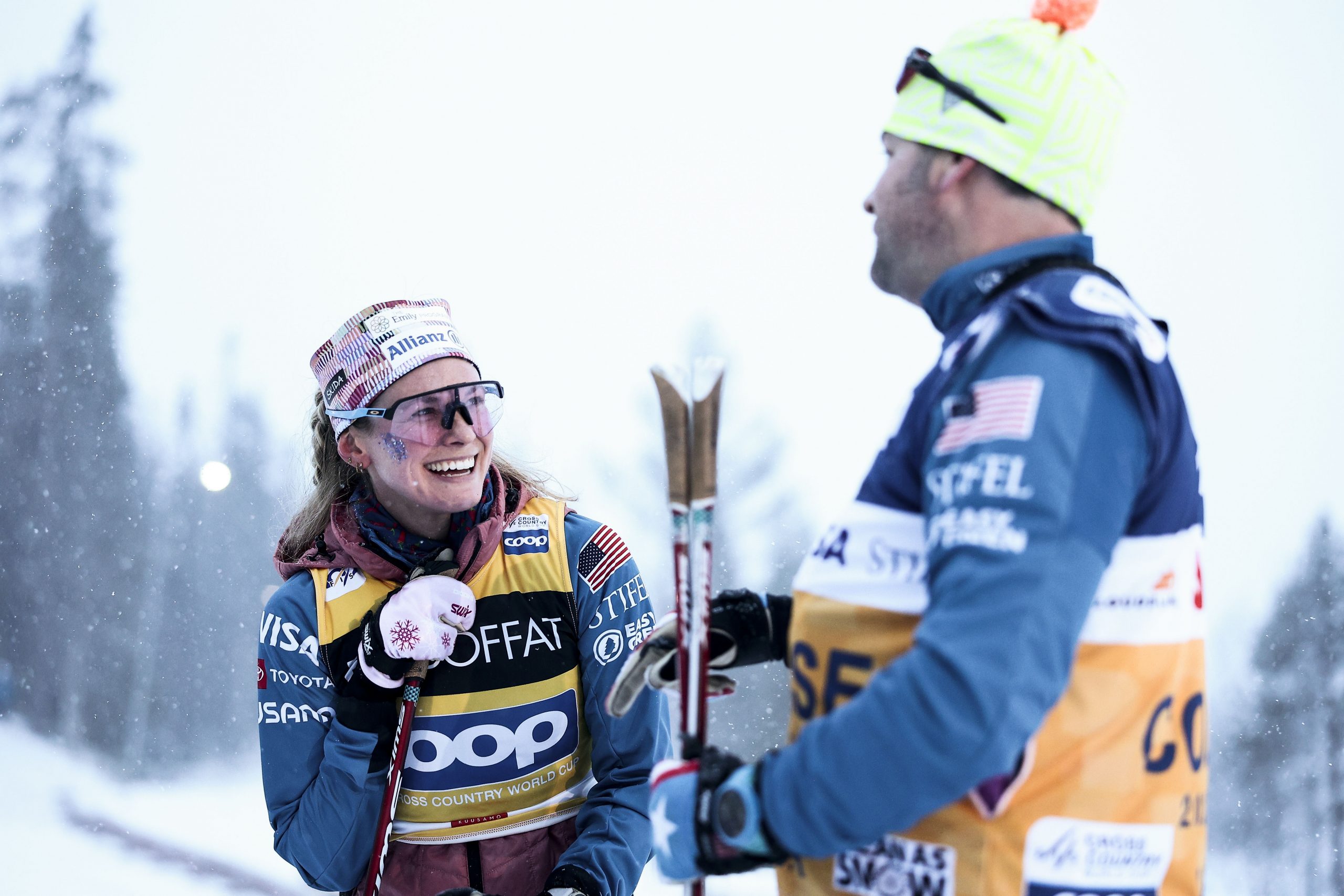
Jessie Diggins (USA) keeping it light with her coach, Jason Cork. (Photo: NordicFocus)
Olympic Stakes, Explained Clearly for Once
For athletes and coaches, the rules of Olympic selection are a map that everyone has memorized; for the public, they are a maze. Whitcomb walked through the system with the clarity of someone who helped write it.
There are three primary pathways:
1. Top-8 in an Olympic event on the World Cup
If an athlete finishes top-8—but only in a race that exactly matches an Olympic event—they automatically qualify.
Classic sprint in Trondheim? Yes.
20k Skiathlon in Trondheim? Yes.
10k skate in Davos? Yes.
Team sprint? No.
Any race similar but not identical (ie, the 15k Skiathlons)? No.
2. Top-45 on the World Cup ranking list (by Oberhof)
Any athlete inside the top-45 overall (distance or sprint, depending on discipline) meets the selection criteria. They still need a spot available, but their case becomes strong.
3. Discretionary selection
This exists—but is avoided whenever possible.
“To be candid,” Whitcomb said, “that’s a goat auction in itself.”
In an Olympic year, the staff prefers not to touch discretion at all.
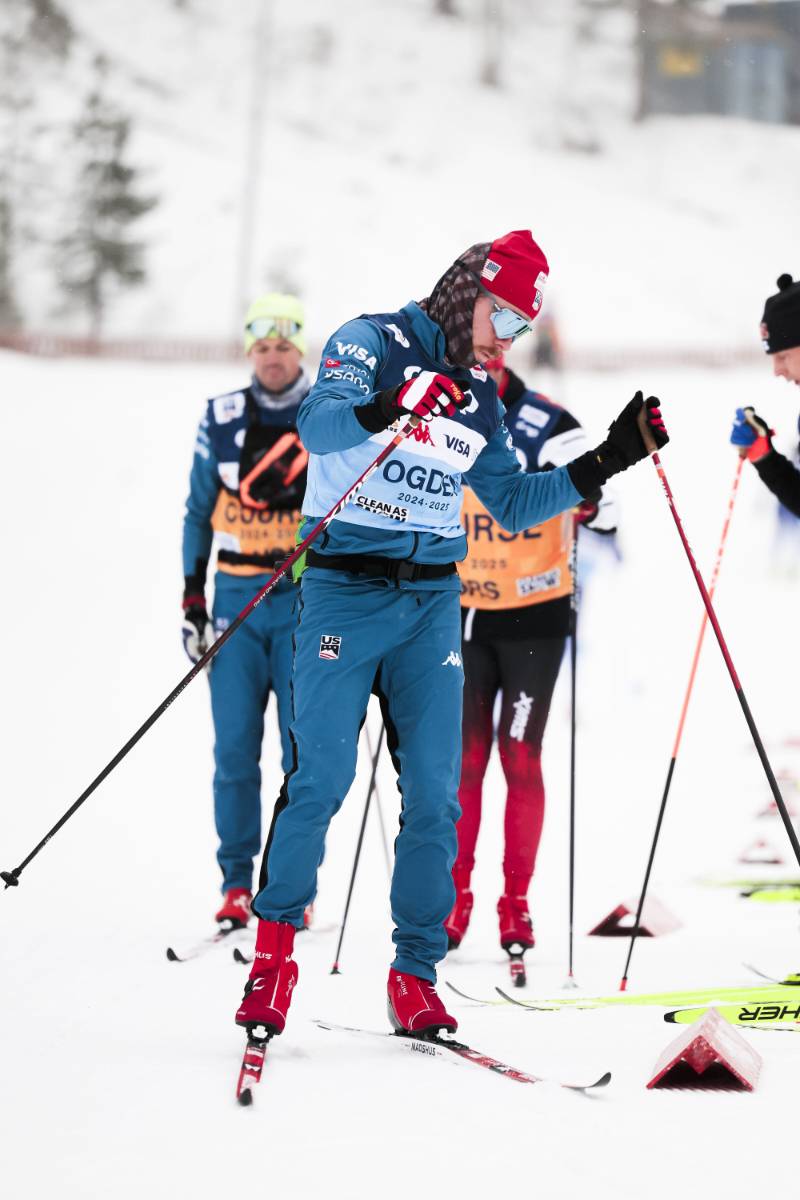
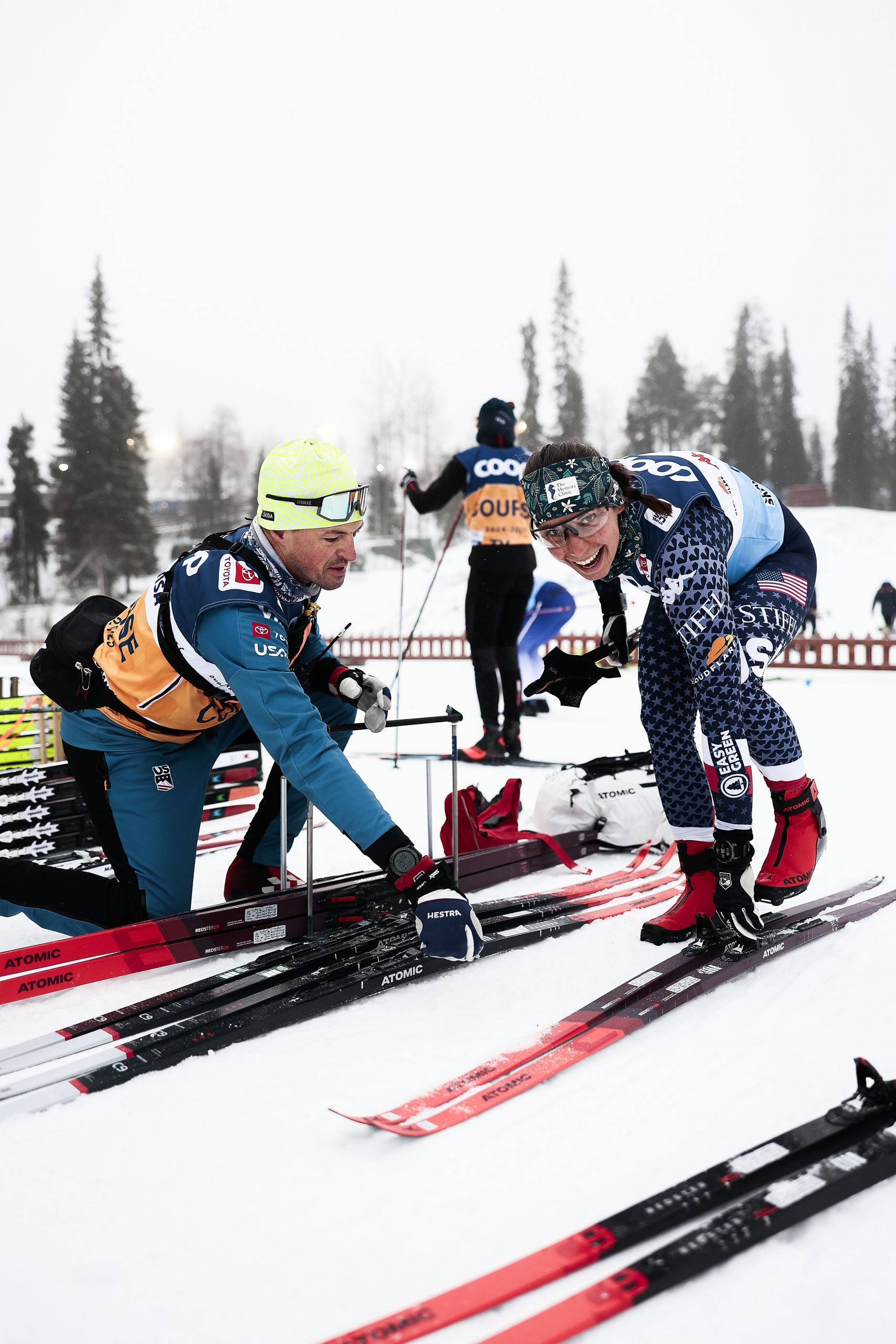
Ben Ogden (USA) working on ski selection on Thursday in Ruka (FIN) a year ago. (Photo: NordicFocus)
Roster limits
Right now, the U.S. holds seven men’s spots and eight women’s spots, with a realistic chance of earning an eighth men’s spot. It will not exceed 8 + 8.
Domestic results?
For someone skiing exceptionally well at Senior Nationals to force their way in, there must be vacancies left by athletes who didn’t meet criteria on the World Cup. In most years, Olympic qualification is won or lost by Christmas.
This is why every World Cup start in Period 1 matters. Every 12th place, every quarterfinal, every decent distance day contributes to the math.
But to Whitcomb, that math isn’t the point. It’s how athletes handle pressure that determines whether the season becomes joyful or claustrophobic.
“Meet Your Body Where It Is”
On Thursday night, in the team meeting before the weekend races, Whitcomb planned to give a simple message.
“You start that 10k, and you’re going up the first hill,” he said, “you just meet your body where it is. You do your very best that day.”
He wants the athletes to tune out the noise:
the coaches on the sides of the trail
the athletes they pass
the athletes who pass them
the crowd, the music, the reporting, the points
“You deal with the one vehicle that you’re driving,” he said. “And you try to enjoy it.”
Because fitness today doesn’t predict February.
Because the Olympic Games begin on February 7th, the only date that truly matters.
Because early-season expectations are a trap: some athletes are ready this weekend; others won’t feel themselves fully until the Tour de Ski.
“The human body,” he said, “is a wildly unpredictable thing.”
If there is one truth that governs the first weekend of racing, it is that.
Julia Kern testing her skis with her longtime tech, Eli Brown a year ago. (Photo: NordicFocus)
Why Ruka Still Matters
Still, the weekend is not symbolic. It is competitive, decisive, and formative. Whitcomb believes the team is “positioned well to have a great opener,” but he also knows that Ruka rarely tells the whole story of a winter. The temperatures are often frigid, and the travel is too recent. But it gives athletes one thing they cannot simulate anywhere else: the clarity of racing.
“Early,” he said, “but it can’t come soon enough. We’re really excited.”
Ruka is where the starting gun echoes for the first time, but it’s also where the season’s unseen forces begin working: confidence, doubt, momentum, cohesion, luck, health, andperspective. Many Olympic stories begin here without anyone realizing it until months later.
The First Night in the Snow Globe
By Tuesday evening, the team had unpacked their bags in the small condos near the stadium. By Wednesday, when we spoke, through Whitcomb’s thin door, we could hear athletes talking after dinner—laughing, telling stories, building team chemistry. “You can hear people probably through my door,” he said, because “they’ve really missed each other.”
Outside, the northern lights edged across the sky.
Inside, there were skis to prep, race plans to finalize, nerves to manage.
And in the morning, the first climb of the season would begin at the bottom of that hill they had ridden over on the bus.
There are a few actual rituals in a sport defined by travel and unpredictability. But in the U.S. team’s calendar, the bus ride to Ruka is one of them. It marks the line between the world that was and the one that’s about to begin. Between training and racing. Between imagining and knowing.
The sun had long since set, but the trail lights of Ruka glowed through the fog, warm against the cold.
The World Cup season officially starts tomorrow.
And for the U.S. team—healthy, united, a little nervous, and very ready—there is nothing left to do but ski.
Rosie Brennan (USA) dialing in her skis a year ago. (Photo: Modica/NordicFocus)
10k Interval Start Classic – Women at 4:30 am EST and Men at 7:15 am EST
November 29th:
Classic Sprint – Heats begin at 5:25 am EST
November 30th:
20k Mass Start Freestyle – Men at 4:00 am EST and Women at 5:45 am
Love Stories Like This? Help Keep Them Coming.
Feature interviews like this one take time, access, and care to produce. If you value thoughtful storytelling and independent ski journalism, please consider becoming a Voluntary Subscriber. Your support directly fuels the work we do to cover the people, places, and moments that make our sport special.
On the Wednesday before the World Cup season opens in Ruka, Jack Young sits in a small condo, looking out at over a foot of new snow that’s been drifting down all morning. The air is much warmer today than it was before he and the U.S. Ski Team loaded onto a six-plus hour bus ride yesterday — “Muonio was friggin’ cold,” he says — and the mood is calmer, quieter, the way he wants it. This is his final runway before an Olympic year truly begins, and he is spending it doing almost nothing.
Not nothing-nothing, of course. But nothing extra. No bonus minutes, no filler skis, no threshold for confidence, no volume for psychological reassurance. “The biggest thing right now is taking these two weeks absolutely as seriously as possible with rest and just not doing anything extra training-wise that I do not need to be doing,” he says. “I’m training so little right now because of how important Ruka and Trondheim are for me.”
Growing up in Northern Vermont, Jack Young had an All-American childhood. (Photo: Courtesy Photo)
Outside, the classic sprint course cuts through the forest — the first of two classic sprints in Period 1. They matter—more than they ever have. To make the Olympics, he must qualify. To qualify, he must have transformed himself into something he has never consistently been: a classic sprinter capable of making heats on the hardest stage in the world.
That he is even here, on the cusp of an Olympic selection fight, is strange enough. Stranger still is the way he got here — not built from the standardized American skiing pipeline but stitched together from its edges. A football quarterback. A baseball outfielder. A skier whose parents “didn’t know what Nordic skiing was.” A D3 athlete who reverse-engineered sprint training out of 800-meter track plans and the writings of a Swedish speed skater. A young man who kept such detailed training logs that, by the time he made the World Cup, he could begin writing his own plan.
In a sport that often rewards conformity, Young’s ascent is something close to a jailbreak.
Jack Young as he started his racing for Craftsbury. (Photo: Courtesy Photo)
A Vermont Childhood Without the Usual Skiing Script
“Neither of my parents knew what Nordic skiing was,” he says with a laugh. They loved the outdoors, yes — mountain biking, alpine skiing, the typical northern Vermont mélange of mud, woods, and winter — but their son’s athletic identity formed somewhere else entirely. “I played every sport. I loved baseball. I played basketball through elementary school. I started football as soon as I was allowed to, which I think was in fourth grade.”
He became the kind of athlete rural towns understand intuitively: the quarterback on fall afternoons, the center fielder chasing down balls in the summer dusk, the kid who could pick up anything and find competition in it. Skiing entered sideways, almost accidentally, through his sister Callie. She joined the small Nordic program in Newport, and he was brought along because that’s what families do — pack the car, hand over snacks, make it work.
“I immediately fell in love with racing,” he says. “I just love the competition.” Running around on skis made sense to him. Movement, speed, chaos — he could do that. But even with training days at Craftsbury beginning around sixth grade, he didn’t think of skiing as his primary outlet. “I wasn’t as focused as my sister was, but I would still get dragged along,” he says. “I loved skiing, but I loved football and baseball just as much.”
The irony — one he now sees clearly — is that he was training for skiing without realizing it. “All summer was spent doing fun things in the woods. We’d go to Craftsbury a couple of times per week. But I never thought of skiing as my main sport. I weighted those sports equally, even though I was putting a lot more time into skiing.”
If northern Vermont had offered a travel football club or competitive baseball without days of driving south, the story may have gone a different way. But mountain running and biking were nearby, and elite baseball diamonds were not. “I’d so much rather go for a long run in the mountains or go mountain biking than I would hit on the tee for two hours,” he says.
Sometimes this is what talent looks like in real time: a kid choosing the fun version of hard work without realizing he’s choosing a future.
When we spoke, Jack Young sat in a small condo in Ruka wearing a Boston Red Sox baseball hat, just added evidence for how important the game has been for him since he was a boy. (Photo: Courtesy Photo)
The Late Bloom: A Breakthrough and a Decision
He kept skiing in the winter, of course. Not obsessively. Not in the way some junior skiers live their lives by FIS points before they have a driver’s license. But enough to stay close. Enough to remain good. Then came the summer after his sophomore year of high school — the first time he trained like someone who had decided to see what was possible.
“I put a good summer of training in,” he says. “Had a bad football season… but that was the first time I was really starting to push the limit on what I could do training-wise while in season for football.”
He mountain-biked in races on weekends, squeezed workouts around football practices, and tried to make the whole geometry hold together. Then came Junior Nationals, and with it, proof. “I had a pretty good result in the sprint. I think I was like 18th or something… and that was the moment where I was like, okay. I am decent at least at this sport. I’m doing a lot better than I’ll ever be at baseball.”
That spring, Young emailed coaches — the NESCAC schools, Dartmouth, and UNH. Bowdoin and Dartmouth joined Colby on his shortlist. Colby won on something less quantifiable: belief.
“Tracy [Cote] was very excited about me,” he says. “And I think that resonated with me. Maybe it’s my ego, but it was nice to hear.”
He would later call it “a perfect decision.”
Jack Young enjoying some backcountry skiing in Jay. (Photo: Courtesy Photo)
Colby: Building an Athlete in a Place That Shouldn’t Have Worked
Winters in college can blur into one another — classes, training, snow, the strange mix of exhaustion and euphoria that defines 19-year-old life. But Young remembers his freshman fall with clarity: meeting people, finding balance, doing “good, not great” training, and then, once the season started, traveling west for Senior Nationals.
There, in Soldier Hollow, everything sharpened. “I think I qualified in the top 20 in the skate sprint,” he says. “That was an absolutely massive result for me. I never had anywhere near that level of success on the national level.”
He didn’t transform overnight — not yet. His sophomore season brought a “fine college season,” a top-30 at NCAAs in the 10k skate, and the sense that distance skiing was finally, mercifully making progress. But the turning point came not in results but in imagination. He learned that the U.S. would receive twelve start spots for the Canmore World Cup the following year. Twelve starts. “I was like, 12 starts… that’s not that far off,” he says. “I kind of feel like I’m in contention for that.”
To chase it, he would need to master something specific: the sprint qualifier.
And this is where the story breaks from the template completely.
Jack Young hits some big lactate numbers during a hard training session. (Photo: Courtesy Photo)
Reinventing Sprinting from Scratch
“I’ve always thought that sprint qualifiers were really similar to an 800-meter race on the track,” he says. Physiologically, mechanically, conceptually — they looked more alike than different. So he dug into 800m training. He looked for the extreme version, the distilled essence of what sprinters do when they train specifically for the thing that matters. Qualifiers are discrete. Defined. Precise. Why train them like a generalist?
Then he read Nils van der Poel.
The legendary Swedish speed skater’s manifesto, How to Skate a 10k, isn’t a skiing manual, but to Young, it may as well have been scripture: the idea of building huge aerobic capacity, then sharpening with brutally specific intervals at exact race pace. “He wants to skate as many possible laps at world record pace as possible,” Young says. “And that really struck me. I’m like — I can apply this to skiing.”
He wasn’t going to become a single-event specialist, not in college. But he could take the principle and adapt it. So he built a sprint-qualifier program composed of things like:
6 × 1 minute
4 × 90 seconds
10 × 30 seconds
8 × 45 seconds
All at precisely what he believed to be his sprint qualifier pace.
“That was the bread and butter,” he says. “I’d do those workouts once or twice a week. I didn’t actually find them that strenuous, but I was accumulating a good amount of time at exactly what I thought sprint qualifier pace was.”
He went completely dry that fall — no beer, no casual nights out, nothing that compromised sleep. “I was just recovering a lot better all the time,” he says. “I didn’t get sick at all.”
Meanwhile, Colby head coach Tracy Cote allowed him to blend his ideas into the fall plan. “We were working together. I think we ended up writing the training plan together that fall,” he says. “She was pretty stoked about the focus on recovery… and she’d let me get away with doing things a bit more geared towards sprinting.”
He trained more overall, too — a heavy summer that gave him the resilience to handle so much intensity once fall arrived. “My freshman year, I trained a little under 600. Sophomore year was around 650. My junior year I trained like 750 or something.”
This was not an American development pipeline approach.
It was an experiment.
A smart one.
A successful one.
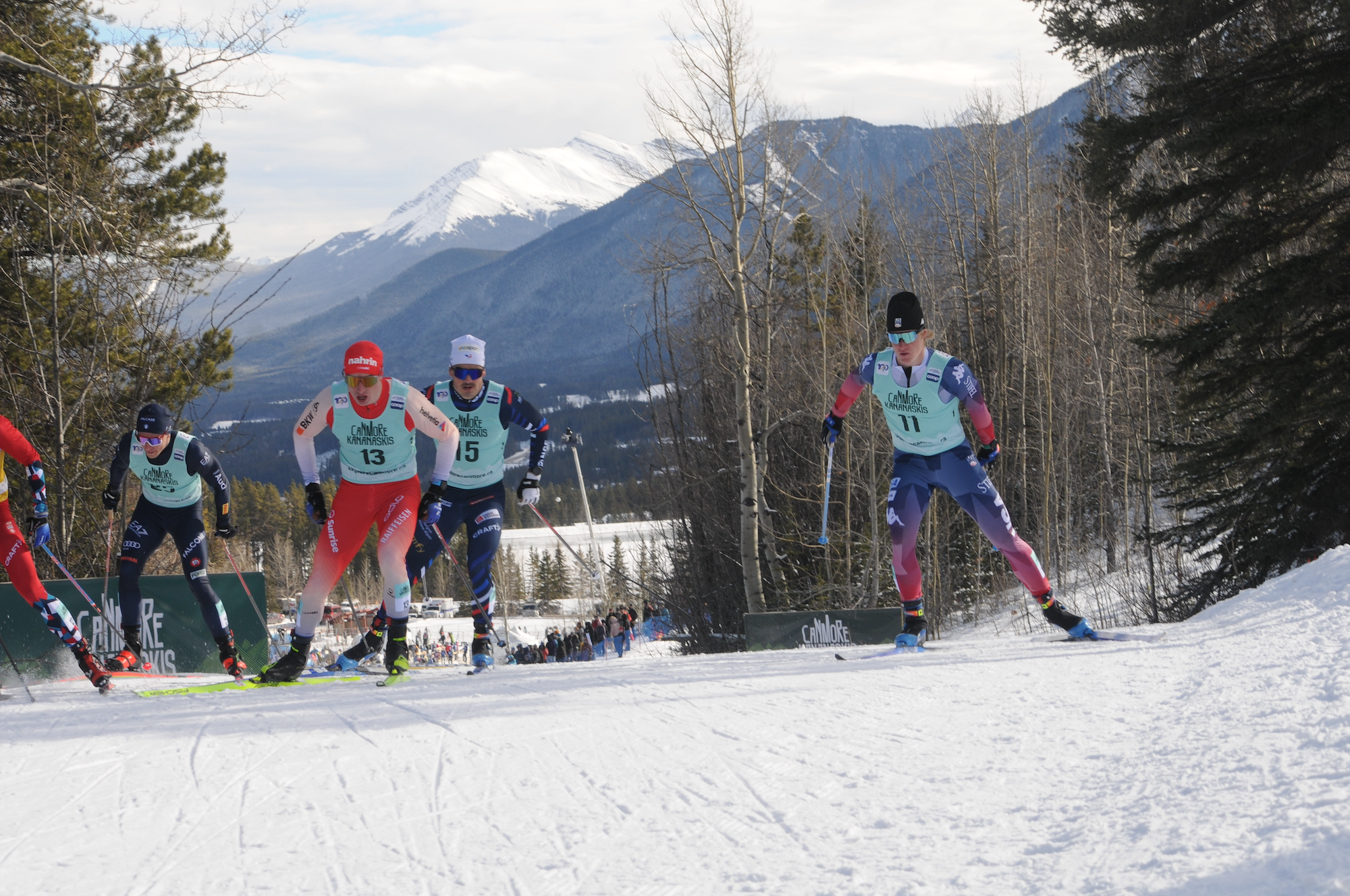
Jack Young, who a week earlier had a 3rd and 5th place in the EISA college races for Colby College delivered the 11th fastest qualifying time in the freestyle sprint at the Canmore World Cup in 2024. (Photo: Cockney/FasterSkier)
Anchorage, SoHo, Canmore — and the Race That Changed Everything
He targeted Anchorage for his first chance at the Canmore World Cup spot. He knew what he had to do: fly across the country in the early winter, race well, then perform at Senior Nationals in Soldier Hollow. Anchorage was the linchpin.
“I went into Anchorage with a lot of confidence,” he says. “I won that qualifier; it was such a surprise.”
He didn’t replicate the magic at Soldier Hollow — “I think I got like 11th” — but the Anchorage win held. He made the Canmore start list.
And then came the race of his life.
“That’s still my lowest FIS points ever,” he says. “I didn’t match that last year.”
When he crossed the line, something shifted internally. “Once I did that in Canmore… that was the first time I really thought I wanted to keep skiing after college,” he says. “That was the moment I realized how good I thought I could get.”
Call it the ignition point, the place where belief calcified into ambition.
Where a multi-sport kid from a non-skiing family, attending a D3 school, doing self-designed intervals, suddenly saw himself in a World Cup heat map and thought: Yes. Here.
Jack Young training on Eagle Glacier this past summer. (Photo: Courtesy Photo)
Writing His Own Plan on the World Cup
Two years later, he is living in Europe, often for months at a time. He is in his second year of racing full-time on the circuit. He is older, stronger, andmore certain. And he is, in many ways, coaching himself.
“For this time of year, it’s entirely guided by what I’ve done the last two years,” he says. “Which workouts worked in which places, which workouts didn’t… the comments are much more important than the hours.”
He still works closely with Pepa Miloucheva at Craftsbury — “She’s the number one on that” — but when he’s on the World Cup, he is the primary author of his training. He reads his patterns. He analyzes sensations. He looks for the combinations of stress and stimulation that make him feel dangerous on race day.
He isn’t reinventing his body now — he’s listening to it.
The independence he cultivated at Colby has become his competitive advantage.
With the Olympic sprint being in the classical technique, Jack Young (USA) hopes to find the form he has historically shown in freestyle sprinting during the early season World Cup stops. (Photo: Modica/NordicFocus)
The Classic Sprint Problem — and the Olympic Dream
To make the Olympics, the math is simple, even if the execution is brutal.
“The simplest answer is: make a big jump in classic sprinting,” he says. “If I can start qualifying for classic sprints consistently, I have a very clear path to making the Olympics.”
Last year’s results would meet the published criteria — “hypothetically, if I had the exact same season… I would technically make the team,” — but this year is different. The Olympic sprint is classic. Period 1 has two classic sprints and only one skate sprint. Some of the contenders for Olympic spots are stronger in classic than he is.
So the path is narrow: qualify in Ruka. Qualify in Trondheim. Hold form in Davos. Don’t step back. Don’t stagnate.
At the philosophical level, the criteria are simpler still.
“It’s all about execution at this point,” he says. “A good season is continuing with progress I’ve made… scoring more World Cup points than I did last year. Anything else is a step back.”
He knows progress isn’t linear. He knows failure is part of sport. But he also knows what a step backward would feel like. “I’d be lying if I said I could look at this season as successful if I don’t maintain what I’ve been doing in skating and at least make a little bit of progress in classic skiing.”
It is clear-eyed. Unsentimental. The kind of assessment you get from someone who has built his career on self-honesty.
Jack and his sister Callie after winning a slow pitch softball tournament. (Photo: Courtesy Photo)
What It Means to Make It This Way
There’s a certain poetry in the fact that Young’s rise mirrors the very way he races: a precise, deliberate accumulation of moments. Nothing in his career came from the prescribed steps, the standard routes, the familiar trophies of a groomed junior-star life. Instead, his path looks more like a map drawn after the fact — connecting points that didn’t seem aligned until the picture emerged.
A sister’s Craftsbury workouts.
A baseball-heavy early adolescence.
Mountain biking and football collisions.
A D3 program that let him try things.
A manifesto by a Swedish speed skater.
A dry collegiate fall at age 20.
A logbook of sensations.
A day in Canmore.
A belief.
There is no template for this. There never was.
But here he is anyway — on the World Cup, in an Olympic year, taking the biggest swing of his life.
And as he sits in a Ruka apartment, resting more than he ever has before a race that matters more than most, he reflects not on what’s missing from his résumé but on what got him here in the first place: a way of building a skier that is his alone.
Love Stories Like This? Help Keep Them Coming.
Feature interviews like this one take time, access, and care to produce. If you value thoughtful storytelling and independent ski journalism, please consider becoming a Voluntary Subscriber. Your support directly fuels the work we do to cover the people, places, and moments that make our sport special.
Norway’s Astrid Øyre Slind grew up in a skiing family and has been competing her whole life. But she didn’t break through at the highest level, on the international World Cup circuit, until her mid-30s. She’s now been a top competitor on the World Cup for the past two seasons and is expected to be a major contender at the Olympics this winter, and she joins Devon and Nat for an interview.
Questions? Feedback? Suggestions for guests? Email us: devon[at]fasterskier.com and nat[at]fasterskier.com.
This article was made possible through the generous support of our voluntary subscribers. If you would like to see more articles like this one, please support FasterSkier with a voluntary subscription.
The Norwegian men are in a league of their own—but when a league is contested by just one team, will fans still watch?
Fans wave flags at the 2025 World Championships in Trondheim. (Photo: Stuart Harden/FasterSkier)
TRONDHEIM, NORWAY – As the morning gales gave way during last Thursday’s men’s 4×7.5 kilometre relay, the crowds at the Trondheim World Ski Championships picked up steam until Granåsen stadium was fit to burst. And burst it did: Fans cheered in unbridled, patriotic delight when Johannes Høsflot Klæbo sailed into the stadium in first place hoisting a full-size Norwegian flag.
In truth, Norway’s win was written before the athletes even hit the start line: The Norwegian men have stood atop the podium in seventeen of the last eighteen relays. If one can look past Klæbo’s mind-bending Championship tally of six for six gold medals, the depth and dominance of the Norwegian mens’ team comes into focus — until Sweden’s William Poromaa broke the spell with an impressive second place finish in the 50-kilometer, they were just one silver medal away from sweeping every single distance podium at the Championships.
The country’s fans and media are increasingly anxious that this level of Norwegian dominance threatens the future of international cross-country skiing. Many pundits and people in the grandstands are convinced that fewer young Norwegians are interested in international ski racing, and that the sheer strength of the Norwegian men’s team is partly to blame.
Simon, Nina, and Tor Erik are locals taking in this week’s races (Photo: Stuart Harden/FasterSkier)
Simon lives a few minutes walk from the ski centre and has tickets for the whole week of competitions. He sums up the state of men’s skiing in a few words: “It’s all about Norway. It’s about Klæbo.”
One of his friends, Nina, chimes in with a familiar refrain: “it’s bad for the sport.”
Simen Hegstad Krüger himself isn’t blind to the consequences of such a lopsided competition. “In the long term,” the Olympic gold medalist admits, “I think it’s better when it’s some change on the podium.”
Simen Hegstad Krueger battles through heavy snow in the men’s 10 kilometre interval start on Tuesday (Photo: Aidan O’Donnell/FasterSkier)
To be sure, other nations aren’t at their best in Trondheim. The French men are flagging, their sprint stars notably missing from the podium. The absence of Finland’s Iivo Niskanen’s clearly blunted the drama of the 10-kilometer classic race. And, despite two bronze medals so far, Edvin Anger and the other Swedish men are still short of their long-promised redemption.
Meanwhile, on the women’s side of the competition, one can’t help but worry that an inverse story of Swedish domination is taking shape. Ebba Andersson and Jonna Sundling each have a hand on the women’s crown, with Sundling making an especially strong case for the title “Queen of Trondheim”: She has medaled in every race of the four she has started, winning three of them.
Jonna Sundling takes over from Ebba Andersson on the way to victory in the women’s 4×7.5 kilometre relay (Photo: Aidan O’Donnell/FasterSkier)
Viewership data collected by the International Ski Federation, or FIS, appears to support the notion that an unbeatable team turns off spectators. Norway — which ranks fourth in international viewership behind Sweden, Germany, and Finland — saw a 10% decline in TV World Cup viewership between 2023 and 2024.
This year’s World Championships are all but guaranteed to drive TV viewership back up in Norway. Indeed, it’s no secret here that whenever the sport’s popularity threatens to dip, the Norwegian Ski Federation relies on events like this to jumpstart hype and participation. Which then begs the question: If a competitive field is so crucial to FIS’ television ratings, when will the United States and Canada have their own chance to host a World Ski Championships to encourage growth in North America?
International Ski Federation statistical reporting shows that fewer Norwegians watched World Cup Competitions in 2024 than in the year previous (FIS/Nielsen Media Research AS)
Despite word on the street and speculation in the broadsheets, there are more factors that affect skiing’s TV ratings than simply the Norwegian men’s results. Indeed, judging by Norwegians’ compulsion to discuss the topic, it seems that their second favorite national pastime after skiing itself is debating whether their chosen sport is dying — and who exactly is killing it.
Fans in Trondheim have pointed out that since Norway’s national broadcaster, NRK, lost the rights to air international ski racing in 2021, people have been reluctant to pay the subscription fees required to follow World Cup racing on other channels. Their fear now is that the recent move by FIS to centralize international broadcasting rights hurts any prospect that free-to-watch World Cups may return.
Other frequently cited causes for the apparent decline in skiing’s popularity are the increasing costs of racing and the shortening of winters due to climate change.
Brothers Vegard, Magnus, and Howard Graesli watch the first lap of the women’s skiathlon. They blame shorter winters, expensive equipment, and the reallocation of media rights away from the state broadcaster for the decline in skiing’s viewership in Norway. (Photo: Stuart Harden/ FasterSkier)
But not everyone buys the doom and gloom narrative. Martin Løwstrøm Nyenget, from his vantage point on the skiathlon and relay podiums, says that the sky most certainly is not falling. He chalks up the talk of declining viewership and participation to media spin.
Nyenget says that “it’s been popular in Scandinavia — and especially Norway — to write in the negative and to tell that the popularity is going down. But it doesn’t seem like it’s completely the truth.” He points to the blockbuster crowds in Trondheim as a testimony to the sport’s vitality.
“You see here around the track during the championship, it seems like it’s still a popular sport,” he said.
Martin Nyenget skied away with the men’s 4×7.5 k relay for Norway last Thursday. (Photo: NordicFocus)
The Norwegian men say that, in the end, they are just doing their job the only way they know how to: without compromise.
Krüger puts the onus on other nations. “The other guys need to step it up,” he said. “We have a really strong team and, for sure, we are just pushing as hard as we can to be the best and to be on top.”
For those keen for some cultural entertainment, on Thursday, Trondheim’s Nidaros Cathedral hosted the World Championships concert. Backed by a string ensemble, the Nidaros Girls’ Choir performed folk songs and modern compositions in the packed 11th Century gothic cathedral.
Nidaros Cathedral (Photo: Stuart Harden/FasterSkier)
On Thursday night, at the site where Norwegian monarchs have been crowned for centuries, the nave echoed with the lyrics: “At the World Championships, I show up with a ticket in my back and color film. I want a world champion, tough and harsh and narrow-hipped. Yes, a world champion is my ideal.”
Other pieces performed at the concert included the themes for the 1966 World Championships in Oslo, the 1997 World Championships in Trondheim, and the 1994 Olympics in Lillehammer (Photo: Stuart Harden/FasterSkier)
Perhaps, then, it is a more ephemeral variable that best explains why Norwegian men are so damn good at skiing.
Nyenget agrees: “I think the culture is the main factor for the good results. It’s almost like, for the Norwegian team, it’s not only the results that are okay. It’s the top of the podium.”
This sentiment should sound familiar to Canadians, who have notoriously high expectations of their junior national hockey teams. And, like Norwegians, Canucks don’t turn off the television when their team goes on a winning streak — they cheer all the louder.
So, while a World Championships on Norwegian soil offers a welcome boost to the profile of cross-country skiing, it seems that the jury is still out as to whether Klæbo and company are killing the sport in the long run. For now, then, ski fans may as well enjoy the spectacle on offer from Klæbo and his merry band of VO2 monsters.
This reporting costs money. Please support this coverage with a voluntary subscription (below) so FasterSkier can provide this level of access to the sport we all love year-round.
This reporting costs money. Please support this coverage with a voluntary subscription (below) so FasterSkier can provide this level of access to the sport we all love year-round.
Johannes Høsflot Klæbo enters Søstrene Karlsen, the club where he celebrated his medal winning performances at the World Championships in Trondheim, Norway. (Nathaniel Herz/FasterSkier)
TRONDHEIM, NORWAY — Johannes Høsflot Klæbo, the Norwegian gold-medal winner of all six competitions at this year’s World Championships here, was refreshingly blunt when asked about his plans to celebrate.
“You need to remember that I’m allergic to gluten, so I don’t drink much beer,” he told an audience of reporters at a news conference following his last race. But, he added: “If you ask me about vodka-Red Bull, it’s a little bit different.”
The 28-year-old went on to describe his monk-like lifestyle in the leadup to the highlight of his career: a World Championships in his home city.
Traveling with his manager-father 150 days a year. No partying since last spring. Two-and-a-half months eating chicken and rice.
“I have really been putting all the energy into these six races,” Klæbo said. “So, I think I will find something else to eat, and I will find something else than water to drink.”
I didn’t think much more about those comments until 9:45 p.m. that evening, when I was walking to the tram home from a (single, non-alcoholic) beer with some friends in Solsiden, a trendy Trondheim neighborhood of shops and bars in a redeveloped shipyard.
Half a block into my walk, I recognized a Norwegian reporter, posing for a portrait on a dimly lit pedestrian bridge over the harbor — a decidedly strange image for a Saturday night. Herman told me that Klæbo’s publicist had informed him and a few other Scandinavian reporters of the location of the victory party. And he and his photographer were testing the lighting while they waited for Klæbo’s arrival at 10 p.m.
Scandinavian reporters and photographers stand outside Søstrene Karlsen on Saturday night. (Nathaniel Herz/FasterSkier)
I quickly checked the tram schedule: There was another one in an hour. So I decided to stick around for what was starting to feel like a bit of a stakeout in front of Søstrene Karlsen — a club that, one of the reporters told me, is a hangout for Trondheim finance bros and, occasionally, some celebrities.
A thudding bass line played from the second floor; 50 sharply dressed Norwegians waited for a bouncer to let them in.
“The drunkest one is up there already,” one of the reporters said, pointing to a second floor balcony where Erik Valnes, one of Klæbo’s medal-winning Norwegian teammates, swayed unsteadily.
While we waited, I discussed the post-championships party vibe with the assembled Scandinavian press corps, which numbered about a dozen. One of them, whose newspaper forbids him from being quoted by name, told me that he completely understood why the athletes would want to unplug after the races, which had drawn wall-to-wall media coverage and tens of thousands of Norwegian fans.
“So much adrenaline, so much running through their head for so long. It’s best to just get drunk and not think about anything,” the reporter told me. “Think about the pressure they’ve been under.”
A few minutes later, Klæbo’s father, Haakon, arrived, looking ebullient in jeans and a puffy blue Craft jacket. Then came a group of former Norwegian superstars: retired Olympic gold medalist Martin Johnsrud Sundby looking dapper in a black felt jacket; marathon racer-turned TV commentator Fredrik Aukland.
But, as the clock ticked past 10:30, still no Klæbo — even as the crowd of waiting reporters grew.
The Scandinavian press follows cross-country skiing with a fervor much like the American media’s enthusiasm for professional football, and the end-of-season athlete celebration is a subplot that draws particular fascination.
Norwegian and Swedish athletes seem to be an especially hard-partying bunch, as do the Brits.
“I’m going to find some beer and drink a lot of it,” Andrew Musgrave, a United Kingdom skier, told the Swedish tabloid Expressen after his last race of the championships.
A Haitian skier, Stevenson Savart, even stopped on the side of the trail in the middle of Saturday’s men’s 50-kilometer event to take a drink from a beer offered by fans, then dropped out of the race.
Not everyone on the World Cup circuit, though, was ready to let loose, with members of the U.S. team in Trondheim exercising notable restraint.
“This is the extent of the partying,” American Gus Schumacher, 24, said Sunday, holding the single empty can of the beer he consumed while watching the last event of the championships, the women’s 50-kilometer race. His teammate, Luke Jager, said his primary method of celebration was playing three hours of a video game, Call of Duty.
“Right now, all I can think about is laying in bed,” an exhausted Julia Kern, one of Schumacher’s teammates, said just after finishing the 50-kilometer event. Heavy drinking, she added, seemed off the table. “I’ve been having really tricky stomach issues, so I can’t even fathom putting anything like that in my body right now,” she said. “I’m so far gone that it’s not even appetizing at this point.”
American Julia Kern at the end of Sunday’s race. (Federico Modica/Nordic Focus)
Kern said she didn’t have time to celebrate her silver medal earlier in the week that she won in the team sprint event, where she was paired with U.S. star Jessie Diggins.
“You don’t really have time. You get funneled from media to straight to the awards ceremony,” she said. “I think we really had our eye on all the future competitions to come.”
Kern said she does hope to take time to commemorate the medal with Diggins, likely with some non-alcoholic ginger beer, in the coming week.
But the Norwegians wasted no time in moving on to the stronger stuff.
Just before 11 p.m. Saturday, Klæbo finally showed up at Søstrene Karlsen, arriving on foot with his girlfriend, Pernille Døsvik.
There were screams from the assembled crowd; the scramble for photos was so intense that a reporter got knocked over into a fence.
Klæbo and Døsvik were allowed to cut the line and were shown inside. A few seconds later, they emerged, led by Valnes, on a staircase leading to the second floor. A door opened, they entered, and a few seconds later, a huge cheer erupted.
That was all the reporters would get. Except for me.
The next morning, I awoke to a selfie sent by one of the friends I was staying with.
They’re a group of avid ski fans who traveled to Trondheim that I’ve been referring to as the “unleashed dads” of Anchorage. Unbeknownst to me, one of them, Andrew Kastning, had gained entrance to the club and, in the early hours of Sunday morning, had captured a dimly lit photo of himself with Klæbo just over his shoulder.
Andrew Kastning’s selfie with Johannes Høsflot Klæbo at Saturday night’s victory party.
On my way out of the house and up to the competition venue for the women’s 50-kilometer race, I busted into Kastning’s room, where he was still groggily tucked under a duvet. He recounted his time at the club, where he’d arrived with some Norwegian friends he made during Saturday’s race.
“I didn’t know where they were taking me, really. But then we showed up and Jan Thomas Jenssen was there,” Kastning said, referring to one of the Norwegian competitors at the championships. “And then they all just started rolling in.”
What was your feeling? I asked him.
“About being there, in the scene of greatness? It was fucking amazing,” Kastning said. “It was so goddamn cool. I had to snap a fan selfie just to make sure I remembered it.”
As for Klæbo? The hero of Norway was “less excited than I would be if I’d won six gold medals,” Kastning said. Sober, with some smiles at times.
Valnes was perhaps having a little more fun. Kastning said his new Norwegian friend, Sondre Elvebakk, had dressed up as Valnes — wearing a hat from the skier’s hometown of Tromsø, with a vest and a speed suit.
As Elvebakk was asserting his feigned identity to a woman at the club, Valnes himself “rolled right around the corner.”
“I’m like, ‘Sondre might have a problem here,’” Kastning said. “The real Erik Valnes just stood up.”
Erik Valnes, standing, parties Saturday night with Sondre Elvebakk and an unidentified woman at Søstrene Karlsen. (Courtesy Andrew Kastning)
This reporting costs money. Please support this coverage with a voluntary subscription (below) so FasterSkier can provide this level of access to the sport we all love year-round.
This reporting costs money. Please support this coverage with a voluntary subscription (below) so FasterSkier can provide this level of access to the sport we all love year-round.
This reporting costs money. Please support this coverage with a voluntary subscription (below) so FasterSkier can provide this level of access to the sport we all love year-round.
This reporting costs money. Please support this coverage with a voluntary subscription (below) so FasterSkier can provide this level of access to the sport we all love year-round.
This reporting costs money. Please support this coverage with a voluntary subscription (below) so FasterSkier can provide this level of access to the sport we all love year-round.
This reporting costs money. Please support this coverage with a voluntary subscription (below) so FasterSkier can provide this level of access to the sport we all love year-round.
This reporting costs money. Please support this coverage with a voluntary subscription (below) so FasterSkier can provide this level of access to the sport we all love year-round.
This reporting costs money. Please support this coverage with a voluntary subscription (below) so FasterSkier can provide this level of access to the sport we all love year-round.
This reporting costs money. Please support this coverage with a voluntary subscription (below) so FasterSkier can provide this level of access to the sport we all love year-round.