From the FasterSkier archive — posts syndicated from athletes’ and coaches’ own blogs between 2004 and 2012, kept online as published. Current coverage is at fasterskier.com.

Tag: truckee

  • The Secret Weapon Is Fun: Inside Kristen Bourne’s Collaborative Coaching on the U.S. Ski Team

    The Secret Weapon Is Fun: Inside Kristen Bourne’s Collaborative Coaching on the U.S. Ski Team

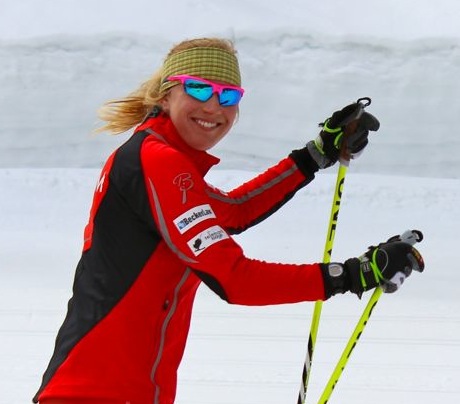
    When we spoke, Kristen Bourne was sitting on the couch in her living room in Truckee, California, a small ski town she now calls home. Tibetan prayer flags hung loosely behind her, shifting gently in the morning light that poured through the window. The room felt warm and calm — the kind of quiet space that comes from someone who spends much of her year on the move. Bourne smiled easily as she spoke, her voice’s cadence unhurried, like someone grounded in both her work and the mountain rhythm around her.

    She had just returned from camp and was preparing to leave again this weekend to start the World Cup with the U.S. Ski Team. Between talk of travel logistics and packing lists, she mentioned the soundtrack that keeps her company on solo skis. “When I’m skiing by myself? Yes,” she said, grinning. “I really like skiing to Machine Gun Kelly… it kind of brings me back to the Blink-182, Sum 41 days. It feels almost like nostalgic, but newer age.”

    That small confession says a lot about Bourne, now in her fourth season on the U.S. Cross-Country Ski Team coaching staff: rooted in rhythm, grounded in joy, and always blending the familiar with the fresh.

    Joy, she’ll tell you, isn’t a garnish. It’s the point.

    Kristen Bourne, Olivia Nesbitt Bouffard, and Jessie Diggins on an afternoon run in Wanaka, New Zealand. (Photo: Jessie Diggins)

    “Happiness goes such a long way in professional sport… our secret weapon as a team is having fun. Our staff genuinely enjoys being together. The athletes genuinely enjoy being together. We love to all come together.”

    The proof, for her, is a memory from the day Jessie Diggins won the 10 K at the World Championships in Planica. The scene isn’t what the public imagines. “You’d think everybody is stressed,” Bourne said. “We were ahead of schedule, and we all just sat down in [our wax truck], Yolanda, and made instruments out of whatever we could find for, like, 30 minutes.” The room filled with improvised drums and laughter. “It was so fun,” she said. “That’s the stuff people never see.”
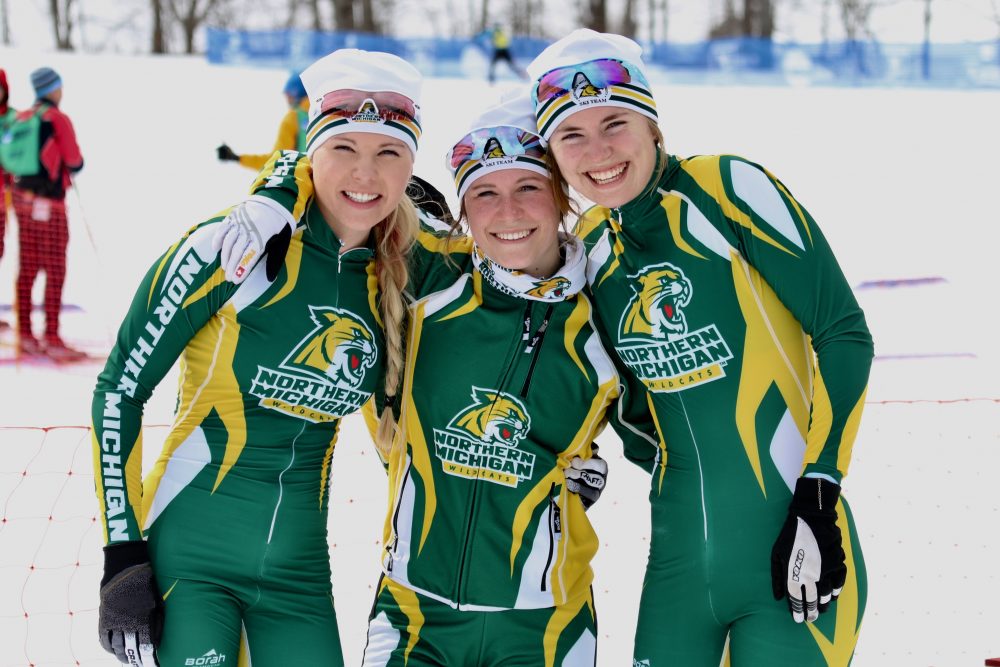
    Northern Michigan University’s Kristen Bourne (c) after the 5-kilometer classic race at the 2017 NCAAs in Jackson, New Hampshire. (Photo: Jackie Schneider)

    Minnesota Roots, and a Goal Cut in Half

    Bourne grew up just outside the Twin Cities, where endurance sport was a family language. “Our family vacations were going to [my dad’s] marathons and triathlons,” she said. She started by hopping into a mile here and there, handing him nutrition at the end of the driveway, learning the cadence and care that go into long efforts.

    Skiing arrived as a nudge. A new high-school coach was recruiting runners to cross-country ski at Mounds Park Academy. The first season was rough: “I swore I was going to quit. Every single race I did, I cried after most races,” she said. In a 5k, Jessie Diggins (then a rival in the same section) beat her by 12 minutes. Bourne’s response was characteristic—specific, measurable, gritty: next year, get that down to six.

    She continued to run and ski through high school, then headed to Northern Michigan University after spending a semester at the University of Colorado. She transferred mid-winter 2014 and skied at NMU through 2018, working under a rotation of assistants. Her path after graduation would tilt everything she thought she knew about training.

    Kristen Bourne spent time in Norway after college training with Lyn Ski / Team Obos. Bourne is pictured here racing in a Norwegian Cup race in Gålå. (Photo: Martin Riseth)

    Norway: Where Individual Plans Meet Shared Trails

    Right out of college, Bourne moved to Norway for a year and a half. She intended to ski; illnesses complicated the plan. But a concurrent internship at the Norwegian School of Sports Science opened doors into a different coaching world. Back home, she was used to “show up and the coach tells you the workout and everybody does the same thing.” In Norway, she said, “you sit down with a coach and you generate your plan… It was the first time I was exposed to individual planning—thinking about what’s best for you, not necessarily the team.”

    Interval days there could look like organized chaos: “Every single person… almost had a different workout, but people would sync up where they could.” At first, she struggled; she missed the mob grind. Then she looked around at a culture of success and realized what was happening: athletes were learning their bodies early, practicing agency. The lesson stuck. “Team workouts are also the way to go,” she said, “but giving athletes a platform to think for themselves—creating this athlete-coach collaborative experience versus coach telling athlete, ‘this is what you should do’—had a tremendous impact” on how she now works.
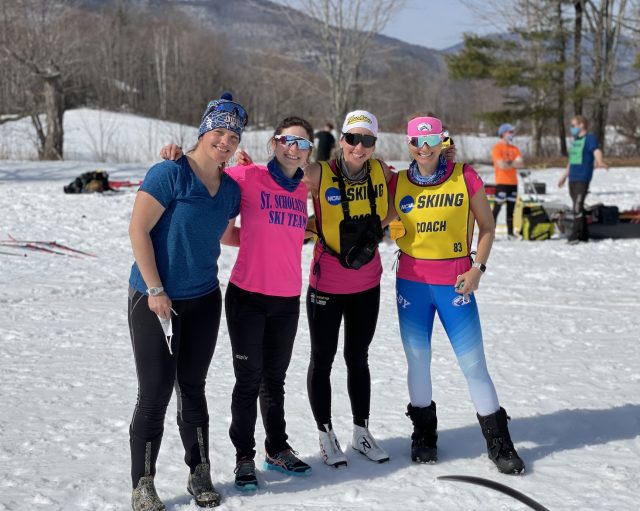
    (l-r) WSCA members Maria Stuber (then CSS), Kristen Bourne (then CSS, now with the US Ski Team), Kristen Monahan-Smith (Michigan Tech), and Tracey Cote (Colby College) at the NCAA Championships in Jackson, New Hampshire, in 2021. (Courtesy Photo).

    The Parking-Lot Pivot

    Her return to the U.S. was abrupt. She lost her residence permit—”turns out it was under the seat of my roommate’s dad’s car”—and flew home with two days’ notice, arriving just as COVID was beginning to ripple into sport. She kept racing a little, then decided she was done.

    That’s when a well-timed email—and a parking-lot shout—changed everything. Her dad reached out to Maria Stuber, who was building the Women’s Ski Coaches Association. “Maria found me in a parking lot at U.S. Nationals and yelled out her window, ‘I’m going to call you,‘” Bourne remembered. A call later, Maria offered her a position at the College of St. Scholastica and connected her with Pepa Miloucheva at the Craftsbury Green Racing Project. After two school years at Scholastica, with summers in Craftsbury, Bourne joined the U.S. Ski Team staff.

    The transition was, by her own admission, intimidating. “It was this idea of, like, how am I here?“ she said. But Norway’s reminder—that fresh eyes are valuable—kept her steady. “Just because you’re newer and have less experience doesn’t mean your ideas aren’t valid,“ she said. “You’re maybe fresher out of a ski career, you relate with athletes in a different way. There’s a lot of value in that.”

    She also learned to de-personalize the miss. “Technique feedback doesn’t always stick. That’s not a reflection of me as a coach or the athlete,“ she said. “We tried that idea; it’s fine. We’ll try something else.“ Each year, she felt more confident; more importantly, she built deeper connections.

    Julia Kern—one of the athletes Bourne works with most closely—sees that same quality every day.

    “Kristen is unique in the sense that she’s able to connect with just about any personality type on the team,“ Kern said. “One of her strengths is figuring out how to connect differently with different athletes. Every athlete responds differently and has different needs, and she just gets that. She’s very approachable and sees athletes as whole people.”
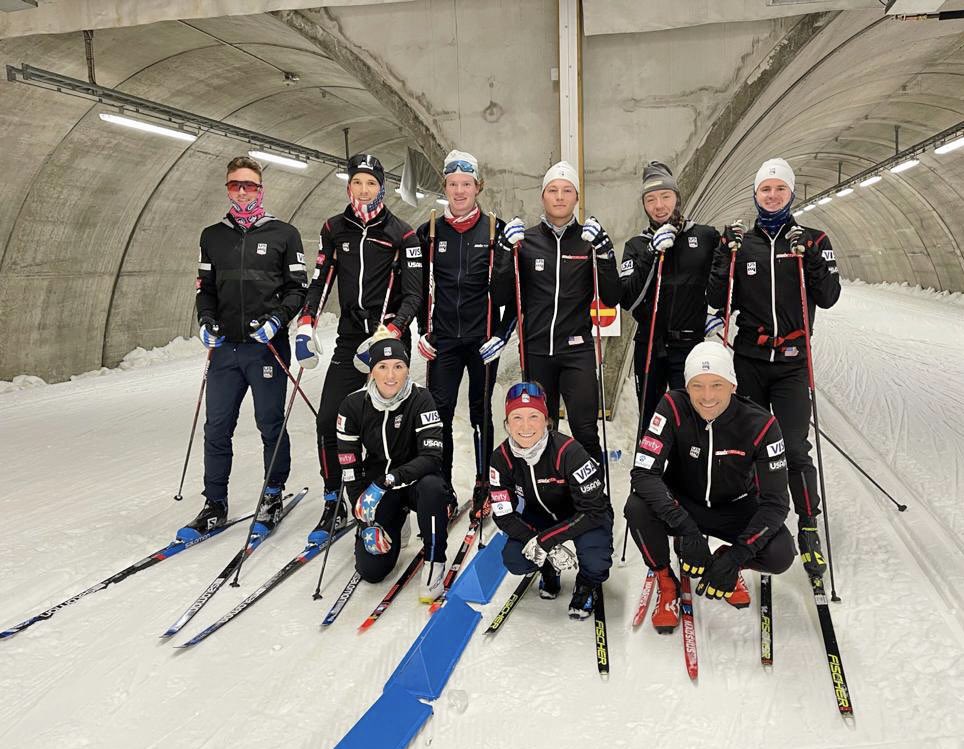
    USST athletes and coaches in the Torsby Ski Tunnel, August 2022. Back row, from left: Johnny Hagenbuch, Kevin Bolger, Finn O’Connell, JC Schoonmaker, Ben Ogden, and Walker Hall. Kneeling, from left: coaches Greta Anderson, Kristen Bourne, and Matt Whitcomb. (photo: François Faivre)

    Mentors and a Collaboration-First Culture

    Ask Bourne about mentors and the names tumble out: Matt Whitcomb, Chris Grover, Jason Cork. “From the very beginning… incredibly supportive,“ she said. “Matt will answer his phone every time. He usually likes to FaceTime… we brainstorm ideas.“ The flow goes both ways: she calls when the connection is hard; he calls when he’s stuck on something.

    Her women’s network is just as active. “Maria Stuber, hands down,“ Bourne said. “And Sam Benzing at Montana State—we coached together at Scholastica. She’s younger, but her perspective is so interesting.“ Group FaceTimes are common: Maria, Sam, Kristen, swapping angles and problem-solving. It’s not just helpful; it’s survival. “It would be really hard to be in this job and not have that,“ Bourne said. “The collaboration makes it so much more sustainable.”

    That same approach underpins her work with athletes like Kern.

    “Kristen’s helped me figure out what kind of training plan works well for me,“ Kern said. “We’ve tried some new things the last few years—different kinds of workouts, always thinking creatively. She’s open-minded, reads up on what other athletes are doing, but also thinks for herself. She’s got such a growth mindset.”

    Julia Kern and Kristen Bourne in Sjusjøen at the 2025 pre-World Championships camp. (Photo: Matt Whitcomb)

    Coaching Women, Coaching Men — and Being Seen

    On the World Cup, visibility is progress measured in inches. FIS’s women-coach bibs created access (up to two additional bibs if teams have women on staff), but change is slow. “Every year, maybe there’s one or two new women… it definitely hasn’t blown up,“ Bourne said. Old assumptions linger. “I probably get asked a couple times a year from male coaches: ‘Are you the massage therapist or PT?’“

    For Kern, Bourne’s presence is more than symbolic.

    “It’s huge,“ Kern said. “She’s one of the few female coaches on the World Cup level, and she’s down to work hard and just have fun with it too. I hope the next generation of women who want to coach feel inspired that they can do it too. Kristen’s paving the way, even in ways people might not see from the surface.”

    Bourne herself agrees that visibility matters. “You can’t be it if you can’t see it,“ she said. “It’s important for young men, too, to see women in leadership roles. Our men’s team has been incredible—they’ve never made me feel like I don’t belong.”

    Her advice to aspiring women coaches is emphatic: build a robust support community. “Ask for advice,“ she said. “It makes a world of difference.”

    Kristen Bourne and Sophia Laukli on the pre-race day at Val di Femme during the 2025 Tour de Ski. (Photo: Leann Bentley)

    Athlete Work: Julia Every Other Day, Gus and Sophia on the Radar

    Bourne’s primary day-to-day is Kern. “We’re talking basically every other day—texting or on the phone, training planning. We work very closely, very in depth,“ she said. She also monitors Gus Schumacher and Sophia Laukli.

    Kern said that beyond the workouts, Bourne has shaped the team culture itself.

    “She’s really good at encouraging athletes to bring their own sense of leadership,“ Kern said. “Not everyone is going to be outspoken—some are quiet leaders, some lead through training. She empowers people to be leaders in their own way. She creates a team atmosphere that’s a judgment-free zone. No idea is a bad idea.”

    Gus Schumacher and Kristen Bourne after his 4th place finish in the Davos sprint during the 2023 Tour de Ski. (Photo: Leann Bentley

    Season Outlook: Keep the Vibe, Chase the Team Moments

    Last year’s long illnesses made for uneasy preseason reading. This year feels different. “People are in a pretty good place,“ Bourne said. “At our camp in Utah, I would assume there would be a little more stress—it’s an Olympic year. Not at all. People were so relaxed and chill and vibing and doing their thing.”

    If there’s a metric she’d choose for success, it’s carrying that “happy momentum“ through everything—the Olympics, Lake Placid World Cup Finals. “In a year with so many eyes on cross-country skiing, that would be massive,“ she said.

    Results still matter, of course. And she lights up talking about the collective ones. “It would be so awesome to see success in team events,“ she said. “Relay and the sprint relay—those mean so much when it’s a collective team event. We want to do well there.”

    Lucas Wilmot, Kristen Bourne, Murphy Kimball, Tabor Greenberg in Bend, Oregon 2025 after wrapping up the first L3 intervals at camp. (Photo: Leann Bentley)

    Representation, Purpose, and the Long Run

    There’s a moment near the end of our conversation when Bourne zooms out to the why. “We are very deeply intertwined in another person’s process and journey,“ she said. “What an absolute privilege to be part of that. It’s impossible not to come to absolutely love and care so much about these people.”

    Kern echoed that sentiment from the athlete side.

    “Kristen understands there’s life outside of skiing,“ Kern said. “She also knows what it takes to be one of the best in the world—and when it’s time to step away. She helps us stay grounded.”

    Five years from now, Bourne hopes she’s doing exactly this, just deeper—”coaching, getting to know these athletes more and more.”

    And she hopes the picture around her looks different: more women coaches on staff, on other staffs, in other sports at U.S. Ski & Snowboard; more women wax techs. “If I can have a tiny ounce of contribution into changing that,“ she said, “I’d be so, so happy.”

    Kristen Bourne and Colin Rodgers out for a run during the OD run at Park City camp, 2025. (Photo: Matt Whitcomb)

    Purpose, Rhythm, and Joy

    As our conversation wound down, Bourne slightly rotated her position as the light spilling through the window shifted—yet still filtering across the prayer flags behind her. She laughed when she mentioned her must-pack item: heated socks for Finland. “I get cold fast,“ she said. “Those are my best friend.“

    There’s rhythm in that, too: warmth, joy, and purpose, all braided into one.

    Because for Kristen Bourne—and for the athletes who work with her—the secret weapon really is fun.

    Leann Bentley, Kristen Bourne, and Bernie Nelson at Val di Fiemme the morning of one of the last stages of the 2024 Tour de Ski. (Photo: Matt Whitcomb)

    Love Stories Like This? Help Keep Them Coming.

    Feature interviews like this one take time, access, and care to produce. If you value thoughtful storytelling and independent ski journalism, please consider becoming a Voluntary Subscriber. Your support directly fuels the work we do to cover the people, places, and moments that make our sport special.

    Join the FasterSkier community!
  • Under 23 Questions: Hannah Halvorsen

    Under 23 Questions: Hannah Halvorsen

    Hannah Halvorsen (Alaska Pacific University) in Alaska. (Courtesy photo)

    In an effort to showcase the North Americans who competed at last week’s International Ski Federation (FIS) 2018 Nordic Junior/U23 World Championships in Goms, Switzerland, we asked those qualifying athletes several questions about themselves — actually, we had them fill in the blanks. Here we have 19-year-old Hannah Halvorsen, of Alaska Pacific University (APU), who represented the U.S. at her second Junior Worlds. 

    Last week in Goms, Halvorsen placed eighth in the freestyle sprint, 22nd in the 5 k classic, and eighth with the U.S. women’s 4 x 3.3 k relay.

    ***

    Hannah Halvorsen and her mom prepping for worlds. (Courtesy photo)

    “My full name is Hannah Halvorsen, most people just call me Hannah.

    I was born and raised in Truckee, and I learned to ski when I was two.

    I spent the time between U.S. nationals and Junior/U23 Worlds prepping for worlds.

    The hardest workout I did in the last training year to prepare for this was intervals with APU.

    This is my first time in Switzerland and fifth year racing internationally, and so far it’s been good.

    One difference I’ve noticed between Switzerland and the U.S. is everything’s smaller.

    Skiing and racing in the Alps is beautiful. Usually racing at altitude is comfortable for me because I grew up at altitude. There are also beautiful mountains around where I live.

    One of the things I’m most excited about for Junior/U23 Worlds in Goms is the opportunity to race internationally.

    Hannah Halvorsen getting some Junior World Championships prep in with Team Halvorsen. (Courtesy photo)

    One race I’m especially targeting there is the skate sprint.

    I really hope I can chat/make friends with someone from Norway and ask them what their secret is.

    My favorite thing at the breakfast where we are staying is the liver.

    Fondue is not the best pre-race meal. The cheese here plentiful. And the chocolate is abundant.

    If I had a totally free day here and didn’t have to worry about race fitness or training, I’d spend it skiing.

    The best way to follow me on social media is my Instagram @hannah.g.halvorsen or my twitter @realDonaldTrump.”

    https://www.instagram.com/p/BedxnOGFMfi/?taken-by=hannah.g.halvorsen

  • 20-for-20 with Peter Carroll

    20-for-20 with Peter Carroll

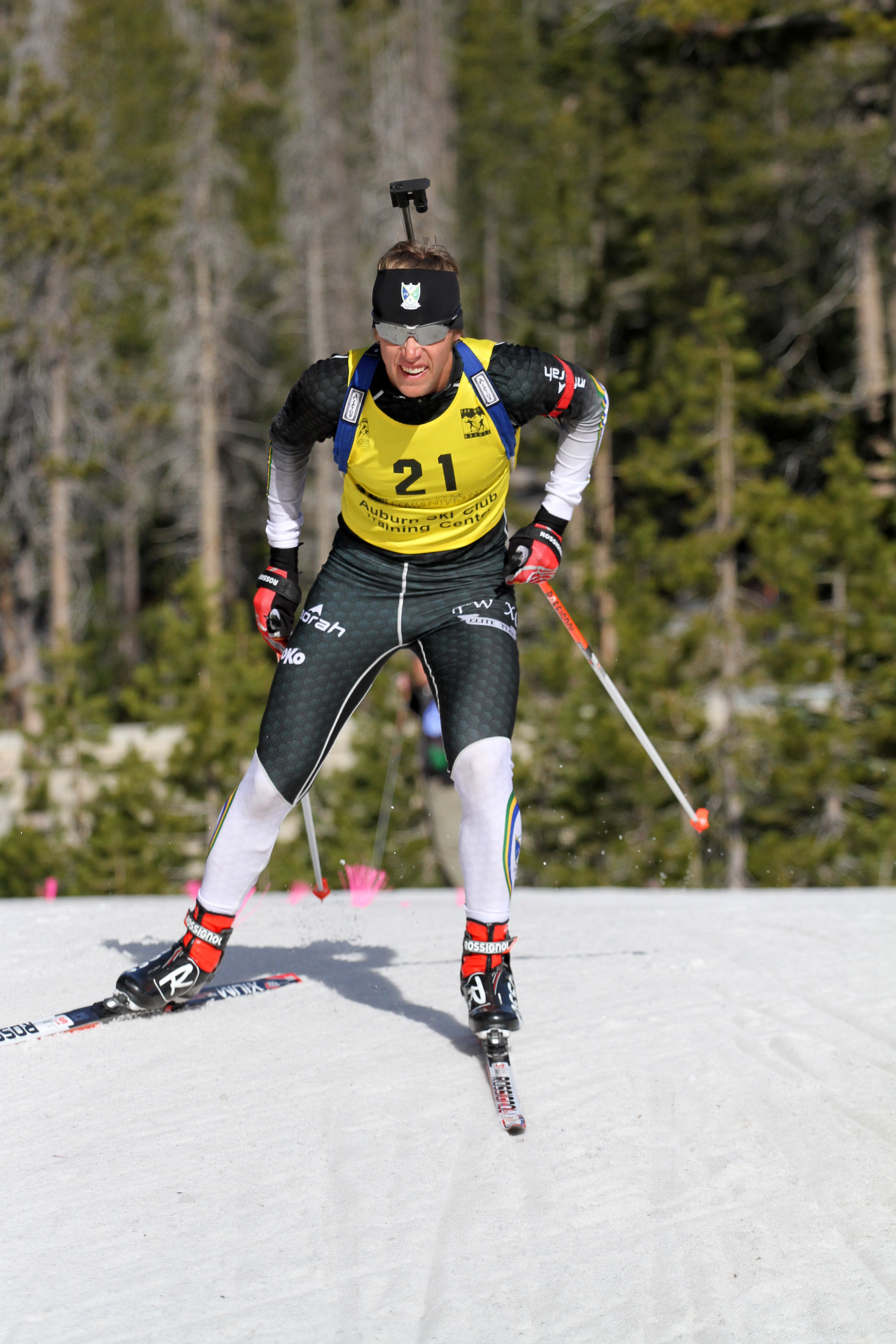
    Peter Carroll (Auburn Ski Club) exploring the back roads of Park City, Utah, during a training camp in October. (Photo: Maddie Morgan)

    In another 20-something-question, fill-in-the-blanks series, we checked in with the world-class U.S. and Canadian biathletes that will be competing at 2017 International Biathlon Union (IBU) Youth & Junior World Championships Feb. 22-28 in Osrblie (also known as Brezno-Osrblie), Slovakia.

    Here’s Peter Carroll, of the Auburn Ski Club, who celebrated his 20th birthday on Friday and is representing the U.S. at his second Youth/Junior Worlds. On Thursday, he finished 79th in the junior men’s 15-kilometer individual and was 82nd in the 10 k sprint on Saturday.

    ***

    “My full name is Peter Myung-Ho Park Carroll but you can call me Galactic President Superstar Freaking McAwesome, Hot Pants, or Peter… Whichever you prefer…. Or can say the quickest…

    I was born in Daejeon, South Korea, raised in Truckee, Calif., aka, The Coolest Place on Earth, and one thing you should know about my hometown is that yes, even though it’s in California, we get some of the best snowfall in the US, you know, when we get snow…….

    I started cross-country skiing when I was 13 and started biathlon when I was 15, thanks to Sam Zabel, one of my best friends and training partners, and Glenn Jobe, former Olympian and a straight-up awesome, awesome coach. I also owe a huge debt to Mark Nadell, to whom many in my hometown know as Marky Mark, or Captain Nordic. I owe a lot to Mark, thanks Coach. Mark Nadell recently passed away from a battle with cancer. Thank you Mark. Rest easy, this ones for you.

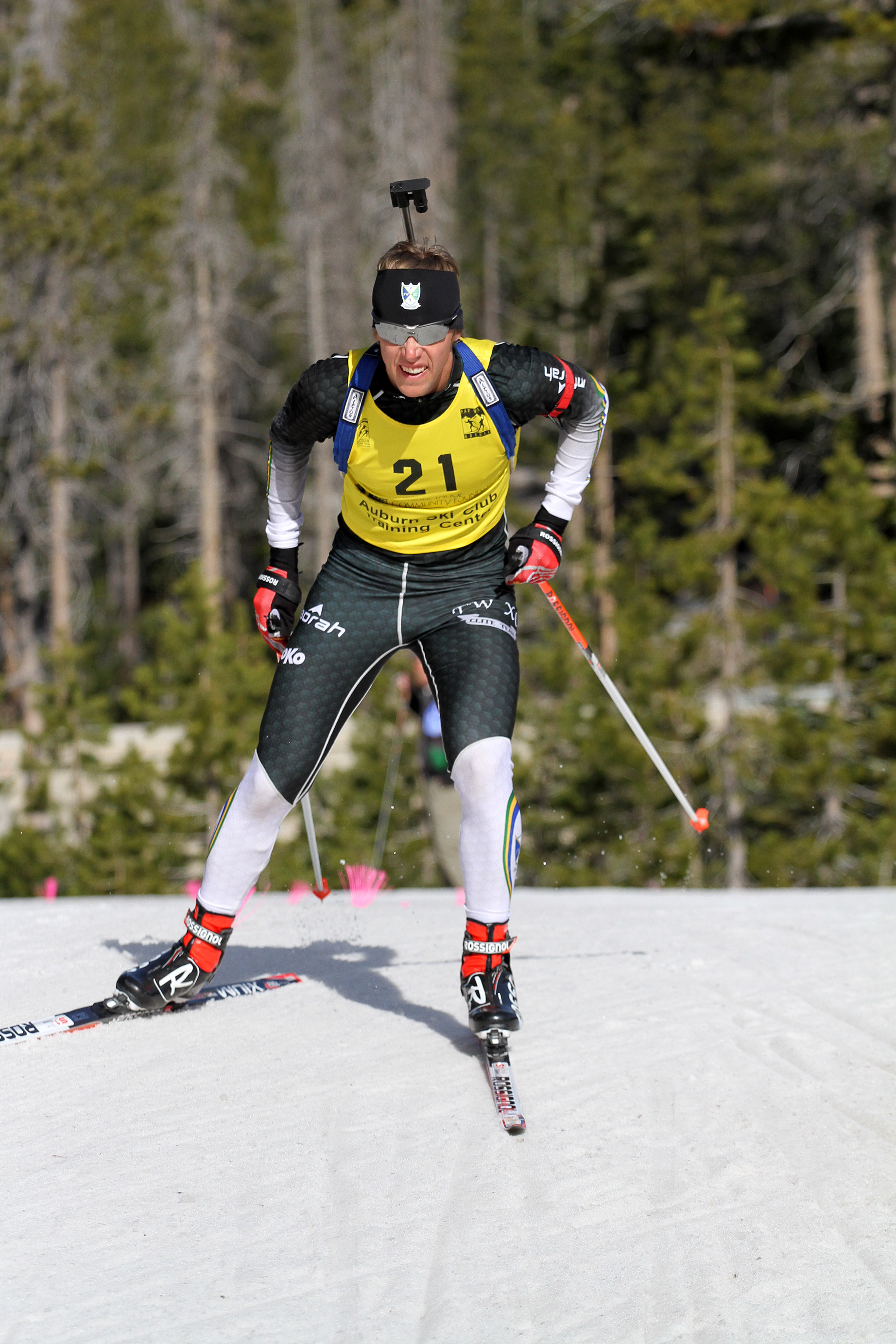
    American Peter Carroll leaving the range after a clean shoot during the 10th Mountain Division race on Jan. 5 at Auburn Ski Club near Truckee, Calif. (Photo: Paige Derdowski)

    I currently train in Truckee at Auburn Ski Club.

    If I’m not skiing, you might find me watching ‘How I Met Your Mother’ and dry firing. I find its really hard to keep good position and have a good trigger squeeze when I can’t help but laugh at that show. It’s great training, but whenever I tell my mom what I’m doing she just rolls her eyes at me.

    If I had to pick a favorite book, it would be ‘The Power of One’. Or the encyclopedia, I’ve never had a book that made me enjoy other books as much as the encyclopedia.

    One of the things I’m most excited about for Youth/Junior World Championships in Brezno-Osrblie is my birthday on the 24th, I’ll be turning 20! Oh and I’m really excited to race against some fast skiers, too! This will be my second Youth/Junior World Championships, and this year, I’m competing as a junior.

    One race I’m especially targeting there is the individual. Hopefully I can ride off of some of Lowell Bailey’s recent success and deliver a solid race with good shooting!

    The best advice anyone ever gave me about skiing and racing was my first day on skis, my first coach Mark Nadell, told me that I ski like my pants were on fire. He gave me the nickname Hot Pants. He then told me that I actually need to focus on the technique behind the sport and said, ‘A flat ski, is a fast ski’, I repeat that to myself every time I ski, over and over and over and over.

    One of the best race memories I have was my third year of ski racing, I qualified first overall for U18s at the Super JNQ in Soldier Hollow, Utah. It was a classic sprint and I had to wear a bike helmet because I had a couple concussions within a year. I called it my speed bucket, it was where I kept my extra speed! I didn’t work very well because I ended up finishing 4th overall in the sprints, but I had a blast the entire day, and got a lot of weird looks for racing around in a pink and blue helmet.

    If I could meet one World Cup skier, it would be Justine Braisaz. I have a celebrity crush on her.

    If I don’t end up being a professional skier, I’ll probably be a professional travel bum, I love going to new places. I’d buy a van and turn it into a miniature home and travel as far and as wide as I could! Either that or I would pursue a career as a coach, I love getting out on snow with younger athletes and showing them how much fun this sport can be. I mean, who doesn’t love dashing through powder on nordic skis? Or making up silly rules while you ski, like say, you see a skier who is wearing blue and everyone has to ski backwards until either everyone falls over or you see another skier?

    I’m missing about -500 days of school to be here, and my old teachers/professors are probably thinking, ‘Why in the heck hasn’t this kid gone to college already?’

    You can follow me on Instagram if you’d like to see poorly edited photos and bad shaky video clips @partyxc_pete.”

  • Under 23 Questions with Hannah Halvorsen

    American Hannah Halvorsen (Sugar Bowl Academy/U.S. Ski Team D-team) racing to 13th in the women's classic sprint qualifier on Monday at 2017 Junior World Championships at Soldier Hollow in Midway, Utah. (Photo: FlyingPointRoad.com)
    American Hannah Halvorsen (Sugar Bowl Academy/U.S. Ski Team D-team) racing to 13th in the women’s classic sprint qualifier on Monday at 2017 Junior World Championships at Soldier Hollow in Midway, Utah. She went on to reach the semifinals and placed 11th overall. (Photo: FlyingPointRoad.com)

    In an effort to showcase the North Americans competing at this week’s International Ski Federation (FIS) 2017 USANA Nordic Junior World Championships and U23 Cross Country World Championships at Soldier Hollow in Midway, Utah, we asked those qualifying athletes several questions about themselves — actually, we had them fill in the blanks. Here we have 18-year-old Hannah Halvorsen, of the Sugar Bowl Academy and U.S. Ski Team D-team, who’s representing the U.S. at her first Junior Worlds after competing at last year’s Youth Olympic Winter Games.

    On Monday, Halvorsen reached the semifinals of the classic sprint to place 11th in her Junior Worlds debut. On Wednesday, she raced to 13th in the women’s 5 k freestyle.

    ***

    “My full name is Hannah but you can call me hannaH (it’s a palindrome). I was born and raised in Truckee, Calif., and one thing you should know about my hometown is there is no surfing.

    I started cross-country skiing when I was 18 months old thanks to Mom and Dad. I currently train in Truckee with Sugar Bowl Academy (team mascot is the Fighting Marmots).

    Sugar Bowl Academy and U.S. Ski Team Development Team member Hannah Halvorsen racing to second in Thursday's skate-sprint prologue on the final day of 2017 U.S. nationals at Soldier Hollow.
    Sugar Bowl Academy and U.S. Ski Team development team member Hannah Halvorsen racing to second in the 2017 U.S. nationals skate-sprint prologue last month at Soldier Hollow.

    If I’m not training for skiing, I might be cutting someone’s hair with my personal haircutting kit (with no training). If I had to pick a favorite book, it would be ‘Seinfeld’ (is there a book version?).

    One of the things I’m most excited about for Junior Worlds at Soldier Hollow is that it will help make America great again. One race I’m especially targeting there is making the relay team.

    The best advice anyone ever gave me about skiing or racing was that it should be really fun. One of the best race memories I have is beating a Norwegian.

    If I could meet one World Cup skier, it would be Marit Bjorgen.

    If I don’t end up being a professional skier, I’ll probably be a coach.

    You can follow me on Instagram @hannah.g.halvorsen.”

  • USSA Releases 2016/2017 SuperTour Calendar: Opening in Bozeman, Ending in Fairbanks

    USSA Releases 2016/2017 SuperTour Calendar: Opening in Bozeman, Ending in Fairbanks

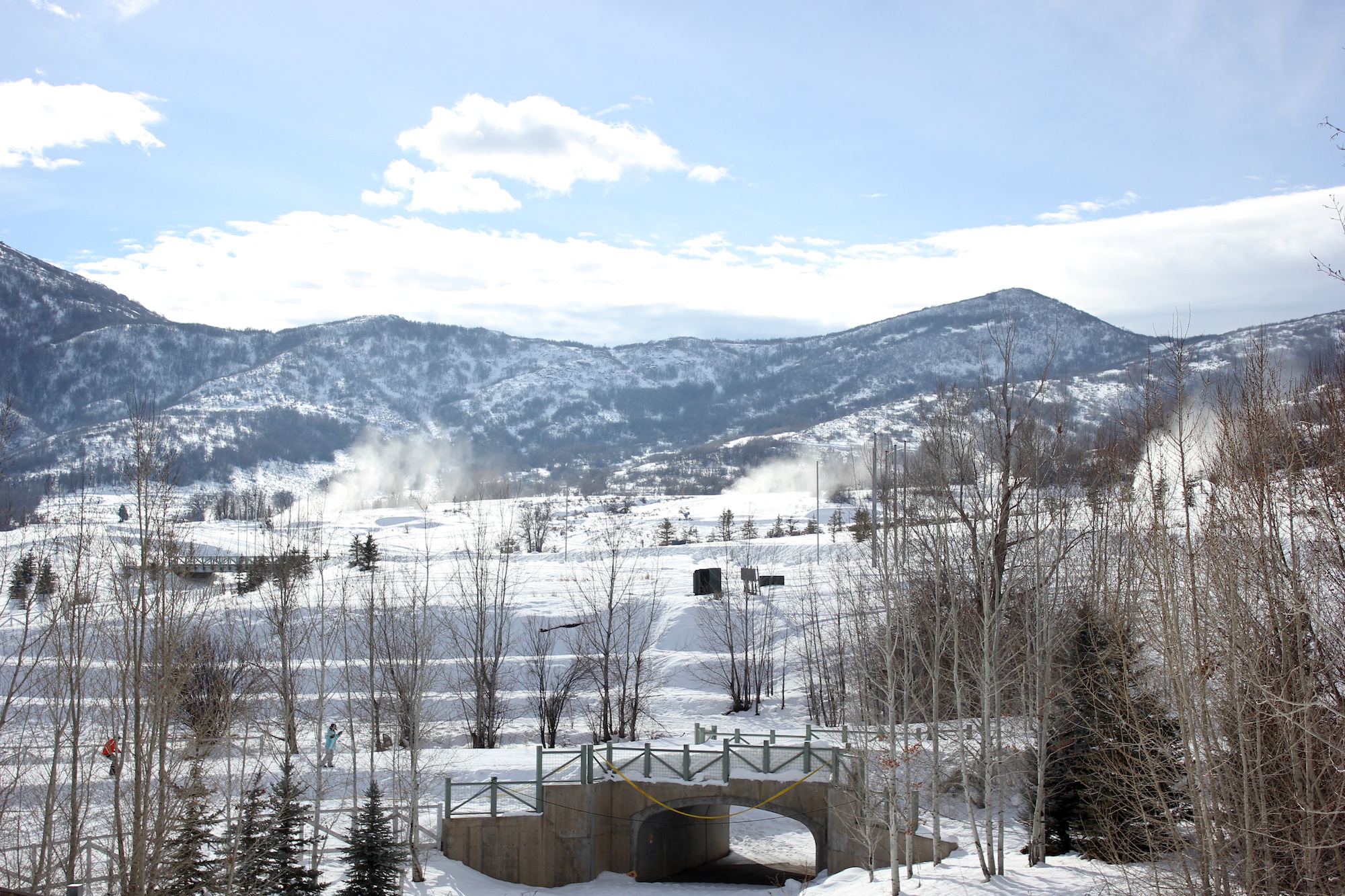
    Snowmakers have blow much of the snow used on tomorrows course, and can be seen in the distance.
    Snowmakers in action at Soldier Hollow in January 2014. The 2002 Olympic venue in Midway, Utah, last hosted the U.S. senior national championships in 2014 (as well as the year before in 2013) before Houghton, Mich., hosted in 2015 and 2016. Nationals are returning to SoHo this coming January.

    USSA Announces Seven-Stop Super Tour for 2016-17

    (Press release)

    PARK CITY, UT – Top cross country athletes from across America will participate in 16 races at seven different stops as part of the U.S. Ski and Snowboard Association’s (USSA) annual USSA SuperTour. The 2016-17 tour kicks off in December in Bozeman, MT.

    The SuperTour is a series of International Ski Federation (FIS) sanctioned cross country ski races taking place across America, produced by the USSA, together with its divisions and clubs. The Tour is a vital piece of the USSA’s development program, providing top level racing at key cross country centers around the nation. It’s a proving ground for club athletes with aspirations of making it to the U.S. Ski Team and competing on the FIS World Cup tour and in the Olympic Winter Games. Caitlin Patterson (Craftsbury, VT; Craftsbury Green Racing Project) and Eric Packer (Anchorage, AK; Alaska Pacific University) took the season long titles in 2015-16.

    “The USSA has had great support from its clubs and divisions in putting together this year’s calendar,” said USSA Nordic Domestic Program Director Robert Lazzaroni. “We’ve rotated a few sites this year and will continue to move around in the future to get the SuperTour to new places. Moving the event around helps stimulate top-level racing in America.”

    Period 1 includes stops in Bozeman, Mont., and Silver Star (Sovereign Lake), British Columbia. The decision was made at USSA Congress to start the series one week later than previous years and to combine with Canada to increase the field.

    Period 2 will open in January with the L.L.Bean U.S. Cross Country Championships at Soldier Hollow in Midway, Utah. Soldier Hollow is also a site for the 2017 FIS Nordic Junior and U23 World Ski Championships. Athletes will then continue on to Truckee, Calif., for races on the Auburn trail system.

    The third period will feature two stops in the midwest. Athletes will race on a new homologated trail in Ishpeming, Mich., before participating in America’s largest cross country race, the Slumberland American Birkebeiner, on Feb. 25 in Hayward, Wis. The series wraps up with the SuperTour Finals Mar. 27- April. 2 in Fairbanks, Alaska. Finals will also double as the L.L.Bean U.S. Championships for long distance and freestyle sprint.

    “The divisions, venues, technical delegates and homologation inspectors have been working hard to develop new venues and evolve current courses to strengthen the SuperTour,” stated USSA Cross Country Development Coach Bryan Fish. “We are making strides to include junior and collegiate racing within the SuperTour to enhance head-to-head racing with juniors, college athletes and our top World Cup competitors. Our collaboration with Cross Country Canada will also better prepare athletes for international competition. It’s an exciting year for cross country in the United States, and we’ll get to showcase this to the world during Junior World Championships.”

    Athletes will also vie for for points across the tour to earn Continental Cup leader starts and World Cup starts. There will also be spots available for the 2017 FIS Nordic World Ski Championships Feb. 22 – March 5 in Lahti, Finland. Those spots will be awarded after the conclusion of the U.S. Cross Country Championships in January.

    For more information on the USSA SuperTour, visit ussa.org/joinnordic.

    2016-17 USSA CROSS COUNTRY SUPERTOUR

    Period 1

    Dec 3-4, 2016

    Bozeman, MT

    Men’s Freestyle Sprint, 15 km CL

    Women’s Freestyle Sprint, 10 km CL

    Dec 9-10, 2016

    Silver Star, British Columbia

    Men: Sprint CL, 15 km Free

    Women: Sprint CL, 10 km Free

    Period 2

    Jan. 7-12, 2017

    L.L.Bean U.S. Cross Country Championships

    Soldier Hollow, Midway, UT

    Men: 15 km Free, Sprint CL, 30 km CL

    Women: 10 km Free, Sprint CL, 20 km CL

    (*Note: U.S. championships also include a freestyle sprint qualifier, which serves as a qualifier for 2017 World Championships but will not be scored as a U.S. nationals or SuperTour event)

    Jan. 21-22, 2017

    Truckee, CA

    Men: Sprint CL, 10 km Free

    Women: Sprint CL, 5 km Free

    Period 3

    Feb. 17-19, 2017

    Ishpeming, MI

    Men: Sprint Free, 10 km CL

    Women: Sprint Free, 5 km CL

    Feb. 25, 2017

    American Birkebeiner

    Hayward, WI

    Men’s and women’s 50 km Free

    Period 4

    Mar. 27-April 2, 2017

    SuperTour Finals

    Fairbanks, AK

    Men: 24 km Skiathlon, Sprint Free, Relay, 50 km Free

    Women: 14 km Skiathlon, Sprint Free, Relay, 30 km Free

    *Complete 2016/2017 SuperTour calendar

  • Far West Elite Team Looking to Grow

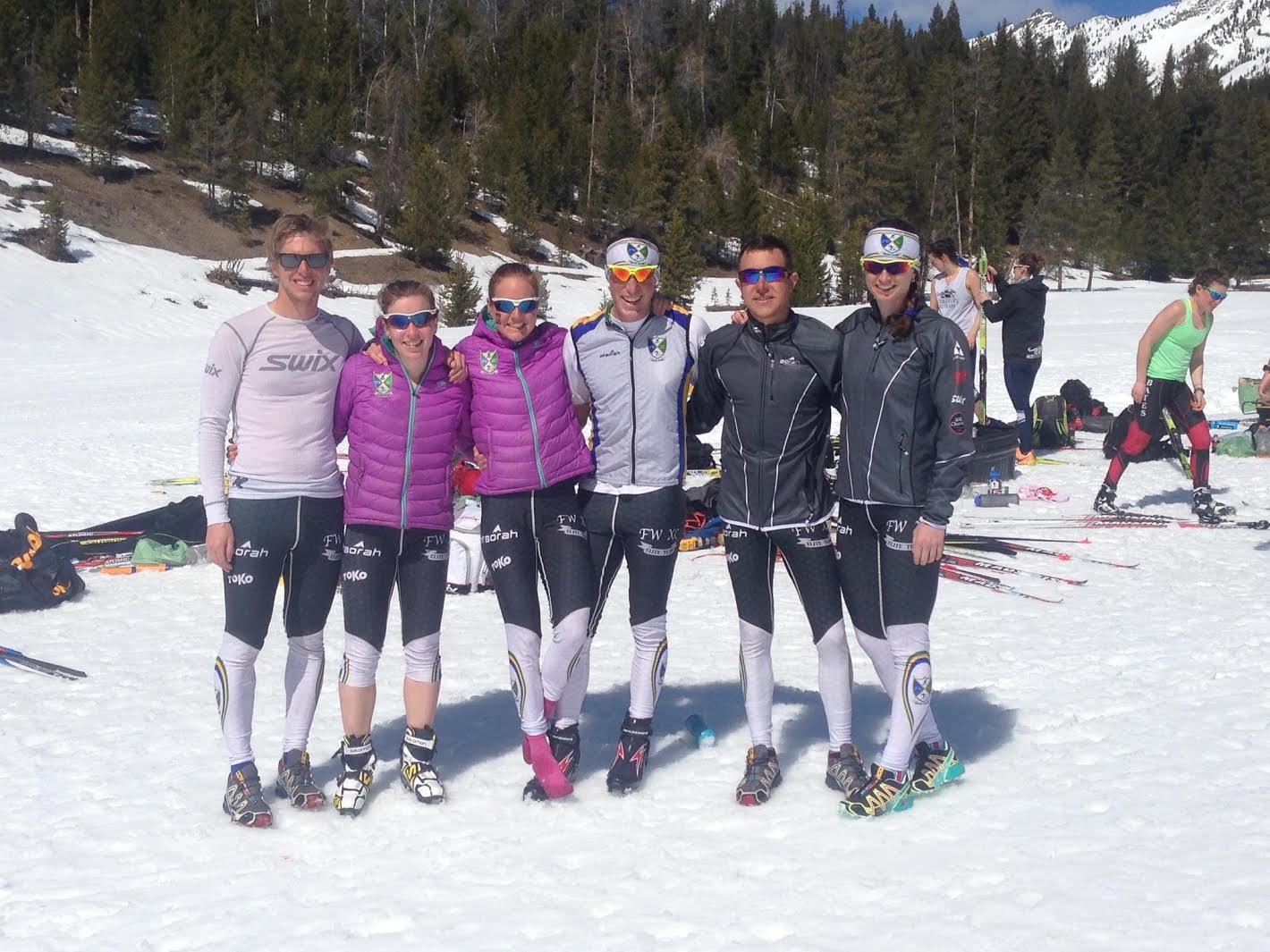
    Far West Elite Team 2014/2015
    (Press release)
    The Far West Elite Team, a post-collegiate senior team based in Truckee, Calif., is looking to support six athletes for the 2015-16 season. Our goal is to develop post-collegiate skiers towards being named to the U.S. Ski Team. The primary focus of the team is the USSA Supertour race series. The large collegiate summer training program, run by Martin Benes, in Truckee makes for excellent summer training. Team members receive funding to offset race, travel, and living expenses as well as additional support within the Tahoe region.
    The team is currently working to iron out specific funding details and an exact dollar amount to be offered to each 2015-2016 athlete. Applications will officially open later this spring. In the meantime, any interested parties are encouraged to contact us to learn more about how the team works and functions throughout the year.
    Team Captain: Spencer Eusden seusden@gmail.com
    Team Manager: Roger Chaney rossi_nordic@yahoo.com
  • Johnson, Egan Sweep U.S. Biathlon Nationals Titles in Truckee

    Johnson, Egan Sweep U.S. Biathlon Nationals Titles in Truckee

    Patrick Johnson of the Auburn Ski Club won two biathlon national titles on home turf in Truckee, California, last week. (Photo: Mark Nadell/Macbeth Graphics)
    Patrick Johnson of the Auburn Ski Club won two biathlon national titles on home turf in Truckee, California, last week. (Photo: Mark Nadell/Macbeth Graphics)

    In spite of the extremely low snow conditions in California for the US Biathlon Championships March 20th-22nd, the Auburn Ski Club Training Center was able to host three successful championship races. Due to the limited snow cover and warm temperatures, all the races had to be run on a groomed 1.5 km loop. The week following hosting the Junior XC Nationals, held at ASC March 7th-14t,h, all nearby and remaining snow was stock piled along the 1.5 km loop and distributed after each biathlon race to maintain the loop through the three races.

    Although the loop was limited in length it had plenty of undulating terrain with an uphill approach followed by a short flat section prior to the shooting range. The uphill approach to the range combined with the 7200 foot elevation provided the participants with some challenging shooting (read, breathing) conditions.

    Clare Egan (Craftsbury Green Racing Project/U.S. National Team) racing to a big win in the 7.5 k sprint. (Photo: Mark Nadell/MacBeth Graphics)
    Clare Egan (Craftsbury Green Racing Project/U.S. National Team) racing to a big win in the 7.5 k sprint. (Photo: Mark Nadell/MacBeth Graphics)

    In the sprint race on Friday, Patrick Johnson from the Auburn Ski Club won the senior men’s division with clean shooting. A recent convert to biathlon, Johnson was named to the U.S. Biathlon Association’s Development Team in October. He notched a minute and a half win on home turf in the 10 k sprint over Mike Gibson of the Craftsbury Green Racing project, who had five penalties. Third place went to Max Durtschi, a former professional cyclist who was named to USBA’s X Team this fall. Durtschi had six penalties and finished three minutes and 14 seconds behind Johnson.

    In the women’s 7.5 k sprint Clare Egan of the Craftsbury Green Racing Project won with only three misses out of 10 shots. Egan had hopped a plane home from Europe after a successful World Championships stint, where in her first appearance on the sport’s biggest stage she finished 40th in the sprint. In Truckee, that equated to a one minute, 49 second win over Kelsey Dickinson of the Maine Winter Sports Center, who also had three penalties. Katrina Howe, also of the MWSC, finished third.

    On Saturday, Patrick Johnson and Clare Egan again won their respective 12.5 and 10 k pursuit races, becoming two-time National Champions. Johnson picked up eight penalties in 20 shots, but still cruised to a one minute, 50 second win over Durtschi, who had seven penalties of his own. Gibson placed third, 37 seconds behind Durtschi with nine penalties.

    Egan accrued seven penalties in the pursuit, but finished 32 seconds ahead of Dickinson. Maddie Phaneuf, racing up from the junior division, had a strong race until the last bout, shooting clean for the first three stages. In the last standing stage, however, the Maine Winter Sports Center athlete picked up four penalties and ultimately finished third, 33 seconds behind Dickinson.

    On Sunday the race series ended with a mixed relay. The teams were made up by the organizers based on results from the previous races in an effort to make the teams as evenly balanced and competitive as possible. It turned out to be an exciting and fun race to end the nationals on. The mixed team of Phil Violett (Senior Men, Auburn Ski Club), Phaneuf, and Scott Waichler (Master Men, Methow Valley) won this mixed relay.

    The top shooter award sponsored by Altius Handcrafted Firearms in West Yellowstone, MT, went to Maddie Phaneuf from Old Forge, NY, with 5 misses out of 30 shots over the first 2 days of racing.

    Results:

    Friday sprints

    Saturday pursuits

    Sunday relay

    Photo Gallery from Mark Nadell, MacBeth Graphics

    -Chelsea Little contributed reporting.

    Peter Carroll racing to a win in the youth men's sprint. (Photo: Mark Nadell/MacBeth Graphics)
    Peter Carroll racing to a win in the youth men’s sprint. (Photo: Mark Nadell/MacBeth Graphics)
    Maddie Phaneuf (Maine Winter Sports Center/USBA "X" Team) won the junior women's sprint, earned bronze in the senior women's pursuit, and raced the second leg of the winning mixed relay. She was also the most accurate shooter of the series. (Photo: Mark Nadell/MacBeth Graphics)
    Maddie Phaneuf (Maine Winter Sports Center/USBA “X” Team) won the junior women’s sprint, earned bronze in the senior women’s pursuit, and raced the second leg of the winning mixed relay. She was also the most accurate shooter of the series. (Photo: Mark Nadell/MacBeth Graphics)
    Auburn Ski Club's own Phil Violett was part of the winning mixed relay team at U.S. National Championships. (Photo: Mark Nadell/MacBeth Graphics)
    Auburn Ski Club’s own Phil Violett was part of the winning mixed relay team at U.S. National Championships. (Photo: Mark Nadell/MacBeth Graphics)
  • After Skiing Success, Johnson Sets Eyes on 2018 Games – In Biathlon

    After Skiing Success, Johnson Sets Eyes on 2018 Games – In Biathlon

    Patrick Johnson of the Far West Elite Team rollerskiing at the Auburn Ski Club in June. Johnson recently switched his focus to biathlon. (Photo: Mark Nadell/MacBeth Graphics)
    Patrick Johnson of the Far West Elite Team rollerskiing at the Auburn Ski Club in June. Johnson recently switched his focus to biathlon. (Photo: Mark Nadell/MacBeth Graphics)

    Patrick Johnson has seen success at a lot of different levels of Nordic sport: from representing the U.S. at Junior World Championships to winning collegiate races for Middlebury College and then SuperTours for Sun Valley.

    Last year, his quest for nordic success saw him move to Truckee, Calif., to join the Far West Elite Team, and now he’s tackling an additional new challenge by taking on the sport of biathlon.

    “I had wanted to give biathlon a serious try for several years,” the 25-year-old Alaska native explained in an email. “When I was 9 I tried a couple novice races, but I never really received any coaching on shooting, so most of my memories from those races were of skiing penalty loops and being cold … midway through college I started thinking it would be a really fun sport to compete in. Of course, at that point, I was busy with school and didn’t have a range nearby, so it wasn’t really an option.”

    When he left Middlebury, the U.S. Biathlon Association (USBA) had curtailed their development programs in order to focus on high performance for the next Olympic cycles. But now, USBA is reinstating the development program and has started to look for talent to recruit from elsewhere in the nordic world.

    Johnson working on his shooting. Courtesy photo.
    Johnson working on his shooting. Courtesy photo.

    So while Johnson was interested in biathlon before USBA announced their Talent ID Camp this summer – he had started working on shooting already in the winter – it provided a perfect opportunity for him. He’s been working on shooting for months now and last week, he was officially named to USBA’s Development Team.

    “The Talent ID camp in June was a great experience!” he wrote. “It was a pretty special opportunity to be able to get coaching from the whole national team staff, along with Tim Burke and Andrea Henkel, only a few weeks into my biathlon training. What was especially great about that camp is that you could tell that this new development program was really being bought into by the whole coaching staff and national team athletes of USBA.”

    Since then, he has attended the recently-finished national team camp in Park City, Utah, and will join the team for an on-snow camp in Canmore, Alberta, in December.

    The rest of the time, he trains at home in Truckee with the Far West squad. It’s a small but elite group of cross-country skiers, which Johnson says is perfect for his athletic style.

    “I’m definitely someone who likes to have a little bit of independence and self-direction in figuring out my training plan,” he explained. “I’ve worked with a lot of great coaches over my time skiing, and learned a lot from them, and I have a decent idea of what works well for me in nordic training. The Far West Elite Team is a good fit for me because I have a lot of flexibility in designing my individual training plan, but I also have plenty of resources to help me out on the task.”

    And the variety of potential training activities in California was a big part of what drew him to the area.

    Johnson leading the mass start race at U.S. Nationals in January.
    Johnson leading the mass start race at U.S. Nationals in January.

    “I was just looking to mix things up and find a new place to live and train,” he wrote about the move from Sun Valley to Truckee. “I really love mountains, lakes and sunshine, so naturally Truckee/Tahoe was a place to consider! I am really happy to be out here. There’s so much great running, road biking, mountain biking and rollerskiing, and it’s a place where it’s really easy to get outside and be active. Most days training just feels like getting out and doing what you’d naturally want to be doing even if you weren’t striving towards some race-oriented goal for the upcoming season.”

    While there’s no official USBA presence in the area, Johnson has been able to rely on help from Glenn Jobe, an Olympic biathlete from the 1980 Games who now drives development of the sport in California. The Auburn Ski Club now has a growing biathlon base.

    “I’m fortunate to have great support for biathlon through Auburn Ski Club and through my shooting coach, Glenn Jobe,” he wrote. “Obviously without ASC I wouldn’t have had the opportunity to try the sport out this past winter and train for it over the summer. ASC’s biathlon program is only a few years old, but it is growing quickly and there’s a lot of enthusiasm for the sport in Far West … Glenn has been a great resource for me as I’ve learned the sport, and he’s the type of coach that works just as hard, if not harder, than the athletes he coaches. And as an athlete, having that type of coach supporting you can really inspire you to work your hardest and bring your best to every practice.”

    Up next? Johnson hopes to make the U.S. squad to IBU Cup races in Europe this season. Although he’s had plenty of success in skiing and may compete in a SuperTour here and there to fill gaps in his race schedule, he’s completely invested in making his way in biathlon at this point.

    “Though this first season primary goal is learning and gaining experience with the sport, I’m already looking down the road towards 2018 and beyond, which is something that is possible because of the support structure behind me,” he wrote.

  • Tahoe Donner Celebrates New XC Ski Center Construction

    Groundbreaking Ceremony Held Today, Friday, June 13


    Truckee, Calif. (June 13, 2014) – With recent agency approvals, Tahoe Donner Association commemorated the official commencement of construction for the new Cross Country Ski Center today, Friday, June 13, with a groundbreaking ceremony. Staff and supporters gathered to celebrate the long-awaited opportunity for overdue improvements at the new Tahoe Donner Cross Country Ski Center and parking lot, which are designed to improve operational and energy efficiencies, while implementing necessary protections to natural resources.

    Representatives from Tahoe Donner including Robb Etnyre, general manager, Tom Johns, president of the board, and Forrest Huisman, director of capital projects, attended the groundbreaking while supporters were invited to participate in the ceremony. Truckee dignitaries including Truckee Mayor Patrick Flora were present as well.

    “At long last, with years of research, collaboration and planning we are excited to be able to move forward with construction of our new Cross Country Ski Center,” said Johns. “We sincerely appreciate the efforts of those who attended the planning commission hearings, wrote letters of support and helped make this project become a reality.”

    The new Tahoe Cross Country Ski Center is designed to meet the growing needs of the community and will include the following benefits:

    •  Energy efficient and environmentally conscious design
    • Improved level of service for both winter and summer operations
    • Improved usage for school teams, young children and educational programs
    • Adherence to environmental regulations by governing agencies
    • Enhanced rental facility and new public locker room
    • Improved parking lot design and protection of adjacent wetlands
    • Improved food and beverage service
    • An architectural vision that contributes to this mountain community


    Local firm, Dale Cox Architects, is the architect of record who created the design of the new building while Robert Scarborough is the contractor responsible for construction.

    “Today is a celebration of the valuable collaboration, community relationships, and project coordination that has taken place during the last three years of planning . The success of this project is a result of everyone’s continued vision and support,” said Huisman.  “Collectively, we are making history by dreaming big, developing our shared vision, and following through for the collective benefit of the Truckee community.”

    Complete access to cross country ski trails will be available, weather permitting, along with limited cross country ski facilities operations in 2014-2015, even if within temporary structures as necessary.


    Images available:

    View image via Dropbox link: https://www.dropbox.com/sh/bduhkkntbqtgjr6/AABhL211KkedQ4ZLGZWboCONa

    Photo credit: Court Leve


    About Tahoe Donner Cross Country Ski Center

    The world-class Tahoe Donner Cross Country Ski Center encompasses the beauty of the Euer Valley and surrounding area and is recognized for its meticulously groomed trail system and talented team of instructors who help beginners and advanced athletes alike. The Tahoe Donner Cross Country Ski Center offers over 100 kilometers of trails groomed daily for diagonal striding, skating and snowshoeing. With scenic trails, challenging peaks and gentle rolling hills, there is plenty of terrain to explore.

     During the summer season the Cross Country Ski Center building accommodates an equestrian center, Bikeworks and Day Camps activities. During the construction of the new Cross Country Ski Center this summer, Bikeworks will be temporarily located at the Tahoe Donner Downhill Ski Area. Equestrian operations have been deferred during construction and will resume June 2015, conditions permitting.


    About Tahoe Donner

    Tahoe Donner is one of America’s largest homeowner’s associations, with nearly 6,500 properties and 25,000 members enjoying over 7,000 acres in the Sierra Nevada. Tahoe Donner is a vibrant community with a passion for outdoor recreation and a celebration of the Tahoe lifestyle.

     Located 15 minutes from Lake Tahoe in Truckee, California, Tahoe Donner operates a wide variety of recreational facilities – some which are for members only and others which are also open to the general public. 

     For more information on Tahoe Donner, as well as its recreational facilities and events, please visit tahoedonner.com or call 530-587-9400. ‘Like’ Tahoe Donner on Facebook at facebook.com/tahoedonner and follow Tahoe Donner on Twitter @tahoedonner and Instagram @TahoeDonnerAssociation.

  • Mindful Babikov Plans to Pace Season for Olympic Peak

    Mindful Babikov Plans to Pace Season for Olympic Peak

    Ivan Babikov (CAN) racing to a career-best fourth in Wednesday's 15 k freestyle individual start at World Championships in Val di Fiemme, Italy. (Photo: Fiemme2013)
    Ivan Babikov (CAN) racing to a career-best fourth in the 15 k freestyle individual start at 2013 World Championships in Val di Fiemme, Italy. (Photo: Fiemme2013)

    Ivan Babikov knows the deal when it comes to Olympic years. Having already competed in two previous Olympics, the Canadian World Cup Team member is entering this season with the confidence that comes from knowing how the game works. At 33, he’s essentially prequalified for this season’s Olympics in Sochi, Russia, and so far all of his prep work is going according to plan.

    Babikov ended last season with some serious fatigue, but all wasn’t lost.

    “It actually turned out the best ever,” he wrote on his blog. “With scoring points in pretty much every World Cup Race before Christmas, awesome result at Tour de Ski, and 4th place at the World Championship 15km skate race, which let me finish in top 20 in the World Cup Overall.”

    Babikov biking on the South Rim Trail at the California training camp this fall. (Photo:  ivanbabikov.com)
    Babikov biking on the South Rim Trail at the California training camp this fall. (Photo: ivanbabikov.com)

    Babikov’s fourth-place finish at World Championships was the best ever by a Canadian man in that event, and his runner-up result at the Tour de Ski hill climb earlier the season — also in Val di Fiemme, Italy — was also notable.

    After that the World Championships, the effects of the long season started to kick in. He struggled with sickness for the next several weeks of World Cups, won the 10k classic race at Canadian Nationals, and then hit the wall.

    “I just went straight to vacation, without even finishing Canadian Nationals,” Babikov continued. “I was exhausted mentally and physically, tank was empty, no juice left.”

    After a bit of a reboot, Babikov moved on from that exhausting-yet-successful season to build upon what he knows works for him.

    His early season saw the familiar iteration of a June training camp in Bend, Ore., followed by a New Zealand camp in August, where Babikov has been going for the past six years.

    Babikov getting some cross-training during his national-team training camp this summer in Bend, Ore. (Photo: ivanbabikov.com)
    Babikov getting some cross-training during his national-team training camp this summer in Bend, Ore. (Photo: Ivan Babikov)

    The Canadians have the benefit of training on the Haig glacier just outside of Canmore, Alberta, where Babikov lives. Even so, the Russian native feels that the benefits of accessing many kilometres of trail, combined with the mid-winter conditions, more than make up for the hassle of travelling to New Zealand.

    This fall included a new national-team camp in Truckee, Calif., for high-altitude training. Besides that, Babikov has stuck to his usual regimen.

    “[I’m] not trying to reinvent the bicycle, you know how they say?” Babikov said in a recent phone interview.

    However, with the lessons of last season, Babikov’s main goal for this winter is to “pace the season well and pace the energy.”

    “The season is long, and the Olympics are at the end of it, so you’ve got to pace [the World Cup races and the Tour de Ski] and get in good shape for February,” he said. “That’s what matters the most. But, yeah, we’ll see what’s gonna happen.”

    Ivan Babikov (r) and his teammates on the Canadian World Cup team, Alex Harvey (c) and Lenny Valjas (l), during a rollerski near Truckee, Calif., in October. (Photo: Ivan Babikov)
    Ivan Babikov (r) and his teammates on the Canadian World Cup team, Alex Harvey (c) and Lenny Valjas (l), during a rollerski near Truckee, Calif., in October. (Photo: Ivan Babikov)

    Babikov has already seen some indication that his fitness is close to where he wants it;  in an informal time trial at Canmore’s Frozen Thunder earlier this month, Babikov beat a solid group of Canadian and U.S. competitors in the distance skate race.

    Looking ahead to the Olympics in February, Babikov is especially excited about racing in his country of birth. Although he was born and raised in Kozhva, a tiny town close to the Arctic Circle far away from Sochi, he said, “It’s going to be special … going back to your motherland and race. Not many athletes in the world get a chance to race two home Olympics. … I raced one in Vancouver and then [Sochi]. That’s already pretty special.”

    At the same time, he doesn’t want to put too much emphasis on his results there.

    “It’s all energy wasting … thinking too much and then getting too excited and too psyched,” he said. “I try to waste as least energy as possible and then just focus on the races.”

    Fortunately, he said the courses suit him.

    “There’s [a] huge uphill in the skate part and of course I love that,” Babikov said. “Harder is better for me. I’m not super-speedy guy, but I can manage those uphills.”

    “What matters most is that the athletes are in the top shape for the best moment for those two weeks,” he added. “Whoever feels the best is going to [do best]. That’s why it’s so important to pace your season and save some energy for February.”

    And, despite racing as a Canadian, Babikov is not worried about feeling like an outsider in his homeland.

    “I still have my Russian passport and I’m still Russian,” he said. “We [my wife and kids] still speak Russian at home. So it’s like when some people have two houses, but they’re both home, and that’s kind of what it is for me. Of course, my home home is Canada, but I still know so much about Russia and it’s not going to be weird at all. It’s going to be like, ‘Oh yeah, I’ve been here so much and I’m comfortable here,’ that kind of stuff.”

    Until leaving for the World Cup circuit at the end of November, Babikov is doing his best to keep things normal and spend time with the family. His 11-year-old son Sergei, a budding biathlete, has his first race coming up.

    “He’s going to start racing even before me!” Babikov says.

    Ivan Babikov and his son, Sergei, in 2008. (Photo: Ivan Babikov)
    Ivan Babikov and his son Sergei, now 11, in 2008. (Photo: Ivan Babikov)
  • Canadians Bounce Between High and Low California Training; Kershaw Off to Norwegian Camp

    Canadians Bounce Between High and Low California Training; Kershaw Off to Norwegian Camp

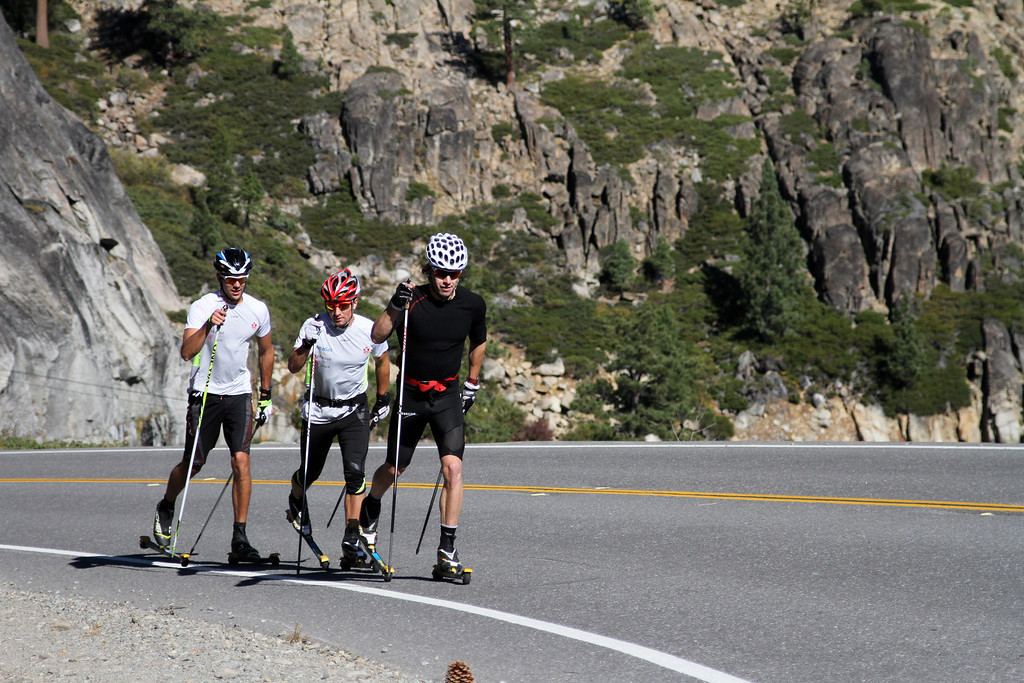
    The Canadian World Cup Men's Team during a rollerski at Donner Pass near Truckee, Calif. (Photo: Mark Nadell/MacBeth Graphics) http://macbethgraphics.smugmug.com/Training/CANADIAN-NATIONAL-TEAM-2013
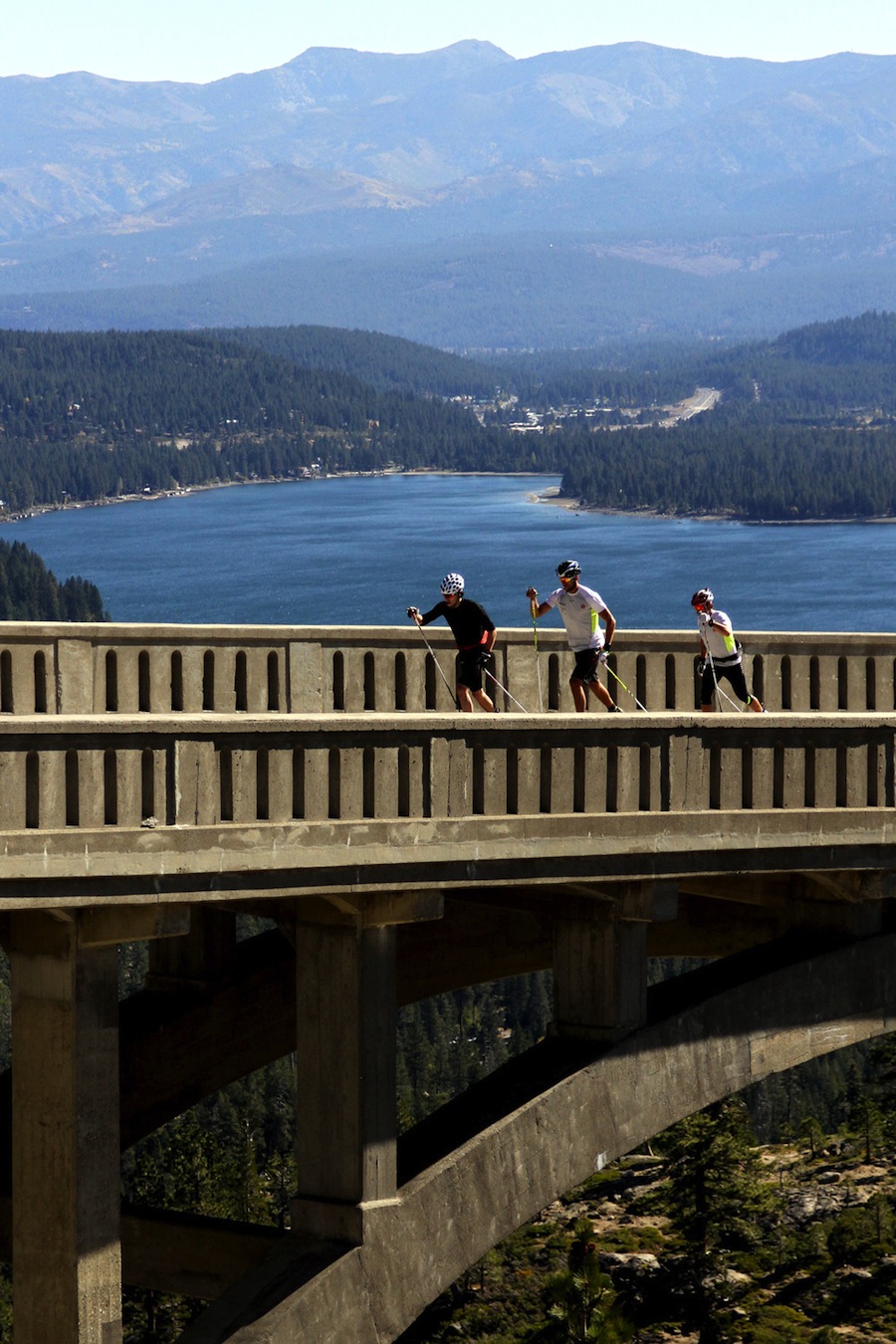
    On Oct. 4, the Canadian World Cup Men’s Team rollerskis across the Rainbow Bridge toward Donner Pass near Truckee, Calif. (Photo: Mark Nadell/MacBeth Graphics)

    “The leaves crunch beneath my now worn running shoes as I negotiate the soft, pine needle infested single track above the Nor-Cal town of Truckee, CA. After days upon days of warm weather, blue skies and summer-like vibes, the jackets and long tights were thrown on – a rude reminder that even in California it’s approaching mid-October. As I weave between some seriously large pines and over the endless ridges, it feels as though I am literally running into winter.”  – Devon Kershaw, on his blog

    There’s no place like California. That’s what Canadian World Cup Team Head Coach Justin Wadsworth thought when he scouted the Truckee area in July. He stayed with a former teammate from the U.S. Ski Team, Marcus Nash, and spent two days exploring northern California and all the high-elevation ski town had to offer.

    What he found was seemingly endless roads covering technical terrain at elevations around 1,775 meters (more than 5,800 feet). About a 45-minute drive away, one could find themselves more than 1,000 meters lower in Nevada City (at 2,477 feet), which Wadsworth deemed perfect for harder efforts. Weather was good there in autumn: warm, sunny and dependable. And who on his team wouldn’t want to go to California for a change?

    The Canadian World Cup Men's Team during a rollerski at Donner Pass near Truckee, Calif. (Photo: Mark Nadell/MacBeth Graphics) http://macbethgraphics.smugmug.com/Training/CANADIAN-NATIONAL-TEAM-2013
    Alex Harvey leads Canadian World Cup teamamtes Ivan Babikov (c) and Lenny Valjas (l) during a rollerski on Old Highway 40 on Oct. 4 near Truckee, Calif. (Photo: Mark Nadell/MacBeth Graphics)

    “It’s been a really great camp; there’s been sunny, blue skies every day,” Wadsworth said on the phone from Truckee on Tuesday. “Everyone can train in shorts and a T-shirt or no shirt.”

    Not that Park City, Utah, where the team normally takes its final dryland camp of the season, is a bad place to be – especially for altitude training at 2,000-plus meters (6,500 feet). But after somewhat of a hold-and-cold season last year, in which some of his skiers reached career bests and others finished a little disappointed, Wadsworth decided it was time for change.

    Off to Truckee they went. Starting Oct. 1, the entire men’s and women’s World Cup team spent nearly three and a half weeks in California, wrapping up Thursday before heading home to Canmore, Alberta, for the opening of Frozen Thunder on Saturday.

    The men’s team – Devon Kershaw, Alex Harvey, Ivan Babikov, and Lenny Valjas – opted for RV dwelling, like their training camps in Hawaii. The women – Perianne Jones and Dasha Gaiazova – weren’t as into that, so they split their time between a Truckee hotel and a house the team rented in Nevada City, Wadsworth said.

    Between the mountain town and low-lying Nevada City, the Canadians divided their efforts accordingly, with sustained easy training in Truckee and more intensity at lower elevations.

    Wadsworth said the area offers some of the best roads and steepest hills he’s ever seen, quiet and ideal for training. He had been looking for rollerski terrain where he could push his men to work on their offset, or V1, for long stretches.

    “We’re so fit these days you have to get a really big hill to get these guys working continuously,” he said.

    California in autumn has been what I remembered it to be. Blue skies and sunny weather, vistas with apparent and looming granite monoliths, stellar soft single track running trails and long, winding (and climbing!), quiet roads. I remember all that from my years training in the fall both in the Mammoth Lakes and Truckee areas in the past. – Kershaw

    Among the skiers he works with directly on the men’s team, Wadsworth said Kershaw, Harvey and Babikov are in the best shape he had ever seen. Valjas was still recovering from his knee surgery in July. According to his blog, Valjas had done “almost no cardio” before the California camp, but Wadsworth said he was jumping into most workouts.

    The Canadian World Cup Men's Team during a four-hour rollerski from 1,000 to 7000 feet. (Photo: Justin Wadsworth)
    The Canadian World Cup Men’s Team during a four-hour rollerski from 1,000 to 7000 feet. From left to right: Devon Kershaw, Lenny Valjas, Alex Harvey, and Ivan Babikov. (Photo: Justin Wadsworth)

    “I was pretty happy he hopped right in and could hang with the guys really well,” Wadsworth said. “We have to make sure we’re not overdoing it with his knee.”

    Women’s coach Eric de Nys worked with the women separately on more sprint-specific training. Jones and Gaiazova left earlier to get on snow in Canmore, and Kershaw flew to Europe on Monday to train with the Norwegian men’s team on the glacier in Val Senales, Italy. Wadsworth will meet him over there later this month and said this was the first time the national team invited one of his athletes to such a significant training camp. It was a no-brainer for a couple reasons.

    “Devon came to me and needed a bit of a change,” Wadsworth said.

    The 30-year-old world champion had been touring North American training camps for his entire career, even before he started racing internationally in 2005. He was also dating Kristin Størmer Steira, who came to Canmore in July, but he hadn’t seen her since, Wadsworth explained.

    “I’ll be there for six days to make sure things are handled well,” Wadsworth said.

    The Canadian World Cup Men's Team hard at work near Truckee, Calif., during their final dryland camp from Oct. 1-17. (Photo: Justin Wadsworth)
    The Canadian World Cup Men’s Team hard at work near Truckee, Calif., during their final dryland camp from Oct. 1-17. (Photo: Justin Wadsworth)

    Mostly, he doesn’t want to blow all the work the team’s put into proper recovery this season. In retrospect, his athletes were a little too eager last summer and they paid the price during the race season, he said.

    “I think things got a little out of hand last year with the intensity,” Wadsworth said. “People being too fired up and doing intensity a bit too hard than what we should.”

    This spring, summer and fall, the Canadians have been more carefully monitoring each workout, placing some responsibility on the athletes. Heart-rate profiles could tell them a lot about where each individual was at with training, and they also tested a bit more this year.

    “After each period, we tested to double and triple check where the athletes were,” Wadsworth said. “That’s something we brought back more … [but] I get more from the actual workouts outside seeing their fitness. The tests give us more indicators of small nuances and changes in physiology. We want to see improvements obviously, but the testing looks at other things that would be red flags or other areas, if they’re missing, we want to see there.”

    Looking at his team’s training progress, Wadsworth said his athletes were right on track.

    “Everybody’s a little bit different, but as a whole I’m really pleased with where we are,” he said. “The main thing is people have been really consistent and doing what they need to do. There hasn’t been a lot of showy stuff; we’re just really, really trying to hit the markers in every training session.”

    Once they get on snow and start gearing up for the start of the World Cup late next month, they’ll have to be more diligent at keeping that in check, he added. The team will skip its typical warmup FIS races in Sweden and jump right in the World Cup opener in Finland.

    “We’re basically using Kuusamo [Nov. 29-Dec. 1] as the first racing that we’ll be doing,” Wadsworth said. “That’s on purpose to build through the season and not having too much hard intensity and save it for later on.”

    Jones and Gaiazova won’t go to Europe until mid-December for the third World Cup in Davos, Switzerland. Wadsworth said the entire goal of the season is a continual slope and gradual build up toward the Tour de Ski and, ultimately, the Olympics in Sochi, Russia.

    “When we get over there, we’ll be fit and ready,” he said.

    In Canmore, the women will have nearly two months at home on manmade snow at Frozen Thunder (Gaiazova will arrive there later this month after training in Montreal and Quebec). Harvey will stay in Quebec with coach Louis Bouchard and the Pierre-Harvey Training Centre.

    On Oct. 24, the rest of the Canadian World Cup Team will host a classic sprint race with the U.S. Ski Team and other elite skiers in town. From what he’s heard, Wadsworth said temperatures have been ideal for making snow, and he hoped they’ll be able to add a “few more meters” to the course.

  • SuperTour Finals Extras: Quotes from the Climb

    SuperTour Finals Extras: Quotes from the Climb

    Far West's Kyla Burill leads Janelle Webb up Monday's 6 k hill climb at SuperTour Finals up Sugar Bowl Resort in Truckee, Calif. (Photo: Mark Nadall/MacBeth Graphics)
    Far West’s Kyla Burill leads Janelle Webb up Monday’s 6 k hill climb at SuperTour Finals up Sugar Bowl Resort in Truckee, Calif. (Photo: Mark Nadall/MacBeth Graphics)

    FasterSkier’s coverage of SuperTour Finals and U.S. Distance Nationals is brought to you by the generous support of Concept2, the leading manufacturer of indoor rowers, racing oars, and the SkiErg.

    TRUCKEE, Calif. – After heaving themselves to the top of Mt. Disney at Sugar Bowl Resort on Monday, several of top finishers were pretty animated about the 6 k hill climb, the final pursuit-style event of SuperTour Finals. Here are some of the best quotes outside of the men’s and women’s race reports.


    On the premise of hill climbs:

    Lisa Larsen of Sweden nears the finish of Monday's agonizing 6 k hill climb at Sugar Bowl Resort at the SuperTour Finals in Truckee, Calif. Larsen placed seventh overall. (Photo: Mark Nadell/MacBeth Graphics)
    Lisa Larsen of Sweden nears the finish of Monday’s agonizing 6 k hill climb at Sugar Bowl Resort at the SuperTour Finals in Truckee, Calif. Larsen placed seventh overall. (Photo: Mark Nadell/MacBeth Graphics)

    “I don’t know, you’re skiing up a mountain, you’re not supposed to do that anyways. It could be the nicest day ever, and it’s still gonna be one of the hardest things you’ve ever done.” – Liz Stephen (Burke Mountain Academy/U.S. Ski Team), overall women’s SuperTour Finals winner, first to the top with fastest time-of-day

    “I actually really like hill climbing. I’m really bad at downhills so I’d much rather just go up the whole time. … It’s always hard when you first start out. It feels just impossible, like you’re never gonna make it there, then once you get going it’s not so bad.” – Rosie Brennan (Alaska Pacific University), sixth overall

    “I like going up hill … and I like V1-ing.” – Brian Gregg (Central Cross Country), 10th overall with second-fastest time


    On the inevitable mental battle:

    “I just put my head down and had to keep reminding myself, this is crazy, but everybody’s in this. It hurts so bad, but you just keep trucking.” – Sadie Bjornsen (APU/USST), third overall

    “I single-sticked so much. Erika [Flowers] was right behind me on the results and I knew she was kind of catching me at one point, and part of me wanted to stop to just have someone to follow, but it was like, ‘Don’t do it don’t do it!’ Spectators help but. You also just want to get to the top.” – Chelsea Holmes (Sun Valley Ski Education Foundation), 12th overall with third-fastest time

    “We’re all tired at this point in the year. If you can trick your mind on certain days that you’re feeling good … the goal was honestly to have fun out there, which was really difficult with that wind.” – Stephen

    “This year I just decided to not pay attention to anybody around me ’cause I know what my strengths are climbing a hill, and it’s not really anything. … I did a lot of skinning two weeks ago in France, and I was like, ‘Just pretend you’re skinning.’ My legs go the classic style a lot better then the side style.” – Sadie Bjornsen

    “I did exactly what my plan was, which was to go out and not blow up on the first loop, go up the hill at what I thought was a sustainable pace, and try to catch Erik [Bjornsen] there. I did catch him.” – Kris Freeman (Maine Winter Sports Center/USST), second to Bjornsen with the fastest time-of-day


    On giving credit where it’s due:

    “[Erik Bjornsen’s] at an age where he gets stronger every year. Erik Flora had him following me around in Bend [Oregon] at Level 3 when I was doing Level 1 two years ago. He’s a resilient kid; he can recover from that. I think recovering from hard training is one the most important things as a ski racer so I’m really impressed with him.” – Freeman


    On the conditions:

    “The wind was so brutal. When it was at your back, it was so sweet. You’d try to ski super big trying to get boosted up, but when you’d turn the corner and it was blowing sideways and blowing your poles. … It was a crosswind at the finish. It definitely felt like I was V1ing sideways into it ’cause otherwise you’d get blown off the side.” – Jessie Diggins (Stratton Mountain School T2 Team/USST), fifth overall with second-fastest time

    “The wind is less obnoxious than the powder. It’s all right, not the most fun conditions, but make you tougher, hopefully.” – Holmes

    “The top is just survival mode. You’re doing everything you can to move and it didn’t help that all a sudden there’d be piles really deep and then there’d be ice and stuff.” – Sadie Bjornsen


    On the finish:

    “You could hardly see even my parents cheering; they were standing up there in this crazy storm. Thank God ’cause we wouldn’t have known where to go. I was like, ‘Thank you guys, and my mom. You’re still standing here! You’re in a full-on storm!’

    ” – Sadie Bjornsen

    “It was windy, but I heard it was worse before we got there. By the top part, it flattens out so it’s the only part you can ski well. It didn’t feel as windy as when you’re standing still and getting buffeted by the side wind. I thought the top was the best part for sure. You could actually get some glide.” – Mikey Sinnott (SVSEF), third overall

    “I was really excited when I previewed the course [the day before] and I could see that last four hundred, five hundred meters was gonna be skiable, maybe V2, and it was. I think I V2-ed a lot of that.” – Erik Bjornsen (APU/USST), overall SuperTour Finals winner/first to top


    On how Sugar Bowl stacks up to other hill climbs (including Italy’s Alpe Cermis, the famous final climb of the Tour de Ski):

    “It was brutal. It’s funny because we were talking about how we thought this climb was a little bit easier than Jay Peak [at SuperTour Finals] last year, but with the four k or whatever we skied before the hill climb, it was a tough race.” – Sylvan Ellefson

     (Ski & Snowboard Club Vail/Team HomeGrown), fourth overall

    “This one, in my mind, was a little easier than Jay Peak. We got a nice run into it, nice ski section in the beginning and then just a couple steep pitches. Jay Peak was so steep the whole time even though it’s shorter [at 1.8 k].” – Tad Elliott (SSCV/HomeGrown/USST), 13th overall with third-fastest time

    “I feel like Alpe Cermis is always going to be the hardest, but this compares pretty well because of altitude, snow drifts, they were so deep.” –Diggins

    “I thought this wasn’t as skiable, more side hill and more awkward grades.” – Kikkan Randall (APU/USST), second overall

    “The actual hill climb seemed a little shorter than the one in the Tour, but we’re way higher than it ever was on the World Cup. It’s just a different deal. The altitude is a huge, huge factor here. You guys [FasterSkier] posted the tape of us walking up the hill in the 15 k the other day. I saw myself coming up the hill and I’m thinking, ‘That’s kind of embarrassing,’ and then I saw the rest of the field come up and I’m like, ‘Oh yeah, I was walking, but I was walking with impulse.’ ” – Freeman, who won Friday’s 15 k classic mass start


    On getting back down the mountain:

    “I don’t think I’ve ever been that cold. That was miserable.” — Erik Bjornsen, stuck on the chairlift for an estimated 15 minutes with Skyler Davis (SMST2/USST). Most people skied down.


    On the last races of the season:

    “It’s good to be four down, one to go. I’ve been feeling really good. [On Monday] I didn’t feel great on the second half, but hill climbing is such a unique thing. I’m hoping to have the energy to finish up one more, and I’m definitely ready to be done.” – Randall

    “Every mini tour I’ve done this year, the 10 k classic I’ve taken myself effectively out of the running. … Every time there’s a slushy, klistery classic race, I need to really work on that. So it’s cool to come out of it knowing where I can improve.” – Diggins, who placed 18th in Friday’s 10 k classic mass start

    “It’s great to end the season here in California. I think the organizers have done an awesome job, and I hope they have it again out here. It’s a little bit too late in the season; that’s the only thing. We’ve all had a long season. A week before this is a more ideal time for all of us. I think right now we’re beating ourselves into a hole that will take an extra week to come out of.” – Stephen

    “I think Sylvan and I are just gonna lay in bed and watch movies, get some ice cream and coffee and hopefully we’ll be up there with these boys in the 50 k.” – Elliott

  • Bjornsen Digs Deep, Bests Freeman in Hill Climb for First SuperTour Finals Title

    Bjornsen Digs Deep, Bests Freeman in Hill Climb for First SuperTour Finals Title

    Erik Bjornsen (APU/USST) just before clinching his first SuperTour Finals overall victory by 20.5 seconds ahead of Kris Freeman (MWSC/USST) in Monday's 6 k freestyle hill climb at Sugar Bowl Resort in Truckee, Calif. (Photo: Mark Nadell/MacBeth Graphics)
    Erik Bjornsen (APU/USST) just before clinching his first SuperTour Finals overall victory by 20.5 seconds ahead of Kris Freeman (MWSC/USST) in Monday’s 6 k freestyle hill climb at Sugar Bowl Resort in Truckee, Calif. (Photo: Mark Nadell/MacBeth Graphics)

    FasterSkier’s coverage of SuperTour Finals and U.S. Distance Nationals is brought to you by the generous support of Concept2, the leading manufacturer of indoor rowers, racing oars, and the SkiErg.

    TRUCKEE, Calif. – Erik Bjornsen thought he was done for. The 21-year-old U.S. Ski Team and Alaska Pacific University (APU) skier had gone out too hard, too early in Monday’s 6-kilometer freestyle hill climb before the real ascent up Sugar Bowl Resort even started.

    Bjornsen had been fighting nerves 24 hours before the final pursuit; thoughts about whether he could hold onto the overall lead for his first SuperTour Finals title infiltrated his mind.

    Two U.S. Ski Team (USST) A-team members started closest to him: first Andy Newell (Stratton Mountain School T2 Team), 41 seconds back, then Kris Freeman (Maine Winter Sports Center), seven seconds later.

    Bjornsen was excited, but anxious. Standing next to Newell on the start line, he smiled as the veteran jokingly talked trash.

    “I was telling him I was gonna catch him, even though I really knew I probably wasn’t,” Newell said after the race.

    Bjornsen laughed, most concerned about Freeman. Starting less than a minute ahead of the defending SuperTour Finals champ wasn’t necessarily enough. But around four kilometers in, Bjornsen was already more than 15 seconds up on him.

    Normally, that would be great for Bjornsen, but not when you’re climbing more than 1,000 feet to the top of Mt. Disney, nearly 8,000 feet above sea level.

    Upon hearing the split from APU head coach Erik Flora, Bjornsen felt a pang of panic. He wasn’t comfortable; he was dying, he said.

    Kris Freeman (MWSC/USST) putting the hurt on up Sugar Bowl Resort on Monday in the 6 k hill climb, the final event of 2013 SuperTour Finals in Truckee, Calif. He finished second overall behind Erik Bjornsen (APU/USST) with the fastest time of the day. (Photo: Mark Nadell/MacBeth Graphics)
    Kris Freeman (MWSC/USST) putting the hurt on up Sugar Bowl Resort on Monday in the 6 k hill climb, the final event of 2013 SuperTour Finals in Truckee, Calif. He finished second overall behind Erik Bjornsen (APU/USST) with the fastest time of the day. (Photo: Mark Nadell/MacBeth Graphics)

    About a kilometer later, Bjornsen looked back to face reality. Freeman was right behind him. Moments later, he caught Bjornsen. The two skied together for the remainder of the grueling climb, turning the corner at the ridgeline into a massive wind.

    Now’s my chance, Bjornsen thought. He found his own second wind and pushed the pace.

    “I was starting to put some time on him,” Bjornsen recalled. “When I saw that first chairlift, I thought we were finishing right there, so I put a sprint on and I got up over that first hump.”

    But the finish line wasn’t there. Bjornsen’s stomach sank again, but he quickly lifted his head up, guessing he was about 10 feet ahead of Freeman.

    “I was like, ‘I’ve put this effort in and I can’t let it go now,’ ” he said. “Then one of my coaches was like, ‘It’s right there!’ I tried to put in another kick and got up over that little hill and just kind of walked over the finish line. I think it was the hardest I’ve ever pushed myself.”

    The runner-up by 20.5 seconds, Freeman, 32, said he gave it his all as well. Along the gradual uphill to the finish, he also tried to attack.

    “I thought by turning the screw by one click at the top I’d be able to go by him, but he turned up three clicks and he beat me,” Freeman said. “I don’t really feel like I lost today; I feel like he won.”

    That’s a unique statement coming from the three-time Olympian.

    “I hate losing,” Freeman said. “But it’s exciting going into next year at the Olympics. If we have Bjornsen there skiing like this, we’re starting get a real relay team going and that’s pretty cool.”

    For Bjornsen, the SuperTour Finals crown – a culmination of four days of racing in the last week – was another stellar result in a season filled with breakthroughs. Last year, Bjornsen was third in the tour; this year, he was the top domestic racer as the period-one SuperTour leader. A USST development skier for the last two seasons, he went on to achieve his first national title in the 15 k freestyle and also made the World Championships team.

    According to Flora, Bjornsen’s gold-medal winning performances at SuperTour Finals, with a prologue victory and two other podiums, weren’t unexpected, but they sure were nice.

    “I think the biggest thing is it’s just confirming,” Flora said. “Last summer we made a pretty big push in his training, and there’s always the chance that it goes great and there’s the chance that it doesn’t go as well.

    “You always have goals and think you can reach a certain level, but to see how strong he was during this tour, I think it surprised both of us,” he continued. “The confidence he brings into next year will be the biggest addition to his performance.”

    With the fourth-fastest time of the day, Bjornsen completed the course – downhill and gradual for the first four kilometers, and up for the last two – in 25 minutes, 28 seconds. It wasn’t the 13-minute, 1.8 k hill climb he had taken third in last year at Jay Peak in Vt., and just like that one, it wasn’t easy.

    “I can’t believe I won the overall tour,” Bjornsen said. “I did not expect that at all coming into this week, and I’m super excited with all the racing that’s gone on so far.”

    Brian Gregg (CXC) leads APU's Mark Iverson up the final ascent before the finish in Monday's 6 k freestyle hill climb up Sugar Bowl at SuperTour Finals in Truckee, Calif. Gregg skied the second-fastest time for 10th overall. (Photo: Mark Nadell/MacBeth Graphics)
    Brian Gregg (CXC) leads APU’s Mark Iverson up the final ascent before the finish in Monday’s 6 k freestyle hill climb up Sugar Bowl at SuperTour Finals in Truckee, Calif. Gregg skied the second-fastest time for 10th overall. (Photo: Mark Nadell/MacBeth Graphics)

    Freeman was the fastest from the bottom in 25:00.5, about 15 seconds ahead of 10th-place finisher Brian Gregg (Central Cross Country), who had the second-fastest time for the second-straight year.*

    USST member Tad Elliott (Ski & Snowboard Club Vail/Team HomeGrown) ranked third for time, 20.6 seconds behind Freeman. He was 13th overall. **

    Despite establishing himself as one of the nation’s fiercest hill climbers, Freeman isn’t a fan.

    “It was absolutely miserable,” he said. “I don’t think anyone here actually wanted to do the race today.”

    Several inches of new snow covered the alpine slopes, making the freestyle race even more work than expected. Early Monday morning, winds gusted at near 40 miles per hour at the bottom, reaching above 50 mph near the top.

    “I kind of hope that this is the hill climb that ends hill climbs at Spring Series,” Freeman said. “I don’t think it’s something that we necessarily need to practice. It only happens once on the World Cup a year.”

    He suggested a 15 k skate pursuit to complement the 15 k classic mass start, or have a 50 k mass start and a 30 k pursuit.

    “I don’t think that doing a mini tour every year is necessary,” Freeman added. “I think that this hill climb and Jay Peak was a bit over the top.”

    Racers were divided over which was tougher, with Jay Peak launching into a relentless incline without a lower loop. Overall third-place finisher, Mikey Sinnott (Sun Valley Ski Education Foundation), said it depended on the day.

    Mikey Sinnott (SVSEF) racing to third overall on Monday in the 6 k freestyle hill-climb pursuit at Sugar Bowl in Truckee, Calif. (Photo: Mark Nadell/MacBeth Graphics)
    Mikey Sinnott (SVSEF) racing to third overall on Monday in the 6 k freestyle hill-climb pursuit at Sugar Bowl in Truckee, Calif. (Photo: Mark Nadell/MacBeth Graphics)

    “It’s so easy to tip over and just have a rough day out there, and that just changes your perspective of it,” said Sinnott, who started fourth, 52 seconds behind Bjornsen. He finished 1:07.9 back with the seventh-fastest time.

    “Sometimes they can go well, sometimes they can go bad,” he said. “Hill climbs are the worst race when you have 3 k to go and you can’t see straight.”

    Lucky for him, he felt “solid,” he said.

    “I wanted to try to stick with Freeman a little more, but he got a little bit of separation on me on the first little hill,” Sinnott said of the first 3 k. “Newell got between us so that kind of let Freeman go, but it worked out because that kept me under control.”

    Sylvan Ellefson (SSCV/HomeGrown) started 1:16 back in sixth and caught Sinnott early in the two-kilometer climb. Ellefson stuck behind him until the top, and the two worked together to try to catch Freeman.

    “When you’re on a slope so steep, it looks like you’re really close, but really you’re like 40 seconds behind,” Ellefson recalled. “We moved up on him a little bit, then Mikey jumped in front of me again and after that we skied together towards the top.”

    Battling for third, Ellefson passed him again as they turned the corner along the ridge. For Sinnott, the timing couldn’t have been better.

    “Sylvan passed me right when the headwind started coming,” Sinnott said. “He took the brunt force of that and gave me a little bit of a cushion.”

    Before the finish, Sinnott overtook Ellefson once more.

    “I was having a lot of trouble with my legs so I did what I could to hold on and hold onto the time that I had,” Ellefson said. He finished 20.1 seconds behind Sinnott in fourth with the fifth-fastest time.

    “I’m not usually a climber, but I think at this altitude I can be,” the Vail native said.

    Newell finished fifth overall (+1:42.6) after placing 35th in the opening prologue and clawing back into contention with a classic-sprint victory on Saturday.

    “The hill climb’s a tough event for me,” Newell said after entering the pursuit in second. “I think it could’ve been a lot better tour if I would’ve had a better prologue.”

    Skiing with Freeman early, Newell said he fell behind on the first part of the climb, letting both him and Sinnott go by him.

    “I just felt like they were going a little bit too fast so I skied up the mountain myself,” he said. “I couldn’t really find the motivation. It was super hard today so I went kind of easy.”

    Freeman was also disappointed with two of his three previous SuperTour Finals results: he was 11th in the prologue and 38th in the sprint, failing to qualify for the heats and losing the overall lead (after he won Friday’s 15 k classic mass start).

    “I’m disappointed that I lost the tour, but it’s hard to overcome two really crappy days,” Freeman said. “I feel good about winning both distance days on the time.”

    Also:

    * Gregg found success on his wife’s skis, using Caitlin Compton Gregg’s 182-centimeter Salomons for the first time in a race.

    “A little bit shorter, a little lighter,” he said. “It’s an advantage of being a married couple; you share your fleets a little bit.”

    Tad Elliott (SSCV/Team HomeGrown/USST) nearing the finish of Monday's SuperTour Finals hill climb at Sugar Bowl Resort with the third-fastest time. (Photo: Mark Nadell/MacBeth Graphics)
    Tad Elliott (SSCV/Team HomeGrown/USST) nearing the finish of Monday’s SuperTour Finals hill climb at Sugar Bowl Resort with the third-fastest time. (Photo: Mark Nadell/MacBeth Graphics)

    Gregg started 22nd and ended up 10th, catching a ride from Elliott, who started 23rd and made up 10 seconds on him within the first 4 k. The two skied together up the climb, picking off places along the way.

    “It’s a disadvantage to start three minutes back, but it’s also an advantage because you can catch people,” Gregg said. “It’s sort of like having real-time splits. I couldn’t see Erik or Kris, those guys were way up there, but I could see some of those other guys.”

    ** “I actually caught and passed Brian Gregg before the steep part and gained time back into him,” Elliott said. “He caught me on the steeper sections and we skied together ’til the finish.”

    According to Elliott, who ended up 13th behind Gregg, Mark Iverson (APU) in 11th, and Trygve Market (University of Denver) in 12th, it wasn’t much of a final sprint.

    “I could see the finish line, but just couldn’t do anything at that point,” he said. “I was pretty tired. I really wanted to try to go for time of day, that was a goal … but the steep sections are actually kind of a weakness for me. Brian was skiing those the best, I think, of the field.”

    — Audrey Mangan contributed reporting

    Results: Overall | Time-of-day

    Photo gallery

  • Instead of Calling It a Season, Biathlon Women Head to Truckee – and Collect Top Finishes

    Instead of Calling It a Season, Biathlon Women Head to Truckee – and Collect Top Finishes

    Biathlete Susan Dunklee, racing for the Craftsbury GRP, has finished fifth, sixth, and twelfth in the three races of SuperTour Finals so far; on Saturday, she made the final of the classic sprint. Photo: Mark Nadell/MacBeth Graphics.
    Biathlete Susan Dunklee (Craftsbury GRP) has finished fifth, sixth, and twelfth in the three races of SuperTour Finals so far. On Saturday, she made the final of the classic sprint. (Photo: Mark Nadell/MacBeth Graphics)

    FasterSkier’s coverage of SuperTour Finals and U.S. Distance Nationals is brought to you by the generous support of Concept2, the leading manufacturer of indoor rowers, racing oars, and the SkiErg.

    SODA SPRINGS, Calif. — After a long season of racing in Europe – one that could probably be considered the best-ever by a U.S. women’s team – biathletes Susan Dunklee, Annelies Cook, and Hannah Dreissigacker easily could have called it a year and headed home. Or, even better, somewhere warm.

    That’s what their coach, Jonne Kahkonen, did, taking a vacation to the Caribbean. Tim Burke will head to the Bahamas; other teammates, too, will find beaches. Leif Nordgren was recently riding a bike along the California coast.

    But the women apparently hadn’t had enough racing, and took a more exhausting route to California, turning up at SuperTour Finals – and turning heads.

    Take Saturday, for example: Dunklee appeared in the final of the sprint, and Dreissigacker and Cook in the semifinal. They mixed it up in a serious way with members of the U.S. Ski Team, which is coming off its own best-ever season.

    More surprising? The sprint was classic, a big change from biathlon, where all competitions feature skating.

    “The biathletes did great,” Pepa Miloucheva, the Craftsbury Green Racing Project coach who works with Dunklee and Dreissigacker when they are home from Lake Placid and Europe, told FasterSkier. “Susan, not bad for a biathlete, A-final. These guys are awesome.”

    But although the some members of the ski community might be wondering how the biathletes could beat them in a classic race, others aren’t surprised at all. Dunklee and Cook routinely turn in very fast ski times on the World Cup, and all three women were ski racers in college. Although they don’t show up regularly on the SuperTour circuit, they are far from unknown.

    “Both Susan and Hannah are very good classic skiers,” Miloucheva said. “During their college years they did very good in classic also. They got a little bit tired today by the end because they haven’t done that much classic this year, but they’re awesome. They both did just great.”

    Annelies Cook (Maine Winter Sports Center) placed ninth in the 10 k classic, then made the semifinals of the sprint. Photo: Mark Nadell/MacBeth Graphics.
    Annelies Cook (Maine Winter Sports Center) placed ninth in the 10 k classic, then made the semifinals of the sprint. (Photo: Mark Nadell/MacBeth Graphics)

    Dunklee is leading the way so far for the biathletes, notching a fifth-place finish in the skate prologue and then finishing sixth in the sprint final. But Cook, who is representing the Maine Winter Sports Center, and Dreissigacker are more than holding their own, too: Cook placed ninth in the 10 k classic mass start and tenth in the sprint, and Dreissigacker was 11th in the 10 k and 12th in the sprint.

    “I’m definitely sore,” Dunklee said after her first two classic races of the season. “We do a lot of classic training for recovery, just not intensity, so we’re still good classic skiers – I think! – but we’re just not used to going hard. We’re definitely getting those muscles worked.”

    Much like the U.S. Ski Team women, this is the first time that the team is racing domestically this season. Dunklee and Cook have been on the World Cup since November, while Dreissigacker joined later after a few trials races here in the U.S.

    “I think we want to be able to prove things with biathlon, but we also know if we tank, it’s okay because we’ve had a good season, a season we can be proud of and this is kind of an extra icing on the cake at the end,” Dunklee said.

    The results add to a season where biathletes have repeatedly shown their strength alongside their skiing counterparts. Germany’s Miriam Gössner was just off the podium at cross country World Championships, finishing just a half-second out of bronze in the 10 k skate; in the same race, Finland’s Kaisa Makarainen placed 14th.

    Canada’s Zina Kocher has also had strong results, heading to the Davos World Cup more or less on a whim, where she was the only Canadian women to start the 10 k skate. She finished 36th. Later in the season, she made an appearance at Canadian Nationals, where she was second in the 30 k, the top Canadian behind Switzerland’s Bettina Gruber.

    None of the U.S. biathletes have won a race, of course, but that’s not the reason they came to California anyway.

    “Truckee is a good place and we wanted to come out and reconnect with the nordic community,” Dunklee said. “This is a bunch of our friends that we don’t get to see very often, and they’re a really fun crowd and I miss it.”

    All three were active in the ski community earlier in their careers, first as juniors and then in college. Dunklee and Dreissigacker raced for Dartmouth College and Cook for the University of Utah, and all were honored with All-American status at NCAAs. In fact, this is Dreissigacker’s first year as a full-time biathlete; before that, she raced cross country for the CGRP. Coming to SuperTour Finals is, for all of the women, very much rejoining their community.

    And they come proudly, too. Dreissigacker qualified for her first World Championships this season, which came quickly after her switch to biathlon; Cook had a string of career-best results, including two top-20’s in Sochi, Russia. The best day of the season was likely when Dunklee finished seventh and Cook 14th in the 15 k individual at the future Olympic venue.

    Along with Sara Studebaker, the women teamed up for tenth- and eleventh-place relay finishes late in the season.

    “We have a great team right now,” Dreissigacker said. “I think our training plan is really good for continuity over the whole season. It’s a lot of training over the summer, and that’s good for keeping us still skiing fast at this time of the year. But I’m just psyched because I have great training partners, and it’s fun to be able to really compete with all the nordic girls, too, because they’re doing so well in the world.”

    Dreissigacker: proving to herself (and everyone else) that she's fast. Photo: Mark Nadell/MacBeth Graphics.
    Dreissigacker: proving to herself (and everyone else) that she’s fast. (Photo: Mark Nadell/MacBeth Graphics)

    For Dreissigacker, attending these races instead of calling it quits on the season was important for some personal goals.

    “I feel like I haven’t been skiing that fast this year, especially in biathlon races,” she said. “I was hoping to do well here just to prove to myself that my training was going all right and that I could ski fast. So I’m psyched about that. But other than that, it’s meant to just be an end-of-season fun sort of thing.”

    And Dunklee viewed the sprint and Friday’s mass start as ways to tune up her head-to-head race strategies.

    “We don’t get that many opportunities to practice pack skiing and mass starts, especially this year I didn’t qualify for any of the mass starts in the World Cup, which I was very disappointed in,” she explained. “But doing a mass start out here the other day and doing heats today, it was really good to keep in touch with that aspect of skiing. I think it’s really good training.”

    For all, though, the focus was fun, and to end the season with happy memories and positive vibes. If they do well? Great. If not? Well, that’s okay too.

    “It’s more just fun, to be honest,” Cook said after the sprint qualifier. “None of us have any expectations. The last time I sprinted, and the last time I did a classic race, was last year. So you go out there, and people are like, ‘how was it?’ And you say, ‘I don’t know!’ I went hard. I think my kick was OK.”

    All three ended up in the same semifinal of the sprint, which was a treat. As Dunklee said, they don’t get to race against each other directly very often; mass start competitions on the World Cup only take 30 women, the number of points on a range, and no Americans qualified for any of the races this season.

    Toeing the line together also added an exciting element to the competition the women are holding among themselves: who can ski the best in these final races.

    “We have a pretty serious competition going here, between the three of us, it’s the Biathlon Cup,” Dunklee explained.

    “It’s hard to tell who’s going to win, because it will really depend on the hill climb,” Dreissigacker said.

    Laughing, Cook agreed: “Hannah and I are pretty neck and neck.”

    So, as tired as they are, there’s more than just pride for their sport on the line, and the chance to show that biathletes are good skiers. When it comes time to skate up the Sugar Bowl, probably the most grueling format available in ski racing today, these three women will be fighting extra hard to beat each other. Dreissigacker suggested that the winner might be rewarded by the opportunity to buy the other two a beer.

    Any one of the three might have a great climb. The last time they tried one was in the fall, when Climb to the Castle took place just outside their normal training grounds in Lake Placid; Cook and Dunklee sat it out, but Dreissigacker finished fourth behind U.S. Ski Team members Liz Stephen, Jessie Diggins, and Ida Sargent.

    So what happens at the Sugar Bowl? It could be anything.

    “It will all come down to the last day,” Dunklee said.

    – Alex Matthews contributed reporting.

  • Bjornsen Weathers Boggy SuperTour Finals Opener, Wins Prologue

    Bjornsen Weathers Boggy SuperTour Finals Opener, Wins Prologue

    Erik Bjornsen (APU/USST) en route to a 14.5-second victory in Thursday's 3.3 k freestyle prologue, which kicked off 2013 SuperTour Finals at Auburn Ski Club near Truckee, Calif. (Photo: Mark Nadell)
    Erik Bjornsen (APU/USST) en route to a 14.5-second victory in Thursday’s 3.3 k freestyle prologue, which kicked off 2013 SuperTour Finals at Auburn Ski Club near Truckee, Calif. (Photo: Mark Nadell/MacBeth Graphics)

    FasterSkier’s coverage of SuperTour Finals and U.S. Distance Nationals is brought to you by the generous support of Concept2, the leading manufacturer of indoor rowers, racing oars, and the SkiErg.

    SODA SPRINGS, Calif. – Lifting his fogged glasses at the finish of the men’s SuperTour Finals opening prologue, Erik Bjornsen turned to look behind him.

    Soaking wet in near-freezing temperatures on Donner Summit, the Alaska Pacific University (APU) and the U.S. Ski Team (USST) member stood there, counting silently until he reached 40 seconds, he later told Sun Valley’s Mike Sinnott.

    With no sign of Sinnott, who started 30 seconds behind him in the 3.3-kilometer freestyle race, Bjornsen moved on and out of the finish pen to get warm.

    One day after sunny skies and 60-degree temperatures blanketed the region, some 175 competitors at Auburn Ski Club withstood a damp and windy morning on Thursday. Rain turned to wet snow for the women’s race, and that snow intensified into variable squalls throughout the men’s competition.

    Fortunately, all anyone had to do was complete one 3.3 k lap, the same for both men and women, but that in itself was a challenge. Filling in as Tahoe Donner’s backup host for SuperTour Finals, Auburn organizers constructed a new hill, which some racers, like Sinnott, referred to as the “wall.”

    In an all-out prologue, that kind of terrain is tough to tackle, especially at more than 7,000 feet above sea level. Add to that the issue of poor visibility with foggy or no eyewear and you’re in for an interesting race.

    APU and US Ski Team member Erik Bjornsen (second from left) celebrates his first career SuperTour victory at 2013 SuperTour Finals after winning Thursday's 3.3 k freestyle prologue at Auburn Ski Club in Soda Springs, Calif. Canadian Knute Johnsgaard (Yukon Elite Squad) was second), and Mark Iverson (APU) and Mike Sinnott (Sun Valley) tied for third. (Photo: Mark Nadell/MacBeth Graphics)
    APU and US Ski Team member Erik Bjornsen (second from left) celebrates his first career SuperTour victory at 2013 SuperTour Finals after winning Thursday’s 3.3 k freestyle prologue at Auburn Ski Club in Soda Springs, Calif. Canadian Knute Johnsgaard (Yukon Elite Squad) was second), and Mark Iverson (APU) and Mike Sinnott (Sun Valley) tied for third. (Photo: Mark Nadell/MacBeth Graphics)

    Bjornsen, who posted the fastest time of the day in 7:47, said he couldn’t see much of anything for the last half kilometer.

    “I was really unbalanced and kind of sloppy, but coach said I looked good at the finish,” he recalled. “I heard the time a little bit after and couldn’t believe it.”

    For Bjornsen, who won his first national title earlier this year at the age of 21, it was the first SuperTour win of his career and set him up nicely for the remaining four races at SuperTour Finals. With a 15 k classic mass start on Friday, Bjornsen will lead the standings by at least 14.5 seconds, the amount of time he beat Canadian runner-up Knute Johnsgaard by on Thursday.

    “It’s super exciting … and pretty unexpected,” Bjornsen said. “Coming into these races, I didn’t have a lot of pressure on myself. Now I see I might be in good form so I’m pretty excited for the rest of the races, and I hope I can go for the overall podium.”

    A year ago at SuperTour Finals in Craftsbury, Vt., Bjornsen tied Noah Hoffman for third in the 3.3 k freestyle prologue. Simi Hamilton of the Sun Valley Ski Education Foundation (SVSEF) and USST won in 5:59.4, and Sylvan Ellefson (Ski & Snowboard Club Vail/Team HomeGrown) was second.

    Bjornsen went on to finish third overall and was 12th in the U.S. Distance Nationals 50 k.

    This year, two men again tied for third, with Sinnott (SVSEF) and Mark Iverson (APU) finishing 15.7 seconds behind Bjornsen.

    Mike Sinnott (SVSEF) starting out Thursday's 2013 SuperTour Finals freestyle prologue at Auburn Ski Club in Soda Springs, Calif. He tied Mark Iverson (APU) for third. (Photo: Mark Nadell/MacBeth Graphics)
    Mike Sinnott (SVSEF) starting out Thursday’s 2013 SuperTour Finals freestyle prologue at Auburn Ski Club in Soda Springs, Calif. He tied Mark Iverson (APU) for third.

    “Man, that kid was flying,” Sinnott said of Bjornsen. “I started right behind him and I was on the steep wall with him and then I never saw him again.”

    With huge flakes swirling about the start slowing the course below, Sinnott made a mental note to copy Bjornsen’s strategy of starting easy then push up the big climb.

    “After the climb, there was still a ton of work and I hammered hard after that,” Bjornsen said.

    Sinnott did the same, fearing he’d lose ground on the backside into the stadium.

    “That’s what I wanted to do but just didn’t have it as much as him,” Sinnott said. “Hats off, that guy skied a really strong and smart race.”

    The tenth starter in the randomized A-seed of FIS points, Bjornsen was the only early racer besides Craftsbury’s Pat O’Brien (who finished fifth) to crack the top 10. Contenders who started before him, like Andy Newell (Stratton Mountain School T2/USST), Ellefson, and NCAA champions Miles Havlik and Rune Ødegård, did not make the top 20.

    Havlik started first and placed 28th, Newell went out fourth and ended up 35th, Ellefson placed 24th, and Ødegård was 47th. Bjornsen was also the only man to beat Kikkan Randall, who won the women’s race in 7:57.9.

    “It’s kind of hard to gauge sensations out here,” said O’Brien, of the Craftsbury Green Racing Project (CGRP). “Coming from sea level, everything feels really slow, a huge difference in ski speed. Right as we were heading out a big snow squall came in and was kind of like wet, heavy snow and I was skiing and didn’t have glasses or anything, kind of lost track where I was out on the course.

    “I’m super happy with how things went,” he added. “It’s a great way to start out the series. … [I’ve] been feeling kind of junky the last few days but I think in a short-enough race like this, you can kind of push through it.”

    Newell said he felt awful afterward, but that was normal for prologues. The conditions weren’t.

    “My skis were so slow; I’m hoping the other people’s felt that slow, too,” he said. “I almost fell over on the downhills, they were so sticky. It just started snowing so hard just before the start.”

    Knute Johnsgaard (Yukon Elite Squad) racing to second in Thursday's 2013 SuperTour Finals 3.3 k freestyle prologue at Auburn Ski Club in Soda Springs, Calif. (Photo: Mark Nadell/MacBeth Graphics)
    Knute Johnsgaard (Yukon Elite Squad) racing to second in Thursday’s 2013 SuperTour Finals 3.3 k freestyle prologue at Auburn Ski Club in Soda Springs, Calif. (Photo: Mark Nadell/MacBeth Graphics)

    Part of the newly formed Yukon Elite Squad, Johnsgaard started in the second half of the 100-man pack and rose to second despite not feeling great, either.

    “I felt really terrible actually,” the 20-year-old Whitehorse native said. “I felt slow with heavy legs. … I got a couple splits at the finish, but I didn’t really believe them because I felt so bad.”

    Coming off five races at Canadian Nationals in Whistler, B.C., which wrapped up last Saturday, Johnsgaard decided to change his plane ticket on a whim and finish his season in California in an effort to boost his FIS points.

    “I’m finally kind of getting to where I wanted to be all year so now I gotta make the most of it,” he said.

    Iverson, 30, hadn’t raced in two months since finishing second in the Boulder Mountain Tour in early February. He suffered a muscle injury in his back in a non-skiing-related incident afterward, “doing something stupid,” Iverson explained.

    He took 2 ½ weeks off completely and went on to take bronze in his first race back on Thursday.

    “My only experience in prologues at altitude was two years ago at Sun Valley and I had an epic, epic, just-came-to-pieces,” Iverson said of placing 85th in the 3.5 k at 2011 SuperTour Finals. “I just tried to go out and not panic and try to ski loose and try to maintain a lightness to the glide and kick.”

    It worked, as Iverson tallied another personal best this season. In January, he won his first SuperTour in Minneapolis and placed second overall in the Tour de Twin Cities.

    In terms of pacing this one, Iverson kept himself in check. During training on Wednesday, he did a Level 3-4 workout around the course with his APU teammates.

    Mark Iverson (APU) in Thursday's 2013 SuperTour Finals prologue at Auburn Ski Club in Soda Springs, Calif. Iverson tied Mike Sinnott (SVSEF) for third. (Photo: Mark Nadell/MacBeth Graphics)
    Mark Iverson (APU) in Thursday’s 2013 SuperTour Finals prologue at Auburn Ski Club in Soda Springs, Calif. Iverson tied Mike Sinnott (SVSEF) for third. (Photo: Mark Nadell/MacBeth Graphics)

    “We were all just gassed at the end,” he said, making a point not to go much harder on Thursday.

    While the prologue at altitude was undeniably tough, Iverson said he was enjoying his visit so far.

    “It could’ve been better weather, but it’s not much worse than Eagle Glacier in the summertime some days,” he said of APU’s summer training mecca near Anchorage.

    “When it’s beautiful, it’s absolutely amazing; you’re on top of a mountain in Alaska,” Bjornsen explained. “But when it’s raining, it’s way foggier and it’s way windier. You get rain like this, and it’s usually a lot softer than this. Snow doesn’t freeze … so I’ve actually gotten really good practice skiing in sloppy snow.

    “You kind of have to have a lighter touch,” Bjornsen added. “I’ve just learned a lot about that the last three years. I was just such a pure sprinter, I was hammering each of my strokes. My coach said I looked really smooth today and I think that’s part of it paying off on Eagle Glacier.”

    Rounding out the top 10, University of Colorado freshman Gustav Nordstom placed sixth, Brent Knight (APU) was seventh, Nils Koons (CGRP) was eighth, Brian Gregg of Central Cross Country (CXC) took ninth, and Tim Reynolds (CGRP) was 10th.

    — Audrey Mangan contributed reporting

    Results

    Photos courtesy of Mark Nadell at MacBeth Graphics. Click here for his SuperTour Finals gallery.

  • SuperTour Finals Preview: A Prologue to ‘Separate the Boys from the Men’

    SuperTour Finals Preview: A Prologue to ‘Separate the Boys from the Men’

    Athletes climb to the high point of the prologue course at the Auburn Ski Club.
    Athletes climb to the high point of the prologue course at the Auburn Ski Club during training on Wednesday.

    FasterSkier’s coverage of SuperTour Finals and U.S. Distance Nationals is brought to you by the generous support of Concept2, the leading manufacturer of indoor rowers, racing oars, and the SkiErg.

    TRUCKEE, Calif. — When skiers think of northern California, they think of the sun, deep snowpack, forested trails, and long, ridge-line ski routes. Unusual weather led to smaller snow banks than usual this April, but the hundreds of athletes and coaches in town for the 2013 SuperTour Finals and U.S. Distance Nationals will nonetheless be getting their racing’s worth starting on Thursday.

    Truckee’s reputation for spring skiing precedes it. This year it’s drawn skiers to the race series from as far away as Sweden, Switzerland and Norway.

    “Four girls from Sweden decided to come here to race, like an adventure,” said Hanna Falk, a Swede with a handful World Cup starts this season. “We’re really happy to be here. This is the first time in the U.S. for me, ever.”

    “We heard that this venue was one of the best in the U.S., so we wanted to come,” added fellow Lisa Larsen, a member of Sweden’s 2013 World Championship squad. “We talked with Kikkan [Randall] and Jessie [Diggins] and they said, ‘You must come to California!’ So we decided late to come.”

    The foreigners add an extra level of excitement and competition to this edition of SuperTour Finals. In addition to the Europeans, a handful of Canadians are on the start lists, as is the regular domestic field, and handful of dedicated college and junior skiers, most of the US Ski Team back from the World Cup and a few biathletes.

    “This is a nice opportunity to ski and have fun and be in the sun,” said Annelies Cook of the U.S. Biathlon team and Maine Winter Sports Center. “And I don’t get to classic race ever. Last year was the last time I classic skied and I loved it, so it was just kind of fun to see what happened. I never go hard but I still love it.”

    For the athletes, the plethora of SuperTour points up for grabs in each race make the stakes high for skiers currently in contention for the lead. But most everyone is looking forward to five relatively laid-back races in between catching up with friends and enjoying California. Some were perhaps hoping for a bit more snow on the backcountry trails, though — like the course at Tahoe Donner Cross Country, where three races were supposed to take place this week, the usually snow-abundant routes along the mountain ridges are pretty bare this year.

    “I was hoping to take people on some of the sweet trails they have here up high,” said Truckee native Matt Gelso (Sun Valley Ski Education Foundation).

    “But this is nice,” he added, indicating the snow around him at the Auburn Ski Club, where Thursday’s prologue will take place. “It’s nice being in Truckee, I like the trails here, I like the setup, I like the spring corn wet skiing.”

    Precipitation is in the forecast this week, but the warmth and blue skies on Wednesday before the first race contributed to a relaxed atmosphere in the stadium.

    “It’s hard to get worked up at this point in the season,” said Alaska Pacific University’s Rosie Brennan, who currently leads the women’s SuperTour. “With double SuperTour points, there’s quite a bit riding on [these races]… but at this point in the season everyone’s just tired. Racing in the West is my favorite thing, so I just enjoy it.”

    Brennan primarily wants to keep her spot on the list in order to get back to Europe for World Cups next fall.

    “I just want to make it through all the races and keep the SuperTour lead,” she said. “So I don’t really care which race goes well as long as a couple of them do!”

    The first step towards that goal is the first race of the series on Thursday, a 3.3 k prologue. Though it’s short, there are just as many points awarded for winning it as there are in the longer events. The course on tap is being described as deceptively challenging. There is nothing illusory about the steepness of the focal point, an A-climb that was built in the last few days specifically for this race, but before and after it there are rolling transitions that will force skiers to stay on their toes where they might not expect it.

    “I’ve never raced this course,” Gelso said. “The climb is new — they put that in a few days ago and this is the third iteration of it. It’s pretty serious. It’s long and steep at the top. You can’t blow it out otherwise you could really not have a good race.”

    The venue sits just over 7,000 feet above sea level, which is good news for athletes who are used to the height at not so good for the unacclimated.

    “I’m excited,” said Sylvan Ellefson of Ski & Snowboard Club Vail/Team HomeGrown. “I haven’t race here since JOs in 2005, and back then the hills certainly seemed a lot bigger than they do now. The A-climb that they just put in is serious and it’s tough and I think it’ll definitely weed out the boys from the men. …  All the hay’s in the barn, so whatever hay is there will hopefully be enough to finish up the season.”

    There are a few notable absences in both the men’s and women’s fields this week. Noah Hoffman (SSCV/USST) just had surgery on his shoulder and is recovering at home in Colorado. Last year’s prologue winner, Simi Hamilton (SVSEF/USST), is having tonsil and sinus surgery next week and decided to skip the series. Holly Brooks (APU/USST) went home to rest after a tiring season in order to be ready for the national team’s first training camp in May.

    The rest of the SuperTour regulars and USST members are in Truckee, however, and are ready to race.

    On the women’s side, the hilly prologue course should be right up Kikkan Randall’s alley. The World Champion and two-time World Cup sprint champion improved her prologue skiing at the end of this season and Thursday’s contest will most certainly be hers to lose.

    “I’m feeling pretty psyched,” Randall said. “It is so great to be back in the USA and good to be skiing in the sun and to see everybody.”

    As for the course?

    “It’s going to be fun,” she said. “It’s deceptively hard. You’ve got the big climb but still a lot of skiing after that and not a lot of rest. And being at altitude, it’s going to be a good challenge.”

    Randall’s teammate was of the same mind.

    “It’s going to make us work,” said Sadie Bjornsen. “It has a lot of hills which at least keeps you awake and working, but there’s also mysterious places where you forget to work, like at the top of the hill where it keeps climbing but at a gradual rate.”

    When it comes time to put on a race bib on Thursday, athletes will ultimately be doing all they always do — going out to see what they’re capable of.

    “It’s fun to go into a race series and not have any specific goals, but more just see what we can do with what we have,” Bjornsen said. “If you do well then it’s super exciting, of course. But you know, it’s more fun to see what we can make of it.”

    Start lists

    SuperTour overall standings: women | men

  • Photo Gallery: SuperTour Finals Training Day

    Photo Gallery: SuperTour Finals Training Day

    FasterSkier’s coverage of SuperTour Finals and U.S. Distance Nationals is brought to you by the generous support of Concept2, the leading manufacturer of indoor rowers, racing oars, and the SkiErg.

    TRUCKEE, Calif. — SuperTour Finals, the last racing push before the offseason, begins on Thursday with a 3.3 k freestyle prologue at the Auburn Ski Club. Though there isn’t enough snow to host the race at Tahoe Donner Cross Country, there is plenty to go around at the backup course. Professional, junior and college athletes from all over the country were out training and testing skis on Wednesday morning to dial in their game plans before the races series gets underway at 9:00 a.m. Thursday.

  • Facing Driest Winter on Record, Organizers Get Creative For SuperTour Finals

    Facing Driest Winter on Record, Organizers Get Creative For SuperTour Finals

    Craftsbury Green Racing Project skiers training at Royal Gorge this week in preparation for SuperTour Finals. Photo: Mark Nadell, Macbeth Graphics.
    Craftsbury Green Racing Project skiers training at Royal Gorge this week in preparation for SuperTour Finals. Photo: Mark Nadell, Macbeth Graphics.

    If it wasn’t already official, it is now: if you want to host a major cross-country ski championship in the United States, you’d best have a contingency plan for worst-case snow scenarios. The area around Lake Tahoe, Calif., usually one of the best places to go spring skiing in the country, just recorded its driest January through March on record. Race organizers for the 2013 SuperTour Finals and Distance Nationals, faced with insufficient snowpack on the newly-homologated championships courses at Tahoe Donner Cross Country Ski Center this week, were recently forced to move three races to higher ground. The 30/50 k was moved to Royal Gorge Cross Country Ski Resort and the freestyle prologue and 10/15 k classic will take place at Auburn Ski Club.

    “[The original course] has melted out, particularly in the stadium and a couple key parts of the trails,” said chief of competition August Teague on Monday afternoon. “We spent two weeks really trying to find snow and really make it work and it just wasn’t… We ran out of snow where we were planning on racing, and Royal Gorge stepped up.”

    The freestyle prologue, 10/15 k classic and classic sprint will now all take place at Auburn Ski Club and the hill climb will remain at Sugar Bowl Resort. The entire series was set up to be a tour that showcased ski areas in northern California, so the decision to cut Tahoe Donner from the lineup was a tough one for organizers. Homologation improvements were made to the trail system in preparation for the championships, but given the limited snow cover it was either move the races or shrink the original loop from 10 k to a few kilometers — not an ideal way to race a marathon, as athletes learned in Craftsbury, Vt., last year.

    “It’s really unfortunate that we’re not able to showcase those trails, because there was a lot of time and energy spent to make sure they were championship- and Olympic-caliber courses,” Teague said.

    Though the backup 10 k course at Royal Gorge is not fully homologated nor as wide as Teague would have liked, volunteers have worked overtime since the venue changes became official to make the reserve courses as good as they can be. A new section of trail was built up out of snow in the last three days to make sure the distance nationals course includes an challenging ascent of A-climb caliber.

    Now that the backup plan is in place, Teague thinks Royal Gorge has plenty of snow. The biggest remaining challenge for organizers is the threat of runoff from underneath. Teague estimates the new course still has a half-meter to a meter of snowpack on north-facing aspects and predicts they’ll have to divert drainage away from the trails to minimize melting from below. Rain and temperatures in the 60s are forecast this week.

    The organizing committee planned for the possibility of a low snow year, but the driest winter on record was an unusual curveball. Average snowfall over the last 30 years for Tahoe City between January an March has been about 16 inches. On Monday, the region officially tallied a whopping low point of 2.68 inches of precipitation for the same time frame.

    “We had backup plans in mind, but we never thought we’d have to go to them because an average snow year would have been fine, even last year would have been fine,” Teague said. “Things are changing whether people want to admit or not.”

    In the days before the race, the weather has been variable — Auburn Ski Club received a dusting of new snow on Monday morning. But despite the snow woes, the best skiers in the country have been showing up in Truckee over the past week to get ready for the upcoming series and to finish off the season. There are valuable Continental Cup points to be had in Truckee in the jockey for World Cup start rights next fall, and as long as there are races the field will show up to compete. At Teague’s last check, 175 athletes had signed up, including several international names from Sweden, Switzerland and Norway. Lisa Larsen (SWE), Maria Graefnings (SWE), Hanna Falk (SWE) and Bettina Gruber (SUI) are among the entrants, as is most of the U.S. Ski Team athletes that were racing on the World Cup all winter.

    Petter Northug, Jr. (NOR), was almost among the list of entrants as well. According to Teague, the 2013 World Cup champion had been seriously considering a trip Truckee to log a high-altitude training and racing block away from the spotlight, but race obligations in Norway ultimately kept him at home.

    “He really wanted to come and train at altitude, but unfortunately Norwegian championships [in Løten] was the same week and there was a lot of pressure from the Norwegians that he partake in that,” Teague said.

    2013 SuperTour Finals begin on Thursday with a 3.3 k freestyle prologue at Auburn Ski Club.

    Event website.

  • Tahoe Donner Announces Sally Jones as Ski Area Manager

    Tahoe Donner Announces Sally Jones as Ski Area Manager

    TRUCKEE, Calif. — Tahoe Donner Association has recently hired Sally Jones as the new Manager for the Tahoe Donner Cross Country Ski area (TDXC) in Truckee.

    Sally Jones, the new cross-country ski area manager at Tahoe Donner (courtesy photo)

    After an extensive management search, Ms. Jones took over operations on November 19th, just in time to prepare for the upcoming 2012-2013 winter season. Jones comes with an impressive resumé of experience in the cross country ski business, most recently as the Director of Nordic Programs for Auburn Ski Club on Donner Summit, a post she held for 16 years. Auburn Ski Club has the largest membership of any ski club on the west coast, and its Nordic programs have long been the most popular and successful in the Far West region.

    Prior to working for Auburn Ski Club, Jones had experience working in a variety of cross country ski-oriented positions, not the least of which was for TDXC itself in the 1990’s. A native of England, she received her BA Degree in Recreation Studies at Bedford College, and subsequently spent time in New Zealand, where she helped develop the country’s first cross country ski area before moving to California.

    Jones also holds the highest level of certification from the Professional Ski Instructors Association (PSIA), and has helped develop instructor training certification for cross country skiing in both New Zealand and the U.S. She is currently a clinician and chief cross country examiner for PSIA’s Western Division  and an active international Cross country ski race Technical Delegate (referee) for the United States Ski Association. In addition, Jones has extensive training in a somatic (holistic) approach to leadership and combines her expertise in leadership presence, athletics, skiing, and the martial art of Aikido to coach leaders in various organizations.  She is also a long-time board member for the Far West Nordic Ski Education Association, the California/Nevada division of the United States Ski Association.

    Although only recently hired, Jones has hit the ground running with her plans for Tahoe Donner Cross Country, where there is a realization that there are few areas in the country that offer the same quality of snow, terrain, grooming and amenities as those found at this Sierra resort. With a heightened emphasis on quality of grooming and customer service, Tahoe Donner plans to upgrade many facets of the operation. “I’m extremely excited with the direction that Tahoe Donner is taking to improve the cross country ski area,” said Jones. “Their commitment to XC, with the new lodge being built and upgrading their ski programs is what made me so interested in taking the job.”

    Added this season is a third grooming machine – a new piston Bully that produces some of the best quality ski track in the world.  There are plans to groom new trails during the season to extend the already-extensive 100+ km. of groomed trails.

    The terrain at TDXC is second to none in the world, combining miles of easy terrain suitable for novice skiers with steeper, breathtaking terrain, challenging expert skiers. From aspen-lined trails, to the beautiful meadows of the Euer Valley, to the exhilarating 1200 foot descent of the “I’m OK – Euer OK” trail, Tahoe Donner is known for its quality of skiing for all ages and abilities of skiers.

    Other upgrades planned for the center for 2012-2013 include a strong commitment to their ski school, which already boasts the largest number of PSIA Level 3 instructors in the region (the highest level of certification). Jones will be bringing her technical experience to the forefront of their instruction programs with ongoing training to provide the best instruction for the beginner skier through advanced racers.

    Exciting events are also being planned, including the US Ski Association’s flagship event, the Super Tour Finals and National Distance Championships in April. By hosting 4 out of the event’s 6 races, Tahoe Donner will be front and center internationally on the Nordic competition circuit, with some of the best skiers in the world arriving for a series of events to determine the champions for 2013.

    On December 20th, Tahoe Donner invites its community to attend an open house to welcome Sally.  The Pour House and TDXC staff and volunteers will be serving wine and appetizers from 5:30-7:30pm at the cross country center, located at 15275 Alder Creek Road, Truckee, CA 96161.

    There will be a presentation about the exciting plans for this season and beyond. Information about rates, trails and events can be found at www.tahoedonner.com/crosscountry.  Or you may call (530) 587-9484 or email xcski@tahoedonner.com.

  • An Uncertain Future for Royal Gorge

    An Uncertain Future for Royal Gorge

    Royal Gorge ski resort
    Skiers pause in the Devil's Peak area at Royal Gorge Cross Country Ski Resort in early 2011. Photo courtesy Mark Nadell — www.macbethgraphics.com

    The thing about Royal Gorge is, nobody really knows how big it is.

    Trail reports have varied since the cross-country ski resort went up on Donner Summit in 1971, suggesting the nearly 3,000-acre property offers anywhere between 195 to 320 kilometers of groomed terrain.

    Back in the early stages of the Royal Gorge’s rapid development in Soda Springs, Calif., founder John Slouber claimed it was the largest nordic ski area in North America. Forty years later, one would be hard-pressed to refute that.

    “I don’t know of anyone that grooms more kilometers than them,” said Mark Nadell, the former head of Far West Nordic who designs the area’s trail maps. “Whether they were 300 or 150 it didn’t matter, it was always more than you could eat.”

    A local skier from nearby Truckee, Calif., Nadell tried to ski Royal Gorge’s perimeter with friends. Six or seven hours later, he figured they had only scratched the surface.

    The obscurity that surrounds the resort’s total kilometers matches its current financial situation. Simply put, it’s a tough one to pin down and could be harder to sort out.

    Six years ago when California developers Kirk Syme and Todd and Mark Foster bought the business for a reported $35 million, they had big plans in mind. Their vision, which included some 900 condominiums and two manmade lakes, never panned out for a myriad of reasons. To name a few, the economy turned sour in a saturated market, Donner Summit’s environment was both fragile and historical, and the community rallied to conserve it.

    In June, news broke that Royal Gorge’s owners defaulted on a $16.7 million loan. Their continued inaction on the nonpayment put the resort under court-appointed receivership in August. The owners were given 45 days to resolve the situation with the receiver, Douglas Wilson Companies of San Diego.

    Time expired without resolution in mid-September, delegating the resort’s operations to the receiver for the upcoming winter and leaving its future undecided.

    For Royal Gorge and its influx of skiers, that arrangement won’t affect much, said the area’s marketing and sales coordinator Lauren Birtwhistle. General manager David Achey remains at the helm and the rest of the resort’s usual staff is in place, ready to offer lessons, rentals and the deluxe nordic ski experience unique to Royal Gorge.

    “Royal Gorge will be open this season,” Birtwhistle said. “There isn’t any reason to be hesitant to make plans to come up here. … There aren’t any big dramatic changes going on.”

    As part of an ongoing marketing effort, Royal Gorge reduced its season-pass price from $425 to $375 per adult and extended the early-season discount to Oct. 31.

    Operating hours would most likely be similar, Birtwhistle said, from Thursday to Monday (9 a.m. to 4 p.m.) and Tuesday (9-1:30), except for holidays when the resort was open seven days a week. She didn’t anticipate major alterations to grooming, especially not at Ice Lakes Lodge, which is under separate ownership.

    “The lodge is the lodge; we have the trail systems and the land,” Birtwhistle said. “Everyone has their rumors and this and that, but you wouldn’t be able to see anything different from day-to-day operations. … We’re really expecting one of our biggest years.”

    The Royal Gorge Experience

    Royal Gorge Cross Country Ski Resort
    The entrance to the Royal Gorge Cross Country Ski Resort. Photo courtesy of David Madison — Royal Gorge.

    The ski area’s original visionary, John Slouber reportedly chose the property when he discovered a hunting lodge on Donner Summit, according to Moonshine Ink of Truckee and North Lake Tahoe.

    Born in Auburn, Calif., he ski raced and guided in Europe, picking up influences from Scandinavian resorts. Starting with four trails on about 10 kilometers, Slouber quickly expanded Royal Gorge with the help of Donner Summit landowner Rancho Monterey. The resort soon encompassed some 3,000 acres, from Van Norden Meadows near the Sugar Bowl alpine resort to the edge of the 4,417-foot-deep Royal Gorge on the North Fork of the American River.

    “Creation of this thing is the fun part,” Slouber once said, according to the San Francisco Chronicle. “I want to see how far it can go.”

    He initially wanted an Olympic Village – a multisport playground in the heart of Royal Gorge, complete with luge runs, ski jumps, ice rinks, a biathlon stadium, five lodges, two lifts and 510 “condotel” rooms, Moonshine Ink reported.

    That idea hit a snag in the early ’90s when the economy took a dive, but Slouber kept thinking. He proposed a lodge and 18 residential units on Van Norden Meadows, but Donner Summit homeowners and conservationists strongly objected.

    In the end, Slouber left Royal Gorge in 2005 with plenty of developmental marks, including four lifts, two overnight lodges and a day lodge, and eight warming huts scattered among 90 trails.

    Six years later, the resort stands as one of the nation’s largest. Development, however, has stalled and one surface lift remains.

    “John Slouber was brilliant,” said Nadell, who worked with Royal Gorge since 1977. “He got out at just the right time, buy low, sell high.”

    The Master Plan

    When Syme and the Foster cousins took over in 2005, they neither anticipated the economic recession that hit the nation less than three years later nor the regulatory problems of developing Donner Summit.

    The real-estate investors reportedly discovered the property in a Wall Street Journal advertisement while living in the San Francisco Bay area. Considering the building boom that was taking place in Truckee – with nearly 10 new golf courses in a few years – they figured they couldn’t lose.

    Before submitting their proposals to Placer County, the new owners took the time to meet the Donner Summit locals. In January 2006, they held a public meeting and noted the community’s concerns, which mostly involved public access. Syme and Todd Foster touched upon their development plans without too much detail, and encouraged people to submit comments and stay updated on their website: royalgorgefuture.com.

    Five years later, that web address did not work.

    In March 2007, the developers held another meeting with Donner Summit residents, this time with concrete plans. Among them, Syme and Foster proposed 600 residential units (for a total of 900), two hotels, two artificial lakes, several ski lifts and trails and a series of retail stores and restaurants.

    The community and several conservationist groups wouldn’t have it.

    “We have felt that the development does not match our community, that it would be very harmful to the environment,” said Serene Lakes Property Owners Association President Ken Hall, specifically pointing out the area’s small lakes and surrounding mountains.

    “We were very opposed to Mr. Syme’s plan,” Hall added. “There were just so many problems with his proposal.”

    Finding an adequate water supply was a major issue. The developers suggested pulling from a lake, which would have caused a significant drop in water level, Hall said. Their expansion would have doubled the population on Donner Summit, which posed septic problems and would have required the construction of a second road in case of emergency.

    According to Hall, the plans did not evolve past the talking stages and were never submitted to the county. While conservationist groups like Sierra Watch stepped in and argued their case, the developers’ lack of progress most likely came down to finances.

    Perry Norris, president of the Truckee Donner Land Trust, said the market was developmentally saturated by 2007, and Donner Summit wasn’t exactly conducive to year-round activities.

    “Literally, there are two or three months where there’s not snow,” Norris said.

    Skiers stop at Palisade Peak Warming Hut, one of eight huts at Royal Gorge Cross Country Ski Area. Photo courtesy of David Madison — Royal Gorge.

    Moving Forward

    While the business didn’t work out as Syme and Foster had planned, skiers can plan on recreating Royal Gorge in the future.

    Conservationists and homeowners agree: it’s a must for the area.

    “We really do value the Royal Gorge cross-country ski area,” Hall said. “We don’t want to lose the resort.”

    With the recent merger of the Squaw Valley and Alpine Meadows alpine resorts, the Tahoe area could be approaching an era of increased tourism, he said. The continued operation of Royal Gorge would add to that.

    “When people come to visit Tahoe for say a week, they’ll typically visit different areas,” said Kevin Murnane, general manager of Tahoe Cross Country and a member of the Cross Country Ski Areas Association board of directors.

    Besides Tahoe Cross Country and Royal Gorge, nordic skiers can also visit Tahoe Donner.

    “In terms of a joint marketing of the area, it shows how much terrain there is,” Murnane added. “From the association side, Royal Gorge was traditionally pretty influential. John Slouber brought about this great revolution. It was creating this presence in cross country … because he had this larger approach. At the same time, the sustainability of that becomes the greater challenge.”
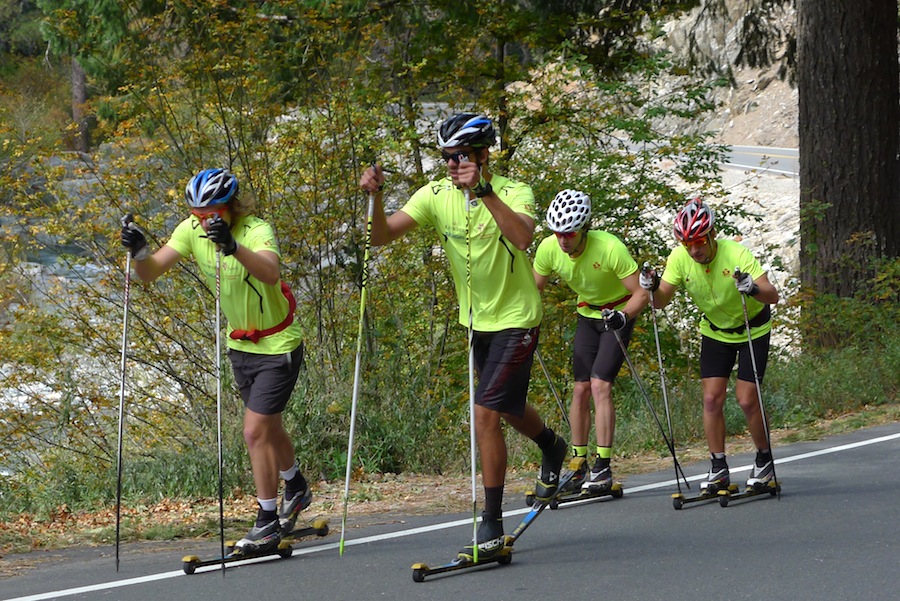
    If all goes according to the plans of the Truckee Donner Land Trust, the property will go up for sale by November and Norris will move toward purchasing it. The land trust’s president for 11 years, he first considered Royal Gorge’s conservation potential in the early 1990s. Back then, the trust tried to buy the 1,000-acre Van Norden Meadows.

    The pending acquisition, which would include more than 3,000 acres in and around the resort, would not be the land trust’s biggest deal in terms of size, Norris said.

    “We’ve done larger acreages and we’ve done more expensive properties,” he said. “But I don’t think we’ve ever done one that’s so important to the community.”

    Devoting some 60 hours a week to the project, Norris has met and spoke with several stakeholders regarding the transition. Foreclosure was an initial concern, but Norris said the owners cooperated with the bank, and the resort would mostly likely not go to auction.

    In the meantime, the Truckee Donner Land Trust was pooling its resources, reaching out to national land trusts and calling for outside help.

    “Our long term goal is to protect the property, keep the nordic center running and most likely, running it better,” Norris said. “We’re going to be looking 100 percent to the private sector to finance this opportunity, and we’re going to be looking to the nordic ski community to step up as well.”

    According to Sugar Bowl Ski Resort President Rob Kautz, his alpine area — with trails that connect to Royal Gorge — was interested in purchasing the land and expanding into the nordic market. If a partnership played out, the land trust wouldn’t run the area, Sugar Bowl would.

    “Royal Gorge is a great brand; it’s a wonderful cross-country resort,” Kautz said. “We would ultimately like to take over the operation. I think the community is supportive of that concept.”

    “The investors in Sugar Bowl are a kind of who’s who in San Francisco,” Norris said of the downhill resort, which opened in 1939. “So they’ll be able to make the investment that the resort needs.”

    As for other potential buyers, Norris said not to expect any.

    In order for the Truckee Donner Land Trust to reach a deal, a long negotiating process was likely, he said. For starters, they would need to convince the Missouri lender, Armed Forces Bank, that Royal Gorge’s price tag shouldn’t be based on sheer acreage.

    “In some ways, a very capable developer looked at this property for six years and wasn’t able to move the property one inch,” Norris said. “I don’t think there’s any developer that is going to come out of the woodwork and buy this property.”

    If there were, the “Save Donner Summit” bumper stickers still clinging to the backs of local vehicles could dissuade them.

    “A reasonable appraiser would probably conclude that the property would best be used as an open space,” Norris said. “And nordic ski area.”