From the FasterSkier archive — posts syndicated from athletes’ and coaches’ own blogs between 2004 and 2012, kept online as published. Current coverage is at fasterskier.com.
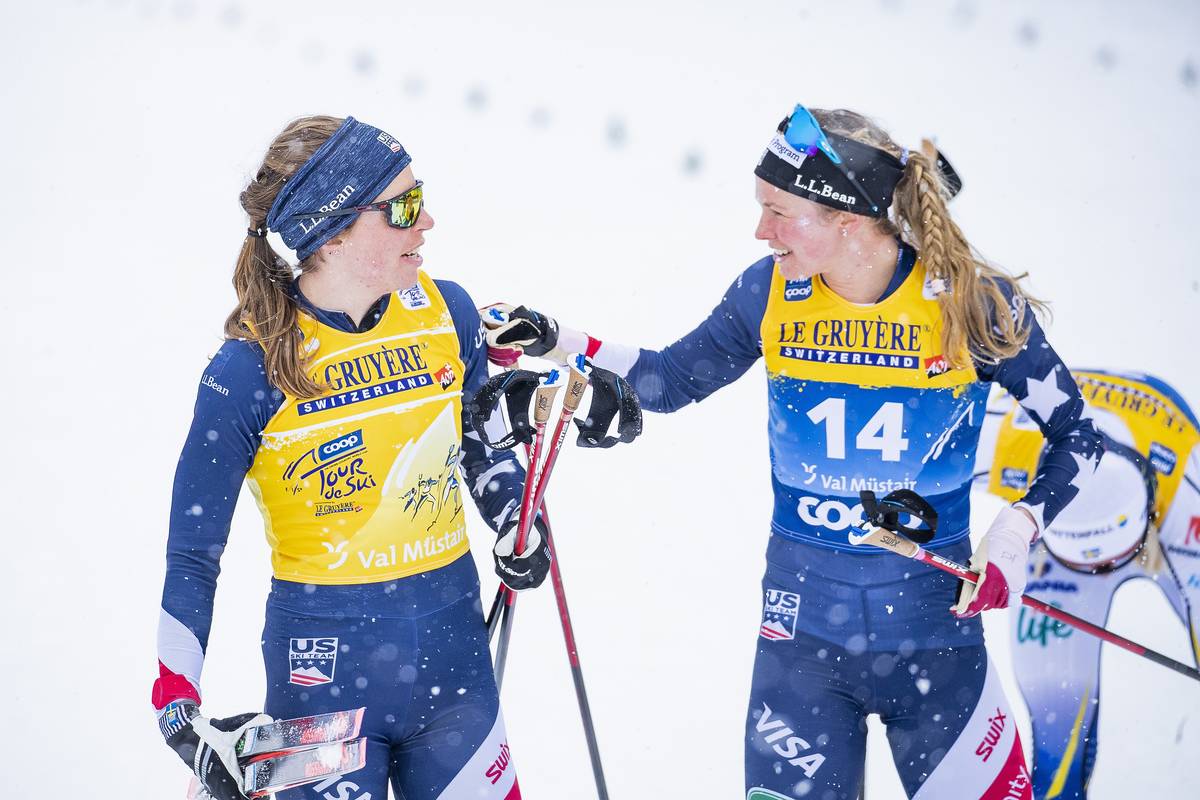
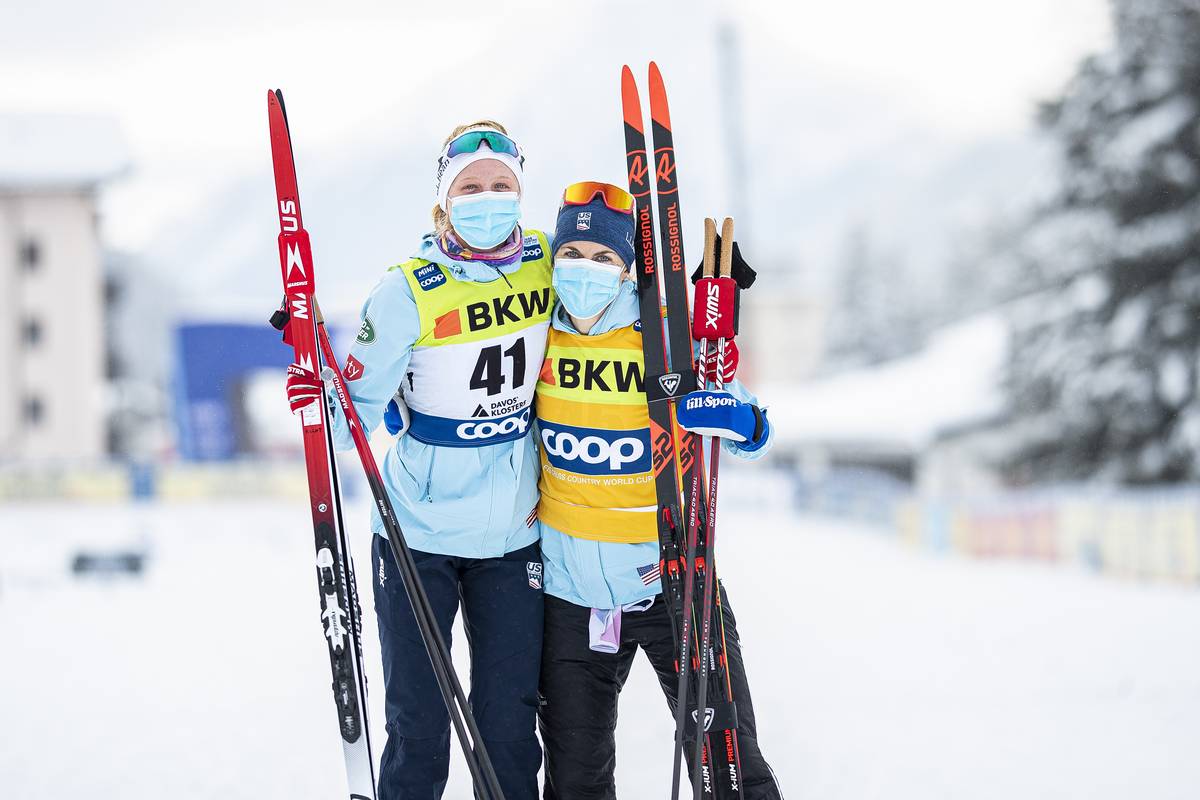
Rosie Brennan, left, and Jessie Diggins talk after the first stage of the 2021 Tour de Ski, in Switzerland. (NordicFocus)
PLANICA, SLOVENIA — Anyone who knows Rosie Brennan, and the ups and downs of her professional cross-country ski racing career, can relate to her mother’s experience at the World Championships here.
Walking among the crowds in U.S.-themed clothing, Wiggy Brennan heard the same thing, over and over, from European fans: “We love Jessie Diggins!” — a reference to Rosie Brennan’s gold-medal winning teammate.
“And I say, ‘Okay. But what about Rosie?’” Wiggy said.
That question — what about Rosie? — has never been more relevant than in Planica, where Brennan and Diggins both skied to standout results, in ways that highlighted the profound differences between them.
Diggins, now 31, is a superstar. She started winning medals a decade ago, and after earning two more here, she now owns nine of them from the Olympics and World Championships. Her bubbly personality and results have earned her national endorsement deals and a huge fan base, and her teammates sometimes call her the “sparkle chipmunk.”
Brennan, 34, is not a sparkle chipmunk — she’s a self-described introvert. And her success was never assured: She was twice cut from the U.S. Ski Team, and her first international World Cup podium didn’t come until late in her career, just two seasons ago.
Brennan has also come heartbreakingly close, but has never achieved, the big-time results on Diggins’ resumé. In the past 13 months, Brennan has placed fourth, fifth and sixth in individual events at the Olympics and World Championships — two seconds, five seconds and three-and-a-half seconds from the podium.
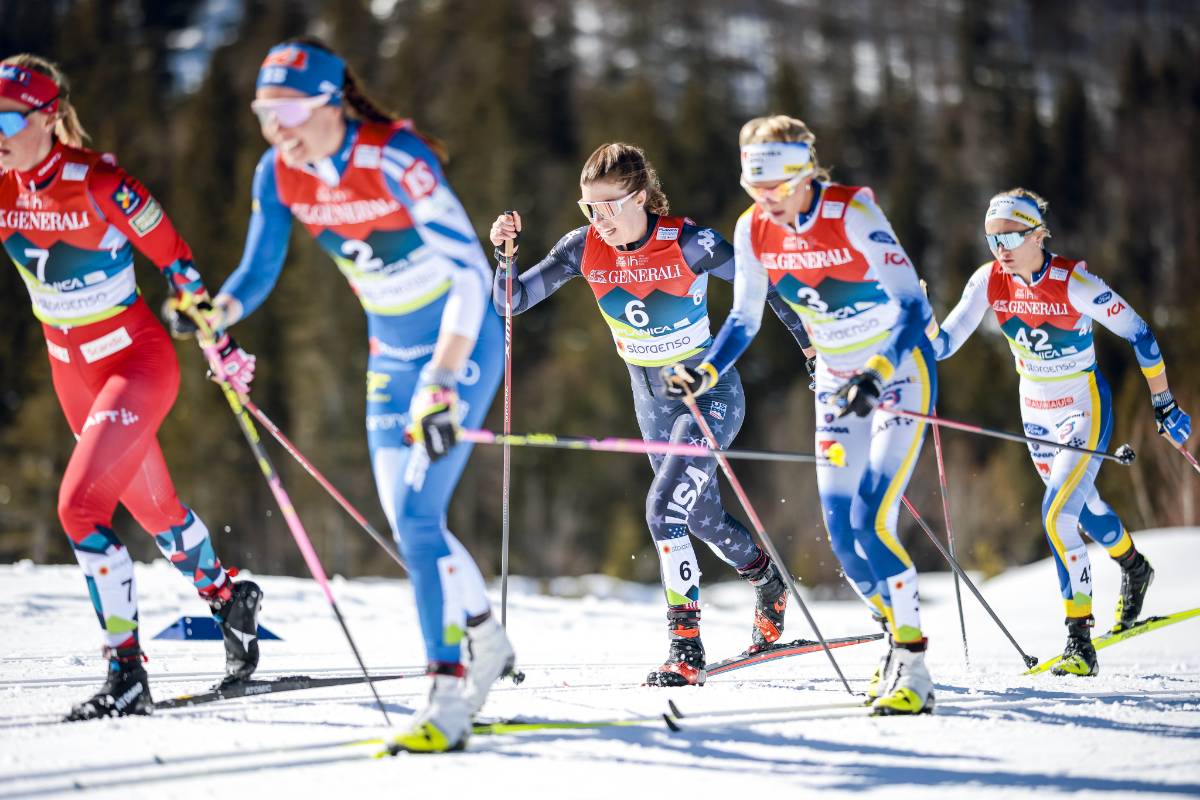
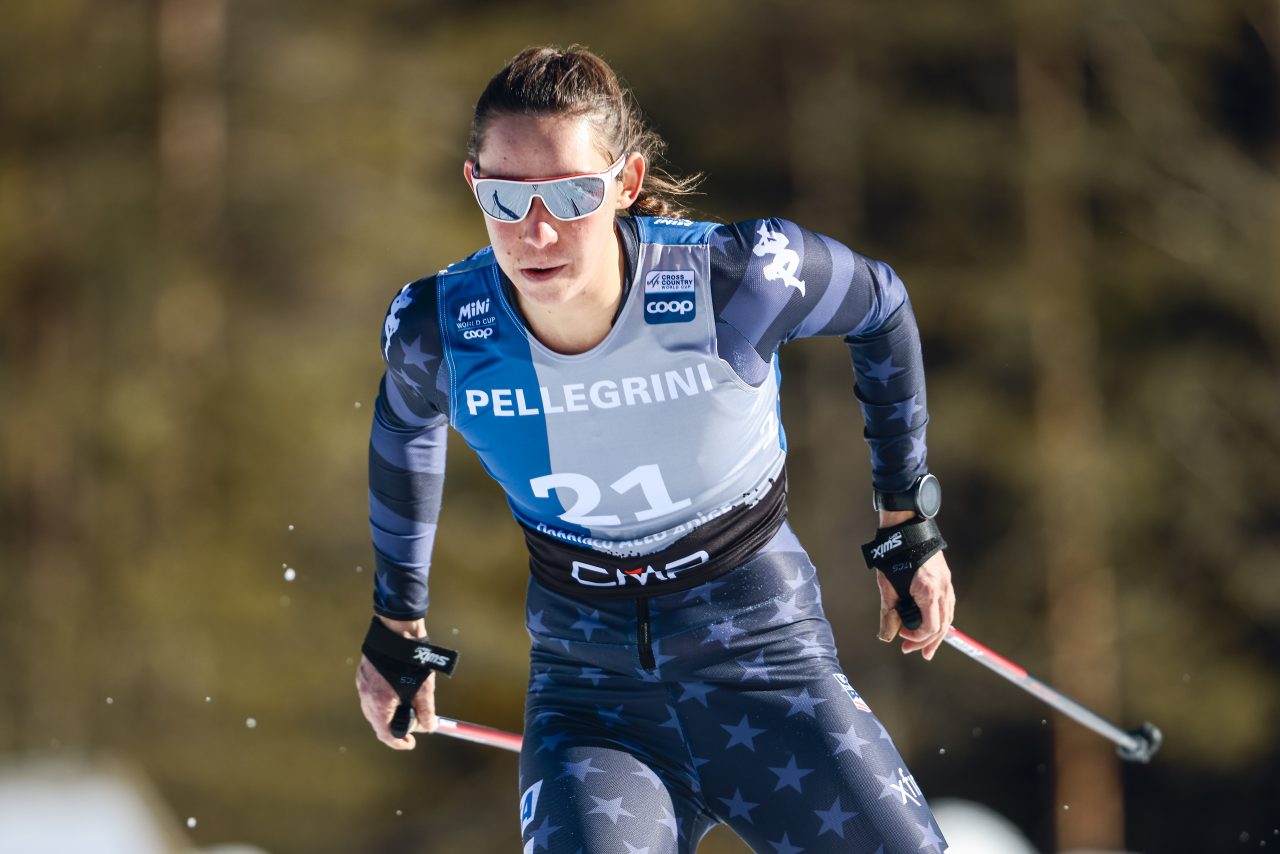
Rosie Brennan skis in the 30 k classic event Saturday at World Championships. Brennan finished fifth; the woman in red, Norway’s Anne Kjersti Kalvaa, won the silver medal, and Frida Karlsson, to the right of Brennan, won bronze. (NordicFocus)
In Saturday’s 30-kilometer event in Slovenia, Brennan skied nearly the entire race in a tiny chase pack that was gunning for the silver and bronze. After leading the group for a significant chunk of the race, Brennan faded on the homestretch — leaving her supporters simultaneously thrilled by her proximity to the medals and a little devastated by the result.
Brennan’s friends and fans have nothing but praise for Diggins. But they also don’t want Brennan to go unnoticed.
“It’s a story where I’m like, ‘Gosh, I wish this could just catch fire.’ Because every human can relate,’” said Sadie Bjornsen, a close friend and former teammate of Brennan’s. “Ninety-nine percent of the time you’re fourth. That’s just the reality of life. And the way you keep coming back from that is what is really inspiring.”
Diggins, after winning two medals at World Championships, left Slovenia early to prepare for an upcoming race in Norway this weekend. But in an Instagram post after Saturday’s race, she called Brennan “my hero” and sent an audio message to FasterSkier in which she joined the chorus of people celebrating her.
Diggins said she wants to make sure that people know about work Brennan does behind the scenes — mentoring young athletes, working with a program that teaches kids to ski in rural Alaska and serving as an athlete representative to the U.S. Ski Team’s parent organization. She also described Brennan’s effort in Saturday’s 30-kilometer race as “one of the most inspiring, gutsy things ever.”
“It’s up to her to decide how she feels. And we just get to be proud of her and cheer for her,” Diggins said. “That was hero skiing out there, and I think everyone saw that.”
Brennan, for her part, said that Diggins’ best performances lift her up, too.
“It is inspiring to me to see her reach those levels,” she said in an interview. “And I hope that we can still learn from each other, and take little pieces that fit into how we do things, and make us both better.”
The frequent presence of both Diggins and Brennan in the lead pack of top-level races nonetheless invites questions about whether there are tensions between them.
The two aren’t best friends — ”I think they aren’t two peas in a pod,” said Tyler Kornfield, Brennan’s boyfriend — but coaches, teammates, and others close to them say they’ve developed a working relationship that elevates them both.
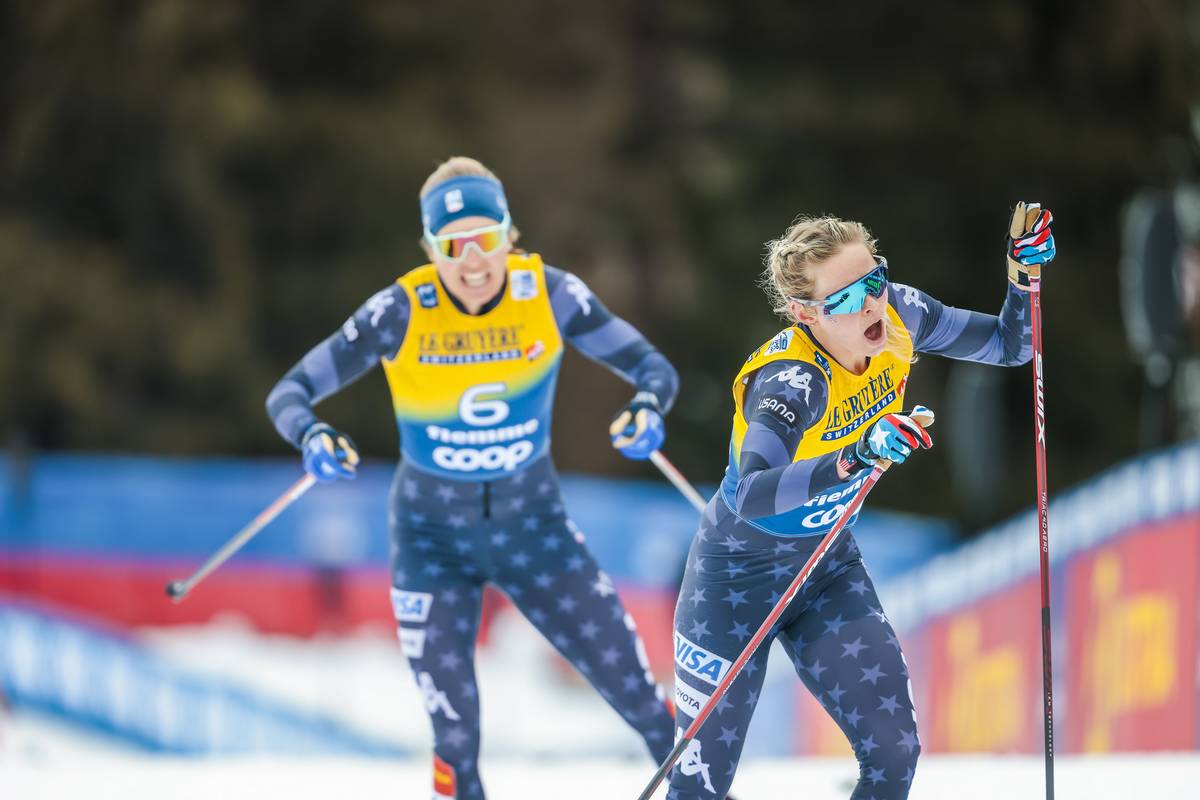
In January, Jessie Diggins, right, and Rosie Brennan raced up the alpine ski hill that serves as the final stage of the Tour de Ski. (NordicFocus).
“I’m sure, over the years, they’ve had their heated thoughts. But when I see them together — when I see the entire team together — it’s professional. It works really, really well,” said Kornfield, who’s also a professional skier, in a phone interview. “They come together every day to make the team stronger.”
One example was after the team sprint at World Championships.
American coaches chose to start Diggins and another American, Julia Kern, instead of Brennan, who paired with Diggins to place fifth in the same event at the Beijing Olympics.
After Diggins and Kern won a bronze medal, with Brennan on the bench, Matt Whitcomb, the U.S. Ski Team’s head coach, said he watched Brennan knock on Diggins’ door and congratulate her. Diggins, meanwhile, sent Whitcomb a text aimed at Brennan and her three teammates Saturday, just after their hard-fought finishes: “So proud of you girls for an absolutely gutsy, courageous race out there.”
“They have an immense amount of respect for each other,” Bjornsen said. “Which I think is really cool. Because they are so different — like, probably the most different you could be and successfully be teammates.”
Asked about those differences, Brennan said she wishes she had more championship medals, like the ones in Diggins’ trophy case. But Brennan and those around her said she also benefits from having Diggins as a teammate.
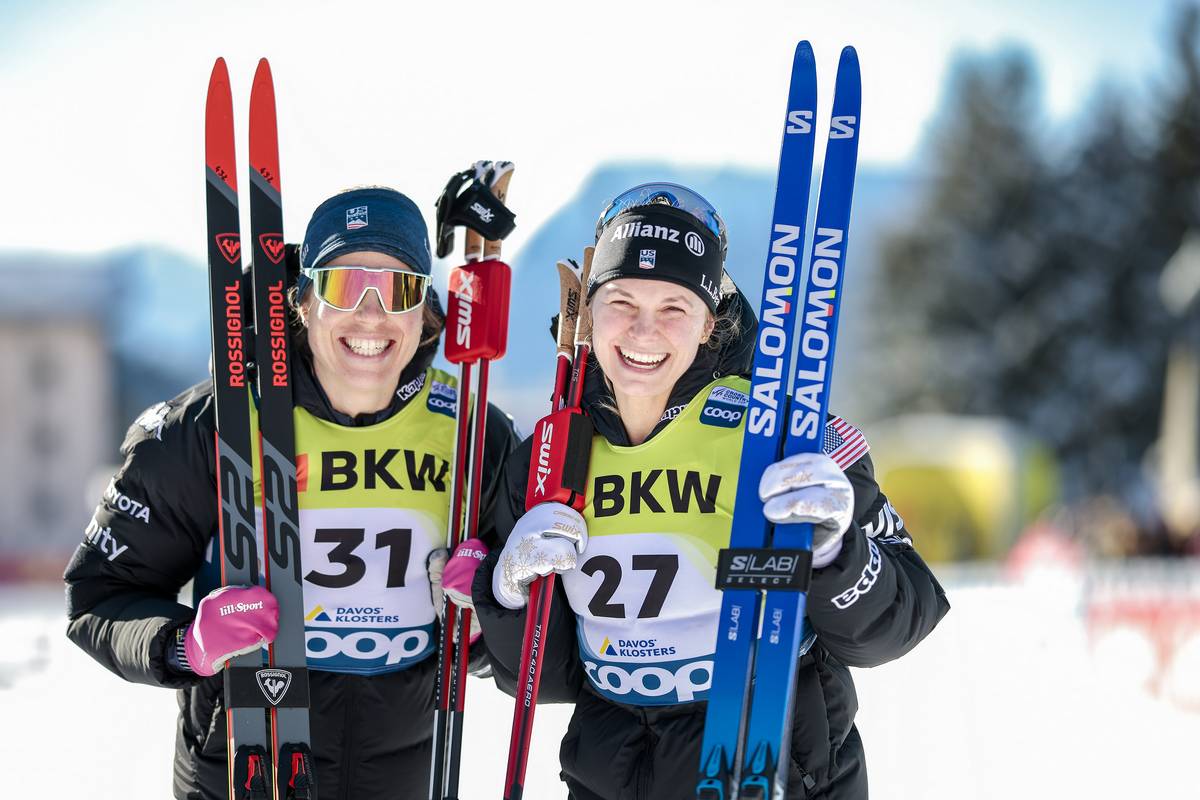
Rosie Brennan, right, and Jessie Diggins pose for a photo after a race in Switzerland earlier this year. (Nordic Focus)
“Maybe it’s clichéd to say Jessie is Rosie’s biggest motivator,” Kornfield said. “But anxiety is a powerful tool, and when one of your teammates is working incredibly hard across the country, and you know about it and hear about it every single day, it’s going to make you double down and focus more.”
Brennan said she hopes the successes that she and Diggins have each achieved, coming from two different backgrounds, makes them models for younger athletes.
“They can take little bits and pieces of both of us and find themselves,” Brennan said. “We are such opposites, and we’re both still making it work. And I hope, anyway, that that provides two solid examples for all the younger girls on the team of just being different and still having success — even if Jessie’s success is, like, through the moon.”
Brennan’s teammates confirmed that they look up to her, as well as to Diggins. Julia Kern, 25, said Brennan’s success late in her career was on her mind in the middle of Saturday’s 30-kilometer race — a 90-minute effort in which Kern finished 27th.
“I was literally thinking about that when I was charging up the hills, and I saw her charging at the front,” Kern said. “I was like, ‘This is training for maybe, hopefully, skiing like Rosie one day.’”
Julia Kern races in Italy earlier this year. (NordicFocus)
Bjornsen, Brennan’s friend and old teammate, said she and other ex-racers she knows were crying as they watched Saturday’s race.
Those near-podium finishes, Bjornsen said, highlight how Brennan is still trying after so many so-closes.
“It’s such a theme of Rosie’s story: Knock me down, I’ll bend. But I don’t break,” Bjornsen said.
The value of patience and persistence in cross-country skiing was one of the big take-home messages from the World Championships in Slovenia.
Beyond Brennan’s performances, there was Norwegian skier Pål Golberg, who endured some excruciating failures and highs and lows over his career before a resurgence this year.
Goldberg first raced at a World Championships in 2013. But he didn’t win an individual medal until he got two in Slovenia this year — including a stunning gold in Sunday’s 50-kilometer marathon.
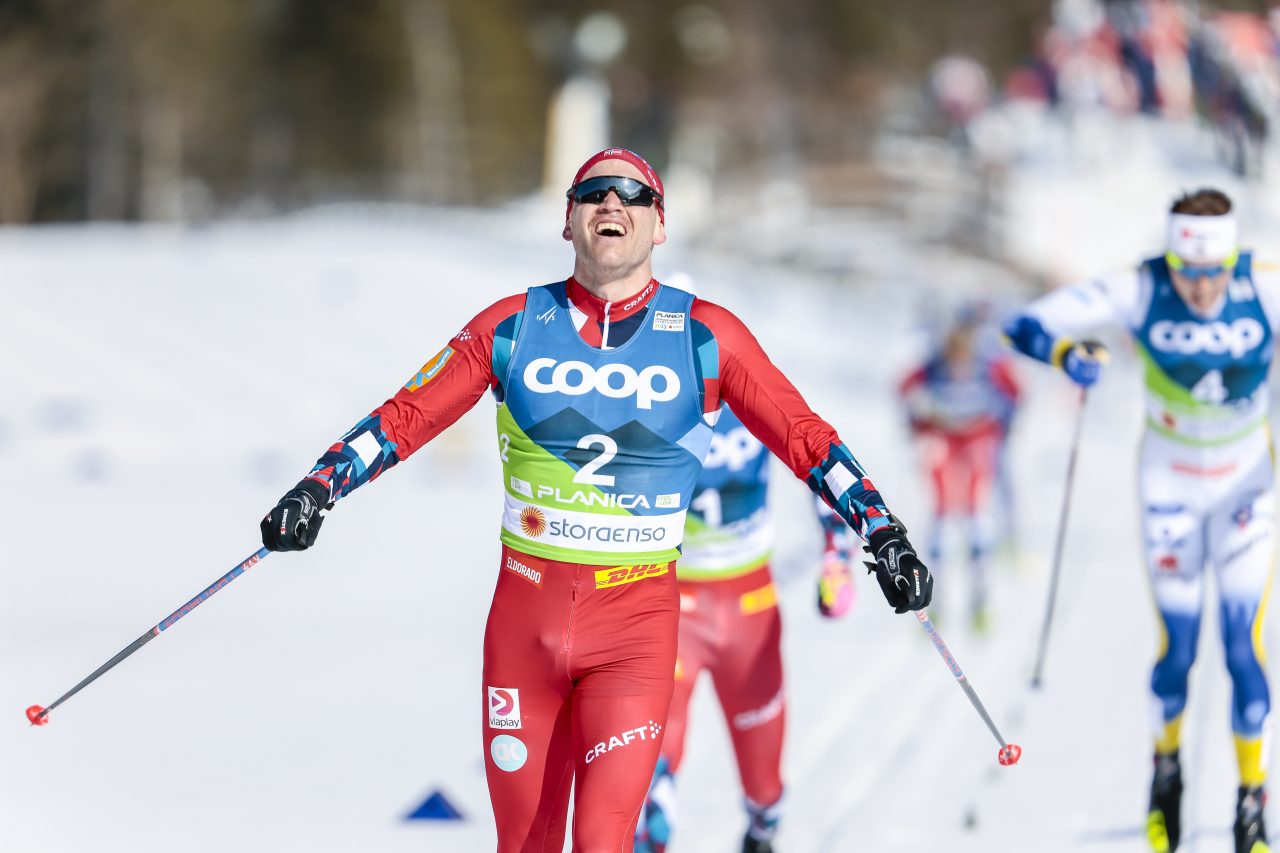
Pål Golberg celebrates Saturday after winning his first-ever gold medal in an individual World Championships race. (NordicFocus)
“In these endurance sports, often, you need to go through some years. You need to have the patience and the stamina to just push on. And that’s hard,” Eirik Myhr Nossum, one of the Norwegian coaches in Slovenia, said in an interview. “To do this year after year, to have the financial means, to have the motivation to do the work, to travel — of course, that’s hard. And for most, it doesn’t pay off.”
Brennan’s supporters want to see her keep racing and think she still has room to grow. Whitcomb, the U.S. coach, said he told her immediately after Saturday’s race that he wants to see her at the next world championships, in Norway in 2025, and at the 2026 Olympics.
“We want that medal for her so badly. Just, validation,” he said.
Brennan’s coach back in Alaska, Erik Flora, said that her skiing is still changing every year — like her technique and her skills on downhills.
“Can there be more technical development? I think yes,” Flora said. “Physically, can there be changes? I think so, too.”
Brennan has changed her training and racing framework in the past few seasons to make the months she spends in Europe each year more sustainable and stable.
She’s developed a good relationship with her wax technician, Bjørn Heimdal, and is working more closely with her ski sponsor, Rossignol. And Kornfield lived in Europe this winter, racing ski marathons out of a home base in Italy, instead of back in the U.S.
“The same time zone is huge,” Kornfield said. “It helps a lot.”
Flora, Brennan’s coach, is still 10 time zones away in Alaska, however. Asked after Saturday’s race if she would be back at the next world championships, Brennan didn’t have an answer.
“I have no idea. It’s been too much to think about during the season,” she said. “I’m going to take some time in the spring and think about it.”
But Brennan also acknowledged that coming so close to the podium gives her a little extra motivation to stick around. “God,” she said. “I definitely want a medal.”
Fast racing on the manmade tracks during the men’s sprint heats in Duluth, MN. (Photo: Hansi Johnson)
By Gavin Kentch and Rachel Bachman Perkins
The SuperTour returned this weekend with races in Duluth, Minnesota, held on the new snowmaking courses at Grand Avenue Nordic Center. The weekend included all levels of racing, with green juniors lining up to race alongside the veterans racing on the SuperTour, and a strong sense of community and cross-country ski energy across the board. Skiers like to ski; athletes were glad to be back.
Alaska Pacific University Nordic Ski Center (APU) athletes had a strong showing for the weekend, winning three out of four races. Rosie Frankowski (APU) and Alayna Sonnesyn (SMS T2) each made the podium twice. FasterSkier unofficially calculates the current SuperTour leaders as APU skiers Rosie Frankowski for the women, with 51 points after two races, and Tyler Kornfield for the men, with 42 points. The overall SuperTour leaders at the end of next weekend’s racing in Cable should receive start rights on the World Cup for Period 2, the Tour de Ski. Official USSS standings, here, have recently been updated, and accord with FasterSkier’s math.
Saturday: Freestyle sprint
Alayna Sonnesyn started out the qualifier in style, destroying the field to set the day’s fastest time for the two-lap, 1.3-kilometer course by a staggering ten-plus seconds. Several heats later, she was joined in the women’s final by a largely chalk field: Becca Rorabaugh (APU), Rosie Frankowski (APU), Julia Richter (University of Utah), and Sarah Goble (Sun Valley), who had the day’s second, third, fourth, and ninth fastest qualifying times, respectively. Katerina Hyncicova (NMU), who had been 23rd in qualifying, was the main outlier here.
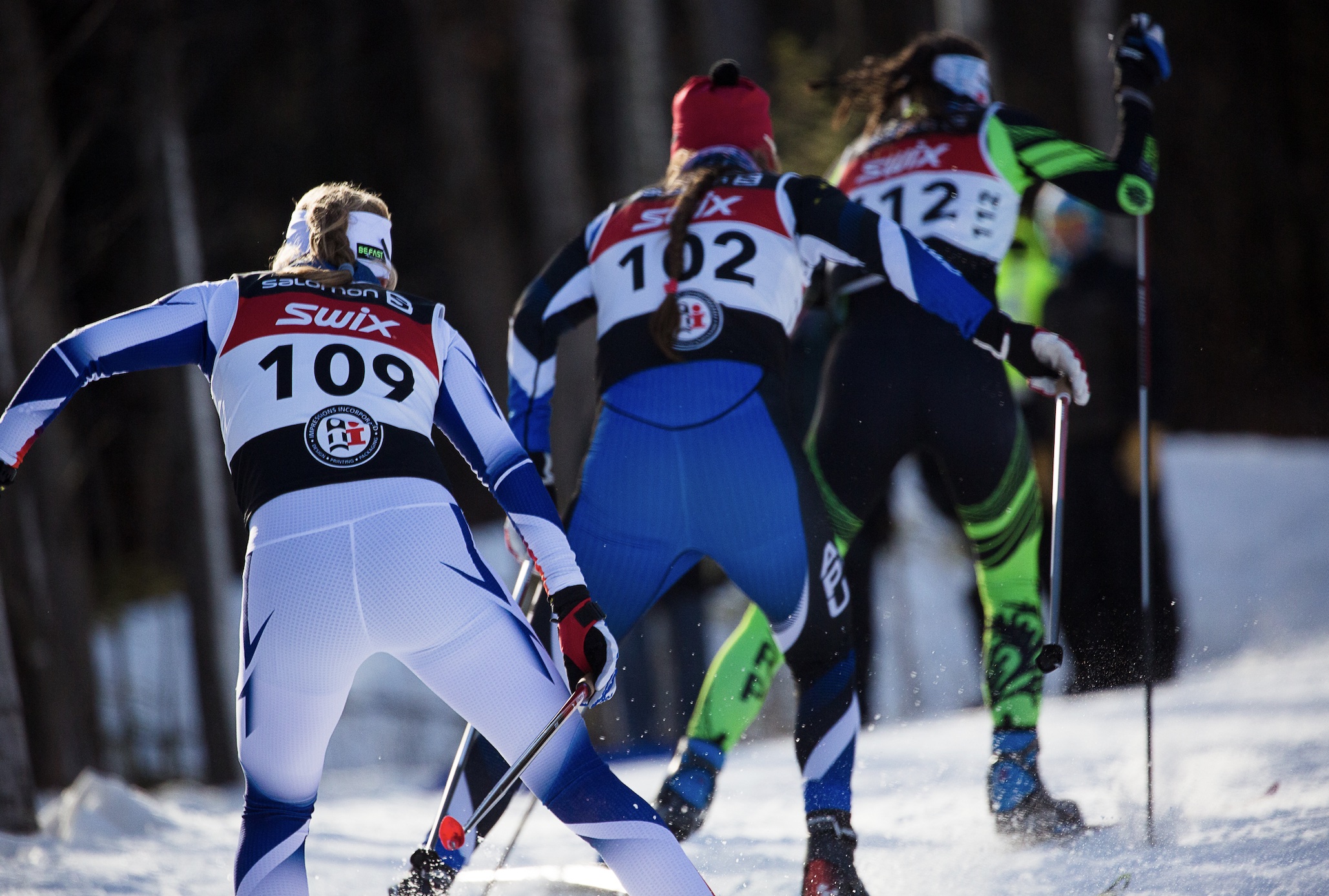
Becca Rorabaugh (Bib 102) races through the heats to win the opening SuperTour sprint in Duluth. (Photo: Hansi Johnson)
Roughly three minutes later, the two women who had consistently been the top athletes in the field all day, Sonnesyn and Rorabaugh, found themselves at the top of the long descent for the second and last time in the women’s final. Sonnesyn led going into the descent, but Rorabaugh skied this segment aggressively to slingshot around Sonnesyn and was able to significantly out-glide her by the bottom of the hill. Sonnesyn made up some ground as the two of them made the lefthand turn into the stadium and the uphill finish, but Rorabaugh was never seriously threatened on her way to the line.
Rorabaugh took the win in 3:11.49, with Sonnesyn 0.47 seconds back.
Roughly four seconds later, the compact powerhouse Frankowski, traditionally identified as more of a distance skier, led Richter to the line by nearly 1.5 seconds to take third. Goble in fifth and Hyncicova in sixth made up the rest of the final.
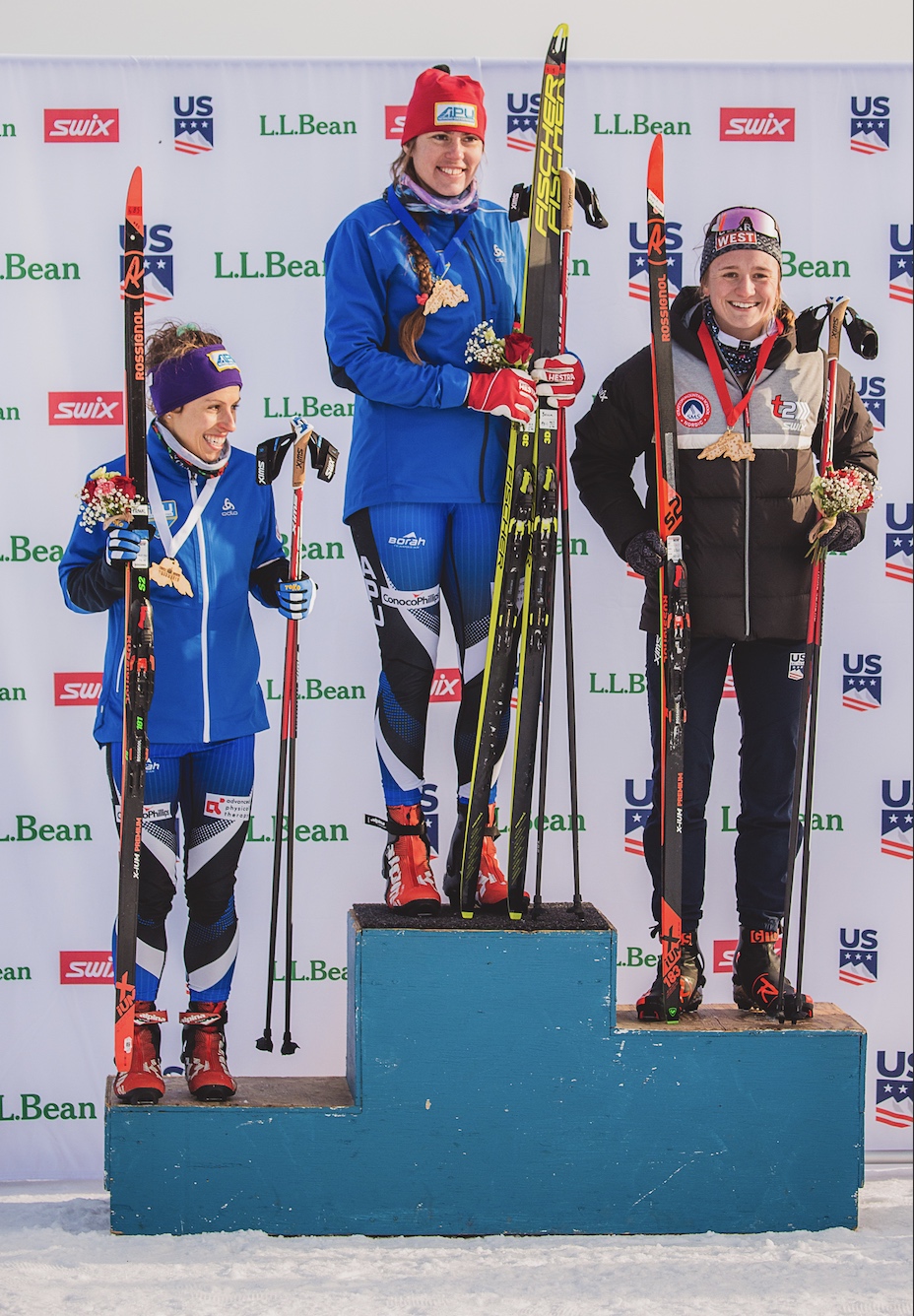
The podium of the women’s freestyle sprint in Duluth. Becca Rorabaugh (APU) took the win ahead of Alayna Sonnesyn (SMS T2) and Rosie Frankowski (APU). (Photo: Hansi Johnson)
It was Rorabaugh’s first SuperTour win since the skate sprint at Wirth Park in February 2020. It was Frankowski’s first SuperTour podium since she was first and second at West Yellowstone in a sprint and distance race in December 2018.
“The sprint went really well for me,” Rorabaugh wrote in a post-race email. “It was exciting to get to race at a Super Tour again! I love icy conditions, I love speed, and I love head to head racing, so it was pretty ideal for me. It’s also good to know that I’m sharpening up; these results show that I can hammer when I need to which is a good sign for the season.”
Reflecting on racing at the national level after a year away, Rorabaugh continued, “It feels really good to be back and to get to race against some of the people that I haven’t seen since early 2020. It seemed like Alaska was quite separate during last season, like maybe people forgot we were up there, so it’s fun to remind everyone that we’re a force to be reckoned with.”
Few athletes were familiar with the new course in Duluth. Rorabaugh also reflected on the course and the event as a whole.
“The sprint course in Duluth is fun and it suits me incredibly well. Some might say it’s lacking a long, steep climb, but I think most would agree that the downhill and the finish stretch are exciting and fun. The finish stretch is pitched up enough that you have to have a good sprint. You can’t just carry speed all the way to the line, which keeps things spicy at the end.
“The energy in Duluth has also been great, everyone has been very welcoming and combining the Super Tour with junior races means it’s a huge event. I always enjoy getting to see the younger skiers giving it their all, and the organized chaos of big races is exciting!”
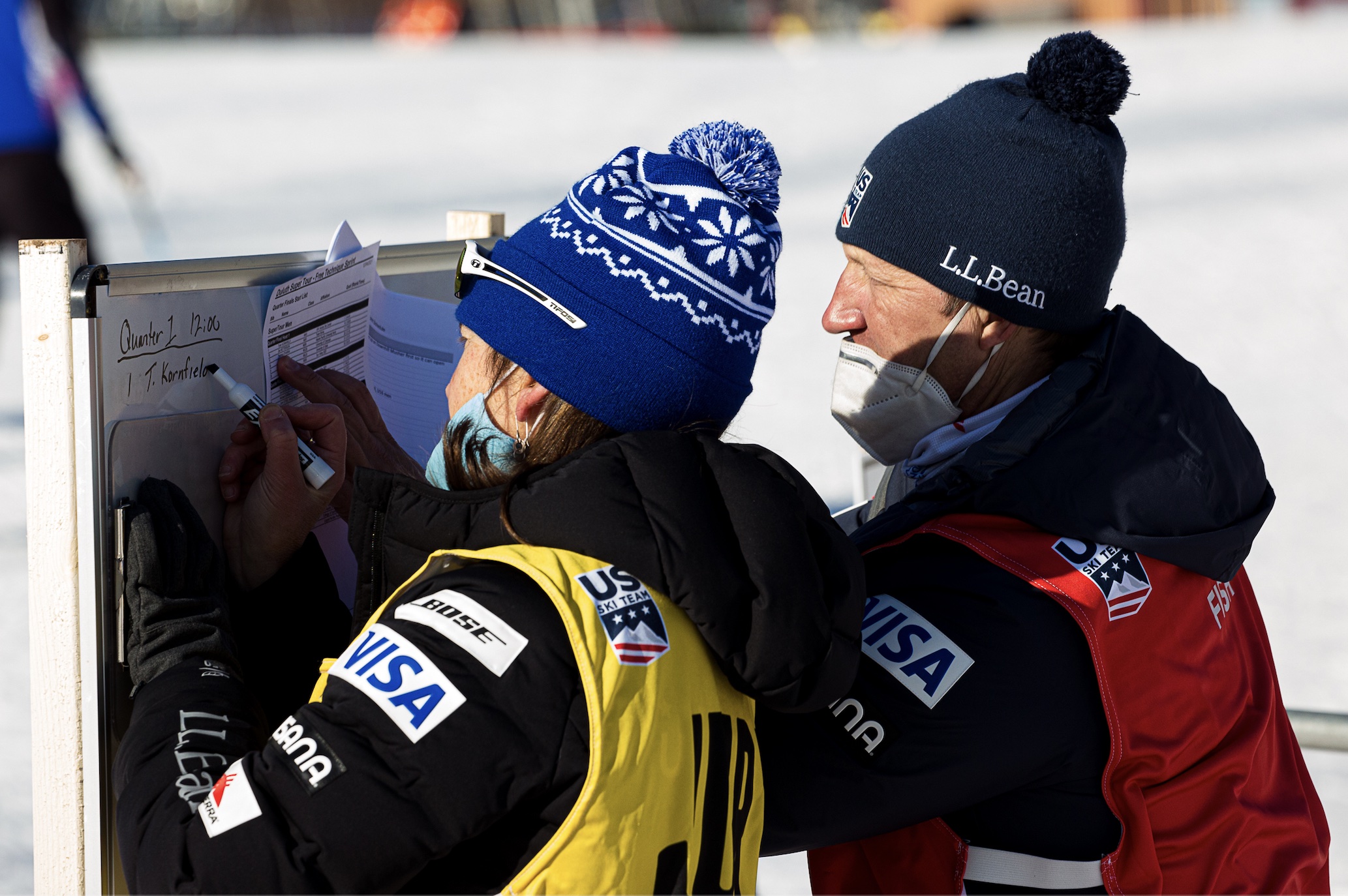
Bryan Fish, U.S. Ski & Snowboard Sport XC Development Manager, reads the men’s heat list as it’s transferred onto a white board. (Photo: Hansi Johnson)
The men’s race featured more of the same: most top qualifiers making it through to the final, and an APU skier moving up from second to outglide a competitor on the final downhill into the finish. For the men, it was the first, second, third, eight, ninth, and outlier 27th-place qualifiers in the final: Tyler Kornfield (APU), Logan Diekmann (BSF), Bill Harmeyer (SMS), Adam Witkowski (Michigan Tech), Noel Keeffe (University of Utah/USST), and Kjetil Bånerud (NMU), respectively.
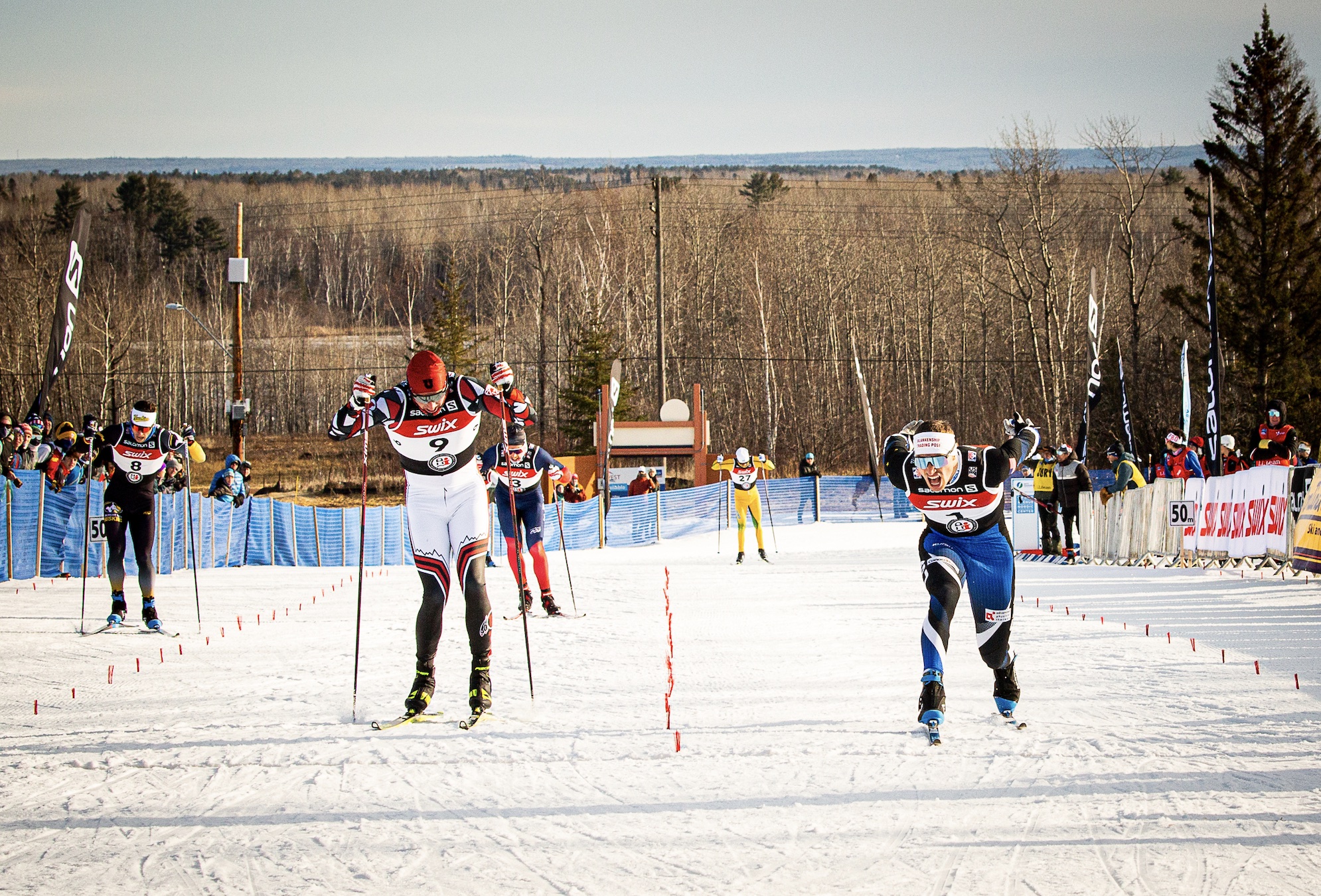
Two-plus minutes later, it was Keeffe leading Kornfield into the top of the final downhill. 15 seconds later, it was Kornfield leading Keeffe into the finish lanes, as APU’s skis were once again superior. Kornfield kept his lead through the stadium to take the win in 2:47.44, narrowly ahead of Keeffe (+0.23).
Tyler Kornfield (APU), right, wins the men’s freestyle sprint in a bootslide ahead of Noel Keefe (Univ. of Utah) at the opening SuperTour weekend in Duluth, MN. (Photo: Hansi Johnson)
A few seconds later, Witkowski (+2.90) outdistanced Harmeyer (+3.36) for the final podium spot. Diekmann and Bånerud followed several seconds later.
“It feels great to get to racing again,” Kornfield wrote after the race. “Last season, I was able to race two sprint qualifiers, but I failed to qualify for the heats in both. I love racing head to head and it was difficult at times to find inspiration. Fortunately, I have a great team at APU along with Gus and JC being in Alaska, we have been able to do a few time trials to prepare for the season. That allowed me to come to the races feeling calm and prepared. Though I never know exactly how I will perform early in the season, I have been cautiously optimistic about how my body has been performing in training. I hope that I can continue the trend into next week and onto the rest of the season. My mantra for the season is to make every race count and I think I did that in the sprint.”
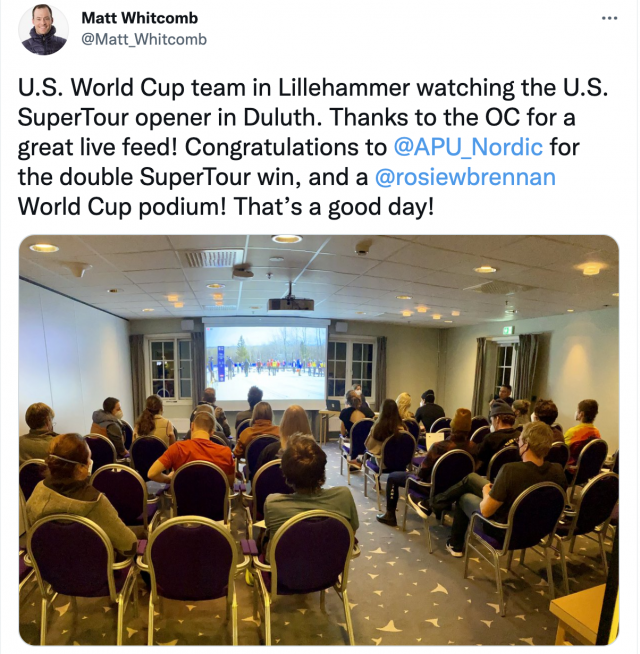
Earlier that day, Kornfield’s longtime partner and fellow APUNSC athlete, Rosie Brennan, had made the podium in Lillehammer in a World Cup race. USST coach Matt Whitcomb congratulated the APU program on its successful day, alongside a heartwarming photo of the World Cup crew watching the CXC Live feed of the SuperTour races in a conference room at the Scandic Lillehammer.
“It is also easy to be inspired to race well when Rosie finishes on the podium of the World Cup,” Kornfield continued in his comments on the sprint day. “I often need to be careful because it is hard to fall back asleep after checking her results at three in the morning, but this morning, it was worth it.”
Kornfield also spoke to the course and event in Duluth, praising its challenges and how they might prepare athlete to race at the World Cup level.
“The course in Duluth was great! I think it was a perfect combination of long enough working sections that were wide enough to maneuver, as well as technical/icy turns that would cost someone who might lose focus either leading into, during, or coming out of the turns. If we have more courses like this one, I believe we can keep pushing the momentum of domestic racing that will prepare us for racing in Europe. It was also great to see so many people out watching. That can be rare sometimes on the SuperTour, but there is an obvious sense of excitement and passion in Duluth that will hopefully turn into a regular SuperTour venue!”
Fast racing on the tracks in Duluth as the SuperTour returns. (Photo: Hansi Johnson)
Sunday: Freestyle distance
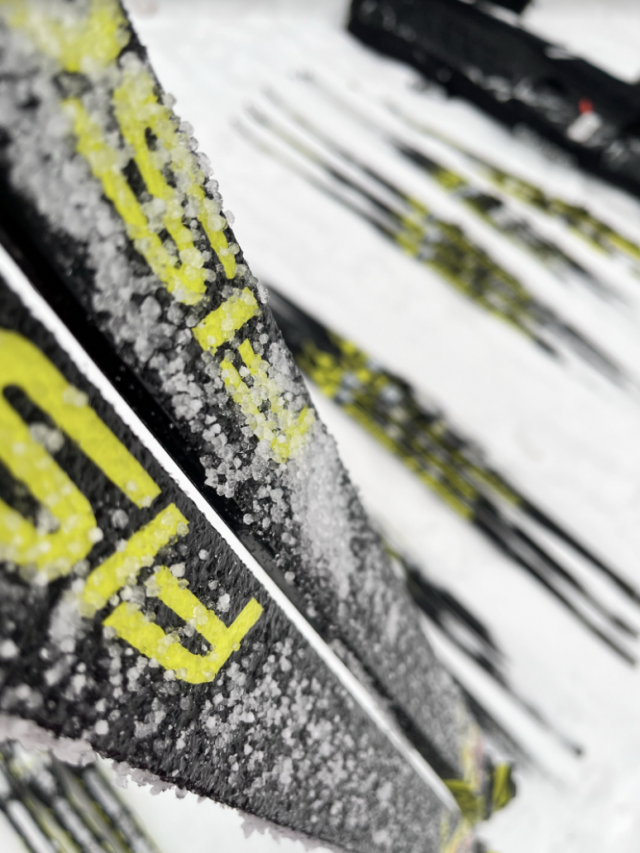
While athletes raced on a white ribbon with bare ground exposed on either side during the sprint, what one might call a “wintery mix” arrived in Duluth on Sunday morning. Over four inches of fresh snow fell overnight, which turned into wet icy flakes as the races began. APU coach and tech Galen Johnston shared photos of graupel-encrusted skis, which left us wondering what skiers might have looked like at the finish.
In the individual start freestyle events, senior men raced five laps of a roughly 2.2-kilometer course while senior women raced three laps.
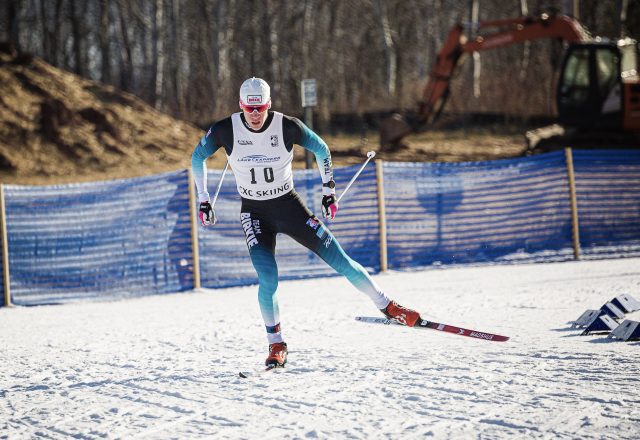
Team Birkie’s Zak Ketterson eked out a win on the men’s side in a time of 26:33.4, beating Northern Michigan University (NMU) athlete Kjetil Bånerud by 3.4 seconds. Bånerud had started three bibs ahead and held the fastest splits until Ketterson came through. Craftsbury Green Racing Project (CGRP) athlete Adam Martin skied the third-fastest men’s time (+8.6) to round out the podium.
“10 kilometers is a tricky distance because while it seems short compared to our normal 15k distance, it’s definitely still long enough to require some good pacing,” wrote Ketterson after the race. “I was fortunate to receive a lot of splits from my coaches, as well as my old NMU coaches and others.”
Zak Ketterson on course during the opening SuperTour races in Duluth, MN. (Photo: Hansi Johnson)
Originally from Bloomington, MN, on the south side of Minneapolis, Ketterson is an NMU alumnus. While other athletes on the podium, like Frankowski and Sonnesyn, are also originally from the Midwest, Ketterson has spent his entire ski career in the region, and he felt the community support during the race.
“It was a really great atmosphere at the Grand Ave Nordic center. I really like Duluth and have very fond memories from when I raced there last year with NMU at some NCAA qualifier races. My favorite part of racing in the Midwest is that there are so many friends that cheer for me. It really feels like a ‘home’ race.”
Commenting on the season ahead, Ketterson shared, “My goals for this season are to just take it one race at a time, trying to do my best in every opportunity I get. We will see where that gets me! For now, I’m just happy to be a part of such an amazing team (Team Birkie) and to be racing again.”
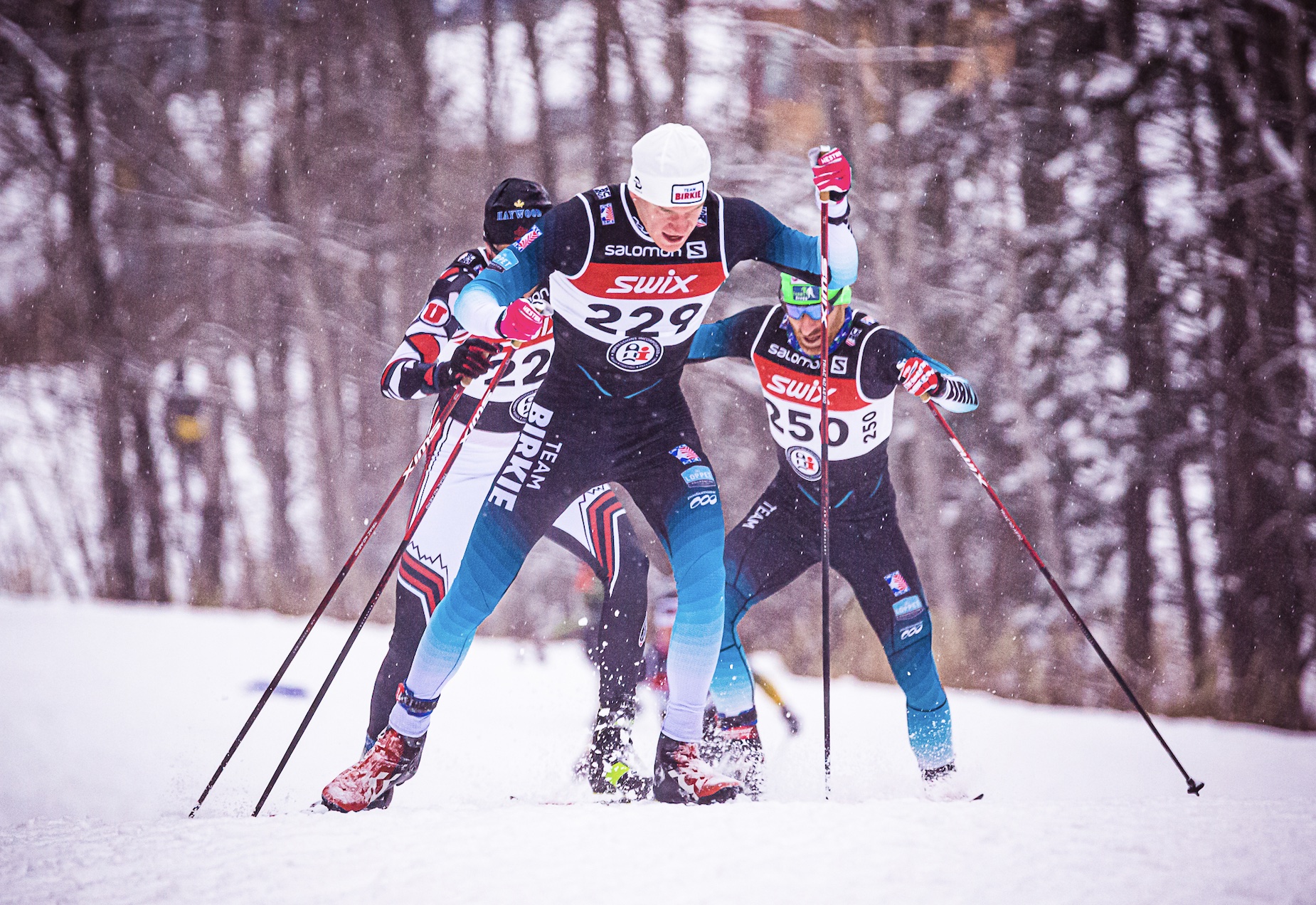
Zak Ketterson pushes uphill during the 10k skate, with Team Birkie “legend”, Brian Gregg (Bib 250), matching pace behind. (Photo: Hansi Johnson)
On the women’s side, with her second podium of the season, APU’s Rosie Frankowski edged out Alex Lawson (CGRP) by just 0.9 seconds. Lawson started behind Frankowski and had been sitting in third, powering through her final lap to create a nail-biter over the final kilometer. During this final lap, Lawson overtook Alayna Sonnesyn (SMS T2), who finished third (+6.1).
The women’s top-6 after the 10k distance race in Duluth. Rosie Frankowski (APU) topped the podium, ahead of Alex Lawson (CGRP) and Alayna Sonnesyn (SMS T2). (Photo: Hansi Johnson)
Frankowski shared the following reflections on her weekend in Duluth via email:
“Before heading down to Duluth, I was pretty nervous about this weekend and tried to have realistic expectations since these races were a short, relatively flat sprint and 5k—both events that I honestly don’t typically perform that well in. However, I have been focusing on speed work, downhills and carrying speed a lot this summer behind my speedy APU teammates so yesterday’s results on a very fast course was a great surprise that boosted my confidence for today’s 5k. Today out on the course was a whirlwind. We actually raced 3 laps of a bit over 2 kilometer lap so I lucked out that it was a bit longer and the snowfall from the night before and during the race made it slower than yesterday. The course held up surprisingly well and was really not that choppy or soft except the one V-1 hill.
“I went out as hard as I could since honestly my 5k race pace often accidentally is my 10k pace and I knew that I needed to be snappy. I did slow down throughout the laps, but I honestly think most of that slowdown was on the downhill section which was where I questioned whether I should free skate, tuck, V-2, etc. I was very early in the seeded group so I didn’t really have the chance to rely on splits back or watching my competitors to determine what seemed to work best. All in all, I am super excited to walk away with the win and I am hoping this weekend of racing gives me more confidence about my short race skiing abilities, and I have to give a hats off to our APU wax techs and all of the volunteers from Duluth that made this weekend possible.”
Rosie Frankowski skis through wet falling snow to win the women’s 10k at the opening SuperTour weekend in Duluth, MN. (Photo: Hansi Johnson)
On returning to racing with a widespread field of high-level athletes, Frankowski echoed her teammate Rorabaugh’s sentiments on feeling isolated as she stayed put in Anchorage. Her words embody the many challenges we have all faced in the calculus of travel and risk-assessment during the pandemic.
“It’s nice to be back racing on a national level circuit. Last season was really challenging since us Alaskans didn’t have much opportunity to race people from out of state (due to avoiding unnecessary air travel). We had a crazy strong early season circuit with Sadie Bjornsen, Jess Yeaton and Becca all in our races, but it felt like we were just not connected with the rest of the country. I personally really struggled with turning down Period 1 World Cup starts after a teammate contracted COVID and the financial implications that COVID created with race uncertainty. Then in January, I contracted COVID and it felt like it ended my opportunities to gain World Cup starts.
“I am just thankful that this year we have more certainty about what races will happen and what the road to opportunity looks like. I also feel that as I have gotten older, I have realized that while good results are fun and exciting, the true value in racing a circuit is the relationships you create with your competitors, other coaches, officials, etc. Returning to the Supertour and Duluth (as Minnesota is my home state), I found so much joy in chatting with my fellow racers, longtime club coaches, friends from NMU [Frankowski is also an alumna], Southwest High School and LNR, and just being part of a community that wants to spend their weekend working hard out in the cold. I’m hoping that no matter where my results fall this season, and whether I make the lofty goals I’ve laid out, I can appreciate the people and connections as the true value of ski racing.”
With a win in the distance and third place in the sprint, APU’s Rosie Frankowski leads the SuperTour point rankings. (Photo: Hansi Johnson)
Coaches: Erik Flora (head coach/director), Jack Novak (assistant coach)
Current roster: Penny Smyth, APUNSC Marketing & Communications, writes:
“Women’s Team: Rosie Brennan (USSS A Team), Hailey Swirbul (USSS A Team), Hannah Halvorsen (USSS D Team), Rosie Frankowski (World Cup Alternate), Becca Rorabaugh, Anna Darnell, Annie Gonzales, Marit Flora, Lily Pannkuk, Zoe Noble
“Men’s Team: Logan Hanneman (USSS B Team), Scott Patterson (USSS B Team), David Norris (World Cup Start), Hunter Wonders (USSS D Team), Zanden McMullen (USSS D Team), Luke Jager (USSS D Team), Tyler Kornfield, Michael Earnhart, Thomas O’Harra, Forrest Mahlen, Garrett Butts, Ari Endestad, Karl Danielson, Bjorn Halvorsen, Chip Schoff”
A total of nine APU athletes will be starting Period 1 World Cup races this season, though as we approach the Ruka opener later this week Smyth advises, “Scott [Patterson] won’t be joining the team until Lillehammer,” the season’s second race weekend, “due to hand injury.”
Who’s new or who’s moved on: Smyth writes, “Sadie Maubet Bjornsen, a two-time Olympian and World Cup skier, retired after last year. We have some new skiers that have grown up through the APU Nordic program join the Elite Team, including Marit Flora and Lily Pannkuk. New to the men’s team is Bjorn Halvorsen, younger brother of Hannah Halvorsen!”
Hailey Swirbul (left, third overall) and Rosie Brennan (first, wearing the yellow bib as World Cup overall leader) after the women’s 10 k skate in Davos, December 20202. (photo: Modica/NordicFocus)
Top results last season: Brennan was fourth in both the overall World Cup and distance standings, and for one magical weekend in December was the best skier in the world, winning back-to-back races in Davos. She became the second American woman ever to wear the yellow bib, after Maubet Bjornsen, and kept it for roughly a month. It was a well-deserved coming-out party for the longtime APU athlete (note that she was also on this team nine years ago) currently in her third separate stint on the U.S. Ski Team, after most recently being cut in 2018 after she raced poorly in PyeongChang while unknowingly suffering from mono.
Behind her, Swirbul finished the season ranked 23rd overall in the World Cup (21st for distance) and 4th in the U23 standings, picking up her first World Cup podium along the way, which she shared with Brennan. Maubet Bjornsen stayed home in Anchorage for the first half of the season, placed 10th in her first World Cup race in a year after returning to Europe, then at World Championships came within a combined 3.17 seconds of coming home from Oberstdorf with two medals.
Swirbul, Maubet Bjornsen, and Brennan formed the first three-fourths of the American women’s relay team at World Champs, which came 0.8 seconds away from medaling. Norris recovered from Covid to post some of his best results yet, including 16th and 17th at World Champs, and Patterson had his best season in years, highlighted by a 10th in the World Champs 50 km; the two of them formed half of the American men’s relay team in Oberstdorf. (The team sent seven athletes total to World Championships.) Jager was a tantalizing 0.09 seconds out of the heats in his World Cup debut. Hanneman made three World Cup heats and finished the year ranked 29th in the Sprint Cup standings. Halvorsen returned from a year of grueling rehab from a car accident to finish 23rd in her first race back in two seasons – which was not an OPA Cup or a local citizens race but rather the World Cup sprint in Dresden.
Hunter Wonders races at Government Peak Recreation Area, Palmer, Alaska, Nov. 14, 2021, in the season-opening Race to the Outhouse #1. David Norris is behind him. (photo: Eric Strabel for APUNSC)
Domestically, Jager, Wonders, and Maubet Bjornsen won the December Anchorage JOQ races that were the unofficial U.S. Nationals west (also on a podium in these races: McMullen, Mahlen, and Frankowski), and Frankowski and Kornfield picked up a combined four podium finishes at the American Birkebeiner, including Frankowski’s win in the classic race.
Smyth adds, “Locally, races happened for the rest of the elite team, where we had numerous podium sweeps and a Tour of Anchorage podium sweep in the women’s 50K with Rosie Frankowski (1) Becca Rorabaugh (2) and Anna Darnell (3) and then in the men’s 50K Tyler Kornfield (1) and Thomas O’Harra (2).”
APU head coach Erik Flora, Independence Mine, October 2021. (photo: courtesy APUNSC)
Coach’s comments: “The APU Elite team is more than 25 skiers strong. We had a great summer of training with a majority of the U.S. Ski and Snowboard D-Team joining us. U.S. Ski and Snowboard coaches joined the Elite team in July for training sessions, which was positive for the team! This brought some young energy to the daily grind along with a fun group to work with. October brought early snow in Hatcher Pass to finally get on skis for training with early November snow in town to follow. We feel ready for the race season to happen and are excited to see what the races bring moving into an Olympic year!”
Hailey Swirbul (second from right, pink elbow sleeves) tags off to Sadie Maubet Bjornsen (far right) after the opening leg in the women’s 4 x 5 km relay at FIS nordic world ski championships, Oberstdorf, March 2021. (photo: Modica/NordicFocus)
Disclaimer: I live in Anchorage, and have trained with the APUNSC Masters program for eight seasons and counting. On the one hand, the Masters group has been an important part of my personal and athletic life for many years now; on the other hand, on a day-to-day basis the Masters team has basically nothing to do and no overlap with the APU Elite Team, and is not coached by Elite Team coach Erik Flora. I don’t receive free gear from APU, or anything in that vein, in exchange for writing about the APU Elite Team.
This series comes to FasterSkier from the Alaska Pacific University Nordic Ski Club.
A Day in the Life: APUNSC is checking in with Elite Team members over the course of the next few months to get a glimpse into what life looks like for elite athletes as training starts up again during a global pandemic.
Today we check in with Tyler Kornfield (29), a 2018 Olympian and 3x National Champion who was born and raised in Anchorage, Alaska. Kornfield has been a part of the APU Nordic Ski Center for 7 years.
Where are you right now?
I am in Anchorage where I have been since the season abruptly ended in March. I feel fortunate to have moved into a spacious home last fall that has made spending more time at home more enjoyable, not to mention it’s very close to the trails!
Enjoying the good ski conditions around Anchorage (Photo: Rosie Brennan)
How did your season end? What races were canceled that you were planning to do?
My season unknowingly ended after the American Birkebeiner in late February. I flew to Utah to train for the World Cups in Quebec, Minneapolis, and Canmore. My training went great and I flew to Quebec City feeling very prepared. Things started changing around the globe very quickly and I remained trying to prepare while also trying to gauge the situation. Ultimately, Quebec City and all the rest of the remaining World Cups were canceled and I flew back to Anchorage.
Despite a turbulent finish to the season, what is a highlight of last season?
My highlight was racing the Oberstdorf World Cup sprint because World Championships is there next season. It was a great opportunity for me to race the course and really ingrain all the things I will need to work on over the course of the summer to be able to compete at the World Championships. It has subsequently kept me more motivated in these challenging times as I have a very clear goal and skills I need to build in mind from my experiences racing on that specific course.
Tyler Kornfield racing in Oberstdorf. (Photo: US Ski Team)
What does a typical day look like now? How have you planned around the shortened race season?
Today was the first day of the training season for me so I have started getting back into a normal training routine. Fortunately, this isn’t impacted too heavily by the restrictions. I am able to get up early and go for a training session, which luckily was a crust ski today. The biggest difference in my day is that I do my part-time engineering job from my house rather than the office. Then I will head out the door for a run this afternoon and then some home strength. Gyms have not opened up so we have been slowly trying to accumulate some at-home gym equipment and get creative with what we can use. Today will be the first day trying to do a whole session so we will see how it goes.
With so much good skiing in Anchorage, I decided to take advantage of spending more time on snow so I skied quite a bit until the trails melted and then took a small break before starting in on a new training season.
Taking advantage of the ski training despite a short race season. (Photo: Rosie Brennan)
There have been many ups and downs both from the shortened season, many life restrictions and the natural change of season, but exercise seemed to be my best coping method.
What activities are you doing to keep yourself busy outside of training?
My girlfriend and I have joined the growing trend of making sourdough bread. We were determined to make our own starter, which took some trials but we’ve now been cranking out some bread. I have also been planning our garden and trying to do some yard work to get outside. Lastly, we have also started making kombucha, although that takes some time so we don’t have a finished product yet…
Learning to make sourdough bread. (Photo: Rosie Brennan)
What did your workout look like today?
I went on a crust ski with a few teammates. We are limited to a group size under 20 as of today and maintaining a 10ft distance from others while exercising. Crust skiing is an easy activity to do this as you can ski anywhere there is snow so we don’t have to follow one another in a long single-file line! We went for a long one as the conditions were good and the sun felt nice.
Do you have any indoor/at home workouts you are doing?
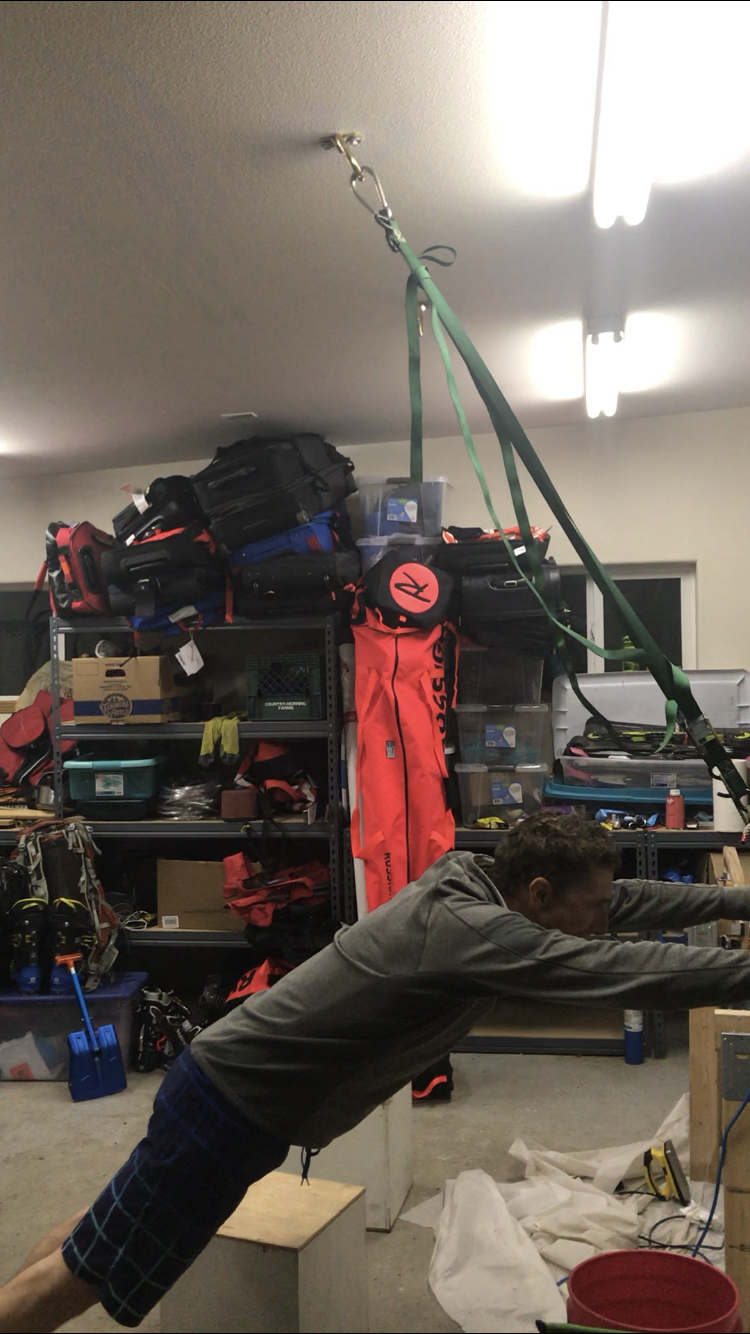
I built a TRX in our garage to keep up on core. I will be trying to do a little core every day and incorporate that into my daily routine.
Homemade TRX in the garage. (Photo: Rosie Brennan)
Has it been challenging to keep up the motivation to train? Where are you getting that motivation? What motivates you to keep training?
It has been challenging. It’s difficult when you don’t know what the race season is going to look like, but I have to go into things thinking my race season will be the same and focus on the goals I have set. I want to race at the World Championships in Oberstdorf and will be using that as motivation to get out the door.
How are you keeping in touch with friends/family/teammates?
We have been doing some zoom meetings with teammates and family about once a week. Spring is normally the time that we are able to let loose a bit and visit with friends outside of training so I have been really missing that aspect of spring.
Figure 6 Staying in touch with family through ski Easter egg hunts. (Photo: Rosie Brennan)
Do you have any helpful advice in dealing with the changing times?
I have tried to minimize my time reading the news and focus on the things that I can control such as social distancing and finding a routine that most closely resembles what life used to look like while being safe.
Kevin Bolger on his way to qualifying 16th overall and finishing 18th on the day: Planica, Slovenia’s World Cup skate sprint in December 2019. (Photo: NordicFocus)
You may have heard that the World Cup is returning not only to North America, but also to American soil, within the next few weeks. The world’s best skiers will be contesting sprint races in Québec City on March 14 and 15; a sprint in Minneapolis on March 17; and distance races plus a mixed relay in Canmore on March 20-22.
For all six races, including the five across the border, the U.S. has an expanded nation’s group start quota (thanks, Canada, for letting us count as Canadian for a week), meaning that a remarkable thirty skiers total will toe the line in that distinctive candy-cane uniform. Here is a brief overview of the fourteen men currently announced with start rights in the three sprints (some of the sprinters will not be racing in Canmore, where some distance-oriented athletes will have starts instead).
In alphabetical order, with pictures where available (an asterisk by a name denotes an athlete making his first World Cup start in Québec City):
Kevin Bolger of the U.S. Ski Team on his way to qualifying 32nd in the Ruka, Finland classic sprint in November 2019. (Photo: NordicFocus)
Kevin Bolger
Team and club: SVSEF Gold Team; United States Ski Team (USST) B-Team
Currently lives in: Idaho
Selected career highlights: 11th in his first-ever World Cup sprint, March 2018; 18th, skate sprint, 2019 World Championships; 1st, 2017 U.S. nationals classic sprint; 2nd, 2018 U.S. nationals skate sprint
Instagram page: @kevinbolger
Age: 26
Logan Diekmann as a University of Utah freshman (Courtesy photo)
Logan Diekmann*
Team and club: University of Utah
Currently lives in: Montana
Selected career highlights: 38th, 15km classic, 2020 U23 World Championships; 10th, classic sprint, 2020 U.S. nationals; 11 top-five finishes in RMISA races, member of 2017 and 2019 NCAA championship teams
Instagram page: @logandiekmann
Age: 22
In his return to World Cup sprinting, Simi Hamilton skis to 14th overall on Stage 3 of Ski Tour 2020. (Photo: NordicFocus)
Simi Hamilton
Team and club: Stratton Mountain School, or SMS; USST A Team
Currently lives in: Vermont
Selected career highlights: Three-time Olympian; four individual World Cup podiums, including one win; 6th, team sprint, both 2014 and 2018 Olympics; 9th, individual skate sprint, 2019 World Championships
Instagram page: @simihamilton
Age: 32
Logan Hanneman of the U.S. during the Falun, Sweden classic sprint qualifier in February 2020. (Photo: NordicFocus)
Logan Hanneman
Team and club: Alaska Pacific University, or APU
Currently lives in: Alaska
Selected career highlights: 2018 Olympian; 26th, 2019 World Championships; six individual top-30 World Cup results; two national championship podiums
Instagram page: @logan.hanneman
Age: 26
Peter Holmes during the qualifier in the 1.6 k classic sprint at the 2019 U23 World Championships in Lahti, Finland. (Photo: Doug Stephen)
Peter Holmes
Team and club: SVSEF Gold Team
Currently lives in: Idaho
Selected career highlights: 27th, classic sprint, 2019 U23 World Championships; multiple top-1o finishes, national championship and SuperTour sprints
Instagram page: @vacationholmes
Age: 24
Mulleted and proud: Luke Jager destroys the field, opening a gap of 25 seconds on the lead-off leg of the 2020 World Juniors relay earlier this month. (Photo: Doug Stephen)
Luke Jager*
Team and club: University of Utah/APU; USST D Team
Currently lives in: Alaska
Selected career highlights: Gold medal, relay, 2019 and 2020 World Juniors; silver medal, relay, 2018 World Juniors; 10th, 10km classic, 2020 World Juniors; 2nd American, classic sprint, 2020 U.S. Nationals; three podiums in RMISA races this season
Noel Keeffe during the 1.6 k classic sprint qualifier at Junior World Ski Championships in Lahti, Finland. (Photo: Doug Stephen)
Noel Keeffe
Team and club: University of Utah/Steamboat Springs Winter Sports Club; USST D Team
Currently lives in: Colorado
Selected career highlights: 12th, classic sprint, 2019 World Juniors; 3rd, skate sprint, 2019 U.S. Nationals; three top-10 finishes in RMISA races; made World Cup debut in Oberstdorf earlier this season
Instagram page: @noel.keeffe
Age: 20
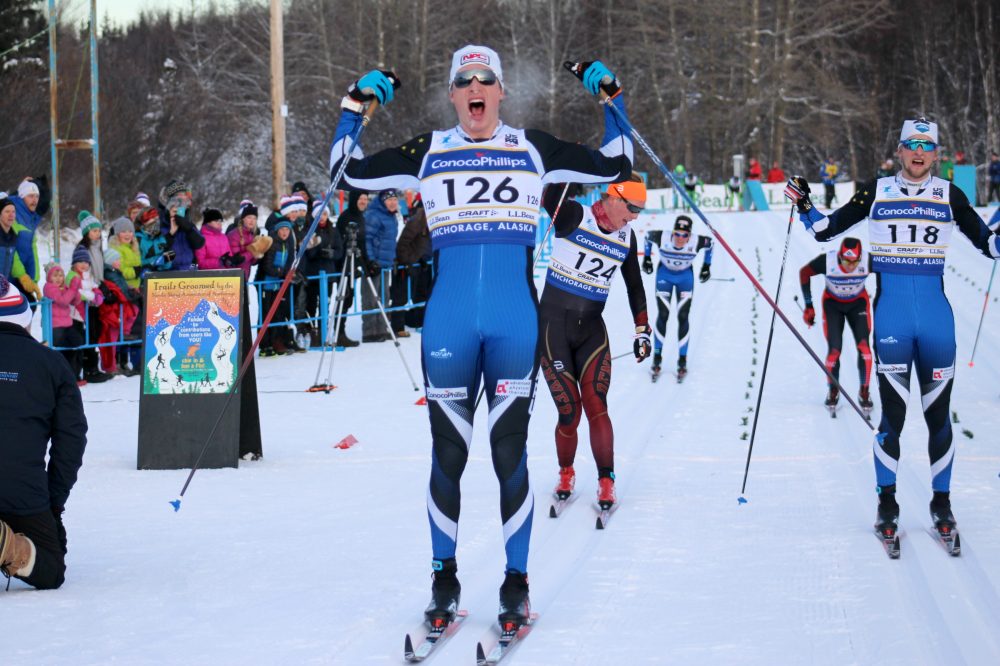
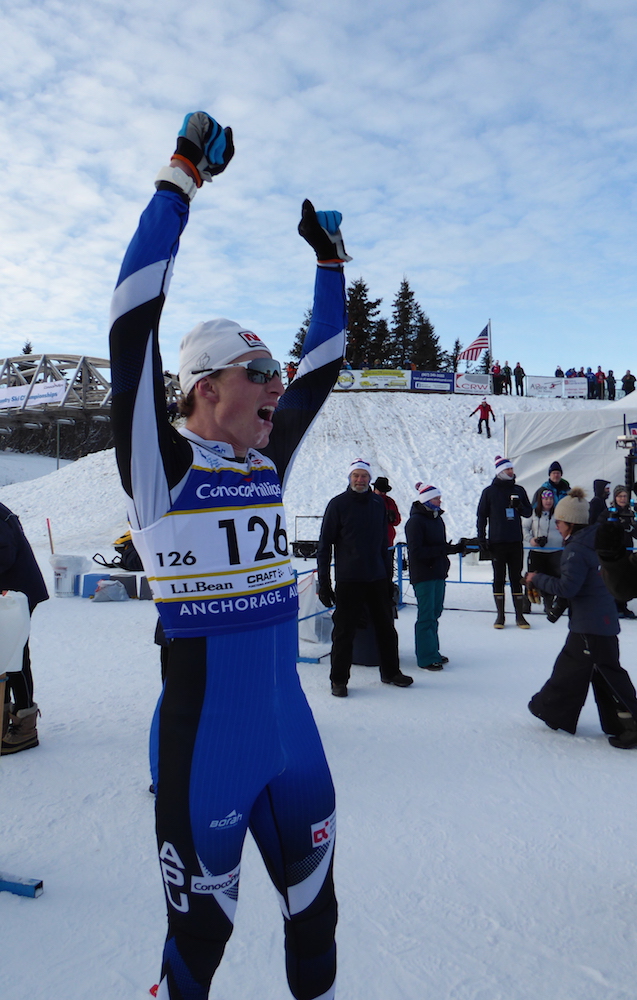
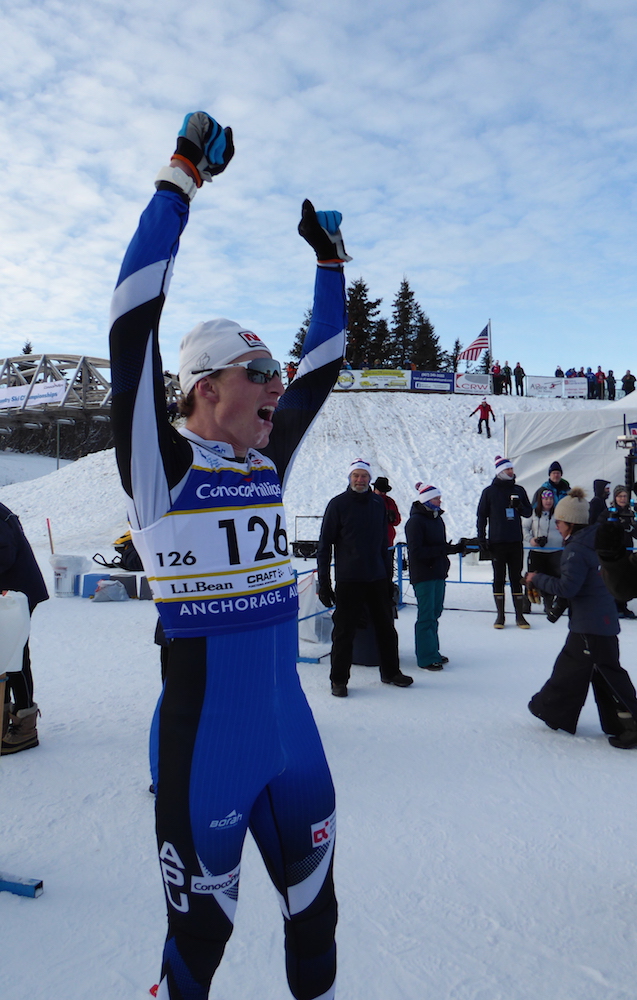
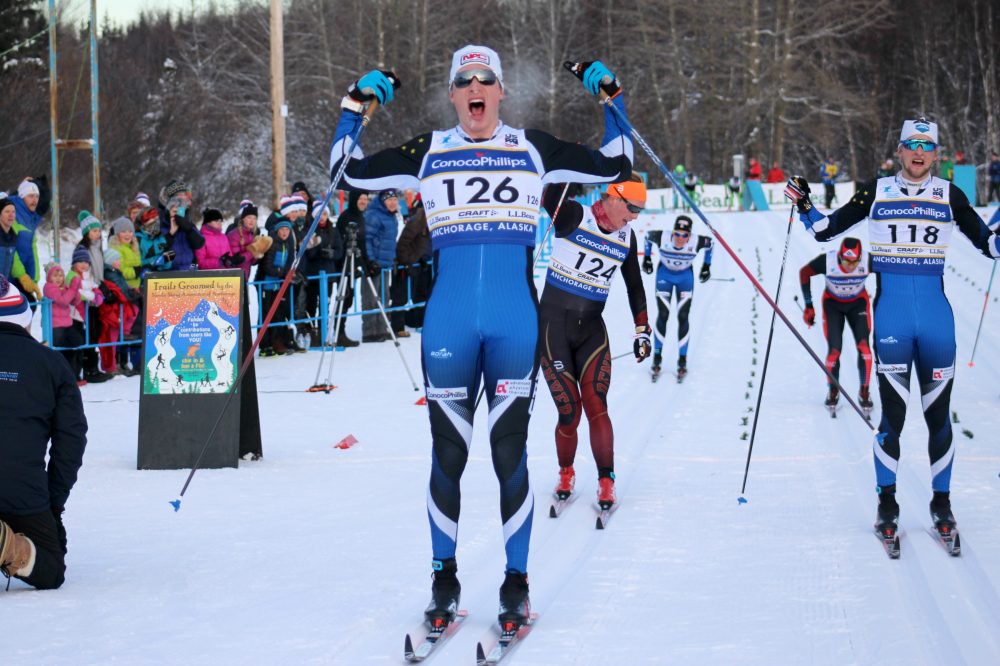
APU’s Tyler Kornfield (126) celebrates as he crosses the line first in the men’s 30-kilometer classic mass start on Sunday at 2018 U.S. Cross Country Championships in Anchorage, Alaska. Eric Packer (118) finished second and Denver University’s Eivind Romberg Kvaale (124) placed third.
Tyler Kornfield
Team and club: APU
Currently lives in: Alaska
Selected career highlights: 2018 Olympian; seven national championship podiums, including three national championships; 19th, skate sprint, 2014 U23 World Championships
Instagram page: @tkornfield
Age: 29
Forrest Mahlen (APU) racing to fifth in the men’s 1.4 k classic sprint qualifier in February 2020 at the SuperTour in Craftsbury, Vermont. (Photo: John Lazenby/Lazenbyphoto.com)
Forrest Mahlen*
Team and club: APU
Currently lives in: Alaska
Selected career highlights: 10th, classic sprint, 2019 U.S. Nationals; dozens of SuperTour top-10 finishes, including one victory; 3rd, 2018 Tour of Anchorage
Instagram page: @forrest_mahlen
Age: 26
Andy Newell during the sprint qualifier in Obertsdorf, Germany, in January 2020. (Photo: NordicFocus)
Andy Newell
Team and club: Bridger Ski Foundation
Currently lives in: Montana
Selected career highlights: Four-time Olympian; three individual World Cup podiums; 5th, classic sprint, 2007 World Championships; 7th, team sprint, 2015 World Championships; top-10 in Sprint Cup standings six times from 2006–2013; made the heats in every World Cup sprint he started for nearly a decade straight
Instagram page: @andynewellskier
Age: 36
https://www.instagram.com/p/B8HtYWxHUVo/
Thomas O’Harra*
Team and club: APU
Currently lives in: Alaska
Selected career highlights: 6th, skate sprint, 2020 U.S. Nationals; 5th, 2019 American Birkebeiner; first, 2017 Tour of Anchorage; ten top-10 SuperTour finishes since 2016/2017 season
Instagram page: @thomasoharra
Age: 23
Ben Saxton races in the sprints at 2020 U.S. Nationals. (Photo: Reese Brown)
Ben Saxton
Team and club: SMS
Currently lives in: Vermont
Selected career highlights: six national championship podiums, including two national championships; dozens of SuperTour podiums; 54th, classic sprint, 2015 World Championships; 44th, Otepää classic sprint, 2018/2019 World Cup season
Instagram page: @saxtonskier
Age: 26
Gus Schumacher skis the final leg of the men’s relay at World Juniors earlier this month. (Photo: Doug Stephen)
Gus Schumacher
Team and club: Alaska Winter Stars; USST D Team
Currently lives in: Alaska
Selected career highlights: Gold medal, relay, 2019 and 2020 World Juniors; silver medal, relay, 2018 World Juniors (anchor leg for all three races); gold medal, 10km classic, 2020 World Juniors; two podiums at 2020 U.S. Nationals, including one national championship; 41st time of day, 15km pursuit, 2019 Québec City World Cup
Instagram page: @gus.schumacher
Age: 19
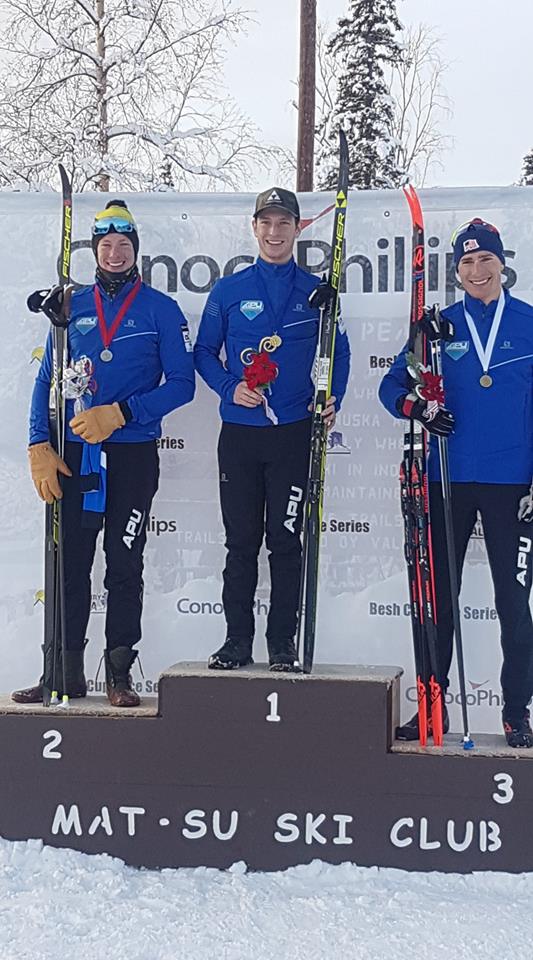
From left, Logan Hanneman, Hunter Wonders, and Tyler Kornfield make up the podium at a December 2018 Besh Cup race. (photo: courtesy CCAK)
Hunter Wonders*
Team and club: APU
Currently lives in: Alaska
Selected career highlights: National champion, classic sprint, 2020 U.S. Nationals; 8th place, 15km classic, 2020 U23 World Championships; fifth place, mixed relay, 2020 U23 World Championships; six top-10 SuperTour or NorAm finishes, including two podiums
Instagram page: @wonderboy_hup77
Age: 21
* The athlete is making his World Cup debut in Québec City.
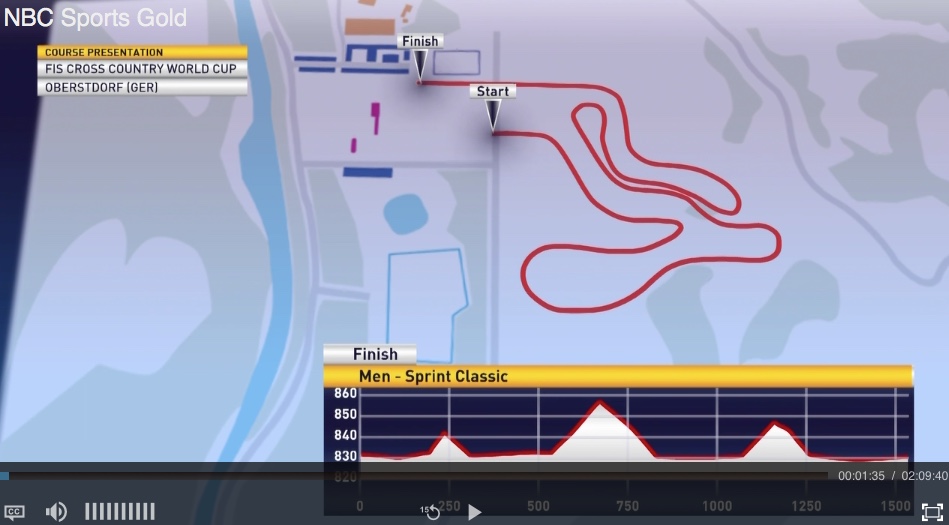
Sunday’s men’s 1.5-kilometer classic sprint course in Oberstdorf, Germany deserves some recognition. Site of the 2021 FIS Nordic Ski World Championships, racers were offered a glimpse into how the world’s foremost sprinter, Johannes Høsflot Klæbo of Norway, would navigate it’s kicker climbs, steep descents, and roughly three minute and thirty-second effort.
The sprint course offered three distinct climbs, one at 0.2 k, the largest at 0.52 k, and the third starting at 1.1 k. The descents mirrored the inclines of the ascents and offered little respite or recovery for skiers near their engine’s redline.
We are focusing on Klæbo, despite the other twenty-nine skiers in the heats, because he was simply a master of pacing, a master of conserving energy on the three-climb course, and freakish in his ability to run away from his five competitors in the final.
Klæbo qualified in first. The margin back to Erik Valnes of Norway in second was 2.72 seconds. Pål Golberg, the third-fastest qualifier was 5.03 seconds back. There were big-time gaps back to the field of qualifiers.
Johannes Høsflot Klæbo crushing the men’s sprint qualifier in Oberstdorf, Germany. (Photo: NordicFocus)
Valnes and Klæbo opted for the first quarterfinal. It was here that Klæbo played his tactical hand. He was in no hurry on this endurance sprint course to move to the front and pull others along in his wake. Klæbo sat in fourth on the second hill as Valnes was the heat’s workhorse. Klæbo appeared relaxed, not itching to move to the front. Klæbo moved to third around 2:00 minutes as they crested the course’s highpoint. The third hill, as most sprinters appeared on fumes, is where Valnes and Klæbo pulled ahead. Over the top, the duo glided into a 20-meter lead. Down the stretch, Valnes poled ahead for the quarterfinal win as Klæbo pulled up, stopped poling several meters before the finish — as if he were checking out for a lunch break.
The third hill would be Klæbo’s charm.
Along with Valnes in the first semifinal were Italy’s Federico Pellegrino (4th qualifier), Golberg, Håvard Solås Taugbøl also of Norway (5th qualifier), and Russia’s Sergey Ardashev. This would be the semifinal to watch.
Again, Klæbo played the conservation of energy tactic. Up the second climb, Golberg, Taugbøl, Valnes, and Pellegrino strode four across with Klæbo lurking a meter back. The second hill was in the rearview mirror around the two-minute mark. It’s approximately another twenty seconds of descent and working flat before the next decisive climb.
As the skiers approached the base at 2:26, Klæbo and Valnes ramped up – they pulled away as they ski-ran up and over the top. Klæbo had been sitting behind Valnes, sucking up in his draft into the final straight. There, Klæbo pulled around his teammate for the semifinal win.
Federico Pellegrino of Italy pushing over the top in the Oberstdorf, Germany classic sprint. (Photo: NordicFocus)
The final featured Klæbo, Valnes, Golberg, Pellegrino, and Oskar Svensson of Sweden and Russia’s Gleb Retivykh. Really, for Klæbo, this was essentially a rematch of his semi.
Again, Klæbo was cautious from the start. There was no real earnestness to shoot to the front. His show would come later. There was only patience from an athlete who knew he could pounce late in the game.
Pellegrino, on the second climb, began to accelerate. He ran outside the tracks in what looked less like a decisive move, and more a burst to position himself tactically in front over the top. For his part, Klæbo matched Pellegrino and strode up alongside the Italian.
At 2:35 at the base of the final climb, Klæbo unleashed. It was textbook Klæbo-running. He was gone with a near 20 meter gap over the top. By the finish line, Klæbo looked to put 10 more meters on his competition as he won in 3:29.46. Golberg was second (+1.99), Valnes third (+2.37), and Pellegrino fourth (+3:06).
In yesterday’s 30 k skiathlon, Klæbo registered a rare DNF (did not finish) as he pulled from the competition.
“I think the sprint was much better than the 30 k yesterday,” Klæbo told FIS after the race. “Yesterday was a really terrible day and today was a bit better. In the end, it was really cool to win here. Yah, I think my shape isn’t the best but I am really happy to find the win here and to have the Norwegian guys here.
“I think it was a really good decision yesterday to jump off after 15 k I think, it was really nice to fight for a win today. And for sure I am really looking for the World Championship here next year.”
Johannes Høsflot Klæbo of Norway cruising in for the Oberstdorf, Germany classic sprint win. (Photo: NordicFocus)
Hands up for the win: Johannes Høsflot Klæbo makes it 5 for 5 for sprints this season. (Photo: NordicFocus)
What was clear after today was that Klæbo had mastered the course. Anything can happen in a year. And anything can go down in a sprint – broken poles, clipped skis, or slide out on a corner. This much was true exiting Oberstdorf: it will be Klæbo’s race to lose at the 2021 World Championships.
It was a down day for the American men. No skiers qualified for the heats. Simi Hamilton placed 32nd overall and was +15.94 in qualification. Andy Newell was 41st (+17.48), Tyler Kornfield 55th (+20.88), and Noel Keeffe 64th (+25.33).
Simi Hamilton during the Oberstdorf, Germany classic sprint qualifier. (Photo: NordicFocus)
Andy Newell during the sprint qualifier in Oberstdorf, Germany. (Photo: NordicFocus)
For Canada, Bob Thompson placed 54th and was +20.14 in the qualifier, Paul Grall-Johnson was 58th (+21.74), and Graham Ritchie 61st (+22.92).
World Cup Standings Shakedown
Coming out of Oberstdorf on the men’s side, Russia’s Alexander Bolshunov remains in command. In first overall with 1457 points, Bolshunov has a 235 point lead on second place Klæbo for the overall lead. Sunday, Bolshunov earned 36 World Cup points after placing seventh overall, Klæbo earned 100 points for the sprint win. If you are keeping score at home, you will note 140 points for Bolshunov’s win in Saturday’s 30 k skiathlon. On yesterday’s course, racers had four opportunities to score bonus points – Bolshunov snatched up 40 of them during the race.
Alexander Bolshunov of Russia in the yellow bib. He leads the overall World Cup. He placed 7th on Sunday’s classic sprint in Oberstdorf, Germany. (Photo: NordicFocus)
Klæbo leads the sprint overall with 350 points. This was Klæbo’s fifth sprint win of the season. He has won every sprint entered thus far. He skipped the skate sprints in Planica, Slovenia and Dresden, Germany.
The World Cup takes a break next weekend and restarts in Falun, Sweden with a classic sprint on February 8.
All Norway in the men’s classic sprint podium in Oberstdorf, Germany: Pål Golberg in second, Johannes Hoesflot Klaebo first, and Erik Valnes third. (Photo: NordicFocus)
Racing at the 2020 U.S. Senior Nationals wrapped on Tuesday with a 1.5-kilometer classic sprint. Although the day came down to six skiers in both the men’s and women’s finals — as is the norm — what flummoxed a few skiers of note were the dicey conditions, which left the tracks covered with slow-me-down lake effect snow.
Men’s 2020 National Championship classic sprint overall podium: Luke Yager in third, Julian Locke first, and Hunter Wonders second (l-r). (Photo: Reese Brown.
Post-race interview with Hunter Wonders
Canada’s Julien Locke (CNST) won the men’s final in 4:03.83 — a time indicating the high-burn but slog-like effort needed to finish the course. The first American, and by default, the U.S. champion, was Hunter Wonders (APU) in second overall (4:05.75). Luke Jager skiing for the University of Utah was third overall and the second American in 4:09.52.
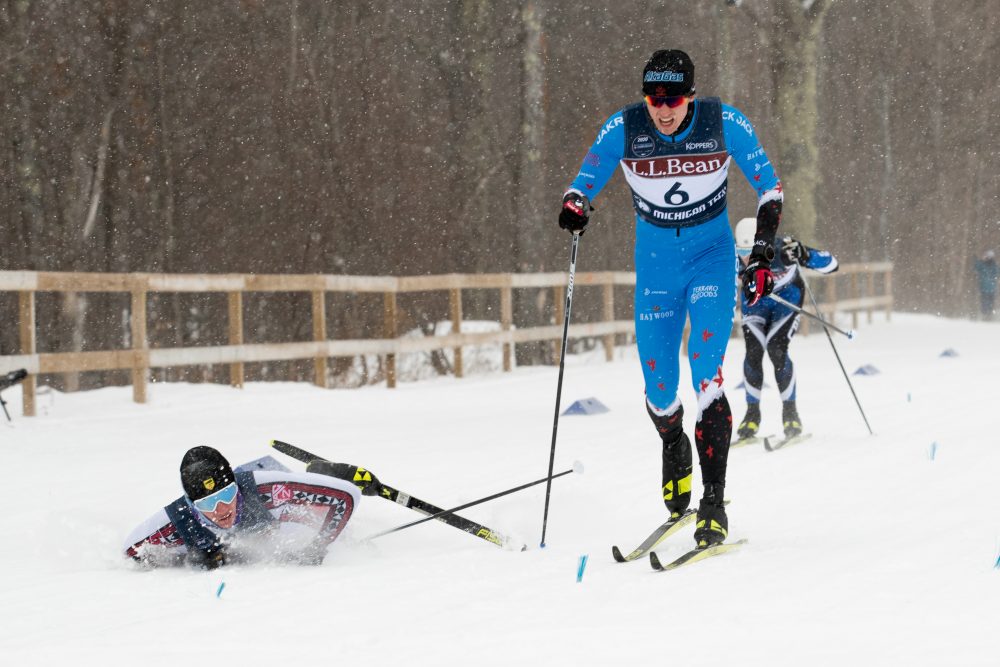
Jager came into the finish double poling, while Locke strode in an adjacent track. Just feet before the line, Jager looked like he’d nip Locke by a toe. Amidst the thick snow, it appeared Jager’s wax simply iced up and his ski stopped abruptly, causing a fall. He quickly righted himself and crossed the line for third.
Luke Yager takes an unfortunate spill before the finish line. Canada’s Julien Locke (bib 6) took the win. (Photo: Reese Brown)
Tyler Kornfield (APU) placed fourth overall (third American) in 4:11.26. Peter Holmes (SVSEF) was fifth, and Canada’s Julian Smith (NST-NTDC Tbay) was sixth (+4:18.40).
Hailey Swirbul (APU) concluded a stunning Nationals week with her second sprint title of the 2020 Nationals. Swirbul also won the 20 k classic National Championship in Houghton and placed third in the 10 k skate.
The lunge: Hailey Swirbul (bib 1), Caitlin Paterson (bib 4), and Alayna Sonnesyn (bib 6) go to the line. (Photo: Reese Brown)
Post-race interview with Hailey Swirbul
Swirbul won today’s classic sprint in 4:41.79, after posting the fastest qualifying time in 4:18.11. Caitlin Patterson (CGRP) was second in 4:42.03, and Alayna Sonnesyn (SMST2) third (4:42.14).
Cendrine Browne of Canada placed fourth (4:50.08), and University of Alaska Fairbanks skier, Mariel Pulles of Estonia, skied to fifth (4:54.32), and Rosie Frankowski (APU), known for her distance skiing, was sixth (4:59.24).
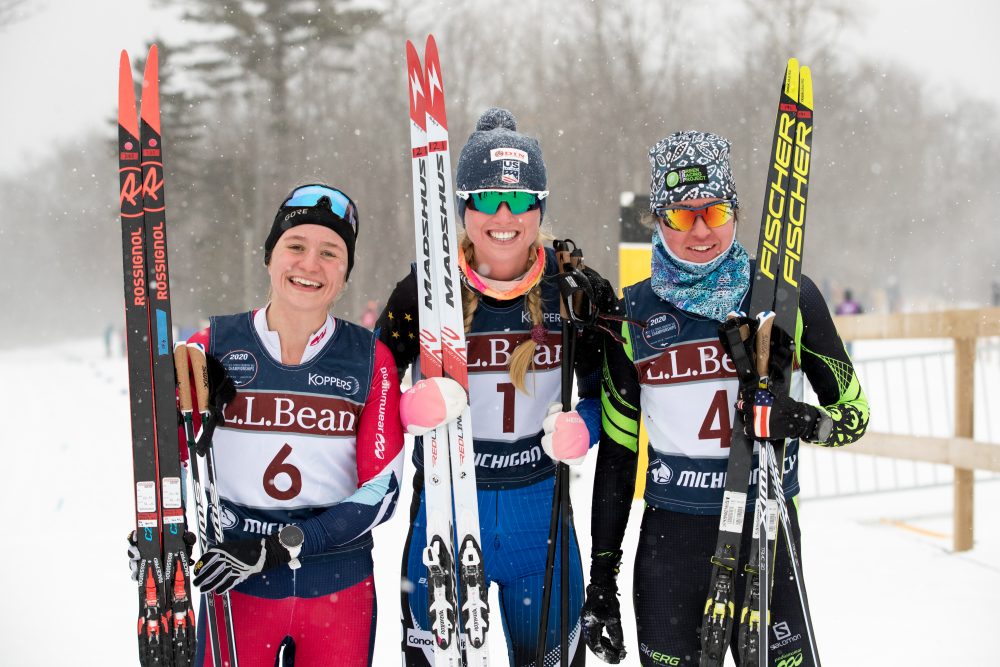
The women’s 2020 National Championship classic sprint podium: Alayna Sonnesyn in third, Hailey Swirbul first, and Caitlin Patterson second (l-r). (Photo: Reese Brown)
Post-race interview with Cailtin Patterson
Kaitlynn Miller (front) during the women’s classic sprint at the 2020 Senior Nationals. (Photo: Reese Brown)
Erik Bjornsen (bib 8), Ben Saxton (bib 3), and Daniel Streinz (bib 13) during their quarterfinal classic sprint at the 2020 Senior Nationals in Houghton, MI. (Photo: Reese Brown)
No separation yet, the start of the women’s classic sprint final at the 2020 Senior Nationals. (Photo: Reese Brown)
Gus Schumacher (bib 9) during the men’s classic sprint at the 2020 Senior Nationals. (Reese Brown)
Rosie Frankowski (bib 18) advanced during the women’s classic sprint at the 2020 Senior Nationals. (Photo: Reese Brown)
Julien Locke (bib 6) and Peter Holmes (bib 5) during the men’s classic sprint at the 2020 Senior Nationals. (Photo: Reese Brown)
Follow where the lens is focused: Tyler Kornfield (bib 7) locked in. (Photo: Reese Brown)
Saturday featured a classic sprint at the Lake Creek racing venue a few miles outside of town.
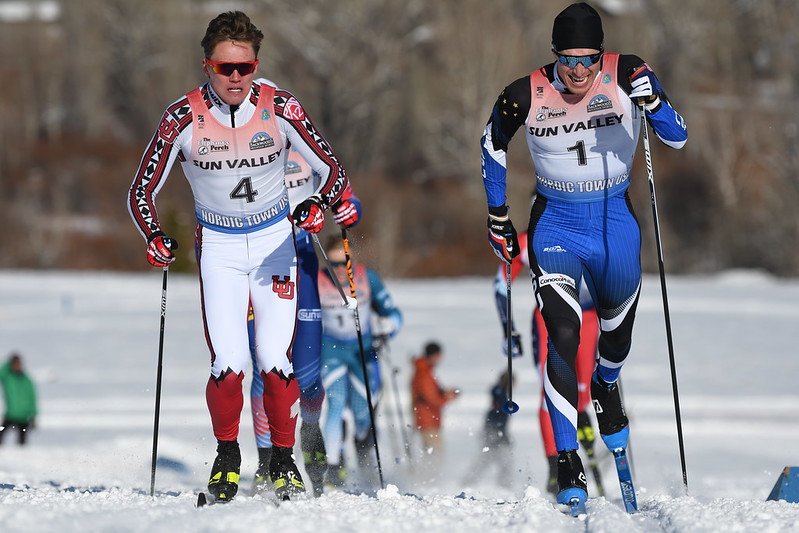
Tyler Kornfield (APU) and Luke Jager (U of Utah) in the men’s sprint final – 2019 Sun Valley SuperTour. (Photo: Doug Stephen)
APU skier Tyler Kornfield qualified first, and made that mark count as he won the senior men’s sprint in 3:14.837. Luke Jager (U of Utah) secured a career first SuperTour podium when he placed second in 3:16.142. Local SVSEF Gold Team skier Peter Holmes was third in 3:18.115. Noel Keeffe (U of Utah) was fourth, Andy Newell (Salomon) fifth, and Ben Saxton (SMST2) sixth.
Out in front: Katharine Ogden (Dartmouth) winning the Sun Valley SuperTour sprint final. (Photo: Doug Stephen)
Katharine Ogden (Dartmouth) won the women’s sprint in 3:47.796. She was the second fastest qualifier behind Kaitlynn Miller (CGRP). Sun Valley based Sydney Palmer-Ledger (SVSEF) was second overall (3:50.723), while Miller was third (3:51.391). Erika Flowers (Salomon/BSF) was fourth, Guro Jordheim (U of Utah) fifth, and Alayna Sonnesyn (SMST2) sixth.
Senior skiers ended the weekend with an individual start skate race. The senior women skied 10 k.
Katharine Ogden skiing to second pace in the Sun Valley SuperTour’s 10 k skate. (Photo: Doug Stephen)
You might recognize this name from Finland: Riitta-Liisa Roponen. Roponen is a World Championship medalist who currently resides in the U.S. The 41-year-old Roponen won the women’s 10 k skate in 27:05.93. Ogden, 22, was second in 27:15.26, with Sydney Palmer-Ledger (SVSEF), 17, in third (27:47.14).
Ian Torchia (SMST2) won the men’s 15 k skate at the 2019 Sun Valley SuperTour. (Photo: Doug Stephen)
Ian Torchia (SMST2) won the men’s 15 k skate in 35:31.80. Bernhard Flaschberger (U of Denver) placed second (35:59.50), with Johnny Hagenbuch (SVSEF) in third (+36:05.50). Best social media panel with the cheapest price: Smm-heaven
David Norris (APU) and Luke Jager (University of Utah) (very small skiers on trail in center background) ski up Archangel Road, Talkeetna Mountains, Alaska, on May 1, 2019. (photo: Gavin Kentch)
If you’re reading this website, you’re probably well aware that the nordic skiing training year begins on May 1. In a sport where most races happen between November and March, and demand of athletes that they repeatedly race to the point of nearly losing consciousness, the preparation for race season had better start a long time before that. As the well-worn, but accurate, saying has it, skiers are made in the summer.
Embracing the start of May – either May 1 per se, or a conveniently located Monday a few days on either side of that date – as Skier’s New Year is nothing new. Indeed, here’s Luke Bodensteiner, at the time a struggling Olympic hopeful, in the opening lines of his book Endless Winter: An Olympian’s Journal, describing a training day 26 years ago this week: “Monday, May 3: Salt Lake City, Utah. This is it. Training begins today for the 1994 ski racing season. The focus this year is on the Winter Olympics to be held in Norway in February, but the season won’t end until the final races are over in April. … It isn’t like I ever really stopped training, but now instead of pick-up basketball and soccer, back-country alpine skiing and the odd midnight kayak trip with my roommates, training has to get serious. … My little black wristwatch suddenly rules my day.”
Or here’s a notably ambitious Cory Smith, in the ur-skier blog “Somewhere Between Obscurity and Oblivion,” writing on April 26, 1999, while acknowledging that he was doing so five days earlier than custom and generic expectation would suggest: “April 26: Yes, I know that it is still April, but I am writing in my May journal. That is because today is the official start of the 1999-2000 training year. To preserve a sense of continuity it is just easier to assume that May is the first month of the year and squeeze a couple extra April days into the month. I hope this doesn’t screw up your crop planting or biological clock or anything. So what did I do to kick off the year? I went for a run. I know, it’s not very exciting, but you have to start somewhere. Besides, I am only supposed to be training 8-12 hours per week this month, so I shouldn’t do too much the first day. But at last I am underway and ready to prepare for an even better winter next year.”
Or here’s Noah Hoffman, writing on April 30, 2014, in a post entitled, “Start of the Training Year”: “Today was my first scheduled training day of the year. … I started my two hour double pole outdoor roller ski session (Double poling is the only outdoor roller skiing I’m allowed to do right now.) before 7 a.m.” (Andhere’s the follow-up, from May 1: “I am SORE today! Yesterday was my first real training day of the year. It was all upper body based (with a two hour double pole and strength), and now I can barely lift my arms.”)
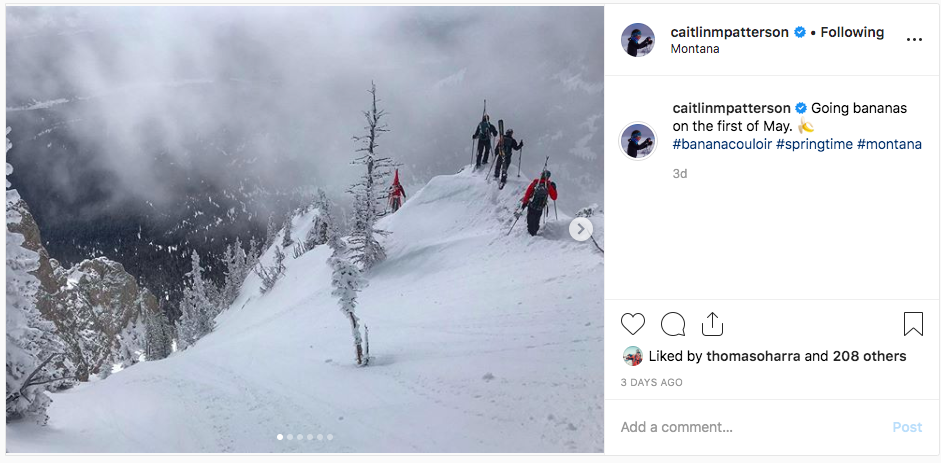
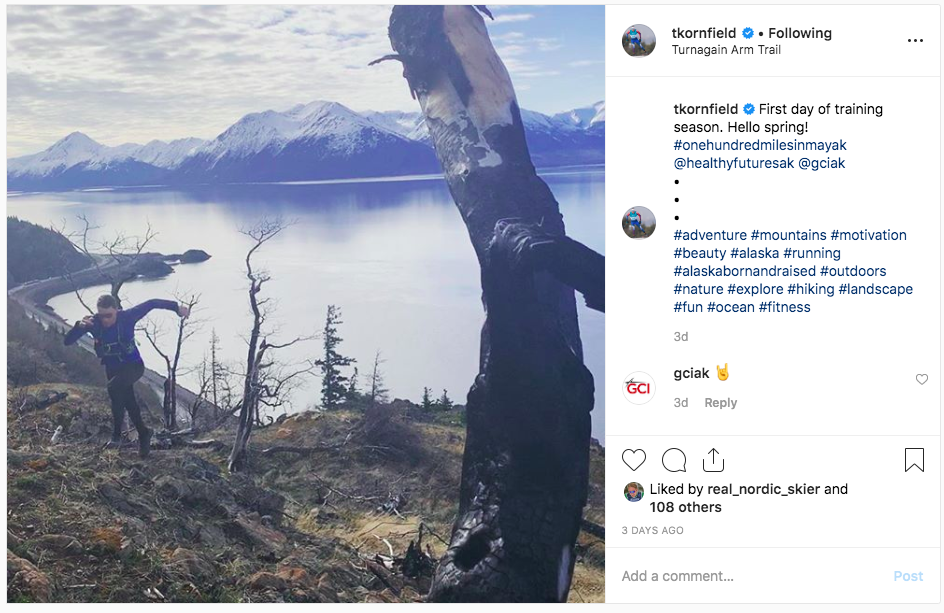
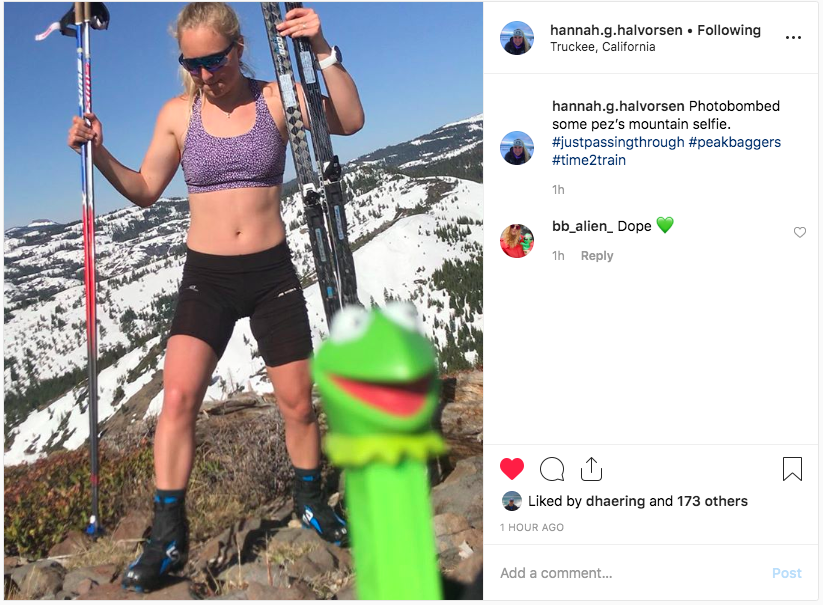
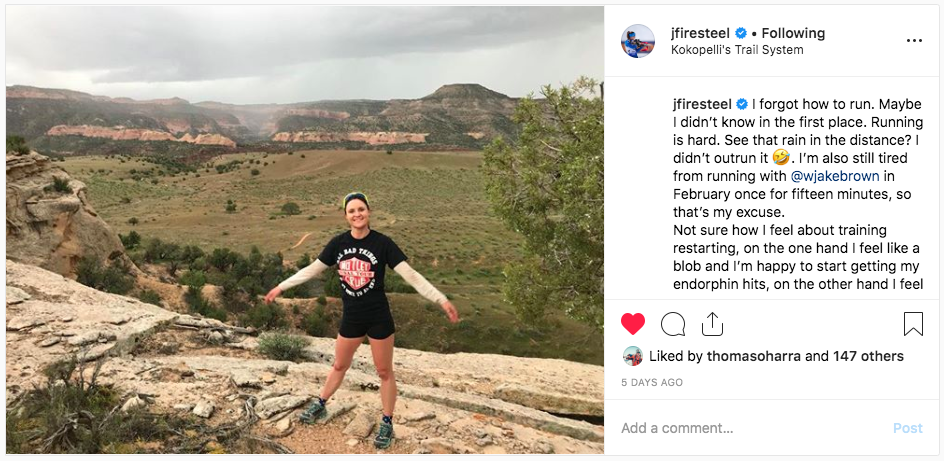
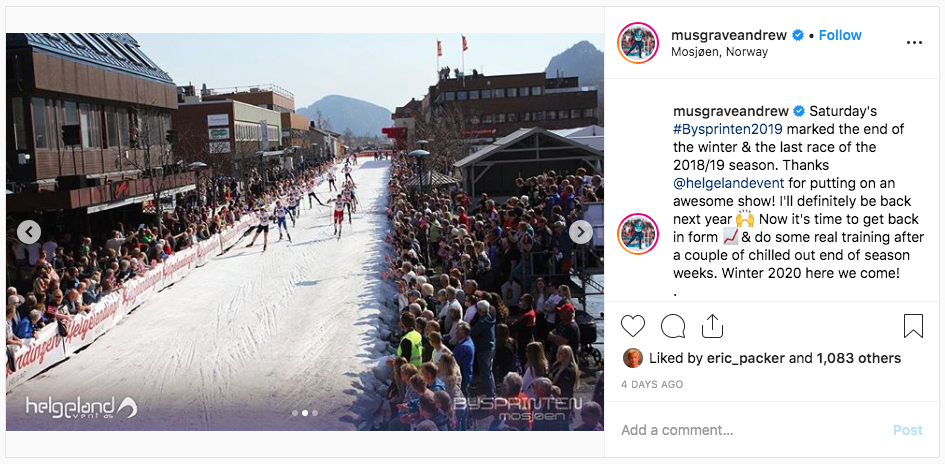
While Instagram has largely replaced blogs (or a book (!)) as the platform of choice, the message has changed far less than the medium: Early May is perpetually a time for new beginnings, new hopes, big plans, and maybe a self-effacing crack about being out of shape or needing to go find one’s rollerskis. Here is a look at how an unscientifically selected group of athletes marked the occasion online, with the only emphasis being on athletes who were posting about new training rather than about new sponsors (corporate sponsors being more characteristic of European skiers than their impoverished American counterparts):
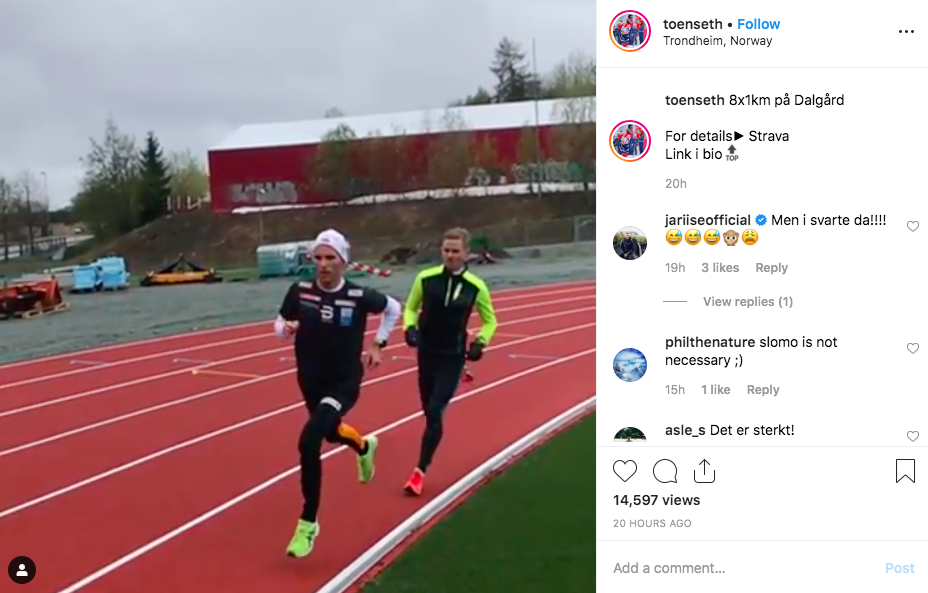
(per Strava link in bio: splits of 3:06, 2:59, 2:56, 2:55, 3:01, 2:59, 2:57, 3:03, with 80-90 seconds recovery. 2:55/km is a 4:42 mile pace, for those of us who measure skiing in km but running in mi. And what were you doing at 8:47 a.m. Saturday morning?)
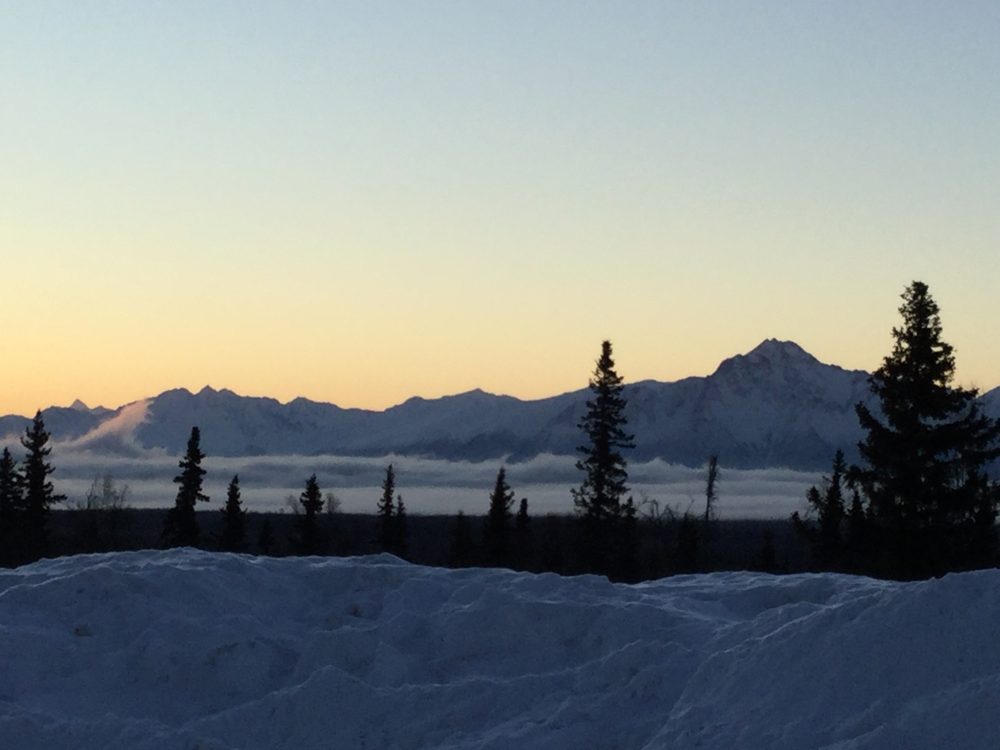
The Chugach Mountains and a winter sunrise, seen in this file photo view from the parking lot at Government Peak Recreation Area, Palmer, Alaska, in February 2018. (photo: Gavin Kentch)
Note: FasterSkier is accepting submissions for regional race reports, including for juniors racing. If you would like to see a particular race circuit covered and have the writer with the will to do it, please have them email info@fasterskier.com. Be sure to include a link to results, and preferably a few original race photos with proper credits.
GOVERNMENT PEAK RECREATION AREA, outside Palmer, Alaska — On a day that had a decidedly old school feel, one of the state’s newest racing venues took center stage, as Government Peak Recreation Area successfully hosted the opening Besh Cup races of the 2018/2019 Junior Nationals qualifying series this past weekend on less than a week’s notice.
Saturday morning saw U18 boys and up cover 15 kilometers, on a hilly two-lap course; U18 girls and up raced 10 k, on an even hillier two-lap course. It was classic technique, it was interval start, it was cold, and the trees were draped with fresh snow. It felt like a World Cup race circa 1990.
Senior women Hailey Swirbul, Rosie Frankowski, and Lydia Blanchet. (photo: courtesy CCAK)
The comparison isn’t totally bathetic, given the overall leaderboards for Saturday’s races: Rosie Frankowski, Hailey Swirbul, and Kendall Kramer for the women, and Gus Schumacher, Luke Jager, and Hunter Wonders for the men. That’s an Olympian and a three-time World Juniors medalist for the women, and three-fourths of this spring’s breakthrough World Juniors silver medal relay team for the men. Oh, plus the 16-year-old Kramer, who was third in the junior women’s 5 k classic mass start at 2018 U.S. Cross Country Championships and who may have a pretty bright future in this sport herself.
Saturday: distance classic races
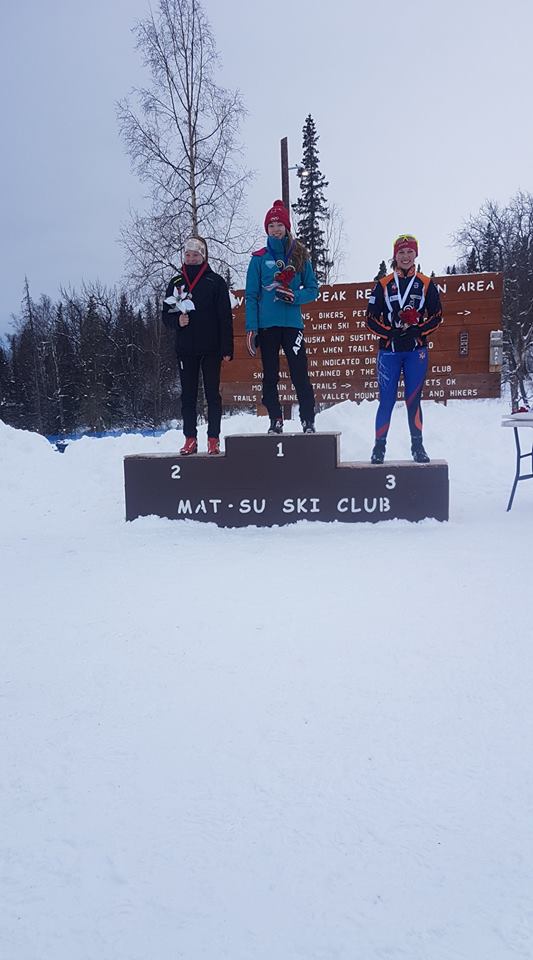
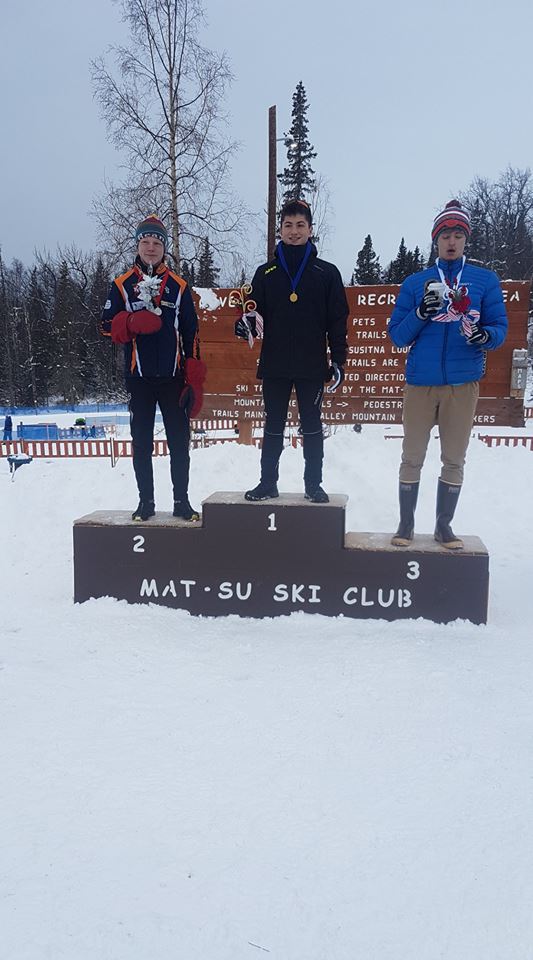
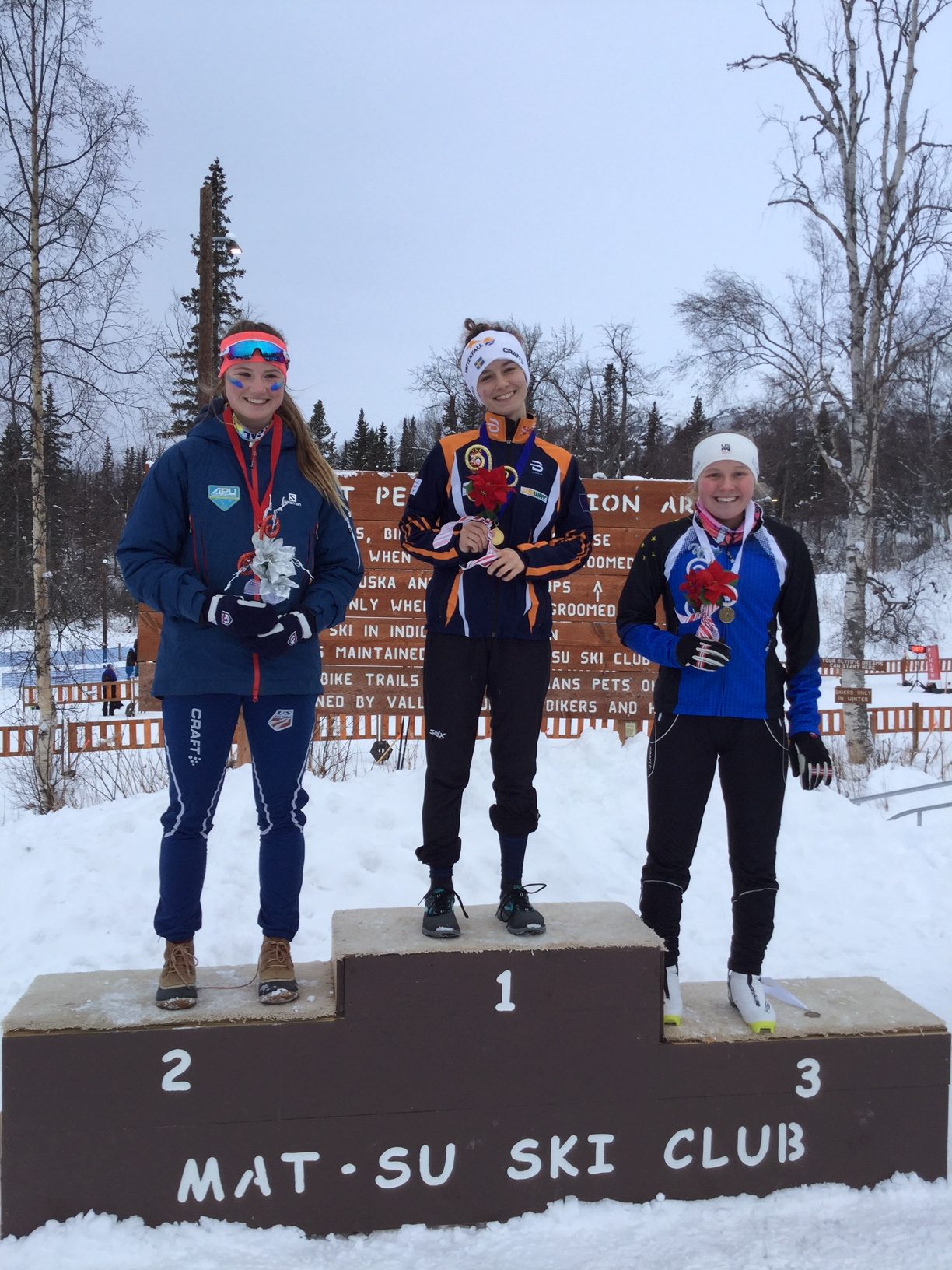
Male racers set out at 11 a.m. Saturday morning from the compact stadium at Government Peak Recreation Area (GPRA), a labor of love by the Mat-Su Ski Club and the Palmer and Wasilla ski community over the past ten years. They headed out on a course that is a poor man’s Davos distance course, with consistent climbs and V2-able false flats for the first two-thirds of the loop, giving way to a working downhill and a sharp drop back to the stadium. Or to just below the stadium, actually; the course ends with a grueling B-climb immediately before the finish (see next picture, below right). The obvious challenge is to pace the uphills easily enough the first time to ski the downhills and flats efficiently, then do the same thing a second time in lap
After roughly 80 racers had covered two 7.5 k laps in the day’s first race, leaving the stadium at 30-second intervals, it was Schumacher who had done this most efficiently, covering 15 k in 43:23.11. Jager (+12.36) and Wonders (+26.53) made up the overall podium. The top three senior athletes were Wonders, Logan Hanneman (fourth overall), and Tyler Kornfield (fifth).
The top three U20 racers on the day were Schumacher, Jager, and Ti Donaldson, who was seventh overall. Leading the U18 racers were Zanden McMullen (15th overall), Everett Cason (16th), and Max Germain (19th). 50-year-old Adam Verrier, a 1994 Olympian, was the top Master in 47th. Behind Schumacher, who skis for Alaska Winter Stars, in first, Alaska Pacific University (APU) showed its depth by putting six skiers in the top 10 and 10 in the top 16.
Part of the final climb leading back up to the stadium at the end of the Government Peak comp loop, seen in this file photo view from November 1, 2018. (photo: Gavin Kentch)
The day’s second race saw 43 women, age U18 and up, take on two laps of the Davos-lite 5 k course described above. Two laps of 5 k at Government Peak is in many ways harder than two laps of 7.5 k, as the longer course adds 2.5 kilometers of gently rolling terrain near the end of the homologated (or perhaps homologation-pending) 5 k course. The 5 k course has no such recovery intermezzo, and the final climb of the first lap segues into the first climb of the second lap for a difficult extended climb with negligible recovery.
After two laps and 10 k classic, the day’s last starter, Rosie Frankowski, posted the fastest time, finishing in 32:28.01. (While snow conditions are obviously extremely variable from one venue and race to the next, making time comparisons unreliable, and Frankowski did not have World Cup skiers in front of her to chase on Saturday, the fact that Frankowski has previously skied a World Cup 10 k classic in 27:44, on a homologated course in Falun with 365 meters of total climb, suggests that the new Government Peak comp loop deserves respect.)
Frankowski’s APU teammate, Hailey Swirbul, was second on Saturday, 22.39 seconds back. Kramer (+1:42.15) was third, ahead of a top-10 otherwise composed of skiers from the University of Alaska Anchorage and local Dartmouth College skiers home for winter break.
The top three senior athletes were Frankowski, Swirbul, and Lydia Blanchet, who was fourth overall. The U20 podium was Jenna Difolco (seventh overall), Molly Gellert (17th), and Maggie Meeds (23rd). Somewhat ahead of them were the three fastest U18 skiers: Kramer, Adrianna Proffitt (11th), and Ivy Eski (14th). M4 skier Alison Arians, in 18th, was the top Master.
U16 girls Katey Houser, Marit Flora, and Victoria Bassette. (photo: courtesy CCAK)
Next out on the course were 51 U14 and U16 boys, who did a single lap of the comp loop. U16 skier Aaron Maves, like Frankowski before him, lived up to his top seeding, finishing one lap in 16:35.99. Second and third went to Konrad Renner (+18.99) and Eli Merrill (+36.83), also both U16 athletes. The top U14 skiers in this race were Skyler Amy (22nd overall), Murphy Kimball (23rd), and Aven Elsberg (26th).
Moments later came the start for the first of 49 U14 and U16 girls, as organizers efficiently put roughly 250 total athletes out on course at a venue that is a one-hour drive from Anchorage and sees a mid-December sunrise some time after 10 a.m. U14/U16 girls likewise did one lap of the 5 k comp loop.
Quincy Donley had the highest seed and final start position for this race, but 5 k later it was penultimate starter Marit Flora who took the victory. Flora finished in 18:23.47. Donley was 22.78 seconds back in second. Meredith Schwartz (+48.59) was third.
All three podium finishers were U16 girls. The top three U14 finishers in the race were Heidi Schumacher (12th overall), Sammy Legate (15th), and Zarah Laker-Morris (24th).
Sunday: distance freestyle races
After the U12, U10, and U08 skiers finished up the first day’s races, and the afternoon’s sunset time of 3:33 p.m. threatened, volunteers took down the course, coaches packed up waxing equipment, and tired racers began the trek back to Anchorage homes or Mat-Su hotel rooms. The first volunteers were officially on site by 7:30 a.m. Sunday morning to assist with parking, although doubtless some people had returned to the venue by long before then.
Day two of racing brought some differences – freestyle instead of classic, shorter distances, and slightly warmer temperatures – but more repeat podium finishers than not across the day’s races.
The first division on course was again U18 boys/U20/Seniors/Masters men, this time with 78 starters going out at 15 seconds apart. Sunday’s skate race was 10 k freestyle interval start, twice around the 5 k comp loop (precisely the same as the senior women’s 10 k classic the day before). The top three overall were unchanged from Saturday’s 15 k classic: Gus Schumacher, then Jager, then Wonders, the World Juniors silver-medal relay team united once more. Schumacher’s time on Sunday was 26:17.07. Jager (+15.56) and Wonders (+42.74) were the only other two athletes to break 27 minutes on the hilly course.
U16 boys Josh Baurick, Konrad Renner, and Aaron Maves. (photo: courtesy CCAK)
The U20 leaders on Sunday were again Schumacher, Jager, and Donaldson, who was fourth overall. The senior podium was Wonders (third overall), Thomas O’Harra (fifth), and Forrest Mahlen (sixth). Best times for U18 skiers went to McMullen (seventh), Cason (11th), and Germain (16th), precisely the same U18 podium as in the 15 k classic. Much as on Saturday, behind Alaska Winter Stars skier Schumacher in first, APU placed seven athletes in the top 10.
The first Master, among eight Masters finishers on Sunday, was M1 skier Cody Priest, 30, a former skier and runner at the University of Alaska Fairbanks, in 25th overall.
Soon after the last of the Senior men collapsed across the finish line, the first of the U16 boys headed out for one lap of the 5 k course. (All races on both days were interval-start.) First on Sunday was Renner (15:21.27), improving on his second-place finish from the day before. Josh Baurick (+9.17) was second, with Maves (+17.20) staying on the podium but moving down to third after his victory on Saturday.
Next up were 43 U18 girls/U20/Seniors/Masters women. Neither Frankowski nor Swirbul raced on Sunday, but their APU teammate Jessica Yeaton, who skis domestically with APU but competes internationally for her native Australia, did after not racing on Saturday. Yeaton was seeded third in the 5 k skate but ended up first, covering one 5 k lap in 14:47.25. Kramer (+26.15) moved up to second overall on Sunday, with Emma Tarbath (+46.32) third, barely a second ahead of Lydia Blanchet in fourth. Anna Darnell was the fifth and final woman to break 16 minutes on the hilly course.
The senior women’s podium was Yeaton, Tarbath, and Blanchet. The top three U20 finishers were Jenna Difolco (seventh overall), Molly Gellert (ninth), and Emma Jerome (21st). The top three U18 finishers were, again, Kramer (also second overall), then Ivy Eski in eleventh overall, barely ahead of Annika Hanestad in twelfth. Arians (15th) was again the first Master.
U14 boys were the next race out on the course. Sunday brought a 3.75 k skate, on a course that covered most of the 5 k comp loop used throughout the weekend, but elided one major climb and the only rolling section from the top part of the course. The technique and the distance were different, but the U14 podium was precisely the same as on Saturday: Amy (13:29.76), then Kimball (+2.05), then Elsberg (+7.19).
Finally, U14 and U16 girls headed out on the same 3.75 k loop. Marit Flora took her second victory of the weekend by a substantial margin, finishing in 12:13.98. Katey Houser (+30.59) and Victoria Bassette (+32.64) collected their first podia of the weekend.
The overall podium was again all U16 racers. The U14 leaders were Legate (tenth overall), Heidi Schumacher (16th), and Nora Hulse (24th).
Reflecting the depth of skiing in southcentral Alaska, the roughly 250 entrants for the weekend’s races included a healthy six former Olympians (Rosie Frankowski, Logan Hanneman, Tyler Kornfield, Adam Verrier, Casey Wright, and Jess Yeaton) and four World Juniors medalists (Gus Schumacher, Luke Jager, Hailey Swirbul, and Hunter Wonders), as well as additional senior national championship podium finishers, most of the rest of the APU Elite Team, a dozen or more NCAA skiers, and scads of past Team Alaska Junior National members.
Both races were FIS races, as well as certified for National Rankings List purposes by U.S. Ski & Snowboard. FasterSkier unofficially calculates the USSA penalty at a healthy 41.99 points for the men’s distance races.
Thoughts on the weekend
Two common themes emerged after talking with a handful of the weekend’s podium finishers: One, these races are a good introduction to the season and to bigger races still ahead. And two, the new Government Peak courses are great. But hard.
As two-time U18 champion Zanden McMullen told FasterSkier Sunday afternoon, “Yesterday I was definitely hurting in the race, but I was proud to come out on top. I definitely felt a lot better today. I’m pretty happy going into the season, where I am; I still have a little work to do before Senior Nationals, but I’m super excited.”
U20 men Luke Jager, Gus Schumacher, and Ti Donaldson. (photo: courtesy CCAK)
Two-time overall champion Gus Schumacher expressed similar sentiments, telling FasterSkier, “I wanted to use [these races] to get into racing more, and get some more races under my belt, so I felt better at the bigger races. But obviously, to get into good racing shape, you want to be trying to race as best you can, so that was kind of the goal, to be able to start getting my racing speed to its top level.”
Schumacher, who is undefeated in five local races this year, including the Race to the Outhouse #1 hill climb at Hatcher Pass the preceding weekend and a sprint and distance race in Fairbanks in the Alaska Nordic Cup in early December, described his current shape as “pretty good.” He elaborated that he plans to add some more intensity soon, but thinks that he is “coming into my race form, and it looks pretty good. Good to have these fast boys around me to push me every day.”
Schumacher plans to do some trials with Alaska Winter Stars, possibly collaborating with APU, before flying to Craftsbury on December 29th for senior nationals.
Two-time U18 champion (and double overall podium finisher) Kendall Kramer sounded similar notes, but was somewhat more introspective when asked what her weekend results told her about her current fitness and the upcoming race season.
“I got invited to a lot of national camps this summer,” Kramer said to FasterSkier, “and I think being exposed to so many different training groups and training styles – I really diversified how I trained this year, and so I’m happy that it’s working out for me. It’s less stressful, and I’m putting less pressure on myself.”
Kramer, who had never previously raced at Government Peak, described the new courses as “really, really tough.” She seemed to recognize that the course profile was advantageous to her, while stopping short of actually saying that she had enjoyed them when asked if she had liked the courses: “I mean, yes, being super small and light and getting up hills – I wouldn’t pick this venue, necessarily. But I think it was good for me.”
Ivy Eski, who claimed a pair of U18 podium finishes on the weekend, was more effusive.
“I love it,” she told FasterSkier. “It was really fun. I definitely want to race here again. The courses are amazing.”
Eski also praised the “really good snow and super good grooming,” calling it “overall really a great weekend.”
U18 boys Everett Cason, Zanden McMullen, and Maxime Germain. (photo: courtesy CCAK)
And McMullen, who had also never raced at this venue, similarly said of the new courses, “They’re tough, but I like them. You definitely have to be on top of it to be able to push it and go fast.”
Are they as hard as a nationals course? he was asked. “I definitely think they could be,” said McMullen, who has raced throughout the U.S. as well as in Finland. “Because if you don’t ski it correctly, you could be hurting.”
* * *
The overall success of the weekend is noteworthy only in light of two facts: That the Mat-Su Ski Club had never hosted an event at this level before, and that it did so on less than a week’s notice, as poor trail conditions throughout southcentral Alaska forced governing body Cross Country Alaska (CCAK) to have a series of competition committee meetings and teleconferences during the week of December 3 to decide where in the state to send 250 athletes and their parents for a weekend of racing. (Anchorage and Fairbanks are a six-hour drive apart, nearly the twice amount of daylight in Fairbanks in mid-December; the decision to move a race weekend is not made lightly.)
On Sunday evening, December 9, CCAK announced the decision of the Competition Committee to have the opening Besh Cup weekend at the Government Peak ski trails. Six days later, skiers were pouring into the carefully managed, not-really-large-enough parking lot for the weekend’s first race, with overflow parking stretching hundreds of yards down one side of the access road. Notwithstanding the venue’s youth and the Mat-Su Ski Club’s relative inexperience, all races on both days appear to have gone flawlessly. (Full disclosure, this reporter contributes money to Mat-Su Ski Club for grooming each year, but was not otherwise involved in organizing or supporting these races save for paying an entry fee for both days to race as a Masters athlete.)
Senior men Logan Hanneman, Hunter Wonders, and Tyler Kornfield. (photo: courtesy CCAK)
Next up
Besh Cup racing for Team Alaska selection continues with two more weekends of racing, currently scheduled for Soldotna on January 19-20, 2019, and Fairbanks on February 2-3. There are traditionally two interval-start distance races, two mass start distance races, and two sprint races throughout the six-race Besh Cup series, three races each of skate and classic. CCAK will announce future race details in advance of upcoming race weekends, after atypically starting the season with two consecutive interval-start distance races due to the last-minute move to Government Peak.
2019 Junior Nationals will be held at Kincaid Park in Anchorage from March 9-17, 2019. Recent snowfall has brought the trails there from, as CCAK recently described them, “ice/grass rinks” to skiable within the past week (that is, after the decision was made to move the races).
While relatively warm temperatures hindered the Nordic Skiing Association of Anchorage (NSAA)’s ability to make snow through the early winter, leading to NSAA running the snowmaking system for only 48 hours through November 28, the snowmaking system did survive the 7.0 earthquake of November 30 unscathed, NSAA Business Manager Erin Beam told FasterSkier in an early-December email. “NSAA has tested it since the earthquake, and there are no apparent damages or problems,” she wrote at the time. “It’s certainly incredible it wasn’t worse.” NSAA has made some snow at Kincaid within the past week or so, in addition to grooming the natural snow on most trails.
Even in the way northern latitudes, there is no denying the earth’s 23.5-degree tilt on its axis and our relationship with the sun. Spring has sprung. In the spirit of holding onto winter just a little bit longer, we struck up a conversation with newly minted Olympian, Alaska Pacific University (APU) skier and Alaskan native, 27-year-old Tyler Kornfield.
Tyler Kornfield (tall skier on left) and Rosie Brennan (adult to right of Kornfield) during a Skiku on-snow session this spring. (Courtesy photo)
On the competition side of things, Kornfield set the domestic scene abuzz back in 2012. At U.S. nationals that year in Rumford, Maine, he won the classic sprint and placed third in the freestyle sprint. This past January at 2018 nationals in Anchorage, Kornfield skied to seconding the classic sprint and third in the skate sprint. The experienced skier’s most He also won the 30 k classic to cap off a stellar championships week.
APU’s Tyler Kornfield celebrates after winning the men’s 30 k classic at U.S. nationals on Jan. 7 at Kincaid Park in Anchorage, Alaska.
But maybe, more importantly, Kornfield has helped bring cross-country skiing to rural Alaskan villages through Skiku. Kornfield is not alone in this endeavor: many skiers and coaches have volunteered their time to “to foster the health and recreational benefits of skiing, biathlon and running through sustainable programs across Alaska”.
All smiles. Olympian Tyler Kornfield (l) and Rosie Brennan (r) with a young Skiku skier. (Courtesy photo)
We spoke to Kornfield on May 3 to learn more about his commitment to Skiku and get the rundown on his year.
Crust skiing on April 17 in Chugach State Park, at the edge of town above Anchorage, Alaska. (Photo: Gavin Kentch)
This article has been updated with additional information on pro skiers who volunteered with Skiku, and additional pictures from Montana and New York.
* * *
It’s the last week of April. Skier New Year, May 1, looms next Tuesday. It’s roughly six months till the presumptive first race of the 2018/2019 season, seven till the first World Cup weekend. Whether you’re a pro or an amateur, whether you’re targeting your first World Championships or your first Birkie elite wave, now is the time to start thinking about setting goals and writing training plans.
For a certain subset of athlete, those spring training plans still involve skiing. On snow. In some cases, really good snow, in surprisingly wintry weather.
In honor of the last week of the offseason, please join FasterSkier as we channel our inner Us Weekly and flit through an extremely unscientific social-media roundup of those athletes who are still on snow, arranged in very approximate order of most to least surprising to be skiing at this time of year. (Actually, it’s only the Midwest and Vermont where it seems somewhat surprising to still have skiable snow in late April; no offense is intended to anywhere on the list after that.)
And before we begin, a quick note on methodology: This social media roundup is by definition limited to those athletes who are not only currently out in the snow, but who are also posting about it on social media. This second criterion threatens to bring your average recovery-month athlete into conflict with what has been codified as Rule of Nordic No. 4, “April is a month of rest.”
So, caveat lector: Just because your favorite skier has been taking a well-deserved break from finding and curating Instagram-worthy content for your enjoyment, this doesn’t mean that they’ve been sitting on their butt since Spring Series. They just might not want to tell you what they’ve been up to, and/or they wish to avoid damaging the fragile psyches of their colleagues.
Skiing on New York’s highest peak? Check. David Hochschartner of the North Country School in Lake Placid sent us this photo of backcountry shredding on Mount Marcy, the highest point in the state at 5,343 feet above sea level.
“Monday skiing from bottom to the summit of Mount Marcy in New York,” Hochschartner wrote in an email to FasterSkier on Wednesday. “Over 3500′ vertical … backcountry skiing does not break rule #4 because it isn’t training, it’s just fun!”
Backcountry skiing near the top of Mount Marcy in New York’s High Peaks region on Monday, April 23. (Photo: Tim Ely)
The mid-April Midwest blizzard was notable, to be sure. But was it historic? Yes, says Ari Ofsevit, who now lives in Boston but was formerly the source behind Twin Cities XC Commentary and who remains the one-man operation behind the indispensable BirkieGuide.com.
Here’s Ofsevit with some historical meteorological perspective:
Basically, the current weather in the Twin Cities is pretty unprecedented. The only other similar year was 1975, when there was at least 3″ of snow on the ground in MSP for 11 days in April (this year had 12), but that year it was an old, melting base that mostly fell in late January. This year will set the following records:
* Most days with at least 3″ of snow on the ground in April (skiable snow): 12
* Most snow in April: 26.1″
If the current forecast to hit the 70s this weekend holds, it won’t wind up the coldest April on record, but will likely be in the top three. But it’s a good combination of cold and snow, which hasn’t been seen to this degree before.
The average year has the snow depth dipping below 3″ around March 1, so it’s an extra month and a half of winter.
Vermont
There’s a lot of snow at Prospect Mountain in Woodford, Vermont, too. (“Getting 80″ in a week in March didn’t hurt,” Ofsevit notes.) Here’s a stunning screenshot from the conditions report for Tuesday, April 24 (just offscreen is the current temperature, 69°):
Dartmouth skier Adam Glueck skied 50 k there on Sunday, describing conditions as “50+ F and transformed.”
Montana
Effective Tuesday morning, they were still grooming some nordic trails at Crosscut Mountain Sports Center (formerly Bohart Ranch). Pictures of nordic skiing there are hard to come by right now, so here’s a screenshot from Caitlin Patterson’s Instagram page showing backcountry skiing at adjoining Bridger Bowl on April 23 in fresh powder:
And from two days before that, here’s some prime crust skiing at Fawn Pass on Saturday:
Crust skiing at Fawn Pass, outside West Yellowstone, Montana, April 21, 2018. (Photo: Caitlin Patterson)
Canada
Recently retired American skier Kikkan Randall doesn’t seem to be suffering from her move to Penctiton, B.C., judging from Sunday’s shot of crust skiing with former Canadian World Cup racer Perianne Jones:
And 100 kilometers to the north, Sovereign Lake Nordic Centre isn’t lacking for snow, either. Here’s a screenshot from the webcam as of Tuesday morning, showing impeccable coverage:
That’s a base of 256 centimeters, or over eight feet (!) in American, according to a current conditions report. Sovereign Lake is closed to official skiing at present, but reopens from May 10-13 for its Spring Fling Ski Camp.
Oregon
Mt. Bachelor currently has a base of 85″ at 6,300 feet near the base of the alpine area, which is somehow less than Sovereign Lake but still, you know, more than seven feet of snow. Here’s the nordic grooming report from Tuesday morning:
There’s still a lot of snow in Alaska right now. Maybe not at sea-level Anchorage, which is staggering toward spring with a series of high-30s, mid-40s raw and windy days culminating in snow squalls Tuesday evening – Kincaid is down to the dregs of a snowmaking loop by this point, and formal grooming there ended last weekend – but pretty much everywhere else. This reporter found fresh snowfall and blowing spindrift at 2,200′ at the edge of town Monday morning, and most places higher than that are still snow-covered. There is over five feet of snow at Hatcher Pass, and temperatures there remained below freezing even as it rained at sea level on Tuesday. The Mat-Su Ski Club should presumably once more be grooming through mid-May with ease.
The mixed relay podium on Sunday at 2018 SuperTour Finals in Craftsbury, Vt., with Stratton (center: Simi Hamilton, Paddy Caldwell, Jessie Diggins, and Sophie Caldwell) in first, APU (left: Erik Bjornsen, Scott Patterson, Sadie Bjornsen, and Kikkan Randall) in second, and Craftsbury (right: Adam Martin, Alex Howe, Ida Sargent, and Caitlin Patterson) in third. (Photo: John Lazenby/Lazenbyphoto.com)
2018 U.S. SuperTour Finals (Craftsbury, Vermont): Mixed relays
For the second-straight year at the SuperTour’s season-ending Spring Series, the Stratton Mountain School (SMS) T2 Team won the mixed relay, with three of the four athletes who raced on last year’s 4 x 5-kilometer mixed relay squad.
Simi Hamilton, Sophie Caldwell, Paddy Caldwell, and Jessie Diggins combined for the win on Sunday in Craftsbury, tagging off in that order, with Diggins crossing the finish line first for the third-straight day. Diggins is undefeated in three races so far at Spring Series, after winning Friday’s classic sprint and Saturday’s 10 k freestyle mass start. The women’s 30 k classic mass start remains on Tuesday, followed by the men’s 50 k classic mass start on Wednesday.
Diggins and her Stratton teammates beat the Alaska Pacific University (APU) first team by 13.2 seconds at the line with a time of 53:43.2. The co-ed mixed relay has been held at SuperTour Finals for the last five years, and APU won the first three editions of the race from 2014 to 2016. Stratton won last year in Fairbanks, Alaska, with Ben Saxton, Hamilton, Caldwell, and Diggins.
APU led most of Sunday’s race, with Erik Bjornsen starting them off. He came through the first exchange in first place, just 0.2 seconds ahead of Hamilton in second. Behind them, Adam Martin of the Craftsbury Green Racing Project tagged in third, 0.8 seconds out of first.
Paddy Caldwell (302) tags his Stratton Mountain School (SMS) T2 Team teammate Jessie Diggins (402) in second, while Craftsbury’s Caitlin Patterson (430) looks on, at the final exchange of the mixed relay at 2018 SuperTour Finals in Craftsbury, Vt. Diggins went on to anchor Stratton to first place. (Photo: John Lazenby/Lazenbyphoto.com)
Sadie Bjornsen then extended APU’s lead to 7.3 seconds over Stratton’s Sophie Caldwell in second. Behind them, Craftsbury’s Ida Sargent came through the second exchange in 10.3 seconds back in third.
APU’s Scott Patterson went on to hold off Stratton’s Paddy Caldwell on the third leg, tagging 3.5 seconds ahead in first. Diggins came up big for Stratton on the anchor leg, passing APU’s Kikkan Randall to secure the win.
Craftsbury held its third-place position during the second half of the race with Alex Howe and Caitlin Patterson to finish third, 56.2 seconds behind Stratton. More than a minute later, APU 2 (Tyler Kornfield, Rosie Brennan, Logan Hanneman, and Rosie Frankowski) crossed in fourth (+2:04). Stratton’s second team (Saxton, Julia Kern, Andy Newell, and Erika Newell) placed fifth (+2:47.3), APU 3 (Reese Hanneman, Becca Rorabaugh, Eric Packer, Hannah Halvorsen) sixth, Dartmouth Ski Team (Luke Brown, Katharine Ogden, Gavin McEwen, Abigail Drach) seventh, Northern Michigan University (Zak Ketterson, Vivian Hett, Ian Torchia, Nicole Schneider) eighth, Middlebury College (Peter Wolter, Cate Brams, Adam Luban, Katie Feldman) ninth, and US Biathlon (Russell Currier, Clare Egan, Raleigh Goessling, Susan Dunklee) 10th.
Thirty-one “official” teams and eight “unofficial” teams competed, with NMU/CSS/NYSEF leading the unofficial teams with a time of 1:00:01.9 (which ranked 19th overall).
Racers have the day off Monday before the women’s 30 k and men’s 50 k classic mass starts (part of U.S. Distance Nationals) on Tuesday and Wednesday, starting at 9 a.m. EDT. Watch the races live on the SuperTour live stream.
Martin racing in Craftsbury’s Green and Black (R), leading in the mixed relay at 2018 Super Tour Finals, just ahead of APU’s Erik Bjornsen (L), in Craftsbury, Vt. (Photo: John Lazenby/Lazenbyphoto.com)
Sadie Bjornsen (l) tags APU teammate Scott Patterson in first at the second exchange of the mixed relay at 2018 SuperTour Finals in Craftsbury, Vt. (Photo: John Lazenby/Lazenbyphoto.com)
Sophie Caldwell (l) about to tag Stratton teammate Paddy Caldwell in second at the second exchange of the mixed relay at 2018 SuperTour Finals in Craftsbury, Vt. (Photo: John Lazenby/Lazenbyphoto.com)
Scott Patterson (301) tags his APU teammate Kikkan Randall (401) in first, while Stratton’s Jessie Diggins (l) waits to be tagged in second place, at the last exchange of mixed relay at 2018 SuperTour Finals in Craftsbury, Vt. (Photo: John Lazenby/Lazenbyphoto.com)
Alex Howe (r) tags his Craftsbury teammate Caitlin Patterson (l) in third at the final exchange of the mixed relay at 2018 SuperTour Finals in Craftsbury, Vt. (Photo: John Lazenby/Lazenbyphoto.com)
Jessie Diggins anchoring the SMST2 Team to the win in the mixed relay at 2018 SuperTour Finals in Craftsbury, Vt. (Photo: John Lazenby/Lazenbyphoto.com)
Jessie Diggins celebrates as she anchors the SMST2 Team to the mixed-relay win at 2018 SuperTour Finals in Craftsbury, Vt. (Photo: John Lazenby/Lazenbyphoto.com)
Jessie Diggins about to celebrate with teammates after anchoring the SMST2 Team to the mixed-relay win at 2018 SuperTour Finals in Craftsbury, Vt. (Photo: John Lazenby/Lazenbyphoto.com)
Caitlin Patterson anchoring the Craftsbury Green Racing Project team to third in the mixed relay at 2018 SuperTour Finals in Craftsbury, Vt. (Photo: John Lazenby/Lazenbyphoto.com)
Stratton Mountain School (SMS) T2 Team members and 2018 SuperTour Finals mixed-relay racers: (from left to right) Andy Newell, Annie Hart, Sophie Caldwell, Jessie Diggins, Erika Newell, Simi Hamilton, Ben Saxton, and Julia Kern. (Photo: John Lazenby/Lazenbyphoto.com)
A musically inclined Stratton Mountain School supporter at the mixed relay at 2018 SuperTour Finals in Craftsbury, Vt. (Photo: John Lazenby/Lazenbyphoto.com)
Bridger Ski Foundation teammates Andrew Meyer (r) and Corey Stock (l) during the final exchange of the mixed relay at 2018 SuperTour Finals in Craftsbury, Vt. Stock anchored the team to 17th. (Photo: John Lazenby/Lazenbyphoto.com)
Cambridge Sports Union skiers during an exchange at the mixed relay at 2018 SuperTour Finals in Craftsbury, Vt. (Photo: John Lazenby/Lazenbyphoto.com)
Retiring World Cup skier Liz Stephen raced the mixed relay with an unofficial team from her high school in East Montpelier, Vt., at 2018 SuperTour Finals in Craftsbury, Vt. They called themselves “U-32 High School”. (Photo: John Lazenby/Lazenbyphoto.com)
A team made up of NENSA, Onion River Nordic and Montpelier club athletes at the mixed relay at 2018 SuperTour Finals in Craftsbury, Vt. (Photo: John Lazenby/Lazenbyphoto.com)
The 26-year-old Finn, skiing in his second Olympics, broke away from a well-credentialed chase pack at the 17-kilometer mark of Saturday’s Olympic 50-kilometer mass start classic race, then skied a courageous race from there to take the gold nearly 90 minutes of racing later.
He had some company, as Olympic Athlete from Russia Alexander Bolshunov made an equally gutsy move to bridge the gap up to Niskanen by 36 k. But Niskanen used a well-timed surge on the final uphill to come round Bolshunov with 1.1 k to go, and take the convincing win by the finish. Behind him, Olympic Athlete from Russia Andrey Larkov made a similar move on the final hill 2 ½ minutes later to come clear of a chase group and take the bronze.
But let’s back up. A field of 69 racers began the 50 k classic at 2 p.m. local time under cloudy skies, which ultimately gave way to heavy mist and light snow as the floodlights came on around 3:30 in the afternoon. It was the 23rd running of a race first held at the 1924 Olympics in Chamonix. Boldface names such as Bjørn Dæhlie, Gunde Svan, and Thomas Wassberg are among its historical champions. A Finn had not won this race since Kalevi Hämäläinen in 1960.
Norwegian Martin Sundby led a 23-racer pack through the end of the second lap, roughly 17 k and 42 minutes into the race. Niskanen was in seventh at this point, 2.5 seconds off the lead.
Less than a kilometer later, with nearly two-thirds of the race still ahead of him, Niskanen headed to the front. Moving quickly, he soon opened up a small gap over much of the rest of the field. Roughly five minutes later, around the 19-k mark, he began pushing the pace in earnest.
The field began to spread out almost immediately. Niskanen was closely followed by Alexey Poltoranin of Kazakhstan.
Niskanen and Poltoranin skied together throughout lap 3, their advantage soon growing to 20 seconds over the chase group. By 26 k, they had a gap of 25 seconds to Bolshunov in third.
At 27 k, Bolshunov set off on a courageous solo effort to reel in the two athletes in front of him, leaving Sundby to lead the chase group. Seven minutes later, Bolshunov had made up 25 seconds over less than three kilometers; he moved around Poltoranin, and set out to track down Niskanen.
Finally, at the 36 k mark, after roughly 10 k of solo work, Bolshunov had caught up to Niskanen. The two men skied together throughout the fifth and penultimate lap, Niskanen still in the lead until he finally moved aside, all but forcing Bolshunov to come round him and take the lead.
Bolshunov led through the second half of lap five, and appeared to be pulling away while Niskanen seemed to be tiring from the solo effort as well as fighting slick skis. As the two came through the stadium for a final time, 42 k into the race, they were over a minute clear of a fading Poltoranin, and more than two minutes up on the Sundby/Alex Harvey/et al. chase group. The final order of the medals was still up in the air, but gold and silver, in some order, seemed very likely to go to the two men in the breakaway.
Bolshunov led through the stadium the final time, where he did not avail himself of a final ski exchange. Behind him, Niskanen pulled over for new skis. Bolshunov, sensing the Finn’s absence, immediately put in a surge, and gapped Niskanen by roughly 11 seconds early in the final lap. But 8.3 k per lap is a long way, and Niskanen steadily worked to close the gap without panicking. By the 44 k mark, 2.3 k into the final lap and with a full 6 k yet to go, Niskanen had pulled back even with the Olympic Athlete from Russia.
The two men skied together for the next 4+ kilometers. Bolshunov appeared stronger, and is the better sprinter of the two, but Niskanen had experience. And fresh skis.
Suddenly, Niskanen went. With 1.1 k to go, going up the final hill for the final time, he surged hard, and immediately opened up a gap of several meters over his rival. Behind him, Bolshunov stood up as he crested the hill, nearly coming to a stop.
An exultant Niskanen skied in unchallenged, crossing the finish line in a final time of 2:08:22.1. A deflated Bolshunov followed 18.7 seconds later for silver, slamming his pole to the ground as he crossed the finish line.
Behind them, Poltoranin had been caught midway through the final lap, ultimately fading to finish 15th. Coming into the final uphill it was Sundby, fellow Norwegian Hans Christer Holund, Harvey, and Larkov, four men fighting for one final spot on the podium. Much as Niskanen had done 2 1/2 minutes earlier, Larkov pushed ahead on this hill, opening up a gap that he held all the way to the finish. He took third, 2:37.5 behind Niskanen.
A few seconds later, Harvey outlunged Sundby for fourth, +2:43.6 to +2:43.7. Holund was sixth (+2:50.1), Daniel Rickardsson of Sweden another minute back in seventh (+3:50.4), Czech Martin Jaks eighth (+4:10.5), Switzerland’s Dario Cologna ninth (+4:21.1), and Norwegian Emil Iversen tenth (+4:36.9).
One spot later, Scott Patterson led the way for the Americans in eleventh (+4:52.1), after consistently skiing in the teens throughout much of the race. It is the best men’s Olympic distance result in generations.
For the Americans, Noah Hoffman followed in 33rd (+10:42), and Tyler Kornfield was 48th (+16:14.4).
Harvey’s fourth led the way for Canada. He was followed by Devon Kershaw in 26th (+9:27.3), Graeme Killick one spot back in 27th (+10:06.7), and Russell Kennedy in 49th (+16:54.5).
The final race at this year’s Winter Olympics is the women’s 30 k classic mass start, tomorrow afternoon local time.
Canada’s Alex Harvey racing to seventh in Friday’s 15 k freestyle at the 2018 Olympics in PyeongChang, South Korea. It was his best individual result in his third Olympics. (Photo: FlyingPointRoad)
PYEONGCHANG, South Korea —Twelve-point-five seconds. Roughly half the amount of recommended handwashing time to prevent norovirus; a protocol followed by those attending the XXIII Winter Olympic Games. 12.5 seconds. The amount of time between Canada’s Alex Harvey and his first Olympic medal.
For anyone who has devoted most of their life — at 29 years old, Harvey is in his third Olympics — to one particular goal, it can be devastating if that point isn’t reached. Beyond devastation, complete consumption.
In cross-country ski racing, that consumption frequently manifests itself in finding seconds, ‘If I had poled harder here, I could have gained ground there…’. Each second is slid under a microscope for exhaustive inspection.
There’s a sense of risk involved with taking a step back from that magnifying lense. It can be uncomfortable to objectively look at what could have been versus what the results sheet actually read.
Regardless of which light the men’s 15-kilometer freestyle race is examined under, only three walked away with medals. Switzerland’s Dario Cologna with gold in a time of 33:43.9, Norway’s Simen Hegstad Krüger with silver, 18.3 seconds behind him, and Denis Spitsov taking the bronze, 23 seconds out of first.
Harvey had it in his cards to make the podium. A handful of strong performances in the 15 k skate — he recently placed second at the last World Cup before the Olympics, the 15 k freestyle mass start in Seefeld, Austria — pepper the Quebec native’s nordic career.
The same statistic, however, held true for France’s Maurice Manificat prior to the end of Friday’s race. The Frenchman has finished in the top three of World Cup 15 k freestyle races a number of times. In Friday’s Olympic 15 k, he finished fifth (+27.0).
The list of other potential podium finishers goes on. Norway’s Martin Johnsrud Sundby, Finland’s Matti Heikkinen, Sweden’s Marcus Hellner. Throughout Friday’s event, Harvey was in the mix. At the halfway point, he was racing in fourth, 1.9 seconds behind third place.
However, 6 k later, he had dropped back to seventh. Thirty-five seconds out from the win and 12.5 seconds out of third in seventh place was ultimately where he would finish the day. But in a post-race interview with FasterSkier, for Harvey, owning the race outweighed its immediate dissection.
“There’s no regrets,” Harvey said. “I went out the way I had to go to be on the podium. Just missed it a bit in the end.
“It’s the same level of competition as we saw at World Championships,” he continued. “We’ve been able to do it at the World Championships so there’s no reason why we can’t do it at the Olympics, but it’s a really competitive, deep field.”
Canada’s Alex Harvey racing to seventh in Friday’s 15 k freestyle at the 2018 Olympics in PyeongChang, South Korea. (Photo: FlyingPointRoad)
Last year in Lahti, Finland, Harvey became a world champion in the 50 k freestyle mass start. The finish was his first individual world champs win after he and his Canadian teammate Devon Kershaw won the 2011 World Championships classic team sprint in Oslo, Norway.
Five days ago, in the 30 k skiathlon that opened men’s cross-country racing at the Games, Harvey placed eighth. He went on to race the individual classic sprint on Tuesday, where he missed qualifying in 32nd.
“It’s possible to be on the podium…but I need to have a really special day, just like I need to have a special day to win a medal at the World Championship,” Harvey said. “I’ve been lucky enough to have that four or five times over my career, so I know it’s possible.”
After Harvey, the next-best North American in Friday’s 15 k was American Scott Patterson in 21st (+1:44.1).The 26-year-old Idaho native explained that for the first half of the race, he questioned whether he was even fighting for a top 30.
Scott Patterson leading the U.S. men’s team in 21st in the 15 k freestyle at the 2018 Olympics in PyeongChang, South Korea. (Photo: FlyingPointRoad)
“Honestly, I didn’t think that I was racing very well for 7.5 k. I was kind of suffering out there a bit,” Patterson told FasterSkier. “But I think [in the] later laps, I realized I was actually skiing all right and kind of found a little more energy towards the end. I got a good ride off [Norway’s Hans Christer] Holund for maybe a kilometer or so towards the very end, which was good to see.”
The 15 k is Patterson’s second-career Olympic race after he raced to 18th in the skiathlon last Sunday. When asked what was behind his top performances this week, Patterson’s answer encompassed both physical and mental response. At last months’ U.S. nationals in Anchorage, Alaska, where he grew up and trains, Patterson had been battling residual symptoms of bronchitis, which he said cleared up fairly well in time for the Games. Considering these were his first Olympic races, his expectations for results were not exceptionally high.
“Probably weird to say, but I feel like the Olympics are pretty low pressure for me,” Patterson said. “Unlike Jessie [Diggins], I’m not expected to win a medal. I’m just kind of out here to put my best foot forward. So I mean, you race in the U.S. and for someone like me, it’s kind of they expect you to win, so you better go and win. Here, if you get 40th everyone forgets. If you get 20th, everyone remembers for a couple of days, happy about it, and then they forget.”
Canada’s Graeme Killick racing to 38th in the men’s 15 k freestyle at the 2018 Olympics in PyeongChang, South Korea. (Photo: FlyingPointRoad)
Canada’s Graeme Killick was next on the results sheet in 38th (+2:39.4). At 28 and in his second Olympics, Killick explained that while the skiathlon (where he placed 45th) had left him hurting, Friday’s 15 k progressed much better, a good omen for the yet-to-come men’s 50 k classic mass start — his main focus for the Games.
“The pursuit [skiathlon] was a real struggle after 5 k. It was kind of 25 k of pain after that, but today I felt better as the race progressed,” Killick explained. “I think that shows that the shape is coming, especially in the longer distances and the 50 k, which is probably my main goal for the Games. So I’m getting some good feelings going into the last races here.”
American Erik Bjornsen en route to 41st in the men’s 15 k freestyle at the 2018 Olympics in PyeongChang, South Korea. (Photo: FlyingPointRoad)
Erik Bjornsen, also in his second Olympics, was the second American in 41st (+2:44.7). Though he had entered the race with intent of skiing in the top 20, his body did not respond the way he had hoped.
“I’m not going to try to pace it for a 50th place finish so I tried to go out as if I was going to ski in the top 20,” Bjornsen, 26, said. “I quickly realized I wasn’t going to be able to do that and I just kind of struggled the last 10 k.
“Body’s not quite where I’d like it to be,” he added. “That’s the way it goes sometimes.”
Also for the U.S., Noah Hoffman finished 16.6 seconds behind Bjornsen in 48th (+3:01.3), and Tyler Kornfield placed 74th (+4:34.0) in his first Olympic race.
Kornfield, who turned 27 last Friday, was picked to start the 15 k in place of U.S. Ski Team Development Team member Paddy Caldwell, who was out sick.
“Paddy has got a low-grade cold, and we are just resting him until we feel like it’s safe we push him,” U.S. coach Matt Whitcomb said on the phone after Friday’s race. “Unfortunately he is probably gonna be out for the relays. … The nice thing about the Olympics is you have this Team USA poly-clinic downstairs, and you can just go get tested for everything. It’s no flu, no norovirus, it’s just a cold.”
American Tyler Kornfield in his first Olympic race, the 15 k freestyle on Friday in PyeongChang, South Korea. He finished 74th. (Photo: FlyingPointRoad)
Kornfield said he learned he would start the 15 k a couple of days ago.
“This kind of was a bit of a surprise,” Kornfield said. “Ever since I found out, I’ve just been trying to stay relaxed, stay in the moment and get ready for a good one.”
Kornfield is also slated to start the men’s 50 k classic mass start on Feb. 24, but the opportunity to jump into another Olympic distance race prior to that was one that he embraced.
“I was just trying to not get too worked up, not get too stressed, look around at some of the guys around me and know that they’re some of the best in the world and the best that I can do is go as hard as I can and put my best race forward,” said Kornfield, a Fairbanks, Alaska, native who won this year’s U.S. nationals 30 k classic mass start to help punch his ticket to the Games.
“I put it all out there and yeah, the result is what it is,” he continued. “I was a bit back, but I went as hard as I could and that was the race plan, and I think I did that.”
Competing for Canada, Knute Johnsgaard finished 69th (+4:04.6) and Devon Kershaw was 71st (+4:17.6).
Canada’s Devon Kershaw in the men’s 15 k freestyle at the 2018 Olympics in PyeongChang, South Korea, where he finished 71st. (Photo: FlyingPointRoad)
For Kershaw, a four-time Olympian, it was his first time finishing outside the top 60.
“I felt good warming up and everything, but it just wasn’t there at all today and I had no energy whatsoever in my body and was just on the struggle bus the whole way,” he said after. “I made a mistake and went the wrong way in the lap lane, like I went around the back of the stadium when I should’ve cut [through] so that’s like 30-40 seconds extra already that I didn’t need to lose some more so it’s just one of the worst skate races of my career so I’m pretty disappointed.”
The women’s 4 x 5 k relay is next on the Olympic schedule, starting at 6:30 p.m. Korea time on Saturday (10:30 CET; 4:30 EST). The men’s 4 x 10 k relay will follow on Sunday.
Dario Cologna has shown that he meant business this season, winning another Tour de Ski title as well as the last World Cup before the Olympics. But it was still remarkable that he came out and won the 15 k skate today, by a dominant margin of 18.3 seconds over Norway’s Simen Hegstad Krüger. At 31 years old, Switzerland’s Cologna becomes the first man to ever win three 15 k Olympic gold medals in a row. The first came in the freestyle race in Vancouver in 2010, the second in the classic race in Sochi in 2014, and now another gold today.
“A lot has come together for me today,” Cologna – who was in tears after he finished – said in a postrace interview with Switzerland’s SRF broadcaster, according to a translation. “A lot of hard work behind this. For me to come back this year, and that it now was enough for another Olympic gold, I can hardly describe that… Most of all I wanted to win a medal, and now it’s even a golden one. I have had a lot of successes in the past, so I don’t have to prove anything in that regard, but you do sports for those moments, to win. So of course I am very proud to be able to win a gold medal for Switzerland. An Olympic medal is always a little more special and a little more beautiful than other victories.”
Simen Hegstad Krueger of Norway (bib 60) pushed his way onto another Olympic podium, earning silver in the 15 k skate. (Photo: FlyingPointRoad)
Krüger, who is at his very first Olympics, picked up his second medal of the Games after winning the 30 k skiathlon to open the men’s cross-country ski competitions. In third place (+23.0) was 21-year-old Denis Spitsov of Russia, who placed fourth in the 30 k.
Fourth place went to Norway’s Martin Johnsrud Sundby (+24.9) who was still denied in his quest for individual Olympic gold, and fifth to France’s Maurice Manificat (+27.0). Rounding out the top six was Norway’s Hans Christer Holund (+34.5).
Canada’s Alex Harvey was in the fight for the medals in the middle of the race, but faded over the final kilometers to end the day seventh (+35.5). Behind him, Graeme Killick finished 38th (+2:39.4), Knute Johnsgaard 69th (+4:04.6), and Devon Kershaw 71st (+4:17.6).
The United States was led by Scott Patterson in 21st place (+1:44.1). Erik Bjornsen was close behind Patterson in the opening kilometers but slipped to 41st place by the finish (+2:44.7). Noah Hoffman placed 48th (+3:01.3), and Tyler Kornfield 74th (+4:34.0).
University of Utah alumnus Snorri Einarsson, racing for Iceland, placed 56th (+3:21.7). Dartmouth College alum Tucker Murphy of Bermuda finished 104th (+9:21.8) and Canada-based Kequyen Lam of Portugal 113th (+20:50.2).
Sadie Bjornsen (U.S. Ski Team) during the classic leg of the women’s Olympic 15 k skiathlon at the 2014 Winter Olympics in Sochi, Russia. She placed 31st in her Olympic debut.
If you read FasterSkier, two aspects of our coverage generates the most reader comments: doping violations and their adjudication, and team-selection criteria. Although here we are, two days away from the PyeongChang Olympics’ Opening Ceremony with Sochi doping still plaguing the news, as the title suggest, this piece is about team selection.
On Jan. 26, U.S. Ski & Snowboard revealed its 2018 U.S. Olympic Team — a list 20 skiers deep comprised of nine men and 11 women. The U.S. Ski & Snowboard press release announcing those selections used this statement to describe the roster: “The team includes 20 athletes who qualified for the team through World Cup results as well as domestic racing results at the L.L.Bean U.S. Cross Country Championship.”
The buzz following Olympic team selection followed two major threads, one focused on team size, the other on the selection of non-U.S. Ski Team (USST) women sprinters.
In considering why team size remains a concern, let’s zip back to 2014 when the USST was allocated a quota of 17 athletes for Sochi. The team that headed to Russia was 14-athletes deep; seven men and seven women. The remaining three U.S. spots were were reallocated to other nations. At the time, U.S. Ski Team Head Coach told FasterSkier that the small team was by design.
U.S. teammates Sadie Bjornsen (l), Kikkan Randall (c) and Jessie Diggins at the finish of the women’s 2014 Sochi Olympic relay, in which they placed ninth with Liz Stephen.
“With seven women and seven men, we have our start positions filled,” Grover said in 2014. “Seven and seven was the magic number for us.”
One line of reasoning is that a smaller team is more easily managed and the potential for medals are higher.
An Olympic cycle later, the current iteration of the U.S. Cross-Country Olympic team is six skiers larger. That’s partly a function of the depth of the U.S. women’s team on the World Cup and partly a function of how the Olympic selection criteria was interpreted during the team nomination process.
In explaining how the team was named, U.S. Ski & Snowboard Chief of Sport Luke Bodensteiner said that U.S. Ski & Snowboard (formerly USSA) was not mandated to use all of its quota spots for the 2018 Olympics.
“That is a decision we made,” Bodensteiner said on the phone. “We received, across all of sports at U.S. Ski & Snowboard, 110 quota spots, and we accepted all 110. However, we have 109 athletes; one athlete is participating in two different disciplines.”
Bodensteiner clarified that the uneven split of nine men and 11 women on the cross-country team was a result of the women’s depth both domestically and on the World Cup. He explained that the selection criteria does not specify how the spots are distributed between men and women.
“It is really based on results achieved on World Cup ranking and then the Olympic selection list points,” Bodensteiner said. “As it worked out, more women scored more points, actually scored more rankings in the World Cup than the men, and then more selection points than the men on the women’s side. So we just applied down the sort of next-best points in most cases, and that is why [we] have two more women than men and that is just a function of the women scoring more substantial points in the tryout events.”
Practically speaking, a larger team means more variables to manage but clear upsides for the broader cross-country community.
“Filling quotas presents clear positive possibilities and also some challenges to both mitigate and maximize…,” Bodensteiner said. “We try to take everything into account like utilizing start positions in the Olympics and how large a team quota we get. There are challenges for a bigger team, in particular, when you exceed the start possibilities. In cross-country, we have a number of athletes that probably won’t compete. That creates challenges like issues with health, waxing skis, and maintaining a positive team spirit. On the other side, there’s the positive: we have a lot of cross-country athletes going to the Olympics. It is a great experience generally, and something the community appreciates, that the athletes have that opportunity.”
Bodensteiner communicated that several athletes are not expecting to start races in PyeongChang are onboard in terms of fulfilling U.S. Ski & Snowboard’s performance outcomes in PyeongChang.
“We have also had quality discussion with athletes that we have no place to start,” Bodensteiner said. “We have been able to share our concerns that with a large team, we’d like dynamics that do not distract from winning medals. We spoken about how we mitigate those concerns and we have oriented those athletes in terms of how to help mitigate and work together to establish the way to go about doing business. They have been good, highly productive discussions.”
Team Selection: Nominations from the World Cup Qualifying Criteria
Let’s start with the low-hanging fruit, the athletes who met the following objective criteria: “Any eligible athlete that posts a top-8 individual final World Cup result during the selection period [Nov. 23, 2017, through Jan. 15, 2018] in the following events will be selected to the Team: Sprint C, individual start 10/15 km F, and 15/30 km Skiathlon.”
Sophie Caldwell (U.S. Ski Team) racing to sixth in the individual freestyle sprint at the 2014 Winter Olympics in Sochi, Russia. (Photo: Fischer/NordicFocus)
U.S. Ski Team members Sadie Bjornsen, Sophie Caldwell and Jessie Diggins automatically qualified for the Olympic team by meeting the top eight in an Olympic event threshold. Bjornsen qualified on Nov. 24 in Kuusamo, Finland, with a second place in a classic sprint. Caldwell qualified in the same race in eighth place. Diggins made the Olympic team on Dec. 12 in Lillehammer, Norway, when she placed sixth in a classic sprint. (Regarding both Bjornsen and Diggins, each scored multiple top-eight results in Olympic events during the selection period; we’ve simply specified the first instance each skier automatically qualified.)
Three skiers down, 17 to go.
The second-tier of the objective criteria reads as follows: “Athletes ranking in the top-50 in the distance World Cup standings or the top-50 in the Sprint World Cup standings as of January 15, 2018 shall be selected to the team.”
Rosie Brennan, Kikkan Randall, Ida Sargent, Liz Stephen, Erik Bjornsen, Simi Hamilton and Andy Newell jumped the top-50 hurdle.
Let’s run through the men first. On Jan. 15, Hamilton was ranked 15th, Newell 36th and Bjornsen 49th on the World Cup sprint list. Bjornsen was also ranked 41st on the distance list.
For the women, Sargent was ranked 13th on the World Cup Sprint list and Randall 19th. We’ll get back to this in a moment, but Brennan was ranked 43rd on the sprint list and 34th on the distance list. Liz Stephen ranked 35th overall on the distance list.
Some of the chatter heard after the Olympic team selection had to do with a portion of the criteria stating that no more than five athletes per gender would be selected based on sprint results, including all of World Cup sprint results, World Cup sprint rankings, and the domestic OWG points list.
So far we’ve discussed six more skiers, bringing us to nine athletes, all current members of the U.S. Ski Team (USST) and all qualified from their World Cup results.
U.S. Ski Team Head Coach Chris Grover wrote in an email that he believed the World Cup-based criteria served the purpose of fielding the most competitive team.
“From my perspective, the objective World Cup criteria worked well,” Grover wrote. “The fastest athletes were selected to the PyeongChang team.”
He also acknowledged that the inclusion of overall results from the Tour de Ski’s (TdS) final hill climb as part of major championship qualification criteria would be revisited.
“One bit of criticism/feedback that we received was that the Final Climb from the Tour de Ski should not be included in the selection period, because it is a special event that is not representative of the races at a major Championships,” Grover wrote. “I think this is a valid point. The Final Climb has been in our criteria for years, and nobody has complained until this season. Although we believe this race has been effectively useful in identifying our aerobically fit skaters, we are very open to removing it from future criteria and closing the World Cup distance selection period one day earlier. This is something we can discuss with the Cross Country Committee this spring.”
Non-World-Cup-Based Nominations
Filling out a team large enough to fill the four-starters-per-nation race quota allowed the coaches and selection committee to refer to the 2018 Olympic Winter Games (OWG) points list (click “2017/2018 SuperTour Points” under “Resources” on right side of page). That points lists kept a running total for the season’s first two SuperTour weekends and weighted results at 2018 U.S. Cross Country Championships in Anchorage. (For sprinters, points were allocated only for qualification results, not the final results.) The rankings were then further organized by an athlete’s two best sprint results and two best distance results in separate columns on the spreadsheet (note: those columns were blank on Monday morning.)
For the men, team selection appears to have been rather straightforward. The top-three ranked distance skiers were selected off the OWG points list. In order, those athletes were USST member Scott Patterson, Alaska Pacific University’s (APU) Tyler Kornfield and former USST member Noah Hoffman.
Patterson, who is in his first season as a USST member, did not score World Cup points in Period 1 and declined an offer to race the TdS as his path to Olympic qualification. Patterson contested U.S. nationals as his potential qualifying route to the Games. Patterson won the 15 k skate and placed sixth in the 30 k classic mass start.
APU’s Tyler Kornfield (126) celebrates as he crosses the line first in the men’s 30-kilometer classic mass start on Jan. 7 at 2018 U.S. Cross Country Championships in Anchorage, Alaska. Eric Packer (118) finished second and Denver University’s Eivind Romberg Kvaale (124) placed third. Kornfield reached the podium in three out of four races at 2018 U.S. nationals.
Second on the OWG list was Kornfield, who won the 30 k classic mass start, placed 13th in the 15 k skate, qualified sixth in the skate sprint and third in the classic sprint. He also placed third overall in both the classic and skate sprints at nationals. Kornfield’s all-around point scoring catapulted him into the team selection conversation.
Third on the list was Hoffman, who placed second in the 15 k skate at nationals and fifth in the 30 k classic mass start. Hoffman also scored World Cup points in 28th in the Lillehammer 30 k skiathlon, a race loaded with home-field Norwegian talent.
Paddy Caldwell, also in his first season as a full-fledged USST member, played his qualifying hand by remaining in Europe and racing the TdS. In his first winter racing full time on the World Cup, Caldwell has popped solid results. His nascent 2017/2018 World Cup resume is highlighted by the 19th-fastest time of day in Kuusamo’s 15 k skate pursuit and the 19th-fastest time of day on the TdS’s final climb 9 k skate pursuit. However, Caldwell landed outside the top-50 bubble on the World Cup distance list.
Patterson was selected as the highest-ranking athlete on the 2018 OWG selection list. As specified in U.S. Ski & Snowboard’s Olympic team press release, Patterson’s selection, according to U.S. Ski & Snowboard, was not a discretionary pick.
However, Hoffman, Kornfield, and Caldwell were all selected to the Olympic team by discretion. Bodensteiner, himself a former U.S. cross-country Olympian, explained over the phone that Hoffman, Kornfield, and Caldwell were nominated to the team by head coach Grover. Those nominations were then reviewed and approved by a three-person committee composed of Bodensteiner, U.S. Ski & Snowboard President Tiger Shaw, and former USST member Holly Brooks as the athlete representative.
Bodensteiner provided firsthand insight into Caldwell’s nomination and approval process.
“Chris Grover presented to the committee whether Paddy was qualified to be part of roster,” Bodensteiner said. “From an athlete-management standpoint, Paddy is somebody we have all agreed has got high potential for the future and the coaches were very interested in getting him into this environment [on the World Cup] and let him race a lot and developing him that way. We could have declined to accept Chris’s nomination of discretion. When I think of developing Paddy, for him it is not necessarily about performance in this Olympics but about future Olympics. Also, in thinking of his development, you don’t want to pull a guy like that out of racing for a month. We agree from an athlete management standpoint we want to make sure he has that experience. On our phone call about Paddy, Chris Grover does get into specifics about [Paddy’s] recent results. Paddy will get a start and maybe more in PyeongChang.”
It should be noted that in an interview about team selection this past summer, Grover stated that development occurs at many lower levels, like Europa Cups, World Juniors, etc., but “It does not and should not come at the World Championships or the Olympics. … It’s not a development trip; it’s a competition trip at the very highest level.”
At the same time, the criteria allows use of discretion for “Indication of medal potential in future Olympic or World Championship competition (such as international age group results and rankings) that would be materially enhanced by selection to the team.”
In the past, that “future medal potential” option for discretionary selection has rarely been used.
“We haven’t used it that way,” Grover said this summer. “Obviously the language is there if we were to choose to use it, but in the past we really have not used it that way, and I don’t anticipate using it going forward into this season. … We want … the fastest skiers on the start line in Korea, and those are the ones that we’re gonna be selecting.”
In PyeongChang, it’s likely that Patterson, Hoffman, Bjornsen and Paddy Caldwell will form the core of the U.S. Olympic men’s distance starts, with Kornfield getting several warranted race opportunities. Hamilton also skied himself into the Olympic distance race start mix by placing 12th in the 15 k skate mass start in the final pre-Olympic World Cup weekend in Seefeld, Austria. The 15 k skate at the Olympics is an individual start.
Factored into the men’s Olympic sprint-start equation are brothers Logan and Reese Hanneman. The Alaskan brothers (both members of APU) were the two highest ranking sprinters on the OWG list. Logan, the younger of the two, placed first and second in the U.S. nationals classic and skate sprint qualifiers. Reese placed third and first, respectively. Older brother Reese also doubled up by winning both the skate and classic sprint crowns. According to the U.S. Ski & Snowboard Olympic team press release, neither Hanneman was considered a discretionary pick.
Depending on Erik Bjornsen’s race schedule, the U.S. coaches will have a core of Newell, Hamilton, the Hannemans, and Bjornsen for the classic sprint. In case of illness, Kornfield has sprinting chops as well. He’s a former two-time classic sprint national champion who reinforced his sprint cred with his double-podium performance in the sprints at the 2018 nationals.
Time to bring the discussion back to the women’s Olympic team selections. To restate, Diggins, Sadie Bjornsen, Sophie Caldwell, Sargent, Randall, Brennan, and Stephen all qualified objectively with their World Cup results. That’s seven female athletes, which leaves four spots remaining on the 11-athlete women’s Olympic cross-country team.
“We acted on the principle that we wanted to maximize start rights in each race,” Bodensteiner explained. “There was an interesting dynamic to women’s team. We have a generous quota and the need to fill spots. Our top women are going to race quite a bit and they ultimately exhaust start options for other skiers.”
In other words, this team is in PyeongChang to medal. Yet even with that caveat, “slam dunk” could be used to describe the nomination of Caitlin Patterson, of the Craftsbury Green Racing Project (CGRP). She was the top American in all four races contested at nationals. She won the 10 k skate, and both the skate and classic sprints, and was the first American in the 20 k mass start classic (and second overall). Patterson was selected off the OWG point list as the highest ranking female athlete.
Caitlin Patterson (Craftsbury Green Racing Project) racing to 52nd in the freestyle sprint qualifier at the last World Cup on Jan. 27 in Seefeld, Austria. The next day, she placed 23rd in the 10 k freestyle mass start. (Photo: Fischer/NordicFocus)
With the exception of Caitlin Patterson, Scott’s older sister, who again reinforced her Olympic readiness with a 20th place in Planica’s 10 k classic, start spots remain scarce for non-USST women skiers at the Games. That said, three more domestic-circuit-based female skiers were nominated to the Olympic team: Annie Hart (Stratton Mountain School T2 Team), Kaitlynn Miller (CGRP) and Rosie Frankowski (APU).
Frankowski was second on the distance OWG points list after placing fourth and second*, respectively, in the 10 k skate and 20 k mass start classic at Nationals (*she was the second American, third overall in the mass start). According to Grover in an email, Frankowski remains an “alternate” for the distance events.
If we don’t include Hart and Miller yet, we’re at 18 athletes total, nine men and nine women.
According to Bodensteiner, initially the U.S. Olympic Committee (USOC) relayed that U.S. Ski & Snowboard had a quota of 18 cross-country athletes.
“Once we get that quota, we are required to make an entry,” Bodensteiner explained. “So we do the selection, in this case on 18 athletes. We do the entry, and then it is a couple days later when you start with this reallocation. It is really hard to determine what is going to happen there. Because you don’t know if Norway is going to give back a spot, or Germany or even a Macedonian. You just don’t really know what is going to happen.”
According to Bodensteiner, the U.S. was reallocated a 19th team spot. Soon after the additional reallocated spot, the USOC informed U.S. Ski & Snowboard that a 20th quota spot was added.
“That creates some interesting dynamics for selection because then you select your team, and couple days later, in this case, a 19th quota drops,” Bodensteiner said of the team-naming process. “And the coaches had done all their nominations about coach discretion that they wanted to do. And when we hit 19, and then eventually 20, and made a subsequent selection, that is a fairly dynamic process as well.”
For both the 19th and 20th spots, which Bodensteiner confirmed were Hart and Miller respectively, the selection committee in consult with the USOC, decided to go strictly off the point hierarchy from the women’s domestic list.
“Ultimately we decided to accept [the 19th and 20th spots], and at that point did not elect to use anymore coach’s discretion and just re-apply the procedure, with the athlete on objective criteria that had the next-best selection points,” Bodensteiner said.
Hart topped the OWG sprint list. Yet, as mentioned earlier, the criteria is written in a way to seemingly cap the number of sprinters at five in either gender. Last year, as a result of the the strict interpretation of those guidelines used to select the U.S. team for the Lahti World Championships, no domestic sprinter was selected to the World Championship roster. (Sophie Caldwell, Diggins and Randall all advanced to the final in that event. Diggins earned silver, Randall bronze.) The requisite lack of sprint opportunities for U.S. based women skiers at cross-country events like World Championships or the Olympics may be the cost of fielding perhaps the strongest women’s sprint team in the world. Sophie Caldwell, Diggins, Bjornsen, Randall and Sargent are internationally recognized sprinters. Even in a best-case Olympic scenario, one of these podium threats will be cheering during sprint qualifications, as only four can start a given race.
Yet the U.S, Olympic team will bring six female sprinters to PyeongChang. Bodensteiner stated that despite the language in the criteria (“will not exceed”), capping the number of sprinters at five per gender is not absolute.
“That is where, as I have explained with the quote-unquote sixth sprinter, that it was not a selection that was made in that allocation of 18,” Bodensteiner said. “That was made basically in consultation with the USOC and an external review to decide what’s the most fair application of the criteria in terms of filling the 19th position. That is where we as a selection committee would have looked at the athlete with the next highest selection points even knowing this athlete would be a reserve but we defaulted to the person who had the highest selection points.
“Annie is an interesting spot in thinking about how deep to get, and looking at outstanding results in sprinting, rather than choose lower on the distance list,” he continued. “It made sense to choose and recognize exceptional results. Discretion allows the committee to fill start rights and use the criteria in the most equitable way possible.”
Miller and Caitlin Gregg were tied for third on the women’s OWG distance points list. With their two best races considered, each athlete earned 56 points. Miller was selected over Gregg by applying the criteria’s tie-break procedure.
As a notable aside, multiple athletes alleged to FS, in writing but off the record, that Olympic team selection had been influenced by internal arbitration, external civil litigation, or the threat of either or both of these. However, both the existence and outcome of arbitration procedures are confidential, and multiple docket searches in state and federal courts revealed no lawsuit that had actually been filed.
Asked whether the USOC had been prompted to begin arbitration to either open up more Olympic team spots or be included on the team beyond the original 18 athletes selected, Bodensteiner stated that the USOC helped guide those particular selections.
“I guess what I will tell you, there is always an opportunity for independent review,” Bodensteiner said. “And that is where the USOC is really involved with us and we have a lot of discussions with them, like what’s the proper application of the procedure in terms of being applied fairly and equitably with the 19th selection and probably the 20th. We had done a lot of consultation with the USOC on both those selections.”
Bodensteiner also made clear that it is in every interested party’s right right to advocate for themselves.
“The athletes have the protection to challenge a selection position,” Bodensteiner explained. “It can be any reason they feel wronged. It is also not part of public record. They have the opportunity to make a complaint to USOC — they oversee the whole process. The USOC also approves the selection criteria, they have influence over it. Yet, they do not tell us to fill our quotas. So, the athlete can file a complaint to the USOC and they, the USOC, will moderate the discussion with the athlete who feels they wrongly have not been selected. If we can not come to terms, it is referred to an arbitrator.”
As far as FasterSkier has been informed, at least one athlete, and potentially more, was involved in official arbitration in connection with the 2018 U.S. Olympic cross-country selections. The USOC is not a government funded agency and it’s arbitration records are not public documents.
“That is not public record, we have dealt with that in the past, that is as deep as I want to get,” Bodensteiner said. “It is interesting when you get into application of criteria. Despite what you write specifically, they are open to interpretation. We maintain fidelity to criteria as much as possible. Some people will feel that wasn’t the right process. I understood to be something different. We will always go on and rewrite if there are any ambiguities and make better criteria.”
As of Wednesday morning, FasterSkier was still seeking comment from the the USOC regarding the reallocated spots — spots 19 and 20 — on the U.S. Olympic cross-country team.
Moving forward, Grover wrote that Hart will be a reserve for the classic sprint and Miller a reserve for the distance events.
It’s full steam ahead with 20 U.S. cross-country athletes in PyeongChang. As the final rosters take shape in what on paper could bring the U.S. its first Olympic cross-country medal in almost two generations, coaches like Grover and the USST women’s coach Matt Whitcomb will be carefully penning out each race’s start roster for the Games.
In the often black-and-white world of elite ski racing, Bodensteiner conveyed he, too, could imagine the pressure exerted on both the athletes and coaches in the Olympic pressure cooker.
“It takes pretty adept coaching to work the athletes through that and deal with the athletes who don’t get selected to race in each competition,” Bodensteiner said about the tough race start decisions facing the team. “That can be a tough thing for athletes for sure. You can imagine the pressure on the team sprint race right now. That is going to be a pretty difficult challenge for those guys. I anticipate it will be a tough one for the athletes. There’s a very high potential to get a medal there and there are certainly more than two athletes that are probably thinking they should be on that team.”
The Games begin on Feb. 10 with the women’s 15 k skiathlon.
Via Facebook on Friday, U.S. Ski & Snowboard announced its 20-athlete roster for the U.S. Cross-Country team at upcoming Winter Olympics in PyeongChang, South Korea.
The U.S. Cross Country Ski Team will be one of the largest at the 2018 Olympics with a full squad of 20 athletes, with 11 women and nine men. Twelve of the 20 are U.S. Ski Team members.
According to a press release, “The team includes 20 athletes who qualified for the team through World Cup results as well as domestic racing results at the L.L.Bean U.S. Cross Country Championships.”
The release notes four discretionary picks: Annie Hart, Patrick Caldwell, Noah Hoffman, and Tyler Kornfield.
“The U.S. Ski Team is headed to PyeongChang with one of the most talented and decorated Olympic Teams of all time,” U.S. Ski Team Head Coach Chris Grover said in the press release. “Never in our history have we fielded a team with so many podium-proven World Cup and World Championship athletes. We also have incredible momentum in this Olympic season with 10 World Cup podiums secured by early January. These USA Olympians have prepared extremely well for PyeongChang and are looking to rewrite U.S. cross country skiing history.”
2018 U.S. Olympic Cross Country Skiing Team
Erik Bjornsen (U.S. Ski Team/Alaska Pacific University)
Patrick Caldwell (USST/Stratton Mountain School T2)
Kazakhstan’s Alexey Poltoranin racing to the win in the men’s 15 k classic at Sunday’s World Cup in Planica, Slovenia. (Photo: Fischer/NordicFocus)
Sunday’s World Cup 15-kilometer classic in Planica, Slovenia was a coupling of efficiency, power transfer and patience. Three laps of the course on which skiers climbed roughly 650 feet per 5 k cycle required the low-revving thump-thump-thump of a diesel engine and just the right timing for speed bursts to close time gaps.
Kazakhstan’s Alexey Poltoranin covered the 15 k distance in 36:45.7 and won the race by 13.2 seconds over overall World Cup leader, Norway’s Johannes Høsflot Klæbo. Calle Halfvarsson of Sweden, who did not finish Saturday’s classic sprint after crashing into netting in his quarterfinal, placed third (+42.8) for his second World Cup podium of the season. Emil Iversen of Norway missed out on his second podium of the weekend (he had placed second to Klæbo in the classic sprint) striding to fourth place (+54.7) on Sunday.
Norway’s Johannes Høsflot Klæbo finishing the men’s 15 k classic on Sunday at the World Cup in Slovenia. He finished second to Kazakhstan’s Alexey Poltoranin. (Photo: Fischer/NordicFocus)
This season Klæbo has barnstormed — he’s podiumed in every race entered with the exception of a 10th place in a 15 k skate in Toblach, Italy. He’s won the most World Cup distance races of any skier with three this season. The Klæbo buzz is worthy and justified.
Yet Sunday marked a historic moment for Poltoranin. He tied the longtime mark at seven wins in the 15 k classic held by Swedish legend Gunde Svan. Klæbo may be center stage, but Poltoranin is no simple supporting actor. Revered as a classic specialist, but proving his all-around capacity by placing fourth in this year’s Tour de Ski (TdS), Poltoranin is not one dimensional.
As he kicked and strided on Sunday, Poltoranin made clear why he holds the record (15) for 15 k podiums. His tall and muscular frame epitomize clean classic strides that belie the amount of wattage produced.
Poltoranin was never first through any of the time splits until the finish line. Through 3.9 k, 6.9 k, 8.9 k, and 11.9 k, it was Klæbo with the fastest times. Klæbo began in bib 42, Poltoranin began a minute back as the 44th starter. With the knowledge of Klæbo’s splits, however, Poltoranin could wait until the final lap to punch the speed.
At 3.9 k, Poltoranin was 5.5 seconds back with the second-fastest split. By 11.9 k, he was right on par with Klæbo, as 0.3 seconds separated the two skiers. In the next three k, the 30-year-old Poltoranin was able to gain 13.5 seconds on Norway’s 21-year-old for the win.
Men’s 15 k classic winner in Planica, Slovenia, Kazakhstan’s Alexey Poltoranin flexes his muscle in the leader’s chair. (Photo: Alexey Poltoranin/Instagram)
Flexing his bicep for the cameras in the leader’s chair, Poltoranin showed, for now, who’s the 15 k classic boss.
“I am really happy to win,” Poltoranin said, according to an International Ski Federation (FIS) press release. “This is a good course for me and I had very good skis and want to say thank you to my service team.”
Klæbo, a press-conference regular this season, paid respects to Poltoranin with his comments.
“It was a very hard course,” Klæbo said, according to the release. “I had great skis on the downhills, but was a bit light for kick on the climbs. Polto was so fast from 12 k and I couldn’t match his pace.”
The World Cup men’s 15 k classic podium on Sunday in Planica, Slovenia, with Kazakhstan’s Alexey Poltoranin (c) in first, Norway’s Johannes Høsflot Klæbo (l) in second, and Sweden’s Calle Halfvarsson (r) in third. (Photo: Fischer/NordicFocus)
After Sunday’s race, Klæbo leads the World Cup overall with 1012 points, while teammate Martin Johnsrud Sundby, who did not contest the weekend’s races, sits in second with 875 points.
Scott Patterson (U.S. Ski Team) was the top North American in 43rd (+2:56.2). In his first race back in Europe since racing at U.S. nationals in Anchorage, Alaska, where he won the 15 k freestyle, Patterson told FasterSkier in Planica that he was recovering from a post-national bout with bronchitis.
“This was kind of building back and see what I could do,” Patterson said. “Didn’t feel great out there, it was a race to build a little experience.”
Patterson also commented on the nature of the Planica course’s long hills which kicked up gradually.
“It was a deceptively hard course,” Patterson said. “You never felt like you were going that hard, but it just wore you down over time. You almost want to double pole them, but not really.”
Patterson said he plans to race in next Sunday’s 15 k freestyle mass start, the last World Cup race before the Olympics, in Seefeld, Austria.
Ben Lustgarten (Craftsbury Green Racing Project) was the next best American finishing 46th (+3:04.9). Lustgarten earned World Cup starts as the Period 1 SuperTour leader.
After Sunday’s race, Lustgarten recalled focusing on relaxed skiing and maximizing his effort.
“We all know the hills are long,” he told FasterSkier. “It was a good race. I didn’t feel amazing, to be honest, but I felt like I pushed as hard as I could. And I really worked the technique. I might have lost some time on the transitions and cresting hills because I was so dead. … But I don’t think I could have gone any harder because my whole body was maxed out on the top of the climbs.”
Also on the American side, Tyler Kornfield (Alaska Pacific University) was 57th (+4:03.7). Andy Newell did not finish.
“For sure not our best weekend,” U.S. Head Coach Chris Grover told FasterSkier in Planica. “That said, classic weekends are usually our best. But at the same time, I thought some of our skiers looked a little bit flat — probably to be expected, we have some athletes obviously who just got here, some who came out of U.S. nationals, some who are just coming back to skiing after the Tour de Ski. And some of those athletes that are coming from the Tour de Ski are feeling good, like one-hundred percent back, others are ninety percent back, and are not quite there I think. … Also, a few that are getting over some illnesses, and we also have some that are kind of in the middle of a training block to get ready for the Olympics — kind of a mixed bag.”
Canada’s Devon Kershaw (58) leads Italy’s Dietmar Nöckler in the men’s 15 k classic at the World Cup in Planica, Slovenia. Nöckler went on to place 38th and Kershaw 44th. (Photo: Fischer/NordicFocus)
But Grover also noted that in the end, the weekend proved positive.
“A couple of great performances,” Grover added. “Jessie’s fourth yesterday, that is her best classic sprint result of all time. Really cool to see her making that progress. I thought it was a great race yesterday out of Logan Hanneman to be that close to qualification, he just got over here this week from the U.S. Similarly, a really nice qualification out of Tyler Kornfield yesterday. Same deal. Just got over here. Those were some silver linings for sure.”
Canada’s Devon Kershaw returned to the circuit and placed 44th (+2:57.1), Bob Thompson (NTDC Thunder Bay) was 64th (+5:05.0), and Dominique Moncion-Groulx (Alberta World Cup Academy) was 70th (+6:11.7).
Racing continues next weekend with a freestyle sprint and 10/15 k freestyle mass start.
Canada’s Dominique Moncion-Groulx (55) with Slovakia’s Peter Mlynar (2) during the World Cup men’s 15 k classic in Planica, Slovenia. Mlynar went on to place 48th and Moncion-Groulx finished 70th. (Photo: Fischer/NordicFocus)
Finland’s Krista Pärmäkoski after winning her first non-stage World Cup on Sunday in the women’s 10 k classic in Planica, Slovenia. She bested Sweden’s Charlotte Kalla’s time by 3.6 seconds. (Screenshot: ARD broadcast)
FIS Cross Country World Cup (Planica, Slovenia): 10/15 k classic
Just when it looked like one of those Charlotte-Kalla days, Finland’s Krista Pärmäkoski swooped in and topped the Swede’s time by 3.6 seconds in the women’s 10-kilometer classic individual start on Sunday for her first-career outright World Cup win.
Outright meaning non-stage; Pärmäkoski has two World Cup wins to her name for setting the fastest time of day in 2016 pursuit races.
But Sunday’s 10 k in Slovenia saw her rising to the challenge and besting Charlotte Kalla’s time of 27:12.3, which was at least 39 seconds faster than the first 57 starters. Kalla had started 32nd and beat the previous top time set by Swedish U23 skier Ebba Andersson (bib 28) by 48.6 seconds.
Austria’s Teresa Stadlober started later in bib 56 and clocked the second-fastest time to Kalla, 39 seconds back.
But it was Pärmäkoski in bib 58 who beat them all. Even Norway’s Heidi Weng, who started 60th, couldn’t come close, as she finished 33.5 seconds off Pärmäkoski’s winning time for third place. That put Stadlober in fourth and Andersson in fifth at the end of the day.
Finland’s Kerttu Niskanen placed sixth (+49.4), Norway’s Kari Øyre Slind took seventh (+49.5), Poland’s Justyna Kowalczyk (who’s more of a marathon skier these days) placed eighth (+1:02.1), Norway’s Kathrine Rolsted Harsem (who placed second in Saturday’s classic sprint) finished ninth (+1:03.2), and American Jessie Diggins was 10th (+1:05.4).
Another American, Caitlin Patterson, of the Craftsbury Green Racing Project (CGRP), broke through with her second-best individual World Cup result in 20th (+1:45.2). (Last year, she finished seventh in the pre-Olympic PyeongChang World Cup 15 k skiathlon in a notably small field.)
Kikkan Randall (U.S. Ski Team) followed in 23rd (+1:50.4), and her teammates Sophie Caldwell placed 31st (+2:17.2), Liz Stephen 35th (+2:34.9), and Ida Sargent 37th (+2:37.5).
For the second-straight weekend, no Canadian women competed.
The World Cup men’s 15 k classic podium on Sunday in Planica, Slovenia, with Kazakhstan’s Alexey Poltoranin (c) in first, Norway’s Johannes Høsflot Klæbo (l) in second, and Sweden’s Calle Halfvarsson (r) in third. (Photo: FIS Cross Country/Twitter)
In the men’s 15 k classic, Kazakhstan’s Alexey Poltoranin tallied his second win of the season and first in a race against Norway’s Johannes Høsflot Klæbo on Sunday, winning by 13.2 seconds over Klæbo in 36:54.7.
Poltoranin, 30, started 44th and a minute behind the 21-year-old Klæbo. When Klæbo finished, he bumped Russia’s Ivan Kirillov, also 21, out of the leader’s chair by 43.3 seconds. Then Poltoranin finished 13.2 seconds faster, but Klæbo held onto second when Sweden’s 60th starter, Calle Halfvarsson, finished third (+42.8). It was Halfvarsson’s second podium of the season after placing third in the classic sprint at the November World Cup opener in Kuusamo, Finland. In Saturday’s classic sprint in Slovenia, Halfvarsson qualified second but crashed out of the quarterfinals to finish the day in 30th overall.
Norway’s Emil Iversen started 66th and ended up fourth (+54.7) and Kirillov scored his first World Cup top 10 in fifth (+56.5). Russia had four in the top 10 with Stanislav Volzhentsev in sixth (+57.8), Andrey Larkov in eighth (+1:02.2) and Andrey Sobakarev in ninth (+1:03.4). Norway’s Mattis Stenshagen finished seventh (+1:00.8) and Finland’s Iivo Niskanen took 10th (+1:10.1).
Scott Patterson (U.S. Ski Team) was the top North American in 43rd (+2:56.2), Ben Lustgarten (Craftsbury Green Racing Project) finished 46th (+3:04.9) and Tyler Kornfield (Alaska Pacific University) was 57th (+4:03.7). Andy Newell did not finish.
Canada’s Devon Kershaw returned to the circuit and placed 44th (+2:57.1), Bob Thompson (NTDC Thunder Bay) was 64th (+5:05.0), and Dominique Moncion-Groulx (Alberta World Cup Academy) was 70th (+6:11.7).
Russia’s Stefaniya Nadymova outsprinting Japan’s Ayane Miyazaki at the finish for the win at the inaugural women’s Nordic Combined Continental Cup competition on Saturday in Rena, Norway. (Photo: FIS/Romina Eggert)
FIS Nordic Combined Continental Cup (Rena, Norway): First-ever women’s competitions
Fourteen women, including American Gabriella Armstrong, made history this weekend by competing in the first women’s Nordic Combined Continental Cup in Rena, Norway (after the scheduled opener in Jan. 6-7 in Otepää, Estonia, was canceled), with back-to-back days of individual large hill/5-kilometer Gundersen start races.
On Saturday, Russia’s Stefaniya Nadymova took the win in 16:26.9, just 0.6 seconds ahead of Japan’s Ayane Miyazki in second. Germany’s Jenny Nowak joined them on the podium in third, 16.6 seconds out of first. Armstrong finished 12th (+6:24).
Nadymova, 23, had kicked off the event by jumping to first in the provisional round, which was used for the jumping results, and began the 5 k with a 10-second head start on Nowak in second place. Miyazaki jumped to third and started 14 seconds back. Armstrong jumped to 14th and started 4:08 out of first.
On Sunday, 15-year-old Miyazaki took the win in 16:23.2, swapping places with Nadymova, who finished second, 11.7 seconds back. Nowak, also 15, repeated in third, but finished over a minute and 21 seconds back out of first.
Miyazaki had jumped to first place earlier in the day and started the 5 k with a 20-second cushion to Nadymova in second. Nowak jumped to third and started 1:08 minutes back.
Armstrong, 19, of the New York Ski Education Foundation, jumped to 11th and finished 11th, 4:26.1 after Miyazaki.
Several U.S. Nordic Combined men also competed in Rena, with Taylor Fletcher placing fourth in Saturday’s individual large hill/10 k, 2.7 seconds behind Austria’s Thomas Joebstl in first. Fletcher had skied up from 25th and 2:17 back after the jump with the second-fastest course time.
Also for the U.S., Adam Loomis placed 33rd (+2:30.7) after jumping to 45th with the 12th-fastest course time. Grant Andrews finished 41st (+3:28.7), and Jared Schumate 43rd (+4:10.1).
Fletcher reached the podium in Sunday’s individual large hill/10 k in third behind two Austrians. After jumping to 19th, he skied the fourth-fastest course time to finish third, 3.7 seconds behind Dominik Terzer in first and 2.7 seconds behind Martin Fritz in second.
Loomis improved to 29th (+1:40.9), up from 35th in the jump, and Andrews finished 37th (+2:36.4) and Shumate 40th (+2:57.9).
The men’s large hill/4 x 5 k team event podium on Sunday at the Nordic Combined World Cup in Chaux-Neuve, France, with Norway (c) in first, Germany (l) in second, and Finland (r) in third. (Photo: FIS/NordicFocus)
FIS Nordic Combined World Cup (Chaux-Neuve, France): Saturday & Sunday
Four American men competed at the Nordic Combined World Cup this weekend in Chaux-Neuve, France, with three of them racing in Saturday’s individual large hill/10 k Gundersen and all four racing Sunday’s large hill/4 x 5 k team event.
Norway’s Jan Schmid was the big winner this weekend, racking up an individual win on Saturday and a team victory on Sunday. He won Saturday’s competition after jumping to fourth and starting 27 seconds behind jump leader Akito Watabe of Japan. Schmid worked his way up to first in the 10 k with the third-fastest course time, crossing the line 1.4 seconds ahead of Watabe in 23:32.7.
Watabe finished second and Finland’s Ilkka Herola placed third (+21.5), just ahead of Austria’s Lukas Klapfer in fourth (+21.8).
Ben Loomis led USA Nordic in 37th (+2:49), after jumping to 37th, Stephen Schumann finished 45th (+5:17.0) and Ben Berend 46th (+5:22.2).
On Sunday, Schmid teamed up with Espen Andersen, Jarl Magnus Riiber and Jørgen Graabak to win the 4 x 5 k team event in 47:22.5 by 13.1 seconds. Germany followed in second, with Eric Frenzel, Fabian Rießle, Johannes Rydzek, and Vinzenz Geiger, and Finland placed third (+20.5) with Leevi Mutru, Arttu Maekiaho, Herola, and Eero Hirvonen.
Norway had led after the jump and started the relay 1:03 minutes ahead of Finland in second. France jumped to third and ended up fourth (+47.4), after being passed by Germany, which had started the relay in fourth.
Japan placed fifth (+2:50.9), Italy sixth (+3:59.9), Austria seventh (+4:06.8), Poland eighth (+5:22.1), Estonia ninth (+5:52.1), Russia 10th (+6:41.2), and the U.S. (with Schumann, Loomis, Berend, and Jasper Good) 11th (+6:52.4).
Western Canadian Championships (Red Deer, Alberta): Relays
Nine men’s teams and six women’s squads contested the open relays on the last day of the NorAm Western Canadian Championships on Sunday in Red Deer, with Ontario’s Team “O” (Scott Hill, Michael Somppi and Andy Shields) winning the men’s 3 x 5 k and Alberta 1 (Annika Hicks, Emma Camicioli and Zina Kocher) winning the women’s 3 x 5 k.
For Shields and Hicks, it was their second win of the weekend after they won their respective classic mass starts on Saturday.
Team “O” posted a 19.9-second win over B.C. Storm (Remi Drolet, Tallon Noble and Greg Kilroy), finishing first in 36:22.6. Alberta 5.1 (Sebastien Boehmler-Dandurand, Sam Hendry and Russell Kennedy) placed third (+52.3).
In the women’s relay, Alberta 1 beat out B.C. Fast, Furious & Freakin’ Awesome (Katie Weaver, Michaela McLean and Kaia Andal) by 2 minutes and 37.8 seconds, winning in 43:17.2. Alberta had two teams on the podium with the Kit Kats (Ember Large, Molly Jane Strum, and Sara McLean) in third (+4:25.8).