From the FasterSkier archive — posts syndicated from athletes’ and coaches’ own blogs between 2004 and 2012, kept online as published. Current coverage is at fasterskier.com.
In this episode, we bring Kris Freeman back to Nordic Nation. For those unfamiliar with Freeman, he skied in four Olympics from 2002 to 2014, placed fourth on two occasions at the World Championships in the 15 k classic, and stayed at the sharp end of American distance skiing until retiring in 2018.
After leaving the ski realm, Freeman — now 40-years old — switched his focus to long distance triathlon and has now completed IRONMAN Lake Placid twice, first in 2019 and second this summer, where he qualified for the Kona World Championships.
All the while, Freeman has managed Type 1 diabetes, which has been omnipresent in his training, racing, and day to day life since his diagnosis at the age of 19. Now an advocate and role model for athletes with Type 1 diabetes, Freeman has fastidiously documented his own methods of balancing synthetic insulin and glucose in alignment with his training and racing throughout his career, and has become an expert in the area of blood sugar management in sport.
In this conversation, Freeman explains the evolution of his own use of continuous glucose monitoring technology, the vital importance that blood sugar management has for him compared to a non-diabetic athlete, and his thoughts on the launch of Supersapiens, which is propelling continuous glucose monitoring into the athletic space. Freeman references this recent article on Gus Schumacher and his experience as a member of the Supersapiens pilot group of athletes.
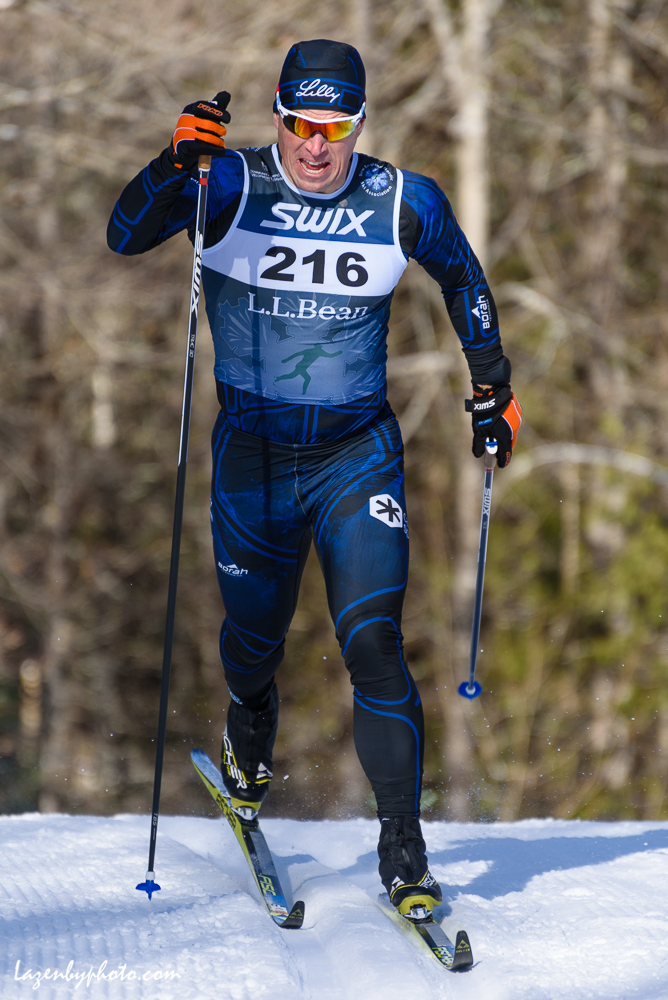
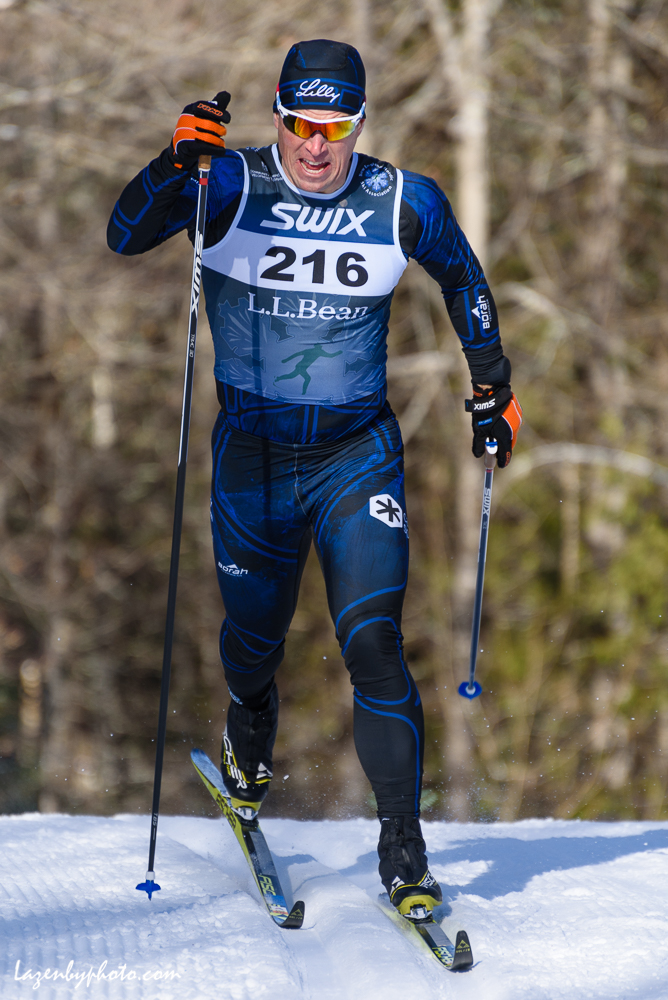
Kris Freeman (Caldwell Sport) racing to 11th in the SuperTour classic sprint qualifier on Feb. 26, 2018 in Craftsbury, Vermont. He went on to place fourth in the final, and two days later, he placed fourth in the 10 k freestyle in Craftsbury. (Photo: John Lazenby/Lazenbyphoto.com)
A quick addition from Freeman on the difference between his own glucose monitoring system, the Dexcom G6, and the Abbot Libre Sense Glucose Sport Biosensor, which he also discusses in the podcast:
“I want to add an important distinction between the Libre and Dexcom products. When CGM products were first hitting the market, many endocrinologist doctors were concerned that their patients would have so much glucose information that they would be overwhelmed. In particular they were worried that diabetes patients would see how often their blood sugars were out of a healthy range and become discouraged with their treatment and less compliant with what their doctors prescribed.
“In response to this, Libre created a system that only stored glucose data and did not provide a way to see glucose numbers in real time. This was done so that doctors and patients would go over weeks worth of data at one time together. Dexcom decided that diabetes patients should know what their real time glucose numbers were and included a receiver in their packaging that showed a real time graph of a patient’s glucose numbers. The graphs could be viewed in 24, 12, 6, 3, and 1 hours increments.
“As phone technology improved the receiver became moot and was replaced by an app on cell phones with the same functions. This app can also be viewed on watches that are linked to the phones. This is what I use to monitor during triathlons. Every five minutes a dot is added to the graph with an arrow accompanying it. A straight across arrow indicates sugars staying constant. A diagonal arrow means slight drop or rise, a vertical arrow a fast drop or rise, and two vertical arrows means drastic changes in glucose.”
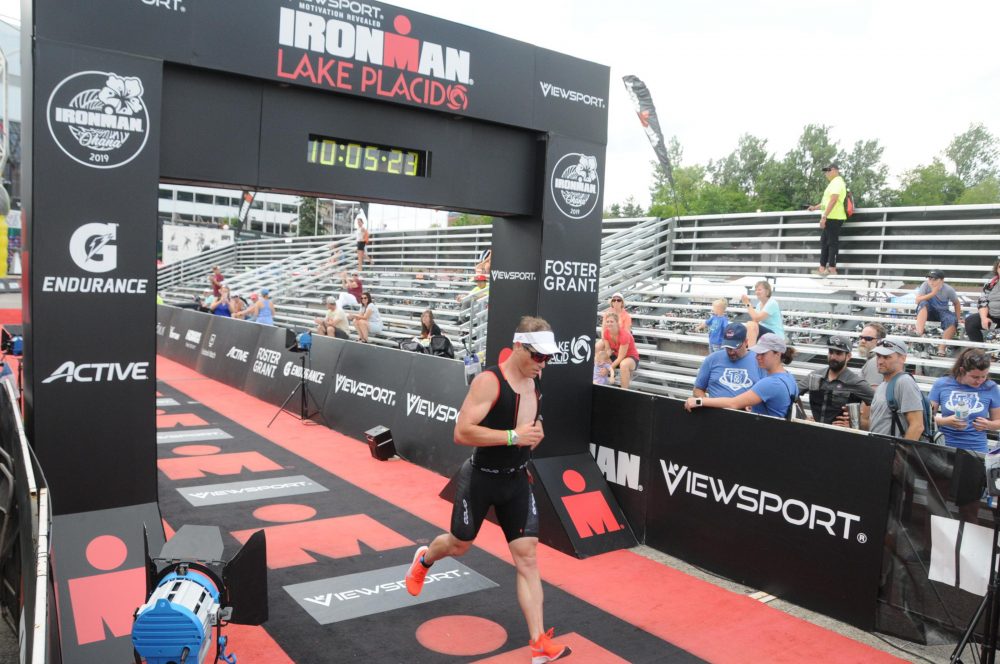
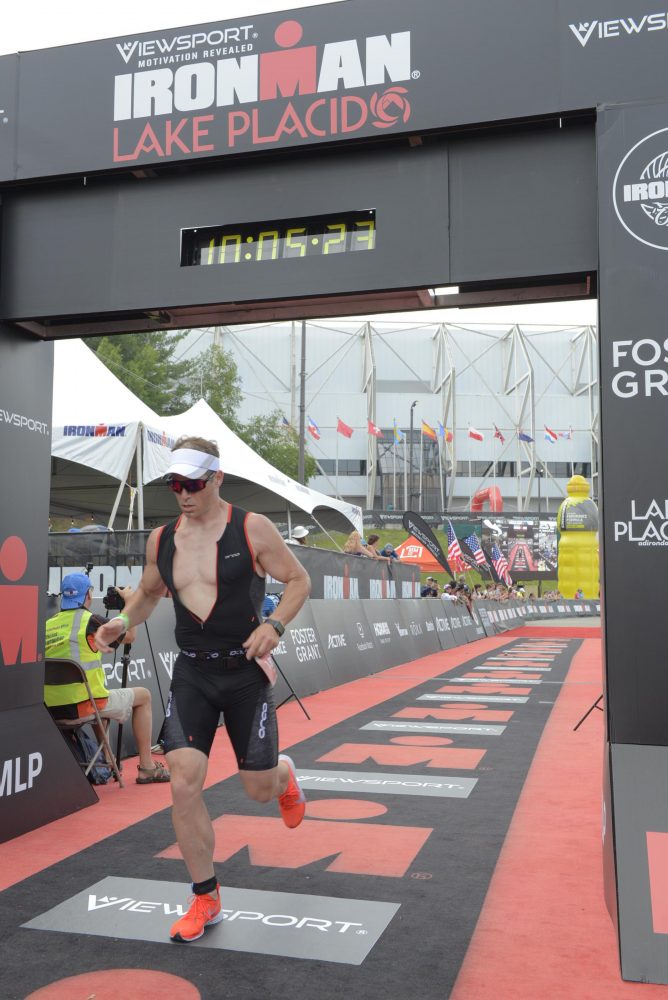
Kris Freeman finishing the 2019 Lake Placid Ironman. (Photo: Courtesy Kris Freeman)
The half is now full. In an often over-corporatized scene blazed with the Ironman logo, thirty-eight-year-old Kris Freeman added a deeply human element as a finisher in the 2019 Lake Placid Ironman. Among the 2042 finishers of the July 28 Lake Placid event, there are 2042 unique stories. The final person across the line was 35 seconds inside 17 hours. The overall winner notched 8:27:57 hours. On each end of the spectrum and in-between, a chasm of suffer-time.
Freeman was 23rd overall, and fourth in his age group with a time of 9:50:12. This was his first full length Ironman which features a 2.4 mile swim, 112 mile bike ride, all capped with a 26.2 mile run.
We’ve followed Freeman on his training and race journey this summer not to determine his finish rank, but for the simple reason that as a type 1 Diabetic he remains an endurance athlete lab specimen. He’s constantly testing and refining insulin dosing and feeding strategies for the single purpose of killing it on course. If you know Freeman you know this: he is exacting and buries himself in effort.
“I took a recovery week after the race and then I trained two very large volume weeks following that and then I took an incredible easy week followed by a medium volume leading into the race,” said Freeman. “And I did in that order because I wanted to come into the race with a predictable glucose response. Had I just rested coming in, it gets harder to guess where my blood sugar is going to be.”
As an active type 1 diabetic, Freeman explained that when he is in a fully rested state balancing his insulin and glucose becomes tricky. When he’s more active and “trained”, his body becomes more receptive to both insulin and glucose making it easier for him to determine a detailed dosing strategy. For this reason, Freeman kept up his training volume more than some as he approached the Lake Placid event.
Before we progress, here’s the basic insulin-glucose primer. During exercise, the body needs glucose for energy. Freemen can consume sports drinks and solid food to maintain his blood sugar levels once his stores are depleted. Insulin drives the glucose back into the muscles, decreasing blood sugar values. Freeman uses synthetic insulin as his body no longer produces insulin. He wears a pump to infuse insulin at a predetermined rate and a continuous blood glucose monitor to assess his blood sugar levels.
Freeman has experimented with his insulin dosing in training and racing. During the half-Ironman in June, he programmed his pump for a rate of 1.0 units per hour for the first hour of racing. He then suspended the insulin for much of the bike portion. It reactivated at the start of the run. Although Freeman won the race, he wasn’t satisfied with the dosing strategy.
“I continued to test that idea of suspending the insulin in some long workouts in those two big volumes weeks before Lake Placid,” explained Freeman. “What I was finding was that it was becoming too unpredictable when I turned the insulin pump off and on. I abandoned that theory.”
He opted for an approach that steadily infused insulin for the entire duration of the Ironman, although at a lower rate.
On his personal blog, Freeman has referred to himself as a cyborg. In the Adirondacks on July 28 Freeman admittedly looked the part. He referred to himself as the “double cyborg”. He wore two insulin pumps, one on each pec, and an insulin monitor planted on each oblique.
He doubled up on his medical hardware as a backup. Insulin pumps and glucose monitors do fail. The double-up strategy provided an element of safety in the event of mechanical failure. Another added benefit of the double-up, if the insulin dosing was off and he needed to reduce the amount of insulin in his system, “I could always just tear one off and instantly half the insulin dose I was getting without having to use a handheld computer and reprogram a pump.”
Time
Insulin Pump 1
Insulin Pump 2
Hours 0 – 2
0.3 units/hour
0.3 units/hour
Hours 2 – end of race at 9:50 hours
0.2 units/hour
0.2 units/hour
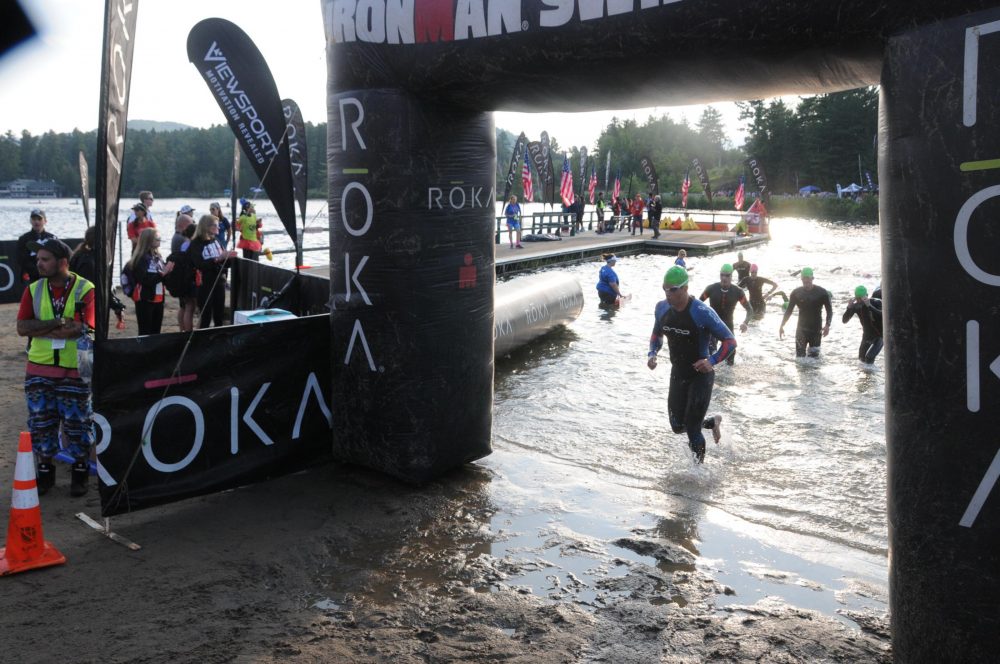
What’s outlined above was Freeman’s dosing plan for the full Ironman. 0.6 units/hour for two hours — then a reduction to 0.4 units/hour for the remainder of the race. We’ll learn in a bit how he modified it on the fly, but despite what he claimed was a stressful pre-race routine learning the ins and outs of gear and feed bag placements, Freeman met his first race day objective. He made the goal of a sub-hour swim. The swim took 59:45 minutes.
Freeman out of the swim in under an hour during the 2019 Lake Placid Triathlon. (Photo: Courtesy Kris Freeman)
The swim-bike transition, according to Freeman, wasn’t clean. He did swig a planned 16 ounces of sports drink to bolster his blood sugar. But for twenty seconds or so he couldn’t locate his bike. As one of the top athletes out of the water (he was 73rd overall), a volunteer had moved his bike to a position for easier retrieval. That was news for Freeman.
Five minutes and twenty seconds later, the transition over, Freeman was set in his aero bars as he rolled out. Once on the bike, Freeman’s watch and phone connected via Bluetooth for his first blood sugar reading: 137 mg/dl. Pretty much dialed — in the sweet spot of the 100 mg/dl -180 mg/dl range.
Freeman’s monitor also provides an indication of blood sugar trend. One downward arrow displayed indicates declining levels. Two arrows down indicate a more precipitous rate of decline. Freeman noted two downward arrows.
“At that point, I emptied another 20 ounces of Gatorade right off the bat which swung the blood sugar so I started climbing into the high 200s for about the next 40 minutes,” said Freeman. “That wasn’t ideal and it also put me in a position where for 40 minutes I wasn’t feeding as I was waiting for my insulin to catch up with the glucose that I gave myself.”
Freeman spent nearly five hours and twelve minutes on the bike. He continued eating solid food when he could and also replenished sugar with fluids. 6:16:52 hours into the race Freeman transitioned to the run. Again, Freeman’s said he bobbled the transition. “Part of it was inexperience and part of it was underestimating the importance of that transition,” he said.
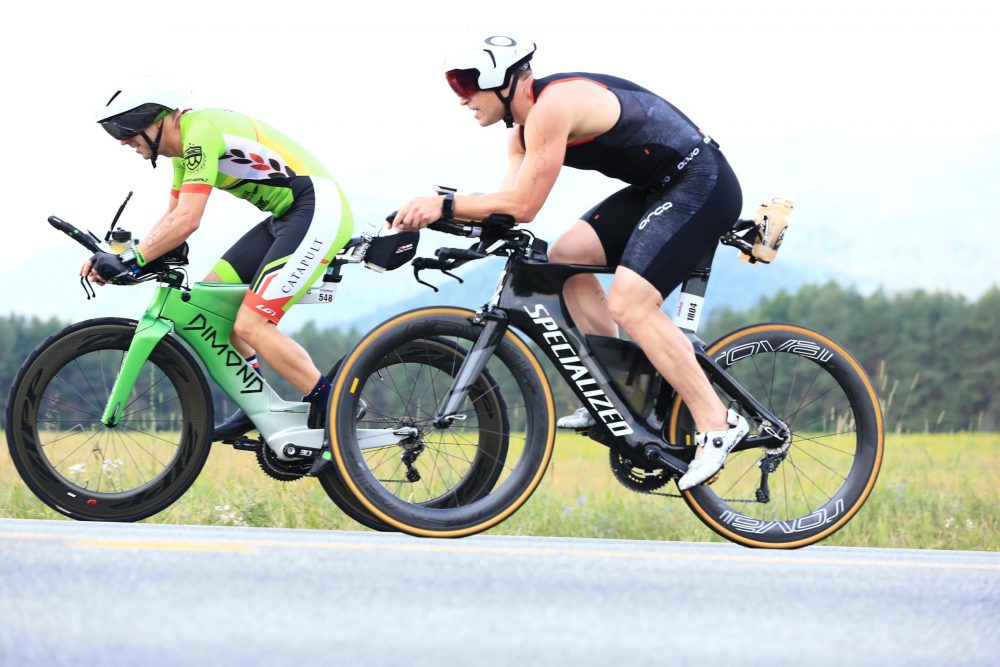
Kris Freeman (right) out on the bike course during the 2019 Lake Placid Ironman. (Photo: Courtesy Kris Freeman)
Among other minor time sinks, Freeman chose not to use a bungee-like quick-lace system on his running shoes. With stiff fingers after the bike ride, simply tying his shoes became a struggle.
The first half of the run, to 13 miles, was as expected. He was on pace for a near 3:15 hour marathon. He followed the usual pattern: he noticed his blood sugar begin to fall, he ingested some form of sugar. The blood sugar levels rise then eventually fall again as his motor burns the fuel and the insulin does its removal work.
“In the run, there were feed zones every mile and a half,” said Freeman. “It was very easy to fuel. They had water, Gatorade, RedBull and cola at every single feed zone. I could get whatever I wanted. And I was doing this for the first half of the race but then I noticed at about 13 miles that I had just fed and my blood sugar was not climbing.”
Back to the dosing strategy and the double-up on medical devices. Freemen knew from experience that his insulin levels were too high. Removing one pump would halve his insulin dosage immediately.
“I tore one pod off at this point,” he said. “Then I noticed that my blood sugar was continuing to drop. Two miles later I tore the other pod off. I made the decision: I have about an hour and a half left in the race and I am not going to get any more insulin.”
The synthetic insulin Freeman employs has a tail of effectiveness. In other words, synthetic insulin’s potency gradually wanes over time.
“The insulin that was already in my body was enough that it kept driving me low,” said Freeman. “And at this point, I started drinking Gatorade and or RedBull or gels not because I felt like I needed the energy but because I was trying to keep up with what insulin I already dosed myself with. Even though I had torn the pods off I still had the residual tail. I was basically feeding that tail to get to the finish.”
That meant drinking and eating during those last 13 miles when it became a struggle to keep food down. Freeman ran a 3:28:24 marathon for his 9:50:12 finishing time. The top-three in each age group earn an auto-invite to Kona’s Ironman World Champs. He was fourth by 40 seconds. Even with a Kona berth, Freeman did not intend to race in Hawaii this year. This season was about making mistakes and learning to refine his approach in the future.
Analyzing the time losses here and there, Freeman mentioned his haphazard transitions as potential areas to build efficiencies. Then he zeroed in on the potential mistakes with his insulin dosing. It’s worth mentioning again, this was the longest sustained race effort of Freeman’s endurance career. What he came in knowing was that the dosing-feeding quandary for his near ten hour effort remained a moving target.
Although spending the post-race week resting and engaging in some easy active recovery, Freeman was clear he’s gearing up for next year and a shot at Kona. That means positing how he’ll modify his insulin dosing for the next Ironman. Freemen said he needed to remove his insulin pump pods for the following reasons: “Overall glycogen depletion and increased muscular receptiveness to insulin contributed to the downward pressure. I should have deactivated the pumps at the start of the run but hindsight is 20/20.”
Freeman crosses the line during the 2019 Lake Placid Ironman. He’s already looking for efficiency for his next go around. ((Photo: Courtesy Kris Freeman)
Beyond shutting down his pumps earlier, the redo would involve front-loading his insulin to receive a higher dose earlier in the race.
“I would have the insulin ramp up more for the start of the ride,”said Freeman. “Early in the race is a better time to have to overfeed than later in the race. You are fresher. Your stomach is better. Food is still appetizing. When you get eight or nine hours into the race, you don’t need the energy but you need to keep your blood sugar up because you have that synthetic insulin in your body.”
Freeman was the 10th overall amateur on his maiden Ironman voyage.
“Given everything I learned, I think I said in our last interview that I would be happy with 9:30. Given the difficulty of the transitions and what I learned — 9:50, I will take it.”
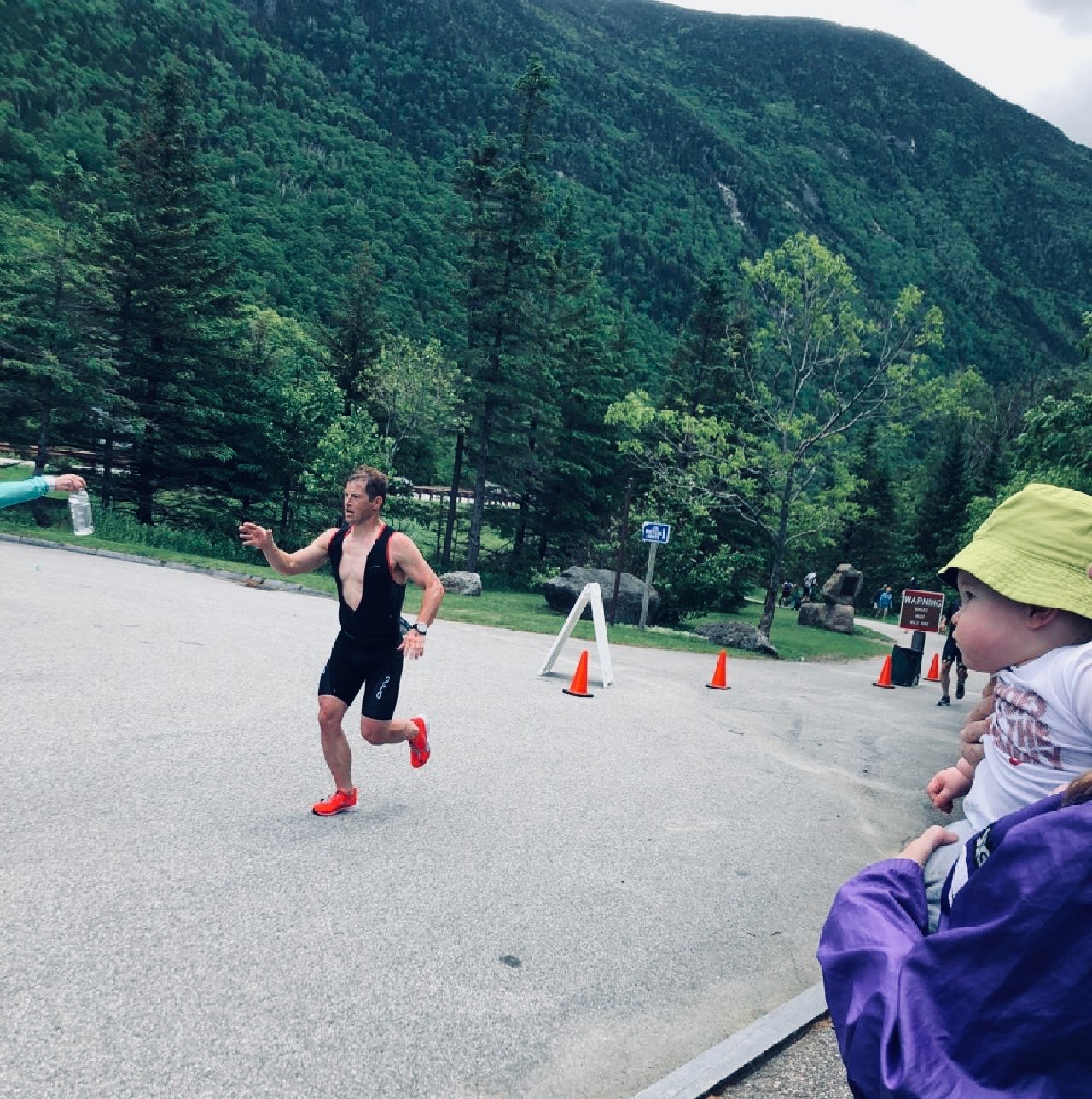
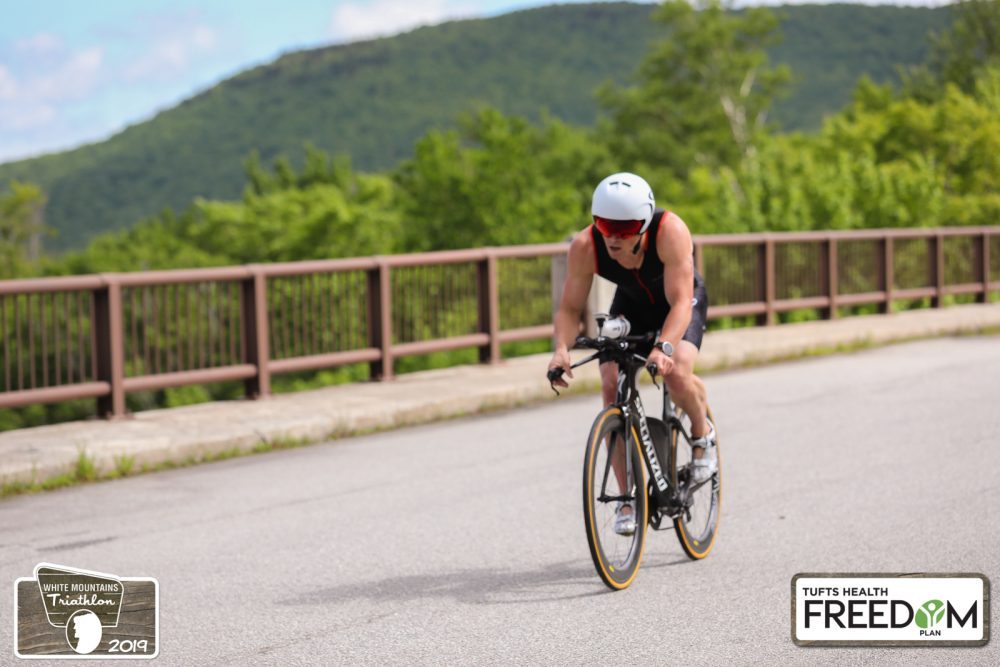
Kris Freeman during the 2019 White Mtn Tri. while his son Axl looks on. (Photo: courtesy Kris Freeman)
This is the second story following Kris Freeman as he builds towards his first Ironman triathlon in late July. You can read part 1 here.
***
They are not baby steps, but they are incremental steps. Retired elite cross-country skier Kris Freeman has been eyeing the Lake Placid Ironman triathlon on July 28. As part of his step by step race and training plan for the full Ironman, Freeman contested an Olympic distance tri on June 1, and a Half Ironman on June 22.
Freeman’s continues to push the boundaries of diabetes management in his post-ski career as well as his performance standards. Freeman placed second in the Olympic distance tri and according to the New Hampshire based athlete, he nailed his blood sugar management.
“It was actually about a perfect blood sugar profile as I could hope to have for a race,” said Freeman.
The Olympic distance race took Freeman 2:24.27 hours to complete. The Half Ironman, with roughly double the distance, would be a different blood sugar challenge.
“Because this race was going to be more or less twice as long as the last race, I decided I was going on a much reduced insulin level,” said Freeman.
Freeman’s experience with dialing in his insulin (which removes glucose from the bloodstream and returns it to the muscles) has taught him that as he goes into an anaerobic state and lactate builds, his blood sugar levels also rise. During longer race efforts, however, Freeman remains mostly aerobic. His insulin dosing strategy takes this into account. He does not want too much sugar removed since his lactate remains lower and his body releases less glucose as a response. During a four hour plus Half Ironman effort, Freeman also has the ability to augment his blood sugar levels by bringing more on board quickly with a sports drink.
In the Olympic distance tri, Freeman programmed his insulin pump for a small dose of insulin every five minutes. With the longer duration Half Ironman, Freeman strategized and chose to dial back his insulin dosage.
“I had been playing with the suspension and the reactivating of insulin in my longer workouts,” Freeman said. “And I have found that when I run just a constant low basal that it sometimes compounds on itself and I get an unwanted unexpected [blood sugar] low.”
A non-diabetic’s response during aerobic exercise is to initiate a physiological cascade releasing glucose to the system while suspending the release of insulin. When blood sugar levels rise, the body releases a dash of insulin as needed to stabilize blood sugar levels.
“I am just trying to replicate as best that I can,” said Freeman of his Half Ironman insulin dosing.
During Freeman’s June 22, Half Ironman, he used the same basal level of insulin as his Olympic tri for the first hour. He then suspended insulin delivery for the next two hours.
The swim took Freeman 32:42 minutes. The 56-mile bike, 2:30.37 hours. His insulin pump remained activated from the start through the first 30 minutes of his bike segment. For the remainder of the bike, he received no additional insulin until his pump reactivated as he began the 13.1 mile run.
“It then came back on for half an hour at the 1.0 rate, so I got a half unit over the course of a half-an-hour,” explained Freeman. “And then I turned it back off again. I figured it being at about three hours into the race when I would transition to running and I would have access to a lot of feeding again because the course loops back on itself through the feeding zones. I could get as much as I wanted at that point.”
How did it all work out?
Swimming is not Freeman’s strong suit. He thrives during the bike and run. He transitioned to the bike with several athletes to catch. Two strong swimmers had a six and four minute lead respectively as they began the bike.
During all this, Freeman monitors his blood sugar. He wants his blood sugar levels between 100 mg/dl and 180 mg/dl. He hears a specific audible alarm if he falls below or rises above those marks.
Kris Freeman during the 2019 White Mtn Tri. (Photo: Sarah Sheldon)
Throughout the swim and bike, Freeman heard the alarm indicating his blood sugar was slightly high: in the 200 mg/dl range. He wanted to be lower.
“I think the main thing that played into that, it is funny, I know what the race is, it is a regional level triathlon,” said Freeman. “This isn’t the end of the world or anything. But before the race, I am scrambling around. I am going to the transition zone, setting everything up, wondering how much time I have to put my wetsuit on. Things I am not used to doing and all of a sudden I am getting nerved up and my high glucose alarm goes off because that is an effect of being nervous.”
Freeman believes that with the added nerves and the subsequent release of adrenaline, his blood sugar levels at the start were most likely elevated. But taking a larger dose of insulin at the outset to control for those nerves may not be the best long term strategy for Freeman.
The synthetic insulin Freeman used has a diminishing tail of effectiveness. The insulin dosage pulls the most glucose out of the blood and into the muscles 30 minutes post-injection.
“Then it has a 2.5 hour tail until it is gone — it is like an ever reducing amount of effectiveness until it is played out,” Freeman explained. “When I am giving myself a dose before the race I need to take into account that this tail stretches into my race. Which is why I don’t take a ton of insulin before my race to control my nerves.”
So despite hearing the alarm, Freeman stuck to his initial feeding plan: Three 20 Oz. bottles of untapped sports drink on the bike.
“Even though my blood sugar was high, I continued to feed and it never went over 220,” said Freeman. “When I came into the bike-run transition I was down to 180, which is about where I wanted to be.”
His aerobic effort had burned through enough glucose to bring his levels down into the desired range as he moved towards the front. Freeman reeled in the eventual third-place finisher around mile 40 on the bike and the second place finisher during the run. He won in a time of 4:33.08 hours.
At the end of the month, his first Ironman distance tri awaits. With it, a new set of data will be filed into Freeman’s catalog of insulin dosing and feeding strategies while racing. He estimates his time racing will at least double for the full Ironman.
“I am not expecting to break nine hours in Lake Placid,” said Freeman. “If I can break 9:15 I would be really happy. If I can break 9:30, I would still be happy. If I break 10, I would be like ‘that was alright.’ ”
Freeman plans to use the fluctuating insulin plan in Lake Placid — he’ll be turning it off and on intermittently throughout his race.
“Running a low level of compounding insulin eventually catches up with me is what I have found,” said Freeman. “I like turning it on and off — even when I turn it off, I still have the tail from the last dose in there. So as long as I don’t turn it off for three hours I will always have insulin in my blood. That way I can time things a little bit for when I feed. And also the Ironman, it is a slower pace, it is a longer race. I may actually take out my pump controller at some point and give myself an additional amount of insulin if I need to. I can keep that controller in my transition zone and if I finish the ride, for example, and I have been running high all day and I really need some insulin, I can give myself that in the transition and it would cost me maybe 30 seconds to do so over a 9 or 9.5 hour race. Thirty seconds, you know, isn’t the same as would be in a two or four hour race.”
For much of his career, Freeman has been a human test lab for choreographing the insulin-glucose duet. The progression from Olympic to Half to full Ironman offers another spelunk into his personal pain cave and data collection.
He’s got a 2.4 mile open water swim, 112 mile bike, capped with a 26.2 mile run to go on July 28.
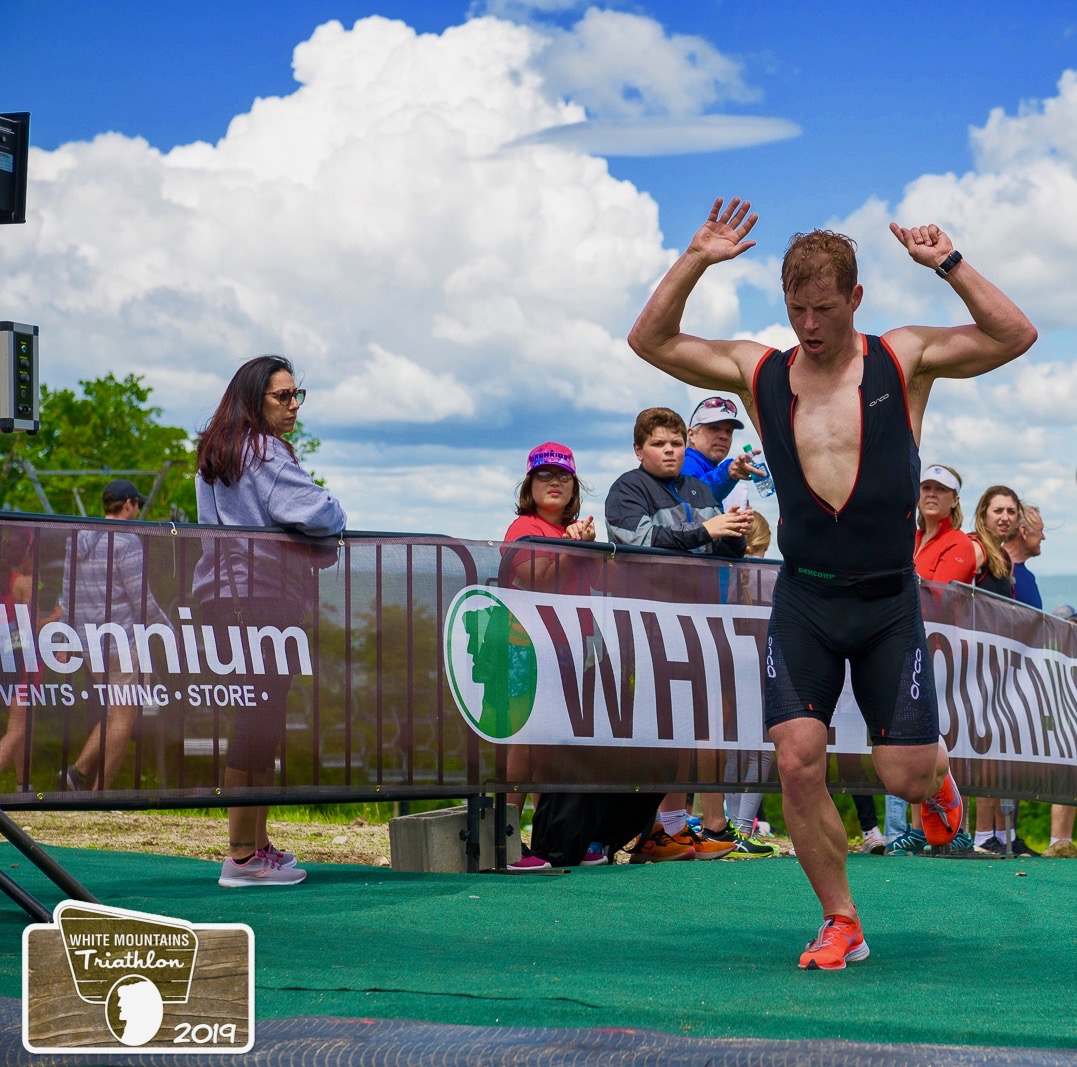
Kris Freeman crossing the line in first place during the 2019 White Mtn Tri. (Photo: Sarah Sheldon)
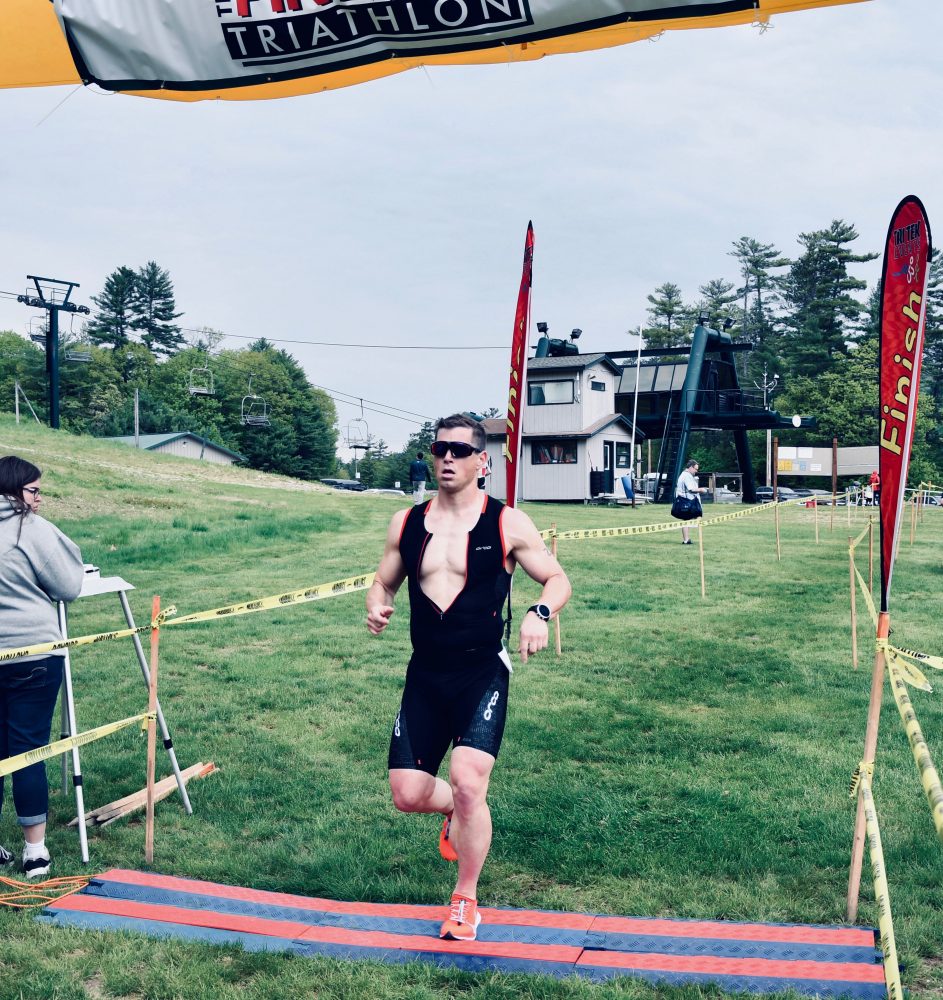
Kris Freeman crossing the line in second overall during the 2019 King Pine triathlon in New Hampshire. (Photo: courtesy of Kris Freeman)
Kris Freeman manages Diabetes. He did this on the World Cup for years and at four Olympics. He remains a competitor and continues to test himself since retiring from elite level skiing in 2018.
Freeman has turned his attention and his considerable capacities to triathlons.
We were interested to know how Freeman had been approaching the sport and managing his Type 1 Diabetes in route to his first Ironman distance triathlon in Lake Placid, N.Y. on July 28. That effort will entail a 2.4 mile open water swim, a 112 mile bike, capped with a 26.2 mile run.
The Lake Placid Ironman is Freeman’s primary goal for the season. To prime for that event, Freeman raced an Olympic distance tri on June 1, and has registered for a half Ironman on June 22.
“I can take a lot of what I learned skiing and apply it to other sports,” said Freeman in a call in late May. “The issue with triathlon though are the shortest events I do are the longest events that I did in skiing.”
The king race on the men’s World Cup is the 50k. A roughly two-hour race pushing the limits of an athlete’s aerobic capacity. An Olympic tri for Freeman clocks near 2:15 hours, the half-Ironman between 4 and 4.5 hours and the full in Lake Placid could go a bit over 9 hours. Freeman has used a Dexcom continuous glucose monitoring system in conjunction with an insulin pump since 2010. The pump injects Freeman with a small dose of insulin every five minutes 24-7. For racing, he pre-programs his doses depending on how high or low he expects his blood sugar levels to be at certain points during the race.
He brings sugar, or glucose, into his system by feeding. The insulin, coming from his pump, draws the glucose out of the blood and into the muscles.
On the World Cup, a few variables kept Freeman from consistently nailing down the moving target of insulin dosing and how to pre-program his pump for a particular race.
“Feeding was always stressful for me on the World Cup,” recalled Freeman. “We had limited staff a lot of the time. So we wouldn’t necessarily have an experienced feeder out there. The guys did the best they could, and a lot of the times we would, but sometimes, we have a volunteer doctor out there who had never fed before in a feed zone and I’m not finishing the race unless I get that bottle. And you come through in a pack of 30 or 40 guys and it is pretty crazy. I definitely had some stress a lot of stress about feeding on the World Cup.”
Distance events were Freeman’s specialty. But the insulin dosage for a 15 k and a 30 k would differ drastically.
“In a 15 k race, I am pretty much all out the whole way,” said Freeman. “I am anaerobic with lactates over 10mm/mol on every uphill and just gasping for air on the backside. Whereas on the 30 k you just cannot sustain that type of output for that long.”
The anaerobic work during harder efforts, Freeman explained, pushes his blood sugar levels up — glucose is a byproduct of lactate.
When programming insulin dosing for shorter races, like a 15 k, Freeman would have to factor in his expected increased lactate load.
“In the shorter races it was always more difficult to find that happy medium of how much insulin to take to cover my anaerobic workload without taking too much and crashing through the floor and going low in a race,” he said.
Freeman explained that in the 30 k and 50 k races his lactate levels were moderated and he would burn primarily glucose for fuel which he could replenish with a timely feed. And his lower levels of lactate would not drive up his blood sugar levels.
In the half and full Ironman distances, Freeman said he expects to be in an anaerobic state for a short period of time. The insulin dosing, he thinks, should be easier to determine. And the feeds in triathlon are simpler than in cross-country skiing. He can consume sugar in the form a sports drink during the swim-bike transition, and take continuous sips while on the bike, and as needed during the run.
According to Freeman, the longer the triathlon event, the lower his insulin dosage.
Freeman’s glucose monitor provides important audible feedback if his blood sugar trends in a too high or too low direction. A certain alarm chimes at the low or 100 mg/dl mark, and another at the 180 mg/dl mark.
“Those are my chosen levels, because if I am below 100 I am not that far from an area, below 70 is going to negatively impact my performance from a low standpoint,” said Freeman. “Below 70 for a non-diabetic, you are bonking. And you are headed to a bad place. So that is just a warning like ‘ok I am below 100 I need to get some glucose on here so I do not go any lower. On the 180 side, if the chime went off, it is programmed to continue to chime every five minutes until it is no longer about 180. So I would listen for 15 minutes, ‘did I hear the chime again?’ Ok I did, I am going to hold off feeding. And if I really got concerned about my level, I could take the device out and look at it, because I am going to be on that bike for five hours so I could take a look if I needed to.”
On the bike, for example, if Freeman hears the 180 level chime, he can cease taking on glucose until his workload “burned enough glucose and made me insulin sensitive enough that my levels just came down,” he said.
Prior to his Olympic distance tri on June 1, Freeman’s only other recent triathlon experience was last year’s Sea to Summit race that finishes atop New Hampshire’s Mount Washington. Freeman won that event in 5:41:37 hours despite what he said was some flawed insulin dosing.
“I learned a lot because I had never done a race longer than a 50 k up until that point,” Freeman said. “And so then I am racing six hours and I actually took too much insulin. I took less insulin than I had ever taken in a 50 k and it was still too much.”
Remember, the insulin pulls glucose from his system. During the Sea to Summit, his insulin levels removed too much glucose out of his blood despite what he believed to be a steady intake of sugar. (And he wasn’t producing lactate that would be converted into glucose.)
In that race, he refueled on the bike, and then made an unplanned stop a half mile from the summit finish to consume what he called an “emergency flask” of UnTapped maple syrup.
“I just drained like five ounces because I was dropping really quickly, and that got me to the top,” he said. “It was a good day. But definitely learned some lessons about how little insulin you need when you are at that aerobic glycogen burning state.”
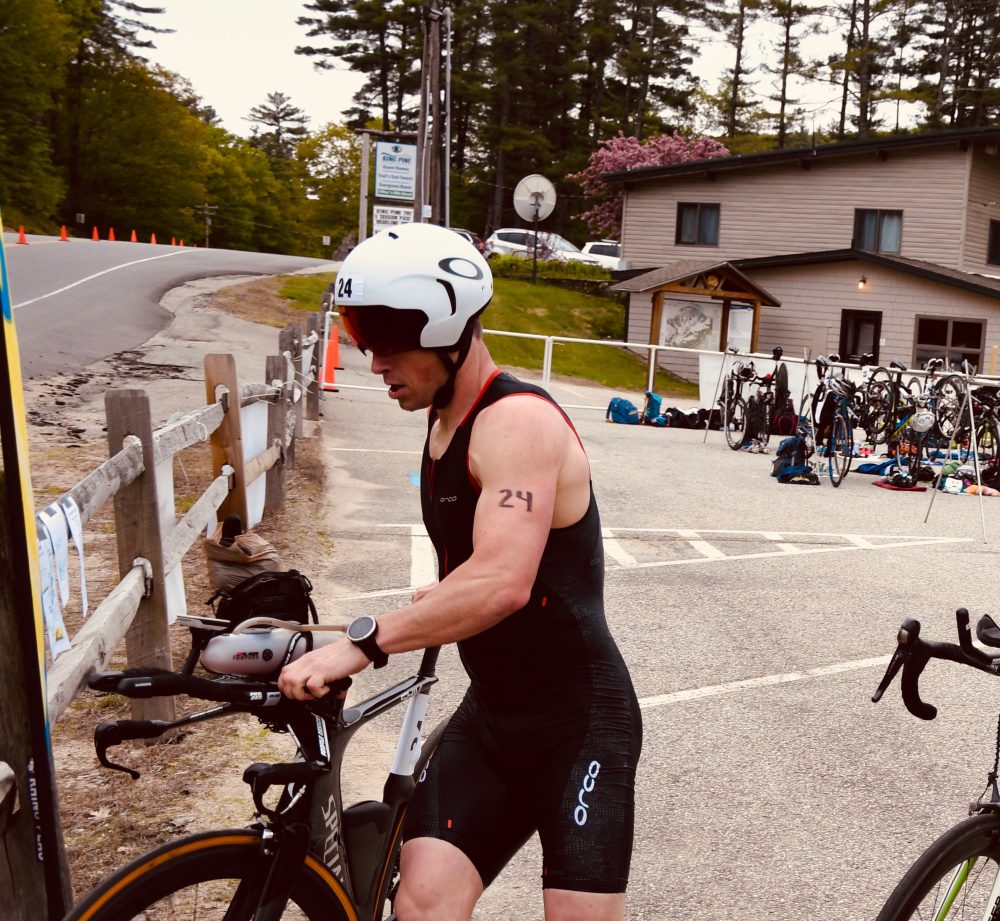
Kris Freeman during the 2019 King Pine triathlon. (Photo: courtesy of Kris Freeman)
Adding to the physiological puzzle, Freeman said riding the bike is lactate intensive. Again, that has the effect of driving up his blood sugar levels, so he might need to refuel on the bike less than he originally thought.
So how did the June 1, race go?
Freeman began the race with a glucose reading of just over 180 mg/dl. He finished around the 150-160 range.
“It was actually about a perfect blood sugar profile as I could hope to have for a race,” Freeman said in a post-race call. “And it is interesting because it was a two hour and 24 minute race which would be kind of like a 50 k ski race. And I used a more aggressive dose in the triathlon than I would have in a ski race. I fed about half what I would have in a 50k. And I think that the reason for that is that I am pushing such a high lactate when I am riding my bike, the lactate drives the sugar upwards. Also, when I am ski racing too, the downhills you truly do nothing when you are in a race. Which allows your body to catch up. In a relatively flat bike race, I am pedaling 99.8 percent of the time.”
With a 33 mile bike portion on June 1, and a 56 mile bike for the half marathon, Freemen suspects he’ll not be pushing into the anaerobic zone as much in the later race. For now, his plan is to run half the dose of insulin for the half-marathon distance. A race approximately twice as long in total elapsed time than his recent Olympic distance performance.
Kris Freeman’s blood glucose levels for the duration of his King Pine triathlon. The race began at approximately 8:15A and lasted 2:24:27 hours. (Photo: courtesy of Kris Freeman)
Freeman’s strategy on June 1, of drinking half-strength sports drink throughout the bike leg and then small quantities of full-strength sports drink at the start of the run, helped keep his blood glucose within the 100-180 mg/dl sweet spot.
Lessons learned and applied. Freeman stated he needs to dial in his swimming (admittedly it is his least strong leg) and his swim to bike transition. Yet, his insulin dosing and feeding strategies passed the first triathlon racing test of the season. He placed second overall in the King Pine Olympic distance tri.
We’ll be following Freeman this summer to hear more about his build-up to his first Ironman in late July and learn more about what he learns when it comes to diabetes management and his high standard of performance.
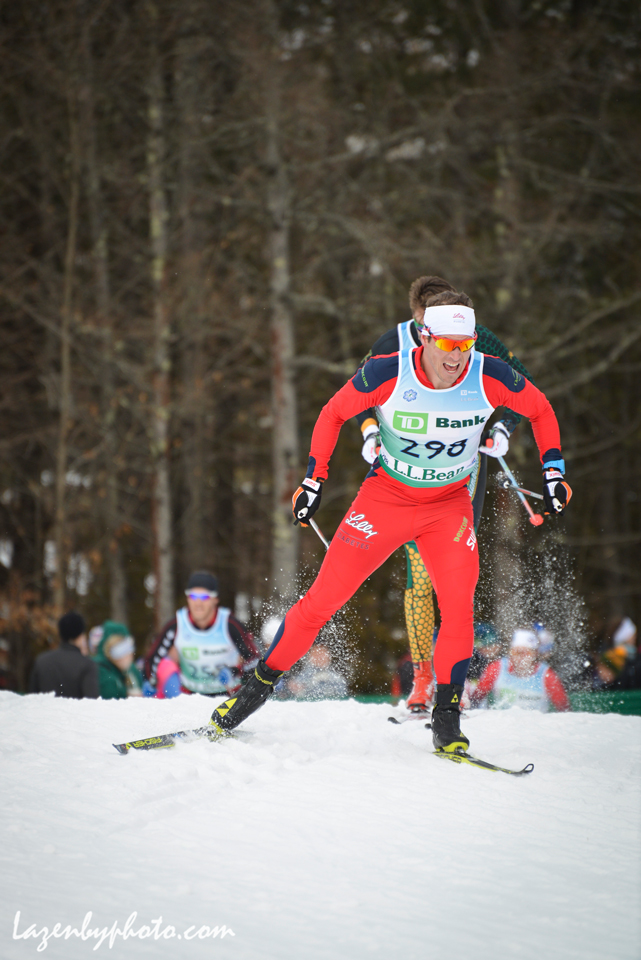
Kris Freeman (Caldwell Sport) racing to 11th in the SuperTour classic sprint qualifier on Feb. 26 in Craftsbury, Vermont. He went on to place fourth in the final, and two days later, he was fourth in the 10 k freestyle there. (Photo: John Lazenby/Lazenbyphoto.com)
Chew on this for a minute: who stands as the greatest male U.S. distance skier in the “modern” era (defined by post-Bill Koch) of World Cup skiing?
Most likely at the top of that list would be 37-year-old Kris Freeman.
The New Hampshire native and longtime Granite State resident retired as a professional cross-country skier after this year’s U.S. Distance Nationals 50-kilometer classic race in late March in Craftsbury, Vermont. Freeman finished seventh in that race. A few days earlier, he placed fourth in the 1.3 k classic sprint, which was part of SuperTour Finals, also in Craftsbury.
“It was a very weird feeling to finish the 50 k in Craftsbury and pack up my skis and be like I am not going to race next year,” Freeman said during a phone call on April 3. “I got home and I have a three-bedroom home. One of the bedrooms is entirely dedicated to my ski stuff, and I am like, I should probably do something else with this room right now. It was a strange feeling.”
(Freeman and his wife, Amber, have about four months to re-purpose the ski gear room for a nursery. The couple is expecting their first baby in September.)
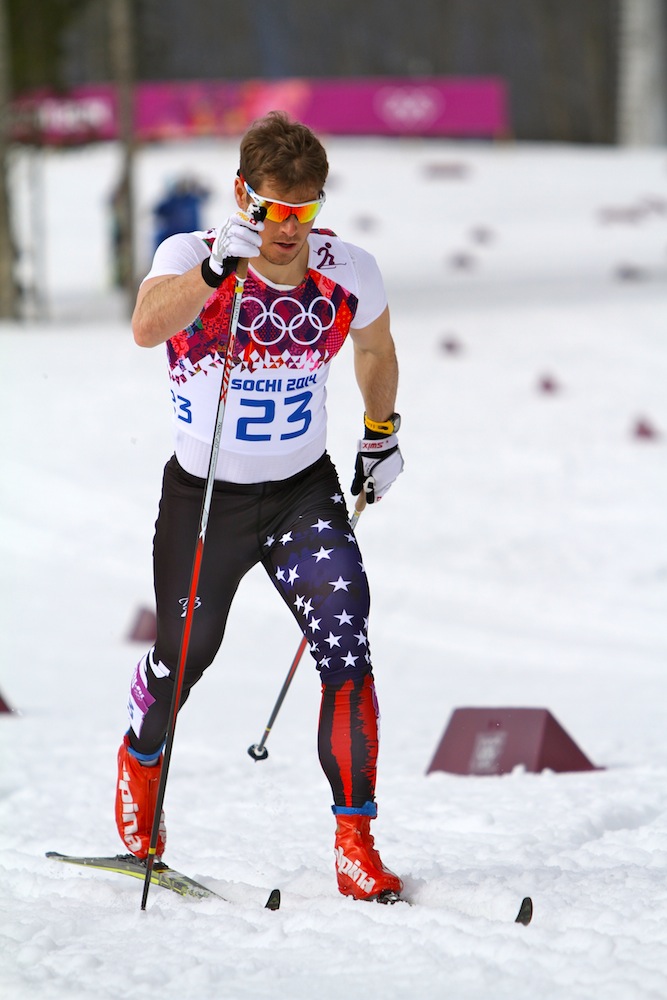
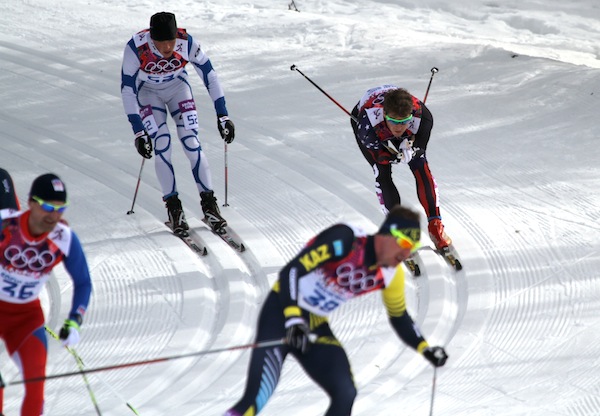
Kris Freeman skiing in the Sochi Olympics 15 k classic.
1980. That’s Freeman’s birth year. His nearly 40 trips around the sun don’t make him ancient in terms of athletic relevance on the national stage. It makes him a reminder of one athlete’s incredible longevity and focus. Freeman has never been in it to just finish.
He raced to win. That maxim held going into his final pro race, not as a sentimental notion, but as podium potential fact. No sane skier lining up with up Freeman could discount the force with “Team Freebird” sublimated on his lycrad backside.
First, the disappointment. Freeman did not qualify for his fifth Olympic team this year.
“I knew going in, two years ago or three years ago, that I was past the peak of my performance,” Freeman said. “I knew that I was losing a little bit each year. 2011 was my best season. I believe I was 31 that year, and I held that fitness together for another year and a half, and it has been slowly losing a little bit each year. After Sochi, I said I am going to take it a year at a time. What happened was I was enjoying what I was doing. I love ski racing.”
That year-by-year plan took Freeman to the cusp of qualifying for PyeongChang this past January. By his own estimation, had he skied 0.8 seconds faster in the U.S. nationals 30 k classic in Anchorage, Alaska, and edged out Eric Packer for second place, the 2018 Olympics would have been a possibility. Freeman was fourth overall and the third American in the 30 k. It is still conjecture, but second place in that race would have positioned Freeman for a potential fifth Olympic berth as a distance-skier selection*. (*For the logic behind that reasoning, see OWG section at end of this article.)
“I knew it wasn’t a guarantee that I would make the team, and I was damn close to making it,” Freeman reflected. “I was able to put together probably the best race of my year in Anchorage in that 30 k. I came up a half a second short. I don’t have any regrets extending my career another four years. I enjoyed it.”
Long before coming up a half-second short, Freeman’s quest for podiums and championship-team selection, more often than not, bore fruit. At U.S. nationals alone, he won 17 championship titles (see sidebar), placed second four times and third five times. Between 2006 and 2016, he won 15 SuperTour races and reached the podium eight other times in second or third place. That stat is more impressive considering Freeman didn’t race a single SuperTour between Jan. 4, 2007 and March 29, 2011.
Freeman’s National Titles:
1. Soldier Hollow 2000: 30 k classic
2-3. Rumford 2003: 15 k classic, 30 k classic
4-5 Soldier Hollow 2006: 15 k classic, 30 k skiathlon
6. Fort Kent 2006: 50 k classic*
7-8. Houghton 2007: 10 k skate, 15 k classic
9-10. Presque Isle 2007: 30 k skiathlon, 50 k skate*
11-12. Anchorage 2009: 10 k skate, classic sprint
13. Anchorage 2010: 15 k skate
14. Sun Valley 2011: 50 k classic*
15. Craftsbury 2012: 50 k skate*
16. Tahoe 2013: 50 k classic*
17. Houghton 2015: 30 k classic
* = Spring Series/U.S. Distance Nationals
His first national championship was in 2000 in the 30 k classic. (Freeman placed third overall but was the best placed American). At the 2001 national champs, Freeman proved he’d remain on the podium scene. He was third in a freestyle sprint. Two days later he was second in the 10 k classic. Freeman lost to first-place skier Justin Wadsworth. Otherwise, the 21-year-old Freeman defeated a legacy-rich field, which included his older brother, Justin Freeman. Ultimately, Freeman’s span of distance dominance lasted 16 years at the senior level.
Internationally, Freeman still sets the high-water mark standard for male distance skiers. He won the 30 k classic at the inaugural U23 World Championships in 2003. He raced at four consecutive Olympics stretching from Salt Lake City in 2002 to Sochi in 2014. His best results were a 22nd place in Salt Lake’s 15 k classic, and 14th in the 20 k skiathlon and 2oth in the 15 k classic, both at the 2006 Torino Games.
Freeman raced on the U.S. Ski Team (USST) from 2002 to 2013. On the World Cup, Freeman notched 10 individual top-10 results. His best finish was a fourth place in the 15 k classic in Kuusamo, Finland, in 2009.
He skied in eight consecutive World Championships. At 2003 World Championships in Val di Fiemme, Italy, he placed fourth in the 15 k classic, 10.6 seconds out of first and 2.1 seconds from bronze. It was a repeat at the 2009 World Championships in Liberec, Czech Republic, where Freeman also placed fourth in the 15 k classic, 17.7 seconds out of first and 1.3 seconds from bronze. Such was Freeman’s form that fifth-place skier Jaak Mae of Estonia was another 13 seconds behind Freeman in that 2009 race.
“Internationally, I think obviously winning Under-23 World Championships was just a great day,” Freeman said of his highlight international moment. “Listening to a scratchy national anthem was really cool. But at the same time, I think that the World Championships in Liberec, just the vibe that we had going on there. We had the nordic combiners sweep the wins that year, all three events. We had Lindsey Van win the ski jumping. Kikkan [Randall] was second. I was fourth. It just seemed we had a run to the podium ceremony every night. So I think Liberec was probably the highlight of my career. That place and that race.”
As far as the belief-in-medals movement is concerned, Freeman’s performances helped seed that optimism.
His Greatest Challenge
And his accomplishments are even more noteworthy considering he achieved them while managing Type 1 diabetes. During his four Olympics and tenure on the World Cup, Freeman’s diabetes was the news peg that exposed him to a broader audience. Since his diagnosis at age 20, he faced the challenges of regulating his blood sugar while competing amongst the world’s most fit athletes.
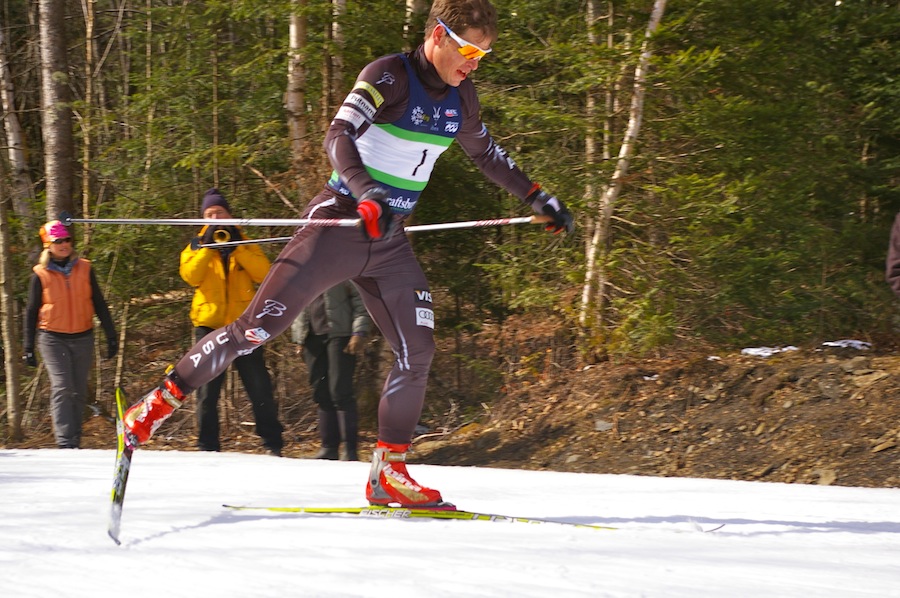
Kris Freeman on his way to claiming the 2012 US Distance Nationals 50 k freestyle title in Craftsbury, Vt.
“I had to be pretty resilient to disappointment because there are a lot of factors that go into ski racing,” Freeman explained about his race-day realities. “You’ve got to be fit. You’ve got to have good skis. You’ve got to get the wax right. And on top of that, I had blood-sugar management, and blood sugar is impacted by just about every hormone in your body, especially stress hormones. So when you are under stress they get even more complicated as you try to pinpoint how much insulin to give yourself.”
In the 30 k pursuit (now called the skiathlon) at the 2010 Olympics, Freeman miscalculated his blood-sugar requirements. The result was a literal hypoglycemic collapse that saw Freeman seeking a quick infusion of sugar before he continued racing. This stark anecdote reflects something that never makes the International Ski Federation’s (FIS) official results: the everyday emotional and physical stress diabetes had on Freeman. His result in that race, 45th place, tells the bare bones story: that 44 other skiers beat him. That would be judging a book by its cover.
In 2010, FasterSkier penned a comprehensive article on the lengths Freeman went to bring some normalcy to his training and racing. Zeroing in on the moving bullseye of his race-day blood sugar levels would have sunk most athletes and their support staff. As his primary coach for the bulk of his career, Zach Caldwell, who owns a business dedicated to ski flexes and wax combos, was also fixated on helping Freeman find the perfect recipe of low pre-race stress and dialed blood sugar.
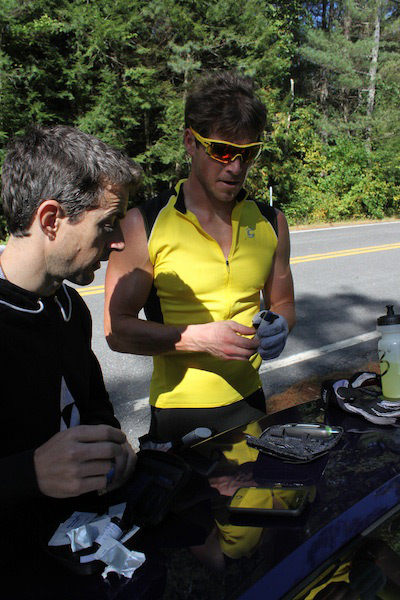
Zach Caldwell (l) with Kris Freeman getting blood to measure sugar and lactate levels.
With the benefit of Caldwell’s and Freeman’s fastidiousness, Freeman’s career will be a case study for other diabetic endurance athletes. The simple documentation of his attempts at athletic normalcy is a significant legacy for diabetics in any endurance sport’s pipeline.
Asked if he could have replicated his storied career without diabetes, Freeman was quick to state that would be a “wasteful exercise”.
“I have had diabetes for so long now I cannot separate what would I be without it,” Freeman said. “I honestly don’t know and it’s a question I don’t try to answer. Would it have been an easier road for me? Absolutely. Would I have stayed with skiing as long as I did? I don’t know. Over time, I became more comfortable talking about some of the real difficulty of it or how it really has impacted certain races or certain seasons or certain aspects of my life. I think for a long time I was just scared of having diabetes and doing what I was doing, and that can close you off.”
From the K-90 to the Olympics
Freeman can be terse in his comments. He’s also forthright in his racing style — he’s more inclined to do the intimidating than being intimidated.
“I am not going to blame all of my cocky behavior on having diabetes,” Freeman clarified. “But, for sure, being cocky is a defense mechanism. It can also be deliberate intimidation, which I am just as guilty of. But, I think, over time, having diabetes has just taught me that being open with people around you and honest with yourself is the key to success in anything.”
Success began early for Freeman. To his core, Freeman is a cross-country skier. He became aware of that at a young age in Andover, New Hampshire. There, Freeman participated in the nordic-skiing and nordic-combined programs Proctor Academy offered to its students and Andover residents like Freeman.
Kris Freeman (c), Jed Hinkley (left), and Carl Van Loan (right) in a 1999 photo from the FIS World Junior Championships in Austria. (Photo: courtesy Proctor Academy)
From the age of 5 or 6, Freeman was going head to head with future nordic combined Olympians Jed Hinkley and Carl Van Loan, who also trained with the Proctor Academy program.
“We were intensely competitive with each other,” Freeman said of his duels with Hinkley and Van Loan. “So for sure, being in a competitive and well-supported program right from the get-go was huge.”
Freeman competed in multiple sports as an adolescent.
“But in the back of my head it was always cross-country skiing that was the most important,” Freeman said of his true passion. “I could win a soccer trophy or a ski-jumping meet, but if I was fifth in that cross-country race, I was going to be pissed off. I needed success there because that is what I identified with.”
Freeman explained that his last jump as a nordic combiner was after he turned 16. He jumped off the K-90 in Lake Placid, New York, and realized he was afraid while he noted his competitor, Billy Demong, seemed to be having fun high up on the jump tower.
Freeman’s identification with cross-country skiing took him to the University of Vermont, where he studied and skied during his freshman year. This is around the time Freeman formalized his relationship with Caldwell. Freeman recalled telling Caldwell he wanted to be an Olympian and asking Caldwell how this could happen.
“I don’t think it’s going to happen,” is how Freeman recalls Caldwell’s staid response. After impressing Caldwell with a tortuous double-pole workout, Caldwell and Freeman paired up. Freeman decided to forgo college and dedicate his energy on training with the USST.
While Freeman plans on taking a year or two away from the sport in his retirement, he eventually plans to coach nordic skiers. Freeman said he’ll bring to his coaching the blunt honesty and humility he learned from Caldwell.
“One thing I always liked about Zach is that when I screw up he tells me, and when he screws up he tells me,” Freeman said. “There is no ego, and there are no protecting feelings.”
Freeman also mentioned that he’ll bring to his future coaching the power to make athletes believe in their process. In terms of future plans, in the short term, he’s weighing his options and talking to his sponsors. Eventually, he’d like to write a book.
“When I have been at my most successful is when I have had a support team that makes me believe that what I am doing is right,” he said. “Whether it is or not, they cover my back once things don’t go great, and they just continually believe that what I am doing is the right thing to do. And that psychology makes you believe that you are doing the right thing. Because I have done the exact same training under different coaches and been told that I was doing things great and that I was doing things terribly, and it was the feedback I received that really affected my performance. That applies to more than just sport, but in life, too.”
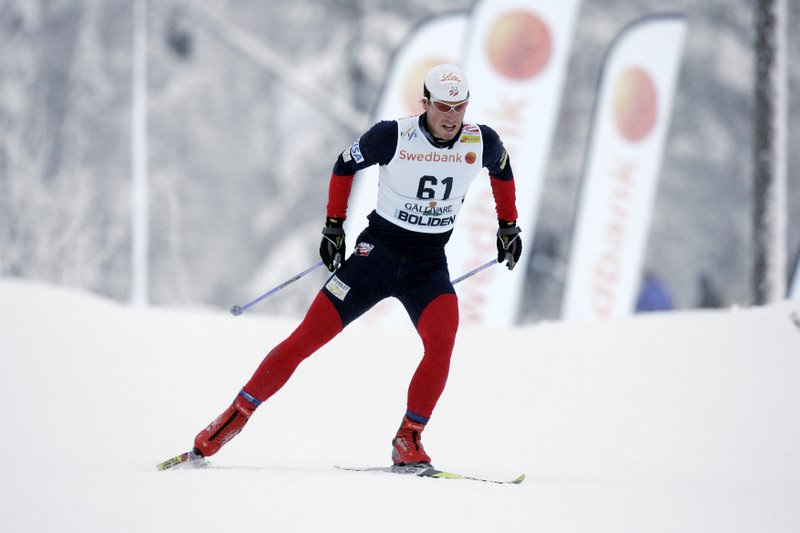
Kris Freeman racing a 15 k freestyle at the 2008 World Cup in Gällivare, Sweden. (Photo: Fischer/NordicFocus)
In an Olympic year when Randall and Jessie Diggins cleared the gold-medal hurdle, Freeman explained he wasn’t surprised with the result, just simply relieved. Not being surprised speaks volumes to how far U.S. cross-country skiing has come.
Freeman, however, came of age as an elite skier during the 42-year-long Olympic medal drought bookended by Koch’s silver and the Randall-Diggins gold.
“As a dreamer back in 1997 versus a dreamer now in cross-country skiing, it is a lot easier and more realistic to dream about medals,” he reflected. “You would hear about these Norwegians that skied so fast and they are just this amazing force. Now, they are still really good, but they are beatable. I wonder what it would be like to be a skier growing up now compared to a skier growing up then.”
Current skiers like Diggins and U.S. women’s coach Matt Whitcomb frequently espouse the power of belief. The current crop of USST athletes are well-trained and certainly better supported than in the past. (wax truck, anybody?). There are now plenty of World Cup podiums and a handful of championship medals worth their weight in belief.
Freeman is confident. No athlete gets as far as he has without it. Yet, Freeman never brought up on his own that he deserves any credit for why U.S. skiers should have belief.
“Are you a reason skiers have belief?” this reporter asked 48 minutes into the interview.
“I hope that I am,” Freeman said without any hint of hubris. “I certainly came to believe that I could be one of the best in the world in skiing. I cannot say that when I was 16 that I really thought that I was going to be fighting for a medal at the World Championships. At that point, I was hoping to get to the World Championships and put up a good show.”
Freeman’s professional skiing show ends having inspired a generation of nordic skiers. And he’ll continue to inspire countless diabetic children who know him as a groundbreaker.
*Freeman and the Olympic Winter Games (OWG) Points List
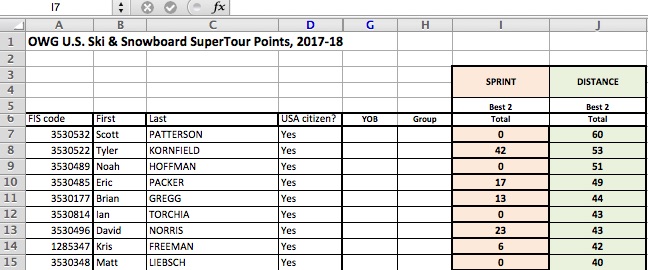
Men’s OWG points scoring list. This list was in part used to determine the 2018 U.S. Olympic Cross-Country Team. (Screenshot from Excel spreadsheet)
Disclaimer: this is a mental exercise to illustrate Freeman’s point that he was close to making the 2018 Olympic team. We all know that if Freeman had different results, any of the leaders could have had different results, too.
For argument’s sake, had Freemen skied 0.8 seconds faster and finished second in the men’s 30 k classic at this year’s nationals, he would have received 35 points. Packer placed second in that race and received the 35 point-allotment. Freeman placed fourth, receiving 26 points as the third Amercian. On the OWG list, Freeman was eighth, with a combined 42 points from his two best distance finishes between the SuperTour and U.S. nationals.
Had Freeman placed second and nailed down those 35 points, that would have given him 51 points total, and tied him for third on the OWG list with Noah Hoffman. As tie-breakers go, both Hoffman and Freeman would have had a 2nd at U.S. nationals with bonus points and a 5th place. The first tie-breaker would have been each athlete’s third-place result. Hoffman, having skied period 1 on the World Cup, had no domestic third place result. By default, Freeman would have been third on the list.
Kris Freeman (Team Freebird) racing to first in the SuperTour men’s 10 k classic individual start this past February in Craftsbury, Vt. (Photo: John Lazenby/Lazenbyphoto.com)
Few athletes remain at the top end of endurance for five years, let alone a single decade. New Hampshire native Kris Freeman, at 35, has been chasing fast times and fast skiers around cross-country ski loops for 16 years as a professional.
For much of that time, Freeman was a staple on the men’s U.S. Ski Team. He was fourth twice, in 2003 and 2009, in the 15-kilometer classic at World Championships.
Type 1 diabetes is not something we associate with four-time Olympians. Yet Freeman has dispelled the physiological odds of a diabetes diagnosis at the age of 20. Flagged for blood sugar anomalies as a U.S. Ski Team development skier during a routine blood test, Freeman and his tight-knit cadre of coaches and endocrinologists have been managing his disease ever since.
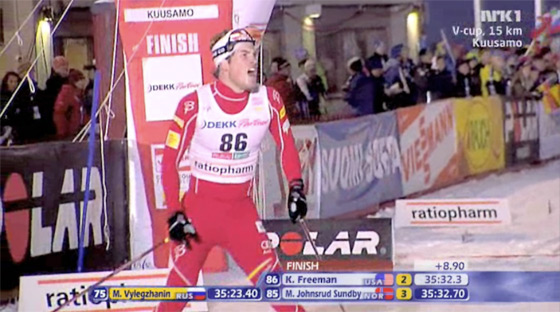
Kris Freeman at the finish of a 2009 World Cup race in Kuusamo, Finland. He finished fourth, 0.4 seconds ahead of Norway’s Martin Johnsrud Sundby.
Freeman said his initial foray into the literature of elite endurance sport and Type 1 diabetes was a black hole. As an athlete at the highest end of sport — racing to win, not simply finish an event — Freeman remains a sample size of one. And even now, Freeman is a student of what he realizes is the inexact science of managing his blood sugar for endurance sport. Needless to say, all that takes some serious commitment to endure. And endure where a margin of error involves high stakes physiological consequences.
Asked about what advice he’d give an up-and-coming cross country skier with the same predicament, Freeman said this: “Learn as much as you can about physiology, learn as much as you can about diet, and finding doctors that believe in you are the keys. For sure, I am not doing everything perfectly, and I know that. I’m sure it can be done better, I just haven’t figured out how. On the positive side, treatments for diabetes: better insulin pumps, continuous glucose monitors, have gotten light-years better even in the 16 years now that I have had diabetes. So at the progression it is going, I am hoping it will be a lot easier to manage in time.”
Press the play arrow below to hear about both the ups and downs of Freeman’s ski racing life. And if you didn’t catch this elsewhere, Freeman is also a newlywed.
(Courtesy photo)
(Courtesy photo)
The wedding party toasts to groom Kris Freeman (third from r) and bride Amber Dodge (fifth from l). (Courtesy photo)
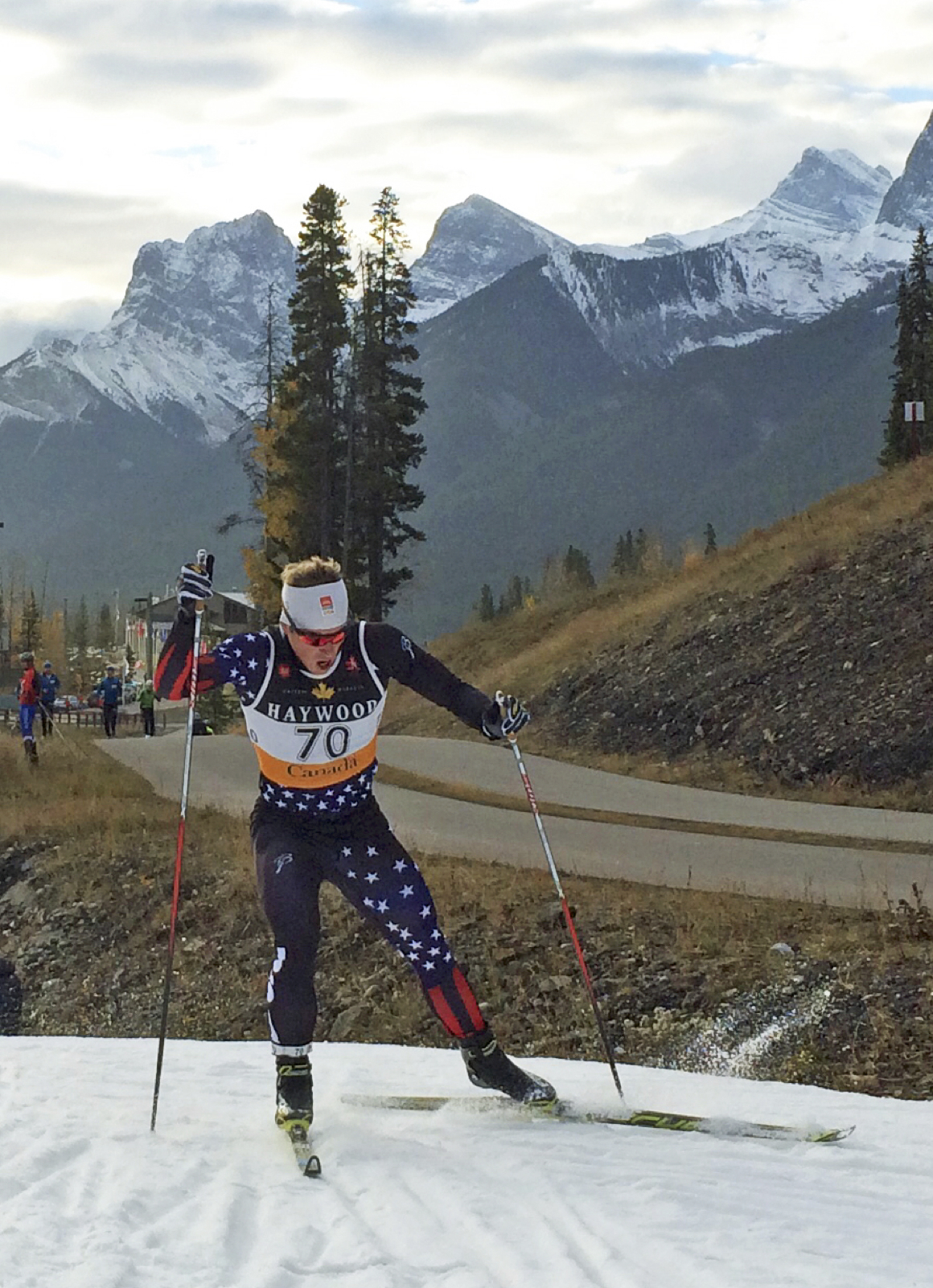
Kris Freeman racing to second in the 10.8 k Frozen Thunder skate race on Oct. 27 in Canmore, Alberta. (Courtesy photo)
It’s been nine years since Kris Freeman last visited West Yellowstone, Mont. Back then, the New Hampshire native was 25 and one of the U.S. Ski Team’s best distance guys (along with Andrew Johnson, Carl Swenson and James Southam) destined for his second Olympics.
After the 2006 Torino Games and two more Olympics later, Freeman, 34, has returned to southern Montana, where he’s only been twice before: for the 2005 and 2002 SuperTour-opening races of the season.
Before that, Sovereign Lake — commonly known as Silver Star— in Vernon, British Columbia, was where many top Americans and Canadians converged at the start of each season in late November.
And every year since 2005, Freeman, a U.S. Ski Team (USST) member from 2002 to 2013, started each winter in Europe. So yeah, it’ll be a little weird for him to be back in West for this year’s opening SuperTour races, but he’s not complaining.
In a phone interview earlier this month from his home in Thornton, N.H., Freeman said he’s more settled this year since losing a major source of income and health benefits after the USST didn’t renominate him to the team in April 2013. In the months after, the Type-1 diabetic became a nordic-racing instructor at Waterville Valley, his original club, which provided health care and a financial boost in the months leading up to the 2014 Sochi Olympics.
Freeman, a 16-time national champion, went on to make the U.S. Olympic team as a non-USST member, placing third at U.S. nationals in the 15-kilometer classic as well as the 30 k freestyle mass start, and fourth in the classic sprint. In Sochi, Russia, he consistently placed around 50th: 52nd in the 15 k classic, 53rd in the skiathlon and 57th in the 50 k freestyle mass start.
It wasn’t anywhere close to the Olympic performance he was looking for, and Freeman ended the season then and there, returning home for two minor surgeries: to remove a viral infection from his right heel and undergo a gum-grafting procedure (in which tissue from the roof of his mouth was used to fill in three areas along his gum line).
Freeman (back right) descending in the skiathlon at the 2014 Olympics in Sochi, Russia.
He scheduled the procedures in advance for the week he got back from Russia, tackling the foot first then seeing the oral surgeon the next day. For the next three weeks, he was out of commission, but that was OK — and by design. He spent the better part of the next three months taking a breather from nordic skiing.
“After the Olympics, my body was completely trashed,” Freeman said. “Part of the interesting thing about having diabetes is when things go bad, they go really bad for me really fast, and I go really deep into what appears to be a deep training hole. … I took three months of basically whatever I wanted to do which consisted of mostly telemark skiing and playing. By late June, I was back and my body was feeling the way it was used to.”
Because of his diabetes, he explained he’s more prone to chronic fatigue, which, in non-diabetic athletes, is caused by overly intense training and racing.
“Once the body’s reserves are used up it will begin to run on adrenaline whenever a stress is placed on it,” he explained. “This is not sustainable and eventually the adrenal gland will get tapped out. When this happens an athlete is diagnosable with chronic fatigue.”
When his blood sugar drops below normal, Freeman explained his body tries to keep those levels in check by releasing adrenaline, which tells the liver to dump sugar into the bloodstream. Since racing and interval training use a lot of adrenaline, a hard race schedule combined with frequent and severe blood-sugar lows could send him spiraling into chronic fatigue.
That’s what happened last season.
“Things just started out at not a very high level … and went downhill from there,” he said. “Last year was one of my hardest training years ever. I was absolutely flying in August and September, which is not when you want to be [at your fastest]. … I’m 34 now. I don’t respond to training the way I used to when I was 24. This year, we [myself and coach Zach Caldwell] took a much more conservative approach, especially after those three months of super easy.”
For each of the last four or five years, Freeman estimated he’d logged about 900 training hours. This training season, he figured he was closer to 700 or 800.
“When I look back at the overtraining or whatever you want to call it, the mistiming of fitness, the mistakes I made, I thought I was kind of immune from being cut from the USST,” he recalled. But he realized it had a bigger impact on his life than he anticipated.
“It was the only support system I knew. Going and changing everything in an Olympic year is difficult,” he said. “I’m still being supported by Waterville. I’m an employee there and I will be teaching some ski lessons this winter. I’m happy with that natural fit. My sponsors have stepped up for another year of support. The big change is I’m no longer with the Maine Winter Sports Center. I’ve chosen to be independent. I’m more comfortable to be at home; that’s where I’ve always made my biggest gains.”
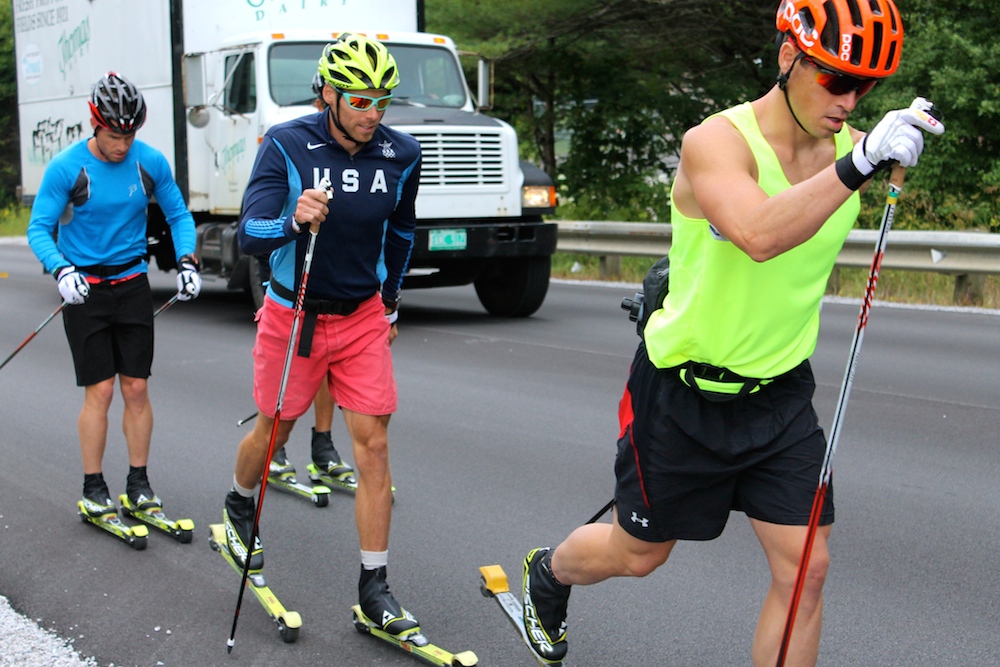
Kris Freeman (r) leads Andy Newell (c) and some others during a rollerski workout in lAugust in Stratton, Vt. There, he trained with the Stratton Mountain School T2 Team as well as the Canadian World Cup Team (not shown).
After revving up his training season with the Canadian World Cup Team and a couple USST men (Andy Newell and Simi Hamilton) in August in Stratton, Vt., Freeman went on to participate in the informal season-opener in Canmore, Alberta, racing both the classic sprint and 10.8 k freestyle race at Frozen Thunder. There, he placed second in the distance race and fourth in the sprint.
“I had what was probably my best sprint qualifier ever there — that was pretty fun,” Freeman said of his fourth-fastest qualifying time. “The skate race, I felt in control with good snap and good power. I would say both those race were far better than anything I put out last year.”
This season, Freeman, who raced in Canmore under the club name Freebird and is backed by equipment sponsors Swix and Fischer (he switched to their boots this year), will start the season in Montana, racing both the West Yellowstone opener and Bozeman SuperTour next weekend. Then, he’ll head north to the Canadian NorAm opener Dec. 13-14 in Rossland, British Columbia, followed by Whistler (Dec. 20-21), return to Thornton for Christmas, and head to Houghton, Mich., after New Year’s for U.S. nationals.
“I’m hoping at that point to be leading the SuperTour, in which case I’ll [earn World Cup starts in Rybinsk,] Russia,” he said.
But he doesn’t plan to go to Russia because it’s 13 time zones and a week after nationals.
“If all goes well, my first World Cup will be in Östersund, Sweden [Feb. 14-15],” he said. “I hope to make the World Championship team and finish out the season on the World Cup.”
While he’d like to see how he stacks up at this point on the World Cup, Freeman said going to Europe later could be a good thing. In the past, he struggled at times in February and March.
“I’d rather go over and hit it at World Championships than hit it in Kuusamo,” he said.
As for the 2018 Olympics in PyeongChang, South Korea, Freeman said he still “very much” enjoys skiing and tracking the adaptations in his body to build a perfect season. “I would love to complete in my fifth Olympics,” he said. “I’m going to take it year by year at this point.”
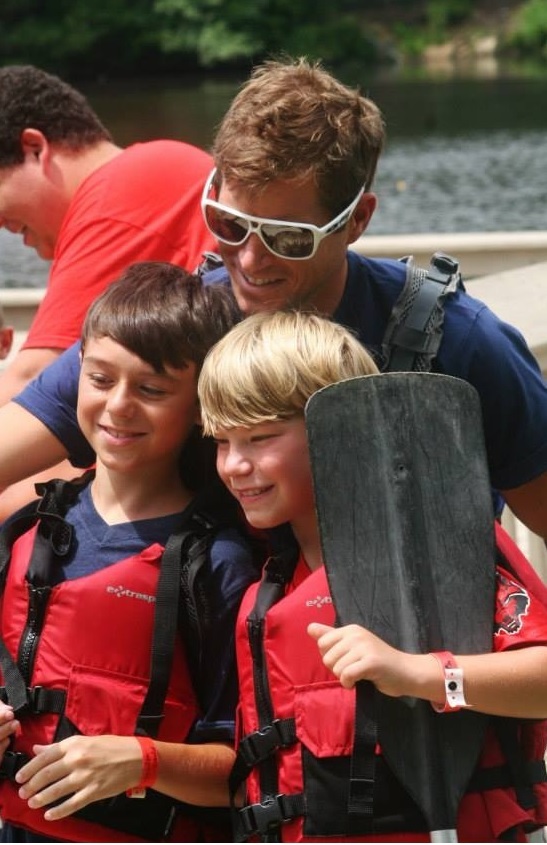
Kris Freeman at an American Diabetes Association’s Camp Aldersgate in July in Little Rock, Arkansas. (Photo: Lilly Diabetes)
Kris Freeman, the guest of honor at a JDRF gala in Indianapolis this past spring. (Courtesy photo)
Kris Freeman, the guest of honor at a JDRF gala in Indianapolis this past spring. (Courtesy photo)
Same Story, Stronger Message
After two seasons with the Maine Winter Sports Center (MWSC) in the northeastern tip of Maine — about a 6 1/2-hour drive from Thornton in central New Hampshire, Freeman decided to return to his longtime base near Waterville Valley and cut down on travel during training blocks.
When he wasn’t pounding the pavement on rollerskis or running trails around Waterville, he could often be found touring a multitude of states around the country, speaking on behalf of Lilly Diabetes. Freeman’s been an ambassador with Lilly since just before the 2002 Olympics.
“When I first started working with Lilly, I used to spend more time going to diabetes expos where I’d sit at a booth and introduce myself,” he explained. “But we weren’t really targeting the people that could relate and maybe draw inspiration from my story.
“I always enjoyed working with kids far more than working with adults,” he continued. “I didn’t grow up with the disease as a lot of these kids have so I’ve learned a lot more. You get exposed to the challenges they’ve had: changing hormones, social interactions can be difficult, also at the very young ages, something as simple as sleeping over at somebody else’s house can be difficult because parents have no idea how to care to somebody with diabetes…”
For the last 10 years, Freeman has taken part in about six to 10 camps every summer, visiting more than 10,000 Type-1 campers and traveling more than 120,000 miles, according to Lilly.
He tries not to keep track.
“Each year, hundreds of camps will request I go there,” he said. Typically, he’ll give precedence to the places he hasn’t been before and lets Lilly do all the scheduling around his training plan.
This year, he dedicated two weeks to presenting, appeared at five camps in a week and made stops in “Indiana, Texas, Arkansas, California, New York… it becomes a little bit of a blur,” he said.
In May, he was a featured speaker at Juvenile Diabetes Research Foundation (JDRF) educational conferences in Phoenix, Detroit, and Albany, N.Y.
“Some people in the ski community might find it ironic, I actually kind of serve as a motivational speaker and I do have a rather blunt style of telling my story,” he said. “But at the same time it’s a very honest way of telling my story and people react to it and that’s why I do it.”
“Some people in the ski community might find it ironic, I actually kind of serve as a motivational speaker and I do have a rather blunt style of telling my story.” — Kris Freeman, Lilly Camp Care ambassador and four-time Olympian who was diagnosed with Type 1 diabetes at 19
Lilly has been his headgear sponsor since 2001, and while the nonprofit pays him to help with his racing, he said it’s about more than the money.
“I could continue to ski race without them, [but] it’s a lot easier to ski race with them,” he said. “They’re a part of my income for sure. I’m glad that I have a company that I respect.”
Questions from Kids: (Provided by Freeman, from one of his interviews this summer. “I found with kids that grow up with diabetes, they mature more quickly,” he said.)
What has been your highest and lowest BG, and how did you deal with it?
I have never lost consciousness from low blood sugar because I can always feel that I am low before I test myself. The less frequently you have low blood sugar the stronger your adrenal response to hypoglycemia. You will sweat shake and feel nervous. However repeated lows in a short space of time will put too much stress on your adrenal gland and your body will give you less warning. My lowest sugars have been in the 30’s. I drank 16 ounces of gatorade and sat down for twenty minutes until my sugar rose above 80.
My highest sugars have been in upper 300’s. When I am high I take a small corrective bolus and then go for an easy walk. The light exercise makes my cells more sensitive to insulin which lowers my blood sugar more quickly. This method also allows me to use less or a corrective bolus which lessens the chance of a subsequent low form overdosing. If I go high in the middle of the night I will do 100-200 jumping jacks to increase my insulin sensitivity instead of walking.
What is it about cross-country skiing that you like?
I have competed in all forms of ski racing. I was a ski jumper, a downhill racer, and a xc ski racer as I kid. I love all forms of skiing but xc is my favorite because I never have to stop or sit on a lift. I love knowing that I can ski continuously for hours and cover 50 miles in a single training session.
What’s your favorite low-carb snack?
I really like Greek Yogurt. Its very high in protein and has a nice texture.
What’s your favorite all-time Guns N’ Roses song (‘Welcome to the Jungle’ would be my answer)?
My favorite G n’ R song is “Rocket Queen” which is the last track on Appetite for Destruction. The first time I listened to the album in its entirety the song blew my mind and it still does.
Over the years, Freeman’s message has generally stayed the same. He tells kids ages 6 to 18 that they can achieve anything they set their minds to — whether it involves sports, music, academics or anything else — and not to listen to anyone who tells them their diabetes will prevent them from doing so.
The first two doctors he had when he was diagnosed with Type-1 diabetes as a 19-year-old USST member said he wouldn’t compete at the next Olympics.
“I tell the kids this so that if somebody tells them they can’t do something, they can do it — they need to find a doctor that can work with them,” he said. “Their eyes open a little bit more. … A lot of the adults in their lives tell them they can’t do things because they’re nervous about them hurting themselves. [It’s about] educating the people around them about what this is and means.”
Since he’s become more comfortable with speaking in front of anywhere from 10 to 100 people at a time (although he still gets nervous presenting to 6 year olds: “It’s a little bit different keeping their attention,” he said), Freeman has opened up and shared more of his personal story as well.
“I tell them about the first time I went to the World Cup and it came time to take an injection of insulin,” he said. “I was like, ‘What am I going to do here? Go into the corner and be sneaky like I’m doping or something, or am I going to sit here at the lunch table and do it like I would at home?’ ”
He sat at the table and injected himself, and while it drew some looks, his fellow competitors eventually got used to it.
“I tell them to be open with it, about it, and I also tell them about the ideas of limitations of diabetes are outdated at this point because of the advances in insulin … and the way we can detect glucose,” Freeman added.
“In my early presentations, I would gloss over any difficulties I had. I wouldn’t talk about any lows … I wouldn’t talk about getting in the van after a workout being absolutely dehydrated, out of fuel and watch all [my] teammates pull out a quart of Gatorade and just down it, like, oh my God, that is something I wish I could do.”
He also frequently brings up what he considers one of the lowest points of his racing career: when he didn’t finish the 50 k classic at the 2010 Vancouver Olympics.
“I’ve had two lows in my career and one of them came in the biggest ski races of my life,” he said. “I share this crushing story and it makes me very relatable and it makes me seem real to them. I didn’t stop after that race and I came back after that season. … It’s a story of resilience, and if they can draw from that it makes it worth it. Honestly, the kids I talk to think 52nd at the Olympics was pretty awesome so it gives me perspective.”
When he gets back to training after a couple weeks on the road each summer, Freeman said he’s more focused. That’s what five to six hours a day at a diabetes camp, speaking and conversing and playing kickball and climbing on a ropes course with kids, does for him.
“When I take time away from training, it is important and I think more important in the grand scheme of things than skiing ever might be,” Freeman said. “I’m as guilty as ever as letting skiing be all-consuming …. I’ve gotten better at it over the years.”
At home, Freeman spends time with his girlfriend Amber Dodge and new puppy, She-Ra.
“The puppy is doing great — she’s gotten big enough that I can run with her now,” Freeman said of the seven-month-old, 40-pound Vizsla named after the sister of the comic-book character, He-Man.
This summer, he competed in a number of cross-training events, like the Wildman Biathlon, Top Notch and Josh Billings triathlons, US National Mountain Running Championships, and Mount Washington Road Race.
Fifteenth overall in Mount Washington’s 7.6-mile uphill run after his brother Justin in ninth, Freeman said he felt “pretty drained” and couldn’t get his heart rate above 164 during the June race. In a recent time trial, he was back to normal at 179.
This training season, he and Caldwell have measured his recovery using Galanes Sports Systems’ Firstbeat technology, which detects variability in Freeman’s heart rate while sleeping. From there, they’ve been able to determine how stressed his body is from training as well as measure the effects of his workouts.
“As time has gone on, I felt better and better,” Freeman said. “The time trials I did out in Park City with the Canadians … and in Canmore felt even better. Things are going in the right direction right now.”
Kris Freeman’s girlfriend Amber Dodge and their puppy She-Ra riding the Gondola down from the finish of the Wildman. (Courtesy photo)
Kris Freeman at the second transition of the Wildman Biathlon, a 10 k run, 22.3 k road bike and 3-mile hill climb run, on Aug. 9 in Gorham, N.H. (Courtesy photo)
Kris Freeman kayaking toward his dog She-Ra. (Courtesy photo)