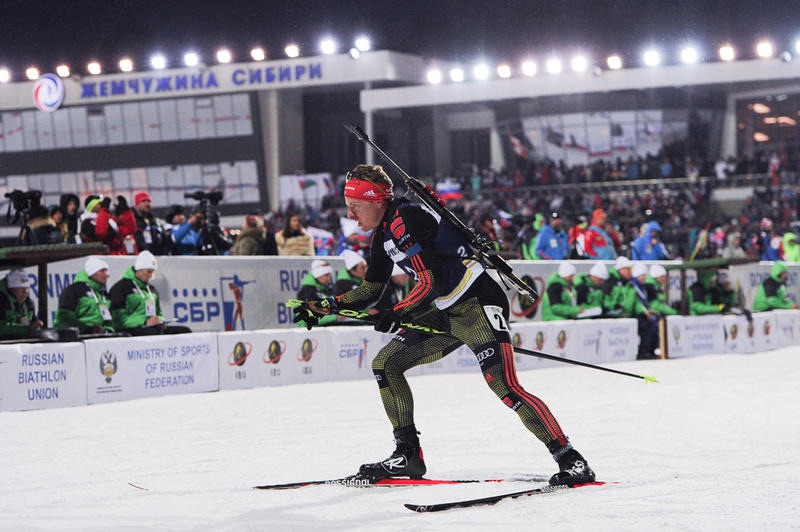
Yesterday, FasterSkier reported that the U.S. Ski Team would not be attending the World Cup finals scheduled for March 18 – 20 in Tyumen, Russia, given the nation’s invasion of Ukraine on Thursday. At that time, the International Ski Federation (FIS) had not announced whether events scheduled for the remainder of the season in Russia would be held as planned, however, a FIS official had indicated on February 15th that the situation in Russia was being closely monitored and alternative locations for the World Cup finals were being evaluated.
The FIS released the following update today indicating that all remaining season events will be cancelled, including the cross country World Cup finals in Tyumen. Rescheduling remains possible, but has yet to be confirmed. FasterSkier will continue to follow this story and will update readers when more information becomes available.
(FIS MEDIA RELEASE) FIS Cancels all Remaining 2021-22 Season Events in Russia
Oberhofen, Switzerland 25 February 2022
After close consultation with its stakeholders, FIS has decided that in the interest of the safety of all participants and to maintain the integrity of the World Cup, that all remaining World Cup events scheduled to take place in Russia between now and the end of the 2021- 22 season will be canceled or moved to another location.
The impacted events include:
FIS Ski Cross World Cup – 25-27 February, Sunny Valley (RUS)
FIS Aerials World Cup – 26-27 February, Yaroslavl (RUS)
FIS Women’s Ski Jumping World Cup – 18-20 March, Nizhny Tagil (RUS)
FIS Women’s Ski Jumping World Cup – 25-27 March Chaikovsky (RUS)
FIS Cross Country World Cup – 18-20 March, Tyumen (RUS)
Participants are already on site at the two World Cup events that were planned for this weekend (Ski Cross and Aerials) and FIS is working closely with the involved stakeholders to ensure their quick return back home.
FIS will communicate the replacement competitions’ hosts and dates as they are confirmed for the impacted events.
ZHANGJIAKOU, CHN — International Ski Federation officials say they’re exploring backup options for season-ending races in Russia amid fears of a war between that country and Ukraine, though they’re still planning on holding the event as scheduled next month unless circumstances change.
The final races of the top-level World Cup are scheduled to be held in Tyumen, Russia, in an oil-rich area in Siberia — about 1,000 miles away from the border with Ukraine, where American officials are warning that Russia could invade.
In an interview at the Beijing Olympic cross-country ski venue, an official from the federation, known as FIS, said that if conditions remain unchanged, the World Cup finals will happen as planned.
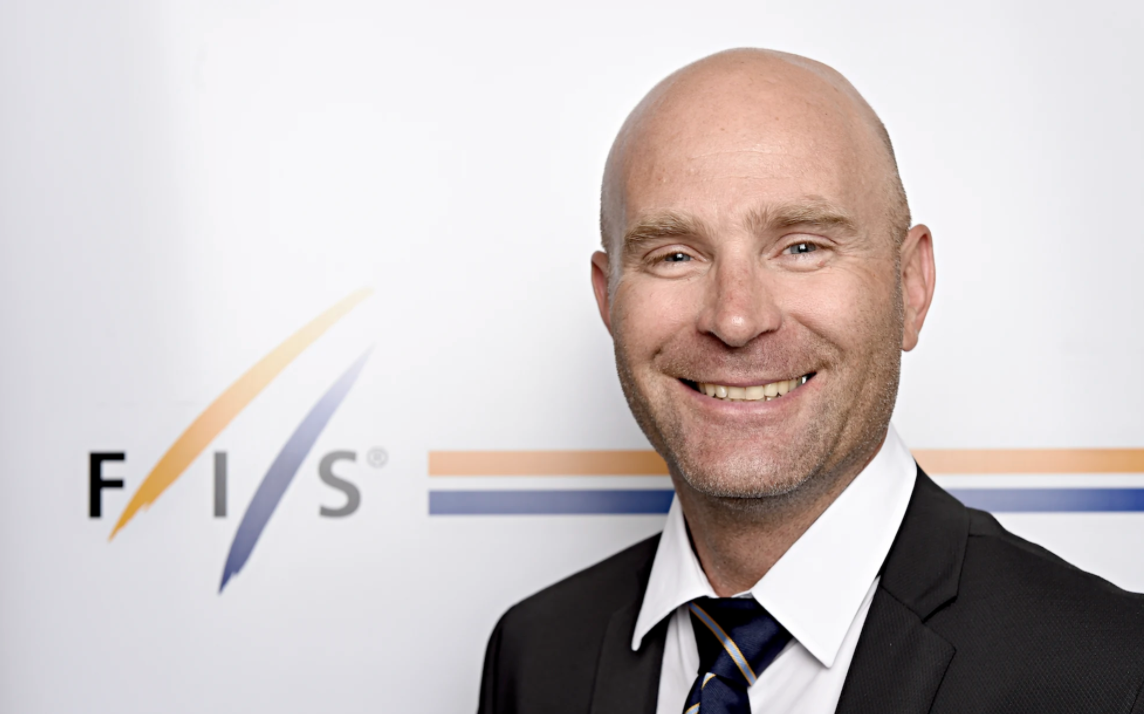
FIS cross country race Director, Pierre Mignerey. (Photo: FIS-Ski.com)
“But of course, we need to see what will go on in the upcoming days,” said Pierre Mignerey, FIS’s cross-country race director. “We will start to prepare some backup solutions, in case.”
Mignerey said he’s had conversations in the past few days with organizers in Sweden and Norway, which could be convenient backups since the World Cup circuit will be racing in Scandinavia before it’s scheduled to head to Russia. The coronavirus pandemic also forced cancelations of races in Slovenia and France last month, so those countries could also be potential replacements, Mignerey said.
The U.S. Ski Team is still planning on attending the races in Russia and is excited to see the new venue in Tyumen, said Head Coach Matt Whitcomb. But he also said the team is monitoring the situation.
“There’s never any guarantee, particularly with the political climate, currently, but also with COVID,” Whitcomb said. “We’re only going to go places we feel like will be safe.”
Officials working with Tyumen’s race organizing committee didn’t respond to a request for comment Tuesday.
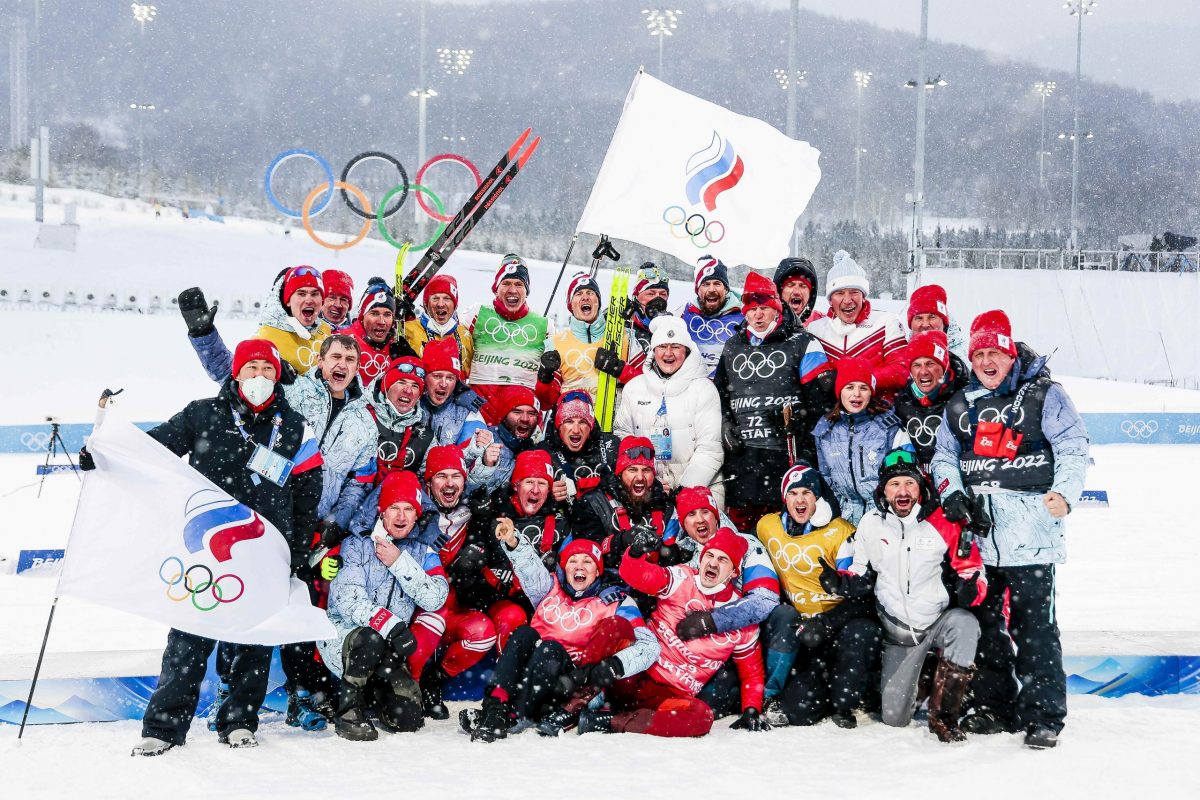
The ROC contingent celebrates their gold medal performance in the men’s 4 x 10 k relay. (Photo: NordicFocus)
Russia is one of the world’s leading nations in cross-country skiing, with its athletes winning gold medals in both the men’s and women’s distance relay events at the Olympics.
The World Cup finals are the first events set to held in Russia in several years, a consequence of doping-related sanctions.
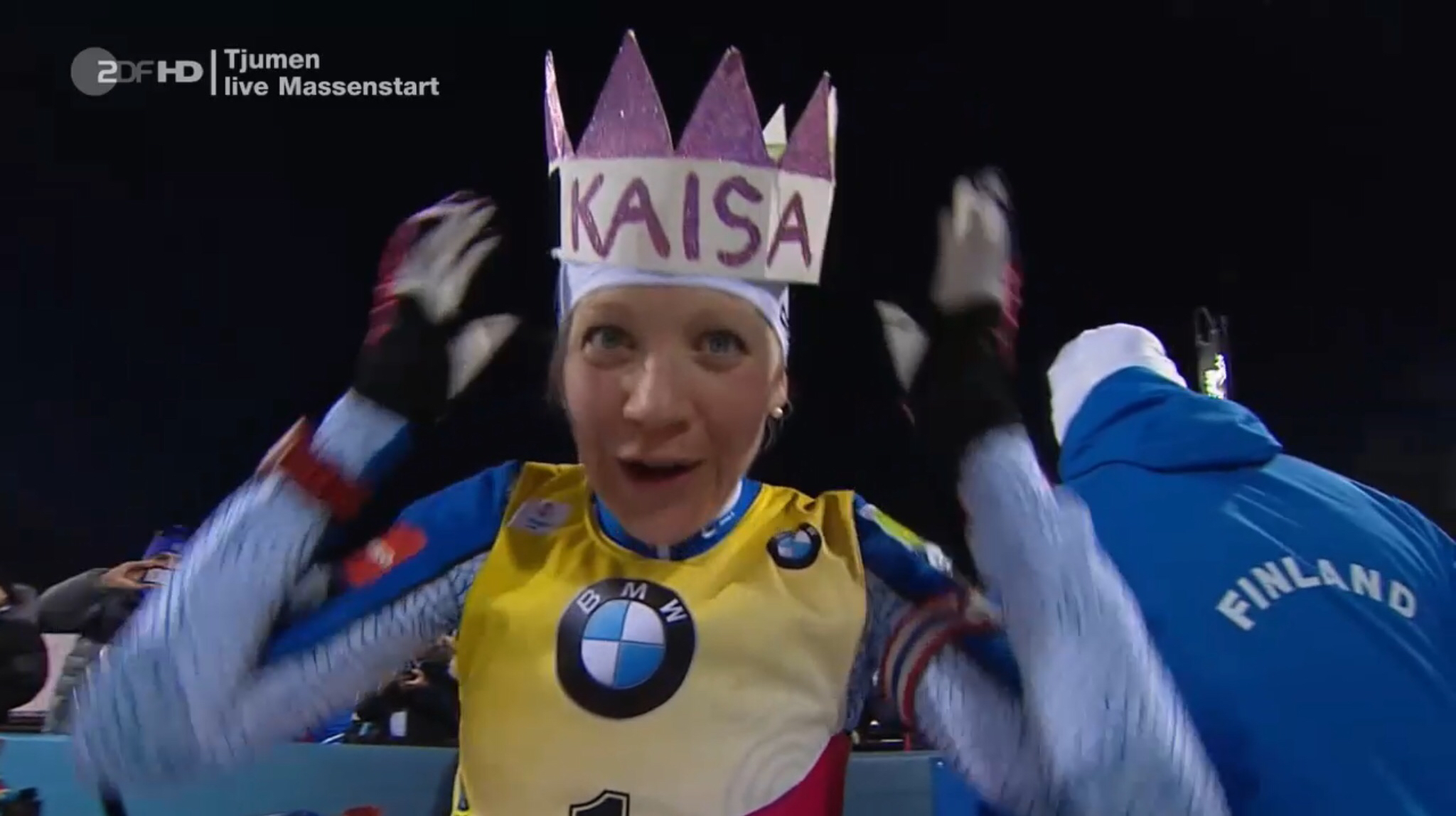
Kaisa Makarainen celebrates her third overall World Cup title after securing it with a sixth-place finish in the last race of the season, a mass start in Tyumen, Russia. (ZDF screencap)
Martin Fourcade didn’t have to do much at the final IBU World Cup weekend in Tyumen, Russia, in order to lock up the overall crystal globe. But the French biathlete came in guns blazing, so to speak, winning Thursday’s sprint by 33.2 seconds and claiming the Total Score title.
His only close(ish) challenger in the overall score, Johannes Thingnes Bø of Norway, had finished just 14th in the sprint. He raced up to second in the pursuit, but by then it was too late to take the globe from Fourcade.
It is the Frenchman’s seventh overall title; the last time anyone else won one was in 2010-2011.
“I am really satisfied with what I did today,” Fourcade told the IBU on Thursday. “It was mentally challenging all these days fighting with Johannes for the Crystal Globe. It seems easy watching on TV, but I can confirm that it is not. I must admit that it was not my main goal back [at the first World Cup weekend] in Östersund; it was the Olympics. But as the season went on, the globe became the most important aim for both of us.”
After that, Fourcade could relax a little.
“You know, before the race I planned to act like usual, be calm on the shooting range and being strategic,” Fourcade told German broadcaster ZDF after winning the pursuit, this time by 47.9 seconds. “But when I came to the zeroing [target practice] I told my coach ‘today I will play a little’. I don’t have many races to enjoy my biathlon [without pressure], to do what I would like to do. I told him ‘do not think (worry?) I will go full attack’, but I wanted to show that the strategy I had all year long is [just] a strategy not a need to shoot slow.”
On Saturday it worked; then came Sunday’s mass start. Fourcade had his worst race of the season, with four penalties and skiing to 19th place, over a minute behind winner Maxim Tsvetkov of Russia. But it didn’t matter – the globe was already decided, and Fourcade had already found his satisfaction.
The fight for the women’s crystal globe had much more drama. Coming into the weekend, Slovakia’s Anastasiya Kuzmina led by 41 points over Finland’s Kaisa Makarainen. But it was Belarus’s Darya Domracheva, in third in the standings, who won Friday’s sprint, by just 1.2 seconds over Makarainen; Kuzmina was 12th.
“Before today’s race I tried to focus only on this race, not think about the overall World Cup so much because I know that I am really [far] behind,” Makarainen told ZDF after the sprint. “But I know that everything is possible. I think that’s also the best tactic for tomorrow: not think about the others or the Total Score, just focus on a good race and enjoy that.”
Makarainen saw her chance and went for the win in the pursuit, edging France’s Anais Bescond by an even smaller margin – 0.2 seconds.
With Domracheva winning the mass start, Makarainen rallying for sixth despite three missed shots, and Kuzmina 11th with the same tally, the title went to the Finn. She edged out Kuzmina by just three points, while Domracheva was only another 15 points back.
Makarainen jumped up and down when she saw the score announced, and her teammates rushed her and placed a pink paper crown on her head. It is her third overall title; she also won in 2011 and in the 2013-2014 season, when she likewise secured the crystal globe in the very last race of the season.
The fields were somewhat reduced in size and depth as the Canadian, U.S., Czech, and Ukrainian teams all skipped the event due to Russia still remaining out of compliance with the World Anti-Doping Code. Other individual athletes skipped the races as well.
Other Notes:
Simon Desthieux of France got his first career World Cup podium, finishing second in the sprint behind teammate Fourcade.
Maxim Tsvetkov of Russia claimed his first career win in the mass start, edging Norway’s Erlend Bjøntegaard by 2.7 seconds as each shot 20-for-20.
In the men’s mass start, Slovakia’s Paulina Fialkova got her first World Cup podium, finishing second, just 1.8 seconds behind Domracheva as each had a single penalty.
The top ranked North American biathletes in the Total Score are Susan Dunklee in 34th in the women’s standings, and Tim Burke in 32nd in the men’s standings, both from the United States. The U.S.’s Lowell Bailey and Sean Doherty ranked 35th and 36th. No Canadians were ranked in the top 40.
Canada’s Christian Gow (12) chases Germany’s Erik Lesser during the men’s 4 x 7.5 k relay at the 2018 Olympics in PyeongChang, South Korea. Germany won bronze. Lesser lamented the situation and said of the IBU’s decision to hold World Cups in Tyumen, Russia, despite requests from him and other athletes to move the event: “If we don’t go, it’s wrong because it’s our sport we love. [But] if we go to Tyumen, we maybe send the wrong sign to IBU.” (Photo: FlyingPointRoad)In three weeks time, biathlon’s World Cup circuit will move to Russia.
But a number of the sport’s stars won’t be there – and others plan to attend, but aren’t very happy about it.
In an Executive Board session in PyeongChang, South Korea, a few weeks ago, the International Biathlon Union (IBU) decided to go on as planned with World Cup races in Tyumen, Russia, even though the Russian Anti-Doping Agency is still not compliant with the World Anti-Doping Code.
Biathlon Canada had announced in December that it would boycott the event if it was kept in Russia, following revelations of systematic abuse of the anti-doping system by that country. In the intervening months, athletes appealed to the IBU through private channels to move the races to a country which complies with the WADA Code.
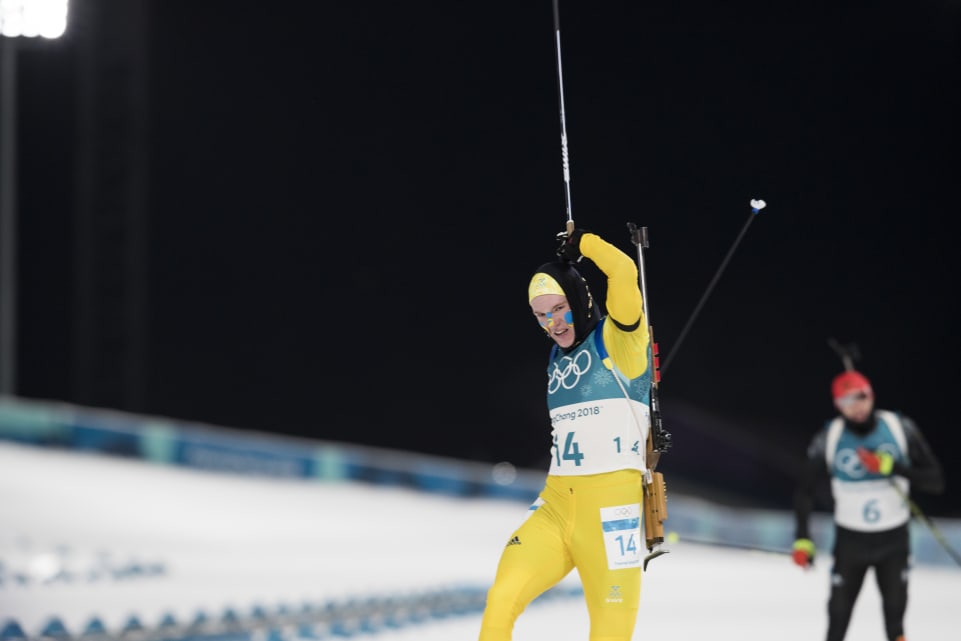
Sebastien Samuelsson of Sweden celebrating silver in the men’s 12.5 k pursuit at his first Olympics on Monday in PyeongChang, South Korea. Samuelsson announced today that he is boycotting the World Cup Finals in Tyumen, Russia, because Russia is not in compliance with the World Anti-Doping Code. (Photo: IBU/Biathlonworld)
Today, 2018 Olympic pursuit silver medalist (and relay gold medalist) Sebastian Samuelsson of Sweden announced on Twitter that he will not go to the races either.
“Nations without a functioning anti-doping organization should not have competitions at the international level,” he wrote, according to a translation. “Also, worried about the safety of both myself and the doping tests in Russia.”
Also not going is Klemen Bauer of Slovenia, a 2012 World Championships relay medalist who is a four-time Olympian.
“I’m not planning to go to Russia at all,” he told FasterSkier in a Twitter exchange. “I was quite sure the IBU will replace the races, but despite all the effort we put into the clean/er biathlon, thanks to the president of the IBU that didn’t happen.”
Both men are running for positions on the IBU’s Athletes Committee.
“The idea is to improve the active role of the athletes and the voice of the athletes,” Bauer wrote of his candidacy. “We’ll see.”
Another man running for a spot on the Committee is Germany’s Erik Lesser, 2014 Olympic silver medalist in the individual, 2015 World Champion in the pursuit, and several-time Olympic and World Championships relay medalist.
Lesser will be attending the races in Tyumen, but he wasn’t happy about the IBU’s decision to hold them there.
Klemen Bauer of Slovenia competing in the mass start at the 2018 Olympics in PyeongChang, South Korea. Bauer will not compete in the World Cup Finals in Tyumen, Russia. (Photo: FlyingPointRoad)
“In my opinion the RUSADA and the Russian Federation have not done enough to light up this case,” he wrote in an email to FasterSkier. “During the last years, WADA and some commissions found a bunch of proof about a doping system in Russia. But RUSADA and [the Russian Biathlon Union] did nothing to fight against doping. The Anti-Doping-Laboratory in Moscow still does not have a license, and all the officials are in the same seats. It’s a wrong sign, after these problems, to go to Russia and celebrate World Cup Finals.”
Lesser and teammate Arnd Peiffer, the 2011 World Champion in the sprint who then won gold at the 2018 Olympics, and who has even more World Championships and Olympic relay medals than Lesser, wrote a letter to the IBU explaining their position.
Yet a few weeks ago, the IBU decided to go ahead and hold the World Cup in Tyumen anyway. They issued a press release explaining the decision.
“I‘ve read the press release and I still don‘t understand why they decided this way,” Lesser wrote. “Because it‘s a threat to Russian biathlon fans and the Organizing Committee will take care of our safety? Wow, these are true reasons to keep the World Cup in Tyumen. So, I don‘t really think that reasons are valid.”
Last season, there was also supposed to be a World Cup in Russia. But in 2017, several teams announced that they would boycott the event and IBU President Anders Besseberg had a contentious meeting with athletes, after which the IBU decided to move the event.
This season, despite appeals by athletes like Lesser, Peiffer, and the others, that has not yet happened. And so in the end, Lesser says that he will compete in Tyumen, even though he wishes the races were somewhere else.
“We argued with our federation and we decided to go to Tyumen,” he wrote. “The sport is the first [priority] and we want to compete. We hope that we can do a good job in Russia. We are there to stand as clean athletes.
“It‘s bad that the IBU put us athletes in this position,” he wrote. “Actually it‘s not our job to be political. It‘s our job to be athletes and compete against other. If we don’t go, it’s wrong because it’s our sport we love. [But] if we go to Tyumen, we maybe send the wrong sign to IBU.”
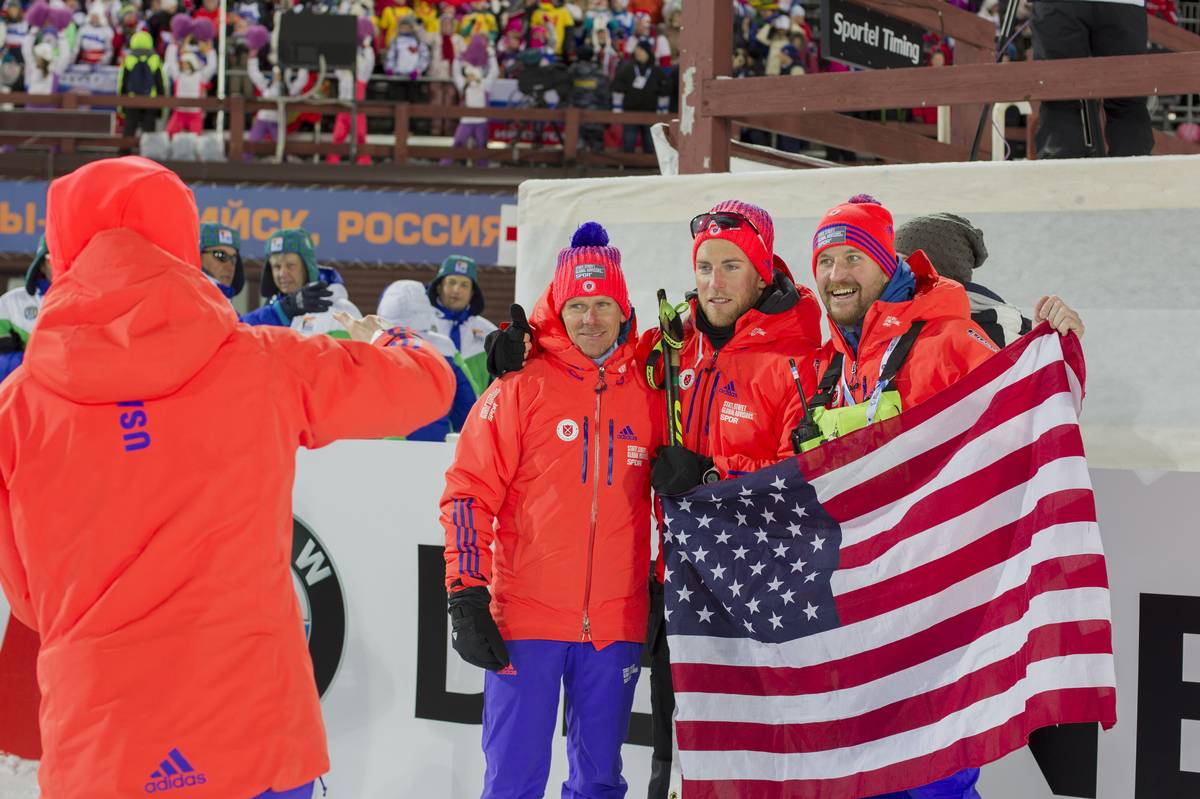
The US Biathlon coaching staff, poses for a photo following the men’s World Cup sprint in Khanty-Mansiysk, Russia, in 2016. The US will not attend this year’s World Cup final in Tyumen. (Photo: USBA/NordicFocus)
In December, Biathlon Canada announced that it would not attend World Cups slated for Tyumen, Russia, in March, due to the doping scandal that has consumed Russian sports. Russia is still not in compliance with the World Anti-Doping Code, and, Biathlon Canada stated, “the integrity of anti-doping procedures in Russia is still very much uncertain, given the current situation in which RUSADA remains non-compliant with WADA.”
This caused little reaction from the International Biathlon Union (IBU) at the time.
The United States and the Czech Republic have now also announced their intentions to boycott the event, and other individual high-level athletes also do not plan on attending.
“I am really discouraged by our international federation, the IBU,” Lowell Bailey said after the men’s relay at the Olympics on Friday. “Our President, Anders Besseberg… at every turn when he has the chance to defend clean sport, he has turned the other way. And it’s not fair to clean athletes. The latest decision by the IBU was to send the World Cup tour to Tyumen, Russia, for our World Cup final. Team USA is boycotting. The Czech team is boycotting. Canada is boycotting. We are trying to rally more support. I know that as an Athletes’ Representative, almost every country had athletes that wrote letters to the IBU [about the World Cup final].”
The Czechs know that they will lose Nations Cup points, and possibly World Cup quota spots, by skipping a weekend of racing, but said that it was worth it.
“We have taken a certain stance, with some sacrifices, and it would be wrong to give it up now,” Czech Biathlon Union President Jiří Hamza told iDNES, a Czech news agency, according to a translation.
“If you are convinced something is not right, you should keep that stance,” shooting coach Ondřej Rybář said in the same article. “If the other countries talk about RUSADA being noncompliant and that they should not have international races in Russia, but they eventually go there, that’s their issue. We clearly stated that we do not agree with what is happening in Russia. We therefore want that the work did in the fight against doping isn’t lost.”
And in the meantime, the IBU had apparently received private feedback from athletes who wanted the World Cups to be moved to a Code-compliant country.
“The outcry from our fellow athletes around the world has been respectful, strong, and definitive,” the U.S. biathletes wrote in a joint statement that they each posted to social media platforms (for example, here). “In addition to the dozens who expressed their opinion to the IBU Athletes Commission members ahead of the meeting in January 2018, the IBU received letters representing over 30 athletes, from eight countries, and included three 2018 Olympic Champions… ”
French star Marie Dorin Habert, a four-time World Championships gold medalist, has announced that she will retire after the World Cup weekend in Oslo – which by definition means that she won’t be going to the final weekend of competition in Russia.
Teammate Martin Fourcade, however, reportedly will attend the races in order to fight for the World Cup crystal globe, which he currently leads by just 54 points over Johannes Thingnes Bø of Norway.
“My position on doping and on Russians who have cheated is clear, but my position on Russia is different,” he said, according to the German Press Agency via a translation. “The country is a fan of biathlon, and I think the Russian public should not be eternally punished for the actions of some of its officials and athletes.”
Sebastian Samuelsson, a Swede who won silver in the Olympic pursuit and then gold in the relay, also expressed his dissatisfaction with the IBU’s handling of the situation.
“Hugely disappointed with the [IBU] decision today to, despite considerable pressure, to keep the [World Cup] in Russia,” he tweeted, according to a translation.
Samuelsson was rewarded with numerous twitter replies from Russian accounts telling him to stay home, one of which called him a baby and another of which said he was “not welcome in Russia”. He was then attacked on Instagram, with obscenity-filled threats and more sober ones, like, “your whole family will die.”
And that’s something that the Americans mentioned in their open letter explaining why they wouldn’t be traveling to Russia: safety.
“I’ve got online threats because of things I’ve said,” Canada’s Rosanna Crawford told Norwegian broadcaster NRK after the Canadians announced their boycott in December. “There are people who say they can’t wait until I come to Russia, ‘we’ll see what happens to you then’.”
It’s something the Czechs are intimately familiar with, too. After their 2014 women’s relay team celebrated being awarded Olympic bronze after the Russian relay team was disqualified for doping – several relay members’ cases are now pending at the Court of Arbitration for Sport – they were attacked as well, with hundreds of comments on social media calling the women “pigs” and “prostitutes” and threatened that if they did come to Russia, their anti-doping samples would be sabotaged.
And indeed, the first comment on U.S. biathlete Susan Dunklee’s Instagram post announcing the boycott was sexually-explicit and degrading insult, the only part of which can be written on a family-friendly website was the part calling her “ugly”. More obscenity-laden comments followed.
“Thank God the Americans won’t come!” another commenter wrote. “If you came to us, I’d throw you tomatoes.”
“You’re not an athlete,” added a third.
“American coward,” mocked another.
Bailey did not post about the boycott on Instagram, but commenters went there anyway, flocking to his most recent post – from nearly a year ago – to call him a doper.
“… the protection of clean athletes and the fight against doping are of the highest priority,” the IBU wrote in a September press release regarding the Russian doping investigation.
But when it comes to online threats against the athletes competing in their sport, the federation has so far been silent.
In response to Canada’s boycott announcement in December, Anders Besseberg said, “It’s not mandatory for anyone to attend, let’s put it that way.”
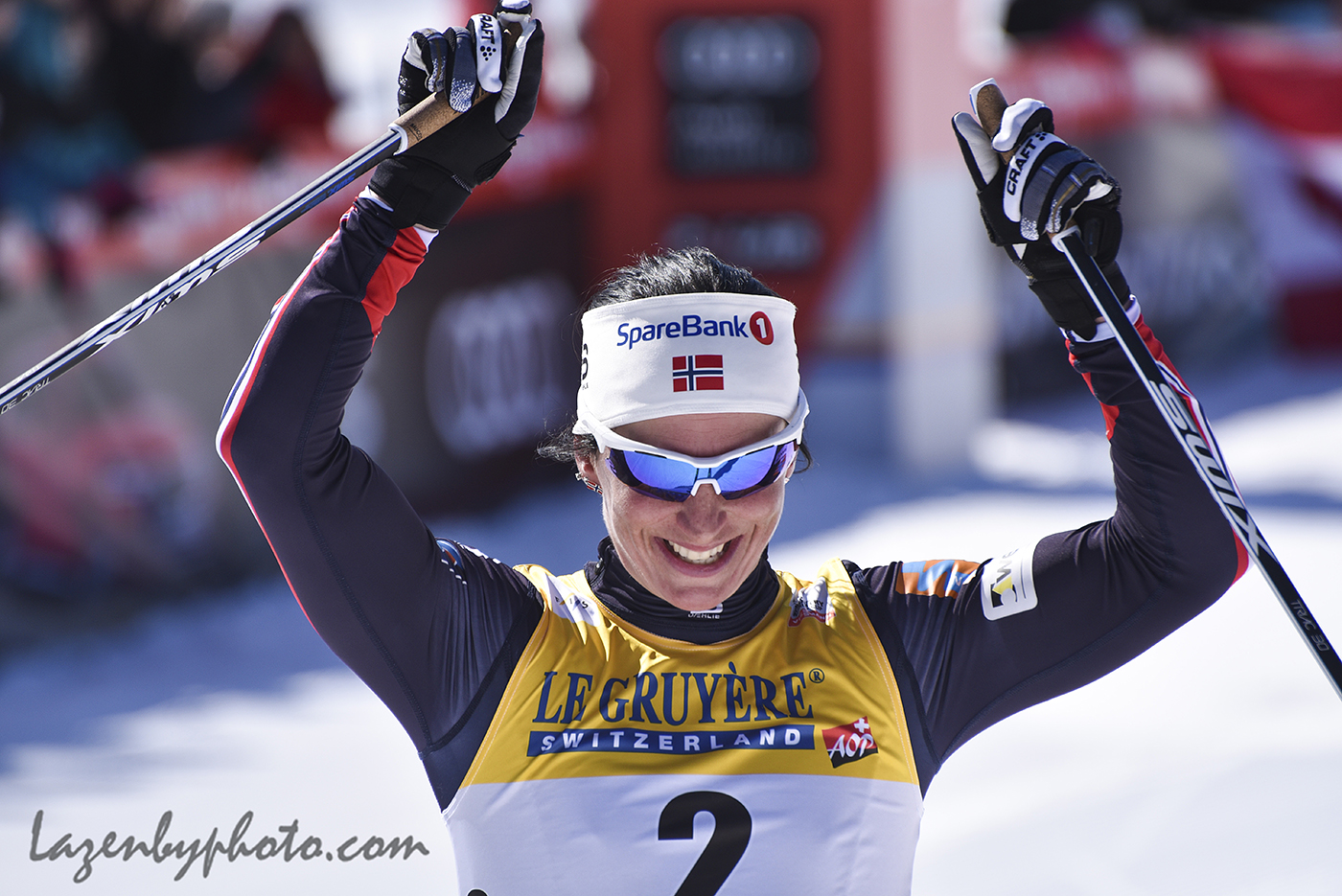
Norway’s Marit Bjørgen celebrates her ninth-straight win in World Cup distance races (anything longer than a sprint) in the last race of the 2016/2017 season, the women’s 10 k freestyle pursuit on Sunday in Quebec City. (Photo: John Lazenby/Lazenbyphoto.com)
QUEBEC CITY — Generally speaking, most European-based World Cup skiers wouldn’t have picked Canada as their ideal place to end the season. It’s too far across the pond, too far from the beaches, too far from home.
Québec City organizers, headed by Gestev, had just under two months to prepare. Having hosted two stages of the Ski Tour Canada last season and a World Cup sprint weekend in 2012, they had the experience, but World Cup Finals — complete with three uninterrupted days of racing and season-ending awards — was another animal of its own entity.
Fortunately, the weather cooperated. Three days before World Cup Finals, Québec City and the eastern part of North America got its biggest snowstorm of the season and perhaps the last several winters. With three straight days of racing taking place on the open-aired Plains of Abraham, most familiar with the expansive downtown park expected bone-chilling wind. Yet with above freezing temperatures at race time, that wasn’t much of a factor, especially not on Saturday and Sunday.
Each day, spectators and athletes required fewer layers, and by Sunday, some of the athletes were down to bibs only. The sun was intense, there wasn’t a cloud in the sky, and the athletes were happy.
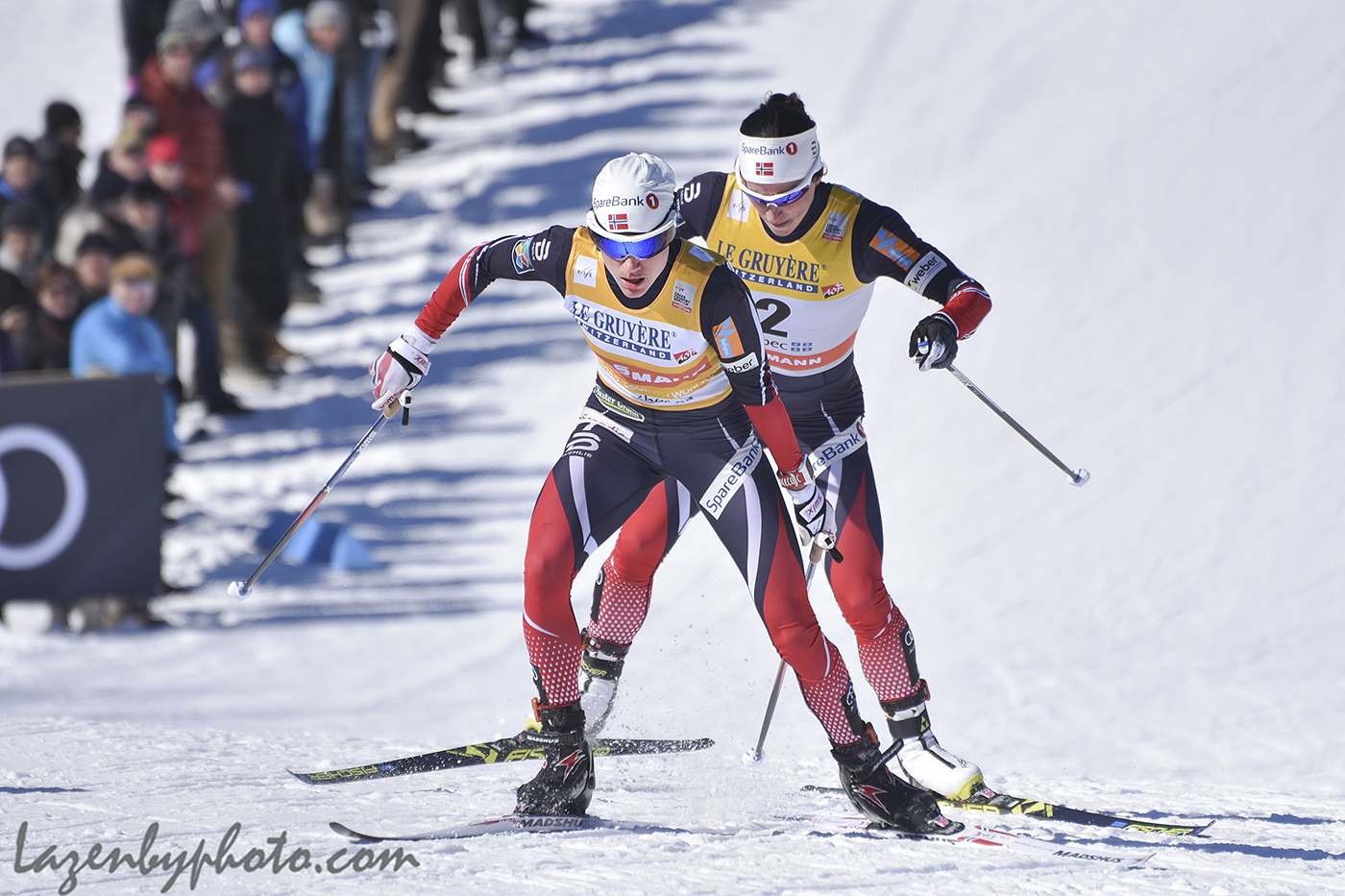
Norway’s Heidi Weng leads her teammate Marit Bjørgen during the women’s 10 k freestyle pursuit on the last day of World Cup Finals in Quebec City. Bjørgen went on to win while Weng was 1.2 seconds back in second. (Photo: John Lazenby/Lazenbyphoto.com)
“When I saw that we would race here, I thought, ‘Oh no. We’ll have to go so far from home,’ ” Norway’s Heidi Weng told FasterSkier on Sunday. “But when I come here, it’s more like winter, and I like the track here, and I’ve gone very fast here before. So I knew I could go do a very good race here, so now I hope we come here often. It’s very good, and many people, and the atmosphere, and good snow. It was very great to be here.”
Weng spoke to a horde of reporters with a large, silver briefcase by her side. In it was one of the Crystal Globes she had just received for winning the Overall and Distance World Cups (she won one globe for each season-long category). Between Friday, Saturday and Sunday, Weng finished sixth in the freestyle sprint, second in the 10-kilometer classic mass start, and second in the 10 k freestyle pursuit. Her Norwegian teammate and longtime idol, Marit Bjørgen beat her in both the distance races.
In all, Weng racked up about 20 individual World Cup podiums (including her Tour de Ski win, Lillehammer mini tour win, and World Championships silver in the 30 k freestyle mass start). She was the most consistent skier throughout the season, thus earning the Overall World Cup crown by 40 points over Finland’s Krista Pärmäkoski, and distance title by 97 points over Bjørgen.
“I’ve had many podiums this year,” Weng said. “In sprint I have taken huge steps, so I am very happy with the season. I have won a sprint race, and that’s the most important to me…
“Maybe I must have a little more confidence that I am good and a good skier, because I always think I am not so good as the others, but now I have a better head,” she added. “Maybe you can say in your head that you are very good and very strong, so next year I do a joke with my head.”
While Weng keeps telling herself that she can win, Bjørgen is fully aware that she’s back to her top form having won every distance race since the new year. That’s nine straight individual wins, including two from this past weekend.
After starting one second behind Weng in Sunday’s 10 k skate pursuit, she outlasted the overall and distance World Cup champion by 1.2 seconds at the finish after leading Weng for most of the three-lap race.
“It has been an incredible season for me after Christmas,” Bjørgen, who had a child in December 2015 and took last season off, told reporters on Sunday. “I won every long distance and four golds in the World Championships so this has been incredible and to win today also.”
On Sunday, Bjørgen caught Weng quickly and with the third starter, Norway’s Ingvild Flugstad Østberg, heading out 29 seconds back, the two skied off together and away from any threat to their top-two quest.
On the first lap, Østberg tried to close the gap, coming within 23 seconds of them at 1.3 k, but by the time she lapped through the stadium at 3.3 k, she was 33 seconds behind and just seven seconds ahead of a chase pack with her Norwegian teammate Maiken Caspersen Falla, Pärmäkoski, and Sweden’s Ida Ingemarsdotter and Stina Nilsson. Another 20 seconds behind them, American Sadie Bjornsen and Sweden’s Anna Haag were leading a pack of eight.
One lap later, Bjørgen and Weng cruised into and out of the stadium 46 seconds before Østberg, who was still 10 seconds ahead of the four-woman chase pack by the time she came through. The group, which was down to Nilsson, Ingemarsdotter and Parmakoski, eventually caught Østberg less than a kilometer before the finish, and Østberg finished at the back of that group in sixth, 1:06.8 behind Bjørgen. In a race for third, Nilsson took it by 1.9 seconds over Ingemarsdotter in fourth and 5.6 seconds ahead of Pärmäkoski in fifth.
“It was a mental struggle the whole way because they were 15 and 10 seconds behind me all the way, and that’s a difficult gap,” Østberg told FasterSkier. “They were three and four working together, and I was all by myself in front. I really tried to push as hard as I could, and stay in front of them, and I had 10 seconds, and it was less than 1 kilometer left, and I really believed that I could take it, but when they passed me, they had such high speed, I couldn’t keep up with them. So that was not so fun to see them pass me there, but I managed to take the third place overall [in the World Cup], so I have to be satisfied with that, I guess.”
“I think we worked well together,” Nilsson told FasterSkier. “Krista did the hardest work, I think, but I tried to help her as much as I could, and I was very excited that we could catch up to Ingvild. … I knew that when we started to be in the sprint course, I started to feel at home, then I just wanted to go as fast as I could.”
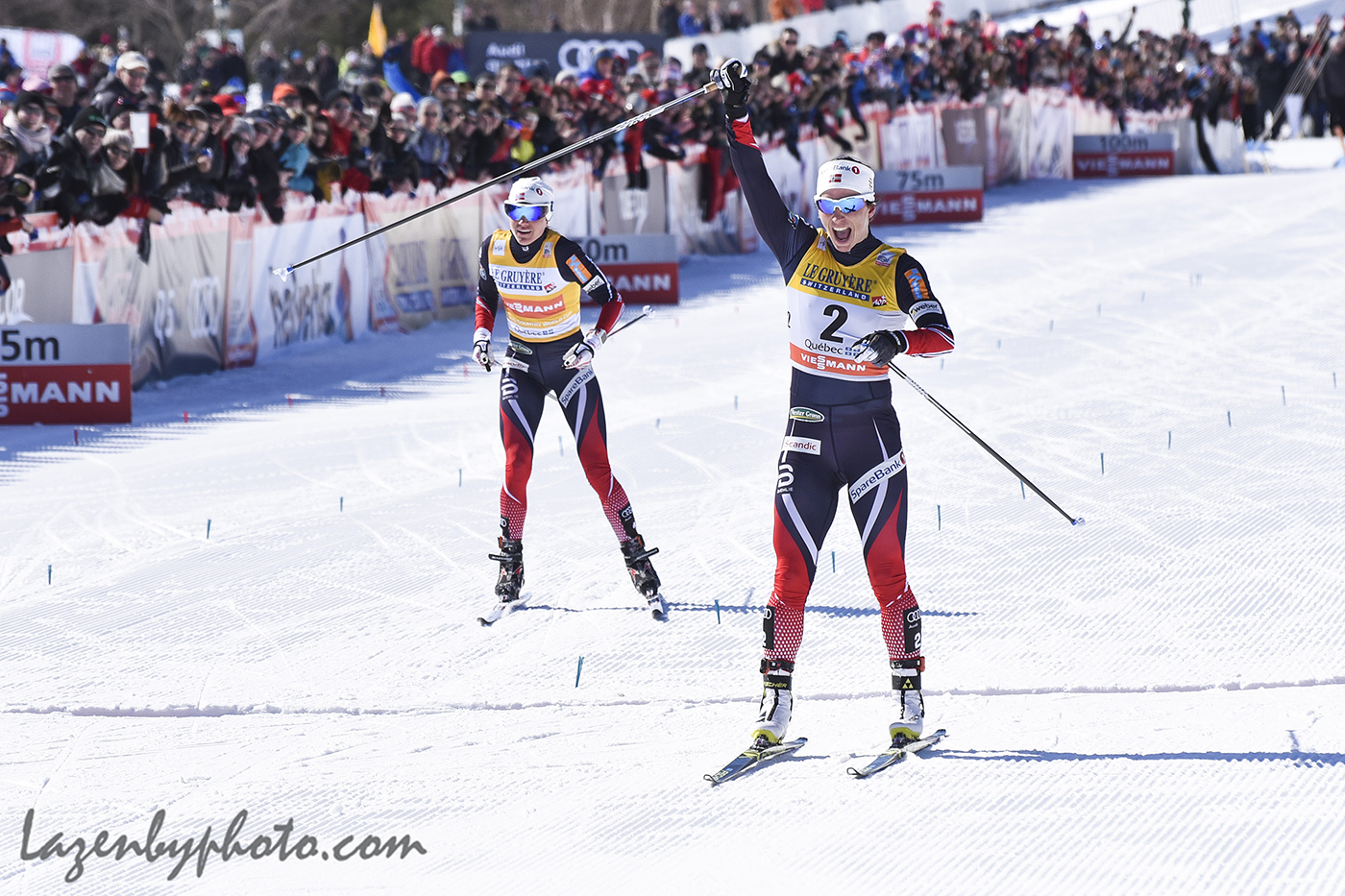
Norway’s Marit Bjørgen after outlasting her teammate Heidi Weng for the win in the women’s 10 k freestyle pursuit on Sunday at World Cup Finals in Quebec City. (Photo: John Lazenby/Lazenbyphoto.com)
Exactly a minute before Nilsson — a sprint specialist — finished third, Bjørgen had crossed the line first in 22:36.1 minutes after getting slightly ahead of Weng coming out of the downhill with 100 meters remaining. Leading up to that point, Weng had come from behind to attack on the second-to-last climb, a markedly steep one, but Bjørgen responded quickly.
“I thought that Marit was a little bit more tired than me, but when I attacked on the sprint uphill I hoped that I could get some meters to Marit, but she was there, and in the downhill she came from behind and take a better speed,” Weng said. “That sucks, but I was number two, and it’s not many who can be on the podium, so I am very happy.”
“I knew that it would be a sprint in the end with Heidi and to have her behind me is a very good feeling,” Bjørgen said. “I’m 10 years older and to be there is a good feeling to take with me into the Olympic [year next season].”
Bjørgen is 36. Weng will turn 26 in July. Nilsson is 23.
On Sunday, Bjørgen not only won the pursuit and with it, the World Cup Finals mini tour, but she was also the fastest for time of day in 25:35.1. Weng was second fastest, 2.2 seconds back, and Nilsson third (+11.9) after starting seventh and moving her way up to third.
On her 34th birthday, Germany’s Nicole Fessel was fourth fastest (+15.3), and Bjornsen of the U.S. tied Sweden’s Charlotte Kalla for fifth on the day, 17.8 seconds off Bjørgen’s time.
Sadie Bjornsen (U.S. Ski Team) soaking up her top-10 finish at 2017 World Cup Finals in Quebec City after placing 10th in the 10 k freestyle pursuit and fifth for time of day. (Photo: John Lazenby/Lazenbyphoto.com)
Overall Bjornsen placed 10th (+1:27.2) after starting 1:10 minutes back in 10th with Kalla in ninth and skiing with her and Fessel (the 13th starter) to the finish.
“Charlotte was going so hard from the start,” Bjornsen said after. “I actually did my warm up behind her, trying to get used to her speed because that was my main goal, to stay with her today. I knew it was going to be rippin’, and at one point some of the girls went in front of me, and I let her get away, and I was like, ‘No! I have to stay with her!’ So I had to do a full sprint in the middle to catch back on, which took a lot to recover from.”
At the finish, just 0.4 seconds separated Kalla, Fessel and Bjornsen, who placed eighth (+1:26.8), ninth (+1:26.9) and 10th, respectively. Ahead of them, Norway’s Falla placed seventh (+1:19.8).
“I really wanted to outsprint those girls in the finish for some redemption from the sprint race the other day,” Bjornsen said, referring to her 13th place in the World Cup Finals opening skate sprint. “I’m super happy with a top 10 in the tour. That’s some of the best general skiing I’ve done this year, and it’s good to end on a high note.”
The U.S. had two in the top 20 both overall and for time of day, with Jessie Diggins in 16th (+2:14.8) after skiing the 14th fastest time of day (+35.0). After placing ninth in the sprint and 27th in the classic mass start, she started Sunday in 20th and moved up four places by the finish.
“This weekend, in particular, was not what I wanted,” Diggins told reporters after. “To be honest, I was in tears before the race, because I was up all night coughing. I don’t know if I was getting sick or what, but I was getting nauseous, and I started to puke a little bit, and I was like, ‘I just want to race, and race in front of my family. I just want to go out there and be able to have a good day.’ ”
Diggins immediately got to work out of the gate and was up to 19th at the end of the first lap with Germany’s Stefanie Böhler. She skied with Böhler to the finish, before edging the German by two seconds for 16th.
“I decided I was going to go for it, and it was really working for me when Stefi came by,” Diggins said. “I was just hanging on in the uphills, and then on the downhills, if I was right in her draft, I could push or pull and help each other that way, and that was really cool. I really like skiing with Stefi, she’s awesome, and we were both working together to get the fastest time we could.”
Jessie Diggins (U.S. Ski Team) racing to 16th in the women’s 10 k freestyle pursuit (up from 20th at the start) with the 14th fastest course time on Sunday at World Cup Finals in Quebec City. (Photo: John Lazenby/Lazenbyphoto.com)
At the end of the season, Diggins ranked sixth in the overall World Cup and seventh in the distance standings.
“My biggest goal for today was to only say positive things to myself all day, no matter what anything felt like, no matter what the skis were doing, no matter what my body was doing, no matter how sick I felt, and the only thing was to push really hard and cross the finish line and be proud of pushing,” Diggins said. “You can’t control a lot of things in ski racing, but you can control, how much effort you put into it, and I can honestly say I’ve put 100 percent in this season, and I’m really proud of that.”
While 12 American woman completed the tour, 15 Canadians women did the same, with Emily Nishikawa (Canadian World Cup Team) leading them in 38th (+4:52.7) after starting 39th. Cendrine Browne, of Canada’s national U25 Team and Pierre Harvey Training Centre, finished just two seconds later in 40th (+4:54.7) after starting 41st.
“I was the last person to start before the wave,” Nishikawa explained. “And the wave, they’re working together as a mass start and moving pretty fast, so I got caught by them at the end of the first lap. I tucked in behind Rosie [Brennan of the U.S.] for the second lap and I actually had a big tangle with [Switzerland’s] Laurien van der Graaff on the fast downhill so I lost contact, lost all my speed. … and I did my best to come back.”
Browne started in the wave and described skiing in that group throughout the race.
“Unfortunately, I finished at the back of the group as I was losing energy,” she told FasterSkier. “I still managed to gain 30 seconds on the leader, which I’m happy about. I finished 41st again, behind my goal of moving towards the top 30, but it’s not dramatic. I think it’s a nice way to cap off the season.
“It was really an amazing weekend, the atmosphere, the crowd, the conditions, everything was on point,” Browne added in French. “I couldn’t have hoped for a better way to end the season.”
“We were so lucky to get [the World Cup Finals] here instead of Russia,” Nishikawa said. “We got to start 30 athletes, lots of people starting their very first World Cups, which is so exciting to see. It’s great for development for our country… We’ve got a really exciting group of women coming coming up in Canada now and to see this group of 15 women get starts this weekend is just great.”
Also for Canada, Dahria Beatty finished 50th, Annika Richardson 55th, Frédérique Vézina 57th, Katherine Stewart-Jones 58th, Andrea Dupont 59th, Annika Hicks 62nd, Sophie Carrier-Laforte 63rd, Sadie White 64th, Lisle Compton 65th, Katherine Weaver 66th, Laura Leclair 67th, and Mia Serratore 68th. Alannah MacLean did not finish.
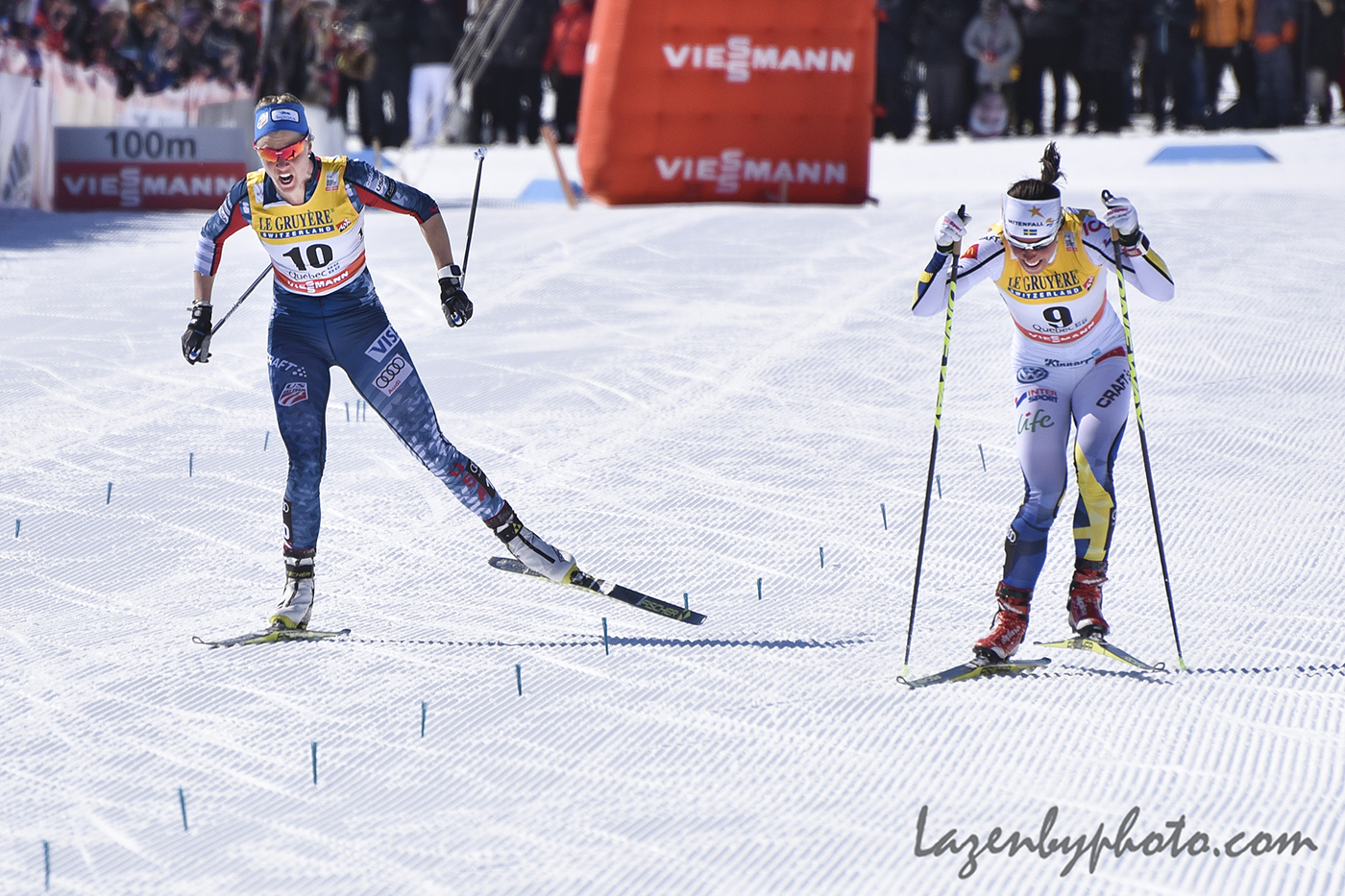
American Sadie Bjornsen (10) racing to the line with Sweden’s Charlotte Kalla (9) and Germany’s Nicole Fessel (not shown) during the women’s 10 k freestyle pursuit on Sunday at World Cup Finals. Kalla placed eighth, Fessel ninth and Bjornsen 10th. (Photo: John Lazenby/Lazenbyphoto.com)
For the U.S., Sophie Caldwell placed 36th (+4:26.1), Rosie Brennan 42nd, Caitlin Patterson 43rd, Chelsea Holmes 45th, Julia Kern 46th, Kaitlynn Miller 52nd, Liz Guiney 53rd, Becca Rorabaugh 54th, Erika Flowers 56th, and Jennie Bender 60th.
“Sadie’s skating has reached a new level this season,” U.S. Ski Team Head Coach Chris Grover said, according to a team press release. “Jessie also had a measure of redemption leading a train of women and moving up four places in the standings today. Rookie Julia Kern continued to impress, staying in front of the chasing group for the entire race and winning the sprint at the end.
“We are very proud of the American effort this weekend — athletes, club coaches and U.S. Ski Team staff,” he continued. “We had some great races but, of course, were left wanting a bit more.”
The U.S. Ski Team will finish out its season in Fairbanks, Alaska, with the SuperTour Finals next week, March 27-April 2. Most Canadians are traveling to Canmore for Canadian Ski Nationals, which started Sunday and extend through this Saturday.
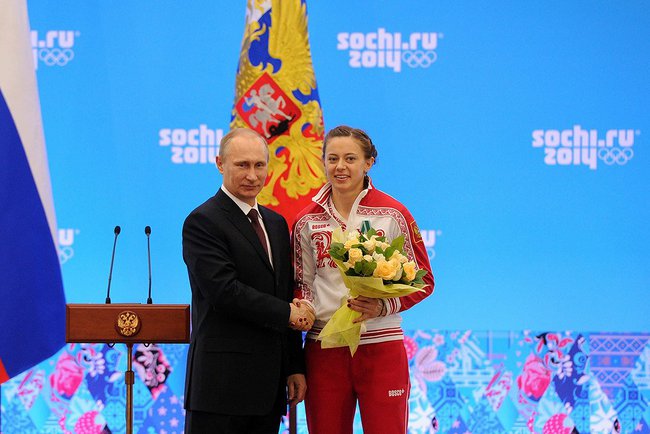
Russian President Vladimir Putin with biathlete Olga Vilukhina on February 24, 2014. (Photo: www.kremlin.ru/Creative Commons)
After an Executive Board meeting today to discuss doping in Russia, the International Biathlon Union (IBU) has provisionally suspended two athletes. The federation opened anti-doping investigations into 29 more.
Meanwhile, the Russian Biathlon Union voluntarily gave up their hosting rights for two events: 2017 Youth and Junior World Championships, slated for Ostrov, and a World Cup stage slated for Tyumen.
Two Suspensions from the 30+ Cases
The IOC has jurisdiction over all anti-doping activity at Olympic Games. That means that any samples collected between Jan. 31 and Feb. 22, 2014 which tested positive for banned substances or showed signs of tampering are the responsibility of the IOC rather than a relevant international sports federation like the IBU.
The IBU noted in its press release that the IOC had opened proceedings against two athletes. The press release did not name the two athletes, but noted that the IBU would suspend them.
Meanwhile, Norway’s NRK broadcaster is reporting that the two athletes were medalists in Sochi. That leaves nine possibilities. Evgeny Garanichev won bronze in the 20 k individual, and Olga Vilukhina silver in the 7.5 k sprint. Vilukhina was joined by Olga Zaitseva, Yana Romanova, and Ekaterina Glazyrina for silver in the women’s relay. And Alexey Volkov, Dmitry Malyshko, Evgeny Ustiugov, and Anton Shipulin won gold in the men’s relay.
At least four biathletes appeared to have “protected” status at the 2014 Games, according to evidence files from the McLaren report. One of those athletes, Romanova, had sample bottles with marks that seem to indicating tampering.
In addition, the IBU is opening investigations into 29 more athletes mentioned in the McLaren report.
The IBU will notify both the athletes and the Russian Biathlon Union. Both entities can comment on the allegations. At the same time, a working group formed by the IBU will continue to investigate. Then the working group will decide whether the case needs to be referred to an Anti-Doping Hearing Panel, which will ultimately decide whether suspensions are required.
The IBU noted only that they would set a deadline for receiving comments from the affected athletes. But otherwise, they did not specify a timeframe for the investigations. Because World Cup racing resumes January 5, 2017, in Oberhof, Germany — just 14 days from today — that means that if any of the 29 biathletes are competing on the World Cup, they will likely continue to do so.
Many in Russia, and outside, were pleased with the decision.
“A balanced decision has been taken,” Deputy Prime Minister Vitaly Mutko told the TASS news agency. “It gives an opportunity to make conclusions in an unhurried manner, not the ones based on the abstract statements or conclusions of just one person… I’m confident our federation will show the majority of athletes [who misused doping] have already been punished.”
The IBU press release noted that in only one case was an athlete already suspended for the same positive test that was noted in the McLaren report.
Several athletes had positive tests explicitly mentioned in different evidence documents. In at least five cases, anti-doping staff reported positive results as negative ones in the World Anti-Doping Agency’s test management database. As a result, the athletes never served suspensions for their violations. One such case occurred at an IBU Cup competition in Ostrov in 2013.
Alexander Tikhonov, a board member of the Russian Biathlon Union and a former Olympic champion, lauded IBU President Anders Besseberg.
“Well, biathlon is not affected,” he told sports.ru. “A positive decision.Besseberg showed that he is our man.”
Russia Gives Up on Hosting Two 2017 Events
Momentum has been growing for an international boycott of biathlon events in Russia. The Czech Republic and Britain led the way by declaring that they would not compete in Russia until the country had a clean bill of health from anti-doping authorities. The Norwegian Biathlon Association expressed support for this position.
Ultimately, such a move will not be necessary. The IBU mentioned in their press release that the Russian Biathlon Union has given up the two events.
“Under the circumstances, [RBU] considers it impossible to conduct the Biathlon World Cup and Junior World Championship, to be held in Tyumen and Ostrov respectively…Determining the place for these activities is up to the IBU,” the Russian Biathlon Union wrote on its website. “The competition should take place in an atmosphere of celebration, and not among suspicions and rumors.”
The IBU has yet to decide where they will be moved to.
“The relocation of both … events will be decided upon later,” the IBU said.
“This is a first important step by the Russian Biathlon Union to show to the IBU and to the world of sport that the current situation is taken very seriously,” Besseberg said, according to the press release. “This will now allow the international biathlon family to focus on biathlon during these events.”
Some in Russia are still upset about the boycott threat.
“These calls for boycotts should entail punishments for athletes,” Mutko told TASS. He elaborated that he thought those advocating for a boycott were in violation of the Olympic Charter.
Athlete Reactions
Some international athletes have also reacted to the decisions.
Punishing the fans instead of real culprits… What a sanction… 👎🏼
Anna Bogaliy-Titovets, who won relay gold with Russia in 2006 and 2010 and now competes for South Korea, had a more nuanced view.
“If the Executive Bommittee IBU made such a decision it means that its members have a good reason, and evidence of Russian athletes involved in doping,” she told sports.ru. “Depriving the whole team of the right to race in international competitions would be extremely unfair.We must respect the decision in the way the IBU presented it.I do not think this is a conspiracy – the Executive Board consists of representatives from different countries. Severe punishment for no reason would not be possible.”
“The IBU has done a solid job,” Norwegian Biathlon Association President Erlend Slokvik told NRK, according to a translation. “And it is good that Russia withdraws.It’s a signal that they have understood the seriousness of the situation.”
In response to evidence of widespread doping in Russia, the Czech Biathlon Union became the first to discuss a boycott. The Czechs will not attend a World Cup stage to be held in Tyumen, Russia, in March; they have been joined by the British Biathlon Union. Several other countries say they hope that the International Biathlon Union will move the event.
But the Russian Biathlon Union put out a defiant press release denying any involvement in doping.
“It was about time that some federation came and said out loud what we are talking about behind the scenes,” Czech Biathlon Union President Jiří Hamza said in an interview with the news agency iDNES, according to a translation.
The International Biathlon Union (IBU) is being pushed to move the competitions. The dozens of doping biathletes are only part of the equation. Perhaps a bigger issue is that extensive sample manipulation and collusion occurred on Russian soil. That makes some athletes and federations reluctant to compete in Russia.
“I don’t think anybody feels safe about being there, in a country that had this high level of collusion,” U.S. Ski and Snowboard Association President and CEO Tiger Shaw told FasterSkier the day the report came out.
A few months ago, the IBU also controversially voted to award 2021 World Championships to Tyumen. The International Olympic Committee (IOC) had directed that no new competitions should be scheduled in Russia; the IBU interpreted the directive to say that the existing Tyumen bid could remain up for election.
2016 Youth and Junior World Championships, slated for Ostrov, Russia, are also part of the discussion.
If the competitions are not moved, Czech athletes will not attend them, Hamza said.
Also signing on to the boycott is the British Biathlon Union (BBU).
“The Board of the BBU made a unanimous decision over the weekend to boycott World Cup 8 in Tyumen,” BBU Secretary General Mark Goodson wrote in an email to FasterSkier.
Momentum may be building for other federations to sign on as well. A widespread boycott could push the IBU Executive Board to move the event. A similar boycott led to 2016 World Championships for bobsleigh and skeleton being stripped from Sochi, Russia.
The IBU Executive Board is meeting to discuss the McLaren report this week.
“Early this morning Tuesday, we received an Email of thanks from [Czech biathlon] and in mid-morning the Czech Republic issued an ‘Open Letter’ to the IBU and all Federations expressing even more displeasure than we had, and boycotting all events in Russia until WADA and the IOC gave their Anti-Doping Systems a clean bill of health,” Goodson wrote. “The latest news is mid-afternoon with a very supportive (of Czech) Open Letter from Norway demanding that named, proven Russian biathletes be banned with immediate effect, and that the IBU withdraw all competitions from Russia until a clean bill of health. Failure of IBU to do this will result in Norway considering a boycott of all international competitions in Russia.”
North American federations are considering their options.
“We have been discussing the issue and will make a decision Friday after the IBU makes its ruling,” Biathlon Canada High Performance Director Eric De Nys told FasterSkier. “We are of course hoping that the IBU makes the right call and pulls the World Cup from Tyumen.”
The United States is leaving the decision up to individual athletes.
“We have told our athletes that participation is up to them and that there will be no pressure for them one way or the other,” U.S. Biathlon Association President and CEO Max Cobb told FasterSkier in a text message.
Some prominent athletes have been speaking individually about the prospect of a boycott.
“It’s not like it’s only one or two [athletes],” Martin Fourcade said in an interview with Norwegian broadcaster NRK. “It’s 31, added to the 12 we had the last few years in biathlon. And I hope if my federation don’t have big enough balls to take [on] the problem, the athletes do it on their own… If nothing is done in January, I will ask my colleagues in the international teams – I mean Norway, I mean Germany, Czech Republic, all of the nations – to don’t compete.”
“Due to the current atmosphere in the media landscape on the matter of 31 Russian biathletes, suspected of using prohibited substances, RBU considers it necessary to issue the following statement.
In the course of several years, RBU has consistently pursued a policy of zero tolerance for doping. This is confirmed both by strict compliance of all Team Russia biathletes with the requirements of WADA and their due availability for control by WADA and other accredited organizations along with active collaboration of RBU with these organizations in the field of promotion of clean sport. Clear evidence of mentioned above – the official statistics of WADA concerning the number of doping tests taken in biathlon in 2014.
Starting spring’14, after the election of the new top management of the Russian biathlon Union, this cooperation has become even more intense.
Within the idea of zero tolerance for doping RBU held more than 10 seminars for athletes and coaches inviting representatives of national and international anti-doping organizations. All persons who had ever been involved or had been under suspicion of any connection with the use of prohibited substances were banned for life. In the course of internal tests at national competitions all the athletes who didn’t comply with strict requirements of RBU were caught and severely punished.
Another proof of zero tolerance for doping is the fact of cooperation of RBU with the foreign experts, such as Ricco Gross and Wolfgang Pichler, who would never agree to jeopardize their reputation.
We do not know the names of the athletes from the list that will be discussed by our respected colleagues from IBU on Thursday, December 22nd. However, we are ready to provide comprehensive information about any RBU athlete ever to participate in the biathlon Events. We admit that the majority of persons from this list are those who have already been accused of violation of doping rules by the RUSADA and RBU internal doping control and are currently disqualified or finished their career.”
Pichler is a German who came to prominence coaching the Swedish biathlon team and Magdalena Forsberg in particular. An outspoken opponent of doping, Pichler was hired to coach the Russian women’s team from 2012-2014. He has now returned to the Swedish team.
Within the Russian national team there were two training squads, with Pichler heading one of them. He said as early as the Sochi Olympics that he suspected there was doping within the other training group, headed by Vladimir Korolkevich. He had even tried to leave his post early due to concerns about doping.
But Pichler has maintained that his own athletes were clean. The report sheds doubt on that assertion. At least two of Pichler’s athletes – Olga Zaitseva and Yana Romanova – were on the “protected list” in Sochi. One of Romanova’s urine samples also showed signs of being tampered with by anti-doping officials. And more of his athletes may be among the 31 who were referred to only by alpha-numeric code identifiers in the report.
“I know relatively little about what happened there,” he said in an interview with German broadcaster ZDF in early December. “I have only been a coach there for one year. It is being discussed, that much is clear. It does put pressure on the athletes, that they are being pointed at. I believe it’s not only a Russian problem, it is a worldwide problem which has to be tackled… I am experiencing a lot of support, also by [the Russian Biathlon Union], because they also want clean and fair sport. So at that moment it is sad when you are being pointed at again. They are following my line, if someone cheats he’ll be kicked out.”
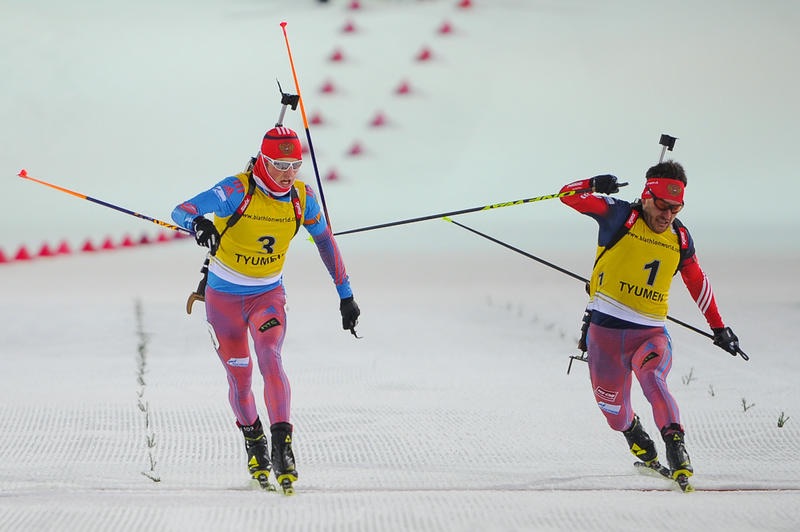
Russia’s Anton Babikov lunges across the line ahead of teammate Evgeniy Garanichev in the men’s pursuit race at the 2016 Open European Championships in Tyumen, Russia. The venue just won the hosting rights for 2021 World Championships. (Photo: IBU)
Note: In an interview with the Associated Press which was published the day after this story, IBU President Anders Besseberg suggested that if Russian biathletes’ anti-doping samples from the Sochi Olympics came back positive during the re-testing process, Tyumen’s hosting rights for World Championships 2021 could be revoked.
In July, the McLaren report dropped and the world learned that Russia had implemented a systematic doping program before the 2014 Winter Olympics in Sochi, Russia.
Then, there had been a parallel systematic program to cover it up, directed by Russia’s Ministry of Sport and its state security service. That had led to the infiltration of the International Olympic Committee (IOC) on-site anti-doping laboratory.
In the wake of the scandal, the IOC Executive Board suggested several guidelines for how to handle Russian winter sports. Among them was a call on “all International Olympic Winter Sports Federations to freeze their preparations for major events in Russia, such as World Championships, World Cups or other major international competitions under their responsibility, and to actively look for alternative organisers.”
And yet, over the weekend the International Biathlon Union (IBU) Congress, which includes 49 possible voting countries, voted to award 2021 World Championships to Tyumen, Russia. The venue in western Siberia will also host World Cup competitions in March 2017, and 2017 Youth and Junior World Championships in Ostrov, Russia, are also moving ahead as planned.
And the IOC did not object. What changed?
“Not only was it surprising, but it was also shocking that [Tyumen] got 25 votes,” Bernd Eisenbichler, chief of sport for the U.S. Biathlon Association (USBA) and the voting representative for the U.S. at the Congress, said in an interview on Tuesday. “I want to state that it is wrong. It is a very disappointing outcome of the vote.”
“It is a country that is under investigation and the IOC has in fact warned against giving new events to the country — that half of the delegates don’t understand what this means for the young international biathletes is disappointing,” Erlend Slokvik, president of the Norwegian Biathlon Federation, told his country’s NRK television station.
Public vs. private attitudes on Russia
Apparently, while stating one thing publicly – that plans for major competitions in Russia should be frozen – the IOC was telling winter sports federations something different.
A still from the candidature video of Tyumen, Russia, which won the hosting rights for 2021 Biathlon World Championships. The International Olympic Committee had previously recommended that no major competitions be awarded to Russia until it comes into compliance with the WADA Code.
“The IOC will not hesitate to take the toughest sanctions available against any individual or organisation implicated,” IOC President Thomas Bach said in July after learning about Russia’s widespread doping at the 2014 Olympics.
Once amongst its stakeholders, the IOC seems to sing a different tune, one which could hardly be described as the “toughest sanctions available.”
Last month, all seven international winter sports federations met with the IOC and World Anti-Doping Agency (WADA) in Rio de Janeiro, Brazil. All seven had competitions scheduled for Russia in 2017, and they wanted clarification about what to do.
What they got was the go-ahead to continue working with Russian organizing committees.
“They said, all competitions given to Russia which are taking place this winter, they should go on as planned,” IBU President Anders Besseberg told FasterSkier on the phone Tuesday. “This is what the IOC Sport Director clearly stated. About awarding them new competitions, the answer was also very clear. When they applied for this bidding process and it was in progress [before the McLaren report dropped], then this should also go the normal way.”
Secretary General of the International Ski Federation (FIS), Sarah Lewis confirmed this account of events in an email to FasterSkier.
Unlike competitions slated for this winter, 2021 is a long way off. World Championships easily could have gone somewhere else. Although the bid process was already started and Tyumen had filed its candidacy before the McLaren report came out, there were two other cities bidding, Nove Mesto in the Czech Republic and Pokljuka in Slovenia.
“There were three very correct candidates,” Besseberg said. “And there was a vote.”
When asked about how Tyumen had won the election given the ongoing discussion of sanctions, Besseberg objected.
“I am not the right person to ask,” he said. “It’s the Congress who is the highest authority in the IBU, it is the delegates in the Congress.”
Who voted for Tyumen?
And so, what did the delegates think?
In his remarks to the Congress at its opening, Besseberg explained that Tyumen’s candidacy was not against any IOC guidelines. That caused a stir.
Germany’s Florian Graf competing in the men’s 15-kilometer mass start at the 2016 Open European Championships in Tyumen, Russia, on his way to winning the gold medal. (Photo: IBU)
“This was very surprising because there was no official statement by either the IBU or the IOC before the congress,” Eisenbichler said. “I discussed with a few friends in other federations about this topic. I got the sense that we were pretty much in agreement.”
Regardless of IOC rules, some feel that biathlon and cross-country skiing should be especially wary of Russia, since they were acutely stung by the allegations in the McLaren report. That investigation implicated 10 biathletes and 13 cross-country skiers.
“The McLaren report is very clear and detailed about what happened in Sochi and mentions biathlon explicitly as one of the sports,” Eisenbichler wrote in an email. “As long as there are not clear signs, facts and proof about different future behavior, it is not time to have Russia get awarded a Biathlon World Championships.”
There has been no news on re-testing of the anti-doping samples in Sochi, and no revelation of which athletes might have been involved.
Clearly, however, there are two lines of thinking on the matter. There are those, like Eisenbichler and Norway’s Erlend Slokvik, who would never vote for Tyumen.
“The IOC letter, I disagree that the IOC took this step after [previously] declaring that the competitions should be frozen and should not be further planned on,” Eisenbichler said. “I’m not in favor of it. So that did not change anything, that I would vote for it or not.”
Murray Wiley, the president of Biathlon Canada, could not be reached for comment, but Canada’s national-team coach Roddy Ward said he was disappointed with the decision.
“Back here in Canada, we have been discussing where they would move [the Tyumen World Cup weekend] to this winter, given our assumption it must be moved after the McLaren report,” Ward wrote in an email. “After all, how can we race in Russia when that has come to light? However, not only does [the World Cup] remain but the IBU has now rewarded Russia with WCH2021!! This is a massive slap in the face to clean athletes.”
But then there are those who would vote for it.
“Western Europe understands that this is not good for the younger international biathletes,” Slokvik told NRK. “There are many nations that are distraught … It’s the small nations from Asia and the old East block that voted for Tyumen.”
Either way, minds appeared to be made up. After his presentation on the new IOC recommendations, Besseberg said he had welcomed discussion.
“They were asked if they had any questions about it and there was not a single question,” Besseberg said.
What now?
Eisenbichler had little doubt that the Tyumen organizing committee would do a good job with the championships.
The venue hosted 2016 Open European Championships, and although neither the U.S. nor Canada attended (nor a number of other countries), reports from those who did compete were positive. Tyumen also hosts a Champions show race, so many top competitors have been there for the cash-rich prize money. Simon and Martin Fourcade of France both tweeted their support for Tyumen along with Antholz, Italy, which was awarded 2020 World Championships.
The local organization is not what concerns Eisenbichler, who heads the U.S. national team along with domestic development.
“Hopefully the future will be showing us that Russia does a different job than they did in Sochi,” he said. “But the McLaren report is very clear. I just think that now, with all the news that we got from the report, it’s the wrong signal to the sports world, to the fans, to the youth athletes, to all the athletes who are fighting for clean sports, that it’s a very wrong signal to reward them right now with that event.”
The biathlon world is also waiting for the other shoe to drop, to find out whether or which of the Russian stars had doped in 2014.
“The McLaren report showed systematic doping in Sochi, with Russian biathlon and x-c implicated,” Ward wrote. “I have been waiting to hear from the IBU how they would respond to the report and I hoped it would be by throwing their weight behind clean sport and punishing Russia… The IBU have made it very clear now that Russia is above anti-doping, that they can get away with anything and that what they did in Sochi totally acceptable.
“Biathlon and all Olympic sport is in a dangerous time,” Ward concluded. “We are losing all credibility. IOC and IBU need to take a strong stand against doping and with the decision to award Russia with [World Championships] they have done the exact opposite.”