From the FasterSkier archive — posts syndicated from athletes’ and coaches’ own blogs between 2004 and 2012, kept online as published. Current coverage is at fasterskier.com.

Tag: U-23 Championships

  • Otep-What? Who-ffman? FasterSkier’s Guide to 2011 U-23’s and World Juniors

    Otep-What? Who-ffman? FasterSkier’s Guide to 2011 U-23’s and World Juniors

    The U.S. Ski Team's wax room in Otepaa, Estonia, the site of the 2011 World Junior and U-23 Championships.

    For U.S. ski fans, this year’s World Junior and U-23 Championships, which begin Wednesday in Estonia, have the potential to be pretty sweet.

    On paper, the American squad is as good as any from the last five years, and deeper, too. No fewer than five of its athletes will go on to compete at the World Ski Championships in Oslo later this winter.

    With Estonia experiencing one of its best winters in years, and two Olympic medalists among the competitors, there’s no doubt that the next week will see some thrilling racing.

    But unless you were a geography major, you’re probably still stuck on that first sentence—where the heck is Estonia?

    How do you get there? And why did someone decide that it was the best place to host these races? Below, we offer a quick primer on everything you need to know.

    The Basics

    Estonia is one of the three Baltic countries, along with Lithuania and Latvia. On a map, it’s the one directly underneath Finland, and left of Russia.

    While the country has spent a good chunk of its history under Russian control, its inhabitants identify more closely with the Finns, who live just 50 miles away, across the Gulf of Finland. Among other things, Estonians share an affinity for saunas, as well as aspects of their language (mainly, double vowels and impenetrability), with their neighbors to the north.

    After a training camp last week in Finland, all 22 members of the American squad took a sketchy-looking ferry to Tallinn, Estonia’s capital city, on the country’s northern coast. From there, they drove three hours to get to the southeastern town of Otepaa, where the competitions are being held.

    Otepaa also hosted last weekend’s World Cup competitions, and the venue is a full-on ski mecca. It’s the home base for Estonia’s national team, whose athletes enjoy a status rivaled only that of Scandinavian and Russian skiers. After last weekend’s World Cup races, they got front-page photos and double-page spreads in Postimees, the national newspaper, and many can be seen

    A Mercedes belonging to Jaak Mae, one of the members of the Estonian ski team.

    driving through town in vehicles provided by their sponsors.

    The Tehvandi ski stadium could suffice for a minor-league baseball team, and the venue also features an immaculate press center. And, of course, the trails are wide, well-groomed, and challenging.

    The Competitions

    For the last few years, the International Ski Federation has been tinkering with the schedule for U-23’s and World Juniors, even if the event composition—a sprint, short distance races (15/10 k for U-23’s, 10/5 k for juniors), a pursuit, and a junior relay—has remained largely stable.

    This season’s schedule includes five consecutive days of competitions, alternating between juniors and U-23 athletes, before concluding on the sixth day with two different events: the junior relays and the U-23 pursuits.

    That last one should be taxing for waxers, who will have to prep as many as 24 pairs of skis: four pairs for each relay team, and classic and skate skis for up to four starters in the pursuit.

    If the service staffs have their work cut out for them, at least they’re blessed with spacious, well-ventilated wax cabins, and conditions that are forecasted to be straightforward—cool, with fresh snow, for the next few days.

    The American wax staff is led by U.S. Ski Team serviceman Randy Gibbs, and also includes University of Vermont Assistant

    The form detailing Ida Sargent's skis.

    Coach Andrew Johnson; an Estonian, Oleg Ragila; and Casey Fagerquist, who heads up the indefatigable service staff for Alaska Pacific University’s club program.

    All told, according to Fagerquist, the Americans brought between 300 and 350 pairs of skis to Europe, which are transported inside a massive rented cargo van. Testing all of those boards is a big project, since the service team isn’t familiar with each athlete’s quiver—to facilitate the process, team staff had skiers fill out forms with a brief biography of each pair.

    Who’s Here?

    With one day to go before Wednesday’s competitions—the 10/5k for juniors—the stadium was teeming with athletes, coaches, and waxers from 37 nations. (That figure also includes countries competing in analogous events for nordic combined and ski jumping.)

    All the traditional powerhouse nations are here, although Norway’s squad for U-23’s is not as competitive as in prior years—instead, many of its best young athletes elected to race at the country’s national championships this week, in hopes of securing start spots at senior World Championships.

    Two Olympic silver medalists are the headliners. Tim Tscharnke’s brilliant final leg in the team sprint in Vancouver helped secure the Germans their hardware, while a few days earlier. Alexander Panzhinskiy, a Russian, narrowly missed out on gold when his teammate Nikita Kriukov outlunged him in the finals of the individual sprint. Plenty of other athletes with Olympic World Cup experience will take to the trails in Otepaa; check FasterSkier soon for a guide to the skiers to watch.

    Gold and Silver for Russia
    Alexander Panzhinskiy (R), just missing out on gold in Vancouver.

    The Americans are led by those five World Championship team members: Ida Sargent, Noah Hoffman, Tad Elliott, Jessie Diggins, and Sadie Bjornsen. The last three are newly-minted national champions, as well.

    Making predictions for the events in Estonia is tough, since fields change every year, and minimal opportunities exist for head-to-head comparisons. But there are a few benchmarks. As far as U-23’s go, both Hoffman and Sargent have raced on the World Cup this season, and their best days, just shy of the top 30, should leave them in contention for top-10 results here.

    Earlier this month, Sargent was struggling to race to her potential while still recovering from injuries she sustained in a car accident in December, but in e-mail to FasterSkier on Tuesday, she said she’d experienced a “huge improvement” since then.

    Elliott and Bjornsen have both proven themselves to be at a similar level domestically, and while neither has popped a big international result, both know their way around Europe. Bjornsen is on her sixth World Junior/U-23’s trip, while Elliott travels frequently as a professional mountain biker. Top 10’s should be within reach for both—especially for Elliott, since both distance races include skating, his stronger technique.

    “I’m pumped on the 15 k skate,” he said on Tuesday. “A lot of big hills out there—a lot of powerful V2.”

    As far as juniors, Diggins has chops in both distance and sprint, and after her stellar results in the fall and at U.S. Nationals—which included a win in the skate sprint, and a fourth in the 10 k classic—a top five doesn’t seem out of the question. Skyler Davis and Erik Bjornsen both had great finishes in the classic sprint at U.S. Nationals, as well, while Scott Patterson was on fire at the SuperTour in Lake Placid.

    Canada's Alex Harvey will be a favorite in the men's 30 k pursuit.

    Could the American squad produce a medal? It’s tough to say. But team leader Matt Whitcomb has been on the last several U-23 and World Junior trips, and he didn’t rule it out.

    “We have some guns on this team, absolutely,” he said. “It in no way means that we’ll get those medals, but…you can look at our list and say ‘wow—each of these groups has at least one skier that could be well inside the top 10, and several more, in some cases.”

    The U.S. team will be very competitive, but they’re not the only ones from North America with a shot at the podium. Canadian star Alex Harvey will fly in to contest a single race in Otepaa, the 30 k pursuit on January 31st, where he’ll be the favorite to win. And coming off a strong fall of international racing, including a 17th place in a World Cup sprint in Switzerland, Len Valjas has his sights set on the U-23 classic sprint final, according to Godfrey Bilodeau, one of the Canadian coaches. It’s the only event Valjas will race here, and he’ll have plenty of motivation after finishing 31st, just .02 seconds out of the heats, in last weekend’s World Cup here.

    As for juniors, Heidi Widmer and Patrick Stewart-Jones should be competitive in the sprint, Bilodeau said, while Andy Shields could crack the top 15 in the distance races.

  • What Happens To Successful World Junior Racers?

    What Happens To Successful World Junior Racers?

    Identifying talent in endurance athletics at a young age can be a challenging task.  My goal in this article is to give you a sense of what different levels of success at WJC/U23s might indicate and how much variability there is between athletes in this respect.

    Our basic tool will be a graph of FIS points versus age for distance results, broken down by their best result (finishing place) at WJC/U23s.  This gives us a total of eight panels representing the men and women whose best results were between 1-5, 6-10, etc.  If you’re in the 1-5 group, that means your best result at any WJC/U23’s was between 1st and 5th.  For each group, I’ve plotted their FIS points (in distance races) versus age.  Each dot represents one race by one athlete.  The blue trend lines are for everyone in that panel.  The red lines are for only the American’s in that panel.

    If an athlete’s name appears next to one of the red lines, that means they are the only American appearing in that panel.  Otherwise, the trend lines are averaging over multiple athletes.  These graphs are fairly large, so you might want to click on them for a larger version.

    There’s a lot of interesting stuff going on here.  Let’s ignore the Americans for a moment and just look at the blue trend lines.  We’d expect the 1-5 group to have the most future success overall, and that is the case.  (More dots near the bottom.)  As we move right to the 6-10, 11-15 and 16-20 groups the cloud of points mostly creeps upwards, but less so by the time we’re comparing the 11-15 and 16-20 groups.

    We might also expect the trend lines in the groups to flatten sooner and at a higher level as we move rightward.  This would correspond to skiers who see less success at WJC/U23s not improving as much or leaving the sport earlier, or both.  This kind of happens, but with some weird caveats.  The men seem to follow this pattern until we get to the 16-20 group.  Why do the 16-20 athletes continue to improve past age 23 where the 11-15 athletes don’t?  The answer is likely our old friend, selection bias.

    Success in ski racing serves as kind of a signaling mechanism as to whether you should continue racing.  Skiers who’s top WJC/U23 result is between 16-20 are more likely to stop pursuing an international racing career as their results have signaled that they won’t be successful.  The only ones who do continue are the ones who beat the odds and see some measure of success.

    Another interesting aspect of these data is the evident plateau effect between ages 20-23.  Notice how many of the blue trend lines flatten out suddenly at these ages.  More so with the women, but we see it in the 11-15 and 16-20 groups for the men as well.  What might be causing this?  My best guess is that it’s another artifact of selection bias.

    My guess would be that the ages 20-23 are crucial for deciding whether you’re going to be a successful international ski racer.  Athletes steadily improve up to that point and then have a decision to make.  Do I continue racing or hang up my skis and go to school, get a job, get married, have kids, etc.?  The plateau in the trend lines come from those athletes that stop improving between those ages.  These athletes are likely to stop pursuing a serious racing career (or at least many of them do).  The ones who continue are, by necessity, the skiers who end up achieving some measure of success.

    That’s why we often see this dramatic improvement from ages 16-20, a plateau from 20-23, and then continued improvement from 24 on.  It’s important to realize that this doesn’t mean that if you somehow push through ages 20-23 regardless of how much success you’re having, that somehow you’ll magically get faster simply by passing the age of 23.  The trend lines simply reflect the individual decision different athletes are making about their likely future success.  I’d guess that a similar plateau effect is happening in the men’s 1-5 and 6-10 panels, but we don’t see it because it’s happening to a much smaller fraction of the athletes, so the trend line isn’t picking it up.

    Now let’s look at what’s going on with the Americans.  Kris Freeman, Rob Whitney and Noah Hoffman are the only Americans in the men’s 1-5, 6-10 and 11-15 panels, respectively.  Each of the other red trend lines are based upon multiple athletes.  For example, the red trend line in the women’s 1-5 panel is based upon Liz Stephen and Morgan Arritola.  The truly bizarre looking red trend line in the women’s 6-10 panel is based upon Kikkan Randall, Nicole DeYong, Taz Mannix and Kristina Trygstad-Saari.  Both Randall and DeYong have significantly improved their distance results of late, which accounts for the line bending down suddenly past age 25.

    Kris Freeman has been more or less “typical” for those athletes achieving a top result at WJC/U23s.  Rob Whitney had a very promising beginning, relative to his peers, but encountered some serious difficulties around age 22-23.  Noah Hoffman seems to be tracking the trend for his peers, or perhaps a bit better.

    The most important thing I want to emphasize in these data is how variable they are.  Generally speaking, of course, it’s better to have good results (not just at WJCs, all the time!).  But if anything, this graph indicates just how crude a predictor WJC/U23s can be for future success on the World Cup.  There are plenty of athletes who’ve landed top results at WJCs but haven’t gone on to do much else.  Conversely, there are plenty of skiers who never cracked the top 15 at WJCs but ended up having a very long and successful career.  There are, as in the rest of life, many different paths to success.

    Be sure to check out StatisticalSkier.com over the next week or so, as I’ll be posting versions of this graph featuring athletes from nations other than the US.

  • Romanian Runs Away With U-23 Men’s Pursuit; Elliot Leads but Fades to 21st

    Romanian Runs Away With U-23 Men’s Pursuit; Elliot Leads but Fades to 21st

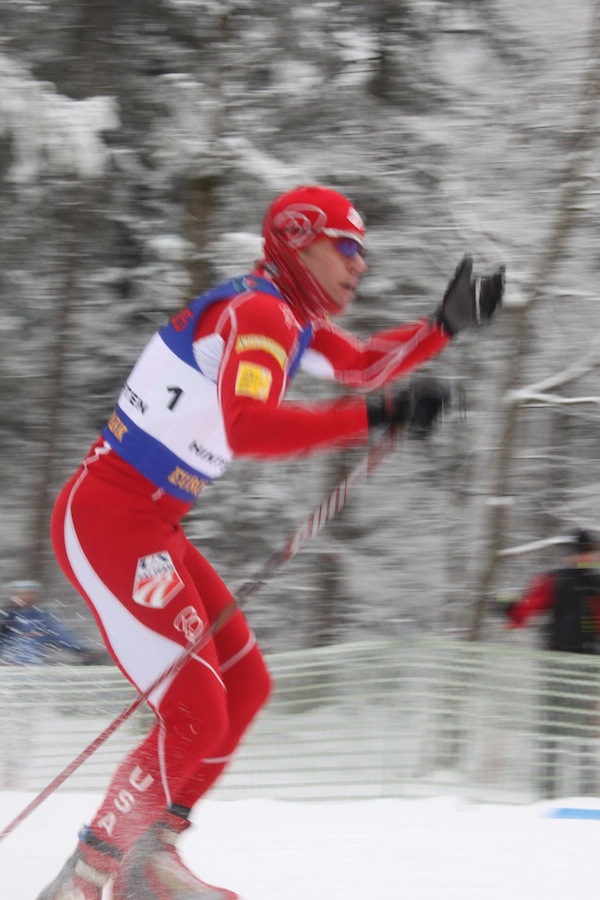
    Paul Constantine Pepene of Romania making his race-winning move on the second of four skate laps. Tad Elliot is in the red suit directly behind Pepene, with Andreas Katz (GER) on the far left.
    Paul Constantine Pepene of Romania making his race-winning move on the second of four skate laps. Tad Elliot is in the red suit directly behind Pepene, with Andreas Katz (GER) on the far left.

    After Petr Sedov’s domination of the junior 20k pursuit here yesterday, it seemed unlikely that anyone would be able to outdo that performance in the 30k U-23 version today.

    Enter Paul Constantin Pepene of Romania.

    As a dense, 30-skier group made its way up the course’s big climb on its sixth of eight laps, Pepene put in a huge acceleration—the biggest that second-place Ole Marius Bach said he had ever seen.

    Using a quirky skate technique–-which he said was ingrained by learning to ski on Romania’s poorly-groomed trails—Pepene was able to fend off a furiously-chasing pack led by Andreas Katz (GER) and Tad Elliot.

    He built up a big lead over the next two laps, crossing the finish line 25 seconds in front of Ole Marius Bach (NOR) and Katz despite a lengthy victory celebration—and he looked like he could have skated another eight laps.

    Elliot found himself in the mix after a relatively slow and tactical start to the race. A professional mountain biker during the off season, Elliot prefers skating, so he was happy to see a brief snow squall slowing down the leaders during the classic leg–he actually came into the stadium for the transition leading the race.

    For the first two 3.75k skate loops, Elliot sat at the front, and was in good position to respond when Pepene made his move. He went with Katz and a few others to try to close the gap, but the Romanian was too strong, and the effort proved to be too much for Elliot to absorb, as he faded to 21st.

    Noah Hoffman also looked to be on course for a strong day, skiing at the front during the third of four classic laps. He said the didn’t wasn’t trying to push the pace, but that with such a touchy pack behind him—Hoffman said the classic leg was like “bumper cars” with everyone jockeying for position—he didn’t want to give up his place at the front. He said he wasn’t sure what happened during the skate leg, or where he lost contact with the lead group, but he was well behind by the middle of the first skate lap.

    Two Canadians, Frederic Touchette and Graeme Killick, rounded out a strong day for their country by finishing sixth and seventh, following Brittany Webster’s eighth place in the women’s race. Killick said that he made the lead chase group that formed behind Pepene, but that he was slowed by cramps over the last two laps. Touchette edged him in a sprint at the line.

    Both of the other Canadian starters made the top-20—Kevin Sandau and Len Valjas were 13th and 16th, respectively.

    Peter Kling and Reese Hanneman of the U.S. battled hard to stay ahead of Pepene on their seventh of eight laps. It appeared that they had succeeded, as they still had a 30-second gap on him coming through the stadium to head out on their final loop, but officials pulled the racers anyway.

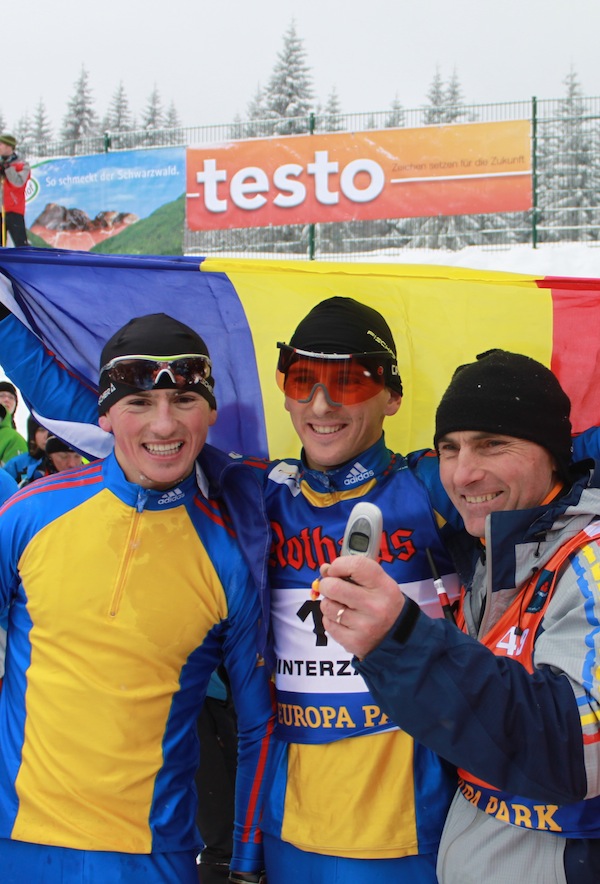
    Pepene’s win was the second Romanian podium in as many days. He said that his country had been helped by a recent infusion of money into their ski federation ahead of the European Youth Olympics that will be held their in 2013, and that there that there’s a strong group of juniors in the

    Pepene with his coach and one of his teammates after the finish
    Pepene with his coach and one of his teammates after the finish

    pipeline.

    “I believe the world will hear of us,” Pepene said in the press conference, still wrapped in the Romanian flag he’d donned at the finish.

    Like Sedov, Pepene is headed to Whistler to compete in the 2010 Winter Olympics, where he said his goal is a top-30.

  • Hard Luck Hamilton Loses Grip in Quarters; Norwegian Wins U-23 Skate Sprint

    Hard Luck Hamilton Loses Grip in Quarters; Norwegian Wins U-23 Skate Sprint

    Simi Hamilton gestures to fans for a pole after losing his grip in the U-23 skate sprint
    Simi Hamilton gestures to fans for a pole after losing his grip in the U-23 skate sprint

    After a mishap in a race in Canada, Simi Hamilton said that he secured the grips on his Swix Stars with “about a pound” of glue. It still wasn’t enough.

    Leading his heat through the initial downhill in the U-23 skate sprint today, a Norwegian skied over one of Hamilton’s baskets as he came out of a tuck. The grip came off, and the whole pack went by.

    Hamilton was left screaming at the fans on the right side of the trail for a new pole, and he finally grabbed one from an unsuspecting Russian woman who was looking the other way. But by then it was far too late.

    Hamilton frantically putting on a borrowed pole while the rest of the heat skis away.
    Hamilton frantically putting on a borrowed pole while the rest of the heat skis away.

    “I thought that I had learned my lesson and put on a ton of glue last fall when I was building my poles up,” said Hamilton afterwards. “I had a good qualifier, which I’m really psyched about…It just sucks that [the mishap] had to happen here.”

    Martin Jaeger (SUI) looked dominant after Hamilton’s exit, and he appeared to have the A-final under wraps until Ole-Marius Bach, a lanky Norwegian, managed to get around him coming into the finishing stretch. Andrei Parfenov (RUS) took bronze.

    Peter Kling was the only other American in the heats, and he failed to advance. He said that the racing was aggressive on the slick course here, and that the Europeans “don’t mess around.”

    “But we can ski with them,” he said. Kling said that he was dropped midway through his heat, but that a crash ahead of him gave him a chance to get back in the race.

    “I just needed another hundred meters,” he said.

    A nervous starter added to the stress—Hamilton’s quarterfinal had a false start, which he said took the wind out of his sails, and one of the semifinals had three. The jury reigned it in after that, though, reinstating all of the disqualified athletes and running the heat with all six.

    For Hamilton, the pole problems were made all the more painful by the fact that course was so short and fast, which seemed like it should suit him.

    He won the qualifier by a full second, which U.S. U-23 Head Coach Pat Casey said was significant.

    “To win the prelim by a second on a course where bib number makes such a difference [with lane choices for the heats]—everyone was gunning for bib number one,” he said. “For him to dominate it like that…it’s like an exclamation point.”

    Losing out in the quarters was a “bummer” for Hamilton, but “every time he does a sprint, though, he learns something,” Casey said.

    Hamilton will be racing in the 15k classic on Tuesday, and then it will be back to North American for the sprint in Canmore. He said that he hopes to travel back to Europe later this winter for some continental cup racing.

    Reese Hanneman was the next-best American finisher after Kling, finishing 34th, just half a second out of the heats. Patrick Johnson was another 1.5 seconds back, in 39th.

    Canada’s Len Valjas made the B-final, placing third.

    The U-23 championships continue on Thursday with the 10/15k classic, while the juniors are back in action tomorrow with a 5/10k in the same discipline.

  • Sargent Sprints to Fourth at U-23’s; Finnish Biathlete Skis Away With Title

    Sargent Sprints to Fourth at U-23’s; Finnish Biathlete Skis Away With Title

    Mari Laukkanen (l) leads Ida Sargent (second from left) in their semifinal heat at the U-23 Championships
    Mari Laukkanen (l) leads Ida Sargent (second from left) in their semifinal heat at the U-23 Championships

    When Simi Hamilton lost a pole and was bounced from his quarterfinal heat, it was up to Ida Sargent to salvage the American hopes in the U-23 skate sprint. She didn’t disappoint.

    After qualifying in fourth, Sargent advanced easily through the quarters and semis, faltering only midway through the A-final. After some bad luck and tactical errors by the Americans over the last two days, you could almost hear the sigh of relief from her coaches and teammates.

    “Before that A-final, I thought Ida could win that thing,” said Pat Casey, head coach of the American U-23 squad. “I talked to her about it, and she thought she could win that thing, too.”

    Sargent was “unbeatable” off the line all day, Casey said, and the final was no different—she was in front headed into the first corner before Mari Laukkanen (FIN) got by. But on the way up the last big climb, she started running out of gas, and Denise Herrmann (GER) and Kathrine Rolsted Harsem (NOR) snuck past.

    Laukkanen was well clear of the group by the finish, but Sargent was still close with the others as the group entered the stadium. She just couldn’t quite match the pace at the finish.

    “I got a little tired on the second hill, so I lost some time there,” she said, “but I was able to pull it together…I feel like I’m right in there, so it was a really fun day.”

    Ida Sargent (l) chases Mari Laukkanen
    Ida Sargent (l) chases Mari Laukkanen

    Laukkanen won the qualifier by over a second, then proceeded to sweep every heat en route to her victory, improving on her third place finish in last year’s U-23 classic sprint in France.

    Laukkanen actually focuses on biathlon, and she said that her goal for the winter had been to qualify for the Finnish Olympic Team. She didn’t seem too overwhelmed by the win, already whipping out her cell phone just five minutes after the finals.

    Laukkanen did have good things to say about Sargent though, noting that the American was right on her heels in their semifinal.

    “It’s not surprising,” she said of Sargent. “In sprint, there’s always been a couple of very good [American women].”

    None of the three other American women made it out of the quarters. Both Rosie Brennan and Sadie Bjornsen were third in their heats, but neither advanced as lucky losers. Becca Rorabaugh found herself in the snow after getting tangled up on the first climb.

    It was clear that Sargent’s finish today gave the rest of her team a big lift, as Hamilton, Rorabaugh, and Peter Kling were all sprinting back and forth across the course during the finals to cheer her on.

    “We were hopeful yesterday that we could get that boost,” Casey said. “Coming in last night talking to the U-23 guys, I basically just told them…to break down those limitations and to know that any one of them could be world champions. And I think a couple of them demonstrated today that we weren’t far off of that.”

  • Hamilton Wins U-23 Sprint Qualifier; Sargent 4th as All Four Women Make Heats

    Hamilton Wins U-23 Sprint Qualifier; Sargent 4th as All Four Women Make Heats

    Simi Hamilton on his way to winning qualifying at the U-23 Championships
    Simi Hamilton on his way to winning qualifying at the U-23 Championships

    He’s the real deal.

    That’s what U.S. Ski Team Development Coach Matt Whitcomb said this morning about Simi Hamilton, after the skate sprint national champ took first place in the qualifying round of the same event here in Hinterzarten.

    After some drizzle overnight, the race trails at the Notschrei Nordic Center were covered with a thin icy crust this morning, which made for some slick skiing and a fast qualifying round—Hamilton’s time was around 2:20.

    Peter Kling also snuck into the rounds, finishing somewhere in the high twenties, while Reese Hanneman was the second Alaskan in two days to finish just out of the heats, just a few places out.

    Peter Kling racing at the U-23 Championships in Hinterzarten, Germany
    Peter Kling racing at the U-23 Championships in Hinterzarten, Germany

    On the women’s side, all four U.S. entrants skied into the heats, led by Ida Sargent in fourth, two and a half seconds behind Mari Laukkanen of Finland. Sadie Bjornsen followed in 13th, with Rosie Brennan 16th and Becca Rorabaugh in 19th.

    For both genders here, there are fewer entrants contesting today’s race than at the junior level yesterday. Yesterday’s men’s field was around 100 racers, while only some 60 men started today, and were just 41 women started.

    According to Whitcomb, many of the world’s best U-23 athletes are competing on the World Cup. But he said that the top of the field is still competitive, and to break into the top ten should still be considered a strong result.

    Ida Sargent on her way to fourth place in the U-23 skate sprint qualifier
    Ida Sargent on her way to fourth place in the U-23 skate sprint qualifier

    Click here for a quick video with Hamilton, and click here for a summary of the Canadian chances today, with one of the team’s coaches, Eric Bailey.

    Check back later today for complete coverage of the heats.

  • World Junior, U-23, and Scando Cup Teams Named

    Simi Hamilton will lead the way at the U-23 World Championships
    Simi Hamilton will lead the way at the U-23 World Championships. Photo: Stuart Jennings

    The U.S. Ski Team named its 2010 World Junior, Under 23 and Scandinavian Cup teams yesterday at the 2010 ConocoPhillips U.S. Cross Country Championships in Anchorage.

    The top two results from each athlete’s three races this week were used to determine the teams.

    The group “is peppered with some very strong skiers, some of whom will have a chance to take a swipe at a podium or top ten finish,” said Matt Whitcomb, the U.S. Ski Team’s development coach. “Simi [Hamilton] is a medal contender in the skate sprint event.”

    The World Junior and U23 Championships will be held Jan. 24-31 in Hinterzarten, Germany. The Scandinavian Cup will be held in Kuopio, Finland, Jan. 29 – 31, and represents the top U.S. athletes under the age of 17.

    “For a lot of these athletes, this will be inspiring and exciting to race in a U.S. Ski Team suit, representing the U.S. internationally,” said Matt Johnson, one of the coaches for the team.

    The Scandinavian Cup is an introductory international championship competition that brings the best young athletes from the Scandinavian nations and the United States for a series of races later this winter.

    Under 23 Team
    Elizabeth Stephen, 22 years old, pre-qualified, USST/BMA, East Montpelier, Vt.
    Ida Sargent, 21, Craftsbury Green Racing Project, Craftsbury, Vt.
    Rebecca Rorabaugh, 20, APU Nordic Ski Center, Fairbanks
    Sadie Bjornsen, 20, Methow Olympic Development Project, Mazama, Wash.
    Kate Fitzgerald, 22, APU Nordic Ski Center, Palmer
    Rosie Brennan, 21, Dartmouth Ski Team, Park City, Utah

    Noah Hoffman, pre-qualified, 20, USST/AVSC, Aspen, Colo.
    Patrick Johnson, pre-qualified, 20, Middlebury Ski Team, Anchorage
    Tad Elliott, 21, CXC Team Vertical Limit, Durango, Colo.
    Simeon Hamilton, 22, Sun Valley Ski Education Foundation, Aspen, Colo.
    Reese Hanneman, 20, Fairbanks Alaska Ski Team, Fairbanks
    Peter Kling, 22, APU Nordic Ski Center, Shelburne, Vt.

    World Junior Championships Team
    Sophie Caldwell, 19, Dartmouth Ski Team, Peru, Vt.
    Caitlin Patterson, 19, University of Vermont, Anchorage
    Anne Hart, 17, Minneapolis Ski Club, Stillwater, Minn.
    Joanne Reid, 17, University of Colorado, Palo Alto, Calif.
    Adele Espy, 19, Sun Valley Ski Education Foundation, Freeport, Maine
    Jessie Diggins, 18, coaches’ discretion, CXC Training, Afton, Minn.

    Scott Patterson, pre-qualified, 17, Alaska Winter Stars, Anchorage
    David Norris, pre-qualified, 19, Fairbanks Alaska Ski Team, Fairbanks
    Tyler Kornfield, 19, University of Alaska Fairbanks, Anchorage
    Eric Packer, 19, Dartmouth Ski Team, Anchorage
    Erik Bjornsen, 18, Methow Olympic Development Project, Mazama, Wash.
    George Cartwright, 18, Northern Michigan University, Lander, Wyo.

    Scandinavian Cup Team
    Katie Gill, 17, Bridger Ski Foundation, Bozeman, Mont.
    Kinsey Loan, 17, Alaska Nordic Racing, Eagle River
    Kate Backstrum, 17, Alaska Winter Stars, Anchorage
    Annie Liotta, 16, Alaska Winter Stars, Anchorage
    Karina Packer, 17, Alaska Winter Stars, Anchorage
    Isabel Caldwell, 17, Stratton Mountain School, Peru, Vt.

    Logan Hanneman, 16, Fairbanks Alaska Ski Team, Fairbanks
    David Sinclair, 17, Green Mountain Valley School, Waitsfield, Vt.
    Bridger Tyler, 17, Stratton Mountain School, Jamaica Pikes Falls, Vt.
    Will Wicherski, 16, Bogus Basin Nordic Team, Boise, Idaho
    Michael Vigers, 16, Boulder Nordic Racing Team, Boulder Colo.
    Austin Cobb, 17, Stratton Mountain School, Peru, Vt.