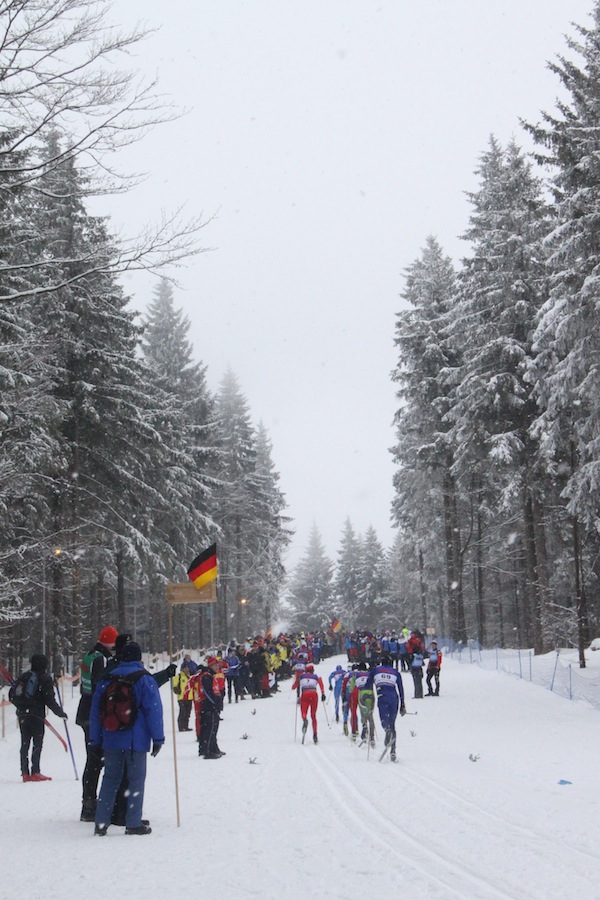
Tag: U-23 World Championships

  • Kris Freeman Retires Leaving a Legacy of Belief and Titles

    Kris Freeman Retires Leaving a Legacy of Belief and Titles

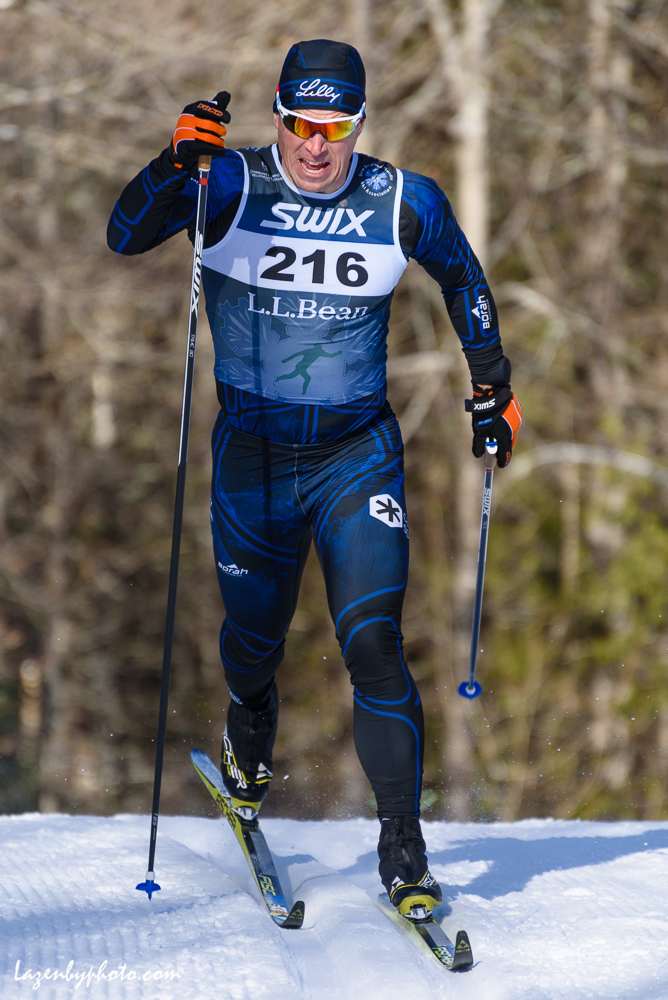
    Kris Freeman (Caldwell Sport) racing to 11th in the SuperTour classic sprint qualifier on Feb. 26 in Craftsbury, Vermont. He went on to place fourth in the final, and two days later, he was fourth in the 10 k freestyle there. (Photo: John Lazenby/Lazenbyphoto.com)

    Chew on this for a minute: who stands as the greatest male U.S. distance skier in the “modern” era (defined by post-Bill Koch) of World Cup skiing?

    Most likely at the top of that list would be 37-year-old Kris Freeman. 

    The New Hampshire native and longtime Granite State resident retired as a professional cross-country skier after this year’s U.S. Distance Nationals 50-kilometer classic race in late March in Craftsbury, Vermont. Freeman finished seventh in that race. A few days earlier, he placed fourth in the 1.3 k classic sprint, which was part of SuperTour Finals, also in Craftsbury.

    “It was a very weird feeling to finish the 50 k in Craftsbury and pack up my skis and be like I am not going to race next year,” Freeman said during a phone call on April 3. “I got home and I have a three-bedroom home. One of the bedrooms is entirely dedicated to my ski stuff, and I am like, I should probably do something else with this room right now. It was a strange feeling.”

    (Freeman and his wife, Amber, have about four months to re-purpose the ski gear room for a nursery. The couple is expecting their first baby in September.)
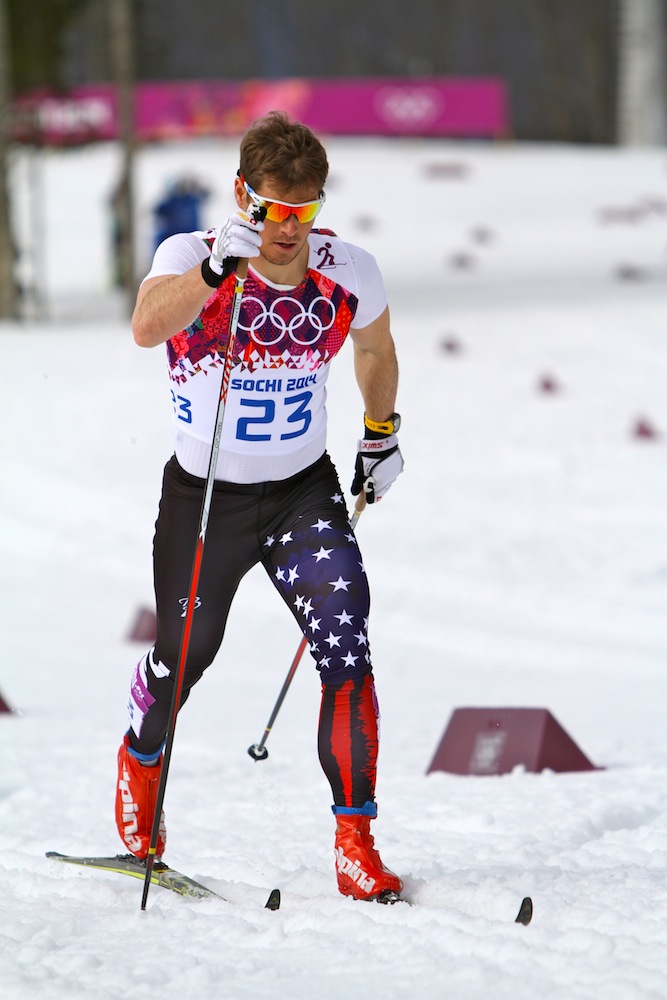
    Kris Freeman skiing in the Sochi Olympics 15 k classic.

    1980. That’s Freeman’s birth year. His nearly 40 trips around the sun don’t make him ancient in terms of athletic relevance on the national stage. It makes him a reminder of one athlete’s incredible longevity and focus. Freeman has never been in it to just finish.

    He raced to win. That maxim held going into his final pro race, not as a sentimental notion, but as podium potential fact. No sane skier lining up with up Freeman could discount the force with “Team Freebird” sublimated on his lycrad backside.

    First, the disappointment. Freeman did not qualify for his fifth Olympic team this year.

    “I knew going in, two years ago or three years ago, that I was past the peak of my performance,” Freeman said. “I knew that I was losing a little bit each year. 2011 was my best season. I believe I was 31 that year, and I held that fitness together for another year and a half, and it has been slowly losing a little bit each year. After Sochi, I said I am going to take it a year at a time. What happened was I was enjoying what I was doing. I love ski racing.”

    That year-by-year plan took Freeman to the cusp of qualifying for PyeongChang this past January. By his own estimation, had he skied 0.8 seconds faster in the U.S. nationals 30 k classic in Anchorage, Alaska, and edged out Eric Packer for second place, the 2018 Olympics would have been a possibility. Freeman was fourth overall and the third American in the 30 k. It is still conjecture, but second place in that race would have positioned Freeman for a potential fifth Olympic berth as a distance-skier selection*. (*For the logic behind that reasoning, see OWG section at end of this article.)

    “I knew it wasn’t a guarantee that I would make the team, and I was damn close to making it,” Freeman reflected. “I was able to put together probably the best race of my year in Anchorage in that 30 k. I came up a half a second short. I don’t have any regrets extending my career another four years. I enjoyed it.”

    Long before coming up a half-second short, Freeman’s quest for podiums and championship-team selection, more often than not, bore fruit. At U.S. nationals alone, he won 17 championship titles (see sidebar), placed second four times and third five times. Between 2006 and 2016, he won 15 SuperTour races and reached the podium eight other times in second or third place. That stat is more impressive considering Freeman didn’t race a single SuperTour between Jan. 4, 2007 and March 29, 2011.

    Freeman’s National Titles:

    1. Soldier Hollow 2000: 30 k classic

    2-3. Rumford 2003: 15 k classic, 30 k classic

    4-5 Soldier Hollow 2006: 15 k classic, 30 k skiathlon

    6. Fort Kent 2006: 50 k classic*

    7-8. Houghton 2007: 10 k skate, 15 k classic

    9-10. Presque Isle 2007: 30 k skiathlon, 50 k skate*

    11-12. Anchorage 2009: 10 k skate, classic sprint

    13. Anchorage 2010: 15 k skate

    14. Sun Valley 2011: 50 k classic*

    15. Craftsbury 2012: 50 k skate*

    16. Tahoe 2013: 50 k classic*

    17. Houghton 2015: 30 k classic

    * = Spring Series/U.S. Distance Nationals

    His first national championship was in 2000 in the 30 k classic. (Freeman placed third overall but was the best placed American). At the 2001 national champs, Freeman proved he’d remain on the podium scene. He was third in a freestyle sprint. Two days later he was second in the 10 k classic. Freeman lost to first-place skier Justin Wadsworth. Otherwise, the 21-year-old Freeman defeated a legacy-rich field, which included his older brother, Justin Freeman. Ultimately, Freeman’s span of distance dominance lasted 16 years at the senior level.

    Internationally, Freeman still sets the high-water mark standard for male distance skiers. He won the 30 k classic at the inaugural U23 World Championships in 2003. He raced at four consecutive Olympics stretching from Salt Lake City in 2002 to Sochi in 2014. His best results were a 22nd place in Salt Lake’s 15 k classic, and 14th in the 20 k skiathlon and 2oth in the 15 k classic, both at the 2006 Torino Games.

    Freeman raced on the U.S. Ski Team (USST) from 2002 to 2013. On the World Cup, Freeman notched 10 individual top-10 results. His best finish was a fourth place in the 15 k classic in Kuusamo, Finland, in 2009.

    He skied in eight consecutive World Championships. At 2003 World Championships in Val di Fiemme, Italy, he placed fourth in the 15 k classic, 10.6 seconds out of first and 2.1 seconds from bronze. It was a repeat at the 2009 World Championships in Liberec, Czech Republic, where Freeman also placed fourth in the 15 k classic, 17.7 seconds out of first and 1.3 seconds from bronze. Such was Freeman’s form that fifth-place skier Jaak Mae of Estonia was another 13 seconds behind Freeman in that 2009 race.

    “Internationally, I think obviously winning Under-23 World Championships was just a great day,” Freeman said of his highlight international moment. “Listening to a scratchy national anthem was really cool. But at the same time, I think that the World Championships in Liberec, just the vibe that we had going on there. We had the nordic combiners sweep the wins that year, all three events. We had Lindsey Van win the ski jumping. Kikkan [Randall] was second. I was fourth. It just seemed we had a run to the podium ceremony every night. So I think Liberec was probably the highlight of my career. That place and that race.”

    As far as the belief-in-medals movement is concerned, Freeman’s performances helped seed that optimism.

    His Greatest Challenge

    And his accomplishments are even more noteworthy considering he achieved them while managing Type 1 diabetes. During his four Olympics and tenure on the World Cup, Freeman’s diabetes was the news peg that exposed him to a broader audience. Since his diagnosis at age 20, he faced the challenges of regulating his blood sugar while competing amongst the world’s most fit athletes.
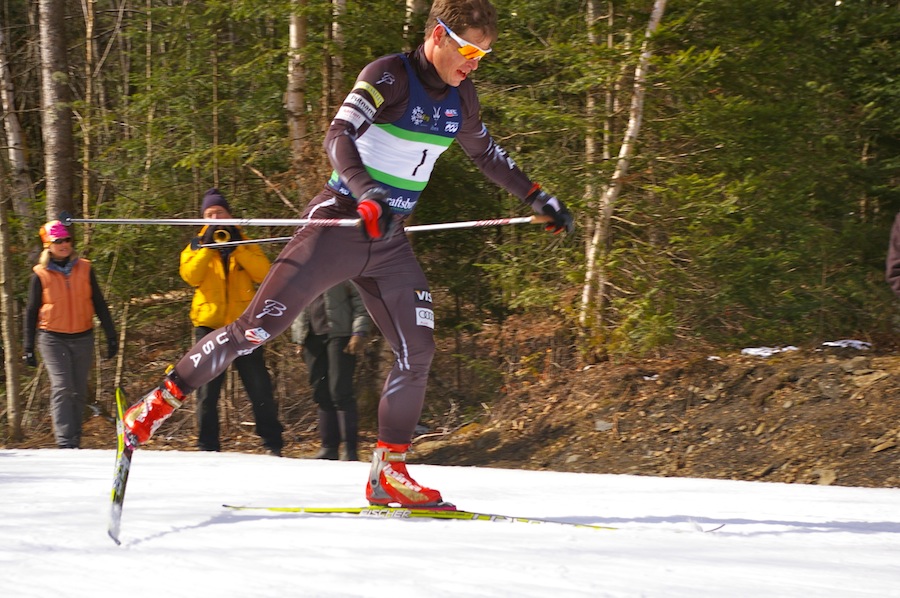
    Kris Freeman on his way to claiming the 2012 US Distance Nationals 50 k freestyle title in Craftsbury, Vt.

    “I had to be pretty resilient to disappointment because there are a lot of factors that go into ski racing,” Freeman explained about his race-day realities. “You’ve got to be fit. You’ve got to have good skis. You’ve got to get the wax right. And on top of that, I had blood-sugar management, and blood sugar is impacted by just about every hormone in your body, especially stress hormones. So when you are under stress they get even more complicated as you try to pinpoint how much insulin to give yourself.”

    In the 30 k pursuit (now called the skiathlon) at the 2010 Olympics, Freeman miscalculated his blood-sugar requirements. The result was a literal hypoglycemic collapse that saw Freeman seeking a quick infusion of sugar before he continued racing. This stark anecdote reflects something that never makes the International Ski Federation’s (FIS) official results: the everyday emotional and physical stress diabetes had on Freeman. His result in that race, 45th place, tells the bare bones story: that 44 other skiers beat him. That would be judging a book by its cover.

    inhalers online

    Forty-fifth place isn’t the story.  

    In 2010, FasterSkier penned a comprehensive article on the lengths Freeman went to bring some normalcy to his training and racing. Zeroing in on the moving bullseye of his race-day blood sugar levels would have sunk most athletes and their support staff. As his primary coach for the bulk of his career, Zach Caldwell, who owns a business dedicated to ski flexes and wax combos, was also fixated on helping Freeman find the perfect recipe of low pre-race stress and dialed blood sugar.
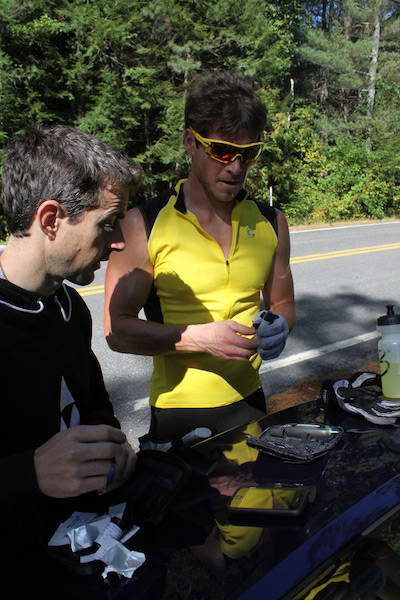
    Zach Caldwell (l) with Kris Freeman getting blood to measure sugar and lactate levels.

    With the benefit of Caldwell’s and Freeman’s fastidiousness, Freeman’s career will be a case study for other diabetic endurance athletes. The simple documentation of his attempts at athletic normalcy is a significant legacy for diabetics in any endurance sport’s pipeline. 

    Asked if he could have replicated his storied career without diabetes, Freeman was quick to state that would be a “wasteful exercise”.   

    “I have had diabetes for so long now I cannot separate what would I be without it,” Freeman said. “I honestly don’t know and it’s a question I don’t try to answer. Would it have been an easier road for me? Absolutely. Would I have stayed with skiing as long as I did? I don’t know. Over time, I became more comfortable talking about some of the real difficulty of it or how it really has impacted certain races or certain seasons or certain aspects of my life. I think for a long time I was just scared of having diabetes and doing what I was doing, and that can close you off.”

    From the K-90 to the Olympics

    Freeman can be terse in his comments. He’s also forthright in his racing style — he’s more inclined to do the intimidating than being intimidated.

    “I am not going to blame all of my cocky behavior on having diabetes,” Freeman clarified. “But, for sure, being cocky is a defense mechanism. It can also be deliberate intimidation, which I am just as guilty of. But, I think, over time, having diabetes has just taught me that being open with people around you and honest with yourself is the key to success in anything.”

    Success began early for Freeman. To his core, Freeman is a cross-country skier. He became aware of that at a young age in Andover, New Hampshire. There, Freeman participated in the nordic-skiing and nordic-combined programs Proctor Academy offered to its students and Andover residents like Freeman.

    Kris Freeman (c), Jed Hinkley (left), and Carl Van Loan (right) in a 1999 photo from the FIS World Junior Championships in Austria. (Photo: courtesy Proctor Academy)

    From the age of 5 or 6, Freeman was going head to head with future nordic combined Olympians Jed Hinkley and Carl Van Loan, who also trained with the Proctor Academy program.

    “We were intensely competitive with each other,” Freeman said of his duels with Hinkley and Van Loan. “So for sure, being in a competitive and well-supported program right from the get-go was huge.”

    Freeman competed in multiple sports as an adolescent.

    “But in the back of my head it was always cross-country skiing that was the most important,” Freeman said of his true passion. “I could win a soccer trophy or a ski-jumping meet, but if I was fifth in that cross-country race, I was going to be pissed off. I needed success there because that is what I identified with.”

    Freeman explained that his last jump as a nordic combiner was after he turned 16. He jumped off the K-90 in Lake Placid, New York, and realized he was afraid while he noted his competitor, Billy Demong, seemed to be having fun high up on the jump tower.

    Freeman’s identification with cross-country skiing took him to the University of Vermont, where he studied and skied during his freshman year. This is around the time Freeman formalized his relationship with Caldwell. Freeman recalled telling Caldwell he wanted to be an Olympian and asking Caldwell how this could happen.

    “I don’t think it’s going to happen,” is how Freeman recalls Caldwell’s staid response. After impressing Caldwell with a tortuous double-pole workout, Caldwell and Freeman paired up. Freeman decided to forgo college and dedicate his energy on training with the USST. 

    While Freeman plans on taking a year or two away from the sport in his retirement, he eventually plans to coach nordic skiers. Freeman said he’ll bring to his coaching the blunt honesty and humility he learned from Caldwell.

    “One thing I always liked about Zach is that when I screw up he tells me, and when he screws up he tells me,” Freeman said. “There is no ego, and there are no protecting feelings.”

    Freeman also mentioned that he’ll bring to his future coaching the power to make athletes believe in their process. In terms of future plans, in the short term, he’s weighing his options and talking to his sponsors. Eventually, he’d like to write a book.

    “When I have been at my most successful is when I have had a support team that makes me believe that what I am doing is right,” he said. “Whether it is or not, they cover my back once things don’t go great, and they just continually believe that what I am doing is the right thing to do. And that psychology makes you believe that you are doing the right thing. Because I have done the exact same training under different coaches and been told that I was doing things great and that I was doing things terribly, and it was the feedback I received that really affected my performance. That applies to more than just sport, but in life, too.”
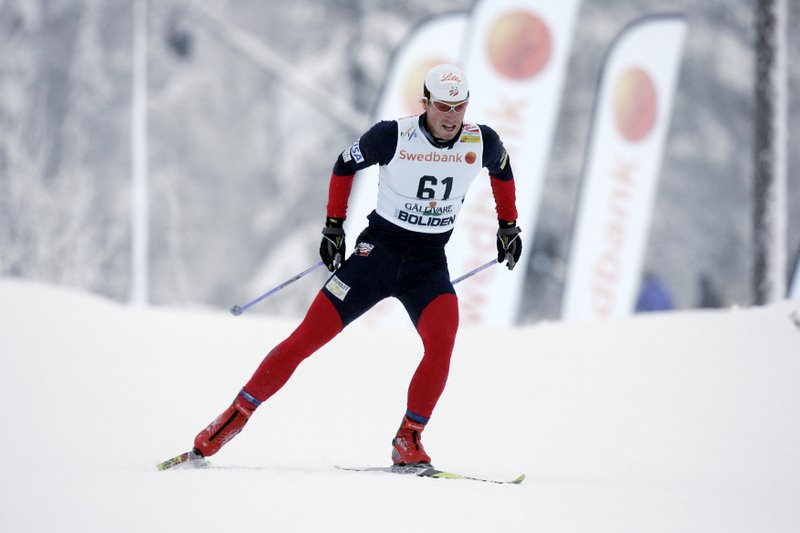
    Kris Freeman racing a 15 k freestyle at the 2008 World Cup in Gällivare, Sweden. (Photo: Fischer/NordicFocus)

    In an Olympic year when Randall and Jessie Diggins cleared the gold-medal hurdle, Freeman explained he wasn’t surprised with the result, just simply relieved. Not being surprised speaks volumes to how far U.S. cross-country skiing has come.

    Freeman, however, came of age as an elite skier during the 42-year-long Olympic medal drought bookended by Koch’s silver and the Randall-Diggins gold.    

    “As a dreamer back in 1997 versus a dreamer now in cross-country skiing, it is a lot easier and more realistic to dream about medals,” he reflected. “You would hear about these Norwegians that skied so fast and they are just this amazing force. Now, they are still really good, but they are beatable. I wonder what it would be like to be a skier growing up now compared to a skier growing up then.”

    Current skiers like Diggins and U.S. women’s coach Matt Whitcomb frequently espouse the power of belief. The current crop of USST athletes are well-trained and certainly better supported than in the past. (wax truck, anybody?). There are now plenty of World Cup podiums and a handful of championship medals worth their weight in belief.

    Freeman is confident. No athlete gets as far as he has without it. Yet, Freeman never brought up on his own that he deserves any credit for why U.S. skiers should have belief.       

    “Are you a reason skiers have belief?” this reporter asked 48 minutes into the interview.

    “I hope that I am,” Freeman said without any hint of hubris. “I certainly came to believe that I could be one of the best in the world in skiing. I cannot say that when I was 16 that I really thought that I was going to be fighting for a medal at the World Championships. At that point, I was hoping to get to the World Championships and put up a good show.”

    Freeman’s professional skiing show ends having inspired a generation of nordic skiers. And he’ll continue to inspire countless diabetic children who know him as a groundbreaker.

    *Freeman and the Olympic Winter Games (OWG) Points List
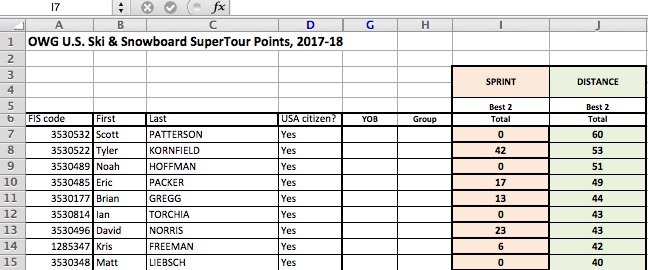
    Men’s OWG points scoring list. This list was in part used to determine the 2018 U.S. Olympic Cross-Country Team. (Screenshot from Excel spreadsheet)

    Disclaimer: this is a mental exercise to illustrate Freeman’s point that he was close to making the 2018 Olympic team. We all know that if Freeman had different results, any of the leaders could have had different results, too.

    For argument’s sake, had Freemen skied 0.8 seconds faster and finished second in the men’s 30 k classic at this year’s nationals, he would have received 35 points. Packer placed second in that race and received the 35 point-allotment. Freeman placed fourth, receiving 26 points as the third Amercian. On the OWG list, Freeman was eighth, with a combined 42 points from his two best distance finishes between the SuperTour and U.S. nationals.

    Had Freeman placed second and nailed down those 35 points, that would have given him 51 points total, and tied him for third on the OWG list with Noah Hoffman. As tie-breakers go, both Hoffman and Freeman would have had a 2nd at U.S. nationals with bonus points and a 5th place. The first tie-breaker would have been each athlete’s third-place result. Hoffman, having skied period 1 on the World Cup, had no domestic third place result. By default, Freeman would have been third on the list.

  • From Snow to Software to Snow Again, Osgood New Men’s Coach at Dartmouth

    From Snow to Software to Snow Again, Osgood New Men’s Coach at Dartmouth

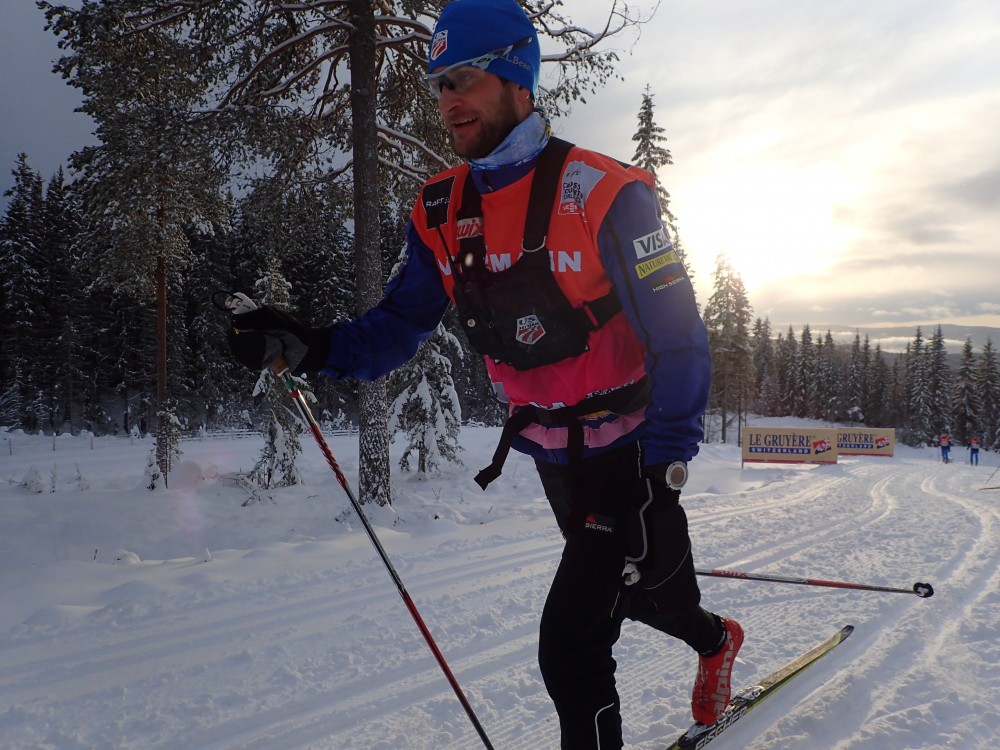
    Brayton Osgood, Dartmouth's new men's nordic head coach, testing skis during Period I of last World Cup season. (Courtesy photo)
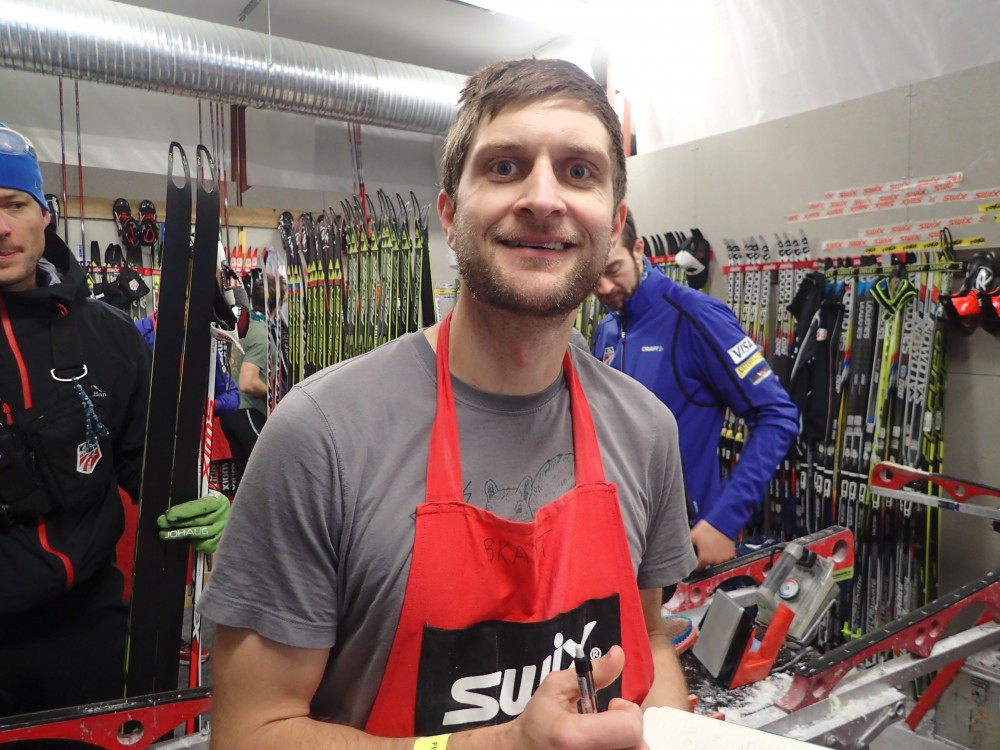
    Brayton Osgood, Dartmouth’s new men’s nordic head coach and a former NCAA All-American, testing skis for the U.S. Ski Team during Period I of the 2015/2016 World Cup last season. (Courtesy photo)

    Sitting before the lurid glow of a computer screen, scrolling through codes and functions does not exactly conjure up images of snow, skis and fitness fanatics. However, a logged training hour, timed kilometer split or monitored heart rate are all indispensable numbers to improving nordic performance. For eight years, these ordinals were the opus of Brayton Osgood’s work.

    A math wiz — he graduated cum laude from Dartmouth College with a degree in mathematics and earned his master’s in business and accounting from Northeastern University — Osgood spent just under a decade perfecting a computer software known as Athletic Management Platform (AMP) for a company called AMP Sport. The program, designed to help coaches decipher the meaning of digits in relation to an athlete’s progression in training and racing, boasts partnerships with the U.S. Ski Team, USA Triathlon and the Cleveland Cavaliers, among others. Whether it involved dribbling on a basketball court or trekking trails (snow or dirt covered), Osgood’s work gave numbers a new meaning for many athletes.

    But the electronic connection to cross-country skiing Osgood maintained through his computer could not replace the physicality he loved about the sport: the granular feel of a wax cork, the watery eye blur from breathing in the icy, mid-January air.

    A former nordic racer (he skied for Dartmouth College, where he was a two-time NCAA All-American, as well as XC Oregon, earning a World Cup distance start in 2009) and a coach (he was a Dartmouth assistant coach for the 2011/2012 season), Osgood, 35, missed being physically present at cross-country skiing events.

    Brayton Osgood, the new Dartmouth men's nordic head coach, during a mountain bike ride in Park City, Utah. (Courtesy photo)
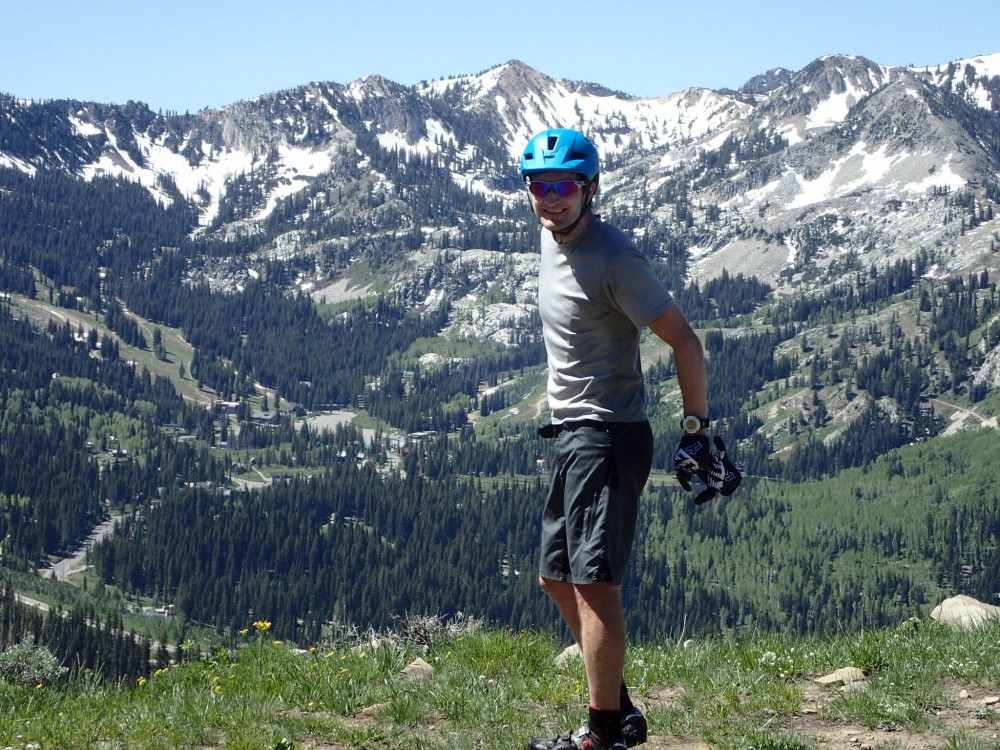
    Brayton Osgood, the new Dartmouth men’s nordic head coach, during a mountain bike ride in Park City, Utah. (Courtesy photo)

    “I was spending all of my free time in the winter and lots of vacation time making my way towards cross-country ski races so it was pretty clear to me that that’s what I wanted to be doing with my time,” he said on the phone earlier this month.

    Though he loved the math and science behind skiing, Osgood began to realize that being entrenched in skiing was where he wanted to be. He began spending more time at ski events. At the beginning of last season, he traveled to Europe to wax for the U.S. Ski Team for Period 1 of the World Cup. He also served as a coach and wax technician for the New England Junior National Ski Team last season and worked as the race-data manager for the New England Nordic Ski Association (NENSA) from 2012 to 2016. Then in March, when the men’s head-coach position for the Dartmouth nordic ski team opened up, he applied.

    “I was excited to apply for this job specifically because it was at Dartmouth,” Osgood, a native of Putney, Vt., wrote in an email. “The Dartmouth Ski Team has been very important in my life, first as a student-athlete, and more recently inspiring my desire to coach.”

    After much anticipation, Osgood discovered in early May that he had been chosen as the new leader for the Big Green men’s team. He had his first team meeting with half a dozen athletes and his co-coach, Cami Thompson-Graves, prior to Memorial Day weekend and officially started on June 22. While he’s no nordic newbie, Osgood explained that writing training plans for large groups of athletes will be one of the biggest challenges for him as he takes over the reins from Dartmouth’s longtime men’s coach for the last 27 years, Ruff Patterson.

    “I’m really lucky and fortunate to have Cami [Thompson-Graves] as a resource,” Osgood said of Dartmouth’s director of skiing and women’s head coach. “We’ve already started meeting and talking about what she’s done and I’m going to spend a fair amount of time as I get started, talking with the current and hopefully some past Dartmouth skiers just about what has worked for them and where we can experiment and change.”

    Though Osgood has been mentored by Thompson-Graves as an athlete and assistant, this upcoming season will mark his first experience working alongside her.

    Brayton Osgood, Dartmouth College's new men's nordic head coach, working behind the scenes for the U.S. Ski Team on the World Cup early last season. (Courtesy photo)
    Brayton Osgood, Dartmouth College’s new men’s nordic head coach, working behind the scenes for the U.S. Ski Team on the World Cup early last season. (Courtesy photo)

    “I am very excited that Brayton will be re-joining our staff!” Thompson-Graves wrote in an email. “I think his passion for skiing and his knowledge of Dartmouth will help generate a lot of excitement with the team, and will allow him to hit the ground running as we start the new training season.”

    As the pair looks ahead to the beginning of a new season and partnership, Osgood points out that key to their success will be complementing each other as coaches. The two programs will work together to shape the future of the Division I program.

    “She has a great history of success in terms of graduating skiers that move on to the U.S. Ski Team and World Cup podiums,” Osgood said of Thompson-Graves, who’s entering her 28th season coaching at Dartmouth. “She’s done a really good job of building that team atmosphere, which I think is a key to achieving success, so I think there’s a lot I can learn from her there.”

    With the tutelage of Thompson-Graves and current and previous Dartmouth skiers, Osgood hopes to not only continue Dartmouth’s history of program success, but expand upon it.

    “Ruff has been a hugely important figure in my life and skiing,” he said. “So having the opportunity to take over for him is really exciting and a little bit daunting because it’s a great legacy he has and I would love to carry on the success that he achieved.

    “I definitely want to have a team that has All-Americans and hopefully podiums at NCAAs and a lot of skiers All-East for EISA [Eastern Intercollegiate Ski Association],” Osgood added. “Then just as important I think is to have a team that’s happy and excited to be out there skiing and racing every day that they ski … There’s going to be 12 to 15 men on that team and they can’t all race carnivals, they can’t all go to NCAAs, but I want them all to feel like they have successful winters and are achieving the goals they set or are making progress towards those goals.”

    Another aspect of the job Osgood sees as both a challenge and a chance to learn is the student side of coaching a collegiate sport.

    “At a school like Dartmouth, finals are never more than 10 weeks away,” he said. “There’s often midterms and a whole host of external factors that you need to account for when writing [a training plan]. There’s also class schedules. There are a lot of constraints to work with, but that’s going to be a new and exciting thing for me, for sure.”

  • Cockney Sixth in U-23 Sprint; Valjas Misses A-Final

    Cockney Sixth in U-23 Sprint; Valjas Misses A-Final

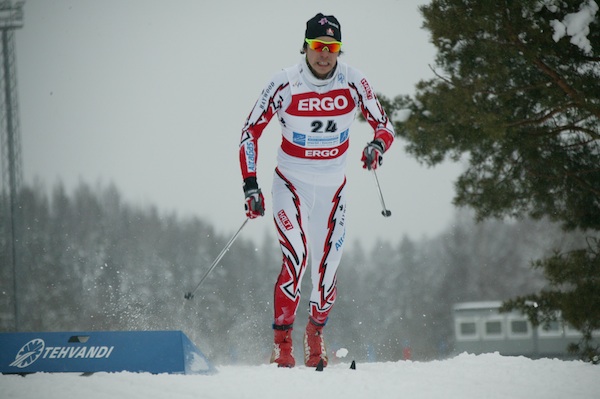
    Canada's Jessie Cockney in qualifying. Photo, Langd.se

    A mix of impressive strength, clever tactics and luck took a Canadian man all the way to the finals of Saturday’s U-23 World Championships classic sprint. It just wasn’t the one everyone expected.

    Instead of the lanky 6’6” frame of Len Valjas gunning for a medal in Otepaa, Estonia, it was the perfectly average one of Jesse Cockney, who showed in a strong outing that what he lacks in height, he makes up with ski smarts and fitness. And the way things went for him on Saturday, it wouldn’t be surprising if he has a few four-leaf clovers lining his boots, too.

    “I was pretty lucky,” he said.

    Valjas, on the other hand, was not. On a course that was all but built for him, he failed to advance past the semifinals after qualifying in second place, the victim of a slow, windblown track on the homestretch.

    With his Estonian roots, the fans were cheering for Valjas like he was one of their own. But on a blustery day in Otepaa, it made no difference, as the faster, glazed tracks to the finish line were blocked by skiers in front of him.

    “I felt good, but with the blowing snow, my only chance was on the far left coming into the finish,” he said. “There’s only one or two good lanes—even on the hill, I was going in ankle-deep, dry snow. I’m pretty disappointed right now.”

    The U.S.’s Reese Hanneman was the only other North American starter on Saturday; he was competitive in his quarterfinal, sitting in third coming into the homestretch, but faded and was eliminated, ultimately placing 24th on the day.

    How good of an outing was it for Cockney, though? Things started off on the right foot in the morning, when he was 30th in the qualifier. A mere .21-second cushion over 31st place was the difference between being the last man to qualify for the afternoon heats and the first guy out, in the race Cockney had targeted at these championships.

    “My coach said he was going to beat me up after the heats, because that’s taken a couple of years off his life, waiting for the qualifying results,” Cockney said.

    Domestically, the 21-year-old Cockney is known for being strong in the rounds, but indeed, according to the Canadian team leader, Eric de Nys, “where he does struggle, a bit, is in the qualifying.”

    “I think that will be something he’ll have to focus on next year,” de Nys said.

    In his quarterfinal, Cockney was matched up with Russia’s Alexander Panzhinskiy, the winner of qualifying, along with Czech skier Jan Barton and German Sebastian Eisenlauer, among others.

    The heat was tactical; Panzhinskiy bided his time before escaping on the homestretch with a commanding double-pole. Cockney

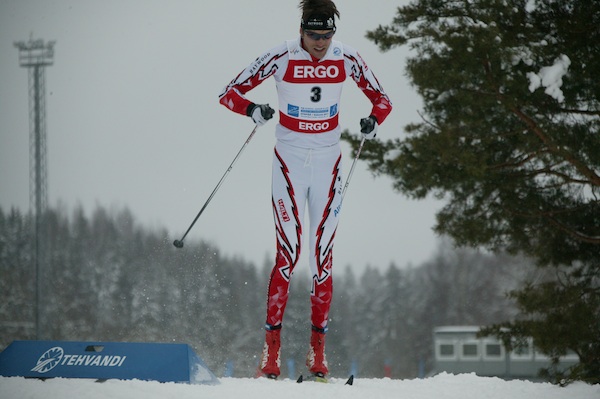
    Len Valjas in qualifying. Photo, Langd.se

    came to the top of the course’s main climb at the back of the group, but moved up on the ensuing descent into the homestretch, where he and Eisenlauer had a fierce fight for the final guaranteed spot in the semis.

    They two came to the line together, with a lunge that was too close to call and sent Cockney sprawling. Initially, the stadium announcer said that Eisenlauer had won, and Cockney was already on his way out of the finish pen when he found out that he had advanced—greeting the news with a loud exclamation that cannot be printed.

    In the semis, he had to face Panzhinskiy again, along with Estonian Karel Tammjarv, Italian Dietmar Noeckler, Swede Calle Halfvarsson, and Eisenlauer, who ended up advancing as a lucky loser.

    Cockney was at the back from the start of the heat, and finished fifth, for what seemed like the end of his day. But then, the news came through that Halfvarsson had been disqualified.

    The Swede had been one of the few men to race on skate skis on Saturday’s course, and on its two hills, he had tried to avoid the windblown powder piled up inside the tracks by climbing outside them. Video footage clearly showed one of his skis making subtle sideways pushes, which according to jury member Torbjorn Broks Pettersen was “inadequate classic technique.”

    “He accepted it,” Pettersen said. ““When you’re doing it on skate skis, you know that you will be borderline from time to time.”

    The disqualification moved Cockney up to fourth in his heat, and when the other semifinal was slower, he moved on to the finals as a lucky loser. There, Panzhinskiy unleashed his full power for the first time, and by that point, Cockney was cooked, trailing in for last in the heat.

    “I wasn’t exactly prepared for that type of speed,” he said.

    Still, Cockney said, he was happy with the result. His goal since May had been to make the A-final here, and he did, in what he said was the first set of international heats he’d raced in two years, since he was a junior.

    “I wasn’t as competitive in the A-final as I would like, but that’s for next year—hopefully I can grab a spot on that podium,” he said.

    Indeed, at 21, Cockney has another year left as a U-23, and he’ll have his shot at a medal at next year’s championships, in Turkey. Valjas, by contrast, had his last chance on Saturday.

    He was clearly, and understandably, let down at the finish line. Despite bettering his result at last year’s U-23 Championships sprint by two places, Valjas had been looking for more after a muscular start to his season on the World Cup circuit.

    On Saturday, Valjas said he felt good. He had won his quarterfinal with ease, looking every bit like the athlete who in qualifying had skied to within a half-second of Panzhinskiy, an Olympic silver medalist.

    But from the start of his semifinal, he got caught behind Norwegians Timo Andre Bakken and Magnus Moholt, who went on to take second and third overal. He was still in contact by the homestretch, but was stymied by his slower lane.

    “I felt like, if I’d had one of those good, glazed tracks…” he said, trailing off. “That sucks.”

    In retrospect, Valjas said, he needed to be in the lead coming over the course’s main climb.

    “Then you pick the good track,” he said.

    Organizers appeared to be doing everything they could to keep the tracks fast, mustering workers with brooms and even a leaf-blower to clean out the powder in the morning. In the afternoon, there were groups of forerunners were skiing the course, section-by-section, throughout the rounds, but it still wasn’t enough to keep up with Otepaa’s gusty wind.

    Third place in his heat, Valjas’s finish was still good enough for seventh, and he’ll get a few more chances at big-time events later this year, with a trip to Norway for a World Cup and the World Ski Championships on his schedule. But on Saturday, he was stuck on the sidelines watching his teammate Cockney in the finals.

    “I was standing getting ready for the A-final, and I asked [a coach] ‘Where’s Len?’ She said he didn’t make it,” Cockney said. “I’ve gotta tell you, my heart did kind of sink a little, knowing I was going to be on my own there. But that’s how it goes.”

    Men’s qualifying results. Men’s final results.

  • Valjas Takes Second in U-23 Sprint Prelim; Nine N. Americans Qualify

    Valjas Takes Second in U-23 Sprint Prelim; Nine N. Americans Qualify

    Canadian Len Valjas on his way to second in the U-23 men's sprint qualifier. (At 6'6", he's too big to fit the frame!) Photo, Langd.se.

    One year ago, it was an American, Simi Hamilton, who topped the men’s skate sprint prelim at the U-23 World Championships in Germany.

    In this season’s edition, Canada’s Len Valjas couldn’t quite match that feat, but he came darn close. In Saturday’s classic sprint qualifier in Estonia, he was second, within a half-second of Olympic silver medalist Alexander Panzhinskiy of Russia, the winner.

    The finish sets up Valjas well for a run at a medal here, since as the second qualifier, he will not have to face Panzhinskiy until the finals.

    The two were well clear of the field, with Norway’s Magnus Moholt the only man to finish less than three seconds behind.

    The sprint course in Estonia might as well be laid out for Valjas, who at 6’6” has an untouchable double-pole. The 1.4-kilometer loop has just two short climbs, and with an endless, 250-meter long finishing straight, Valjas could enter in last, “and still have a shot,” said Canadian coach Eric Bailey.

    Valjas may be the best North American hope for the heats, but he’s not the only one that will get a start in the quarterfinals. No fewer than nine Americans and Canadians qualified in the top 30, plus Britain’s Andrew Musgrave.

    American Ida Sargent, who finished 21st. Photo, Langd.se

    On the women’s side, Sadie Bjornsen (USA) led the way in 11th, seven seconds down on winner Kerttu Niskanen of Finland.

    Alysson Marshall of Canada was 14th, American Jennie Bender 18th, Canadian Emily Nishikawa 19th, Ida Sargent (USA) 21st, and Canada’s Sara Hewitt in 30th. Erin Tribe (CAN) and Becca Rorabaugh (USA) were the only North American starters not to qualify, with Tribe the second Canadian in two days stuck in the 31st spot.

    On the men’s side, Musgrave was 28th, with American Reese Hanneman 29th, and Canada’s Jesse Cockney 30th, just topping Gianluca Cologna, the brother of Swiss superstar Dario, for the last spot in the rounds.

    Despite temperatures just below freezing, wax didn’t end up being a factor—there was enough new snow mixed into the tracks to make things straightforward. Just one of the men, Austria’s Markus Bader, opted to double-pole the course, and it clearly was not an advantage. (Bader was seeded fourth, and finished 19th, clearly bogging down on the main climb.)

    The fields were small, with 56 men and 40 women. Especially on the women’s side, the depth that was present in Friday’s junior race was clearly absent.

    Hewitt, in 30th, was nearly 21 seconds down on Niskanen’s time, compared to a 10-second spread last weekend’s World Cup qualifier on the same course. Swedish sprinter Hanna Brodin, who was second to Petra Majdic in that race, appeared to be holding back a bit on Saturday, and she finished ninth.

    Things were a little tighter on the men’s side, with Panzhinskiy finishing 13 seconds up on Cockney, but that was still a 50 percent larger spread than the one from Norway’s Ola Vigen Hattestad to Switzerland’s Valerio Leccardi, the first and last qualifiers in the World Cup.

    The course, Hanneman said, favors athletes who are jacked enough to power through the long double-pole sections, but who can also stay relaxed and smooth on Otepaa’s gradual terrain, of which there is plenty.

    “Fluid and long—I think on this type of course, that’s how you’ll ski fastest. There’s nothing steep enough that you need to run, or anything like that. It skis pretty easy,” he said. “But then, in a way, it’s also hard, because there’s so much time that’s on these weird, awkward…sections. The hills are really short.”

    Women’s results.

    Men’s results.

  • Russian Phenom Sedov to Miss U-23 Championships

    Petr Sedov on his way to winning the 20k pursuit at last year's World Junior Championships in Germany.

    A familiar and dominating form will miss this year’s U-23 World Championships.

    According to the website Sports.ru, 20-year-old Russian phenom Petr Sedov is suffering from a heart problem, and will sit out next week’s races in Otepaa, Estonia.

    The World Ski Championships in Norway in February are up in the air for Sedov, as well, the report says.

    Tall and thin at 6’2” and 165 pounds, Sedov had been an imposing presence at the World Junior Championships over the past three years, collecting three individual titles and missing the podium just once in nine starts.

    After competing in the Vancouver Olympics in 2010, the 2011 season was Sedov’s first full one on the World Cup, and his results to date suggested a star on the rise.

    He was fifth in the circuit’s opening race, a 15 k freestyle in Sweden, and never finished outside the top 15 in five individual distance starts.

    According to the Sports.ru article, Sedov returned home after his final World Cup race in December and underwent routine medical tests with the rest of the Russian national team.

    An EKG apparently turned up some kind of heart problem, which has yet to be diagnosed. The Sports.ru piece says that Sedov is currently visiting experts in Europe, trying to obtain some kind of explanation.

    Had Sedov traveled to the U-23 Championships, he would have been a clear favorite in any event he entered there. But the Russian roster for that event, released on Saturday, does not include Sedov, and according to the report in Sports.ru, he will “most likely” miss the remainder of the season.

    The piece does not cite a source for its information, but nonetheless, the news spread quickly in the European ski media on Monday morning.

    Russian Eurosport commentator Andrey Kondrashov told FasterSkier in an e-mail that Sports.ru is a “quite respectable source,” but no official word from the Russian Ski Association had confirmed the news.

  • USST Seeking Coaches for World Junior/U-23 Championships

    The U.S. Ski Team is offering four coaching positions for the 2011 World Junior and U23 World Championships. All four positions are fully funded by NCCSEF. Coaches looking to apply for these positions should have experience working with athletes aged 16-22, a strong background in waxing and testing skis, and be willing to work hard for two weeks and seven races. That said, we are looking to develop coaches and welcome all applications from coaches wishing to gain new experience and willing to share their own.

    Please send a resume and brief cover letter to mwhitcomb@ussa.org by October 25th. The
    staff will be selected by November 1st.

    Selection criteria for athletes are posted at www.ussa.org – go to “Sports,” “Cross Country,”
    and then “Advancement.”

    Trip Details
    Location: Otepaa, Estonia
    Trip Dates: Jan 16 – Feb 1, 2011

    Coaching Staff:
    Head World Junior Coach: Matt Whitcomb (USST)
    Head U23 Coach: Bryan Fish (USST)
    Head Wax Tech: Randy Gibbs (USST)
    Asst. Wax Tech (NCCSEF Funded) TBA
    Coach (NCCSEF Funded): TBA
    Coach (NCCSEF Funded): TBA
    Coach (NCCSEF Funded): TBA
    Physical Therapist: TBA (USST)

    Trip Schedule:
    Depart U.S. Jan 16, arrive Helsinki, Finland Jan 17
    Pre-camp in Vierumaki, Finland Jan 17-23
    Travel to Otepaa, Estonia Jan 23

    Race Schedule:
    Jan 26 Junior 5/10 Freestyle
    Jan 27 U23 10/15 Freestyle
    Jan 28 Junior Sprint C
    Jan 29 U23 Sprint C
    Jan 30 Junior 10/20 Pursuit
    Jan 31 Junior 4 x 3.3/5 Mixed Relay and U23 15/30 Pursuit

    Event Website
    http://www.tehvandi.ee/njwsc

  • Slind Skis to Pursuit Victory in U-23 Women’s Pursuit; Webster Eighth

    Slind Skis to Pursuit Victory in U-23 Women’s Pursuit; Webster Eighth

    Larisa Shaidurova, Polina Medvedeva, and Svetlana Nikolaeva, all of Russia, lead the 15k pursuit at U-23 World Championships
    Larisa Shaidurova, Polina Medvedeva, and Svetlana Nikolaeva, all of Russia, lead the 15k pursuit at U-23 World Championships

    Halfway through the 15k women’s pursuit at the U-23 World Championships, the Russians appeared to have everything under control. Skiing three abreast on their second of four trips up the big climb here, there didn’t seem to be a way for anyone to get around their sea of blue suits.

    But when they switched to skate skis, the Russians’ grip on the race disappeared as quickly they had taken it, snatched by a pair of Norwegian women, Hilde Lauvhaug and Astrid Oeyre Slind. Working together, the two blew the race apart, and after shattering the field, Slind powered away from her teammate on the last hill to take the win. Svetlana Nikolaeva salvaged the day for the Russians by finishing third.

    After her fifth-place finish in Thursday’s classic distance race, Canada’s Brittany Webster flirted with another top-five today, making the lead group of nine when the pack split up on the third lap. She said that effort was a bit much for her, however, and after Slind and Lauvhaug got away, it was all Webster could do to keep it together to win the sprint for eighth place over Aurelie Dabudyk (FRA) and Britt Ingunn Nydal (NOR).

    “I didn’t have much left,” she said.

    Sadie Bjornsen was the top American finisher, in 26th. She was sitting 17th after the classic leg, but lost nine places during the second half of the race. Becca Rorabaugh was skiing near Bjornsen at the transition after a rough start, but she said she fell after the exchange and lost a lot of ground, leaving her in 31st place at the finish.

    Ida Sargent and Kate Fitzgerald were the two other American starters; they ended in 34th and 38th, respectively.

    In an interview with FasterSkier after the race, Slind said that the Russians’ pace during classic section was fairly tame, and that behind them the rest of the field was jockeying for position. Nikolaeva agreed, saying that she and her teammates were just trying to keep things under control.

    Astrid Oeyre Slind (l) and Hilde Lauvhaug going over the top of the final climb for the last time
    Astrid Oeyre Slind (l) and Hilde Lauvhaug going over the top of the final climb for the last time

    Towards the end of the first skate lap, Slind and Lauvhaug began stretching things out, and an initial group got away as the women went over the course’s big climb. By the last time up that hill, the two Norwegians had left everyone else behind.

    They went over the top together, and it looked like the race would come down to a drag race on the finish stretch. But there was one more hill before the pair entered the stadium, and Slind, seeing that Lauvhaug was getting “wobbly,” seized the opportunity, opening up a big gap that reached eight seconds by the finish.

    When the rest of the pack reached the top of the big climb for the last time, Japan could almost taste its first medal of the championships after three fourth-place finishes here, with Yuki Kobayashi holding a small lead over Nikolaeva as the two began their descent into the stadium. But by the time the two were over the same hill where Slind had made her move, Nikolaeva was able to sprint away from Kobayashi, and she held on for the bronze.

    Today’s races were the last for the U-23 athletes here, and tomorrow’s relay is the final event for the juniors. Check back tomorrow for coverage.

  • Skobelev Takes U-23 15k on Tough Course; Sandau 13th; Hoffman 20th

    Skobelev Takes U-23 15k on Tough Course; Sandau 13th; Hoffman 20th

    Athletes nearing the "tunnel of noise" during the 15k classic at the U-23 World Championships in Hinterzarten, Germany
    Athletes nearing the "tunnel of noise" during the 15k classic at the U-23 World Championships in Hinterzarten, Germany

    With some big climbs and minimal recovery, the 3.75k course in Hinterzarten demands some restraint and smart pacing. That’s no accident, according to Karl-Heinz Lickert, the FIS official who laid out the loop that was used in the U-23 men’s 15k.

    “We don’t want athletes who are only physically strong,” he said.

    The winner here, Vladislav Skobelev (RUS), clearly had both the brawn and brains Lickert was looking for—though he also wasn’t hurt by the snow squall that blew in just as he was finishing, slowing many of his rivals still out on course.

    Back in seventh place after the first lap, Skobelev–who rose through the field over the next three circuits to take the win by 20 seconds over his teammate, Stanislav Perliak. Gennadly Matviyenko of Kazakhstan was third, another second behind.

    Noah Hoffman led the way for the Americans in 20th, while Kevin Sandau was the top Canadian, in 13th.

    After some long-overdue warmth and sun, it was back to the same snow and fog that blanketed the first two days of competitions. The crowds, however, were not deterred. Local schools sent their teachers and students to the trails here, and like yesterday, they helped line the toughest hill on the course, along with coaches and many of the athletes who weren’t competing.

    “I was super-impressed with how many people were out there,” Hoffman said. “I’ve never skied quite through anything like that. It was just a tunnel of noise.”

    Hoffman said that he had been working on his pacing, and that today’s effort was definitely an improvement—though still not his best.

    Tad Elliot, who finished 32nd, with U.S. Coach Matt Whitcomb
    Tad Elliot, who finished 32nd, with U.S. Coach Matt Whitcomb

    It was what Lickert’s course demanded, though. While the late snow may have slowed a number of the top-ranked skiers towards the end of the race, it was still clear that the best finishers today all started very conservatively. Out of the top six finishers, only Matviyenko was ranked in top five after the first lap. In the post-race press conference, Skobelev said that he always starts conservatively, and that today he did so with the final climb in mind.

    Unlike the Russians, though, Canada’s Graeme Killick received the sharp end of Lickert’s loop. He was sitting third after 3.5k, but he faded hard, losing between seven and ten places each subsequent lap to finish 24th. He said his legs seized up on his last circuit, even though he said that he began at a pace that “I thought I could keep.”

    Lickert said that FIS courses are designed to challenge athletes in three areas: physical fitness, technical skill (like with challenging downhills), and mental resilience. Today’s placed a premium on the latter—while there’s only an average amount of climbing in each loop, “there’s nowhere you can really relax.”

    “You have to plan your race—you have to be clever and smart. This is why Petter Northug is the champion,” Lickert said, citing the Norwegian’s skill at pacing and his killer finishing kick.

    Simi Hamilton, who finished 33rd, perhaps summed it up best.

    “It wasn’t a ton of recovery, but it was just enough to let you go really hard up the hills,” he said. “So it hurt.”

    Other Americans in the race were Tad Elliot and Patrick Johnson, who finished 32nd and 52nd, respectively. Frederic Touchette and Julien Nury were the two other Canadians starters, in 19th and 47th. For complete results, click here.