Tag: U.S. Cross Country Championships

  • Wednesday Workout: Elghuffs with Britain’s Nichole Bathe and Annika Taylor

    Wednesday Workout: Elghuffs with Britain’s Nichole Bathe and Annika Taylor

    Nichole Bathe (l) and Annika Taylor, both American-born members of the British Nordic Ski Team, during a training session last fall in the Rhône-Alpes region of France. (Courtesy photo)

    This week FasterSkier presents a workout from British national ski team members Nichole Bathe and Annika Taylor. Last season, both Bathe and Taylor competed overseas on Great Britain’s national nordic team. They were interviewed on the phone last fall and email this spring.

    ***

    May. For some, it’s a month marked by caps and gowns and new beginnings. Last year, May was a month in question for Nichole Bathe. The Madison, Wisconsin, native had just graduated from the University of Alaska Fairbanks (UAF) with a degree in justice and social work. But immediately starting a nine-to-five job was not what she wanted to do.

    During the school year, she had raced for UAF’s ski team, qualifying for three NCAA Championships and finishing as the top American in fourth place as a freshman. As a senior, she qualified for U23 World Championships in Midway, Utah. A few of Bathe’s coaches suggested that she continue her cross-country career after college.

    “I had no idea what I was going to do at graduation in May,” said Bathe, now 23. “But I was always wondering what it would be like to focus on skiing as a whole, instead of having school in the way of that.”
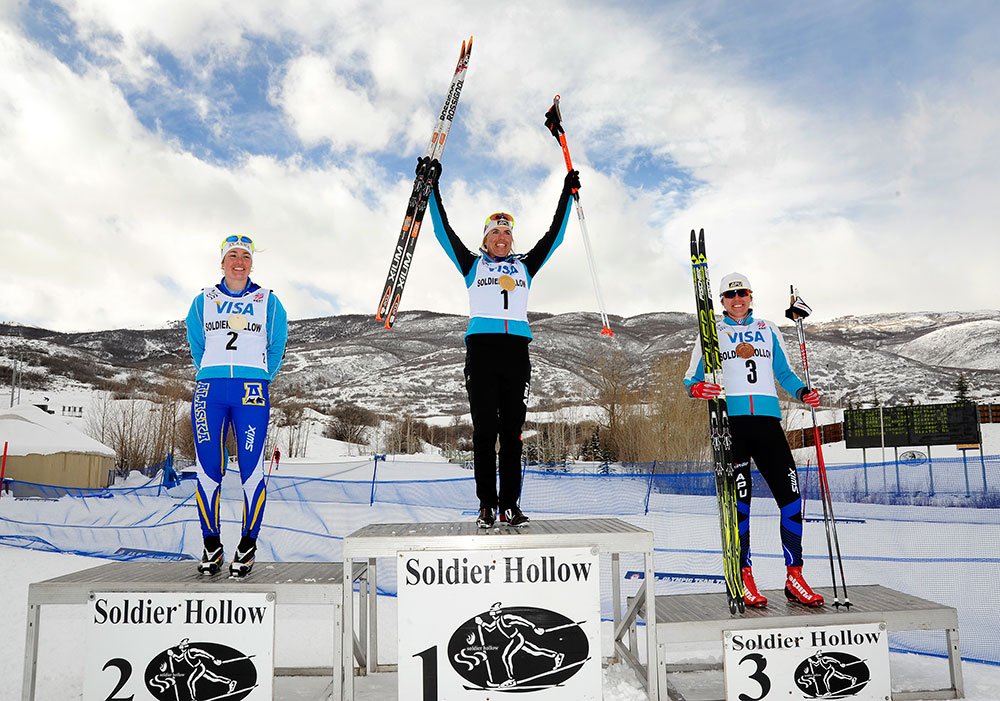
    Nichole Bathe of the University of Alaska Fairbanks (l) as the second American in the classic sprint at 2014 U.S. nationals at Soldier Hollow in Midway, Utah. Rosie Brennan (c) finished first and Becca Rorabaugh (APU) placed third. (Photo: Tom Kelly/U.S. Ski Team)

    By June of last year, Bathe made a phone a call. The recipient was Annika Taylor.

    Taylor presented a unique situation in nordic sport. After growing up in Truckee, California, and graduating from the University of New Hampshire (UNH) with a chemistry degree in 2015, Taylor — a dual citizen – moved to Europe to ski for Great Britain’s national team, which is based in Lillehammer, Norway. (Taylor holds one passport through the United Kingdom and one through the United States, thanks to her father who is originally from the U.K.)  

    Bathe contacted Taylor because she shared a similarly unique family background. Both of Bathe’s parents hail from Britain, and since she was born in the U.S., Bathe is an American citizen.

    If Bathe wanted, she could apply for dual citizenship and follow Taylor’s path, moving to Norway to ski for Britain. (Bathe only needed one of her parents to hold a valid British passport order to apply. Not all countries permit individuals to become dual citizens; the Czech Republic and Estonia, for example, require individuals to rescind one).

    In their conversation together, Bathe asked Taylor about the logistics of moving to Europe. Taylor was reflective in her advice. She encouraged Bathe take into consideration not just the training she hoped to receive, but also the lifestyle changes she would have to make.

    “When you move to a new country, you get challenged as a person,” Taylor, 24, explained.

    During her first full year abroad, Taylor trained predominantly with a professional Norwegian team. Her teammates at the time spoke little English, she explained. While she had a background in basic Spanish, Taylor’s exposure to Norwegian was minimal when she arrived in Lillehammer.

    The process of learning the language came gradually, she said. After a few months, Taylor had picked up conversational phrases. A few months after that, she purchased a grammar book to better her understanding of sentence syntax. Meanwhile, her primary language instruction stemmed from training sessions and talking to her teammates in Norwegian.

    “When you’re out training with people and you’re out for three hours, you’re practicing constantly, asking questions and trying to explain yourself,” she said.  
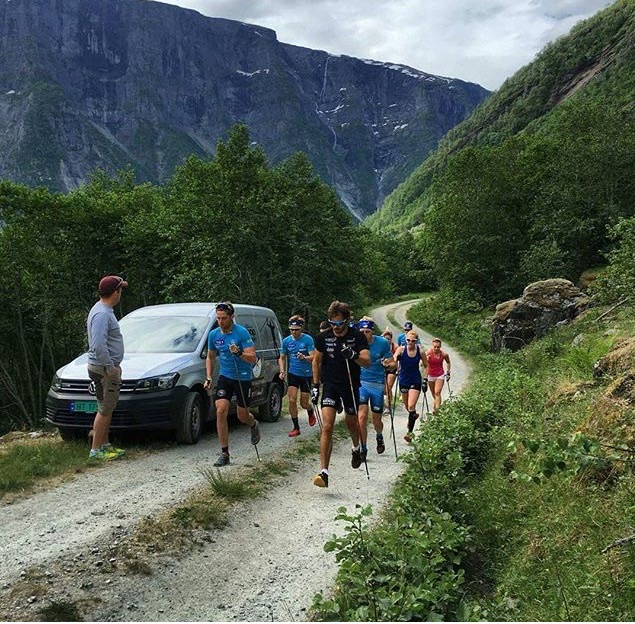
    Annika Taylor (back right, in blue tanktop) during an elghuffs workout with Norwegian Coop talent team in 2016. (Courtesy photo)

    In the end, Taylor said the language barrier was worth breaking through. She recalled a strength session she did with Norway’s Heidi Weng (now the two-time reigning overall and distance World Cup champion) and the confidence it gave her. Most importantly for her, Taylor was able to train with athletes who are World Cup regulars.

    “I needed women who had international experience and not just experience in the U.S.,” Taylor said of her decision to join the British team.

    After speaking with Taylor, Bathe realized she felt similarly. She had skied for Central Cross Country (CXC) program for the past nine years, returning each summer to train with the CXC Team, while a student at UAF. By the end of her college career, she’d tallied a fourth place, seventh, 12th, and 13th in the NCCA Championship races she’d contested. She’d competed at five U.S. senior nationals, finishing on the podium in third (as the second American) in the classic sprint in 2014.

    But Bathe wanted to test herself outside the U.S.

    “I felt that I was going to get the most out of taking a year or two to ski if I went all in and moved to Europe and had the chance to train with high-caliber people all the time,” Bathe said.

    Bathe sent her application to the U.K. last spring, was granted dual citizenship and moved to Lillehammer in the early fall. Her application included proof of her parents’ original U.K. citizenship documents and Bathe’s U.S. birth certificate information.

    “It’s actually pretty streamlined once they have all the information,” she explained.

    This winter, Bathe earned a spot on the British national team. Her focus for the season remained on U23 World Championships in Goms, Switzerland. There, her best result was 37th in the 10-kilometer classic. 

    “I was lucky to race in Europe all year and really learned a lot about racing and just training in general,” Bathe wrote in an email. “Even though it wasn’t the year I had hoped for results-wise, it was a really useful year for me and I know now what I need to do to race faster and to just ski better in general.”

    Taylor, who came into the season prequalified for the 2018 Winter Olympics, explained that she came down with an illness that plagued her from October through February. At her first Olympics in PyeongChang, South Korea, she finished 60th in the 15 k skiathlon and 75th in the 10 k skate.

    “My body just didn’t have anything left to give in races,” Taylor reflected in an email. “I had to deal with a lot of feelings of ‘failure’ and push on past the disappointment of last season, but I am glad to report that I’m out the other side, loving training, looking forward to giving my best another season, while setting my sights on achieving a Doctor in Physical Therapy in my future!

    “Athletes have ‘off years’- we are only human!” Taylor continued. “I definitely learned how to control the things I could control this past season, and learned to let go of the uncontrollable. It was a humbling experience and gave me a new empathy for those athletes that suffer from injury and illness on a regular basis!

    “There’s something quite unique about the community of people and the resilience and determination, but also finesse that cross country skiing demands, that seems to shape quite interesting and well-rounded human beings. I think every athlete can recall a story of when their sport treated them to a ‘mountain-top’ experience and plenty of times where they experienced the low-lows that result when you dedicate your energy, time and emotion to something you love. It’s always a gamble to give something your all: you either succeed spectacularly or fail spectacularly, and somehow we keep coming back for more! It’s a cross country skier, human condition!”
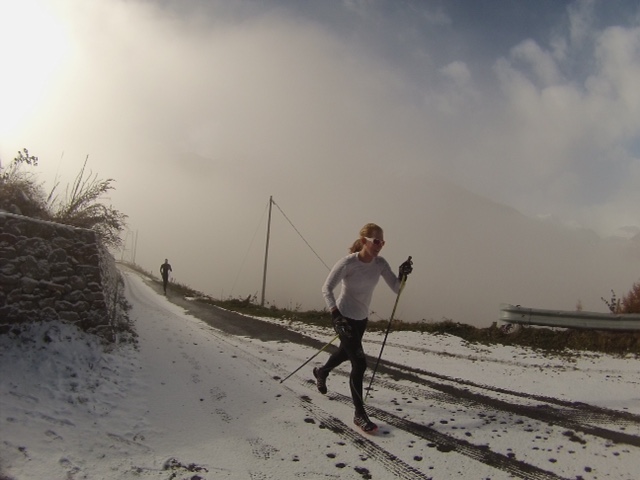
    Annika Taylor of the British national team during a bounding workout.

    For the upcoming season, both Taylor and Bathe plan to continue racing for Britain. Bathe spent some time in Wisconsin this spring before returning to Lillehammer for training. Taylor is currently spending some time in Truckee before returning to Scotland and eventually Norway. As of this spring, both women were fully funded by the team, leaving only housing and food as their primary expenses.

    “The hardest part of this last season was just managing the disappointment in results,” Bathe explained. “Seeing your name at the bottom of a results page is a bit of a gut punch, at the beginning of the season that was tough but once I figured out how to handle that and understand that I wasn’t going to have the dream season I envisioned it became more of a learning season and a technique season.

    “Looking to the future I’m excited to race again and am much better prepared for those slap-in-the-face races that happen when your newer to the World Cup,” Bathe added.

    The two teammates recommended the following Norwegian “elghuffs” bounding workout:

    The Workout: “Elghuffs” a.k.a. hard bounding/ski walking uphill intervals

    Goal: Get a good Level 3-5 workout in “and not get dropped to hard by the Norwegians!”

    When: Can be done 1-2 times a week through the fall

    Where: Alpine hill

    “We do it in a town called Hajfell which is just outside of Lillehammer at a downhill mountain bike and ski area,” Bathe wrote.

    The set: 6 x 6 minutes Level 4

    “Then we catch the gondola back down the mountain for free,” Taylor wrote. “Pretty sweet that Hafjell offers that to people who go on foot or bike up!”

    Top tip: “Don’t start too hard; it will catch up to you by the top,” Bathe wrote.

  • Sundby Stumbles, Ustiugov Surges to Win Lahti Skiathlon; Harvey 5th

    Sundby Stumbles, Ustiugov Surges to Win Lahti Skiathlon; Harvey 5th

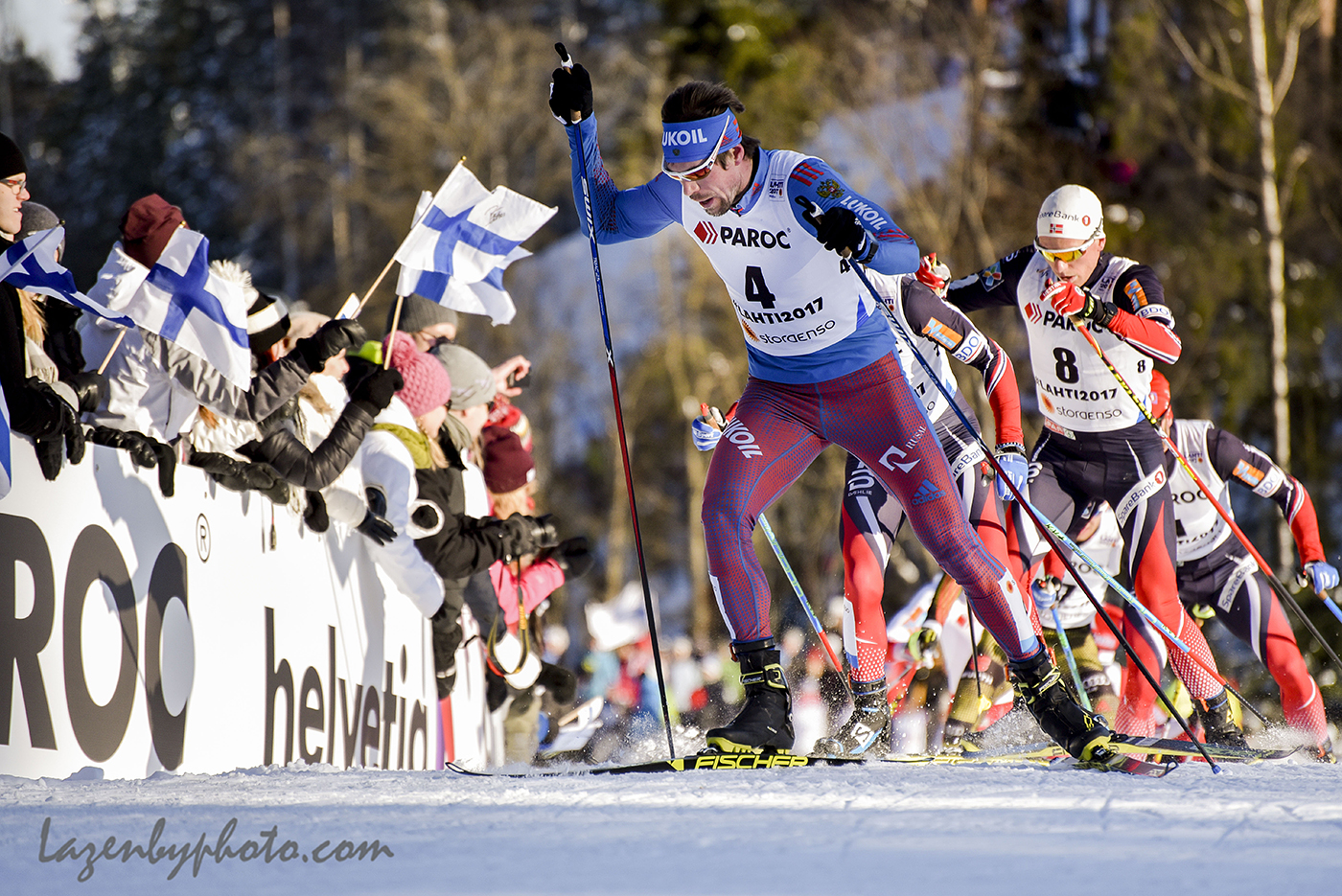
    Russia’s Sergey Ustiugov (4) leads three Norwegians, including Didrik Tønseth, and the rest of the field during the men’s 30 k skiathlon at 2017 Nordic World Championships on Saturday in Lahti, Finland. (Photo: John Lazenby/Lazenbyphoto.com)

    LAHTI, Finland — A collective gasp fell through the stands. Flags bearing Norway’s iconic red, blue and white symbol, previously waving, went limp. With half a kilometer left in the men’s 30 k skiathlon at the 2017 Nordic World Championships in Lahti, Norway’s race favorite Martin Johnsrud Sundby had fallen.

    A half a second earlier on Saturday, the Norwegian’s shot at the win was still within sight. He and Russia’s Sergey Ustiugov had broken away from the front pack around the 20 k mark, put close to 10 seconds on the rest of the field with the next k, and almost quadruped that by the bottom of the final climb.

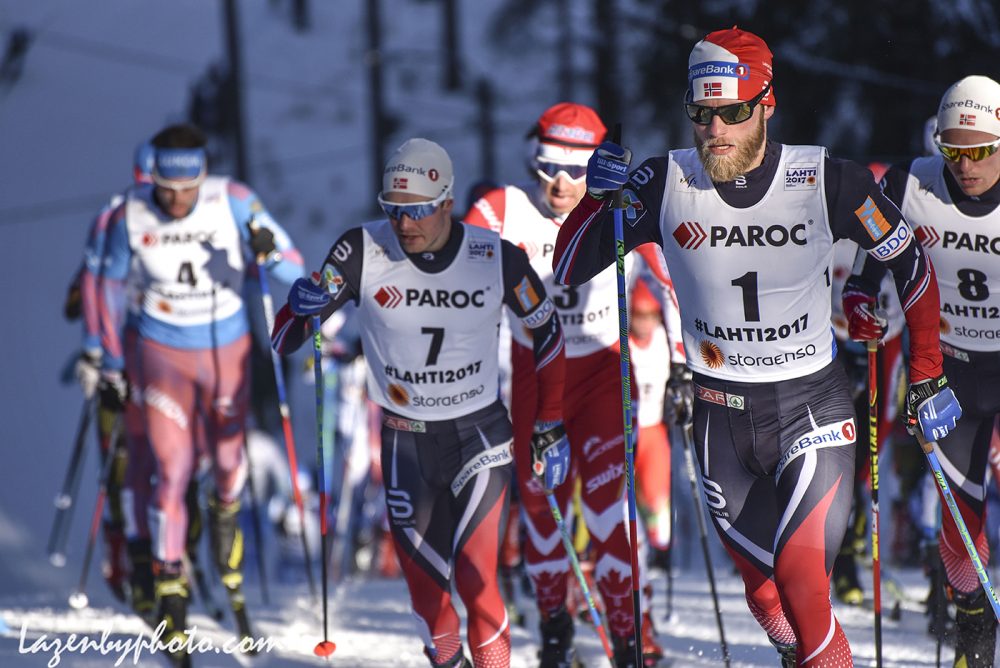
    Norway’s Martin Johnsrud Sundby (1) leading his teammates Sjur Røthe (7) and Didrik Tønseth and Canada’s Alex Harvey, among others, including Russia’s Sergey Ustiugov (4), during the men’s 30 k skiathlon at the 2017 Nordic World Championships in Lahti, Finland. (Photo: John Lazenby/Lazenbyphoto.com)

    Heading into the hill, there was only one man to worry about — a scene fairly familiar for the Norwegian. In last season’s 30 k skiathlon in Lahti, it was during the same final ascent that Sundby pulled away from his teammate Finn Hågen Krogh to take the win.  

    Like last year, the Norwegian upped his tempo as he began the final climb. His high turnover surpassed Ustiugov’s, and Sundby glimpsed at gold. But as just as he secured a slight lead over the Russian, Sundby’s pole slipped, sending him off balance and in a forward fall to the ground.

    As Sundby stood up, his right pole was broken. While it didn’t take long for a new one to reach him, by the time he had grasped the fresh pole grip, the Russian skier was long gone.

    “You have to remember I was skiing side-by-side with the fastest guy in the world, so if I would have one chance, I had to try and make a move,” Sundby said during the post-race press conference. “If there was a possibility to gain a few meters, I had to go for it…Unfortunately it did not work and I made a mistake.”

    With no Norwegian to contest his name, Ustiugov descended the final downhill, cornered the final stretch and crossed the finish line first in 1:09:16.7 hours for his first World Championships gold (he took silver in Thursday’s sprint, behind Italy’s Federico Pellegrino). Finishing 6.7 seconds later in second place was Sundby.

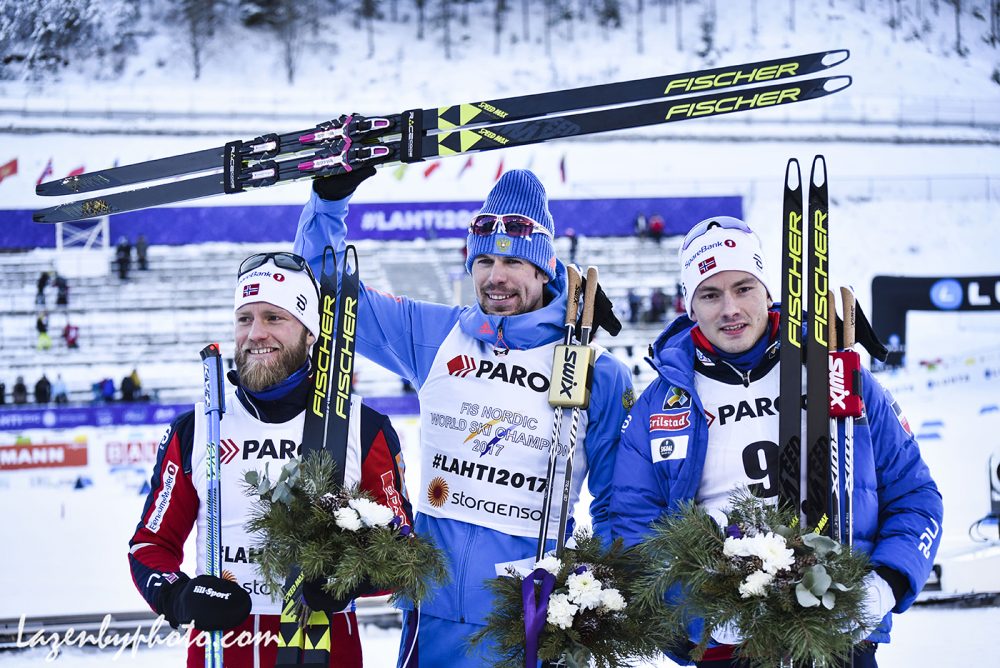
    Left to right: Norway’s Martin Johnsrud Sundby, Russia’s Sergey Ustiugov, and Norwegian Finn Hågen Krogh on the men’s 30 k skiathlon podium at the 2017 Nordic World Championships in Lahti, Finland. (Photo: John Lazenby/Lazenbyphoto.com)

    “It is a great achievement for me,” Ustiugov said the press conference through a translator. “I was disappointed after the sprint so to win the gold medal is amazing. It is not only my success. The whole team did a great job.”

    Crossing third for the men was Krogh, 31.8 seconds after Ustiugov. The bronze medal is Krogh’s first in an individual World Championships race. Although Krogh indicated he tried to go with Ustiugov and Sundby when they made their break from the pack, he admitted the two were in a league of their own in terms of the front pace.

    “The second lap of skating, I saw these guys make a gap,” Krogh said of Ustiugov and Sundby during a press conference. “I tried to push hard to hold it, but after a couple of kilometers I realized it was going to be too hard to catch them, and then I tried to save a little energy to secure the bronze.”

    Harvey Top North American in 5th

    The first man out of the exchange for the 30 k skiathlon on Saturday was not from Norway, nor Russia, or even Sweden. It was Canada.

    After racing within a front group of nearly 25 skiers for the first 15 k, Canada’s Alex Harvey led the mass during their final classic leg stadium descent and into the ski exchange. And as racers headed back out on course for the freestyle portion, it was once again the red maple leaf in the lead.

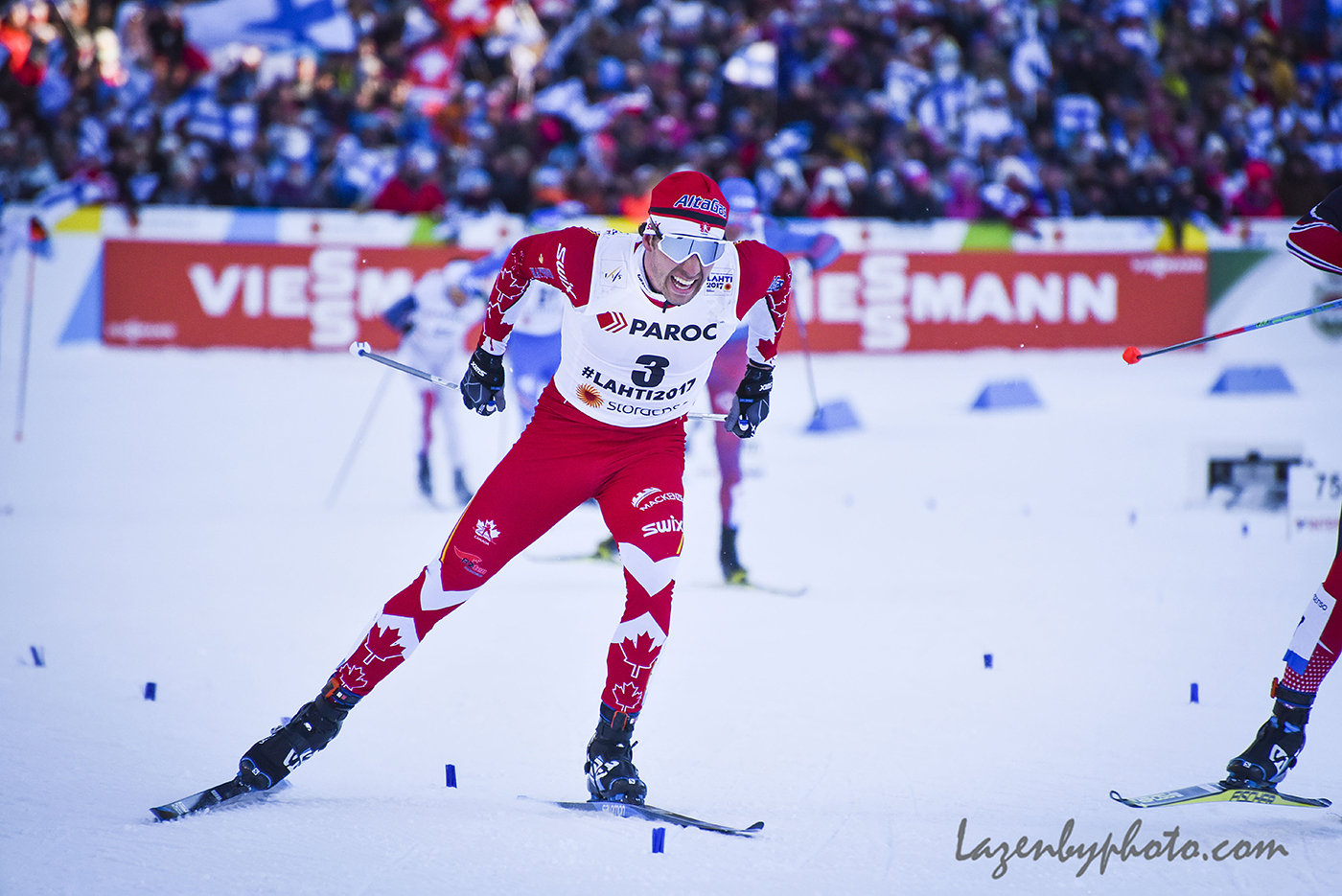
    Canada’s Alex Harvey racing to fifth in the men’s 30 k skiathlon at the 2017 Nordic World Championships in Lahti, Finland. (Photo: John Lazenby/Lazenbyphoto.com)

    While Harvey intended to position himself up front early in the skate leg, he also pointed out that he had the skis to do so, even after one broke in a fall.

    “I had really, really fast skis, both in classic and skate,” Harvey said. “Broke my classic ski during the last lap. Ustiugov cut me off and I crashed on the climb and broke my ski, but they were still running really well and I was still able to come to the exchange in the lead.”

    For most of the classic portion of the race, Harvey had raced within the top 10, at times the top three, following Sundby and Ustiugov, along with Norwegians Krogh, Sjur Røthe and Didrik Tønseth, as well as Finland’s Matti Heikkinen, Great Britain’s Andrew Musgrave and Sweden’s Calle Halfvarsson. 

    The large front group remained intact through the exchange, with Harvey in front. Within a few kilometers, however, Sundby and Ustiugov tookover the reins, and Harvey soon got caught behind Heikkinen. By the 20 k mark, Harvey could see his fight for the podium would be for bronze.

    “On the second lap of skating I was following Heikkinen and I kind of was in a good position in fourth there able to react,” Harvey said, referring to any moves made by Ustiugov or Sundby. “But [Heikkinen] just completely blew up. That’s the moment I’d like to relive in the race because I feel like I had the legs to go with the first two. But once they had a gap, it’s so windy out there, it’s really hard to come back.”

    The battle for third ensued, with Harvey holding on tight to any moves made by Krogh, Røthe or Tønseth. Coming into the final downhill turn, the Canadian was fourth and Krogh in third place, at the front of the chase pack, was making a break. The Norwegian held the lead and Harvey eventually crossed fifth (+33.3), just two tenths of a second behind Røthe in fourth (+33.1).

    “It’s disappointing to be so close to the goal,” Harvey said, explaining that Saturday’s skiathlon was one of the championships races he had been targeting a medal in.

    “But now I know that I’ll have to ski in the top three, not the top four, for the 50 k skate,” he added, indicating that his next individual target event will be the men’s 50 k freestyle mass start.

    Graeme Killick and Knute Johnsgaard also both competed in the skiathlon for Canada, with Killick finishing in 47th (+6:23.5) and Johnsgaard 55th (+8:40.2).

    Canadian Devon Kershaw, did not compete in Saturday’s event due to not feeling 100 percent. Though he explained in an email that he has had good results in the skiathlon event over the course of his career, his world champs focus is on other races.

    “The 30km [skiathlon] is punishing, and with other races slated later in this World Championships it made the most sense to take another day easy and let myself come back perfectly,” Kershaw wrote in an email. “A bit of bad luck not being able to race this first race (the 30km), since I had planned to do it, and the skiathlon has been kind to me in my career, but ‘delay doesn’t mean denial’ as an old sports psych and good friend Cal Botterill would always say to me –  so I won’t be denied of chances to show my fitness later in these Championships.”

    Kershaw’s next focus will be the men’s 15 k classic on Wednesday.

    Three Americans competed in Saturday’s skiathlon, with Tad Elliott placing 48th (+7:11.2), Kyle Bratrud 49th (+7:16.5) and Noah Hoffman 57th (+9:33.6). Ben Lustgarten did not start.

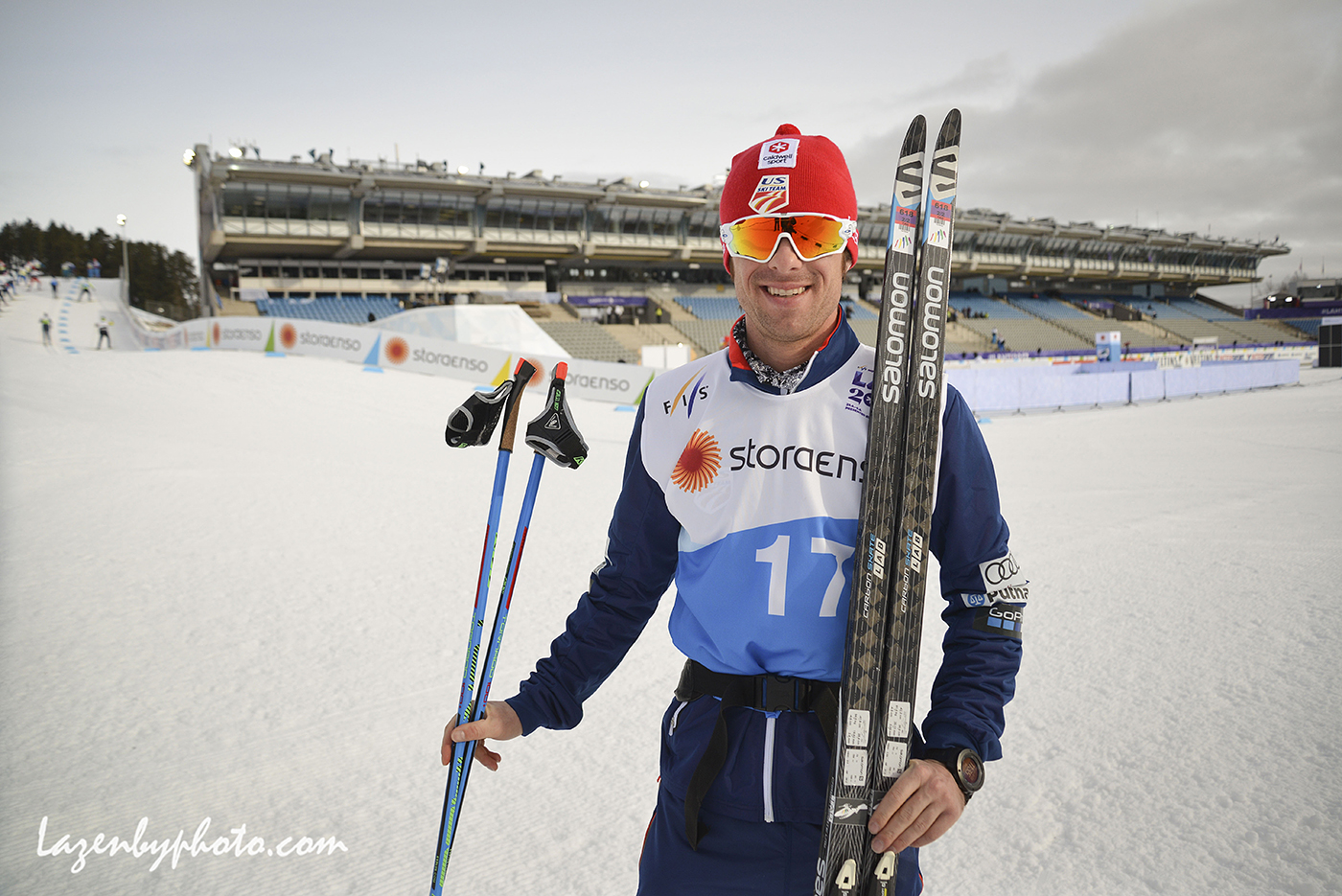
    American Tad Elliott at the arena on Wednesday at 2017 Nordic World Championships in Lahti, Finland. (Photo: John Lazenby/Lazenbyphoto.com)

    Elliott explained that while classic skiing may not be his strength, Saturday’s classic segment was one of his better efforts.

    “It was quite apparent that those guys were going to charge from the front, at a pace I wasn’t comfortable with,” Elliott said. “My strategy was to try and save something for the skate leg, wherever I was, to really let my skating take over, and try to get in the mix after that. After the first lap I knew I was going to have to dig deep in the classic to have a shot, and that was the hardest I’ve gone all year, the deepest I’ve gone.”

    Elliott attributes part of that ability to dig deeper to his growing fitness. Though he had a successful last season and reached the podium at this year’s U.S. nationals, he indicated that his fitness is just now coming around.

    “Nationals were great, but I didn’t feel like I had reached my peak form from last year, and I feel like it’s coming together here,” Elliott said. “I felt great in the skate leg. I was with Kyle, and we worked together really well to pick up as many places as we could, but we were out of contact, because of us, not because of the techs. But I think that bodes well of things to come for Kyle and I, in the skate, especially me, in the skate 50 k. To be able to go that deep in the classic and to skate pretty well. I think it’s great for the 50. I’m pretty excited.”

    Elliott skied much of the race alongside Bratrud, who finished five seconds behind him. Bratrud is also focused on the 50 k, and he viewed the skiathlon as a good opportunity to get competition experience for his later races during his second World Championships.

    Despite also breaking a pole during the first part of his classic race, Bratrud maintained composure and was able to work his way up through the results.

    “I’m shooting for the 50 k, but I had really good energy today,” Bratrud said. “I felt like I was at the back of the lead group, moving my way back up from the start in the classic, and then I got my pole stomped on, and broken at about 6 k. I spent the next 5 k exchanging different length poles, until I finally got my pole, and from there I don’t think I lost too much time. I hooked up with Tad, and we were able to skate pretty fast.”

    As for the 50 k, Bratrud described it as a “brutal course, but if you have the legs, you can do some damage,” he said. “I’m really excited for it. It’ll be a good way to end it. I’m hoping to do the 15 k classic, and the relays before that, but I’m excited for the next week.”

    Results

    — Jason Albert, Harald Zimmer and Jake Ellis contributed

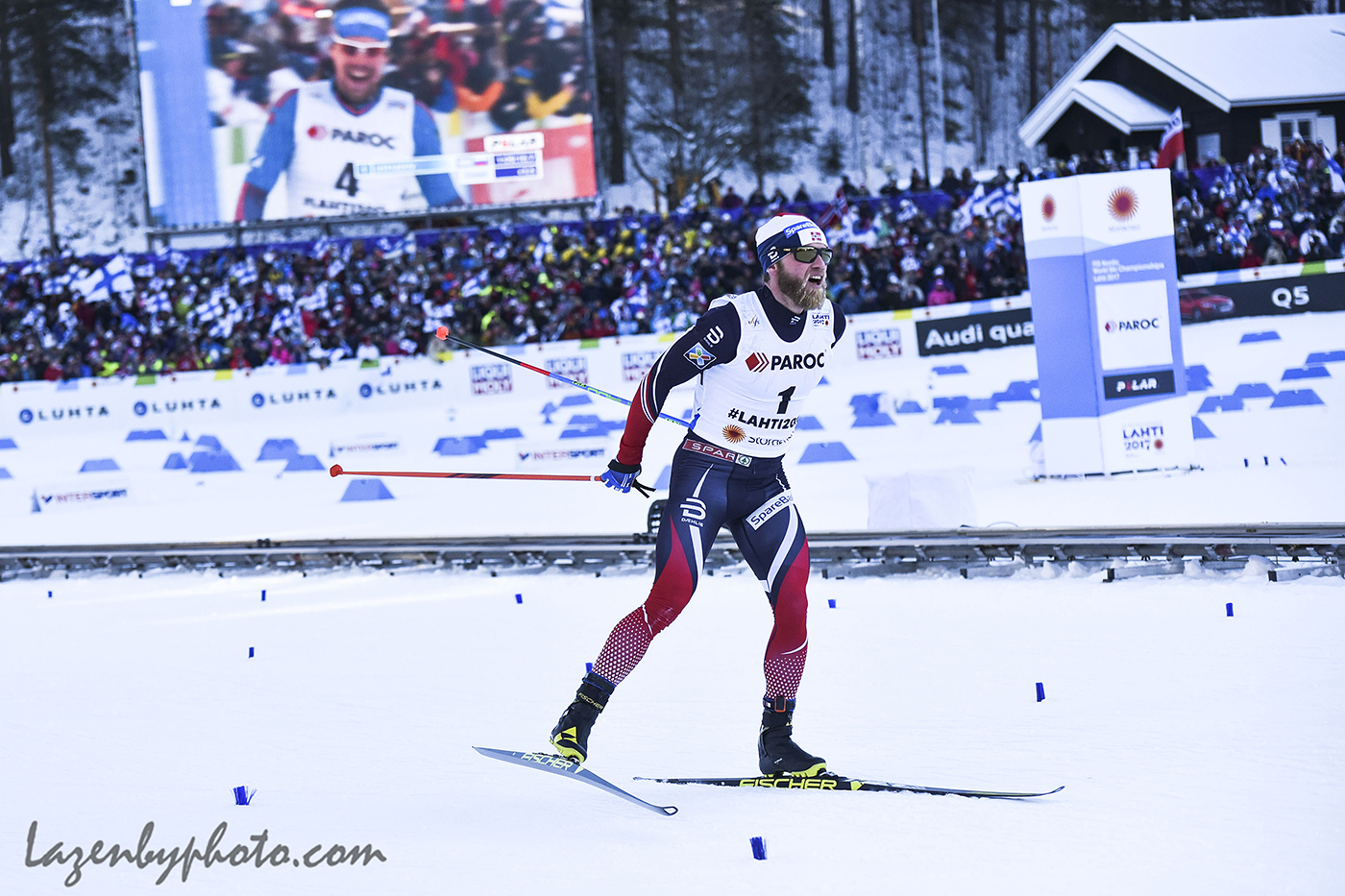
    Norway’s Martin Johnsrud Sundby finishing second in the men’s 30 k skiathlon while Russia’s Sergey Ustiugov (on the big screen in the background) celebrates gold at Nordic World Championships in Lahti, Finland. (Photo: John Lazenby/Lazenbyphoto.com)
  • Photos from U.S. Nationals: Classic Sprint

    Photos from U.S. Nationals: Classic Sprint

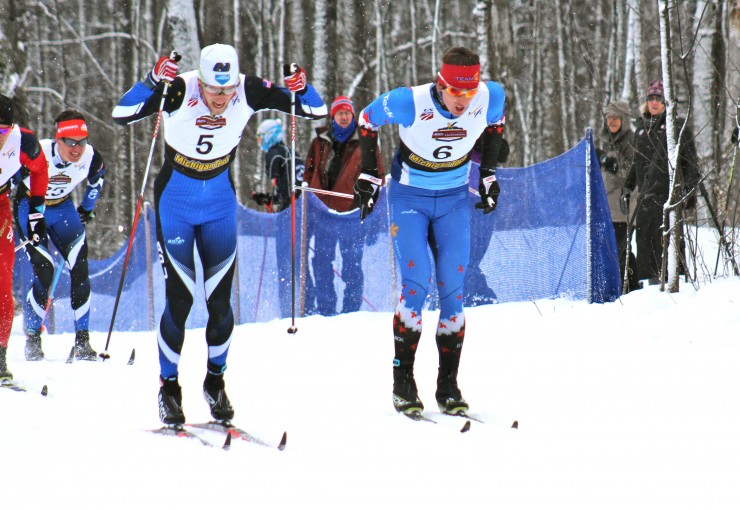
    HOUGHTON, Mich. — The last day of racing at U.S. Cross Country Championships on the Michigan Tech Trails wrapped up last Saturday, Jan. 9, with the 1.5-kilometer classic sprint. At the end of the day, Alaska Pacific University’s Eric Packer and Craftsbury Green Racing Project’s Kaitlynn Miller both walked away with their first U.S. national title. From the qualifier, to the rounds, to the podium ceremony, FasterSkier provides the day’s top moments in photos. Special thanks to Christopher Schmidt.

    Results: Overall | Qualifier | Heats

  • A Guide to the Development Trips Selected at the U.S. Cross Country Championships

    5904_MattieWattsQuarter.jpg-628x250

    (Press release)

    Every year, the U.S. Cross Country Skiing Championships, often called “Nationals” plays host to the skiers not racing in Europe, skiers making a jump to the next step, beyond racing in the U.S. to international competition and a global ski career.

    “A popular question is, ‘How do we obtain International success in Cross Country skiing?’ ” explains U.S. Ski Team Development Coach, Bryan Fish. “Obviously, it takes hard work and well-planned consistent training, however success also stems from knowing the key opportunities as an upcoming skiers.  These opportunities are both domestic and abroad.”

    The 2015 US Cross Country Skiing Championships January 2-10 on at Michigan Tech Nordic Training Center in Houghton, Michigan is that opportunity. These are the events that are measured as key pillars in becoming a World Class skier. “ALL athletes need a FIS license for these trips.  Some/parents/ coaches encourage their athletes to not purchase a FS license until they qualify for the U18 trip for example.  This however means they go into these races with no FIS profile and hence poor starting positions at the races. FIS licenses are good to have in advance for this purpose.”

    So athletes need a FIS license, a Passport, but what of the trips? What are the details? Here are the basic sketches of the NNF funded, USSA sanctioned devo trips at the US Cross Country Skiing Championships. Skiers will be competing for berths in the following three critical international development teams. Selection for the teams is competitive and spots are limited.

    • The U18 Trip – Often called the Scando Trip, this competition is geared for 16 and 17 year old athletes en route to a career of international racing. An annual two week trip focused on raising the level of skiing awareness for developing Americans this event focuses athletes by exposing them to stronger competitive events, skiing clubs and programs in Scandinavia.

                Details: Feb 1-11 Örnsköldsvik, Sweden (Trip total: 12 athletes – 6 female & 6 male)

    • The WJC / U23 Championships– Internationally recognized as a stepping stone to World level skiing, racers who go on to World Cup success often have posted results in the top ten at World Junior competitions (for athletes under 20 years old) or the U23 World Championships (for athletes under 23). The NNF funds the majority of this trip, subsidizing the individual costs for those that qualify through strong domestic racing.

                 Details: Jan 28 – Feb 9 Almaty, Kazakhstan (22 athletes – Juniors  = 6 female & 6 male; Under-23 = 5 female & 5 male)

    • The World Cup/ World Championships (Double points for US Champs to name SuperTour Leaders & compete for World Champ berths) – Skiing’s highest level of competition, young skiers have the capacity to make this leap early if talent allows. (Jessie Diggins and Sadie Bjornsen are examples of women who raced from a young age at the World Championships.)

                 Details: Based off points selections. Numbers will vary.

    Each of these teams builds towards the next team, the next level, the next caliber of racing.  Success requires step-by step-opportunities to allow the athletes to grow and improve their skiing. Lastly, all of this takes money and the USST does not provide funding. The National Nordic Foundation was founded by Reid Lutter for this very reason back in 1995. The NNF funds the majority of the expenses associated with these events as NNF Pillar Projects.

    “Step one for every developing skier is taking part in events like the US Cross Country Skiing Championships,” Fish continued. “You have to toe the start line and compete for a position to qualify for one of these teams. “

    For more information on the U.S. Cross Country Skiing Championships, log onto www.nordicchampionships.org

    For more information including the criteria in determining each of these teams, log onto the USSA website at: www.ussa.org

    To learn more about the National Nordic Foundation, log onto www.nationalnordicfoundation.org.

  • U.S. Nationals Photo Gallery: Women’s 20 k Freestyle Mass Start

    U.S. Nationals Photo Gallery: Women’s 20 k Freestyle Mass Start

    Caitlin Gregg (Team Gregg/Madshus) smiles with relief after winning the women's 20 k freestyle mass start at U.S. Cross Country Championships on Wednesday in Midway, Utah. Gregg won by 3:36, the biggest margin at nationals in recent memory.
    Caitlin Gregg (Team Gregg/Madshus) smiles with relief after winning the women’s 20 k freestyle mass start at U.S. Cross Country Championships on Wednesday in Midway, Utah. Gregg won by 3:36, the biggest margin at nationals in recent memory.

    FasterSkier’s coverage of the 2014 U.S. Cross Country Championships is brought to you through the generous support of The Memory Clinic in Bennington, Vt.

    MIDWAY, Utah — Caitlin Gregg didn’t waste any time getting out front and out of range on Wednesday, opening up an 11.5-second lead by the first of four laps in the women’s 20-kilometer freestyle mass start. The 33-year-old SuperTour leader went on to post the fastest lap each time around the Olympic 5 k course at Soldier Hollow en route to a 3:36.4-second victory in the penultimate race of the 2014 U.S. Cross Country Championships.


  • U.S. Nationals Men’s Skate Sprint Video

    U.S. Nationals Men’s Skate Sprint Video

    The final day of the 2013 U.S. Cross Country Ski Championship proved to be one of the most exciting as racing continued with the skate sprints.  After the day of racing it was Dakota Blackhorse-von Jess who was strongest down the finish stretch to earn the top step on the podium and the national crown.

  • One Day ‘Til Nationals: A Look at Rumford (Video)

    One Day ‘Til Nationals: A Look at Rumford (Video)

    On the eve of U.S. Nationals in Rumford, Maine, FasterSkier’s Audrey Mangan talks about the conditions and the atmosphere in at Black Mountain on Sunday.

    2012 U.S. Nationals
    Looking down on the two-way stretch into the stadium at the 2012 U.S. Cross Country Championships on Sunday at Black Mountain in Rumford, Maine.