From the FasterSkier archive — posts syndicated from athletes’ and coaches’ own blogs between 2004 and 2012, kept online as published. Current coverage is at fasterskier.com.
John Caldwell, born November 28, 1928, passed away February 27 at 97 years old. John’s contribution to cross-country skiing in the United States is unquestioned.
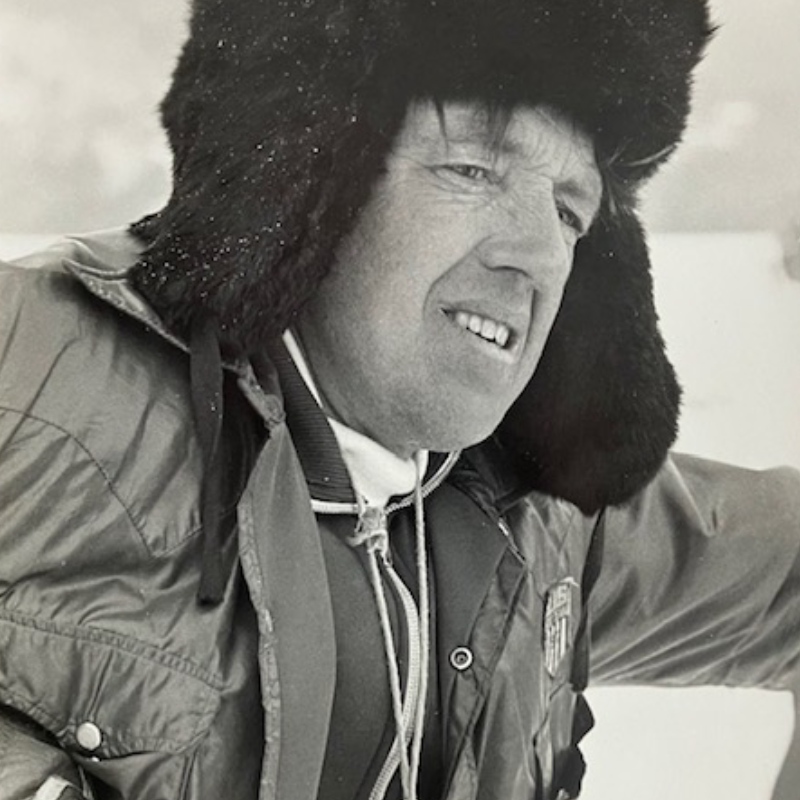
John Caldwell, November 28, 1928 — February 27, 2026. (Photo: Robert George)
He was a 1952 Olympian in Nordic Combined. He wrote several books on cross-country skiing that became our training guidance, our bibles, in the early and mid-1970s. He was a long-time teacher and coach at The Putney School, an early U.S. Ski Team coach, and a member of the coaching staff at the Winter Olympics in 1960, 1964, 1968, 1972, and 1984. In the mid-1990s he founded the New England Nordic Ski Association (NENSA), stepping in to fill a regional void the U.S. Ski Association had abandoned at the time.
That’s the high-level resume. But that doesn’t capture what happened. It’s beyond me to catalog everything John did for the sport. What I can offer is a personal perspective, what it was like to grow up skiing with his influence.
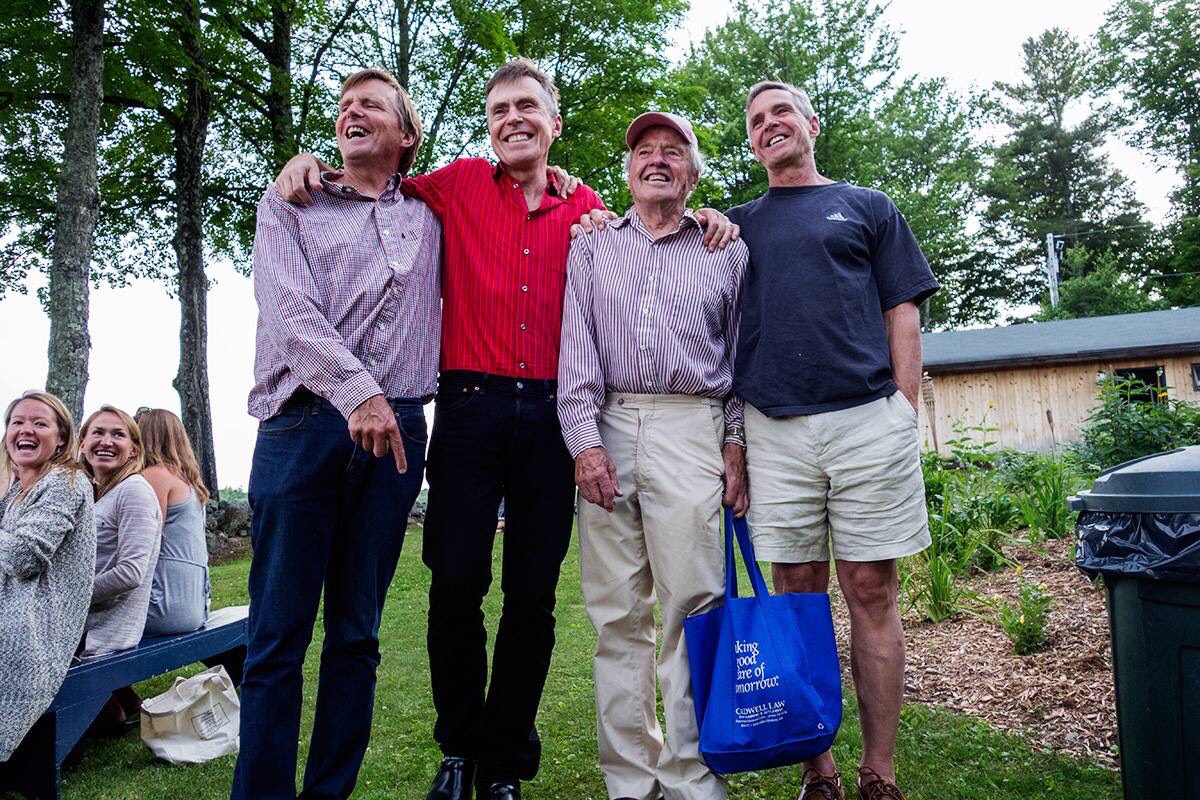
Left to right: Jennifer, Peter, Sverre, Tim, Hep, and John. (Photo: Courtesy Image)
My earliest memory of JC was driving to Putney with my dad to buy a pair of skis from him. Later I saw him at the Washington’s Birthday races, local races in Putney, the Samsonite/Dannon Series, and the night races of the late ’60s and early ’70s.
In 1967 or so, John reached out to Inga Löwdin in Sweden to bring women to the U.S. to race. That exchange helped spearhead women’s skiing in this country, particularly the career of Martha Rockwell, then a student at Putney. In the early ’70s he also brought Norwegian skiers over to compete in what was then a surprisingly robust night race circuit in the Northeast.
I’m not sure he was thinking in terms of “athlete development” as we define it today. His goal was simpler: to grow the sport. Get people involved. Raise the level by exposure.
He was integral in founding the Washington’s Birthday race in southern Vermont, one of the first popular cross-country races in the country. The race rotated locations from Marlboro, Guilford, Brattleboro, Putney, and Westminster West. It reportedly grew from 54 participants in the first year to several hundred within just a few years.
It was not an accident, even before Bill Kochs success the sport was going through a growth and participation spike that fuels the sport still today.
In junior high I would go up to Putney School for occasional training sessions. I remember skiing long loops and being far behind. In high school, Labor Day training camps organized by JC brought national team skiers into our backyard, Bob Gray, Tim Caldwell, Charlie Kellogg, Peter Davis, Joe McNulty. That was normal in Windham County. There were always good skiers and cyclists around for a workout.
Chris Osgood, Mary Heller Osgood, Jennifer Caldwell (daughter), Peter Caldwell (son) and John Caldwell arriving in Australia for a ski trip. (Photo: Courtesy Image).
By the early to mid-’70s, Putney graduates like Bob Gray and Martha Rockwell, along with the next wave, Bill Koch, Tim Caldwell, Stan Dunklee, myself, were training and competing together more regularly. John didn’t “coach” us in the modern sense. He rarely prescribed workouts. Instead, he would ask what I was doing for training, then share what he was hearing from Russians, Norwegians, and Finns.
“This is what they’re doing. Maybe it makes sense to try it.”
Between 1974 and 1978, and through the 1980 Olympics in Lake Placid, our local group trained together more often. Long runs from Putney to Saxtons River and back. Weekly 50–60 km roller skis, usually ending at the Caldwell sauna. For a few years we did a 220-mile bike ride straight up or down the spine of Vermont, depending on Bill’s forecast of prevailing winds.
John didn’t script those sessions. He didn’t stand there with a stopwatch. His influence, and his openness to ideas from abroad, shaped the key workouts we implemented. Many of them still hold up today.
I spent a lot of time around Putney in those years, so JC and I worked frequently on technique. He pushed me to experiment. Not necessarily because he knew the movement would be faster, but because adapting to new movement patterns develops skill. Most of our technical work happened on uphill’s. Back then, equipment and grooming limited how much time you could gain on flats and downhills. Uphill efficiency mattered most or so I thought. We worked on short, quick tempo striding. Shuffling. Even running movements not far from what people now call the Klaebo run.
John Caldwell and the art of flexing skis. Here, he’s helping his granddaughter Sophie Caldwell, a former U.S. Ski Team member, pick skis in 2017. (Photo: Sophie Caldwell)
In December 1979, John was contracted by the U.S. Ski Team to work with me in early, season Nordic Combined World Cups. I was skiing well and trying to hold form heading toward the 1978 World Championships in Lahti. I’m not sure how much he knew about ski jumping at that point. But he knew enough to keep things relaxed and low-key in the days before competition, including an afternoon visit to the Hofbräuhaus in Munich.
In Reit im Winkl, I was third in jumping and won the cross-country by a substantial margin. That week, at least, he did just fine as a coach!
At the 1982 World Championships he was there in a wax-support role. Back then, that mostly meant Swix Purple or Toko glide and a binder plus hard wax for kick. There wasn’t extensive testing. Athletes prepared their own skis. He was there as support team, especially for those of us from the Putney Ski Club. His last international trip with us was the 1984 Olympics in Sarajevo.
In later years, John served on a steering committee overseeing the U.S. cross-country program. I’d like to say it was a productive collaboration between staff and the steering committee. It wasn’t. The structure didn’t allow for effective dialogue. Good intentions don’t automatically produce good governance.
From left to right: Sverre Caldwell, Tim Caldwell, John Caldwell, and Peter Caldwell. (Photo: courtesy Sophie Caldwell)
In the early to mid-1990s, I worked at Stratton Mountain School. Being close to Putney again meant more time with JC, and many discussions that eventually led John to the formation of NENSA. As a founding board, we saw the early organizational stages and the hiring of its first staff. Summers often included time at the sauna, the best conversations happened when only a few of us were there, often ending around the big dinner table.
The last 30 years of my friendship with John were mostly phone calls, emails, and the occasional Facebook comment. Often cryptic. Once, commenting on a photo of me skiing in my 60s, he wrote that I still skied like a donkey. Not entirely inaccurate.
Other times it was, “What do you make of the results at X race?” Or, “Whose technique is best?” He was always curious and engaged. Thinking about the sport at a higher level than most others during those years
The last time I visited him was last June during a short trip through New England. Tim told me it was JC’s nap time, but I was on a tight schedule and stopped in anyway. The caretaker let me into his apartment. I walked in and said, “JC, what the hell is going on?” Before he even saw me, he replied, “Galanski, what the hell are you doing here?” We spent two hours talking about old times, friends, and family. Mentally, he was as sharp as ever, even as his body was failing.
John’s contributions to skiing can be measured by the roles he held, the teams he coached, and the organizations he helped build. Harder to measure, and ultimately more important, is what happened in southern Vermont simply because he was there. A culture took shape that valued learning and curiosity, exposure to the highest levels, and consistent, broad-based participation. Athletes trained hard, thought broadly, and held themselves to a higher standard, without being told to do so. John didn’t try to manage the sport or own its direction. He created the conditions where it could grow. And for decades, it did.
Note: An official obituary for John Caldwell has been published by his family. Those wishing to honor John’s legacy may consider making a donation toNew England Nordic Ski Association(NENSA), the organization he helped found to strengthen and grow cross-country skiing in the region. Contributions in his memory will continue the work he cared so deeply about — supporting athletes, coaches, and the future of American Nordic skiing.
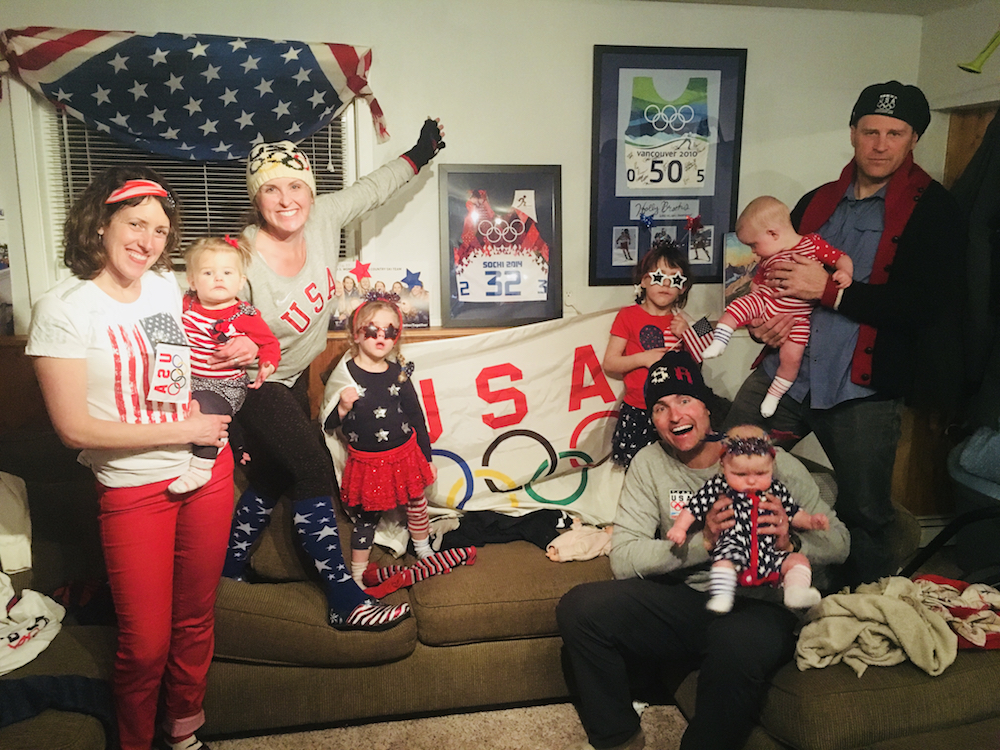
John Caldwell, front left, with his, Hep, and all 10 of their grandchildren. Photo: courtesy of Sophie Caldwell.
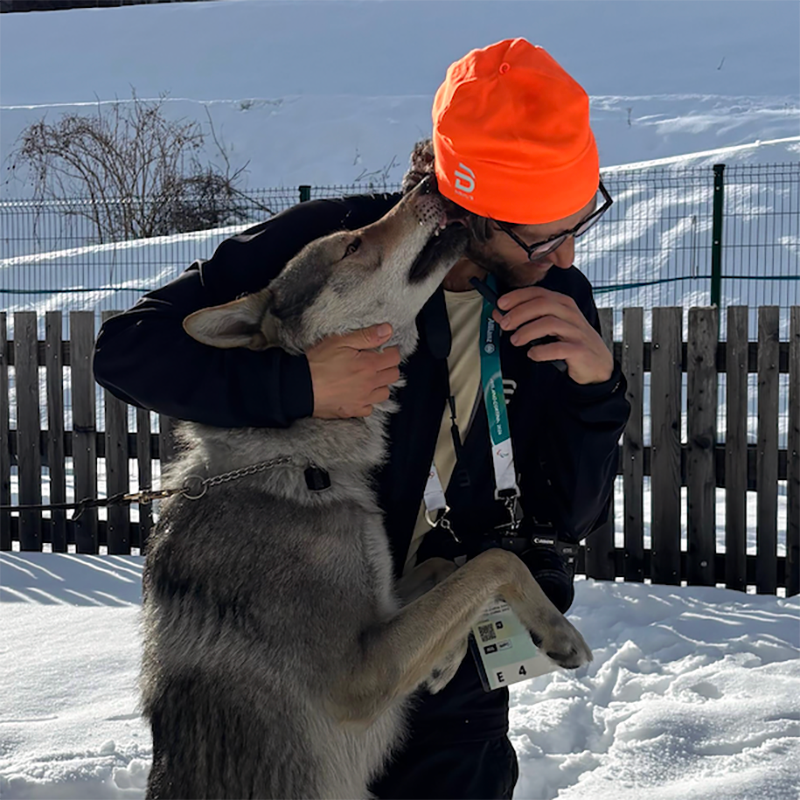
Reporter Nat Herz bonds with Nazgul, the infamous Olympic wolfdog. (Courtesy Alice Varesco)
Ciao a tutti!
Greetings from Torino, where this fatigued Olympics correspondent has retreated to recover through bike rides and repeated doses of pizza with family.
I had the chance to attend the closing ceremonies — mostly as a spectator — in Verona on my trip down from the mountains. After more than a dozen Olympic features, not to mention podcasts and race coverage, I’m now about to unplug for a couple of weeks.
But first, I couldn’t resist one last quick post: a roundup, in abbreviated, Reader’s Digest form, of some of the stories that were still on my list as the Olympics ended.
That’s below. In the meantime, I wanted to reiterate my gratitude to the many readers, fans and news organizations who stepped up to support my on-site Olympic coverage. The money you provided was enough to make a real difference in what I was able to do, and gives me the confidence that there’s the support to do this again in the future.
While the past few weeks were a lot of work, it was also an enormous, ravioli-filled privilege and pleasure — one where I made new friends, drank innumerable espresso macchiatos and got to cross-country ski downhill to the “office” every morning.
As I told a friend yesterday: If anyone ever offers you an assignment in Italy, take it.
With that, and with these brief items, we’ll see you next year. Or maybe, in Lake Placid.
American road warrior ski techs grind on
If you thought the work stopped once the Olympic torch flame was extinguished, think again.
That’s definitely not the case for the indefatigable crews that do the work of waxing, cleaning and tuning skis for Olympic cross-country teams.
Top teams, including the U.S., each have their own massive semi truck that they use as a mobile work quarters while traveling all winter around the European World Cup circuit. Those trucks were all in northern Italy for the Olympics — until the last race ended Sunday afternoon.
Soon afterward, the American truck — named Yolanda, after a character in the cult classic film Pulp Fiction — pulled out of the Olympic venue in Lago di Tesero. Or, at least, it tried to: With the warm weather, the truck got stuck in the mud, and required a tractor from organizers to pull it out, said Chris Hecker, one of the U.S. team’s service crew.
U.S. Ski Team service staff member Tim Baucom at the wheel behind one of the squad’s trucks, and at the table on the crew’s Italy-to-Sweden road trip after the Olympics. (Courtesy Chris Hecker)
After a four-hour drive Sunday through the Dolomites, Yolanda and its three staff members rendezvoused with a secondary truck driven by two other ski service technicians in Munich. A six-hour drive on Monday took them to an overnight ferry from northern Germany to Sweden — which would be followed by a nine-hour drive to the Swedish community of Falun, where the World Cup circuit resumes this coming weekend.
The distance, according to Hecker, adds up to 1,100 miles.
One key pit stop was a McDonald’s in a mountain pass leaving Northern Italy known for its beautiful view.
The trucks were also well-stocked by the U.S. team’s nutritionist, Hecker said: sandwiches, water, gummies, chips, Red Bull and cookies.
“All the important things a tech needs to keep driving throughout the day,” he added.
A diminished Chinese team
The 2022 Winter Olympics in Beijing were marked by an enormous investment by the Chinese government in training and building up the nation’s cross-country ski team.
Well before the Beijing Games, China hired a huge number of veteran European coaches and support staff that included retired Olympic athletes like Russia’s Nikita Kriukov and Norway’s Terje Langli. The country also spent freely on equipment and even built an indoor ski tunnel for summer training.
This time around? China’s Olympic cross-country ski team was a shadow of its former self, with just a single coach in Italy. Wang Qiang, who during the 2022 Olympic season became the first-ever Chinese athlete to stand on the podium in an elite-level World Cup race, placed 37th in his best event, the sprint, at this year’s Games.
Meanwhile, the government has asserted “serious violations of discipline and law” by Zhang Bei, the bureaucrat who led the cross-country ski team effort at the last Olympics, and Chinese news sources report that she’s been “taken away” by police amid an investigation for “suspected economic crimes.”
Meanwhile, Gou Zhongwen, the Chinese sports minister who’d prioritized government investment in cross-country skiing, has been purged from power. In 2024, the government placed Gou — the former chair of the Chinese Olympic Committee and of the 2022 Winter Olympics organizing committee — under investigation, then expelled him from the party.
China’s former sports minister, Gou Zhongwen, stands during court proceedings in this photo published by the Chinese government.
In December, he was sentenced for taking what the government said was more than $30 million in bribes, among other alleged transgressions. Gou’s official sanction was the death penalty, though it comes with a two-year reprieve, and experts say such a sentence is typically converted to life in prison.
A spokesperson at the U.S.-based Chinese embassy said in an email last week that the country has “consistently placed high importance on the development of winter sports.”
“Chinese cross-country skiing and biathlon have achieved and will continue achieving significant progress,” the spokesperson said.
Klaebo’s post-Olympics: a return to World Cup, chicken wings and a trip to America
Norwegian Johannes Høsflot Klæbo, the winningest winter Olympian in history after sweeping six golds in this year’s games, says he plans to compete at the season-ending World Cup races in Lake Placid, New York.
At a news conference Saturday after winning his last event, the 50-kilometer classic race, Klæbo said he needs a “couple of weeks, now, to really recover,” but after that it’s his goal to participate in March in Lake Placid — only the second weekend of World Cup racing in the United States in more than two decades.
“My personal opinion is that we should have a World Cup event (in the U.S.) every single year, but I’m not in charge,” Klæbo said. “I think we are all looking forward for Lake Placid. I think it’s going to be a fun weekend to finish up this amazing season.”
Klæbo is also on the Norwegian team for this upcoming weekend’s World Cup races in Sweden.
But he did let himself indulge, at least briefly, in a break from his notoriously fastidious diet following the Olympic closing ceremonies in Verona, where he acted as Norway’s flag bearer.
Johannes Høsflot Klæbo orders chicken wings at a McDonald’s after the Olympic closing ceremonies in Italy. (Pien Huang/NPR, used with permission)
Afterwards, an NPR reporter, Pien Huang, spotted Klæbo and some teammates “putting in a big order for chicken wings” at a local McDonald’s.
In a text message, Klæbo’s father Haakon confirmed Huang’s report, saying his gluten-intolerant son had turned to fast food “when I said I was not able to order gluten-free pizza.”
An Olympic cheese tour
What’s the point of a reporter traveling to Italy if he can’t con his way into a tour of a cheese factory?
Yes, dear reader, after these Olympics, I am not just a ski correspondent. I am also now an expert on a raw milk cheese called Puzzone, which is native to the area, Val di Fiemme, that hosted the Olympic cross-country ski races.
The backstory: One morning at the competition venue, I was having a chat with an Italian ski industry professional, whom I was told was from the town of Asiago. Ah, I said, you guys have some good cheese. Yes, the guy responded, I’m not really a cheese guy, but here in Val di Fiemme, you should really try the local delicacy called Puzzone — an Italian word that translates roughly to “stinker.”
This being a busy assignment at the Olympics, I filed this fact into the corner of my brain where stories go to die.
A day later, though, I was taking a walk from my apartment to a nearby cross-country ski trail when I stopped dead: There was a sign on the side of the road that said: Puzzone di Moena. (Moena is a nearby village.) It was next to a nondescript building that, upon further inspection, contained a cheese shop and a workspace that looked to me like a cheesemaking area.
I tasted some Puzzone in the store — it was sharp and pungent, especially the more aged varieties — then left with a chunk that I shaved onto eggs and toast. But feeling a little unresolved, the next time I passed the building, I knocked on the door to the workspace, and asked if I could check it out.
Which was how, a few days later, I ended up exchanging some messages with the “boss” — Andrea Morandini, the son of one of the farmers in the local cheese coop. He told me, in his Italian accent, to meet him the next morning at “da place.” I did, where he walked me through the history and current status of Puzzone — which, he said, acquired its name when an agricultural expert, on a national radio program in 1974, was tasting and describing area cheeses.
The inside of the Puzzone cheese factory in Predazzo. (Nathaniel Herz/FasterSkier)
“They are trying and smelling it — the one from Cavalese, the one from Predazzo. And when they are speaking about the one from Moena…they say, ‘Wow, it’s strano (strange), this is Puzzone,’” said Morandini. “So, it’s born live.”
Puzzone, Morandini told me, had its roots in Val di Fiemme’s agrarian history, when families would keep a cow or two and trade milk to local dairies in exchange for a share of the cheese produced. In a diet that otherwise depended on potatoes and polenta, cheese was a welcome addition of flavor, Morandini said.
The particularly stinky character of Puzzone is because it’s what’s known as a “washed rind” cheese — with its rind brushed regularly with salty water that encourages the growth of bacteria.
After my history lesson, Morandini took me backstage. What I thought was a workroom was actually a dressing room, where I donned a hairnet, slippers and vest; we then walked through a cavernous industrial space with vats and tanks, where cheese had been made earlier that morning.
Down a flight of stairs, we found the racks where wheel upon wheel of cheese is stored. In the deepest, darkest room, I hit a wall of ammoniac haze that made my eyes water and my lungs tickle.
The cooperative, Morandini told me, includes 11 farmers, most of whom own some 50 cows each. In the winter, the cows stay close to home, but in the summer, they’re sent outside to feast on grass, which gives the cheese made in that season a special flavor, according to Morandini.
One full wheel of aged Puzzone, a foot or so across, will set you back about 300 euros, or some $350. A wheel of younger cheese goes for some 170 euros, Morandini said. Some 70% of the factory’s production is consumed in the region, while a portion of it goes to customers in the United Kingdom and France, he added.
Andrea Morandini points to a wheel of Puzzone cheese that’s aging on a rack in the factory basement. (Nathaniel Herz/FasterSkier)
In a subsequent taste test I conducted with U.S. Olympic silver medalist cross-country skier Ben Ogden — a Vermonter who grew up eating raw milk cheese — Ogden described the young Puzzone as a solid “daily driver” cheese he could eat on the regular.
The aged stuff?
“Oh, God, that has got a taste,” Ogden said. “Holy crap.”
He added: “There are acquired tastes out there. And this is not one that I’ve acquired; it tastes like compost, a little bit.” “I’m sorry,” he said. “I hope the Italians don’t listen to this.”
Schumacher eyes medal celebrations — and maybe some free drinks
Anchorage’s Gus Schumacher, who last week became only the third ever American man to win an Olympic medal in cross-country skiing, says he’s looking forward to sharing his silver hardware with the next generation of U.S. athletes when he arrives back in Alaska.
“I’ll do whatever anyone asks me to do — but I’m excited to get some wear and tear on that thing,” Schumacher said in an interview a few days after his medal, which he earned with his podium finish in the team sprint with Ogden. “Not that I’ve not been a role model at home, but to have that carry a little more weight is pretty exciting.”
Schumacher, who grew up inspired by Alaska Olympic gold winner Kikkan Randall, said he’s seen how beat up and worn her medal is, along with those won by Jessie Diggins, the star American skier from Minnesota, “and I think that’s the coolest thing ever,” he added.
“I’m really glad they make them heavy — it could be lead in there for all I care,” said Schumacher, 25. “But you feel the weight when you touch it. And I think for people to be able to see it in person is cool.”
Gus Schumacher, left, and Ben Ogden show their silver medals after the Olympic team sprint. (Davide Barbieri/NordicFocus)
Schumacher will also race in Lake Placid before finishing his season, and it’s possible he could take a vacation in Central America after that. But he also likes being home, he said.
His life hasn’t changed much, Schumacher added, and even if a big sponsor showed up at his doorstep, he might still turn it down if it required too much work. He makes enough money from prize money and ski sponsorship, he said, to cover his expenses — especially since he still lives at home with his mom.
One thing he will be accepting: An offer of free water or beers at Creekbend, a popular concert venue in the community of Hope, outside Anchorage, that Schumacher has visited occasionally.
“I’ll definitely be cashing that one in,” he said, adding: “If I’m really milking the whole medal thing, I probably won’t have to pay for a ton of beers this spring.”
Help Support Our Olympic Coverage!
FasterSkier will have our own Nat Herz on the ground at the Olympics, which, to be honest, is a very big financial lift for us. If you value the thoughtful work and access FasterSkier provides at championships like this one, please consider becoming a Voluntary Subscriber. Your support directly fuels the work we do to cover the people, places, and moments that make our sport special.
This article was made possible through the generous support of our voluntary subscribers who have helped put our Nat Herz on the ground at the Olympics. If you value coverage like this, please support FasterSkier with a voluntary subscription.
Hailey Swirbul (USA) racing the 20 k Classic Mass Start in Goms, Switzerland, two weeks ago. (Photo: Authamayou/NordicFocus)
When Hailey Swirbul logged onto a Zoom call from Italy last Monday, she was already living inside uncertainty.
“I’m in Livigno right now,” she said. “Yeah — the higher one.”
The U.S. team held two pre-Olympic altitude camps, and Livigno was the higher-altitude option. With thinner air, it’s a place where nothing happens quickly, where adaptation takes patience, and where clarity is rarely immediate. When we spoke, it still wasn’t public which races she might ski, or even whether she would start any at all. She was there because she had qualified back onto the U.S. Olympic Cross-Country Ski Team — but nothing beyond that had been decided.
She didn’t talk about it like a comeback. She didn’t talk about it like redemption, either. Mostly, she sounded attentive — to her body, to her thinking, to the risk of letting the story get ahead of her.
“I’ve thought about this whole thing more as an experiment,” she said. “Like… can I do this? And can I do it in a way that actually feels good?”
The Olympics mattered. She didn’t pretend they didn’t. But they weren’t the point.
“What can I do?” she kept asking.
Hailey Swirbul’s entry into endurance sports began with mountain bike racing with her family around Colorado. (Photo: Courtesy Photo)
Before Skiing Was the Point
Swirbul’s relationship with endurance sport started long before skiing felt central, or even intentional.
“I grew up in just a really active family,” she said. “My parents valued getting outside and doing that with our family.”
Neither parent was an elite athlete. That wasn’t the model. The emphasis was simpler: movement, time outdoors, effort shared rather than measured.
“They just love being outside and moving our bodies,” she said. “And they taught that to my brother and me growing up.”
The first sport that really mattered to her wasn’t skiing.
“The main thing we loved to do as a family when we were young was mountain bike races,” she said. “We would travel around Colorado or the West and camp as a family and do these bike races.”
Mountain biking wasn’t cross-training. It was the center.
“That was kind of the first main sport that my brother and I both really loved,” she said.
Nordic skiing entered her life almost accidentally. Her older brother decided to try it as winter conditioning for mountain biking.
“So as the younger sister,” she said, “I was just going to follow whatever he did.”
Her first experience skate skiing was blunt.
“I had never skate skied before,” she said. “And I just got destroyed. I was so far behind everyone.”
What stayed with her wasn’t embarrassment. It was the challenge.
“I remember feeling this sense of, like, I need to figure this out,” she said.
Progress came quickly, and with it a new kind of motivation.
“I remember feeling like, whoa,” she said. “It’s pretty fun to do well at it — whatever well means.”
What drew her in wasn’t winning so much as the learning curve.
“Skiing is such a hard sport to master,” she said. “I don’t think anyone really can. It’s always evolving.”
By middle school, she was actively seeking out more difficulty.
“I wanted to race more,” she said. “I would go on jogs in the fall after soccer practice because I was like, I need to get more training.”
She started racing up in age groups — not because anyone pushed her, but because she wanted to be there.
“I raced up as a U16 when I was still 13,” she said. “And I qualified for Junior Nationals that year.”
Being part of something bigger mattered.
“Getting to go and be part of this bigger thing,” she said, “that was incredibly motivating to me.”
Hailey Swirbul celebrates the U16 Junior National Championship title in the Freestyle Mass Start in Stowe, Vermont, in 2014. (Photo: Voisin/FasterSkier)
Racing Up — Until There Was Nowhere Left to Go
Much of Swirbul’s early career followed that same pattern.
“My young career — and honestly much of my career — was defined by racing up,” she said.
It worked. Racing older athletes fed her curiosity and reinforced the idea that discomfort was something to move toward, not away from.
But as she progressed through the development pipeline and into the World Cup system, the feedback loop changed.
“There’s this moment where it flips,” she said. “And suddenly you’re supposed to be top 30.”
Early World Cups felt expansive. Points mattered. Starts felt earned.
“Getting points felt exciting,” she said.
Hailey Swirbul scored her first varied World Cup points in the 2019 Davos, Switzerland, Skate Sprint. (Photo: NordicFocus)
Over time, expectations hardened. Results that once signaled progress became baseline.
“It stops being exciting,” she said.
What made it difficult wasn’t failure in the dramatic sense. It was repetition.
“It’s really hard to go over there and be 45th every weekend,” she said. “And still believe in yourself.”
She kept coming back to that number — not as a complaint, but as a psychological reality.
“When that happens over and over,” she said, “it starts to mean something about you.”
The pressure didn’t explode. It narrowed.
“I felt really rigid,” she said. “And I didn’t like that.”
By the end, the issue wasn’t the results.
“There wasn’t anything wrong, exactly,” she said. “That was kind of the hard part.”
She wasn’t falling apart. She just wasn’t herself anymore.
Rosie Brennan (USA), Samantha Smith (USA), Jessie Diggins (USA), Julia Kern (USA), and Hailey Swirbul (USA) (l-r) celebrate the end of the season and Swirbul’s retirement in 2023. (Photo: NordicFocus)
Leaving Without Drama
Swirbul didn’t retire in crisis. She retired calmly.
“I don’t regret retiring,” she said. “At all.”
She enrolled in an engineering program. She stepped away from the race calendar. For the first time in years, skiing wasn’t the organizing principle of her life.
That winter, she worked as a ski patrol member in Colorado.
“At Aspen Highlands, we have this hike-to terrain up at 12,000 feet,” she said. “It’s like an 800-vertical-foot hike.”
For weeks at a time, that meant repeating the same climb again and again.
“You’re hiking up and down that bowl for six hours a day,” she said. “And honestly, I loved it.”
She was careful to separate that year from any training narrative.
“That wasn’t training,” she said. “It was just work.”
What mattered was usefulness. Responsibility. Being competent at something that didn’t care who she was or what she’d done before.
“There’s something really grounding about that,” she said.
Her body worked constantly, but without scrutiny.
“I just loved hiking,” she said. “That was my whole day.”
Hunter Wonders, Hailey Swirbul, and Chip Schoff (former APU skier and wax tech) on a multi-day hut trip. (Photo: Courtesy Photo)
When Time Shows Up
The idea of returning didn’t appear during that patrol season in any obvious way. It arrived later, through moments that didn’t seem connected at first.
One came from a book about time—the idea that a human life spans roughly 4,000 weeks.
“It wasn’t panic,” she said. “It was more like honesty.”
Another came from a comment made by someone she respected — casual enough that it might have been ignored.
“I kind of just sat with it,” she said. “And I couldn’t shake it.”
What lingered wasn’t urgency. It was clarity.
“If I’m ever going to do this again,” she said, “it’s now.”
Not because she felt behind. Because waiting indefinitely no longer felt natural.
The Risk of Trying Again
Coming back wasn’t simple. It carried risk.
“I didn’t want to come back if I was just going to be the same athlete,” she said.
She worried about slipping back into rigidity. About obligation replacing curiosity again.
“I’m way more aware now of how easily I can slip back into that mindset,” she said.
She also worried about the other possibility.
“What if I come back,” she said, “and I’m just not good enough anymore?”
She didn’t rush past that thought.
“That’s part of the experiment,” she said. “Like… maybe it doesn’t work.”
Hailey Swirbul (APU) racing the US National Championships Mass Start Freestyle in Lake Placid in January. (Photo: Nancie Battaglia)
Starting Where She Actually Was
When Swirbul decided to race again, she didn’t shortcut the process. She entered domestic races. She lined up without protection.
“I was literally starting from the back in mass starts,” she said. “And I was like, okay. This is fine.”
Fine didn’t mean easy. It meant honest.
“I actually loved that,” she said. “It took so much pressure off.”
Domestic racing gave her feedback she could read again. Progress looked like progress. Bad days stayed contained.
Later, she reached for a phrase that stuck with her — the idea of a “safe nest.”
“A place where you can go out into the world and get beat down a little bit,” she said, “but you always have somewhere you can come back to and rebuild your confidence.”
For her, that place was domestic racing.
Samantha Smith (USA), Hailey Swirbul (USA), NS Rosie Brennan (USA), (l-r) in the 20 k Classic Mass Start in Goms, Switzerland, two weeks ago. (Photo: Authamayou/NordicFocus)
Europe, Revisited
She never forgot what the other side felt like.
“There’s this moment where it flips,” she said again of World Cups. “And suddenly you’re supposed to be top 30.”
She talked about Europe without bitterness, but with clarity.
“It’s really hard to go over there and be 45th every weekend,” she said. “And still believe in yourself.”
This time, she wasn’t trying to prove she could survive that environment again.
She wanted to know whether she could return without losing herself to it.
Not Being Only One Thing
Throughout her return, Swirbul kept coaching at Alaska Pacific University.
“I was doing three sessions a day sometimes,” she said. “Elite team, masters, devos.”
The workload was heavy. She didn’t romanticize it. But she didn’t want to let it go.
“Being around kids who are just excited to ski,” she said, “it reminds you why you started.”
She was conscious of what she modeled — not just in training, but in attitude.
“I didn’t want to be only an athlete again,” she said.
Hailey Swirbul enters these Olympic Games not only to prove she can still perform at an elite level, but also to celebrate that she still loves endurance sports, just as she did growing up in Colorado. (Photo: Courtesy Photo)
Where the Experiment Stands
Qualifying for the Olympic team didn’t resolve the experiment. It simply moved it forward.
“It doesn’t make the decision right,” she said. “It’s just what happened.”
She didn’t frame it as validation.
“I don’t regret retiring,” she said. “At all.”
While in Livigno, she waited — not gripping, not withdrawing.
The Olympics were close enough to matter. Far enough away to remain uncertain.
Now the races have started, and Swirbul is presumably days away from a race start at the Winter Olympic Games. So the hypothesis has been written and the lab experiment designed.
“What can I do?” she asked.
Not forever. Not for anyone else. But the time to run the test has arrived.
Help Support Our Olympic Coverage!
FasterSkier has our own Nat Herz on the ground at the Olympics, which is a significant financial lift for us. If you value the thoughtful work and access FasterSkier provides at championships like this one, please consider becoming a Voluntary Subscriber. Your support directly fuels our work to cover the people, places, and moments that make our sport special.
The bad news? Devon is indisposed and isn’t here for the Olympic preview podcast. As a consolation: We have a great guest in Philip Gadd, a sports reporter with the Swedish tabloid Expressen.
Philip takes us through his new podcast about Frida Karlsson and Ebba Andersson’s rivalry, the feast and famine of Sweden’s women’s and men’s teams, and other Olympic predictions. You can read about his dystopian experience in an isolation hotel at the last Olympics here. (Spoiler alert: He eventually got out.)
Reach us at nat[at]fasterskier.com and devon[at]fasterskier.com. We’ll be back after tomorrow’s race.
Help Support Our Olympic Coverage!
FasterSkier will have our own Nat Herz on the ground at the Olympics, which, to be honest, is a very big financial lift for us. If you value the thoughtful work and access FasterSkier provides at championships like this one, please consider becoming a Voluntary Subscriber. Your support directly fuels the work we do to cover the people, places, and moments that make our sport special.
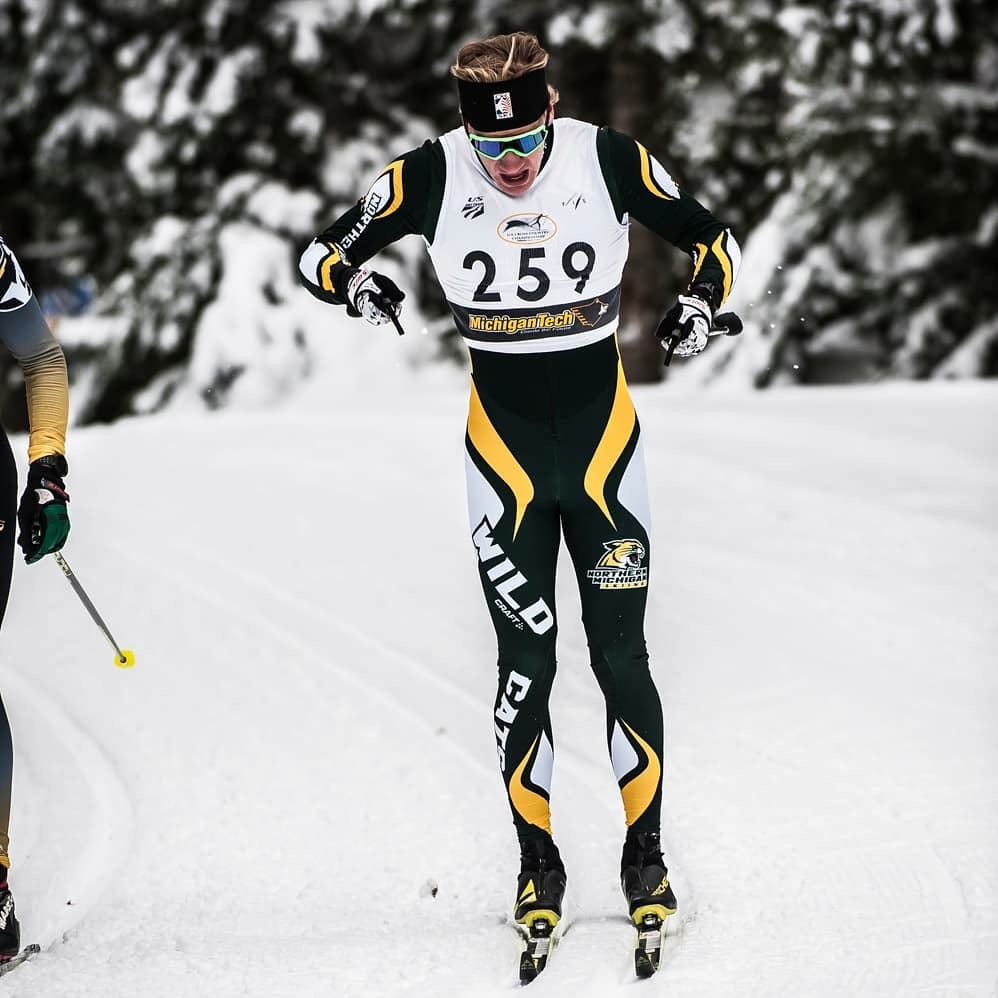
Zak Ketterson (USA) during the 10 k Classic in Toblach, Italy, as part of the 2026 Tour de Ski. (Photo: Vanzetta/NordicFocus)
On Monday, a clear winter morning in northern Italy, Zak Ketterson skied intervals while his teammates enjoyed a point-to-point on an idyllic pre-Olympic winter day. The sun was out. The snow was good. He was working.
“I did some hard intervals,” he said later. “So it was still nice and sunny and everything, but not as enjoyable.”
That small distinction — between the workout that feels good and the workout that gets you ready — has followed Ketterson for most of his career. He has never been the prodigy. He has never been the junior who arrived early, polished, and inevitable. His path to the Olympic start line has been indirect, uneven, and occasionally fragile. It has also been intentional in ways that only make sense in hindsight.
At 27, Ketterson is preparing to race at his first Olympic Winter Games, starting with the Skiathlon on Sunday, the culmination of a season that has quietly redefined his place in American men’s cross-country skiing. He has been competitive across formats, consistent across weekends, and calm in moments that once rattled him. But none of that came from doing things the “right” way — at least not the way modern development systems tend to define it.
Ketterson arrived here by starting late, resisting structure, leaning into racing before training, and trusting that if he kept showing up long enough, the pieces might eventually fall into place.
They have. Just not quickly.
Ketterson’s favorite sports as a child were football and baseball. (Photo: Courtesy Photo)
A Winter Without a Script
Ketterson grew up in Minnesota, where winter is not an inconvenience so much as a condition. The days shorten. The lakes freeze. School calendars and community life bend around the cold. You don’t opt out of winter there; you adapt to it.
In many households, adaptation means skiing. For Ketterson’s, it meant something else first.
“For me, I was always really into football and baseball,” he said. “That was my fall sport and my spring sport.”
Those sports gave his year shape. Football stretched into late autumn. Baseball pulled him toward summer. They came with teammates, structure, and a clear sense of belonging. Winter, by contrast, arrived as a blank space.
Basketball — his favorite sport to this day — lived somewhere between play and possibility. He loved it but never formally committed to it. Organized winter athletics never quite settled into his life. Not yet.
Before skiing was ever part of his life, Ketterson dreamed of being a pro athlete. (Photo: Courtesy Photo)
Cross-country skiing entered almost accidentally, carried in by family rather than ambition.
“My brother, for whatever reason, was more into cross-country running, track, and cross-country skiing,” Ketterson said. “He kind of convinced me, like, yo, you don’t have anything going on in the winter, you should just try this.”
It wasn’t a calling. It was a solution.
He was thirteen — late by elite skiing standards, but early enough to slip into the margins of the system. In Minnesota, seventh graders could train and travel with high school teams. Ketterson joined at the JV level, young and mostly anonymous.
The draw wasn’t the work. It was the race.
“I really liked racing, especially mass starts and sort of the competitive head-to-head aspect of it,” he said.
Training, on the other hand, felt like an obstacle.
“I absolutely hated that,” he said. “When it came to going into the woods and just doing a two-hour ski or something, I hated it.”
Sometimes, hatred turned into avoidance.
“There were a lot of practices where I would hide in the woods,” he said. “My friends and I would just pretend that we trained, but we were actually just building snow forts.”
If this were a conventional development story, it might end there. Plenty do. A late start, uneven buy-in, resistance to structure — those are often warning signs.
But Ketterson kept finding himself back on start lines.
Early days on skis for Zak Ketterson. (Photo: Courtesy Photo)
Racing as the Through Line
What sustained him through those early years was not discipline, but opportunity. Each step forward offered another race, another environment where effort produced immediate feedback.
Junior Nationals. Then World Juniors. Eventually, college.
“The thing that kept me in the sport initially was just the racing,” he said.
That instinct — to measure himself against others rather than against a stopwatch or a training plan — would define much of his early relationship with the sport.
By the time he reached Northern Michigan University, skiing stopped being seasonal. It became daily. The margin for avoidance narrowed.
“I started to develop more of a relationship with the training aspect of it,” he said. “Especially in college, I began to really enjoy the process of trying to improve and optimize things.”
Sleep. Nutrition. Recovery. The quiet details, that barely registered when skiing was something you fit around football and baseball, suddenly mattered.
The shift wasn’t romantic. It was practical.
That change carried him into a professional career after graduation — not as a finished skier, but as someone finally willing to do the work consistently.
A young Zak Ketterson (Midwest/Loppet Nordic Racing) leads the U16 Boys 5 k Classic Mass Start at the 2013 Junior Nationals in Fairbanks, Alaska. (Photo: bertboyer.zenfolio.com. Proceeds go to NNF)
Northern Michigan, Daily Work
Northern Michigan University didn’t transform Ketterson overnight. It narrowed the margins.
Skiing there demanded repetition. Cold mornings. Tired legs. Routine. Improvement stopped being incidental.
The biggest shift came junior year, when he began dating his now wife, Julie Ensrud, and skiing stopped being something he did mostly alone.
“When I started dating her my junior year in college,” Ketterson said, “that really coincided with when I started doing a lot better in skiing.”
Julie grew up in Norway, in a system that treated sport as something you lived inside rather than something you added on. She attended a specialized Norwegian sports high school. She trained at volume. She understood structure.
“She was kind of living semi-professionally from the age of 16,” Ketterson said.
She noticed the basics first.
“I started going to bed a lot earlier,” he said. “I would always just be on my phone until 11 or 11:30.”
Food followed.
“Not only eating healthier,” he said, “but eating more of the right things. More carbs. The timing of what you eat with training.”
By living together senior year, Ketterson’s bad habits became visible.
“She’s probably the hardest worker and most efficient person I’ve ever met,” he said. “She gets an email and does it immediately.”
Ketterson noticed the contrast.
“I used to be super disorganized,” he said. “I used to lose stuff and leave things everywhere.”
Being around someone who treated time deliberately changed how he approached his own days.
“She comes to basically every interval session I do,” he said. “Takes video. Takes lactates. Gives technique tips.”
What could have felt like a sacrifice became shared life.
“If I were single and just kind of doing this grind alone,” he said, “it would feel like a much bigger sacrifice.”
Ketterson (NMU) racing at the CCSA opener in Houghton, Michigan during his college days at Northern Michigan University. (Courtesy photo)
Learning How to Stay Anyway
Leaving college did not feel like an arrival. It felt like exposure.
Professional skiing offered fewer guarantees. Results came without permanence. Progress was harder to measure.
“This is maybe my fifth year as a professional,” Ketterson said. “I feel like I’ve just been sort of taking small steps each year.”
From the outside, those steps were hard to see. He qualified. He scored points. Then momentum faded.
“I’ve had glimpses here and there of being quite good on the World Cup,” he said. “But it was so inconsistent and few and far between.”
One year, sprint qualification came easily while distance slipped. Another season, the opposite.
“I would qualify every sprint but struggle in distance,” he said. “Or I wouldn’t qualify in sprints, but I’d get a lot of top-30s in distance.”
The belief stayed intact.
“I believed I had that all-around potential,” he said.
Belief, however, doesn’t quiet doubt when seasons stack without resolution.
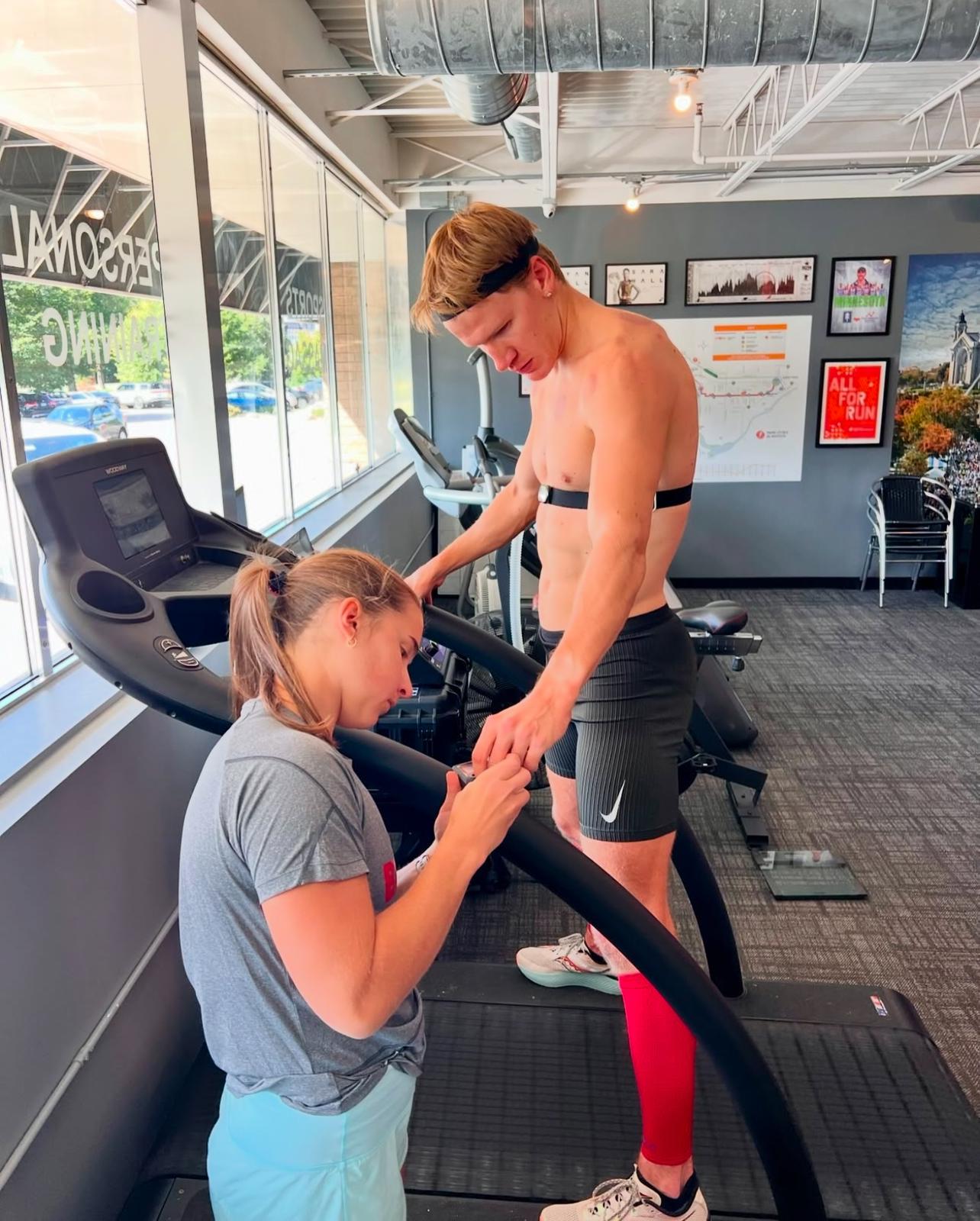
Ketterson’s wife, Julie Ensrud, assists him with lactate testing during a treadmill session. (Photo: Zak Ketterson)
Choosing a Place That Could Hold the Work
For American skiers, Europe is often something you pass through. For Ketterson, Norway eventually became something else.
Julie’s family lived outside Oslo, close to training venues and the airport. There was also a cabin — quiet, familiar.
“It works out super well,” Ketterson said. “I can just get these three- or four-day stints at the cabin and unpack my bag and feel really at home.”
Most American skiers live out of their bags.
“There are a lot of Americans who just live out of their bag and are constantly in hotels,” he said.
In Norway, life slowed just enough for training to accumulate rather than reset.
“They’re super into skiing,” Ketterson said of Julie’s family. “Her brother skied competitively growing up.”
Her father, especially, was absorbed by the details.
“He’s so into ski waxing and the nitty-gritty stuff,” Ketterson said.
The support wasn’t motivational. It was stabilizing.
“They’ve sort of adopted me,” he said. “Like, how can we support him?”
Norway wasn’t the breakthrough. It was the ground beneath it.
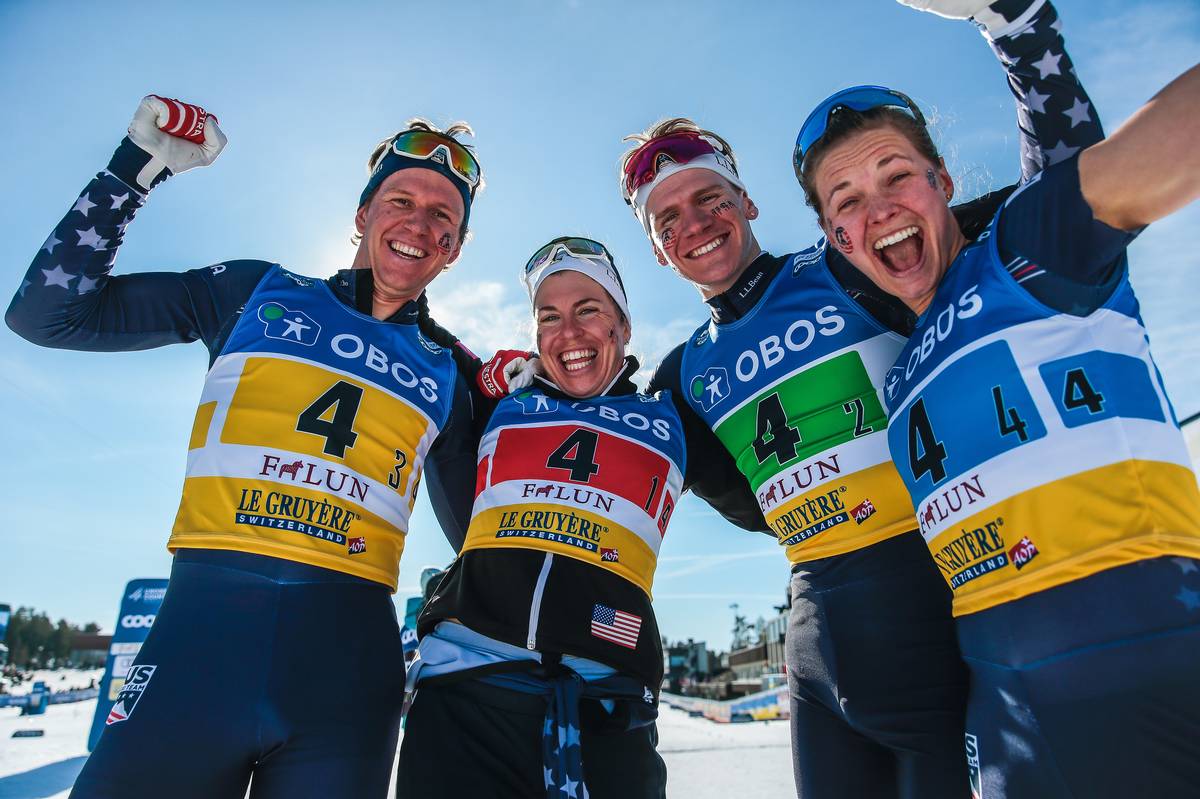
USA I takes the win in a rare World Cup 4 x 5 k mixed relay in 2022. From left to right, Scott Patterson, Rosie Brennan, Zak Ketterson, and Jessie Diggins. (Photo: NordicFocus)
Nothing Fancy, Just Better
With stability in place, the training changed.
“I started working with a coach in Oslo,” Ketterson said.
The relationship was loose.
“He created the framework,” Ketterson said. “But I was still writing probably 90 percent of my training.”
The biggest change was subtraction.
“I used to do strength twice a week, sometimes even three times a week,” he said. “Now it was basically once every ten days.”
The logic was blunt.
“If you want to get better at double pulling,” he said, “you just need to double pull more.”
He replaced strength with ski-specific work. Fitness became the priority.
His training rhythm flattened.
“My training became much more consistent,” he said. “Every week was pretty similar.”
No dramatic rest weeks. No spikes. Stress accumulated steadily.
He returned to the same hills. The same treadmill sessions.
“If something feels way worse than the last six times,” he said, “then you know you need rest.”
Zak Ketterson logs some roller-ski hours in Minneapolis with Team Birkie. (Photo: Instagram @zaketterson)
Toppidrettsveka
Late in August, Ketterson lined up at Toppidrettsveka, Norway’s popular roller-ski stage race.
“I was expecting to be absolute middle of the pack,” he said.
Instead, he stayed with the leaders.
“From the first race — a mass start 50k — I was fighting for the win,” he said.
Three years earlier, he had been dropped halfway.
“That was one of those moments where it’s like, wow,” he said. “This is a really big difference from anything I’ve felt before.”
Across stages, the pattern held.
“That gave me a lot of confidence,” he said. “Like, okay — what we’re doing is really working.”
Still, he waited.
The Ultimatum
By autumn, the feeling hadn’t faded.
“I told Julie that this had been by far my best off-season ever,” Ketterson said.
Then came honesty.
“I told her that if I’m not good this year,” he said, “or if I don’t make a really big jump, then I kind of want to retire.”
It wasn’t dramatic. It was diagnostic.
“If this doesn’t work,” he said, “then I don’t know anything about training.”
Zak Ketterson (USA) and Friedrich Moch (GER) (l-r) lapping through the stadium during the Men’s 20 k Mass Start Freestyle in Ruka, Finland, at the beginning of the 2025/2026 season. (Photo: Modica/NordicFocus)
Ruka
Ketterson finished 14th in the World Cup opener in Ruka.
“I was crying in the finish,” he said.
Not from disappointment.
“It was such an emotional rush,” he said. “All the work that I’d put in, and that my wife had supported — it finally got some validation.”
For the first time since college, the feeling matched the effort.
The season didn’t spike. It held.
“For the first time,” he said, “regardless of whether it’s a sprint or a distance race, I feel like I can compete that day.”
Zak Ketterson (USA) racing on the Olympic Sprint Course in Val di Fiemme, Italy, during the 2026 Tour de Ski last month. (Photo: Vanzetta/NordicFocus)
Arrival Without a Finish Line
Ketterson will start his first Olympic race just days from now — older than most of his teammates, newer to the stage, and unusually calm.
“I’m just treating it like any other race,” he said.
There is no demand for the outcome. Only execution.
“What would haunt me,” he said, “is doing something that was within my power not to do.”
So he will race. He will pace. He will pay attention.
The long way in has given him that luxury.
Help Support Our Olympic Coverage!
FasterSkier has our own Nat Herz on the ground at the Olympics, which is a significant financial lift for us. If you value the thoughtful work and access FasterSkier provides at championships like this one, please consider becoming a Voluntary Subscriber. Your support directly fuels our work to cover the people, places, and moments that make our sport special.
By the time Lauren Jortberg made the U.S. Olympic Cross-Country Ski Team, the achievement arrived not as a burst of disbelief or relief, but as something quieter and stranger: a moment that required processing.
“It is a lot to take in,” she said, speaking from Seefeld, Austria in the middle of a pre-Olympic training block. “It’s been a big goal. But it’s one of those big goals that I’ve tried not to think about too much and just really focus on being my best self.”
The phrasing matters. Jortberg did not describe the Olympics as a finish line or a culmination. She spoke about it as something she had to learn how to hold — something earned, yes, but also something that could overwhelm if mishandled. “Now,” she said, “I’m trying to put aside the completion of the goal and really focus on performing. And performing really well.”
That distinction — between achievement and performance, between arrival and presence — has come to define her career. It is also the reason her story resists easy telling. Jortberg was not a prodigy. She was not a junior star. She did not dominate early or move cleanly through the system. She took the long way around.
The Long Way Around
Jortberg grew up in Boulder, Colorado, a town dense with endurance athletes and outdoor ambition. “I’m super fortunate to have been born and raised in Boulder,” she said. “It has one of the highest percentages of Olympians for cycling and running.”
Her parents were athletic — her mother was a professional runner, her father competed in multiple sports — and movement was woven into daily life. There was mountain biking, trail running, hiking, time spent at a family place in Winter Park. But skiing, she noted, was not central to Boulder’s identity. “If you’re familiar with Boulder, it’s not really a winter place. We had to work hard to get to snow.”
Her earliest athletic identity was split. She loved soccer deeply and still wonders what might have happened had she stayed with it. “I do kind of wonder what I could have done if I had pursued soccer,” she said. Her father spent hours training with her, and she took pride in improvement more than outcome.
The turn toward skiing came, in part, through her older sister — six years ahead, a steady presence, someone to chase. When her sister tore her ACL playing soccer and pivoted fully to skiing, Jortberg followed. “I really looked up to my sister,” she said. “She went to U18 Scandinavian Cup, Junior Nationals, skied at the University of Denver. Seeing her do all these cool things with skiing really felt like, well, I can do that.”
But progression was slow. In high school, Jortberg struggled. She did not make Junior Nationals her first year — a moment she still remembers clearly. “I was devastated,” she said. “It was one of the first big adversities in my career.”
She never cracked the top ten at Junior Nationals until she was a U20. “I had a lot of 11th places,” she said. “I could never crack that top ten.”
It is difficult, in hindsight, to overstate how thoroughly unremarkable her junior results were by Olympic standards. This is not revisionism; it is the point. There was no obvious through-line, no early validation to cling to.
After high school, she took a gap year at Stratton Mountain School. It did not go smoothly. She fractured her arm in a parking lot crash. The season was disrupted. Progress stalled again.
What she had, instead, was a willingness to stay.
Dartmouth and the Work of Becoming
At Dartmouth, something shifted. Not overnight, and not magically — but structurally.
“I think it was a big surprise starting at Dartmouth,” Jortberg said, “the level I was at and the level the team was at.” She majored in environmental science and found herself inside a women’s program that emphasized individual growth within collective intensity.
Under coach Cami Thompson Graves, the team culture was demanding but non-coercive. “She’s really amazing at coaching athletes to really know what is good for them,” Jortberg said. “She’s incredibly good at getting athletes to become very independent with an amazing team culture.”
The women’s team was deep, competitive, and internally driven. “We were going one through five, or one to four, five, eight, ten,” she said. “It was insane.” NCAA spots were scarce; no one could coast.
Crucially, Dartmouth supported international racing alongside collegiate commitments. Jortberg went to World Juniors, U23s, OPA Cups — sometimes twice in a season. “Having that support was super helpful,” she said. “Not just to perform in a green suit, but to perform later on.”
For the first time, development felt cumulative.
The women’s final of the 2021 Keys to the Castle rollerski sprint in Lake Placid, NY. From left to right, Lauren Jortberg (BSF Pro), Julia Kern (SMS T2/USST), Jessie Diggins (SMS T2/USST), Alayna Sonnesyn (SMS T2). (Photo: Reese Brown RDB Marketing)
The Bubble Years
Post-collegiately, Jortberg entered what many American skiers know intimately: the bubble.
She moved through programs, spent time with Bridger Ski Foundation Pro and later SMS T2, and began working with coach Perry Thomas. She earned World Cup starts, lost them, re-earned them. Progress was intermittent. Confidence, fragile.
“It was a lot of back and forth,” Thomas said. “Getting starts and not getting starts. Proving herself again in the U.S. and then getting those World Cup starts again.”
Thomas had recruited Jortberg as one of his first athletes when he began coaching at the professional level. Their early years together were not seamless. “Our first year together, there was a lot of figuring things out,” he said. “There were ups and downs.”
What mattered was not immediate success but shared patience. “We were both willing to make it work,” Thomas said. “And work through difficulty together.”
During this period, Jortberg made a deliberate choice that would shape the rest of her career: she doubled down.
Lauren Jortberg (USA) training in Tignes, France, last June. (Photo: Authamayou/NordicFocus)
Choosing One Thing
Sprinting had always been her strength — particularly skate sprinting. Classic sprinting lagged behind. Rather than attempting to become broadly better at everything, Jortberg and Thomas made a narrower decision.
“Let’s spend one day a week, every week, for an entire summer and fall, working on classic skiing,” Thomas said. “Double pole. Thirty to sixty minutes. Just consistently.”
It was not glamorous work. It was not optimized for social media or immediate payoff. But Jortberg committed fully. “She was like, ‘Hell yeah, let’s do this,’” Thomas said.
Even when they were no longer formally affiliated with the same team, she continued the work remotely. “She continued that work on her own,” he said. “From afar.”
At the same time, something else was happening — something less visible.
Lauren Jortberg (USA) during the qualification of the World Cup Individual Skate Sprint in Oberhof, Germany, two weeks ago. (Photo: Authamayou/NordicFocus)
The Mental Turn
Jortberg began working seriously with a sports psychologist. She and Thomas independently immersed themselves in books, podcasts, and writing about mental performance. They traded recommendations. They talked openly about processing failure.
“I don’t care how pretty your technique is,” Thomas said. “If you don’t have control over the on-off switch in your brain, you’re not going to get to the line fastest.”
What Thomas noticed later, during Period 1 Super Tour in Alaska, was a change. “That was a different Lauren than even a year ago,” he said. “In such a good way.”
Jortberg describes it less as a breakthrough than a reframing. “Everyone is going to have setbacks,” she said. “It’s about how you respond. Chipping away little by little. Not letting setbacks impact how you see yourself.”
She learned to loosen her grip on outcomes. “Often when we think things have to happen a certain way,” she said, “that’s when they don’t.”
Lauren Jortberg with boyfriend Antoine Cyr (CAN). (Photo: Courtesy Photo)
Two Places at Once
In the fall, Jortberg moved to the Mount Sainte-Anne area of Quebec. The decision was partly personal — she is dating Canadian skier Antoine Cyr — but also practical.
She began training at the Pierre Harvey Training Centre, known for its demanding terrain and extensive roller-ski infrastructure. “The terrain is really hard,” she said. “I think it’s been awesome for intensity. Especially my classic skiing.”
Her coaching arrangement became hybrid: remote communication with Thomas, daily training in Quebec. “We text pretty much every day,” Thomas said. “Or we’re on the phone.”
Jortberg chose not to maintain two residences. “That’s just not something that financially would be feasible,” she said. More importantly, she valued stability. “I really prioritize my personal life. That’s what allows me to perform at the highest level.”
It is an unromantic truth of elite skiing: stability is performance.
Alaska and Leadership
When Jortberg declined early World Cup starts to focus on Super Tour and U.S. Nationals, she rejoined Coach Thomas and the rest of the Mansfield Nordic Pro team in Alaska. What stood out was not just her skiing.
“I was so impressed with her as a leader,” Thomas said. “We used her a ton in team meetings. Tactics. Pacing. Course preview.”
After Alaska, the decision to formally add her back to the team was unanimous. “It was an easy decision,” Thomas said. “She just wanted to be part of the team and demonstrated awesome leadership.”
Kendall Kramer, Samantha Smith, Lauren Jortberg, and Julia Kern (l-r) will join Jessie Diggins, Rosie Brennan, Novie McCabe, and Hailey Swirbul to represent the United States in Val di Fiemme, Italy, from Feb. 6–22, 2026. (Photo: Authamayou/NordicFocus)
Not Jaded
Jortberg will arrive at her first Olympics as one of three women on the U.S. team making their Olympic debut. She sees that as an asset.
“I want to bring non-jaded energy,” she said. “Just that first-time excitement.”
She wants to be present — not consumed by outcome. “I want to look back and be grateful that I was even there,” she said. “And really appreciate the experience.”
It is not a rejection of ambition. It is a different relationship to it.
Forward
Jortberg plans to continue racing. She hopes for 2030, in the French Alps — a place she loves, a skate sprint on a stage that suits her. She is considering an online master’s program in sustainability and renewable energy, thinking carefully about how to prepare for the life that will follow skiing without rushing herself toward it. For the first time in her career, she feels no urgency to escape the present.
“I feel the most stable I’ve ever felt in my career,” she said. “And it’s showing.”
Stability, for Jortberg, has never been accidental. It is something she built deliberately, after years of motion without certainty — years of chasing snow from a town where Olympians ran past her on bike paths and reservoir loops, where excellence was ambient and ordinary at the same time. In Boulder, she grew up watching greatness move casually through public space, learning early that world-class athletes were not mythical figures but people who showed up every day and kept going.
She was not the fastest junior in that environment. She was not the one with the early results or the easy narrative. She lingered on the edges, finished just outside the frame, learned patience in a place that celebrated inevitability. And still, she stayed.
Lauren Jortberg (USA) anchors the relay for the United States in Toblach, Italy, in 2023. (Photo: Modica/NordicFocus)
Now she is an Olympian — not because she followed the shortest line between promise and performance, but because she learned how to endure the long arcs in between. She learned when to narrow her focus, when to loosen her grip, when to trust work that did not announce itself right away. She learned how to live inside uncertainty without mistaking it for failure.
There is something quietly astonishing about that return: a young woman who grew up surrounded by Olympians, never quite believing she was one of them, becoming one anyway — not by force or speed, but by accumulation. By choosing stability when chaos was easier. By learning how to stay.
For an athlete who never arrived early, this moment is not a surprise step so much as a natural one. The long way around, it turns out, still leads somewhere.
Help Support Our Olympic Coverage!
FasterSkier will have our own Nat Herz on the ground at the Olympics, which, to be honest, is a very big financial lift for us. If you value the thoughtful work and access FasterSkier provides at championships like this one, please consider becoming a Voluntary Subscriber. Your support directly fuels the work we do to cover the people, places, and moments that make our sport special.
The men’s Classic Sprint heats got started with quarterfinal number one at the US Nationals Cross-Country Ski Championship at Mt Vanhoevenberg in Lake Placid NY. (Photo Nancie Battaglia)
The last day of the U.S. National Cross-Country Ski Championships in Lake Placid arrived the way honest days in this sport often do. The snow at Mt. Van Hoevenberg had been churned and scoured by a week of racing and changing weather, its surface no longer pristine but revealing, the kind that gives little for free. Legs were tired. Arms were tender. Expectations had been trimmed back by accumulated kilometers and decisions already made.
For the men lining up for the classic sprint, this was not simply a final chance at a national title. In an Olympic winter, nothing is ever only what it claims to be. The sprint was an audition—not necessarily for Olympic selection, but for relevance. For future start rights. For the ability to say, credibly, that range still exists.
Sprint qualification, in particular, has a way of stripping sport down to its essentials. No drafting. No hiding. One lap to explain yourself. As has been said all week about sprints, it does not matter how clever you are in the heats if you cannot arrive there in the first place. In Lake Placid, that truth shaped the day from the first starter onward.
Fin Bailey (UVM) makes his way up the Lake Placid sprint course’s signature climb. (Photo Nancie Battaglia)
Qualification: where the day declares itself
Qualification mattered here in a way that went beyond podiums and medals. With sprint start rights in the World Cup largely determined by qualification speed, the men knew exactly what was at stake. If this were a sorting mechanism, it was a blunt one.
The fastest man through the course was John Schwinghamer, whose time at the top of the board set the early benchmark. But the story quickly widened. Pierre Grall-Johnson followed closely, and then Will Koch, who would soon become central to the day’s most unusual tactical thread, placed third.
A few seconds farther back sat a cluster of names that told a deeper story: athletes with distance pedigrees, athletes chasing U23 selection, athletes managing fatigue from a long week and still trying to produce speed on demand.
Among them was Zanden McMullen, who qualified tenth, solid but not dominant. “The qualifier felt a little off,” McMullen admitted. “I didn’t feel smooth and thought I skied poorly through the terrain. I was happy to qualify and have another chance to improve on the day.”
That, in retrospect, was the quiet warning shot.
Classic striding versus powerful double poling was one of the key storylines in the men’s Classic Sprint. (Photo Nancie Battaglia)
A decision made in minutes
If qualification is the most honest part of sprinting, it is also where improvisation sometimes reveals itself. Koch arrived at the start line with little margin and even less certainty.
“I was already pretty tired going into the classic sprint,” Koch said. A bonk midway through the 20-kilometer freestyle earlier in the week had drained his reserves, and classic sprint had never been his strength. “With about ten minutes to go before my qualifier, I still couldn’t get my classic skis to kick.”
The decision that followed was not theoretical. Koch asked his coach to prepare a pair of skate skis — not as a backup, but as a commitment. He reached the start with roughly 90 seconds to spare, hoping that strength alone might be enough to advance.
Third in the qualifier erased doubt immediately. “When I ended up third, I knew it was the right call,” he said. “I never even tested a classic ski the rest of the day.”
The gamble would ripple through every round that followed.
Will Koch (SVSEF) powered through the qualification and heats, double poling on skate skis. (Photo Nancie Battaglia)
Heats: when fatigue starts to speak
Classic sprint heats at Mt. Van Hoevenberg reward clarity. The course offers opportunities, but they are conditional. Mistime a move, and the course and competition punish hesitation. Get trapped behind the wrong skis, and speed evaporates.
Koch’s plan was simple and exhausting: lead early, create space before the climb, and survive long enough for glide to matter again. “If I could crest the climb with the group, my skis would be fast enough to carry me through,” he explained.
For a time, it worked exactly as intended.
But others were playing different games.
Zach Jayne arrived at the sprint with a different set of calculations. Already qualified for U23 Worlds and carrying a narrow SuperTour points lead, his goals were layered. “I wanted to finish strong,” Jayne said. “I also wanted to make the final so I could displace other U23 athletes and help ensure my teammate Max Kluck made the trip.”
Jayne, Koch, and teammate Carl Rune all opted to double-pole the heats on skate skis, a choice that paid dividends early. “It worked really well in the quarterfinal,” Jayne said. “But as the rounds went on and fatigue built, I was definitely wishing I’d brought a pair of klister skis.”
That fatigue — cumulative, unrelenting — became the quiet theme of the afternoon.
Zanden McMullen (APU) showed he had made the right calculations for himself in the final, creating a gap on the large climb, which he was able to maintain on the final downhill. (Photo Nancie Battaglia)
Trusting kick in uncertain snow
While some chased glide, Max Kluck made a different bet. His week had been defined by nerves more than novelty. “I was more nervous than I’ve been in years,” Kluck said. “I knew my U23 spot was on the line.”
The snow tempted experimentation, but Kluck resisted. “I was pretty certain I wanted to stay on classic skis unless the weather took a major turn,” he explained. “I stuck with my gut.”
The reward came immediately. In the quarterfinals, Kluck ran the climb with confidence, kick biting cleanly while others labored, arms already beginning to pay the price. “I figured I might be able to make double-poling work once,” he said. “But I didn’t think I could personally do it four times.”
His solution was economy. By trusting his wax and striding more often, Kluck preserved his upper body for the finishing straight — a detail that would matter later.
UVM’s Fin Bailey was showing he was on form and a threat for the podium throughout the heats, but his final got off to an unlucky start with a broken pole. (Photo Nancie Battaglia)
The final: legs versus arms
By the time the final assembly was complete, the calculus was visible even from the sidelines. The men who had double-poled all day carried speed — and fatigue. Those who had relied on kick carried legs.
McMullen understood the equation precisely. “Going into the final, I knew the few boys that double-poled all day would be tired,” he said. “My plan was to keep them in reach before the final climb and then gap them.”
Snow conditions had continued to degrade, wind and rain complicating grip and timing. McMullen’s classic skis, however, remained reliable. “Our classic skis felt good,” he said. “I didn’t think there was a need to try and double-pole the race.”
When the decisive climb arrived, McMullen did not hesitate. He strung together clean transitions, trusted his kick, and separated decisively. “I felt really fresh still at the start of the final,” he said. “I knew I would be able to run away with it.”
Behind him, the chase unfolded exactly as predicted. Koch’s glide carried him, but the cost of four rounds of double-poling showed. Kluck’s restraint paid dividends, his saved arms helping him close strongly. Jayne fought valiantly through fatigue, his earlier work for teammates already done.
McMullen crossed the line alone — a national champion not because he had chased novelty, but because he had waited for the moment that mattered.
Zanden McMullen (APU) comes to the finish of the Classic Sprint with his second national title in as many days at the US Nationals Cross-Country Ski Championship at Mt Van Hoevenberg in Lake Placid, NY. (Photo Nancie Battaglia)
What the result actually means
The men’s classic sprint did not reshape Olympic selection overnight. Sprint specialists were unlikely to be named from Nationals alone. But the race clarified something subtler and perhaps more important.
It showed who can adapt under stress. Who can make decisions when plans unravel? Who understands that qualification speed opens doors long before medals do?
For Koch, the day was a revelation. “The classic sprint was a really pleasant surprise to end the week,” he said, even as he acknowledged that broader goals remained unmet.
For Jayne, consistency mattered more than headlines. “I don’t race to prove people right or wrong,” he said. “I know what I’m capable of.”
For Kluck, the outcome was tangible. “Securing my U23 spot was the biggest goal of my season,” he said. “Locking it down here feels incredible.”
And for McMullen, the victory was both affirmation and invitation. “I hope people know now that I’m an all-around skier,” he said. “And I hope the Olympic selection committee knows I have a lot of potential to succeed at the Olympics.”
Zanden McMullen (APU) first place, Will Koch (SVSEF) second place, and Max Kluck (UU) third place at the US Nationals Cross-Country Ski Championship Classic Sprint at Mt Vanhoevenberg in Lake Placid NY. (Photo Nancie Battaglia)
A quiet ending, honestly earned
As the course emptied and the equipment was packed away, Mt. Van Hoevenberg returned to stillness. Another Nationals was complete. Another set of arguments had been made — not loudly, not always cleanly, but honestly.
Sprint racing, especially in January of an Olympic year, has a way of revealing truths athletes might prefer to delay. Qualification does not negotiate. Fatigue does not compromise. Decisions, once made, echo through every climb and corner that follows.
On this final day in Lake Placid, the men who listened closely to their bodies, their skis, and the snow underfoot, were the ones who left with something lasting.
Feature stories like this one take time, access, and care to produce. If you value thoughtful storytelling and independent ski journalism, please consider becoming a Voluntary Subscriber. Your support directly fuels the work we do to cover the people, places, and moments that make our sport special.
What was truly on display this week at the US Nationals Cross-Country Ski Championship at Mt Van Hoevenberg in Lake Placid, NY was not only that cross-country skiing is an awesome sport, but the community that embodies it is something worth celebrating. (Photo Nancie Battaglia)
This coverage is made possible, in part, through the generous support of Marty and Kathy Hall and A Hall Mark of Excellence Award. To learn more about A Hall Mark of Excellence Award, or to learn how you can support FasterSkier’s coverage, please contact info@fasterskier.com.
Gus Schumacher (USA) and the rest of his heat work their way up and over Toblach’s signature feature during the 5 k Mass Start last week. (Photo: Modica/NordicFocus)
There are days in this sport when the numbers feel like the whole story: a time, a place, a gap. But every so often, cross-country skiing produces a day that can’t be explained by the clock alone — a day that feels bigger than the course, bigger than the snow, bigger than the athlete who happens to win it.
December 31, 2025, was one of those days.
In the space of a few hours at the Tour de Ski in Toblach, Gus Schumacher and Jessie Diggins both climbed onto the top step of the World Cup podium — Schumacher winning the men’s 5 km freestyle heat mass start in 9:35.4, Diggins winning the women’s in 10:51.2.
It’s worth pausing on what that sentence contains.
Not merely that two Americans had strong races on the same day. Not merely that the U.S. team put two athletes in contention. But that the United States — a nation that has spent decades carving out its place in a sport long dominated by Europe — produced two winners, one men’s and one women’s, on the same World Cup day, in the same venue, in a brand-new format that demanded equal parts speed, tactics, and social intelligence.
The official results pages will always show the same clean fact pattern: Schumacher over Austria’s Benjamin Moser by two-tenths, Norway’s Lars Heggen third; Diggins comfortably ahead of Sweden’s Emma Ribom and Moa Ilar.
But inside the U.S. wax room and the mixed zone, the day’s atmosphere was not clinical. It was almost disorienting — a moment that drew a line through American skiing’s past and then, for a beat, let everyone see how far the line had traveled.
“It’s probably going to take us all a little bit to really kind of wrap our heads around it,” U.S. Ski Team Nordic Director Chris Grover said afterward, still sounding like someone trying to describe a thing while standing inside it.
And then he admitted the quiet truth that every program director carries: days like this don’t happen on demand.
“It’s a special moment to see both those athletes on top at the same time,” he said. “It’s going to be hard to replicate. We’ll take it where we can get it for sure.”
U.S. head coach Matt Whitcomb saw it less as lightning and more as follow-through.
“It truly was a great day,” Whitcomb said. “And it was actually better than the results show. Every heat — with the exception of Kevin [Bolger’s] experience — our athletes moved up, finished competitively, and executed the plans they intended to execute.”
What stood out most to him wasn’t just the double victory. “Honestly,” Whitcomb said, “better than the double win is the feeling that we came up with a plan individually and as a team — and executed. It was a big win for everybody.”
Jessie Diggins (USA) wasn’t just the leader of the race and the Tour, but also of the athletes she teamed with in her heat of the 5 k Mass Start. (Photo: Modica/NordicFocus)
A day that didn’t have to happen this way
If you want to understand why Toblach felt like more than an athletic coincidence, it helps to begin with the format, because the format did not reward the simplest kind of superiority.
Stage 3 was a 5-kilometer freestyle race in four separate mass-start heats with staggered start times and a final classification determined by combined times, not by who crossed the line first in any single heat. It was new enough that even veterans were still learning what the race “wanted.”
Whitcomb described the format as genuine unknown territory — not because the course was unfamiliar, but because the distance itself had been largely absent from the World Cup.
“The 5 k hasn’t been part of the World Cup for a while,” he said. “We know historically that we skate well, sprint well, skate 10 k’s well — and we focus a lot on the 5 k as a building block in training. But nobody really knew what to expect.”
The approach, he said, was deliberately simple: stay organized, enjoy the process, and trust the system. “We just operated the way we always do,” Whitcomb said. “Be organized, enjoy each other’s company, and look at the results at the end of the day.”
In a normal interval start, you win by suffering well. In a normal mass start, you win by positioning, conserving, and timing. In this hybrid, the incentives were stranger: the best strategy could be to help your competitors go faster — to create a heat so fast that it swallowed the rest of the field on arithmetic.
That sounds like something coaches dream up in theory and athletes abandon under the first real surge.
And yet, both Diggins and Schumacher described essentially the same decision: race the clock, and don’t be precious about the heat win.
Schumacher put it in his own blunt, funny way when asked about winning on the same day as Diggins: “I think it’s super cool! Jessie had to be a huge favorite today, so it was up to us to hold up our end, haha.”
Diggins, in the mixed zone after her race, was still riding the strange energy of having watched the men first — watched the experiment play out once — and then stepping into the women’s version with a clearer sense of the rules of engagement.
“What’s nice is it was just 5 k,” she said. “After watching the men, you were like, okay, you’re going to gain or lose 10 seconds on the Tour overall. But the big thing was to just have a really fast heat.”
Then she said the thing that makes this day so revealing: she described her heat as a temporary team—a coalition formed not by flags but by incentives.
“I thought it was so cool and fun to feel the camaraderie,” Diggins said. “I was talking to all the girls beforehand, like, okay, team number three, we’re going to do this… we’re going to change leads, and everyone’s like, yeah… We had really great teamwork out there… It was an unexpected delight of the format.”
Gus Schumacher (USA) charges to the finish line to win heat two and post the fastest time of the day. (Photo: Modica/NordicFocus)
Schumacher told a version of the same story — not as delight, but as commitment.
“I think my heat-mates and I realized that having a fast heat was the biggest picture,” he said. “I was prepared to be 10th in the heat if it meant we were fast.”
From the outside, Whitcomb saw something even more deliberate.
“Gus spent time reaching out to Lars Heggen and Ben Moser and came up with a plan,” Whitcomb said. “You saw some really well-orchestrated trading off of the lead in that heat. That led to a fast heat — and it led to those three guys on the podium.”
For Whitcomb, that was the defining trait of the race. “Gus is an incredibly savvy racer,” he said. “He’s a great physical specimen — this distance suits him. But what really made the difference was his willingness to control everything he could. And that meant teaming up with athletes from Austria and Norway.”
He explained how that philosophy became practical: trading leads early, staying disciplined, then continuing to work together deeper into the race than he expected — a heat built like a rotating paceline, but on snow, at World Cup speed.
And then, of course, the part no coalition can hand you: the finish.
Schumacher still had to have enough left to win the stage outright. Diggins still had to be strong enough to make the tactics matter.
The format offered an opening. The athletes still had to ski through it.
Benjamin Moser (AUT), Gus Schumacher (USA), and Lars Heggen (NOR), (l-r) share the Tour de Ski stage podium in Toblach (ITA). (Photo: Modica/NordicFocus)
The numbers, briefly, before the meaning
It’s important in a historical story to keep the results clean and factual.
On the men’s side, Gus Schumacher (USA) won in 9:35.4, with Benjamin Moser (AUT) second at +0.2, and Lars Heggen (NOR) third at +0.6.
On the women’s side, Jessie Diggins (USA) won in 10:51.2, with Emma Ribom (SWE) second at +5.5, and Moa Ilar (SWE) third at +6.9.
Those are the hard edges of the day — the parts that will remain true no matter what story gets written around them.
But what made Toblach feel different was not just that two Americans won; it was who they were, where they were in their respective arcs, and what it implied about the American program’s shape heading into an Olympic season.
Diggins is the established cornerstone — a skier who has spent years normalizing things that once felt improbable for the U.S. program. Schumacher is the next wave, still building the evidence that Minneapolis wasn’t a one-off, that his skillset is durable, that he can win in more than one kind of race.
In the mixed zone, Diggins made it feel personal and immediate. She had the post-win glow, yes, but the first emotion she reached for was pride in Schumacher.
“It was really cool,” she said. “It was super inspiring seeing Gus with his win. I’m so proud of him. So excited for him.”
That’s the moment: the most decorated active American skier on the women’s side, standing in Toblach, still buzzing, describing the men’s win as fuel — not as separate news.
Emma Ribom (SWE), Jessie Diggins (USA), and Moa Ilar (SWE), (l-r) on the Tour de Ski podium for the 5 k Freestyle Mass Start. (Photo: Modica/NordicFocus)
Toblach, of all places
Grover, thinking like a director who has watched years of World Cup logistics and outcomes, pointed to something that has been true long enough to become lore: Toblach has often been a good venue for the U.S. team.
“It’s funny — over the years, I’ve got to say Toblach has probably been the best venue for us of any place on the World Cup,” he said. He cited previous successes there — podiums and performances from different eras and athletes — and he also offered the pragmatic layer: Toblach’s dry, manmade Italian snow can be “easier to wax for,” which matters more than casual fans appreciate.
The location matters for another reason, too: Toblach sits inside the Tour de Ski, a crucible that encourages narratives. Athletes arrive tired. They leave tired. Every result is filtered through what it means for the overall standings and what it costs to achieve it.
This year’s Stage 3 came after a rest day and arrived as a kind of reset: short enough to be explosive, structured enough to be strange, meaningful enough to be remembered.
It was also the kind of stage where the U.S. program’s long-running strengths could express themselves.
Grover offered one of the more interesting explanations for why the U.S. has historically punched above its weight in short freestyle formats: structural adoption.
When sprint racing emerged and became formalized on the World Cup, the U.S. embraced it aggressively, he said — building it into domestic racing pathways early, so the program effectively selected and developed athletes with high anaerobic capacity, then built the aerobic engine on top.
The result, over time, has been athletes who can tolerate the speed of short formats without losing the distance competence required to survive something like the Tour.
Diggins and Schumacher are not identical athletes, but the day in Toblach suggested they share a kind of hybrid competence: fast skating with depth.
And that’s exactly what the new format asked for.
The historical thread: what came before, and why this is still rare
Toblach’s double win is easier to appreciate when you place it alongside earlier American “two-at-once” moments — because it clarifies what is new here and what is part of a longer progression.
Fellow U.S. Ski Team members Kikkan Randall (l) and Sophie Caldwell after finishing an unprecedented first and third, respectively, in the World Cup freestyle sprint in Lahti, Finland in 2014. (Photo: Fischer/Nordic Focus)
Two Americans on the same World Cup podium: the women’s thread
Over the last 15 years, the most frequent American double podiums in individual races have come on the women’s side — and FasterSkier’s archive captures that evolution in chapters.
At the 2015 World Championships in Falun, Jessie Diggins and Caitlin Gregg won silver and bronze in the 10 km freestyle — an all-timer, not only for the medals but for what it did to the American imagination about what was possible in championship distance racing.
If you track those milestones as a line, you can see how the U.S. women’s program went from “breakthrough” to “repeatable.” It also helps explain why Diggins winning in Toblach — while still special — did not feel like a shock.
It felt like the continuation of a normal she helped invent.
Simi Hamilton (l) hugs fellow U.S. Ski Team member Jessie Diggins after both placed third in their respective freestyle sprint finals at the World Cup stage in Gatineau, Quebec. (Photo: John Lazenby/Lazenbyphoto.com)
Men + women on the podium the same day: the precedent
Now add the second thread: men and women both reaching the podium on the same day.
That day is an important historical anchor because it shows how rare cross-gender podium alignment was, even during periods of strong U.S. women’s success.
That alignment has echoed in the recent past, too — most memorably on February 18, 2024, in Minneapolis. Schumacher’s first World Cup victory, a 10-kilometer freestyle individual start on home snow, came on a day when Diggins also climbed onto the podium, finishing third in the women’s race. It was the kind of split-screen moment that hinted at what might be coming: a U.S. program no longer living on isolated miracles, but beginning to stack elite performances across genders on the same afternoon. Toblach sharpened that earlier echo into something rarer still — not a shared podium, but shared victories, on foreign snow, inside the Tour de Ski.
Toblach 2025 goes a step further than Gatineau 2016 — not “podium together,” but win together.
And that is why Grover’s comment — “hard to replicate” — matters. Because even a strong program doesn’t get to schedule these moments. It can only position itself to recognize them when they arrive.
Gus Schumacher (USA) celebrates the victory in Toblach (ITA) with his US Ski Team teammates, coaches, and staff. (Photo: Modica/NordicFocus)
Why the double win felt like a team story
One reason Toblach resonated within the team is that both Diggins and Schumacher narrated their wins with a vocabulary that sounded less like a solitary triumph and more like collective execution.
Diggins led with skis.
“Fast snow, had really fast skis,” she said. “So thank you to our team…”
She emphasized tactics not as personal cleverness but as mutual agreement: “Everyone did their part… Okay, I can pull now, and you can pull now.”
And she framed the day’s broader meaning not as a press-release milestone but as a human reaction: “I’m so proud of Gus and everyone on the team.”
Schumacher, asked to reflect on the same-day symmetry, responded with humor and a little humility — the kind that still acknowledges responsibility.
Jessie Diggins (USA) also celebrates the victory in Toblach (ITA) with her US Ski Team teammates, coaches, and staff. (Photo: Modica/NordicFocus)
Jessie “had to be a huge favorite,” he said. So “it was up to us to hold up our end.”
That sentence contains something important about Schumacher’s emergence: he speaks like someone who believes he belongs in the job.
Not in a boastful way — in a functional way. Like a skier who believes the U.S. men’s team is allowed to contribute to a “historic day” not as an anomaly but as a duty.
Grover, who has watched the U.S. program move through phases in which the women carried the torch while the men tried to catch up, seemed to feel that shift, too.
He described the day as something that bridges eras: there were times when a strong men’s day came without a matching women’s result; times when the women’s team was deep, and the men’s team was still searching for its consistent breakthrough.
Toblach wasn’t just both genders on the podium. It was both on top.
Whitcomb saw the same pattern across the roster.
“Every one of our athletes — men and women — finished competitively in their heats,” he said. “And they executed the plans they came in with.”
That included results beyond the podium: Diggins winning, Schumacher winning, Julia Kern in 10th, Ben Ogden in 20th, and J.C. Schoonmaker in 29th. “It really was an all-around great day,” Whitcomb said. “The execution was better than the results show.”
A program doesn’t change overnight, but it does reveal itself in moments like this — when two separate pipelines deliver winners on the same day, under the same strange rules, in the same high-pressure context.
Jessie Diggins (USA) embracing the excitement in the finish corral. (Photo: Modica/NordicFocus)
The strange beauty of the format: teamwork as the unintended point
FIS likely designed the four-heat format for spectacle: shorter races, more winners crossing lines, more “events” within a day. But Diggins described a different kind of spectacle — not for the cameras, but for the athletes.
The format made cross-country skiing briefly feel like a sport of temporary alliances.
“Maybe that wasn’t the goal,” Diggins said, acknowledging that she was projecting her own values onto a structural experiment. “Maybe that wasn’t the goal to get teamwork across countries. But for me, that was the goal.”
Whitcomb was candid about why formats like this matter beyond athlete preference.
“What’s most important isn’t actually what the athletes think,” he said. “It’s what the fans think. What the fans think dictates whether or not the sport survives in some regards.”
Traditional 10 and 15-kilometer individual starts, he added, can be hard for casual viewers to engage with. “We need some change,” Whitcomb said. “And I think today provided a little bit of life to the sport. Frankly, it needs that.”
Schumacher’s description of his heat was less philosophical but equally revealing: a group of men deciding, in advance, that the only way to win was to make the whole heat fast — even if it meant giving up individual control.
This is an unusual kind of honesty in ski racing, where athletes are trained to reveal as little as possible about tactics.
And it helps explain why the double win felt like a “team day” even though cross-country skiing is, most of the time, one of the most solitary endurance sports in the world.
Both winners described the same phenomenon: speed created by cooperation.
And both wins required the same final act: individual excellence layered atop shared work.
Gus Schumacher (USA) thanks his ‘lucky’ fan club in Toblach (ITA). (Photo: Vanzetta/NordicFocus)
The human detail that made it feel like a story, not a statistic
Near the course, as the day unfolded, there was also the kind of detail that doesn’t appear in official documents but sticks to memory — the four “good luck Alaskans” who have now become part of Schumacher’s mythology.
They were present at his World Juniors victory. They were present in Minneapolis. They were in Toblach again.
They will be at the Olympics, too.
It’s an affectionate superstition, but it also points toward something real: American skiing used to feel like a sport of isolated miracles — one athlete, one day, one surprise.
Now, it is starting to feel like a sport that can sustain its own community momentum — people traveling for it, following it, building rituals around it.
A program becomes a culture not when it wins once, but when it wins often enough that people start to behave like it’s a thing worth following.
Jessie Diggins (USA) and Rosie Brennan (USA), (l-r) skied to second and third place in Davos in 2024. (Photo: NordicFocus)
What to do with a day like this
There is always a temptation, after a historic result, to treat it like a prophecy.
To declare that the U.S. has “arrived,” that the future is guaranteed, that Toblach is the beginning of the next era.
Neither Diggins nor Schumacher offered that kind of certainty. Diggins, even in the glow, stayed practical; Schumacher talked about holding up his end and taking the Tour day by day.
Grover, too, resisted prophecy. He chose something quieter: recognition, gratitude, and the realism that moments like this can’t be manufactured.
But history has its own rules. Even if athletes move on quickly, even if the World Cup continues, even if the next races erases some of last week’s glow, the record will still show: the United States won both races on the same World Cup day in Toblach.
And when future athletes look back through FasterSkier’s archive — through Lahti 2014, Falun 2015, Gällivare 2015, Toblach 2017, the Tour days with Diggins and Brennan, the first men-and-women same-day podium in Gatineau — they will see Toblach 2025 not as a random spike, but as a point that makes the line look continuous.
A story isn’t just an outcome. It’s the shape that outcomes make when you stack them over time.
On December 31, 2025, American cross-country skiing’s shape changed again — not by accident, but by two winners choosing to race the same strange day with the same clear idea of what mattered.
Feature stories like this one take time, access, and care to produce. If you value thoughtful storytelling and independent ski journalism, please consider becoming a Voluntary Subscriber. Your support directly fuels the work we do to cover the people, places, and moments that make our sport special.
It is fitting that Brennan and Diggins were there in Minneapolis to celebrate and lift Schumacher when he won his first World Cup race; it’s easy to imagine Randall, Gregg, Maubet Bjornsen, Caldwell Hamilton, and Hamilton also there lifting all of them because they are all building blocks for what comes next. (Photo: Modica/NordicFocus)
This coverage is made possible through the generous support of Marty and Kathy Hall and A Hall Mark of Excellence Award. To learn more about A Hall Mark of Excellence Award, or to learn how you can support FasterSkier’s coverage, please contact info@fasterskier.com.
Richard Jouve (FRA), JC Schoonmaker (USA), Elia Barp (ITA), Lucas Chanavat (FRA), Gus Schumacher (USA), and Lars Heggen (NOR), (l-r) during the FIS Tour de Ski Classic Sprint quarterfinals in Val di Fiemme (ITA). (Photo: Vanzetta/NordicFocus)
There are places in cross-country skiing where the scenery tries to soften the message. Val di Fiemme is one of them: chalets tucked into the folds of the valley, the geometry of the Dolomites, the sense that the world is being held in a wide, cold palm. But on Saturday—Stage 5 of the Tour de Ski—the athletes arrived with that gentler Italy already behind them. Toblach, with its familiar corridors of speed and fatigue, was gone. The rest day was gone, too. And in its place sat something more specific and more unsettling: a brand-new sprint course built not for tradition, but for February.
For the first time, the World Cup sprint field raced the exact Olympic sprint track that will be used at Milano-Cortina 2026. That matters not because athletes need more “practice,” but because courses have personalities, and this one introduced itself like a handshake that squeezes a little too long. It asked for patience in the technical sections, then demanded commitment on a long climb that made everyone reveal something—fitness, timing, ski choice, nerve. And it did all of that during the Tour de Ski, a stage race where every extra match struck comes with a price tag at the bottom of Alpe Cermis.
It was, in other words, the kind of sprint that is only a sprint if you insist on calling it that.
Edvin Anger (SWE) leads his quarterfinals in Val di Fiemme (ITA). (Photo: Vanzetta/NordicFocus)
A course that changes the definition of “sprint.”
The men’s sprint qualification—one lap, individually, no drafting—made the opening statement. Johannes Høsflot Klæbo (NOR) posted the fastest time in 3:17.64, immediately establishing that the new Val di Fiemme sprint course rewards the kind of controlled power that can climb without unraveling.
Behind him, the qualification list already hinted at the day’s theme: capacity mattered. The climb mattered. And a handful of skiers who sometimes feel squeezed by short, sharp sprints found themselves looking at something longer, more elastic, more survivable.
That was the feeling Gus Schumacher (USA) described when he stepped away from the finish area and tried to name what this course was asking for.
“It’s pretty long… it favors a guy like me,” Schumacher said. “The length, having a long climb, helps me… capacity.” He paused, then gave the most accurate label anyone offered all day: “It feels like a sprint for… yeah. I mean, yeah, it’s not a distance course.”
Schumacher wasn’t the only American to qualify well. In fact, the U.S. men placed four athletes in the top 14 of qualification: Ben Ogden was 8th (3:21.53), Zak Ketterson 11th (3:22.08), J.C. Schoonmaker 13th (3:22.26), and Schumacher 14th (3:22.32).
That’s the kind of qualification spread that usually sets a team up for a day of opportunity—multiple rolls of the dice, multiple chances to land someone in the semifinals where the sport’s real math begins.
But the sprint format never promises fairness. It only promises structure.
Zak Ketterson (USA) during qualification. (Photo: Vanzetta/NordicFocus)
How the day works: one lap to qualify, one lap to survive
The men’s sprint unfolded the way sprint days do: qualification narrowed the field to 30, then the heats began.
Five quarterfinals. Six skiers per heat. One lap each.
Advance by placing in the top two—or by being one of the two fastest “lucky losers” across all heats.
Then two semifinal heats, same rules. Then a six-man final.
Every lap is a new decision-making problem. Every lap is also a chance to get boxed in, bumped out of rhythm, or forced into the wrong line at the wrong moment.
If qualification is a test of horsepower, the heats are a test of spatial intelligence.
And on this course, spatial intelligence was complicated by a finishing sequence that bred uncertainty: a long downhill run-in that made it hard to know whether to lead, draft, or gamble on timing.
That was Zak Ketterson (USA)’s main takeaway.
“This course finishes in such a long, fast downhill,” he said. “So it’s like, do you lead and then hope you don’t get passed, or do you go in third or fourth and hope that the draft is good enough?” The group, he explained, tried different strategies. “No one really found something that worked.”
Ketterson described a moment that will sound familiar to anyone who has ever felt a sprint slip away at the worst possible time: “I was in first at the top of the hill… skied really hard into the downhill, put in some super hard pushes, and still just got kind of swallowed up.”
What the course offered—passing opportunities on the climb—it took back in the late-run chaos of speed and positioning.
Lars Heggen (NOR), JC Schoonmaker (USA), Lucas Chanavat (FRA), Elia Barp (ITA), and Gus Schumacher (USA), (l-r) during their quarterfinals in Val di Fiemme (ITA). (Photo: Vanzetta/NordicFocus)
Quarterfinals: when good qualification isn’t enough
The official final results show a blunt fact: none of the four U.S. men who advanced to the quarterfinals made it through to the semifinals. Schumacher finished 19th overall, Ketterson 18th, Ogden 17th, and Schoonmaker 22nd, all eliminated in the quarterfinal round.
That’s the story in the statistics. The story as a race day was more complicated: a series of heats where the differences were small, where a late shove of speed could turn into nothing if the line closed, where the “right” choice was often only identifiable after it was too late to make it.
J.C. Schoonmaker (USA)—whose comments matched Schumacher’s in tone—captured the frustration of a quarterfinal where the movement simply didn’t happen.
“I was okay. I felt all right,” he said. “It was just a little… I didn’t really know how to play it in the end.” He described entering the downhill in fourth and finishing fourth—close enough to feel like you were in the race, far enough to be done. “Maybe less movement than before, which is good,” he added, sounding like someone trying to find the useful part of a disappointing outcome.
Ketterson, too, framed the day as reconnaissance: “We’re really lucky to have this practice since we’re gonna get to race here again in a month… hopefully we learn something.”
That line—practice—is never said casually in January. It’s a word you use when you want to turn a miss into preparation.
Antoine Cyr (CAN), Harald Oestberg Amundsen (NOR), Ben Ogden (USA), and Simone Mocellini (ITA), (l-r) sprint for the finish line during the quarters. (Photo: Modica/NordicFocus)
The Canadian near-miss: Antoine Cyr, 15th
For Canada, the day held a performance that belonged in the center of the narrative.
Antoine Cyr (CAN) qualified 24th (3:23.74) and advanced to the heats, then raced well enough to finish 15th overall, just missing progression into the semifinals.
Fifteenth is a strange place in sprinting: too high to dismiss, too low to celebrate, close enough to the semifinals that the what-ifs come easily. It also matters inside the Tour because athletes like Cyr are not only sprinting for the day—they’re managing the Tour’s overall clock, and every effort has to be weighed against the climb that ends this race.
In a field loaded with sprinters, all squeezed by the Tour’s cumulative fatigue, Cyr’s result was one of the cleaner statements of form: he belonged in the mix, and he was nearly through.
Johannes Hoesflot Klaebo (NOR) showed he didn’t need to find someone’s draft to win; he could claim the win during the last climb. (Photo: Modica/NordicFocus)
The final: Klæbo wins, the course makes its point
If the quarterfinals were chaos and calculation, the final delivered clarity.
Johannes Høsflot Klæbo (NOR) won the men’s classic sprint in 3:21.28, with Jules Chappaz (FRA) second (+3.11) and Anton Grahn (SWE) third (+3.14).
Behind them, Ansgar Evensen (NOR) placed fourth, Lars Heggen (NOR) fifth, and Jan Stölben (GER) sixth.
Klæbo’s win did not read as a normal sprint win, where the whole story is a final straightaway. This felt like a course that paid out earlier than that—on the climb, on the willingness to push, on the ability to arrive at the downhill with both speed and options.
And it’s worth noting what the result sheet shows about the men who made it out of the semifinals and into that final: this was not a day dominated solely by pure short-sprint specialists. The course asked for more, and the finalists were the ones who could give it.
Gus Schumacher (USA) during qualification in Val di Fiemme (ITA). (Photo: Modica/NordicFocus)
What it means for the Tour: Schumacher in the mix, Cermis ahead
With the sprint finished, the Tour de Ski narrative tightened. The decisive climb up Alpe Cermis was no longer “upcoming”; it was practically audible.
The most current men’s overall standings posted by FIS list Klæbo in the lead, with Heggen second and Mattis Stenshagen (NOR) third.
Gus Schumacher (USA) appears 7th overall on that list, and Antoine Cyr (CAN) 12th overall—a significant position heading into the Tour’s final confrontation with gravity.
(For U.S. readers tracking the broader picture: the overall standings list shows Ben Ogden 24th, Zak Ketterson 36th, Kevin Bolger 43rd, J.C. Schoonmaker 48th, and Jack Young 70th.)
That overall placement is why Schumacher’s post-race tone mattered so much. He sounded like someone who sees tomorrow not as a survival exercise, but as a legitimate racing day.
Asked how he felt physically and mentally going into the final climb, Schumacher didn’t hedge. “Feeling good. Definitely got to push. I’ve got a lot of energy left,” he said. “Today wasn’t too hard, especially on the legs, which is nice.”
Then the part that reveals what the Tour does to athletes: it turns them into calculators of effort. A sprint can be hard on the lungs and nerves without stripping the legs. That matters on Alpe Cermis, where every athlete arrives with a different version of fatigue.
Schumacher made his intentions plain: “Obviously, I’m going to race aggressively.” He added a piece of perspective that’s easy to overlook: “I actually haven’t really raced it feeling like myself, healthy, since my first year on the World Cup… I feel like I’m in really good shape and I’m excited to push and try to stay near the front.”
In a Tour de Ski, that kind of confidence is itself a resource.
Not everyone sounded like that.
Simone Mocellini (ITA), Ben Ogden (USA), Roman Alder (SUI), and Antoine Cyr (CAN), (l-r) in their quarterfinals. (Photo: Vanzetta/NordicFocus)
Ben Ogden: The honest cost of sprinting in a Tour
Ben Ogden (USA) gave the other side of the ledger—the part that usually stays hidden behind finish-line smiles and polished mixed zone answers.
“Definitely frustrating,” he said. “A little drained physically and mentally, to be completely honest.”
He didn’t claim emptiness; he just didn’t claim abundance. “There’s some energy still there,” he said, “not a crazy amount.”
Ogden described his current skiing with a clarity that is both discouraging and useful: “I feel like strength and fitness are okay when it comes to sprinting, but the tactics are just still a struggle.” He called it a “blow to the confidence,” then separated that from tomorrow: not necessarily a blow to what the final climb will be.
His plan for Alpe Cermis wasn’t romantic. It was practical. “Tomorrow is what it is,” he said. “Just sort of putting my head down and getting it done.”
And then, in the simplest possible terms, he described the Tour de Ski’s last stage: stay connected early; endure late. “Try to stay connected to the bottom of the hill. And once the hill starts, it’s whatever you got. And then when it’s done, at least it’s done.”
That line is not optimism. It’s accuracy.
Maybe the most interesting moment of the day was when Jules Chappaz (FRA) started celebrating to the crowd before the finish line while Anton Grahn (SWE) almost stole second with a tremendous lunge. (Photo: Modica/NordicFocus)
What Saturday really was: Olympic reconnaissance under Tour pressure
Stage 5 didn’t decide the men’s Tour de Ski. But it clarified it, in a way that felt almost clinical.
The Olympic sprint course in Val di Fiemme is not a nostalgic sprint track. It doesn’t let everyone arrive together and sort it out in a final straight. It makes decisions earlier. It forces athletes to choose between leading and drafting, between saving and committing, between the clean line and the crowded one.
For the Americans, the day contained both promise and frustration: four men qualifying in the top 14 is a sign of depth and form, even if the quarterfinals didn’t deliver the advancement they were chasing. For Canada, Antoine Cyr’s 15th-place result was the sort of near-breakthrough that keeps a season’s story alive—one more push, one more opening, and the semifinal door swings the other way.
Jules Chappaz (FRA) and Anton Grahn (SWE) made the podium order exciting at the line. (Photo: Modica/NordicFocus)
And above all, hovering over it all, was the climb that ends the Tour: Alpe Cermis, an alpine ski slope repurposed into a cross-country crucible, where technique becomes something closer to posture and grit.
Saturday gave the field one kind of truth—the truth of speed, positioning, and compressed opportunity. Tomorrow will provide the other kind: the truth of endurance, suffering, and the ability to keep moving when the course stops pretending it wants you to.
The Olympic Classic Sprint rehearsal is behind them. Whatever each athlete learned on Saturday—about skis, about lines, about courage on the climb—will be carried into February, but for now, the one place the Tour de Ski never lets anyone hide is tomorrow. Alpe Cermis awaits!
Feature stories like this one take time, access, and care to produce. If you value thoughtful storytelling and independent ski journalism, please consider becoming a Voluntary Subscriber. Your support directly fuels the work we do to cover the people, places, and moments that make our sport special.
Jules Chappaz (FRA), Johannes Hoesflot Klaebo (NOR), and Anton Grahn (SWE), (l-r) sharing the Classic Sprint Podium in Val di Fiemme (ITA). (Photo: Modica/NordicFocus)
This coverage is made possible through the generous support of Marty and Kathy Hall and A Hall Mark of Excellence Award. To learn more about A Hall Mark of Excellence Award, or to learn how you can support FasterSkier’s coverage, please contact info@fasterskier.com.
Nadja Kaelin (SUI), Ingrid Bergene Aabrekk (NOR), Julia Kern (USA), Jasmin Kahara (FIN), Moa Ilar (SWE), and Nicole Monsorno (ITA) (l-r) start their quarterfinals during the Classic Sprint in Val di Fiemme (ITA) during the penultimate stage of the 2025/26 Tour de Ski. (Photo: Vanzetta/NordicFocus)
By the time the women arrived in Val di Fiemme for Stage 5 of the Tour de Ski, the race had already narrowed in a way that had nothing to do with start lists or bib numbers. Five stages into the Tour, with travel from Toblach behind them and the final climb up Alpe Cermis looming ahead, every decision began to carry weight beyond the moment.
Saturday’s classic sprint added another layer. For the first time, the athletes raced the exact sprint course that will be used at the Olympic Games in February — not a modified version, not a nearby loop, but the course itself. It was a rare opportunity: Olympic reconnaissance inside a stage race that punishes excess effort.
The challenge was simple and unforgiving. One lap to qualify. One lap to survive each heat. No chances to reset.
Julia Kern (USA) – FIS world cup cross-country, tour de ski, individual sprint, Val di Fiemme (ITA). (Photo: Vanzetta/NordicFocus)
“It definitely feels like an Olympic course.”
The Val di Fiemme Olympic sprint course announces itself immediately. Tight turns demand positioning. Technical downhills reward precision. And the long climb — the defining feature — exposes anyone who arrives underpowered or out of position.
“It definitely feels like an Olympic course,” said Julia Kern. “It is very hard. It has technical downhills, big climbs — it has everything.”
Jessie Diggins agreed.
“It’s a really legit course,” Diggins said. “I love that the uphill is long and there are opportunities for people to move and to pass.”
Then she framed it in terms of February.
“It’s the Olympics. It should be hard,” she said. “You should have to be the fittest and the fastest and just the best to win. And I think this is a course that demands those things.”
Jessie Diggins (USA) – FIS world cup cross-country, tour de ski, individual sprint, Val di Fiemme (ITA). (Photo: Modica/NordicFocus)
Qualification: one lap, no margin
Qualification was a single-lap time trial, and it set the tone for the day. With no drafting and no tactical games, athletes had to show exactly what they had on the climb. The long uphill created immediate separation, and the results reflected fitness more than finesse.
For athletes racing the Tour de Ski overall, qualification was also about control: skiing hard enough to stay well inside the top 30, but not harder than necessary.
Both Diggins and Kern advanced cleanly into the heats, securing places in the top 30 and moving on to the quarterfinals.
Julia Kern (USA) reached the line in her quarterfinal but was not fast enough to advance. (Photo: Modica/NordicFocus)
Quarterfinals: positioning becomes everything
The quarterfinals split the field into five heats of six, with the top two from each heat automatically advancing to the semifinals, joined by two lucky losers based on time.
With only one lap to work with, positioning was critical. The opening corners and technical sections determined who could enter the climb with momentum — and who would have to spend energy simply fighting back into contention.
Kern approached her quarterfinal with a clear plan.
“Today I wanted to be near the front, given all the turns,” she said, “and then open it up on the climb.”
The plan made sense on a course where passing opportunities exist — but only if you can generate speed when the hill demands it.
“At this stage in the Tour — in this season — I haven’t quite found my speed yet,” Kern said afterward. “And so didn’t quite have it on the hill today.”
She finished outside the top two in her heat and did not advance as a lucky loser, ending the day 18th overall, eliminated in the quarterfinals.
Still, Kern found something constructive in the effort.
“I feel like I skied the first half better than I have in the past,” she said. “So I’m glad about that — and I just got to practice the hill now.”
On an Olympic course, even a quarterfinal can be information worth collecting.
Jessie Diggins (USA) and Johanna Matintalo (FIN), (l-r) lead their quarterfinal. (Photo: Vanzetta/NordicFocus)
Semifinals: racing the sprint vs. racing the Tour
The two semifinal heats brought together 12 athletes, each with the same arithmetic: finish in the top two, or be fast enough to earn one of the two lucky-loser spots into the final.
This is where the Tour de Ski context begins to shape behavior.
Diggins was explicit about that calculus.
“My tactics were super different than the guys,” she said, “based on how women generally tend to race — especially on a longer course.”
She came into the day with a clear objective: protect her overall position, gather bonus seconds if possible, and avoid unnecessary damage with Alpe Cermis one day away.
Jessie Diggins (USA) came into the finishing stretch in the tracks behind Johanna Hagstroem (SWE), but was soon boxed out by Iris De Martin Pinter (ITA) and Julie Bjervig Drivenes (NOR), which made it impossible for her to find space in the closing meters. (Photo: Modica/NordicFocus)
In the semifinal, Diggins briefly looked poised to advance into the final. Coming out of the final downhill and into the approach to the home stretch, she dropped into an aggressive low tuck, taking full advantage of fast skis to glide up into contention without spending additional energy. But as the field compressed in the final meters, Diggins found herself boxed in, with no clean lane to move forward before the line. It was a moment that captured both the precision and the limits of sprint racing on a technical course — speed alone wasn’t enough if space never opened.
“For me, it was really like, okay, I just needed to try to get through to the semis and ideally through to the final,” Diggins said.
She advanced through her semifinal — but without selling out — and finished 7th overall, just outside the six-woman final.
“Seventh place was kind of almost best-case scenario,” she said. “One less hard effort for maximum points.”
In the Tour de Ski, that logic is not defensive — it’s strategic.
A Swiss, a Swede, a Finn, and repeat with Anja Weber (SUI), Maja Dahlqvist (SWE), Jasmi Joensuu (FIN), Nadine Faehndrich (SUI), Johanna Hagstroem (SWE), Johanna Matintalo (FIN), (l-r) lining up against each other in the finals of the Classic Sprint. (Photo: Vanzetta/NordicFocus)
The final: Joensuu takes advantage
The six-woman final delivered what the course promised: a fast, honest race where the climb made the selection.
Jasmi Joensuu (FIN) executed it best, winning the sprint in 3:45.75. Nadine Fähndrich (SUI) finished second, with Johanna Hagström (SWE) rounding out the podium.
Where the Tour stands
After Stage 5, Diggins remains in the gold bib, leading the Tour de Ski overall. Joensuu’s sprint victory moved her into second overall, tightening the standings ahead of the decisive final stage.
Kern sits 17th overall, a position that reflects both the difficulty of the sprint and the way Tour time gaps become stubborn once established.
With only the final climb remaining, the math is clear — but the execution is anything but.
Jasmi Joensuu (FIN) celebrates ahead of Nadine Faehndrich (SUI) at the finish of the Classic Sprint in Val di Fiemme (ITA). (Photo: Modica/NordicFocus)
One climb left
The Tour de Ski ends where it always does in Val di Fiemme: on the Alpe Cermis, a climb so steep it turns technique into survival.
For Diggins, Saturday’s ascent will be the last final climb of her career.
“This is my 14th Tour,” she said. “I’m really excited that this is the last one. You will not catch me doing that again. I put in my time.”
Her approach is stripped to essentials.
“You literally have no idea how you’re going to feel until you’re a third of the way into the climb,” Diggins said. “And then you find out, and then you work with what you got.”
She wants one thing.
“I’m excited to be gritty,” she said. “Leave it all out there.”
What Saturday actually revealed
Saturday’s sprint didn’t decide the Tour de Ski. It clarified it.
The Olympic sprint course in Val di Fiemme is technical, selective, and honest. It rewards fitness and decisiveness. It punishes hesitation. And it gives athletes exactly one attempt at a time to get it right.
For Diggins, the day was about control — gathering points, learning the course, and arriving at Alpe Cermis with something left in the tank.
For Kern, it was about feedback — confirmation of progress in parts of the course, and clarity about what still needs sharpening.
And for the field as a whole, it was a reminder that Olympic snow does not negotiate.
Tomorrow, the Tour de Ski ends on a climb that reduces everything to fitness and will.
Feature stories like this one take time, access, and care to produce. If you value thoughtful storytelling and independent ski journalism, please consider becoming a Voluntary Subscriber. Your support directly fuels the work we do to cover the people, places, and moments that make our sport special.
Nadine Faehndrich (SUI), Jasmi Joensuu (FIN), Johanna Hagstroem (SWE), (l-r) share the podium of the Classic Sprint in Val di Fiemme (ITA). (Photo: Modica/NordicFocus)
This coverage is made possible through the generous support of Marty and Kathy Hall and A Hall Mark of Excellence Award. To learn more about A Hall Mark of Excellence Award, or to learn how you can support FasterSkier’s coverage, please contact info@fasterskier.com.
Mattis Stenshagen (NOR) took stage two of the Tour de Ski in Toblach (ITA). (Photo: Vanzetta/NordicFocus)
By the time the final seeded skier pushed through the finishing straight in Toblach, the race had already revealed what interval starts always do best: not who looks fastest, but who stays fastest when no one is there to help.
On a clear, cold Monday morning in northern Italy, the men’s Tour de Ski distance competition began in earnest with a 10-kilometer classic interval start — a race that rewards patience, punishes impatience, and exposes any weakness in pacing, technique, or timing. For some, it was a statement. For others, a warning. For nearly everyone, it was a reminder that the Tour de Ski is less a series of races than a slow accumulation of consequences.
At the front of the field, Mattis Stenshagen (NOR) delivered the cleanest distance race of his World Cup career, leading from the opening checkpoint to the finish and winning Stage 2 in 22:11.0. Behind him, familiar names followed — Johannes Høsflot Klæbo and Emil Iversen — but the day belonged to the skier who never wavered, never overreached, and never gave back time once he took it.
Mattis Stenshagen (NOR) led wire to wire in the 10 K Interval Start Classic. (Photo: Vanzetta/NordicFocus)
A Classic Race, Skied Classically
From the opening 2.1-kilometer split, Stenshagen established a rhythm that no one else matched. His early advantage was not explosive, but it was decisive: a smooth, efficient tempo that translated into the fastest time at every checkpoint — 2.1 km, 3.0 km, 5.0 km, 6.7 km, 8.0 km — and ultimately at the finish.
Behind him, the race for the podium unfolded with more complexity.
Klæbo, starting later with the gold Tour de Ski leader’s bib, skied conservatively through the opening kilometers, conceding small amounts of time before gradually tightening the gap. His second-half splits were among the fastest in the field, but by then Stenshagen’s advantage was already established. Klæbo finished 8.9 seconds back, a strong result that preserved his overall lead without demanding unnecessary risk.
Iversen followed a similar arc — controlled early, assertive late — but never quite bridged the gap to Klæbo, finishing third at +10.1. Behind the podium, the field compressed quickly, with Iivo Niskanen, Edvin Anger, Erik Valnes, and Harald Østberg Amundsen all skiing within seconds of one another through the middle splits before settling into their final placings.
It was the kind of race that rewards experience — and punishes even small mistakes.
Johannes Hoesflot Klaebo (NOR) kept close to the lead on the day and preserved his Tour de Ski lead. (Photo: Modica/NordicFocus)
Norwegian Depth, Olympic Stakes
If the Tour de Ski is often described as a test of endurance, for the Norwegian men it is also something else entirely: an extended job interview.
With the Olympic Games returning to Italy in February, every race carries an added layer of pressure. The margins between selection and omission are thin, and performances like Stenshagen’s matter not just for podiums, but for perception. Beating Klæbo, Iversen, Valnes, and Amundsen head-to-head in a classic interval start sends a message — especially when it is done decisively.
Emil Iversen (NOR) continued making his case for one of the valuable Norwegian Olympic team spots. (Photo: Vanzetta/NordicFocus)
The depth of the Norwegian field was evident throughout the top ten, but Stage 2 clarified one thing early in the Tour: no spot is guaranteed beyond Klæbo, and even he is racing with calculation rather than abandon.
Gus Schumacher (USA) led the American men in the 10 K Classic Interval Start in Toblach (ITA). (Photo: Vanzetta/NordicFocus)
Schumacher Leads the Americans on a Complicated Day
For the U.S. men, the day unfolded with a mix of promise and frustration — a pattern that became clear as the split times accumulated.
Gus Schumacher emerged as the top American finisher, placing 17th, just under 50 seconds back. His race was defined by steadiness rather than volatility, with consistent splits that kept him in contact with the top 20 throughout the day. In a Tour de Ski that rewards durability as much as peak form, Schumacher’s result positioned him solidly in both the stage results and the overall standings.
Still, Schumacher felt there was more on the table.
“The pacing wasn’t amazing,” he said. “It was close to the race I expected, but it could have been a bit better with a little more energy over the last two or three kilometers.”
Part of that equation came down to ski feel — specifically, kick wax that required more effort than anticipated.
“I think my kick was slightly slipperier than I expected based on how it felt in testing,” Schumacher said. “Having to work for the kick more than I planned on the second lap tilted the scales of my pacing a bit. Overall, it was a solid day, but some small changes could have made a big difference.”
Rather than holding back, Schumacher said he plans to continue racing the Tour aggressively, while being deliberate about recovery away from the course.
“This year’s Tour doesn’t feel too hard, so managing load isn’t really on my mind during the races,” he said. “Outside of racing, I’m trying to give myself a lot of quiet time, but I don’t feel any reason to hold back in my efforts.”
His goals for the Tour strike a careful balance between ambition and pragmatism.
“I want to end up top 10, but most of all I want to finish,” Schumacher said. “A lot of my focus is on doing everything i can to avoid getting sick.”
Zak Ketterson (USA) was sharp early during the 10 K Classic in Toblach (ITA). (Photo: Vanzetta/NordicFocus)
Zak Ketterson’s Race Changes in an Instant
Through more than seven kilometers, Zak Ketterson was skiing the way he had during the first part of the season.
His early splits placed him firmly in contention for a top-15 finish, and as he crested the final significant climb with just one uphill remaining, the trajectory of his race appeared set. Then, in an instant, it wasn’t.
“This race was going really well for me up until I crashed on a really high-speed downhill at about 7.3 kilometers,” Ketterson said. “I was fighting for a top-15 finish and had just one uphill left to go.”
The fall itself was only the beginning.
Zak Ketterson (USA) continued his form from November and December through most of the race before a crash changed his day. (Photo: Vanzetta/NordicFocus)
“After I got up, my muscles got insanely stiff, and I felt really dizzy and disoriented,” he said. “I honestly thought about DNF’ing at that point and was just in survival mode to the finish.”
The split data tells the story clearly: a sharp loss of time between the 7.1- and 8.0-kilometer checkpoints, followed by a fight simply to reach the line. Ketterson finished well outside his early-race position, but his performance before the crash suggested a level of classic skiing that bodes well for the remainder of the Tour and beyond.
“I’m feeling okay now — I don’t think I injured anything, but I’ll see how things feel over the rest of the day,” he said. “My shape feels good, so hopefully I’m back in the fight on Stage 3.”
Ben Ogden (USA) looked strong early in Toblach (ITA). (Photo: Modica/NordicFocus)
Ogden’s Setback Comes Early
For Ben Ogden, the defining moment came much earlier in the race.
Based on the split times, Ogden’s momentum shifted between the 3- and 5-kilometer checkpoints, where a promising early pace gave way to a sudden loss of time. The cause was broken equipment — and a prolonged scramble to find a usable replacement.
“I broke a pole right around three kilometers — maybe a little before,” Ogden said. “After that, I was kind of swapping poles until I finally got one that was the right side and the right length, which was a bummer.”
What followed was an unusually long stretch of improvisation in the middle of a World Cup race.
“I was swapping poles for probably two and a half kilometers,” he said. “I think I swapped four times — from an Italian coach, to a Swiss coach, to an American coach, and then finally to one of my own spare poles that was the right height and side.”
Ogden eventually crossed the line in 46th, a result that understated how well he felt he was skiing before the incident — and how difficult it was to mentally reset afterward.
Ben Ogden (USA) crosses the line in Toblach (ITA) with a trail of random poles scattered throughout the course behind him. (Photo: Vanzetta/NordicFocus)
“It was hard to get back into it mentally,” he said. “But I felt like I skied pretty well over the last couple of kilometers, so I was happy with that. I definitely wish I could have put together the race I felt capable of.”
From a Tour de Ski perspective, the lost time was costly. But Ogden emphasized that his broader season goals remain intact.
“My biggest goals this year aren’t in the Tour,” he said. “I still feel like I can take steps toward my big goals this year and feel good about that. These tours can change really quick. I’ve been in the top five in the Tour, and then after one race, I’ve been 40th, so maybe the same will happen in the opposite, but, yeah. Definitely just keep my eye on my main goals this year and trying to stay positive and keep fighting.”
Antoine Cyr (CAN) during his second World Cup race this season. (Photo: Modica/NordicFocus)
A Canadian Return to the World Cup
Stage 2 also marked a quiet but meaningful milestone for the Canadian men, who arrived in Toblach for their first World Cup races of the season after holding Olympic trials in Canada before Christmas.
Antoine Cyr led the Canadian contingent with a solid performance just outside the top 20, while teammates followed in behind. For a group using the Tour de Ski as both a competitive platform and a form-building block toward February, the results offered a baseline — not definitive answers, but a starting point.
Johannes Hoesflot Klaebo (NOR), Mattis Stenshagen (NOR), Emil Iversen (NOR), (l-r) take the podium of the 10 K Classic in Toblach (ITA). (Photo: Vanzetta/NordicFocus)
The Long View of the Tour
The Tour de Ski rarely reveals its winner on the first distance day. Instead, it reveals tendencies: who overreaches, who fades late, who absorbs pressure, and who survives adversity without letting it define the week.
In Toblach, Stenshagen showed he could control a race from the front. Klæbo showed he could defend without exposing himself. Others — Ketterson among them — showed flashes of form that mattered more than a single line in the results.
By the time the Tour leaves Toblach for Val di Fiemme, the standings will shift again. Fatigue will accumulate. Risks will sharpen. And the races will begin to resemble not just World Cups, but rehearsals.
In Italy, on familiar snow, the men are already practicing for something larger.
Feature stories like this one take time, access, and care to produce. If you value thoughtful storytelling and independent ski journalism, please consider becoming a Voluntary Subscriber. Your support directly fuels the work we do to cover the people, places, and moments that make our sport special.
This coverage is made possible through the generous support of Marty and Kathy Hall and A Hall Mark of Excellence Award. To learn more about A Hall Mark of Excellence Award, or to learn how you can support FasterSkier’s coverage, please contact info@fasterskier.com.
Davos doesn’t reward urgency.
It tolerates it, sometimes — lets it flirt with the clock through the opening kilometers — but it never forgets. Like a mysterious, wispy cloud, the altitude sits quietly above the stadium, thinning the air just enough that the consequences arrive late, not immediately. The first lap can feel generous. The second is where Davos asks what you’ve really brought with you.
On Sunday, in the men’s 10-kilometer freestyle interval start at the World Cup in Davos, Switzerland, that truth arrived right on schedule. Athletes who attacked early were gradually called back. Athletes who waited found themselves moving forward without ever appearing to accelerate. And one skier — patient, smooth, and increasingly inevitable — turned the second lap into a private demonstration.
Einar Hedegart of Norway won in 22:40.7, earning his second straight World Cup victory, this one built not on surprise but on control. Behind him came Harald Østberg Amundsen (NOR) at +11.7 seconds, Mattis Stenshagen (NOR) at +18.8, Johannes Høsflot Klæbo (NOR) fourth (+24.1), and Martin Løwstrøm Nyenget (NOR) fifth (+30.6). Andrew Musgrave (GBR) led the non-Norwegians in sixth (+31.1).
Five Norwegians in the top five — but only one skied the race the way Davos prefers.
Mattis Stenshagen (NOR) comes to the 10 k Interval Start Freestyle finish in Davos (SUI). (Photo: Modica/NordicFocus)
The Temptation of the First Lap
Interval starts strip racing down to decisions. No drafting. No cover. No negotiation. In Davos, those decisions begin almost immediately because the course invites speed from the start. The opening kilometers flow. The snow was hard and fast after an overnight freeze. Skis hummed. Breathing felt manageable.
Several athletes took the invitation.
Early time checks were brisk, and for a moment the race appeared to be tilting toward the skiers willing to press from the gun. Harald Østberg Amundsen, the reigning overall World Cup champion, was among them — assertive, controlled, but unmistakably on the front foot. At the first major checkpoint, Amundsen held a small advantage over Hedegart, exactly the kind of margin that feels reassuring on paper.
Others followed similar scripts. Strong starters carved seconds in the opening loop, skiing as if Davos were simply another mid-altitude venue rather than one of the circuit’s quiet physiological traps. It all looked reasonable — until the course turned upward again.
Why Davos Punishes Impatience
At roughly 1,560 meters above sea level, Davos sits just high enough to distort pacing instincts. Red-lining a climb here doesn’t always feel catastrophic in the moment. The cost arrives later, when recovery never quite comes, and the second lap begins to feel longer than the first.
That dynamic defined the race.
Athletes who went hard early found themselves defending, not attacking, once the second lap began. Speed leaked away on the longer climbs. Transitions dulled. The ability to change gears — so critical in freestyle skating — started to fade.
Hedegart, meanwhile, was doing something else entirely.
Einar Hedegart (NOR) with Vili Crv (SLO) trailing during the 10 k Interval Start Freestyle in Davos (SUI). (Photo: Vanzetta/NordicFocus)
Hedegart’s Patience — and the Moment it Mattered
Hedegart did not lead early.
That point matters.
He allowed seconds to slip away in the first lap, skiing smoothly but without urgency, keeping his effort under control on the steepest sections. At altitude, that restraint isn’t passive — it’s strategic. Backing off even a few percent on the climbs can preserve a system that stays responsive later.
When the race entered the second lap, the difference became apparent.
Hedegart didn’t surge so much as continue. While others plateaued, he maintained tempo. While early leaders fought to hold speed, he quietly increased his advantage, taking time not through dramatic accelerations but through the absence of slowdown.
By the 7.4-kilometer mark, the race had clarified. The seconds Hedegart had conceded early were gone — and then some. His advantage over Amundsen had grown decisively. The course was no longer offering second chances.
The finish confirmed what the splits already suggested: Hedegart’s second lap was the fastest in the field, and it wasn’t close.
Harald Amundsen (NOR) on his way to second place in Davos (SUI). (Photo: Vanzetta/NordicFocus)
Amundsen, Stenshagen, and the Norwegian Sorting Hat
Behind Hedegart, the Norwegian internal race unfolded in layers.
Amundsen’s early aggression kept him close, but the cost was unavoidable. He remained solid — this was not a collapse — yet the final kilometers belonged to Hedegart. What had been a narrow early lead turned into an 11.7-second deficit at the line.
Mattis Stenshagen, by contrast, skied one of the day’s most even races. Never flashy, never panicked, he moved steadily forward as others drifted back, finishing third and reinforcing his reputation as one of Norway’s most reliable distance technicians.
Johannes Høsflot Klæbo offered another useful case study. After a frustrating sprint the day before, Klæbo looked sharper and more composed, staying in contention through the middle of the race. But Davos demands distance-specific economy, not just efficiency, and he lost ground late, finishing fourth — competitive, but never truly threatening Hedegart.
Martin Løwstrøm Nyenget, wearing the red distance bib, rounded out the Norwegian sweep of the top five, steady as ever but unable to match the winning pace in the final lap.
Five Norwegians, five slightly different races — and one clear template emerging at the top.
Andrew Musgrave (GBR) was the fastest non-Norwegian skier in Davos (SUI). (Photo: Vanzetta/NordicFocus)
The International Picture: Holding On vs. Moving Up
Outside Norway, the same altitude logic applied.
Andrew Musgrave (GBR) skied a disciplined race, managing his effort well enough to stay competitive throughout. He was rewarded with sixth place — not by attacking late, but by avoiding the fade that claimed others. In Davos, survival is often the first victory.
France’s Mathis Desloges and Hugo Lapalus hovered near the top ten, their early speed gradually neutralized by the second lap. Italy’s Federico Pellegrino, so dangerous in sprint formats, found the sustained demands of the 10 km Interval Start less forgiving, finishing outside the top 30.
The pattern repeated down the results list: strong early checkpoints followed by diminishing returns. Davos was collecting its debts.
On his way to 30th place, John Steel Hagenbuch (USA) follows teammate Ben Ogden (USA). (Photo: Vanzetta/NordicFocus)
The American View: Learning in Familiar Air
For the U.S. team, John Steel Hagenbuch finished 30th, the top American on the day — a result that only hints at how complicated his Davos race really was.
Hagenbuch has never considered himself particularly sensitive to altitude, a fact that quietly shaped both his expectations and his pacing plan.
“I’m maybe not the best authority to say how altitude feels, as I usually don’t feel affected by it much,” Hagenbuch said. “I typically start slow and then pick up speed through races, and this pacing strategy is typically rewarded at altitude.”
That approach aligned neatly with what Davos demanded. And while Hagenbuch is quick to downplay any physiological advantage from growing up and training in Sun Valley, Idaho, he did note a different kind of familiarity.
“I think being from altitude can help with racing at altitude, but it’s certainly not a decisively significant factor — I was still plenty far behind the sea-level Norwegians today,” he said, with a laugh. “Speaking of familiarity, however, I remarked at how much Davos reminded me of home — the trails and the surrounding mountains strongly resemble Galena.”
The race itself marked his best feeling of the opening World Cup block — even if the result came under less-than-ideal circumstances.
“This Davos Skate 10 km was the best I’ve felt so far in Period 1,” Hagenbuch said. “But it unfortunately came only a day after I crashed hard on the infamously icy slalom downhill coming down from Flüelapass and subluxed my right shoulder for about the tenth time.”
By race morning, the pain hadn’t gone away.
“Even with a few thousand milligrams of acetaminophen down the hatch, every single pole stroke hurt,” he said. “So while it was nice to finally — barely — be top 30, I can’t help but think that without the injury and the stress associated with it, I could have done better. Alas, that’s life, and that’s skiing. I am not the only one to have had some bad luck in important races.”
Zooming out, Hagenbuch remains confident in his trajectory, even if the opening block didn’t fully reflect it.
“I feel confident in what I can achieve this winter — even if I didn’t necessarily show it during Period 1,” he said. “With this being an Olympic year, the competition was even higher than normal. For example, Per-Erik Bjornestad, one of our Norwegian wax techs, said that the Trondheim 10 km skate was the highest level of skiing he had ever witnessed.”
Looking ahead, Hagenbuch’s plans are clear — and pragmatic.
“Pretty much regardless of how today’s race went, I was going to go home to Sun Valley for Christmas,” he said. “I don’t think it makes sense for me to do the Tour de Ski, given how my health has been this fall and the start of the winter. I’m excited to go home and to compete at U.S. Nationals in Lake Placid.”
Einar Hedegart (NOR) celebrates with a fist pump to the camera in Davos (SUI). (Photo: Modica/NordicFocus)
Why this Race Matters More than it Looks
It’s easy to treat Davos as an outlier — scenic, elevated, a little unique. The athletes don’t.
The men’s 10 km Freestyle Interval Start is an Olympic format. It’s a race without shelter, without drafting, and without excuses. Davos amplifies all of that. Pacing errors are magnified. Aerobic limits are exposed. The second lap becomes a referendum.
Hedegart passed that referendum emphatically.
This was not a perfect-day fluke. It was not a tactical accident. It was the same pattern, repeated under different conditions, at a different altitude, against the deepest field in the sport. Ski patiently. Protect the climbs. Let others make the race hard early — then make it impossible late.
Einar Hedegart (NOR) remained on the snow for several minutes after crossing the finish line in Davos (SUI). (Photo: Modica/NordicFocus)
A Quiet Finish, a Louder Message
There was no spectacle at the finish line. No disbelief. No chaos. Hedegart crossed, collapsed, and recovered — another man undone by thin air, but this time by his own effort.
Two races. Two wins. Two second laps that separated him from everyone else.
Davos didn’t raise its voice. It didn’t have to.
It simply told the truth — the same one it always tells — and this time, Einar Hedegart listened better than anyone else.
Harald Amundsen (NOR), Einar Hedegart (NOR), and Mattis Stenshagen (NOR), (l-r) take the 10 k Freestyle podium in Davos (SUI). (Photo: Modica/NordicFocus)
Love Stories Like This? Help Keep Them Coming.
Feature stories like this one take time, access, and care to produce. If you value thoughtful storytelling and independent ski journalism, please consider becoming a Voluntary Subscriber. Your support directly fuels the work we do to cover the people, places, and moments that make our sport special.
Andrew Musgrave (GBR) gives the race winner Einar Hedegart (NOR) a sleigh ride after the pair had excellent days in the 10 k Freestyle in Davos (SUI). (Photo: Vanzetta/NordicFocus)
Kikkan Randall (l) and Jessie Diggins after being awarded their gold medals from the freestyle team sprint at Thursday night’s Olympic medal ceremony in PyeongChang, South Korea. (Photo: FlyingPointRoad)
After the U.S. women’s historic gold medal on Wednesday, we wanted to try something a little different and invite a few prominent members of the North American ski community to a roundtable discussion. Contacted via email, they each weighed in on the following questions with an interactive Google doc, where they could view others’ written responses and build on the conversation.
In no particular order, we’d like to introduce our special guests:
Holly Brooks, former U.S. Ski Team member and two-time Olympian (2010 and 2014)
Pete Vordenberg, former U.S. Ski Team head coach (from 2002-2012)
Nancy Fiddler, former U.S. Ski Team member and two-time Olympian (1988 and 1992)
Chandra Crawford, former Canadian National Ski Team member, three-time Olympian (2006, 2010 and 2014) and, before Wednesday, the last North American to win Olympic gold in cross-country skiing (in the freestyle sprint in 2006 in Turin, Italy)
*John Caldwell, 1952 Olympian and one of the founders of the U.S. women’s cross-country program who coached the U.S. Ski Team through five Winter Olympics (1960, 1964, 1968, 1972, and 1984), was also invited to the discussion and opted to respond with a mini essay on the subject, which was posted separately.
Roundtable Q & A
Q: Where and with whom did you watch today’s race?
Chandra Crawford: In my living room at 3 am with my husband Jared. 1.5 year old Kyla was crying a bit upstairs but she had to wait for the race to finish to be over-enthusiastically consoled. She was probably wondering what her mom was so excited about.
Nancy Fiddler: Today is my birthday, and I got up to find text messages on my phone with birthday greetings and news of the gold medal (I didn’t stay up to watch it). I played and re-played the final moments over and over again. I was not prepared for my physical reaction to watching Jessie cross the finish line; I was overcome with emotion and the tears flowed. I showed the final moments of the race video to everyone at the hair salon where I got my hair cut this afternoon. Watched the entire race again this evening with my husband.
Olympic women’s relay viewing party last Friday, Feb. 16, at the Brooks/Whitney house in Anchorage, Alaska. (Courtesy photo)
Holly Brooks: After hosting a festive viewing party for the 4x5k complete with USA-themed food and 5 kids ages 5 months to six years old in flare head to toe we decided to have a low-key night for sprint relay. I watched LIVE with my husband Rob (wouldn’t miss it for the world) and my twin 5-month old twin infants were asleep in their respective cribs wearing their homemade relay socks. I was sitting in front of the TV on my knees yelling words of encouragement and affirmation when the internet connection died one minute into Jessie’s final lap — talk about WORST TIMING EVER. After what seemed like the longest Coca Cola commerical of my life we reconnected to see the final downhill, turn and finishing straight. For the final sprint I remember yelling, “YOU’VE OUTSPRINTED HER BEFORE!” reminiscing about World Champs last year. Once it was clear they won it was tears upon tears of joy!
Pete Vordenberg: My wife Barb was Kikkan’s Olympic roommate in 2002. And Barb grew up just miles from where Jessie grew up. We’re big fans. We watched in bed on a laptop – like modern Americans do.
Q: What do you think has been the most important cultural shift in recent years to bring U.S. Skiing back to a place where today was possible?
Chandra: Incredible, second-to-none dedication to a positive and supportive team environment.
Nancy: I agree with Chandra! The shift began with Kikkan’s initial success, when Americans saw the possibility of our athletes being able to compete on the international stage. But the team spirit that was cultivated around this tangible success is what changed the look of U.S. women’s nordic skiing. I know I got caught up in it and knew it was just a matter of time before the Olympic medal ceiling was smashed.
Holly: Kikkan’s unfathomable faith lead the way….. Then I believe it was a matter of getting the right people into the right place at the right time. The coaching staff and their ability to look at us as people, beyond simply results is crucial. I think that unconditional love and support is/was essential to a positive team environment, sustainability, and keeping people engaged and interested in supporting one another. People always ask us (I use the present tense because these girls will always be my teammates!) how did you do it? We took what was originally an individual approach and applied a team approach to it. Rather than being preoccupied with beating eachother we understood that we could collaborate and band together to beat the world. Which tonight, resulted in an Olympic GOLD MEDAL.
Pete: The quality of work being done, day-to-day and year-to-year training by coaches and athletes across the country is the reason we are where we are. How that improved is a rise in development efforts and programing at team/club, regional and the national level. All of it is tied together.
Luke, Farra, Wadsworth and I all raced together at the national team level in the late 80’s through late 90’s early 2000’s. These were hard and lean years that came on the tail of more hard and lean years that followed the successful Koch years. That we all (Luke, etc) ended up working in US Skiing is not an accident — we all wanted more and saw a way to do it. Bodensteiner began to build a consistent domestic and North American race circuit that really enabled US racers to compete at the right level and build from there. This was the start of a good pipeline for racers to develop. Chris Grover and Miles Minson started a development team. It was a small team, but it was a development team – the work they did was back to the basics, build from where you are not from where you wish you were.
Very importantly around this time a few junior programs added senior programs to build a link from junior to senior level racing. We were all working to developing skiers along a pathway, the pipeline – not just taking skiers to the World Cup, most of whom had not really developed enough to be at that level even if they were the best in the US. Somewhere in here better drug testing plays a role and more dopers are getting caught and then fewer are doping. This is a factor that is hard to quantify. There is still doping. But it seems less prevalent and this is an advantage to us as clean racers.
This development system was capitalized on by Trond Nystad and built and improved upon by myself, Trond, Grover and Vidar Lofshus. At this time Luke helped us build an actual team. We began to put together a national team program, a consistent staff, a more complete wax team and continued to focus on development (today Bryan Fish runs much of the USST’s development efforts and he does amazing work).
Kikkan Randall (l) with her fourth-career World Cup podium after placing second in a freestyle sprint in December 2010 in Düsseldorf, Germany, behind Italy’s Arianna Follis (c) in first and ahead of Slovenia’s Vesna Fabjan (r) in third. (Photo: Pete Vordenberg)
That is the beginning of the shift — a real focus on the development pipeline. But one thing I think is important to point out is that this effort across local, regional and national teams also changed the tone of US Skiing –- the tone is now one of preparing to win. We began to work together across the whole country to win at the international level. That is huge. This is probably the biggest thing – a ground swell of collective effort toward a shared goal. The number of people who played a specific, vital role are too numerous to name. Erik Flora at APU who is Kikkan’s coach and Jason Cork with the USST who is Jessie’s coach both deserve mention, but who coached and mentored Cork and Flora? They also deserve mention. I mean, I still teach classic the way Nancy Fiddler showed me how to teach classic! It is all interwoven. Before Erik and Cork, Kikkan and Jessie were coached by their youth coaches, their high school coaches, they were supported by race course volunteers, people handing out orange slices after races, parents driving to practice, club organizers and regional leaders and national team coaches like Whitcomb… That support network, that development pipeline, that nationwide effort is what got this medal.
I do want to point out the role of Andy Newell was the first one to get a World Cup podium after two generations of skiers struggled to crack the top 30. Newell was the tip of the spear. The 2002 team was awesome, Freeman got very close (and was robbed of medals by dopers) but it was spring, 2006 when Andy got a WC podium that the possibilities became more real. Kikkan’s podium in Russia was a huge moment for us as a country too and since then, well, here we are.
Q: What made the biggest difference in today’s race?
Chandra: Jessie’s ability to go beyond her limits is truly on another level, and they both rose to the occasion as game-day champions in terms of mental state.
The entire team keeping everything positive through the exhausting, media-intensive lead up to these games. And a gold old 15-year “overnight success story” led by Kikkan Randall’s belief in teamwork and profound humility and caring.
Nancy: Today it was about the combination of Jessie’s heart and Kikkan’s ability to perform under immense pressure. This was the American combination I picked to win a medal, and my intuition proved correct! They did it at Worlds and knew they could do it again if each one of them performed at their top ends. I do not think Jessie ever doubted that she wouldn’t get by Stina for one moment when she rounded that last turn.
Holly: Belief, experience, support from the “team behind the team” and the fact that the course played to their individual strengths. Kikkan is one of the best uphill, V1 jump skaters in the world and Jessie is one of the best downhiller/overspeed, “finishers when a teammate is waiting at the finish line!”
Pete: Today’s race was just one race, the fitness, the program, the team, the work, it has been done and rehearsed, and done again and rehearsed again, built up over years. It is everyone playing their role from massage therapist to waxer to club volunteer, club fundraiser, NNF fundraiser, youth coach to parents and friends, to athletes who were not chosen to race but still played their role as teammate… Today’s race is not a culmination, it is just another race and as long as there is still snow, the framework for more great races is in place. There is more to come.
Q: Which specific moment in the race did you think was most impressive?
Jessie Diggins as a junior training at Soldier Hollow in Midway, Utah. (Photo: Pete Vordenberg)
Chandra: Kikkan, despite her injuries in the lead-up to the games, hanging with Marit and Charlotte and making it look like no problem and Jessie keeping calm cool and collected on the skittery downhill and then pumping out huge power in the finishing one-skate. Sorry, that’s not one thing!
Nancy: Again, I agree with Chandra that Kikkan notched her game up to match Marit and Charlotte’s and made it look easy. And The Moment for me was when Jessie gave those 3-4 hard skates to give her the momentum that would ultimately send her past Stina at the finish line.
Holly: I don’t really believe in perfection but almost every once of this race was perfect and thank goodness, there were NO BROKEN POLES this time! (Thanks Diggy!) For five and a half laps it is all about staying in contact but when that is accomplished it is all about the finishing tactics and kick. There are so many things that could wrong is this situation but Jess set up her slingshot perfectly and her kick was world class. As the saying goes, it takes two to tango!
Pete: Every moment presents a challenge and an opportunity. Each exchange is both a challenge to get through safely and also an opportunity to gain a few meters. Every slick downhill presents the same challenge/opportunity. Each opening you see in the pack and can squeeze through could end in a fall, a broken pole or a great move up, and of course every uphill gives you the test of fitness and grit that makes our sport so hard and so cool. It was so fun to see all challenges met and opportunities capitalized on.
Q: Should casual ski fans be surprised by this result or was it only a matter of time?
Chandra: Be surprised and amazed! There’s quite a bit of luck involved in the Olympics! No matter how prepared or amazing people are it’s truly insane how much each micro-moment is weighted and placing a ski an inch to the left or right could cause a trip and effect things.
Nancy: I actually don’t think casual fans really expected the gold medal outcome. I was out skiing today at our local area and everyone I saw stopped me and wanted to talk about it. Those who follow World Cup skiing closely could see how the possibilities were shaping up.
Holly: Casual ski fans are surprised. Hard core ski fans should not be surprised. My suite mate at work today told me he was surprised and I found my hackles up, (AK moose reference) ….. I was actually offended. Kikkan and Jessie have done it before and the USA arguably has the best sprint team in the world. It’s sport so anything can happen but this is the outcome I knew was possible.
Pete: Are there casual ski fans? I thought either you don’t even know about skiing or like all of us, you bleed for it. If you have paid attention you should know we are contenders, and can no longer enjoy the status of underdog.
Though we have come far, it is still important to celebrate small successes and not just Gold, Silver and Bronze. Even if as a country we don’t celebrate a top 30 any more, for developing athletes a top 30 on the World Cup is really something to celebrate, as is a great training session, a single great interval workout up your local hill is a success, a long run in the woods is a joy in itself as well as a step forward. Those daily successes are the steps toward medals and there will always be more steps than medals.
Q: What does this mean for the US ski team’s status internationally?
Kikkan Randall (l) and Jessie Diggins listening to the U.S. national anthem after being awarded their gold medals from the freestyle team sprint at Thursday night’s Olympic medal ceremony in PyeongChang, South Korea. (Photo: FlyingPointRoad)
Chandra: I have never seen the ENTIRE field hug the winner. This team is so open, friendly, inspiring and well-loved. They are great people first and foremost, and that goes for the women’s team, men’s team, coaches, techs and support staff.
Nancy: RESPECT. I think the U.S. women have been getting noticed more and more the last several years, especially now that the team has so much depth. In addition to the successes of Kikkan, Jessie, and Sophie, Sadie has turned heads with her consistent results, and now Ida and Rosie are making their way into the top 20 in the world. It is apparent that even the toughest competitors out there genuinely like the American girls. Even without the gold medal, I would say that the American women have been accepted as challengers on any race day. And at the same time, they are friends with everyone. Watching every competitor congratulate Kikkan and Jessie after their win was just as satisfying as watching the race for me.
Holly: I would echo what Chandra said – if the skiers from other countries couldn’t win they were happy that we did. I’ve never seen so many genuine smiles or congratulatory hugs at a finish line. It was same in 2012 when we had our first relay podium. Our competitors were genuinely happy for us and as Marit Bjorgen said, it is “healthy for the sport.” Also of note would be the sportsmanship that Kik and Diggs displayed on the venue podium. Past races winners have been happy but remained on their podium block. In contrast, Kikkan and Jessie hugged their competitors to the right and to the left. I have witnessed our team spearhead a cultural shift on the entire World Cup. I think people have realized that we can be competitive as hell but be friends once the races are over. We have lead by example that you can be fun AND successful at the same time!
Q: What does this mean for the development of cross-country skiing in the U.S.?
Chandra: Get ready for the inspirational boost to our sport to last several hundred years, I reckon!
Holly: I think this is a watershed moment. The floodgates are open, the Olympic glass ceiling is shattered. This might be the “first – historic” medal but I expect more to come. We have some promising juniors in the pipeline and they should hold their heads high at international races. They are part of team USA and we mean business! Watch out world.
Nancy: I have seen huge leaps and bounds in the development of our sport since I was a racer back in the 70’s-90’s. There was no national picture to junior development, our international results were sporadic, and it seemed like there was no pipeline to success. I began coaching juniors soon after I retired in 1993, and shortly thereafter, I began to see some direction. The groundwork was being laid in the form of USST outreach to regional coaches. Coaches were becoming educated, regional camps started happening, and there was a whole lot of sharing of ideas across the country. Junior competition showed just how many kids were benefiting from the better system. I watched Sophie and Kikkan race at JN’s and was impressed by their technique and speed; I knew that this was the beginning of a better U.S. SkiTeam. With all the REG and U-16 camps, support from the NNF, strong clubs, and better coaches education, we have created a base of competitive skiers who grew up in this improved system. We have had success on the World Cup, at World Championships, and now a gold medal. The gold medal is going to stimulate our base of junior skiers to even more success. Seeing Jessie and Kikkan win that medal is BELIEVING that it is possible.
Pete: It means we are on a good path. But it doesn’t mean we can relax. If we want to win, and win even more frequently then the work, the innovation and collaboration, the learning, and failing and trying again must be on-going.
I would actually love to hear some history on how US Skiing entered that long period of drought after the Koch era. I think there could be some important lessons for us to keep in mind as we move forward from here.
If this success shows us anything it is a matter of working together across the entire country, pulling people together and working hard toward a shared goal. Maintaining, even improving on the positive and cohesive team and US xc community atmosphere supports this. Positive and solution-oriented work, action and words are the path to success.
One more specific thing is that I would like to see some of these women assume regional and national team leadership roles. For me this is the next step to build on our success.
***
Thank you to everyone who participated in this conversation.
Kikkan Randall (l) and Jessie Diggins after winning a historic gold for the U.S. in the women’s freestyle team sprint at the 2018 Olympics in PyeongChang, South Korea. (Photo: FlyingPointRoad)
Members of the Sun Valley Ski Education Foundation Gold Team with coach Colin Rodgers in Europe last season. (Photo: NNF)Five years ago, David Knoop was a self-described master blaster looking for a cause, and the National Cross Country Ski Education Foundation (NCCSEF) was going to be it.
His process of finding the NCCSEF didn’t happen overnight. In fact, the nonprofit had been more or less defunct since 2008, when founder Reid Lutter decided he was too busy to continue its mission of supporting junior development in U.S. nordic skiing.
After starting the NCCSEF, formerly based in St. Paul, Minn., 14 years earlier with Rick Kapala and evolving to the point where they could send American kids to Junior World Championships, Lutter simply had other focuses as a ski coach and owner of a custom-apparel company, Podiumwear.
Meanwhile, Knoop, who lives in Park City, Utah, and works as an insurance broker in Salt Lake City, was figuring out his own calling. In the spring of 2008, his 20-year-old son Matthew Knoop was killed by a hit-and-run driver while on a mission for The Church of Jesus Christ of Latter-day Saints in Brazil. The oldest of Knoop’s two children, Matthew was a Park City High School soccer standout who captained his team to a state championship in 2006, his senior year.
After his passing, Knoop started to research charitable causes to devote himself to.
“My son didn’t get paid to go on a volunteer mission — it was something he wanted to do because he made a difference,” Knoop said on the phone this week. “He taught me a lesson there and I just decided I could give back.”
Simi Hamilton on his way to winning the U23 World Championships skate-sprint qualifier by one second in 2010 in Hinterzarten, Germany. He went on to place 26th after his pole broke in the quarterfinal. This season, Hamilton, 27, is a member of the U.S. Ski Team A-team. (Photo: NNF)By way of the U.S. Ski Team, he found the NCCSEF. A regular donor to the team, Knoop eventually got a direct request from then-U.S. Ski Team (USST) director John Farra.
“Farra said, ‘I want you to take over the NCCSEF,’ ” Knoop recalled. “I was like, ‘I don’t even know what you’re talking about it.’ He was like, ‘I’ll help you with it for a couple of months.’ ”
Knoop remembered thinking about the potential of the sport and the ranging emotions people have when it comes to their perception of the USST or its national governing body, the U.S. Ski and Snowboard Association (USSA). Instead of admiring the problem, he decided it was time to take positive action.
According to Knoop, the National Nordic Foundation (NNF), which came to be in 2011 out of the same 501(c) because “just saying [NCCSEF] is a mouthful,” started with a basic structure — not exactly a business plan.
“[Farra] said, this is junior development, this is how junior development works, these are the projects that are sorely in need of funding,” Knoop said.
From there, the former soccer coach and longtime nordic enthusiast began to immerse himself in U.S. cross-country skiing from the club to national-team levels.
The 2011 NCCSEF calendar cover. (Photo: FasterSkier)Then, he got some help from Kapala. The head of the Sun Valley Ski Education Foundation (SVSEF) nordic program, Kapala knew of a generous donor in Sun Valley, Idaho, who would likely support a national cause as well, and he connected him with Knoop.
“The first year I did a bit of wandering in the wilderness by myself — John Farra gave me a lot of guidance in terms of projects he felt were important … Rick Kapala had a few people he introduced to me,” Knoop said. “They were kind to me. They could tell I really didn’t know what I was talking about, but I had an idea and there was probably half a dozen donors that wrote some good-sized checks and said, good luck with your experiment.”
Knoop was not a professional fundraiser; he was a volunteer with a demanding day job. Once donors realized that and understood that he had little to gain, he said they became easier to approach and usually more likely to open their wallets.
NNF’s Rise
In 2009, the NCCSEF came back to life with roughly $35,000 dollars in the bank. Five years later, Knoop as the director checked the balance from his Salt Lake office: the NNF had about $215,000 in reserves for cross-country skiing and about $43,000 for nordic combined. And that was more than three weeks before the Drive for 25 (D25) ended.
Annually the foundation raises more than half a million dollars in donations. With goals of raising $150,000 for cross-country and $50,000 for nordic combined in this year’s D25, the NNF was more than halfway there with 19 days to go. As of Friday, 75 percent of the target had been reached for cross-country and 14 percent for nordic combined.
While the discrepancy between the two sports might seem large, Knoop explained that it’s misleading: nordic combined parted ways with the NNF this summer, then returned to the organization three weeks before the D25 started Oct. 1.
When USSA defunded nordic combined in April, NNF board member and nordic-combined veteran Billy Demong devoted his offseason to fundraising to save his sport. One of his first moves was partnering with USA Ski Jumping.
NNF Board of Directors:
David Knoop (executive director)
Reid Lutter
Joey Caterinichio
Yuriy Gusev
Jennifer Barba
Steve Fuller
Kerry Lynch
Billy Demong
Contract employees:
James Southam (administrator)
Andrew Gardner (public relations)
According to Knoop, that led nordic combined — which was in search of top-to-bottom funding — to search for funding outside the NNF, which reserves financial support for national B-team athletes and those in the developing ranks below them and above Junior Nationals.
“My response to Billy [was], ‘You can leave the NNF, but we’re not kicking you out. There’s no hard feelings,’ ” he said, explaining that they kept their lines of communication and nordic-combined’s checking account within NNF open.
“We even funded a summer project for them with some remaining funds they had,” he added. “Kerry [Lynch] and Billy remained on our Board of Directors.”
Over the course of the summer, nordic combined generated most of the money it needed to get through the next season and put a renewed emphasis on development and future sustainability. As a result, Knoop said the program was probably stronger as a result.
“They’ve had a heck of a ride,” he said. “They got a fair amount done through [USA Ski Jumping] all summer long, then they kind of realized, we benefit from being part of the NNF. There’s no takeaway here — why wouldn’t we have three buckets of revenue?
“They came back to us three weeks before the Drive for 25 and you can see the result,” he added. “It’s not very scintillating, but they’ll be back.”
At the same time, the Drive is one of multiple nordic-combined fundraisers held each year. The then-NCCSEF added nordic combined to its support structure in the spring of 2011.
“Nordic combined historically has done really well,” Knoop said. “[As] Kerry Lynch said, ‘We might be small, but we’re mighty.’ ”
The Drive: what it is and how it started
NNF’s D25-donation tally by state, with director David Knoop emphasizing the importance of the number of donors over the fundraising amount. “There’s a national appetite for this,” he says.
In its fourth year, the D25 is one of two annual fundraisers the NNF holds for cross-country. Alternatively, nordic combined prefers to spread its efforts, and typically solicits donations in different forms multiple times a year.
The idea to encourage an estimated 4,000 U.S. nordic enthusiasts to donate in the name of development came to life in 2011 with founders Peter Vordenberg and Matt Whitcomb, then both U.S. Ski Team coaches. They reasoned if thousands donated $25 on a single day — Nov. 15 — it could make a lasting impact on developing cross-country skiers.
“U.S. cross country skiing is in financial trouble,” a 2011 press release for the D25 stated. “While we have improved from a nation that seldom put a single skier in the top 15 on the World Cup to a nation with World Cup and World Championship podiums we are currently operating at a budget of less than a tenth of our toughest competitors. And more importantly our budget shortfalls are making it impossible for our younger developing athletes to afford the racing opportunities they require to compete among the best.”
There were two ways to get involved: simply donate $25 on Nov. 15, or even better, become an ambassador and persuade at least 10 others to donate $25 on the same day.
The premise was solid, but NNF’s mailbox nearly couldn’t handle it. Knoop said it was a good problem to have, “Sure enough, on November 15, it rained [money] on that day … We raised like $50,000, like, holy smokes,” and the buzz surrounding the Drive was what left a lasting impression.
But there were questions. Knoop said he received checks in the months following with letters asking if the NNF would still accept donations. Of course they would, he always responded. And while the Drive took different forms in the years to come — from lasting almost three months last year, to six weeks this year — the goal was the same: to get “hay in the barn” so NNF’s board could allocate funds for the fast-approaching winter.
“Sure enough, on November 15, it rained on that day … We raised like $50,000, like, holy smokes.” — David Knoop, NNF director on the inaugural Drive for 25 in 2011
Before the Drive, Knoop said he focused on larger donors, and Vordenberg and Whitcomb drew his attention to the importance of a grassroots presence. What he later found was the NNF could have the best of both worlds, with big-time donors offering to match the amounts raised by grassroots donors.
The NNF is currently promoting a matching challenge for U.S. Nordic Combined’s Drive for 25, effective until Nov. 12, 2014. (Photo: NNF press release)Nordic combined currently has a matching challenge on the table: if it reaches $20,000, it’ll receive $20,000 in matching grants. As of Oct. 24, it had raised just over $7,000.
NNF’s athlete ambassadors sometimes have their own matching proposals to help them reach individual fundraising goals.
Katharine Ogden of the Stratton Mountain School led this year’s ambassadors in donations after exceeding her goal of $3,000 with more than $4,300 as of Oct. 24. The second-highest fundraiser, Paddy Caldwell of the USST D-team raised nearly $2,000 of his $2,500 goal in that time.
Knoop said those athletes went above and beyond their expectations as ambassadors, but he encouraged anyone who has benefited or could benefit from the NNF’s support to fundraise on its behalf as well.
And that’s the part of the Drive that hasn’t changed over the last four years. According to Knoop, the bottom line is, ambassadors are still expected to get 10 friends to donate $25 before Nov. 12.
While fundraising isn’t glamorous, it’s necessary, Knoop said.
“It’s about as tedious as your parents asking you to mow the lawn,” he said. “In terms of the timing of it, we run it a bit longer because all these kids are going to school, they’re training and to tell them they’ve got to get something done in one or two weeks, it’s not going to happen. We need to give these kids some time to build momentum.”
Not all of NNF’s roughly 80 ambassadors are developing athletes. USST Head Coach Chris Grover has raised the third-most amount of donations as an individual and USST Assistant Coach Jason Cork is fifth on the list after Team Gregg.
Several members of the USST A-team, the elite tier that doesn’t receive money from the NNF, are also ambassadors. According to NNF’s public-relations director Andrew Gardner, everyone on the USST with the exception of Andy Newell received NNF funds as developing skiers — and Newell supports the NNF regardless.
“What we’re trying to do now, twenty years later is say, there’s a whole development need and there’s a space between Junior Nationals and the A-team on the U.S. Ski Team that’s a funding void. In terms of development, that’s what you need.” — Knoop
Understanding the NNF
Last year, the D25 exceeded its goal of $150,000 for cross-country and raised $170,000 with 1,071 donors. That’s great, Knoop said, but what confounds him is how many nordic skiers still don’t know what the NNF is.
“I race a lot in the Midwest; it is master-blaster central,” he said. “Just imagine, part of our tagline is: generations helping generations. I wear an NNF patch on my hat and yet as a master blaster going to a fairly large citizen race, I can stand there at the starting line and easily 90 percent of the athletes will have no clue what that NNF patch is. That’s the potential. Whether or not we ever reach a broader base, that is the question mark.”
An example of thank-you postcards the NNF receives by the dozens each season. Above: from Italy. Below: from the SMST2 Team
In a perfect world, he’d set a goal of half a million dollars for the D25 and the NNF could still “blow through that money” if it was all raised. The U.S. is competing in an international realm with players like Norway and Germany with multi-million dollar budgets.
“I’m glad that we’re a half-million dollar organization,” he said, referring to the $516,000 NNF received in donations last year (up from $192,000 in 2012 and $352,000 in 2013). “I’d like to see us one day get to be a million-dollar organization, but as you can see we’re competing against countries that are far more robust. … We’ve been able to do far more with far little, and the reality is that it’s never enough.”
Last year, the NNF’s expenses amounted to about $120,500 in administrative-and-fundraising costs like website development and maintenance, and two contract salaries with Gardner and full-time administrator James Southam. On top of that, NNF spent some $313,000 on athletics in 2013/2014, specifically pillar projects — the initiatives it stands behind and works to support year after year — for a total profit of about $82,000.
Since the foundation’s inception, helping athletes afford U23 and Junior World Championships has been a priority. This season, the NNF stated on its website that it aims to spend $80,000 on that event (70 to 80 percent of its cost to U.S. athletes) and $348,000 total on athletics.
“I want to say that’s a three to four-thousand dollar expense per athlete,” Knoop said. “We typically tell the athlete the event will cost you $700 or $500 … plus your airfare. We want you over there and focused on racing and not have your parents stressed about money.”
After the D25 ends in Nov. 12, Knoop said his eight-member board will meet over conference calls to discuss how to spend the money — and how much they should use.
“Let’s say we hit $150,000 — it’s going to be a fun meeting for cross-country to say we have $350,000 in the bank, what do you want to spend?” he explained. “They all want to know, here’s how much we have, how much do we want to spend? Let’s be careful, let’s be conservative … how much should we save? As a rule of thumb, with $350,000, we typically spend half of it.”
NNF’s funding goals for 2015 amount to nearly $350,000, between projects like U23/junior worlds, paying for a development coach, assisting World Cup skiers, and supplementing the OPA, Scando and U18 trips in Europe. Besides the D25, the NNF relies on other fundraisers throughout the year, like the online auction held last winter that raised upwards of $150,000.
“Let’s just say for whatever reason the Drive for 25 falls flat, we’ve got those other fundraising mechanisms,” he said.
The NNF also gets direct donations from certain photographers like board member Steve Fuller, who sells his nordic photos on FlyingPointRoad.com and gives all proceeds to the foundation.
A thank-you postcard from Mattie Watts from New Brighton, Minn., now a freshman on the University of Vermont nordic team.Over time, Knoop has learned about the delicate balance of relying on loyal donors while searching for new support. For this reason, he writes handwritten thank-you notes to anyone that mails a check, and while online donations far outnumber those received by mail (and come with automatically generated thank-you’s), he tries to remember to thank online donors when he sees them in person.
When it comes to the timing of fundraisers, Knoop said it’s OK when others in the ski community are raising money simultaneously. The Stratton Mountain School T2 Team is currently promoting its own Matching Grant Challenge, where a private donor will match all team donations up to $25,000 before Nov. 15.
As a team, Stratton’s raised more than $7,000 for the NNF this year.
“If they’re donating to a club or some other cross-country initiative, there’s no need to cannibalize each other — that’s not going to further our sport,” Knoop said. “To the degree that people want to donate to the NNF and they see the value of what we’re doing, then I fully support that. If they want to support an initiative in another part of the country, then that’s great … and they should do it. We still win as a sport.”
The Greater Goal
In the years since its resurrection, Knoop said the NNF’s growth has been more gratifying than surprising.
“We’re not a huge nonprofit, but for our sport and the niche that we provide, I’d say we’re pretty successful,” he said.
“When you look at the entire potential of cross-county skiing, then I’m like, OK, I guess we’re never going to be like Norway where every citizen owns a pair of cross-country skis,” he later added. “But if we have a couple thousand people who get what cradle-to-grave skiing is all about, then we should have no problem getting our message across.”
That said, Knoop, in his late 50s, isn’t sure he’ll be onboard when the NNF reaches full steam.
“I’m going to get tired one of these days and I hope to hand the NNF baton off to someone who has the energy,” he said, noting his gratitude to Lutter for having the vision to start it.
With a cash fund to rely on for rainy days, Knoop said he dreams of finding enough money to start an endowment: a “big chunk of cash” that goes into an interest-bearing account and cannot be touched. Meanwhile, his example of a million-dollar endowment would generate $100,000 in additional cash each year — and he imagined what the NNF could spend that on.
At the same time, saving that much reserve money or finding a million- or half-million-dollar donor isn’t easy.
“I’ve never asked people for money in my life, and I’ve gotten more comfortable with it,” Knoop said. “I’m moderately comfortable getting people to write checks for $10,000 to $100,000 dollars so far…”
At the end of the day, there’s one thing that matters most to Knoop, and that’s whether the NNF is staying true to its mission statement: “to support athletic excellence in developing nordic athletes in the United States.”
Whenever there’s a question or debate amongst the board regarding what they should help pay for, he said that’s what they go back to.
Never Saw It Coming
In August, Knoop suffered a stroke that knocked him to the ground shortly after finishing a running-interval workout in Park City.
“Obviously that was quite a shock and it’ll probably take me a year to recover,” he said. “I had a brain aneurism. It had been there like a ticking time bomb … [that] dated back to youth football.”
National Nordic Foundation (NNF) Director Dave Knoop doing his thing as a self-described master blaster. (Photo: NationalNordicFoundation.org)
At the time, he was only about a mile from USSA’s Center of Excellence (COE), located next to a hospital. Knoop had been feeling strong and striding along some single-track trails when he finished his last interval, walked for a bit, then began an easy jog.
“I walked about a hundred or two-hundred meters and then just about as I started to run, I got really dizzy and I had no feeling and I dropped in the dust,” he recalled. “[I thought], ‘Oh, that’s great, you look like an idiot here.’ I knew something was wrong, but I had no comprehension it was a stroke.”
He tried to get back to his feet, but fell down without any feeling along the right side of his body. He later learned he had 50 percent paralysis.
Within minutes, a mountain biker discovered him and told Knoop to relax. He could talk, but with the right side of his face not working, it was difficult. As the biker tried to call for help, his cellphone was dying. Meanwhile, thunderstorms started to roll in.
“I’m like great, the fire station is only a mile away, the guy’s cell battery’s dying, it was just a calamity,” Knoop said.
It took the paramedics two hours to get to him.
“These firefighter guys were totally city and they had no idea that the trails existed,” Knoop said, adding that he still intended to thank them personally and provide them with some info on the trail system.
They loaded him onto a stretcher with a single wheel and pushed him a bumpy mile to their entry point, which was about 500 meters away from the hospital. Knoop couldn’t remember when, but at some point, they transferred him to an ambulance.
Once inside the hospital, he was informed he had about 45-minutes left in a three-hour window to reverse his paralysis with an anti-stroke medicine. While there was a 97 percent success rate, there was also a slight chance that the drug could lead to complete paralysis or death.
“The way they read the riot act to you, it’s like, big gulp,” Knoop said.
With his 24-year-old daughter at his side, they decided to take the chance. Within three minutes of being injected, Knoop could feel the medicine starting to work with tingling sensations in his right arm and leg.
Fewer than three months later, he was working out three to four times a week at “low Level 1” to avoid raising his heart rate. “I’m glad I can do this,” he said. “Walking I’m a little dizzy and yet I can go for a run on a trail and I feel fine. It’s weird how your brain gets affected.”
Sitting at his desk earlier this week, Knoop explained his short-term memory has been affected, his right arm and one of his fingers still tingle, and certain nerves in his arm and shoulder muscles feel like they’re firing at all times.
“I’ve had a number of CAT scans and MRI’s that show me pictures of parts of the brain that have been damaged,” he explained. “I’m not sure how it all works but your brain will remap itself in terms of just sending nerves and neurons around the dead parts, but it takes months if not over a year for that to [happen].”
Regardless, he feels lucky and compelled to carry a cell phone any time he works out alone.
“I didn’t take a cell phone with me — I prefer to workout away from people. I love to be in the wilderness all the time, mostly because I’m working in an office in downtown Salt Lake City,” he explained. “Now it’s like, I cant work out anymore without having my cell phone on me.”
And with responsibilities like NNF, he was grateful to have Southam and Gardner around. While the “three amigos” planned for this year’s D25 well before August, Knoop said they finalized its structure and implementation without him in the weeks after.
“James worked for a number of months on new fundraising mechanism [for nonprofits]: StayClassy,” he said. “Andrew worked on photography and getting the message out.”
“I think this year we’re much more organized,” he added. “If there was ever a time for somebody on the team to take a hit … I’m glad to see it doing well. The NNF or the Drive for 25 really shouldn’t be about any one person or a few key people, it should be about a whole community putting it together. As long as there’s the right framework, there should be the structure to make it happen.”