From the FasterSkier archive — posts syndicated from athletes’ and coaches’ own blogs between 2004 and 2012, kept online as published. Current coverage is at fasterskier.com.
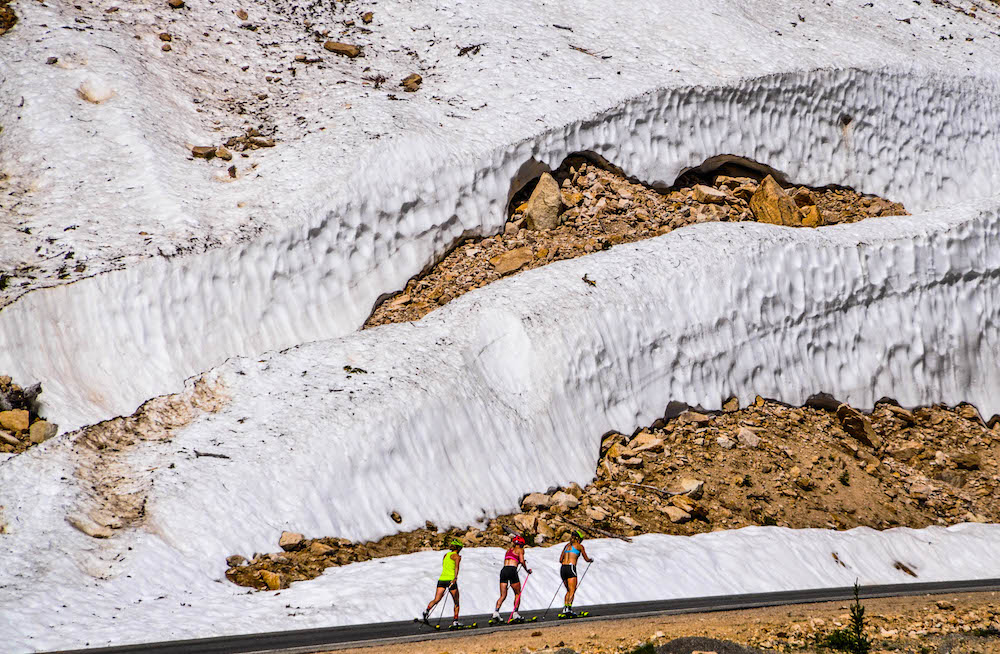
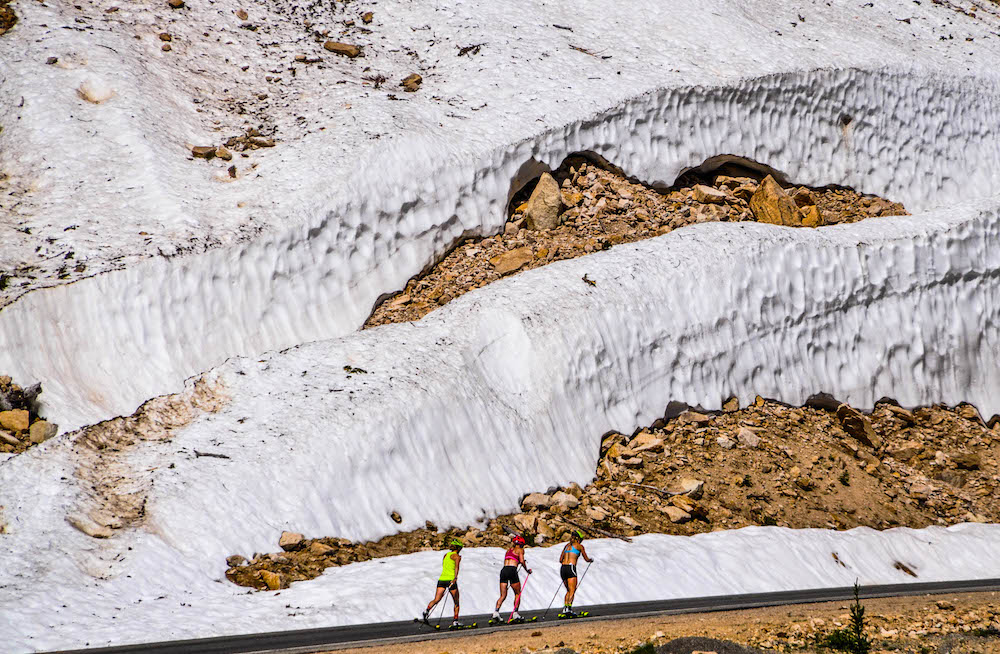
The U.S. Ski Team women’s team at work during a 10-day camp in the Methow Valley. (Photo: Matt Whitcomb/U.S. Ski Team)
(Note: This article has been updated to include comments from Canadian coach Ivan Babikov on his team’s recent camp in Park City, Utah.)
Two days after Andy Newell and Erika Flowers tied the knot in Bozeman, Mont., seven members of the men’s U.S. Ski Team and eight U.S. women’s team members jumped into an intensity training block at their respective dryland camps in Park City, Utah, and the Methow Valley in northern Washington.
The 10-day camps were scheduled simultaneously from June 26-July 5 to accommodate the wedding. Newell is a longtime U.S. Ski Team (USST) member and teammates with Flowers on the Stratton Mountain School (SMS) Elite Team out of Stratton, Vt. Because several national-team members ventured to Bozeman (Flowers’s hometown) to watch them say “I do,” the USST coaches decided to reduce travel and keep their squads together out west.
“We wanted to capture the men in the Intermountain West immediately following Andy Newell’s wedding in Bozeman, and therefore reduce the overall travel load for athletes who were already coming to the West from the East or Alaska,” head coach Chris Grover explained in an email.
The men based themselves in Midway, Utah, about 1,500 feet lower in elevation than Park City and 1,000 feet lower than Deer Valley, where they typically reside for summer and fall camps. Grover explained that this was by design, “because of the shorter duration of the camp (i.e. too short to create a meaningful stay at altitude), the focus on specific intensity workouts, and the benefits of quicker recovery at lower altitude,” he wrote.
Staying closer to the Soldier Hollow training venue was also ideal for the men’s team’s “PyeongChang-specific workouts”, Grover explained, including sessions focused on the freestyle team sprint, classic sprint and 4 x 10-kilometer relay, which will be contested at the 2018 Winter Olympics in PyeongChang, South Korea.
Newell, Simi Hamilton, Erik Bjornsen, Scott Patterson, Paddy Caldwell, Ian Torchia, and Ben Saxton attended and worked with coaches Jason Cork, Pat O’Brien, Grover, and U.S. Ski & Snowboard Strength and Conditioning Coach Tschana Schiller.
“The men did a great job of bringing heightened focus and effort to these key intensity workouts and we are grateful to the staff at Soldier Hollow for preparing the track for us,” Grover wrote. “Overall, it was a very productive camp and I think sent the men into the main summer preparation period with important areas to work on, a good gauge of fitness, and a further understanding of what skills need to be developed for the WC [World Cup] season and for PyeongChang.”
(Article continues below)
The U.S. men’s cross-country team at work during a classic distance rollerski near Midway, Utah. (Photo: Pat O’Brien)
The U.S. men’s cross-country team at work during a classic distance rollerski near Midway, Utah. (Photo: Pat O’Brien)
The U.S. men’s cross-country team at work, accompanied by head coach Chris Grover on his bike, during a skate over-distance rollerski near Midway, Utah. (Photo: Pat O’Brien)
The U.S. men’s cross-country team at work during a skate over-distance rollerski near Midway, Utah. (Photo: Pat O’Brien)
The U.S. men’s cross-country team at work during a skate over-distance rollerski near Midway, Utah. (Photo: Pat O’Brien)
The U.S. men’s cross-country team at work during a skate over-distance rollerski near Midway, Utah. (Photo: Pat O’Brien)
Start of the men’s skate team sprint on July 3 at the U.S. Ski Team men’s camp at Soldier Hollow in Midway, Utah. (Photo: Pat O’Brien)
Start of the men’s skate team sprint on July 3 at the U.S. Ski Team men’s camp at Soldier Hollow in Midway, Utah. (Photo: Pat O’Brien)
Do you use a heart rate monitor for training? Has it ever given you a seemingly implausible reading? Here’s why, and whether you should worry. (Photo: Pat O’Brien)
Andy Newell (r) leads the men’s skate team sprint on July 3 at the U.S. Ski Team men’s camp at Soldier Hollow in Midway, Utah. (Photo: Pat O’Brien)
Scott Patterson starting the U.S. Ski Team’s distance time trial at Soldier Hollow in Midway, Utah. (Photo: Pat O’Brien)
Scott Patterson (l) ascends the infamous Hermod’s Hill during the U.S. Ski Team’s distance time trial at Soldier Hollow in Midway, Utah. (Photo: Pat O’Brien)
Paddy Caldwell climbing during the U.S. Ski Team’s distance time trial at Soldier Hollow in Midway, Utah. (Photo: Pat O’Brien)
Simi Hamilton during the U.S. Ski Team’s distance time trial at Soldier Hollow in Midway, Utah. (Photo: Pat O’Brien)
Newlywed Andy Newell on his U.S. Ski Team’s distance time-trial day at Soldier Hollow in Midway, Utah. (Photo: Pat O’Brien)
From left to right: Andy Newell, Ben Saxton and Simi Hamilton working on classic speeds at Soldier Hollow in Midway, Utah. (Photo: Pat O’Brien)
From left to right: Andy Newell, Ben Saxton and Simi Hamilton working on classic speeds at Soldier Hollow in Midway, Utah. (Photo: Pat O’Brien)
Simi Hamilton leads Andy Newell and Paddy Caldwell during a classic-speeds workout at Soldier Hollow in Midway, Utah. (Photo: Pat O’Brien)
Andy Newell leads Simi Hamilton during a classic-speeds workout at Soldier Hollow in Midway, Utah. (Photo: Pat O’Brien)
Paddy Caldwell leads Erik Bjornsen (c) and Ian Torchia (r) during a classic-speeds workout at Soldier Hollow in Midway, Utah. (Photo: Pat O’Brien)
Ben Saxton (r) and Erik Bjornsen (l) during a classic-speeds workout at Soldier Hollow in Midway, Utah. (Photo: Pat O’Brien)
U.S. men’s team members Erik Bjornsen (l) and Ian Torchia during a classic-speeds workout at Soldier Hollow in Midway, Utah. (Photo: Pat O’Brien)
U.S. Ski Team Men’s Assistant Coach Jason Cork checks in with Ian Torchia during a classic-speeds workout at Soldier Hollow in Midway, Utah. (Photo: Pat O’Brien)
Local juniors rollerski alongside U.S. Ski Team members during a workout at Soldier Hollow in Midway, Utah. (Photo: Pat O’Brien)
***
Meanwhile, the U.S. women tried a new camp in the Methow Valley, home of current national-team members Sadie and Erik Bjornsen. The athletes themselves dubbed it the “CAGS Camp“, which U.S. women’s coach Matt Whitcomb explained stood for “a secret and mildly inappropriate team acronym that pokes fun at girls being girls. Sophie had hats made for the camp that she handed out at the airport when everyone arrived.”
All kidding aside, the goal of the camp was to be small and intensity focused, “with eight days of training and hard intervals every other day,” Whitcomb wrote in an email. “It’s an unusual setup for our team as we usually run joint camps with the men, but both enjoyed the simplicity of having such small training groups.
“We chose the Methow in part because it is where Sadie and Erik Bjornsen grew up, but also because we could get close to sea-level to maximize our hard efforts,” he added. “Another draw was that Pete Dickenson, one of our team physical therapists, was able to provide great treatment all week. Winthrop PT & Fitness sponsored our strength sessions, which meant we didn’t have to drive very far to get strong.”
Like Grover, Whitcomb used the word “ideal” to describe the Methow as a training site, yet emphasized that the community that hosted them was “even more incredible.”
“A local couple gave us their two cabins in a location as beautiful as we’ve seen anywhere in the world,” he wrote. “The chance to meet Olympians Laura McCabe (’94, ’98) and Leslie Hall (’88, ’92, ’94) was an important experience for the team. We owe them special thanks not for just guiding us to their favorite training spots, but for helping pave the early path for elite women’s skiing.”
The women’s team, which included Sadie Bjornsen, Rosie Brennan, Sophie Caldwell, Jessie Diggins, Katharine Ogden, Kikkan Randall, Ida Sargent, and Liz Stephen, spent one afternoon working with with the Methow Valley Nordic Team, which McCabe and Hall both coach.
“We invited a handful of their top athletes to join our bounding and ski walking sessions, and were encouraged by their technique and fitness, but also their love for the sport,” Whitcomb wrote. “They are doing a good job up there. I don’t know what the future holds for us regarding camp locations, but the Methow Valley will be considered as a great option moving forward. Thanks to so many people for making it happen.”
Women’s team staff included Whitcomb, Tim Baucom and physical therapist Pete Dickenson.
(Article continues below)
The U.S. women’s team with Methow Valley Nordic Team members during the U.S. Ski Team’s recent camp in Washington state’s Methow Valley. (Photo: Matt Whitcomb)
Rosie Brennan (in yellow) takes the lead while Sadie Bjornsen (in pink helmet) coaches on the bike during a 2017 U.S. women’s team camp in the Methow Valley. (Photo: Matt Whitcomb)
The U.S. Ski Team women’s team at work during a 10-day camp in the Methow Valley. (Photo: Matt Whitcomb)
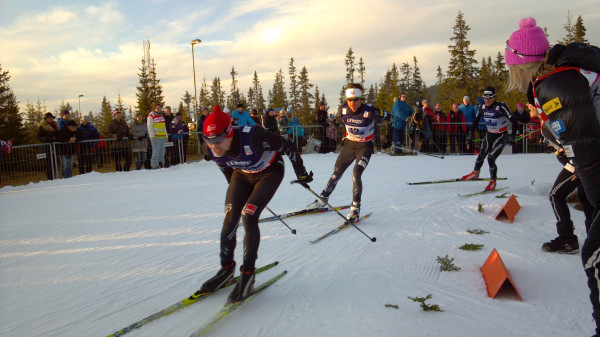
The U.S. Ski Team women line up for the team sprint final during their camp in Washington state’s Methow Valley. (Photo: Matt Whitcomb)
Liz Stephen at work during the U.S. Ski Team women’s team’s camp in the Methow Valley. (Photo: Matt Whitcomb)
Sadie Bjornsen (front) and Ida Sargent get some help hydrating from coach Tim Baucom during a run in the Methow Valley. (Photo: Matt Whitcomb)
The U.S. women’s team at their dryland camp in the Methow Valley: (from left to right) Ida Sargent, Kikkan Randall, Sophie Caldwell, Jessie Diggins, Liz Stephen, Sadie Bjornsen, and Rosie Brennan. (Photo: Matt Whitcomb)
U.S. Ski Team coach/serviceman Tim Baucom sits on the porch of one of the team’s cabins during their recent camp in the Methow Valley in northern Washington. (Photo: Matt Whitcomb)
***
Cross Country Canada also recently finished up a two-week camp in Park City (June 26-July 11) with its entire men’s World Cup team — Alex Harvey, Len Valjas, Devon Kershaw, Jess Cockney, Knute Johnsgaard, and Graeme Killick — and U25 national-team member Julien Locke. Co-World Cup coaches Ivan Babikov and Louis Bouchard accompanied the team for the duration, and Joel Jaques joined for the first week.
While Park City has become an annual staple for the Canadian team, Babikov explained that this was their first time there in the summer, as opposed to the fall.
“We love the area and training there. … It was pretty hot but we managed,” he wrote. “The main goal was a big training volume/hours at the altitude. We were planing on doing a time trial at the SoHo but it got closed for those dates so we ended up doing intensity down in Salt Lake instead.
It was a great camp for all the guys, everyone feels good and no injuries on the team.”
Brendan Green racing to sixth for Canada in the men’s 4 x 7.5 k relay at the IBU World Cup in Hochfilzen, Austria. Sixth place remains the Canadian men’s second-best relay result. (Photo: Biathlon Canada/NordicFocus)
The men’s 4 x 7.5-kilometer relay at the IBU World Cup in Hochfilzen, Austria, was marked by frequent lead changes on Sunday, leaving the big question of which nation — out of several — would actually win.
At one point, US Biathlon’s Tim Burke was sitting in first place as his team’s second skier. But in the end, three of the “usual suspects” prevailed, with Russia catching up to and eventually overtaking Norway at the very end of the final lap. France claimed the third podium spot, and Canada and the U.S. finished sixth and eighth, respectively.
For Canada, sixth place stood as the second-best men’s relay finish since the same four skiers placed fifth at last season’s World Cup in Oslo, Norway. With Christian Gow, Nathan Smith, Scott Gow, and Brendan Green racing in the same order as they did in Oslo, the Canadians rose to sixth during the second half of Sunday’s race and ended up 21.3 seconds off the podium in Hochfilzen.
With a clean prone stage and one spare in standing, Christian Gow, 22, tagged Smith 25.7 seconds behind Latvia in first. The Latvians had been elevated by a flawless leg from their scramble skier, Andrejs Rastorgujevs. On the second leg, Lativa slipped to 23rd (and was ultimately lapped on the final leg), while Canada moved into seventh with Smith.
“It was a lot of fun to race and to be so close to the top of the field,” Christian wrote in an email. “I am happy with how well I held it together in the range and out on the course! It was an all round very good day for me.”
Smith explained that while his men’s team repeated its sixth-place result from last year’s Hochfilzen relay, the competition was a lot tighter on Sunday.
“It was a much more exciting race to be in, with constant changes,” he wrote.
“Each time I went into the range I could still see the leaders,” Smith added. “This might’ve led me to be overly aggressive in shooting as I knew a quick clean could get me up there. Unfortunately I didn’t have any of those…”
Smith needed all six spares — three for each shooting — but knocked down all his targets to avoid the penalty lap. He noted that “6 spares is a lot on this course. Ski times are so close that it really all came down to shooting accuracy and speed. The rest of the guys had phenomenal shooting, though. I’ll admit I was the one that didn’t race to my potential today.”
With the seventh-fastest course time, Smith overtook three teams to move the Canadians into seventh, 49.3 seconds back at the second exchange. From there, Scott Gow cleaned without needing any spares and also skied the seventh-fastest course time for his leg to put his team in sixth (+59.0) before the final leg.
“My goal today was to try and not rely on spares, and the end result was exactly what I wanted,” Scott, 25, wrote in an email. “My skiing felt good today and my shooting was perfect, so overall I’m very happy.”
Canada’s anchor leg, Greene used one spare in both prone and standing and posted the fifth-fastest course time of his leg to secure sixth. He was able to still overtake Sweden’s Jesper Nelin, while Germany’s Simon Schempp moved ahead of him.
“Austria has been great to us,” Green said with a laugh. “It’s hard to say what it is. I think right now momentum is building on the team with some good results early in the season. But I think as a team we are more confident now.
“The biggest thing for me is knowing if I don’t perform, one of the younger guys will, so that removes some pressure because the expectations for the team are not all on one athlete anymore,” Green added.
A 29-year-old team veteran, Green felt the pressure on the final leg after his teammates skied as high as fifth during the race.
“There was a lot of pressure out there on that last leg today but I’m happy with how I handled it,” Green said.
He considered the Gow brothers to be the difference-makers on Sunday, and Smith agreed.
“The Gows are a lot stronger this year skiing and can fight with the top teams now,” Smith wrote. “I think a relay medal is within reach if we can all lay down our best on the same day.”
After using nine spares, the Canadians ended up behind Russia in first, with Alexander Volkov, Evgeny Garanichev, Dimitry Malyshko, and Anton Shipulin winning in 1:11:40.8. Norway placed second, 3.1 seconds back, with Henrik L’Abee-Lund, Johannes Thingnes Bø, Tarjei Bø, and Emil Hegle Svendsen. France was more than a minute back in third (+1:01.9), and Austria finished fourth 9 seconds later. Germany placed fifth (+1:18.4), 4.8 seconds ahead of Canada.
According to Smith, sixth place wasn’t necessarily a surprise. The team ranked seventh in the relay based on last season’s results. At the same time, coming close to a team best was always a good thing.
“All of us put forward strong legs to get in to the top 6 and that is an accomplishment we are all proud of,” Christian wrote. “I am hoping that we can match or hopefully even improve upon our 5th place relay from last year. That will be a tall order to say the least, but today was a good sign that we are on the right track!”
“That was some high-pressured racing today. We are all pretty happy for sure,” Green told Biathlon Canada.
“It was a really exciting race. I mean when you look at how the position changed, and now at the end still a good fight for the sixth place with the Swedes. I’m very happy that we made it,” Ahrens said.
Asked which athlete he would single out he added: “You know I’d have to pick all four, they put their work in, and not having a penalty and shooting very solid all throughout. But also the skiing, really fighting it out there, attacking … And our anchor Brendan at the end, when Schempp passed him to go with him and catch the Swede was the highlight.”
“It’s a young season, but so far, besides our other relay, the mixed relay in Östersund, it’s definitely a highlight,” he added.
Sean Doherty on his way to anchoring the U.S. men’s 4 x 7.5 k relay to eighth on Sunday at the IBU World Cup in Hochfilzen, Austria. (Photo: Fischer/NordicFocus)
The U.S. men placed eighth (+2:06.6) with Lowell Bailey, Burke, Leif Nordgren, and Sean Doherty requiring a total of 12 spares and one penalty lap.
Sixth after Bailey’s first leg, in which he used one spare in prone and cleaned all of his targets, the U.S. moved into eighth with Burke, who ended up skiing a penalty lap after using all three spares on his second shooting (0+0, 1+3). Nordgren used a total of three spares between his two stages (0+2, 0+1) before tagging Doherty in ninth. Doherty recovered to eighth despite five spares (0+3, 0+2) with the sixth-fastest anchor leg.
“I was really happy with the performance. I felt a little bit better on course today, too,” Bailey wrote in an email, ”which is encouraging leading into the Pokljuka World Cup next week. I think we are satisfied as a team, but we all know that we have the potential to be on the podium…”
“We’re all capable of much more,” Nordgren wrote in an email. “This was a good starting point, but as we get deeper into the season we’ll be expecting more.”
Shipulin Attacks for the Win
n a large field of 27 starting countries, Russia came out at the top, requiring just six spare rounds and no penalty laps. Russia’s anchor Anton Shipulin achieved his first podium of the season on Sunday, and later said in the post-race press conference that he felt that he was “doing better and better race by race.” He put an exclamation mark to this statement on Sunday, outsprinting Norway’s Svendsen on the last meters.
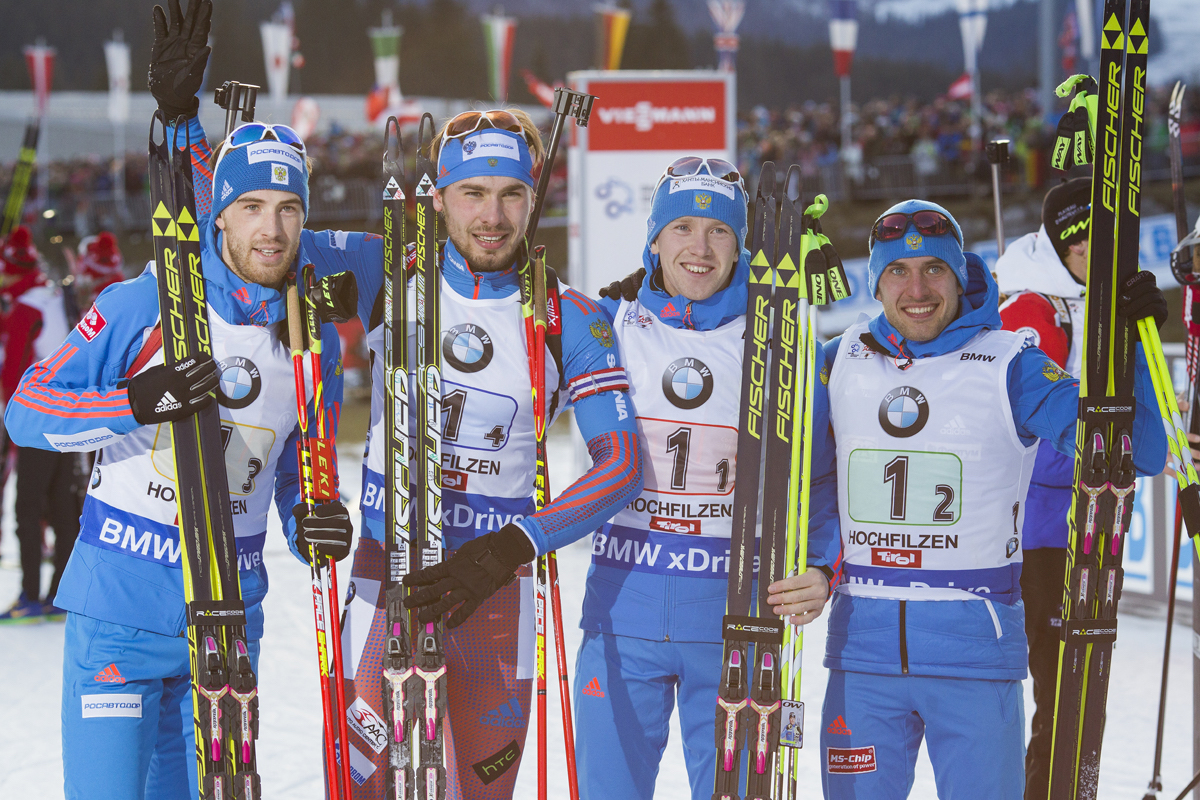
The Russian men’s relay team won the IBU World Cup 4 x 7.5 k on Sunday in Hochfilzen, Austria, with (from l to r) Dmitry Malyshko, Anton Shipulin, Alexey Volkov, and Evgeniy Garanichev. (Photo: Fischer/NordicFocus)
“After the last shooting stage, I saw Emil was not too far away from me and I knew I had to attack and catch him; I was a bit better on the track, so that was basically the plan,” Shipulin said through a translator. “This was not just my victory; all of the guys on the team were really great today.”
Norway had decided to give superstar Ole Einar Bjørndalen some rest, with L’Abee-Lund starting in his place, then handing off to the Bø brothers and finally closing with Svendsen. For quite a while they looked like the eventual winners, with Tarjei Bø handing over to Svendsen with a 30.8 second lead over Russia at the final exchange. But that gap wasn’t enough.
Svendsen still led by 18.1 seconds after the penultimate shooting, and many local as well as Norwegian fans that had traveled to Austria loudly chanted the typical “Hey!” with every target he cleaned while uncontested in the range (0+0). He still came into the final stage first, but then required two spares and his lead shrunk significantly to 10.4 seconds when he left the stadium.
Seeing the opportunity to catch Norway, Shipulin began his chase up the last climbs, posting the best course time on the final loop and sprinting past Svendsen as they approached the finish. Just 3.1 seconds behind Russia in the finish, Norway required seven spare rounds, and had no penalties.
Despite the close loss, the Norwegians weren’t too disappointed: “The team did a good job today, and we are satisfied with the race,” L’Abee-Lund said during the press conference.
“I feel my shape and confidence is coming back,” Johannes Thingnes Bø said.”Hopefully after the New Year I will come back and fight with Fourcade, Schempp and the best.”
13.12.2015, Hochfilzen, Austria (AUT): Norway’s Johannes Thingnes Bø leads France’s Quentin Fillon Maillet (c) and Italy’s Lukas Hofer during the second leg of the men’s relay at the IBU World Cup in Hochfilzen, Austria. (Photo: Fischer/NordicFocus)
France grabbed the last spot on the podium, finishing more than a minute behind Russia, also requiring six spares and no penalty lap. The team chose a lineup of Simon Fourcade, Quentin Fillon Maillet, Simon Desthieux, and Martin Fourcade, and was skiing just outside the top three for most of the race.
Then, anchor Martin Fourcade, last year’s overall World Cup winner and runner-up in Friday’s sprint and winner of Saturday’s pursuit, managed to move them up one position after he required just one spare in his prone shooting. On the next loop, he crashed descending down a bridge before the final shooting stage, a mistake that didn’t cost France the podium, yet ended any chances to catch up to the two leading teams before the last shooting.
“It was not a perfect race, but I’m satisfied with it,” the team’s starter Simon Fourcade said in the press conference, after using one spare in prone and handing off in eighth. “I had some little mistakes in the shooting … But yeah, satisfied with the race today, and satisfied to see that my ski level is back.”
Local favorite Austria, with Sven Grossegger, Julian Eberhard, Simon Eder, and Dominik Landertinger placed fourth (+1:10.9) and just 9 seconds off the podium, despite having to ski two penalty loops, which all the other top teams avoided. They used a total of 13 spares, two of which came from Landertinger on his first stage, but the Austrian anchor closed out the race with a flawless standing stage and the second-fastest time behind Shipulin on the final loop.
“A little bit more would have been possible, the two misses in prone shooting are really annoying,” Landertinger told Austrian broadcaster ORF. In the pursuit the day before, he had already achieved the best individual result of the season so far for his team.
Germany’s Simon Schempp, who had battled Martin Fourcade for the win in the other two races this weekend, again skied a very strong last lap with the third-fastest time behind Shipulin and Landertinger and only required two spares. With that performance he elevated his squad from 10th to fifth place (+1:18.4), after his teammates Erik Lesser, Andreas Birnbacher and Benedikt Doll struggled throughout the race with shooting. Uncharacteristically, Germany required 16 spares, the second-most of any team on Sunday, and narrowly avoided the penalty lap on four of eight stages.
Arguably the biggest surprise of the day was Sweden in seventh (+1:26.1), with Torstein Stenersen, Ted Armgren, Fredrik Lindström and Jesper Nelin. Aside from Lindström, the team had little World Cup experience. Despite that, Sweden managed to stay near the top the whole race and even tagged off in third place on the last exchange, before Nelin missed three targets on his leg and fell back a bit to seventh place, finishing 2.9 seconds after Canada and 40.5 seconds ahead of the U.S.
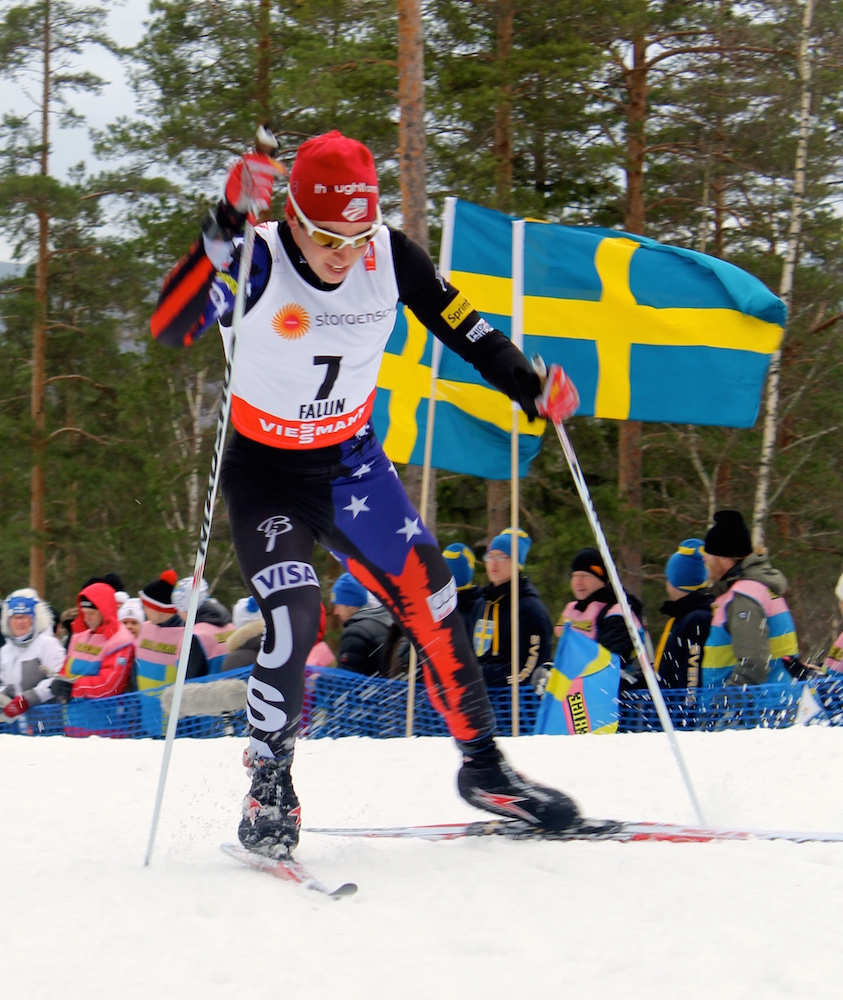
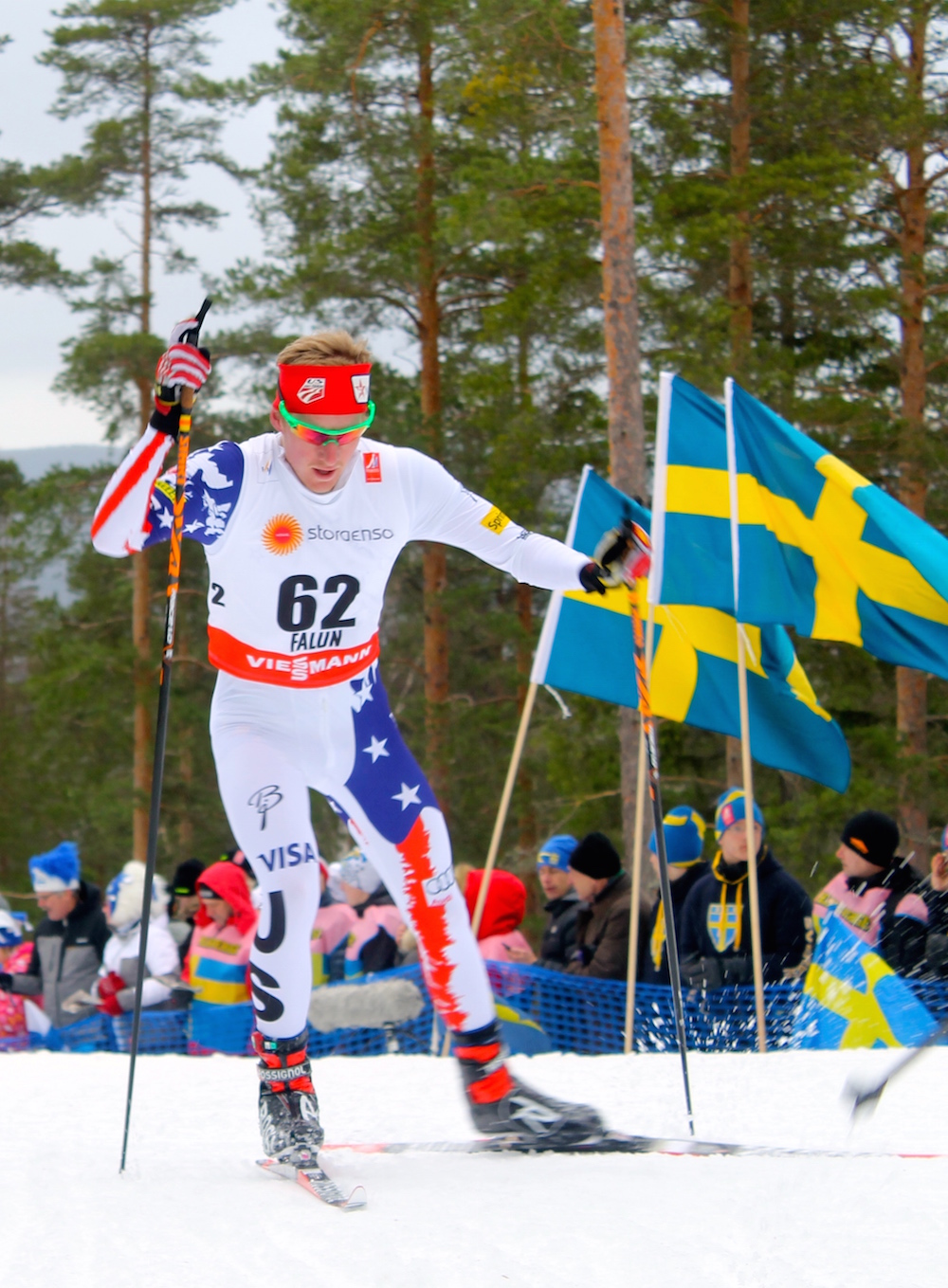
Noah Hoffman (U.S. Ski Team) racing to 34th in the men’s 15 k freestyle at 2015 World Championships in Falun, Sweden.
FasterSkier’s coverage of the 2015 FIS Nordic World Ski Championships in Falun, Sweden, is brought to you by the generous support of L.L. Bean, now featuring a complete line of Kikkan Randall training wear.
FALUN, Sweden — It’s not easy following a double-medal act. A day after two U.S. women, Jessie Diggins and Caitlin Gregg, racked up silver and bronze in the 10-kilometer freestyle at 2015 FIS Nordic World Ski Championships, their male teammates finished outside the top 30 in the men’s 15 k individual start.
Not that they were trying to compete with Diggins and Gregg, but after all the hype surrounding the U.S. women’s achievements, it was difficult for some of the American men to get excited about their results on Wednesday.
“I had trouble getting going a little bit,” U.S. Ski Team (USST) member Noah Hoffman, who led the U.S. men in the 15 k in 34th, said after his race. He finished 2:35.6 behind Sweden’s Johan Olsson, who won by 17.8 seconds in 35:01.6.
“[I skied] kind of just very even-keeled and neutral, but certainly nothing special, so not quite what I was looking for,” Hoffman added.
The seventh starter out of 86, he posted split times throughout the two-lap race that ultimately ranked in the top 40. While they indicated consistent skiing, they weren’t as fast as he wanted, and he said he lost time all over the course.
“It’s been a little discouraging,” he said of his World Championships thus far, which included one other race: the 30 k skiathlon, in which he placed 44th last Saturday. This season, he’s only completed three races after a broken leg in the 2014/2015 World Cup opener derailed his World Championships prep.
“It was not the year I planned on and [I’m just trying] to build on every race,” Hoffman said. “The season’s not over and I’ll think about moving on from the end of the season once the season comes to a close.”
In a blog post Wednesday evening, Hoffman reflected more on his race.
“I executed today more or less how I wanted to. I skied relaxed with high energy,” he wrote. “The race was a step in the right direction from Saturday’s skiathlon, and there’s nothing for me to do but keep preparing as well as I can and hope my form comes around.”
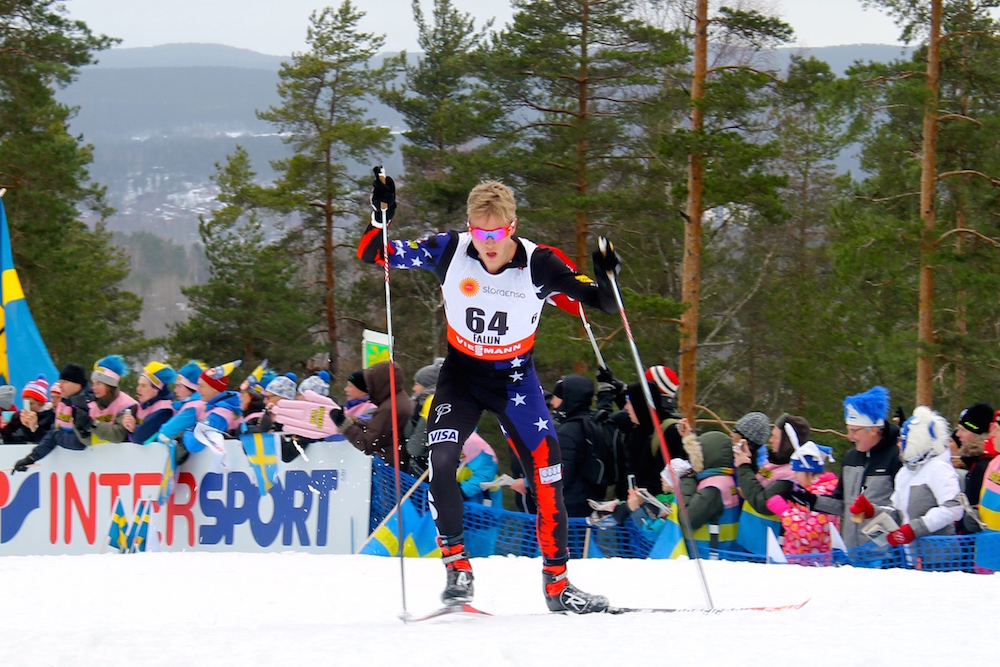
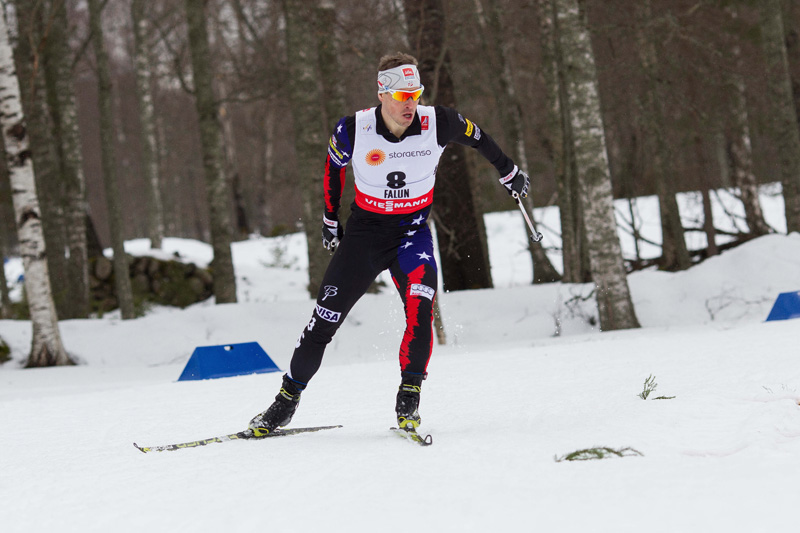
Erik Bjornsen (U.S. Ski Team) at the top of Mördarbacken on his first of two laps, en route to 47th in the 15 k freestyle at 2015 World Championships in Falun, Sweden.
After Hoffman, Erik Bjornsen placed 47th for the U.S., 3:19.5 after Olsson, Kyle Bratrud was 52nd (+3:58.7), and Kris Freeman finished 59th (+4:25.9).
Bjornsen and Bratrud explained they came into the 15 k generally aiming for a top 40. Bjornsen finished 22.9 seconds back from that goal.
“Some spots were good. It felt like the body was firing. The results weren’t great,” the 23-year-old Bjornsen said.
He started 64th, one minute behind Bratrud in bib 62, and 30 seconds ahead of Norway’s Petter Northug. At one point, Northug nearly caught him, and Bjornsen was prepared to take advantage of a boost by trying to stay with him.
“All of a sudden, I could tell he wasn’t behind me anymore, and I looked back on one downhill and he was way back there,” Bjornsen said. “It would’ve been one thing if it was someone like [Switzerland’s Dario] Cologna, but with Northug, I figured he went for it and then wasn’t feeling it and started walking or something.
“I saw some fast guys behind me. I was hoping to at least ski with somebody out there, but it didn’t happen,” he added. “I felt like I was hammering a few hills and felt all right, but I lost some time somewhere.”
At 1.5 k, Bjornsen heard he was 17 seconds down to the race leader at the time.
“I was like, ‘Woah, that was quick,’ ” he recalled.
Despite pushing harder, he still didn’t feel like he was having a great race.
“There were parts today when I felt really good and obviously I felt great about the pursuit,” Bjornsen said, referring to his 28th-place finish in the World Championships 30 k skiathlon. “I think that I did a good job peaking for this championship. I love head-to-head racing so hopefully I’ll get a chance to do that on the relay [on Friday].”
American Kyle Bratrud (Northern Michigan University) racing to 52nd in the men’s 15 k freestyle at 2015 World Championships in Falun, Sweden.
A Northern Michigan University senior in his first World Championships, Bratrud was pleased with how he fared in his signature race on Wednesday.
Early last month, Bratrud, 21, punched his ticket to U23 World Championships, and ultimately the Falun World Championships as well, with a 50-second win in the 15 k freestyle at U.S. nationals.
On Wednesday, he was looking to improve on his 84th place from 10 days earlier in the 15 k freestyle at his first-ever World Cup in Östersund, Sweden. He knocked off 32 places and didn’t crash, so he considered it a success.
“It was really soft, but I think that probably benefited me being a small guy,” Bratrud said of the slushy conditions on a 40-degree, damp-and-overcast afternoon. “I felt like I kept my tempo up pretty much the whole race. I died a little bit at the end, but it was a lot better paced than it was in Östersund so that was good. It was a good way for me to end my time in Europe.”
He ended up beating Northug, who placed 62nd.
“He’s been one of my idols since I’ve grown up,” Bratrud said. “I wouldn’t say I’m better than him, but to beat him is pretty cool.”
Now done with his first-and-only race of World Championships, Bratrud planned to head back to Marquette, Mich., to “catch up on the month and a half of homework” before heading to NCAA Skiing Championships in Lake Placid, N.Y., in mid-March.
“We have a really strong team so I want to go back and put together a solid effort at NCAAs,” he said.
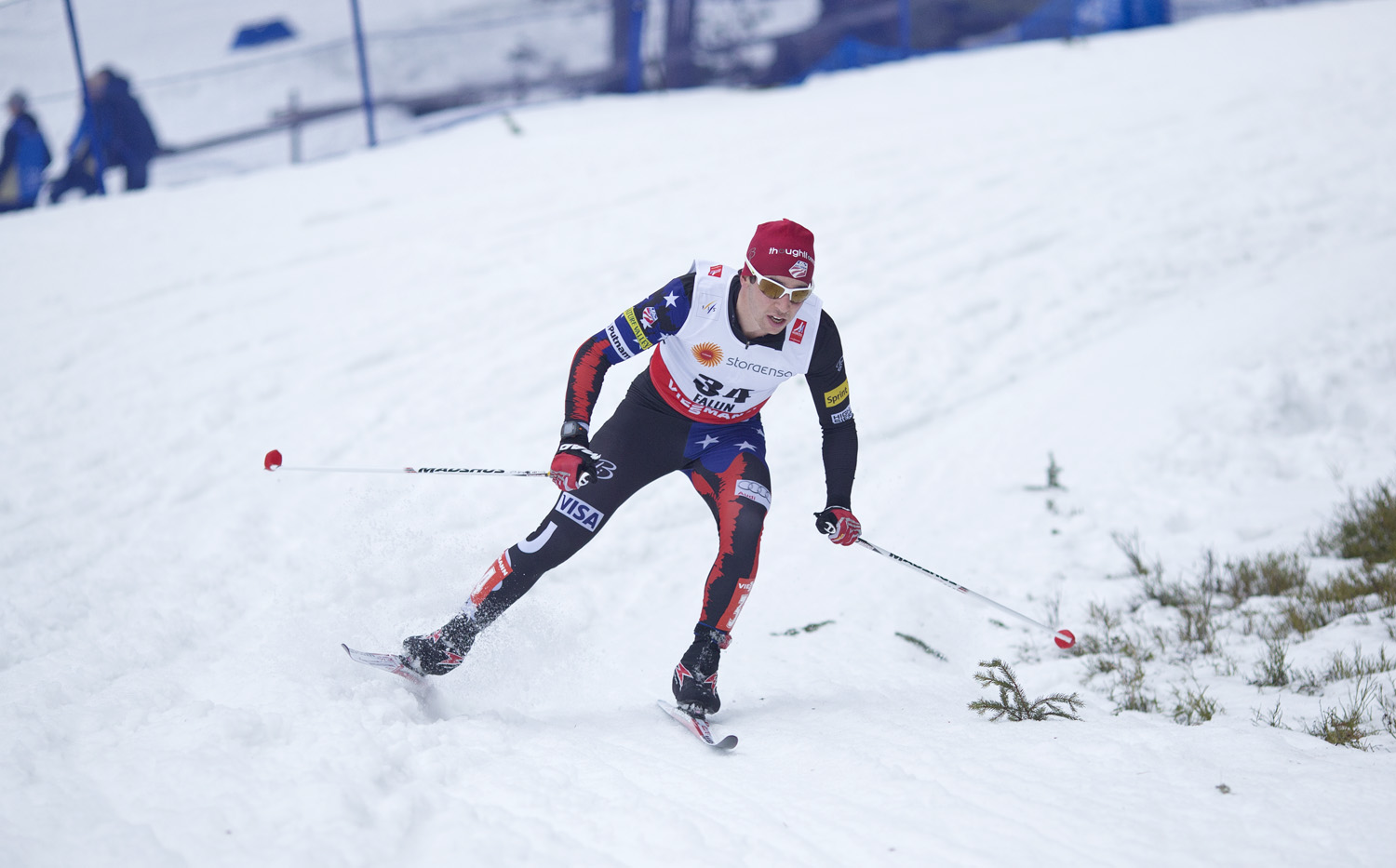
American Kris Freeman on his way to 59th in the 15 k freestyle at 2015 World Championships in Falun, Sweden. (Photo: Fischer/NordicFocus)
After placing 59th, Freeman called his race “horrible.”
He started eighth, right after Hoffman, and his 1.5 k time ended up ranking 33rd. By 7.5 k, he slipped to 42nd and then 55th by the 12.8 k checkpoint.
“I don’t understand — I felt pretty good this morning and I felt good on the first lap, and then it was just lights out and I couldn’t ski anymore,” Freeman said. “In this kind of snow, once you get a little tired you start to sink and if you’re feeling good you stay on top and float, and I was sinking. I’m really confused and disappointed.”
While he wasn’t sure whether he’d race Friday’s 4 x 10 relay, which the U.S. Ski Team won’t divulge until the start list has been posted Thursday evening, Freeman expected to race Sunday’s 50 k.
“Right now I feel like it’s a really long way and I’ve got to figure something out,” Freeman said. “I just want to feel the way I’ve been feeling this year and the first two races [of World Championships] I just haven’t felt like that at all.”
Erik Bjornsen (U.S. Ski Team) races up Mördarbacken during the the men’s 30 k skiathlon at the 2015 FIS Nordic World Ski Championships in Falun, Sweden. He finished 28th for his best distance result of the season. (Photo: FlyingPointRoad.com)
FasterSkier’s coverage of the 2015 FIS Nordic World Ski Championships in Falun, Sweden, is brought to you by the generous support of L.L. Bean, now featuring a complete line of Kikkan Randall training wear.
FALUN, Sweden — The timing was right for Erik Bjornsen in the first race of his second FIS Nordic World Ski Championships on Saturday.
For the first time this season, the 23-year-old U.S. Ski Team member cracked the top 30 in a distance race and he did so after skiing in the top 30 for most of the men’s 30-kilometer skiathlon.
After starting the mass start in bib 47 of 63, Bjornsen made his way up to 34th, 9.2 seconds from the lead, within the first 1.5 k of the opening 15 k classic leg. Meanwhile, his U.S. teammate Matt Gelso, of the Sun Valley Ski Education Foundation, hung with the group in 31st, 8.1 seconds behind.
“I have been working on my classic technique and just trying to stay really relaxed,” Bjornsen recalled.
After the women rounded two similar courses for the 15 k skiathlon earlier Saturday afternoon, the men were left with mostly chewed-up conditions in temperatures around 35 degrees Fahrenheit. Race officials salted two hills on the men’s 5 k freestyle course, according to Gelso, who said, “Those were awesome and the rest, the main hill on Mördarbacken, was so deep and soft and smushy…”
Bjornsen and Gelso skied near each other for the first lap, with Bjornsen in 35th at 3.3 k, 10.5 seconds behind the leaders, and Gelso just 0.7 seconds back in 38th.
By the end of the first lap, Bjornsen was up to 28th, 7.7 seconds out of first, while the second U.S. man at the time, Kris Freeman (Freebird) lapped through the stadium in 42nd, 13 seconds back. Gelso was 0.8 seconds behind Freeman in 44th, and U.S. Ski Team (USST) member Noah Hoffman lost contact with the lead group to complete his first of six laps in 54th, 43.7 seconds from first.
From that point, Bjornsen continued to the lead the U.S., skiing in 27th at 15 k, 14.1 seconds back, and 24th after the ski change at 15 k. At that point, he was 43.7 seconds behind race leader Alex Harvey of Canada.
“For the first couple of laps, it was really good, I was having solid kick,” Bjornsen said of the first half of the race. “Last lap I was starting to slip, but I knew I had some really fast skis so really just trying to work up the tops of the hills. I was really happy with the classical leg.”
He completed his first skate lap in 25th, 1:04.4 behind, and hung in 29th (+1:37.1) with 5 k to go.
“I got a split with, like, two laps to go and I was like 28th or 29th,” Bjornsen recalled. “I was starting to cramp and I was trying to hold on for dear life. I mean, I was pretty happy with the last few kilometers. I was able to pick off a couple more spots. It was awesome.”
He ended up 28th, 2:54.0 behind Russian winner Maxim Vylegzhanin after posting the 25th-fastest classic leg, 25th-ranked skate leg and 20th-fastest transition time.
Bjornsen said the key was trying to hold onto the group then passing them when he felt good in the final kilometers. In doing so, he overtook some competitors he hadn’t seen earlier in the race.
“I felt like I was always with people trying to hold on, knowing that those guys in front of me were probably dying just as bad as I was,” he said. “I am pretty confident with my finishes and I knew if I could just hold onto those guys for those the first two laps of skating, I would be able to makes something happen the last lap and I was able to.”
He finished 0.3 seconds behind Germany’s Jonas Dobler in 27th, 0.5 seconds behind Finland’s Iivo Niskanen in 26th and a second behind Japan’s Akira Lenting in 25th.
“I was right behind a few more spots,” Bjornsen said. “It would have been nice to have a little bit more in the tank, but I was happy with it.”
Noah Hoffman racing to 44th Saturday’s 30 k skiathlon at 2015 World Championships in Falun, Sweden. (Photo: NoahHoffman.com/Jonas Birgerson)
Behind him, Freeman reached the ski change in 49th, 2:52.6 back from the lead, Hoffman came through 53 seconds later in 51st (+3:45.7), and Gelso nearly another minute back in 52nd (+4:43.0).
Hoffman went on to post the 39th-ranked skate leg to finish 44th (+7:09.1) in his first classic race of the season, after he broke his fibula in the 15 k classic World Cup opener in November in Kuusamo, Finland. Last week at the World Cup in Östersund, Sweden, Hoffman was 38th in the 15 k freestyle.
“Not what I was hoping for,” Hoffman said after Saturday’s skiathlon. “The classic leg was really challenging from the gun. So early on it was so bad, and I’m not sure why.
“I was definitely trying to ski a race where I could move up in the skate leg but that whole thing kind of went out the window when I found myself being dropped from a 60-person group in the classic leg,” he continued. “At that point, you have to do everything you can to hold on.”
In a blog post on Saturday evening, Hoffman wrote that his “energy and technique felt okay, I was just slow. The race was brutally hard; I felt like I’d been hit by a truck afterwards.”
He told FasterSkier his goal coming into the race — just his second race of the season after spending more than two months healing, rehabbing and recovering — was to get into the points with a top 30.
“That didn’t happen today. I think I can still do that in the coming races, but I need to refocus,” Hoffman said. “There’s two more good races [the 15 k skate and 50 k classic mass start] coming up for me plus the relay will be really fun, and then a couple of World Cups after World Champs. I’m just hoping to build. Today was not what I was looking for, but there’s lots more possibilities.”
Freeman finished 48th (+7:57.1). Up until two days ago, he explained he wasn’t sure he was going to race after catching a cold at his last races, the SuperTour mini tour, in Craftsbury, Vt.
“I felt flat and it showed,” he said. “I’m not happy with it. I blew up spectacularly at eight kilometers when I lost the group and then I regrouped around 20 k, which is a good thing, and I was able to come back and actually race again, but it was obviously unimpressive.”
Freeman reflected that he may have opted for too much kick while testing his skis.
“I could run up a wall, but they weren’t running very fast, and I just kept losing a little bit on the downhill and I wasn’t strong enough to overcome it,” he said. “To stay with the pack today, I was going to need an advantage in skis and I think a slight disadvantage just killed me, but it was totally my fault — I went back for more.”
The last time up the infamous Mördarbacken hill, Hoffman caught Freeman with just a couple kilometers to go.
“He was at a different level going up that so I think he is going to have a good race in the 15 k [next week],” Freeman said. “I am hoping that this blew the snot out of me and I will be back for the 15 k.”
In his first-ever World Championships race, Gelso, 26, finished 54th (+11:26.4), and explained after he felt “pretty awful” during it.
“I was struggling with the classic. I was OK the first lap and then I just started blowing up and I don’t know why,” he said. “I was hoping to be with the pack in the classic and see what happened in the skate, but that didn’t happen for a number of reasons.”
Gelso added that the skiathlon had been his focus race while in Falun.
“I just didn’t have it today, that is for sure,” he said.
At the same time, Gelso observed that the racing scene in Falun, with more than 44,000 spectators on Saturday, was unlike anything he’d ever experienced before.
“I thought this was just going to be like a World Cup, but just a little bit bigger,” he said. “Like Hoff and I talked about, it’s more like a mini Olympics than a big World Cup. There’s lot going on, there’s a lot of people, there’s a ton of effort that goes into this. It’s a pretty serious event.”
Commenting on the team’s overall performance on Saturday, USST Head Coach Chris Grover called it, “a solid day; great for some just okay for others.” In the women’s race, Liz Stephen led the team in 11th.
In the men’s race, Grover observed that Bjornsen had “really fantastic skis, which you could see on the downhills. He was gliding super well and maybe dropped a couple places during the classic leg on the ups and then he would just grab them right back on the downs,” he said.
“He and his coach, Erik Flora, have just managed to find the form when it counts,” Grover added. “Here is another championship just like last year where he has just started off in excellent form so that is pretty exciting.”
On Sunday, two of U.S. sprint veterans — Andy Newell and Simi Hamilton — will race the two-man freestyle team sprint in that order. At the last skate team sprint in Otepää, Estonia, they missed qualifying because of a crash and placed 19th. At last year’s Sochi Olympics, Hamilton teamed up with Bjornsen to finish sixth in the classic team sprint.
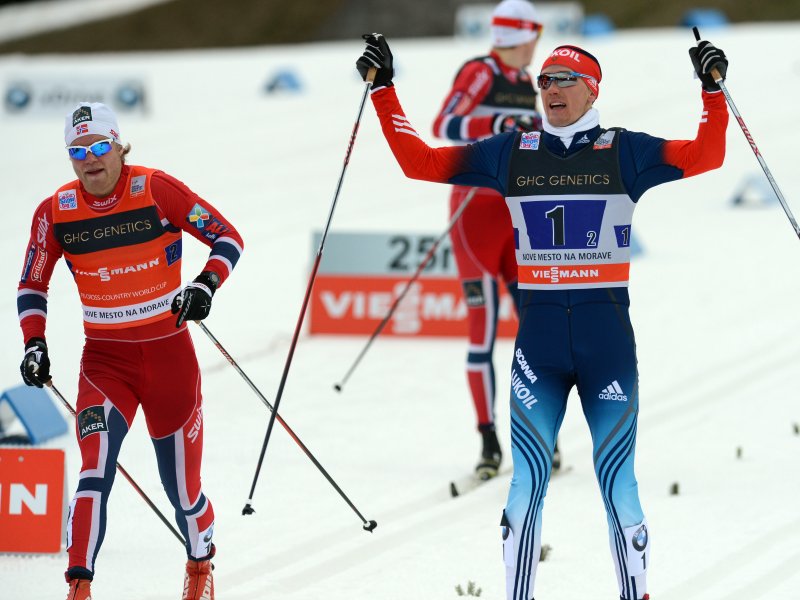
Nikita Kriukov (r) celebrates a 0.22-second victory for Russia I over Norway I’s Eirik Brandsdal in Sunday’s 6 x 1.6 k classic team sprint. Norway II’s Ola Vigen Hattestad placed third, 1.78 seconds back in the final classic sprint before the Olympics. (Photo: Fischer/Nordic Focus)
Twenty-five days before the Olympics open in Sochi, Russia, Nikita Kriukov couldn’t have timed Sunday’s 6 x 1.6-kilometer team-classic sprint victory much better. The 28-year-old Russian’s execution was right up there as well.
Following Norway’s Eirik Brandsdal into the finish, the reigning sprint world champion left no doubt that he’s still in top form, and when it comes to classic sprinting, watch out.
With teammate Maxim Vylegzhanin, Kriukov anchored Russia I to a World Cup win in 22:03.89 in the final classic-sprint tuneup before the Olympics, To do so, he outsprinted not only Brandsdal of Norway I by 0.22 seconds, but outlasted Norway II’s Ola Vigen Hattestad, who took third 1.78 seconds back.
Almost as soon as he crossed the finish, Kriukov graciously bowed to the grandstand at Nové Mesto, Czech Republic. The Norwegians hung their heads, fully realizing what happened and the work they have cut out in the team classic sprint at the upcoming Winter Games.
“I followed the plan and hoped to avoid meeting Kriukov [in the finish],” Brandsdal, 27, told NRK, according to a translation.
Despite teammate Eldar Rønning giving him a 1.1-second head start out of the last exchange, Brandsdal ended up chasing Kriukov to the finish anyway.
“We have to hope for a step up in the Olympics, but we do not know if this is being made,” Rønning told NRK. “There is strong competition.”
But rehearsal is rehearsal and the show is the main attraction, the 31-year-old Rønning reasoned. Either way, the Russians made a point.
The Norwegians led out of the start with Norway II’s Pål Golberg, 23, leading through the first exchange, just 0.4 seconds ahead of Rønning. Sweden II (Marcus Hellner/Emil Jönsson) remained in the mix 0.9 seconds back with Germany I (Sebastian Eisenlauer/Josef Wenzl), and Vylegzhanin was just a second back in fifth. Switzerland I (Ueli Schnider/Gianluca Cologna) tagged sixth, a tenth of a second ahead of the Americans, with Simi Hamilton handing off to Andy Newell 1.4 seconds back from the leaders.
“We got off to a really good start,” Hamilton said on the phone, after the Americans qualified in second in their semifinal then placed fifth behind the Czech Republic (Martin Jaks/Ales Razym) in the final.
All 10 teams remained within 2 1/2 seconds of one another through the first four laps, before the three leaders — Rønning, Vylegzhanin and Golberg — broke away on the second-to-last leg.
Meanwhile, Hamilton put the U.S. in fourth, 4 1/2 seconds back. Newell had posted the fastest leg just before him to bring the team to third at the fourth exchange, tied with Russia.
Russia I’s Maxim Vylegzhanin leading Norway II’s Pål Golberg in Sunday’s World Cup 6 x 1.6 k classic team sprint in Nove Mesto, Czech Republic. (Photo: Fischer/Nordic Focus)
“It was pretty tight the entire time with all ten teams and we lost a little bit of time in one of the tags because it was so tight with all ten teams within a couple seconds,” Hamilton explained.
After Newell’s first lap, Hamilton fell from sixth to ninth, 2.4 seconds behind the two Norwegian teams and Russia up front.
“We got a little scrapped up in one of the tags and lost a little time and came back thanks to Andy’s second leg,” Hamilton said. “When he tagged off to me on my last leg I just made it a goal to stay in contact with the top three teams. … I skied as hard as I could and lost a little bit of time but fought hard.”
After Newell received the tag in fourth, he led the chase pack as Russia, Norway I and Norway II continued to contend for the lead.
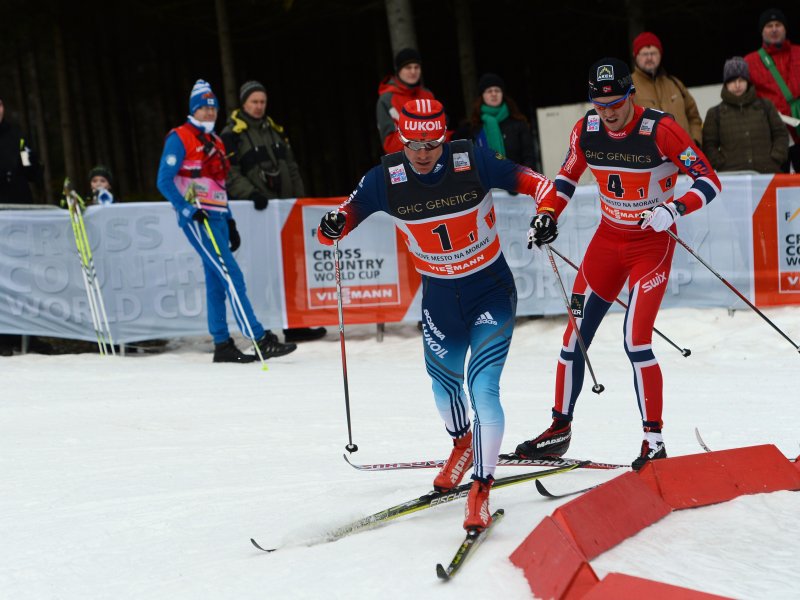
Norway II’s Hattestad fell off the pace on one of two climbs with what appeared to be less-than-ideal skis on the 36-degree Fahrenheit afternoon. Slipping up while herringboning outside the track, Hattestad initially lost contact with Kriukov and Brandsdal before putting on a last-ditch attempt to catch up.
Brandsdal took advantage of his superior glide on the descent as he drafted and passed Kriukov a few hundred meters before the finish. Heading down into the stadium, Brandsdal led while Kriukov followed closely, and Hattestad, who anchored Norway to a classic team sprint victory three weeks ago in Asiago, Italy, trailed a couple meters behind.
As Newell led the second group, including Czech Republic’s Razym and Germany’s Wenzl, into the stadium, Kriukov unleashed his well-known double pole, stepping around Brandsdal and definitively beating him to the finish.
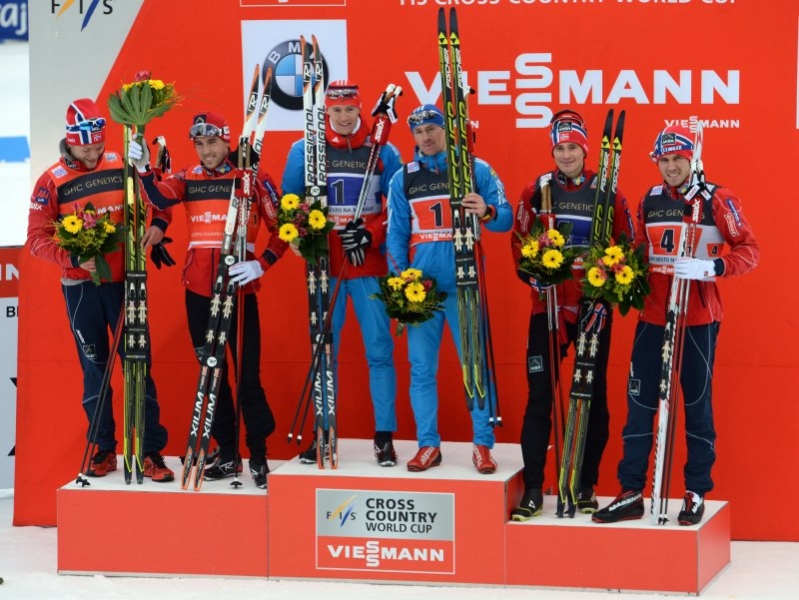
The World Cup men’s classic team sprint podium in Nove Mesto, Czech Republic: (from left to right) runner-up Norway I, Russia I’s winners Nikita Kriukov and Maxim Vylegzhanin, and Norway II in third. (Photo: Fischer/Nordic Focus)
“I felt much better than yesterday,” Kriukov told FIS after narrowly qualifying in 27th in Saturday’s classic sprint and placing 10th overall. “It was my first time skiing with Maxim. It gives us great confidence going to Sochi.”
“A few centimeters were missing on Kriukov,” Brandsdal told FIS. “I do not like losing in the finish. Nikita was very strong. It was cool to have such [a] tight fight.”
Newell successfully dropped Switzerland’s Cologna and bested Wenzel, but failed to match Razym, who used the home-crowd advantage to edge him by 0.54 seconds for fourth.
The Americans placed fifth, 14.28 seconds behind the Russian winners, and held off Germany by seventh-hundredths of a second. Switzerland placed seventh, another 6 1/2 seconds back, France was eighth (+22.08), Italy ninth (+26.47), and Sweden 10th (+50.32).
After Jönsson’s second leg, Sweden dropped from seventh to 10th with Hellner, leading him to rethink whether he’ll sprint at the Olympics after failing to qualify on Saturday.
“It would not be fun to go and feel like this in the Olympics,” he told aftonbladet.se, according to a translation.
“Right now I am pensive on sprint,” Hellner told Radio Sport. “But who knows, maybe it will be better and better. Nothing is certain in any case.”
Jönsson was back in action after sitting out Saturday’s sprint because of a troublesome right knee.
“I could list 3,000 things we could have done differently, but I’ve got three good races, have a knee … and Marcus holding up and moving well, so there is probably some bright spots,” Jönsson said.
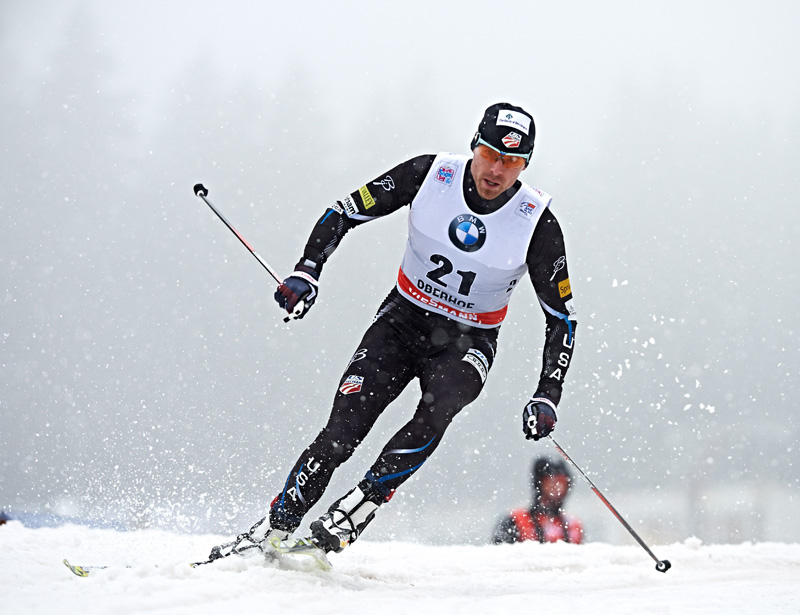
Andy Newell (U.S. Ski Team) racing the individual sprint at the Tour de Ski Dec. 29 in Oberhof, Germany. (Photo: Fischer/Nordic Focus)
Newell said that he and Hamilton, who won the Tour de Ski freestyle sprint in Lenzerheide, Switzerland, on New Year’s Eve, relied on smart yet aggressive skiing and not being afraid to take chances.
“We were right in there for a while,” Newell said on the phone. “Whenever I do a sprint relay it’s just kind of my goal to stay up front and keep us in a good position and save as much energy as I can for the end because that’s when it’s really going to matter.”
At least 20 meters behind the top three on the last lap, he realized the podium was likely out of reach.
“We tagged in fourth for my last lap, but even then we weren’t in medal contention,” Newell said. “In a sprint relay even 20 meters is too much to make up on the best skiers in the world. If we’re going to be in medal contention, we need to be up in the front for the last tag, which is the only thing holding us back for being a contender. It’s looking good leading into Sochi for sure.”
While fifth remains the best U.S. men’s team sprint result in recent memory, another highlight of the day was Hamilton and Newell automatically qualifying in second in their semifinal, 0.82 seconds behind Norway I’s Rønning and Brandsdal.
“We had a really good day with Andy and Simi qualifying outright, being second in their semifinals and were strong all day,” U.S. Ski Team Head Coach Chris Grover said. “I don’t think the guys have been as high as fifth for a few years now so that was really cool.”
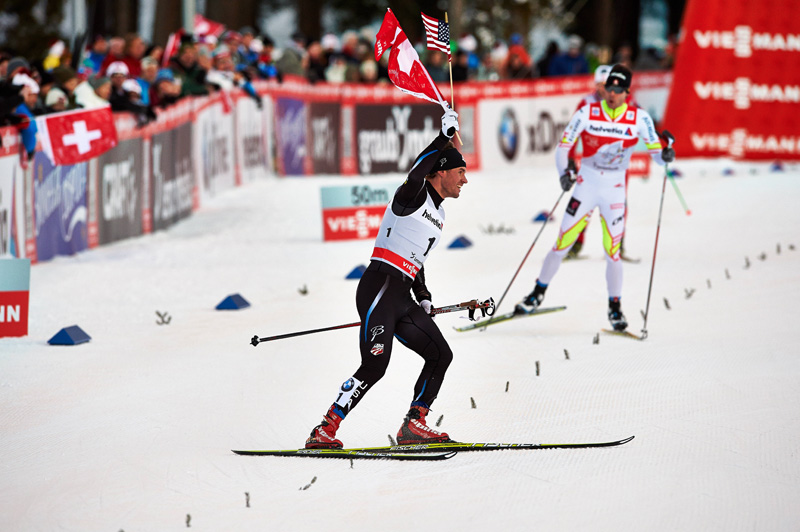
Simi Hamilton (U.S. Ski Team) enjoying a victory lap after winning the third stage of the Tour de Ski on Dec. 31 in Lenzerheide, Switzerland. (Photo: Fischer/Nordic Focus)
Racing against 15 other teams in the second semifinal, Grover pointed out that they needed to place in the top two to guarantee themselves a spot in the final. Ultimately, Germany I, Sweden II and Italy I (David Hofer/Federico Pellegrino), ended up advancing with them as lucky losers.
“Andy and Simi’s semifinal was running slightly slower than the first semifinal which is somewhat typical in warmer conditions were the track is actually slowing down,” he said. “They would have been fine if they had been in the top four as it worked out, but you have to play it safe. Beyond that, we just try and get in the finals, and once you’re in the finals the tactic is just to rest when you can and be as strong as you can on the last two and half to three legs when people take off and really start hammering.”
“We were able to save our energy when we needed to and stay on our feet and that’s all you can hope for, just staying out of trouble and staying up with the leaders,” Newell said. “We don’t want to be trying to break off the front. You only have to ski as fast as the people around you.
“That’s what were trying to do in these relays: keep up with the leaders, stay out of trouble, and it always just comes down to last lap or two,” he added. “In Sochi it’s going to be a harder course, but I think were both in good enough shape so that when it comes down to our last laps we need to be up there with the best. I think we can do that for sure.”
“It’s obviously a very different course than what we’re going to find at Sochi, but last year we skied really well at the team sprint day there,” Hamilton said, after he and Newell placed seventh in the World Cup classic team sprint in Sochi last February. “We both like that course there. I think it speaks to our fitness right now. We are both on a really good trajectory in terms of where our fitness is and our speed is. We’re encouraged and we’ll see what happens, but we’re psyched for sure. Today it would have been great to be on the podium but I think we’re encouraged with how everything went.”
The Americans will continue training in Nové Mesto before the next World Cup in Szklarska Poreba, Poland, with an individual skate sprint and 10/15 k classic mass start on Saturday and Sunday.
After that, they’ll head to Europe’s largest high-altitude meadow at Seiser Alm, Italy, for a training block before the last World Cup before the Olympics in Toblach, Italy.
— Lander Karath and Pasha Kahn contributed reporting
Tad Elliott, second from front, rounds a corner while keeping the U.S. men in ninth place as the third leg in the 4×10 k relay at Sjusjoen, Norway, on Sunday. Photo courtesy of Kikkan Randall.
From the start, the U.S. men appeared ready to roll with the best of their World Cup competition at the 4×10 k relays in Sjusjøen, Norway, on Sunday. It wasn’t looks so much as action.
Andy Newell jumped out to a first quick lap on the 2.5-k loop, working outside the icy track to position himself in fifth. As he found out, he wasn’t the only one working hard — most of the men he was up against in the first classic leg had to do the same.
“There wasn’t a whole lot you could do as far as getting kick on the uphills,” Newell said. “A lot of people had to run outside the track, which was fine. … It made for a scrappy race, for sure. The first leg is always fun in that way.”
Newell’s teammates had similar races — and fun for that matter — chasing the lead pack and at times gaining significant ground.
For most of the U.S. Ski Team relay members, their 11th place result (+58.8 after Norway as the winner) indicated they each had better individual races than in Saturday’s 15 k freestyle, where Kris Freeman led them in 55th place. As a team, they were certainly making headway.
“In the last year or two, we’ve started focusing more on relays,” Newell said. “That’s something that we want to prioritize as a team … because it’s such a huge event and there’s so much pride involved.”
To make a podium run in future Olympics or World Championships, the U.S. men and women decided to field relays and practice in the World Cup. It didn’t matter if they were tired or gearing up for other races, they’d show up and race, Newell said.
Fortunately for the Americans, they were in the mood to go hard Sunday. Newell came within about two seconds of the frontrunners, but a minor tactical error may have cost him some time. When he tagged off to Freeman, Newell was about 15 seconds behind the leading pack of six.
“That time was basically lost all in that last kilometer,” Newell said. “In the first leg there’s a lot of hammering and you have to be in a good position … and I was in a good position, but maybe got caught off-guard a little bit coming into the stadium.”
The U.S. men's relay team poses for a photo in Sjusjoen, Norway, on Sunday. From left to right: Hamilton, Elliott, Freeman and Newell. Photo courtesy of Kikkan Randall.
For Newell and Freeman, which stayed at home on the East Coast before traveling to Europe, they had not had as many opportunities to get on snow as some others, like teammates Tad Elliott and Simi Hamilton, who hail from out West. The relay gave everyone another chance to test their fitness and racing mindset.
Especially for Freeman and Elliott, the second and third legs, they had to be especially tactful to catch the leaders. Freeman came close, within about 4 seconds of the leader, to lower the team to ninth place during his classic leg. He struggled to keep the position, in part because of the especially tricky conditions for classic, and finished about 30.8 seconds back.
“The tracks became kind of unskiable for most people,” Freeman said. “There was only a few people that had kick to stay in the track because it was getting colder as we raced. … I actually wasted a little energy trying to stay in the track too much, and in the end was just running on the outside.”
“I caught the lead group, but I had to work really hard to do it,” he added. “When the lead group made their move, I just didn’t have the energy to stay with them at the very end of the race.”
Tagging off to Elliott 20 seconds sooner would’ve made a difference, considering how well Elliott skied the team’s opening skate leg, Freeman said. Clocking a split of 22:53.6, the U.S. Ski Team newcomer was faster than Norway’s prized anchor, Petter Northug — the man who dusted off his forearms on Sunday before sealing Norway’s relay victory.
In an email, Elliott pointed out Northug was in a completely different race as the fourth leg. Jockeying at the start with a few race leaders, the Norwegian felt out his competition before turning it on.
Tad Elliott climbing on the third leg (Photo: Liz Stephen)
Elliott wrote he could joke about the bragging rights of besting Northug, but was more pleased with his ability to stay with two competitive racers: Romo Fischer (SUI) and Morten Eilifsen (NOR III). On Saturday, Fischer was sixth in the 15 k.
“I am new and a bit, well, dumb,” Elliott wrote. “I didn’t know who I was skiing with. They are both awesome skiers. So that was cool to learn who they were after the race.”
After initially catching them and closing the gap to 21 seconds behind the leaders, Elliott said he ultimately paid for his all-out effort on the hills when Fischer and Eilifsen dropped him in the last kilometer. After advancing to seventh, Elliott moved to ninth and tagged off to Hamilton about 53 seconds back.
The Americans’ last chance, Hamilton worked to hold his own in his first World Cup race of the season, but Russian II anchor Ilia Chernousov eventually overtook him as did Norway II’s Emil Hegle Svendsen.
Kris Freeman, on the second leg of the men's 4×10 relay in Sjusjoen, Norway (Photo: Liz Stephen)
Regarding the 11th-place showing, Hamilton said he was pleased, especially after missing an opportunity to race Saturday. Because of an oversight, he was the fifth U.S. man entered in the individual race — which was one too many. He sat out and focused on Sunday’s race.
“I was fairly anxious going in to the day,” Hamilton wrote in an email. “First races are always like that, and being the anchor leg in a World Cup relay doesn’t help much to calm the nerves.”
While he was “fairly psyched” about his performance, he added there was always room for improvement.
“The race showed that we’re making some really good improvements as a nation in these types of races,” Hamilton wrote. “All of the U.S. guys were extremely fired up, and the camaraderie between the four of us both before and after the race was incredibly positive.
“The day really showed us that with continued hard work and more experience in these races, we can and should be entering the finish lanes along side the Norwegians and Swedes in the future.”
U.S. head coach Chris Grover said he initially felt the team should have modest expectations for the first weekend on the World Cup circuit, and several of his athletes exceeded that. Aside from Kikkan Randall and Liz Stephen, who met career bests on Saturday, he pointed to some recent achievements on the men’s side.
“Andy had one of the better 15 k skates of his career, not typically his strongest event, and then a great relay leg today,” Grover said after watching the men’s relay from Park City, Utah. “It was really exciting to see Tad get going today and Kris skied a little bit more competitively as well. I think in the next week or two we’re going to see some outstanding performances.”