From the FasterSkier archive — posts syndicated from athletes’ and coaches’ own blogs between 2004 and 2012, kept online as published. Current coverage is at fasterskier.com.
Tag: U.S. National Cross Country Ski Championships
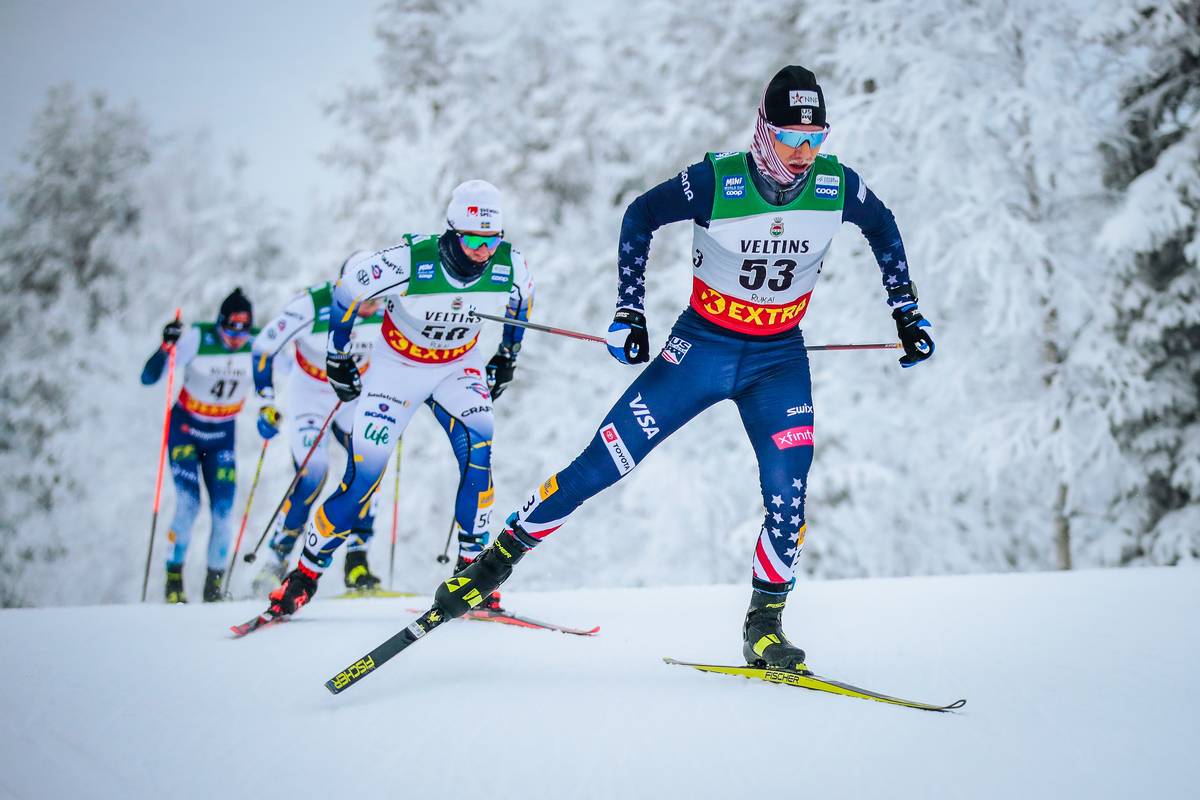
Zanden Mcmullen (USA) during the World Cup 10 k Freestyle in Trondheim (NOR) in December. (Photo: Modica/NordicFocus)
There is a particular kind of quiet that settles in before a decisive weekend—not the calm that follows certainty, but the stillness that comes when outcomes are no longer yours to predict. Zanden McMullen arrived in Oberhof, Germany, this week carrying that quiet with him. Period Three of the World Cup season is underway. These races are the final ones that will be considered for U.S. Olympic Team selection. The committee will meet after Sunday’s races. Until then, there is nothing to do but race.
“I’m pretty much taking it one week at a time right now and keeping my hopes up,” McMullen said earlier this week via text. “The races should be really fun this weekend, and my focus is on those right now.”
It is the kind of message that sounds simple until you sit with it. One week at a time. Focus on the races. Fun. Behind those words is a career that has moved forward incrementally, without shortcuts, and a season that has already required recalibration. McMullen’s path to this weekend—both geographically and personally—has been anything but linear.
Growing Up Where Winter Is Normal
McMullen was born and raised in Anchorage, Alaska, a place where winter does not arrive as a novelty or an interruption. It simply is. He grew up outdoors, moving easily between sports—hockey, soccer, lacrosse—before skiing gradually took precedence.
“I grew up doing a bunch of sports,” he said. “Skiing wasn’t really a main focus until maybe, like, first year of high school, when I was like, all right, this is going to be my main sport.”
Cross-country skiing entered his life less as an ambition than as a community. His mother took him out. He joined a club. He found friends. He was good enough that there was never much reason to stop.
“I just kind of found my group,” McMullen said. “And then as I progressed and just kept getting better and better, there was never really a reason for me to leave.”
Anchorage has produced lots of elite skiers, but McMullen has never been particularly interested in mythology. When asked why Alaska continues to turn out athletes capable of racing at the highest level, his answer is understated.
“We have access to great outdoor activities,” he said. “And I feel like that’s probably a pretty big foundation to our success. The community is great and has always been supportive of ski racing.”
It is not a romantic explanation. It is a practical one. Snow matters. Time outside matters. People matter.
Zanden McMullen (APU/Team Alaska), center, won the men’s U18 10K classic mass start race Friday at the 2019 U.S. Ski & Snowboard Cross Country Junior National Championships at Kincaid Park. Johnny Hagenbuch (Sun Valley SEF/Intermountain), left, was second, followed by Griffin Wright (Craftsbury Nordic Ski Club/New England), right. (Photo: Michael Dinneen)
The First Crack in the Horizon
For much of his early skiing life, McMullen’s world remained bounded by Alaska. The high school circuit was competitive enough that it was difficult to tell where he stood nationally. That changed almost accidentally.
“A pretty pivotal point in my ski career was the Anchorage U.S. Nationals,” he said. “I wasn’t planning on going. I was still pretty young, but because it was in Anchorage, it was like, sure, of course I’ll do those races.”
In the mass start 10-kilometer race, McMullen had what he still describes as a standout performance. The result earned him a spot on a U18 international trip.
“That was one moment where I was like, holy crap, I can’t believe I made that,” he said.
The next year, he qualified for World Juniors. Then another benchmark. Then another.
“Every year was like I hit that next benchmark,” McMullen said. “And I was like, okay, wow, this is really happening.”
What is striking in retrospect is how little certainty accompanied those steps. McMullen did not grow up believing he would race World Cups. He arrived there gradually, often surprised by his own progress.
“I never really believed that I was going to be able to do that,” he said. “All the way up until, like, pretty much two years ago when I was like, damn, I’m really ripping the World Cup circuit.”
Zanden McMullen races a skate pursuit in Ruka, Finland in November, 2021. (Photo: NordicFocus)
Learning the Long Way
McMullen’s development has mirrored that of a broader cohort of American men who have risen together, without a single breakout prodigy defining the group. The men’s team has become competitive not through sudden transformation, but through accumulation.
“There’s definitely a core group of us that have been doing this for a long time and have just been hitting that next level every year together,” McMullen said. “Honestly, I’d say we just have a great attitude towards it, and I think that’s really contagious.”
Central to McMullen’s progression has been his relationship with coach Eric Flora, who began working with him after high school. The partnership is not flashy. It is deliberate, methodical, and built on constant communication.
“We all have individual phone calls with him about once a week,” McMullen said. “He’ll be driving to practice every morning, and he’ll just rip through all of us.”
Training plans are personalized but similar. Adjustments are fluid. There is room to adapt when conditions—or bodies—require it.
“Training is super fluid,” McMullen said. “There’s no reason to be super methodical about it.”
If there is a defining value that underpins the approach, it is consistency. McMullen returns to the concept repeatedly, almost reflexively.
“I don’t enjoy when I’m hot and cold,” he said. “I know I’m in a good place when I’m just consistent.”
Racing Through Fog
Consistency, however, is not something that can be summoned on demand. When the World Cup season opened in December, McMullen entered Period One with a clear process goal: race distance events, avoid panic, see where he stood.
“It’s so challenging going into Ruka every year,” he said. “You just have really no idea what kind of shape you’re in.”
He described the feeling as “looking through fog.” The metaphor fits. Fitness tests and workouts provide clues, but racing offers the only real clarity.
“Those could both result in amazing races,” he said. “Or they could be pretty crappy races. I have no idea.”
December did not unfold the way McMullen had hoped. Results were not disastrous, but they were not convincing enough to quiet questions—his own included. Olympic qualification, with its layers of objective criteria and discretionary judgment, hovered in the background, offering no reassurance.
“Nothing’s for sure until the last race is over,” he said.
As Period One ended, McMullen faced a decision that athletes rarely frame publicly: whether to stay in Europe and press on, or to step away and reset.
Davos to Regroup
McMullen stayed in Davos to train and regroup during the holidays before flying back to the United States for Nationals.
The decision was not dramatic. It did not come with declarations or explanations. It was simply what made sense.
Settling in to training through the holidays stripped things back to essentials. Favorite trails. Simple routines. Fewer variables.
For McMullen, training has never been a place to escape. It is where things become clear.
The reset did not guarantee anything. But it restored something harder to quantify: alignment between effort and intention.
By the time McMullen boarded a flight for Lake Placid in January, he carried less expectation and more readiness.
Zanden McMullen charges for the win in the Men’s 20 k Freestyle Mass Start last week at the US National Cross-Country Ski Championships in Lake Placid, New York. (Photo: Nancie Battaglia)
Lake Placid: Evidence
The U.S. Senior National Cross-Country Ski Championships arrived with their own weight. Nationals are never just Nationals in an Olympic year. Results echo beyond the finish line.
On Thursday, McMullen won the 20-kilometer Freestyle Mass Start. The race unfolded honestly, favoring patience and pacing. McMullen looked comfortable in control.
The next day, he returned to win the Classic Sprint.
Two wins, two very different demands, back to back.
The performances were not loud. They were authoritative.
For an athlete who measures progress in consistency, the week in Lake Placid did not feel like redemption. It felt like confirmation.
Zanden McMullen with his second win in two days in the Classic Sprint last week at the US National Cross-Country Ski Championships in Lake Placid, New York. (Photo: Nancie Battaglia)
Oberhof
From Lake Placid, McMullen traveled to Germany for the final races that will be considered in the Olympic team selection. Oberhof will decide whether his season will continue toward Milan or pivot elsewhere.
“I’ll know by the end of the weekend if I have made the Olympic team,” he said via text. “If I don’t, I’ll head back with a little bit of Birkie fever.”
The phrasing is characteristically restrained. There is no bargaining, no projection beyond what he can control.
“I’m in Oberhof now for P3 World Cup, and will stay with the team through Goms,” he said. “I’m pretty much taking it one week at a time right now.”
That outlook has been hard-earned. McMullen understands that racing well is not the same as demanding belief. His approach is simpler.
“Let the racing speak,” he said in November. “There’s no reason to freak out about it.”
The Space Before the Answer
By Sunday evening, the committee will meet. Names will be discussed. Arguments will be weighed. Decisions will be made.
McMullen will not be in the room.
What he will have is a body of work that stretches back much further than this weekend: a childhood shaped by Alaska winters, a career built on incremental belief, a season that required adjustment rather than insistence, and a January that reaffirmed who he is as a racer.
Whether or not the Olympic team includes his name, McMullen has reached a threshold that is difficult to cross. He is no longer auditioning for relevance. He is racing for a place.
“I just want to be consistent,” he said. “I feel like when you are consistent, and you find yourself in a position where you might have a standout result, then it’s just that much higher.”
In Oberhof, consistency will not announce itself. It rarely does. It will show up quietly, in decisions made at speed, on terrain that rewards honesty.
For now, that is enough.
Love stories like this? Help keep them coming.
Feature stories like this one take time, access, and care to produce. If you value thoughtful storytelling and independent ski journalism, please consider becoming a Voluntary Subscriber. Your support directly fuels the work we do to cover the people, places, and moments that make our sport special.
The men’s Classic Sprint heats got started with quarterfinal number one at the US Nationals Cross-Country Ski Championship at Mt Vanhoevenberg in Lake Placid NY. (Photo Nancie Battaglia)
The last day of the U.S. National Cross-Country Ski Championships in Lake Placid arrived the way honest days in this sport often do. The snow at Mt. Van Hoevenberg had been churned and scoured by a week of racing and changing weather, its surface no longer pristine but revealing, the kind that gives little for free. Legs were tired. Arms were tender. Expectations had been trimmed back by accumulated kilometers and decisions already made.
For the men lining up for the classic sprint, this was not simply a final chance at a national title. In an Olympic winter, nothing is ever only what it claims to be. The sprint was an audition—not necessarily for Olympic selection, but for relevance. For future start rights. For the ability to say, credibly, that range still exists.
Sprint qualification, in particular, has a way of stripping sport down to its essentials. No drafting. No hiding. One lap to explain yourself. As has been said all week about sprints, it does not matter how clever you are in the heats if you cannot arrive there in the first place. In Lake Placid, that truth shaped the day from the first starter onward.
Fin Bailey (UVM) makes his way up the Lake Placid sprint course’s signature climb. (Photo Nancie Battaglia)
Qualification: where the day declares itself
Qualification mattered here in a way that went beyond podiums and medals. With sprint start rights in the World Cup largely determined by qualification speed, the men knew exactly what was at stake. If this were a sorting mechanism, it was a blunt one.
The fastest man through the course was John Schwinghamer, whose time at the top of the board set the early benchmark. But the story quickly widened. Pierre Grall-Johnson followed closely, and then Will Koch, who would soon become central to the day’s most unusual tactical thread, placed third.
A few seconds farther back sat a cluster of names that told a deeper story: athletes with distance pedigrees, athletes chasing U23 selection, athletes managing fatigue from a long week and still trying to produce speed on demand.
Among them was Zanden McMullen, who qualified tenth, solid but not dominant. “The qualifier felt a little off,” McMullen admitted. “I didn’t feel smooth and thought I skied poorly through the terrain. I was happy to qualify and have another chance to improve on the day.”
That, in retrospect, was the quiet warning shot.
Classic striding versus powerful double poling was one of the key storylines in the men’s Classic Sprint. (Photo Nancie Battaglia)
A decision made in minutes
If qualification is the most honest part of sprinting, it is also where improvisation sometimes reveals itself. Koch arrived at the start line with little margin and even less certainty.
“I was already pretty tired going into the classic sprint,” Koch said. A bonk midway through the 20-kilometer freestyle earlier in the week had drained his reserves, and classic sprint had never been his strength. “With about ten minutes to go before my qualifier, I still couldn’t get my classic skis to kick.”
The decision that followed was not theoretical. Koch asked his coach to prepare a pair of skate skis — not as a backup, but as a commitment. He reached the start with roughly 90 seconds to spare, hoping that strength alone might be enough to advance.
Third in the qualifier erased doubt immediately. “When I ended up third, I knew it was the right call,” he said. “I never even tested a classic ski the rest of the day.”
The gamble would ripple through every round that followed.
Will Koch (SVSEF) powered through the qualification and heats, double poling on skate skis. (Photo Nancie Battaglia)
Heats: when fatigue starts to speak
Classic sprint heats at Mt. Van Hoevenberg reward clarity. The course offers opportunities, but they are conditional. Mistime a move, and the course and competition punish hesitation. Get trapped behind the wrong skis, and speed evaporates.
Koch’s plan was simple and exhausting: lead early, create space before the climb, and survive long enough for glide to matter again. “If I could crest the climb with the group, my skis would be fast enough to carry me through,” he explained.
For a time, it worked exactly as intended.
But others were playing different games.
Zach Jayne arrived at the sprint with a different set of calculations. Already qualified for U23 Worlds and carrying a narrow SuperTour points lead, his goals were layered. “I wanted to finish strong,” Jayne said. “I also wanted to make the final so I could displace other U23 athletes and help ensure my teammate Max Kluck made the trip.”
Jayne, Koch, and teammate Carl Rune all opted to double-pole the heats on skate skis, a choice that paid dividends early. “It worked really well in the quarterfinal,” Jayne said. “But as the rounds went on and fatigue built, I was definitely wishing I’d brought a pair of klister skis.”
That fatigue — cumulative, unrelenting — became the quiet theme of the afternoon.
Zanden McMullen (APU) showed he had made the right calculations for himself in the final, creating a gap on the large climb, which he was able to maintain on the final downhill. (Photo Nancie Battaglia)
Trusting kick in uncertain snow
While some chased glide, Max Kluck made a different bet. His week had been defined by nerves more than novelty. “I was more nervous than I’ve been in years,” Kluck said. “I knew my U23 spot was on the line.”
The snow tempted experimentation, but Kluck resisted. “I was pretty certain I wanted to stay on classic skis unless the weather took a major turn,” he explained. “I stuck with my gut.”
The reward came immediately. In the quarterfinals, Kluck ran the climb with confidence, kick biting cleanly while others labored, arms already beginning to pay the price. “I figured I might be able to make double-poling work once,” he said. “But I didn’t think I could personally do it four times.”
His solution was economy. By trusting his wax and striding more often, Kluck preserved his upper body for the finishing straight — a detail that would matter later.
UVM’s Fin Bailey was showing he was on form and a threat for the podium throughout the heats, but his final got off to an unlucky start with a broken pole. (Photo Nancie Battaglia)
The final: legs versus arms
By the time the final assembly was complete, the calculus was visible even from the sidelines. The men who had double-poled all day carried speed — and fatigue. Those who had relied on kick carried legs.
McMullen understood the equation precisely. “Going into the final, I knew the few boys that double-poled all day would be tired,” he said. “My plan was to keep them in reach before the final climb and then gap them.”
Snow conditions had continued to degrade, wind and rain complicating grip and timing. McMullen’s classic skis, however, remained reliable. “Our classic skis felt good,” he said. “I didn’t think there was a need to try and double-pole the race.”
When the decisive climb arrived, McMullen did not hesitate. He strung together clean transitions, trusted his kick, and separated decisively. “I felt really fresh still at the start of the final,” he said. “I knew I would be able to run away with it.”
Behind him, the chase unfolded exactly as predicted. Koch’s glide carried him, but the cost of four rounds of double-poling showed. Kluck’s restraint paid dividends, his saved arms helping him close strongly. Jayne fought valiantly through fatigue, his earlier work for teammates already done.
McMullen crossed the line alone — a national champion not because he had chased novelty, but because he had waited for the moment that mattered.
Zanden McMullen (APU) comes to the finish of the Classic Sprint with his second national title in as many days at the US Nationals Cross-Country Ski Championship at Mt Van Hoevenberg in Lake Placid, NY. (Photo Nancie Battaglia)
What the result actually means
The men’s classic sprint did not reshape Olympic selection overnight. Sprint specialists were unlikely to be named from Nationals alone. But the race clarified something subtler and perhaps more important.
It showed who can adapt under stress. Who can make decisions when plans unravel? Who understands that qualification speed opens doors long before medals do?
For Koch, the day was a revelation. “The classic sprint was a really pleasant surprise to end the week,” he said, even as he acknowledged that broader goals remained unmet.
For Jayne, consistency mattered more than headlines. “I don’t race to prove people right or wrong,” he said. “I know what I’m capable of.”
For Kluck, the outcome was tangible. “Securing my U23 spot was the biggest goal of my season,” he said. “Locking it down here feels incredible.”
And for McMullen, the victory was both affirmation and invitation. “I hope people know now that I’m an all-around skier,” he said. “And I hope the Olympic selection committee knows I have a lot of potential to succeed at the Olympics.”
Zanden McMullen (APU) first place, Will Koch (SVSEF) second place, and Max Kluck (UU) third place at the US Nationals Cross-Country Ski Championship Classic Sprint at Mt Vanhoevenberg in Lake Placid NY. (Photo Nancie Battaglia)
A quiet ending, honestly earned
As the course emptied and the equipment was packed away, Mt. Van Hoevenberg returned to stillness. Another Nationals was complete. Another set of arguments had been made — not loudly, not always cleanly, but honestly.
Sprint racing, especially in January of an Olympic year, has a way of revealing truths athletes might prefer to delay. Qualification does not negotiate. Fatigue does not compromise. Decisions, once made, echo through every climb and corner that follows.
On this final day in Lake Placid, the men who listened closely to their bodies, their skis, and the snow underfoot, were the ones who left with something lasting.
Feature stories like this one take time, access, and care to produce. If you value thoughtful storytelling and independent ski journalism, please consider becoming a Voluntary Subscriber. Your support directly fuels the work we do to cover the people, places, and moments that make our sport special.
What was truly on display this week at the US Nationals Cross-Country Ski Championship at Mt Van Hoevenberg in Lake Placid, NY was not only that cross-country skiing is an awesome sport, but the community that embodies it is something worth celebrating. (Photo Nancie Battaglia)
Sofia Pedersen (UU) and Samantha Smith (SVSEF) lead the first quarterfinal out onto the course at the start of the heats. (Photo: Nancie Battaglia)
On the morning of the women’s classic sprint at the U.S. National Cross-Country Ski Championships, the quiet around Mt. Van Hoevenberg felt deliberate.
Not calm — no one was calm by Friday — but restrained. The week had already taken its toll. Distance races had piled fatigue into legs and minds alike, and no one arrived at the sprint believing freshness would be part of the equation. What remained, instead, was clarity: the understanding that in an Olympic winter, the most important racing of the day would happen before the heats ever began.
“It definitely started the day tired,” Ava Thurston said. “But I was trying to just remind myself that everyone was feeling that way. Most people had raced two, if not three, of the races, and we’re all coming in in a similar place.”
That recognition — that fatigue was universal — became the baseline. The differentiator would be execution.
For the women with Olympic aspirations, the classic sprint qualifier was no formality or warm-up. It was the argument itself. The U.S. selection process, quietly but decisively, has elevated qualification speed to the top of the sprint hierarchy. Heats matter, but only if you earn the right to be in them. On Friday in Lake Placid, no one confused the order of importance.
Sofia Pedersen (UU) and Samantha Smith (SVSEF) get the action started in the quarterfinals. (Photo: Nancie Battaglia)
Carrying the Week
By the time the women clipped in for qualification, the week was already present in their legs.
After Thursday’s 20-kilometer race, Sammantha Smith felt that accumulation acutely — and honestly. “After the 20 k, I was definitely feeling the fatigue and accumulation of all the racing throughout the week,” she said. “I know I’m more of a sprinter, but obviously, I was still hoping to perform well in the 20k, so I was not thrilled with the race.”
Rather than letting that disappointment linger, Smith pivoted quickly. “I tried to quickly put it behind me and get ready for some classic sprinting,” she said. “My goal for the day was to focus on skiing a clean qualifier and ski to my strengths.”
Hailey Swirbul arrived at the start line with similar fatigue — and a similar refusal to let it define the day. “Today, I definitely felt a little tired this morning warming up compared to the other races after a hard 20 k effort,” she said. “But so was everybody else dealing with that same.”
For Swirbul, there was anticipation as well. “I was really excited to get to finish this week off with a classic race,” she said. “I just love classic skiing. I think it’s such an art, and I really appreciate the finesse that is needed to be able to make skis kick well.”
Thurston framed the day with a different emphasis — joy rather than pressure. “It had been a great week so far,” she said, “so I was excited to get to go fast and run up that big hill.”
Different approaches, same reality: the sprint would reveal who could still make good decisions under fatigue.
Samantha Smith (SVSEF) commanded the Classic Sprint day from start to finish just like she had done in the Freestyle Sprint. (Photo: Nancie Battaglia)
Qualification: Where the Day Was Decided
When the women dropped into the qualifier, the course made its judgment quickly and without theatrics.
Smith’s run stood apart immediately. She won the qualification by more than six seconds — not by forcing the issue, but by skiing exactly the race she had planned. “It was my first classic sprint of the year, so I didn’t really have too many expectations,” she said. “But I was hoping for a strong result.”
What made the result significant wasn’t just the margin — it was the trajectory behind it. “Up until last season, I think there was a noticeable gap between my skate and classic sprinting,” Smith explained. “But the last few years I’ve really prioritized working on getting my classic sprint to a place I’m happy with.”
That work showed. In an Olympic winter, qualification speed isn’t just about advancing — it’s about relevance. Smith’s time didn’t merely put her safely through; it reframed the sprint conversation.
Behind her, two performances raised equally important questions.
Swirbul and Thurston — both known primarily for their distance strength — delivered qualification runs that demanded attention. In a format that strips away drafting, tactics, and protection, they showed they belonged in the sprint conversation on pure speed.
“I didn’t set out to make a statement this week,” Swirbul said. “I just wanted to show up and try to race my best and see where that landed me.”
For selectors, where it landed mattered.
Quarterfinal 4 trying to find their space and line around the U-turn on the sprint course in Lake Placid. (Photo: Nancie Battaglia)
A Day That Wouldn’t Sit Still
As the day progressed, conditions refused to settle. Snow softened. Moisture crept in. Wind shifted. Ski choices that worked in the morning became liabilities by afternoon.
“The waxing team today was absolute heroes,” Swirbul said. “They were out until the wee hours of the morning, waxing late last night and woke up for a super early morning today for a classic day with really gnarly conditions.”
Adaptability became a skill equal to speed. “I raced on totally different skis from the qualifier to the heats,” Swirbul said. “And even in the heats, I had a couple of changes to my kick in between the rounds because our conditions were continuing to change.”
Smith faced the same puzzle. “In my quarter and semi-final I was actually icing up a bit and too grabby on kick as the snow got wetter,” she said. “My coaches ended up stripping a lot of the kick to bring back some of the glide for the final.”
The goal, she explained, was precision rather than excess. “The main thing was to try to have just enough kick to get up the hills but not so much that it was draggy for the double pole or downhills.”
Thurston made a strategic choice early — prioritizing glide over grip. “I ended up going with the pair that had a little more glide for the downhill finish,” she said, “just because I wanted to be able to hang with people rather than having that extra kick on the hill.”
Three athletes, three solutions, same underlying demand: bend, don’t break.
Lauren Jortberg (CNEPH)leads semi-final 1 out of the starting stretch. (Photo: Nancie Battaglia)
Heats: Confirmation, Not Reinvention
By the time the heats began, the hierarchy established in qualification largely held — and that, too, carried meaning.
Smith moved through the rounds with patience and control, never forcing a moment unnecessarily. Swirbul sharpened as the day progressed, her adjustments paying dividends. Thurston continued to ski within herself, staying connected and opportunistic.
For Thurston, the day reinforced something larger than a single result. “What it kind of said to me was that I can be really consistent,” she said, “and I’m also a strong all-around skier.”
That consistency — across multiple races, formats, and conditions — is currency in an Olympic year.
The women’s final gets started on the last day of racing at the 2026 US National Cross-Country Ski Championships at Mt Van Hoevenberg. (Photo: Nancie Battaglia)
The Final: Execution, Not Emotion
The women’s final unfolded cleanly and decisively.
Smith took control early, extending her advantage where momentum mattered most. The ski changes made before the final were immediately evident. She crossed the line as U.S. National Champion in the classic sprint, completing a sweep of the week’s sprint events.
Behind her, Swirbul claimed second, a reward for adaptability and composure. Thurston rounded out the podium, another affirmation of her ability to race fast across disciplines.
For Smith, the result was about more than placement. “I hope people see that I love to race,” she said. “I love to compete and push myself, and I always leave everything I have out on the course.”
Everyone was deserving of a helping hand up after a full week of racing at the US National Cross-Country Ski Championships at Mt Van Hoevenberg. (Photo: Nancie Battaglia)
What the Race Clarified
Nationals does not select Olympic teams outright, but it argues persuasively — and the women’s classic sprint in Lake Placid made its case clearly.
Smith’s qualification speed, combined with her technical development in the classic sprint, strengthened her position at precisely the right moment. Swirbul’s performance underscored versatility and poise under changing conditions. Thurston’s podium reinforced consistency and all-around strength.
“I’m really happy with how this week went,” Swirbul said. “And looking forward to figuring out where the rest of the season goes.”
Thurston echoed that momentum. “This week was so, so awesome,” she said. “I’m excited to keep racing.”
The arguments weren’t loud. They didn’t need to be. On a tired Friday at Mt. Van Hoevenberg, they were made the way Olympic cases often are — quietly, cleanly, and against the clock.
Feature stories like this one take time, access, and care to produce. If you value thoughtful storytelling and independent ski journalism, please consider becoming a Voluntary Subscriber. Your support directly fuels the work we do to cover the people, places, and moments that make our sport special.
The women’s Classic Sprint podium, including Samantha Smith (SVSEF) in first, Hailey Swirbul (APU) in third, and Ava Thurston (Dartmouth) in third at the US National Cross-Country Ski Championships at Mt Van Hoevenberg. (Photo: Nancie Battaglia)
The start of the US National Cross-Country Ski Championship Men’s 20 k Freestyle Mass Start. (Photo: Nancie Battaglia)
There are moments in endurance sport when the noise falls away—not because the stakes are small, but because they are too large to announce themselves loudly. The men who gathered on the start line at Mount Van Hoevenberg on Thursday afternoon understood that kind of quiet. The banners said US National Championships. The calendar said 20 k Freestyle Mass Start. The course—four laps of five kilometers, stitched together by long climbs and fast descents—said this will be honest. But the silence said Olympics!
For much of the week in Lake Placid, honesty had come quickly. The 10 k classic individual start exposed margins. The sprint laid bare specialization. By the time the men lined up for the 20 k Freestyle Mass Start, the argument had narrowed. There were medals to be won, yes, but more importantly, there were questions still unresolved about who might fit through the narrowing door of Olympic selection.
For Zanden McMullen, the stakes were explicit. “Today’s race was a ‘one shot, one opportunity’ type of race for me,” he said later. He knew that anything short of a win would leave his Olympic case incomplete. That knowledge sat heavily over the first kilometers—not as panic, but as pressure carefully managed.
What followed was not a race that fractured early or declared itself with theatrics. Instead, it unfolded as a study in restraint.
A large, shifting group stayed at the front early on in the race. (Photo: Nancie Battaglia)
A Race That Refused to Break
From the opening lap, the field behaved in a way that confounded expectations. In contrast to the women’s race earlier in the day, no decisive break formed. Attacks surfaced briefly—on climbs, into transitions—but were quickly absorbed by the physics of the course. Downhills regrouped the field. Drafting mattered. The snow was fast, the air cold enough to preserve glide, and separation proved expensive.
John Steel Hagenbuch allowed himself to drift deep into the pack early—sometimes close to twentieth—an approach that looked counterintuitive given both his fitness and his history on the course. It was neither indecision nor passivity. “I was just staying relaxed and letting people work out some energy that I knew wasn’t going to result in any meaningful gain,” he explained. “Racing in the U.S. is very different than racing on the World Cup, and being able to relax at the start of a mass start race is perhaps the best example of that.”
Zanden McMullen (APU) and his APU teammates Hunter Wonders (#208) and Luke Jager (#204). (Photo: Nancie Battaglia)
The early splits reflected this tension. Leaders rotated through the front, but gaps rarely exceeded a handful of seconds. By the midpoint of the race, the field had thinned not through violence but through attrition—skiers falling off the back as the pace remained relentlessly honest.
McMullen, meanwhile, adhered to a plan that demanded patience. “My race strategy was to conserve as much energy as possible,” he said. “Every time a move was made, I made sure to match it calmly but decisively.” By the second lap, he sensed the race’s texture changing. The pack stretched. Breathing deepened. The small inefficiencies of earlier surges began to show.
Zach Jayne, consistently present near the front group, felt that tension acutely. “Holding position is always difficult,” he said. “So being aware while racing is important.” In a race defined by proximity rather than separation, awareness became a skill as valuable as strength.
Olivier Leveille (CNEPH), John Steel Hagenbuch (Dartmouth), Zanden McMullen (APU), Jakob Elias Moch (CU), and Brian Bushey (Craftsbury) (l -r). (Photo: Nancie Battaglia)
Decisions Not Taken
If the race hinged on a single moment, it may have been defined instead by two moments when nothing happened.
Hagenbuch identified them clearly. The first came at the start of the third lap, at the base of the long climb—a place where he has both won and lost races before. “Looking back at it now,” he said, “the one that makes me wonder the most is the decision to not attack on the third lap.” His reasoning was sound. The conditions were fast. The field regrouped quickly on descents. “In order to get away, you would have to be very fit and have the best skis in the race,” he said. Unsure that any gap would hold, he chose restraint.
Mons Melbye (UU) leads Zanden McMullen (APU) and John Steel Hagenbuch (Dartmouth), and Jakob Elias Moch (CU) (r – l) down the final downhill into the stadium. (Photo: Nancie Battaglia)
The second moment arrived on the final sprint climb before the descent into the stadium. Again, Hagenbuch assessed the cost-benefit. He believed he could crest first—but likely only to be swallowed by the draft. “As such, I decided to follow Zanden over the top,” he said. “I think this was the correct thing to do tactically.”
That calculus—when to go, when to wait—defined the race for several athletes. McMullen made the same choice from the opposite perspective. “There was no need to do anything rash,” he said. “Just go out and race hard and smart.”
The result was a front group of four that arrived at the final kilometer together, legs full but not shattered, tension compressed into seconds.
Zanden McMullen (APU) and John Steel Hagenbuch (Dartmouth) follow Jakob Elias Moch (CU) near the end of the race. (Photo: Nancie Battaglia)
The Finish
As the leaders dropped off the final descent and into the stadium, the race became what everyone suspected it would be: a matter of position, timing, and nerve.
McMullen entered the final stretch calm by design. “During the final lap, I knew it would come down to the final meters,” he said, “and I just made sure to relax as much as I could.”
Hagenbuch, attempting to execute his finishing move, found the narrow margins of mass-start racing unforgiving. “Getting around Jakob was the crux move of the finishing maneuver I was trying to execute,” he said. “And there just wasn’t enough room for me to come around.” Pushed slightly wide through the final sweeping corner, he lost the speed he needed. “That’s racing,” he added. “It didn’t pan out, but it doesn’t always.”
McMullen surged cleanly to the line, stopping the clock at 47:37.0. The University of Utah’s Mons Melby was 7-tenths of a second behind, with Hagenbuch a second from the win for third. Behind them, the rest of the field streamed in—gaps small, order consequential.
Zanden McMullen (APU), John Steel Hagenbuch (Dartmouth), and Jakob Elias Moch (CU) — with Mons Melbye (UU) off camera — come down the finish stretch. (Photo: Nancie Battaglia)
What the Race Revealed
On paper, the result was simple: a national champion crowned. In context, it was anything but.
For McMullen, the victory represented survival as much as success. “The Olympic selection has definitely been looming over my head all week,” he admitted. The stress was real. So was the clarity. He did what he could do.
For Hagenbuch, the outcome carried both frustration and resolve. “I still have faith that there is a path for me to the Olympics,” he said, while acknowledging that the decision now sits elsewhere. He stood by his choice to skip the Tour de Ski, citing health and long-term belief. It was not a plea, but a statement of readiness.
Zach Jayne, who again placed himself among the front contenders, viewed the week through a longer lens. “If you look at my results a year ago or two, I was barely a name in the competitive field,” he said. Improvement, for him, is cumulative. “Overall development is just as important to me as any given race.”
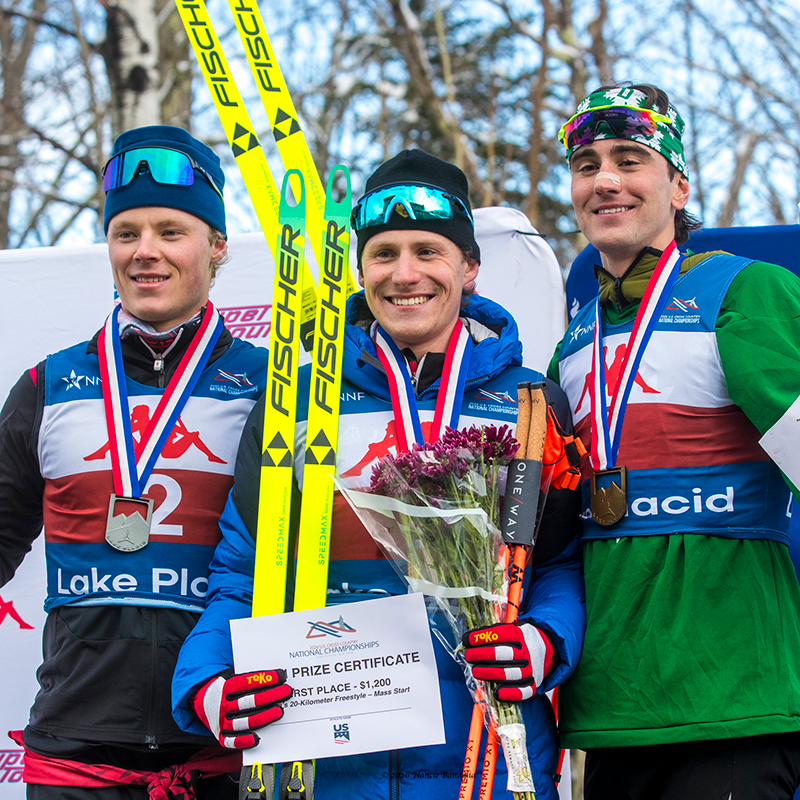
The national podium for the US National Cross-Country Ski Championship Men’s 20 k Freestyle Mass Start with Zanden McMullen (APU) first, John Steel Hagenbuch (Dartmouth) second, and Zach Jayne (UU) third. (Photo: Nancie Battaglia)
A Door, Not Yet Closed
National championships often promise clarity. This one offered something subtler: differentiation without finality. The men’s 20 k freestyle did not decide everything, but it sharpened the picture. It showed who could manage pressure, who could read a race, who could wait—and who could finish.
In an Olympic winter, those qualities matter as much as any single result.
As the stadium emptied and the snow settled back into quiet, the door to Milan–Cortina did not swing wide. But for one, and hopefully two skiers, it remained open, narrow, demanding, and earned.
Feature stories like this one take time, access, and care to produce. If you value thoughtful storytelling and independent ski journalism, please consider becoming a Voluntary Subscriber. Your support directly fuels the work we do to cover the people, places, and moments that make our sport special.
Traffic was thick at the beginning of the US National Cross-Country Ski Championship Women’s 20 k Freestyle Mass Start in Lake Placid, NY. (Photo: Nancie Battaglia)
There is a particular moment in a long mass start when the race quietly declares what it will be. It does not arrive with a surge, a crash, or even a decisive move. It arrives when the pack thins just enough that the edges of the course begin to matter—when skis no longer overlap cleanly, when passing requires intention, and when each athlete realizes—often simultaneously—that this is no longer a collective undertaking.
At Mt. Van Hoevenberg, that moment came early.
The women’s 20-kilometer freestyle mass start at the 2026 U.S. National Cross-Country Ski Championships unfolded under conditions that rewarded clarity and punished hesitation. The course was wide in places, narrow in consequence. Fresh snow lined the edges, slower and heavier than the main track, turning every attempt to move forward into a calculation of cost. The pace at the front was honest from the gun—fast enough to string the field out, fast enough to strip away the illusion that patience alone would bring opportunity.
In an Olympic winter, Nationals rarely exist in isolation. They are arguments as much as races, each result carrying the quiet weight of future conversations. But on this morning, before selection scenarios and season arcs could intrude, the race itself demanded attention. Four laps. Twenty kilometers. A course that climbs insistently and asks athletes to be precise even when tired.
What followed was not one story, but several—layered, intersecting, and revealing.
Colorado’s Tilde Bångman did much of the work at the front of the Women’s 20 k Freestyle Mass Start in Lake Placid, NY. (Photo: Nancie Battaglia)
The Fast Start That Changed Everything
From near the front, the race immediately took on the shape many expected. Kendall Kramer, eager to avoid the kind of chaos that can derail a mass start before it has truly begun, made her intentions clear.
“I wanted to go out fast because I didn’t want any funny business—colliding or breaking equipment,” Kramer said later. “I was super looking forward to being in the front of a mass start after being caught in the back on World Cups.”
For Kramer, the early pace felt familiar rather than reckless. World Cups, she noted, often begin faster than domestic races, and the instinct to establish position early has become second nature. The speed was assertive but manageable. She felt fit, capable, present.
Behind her, the effect was immediate. The field stretched, then fractured, then reorganized into smaller, more intentional units. For athletes starting deeper in the field, this stringing-out created both opportunity and pressure.
Novie McCabe, starting from bib 26, felt the opening kilometers open rather than close.
“My plan for the start was just to stay relaxed and try to work my way up,” she said. “It honestly ended up being easier than expected because the front girls took it out so fast. It was very strung out, and there was lots of room to move around.”
Within minutes, McCabe had navigated cleanly into the front group. What followed was less about advancing and more about survival.
“I got to the front pack about three minutes into the race,” she said. “So I spent most of it there just trying to hang on for as long as I could—and ended up having it in me to hang till the end.”
That phrase—hang on—would recur in different forms throughout the day, taking on slightly different meanings depending on where each skier found herself in the race.
Ava Thurston (#8 – Dartmouth) couldn’t quite hang on to the lead group of three, but eventually skied with Hailey Swirbul (#67 – APU) and Haley Brewster (#46 – UVM) before finishing fourth overall and third-place American. (Photo: Nancie Battaglia)
When the Front Pulls Away
Not everyone who tested the front pace could stay there.
Late in the first lap, Ava Thurston made her own attempt to bridge. She came close enough to feel the rhythm of the leaders, close enough to understand the cost.
“I tried to get back onto the front group, and I got pretty close,” Thurston said. “But I realized that I wasn’t going to be able to match their pace.”
The realization came with consequences. For a brief stretch, she found herself skiing alone—a dangerous place in a mass start, especially early, when gaps can grow quietly and decisively.
“That was where I did have a little bit of that panic,” she admitted.
The panic did not last. Company arrived in the form of Hailey Swirbul and Haley Brewster, and with it, perspective.
“Once I was skiing with them, I was kind of just thinking, ‘This is a good group. I can stay with these guys,’” Thurston said.
From there, her race became less about chasing what was ahead and more about managing what was happening around her. She tucked in, matched surges, and responded quickly to small separations before they became something larger.
“There were a couple of times where I would fall off the pack just a little bit,” she said. “Each time, I worked hard to get right back on before letting it be a big gap. I was really stoked on that.”
On a course like Van Hoevenberg—four laps of sustained uphill skating—those moments add up. Fitness is exposed repeatedly, not all at once. For Thurston, the race offered reassurance.
“This was the first race longer than 10k I’d done this year, and the first mass start that wasn’t a sprint,” she said. “It was a really good indicator that my fitness is there. It’s hard to fake anything on this course.”
She would finish fourth, clearly separated from the podium trio but equally clear of the deeper chase—an honest result in a demanding field.
With higher FIS points from not racing the past two seasons, Hailey Swirbul (#67 – APU) needed to ski through a lot of traffic during the early kilometers, but eventually found herself in the chase pack. (Photo: Nancie Battaglia)
Racing From the Back Without Racing Small
While the front and mid-pack sorted themselves, Hailey Swirbul was running an entirely different race.
Starting from bib 67, she entered the day knowing she would need to be deliberate.
“I didn’t even realize I would be seated so far back until the start list came out,” she said. “Obviously, I would be, because my FIS points aren’t low at this point—but it was an experience.”
The challenge was not simply moving forward. It was how to do so without paying too steep a price.
“The edges of the course had fresh snow on them,” Swirbul explained. “It was much slower, and a much higher energy expenditure to get around people that way.”
Instead of forcing passes, she waited. Instead of locking into the pace of whatever group surrounded her at a given moment, she kept her attention forward.
“I almost approached the first couple laps like an individual start,” she said. “It’s really easy to lock into the group you’re around and forget about the people ahead of you.”
Women’s racing, she noted, often begins with a fast, destabilizing surge—a period where the goal is simply to hang on long enough for things to settle.
“That’s exactly what happened today,” she said. “The leaders go fast, string it out, and then the real race starts again.”
For Swirbul, the balance was constant: advancing through traffic while respecting the race’s length.
“A 20k is a long race,” she said. “You can’t really pay for it.”
Though she never bridged to the front trio, Swirbul finished fifth—solidly clear of the next wave behind her—and left the course satisfied with her execution and proud of the broader team effort.
“Our coach absolutely crushed it with skis and feeds,” she said. “It was a good day to be APU.”
Novie McCabe (APU) maintained contact on the uphills and used the downhills to close the small gaps to Tilde Bångman (CU) at the front of the race. (Photo: Nancie Battaglia)
The Margins at the Front
At the sharp end, the race narrowed to a familiar dynamic: strength, speed, and patience under pressure.
As the kilometers mounted, Tilde Bångman began to apply pressure on the climbs, testing the group’s elasticity. By mid-race, the front had distilled to three: Bångman, McCabe, and Kramer. The chase group behind them was no longer within striking distance, and the podium places would be decided among those three alone.
McCabe felt the pressure immediately.
“In the last few kilometers, Tilde was skiing super strong and still really pushing the pace,” she said. “She would gap me a little bit on some of the hills.”
Each gap mattered. Each closure required confidence—in skis, in timing, and in restraint.
“I had some super good skis, so I was able to glide back up to her,” McCabe said.
The plan crystallized: stay attached through the final hill, try once to make a move, and if that failed, save everything for the finish.
“I tried to get a gap on the last hill, which didn’t quite work,” she said. “So I tried one last time at the finish.”
It was enough.
McCabe crossed the line first, securing the national title after a race built not on constant aggression, but on measured commitment. The emotion that surfaced surprised even her.
“I think when I crossed the line, I mostly just felt super happy to be back racing and feeling like myself,” she said.
The win mattered. So did what it represented.
“Going into this week, I wasn’t sure it was the best idea for me to race frequently this season,” she said. “Now I have a lot more confidence that I can race—and maybe more importantly, recover from racing.”
In an Olympic year, that distinction is not trivial.
The lead pack and eventual overall podium with Kendall Kramer (APU), Tilde Bångman (CU), and Novie McCabe (APU) (l – r). (Photo: Nancie Battaglia)
Kramer’s Race: Control Without Regret
For Kendall Kramer, the separation late in the race came not through fitness, but friction.
“My skis slowed down as they went,” she said. “They started to feel sticky—like I skied through too much Gatorade or something.”
The effect was most pronounced on the downhills, where speed should have come freely.
“The girls had to push my poles to speed me up to keep together,” she said. “Eventually, they could just gap on all the downhills.”
Once the gap formed, Kramer shifted her focus from contesting the win to finishing the race well.
“I’m happy to maintain my place and feel good,” she said. “I can’t complain.”
What she wanted from the race, she explained, was not chaos or last-minute risk, but sustained pressure in a small group.
“I wanted a small pack where we could test at every little bit,” she said, “as opposed to leaving it to a sprint or taking risks at a time like this.”
She finished third, completing the podium, and left Lake Placid without repeating her national title—but with confirmation that mattered just as much.
“I felt fit and totally capable today,” she said. “I didn’t feel bad feelings.”
Novie McCabe (APU) managed to put a small gap on teammate Kendall Kramer to get away with Tilde Bångman (CU) and eventually ski to the national title in the finish stretch. (Photo: Nancie Battaglia)
What the Race Revealed
By the time the women completed their fourth lap, the story of the day was no longer about who surged when, but about how each athlete managed the same course differently—and honestly.
McCabe raced with restraint until she no longer needed to. Kramer raced with intent and accepted the margins. Thurston learned, adjusted, and confirmed her distance fitness. Swirbul navigated from deep in the field with patience and clarity.
None of those narratives exists in isolation. Together, they form a portrait of a championship race that did what the best distance races always do: expose truth without exaggeration.
At U.S. Nationals, the women did not simply ski 20 kilometers. They negotiated space, managed doubt, trusted preparation, and tested belief.
In an Olympic winter, those are not side effects.
They are the point.
The national podium for the US National Cross-Country Ski Championship Women’s 20 k Freestyle Mass Start with Novie McCabe (APU) first, Kendall Kramer (APU) second, and Ava Thurston (Dartmouth) third. (Photo: Nancie Battaglia)
Feature stories like this one take time, access, and care to produce. If you value thoughtful storytelling and independent ski journalism, please consider becoming a Voluntary Subscriber. Your support directly fuels the work we do to cover the people, places, and moments that make our sport special.
The overall podium for the US National Cross-Country Ski Championship Women’s 20 k Freestyle Mass Start with Novie McCabe (APU) first, Tilde Bångman (CU) second, and Kendall Kramer (APU) third. (Photo: Nancie Battaglia)
Samantha Smith (#1 – SVSEF) was the fastest qualifier and advanced through all her rounds in first on her way to the national championship at the US National Cross-Country Ski Championships Freestyle Sprint. (Photo: Nancie Battaglia)
There is a particular kind of pressure that lives in a sprint qualification. It isn’t loud. It doesn’t announce itself with theatrics. It sits in the quiet places: the moment you realize the warm-up loop is over and you’re headed back toward the start; the thin stretch of time when your poles feel too long and your gloves feel too tight and the only thing you can hear is the scrape of skis and the soft, practiced urgency of coaches repeating the same cues they’ve repeated for years.
In the heats, there is cover. There is a draft. There is a corner to hide behind, a decision to delay, a shoulder to lean into, a mistake you can sometimes survive. Qualification has none of that. Qualification is a solitary negotiation with speed, oxygen, and the course itself. And in an Olympic winter, it also becomes something else: a sorting mechanism. A gate. A reminder that at the Games, you don’t get to be “good in the heats” if you don’t first earn your way into them.
At the 2026 U.S. National Cross-Country Ski Championships in Lake Placid, Tuesday’s freestyle sprint at Mt. Van Hoevenberg offered that truth clearly. On the women’s side, Samantha Smith (Sun Valley SEF) was the fastest qualifier. On the men’s side, Zanden McMullen (APU Nordic Ski Center) topped the morning results.
By the end of the afternoon, the national titles belonged to Smith — who converted qualifier speed into clean, controlled racing through every round — and Mons Melbye (University of Utah), who did something deceptively difficult: he kept winning as the format stopped forgiving mistakes.
Dartmouth College’s Ava Thurston was impressive all day on her way to third overall. (Photo: Nancie Battaglia)
Qualification as the Real Story — and the Olympic-Year Subtext
The sprint format always tempts us to focus on finish-line photos, final turns, and last lunges. But if you’re trying to understand what this race meant in the broader context of the week — and in the longer context of an Olympic winter — you start with the qualifier.
Smith’s win in qualification wasn’t just fast; it was decisive in a way that matters in a discipline where tenths often separate confidence from chaos. She led Alayna Sonnesyn (Team Birkie) by nearly two seconds, with Lauren Jortberg (CNEPH) third and Ava Thurston (Dartmouth) fourth.
On the men’s side, the top end was deep and tightly packed. McMullen led Owen Young (University of Vermont) by just over a second, with Michael Earnhart (APU Nordic Ski Center) essentially on Young’s shoulder. Melbye qualified fourth, with Cole Flowers (University of Alaska Fairbanks) and Max Kluck (University of Utah) close behind.
This matters because international sprinting — the kind that happens at the Olympics — is not a format where you can count on “finding your way through the rounds” if you start your day in the wrong place. Qualification is where your sprint begins or ends.
The subtext, however, differs by gender. On the men’s side, the Olympic pathway through domestic sprinting appears closed this winter. On the women’s side, the picture has felt more open, with multiple domestic spots likely in play and sprint specialists carrying meaningful leverage. The sprint, then, does not “mean” the same thing for every athlete — but it still demands the same thing from all of them.
Eventual winner, Samantha Smith (#1 – SVSEF) controls the start of the women’s final at the US National Cross-Country Ski Championships Freestyle Sprint. (Photo: Nancie Battaglia)
Women: Samantha Smith’s Control, Sonnesyn’s Speed, and a Final that Rewarded Discipline
Smith won the qualifier. Then she won her quarterfinal. Then she won her semifinal. Then she won the final.
Behind her in the final were Sonnesyn in second and Thurston in third, followed by Nina Schamberger (University of Colorado), Jortberg, and Katherine Weaver (Alberta World Cup Academy).
Sonnesyn’s day began where the pressure was heaviest.
“I am really proud of my sprint qualifier,” Sonnesyn said. “There was a lot of pressure on it, and I was feeling that, so I really leaned into the energy of those around me. I left everything I had out there on that course. Not perfect, but really good.”
In the final, she was clear-eyed about what limited her chances to fight for the win.
“I always need to keep working on my starts,” she said. “It’s really hard for me to get going that fast, and I ended up getting a bit boxed during the final because I didn’t have a great start. That being said, I think that final hill and the super fast downhill at the end worked in my favor.”
Alayna Sonnesyn (#2 – Team Birkie) pushes over the top of the sprint course’s main climb. (Photo: Nancie Battaglia)
Smith described a day defined by managing nerves and executing details.
“I was quite nervous going into today’s race,” Smith said. “I was putting a lot of pressure on myself to perform well, so I tried to channel the nerves into adrenaline. I focused on skiing smoothly, working the transitions, and finding the most efficient line out there.”
The final climb played directly to her strengths.
“The final hill was definitely my favorite part of the course,” she said. “I really love to hop skate, and the gradient of that hill is perfect for it. On this course, transitions are critical, so I tried to be really disciplined about skiing hard over the tops and pushing into the downhills.”
Thurston, who qualified fourth and finished third overall, described a sprint day built around process rather than pressure.
“My approach to nerves was to focus on having fun and getting to the start line ready and excited to race,” she said. “Having my whole team here helped a lot. Chatting and joking with teammates and competitors really eases my nerves.”
She found her biggest opportunities during the heats.
“During the heats, I gained the most time on the final big hill,” Thurston said. “The wide trail made it an ideal place to pass. I’m still working on my double pole at the start, so that’s an area where I think there’s more speed to unlock.”
Lauren Jortberg (CNEPH) leads her semifinal at the US National Cross-Country Ski Championships Freestyle Sprint. (Photo: Nancie Battaglia)
Jortberg’s fifth-place finish, after qualifying third, served as a reminder of sprinting’s second demand: doing the work repeatedly under imperfect conditions.
Jortberg said the qualifier remained her primary focus, especially in an Olympic winter where advancing matters as much as how fast you ski.
“Sprint qualification is something I’ve been working on a ton,” she said. “That’s the most important part of the day, especially when it comes to World Cup skiing — just moving on. I was happy with my qualifier. It wasn’t my best skiing, but it was solid.”
She said lingering fatigue from the previous classic race played a role, particularly after spending much of that race running due to skis that wouldn’t kick.
“I definitely felt like I was carrying some fatigue from the classic,” Jortberg said. “So I’d say the qualifier was okay, but not my best work. I know I can ski better than that.”
Jortberg said the Van Hoevenberg sprint course suits her strengths, but emphasized that the margins — especially on the downhills — leave no room for lapses.
“I really like this course. It plays to a lot of my strengths — strong V2, a long climb, and hop skating,” she said. “But you have to be diligent everywhere, especially on the downhills. You can’t be lazy for even half a second.”
In the semifinals, she said the tight schedule and downhill dynamics ultimately limited her ability to move forward.
“My semifinal was only about eight minutes before the final,” Jortberg said. “I couldn’t really clear the lactic acid, and I didn’t have much time. I got passed on the downhill and then couldn’t really move in the final.”
Despite the broader Olympic context, Jortberg said she is deliberately keeping her focus narrow.
“I try not to stress about spreadsheets or criteria,” she said. “I just want to race, have fun, and ski the best way I know how. That’s really all you can do.”
Smith added one more note at the end of the day, confirming she plans to continue racing later in the week.
“As of now, yes, I am planning to race the 20-kilometer on Thursday.”
Eventual winner, Mons Melbye (#4 – UU) in his quarterfinal at the US National Cross-Country Ski Championships Freestyle Sprint. (Photo: Nancie Battaglia)
Men: Melbye’s Title, Jayne’s Podium, and Endestad’s Deep Run from 16th
On the men’s side, the qualifier winner did not win the title.
McMullen was fastest in the morning, but the championship ultimately went to Melbye, who qualified fourth and then won his quarterfinal, semifinal, and final.
Behind Melbye, Sasha Masson (CNEPH) finished second, Zachary Jayne (University of Utah) third, and Ari Endestad (Alaska Pacific University Nordic Ski Center) fourth. Michael Earnhart finished fifth, with Owen Young sixth.
The University of Utah was central to the men’s story throughout the day, with Melbye winning the title and Jayne joining him on the podium.
Zach Jayne (UU) during qualification. (Photo: Nancie Battaglia)
Jayne described a qualifier that didn’t match his expectations — and a deliberate reset once the rounds began.
“Coming off a skate qualifier win in Alaska, I was disappointed after my qualifying performance,” Jayne said. “I thought I was capable of much more. Knowing that, I went into the heats with a better plan focused on composure and power. I was more relaxed and less nervous once I committed to that.”
His view of sprint racing was blunt.
“The rounds were incredibly close, but it only matters where people are at the finish — nowhere else,” he said.
Young (University of Vermont), who finished sixth overall, described a day shaped largely by the pressure of the qualifier and the need to earn his way into the rounds.
“Heading into the race today, my internal goals were a bit of a mixed bag,” Young said. “The main focus was result-based, but I really approached the day thinking about the qualifier. I’ve only raced one sprint this season, and the result was pretty mediocre, so I was pretty dead set on just trying to qualify.”
Once through the qualifier, Young said his focus narrowed to managing the rounds one at a time.
“After the qualifier, I tried to just take each heat one at a time and give it my best shot to move on,” he said. “I don’t really try to preserve energy in the qualifier — I usually give it everything I’ve got. That might not be the smartest choice for later in the day, but the confidence boost from a fast qualifier can really help mentally in the heats.”
Miachael Earnhart (APU) on his way to posting the third fastest qualification time. (Photo: Nancie Battaglia)
Endestad’s fourth-place finish told a different story: one of survival, adaptation, and opportunity.
He qualified 16th in what he described as one of the tightest sprint qualifiers he had ever seen at Nationals, then raced his way through the rounds into the final.
“Ideally, I would’ve liked to qualify a little higher,” Endestad said. “But with how close it was, I felt lucky just to be in the heats at all.”
The physical cost of the day was obvious.
“This course is so hard,” he said. “I threw up after the qualifier and had to fight to stay composed through the quarter and semi. There were only about 12 minutes between the semi and the final, so it was about breathing, keeping it down, and making good decisions.”
Tactically, he was clear about where he needed to attack.
“It might have looked like patience early, but honestly, I was barely hanging on from the start,” Endestad said. “The goal was to be in position for the main hill, because that’s where I felt I could really put the hammer down.”
Ari Endestad (APU) leads teammate Michael Earnhart (APU) during the heats of the Freestyle Sprint at the US National Cross-Country Ski Championships. (Photo: Nancie Battaglia)
Michael Earnhart said his goals at U.S. Nationals were shaped as much by the SuperTour standings as by the result of any single race.
“One of my goals coming into Nationals was to try to take back the SuperTour lead heading into Period 3,” Earnhart said. “Today helped me with points against Hunter Wonders, but not against Zach Jayne. It’s still very close, and both of them are really good athletes.”
He admitted he arrived with higher expectations after last season’s skate sprint performances.
“After last year, I really wanted to try to win today,” he said. “So I was a little disappointed to come in fifth. But with how close the qualifier was and how strong the competition is getting in the U.S., I’m not overly disappointed. It’s a reasonable result.”
Earnhart said experience helped him stay composed through the rounds.
“I’ve done a lot of heats on the SuperTour, so I feel confident in this field,” he said. “I try to ski to my strengths, stay relaxed, and ski with the confidence that I deserve to win the heat. Normally, that gets me through, but sprinting is unpredictable.”
He added that Van Hoevenberg offered rare opportunities to move in a skate sprint.
“The main sprint hill is wide enough to move, and jump skating is my strongest technique,” Earnhart said. “When the qualifier is six seconds from first to 30th, it’s fine margins. Sometimes you need a little luck — but you also have to make your own.”
Mons Melbye (#4 – UU), Sasha Masson (#11 – CNEPH), and Zach Jayne (#12 – UU) on their way to first, second, and third places, respectively, with Ari Endestad (APU) trailing in fourth place during the men’s Final at the US National Cross-Country Ski Championships Freestyle Sprint. (Photo: Nancie Battaglia)
What It Means — and What It Doesn’t
It’s tempting in an Olympic year to treat every Nationals result like a verdict. But Nationals is not the Olympics, and a domestic sprint is not a World Cup sprint field.
What it can be is a stress test.
For the women, the sprint reinforced that athletes who can combine elite qualifier speed with repeatable execution are building strong cases. Smith won both the qualifier and the final. Sonnesyn backed up top-end speed with a runner-up finish while clearly identifying where she can improve.
For the men, the sprint may not be about Olympic selection, but it was revealing and also adds to the season-long narrative. Melbye showed an ability to win under repeated pressure. Jayne demonstrated resilience after a disappointing qualifier. Endestad showed how quickly sprinting can reward those who survive long enough to find their moment.
Young’s comments also underscored the tradeoffs athletes are navigating as the week continues.
“I don’t have a definite answer, looking forward to the rest of Nationals,” he said. “I’d like to throw down top results in the 20k and the classic sprint, but I need to talk with my coach and assess the best plan to give me the best shot at scoring enough points. That could mean skipping the 20k and focusing on the sprint, or maybe doing both — it’s tricky with no rest day and the body starting to feel the last couple days of racing.”
Katey Houser (MSU) leads Ruby Serrouya (DU) and Marit Flora (UAA) in their quarterfinal at the US National Cross-Country Ski Championships Freestyle Sprint. (Photo: Nancie Battaglia)
A Closing Note from Lake Placid
By late afternoon, the sprint course felt smaller than it had in the morning. Not only because it changed slightly for the juniors, but because sprint days compress experience. The same hill feels steeper the fourth time. The same turn feels tighter. The same finishing straight feels shorter.
That is the quiet lesson of a National sprint in an Olympic winter. It doesn’t allow vagueness. It demands specificity. It asks for one fast lap — and then asks you to do it again, and again, and again, under less forgiving conditions.
Samantha Smith and Mons Melbye won because they answered those questions most consistently.
For everyone else, Lake Placid delivered the same message sprinting always does: if you want to be part of the story later, you still have to earn your way into the next round now.
Feature stories like this one take time, access, and care to produce. If you value thoughtful storytelling and independent ski journalism, please consider becoming a Voluntary Subscriber. Your support directly fuels the work we do to cover the people, places, and moments that make our sport special.
Mons Melbye (#4 – UU), Sasha Masson (#11 – CNEPH), and Zach Jayne (#12 – UU) on their way to first, second, and third places, respectively, with Owen Young (UVM – far left), Ari Endestad (#16 – APU), and Michael Earnhart (#3 – APU) trailing to start the men’s final at the US National Cross-Country Ski Championships. (Photo: Nancie Battaglia)
The US National Championships got started yesterday with the 10 k Classic Individual Start in Lake Placid, NY. Hunter Wonders (#369 – APU) took top honors in the men’s race. (Photo: Nancie Battaglia)
On a January afternoon in Lake Placid, Mt. Van Hoevenberg did what it has always done best: it asked skiers to be honest.
The 10-kilometer classic individual start is not a format that rewards theater. It doesn’t care how good you looked in warm-up, how confident you sounded the night before, or how convincing your season-long narrative might be. It rewards pacing that’s brave but not reckless, technique that doesn’t unravel under strain, and the ability to keep making good decisions when your legs are trying to renegotiate the terms of the day.
This year, the U.S. National Cross-Country Ski Championships opened with that race—two laps on the 5-kilometer loop—and the timing was no accident. In an Olympic winter, Nationals is never just Nationals. It’s an argument. It’s a week where results don’t merely “count,” they accumulate, and the accumulation becomes the story that follows athletes into selection meetings, petitions, and—if all goes right—onto a plane headed for Italy.
Will Koch (SVSEF) on his way to 8th place on the day. (Photo: Nancie Battaglia)
The Course: Where You Can’t Afford to “Blow Up”
The Van Hoevenberg course is famous for being “fair,” but fairness in skiing is rarely gentle. The climbs arrive in layered sequences—sections where you can press, sections where you can survive, sections where you can lose seconds simply by being a fraction late to a gear change. There are places to win time, and places where you simply try not to hemorrhage it.
Hunter Wonders described the central problem precisely after the finish:
“It has some big hills. And I really think that in this course you can’t afford to blow up. If you blow up, you’re just going to bleed so much time.”
That idea—bleeding time—was the hidden refrain of the day. Not because athletes were exploding spectacularly, but because this loop punishes any lapse in restraint. It is a course that rewards a mind that stays intact.
Corbin Carpenter (UAA) on his way to 10th place in the 10 k Classic at US Nationals. (Photo: Nancie Battaglia)
Men’s Race: Seconds as a Selection Language
At the front of the men’s race, the margins compressed into something almost absurd: a national title decided in a space so small it could be measured in one imperfect corner, one extra step of herringbone, one pole that slips just slightly at the wrong moment.
Hunter Wonders won the men’s 10 k Classic National Championship. Behind him, the podium fight came down to an almost unnerving closeness. The story wasn’t simply that the race was fast; it was that it was tight—tight enough to turn pacing into the defining skill.
Wonders’ post-race reflection didn’t sound like someone who had “controlled” the race so much as someone who had managed it correctly, which is often the same thing in interval start racing:
“Yeah. So going through it never really felt like it was my day. I knew it was going to be a competitive one, and I knew that it would just come to good skis, good feelings in the body, good pacing, and I’m just really happy that I was able to pull it off.”
He returned to pacing again, emphasizing that his strategy wasn’t about heroics, but about avoiding the one mistake that the Van Hoevenberg loop will magnify:
“I think pacing was the biggest challenge for me today… So I was trying to take it out hot to where I could be competitive but not blow myself up.”
What made Wonders’ win especially convincing was how he described staying committed to his plan and then finishing with intent when the splits told him the race was available:
“I never really changed my race plan mid-race. But I did get some good splits, especially near the end, so I just tried to finish as hard as I could.”
And then, because it’s 2026 and everyone knows what this week represents, he said the part that matters most:
“And then, of course, U.S. Nationals does carry some heavy weight in an Olympic year. And I’ve been thinking about this race since the races in Anchorage ended, so I’m just really happy to have it behind me.”
He wasn’t pretending the pressure isn’t real:
“I definitely felt the pressure, and I’m going to continue to feel the pressure throughout the rest of this Nationals. But I think I have good momentum going, and I have good confidence. I know that I’m in shape, and everything else just kind of hopefully falls into place over the next week.”
The finish-line truth of the men’s race is that it created a kind of selection tension that will hang over the rest of the week: the top contenders weren’t separated by a narrative gap. They were separated by seconds.
Luke Jager, who finished second, captured what that tightness means on this course and in this moment:
“Yeah, crazy how close the times were! The course is cool because there are so many different gears in the climb that people can all have different focus spots and still end up so close together at the finish line. It is really cool, fair racing like that.”
That line—different focus spots, same finish—explains why the top of the results can look like a near-tie without being random. You can ski this course well in different ways. But you still have to ski it well.
Jager also spoke directly to the Olympic subtext without overplaying it:
“I’m not naive enough to say that the Olympics aren’t on all of our minds, but I’m also really having fun just trying to do my best and working to solve the puzzle of how to perform on any given day. Italy would be sweet, but I’m super thankful for this opportunity to even be feeling that pressure at all. It’s been fun to have such a big challenge.”
And then the warning embedded in the closeness:
“The close times just show me that you can’t take anything for granted, and each race could be someone else’s day. Fun to have to try and be as dialed and prepared as you can every day when the stakes are high.”
In other words, this wasn’t a day that “settled” anything. It made the next races more consequential.
Hailey Swirbul (APU) on her way to a national title in the 10 k Classic at US Nationals in Lake Placid. (Photo: Nancie Battaglia)
Women’s Race: Swirbul’s Return, and a Course That Doesn’t Flatter Anyone
If the men’s race was defined by a razor-thin margin, the women’s race had a different feel: not less intense, but shaped by a performance at the front that felt like a statement. And the words that followed from the winner did not sound like someone who had stumbled into a good day; they sounded like someone who had been building toward a day like this for a long time.
Hailey Swirbul framed her win as the visible outcome of a longer experiment:
“Winning this race felt like finally getting to watch the outcome of a long experiment unfold! I’ve wanted to approach this season from a place of curiosity to see if I can get fitness and strength back after a 2.5-year hiatus. It has felt so rewarding to get stronger and remember how it feels to race and go hard again.”
She described the way racing itself can re-teach an athlete what “hard” feels like:
“Each race or hard interval session reminds me what it feels like a little bit more.”
And then she said what almost everyone in the finish area seemed to be thinking, whether they admitted it or not:
“This course is legit. I didn’t hear the words ‘I felt good out there!’ come out of a single person’s mouth! It was a battle of self against hill.”
That sentence carries the whole day inside it: not a battle against other people, exactly, but against the course’s capacity to strip away pretense.
Hailey Swirbul (APU) charges up one of the many climbs on that Lake Placid course behind Virginia Cobb (#120 – DAR) and Marit Flora (#76 – UAA). (Photo: Nancie Battaglia)
Swirbul’s race plan—at least as she described it—was deeply personal in its logic. Not a copy of someone else’s pacing, not a response to what she imagined others were doing, but an attempt to ski in a way that matched her strengths:
“I tried to ski true to myself. I wanted to use momentum and my own body weight the most effectively I could to get around that course as fast as I could- regardless of how the pacing looked for others.”
And because it’s an Olympic year, she made the subtext explicit:
“I have my eyes on an Olympic Team spot, and I’m going to continue to fight for it until the team is officially named. I’m not thinking beyond this week of racing here at Nationals. One step at a time, staying present…”
Then the line that reminds you why athletes keep doing this:
“…and enjoying getting to live this life and see so many people from old racing days— it’s a good life.”
Novie McCabe’s post-race comments carried a tone that felt especially relevant to this week: gratitude, yes—but also a clear-eyed description of how fragile a season can feel, and how an athlete can build stability by focusing on what can be controlled.
“It meant a lot to be starting today for sure! I think that being a bit unsure of whether I’d be starting these races made me feel pretty grateful for the opportunity to go out there and give it my best today.”
She described the emotional mix honestly:
“There were, of course, lots of doubts and some nerves going in as well, but I really tried to just enjoy the skiing and made that my main goal going into it.”
And she emphasized that conditions and course feel matter—not as excuses, but as context:
“The conditions were insanely nice today, which helped, and this course is one of my favorites!”
On pacing, McCabe described a strategy rooted in self-knowledge:
“Honestly, I kinda just went out as hard as I could within reason, and tried to relax and hold onto it. I know the splits don’t really make it look that way, haha, but I am not the fastest starter, so it is usually best for me to go out at what feels like a pretty hard pace.”
Then she explained the architecture of her day: not results goals, but process goals. She made a point that’s easy to dismiss until you remember what an Olympic week does to people:
“Being focused on process goals going into a race really helps me develop a framework for success.”
She listed those goals with specificity—how she wanted to feel, what she wanted to focus on, what she wanted her mind to do when discomfort arrived:
“…going out hard but comfortable and trying to hold it, skiing well (not skiing hard), be the focus of the day, keeping up the positive self-talk, and finding the good and noticing what is going well throughout the race.”
And on Olympic pressure, she offered a perspective that will sound familiar to anyone who has ever had a season disrupted by health or inconsistency:
“I think it has honestly helped me out in terms of handling self-imposed Olympic qualification pressure to not have had the best lead up and be pretty unsure of what I would be doing as far as racing goes this year…”
She described her focus as narrower—day by day—because it has to be:
“…it has taken some of my focus off of results… It has just kind of led to an approach where I take it day by day, and don’t really think much further into the future than that.”
That isn’t resignation. It’s an operating system. And it’s one that often works, especially on a course where you can lose time in the exact moment you start racing the future instead of the hill in front of you.
Rosie Fordham (UAF) leaving it all on the course on her way to 7th place overall. (Photo: Nancie Battaglia)
Samantha Smith: A Double Life and a Very Real Result
Samantha Smith’s presence near the top of the women’s results came with a storyline that’s unusual even in American ski racing: balancing elite cross-country skiing with Division I soccer at Stanford, and arriving at the heart of ski season off a long NCAA tournament run.
She spoke about the short transition plainly:
“Yes, that’s correct, that our soccer team’s long run into the NCAA tournament has made for a much shorter transition to the season. I’ve only been on snow for a few weeks, so I know my ski fitness is improving every day.”
She described the emotional carryover of playing for a national title—how it can become fuel rather than a distraction:
“Playing in the National Championship was an amazing experience—we were so close to winning it all. It was a tough way to end such a great season. I’m taking that fire from our final game and pouring it into my skiing.”
And she framed her path as something she’s embracing, not defending:
“I know my path is different from others, but I’m doing what I love, and I think there’s a lot to be said for staying true to that. I’m trying to take everything step by step, live in the moment, and focus on what I can control!”
On the scrutiny that comes with missing ski events earlier in the season, she emphasized the lessons she’s drawn from doing two sports seriously:
“…for me, I feel like there’s actually a lot I can pull from the two sports and use it to my advantage.”
She described last year as a “trial year” and explained how she’s adjusted:
“I needed that test phase to figure out what works and what doesn’t work. I made some adjustments this year in training, switching things up a bit, and I feel like that’s helped me a lot going into this season.”
She credited Braden Becker for helping with training and coaching through the fall:
“I owe a huge thank you to Braden Becker, a retired skier, who’s now a grad student at Stanford. He helped me a lot with training this fall, and it honestly made a world of difference…”
And then she returned to the mental challenge of this week—high stakes, lots of uncontrollables—and the philosophy that keeps an athlete from spiraling:
“…I’m just trying to focus on what I can control—my attitude and effort.”
Finally, she addressed the question of what a distance result might “say” about her:
“I was happy with today’s result… I think today’s race was a good indication of my trajectory for the rest of the week and the rest of the season.”
And she framed versatility—distance and sprint—as part of the argument she wants to make this winter:
“…hopefully showcase some of my versatility in different distances and disciplines, which I think can be important for big competitions like the Olympics.”
Alayna Sonnesyn (Team Birkie) on her way to 10th place overall. (Photo: Nancie Battaglia)
Why This Week Matters So Much
For the men, the arithmetic of Olympic selection is already partly written—and partly unresolved. At present, the United States is allotted seven men’s quota spots for the Olympic team, with the possibility that an eighth could roll down following this weekend’s World Cup races in Oberhof, Germany. That uncertainty is where much of the tension at U.S. Nationals resides.
It is also where most of the speculation comes from—so take it for what it is, informed but unofficial. The six American men who recently raced the Tour de Ski appear, by any reasonable reading of the criteria, to be on solid ground. Each currently ranks in the top 45 on the FIS World Cup sprint and distance overall lists, the threshold set by the US Ski Team that meets the objective requirements for Olympic selection.
Within that group of six, there is also ample sprint depth to cover the four available starts in the individual classic sprint and to form a competitive two-man sprint relay. As a result, Tuesday’s Freestyle Sprint at Nationals is likely to carry less weight for those athletes racing in Lake Placid with dreams of making the Olympic roster. Instead, the races most likely to function as closing arguments—particularly if an additional quota spot materializes—were Sunday’s 10 k Classic and Thursday’s 20 k Freestyle Mass Start. For at least one man, and potentially two, those performances may determine whether this week in Lake Placid becomes a footnote or a turning point.
On the women’s side, the picture is far less settled—and far more fluid. The United States has eight Olympic quota spots available, but only a portion of them is considered secure. Jessie Diggins—if it were ever in doubt—has already satisfied the objective criteria by finishing in the top eight in World Cup races that are part of the Olympic schedule. Julia Kern and Rosie Brennan also appear well-positioned, based on their respective rankings on the sprint and distance overall lists.
That still leaves as many as five remaining spots to be determined, drawing from a complicated blend of results across Period One on the World Cup, the SuperTour events in Alaska, and, critically, U.S. Nationals this week in Lake Placid. For those athletes, Nationals is not simply a domestic championship. It is an audition, a data point, and—in some cases—the clearest remaining path onto the Olympic team.
John Steel Hagenbuch (DAR) on his way to 5th place overall on the day. (Photo: Phillip Belena/EISA)
Grover: “There’s Going to be Space”… and then the Paperwork
US Cross-Country Ski Team Director Chris Grover offered perhaps the clearest explanation for why the opening races at Nationals feel unusually charged—not because they deliver final answers, but because they create space. Space in which athletes can move themselves from the margins of the conversation toward its center.
The story, as Grover framed it, is not simply who wins. It is what a result permits: what doors it opens, what arguments it strengthens, and how it positions an athlete within the broader, inevitably imperfect machinery of Olympic selection.
As Grover put it in an interview with FasterSkier, U.S. Nationals does exactly that—it creates room:
“…it’s going to be a great story because there’s space. There’s going to be space on both the men’s squad and the women’s squad, by the looks of it, for athletes to qualify from Nationals, to have great U.S. Nationals and come over, especially on the women’s side…”
That space, however, is not filled automatically. In an Olympic year, it is accompanied by paperwork, petitions, and deliberation—an acknowledgment that performance, while central, is rarely the entire story.
Grover outlined the petition process that follows Nationals, a step that often receives less public attention but carries significant weight:
“…all athletes who want to be considered for discretionary selection… We’ll put in an application. Or a petition rather, where they will kind of write out what their case is, why they should be considered…”
Those petitions, Grover explained, are then evaluated by a selection committee—six people tasked with translating results, trends, and context into final decisions:
“…we have the six-person selection committee that will pick the team. So as a committee, we’ll read everybody’s application, and then we, as a committee, will decide whether we want to elevate somebody using Coach’s discretion to be selected.”
Even the arithmetic of quota spots, Grover noted, is subject to forces beyond any one athlete’s control. On the men’s side, the possibility of an additional spot remains unresolved:
“…it’s after Oberhof… qualification for nations also closes on January 18… and at that point a spot [might be] available…”
Which is to say: timing matters. So does patience.
Taken together, Grover’s explanation underscores a truth that every athlete racing this week understands intuitively. Lake Placid does not merely crown national champions. It produces evidence—sometimes decisive, sometimes ambiguous—for a selection process that will soon harden from theory into reality. And once it does, the margins that feel abstract today will become permanent.
Ava Thurston (#45 – DAR) on her way to 6th place overall on the day. (Photo: Phillip Belena/EISA)
What Sunday Actually Did
The first day of Nationals did not select the Olympic team. It did something subtler and, in some ways, more powerful: it established the tone of the week.
On the men’s side, it proved that the domestic field is not going to give anyone breathing room. Wonders’ win was decisive in the only way that matters in interval start racing: he was fastest when everyone had to ski alone. But the closeness behind him reinforced Jager’s point—each race could be someone else’s day. In a week like this, that’s not a platitude. It’s a forecast.
On the women’s side, Swirbul’s victory felt like a day where preparation and belief finally aligned. But even she framed the week properly: one step at a time, staying present, not thinking beyond Lake Placid. McCabe and Smith offered two different versions of the same survival skill: build a framework, focus on process, control what you can, and let results become the output rather than the obsession.
If there was a single emotional throughline, it was this: the athletes weren’t pretending the Olympics weren’t there. They were trying, in different ways, to keep that fact from hijacking the work.
A Conclusion in the Shape of an Interval Start
There’s a particular quiet that follows an interval start classic race—not silence, exactly, but the hush of athletes doing their internal accounting. A national championship can feel like a celebration. In an Olympic year, it can also feel like a deposit: something placed into the larger selection ledger, something that will matter later, in rooms the athletes won’t be in, in conversations they can’t control.
What makes Lake Placid different—what makes Mt. Van Hoevenberg feel so permanent—is that it refuses to dramatize any of this. It simply asks the same thing of everyone: ski two laps honestly, manage the climbs, keep your head when your legs get loud, and finish without bargaining.
Wonders said he felt the pressure—and expects to keep feeling it. Jager said the closeness means nothing can be taken for granted. Swirbul described a long experiment that finally yielded its outcome. McCabe described building success from process, not prediction. Smith described a life lived between two sports, and a focus narrowed to attitude and effort.
Taken together, those aren’t just post-race quotes. They’re the first chapter of the week.
And in an Olympic winter, first chapters matter—because the next race arrives quickly, and the story keeps writing itself, one start at a time.
Love stories like this? Help keep them coming.
Feature stories like this one take time, access, and care to produce. If you value thoughtful storytelling and independent ski journalism, please consider becoming a Voluntary Subscriber. Your support directly fuels the work we do to cover the people, places, and moments that make our sport special.