From the FasterSkier archive — posts syndicated from athletes’ and coaches’ own blogs between 2004 and 2012, kept online as published. Current coverage is at fasterskier.com.

Tag: U.S. nationals classic sprint

  • ‘It Felt Surreal,’ Patterson Closes Out U.S. Nationals with Win No. 4

    ‘It Felt Surreal,’ Patterson Closes Out U.S. Nationals with Win No. 4

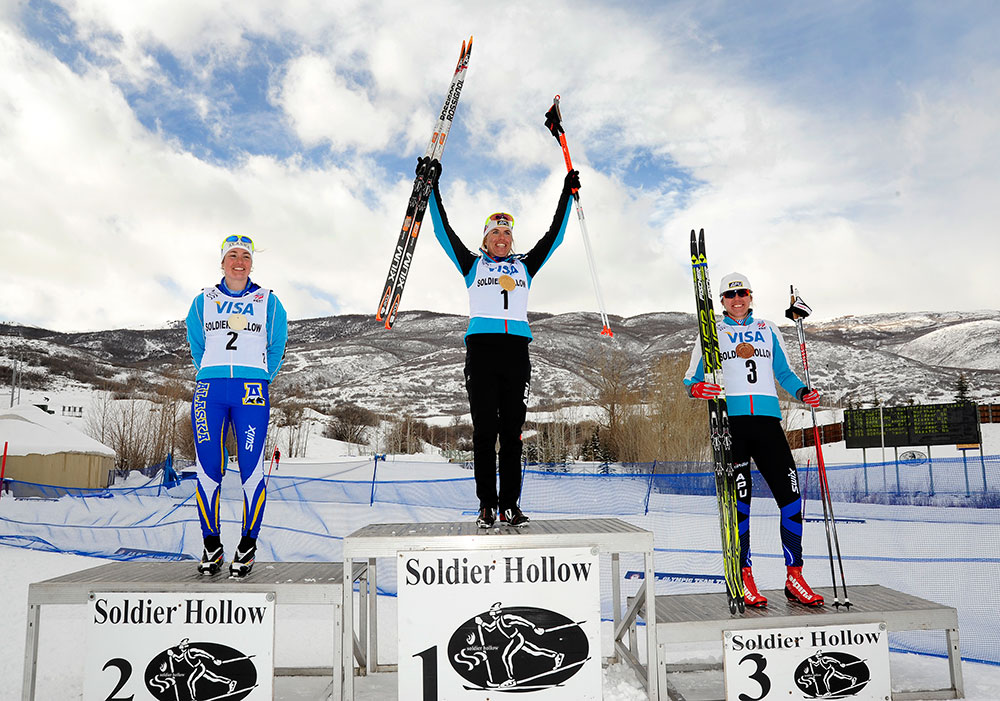
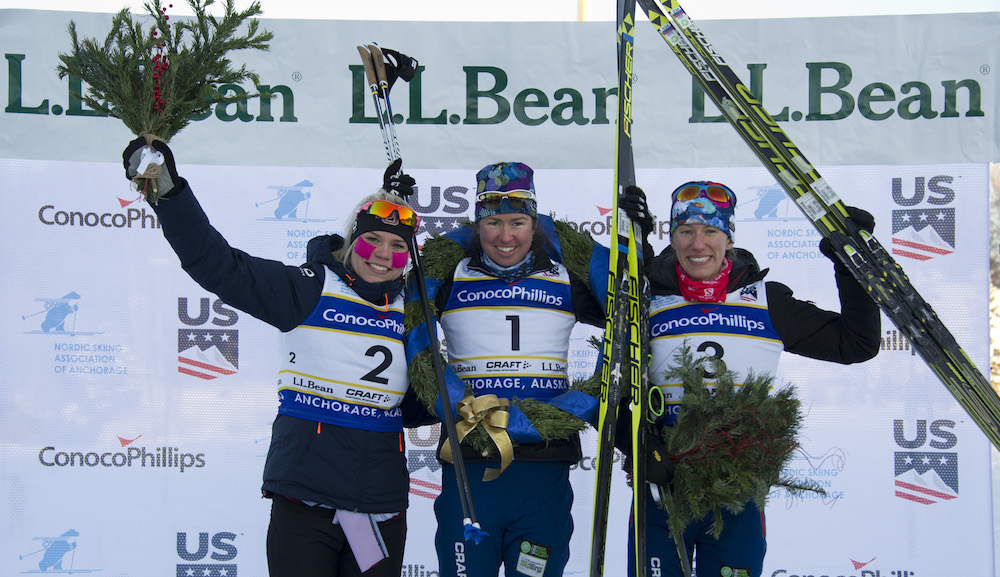
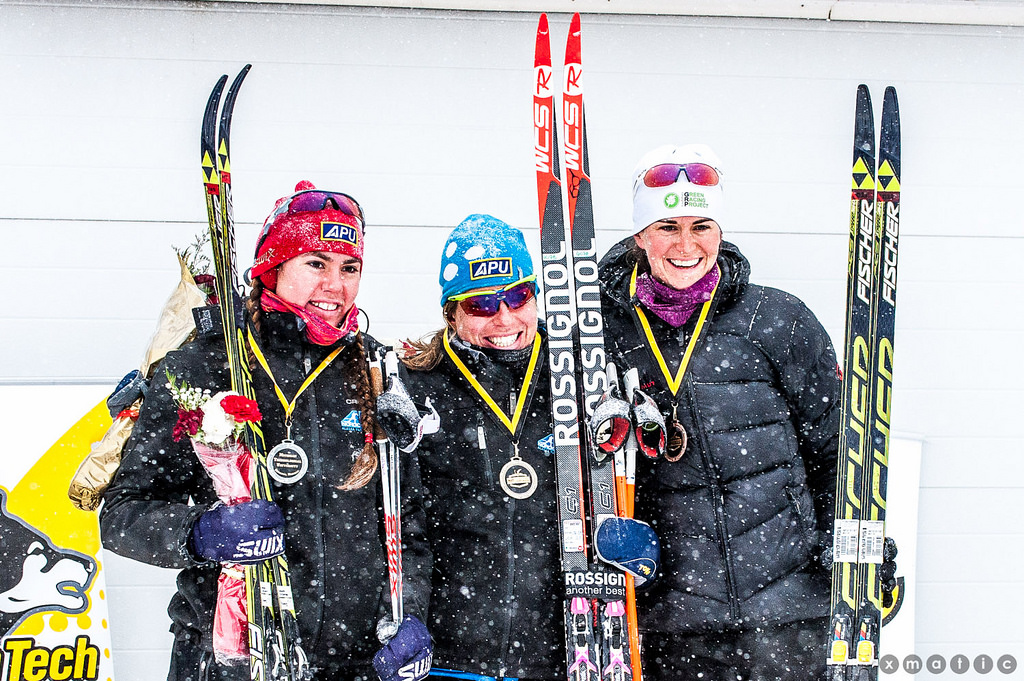
    Caitlin Patterson (c) atop the podium for the fourth-straight race of the week at 2018 U.S. Cross Country Championships in Anchorage, Alaska, joined by Finland’s Jasmi Joensuu (l) of the University of Denver, in second and Patterson’s CGRP teammate Kaitlynn Miller (r) in third. (Photo: Michael Dinneen Photography)

    Note: This article has been updated to reflect the fact that U.S. Ski Team member Jessie Diggins was the top American in four consecutive U.S. nationals races in 2012, winning the freestyle sprint, 10 k skate and 20 k classic mass start outright and placing second to Canada’s Dasha Gaiazova in the classic sprint (but topping the podium as the first American). This week, Caitlin Patterson, of the Craftsbury Green Racing Project, became the first woman since Diggins to be the top American in four U.S. national races as well.

    ***

    ANCHORAGE, Alaska — Maybe there’s something to be said for growing up in Alaska. Or maybe there’s something to be said about the mystique of Kincaid Park, its surrounding Tordillo, Chugach and Alaskan mountain ranges all bathed in sunlight at the start on the last day of 2018 U.S. Cross Country Championships during the women’s 1.5-kilometer classic sprint.
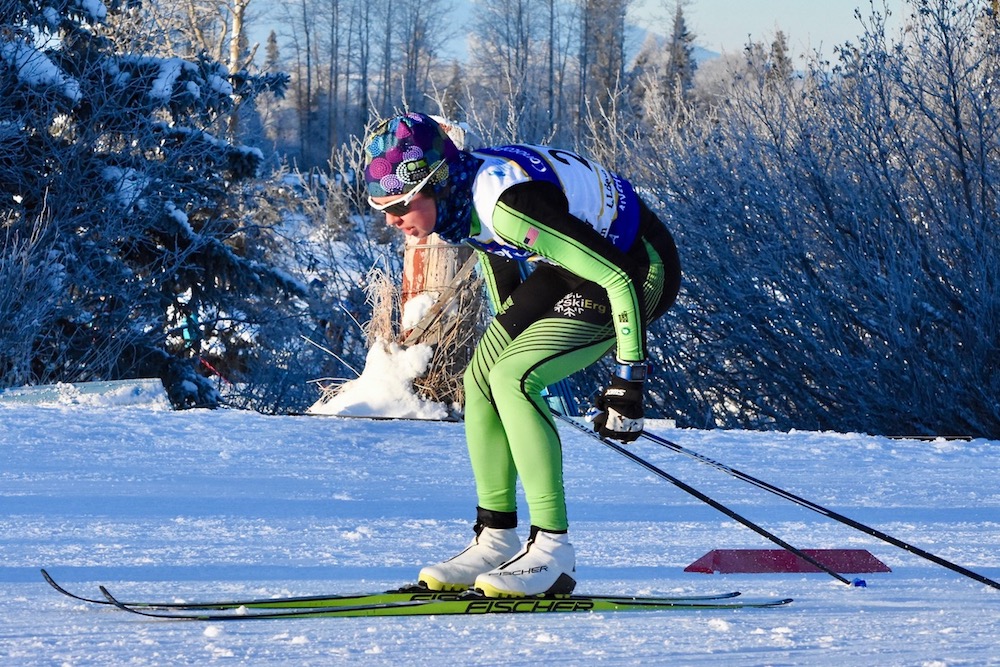
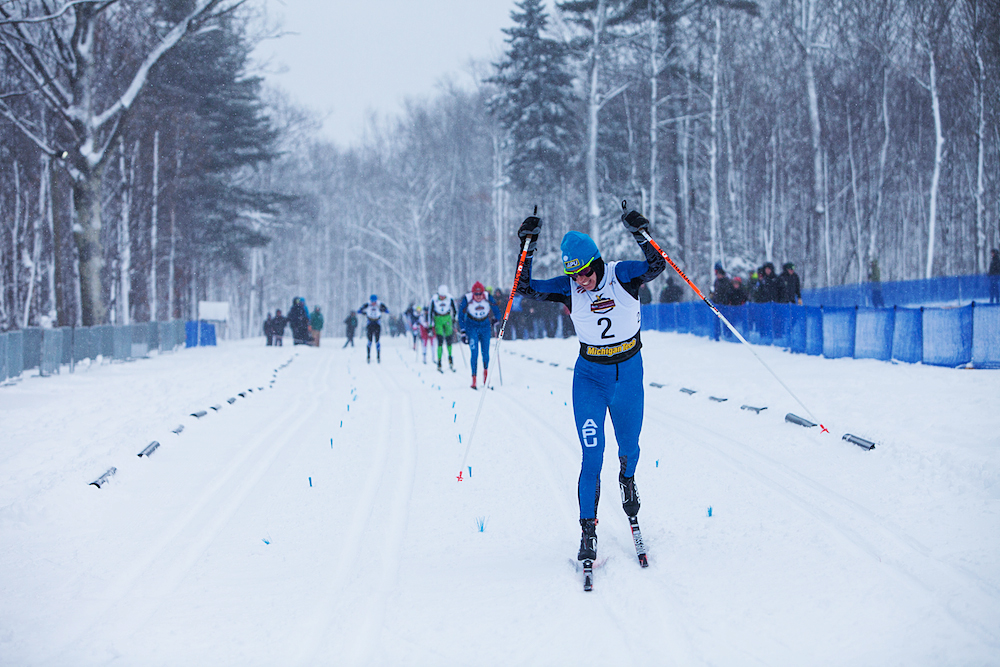
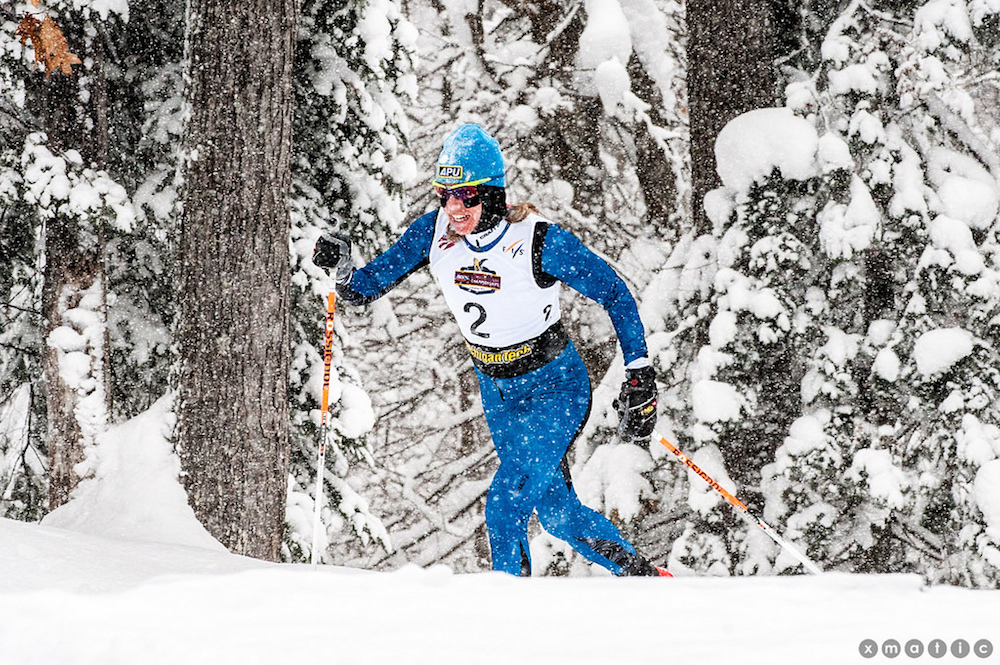
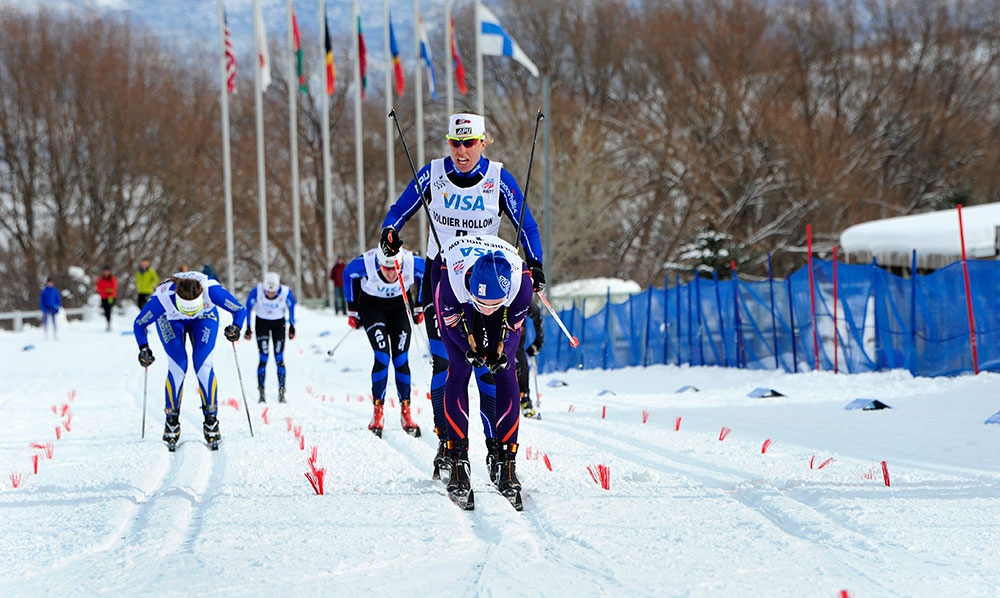
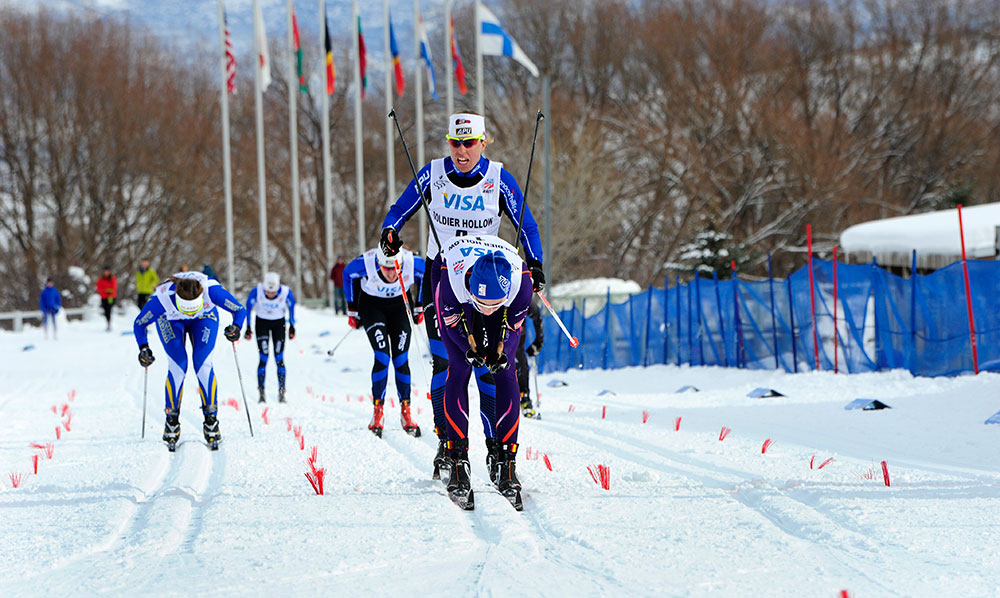
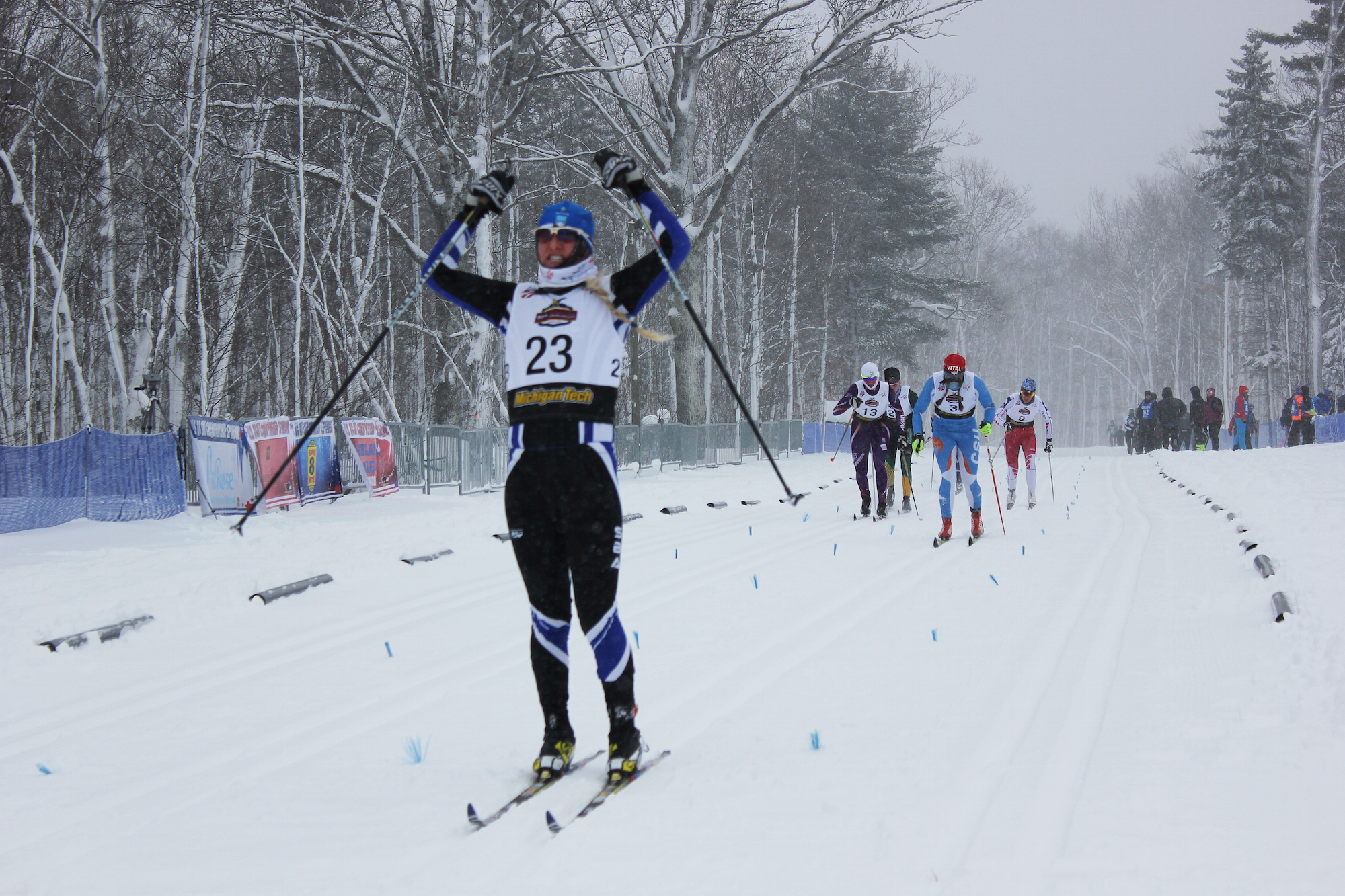
    Caitlin Patterson (Craftsbury Green Racing Project) approaching the finish line of the women’s 1.5 k classic sprint final on Monday, the last day of 2018 U.S. Cross Country Championships in Anchorage, Alaska. She won the final for her fourth-straight national title of the week. (Photo: Michael Dinneen Photography)

    Be it either of those, Caitlin Patterson became the first woman since U.S. Ski Team (USST) member Jessie Diggins, to earn four consecutive titles at a single U.S. nationals. Diggins did it in 2012 in Rumford, Maine, two years after Kikkan Randall, a USST member who trains with Alaska Pacific University (APU), swept four races outright at Kincaid. (Both Randall and Patterson grew up in Anchorage; Randall was born in Salt Lake City, born in McCall, Idaho. Patterson, 27, attended South Anchorage High School while Randall, 35, went to East Anchorage High).

    Even if Patterson, who’s currently based out of Vermont with the Craftsbury Green Racing Project (CGRP), had not won the final event of 2018 nationals, she had already posted a banner week. She started it by racing to first in the opening women’s 10 k freestyle individual start last Wednesday, amidst slushy ski trails, falling wet snow and a standard dark Alaskan winter morning sky.

    After a training day on Thursday, she returned to the Kincaid trails on Friday — which had transformed from 48 hours before — racing once again to first, this time in the women’s freestyle sprint for her first sprint title.

    Saturday brought another training day before Patterson returned on Sunday for the women’s 20 k classic mass start.
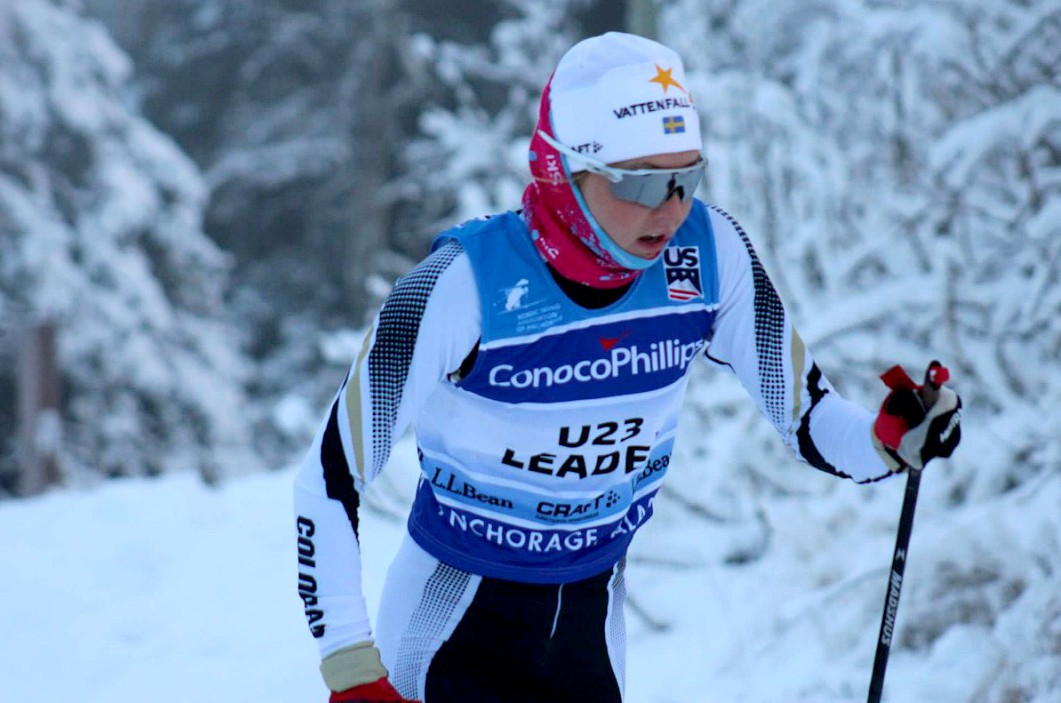
    Hedda Bångman, a Swedish freshman at the University of Colorado at Boulder (CU), racing to fourth in the qualifying round of the women’s 1.5 k classic sprint on Monday at 2018 U.S. Cross Country Championships in Anchorage, Alaska.

    Up against Sweden’s Hedda Bångman, a University of Colorado at Boulder (CU) freshman, and Rosie Frankowski (APU), the two of whom led much of Sunday’s four-lap race, Patterson had met her match. However, Frankowski’s fall on the final hill paired with Patterson’s strong skiing led Patterson to finish as the day’s top American. Bångman took the outright win while Patterson placed second overall, ahead of Frankowski in third. The two were first and second on the U.S. podium.

    If she had left it at that, Patterson would have tied Rosie Brennan — of the U.S. Ski Team and APU — who won three out of four U.S. nationals races in 2015.

    But Patterson took it one step further.

    With no training or rest day in between, the CGRP skier joined the remaining U.S. nationals field on Monday. Some skiers had already left, including Australian and APU skier, Jessica Yeaton, who flew out Monday morning to prepare for next weekend’s World Cup in Dresden, Germany.

    Based on her qualifier alone, it might have seemed Patterson was beginning to feel the effects of four days of racing since last Wednesday. She qualified seventh, 4.77 seconds behind the fastest qualifying time of 3:41.40, posted by Finnish skier and University of Denver (DU) junior Jasmi Joensuu.

    “Today qualification was really good, I felt really good,” Joensuu said after the race. “But then, my throat is really sore after the qualification … so I didn’t know if I could race actually. But I decided to race, I knew that I could win this race. I knew that there were some good girls but they also had 20 k yesterday, which I didn’t race, so that was good for me.”

    With Joensuu, 21, having sat out Sunday’s mass start and Patterson having expended herself over 20 k, the Finn may have had a leg up on the American.

    What Joensuu had not counted on was Patterson’s familiarity with the course and what the American had learned from Friday’s freestyle sprint.

    “I think that bottom corner was a really good one for me all week and in the skate sprint I figured out how to ski it with good momentum,” Patterson said after Monday’s race, referring to the slightly inclined corner about 100 meters before the finish. “Even with that big gap that she put on the hill, I think just knowing how to ski the hill here at Kincaid … the finish stretch was mine.”
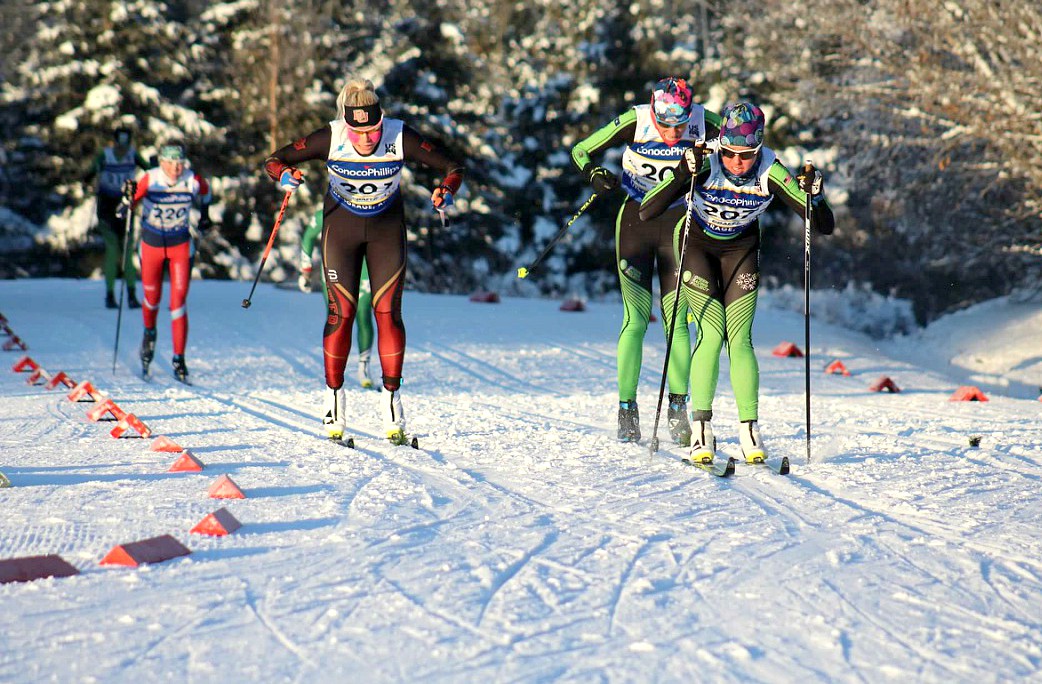
    Craftsbury’s Caitlin Patterson (207) and Kaitlynn Miller (second from r) and Jasmi Joensuu, of the University of Denver, lead their semifinal during the women’s 1.5 k classic sprint on Monday at 2018 U.S. Cross Country Championships in Anchorage, Alaska.

    In their semifinal, though Joensuu had gapped both Patterson and and another CGRP skier Kaitlynn Miller at the top of Gong Hill — the sprint’s final major climb — both Craftsbury skiers had caught Joensuu by the bottom of the descent’s corner back towards the finish.

    A similar scenario played out in the final.

    “In the final I did a tactic, I would ski the uphill as fast as I can, I don’t save anything and that almost worked,” Joensuu recalled.

    Joensuu and Petra Hyncicova, a CU senior from the Czech Republic, had pushed hard out of the start of the final, followed by Patterson and Miller, as well as Dartmouth skier Lydia Blanchet and APU’s Becca Rorabaugh.

    “I tended to lose time in the beginning of the race and then catch back up,” said Blanchet, who had to catch a plane within an hour of finishing the final. “I had great skis and downhills are one of my strengths.”

    While the two non-Americans raced to the front halfway through the course’s major climb, Blanchet, Rorabaugh, Miller, and Patterson hung behind. Then halfway through the final hill, Joensuu attacked, attempting to distance herself from the pack.

    By the top of the hill, she had done just that, with 4 meters separating her from the rest of the field. Miller and Patterson followed, tucked into the downhill swooping curve.

    As Joensuu disappeared behind the trees blocking the corner from spectator’s view, Miller and Patterson were already hot on her heels. Using her momentum, Patterson swung around Joensuu and emerged from the corner first, double poling with a sizeable lead to her fourth victory in a row in a time of 3:39.58.

    “It felt surreal coming down the finishing stretch today, realizing that I couldn’t hear people behind me and realizing that it was going to be number four,” Patterson said. “I could not have imagined this if I tried, but I’ve just had really good feelings all week. Great support from the staff and waxers and everything, and it’s fun being back here in Anchorage, especially.”
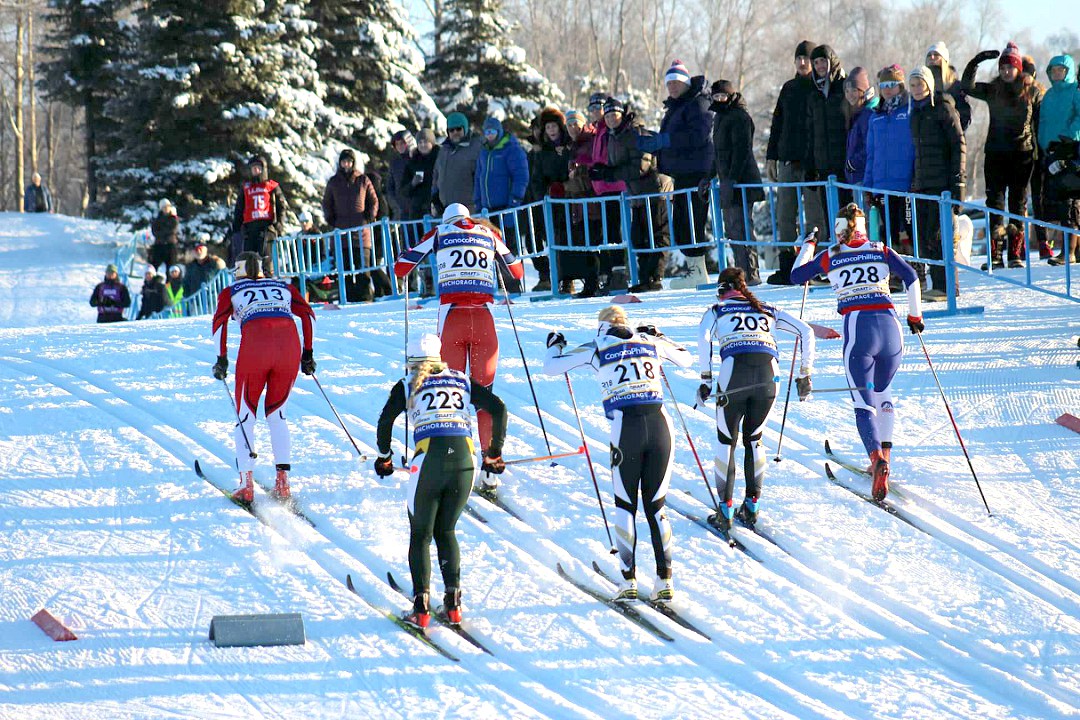
    The fifth women’s classic sprint quarterfinal heat on Monday at 2018 U.S. Cross Country Championships in Anchorage, Alaska, with CXC/Peak Nordic’s Felicia Gesior (208) leading with Corey Stock (213) of the Bridger Ski Foundation, and Northern Michigan’s Nicole Schneider (223), the University of Colorado Boulder’s Christina Rolandsen (218) and Petra Hyncicova (203), and Mae Chalmers of SMS (228) chasing.

    Finishing second, 2.36 seconds behind Patterson, was Joensuu. Capturing third for her third American podium this week was Miller (+3.9). Miller finished second to Patterson in Friday’s freestyle sprint and was the third American in Sunday’s 20 k.

    “I’m really pleased with how everything panned out,” Miller said. “To me the big sign of improvement has been in my skating and I was really excited with my skate sprint and obviously really excited with yesterday and today as well, but it’s nice to see my skating moving up a little bit.” 

    Despite being the 2016 national classic sprint champion, Miller, of Elmore, Vt., explained she entered Monday’s race with nothing held over her head.

    “I don’t ever go into a race expecting a certain result,” she said. “Anything can happen, even to strong, very experienced skiers … [but] it is exciting to be in the mix.”

    Though Miller also explained she “felt pretty tired” by the time she lined up for the final on Monday, she also acknowledged that she was, in all likelihood, not alone.

    “I think that was the situation for all of the women out there today, after the 20 k yesterday. It was sort of like, well, the snap isn’t there, the energy isn’t quite there, but everyone was in the same boat,” she said. “Everyone’s making the best of it, and your body knows what to do once you get to the start line.

    “All things considered, I felt great, had a really great result, and I’m very happy with it,” Miller added.
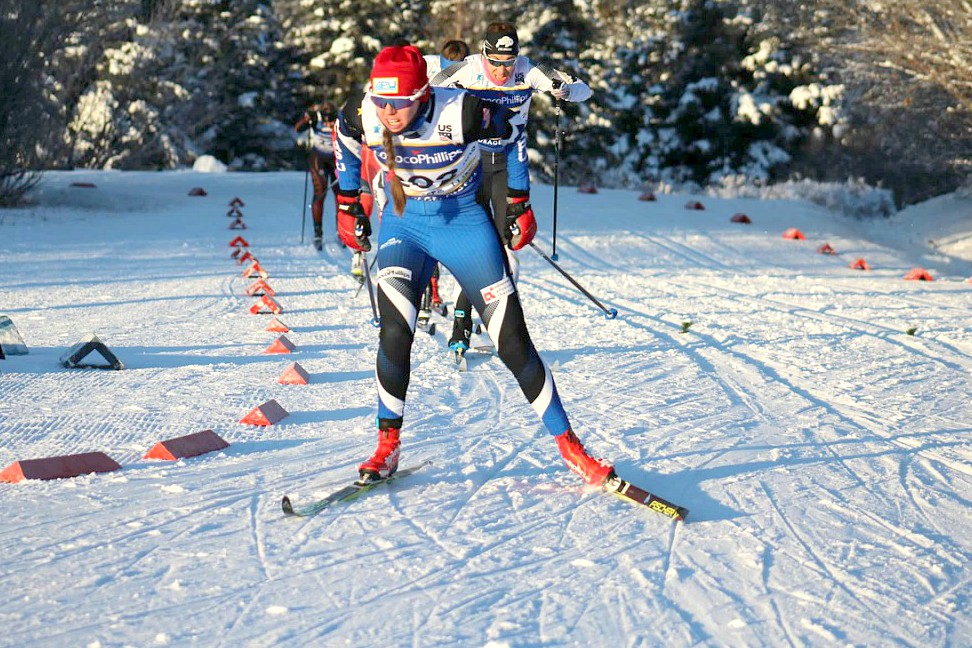
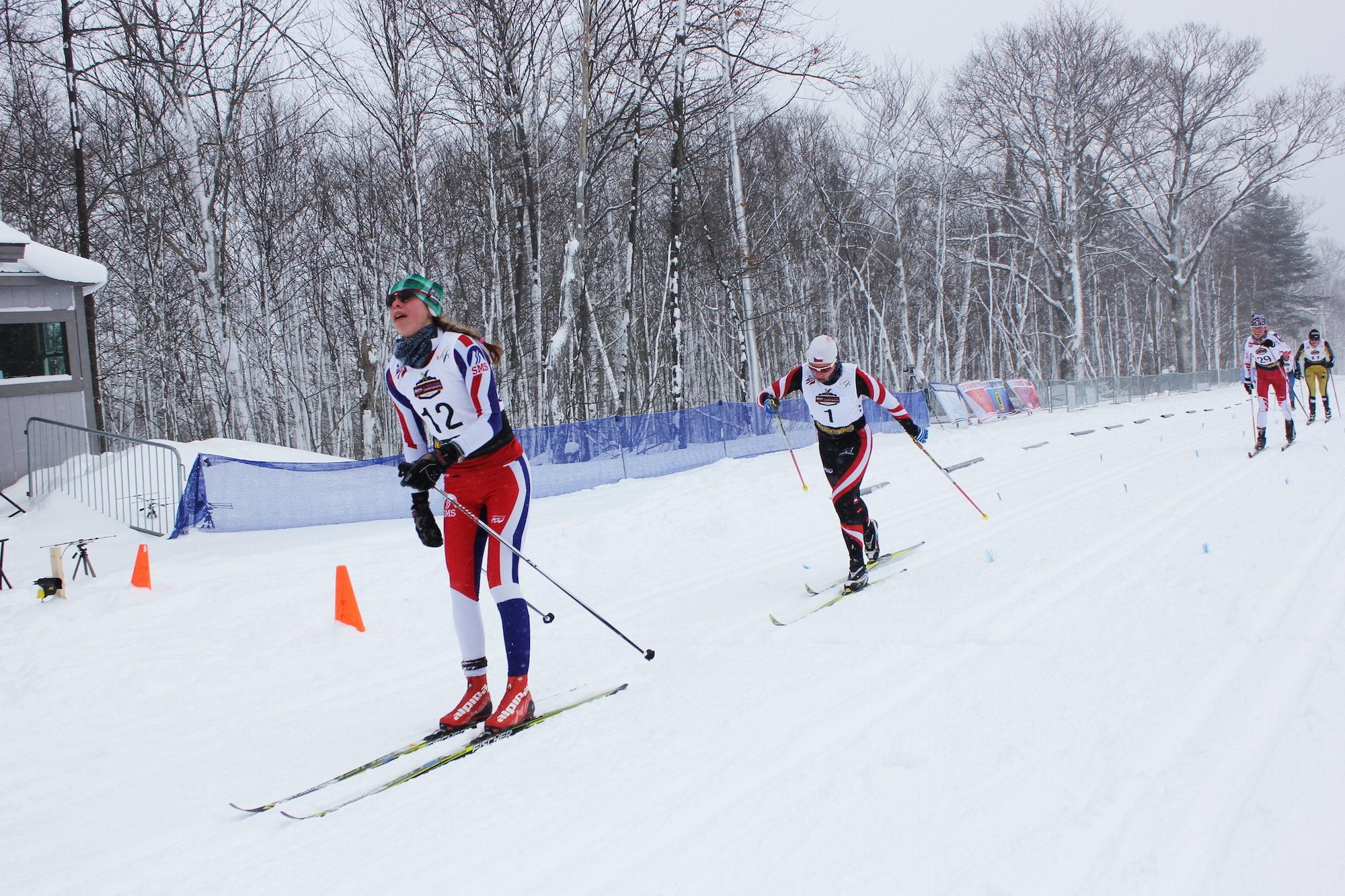
    Becca Rorabaugh (APU) during the women’s 1.5 k classic sprint on Monday at 2018 U.S. Cross Country Championships in Anchorage, Alaska. After finishing second in the qualifier (as the top American) she finished fourth overall in the final and was the third American on the day.

    Rorabaugh finished fourth overall (+9.92) and was the third American. The Fairbanks native, who has spent the last 10-plus years living and training in Anchorage, was the top American qualifier on Monday, 1.31 seconds behind Joensuu in first overall.

    “I was extremely excited with my qualifier,” Rorabaugh said. “It was rather unexpected. I was the first American and I had one really good qualifier in West Yellowstone this year but the other two so far have been pretty medium for me, so I was really excited really happy with this morning.”

    Though the qualifier is what counts for the Olympic points list, Rorabaugh indicated that was of less importance to her than just “getting her qualifier back.”

    “It’s been a couple years since I’ve been having a very strong qualification in sprint racing so I was just trying to work on having enough energy and having enough heat pumped to really crush a qualifier first thing in the morning,” she said.  

    “I wanted to have something special at home,” she added, referring to the friends and family that came to Kincaid to watch her race. “So it was good to have something at the end of the week.”

    With firm tracks, cold temperatures reading around 10 degrees Fahrenheit and a low sun in the sky, Rorabaugh described the final U.S. nationals event as “a quintessential Alaskan day.”

    “That was quite nice,” she added.

    Rounding out the final was Hyncicova in fifth (+10.03) and Blanchet in sixth (+11.21).

    “Today I was kind of tired. I finally hit the jet lag over the weekend,” Hyncicova, the two-time defending NCAA champion, said. “But … making the final, and even being third in the quarterfinal is awesome. It’s just proving that I am kind of in good shape so that’s a good start of the season.”

    Rounding out the remainder of the women’s top 10 was Bångman in seventh, Sun Valley Ski Education Foundation skier, Kelsey Phinney in eighth, Central Cross Country’s Felicia Geisor in ninth and Stratton Mountain’s Erika Flowers in tenth.

    In the junior women’s classic sprint, Wasatch Nordic’s Sarah Morgan took the win in 3:54.93. Novie McCabe (Methow Valley Nordic) placed second (+1.5) and her teammate teammate Ella-Sophie Kuzyk placed third (+6.66).

    Results: Women’s qualifier | Women’s final | Junior women’s final

    –Ian Tovell, Andrea Pontyondy-Smith and Gavin Kentch contributed

    Highlights video by Max Romey Productions

  • Monday Rundown: U.S. Nationals; MSA NorAm Trials

    Monday Rundown: U.S. Nationals; MSA NorAm Trials

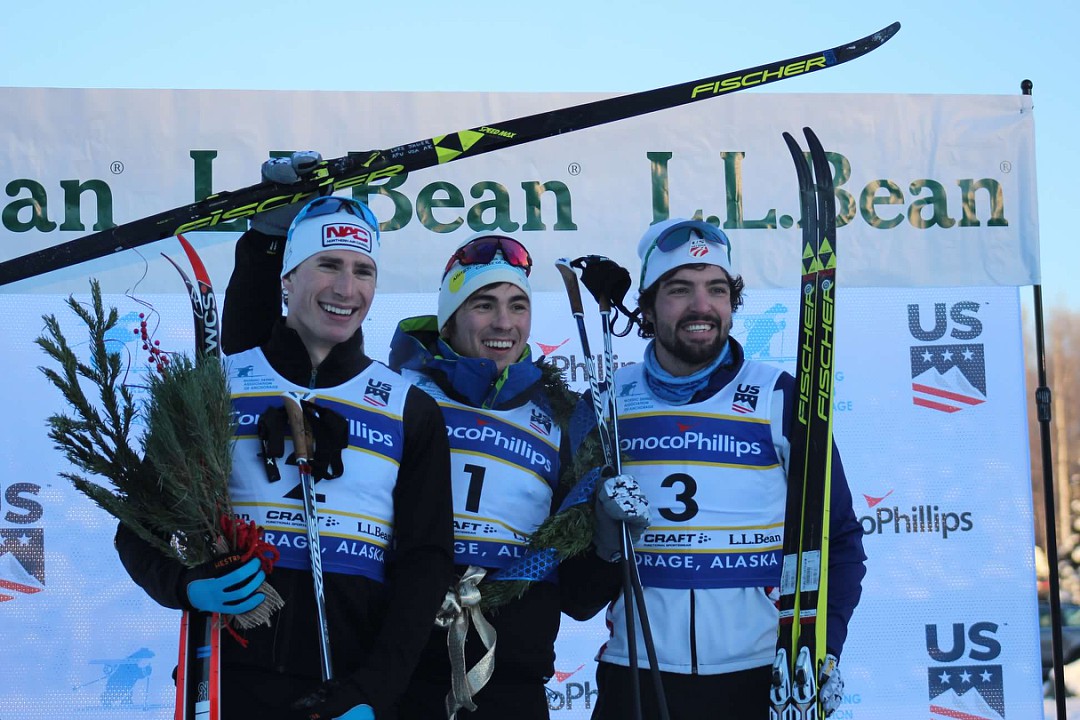
    Left to right: Tyler Kornfield (APU), Reese Hanneman (APU) and Ben Saxton (SMS) the top three Americans in the men’s 1.6 k classic sprint final on Monday, the last day of 2018 U.S. Cross Country Championships in Anchorage, Alaska.

    U.S. Cross Country Championships (Anchorage, Alaska): Classic sprint

    Women’s report

    Men’s report

    Caitlin Patterson did it. With a classic-sprint win on Monday, she successfully capped off an undefeated 2018 U.S. Cross Country Championships, as the top American woman in all four races over the past week in Anchorage, Alaska.

    Patterson, of the Craftsbury Green Racing Project, qualified seventh then won the women’s 1.5-kilometer final by more than 2 seconds in 3:39.58 minutes. Finland’s Jasmi Joensuu, a junior at the University of Denver (DU), won the qualifier and ultimately finished second in the final, 2.36 seconds behind Patterson.

    Craftsbury once again had two on the podium with Kaitlynn Miller placing third overall (+3.9) as the second American. Becca Rorabaugh, of Alaska Pacific University (APU), was the top American in the qualifier in second overall, then placed fourth in the final (+9.92) and reached the U.S. podium in third.

    Petra Hyncicova, a University of Colorado Boulder (CU) senior from the Czech Republic, placed fifth overall (+10.03), and Lydia Blanchet, a Dartmouth College U23 skier, finished sixth (+11.21) and was the fourth American woman.

    Joensuu, 21, of Kuortane, Finland, started the day by winning the qualifier in 3:41.4, while Rorabaugh followed in second, 1.31 seconds back. Hyncicova qualified third (+1.85), CU’s Hedda Bångman (who won Sunday’s 20 k classic) qualified fourth (+2.92), and Miller qualified fifth (+2.93). Anne Hart of the Stratton Mountain School (SMS) Elite Team clocked the sixth-fastest qualifying time (+3.88), and Patterson followed in seventh (+4.77).

    From there, Patterson won both her quarterfinal and semifinal, besting Miller and Joensuu in the latter by 0.66 seconds and 2.63 seconds, respectively. Blanchet placed fourth in that same semifinal (+5.15) and advanced to the final as a lucky loser with a fast-enough time, along with Joensuu (Patterson and Miller automatically advanced in first and second).

    With her 4-for-4 record at 2018 nationals, Patterson is the most successful woman at U.S. Cross Country Championships since U.S. Ski Team member Jessie Diggins was the top American in all four races at 2012 nationals in Rumford, Maine.

    In the men’s classic sprint final, Reese Hanneman (APU) captured his second title in as many sprints this week (after winning the freestyle sprint on Friday). He won the qualifying round by 2.84 seconds in 3:21.93, and later the final by a 0.2 seconds in 3:20.62. Kornfield placed second, and Ben Saxton (SMS Elite Team) rounded out the podium in third (+4.78).

    Logan Hanneman, the winner of Friday’s freestyle-sprint qualifier, finished second to his older brother Reese in Monday’s classic-sprint qualifier, then went on to reach the final and place fourth overall (+5.42). Kevin Bolger (Sun Valley Ski Education Foundation) placed fifth (+5.52), and Zak Ketterson (Northern Michigan University) was sixth (+6.83).

    Results:

    Women’s qualifier | Women’s final

    Men’s qualifier | Men’s final

    ***

    NorAm Trials (Mont Sainte-Anne, Quebec): 15/30 k skiathlons

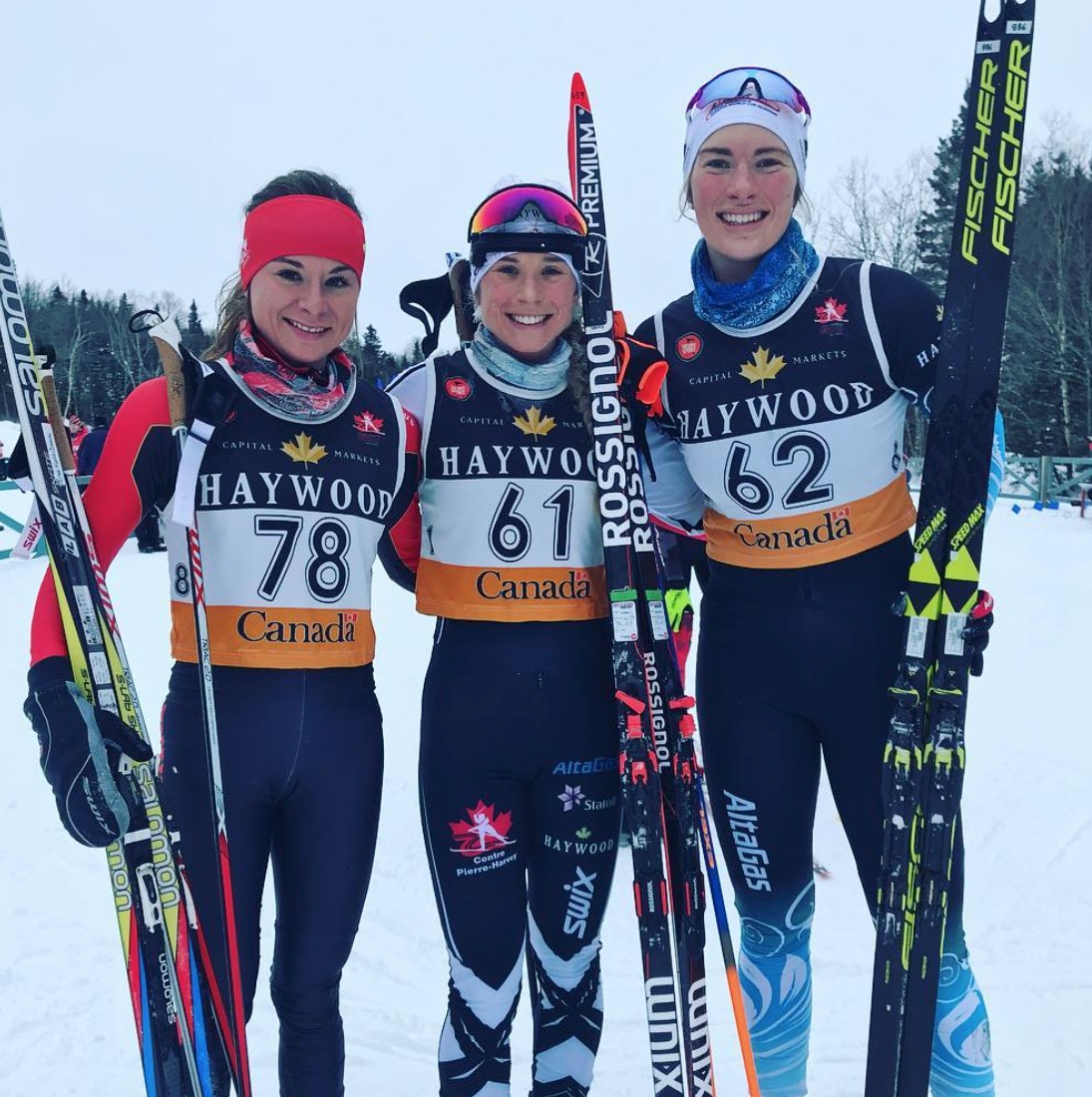
    The women’s 15 k skiathlon podium on Monday at NorAm trials at Mont Sainte-Anne, Quebec, with Cendrine Browne (c) of the Pierre-Harvey National Training Centre (CNEPH) and Canadian U25 Team in first, Anne-Marie Comeau (l) of Laval University in second, and Dahria Beatty (Alberta World Cup Academy/Canadian World Cup Team) in third. (Photo: Cross Country Canada/Instagram)

    Cendrine Browne won the women’s 15-kilometre skiathlon in 43:01.9 minutes on Monday at the Mont Sainte-Anne (MSA) ski trails to put an exclamation point on her presumptive selection for the PyeongChang Olympics. Browne, of the Centre National d’Entraînement Pierre Harvey (CNEPH)/Pierre-Harvey National Training Centre, which is based in nearby Saint-Ferréol-les-Neiges, broke away with Laval University’s Anne-Marie Comeau during the classic leg to take a 20-second lead that she held to the finish.

    Comeau faded slightly to take second, 11.9 seconds back, qualifying for U23’s and putting her name in the hat for the upcoming 2018 Olympics. Either Comeau or the winner of Wednesday’s classic interval start should take that potential Olympic berth as Canada’s top female distance skier not already qualified. Browne has theoretically earned a spot as the top women’s sprinter, besides Dahria Beatty, who won the sprint and already met Canada’s Olympic qualifying criteria.

    “It now has to go before the selection committee,” Cross Country Canada’s High Performance Director Thomas Holland wrote in an email on Friday.

    After trials races were shuffled around due to extreme cold, with temperatures near -20 Celsius on Sunday at MSA, it warmed up to a balmy -8 degrees Celsius (17 Fahrenheit) by mid-afternoon on Monday. Both the women’s and men’s skiathlons were held, which not only served as one of two distance races for Olympic selection, but for Junior and U23 World Championships as well.

    In the race for third place, Beatty outsprinted a group of four to take the final podium spot, 19.9 seconds behind Browne and 0.3 seconds ahead of their fellow Canadian National Team member Maya MacIsaac-Jones, of Rocky Mountain Racers (RMR) and U25 Team. Just 0.2 seconds out of fourth, Katherine Stewart-Jones, of the National Training Development Centre (NTDC) Thunder Bay and national U25 Team, placed fifth (+20.4) and CNEPH’s Laura Leclair was another second back in sixth (+21.4).

    Almost 55 seconds passed before the seventh-place finisher came across the line, which was Zina Kocher (Foothills Nordic) skiing alone (+1:15.8). Another 49 seconds later, Jaqueline Mourao of Brazil’s national team placed eighth (+2:04.9), ahead of Zoë Williams (Carleton University) in ninth (+2:11.3), and Andrea Dupont (RMR) in 10th (+2:11.5).

    In the junior women’s 10 k skiathlon, Whitehorse’s Natalie Hynes won in 30:19.8 to punch her ticket to Junior Worlds in Goms, Switzerland, from Jan. 28-Feb. 3. India McIsaac (RMR) finished 0.7 seconds back in second and Orford’s Alexandra Racine completed the podium in third (+32.8).

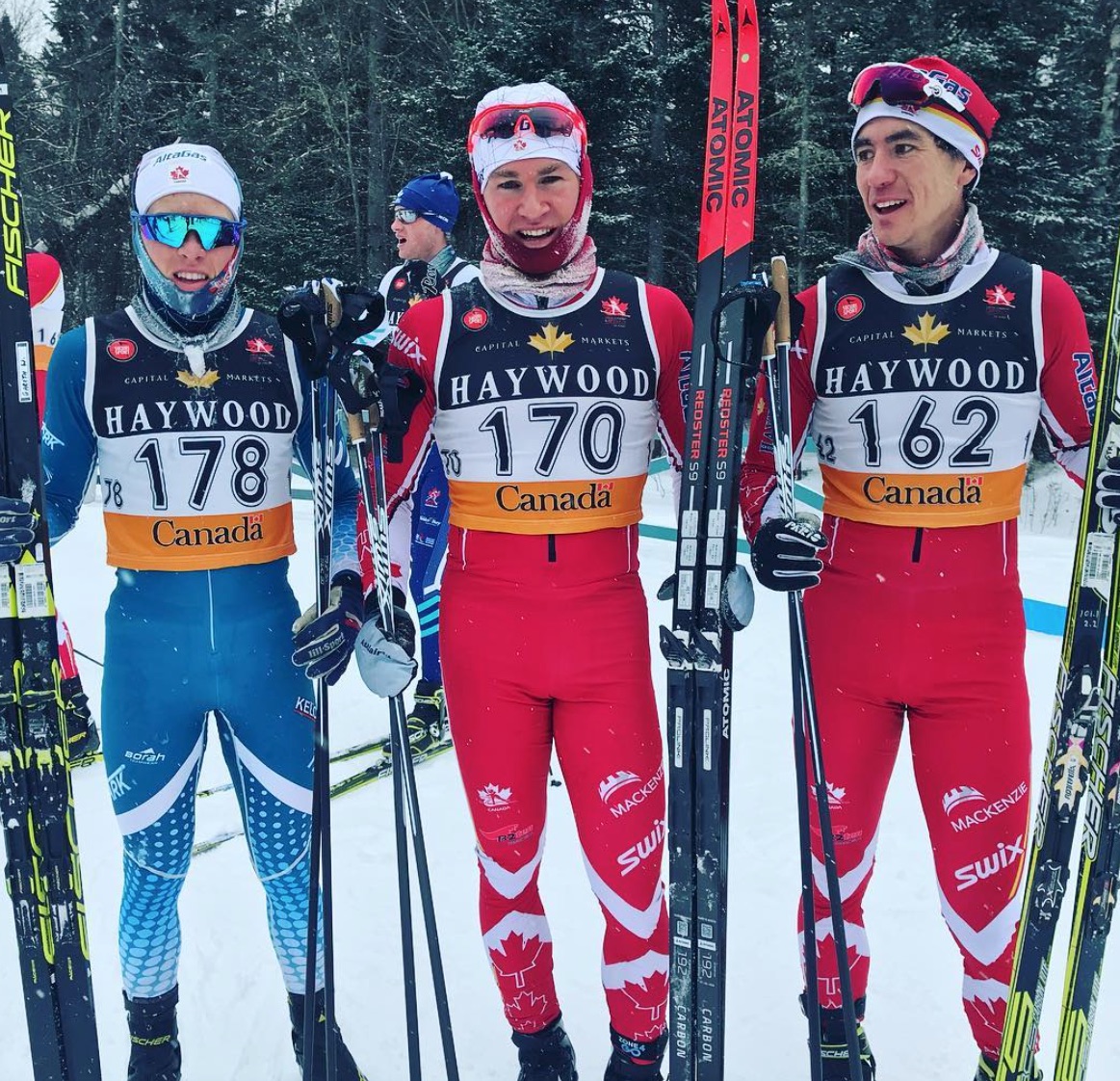
    The men’s 30 k skiathlon podium at NorAm trials at Mont Sainte-Anne, Quebec, on Sunday, with Knute Johnsgaard (c) of Canada’s World Cup Team in first, Graham Nishikawa (r) of the Canadian Para-Nordic Team in second and Gareth Williams (Telemark Nordic/Canadian U25 Team) in third. (Photo: Cross Country Canada/Instagram)

    On the men’s side, Canadian World Cup Team member Knute Johnsgaard, who met qualifying criteria for PyeongChang last season, shook off a slow start to the World Cup season with a win in the NorAm trials men’s 30 k skiathlon, finishing in 1:13:30.9.

    Graham Nishikawa, who’s already destined for the PyeongChang Paralympics as a guide on the Canadian Para-Nordic Ski Team, finished 1 second back for second place. The 34-year-old Nishikawa edged out first-year senior national-team member Gareth Williams, 20, of Telemark Nordic and the national U25 Team, by 0.5 seconds. Williams was the top U23 athlete to qualify for this year’s U23 World Championships.

    The top 6 finished within 41 seconds of the podium, with Jack Carlyle (AWCA) in fourth (+5.8), Philippe Boucher (CNEPH) in fifth (+13.9), and Scott Hill (BXC) in sixth (+40.7). World Cup Team member Len Valjas led the next group across the line in seventh (+1:28.6), followed by Bob Thompson (NTDC Thunder Bay) in eighth (+1:29.4), Alexis Dumas (CNEPH) in ninth (+1:35.5), and Ricardo Izquierdo-Bernier (CNEPH) in 10th (+1:35.7)

    CNEPH’s Antoine Cyr won the junior mens 15 k skiathlon in 50:13.1 to earn a spot at Junior Worlds. Félix Longpré, of the local M.S.A. ski club, finished second (+15.7) and Thomas Manktelow was third (+49.0), just ahead of his Alberta World Cup Academy teammate Étienne Hébert in fourth (+49.3).

    After Sunday’s racing was postponed due to temperatures well below the legal race limit, the remaining trials schedule includes freestyle sprints on Tuesday (for Junior and U23 World Championships qualifying purposes only), and classic interval starts on Wednesday.

    Results

  • On Crazy Championships Day, University of Utah’s Bolger Wins Classic-Sprint Title

    On Crazy Championships Day, University of Utah’s Bolger Wins Classic-Sprint Title

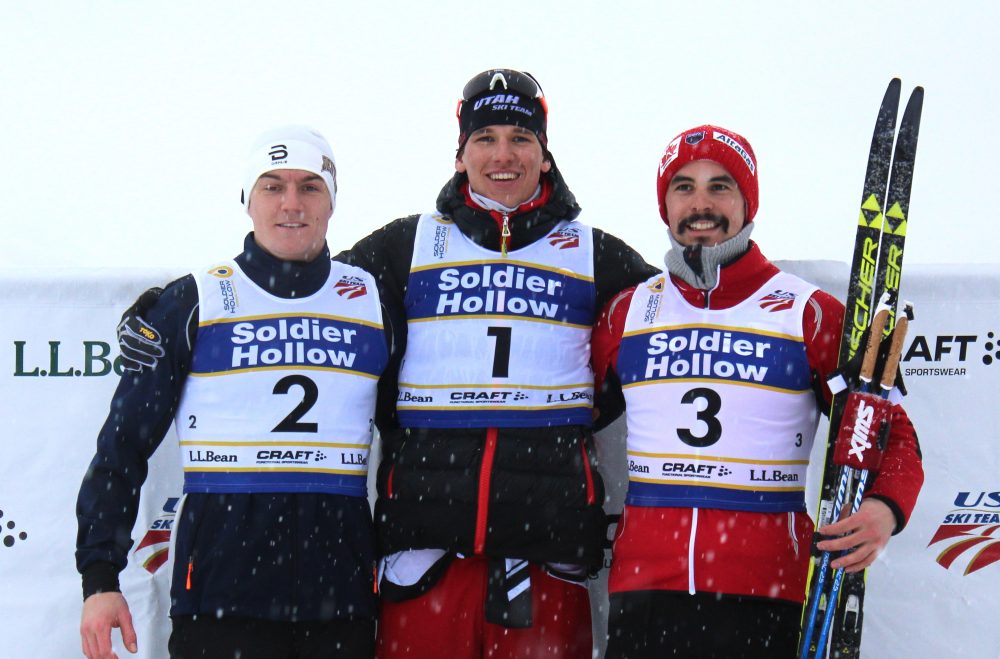
    Left to right: University of Denver skier Moritz Madelner, University of Utah's Kevin Boldger and Canada's Jesse Cockney on top of the podium for the men's 1.5-kilometer classic sprint n Sunday at U.S. nationals in Midway, Utah.
    Left to right: University of Denver skier Moritz Madlener, University of Utah’s Kevin Bolger and Canada’s Jesse Cockney on top of the podium for the men’s 1.5-kilometer classic sprint on Sunday at U.S. nationals in Midway, Utah.

    MIDWAY, Utah — Classic sprint day at U.S. Cross Country Championships. Nothing was simple. The 9:05 a.m. start time brought a daylong chess match for athletes and wax techs. Temperatures hovered near freezing all day — the entire spectrum of precipitation seemed to fall: drizzle, swollen wet snowflakes, and graupel.

    One by one the big names set off at 15-second increments. There was Bend Endurance Academy’s Dakota Blackhorse-von Jess, then Reese Hanneman, of Alaska Pacific University (APU), followed by an elite list of North America’s best sprinters absent those few racing on the World Cup.

    The men’s course featured three climbs, the last of which was positioned before a sweeping descent back into the stadium about 0.5 kilometers from the finish. Early on, even with the first few starters, it was evident on this hill that the chess match’s checkmate move pivoted on the wax.

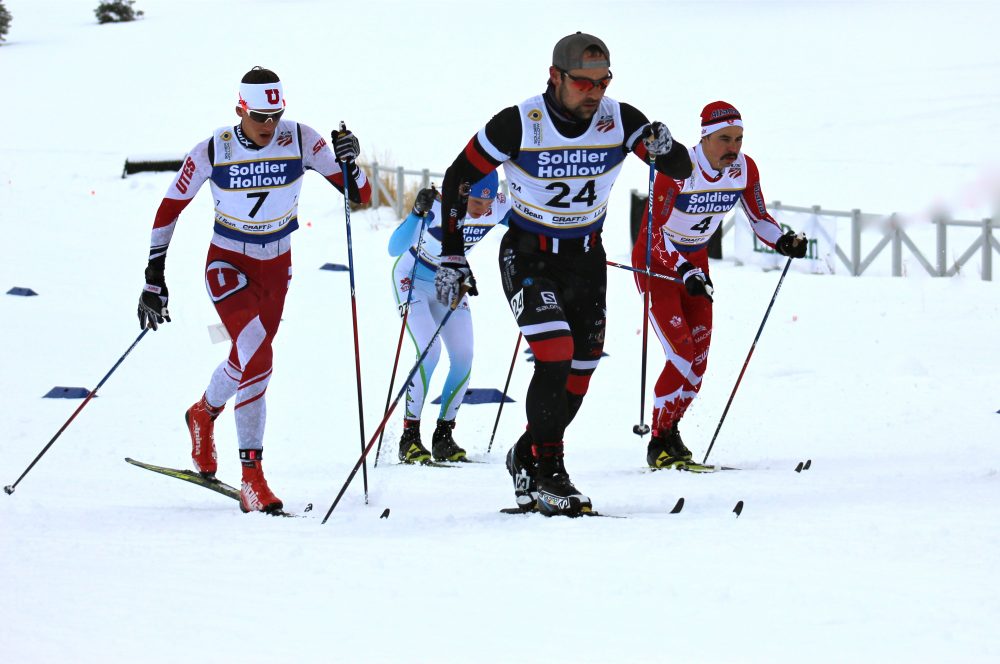
    Dakota Blackhorse vonn Jess of Bend Endurance (24) leads University of Utah's Kevin Boldger (7) during the first quarterfinal of the men's 1.5-kilometer classic sprint n Sunday at U.S. nationals in Midway, Utah.
    Dakota Blackhorse-von Jess (24) leads Kevin Bolger (7) and Jess Cockney (4) during the first quarterfinal of the men’s 1.5-kilometer classic sprint on Sunday at U.S. nationals in Midway, Utah.

    Up that hill, some skiers strode, many slipped. Some athletes employed a herringbone-run mash up, some double poled on skate skis. Others suffered the indignity of balled up snow under foot and the awkward dance of shedding that snow and attempting to make forward progress.

    APU Head Coach Erik Flora helped put the qualifier in perspective.

    “This is the first time ever that I have been in a sprint race when we haven’t had any men in the heats,” Flora said about his men’s results. “And that’s the first time in ten years.”

    For a club like APU, it’s clearly rare when a perfect storm impacts an entire men’s side.

    “I don’t think it was one thing, it was a combination of a few things,” Flora said after the racing was completed. “We have a few guys that came in sick and that didn’t help. And we have a lot of guys that are seeded really high in the start list with points and if you look through the top 30, there’s a lot of unusual places.”

    On many days, a high race seed correlates with good results.

    “But sometimes there are those days when being in a certain place in a seed helps. I think for the leading men it was a disadvantage today,” Flora added.

    Along with some recent sickness, the seeding and weather conditions, and skis that Flora noted weren’t “anything special”, APU’s qualifying positions portended a rough day for many.

    Some athletes’ misfortune opened doors for others. No one kicked that door open with more force than University of Utah’s 23-year-old Kevin Bolger. He was the only American in the men’s final and won his first-career national title outright by winning the final over second-place skier Moritz Madlener (University of Denver), and Canadian national-team member Jess Cockney in third.

    “100 percent. Absolutely,” Bolger said when asked if he was surprised by the end result. “Usually just qualifying for the heats is kind of my biggest goal. And today, I just, with the qualifying seventh I was in awe, actually.”

    Bolger qualified seventh in 3:41.69, only a few seconds behind best qualifier, Ben Saxton of the Stratton Mountain School (SMS) Elite Team, who rounded the 1.5 k course in 3:38.35.

    The Utah skier had a four-leaf-clover day. Bolger said his coach nailed the wax every round which complemented his fitness. In his quarterfinal, Blackhorse-von Jess set the tempo.

    “I knew he was a good sprinter, I kind of look around in my heats before each, kind of see who I’m around, who I can play with,” Bolger said. “And I saw he was there, I knew he wanted to get to the final, so I was like, ‘He’s going to try and race well.’ And I got in behind him, he made a move and I stuck with him.”

    On the back hill, where the skiers race up and away to the backside of the course, Blackhorse-von Jess played his hand.

    “I think he got 10 meters off on me,” Bolger said of Blackhorse-von Jess’s stamp of authority.

    But on the descent into the last kicker climb, Bolger’s skis were running.

    “And my skis just – they glided right up to him,” Bolger described. “And I came up to that hill and they kept going, and I was like, ‘All right, I’m going to run up this sucker.’ And I went for it.”

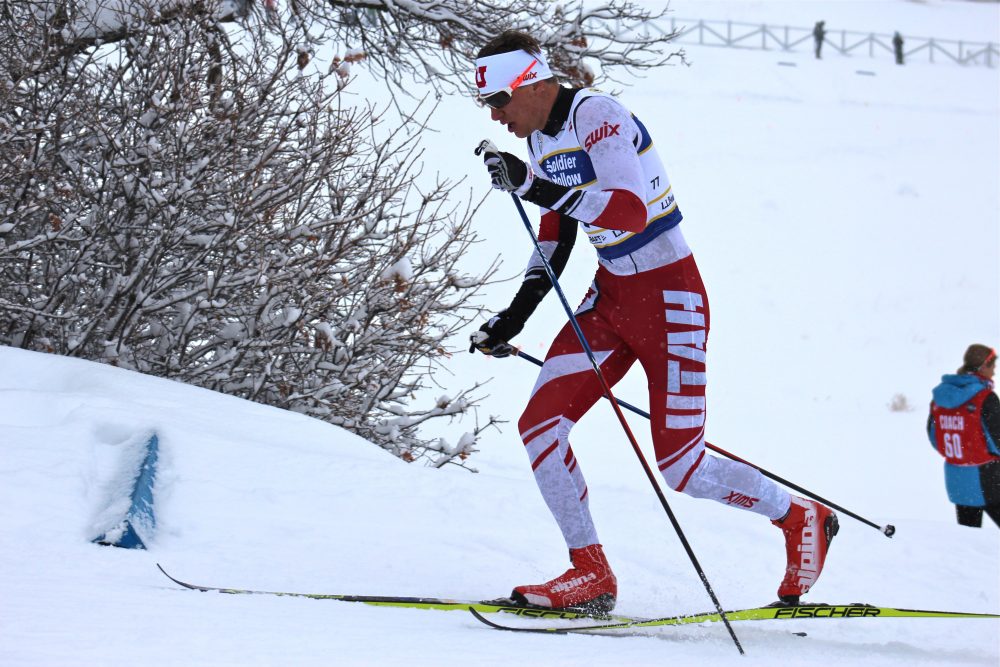
    The University of Utah's Kevin Boldger during the qualifier for the 1.5-kilometer classic sprint n Sunday at U.S. nationals in Midway, Utah.
    The University of Utah’s Kevin Bolger during the qualifier of the 1.5 k classic sprint on Sunday at U.S. nationals in Midway, Utah.

    Now Bolger was off the front widening a small gap. Behind, it appeared Blackhorse-von Jess’s skis momentarily stalled out, resulting in a fall and snapped pole. Unaware of changing fortunes behind, Bolger cruised in. But he’d not simply cashed out, satisfied with a quarterfinal win. He banked some important knowledge. He wasn’t slipping on his skis when kicking at decisive moments.

    “Knowing that I can charge up that [last] hill 100 percent and trust my skis, that’s huge, I think, in our sport,” Bolger said.

    Luck struck again in his semifinal — Bolger placed fourth in a fast first semifinal; he was the second lucky loser, both of whom came from his semifinal.

    In the final, Cockney made a bold move from the start, but the group behind yo-yoed, never losing significant contact. And on that same last hill, Bolger charged again.

    “I was like, ‘OK, I think this is the time to go,’ ’cause I don’t have quite the turnover in my double pole,” Bolger said. “I know I’m big, strong and powerful, but the turnover I think isn’t quite there. So I thought that that was my time to go.”

    Up and working over the top, Bolger was gone for his first national title.

    “It kind of hit me like 10 meters from the finish that I was gonna win this sucker, and I was like, ‘Holy sh*t,’ ” he said.

    Second-place finisher, 23-year-old Madlener is a student in the U.S. but grew up skiing in Germany. (It was Madlener’s second podium in as many races at senior nationals. He placed third in Saturday’s 15 k freestyle.)

    Madlener is a multiple NCAA podium placer.

    “I had second and third in NCAAs last year, and second the year before during my sophomore year,” Madlener explained in a post-race phone interview.

    Although pleased with his podiums at Soldier Hollow this week, he explained his year-end goal remains winning an NCAA individual title.

    “I want to win it at some point,” Madlener added. “This is my senior year, this year is it. I am aware it is difficult to win a race at NCAAs but that is my goal and of course to win again as a team, which I think we have a good chance to do.”

    Madlener told FasterSkier he will not be pursuing a post-collegiate ski career and has accepted a job that will eventually base him in Salt Lake City after graduation.

    The U.S. Podium

    As part of U.S. nationals, a separate, U.S.-only podium is also recognized. Bolger still stood atop in first, 22-year-old Sun Valley Ski Education (SVSEF) Gold Team member Jack Hegman was second, and his teammate Cole Morgan, also 22, third.

    Hegman and Morgan both skied in the second semifinal and neither advanced; Hegman finished third, Morgan fourth.

    For Hegman, it’s his last year as a U23 so his main goal this week at nationals is qualifying for U23 World Championships.

    “I’ve had two really solid races so far, so I’m pretty stoked on that,” Hegman told FasterSkier after the race, referring to Sunday’s classic sprint and Saturday’s 15 k skate. “Yesterday I ended up sixth, I think, fifth American, and second U23. So that was a really awesome race for me, I was pretty fired up.”

    Double poling was Morgan’s golden ticket. He qualified fifth on skate skis.

    “Then it started raining before the quarters,” Morgan explained. “I came out to do the warmup, and it was super icy when I warmed up, I was like, ‘Oh, I’m definitely going to double pole it again in the quarterfinal.’”

    In the third quarterfinal, Morgan took second place to automatically advance.

    Like Hegman, Morgan’s ride ended in the semis. But his goal of obtaining an U23 World Championship berth remains.

    New names, emerging names, and some old ones: a crazy day in SoHo.

    Results: Qualifier | Brackets (final)

  • Photos from U.S. Nationals: Classic Sprint

    Photos from U.S. Nationals: Classic Sprint

    HOUGHTON, Mich. — The last day of racing at U.S. Cross Country Championships on the Michigan Tech Trails wrapped up last Saturday, Jan. 9, with the 1.5-kilometer classic sprint. At the end of the day, Alaska Pacific University’s Eric Packer and Craftsbury Green Racing Project’s Kaitlynn Miller both walked away with their first U.S. national title. From the qualifier, to the rounds, to the podium ceremony, FasterSkier provides the day’s top moments in photos. Special thanks to Christopher Schmidt.

    Results: Overall | Qualifier | Heats

  • Brennan Paves the Way, Keeps on Plugging for Classic-Sprint National Title (with Gallery)

    Brennan Paves the Way, Keeps on Plugging for Classic-Sprint National Title (with Gallery)

    Rosie Brennan (APU) celebrates her definitive win in the women's 1.5 k classic sprint on Tuesday at U.S. Cross Country Championships in Houghton, Mich., where she notched her third national title. (Photo: Jake Ellingson)
    Rosie Brennan (APU) celebrates her definitive win in the women’s 1.5 k classic sprint on Tuesday at U.S. Cross Country Championships in Houghton, Mich., where she notched her third national title. (Photo: Jake Ellingson)

    HOUGHTON, Mich. — As Rosie Brennan plowed through the fresh powder and tried to pick out what she thought was the best lane for the women’s 1.5-kilometer classic sprint at U.S. Cross Country Championships on Tuesday, she thought, this is brutal.

    Not only did she have to start first in the qualifier, which began at 10 a.m. after nearly half a foot of fresh snow had fallen since two hours earlier, when the groomer last passed over the Michigan Tech course, but Brennan had nobody starting directly behind her, either. Caitlin Gregg (Team Gregg/Madshus) in bib No. 2 had scratched.

    “I had no idea how fast I was going relatively, plus I was plowing the tracks for everybody so it actually was kind of unfortunate,” Brennan recalled with a laugh. “But I just tried to tell myself that if I skied well, that I had to be moving fast enough and just hope for the best.”

    The Alaska Pacific University (APU) veteran ended up second in the qualifier, 1.16 seconds behind Eliška Hájková, a 2013 University of Colorado Boulder graduate and current Boulder Nordic Junior Racing Team coach, who clocked the fastest time of 5 minutes, 18.63 seconds.

    After the race, several described it as more like a prologue or even a distance race than a typical sprint. At least for many, it felt that way.

    “I kind of felt like I was doing a 5 k,” said Brennan’s APU teammate Becca Rorabaugh, who qualified 10th.

    Fortunately for the racers, the track got faster by the time the heats rolled around at 12:30 p.m., and there were more options that the one track Brennan picked to lead 136 women out in the qualifier.

    The organizers re-groomed the loop after the men’s qualifier ended at 11:50, and with wet snow from a northwest wind off Lake Superior about 10 miles north, the course set quickly before the women’s quarterfinals started 40 minutes later.

    It was still about 7 degrees with a biting wind shooting across the stadium start and finish, but racers seemed unfazed once they got moving. With the snow still falling, as long as they could find a skied-in track, they were generally happy.

    Rosie Brennan leading her quarterfinal in Tuesday's 1.5 k classic sprint at U.S. Cross Country Championships in Houghton, Mich. (Photo: Christopher Schmidt)
    Rosie Brennan leading her quarterfinal in Tuesday’s 1.5 k classic sprint at U.S. Cross Country Championships in Houghton, Mich. (Photo: Christopher Schmidt)

    The blizzard let up by the afternoon, right about the time Brennan started to come into her own. With three SuperTour victories out of four races on the circuit this season (and a national podium on Sunday), she had the confidence — and she soon realized she had the ski speed as well.

    “I thought it would be more prudent to be patient basically on top of the big climbs because it’s still half a [kilometer] to the finish,” she explained, “But I just noticed how fast my skis were.”

    Seeing that, the 26-year-old Park City, Utah, native decided to take advantage of the gap she had created and extend her lead on the downhills then up the final gradual climb to the finish.

    Brennan won her quarterfinal by 2.55 seconds over 17-year-old Katharine Ogden of the Stratton Mountain School (SMS) in second. In the semifinal, she again stole the show ahead of 16-year-old runner-up Hannah Halvorsen (Sugar Bowl Academy) and Anne Hart (SMST2), who advanced as the lucky loser in third, 1.18 seconds behind Brennan.

    Ogden in fourth — ahead of Erika Flowers (SMST2) in fifth and another New England skier, Julia Kern (Cambridge Sports Union) in sixth — did not advance. The three women went head-to-head in the B-final (along with Hájková, Michigan Tech’s own Deedra Irwin, and APU’s Rosie Frankowski), where Ogden bested Hájková by nearly a second to win the heat and tie her best-senior-nationals result in seventh.

    Katharine Ogden (SMS) winning the women's classic-sprint B-final on Tuesday at U.S. Cross Country Championships in Houghton, Mich.
    Stratton’s Katharine Ogden (l) winning the women’s classic-sprint B-final for seventh overall on Tuesday, ahead of Eliška Hájková (Boulder Junior Nordic Racing Team), at U.S. Cross Country Championships in Houghton, Mich.

    “I kind of went in with not a lot of expectations, just hoping to do the best I could and I was pretty psyched with how it ended up,” Ogden said. “It’s also really cool to see Julia Kern [who qualified in third], is a junior; she was in my heat, and Hannah Halvorsen is even younger than me and she [was] in this A-final.”

    Six women lined up for the A-final, four of them ages 23 and under. Brennan and Rorabaugh were the most experienced in the group, and Hart had raced one national A-final before, but none of the other three — Halvorsen, Liz Guiney (Craftsbury Green Racing Project) and Heather Mooney (Middlebury College) — had previously made it that far in national sprint.

    “At that point, it was just very exciting,” Halvorsen recalled. “I wasn’t really worried — I just wanted to have fun out there. It was just an honor to get to race with those super-fast girls and go as hard as I could.”

    For Brennan, it was a matter of business. She wondered if she had the snap she needed to win her third national title, especially given how long the course felt and how cold it was.

    “It’s hard to feel great all the time,” Brennan said. “I really just tried to trust the fitness that I’ve built and try to keep skiing and not look back and just keep going.”

    That’s exactly what she did, and to no one’s surprise in the final.

    Rosie Brennan (c), leads Liz Guiney (l) and Anne Hart shortly after the start in the women's 1.5 k classic sprint final at U.S. Cross Country Championships in Houghton, Mich. (Photo: Christopher Schmidt)
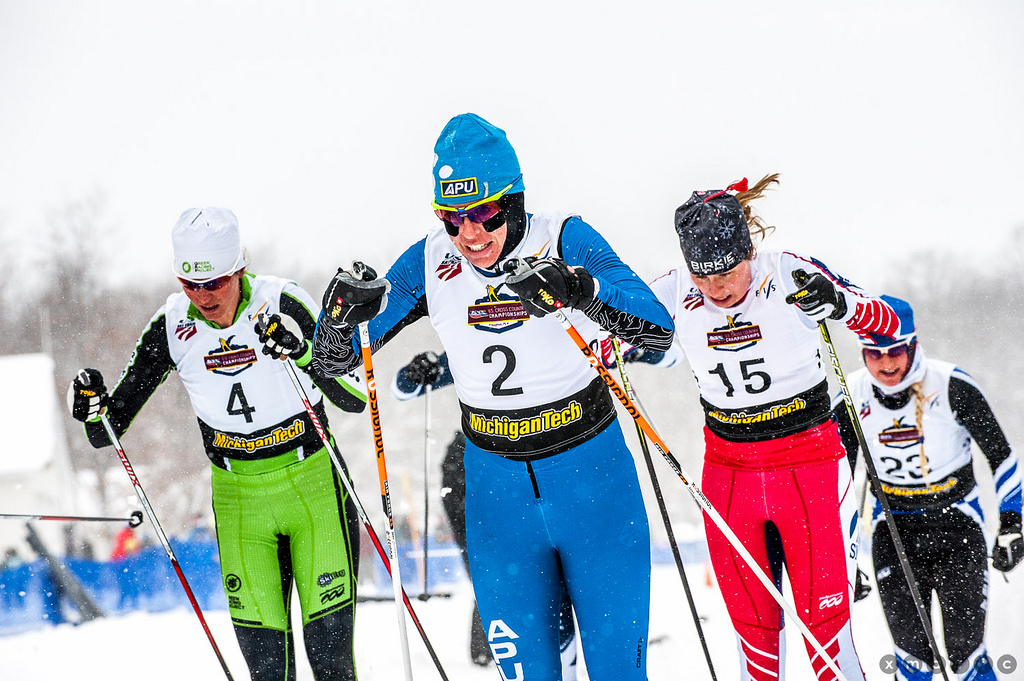
    Rosie Brennan (2), leads Liz Guiney (4), Anne Hart (15) and Hannah Halvorsen (23) shortly after the start in the women’s 1.5 k classic sprint final at U.S. Cross Country Championships in Houghton, Mich. (Photo: Christopher Schmidt)

    “I knew Rosie was just gonna blow it out of the water so I just tried to hang on,” Rorabaugh said with a laugh.

    Brennan did just that, surging to front of the pack out of the start, slightly ahead of Rorabaugh and Guiney, and directly in front of Hart before the downhill out of the stadium. According to Rorabaugh, Brennan attacked on the course’s two steeper climbs — most notably on the slight downhill in the middle and on the second hill about two-thirds of the way through.

    “It’s kind of like training, like, ‘Oh, Rosie’s going away on a hill again, this is my chance to hang on,’ ” Rorabaugh said.

    But unlike some training sessions in Anchorage, Alaska, this time, Brennan dropped Rorabaugh and the rest of the field for good.

    “I actually was putting most of my time in over the top of that first uphill and in the downhill,” Brennan said. “And then I guess the second uphill, I just surged to the top of that and then just tried to relax and ski it in.”

    Becca Rorabaugh (10) leads Heather Mooney (l) and Liz Guiney (r) into the finish in the semifinal of the U.S. Cross Country Championships women's 1.5 k classic sprint on Tuesday in Houghton, Mich.
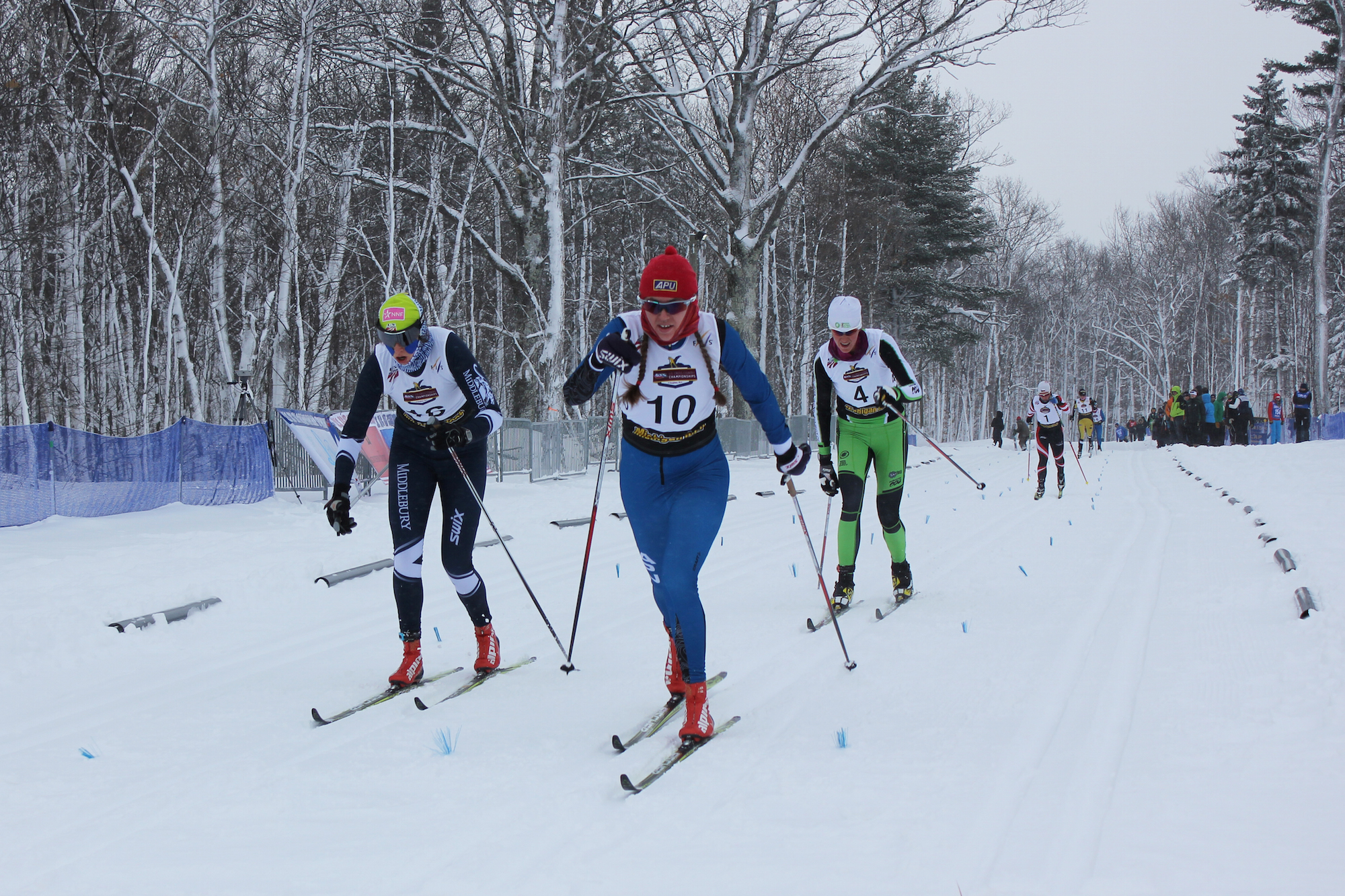
    Becca Rorabaugh (10) leads Heather Mooney (l) and Liz Guiney (4) into the finish in the semifinal of the U.S. Cross Country Championships women’s 1.5 k classic sprint on Tuesday in Houghton, Mich.

    Just like each of her preceding heats, she won the final comfortably by 6.82 seconds in 4:52.72.

    Rorabaugh sensed a couple women gunning behind her for second, so she sped  up on the final gradual climb before the stadium straightaway.

    “I figured they were close enough that I should just go as hard as I could, so I was happy that the finishing stretch was striding today,” she said of the still-dragging conditions.

    After securing the win, Brennan looked behind her to welcome her teammate and the rest of her competitors (including Guiney as a former Park City teammate) across the line. She and Rorabaugh embraced after delivering the 1-2 APU punch, and Guiney, who finished 3.67 seconds later, stayed 2.4 seconds ahead of Hart for her first national podium in third.

    “[I’m] tired, cold. I’m ecstatic, honestly,” Brennan said with a laugh after. “Last year, I technically got the national championship [in the classic sprint], but I was second [to Russia’s Natalja Naryshkina] so to win outright is that much sweeter. I really like classic sprinting so it was just good — good course and good skiing for me.”

    “It’s hard to feel great all the time. I really just tried to trust the fitness that I’ve built and try to keep skiing and not look back and just keep going.” — Rosie Brennan (APU), two-time national classic sprint champion

    APU's Rosie Brennan (c) and Becca Rorabaugh (l) on the podium in first and second, respectively, and Liz Guiney (Craftsbury Green Racing Project) in third in the women's classic sprint at U.S. nationals in Houghton, Mich. (Photo: Christopher Schmidt)
    APU’s Rosie Brennan (c) and Becca Rorabaugh (l) on the podium in first and second, respectively, and Liz Guiney (Craftsbury Green Racing Project) in third in the women’s classic sprint at U.S. nationals in Houghton, Mich. (Photo: Christopher Schmidt)

    It was also her fourth win out of six SuperTour races this year. Rorabaugh said she was happy the two could team up to take first and second.

    “We work really hard together all the time so it’s really great to have it play out like this,” she said.

    Guiney, a 23-year-old, first-year senior who qualified in fourth, placed ninth the last two years at nationals in the classic sprint (in 2013) and freestyle sprint (in 2014).

    “It’s really exciting,” said Guiney, who won her quarterfinal ahead of Frankowski and placed third in her semifinal behind Brennan and Rorabaugh, respectively. “It’s kind of a cool realization for me that I can be up there.”

    Hart improved upon her best nationals finish (which was fifth in the 2013 skate sprint) in fourth on Tuesday, about 13 seconds behind Brennan, and explained her main goal after qualifying in 15th was to keep an open mind and chip away at the heats.

    Anne Hart (SMST2) leads her quarterfinal ahead of Middlebury's Heather Mooney (16) and Northern Michigan University's Vivian Hett (6). (Photo: Christopher Schmidt)
    Anne Hart (SMST2) leads her quarterfinal ahead of Middlebury’s Heather Mooney (16) and Northern Michigan University’s Vivian Hett (6). (Photo: Christopher Schmidt)

    “It was really anyone’s day out there,” she said. “When you look at [Sunday’s 15 k] skate race with Kyle [Bratrud] having such a standout race, you just have to remember that anything can happen.”

    Hart won her quarterfinal by 1.32 seconds over Mooney, advanced out of the semifinal in third, and by the time the final rolled around, she was mostly aiming to stay in front of her fellow U23 competitors.

    “[Stratton coach] Pat [O’Brien] gave us stunningly fast skis today, so all of the starts the plan was, I figured Rosie was going to be the fastest out there,” Hart recalled. “I was just like, if I can just get myself right behind her and stay on her as long as possible…”

    She did so on the first climb, but by the second hill, she thought, “ ‘OK, maybe not,’ ” Hart said. “From there on out, it was just kind of battling for spots and with U23’s, every spot matters, so I was just willing myself to the finish line.”

    Her father was cheering her on from the sidelines, which helped, she said.

    “I graduated from Dartmouth last year and the first year out of college, I’ve been told a million and a half times by everyone and their mother that … it’s really different,” Hart said. “I just had what I call a bunch of vanilla races [to start the season], and so it’s just a confidence booster to say, ‘I’m doing this for a reason, I can do this.’ … So it’s gonna help me sleep better at night I think.”

     “It’s just a confidence booster to say, ‘I’m doing this for a reason, I can do this.’ ” — Anne Hart (SMS T2 Team), fourth

    Sixteen-year-old Hannah Halvorsen celebrates her quarterfinal win on Tuesday in the women's 15 k classic sprint at U.S. Cross Country Championships in Houghton, Mich.
    Sixteen-year-old Hannah Halvorsen celebrates her quarterfinal win on Tuesday in the women’s 15 k classic sprint at U.S. Cross Country Championships in Houghton, Mich.

    Halvorsen in fifth (+15.16) said her parents also buoyed her throughout the day.

    “My parents were really believing in me so I decided I’d give it what I have and I was pretty surprised that I was able to do really well in the heats,” Halvorsen said. “I had a lot of fun skiing with some fast girls.

    “I’ve been training this year with World Juniors kind of on my mind, but just trying to focus on the process and ski as well as I can,” she added. “So we’ll see what happens and how the points play out.”

    Twenty-year-old Mooney in sixth (+15.36), in her senior year at Middlebury, improved upon her two eighth-place finishes at nationals in the classic sprints in 2013 and 2011.

    “I was in the A-final at Spring Series when I was a J2, same race, but I was psyched [about today],” she said after qualifying 16th. “[I] tried to go into it without any expectations … definitely was intimidated by a six-minute sprint course, but just took each one as it came.”

    As for her goals for the rest of the season — and whether U23 World Championships are at the heart of them — Mooney said not necessarily.

    “This sounds really silly — I’d like to race fast enough to be among the top U23’s, but I love college racing and this is my last year and I’m really excited to try to race really consistently and be at the top of the college circuit, focusing on NCAAs,” she said. “I’d love to make [U23 World Championships], but also I’m going to spend the winter in the East and I’m excited for that.”

    Note: The defending freestyle sprint champion and 2013 classic sprint champion, Jennie Bender of the Bridger Ski Foundation crashed out of contention while leading up and over a climb near the end of her quarterfinal.  She placed fifth, 7.8 seconds behind Rorabaugh as the quarterfinal winner, and did not advance to the semifinals.

    “I was leading, then I was on my face,” Bender recalled in an email. “Knocked the wind out of me. … I am pretty disappointed, because I came into this race with high hopes, but that’s sprint racing. Looking forward to the skate sprint.”

    — Lander Karath contributed reporting

    Results

  • Naryshkina Adjusts in Time to Win U.S. Nationals Classic Sprint; Brennan Top American

    Naryshkina Adjusts in Time to Win U.S. Nationals Classic Sprint; Brennan Top American

    Rosie Brennan (APU) in second stands up just before the finish as Russia's Natalja Naryshkina (CXC) wins the women's classic sprint A-final by 0.3 seconds. (Photo: Tom Kelly/U.S. Ski Team)
    Rosie Brennan (APU) in second stands up just before the finish as Russia’s Natalja Naryshkina (CXC) wins the women’s classic sprint A-final by 0.3 seconds. Nichole Bathe of the University of Alaska-Fairbanks (l) placed third after outsprinting Becca Rorabaugh (APU). (Photo: Tom Kelly/U.S. Ski Team)

    FasterSkier’s coverage of the 2014 U.S. Cross Country Championships is brought to you through the generous support of The Memory Clinic in Bennington, Vt.

    MIDWAY, Utah – Natalja Naryshkina just needed another day. Acclimating to racing at Soldier Hollow’s elevation of more than 5,500 feet was hard enough, and Naryshkina had flown in from Russia just over a week earlier.

    A student in Saint Petersburg, she had to adjust to an 11-hour time difference. But more than a decade of World Cup racing had taught her that racing is racing – and when you feel your best, you can achieve it.

    Natalja Naryshkina (1) leads Erika Flowers (SMST2) in the quarterfinals of Friday's 1.5 k classic sprint. Naryshkina went on to win the quarterfinal, semifinal and ultimately the A-final for the overall victory at U.S. nationals at Soldier Hollow.
    Natalja Naryshkina (1) leads Erika Flowers (SMST2) in the quarterfinals of Friday’s 1.5 k classic sprint. Naryshkina went on to win the quarterfinal, semifinal and ultimately the A-final for the overall victory at U.S. nationals at Soldier Hollow.

    “She expected it,” said Dmitriy Ozerskiy, a Moscow native and Naryshkina’s teammate at the Wisconsin-based Central Cross Country (CXC), who translated for her on Friday after she won the classic sprint at U.S. Cross Country Championships.

    In the last of four races at nationals, the 1.5-kilometer classic sprint, the 29-year-old Naryshkina clocked the fastest qualifying time by 0.02 seconds over Rosie Brennan of Alaska Pacific University (APU), then won her quarterfinal and semifinal to start as the A-final favorite.

    There, Naryshkina hoped the good feelings from earlier in the day would help her win the final. She did so, leading out of the start then skiing even with Brennan up the lone-yet-massive climb known as Hermod’s.

    Brennan reached the top first, but Naryshkina trailed closely down the descent while Nichole Bathe (University of Alaska-Fairbanks), Becca Rorabaugh (APU), Jennie Bender (Bridger Ski Foundation), and Lauren Fritz (APU) followed, respectively.

    As the two frontrunners rounded a tight corner toward the finish, Naryshkina stepped left and nearly tangled with Rorabaugh, who had caught up on the descent. Brennan continued on in first while Naryshkina moved right to the inside lane to stay in second. Meanwhile, Rorabaugh recovered and searched for an opening, which Bathe found to make her way to third. Naryshkina pushed over the last rise into the stadium, accelerating past Brennan as she double poled to the line.

    Brennan jumped in the track behind her, following closely to ensure second and a national title as the first American. From her perspective, it was hard to know who was behind her and how close they were.

    “My back was giving me a lot of trouble today so I was nervous about the double pole,” Brennan said. “So I thought, ‘I’m just gonna get in behind her and try to hold off anyone that comes off behind,’ and I started catching her more and more.”

    A few feet before the finish, Brennan stood up to avoid riding up on Naryshkina’s skis, stepping to the side just across the line as Naryshkina took the win in 3:53.1. Brennan finished second, 0.3 seconds back, and the 18-year-old Bathe captured her first national podium in third.

    “Retrospectively I probably should’ve stepped out and tried to do something, but I don’t know, it just worked out,” Brennan said with a laugh. “I just didn’t really think about it until I was practically running into her and then the line was right there. So I’m like, ‘No one’s coming behind me so it’s good.’ ”

    “The first race here when I have so many people cheering for me it’s like, ‘Oh God, I have to do so well, there’s so much pressure.’ But then as the week goes on, I start to just relish in it.” — Rosie Brennan (APU), first American, second overall

    Bathe finished 2.2 seconds later after outsprinting Rorabaugh by three-tenths of a second. Rorabaugh placed fourth, 1.3 seconds ahead of Bender in fifth, and Fritz placed sixth, 9.6 seconds behind Naryshkina.

    “Today, I’m feeling better,” Naryshkina said. “Yesterday was acclimatization. Today is better.”

    In her third season with CXC, the Russian is a familiar face on the SuperTour circuit and in marathons like the American Birkebeiner. However, Friday’s victory was special after she placed 52nd in the 10 k classic and 13th in the skate sprint earlier in the week.

    “I love this course,” Naryshkina said. “It’s the very best competition. [Everyone is] very strong, good shape, very good conditions.”

    CXC Head Coach Bill Pierce wasn’t surprised, but said she gave them a scare in her quarterfinal and semifinal, which she led from start to finish.

    “You watched her double pole in really easy,” Pierce said. “She just saved it for the last [race] … smart bold moves in the final. It was cool.”

    Nichole Bathe (University of Alaska-Fairbanks) leads Russian Natalja Naryshkina (CXC) in the 1.5 k classic sprint semifinal at the top of Hermod's. Naryshkina won the heat, 0.2 seconds ahead of Bathe, and the two went on to place first and third in the A-final, respectively.
    Nichole Bathe (University of Alaska-Fairbanks) leads Russian Natalja Naryshkina (CXC) in the 1.5 k classic sprint semifinal at the top of Hermod’s. Naryshkina won the heat, 0.2 seconds ahead of Bathe, and the two went on to place first and third in the A-final, respectively.

    Another highlight for Pierce was Bathe, a UAF freshman whom he’s worked with since her first year as a J3. A former CXC athlete, she’ll return to the Midwest to train with the team next summer, Pierce said.

    “She’s been through the whole program,” he explained. “She’s just strong. She’s doing well up there, doing really well.”

    The fourth-fastest qualifier after Naryshkina, Brennan and Bender, respectively, Bathe won her quarterfinal by nearly a second ahead of Dartmouth’s Anne Hart. In her semifinal, she placed second, just 0.2 seconds behind Naryshkina.

    “The quarterfinals and semifinals were good; I went out from the start pretty hard,” Bathe said. “In the finals, I knew that I wasn’t gonna be able to hold that if I tried, so I just kind of went behind people and it just seemed to work out for me.”

    Following Brennan and Naryshkina up Hermod’s with Rorabaugh, she put herself in fighting position for the finish.

    “I tried to go as hard as I could, push over the top and try to hold on at the end,” Bathe said.

    As for her best senior nationals result by 36 places, she said it was a confidence booster heading into her first collegiate season.

    “I’m planning on going to Junior Worlds so I’m hoping [after] the results here, I can help our team out there,” Bathe said.

    Rorabaugh had mixed feelings about her week after opening with her first national title in the 10 k classic individual start. The next day, she placed seventh in the skate sprint and was 13th in the 20 k freestyle mass start on Wednesday.

    “It’s been a crazy week, lots of ups and downs,” Rorabaugh said with a laugh. “I think I’m in better classic shape than skating shape right now so I’ll see where that takes me.”

    Natalja Naryshkina (1) and Rosie Brennan (2) go head-to-head up Hermod's in the women's classic sprint A-final at U.S. nationals at Soldier Hollow on Friday. Naryshkina ended up edging Brennan by 0.3 seconds for the overall win, but Brennan was the top American in second.
    Natalja Naryshkina (1) and Rosie Brennan (2) go head-to-head up Hermod’s in the women’s classic sprint A-final at U.S. nationals at Soldier Hollow on Friday. Naryshkina ended up edging Brennan by 0.3 seconds for the overall win, but Brennan was the top American in second.

    The final turned out to be interesting after Brennan decided to pick up the pace early.

    “Rosie would much rather have it come down to the hill than come down to the final sprint, so she took it out as hard as she could, which made it fun because it was definitely all-out the whole time,” Rorabaugh said.

    Fourth up the hill, Rorabaugh soared back into contention on the descent with noticeably faster skis.

    “I had amazing skis; our wax techs really killed it today,” she said.

    Skiing in third, she said both she and Naryshkina moved to the outside track around the 180-degree corner.

    Naryshkina eventually took the inside lane, but the tangle gave Bathe “an opportunity to come in with a little more speed,” Rorabaugh said. “We had a good sprint finish; it was really exciting. I think I gained on her a little bit toward the finish, but didn’t quite get it so ended up fourth, which is still a pretty darn good day.”

    Brennan was also excited about her second U.S. title after she won the 10 k freestyle last year at Soldier Hollow – her home course.

    “I can’t say I ever expect to win a sprint, but it’s sprinting so you really never know what happens,” Brennan said. “It’s cool that way. I’m excited.”

    With a new sprint course this year that included a grueling ascent up Hermod’s, Brennan said it suited her strengths.

    “I felt like, ‘If I can just wear people out and take the sprint out of them a little bit then I have a chance,’ ” she said.

    Rosie Brennan (APU) takes charge up Hermod's in the women's 1.5 k classic sprint semifinals at U.S. nationals at Soldier Hollow. Jennie Bender (second from r) ended up winning the heat, followed by Brennan's teammate, Becca Rorabaugh, in second. Brennan made the A-final in third as a lucky loser.
    Rosie Brennan (APU) takes charge up Hermod’s in the women’s 1.5 k classic sprint semifinals at U.S. nationals at Soldier Hollow. Jennie Bender (second from r) ended up winning the heat, followed by Brennan’s teammate, Becca Rorabaugh, in second. Brennan made the A-final in third as a lucky loser.

    After breaking away in her quarterfinal, she avoided a downhill crash that left Deedra Irwin (Michigan Tech University) on the ground for several minutes, but ultimately able to walk off the course.

    “I had no idea that that happened,” Brennan said. “Everyone was like, ‘You can slow down, you’re winning by a lot now.’ I was like, ‘Oh, OK. Thank you.’ ”

    She went on to lead her semifinal before ending up third, 1.9 seconds behind Bender and 1.7 behind Rorabaugh, but she didn’t regret going out hard from the gun.

    “It worked out perfectly because I don’t think I would’ve been lucky loser if I didn’t do that,” she said.

    As for her best result of the week, the Park City native said it felt great.

    “The first race here when I have so many people cheering for me it’s like, ‘Oh God, I have to do so well, there’s so much pressure,’ ” she said. “But then as the week goes on, I start to just relish in it. It’s so awesome to have so many supporters that come out. My best friend from since I was born is out her cheering for me and my brother and my dad and mom … so it’s really nice.”

    Results | Complete U.S. nationals results

    — Lander Karath contributed reporting

    The U.S. women's classic sprint podium with Rosie Brennan (APU) as the top American (second overall), Nichole Bathe of the University of Alaska-Fairbanks (l) in second, and Becca Rorabaugh (APU) in third. (Photo: Tom Kelly/U.S. Ski Team)
    The U.S. women’s classic sprint podium with Rosie Brennan (APU) as the top American (second overall), Nichole Bathe of the University of Alaska-Fairbanks (l) in second, and Becca Rorabaugh (APU) in third. (Photo: Tom Kelly/U.S. Ski Team)
  • U.S. Nationals Notes and Quotes: Classic Sprint Edition

    U.S. Nationals Notes and Quotes: Classic Sprint Edition

    Skyler Davis (SMS T2) and Torin Koos (BSF/Rossignol) matched stride for stride on the last climb during the heats.

    MIDWAY, Utah – Tactics were the name of the game in Wednesday’s classic sprint at Soldier Hollow on the first day of racing at the 2013 U.S. Cross Country Championships. Some of the best didn’t have them completely dialed in, and with that, they failed to move on.

    U.S. Ski Team member Erik Bjornsen, who finished eighth after being eliminated in the quarterfinals, racked it up as a learning experience. At least racers like him will have another shot on Tuesday with the skate sprint – and they’ve got two distance races before that. But enough about the future, let’s get to what we didn’t fit in Wednesday’s race recaps.
    On tactics:

    “I thought I could break some people on this first uphill, and that wasn’t the case. I went out hard and lead it over the top, and Torin [Koos] and Matt [Gelso] were right behind me and they slingshotted past me like everybody said they would.

    I think everybody’s learned that you can’t be leading over that hill unless you really have a gap. Skyler Davis did it a couple times today, but there wasn’t a lot of other people, well the girls were, but that’s a little different. Number one thing is not lead over the top.” – Erik Bjornsen (Alaska Pacific University/USST), 21st

    “The beginning is probably the most rough because it’s where the panic sets up coming around the turn, you really can’t drop back too much. … On the down you just need to be top three. So I seemed to catch up on the downhill. I passed Sophie [Caldwell] and I was like, ‘Woah, OK.’ ” – Jenny Bender (Central Cross Country), women’s winner

    “The qualifier was really funny. I didn’t do any double-poling warmup, and for the first time, it didn’t feel good and I was concerned about it. But then once we got into the heats the first quarter, I tried tactics but I was a little frustrated because even though we’re back in the U.S. and could be skiing easy, it’s good practice to go hard. So then in the semi, I was like I’m just gonna go for it.” – Sadie Bjornsen (APU/USST), 2nd

    “I was just trying not to be the leader at the top of the hill, basically. The draft was so important that it was important to be around second or third on the downhill to make sure you get the advantage in the draft. And then just having a strong double pole; it’s a long finishing stretch. … Because of the way it skis tactically, it was nice to relax. Normally when girls race, we just go as hard as we can the whole time and last one standing wins sort of thing. So it was fun to ski in there and move a little bit and then just really give it over the top of the last hill into the finish.” – Rosie Brennan (APU), 3rd

    “[I] definitely tried to get behind people because that’s such a key point to get that draft. And yeah it was just trying to hang in there in the finishing stretch. For sure, it’s a lot longer, like, you can see the finish, but then its like am I there yet? But it’s a great finish for sure.” – Kate Fitzgerald (APU), 4th

    “All today I knew my strength was not necessarily the double-pole finish, so throughout the day I tried to put some time in on the hills and I felt great for most of it. My arms just felt dead on that final stretch. … Usually my strategy is not to lead, this is more for skate sprints because I have a pretty good finish kick so I hold on the end of that. But classic sprinting is a little different, especially for the double-pole finish.”  – Sophie Caldwell (Stratton Mountain School T2 Team), 5th


    On whether or not to use skate skis:

    “Qualification was good, it was really cold and I decided to still use the skating skis to use the upper body. It wasn’t the best choice, but I wanted to take that opportunity to know that I could do that in the final, and I ended up opting to go with the kick wax instead. Obviously it was a pretty good choice.

    “I think it would’ve been an OK choice to go with skating as well, but I just had the idea that I know how to win this on the kick wax.I had a pretty good idea that I would race against some of the other guys in the heats, and I was like, ‘OK, this is where they’re gonna be really good, but I think I can do this better than them.’ ” – Torin Koos (Bridger Ski Foundation/Rossignol), men’s winner (qualified third on skate skis, won A-final on classic boards)

    “I double poled most everything until that last hill and when Torin [Koos] came up beside me, he was afraid I was on no-wax skis so he’s like, ‘Are you double poling?’ because he figured if I was double poling he needed to be leading going into that. I didn’t answer him, but he quickly figured it out when I started striding.” – Erik Bjornsen, who stuck with classic skis


    On feeling good:

    “In Bozeman, I finished a heat and I wanted to weave around like this (wavers on her feet), and today I felt back to normal. I was kinda jazzed, like, ‘Oh, this is a good sign. I don’t feel completely dead.’ So you know, one heat at a time.” – Bender

    “I felt good today. I’m really low on racing. I’ve only done two sprints and both those the health was not good. I was just trying to race for qualification reasons. So this is kind of like a start to the season because it’s only the second of the year. I’m really looking to build on this. … My health’s good. Coming back into race shape. ” – Koos

    “I’ve been feeling better. We had some races at home [in Sun Valley, Idaho] and I’ve been getting some rest and feeling pretty good. Ready for the 15 k, for sure.” – Mike Sinnott (Sun Valley Ski Education Foundation), 2nd

    “[These] last five days are the best I’ve felt all year so I have to take that as a real good sign for the next week and the next couple weeks.” – Skyler Davis (SMS/USST), 4th

    “I’m pretty excited that’s the best I’ve done at nationals ever. I find it ironic because I didn’t think classic sprinting was my forte. … Maybe as a team we did enough double-pole sprinting this summer, … but this summer my goal was to work on my distance racing and my threshold.” – Becca Rorabaugh (APU), 6th

    “I was feeling pretty well, been out at altitude for a while so didn’t hurt as much as Bozeman or Yellowstone because those were really bad.” – Ben Saxton (F.A.S.T. Performance Training), 5th

    “I was feeling really good at home [in Durango, Colorado], had a great holiday and had some awesome training. My twin brother’s up here helping me test with Team HomeGrown. I had a great holiday training with those guys and had a few down days the last couple days, but feel like I’m coming back now. It’s the best classic sprint qualifier I’ve ever had, just missed the top 30 so I’m stoked.” – Tad Elliott (Ski & Snowboard Club Vail/Team HomeGrown/USST), 39th

    “I felt good, I felt powerful. The [SuperTour] races in Bozeman and West Yellowstone were pretty similar to this, but those races I felt pretty weak and I didn’t have the speed. I felt like I had the speed today and whatever it was it just didn’t work out.” – Tyler Kornfield (University of Alaska Fairbanks), last year’s national classic sprint champ, 42nd in Wednesday’s qualifier


    On keeping results in perspective:

    “I was pretty frustrated after the races in Montana, but I mean, it’s a long season. This happened before, it happens to everyone. You just need to get through it, stay focused stay calm and relaxed. … I’m going to have to adjust my goals, but I still have big goals.” – Kornfield

    “I did have some people, a few this summer, that I got angry at who told me to write the year off. I’m pretty stubborn so having something you can’t control is extremely frustrating no matter what it is, but at the same time, to come to terms with what you can’t control is an interesting process. I think that’s what I’ve been: more relaxed and I’ve come into a lot of races with a neutral mentality. I still have goals, but it’s possibly been helpful because I had no expectations.” – Bender

    “I always just try to go into races with, I mean, just be myself and we’ll see how the rest of it plays out. A lot of factors on the day, skis and tactics and everything, worked really well for me. The next sprint will be a lot different and next meet will be different. Just changes it up, I guess.” – Saxton


    On Soldier Hollow:

    “I did my first World Cup here, my first Olympics here, my first national championship here, and so I was looking forward to coming back. It kind of feels like it’s coming full circle, and it’s really cool that it’ll be this year and next because no matter what, the organizers here do a phenomenal job. The course is always in very fair shape. As an athlete it makes you feel like what you do is respected.” – Koos

    “It’s great. That’s a great course, it’s a fantastic venue, you know, racing with a bunch of my friends. … These bibs are not as tight as the ones in Rumford (puts on podium bib). That’s nice. Good-fitting bibs are nice.” – Dakota Blackhorse-von Jess (Bend Endurance Academy), 3rd

    “SoHo always pumps out a lot of snow and you can see, it’s pretty wild. The course is in great shape, two feet of snow everywhere pretty much.” – Leif Zimmermann (BSF), 48th

    “I knew some of the guys wanted to keep skiing in Europe; I wanted to be here, though. That was kind of the plan all along. If I was really killing it early season that might have been an option, but knowing how good Noah [Hoffman] and Kris [Freeman] are doing, they go the Tour [de Ski] starts and I’m here. Both win-win situations. I’m happy to be here and these are big races. I always want to try do well at national champs.” – Elliott

    ***

    Overall results