From the FasterSkier archive — posts syndicated from athletes’ and coaches’ own blogs between 2004 and 2012, kept online as published. Current coverage is at fasterskier.com.

Tag: U.S. Nordic Combined

  • For Lodwick, ‘Passion Still Burns’ for Sixth Olympics, Will Be First American to Do So in Sochi

    For Lodwick, ‘Passion Still Burns’ for Sixth Olympics, Will Be First American to Do So in Sochi

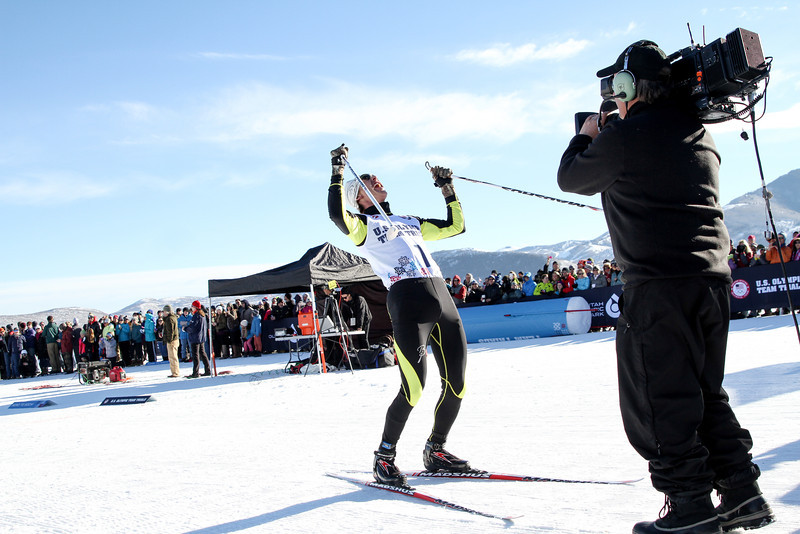
    Todd Lodwick (U.S. Nordic Combined) celebrates a clear-cut victory at 2014 U.S. Nordic Combined Olympic Team Trials at Utah Olympic Park on Dec. 28 in Park City, Utah. First in the jump, Lodwick beat teammate Bryan Fletcher by 17 seconds for the victory, which secured his bid for his sixth Olympics, the most of any American in the Winter Games. (Photo: Sarah Brunson/U.S. Ski Team)
    Todd Lodwick (U.S. Nordic Combined) celebrates a clear-cut victory at 2014 U.S. Nordic Combined Olympic Team Trials at Utah Olympic Park on Dec. 28 in Park City, Utah. First in the jump, Lodwick beat teammate Bryan Fletcher by 17 seconds for the victory, which secured his bid for his sixth Olympics, the most of any American in the Winter Games. (Photo: Sarah Brunson/U.S. Ski Team)

    Todd Lodwick hadn’t felt nerves like he experienced last Saturday in a long time.

    Seventeen years old at his first Olympics in 1994 in Lillehammer, Norway, Lodwick, now 37, was about to see if he could make his sixth Olympic team at the U.S. Nordic Combined 2014 trials on Dec. 28. If he came out on top of the individual 10-kilometer competition in Park City, he’d also make history as the first American to qualify for six Winter Olympics.

    “That’s always on the mind, to break the record books,” Lodwick said on the phone Dec. 30. He was on a personal business trip in the south and planned to return to Steamboat Springs, Colo., Jan. 2 before leaving for Europe on Jan. 6.

    Really, though, Lodwick wanted to prove again to himself and to everyone with an Olympic dream or any kind of lifelong aspirations, that it was possible.

    “For me, I think it was that I’m one of the top athletes in the world and that I’m out there to win,” Lodwick said. “And to solidify the hard work that I’ve been putting in and know that I am still capable of some great things. That passion still burns hot inside of me and it’s something that I wanted to do.

    “It’s not only my doing that got me here,” he said, crediting his sponsors, “teammates and coaches and family and friends that believe in me and believe in my whole journey.”

    With some 5,000 people at Utah Olympic Park (UOP) watching him and nine others compete in the coveted Gold Cup trial, Lodwick posted the best jump of 95.5 meters, giving him a 36-second headstart on teammate Billy Demong in the 10 k, also at UOP in Park City.

    Lodwick not only extended his gap on Demong, a four-time Olympian and 2010 Olympic gold medalist, on the four-lap course, but he held off teammate Bryan Fletcher — just as hungry for a guaranteed Olympic spot — by 17.3 seconds. Lodwick won the winner-takes-all competition in 25:27.6 to prequalify for the 2014 Games in Sochi, Russia. Fletcher placed second, and Demong was third, 56.1 seconds back.

    Eighth in the jump, Taylor Fletcher rose to fourth, 23.4 seconds behind Demong. Adam Loomis of the U.S. Nordic Combined B-team was fifth and his teammates Brett Denney, Nick Hendrickson and Michael Ward placed sixth through eighth, respectively. Ben Berend (Steamboat Springs Winter Sports) finished ninth and teammate Tyler Smith was 10th.

    “It feels pretty good,” Lodwick said two days after. “I put a lot of pressure on myself just like the rest of the athletes and knew that there was some big stuff on the line. … Going to these Games is something that’s always been on my mind since I started to pursue it. I knew it took a lot of hard work.”

    He said he was able to do so because of teammates “that push me as hard as they do and coaches that support me.”

    “If I touch one kid to help them achieve their dream, then I consider my career a success.” — Todd Lodwick, after winning U.S. Olympic trials to prequalify for 2014 Sochi Games

    Lodwick became the first of potentially five U.S. Nordic Combined athletes to qualify for the Olympics. The rest of the team will be decided based off world rankings through Jan. 19, with a complete team naming set for Jan. 22.
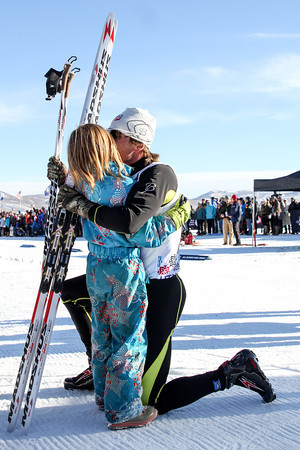
    Todd Lodwick and his 8-year-old daughter embrace after Lodwick won the Gold Cup U.S. Olympic trials on Dec. 28 in Park City, Utah, to qualify for his sixth Olympics -- unprecedented among U.S. Winter Olympians.  (Photo: Sarah Brunson/U.S. Ski Team)
    Todd Lodwick and his 8-year-old daughter embrace after Lodwick won the Gold Cup U.S. Olympic trials on Dec. 28 in Park City, Utah, to qualify for his sixth Olympics — unprecedented among U.S. Winter Olympians.
    (Photo: Sarah Brunson/U.S. Ski Team)

    As soon as he finished, Lodwick’s 8-year-old daughter ran up and gave him a huge hug.

    “She’s probably one of my biggest supporters,” he said. “I’m doing it for my kids. For me [it’s to] show them that dad still has it and can still kick butt. With my son, he’s five and he has some special needs and providing for him is something that I care deeply about. We have a bond that is very special.”

    His oldest understands what’s going on, and as she celebrated with him last Saturday, she enjoyed being in the limelight, just like her dad, Lodwick said.

    “This being my last competition ever in the states, I couldn’t have asked for anything more,” Lodwick said. “I was blown away by the volunteers and the setup crew, the people that dedicated so much time to putting on such an amazing event, and we all had a blast doing it. That was one of the best events that we’ve had in the states in a very, very long time.”

    For Lodwick, it was the start of a pre-Olympic sendoff he can enjoy in the next month leading up to the Olympics. It also confirmed that he’s once again in the best shape of his life.

    “Everyone [was] out there to compete at their best; a few of us had a victory in mind,” he said. “Bill, having it be his adopted home hill and home state, he was rested and training so I think he went into knowing he was the favorite.”

    Bryan Fletcher has led the team this season on the World Cup, notching three individual top 10-results and a program-best fourth with Lodwick in the team sprint Dec. 14 in Ramsau, Austria.

    The oldest guy on the team, Lodwick said this year will be his last, complete with two decades worth of Olympics and U.S. Ski Team experiences.

    “I’m 37 years old and do I feel like I’m capable of going to another Olympic Games when I’m 41? Sure,” he said. “But I think I’m ready to move on.”

    “I still believe in myself,” he said. “Dreams can come true if you work hard enough. … All this work isn’t for nothing and the time spent, sweating and wanting to throw up and legs cramping, looking back on that and knowing that I never gave up on my dream that lives in every single kid that watches on TV. If I touch one kid to help them achieve their dream, then I consider my career a success.”

    And it doesn’t have to be sports related, he said.

    “First step is to dream big and you have to do that to be successful,” Lodwick explained. “And you have to believe in yourself wholeheartedly.”

    He proved that at 2009 World Championships, winning two individual golds, and setting his sights on the 2010 Olympics in Vancouver, B.C. There, he won a silver medal in the 4 x 7.5 k team event. A year later at 2011 World Championships, he decided to commit to three more years and make a run for his sixth Olympics.
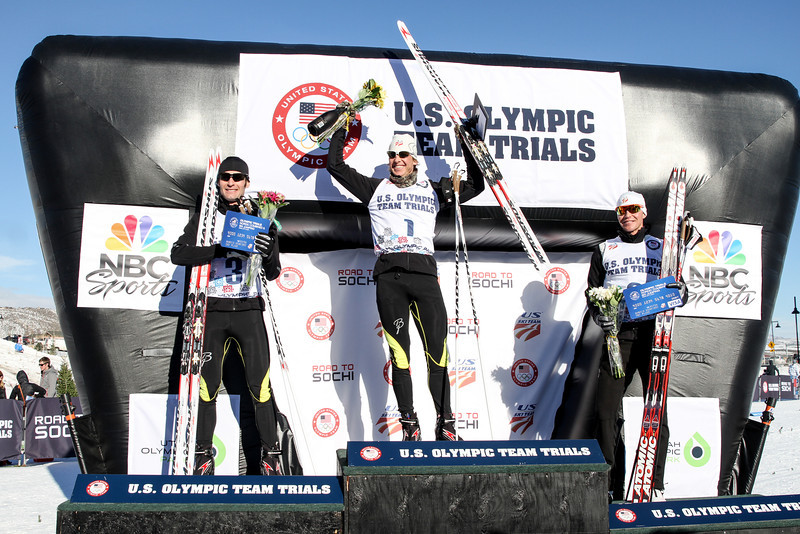
    (From left to right) The 2014 U.S. Nordic Combined Olympic Team Trials podium on Dec. 28 in Park City, Utah, with runner-up Bryan Fletcher, winner Todd Lodwick and Billy Demong in third. (Photo: Sarah Brunson/U.S. Ski Team)
    (From left to right) The 2014 U.S. Nordic Combined Olympic Team Trials podium on Dec. 28 in Park City, Utah, with runner-up Bryan Fletcher, winner Todd Lodwick and Billy Demong in third. (Photo: Sarah Brunson/U.S. Ski Team)

    One of the biggest difference-makers over the years has been the growth and success of the U.S. Nordic Combined team, he said. Last February at 2013 World Championships in Val di Fiemme, Italy, Lodwick, Demong, and the Fletcher brothers earned America’s first medal (bronze) in the team event.

    “I can’t thank Dave Jarrett enough,” Lodwick said. “He has made … sure that we are the best in the world. We started believing in ourselves and came together as a team. Going into these Games we’re going to feed off the inspiration that we had in 2010 and the success we had at World Championships. We rise to the occasion more often than not and surprise the heck out of people.”

    The U.S. Olympic quota is currently four, but they’re hoping to take five men to the Games if they can get five to rank in the World Cup top 50. Before the Olympic trials last month, Demong won two Continental Cup competitions in Park City to secure the team’s fifth World Cup quota spot, allowing them to bring another man over to Europe and try to score some World Cup points.

    “We rise to the occasion more often than not and surprise the heck out of people.” — Lodwick

    A couple U.S. Ski Team members are in Chaikovskiy, Russia, this weekend competing for those points, with Taylor Fletcher placing sixth and Denney finishing 32nd in Saturday’s normal hill/10 k.

    Starting next weekend, Lodwick and the rest of the U.S. A-team will get back to the World Cup in Chaux Neuve, France, then Seefeld, Austria, before heading back to Park City for a two-week training block at altitude for the rest of January. On Feb. 1, they’ll head back to Europe for a brief jumping camp in Oberstdorf, Germany, before heading to Sochi on the sixth.

    Trials results

  • U.S. Nordic Combined Just Warming Up, Primed for Olympic Trials and Beyond

    U.S. Nordic Combined Just Warming Up, Primed for Olympic Trials and Beyond

    On the final day of Continental Cup competition at Soldier Hollow in Midway, Utah, U.S. Nordic Combined's Billy Demong jumped to first and stayed ahead for the win, earning the U.S. an additional World Cup spot. (Photo: Riley Steinmetz/U.S. Ski Team)
    On the final day of the Continental Cup at Soldier Hollow in Midway, Utah, U.S. Nordic Combined’s Billy Demong jumped to first and stayed ahead for the win, earning the U.S. an additional World Cup spot. (Photo: Riley Steinmetz/U.S. Ski Team)

    Billy Demong’s doing just fine. The fact that he competed at this week’s Continental Cup in Utah while four of his teammates prepared for this weekend’s World Cup in Schonach, Germany, isn’t a cause for concern for the 2010 Olympic gold medalist.

    Demong, 33, needed to take care of business at home in Park City; there was a fifth World Cup spot on the line for U.S. Nordic Combined and someone needed to capture it.

    In a phone interview last month, head coach Dave Jarrett explained that Demong was in one of the best positions to qualify for the 2014 Olympics out of anyone on the World Cup team, based on his cumulative results from 2012 and 2013.

    The rest of the team, including Bryan and Taylor Fletcher, Todd Lodwick, and Brett Denney, would have to prove themselves worthy of the 2014 Sochi Games in the months leading up to it.

    That’s why those four are in Europe, and Demong was sent to take one for the team this week at Utah Olympic Park and Soldier Hollow.

    “It’s a little strategic plan to maximize quota spots for the Olympics and World Cup,” Jarrett explained.

    Demong did what he needed to, winning two out of three competitions from Tuesday to Thursday (and placing second in the other) to secure a fifth World Cup start for his team.

    “It opens up a spot for Brett Denney to be not sitting on his rear-end, not competing at all,” Jarrett said of the B-team member, who earned a trip to Europe with his summer performances.

    Denney, 23, joined the A-team in Europe earlier this month in Lillehammer, Norway. He ended up competing in Ramsau, Austria, last weekend, where he placed 15th in the 2 x 7.5-kilometer team sprint with Taylor Fletcher. The Americans’ first team, Bryan Fletcher and Lodwick, placed fourth – a first for U.S. NoCo in that event.

    Preceding their recent successes, the first competitions of the season weren’t so smooth. On the opening day in Kuusamo, Finland, none of the Americans made the top 50 in order to compete, and Demong was disqualified for an equipment violation; his suit was too loose around his thigh.
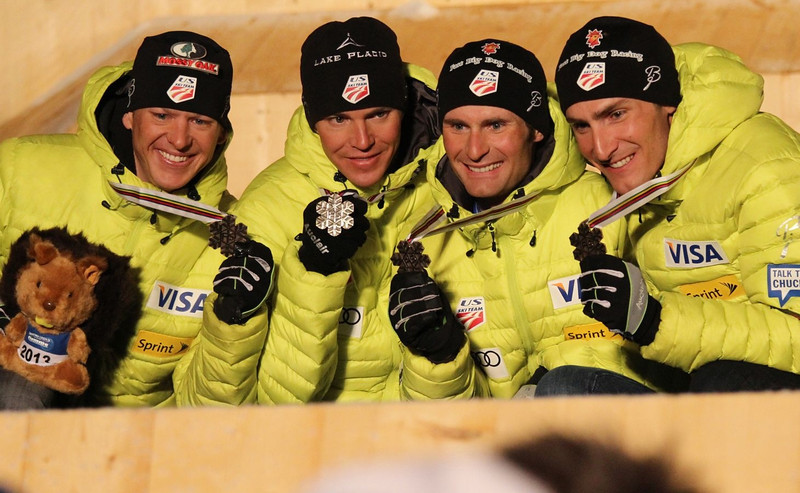
    From left to right: Todd Lodwick, Billy Demong, Bryan Fletcher and Taylor Fletcher with their bronze medals from Sunday's team event at the 2013 Nordic Combined World Championships in Val di Fiemme, Italy. (Photo: Fiemme2013)
    From left to right: Todd Lodwick, Billy Demong, Bryan Fletcher, and Taylor Fletcher display their team-event bronze medals at 2013 Nordic Combined World Championships in Val di Fiemme, Italy. (Photo: Fiemme2013)

    In the four-man team event the next day, the U.S. rose from 12th to seventh thanks to Taylor Fletcher, who skied the fastest anchor leg. The next weekend in Lillehammer, the U.S. notched 10th and 11th with Bryan Fletcher and Lodwick, respectively, and six days later, the two celebrated their unprecedented team-sprint result. On Sunday in Ramsau, Bryan rose to seventh in the individual competition and Demong placed ninth.

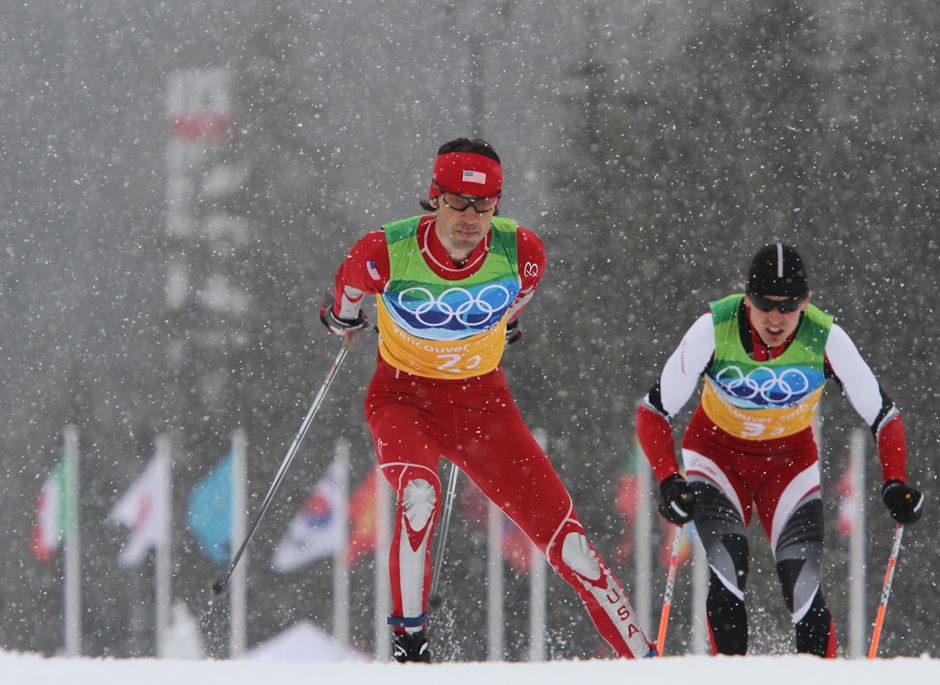
    Suddenly, it seems like things are back on track for four returners from the 2010 Olympic team, including Demong, who became the first American nordic skier to win gold (in the 10 k large hill competition), and Lodwick, who helped his team (with Demong, and the now-retired Brett Camerota and Johnny Spillane) notch silver in the relay.

    Bryan, 27, and his younger brother Taylor, 23, are back, too – this time as veterans. Last season, Taylor led the team in 16th in the World Cup rankings after achieving third for his first podium in Seefeld, Austria. Bryan was the second-leading American in 21st overall. Equally competitive on any given day, Taylor is best known for his superior racing skills, while Bryan has historically been stronger in jumping.

    While Bryan has stated he prefers to work on his strengths, Taylor would rather spend more time improving his weaknesses.

    “We’re such polar opposite guys, maybe that’s how it works for him, but I feel like I work on my jumping because I’m confident my cross country will be strong,” Taylor said on the phone in October. As a result, his summer training was generally 60-percent jumping, 40-percent skiing.

    “Luckily for me I have to focus on cross country, too,” Bryan said in November. “If I’m not jumping two-minutes ahead of those guys, then I have a race on my hands.”

    Before the World Cup season, team time trials were a big indicator – and Taylor was happy to win at least two of them. First in the jumps, he didn’t let anyone catch him in the races.

    “To do that and know that people behind me are Olympic champions and World Champion gold medalists, that kind of gives you a good feeling and a good focus … that I’m jumping well and I’m skiing well,” Taylor said.

    But with teammates like Demong and Lodwick, 37, Taylor’s still the young guy.

    “Bryan’s four years older than me so I definitely do get treated like a rookie, but it’s not that I don’t enjoy it,” Taylor said on the phone in October. “I might get frustrated because they’re not listening to me when I might have something worthy to say, but it doesn’t matter to me because Bill knows what he’s doing and everything he does is right. It’s easier to follow him and it should work come this winter.”

    Olympic Goals – and Golds

    In terms of 2013/2014 aspirations, the World Cup isn’t it. Like most, peaking at the Olympics will be U.S. NoCo’s top priority – and they’re not too concerned with what happens before or after that.

    Olympic Champion Billy Demong shares the podium with teammates Taylor and Bryan Fletcher after winning his ninth career U.S. title. (Photo: USST/ORDA-Jon Lundin)
    U.S. Nordic Combined’s Billy Demong (c) shares the podium with teammates Taylor and Bryan Fletcher after winning his ninth career U.S. title at nationals in October in Lake Placid, N.Y. (Photo: USST/ORDA-Jon Lundin)

    After the Schonach World Cup, the team will head back to the U.S. for Olympic Gold Cup Trials on Dec. 28 in Park City. The winner there will secure an Olympic spot, but it’s not like anybody can make it – racers have to be eligible to compete in the Olympics. According to Jarrett, that narrows the field to 10 or so.

    “Nobody is prequalified, everybody has got to earn it objectively,” Jarrett explained.  “There is coaches’ discretion for maybe one spot, but that is kind of a force majeure, if we have to use it. We would rather everybody qualifies via the objective criteria.”

    Those criteria are based off the top-ranked athletes on the overall World Cup list.

    “It’ll be hard to make the Olympic team if you haven’t scored any World Cup points,” Jarrett added. “We have enough competitions – two competitions every week – that if we want to have winners at the Olympics we gotta have guys that can win at the World Cup and at the very least score points.”

    On Dec. 28, several men will be gunning for the top spot to ensure their ticket to Sochi, but as Bryan pointed out, it probably won’t be dramatic.

    “It’s one of those situations where one of our best guys wins who would already be going to the Olympics, the way it should be, but it is a cool event,” Bryan said. “I remember in 2002 competing [at the] Gold Cup and getting sixth or 11th or something. You feel so close to making that Olympic team that’s such a cool opportunity for the junior kids to feel like, ‘I could rise to the occasion and jump well or ski fast and get myself an Olympic spot.’ It’s a full-on, real competition and all those A-team guys will be certainly trying to perform our best.”

     “Dave’s always been big on saying, ‘Compete at your average’ because if you try too hard, it can blow up in your face.’ ” — Taylor Fletcher

    Meanwhile, the World Cup will continue while the U.S. A-team races at home then rests up before returning to Europe on Jan. 7. Two weeks later, they’ll fly back to Park City for an pre-Olympic altitude camp, then to Europe again on Feb. 1 for a “mini-jumping camp” in Oberstdorf, Germany. Then, they’ll head to Sochi on Feb. 6.

    It might sound like a lot of travel, but Jarrett said it’s all part of their plan.

    “Our guys would rather do that then sit in a hotel somewhere in Europe spending all those days away,” he said. “People question strategies, but that is something we’ve been good at doing in the past, so we’ll continue to do that.”

    While the US Nordic Ski Team spends the entire winter in Europe, Jarrett said they’d rather go home when they have time between competitions, even if it’s only 10 days.

    “On a cost basis, it is somewhat of a wash on lodging,” he explained. “Some athletes don’t want to fly, some athletes would rather stay there, but for the most part all of our guys would rather come home for a little bit and relax.”

    Demong and Lodwick both have children at home, which adds to the draw of stateside training and recovery. Taylor said its helped them in the past, allowing for a “mental reset” during a hectic season.

    “It’s hard to answer those questions sometimes when the Europeans are like, ‘All you guys care about are the big events and why don’t you target the overall?’ ” Taylor said. “But our goals are the big events and a gold medal.

    “The French team, they’ll go home almost every single weekend stay in their own bed for two or three nights, regroup and come back,” he added. “I think that helps a lot to go home and not have the stress of being around your teammates every single weekend. There’s no other team as close as we are.”

    In terms of results, Taylor said the team’s been good about keeping them in perspective.

    “We’ve always just gotten better as the season goes on,” he said. “Bryan went from top 20 at the beginning of the [2011] season to winning a world cup in Oslo [in 2012].”

    Without much fanfare leading up to the 2013 World Championships, the Americans went out and captured their first World Championships team-event medal in third. Earlier in the season, they achieved their first World Cup relay podium in third, “and that was a pretty damn average day for everybody,” Taylor said.

    “To know that we’ll be in there on our average day makes the expectations quite a bit less … We know that we don’t have to try so hard to get things done and our performances will allow us to have those results,” he said. “Dave’s always been big on saying, ‘Compete at your average because if you try too hard it can blow up in your face.’ ”

    Plain and simple, that’s the team’s goal – to go out and win medals just like they did four years ago in Vancouver. Having never reached the Olympic podium before, the 2010 team captured four medals – at least one in every event – for 44 percent of the available medals. While Camerota retired in the spring of 2011 and Spillane called it a career last April, Lodwick’s embarking on his sixth Olympics and Demong is looking ahead to his fifth.

    “I think that we’re on par to be fighting for medals like we were in Vancouver,” Jarrett said. “A lot of teams are the same as they were and a lot of teams are different. It’s hard to say, but I think that we’re in a good spot and I feel good about it. We just have to go out and do it. That’s the main thing.”

  • Weekend Roundup: High Expectations

    Weekend Roundup: High Expectations

    Kikkan Randall and Marit Bjørgen's photo finish (Photo: Fischer/Nordic Focus)
    Kikkan Randall and Marit Bjørgen’s photo finish in Sunday’s Sprint in Davos, Switzerland. Bjørgen won it by a hair. (Photo: Fischer/Nordic Focus)

    Extraordinary performances are becoming ordinary for the North American contingent this year as new stars emerge, historic results accumulate, and expectations continue to grow.

    FasterSkier was on site in Davos, Switzerland, where five USST members raced to the top 30 in Saturday’s distance races. Kikkan Randall placed 18th in the women’s 15 k, followed by Liz Stephen in 20th, Holly Brooks in 25th, and Jessie Diggins in 30th. Noah Hoffman was 25th in the men’s 30 k.

    Sunday’s Skate sprints brought even more excitement for the U.S. team with Randall skiing to a hard fought second place against powerhouse Marit Bjørgen. Sophie Caldwell, in a breakout performance, reached the World Cup semifinals and cracked the top ten with her ninth place finish. Diggins and Sadie Bjornsen, who both suffered falls, were 12th and 27th.

    On the men’s side Simi Hamilton and Andy Newel advanced to the quarterfinals and finished in 14th and 17th.

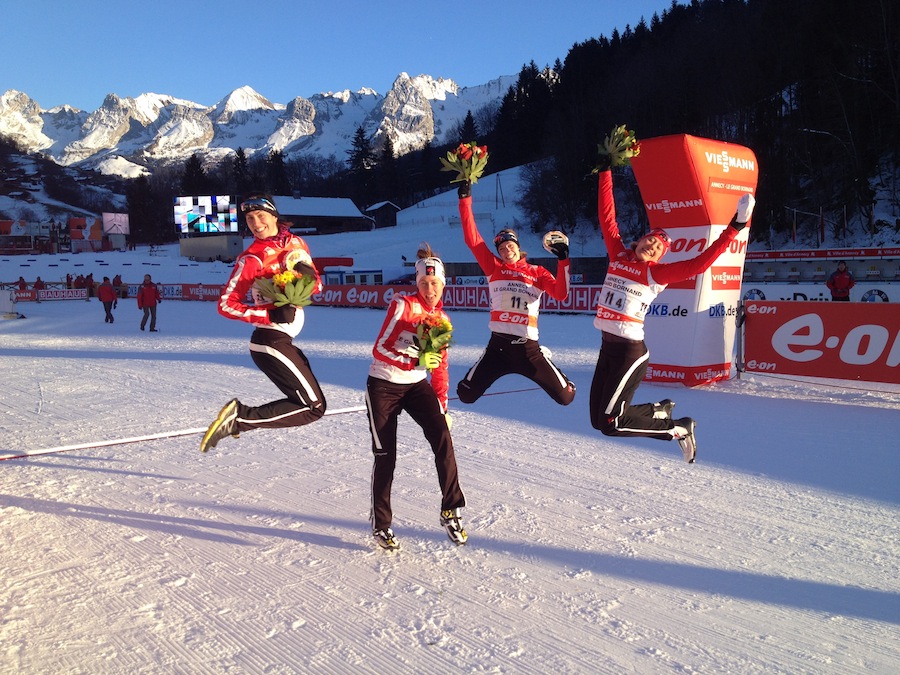
    The Canadian women jumping for joy after notching Biathlon Canada's best-ever finish in a relay. (Photo: Biathlon Canada/Matthias Ahrens)
    The Canadian women jumping for joy after notching Biathlon Canada’s best-ever relay result of fourth. (Photo: Biathlon Canada/Matthias Ahrens)

    North America shined in the IBU World Cup with the Canadian women’s relay team taking a historic fourth-place finish in the 4 x 6 k relay. The success continued throughout the weekend with four Canadian women qualifying for the pursuit, and Rosanna Crawford ultimately finishing 19th.

    On the men’s side Canadian Nathan Smith finished 16th in the 10 k sprint and was followed by Americans Tim Burke in 28th and Lowell Bailey in 35th.  In the 12.5 k pursuit Smith impressed again with an eighth-place finish. He was followed by Bailey and Burke in 15th and 16th.

    The action didn’t stop there with historic results from U.S. Nordic Combined. In Ramsau, Austria, Bryan Fletcher and Todd Lodwick skied the fastest combined time in the 2 x 7.5 k team sprint to place fourth, the best-ever result for the U.S. in the two-man event.

    In Sunday’s individual 10 k competition, Fletcher and Billy Demong cracked the top ten by placing seventh and ninth.

    With all the success happening across the pond it’s easy to forget that North America had some races of its own this weekend. Rossland, B.C. hosted the second set of NorAm races where Erik Bjornsen and Emily Nishikawa triumphed in the sprint, and Kate Fitzgerald and Kevin Sandau won Sunday’s 10 and 15 k.

    The IPC World Cup also took place in Canmore, Alberta, with several North American standouts. Canadian Brian McKeever won the 10 k on the opening day and churned out another winning performance in the 20 k classic race. American Oksana Masters placed third in the women’s sit-ski 5 k and fourth in the 0.75 k sprint.

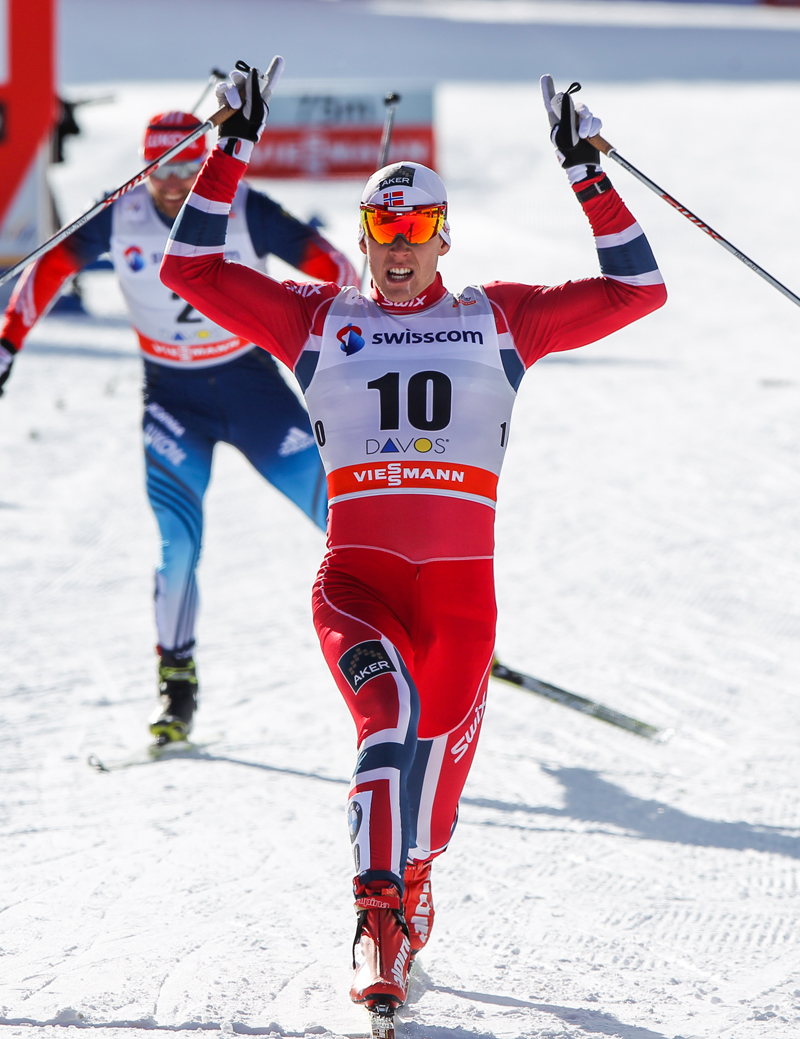
    Norway’s Anders Gløersen celebrates his win as he crosses the finish line (Photo: Fischer/Nordic Focus)
    Norway’s Anders Gløersen celebrates his sprint win as he crosses the finish line in Davos. (Photo: Fischer/Nordic Focus)

    Cross-Country World Cup, Davos, Switzerland (Results)

    Saturday’s 15/30 k skate individual start: Women’s report | Men’s report | U.S. women’s report | Hoffman Happy with Performance

    Sunday’s 1.5 k skate sprint: Women’s report | Men’s report | Canadian report | One of USST’s ‘Best Days Ever’ | Randall’s Lesson for Sochi | USSA CEO Shaw Spectates in Davos

    Nordic Combined World Cup, Ramsau, Austria (Results)

    Saturday’s 2 x 7.5 team sprint: Report

    Sunday’s NH/10 k: Recap

    IBU World Cup, Annecy, France (Results) 

    Thursday’s 4 x 6 k relay:  Women’s report

    Friday’s 4 x 7.5 k relay:  Men’s report

    Saturday’s 7.5/10 k sprint: Women’s report | Men’s report

    Sunday’s 10/12.5 k pursuit: Women’s report | Men’s report 

    Black Jack NorAm, Rossland, B.C. (Results)

    Saturday’s skate sprint: Report

    Sunday’s classic 10/15 k: Report

    IPC World Cup, Canmore, Alberta (Results)

  • U.S. NoCo Hires New Jumping Coach Nölke in Olympic Year

    U.S. NoCo Hires New Jumping Coach Nölke in Olympic Year

    Earlier this month, the U.S. Nordic Combined Ski Team named Marc Nölke, a 1992 Olympian and well-known ski jumping coach, to oversee its jumping program. (Photo: USSA/Marc Nölke)
    Earlier this month, the U.S. Nordic Combined Ski Team named Marc Nölke as its new jumping coach. A 1992 Olympian in ski jumping, Nölke coached the Austrian and German national ski-jumping teams. (Photo: USSA/Marc Nölke)

    “If you always do what you always did, you will always get what you always got.” — Albert Einstein

    That’s U.S. Nordic Combined Head Coach Dave Jarrett’s go-to saying to inspire productivity in his athletes’ training, and it came to his mind when he was recently asked about the departure of a veteran coach less than a year before the Winter Olympics in Sochi, Russia.

    In what Jarrett called a mutual decision to part ways, Chris Gilbertson is out as jumping coach and German Marc Nölke is in.

    “We needed to make a change and this was the time to do it,” Jarrett said in a phone interview Monday. “As much as it can be a resource and an advantage to have a really tight, close-knit group like we have, it can be a double-edged sword. At some point things get stale and you need to bring in some fresh perspective.”

    Jarrett said Gilbertson, who coached the U.S. team since 2006 and helped them to four Olympic medals in 2010, was an “awesome” coach, who will be forever linked to the team’s achievements during his coaching tenure. Jarrett likened the situation to when professional golfers summon a new swing coach, even if the golfer’s technical flaws are not attributed solely to the coaching.

    “I think every coach and every athlete has to realize that unless some dynamic changes, it can’t be the same thing over and over again,” Jarrett said.

    Jarrett said he had to take a long look at himself, thinking maybe the message he’s been delivering since joining the U.S. Ski Team coaching staff in 2002 was losing its effectiveness. He cited recent rule changes and equipment evolution as reasons to be proactive, especially in a year when so much is at stake.

    Enter Nölke, an Olympic ski jumper who coached the German and Austrian national teams after his career was shortened by the effects of an injury at the 1992 Olympics. In his final year with the latter, the Austrian nordic-combined team won gold in the large-hill team event at the 2010 Olympics, ahead of the U.S. in second. For Nölke, coaching the Americans will be his first foray into nordic combined.

    “The most important thing for me will be to invent nordic-combined, ski-jumping training,” the 40-year-old Nölke said on the phone Tuesday from his home in Cologne, Germany. “Not taking only the special jumping training and putting it somewhere else, but really inventing new training, new exercises, new settings, everything.”

    Nölke joined the U.S. team for a training camp in Utah at the end of May before returning to Germany, where he is finishing up his pursuit of a Master’s degree. He will alternate commuting to the U.S. for camps and working with the athletes in Europe until the start of the competition season. Nölke is married with a 5-year-old son and another child due in November.

    “The United States is a big country with a lot of possibilities, a lot of experience and a lot of power,” Nölke said. “I love it for the mentality. I think it fits pretty good to my mindset.”

    U.S. Ski Jumping Director Alan Johnson was also looking for help earlier this spring and passed Nölke’s name along to Jarrett, thinking the fit would be good, Jarrett said. The only previous interactions Nölke and Jarrett had came when their competition schedules coincided.

    “I think it’s going to be a pretty fruitful and productive relationship,” Jarrett said. “Marc’s brought a lot of enthusiasm and a lot of organization.”

    Johnny Spillane retired from the U.S. team in April at the age of 32, closing the book on a career that included three Olympic silvers and a World Championship gold. Billy Demong, 33, and Todd Lodwick, 36, will count on brothers Bryan and Taylor Fletcher to fill the void left by Spillane and Brett Camerota, who retired in 2011, if the U.S. is to match its 2010 Olympic success.

    The athletes spent last season adjusting to a new International Ski Federation (FIS) uniform rule, which requires form-fitting jumping suits  (no more than 2 centimeters greater than body size), which do not benefit from wind currents as the previous looser-fitting suits did. Aerodynamic uniforms give the jumper more speed, but less stability during flight and landing.

    “Having Marc in Germany, being in touch with what’s going on in the ski-jumping world on a day-to-day basis, helps us answer the question of whether we’re way off on the equipment side,” Jarrett said, “Or if everything is fine and we need to pull our heads out of our butts and jump the way we used to.”

  • Taylor Fletcher Rises to the Top, Achieves Nordic Combined Skier of the Year

    Taylor Fletcher Rises to the Top, Achieves Nordic Combined Skier of the Year

    Taylor Fletcher jumping earlier this year in Seefeld, Austria, where he was fifth and third for career bests on the World Cup. (Photo: Michael Ward)
    Taylor Fletcher jumping earlier this year at the World Cup in Seefeld, Austria, where he was fifth and third for career bests on the World Cup. (Photo: Michael Ward)

    A few years ago, distinguishing the U.S. Nordic Combined Ski Team’s veterans and newbies was relatively simple. On one side, you had the Olympic standouts – Billy Demong, Johnny Spillane and Todd Lodwick – then there were the Fletcher brothers: two promising youngsters with big goals and ambition to match.

    Relative rookies, they hardly flew under the radar. Two years ago, Bryan broke through as the second American in the overall World Cup standings, placing 30th behind Lodwick in 28th. At age 24, the Steamboat Springs, Colo., native was named FasterSkier’s Nordic Combined Skier of the Year, and last season, he ranked 17th overall after topping the podium at World Cup Finals.

    Taylor Fletcher - Nordic Combined Skier of the Year
    Taylor Fletcher – Nordic Combined Skier of the Year

    Not to be outdone by his older brother, Taylor, 22, rose from 36th overall last season to 16th in the World Cup standings this year. In late January, he notched his first World Cup podium in Seefeld, Austria, placing third in the individual normal-hill competition and shattered his career-best fifth from the day before.

    A month later in Val di Fiemme, Italy, Taylor scrambled for the U.S. in the 4 x 5-kilometer team event at World Championships. There, he and his brother put their team in medal contention after the jumping portion, and Taylor made up 50 seconds on the leader to tag off in fifth. With Bryan, Lodwick and Demong, the U.S. men ultimately placed third for the nation’s first relay medal at World Championships.

    “For sure, that was our goal,” U.S. head coach Dave Jarrett said at the awards ceremony. “We could’ve won as easily as gotten fifth, so to split the difference and get a medal is awesome.”

    Performances like the Fletcher brothers’ made the difference (paired with Demong’s impressive anchor leg), he added, and at this point, they weren’t surprising.

    “We knew [Taylor] was capable of doing this and now he’s showing he’s able to do it, too,” Jarrett said in Seefeld.

    “I made it onto the big stage with some of the better skiers and now I know I can do it on any given weekend,” Fletcher said at the time. “I know my jumping can be better and the cross-country is just getting better and better, so I’m very excited.”

    medal-final-layer-2013

    Previous Winners:

    2011

    Bryan Fletcher (USST)

    2010

    U.S. Nordic Combined Team

    2009


    Billy Demong (USST)


    See also:

    Breakthrough Skier of the Year

    Continental Skier of the Year

    Junior Skier of the Year

    Rookie of the Year

    Collegiate Skier of the Year

  • Spillane Calls It a Career, Explains Decision Before 2014 Olympics

    Spillane Calls It a Career, Explains Decision Before 2014 Olympics

    Johnny Spillane's climb to the podium will be a little steeper next year after suffering torn knee ligaments in a cliff-jumping accident earlier this month. Vancouver 2010 - Nordic Combined Individual Large Hill - Johnny Spillane, podium
    Four-time Olympian Johnny Spillane after notching his third-straight silver medal at the 2010 Winter Olympics in Vancouver, British Columbia. A longtime staple of the U.S. Nordic Combined Team, Spillane, 32, recently announced his retirement.

    It’s hard to imagine U.S. Nordic Combined without Johnny Spillane.

    For more than a decade, the Steamboat Springs, Colo., native has been the sport’s poster child, winning America’s first gold at 2003 World Championships and later notching three silver medals at the 2010 Olympics.

    He’s been to every Olympics since 1998 and bounced back from several injuries to return to the team year after year. But this season, Spillane won’t be training for the 2014 Olympics. At 32, he recently decided to call it a career, and is the first of three over-30, A-team members to do so (Billy Demong, 33, and Todd Lodwick, 36, apparently have their sights set on Sochi, Russia).

    The news came in the form of a letter to the Steamboat Springs community, published in Steamboat Today on April 18.

    “I would like to take this opportunity to thank the community of Steamboat Springs for the incredible support it has given me over the years,” he began. His national-team career spanned more than 15 seasons.

    Johnny Spillane racing in the team event at the 2010 Olympics, in which he won his second of three silver medals
    Johnny Spillane (l) racing in the team event at the 2010 Olympics, in which he won his second of three silver medals.

    “I’ve been very fortunate to be raised in this town and have the opportunities that Steamboat provides, but it is time for me to move on,” Spillane wrote. “It has been a long and productive career, and I have no regrets as I start a new chapter in my life.”

    Not to worry, Steamboat; Spillane’s staying right at home. In an interview with FasterSkier, he explained that he’ll pursue passions like fly fishing and start by guiding this summer.

    “It was a long, long career so I’m pretty excited to be done,” Spillane said on the phone of the decision he made a couple of weeks ago. Every year, he reevaluates, and this year, the time was right.

    “I’m sure there’s more things that can be accomplished, but at the same time, there’s other things I want to do besides travel and ski,” he said with a laugh.

    Initially, he plans to “explore as many different opportunities” as possible, which could include something in the fly-fishing industry and part-time junior coaching with the Steamboat Winter Sports Club.

    “I don’t anticipate getting into coaching at any kind of high level because at that point you’re just traveling a ton anyways, and that’s what I’m trying to avoid to begin with,” Spillane said. “I would be open to [coaching] really young kids here in Steamboat, something that you could do a few nights a week, but beyond that I don’t have too much interest.”

    While few are questioning his next steps, a lot of people are wondering why Spillane decided to call it quits before an Olympic year.

    Simply put, he wants to spend more time with his wife, Hilary, and two daughters. His oldest, Hadley, is 2 ½, and Genevieve will turn 1 in May.

    “It’s so much traveling and with having kids and stuff like that, I’d had enough,” Spillane said. “I’ve done this a long time. I’ve been to four Olympics and while it would be great to go to another, it’s not going to change my career in any way or anything like that.”

    Last season, the 2003 world sprint champion competed in one event at World Championships in Val di Fiemme, Italy. There, he was 30th in the large-hill competition, and he cheered his teammates (Taylor Fletcher, Bryan Fletcher, Lodwick and Demong) on as they captured the nation’s first World Championships medal – bronze – in the team event.

    “For sure, you want to be competing, but if you’re not gonna be the one out there, you want to be helping in every way you can,” Spillane said. “I was in the wax room, testing skis and doing everything I could to help contribute.”

    His best individual World Cup result last season came in January, when he was 22nd on the large hill in Klingenthal, Germany. Despite traveling with the team all season, Spillane competed just five times. Hindered by injuries in the past, it wasn’t his body that was keeping him out of it this time. Rather, new rules required athletes to make the top 50 in preliminary jumps to advance to the actual competitions.

    Spillane said he “struggled pretty heavily with the rule changes,” especially the tighter suits.

    “There was a learning curve there and it took me a while to get it figured out,” he explained. “I don’t think I ever got it entirely figured out. I think that was by far the only contributing factor to some of the poor results I had because I felt really good skiing all winter long. It was just a matter of jumping well enough to put myself in any kind of position to be competitive.”

    The changes were certainly “annoying,” Spillane said, but they’re also inherent in the sport. For a smaller nordic-combined squad like the U.S. it made adapting even tougher.

    “Every time they make a rule change, it takes the countries that don’t have the financial capabilities to really explore the equipment a couple years to catch up,” he said. “You’re spending half your energy trying to figure out your equipment where you want to be spending that energy training and improving. That part is hard. Everybody gets frustrated with that.”

    It’s also difficult missing out on opportunities to ski up to your potential. If Spillane could’ve made the top 50 on the jump hill more often last season, he believed he could’ve skied up to 20th or so.

    But that’s all behind him now. Looking back on an individual World Championships gold, four national titles, and three silvers at the 2010 Olympic Games (the first of which was America’s first), Spillane said it’s the team he’ll remember most.

    “What I’m most proud of is what the team accomplished as a whole while I was a part of it, whether it was individual results or team results,” he said. “Becoming one of the stronger nations in the world was for me one of the most exiting parts of it. The individual results and competitions were great, but I don’t focus on them all that much.

    “Obviously I would’ve liked to have done better at every competition, but at some point you just have to be satisfied with what you did, and that’s where I’m at,” Spillane added. “I’m proud of the results I had, I wish some of them were better, but that’s in the past. I know that I did everything I could to get the results that I did get, and that lets you sleep at night.”

  • U.S. Nordic Combined Team Enters Another World Championships with Big Expectations

    U.S. Nordic Combined Team Enters Another World Championships with Big Expectations

    Taylor Fletcher jumping earlier this year in Seefeld, Austria, where he was fifth and third for career bests on the World Cup. (Photo: Michael Ward)
    Taylor Fletcher jumping earlier this year in Seefeld, Austria, where he was fifth and third for World Cup career bests. (Photo: Michael Ward)

    FasterSkier’s coverage of the 2013 FIS Nordic World Ski Championships in Val di Fiemme, Italy, is brought to you by the generous support of Fischer Sports.

    VAL DI FIEMME, Italy – As more than a half dozen members of the U.S. Nordic Combined team and staff zipped around the stadium at Lago di Tesero on Thursday, several made jokes in the transitions between testing skis, but it didn’t seem to effect their efficiency.

    That’s no surprise; three out of five of the team’s World Championships athletes have been to this level – the biggest thing outside of the Olympics – at least seven times. Todd Lodwick, 36, leads the group entering his ninth World Championships just a few years after winning two individual golds in Liberec, Czech Republic. Billy Demong, 32, also notched a world title that year in 2009, as well as a bronze, and just last year, he reached a season high of third in the Val di Fiemme World Cup. That success could mean good things for the seasoned U.S. team with multiple world titles, including Johnny Spillane, 32, who won the individual sprint here 10 years ago.

    But this year, the team’s goal of three World Championships medals could largely ride on the performance of its youngest athletes: Taylor Fletcher, 22, and his older brother Bryan, 26. Both have notched breakout results in the past year, with Taylor most recently notching a career-best bronze at the World Cup in Seefeld, Austria, and Bryan winning the 134-meter large hill/Gundersen individual at the 2012 World Cup finals in Oslo, Norway.

    The team also combined for a relay podium in early Januray in Schonach, Germany, with the two Fletchers, Lodwick and Demong combining for third behind Norway and Germany. It’s those kind of results that make the their coaches know big things are possible in the four competitions at World Championships over the next week and a half, but they know it’s going to take all they can muster to get there.

    U.S. jumping coach Chris Gilbertson chatted with FasterSkier alongside the track on Thursday, one day before the team started the first competition: the individual HS 106 and Gundersen 10 k. The team event, with a 4 x 5 k relay, will take place Sunday, followed by the individual HS 134/Gundersen 10 k on Feb. 28 and the team sprint (2 x 7.5 k) on March 2.

    FasterSkier: How’s everyone doing?

    Chris Gilbertson: Pretty much everyone’s healthy. Todd’s been doing OK with the cough and stuff that he’s got. Since basically the middle of January, everything’s been moving better and better and better, going in the right direction. Bryan’s skiing is finally starting to catch up to the jumping side and of course Taylor has always been crossing fast and that confidence is starting to carry over into the jumping, which is nice. It sort of takes a little bit pressure off Taylor one way and then it also takes pressure off Bryan just to be the only guy that’s doing well. Also having Bill jumping better now, that was always his plan. He said, ‘Don’t worry, I’ll be ready by World Championships,’ and Dave and I were pretty much ready to strangle ourselves. All summer he was just horrible and we’re like, ‘I’ll get better,’ and we’re like, ‘Come on, when are you going to start?’ Finally, the last two weeks.

    FS: What’s it like coaching a World Championships team with three seasoned veterans?

    CG: It’s harder in some ways and easier in others. Easier in the sense that, you kind of don’t have to tell anyone what to do, they already know for the most part what’s going on. But on the other hand it’s really hard to tell the older guys what they need to do, because they already feel like they know, what they need to do. I kind of joke my coaching’s more reminding than anything, but it needs to be a little more forceful sometimes and you just can’t do that with the older guys because it just won’t work. The younger guys you can be a little more strict and stronger, with these guys, it’s kind of like, ‘Come on.’ If they’re on track, it’s fine, and when they’re not, it’s really hard to kind of pull them back into where you think they should be.

    We just kind of have to let it run and let the results speak for themselves. [Head coach] Dave [Jarrett] is probably one of the best guys about this it’s like, ‘Look, it’s they’re performance and their results, and until they realize what’s going on, you can’t make them do anything.’ And it’s hard. It’s really hard to know that they’re making mistakes, that they’re a little bit off, or that they don’t want to listen. They’re still being stubborn in what they think is right. It’s not that we’re that far off, but sometimes it’s just enough.

    Luckily they’ve all done it [won world titles]. You don’t have to reinvent the wheel in that sense, but just finding that, and we’re always saying the consistency.

    FS: What do you think they’re capable of at these championships?

    CG: It’s a little bit rough because we put high expectations on when we do the spring meetings, but I would say that the season so far hasn’t gone as planned. It’s been pretty good for Bryan and better and better for Taylor, but not for Johnny, Todd or Bill so I think that kind of tempers everything a bit. It’s not out of the realm of possibility but I would kind of say we’re gonna need to jump better than we’ve been to get close. We need to be within a minute and 15 or a minute to really get medal contention for sure. Definitely one of the better things was getting that third in Schonach [in a World Cup relay in Germany.] That showed Taylor went above and beyond and I think can pull it in. When we get close, we’re all right, but we can’t be that far out.

    FS: What about the team’s past success in Val di Fiemme?

    CG: I think on the big hill is better for Johnny, and I know these guys, they like the cross-country course. This is where it all began so it’s good. We trained here twice this summer. This is another place that we’re very comfortable, being at the hotel that we’re at, knowing everyone else here.

    FS: What about the cross-country course?

    CG: I thought it was really hard, which I think plays in our favor. I think it’s good for Taylor, good for Bill.

    FS: How long has the team been training here?

    CG: We just got here Saturday night/Monday morning. Bill loves to just show up as late as he possibly can. Bryan and Johnny like to come a couple days earlier than that. These guys aren’t affected by jet lag anymore. They won’t use that as an excuse ever. It’s only for Johnny, sometimes he’s got to stretch more and Bryan needs to get the cobwebs out a little, but then we’re good to go.

    FS: What’s the goal at this point?

    CG: A goal is three medals here, and however it happens, whether it’s one individual, one team, we’ll take any combination we can get. I’d be happy with one right now, the way things have been going.

    FS: How key is having the younger guys step up?

    CG: It’s good that that’s happening. We’ve been like, ‘Come on guys, we can’t depend on the older guys that are getting older,’ so it was good to finally see Taylor moving in and that breakthrough with Bryan last year was good.

    2013 World Championships schedule

  • U.S. NoCo Takes Captain America to Europe; Jarrett Speaks in Tokyo

    U.S. NoCo Takes Captain America to Europe; Jarrett Speaks in Tokyo

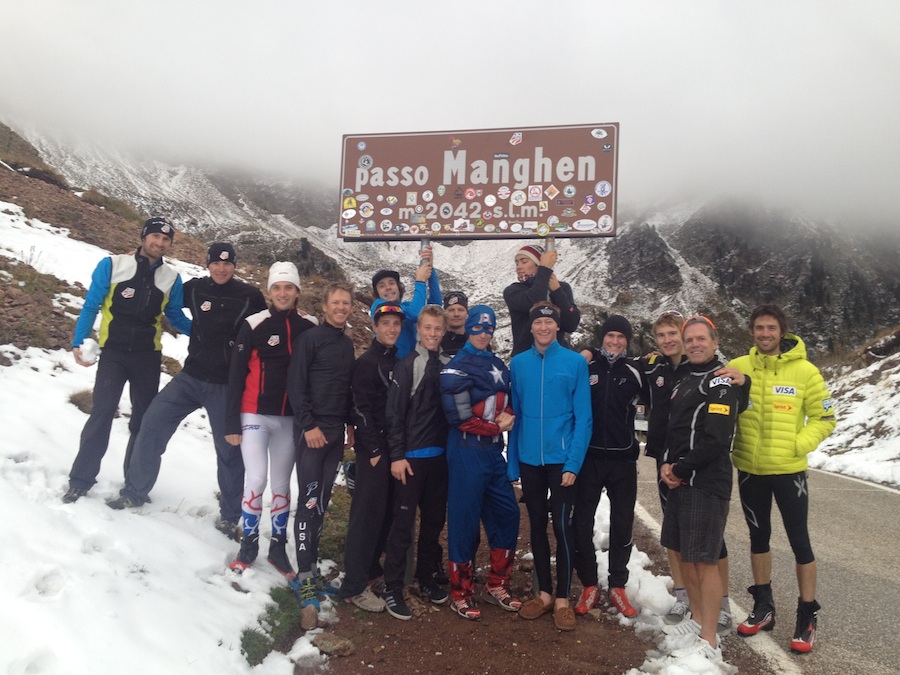
    The U.S. Nordic Combined Ski Team and NTG after doing intervals up Passo di Manghen in Trentino, Italy, during a training camp Oct. 15-25. Captain America (a.k.a. Taylor Fletcher) even made an appearance. (Photo courtesy of Martin Bayer)

    The U.S. Nordic Combined Ski Team strives for a lot of things – medals, depth, continued improvement – but flying under the radar isn’t one of them. Anyone who followed the team and one if its racers, Taylor Fletcher, for the past 10 days in Europe could tell you that.

    The younger of two brothers on the team, Taylor, 22, ran around in a full-body Captain America costume throughout the trip from Oct. 15-25, which included stops in Val di Fiemme, Italy, and Oberstdorf, Germany. The reason? He lost a bet with A-teamer Billy Demong for lowest cumulative time in World Cup competitions last season. But when you look at the video of Taylor rollerskiing and trying to catch a football in the bulky suit, it looks like he’s having fun.

    That’s the entire U.S. Nordic Combined squad in a nutshell. With 10 men between the A and B teams this season – up three from last year with the addition of Adam Loomis, Erik Lynch and Michael Ward – they’re close-knit and comical. However, with the start of the 2012/2013 season about four weeks away, they also know how to get down to business.

    The entire team (excluding Lynch who was home recovering a broken wrist) and its National Training Group (NTG) traveled to Europe nearly two weeks ago for a camp largely focused on jumping. With the financial support of the National Nordic Foundation and a budget initiative from the U.S. Ski and Snowboard Association/U.S. Ski Team, 13 skiers attended the team’s second overseas camp of the season. A-team member Bryan Fletcher, 26, felt the large group made a difference.

    “The 4 young guys [Tyler Smith, Alec Gantic, Spencer Knickerbocker and Ben Berend] are full of energy and it’s awesome for us to have an opportunity to share our training with them,” he wrote in an email. “They are definitely the future of US NC so it’s important to provide them with the best possible training as early as we can.”

    In a blog post before flying back to the U.S. on Thursday, Loomis explained they ended camp with a two-man team event on Oberstdorf’s big hill and 1.5-kilometer sprint course. Teammates tagged off between laps to race 7.5 k apiece.

    “Billy and Nick [Hendrickson] cleaned up,” Loomis wrote. “But it was a good fight for the next few spots (the middle guys always seem to have the strongest teams — and they didn’t exactly have great races in Predazzo).”

    The ski jumps at Val di Fiemme, Italy, the site of the 2013 World Championships from Feb. 20-March 3. (Photo: Nick Hendrickson/haveskiswilltravel.tumblr.com)

    The team did several interval sessions and a few time trials in Italy, according to U.S. Continental Cup and development coach Greg Poirer.

    It was quite a sight to see more than a dozen “Team USA” guys flying around parts of the Marcialonga marathon course on rollerskis, he added. They wanted to train at the site of the 2013 FIS Nordic Ski World Championships for that reason.

    “One of our philosophies is to become as familiar as possible with the facilities/venues where we have major events (i.e. Vancouver, Oslo, Val di Fiemme and, of course Sochi),” Poirer wrote in an email. “In addition to scheduled World Cups or so called ‘test events’ at these venues, we try to spend quality training time, as well, to enhance our preparation for these major competitions.”

    U.S. head coach Dave Jarrett said they chose Oberstdorf because its jump has an iced inrun in October. His staff hoped that would provide adequate preparation before the team could jump on snow at home in Park City, Utah, within the next month. The World Cup season starts Nov. 24-25 in Lillehammer, Norway.

    Before they go full steam ahead, Poirer explained U.S. Nordic Combined has some distinct goals: namely three medals at World Championships.

    “It’s the same goal we set for Vancouver, Oslo and Sochi,” he wrote. “Three medals sets the bar very high but as the team proved in Vancouver [at the 2010 Olympics] … doable!”

    He credited their success at the last Winter Olympics – with Demong winning gold, Johnny Spillane taking two individual silvers, and the team placing second in the relay – partially to being familiar with Whistler Olympic Park.

    “We are using resources to duplicate, to the best of our ability, the familiarity of Vancouver here in Val di Fiemme as well as Sochi,” he wrote. “So far, Sochi has been a little difficult to organize training outside of test events.”

    That’s why they focused on Italy. Back in Park City, Jarrett prepared to fly to a different part of the world: Tokyo. On Sunday, he spoke at an altitude training conference at the Japanese Institute of Sport Science (JISS). U.S. Olympic Committee senior physiologist Randy Wilber nominated him to do so, and Jarrett said it was an honor to join the ranks of international presenters. In the past, renowned people, such as Michael Phelps’ coach Bob Bowman and U.S. cycling coach Dean Golich, spoke at similar conferences.

    “They were looking for a coach from the U.S. that uses altitude training and has experience in it,” said Jarrett, who has presented at a couple of Wilber’s altitude conferences in the U.S. as well.

    In a phone conversation, Jarrett explained he’s been interested in the effects of altitude for a long time, especially living around 7,000 feet above sea level in Park City. What he shared was mostly based around that.

    “I don’t want to give away too many secrets, but it’s also not a big secret, either: We use altitude training because live at altitude anyway,” he said. “We are almost doing it a little backwards than what most other nations are because they’re usually going up to altitude to acclimatize and go back to sea level to race. We’re always at altitude so we have to reverse-engineer it: how do we live all the time at altitude and be ready to race at sea level?”

    In his first time in Tokyo for more than a night, he wrote in an email that the JISS was “a pretty amazing place.” Jarrett was back in Park City on Monday and trained with juniors Wednesday at Soldier Hollow, where snow was spotted that morning. Early Thursday, he reached out to the Norwegian nordic combined team, which is finishing up a monthlong training period in Park City, via Twitter: “Skiing this morn?”

    2012/2013 U.S. Nordic Combined Ski Team

    A-team

    Billy Demong (Vermontville, N.Y)

    Bryan Fletcher (Steamboat Springs, Colo.)

    Todd Lodwick (Steamboat Springs)

    Johnny Spillane (Steamboat Springs)

    Taylor Fletcher (Steamboat Springs)

    B-team

    Brett Denney (Steamboat Springs)

    Nick Hendrickson (Park City)

    Adam Loomis (Eau Claire, Wis.)

    Erik Lynch (Steamboat Springs)

    Michael Ward (Aspen, Colo.)

    Coaches

    Head Coach: Dave Jarrett

    World Cup Jumping Coach: Chris Gilbertson

    Continental Cup/Development Coach: Greg Poirer

  • USST Athletes Descend on Park City, Join Several Others

    USST Athletes Descend on Park City, Join Several Others

    The Canadian women’s nordic training group on Thursday, including biathletes Rosanna Crawford (second from left) and Zina Kocher (third from right), American Jessie Diggins (second from right), and Germany’s Monique Siegel (front right). (CCC photo)

    The U.S. Nordic Ski Team’s final dryland camp of the season starts in earnest on Monday, but many of its athletes are already getting after it in Park City, Utah.

    Liz Stephen, Noah Hoffman and Tad Elliott generally live in the high-altitude training mecca when they’re not traveling, and Jessie Diggins arrived almost a week ago. According to U.S. Ski Team (USST) head coach Chris Grover, the Alaska Pacific University (APU) athletes rolled into town on Wednesday. He outlined an “early arrival” routine for skiers like them, with some bounding and intensity, a distance rollerski, roll/run combo and testing at the Center of Excellence beforehand.

    U.S. Nordic Ski Team member Tad Elliott (tucked behind leader Bill Demong) works out with the U.S. Nordic Combined Team earlier this week at Soldier Hollow in Midway, Utah. (Dave Jarrett photo)

    Between that and the presence of U.S. Nordic Combined and Canadian men’s and women’s teams, they’ll probably stay busy.

    By Monday, the entire USST will unite in Park City, at which time they’ll delve into the main course: a weeklong training camp that runs Oct. 9-16.

    Grover wrote in an email that the primary goal is exposure to altitude living (at nearly 7,000 feet above sea level) and increase in hemoglobin (Hb) mass. The idea is to boost the athletes’ oxygen capacity before they start racing in Europe in late November.

    Another reason the USST is returning to Park City is follow up on labs tests taken in earlier this spring and summer. Grover wrote they’ll determine where athletes have made progress and where they need more work. Testing takes place during the first two days of camp in both the morning and afternoon.

    After that, there will be some distance rollerski sessions, bounding and skate intensity and lower-elevation training (in Soldier Hollow or Salt Lake City) mixed in with recovery workouts. On Oct. 17, the USST coaches will drive north to Canmore, Alberta, while most of their skiers fly to meet them at Frozen Thunder (Canmore Nordic Centre’s 2-kilometer loop of stockpiled manmade snow).

    “The goal of the Canmore period is to get on snow and to work on technique before heading to the World Cup, and to tune up for racing with some on-snow time trials,” Grover wrote. “The entire team will be in Park City and most of team in Canmore, the exception being the Alaskans who will head home to find snow.”

    Other notes:

    — German skier Monique Siegel has been training with the Canadian women and Diggins and Stephen in Park City. According to U.S. women’s coach Matt Whitcomb, they joined the Canadians for an interval session on Thursday.

    “We haven’t lined up very well for too many workouts as we are just beginning our altitude acclimation period with Jessie and Liz, and the Canadians are in full training camp swing,” he wrote in an email.

    Siegel will continue training with the Americans through Sunday when she heads back to Germany, Whitcomb wrote.

    — Just as it did in July, the U.S. Nordic Combined Team is hosting Norway in Park City. The Norwegian Nordic Combined Team will be in the area for about a month, U.S. head coach Dave Jarrett explained. Meanwhile, his guys will travel to Europe for a jumping camp from Oct. 15-25.

    “It is very busy in PC,” Jarrett wrote. During his team’s time trial Wednesday morning at Soldier Hollow, the Canadian men’s and women’s biathlon squads were also there, along with the Canadian women’s nordic team.

    “We are here, US XC men and women will be here, Canadian XC men and women, Canadian BT [biathlon] men and women, Norway NC, and US Para [Paralympics] team will be here as well,” he wrote. “Would be fun to get one session together but probably not feasible.”

    — The Canadian men’s cross-country team leaves Park City on Tuesday after more than two weeks of dryland training. The women’s team departs Saturday for St. George, Utah, about a five-hour drive south, where they’ll train through Thursday.

  • Demong Conquers Hurt in the Dirt Duathlon

    Demong Conquers Hurt in the Dirt Duathlon

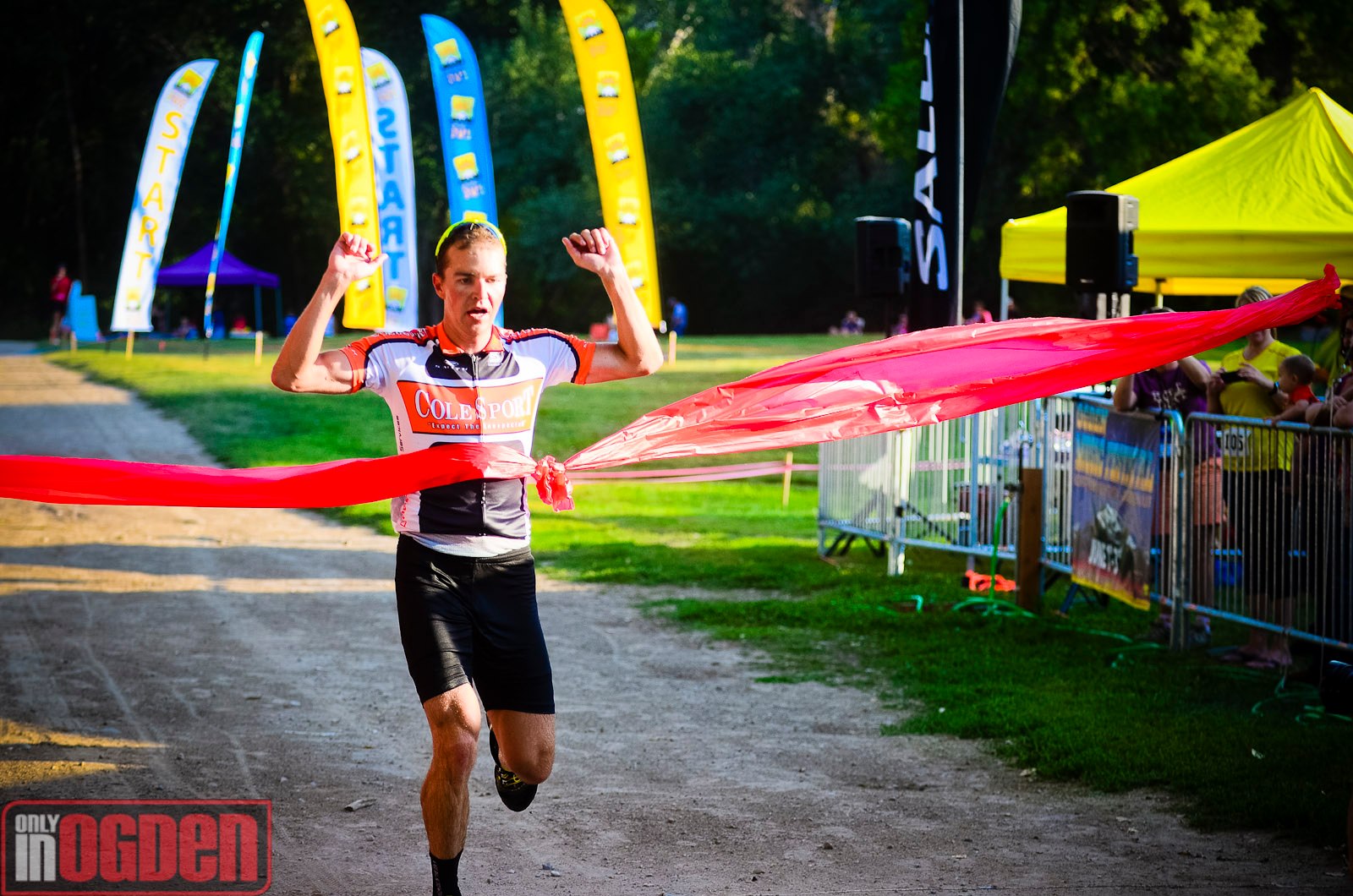
    U.S. Ski Team nordic combined skier Billy Demong breaking the tape at the third annual Hurt in the Dirt trail run and bike race in Ogden, Utah, this Saturday. Photo: Only in Ogden.

    U.S. Nordic Combined Team veteran Billy Demong took a break from ski-specific training last Saturday to compete in the Hurt in the Dirt duathlon, a trail run and bike race in Ogden, Utah. Racing against individuals and relay teams alike, Demong won the event outright in 2:01:12, over a minute ahead of a two-man team from Sandy, Utah, and over four minutes ahead of individual runner-up Weston Woodward.

    “I’ve never done a race like this,” Demong said. “Some friends were doing it and I’ve been wanting to race, but haven’t found any other good running or bike races that appeal to me right now.”

    Demong is no stranger to offseason challenges. This time last August, the Olympic gold medalist had recently completed the Leadville Trail 100 mountain-bike race in Colorado.

    “I’m not really in shape for a 100-mile bike race right now, so this was the perfect thing to do to get some cross-training in,” Demong said.

    The run-bike-run-bike traversed a grand total of 8 miles on foot and 20 miles on the bike. By itself that may not seem like a lot, but a course designed to make participants hurt had some extra challenges thrown in. Competitors crossed through sand, mud, trees and the Weber River multiple times.

    “You had to swim across the river, you’re constantly snaking through trees, and on the bike you have to dismount to do a river crossing, too,” Demong said.

    He came through the finish with a sizeable lead, but a few relay teams managed to get close enough to challenge him earlier in the race. The competition he was really looking out for, multi-time USA Cyclocross champion Jonathan Page, took a wrong turn and broke his bike chain early on. Page ended up as the third individual in 2:09:50.

    “He still managed to finish a few minutes back, but it would have been an exciting finish, I think,” Demong said.

    Hurt in the Dirt results

  • From France to Sochi, Taylor Fletcher Talks About Whirlwind Trip (with Video)

    From France to Sochi, Taylor Fletcher Talks About Whirlwind Trip (with Video)

    U.S. Nordic Combined team members Bryan Fletcher (l) and Taylor Fletcher (second from left) at Stage 11 of the Tour de France, just 1 kilometer from the top of the Col de la Madeleine with their cycling trip’s VIP members Walter McCormack (c), Jon Schafer (third from right), Eric Oberg, and Jed Hinkley (r). (USST photo)

    Just over two weeks ago, the U.S. Nordic Combined Ski Team set foot in France and immediately hopped on their road bikes. From there, they embarked on a weeklong cycling camp and watched two stages of the Tour de France along the way.

    In all, they rode more than 600 kilometers and tallied some 14,500 meters of climbing, including a team time trial up L’Alpe d’ Huez. The team’s youngest A-team member, 22-year-old Taylor Fletcher clocked the fastest time up the nearly 15-kilometer ascent, which gains about 3,600-feet of elevation on an overload of switchbacks.

    FasterSkier spoke with Fletcher on the phone Tuesday after he arrived in Park City, Utah, earlier that morning. Fletcher and his U.S. Ski Team (USST) teammates recently returned to the U.S. after ending their trip in Sochi, Russia, where they competed in the first competitions of the FIS Summer Grand Prix.

    Before that, the U.S. squad visited Oberstdorf, Germany, where the A-team spent a day and a half reminding their legs how to jump after so many hours on the bikes.

    (Note: Check back for another FasterSkier story on the U.S. team’s experience in Sochi, including what its members thought of the venue and they’re feeling at this point in the summer. Below is a video about the team and the Tour made by Fletcher’s older brother, Bryan.)

    ***

    FasterSkier: How many times have you personally seen the Tour de France in person?

    Taylor Fletcher: That’s my second time going over there and checking it out. We saw two stages this trip and two last trip. They’re really fun to go to, but watching them on TV is almost better because you can see the whole race, not just the 10 seconds they come by. The first year what was really cool is we were able to go watch the stage and ride down, go to the car, drive back to the hotel and watch the finish. That’s definitely the way to do it.

    FS: Did you something similar this year?

    TF: We did it one of the days. Actually what we did, which was really cool, we biked to watch the stage, watched them come by and they still had about 18 kilometers to go and so then we biked down, went to a bar with a bunch of people, ordered pizza and watched the last climb. So that worked out pretty good.

    FS: What’s it like being at the Tour?

    TF: It’s nuts. I would compare it to any of the biggest events in the U.S. or even the Olympics. There’s people lining every climb, pretty much the whole way up, and some are hammered from 2 o’clock, from pretty much 11 o’clock until they are sober enough to un-park their campers and drive down. Then you have people who are riding from their houses and climbing up, so you have pretty much anybody that you can imagine up there, and it’s just a great atmosphere. Everyone loves it and they’re all cheering for everybody. It’s just a great time.

    FS: Did watching them make you ride faster?

    TF: Definitely. The whole purpose is to go over there and bike and enjoy ourselves and have fun with what we’re doing. We’re going to watch people that are the best in the world at doing it, so we try to be like them, which is fun. It’s not very successful for us because we’re still, like, beginners compared to them. It’s crazy. There’s hundreds of people in the roads so it’s almost more like the interstates become bike paths and you can bike anywhere.

    FS: How did the team time trial go up L’Alpe d’ Huez?

    TF: Going back like a month ago … we did a race up Sundance Resort [in Utah] and they have a really nice road there. I think it’s like eight miles of really nice road and it winds through the trees. [U.S. Ski Team sport science trainer Alex Moore] based everybody off a relative threshold, so everybody spun around on a stationary bike and figured out what their threshold was, and he set everybody up. [One] freeskier, she started 32 minutes ahead of Tad Elliott and Noah [Hoffman] and I. Based on your threshold you were either closer or some guys were like five minutes ahead of us, some were like 15. The idea of that was to get everybody to come to the finish line at once, so it was almost like a mass sprint. It wasn’t as close, [though].

    Billy [Demong] wanted to try to do the same thing with the Alpe d’ Huez time trial, but he didn’t have the same data that the sport science guys have. He started a minute and a half ahead of me, and he beat me to the top by 30 seconds, but I raced it a minute faster than him. It was kind of like he won, but I had the fastest time. I was 47:30 and he was 48:30.

    I don’t remember who started first, but they started, like, 25 minutes ahead of me. I was the last person to go. It’s funny, every time you start the race, you’re like, ‘There’s no way I’m going to catch this person, 25 minutes is way too much on a 50-minute climb,’ and then sure enough at the top, you’re going past them, like ‘Holy crap, I can’t believe I just made up 25 minutes on that first hill.’ It’s pretty interesting and it’s kind of fun because you never know who’s going to win.

    FS: How hard is it?

    TF: It was hard. The first 2 [kilometers] average like 11 percent, but the first 2 k’s are steep and it starts to level out. I think the average gradient for the whole thing is 8.1 percent.

    FS: How are you feeling about your fitness considering how you did there and also in Sochi on Sunday, with a career-best Grand Prix result of 10th?

    TF: I feel like I’m at a good level. I’ve been biking really strong all spring up until now, and I haven’t really spent much time on rollerskis. I definitely don’t feel like I’ve overtrained, I don’t feel like I’ve undertrained, I just feel like I’m right at that perfect level and the more time I’m going to spend on rollerskis, the better I’ll get. Leading up to nationals next week, I think I’m at a really good level and I’m excited about it.

    FS: What exactly did you do in Oberstdorf (the site of the next set of Grand Prix races in late August)?

    TF: We basically went there to have a couple jump sessions and we had one interval session at the rollerski course there, which is a really nice course, just to get our normal cross-country legs underneath us … after biking for a week.

    We’ve jumped there pretty much every year. We had a World Cup there last year, and usually every summer we go there for a couple sessions because it’s a really nice facility.

    FS: How was Sochi?

    Looking down from the 2014 Winter Olympic jumping complex near Krasnaya Polyana, about a 1-1/2 hour drive from Sochi, Russia. (Photo courtesy of Taylor Fletcher)

    TF: It’s unbelievable, just the area is absolutely beautiful. Everyone said it kind of reminded them of East Coast, Vermont. The mountains are 3,000 meters high. It’s nuts; there are big mountains and it’s a true ski town. If they were to cut more trails, they could have resorts up and down the valley.

    It’s kind of crazy that whole entire area is under construction and just big buildings are going up everywhere. They’re building a giant rail system from the airport all the way up to the Olympic venues, all the skiing venues and stuff. That’s going to be amazing when it’s all finished. Right now it reminds me of, like, SimCity, just thousands of guys running around. They don’t even wear hard hats or shirts, all they have is their tools and they’re just working day and night.

    We’re going back there this winter for World Cup, so it’ll be pretty interesting to see how much more they’ve gotten done by the time we’re there. I would think they should have everything done by the Olympics, and once it’s done it’s going to be a really impressive town.

    FS: Why were you disqualified for your suit on Saturday?

    TF: I have an undersuit, like a one-piece undersuit that is head to toe, and I like it because it’s tight and it [fits] underneath the jumpsuit so it doesn’t catch. I had cut some holes in there, which were legal last year, but they changed the rules and you’re not allowed to have them anywhere. So I had to go get tested and [the official] felt that I had some holes, and now they’re being really strict with rules to enforce them for the winter so they had to disqualify me, so that was a bummer.

    I found it out after I jumped on Saturday. If I found it out before, I could have just cut it off and skied, but I didn’t know that. It’s just my suit that goes underneath my jumpsuit … it’s just really more comfort than performance.

    FS: How did you feel about Sunday’s performance (when you were 16th on the large hill, eighth in the race and 10th overall)?

    TF: I was extremely happy because definitely some of the best jumpers were there that usually jump top five, and I was jumping pretty well in comparison to them. I had a pretty good race; I had one little spill. I slipped on some water and fell down.

    There was a section you could hand water to the racers. [The first day when I was disqualified,] I gave Bill a feed of sports drink and everyone else just wanted me to pour it on them. I was just giving them bottles of water and dumping it on them. Bill got disqualified the second day [because of his suit] so he did the same thing. He threw it and it hit my back wheel and I just instantly slipped out. It was like I was running on ice and fell down, and I got back up and I kind of spazzed to get back where I was and I definitely think that cost me a lot of energy so I’ve got to work on that for sure. … Other than that I think it was a good showing. Everyone was happy.

    FS: What was it like seeing teammate Todd Lodwick at the top of the podium on Sunday after he took second on Saturday?

    TF: It’s good to see Todd doing well after taking a year off last year, and it’s good to see everyone else doing well. Everyone wants to take the first spot. Only one person can do that. It is what it is, you can’t change it, you can only wish to do better.

    To have three or four in the top 10 is even better [Lodwick was first, Johnny Spillane placed seventh and Fletcher finished 10th on Sunday]. It shows the depth of the team and what we’re doing for summer training seems to be worthwhile and it just increases the motivation of the rest of the team to get to that level and continue to improve so they can have their chance up there as well.

  • Norwegian NoCo Team Likes Taste of Park City

    Norwegian NoCo Team Likes Taste of Park City

    Norwegian nordic combined A-teamer Mikko Kokslien (l) and Bryan Fletcher of the U.S. Ski Team riding together near Park City, Utah. The Norwegian national team spent nearly three weeks in the area for altitude training during a joint camp with the Americans. (Photo courtesy of Mikko Kokslien)

    In their first collective visit to Park City, Utah, several members of the Norwegian nordic combined team couldn’t get over the place.

    There was never a cloud in the sky, and even unseasonably cold days weren’t that bad. People were nice, the motorists were considerate, and the training possibilities were endless.

    Following a three-week camp with the U.S. nordic combined squad last month, Norwegian A-team member Mikko Kokslien wasn’t the only one considering buying a condo there.

    Norwegians Magnus Krog (l) and Håvard Klemensten followed by U.S. Ski Team member Bryan Fletcher (far right) and some others during a group rollerski with the U.S. nordic combined team in Park City, Utah. The joint dryland camp took place June 6-26. (Photo courtesy of Dave Jarrett)

    His teammate, Håvard Klemetsen, who was last in Park City about 11 years ago, was sure he’d be back as well.

    “We are not use to so open and friendly people, especially when we where out training,” Klemetsen, 33, wrote in an email after their camp from June 6-26. “In our culture people don’t say hello when they meet strangers – I like the open and enthusiastic people in Park City.”

    Reflecting on the trip from home in Lillehammer, Kokslien, 27, wrote that the altitude camp was the best of his career. He was last in Park City in 2006 during the World Cup ‘B’ competitions, but didn’t exactly get a feel for the area.

    “Now we had good time and really enjoyed staying in Park City,” Kokslien wrote. “Maybe I’ll move there some day.”

    History in the Making

    By the time the five Norwegian athletes, including Magnus Krog, Gudmund Storlien and Jørgen Graabak, and their head coach, Kristian Hammer, left a week ago, U.S. head coach Dave Jarrett knew they had a good time. In the first joint camp between the teams, his skiers enjoyed having them around as well.

    In a phone interview, Jarrett said their ties with Norway have historically been strong. He could personally trace it back to the summer of 1992 when he hosted Norwegians Baard Jørgen Elden and Fred Børre Lundberg for a few weeks in Steamboat Springs, Colo. Lundberg went on to win world titles and Olympic gold medals, and Elden later coached Jarrett on the U.S. Ski Team. Today, Jarrett said they remain close friends.

    While Norwegian no-co skiers had trained in the U.S. in the decades since, they had not made an official team trip until this year. Head coach Kristian Hammer scheduled the American altitude camp last winter, taking Jarrett up on his longstanding offer.

    U.S./Norwegian NoCo Camp:

    Who: U.S. and Norwegian nordic combined teams.

    What: Three-week joint dryland camp in Park City, Utah. Involved jumping, rollerski intervals, OD run-rolls, road biking, golfing and more.

    Roll call: Every member of the U.S. team attended at least part of the camp, including Johnny Spillane and Todd Lodwick.

    Norway’s A-team was there,  minus Magnus Moan (coming off Achilles surgery in May) and Jan Schmid (busy with final exams)

    “I’ve always extended the invitation for years for them to come to Park City, but it was only until now that Kristian really pulled the trigger on it,” Jarrett said.

    With plans in place, Hammer asked for some help with logistics, and Jarrett gladly jumped in to help with accommodations and ground transportation. The team, which included two coaches and a PT for part of the trip, stayed in condos overlooking Park City’s golf course. Kokslien played several rounds with U.S. Ski Team member Taylor Fletcher.

    “He got me the first day, but the next day I might’ve played my best round ever,” Fletcher wrote in an email.

    Aside from meeting up for barbecues and dinner, athletes from both teams spent most of their time training together – first on the jumping hill and later on rollerskis and road rides.

    Fletcher, 22, wrote that he learned a lot from the Norwegians during the jumping portion of camp. His older brother, Bryan, said it was nice to show them around for a change.

    “It’s not an every-day opportunity that another team gets to come to the U.S. and train,” Bryan said on the phone. “Hopefully they’ll have a good report to send home to other athletes so that next year and the year after that, more people will want to come here instead of being solely based in Europe.”

    Role Reversal

    The Americans are typically the ones playing tourist, traveling to Norway in late August for training camps and racing in Lillehammer’s annual uphill sprint race in early September. This year, the U.S. team heads to France on July 8, where they will spend a week chasing cyclists in the Tour de France before competing in first races of the FIS Grand Prix in Sochi, Russia. There they’ll also get a chance to preview the 2014 Olympic venue.

    U.S. nordic combined teammates Johnny Spillane (l), Billy Demong (c) and Bryan Fletcher working out in Park City during their training camp in June. (Photo courtesy of Dave Jarrett)

    They’ll return to Park City for nationals in August, but Jarrett said he was trying to get his to central Europe in September/October for additional camps with the Norwegians. Next year, he said there was a good chance Team Norway would be back in Park City.

    “They were pumped about coming back next year,” Jarrett said. “Kristian and I talked about [them] coming back in October possibly next year. That’s a good time for training here, it’s still sunny whereas other places it’s starting to get rainy and snowy.”

    In the past, Norwegians sometimes avoided altitude training, believing it did little to boost performance, Jarrett said. While they spent the first few days following a rigid protocol to acclimate to Park City’s 7,000-foot elevation, Jarrett said they joined his team for most workouts thereafter.

    “You didn’t hear the typical, ‘Oh it’s so hard, I feel this bad,’ things like that,” Jarrett said. “They were all into it and we had great weather and they were pretty psyched about doing it again.”

    Jarrett was excited to have them there for a change.

    “It was awesome for us to have three weeks with those guys, not just cross-country wise but almost more importantly on the jumping hill,” he added. “We usually have to pay to go to Europe to do that so this was almost no cost to us to have them here.”

    Kokslien snapped a photo while in awe of the U.S. nordic-combined jumping facility in Park City.

    Kokslien wrote that while the main purpose of the camp was altitude training, it was just as important for them to learn from the Americans, especially Olympic gold medalist Billy Demong.

    “In the summer we don’t often get to see how the other teams are training, so its also nice in a way we can learn and see how they are working in the US,” he wrote. “I have always looked up to and learned a lot from Bill. To be with him and the rest of the American team, gives me and our team a good motivation for the winter. The American team has a really good work ethic, and I think many can learn from them.”

    Demong explained in an email that such relationships have existed for years and didn’t end at competitions. In a World Cup race last season, Demong teamed up with Kokslien to pass several people for his best result of the year – third. Kokslien was second.

    It helped that Demong and his teammates spoke some Norwegian.

    “When it comes to training, we can have sessions with the Norwegian team and it becomes almost like one big team,” Demong wrote. “We do long easy skis without egos and time trials and interval sessions constructively pushing each other to go faster and learn from one another. Also the contact on the jumping hill is always very important as they are some of the best.”

    — Audrey Mangan contributed reporting.

  • Pittin Sweeps for Italy; Demong and Spillane Notch Season Bests

    Olympic gold medalist Billy Demong at the 2010 Vancouver Games

    In some ways, starting off average works well for Billy Demong.

    It’s not that he would prefer to rank 21st out of 54 athletes, although for some nordic combined athletes, that would be a good jump in the World Cup.

    For Demong, a four-time Olympian and gold medalist, that result meant he was about 20 spots away from where he wanted to be.

    On Sunday, the 31-year-old attacked the afternoon 10 k Gundersen start as he would have liked to on the 118-meter large hill in Chaux-Neuve, France. It was Demong’s last day of World Cup competition for nearly three weeks, and he went for it.

    At the same time, so did his U.S. teammate Johnny Spillane, who ranked 20th in the morning jump. Working together, they captured their best results of the season as Demong finished sixth and Spillane placed eighth.

    Starting 1 second in front of Demong, Spillane charged ahead to chase down his competition, and Demong followed. For most of the four laps, Demong and Spillane worked with Norway’s Mikko Kokslien to move to the front and drop those behind them, Demong wrote in an email.

    They successfully caught second on the third lap, with only the weekend’s two-time defending champion, Alessandro Pittin (ITA), ahead. Demong held his position at the front of the chase group and attempted to drop his contenders on the last hill. In the end, he found he was too tired to sprint at the finish and fight for a podium spot.

    While sixth wasn’t first, second or third, Demong was satisfied with his progress.

    “I’m feeling good overall, building again,” Demong wrote. “My goals for this season are basically to get back on the podium and win. I’m also still satisfied to be struggling a bit as it fields my motivation to train harder.”

    By struggling, Demong and Spillane and the rest of the U.S. crew generally mean their jumping. On Sunday, Demong clocked the third-fastest 10 k time (21:34.6) and Spillane had the fifth-fastest split (21:42.6).

    Kokslien was the fastest of the day (21:30.6), and after starting 24th,  the Norwegian placed third. Pittin picked up his third-straight victory of the weekend in 22:18.1 after becoming the first Italian to top the World Cup podium on Friday. Joergen Graabak (NOR) was second overall.

    “They key to today’s race was jumping,” Pittin told EuroSport Italia on Sunday. “There, I made a difference.”

    If Demong, Spillane or any of the other Americans had ranked fourth after the jumps, like Pittin, it’s likely they could have ended up in even better positions.

    “The level both on the hill and on the course is really high,” U.S. Nordic Combined Head Coach Dave Jarrett said. “In order to win you have to very good at both sides in every comp.  Not very much room for mistakes.”

    American Bryan Fletcher placed 26th after ranking  28th in the jump. His brother, Taylor, finished 39th after starting 51st and Nick Hendrickson moved one spot down from 50th in jumping to 49th overall.

    On the road almost as soon as the three-day competition ended, Jarrett said his athletes would fly home to train in Park City, Utah, and Steamboat Springs, Colo., for at least a week. The team will reunite in early February when the World Cup starts up again with a penalty race, team sprint and Gundersen start in Predazzo, Italy.

    Sunday’s overall results.


  • Demong’s Error Costs Him; Fletcher 16th in Penalty Race

    Demong’s Error Costs Him; Fletcher 16th in Penalty Race

    Lillehammer World Cup, nordic combined
    Billy Demong competes in the snowy 10 k gundersen start on Saturday in Lillehammer, Norway. After placing 25th on Saturday, he was in the running to make the top 20 in Sunday's race, which was slightly faster with packed powder, but Demong was disqualified for completing three of four penalty laps. Photo courtesy Dave Jarrett.

    Their plan had been so simple. Stay loose, ski strong and play the first World Cup penalty race by ear.

    The two Americans that qualified for Sunday’s competition in Lillehammer, Norway, Billy Demong and Bryan Fletcher found that worked well considering the circumstances.

    As they completed the first of five laps on the 10 k course, Demong and Fletcher watched dozens of skiers take their penalty loops at once. Depending on how they jumped on the large hill earlier that morning, competitors were penalized with a certain number of 150-meter loops. The 41 athletes could complete them as they pleased during the first four laps of the mass start.

    Some of the athletes, like German winner Eric Frenzel — the second-best jumper and top skier in 28:38.5 — had no penalty laps. Others, like Demong and Fletcher, had the maximum of four.

    Ranked 32nd and 36th in the jumps, respectively, Demong and Fletcher took advantage of the mass start by moving immediately toward the front. About halfway through, they shared the lead. At some point, they’d have to take their penalties, but not yet.

    Fletcher decided to complete his loops all at once on the third lap, which left Demong in front. Frenzel soon moved up to share the lead, and as Demong peeled off at the last possible moment to do the biathlon-like penalties on his fourth lap, he wished the German luck.

    “I yelled at him, ‘Go win this thing,’ and he was like, ‘Thanks,’ and took off,” Demong said in phone interview from Oslo, Norway, where the Americans traveled to after Lillehammer.

    With no loops to hold him back, Frenzel won it ahead of France’s Jason Lamy Chappuis (+17.4), who was who had two penalties. Bjoern Kircheisen (GER) was third (+20.6), and skied an extra 300 meters as well.

    Fletcher ended up 16th (+1:28), his best result of the season, despite skiing an additional 600 meters, or 0.6 kilometers.

    But Demong, who had the same number of penalties and appeared to have finished in 11th, miscounted. As he returned to the race with one lap to go, Demong noticed he was a little farther ahead then he expected, considering each penalty loop took about 20 seconds.

    As far as he could see or hear from spectators, he was in the clear. Soon after finishing, Demong learned he was disqualified for skiing three laps, not four.

    “I kind of had this inkling that I didn’t do enough,” Demong said, adding that he counted the laps in his head initially and believed he had done four.   “I don’t know how I miscounted. I couldn’t tell you now.”

    While he took full responsibility for the mistake (coaches are not allowed near to penalty loop to assist athletes, and technology ensures there are no officiating errors), Demong was pleased with his performance. Considering his jump had not gone as planned, he was happy to have a strong race after placing 25th Saturday’s race.

    “I just totally didn’t play it right, didn’t have a smart race, and I paid for it,” Demong said of starting too hard and losing energy halfway through on Saturday. “After you have a race where you blow up that hard, it’s just good to get a good feeling again.

    “Finishing on a good race, even if it wasn’t the result I was looking for, gives me confidence,” he added. “I’d rather get disqualified when I get 11th place. … If I was on the podium and got disqualified then I would be super upset.”

    Fletcher, for one, was pretty excited. He started the day with the notion that he needed a solid jump, with only one or two penalties at the maximum, to be in contention for top 20. When he ended up 36th, he wasn’t thrilled.

    “I kind of thought the worst and went out thinking it would be a good race to get in the top 30,” Fletcher said. “Shortly thereafter, I found myself in the hunt for a top 20 and was kind of surprised by that. … I was just really happy that I had a good race.”

    He said skiing with a teammate in Sunday’s race was especially helpful. He strategized with Demong and skied a similar race — except Fletcher took his penalties sooner.

    “I knew I wanted to go in there when my legs were still fresh,” he said. “It’s actually pretty tiring going around those circles. It really works your legs quite a bit.”

    U.S. head coach Dave Jarrett explained the format was confusing, even though they raced it before in the Summer Grand Prix. Demong and Fletcher used Alessandro Pittin (ITA) as a benchmark on Sunday as the best skier with four penalty laps. While Jarrett wasn’t sure when Pittin took his loops, Pittin ended up 10th and Fletcher was just 20 seconds behind him.

    “So I think the strategy worked,” Jarrett said.

    “It’s pretty difficult to know what’s going on, who’s doing what,” he added. “The only information we had was from the coaches in the stadium watching the scoreboard and kind of watching the T.V. coverage.”

    While the jumping had been a sore point for most of the Americans — with Taylor Fletcher and Johnny Spillane failing to qualify with a sufficient jump lengths in Sunday’s trial — Demong said they were all improving and had done better outside of competition. A strong and variable tailwind on Sunday morning didn’t help.

    “Jumping is something that you build on in confidence more than anything,” Demong said. “And I think we can just get better and better on both the jump hill and in cross country.”

    Sunday’s complete results.

  • Taylor Fletcher Climbs to Career-Best 21st

    Taylor Fletcher Climbs to Career-Best 21st

    World Cup nordic combined
    Nordic-combined athletes practice on the hill in Lillehammer, Norway, on Friday. The previously-barren area was hit with several inches of snow on Saturday, and high winds led to the cancellation of the competition jumping. Friday's provisional jumps were used. Photo courtesy Dave Jarrett.

    With 44 competitors in front of him and six behind at the start of Saturday’s nordic combined 10 k, Taylor Fletcher knew he had his work cut out for him.

    Starting 2 minutes and 14 seconds behind the leader, Germany’s Tino Edelmann, the 21-year-old Fletcher took on the massive task of catching up after his provisional jump from Friday put him in 45th.

    Fletcher covered the difficult course, with about 4 inches of fresh snow and windy conditions, faster than all but one man — Alessandro Pittin (ITA), the overall runner-up, who finished the 10 k in 26:26.6.

    Pittin was second to Norway’s Haavard Klemetsen, who made his first podium appearance with the victory on Saturday. Klemetsen was the second man to start, 0.2 seconds after Edelmann, who placed third overall.

    “It was time,” Klemetsen said in a translated interview with NRK.  “It tasted very good.”

    Klemetsen skied the 21st fastest split on the snowy course, which had been surrounded by a snow-less landscape on Friday. Edelmann’s time ranked 27th.

    The younger of two Fletcher brothers in the race, Taylor finished in 26:38.9, which ranked second and bumped him to a career-best 21st overall (+1:08.5). His previous top result in a World Cup competition was 29th.

    “I was very happy with my all around results,” Taylor wrote in an email. That included Friday’s provisional jump, used when race organizers decided to cancel Saturday’s jumping portion because of wet and snowy weather and high winds.

    On Friday, the conditions weren’t exactly ideal, either. Taylor wrote that there was a “very hard tailwind,” and he considered 45th not a bad spot to be in, starting less than a minute behind the top 30.

    “I really knew I had a chance to score points today,” he wrote. “I started out strong and then followed some of the fast skiers as I caught up. Then I started to feel stronger in the race, which allowed me to put on a strong last lap.”

    U.S. Nordic Combined Head Coach Dave Jarrett wrote in an email that Taylor was solid on both the normal hill and the course.

    “We know he is one of the fastest guys out here and he showed it today,” Jarrett wrote.

    After Taylor, Billy Demong had the second-best showing for the Americans on Saturday. He was 25th (+1:19.8), after ranking 28th in the provisional jump and 22nd in the race.

    According to Jarrett, that wasn’t a bad jump for Demong, but he started too hard in the 10 k. Demong tried to stick with Magnus Moan (NOR), who started one second ahead of him, and Pittin, who started at the same time (1:18 seconds back from first), but fell behind on the last of four laps. Moan finished 12th (+31.9).

    “The course was very hard and many guys paid the price for starting too hard,” Jarrett wrote.

    10 k gundersen
    Bryan Fletcher in the No. 16 bib races with Janne Ryynaenen (FIN) on in the nordic-combined World Cup 10 k on Saturday in Lillehammer, Norway. Ryynaenen finished just ahead of Fletcher in 30th. Photo courtesy of Dave Jarrett.

    Bryan Fletcher found himself in a similar position, struggling with the final two laps after starting 16th. He wrote in an email that he had been excited about his potential to move up more, and planned to stay with a few fast skiers that could pull him to the front.

    About halfway through the first lap, Bryan was the one leading a chase group.

    “I felt great, so I thought nothing of it,” he wrote. “I skied on the front at my own pace and just tried to slowly make my way up. … This was all fine and great except by (the start of) lap three, I was still on the front and now the faster guys behind me were moving up to take the lead.

    “Even thought I still felt good, they felt better,” Bryan added. “The next two laps were painful to say the least.”

    He dropped from the top 10 to finish 31st (+1:39.1). His time ranked 38th of 50 finishers.

    “Although I was disappointed at the finish it was a good lesson to learn early,” Bryan wrote. “I will use today’s mistake as motivation for tomorrow.”

    The fourth American, Johnny Spillane opened his first weekend of World Cup competition in 35th. He had been 50th of 51 competitors in the provisional jump, and clocked the 18th fastest split — without much help. According to Jarrett, Spillane skied mostly alone, right behind Taylor, but was unable to catch him.

    With the challenges of racing in blizzard-like conditions behind them, the Americans looked forward to Sunday’s large hill jump and penalty-race format.

    While the weather was an unknown, many hoped the competition would go on as planned.

    As for goals, Taylor wrote that he wanted to jump in the “top thirty so I don’t have to ski up so many positions to get points!”

    Complete nordic-combined results. 

  • Kids in Tow, U.S. NoCo Racers Ready to Go

    Kids in Tow, U.S. NoCo Racers Ready to Go

    U.S. Nordic Combined veterans Todd Lodwick (L) and Billy Demong (R) celebrate 5th and 6th in the large hill individual comp at the 2011 World Championships in Oslo, Norway.

    If the U.S. Nordic Combined Team got together for Thanksgiving, there might be less football watching and more talk about the kids.

    That’s the way life is for almost half of the seven-man squad, with each of the “Big Three” aged 30 or older and with at least one child.

    “It’s a different dynamic than it has been in the past,” said head coach Dave Jarrett, who has two kids of his own. “But it’s also a sign that these guys aren’t taking this as a hobby. … This is what their job is right now and this is how they’re supporting their family.”

    Billy Demong, 31, was the latest to join the club when his wife, Katie, gave birth to their son, Liam, in January. While Demong said it’s not exactly all dad-talk when he travels with fellow veteran teammates Johnny Spillane and Todd Lodwick, it’s become a shared focus.

    “Having a child is definitely something that changes your approach on a lot of things,” Demong said in a phone interview from Park City, Utah. “Yes, it takes away a lot of time and energy, but it’s time and energy spent with your child.”

    Coming off a banner year in 2010, in which Demong captured two Olympic medals, including the first gold won by an American nordic skier, he took some time off to get married and renovate his Park City home last summer.

    The plan was to regenerate — especially if he wanted to repeat his success at the 2014 Winter Games — and return to top form by the 2011/2012 season.

    About a week before the team planned to fly to Finland for the World Cup opener in Kuusamo Nov. 25-26, Demong said he was ready to start the season. Like the two other dads and four 20-somethings on the team, the upcoming season was about setting personal goals.

    Without any Olympics or World Championships this season, 28 World Cup events remained. The Americans would try for top finishes in most of them.

    Goals

    According to Jarrett, the World Cup is the main focus of the team this season, mainly because it’s all there is. While striving for the overall title would be harder than preparing for one big event, it’s the goal the coaching staff presented.

    “We’re going to attend all the World Cups with the plan of chasing the overall as high as we can,” Jarrett said. “But we’re not living or dying by it either. We’ll adjust if needed.”

    For starters, the team will miss two races by opting not to travel to Almaty, Kazakhstan. Then again, if one of the Americans needs to race there, Jarrett said they might reconsider.

    “We’ll just have to play it weekend by weekend,” he said.

    In the long term, most of the team is focused on performing when it counts, Demong said.

    “What it takes to peak is not necessarily best for the whole season,” he said. “This is a good year for trying to find a high level and try to keep that … without sacrificing anything on either end.”

    While all the athletes work to find their groove, a few will try for World Cup podiums, Demong said. Personally, he would not approach the season with an overall-title-or-bust attitude. In 2008 and 2009, Demong finished third overall in back-to-back World Cups. The first time, he exhausted himself trying maintain second and ultimately placed third. The next year, Demong said he didn’t care as much and ended up third anyway.

    “To me, it’s not as important to focus on the overall; it’s important to focus on today and the here and the now,” he said. “It’s not something to stress from the beginning.”

    An exhausted Demong at the finish at the 2011 World Championships in Oslo, Norway.

    The Players 

    After somewhat of an off-year in 2010/2011, Demong still managed to come back to competition midseason and place sixth and seventh at the World Championships. In August, he was third in the debut of the penalty-race format at the Summer Grand Prix in Germany.

    While it was early in the season, Jarrett said top performances like those of Demong — who was on a similar pair of rollerskis as everybody else — were good indicators for the winter ahead.

    When Demong returned full time in April, he discovered he was more focused and motivated. With a family to look after, Demong said he wasn’t as carefree about his training and did less cycling to concentrate on nordic combined.

    Learning how to be efficient with his time helped him bounce back, he said.

    “I feel like I’m in as good shape as I’ve ever been in summer training,” Demong added. “And a lot of times, I’m not the best guy (on the team) anymore, and that’s really motivating.”

    Bryan Fletcher racing in the large-hill team competition at the 2011 World Championships, Oslo, Norway.

    Demong not the best? A few weeks ago, he was third in a team time trial. The Fletcher brothers — Taylor and Bryan — finished ahead of him in a respective first and second.

    Up-and-comers like Taylor, 21, and Bryan, 25, made a difference. While Spillane and Lodwick trained in Steamboat Springs, the younger teammates kept Demong honest in Park City.

    “We’ve always had this kind of focus on team training where the whole goal is to keep each other motivated,” Demong said. In the past, a few top teammates kept the others gunning for them.

    “To be honest, I think that Bryan and Taylor are as fast as those guys now,” Jarrett said. “It definitely helps to know that if you can beat Bill or you can beat Johnny, that you can pretty much beat anybody in the world.”

    With Demong, Spillane, Lodwick on the A-Team this season, Bryan finished 30th overall in the World Cup last year in his first full season on the circuit. Lodwick was the only American to do better, placing 25th.

    This year, Lodwick, who placed fifth at worlds, is approaching the season a bit more tentatively while dealing with some pulmonary issues. Jarrett said he has been coping with asthma for years; “he just can’t seem to shake it.”

    “His plan is a little bit more focused on certain events and not so much the whole season, per say,” Jarrett added.

    The oldest on the team with two children, Lodwick, who will turn 35 at the end of the month, will spend the beginning of the season with his family, Jarrett said.

    “Todd’s going to do a little bit of an abbreviated schedule to keep him in the game,” he said. “He’s kind of at that point in his career where he wants to focus on the big events, and since there’s no big events or World Championships this season … he’s not committed to (focusing) on the overall.”

    Spillane celebrating silver at the 2010 Vancouver Olympics.

    Three days before Lodwick’s birthday, Spillane will turn 31 on Nov. 21. This time last year, Spillane was recovering from a torn ACL, MCL and meniscus in his left knee. He managed to crack the top 20 at the World Championships despite the setback.

    Spillane entered this season injury-free, a claim he wasn’t used to.

    “Johnny’s been bitten, his whole career, with injuries,” Jarrett said. “2009/2010 was one of the first seasons he didn’t spend the spring doing rehab.”

    That year, he racked up two individual silver medals and another with the team at the Vancouver Olympics. While Lodwick did not make the 2011 Summer Grand Prix, Spillane and the Fletcher brothers all cracked the top-20.

    Joining Taylor on the B-Team, Denney and Hendrickson will try to break into a higher level of international racing, like Taylor did in placing 26th at worlds last year.

    “They continue to improve and that’s what we need,” Jarrett said. “Now with tightening budgets, the key to having an active winter is to be competing in the World Cup.”

    Last year, the 20-year-old Hendrickson finished a respectable 53rd in the Continental Cup and Denney, 21, was 58th overall.

    U.S. Nordic Combined, 2011, Mount Baldy
    While backcountry skiing on Mt. Baldy in Alta, Utah, Billy Demong (not pictured) snaps a photo of training partners Jeremy Teela, Nick Hendrickson, Bryan Fletcher, Brett Denney and Taylor Fletcher on Nov. 9. Photo courtesy Billy Demong.

    Starting Off

    While the team is scheduled to fly to Finland on Saturday, a last-minute decision could could change its plans. In the event of no snow in Kuusamo, which was the case for the cross-country World Cup opener, the races could be moved.

    “Murphy’s Law is that they’ll change it and cancel it while we’re in the air,” Jarrett said on Monday. “Hopefully I can stay ahead of it.”

    As of Friday, the team’s plans were in tact and its members were ready to roll. They started jumping on snow Saturday in Park City and Wednesday in Steamboat Springs, and Jarrett said they were the first two jumps open in the world.

    “We kind of feel like we have a leg up on everyone,” he said.

    Regardless of what happens with Kuusamo, the possibility of competing in Sjusjøen, Norway (which will host nordic-combined World Cup events Dec. 3-4), is good.

    The International Ski Federation decided to move the cross-country World Cup opener to Sjusjøen for this upcoming weekend because of its colder temperatures and snowmaking capabilities.

    Demong was confident the conditions would hold up for nordic combined.

    “That’s good for us because it kind of puts Sjusjøen on the line to make sure they have snow,” he said.

    ***

    2011/2012 U.S. Nordic Combined Team 

    A Team

    Billy Demong (Vermontville, N.Y.)

    Bryan Fletcher (Steamboat Springs, Colo.)

    Todd Lodwick (Steamboat Springs, Colo.)

    Johnny Spillane (Steamboat Springs, Colo.)

    B Team

    Brett Denney (Steamboat Springs, Colo.)

    Taylor Fletcher (Steamboat Springs, Colo.)

    Nick Hendrickson (Park City, Utah)