Tag: U.S. Nordic skiing

  • A 50-Year Wait Ends: Ben Ogden Takes Olympic Silver for U.S. Men

    A 50-Year Wait Ends: Ben Ogden Takes Olympic Silver for U.S. Men

    This article was made possible through the generous support of our voluntary subscribers who have helped put our Nat Herz on the ground at the Olympics. If you value coverage like this, please support FasterSkier with a voluntary subscription.

    Johannes Hoesflot Klaebo (NOR) crosses the line during the Men’s Olympic Classic Sprint semifinal while Ben Ogden (USA) and Lauri Vuorinen (FIN) (l-r) lunge for second during the semifinals of the Olympic Classic Sprint. (Photo: Vanzetta/NordicFocus)

    PREDAZZO, ITALY — Ben Ogden finished his semifinal standing upright, his skis still on, lungs burning in the familiar way that meant the work had been done, but the verdict was not. He crossed the line in third place — close enough to matter, not close enough to know if he would advance. As he waited and recovered, on another stretch of the course, the second semifinal was still unfolding, its clock still running, its outcome still capable of undoing everything he had just done.

    For a few minutes, the race was no longer about how he skied. Ogden, in this moment, had to wait.

    Out on the course, six more skiers were racing for two automatic spots and two chances to survive on time. The math of it was simple, brutal, and final. Either his time would hold, or it wouldn’t.

    In the stadium, just above the finish line, Andrea Ogden, Ben’s mother, stood with a friend, phone clenched in her hand, trying to make peace with the day as it already was. She had watched enough sprint races to know how easily they break. She knew what it meant that Ben had been edged into third. A podium was possible, but so was an ending that would look, on paper, entirely ordinary.

    “That would have been okay,” she said later. “That would have been a great day.”

    This wasn’t resignation. It was realism.

    While Ogden waited Jiri Tuz (CZE) and Oskar Opstad Vike (NOR), (l-r) stride their way to the top of the Zorzi Climb. (Photo: Barbieri/NordicFocus)

    Men’s sprint racing begins with a time trial that sorts athletes by hundredths of a second, and from there it becomes a sequence of increasingly narrow tests. Thirty advance. More than seventy don’t. On this day in Val di Fiemme, the margins were particularly cruel. Thirty-first place missed the heats by fourteen hundredths of a second. From twenty-second to thirty-first, was separated by just over a second — a slip in a corner, a missed pole plant, a hesitation where there could not be one.

    For the United States team, the line had already claimed one of its strongest skiers. Gus Schumacher was that racer who finished thirty-first, out by the smallest of margins. His Olympic sprint ended before it began.

    Ogden avoided that fate in the morning. He qualified second-fastest, behind only Johannes Høsflot Klaebo, the Norwegian who arrived at these Games with history in his sights. It was an early signal that Ogden’s form was real — but sprint days are not won in qualification. They are endured through rounds, managed through fatigue, and decided by timing as much as strength.

    He moved through his quarterfinal easily after gaining a big lead on the Zorzi Climb. In the semifinal, he held back, once again saving his effort until the final climb. There, he skied next to Klaebo and crossed the line, still unsure whether the result would hold.

    Five minutes can feel like an hour when a season or sometimes a career is compressed into a single time.

    When the final times from the second semifinal appeared, they came without drama. Ogden’s time held. He was through to the final.

    Only then did the day change shape.

    Six men would race for medals. Ben Ogden would be one of them.

    Johannes Hoesflot Klaebo (NOR) on his way to winning qualification. (Photo: Vanzetta/NordicFocus)
    Qualification: The Day Narrows

    Sprint days do not unfold evenly. They constrict. After the top 30 advance from the qualification to the heats, the field shrinks heat by heat. First to 12, then to six, and eventually to one.

    By the time the men’s classic sprint reached its decisive final, the field had already been reduced by not just the clock but also by the rapidly changing conditions, the soft corners, the hard, long climbs, and a finish stretch that at times required careful and unique tactics. What remained was not simply the fastest skiers, but the ones who had survived a sequence of increasingly challenging tests throughout the day.

    Ben Ogden (USA) steadies himself in the starting gate as he gets ready to start his day and chase his dream. (Photo: Barbieri/NordicFocus)

    The course at the Olympics is a 1.5 k sprint loop with a grinding climb. Klaebo set the fastest qualifying time with his usual economy, skiing exactly as hard as necessary and no harder. Ogden followed less than three seconds back, skiing with a balance he hadn’t always found earlier in his career, and to be fair, this season.

    Behind him, the time gaps shrank again.

    Zak Ketterson qualified twenty-third. JC Schoonmaker slipped in at twenty-eighth. Schumacher missed by fourteen hundredths. None of the Canadian men advanced. The difference between safety and elimination felt almost arbitrary, though every athlete on the start list knew it wasn’t.

    Johannes Hoesflot Klaebo (NOR) and Ben Ogden (USA), (l-r) crest the final climb before descending into the finish during the semifinals. (Photo: Barbieri/NordicFocus)
    The Heats

    Once the heats started, the race took on a new feel.

    Sprint brackets reward quick decisions and punish hesitation. Six skiers line up, two move on automatically, and the rest hope their times are fast enough to be one of the two Lucky Losers. Drafting is valuable, and position matters. Every downhill section encourages patience and positioning, but every corner can ruin it.

    Ogden skied his quarterfinal calmly, not pushing too hard, until the final climb. Ketterson’s race ended suddenly when he fell, his klister sticking at the worst possible time. Schoonmaker made it to the semifinals, but later stated that he just didn’t have what he needed on the final climb.

    By the semifinals, the race had stripped itself down to essentials. Like the quarterfinals, six skiers per heat. The top two in each advanced automatically to the finals. And again, two Lucky Losers did so on time as well.

    It was here that Ogden’s approach stood out. Earlier in his career, he had raced as if opportunity might vanish at any moment — attacking early, burning energy that never came back. Today, he waited. He skied the lower sections under control and trusted that something would still be there when it mattered.

    That restraint didn’t make the racing feel safe. It made the result possible.

    Erik Valnes (NOR), Ben Ogden (USA), Oskar Opstad Vike (NOR), Johannes Hoesflot Klaebo (NOR), Jiri Tuz (CZE), and Lauri Vuorinen (FIN), (l-r) start the men’s final. (Photo: Barbieri/NordicFocus)
    The Final

    Six men lined up for the final, and for the first time all day, everything was clear.

    There were no more clocks to watch or other heats to compare. The medals would be decided in one lap, based on position, timing, and nerve.

    From the gun, Klaebo and Ogden moved to the front side by side without urgency, setting a pace that revealed nothing until it started to. Norway’s Oskar Opstad Vike hung in the tracks behind the two leaders. The others followed, each solving the same problem: how long to wait until trying to break open the race or at least make a move for a medal.

    The course rewarded drafting, especially through the downhill sections and into the finishing straight. The question, however, was whether the medals could be won on the Zorzi Climb with an explosive attack that would open up a large enough margin so the draft wasn’t a factor.

    “I was definitely feeling it,” Ogden said later. “The body’s starting to hurt. But I figured that was my one chance.”

    Johannes Hoesflot Klaebo (NOR) celebrates as he comes to the line for the gold. (Photo: Barbieri/NordicFocus)

    The decisive move did come over the final hill, where Klaebo accelerated with the explosiveness that has made him nearly untouchable. As seen in so many races before, it was a surge meant to drop everyone immediately.

    Ogden tried his best to keep up with the attack, just as he had in the semifinal when he skied next to Klaebo.

    “I wondered a little bit in the semifinal,” said Haakon Klaebo, Johannes’s father. “They were really looking at each other.”

    In the final, though, Klaebo pulled ahead, as he often does. Behind him, the fight for silver became even more intense.

    As the climb reached the crest, Ogden gave one last surge that opened up a small enough gap on Vike so the Vermonter could get clear and avoid being overtaken by the Norwegian, as he had been in the semifinal by Finland’s Lauri Vuorinen.

    Ben Ogden (USA) double-poles with everything he has down the finish stretch to win silver. (Photo: Vanzetta/NordicFocus)

    Ogden stayed tucked down the final descent into the finish stretch before popping up and double-poling for the finish with everything he had left. In sprinting, skiers are often passed in the last hundred meters by someone who has saved just a little more.

    “I was double-poling down that final stretch,” Ogden said, “[hoping] no one comes sneaking up behind me.”

    No one did.

    When he crossed the line, he didn’t look back.

    Klaebo took gold. Ogden crossed second, winning the silver. Vike followed for bronze.

    Only after he crossed the finish line did Ogden let up.

    Ben Ogden (USA) waves to his fans as he celebrates the first American Olympic medal in 50 years. (Photo: Vanzetta/NordicFocus. For editorial use only.
    The Weight of What Came Before

    Klaebo did not come to Val di Fiemme chasing a single race. His sprint victory was another step in an attempt no skier has ever completed: winning gold in every Olympic cross-country event. Doing so would place him beyond even Marit Bjoergen, whose Olympic record has long defined the sport’s outer limit.

    His dominance framed the day, but it did not define it.

    Ogden’s silver mattered because of what it represented for American men’s skiing. The last Olympic medal by a U.S. man came in 1976, when Bill Koch won silver in Innsbruck. Since then, generations of skiers had come close without breaking through.

    Ogden grew up near that history, not as legend but as geography. He learned to ski on trails threading through maple groves and dirt roads in southern Vermont. Koch lived nearby, as in just a couple of miles away. The connection was literal, not symbolic.

    For years, Ogden raced with urgency, as if opportunity might disappear. In Val di Fiemme, he raced differently.

    What changed was not his strength, but his patience.

    Ben Ogden (USA) jumps on the podium to the delight of all his teammates, coaches, and fans who came to celebrate this moment with him. (Photo: Vanzetta/NordicFocus)
    After the Line

    Ogden skied through the finish, coasted toward the fencing, and bent forward, hands on knees. The medal was secure. There was nothing left to calculate.

    Andrea Ogden was crying in the stands.

    “It was overwhelming,” she said. “Just pure joy.”

    At the medal ceremony, with the ribbon of the silver medal draped around his neck and over his shoulders, there was just one choreographed celebration waiting for him, a backflip off the podium he had promised himself he would do as a young teenager had the dream been realized. From there, just teammates, coaches, family, and a long exhale of disbelief.

    “You know how many things have to go right,” Andrea said. “And how many times they don’t.”

    Ogden spoke afterward with excitement, as if the day had been so much more than he had dreamed of for years.

    Ben Ogden (USA) captures Olympic silver and realizes a dream a long time in the making. (Photo: Vanzetta/NordicFocus)
    What It Means

    “A huge goal of mine this year has been an Olympic medal,” Ogden had said months earlier, when he spoke with FasterSkier over Zoom, careful to pair ambition with realism. He talked then about patience, about understanding how foolish it is to expect outcomes in a sport built on margins.

    The final played out exactly that way.

    Ogden waited when others pressed. He trusted preparation. When it was time to commit, he did so without hesitation.

    “This wasn’t something that surprised us,” said Chris Grover, the U.S. program director. “Ben’s been building toward this for a long time.”

    Head coach Matt Whitcomb agreed. “He skied like a complete athlete,” he said. “He managed the day.”

    The rest of the team felt the other side of the sport. Schumacher was out by just fourteen hundredths. Ketterson went down in a fall. Schoonmaker was eliminated in the semifinals. All prepared. Yet all were impacted by the reality of cross-country skiing, especially sprint racing.

    Ben Ogden (USA), Johannes Hoesflot Klaebo (NOR), and Oskar Opstad Vike (NOR), (l-r) share the 2026 Olympic Winter Games Classic Sprint podium in Tesero, Italy. (Photo: Vanzetta/NordicFocus)

    That context matters. It keeps the medal from becoming myth.

    Ogden will leave Val di Fiemme with more attention than he arrived with, but with the same constraints. Sprint skiing will remain unforgiving. The margins will not soften.

    What has changed is clarity.

    There is now proof — not theoretical, not historical — that on the right day, with the right decisions, an American man can stand on the Olympic podium again.

    Ogden’s moment was born from hours of training on a network of muddy dirt roads in southern Vermont and fueled by the sap running through the lines strung from maple tree to maple tree, which lined those same roads. It will live in the memory of a final hill, a perfectly timed move, and the discipline to wait.

    After thousands and thousands of hours of training, and maybe as much time dreaming, what remained was simple. It took a decision not to rush, the nerve to trust that choice and seize the moment when it arrived, and the experience to know that waiting, when done at the right time, was what would make the dream come true.


    Olympic Winter Games – Men’s Sprint Qualification – RESULTS

    Olympic Winter Games – Men’s Sprint Final – RESULTS

    On the ground reporting by FasterSkier’s Nat Herz.


    Help Support Our Olympic Coverage!

    FasterSkier has our own Nat Herz on the ground at the Olympics, which is a significant financial lift for us. If you value the thoughtful work and access FasterSkier provides at championships like this one, please consider becoming a Voluntary Subscriber. Your support directly fuels our work to cover the people, places, and moments that make our sport special.

    Join the FasterSkier community!


    Ben Ogden (USA), Johannes Hoesflot Klaebo (NOR), and Oskar Opstad Vike (NOR), (l-r) share the 2026 Olympic Winter Games Classic Sprint podium in Tesero, Italy. (Photo: Vanzetta/NordicFocus)


  • Eli Brown – The Ski Caddy

    Eli Brown – The Ski Caddy

    This article was made possible through the generous support of our voluntary subscribers. If you value coverage like this, please support FasterSkier with a voluntary subscription.

    Waxing Julia Kern’s skis in Toblach New Years 2026. (Photo: Courtesy Photo)

    On race mornings, when the athletes are still quiet, and the stadium hasn’t yet decided what kind of day it wants to be, Eli Brown is already working through choices that won’t appear anywhere in the results sheet.

    Brown is a technician for the U.S. Cross-Country Ski Team, a job title that undersells the reality of what he does. He manages ski fleets that can swell to dozens of pairs for each athlete, interprets snow that changes by the hour, balances structure, flex, base material, and wax, and does it all while standing between an athlete’s confidence and the unforgiving arithmetic of international racing. He describes the role with a metaphor that is so perfect and precise.

    “It’s kind of like being a golf caddy,” Brown said. “You’re advising. You’re coaching. You’re listening. There’s some sports psychology in there. And at the end of the day, it’s teamwork.”

    The difference, of course, is speed. Brown’s athletes are making decisions at speeds that at times surpass fifty kilometers an hour, on snow that doesn’t care how good yesterday felt. His job is to make sure they don’t have to think about their skis at all.

    This week, as the U.S. team arrives in Val di Fiemme for the 2026 Olympic Games, Brown is heading into his third Olympics as a full-time national team technician. He works primarily with Julia Kern and Ben Ogden, two athletes who could hardly be more different in how they move through the sport — or through their skis.

    What ties them together is Brown’s ability to translate snow into something usable and pressure into something manageable.

    The Mora (Minnesota) Vasaloppet in 1983. (Photo: Courtesy Photo)

    Before the Truck

    Brown didn’t arrive in the U.S. Ski Team wax truck by accident, or through a single decisive turn. He arrived there by staying in the sport long enough to see it from nearly every angle.

    He grew up outside Minneapolis, where skiing was part of the landscape rather than a specialization. From there, he headed north to Northern Michigan University, spending time embedded in one of the country’s most storied distance programs. He raced, trained, and lived the rhythms of high-level skiing there, even if the academic endpoint never quite aligned. The years mattered anyway.

    After Northern, Brown continued racing at a high level, lining up on the SuperTour with the Maine Winter Sports Center. Those seasons placed him squarely inside the domestic pipeline, moving between venues, teams, and support systems that most fans never see. It was an education in how competitive skiing actually functions in the United States — who does what, who makes decisions, and how outcomes are shaped long before race day.

    Coaching followed. Brown took over as head coach at the University of Utah, a role that asked him to shift from personal performance to collective responsibility. Coaching meant planning seasons, managing personalities, and learning how to communicate under pressure — skills that would later prove just as valuable off the racecourse as on it. It was also in Utah that he completed his degree, closing a chapter that had remained open since his time at Northern.

    His transition into technician work came gradually. After the 2014 Sochi Olympics, Brown began volunteering with the U.S. Ski Team as a tech, contributing where he could and learning how the national program operated from the inside. There was no formal on-ramp. He showed up, worked, and earned trust in the most durable way possible.

    Later that year, he became a full-time member of the U.S. Ski Team staff. He has remained in that role since, now heading into his third Olympic Games as a technician.

    That long, nonlinear path matters because it produced range. Brown understands athletes because he has been one. He understands coaches because he has been one. And he understands the demands of elite racing because he has lived alongside them for decades, in roles that rarely attract attention.

    By the time he steps into the wax truck now, Brown isn’t just a specialist. He’s a translator — carrying experience forward from each stage of his career and applying it quietly, in service of athletes who don’t have time to wonder how their skis came to be ready.

    Trailside support back in the 90’s. (Photo: Courtesy Photo)

    The Job Is Not the Ski

    Brown came up in an era when elite racers still did most of their own ski work. He’s part of what he calls “the last generation of full-time racers who maintained their own equipment,” a background that shapes how he approaches the modern technician’s role.

    Today, that role is far more layered than waxing alone. A tech has to understand how structure reduces suction in wet snow, how flex interacts with kick wax in classic skiing and changes contact on skate skiing, how base materials respond to temperature and moisture, and how all of that feels under an athlete who has preferences, moves differently, and skis faster than the tech ever will.

    “It’s complicated,” Brown said, describing how structure, grinds, and brands interact. “How it interacts with different brands and different grinds. Now we have to make sure that it interacts with our new grinds as we develop them, especially for race days in the games coming up.”

    The complexity has only increased in recent years. Product cycles are shorter. Wax formulations change constantly. “If you ask me what waxes we use,” Brown said, “it’s a combination of letters and numbers. From Swix or whoever. It’s always changing.”

    That instability has pushed the job away from recipes and toward judgment. Brown doesn’t describe himself as a scientist. He calls himself an artist.

    “I rely heavily on feel,” he said, contrasting his approach with colleagues who lean more on data. “There’s subjective testing, and that’s still really important.”

    The goal is simple, even if the path there isn’t: remove friction, remove doubt, and give the athlete skis they can trust without thinking.

    Julia Kern, Eli Brown, and Ben Ogden at the Planica World Championship. (Photo: Courtesy Photo)

    One Pair of Skis, Two Skiers

    Brown’s ability to individualize that trust is most obvious in the contrast between the two athletes he supports.

    “They’re such different athletes,” he said of Kern and Ogden. “And the way they ski, I think, is also different in the way that their ski brands are also different. So it’s hard to say there’s much crossover or similarity there.”

    Kern (Atomic) and Ogden (Madshus) race on different brands, which means separate quivers, separate development conversations, and separate ways of defining what “good” feels like. Over time, those preferences shape the skis themselves.

    “The quiver of skis develops kind of along with what the athlete wants,” Brown said. “Whether by effort or by chance.”

    For Brown, that means his own body becomes a tool — a reference point for athletes whose sensations he can’t fully replicate. In classic skiing, especially, the feedback loop is intimate and physical.

    “With Julia,” Brown said, “if I can feel the wax, then it’s good. And with Ben, I need to jump on those things and make them work. I need a hammer almost to keep up with him when he’s skiing easy.”

    Kern wants skis that give her clear feedback. Ogden wants skis that disappear under him.

    “She calls it the Eli Factor,” Brown said. “I ski in her skis a lot, and it’s like, yeah, she’ll like it if it feels a touch slow. And I question if it’s fast enough, then it’s perfect for her.”

    That calibration — knowing when “slow” is actually right — is the kind of knowledge that doesn’t show up in spreadsheets. It lives in repetition, in trust, and in the willingness to be wrong and adjust.

    Eli modeling the new Kappa kit inside the wax truck. (Photo: Courtesy Photo)

    Inside Yolanda

    The work happens inside a semi-truck the team calls Yolanda, a mobile workshop and nerve center that houses eight technicians during World Cup weekends and championships.

    “When you walk into Yolanda,” Brown said, “on the left, there’s Jason. He’s like the door security.”

    Jason Cork oversees Jesse Diggins’ skis and manages data. Across from him sits Chris Heckler, the team’s glide specialist, responsible for Gus Schumacher’s skis and for pushing development at the cutting edge. In the back corner is Oleg Ragilo, “a quiet boss from Estonia,” the head of kick wax and the truck’s mechanic. Tim Baucom, recently returned from retirement, handles hand structure. Bernie Nelson works with Jack Young and specializes in high-speed testing and emotional steadiness. Bjorn Heimdal and Per Erik Bjørnstad, both from northern Norway, bring decades of experience across glide and kick.

    “And then at table three,” Brown said, “it’s Bernie and me.”

    Everyone can wear any hat if needed, but the structure matters. Decisions are made by conversation, testing, and sometimes by vote. Kick wax choices are made by committee — “two out of three or three out of three votes advance skis” — a system designed to protect athletes from any single person’s blind spot.

    There’s humor inside the pressure. The team maintains a set of traveling trophies, passed around to mark gratitude, effort, or apology. It’s a way of acknowledging that success and failure are shared.

    “You’re on a roller coaster together,” Brown said. “The emotional roller coaster part.”

    Team Kern: Eli Brown, Julia Kern, and Kristen Bourne in Toblach. (Photo: Courtesy Photo)

    Relearning Speed

    The current era of ski preparation is defined by change. Products come and go. Environmental and health concerns have reshaped what’s allowed. Even trusted solutions can’t be trusted for long.

    “We’re on the cutting edge,” Brown said, “and it’s constantly changing.”

    That volatility has made high-speed testing more important than ever, especially in skate races where structure and glide decisions can hinge on how skis behave at race pace on the actual course. Hand structure tools, brand-specific grinds, and new base materials all interact in ways that don’t fully reveal themselves on paper.

    Brown sees his role as filtering that uncertainty before it reaches the athlete.

    “I don’t want them thinking about it,” he said. “I want them to just ski.”

    The Olympics compress all of that work. The venue in Val di Fiemme is familiar, but transformed by Olympic infrastructure. Warm weather looms as a wildcard. The margin for error narrows.

    Looking back on the Tour de Ski, Brown is candid about what he’d change. “I wish I’d given Julia slightly more kick,” he said. “Ben slightly less kick.”

    That kind of reflection isn’t self-flagellation. It’s the process.

    Eli and fiancé Colleen above snowy Predazzo days before the Olympics start. (Photo: Courtesy Photo)

    The Emotional Work

    If the technical demands are invisible, the emotional ones are even more so. A tech absorbs disappointment, so an athlete doesn’t have to. He steadies confidence when results wobble. He celebrates quietly when things click.

    Brown talks about success in broader terms than medals.

    “Gold is the goal,” he said. “But it’s also maintaining team relationships and health through an intense period.”

    That perspective extends beyond race results to the ecosystem around the sport. Brown worries about industry instability, about layoffs and shrinking budgets, about whether the work he and others do will continue to be supported.

    “We’re all one big community trying to do something special,” he said. “It’s my little cog in the machine.”

    Inside Yolanda, that belief takes practical form. Shared meals. Shared jokes. Shared responsibility when something goes wrong. The trophies circulate. The work continues.

    Skiing the 2025 Birkie with his dad, Elton Brown. (Photo: Courtesy Photo)

    What Happens When It Works

    When it works, there’s no single moment that announces it. No flag. No statistic. Just an athlete skiing freely, unencumbered by doubt.

    Brown watches from the side of the course or from inside the truck, reading body language, listening for feedback, and filing away information for the next decision. The skis disappear. The job is done.

    That’s the paradox of being a golf caddy or maybe more accurately a ski caddy: success means becoming invisible.

    For Eli Brown, that invisibility is the point.


    Help Support Our Olympic Coverage!

    FasterSkier will have our own Nat Herz on the ground at the Olympics, which, to be honest, is a very big financial lift for us. If you value the thoughtful work and access FasterSkier provides at championships like this one, please consider becoming a Voluntary Subscriber. Your support directly fuels the work we do to cover the people, places, and moments that make our sport special.

    Join the FasterSkier community!
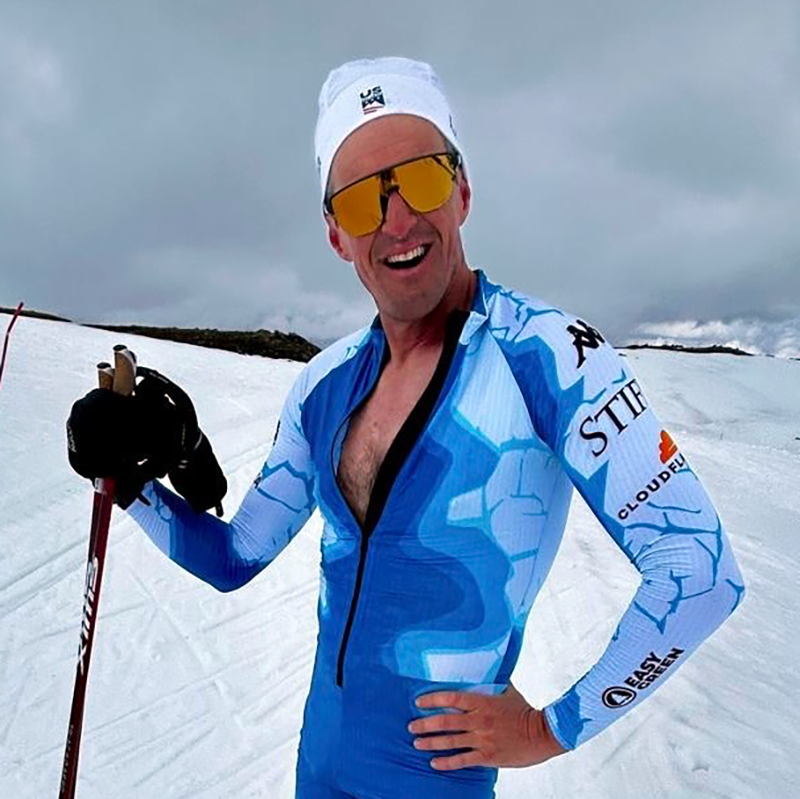
     

    Eli and fiancé Colleen doing some pre Olympic cruising. (Photo: Courtesy Photo)
  • Smith and Melbye Win U.S. Nationals Freestyle Sprint as Qualification Shapes the Day

    Smith and Melbye Win U.S. Nationals Freestyle Sprint as Qualification Shapes the Day

    This article was made possible through the generous support of our voluntary subscribers.  If you value coverage like this, please support FasterSkier with a voluntary subscription.  

    Samantha Smith (#1 – SVSEF) was the fastest qualifier and advanced through all her rounds in first on her way to the national championship at the US National Cross-Country Ski Championships Freestyle Sprint. (Photo: Nancie Battaglia)

    There is a particular kind of pressure that lives in a sprint qualification. It isn’t loud. It doesn’t announce itself with theatrics. It sits in the quiet places: the moment you realize the warm-up loop is over and you’re headed back toward the start; the thin stretch of time when your poles feel too long and your gloves feel too tight and the only thing you can hear is the scrape of skis and the soft, practiced urgency of coaches repeating the same cues they’ve repeated for years.

    In the heats, there is cover. There is a draft. There is a corner to hide behind, a decision to delay, a shoulder to lean into, a mistake you can sometimes survive. Qualification has none of that. Qualification is a solitary negotiation with speed, oxygen, and the course itself. And in an Olympic winter, it also becomes something else: a sorting mechanism. A gate. A reminder that at the Games, you don’t get to be “good in the heats” if you don’t first earn your way into them.

    At the 2026 U.S. National Cross-Country Ski Championships in Lake Placid, Tuesday’s freestyle sprint at Mt. Van Hoevenberg offered that truth clearly. On the women’s side, Samantha Smith (Sun Valley SEF) was the fastest qualifier. On the men’s side, Zanden McMullen (APU Nordic Ski Center) topped the morning results.

    By the end of the afternoon, the national titles belonged to Smith — who converted qualifier speed into clean, controlled racing through every round — and Mons Melbye (University of Utah), who did something deceptively difficult: he kept winning as the format stopped forgiving mistakes.

    Dartmouth College’s Ava Thurston was impressive all day on her way to third overall. (Photo: Nancie Battaglia)
    Qualification as the Real Story — and the Olympic-Year Subtext

    The sprint format always tempts us to focus on finish-line photos, final turns, and last lunges. But if you’re trying to understand what this race meant in the broader context of the week — and in the longer context of an Olympic winter — you start with the qualifier.

    Smith’s win in qualification wasn’t just fast; it was decisive in a way that matters in a discipline where tenths often separate confidence from chaos. She led Alayna Sonnesyn (Team Birkie) by nearly two seconds, with Lauren Jortberg (CNEPH) third and Ava Thurston (Dartmouth) fourth.

    On the men’s side, the top end was deep and tightly packed. McMullen led Owen Young (University of Vermont) by just over a second, with Michael Earnhart (APU Nordic Ski Center) essentially on Young’s shoulder. Melbye qualified fourth, with Cole Flowers (University of Alaska Fairbanks) and Max Kluck (University of Utah) close behind.

    This matters because international sprinting — the kind that happens at the Olympics — is not a format where you can count on “finding your way through the rounds” if you start your day in the wrong place. Qualification is where your sprint begins or ends.

    The subtext, however, differs by gender. On the men’s side, the Olympic pathway through domestic sprinting appears closed this winter. On the women’s side, the picture has felt more open, with multiple domestic spots likely in play and sprint specialists carrying meaningful leverage. The sprint, then, does not “mean” the same thing for every athlete — but it still demands the same thing from all of them.

    Eventual winner, Samantha Smith (#1 – SVSEF) controls the start of the women’s final at the US National Cross-Country Ski Championships Freestyle Sprint. (Photo: Nancie Battaglia)
    Women: Samantha Smith’s Control, Sonnesyn’s Speed, and a Final that Rewarded Discipline

    Smith won the qualifier. Then she won her quarterfinal. Then she won her semifinal. Then she won the final.

    Behind her in the final were Sonnesyn in second and Thurston in third, followed by Nina Schamberger (University of Colorado), Jortberg, and Katherine Weaver (Alberta World Cup Academy).

    Sonnesyn’s day began where the pressure was heaviest.

    “I am really proud of my sprint qualifier,” Sonnesyn said. “There was a lot of pressure on it, and I was feeling that, so I really leaned into the energy of those around me. I left everything I had out there on that course. Not perfect, but really good.”

    In the final, she was clear-eyed about what limited her chances to fight for the win.

    “I always need to keep working on my starts,” she said. “It’s really hard for me to get going that fast, and I ended up getting a bit boxed during the final because I didn’t have a great start. That being said, I think that final hill and the super fast downhill at the end worked in my favor.”

    Alayna Sonnesyn (#2 – Team Birkie) pushes over the top of the sprint course’s main climb. (Photo: Nancie Battaglia)

    Smith described a day defined by managing nerves and executing details.

    “I was quite nervous going into today’s race,” Smith said. “I was putting a lot of pressure on myself to perform well, so I tried to channel the nerves into adrenaline. I focused on skiing smoothly, working the transitions, and finding the most efficient line out there.”

    The final climb played directly to her strengths.

    “The final hill was definitely my favorite part of the course,” she said. “I really love to hop skate, and the gradient of that hill is perfect for it. On this course, transitions are critical, so I tried to be really disciplined about skiing hard over the tops and pushing into the downhills.”

    Thurston, who qualified fourth and finished third overall, described a sprint day built around process rather than pressure.

    “My approach to nerves was to focus on having fun and getting to the start line ready and excited to race,” she said. “Having my whole team here helped a lot. Chatting and joking with teammates and competitors really eases my nerves.”

    She found her biggest opportunities during the heats.

    “During the heats, I gained the most time on the final big hill,” Thurston said. “The wide trail made it an ideal place to pass. I’m still working on my double pole at the start, so that’s an area where I think there’s more speed to unlock.”

    Lauren Jortberg (CNEPH) leads her semifinal at the US National Cross-Country Ski Championships Freestyle Sprint. (Photo: Nancie Battaglia)

    Jortberg’s fifth-place finish, after qualifying third, served as a reminder of sprinting’s second demand: doing the work repeatedly under imperfect conditions.

    Jortberg said the qualifier remained her primary focus, especially in an Olympic winter where advancing matters as much as how fast you ski.

    “Sprint qualification is something I’ve been working on a ton,” she said. “That’s the most important part of the day, especially when it comes to World Cup skiing — just moving on. I was happy with my qualifier. It wasn’t my best skiing, but it was solid.”

    She said lingering fatigue from the previous classic race played a role, particularly after spending much of that race running due to skis that wouldn’t kick.

    “I definitely felt like I was carrying some fatigue from the classic,” Jortberg said. “So I’d say the qualifier was okay, but not my best work. I know I can ski better than that.”

    Jortberg said the Van Hoevenberg sprint course suits her strengths, but emphasized that the margins — especially on the downhills — leave no room for lapses.

    “I really like this course. It plays to a lot of my strengths — strong V2, a long climb, and hop skating,” she said. “But you have to be diligent everywhere, especially on the downhills. You can’t be lazy for even half a second.”

    In the semifinals, she said the tight schedule and downhill dynamics ultimately limited her ability to move forward.

    “My semifinal was only about eight minutes before the final,” Jortberg said. “I couldn’t really clear the lactic acid, and I didn’t have much time. I got passed on the downhill and then couldn’t really move in the final.”

    Despite the broader Olympic context, Jortberg said she is deliberately keeping her focus narrow.

    “I try not to stress about spreadsheets or criteria,” she said. “I just want to race, have fun, and ski the best way I know how. That’s really all you can do.”

    Smith added one more note at the end of the day, confirming she plans to continue racing later in the week.

    “As of now, yes, I am planning to race the 20-kilometer on Thursday.”

    Eventual winner, Mons Melbye (#4 – UU) in his quarterfinal at the US National Cross-Country Ski Championships Freestyle Sprint. (Photo: Nancie Battaglia)
    Men: Melbye’s Title, Jayne’s Podium, and Endestad’s Deep Run from 16th

    On the men’s side, the qualifier winner did not win the title.

    McMullen was fastest in the morning, but the championship ultimately went to Melbye, who qualified fourth and then won his quarterfinal, semifinal, and final.

    Behind Melbye, Sasha Masson (CNEPH) finished second, Zachary Jayne (University of Utah) third, and Ari Endestad (Alaska Pacific University Nordic Ski Center) fourth. Michael Earnhart finished fifth, with Owen Young sixth.

    The University of Utah was central to the men’s story throughout the day, with Melbye winning the title and Jayne joining him on the podium.

    Zach Jayne (UU) during qualification. (Photo: Nancie Battaglia)

    Jayne described a qualifier that didn’t match his expectations — and a deliberate reset once the rounds began.

    “Coming off a skate qualifier win in Alaska, I was disappointed after my qualifying performance,” Jayne said. “I thought I was capable of much more. Knowing that, I went into the heats with a better plan focused on composure and power. I was more relaxed and less nervous once I committed to that.”

    His view of sprint racing was blunt.

    “The rounds were incredibly close, but it only matters where people are at the finish — nowhere else,” he said.

    Young (University of Vermont), who finished sixth overall, described a day shaped largely by the pressure of the qualifier and the need to earn his way into the rounds.

    “Heading into the race today, my internal goals were a bit of a mixed bag,” Young said. “The main focus was result-based, but I really approached the day thinking about the qualifier. I’ve only raced one sprint this season, and the result was pretty mediocre, so I was pretty dead set on just trying to qualify.”

    Once through the qualifier, Young said his focus narrowed to managing the rounds one at a time.

    “After the qualifier, I tried to just take each heat one at a time and give it my best shot to move on,” he said. “I don’t really try to preserve energy in the qualifier — I usually give it everything I’ve got. That might not be the smartest choice for later in the day, but the confidence boost from a fast qualifier can really help mentally in the heats.”

    Miachael Earnhart (APU) on his way to posting the third fastest qualification time. (Photo: Nancie Battaglia)

    Endestad’s fourth-place finish told a different story: one of survival, adaptation, and opportunity.

    He qualified 16th in what he described as one of the tightest sprint qualifiers he had ever seen at Nationals, then raced his way through the rounds into the final.

    “Ideally, I would’ve liked to qualify a little higher,” Endestad said. “But with how close it was, I felt lucky just to be in the heats at all.”

    The physical cost of the day was obvious.

    “This course is so hard,” he said. “I threw up after the qualifier and had to fight to stay composed through the quarter and semi. There were only about 12 minutes between the semi and the final, so it was about breathing, keeping it down, and making good decisions.”

    Tactically, he was clear about where he needed to attack.

    “It might have looked like patience early, but honestly, I was barely hanging on from the start,” Endestad said. “The goal was to be in position for the main hill, because that’s where I felt I could really put the hammer down.”

    Ari Endestad (APU) leads teammate Michael Earnhart (APU) during the heats of the Freestyle Sprint at the US National Cross-Country Ski Championships. (Photo: Nancie Battaglia)

    Michael Earnhart said his goals at U.S. Nationals were shaped as much by the SuperTour standings as by the result of any single race.

    “One of my goals coming into Nationals was to try to take back the SuperTour lead heading into Period 3,” Earnhart said. “Today helped me with points against Hunter Wonders, but not against Zach Jayne. It’s still very close, and both of them are really good athletes.”

    He admitted he arrived with higher expectations after last season’s skate sprint performances.

    “After last year, I really wanted to try to win today,” he said. “So I was a little disappointed to come in fifth. But with how close the qualifier was and how strong the competition is getting in the U.S., I’m not overly disappointed. It’s a reasonable result.”

    Earnhart said experience helped him stay composed through the rounds.

    “I’ve done a lot of heats on the SuperTour, so I feel confident in this field,” he said. “I try to ski to my strengths, stay relaxed, and ski with the confidence that I deserve to win the heat. Normally, that gets me through, but sprinting is unpredictable.”

    He added that Van Hoevenberg offered rare opportunities to move in a skate sprint.

    “The main sprint hill is wide enough to move, and jump skating is my strongest technique,” Earnhart said. “When the qualifier is six seconds from first to 30th, it’s fine margins. Sometimes you need a little luck — but you also have to make your own.”

    Mons Melbye (#4 – UU), Sasha Masson (#11 – CNEPH), and Zach Jayne (#12 – UU) on their way to first, second, and third places, respectively, with Ari Endestad (APU) trailing in fourth place during the men’s Final at the US National Cross-Country Ski Championships Freestyle Sprint. (Photo: Nancie Battaglia)
    What It Means — and What It Doesn’t

    It’s tempting in an Olympic year to treat every Nationals result like a verdict. But Nationals is not the Olympics, and a domestic sprint is not a World Cup sprint field.

    What it can be is a stress test.

    For the women, the sprint reinforced that athletes who can combine elite qualifier speed with repeatable execution are building strong cases. Smith won both the qualifier and the final. Sonnesyn backed up top-end speed with a runner-up finish while clearly identifying where she can improve.

    For the men, the sprint may not be about Olympic selection, but it was revealing and also adds to the season-long narrative. Melbye showed an ability to win under repeated pressure. Jayne demonstrated resilience after a disappointing qualifier. Endestad showed how quickly sprinting can reward those who survive long enough to find their moment.

    Young’s comments also underscored the tradeoffs athletes are navigating as the week continues.

    “I don’t have a definite answer, looking forward to the rest of Nationals,” he said. “I’d like to throw down top results in the 20k and the classic sprint, but I need to talk with my coach and assess the best plan to give me the best shot at scoring enough points. That could mean skipping the 20k and focusing on the sprint, or maybe doing both — it’s tricky with no rest day and the body starting to feel the last couple days of racing.”

    Katey Houser (MSU) leads Ruby Serrouya (DU) and Marit Flora (UAA) in their quarterfinal at the US National Cross-Country Ski Championships Freestyle Sprint. (Photo: Nancie Battaglia)
    A Closing Note from Lake Placid

    By late afternoon, the sprint course felt smaller than it had in the morning. Not only because it changed slightly for the juniors, but because sprint days compress experience. The same hill feels steeper the fourth time. The same turn feels tighter. The same finishing straight feels shorter.

    That is the quiet lesson of a National sprint in an Olympic winter. It doesn’t allow vagueness. It demands specificity. It asks for one fast lap — and then asks you to do it again, and again, and again, under less forgiving conditions.

    Samantha Smith and Mons Melbye won because they answered those questions most consistently.

    For everyone else, Lake Placid delivered the same message sprinting always does: if you want to be part of the story later, you still have to earn your way into the next round now.


    RESULTS:

    US Nationals Freestyle Sprint Qualification Men
    US Nationals Freestyle Sprint Qualification Women
    US Nationals Freestyle Sprint Heats Women
    US Nationals Freestyle Sprint Heats Men
    US Nationals Freestyle Sprint Heats Junior Women
    US Nationals Freestyle Sprint Heats Junior Men


    Love stories like this? Help keep them coming.

    Feature stories like this one take time, access, and care to produce. If you value thoughtful storytelling and independent ski journalism, please consider becoming a Voluntary Subscriber. Your support directly fuels the work we do to cover the people, places, and moments that make our sport special.

    Join the FasterSkier community!


    Mons Melbye (#4 – UU), Sasha Masson (#11 – CNEPH), and Zach Jayne (#12 – UU) on their way to first, second, and third places, respectively, with Owen Young (UVM – far left), Ari Endestad (#16 – APU), and Michael Earnhart (#3 – APU) trailing to start the men’s final at the US National Cross-Country Ski Championships. (Photo: Nancie Battaglia)
  • The Day American Skiing Aligned

    The Day American Skiing Aligned

    This coverage is made possible, in part, through the generous support of Marty and Kathy Hall and A Hall Mark of Excellence Award. To learn more about A Hall Mark of Excellence Award, or to learn how you can support FasterSkier’s coverage, please contact info@fasterskier.com.

    Gus Schumacher (USA) and the rest of his heat work their way up and over Toblach’s signature feature during the 5 k Mass Start last week. (Photo: Modica/NordicFocus)

    There are days in this sport when the numbers feel like the whole story: a time, a place, a gap. But every so often, cross-country skiing produces a day that can’t be explained by the clock alone — a day that feels bigger than the course, bigger than the snow, bigger than the athlete who happens to win it.

    December 31, 2025, was one of those days.

    In the space of a few hours at the Tour de Ski in Toblach, Gus Schumacher and Jessie Diggins both climbed onto the top step of the World Cup podium — Schumacher winning the men’s 5 km freestyle heat mass start in 9:35.4, Diggins winning the women’s in 10:51.2.

    It’s worth pausing on what that sentence contains.

    Not merely that two Americans had strong races on the same day. Not merely that the U.S. team put two athletes in contention. But that the United States — a nation that has spent decades carving out its place in a sport long dominated by Europe — produced two winners, one men’s and one women’s, on the same World Cup day, in the same venue, in a brand-new format that demanded equal parts speed, tactics, and social intelligence.

    The official results pages will always show the same clean fact pattern: Schumacher over Austria’s Benjamin Moser by two-tenths, Norway’s Lars Heggen third; Diggins comfortably ahead of Sweden’s Emma Ribom and Moa Ilar.

    But inside the U.S. wax room and the mixed zone, the day’s atmosphere was not clinical. It was almost disorienting — a moment that drew a line through American skiing’s past and then, for a beat, let everyone see how far the line had traveled.

    “It’s probably going to take us all a little bit to really kind of wrap our heads around it,” U.S. Ski Team Nordic Director Chris Grover said afterward, still sounding like someone trying to describe a thing while standing inside it.

    And then he admitted the quiet truth that every program director carries: days like this don’t happen on demand.

    “It’s a special moment to see both those athletes on top at the same time,” he said. “It’s going to be hard to replicate. We’ll take it where we can get it for sure.”

    U.S. head coach Matt Whitcomb saw it less as lightning and more as follow-through.

    “It truly was a great day,” Whitcomb said. “And it was actually better than the results show. Every heat — with the exception of Kevin [Bolger’s] experience — our athletes moved up, finished competitively, and executed the plans they intended to execute.”

    What stood out most to him wasn’t just the double victory. “Honestly,” Whitcomb said, “better than the double win is the feeling that we came up with a plan individually and as a team — and executed. It was a big win for everybody.”

    Jessie Diggins (USA) wasn’t just the leader of the race and the Tour, but also of the athletes she teamed with in her heat of the 5 k Mass Start. (Photo: Modica/NordicFocus)

    A day that didn’t have to happen this way

    If you want to understand why Toblach felt like more than an athletic coincidence, it helps to begin with the format, because the format did not reward the simplest kind of superiority.

    Stage 3 was a 5-kilometer freestyle race in four separate mass-start heats with staggered start times and a final classification determined by combined times, not by who crossed the line first in any single heat. It was new enough that even veterans were still learning what the race “wanted.”

    Whitcomb described the format as genuine unknown territory — not because the course was unfamiliar, but because the distance itself had been largely absent from the World Cup.

    “The 5 k hasn’t been part of the World Cup for a while,” he said. “We know historically that we skate well, sprint well, skate 10 k’s well — and we focus a lot on the 5 k as a building block in training. But nobody really knew what to expect.”

    The approach, he said, was deliberately simple: stay organized, enjoy the process, and trust the system. “We just operated the way we always do,” Whitcomb said. “Be organized, enjoy each other’s company, and look at the results at the end of the day.”

    In a normal interval start, you win by suffering well. In a normal mass start, you win by positioning, conserving, and timing. In this hybrid, the incentives were stranger: the best strategy could be to help your competitors go faster — to create a heat so fast that it swallowed the rest of the field on arithmetic.

    That sounds like something coaches dream up in theory and athletes abandon under the first real surge.

    And yet, both Diggins and Schumacher described essentially the same decision: race the clock, and don’t be precious about the heat win.

    Schumacher put it in his own blunt, funny way when asked about winning on the same day as Diggins: “I think it’s super cool! Jessie had to be a huge favorite today, so it was up to us to hold up our end, haha.”

    Diggins, in the mixed zone after her race, was still riding the strange energy of having watched the men first — watched the experiment play out once — and then stepping into the women’s version with a clearer sense of the rules of engagement.

    “What’s nice is it was just 5 k,” she said. “After watching the men, you were like, okay, you’re going to gain or lose 10 seconds on the Tour overall. But the big thing was to just have a really fast heat.”

    Then she said the thing that makes this day so revealing: she described her heat as a temporary team—a coalition formed not by flags but by incentives.

    “I thought it was so cool and fun to feel the camaraderie,” Diggins said. “I was talking to all the girls beforehand, like, okay, team number three, we’re going to do this… we’re going to change leads, and everyone’s like, yeah… We had really great teamwork out there… It was an unexpected delight of the format.”

    Gus Schumacher (USA) charges to the finish line to win heat two and post the fastest time of the day. (Photo: Modica/NordicFocus)

    Schumacher told a version of the same story — not as delight, but as commitment.

    “I think my heat-mates and I realized that having a fast heat was the biggest picture,” he said. “I was prepared to be 10th in the heat if it meant we were fast.”

    From the outside, Whitcomb saw something even more deliberate.

    “Gus spent time reaching out to Lars Heggen and Ben Moser and came up with a plan,” Whitcomb said. “You saw some really well-orchestrated trading off of the lead in that heat. That led to a fast heat — and it led to those three guys on the podium.”

    For Whitcomb, that was the defining trait of the race. “Gus is an incredibly savvy racer,” he said. “He’s a great physical specimen — this distance suits him. But what really made the difference was his willingness to control everything he could. And that meant teaming up with athletes from Austria and Norway.”

    He explained how that philosophy became practical: trading leads early, staying disciplined, then continuing to work together deeper into the race than he expected — a heat built like a rotating paceline, but on snow, at World Cup speed.

    And then, of course, the part no coalition can hand you: the finish.

    Schumacher still had to have enough left to win the stage outright. Diggins still had to be strong enough to make the tactics matter.

    The format offered an opening. The athletes still had to ski through it.

    Benjamin Moser (AUT), Gus Schumacher (USA), and Lars Heggen (NOR), (l-r) share the Tour de Ski stage podium in Toblach (ITA). (Photo: Modica/NordicFocus)

    The numbers, briefly, before the meaning

    It’s important in a historical story to keep the results clean and factual.

    On the men’s side, Gus Schumacher (USA) won in 9:35.4, with Benjamin Moser (AUT) second at +0.2, and Lars Heggen (NOR) third at +0.6.

    On the women’s side, Jessie Diggins (USA) won in 10:51.2, with Emma Ribom (SWE) second at +5.5, and Moa Ilar (SWE) third at +6.9.

    Those are the hard edges of the day — the parts that will remain true no matter what story gets written around them.

    But what made Toblach feel different was not just that two Americans won; it was who they were, where they were in their respective arcs, and what it implied about the American program’s shape heading into an Olympic season.

    Diggins is the established cornerstone — a skier who has spent years normalizing things that once felt improbable for the U.S. program. Schumacher is the next wave, still building the evidence that Minneapolis wasn’t a one-off, that his skillset is durable, that he can win in more than one kind of race.

    In the mixed zone, Diggins made it feel personal and immediate. She had the post-win glow, yes, but the first emotion she reached for was pride in Schumacher.

    “It was really cool,” she said. “It was super inspiring seeing Gus with his win. I’m so proud of him. So excited for him.”

    That’s the moment: the most decorated active American skier on the women’s side, standing in Toblach, still buzzing, describing the men’s win as fuel — not as separate news.

    Emma Ribom (SWE), Jessie Diggins (USA), and Moa Ilar (SWE), (l-r) on the Tour de Ski podium for the 5 k Freestyle Mass Start. (Photo: Modica/NordicFocus)

    Toblach, of all places

    Grover, thinking like a director who has watched years of World Cup logistics and outcomes, pointed to something that has been true long enough to become lore: Toblach has often been a good venue for the U.S. team.

    “It’s funny — over the years, I’ve got to say Toblach has probably been the best venue for us of any place on the World Cup,” he said. He cited previous successes there — podiums and performances from different eras and athletes — and he also offered the pragmatic layer: Toblach’s dry, manmade Italian snow can be “easier to wax for,” which matters more than casual fans appreciate.

    The location matters for another reason, too: Toblach sits inside the Tour de Ski, a crucible that encourages narratives. Athletes arrive tired. They leave tired. Every result is filtered through what it means for the overall standings and what it costs to achieve it.

    This year’s Stage 3 came after a rest day and arrived as a kind of reset: short enough to be explosive, structured enough to be strange, meaningful enough to be remembered.

    It was also the kind of stage where the U.S. program’s long-running strengths could express themselves.

    Grover offered one of the more interesting explanations for why the U.S. has historically punched above its weight in short freestyle formats: structural adoption.

    When sprint racing emerged and became formalized on the World Cup, the U.S. embraced it aggressively, he said — building it into domestic racing pathways early, so the program effectively selected and developed athletes with high anaerobic capacity, then built the aerobic engine on top.

    The result, over time, has been athletes who can tolerate the speed of short formats without losing the distance competence required to survive something like the Tour.

    Diggins and Schumacher are not identical athletes, but the day in Toblach suggested they share a kind of hybrid competence: fast skating with depth.

    And that’s exactly what the new format asked for.

    The historical thread: what came before, and why this is still rare

    Toblach’s double win is easier to appreciate when you place it alongside earlier American “two-at-once” moments — because it clarifies what is new here and what is part of a longer progression.

    Fellow U.S. Ski Team members Kikkan Randall (l) and Sophie Caldwell after finishing an unprecedented first and third, respectively, in the World Cup freestyle sprint in Lahti, Finland in 2014. (Photo: Fischer/Nordic Focus)

    Two Americans on the same World Cup podium: the women’s thread

    Over the last 15 years, the most frequent American double podiums in individual races have come on the women’s side — and FasterSkier’s archive captures that evolution in chapters.

    If you track those milestones as a line, you can see how the U.S. women’s program went from “breakthrough” to “repeatable.” It also helps explain why Diggins winning in Toblach — while still special — did not feel like a shock.

    It felt like the continuation of a normal she helped invent.

    Simi Hamilton (l) hugs fellow U.S. Ski Team member Jessie Diggins after both placed third in their respective freestyle sprint finals at the World Cup stage in Gatineau, Quebec. (Photo: John Lazenby/Lazenbyphoto.com)

    Men + women on the podium the same day: the precedent

    Now add the second thread: men and women both reaching the podium on the same day.

    In Gatineau (2016), during Ski Tour Canada, Simi Hamilton and Jessie Diggins both placed third in their freestyle sprint finals, and FasterSkier rightly framed it as a historic first: an American man and woman podiuming on the same World Cup day.

    That day is an important historical anchor because it shows how rare cross-gender podium alignment was, even during periods of strong U.S. women’s success.

    That alignment has echoed in the recent past, too — most memorably on February 18, 2024, in Minneapolis. Schumacher’s first World Cup victory, a 10-kilometer freestyle individual start on home snow, came on a day when Diggins also climbed onto the podium, finishing third in the women’s race. It was the kind of split-screen moment that hinted at what might be coming: a U.S. program no longer living on isolated miracles, but beginning to stack elite performances across genders on the same afternoon. Toblach sharpened that earlier echo into something rarer still — not a shared podium, but shared victories, on foreign snow, inside the Tour de Ski.

    Toblach 2025 goes a step further than Gatineau 2016 — not “podium together,” but win together.

    And that is why Grover’s comment — “hard to replicate” — matters. Because even a strong program doesn’t get to schedule these moments. It can only position itself to recognize them when they arrive.

    Gus Schumacher (USA) celebrates the victory in Toblach (ITA) with his US Ski Team teammates, coaches, and staff. (Photo: Modica/NordicFocus)

    Why the double win felt like a team story

    One reason Toblach resonated within the team is that both Diggins and Schumacher narrated their wins with a vocabulary that sounded less like a solitary triumph and more like collective execution.

    Diggins led with skis.

    “Fast snow, had really fast skis,” she said. “So thank you to our team…”

    She emphasized tactics not as personal cleverness but as mutual agreement: “Everyone did their part… Okay, I can pull now, and you can pull now.”

    And she framed the day’s broader meaning not as a press-release milestone but as a human reaction: “I’m so proud of Gus and everyone on the team.”

    Schumacher, asked to reflect on the same-day symmetry, responded with humor and a little humility — the kind that still acknowledges responsibility.

    Jessie Diggins (USA) also celebrates the victory in Toblach (ITA) with her US Ski Team teammates, coaches, and staff. (Photo: Modica/NordicFocus)

    Jessie “had to be a huge favorite,” he said. So “it was up to us to hold up our end.”

    That sentence contains something important about Schumacher’s emergence: he speaks like someone who believes he belongs in the job.

    Not in a boastful way — in a functional way. Like a skier who believes the U.S. men’s team is allowed to contribute to a “historic day” not as an anomaly but as a duty.

    Grover, who has watched the U.S. program move through phases in which the women carried the torch while the men tried to catch up, seemed to feel that shift, too.

    He described the day as something that bridges eras: there were times when a strong men’s day came without a matching women’s result; times when the women’s team was deep, and the men’s team was still searching for its consistent breakthrough.

    Toblach wasn’t just both genders on the podium. It was both on top.

    Whitcomb saw the same pattern across the roster.

    “Every one of our athletes — men and women — finished competitively in their heats,” he said. “And they executed the plans they came in with.”

    That included results beyond the podium: Diggins winning, Schumacher winning, Julia Kern in 10th, Ben Ogden in 20th, and J.C. Schoonmaker in 29th. “It really was an all-around great day,” Whitcomb said. “The execution was better than the results show.”

    A program doesn’t change overnight, but it does reveal itself in moments like this — when two separate pipelines deliver winners on the same day, under the same strange rules, in the same high-pressure context.

    Jessie Diggins (USA) embracing the excitement in the finish corral. (Photo: Modica/NordicFocus)

    The strange beauty of the format: teamwork as the unintended point

    FIS likely designed the four-heat format for spectacle: shorter races, more winners crossing lines, more “events” within a day. But Diggins described a different kind of spectacle — not for the cameras, but for the athletes.

    The format made cross-country skiing briefly feel like a sport of temporary alliances.

    “Maybe that wasn’t the goal,” Diggins said, acknowledging that she was projecting her own values onto a structural experiment. “Maybe that wasn’t the goal to get teamwork across countries. But for me, that was the goal.”

    Whitcomb was candid about why formats like this matter beyond athlete preference.

    “What’s most important isn’t actually what the athletes think,” he said. “It’s what the fans think. What the fans think dictates whether or not the sport survives in some regards.”

    Traditional 10 and 15-kilometer individual starts, he added, can be hard for casual viewers to engage with. “We need some change,” Whitcomb said. “And I think today provided a little bit of life to the sport. Frankly, it needs that.”

    Schumacher’s description of his heat was less philosophical but equally revealing: a group of men deciding, in advance, that the only way to win was to make the whole heat fast — even if it meant giving up individual control.

    This is an unusual kind of honesty in ski racing, where athletes are trained to reveal as little as possible about tactics.

    And it helps explain why the double win felt like a “team day” even though cross-country skiing is, most of the time, one of the most solitary endurance sports in the world.

    Both winners described the same phenomenon: speed created by cooperation.

    And both wins required the same final act: individual excellence layered atop shared work.

    Gus Schumacher (USA) thanks his ‘lucky’ fan club in Toblach (ITA). (Photo: Vanzetta/NordicFocus)

    The human detail that made it feel like a story, not a statistic

    Near the course, as the day unfolded, there was also the kind of detail that doesn’t appear in official documents but sticks to memory — the four “good luck Alaskans” who have now become part of Schumacher’s mythology.

    They were present at his World Juniors victory. They were present in Minneapolis. They were in Toblach again.

    They will be at the Olympics, too.

    It’s an affectionate superstition, but it also points toward something real: American skiing used to feel like a sport of isolated miracles — one athlete, one day, one surprise.

    Now, it is starting to feel like a sport that can sustain its own community momentum — people traveling for it, following it, building rituals around it.

    A program becomes a culture not when it wins once, but when it wins often enough that people start to behave like it’s a thing worth following.

    Jessie Diggins (USA) and Rosie Brennan (USA), (l-r) skied to second and third place in Davos in 2024. (Photo: NordicFocus)

    What to do with a day like this

    There is always a temptation, after a historic result, to treat it like a prophecy.

    To declare that the U.S. has “arrived,” that the future is guaranteed, that Toblach is the beginning of the next era.

    Neither Diggins nor Schumacher offered that kind of certainty. Diggins, even in the glow, stayed practical; Schumacher talked about holding up his end and taking the Tour day by day.

    Grover, too, resisted prophecy. He chose something quieter: recognition, gratitude, and the realism that moments like this can’t be manufactured.

    But history has its own rules. Even if athletes move on quickly, even if the World Cup continues, even if the next races erases some of last week’s glow, the record will still show: the United States won both races on the same World Cup day in Toblach.

    And when future athletes look back through FasterSkier’s archive — through Lahti 2014, Falun 2015, Gällivare 2015, Toblach 2017, the Tour days with Diggins and Brennan, the first men-and-women same-day podium in Gatineau — they will see Toblach 2025 not as a random spike, but as a point that makes the line look continuous.

    A story isn’t just an outcome. It’s the shape that outcomes make when you stack them over time.

    On December 31, 2025, American cross-country skiing’s shape changed again — not by accident, but by two winners choosing to race the same strange day with the same clear idea of what mattered.

    Go fast. Together. Then finish it yourself.


    Links and results

    FasterSkier’s Men’s Race Report

    FasterSkier’s Women’s Race Report

    Men’s Official 5 k Freestyle Mass Start Results

    Women’s Official 5 k Freestyle Mass Start Results


    Love Stories Like This? Help Keep Them Coming.

    Feature stories like this one take time, access, and care to produce. If you value thoughtful storytelling and independent ski journalism, please consider becoming a Voluntary Subscriber. Your support directly fuels the work we do to cover the people, places, and moments that make our sport special.

    Join the FasterSkier community!


    It is fitting that Brennan and Diggins were there in Minneapolis to celebrate and lift Schumacher when he won his first World Cup race; it’s easy to imagine Randall, Gregg, Maubet Bjornsen, Caldwell Hamilton, and Hamilton also there lifting all of them because they are all building blocks for what comes next. (Photo: Modica/NordicFocus)


  • “You Can’t Live Nervous”

    “You Can’t Live Nervous”

    Finals week has a way of compressing time. Days shrink into problem sets and exams; nights stretch just long enough to make sleep negotiable. When Jack Lange logged onto Zoom from Hanover in late November, he was finishing his senior fall at Dartmouth, a mechanical engineering major balancing equations while packing for a training block at Silver Star. The snow out west wasn’t cooperating. Races were being reformatted. Nothing felt settled.

    That uncertainty didn’t seem to bother him much.

    “We’re wrapping up school right now and then heading to Silver Star next Tuesday,” Lange said. “Hopefully, the snow conditions there improve a little bit.”

    It was a measured answer—calm, almost deliberately so. Over the next hour, that calm would reveal itself not as indifference, but as something learned the hard way.

    Young Jack Lange skiing in a New England BKL race. (Photo: Heidi Lange)

    A kid who wasn’t supposed to be good at this

    Lange grew up in Vermont’s Upper Valley, skiing out of Green Woodlands and the Ford Sayre Bill Koch League. It was the kind of childhood that feels almost mythic now: full-moon skis to a cabin, hot chocolate on a frozen pond, friends everywhere.

    “I’ve always just made sure that that’s the thing that comes first,” he said. “Getting outside and enjoying being outside and enjoying pushing myself and having fun.”

    He played everything. Soccer, where he was very aware he wasn’t the best. Swimming, where he gravitated toward breaststroke. Cross-country running. Mountain biking. For a while, he did both alpine and Nordic skiing, until a choice had to be made.

    “My sister was doing more Nordic and more of my friends were on the Nordic,” he said. “So I just went with Nordic.”

    Lange and friends meeting Jessie Diggins and Sophie Caldwell Hamilton at the Quebec World Cup. (Photo: Heidi Lange)

    It wasn’t a natural fit at first. Lange remembers being the odd kid out on relay day—the one paired with a skier from another team because the numbers didn’t work.

    “I wasn’t good at it,” he said simply.

    What hooked him wasn’t speed. It was curiosity.

    “I really like the amount that you can learn from being out in training,” he said. “Not even structured training—just being outside and having fun. I really enjoy the process of figuring out how hard I can push myself.”

    By freshman year of high school, something shifted. He trained more. He paid attention. And suddenly the results were better than expected.

    “That was kind of the confidence boost that launched me into, like, ‘Oh, this is something I can do.’”

    2019 Junior National Championships in Alaska. Lange finished in fifth place with Dartmouth teammate Wally Magill in first. (Photo: Heidi Lange)

    The pressure builds—and breaks

    Lange’s junior years were uneven. Seasons were disrupted. Races were canceled. One winter meant nine consecutive weekends racing at Craftsbury, all interval starts—an exercise in patience for someone who loved head-to-head competition.

    “I love mass starts,” he said. “I love racing next to people. Mind games and competitiveness.”

    By his senior year, he had narrowed his focus to Junior Nationals. The goal was simple: qualify. Nothing more.

    When he arrived at the 2019 Junior National Championships in Alaska, he was the last skier to qualify from New England. He started near the back in the 5-kilometer skate race at Kincaid Park.

    “My goal for the entire season was to make JN’s,” he said. “And I was there, and I was like, I’m in Alaska. This is kind of crazy.”

    Mid-race, a coach called out a split.

    “One of the New England coaches is like, ‘You’re like three seconds out of top ten,’” Lange recalled. “And I was like, that’s pretty funny.”

    He kept skiing. He finished fifth.

    “That was way, way beyond where I ever could have expected to be.”

    There’s a photo from that day—Lange among a group of skiers who would later become familiar names on the U.S. Ski Team. At the time, it felt surreal. In hindsight, it was clear it wasn’t the performance itself that mattered most, but the conditions under which it happened: no expectations, no fear.

    That lesson wouldn’t fully sink in until later.

    Lange with his parents, Heidi and Greg. (Photo: courtesy photo)

    Dartmouth, and the weight of wanting it too much

    Lange chose Dartmouth largely because it felt right. He wanted engineering. He liked the people. He trusted the coach.

    “Brayton [Osgood] is such an amazing coach to work with,” Lange said. “He’s never the guy to show up and be like, ‘This is what you’re doing.’ He’s super approachable. He really wants us to find our spot in the sport.”

    At Dartmouth, skiing wasn’t isolated from the rest of life—it was embedded within it. That integration became most visible during the most stressful week of the year: NCAAs, which overlap directly with finals.

    “My freshman year, that finals week with NCAAs was kind of a dark time,” Lange said. “I was close to tears on the start line of the 20k race. Just so much pressure, so overwhelmed.”

    He remembers warming up briefly, then stopping.

    “I skied like fifteen minutes in the warm-up and just put my skis down,” he said. “I was completely broken.”

    A kilometer into the race, he was in dead last.

    And then something shifted.

    “I saw Brayton on the side of the trail,” Lange said. “And I was like, you know—I don’t need to take this so seriously. I can show up, do my best at everything, and give 100 percent effort. If I do that, it’s gonna come through.”

    It did. That race became one of his best of the season.

    Dartmouth Ski Team (Photo: courtesy photo)

    The things that make it lighter

    The story of Dartmouth skiing is often told through tradition—green suits, first-years with mohawks, time trials. Lange points to different details.

    There’s a sauna in the locker room.

    “That’s a prime spot to get to know the team,” he said. “We rip this on all the time.”

    There’s also life beyond skiing. Every non-freshman on the men’s team is in a fraternity. Lange lives in the Zeta Psi house with teammates and classmates—engineers, computer scientists, people whose lives orbit entirely different centers.

    “I’m surrounded by a ton of people who have no clue what skiing means to me,” he said. “And that’s been a really huge part of being at Dartmouth.”

    His best season, he said, came immediately after pledging.

    “It taught me how to not put as much pressure on myself,” Lange said. “How to make this a sustainable thing that I could really enjoy.”

    That balance—academic, athletic, social—isn’t accidental.

    “None of the three would be as good without the others,” he said.

    Lange’s favorite race: Prospect relay with Cam Wolfe and Cooper Camp. (Photo: Heidi Lange)

    “You can’t live nervous”

    Lange keeps a training log. He trains consistently. He admits he’s overcooked himself before. What he doesn’t do is chase numbers obsessively.

    “I don’t think I’ve ever had an hour’s target that I’m trying to hit,” he said. “I’ve just trained for the enjoyment of it.”

    There was a time, early on, when outside voices crept in.

    “I was getting a lot of people saying, ‘You’re training too much. You’re doing this wrong,’” he said. “I got a little worked up about it and a little nervous.”

    He paused.

    “You can’t live nervous.”

    It’s the line that keeps resurfacing, whether he’s talking about high school racing, college pressure, or the future beyond Dartmouth.

    “I think anyone who’s in high school, middle school—just go out there because you enjoy it,” he said. “You’re gonna have crappy days. But if you go out there every day and just have a good time, and surround yourself with people you like to be around, things will work out.”

    That philosophy shapes how he defines success now. Lange talks about team first. About racing in a green suit. About showing up energized.

    “The guys here are here for the right reasons,” he said. “They’re skiing because they really enjoy skiing. That’s super energizing.”

    Lange with his long time coach and mentor, Dennis Donahue. (Photo: Heidi Lange)

    A quiet kind of confidence

    Ask Lange where he sees himself years down the road, and he doesn’t reach for outcomes. He talks about process.

    “The process of showing up every day,” he said. “How can I be the best athlete I can be today? That’s the most rewarding thing.”

    Skiing, he believes, has taught him how to live—how to work, how to recover, how to stay curious.

    “Wherever I am fifteen years from now,” he said, “all of the lessons that I’ve learned are still going to be extremely relevant and important.”

    For now, there are finals to finish and skis to pack. The snow will either come or it won’t. The races will sort themselves out.

    Lange will keep doing what he’s learned to do best: show up, stay loose, and ski without fear.

    Because speed, he’s learned, is hard to find when you’re holding your breath.

    Love Stories Like This? Help Keep Them Coming.

    Feature stories like this one take time, access, and care to produce. If you value thoughtful storytelling and independent ski journalism, please consider becoming a Voluntary Subscriber. Your support directly fuels the work we do to cover the people, places, and moments that make our sport special.

    Join the FasterSkier community!


    Enjoying adventures with Luke Allan. (Photo: Jack Lange)