From the FasterSkier archive — posts syndicated from athletes’ and coaches’ own blogs between 2004 and 2012, kept online as published. Current coverage is at fasterskier.com.
The above discretionary selection process will be repeated for each period of World Cup this coming season. As always, if you have questions or concerns about this process, feel free to contact me directly.
U.S. Biathlon’s board votes Wednesday on a formal operating alliance with U.S. Ski & Snowboard. Supporters call it the stability the sport has always lacked. Skeptics call it a surrender of independence. Both are working from the same set of facts. Here is what the deal actually says, and what it would and would not change.
The U.S. Biathlon board of directors is scheduled to meet tomorrow, Wednesday, July 29, at 4 p.m. Eastern. This account is based on interviews conducted by FasterSkier with the chief executives of both organizations, a U.S. Biathlon athlete representative, the U.S. Biathlon head physiology coach, a written statement from the U.S. Olympic & Paralympic Committee, and a review of the alliance term sheet, three community working-group reports, and correspondence circulated by members opposed to the deal. All of these documents were posted publicly by U.S. Biathlon or provided to FasterSkier.
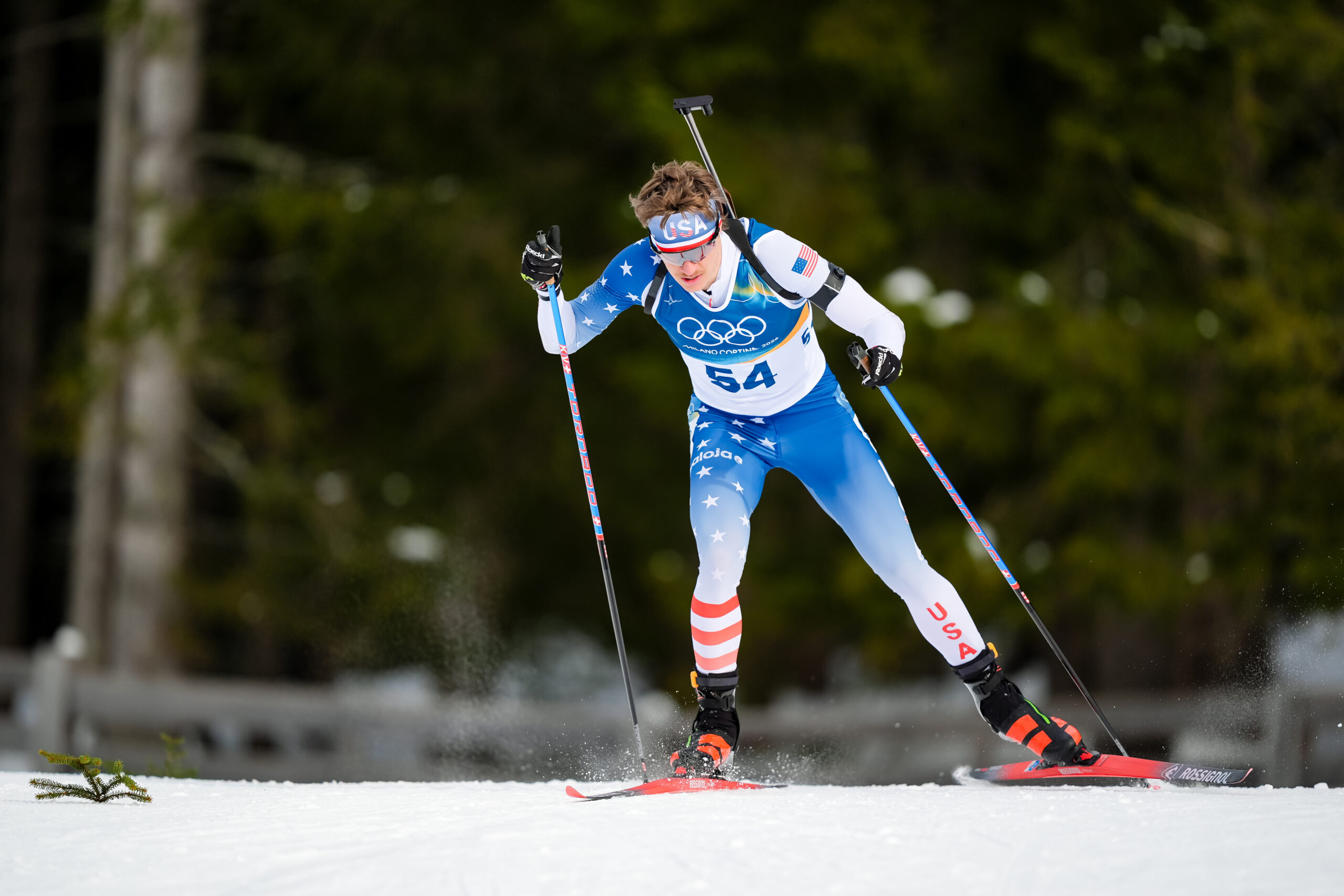
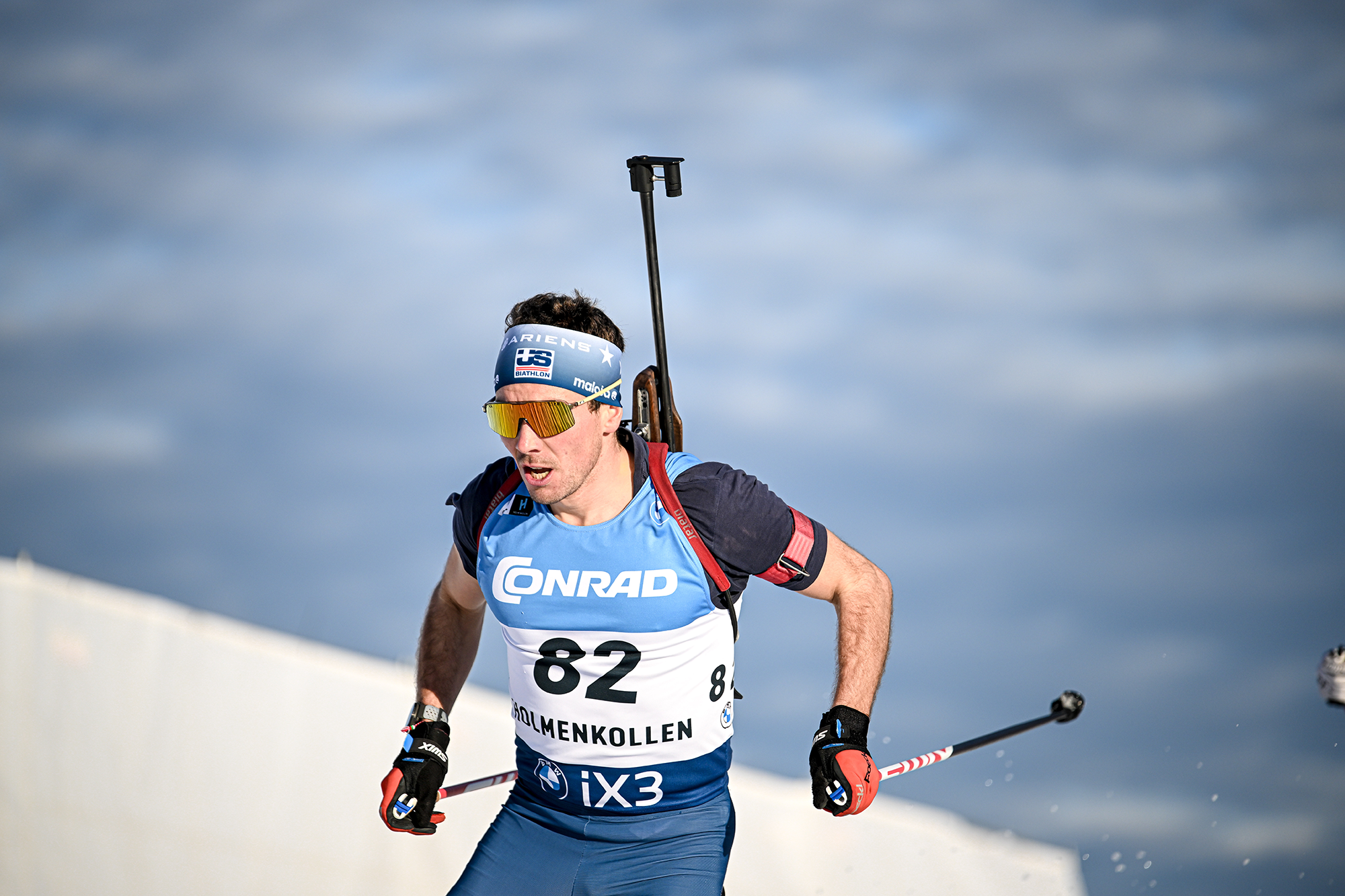
Campbell Wright (USA) during the biathlon sprint at the XXV Olympic Winter Games in Antholz (ITA). (Photo: Thibaut/NordicFocus)
Every winter, for a few weeks in February, cross-country skiing and biathlon stop being niche pursuits in the United States. During the last Olympic period, FasterSkier drew more than 180,000 unique readers in a single February, most of them people who do not know the sport’s governance history and have never heard of the Ted Stevens Olympic and Amateur Sports Act. On Wednesday afternoon, a board most of those readers could not name will vote on a decision that could reshape how one of their sports is run for the rest of the decade and beyond.
The question in front of the U.S. Biathlon board is whether to enter a “Strategic Operating Alliance” with U.S. Ski & Snowboard, the far larger national governing body that oversees Olympic and Paralympic skiing and snowboarding. Under the proposal, U.S. Biathlon would remain a legally separate organization and the recognized governing body for the sport, but would hand much of its day-to-day operation to U.S. Ski & Snowboard under a services agreement. To its architects, it is a way to give a chronically under-resourced sport the stability and commercial muscle it has never had. To its critics, it is the moment a proud, independent program stops steering its own ship.
The two sides do not disagree much about the facts. They disagree about what the facts mean.
What is actually being proposed
Strip away the temperature of the debate and the structure is specific, and it has changed meaningfully since the idea first surfaced publicly in the spring. The current terms, which U.S. Biathlon posted for its members on July 27, describe an alliance rather than a merger in the dictionary sense. No organization dissolves.
Under the agreement summary, U.S. Biathlon “will remain a separate legal entity,” keeping “its own corporate existence, financials, and independent audit.” It stays the governing body recognized by the U.S. Olympic & Paralympic Committee under the Ted Stevens Act, and keeps its membership in the International Biathlon Union, the sport’s world federation. Its name, logo, and trademarks remain owned by U.S. Biathlon and are licensed to U.S. Ski & Snowboard.
What changes is who runs the operation. Under a services, or operating, agreement, U.S. Ski & Snowboard would take over “staffing, programs, events, and administration for biathlon,” giving the smaller sport access to a chief financial officer, general counsel, marketing and revenue staff, medical and sport-science support, and technology infrastructure it cannot afford on its own. U.S. Biathlon’s own staff, its leaders say, would remain responsible for running the sport itself. A new Biathlon Sport Committee would be created inside U.S. Ski & Snowboard, mirroring the structure the larger body already uses for cross-country and its other disciplines.
Jack Gierhart, U.S. Biathlon’s president and chief executive, described the mechanism plainly in an interview. “The mechanics of this are like an operating agreement between U.S. Biathlon and Ski and Snowboard where they take over operations,” he said. “That’s how we’re honoring and satisfying the Ted Stevens Act.”
Sophie Goldschmidt, president and chief executive of U.S. Ski & Snowboard, framed the same structure around what biathlon keeps. “We would keep the biathlon entity. In fact, we keep the biathlon name, the biathlon logo,” she told FasterSkier. “From a legal perspective, it would also have its own entity. With that, it would have its own board. So very much operating like it does today, but sitting within a larger framework so that it can benefit from the other resources and shared knowledge, extra funding that we can provide.”
That phrase, “operating like it does today,” sits at the center of the argument, because a great deal depends on how much a board that has delegated its operations still actually decides.
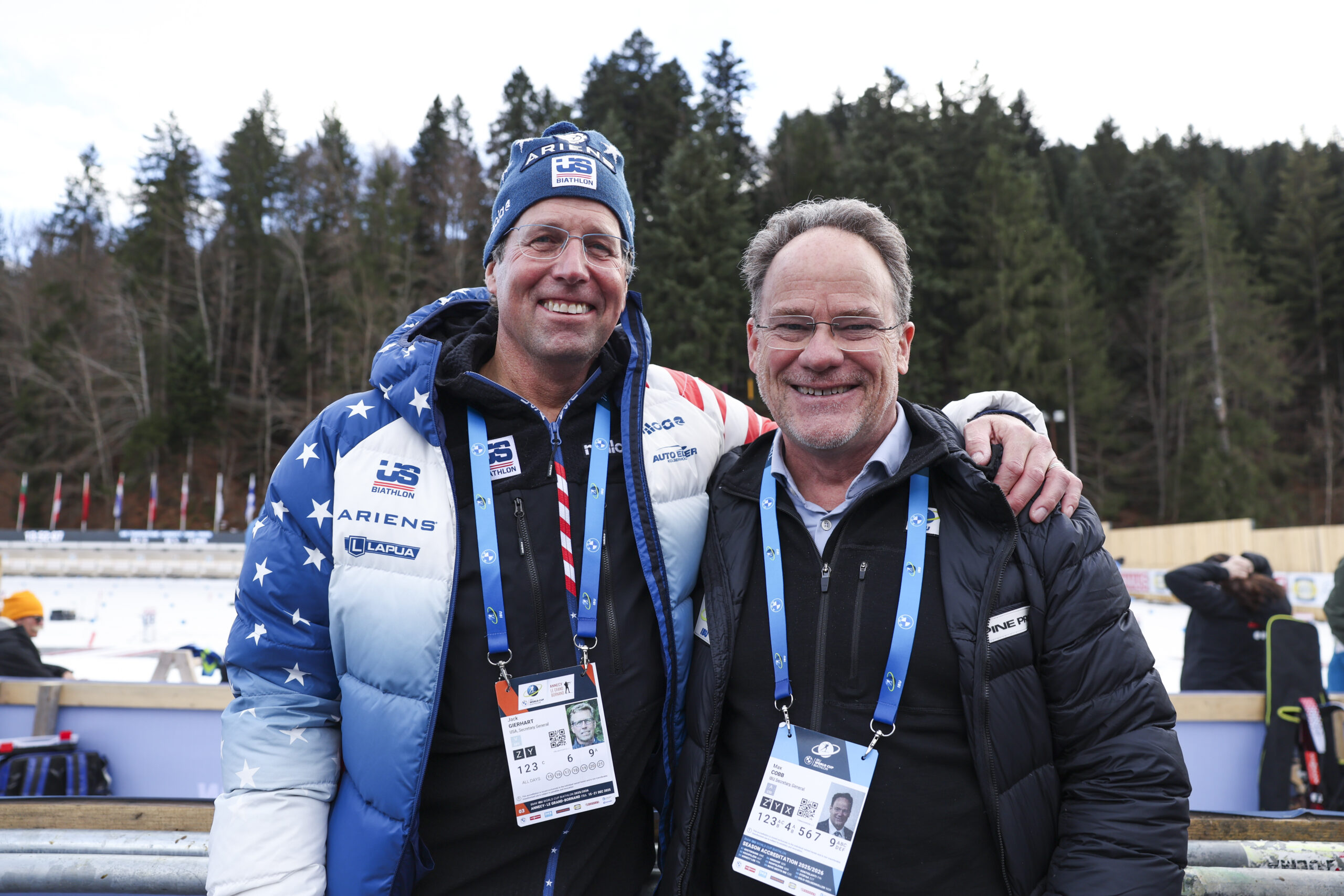
USBA CEO Jack Gierhart poses with Max Cobb (IBU Secretary General) (l-r) at the IBU World Cup in Annecy-Le Grand Bornand (FRA) last December. (Photo: Manzoni/NordicFocus)
How the sport got here
By the account of the people who built it, this did not begin as a takeover. It began, Gierhart said, as an attempt to solve a problem every small Olympic sport shares.
Gierhart arrived at U.S. Biathlon in September 2022, as longtime leader Max Cobb was leaving for the IBU. The organization was early in a strategic plan aimed at growing the sport, and a central piece of that plan was working more closely with the cross-country community, since most American biathletes come from skiing. “From my experience being in sport for 25 years, when you offer people more options, more pathways, you increase retention and you grow the pie,” he said. “It’s like, this should be a no-brainer, but then you run into the cultures and communities.”
Those conversations, Gierhart said, drew in the U.S. Olympic & Paralympic Committee, which oversees and funds the country’s Olympic sports. “The USOPC started to suggest, hey, we’ve got a lot of these small NGBs, why don’t you guys think about something a little more formal?” he said. That was roughly a year and a half ago. The organizations sketched the basic terms, paused through the Olympic and Paralympic Games so as not to distract athletes, then brought the concept to a wider audience in the spring.
Goldschmidt described the same arc and made the case for why her organization wants biathlon at all. U.S. Ski & Snowboard already runs multiple sports under one roof, she said, which means it can absorb the compliance and administrative costs that crush small governing bodies. “The central costs can really be absorbed and be a real cost saving for those organizations,” she said. “Legal, finance, safe sport compliance, all of that, which is quite a big burden, especially on some smaller NGBs. We can absorb that quite easily without having to increase the cost base, which means practically more money is going directly to the athletes.”
The rollout did not land smoothly. After town-hall meetings drew pointed questions, the two organizations convened three joint working groups, on governance, sport development, and high performance, that met through the back half of July. Twenty-eight to twenty-nine participants, including athletes, coaches, club leaders, and staff, spent two weeks documenting what a successful alliance would require and what worried them. Their reports, posted publicly, have become some of the most revealing documents in the whole debate, in part because they capture both the community’s hopes for closer collaboration and its doubts, in the community’s own words.
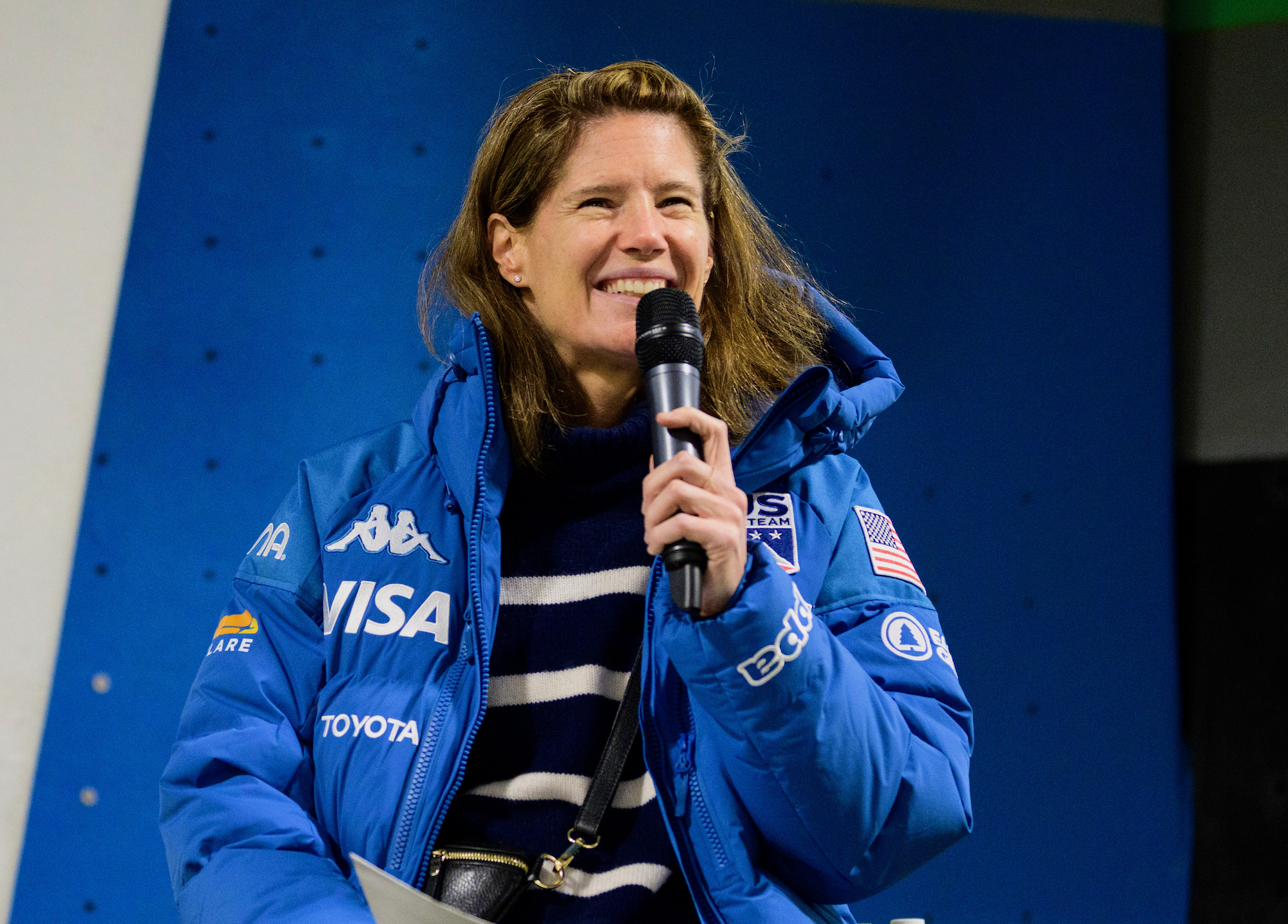
Sophie Goldschmidt speaking at the Alpine World Cup in Killington, Vermont in 2024. (Photo: U.S. Ski & Snowboard)
The money, and the question at the center of it
Almost everyone involved agrees that money is the engine of this deal. What they do not agree on is how to describe the pressure behind it.
The clearest number comes from Gierhart. For the coming season, he said, the USOPC reduced U.S. Biathlon’s grant by 22 percent. The reason, in his telling, has less to do with the alliance than with a shift in how the USOPC allocates money. Roughly three years ago, he said, the committee created an investment framework weighted toward medal potential. “They told us a couple of years ago, you guys are one of the highest funded sports, you haven’t delivered medals,” Gierhart said. “There’s a good probability you’re going to get a cut. And that’s what happened. They cut us,” a reduction he put at 22 percent for this year.
Crucially, Gierhart rejected the idea that the cut is a lever to force the alliance. “It hasn’t been like, if you don’t do it, we’re taking away money,” he said. “It was, we’re taking away money because you’re over-resourced from our model standpoint and you’re not delivering. But if you go in this direction, which we believe will be beneficial in the long term, we want to help you do that.” Asked directly in a later FasterSkier interview whether it was a threat, he drew the distinction again. “They gave us our grant for this year, and it’s the 22 percent reduction. But they said that if we move in this direction with this alliance, they want to invest more in us. And they will find a way to do that,” bringing biathlon “back to where we were.”
Goldschmidt, in interviews with FasterSkier, likewise described the reduction as reversible if the alliance proceeds, and tied it to the USOPC’s belief that a more efficient biathlon can compete for medals.
The U.S. Olympic & Paralympic Committee, asked to confirm the figures and to say whether restoration of the funding is contingent on the alliance being approved, declined to address specifics. In a written statement, spokesman Jon Mason said the committee “is aware of and engaged in the discussions between U.S. Biathlon and U.S. Ski & Snowboard, and we support them taking a deliberate, transparent, fact-based approach to exploring a future relationship that complies with the Ted Stevens Olympic & Amateur Sports Act.” The committee, he added, is “supportive of outcomes that can build long-term stability and create opportunities for current and future generations of athletes.” The statement did not confirm the size of the cut, and it framed compliance with the Act as a goal the parties must meet rather than a settled fact.
What the alliance would add is documented. According to the high-performance working group’s summary, biathlon “would receive a ~$600k increase from current FY27 revenue projections” in the first year, with U.S. Ski & Snowboard guaranteeing an increase “from this year-one level through year 4.” Gierhart put the combined total, new revenue and shared-services savings together, at “at least” $3.3 million over four years. That money, in principle, flows back into programs.
Set against U.S. Biathlon’s roughly $3.5 million in annual revenue, those are not small numbers. And they arrive alongside a promise that biathlon’s existing money stays biathlon’s. Under the agreement, “all funding designated for biathlon, including IBU and USOPC support, existing sponsorship contributions, charitable donations, and other biathlon-specific revenue, will remain ring-fenced and used exclusively to support biathlon.”
Here Goldschmidt was careful to correct what she called a misunderstanding. The ring-fence, she said, is permanent, not a four-year arrangement. “All of the money that they generate that is ring-fenced for biathlon will continue to go to that program. That will be a contractual commitment,” she said. “Some people have got confused that we’re only committing to four years to ring-fence and provide them funding. That’s not accurate.” The four-year commitment, she clarified, applies to the additional commercial funding U.S. Ski & Snowboard brings to the table, which depends on the sponsorship deals it can renew.
Gierhart described the same two-part structure, and pushed back on the idea that biathlon falls off a cliff when the four years are up. “This gives us a platform for four years of sort of guaranteed increased revenue to build momentum and to implement the things that we know are going to help us,” he said. “Without that, we’re going to live year to year, and we’re already in maintenance mode as opposed to growth mode.” In four years, he argued, biathlon would be “in no different a situation than we are today. In fact, we’ll be better, because we’ll have a lot more resources to work with over the next four years.”
That distinction defines exactly where the community’s deepest financial fear lives. The money biathlon already raises is protected by contract. The new money, the actual growth case, is guaranteed for one Olympic cycle, through 2030, and after that depends on the USOPC and on sponsors, the same as it would if biathlon stood alone.
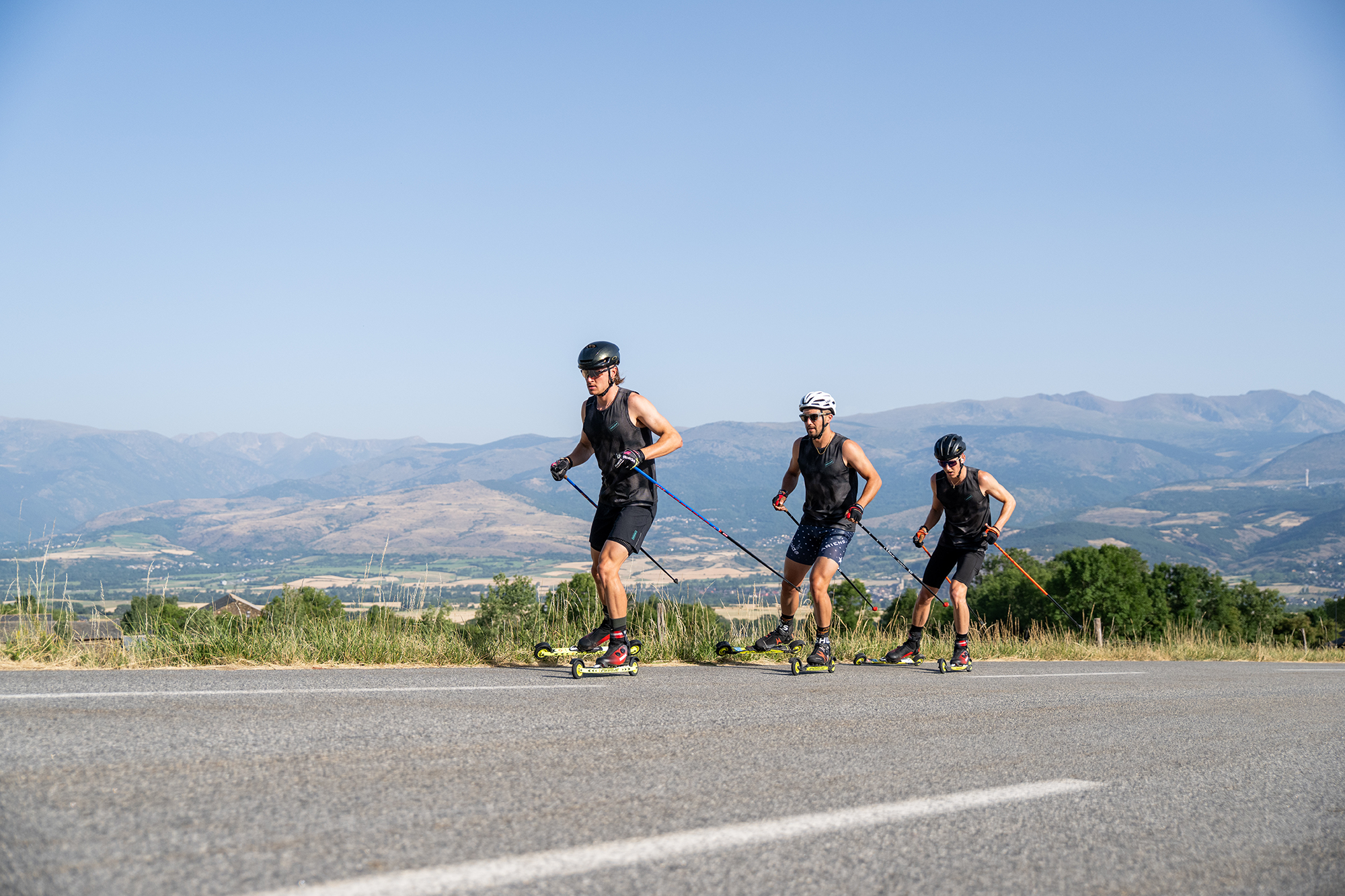
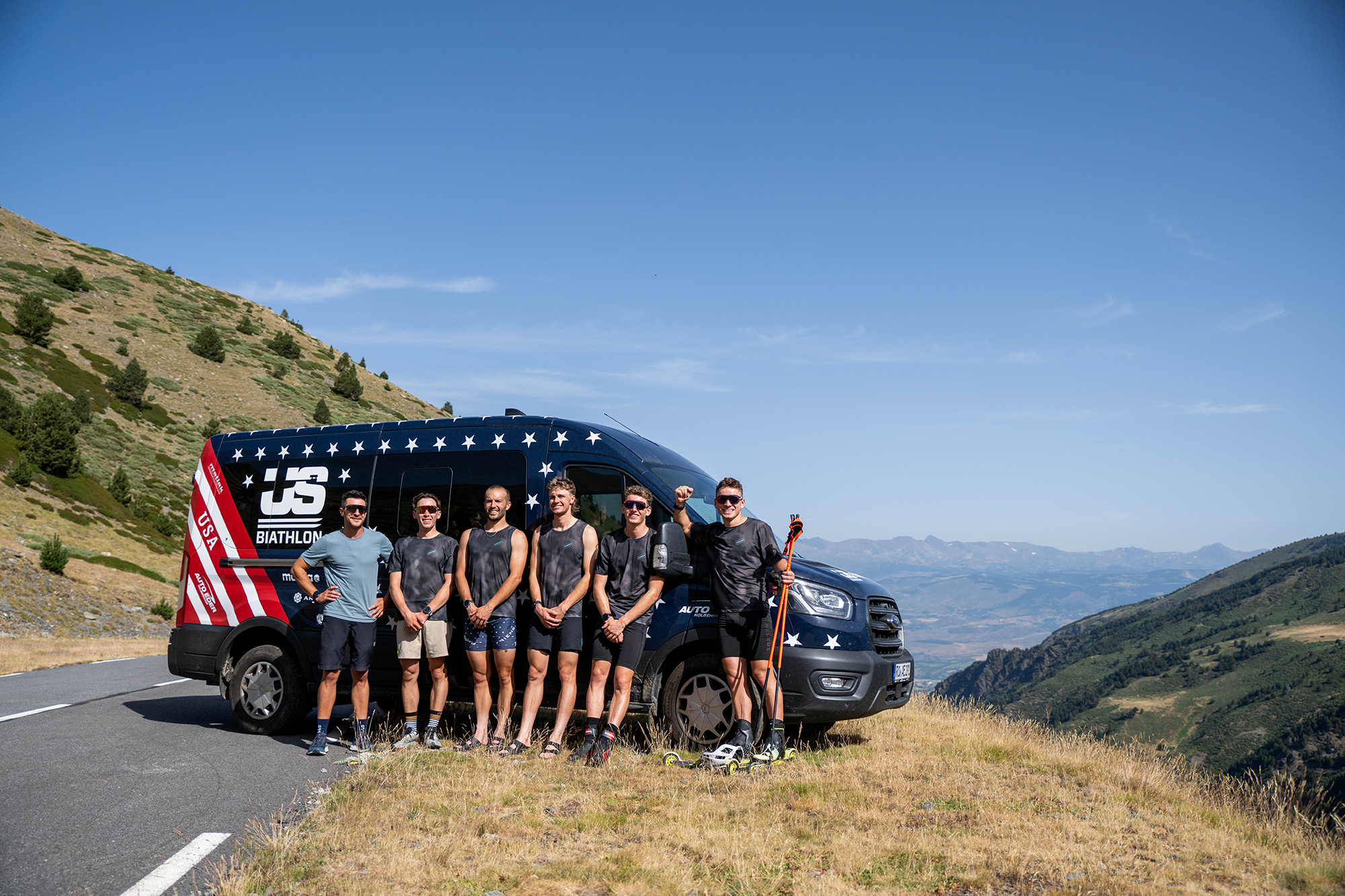
While much of the US biathlon community debates governance, the USBA’s Campbell Wright, Vincent Bonacci, and Maxime Germain (l-r) gets after their summer training in Font-Romeu (FRA). (Photo: Authamayou/NordicFocus)
The Ted Stevens question
No part of the debate has generated more heat than the law. A group of members, some of whom helped establish U.S. Biathlon as an independent governing body decades ago, argue that the alliance violates the Ted Stevens Act. Their case rests on two provisions.
The first is the single-federation rule. Under 36 U.S.C. 220522, a national governing body must be “a member of no more than one international sports federation that governs a sport included on the program of the Olympic Games.” U.S. Ski & Snowboard belongs to FIS, the International Ski and Snowboard Federation. Biathlon answers to the IBU. Critics contend that if U.S. Ski & Snowboard effectively governs an IBU sport, the arrangement collides with that rule.
The second is autonomy. The same statute requires a governing body to be autonomous, in that it “independently decides and controls all matters central to governance” and “does not delegate decision-making and control of matters central to governance.” Arthur Stegen, a former U.S. Biathlon board member and part of a group called Team Independent Biathlon, laid out the objection in correspondence circulated to other members and shared with FasterSkier: a services agreement that assigns operational responsibility to U.S. Ski & Snowboard, he argues, is by definition a delegation of control, and reducing the biathlon board to a sport committee “would appear to relinquish its governance responsibilities to another organization.” Stegen wrote that he is “completely against this potential merger.”
The written terms were plainly built to answer that challenge. The agreement summary includes a section titled “Reserved Governance Authorities,” which states that “notwithstanding any operational responsibilities delegated to U.S. Ski & Snowboard,” U.S. Biathlon “will retain sole authority over all matters required by the Ted Stevens Act or otherwise reserved to the National Governing Body,” including “oversight of the organization, approval of the biathlon budget, and all authorities reserved to the NGB.” In other words, the deal’s authors say operations are delegated while governance is reserved.
Goldschmidt said the structure was designed to align with the statute from the start. “We’ve worked with the USOPC and others to ensure it fits all of those criteria, which it does,” she said. Gierhart said U.S. Biathlon has already received an opinion on the point. “We’ve gotten the opinion from the USOPC’s legal counsel on the terms as they’re written now, and their opinion is that it meets the requirements and is in compliance with the Ted Stevens Act,” he said.
He was also clear about sequence, and described it as the normal way such deals come together. Wednesday’s vote is on the foundational terms, the fundamentals both sides have agreed to. “You’ve got to agree on the fundamentals, and then that’s what’s going to drive the detailed operating agreement,” he said. That more extensive agreement, covering licensing of the biathlon trademarks, the function of the board, and the bylaws, would be drafted next, “vetted by independent counsel” to confirm it complies with the Act, and then brought back to the U.S. Biathlon board, athlete representatives included, for a separate vote to approve it.
That staging is itself contested ground. Supporters see a standard process: agree on principles, then build and independently vet the detailed contract. Skeptics see a board being asked to commit before the full agreement exists and before the independent legal review happens, and some argue a binding vote should wait until both are done. What Wednesday’s vote actually authorizes, the concept or a finished deal, is a distinction worth watching closely as the meeting unfolds.
The USOPC, for its part, did not put its weight behind a declaration that the current structure is legal. It said it supports the parties “exploring a future relationship that complies” with the Act, language that leaves compliance as something still to be demonstrated.
There is precedent for the skepticism, and for U.S. Ski & Snowboard’s interest in expansion. The organization previously pursued governing roles in surfing and skateboarding, efforts that critics cite as evidence of a broader ambition to build a multi-sport governing body, the very kind of concentration the Ted Stevens Act was written to prevent. Goldschmidt described those episodes as different in kind. Surfing, she said, “just got too political,” and the organization walked away; skateboarding remains “ongoing” with “no immediate decisions.” Biathlon, she argued, is a natural fit that most European countries adopted long ago. “I get asked all the time, why is biathlon not integrated within your organization,” she said. “It’s a natural fit in many ways.”
Who controls the board
Because the autonomy argument turns on control, the composition of the board is more than a technicality, and it is an area where early rumors and current terms diverge sharply.
Gierhart was emphatic that the U.S. Biathlon board does not shrink or change hands. “The board is going to continue at the same size it is by the bylaws. It’s 12 to 15 members. They’re voted on by the membership,” he said. Those voters remain biathlon’s own roughly 1,500 members, whose categories will be tracked separately even after membership systems migrate to U.S. Ski & Snowboard’s platform in the 2027-28 season. “Our board size is not going to change. The composition is not going to change,” Gierhart said.
Just as important, he said, is what that board keeps deciding. Among the authorities it retains is control of the budget and the annual plan, meaning that where biathlon’s money is spent would still be approved by the U.S. Biathlon board of directors.
The new layer is the Biathlon Sport Committee, which the agreement describes as being drawn from the existing board, “6 to 8 members,” and maintaining the 33 percent athlete representation required by USOPC bylaws. The chair of that committee and one athlete representative would sit on the U.S. Ski & Snowboard governance board, giving biathlon two seats and a direct voice in the larger organization. The arrangement runs in both directions: U.S. Ski & Snowboard would, in turn, have representation on the U.S. Biathlon board.
Athlete voice, a recurring worry, is addressed specifically. Rather than being folded into U.S. Ski & Snowboard’s athlete representation, “biathlon would still maintain its separate voice of athletes on the Team USA [Athletes’] Commission,” Gierhart said. “We’d have our own.”
Even though Jake Brown officially retired from the IBU World Cup after last season, he has played an active role as an athlete rep throughout this process. (Photo: Authamayou/NordicFocus)
What changes for the athletes
For the people who actually race, the alliance is not an abstraction about governance. It is a question about who pays for the plane ticket to Europe.
U.S. Biathlon funds its athletes to a degree unusual among American winter sports. “Our athletes within biathlon are better funded and supported than in any other winter sport,” Gierhart said, noting that the program fully funds its World Cup athletes and nearly fully funds its IBU Cup athletes. Revisiting the specifics, he said U.S. Biathlon provides its athletes $48,000 in direct athlete support, $35,000 in need-based assistance, and $30,000 in performance bonuses, and secures roughly $36,000 a year for its top competitors. Cross-country, by contrast, does not pay national-team skiers to compete on the World Cup; much of that burden falls to clubs and to community fundraising.
That gap is the source of the athletes’ most concrete fear. Jake Brown, who retired from biathlon this year and sits on the U.S. Biathlon board as an athlete representative, said the worry he hears most is that biathlon’s funding model quietly converts to the ski-team model once the sports combine. He is careful to add nuance. “There’s nothing guaranteed that U.S. Biathlon will continue funding World Cups either,” he said. “The funding has to be there.” Biathlon also draws money from the IBU for each athlete who starts a race, which makes subsidizing those starts partly self-financing, and the sport has leaned into keeping athletes in the pipeline rather than cutting them early. “We can’t afford to lose them,” Brown said.
The agreement attempts to lock that model in place, but only for a defined window. The current athlete support model “will continue through the 2030 Olympic quad,” it says, with “National Team, World Cup, IBU Cup, Youth, and Junior athlete support structures” remaining “in place unless changes are jointly approved by the Biathlon Sport Director and the U.S. Biathlon Board.” As with the incremental funding, the guarantee runs one cycle. What happens after 2030 is precisely what no document can promise, though, as Gierhart notes, biathlon cannot promise that to itself every year either.
No voice in this debate has lived that risk more directly than Justin Wadsworth, the former U.S. Olympian who now is U.S. Biathlon’s Head Physiology Coach (working with both the men’s and women’s national teams) and who spent years coaching in Canada, including a stretch as a high-performance director there. Wadsworth described watching Biathlon Canada’s funding collapse. “Over the last eight to ten years, we’ve seen organizations having funded the athletes for all camps, all trips, everything, to now athletes paying for training camps, paying for trips,” he said. “That’s basically what’s really pulled Biathlon Canada down. The athletes just can’t afford to go on trips or training camps.”
The damage, he said, was not only financial. “It really changes the dynamic with the team,” Wadsworth said. “As a coach and as an organization, it’s much harder when athletes are paying for everything.” His wife, Beckie Scott, the Olympic champion who now leads Nordiq Canada, made cutting athlete fees a priority for exactly that reason. Asked what U.S. Biathlon should guard most carefully, Wadsworth did not hesitate. “The number one is just, are the athletes going to continue to be getting funded when they’re absorbed with U.S. Ski and Snowboard.”
Brown framed the same anxiety in a different register, as a question of trust. “There is a strength in independence,” he said. “You have a trust that your leader, when they put their head on the pillow every night, is trying to figure out how to make biathlon better in the country, and not trying to figure out how to prioritize what sport within a larger organization.” That, more than any statute, is the emotional core of the opposition: the fear that biathlon becomes one line item among many, advocated for by executives whose attention is divided.
The community’s own working group named the same items. The high-performance group’s report listed what “must be protected”: the centralized national team model, athlete stipends and need-based aid, the pathway that recruits skiers into biathlon, the world-class ski-service program, the Montana State University sport-science partnership, and “athlete-centered decision making.” It also warned, in writing, of the risk that unites the skeptics and the supporters, that “differences in stipends, housing, and athlete funding philosophies will be inequities across sports,” and that “the reasoning behind this must be explained well, or there is high risk of tension between sports.”
The case for
Set the fears aside and the argument for the alliance is not hard to follow, and some of its most persuasive versions come from people with no stake in the outcome.
Wadsworth, who says he has “no real skin in the game” and is “just trying to coach right now,” makes the efficiency case from painful experience. A small governing body cannot carry the overhead a large one can. “An appeal, from an athlete and the organization needs to get a lawyer for that, a single appeal can cost 30 to $50,000,” he said, “and if that’s 5 percent of your budget, that’s a big hit.” Fold biathlon into a larger organization with in-house counsel, fundraising staff, a training center, and sport scientists, he said, and those costs largely vanish. “Those efficiencies are really the positive side.”
Goldschmidt’s version is about scale on the revenue side. U.S. Ski & Snowboard, she wrote to biathlon’s members, generated “more than 900 million social media impressions and 7 billion earned media impressions last season,” counts more than a million social followers, and has “more than doubled our commercial revenue over the last four years,” with “nearly 85 percent of that revenue going directly to athletics.” Biathlon, by her argument, brings a genuinely valuable and telegenic property, the IBU World Cup is among the most-watched winter sports in Europe, that a 35,000-follower organization cannot monetize on its own. “One plus one can equal a lot more than two,” she said, “most importantly for biathlon.”
Gierhart’s case is about the limits of the status quo. “We’ve been doing the same thing for 60 years,” he said. “We’re a small sport, we have limited resources. We’ve always had a thin bench. But the formula isn’t changing. And if we’re going to try to drive transformational change, we’ve got to look at some things a little differently.”
And there is the pipeline, the argument that biathlon and cross-country are natural partners that have been kept artificially apart. Today a club that wants to offer both sports contends with two governing bodies, two memberships, two coaching-education systems, two calendars. The sport-development working group’s central recommendation was to merge those tracks, shared coach education, coordinated regional calendars, laser biathlon introduced to youth skiers, so that, in Brown’s words, the “big potential benefit comes in the sport development space.” Wadsworth added the practical constraint that enthusiasm tends to skip past: it comes down to shooting ranges. “The number one thing for biathlon is you need a range, and so that’s probably a limiting factor,” he said. “If U.S. Ski and Snowboard decides they really want to focus on the development side, they’re going to have to build more biathlon ranges. If you build it, they’ll come.”
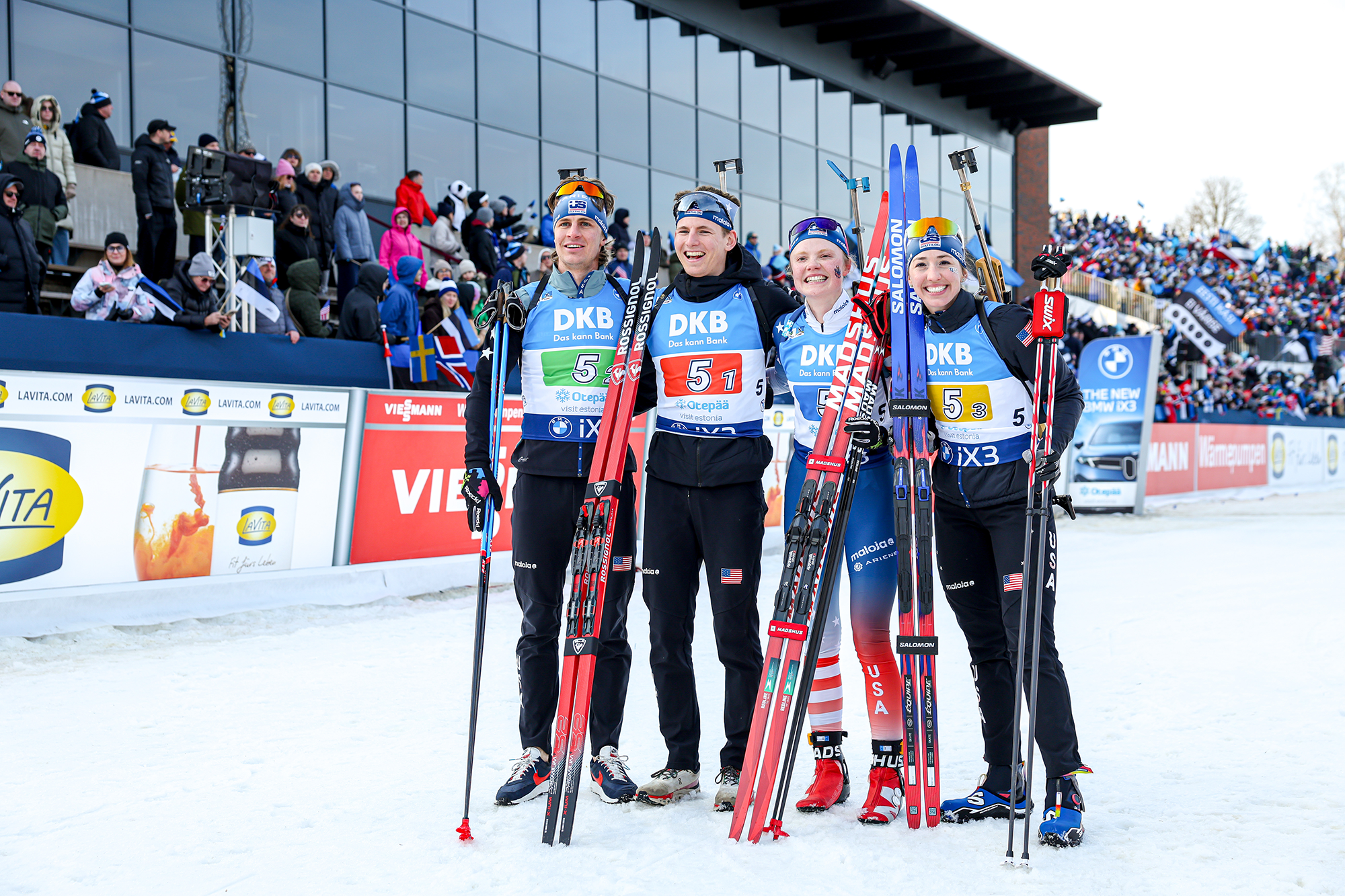
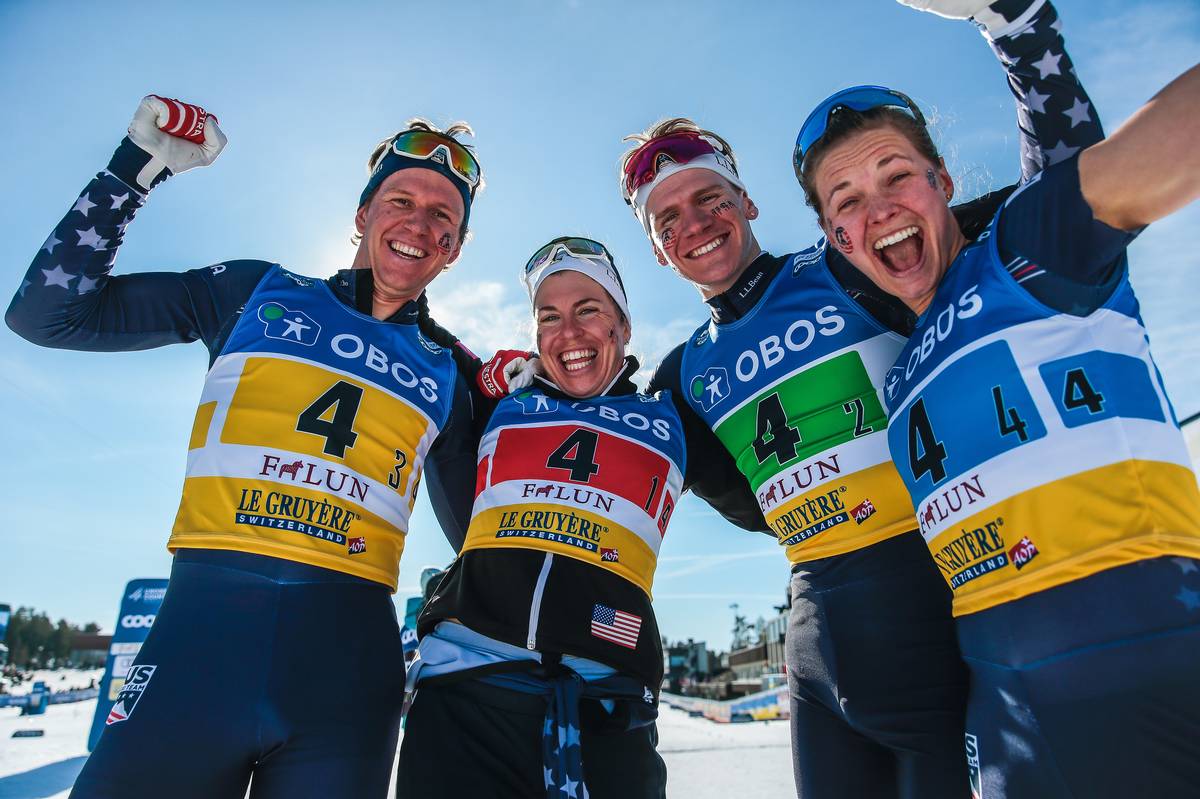
Campbell Wright (USA), Maxime Germain (USA), Margie Freed (USA), and Deedra Irwin (USA), (l-r) after the IBU World Cup Biathlon mixed relay in Otepaeae (EST). (Photo: Manzoni/NordicFocus)
The case against, in the community’s own words
The sharpest questions about the alliance do not come from the members trading accusations online. They come from the process U.S. Biathlon itself ran. The working groups produced plenty of enthusiasm for closer collaboration, and their reports document at length the benefits participants believed an alliance could unlock. But the same reports surfaced a recurring doubt.
Across all three groups, participants returned to a single question: if the goal is collaboration between biathlon and cross-country, why does it require a formal alliance? The consolidated report notes that “several participants observed that many of these initiatives could theoretically be pursued without a formal alliance.” The sport-development group put it more bluntly in its written takeaway: “Some expressed confident progress could be made without an alliance. It is not accountability that will move this from conversation to action. It is the passion of the people involved in both sports.” (U.S. Biathlon cautions on every page that the working-group notes were “generated during meetings in which judgment was not applied” and “do not represent the decisions or strategies” of the organization.)
The governance group’s “parking lot” of unresolved issues reads like a checklist of the skeptics’ concerns: “Ted Stevens Act compliance,” “an escape path if integration fails,” “what autonomy does Sport Committee have to direct USSS operations,” and whether a replacement is needed for the athletes’ advisory council “to preserve biathlete input.” The high-performance group flagged “budget flexibility,” asked “which proposed benefits truly require an alliance, and which can already be achieved through partnership,” and wondered whether biathlon could build its own dedicated fundraising vehicle, an equivalent of the National Nordic Foundation, without merging at all.
U.S. Ski & Snowboard’s answer to the “why not just collaborate” question is that informal collaboration has been tried, and has not delivered. The alliance-alignment document U.S. Biathlon distributed argues that, while the two organizations “have collaborated successfully for many years, this formal Alliance creates a level of commitment, coordination and accountability that cannot be achieved through informal collaboration alone.” Gierhart put it more sharply. He said he disagrees “wholeheartedly” with the notion that passion alone will carry the work forward. “You need accountability,” he said, describing what he sees as a fundamental difference within the community over how things actually get done. Goldschmidt made the same point about incentives: absent a formal structure, she said, no one at a big organization is measured on whether they helped a small one. “Why would I help another sport if that’s not how I’m measured?”
Then there is the matter of process and speed, which even supportive athletes acknowledge. Brown said the spring rollout caught the community off guard. “It kind of came out in the springtime. It was a little bit surprising, and it took us some time to understand why,” he said. “Most of the membership and the athlete body, we had some catching up to do.” The working groups were themselves a response to feedback that the process had moved too fast with too little consultation, and some members continue to argue that a binding vote should wait for the final agreement and its independent legal review, both of which, by U.S. Biathlon’s own account, come after Wednesday.
The exit, and what the fine print says
If there is a single provision that will decide how much reassurance skeptics take from this deal, it is the exit. Gierhart is adamant that it is a last resort, not a trap door.
He described a defined process. Goals and key performance indicators would be set at the outset, with an assessment after the first year and a comprehensive review at the end of the quad. “If we get to a point where there’s irreconcilable differences,” he said, “then there is an option to move towards a different operating structure, which could mean that U.S. Biathlon becomes an independent operating entity again. And that is a choice that can be made by either party. It doesn’t have to be mutually agreed upon.”
He was careful to say that does not mean either side can simply walk away on a whim. The written summary describes an interim assessment after the 2026-27 season and a comprehensive review after 2029-30, and says that “should significant challenges arise that materially impair the objectives of the alliance, the organizations will first implement a corrective action plan.” Only “if substantial concerns remain unresolved after those efforts” would “alternative organizational structures, including the return of U.S. Biathlon to an independently operated organization, be considered.” That, Gierhart said, matches what he meant: a process of measuring progress against shared goals, trying to fix what is not working, and only then, if the problems prove irreconcilable, allowing either party to end the alliance without the other’s consent.
“I don’t want it to sound in any way that in four years there’s an exit ramp that’s most likely going to happen,” he said. It is less an exit ramp, in his framing, than a runaway-truck ramp: an emergency measure, rarely used, that exists only for the case where nothing else has worked. The distinction that matters, he said, is that the eventual decision does not require both sides to agree. “It would probably be the board of directors of U.S. Biathlon that would say, we can’t resolve these differences and we want to make a change. Or Ski and Snowboard would say this is not working.”
Emil Bormetti (ITA); Coach Team USA, Bjorn Westervelt (USA), Vincent Bonacci (USA), Campbell Wright (NZL), Maxime Germain (USA), Vaclav Cervenka (USA), (l-r) summer training in Font-Romeu (FRA). (Photo: Authamayou/NordicFocus)
What happens Wednesday
The board meets Wednesday at 4 p.m. Eastern. By Gierhart’s account, directors received an extensive board package over the preceding weekend, and the athlete representatives, who under USOPC rules make up a third of the board, have been closely engaged.
What the vote settles may be narrower than the noise around it suggests. If the board approves the foundational terms, the more detailed operating agreement, and its independent legal review, would follow, along with a further board vote to approve it. If the board balks, or postpones, the timeline slides. Either outcome will be read as a verdict on a process that many in the community found rushed and many others found overdue.
The stakes are real in both directions, which is why the debate has been so bitter. If biathlon stays independent, it does so facing a documented funding cut and the same structural constraints that have kept it small for six decades. If it joins, it trades a measure of autonomy for stability, resources, and a commercial platform it has never had, and it does so on the promise, guaranteed for four years and asserted in perpetuity, that the sport it has built will not be diminished inside a larger one.
The people on every side of this insist they want the same thing. “Whichever way the board decides,” Brown said, “I really want to be able to take our membership with us in whichever direction we go, and maintain good relationships with our full community. Because otherwise, we lose.”
On Wednesday afternoon, fifteen people will decide which way that goes.
FasterSkier will report the outcome of Wednesday’s vote. Reporting for this article included interviews with U.S. Ski & Snowboard president and CEO Sophie Goldschmidt, U.S. Biathlon president and CEO Jack Gierhart, U.S. Biathlon athlete representative Jake Brown, and U.S. Biathlon head physiology coach Justin Wadsworth, a written statement from the U.S. Olympic & Paralympic Committee, and a review of the alliance term sheet, the July 2026 community working-group reports, and correspondence from members opposed to the deal.
Because the details of this proposal are complex, quotations attributed to U.S. Ski & Snowboard and to U.S. Biathlon were provided to each organization in advance of publication so they could verify the accuracy of their own statements and clarify technical details. FasterSkier retained full editorial control over the content, framing, and conclusions of this article.
Help Support Our Coverage!
If you value the thoughtful work and access FasterSkier provides, please consider becoming a Voluntary Subscriber. Your support directly fuels our work to cover the people, places, and moments that make our sport special.
At this moment, we don’t know what is down the road for USA Biathlon, but hopefully we will stay a community that supports the sport and the hard work of the athletes and coaches doing their best to perform at the highest level. (Photo: Authamayou/NordicFocus)
I was reviewing recent U.S. Ski & Snowboard Cross Country Sport Committee meeting minutes and came across an interesting note in the April 7, 2026, meeting. The following item stood out:
“Rick shared the announcement of adding Para Cross Country and that there is a strong drive from the USOPC to move Biathlon governance under USSS.”
That immediately raised a larger question. Years ago, U.S. Ski & Snowboard decentralized Nordic disciplines because they were financially difficult to sustain. Now, the organization appears willing to absorb another financially struggling discipline.
Campbell Wright (USA) takes aim during the men’s relay at the IBU World Championships in Lenzerheide (SUI) in 2025. (Photo: NordicFocus)
The Questions
Over the last week, I reached out to representatives from USA Biathlon, U.S. Ski & Snowboard, and the United States Olympic & Paralympic Committee with several specific questions regarding the discussions around potentially moving USA Biathlon under USSS governance. The questions were straightforward:
Why is the USOPC driving this discussion?
What does the USOPC believe the benefit of this move would be?
Is the push in any way related to USA Biathlon’s previously reported cultural and athlete protection failures?
If these discussions are connected to systemic governance failures, why were the corrective mechanisms outlined in the Sports Act not pursued first, including mandated reforms, leadership changes, sanctions, or ultimately decertification of the NGB?
In its spring meeting minutes, USA Biathlon framed the discussions as an opportunity to transform the sport and accelerate long-term development, specifically through expanded athlete support, increased visibility, broader talent identification, and enhanced fundraising and sponsorship opportunities.
The response from USSS was carefully worded:
“U.S. Ski & Snowboard and U.S. Biathlon are exploring a potential integration aimed at growing the sport and strengthening long-term performance. Discussions are ongoing, and both organizations are committed to a thoughtful, athlete-first approach.”
The USOPC response was similarly broad:
“Can confirm that we are engaged and aware of the ongoing discussions between USSS and USA Biathlon, and supportive of actions that provide increased levels of athlete support and long-term organizational stability.”
None of the organizations addressed the underlying questions.
It is difficult to believe the negative publicity and lack of accountability surrounding multiple abuse cases within USA Biathlon did not create operational and funding consequences. It is equally difficult to understand how moving USA Biathlon under USSS materially improves athlete opportunities when the existing Nordic programs already operate under significant financial pressure.
The 2007 Precedent
The discussion also seems contradictory given what occurred in 2007, when the then-United States Ski Association/U.S. Ski Team eliminated direct national team funding for Ski Jumping and Nordic Combined, citing financial sustainability concerns. At the time, the core message from USSA leadership was clear:
Ski Jumping and Nordic Combined were too financially difficult to sustain within a centralized national team structure.
The sports needed to develop independent fundraising and governance models.
The creation of USA Nordic Sport was presented as a way to ensure the long-term survival of those disciplines through independent leadership and donor support.
The rationale then was limited resources and the need to prioritize disciplines with stronger medal potential. If those same arguments were applied consistently today, they would appear to point toward similar conclusions regarding USA Biathlon.
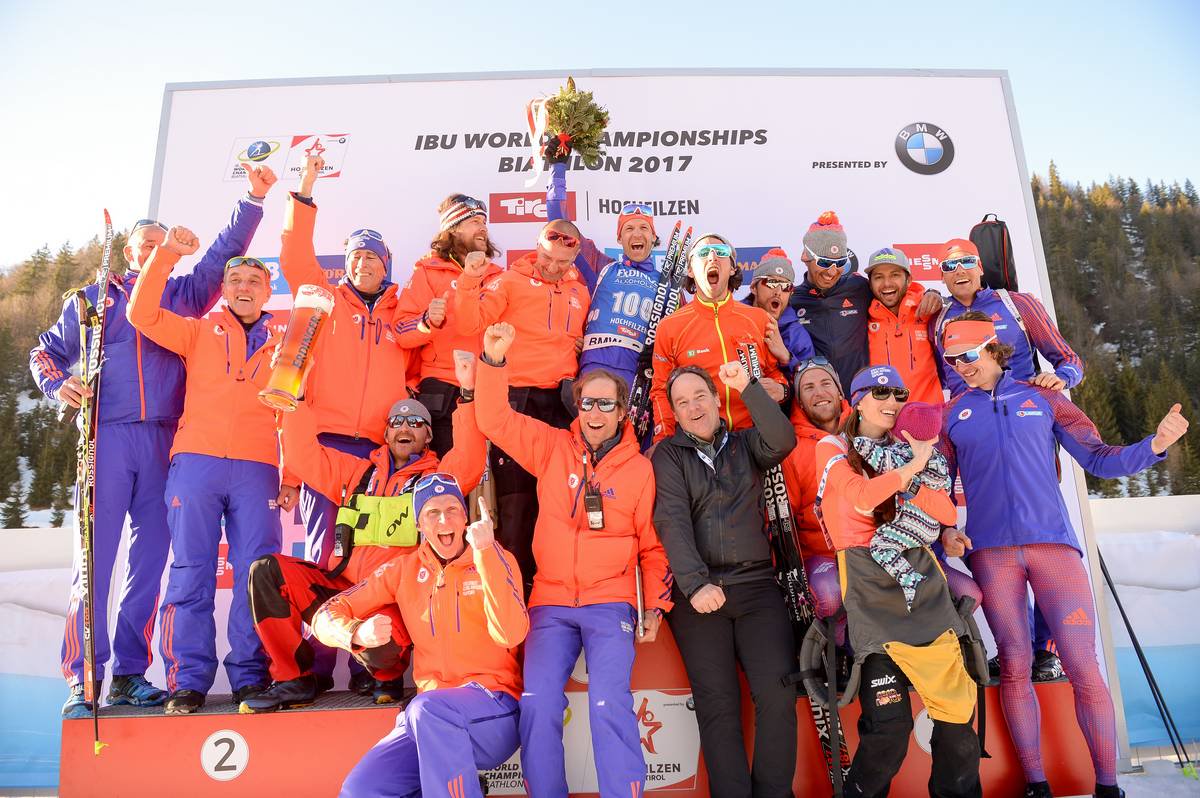
The U.S. Biathlon team and staff celebrate a Lowell Bailey’s gold medal in Hochfilzen in 2017. (Photo: USBA/NordicFocus.com/Twitter)
The Performance and Financial Picture
USA Biathlon has struggled for decades within its centralized development model. The program has never won an Olympic medal. Its financial structure remains heavily dependent on external institutional support. The closest the United States has come to a modern Olympic breakthrough was Lowell Bailey, whose 2017 World Championship gold medal represented a historic result for the program.
More recently, Campbell Wright’s rapid rise has dramatically changed expectations. Olympic podiums now appear to be viewed internally as realistic rather than aspirational.
Financially, the organization remains highly dependent on the USOPC and the International Biathlon Union. In 2023, those two sources combined to provide just under $2 million in funding. Membership revenue totaled approximately $305,000. Together, those categories represented roughly 70% of total organizational revenue, illustrating how limited the organization’s independent sponsorship and fundraising capacity remains.
Overall, USA Biathlon reported approximately $3.2 million in annual revenue against roughly $3.2 million in expenses, essentially operating at break-even. Based on expense reporting, it appears less than $800,000 was directed toward direct athlete programs and support. USA Biathlon categorized approximately $2.4 million under “Functional Business” expenses tied to trials, training, competition, and development programs, yet more than $700,000 of that consisted of staffing and contract labor costs. In total, staffing and operational expenses appear to exceed $2 million annually, roughly 63% of total expenditures.
That leaves very little financial margin for error. USA Biathlon appears to be operating in a structurally fragile position where revenues and expenses are essentially balanced while administrative and operational costs consume the majority of available resources.
What Does USSS Gain?
Given the current financial picture, and the program’s historical performance trajectory, it is difficult to see how USA Biathlon brings anything other than additional financial pressure to USSS. So the obvious question becomes: what does USSS gain from the arrangement?
Presumably, increased USOPC funding. USA Biathlon’s own 2030 strategic plan lays out explicitly outcome-based goals:
“Consistent medal winning performances every year,”
beginning with “one Olympic medal in 2026,”
and progressing toward “four [Olympic medals] in 2030, at least one gold.”
That language closely mirrors the increasingly performance-driven funding expectations the USOPC now places on National Governing Bodies.
It is clear USA Biathlon currently faces significant operational and financial challenges in supporting athletes at the level required for sustained international success. Campbell Wright’s emergence has only intensified the pressure surrounding those expectations. What remains unclear is how simply moving the sport under USSS materially changes the equation.
There may be some operational efficiencies through shared services and administrative consolidation, perhaps several hundred thousand dollars annually. But regardless of governance structure, the fundamental reality remains the same: the sport will require substantially more funding if it expects to support athletes at a level capable of producing consistent Olympic success.
Athlete Trust
The unresolved issue in all of this is athlete trust. Financial instability and competitive underperformance are one thing. Failures involving athlete safety, organizational culture, and accountability are something entirely different.
Over the last several years, USA Biathlon has faced significant public scrutiny surrounding athlete abuse allegations and broader questions about organizational oversight. Whether or not those issues are directly tied to the current governance discussions, it is difficult to believe they are irrelevant to the long-term stability of the organization.
For athletes and families, trust matters. Those athletes impacted by abuse allegations have asked for accountability for those who minimized their reports of abuse and failed to report. Parents should be evaluating a development pathway, not simply assessing coaching quality or race results. They should be asking whether the organization can provide a healthy, stable, and safe environment for athletes.
Once an NGB develops a public reputation for cultural or athlete protection failures, rebuilding confidence becomes extraordinarily difficult. That impacts membership growth, fundraising, athlete retention, and ultimately performance itself.
The Case for Transparency
Which is why transparency matters here. If the proposed integration is fundamentally about operational efficiency and athlete support, then that case should be made openly and directly. If it is also connected to concerns surrounding governance, accountability, or organizational stability, those questions deserve equally direct answers.
Without that transparency, the process begins to look less like strategic planning and more like institutional consolidation without meaningful public accountability.
Help Support Our Coverage!
If you value the thoughtful work and access FasterSkier provides, please consider becoming a Voluntary Subscriber. Your support directly fuels our work to cover the people, places, and moments that make our sport special.
Stifel Lake Placid Finals, a Coop FIS Cross-Country World Cup, to Bring Elite Ski Racing and Winter Festival Atmosphere to Lake Placid
FIS Cross-Country World Cup racing, fan experiences, athlete engagement, and live entertainment coming March 19–22
LAKE PLACID, N.Y. — The Stifel Lake Placid Finals, a Coop FIS Cross-Country World Cup, will offer more than world-class competition this March. The event will transform Lake Placid into a multi-day winter sports festival featuring themed race days, live entertainment, film screenings, interactive expo activations, and family-friendly programming.
In collaboration with the New England Nordic Ski Association (NENSA), the 10th Mountain Division, U.S. Ski & Snowboard, and the International Ski and Snowboard Federation (FIS), the Olympic Regional Development Authority (Olympic Authority) has curated a dynamic schedule that celebrates Nordic skiing and outdoor winter-sport culture.
A central focus of the week will be spotlighting women and girls in sport, networking opportunities, and hands-on activities. Fans will also have unique opportunities to connect with athletes through meet-and-greets, alumni celebrations, and special legacy moments — including Sunday’s “Last Lap” ceremony honoring retiring World Cup athletes.
Together, these events are designed to foster engagement, connection, and shared celebration across the Lake Placid community and the global ski family.
One final celebration of Jessie Diggins (USA) amazing career. (Photo: Authamayou/NordicFocus)
Event & Community Programming
In addition to World Cup racing, the Stifel Lake Placid Finals will feature a range of community events, athlete appearances, and festival programming throughout the week. Activities include youth programming, athlete conversations, live music, demonstrations, and opportunities for fans to connect with past and present champions.
Programming details may evolve, and additional events may be added throughout the week. Visitors are encouraged to check the official event schedule for the most up-to-date information.
Thursday, March 19 – Community & Kickoff
Opening day features official training and festival programming at Mt Van Hoevenberg, along with an evening film screening at the Palace Theatre that kicks off the festivities in downtown Lake Placid.
Friday, March 20 – Theme: Past
Friday celebrates the legacy of Nordic skiing and Olympic history in Lake Placid. The venue opens with festival programming, including the NENSA Terrain Park and Expo with L.L. Bean, regional athlete recognition connected to the 2026 Winter Olympics, and Adirondack Birds of Prey demonstrations. Fans can also watch presentations from the 10th Mountain Division, enjoy live music, and attend athlete interviews and meet-and-greets throughout the day. A highlight of the afternoon is the “One More Lap” legacy ski, featuring international and U.S. Ski Team alumni, including Olympic legend Thomas Wassberg and American champion Bill Koch, before World Cup racing and awards ceremonies conclude the day.
Saturday, March 21 – Theme: Future
Saturday’s programming focuses on the next generation of Nordic skiing. Activities include the NENSA Terrain Park and Expo with L.L. Bean, athlete appearances, and fan engagement opportunities. The Women in Sports Heroic Panel highlights leadership and opportunities for girls and women in athletics, while fans can also attend athlete meet-and-greets and participate in interactive programming throughout the venue. Competition highlights include the freestyle sprint finals, followed by Crystal Globe presentations. Youth racing also takes center stage with the World Cup Future Stars Sprint. Additional programming includes Lollipoppers to Olympians: A Celebration of New England Skiing, a live recording of the Skirious Podcast featuring Ben Ogden and special guests at the Olympic Jumping Complex, and evening film screenings at the Palace Theatre.
Sunday, March 22 – Theme: Present
Championship Sunday features entertainment, athlete appearances, and the season-ending races of the World Cup Finals. Live music, a DJ set, and ceremonial elements, including the 10th Mountain Division Color Guard and flyover, set the stage for the final competition. The afternoon concludes with awards ceremonies and the “One Last Lap” ceremony honoring retiring World Cup athletes.
Gus Schumacher (USA) and Ben Ogden (USA), (l-r) celebrate their silver medal at the Olympic Winter Games in Tesero, Italy. (Photo: Vanzetta/NordicFocus)
Competition Schedule | FIS Cross-Country World Cup Finals
Mt Van Hoevenberg | March 19–22, 2026
World Cup official training and competition runs March 19–22 at Mt. Van Hoevenberg, where the world’s top U.S. and international cross-country skiers will compete for overall and discipline Crystal Globe honors. The weekend culminates on Sunday with championship racing, awards presentations, and the “One Last Lap” ceremony recognizing retiring athletes.
Full competition schedule:
Thursday, March 19, 2026:
11:00 – 1:00 pm | 10km Official Training
1:00 pm – 3:00 pm | Sprint Official Training
Saturday, March 21, 2026:
10:30 am | Women’s Sprint Qualification Free
10:30 am | Men’s Sprint Qualification Free
1:00 pm | Women’s Sprint Final Free
1:00 pm | Men’s Sprint Final Free
Sunday, March 22, 2026:
12:30 pm | Men’s 20km Mass Start Free
2:30 pm | Women’s 20km Mass Start Free
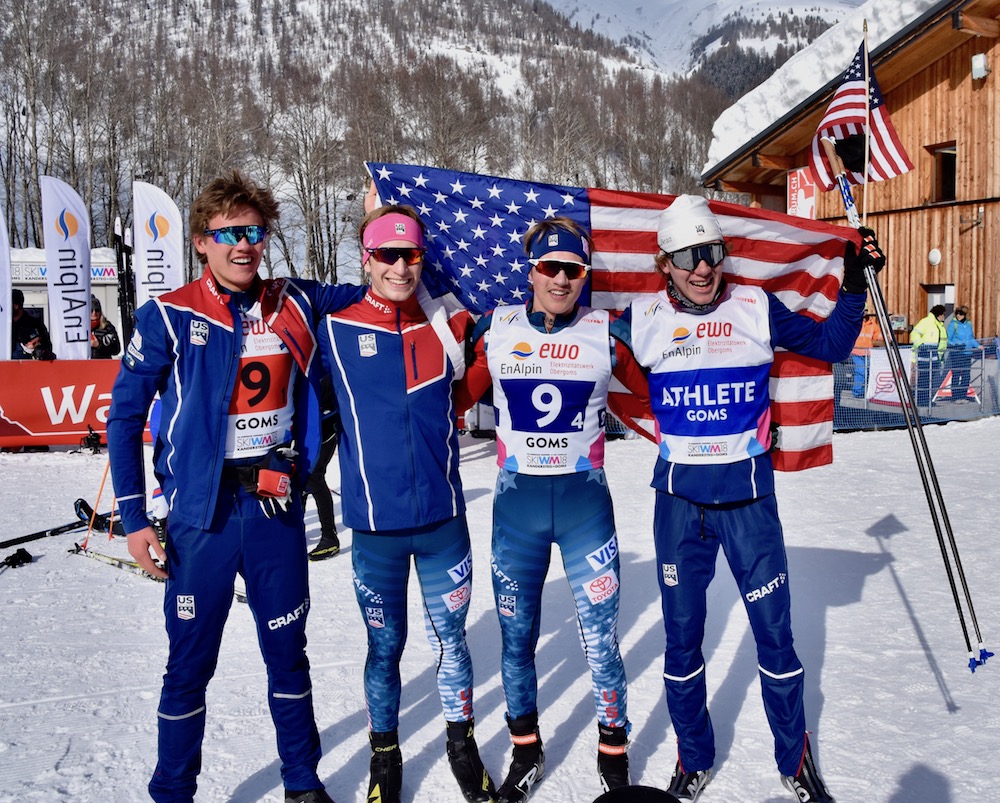
Jessie Diggins (USA) and the US Ski Team celebrate in Goms. (Photo: Authamayou/NordicFocus)
Broadcast Schedule
NBC will air the Sprint Finals live on Saturday, March 21, from 1–2 p.m. ET. CNBC will air coverage of the Men’s and Women’s 10km Interval Starts on Saturday, March 21, from 2–4 p.m. ET. NBC will also air the Women’s 20km Mass Start on Saturday, March 29, from 1–2 p.m. ET on tape delay.
Hunter Wonders (USA) racing the Skiathlon at the 2023 World Championships in Planica, Slovenia. (Photo: Modica/NordicFocus)
When U.S. Ski & Snowboard released its roster for the 2026 Olympic Winter Games, Hunter Wonders’ name appeared without emphasis. No asterisk. No parenthetical explanation. Just another line in a list that had already absorbed months of speculation, anxiety, and arithmetic.
To most readers, the name represented a straightforward outcome: an athlete peaking at the right moment, a season resolved by results. But the roster line masked a career that did not move in a single direction. Wonders’ path bent, paused, and restarted. At one point, it appeared to end entirely.
Understanding how he arrived at the Olympics requires starting far from the Games themselves — in a place where progress is quiet, repetition matters more than recognition, and development happens long before it is visible.
Hunter canoe racing with his dad in Michigan. (Photo: Courtesy Photo)
Alaska, Not Michigan
Hunter Wonders is sometimes misidentified as a Midwestern skier. His parents are from Michigan — his father from Grayling, his mother from Traverse City — and the family returned there most summers to visit grandparents. Wonders spent long stretches canoe racing in Michigan and maintaining close ties to extended family.
But Alaska is home.
“My parents were originally from Michigan… And yeah, they moved to Alaska. It was supposed to be like a two-year thing for my dad’s work,” Wonders said. “And he just knew, like, nope, we’re not going back. I’m staying here.”
That decision happened decades before Wonders had any agency of his own. By the time he was born, Alaska was already permanent.
“I’m definitely from Alaska and have lived there my whole life,” he said.
In American cross-country skiing, place is not just a backdrop. It is infrastructure. Alaska exists at the edge of the domestic system — geographically distant from centralized camps, expensive to travel from, and easy to overlook. Athletes there develop without constant reference points, often without external validation.
For Wonders, that isolation became formative.
Hunter Wonders, Hailey Swirbul, and Chip Schoff (former APU skier and wax tech) on a multi-day hut trip. (Photo: Courtesy Photo)
Alaska, Off the Circuit
In Alaska, training is often solitary. Progress is built through lifestyle and repetition rather than comparison, and improvement is measured internally long before it is confirmed externally.
The winters matter. So does the darkness. Training extends into hours when daylight is no longer guaranteed, when motivation cannot depend on atmosphere or audience. You go out because it’s how you choose to live and enjoy your life.
That rhythm shaped Wonders’ relationship to skiing early. He did not grow up racing for recognition. He learned to train for alignment — the quiet sense that body, terrain, and effort were moving together. Alaska not only accelerated his trajectory. It birthed it.
Hunter Wonders (APU/Alaska) takes the lead in the U16 Boys Mass Start Freestyle race at the US Junior National Championship in Stowe, Vermont in 2014. (Photo: Voisin/FasterSkier)
A Childhood of Rotation
Wonders grew up chasing his older siblings — twin brother and sister, five years ahead — through a constantly shifting landscape of sports. Alpine skiing. Motocross. Soccer. Ski jumping. Biathlon. Mountain biking.
“Anytime I started getting into a sport, my family shifted away from that one,” he said.
The pattern was not neglect, but necessity. Supporting multiple competitive sports for multiple children eventually became unsustainable.
“My parents were like, all right, we can’t do all this stuff. We gotta limit it. And they chose to Nordic ski. And so naturally, I was kind of dragged into that scene.”
Nordic skiing, at least initially, was not a calling. It was what remained once the family consolidated its energy.
Wonders’ first encounter with skis reflects that informality.
“It was my dad playing with me on my back deck in 2001. And I’m not really skiing that much, but that was kind of my first encounter with it.”
There was no mythology attached to that moment. No sense of destiny. Skiing entered his life as play, then habit, then gradually — almost without announcement — as a central structure.
Hunter Wonders (APU/Alaska) winning the U16 Boys Mass Start Freestyle race at the 2014 US Junior National Championship in Stowe, Vermont. (Photo: Voisin/FasterSkier)
Stowe, Vermont
The first moment when that structure revealed competitive meaning came far from Alaska.
Wonders qualified for Junior Nationals in Stowe, Vermont, in 2014. He did so narrowly, selected as the fifth or sixth skier on Team Alaska.
“I barely made Team Alaska. But it was a big goal for me as a U16,” he said.
What followed surprised nearly everyone, including Wonders himself.
“And just out of nowhere, I ended up getting a second place in the individual start race and first place in the mass start. And that was just like, whoa, where did that come from?”
The results did not instantly rewrite his trajectory. But they altered his internal calculus.
“I think it kind of clicked for me that, okay, I can do this. I can be competitive.”
The significance of that realization was not the result itself, but permission. Permission to imagine a longer horizon.
The U.S. men’s silver-medal relay at the 2018 Junior World Championships in Goms, Switzerland, with (from left to right) Luke Jager, Hunter Wonders, Gus Schumacher, and Ben Ogden. (Photo: Julia Kern)
The Long Middle Begins
What followed was not a rapid ascent, but a prolonged middle years defined by steady development, incremental gains, and results that suggested promise without announcing arrival.
On the World Cup, Wonders often raced from the margins. Finishes in the 50s and 60s gave way slowly to finishes in the 30s. The progress was real, but it did not demand attention.
In American men’s skiing, where depth is both strength and complication, that middle can be unforgiving. Selection is rarely guaranteed. Criteria shift. Opportunity compresses.
Wonders responded the way he had learned to respond in Alaska: by focusing inward. Training remained central.
“For me, training has always been kind of the fun part… The training and living that lifestyle is really, really big to me.”
That orientation would become essential later — when the question was no longer how to improve, but whether improvement was still worth pursuing.
Hunter Wonders races at Government Peak Recreation Area, Palmer, Alaska, Nov. 14, 2021, in the season-opening Race to the Outhouse #1. (photo: Eric Strabel for APUNSC)
APU and Staying Put
Alaska Pacific University provided continuity during those years. It was neither a junior factory nor a national-team satellite. Its athletes often arrived through unconventional paths and stayed longer than expected.
For Wonders, APU offered stability without stagnation. Coaching relationships endured. Autonomy was preserved. Expectations were internal before they were external.
Progress was allowed to be slow.
That patience would later prove critical — because when Wonders eventually left the sport, and then considered returning, there was no system to rebuild, no trust to reestablish. The ground remained where he had left it.
Hunter Wonders (USA) on his way to 16th place in the 10 k Classic in Beitostolen, Norway in 2022. (Photo: NordicFocus)
Proof, Finally
The breakthrough season arrived quietly, without spectacle or announcement.
During the 2022–23 World Cup season, Wonders recorded the strongest international results of his career: a 16th-place finish in Beitostølen, Norway an 11th-place finish in Oberstdorf, Germany and a 23rd-place finish at Holmenkollen. The trajectory was unmistakable, even if it did not demand attention.
“For me, that was a big jump from spending my time in the 50s, 60s,” he said.
The significance of those results was not external. They did not alter his standing overnight or change how the sport viewed him. Their impact was internal.
“It felt good. To prove to myself that I could ski with some of the best out there.”
For years, that belief had existed as conviction rather than certainty. Now it had evidence. The question of whether he belonged — the one that had quietly governed training blocks, selections, and seasons — no longer needed answering.
What remained was not ambition, but choice.
Hunter Wonders (USA) on his way to 23rd place in the Holmenkollen 50 k Freestyle in Oslo, Norway in 2023. (Photo: Modica/NordicFocus)
Leaving Without Collapse
Retirement in endurance sport is often framed as inevitable. Bodies fail. Results decline. Motivation erodes. The decision arrives trailing visible causes.
Hunter Wonders’ retirement did not follow that pattern.
When he stepped away from World Cup racing in the spring of 2023, his career was not unraveling. It was consolidating. The season behind him had not forced his hand; it had freed it.
“My planned last World Cup… it was right after a really good season for me,” he said.
The timing mattered. He was not leaving with questions unanswered. He was leaving with a sense of completion.
For a long time, Wonders had believed he could compete at that level. Now he knew it. And that knowledge altered the logic of staying.
With the central doubt resolved, the future opened in unexpected ways. Instead of sharpening ambition, success created space to consider what life beyond skiing might look like, and whether the cost of continuing still made sense.
“I thought I was content. I thought I was, you know… ready to move on.”
The decision was not driven by exhaustion or dissatisfaction. It was driven by certainty — and by the rare freedom that certainty can bring.
Crust ski in the spring time (Wonders’ all time favorite form of skiing). (Photo: Courtesy Photo)
What It Means to Leave While Improving
Leaving while things are going well carries a specific psychological weight. There is no obvious decline to explain the decision. No external force to blame. The athlete leaves not because the door is closing, but because it remains open.
Improvement, once experienced, does not fade quietly. The body remembers what alignment feels like — when training, racing, and confidence converge. Walking away at that moment does not resolve ambition; it suspends it.
Wonders framed his retirement as closure. But closure in elite sport is rarely permanent. The unanswered questions tend to return first, often in subtler forms.
In his case, the unresolved question was not whether he could ski at the highest level. That had been answered. The question was whether he wanted to continue building a life that revolved so completely around it.
From Seasons to Paychecks
After stepping away, Wonders entered a different rhythm entirely.
“That whole following summer, I worked construction, learned a lot of new skills. That’s when I got my pilot’s license.”
The change was not symbolic. It was practical. Construction offered tangible progress — work that produced visible results and predictable compensation.
“Even when skiing was going well, I just wanted to get out of it and work a normal job, get the normal paycheck, things like that.”
The appeal of normalcy was not rooted in dissatisfaction with skiing. It was rooted in adulthood. After years of living season to season, the idea of stability carried weight.
At the same time, Wonders had recently completed his degree at Alaska Pacific University.
“I graduated with a bachelor’s in business administration,” he said.
What followed was a transition many elite athletes experience but rarely articulate.
“I found a really hard transition when I graduated from being a student athlete to just an athlete. I felt like I wasn’t progressing elsewhere in life. And that was pretty hard for me.”
Without coursework, semesters, or academic milestones, skiing existed in isolation. Progress on snow no longer corresponded to progress in life. The imbalance unsettled him.
The Second Discipline
Aviation entered that gap not as a hobby, but as a parallel discipline.
“I have my pilot’s license now, and I’ve been working on my instrument rating,” Wonders said.
He described the training with precision.
“Being able to fly only using what’s on the dashboard of the plane. Basically, no looking outside the plane.”
Instrument flight is unforgiving. It demands trust in systems over instinct, procedure over perception. For Wonders, it offered a structure that mirrored elite sport without duplicating it.
“It’s been giving me something to work on outside of skiing, which has been really nice.”
More importantly, it offered psychological margin.
“It’s a very important thing for me, I think, to not feel trapped.”
The word matters. Trapped implies more than fatigue or burnout. It implies a loss of agency — the sense that leaving would erase identity rather than expand it.
Aviation gave Wonders a way to be committed to skiing without being consumed by it.
A Life That Almost Fit
For a time, the other life worked.
Construction days were long and direct. Progress was visible. Paychecks arrived on schedule. Flight training offered complexity, mastery, and forward motion.
The pace was different. The stakes were different. The feedback was immediate.
Skiing receded into the background — not as a regret, but as a completed chapter.
Yet even in that distance, the sport did not disappear entirely. It remained embedded in routine, in memory, in the body’s sense of what effort felt like.
Wonders did not describe missing racing. He described missing the calendar.
In November of 2022 Hunter Wonders (USA) was on his way to 30th place at the opening World Cup weekend in Ruka, Finland, but a year later he was home in Alaska. (Photo: NordicFocus)
November
“When everyone started peacing out to go race, I was like, man, what am I doing?”
November arrived the way it always does in elite skiing — as a turning point. Training blocks gave way to travel. Preparation became exposure.
For athletes still inside the system, November is movement. For those who have stepped away, it is absence.
The routines disappear first. Then the shared language. Eventually, the calendar itself feels unfamiliar.
Wonders’ realization was not emotional. It was logistical.
“I can always be installing insulation in some random house someday, but I can’t be skiing forever.”
November clarified something Wonders had not fully confronted while working construction or studying flight manuals: skiing was not just a job he had left. It was a window with an expiration date.
The question was no longer whether another life was possible. That had been answered. The question was whether he was prepared to let the skiing life close while it remained viable.
APU Head Coach Erik Flora, Chip Schoff, and Oscar Flora after getting the PistenBully running on Eagle Glacier last spring. (Photo: Courtesy Photo)
The Conversation That Changed the Direction
Wonders began talking again with his APU coach, Erik Flora. The conversations were not urgent.
“He was very enthusiastic about my getting back into skiing. And so that just made that step a little easier.”
There was no pressure to return immediately. No demand for proof. The space remained open.
What followed was not an impulsive comeback, but a deliberate reconstruction.
Fishing trip on the Gulkana river this last September with close friends. (Photo: Courtesy Photo)
A Three-Year Calendar
Rather than simply resuming his previous life, Wonders built a framework designed to prevent the same tension from reemerging.
“I just planned out this three-year calendar kind of to right now,” he said.
The calendar was not about training volume or race targets.
“I blocked off weeks that I was like, okay, these chunks of time, I’m not going to be thinking about ski racing.”
Those blocks were non-negotiable.
Moose hunting with his father and brother. Fishing weekends on the Kenai Peninsula. Commitments that anchored him to a life beyond snow.
“There are certain things I was willing to give up and certain things I wasn’t.”
The decision to return was conditional. Skiing would be central again, but not all-consuming.
Moose hunting camp with his dad and brother in interior Alaska. (Photo: Courtesy Photo)
The Return, Without Announcement
When Hunter Wonders returned to full-time racing, there was no formal reintroduction. No narrative reset. No expectation that the sport should receive him differently than it had before.
He did not return as a project. He returned as a person who had already tested the alternative.
The first season back was uneven by his own account — fitness arriving in pieces, rhythm coming and going — but the framework held. The calendar he had built remained intact. The boundaries were not abandoned under pressure.
“Coming back from retirement wasn’t the easiest. Not… not the most productive thing,” he said.
The difference this time was not performance. It was posture. He no longer treated each result as a referendum on identity. He had already stepped outside the system once and learned what waited there.
That knowledge altered how he handled uncertainty.
Hunter Wonders (USA) during the 10 k Freestyle in Les Rousses, France of January of 2025. (Photo: Authamayou/NordicFocus)
Progress Without Urgency
As the return season unfolded, improvement came incrementally — the way it always had for Wonders. There was no single race that announced transformation. Instead, there was accumulation: training blocks completed, races absorbed, effort normalized.
The quiet confidence that had once been provisional now appeared settled. Racing no longer felt like a test of belonging. It felt like execution.
That distinction matters in Olympic years, when urgency can distort judgment. Athletes often feel pressure to force form, to manufacture moments that prove readiness. Wonders did not describe that impulse. He described a narrowing focus.
“I really tried to narrow the focus. And limit some distractions in the last year. I just wanted to go all in.”
The phrase carried none of its earlier desperation. “All in” now meant presence rather than sacrifice — committing fully to skiing while refusing to let it consume everything else.
Hunter Wonders (#369 – APU) on his way to winning the opening race, a 10 k Individual Start Classic, at the US National Championships in Lake Placid, New York, at the beginning of January. (Photo: Nancie Battaglia)
The Olympic Winter, Reframed
Olympic selection seasons tend to magnify everything. Results are scrutinized more closely. Criteria are parsed more aggressively. Small margins carry exaggerated meaning.
For athletes who have never stepped outside the system, that pressure can feel total. For Wonders, it did not.
He had already lived the other version of his life — the one with construction hours, flight manuals, and normal paychecks. He knew that version was viable. He also knew it was incomplete.
That knowledge changed how the Olympic Winter Games landed.
The selection process did not define him. It tested him.
Hunter Wonders (USA) racing the 10 k Classic in Oberhof, Germany on the final weekend of racing that was considered for making the US Olympic Team. (Photo: Authamayou/NordicFocus)
Selection as Consequence
When the Olympic team was named, Wonders’ response did not resemble arrival. It resembled recognition.
“My parents are coming over. I’m very excited about that,” he said.
Their presence mattered more than the announcement itself.
“Regardless of whether I made the Olympics or not, they were going to be supportive and proud.”
That certainty allowed the moment to settle without drama.
Still, the meaning was clear.
“To me, making the Olympics is kind of like paying them back… like, I finally made it.”
The phrasing was not triumphant. It was relational. The Olympics were not framed as destiny fulfilled, but as acknowledgment earned — proof that the years of logistics, travel, and patience had resolved into something concrete.
Hunter Wonders (USA) during the 20 k Classic Mass Start in Goms, Switzerland, the weekend after he had been named to the US Olympic Team. (Photo: Authamayou/NordicFocus)
After the Goal
The days after selection often reveal more than the selection itself. For many athletes, the achievement creates a vacuum. The central question disappears, replaced by a quieter one: Now what?
Wonders articulated that shift immediately.
“Now it’s hard. I’ve been kind of thinking about now, what are my goals going forward?”
Qualification had resolved the season’s largest uncertainty. It also removed the shelter of pursuit.
“I don’t want to look like a bum at the Olympics… that’s not why I came here.”
The bluntness mattered. Making the team had never been the end of the story. It was a threshold — one that demanded a different kind of clarity.
Wonders taking his friend, who’s also a pilot, on a flight while he visits Alaska. (Photo: Courtesy Photo)
Flying by Instruments
The metaphor that runs quietly through Wonders’ story — though he never names it as such — is aviation.
“Being able to fly only using what’s on the dashboard of the plane,” he said, describing his instrument rating.
Instrument flight requires a specific discipline. When visibility disappears, instinct becomes unreliable. The pilot must trust systems rather than sensation, training rather than impulse.
That discipline mirrors the way Wonders has navigated his return. He has learned not to chase feelings — not to react to noise — but to trust the structures he has built.
In an Olympic year defined by margins, criteria, and scrutiny, that trust is rare.
When these two embrace each other next, they will have gone from this first ski on the back deck all the way to the Olympics. (Photo: Courtesy Photo)
A Different Kind of Olympic Story
Hunter Wonders will arrive at the Olympic Games as a first-time Olympian. He will not arrive as someone who chased the Olympics at all costs.
He has already lived the alternative. He knows what it means to step away, to build another life, to find meaning beyond the sport. That knowledge changes how the Olympics function in his story.
The arc matters because it resists simplification. It does not fit neatly into the narratives elite sport prefers — prodigy, burnout, comeback. It occupies a quieter space: adulthood.
Wonders did not return because he had nothing else. He returned because he chose skiing again — deliberately, with boundaries intact, with the instruments checked and trusted.
In endurance sport, where careers are often defined by urgency and fear of loss, that choice may be the rarest qualification of all.
Help Support Our Olympic Coverage!
FasterSkier will have our own Nat Herz on the ground at the Olympics, which, to be honest, is a very big financial lift for us. If you value the thoughtful work and access FasterSkier provides at championships like this one, please consider becoming a Voluntary Subscriber. Your support directly fuels the work we do to cover the people, places, and moments that make our sport special.
If Hunter Wonders (#302) earns an Olympic start this February, hopefully, it will be a little less chaotic than the start of the US Junior National Championship in Stowe, Vermont, in 2014. (Photo: Voisin/FasterSkier)
Paul Choudoir with his wife Julia Curry. (Photo: Courtesy Photo)
A Portfolio, Not a Resume
Paul Choudoir did not set out to work at the Olympic Games. He did not study engineering. He did not grow up in a wax room, nor did he apprentice under a legendary grinder with a machine humming in the background. He went to school for communications. Advertising, specifically. He built a portfolio. He expected a desk.
“I was a communications major,” Choudoir said. “Yeah, in advertising.”
In 2018, his life looked orderly in the way young professionals’ lives often do just before they don’t. He was finishing school, assembling work samples, and preparing to enter an industry with defined pathways and predictable ladders. He interviewed at an ad agency. They liked him.
“The next day, they offered me the job,” he said.
The day after that, something else happened.
“And I told them that I took a job with the snowboard team,” Choudoir said. “And I couldn’t be more grateful that I turned that down.”
That second offer was seasonal. It was physical. It came with no guarantee of permanence. It was also the beginning of a career that would, eight years later, place Choudoir at the center of the U.S. Cross-Country Ski Team’s Olympic preparation, responsible for the grinding program that shapes the skis American athletes will consider racing on when the Winter Games begin this Saturday.
It is not a path that makes immediate sense on paper. Which, in many ways, is the point.
Growing Up on Skis, Not Destined for Them
Choudoir grew up in central Wisconsin, five minutes from his local ski trails. Skiing was present from the start, not as destiny but as texture—something you did because it was there.
“I’ve been skiing all my life,” he said. “As soon as you could walk, you played on skis.”
He raced. He trained. He went to college and skied there too, though he is careful not to mythologize that part of the story.
“Not exactly an illustrious college career,” he said. “But I wouldn’t be where I am today if I hadn’t done that.”
The tone matters. Choudoir does not frame himself as a near-miss Olympian or an athlete who found a second life in service. He is precise about what his racing was and wasn’t. Skiing gave him familiarity with snow, equipment, and race culture. It did not hand him a blueprint.
What it did give him—though he didn’t know it at the time—was an eye.
US Snowboard Cross Team started using cross-country skis and techs to help determine what to do to their snowboards for races. Choudoir was one of those techs at the last Olympics. (Photo: Courtesy Photo)
Learning to See the Ski
“I fell in love with the service side of the sport,” Choudoir said.
That love did not arrive fully formed. It developed slowly, through observation, repetition, and mentorship. One name comes up again and again when Choudoir talks about learning to grind: David Chamberlain.
“David taught me to grind,” he said. “I’ve been grinding since… about ten years now.”
Grinding, at its simplest, is the process of cutting microscopic patterns into the base of a ski using a stone grinder. Those patterns—called structure—help manage how water behaves between the ski and the snow. Too much suction and the ski sticks. Too little contact and it chatters. In dry snow, structure can be minimal. In wet snow, it can be decisive.
But Choudoir resists explaining grinding as a purely technical exercise. What matters, he suggests, is not just the machine but how you look at the ski coming off it.
“When running a grinding machine,” he said, “I think you need both. You need right-brain and left-brain people.”
There are databases. There are measurements. There are RA values, stone parameters, and logs that stretch back years. And then there is feel.
“You need the people who have the database of what we waxed with here three years ago,” he said. “And you need the gut-instinct people.”
Choudoir’s background in visual communication—learning how images convey meaning, how patterns read, how subtle differences change perception—became an asset. Grinding is, in many ways, about pattern recognition. Noticing when something looks right. Or wrong.
The First Call to Europe
The moment when Choudoir’s interest hardened into commitment came not in a classroom or a wax room, but through a phone call.
“Someone had to bail from the OPA Cup trip,” he said. “And [Bryan] Fish was asking around.”
Chamberlain’s name came up. So did Choudoir’s.
“David immediately asked me,” he said.
The trip was three weeks long. It was his first sustained exposure to European racing, to the rhythm of international service work, to the stakes that live just behind the results sheet.
“I went on that trip for three weeks,” Choudoir said. “And that kind of solidified what I wanted to do.”
Service at that level is relentless. Skis arrive. Conditions change. Decisions must be made quickly and defended quietly. There is no time to romanticize the work. But for Choudoir, it clarified something fundamental: this was where his skills mattered.
Constructing the Arrow While Shooting It
“This grinding development project is kind of my baby,” Choudoir said.
He is referring to the U.S. team’s effort to build a modern, resilient grinding program—one capable of producing skis that perform across a wide range of snow conditions, with limited resources and little margin for error.
“We’re kind of constructing the arrow while we’re shooting it,” he said.
The phrase captures both the ambition and the constraint. Unlike larger federations, the U.S. does not have the luxury of endless testing or redundancy. Time, money, and personnel are finite. That reality shapes every decision.
The goal is not perfection. It is coverage.
There have been moments of early confirmation along the way. Certain grinds have worked immediately, validating months of off-season testing and reinforcing the idea that the overall approach is sound. But Choudoir is quick to note that genuine development rarely happens when the calendar is full. Race weekends compress decision-making into survival mode: skis need to be ready, not experimental. Time disappears, weather intrudes, and the consequences of being wrong grow heavier. Building new structure in those moments is less about innovation than restraint—knowing when to trust what already exists, and when to leave the next step for another week.
“You’re trying to limit catastrophe,” Choudoir said. “You’re trying to make sure you’re never hand-structuring a ski and making it slower.”
The program relies on building a menu of grinds—each tested, logged, and understood well enough that when race day arrives, choices can be made with confidence rather than desperation. It is a philosophy rooted in risk management as much as speed.
Choudoir with US Snowboard athletes and techs at the last Olympics in Beijing, China. (Photo: Courtesy Photo)
The Detour That Mattered: Snowboard Cross
Before Choudoir arrived in cross-country, he spent six seasons with the U.S. Snowboard Cross Team.
“Not exactly the trajectory I thought,” he said. “But I was with them for six seasons.”
Snowboard Cross is chaotic by design. Courses change. Weather shifts. Equipment choices are compressed into narrow windows. The service environment is intense.
“I went to Beijing with that crew,” Choudoir said. “Had a blast.”
He is not being flippant. Beijing mattered. It was his first Olympics, his first exposure to that particular compression of pressure and permanence. Mistakes echo. Success is fleeting. Everything is amplified.
“Very different environment,” he said, “but still kind of doing the same thing.”
What transferred was not discipline-specific knowledge but temperament. The ability to make decisions under stress. To stay calm when the margins disappear.
Pressure Without a Bib
“I still wake up on race day with that nervous stomach,” Choudoir said.
It is an admission that disrupts the usual hierarchy of anxiety. Athletes are expected to feel it. Techs are supposed to be invisible. But Choudoir does not pretend otherwise.
“We’re being demanded to perform,” he said.
Service technicians do not get a lane. They do not get a split time. Their work is judged indirectly, through glide, through kick, through moments when an athlete looks down mid-race and knows something is wrong—or right.
“If we’re the first ones to freak out,” Choudoir said, “that trickles down.”
Pressure in the wax room is quiet. It hums rather than roars. It lives in choices made hours before a start, when weather models disagree, and snow crystals are in flux.
No Assholes in the Wax Room
“Nobody wants to work with an asshole,” Choudoir said.
It is a blunt statement, and an accurate one. Service teams operate on trust. Ego corrodes that trust quickly.
“We have to be calm,” he said. “If we’re calm, the athletes are calm.”
Calm does not mean passive. It means deliberate. It means creating an environment where athletes feel supported rather than scrutinized. Music plays. Routines settle. Decisions are explained clearly and without drama.
Choudoir describes a culture where competence is expected, and humility is enforced—not through policy, but through proximity.
Collaboration, Not Espionage
There is a persistent myth that ski service at the highest level is governed entirely by secrecy. Locked rooms. Guarded notebooks. Stolen glances.
The reality, Choudoir suggests, is more complicated.
“People help each other more than fans realize,” he said.
There are boundaries, of course. Proprietary information remains protected. But when a machine breaks, when conditions confound everyone equally, assistance flows.
“Nobody wants to see anyone fail because of equipment,” he said.
It is a quiet fraternity, built on shared exposure to the same uncontrollable variables.
Saturday
“At some point, the decisions are made,” Choudoir said. “After that, it’s just execution.”
As the Olympic races begin this coming Saturday, the grinding lists are locked. The skis are prepared. The patterns have been chosen based on months of testing and years of accumulated knowledge.
What remains is the weather. And trust.
Choudoir will be there, awake early, stomach tight, listening to the machines and watching the snow. His name will not appear on the results sheet. But his work will.
And that, for him, will be enough.
Help Support Our Olympic Coverage!
FasterSkier will have our own Nat Herz on the ground at the Olympics, which, to be honest, is a very big financial lift for us. If you value the thoughtful work and access FasterSkier provides at championships like this one, please consider becoming a Voluntary Subscriber. Your support directly fuels the work we do to cover the people, places, and moments that make our sport special.
By the time Lauren Jortberg made the U.S. Olympic Cross-Country Ski Team, the achievement arrived not as a burst of disbelief or relief, but as something quieter and stranger: a moment that required processing.
“It is a lot to take in,” she said, speaking from Seefeld, Austria in the middle of a pre-Olympic training block. “It’s been a big goal. But it’s one of those big goals that I’ve tried not to think about too much and just really focus on being my best self.”
The phrasing matters. Jortberg did not describe the Olympics as a finish line or a culmination. She spoke about it as something she had to learn how to hold — something earned, yes, but also something that could overwhelm if mishandled. “Now,” she said, “I’m trying to put aside the completion of the goal and really focus on performing. And performing really well.”
That distinction — between achievement and performance, between arrival and presence — has come to define her career. It is also the reason her story resists easy telling. Jortberg was not a prodigy. She was not a junior star. She did not dominate early or move cleanly through the system. She took the long way around.
The Long Way Around
Jortberg grew up in Boulder, Colorado, a town dense with endurance athletes and outdoor ambition. “I’m super fortunate to have been born and raised in Boulder,” she said. “It has one of the highest percentages of Olympians for cycling and running.”
Her parents were athletic — her mother was a professional runner, her father competed in multiple sports — and movement was woven into daily life. There was mountain biking, trail running, hiking, time spent at a family place in Winter Park. But skiing, she noted, was not central to Boulder’s identity. “If you’re familiar with Boulder, it’s not really a winter place. We had to work hard to get to snow.”
Her earliest athletic identity was split. She loved soccer deeply and still wonders what might have happened had she stayed with it. “I do kind of wonder what I could have done if I had pursued soccer,” she said. Her father spent hours training with her, and she took pride in improvement more than outcome.
The turn toward skiing came, in part, through her older sister — six years ahead, a steady presence, someone to chase. When her sister tore her ACL playing soccer and pivoted fully to skiing, Jortberg followed. “I really looked up to my sister,” she said. “She went to U18 Scandinavian Cup, Junior Nationals, skied at the University of Denver. Seeing her do all these cool things with skiing really felt like, well, I can do that.”
But progression was slow. In high school, Jortberg struggled. She did not make Junior Nationals her first year — a moment she still remembers clearly. “I was devastated,” she said. “It was one of the first big adversities in my career.”
She never cracked the top ten at Junior Nationals until she was a U20. “I had a lot of 11th places,” she said. “I could never crack that top ten.”
It is difficult, in hindsight, to overstate how thoroughly unremarkable her junior results were by Olympic standards. This is not revisionism; it is the point. There was no obvious through-line, no early validation to cling to.
After high school, she took a gap year at Stratton Mountain School. It did not go smoothly. She fractured her arm in a parking lot crash. The season was disrupted. Progress stalled again.
What she had, instead, was a willingness to stay.
Dartmouth and the Work of Becoming
At Dartmouth, something shifted. Not overnight, and not magically — but structurally.
“I think it was a big surprise starting at Dartmouth,” Jortberg said, “the level I was at and the level the team was at.” She majored in environmental science and found herself inside a women’s program that emphasized individual growth within collective intensity.
Under coach Cami Thompson Graves, the team culture was demanding but non-coercive. “She’s really amazing at coaching athletes to really know what is good for them,” Jortberg said. “She’s incredibly good at getting athletes to become very independent with an amazing team culture.”
The women’s team was deep, competitive, and internally driven. “We were going one through five, or one to four, five, eight, ten,” she said. “It was insane.” NCAA spots were scarce; no one could coast.
Crucially, Dartmouth supported international racing alongside collegiate commitments. Jortberg went to World Juniors, U23s, OPA Cups — sometimes twice in a season. “Having that support was super helpful,” she said. “Not just to perform in a green suit, but to perform later on.”
For the first time, development felt cumulative.
The women’s final of the 2021 Keys to the Castle rollerski sprint in Lake Placid, NY. From left to right, Lauren Jortberg (BSF Pro), Julia Kern (SMS T2/USST), Jessie Diggins (SMS T2/USST), Alayna Sonnesyn (SMS T2). (Photo: Reese Brown RDB Marketing)
The Bubble Years
Post-collegiately, Jortberg entered what many American skiers know intimately: the bubble.
She moved through programs, spent time with Bridger Ski Foundation Pro and later SMS T2, and began working with coach Perry Thomas. She earned World Cup starts, lost them, re-earned them. Progress was intermittent. Confidence, fragile.
“It was a lot of back and forth,” Thomas said. “Getting starts and not getting starts. Proving herself again in the U.S. and then getting those World Cup starts again.”
Thomas had recruited Jortberg as one of his first athletes when he began coaching at the professional level. Their early years together were not seamless. “Our first year together, there was a lot of figuring things out,” he said. “There were ups and downs.”
What mattered was not immediate success but shared patience. “We were both willing to make it work,” Thomas said. “And work through difficulty together.”
During this period, Jortberg made a deliberate choice that would shape the rest of her career: she doubled down.
Lauren Jortberg (USA) training in Tignes, France, last June. (Photo: Authamayou/NordicFocus)
Choosing One Thing
Sprinting had always been her strength — particularly skate sprinting. Classic sprinting lagged behind. Rather than attempting to become broadly better at everything, Jortberg and Thomas made a narrower decision.
“Let’s spend one day a week, every week, for an entire summer and fall, working on classic skiing,” Thomas said. “Double pole. Thirty to sixty minutes. Just consistently.”
It was not glamorous work. It was not optimized for social media or immediate payoff. But Jortberg committed fully. “She was like, ‘Hell yeah, let’s do this,’” Thomas said.
Even when they were no longer formally affiliated with the same team, she continued the work remotely. “She continued that work on her own,” he said. “From afar.”
At the same time, something else was happening — something less visible.
Lauren Jortberg (USA) during the qualification of the World Cup Individual Skate Sprint in Oberhof, Germany, two weeks ago. (Photo: Authamayou/NordicFocus)
The Mental Turn
Jortberg began working seriously with a sports psychologist. She and Thomas independently immersed themselves in books, podcasts, and writing about mental performance. They traded recommendations. They talked openly about processing failure.
“I don’t care how pretty your technique is,” Thomas said. “If you don’t have control over the on-off switch in your brain, you’re not going to get to the line fastest.”
What Thomas noticed later, during Period 1 Super Tour in Alaska, was a change. “That was a different Lauren than even a year ago,” he said. “In such a good way.”
Jortberg describes it less as a breakthrough than a reframing. “Everyone is going to have setbacks,” she said. “It’s about how you respond. Chipping away little by little. Not letting setbacks impact how you see yourself.”
She learned to loosen her grip on outcomes. “Often when we think things have to happen a certain way,” she said, “that’s when they don’t.”
Lauren Jortberg with boyfriend Antoine Cyr (CAN). (Photo: Courtesy Photo)
Two Places at Once
In the fall, Jortberg moved to the Mount Sainte-Anne area of Quebec. The decision was partly personal — she is dating Canadian skier Antoine Cyr — but also practical.
She began training at the Pierre Harvey Training Centre, known for its demanding terrain and extensive roller-ski infrastructure. “The terrain is really hard,” she said. “I think it’s been awesome for intensity. Especially my classic skiing.”
Her coaching arrangement became hybrid: remote communication with Thomas, daily training in Quebec. “We text pretty much every day,” Thomas said. “Or we’re on the phone.”
Jortberg chose not to maintain two residences. “That’s just not something that financially would be feasible,” she said. More importantly, she valued stability. “I really prioritize my personal life. That’s what allows me to perform at the highest level.”
It is an unromantic truth of elite skiing: stability is performance.
Alaska and Leadership
When Jortberg declined early World Cup starts to focus on Super Tour and U.S. Nationals, she rejoined Coach Thomas and the rest of the Mansfield Nordic Pro team in Alaska. What stood out was not just her skiing.
“I was so impressed with her as a leader,” Thomas said. “We used her a ton in team meetings. Tactics. Pacing. Course preview.”
After Alaska, the decision to formally add her back to the team was unanimous. “It was an easy decision,” Thomas said. “She just wanted to be part of the team and demonstrated awesome leadership.”
Kendall Kramer, Samantha Smith, Lauren Jortberg, and Julia Kern (l-r) will join Jessie Diggins, Rosie Brennan, Novie McCabe, and Hailey Swirbul to represent the United States in Val di Fiemme, Italy, from Feb. 6–22, 2026. (Photo: Authamayou/NordicFocus)
Not Jaded
Jortberg will arrive at her first Olympics as one of three women on the U.S. team making their Olympic debut. She sees that as an asset.
“I want to bring non-jaded energy,” she said. “Just that first-time excitement.”
She wants to be present — not consumed by outcome. “I want to look back and be grateful that I was even there,” she said. “And really appreciate the experience.”
It is not a rejection of ambition. It is a different relationship to it.
Forward
Jortberg plans to continue racing. She hopes for 2030, in the French Alps — a place she loves, a skate sprint on a stage that suits her. She is considering an online master’s program in sustainability and renewable energy, thinking carefully about how to prepare for the life that will follow skiing without rushing herself toward it. For the first time in her career, she feels no urgency to escape the present.
“I feel the most stable I’ve ever felt in my career,” she said. “And it’s showing.”
Stability, for Jortberg, has never been accidental. It is something she built deliberately, after years of motion without certainty — years of chasing snow from a town where Olympians ran past her on bike paths and reservoir loops, where excellence was ambient and ordinary at the same time. In Boulder, she grew up watching greatness move casually through public space, learning early that world-class athletes were not mythical figures but people who showed up every day and kept going.
She was not the fastest junior in that environment. She was not the one with the early results or the easy narrative. She lingered on the edges, finished just outside the frame, learned patience in a place that celebrated inevitability. And still, she stayed.
Lauren Jortberg (USA) anchors the relay for the United States in Toblach, Italy, in 2023. (Photo: Modica/NordicFocus)
Now she is an Olympian — not because she followed the shortest line between promise and performance, but because she learned how to endure the long arcs in between. She learned when to narrow her focus, when to loosen her grip, when to trust work that did not announce itself right away. She learned how to live inside uncertainty without mistaking it for failure.
There is something quietly astonishing about that return: a young woman who grew up surrounded by Olympians, never quite believing she was one of them, becoming one anyway — not by force or speed, but by accumulation. By choosing stability when chaos was easier. By learning how to stay.
For an athlete who never arrived early, this moment is not a surprise step so much as a natural one. The long way around, it turns out, still leads somewhere.
Help Support Our Olympic Coverage!
FasterSkier will have our own Nat Herz on the ground at the Olympics, which, to be honest, is a very big financial lift for us. If you value the thoughtful work and access FasterSkier provides at championships like this one, please consider becoming a Voluntary Subscriber. Your support directly fuels the work we do to cover the people, places, and moments that make our sport special.
U.S. Ski & Snowboard has announced its Olympic cross-country ski team for the 2026 Milano Cortina Olympic Winter Games, naming eight women and eight men to represent the United States in Val di Fiemme, Italy, from Feb. 6–22, 2026.
While the women were allocated eight Olympic starting positions outright, the men’s team was originally allotted seven. That number increased to eight after another nation declined to use one of its quota spots, allowing the United States to fill the vacancy and send a full men’s roster.
The announcement is part of a broader U.S. Ski & Snowboard nomination of 97 athletes across all disciplines. The athletes will be formally named to Team USA on Jan. 26.
Gus Schumacher races the third leg of the men’s 4 x 10 k relay during the 2022 Olympics. (Photo: NordicFocus)
Veteran Core, First-Time Olympians
The women’s team is led by Jessie Diggins, who will compete in her fourth and final Olympic Games as the most decorated American cross-country skier in history. She is joined by returning Olympians Rosie Brennan, Julia Kern, Novie McCabe, and Hailey Swirbul, alongside first-time Olympians Lauren Jortberg, Kendall Kramer, and Samantha “Sammy” Smith.
On the men’s side, Olympic veterans Ben Ogden, JC Schoonmaker, and Gus Schumacher return after competing in Beijing in 2022. They are joined by first-time Olympians John Steel Hagenbuch, Zak Ketterson, Zanden McMullen, Hunter Wonders, and Jack Young.
Grover: “We’ll Be Medal Threats”
Chris Grover, Program Director of the Stifel U.S. Cross Country Ski Team, emphasized the team’s late-season momentum and growing confidence heading into the Games.
“Our season started slowly, but we’ve built some important momentum in the last few weeks,” Grover said. “We have some athletes who are at the pinnacle of their craft, winning World Cups and showing everyone what is possible for USA cross country. We’ll be medal threats in some key Olympic events.”
Grover also highlighted the size and scope of the U.S. support operation, calling it the largest and most experienced staff the program has ever brought to an Olympic Games, with major advances in ski service and equipment preparation.
Olympic cross-country skiing will take place in Val di Fiemme, a long-established championship venue that last hosted Olympic events in 2006 and is a frequent stop on the World Cup circuit.
Rosie Brennan leaves the exchange zone halfway through the women’s 15k skiathlon, the opening race of the 2022 Winter Olympics. (Nat Herz/FasterSkier-ADN)
2026 U.S. Olympic Cross-Country Ski Team
Women
Rosie Brennan (Anchorage, AK)
Jessie Diggins (Afton, MN)
Lauren Jortberg (Boulder, CO)
Kendall Kramer (Fairbanks, AK)
Julia Kern (Waltham, MA)
Novie McCabe (Winthrop, WA)
Samantha “Sammy” Smith (Boise, ID)
Hailey Swirbul (El Jebel, CO)
Men
John Steel Hagenbuch (Ketchum, ID)
Zak Ketterson (Minneapolis, MN)
Zanden McMullen (Anchorage, AK)
Ben Ogden (Burlington, VT)
JC Schoonmaker (Lake Tahoe, CA)
Gus Schumacher (Anchorage, AK)
Hunter Wonders (Anchorage, AK)
Jack Young (Jay, VT)
Ben Ogden races his first distance event of the 2022 Olympics, the 15 k individual start classic. (Photo: NordicFocus)
Thursday, February 12
• Women’s 10 km Free – 13:00
Friday, February 13
• Men’s 10 km Free – 11:45
Saturday, February 14
• Women’s 4 × 7.5 km Relay – 12:00
Sunday, February 15
• Men’s 4 × 7.5 km Relay – 12:00
Wednesday, February 18
• Team Sprint Free (Women & Men) – Qualification & Finals – from 09:45 / 11:45
Saturday, February 21
• Men’s 50 km Mass Start Classic – 11:00
Sunday, February 22
• Women’s 50 km Mass Start Classic – 10:00
Help Support Our Olympic Coverage!
FasterSkier will have our own Nat Herz on the ground at the Olympics, which, to be honest, is a very big financial lift for us. If you value the thoughtful work and access FasterSkier provides at championships like this one, please consider becoming a Voluntary Subscriber. Your support directly fuels the work we do to cover the people, places, and moments that make our sport special.
On an ordinary winter afternoon in Fairbanks, before NCAA titles and World Cup bibs and FIS profiles, there was just a loop—eight hundred meters of snow and one long, unforgiving hill.
Middle-school Kendall Kramer skied it after class, day after day, with her dad. Birch Hill. Blue Loop. One big climb, same as yesterday, same as tomorrow. What changed was how it felt.
“We would just go for, like, 30 minutes after middle school every day,” she remembers. “And I remember really liking the feeling of this specific loop in Fairbanks at Birch Hill called Blue Loop. It’s like 800 meters, but it has this really big, steep, long hill. And we would do that every day. And I became really addicted to feeling like the hill was easier to get up every single day.”
Kramer didn’t start as the kid who loved hard things. She started as the kid who had to be bribed—stickers, money, chocolate, extra iPad time—just to go outside with her very active dad, a former Washington State runner who picked up skiing when he moved back home to Fairbanks.
“I really didn’t like hard things. I didn’t like pushing myself. I didn’t like going outside. I didn’t like athleticism,” she says now, half amused, half incredulous. “I was into theater, and I went to art camps, and I went to fashion designing and sewing camps, and I was just doing a bunch of art stuff until seventh grade.”
The shift did not come from some early, noble desire to maximize her potential. It came from middle-school social dynamics: her best friend and the “cool, funny kids” were in the local ski club, FXC. They were getting strong; she wanted in.
“All of the cool, funny kids, and my best friend, were on the ski club FXC,” she says. “I noticed that she was getting really muscular. And, I want to get muscular too. That was literally my motivation. I wanted to spend more time with my friends.”
So she flipped the script. The kid who once needed bribing was suddenly begging to ski. “In middle school, I asked [my dad] to take me skiing every day,” she says. “I liked the feeling of the work I was putting in quantifying to something. You don’t get that with everything in life.”
That tiny addiction—to feeling the hill get easier—would quietly rewire the course of her life.
Running Into an Identity
Before she thought of herself as an athlete, there was one race that hinted at what might be possible: a local 5K in eighth grade.
“There was this one race,” she says. “There was this local 5K, and I won that. And I beat a UAF girl. And I was in eighth grade. And so then I thought, oh, I could start training for another level at this.”
It’s a funny hinge moment: a middle-schooler passing a college athlete on a random Fairbanks course—”I think it was the Chena River Run 5K”—and suddenly reevaluating what “participation” might mean.
From there, skiing and running braided together. Everyone in her circle seemed to do both—cross-country in the fall, cross-country skiing in the winter, track in the spring. The sports gave structure to adolescence. They also gave her a first glimpse of what high-level results feel like: she made Junior Nationals, then Junior Worlds, and at 16, in her first year there, she finished fourth.
It looked, from the outside, like a linear rise.
It wasn’t.
Kendall Kramer on her way to fourth place in the U20 15 k classic mass start at World Juniors in Lahti, Finland. (Photo: Doug Stephen)
Burnout at the Top of the Podium
The breakout year rolled into something heavier. Right as college coaches were calling and scholarships were appearing, Kramer’s relationship with skiing began to fracture.
“After my breakout year, I went through a large burnout of skiing,” she says. “Looking back, maybe kind of predicted with how huge a jump it was… but I went through a huge burnout that happened to coincide with my senior year of high school.”
She was in the rare position of being heavily recruited and deeply ambivalent about the thing doing the recruiting.
“I didn’t want to do any athletics,” she says. “I wanted to go to school. I just wanted to do academics. I only applied to Ivy League colleges, [but] I didn’t get into them.”
The plan, as she saw it then, was to walk away from elite sport altogether. No more ski clubs, no more interval sessions, no more World Juniors. She would be a student, full stop.
But mid-winter, another pivot arrived. Running, with its promise of a single daily practice and a more contained lifestyle, began to look like a compromise.
“I was like, I’ll run,” she recalls. “I really feel like I could have a balanced life if I just ran in college. I might as well do something athletic.” She started talking “very seriously” with Northwestern—”for quite a few months,” she says, laughing at how she kept mixing it up with Northeastern.
Still, skiing lurked in the background. Friends were planning official visits. There were trips to New England—Dartmouth, UVM—to meet both ski and running coaches. “We worked out a plan for me,” she says of Dartmouth, “like what days I would go to running practice, what days I’d go to ski practice, how I would do all of that.”
In those conversations, UAF—her hometown university in Fairbanks—barely registered as a serious option. If anything, it was the anti-option.
“There’s a FasterSkier article where [Jason Albert] interviewed me my senior year of high school,” she says. “I did say, ‘Oh, I’m definitely not going to UAF.’ Because I need to get away. Just like every high school senior.”
The only reason she even agreed to visit was for social reasons. “I had a bunch of friends at that time… they were also going on an official visit, and I wanted to hang out with them at UAF for that weekend,” she says. “I was like, ugh, okay, fine, I’ll go to UAF for the weekend.”
That reluctant trip changed everything.
Choosing the “Wrong” School
UAF did not look like the kind of program that impresses strangers in an Instagram bio. It looked like something else: a coherent life.
Kramer noticed first what happened away from intervals and wax benches.
“The team I felt really… not only got along just at practice, and practice was fun, but they chose to hang out with each other as people outside,” she says. “They really felt genuine about it. They are really friends with each other. They actually care about each other. They’re having fun. They’re all a little bit weird.”
The second revelation was structural. At UAF, running and skiing weren’t two programs negotiating over a dual-sport athlete’s time. They were one.
“At UAF, it’s literally one program,” she says. “We share a locker room and a team room, and the coaches have their offices in the same room. Like, it’s really the same program, cross-country running and skiing.” While coaches at other schools were willing to coordinate, the Fairbanks setup was seamless. “I barely had to, like, go out of my way. I didn’t have to change my training at all with UAF, and that was really valuable.”
There was also something less tangible: the sense that staying close to home might be protective at a time when she was “really… sensitive mentally.”
“This is really a tumultuous time for me,“ she recalls thinking. “I can stay close to home. I don’t have to change too much while I’m in this mental state. I can see my family every single week. I think that would be a really good move for me.“
From the outside, it didn’t fit the script; hometown program, Div. II running, and a school she had publicly ruled out. She knew people would talk.
“Of course, people, you know, judge me for staying in my hometown,“ she says now. “People still are like, ah, you needed to finally leave Fairbanks. You need to get out. But I know that didn’t sound the best, that I’m going to UAF, because it’s not ‘the‘ program. But I’m really glad that I let what things ‘sound like‘ go, because it gave me a lot of happiness, and it made me feel like it was my choice.“
Reverse Podiums and the Slow Build Back
UAF didn’t magically solve everything. Her first years there were heavy.
“My first two years, not only was I recovering from burnout and not wanting to go to practice at all and really trying to get back into sport my whole freshman year of college,“ she says, “I was also super overtrained, and I could not go fast for the life of me. I think that I was getting a ‘reverse podium’ in my Western college races.“
The COVID year wiped out her first NCAA running season entirely—”there’s just no running races held,“ she notes. In skiing, she salvaged an All-American by the end of winter, but the trajectory felt nothing like her high-school ascent.
If her junior years had been a rocket ship, college was more like a slow climb back onto the trail.
“Luckily, I feel like one of my strengths athletically, besides that, blip, is consistency,“ she says. “I did feel like it was a gradual buildup leading up to my last year at UAF, where both [sports] were progressing from that low burnout point.“
On the running side, her NCAA results tell the story: 170th in her first nationals, then 8th—”because it was cold and super late, so I was already in ski form”—then 20th, then runner-up in Sacramento. She says, simply, “That was really cool.”
In skiing, she went from anonymous trips to the NCAA Championship to a national title. Before that win, she says, “I don’t think I got better than seventh at other NCAAs.“ Last March, she finally broke through and won.
It wasn’t a straight line. But it was, in its own way, a larger version of the Blue Loop lesson: keep showing up, let the hill get fractionally easier, trust that one day you crest the top.
Two Degrees, One Classroom
Through all of this, Kramer was not just an athlete. She was building an intellectual life, too.
“Yes. Biology, specifically, arctic ecology, which was cool. And psychology,“ she says, almost offhand, when asked about her majors.
The combination sounds eclectic until she explains her real career ambition.
“It seems unrelated to both of them,“ she says, “but it is actually related to both of them, as I want to teach.” She’s not yet sure about age group—”I am leaning towards high school”—but the vision is clear: “I want to teach high school science and high school psychology. I think [that] is a way to be still involved with both of my subjects.“
This is not a vague, post-sport idea. She’s already testing it. This year, while racing and training out of Anchorage, Kramer has been substitute teaching.
“I’ve been substitute teaching, actually, this year in Anchorage,“ she says. “That’s been really cool. That’s exposed me to that, and I have really confirmed that it’s something that I enjoy going into, and I feel fulfilled after I do the job, and I really enjoy it, and it’s something new every day.“
The logistics fit surprisingly well with elite training. Kramer logs into the Anchorage School District’s database, looks a week ahead, and drops half-days into the white space between sessions.
“You can go into the online database every week,“ she explains. “You’re like, oh, I don’t have training Monday, and it’s on your own Wednesday, and we have our afternoons off on Thursdays, so I could do all those days. And then you just sign up for what you can do.“ Elementaries offer half-days—”like 11:30 to 2:30″—which sit perfectly between morning and afternoon workouts. “It’s really good pay,“ she adds, “and that’s completely in between the two sessions, so it’s really been perfect.“
There is also a deeper satisfaction. “I think it’s a really respectable career,“ she says of teaching. “I think that it’s… one of the pillars of society. And so I would feel really fulfilled every day doing that.“
It makes the future feel less contingent on a result sheet.
“In my personal life aspect,“ she says, “to know that I have a career available for me at any time that I want to take it, that I really am passionate and excited about, not just something that pays a bill… I’d be perfectly fine if I were doing that.“
The Type-A Gap Year
Kramer did not grow up assuming she would ski professionally.
“I still am… it was a surprise to me that I am even skiing past college,“ she says. “I really was planning on, you know, doing my absolute best through college, but ending on a high note.“
This season, now that she’s graduated, is something different: “an experimental year in the first place of just trying out professional skiing, giving myself, like, a gap year of sorts and seeing how it plays out.“
She is grateful that the experiment is optional, not existential.
“I’m really grateful to have some educational and career stuff that I really am also passionate and fulfilled by to fall back on,“ she says. “If along the lines [skiing] becomes not what I’m enjoying anymore… I really am enjoying it right now, so that’s what I’m finding in my gap year, I guess. But yeah, I really am taking it year by year.“
It’s an outlook that sits a little oddly with the logistics of the World Cup, where you can’t plan a life too far in advance. Her personality wants spreadsheets; the selection system gives you “we’ll tell you Sunday.“
“I’m extremely Type-A,“ she says, laughing at herself. “I packed my ski bag for this Europe trip, like, two weeks before I left. And everyone I was asking what skis they’re bringing, they’re like, ‘I haven’t even thought about it.‘ I like to plan months in advance for things.“
Right now, as she races into mid-winter, that Type-A planner is bumping against the uncertainty of World Cup selection. Tour de Ski rosters, for example, are announced three days after Davos.
“I haven’t necessarily done something that makes it, like, super obvious that I’m going to Tour de Ski,“ she admits. “I haven’t gotten a top 30 or 20 or whatever. And so I’m actually completely unsure. I’m definitely having a freak-out situation where on Sunday night, when I finish my Davos race, I don’t know where I’m going.“
She’d love to do the Tour—”I would take the opportunity… if it’s granted to me”—but she’s honest that she hasn’t hit the automatic criteria, and that there may be Lake Placid nationals in her near future instead. “There are no bad options,“ she says, sounding like someone who has practiced this perspective.
Kendall Kramer (USA) racing the 10 k Freestyle this past weekend in Trondheim (NOR). (Photo: Modica/NordicFocus)
Racing in the Deep End
On paper, her World Cup results this year might make casual fans nervous: numbers in the 30s and 40s, no breakthrough into the top 20—yet. From inside the bib, it feels very different.
“I feel like I have done really good races,“ she says. “I felt like I could push every second. I feel like I’m recovering really fast. I feel strong in my skiing. I’m really liking how I’m taking the races, and I’m going absolutely as hard as I can.“
What’s changed, she says, is her understanding of context.
“I think that it’s opened my eyes to… how things look on paper on a ski race,“ she says. “People back home have maybe been watching, and they’ve seen placement numbers near my name that they haven’t seen before… And I don’t think that people understand the context of the strength of these athletes that we’re against here.“
Everyone is there in Period 1. Everyone is fit. Everyone is fighting for the same 0.3 seconds.
“Even though we are strong and fast as well,“ she says, “that’s just where we’re ending up in this pool of really… the strongest and fastest in the world.“
Kendall Kramer (USA) on her way to 18th place in the 10km Freestyle iin, Cogne (ITA) last February. (Photo: Authamayou/NordicFocus)
Still, the goals are clear. “I definitely go into any World Cup wanting a top 30,“ she says. “That opens a lot of doors for the national team… I have reached that level before,“ she adds, noting her 18th in a World Cup 10K skate last year. “Top 30 is a pretty sweet spot.“
She is also honest about the practical stakes. “Top 30s will get you nominations for more things,“ she says. “That’s a really good number.“
On the Olympic question, she doesn’t dodge.
“Yeah,“ she says when asked if making the team is a big goal. Then she pauses. “I’m trying to… so far, I could just take it weekend by weekend. I really hope that by doing my best every single time and making the correct decisions, it can build up to that, and I can do well enough to earn a spot there. But I’m not going to define if my season was worthwhile or if I’m a talented athlete or whatnot on that.“
It’s not that she doesn’t care. It’s that she refuses to let a quadrennial selection meeting be the sole judge of her life.
Kendall Kramer (USA) – racing the Mixed Relay in Engadin (SUI) last January. (Photo: Authamayou/NordicFocus)
Process Over Podiums
If you want to understand how she’s trying to get there, you don’t look at the results sheet. You look at the small, specific things she’s attacking.
“I’m trying to be braver on downhills,“ she says. “I’ve always been very cautious because I think I’ve just had too many instances where I’ve tried to be crazy on something, and then I break something, and it ends up costing more time than if I just skittered a little bit.“
She’s working on classic technique so she doesn’t feel like she’s “just flailing around and fighting my kick all the time.” She’s learning to lean into the brutality of World Cup individual starts, where a tenth of a second can be the difference between important FIS points she is chasing.
She is, perhaps unsurprisingly, an individual-start partisan. Mass starts have burned her before.
“In every Junior World mass start race, I’ve had somebody knock into me and break my pole, and then I’m out of it,“ she says. “Or I fall, and I’m out of it… Your race was defined by someone else.“ On the World Cup, she loves that an individual start feels like “how I ski the course against how other people ski the course, as opposed to if you’re in the right place at the right time.“
She also wants something simpler: volume.
“I really want to take every opportunity presented to me,“ she says. “I really like to race, and I like being in the thick of race season. I want to race a lot, and I feel like I’ve built up now a tolerance to building on a lot of races.“ For the first time, she’s planning to carry a full season through the SuperTour Finals. “I want to have a real ski season like the rest of the skiers who start racing in December instead of August… and keep myself together through the end of Spring Series.“
It’s a small, quiet ambition. It’s also a radical one in a sport where so many seasons end in March with more relief than joy.
Kramer racing the World Cup 10 k Freestyle in Minneapolis (USA). (Photo: Modica/NordicFocus)
The Hill, Again
These days, Kramer spends more time on World Cup courses than on the Blue Loop. The hills are longer now. The stakes are higher. There are TV cameras, FIS points, and spreadsheets full of criteria that will determine who gets a call before the Olympics.
But if you strip all of that away—if you put her on a snowy climb and ask what she’s chasing—it doesn’t sound all that different from the middle-schooler trying to make it to the top without stopping.
“I like the feeling of bettering myself,“ she said of those first, shaky loops at Birch Hill.
This fall, between substitute teaching shifts and Type-A packing lists, and this winter between Tour de Ski uncertainties and top-30 dreams, she is still chasing that feeling: the knowledge that the hill is getting a little easier, and that the life she’s building, with two degrees, one dream, and a classroom waiting, makes sense no matter what the result sheet says.
Love Stories Like This? Help Keep Them Coming.
Feature stories like this one take time, access, and care to produce. If you value thoughtful storytelling and independent ski journalism, please consider becoming a Voluntary Subscriber. Your support directly fuels the work we do to cover the people, places, and moments that make our sport special.
The Zoom room filled slowly, one journalist after another blinking into existence in a grid of small rectangles. Los Angeles, Minneapolis, Helsinki, Colorado, New York — not just the coordinates of U.S. skiing scattered across time zones, but also NPR, NBC, and European reporters, over 60 media outlets, all converging on a November morning. Jessie Diggins appeared in the largest box, glowing as she does all the way from Muonio, Finland, where she had arrived two nights earlier. The wooden panels on the wall behind her made it clear she sat in a Northern Scandinavian rental, probably one that has become quite recognizable to her each November. Diggin’s voice is steady and familiar, but beneath the surface, something is newly unbound.
“Hi, everyone,” she began, smiling with that practiced combination of approachability and poise that has made her — for more than a decade — the emotional center of American cross-country skiing.
It was the day after she announced her retirement.
Not an immediate farewell, but a season-long glide toward her final finish line — a full World Cup circuit, the Milano-Cortina Olympics, and a last race on home snow at the Stifel Lake Placid World Cup Finals. Her final year. Her final winter. A long goodbye in the only language she has ever known: motion.
But on this morning, she wasn’t moving at all. She was speaking — clearly, expansively — as though practicing for a stage much larger than a press conference. Which, in a way, she was.
When asked what comes next — “besides knitting,” she said, laughing — Diggins didn’t hesitate.
“I’m really excited… because I feel like when I ski race, it’s usually done with my body moving around as fast as it can, but everyone’s watching and you get this one moment to try to leave people feeling inspired,” she said. “And I want to do that — but through keynote speaking… it’s all about the storytelling and leaving people with this little piece.”
As she talked, I could see it already: a home office somewhere in Wakefield, Massachusetts, where she’ll finally get to spend time with her husband. A wooden desk, house plants, and a neatly stacked pile of notes for a TED-style talk on resilience. And above her desk, three matte-framed photographs from her career — not the ones you’d expect.
Not the historic PyeongChang team sprint.
Not the Crystal Globe.
Not the Tour de Ski.
Diggins has never defined herself by her medals. And in the conference, she explained why.
“To me, it’s not about the racing,” she said. “It’s not about medals, it’s not about results. It never has really been.”
Instead, she pointed to three moments — three stories — that she said she is most proud of. They form a different kind of highlight reel, one that reveals far more about how she sees herself, and how she hopes the sport will remember her when she’s gone.
These are the three frames above the desk.
Jessie Diggins (USA) embraced by teammate and close friend Julia Kern (USA) at the World Championships in Trondheim (NOR). (Photo: Modica/NordicFocus)
The First Frame: Advocacy — Where Her Legacy Lives
When she was asked about impact — real impact, the kind that doesn’t fit in a results database — Diggins leaned forward slightly, like someone stepping out of a doorway into more honest light.
“One of the legacy pieces that I’m leaving behind is how US Ski & Snowboard handles mental health and how they support people,” she said. “When someone says, ‘Hey, I’m struggling with an eating disorder,’ there is so much help available for athletes… and I know I was a part of that because I was so open and shared everything along the way.”
For over a decade, she has made vulnerability her strength — not a PR tactic, not a brand, but a form of leadership she learned the hard way.
She spoke about the younger version of herself with a mix of compassion and urgency:
“18-year-old Jessie needed that so bad… if I had felt less alone and isolated when I was 18, I think I would have hopefully asked for help sooner.”
So she built what she calls a “safety net,” a phrase that recurred throughout the hour:
“When you’re in a good place of recovery… every time you meet with your therapist or your eating disorder specialist, sport dietitian, or eating-disorder doctor, you’re stitching and weaving together more of a really robust and large safety net,” she said. “You have this awesome thing ready to catch you should you need it.”
The metaphor is striking — a net woven from professional expertise, honesty, repetition, andpermission.
She also made clear that part of protecting herself meant protecting her team from having to be responsible for her recovery:
“My coaches, the wax techs, my teammates… they get to help support me, and I get to help support them, but they don’t have to work on the eating disorder side of things,” she said. “That is not something that they have to tackle. They shouldn’t feel obligated.”
Her work with Protect Our Winters (POW) — from lobbying in Washington to serving on the board — is woven into that same mission: to leave the sport stronger, safer, and more sustainable for others. Her climate story has always been an extension of her mental-health story: both about protecting what is fragile, what is at risk of disappearing.
It’s no surprise this is the first frame above the desk. This is the part of her career she insists cannot fade.
Jessie Diggins with teammates and staff after winning a historic silver medal in the 30K Freestyle at the 2022 Olympics in Beijing, China. (Photo: NordicFocus)
The Second Frame: The Beijing 30K — The Race She Calls Her Proudest
When asked about the moment she is most proud of as a competitor, she didn’t hesitate.
She didn’t say PyeongChang, though she acknowledged the magic of that day. She didn’t say her World Cup overall titles, though she earned those through years of relentless precision.
Instead, she chose a different story — one that most athletes would quietly bury.
“The proudest moment… was the 30K in Beijing,” she said. “Because it wasn’t about if I won or not… the fact that I had battled through food poisoning and chosen to start the race… one minute into the race I had [crashed] and got back on… everything had gone wrong… but I decided to go after it anyway.”
There is something primitive about that choice: to define greatness by suffering openly, to measure success by depth rather than placement.
She emphasized that she “had no business going in the breakaway,” no business skiing alone with a body that was “falling apart and cramping.” But she did it anyway. And she finished.
In a career built on composure and precision, this race was about something far less visible: the instinct to keep going when no one would blame you for stopping.
It is not the kind of image that hangs in a sports museum. But it belongs above her desk — the second frame — because it reminds her who she became, not merely what she achieved.
Jessie Diggins soaks in all the energy from the home crowd in Minneapolis. (Photo: Gretchen Powers, U.S. Ski & Snowboard )
The Third Frame: Minneapolis — The Moment That Surprised Even Her
Jessie Diggins’ favorite moment of her entire career was not a race, not a podium, and not a championship. It was a warm-up lap.
Not even the race itself — just the lap before it.
“It was the warm-up lap that I did in Minneapolis,” she said. “I cried like 12 times. It was the coolest moment of my entire career.”
The Minneapolis World Cup, held after years of planning and pandemic delays, drew more than 20,000 fans — kids in ski jackets, families, high school teams, masters racers, longtime volunteers, and the entire Nordic diaspora of America. She helped bring the race to Worth Park; she fought to keep it on the calendar; and then she skied into a stadium that felt like home.
“When you’re warming up, you can really see the crowd and be in it with them,” she explained. “Being a part of bringing together 20,000 plus fans… that was the coolest moment.”
This is the third frame above the desk. It captures the rarest kind of athlete achievement: the moment when an individual’s career transforms into a collective story.
This wasn’t symbolic. It was literal. She had helped create the environment in which the sport could grow.
She wasn’t skiing through fans; she was skiing through the future of U.S. skiing itself.
Staying, Leaving, Returning
If advocacy, suffering, and community are the three frames above her desk, there might be a fourth frame just below them: the one showing something from this final World Cup season or what comes next.
She says she will still support the team, “just not in a way that has to be quite so physically hard on my body.” She imagines herself as “team mom from the sidelines,” cheering but not chasing splits.
She will garden.
She will sleep in her own bed.
She will run a 100-mile race — “just for me… I don’t expect to run it quickly or competitively.”
She will finally come home.
The irony of this final season is that she wants to experience it with the full emotional force of closure — the opposite of detachment, the opposite of stoicism.
“It frees me to enjoy it even when it’s hard,” she said, describing the upcoming Olympics. “Even if it doesn’t go perfectly… my career is this entire body of work, and I just want to be there to be present… because it’s the last time I’m ever going to do this.”
Her retirement announcement wasn’t a curtain; it was an opening.
She’s letting people in.
She’s letting herself feel everything.
She’s letting the sport rush over her one last time.
The Press Conference Ends. The Story Begins.
When the final question was asked and the moderator thanked everyone for their time, Diggins’ Zoom square flickered and the screen returned to its familiar grid. Reporters signed off. Microphones muted. The call ended.
But her voice stayed in my head — not the athlete’s voice I’ve heard in mixed-zones for years, but the one she seems excited to use next.
The voice of someone shifting from performance to reflection, from competition to communication.
The voice of someone ready to tell stories for a living.
Back in Wakefield, someday soon, she’ll sit at her desk beneath those three frames. And as she maps out the arc of a keynote, or a book, or whatever comes after skiing, she’ll look up and see exactly what she spent her career building:
The people she helped.
The battles she fought.
The community she created.
Three frames.
One legacy.
And one last winter to live it fully.
Love Stories Like This? Help Keep Them Coming.
Feature interviews like this one take time, access, and care to produce. If you value thoughtful storytelling and independent ski journalism, please consider becoming a Voluntary Subscriber. Your support directly fuels the work we do to cover the people, places, and moments that make our sport special.
Jessie Diggins (USA) racing on home soil in Minneapolis and will do so again in Lake Placid as she concludes her storied World Cup career. (Photo: Modica/NordicFocus)
After an untold number of bear sightings and many hours of quality training, the U18 National Training Group (NTG) camp wrapped up in Whistler, B.C. the third week of June. The first of the National Nordic Foundations (NNF) Summer Series, the goals of the camp were twofold: the first was to give these athletes a chance to meet and train together, particularly since the annual U18 Nordic Nations Cup trip was canceled in January due to high COVID-19 cases in Norway; the second was to familiarize the athletes with the venue and living environment in Whistler, as it will be the site of the upcoming 2023 Junior/U23 World Ski Championships in January.
The camp’s attendees earned a spot on this trip after selection by the U.S. Ski & Snowboard (USSS) based on their performances at last year’s Senior Nationals in Soldier Hollow, UT and/or other USSS sanctioned races. Hailing from all over the country, 13 athletes made their way to Canada for a week of training and exploration.
Group shot of the 13 athletes from around the US who participated in the U18 NTG camp in Whistler, BC (Photo: Bryan Fish)
U.S. Ski & Snowboard Cross-Country Sport Development Manager Bryan Fish, explained in an email what this might mean for the American juniors. “Our teams have become very good at traveling well and executing overseas, however our first Junior World Ski Championship medals became a reality in 2017 when Park City, UT hosted Jr Worlds. Those home-field championships helped spark the successful trajectory of USA cross-country skiing. We are trying to build a similar positive environment for these 2023 Championships.”
Getting familiar with the trails at the Whistler Olympic Park before 2023 Jr World Championships (Photo: Greta Anderson)
In addition to Fish, the camp’s coaching staff was comprised of U.S. Development Team Coach Greta Anderson, Alex Jospe from Stratton Mountain School, and Naomi Kiekintveld from Alaska Pacific University Nordic Ski Center.
After the recent conclusion of the NTG camp, Fish felt that the camp’s objectives had been achieved. He wrote, “the camp successfully achieved the goals of familiarizing ourselves with all aspects of the venue, the race courses, and the living arrangements. It was a great group of athletes which made for positive and motivating training sessions. The Whistler rollerski track is on a portion of the Jr World race courses, so we spent a great deal of time getting comfortable on the track at speed to understand how the course flows.”
Through collaboration with Nordiq Canada, the joint U.S./Canadian Spring National cross-country Championships were also held in Whistler in March, which Fish explained, “provide[d] our athletes with true on-snow race experience on these courses.”
Exploring the area outside of the Whistler Olympic Park and getting some training (Photo: Greta Anderson)
As for the athletes’ perspective, in a blog post written for NNF, Midwest junior Cooper Camp reflected that for him, “one of the most valuable parts about this camp was being able to ski with the best juniors in the nation. Not only being able to get quality training in with each other, but also skiing behind others and learning from what they do, is one of the biggest benefits from camps like these.”
Campers head out for a long run (Photo: Greta Anderson)
Although the athletes have returned home to their respective clubs, there may be more opportunities for them to train together before the summer is over with both Regional and National Elite Group camps still to come. As to who will be returning to Whistler to represent the U.S. at the Jr/U23 World Ski Championships starting January 27th, 2023, both athletes and fans will have to wait until the conclusion of Senior Nationals (Houghton, MI) at the beginning of January before the team will be announced.
Campers cooling off after a day of training (Photo: Greta Anderson)
For an on-the-ground look at the recent camp, a recap video made by coach Alex Jospe, can be found here.
Elections at FIS Congresses are normally not the scene of political intrigues, particularly when there is only one candidate for President. Yet, in a surprise twist, a bloc of powerful ski nations walked out on FIS President Johan Eliasch’s uncontested election and voted out Dexter Paine, the U.S. Ski & Snowboard representative, as well as a FIS Vice President and Councilor.
Prior to the vote for President on May 26th in Milan, Italy, Croatia’s representative Vedran Pavlek insisted that the procedure be changed to allow a yes, no, or abstaining vote. Denied by FIS Legal Counsel, the delegates of Switzerland, Austria, Germany, Croatia and Scandinavia walked out. In all, only 70 of the 117 available votes were cast—just over the 63 minimum needed to reelect Eliasch.
U.S. Ski & Snowboard representative Dexter Paine was ousted from the FIS Council after a vote during late May Congress sessions. (Photo: U.S. Ski & Snowboard)
The vote for FIS council followed, and Dexter Paine, who has served on the council since 2014, found himself in third lowest position—an abrupt turn of events for US skiing’s representative.
“It was a real surprise,” Dexter Paine said on a call with FasterSkier. “A year ago, I was elected with the second largest number of votes. I think it was more of a protest vote against Johan [Eliasch], because, ultimately, he was the only name on the President’s ballot.”
“One of the things that I find disappointing,” Paine said, “is that I wish people were more direct and more open on the council and within that community, rather than being political.”
Austria’s representative, Christian Scherer, seemed to sum up the underhanded attitude in an interview with Kleine Zeitung, saying, “We don’t want to say whether we voted for [Paine] or not. What I can say is that we always had excellent connections with the United States.”
Paine explained that he received close to the same number of votes (74) as Eliasch and said, “I assume all the countries that walked out voted against me.”
President Johan Eliasch said that Paine’s presence on the council “will be missed,” adding, “He’s really been one of the people before I came in that was very strongly driving change for the better. His contribution has been invaluable over the years.”
The lead men kick and glide as a large group early in the 2022 50 k classic at Holmenkollen in Oslo, Norway. (Photo: NordicFocus)
Paine had long advocated for modernization efforts within FIS—a position that led him to wholeheartedly endorse Eliasch’s progressive platform. Together, they rode a victorious crest during last year’s FIS elections.
Their decisive electoral wins in 2021 were interpreted as a mandate for change, and the two men pushed for Eliasch’s positions, key among them, the centralization of media rights that would help fund an overhaul of how FIS presents its sports and funds its athletes.
Just one year in, the representatives of large ski nations have seemed to sour on their enthusiasm for disrupting the status quo, with those that walked out of the Congress and voted out Paine decrying the election as undemocratic.
“An election is called that because one has a choice,” said Urs Lehmann, the head of Swiss Ski. “But that didn’t exist, that goes against our understanding of the law.” The Swiss, according to Lehmann, are considering legal action to invalidate the election.
FIS statutes stipulated that candidates who wished to run for President needed to register by March 31st. When none did, Eliasch, who was voted in last year in a competitive election, was left as the lone candidate.
“Anyone could have run against [Eliasch] 60 days ago,” said Paine. “So, if the folks who objected to the ballot were so focused on a democratic process, they should have run someone 60 days ago. Clearly, they didn’t think that they could run someone and have them win.”
Johan Eliash was elected president of FIS Council in June 2021. (Photo: FIS-Ski.com)
Lehmann insisted that the discord with Eliasch only began to occur after March 31, when, according to Tages Anzeiger, Eliasch presented “his sometimes hair-raising plans”to National Ski Associations. “The whole thing has only escalated in the last few weeks,” said Lehmann, adding, “the time for a serious candidacy was simply too short.”
Paine sees Lehmann’s motivations differently. “I think Urs Lehmann, who’s the head of Swiss Ski, desperately would like to be the President of this organization,” said Paine. “He lost last year and he could have filed his name and run this year, if he chose to.” Better that, Paine thought, than to “create a disruptive event at the Congress.”
The discontent directed at Eliasch and Paine over the electoral process seems disingenuous. The former FIS President, the late Gian Franco Kasper, ran unopposed throughout the course of his 23 year Presidency—and had much more to do with a plan to centralize media rights under FIS.
“I’ve been a pretty vocal advocate for centralization of media rights,” Paine said. “Every successful sports organization out there, Formula One [F1], NFL, Premier League, all have centralized rights.”
Paine’s position has been backed by U.S. Ski & Snowboard President and CEO Sophie Goldschmidt, who wrote that she is “pro-centralization.” The rights, she said “are valuable, and centralization can offer a significant revenue increase for countries across the board. This is a proven strategy across many successful sports globally, and by building the right structure, all of the national governing bodies under FIS can benefit.”
Under the current long-standing structure, National Ski Associations (NSAs) presumed ownership of the media rights to FIS events hosted in their countries. Nearly all nations sold the totality of these rights to Infront Sports and Media who in turn brokered deals with broadcasters around the world to air these events.
Sophia Laukli (right) skis in the pack during a mass start skate race in Val di Fiemme, ITA, the final stop in the 2021-22 FIS Tour de Ski. (Photo: NordicFocus)
Eliasch and Paine advocated a different approach—a proposal called the FIS Concorde Agreement, in which FIS would own or distribute the rights previously controlled by the NSAs and sell them, much as Infront has done.
The potential windfall of income to FIS by retaking control of the media rights would be substantial. “The estimate is that Infront makes somewhere between 40 and 50 million euros on their ski contracts,” said Paine. “If you could instead allocate that increased income to increase prize money for athletes, increase distributions for our members, I think those would all be really good things. We can also do things like give digital rights to athletes.”
Currently, an athlete is unable to post videos of themselves racing due to copyright infringement. Paine suggested that if FIS owned the distribution rights, an athlete such as Jessie Diggins would have been able to post footage of her Tour de Ski win.
“Today, athletes don’t have that opportunity,” Paine said, “but if we were to control those rights, we could do that to really help our athletes, not just to generate more revenue, but increase our appeal globally.”
According to Hannah Kearney, an athlete representative on the FIS council, “This is something that would benefit athletes, so I believe they support the centralization.” However, Kearney wrote that “athletes from different countries definitely have unique perspectives on the issue which makes it hard to make a broad claim about how all athletes feel.”
The proceeds would also fund the improvement of viewers’ experience. “I think cross country is a great product,” said Eliasch, “but we can make the television production more attractive, so what you see on television is more exciting. That applies across the board. I mean, we’re talking about using drone technology, telemetrics packages, more cameras, stuff like Formula One does. We need a series like ‘Drive to Survive’ like F1.”
Netflix’s Drive to Survive takes viewers inside the inner workings of F1 and has helped boost interest in the motorsport. The show has been touted by Eliasch as an example of what would be possible if FIS had centralized rights. Asked if he could envision a similar series on cross country skiing, he said, “Yeah, definitely.”
While Eliasch has promoted the model of F1, Paine has looked to biathlon, which he said was “a perfect example—they’ve been wildly successful. The new biathlon leadership has done a great job with their television contracts, with sponsorship, and really grown revenues and distributions very nicely for athlete prize money.”
“It is the model we should be looking at,” Paine said chuckling. “I’ll be really direct about that.”
The course in Val di Fiemme, ITA is prepped and ready for the men’s mass start during the 2021-22 FIS Tour de Ski. (Photo: NordicFocus)
The basic concept is that FIS, by reinvesting the profits from the rights, would be able to improve both the media product and the competitive field by supporting coaches and athletes from underfunded nations. The more attractive media product and broader competition would draw in more viewers, and in turn, more profits.
In theory, the Concorde Agreement would raise all National Ski Associations, through a profit sharing initiative between FIS and the event hosts, and by distributing proceeds to all NSAs.
Clearly, that is not the view of the big players in the ski world, who have viewed the rapid moves by Eliasch to remove Infront as a threat to their bottom line.
Paine explained that the largest TV revenue contracts go to Austria and Switzerland, with Germany and Norway likely close behind. “So I think their very simple calculus is,” Paine said, “they have the most downside—not what is best for the athletes and the sport.”
“If you’re Austria, you make €25 or €30 million a year from your TV contract,” said Paine. “That’s how you fund your athletes, and you don’t want to end up with €15 million. Now, Johan [Eliasch] would say that €25 [million] will, in fact, be €30, or €35 [million]—under a new contract [with] centralized rights. But he needs to make sure that people get comfortable with that and understand the math which seems compelling.”
The FIS President recognized the hesitancy of large ski nations, saying, “For the dominant alpine nations, this is a big change. But it is essential if we want to move forward, because today we don’t have a digital media platform. We don’t have any content. The app and the website are [both] done by the same company—which control FIS’s media and broadcast rights.”
For FIS, the problem of Infront as a middleman goes beyond recapturing profits and platforms—the Swiss based media company has made deals that run counter to the interests of both FIS and the NSAs.
“They’ve been very clever,” Eliasch said of Infront. “They have done the centralization of FIS’s media and broadcast rights—what FIS should have done twenty years ago.”
“Historically,” said Eliasch of the existing business model, “the FIS World Cup rights have been sold outright, mostly at below fair market value with very onerous terms contributing to a loss of viewership.”
“A good example is Scandinavia,” continued Eliasch. “FIS World Cup rights were sold to a marketing agency who in turn sold them to a web based streaming platform for more than double what they paid.”
Eliasch noted that while “this model proves exceptionally profitable for the marketing agency, the strategy behind the sale is problematic to our future. The streaming channel is a specialty channel with small viewership compared to mainstream broadcasters. Consequently, less people are able to access the product and viewership is down a staggering 40% in Norway and Sweden which is disastrous for our sport.”
Norway’s Therese Johaug stands atop her final podium at Holmenkollen, her home course in Oslo, in March 2022. (Photo: NordicFocus)
The streaming service that Eliasch was referring to is NENT, now rebranded as Viaplay, whose purchase of the rights has taken skiing events off public TV, to various degrees, in Norway, Sweden, and Finland, and put them behind a paywall—an unpopular move that has suppressed viewership in a key market for cross country skiing.
In all, the sport has lost 27% of its total audience this season, with Norway losing close to half in just two years. With Scandinavia hemorrhaging viewers, the Viaplay deal could have hardly come at a worse time: the sport is poised to lose a further third of its audience in Russia should it remain banned. All things being equal, this possibility would see cross country skiing’s viewership crater to just a third of what it was a decade ago.
While the windfall to Infront from brokering the rights to Viaplay is purportedly worth more than €10 million a year and extends until the 2024/25 season, the sponsorship value lost in the past year—more than €22 million—suggests that the deal only made sense to the third party selling the rights.
“Future deals will be based on previous audience metrics,” said Eliasch. “Any decline in viewership is a decline in value.”
For Ski Associations there was little recourse to prevent the Viaplay deal, explained Eliasch. “The current agency rights agreements are so restrictive they prevent an NSA the ability to approve or reject distribution channels, which today is a ‘standard’ right of the IP rights holder.”
The FIS President felt that the Viaplay deal demonstrated what happens “if you do an agreement with a complete buyout.”
By buyout, Eliasch was referring to the policy of selling the totality of the media rights, rather than, say, granting a “license for a live showing and then you [get] the rights back.”
Eliasch felt a more typical approach would be a commission based contract that grants a “license for a live showing and then you [get] the rights back.”
“That’s how it [normally] works,” said Eliasch, adding, “If you have a middleman involved, he gets a 15% commission. You get a minimum guarantee, you have controls over the distribution channels. That’s kind of how the business works today. An outright sale to an agent is not how the business is done.”
When asked how Infront had gained so much influence over FIS, Eliasch replied:
“I can’t…I can’t begin to explain that. I can only say these agreements make the Versailles Treaty look like a good treaty. But again,” added Eliasch, “we can only blame ourselves. And that is what we have to change.”
“We must evolve,” he said. “It is essential if we want to move forward. We’re not in control of our own destiny.”
Norway with the lead during a 15 k mass start classic in Val di Fiemme, ITA in January 2022. From left to right, Even Northug, tour leader Johannes Høsflot Klæbo, and Erik Valnes. (Photo: NordicFocus)
Eliasch has been clear in his vision for the future of FIS, saying, “We are an FIS for all members, not just for the chosen few—we are for all disciplines, all over the world. I want to strengthen our commercial activities. I want to make sure we’re fit for purpose. I want us to expand our reach, and make us more attractive to young people.”
Paine remained steadfast in his views despite running afoul of entrenched interests at FIS, saying, “I wouldn’t do anything differently in terms of the positions we advocate for, or what we think is best for the athletes in the sport. I’m very much a person that does what I say I’m going to do.”
The election loss was bittersweet for Paine, as he felt that much of his agenda set out in the last couple of years had been accomplished: “We were very focused on electing women to the council,” said Paine, “So we had put through the statute change that required three women [to be elected] and actually four women were elected, which I think is great for the organization.”
He listed other goals attained at this spring’s Congress such as the culmination of a ten year effort to officially change the name of FIS to include Snowboard, as well as the (likely) integration of Para sports under the FIS umbrella at the end of June.
“On the alpine side, we doubled the number of World Cup races we have in the US, including a block in March, which is terrific. We were able to get through many of the things we’ve worked really hard on, that I think will have a really positive impact on athletes,” said Paine, adding, “So that’s exciting.”
Paine’s presence on the council will be missed by many. “I sincerely appreciate Dexter’s sense of humor and his willingness to stand up for what he believes is right,” Kearney wrote. “Dexter was an energetic, outspoken, and thoughtful Council member. He advocated for the athletes and was a wonderful mentor to me.”
U.S. Ski & Snowboard President and CEO Sophie Goldschmidt wrote that “Dexter has been an incredible advocate for modernization and making the FIS more democratic throughout his time on the FIS council.” She added that his work to get smaller nations and women represented on the council “will help bring a global and more inclusive perspective to the FIS.”
While the US continues to have a vote on the council through athlete representative Hannah Kearney, her role is somewhat different from that of Paine’s. Selected by the fourteen athlete representatives, she wrote that her role is to “represent the interest of the athletes, whereas elected council members balance the interests of all stakeholders across the FIS family.”
“I am really sad that we (the US) don’t have an elected voice,” Paine said. “Forget whether it’s me or someone else, I just think it is important to have a voice.”
“The good news is,” said Paine, “Johan continues to call a lot. So, I think we continue to have the ear of the presidency.”
Goldschmidt noted that the US is still well represented in FIS committees and that the “[U.S. Ski & Snowboard] has some great relationships with other countries and members of FIS,” including, “new elects Deidra Dionne from Canada, Magdalena Kast of Argentina, and Fiona Stevens of New Zealand.”
“While we’re disappointed that Dexter was not reelected,” wrote Goldschmidt, she pointed out that Paine still retains influence at FIS. After his electoral loss, he was voted in as an Ex Officio Honorary Member, a title that lacks voting rights but will, according Goldschmidt, allow Paine to “participate in council meetings and encourage U.S. Ski & Snowboard-backed changes.”
“Hopefully,” Paine reflected on his eight year career on the FIS council, “it ultimately has been a real benefit to the athletes at FIS.”
Germany’s Sofie Krehl in course during a 10 k mass start classic in Val di Fiemme, ITA in January 2022. (Photo: NordicFocus)
Celebration abounds following Jessie Diggins’ Olympic silver medal in the 30 k mass start skate in Zhangjiakou, CHN. U.S. Ski Team head coach Matt Whitcomb and cross-country program director Chris Grover wear orange hats near the top-right corner. (Photo: NordicFocus)
I think we can all agree that the last two years have been a wild ride.
For those at the helm of the cross-country program at U.S. Ski & Snowboard, added layers of COVID safety precautions and expensive testing have increased the otherwise mounting demands of preparing for an Olympic Games. There have been numerous domestic and international competitions canceled, including a full season of SuperTour racing in 2020/2021, numerous World Cups canceled, and three consecutive years where the World Cup finals were either rescheduled or canceled. Amidst ever-changing travel policies country to country, the U.S. Ski Team tested, masked, and problem solved their way through two race seasons.
U.S. Ski & Snowboard XC Program Director Chris Grover oversees training during a 2019 U.S. Ski Team camp in Bend, OR. (Photo: FS Archives)
Throw into the mix preparations for an Olympic Games at a brand new venue where teams would be arriving site unseen and COVID testing protocols were extreme, and cap the season with the invasion of Ukraine and subsequent ban of the Russian cross-country powerhouse – there’s simply been a lot of curveballs thrown.
But as the 2022/2023 season approaches, we also sit at a transition point for World Cup racing that perhaps marks a few steps forward with gender parity. Namely, a move toward equal distance racing and the adoption of an initiative proposed by U.S. Ski & Snowboard to the FIS to incentivize supporting and developing more women to become ski technicians at the World Cup level. In this proposal, an additional set of course access bibs which could be used to test skis and product at World Cup events would be available only to women; therefore, a country could increase the size of its service staff by investing in the development of women techs and utilizing these women at World Cups.
Though Grover explains this may best serve the nations with the biggest budgets – which does not include the United States – it’s greater purpose aligns with other grassroots initiatives at U.S. Ski & Snowboard to hire, develop, and support women in coaching and leadership to improve the balance of men and women representing all levels of the sport.
There’s also a recently-released 2022-23 roster of U.S. Ski Team athletes, featuring a bloom of young talent on the men’s side whose trajectory may enable a full field of men and women to race at the 2026 Olympic Games in Milano Cortina. And, there’s momentum building for a Minneapolis World Cup in 2024, followed by a trip to the Northwoods of Wisconsin for a super-Birkie – i.e., a World Cup sprint and 50k on the Birkie trails.
In short, there were no shortage of talking points for this insightful conversation with cross-country program manager Chris Grover, who joined us from his home in Hailey, ID upon returning from the U.S. Ski Team’s first training camp of the season at the Mt. Bachelor Nordic Center in Bend, OR.
Thanks for listening.
Masked up, Jessie Diggins and Ebba Andersson (SWE) congratulate one another on podium performances in the 10 k skate in Falun in Mar. 2022. (Photo: NordicFocus)
USA I takes the win in Falun’s 4 x 5 k mixed relay. From left to right, Scott Patterson, Rosie Brennan, Zak Ketterson, and Jessie Diggins. (Photo: NordicFocus)
By Tom Horrocks
May, 10 2022
U.S. Ski & Snowboard has announced the 22 athletes nominated to the U.S. Cross Country Ski Team for the 2022-23 season. Nominations include those active athletes who qualified based on the published selection criteria in the prior season.
In addition to established veterans, including three-time Olympic medalist Jessie Diggins and two-time Olympians Rosie Brennan and Scott Patterson, the 2022-23 Team includes five new members. Moving up to the A Team and joining Diggins, Brennan and JC Schoonmaker for the coming season are 2022 Olympians Julia Kern, Novie McCabe, Ben Ogden and Patterson.
B Team nominations include 2022 Olympians Hailey Swirbul, Sophia Laukli, Gus Schumacher, Kevin Bolger and Luke Jager. John Steel Hagenbuch and Hunter Wonders move from the D-Team to the B Team, and Zak Ketterson re-joins the national team program as a member of the B Team for the 2022-23 season. Finn O’Connell has been nominated to the B Team for the first time after finishing fourth in the overall SuperTour standings, which included nine individual top-10 results.
Development Team nominations include returning team athletes Sydney Palmer-Leger – the 2020-21 NCAA Champion – and Zanden McMullen. New Development Team athletes include Sammy Smith, who finished fifth in the freestyle sprint at the 2022 Junior World Championships; and three members of the bronze-medal winning U.S. men’s relay team from the 2022 Junior World Championship – Will Koch, Michael Earnhart, and Walker Hall.
“This team is the largest in U.S. Ski & Snowboard’s XC history, and it could become our most successful one, too,” noted Head Coach Matt Whitcomb. “There is clear talent, as well as a history of impressive results, but most importantly, these are individuals from many different clubs in the U.S. that are interested in connecting and believing in one another, and pushing hard. Talent and past results don’t get me as excited as a bunch of athletes that are ready to lock in together.”
Notable retirements following the 2021-22 season include 2022 Olympian Hannah Halvorsen, and Junior World Championships bronze medalist Katharine Odgen.
The 2022-23 FIS Cross Country World Cup season is scheduled to kick off with races in Ruka, Finland Nov. 25-27. The 2023 FIS Nordic World Ski Championships are scheduled for Feb. 21 through March 5 in Planica, Slovenia.
A 2022-23 staff announcement will be forthcoming, while an official U.S. Cross Country Ski Team announcement will be made in the fall.
PARK CITY, UTAH (January 20, 2022) — U.S. Ski & Snowboard announced today its nominations for the U.S. Olympic Cross Country Team to represent Team USA at the Olympic Winter Games Beijing 2022 from February 4-19, 2022. Nominations are to be confirmed by the United States Olympic & Paralympic Committee when it formally announces the U.S. Olympic Team.
Fourteen athletes were nominated to Team USA, including the 2018 Olympic gold medalist and defending World Cup overall and distance champion Jessie Diggins, and two-time World Cup winner Rosie Brennan. Brother and sister Caitlin and Scott Patterson, both 2018 Olympians, are also nominated to return to the Games. The 10 remaining nominated athletes will be competing in their first Olympic Winter Games.
“We are incredibly excited to be welcoming so many athletes to their first Olympic team,” said U.S. Ski & Snowboard Cross Country Director Chris Grover. “We’ve been watching this American talent emerge at World Juniors for the past five seasons, and now these very same athletes that have brought home so much hardware are populating the Olympic team. Beijing will be such a valuable experience for them as they progress towards being medal contenders at the highest level. We are also lucky to have the experience, leadership, and professionalism of athletes like Jessie Diggins and Rosie Brennan to show these young athletes what it takes to be successful at this level.”
Athletes were selected based upon World Cup results, World Cup rankings, SuperTour results, and the recently completed U.S. Cross Country Championships.
The 2022 Olympic Winter Games will feature 12 cross country events, including four individual events for both men and women and two team events for each gender, including the team sprint and the team relay. At each Olympics, disciplines swap between freestyle and classic techniques. For example, Diggins and Kikkan Randall won the freestyle team sprint at the 2018 Games—the first-ever Olympic gold medal for the USA in cross country skiing. The team sprint hosted at the 2022 Games will be held in the classic technique.
JC Schoonmaker was the top U.S. qualifier in the Davos sprint, placing 5th. (Photo: Nordic Focus)
Cross country kicks off the 2022 Games with its first medal event, the women’s 15k skiathlon on Saturday, February 5. The event features two 7.5k legs, with the athletes skiing the classic technique for the first 7.5k, then switching to the freestyle technique for the second 7.5k. The men will compete in the 30k skiathlon on Sunday, February 6— a 15k classic followed by 15k freestyle. The complete Olympic cross country program is listed below.
2022 U.S. OLYMPIC CROSS COUNTRY TEAM
(Name, Hometown; Birth Date; Club; Past Olympics)
Women
Jessie Diggins, Afton, Minnesota and Stratton, Vermont; 8/26/91; Stratton Mountain School Elite Team (Olympics: 2014, 2018)
Rosie Brennan, Park City, Utah; 12/2/88; Alaska Pacific University Nordic Ski Center (Olympics: 2018)
* Julia Kern, Waltham, Massachusetts 9/12/97; Stratton Mountain School Elite Team
* Hailey Swirbul, El Jebel, Colorado; 7/10/98; Alaska Pacific University Nordic Center
* Sophia Laukli, Yarmouth, Maine; 6/8/2000; University of Utah
* Novie McCabe, Winthrop, Washington; 12/15/2001; Methow Valley Nordic Team
* Hannah Halvorsen, Truckee, California; 2/19/1998; Alaska Pacific University Nordic Ski Center
Caitlin Patterson, Craftsbury, Vermont; 1/30/90; Craftsbury Green Racing Project (Olympics: 2018)
Putting together another highlight weekend in Davos, Rosie Brennan skis to 4th in the 10k individual start skate. (Photo: NordicFocus)
Men
* JC Schoonmaker, Tahoe City, California; 8/12/2000; University of Alaska Anchorage
* Kevin Bolger, Minocqua, Wisconsin; 4/11/93; Sun Valley Ski Education Foundation
* Ben Ogden, Landgrove, Vermont; 2/13/2000; University of Vermont / Stratton Mountain School Elite Team
* Luke Jager, Anchorage, Alaska; 1/7/2000; University of Utah/Alaska Pacific University
“I’m honored and excited to be representing my country once more as a member of the 2022 Olympic team! This will be my third Olympics and I’m so proud of all the hard work and dedication from all our athletes to make this team. I’m also incredibly thankful for the support from so many people who have helped me prepare for the Games! I won’t be racing for just myself out there.”
Julia Kern
“I am very excited to be named to the Olympic team, it is a dream come true! I believe the team we are bringing is really strong and will do great things at the Olympics. It takes a massive support system to get there and I am extremely thankful for all of the people who have been a part of this journey.”
Rosie Brennan
“I am honored to be representing Team USA in another Olympic Games. I am very excited to be on this team and to be in a place where we can fight with the best. I am looking forward to getting there and getting the races started.”
Hailey Swirbul skis to 6th place in the 10k individual start skate in Davos. (Photo: NordicFocus)
Hailey Swirbul
“More than anything, I feel honored to represent my country on the world stage at the Olympics. I have dreamed of the opportunity to do this since I was a kid and it hasn’t totally set in for me yet! I think it won’t feel real to me until we actually arrive in Zhangjiakou. I am really looking forward to finishing my preparations knowing I am ready to fight with everything I have out on the race courses. Going into my first Olympics, I’m not sure what to expect, but I am going to try to stay true to myself and do what I know how to do!”
Novie McCabe
“I am super excited! The Olympics have always been the dream and it’s surreal to have actually made the team! Going into this season I was very uncertain of what it would hold, but it’s been full of so many great experiences and it’s pretty hard to believe that I also get to go to the Olympics. Just overall, I’m feeling quite happy about things and very thankful for everyone who has helped make all of it possible!”
Sophia Laukli
“I’m so so excited. It’s pretty incredible to actually be named to the Olympic team and I still haven’t fully wrapped my mind around it. Even just a year ago, the Olympics seemed far-fetched, so it feels pretty surreal. That being said, I am so excited and grateful for the opportunity. It’s definitely a proud moment and I’m looking forward to the whole experience and learning a lot from it, and I especially can’t wait to see what the U.S. team can do this year!”
Caitlin Patterson
“I’m very excited to be heading to my second Olympic Games! The U.S. is bringing a strong group of cross-country athletes and I’m looking forward to seeing what we can do!”
Hannah Halvorsen
“All of my emotions are on overload. I am beyond proud, beyond grateful, and beyond excited and honored to be on the 2022 Olympic Team.”
JC Schoonmaker
“I’m super pumped to be named to my first Olympics! Pretty crazy feeling. It’s still kinda hard to believe it! Can’t wait to get over there, enjoy the experience and race the best I can!”
Kevin Bolger
“It’s every kid’s dream come true. It’s something I’ve been shooting for and dreaming of for a long time. And to be able to call my family and give them the news is just as satisfying as getting the news myself—they are just as much a part of this journey as anyone. So now making the team is the last stepping stone to my ultimate goal and that is to return from Beijing with the result I want! And I couldn’t be more excited about the men’s team I get to travel there with. It goes without saying the men’s team is putting up big results on the World Cup, and now I think we can expect some big results at the Olympics! Time to go have some fun!”
Ben Ogden leads teammate Luke Jager up the first climb during the quarterfinal of the classic sprint in Ruka. (Photo: NordicFocus)
Ben Ogden
“I’m really excited to be named to the Olympic team. Growing up in southern Vermont, I have been inspired by Olympians my whole life, and becoming one myself has always been a dream. I am excited to race hard and have some fun in China.”
Gus Schumacher
“I really have to stop and give myself some credit because it’s a lifelong dream coming to fruition, but at the same time my goals keep coming, and just making the team isn’t the end of the road. I wanna race fast! But overall I’m very excited for the opportunity to represent the U.S. on the highest level in my sport.”
Luke Jager
“This is a dream come true for me! I remember being a little kid watching Kikkan (Randall) and Andy (Newell), Simi (Hamilton), and crew at the Olympics and getting so fired up. Feels pretty crazy to get to be here now a few years later with my best friends. I feel so thankful for all the people that have worked so hard over the years to help us get here!”
Scott Patterson
“Races at the 2022 Olympics have been on my goal list for a long time. I’m excited to return to the Olympics and build on the successes I had in 2018. We have a strong contingent of U.S. athletes and I look forward to being a part of it!”
2022 Olympic Winter Games Cross Country Schedule
Saturday, Feb. 5
Women’s 15k Skiathlon
Sunday, Feb, 6
Men’s 30k Skiathlon
Tuesday, Feb. 8
Men and Women’s Freestyle Sprint
Thursday, Feb. 10
Women’s 10k Classic
Friday, Feb. 11
Men’s 15k Classic
Saturday, Feb 12
Women’s 4x5k Relay
Sunday, Feb. 13
Men’s 4x10k Relay
Wednesday, Feb. 16
Men and Women’s Classic Team Sprint
Saturday, Feb. 19
Men’s 50k Freestyle Mass Start
Sunday, Feb. 20
Women’s 30k Freestyle Mass Start
Jessie Diggins celebrates a podium effort with team sprint partner, Julia Kern, who anchored the team to 2nd place in Dresden, GER. (Photo: NordicFocus)
About U.S. Ski & Snowboard
U.S. Ski & Snowboard is the Olympic National Governing Body (NGB) of ski and snowboard sports in the USA, based in Park City, Utah. Tracing its roots directly back to 1905, the organization represents nearly 200 elite skiers and snowboarders in 2021, competing in seven teams; alpine, cross country, freeski, freestyle, snowboard, nordic combined and ski jumping. In addition to the elite teams, U.S. Ski & Snowboard also provides leadership and direction for tens of thousands of young skiers and snowboarders across the USA, encouraging and supporting them in achieving excellence. By empowering national teams, clubs, coaches, parents, officials, volunteers and fans, U.S. Ski & Snowboard is committed to the progression of its sports, athlete success and the value of team. For more information, visit www.usskiandsnowboard.org
In this episode, we connect with US Ski Team Head Coach Matt Whitcomb following the US Ski Team and National Training Group camp in Park City. Whitcomb answers a variety of questions to provide insight into the upcoming season leading up to the 2022 Beijing Olympics.
Matt Whitcomb. (Photo: Twitter)
A couple of notes:
Firstly, you’ll notice some crackling in the audio on our end. We’re working out the kinks. Thanks for your patience.
Also, if your interest has been piqued, FasterSkier has an upcoming article providing a deeper look into the pace project that Whitcomb discusses here.
(13:30) Whitcomb’s cross country road trip and seeing various junior club programs
(15:30) The generational shift happening on the U.S. Ski Team following several notable retirements, and its implications for leadership and team dynamics
(19:30) Outlook for the men’s program as the crop of athletes successful at the junior level moves into the Olympic season
(25:00) Altitude training camps leading into Beijing: the when, where, and why.
(30:15) Olympic team selection and athlete quotas
(35:00) Season planning: decisions around competing at the Tour de Ski and other World Cup weekends
(40:30) Managing athlete and personal wellbeing and holistic health, in the wake of Simone Biles decision to withdraw from the Tokyo Olympics
A colorful rollerski session during the fall 2021 U.S. Ski Team and National Training Group camp in Park City, UT. (Photo: Alayna Sonnesyn/SMS T2 team blog)
Rollerskiing roadside at a 2018 U.S. Ski Team women’s camp in Lake Placid, N.Y. (Photo: Matt Whitcomb)
Due to the start of the rollerski season, we are republishing this story to help promote best practices when rollerskiing on the open road.
Making yourself visible while rollerskiing is a must. And with a recent reminder from U.S. Ski Team (USST) World Cup coach Matt Whitcomb, the time of year has come when many skiers are training on roads in lower angle sunlight as we tip away from the Sun in the Northern Hemisphere. Below we are including the rollerskiing safety bullet-points and slides from Whitcomb’s presentation on the topic at the recent National Coaches’ Symposium.
Before that, we recognize that rollerskiing on roads open to car traffic poses risks. For several years now, rollerskiers have been encouraged to wear high-visibility shirts. The next progression in rollerskiing safety will likely come from the cycling community where researchers have studied how cyclists can become even more visible on the road. The safety debate has evolved beyond simply wearing a high-visibility shirt to further exploring “static-vs.-active dynamic” means to make drivers aware of athletes on the road. In other words, it appears high-visibility clothing worn on active dynamic parts of the body while cycling, like the legs and feet, more effectively alerts drivers. The same goes for rear-facing bike lights: blinking lights are safer than static lights. (Any light is safer than no light.)
For now, we don’t know of any ski-specific water bottle carrier manufactured with simple attachments for a lightweight blinking light. We imagine that with some simple modifications, affixing a blinking light would be no big deal.
Here’s a Wall Street Journal Video summarizing some of the 2017 findings to improve cyclist visibility.
Current recommendations from the USST on rollerski safety.
The U.S. Cross Country Ski Team is determined to win more Olympic medals. To do this, we all must train hard and smart. For us to move forward as a nation, we seek to keep every member of our skiing community as safe as possible while roller skiing. Safety must be the primary consideration of every roller ski session. No exceptions. No mistakes.
The following is the roller ski safety protocol created by athletes and coaches of the U.S. Ski Team.
Before a skier can share the road, they must be able to snowplow, stop quickly, and maneuver their skis to avoid hazards. The skier must be comfortable skiing off the road into the dirt or grass when necessary.
An approved helmet in good condition must be worn at all times while roller skiing.
Athletes and coaches should wear at least one of the following high-visibility articles as a way of alerting drivers:
Shirt, safety vest, shorts, socks, helmet, water bottle holder.
Highly visible bike light that can be seen clearly in bright sunlight.
Skiers must practice single-file skiing at all times.
Coaching support vehicles should utilize proper cautionary signage – g., “Athletes Training”.
Minimize the number of support vehicles, as coach’s vehicles can be equally hazardous to athlete safety.
Limit group size. A small, single-file pack of skiers is easier for passing cars to manage than a large group.
All athletes and coaches must know the route. Avoid or walk dangerous sections.
Train during non-peak traffic hours, and avoid holidays and busy weekends when possible.
Skiers and coaches must know and abide by driving laws. Use hand signals to indicate direction to both cars and fellow skiers, and make eye contact with drivers at intersections.
When not skiing (water breaks or coaching sessions), all athletes and coaches should be off the road. Wheels in the dirt – don’t get hurt.
Sunglasses or clear lenses are mandatory at all times to prevent poles and debris from damaging the eyes.
Improve roller ski awareness in your community, including publishing something in the local paper every year. Working with the local government to have “Athletes Training” or other signage helps alert drivers.
Inspect equipment often. Properly tighten nuts, and inspect wheels, shafts, poles, and helmets.
The letter opens with a strong message: “In this time of unparalleled social change and reflection, we request that this Committee take an important step forward for equity and inclusion by creating domestic race schedules that offer equal race distances for women and men.” Letter signatories include several head NCAA coaches like Becky Woods of Bates and Tracy Cotes of Colby, as well as U.S. legend Bill Koch, and current World Cup overall winner Jessie Diggins.
Head Cross-Country Ski Coach at St. Michael’s. (Photo: St. Michael’s)
In speaking with Peters, she emphasizes the desire to equalize the race experience.
“We used to hear that we’re trying to equalize the time on course and we want people to have the same race experience – which is based around time,” said Peters. “The current model of racing, where women generally race 5 k less than men, offers completely different race experiences for men and women. When you look at the data we provide in the letter, race times get closer when you analyze the longer distances. In those longer distances, race times are much closer when men and women are doing the same distance, not women racing 5 k shorter.”
The data provided to The Ski Equal Team by Lily Koffman, a Harvard biostatistician and former collegiate skier, tells a simple story. Of the four classic races analyzed by Koffman, finish times were more similar when men and women both raced 10 k rather than 5 k and 10 k respectively, or 10 k and 15 k, respectively.
The same trend holds for the skate racing data. The finish times for men and women overlapped more when both genders raced the same distance. In this case, equal distance skate races of 15 k and 13.2 k, respectively. Conversely, skate race data show little overlap in times comparing unequal race distances. What appears to hold true is that if stakeholders want roughly equal time racing for men and women, at least according to this sample, all skiers should race longer distances and of equal length.
“The difference in time on course for men and women competing in separate distance races show a significant gap and virtually no overlap of time,” asserts the Ski Equal Team letter to U.S. Ski & Snowboard. “By contrast, equal distance races show a significant overlap in finish times and consequently a similar race experience for the men’s and women’s fields. This is not an isolated example – we see similar patterns in other collegiate and junior races. There is no compelling reason to require women and men at any level to race different distances.”
“By providing equality of opportunity in sport, the Nordic ski community will prepare women to expect equality of opportunity in areas beyond sport, such as employment and compensation,” reads the Ski Equal Team letter.
The equal distance initiative has set its eyes on the NCAA ski championships too. The Ski Equal Team’s proposal to the NCAA’s Ski Committee includes several scenarios including sprints, mass starts, and individual start races — all equal distance.
Below are the potential formats proposed by the Ski Equal Team:
o Year 1 – 5k & 20k mass; Year 2 – 10k & 15k mass
o Year 1 – Sprint & 10k; Year 2 – 5k & 15k
o Year 1 – Sprint & 20k; Year 2 – 10k & 15k
CU Head Cross-Country Coach Jana Weinberger. (Photo: CU)
University of Colorado Head Nordic Coach Jana Weinberger expressed she does not have strong feelings about the equal distance debate. Weinberger raced at CU as a student-athlete and has coached at the school for many years. “When I was a competitive athlete, I was happy women skied shorter distances, and it never crossed my mind that we should, or that I wanted to, ski the same distance. I was solely focused on competing against the women I raced, as opposed to racing the same distance as men. I never felt that racing a shorter distance was a sexist decision.”
According to Weinberger, many of her female athletes are focused on performing their best at the predetermined distances, which in this case are 5 k shorter than the men’s distance. “Additionally, I had this discussion with many of the women on my team in the past, and the strong majority did not want to race the men’s distances,” Weinberger added. “For them, it was not a matter of; I can’t race that far, or, the men race farther because they are stronger, but more from the standpoint that I like racing the distances we currently have and am focused on racing women.”
Weinberger also has the distinction of serving on the NCAA’s Ski Committee. One glaring absence from collegiate racing, well represented at seemingly all other levels of cross-country ski racing, are sprints. The CU coach said she considers adding sprints to the NCAA Championship calendar a more important short-term goal.
“As a member of the NCAA committee, I feel it is more important to add a sprint race to the Championship weekend than to spend our time and resources in having equal distances for men and women,” wrote Weinberger.
A 2016 FasterSkier article featuring the different distances raced at the NCAA level for men and women reflected an antiquated notion, or myth, regarding a woman’s ability to endure. Former ski racer Annie Pokorny, quoted in that piece, said, “that conception turned into tradition, one that still thrives today in the form of shortened distances for female endurance athletes.”
During this inflection point in history when equity and inclusion have become keystones for many evolving institutions, modifying race distances by making them equal in length, has gained traction.
There is talk of equal distance racing for next season. With the racing calendars at the national level to be formalized at the upcoming U.S. Ski & Snowboard Congress from May 17-21, the topic of equal distance racing is expected to be discussed. On a regional level, Justin Beckwith, the Competitive Program Director for NENSA, expects some experimentation with equal distance formats to take place next year.
NENSA Competitive Programs Director Justin Beckwith.
“The underlying sentiment from most parties is that decisions of race distances should be made on the basis of development/speed development,” Beckwith emailed. “There are complicating factors in all of these discussions, like NCAA, Junior World Ski Championships and World Cup distances — those training for these specific events feel compelled to do just that.”
Those examples of unequal distance racing cited by Beckwith remain for the time being. It’s true, women race shorter distances than men in the distance events at Junior Worlds, U23 Worlds, Senior World Championships, Olympics, and the World Cup. That might be another debate altogether: is cross-country ski racing a means to train up the pin-prick of light at the sharp end of the pipeline, and prepare those athletes for specific distance races, like a 5 k for women and 10 k for men? Or should it function as a completely different competitive enterprise?
This strange ski racing season, Beckwith explained, allowed for some experimentation with organizing events where equal distance racing came into play.
“Through our pandemic 2021 season we had some latitude to try equal distance in a few more events than we normally would — it seemed to be well received minus some feedback from college athletes,” said Beckwith. “As we are planning for 2022 we are looking at the opportunity to shake up distances to make exciting events for competitors, venues, and spectators alike. Specifically, if Eastern SuperTours are approved for Period 3 we have a proposal that would have not just equal distances, but also unique formats.”
Back at St. Michael’s College in Vermont, Peters knows change starts somewhere. The two most common approaches are from the top down, or at the more local level, from the bottom up. Peters’ family owns and operates Vermont’s Sleepy Hollow Nordic Center. Peters has helped develop a statement called the Sleepy Hollow Ski Equal Pledge. If you are racing at Sleepy Hollow, everyone races the same distance.
It might make sense before you grind out training for specific distances to check out the set-in-stone race schedules, when they become available, and plan accordingly. They might just be equal.
U.S. Ski & Snowboard has announced the Davis U.S. Cross Country Ski Team nominations for the 2021-22 Olympic season. Nominations include those active athletes who qualified based on published selection criteria in the prior season.
The 2021-22 team is highlighted by an experienced group of World Cup, World Championship, and Olympic athletes, including Olympic gold medalist and 2021 FIS Overall Champion Jessie Diggins; two-time World Cup winner Rosie Brennan; and 2020 FIS Junior World Championship double-gold medalist Gus Schumacher. Schumacher, who just two years ago was a member of the Development Team, moved from the B Team up to the A Team following a break-out season that included more than a dozen top-30 World Cup results. JC Schoonmaker, who was on the Development Team last season, also joins Schumacher on the A Team this season after posting numerous top 30 World Cup results. Diggins, Brennan and Hailey Swirbul, who picked up her first career World Cup podium last season, were also nominated to the A Team.
B Team nominations include Julia Kern, Katharine Ogden, Kevin Bolger, Scott Patterson, Logan Hanneman, and Sydney Palmer-Leger, who moves up from the Development Team.
The 2021-22 team features 10 Development Team athletes, including numerous members with junior and U23 World Championships medals to their credit. Zanden McMullen joins the Development Team this season following his results at the 2021 Junior World Championships, including a fifth-place result in the 10 km skate. Also returning to the Development Team are Sophia Laukli, who competed in her first World Cup races, and the 2021 World Championships this past season; and Hannan Halvorsen, who also competed in her first World Cup races – scoring World Cup points in the freestyle sprint events.
Athletes nominated to the team will all be invited to the first training camp of the season May 15-28 at Mt. Bachelor / Bend, Oregon. Team training camps will follow July 25 through Aug. 7 on Eagle Glacier in Alaska; and October 4-18 in Park City, Utah. The 2021-22 FIS Cross Country World Cup season kicks off Nov. 26-29 in Ruka, Finland. The 2022 Olympic Winter Games are scheduled for Feb. 4-20 in Beijing.
Each athlete accepting the nomination to U.S. Ski Team receives world-class program support, along with access to the U.S. Ski and Snowboard Center of Excellence, as well as athletic benefits including elite coaching, sport science, sports medicine, and high performance staff, and education opportunities.
An official Davis U.S. Cross Country Ski Team announcement will be made in the fall.
The start of the women’s 30 k classic mass start at 2018 U.S. Distance Nationals in Craftsbury, Vt. (Photo: John Lazenby/Lazenbyphoto.com)
On short notice in October, the International Ski Federation (FIS) reversed its fluoro wax ban for the upcoming season. Bryan Fish, Cross Country Sport Development Manager for U.S. Ski & Snowboard, explained this was termed a “delayed implementation”. What had been expected to be a fluoro-free racing scene at the FIS level, became a business as usual wax policy for 2020-2021. In short, fluoros, C8 or otherwise, are allowed at FIS sanctioned events. The FIS fluoro ban won’t come into effect until at least summer 2021. Stay tuned.
In the meantime, U.S. Ski & Snowboard will implement a fluoro ban for all disciplines at its sanctioned events this season. “We see the future and we know that for health concerns about the product, we have implemented a fluorocarbon-free policy,” said Fish.
The policies, though opposite in their allowances, are clear. But things get muddy when events are sanctioned by both FIS and U.S. Ski & Snowboard. Fluoros or no fluoros? Testing or not? Penalize an athlete for violating the rule or not?
These are not simply thought experiments.
As part of its E-blasts, TOKO sent emails last week that raised several of those questions. It also raised awareness for an upcoming dilemma for those seeking to earn FIS points and NRL points, or National Rankings List points used for U.S. Ski & Snowboard national rankings. The TOKO emails listed all the U.S. events where fluoros are allowed. This was a comprehensive FIS sanctioned race list that linked back to the FIS cross-country race calendar.
It’s easy to see how there might be confusion. According to Toko, three of the venues on the list of FIS sanctioned races are in fact fluoro free venues: Wirth Park, the Michigan Tech Trails, and the Craftsbury Outdoor Center. FasterSkier has reported on the Outdoor Center’s initiatives in the past.
Bryan Fish, U.S. Ski & Snowboard’s cross country sport development manager, delivering a presentation in Jackson, Wyoming. (Photo: Nancy Leon/Jackson Hole Nordic)
Last week, Fish said U.S. Ski & Snowboard is in the process of developing guidance on the differences between FIS and U.S. Ski & Snowboard sanctioned events. Fish also explained a document in the works would help clarify how athletes can, for example, can remove fluoros from ski bases and how skis might be tested this season at U.S. Ski & Snowboard races.
Here’s the thing: In the hierarchy of governing bodies, FIS trumps U.S. Ski & Snowboard. If a race were both FIS sanctioned and U.S. Ski & Snowboard sanctioned, a skier “caught” with fluoros on their bases could not be legally disqualified. FIS allows fluoros.
“We cannot force anybody to do anything,” said Fish. “We do sanction events and we ask people to follow the rules. … That means that in FIS events no repercussions can be handed down for an individual that competed in a FIS event and used fluorocarbon wax because that is policy.”
“We’ve been preparing for nearly a year to work in a fluoro free world,” said Ollie Burruss, nordic race director at the Craftsbury Outdoor Center. “And then we got a complete reversal handed down from the International Governing Body (IGB) at the 11th hour.”
In the recent past, as the culture shifted towards fluoro free waxing, the Outdoor Center made exceptions for using fluorinated waxes on its trails. This was the case when it hosted SuperTour events last year. Coming into this season, regardless of race and sanctioning body, no fluoros. According to Burruss, that is still the plan.
A common argument against policies banning fluoros is the lack of testing. Testing is expensive. The cost-prohibitive process often allows for only a few pairs of skis to be tested at any particular event. When delegitimizing fluoro bans, many ask why have a rule that cannot be enforced?
Burruss said in places like New England no quandary exists when it comes to using or not.
Ollie Burruss, chief of competition at the 2019 US Nationals in Craftsbury. (Photo: Craftsbury Outdoor Center)
“All summer, we weren’t planning on testing,” said Burruss. “And so the Outdoor Center had a policy that we wrote last year, you know about it, we made exceptions to that policy for the SuperTour that we hosted. So going into this year we still have this venue wide policy. We’re not going to test every pair of skis that come into the venue. We are going to make a set of guidelines and policies that we ask all of our guests to follow.
“We don’t have a community in New England where it’s fraught with suspicion, backstabbing, and people trying to one up each other. We really have, I think, a really tight-knit supportive ski community. And so when we planned on having FIS racing, we weren’t going to test. We were more concerned about how to safely hold an event during a pandemic. That was way more of my concern than whether or not someone was going to use fluoros.”
In Burruss’ estimation, racing at the Outdoor Center is de facto fluoro free. And for now, the Outdoor Center’s races are still listed on the FIS calendar. The Outdoor Center asks you not to use fluoros. That decision, according to Burruss, will be based on trust and a hardened value system relying on people doing the right thing, not necessarily the fastest thing.
“So basically what I’m what I’m getting at is if you violate that, if you go against that, you’re cheating,” Burruss added. “And so what we are telling people is, ‘we can’t stop you from cheating.’ We’re not going to make your cheating no longer cheating. That rubs me the wrong way. That is not the sport that I want to be a part of.”
The logic is not circuitous. It seems to trend from A to B, then C. As stated, the Outdoor Center did not have the capacity to suitably test for fluoros either way. Burruss has also not been informed by U.S. Ski & Snowboard that the ski governing body can police fluoro use at the Vermont venue with testing. So Burruss sees no contradiction for the Outdoor Center’s races remaining both FIS and U.S. Ski & Snowboard sanctioned.
Thomas Smith, Head Coach at Michigan Tech emailed that the races at the Tech venues would remain fluoro-free but would remove the FIS sanctioning.
“Through discussion and consultation amongst our MTU Race OC and US Ski Team staff, we have decided to remove the FIS sanctioning of our MTU January 2-3 Regional Championship ski race event. We will maintain US Ski & Snowboard (USSS) sanctioning of this event,” stated an email sent Wednesday morning.
“We believe the most important leadership stance for us to take as a public research institution is to ban the use of fluorinated wax at the Michigan Tech Trails to protect and promote a healthy competitive environment for our event participants, our trails, and our community. By removing FIS sanctioning from this event, this allows us to place a fluoro ban for this race event, and all race events we are hosting for the 2020-21 season. As US Ski & Snowboard has banned the use of fluorinated waxes from all USSS sanctioned events for the 2020-21 season, we will still maintain USSS sanctioning for this January 2-3 event with a fluorinated wax ban,” noted the email.
“What I will say is this, if a venue wants to be fluorocarbon-free, then we encourage them to host U.S. Ski & Snowboard sanctioned events because you can implement a fluorocarbon-free policy there and we can have a deterrent and test at that event,” said Fish.
Fish said he was concerned for athletes who might be competing at dual sanctioned events if the use of fluoros would incur no repercussions. Although Fish did not comment on this specifically, FIS events include points for scoring world rank, which is relevant in the run-up to the Olympics. And recently, U.S. Ski Team nominations have also been pinned to world rank. FIS points will matter. This only adds to the depth of the sanctioning morass.
Speaking on behalf of U.S. Ski & Snowboard, Fish was clear about the reasoning for implementing the fluoro ban now. “We want to focus on health, we want to focus on the safety of our environment and that is why U.S. Ski and Snowboard has implemented this policy and done it this year. … We want to move forward because we know it is the right thing to do. We know that fluorocarbon products that are used in some waxes are not healthy for humans and they are not healthy for the environment. We want to move forward on that piece sooner rather than later. It is clearly a hard decision to make. But I think it is the right decision.”
Fish continued that races sanctioned solely by U.S. Ski & Snowboard provide an enforceable and consistent playing field.
In Bib 104, SMS T2 skier Kyle Bratrud crests a hill during the men’s 30 k skate mass start at the 2019 U.S. Nationals in Craftsbury, VT. (Photo: John Lazenby)
The expectation that clubs, coaches, and skiers toss the fluoros may have been premature. Venues like the Craftsbury Outdoor Center are ahead of the curve. As it appears, so too is U.S. Ski & Snowboard when considering the timeline to wean racing off of speed chemicals. The FIS “delayed implementation” policy is a wrench in the U.S. fluoro free movement.
Buruss would like the following message to be loud and clear if people decide to race: “These are complicated times, pay attention to the rules at each venue.” One choice is to take the approach of faith in others that Burruss puts forth. Another is to wait for the threat of testing and punishment to force a behavior change.
This all comes down in an environment undeniably tenuous as urban and rural communities experience an increase in Covid-19 cases. Either way, according to the number of FIS sanctioned races in the U.S., opportunities to dip into the chemical speed-basket this season are plentiful.