Tag: U.S. Ski Team wax truck

  • U.S. Ski Team Locks In for Waxing, Winning with New Wax Truck

    U.S. Ski Team Locks In for Waxing, Winning with New Wax Truck


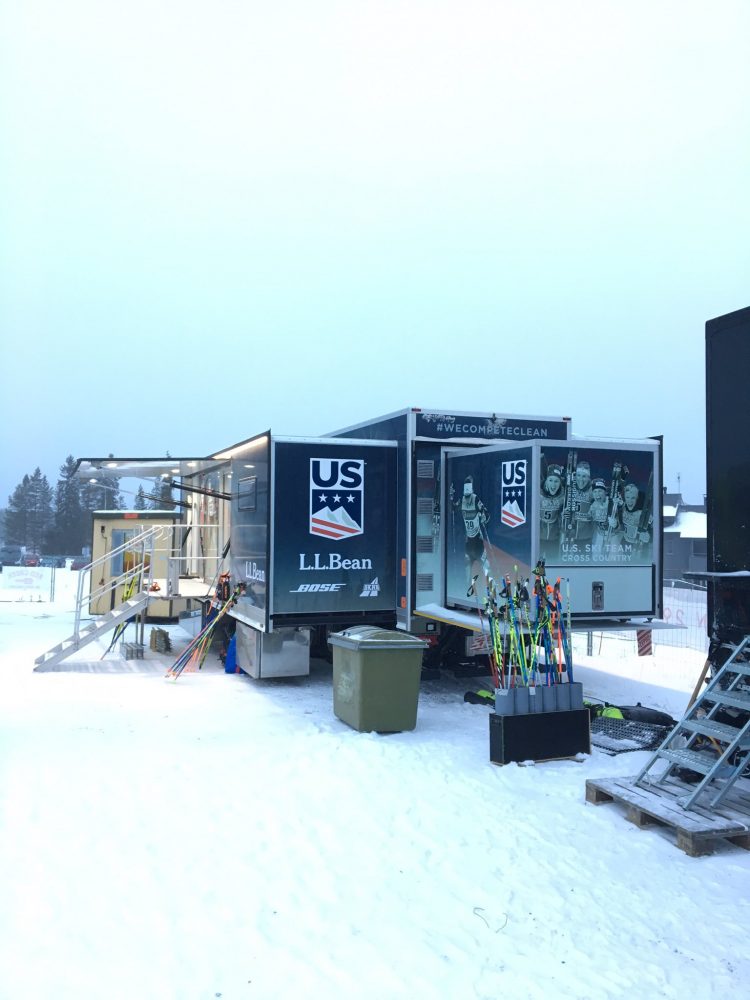
    The new U.S. Ski Team wax truck fully deployed. (Photo: Matt Whitcomb/Twitter)

    Since 2008 when Sweden arrived on the World Cup scene with a full-scale, blue-and-yellow-wrapped wax truck, it didn’t take long for the other major cross-country ski nations to not only keep up with the Joneses but surpass them. 2009 saw Norway arrive and begin lording over the wax-truck world with a succession of vehicles. As only Norway might do on the nordic-resource amenities side of things — Norway out Norway-ed itself. Its World Cup cross-country team began with a state-of-the-art wax truck in 2009, but has since moved on up. These days, Norway’s wax-tech crew arrives at World Cup venues with two wax trucks, each with extendable sides and rears, and a pop-top athlete lounge.
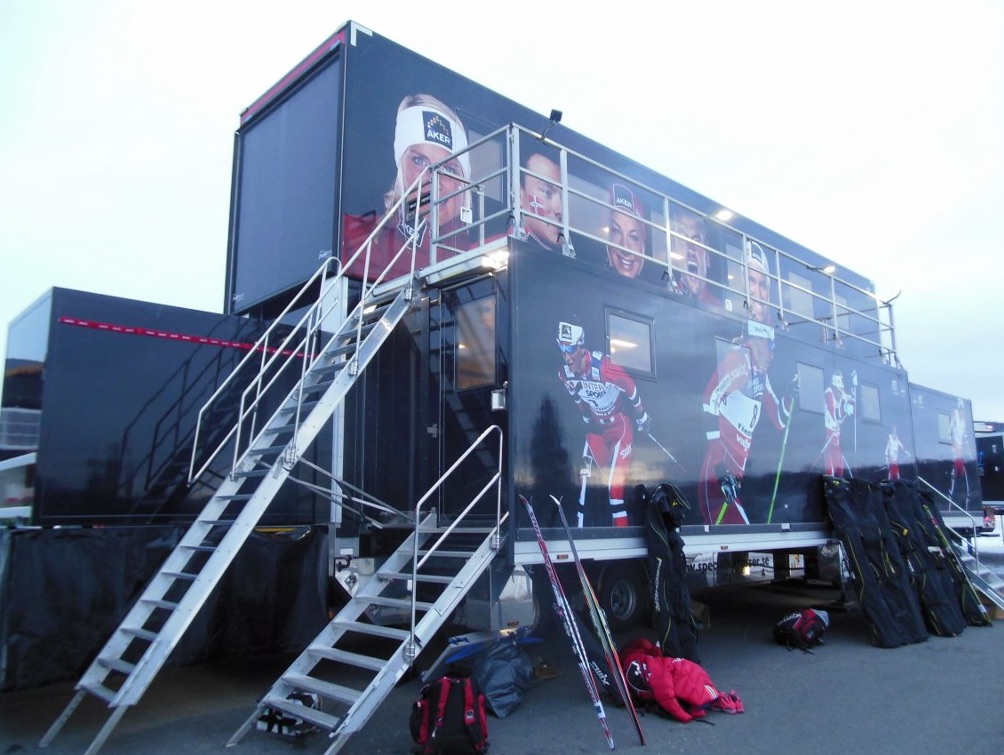
    The benchmark: Norway’s wax truck. (Photo: Noah Hoffman)

    Even the Americans’ friendly neighbors to the north, Canada, have styled their maple-leaf themed wax truck in World Cup wax compounds since 2013.

    Of the nine top-ranked teams on the World Cup, the U.S. is the last to meet the benchmark of eschewing wax cabins for a wax truck. This season, the U.S. Ski Team (USST) arrived in Kuusamo, Finland, and Lillehammer, Norway — the first two World Cup stops — with its own state-of-the-art mobile ski waxing facility.

    “It’s been in the works for a couple of years,” USST Head Coach Chris Grover said on the phone last month, before the race season began. “One of our USSA Board of Trustees, now Board of Director individuals, Liz Arky, she was the main catalyst behind the wax-truck project. I want to say two years ago in 2015, she was with the team in Davos at the World Cup, and that was the first time she saw firsthand what we were up against. So at that point she came into the wax compound and saw the trucks from all the other nations and then saw how we were operating in our temporary containers, and so she was like, ‘Oh my gosh, how come you guys don’t have a truck? You guys need to have a truck.’”

    For the past several years, the USST has thrived without a wax truck. There have been Sprint Crystal Globes, World Championship medals, and podiums. But safer working environments, and a more stable and efficient workplace should promote healthier wax crews and in theory, a more competitive team when it comes to the wax equation. Rather than a cyclic and backbreaking process of loading and unloading smaller transport vans as the teams depart and arrive at each new World Cup, a wax truck affords continuity and faster pack up and set up.   

    Arky, along with the help of USST veteran Kikkan Randall and U.S. Ski & Snowboard Executive Director and CEO Tiger Shaw, began the hustle for funds. From Aspen to Vail to the East Coast, eventually, the money was raised. Their two-year fundraising effort came through.

    “This truck with all the taxes we had to pay for on it, is a little more than $600,000 dollars,” Grover said. “And actually, quite a big percentage of that is taxed in Europe, the value added tax that you have to pay on that. This is a 600K plus project for us that, of course, is totally separate from our normal budget.”

    With the money secured, Grover explained his team worked with Swedish custom-bus outfitters Scania and SKAB to dial in the wax truck’s design. These two companies assisted the Canadians, Swedes, Russians, and Norwegians with their wax truck build outs as well.
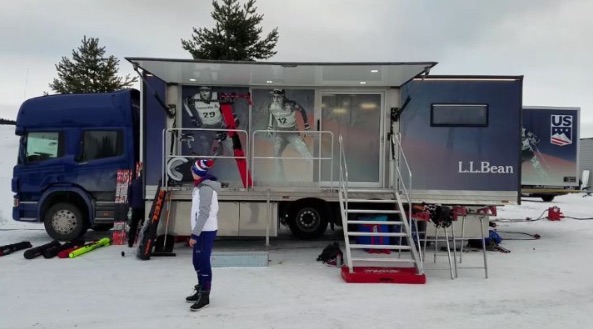
    The USST’s newly minted wax truck. (Photo: Noah Hoffman)

    “Our truck is the same cab and chassis as the Canadian truck. It’s not a tractor-trailer; it doesn’t articulate like that,” Grover said of the wax truck’s underlying chassis. “You don’t need the highest class of driver’s license in Europe in order to drive it; it is more like a bus when it drives. However, the size of the Canadian truck wouldn’t work for us because it’s too small. It only expands in the back where there is a ski storage box that pops out the back, and it only can accommodate six workstations, but the Canadians carry fewer athletes in the World Cup than we do typically and at major championships, and so we needed something bigger.”

    The U.S. wax truck expands from the back like the Canadian truck. The similarities in terms of expansion end there. The U.S. version extends from both sides, but not vertically like the Norwegian trucks.
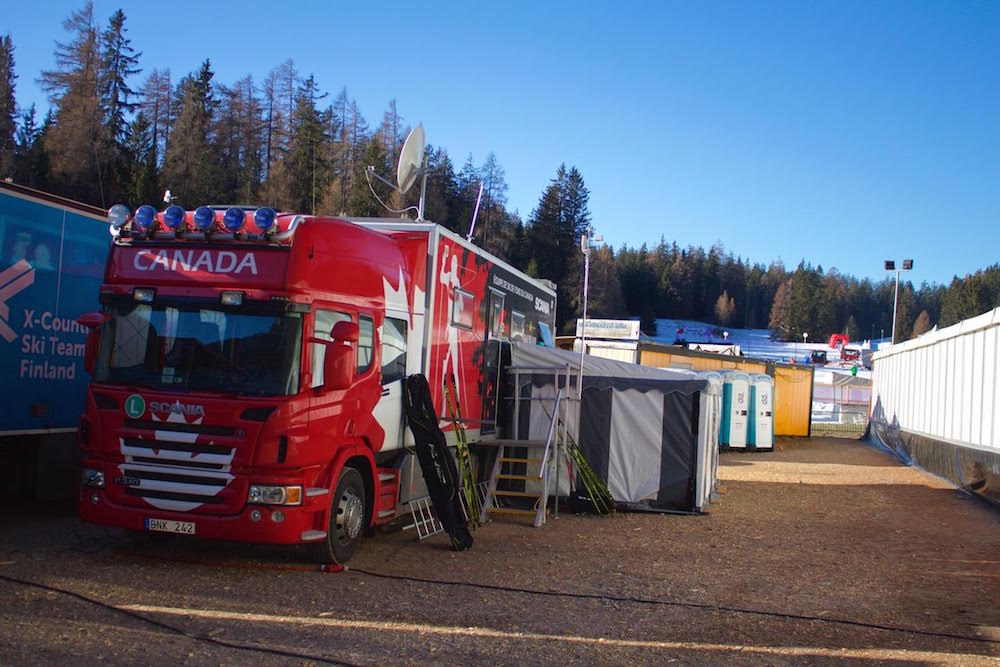
    The Canadian “tour bus”, a.k.a. wax truck, parked in Lenzerheide, Switzerland, as seen Dec. 30, 2015, before the start of the 2016 Tour de Ski. (Photo: JoJo Baldus)

    “I want to say it creates something like 30 square meters of workspace,” Grover said. “In addition, we also had a covered porch added, like the Russian truck, and the reason is so we can basically kick wax outside in the cold and have it covered if it’s snowing. That’s a really cool feature like we saw in the Russian truck and we were like, ‘We gotta have this,’ because sometimes you can’t kick wax inside when it’s hot inside the truck and you need to go outside, but it’s nice to have it covered if it’s really snowing or something … It’s quite wide when it’s expanded.”

    Inside the truck are four workstations with two functional benches each. Those workstations are mobile in a sense — they are fitted to locking caster wheels making them movable and easily stored when the truck is mobile.

    Interior ventilation is a major concern when considering exposure to toxic fumes and particulates, especially when working with vaporized fluorocarbons. According to Grover, the USST wax truck is fitted with ventilation to mitigate the hazards. Each wax station is ventilated independently with industrial fume hoods.

    “Basically for everyday wax-working, you would not need a [respirator] mask in this setup,” noted Grover. “However, and when people get powdering, we are still going to wear a mask. We are going to be on the safe side. Not only do we have this ventilation that is going, but we are also making sure that every person in the truck is 100 percent safe.”

    The ventilation system is not a single large-scale,vacuum-type system where the expelled air is refreshed with clean air.

    “It is interesting, I obviously learned a lot about this in the process,” Grover said of the technical side of ventilating the wax truck. “You cannot really have one massive ventilation system that is sucking all of the air out all the time, because it creates vacuum locks on the doors, and nobody can get out of the trailer. So that is a challenge.”

    The Norwegian team uses specialized irons with ventilation tubes attached directly to the iron to draw and then expel any vapors emitted from the iron/ski-wax interface. The U.S. truck does not feature these costly irons, however, the workstations are outfitted in a manner that can accommodate these types of venting irons without any modifications to the pre-existing build out.
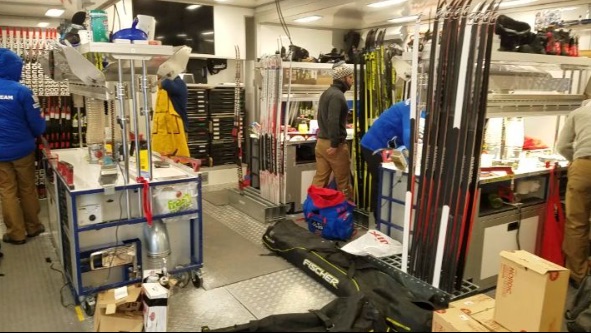
    Relatively clutter-free and ready for waxing inside the new USST wax truck. (Photo: Noah Hoffman)

    The truck also features storage for the more than 600 pair of skis and an array of coordinated storage compartments that might make an Ikea designer drool.

    Five of the U.S. wax techs are certified to drive the truck. They have been trained and certified with CDL’s (commercial driving licenses). And all five wax techs can travel at once in the crew cab, which also features a bed. Grover noted that it is unlawful for anybody to be in the bed while the truck is moving.  

    “This is a total utilitarian, well lit, well ventilated, well lit, open, easy workspace for the techs,” Grover summarized.

    The start to the season has been solid two weekends with two podiums, several top 10’s, and a fancy wax truck to complement the U.S. team. 

    ***

    Related: Check out our off-the-cusp Nordic Nation podcast where we interview U.S wax tech Tim Baucom, who along with Andrew Morehouse, were on the road from Lillehammer, Norway, to the next World Cup in Davos, Switzerland, with $600,000+ of precious cargo.

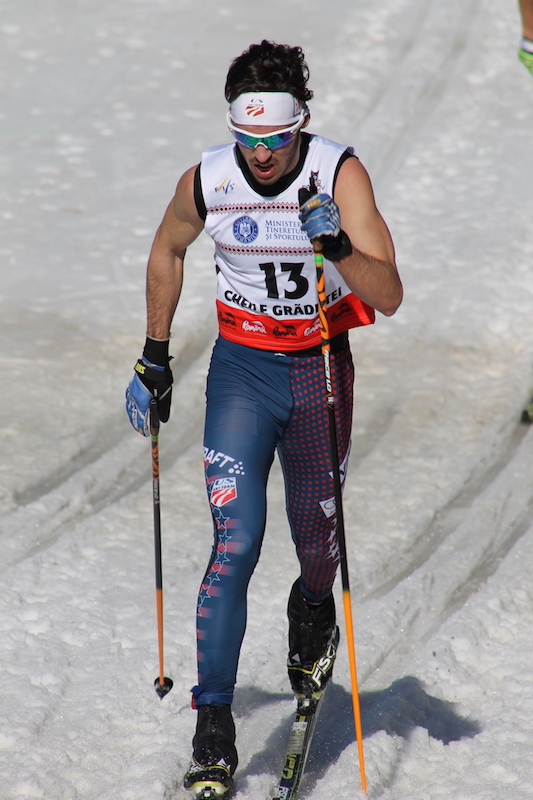
    Andrea Potyondy-Smith contributed
  • Ten (Plus) Questions with U.S. Ski Team Coach Chris Grover

    Sadie Bjornsen with U.S. Ski Team Head Coach Chris Grover in Quebec City, where she went on to place eight overall in the freestyle sprint at Stage 3 of the Ski Tour Canada. (Photo: FlyingPointRoad.com/NNF)
    U.S. Ski Team Head Coach Chris Grover with Sadie Bjornsen in Quebec City, where she went on to place eight overall in the freestyle sprint at Stage 3 of the Ski Tour Canada. (Photo: FlyingPointRoad.com/NNF)

    Earlier this week, the U.S. Cross Country Ski Team nominated 16 athletes to its 2016/2017 squad. That’s exactly the same number as last year, yet two new emerging juniors (Ian Torchia and Hannah Halvorsen) have made it onto this year’s list, while two athletes (Caitlin Gregg and Ben Saxton) were not renominated. We asked U.S. Ski Team Head Coach Chris Grover about the rationale behind the most recent nominations, fielding 10 (OK, 11) questions via email.

    1. Why aren’t there more men on the A-team? 

    2016/2017 U.S. Cross Country Ski Team Nominations: A Team
    Men
    Simi Hamilton
    Andrew Newell
    Women
    Sadie Bjornsen
    Sophie Caldwell
    Jessie Diggins
    Kikkan Randall
    Ida Sargent
    Liz Stephen

    B Team
    Men
    Erik Bjornsen
    Noah Hoffman
    Women
    Rosie Brennan

    D Team
    Men
    Patrick Caldwell
    Ian Torchia

    Women
    Hannah Halvorsen
    Julia Kern
    Katharine Ogden

    Chris Grover: Over the past few years, we have determined A-Team status by those athletes that finish the season in the top-30 in either sprint, distance or both. We are using the World Ranking Lists, or Red Group lists, and traditionally funding via the different race organizers is tied to the appearance of these specific athletes at a race venue, although the rules that govern these Red Group lists will most likely change this coming season. Also, top-30 in the world in a discipline is one of the standards we have set as the objective criteria for making the U.S. Ski Team. So the 8 athletes on the A-Team are all ranked in the top-30 in the world, and that happens to currently be 6 women and 2 men.

    2. Is Andy Newell planning to race a full World Cup season? 

    Not the full World Cup, but probably close to it. He will target primarily classic sprints, some skate sprints, and some classic distance events. His plans are still evolving. Luckily for the USA, he is reinvigorated to pursue training and racing full-time.

    3. What criteria did Kikkan Randall make to be renominated to the A-team despite not competing last season?

    Because Kikkan’s FIS points and World Ranking List status were effectively frozen during her pregnancy year, she is actually returning to the Team in the Red Group and ranked in the top-15 in the world in sprint.  However, even if she wasn’t ranked so high, we would still name her to the Team via discretion given her incredible history of performance.

    4. Why wasn’t Caitlin Gregg renominated?

    This past season Caitlin was not able to demonstrate that she is on a path to winning a medal.  Her results were solid at times but not indicative of future podium performances for an athlete her age.  Caitlin is a great athlete and is very determined to continue to chase her dreams and we have encouraged her to let nothing stand in her way. We are looking forward to supporting Caitlin however we can and providing her with start opportunities when appropriate.

    5. Why wasn’t Ben Saxton renominated?

    Ben had a tough year that was riddled with injury and illness, and his results reflected those struggles. It would be unfair to name Ben to the Team this coming season without naming a host of other athletes, many of whom are not skiing fast enough yet to merit Team status. We still very much believe in Ben’s ability and we know we’ll be seeing him back on the U.S. Ski Team in the future.

    Ian Torchia racing to 43rd in the men's 10 k classic at Junior World Championships in Rasnov, Romania. (Photo: Pete Leonard)
    Ian Torchia (Northern Michigan University) racing at 2016 Junior World Championships in Rasnov, Romania. (Photo: Pete Leonard)

    6. What kind of criteria or outstanding results did Ian Torchia and Hannah Halvorsen achieve that merited their nominations?

    None of the current B or D Team athletes made the objective criteria for the Team so all of these athletes have been named via discretion. At the development level, it’s very challenging to compare results from all the various levels of racing (i.e. World Cup, World Juniors, U23s, SuperTour, Europa Cup, etc) so it’s incredibly hard to construct a selection criteria that doesn’t fall short somewhere and overreach somewhere else. At this level, discretion is the easiest way to identify future podium potential. Although we look at an athletes complete body of racing over the past season, in general we are looking for athletes who can deliver big results in Europe against tough fields. Ian was the standout USA male once again at World Juniors and posted his second consecutive top-15 result there. Hannah has been the standout USA athlete at the U18 Scandinavian Championships for the past two seasons, including a podium there two seasons ago.

    7. Besides being invited to national-team training camps, what perks come with being part of the D-team?

    The primary benefits are the support of U.S. Ski Team coaches, sports scientists, the sports medicine team, strength coaches, and various other providers.

    8. What can you say about this entire group on the whole and the team focus for the next World Championship season? 

    With Kikkan Randall rejoining the Team this winter, we’ll have the strongest women’s team in the history of USA skiing. On the men’s side we don’t have nearly the depth that we have in the women’s team but we have some very talented individuals. Simi led the men’s squad last season with two podiums and he managed to find a level of fitness that could have produced even more incredible results with a bit of better luck. This Team will make even more history for USA cross country skiing over the next two seasons.

    9. What about the focus for two years out at the 2018 Olympics?

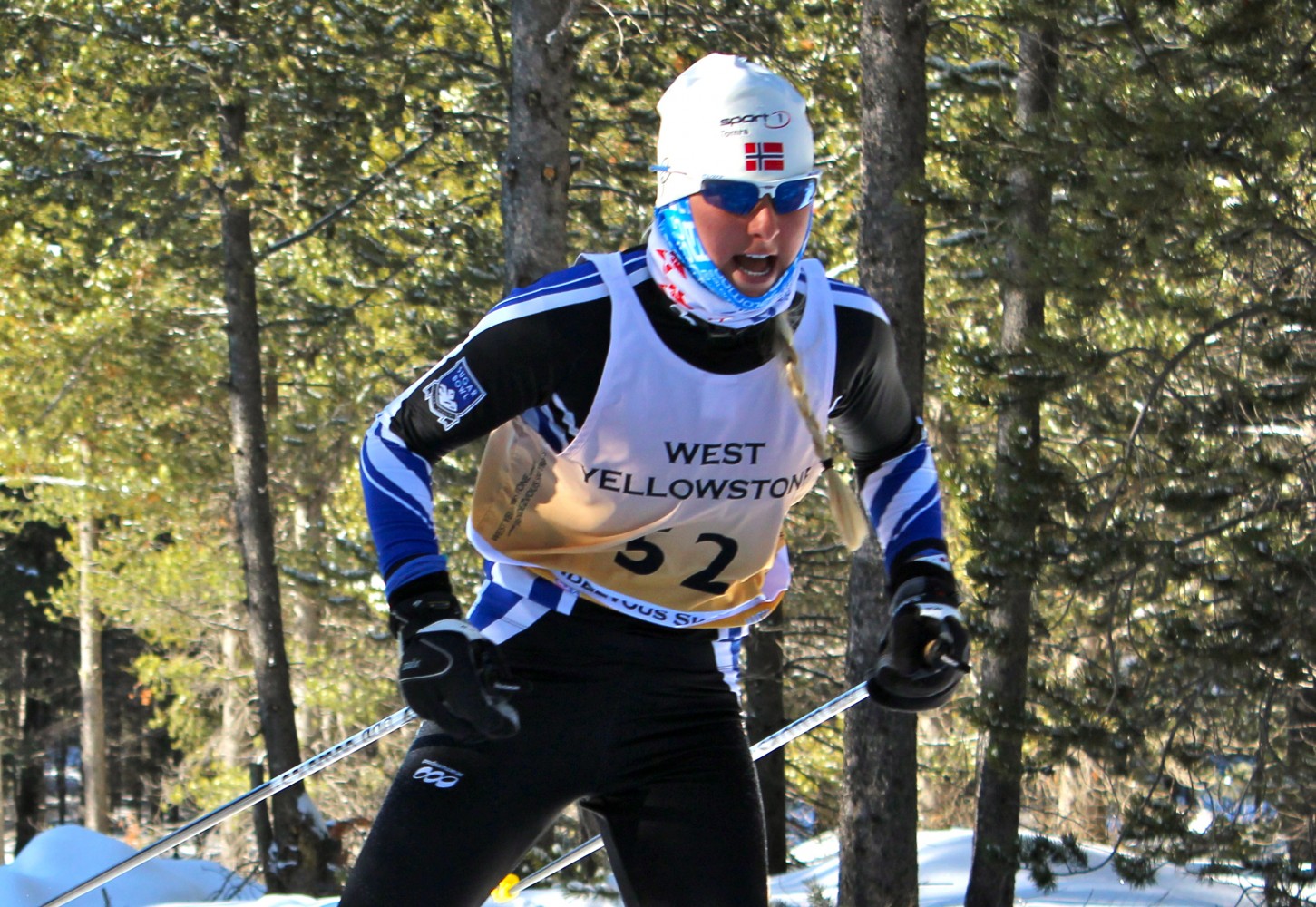
    Hannah Halvorsen (Sugar Bowl Academy) racing to third during qualifying for the women's SuperTour 1.3 k freestyle sprint on Nov. 27 in West Yellowstone, Mont. Halvorsen went on to edge out AWCA's Dahria Beatty for second place overall, 4.31 seconds behind race winner, Jennie Bender.
    Hannah Halvorsen (Sugar Bowl Academy) racing to third during qualifying at the women’s freestyle sprint last November in West Yellowstone, Mont. Halvorsen went on to place second overall.

    The big focus is on developing the skills necessary to win medals in the team events.  Norway has been incredibly strong for quite a few years now and they took yet another step forward this past season. Norway earned more World Cup points than the next 4 countries in the Nation’s Cup (Russia, Finland, Sweden, and Germany) combined. And they did this without the help of Marit Bjørgen who returns to World Cup competition this next fall. Norway has the potential to sweep the podium in all of the individual events at the major championships. Our clearest path to medals in Lahti and Pyeongchang is by targeting the team events where Norway can only take one medal. Unfortunately the rest of the world will be focused on this same task as well, so we have to train harder and smarter in order to reach the podium.

    10. Compared to last season and recent years, what’s the team budget like this year?

    We’ll be at about the same place we were entering last season.

    11. We heard the team might be the proud owners of a new wax truck?

    We don’t have the truck yet but it is coming. Thanks to the generosity of some key supporters, it will happen. Over the past year, we’ve been meeting with Scania and SKAB, the two Swedish companies that build trucks for the Norwegians, the Russians, the Canadians, and others.  These other nations have been super helpful in helping us design our truck given what they’ve learned constructing and working in their trucks over the past seasons.  We’re on our third round of plan revisions right now but we are very close to having the truck we need to support USA athletes for the next several decades. We don’t currently have enough available construction time for such a specialized project to have the truck by next season but it will be rolling by the fall of 2017.  The Team is really excited by the project and once it is delivered, it will be yet another source of pride for the US skiing community.