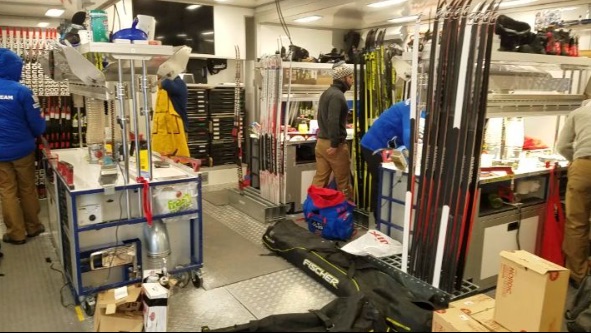
Tag: U.S. wax truck

  • An accountant, a summer flooring salesman and an Estonian helped Diggins deliver bronze. Here’s how.

    An accountant, a summer flooring salesman and an Estonian helped Diggins deliver bronze. Here’s how.

    ZHANGJIAKOU — Patrick Moore is a cheerful accountant from Edmonton, Alberta. Tim Baucom spends his summers working sales for a Vermont plank flooring company. Oleg Ragilo runs a cosmetic shop in Estonia with his wife.

    Jessie Diggins, the American cross-country ski star, couldn’t have won her Olympic bronze without them.

    Jessie Diggins earns an Olympic bronze medal in the 1.5 k freestyle sprint. (Photo: NordicFocus)

    Moore, Baucom and Ragilo all belong to America’s nine-member ski service team here — a mix of mostly paid staff and a couple of volunteers like Moore.

    “I can’t speak highly enough of their work ethic — they’ve been out here every single day, hours and hours and hours, probably skiing like 50 k a day,” Diggins said after finishing eighth Thursday in her third race of the Games. She added, referring to her medal-winning ski: “They delivered such a clutch performance the other night.”

    The service crew is charged with the complicated, high-stakes work of choosing the right skis and wax for the snow conditions in Zhangjiakou, the mountain resort town outside Beijing where Olympic cross-country events are taking place.

    The task sometimes can make the difference between an average day and a medal. 

    But the work, which happens in drab tan buildings off a corner of the stadium, is relatively anonymous — except when things go wrong.

    “I think it’s sometimes hard for people at my regular job what I look like here,” said Moore, the accountant. “And it’s probably hard for people at this job to understand what I look like there.”
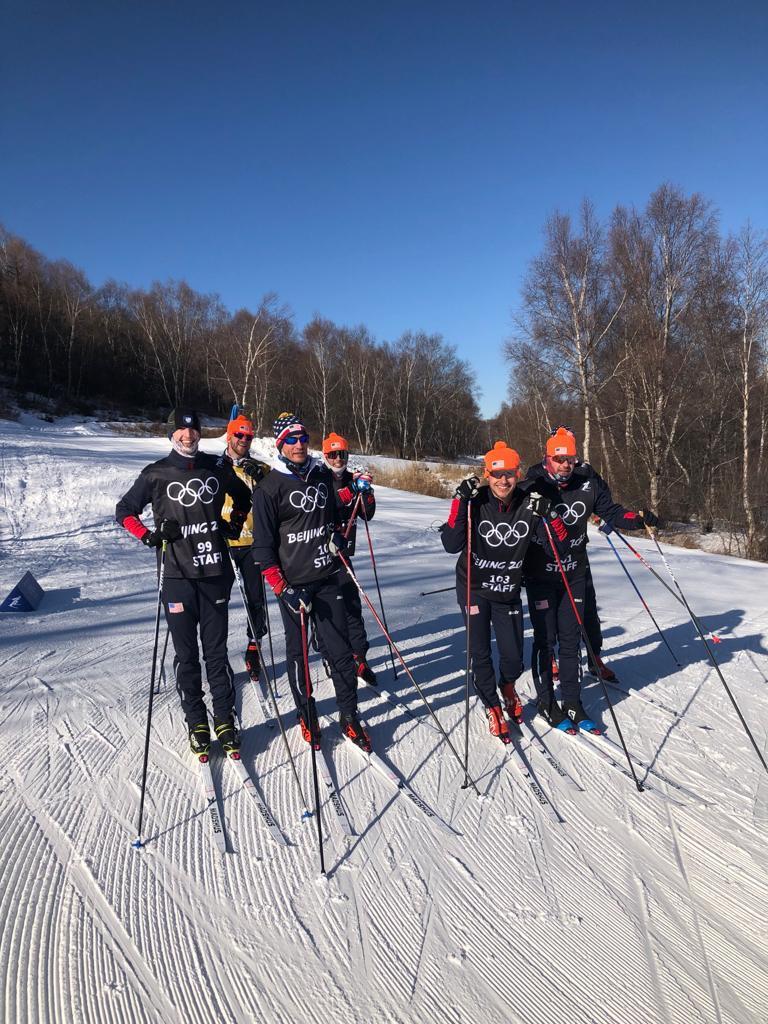
    The U.S. wax staff arrives in Zhangjiakou. From left to right, Patrick Moore, Andrew Morehouse, Bjorn Heimdal, Tim Baucom, Chris Hecker, Jason Cork, and Eli Brown. (Photo courtesy fellow technician, Karel Kruuser)

    The U.S. service team is composed of a mix of Americans and Europeans — including Ragilo, who previously waxed for superstars in Estonia and is something of a legend there.

    To appreciate the crew’s work requires a quick lesson in ski technology.

    Cross-country ski bases — the part that slides across the snow — are generally made of a plastic called polyethylene, or p-tex. The material has tiny pores, somewhat like a sponge, which means it absorbs wax that’s ironed or rubbed in by technicians; the excess can be scraped off to leave what appears to be a smooth plastic surface.

    Manufacturers produce different waxes to help the skis slide faster in different conditions: warmer or colder, natural snow or man-made.

    The waxes are typically layered, and they can be applied in different ways — ironed in, rubbed in with a cork or even a spinning wool cylinder attached to a drill, for example.

    Technicians can also enhance the gliding potential of skis with metal tools that press tiny, intricate patterns into the bases, known as structure. Then there are the skis themselves, which are built stiffer or softer to suit snow conditions. American athletes each brought dozens of pairs to the Olympics — perhaps 300 total.

    Sorting through each of those variables and identifying the best skis, waxes and structures takes hours and hours of testing. U.S. service team members arrived in Zhangjiakou a week before the first race, and got to work.

    “None of us are scientists,” said Baucom. “But we just tinker around with all this stuff.”

    Old entries in a U.S. wax technician’s notebook keep track of the many iterations tested en route to a winning selection. (Photo: Nat Herz/FasterSkier-ADN)

    The crew spends its first day or two skiing the race courses, setting up gear and getting a feel for the place. Then, they start testing the first layers of waxes and the best methods for applying them, as well as durability: How far can they ski before the wax starts losing potency?

    Most of the testing is done by feel, with two technicians gliding down a hill, side by side, on two pairs of skis with different waxes to see which pair is faster. The American technicians can ski 30 kilometers a day or more; some or the Scandinavian teams with larger staffs have workers whose sole job is testing and can ski twice that far.

    When race day arrives, the U.S. team may have tested 50 or 60 types of glide wax, and a similar number of kick waxes, which skiers use to grip the snow and push themselves uphill. 

    Olympic team staff test skis and wax Friday, February 4, 2022 at the Zhangjiakou National Cross-Country Skiing Center. (Nat Herz/FasterSkier-ADN)

    They’ll narrow that number to perhaps 16 waxes to test in the hours before the gun goes off. Athletes, who are paired with the technicians, will also test a handful of pairs of skis before a race to see which are fastest.

    The Americans aren’t typically expecting to find a magic bullet that makes their skis the best in the field, said Baucom, the U.S. team’s head of glide waxing in Zhangjiakou.

    “You always want to have skis that are ridiculous, and make you look good,” he said. “But really, our goal is to have competitive skis. And it seems like in these conditions, as far as I can tell, almost every team has had pretty competitive skis.”

    Rosie Brennan tests skis with her tech, Bjørn Heimdal, before the opening 15 k skiathlon. (Photo: NordicFocus)

    The conditions in Zhangjiakou were the subject of intense speculation before the Games. 

    The area is not far from the Gobi desert and gets minimal precipitation, so skiers are racing mostly on manmade snow. Before the Games, Baucom heard about storms that deposited sand on the trails that ruined skis. 

    But so far, he said, the skiing at the Olympics has been quite good, even if the snow is a little dirty and wears away wax a bit more quickly than usual.

    “It’s not throwing us for a loop as far as being very different from other really cold, dry snow that we’ve raced on,” Baucom said. “It’s abrasive, but it’s not, like, crazy.”

    Ski preparation at the elite level can be something of an arms race: On the European World Cup cup circuit, bigger teams, including the U.S., travel with huge trucks that have been outfitted as roving wax rooms at a cost of $500,000 or more. Those trucks, however, did not make the trip to Zhangjiakou.

    Scandinavian teams spend more money on ski service and have bigger workforces, which can sometimes produce inequities. At the World Championships in Germany last year, the U.S. technicians had an especially tough day in the women’s pursuit race, where the skis they gave athletes were too slow to be competitive. Baucom described the feeling as “gut-wrenching” for the staff.

    Julia Kern prepares for the 15k skiathlon with her wax technician, Eli Brown. (Photo: NordicFocus)

    When things go wrong, the U.S. team will often collect skis after the race and retest, to see what went wrong.

    At the Olympics, though, conditions have been stable and relatively straightforward for waxing, even after a flurry of fresh snow Saturday morning. So far, the American athletes have had few complaints.

    “It feels good to know that everyone has a pretty fair shot,” Diggins said. “I’m just so grateful to our staff, because we win as a team.”
  • U.S. Ski Team Locks In for Waxing, Winning with New Wax Truck

    U.S. Ski Team Locks In for Waxing, Winning with New Wax Truck


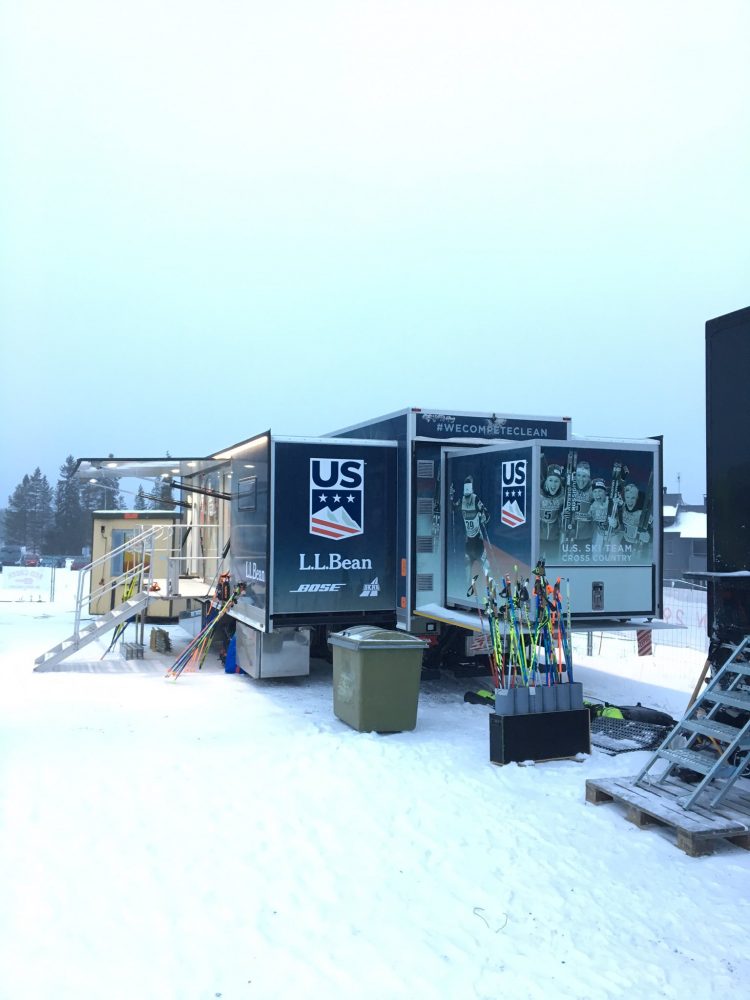
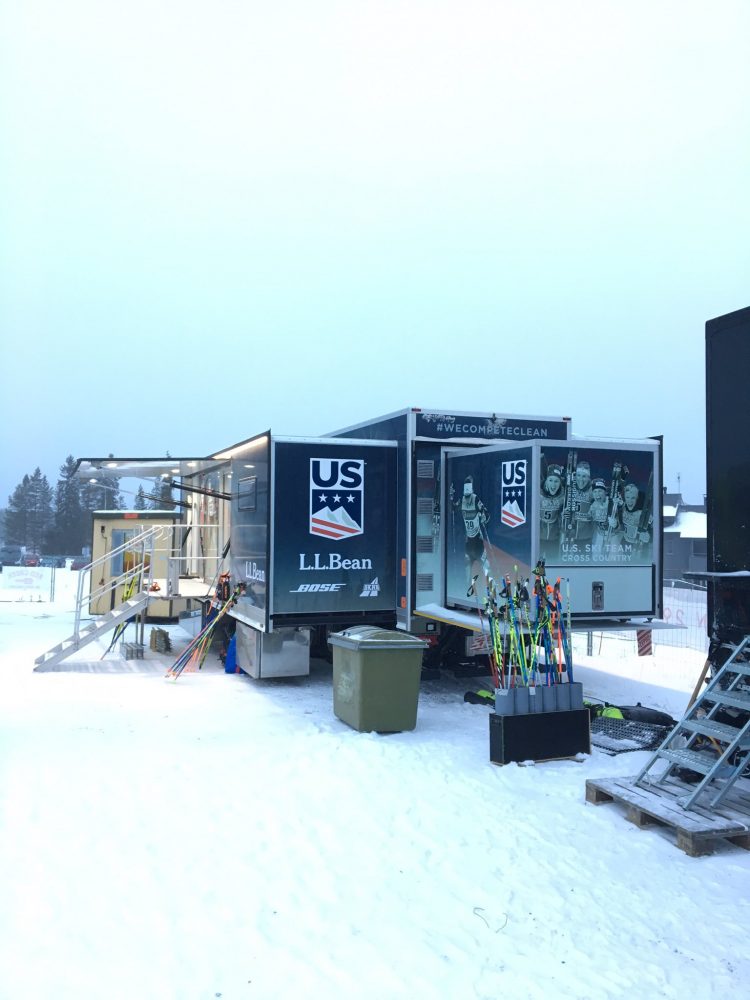
    The new U.S. Ski Team wax truck fully deployed. (Photo: Matt Whitcomb/Twitter)

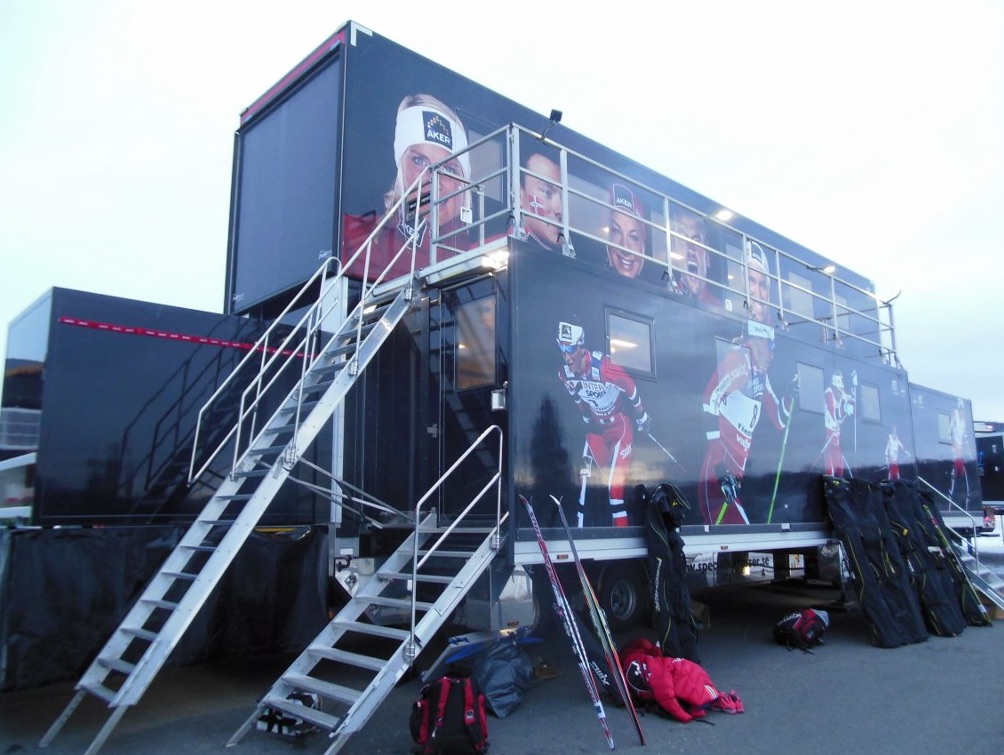
    Since 2008 when Sweden arrived on the World Cup scene with a full-scale, blue-and-yellow-wrapped wax truck, it didn’t take long for the other major cross-country ski nations to not only keep up with the Joneses but surpass them. 2009 saw Norway arrive and begin lording over the wax-truck world with a succession of vehicles. As only Norway might do on the nordic-resource amenities side of things — Norway out Norway-ed itself. Its World Cup cross-country team began with a state-of-the-art wax truck in 2009, but has since moved on up. These days, Norway’s wax-tech crew arrives at World Cup venues with two wax trucks, each with extendable sides and rears, and a pop-top athlete lounge.

    The benchmark: Norway’s wax truck. (Photo: Noah Hoffman)

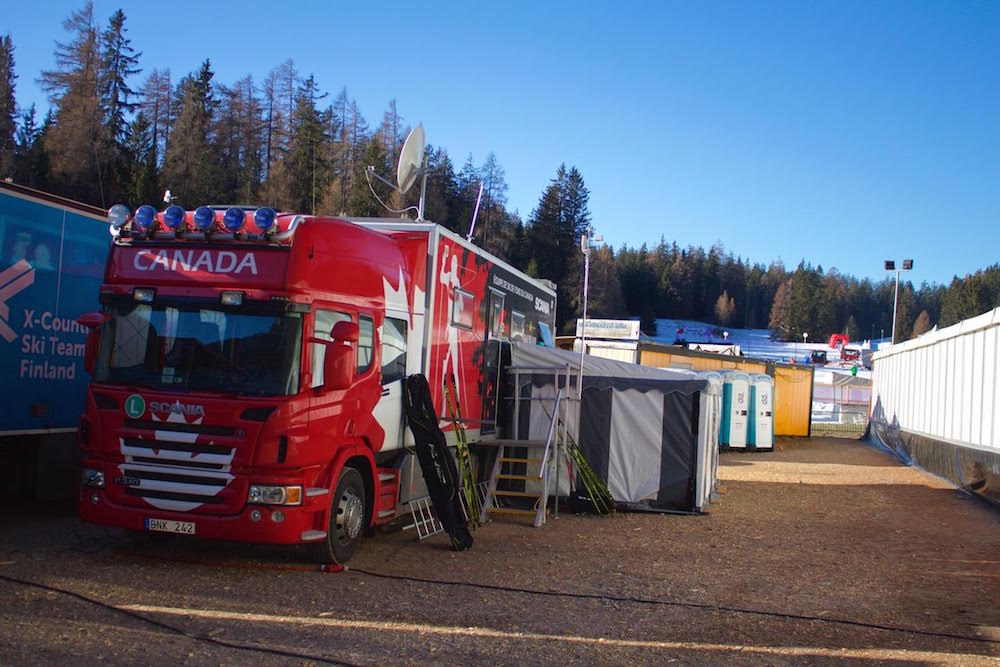
    Even the Americans’ friendly neighbors to the north, Canada, have styled their maple-leaf themed wax truck in World Cup wax compounds since 2013.

    Of the nine top-ranked teams on the World Cup, the U.S. is the last to meet the benchmark of eschewing wax cabins for a wax truck. This season, the U.S. Ski Team (USST) arrived in Kuusamo, Finland, and Lillehammer, Norway — the first two World Cup stops — with its own state-of-the-art mobile ski waxing facility.

    “It’s been in the works for a couple of years,” USST Head Coach Chris Grover said on the phone last month, before the race season began. “One of our USSA Board of Trustees, now Board of Director individuals, Liz Arky, she was the main catalyst behind the wax-truck project. I want to say two years ago in 2015, she was with the team in Davos at the World Cup, and that was the first time she saw firsthand what we were up against. So at that point she came into the wax compound and saw the trucks from all the other nations and then saw how we were operating in our temporary containers, and so she was like, ‘Oh my gosh, how come you guys don’t have a truck? You guys need to have a truck.’”

    For the past several years, the USST has thrived without a wax truck. There have been Sprint Crystal Globes, World Championship medals, and podiums. But safer working environments, and a more stable and efficient workplace should promote healthier wax crews and in theory, a more competitive team when it comes to the wax equation. Rather than a cyclic and backbreaking process of loading and unloading smaller transport vans as the teams depart and arrive at each new World Cup, a wax truck affords continuity and faster pack up and set up.   

    Arky, along with the help of USST veteran Kikkan Randall and U.S. Ski & Snowboard Executive Director and CEO Tiger Shaw, began the hustle for funds. From Aspen to Vail to the East Coast, eventually, the money was raised. Their two-year fundraising effort came through.

    “This truck with all the taxes we had to pay for on it, is a little more than $600,000 dollars,” Grover said. “And actually, quite a big percentage of that is taxed in Europe, the value added tax that you have to pay on that. This is a 600K plus project for us that, of course, is totally separate from our normal budget.”

    With the money secured, Grover explained his team worked with Swedish custom-bus outfitters Scania and SKAB to dial in the wax truck’s design. These two companies assisted the Canadians, Swedes, Russians, and Norwegians with their wax truck build outs as well.

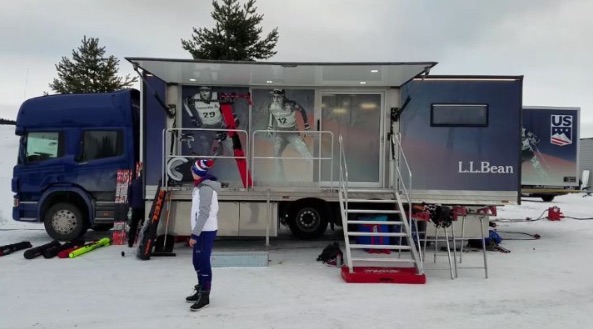
    The USST’s newly minted wax truck. (Photo: Noah Hoffman)

    “Our truck is the same cab and chassis as the Canadian truck. It’s not a tractor-trailer; it doesn’t articulate like that,” Grover said of the wax truck’s underlying chassis. “You don’t need the highest class of driver’s license in Europe in order to drive it; it is more like a bus when it drives. However, the size of the Canadian truck wouldn’t work for us because it’s too small. It only expands in the back where there is a ski storage box that pops out the back, and it only can accommodate six workstations, but the Canadians carry fewer athletes in the World Cup than we do typically and at major championships, and so we needed something bigger.”

    The U.S. wax truck expands from the back like the Canadian truck. The similarities in terms of expansion end there. The U.S. version extends from both sides, but not vertically like the Norwegian trucks.

    The Canadian “tour bus”, a.k.a. wax truck, parked in Lenzerheide, Switzerland, as seen Dec. 30, 2015, before the start of the 2016 Tour de Ski. (Photo: JoJo Baldus)

    “I want to say it creates something like 30 square meters of workspace,” Grover said. “In addition, we also had a covered porch added, like the Russian truck, and the reason is so we can basically kick wax outside in the cold and have it covered if it’s snowing. That’s a really cool feature like we saw in the Russian truck and we were like, ‘We gotta have this,’ because sometimes you can’t kick wax inside when it’s hot inside the truck and you need to go outside, but it’s nice to have it covered if it’s really snowing or something … It’s quite wide when it’s expanded.”

    Inside the truck are four workstations with two functional benches each. Those workstations are mobile in a sense — they are fitted to locking caster wheels making them movable and easily stored when the truck is mobile.

    Interior ventilation is a major concern when considering exposure to toxic fumes and particulates, especially when working with vaporized fluorocarbons. According to Grover, the USST wax truck is fitted with ventilation to mitigate the hazards. Each wax station is ventilated independently with industrial fume hoods.

    “Basically for everyday wax-working, you would not need a [respirator] mask in this setup,” noted Grover. “However, and when people get powdering, we are still going to wear a mask. We are going to be on the safe side. Not only do we have this ventilation that is going, but we are also making sure that every person in the truck is 100 percent safe.”

    The ventilation system is not a single large-scale,vacuum-type system where the expelled air is refreshed with clean air.

    “It is interesting, I obviously learned a lot about this in the process,” Grover said of the technical side of ventilating the wax truck. “You cannot really have one massive ventilation system that is sucking all of the air out all the time, because it creates vacuum locks on the doors, and nobody can get out of the trailer. So that is a challenge.”

    The Norwegian team uses specialized irons with ventilation tubes attached directly to the iron to draw and then expel any vapors emitted from the iron/ski-wax interface. The U.S. truck does not feature these costly irons, however, the workstations are outfitted in a manner that can accommodate these types of venting irons without any modifications to the pre-existing build out.

    Relatively clutter-free and ready for waxing inside the new USST wax truck. (Photo: Noah Hoffman)

    The truck also features storage for the more than 600 pair of skis and an array of coordinated storage compartments that might make an Ikea designer drool.

    Five of the U.S. wax techs are certified to drive the truck. They have been trained and certified with CDL’s (commercial driving licenses). And all five wax techs can travel at once in the crew cab, which also features a bed. Grover noted that it is unlawful for anybody to be in the bed while the truck is moving.  

    “This is a total utilitarian, well lit, well ventilated, well lit, open, easy workspace for the techs,” Grover summarized.

    The start to the season has been solid two weekends with two podiums, several top 10’s, and a fancy wax truck to complement the U.S. team. 

    ***

    Related: Check out our off-the-cusp Nordic Nation podcast where we interview U.S wax tech Tim Baucom, who along with Andrew Morehouse, were on the road from Lillehammer, Norway, to the next World Cup in Davos, Switzerland, with $600,000+ of precious cargo.

    Andrea Potyondy-Smith contributed