From the FasterSkier archive — posts syndicated from athletes’ and coaches’ own blogs between 2004 and 2012, kept online as published. Current coverage is at fasterskier.com.
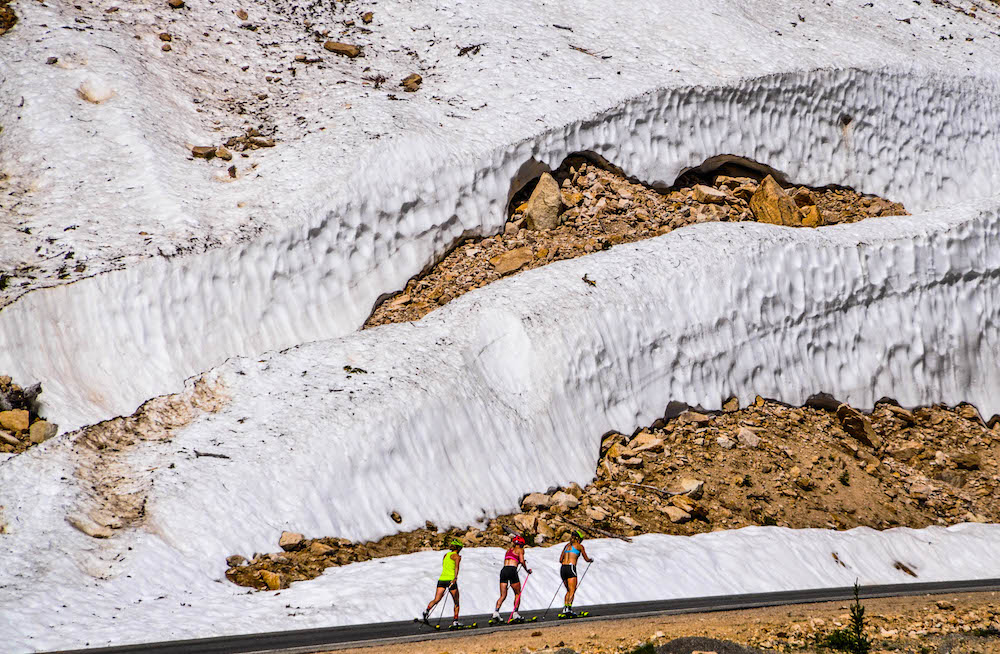
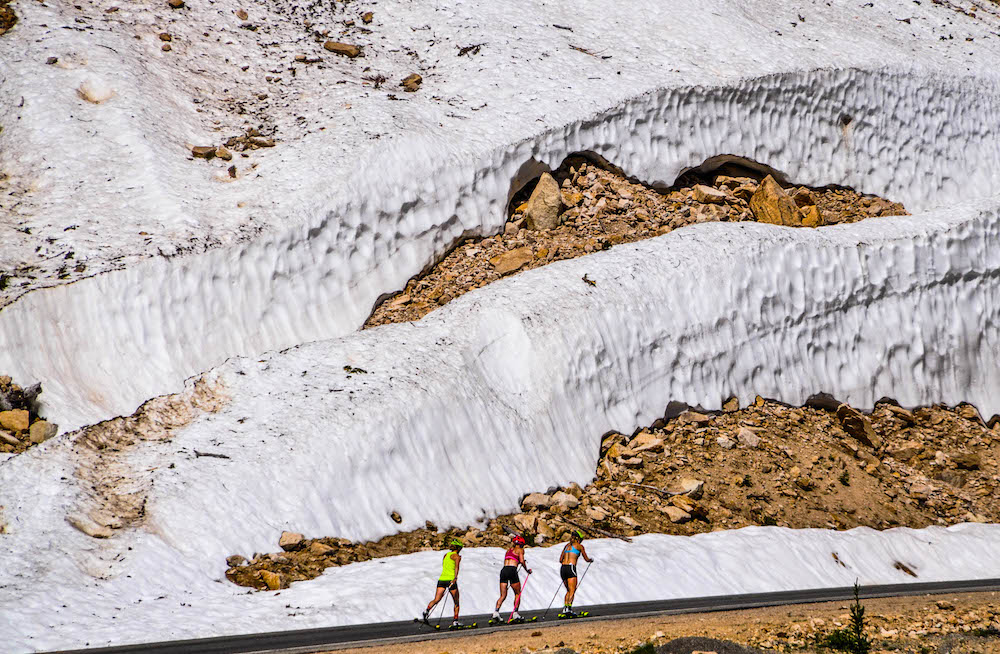
The U.S. Ski Team women’s team at work during a 10-day camp in the Methow Valley. (Photo: Matt Whitcomb/U.S. Ski Team)
(Note: This article has been updated to include comments from Canadian coach Ivan Babikov on his team’s recent camp in Park City, Utah.)
Two days after Andy Newell and Erika Flowers tied the knot in Bozeman, Mont., seven members of the men’s U.S. Ski Team and eight U.S. women’s team members jumped into an intensity training block at their respective dryland camps in Park City, Utah, and the Methow Valley in northern Washington.
The 10-day camps were scheduled simultaneously from June 26-July 5 to accommodate the wedding. Newell is a longtime U.S. Ski Team (USST) member and teammates with Flowers on the Stratton Mountain School (SMS) Elite Team out of Stratton, Vt. Because several national-team members ventured to Bozeman (Flowers’s hometown) to watch them say “I do,” the USST coaches decided to reduce travel and keep their squads together out west.
“We wanted to capture the men in the Intermountain West immediately following Andy Newell’s wedding in Bozeman, and therefore reduce the overall travel load for athletes who were already coming to the West from the East or Alaska,” head coach Chris Grover explained in an email.
The men based themselves in Midway, Utah, about 1,500 feet lower in elevation than Park City and 1,000 feet lower than Deer Valley, where they typically reside for summer and fall camps. Grover explained that this was by design, “because of the shorter duration of the camp (i.e. too short to create a meaningful stay at altitude), the focus on specific intensity workouts, and the benefits of quicker recovery at lower altitude,” he wrote.
Staying closer to the Soldier Hollow training venue was also ideal for the men’s team’s “PyeongChang-specific workouts”, Grover explained, including sessions focused on the freestyle team sprint, classic sprint and 4 x 10-kilometer relay, which will be contested at the 2018 Winter Olympics in PyeongChang, South Korea.
Newell, Simi Hamilton, Erik Bjornsen, Scott Patterson, Paddy Caldwell, Ian Torchia, and Ben Saxton attended and worked with coaches Jason Cork, Pat O’Brien, Grover, and U.S. Ski & Snowboard Strength and Conditioning Coach Tschana Schiller.
“The men did a great job of bringing heightened focus and effort to these key intensity workouts and we are grateful to the staff at Soldier Hollow for preparing the track for us,” Grover wrote. “Overall, it was a very productive camp and I think sent the men into the main summer preparation period with important areas to work on, a good gauge of fitness, and a further understanding of what skills need to be developed for the WC [World Cup] season and for PyeongChang.”
(Article continues below)
The U.S. men’s cross-country team at work during a classic distance rollerski near Midway, Utah. (Photo: Pat O’Brien)
The U.S. men’s cross-country team at work during a classic distance rollerski near Midway, Utah. (Photo: Pat O’Brien)
The U.S. men’s cross-country team at work, accompanied by head coach Chris Grover on his bike, during a skate over-distance rollerski near Midway, Utah. (Photo: Pat O’Brien)
The U.S. men’s cross-country team at work during a skate over-distance rollerski near Midway, Utah. (Photo: Pat O’Brien)
The U.S. men’s cross-country team at work during a skate over-distance rollerski near Midway, Utah. (Photo: Pat O’Brien)
The U.S. men’s cross-country team at work during a skate over-distance rollerski near Midway, Utah. (Photo: Pat O’Brien)
Start of the men’s skate team sprint on July 3 at the U.S. Ski Team men’s camp at Soldier Hollow in Midway, Utah. (Photo: Pat O’Brien)
Start of the men’s skate team sprint on July 3 at the U.S. Ski Team men’s camp at Soldier Hollow in Midway, Utah. (Photo: Pat O’Brien)
Do you use a heart rate monitor for training? Has it ever given you a seemingly implausible reading? Here’s why, and whether you should worry. (Photo: Pat O’Brien)
Andy Newell (r) leads the men’s skate team sprint on July 3 at the U.S. Ski Team men’s camp at Soldier Hollow in Midway, Utah. (Photo: Pat O’Brien)
Scott Patterson starting the U.S. Ski Team’s distance time trial at Soldier Hollow in Midway, Utah. (Photo: Pat O’Brien)
Scott Patterson (l) ascends the infamous Hermod’s Hill during the U.S. Ski Team’s distance time trial at Soldier Hollow in Midway, Utah. (Photo: Pat O’Brien)
Paddy Caldwell climbing during the U.S. Ski Team’s distance time trial at Soldier Hollow in Midway, Utah. (Photo: Pat O’Brien)
Simi Hamilton during the U.S. Ski Team’s distance time trial at Soldier Hollow in Midway, Utah. (Photo: Pat O’Brien)
Newlywed Andy Newell on his U.S. Ski Team’s distance time-trial day at Soldier Hollow in Midway, Utah. (Photo: Pat O’Brien)
From left to right: Andy Newell, Ben Saxton and Simi Hamilton working on classic speeds at Soldier Hollow in Midway, Utah. (Photo: Pat O’Brien)
From left to right: Andy Newell, Ben Saxton and Simi Hamilton working on classic speeds at Soldier Hollow in Midway, Utah. (Photo: Pat O’Brien)
Simi Hamilton leads Andy Newell and Paddy Caldwell during a classic-speeds workout at Soldier Hollow in Midway, Utah. (Photo: Pat O’Brien)
Andy Newell leads Simi Hamilton during a classic-speeds workout at Soldier Hollow in Midway, Utah. (Photo: Pat O’Brien)
Paddy Caldwell leads Erik Bjornsen (c) and Ian Torchia (r) during a classic-speeds workout at Soldier Hollow in Midway, Utah. (Photo: Pat O’Brien)
Ben Saxton (r) and Erik Bjornsen (l) during a classic-speeds workout at Soldier Hollow in Midway, Utah. (Photo: Pat O’Brien)
U.S. men’s team members Erik Bjornsen (l) and Ian Torchia during a classic-speeds workout at Soldier Hollow in Midway, Utah. (Photo: Pat O’Brien)
U.S. Ski Team Men’s Assistant Coach Jason Cork checks in with Ian Torchia during a classic-speeds workout at Soldier Hollow in Midway, Utah. (Photo: Pat O’Brien)
Local juniors rollerski alongside U.S. Ski Team members during a workout at Soldier Hollow in Midway, Utah. (Photo: Pat O’Brien)
***
Meanwhile, the U.S. women tried a new camp in the Methow Valley, home of current national-team members Sadie and Erik Bjornsen. The athletes themselves dubbed it the “CAGS Camp“, which U.S. women’s coach Matt Whitcomb explained stood for “a secret and mildly inappropriate team acronym that pokes fun at girls being girls. Sophie had hats made for the camp that she handed out at the airport when everyone arrived.”
All kidding aside, the goal of the camp was to be small and intensity focused, “with eight days of training and hard intervals every other day,” Whitcomb wrote in an email. “It’s an unusual setup for our team as we usually run joint camps with the men, but both enjoyed the simplicity of having such small training groups.
“We chose the Methow in part because it is where Sadie and Erik Bjornsen grew up, but also because we could get close to sea-level to maximize our hard efforts,” he added. “Another draw was that Pete Dickenson, one of our team physical therapists, was able to provide great treatment all week. Winthrop PT & Fitness sponsored our strength sessions, which meant we didn’t have to drive very far to get strong.”
Like Grover, Whitcomb used the word “ideal” to describe the Methow as a training site, yet emphasized that the community that hosted them was “even more incredible.”
“A local couple gave us their two cabins in a location as beautiful as we’ve seen anywhere in the world,” he wrote. “The chance to meet Olympians Laura McCabe (’94, ’98) and Leslie Hall (’88, ’92, ’94) was an important experience for the team. We owe them special thanks not for just guiding us to their favorite training spots, but for helping pave the early path for elite women’s skiing.”
The women’s team, which included Sadie Bjornsen, Rosie Brennan, Sophie Caldwell, Jessie Diggins, Katharine Ogden, Kikkan Randall, Ida Sargent, and Liz Stephen, spent one afternoon working with with the Methow Valley Nordic Team, which McCabe and Hall both coach.
“We invited a handful of their top athletes to join our bounding and ski walking sessions, and were encouraged by their technique and fitness, but also their love for the sport,” Whitcomb wrote. “They are doing a good job up there. I don’t know what the future holds for us regarding camp locations, but the Methow Valley will be considered as a great option moving forward. Thanks to so many people for making it happen.”
Women’s team staff included Whitcomb, Tim Baucom and physical therapist Pete Dickenson.
(Article continues below)
The U.S. women’s team with Methow Valley Nordic Team members during the U.S. Ski Team’s recent camp in Washington state’s Methow Valley. (Photo: Matt Whitcomb)
Rosie Brennan (in yellow) takes the lead while Sadie Bjornsen (in pink helmet) coaches on the bike during a 2017 U.S. women’s team camp in the Methow Valley. (Photo: Matt Whitcomb)
The U.S. Ski Team women’s team at work during a 10-day camp in the Methow Valley. (Photo: Matt Whitcomb)
The U.S. Ski Team women line up for the team sprint final during their camp in Washington state’s Methow Valley. (Photo: Matt Whitcomb)
Liz Stephen at work during the U.S. Ski Team women’s team’s camp in the Methow Valley. (Photo: Matt Whitcomb)
Sadie Bjornsen (front) and Ida Sargent get some help hydrating from coach Tim Baucom during a run in the Methow Valley. (Photo: Matt Whitcomb)
The U.S. women’s team at their dryland camp in the Methow Valley: (from left to right) Ida Sargent, Kikkan Randall, Sophie Caldwell, Jessie Diggins, Liz Stephen, Sadie Bjornsen, and Rosie Brennan. (Photo: Matt Whitcomb)
U.S. Ski Team coach/serviceman Tim Baucom sits on the porch of one of the team’s cabins during their recent camp in the Methow Valley in northern Washington. (Photo: Matt Whitcomb)
***
Cross Country Canada also recently finished up a two-week camp in Park City (June 26-July 11) with its entire men’s World Cup team — Alex Harvey, Len Valjas, Devon Kershaw, Jess Cockney, Knute Johnsgaard, and Graeme Killick — and U25 national-team member Julien Locke. Co-World Cup coaches Ivan Babikov and Louis Bouchard accompanied the team for the duration, and Joel Jaques joined for the first week.
While Park City has become an annual staple for the Canadian team, Babikov explained that this was their first time there in the summer, as opposed to the fall.
“We love the area and training there. … It was pretty hot but we managed,” he wrote. “The main goal was a big training volume/hours at the altitude. We were planing on doing a time trial at the SoHo but it got closed for those dates so we ended up doing intensity down in Salt Lake instead.
It was a great camp for all the guys, everyone feels good and no injuries on the team.”
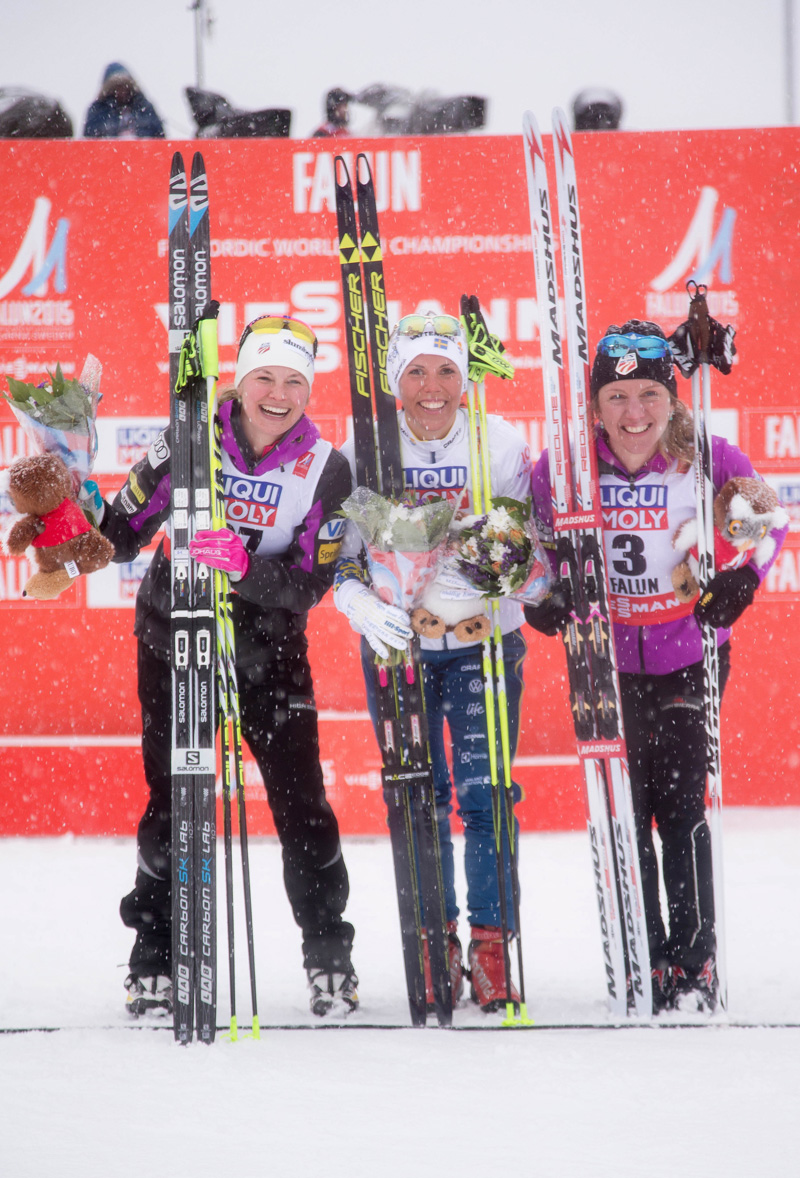
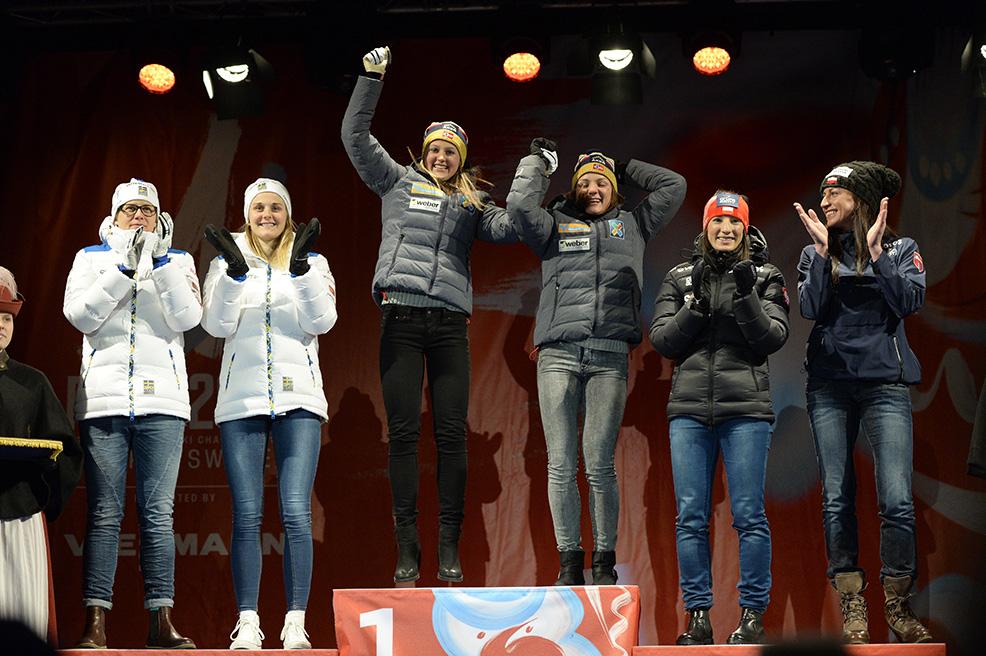
Americans Jessie Diggins (l) and Caitlin Gregg (r) share the women’s World Championships 10 k freestyle podium with Sweden’s Charlotte Kalla (c), who won the race by 41 seconds for her first individual gold on Tuesday in Falun, Sweden. Diggins took second while Gregg took third, 46.9 seconds back. Both finishes were the best distance result in history for a U.S. woman at a World Championships. (Photo: Fischer/NordicFocus)
FasterSkier’s coverage of the 2015 FIS Nordic World Ski Championships in Falun, Sweden, is brought to you by the generous support of L.L. Bean, now featuring a complete line of Kikkan Randall training wear.
FALUN, Sweden — All over the trails of the 2015 FIS Nordic World Ski Championships venue in Falun, people buzzed about Charlotte Kalla. They sang her name, cheered anytime the stadium announcer brought her up and roared as she skated by during the 10-kilometer freestyle individual start on Tuesday.
Three days earlier at her home nation’s World Championships, the 27-year-old Kalla had claimed a bronze medal in the 15 k skiathlon. One of Sweden’s best medal chances throughout the championships, there were a couple other races that Kalla, a 2010 Olympic champion in the 10 k skate and 2011 world champion in the classic team sprint (with Ida Ingemarsdotter), had been considered a favorite in as well. The 10 k skate was at the top of the list.
So when she soared through each timing point on the women’s course (made up of two unique loops) more than 10 seconds, then 20 seconds, 30 and finally 40 seconds ahead of any of the 48 women who started before her, the 13,800-strong crowd went nuts.
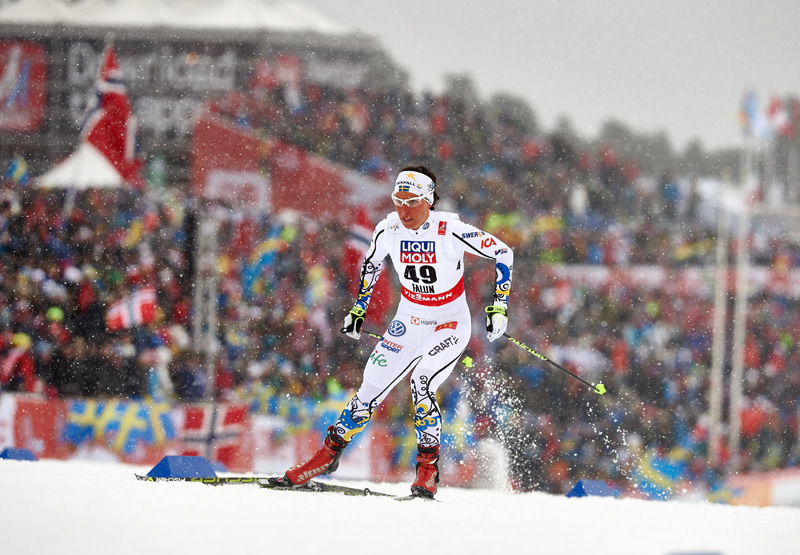
Sweden’s Charlotte Kalla racing to her first-career individual gold at 2015 World Championships in Falun, Sweden. Kalla won the 10 k freestyle by 41 seconds over silver medalist Jessie Diggins and 46.9 seconds over another American, Caitlin Gregg, in third. (Photo: Fischer/NordicFocus)
“I was a little bit nervous before the start and for the whole morning; I just longed to go to the competition area and put on my race bib,” Kalla said in a post-race press conference. “When the speaker presented me before the start, it was an amazing atmosphere in the stadium. I had to keep calm and focus on skiing all the way and not just go crazy because there was a big crowd cheering for me.”
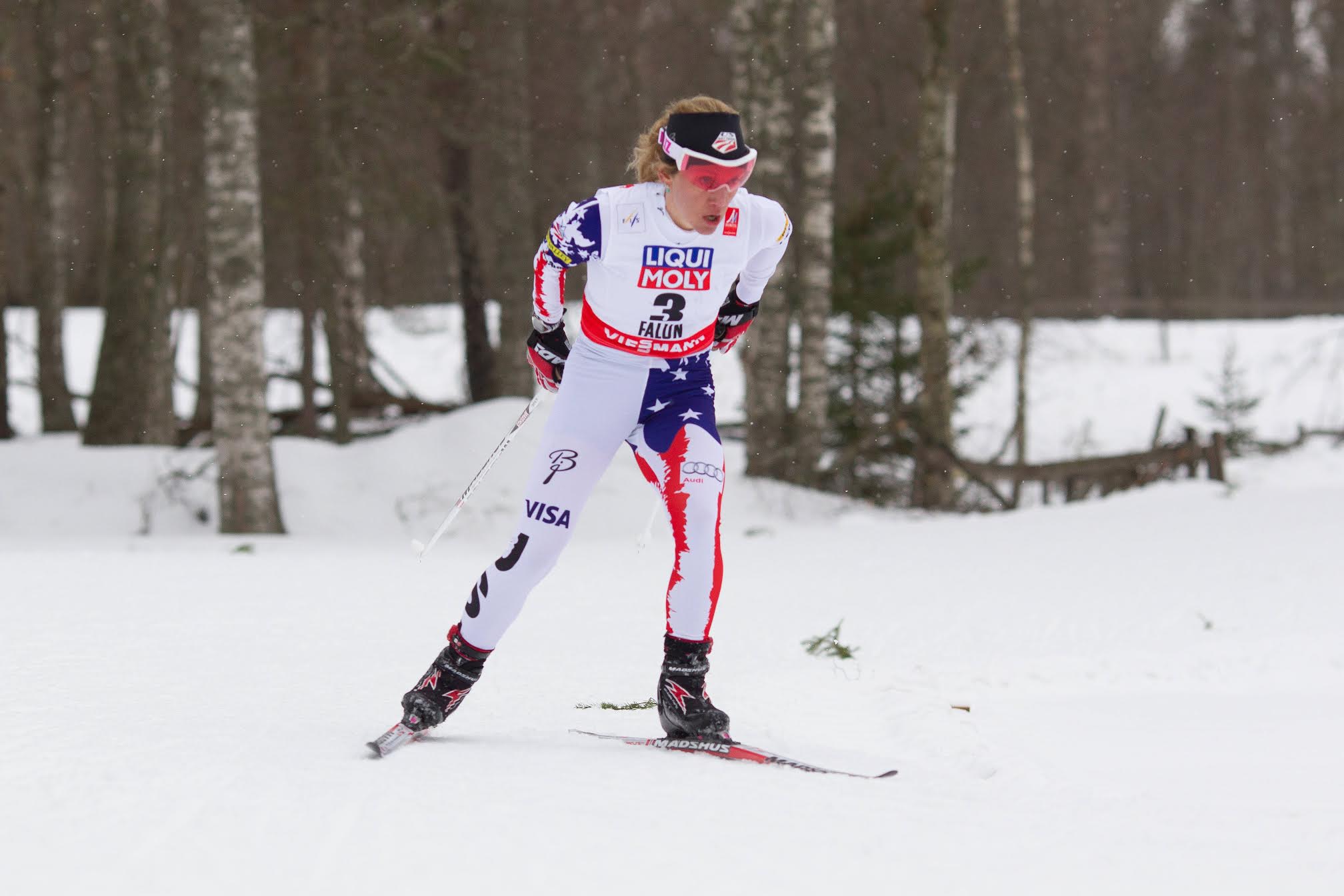
While Swedish spectators grew increasingly giddy over Kalla, the 49th starter of 71, two other names became a big part of the conversation at Lugnet Arena: Caitlin Gregg, an early leader in bib 3, and later in the race, Jessica Diggins in bib 37.
Known in the U.S. as Jessie, Diggins wasn’t exactly a surprise; the 2013 World Championships freestyle team sprint champion (with Kikkan Randall), she had already earned her stripes and risen to the forefront of international cross-country skiing.
But Gregg?
One Norwegian journalist said after the race he couldn’t even find her International Ski Federation (FIS) profile. It existed, but with a top World Cup result of 14th in the 10 k skate in 2010 in Canmore, Alberta, and an individual best of 47th at her last World Championships in 2009 in the 30 k freestyle mass start, one might understand why the independent American skier was overlooked.
“I must admit, I have never heard of her,” Norwegian women’s coach Egil Kristiansen told NTB afterward.
With a finishing time of 25:49.8, Gregg put herself in the leader’s chair for what ended up being almost half the race. Her fellow U.S. World Championships team member, Diggins ultimately bumped her out of it by 5.9 seconds.
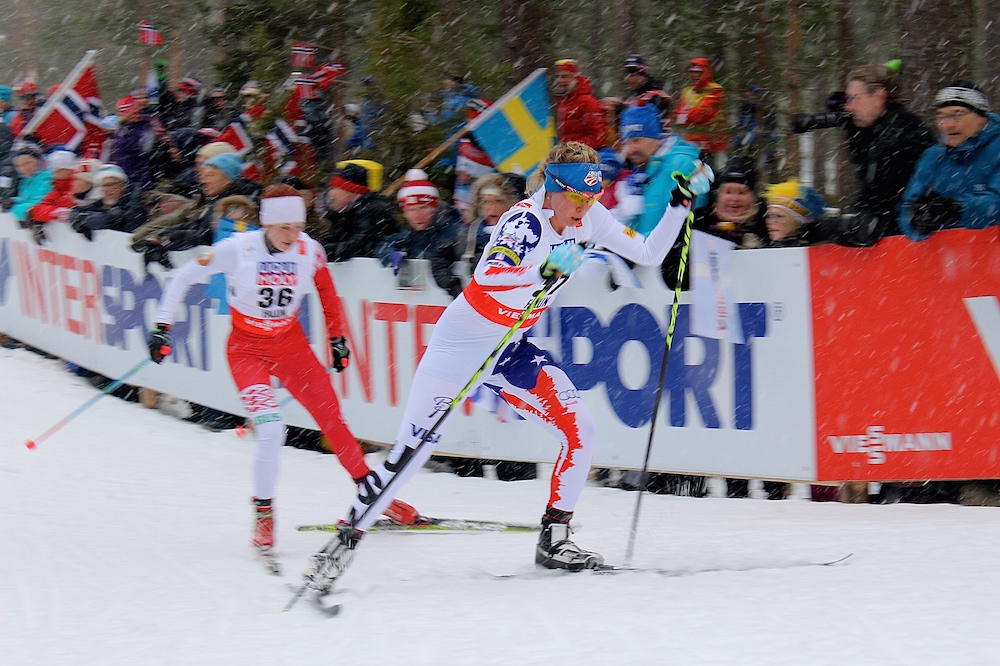
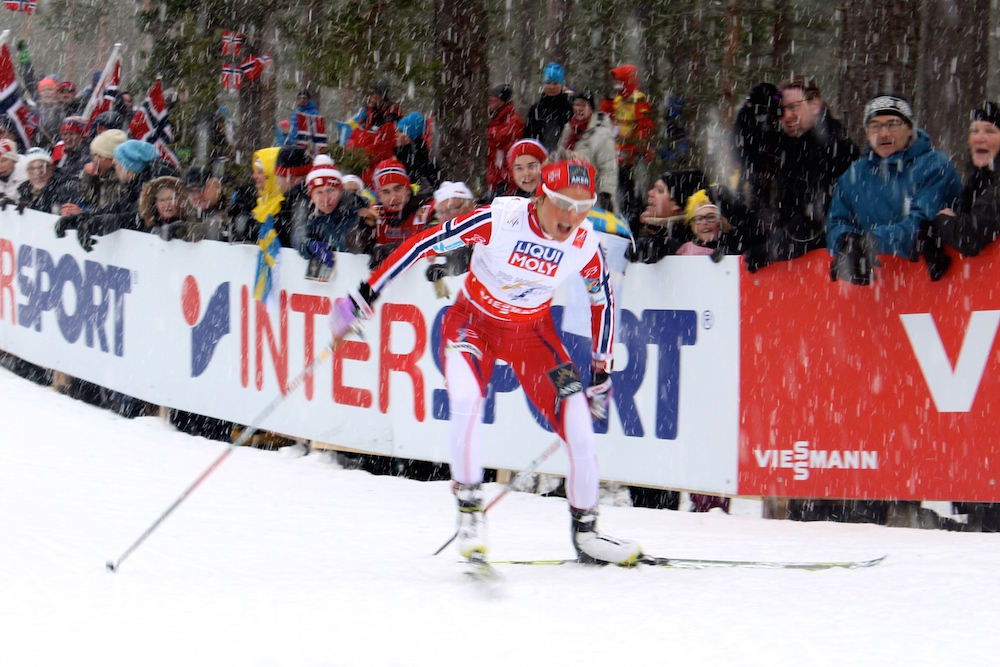
Lightly falling snow at the start turned into a full-fledged downpour of wet-and-heavy snowflakes throughout the race, making an already soft track in above-freezing temperatures even slower. And while some of the Norwegians, like Therese Johaug, later said they felt like they were skiing on glue, the U.S. women didn’t seem to have a problem. Nor did Kalla.
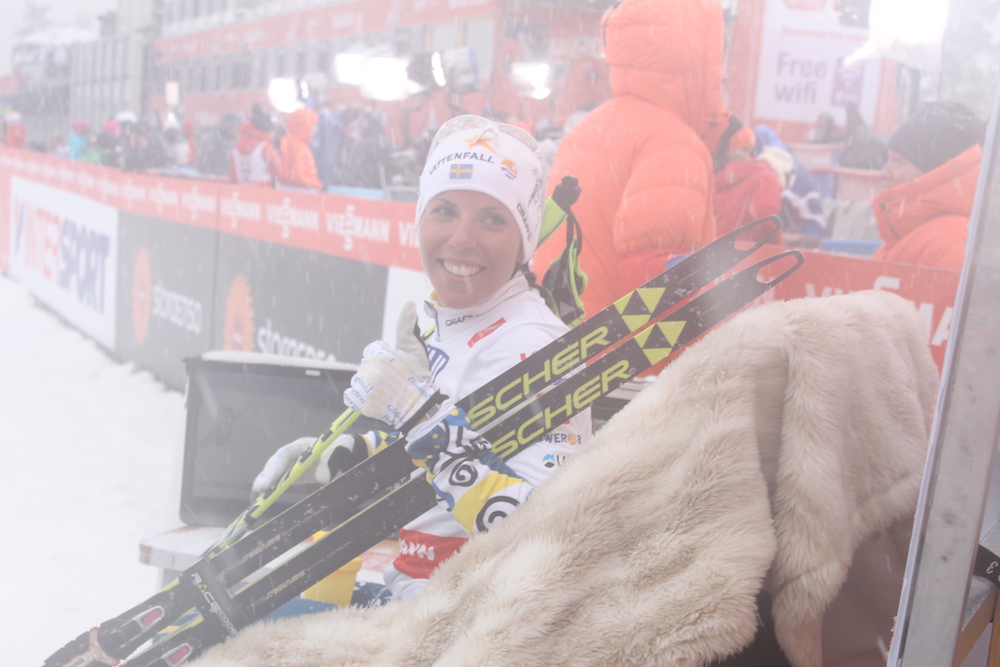
Sweden’s Charlotte Kalla in the leader’s chair after essentially securing her first individual gold at a World Championships in the 10 k freestyle at 2015 worlds in Falun, Sweden.
The Swede rounded the course in 25:08.8, 41 seconds faster than Diggins to replaced her in the fur-covered chair at the finish. Kalla hardly spent any time in it, though, congratulating Diggins on a strong race before sitting down briefly for a few photos then getting up to put on dry clothes. By the time she returned to the finishing pen, the race was just about over.
And nobody — none of the Norwegians, including Johaug, the 10 k skate’s defending world champion, nor Marit Bjørgen — came anywhere close.
“I think I had the focus on the right thing for the most of my race,” Kalla said in the press conference. “[I heard] coaches screaming that I’m going for the gold medal, but it’s putting that behind me and trying to ski as fast as possible.”
At 1.5 k, Johaug in bib 63 came within 8.2 seconds of Kalla, and Finland’s Kerttu Niskanen, the 47th starter, was 11.4 seconds back in third. Norway’s Astrid Uhrenholdt Jacobsen started 43rd and ended up 11.8 seconds off Kalla’s time at that marker, and Bjørgen, who started 65th, was 12 seconds behind Kalla at 1.5 k.
By the halfway point, Kalla was 17.5 seconds up on Diggins and 25 seconds ahead of Gregg in third. Another Swede, Maria Rydqvist ranked fourth at 5 k, 27.1 seconds behind, and Poland’s Sylwia Jaśkowiec — coming off bronze in Sunday’s freestyle team sprint — stood in fifth (+28.2).
Also at 5 k, Heidi Weng as the top Norwegian in bib 61 clocked through 49.8 seconds after Kalla. Jacobsen ranked 22nd there (+49.9), and Johaug and Bjørgen were 26th and 32nd, respectively, with Bjørgen more than a minute back with 5 k to go.
Kalla came through the 6.3 k checkpoint 36.3 seconds faster than Gregg in second place and 36.6 seconds ahead of Diggins in third. By 7.8 k the Swede was up to 40.2 seconds ahead of Gregg and 40.9 ahead of Diggins. Kalla extended that gap in the last two kilometers to win by 41 seconds for her first individual title at World Championships.
“It’s a dream come true, to become world champion at home,” Kalla told Expressen. “It probably has not really dawned on me yet. I need enough time for it to melt in.”
Diggins, who achieved silver for the best-ever U.S. women’s distance result at an international championships, and Gregg, who helped notch a historic U.S. double podium with bronze, felt similarly. Once the results were final, the 23-year-old Diggins fell to her knees in tears. Gregg, 11 years her elder, hugged her at the finish.
Jessie Diggins (U.S. Ski team) leads Ekaterina Rudakova (l) of Belarus, whom Diggins passed, up “little” Mördarbacken early in the women’s 10 k freestyle individual start at 2015 World Championships in Falun, Sweden. Diggins went on to take silver for the best-ever U.S. women’s distance result at an international championships.
“World championships and Olympic games, sometimes crazy things happen, and people who are favorites don’t always come out on top,” Diggins said. “You never know, especially with the snow today, [I thought], ‘Okay, here’s a chance. Why not me? Someone’s going to be on the podium and I have as good shot, I’ve trained as hard as anyone, and I want it as much as anyone,’ so I think with that in mind, we just went out there for every second.”
“Right off the bat, I just knew everything was clicking,” Gregg recalled. “It was that fantastic feeling you hope for when you get to a championship event, of like, yeah, this is just happening, keep it going, keep it going. I knew that I could only put down the best effort I could. I’ve been talking to [my husband] Brian and really trying to outline how to approach the course, and I just basically was executing my plan for the day and skiing consistently and skiing aggressively the whole way.”
With a goal of being in the race leader, she accomplished that, but it took some time for Gregg to realize that she was an actual podium contender.
“I knew I had two girls [starting] ahead of me,” Gregg said, referring to Japan’s Yuki Kobayashi in bib 1 and Italy’s Marina Piller in bib 2. “I looked at their results from previous races to know where they were on the World Cup so I used that to kind of say, OK if I’m pulling them in, this is a really good race for me…”
Also for the U.S., Randall started fourth, 30 seconds behind Gregg, and ended up 15th, 1:25.2 behind Kalla. The U.S. women put four in the top 15, with Liz Stephen finishing 10th (+1:06.4).
Caitlin Gregg (Team Gregg/Madshus) racing to bronze on Tuesday in the 10 k freestyle at 2015 World Championships in Falun, Sweden. Gregg finished third behind Swedish winner Charlotte Kalla and fellow American Jessie Diggins, who was second. (Photo: Madshus/NordicFocus)
“I did get a back split at one point that I was still tied for the lead at one-and-a-half k, which was a really positive feeling out there,” Gregg explained. “After that, it just all kind of drowned out — I don’t remember hearing any splits or anything. It was all just kind of mumble jumble.”
Diggins said she also stuck to her race plan, which involved breaking the course down into eight climbs, attacking each one then making a point to recover after each as well.
“As it was snowing, I knew that the course was going to get slower, so on the downhills I was setting my skis on edge and going knocked-kneed because maybe I would have fallen,” she said. “It was very fast. I was happy to stick with the plan and pace Mördarbacken [the big climb] like I wanted to. The crowds and the fans are amazing, but then you would just start wanting to go crazy and then do you blow up.”
While Scandinavian fans also cheered loudly for contenders like Johaug and Bjørgen, it wasn’t their exuberance that caused the Norwegians to have a massive off day.
“I think the skis were not perfect today, so it’s not only the snow,” Bjørgen told reporters afterward.
Bjørgen, a 34-year-old, 20-time World Championships medalist, ended up 31st, 2:23.6 behind Kalla, for her first time outside the top 24 in a World Championships race in at least 14 years. According to Norwegian media, the team didn’t anticipate the amount of snowfall that settled in Tuesday afternoon, and the Swedish ski federation had its own meteorologist, which predicted the exact conditions. Based on online weather models, the U.S. Ski Team also expected the snow.
“There were several things that worked out [for our team today],” U.S. Ski Team Head Coach Chris Grover told VG. “The snow played a big role. Obviously, we had seen snow in the weather forecast.”
But for some reason, the Norwegians missed the memo and all five of its women missed the top 20. Weng as the top skier finished 22nd (+1:51.9), Johaug was 27th (+2:14), Ragnhild Haga was 29th (+2:20.4), and Jacobsen ended up 33rd (+2:32.4). And while they were disappointed, Johaug told reporters she wasn’t angry.
Norway’s Therese Johaug racing up “little” Mördarbacken early in the women’s 10 k freestyle individual start at 2015 World Championships in Falun, Sweden. She went on to place 27th for her first non-top 10 at a World Championships.
“I don’t blame the guys in the wax trailer, they work their butts off,” Johaug told Dagbladet, according to a translation. “Most of the time they nail it, but today they didn’t. That’s too bad. It’s not the end of the world, but I know I’m better than 27th.”
In five-career World Championships, Johaug had never been outside the top 10.
“That’s just ridiculous,” she added. “I pretty much cant remember the last time that happened.”
Moving on, she vowed four Norwegian women would be hungry for Thursday’s 4 x 5 k relay.
“I can promise you that there are four very revenge-crazed Norwegian girls at the start line there,” Johaug said.
At the end of the day, the several coaches complimented the Americans. U.S. women’s coach Matt Whitcomb said the door of their wax room hadn’t shut with so many people stopping by to congratulate them.
Norway’s Marit Bjørgen racing up “little” Mördarbacken early in the women’s 10 k freestyle individual start at 2015 World Championships in Falun, Sweden. She went on to place 31st for her time outside the top 30 in at least 14 years of World Championships competition.
“It’s a huge surprise,” said Kristiansen, the Norwegian women’s coach. “If anyone had put money on this podium before the race, I believe they would be very rich by now.”
VG pointed out that the U.S. Ski Team has 10 percent of the budget of the Norwegian national team, which spends about $7 million dollars a year.
“For us as a smaller ski nation, we must get everything to fall into place on the same day,” Grover told VG. “We were a bit lucky that several of our girls started a little early, but we also had wonderful skiing.”
The Norwegian saga aside, Kalla considered her gold on Tuesday more meaningful than her 2010 Olympic win because of the level of competition she faced.
“It is much tougher competition among the ladies in the World Cup now,” she told Expressen. “So it feels larger.”
Rydqvist was the second Swede in the top four, 48.6 seconds behind Kalla and 1.7 seconds off the podium. France’s Anouk Faivre Picon placed fifth (+55.2), Switzerland’s 21-year-old Nathalie von Siebenthal notched sixth (+59.2), and Japan’s Masako Ishida finished seventh (+1:02.5). Niskanen ended up eighth (+1:04.5), Switzerland put two in the top 10 with Seraina Boner in ninth (+1:05.8), and Stephen was the third U.S. woman in the top 10 in 10th.
Ingvild Flugstad Østberg (in red bib) awaits her longtime friend and Norwegian teammate Maiken Caspersen Falla at the finish of the women’s 6 x 1.2 k classic sprint on Sunday at 2015 World Championships in Falun, Sweden. The two took gold by more than eight seconds over Sweden. (Photo: FlyingPointRoad)
FasterSkier’s coverage of the 2015 FIS Nordic World Ski Championships in Falun, Sweden, is brought to you by the generous support of L.L. Bean, now featuring a complete line of Kikkan Randall training wear.
FALUN, Sweden — With Marit Bjørgen out of the freestyle team sprint on Sunday after what she considered a disappointing sixth-place finish in Saturday’s skiathlon at 2015 FIS Nordic World Ski Championships, that left someone to step up in her absence.
The Norwegian national-team staff decided one of their best bets was Ingvild Flugstad Østberg, a longtime friend of their other athlete in the race, Maiken Caspersen Falla.
Teammates for the last decade, the two wouldn’t have wanted it any other way.
“If there is anyone who makes me better, it’s Ingvild,” Falla, the 2014 Olympic classic-sprint champion told NRK, according to a translation, after Sunday’s race.
“We’ve known each other a long time and push each other on countless sessions,” Østberg added.
Both 24, the two are nearly three months apart in age, with Falla being the elder. Partners in the World Cup freestyle team sprint last month in Otepää, Estonia, Falla and Østberg placed second, 0.85 seconds behind Sweden’s Ida Ingemarsdotter and Stina Nilsson in first.
While the Swedes stuck with their winning order, the Norwegians switched it up on Sunday, with Østberg leading out and Falla anchoring the 6 x 1.2-kilometer freestyle team sprint. The combination worked, as the two won the first semifinal of the day ahead of Poland’s Justyna Kowalczyk and Sylwia Jaśkowiec. The two teams automatically advanced to the final, and Sweden in third earned a spot as one of six teams with fast-enough times to move on as well.
Germany’s Nicole Fessel and Denise Herrmann won the second semifinal, and the Americans, with Sophie Caldwell and Jessie Diggins, placed second in that heat. Finland, Russia and Slovenia advanced as well, along with France and Switzerland from the first semifinal.
Poland’s Justyna Kowalczyk leads Norway’s Ingvild Flugstad Østberg on the second lap of the women’s 6 x 1.2 k freestyle team sprint on Sunday at 2015 World Championships in Falun, Sweden. Østberg reclaimed the lead for good for Norway. (Photo: FlyingPointRoad)
In the final, Norway got down to business from the start, with Østberg leading out of the stadium and into the first-and-only climb of the women’s 1.2 k course. Fessel and Ingemarsdotter followed, while the U.S. positioned itself in fourth with lead-out skier Sophie Caldwell.
By the time the pack returned to the stadium, Kowalczyk put herself in third for Poland, less than half a second behind Østberg in first and Fessel in second. Ingemarsdotter came through the exchange in fourth (+0.88), Slovenia’s Katja Visnar tagged Nika Razinger in sixth (+1.47) while the U.S. was 2.01 seconds back in sixth.
One lap later, Germany was up to first with Herrmann, and Jaśkowiec was 0.55 seconds back in second and Falla 0.57 seconds behind in third. The silver medalist from Thursday’s classic sprint, Nilsson came through in fourth (+1.01) for Sweden, with Diggins three-tenths of a second behind her in fifth. Flying into the exchange and prohibited from snowplowing to stop, Diggins ran into one of the Germans and nearly caused Ingemarsdotter to crash before the Swede headed out on her second loop.
“The U.S. was falling in front of me so I had to go around them,” Ingemarsdotter said in a press conference. “It was a little bit scary for a while, I think, ‘Oh I hope, I don’t fall.”
She didn’t.
With two of six laps completed, the race for gold appeared wide open — until Østberg launched an attack on the steep climb.
Fessel went with her, as did Kowalczyk, while Ingemarsdotter started to fall off the pace and Caldwell drifted farther back in fifth. Østberg led Fessel into the exchange, where they tagged in first and second, respectively, 0.43 seconds apart. Kowalczyk tagged her teammate some 3 seconds out of first, while Ingemarsdotter was another second back in fourth and Visnar 10.17 seconds behind in fifth. Behind Russia in sixth (+10.41), the U.S. slipped to seventh (+11.21).
Heading out on her second lap, Falla made a point to stay up front and push the pace, leading Herrmann up the steep climb while Jaśkowiec and Nilsson clung tightly to them. Diggins moved up into fifth several seconds behind the leaders, while Falla widened the space between her and everyone else on her way back down into the stadium.
By the time she reached the tag zone, Falla put Norway 1.07 seconds ahead in first, followed by Herrmann, Jaśkowiec (+1.67), Nilsson (+2.56), and Diggins (+16.28).
Her final time around, Østberg went for it once more on the sprint hill, this time dropping Fessel. Kowalczyk took advantage of the fading German and moved into second over the top, while Østberg led by a significant margin on the way down. Meanwhile, Kowalczyk, Fessel and Ingemarsdotter pushed to take hold of second.
“I had a little gap to Poland and Germany so I just tried to push everything I had to get Stina in as good a position as possible for the last lap,” Ingemarsdotter recalled. “I know if Stina has a little bit feeling that she is with them, then no one will beat her.”
While she put Sweden in fourth, Østberg gave Falla a 6.11-second head-start for their final lap. Kowalczyk tagged Jaśkowiec in second, six-tenths of a second ahead of Germany in third and nine-tenths of a second ahead of Sweden.
Falla continued to plug away alone up front, while Jaśkowiec, Herrmann and Nilsson jockeyed for position in the chase pack. On a tight turn before a final descent into the stadium, Nilsson came from behind and nearly collided with Herrmann. The two stayed upright, but Herrmann dropped to fourth while Jaśkowiec led Nilsson into the finishing stretch.
The women’s freestyle team sprint podium at the medals ceremony on Sunday night at 2015 World Championships in Falun, Sweden. Norway’s Ingvild Flugstad Østberg (third from l) and Maiken Caspersen Falla (third from r) teamed up for gold, Sweden’s Ida Ingemarsdotter (l) and Stina Nilsson (second from l) took silver, and Poland’s Sylwia Jaskowiec (second from r) and Justyna Kowalczyk (r) tallied bronze. (Photo: Falun2015/Twitter)
There, Falla, the 2015 World Championships classic-sprint bronze medalist, crossed the line uncontested for the Norwegian victory in 14:29.57.
“We were planning to start a little bit easy in the first round and speed up in the second and give it all in the last round, and we did as planned,” Østberg explained in the conference. “It was amazing to give Maiken some seconds and she was really strong in the last lap, and then we could cross the finish line first. That was amazing.”
Nilsson outsprinted Jaśkowiec to clinch second for Sweden, 8.17 seconds after Norway and 0.31 seconds ahead of Poland.
“I was very inspired by Ida’s amazing last lap so I felt that the medals were really close,” Nilsson said after her second-straight silver. “I gave it everything I had on the last lap and I’m very happy it worked out well.”
“I saw only the back of Falla,” Jaśkowiec recalled in the conference. “I was going [for] second place in the finish area, but I felt in my back that somebody push very fast and I tried to focus on only to get the final line. Stina was amazing with amazing finish and I could just only watch how she passed, but bronze medal is for us. I am really happy we could even be a part of this today.”
Her teammate, Kowalczyk was just as thrilled after missing out on a medal when she placed fourth in the classic sprint on the first day of World Championships.
“Before the race, I was sure that we’ll be good because Sylwia has really good skating, but there was five or seven really strong teams,” Kowalczyk told FasterSkier. “I am so happy because this is the first medal for Poland [at these World Championships], and I’m so happy for me and of course for Sylwia because she’s ranking number two in Poland now, who have the medals in cross-country skiing. … It’s not only Justyna now.”
Jaśkowiec reveled in her first World Championships medal after coming back from a rollerski accident in 2010.
“Four years ago, I had a very bad accident and I spent one year on rehabilitation so comeback was very tough,” she said in the conference. “I have a lot of thought if I could come back in skiing — the level is so high that I felt that the top athletes just run away from me so today it’s a huge satisfaction and my dream has come true. I know that the tough time was worth so much pain and fighting, and I hope that my courage just now start to be faster and faster and it will be the beginning of the show.”
Herrmann anchored Germany to fourth, 11.57 seconds back from the winners and three seconds off the podium. Russia’s Anastasia Dotsenko and Natalia Matveeva improved to fifth (+29.19) after ranking ninth at the second-to-last exchange. France was sixth (+30.26) with Coraline Thomas Hugue and Celia Aymonier, and Switzerland was seventh (+33.98) with Seraina Boner and Laurien van der Graaff.
The U.S. finished eighth (+34.06) after slipping from fifth to eighth on Caldwell’s last lap. Slovenia placed ninth (+42.39) and Finland — which reached the team-sprint podium in the last three World Championships — was 10th (+42.9) with Riikka Sarasoja-Lilja and Anne Kyllönen,
At the last World Championships in Val di Fiemme, Italy, the U.S. won the freestyle team sprint with Diggins and Kikkan Randall in 2013. Sweden took silver with Charlotte Kalla and Ingemarsdotter, and Finland earned bronze with Sarasoja-Lilja and Krista Lahteenmaki (now Pärmäkoski).
Østberg and Falla placed fourth in that race, some 20 seconds after the U.S. and 10 seconds off the podium. After that showing, Østberg viewed Sunday as an opportunity.
“When Marit said she wasn’t supposed to go [in the team sprint] then I’m really happy that I could show that I also could do a really good job,” she said in the conference. “In 2013, we were the same team and the same distance and then I ruined it, and today we could do this for the team and to do this with Maiken is amazing. We’ve been teammates for several years and good friends so that’s an awesome feeling.”
“In 2013, we were the same team … and then I ruined it, and today we could do this for the team and to do this with Maiken is amazing.” — Norway’s Ingvild Flugstad Østberg, who won gold with teammate Maiken Caspersen Falla on Sunday in the 2015 World Championships freestyle team sprint
“We were a proper gold team today,” Falla told NRK, according to a translation. “It means so much to stand here with Ingvild — we’ve been through so much together.”
The two set the tone for back-to-back Norwegian victories on Sunday, as Finn Hågen Krogh and Petter Northug teamed up for gold in the men’s 6 x 1.4 k team sprint later that afternoon. They beat Russia’s Alexey Petukhov and Nikita Kriukov by 5.64 seconds.
Kikkan Randall (U.S. Ski Team) during Thursday’s 1.4 k classic sprint qualifier, in which she placed 36th to miss advancing to the heats on the opening day of 2015 World Championships in Falun, Sweden. She finished 35th overall after Sweden’s Hanna Falk was disqualified. (Photo: FlyingPointRoad)
FasterSkier’s coverage of the 2015 FIS Nordic World Ski Championships in Falun, Sweden, is brought to you by the generous support of L.L. Bean, now featuring a complete line of Kikkan Randall training wear.
FALUN, Sweden — The defending world champions in the women’s team sprint will field a new team at the 2015 FIS Nordic World Ski Championships. Sophie Caldwell will join Jessie Diggins as the Americans attempt to defend their title in a field that features fierce competition in the form of Norway’s team of Maiken Caspersen Falla and Ingvild Flugstad Østberg and Sweden’s team of Stina Nilsson and Ida Ingemarsdotter.
Kikkan Randall, a member of the defending 2013 World Championships team, will not start Sunday.
“It was a really hard decision to make. We had a number of women we were considering for that,” U.S. Ski Team (USST) Head Coach Chris Grover said in an interview. “Jessie was the first pick for that team given what her form has been like.”
Grover explained that Caldwell, Randall, Sadie Bjornsen, and Ida Sargent were all in the running for the final spot and that U.S. coaches took results, tactical abilities and current states of fitness into the consideration. He said that the decision to start Caldwell was due to her improving form over the season.
“Sophie seems to be coming into better and better fitness. Her skating in the pack in a sprinting environment is always good,” he said.
Randall has struggled to find form so far this season. In the first two races of World Championships, she finished 35th in Thursday’s classic sprint and 31st in Saturday’s 15 k skiathlon.
“[I’m] just kind of playing it day by day, and searching, and trying to find better feelings,” she said after the skiathlon.
According to Grover, the decision to leave Randall off the team was difficult giver her abilities and experience. He believes that Caldwell’s addition gives the U.S. its best chance at a top result. He also acknowledged that “at the end of the day, you never really know if you made the right choice or not.
“It was a hard decision with Kikkan because even though she’s not at her peak fitness right now, she’s still good tactically and a good skater. She knows where to be and knows where to see the openings,” he said. “It was tough and in the end, we felt like Sophie’s trajectory right now was putting her in a place right now where she could be part of our best team.”
The women’s and men’s team sprints begin tomorrow with semifinals at 12:30 p.m. CET (6:30 a.m. EST).