From the FasterSkier archive — posts syndicated from athletes’ and coaches’ own blogs between 2004 and 2012, kept online as published. Current coverage is at fasterskier.com.
The women’s team sprint medal ceremony at the 2018 Winter Olympics in PyeongChang, South Korea, with (from left to right) Sweden’s silver medalists Charlotte Kalla and Stina Nilsson, American gold medalists Kikkan Randall and Jessie Diggins, and Norway’s bronze medalists Marit Bjørgen and Maiken Caspersen Falla. (Photo: FlyingPointRoad)
(Note: This article has been updated to include clarification from Sara Mae Berman on her results in the 1971 national 50-kilometer ski race in Putney, Vermont)
***
What did John Caldwell have to say after the U.S. women’s gold-medal performance on Wednesday at the 2018 Olympics? We asked Caldwell, a 1952 Olympian and one of the founders of the U.S. women’s cross-country program who coached the U.S. Ski Team through five Winter Olympics (1960, 1964, 1968, 1972, and 1984), and he wanted to take the opportunity to explain how the team came to be in order to give some perspective on how far it’s come. The following was written by Caldwell, 89, of Putney:
“It hasn’t been easy to get to where we are after today. Lots of the reports mention how many years it’s been, or that it’s been 564, 321 days (or something like that) etc., and they are all true. Better they knew a bit about the development and could write about that. So that’s what I intend to do here.
In the Oslo Olympic Games in 1952, the Finnish women ran the same course as the guys one day and their times beat our times. Of course we didn’t have a women’s team then.
I coached the FIS Team to Oslo in 1966 (Gallagher, Elliott, Gray, Damon and C Matis) and the manager, Bob Tucker, and I wanted to get females started skiing more in the US. So we met with a Swedish official named Inga Lowdin and she told us we should work to make sure people don’t think you need Amazons (females) to be good at xc. “I will send you some “girls” that will help your development of xc.”
Tucker and I had to lock the big boss in a closet — well, almost — in order to get funding for airfares, something on the order of $3500. Three Swedes came over in 1967, including Toini Gustafsson and Barbro Martinsson, who both won gold medals at the Autrans OWG in 1968. They made their first stop in Putney and encouraged Martha Rockwell to race the next day, thus starting her international career.
A few years earlier Martha had led off for a team at the Putney Relays. Girls didn’t race then and so she was teamed up with two boys. She beat a couple of boys from a near-by prep school to the finish and one was seen shredding his skis afterwards on a handy fence.
Sometime in the late ’60s we ran a National 50k at Putney. Sara Mae Berman wanted to race, but no long races were run for the female sex. I entered her with the guys on a 5 x 10 k loop. She was quite far behind when she came by on her 4th lap and I stopped her for a moment or two, showed her our timing clock on a little stand, along with a pencil and paper, and told her to just time herself because I had to go inside and award prizes. She finished and I will wager her time is registered somewhere. We ran a tight ship in those days.
[Note: Berman wrote FasterSkier and sent a copy of results from that race, which was held in 1971, to clarify that at least one man finished behind her. Her husband Larry Berman explained in another email that her time was not originally listed, “but the timers recorded her and I wrote down her splits. At the end of 4 laps, there were 3 men behind her.”]
So our first ladies international team didn’t materialize until 1970 when we sent them to the FIS World Championships in Vsyoke Tatry in Czechoslovakia.
All along the way in these years there was precious little club skiing. Almost all of it happened in secondary schools and colleges. Divisional committees dictated races to fit the school and college schedules. Year-round XC training was a rarity, mainly due to the fact there were few year-round coaches available. So as a nation, we floundered. The transition to club skiing was slow and I hesitate to try and explain it or point to significant events, but thank goodness, it happened. Now we are fairly well set up with a pretty good club system. The secondary schools are feeding some clubs and a lot of colleges, the colleges are doing a good job of developing skiers with their four-year programs and they help feed the clubs with good seniors. The clubs also help feed the colleges with good skiers from their junior ranks.”
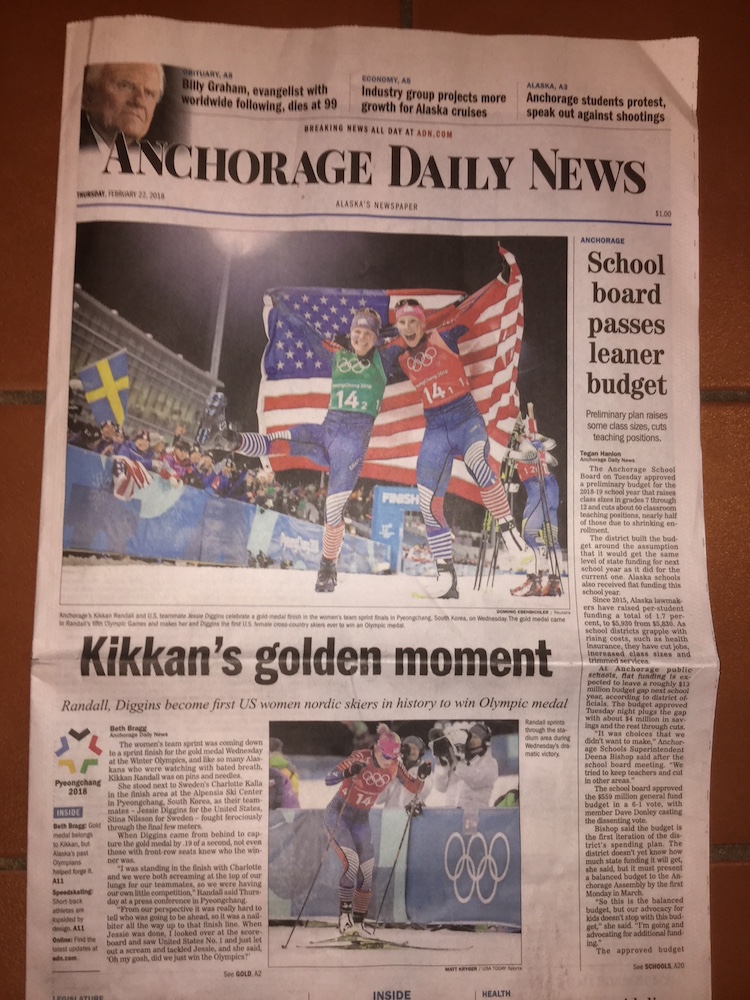
Front page of the Anchorage Daily News on Thursday, Feb. 22, 2018.
You may have noticed that Kikkan Randall and Jessie Diggins won a gold medal yesterday. (If you’ve forgotten, or just haven’t seen the video in the last five minutes, you should probably go watch that finish sprint one more time. We’ll wait.)
The rest of the world noticed. For longtime fans of the sport, one of the most surreal things about Wednesday may have been seeing cross-country skiing – our sport, a niche sport, a pastime that typically merits mention in The Gray Lady only when it’s in that one piece about cross-country skiing and “topographical Buddhism” that all your friends sent you even though we’re totally cooler than that and don’t actually wear helmets and goggles when we ski – in The New York Times, andThe Washington Post, andThe Washington Post again, and The Wall Street Journal, and so on. Apparently gold medals talk or something.
Here’s a non-scientific roundup of how the Americans’ win was covered in English-language media. Coverage is arranged from very roughly the most-national newspapers (“the U.S. wins a medal”) to the most-parochial (“local hero Randall/Diggins wins a medal”), followed by a handful of online-only publications. Particularly good lines and, in some case, unfortunately imprecise lines are highlighted.
Best line: “The team sprint – especially on this brutal course – is a sadistic event. It requires two skiers to take turns skiing three legs each of 1.25 kilometers. With two rounds of racing for the top 10 teams, that means six all-out sprints for each skier, with a little more than an hour to recover between the semifinals and the final.”
Least-accurate line: “Randall, an Alaska native, was the first American woman to break into the elite of international cross-country skiing, and there was a long period in which she was the only woman on the United States team.” (The phrase “Alaska Native” is the preferred term of cultural identity for the indigenous peoples of Alaska; it’s a small point, but “native Alaskan” would be more appropriate for someone who grew up in Alaska but is of Caucasian heritage. Plus, Randall was technically born in Salt Lake City while her mother was in law school in Utah, before moving to Anchorage in childhood.)
Best line: “Diggins, the ebullient talisman of the US team who spends her downtime learning hip-hop dance routines from YouTube tutorials, was third entering the final lap before finding an extra reserve to overtake both the Swedish and Norwegian teams and secure the history-making gold.”
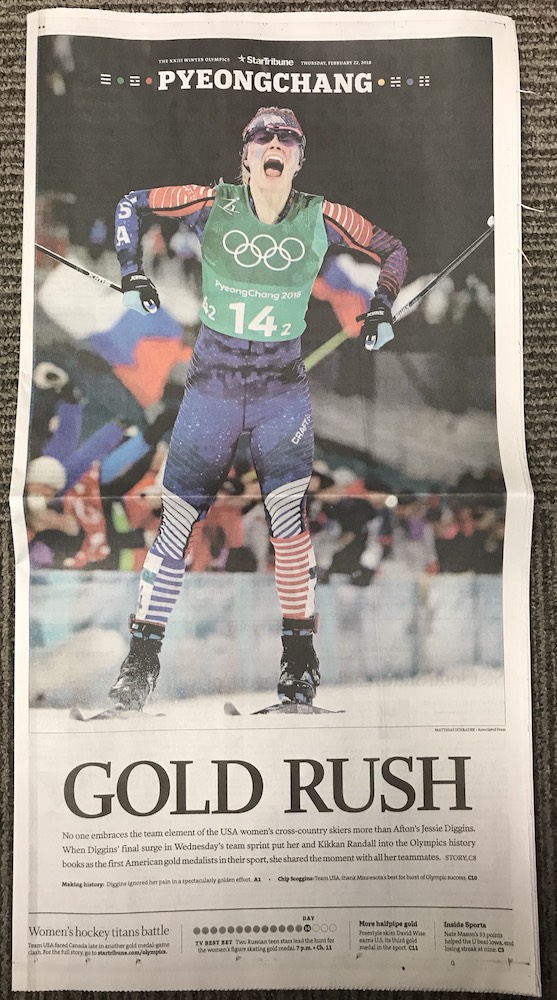
Front page of the Minneapolis Star Tribune sports section on Feb. 22, 2018. (Photo: Scott Beutel)
Best line: “While Bjoergen was winning 14 medals, Randall was waiting for one. Diggins had made it happen with her 100-meter sprint. Randall had made it possible with the previous 16 years.”
Best line: “Technically, every mother deserves a gold medal.”
Least-accurate line: “And Randall – who intentionally positioned her childbirth midway between two Olympics and in a non-World Cup year – has attracted admirers for her decision to stick with her craft.” (The World Cup of course went on in Randall’s absence in the 2015/2016 season; it was a non-World Championships year.)
Best line: “Kikkan Randall screamed at the Alpensia Cross Country Centre’s finish line here as Jessie Diggins, her teammate on the two-woman sprint relay, ricocheted off the final turn for home.”
Least-accurate line: “The Americans found themselves in an unusual position: racing the powerhouse Norwegians and Swedes for gold over the final meters.” (Well, actually, Diggins and Randall have been competing head to head with Scandinavia for many years now, often with World Cup or World Championship gold at stake.)
Best line: “When President Obama first got inaugurated,” Randall said, “I had a dream that I was sitting on Air Force One talking to him about cross-country skiing and telling him it is a really cool sport but didn’t get enough attention. He said [in the dream] when he became president, he would help make cross country a higher profile.”
Least-accurate line: “Each racer skies three legs on the twisting, undulating course, and the three medalists separated themselves from the rest of the 10-team field entering the final loop.” (The verb is “skis,” guys, not “skies.”)
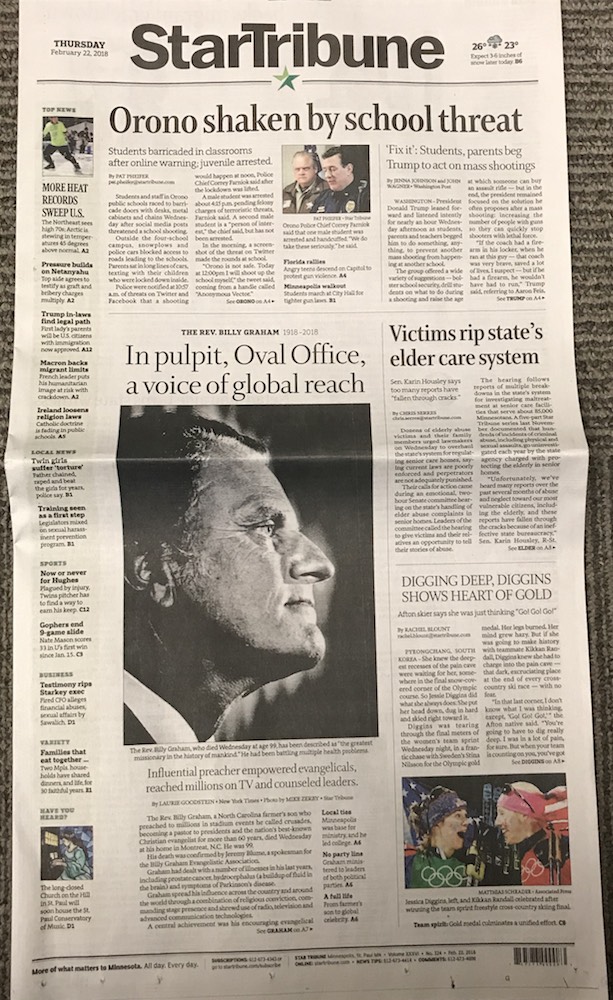
Front page of the Minneapolis Star Tribune (see bottom right) on Feb. 22, 2018. (Photo: Scott Beutel)
Best line: “When she reached the finish line, Diggins said, she couldn’t feel her legs. Within moments, though, she came out the other side of the pain cave, into the light of a golden evening.”
Least-accurate line: “It was the 18th Olympic medal for Bjoergen, the most of any Winter Olympian in history.” (Bjørgen’s cumulative medal haul is stunning, but in fact stands at “only” 14 Olympic medals total.)
Best line: “Diggins has stayed a part of the Stillwater team. She sent a text from South Korea last week before the Ponies girls team went out and won the team title. Wednesday the texts were going the other way.”
Best line: “Few Americans have Olympic gold medals. Fewer still have an ice cream flavor named after them. Jessie Diggins has one, and she might soon have both. … The goal is to introduce the flavor in coordination with a citywide celebration of Diggins’ accomplishment that Afton officials, business owners and residents are planning to honor their hometown hero.”
Best line: “Randall and Bjoergen, 37, are both five-time Olympians and both are mothers of toddlers. Randall’s son, Breck, will turn 2 in April, and Bjoergen’s son turned 2 in December. Both have shown that neither age nor motherhood spell the end of a world-class career.”
Least-accurate line: “[Diggins is] also a three-time World Championship medalist – in 2013, she and Randall won the team sprint at worlds – and a frequent visitor to the World Cup podium.” (Diggins has four World Championships medals.)
Best line: “I puked after a lot of races that year. There is old camcorder footage of me vomiting at a race in Michigan’s Upper Peninsula and you can audibly hear all of my teammates – and I do mean ‘all,’ I was one of the last guys across the line – scream with laughter.”
Best line: “On the fourth lap, Diggins made a move, pulling ahead of the entire field. Even though I already knew the outcome of the race before I watched the full replay, I still sat up in my chair when I saw Diggins pull ahead. I’ve watched enough cross-country skiing to know it’s rare for an American to ever pull ahead. ‘She’s going to do it,’ I said, even though I knew she had already done it. That’s how thrilling this race was: It made me nervous about an outcome that I already knew was not in doubt.”
Least-accurate line: “On Wednesday in Pyeongchang, cross-country skiers Kikkan Randall and Jessie Diggins pulled off the United States’ biggest upset of the Winter Games, winning a gold medal in the women’s team sprint. It’s safe to say no one saw this coming. If cross-country skiing is the NFL, then the United States is the Cleveland Browns. Imagine how surprised you’d be if the Browns made the playoffs, then got to the Super Bowl, then hoisted the Lombardi Trophy, having defeated Norway along the way.”
(The U.S. team is currently ranked fifth in the Nations Cup (the women alone are third), barely behind Finland for fourth. Luke Bodensteiner, U.S. Ski & Snowboard Chief of Sport, told FasterSkier yesterday, “I think we came in feeling like team sprint was not only our best opportunity for a medal, but probably a pretty high likelihood for us, honestly.” The Browns, by contrast, just suck.)
Best line: “People often call cross-country skiing an individual sport. But more than anything, Randall’s and Diggins’ success is a counterpoint to that idea; their victory is a testament to the people rallying behind them. … This community pushed through dips in funding, apathy in American ski culture, and the general challenges that come with pursuing the hardest sport on the planet. Today, Randall and Diggins proved that this is truly a team sport.”
Least-accurate line: [Not applicable; author Annie Pokorny, a recently retired elite American domestic racer, knows her stuff.]