From the FasterSkier archive — posts syndicated from athletes’ and coaches’ own blogs between 2004 and 2012, kept online as published. Current coverage is at fasterskier.com.

Tag: U.S. women’s team

  • ‘It Was Like Hell Today’: Østberg on Keeping the Red Bib; Diggins Up to 3rd in TdS Stage 3

    ‘It Was Like Hell Today’: Østberg on Keeping the Red Bib; Diggins Up to 3rd in TdS Stage 3

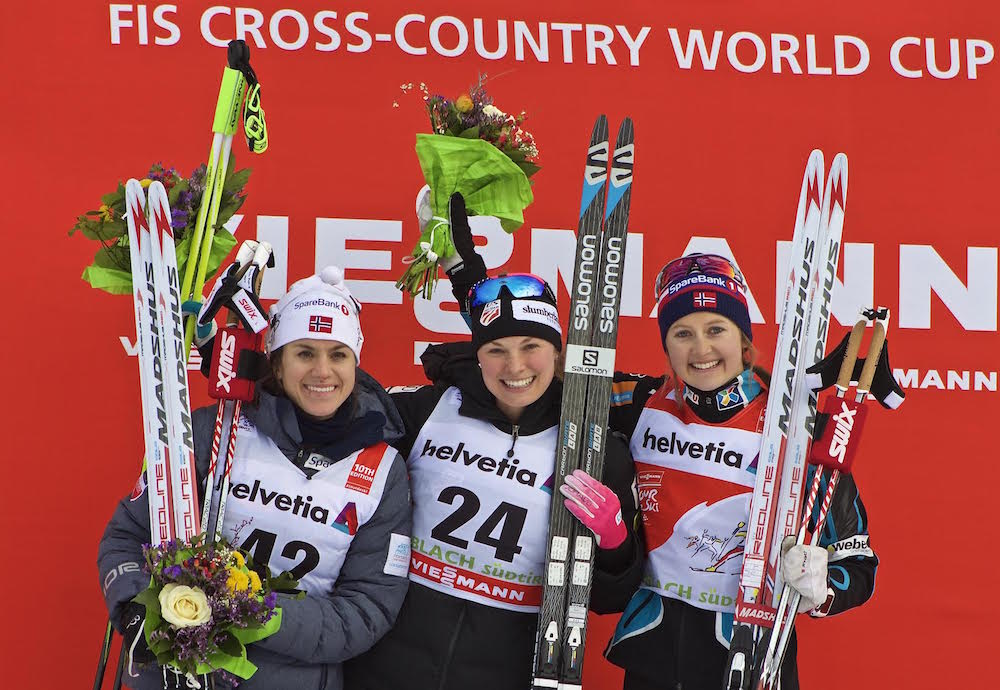
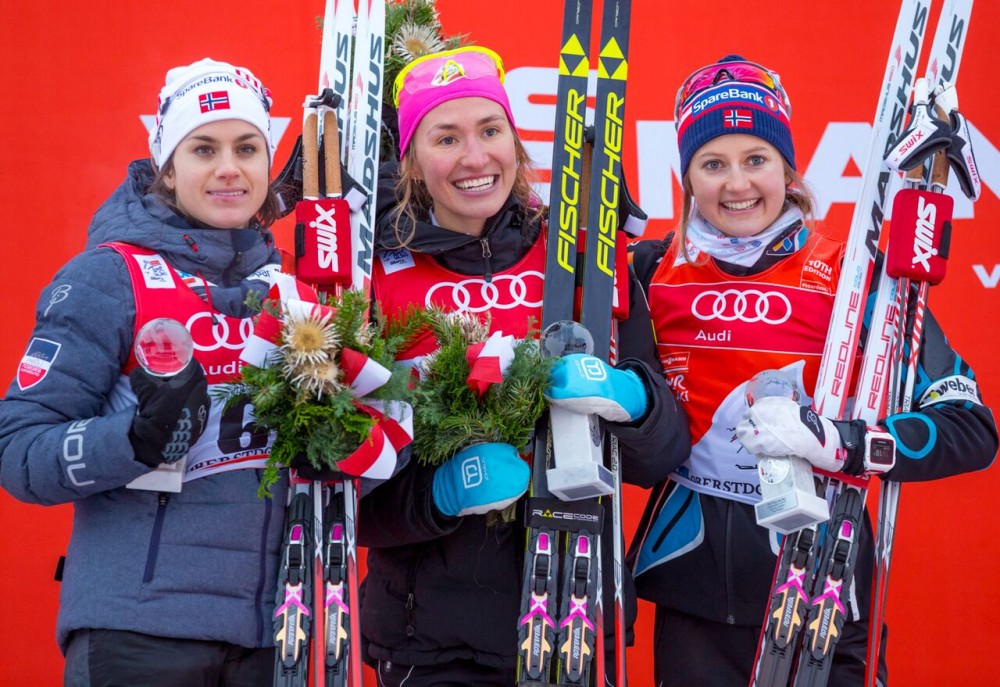
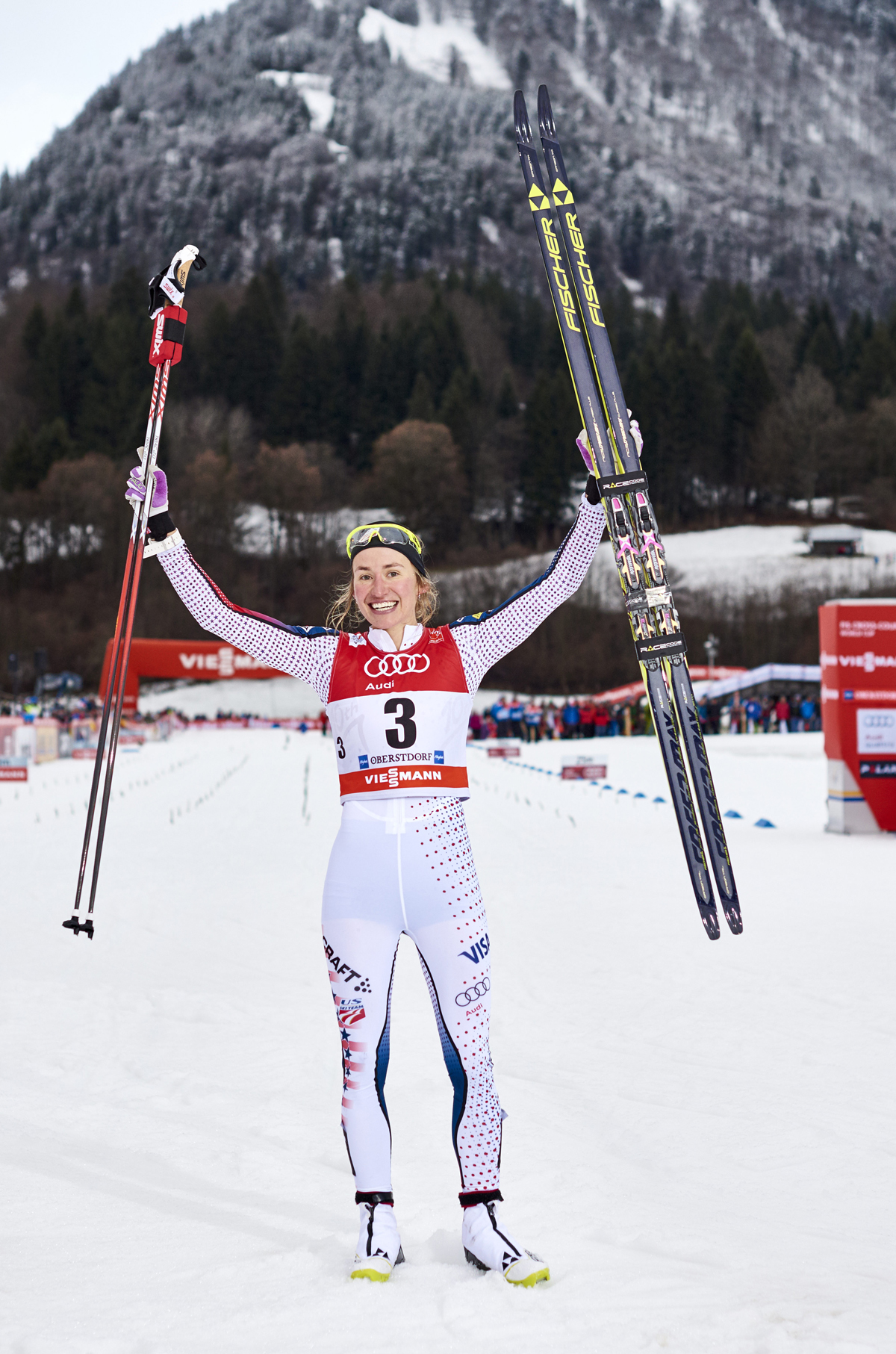
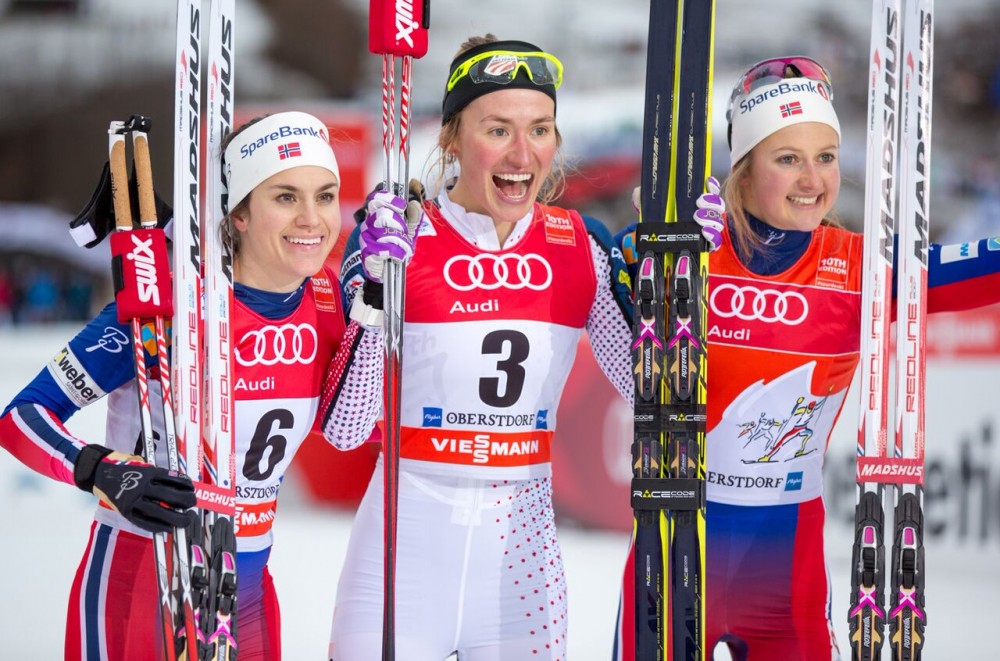
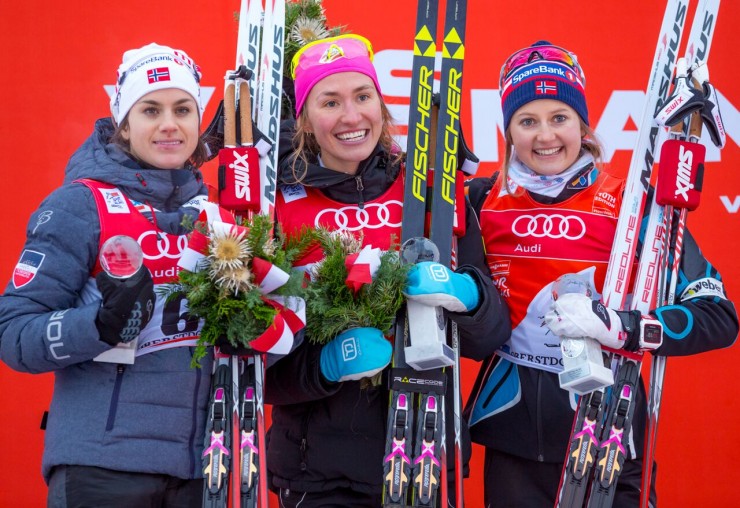
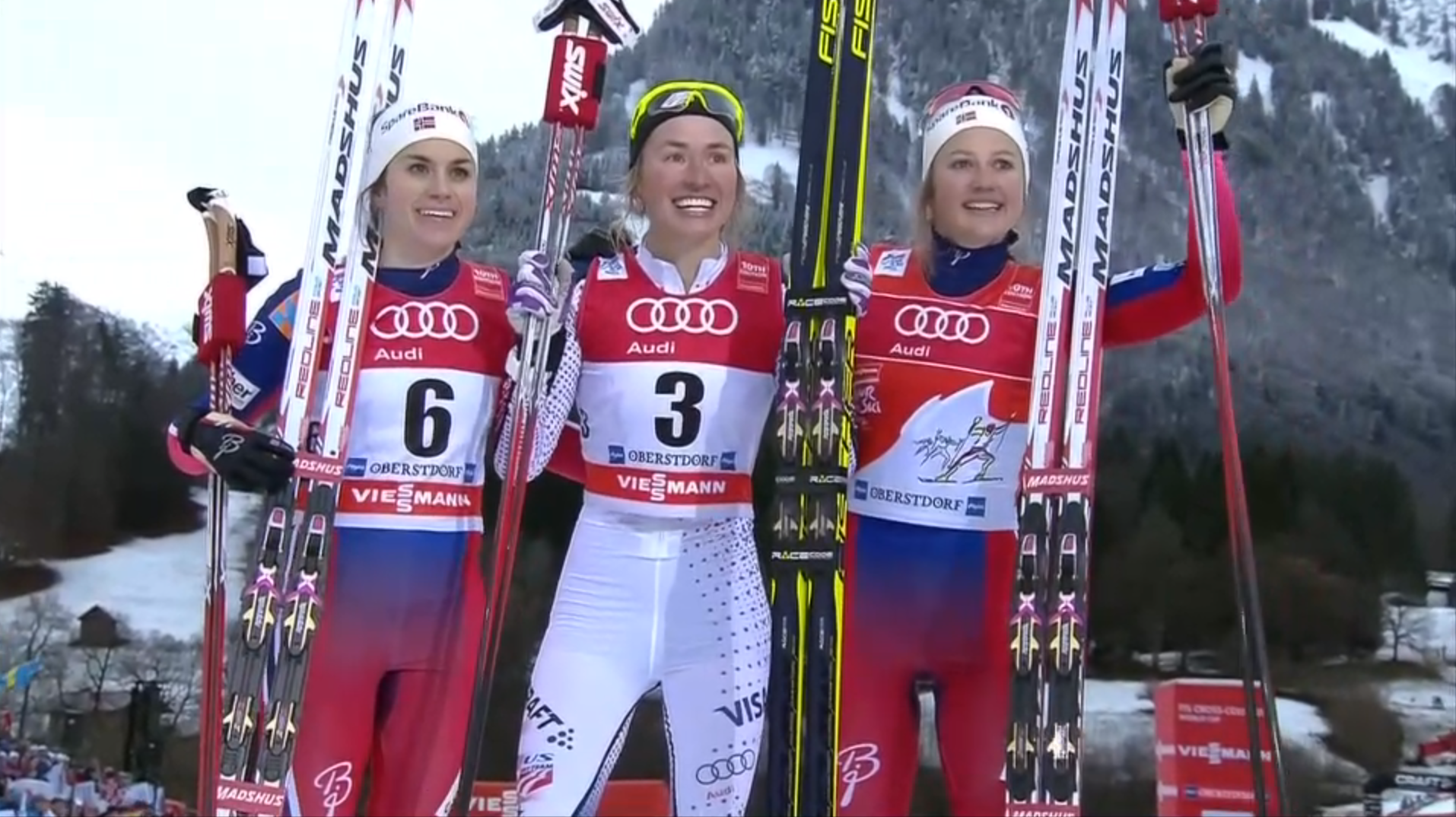
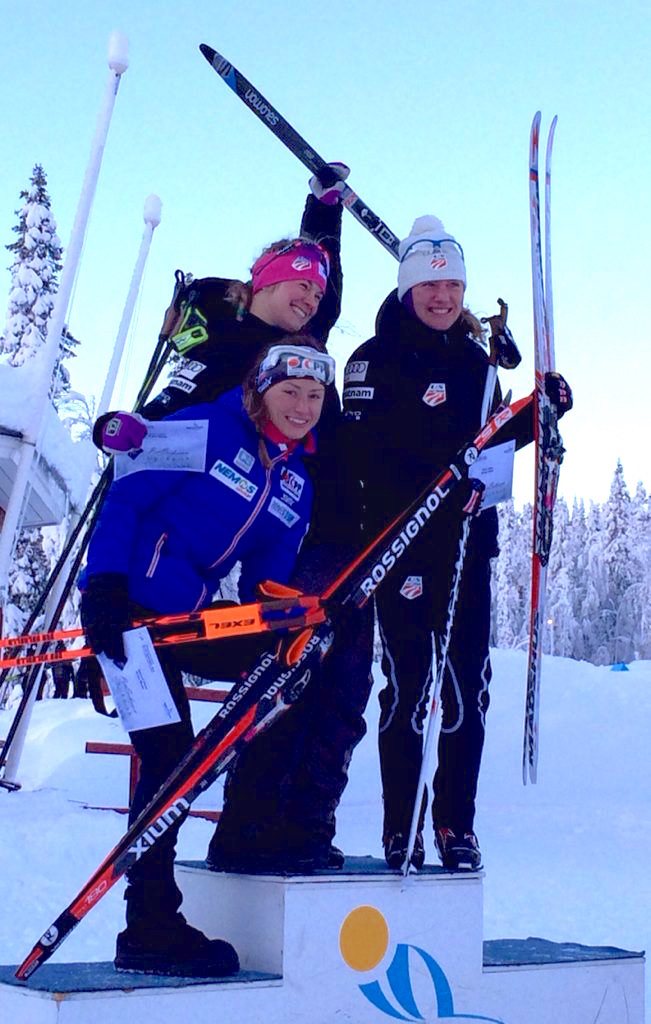
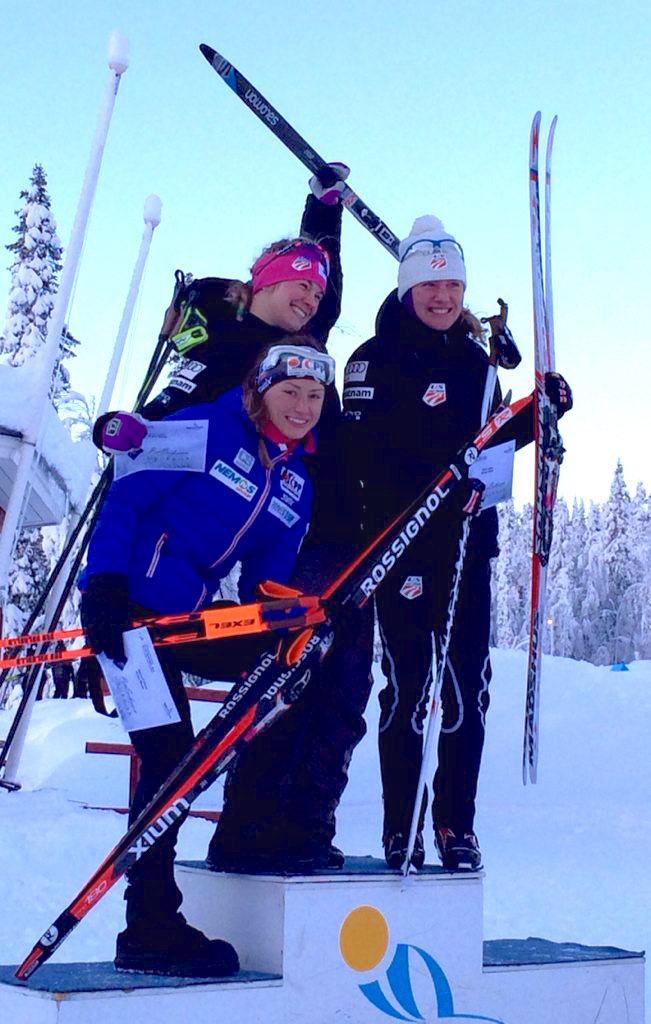
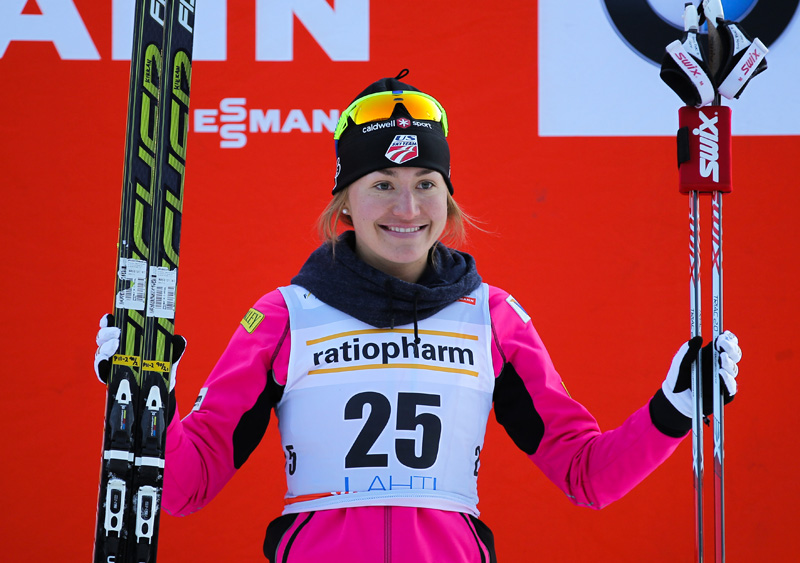
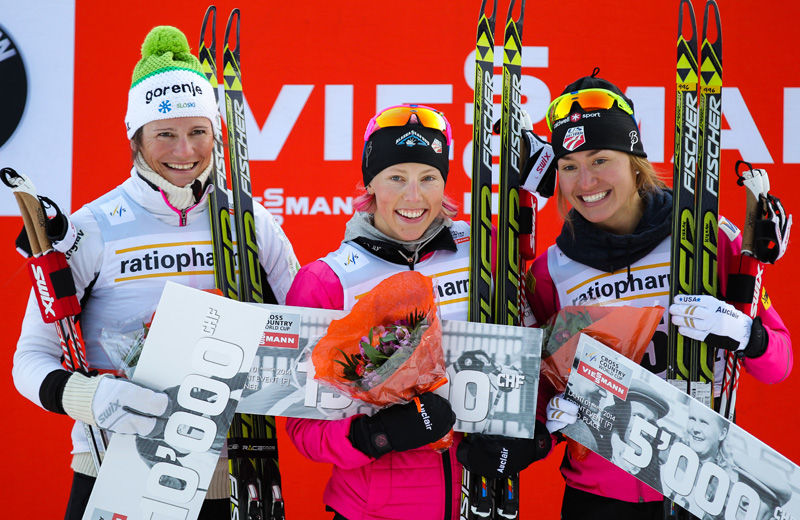
    The women’s 10 k freestyle podium at Stage 3 of the 2018 Tour de Ski on Monday in Lenzerheide, Switzerland, with Norway’s Ingvild Flugstad Østberg (c) in first and Heidi Weng (l) in second, and American Jessie Diggins (r) in third. (Photo: Salomon/NordicFocus)

    Not one of the last three days in Lenzerheide, Switzerland, were alike, with three different American women standing on the coveted podium and three vastly different conditions for the first three stages of the 2018 Tour de Ski.

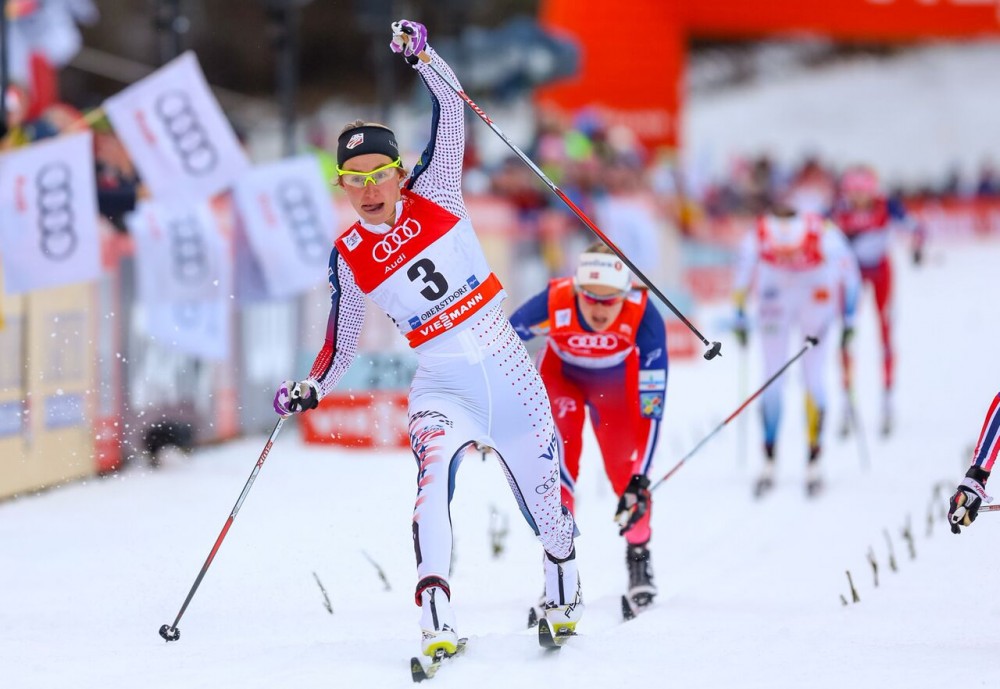
    Technically, it wasn’t 2018 until today — with Jessie Diggins racing to third in the women’s 10-kilometer freestyle pursuit on Monday, the first day of the new year and her first podium of the season.

    She did so in soft, slow conditions with fresh snow coating Lenzerheide’s 3.75 k distance course — a stark contrast to Sunday’s fast-and-icy conditions that caused a few racers to fly off the course*. American Sadie Bjornsen stayed on her feet and raced to third for her first-career 10 k podium. Saturday’s skate sprint was a snowy one, which another U.S. Ski Team member Sophie Caldwell embraced and raced to second place, for her first individual World Cup podium in two years.

    Monday was a suffer-fest for everyone on course and a solo one for the first three skiers. Norway’s Ingvild Flugstad Østberg headed out of the gate first, after leading the Tour de Ski (TdS) standings with a win in Saturday’s 10 k classic. Her teammate Heidi Weng started second, 33 seconds back, and Diggins started 32 seconds after Weng (1:05 minutes behind Østberg) in third.

    With Bjornsen next in line, another 10 seconds back in fourth, and Russia’s Natalia Nepryaeva 2 seconds behind her in fifth, the race was for the podium was more or less a formality, barring anything unexpected for Østberg, Weng and Diggins. Sure, anyone of them could have unraveled, but it wasn’t likely. Regardless, each still had to gut out three long laps on their own, with Diggins eyeing Weng, Weng trying to close the gap to Østberg, and Østberg with only the open trail ahead of her.

    “It was like hell today,” the 27-year-old Østberg said after her second-straight win on Monday, according to an International Ski Federation (FIS) press release. “It was a very hard fight. I felt the snow was not fast. I was gaining seconds on Heidi and then losing them again.”

    Throughout the race, Østberg had a maximum gap of 36 seconds to Weng in second (at 1 k) and a minimum gap of 23 seconds (again to Weng at 5.6 k). She crossed the finish line first in 26:48.1 minutes, while Weng finished 27.8 seconds back in second and Diggins another 49.1 seconds later in third (+1:01.4).

    Weng, who is currently second in the overall Tour standings, 32.8 seconds behind Østberg in first with four stages to go, told FIS that the race was “very hard for everybody”, but she was pleased with her ability to ski hard on the uphills and flats. For most of the race, she looked like Weng was giving it everything she had — as was Diggins — and Weng ended up with the third-fastest time of day. Austria’s Teresa Stadlober posted the fastest 10 k time in 26:20.6, which put her in 12th at the finish after she started 29th. Weng was 22.5 seconds slower and Østberg 27.5 seconds off that time with the fourth-fastest time of day.

    In her third race in as many days, Østberg said she felt tired out of the start on Monday.

    “Already after one hundred meters, my legs were tired, but I fight, fight, fight all the way,” she told German broadcaster ZDF. “And I managed to reach the finish first, it was a great feeling.”

    This marked Østberg’s third win of the season — all of which have come in Switzerland (she won the Davos 10 k freestyle on Dec. 10). Four years ago, she won her first World Cup race in Lenzerheide in a freestyle sprint.

    “In Davos and here in Lenzerheide I had some of my best races, so Switzerland is a good place for me to race,” she told ZDF.
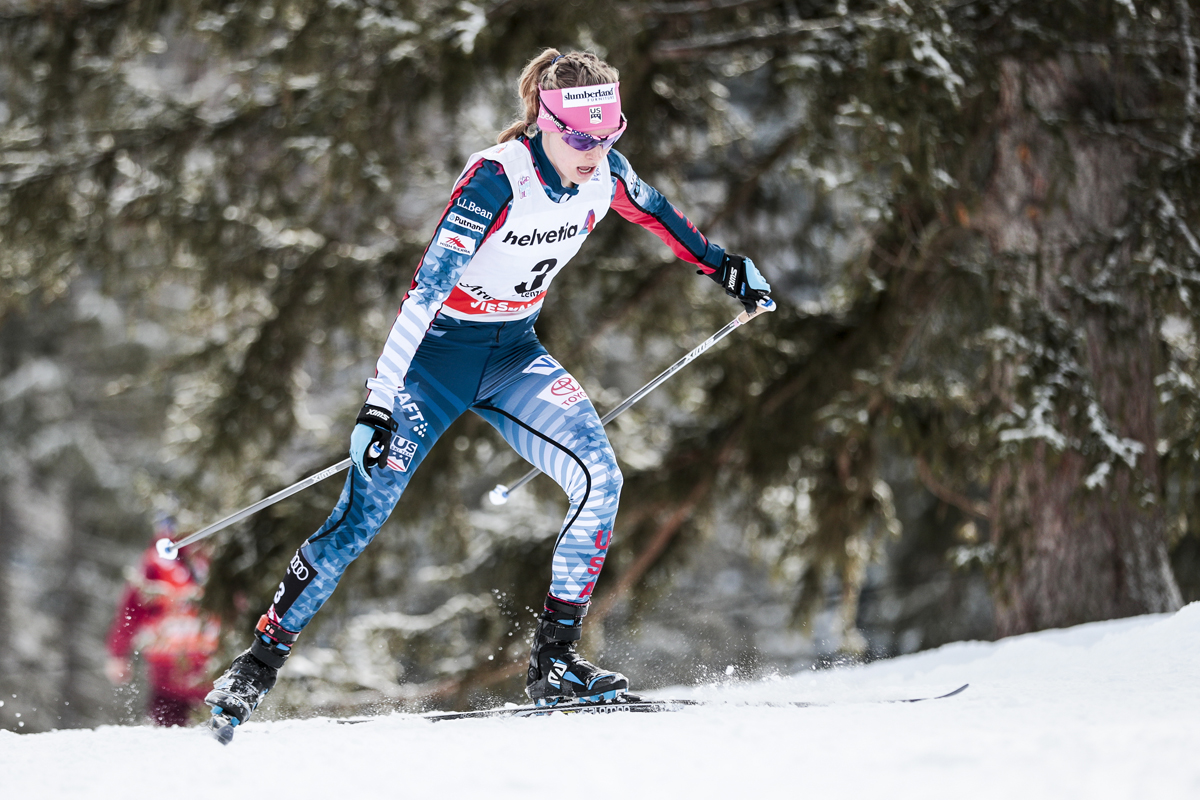
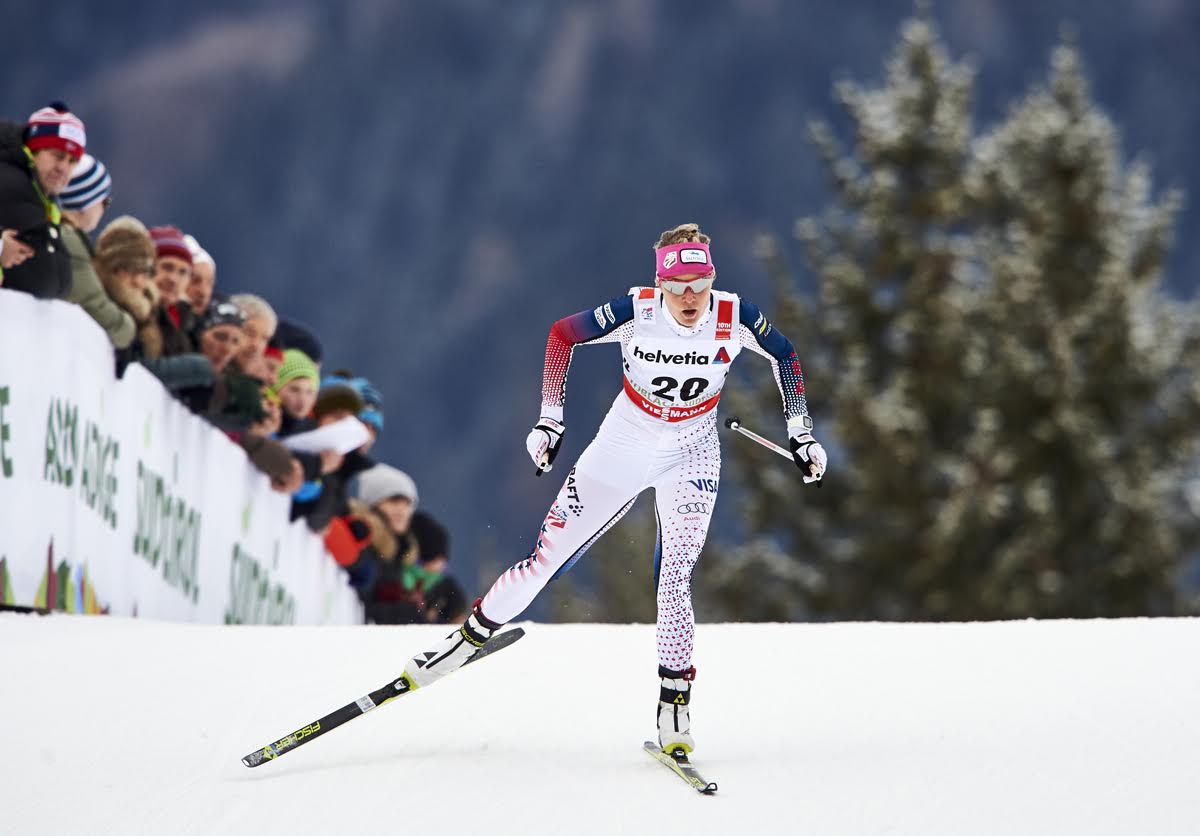
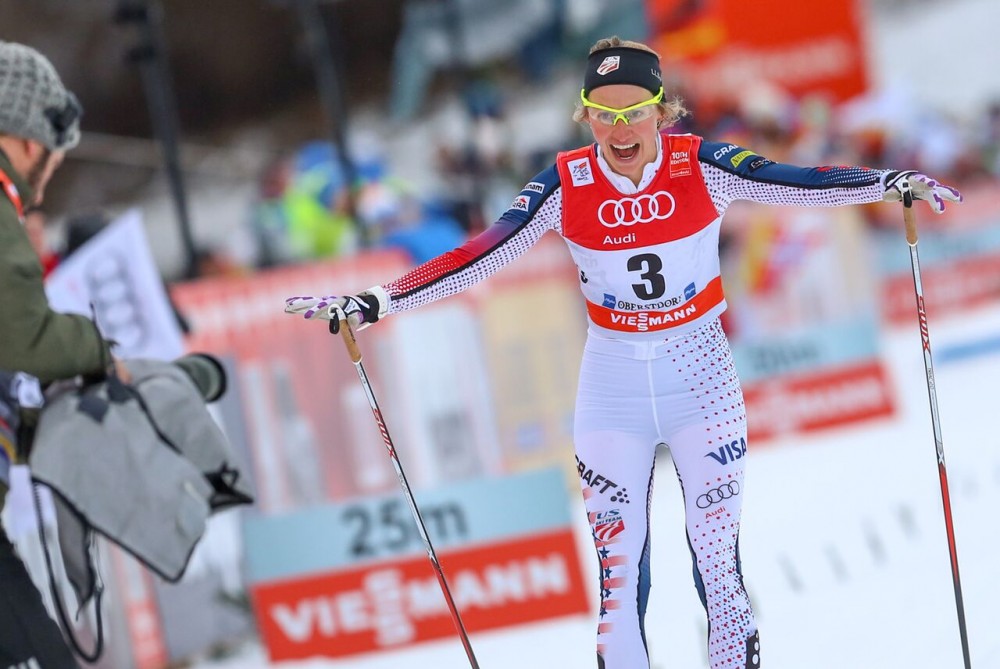
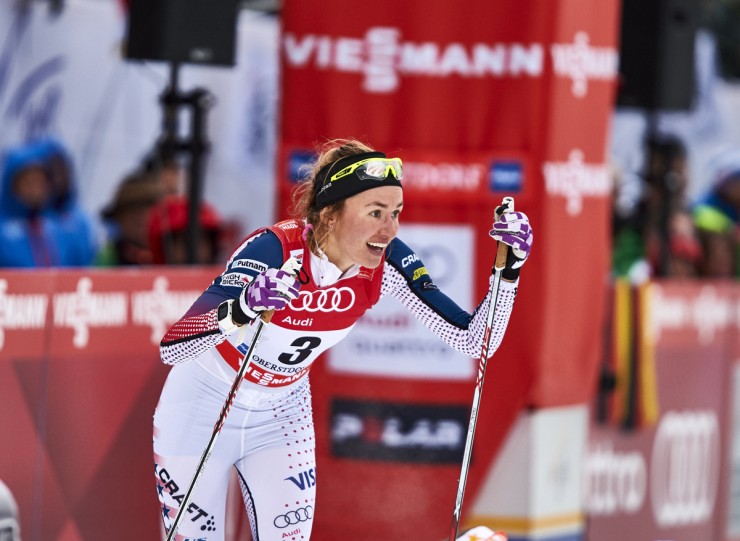
    Jessie Diggins (U.S. Ski Team) racing to third in the women’s 10 k freestyle pursuit at Stage 3 of the 2018 Tour de Ski in Lenzerheide, Switzerland. On the first day of the new year, it was her first podium of the season. (Photo: Salomon/NordicFocus)

    Then there was Diggins, who continued the U.S. Ski Team (USST) streak of landing on the podium over three consecutive days.

    “Today my plan was to go out hard and ski a gutsy race, and try to put some time into the girls behind me,” she wrote in an email to FasterSkier. “It’s sometimes hard to be skiing alone but I actually loved it because I could just put my head down, hammer, and do my thing!”

    Within the first kilometer, she had already put a few more seconds into Bjornsen in fourth place. Meanwhile, Bjornsen, 13 seconds behind Diggins, worked to shake off Nepryaeva.

    “Starting in 4th was a pretty exciting position, and even a bit terrifying,” Bjornsen wrote in a mass email to media outlets. “It was my goal to try to catch Jessie, and ski with her, but I knew I needed to get it done in the first kilometer, because she was going to be on a mission. I got darn close, but not quite close enough. I could tell right away I was going to be on a solo mission, and needed to really push hard to stay ahead of the group working together behind me.”

    The group she was referring to included Finland’s Kerttu Niskanen and Krista Pärmäkoski. Toward the end of the first lap at 3.3 k, they had distanced themselves from a nine-woman chase group led by Norway’s Astrid Uhrenholdt Jacobsen, of which Caldwell was a part of. After dropping Nepryaeva on the first lap, Bjornsen had the two Finns and the crew behind them to worry about.

    “I managed to stay ahead until literally the last downhill, and got passed by Krista, so lost one place, but I left the day pretty satisfied,” Bjornsen wrote after finishing fifth in a three-way battle with Pärmäkoski and Niskanen for fourth place. Pärmäkoski took it, passing Bjornsen in the last few hundred meters and leading her and Niskanen, respectively, into the finishing straight. Pärmäkoski crossed the line in fourth, 29 seconds after Diggins and 1:45.9 after Østberg, while Bjornsen was another 0.3 seconds back in fifth (+1:46.2) and Niskanen finished 0.4 seconds later in sixth (+1:46.6). Behind them, Jacobsen finished seventh (+1:59.9), Fessel eighth (+2:00.3), the Czech Republic’s Petra Novakova ninth (+2:01.0), and Germany’s Sandra Ringwald 10th (+2:11.3).
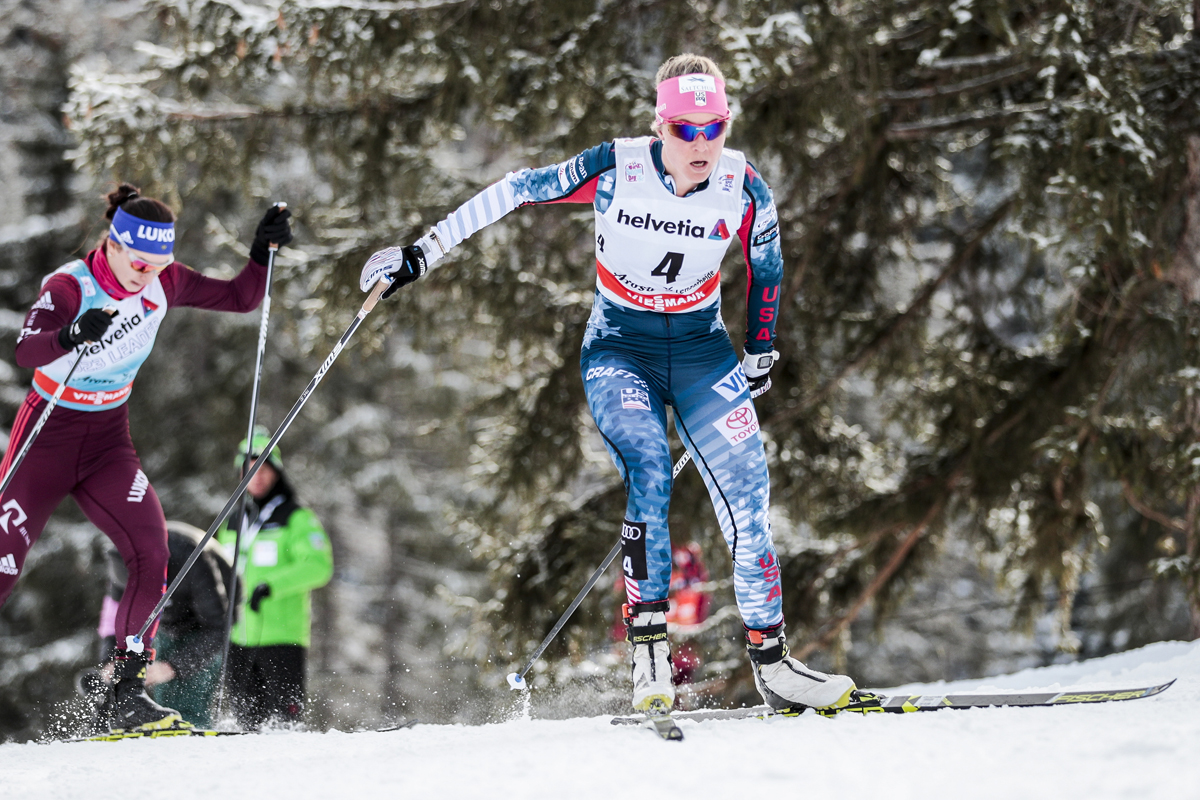
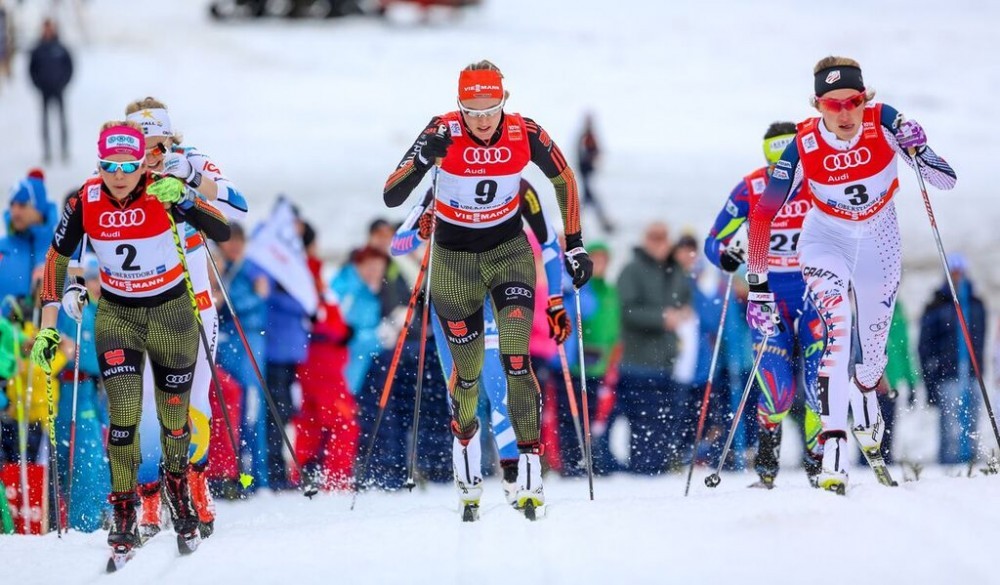
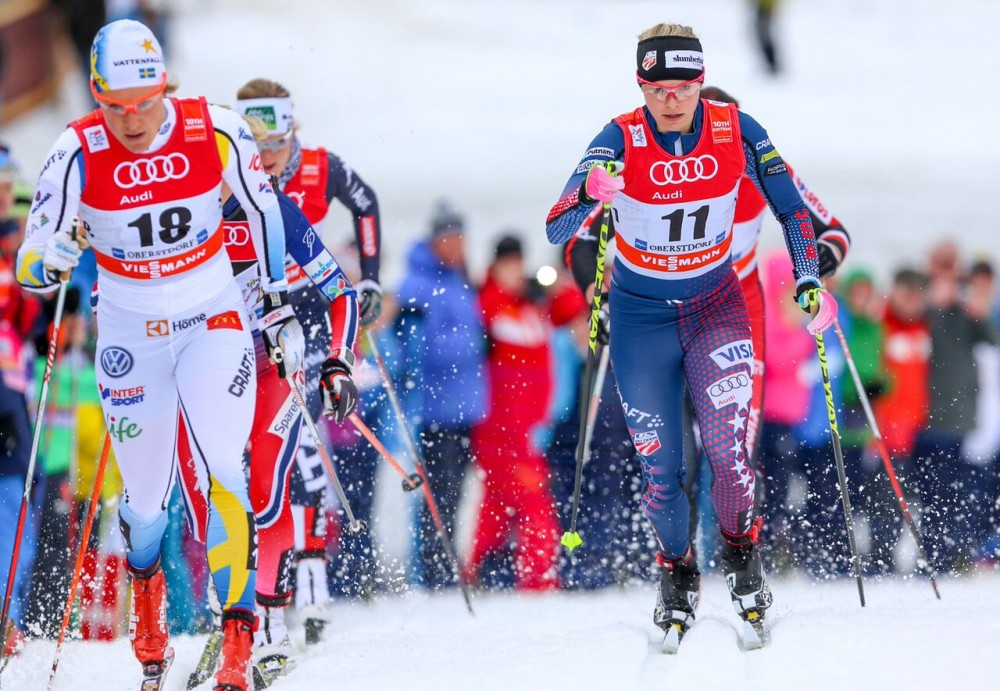
    Sadie Bjornsen (U.S. Ski Team) leading Russia’s U23 leader Natalia Nepryaeva (l) in the women’s 10 k freestyle pursuit at Stage 3 of the 2018 Tour de Ski in Lenzerheide, Switzerland. Bjornsen went on to finish fifth and Nepryaeva finished 17th. (Photo: Fischer/NordicFocus)

    “It required digging darn deep those last kilometers,” Bjornsen wrote. “I was feeling pretty good for the first lap, but started to really burn for the last two. I’m really looking forward to a day off, and then some classic sprinting! Sounds like it will be darn wet and rainy, but it will be fun.”

    Heading into the fourth stage of the TdS, Wednesday’s classic sprints in Oberstdorf, Germany, Diggins is third overall,1:26.9 minutes out of first, Parmakoski is up to fourth (+2:00.9; after starting Monday’s race in eighth), and Bjornsen is positioned in fifth (+2:01.2), just ahead of Niskanen in sixth (+2:01.6).

    “It’s really fun to be in podium position right now in the tour, but my plan as always is to just take it one day at a time and focus on each stage separately,” Diggins wrote. “If I can give my best effort each day, hopefully it all adds up well!

    “I was really proud of our wax tech team because the past two races have been extremely tricky waxing conditions with varying snow all over the course,” Diggins added. “It was hard to pick skis but my tech Cork was so calm and collected and got me through the pre-race testing!”

    Despite not planning to finish the Tour, Caldwell is sitting in a respectful 18th overall (+3:14.2) after finishing 18th in Monday’s race, 2:59.2 behind Østberg.

    “10km skates tend to be the hardest discipline for me, and although today wasn’t anything to write home about, it also wasn’t a disaster, so I was pretty happy with it!” Caldwell wrote.
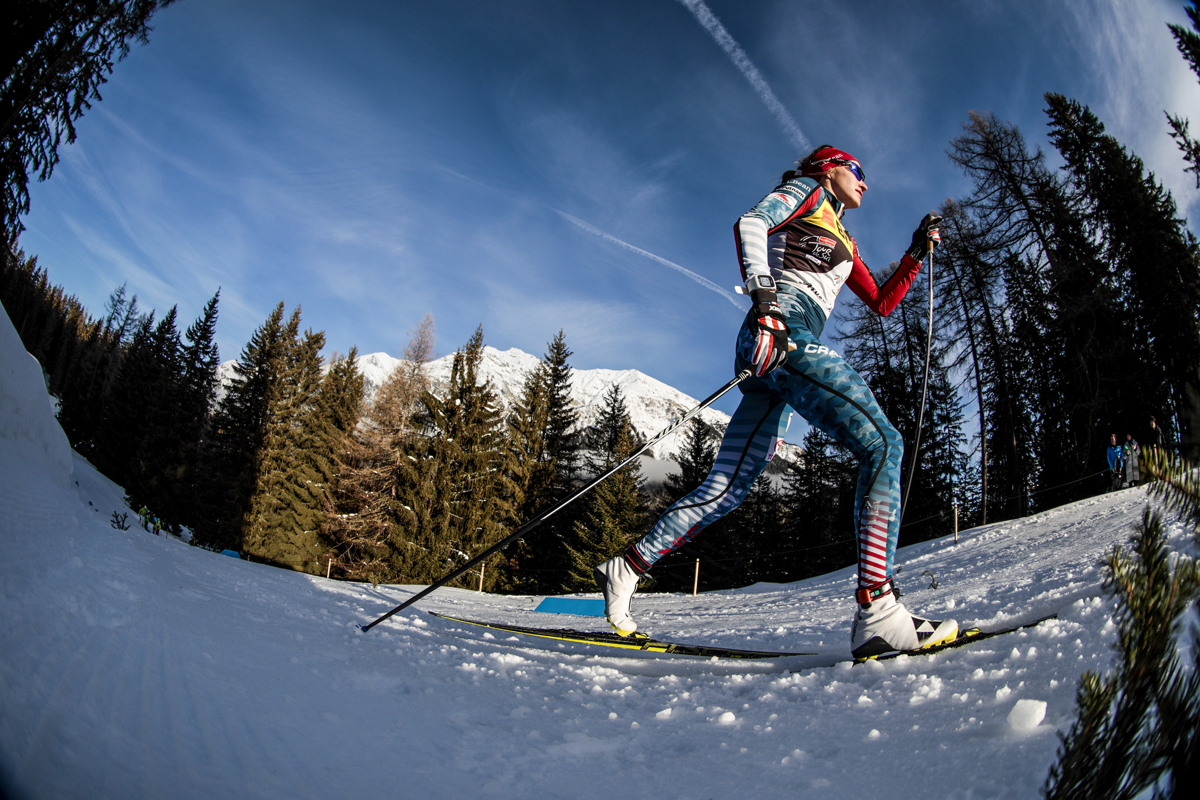
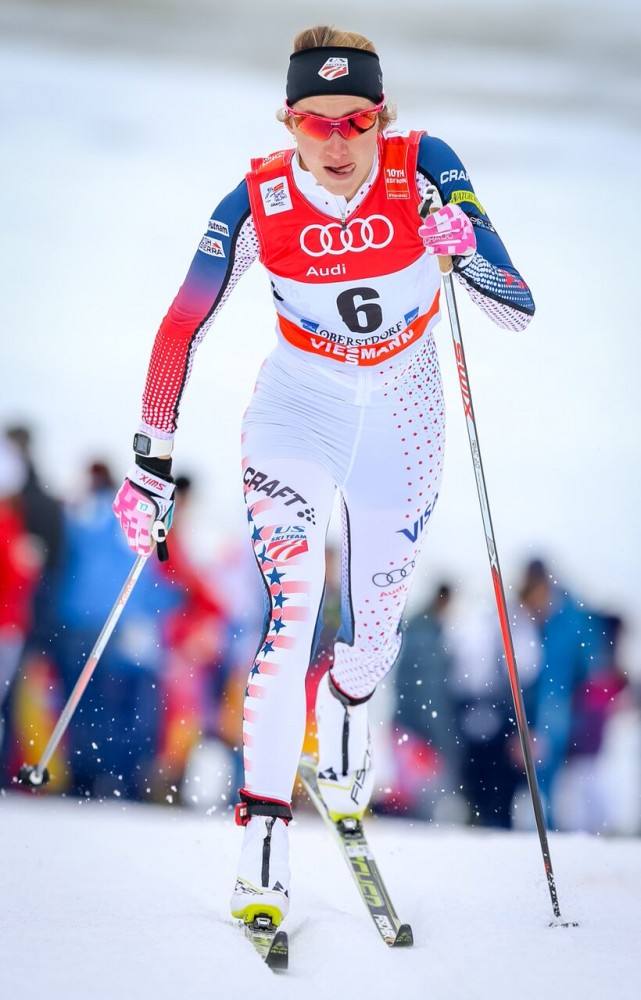
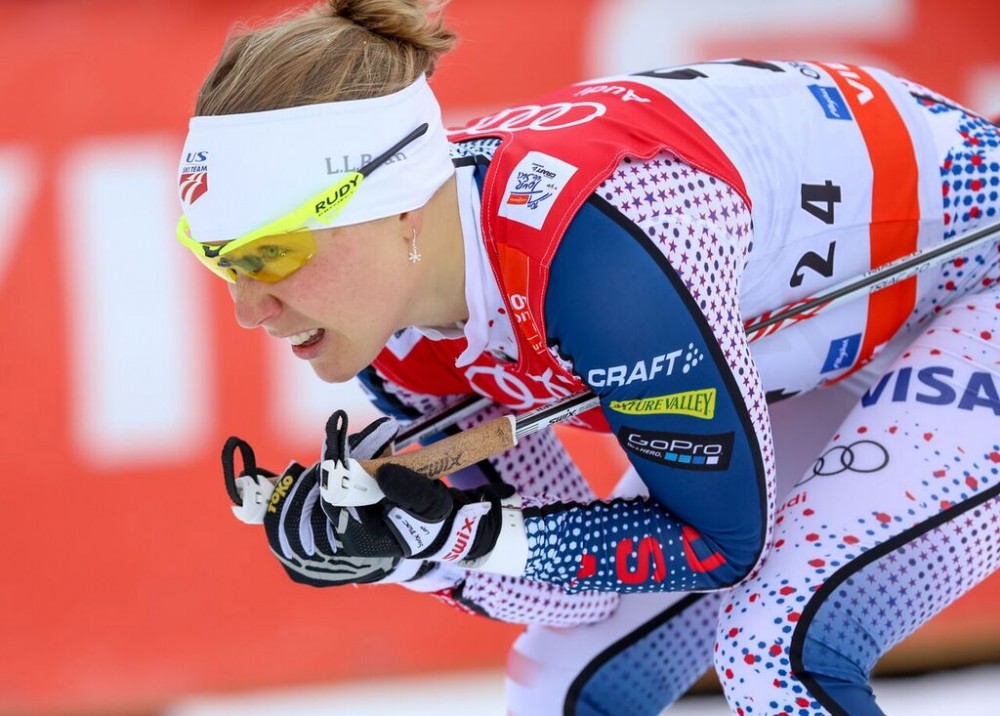
    Sophie Caldwell (U.S. Ski Team) racing to 21st in the women’s 10 k classic on Sunday at Stage 2 of the 2018 Tour de Ski in Lenzerheide, Switzerland. On Monday, she finished 18th in the Stage 3 10 k skate pursuit. (Photo: Fischer/NordicFocus)

    She started seventh, 1:32 back, at the same time as Niskanen in bib 6. Parmakoski started 3 seconds behind them and the three immediately formed a group, with Caldwell leading the first kilometer.

    “For some reason out of the start Kerttu just pulled to the side and made me lead, which I thought was interesting since both she and Krista are much better distance skiers than I am,” Caldwell wrote in an email to FasterSkier. “But anyway, I was totally fine taking the lead, but I wasn’t going to push the pace leading, so I just skied a chill pace until they decided to take back over coming through the stadium. The chase pack caught us pretty quickly, which I was actually excited about because the Finns’ pace was a little too hot for me once they picked it up and the chase group was skiing a pace that felt quite comfortable for me for a lap or so.”

    With racers like Jacobsen and Germany’s Nicole Fessel leading the large chase pack for much of the race, Caldwell hung in the group for about 5 k in the middle of the race. But with one lap to go, she lost contact and found herself fighting for 18th.

    “The pace was definitely picked up at the beginning of the third lap and I started to get tired then, but I just tried to keep my skis gliding and focus on getting to the finish line,” she wrote. “It was cool for me because often I feel like those skate races are red lining it from the start for me, and today I felt in control for two laps and had a pretty fun time with it!

    “I’m really happy with how my tour has gone so far,” Caldwell continued. “I had one of my best sprints ever and one of my best distance races ever, so no complaints there! I feel healthy, fit, and happy and it’s given my confidence a good boost.”

    “The vibe is pretty amazing among our team right now,” Bjornsen wrote. “To have a podium every day of the Tour is pretty exciting! It’s fun to see things really come together for everyone. I think there is more to come!”

    Asked if this was in line with what the U.S. team was expecting for a start to the Tour, USST Head Coach Chris Grover said it surpassed expectations, but wasn’t unanticipated.

    “There was some opportunity in this field this year with [Sweden’s Charlotte] Kalla and Stina Nilsson not starting, with [Norway’s Marit] Bjørgen and Ragnhild Haga not starting, for example, so that left some opportunity for some of the other women to have some breakthrough results,” he said on the phone. “But at the same time, the women that have been on the podium from the U.S.A. the last three days have been on the podium this year or in past years and have been kind of knocking on the door of those results…

    “Overall it’s a better start to the Tour than we could’ve wished for,” he later added. “It’s been really exciting to see a podium from a different woman on the team each day. I think once we get to Oberstdorf there’s going to be fresh opportunities for all those women once again to reach the podium. I’m just hoping that right now that everybody can stay healthy, get some good rest, and really look forward to seeing what they can do in the next couple stages.”

    With four stages to go, the U.S. has six women in the Tour, with Liz Stephen improving to 31st on Monday (up from 37th at the start), Rosie Brennan maintaining her overall place in 33rd, and Ida Sargent in 55th (down from 31st at the start).

    “I was hoping to make up some more places and thought getting into the top 30 was doable. But last lap I lost a little steam and couldn’t keep up my pace,” Stephen wrote in an email to FasterSkier.

    En route to the 26th-fastest course time, Stephen picked off four places between 3.3 and 4.3 k.

    “The race started really fast, as usual for the World Cup, so I try to be patient and bank on people coming back to me, which they did after about a lap,” she wrote. “I was focused on making up time consistently around the whole course and not just killing myself on the uphills. However the second 1/2 of the course was a lot of climbing so I focused on those sections and tried to get in peoples drafts for the long downhill into the stadium.”

    Now in 31st overall, she is 4:22.7 out of first. Brennan is another 10 seconds back in 33rd (+4:32.9).

    “I am happy to have scored my first points of the year yesterday in a classic race on very icy, scary conditions, which is not my strong suit, and then again have a top 30 performance,” Stephen continued, referring to her 28th place in Sunday’s 10 k classic. “My year has certainly started slower than I wanted it to, but the Tour is always a good way for me to get a lot of racing in a short period of time and bring my fitness up. So, every day I focus on making a few more spots and look forward to Alp Cermis!”

    While Sargent is fighting illness and had initially planned to withdraw from the Tour after Stage 4 or 5 in Oberstdorf (to focus on the World Cup sprints after the Tour), Stephen and Brennan intended to finish it.

    “I know Ida is kind of feeling on edge … I know she was kind of a questionable start for yesterday’s classic race so we’ll see what happens with her going into Oberstdorf,” Grover said.

    He described Kikkan Randall’s foot injury as one that’s crept up over time that and doesn’t involve a stress fracture.

    “She is planning on starting in Dresden right now, both in the sprint and the team sprint so I think she’ll continue to be somewhat selective with the races she chooses,” he said of Randall resuming her season with the next regular-season World Cup races Jan. 13-14 in Dresden, Germany. “She may or may not go at all to Planica [Slovenia, Jan. 20-21], since those are two classic races, but she will for sure race in Seefeld [Austria, Jan. 27-28], where there’s two skate races. So right now her plan is, keep trying to make progress with the foot, get it healthy, be ready to race in Dresden, be ready to race in Seefeld, be ready to race at the Games.”

    — Harald Zimmer contributed

    Results: Women’s Stage 3 pursuit | Women’s Time of Day | Women’s TdS standings (through Stage 3) 

    ***

    *Switzerland’s Laurien van der Graaff, the Stage 1 skate-sprint winner, crashed out of contention in Saturday’s 10 k classic, and finished 35th to put herself 16th overall in the TdS heading into Stage 3. 

    “…I skied out into the deep snow, I had problems to brake at all and went straight ahead and unfortunately crashed and lost quite a few seconds there,” she told Swiss broadcaster SRF, according to a translation. “Otherwise I felt good. It was a special race, a bit more attention on me than usual, but it was cool, I am still happy about yesterday. Aside from my crash I enjoyed it. My nose is pretty banged up. … It really hurts.”

    https://instagram.com/p/BdX8iINDfeB/

  • Tour de Ski Rundown: Caldwell 2nd on Day 1; Van der Graaff and Ustiugov on Top

    Tour de Ski Rundown: Caldwell 2nd on Day 1; Van der Graaff and Ustiugov on Top

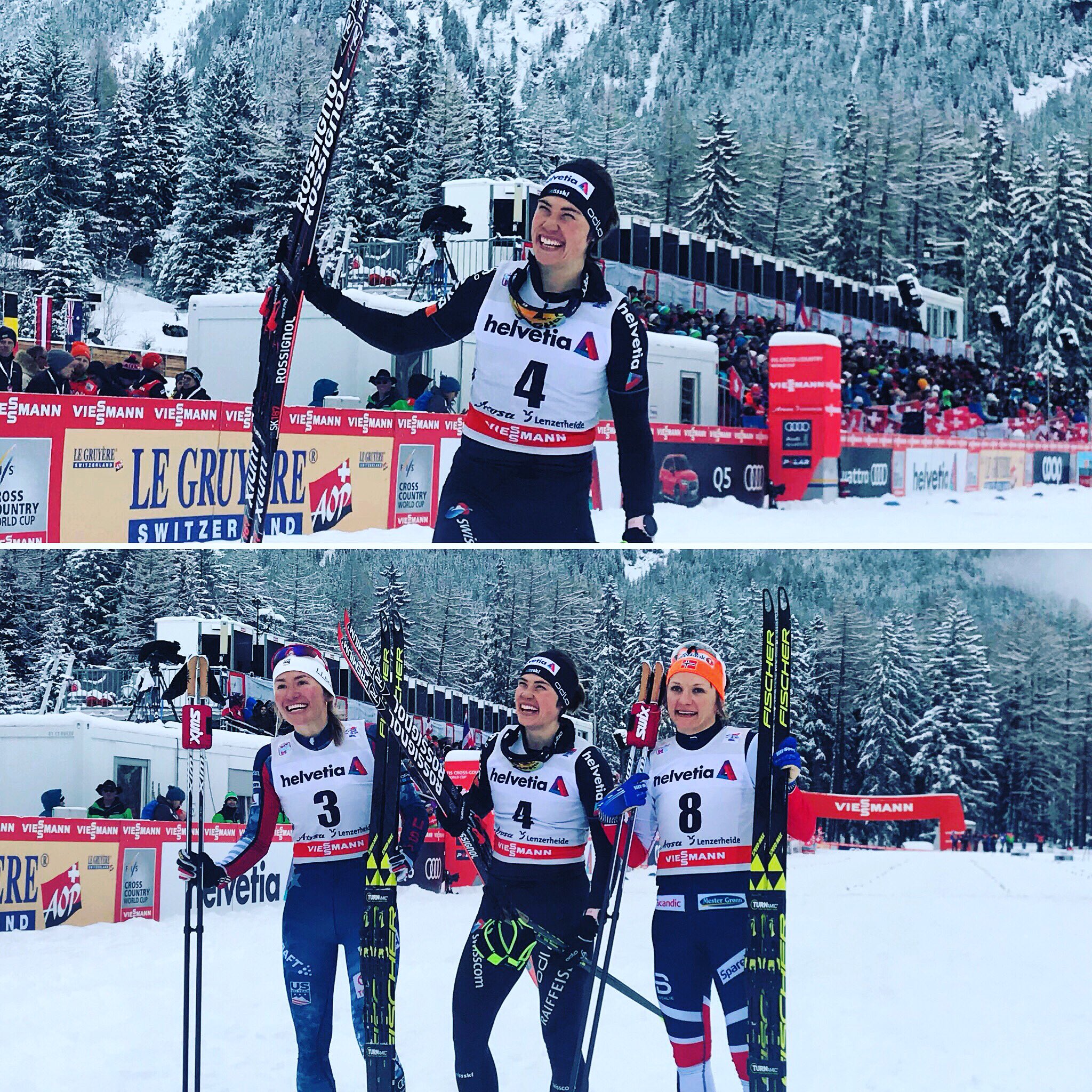
    The women’s top-three finishers (below) after Stage 1 of the 2018 Tour de Ski, with (from left to right) American Sophie Caldwell in second, Switzerland’s Laurien van der Graaff in first, and Norway’s Maiken Caspersen Falla in third. Above, van der Graaff acknowledges her home crowd after winning her first World Cup in Lenzerheide, Switzerland. (Photo: FIS Cross-Country/Twitter)

    FIS Cross-Country Tour de Ski (Lenzerheide, Switzerland): Stage 1 freestyle sprint

    Women’s report

    Men’s report

    Sophie Caldwell is back on the podium. It’s been two years since the 27-year-old U.S. Ski Team sprinter won an individual World Cup race and became only the third woman in U.S. history to to do so. That was also in the Tour de Ski — but in a classic sprint.

    In the time since, the U.S. women’s team has racked up several more podium accolades. Jessie Diggins has recorded three individual World Cup wins (and two World Championships medals), Sadie Bjornsen has notched three individual podiums (and a World Championships team sprint silver with Diggins) in the last year, and Kikkan Randall raced to bronze in the 2017 World Championships skate sprint.

    But Saturday, the first day of the 2018 Tour de Ski, was Caldwell’s moment to stand on the second step of the podium. She started the morning by qualifying third in the women’s 1.5-kilometer freestyle sprint in Lenzerheide, Switzerland, 2.33 seconds behind Norway’s Ingvild Flugstad Østberg, who won the qualifier in 3:29.19 minutes. Diggins qualified second, 1.41 seconds off Østberg’s time.

    Five out of the seven U.S. women entered in the Tour qualified in the top 30 to advance to the heats, with Bjornsen clocking the 13th fastest time (+5.20), Rosie Brennan 15th (+5.27), and Ida Sargent 30th (+8.69). Randall finished 44th and Liz Stephen 66th out of 71 in the women’s qualifier.

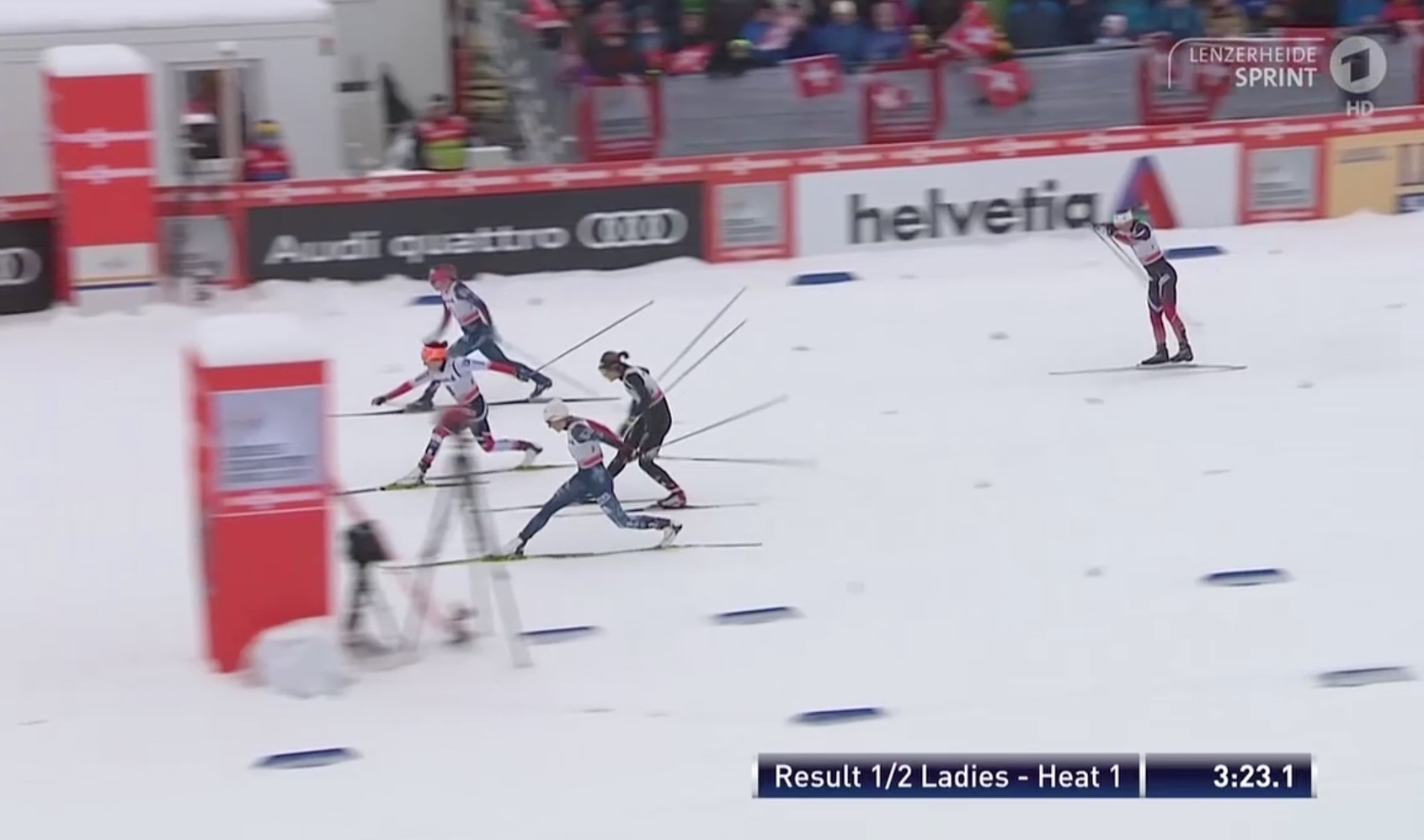
    A three-way photo finish for first in the first women’s semifinal, with Americans Jessie Diggins (far side) and Sophie Caldwell (near) lunging at the line with Norway’s Maiken Caspersen Falla (pink headband). Falla won that heat, Caldwell was second and Diggins third, while all three plus Switzerland’s Laurien van der Graaff in fourth (in black) advanced to the final. (Screenshot: ARD broadcast)

    Caldwell went on to win the first quarterfinal and place second in the semifinal by just six-hundredths of a second (behind Norway’s Maiken Caspersen Falla, who won the first semifinal).

    Diggins advanced in second in her quarterfinal, 0.54 seconds behind Østberg who won that heat, then raced to third in the first semifinal, just another hundredth of a second behind Diggins. The final featured the two Americans as well as local favorite, Laurien van der Graaff of Switzerland, Falla, Russia’s Natalia Nepryaeva, and Germany’s Sandra Ringwald.

    In front of friends and family, Van der Graaff went on to take the win — her first and Switzerland’s first on home soil since Toni Livers won in Davos in 2007.

    She won the final in 3:25.8, 1.42 seconds ahead of Caldwell in second. Falla placed third (+1.86), Nepryaeva took fourth (+3.17), and Diggins finished fifth after breaking her second pole of the day (she previously broke a pole and skied a while without one in the quarterfinal). Ringwald fell and finished sixth (+31.68).

    Van der Graaff had previously qualified fourth then won her quarterfinal and advanced as a lucky loser from the first semifinal, where she placed fourth behind Falla, Caldwell and Diggins.

    “It’s incredible. I mean, to win on this course, home, is just crazy,” van Der Graaff said in a post-race interview with the International Ski Federation (FIS).

    Bjornsen and Brennan finished the day in 14th and 15th, respectively, after placing third in their quarterfinals. The U.S. had five in the top 20 with Sargent in 20th, after she placed fourth in her quarterfinal.

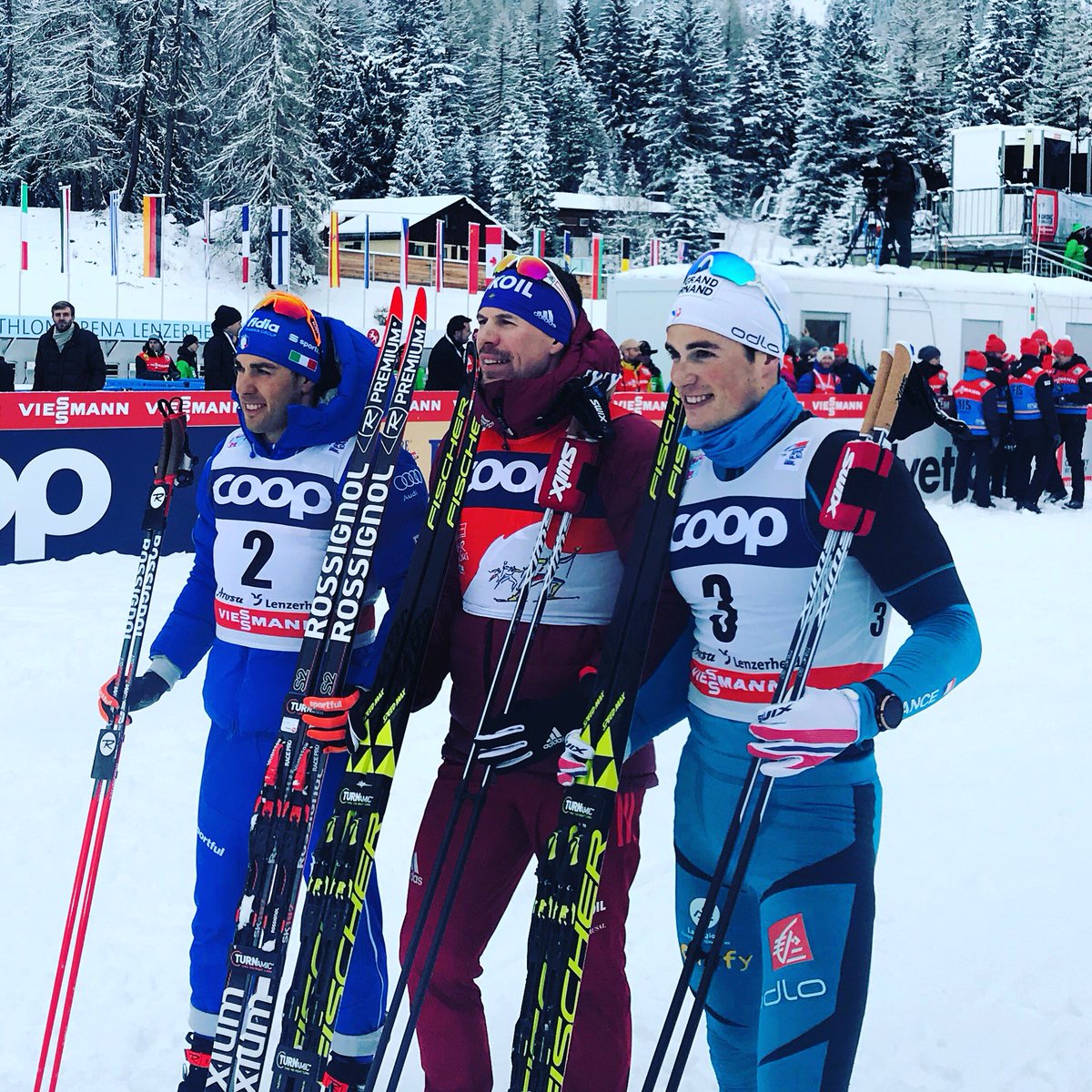
    The men’s podium after the Stage 1 freestyle sprint of the 2018 Tour de Ski, with Russia’s Sergey Ustiugov (c) in first, Italy’s Federico Pellegrino (l) in second, and France’s Lucas Chanavat (r) in third. (Photo: FIS Cross Country/Twitter)

    In the men’s 1.5 k freestyle sprint, the defending Tour de Ski champion, Sergey Ustiugov of Russia, won his first World Cup race of the season by 1 second over Italy’s Federico Pellegrino.

    Ustiugov started off by winning the qualifier in 2:58.46, and Pellegrino qualified second, 1.08 seconds off the Russian’s time. Ustiugov then raced to second in the first quarterfinal, just 0.07 seconds behind Norway’s Finn Hågen Krogh in first. In the second quarterfinal that followed, Pellegrino took the win over Finland’s Ristomatti Hakola in second (+0.35).

    The first semifinal featured a three-way photo finish for first, with Ustiugov edging Pellegrino by 0.04 seconds and Krogh by 0.06 seconds. Hakola finished fourth (+1.11) in that heat to advance to the final as well.

    There, the 25-year-old Ustiugov was first across the finish line in 2:57.28. Pellegrino claimed second (+1.0), and France’s Lucas Chanavat — whom had qualified third and won both his quarterfinal and semifinal — reached the podium in third (+2.76). Hakola was fourth (+5.91), Krogh fifth (+14.39), and the second French skier in the final, Richard Jouve sixth (+21.01).

    Canada’s Alex Harvey missed reaching the final by one-hundredth of a second, placing third in Chanavat’s semifinal after a photo finish for second place. While Chanavat won that heat by 0.34 seconds over his French teammate Jouve, Harvey was another 0.01 seconds back in third. Ultimately, Harvey placed seventh overall (he started the day by qualifying in 18th).

    Three out of four American men qualified for the heats, with Simi Hamilton in 15th, Andy Newell in 20th and Erik Bjornsen in 27th. Hamilton finished the day in 15th as well after placing third in his quarterfinal, Newell ended up 19th after finishing fourth in his quarterfinal, and Bjornsen was 25th after taking fifth in his quarter.

    Paddy Caldwell finished 74th in the qualifier for the U.S. Canada’s second man in the Tour, Devon Kershaw finished 86th out of 94.

    Qualifier results: Women | Men

    Final results: Women | Men

  • Men Go to SoHo, U.S. Women in the Methow (Camp Photo Galleries)

    Men Go to SoHo, U.S. Women in the Methow (Camp Photo Galleries)

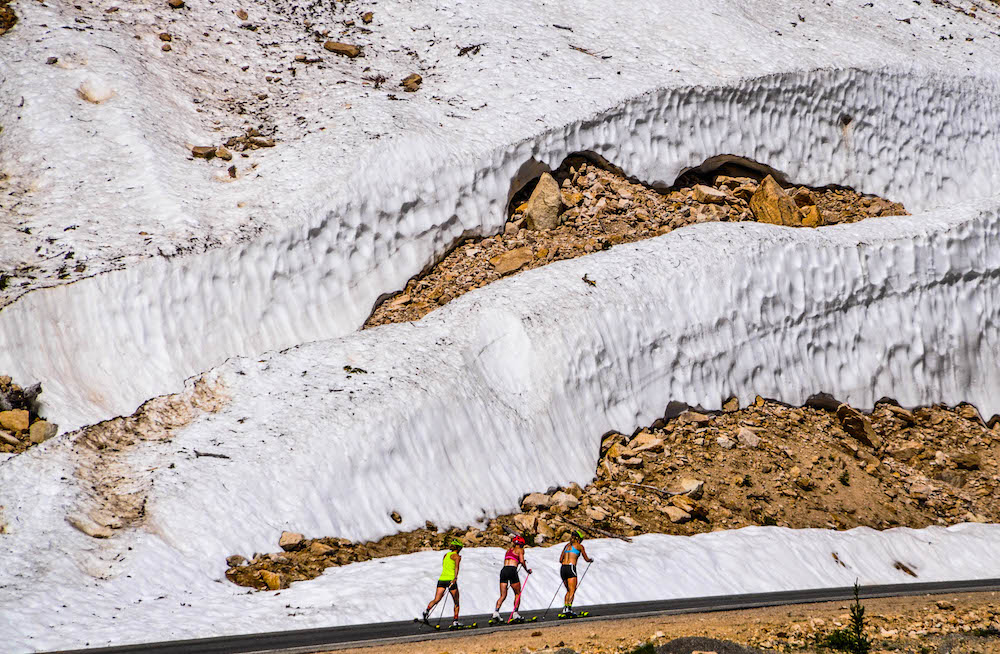
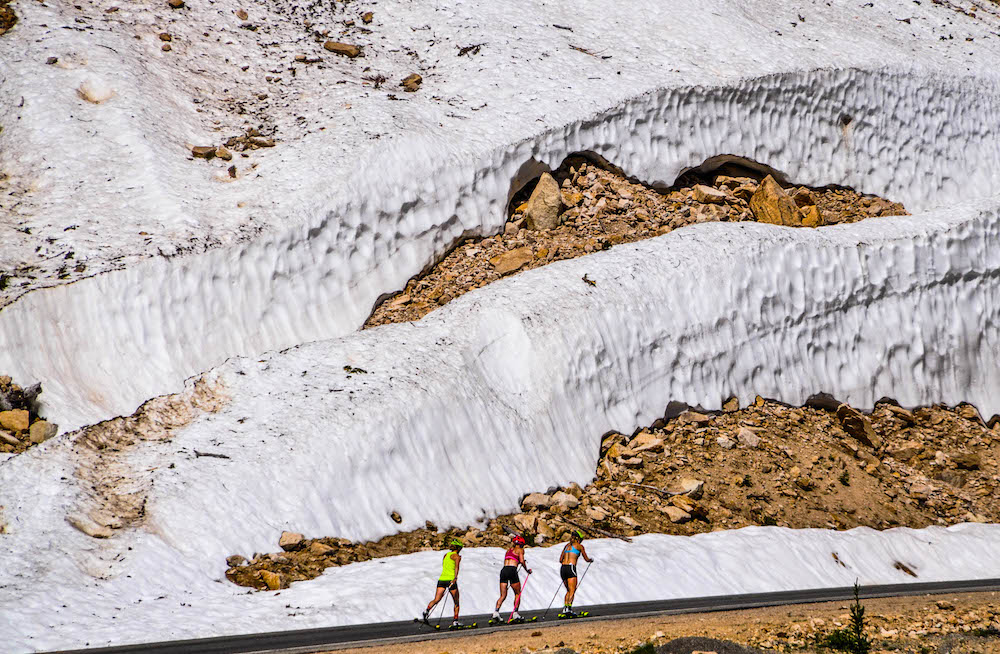
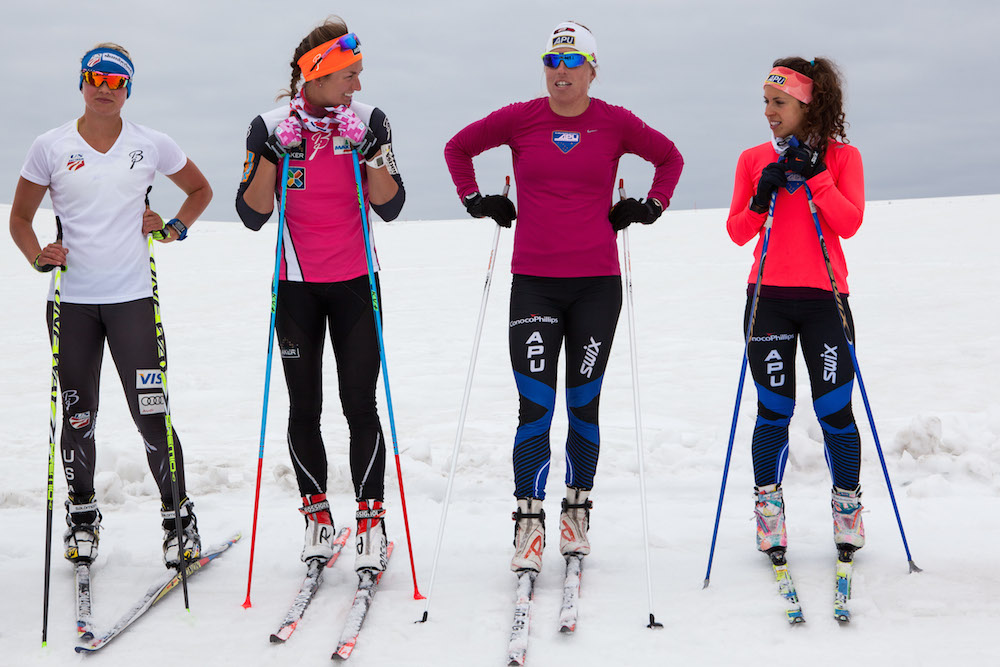
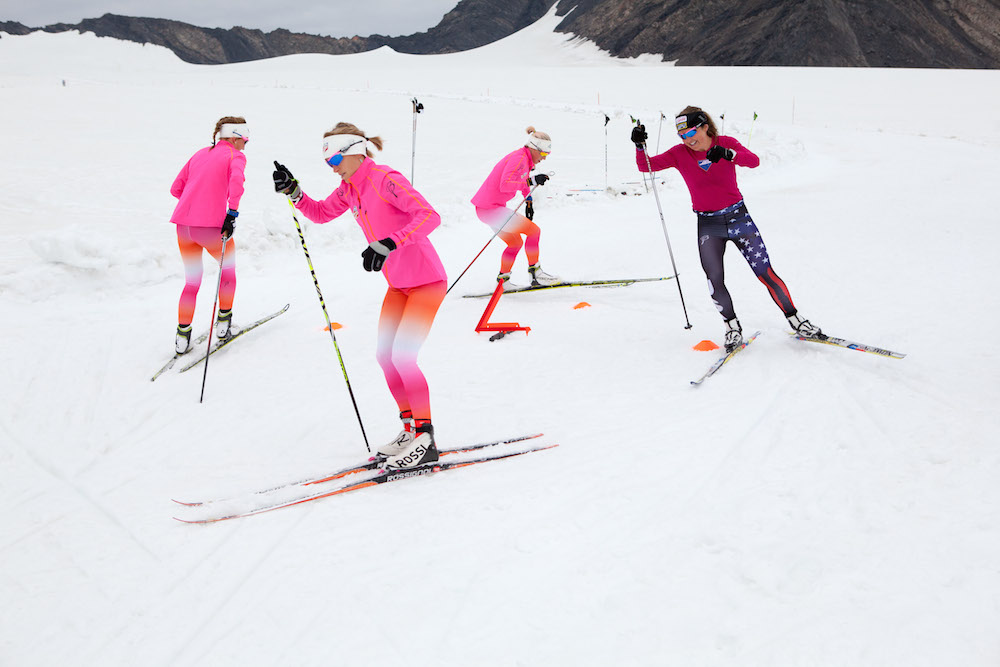
    The U.S. Ski Team women’s team at work during a 10-day camp in the Methow Valley. (Photo: Matt Whitcomb/U.S. Ski Team)

    (Note: This article has been updated to include comments from Canadian coach Ivan Babikov on his team’s recent camp in Park City, Utah.)

    Two days after Andy Newell and Erika Flowers tied the knot in Bozeman, Mont., seven members of the men’s U.S. Ski Team and eight U.S. women’s team members jumped into an intensity training block at their respective dryland camps in Park City, Utah, and the Methow Valley in northern Washington.

    The 10-day camps were scheduled simultaneously from June 26-July 5 to accommodate the wedding. Newell is a longtime U.S. Ski Team (USST) member and teammates with Flowers on the Stratton Mountain School (SMS) Elite Team out of Stratton, Vt. Because several national-team members ventured to Bozeman (Flowers’s hometown) to watch them say “I do,” the USST coaches decided to reduce travel and keep their squads together out west.

    “We wanted to capture the men in the Intermountain West immediately following Andy Newell’s wedding in Bozeman, and therefore reduce the overall travel load for athletes who were already coming to the West from the East or Alaska,” head coach Chris Grover explained in an email.

    The men based themselves in Midway, Utah, about 1,500 feet lower in elevation than Park City and 1,000 feet lower than Deer Valley, where they typically reside for summer and fall camps. Grover explained that this was by design, “because of the shorter duration of the camp (i.e. too short to create a meaningful stay at altitude), the focus on specific intensity workouts, and the benefits of quicker recovery at lower altitude,” he wrote.

    Staying closer to the Soldier Hollow training venue was also ideal for the men’s team’s “PyeongChang-specific workouts”, Grover explained, including sessions focused on the freestyle team sprint, classic sprint and 4 x 10-kilometer relay, which will be contested at the 2018 Winter Olympics in PyeongChang, South Korea.

    Newell, Simi Hamilton, Erik Bjornsen, Scott Patterson, Paddy Caldwell, Ian Torchia, and Ben Saxton attended and worked with coaches Jason Cork, Pat O’Brien, Grover, and U.S. Ski & Snowboard Strength and Conditioning Coach Tschana Schiller.

    “The men did a great job of bringing heightened focus and effort to these key intensity workouts and we are grateful to the staff at Soldier Hollow for preparing the track for us,” Grover wrote. “Overall, it was a very productive camp and I think sent the men into the main summer preparation period with important areas to work on, a good gauge of fitness, and a further understanding of what skills need to be developed for the WC [World Cup] season and for PyeongChang.”

    (Article continues below)

    ***

    Meanwhile, the U.S. women tried a new camp in the Methow Valley, home of current national-team members Sadie and Erik Bjornsen. The athletes themselves dubbed it the “CAGS Camp“, which U.S. women’s coach Matt Whitcomb explained stood for “a secret and mildly inappropriate team acronym that pokes fun at girls being girls. Sophie had hats made for the camp that she handed out at the airport when everyone arrived.”

    All kidding aside, the goal of the camp was to be small and intensity focused, “with eight days of training and hard intervals every other day,” Whitcomb wrote in an email. “It’s an unusual setup for our team as we usually run joint camps with the men, but both enjoyed the simplicity of having such small training groups.

    “We chose the Methow in part because it is where Sadie and Erik Bjornsen grew up, but also because we could get close to sea-level to maximize our hard efforts,” he added. “Another draw was that Pete Dickenson, one of our team physical therapists, was able to provide great treatment all week. Winthrop PT & Fitness sponsored our strength sessions, which meant we didn’t have to drive very far to get strong.”

    Like Grover, Whitcomb used the word “ideal” to describe the Methow as a training site, yet emphasized that the community that hosted them was “even more incredible.”

    “A local couple gave us their two cabins in a location as beautiful as we’ve seen anywhere in the world,” he wrote. “The chance to meet Olympians Laura McCabe (’94, ’98) and Leslie Hall (’88, ’92, ’94) was an important experience for the team. We owe them special thanks not for just guiding us to their favorite training spots, but for helping pave the early path for elite women’s skiing.”

    The women’s team, which included Sadie Bjornsen, Rosie Brennan, Sophie Caldwell, Jessie Diggins, Katharine Ogden, Kikkan Randall, Ida Sargent, and Liz Stephen, spent one afternoon working with with the Methow Valley Nordic Team, which McCabe and Hall both coach.

    “We invited a handful of their top athletes to join our bounding and ski walking sessions, and were encouraged by their technique and fitness, but also their love for the sport,” Whitcomb wrote. “They are doing a good job up there. I don’t know what the future holds for us regarding camp locations, but the Methow Valley will be considered as a great option moving forward.  Thanks to so many people for making it happen.”

    Women’s team staff included Whitcomb, Tim Baucom and physical therapist Pete Dickenson.

    (Article continues below)

    ***

    Cross Country Canada also recently finished up a two-week camp in Park City (June 26-July 11) with its entire men’s World Cup team — Alex Harvey, Len Valjas, Devon Kershaw, Jess Cockney, Knute Johnsgaard, and Graeme Killick — and U25 national-team member Julien Locke. Co-World Cup coaches Ivan Babikov and Louis Bouchard accompanied the team for the duration, and Joel Jaques joined for the first week.

    While Park City has become an annual staple for the Canadian team, Babikov explained that this was their first time there in the summer, as opposed to the fall.

    “We love the area and training there. … It was pretty hot but we managed,” he wrote. “The main goal was a big training volume/hours at the altitude. We were planing on doing a time trial at the SoHo but it got closed for those dates so we ended up doing intensity down in Salt Lake instead.
    It was a great camp for all the guys, everyone feels good and no injuries on the team.”

    https://www.instagram.com/p/BWF7eG6HLJo/?taken-by=coach_babs_

    https://www.instagram.com/p/BWP_Wi_nYV3/?taken-by=coach_babs_

    https://www.instagram.com/p/BWdDCu1nObo/?taken-by=coach_babs_

  • Diggins Fourth in Davos: Now I ‘Realistically Expect to Be in the Fight’

    Diggins Fourth in Davos: Now I ‘Realistically Expect to Be in the Fight’

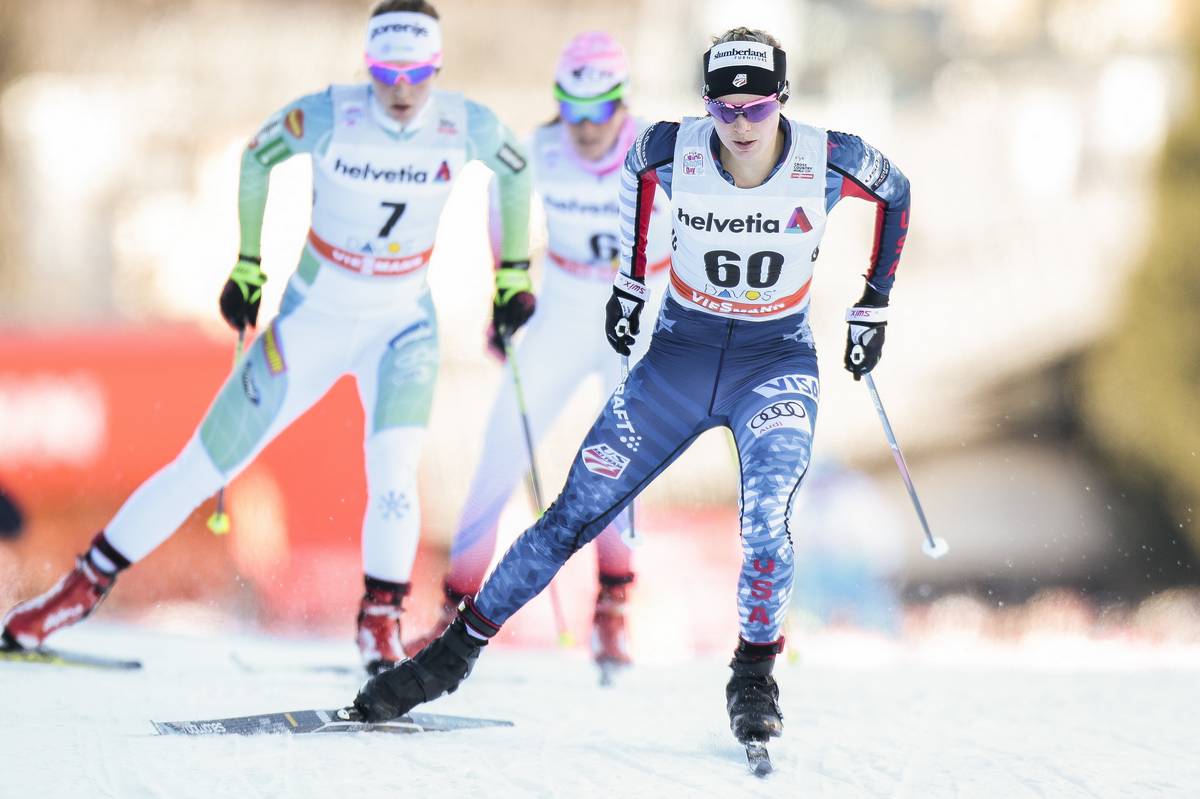
    U.S. Ski Team member Jessie Diggins (60) en route to fourth place in the World Cup women's 15 k freestyle individual start on Saturday in Davos, Switzerland. (Photo: Salomon/NordicFocus)
    U.S. Ski Team member Jessie Diggins (60) en route to fourth place in the World Cup women’s 15 k freestyle individual start on Saturday in Davos, Switzerland, while leading Slovenia’s Alenka Cebasek (7) and Katerina Smutna (6) of the Czech Republic. (Photo: Salomon/NordicFocus)

    DAVOS, Switzerland — Coming off a win in the 5 k skate in Lillehammer, Norway, this weekend, the U.S. Ski Team’s Jessie Diggins knew that plenty was possible in Saturday’s World Cup 15 k skate.

    “I was not expecting to come into the season this hot; normally I would work my way right into it,” she said, “It definitely makes it really fun and exciting when you have you’re sights set on the podium, and you can realistically expect to be in the fight.”

    Fight she did, rising from sixth at the race’s halfway point to fourth at the finish, her best result ever in Davos and also the best 15 k of her World Cup career.

    Her time was 54.3 seconds behind that of Ingvild Flugstad Østberg of Norway, who won the day.

    “Working on the long distances, it’s still a ways to catch up to the girls at the top,” Diggins said. “But it’s a long season, and we have a lot of belief, a lot of sparkles on our side.”

    By 10 k into the race, she was up into fifth place, and within a second of the time laid down by Nathalie Von Siebenthal of Switzerland. Because Diggins had started last out of the field’s 60 competitors, she knew exactly what she had to do to close time on her competitors over the last five kilometers.

    “I know I was really close, like four or five seconds between several of us. “So I was happy to have been able to finish strong, and proud of how I skied the downhills!”

    The 15 k in Davos is not a kind one, with a long flat section out of the stadium and then an undulating climb which provides little to no rest until more than half of the race loop’s 5 k distance is completed. After topping out, it’s a fast downhill section to the lap, and then it’s on to the climb again.

    With the race venue sitting at over 5,000 feet of elevation, pacing becomes even more challenging.

    “It’s definitely hard to pace here, because it’s a 15 k at just the right amount of altitude where if you go under, you’re done,” Diggins said. “But you don’t want to finish with gas in the tank. This was the closest I’ve ever come to the right pacing, and I still think it could have been maybe a little bit better.”

    The downhills also don’t provide much rest, with several icy hairpin turns before the course re-enters the stadium.

    Kikkan Randall takes a turn on her way to 33rd in the 15 k skate in Davos.
    Kikkan Randall (r) takes a turn on her way to 33rd in the 15 k skate in Davos.

    “I wasn’t happy about starting last here, not going to lie,” Diggins laughed. “I didn’t enjoy that, but the downhill, the big corner there, I would just look for the fresh snow, and throw a hard skid, and step, and it was fine, so… The course held up remarkably well. You know, it’s almost worse on training days when there’s a million techs, and on racing day, there’s actually much less traffic.”

    Diggins is now ramping up for the skate sprint to be held tomorrow. Last year she finished ninth in the event.

    “This is a really interesting course; it’s very tactical, I think it’s hard to drop people, and it’s hard to be dropped,” she explained. “I don’t know–I tend to favor distance races sometimes, because it’s more about your fitness and you, than tactics and seeing if people are pushing, or you get lucky, or you find a window or not, but I’m excited to see what I can do going into it with positive attitude and looking for every opportunity.”

    The U.S. women haven’t had much luck in sprint heats this season, with four women – Diggins, Sadie Bjornsen, Sophie Caldwell, and Ida Sargent – making the quarterfinals in the classic sprints in both Lillehammer and Ruka, but none advancing to the semifinals.

    “This has been a historically great place for us, so knock on wood, but it might be time to turn it around,” Diggins said.

    With the season start she’s had, more excitement always seems to be just around the corner.

    “Training load is still fairly high, so the goal is always way later in the season for me, but to be in the fight this early is like ‘that’s exciting, that’s great!’” Diggins said. “If you would have told me that this summer, I would have been like, ‘nah’.”

    For the U.S., Liz Stephen was the next finisher after Diggins, earning 28th place (+2:17.5).

    “This year, I think that especially with the 15 k, just having to focus for such a longer period of time on that weird grade, I actually was not that excited going into the race this morning,” admitted Stephen, who has finished in the 20’s each time a 15 k race has been held here in Davos.

    “I recognize it, because it’s not usually how I feel,” she continued. “I had to sort of restructure my brain this morning. And just really focus in on what my goal of the day was, which was just to ski as smooth and big as I could, and keep it into my race. Then my brain kind of opened up as I got out there. But it’s a really challenging race and every year, it’s just a really hard grade and altitude to feel like you’re racing. And I think when you don’t feel like you’re racing in your brain, it’s hard to keep engaged.”

    Kikkan Randall finished 33rd (+2:30.2) and Caitlin Patterson 44th (+3:21.6). Rosie Brennan did not start.

    “It was just so much altitude, flatness, yuck,” Patterson said.

    Emily Nishikawa led the Canadian team in 34th (+2:33.5).

    “The two girls that started right behind me [ninth-place Ilaria Debertolis of Italy and 13th-place Polina Kalsina of Russia] caught me, and they are both holding on to pretty good times, so that was nice to ski with them,” Nishikawa said. “It’s a super-hard course. So it’s great to have people out there to help you.”

    — Jake Ellis contributed reporting

  • Johaug News Stuns U.S. Women’s Team; Saarinen Takes to Social Media

    Johaug News Stuns U.S. Women’s Team; Saarinen Takes to Social Media

    American Jessie Diggins (r) with Norway's Therese Johaug (c) and Astrid Uhrenholdt Jacobsen (l) all smile after placing third, first, and second, respectively, in the women's 10 k freestyle individual start on Saturday in Nove Mesto, Czech Republic.
    American Jessie Diggins (r) posing for a podium photo with Norway’s Therese Johaug (c) and Astrid Uhrenholdt Jacobsen (l) after the women’s 10 k freestyle in January 2016 in Nove Mesto, Czech Republic. Johaug won, Jacobsen was second and Diggins placed third.

    The morning news broke about Norwegian cross-country skier Therese Johaug’s positive drug test last week, emails circulated among the U.S. women’s ski team. Most of its athletes were stunned.

    “Johaug’s positive test hit our women’s team pretty hard. We got a group email going first thing that morning so everyone had a good balance of information to wake up to,” U.S. women’s coach Matt Whitcomb explained in an email to FasterSkier on Sunday. “There has been a combination of disbelief that a mistake like this could happen again from Norway, but for the most part, our athletes are sympathetic to Therese. They know how easy it would be to take the wrong cold medication when your head is pounding and you haven’t slept in three days, or to take the wrong cream when you just want your lips to stop bleeding. Therese will continue to be a role model and friend to our team. She is not a cheater.”

    That was the overarching message of Whitcomb’s 1,000-word email in response to the news about Johaug, a two-time overall World Cup champion and Olympic and World Championships gold medalist. She used the banned steroid clostebol in the form of a lip cream to treat her badly sunburned lips and was visited by doping control officers on Sept. 16. She told the officers she was using the lip cream Trofodermin, which she obtained from an Italian pharmacy while training in Livigno, but apparently did not realize it contained a banned substance. Her doctor bought the medication and reportedly assured her that it didn’t contain anything on the World Anti-Doping Agency (WADA) Prohibited List.

    But it did — clostebol — and Johaug was informed of her positive test on Oct. 3. Today, Anti-Doping Norway, the first to handle the case, issued Johaug a two-month provisional suspension from competition and organized training until Dec. 18. Her case is now in the Norwegian Olympic Committee’s hands.

    Is that fair? This past weekend, we asked three U.S. women’s team members previously sponsored by Johaug’s clothing line (they wore her gloves for two seasons, but switched to other companies this spring for reasons unrelated to this case), what they thought.

    Jessie Diggins, who now wears Swix gloves for reasons outlined below, requested that her email response be used in its entirety. On Sunday, she wrote:

    “I believe that this was an honest mistake, and I feel really badly for her [Johaug]. Everyone in the world has had the experience of trusting someone when they perhaps shouldn’t have, and and it makes you realize how lucky most people are that any simple mistake they make won’t cause them to be eviscerated in international press. And they’re lucky as hell not to have their medical history up for debate by people like the ones who comment on FasterSkier.

    Even answering questions for this article will open me up for criticism, because people feel they have a right to pass judgement immediately on situations that they’ve never been a part of, and will never know all the details about. It’s one of the hardest things about being an athlete – giving up the right to defend yourself against people who will hate you because you’re good at your job, and then hate you for not being good at your job all the time.

    But if I can say something directly to the people so quick to attack Johaug? Leave her alone. Let it go. It was an honest mistake, and guess what? She doesn’t win races by MINUTES because of any lip cream, she wins because she’s an amazing skier and very good at racing, and she works incredibly hard. I’ve seen how hard she trains and how much she cares about her teammates and I have a lot of respect for her.

    I got to know Therese a little bit over the past year and she’s a pretty amazing person. I used to race on her gloves before switching to Swix gloves – not because of anything personal, simply because her ‘Johaug’ brand was focusing more on the clothing and Swix offered me a chance to make a fun design for myself on their gloves. And when I switched to Swix poles, I wanted to go in 100% and do the gloves, too. I loved that Therese donates a percentage of every glove sold to Active Against Cancer (I’m sure I’m not spelling it correctly when translated to English) and all the great things she’s done for sport shouldn’t be overshadowed by recent events.

    I don’t think Therese should be banned from racing, because I believe that it was an honest mistake. When I toe the line in a World Cup, I want to race against the best in the world, and it won’t be the best unless she’s there racing. I don’t believe that the amount of clostebol she may have accidentally ingested through her lips would give her an advantage, and as a fellow athlete racing the World Cup I feel like I have just as good a chance at racing her as I did last year. If an athlete knowingly dopes and gains a serious advantage from it, well, that’s another story, but in this case I firmly believe she should be allowed to compete.

    This is any athlete’s worst nightmare. According to an article by FasterSkier, the drug Therese tested positive for is amazingly sensitive ‘and there are documented cases of test subjects who had never taken the drug having it show in urine samples after eating meat from animals raised on the substance.’ So, as an athlete, it really makes me paranoid to do something as simple as eat a steak. I went back and re-checked all medications I’ve ever taken, even something as simple as vitamin C. Staff members have advised me on what to take when I’m sick on the road and in a foreign country, for example, but I always look it up on globaldro.com, a site where you can check (for US athletes, at least), the status of medications. But when you’re sick and tired and it’s someone you trust handing you an aspirin pill? Yeah, you want to just take it right away. The instinct to be suspicious and not trust people just isn’t there. And it’s definitely not something most people ever have to think about. It feels wrong to train the instinct to go and fact-check your doctors whom you know care about you and support you 100%, but that’s what you have to do.”

    Sophie Caldwell and Liz Stephen both switched to Toko gloves this spring, with Caldwell explaining that it had “nothing to do with the recent news, just because Johaug is moving into more products than just gloves and looking to support athletes who can also wear the clothing and Toko seemed like a better fit for me…”

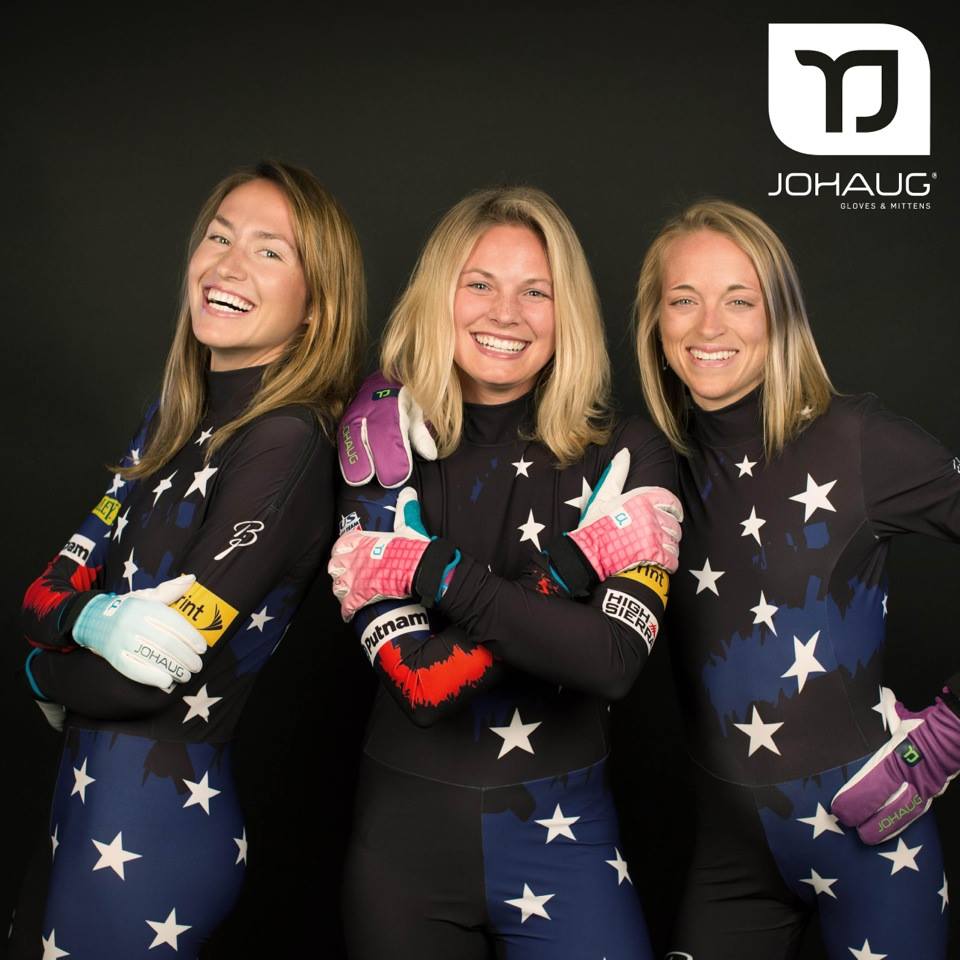
    In December 2014, three U.S. Ski Team members, Sophie Caldwell (l), Jessie Diggins (c) and Liz Stephen (r), signed an agreement to wear Johaug® gloves and did so until this spring of 2016. (Photo: Outthereshop.com/http://outthereshop.com/tag/johaug/)
    In December 2014, three U.S. Ski Team members, Sophie Caldwell (l), Jessie Diggins (c) and Liz Stephen (r), signed an agreement to wear Johaug® gloves and did so until this spring of 2016. (Photo: Outthereshop.com)

    Caldwell added, “I personally feel very badly for Therese. I choose to give people the benefit of the doubt until given a reason not to. I am a strong advocate of clean sport, but I am also in no place to be accusing anyone of anything. I believe that it was an honest mistake and can’t imagine the pain she is going through right now. It is a wake up call to everyone to be double and triple checking any supplement or prescription we take.”

    Whitcomb emphasized that the U.S. Ski Team (USST) tries to use medications and supplements as minimally as possible.

    “But we all still have our medical needs from time to time,” he wrote. “When possible, we use familiar medications that we bring from the U.S. We never take any prescription medications without consulting our team doctors, who are all well-educated by USSA [U.S. Ski & Snowboard Association] in the WADA code. We’re not impervious to mistakes, but our athletes, doctors, and coaches are very respectful of and educated in the WADA code. We take a lot of pride in competing cleanly.”

    During a given race season, the USST is accompanied by a medical pool of six to eight volunteer doctors for half the winter.

    “When we don’t have a doctor with us, we always have our medical director on call in Park City, as well as any of our other team doctors,” Whitcomb explained. “Occasionally, one of our doctors will be asked to help a skier from another team that isn’t traveling with one that week, and vice versa.”

    In a phone interview on Friday, Stephen explained that while she and her teammates expect their doctors to be up to speed on what’s legal and what isn’t according to WADA and U.S. Anti-Doping Agency (USADA) standards, the onus is ultimately on the athletes themselves.

    “There’s never something that we just take without looking at it ourselves,” Stephen said. “If a doctor gives you something and he thinks it’s right, he could legitimately think it’s right as what I think has happened with this case, which is so sad for Therese, and for the doctor — I’m sure he feels absolutely terrible. But I think ultimately, the doctor isn’t who’s going to be remembered here, you know? This is a huge, huge thing for Therese and her career … because like it or not, whether it was an honest mistake or not, if you have your name and doping next to it, it’s a done deal…

    “That’s why it’s so so important that with supplements and with whatever you are taking and rubbing on your skin or whatever, you are looking it up for yourself every single time because it is this kind of thing that is our worst nightmare as athletes,” she added.

    Stephen sympathized with Norway for having its clean record in cross-country skiing tattered by two doping violations in the last three months, with Martin Johnsrud Sundby serving a two-month suspension for violating asthma-medication rules this summer.

    “I see them very differently than I see the Russian violations, which were so obviously a violation of the anti-doping rules. EPO is such blatant cheating, it’s black and white,” Stephen said. “Perhaps I am just naive, but I see what happened with Sundby and certainly with Therese as very different. Therese is taking full responsibility for not checking Global DRO herself and just trusting her doctor. When you are in pain, or sick and all you want to do is feel better, sometimes you skip a step, and this is a terrible misfortune for Therese. I hope that it does not end up overshadowing some of the more severe doping violations that have gone on in the past year.”

    Whitcomb also separated the cases of Johaug and Sundby, explaining that he believes the story told by Johaug and her doctor.

    “I trust that it was a stupid mistake and I’m sad for them,” he wrote. “I am not a conspiracy theorist, and I’m not one of those guys that suspects doping every time someone does a little better in a race than normal. We witness those ethical bumps in performances on our team. With a few exceptions, I think women’s skiing is very clean these days. If I’m proven wrong, then I’ll be burned by it down the road. For now, my ability to trust lets me sleep at night, and it lets me focus during the day.  The same is true for our athletes.  We don’t get caught up in the unknown.”

    On Sundby, Whitcomb wrote:

    “I have less sympathy for the abuse of asthma medication. For starters, it’s not fair to asthmatics who are prescribed medicine and use it ethically. They now feel self-conscious when they take their medication, and their health requires it. What also bothers me about the Sundby case is the amount of medicine that was being ingested. But he got busted and has paid for it, mostly in the currency of credibility. His actual suspension was pretty short. I trust that he and Norway will not do this again, and I’ll still cheer for him on the course this winter.

    “What bothers me most about this all is that it’s a major distraction from a larger issue,” he added, echoing Stephen’s remarks on Russia. “The timing of Norway’s troubles could not be worse for skiing. The skiing world, through the pending results of Richard McClaren’s report, is trying to solve the allegations that Russia cheated in the Olympics they hosted.”

    At the end of the day, Whitcomb explained that the penalty for doping infractions “at the extreme end of the doping continuum” should be much more firm. He is an advocate for lifetime bans, when appropriate.

    “Because the current penalties for cheating are so soft, the most serious deterrent at this point, in my opinion, is shame,” he wrote. “Unfortunately, I don’t think all cheaters have that emotion. Even a four-year ban doesn’t seem like it adequately penalizes someone that uses EPO. It’s not like they go into a prison cell for four years, like when someone steals a couple cars.  They just can’t ski race for a little while.  That’s too light.”

    Whitcomb recommended splitting the banned list in two for less severe and more severe infractions.

    “I have no problem with what happened to Evi Sachenbacher-Stehle in Sochi, or to Sundby this year, and what is likely to happen to Johaug. You make a small mistake, you get a small penalty,” he wrote. “But when it comes to EPO, anabolic steroids, human growth hormone, or other drugs that are so clearly used to cheat, I never want to see them in a race again. Since doping is in the news now, I think it’s time to talk about how a lifetime ban would help solve our problems. The stakes are currently too low.”

    Saarinen Goes Straight to the Source

    Last Thursday, Aino-Kaisa Saarinen, a 37-year-old Finnish world champion who sat out last season while pregnant with her first child, tweeted a photo of herself at a Livigno pharmacy. She took a close up of the Trofodermin packaging, which displayed a red circle with a slash through it over the word “DOPING”.

    Aino-Kaisa Saarinen Twitter Oct. 13

    “Kävin uteliaisuuttani Livingon apteekissa katsomassa miltä pakkaus näyttää. Voiko tästä paketista lääkäri erehtyä sopingin suhteen?” Rough translation: “Out of curiosity, I went to a Livigno pharmacy to see how the packaging looks. Can this package be mistaken by a respectful doctor?” pic.twitter.com/hK7JXYtjs5

    — Aino-Kaisa Saarinen (@Aino_Kaisa) October 13, 2016

    “For me it seemed very clear,” Saarinen wrote in an email to FasterSkier on Monday. “At least symbol like that should ring the bell, because you never see such symbol in anything you take. I understand that one can make a mistake about that symbol, but if you are a doctor, I think it should be impossible to misunderstand that.”

    She was “almost shocked” when she heard the news about Johaug and had a hard time believing it, adding that she had never been suspicious of Johaug.

    “Therese is lovable and awesome personality and I always had great respect towards her,” Saarinen wrote. “Great athlete and great person. I actually had little bit similar feelings as I had as young athlete in 2001 when a lot of Finns were catched [sic] for doping. Could not believe that either, at first.”

    What does Saarinen hope becomes of the investigation on Johaug? “Careful inspections, which follow the common rules and the punishment should be in the scale what is written on WADA rules,” she wrote. “All nations and athletes must be committed to follow those same rules. That’s fair play. Otherwise the whole system is not credible at all.”

    Saarinen has previously been outspoken on social media and in the news for her anti-doping sentiments.

    “After Finnish skier Tero Similä got banned, I started an antidoping campaign, where the slogan was: ‘Today’s top athletes are responsible of future stars and future of clean sport’,” she wrote. “The idea was that athletes would go to talk about antidoping work together with National Antidoping agency to spread to word and idea that antidoping work is good for us and for our sport. I still do these sessions, they are really popular and other athletes have done it also. After Sundby case I tried to throw that challenge internationally as well.

    “I [voice] my opinions on social media, because I think that talking about these things is also antidoping work,” she added. “These cannot be taboos. I would like to see other active athletes to [voice] their opinions as well, but I understand very well why it is not easy. It has been a taboo for a long time in history and for sure not all people will like those opinions, whatever they are. You will get some love and some hate, but that’s freedom of speech as well.”

    A World Cup competitor since 1998, Saarinen believes cross-country skiing at the highest level is getting cleaner.

    “I tend to trust that system works all the time better and better and people [who] do doping will get caught,” she wrote. “… There is always different opinions. One extreme example is one Finnish reporter which claims that it is not possible to be on the podium in world championships or in Olympics in individual sport without doping. I personally know that it is not true. That’s also one reason to talk about these things, so that the youth understands to not believe anything the reporters claim.”

  • Randall to Resume Training, Cautious but Excited: ‘I Feel Refreshed’

    Randall to Resume Training, Cautious but Excited: ‘I Feel Refreshed’

    June 1. That’s the date Kikkan Randall’s had in her head for a while now, and it has nothing to do with a milestone or a checkup involving her first child.

    That’s when she’s getting back at it.

    “I know I’m not going to be able to jump right in cold turkey to what I’ve been doing in the past so it’s going to be a gradual build,” Randall said on the phone from Anchorage, Alaska, earlier this month, about three and a half weeks after baby Breck was born.

    “Just talking with Erik [Flora], my coach, we’ve been trying to set it up so there’s different little stages to clear before moving onto the next thing,” she explained. “First building up the volume and then adding the intensity as each intensity feels good and then hopefully be a kind of normal training rhythm by the end of July into August.”

    Normally when she’s home for the summer, Randall, a four-time Olympian and three-time overall Sprint World Cup champion, trains with her team, Alaska Pacific University (APU), about four times a week. The rest of the week she trains solo or in small groups, and this summer, she plans to do a little of all of the above.

    With her coach, Randall has formulated a plan that works for her, her husband, Jeff Ellis, and most of all, Breck.

    “This first time at home has been so wonderful, just to have no schedule and spend some time getting to know Breck and be here for him,” she said. “That’s been great, but I also know that I miss training so it’ll be nice to have a blend where, it’s not like I have to disappear off to work for 8 to 10 hours and then miss him all day. I can go out and do my work and come back and be with him and then go out and do it again.”

    For the coming 2016/2017 race season, the 33-year-old Randall, who has been competing at the sport’s highest level since she was 19, plans to spend the entire winter in Europe on the World Cup circuit. That will involve traveling with Breck, her parents and in-laws at times, and eventually an au pair. Jeff will be there, too, as he works for the International Ski Federation (FIS) Cross Country marketing support.

    “We’re going to rely on our parents a little bit, they’re going to come over in intervals on certain weekends and periods and then there’s going to be a point in the middle of the season where we’d like to find a European-based nanny to help out,” Randall said.

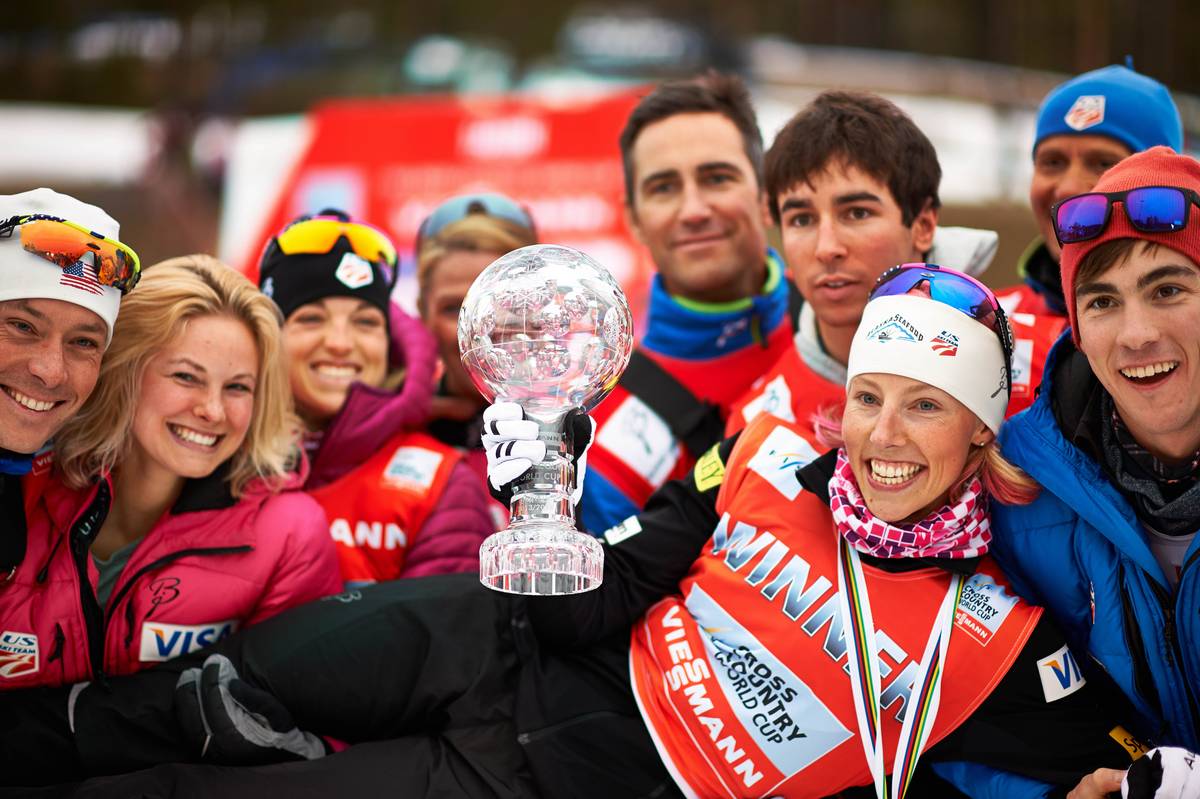
    Several members of the U.S. Ski Team lift up Kikkan Randall after she won her third-straight World Cup sprint Crystal Globe a the end of the 2013/2014 season. (Photo: Fischer/Nordic Focus)
    Kikkan Randall and her U.S. Ski Team teammates and coaches after she won her third-straight Sprint World Cup Crystal Globe at the end of the 2013/2014 season. (Photo: Fischer/Nordic Focus)

    With the challenges of coordinating caregivers comes the cost of traveling with at least one extra person, like a nanny, on the circuit. While Randall retained her spot on the U.S. Ski Team’s A-team based on her FIS world ranking and Red Group status from two seasons ago and could potentially have much of her room-and-board costs covered by FIS, she anticipated the need to make different arrangements.

    “While I want to be as much a part of the team as I can, I don’t want to be disruptive and I think living in a hotel room with a baby for a whole year would be challenging,” she said.

    For the holiday break in late December, Randall and her husband reserved a condo in Davos, Switzerland, for a more-homey alternative and they are hoping to find a similar setup in Sweden before World Championships in Lahti, Finland.

    “We’ve started to formulate a plan, but we have a lot to learn, but we’re excited we get to bring [Breck] on this journey,” she said. “And our parents, we’re lucky that they’re able to assist and that’ll get us going, and we’ll learn the ropes as we go.”

    It’s a Boy!

    On April 14, after 13 1/2 hours of labor, Randall gave birth to her son, Breck Stuart Randall Ellis. The gender was a surprise, but they had a boy name ready.

    A few years ago, Jeff did a mountain-bike race called the Breck Epic in Breckenridge, Colo.

    “He came back with all this stuff, a T-shirt, a belt buckle and it said the name of the race on it and I thought, ‘Oh Breck, that sounds really cool! That could be a good name,’ ” Randall said. “So we just kind of had it tossed around for a while and when it came time to narrow it down, we just liked the sound of it. It’s kind of unique, but still simple.”

    Breck’s middle name, Stuart, is his grandfather’s first name, dad’s middle name and great grandmother’s maiden name.

    “It relates back to a royal clan in Scotland, apparently, so that’s got some fun family history,” Randall said.

    His second middle name is Randall, and Ellis is his last name.

    “The whole process has been so fun,” Randall reflected. “The pregnancy went great and toward the end, the anticipation was building and building, and we ended up inducing my labor so things progressed pretty quickly that day, so it was kind of fun to get to the point that we were pushing him out…”

    (Ed. note: Fun and childbirth aren’t usually part of the same sentence, but we digress.)

    “When he came out and he got put on my chest, that’s such a strong emotion at that point, it’s hard to put into words…,” she continued. “I kind of felt like it was the end of a ski race, particularly something like the Tour de Ski where it’s so hard and so painful and you’re pushing, but you just want to get to that finish line and then when you do it’s just like that bliss of laying in the snow, of course one hundred times greater, but kind of that similar feeling.”

    So what’s harder — the hardest ski race she’s ever done or giving birth?

    “It was a different kind of pain than I’ve ever experienced before,” Randall said of the latter. “I was curious to see how it would feel to the toughest race or VO2max test or tough intervals or something like that, but instead of being like a lactic-acid burning pain, it was almost like a flu, crampy kind of pain and I think the hardest part was just not knowing when it was going to end.”

    It eventually did end and Breck, 8 pounds, 11 ounces, was born. Within two weeks he was back up and slightly heavier than his birthweight — thriving in his new world — and in the 90th percentile for length and 60th for weight.

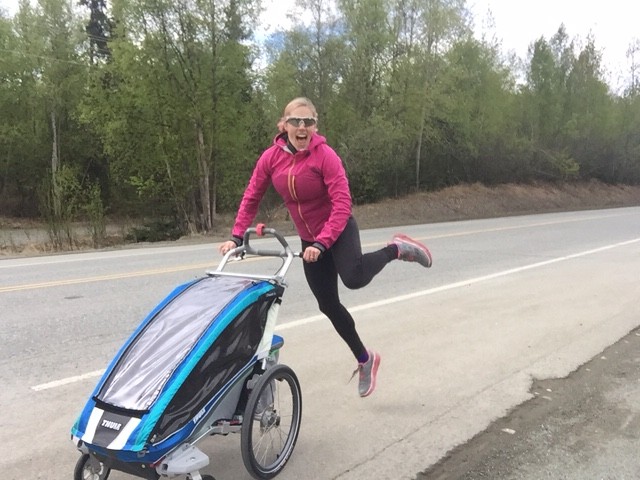
    “He’s a little string bean; he has big feet,” Randall said with a laugh. “He’s got a really good temperament, doesn’t get too fussy … He loves to be in the front carrier or the Chariot, that instantly puts him to sleep. I think he was used to riding along with me for the nine months.”

    Now a month-and-a-half old, he’s up to 11 pounds and out of the newborn outfits and diapers.

    “He’s awake a lot of the day now and even giving us some involuntary smiles,” she wrote in an email. “Can’t wait until the real ones start!!”

    Six-Week Marker

    This week, Randall goes in for her six-week checkup, at which point she’s hoping the doctor will give her the “all-clear.”

    So far, she’s done some easy rollerskiing and biking the last three weeks, in addition to walking and “testing the waters” with the SkiErg.

    “I feel like I’m healing up pretty well. I’ve been pleasantly surprised with how intact my abs feel and everything still feels like it has good tensions so I’m happy about that,” she explained. “… I’m trying to really keep this first six weeks as just an opportunity to heal and get my body ready to train, but just being careful so I don’t risk getting injured.”

    Regardless of how anxious she is, Randall asked the doctor to give it to her straight and what the most conservative approach is to returning to physical activity.

    “I have definitely been antsy and wanted to test things a little bit so it’s nice to have that voice in the back of my head that says, ‘No, just go on six weeks, be careful,’ ” she said. “I also have been in touch with Marit a little bit and she said to be cautious about coming back. She maybe feels like she pushed it a little bit.”

    Three months after having her first child, Norwegian legend Marit Bjørgen injured her hip while jogging in March, having previously completed a 42-kilometer ski race. She and Randall have exchanged some text messages in the time since.

    “I think you need to be cautious for caution’s sake,” Randall said. “But it’s so hard because you’ve essentially taken off a weight vest and you feel light.”

    In terms of goals, Randall’s focused on getting in shape for the U.S. Ski Team (USST) camp in Anchorage in mid-July. She figured that would give her six weeks of training beforehand. That Eagle Glacier camp will likely be her first time on snow.

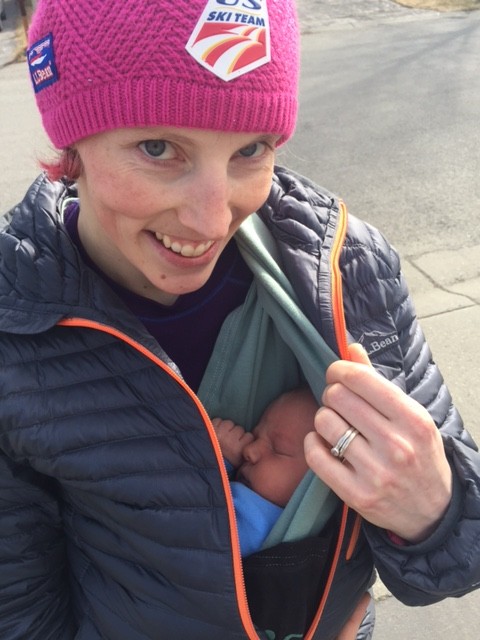
    Randall with Breck in the front pack during a spring walk in Anchorage, Alaska. (Courtesy photo)
    Randall with Breck in the front pack during a spring walk in Anchorage, Alaska. (Courtesy photo)

    Beyond that, she plans to spend most of her summer and fall at home, with the exception of the USST October camp in Park City, Utah, and a trip north of Toronto to visit Jeff’s parents. Asked if she’ll take Breck along for some workouts (i.e. in one of her two Thule jogging strollers or in a front or back pack), Randall said she’d like to.

    “I could get in some good workouts with him, which would be fun, and Jeff will be along as well so we can do it as a family, and then there will be some times when I can just get out the door and do a workout and get right back. I think it’ll be a nice balance,” she said. “I have a lot of really good training opportunities right out my door for times where I just really need to go get in a workout and be right back and hopefully I’ll be able to join in some team sessions with APU as well, but that will really depend on how [Breck] is adapting to the schedule. Hopefully I can get it in that way, but we’ll have to just wait and see.”

    Come fall, she plans to start the season in Europe with the rest of the team on the World Cup in late November. Her goal is to be in top shape by February for World Championships.

    “Other than that it’s going to be a lot of playing it by ear and seeing how my body responds to things,” she said.

    After a year off and now a mother, will she be the same racer? Randall said she’s not sure.

    “This is a big question mark right now. There were certainly days where I was training while pregnant and as we got toward the end it was getting harder and harder and I felt a little more disconnected from those days when I was in peak shape. I just started to feel like, ‘Woah, getting back to that level is going to be challenging and racing every weekend and every discipline is going to be hard,’ ” she reflected. “Then on the other hand, I hear these amazing stories of women who say they only got stronger when they came back, training with that weight vest for at least six months of the pregnancy, and those nice physiological adaptations that you have throughout the pregnancy and then of course the change of focus, the fact that you don’t take your training time for granted any more, you maximize the time you have and you have this other thing in your life that is so important that you don’t sweat the small stuff.”

    Her friend and fellow Olympian James Southam told her that having a child gave him new motivation to do his best and set a good example.

    “I’m really curious to see how it feels,” Randall said of racing. “I know there’s parts that are going to be really challenging, just getting back into shape and trying to still be able to handle that high load with this new lifestyle, but on the other hand, I feel refreshed. My body is refreshed from a little break, my mind is refreshed and that could open totally new doors.”

    Randall’s not alone. Several other top World Cup women have also had their first children in the last year, including Finland’s Aino-Kaisa Saarinen (in early May), Slovenia’s Katja Višnar (last November) and Bjørgen (in December). FIS has taken notice and is initiating new rules that give caregivers (i.e. a nanny) World Cup accommodation travel rates and access to venues, according to Randall.

    FIS Cross-Country Event Coordinator Sandra Spitz said she could not comment on the changes until after the FIS Congress in early June.

    “I’m not really sure how to explain why this kind of [baby] boom hasn’t happened in the past,” Randall said. “This [past] year, it’s probably no coincidence that there was no major championship, if anyone had to miss a season this was the one to do it and you still have two years now leading into the Olympics. But we certainly had years like this in the past, so why now? I don’t really know how to explain that, but I think it is really cool, but I think it’s maybe becoming a little bit more acceptable. Maybe teams and sponsors are being a little bit more supportive so it’s not this scary unknown … There’s a support system for that.”

    She’s hoping this group of women, all of which plan to continue competing, can prompt change and show that one can continue with their career after starting a family, rather than have to chose one over the other.

    “I think [FIS is] recognizing, too, that it’s worth their while to keep the top athletes in the sport versus them leaving to have a family,” she added. “Any way you can encourage that is good for everybody.”

    As she held Breck in her arms, he cooed and grunted; she laughed and reviewed the last few weeks.

    “I don’t think I could’ve imagined just how happy and content I would be,” she said of motherhood. “When he’s just as cute as can be cuddled up, sleeping on my shoulder or when he’s just spit up for the third time and we’ve had to change his outfit and he’s spit up all over me, I seem to just really love every moment of it. And also how relaxed I’ve been able to be through it. I feel like I enjoy every moment and I’m just loving it.

    “It’s so crazy how your life really does change in an instant,” she continued. “You go from being completely independent to now always having this responsibility, but suddenly I can’t imagine that that life would be satisfying anymore because it’s so fun.”

  • Diggins Second American to Win in Three Stages: ‘It is Totally Surreal,’ Coach Says

    Diggins Second American to Win in Three Stages: ‘It is Totally Surreal,’ Coach Says

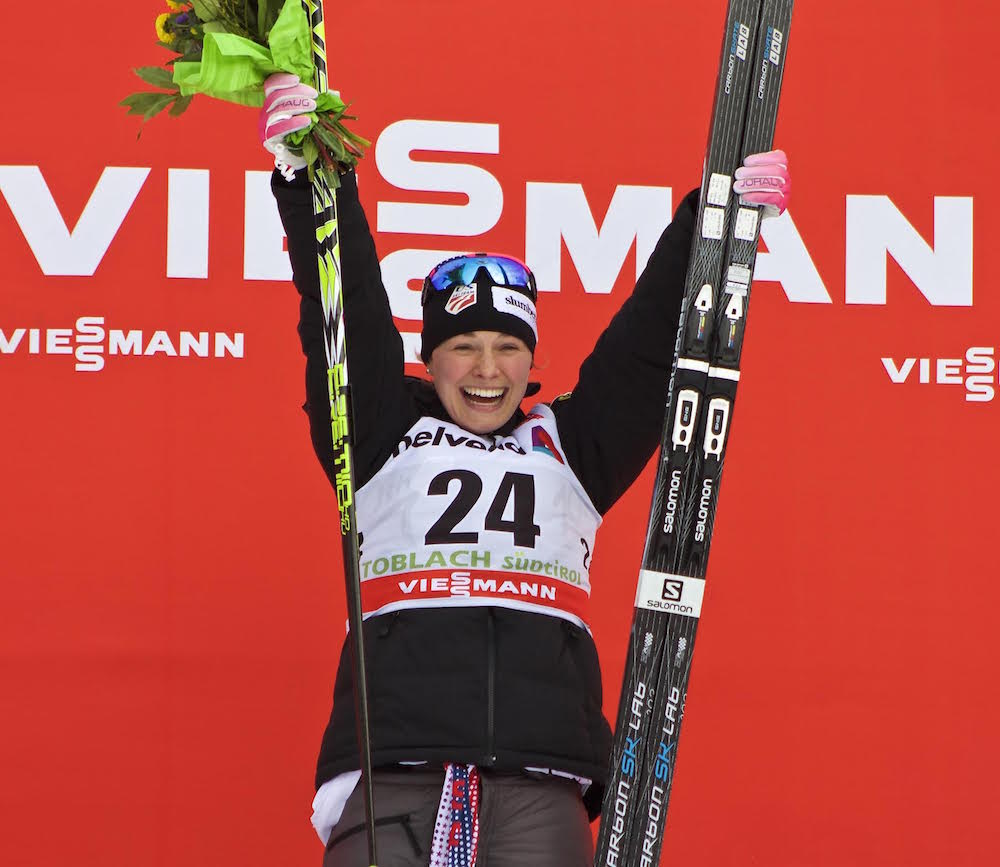
    Jessie Diggins (c) of the U.S. Ski Team after winning her first-career World Cup in Friday's 5 k freestyle at Stage 6 of the Tour de Ski in Toblach, Italy. (Photo: JoJo Baldus)
    American Jessie Diggins after winning her first individual World Cup on Friday in the women’s 5 k freestyle at Stage 6 of the Tour de Ski in Toblach, Italy. For the U.S. Ski Team, it was their second victory in the last three stages. (Photo: JoJo Baldus)

    TOBLACH, Italy – With many smiles, shrieks and leaps of joy, Jessie Diggins won Stage 6 of the Tour: a 5-kilometer freestyle individual start. It was the second of two huge wins for the U.S. women, following Sophie Caldwell’s Stage 4 classic-sprint victory on Tuesday in Oberstdorf, Germany.

    Interestingly, the podium remained exactly the same between both races — with Heidi Weng in second and Ingvild Flugstad Østberg in third — except Diggins replaced Caldwell on the top step.

    “What’s so cool about this team is we ride on each other’s successes,” Jessie exclaimed in an in-person interview after Friday’s race. “Seeing Sophie do it, we all train together, and we can do this! It really shows the strength of the team that we push each other and train so hard to get to this point where we can start putting together really good races. So this is a pretty sweet victory for the team.”

    Diggins is now the fourth U.S. woman to win a World Cup race, and the first to do so in a modern distance race. (Kikkan Randall has won numerous freestyle sprints and a 3 k prologue, but nothing longer.)

    A 24-year-old member of the U.S. Ski Team, Diggins was a 2015 World Championships silver medalist in the 10 k freestyle and won gold in the freestyle team sprint at 2013 World Championships with Randall. She also won the preceding World Cup freestyle team sprint with Randall in December 2012, but had yet to achieve an individual World Cup podium before Friday.

    Her post-race demeanor was true to herself — bursting with enthusiasm, belief, positivity, and especially a team-focused mentality — times 100.

    “I didn’t believe it,” Diggins said when asked about seeing her name in first place. “I mean, to come out on top in this field with those incredible women feels like doing the impossible. So that really speaks to how hard the [wax] techs have worked, how fast the skis were, the incredible cheering…”

    Racing to First

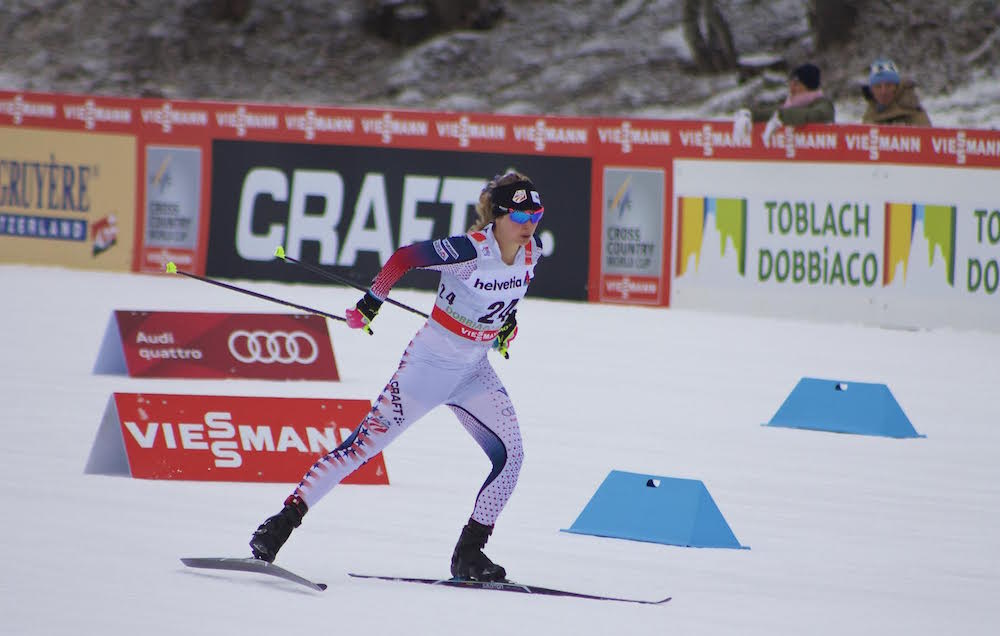
    Jessie Diggins (U.S. Ski Team) racing to her first World Cup victory in the 5 k freestyle at Stage 6 of the Tour de Ski in Toblach, Italy. She won by 0.6 seconds, beating out four Norwegians in the top five. (Photo: JoJo Baldus)
    Jessie Diggins (U.S. Ski Team) racing to her first individual World Cup victory in the 5 k freestyle at Stage 6 of the Tour de Ski in Toblach, Italy. She won by 0.9 seconds, beating out four Norwegians in the top five. (Photo: JoJo Baldus)

    Depending on how racers show up on a given day, the individual-start format can be anything from interesting to anti-climactic, and even nerve-racking.

    Forty-six women started on Friday, heading out at 30-second intervals. After racing the clock and crossing the finish line, athletes are left waiting to see how their time stacks up against the rest of the field.

    Early starters don’t have much to work with in terms of splits. The race consisted of a single 5 k loop, with gradual climbing out of the start and official timing points at 1.7 and 2.1 k.

    Diggins started 24th and reached the first timing point in 4:28.9, which turned out to be the fourth-fastest time of the day. Then at the 2.1 k, her time ranked third, indicating she was accelerating.

    “When the split at 2.1 came in that Jessie was 8 seconds out of the lead with everyone by, we knew that meant she could win,” U.S. Ski Team Women’s Coach Matt Whitcomb told FasterSkier afterward. “Nobody finishes this course more successfully than Jessie.”

    What made her the best woman out there today? The answer lies largely in the subtle downhill profile of the latter part of the course.

    “You are always working and you have to really work those downhills,” Diggins said of the Toblach course. “It is a great course for me because I love to V2 and I love those downhills where you just get in your little tuck and you just skate.”

    From Afton, Minn., Diggins won Minnesota state championships three times, which is held at Giant’s Ridge. The end of the course is characterized by a similar, long downhill segment for the last kilometer or two leading out of the woods and right into the stadium.

    Several coaches and race organizers on the Minnesota high-school scene remember the way Diggins would come flying down this hill in a bullet-like tuck, practically sitting on the back of her skis. From high-school meets all the way to the top podium spot in the World Cup, Jessie Diggins can truly work the downhills.

    “She can lay down the fastest time day after day after day through terrain like this; she is a glider and she is a finisher,” Whitcomb explained. “[The course] suites Jessie’s strengths very well.”

    “There are very few skiers in the world that can close down the final kilometer of a course like Jessie,” U.S. Ski Team Head Coach Chris Grover said in a team press release. “She was fierce and unrelenting on the downhills and flats leading back to the stadium; pushing extremely hard on her skis. We’ve been wowed by this ability of hers many times, most notably in the recent Lillehammer 4×5 k women’s relay.”

    Diggins crossed the line in 13:15.5, “A new best time!” as stadium commentators exclaimed over the sound system, 15.7 seconds ahead of the previous leader; Germany’s Denise Herrmann, who started 11th. But half the field was still racing, including most of the seeded competitors, who stood the biggest chance at challenging Diggins’ time.

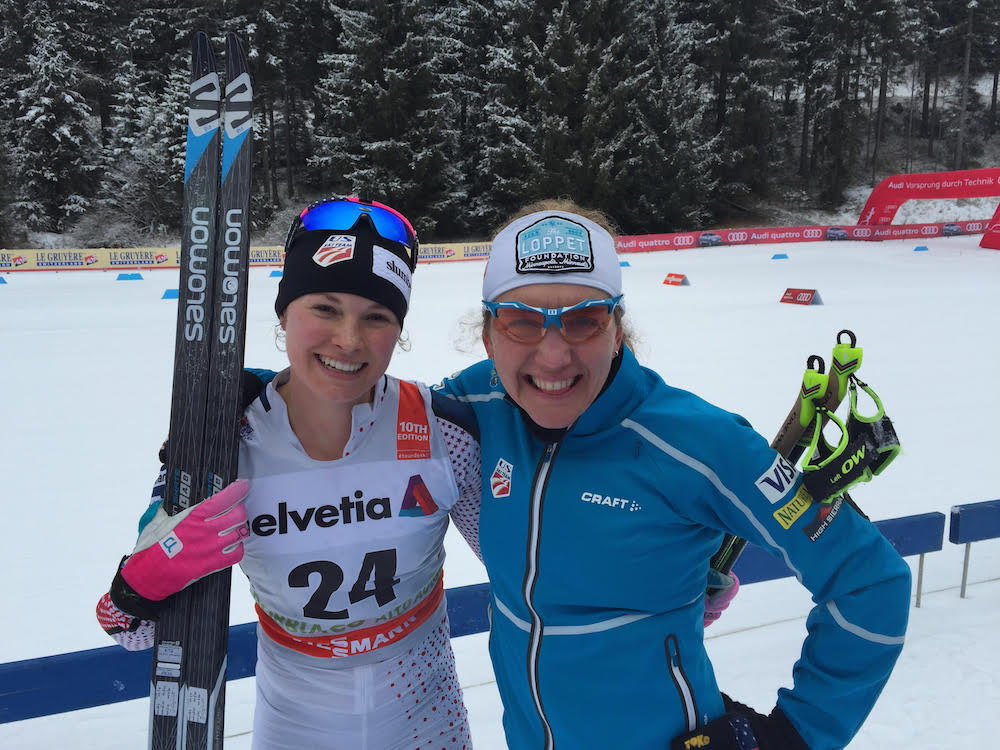
    Diggins with fellow U.S. Ski Team member Caitlin Gregg. The two shared the podium at 2015 World Championships in the 10 k freestyle, where Diggins placed second and Gregg was third. (Photo: JoJo Baldus)
    Diggins with fellow U.S. Ski Team member Caitlin Gregg. The two shared the podium at 2015 World Championships in the 10 k freestyle, where Diggins placed second and Gregg was third. (Photo: JoJo Baldus)

    The waiting began — a system of delayed gratification. She didn’t know how well her time was going to hold up, and so she collected her skis and left the finishing pen, walking past broadcast reporters who didn’t bother to interview her yet while fielding a multitude of polite congratulatory remarks.

    “Thank you! Thank you!” Diggins energetically replied.

    Slowly, but surely, her time weathered more and more finishers, keeping that top spot. She had enough time to go change clothes — little did Diggins know she was changing in preparation for the podium ceremony.

    Then came a moment of great excitement. Some of the remaining favorites were entering the stadium and finishing in rapid succession. Where would they stack up?

    Norway’s Ragnhild Haga: not quite, as she was 8.4 seconds short for second initially, and fourth at the end of the day.

    Sweden’s Charlotte Kalla: 12.3 seconds behind Diggins at the line would eventually be enough for seventh.

    One by one, as each of these top athletes crossed the line, Diggins’ eyes and smile grew bigger and bigger. She could not believe it. “I thought, well, this is obviously a really good race, and… maybe, maybe I will be on the podium,” she recalled.

    But they kept coming, unable to touch Diggins.

    Jessie Diggins (c) of the U.S. Ski Team after capturing the second U.S. women's win of the week at the Tour de Ski. Diggins won Friday's 5 k freestyle by 0.9 seconds over Norway's Heidi Weng (l) and another Norwegian Ingvild Flugstad Østberg (r) placed third. (Photo: JoJo Baldus)
    Jessie Diggins (c) of the U.S. Ski Team after capturing the second U.S. women’s win of the week at the Tour de Ski. Diggins won Friday’s 5 k freestyle in Toblach, Italy, by 0.9 seconds over Norway’s Heidi Weng (l) and another Norwegian Ingvild Flugstad Østberg (r) was 1.5 seconds behind in third. (Photo: JoJo Baldus)

    As Østberg — the clear leader at both timing points — cruised down into the stadium, the announcer bellowed, “Her pace is matching Diggins’ with a few hundred meters remaining,” and repeated the observation in several different languages.

    “No, she is 1.5 seconds back from Diggins’ time,” he continued.

    That put the overall Tour leader in second.

    Therese Johaug, second to Østberg at the 2.1 k checkpoint, was ultimately unable to match Diggins nor Østberg and finished fifth, 9.6 seconds back.

    Then came Weng, another Norwegian threat. “She could do it!” the announcer said.

    Spectators watched the seconds tick by on the Jumbotron.

    “She is into the final sprint, and ladies and gentlemen, this will be a fight to the end…”

    As Weng lunged across the line: “No, Weng cannot beat Diggins. Jessie Diggins has kept the top time. Weng takes second, just nine-tenths of a second behind!”

    Diggins melted to the ground in overwhelming excitement and disbelief. Weng and Østberg shared a hug of utter exhaustion just across the finish line before sincerely congratulating Diggins. Just 1.5 seconds separated the top three. “A day of very small margins,” as coach Whitcomb put it.

    ***

    Diggins at the post-race press conference after winning her first individual World Cup, the sixth stage of the Tour de Ski (a 5 k freestyle individual start). (Photo: JoJo Baldus)
    A smiling Jessie Diggins before the post-race press conference after winning her first individual World Cup, the sixth stage of the Tour de Ski (a 5 k freestyle individual start). (Photo: JoJo Baldus)

    Diggins emphasized that, despite feeling good about the race, she certainly did not expect to win.

    “I’m still in shock!” Diggins said as she awaited the awards ceremony. “I never thought that I would win it.”

    Diggins and Weng accelerated through the end of the course into first and second, respectively. Just under seven seconds off the podium in fourth, Haga also had faster second-half splits, but not quite enough to reach Diggins or Weng. Østberg and Johaug both lost time and ranking on the second half of the race.

    “I tried to open a bit slowly and get faster in the downhills,” Weng explained in a post-race press conference. “I think that was a very good tactic for me. … It’s a very hard race because you can overpower and it can go very good or it can go [bad] and you can [lose] many seconds in the end. It’s very hard to go five kilometres.”

    Østberg in third ended up besting her teammate and biggest Tour rival, Johaug, by 8.1 seconds. She will continue to wear the red Tour leader’s bib heading into the last two stages in Val de Fiemme, Italy, after extending her overall lead to 25.3 seconds ahead of Johaug.

    “It was a tight and hard race, and maybe I had a little [too] hard opening, different from the other racers, I guess,” Østberg said in the press conference. “In the last uphill my mother cheered for me, but my legs were just so tired I didn’t think I was gonna come to the finish. Another podium for me, and it’s so amazing that I’m still in the lead of the Tour de Ski. It’s unbelievable, for sure I didn’t believe it was possible. And 1.5 seconds from the win that’s amazing.”

    After the stage win, Diggins improved to 10th overall, 6:50.2 behind Østberg.

    A Proud U.S. Ski Team

    Diggins’ win, piggybacking on Caldwell’s sprint victory just two days prior, provides a very notable marker for the overall success of the U.S. Ski Team.

    “You need to have kind of everything perfect to have such a good race,” Diggins said in the press conference. “You have to have really good skis and your head has to be in the right place and then your body has to feel good, so it’s really exciting for us that it all worked out so many times this year.”

    “It is totally surreal,” Whitcomb remarked. “It is totally surreal because we have never had such success in a small amount of time with two different athletes. [There are] so many guns on this team.”

    Never before had the U.S. team racked up two stage wins by different athletes in the same Tour de Ski, which is in its 10th year. Randall won a prologue and a sprint stage in 2012/2013.

    According to FIS, the U.S. joins Norway and Finland as the only nations with a history of two stage wins by different athletes in the same Tour. Aino-Kaisa Saarinen and Virpi Kuitunen won stages in 2007/2008.

    “One thing is for sure, the Americans have proved they can for sure play with those Norwegians!!” teammate Sadie Bjornsen wrote in an email. She placed 13th on the day, 25.7 seconds behind Diggins.

    The wax team and support staff can revel in the team’s recent successes as well.

    “It speaks volumes to the work [head of service Oleg Ragilo] has put forward, the leadership that he has created out there…,” Whitcomb said. “When those guys can be rewarded with good results like this it makes us really happy for them.”

    Bjornsen Up to 13th Overall

    Sadie Bjornsen (U.S. Ski Team) racing to 13th in the 5 k freestyle at Stage 6 of the Tour de Ski in Toblach, Italy. (Photo: Fischer/NordicFocus)
    Sadie Bjornsen (U.S. Ski Team) racing to 13th in the 5 k freestyle at Stage 6 of the Tour de Ski in Toblach, Italy. (Photo: Fischer/NordicFocus)

    The 20th starter, heading out two minutes ahead of Diggins, Bjornsen initially finished fourth.

    “I went out there today racing for the podium,” Bjornsen recalled after starting the day ranked 14th in the Tour. “I decided to go with no fear and see how long I could hold on for…. And that lasted about 2.5k… At which point I realized I was going to have to dig seriously deep to make it home.”

    Her 1.7 k time held up as 10th fastest, 9.8 seconds behind Østberg, and at 2.1 k, Bjornsen sat in eighth, 5.8 seconds behind Diggins in third.

    “I am proud for taking a chance… Because at some point it will work,” Bjornsen continued.

    She improved one spot to 13th in the Tour, 7:58.8 out of the lead.

    U.S. teammates Liz Stephen placed 26th on Friday (+41.5) to move up three places into 25th overall, just over 10 minutes back, Rosie Brennan finished 33rd (+54.4) for 34th overall, and Caitlin Gregg was 39th (+1:05.7) for 39th overall.

    “I’m starting to feel more like myself everyday,” Brennan said during an in-person interview after the race. In the sixth stage of her first Tour de Ski, she started 41st on Friday, 30 seconds ahead of Weng.

    “I was coming down the hill and Heidi had passed me, and I’m like, Well, I really hope she’s having a good one,” Brennan recalled. “I just saw out of the corner [of my eye], the screen and I saw Jessie’s name, and I’m like, God damn that’s awesome!”

    Brennan plans to complete the Tour, ending with the final climb on Sunday.

    “I don’t have a particular one event that’s way better than the other, so I think this type of tour really suits me,” she said. “I’m looking forward to chalking this one up to experience and coming back for more later.”

    Also in her first-ever, eight-stage Tour, Gregg started 13th, one position ahead of Poland’s Justyna Kowalczyk, on Friday. While Kowalczyk went on to finish 18th (+34), Gregg explained being caught by her was a good thing.

    “I got caught by Kowalczyk at like 2 k, but then we actually skied together and that was awesome. It kind of lifted my momentum and I felt like my skis were really good,” Gregg said.

    “I think I entered [the Tour] just not really knowing how it would go and maybe I’m a little off — I have been since I got over here,” Gregg added. “Every race … I don’t get those good race sensations when I’m racing. I’m actually going home on Monday and I’m pretty stoked to reset and recharge.”

    The Tour continues in Val di Fiemme on Saturday with the women’s 10 k classic mass start and concludes with the 9 k freestyle climb up Alpe Cermis on Sunday.

    — Alex Kochon and Harald Zimmer contributed reporting

    Results | Tour standings (through Stage 6)

    ***

    About the Author: JoJo Baldus is a nordic skier from snowy Minneapolis, Minn. Currently living the dream as a volunteer journalist and photographer for FasterSkier while enjoying a gap year before starting at Macalester College in St. Paul. He could not be more excited to attempt to stagger across the finish line of 8 different WorldLoppet ski races this winter!

  • First Report: Another U.S. World Cup Win, Diggins Tops Field in 5 k Skate

    First Report: Another U.S. World Cup Win, Diggins Tops Field in 5 k Skate

    Jessie Diggins (c) of the U.S. Ski Team after capturing the second U.S. women's win of the week at the Tour de Ski. Diggins won Friday's 5 k freestyle by 0.9 seconds over Norway's Heidi Weng (l) and another Norwegian Ingvild Flugstad Østberg (r) placed third. (Photo: JoJo Baldus)
    Jessie Diggins (c) of the U.S. Ski Team after capturing the second U.S. women’s win of the week at the Tour de Ski. Diggins won Friday’s 5 k freestyle by 0.9 seconds over Norway’s Heidi Weng (l) and another Norwegian Ingvild Flugstad Østberg (r) placed third. (Photo: JoJo Baldus)

    TOBLACH, Italy — It’s that moment, that realization, when you’ve beaten the Norwegians — your most immediate threats.

    That’s a memory that will likely stick with American Jessie Diggins, a three-time Minnesota state champion, who, at the age of 24 won her first World Cup on Friday at the sixth stage of the Tour de Ski in Toblach, Italy. She became the second American woman to do so in the last three races on the Tour (after teammate Sophie Caldwell won the Stage 4 classic sprint), and the first U.S. female to do so in a modern World Cup race longer than 3 kilometers.

    Jessie Diggins (c) of the U.S. Ski Team after winning her first-career World Cup in Friday's 5 k freestyle at Stage 6 of the Tour de Ski in Toblach, Italy. (Photo: JoJo Baldus)
    Jessie Diggins (c) of the U.S. Ski Team after winning her first-career World Cup in Friday’s 5 k freestyle at Stage 6 of the Tour de Ski in Toblach, Italy. (Photo: JoJo Baldus)

    “I’m still in shock!” Diggins said in an in-person interview with FasterSkier after winning the women’s 5-kilometer freestyle individual start by 0.9 seconds in 13:15.5, holding off later-starting Norwegians Heidi Weng, Ingvild Flugstad Østberg, Ragnhild Haga, Therese Johaug, respectively.

    The victory also stood as her first individual World Cup podium, although Diggins has been on the World Championships podium twice before: first with Kikkan Randall in the 2013 freestyle team sprint (which they won) and then individually last season at 2015 World Championships in Falun, Sweden, where she placed second in the 10 k freestyle. In December 2012, before World Championships that season, Diggins and Randall teamed up to win a World Cup freestyle team sprint in Quebec City.

    “What’s so cool about this team is we ride on each other’s successes. Seeing Sophie do it [on Tuesday], we all train together, and we can do this!” Diggins said. “We just kept it going and yeah, I mean obviously I had some pretty incredible skis out there and it really shows the strength of the team that we push each other so hard to get to this point where we can start putting together really good races like this.”

    Diggins went out in bib 24 and ousted Germany’s Denise Herrmann from the lead at the finish by 15.7 seconds. Smiling and shaking her head as she sat on the ground, Diggins looked like she knew she had a good race. But a World-Cup-winning kind of day?

    Jessie Diggins (U.S. Ski Team) racing to her first World Cup victory in the 5 k freestyle at Stage 6 of the Tour de Ski in Toblach, Italy. She won by 0.6 seconds, beating out four Norwegians in the top five. (Photo: JoJo Baldus)
    Jessie Diggins (U.S. Ski Team) racing to her first World Cup victory in the 5 k freestyle at Stage 6 of the Tour de Ski in Toblach, Italy. She won by 0.6 seconds, beating out four Norwegians in the top five. (Photo: JoJo Baldus)

    “This was a big surprise for everyone, most especially me; I couldn’t believe it. I really couldn’t believe it,” Diggins said in a televised interview with FIS.

    Her splits at just two timing points on the course ranked fourth at 1.7 k and third at 2.1 k. Just before the halfway point at 2.1 k, her time trailed Østberg’s by 8 seconds.

    But Diggins proved fastest over the second half of the course, holding off Weng in bib 42 as her closest challenger, 0.9 seconds back. The overall World Cup leader, Østberg ended up third (+1.5), Haga fourth (+8.4), and Johaug fifth (+9.6).

    She now ranks 10th after six of eight stages in the Tour, 6:50.2 behind Østberg, who extended her lead over Johaug by 25.3 seconds. Teammate Sadie Bjornsen ranks 13th overall (+7:58.8) after placing 13th on Friday, 25.7 second after Diggins.

    Also for the U.S., Liz Stephen placed 26th (+41.5) and ranks 25th overall, Rosie Brennan finished 33rd (+54.4) for 34th in the Tour and Caitlin Gregg was 39th (+1:05.7) for 39th overall.

    Stay tuned for more details and a complete report.

    — JoJo Baldus contributed reporting

    Results | Tour standings (through Stage 6)

  • One for the Books: Caldwell Wins Oberstdorf Classic Sprint, Over Weng & Østberg

    One for the Books: Caldwell Wins Oberstdorf Classic Sprint, Over Weng & Østberg

    Sophie Caldwell (U.S. Ski Team) after winning the 1.2 k classic sprint final at Stage 4 of the Tour de Ski in Oberstdorf, Germany. (Photo: Marcel Hilger)
    Sophie Caldwell (U.S. Ski Team) smiles for TV cameras after winning the 1.2 k classic sprint final at Stage 4 of the Tour de Ski in Oberstdorf, Germany. In doing so, she became the third U.S. woman to win a World Cup, after Alison Kiesel (formerly Owen-Spencer) won the inaugural women’s World Cup race in 1978 at Telemark in Cable, Wis. Caldwell’s teammate, Kikkan Randall became the second U.S. woman to top the World Cup podium (and the first in modern World Cups). (Photo: Marcel Hilger)

    OBERSTDORF, Germany — Tuesday was definitely a thrilling day to be a U.S. nordic fan. The race format for the fourth stage of the Tour de Ski: a 1.2-kilometer classic sprint, was characterized by a single lap of wet, mushy, dirty snow.

    Sophie Caldwell, of U.S. Ski Team and Stratton Mountain School T2 Team, shined through the gloomy, spitting weather; advancing through the heats and then beating out a final full of Norwegians and Swedes to take the top spot on the podium. In doing so, the 25-year-old Vermont native became the third U.S. woman to win a World Cup race, and the first to do so in a classic sprint.

    Sophie Caldwell soaks up her first World Cup win on Tuesday at the Tour de Ski Stage 4 classic sprint in Oberstdorf, Germany. (Photo: Fischer/NordicFocus)
    Sophie Caldwell soaks up her first World Cup win on Tuesday at the Tour de Ski Stage 4 classic sprint in Oberstdorf, Germany. (Photo: Fischer/NordicFocus)

    “Push it over the tops, stick on Ingvild on the ups, and have a strong finish.”

    This was Caldwell’s magic mixture to reach the highest step in the podium, the spot every racer aspires to in their career. It was a simple-enough strategy, but it worked wonders in all of her heats, even securing her joyous victory in the final.

    In the last month or so since the 2015/2016 World Cup season began, Caldwell has emerged as one of the world’s top sprinters. Her win didn’t come out of nowhere; some analysts observed she has been lurking in the shadows of the podium-frequenting Norwegians. She built up to Tuesday with multiple appearances in sprint finals: doing so in two of the three freestyle sprints preceding the Tour’s classic sprint in Oberstdorf.

    The one time she missed the skate-sprint final, she did so by one place — finishing seventh in Toblach, Italy. In the only two sprints of the Tour, Caldwell qualified in second (on Jan. 1 in Lenzerheide, Switzerland; a skate sprint) and third on Tuesday.

    In Lenzerheide, she narrowly missed the podium in fourth in the final. Before the holiday break, she placed seventh in Toblach and sixth in the skate sprint in Davos, Switzerland.

    Yet on Tuesday, she beat the Norwegians at their game — classic sprinting — holding off Heidi Weng by 0.1 seconds in the finishing stretch with the win in 2:46.38 minutes. Ingvild Flugstad Østberg, the overall leader after both Stage 3 and 4 of the Tour, was the second Norwegian on the podium in third (+0.8), but after winning the qualifier to start the day, Østberg had been the favorite.

    “It has been a while since I have been on the podium and that is the first sprint I have ever won,” Caldwell reflected in an in-person interview with FasterSkier after the race. “I am psyched. I never thought it would come in a classic sprint, so that was a pleasant surprise.”

    The course, conditions, and resulting tactics

    The Oberstdorf race stadium was far from a dreamy winter wonderland with sleigh rides and snow falling. There had been much uncertainty about whether the event organizers would be able to produce enough snow to cover the stadium race loop. About a week ago, the International Ski Federation (FIS) and the organizing committee gave Oberstdorf “the green light” for the fourth and fifth stages of the Tour. Then, as a rainy sleet mix fell heavily for all of Monday, it was hard to believe world-class ski races would happen there.

    Germany's Sandra Ringwald (2) and Denise Herrmann (9) go head-to-head with American Sophie Caldwell (3) during the 1.2 k classic sprint at Stage 4 of the Tour de Ski in Oberstdorf, Germany. (Photo: Marcel Hilger)
    Germany’s Sandra Ringwald (2) and Denise Herrmann (9) go head-to-head with American Sophie Caldwell (3) during the 1.2 k classic sprint at Stage 4 of the Tour de Ski in Oberstdorf, Germany. (Photo: Marcel Hilger)

    The course turned out to be quite soft, uneven and thoroughly saturated; a layer of mush on the top seemed to make control tricky. But across the board, athletes were impressed and expressed gratitude about the course the organizers and volunteers worked hard to prepare against the forces of warm weather. Caldwell, a New Englander, thrived in the less-than-ideal snow conditions.

    After the race, U.S. Ski Team Women’s Coach Matt Whitcomb (who previously coached at Burke Mountain Academy in Vermont) commented how “these conditions today are like growing up in New England; skiing through slop, it’s no big deal.”

    Temperatures in the mid-to-upper 30s and drizzle occasionally spitting down on racers made for a brutal day for the waxing team.

    “Really difficult, really difficult,” Whitcomb emphasized, referring to the waxing. “This was a day that could not have been done without great skis.”

    Caldwell described her skis as “amazing. … I was kicking up everything and they were clearly some of the best ones on the downhills.”

    Sophie Caldwell (U.S. Ski Team) racing to third in the 1.2 k classic sprint qualifier at Stage 4 of the Tour de Ski in Oberstdorf, Germany.  She went on to win the final for her first World Cup victory. (Photo: Marcel Hilger)
    Sophie Caldwell (U.S. Ski Team) racing to third in the 1.2 k classic sprint qualifier at Stage 4 of the Tour de Ski in Oberstdorf, Germany. She went on to win the final for her first World Cup victory. (Photo: Marcel Hilger)

    Not only were her skis some of the best gliding the downhills, but she also proved to be one of the most confident downhill skiers.

    “She got to the tops of climbs and attacked over them rather than backing off, and that was a big difference-maker today,” Whitcomb said.

    There was one particularly treacherous downhill into a turn about halfway into the race. This section gave many athletes trouble during the heats, including a wipeout that took down Caldwell’s teammate Jessie Diggins and out of the running in her quarterfinal.

    In the final, Caldwell avoided any potential for downhill trouble when Sweden’s Ida Ingemarsdotter shifted her skis into a snowplow formation, her ski tails nearly skimming Caldwell’s skis. Caldwell shot past her through an opening on the right, step turning the lefthand corner to get within striking distance of the lead.

    Another major key to Caldwell’s success proved to be a wise tactical move: lock onto Østberg and never let go. That is, until Caldwell passed her on the final roller over a bridge and led down into the finishing stretch. Caldwell faced Østberg in both the semifinal and final, and clamped down on her ski tails without fail. This helped Caldwell, known recognized as one of the most consistent lucky losers in World Cup sprints, comfortably advance to the final: initially winning her quarterfinal (ahead of Sweden’s Stina Nilsson) and placing second in her semifinal to Østberg.

    Østberg won the first quarterfinal by nearly 4 seconds. She entered Tuesday’s race with a broad repertoire of recent sprint podiums, so it fit logic to follow her stride. In the last three skate sprints, she reached the podium in every race. Placing third on Tuesday, she extended her Tour lead over teammate Therese Johaug — a distance skier who notably reached the final and finished fifth (+4.71)

    Sophie Caldwell (U.S. Ski Team)  lunges to edge Norway's Heidi Weng (not shown) for the win in the 1.2 k classic sprint final at Stage 4 of the Tour de Ski in Oberstdorf, Germany. (Photo: Marcel Hilger)
    Caldwell lunges to edge Norway’s Heidi Weng (not shown) for the win in the 1.2 k classic sprint final at Stage 4 of the Tour de Ski in Oberstdorf, Germany. Østberg (behind Caldwell) placed third. (Photo: Marcel Hilger)

    Østberg led the majority of the final with Caldwell behind her, and Weng and Ingemarsdotter skiing beside them in another track. On the final downhill curve, on the backside of the last bridge bump, Caldwell passed Østberg on the inside and led into the finishing flat.

    Weng also passed the tiring Østberg and began gaining on Caldwell. But Caldwell was able to hold off Weng in the double-pole derby and take the win with a final lunge, winning by one-tenth of a second.

    The favorite to win the overall Tour, Johaug was more than thrilled to finish fifth and earn crucial bonus seconds to stay close to Østberg with four distance races remaining. Sweden’s Ingemarsdotter and Nilsson rounded out the final in fourth (+3.95) and sixth (+27.43), after Nilsson crashed alone at the back of the pack on the troublesome downhill and slid into the barrier lining the course.

    Answering a rush of Norwegian reporters after the race, the characteristically modest Caldwell said, “The Norwegians are very dominant, so it feels really good to upset them.

    “But they are all so nice,” she added. “At the end, they were all congratulating me. It was a fun race.”

    Immediately after finishing, Weng was the first to congratulate Caldwell with a hug. Essentially every other competitor in the final made a point to congratulate her as well in a series of embraces before Caldwell’s victory lap.

    Sophie Caldwell (c) after becoming the first U.S. woman to win a World Cup classic sprint with the other podium finishers, Norway's Heidi Weng (l) in second and Ingvild Flugstad Østberg (r) in third in the 1.2 k classic sprint at Stage 4 of the Tour de Ski in Oberstdorf, Germany. (Photo: Marcel Hilger)
    Sophie Caldwell (c) after becoming the first U.S. woman to win a World Cup classic sprint with the other podium finishers, Norway’s Heidi Weng (l) in second and Ingvild Flugstad Østberg (r) in third in the 1.2 k classic sprint at Stage 4 of the Tour de Ski in Oberstdorf, Germany. (Photo: Marcel Hilger)

    The dynamics between Caldwell and the two Norwegians sharing the podium with her in the post-race press conference could not have been warmer.

    “These two girls were faster than me the last couple hundred meters,” Østberg said. “That Sophie could win and the U.S. could get a win, I think that’s so fun.”

    A swarm of young children glowing with excitement to get Caldwell’s autograph engulfed the American as she exited the press area. With this, the public celebrations drew to a close and the U.S. team headed back to their hotel with a contagious, electric buzz of team-wide excitement.

    “It’s not just about winning, of course, it’s about watching somebody who put in a lot of work, learned how to believe in themselves, and attack a plan and have it work out,” Whitcomb said. “But at the end of the day it’s also really fun to watch Sophie succeed. She cares every bit as much about her teammates as she does about herself. And so it’s a team win today.”

    Sophie Caldwell plans to race the 10-kilometer classic mass start in Oberstdorf on Wednesday and possibly also race Stage 6 of the Tour: a 5 k skate in Toblach, Italy. Although she does not plan to finish the Tour, it is worth noting a sizable leap from 27th to 14th in the overall Tour standings with her win on Tuesday.

    The rest of the U.S. women: Sargent 15th, Diggins 21st

    Jessie Diggins (11) during her quarterfinal of the 1.2 k classic sprint at Stage 4 of the Tour de Ski in Oberstdorf, Germany. The American placed fifth after crashing with Hanna Falk (18). (Photo: Marcel Hilger)
    Jessie Diggins (11) during her quarterfinal on Tuesday. The American placed fifth after crashing with Sweden’s Hanna Falk (18). (Photo: Marcel Hilger)

    Also for the U.S., Diggins and Ida Sargent qualified for the heats with the  11th and 14th-fastest qualifying times, respectively. Notably, Diggins skied her entire qualifier without a pole basket.

    “It fell off at the start and I felt myself punching through, and I was like ‘no way,’ ” she recalled. “So I just skied as hard as I could because I thought, it is going to be a miracle for me to qualify like this.”

    Sure enough she did, and in a comfortable 11th, well within the top 30, 8.45 seconds behind Østberg’s top time of 2:38.18.

    In the quarterfinals, Diggins’ run ended when she collided with Sweden’s Hanna Falk, who snowplowed the notorious downhill. They entered the descent together, side by side in first and second, but as they picked up speed, the back of one of Falk’s skis clipped Diggins and they both went down. Diggins finished fifth in that heat, 26.22 seconds behind Johaug, who won that quarterfinal.

    “The silver linings of today, and I am all about silver linings, are that I felt great … I mean, physically I am fit, I am ready, I am in a good position in the Tour,” Diggins said. She’s currently 10th in the overall standings and 4:33.4 out of the lead. “I am ready for the next race.”

    Ida Sargent ( U.S. Ski Team) racing to third in her quarterfinal for 15th overall at the 1.2 k classic sprint at Stage 4 of the Tour de Ski in Oberstdorf, Germany. (Photo: Marcel Hilger)
    Ida Sargent ( U.S. Ski Team) racing to third in her quarterfinal for 15th overall at the 1.2 k classic sprint at Stage 4 of the Tour de Ski in Oberstdorf, Germany. (Photo: Marcel Hilger)

    Sargent narrowly avoided the first series of crashes of the day in the first women’s quarterfinal (Sweden’s Charlotte Kalla, Russia’s Natalia Matveeva and Germany’s Nicole Fessel all went down on the same hill) and placed third her heat. Sargent finished 10.36 seconds behind the winner of that quarterfinal, Østberg, which was not enough to advance to the semifinals.

    “That downhill was crazy; I was certain I was gonna go down,” Sargent said. “My ski was caught on an ice chunk of some kind so I was really happy to stay up, but I think I needed a little more kick to hammer the [next] uphill.”

    At the end of the day, Sargent placed 15th and Diggins 21st overall. Also for the U.S., Rosie Brennan again narrowly missed qualifying in 35th, Sadie Bjornsen did not make the quarterfinals in 44th due to a crash, Liz Stephen finished 49th, and Caitlin Gregg placed 53rd.

    In terms of overall Tour standings after four of eight stages, Diggins ranks 10th (+4:33.4), Bjornsen slipped out of the top 10 to 13th (+4:53.7), Caldwell is up to 14th (+5:23.7), Stephen is 25th (+6:22.1), Caitlin Gregg 39th (+8:12.6), Brennan 42nd (+8:33.1), and Sargent 45th (+8:47.3).

    Results | Tour standings (after Stage 4)

    — Alex Kochon contributed reporting

  • First Report: Caldwell Does What She Considered Unthinkable

    First Report: Caldwell Does What She Considered Unthinkable

    Sophie Caldwell became the second U.S. woman to win a World Cup race on Tuesday at Stage 4 of the Tour de Ski in Obertsdorf, Germany. The U.S. Ski Team member won the classic sprint ahead of Norwegians Heidi Weng (l) and Ingvild Flugstad Østberg (r), the latter of which leads the Tour de Ski standings.
    Sophie Caldwell (c) became the third U.S. woman to win a World Cup race on Tuesday at Stage 4 of the Tour de Ski in Oberstdorf, Germany. The U.S. Ski Team member won the classic sprint ahead of Norwegians Heidi Weng (l) and Ingvild Flugstad Østberg (r), the latter of which leads the Tour de Ski standings.

    Note: This is an initial post about American Sophie Caldwell’s World Cup victory on Tuesday at the Tour de Ski in Obertsdorf, Germany. Stay tuned for more in-depth reports about the women’s and men’s classic sprints.

    Correction: This article has been updated to reflect the fact that Caldwell became the third U.S. woman to win a World Cup.  Alison Kiesel (formerly Owen-Spencer) won the inaugural women’s World Cup event in December 1978 at Mount Telemark in Wisconsin.

    ***

    OBERSTDORF, Germany — Sophie Caldwell saw the opportunity in the final roller of a hill in the women’s 1.2-kilometer classic sprint final on Tuesday and she seized it, overtaking the last Norwegian in her sights and holding off Heidi Weng by one-tenth of a second to win Stage 4 of the Tour de Ski.

    “It feels really good,” Caldwell, a 25-year-old member of the U.S. Ski Team, told FasterSkier in an in-person interview after the race. “It has been a while since I have been on the podium and that is the first sprint I have ever won. So I am psyched, I never thought it would come in a classic sprint so that was a pleasant surprise.”

    A native of Peru, Vt., and daughter of the Stratton Mountain School’s nordic director Sverre Caldwell, Caldwell has been on the World Cup podium once before — in a freestyle sprint in March 2014 in Lahti, Finland. There, she placed third after teammate Kikkan Randall, who won, and Slovenia’s Katja Visnar in second. Two U.S. women had never before shared a World Cup podium.

    On Tuesday, Caldwell continued to make U.S. history, becoming the third American woman, after Randall and Alison Kiesel, to win a World Cup race. Caldwell is also the first U.S. woman to win a World Cup classic sprint.

    No stranger to sprint finals, she had reached the finals (thus placing in the top six) in two of the last three sprints (all of which were freestyle) before Tuesday. The only one she missed, she did so by just one place in seventh in Toblach, Italy. She has now placed in the top seven in four consecutive sprints.

    “I knew I had some really good skis today and my strengths are usually tricky downhills because I didn’t like to snowplow and I don’t get freaked out by them,” Caldwell said of Tuesday’s classic sprint.

    “I was probably the last person who woke up this morning and thought this would happen,” she told FIS media coordinator Jeff Ellis (Randall’s husband) in a post-race interview. “I’m thrilled.”

    “We know Sophie is among the best downhill skiers in the world,” U.S. women’s coach Matt Whitcomb said. “These conditions today are like, growing up in New England, skiing through slob it’s no big deal. She got to the tops of climbs and attacked over them rather than backing off, and that was a big difference-maker today. But what really stood out was that she was climbing with the best of the world today.”

    Caldwell stayed on her feet all day, even in the final when Sweden’s Ida Ingemarsdotter came close to nicked her skis. Ingemarsdotter began to snowplow on a washed-out descent, which caused problems in several heats — including those of Caldwell’s U.S. teammates Ida Sargent and Jessie Diggins. In the final, Caldwell scooted around the snowplowing Ingemarsdotter and moved into third behind Norway’s Ingvild Flugstad Østberg — the overall Tour de Ski leader — and Weng. She proceeded to pick both Norwegians off to take the win.

    Earlier in the day, Sargent avoided a crash in the first women’s quarterfinal to place third in that heat. But finishing 10.36 seconds behind Østberg as the winner of that quarterfinal, Sargent did not advance to the semifinals.

    Neither did Diggins, who got hung up in a snowplow snafu by Sweden’s Hanna Falk on that same downhill in the fourth quarterfinal. The back of Falk’s skis caught Diggins and both went down. Diggins finished fifth in that heat, 26.22 seconds behind Norway’s Therese Johaug, who won that quarterfinal. Falk crossed the line 50 seconds back in sixth.

    At the end of the day, Sargent placed 15th and Diggins 21st. Also for the U.S., Rosie Brennan again narrowly missed qualifying in 35th, Sadie Bjornsen did not make the quarterfinals in 44th, along with Liz Stephen in 49th, and Caitlin Gregg in 53rd.

    In terms of overall Tour standings after four of eight stages, Diggins ranks 10th (+4:33.4), Bjornsen slipped out of the top 10 to 13th (+4:53.7), Caldwell is up to 14th (+5:23.7), Stephen is 25th (+6:22.1), Caitlin Gregg 39th (+8:12.6), Brennan 42nd (+8:33.1), and Sargent 45th (+8:47.3).

    Racing continues in Obertsdorf on Wednesday with the women’s 10 k classic mass start and men’s 15 k classic mass start.

    “[I] plan on racing tomorrow as long as … I have had a bit of a race hack, so as long as that doesn’t get any worse,” Caldwell said.

    (Her boyfriend Simi Hamilton had to skip Tuesday’s sprint and thus withdraw from the Tour due to illness.)

    “I plan on racing tomorrow and then probably dropping out,” she continued. “There is a small chance I would do the 5 k in Toblach [Italy on Friday], but kind of taking it a day at a time. I won’t go past Toblach.”

    Results | Tour standings (after Stage 4)

  • Johaug Tallies 25th World Cup Win in Toblach; Bjornsen 19th, Diggins 20th

    Johaug Tallies 25th World Cup Win in Toblach; Bjornsen 19th, Diggins 20th

    Norway's Therese Johaug racing to a 28.2-second win in the Toblach World Cup 10 k classic on Sunday in Italy. (Photo: Fischer/NordicFocus)
    Norway’s Therese Johaug racing to a 28.2-second win in the Toblach World Cup 10 k classic on Sunday in Italy. (Photo: Fischer/NordicFocus)

    Taking her fifth-consecutive World Cup distance victory in Sunday’s 10-kilometer classic individual start classic race in Toblach, Italy, Norway’s 27-year-old Therese Johaug continued to dominate the women’s distance races this season.

    No woman has been able to top Johaug’s incredible fitness this season as her smallest margin of victory was 17 seconds over only 5 kilometers in the opening races in Kuusamo, Finland.

    “I don’t think I have ever been in such good shape in my life,” Johaug told FIS after winning Sunday’s race in 27:22.4 minutes.

    The 34th starter, Johaug established her lead at the first checkpoint at 1.7 k (where she was 0.2 seconds ahead of teammate Heidi Weng) and extended throughout the two-lap race. By 2 k, she was 4.7 seconds ahead of Weng, and by the halfway point, she was 17 seconds ahead of another teammate Ingvild Flugstad Østberg, who moved into second.

    The women's 10 k classic podium at the World Cup in Toblach, Italy: with Norwegian winner Therese Johaug (c), Finland's Krista Parmakoski (l) in second, and Norway's Ingvild Flugstad Østberg (r) in third. (Photo: Fischer/NordicFocus)
    The women’s 10 k classic podium at the World Cup in Toblach, Italy: with Norwegian winner Therese Johaug (c), Finland’s Krista Parmakoski (l) in second, and Norway’s Ingvild Flugstad Østberg (r) in third. (Photo: Fischer/NordicFocus)

    Johaug went on to win by 28.2 seconds over Finland’s runner-up Krista Parmakoski, who started 52nd. Norway had two on the podium with Østberg in third, 40.1 seconds behind Johaug.

    The win marks Johaug’s 25th-career World Cup distance victory, which ties her for fourth on the all-time list with Norway’s Bente Skari. Ahead of her, Johaug’s teammate Marit Bjørgen has 53 wins, Russia’s Elena Välbe won 44 and Poland’s Justyna Kowalczyk won 34, according to FIS.

    Parmakoski, 25, had long awaited her result on Sunday since she last reached the World Cup podium in the Tour de Ski 10 k classic in 2013.

    “I have been waiting for this moment since the beginning of the season,” Parmakoski told FIS. “I knew my energy and shape was there, but until today I did not show it in my results.”

    Norway's Therese Johaug celebrates her 25th World Cup victory on Sunday at the 10 k classic in Toblach, Italy. (Photo: Fischer/NordicFocus)
    Norway’s Therese Johaug celebrates her 25th World Cup victory on Sunday at the 10 k classic in Toblach, Italy. (Photo: Fischer/NordicFocus)

    Weng posted the third-fastest times throughout most of the race, but Parmakoski skied a strong final 3 k to hold off both Weng, who started 54th, and Østberg, in bib 58, behind her.

    Best known for sprinting, Østberg has been making her mark on the distance races as well this season and currently sits in second in the overall World Cup standings, 112 points behind Johaug. Sunday’s race marked her fifth-individual podium this season, including second place in the Davos 15 k freestyle.

    “The season has been so great for me. I nearly cannot believe it,” Østberg told FIS.

    Five seconds back from Østberg, Weng placed fourth (+45.2) and Sweden’s Charlotte Kalla was another 5 seconds back in fifth (+50.2). Finland put four in the top nine with Anne Kyllönen in sixth, Laura Mononen in seventh and Kerttu Niskanen in ninth (after Kowalczyk in eighth). Sweden’s Anna Haag placed 10th.

    Two U.S. Women in Top 20

    The U.S. women’s team had two in the top 20 as Sadie Bjornsen continued her streak of top-20 finishes in every race she’s started so far this season, finishing 19th (+2:04.6), and Jessie Diggins placed 20th (+2:09) for her best classic distance race of 2015/2016.

    The American contingent also included Liz Stephen in 34th (+2:39.6), Rosie Brennan in 38th (+3:06.2), Sophie Caldwell in 41st (+3:13.2), and Caitlin Gregg in 43rd (+3.20.1).

    Sophie Caldwell (U.S. Ski Team) racing to 41st in the World Cup 10 k classic in Toblach, Italy. (Photo: Fischer/NordicFocus)
    Sophie Caldwell (U.S. Ski Team) racing to 41st in the World Cup 10 k classic in Toblach, Italy. (Photo: Fischer/NordicFocus)

    In seven individual World Cup races in the last two months, Bjornsen has consistently placed in the top 20, in both distance and sprint events. Even so, her result on Sunday left her wanting a bit more.

    “Today was an incredibly challenging day due to conditions and the track,” she wrote in an email. “I gave it 110%, but unfortunately the result didn’t show what I believe It was capable of today. I went out there trying to win, but the ducks didn’t all align today. It’s ok — one day they will, and I’ll fight for a classic podium!”

    The 20th starter, Bjornsen skied a consistent race, posting times at each of the four checkpoints that ranked between 18th and 23rd in the field of 60 racers. Meanwhile, Diggins in bib 29 rallied late in her race to move from 27th to 20th overall in the last three kilometers.

    The challenges of the Toblach’s 5 k course, with gradual climbing toward the middle of each lap, were compounded by somewhat-tricky waxing conditions on Sunday. Temperatures were forecast to be around 4 degrees Celsius (39 Fahrenheit), but ended up around freezing (0 Celsius) and the snow on the course was entirely artificial. The course included two 5 k laps and more than 600 meters (1,970 feet) of climbing over 10 k.

    While some of the competitors in the men’s 15 k, including winner Martin Johnsrud Sundby, chose to forgo kick wax and double pole on skate skis, the women’s field worked to strike the delicate balance of kick and glide.

    “It was warm and artificial snow, but the course held up very well,” Brennan wrote in an email. “This course is tricky because you really need fast skis, but if you are going to go with kick, you want to be able to actually kick so some combination of the right skis and right wax can make a big difference.”

    U.S. Ski Team Head Coach Chris Grover suggested the conditions were “not that tricky” and his athletes’ skis were sufficient.

    “Our wax techs did a great job and we had good skis,” he wrote in an email. “The course was in good shape. Cold snow that set-up firm overnight.”

    Diggins described Toblach as a tough course because it features a lot of gradual climbing, “(which I love because it feels like real classic skiing out there — long kicking and gliding) but also not a lot of rest!” she wrote in an email. “The corners and downhill sections are ones that demand to be worked well, and you can make up a lot of time on them by staying focused and working every inch.”

    Stephen echoed the unique challenges of the Toblach course.

    “Every hill is kind of the same grade, both up and down and it makes it a challenging one for me to keep the glide and powerful pushes that are needed,” she wrote.

    For a team steeped in skating depth, improving classic distance results are encouraging.

    “I’ve been working so hard for years to improve my classic skiing, so it feels really good to finally have that hard work come across in World Cup races!” Diggins wrote. “I was happy with my race today, for sure.”

    Grover called it “a solid day for the USA but not a standout one.” Asked specifically about Bjornsen and Diggins, he observed, “Both looked good but we know they can ski faster. They both were left wanting more and I think we’ll see a step forward during the Tour [de Ski].”

    The first period of the World Cup concluded in Toblach and racers now have a week and a half off before racing resumes with the Tour de Ski on Jan. 1.

    The break allows World Cup racers some rest and recovery as well as time for some training, and for those who live in Europe — a trip home for the holidays. It’s also a time to take inventory and gear up for strong racing in Period 2.

    Emily Nishikawa (Canadian Development Team) racing to 39th in the Davos World Cup 15 k freestyle on Dec. 12 in Switzerland. She tied her season-best 39th in the Toblach World Cup 10 k classic on Dec. 20. (Photo: JoJo Baldus)
    Emily Nishikawa (Canadian Senior Development Team) racing to 39th in the Davos World Cup 15 k freestyle on Dec. 12 in Switzerland. She tied her season-best 39th in the Toblach World Cup 10 k classic on Dec. 20. (Photo: JoJo Baldus)

    “I am happy with my consistency because I think that shows I have good base fitness, but I am certainly looking to pick up a little speed and some more positive feelings during the Christmas break,” Brennan wrote.

    “I felt like after racing every single race in period 1, plus the pre-season Gallivare races, my body is a little tired and I’m really looking forward to a nice relaxing week of training in Davos [Switzerland] with my teammates,” Diggins explained.

    The lone Canadian in the women’s race, Emily Nishikawa tied Germany’s Lucia Anger for 39th (+3:10.1), which also tied her best result of the season.

    “This was a good result for Emily,” Canadian National Team Head Coach Justin Wadsworth said in a Cross Country Canada press release. “She is in better shape now than she has been in years past. We are hoping for Emily to get into that top-30 so we need to keep working and progressing towards that goal.”

    Nishikawa could not be immediately reached for comment.

    Results

  • Pellegrino Wins Again; Hamilton Second in Toblach for Second Career Podium

    Pellegrino Wins Again; Hamilton Second in Toblach for Second Career Podium

    Simi Hamilton (U.S. Ski Team) racing to his first non-stage World Cup podium on Saturday in Toblach, Italy, where he placed second in the freestyle sprint. (Photo: Fischer/NordicFocus)
    Simi Hamilton (U.S. Ski Team) racing to his first non-stage World Cup podium on Saturday in Toblach, Italy, where he placed second in the freestyle sprint. (Photo: Fischer/NordicFocus)

    (Note: This brief summary of Saturday’s freestyle sprints was intended was followed up with more in-depth reports. Read the full story about Hamilton here.)

    Simi Hamilton had this race circled on his calendar. Several U.S. Ski Team members did as the Saturday’s 1.3-kilometer sprint in Toblach, Italy, was the second freestyle sprint in the last two World Cup weekends.

    Last weekend, Hamilton qualified in 10th at the skate sprint in Davos, Switzerland. He broke a pole halfwayinto hisquarterfinal and ended up 26th overall. Not bad, but Hamilton, 28, was looking for more.

    He said he couldn’t complain on Saturday after qualifying in 16th and placing second in both his quarterfinal and semifinal en route to the final where he reached the podium in second overall. It was his first podium in a non-stage World Cup after winning a Tour de Ski sprint two years ago in Lenzerheide, Switzerland. According to a USSA press release, this stood as the sixth podium in U.S. men’s cross-country history: Andy Newell has three and Torin Koos has one.

    “I knew that I wanted to put something together for this weekend; skate skiing is one of my strengths my best thing and we had one on the schedule and it got me fired up,” Hamilton said in a post-race phone interview with FasterSkier. “I’m pretty psyched for sure about the day. A lot of things just came together for me.”

    Hamilton placed second to Italy’s Federico Pellegrino, who won his second-straightfinal in 2:29.57, after winning last weekend’s Davos sprint as well. Now with fiveWorld Cup skate sprint victories, Pellegrino is tiedwithChristian Zorzi as Italy’smost successful sprinter ever.

    Hamilton finished 0.48 seconds after Pellegrino, just ahead of Andrew Young, who became Great Britain’s first-everskier to podium in aWorld Cup sprint in third (+0.84).Switzerland’s Jovian Hediger placed fourth (+1.09), Norway’s Finn Hgen Krogh was fifth (+1.44), and Norway’s Sondre Turvoll Fossli took sixth (+11.89).

    In a press release, U.S. Ski Team Head Coach Chris Grover noted that Hamilton has been in topform and finally had a chance to show it on Saturday.

    “Heexecuted his race plan perfectly from quarterfinals to final — relaxing early on in each heat and then making big moves to get himself to the front in the middle of the course and on the last uphill before the finish,” Grover said. “The next sprint on the World Cup is Lenzerheide where Simi won two years ago.”

    Also for the U.S., Newell qualified in 13th and went on to place 27th after finishing sixth in his quarterfinal. He was only a second back from the winner, Hediger, in that heat.

    In the women’s race, Hamilton’s girlfriend, Sophie Caldwell, narrowly missed her second World Cup final of the season in seventh. Last Sunday, sheplaced sixth in Davos.

    On Saturday, Caldwell qualified 10th (she was one of three U.S. women to qualify in the top 10), and went on to place second in her quarterfinal then fourth in her semifinal, 0.53 seconds behind Norway’s Maiken Caspersen Falla, who won that semifinal and went on to win the final as well.

    Just behind Caldwell, Sadie Bjornsen ended the day in ninth after qualifying in sixth, advancing in second in her quarterfinal then placing fifth in her semifinal (just 0.01 seconds behind Russia’s Natalia Matveeva in fourth and 0.46 behind Norway’s Ingvild Flugstad stberg, who won that semifinal.

    Jessie Diggins qualified ninth for the U.S. and ended up 22nd after taking fifth in her quarterfinal. She raced in the same quarterfinal as teammate Ida Sargent, who finished sixth in that heat after qualifying in 28th. The fifth U.S. woman, Rosie Brennan missed the top 30 by 1.91 seconds in 35th.

    Stay tuned for complete reports.

    Final results: Men | Women

  • Caldwell Sneaks into Davos Sprint Final for Sixth; Diggins 9th

    Caldwell Sneaks into Davos Sprint Final for Sixth; Diggins 9th

    Sophie Caldwell (U.S. Ski Team) qualified fifth in the Davos World Cup skate sprint on Sunday and went on to make the final as a two-time lucky loser (in both the quarterfinals and semifinals), then finish sixth overall. (Photo: JoJo Baldus)
    Sophie Caldwell (U.S. Ski Team) qualified fifth in the Davos World Cup skate sprint on Sunday and went on to make the final as a two-time lucky loser (in both the quarterfinals and semifinals), then finish sixth overall. (Photo: JoJo Baldus)

    DAVOS, Switzerland — Sprint-racing success requires strength, strategy and at least a little bit of luck. All these factors were in Sophie Caldwell’s favor as the U.S. Ski Team sprinter advanced as a “lucky loser” twice en route to a sixth-place finish in the women’s 1.6-kilometer freestyle sprint at the World Cup in Davos, Switzerland.

    Four U.S. women qualified for the heats, racing two laps of the 787-meter course during each round. Caldwell posted the fifth-fastest qualifying time in 2:43.16, 3.32 seconds behind Norway’s Ingvild Flugstad Østberg, who won the qualifier. Jessie Diggins qualified in 13th, Ida Sargent moved on in 18th and Sadie Bjornsen advanced in 19th.

    American Sophie Caldwell (r) and Sweden's Ida Ingemarsdotter (14) chase Norway's Ingvild Flugstad Østberg (left, in red) during the first women's quarterfinal of the Davos World Cup freestyle sprint in Switzerland. All three advanced to the semifinals. (Photo: Marcel Hilger)
    American Sophie Caldwell (r) and Sweden’s Ida Ingemarsdotter (14) chase Norway’s Ingvild Flugstad Østberg (left, in red) during the first women’s quarterfinal of the Davos World Cup freestyle sprint in Switzerland. All three advanced to the semifinals. (Photo: Marcel Hilger)

    The fifth U.S. women racing on Sunday, Rosie Brennan finished 2 seconds outside the top 30 (necessary to qualify) in 40th, 11.65 seconds behind Østberg.

    After Caldwell, 25, posted her second-best qualifying result in a World Cup (she qualified in fourth two seasons ago in Szklarska Poreba, Poland), she opted for the first quarterfinal heat, squaring off against Norwegian powerhouses like Østberg and Heidi Weng, as well as Sweden’s Ida Ingemarsdotter and even Canadian native Heidi Widmer, a new member of the Swiss National Team.

    Østberg, Weng and Ingemarsdotter all made the final at the opening World Cup sprint in Kuusamo two weeks ago. This season on the World Cup, athletes select which quarterfinal they want to compete in order of their qualifying time or heat placement. This adds an additional element of strategy to the racing.

    “The first heat is nice because you get more recovery before the semis, but it is often what a lot of the top skiers pick,” Caldwell said during an in-person interview. “I don’t really know what the best answer is yet, but we are learning a lot each weekend; it’s kind of fun.”

    In that quarterfinal, Østberg took control out of the start. Caldwell stuck close in second, then slipped into third behind Weng on the first of two hills (with one steep climb per lap). After qualifying in 29th, Widmer hung on in sixth throughout the race while Østberg continued to hammer the pace up front. On the final descent down into a righthand curve and into the stadium, the two Norwegians increased their distance ahead of Caldwell, securing first and second, while Caldwell fought for third, 0.41 seconds ahead of Ingemarsdotter in fourth. She finished 2.34 seconds behind Østberg in first. Widmer placed sixth (+11.1).

    Their quarterfinal ended up being the fastest of all five by 3 seconds, lifting both Caldwell and Ingemarsdotter to the semifinals as lucky losers.

    “I was hanging on for dear life up that last hill,” Caldwell said.

    In the semifinal, competing against two Swedes — Stina Nilsson and Hanna Falk —  two Norwegians — Astrid Uhrenholdt Jacobsen and Kathrine Rolsted Harsem — and Diggins, her U.S. teammate, Caldwell ended up fourth, but just 0.88 seconds behind Nilsson as the winner. Diggins was fifth, 1.7 seconds back after advancing to the semis with a dominant quarterfinal performance.

    Jessie Diggins (13) led her quarterfinal from start to finish on Sunday, with the likes of Slovenia's Vesna Fabian (16), Sweden's Stina Nilsson (in white) and Finland's Krista Parmakoski (21), to advance to the Davos World Cup freestyle sprint semifinal in Switzerland. She went on to place fifth in the semifinal for ninth overall. (Photo: Marcel Hilger)
    Jessie Diggins (13) led her quarterfinal from start to finish on Sunday, with the likes of Slovenia’s Vesna Fabian (16), Sweden’s Stina Nilsson (in white) and Finland’s Krista Parmakoski (21), to advance to the Davos World Cup freestyle sprint semifinal in Switzerland. She went on to place fifth in the semifinal for ninth overall. (Photo: Marcel Hilger)

    Diggins won her quarterfinal by 0.27 seconds over Nilsson after leading the entire 1.6 k. Nilsson came on strong in the finishing stretch, but Diggins held her off. Asked of her strategy, Diggins said she picked the fourth quarterfinal because it was one she thought she could win.

    “I tried to get out in front because I know that passing is really tough,” Diggins said after the race. “I was able to have a good start and just hold it.”

    In their semifinal, Nilsson and Jacobson gapped the group, pushing over the final climb. Nilsson went on to edge Jacobson by 0.24 seconds for the win. Falk placed third (+0.65) and Caldwell was fourth, while Diggins was shuffled to the back of the pack after the first lap. She recovered, catching the group on the final climb and passed Harsem to finish fifth.

    “I was a little more tired than I would have liked so after I got pushed to the back it was really hard to get back on, but I kept fighting,” Diggins said.

    She ended up ninth on the day, while Caldwell continued on with a time 0.03 seconds faster than Weng, who placed third in the other semifinal (behind Østberg and Falla, respectively).

    Caldwell had beaten the odds yet again and advanced to the final along with Falk.

    Sweden's Stina Nilsson racing to 17th in the Davos World Cup freestyle sprint qualifier on Sunday in Switzerland. She went on to win the final for the first World Cup win of her career. (Photo: Marcel Hilger)
    Sweden’s Stina Nilsson racing to 17th in the Davos World Cup freestyle sprint qualifier on Sunday in Switzerland. She went on to win the final for the first World Cup win of her career. (Photo: Marcel Hilger)

    There, in the final round of the day, Falk challenged Østberg out of the gate and into the first climb, and Caldwell skied with the group in fifth at the start of the second lap.

    Østberg and Falla took control by Lap 2, and at the top of the last hill, Falla passed her teammate to lead for the first time. Østberg nearly caught her on the downhill and into the final bend, but few saw U23 World Cup leader Nilsson slingshotting up from third.

    Nilsson took the outside line around the bend then pulled up alongside Østberg and finally Falla to beat them both to the line. The 22-year-old Swede won in 2:39.27, 0.15 seconds ahead of Falla in second place and 0.84 ahead of Østberg in third.

    In 30 World Cup starts, it was Nilsson’s first career victory. She had reached the podium eight times before. For Østberg, it was her second podium in as many days after placing second in Saturday’s 15 k freestyle.

    Jacobsen, who was fourth descending into the stadium and around the turn, ended up fourth (+1.06), Falk placed fifth (+2.74), and Caldwell, who had lost contact after the first lap, finished sixth (+14.47).

    Despite fading in the final, Caldwell expressed happiness with her day.

    “It was definitely a burst of confidence. I’ve felt good skating, but I didn’t know how I stacked up,” she said. “I think my speed and technique are good, but I need to have the fitness to have the same energy as I did in the qualifier in the final.”

    Sixth in the skate sprint at the 2014 Olympics, Caldwell finished a career-best third in a World Cup skate sprint after the Olympics in Lahti, Finland. She placed seventh in two World Cup freestyle sprints last year, and 10th in the 2015 World Championships classic sprint, but she hadn’t made a final since Lahti in March 2014.

    Sadie Bjornsen (U.S. Ski Team) leads Slovenia's Nika Razinger (behind) in their quarterfinal of the Davos World Cup freestyle sprint on Sunday. Bjornsen finished fourth in the heat for 17th overall. (Photo: Marcel Hilger)
    Sadie Bjornsen (U.S. Ski Team) leads Slovenia’s Nika Razinger (behind) in their quarterfinal of the Davos World Cup freestyle sprint on Sunday. Bjornsen finished fourth in the heat for 17th overall. (Photo: Marcel Hilger)

    “I was really psyched to see four girls in the top 20 in the qualifier, highlighted by Sophie’s fifth,” U.S. Ski Team Women’s Coach Matt Whitcomb said in a post-race interview. “Our girls were within striking distance of the top today and that felt really good. We feel like we put together great heats and great performances all the way up to Sophie’s final and she was just too cashed at that point.”

    Bjornsen finished fourth in her quarterfinal, 3 1/2 seconds behind Jacobsen, who won that heat. Harsem placed second (+2.41), Slovenia’s Nika Razinger was third (+3.01). Heading into the final climb, Bjornsen hung around fourth behind Italy’s Gaia Vuerich. She passed Vuerich to move into third, but Razinger ultimately passed Bjornsen in the finishing stretch to bump her to fourth.

    In a post-race interview, Bjornsen said she found it difficult to pass.

    “The course is very tactical so you need to find some open spots,” she said. “On the final climb I got a bit tangled with poles, so I couldn’t sprint it out like I wanted to.”

    Bjornsen ended up 17th overall for her fifth-consecutive top 20 in as many individual World Cup races this season.

    “I’ve only qualified [for the heats] once in Davos so this is good,” Bjornsen said.

    Sargent placed sixth in her quarterfinal, 3.6 seconds behind Germany’s Sandra Ringwald in first. Falk was on the good side of a photo finish for second (+0.06), ahead of Switzerland’s Laurien van der Graaff in third (+0.08). Their quarterfinal ended up being the slowest, leaving only the top two, Ringwald and Falk, to advance to the next round.

    Ida Sargent (U.S. Ski Team) racing to 18th in the women's freestyle sprint qualifier on Sunday at the World Cup in Davos, Switzerland. She went on to place sixth in her quarterfinal for 27th overall. (Photo: Marcel Hilger)
    Ida Sargent (U.S. Ski Team) racing to 18th in the women’s freestyle sprint qualifier on Sunday at the World Cup in Davos, Switzerland. She went on to place sixth in her quarterfinal for 27th overall. (Photo: Marcel Hilger)

    Germany’s Denise Herrmann placed fourth (+0.76), and Russia’s Natalia Matveeva finished fifth (+2.09), while Sargent followed about a second later. She placed 27th overall.

    Afterward, Sargent, a classic-sprint specialist, explained her day went better than expected.

    “I’m not sure if it is the elevation, but today my legs were not moving quickly and I was actually surprised to qualify so well,’” she said. “I was pretty psyched with qualifying in 18th because normally I’m high 20s, so now I just need to get my legs back underneath me.”

    Across the board, the U.S. women credited their wax team with fantastic skis.

    “The techs put together brilliant skis even though we had incredibly limited testing window on the tracks,” Whitcomb said. “The fact that we are operating with more of a complete staff these days allowed us to put some skis on the snow and test some good structures and products. We had fantastic skis, the athletes were feeling good and did good things with them.”

    “I am really proud of this team. All the athletes and all the staff,” Whitcomb added. “We have a good thing going and I’m proud to be representing the U.S. over here in Europe.”

    Widmer finished 30th on the day in her first World Cup of the season. It was her career best and first time in the World Cup heats, and marked her first time representing Switzerland on the World Cup.

    Overall results | Heats

    — JoJo Baldus and Jeremy Blazar contributed reporting

  • Diggins Wins Again, Gregg Joins Her on Podium in Gällivare 10 k

    Diggins Wins Again, Gregg Joins Her on Podium in Gällivare 10 k

    Jessie Diggins stands atop the podium with Czech runner-up Petra Novakova (l)  and U.S. teammate Caitlin Gregg (r), who placed third, after the women's 10 k freestyle in Gällivare, Sweden. (Photo: USSA)
    Jessie Diggins stands atop the podium with Czech runner-up Petra Novakova (l) and U.S. teammate Caitlin Gregg (r), who placed third, after the women’s 10 k freestyle in Gällivare, Sweden. (Photo: USSA)

    Consider it a test drive. That’s how several members of the U.S. Ski Team viewed this weekend’s season-opening International Ski Federation (FIS) races in Gällivare, Sweden. And while a win or result close to it is always welcomed, it wasn’t essential. No need to go 100 miles per hour on the first try.

    That said, if you start fast, go with it. Jessie Diggins, a 24-year-old A-team member who took silver in the 10-kilometer freestyle at the 2015 World Championships last season, kicked off this season with a win on Saturday in the Gällivare classic sprint, then repeated the feat in Sunday’s 10 k freestyle — what’s becoming her signature event.

    While it was great to get some good feelings on snow and back-to-back victories to go with it, Diggins said in a post-race phone interview that it was more about taking “inventory of where [we] are and what else needs to be improved, as well as a good reminder of warmups, race routines, and testing skis.”

    She added that the wins were a huge confidence boost going into the World Cup season, which starts Friday in Kuusamo, Finland. And she was pleased her offseason of technique work translated to results on snow.

    She was the fastest in a women’s field of 38 on Sunday, winning the 10 k in 25:08.7 by 10.7 seconds over Petra Novakova of the Czech Republic. For the second-straight day, the U.S. had two on the podium with Caitlin Gregg in third, 30.1 seconds behind Diggins. It was a flashback to February, when the two shared the podium at 2015 World Championships, where Diggins placed second in the 10 k skate and Gregg was third.

    Diggins had started second to last ahead of another teammate, Liz Stephen. Gregg went out 30 seconds ahead of Diggins and kept herself in contention in the top-three throughout the race.

    At the finish, Novakova originally bumped Czech teammate Karolina Grohova out of the lead, then stayed 19.4 seconds ahead of Gregg to hold onto first. That is, until Diggins crossed the finish line.

    “The course was awesome,” Diggins said. “It’s a challenging track with quite a bit of climbing and twisty, turny descents which doesn’t allow for a lot of rest. It is a great representation of the type of courses we race on the World Cup.”

    While she had fun out there, she also made up a lot of time on those who started ahead of her. Diggins jumped out to an early lead, 0.4 seconds ahead of Gregg and 0.7 seconds ahead of Novakova in third, by the first checkpoint.

    Jessie Diggins (bottom) and Caitlin Gregg after notching silver and bronze, respectively, at 2015 World Championships in the 10 k skate.
    Jessie Diggins (bottom) and Caitlin Gregg after notching silver and bronze, respectively, at 2015 World Championships in the 10 k skate.

    Halfway through the race, she held a 3.5-second lead over Novakova and Gregg was 17.6 seconds back in third. On the second of two laps, Diggins caught Gregg, her 30-second woman, and the two finished together.

    “I was psyched when Jessie caught me because I felt like I was skiing well so I knew she was skiing well!” Gregg recalled in an email. “I cheered for her and tried to hang on. As I started following her stride I felt myself actually relax and start skiing way better! I tried to keep the pressure on her because I knew she was fighting for the win without stepping on her skis! I thought it was great to follow her on most of the second lap and it certainly helped me reach the podium!”

    Gregg wasn’t exactly sure where she stood throughout the race, but she had a sense she was in the running for a top result.

    “Both Jessie and Petra are fantastic skaters so it was a solid result for me,” Gregg wrote, a day after placing seventh in the classic sprint. “My skis were fantastic and I knew I was moving well on the course.

    “This has by far been my best preparation season ever,” the 35-year-old U.S. Ski Team rookie added.  “I started working with [personal coach] Tom Jorgenson after I came home from Norway this summer and he had helped me immensely in my training and technique! I feel like my fitness is really good right now and I am very excited to start the season.”

    Eighteen seconds behind Gregg, Stephen placed fourth, and another 1.8 seconds later, the fourth U.S. woman in the top five, Rosie Brennan was fifth.

    “Our coaches were out there giving splits and cheering as were our waxers,” Stephen wrote in an email. “We had a great group out there pushing us on and encouraging us to rally. The splits just encourage me, but I was not focused on the result out there today, I was just focused on the getting back into the groove of it all and maximizing my time taking corners with loaded legs at high speed.”

    Staying positive and motivated is something the U.S. women's cross-country ski team is famous for. Is it a sign of high emotional intelligence? Here, USST's Caitlin Gregg (r), Jessie Diggins (c) and Liz Stephen (r) in the finish of the 2015 Holmenkollen 30 k. Stephen led the three in ninth, while Diggins and Gregg Placed 14th and 19th. (Photo: Madshus/Nordic Focus)
    U.S. Ski Team members Caitlin Gregg (r), Jessie Diggins (c) and Liz Stephen (r) at the finish of the 2015 Holmenkollen 30 k. Stephen led the three in ninth, while Diggins and Gregg Placed 14th and 19th. (Photo: Madshus/Nordic Focus)

    On Saturday, Stephen — a well-known distance skier and hill climber — made the rounds and placed ninth in the classic sprint.

    “My goals for the weekend were to put a bib on and remember what it feels like to be ski racing on snow again,” she explained. “Snow brings its own set of new challenges and it can take a bit of time to get used to those again. I have a constant project on improving my downhills, so working on that the last couple of races has been on my mind, though today’s race was not my best performance on the downhill skills portion but, it has it’s ups and downs like any project.”

    Stephen added that she needed some more races to get into the form she wants to be in. Brennan was looking for the same.

    “I know my base fitness is quite high so it is a matter of finding the right balance of rest, quality intensity, and race starts,” Brennan wrote in an email. “I felt my race was solid, but I think I have another level in me that I hope to see as the season progresses.”

    Between those four U.S. women, that was everyone from the women’s team that competed. Ida Sargent rested this weekend as she’s been fighting a cold and is aiming to be healthy when the World Cup starts next week, U.S. women’s coach Matt Whitcomb explained. Sadie Bjornsen also did not race as she was coming off an illness from last week.

    “Sadie is healthy and back training, but the stomach bug she had earlier in the week isn’t something we wanted to test,” Whitcomb wrote in an email. “We know what happens with that test. She is in great spirits and had a productive workout tonight.”

    As for the results, with the U.S. notching two podiums and sweeping third through fifth, Whitcomb said in a phone interview that “the results are fun. It’s great to get a podium regardless of what show you are playing in, but the important thing is they are looking really good in what they are doing.”

    He credited Diggins with “another brilliant day” and said he was excited to see what she can do on the World Cup this season.

    “People can be scared of skiing fast early in the season, but to be honest, Jessie is just getting started,” he said.

    He added that the team’s wax crew was another highlight of the weekend, especially with new members that service chief Oleg Ragilo assembled this year. Diggins agreed.

    “The wax technicians did a great job, we had fast and consistent skis all weekend,” she said.

    Temperatures were cooler on Sunday, around -11 degrees Celsius (12 degrees Fahrenheit).

    Canada’s lone female in Gällivare, Emily Nishikawa placed ninth (+2:35.2), a day after finishing sixth in the sprint.

    “I was happy to start the season with a good race!” she told Cross Country Canada after Saturday’s race. “I’ve had a good summer of training and feeling strong coming into the race season so I was really excited to race…”

    Monday marks a travel day for most, with the World Cup skiers heading to Kuusamo for four days of preparation before the season begins in earnest with a classic sprint on Friday.

    Results

  • Norway’s Brun-Lie Impressed with U.S. Women’s Team: ‘I Think We Have A Lot to Learn’

    Norway’s Brun-Lie Impressed with U.S. Women’s Team: ‘I Think We Have A Lot to Learn’

    Four women with the 2014 North American Women's Training Alliance (NAWTA) on Eagle Glacier last week (from left to right) Jessie Diggins (SMST2/USST), Celine Brun-Lie (Norway), Rosie Brennan (APU), and Rosie Frankowski (APU). (Photo: Chris Hodel)
    Four women with the 2014 North American Women’s Training Alliance (NAWTA) on Eagle Glacier last week (from left to right) Jessie Diggins (SMST2/USST), Celine Brun-Lie (Norway), Rosie Brennan (APU), and Rosie Frankowski (APU). (Photo: Chris Hodel)

    It all started with brown cheese and banana bread. While the U.S. Ski Team was just warming into its five-month World Cup grind, one act of kindness in Beitostølen, Norway, had a lasting effect into the following year.

    Last November, Norway’s Celine Brun-Lie visited the U.S. women’s team at their cabin in the village affectionately known at Beito, bringing Scandinavian cheese with her. Then, the group made banana bread.

    Eight months later, they were doing more of the same, baking some 4,000 miles away on Eagle Glacier near Anchorage, Alaska.

    “It’s amazing,” Brun-Lie, 26, said on the phone last Friday from the glacier. “We are, like, 14 girls and it works really well. The girls are just nice to each other. They want everybody to have a good time. We bake a lot and do nice stuff for each other, so we have good food and everybody’s just smiling.”

    Finding Falun on Eagle Glacier:

    Before the NAWTA arrived on Eagle Glacier, APU went to work on a loop that replicated the sprint course at the upcoming 2015 World Championships in Falun, Sweden.“It’s amazing how the tracks are,” Brun-Lie said of how the grooming holds up in often humid daytime conditions. “I don’t know what Erik [Flora] does with the grooming but it’s always really good.”

    As for the Falun-like course: “That’s really cool,” she said of the course with big hills and a technical, curving descent. “[It’s] really, really good training. You have to ski hard uphill and your legs are so tired and you have to ski down. I think it’s really important that you have to do that. It’s just amazing.”In Norway, she said her team will find terrain with similarities to a particular course, but in parts — nothing in its entirety like what APU created.

    In the fourth year of the North American Women’s Training Alliance (NAWTA), Brun-Lie, part of Norway’s selective Sochi Olympic team, was invited to be the Americans’ international guest at their Alaska training camp. She’d been to Alaska once before — at least 10 years ago.

    But back then, she went with her family on a cruise, visiting what she referred to as tourist spots in places like Juneau. Nothing like what she’d experience in Anchorage.

    For two-and-a-half weeks, Brun-Lie explored Anchorage and the Kenai Peninsula, stopping at places like Homer and Seward (for Mount Marathon on July 4) while staying with U.S. Ski Team (USST) member Sadie Bjornsen.

    “She is friends with Marine Dusser, my brother’s girlfriend, so I always heard how much fun she was from Marine,” Bjornsen wrote in an email. “Last winter we threw around the idea of her coming to Alaska to visit, and by World Cup Finals she was sold.”

    Visiting Alaska had been on Brun-Lie’s mind for the last several years, ever since U.S. women first asked the Norwegian women to come over. Astrid Uhrenholdt Jacobsen joined the camp last July and returned with raving reviews.

    “I just asked the girls if I could come and they said yes,” Brun-Lie explained.

    Brun-Lie booked her flight in April and took some classes toward her engineering degree at the Norwegian University of Science and Technology in May. With just one stop in Iceland en route from Norway, she arrived in Anchorage with a few days to play before the USST camp.

    “We went to all these cool places, doing all these Alaska things, which was really cool,” Brun-Lie explained.

    She watched Holly Brooks, Bjornsen’s Alaska Pacific University (APU) teammate, win the prestigious-and-gut-wrenching Mount Marathon hill climb, and later visited Brooks at her cabin in Hope. She took a ride in a bush plane (which she called one of her greatest experiences ever), ate Alaskan salmon (drier than Norwegian salmon, but still good), saw moose, and checked out Anchorage’s abundant recreation and rollerski trails.

    Norway's Celine Brun-Lie at the NAWTA Eagle Glacier camp last week. (Photo: Chris Hodel)
    Norway’s Celine Brun-Lie at the NAWTA Eagle Glacier camp last week. (Photo: Chris Hodel)

    After a week of dryland training around Anchorage and another week of on-snow skiing on Eagle Glacier, she spoke excitedly about the camp. Had she been home in Trondheim, Brun-Lie would’ve had the month of July to train by herself.

    Instead, she joined a selective group of 14 women in a foreign place. Five belonged to the USST (Bjornsen, Sophie Caldwell, Jessie Diggins, Kikkan Randall, and Liz Stephen), five more came from APU (Brooks, Rosie Brennan, Rosie Frankowski, Becca Rorabaugh, and Lauren Fritz), and three were from other U.S. clubs (Erika Flowers of SMST2, Chelsea Holmes of Sun Valley, and Caitlin Gregg of Team Gregg).

    Not only was the trip good for her English (she fielded questions from local reporters at media day on the glacier last Wednesday) , but it was also good for her skiing, Brun-Lie said. A week before the camp, she reviewed the Americans’ two-week training plan with her coaches. It was comparable to what she would’ve done on her own, so she had no problems jumping right in. To her surprise, the U.S. coaches gave her daily feedback.

    “I didn’t know if they would care so much about me, but they do,” she said of the camp’s coaches, including APU Head Coach Erik Flora, USST Women’s Coach Matt Whitcomb and USST assistant Jason Cork. “They tell me their ideas and I tell them about mine. It’s really fun to see how similar it actually is. Maybe Matt tells me a little different than something my coaches tell me.”

    International Exchange

    A sprinter by nature who placed sixth in the classic sprint at the 2010 Olympics, she had been focusing on her stability skills this summer. Last season wasn’t her best, she said.

    “I think I was in good shape most of the winter, but I had a tendency to fall in every sprint I did,” she said. “I’m more stable in skating than I am in classic.”

    One of eight women to make Norway’s selective 2014 Sochi Olympics team, Brun-Lie had previously claimed two Junior World Championships medals (in 2006 and 2008) and went on to win a Norwegian national skate sprint in 2009. At the pre-Olympics World Cup in Sochi in February 2013, she placed third in the skate sprint.

    But she didn’t compete in Russia. Her team was too competitive.

    “We have a lot of good skiers; I didn’t race so I didn’t really make the team … I was kind of the reserve,” she said. “It was really tough to know that you were in a dangerous position and you might make the team but maybe not … and then go to the Olympics and be there and really want to race, but I couldn’t race.

    “I learned a lot about those two weeks I was there, about myself, about how the team works and everything,” she continued. “It motivates me a lot for next season to not be in that position.”

    She was glad to have made the team in the first place, because not making the team would’ve meant she had a bad season, Brun-Lie explained.

    “I learned a lot about those two weeks I was there, about myself, about how the team works and everything. It motivates me a lot for next season to not be in that position.” — Celine Brun-Lie, on being ‘on the bubble’ of Norway’s Olympic team

    “The hard part this year was that I was good enough to take a medal, but I kept falling in every sprint, and I didn’t know why,” she said. “But just to be there with the girls and … the U.S. Ski Team girls were so nice to me. I got to hang out with them a lot — they took care of me. I was happy to be there.”

    Norway’s Untimely Tragedy

    The day before the Olympics started in Sochi, Russia, Astrid Jacobsen’s brother died unexpectedly, and the team was left to cope with the tragedy throughout the next two weeks of competition.“It’s really a sad thing and I knew him also,” Brun-Lie said. “No one saw it coming. … I’m amazed how we took care of each other and got a bigger perspective of what we were doing — the races were really important, but there was a life that was more important, especially for those who didn’t race well.

    “But at the same time we were there to do a job and it was important because we worked on it so long. We learned how the team works and it made us closer than we were before.”Staying in the Olympic village and speaking with athletes from other teams made for “a big family,” she added. “We had amazing coaches and doctors and all the people around us that were doing an amazing job. We got out of it pretty good compared to how tragic it was.”

    That kind of relationship prompted her to solidify her trip to Alaska, where she learned more about the U.S. women’s team. Close with her own teammates, especially after the sudden death of Jacobsen’s brother on the eve of the Sochi Olympics, Brun-Lie was especially in awe of the Americans.

    “I’ve always been impressed with how they can stay together and have a good time in Europe for five months at a time and not get sick of each other,” she said. “Everybody has their place on the team.”

    One thing she noticed was a lack of team-building activities, which they apparently didn’t need during the two-week camp.

    “We have a lot of meetings ,” she said of the Norwegian women’s team. “How we want to be with each other … You put kind of the most selfish girls in the country together and we have to work together and it’s amazing it works as well as it does.”

    But the Norwegians go home after every World Cup weekend and for some quality alone time, or time with people outside of their team.

    “I think it’s amazing how they keep up the good mood and if someone has a bad day, they learn how everyone reacts,” she said. “They learn how to handle it much better than we do. I think we have a lot to learn.”

    Bjornsen, 24, explained this year’s camp was one of the best to date — and she trains on Eagle Glacier multiple times a year.

    “We do a lot of baking, giggling, recalling stories from our fun times together — and our training is always great,” she wrote. “With 14 girls you can push each other and encourage each other to make one more step forward in training. There is always something to learn from someone else, and someone to follow! I have always loved girls camp.”

    As for her team in particular, Bjornsen felt they’re unique because of their different personalities and ability to work together.

    “We are all very patient and encouraging of each other which allows us to be individual,” she wrote. “In the summer for example, we are all working on different things. We have different training goals, and different approaches…. yet we are able to come to a camp, work together and have a ton of fun.”

    “I think it’s amazing how they keep up the good mood and if someone has a bad day, they learn how everyone reacts. They learn how to handle it much better than we do. I think we have a lot to learn.” — Brun-Lie after getting to know the U.S. women’s nordic team

    Bjornsen and Brun-Lie talked a lot about their teams, and ultimately, Bjornsen didn’t think the two were very different.

    Sochi Olympians (from left to right) Sophie Caldwell, Liz Stephen, Kikkan Randall, and Holly Brooks work on a one-pole cornering drill during their annual NAWTA camp on Eagle Glacier last week. (Photo: Chris Hodel)
    Sochi Olympians (from left to right) Sophie Caldwell, Liz Stephen, Kikkan Randall, and Holly Brooks work on a one-pole cornering drill during their annual NAWTA camp on Eagle Glacier last week. (Photo: Chris Hodel)

    “They too have tons of fun together, they have good chemistry, good leadership, and a great team,” she wrote. “I think the awe comes from seeing this phenomena in a different place. While we are not doing the ‘exact same thing’, we are finding a way to push each other along in a fun and healthy way! There are so many ways to do this that I think Celine just finds it interesting and exciting.

    “I can imagine it would feel the same way for any of the US girls when we join the Swedish Team, or the Norwegian Team, or maybe some others,” she added. “It is a natural thing for woman to bond together — we are just lucky we have some great leadership that has allowed this to happen!!”

    Brun-Lie even offered Bjornsen some training tips.

    “One day after training, Celine asked if she could tell me something, and she explained what she has been working on and what I was missing a bit,” Bjornsen wrote. “It has been amazing to see how open these girls are, and how we all just want to learn from each other and have a good time together. Training with new buddies, and learning new techniques and ideas keeps things fresh for everyone!”

    Six days before flying back to Oslo, before upcoming summer and fall training camps in Norway and Italy, Brun-Lie was already starting to feel nostalgic.

    “I was thinking about that, like, ‘Oh no we only have five days left!’ ” she said.

    Regardless, she was excited about her own team, with 11 women — the most Norway has had in recent years. In addition to distance skiers, she also has a number of sprinters to work with at home.

    Before she left on Tuesday, she extended an invite to her U.S. training partners.

    “I hope if they want to come to Norway, they will,” she said. “It’s really nice for the World Cup next year to know them, so if we want to hang out get a coffee, they will.”

  • U.S. Women Get Their Swagger Back with Randall, Caldwell on First Double Podium

    U.S. Women Get Their Swagger Back with Randall, Caldwell on First Double Podium

    Fellow U.S. Ski Team members Kikkan Randall (l) and Sophie Caldwell after finishing an unprecedented first and third, respectively, in the Lahti World Cup freestyle sprint on Saturday in Finland. (Photo: Fischer/Nordic Focus)
    Fellow U.S. Ski Team members Kikkan Randall (l) and Sophie Caldwell after finishing an unprecedented first and third, respectively, in the Lahti World Cup freestyle sprint on Saturday in Finland. (Photo: Fischer/Nordic Focus)

    Perched over her poles before the start of Saturday’s freestyle sprint in Lahti, Finland, Kikkan Randall smiled from ear to ear for the cameras, with the same pink-haired, cheery persona that she’s displayed before essentially every race this season — and over the last several years.

    It was the look that’s landed Randall, the 31-year-old U.S. Ski Team leader, sponsorships with major sandwich and cereal chains, and was reminiscent of how she appeared before the start of her last freestyle sprint at the Olympics.

    After flashing her ever-excited grin, she shot out of the gates in the Olympic quarterfinal and attacked the first climb on an unforgiving course in Krasnaya Polyana, Russia. After that, Randall struggled to hold on to an automatic top-two qualifying spot down the finishing stretch, and ended up bounced in fourth.

    Kikkan Randall (U.S. Ski Team) racing to a World Cup win in Saturday's freestyle sprint in Lahti, Finland. (Photo: Fischer/Nordic Focus)
    Kikkan Randall (U.S. Ski Team) racing to a World Cup win in Saturday’s freestyle sprint in Lahti, Finland. (Photo: Fischer/Nordic Focus)

    It was the first time she hadn’t advanced to the semifinals in a skate sprint in three years.

    Three Olympic races and two and a half weeks later, Randall was back at the World Cup on Saturday in the last freestyle sprint of the season. After qualifying in 11th, she appeared relaxed throughout her heats, and just as eager as ever at the start of the final.

    Randall had executed as expected on a tactical course in Lahti, one that was relatively narrow and getting more chewed up as the afternoon lingered in temperatures above 40 degrees Fahrenheit.

    After following the qualifier winner, Norway’s Ingvild Flugstad Østberg, around the rolling 1.55-kilometer course for most of the quarterfinal, Randall went from second to first by threading her way through the inside lane around a final hairpin corner then surging ahead of Østberg over one of the final bumps in the stadium. Randall won the heat by 0.25 seconds over Østberg in 2:50.92, nearly five seconds faster than what Randall had qualified in.

    The time proved to be the fastest of any of the quarterfinals by almost three seconds, which enabled the third- and fourth-place finishers in that quarterfinal — Sweden’s Charlotte Kalla and Russia’s Anastasia Dotsenko — to advance as well.

    Meanwhile, Sophie Caldwell, who achieved the Americans’ top result in sixth at the Olympics (and a best-ever Olympic showing by a U.S. woman) qualified in 25th and later said she made a point to relax for the rounds.

    This course wasn’t going to favor anyone who tensed up in the squirrelly snow, and Caldwell, 23, did her best to focus on the openings, seek out the firmer parts of the track, and basically float over it.

    “It was skiing in like a foot of sugar,” Caldwell said. “Maybe that’s an exaggeration, but it was really soft and really sugary.”

    Her attention to detail worked as she skied in third early in her quarterfinal, moved up to second, then challenged Sweden’s Hanna Falk for the win. Falk stayed ahead to finish first by 0.23 seconds over Caldwell, and both advanced to the semifinals.

    There, Randall and Caldwell faced off against Slovenia’s Vesna Fabjan, Italy’s Gaia Vuerich, Østberg and Kalla.

    Fabjan took the lead over the most significant climb in the middle of the course, after a misstep by Kalla over the top dropped the Swede back to third. As all six women converged on the hairpin corner, Kalla lost her balance again, this time, falling face down into the mashed-potato snow. Caldwell and Randall narrowly dodged the crash on the inside of the corner, as did Vuerich, who followed the Americans, but Østberg directly behind had no time to react and toppled over Kalla.

    With four women still standing and racing away to the finish, Caldwell didn’t rule out that Kalla and Østberg could potentially catch up. While Randall accelerated after Fabjan to the finish, Caldwell skied behind them, trying to close the gap hold off Vuerich and anyone else to the line. Fabjan won the heat by 0.45 seconds over Randall, and Caldwell was another 0.45 back in third.

    Vuerich finished fourth, 0.49 seconds after Caldwell, and Østberg and Kalla were 9 and 16 seconds back, respectively, in fifth and sixth.

    The second women’s semifinal was 2.65 seconds slower. Norway’s Maiken Caspersen Falla won it after hovering in third before the final rolling stretch to the finish. Slovenia’s Katja Visnar took second, 0.17 seconds back, and two Swedes, Marika Sundin and Falk contended in a photo finish for third. Sundin got it by one-hundredth of a second, but the heat’s time was not fast enough to advance her to the final.

    Boxed out early and in last place for much of the race, Norway’s Marit Bjørgen ended up fifth, 0.76 seconds behind Falla, after finally getting past Dotsenko. The most successful Norwegian nordic skier’s run would end there — much like it did for Bjørgen in the Olympic skate-sprint semifinals.

    However, Caldwell did move on, along with Vuerich.

    In the final, Falla took charge early, leading over the first rise. Fabjan challenged up the inside lane of the climb, but tripped up in the soft snow, putting her behind her teammate, Visnar, as well as Vuerich and Randall. Caldwell moved into fourth before the infamous corner and emerged out of it in the same position — just as Randall was starting to turn it up.

    Attacking before the final bump in the stadium, Randall surged ahead of Visnar. While the Slovenian chased her in second, Vuerich raced for a podium in third. It appeared the she wasn’t entirely aware of Caldwell’s whereabouts, as the American pushed down the finishing stretch and outlunged her by three-hundredths of a second.

    U.S. teammate Kikkan Randall (l) and Sophie Caldwell celebrate the first U.S. double podium in Saturday's World Cup skate sprint in Lahti, Finland. (Photo: Fischer/Nordic Focus)
    U.S. teammate Kikkan Randall (l) and Sophie Caldwell celebrate the first U.S. double podium in Saturday’s World Cup skate sprint in Lahti, Finland. (Photo: Fischer/Nordic Focus)

    Randall locked up the win in 2:56.53, half a second ahead of Visnar, who achieved her first World Cup podium since 2011.

    Caldwell was 0.9 seconds back in third for another historic day for the U.S. — two women on the podium. No other U.S. woman except Randall had ever achieved an outright individual (non-stage) World Cup top three.

    Lying on the ground trying to catch her breath, Caldwell wasn’t sure where she ended up. She didn’t even know where to look to find out.

    Then she heard Randall.

    “Kik just screamed, ‘You just caught a podium!’ ” Caldwell recalled.

    It was her first World Cup podium in her rookie year on the U.S. Ski Team, less than two years after graduating Dartmouth College.

    Randall had scored her third World Cup victory of the season and fourth individual podium — all of which came in skate sprints — which put her at the top of the World Cup sprint standings, 36 points ahead of Germany’s Denise Herrmann, with two classic races left on the circuit.

    A year ago, Randall won the same sprint in Lahti.

    “I am glad the good race feelings are back and I’m hoping to find the strong classic form I had at the beginning of the season,” Randall wrote in an email. “I knew I needed a big race today so it’s great to have a chance to defend the globe now!

    “It’s of course a big bummer that I had that lull in my shape during the Olympics,” she added. “I’m still not quite sure what went wrong. But at least I’m coming back into form so I can hopefully end the season on a good note.”

    Caldwell said her entire season has exceeded her expectations since going pro last season. In terms of peaking, she never really had a plan until this year. In college, it was all about skiing as fast as possible over a few months, and last year, she was trying to earn World Cup starts with top early season SuperTour results.

    This season, she and her Stratton Mountain School T2 Team coach, Gus Kaeding, planned something similar since it worked the year before.

    Sophie Caldwell (U.S. Ski Team) after placing third on Saturday for her first World Cup podium at the Lahti World Cup skate sprint. (Photo: Fischer/Nordic Focus)
    Sophie Caldwell (U.S. Ski Team) after placing third on Saturday for her first World Cup podium at the Lahti World Cup skate sprint. (Photo: Fischer/Nordic Focus)

    “It definitely wasn’t rocket science,” Caldwell said. “It worked out well because it wasn’t complicated.”

    The key to her success on Saturday stemmed from her ability to learn as she progressed through the heats — about where the snow was more skiable and where she’d find opportunities to pass.

    U.S. women’s coach Matt Whitcomb said that Caldwell can find success on any given day in any conditions, but “the more difficult it becomes, the better Sophie can do.”

    “She was the only one out there today that she’d be in sixth then she’d be in second, then she’d be in fourth,” Whitcomb recalled. “She can move through a pack so incredibly well. Sophie can have a bad start and with one decisive move through a corner or through a slushy section… move [up]. … It was fun to watch her today.”

    Caldwell’s shining moment came with her last-ditch lunge past Vuerich. She recalled how many of those she’s lost in the past — at NCAA Championships, at last year’s Slavic Cup — and how she’s been working on them in most of her interval and speed workouts since.

    “[I’d] look at pictures of myself like, ‘What am I doing?’ and I’m basically lunging with my nose,” she said. “Today I put my weight back, pushed my ski forward and somehow managed to time it perfectly.”

    Caldwell saw the replay of her lunge — it looked good, she said with a laugh.

    “I’ve always dreamed of getting a World Cup podium, but I definitely didn’t think it was going to happen this year,” she said. “I was surprised to find myself in any sprint final this year.”

    She made four sprint finals, including Saturday’s and the Olympics.

    “I couldn’t imagine a better way to get my first podium with a teammate, especially Kikkan, someone I’ve looked up to so long,” she said. “I basically was asking her some questions [after the race about where to go, etc.] … and I was like, ‘Is it OK, if i just follow you everywhere?’ ”

    Kikkan Randall (U.S. Ski Team) after winning Saturday's skate sprint in Lahti, Finland, at the first World Cup since the Olympics last week. (Photo: Fischer/Nordic Focus)
    Kikkan Randall (U.S. Ski Team) after winning Saturday’s skate sprint in Lahti, Finland, at the first World Cup since the Olympics last week. (Photo: Fischer/Nordic Focus)

    Randall said absolutely.

    “It was super fun to share the podium with my teammate today,” Randall wrote. “Sophie is having an incredible breakthrough season and it’s so fun to head to the start with your teammate. I’m super impressed with her trajectory and I’m looking forward to pushing each other and the other girls to the next level!”

    Whitcomb explained their first World Cup race back was exactly what the team needed after an Olympics that, for most, left something to be desired.

    “In some ways it’s unfortunate timing and in other ways it’s perfect timing,” he said. “I’m really proud of the team, not just for today’s result, but kind of what led to the result.”

    Sochi was a test of resilience, he explained. Mental state or preparation was never an issue, especially at the start of each race, Whitcomb said. That’s what impressed him most. When his athletes’ performances didn’t match their expectations, “Everyone [held] their heads proud … always ready to take that next swing.”

    “We were ready again today; we weren’t tired, we were ready to see the opening and jump through it,” he said. “Two girls on the podium was a result of our Olympic team never getting beaten down.”

    Mostly, he was extremely happy for Randall and Caldwell. Randall had managed to stay healthy and find energy in the last week, despite being on a team stricken with illness since (and during) Sochi. Caldwell rallied while battling a cold she came down with halfway through the Olympics.

    “Kikkan’s feeling like herself again,” Whitcomb said. “Getting a little bit of her Kikkan stride back again in the start pen.”

    Results

    The women's World Cup freestyle sprint podium in Lahti, Finland, with winner Kikkan Randall (c) and Sophie Caldwell (r) in third for the U.S., and Slovenia's Katja Visnar in second (l). (Photo: Fischer/Nordic Focus)
    The women’s World Cup freestyle sprint podium in Lahti, Finland, with winner Kikkan Randall (c) and Sophie Caldwell (r) in third for the U.S., and Slovenia’s Katja Visnar in second (l). (Photo: Fischer/Nordic Focus)
  • U.S. Women Sparkle, Lack Spark in Sochi Olympic Relay

    U.S. Women Sparkle, Lack Spark in Sochi Olympic Relay

    Members of the U.S. Ski Team cheer on their own Sadie Bjornsen in the second leg of Friday's Olympic 4 x 5 k relay in Sochi, Russia. The team ultimately placed ninth for their best result since 1998.
    Members of the U.S. Ski Team cheer on their own Sadie Bjornsen in the second leg of Friday’s Olympic 4 x 5 k relay in Sochi, Russia. The team ultimately placed ninth for their best result since 1998, but not the podium they were hoping for.

    FasterSkier’s coverage is made possible through the generous support of Rudy Project.

    SOCHI, Russia — When U.S. women’s coach Matt Whitcomb sat his team down Friday night, he said they talked about executing three things in Saturday’s 4 x 5-kilometer relay. It had nothing to do with tactics, not even the five or so teams battling for a podium in the ultimate team event of the Olympics.

    First of all: “Never say die,” Whitcomb said. “Fight until the end.”

    Secondly: “Believe in your teammates. Believe in yourselves,” he elaborated. “We can use that fuel better than any team in the world, I believe.”

    And finally: “Get your sparkle on.”

    “It was all about attitude out there,” he said after the race. “We have two sports psychologists on hand here that are phenomenal, and we’ve hardly used them because the team chemistry and the stability of the team is so great. Such great support from the men, from athletes on a particular day that are considered reserves, from coaches. The psychological aspect of the [team] is not struggling right now.”

    Kikkan Randall early in Friday's 4 x 5 k relay at the Sochi Olympics. The U.S. scramble leg, she slipped from fourth to 12th on the second 2.5 k lap.
    Kikkan Randall early in Friday’s 4 x 5 k relay at the Sochi Olympics. The U.S. scramble leg, she slipped from fourth to 12th on the second 2.5 k lap.

    That’s why his eyes welled up at the end of the day. It wasn’t because his team had just placed ninth, 2:30.7 minutes behind Sweden, which notched its first Olympic women’s relay gold since 1960 and first medal since 1968.

    It wasn’t because their scramble leg, Kikkan Randall experienced her second-straight off-day of the Sochi Games, going from second up the first climb to fourth by the end of the first 2.5 k lap. She tagged U.S. teammate Sadie Bjornsen in 12th, 39.7 seconds behind Russia’s Julia Ivanova up front.

    It’s because they did exactly what Whitcomb expected them to.

    “When we nail those three points, any result is going to be good for us,” Whitcomb said. “I’m confident and content with what went down today knowing that we’re not broken. We’re as strong as we’ve ever been, we just didn’t ski fast enough today.”

    For Randall, it simply wasn’t her day, he said. The first lap went well as she stayed near the front of the pack and within 0.7 seconds of Ivanova in the lead, but she slipped to 10th over the next two kilometers on a meandering, rolling course.

    “The endurance just wasn’t there today,” Whitcomb observed. “Our wax staff did a phenomenal job with skis; we had skis good enough to win today. Unfortunately, the relay acts as sort of an example of how things are going for the team when in reality what it is, is an example of how things went today. Today they did not go well.”

    Randall’s coach at Alaska Pacific University, Erik Flora recalled the difference watching Randall on her first and second laps. Initially, she appeared strong and in control. Even through 3 or 3 1/2 k, she looked good, he said.

    “As she climbed [on the second lap] I saw the form come apart a little bit,” he said. “Something we’ll have to go back and kind of review a little bit and talk about, but looked like a tough day.”

    The timing was perhaps the most unfortunate and uncharacteristic piece of the puzzle for Randall. Three days ago, she didn’t advance past the quarterfinals of a skate sprint for the first time in three years.

    “Unfortunately, the relay acts as sort of an example of how things are going for the team when in reality what it is, is an example of how things went today. Today they did not go well.” —  Matt Whitcomb, U.S. women’s coach

    Randall said she went “deep into the hurt box” and tried to unlock the key for a different result on Saturday, but she couldn’t pull out the performance she was looking for.

    “Unfortunately, I kept getting slower and slower at the end,” Randall said. “Ah, shoot, not what I wanted to do today.”

    She elaborated, explaining her legs felt flooded with lactic acid. And the conditions didn’t necessarily cause problems; an entirely salted course with firm tracks made for smoother skiing compared to some of the past 55-degree days. On Saturday, it was around 50 degrees on a sunny, almost beach-like afternoon.

    Kikkan Randall in Friday's 4 x 5 k relay at the Sochi Olympics.
    Kikkan Randall in Friday’s 4 x 5 k relay at the Sochi Olympics.

    “I had a great first lap. I was staying up front, feeling good and then the pace accelerated on the second lap and I just flooded and I couldn’t keep my tempo up,” Randall said. “That’s where you really start to lose time. I’m kind of at a loss as to why. I had a great workout on the course two days ago and felt totally ready coming into today.”

    “I have some work to do to figure out what’s going on but hopefully we can turn it around,” she said.

    Whitcomb pointed out that the women have a week until their last Olympic race, and after Saturday’s race, they’ll discuss everything from skis, to fitness, to training with each athlete.

    “[We have] room to make some adjustments,” he said. “Some people felt very good out there today and some people didn’t feel very good, so we’ll make small adjustments for some and maybe some large adjustments for others.”

    Their second classic skier, Bjornsen picked off three places to bring the team to ninth with the seventh-fastest leg. Remembering her team’s “keep fighting” motto, she tried to chase down Italy and Poland, 18 and 8 seconds ahead of her, respectively.

    While Poland rocketed to fourth with Justyna Kowalczyk’s fastest second leg, Bjornsen passed the Czech Republic, Austria and Slovenia. Before the exchange, Bjornsen tucked behind Italy’s Elisa Brocard, handing off to U.S. teammate Liz Stephen 0.7 seconds back from eighth.

    “I took off ready to go catch the pack and everybody was reminding me, don’t do it all at the beginning because we’re at altitude, it’s hot out, the courses are tough, and if you do that you’re gonna blow up one kilometer in,” Bjornsen said. “So I tried to just pace it as a 5 k that I would race on my own, and as I saw people I looked up and tried to catch them. I never really saw that front pack, but I pretended I was chasing them the whole time.”

    The U.S. women's first skate leg, Liz Stephen holds onto ninth in the Olympic 4 x 5 k relay on Saturday in Sochi, Russia.
    The U.S. women’s first skate leg, Liz Stephen holds onto ninth in the Olympic 4 x 5 k relay on Saturday in Sochi, Russia.

    One minute and 5 seconds behind Sweden in the lead, Stephen set out on the first skate leg with Italy’s Marina Piller and the two skied together for the entire two laps.

    “My brain was in it the entire time,” Stephen said. “I pretended Italy and I were out for silver and gold and went my hardest.”

    Stephen, who did not race on the U.S. women’s 11th-place relay at the 2010 Olympics, held her position in ninth and tagged anchor Jessie Diggins 2 seconds after Italy and 1:34.6 behind Finland up front.

    Considering the course, without long, steep hills to suit Stephen and the U.S. team’s skating strengths, Stephen said it was still challenging.

    “We were focused on not needing a course that was perfectly built for us, but just to go as hard as we could on the course we had,” she said. “I’m very proud of our team and I can’t believe how lucky I am to be on such a strong women’s team. It might never be as amazing in the next 10 years as it is right now to be a part of this crew. I’m enjoying every second.”

    Diggins latched onto Italy’s Ilaria Debertolis and surged ahead of her before the last downhill to the finish. Freeskating her way around the horseshoe-shaped stretch, Diggins looked to have eighth place locked up — but a moment later she found she had made a big mistake.

    U.S. anchor Jessie Diggins finishing ninth, after taking the wrong route into the lap lanes, in Saturday's Olympic 4 x 5 k relay in Sochi, Russia.
    U.S. anchor Jessie Diggins finishing ninth, after taking the wrong route into the lap lanes, in Saturday’s Olympic 4 x 5 k relay in Sochi, Russia.

    The youngest member of the U.S. women’s team, Diggins, a 22-year-old world team-sprint champion with Randall, skied into the lap lane. As soon as she realized her mistake, she fell, then got back to her feet to backtrack around the v-boards and follow the Italian into the finish.

    “Whether or not we were going to be tagged into the medal contention spot or tagged into last place duking it out it was like, all right, I’m going to go out there and give it everything I have, and so that’s what I did,” Diggins said.

    “I was basically very, very close to blacking out and took the wrong lane and that was obviously really dumb,” she explained. “I’ll laugh about it later, but it’s good to know that, hey I gave it everything I had. I’m really proud of my teammates. We all skied our hardest and sometimes that means we’re on the podium and sometimes that means we’re near the end of the pack and as long as we gave it everything we had, that’s what matters.”

    “Jessie skied a great last leg,” Bjornsen said. “You just have to laugh it off sometimes. Had she been fighting for a medal maybe we would’ve been a little more disappointed … but you know it happens. It’s the Olympic Games and we’re having fun.”

    That’s the Sport

    Randall’s leg quickly deflated the American cross-country skiers and biathletes who had gathered to watch from the side of the relay trail, waving flags and bedecked in stars-and-stripes headbands, scarves, and gloves.

    Liz Stephen leads Italy's Marina Piller up a climb out of the stadium on one of two laps during her skate leg of the women's Olympic 4 x 5 k relay on Saturday at the 2014 Sochi Olympics. The U.S. placed ninth, behind Italy in eighth.
    Liz Stephen leads Italy’s Marina Piller up a climb out of the stadium on one of two laps during her skate leg of the women’s Olympic 4 x 5 k relay on Saturday at the 2014 Sochi Olympics. The U.S. placed ninth, behind Italy in eighth.

    Nervous excitement gave way to disappointment on Randall’s second of two loops, when she failed to appear at the base of a hill with the rest of the pack — prompting one of the American spectators to ask: “Where’s Kikkan?”

    “It was really hard to watch. We really tried not to put too much emphasis on medals, but everyone knew we stood a really good chance today,” said Holly Brooks, one of the women on the U.S. team.

    Asked to describe the race, it took 15 seconds before Sophie Caldwell and Ida Sargent, two other members of the U.S. team here who watched from the sidelines, could answer the question.

    “A little heartbreaking, but they clearly fought each leg,” Caldwell finally said.

    “This is one day,” Sargent added.

    Flora pointed out that the Americans were not the only ones to struggle on Saturday. The Norwegian team, comprised of the four leaders of the World Cup circuit, collapsed catastrophically, failing to even make the podium.

    “Sochi is unique,” he said. “Look at the results.”

    Another spectator at the relay was U.S. Ski and Snowboard Association President Bill Marolt, who said he watched from the stadium.

    “It’s frustrating, because we do have a good team,” he said. “Sometimes it works, and sometimes it doesn’t.”

    U.S. teammates Sadie Bjornsen (l), Kikkan Randall (c) and Jessie Diggins at the finish of Saturday's Sochi Olympic relay, in which they placed ninth with Liz Stephen.
    U.S. teammates Sadie Bjornsen (l), Kikkan Randall (c) and Jessie Diggins at the finish of Saturday’s Sochi Olympic relay, in which they placed ninth with Liz Stephen.

    Asked about his reaction to the Americans’ Olympic results, in which a pair of hoped-for medals in the relay and skate sprint failed to materialize, Marolt said that “the way we look at this, we keep our eye on the horizon.”

    “We don’t look at the rearview mirror,” he added, though he ended the interview without answering a question about just what the horizon looked like.

    The end result on the day may have been disappointing for the U.S., given its medal hopes. But ninth place still represents the best American finish in a women’s relay since 1988, when the team of Dorcas Wonsavage, Leslie Thompson, Nancy Fiddler, and Leslie Bancroft-Krichko finished eighth.

    The Americans’ all-time relay best was seventh place, in 1980 and 1984. That record seemed almost certain to fall in Sochi. Now, the U.S. women will have to wait four more years for their next shot to break it, which will come in South Korea in 2018.

    In the meantime, the team will have to move on from the Saturday’s frustrating effort, which ended with the American women threading their way through groups of their jubilant opponents as they walked to greet a tearful Diggins at the finish line, two-and-a-half minutes after the winners arrived.

    That image, said Brooks, encapsulates the relay race.

    “You always have some people crying and some people screaming, and some people carried off because they can’t support their own weight,” she said. “It’s a crazy mixed bag of emotions. But that’s the sport.”

    –Chelsea Little contributed reporting

    Results

    USA-spandex wearing teammates cheer on their own Sadie Bjornsen in the second leg of Friday's 4 x 5 k relay at the Sochi Olympics.
    USA-spandex wearing teammates cheer on their own Sadie Bjornsen in the second leg of Friday’s 4 x 5 k relay at the Sochi Olympics.
    Kikkan Randall leaving the course after the 4 x 5 k relay on Friday at the Sochi Olympics.
    Kikkan Randall walks away from the course after the 4 x 5 k relay on Friday at the Sochi Olympics.
  • Lone North American in the Semis, Sargent Gets Hers in 10th

    Lone North American in the Semis, Sargent Gets Hers in 10th

    Ida Sargent (U.S. Ski Team) racing to her first top 10 of the season in the 1.25 k classic sprint in Asiago, Italy. (Photo: Fischer/Nordic Focus)
    Ida Sargent (U.S. Ski Team) racing to her first top 10 of the season in the 1.25 k classic sprint in Asiago, Italy, where she placed 10th on Saturday. (Photo: Fischer/Nordic Focus)

    Race after race, the US Ski Team has found success. On Saturday in Asiago, Italy, it was Ida Sargent’s turn.

    Sixteenth in her first World Cup of the season, Sargent, 25, has been hardly behind the eight ball. A classic-sprint specialist, she’s only had two classic sprints this season. Saturday marked the second.

    The 25-year-old Vermont native started her day with the 21st-fastest qualifying time on the women’s 1.25-kilometer course, holding her own amongst a fleet of Norwegians, most of which double poled on skate skis. On a damp morning with temperatures rising near 40 degrees by the time the heats started, Sargent decided to stride on classic skis – a move that helped her rise all the way to the semifinals.

    Third in her quarterfinal behind Norway’s Maiken Caspersen Falla and Slovenia’s Katja Visnar, who won the qualifier and placed second in the quarterfinal on skate skis, Sargent advanced with one of the two fastest “lucky loser” times.

    Kikkan Randall (US SKi Team) racing to 27th in the 1.25 k classic sprint qualifier at the Asiago World Cup in Italy. She went on to place fourth in her quarterfinal for 20th overall. (Photo: Fischer/Nordic Focus)
    Kikkan Randall (US SKi Team) racing to 27th in the 1.25 k classic sprint qualifier at the Asiago World Cup in Italy. She went on to place fourth in her quarterfinal for 20th overall. (Photo: Fischer/Nordic Focus)

    The only North American to make it to the semifinals (teammates Kikkan Randall, Sadie Bjornsen and Sophie Caldwell all advanced out of the qualifiers but not the quarterfinals), Sargent went on to finish fifth behind Poland’s eventual-winner Justyna Kowalczyk, who took first. Sargent placed 10th overall for her first top-10 of the season and second-best classic sprint of her career.

    “Today was fun and a good confidence booster,” Sargent wrote in an email. “I had felt like my fitness has been good but the results were not there so it feels great to sneak back into the top ten.”

    Looking around at some 63 other women in the field, she noticed that several raced the qualifier on skate skis. While double poling a relatively flat course isn’t uncommon in men’s sprints, it is in women’s – at least until now.

    Sargent and the rest of the U.S. women’s team opted for classic skis. While most of the USST members tested double poling on skate skis Friday (and all four of the U.S. men did the same racing Saturday), U.S. coach Matt Whitcomb said that it wasn’t the best option for their women.

    “Honestly as a team, I don’t think we’re quite there,” he said on the phone. “It might have exposed a little bit of a weakness or an opportunity. I don’t think as a team our women are confident enough or strong enough on that course. … It’s not something we can look at and say, ‘Yep, for sure,’ like Norway did today.”

    While the men’s classic-sprint course will be entirely different at the Sochi Olympics in February, the women’s course shares some similarities with the one in Asiago. According to Whitcomb, both start with climbs and ended with descents. But there’s a good chance the women won’t be double poling the hills in Sochi, Russia.

    “I prefer when everybody has to classic ski,” Whitcomb said, adding that Saturday’s double-pole element made it interesting. “It introduced sort of an unusual element of strategy that you don’t usually see. It’s a great course, rolly through the trees; it flows reasonably well.”

    He was pleased to see his athletes “hitting their classic stride pretty well,” with good skis on a tricky waxing day. Sargent hung with the best of them, including Visnar, finishing just 0.18 seconds behind the Slovenian in the quarterfinal. Falla finished first in 3:10.5 for the second-fastest quarterfinal of the day, and Sargent was 2.06 seconds back in third.

    Falla went on to place third in the final behind Kowalczyk and Finland’s Anne Kyllönen, who notched her first World Cup podium in second.

    After what she described as a “horrible start” to her quarterfinal, Sargent was happy with advancing in third.

    “I was just asleep on the line and everyone else took off so fast and I was left way behind,” she wrote. “I was able to move up on the next two hills and was in second going into the final stretch but Visnar who was on skate skis got me at the line.  I needed [the race] to be just a little shorter.”

    As she watched the four other quarterfinals, waiting to see if her time was fast enough while prepping just in case, Sargent explained she was excited to make the cut.

    “In the semifinal I had a horrible lane on the outside and got stuck with nowhere to go,” Sargent explained. She tried to get in better position by jumping behind Finland’s Aino-Kaisa Saarinen, but skied on Saarinen’s tails and “almost went down.”

    Sargent quickly caught back up to the group, but this time found herself behind Norway’s Ingvild Flugstad Østberg, who forced Sargent to the outside.

    “I was again without a track and having to sprint to catch back up,” she wrote. “On the next hill I just kind of ran out of gas so maybe I was tired or maybe I just wasted too much energy earlier on. It was a fun day and I had great skis the whole time.”

    ‘Almost … Lackluster’

    Whitcomb described the day as “almost a bit lackluster” with Bjornsen finishing 16th, Randall 20th and Caldwell 24th. In the men’s 1.65 k sprint, Simi Hamilton and Andy Newell placed 23rd and 26th, respectively after finishing fifth and sixth in the same quarterfinal.

    Sadie Bjornsen (US Ski Team) qualified in fifth in the World Cup 1.25 k classic sprint in Asiago, Italy. She went on to finish fourth in her quarterfinal for 16th overall. (Photo: Fischer/Nordic Focus)
    Sadie Bjornsen (US Ski Team) qualified in fifth in the World Cup 1.25 k classic sprint in Asiago, Italy. She went on to finish fourth in her quarterfinal for 16th overall. (Photo: Fischer/Nordic Focus)

    “I feel bad saying that,” Whitcomb added. “Anytime you get a top 10 you forget how amazing that is. For Ida to post her first top 10 of the year, it’s amazing in that way. It was more than solid, and we’re looking forward to more.”

    Bjornsen started off with the fifth-fastest qualifying time, 3.7 seconds behind Visnar, who clocked 3:02.85. Reminiscent of the first race of the season in Kuusamo, Finland, where she qualified in third, Bjornsen wanted to make sure she took advantage of racing in the heats. In Kuusamo, Bjornsen ended up 26th.

    “Today I was super happy because it was a lot better than Kuusamo,” Bjornsen said on the phone after placing fourth in her quarterfinal, just 0.79 seconds ahead of Caldwell in fifth. “Each weekend, I can find more confidence and opportunities. It was so great to have all four girls qualify; that was fun.”

    She explained she’s worked to improve her tactics in the heats and find openings on short and winding courses like Asiago’s, especially in slow-and-sloppy conditions on trucked-in snow.

    While she found some opportunities on Saturday, Bjornsen ultimately got stuck behind Norway’s Kari Gjeitnes before the last long climb up to the stadium.

    “I was coming up with a clear track and the Norwegian girl kind of jumped in just before,” she said. “That would’ve been nice to go there because it would’ve been a great opportunity to go to the front.”

    Instead, it was a “double-pole drag race” to the finish, and Gjeitnes ended up winning in 3:15.72. Switzerland’s Laurien Van Der Graaf took second (+0.25), Sweden’s Ida Ingemarsdotter was third (+0.62), and Bjornsen was another 0.19 seconds back in fourth.

    “I didn’t really feel like it was my very best double poling I’ve ever had,” she said. “In this soft snow, you’re skiing with shorter poles and pulling on different muscles to work. I wasn’t able to be quite fast enough to the line.”

    After working on tactics with her Alaska Pacific University coach Erik Flora earlier this week, Bjornsen switched to shorter classic poles this week. That 2 ½ centimeters made all the difference — in a good way, she said.

    “[Flora’s] been trying to convince me for years that my poles are too long,” Bjornsen said. On Saturday, she noticed a significant change, especially on uphills. “It’s been so nice.”

    Sophie Caldwell (US Ski Team) qualifying in 25th in the World Cup 1.25 k classic sprint in Asiago, Italy. She went on to place fifth in her quarterfinal for 24th overall. (Photo: Fischer/Nordic Focus)
    Sophie Caldwell (US Ski Team) qualifying in 25th in the World Cup 1.25 k classic sprint in Asiago, Italy. She went on to place fifth in her quarterfinal for 24th overall. (Photo: Fischer/Nordic Focus)

    As for what she took away from Saturday’s sprint, Bjornsen said she and Caldwell agreed: they need to work on their starts. Both fell behind early and spent the first half of the quarterfinal working their way toward the front.

    “You spend the whole race trying to fight your way back into the race,” Bjornsen said.

    “It was just really frantic out there,” Caldwell wrote in an email. “People are always fighting for position and best line and because it’s so flat, everyone is basically skiing as powerfully as possible from the start.”

    Sticking right behind Bjornsen for most of the race, Caldwell explained she found herself in good positions at times, but couldn’t quite capitalize.

    “If you let up for a second or get a little tangled up, the rest of the heat comes flying by you,” she wrote. “It was really important to work the transitions today and that’s something I felt like I could have tried to do a little better.”

    Overall, she was satisfied with making the heats in another World Cup sprint (she qualified with a career-best ninth and went on to place 12th in last weekend’s skate sprint in Davos, Switzerland) with the 25th-fastest prelim time on Saturday.

    “It’s definitely no guarantee that I make the rounds, so I’m always happy to be in the top 30!” she wrote.

    After placing second in last weekend’s sprint in Davos, Randall was less enthused.

    “I was hoping for a lot more today,” she wrote in an email, after qualifying 27th and placing fourth in her quarterfinal, nearly 6 seconds behind Sweden’s Britta Johansson Norgren in first. “I was definitely looking for a faster qualification and to be fighting up front in the rounds. In the [Kuusamo] Ruka classic sprint, I was skiing technically well and had good power and spark in my movements. Today I wasn’t able to lock into my best technique and my body felt a little heavy and slow.

    “I’m hoping that today’s hard efforts will help spark me for the team sprint tomorrow,” Randall added. “I know when I’m on I can compete for the podium in classic sprints now, today I just wasn’t on!”

    According to Whitcomb, the defending World Cup Sprint champion wasn’t heeded by fatigue or slow skis. Randall felt out of contention early in her quarterfinal behind Norgren, Kyllönen, and Finland’s Mona-Liisa Malvalehto relatively early and couldn’t quite catch the leaders.

    “It’s a short course; it happens quickly. The uphills are in the beginning, downhills are in the end, and if you don’t hit them just right you might not settle into that space where you can ski really fast,” Whitcomb said. “Qualification for Kikkan, it looked like she could’ve done a bunch of those rounds, but she wasn’t able to hit the flow.”

    Twentieth was a solid result for anybody, he added, but the team reacted more like veterans after Saturday’s races.

    “They left the venue, with the exception of Ida, wanting more,” he said.

    They’ll get their chance on Sunday with two women’s and two men’s teams in the classic team sprints. Bjornsen and Randall will form a pair as USA I, and Sargent and Caldwell will team up as USA II. Whitcomb said neither team was considered ‘A’ or ‘B’, and he’s excited to see how both fare against nine other teams in the first semifinal.

    “It was a tough decision to decide which is our number-one team,” he said. “The classic team sprint is an Olympic event so there’s a lot of pressure to be part of the team that has Kikkan on it … That’s not to say she’s guaranteed a spot [in the team sprint] in Sochi, but come on, let’s get real.”

    Bjornsen was selected as Randall’s partner based on her proven endurance, as well as Saturday’s sprint result, Whitcomb said. At the same time, “Ida was very much a part of the discussion today,” he added.

    With similar above-freezing temperatures and the possibility of overnight rain, Whitcomb explained that racing the first semi should be an advantage. Those in the second semifinal will have to qualify outright rather than rely on fast-enough lucky loser times – as the conditions are expected to soften and slow.

    Results

  • Johaug Takes Off ‘Like a Crazy Lady’ to Set Up Norway’s Relay Win; U.S. Hammers for Third

    Johaug Takes Off ‘Like a Crazy Lady’ to Set Up Norway’s Relay Win; U.S. Hammers for Third

    Thursday's 4 x 5 k relay winners (from left to right), Marit Bjorgen, Kristin Stormer Steira, Therese Johaug and Heidi Weng celebrate their second-straight title at World Championships. The topped Sweden by 26.2 seconds for the victory in Val di Fiemme, Italy, but had a little difficulty spelling out a tribute to Norway at the finish.
    The reigning world champions in the 4 x 5 k relay winners (from left to right), Marit Bjørgen, Kristin Størmer Steira, Therese Johaug and Heidi Weng celebrate their second-straight title at 2013 World Championships in Val di Fiemme, Italy.

    At least the race for second was interesting. The women’s 4 x 5-kilometer relay at the Lillehammer World Cup in Norway on Sunday was, in some ways, a tale as old as time.

    The Norwegian’s top team (out of four Norwegian squads in the women’s race) might as well have lulled spectators to sleep with their predictable execution and essentially flawless victory. But the reality is they’re fun to watch.

    And ultimately, teams like the U.S. think they’re beatable – at least that’s what they’ve been told.

    “We got a really funny email from a 44-year-old guy in Norway that told us that Norway is definitely beatable, we just have to get close to Marit [Bjørgen] and get her stressed out on the last leg,” US Ski Team member Kikkan Randall said in a post-race phone interview with her relay team. “We’re close. I think our best form is still coming. You’ve got some people that are starting this year off super hot, some people that are building into it, so when it comes to Sochi we just gotta stay close, and I think if we put them under pressure, anything can happen.”

    The U.S. women after placing third in a World Cup relay, the first relay podium in the history of the program – Kikkan Randall, Holly Brooks, Jessie Diggins, and Liz Stephen. Photo: NordicFocus/Felgenhauer/Fischer.
    The U.S. women after placing third in a World Cup relay, the first relay podium in the history of the program – Kikkan Randall, Holly Brooks, Jessie Diggins, and Liz Stephen. (Photo: NordicFocus/Felgenhauer/Fischer)

    On Sunday, the U.S. women were close, tying their best-ever result of third in a World Cup relay, which they first achieved just over a year ago in Gällivare, Sweden.

    The U.S. women’s first team of Randall, Sadie Bjornsen, Liz Stephen and Jessie Diggins was 23.4 seconds shy of another historic first in second place, which went to Finland’s Aino-Kaisa Saarinen, Anne Kyllönen, Kerttu Niskanen, and Krista Lähteenmäki.

    However, the Finns finished a minute and 13.1 seconds behind the Norwegians, who skied themselves out of the ballpark (starting on the second leg) for yet another relay win in 58:38.9.

    “This was a good performance from the team, but annoying is when I was not able to [match] Johaug,” Finland’s Kyllönen told the Ilta-Sanomat.

    If it makes her feel any better, nobody could on Sunday.

    Heidi Weng opened with a solid classic leg to put Norway I in first, Therese Johaug vented some frustrations after her fourth-place finish on Saturday, and Kristin Størmer Steira held steady in the third leg to set Bjørgen up for two final cruiser laps.

    Bjørgen told NRK that the lead was so good, she simply needed to stay on her feet. After Steira tagged her in first with a 35-second lead, Bjørgen was one of the few skiers who appeared smooth from start to finish on a snowy and technically wrenching day. Johaug was the other, accelerating out of the stadium with a two-second lead, which quickly grew to 15 seconds just 800 meters into the second classic leg.

    But their race started with Weng, the youngest on the team at 22, who made a move just over halfway through the first classic leg.

    The U.S. scramble skier, Randall was one of the first out of the gate and led for most of the two-lap 5 k, until Weng attacked exactly where Randall expected her to on the second lap.

    As Weng surged up the steep section of the long climb, Randall latched on.

    “I just did everything I could to stay on her heels” Randall said. “I was able to all the way up [and over the hill], then just kind of followed her, figuring it would be good to tag off to Sadie [Bjornsen] in the pack knowing we were in touch at the front.”

    Weng handed off to Johaug in first, tied with Norway II’s Ingvild Flugstad Østberg. Randall was 2.1 seconds back in third, just ahead of Russia’s Julia Ivanova and Finland’s Saarinen in fourth and fifth, respectively.

    The scramble leg of the second U.S. team (the first time the Americans have been able to start two women’s relays in recent memory), Sophie Caldwell came through in sixth, just 5.5 seconds after Weng.

    With a two-second lead, Johaug didn’t waste anytime breaking away. Meanwhile, Bjornsen and Kyllönen took turns leading the chase, and realistically, battling for second. Strung out by the attack, the rest of the pack fell behind.

    “Johaug took off like a crazy lady from the start,” Bjornsen recalled. “It was challenging out there today with all that snow, and you start falling apart at one point and then you just have to collect your mind and know that it’s relay day and just have to keep going. So it was really awesome to have that Finnish girl just to chase down. That’s why I was so stoked to where Kikkan put me … thank God she didn’t stick us way in the front.”

    The two followed Johaug into the tag zone, with Kyllönen 38.5 seconds behind in second, Bjornsen 39.2 seconds back in third, and Russia’s Alija Iksanova another 20 seconds back in fourth. Johaug had put down the kind of race Norway needed, setting Steira up perfectly to put Bjørgen in a position to win.

    “I was much more active today,” Johaug told NRK, according to a translation. “It was a slightly different body … I was probably a bit annoyed after the race yesterday … and I managed to get the flick that I was missing.”

    With nearly 40 seconds separating Stephen from Steira at the start of the third leg, Stephen immediately sprang to try to chase her down.

    Two kilometers in, Stephen had made up about five seconds on Norway. Niskanen followed closely in an effort to do the same, and ended up passing Stephen on a climb with about 1 ½ k remaining.

    “If I had known how my body was going to feel today, I would have stuck behind Finland for a bit longer than I did,” Stephen said. “But you certainly always hope for the best, and I felt fairly good in warm up and just off the bat, I felt really psyched. Probably a lot of that was adrenaline. Maybe if I had it to do over and I knew exactly how it was going to go, but I was not as concerned with Norway as I was with Charlotte Kalla catching me.”

    Down by nearly 45 seconds heading into the third leg, Sweden rose from sixth to fourth with Kalla, just three seconds behind the Americans, by the final exchange.

    Trying to hang onto Niskanen while holding off Kalla, Stephen caught her ski tip in some powder on the edge of the course and nearly fell just meters before the exchange. She caught herself, and tagged Diggins in third, about 14 seconds behind Finland and 49 seconds back from Bjørgen.

    The U.S. women surround Jessie Diggins after she anchored them to third in the Lillehammer World Cup 4 x 5 k relay, tying their best-ever relay result on Sunday.
    The U.S. women surround Jessie Diggins after she anchored them to third in the Lillehammer World Cup 4 x 5 k relay, tying their best-ever relay result on Sunday.

    Careful not to blow up on the first hill out of the stadium, Diggins, the tried-and-tested U.S. anchor, reeled in Lähteenmäki by the 2 k mark. The two skied together to drop Sweden’s Britta Johansson Norgren and Maiken Caspersen Falla of Norway II, in fourth and fifth, respectively.

    “I knew we were in for a medal; it would either be silver or bronze,” Diggins recalled.

    She took the lead up the long climb of their second lap and over the top, Diggins dropped Lähteenmäki, and said she could feel her energy rising.

    “I was ready for a sprint, like, ‘OK, bring it, we can do this. We have this silver medal,’ ” Diggins said. “But then I caught my tip in the powder in the same spot that Liz [did], where suddenly you’re in the track and then [it] suddenly goes away and you’re in some powder.”

    Not expecting that, Diggins fell and broke a pole, forcing her to ski over the last bridge without one. On the descent, Norwegian coach Vidar Lofshus ran over to her with a replacement.

    “They didn’t have to do that; that’s not part of their job,” Diggins said of the gesture. “I was able to hold off the chasing Norway and Sweden and we were able to get a bronze, which was awesome. It’s still tying our best result ever and it’s cool because I know that, hey, it was a little bit of bad luck with the hard fall and all that, but we’re in good shape. We know how to put together a good day … we are right the hunt and that’s right where we want to be.”

    Trailing the U.S. in third by 10.8 seconds, Norway II placed fourth (+1:47.3), Russia I was fifth (+1:53.9), and Sweden placed sixth (+2:05.1) of 19 teams.

    USA II, with Ida Sargent, Holly Brooks and Rosie Brennan, went on to place 12th (+3:20.5).

    — Emily Schwing contributed reporting

    Results

    Liz Stephen (USST) hits the weight room hours after racing to third with the U.S. women's team in Sunday's World Cup 4 x 5 k relay in Lillehammer, Norway. (Photo: Billy Demong/Twitter)
    Liz Stephen (USST) hits the weight room hours after racing to third with the U.S. women’s team in Sunday’s World Cup 4 x 5 k relay in Lillehammer, Norway. (Photo: Billy Demong/Twitter)
  • Bjornsen Uses Birthday Fuel to Rocket into Fifth; Seven USST Women Make Top 30 in Beitostølen

    Bjornsen Uses Birthday Fuel to Rocket into Fifth; Seven USST Women Make Top 30 in Beitostølen

    Sadie Bjornsen celebrating her birthday with fellow U.S. Ski Team members in Beitostølen, Norway, on Thursday. (Photo: Noah Hoffman/noahhoffman.com/first-race/)
    Sadie Bjornsen celebrating her 24th birthday with fellow U.S. Ski Team members in Beitostølen, Norway, on Thursday. On Friday, she placed fifth in her first race of the international season, the 10 k classic in Beitostølen. (Photo: Noah Hoffman/noahhoffman.com)

    A year ago, the U.S. Nordic Ski Team was in Finland, tearing it up. Liz Stephen led some solid women’s results with a runner-up finish in the 10-kilometer freestyle race in Muonio – placing second to Poland’s Justyna Kowalczyk – one week before the World Cup began in Gällivare, Sweden.

    In that same race on Nov. 18, 2012, Holly Brooks finished seventh, Jessie Diggins took ninth, and Ida Sargent notched sixth in the classic sprint two days earlier in Muonio.

    Sadie Bjornsen (APU/USST) skating to fourth-place finish at West Yellowstone SuperTour 9 k on Nov. 23.
    Sadie Bjornsen (APU/USST) skating to fourth-place finish at West Yellowstone SuperTour 9 k on Nov. 23.

    Meanwhile, Sadie Bjornsen was stateside, taking time to heal tendonitis in her foot and starting her season in West Yellowstone, Mont.

    Back then, Bjornsen said her yearlong focus was “racing myself back into shape.” A day after her 24th birthday, the Alaska Pacific University (APU) skier jolted herself into the top 5 on Friday in Beitostølen, Norway, placing fifth in the 10 k classic FIS race. Along with six other women and three men on the U.S. Ski Team (USST), it was her first race of the season.

    “For the first time in a couple years I have had good training through the off season, and I have gone into a season feeling like I have some fitness,” Bjornsen wrote in an email. “I am excited to have a full season of practice at getting better, and skiing consistently this winter! I am stoked I have the first one done, and I am stoked to keep going!”

    Bjornsen started 45th out of 53 women. Halfway through, she ranked 13th, and two kilometers later, she was in seventh. Racing the clock and presumably fast women behind her, she was unsure where she’d end up, but pleased with the result – finishing 1:32.8 minutes behind Norway’s Therese Johaug, who won by almost 55 seconds in 26:40.6.

    “I went out there racing for my own self, remembering to ski strong, and do my best – the same way I go into every race,” Bjornsen wrote. “Every so often you have a little surprise and it is very fun!”

    Along with teammate Kikkan Randall, Bjornsen was the only other non-Norwegian in the top 10. Randall missed the USST’s first races in Muonio last year was also healing a foot injury. On Friday, she started last and skied to 10th, 1:54.7 behind Johaug.

    “It was a solid start for me,” Randall wrote in an email. “I didn’t feel totally turned on and ready in the first half, my body felt stuck in a middle gear.”

    Randall received a few splits on the course, but after a slow start, she didn’t think they meant much. She felt herself speed up on the second lap, which she took as “a good sign.”

    “I got out of today exactly what I wanted,” Randall wrote. “I went hard, played with some different technique cues and got to see the status of the body. I think I’m still holding on to a little fatigue from the training season and the travel over here, and I was glad that I was able to put down a solid hard effort today.”

    Excited about Bjornsen’s result, Randall tweeted, “A solid start for me and a wicked start for ‪@sadzarue!”

    As for Bjornsen’s secret to success on Day 1, she said it probably had to do with her birthday festivities.

    “My teammates were incredible – hiding 24 presents throughout the day, and 24 really meaningful cards!” Bjornsen wrote. “It is days like this that remind me how much I love what I do, and the people I do it with. A happy person with fast skis … fun things can happen.”

    Jessie Diggins (USST) en route to a ninth-place finish in the 10 k freestyle individual start on Sunday in Muonio, Finland  "I skied the last 7km of the race with the Russian girl who started one bib ahead of me. I caught her and then she latched on," Diggins wrote in an email. "Although she never took a turn leading it was good to have her right behind me, like a reminder to keep pushing hard." (Photo: Petri Ikävalko / Hevoskuuri.fi)
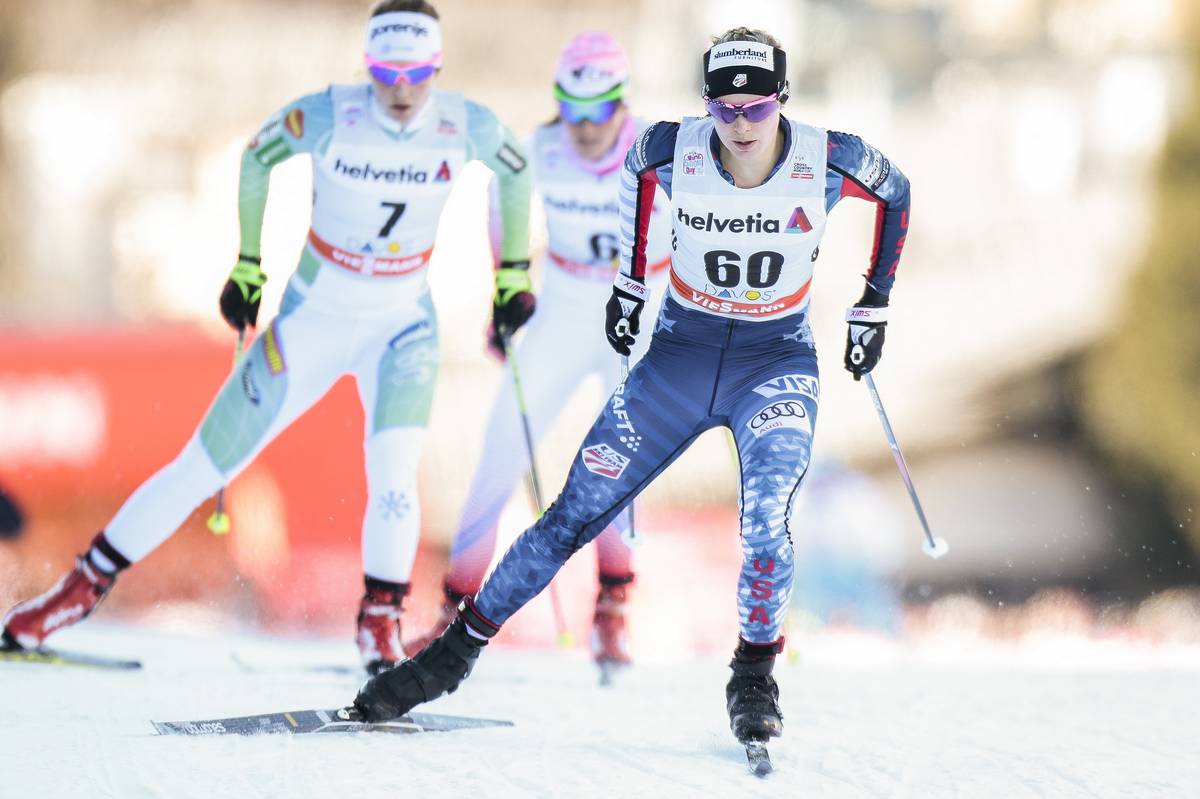
    Jessie Diggins (USST) en route to a ninth-place finish in the 10 k freestyle individual start on Sunday in Muonio, Finland. (Photo: Petri Ikävalko/Hevoskuuri.fi)

    About 10 seconds outside the top 10, Diggins placed 13th (+2:04.6) after starting 41st.

    “It felt really great to get a bib on again, jump around and dance in the starting gate, and go hard (the endorphin rush afterwards wasn’t bad, either)!” Diggins wrote in an email. “I was psyched to get the first one out of the way because that’s sometimes the most nerve-wracking one … you never know how you’re going to feel until you do it.”

    Starting immediately ahead of Vibeke Skofterud (who ended up sixth) and right behind another Norwegian, Heidi Weng (who placed third), Diggins made a point to imagine she was racing head to head.

    “I could feel [Vibeke] behind me catching me, and so I pretended that this was a team relay and I couldn’t let her catch me before I got to the tag zone (finish line),” she explained. “I just barely held out but the strategy worked!”

    Looking up her results later in the day, Diggins wrote that she was happy with it and pleased with her improvements in classic skiing – something she’s been working on all summer.

    “I think it’s really important to keep in mind that these early season races, while everyone wants to do well, are not as important as the mid-season races (Olympics!)” she wrote. “It’s ok to work into the season. I think these are a great chance to get back in the groove, identify some things to work on for the year and remember what it’s like to race, while not taking results too seriously.”

    The biggest takeaway from Friday was Bjornsen’s performance, she explained.

    “I am so proud of her – she has worked through some tough injuries over the years and I can’t think of a more fun way for her season to start,” Diggins wrote. “She really gave me something to jump around about, seeing her race so well today!”

    Holly Brooks snaps a photo of USST teammate Liz Stephen on Sunday after Stephen placed second to Justyna Kowalczyk in the 10 k freestyle individual start in Muonio, Finland. (Brooks courtesy photo)
    Holly Brooks snaps a photo of USST teammate Liz Stephen on Nov. 18, 2012, after Stephen placed second in the 10 k freestyle individual start in Muonio, Finland. (Photo: Holly Brooks)

    Among other highlights, Brooks placed 19th (+2:21.3), and three other U.S. women cracked the top 30 (Stephen in 25th, Sophie Caldwell in 27th and Ida Sargent in 29th).

    “I wanted to work on pacing the race and I skied a strong and smooth first 5 k,” Brooks wrote in an email. Her 5 k time ranked 16th, and she was down to 14th with three kilometers to go.

    “I typically start too fast in races like this and I’m working on turning in more consistent results. Ideally I’d be able to go out fast and keep it fast,” she added.  “There were certainly moments where I felt ‘like a World Cup skier’ and times when I did not. But, overall it was a solid start for me and I’m hoping to improve my race fitness from here.”

    Brooks will race Saturday’s 10 k freestyle race as well.

    “I always approach the first races with mixed excitement and anticipation,” she said of the FIS openers. “Everyone’s asking each other how their ‘Training Season’ was and everyone is positive about their preparation. However, in every race there can only be one ‘winner’ and results actually quantify where everyone stands.”

    Satisfied with her effort, Stephen said she focused on technique and pacing.

    “There is still a lot of work to do with classic, but I am happy with the effort I gave today,” Stephen wrote in an email. “It’s a long season and this is just the start. The highlight of the day was certainly hearing Sadie’s name being called up to the awards ceremony with a 5th place!  I am so happy and proud of her, as she has had such a tough go with injuries the last few years and it has not been an easy ride for her the last couple of years. She works really hard, always believes in herself and has such a positive happy vibe that she brings to the team atmosphere that it is impossible not to feel over the moon for her on a day like today.”

    As for other highlights: “It has been fun to see all of our European friends again!” Stephen wrote. “It is exciting to start a new season and to be on the road with everyone again, for sure, but I use that excitement to get me fired up and ready to race.”

    In her first official race with the USST, Caldwell explained she wasn’t very nervous, although she wasn’t sure why.

    “I didn’t really have any expectations going into the day, I wanted to focus on skiing with good technique, pacing, and dialing in my skis,” she wrote. “We’ve been having a really fun time over here and I was just happy to be racing again.”

    She might have taken it out too fast, she recalled.

    “My first lap was great, and I got a little tired on my second lap,” Caldwell wrote. “I had a lot of very fast Norwegians starting right behind me, so when I started fading it seemed like they all just came zooming by me. … I didn’t put a lot of pressure on myself and mostly wanted to go out there and race my best and also watch all the other fast girls that are here to learn a thing or two.

    “I think we were all excited to have a strong result as a group, but we’re definitely all mostly very proud of Sadie and how she did today. So awesome!” Caldwell wrote.

    Like her teammates, Sargent was also thrilled to “put a bib on” and get the season started.

    “I had a mix of nerves and excitement over the last couple days but felt a lot more relaxed this morning and was enjoying ski racing again,” she wrote in an email. “My goals for the weekend are to get back into racing mode again and have a couple hard efforts before the World Cup starts.”

    According to Sargent, who will next race Sunday’s freestyle sprint, the classic conditions on Friday were “great. Hard and fast …”

    The start of the men's 15 k classic FIS race on Friday in Beitostølen, Norway, with Petter Northug (143) and U.S. Ski Team member Andy Newell to the right (142). Newell went on to place 59th, and Northug was 63rd.  (Photo: noahhoffman.com)
    The start of the men’s 15 k classic FIS race on Friday in Beitostølen, Norway, with Petter Northug (143) and U.S. Ski Team member Andy Newell to the right (142). Newell went on to place 59th, and Northug was 63rd. (Photo: noahhoffman.com)

    Hoffman Leads U.S. Men

    In the men’s 15 k classic race, complete with a field of 191 finishers, Noah Hoffman was the top American in 42nd, 2:04.7 behind Norwegian winner Martin Sundby, who competed the course in 37:00.5. The Norwegians swept the top 12 and occupied 23 out of the top 24 (Great Britain’s Andrew Musgrave was 13th).

    “My biggest goal going into today was execute well and carry the lessons I learned last year through to the start of this season,” Hoffman wrote in an email. “I feel that I accomplished that. I didn’t have any results-based goals for this weekend, but I have to admit that I am a little disappointed with today’s result. I expect to be further up the results sheet tomorrow [in the 15 k skate].”

    While he felt good physically, Hoffman noticed he struggled a bit technically after watching video of himself racing. Conditions were “almost perfect,” he explained, “with cold temps, sunny skies, hard tracks and a well-prepared course.”

    “Overall I am satisfied with my effort and psyched to move forward tomorrow and next weekend,” Hoffman added.

    Simi Hamilton (USST/SMST2), who placed 135th out of nearly 200 men in Friday's 15 k classic FIS race in Beitostølen, Norway. (Photo: noahhoffman.com)
    Simi Hamilton (USST/SMST2), who placed 135th out of nearly 200 men in Friday’s 15 k classic FIS race in Beitostølen, Norway. (Photo: noahhoffman.com)

    Another USST member, Andy Newell placed 59th (+2:23.7). In an email, he explained it was his probably his first 15 k since last winter.

    “It always takes a few efforts to get back into the distance racing state if mind for me,” Newell wrote. “Technique and skiing felt great out there but definitely didn’t have much to dig into as far as energy. It’s always hard during the first week over here while adjusting to Europe, but that’s why we have these practice races.”

    Newell will save up for Sunday’s 1.2 k sprint, which he expects will be “tight and competitive” and “making the final won’t be easy.”

    Another Olympian, Torin Koos of the Bridger Ski Foundation took 70th (+2:41.4) in his first race of the season.

    “It feels pretty great to put on the race bib again. You know, racing is the inspiration for all those tough training sessions through the summer and fall,” Koos wrote.

    In Europe since late August, he has been mostly in Davos, Switzerland, training with the Swiss National Team. He’s also maintained ties with the Norwegian club, Strindheim, and was staying with Team LeasePlan Go for the weekend.

    “I have a lot of friends I’ve met through skiing here,” Koos wrote.

    Last year’s overall SuperTour leader Mikey Sinnott (Sun Valley Ski Education Foundation) placed 131st on Friday, and the third USST member in the mix, Simi Hamilton was 135th. Jesse Smith, a former Michigan Tech skier, placed 165th.

    ***

    Women’s results | Men’s results