Tag: U23

  • National Nordic Foundation: Bridging the Funding Gap

    National Nordic Foundation: Bridging the Funding Gap

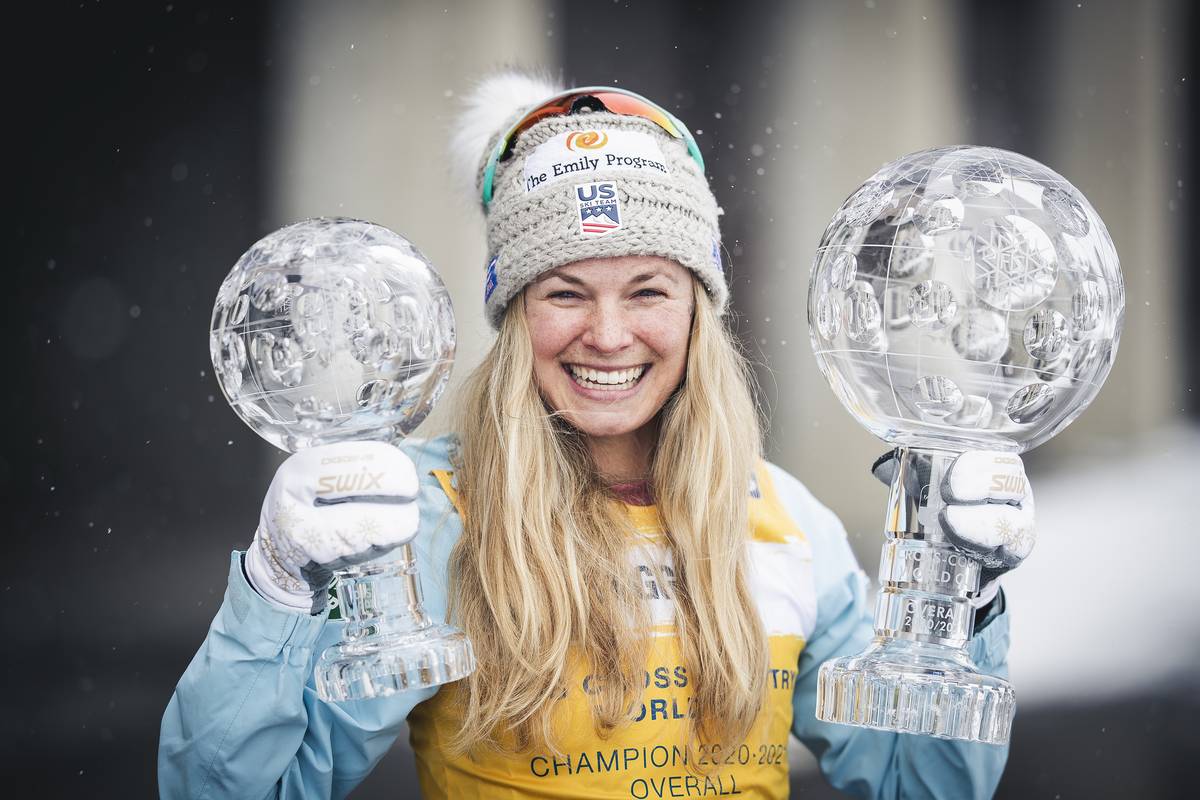
    Before she was capturing Crystal Globes, Jessie Diggins was working her way up the skiing pipeline. Developing skiers across the country receive assistance from the NNF. (Photo: NordicFocus)

    There’s a great scene in the 1983 classic movie epic The Right Stuff, where the test pilots are hanging out in their dank watering hole discussing the future of supersonic flight and bemoaning what they see as misplaced priorities. The press liaison throwing back a beer with Chuck Yeager and Jack Ridley seems to innocently ask, “you know what makes your rocket planes fly?” The aeronautical engineer puts down his beer and responds by beginning to recite the complexities of aerodynamics when the liaison interrupts, shaking his head at him and says, “Funding, that’s what makes your ships go up. I’ll tell you something …no bucks, no Buck Rogers.” It was a perfect synopsis with a crystal clear meaning. All of the science, bravado, and tenacity in the world didn’t matter if there wasn’t the funding to support the incremental gains needed to push human flight in supersonic speed aircraft. No bucks, no Buck Rogers. It’s that simple.
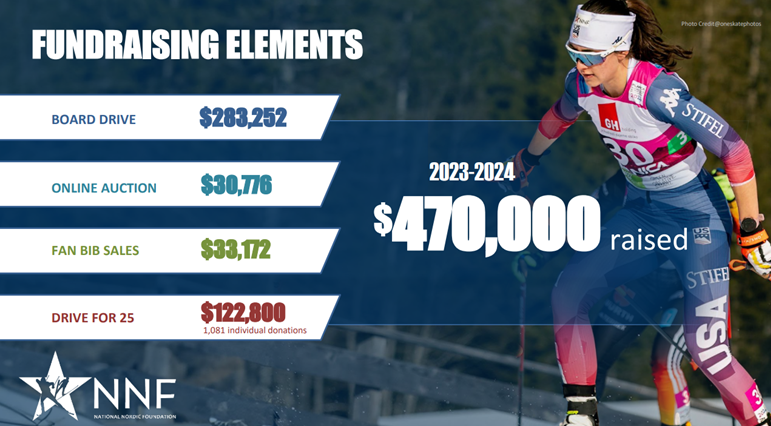
    The NNF raised over $470,000 last year, helping to fill the pipeline of talented Nordic athletes. (Photo: NNF Impact Statement)

    The same is true in elite level skiing. All the hard work, talent, training, and determination in the world won’t matter if there aren’t the dollars to get athletes to the World Cup, and equally important, to develop young athletes who fill the pipeline on their way to the top of their sport. In short, no cash, no Cups. The best skier in the world can’t win anything on any level, if they’re grounded in their gym in Utah.

    This presents skiers with a real problem. In the United States, Nordic skiing is a low profile sport, and unlike almost every major international competitor, the U.S. cross-country squad doesn’t receive direct funding from the government. Contrast that to Norwegian skiers who really don’t have to worry about where the money will come from. Ski fast and the cash will follow. In America, it’s a different story. While the headline skiers on the United States A and B teams receive funding from U.S. Ski and Snowboard, through the U.S. cross-country team, skiers working their way up the skiing ecosystem are largely on their own financially. It takes a mix of club support, sponsorships, fundraising, and donors to keep the pipeline of young talent flowing in the ski game.
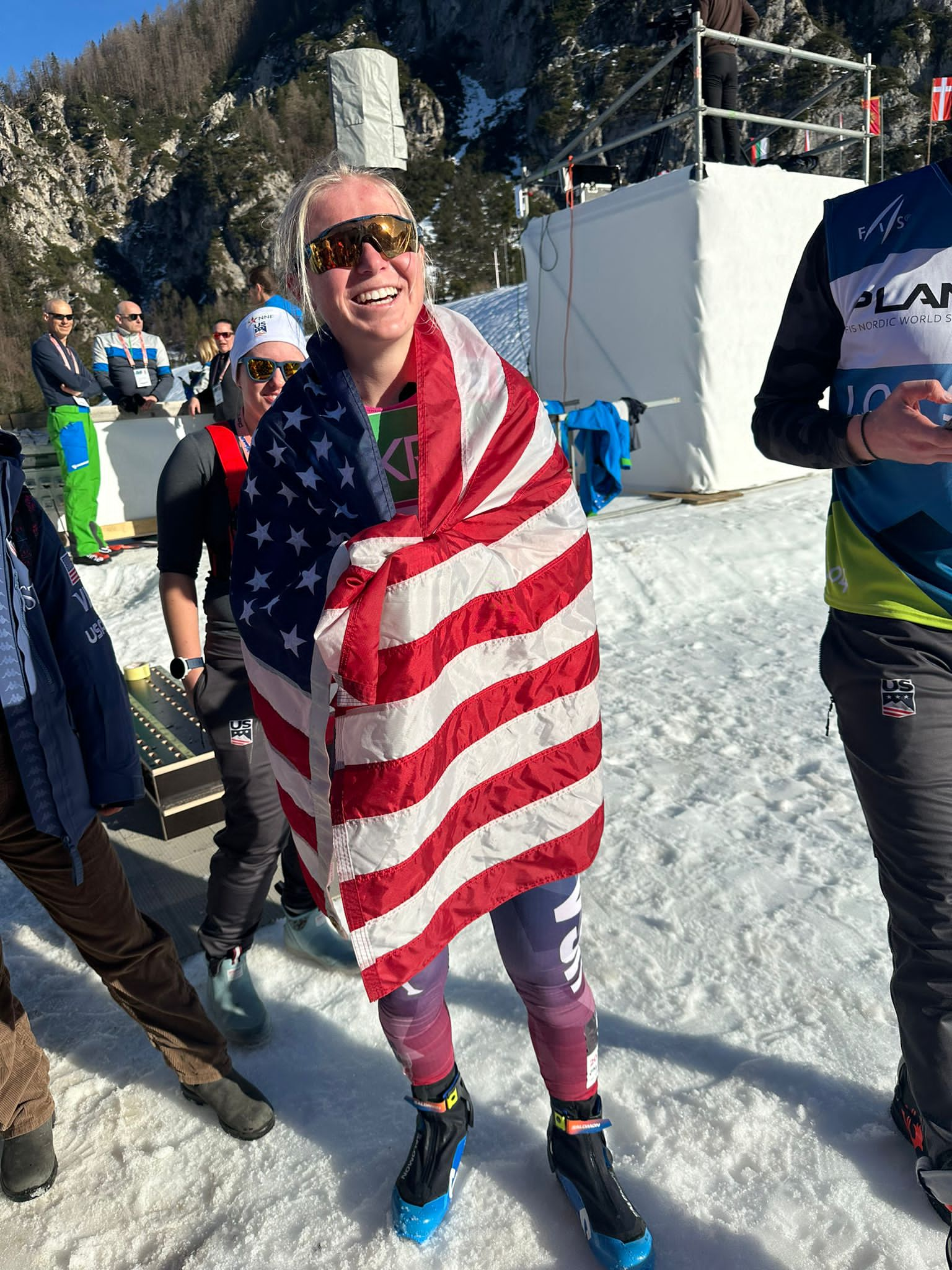
    Sammy Smith after skiing to 2nd place in the skate sprint at World Junior Ski Championships Planica, Slovenia. Talented athletes like Smith have options other than cross-country. NNF helps to keep athletes like Smith in the skiing game. (Photo: Courtesy Image/Jasmine Wiley)

    If you’re a talented young athlete, you also probably have other options besides skiing. Look at Sammy Smith and Sophia Laukli. Both have the talent to earn a living in other sports. To keep them in the ski game long enough to reach the A team, there needed to be a funding mechanism to help developing skiers until they reached the level of receiving national team support.

    For a young skier trying to stay with the sport, the different pieces of the funding puzzle can be an economic Rubik’s cube to try and figure out. That’s where the NNF (National Nordic Foundation) comes in. It acts as the bridge in that funding gap between established U.S. cross-country team skiers, and those without full national team financial support who are chasing their World Cup dreams. It’s the bridge to where the funding is easier to acquire— being an A or B team member of the U.S. national squad— and wandering the financial wilderness of being a developing athlete.
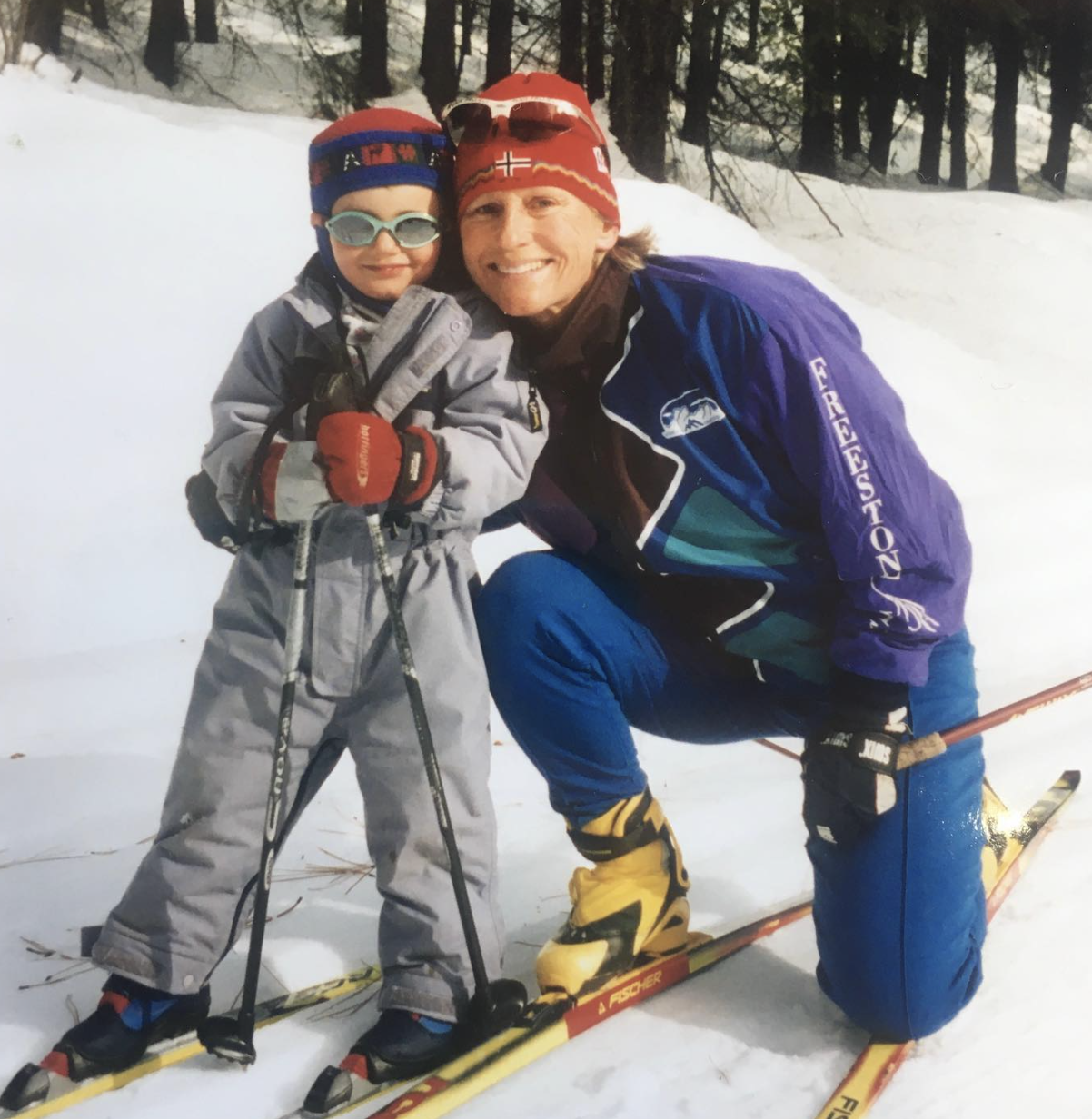
    Laura McCabe (right), former U.S. ski team member and Olympian, is the current NNF chairperson. Here she is working on skier development with her then young daughter, now U.S. team member, Novie McCabe. (Photo: Instagram @novie.mccabe)

    The NNF is a non-profit funded solely by donations whose mission is to “power the opportunities that bridge the gap to World Cup and Olympic excellence for Nordic skiers from the United States.” Chairperson of the Board of directors, former Olympic cross-country skier Laura McCabe—mother of current U.S. team member Novie—states in her letter to the ski community that the NNF was “founded on the belief in supporting a development system rivaling any nation, a vision we’re proudly realizing thanks to our dedicated community.” That founding vision was a tall order considering that the other major Nordic nations don’t have to go to donors with hat in hand soliciting support.

    But the NNF has been successful in fulfilling its mandate as a funding bridge. Last year, the NNF raised $470,000 to support the development of the cross-country racing ecosystem in the United States.
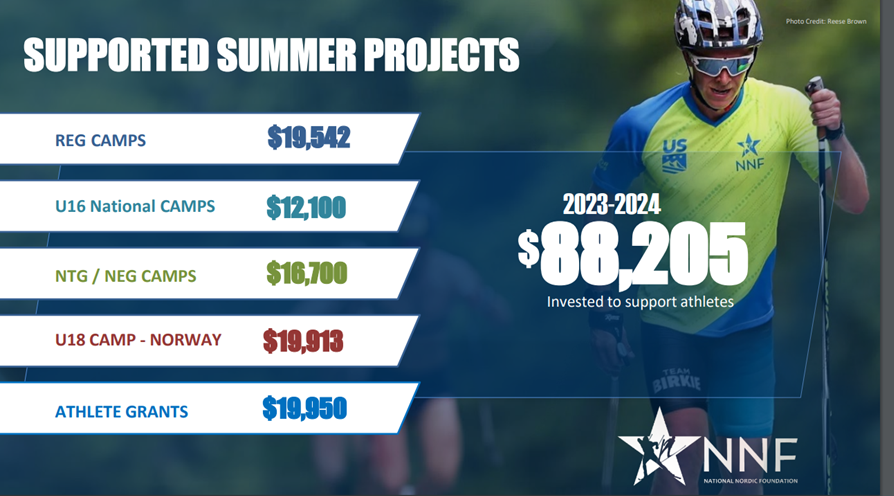
    NNF supports summer as well as winter projects. (Photo: NNF Impact Statement)

    NNF uses that money to help skiers afford the cost of winter and summer events and training. In the summer, NNF helps offset the cost of attending training camps. There are National Elite Groups, Regional Elite Groups, National U16 Camp, and international development exchanges and trips. Last year NNF provided over $88,000 in funding for these activities.

    During the winter, NNF provides funding for coaching development as well as athlete funding to help attend U18 championships, Junior World/U23 championships, World Cup races, and OPA Cup racing (a second level of competition ranked just below the World Cup). There are also individual grants to athletes to help them attend World Cup events. Last year those winter projects support for event attendance was over $180,000.
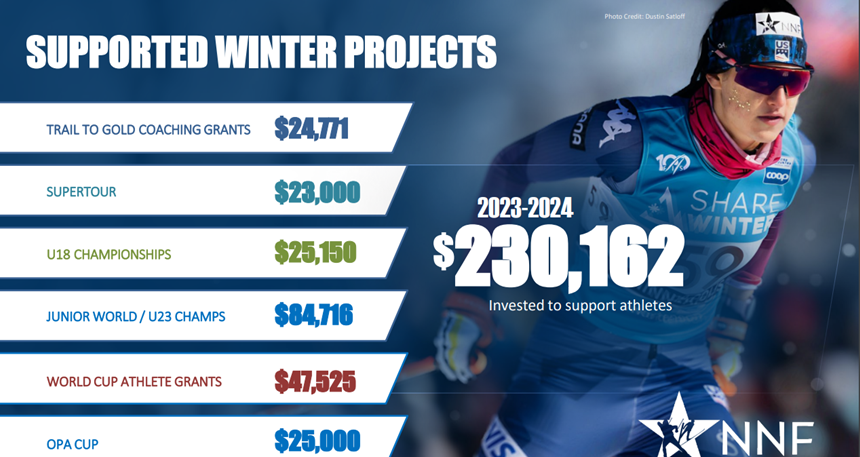
    The NNF is the lead sponsor for the Supertour as well as supporting other winter programs. (Photo: NNF Impact Statement)

    NNF also sponsors domestic racing by being the title sponsor for the Supertour. The Supertour is the highest level of race competition in the United States and consists of a race series spread across the country. Success in the Supertour often leads to a spot on the U.S. national team or start rights in the Tour de Ski. Last year NNF subsidized the cost of the Supertour to the tune of $23,000, which covered almost 60 percent of the tour’s prize money.

    One of the NNF’s other successful winter projects is its Trail to Gold program. The T2G is a coaching grant that supports developing women coaches and technicians in an historically male dominated profession. Bernie Nelson who was just hired by the U.S. team as a full time technician was a T2G funding recipient.
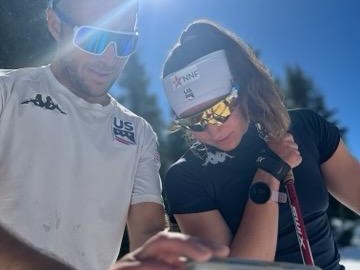
    U.S. team coach Matt Whitcomb (left) crunching numbers with Sydney Palmer-Leger. He’s a key part of the puzzle to help the NNF design its funding disbursements. (Photo: Leann Bentley, U.S. Ski Team).

    A critical piece of the puzzle for the NNF is coordinating between itself and the U.S. national team. That’s where Matt Whitcomb comes in. Whitcomb is the head coach of the U.S. ski team. He is also on the NNF Board of Directors. Whitcomb provides the Board with an invaluable overview of the needs of developing skiers, and what a successful development program looks like. “The NNF is the bridge between being a U14 athlete and being an Olympian,” said Whitcomb. “NNF picks up and assists with projects between those two things where athletes are most likely to quit because of funding challenges.”

    “The NNF and national ski team are critical partners, but we’re really different puzzle pieces that just fit really well together where the NNF funds younger kids, and the U.S. ski team funds the older or more successful athletes. Our philosophy at the NNF is that all hard working athletes with big goals should be able to compete in the sport regardless of their economic status” The NNF states that there is funding which touches over 250 athletes per year, with funding from thousands of donors. “We have a three year fundraising average of raising over $500,000 a year, said Whitcomb.”
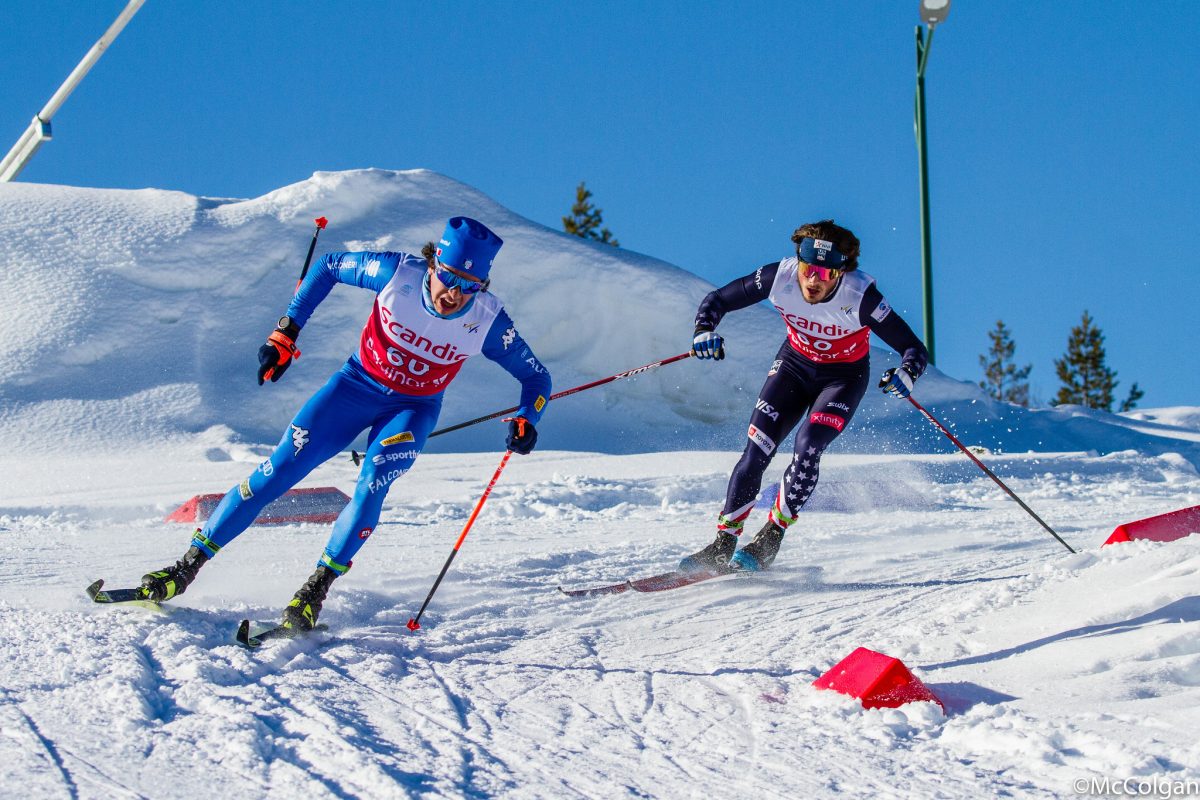
    WIll Koch finished 13th in the 10K Classic at the 2022 Junior World Championships. NNF helped secure his presence. (Photo: John McColgan)

    Often part of the NNF funding process is to generate individual amounts of support for certain events. For example, there might be a dollar amount set aside for the U23 championships which is then divided between different athletes. It can start out as a large pot of money, but by the time it’s divided between all the athletes and support crew, the dollar amount shrinks significantly. For example, it previously allocated over $84,000 in total to the last Junior World/U23 Championships. But after the math is done, it only comes out to several thousand dollars per athlete. It’s a big help but doesn’t cover an athlete’s entire cost. “There’s 10 wax techs alone that come to World Juniors, and around 24 athletes,” said Whitcomb.
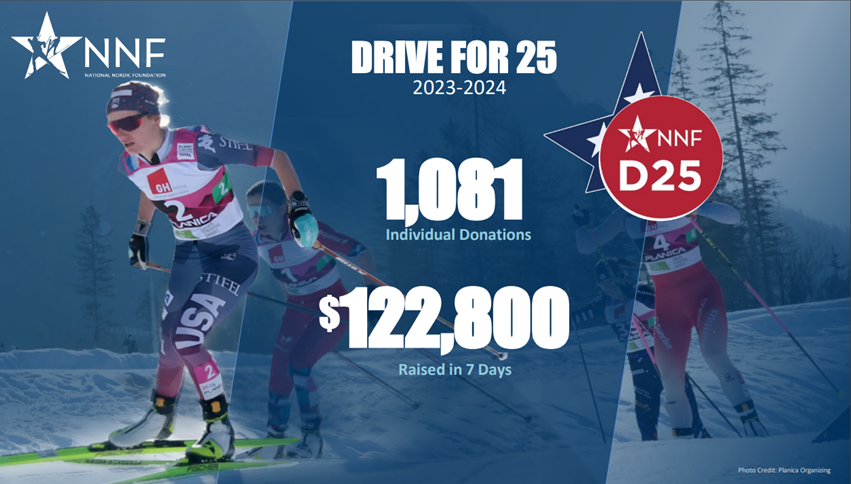
    NNF focuses on grass roots fundraising. Over 1,000 donations just for the Drive for 25 fundraiser shows its breadth. (Photo: NNF Impact Statement)

    Athlete buy-in is critical to NNF’s mission. Athletes are part of the fundraising efforts and build important ties to the cross-country community. Athletes are encouraged to actively participate in the fundraising process. “We don’t cover any project completely,” said Whitcomb. “The goal is to leave some of the responsibility up to the club and the athletes. If they all do a little bit (the athletes), it will really move the needle for an organization like this.” The NNF is proud of width and breadth of its donor base, with over 1,000 individual donations for its drive for 25 fundraising effort, it demonstrates its status as a grass roots organization. “Our window is at the grass roots level. There are people that donate five dollars recurring monthly. You know what it means to those people. We’re trying to sell shares of this great journey to as many donors as possible.” You may have heard of the Drive for 25, but not really known what it was about. It’s one of the NNF’s principle fundraising efforts. Last year it raised over $122,000.

    It’s not just racers who benefit from the NNF’s support. High level racing needs high level officiating. At every FIS (International Ski Federation) event there are teams of technical delegates who are the equivalent of officials or umpires. Without the technical delegates, high level racing doesn’t happen. In the U.S., these positions are volunteers, but there are significant expenses attached to being a delegate. NNF has launched a new program to offer grants to individuals trying to gain technical delegate status to help offset part of the expense. It’s part of NNF’s efforts to maintain the flow of talent and treasure which feeds the cross-country pipeline.
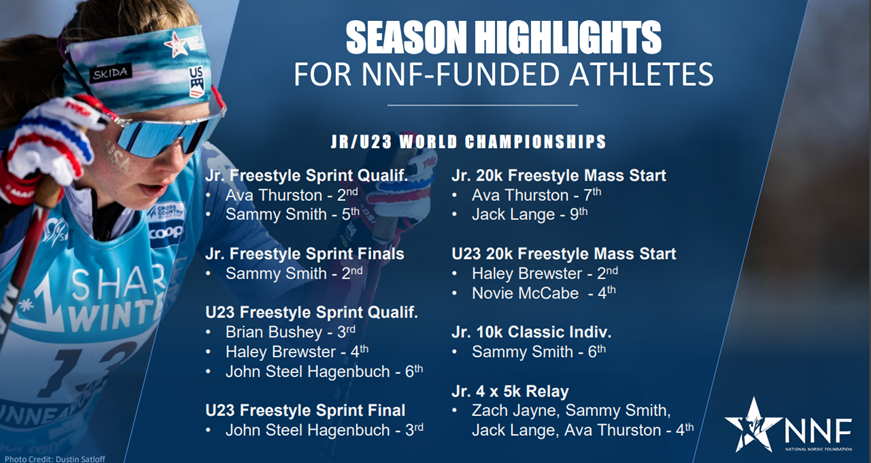
    NNF is part of the American success at the Junior level. (Photo: NNF Impact Statement)

    The NNF proudly points to athletes’ success as proof that its support continues to feed the American pipeline for world class ski talent. In the most recent Junior/U23 World Championships nine different NNF funded athletes finished in the top 10 in different events. In addition to the junior level racing, it also provided funding which contributed to 151 world cup starts. The results from that effort were over 20 top 30 World Cup finishes for NNF supported athlete. Another sign of NNF fulfilling its mission is that many previously NNF funded athletes have recently achieved United States A or B team status, including Sammy Smith, Kevin Bolger, and Will Koch.
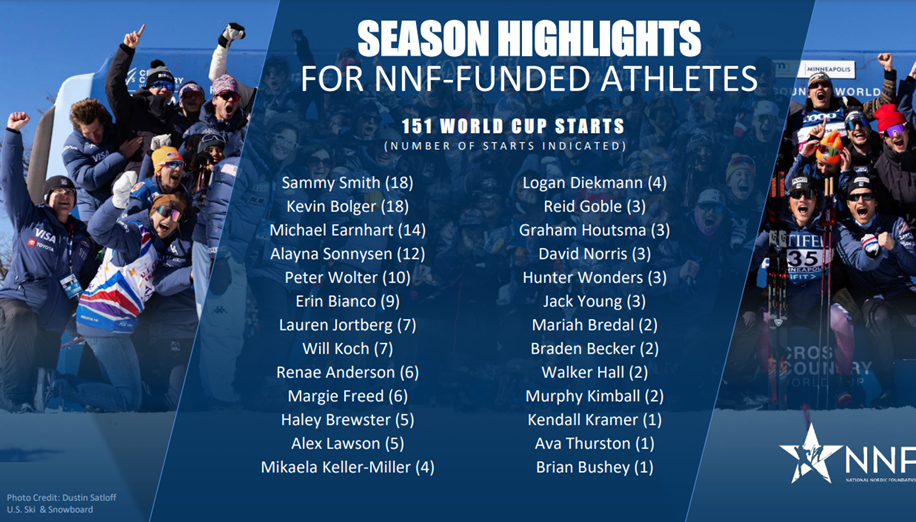
    NNF also impacts World Cup performances as it helps athletes who haven’t yet made A or B team status. (Photo: NNF Impact Statement)

    Every time one of these developing athletes achieves success in competition it helps moves them along the pathway to becoming a member of the United States A or B team which is where the other side of the funding bridge is met and continues the pathway to Olympic success. “Take a look at the last Olympic team. Everyone of those athletes, earlier in their career, had received funding from NNF.”

    It’s fair to say that without NNF support the pipeline of developing skiers would be limited to athletes from wealthy backgrounds or those who have the good fortune to have the marketing skills to promote themselves on GoFundMe pages or Instagram. As long as it continues to receive support from the Nordic community, NNF will continue to be the funding bridge for up and coming athletes.

    More information on NNF

  • 12th in U23 Skiathlon, Bouffard-Nesbitt Makes Case for Senior Worlds

    12th in U23 Skiathlon, Bouffard-Nesbitt Makes Case for Senior Worlds

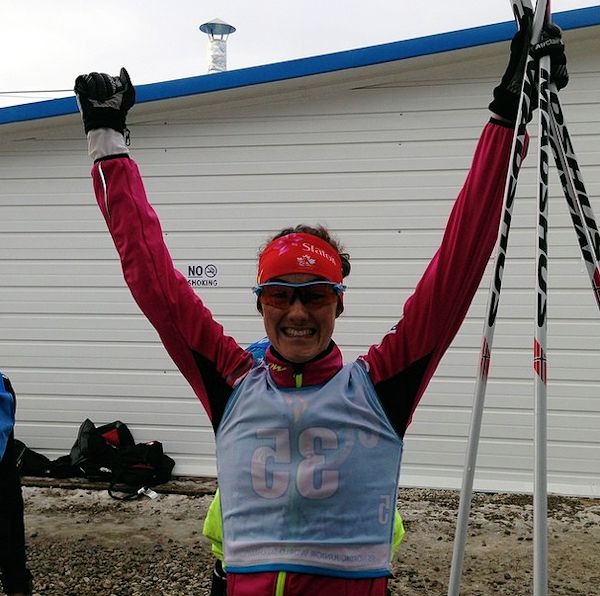
    Canada's Olivia Bouffard-Nesbitt (Rocky Mountain Racers) celebrates after finishing 12th in the 15 k skiathlon at Under-23 World Championships in Almaty, Kazakhstan. (Photo: Lisa Patterson/CCC)
    Canada’s Olivia Bouffard-Nesbitt (Rocky Mountain Racers) celebrates after finishing 12th in the 15 k skiathlon at Under-23 World Championships in Almaty, Kazakhstan. (Photo: Lisa Patterson/CCC)

    Olivia Bouffard-Nesbitt (Rocky Mountain Racers) didn’t have the best start to Saturday’s 15 kilometer skiathlon at Under-23 World Championships in Almaty, Kazakhstan.

    The Canadian cross country skier started at the back of the mass start, and she didn’t feel great on her classic skis.

    “I was pretty much last starting the race,” she said in a phone interview.

    But oh, how things picked up from there. After a fast transition to skate skis after 7.5 k, Bouffard-Nesbitt felt better and better. She soon found herself skiing with a pack of four or five other women, and picked off competitors who were tiring. Around 11 k, her coach told her that she was in 16th.

    “It was super motivating to hear that,” Bouffard-Nesbitt said. “So I knew that at that point, I was at the back of my little pack so even within my pack, if I could beat the rest of them that would leave me in a good position. It really helped in catching the girls in front of us.”

    She attacked with about 1.5 k to go before the finish, and ended up 12th for the best international result of her career and the best finish for Canada so far this week at World Junior and U23 Championships.

    Bouffard-Nesbitt’s time was 1:32.3 behind winner Nathalie Von Siebenthal of Switzerland, and just 3.1 seconds outside the top ten.

    “Especially in the last kilometer, it’s kind of a blur,” the Canadian said. “I’m thinking back to it and I can’t remember who I passed and who passed me, and where I was. But I just knew that I had to go. That was it. That’s all I remember.”

    Besides being thrilled with her result, Bouffard-Nesbitt believes she found another silver line. She said that in a previously-published version of Cross Country Canada’s selection criteria for senior World Championships in Falun, Sweden, later this month, a top-12 distance result at U23’s was listed as one possible way to qualify.

    “They always make discretionary choices and I don’t know what they’ll do with that,” she said of making the cut. “It’s an option. I’m crossing my fingers – it’s not something that I had even been thinking about for this season. I’ve never raced a World Cup and so it wasn’t in my plans. But I’d be pretty stoked.”

    Bouffard-Nesbitt has met the organization’s eligibility requirement of scoring lower than 75 FIS points in multiple races so far this season. No Canadian women meet the primary objective criteria for World Championships, of having finished in the top 12 in an individual World Cup event, being in the World Cup “Red Group”, or having an individual podium in the last two seasons.

    The currently-posted National Team selection criteria state the U23 World Championships performances can be used for selection to the senior World Championships team, but don’t outline how. They do, however, refer that a top-12 performance at U23’s should earn an athlete placing on the Senior Development Team. And it does state that top-12 finishes at U23’s qualify athletes for the B-Tour to Finland this month.

    “Our team release date is Feb.9,” Cross Country Canada High Performance Director Tom Holland wrote in an e-mail to FasterSkier. “Olivia is certainly under consideration.”

    So it’s unclear where she stands, but Bouffard-Nesbitt said she was sure she’d have an amazing time if she made the trip.

    “I’ve never performed this well in my life,” she said of this week, where she also finished 17th in the 10 k freestyle and qualified 12th in the classic sprint. “I think the best thing it has done is to have given me confidence that I belong on the international stage. I’ve never raced this well, so the confidence is a big thing, and knowing that the girls I’m racing against aren’t superhuman, and that if I’m having a good race I can be right up there with them.”

    Despite the strong results earlier this week, Bouffard-Nesbitt tried not to have expectations going into the skiathlon.

    “I try not to go into races, especially at Worlds, with too many expectations,” she explained. “Especially because it kind of stresses me out personally. And I think that if you don’t go in with expectations other than trying to do your best, you can be happily surprised. I’ve been really happy with how I’ve approached the races mentally this week. Normally I go into races pretty anxious, but I’ve just been really excited all week to race.”

    After the tough start in the classic section, she was able to ski more aggressively in the skate. She explained that she was working together with four other women, moving at a fast pace, and they eventually began to catch skiers who had excelled in the classic portion but were running out of gas.

    “Halfway through the last lap of skate, I saw a big group of girls ahead of us who were all dying I think,” she said. “We were going at a pace I was able to maintain, and we were slowly catching them. When we actually caught them, that’s when I made my push. I thought, I have to go now, I have to go before the end, I should pass these girls now so they can’t latch on. So I went to the front of my little pack and pushed really hard at that part of the race. It just felt really good.”

    It took a toll: by the finish she was exhausted. The top-12 nearly didn’t happen as Alisa Zhambalova of Russia came from behind and nearly passed the Canadian. Bouffard-Nesbitt held her off by 0.6 seconds.

    “I actually wasn’t aware that she was behind me, and I only realized after the race was over that she was so close,” Bouffard-Nesbitt said, clearly still worried just thinking about it. “I’m really grateful that she did not get me before the line.”

    This was the final day of competition at U23’s – World Junior Championships conclude on Sunday with relays – and Bouffard-Nesbitt says that World Championships selection is “in the hands of Cross Country Canada now.”

    Regardless of where she travels next, it’s doubtful that she’ll forget this race.

    “It was an amazing feeling,” she marveled. “I was just able to push it.”

    Canadian teammate Cendrine Browne (CNEPH) finished 30th (+4:00.1) and Dahria Beatty (Alberta World Cup Academy) did not finish.

    In the men’s 30 k skiathlon, Knute Johnsgaard (Yukon Elite Squad) led Canada in 32nd place (+3:49.7). Colin Ferrie (Blackjack), Scott Hill, (Thunder Bay NDC) and Raphael Couturier (CNEPH) followed in 44th, 45th, and 48th, respectively.

    Results: womenmen

  • Canadian Junior Women Lead Charge in Opening Day of Junior Worlds; Shields Canada’s Top Man

    If the junior women are a harbinger of things to come, then, with three women in the top 30, Canada’s future looks bright. Canada’s best result in Wednesday’s Junior and U23 World Championships was delivered by Katherine Stewart-Jones, who finished 15th in the junior women’s 1.2-kilometer sprint. She was followed by Dahria Beatty, who finished 20th, and Sophie Carrier-Laforte, who finished 28th.

    All three women advanced to the quarterfinals. The fourth Canadian junior, Anne-Marie Comeau, was 52nd.

    “I was super excited with how things turned out today,” Stewart-Jones wrote in an email. In spite of a rough start to the quarterfinal, she moved into second place over the top of an uphill, saying that she “managed to squeeze in the side.”

    But bad luck struck again, and she was passed by two skiers on an uphill after taking a corner too wide. But the race was not over.

    “The German girl fell right in front of me, and, after losing my balance, I was able to stay on my feet and pass her.” Stewart-Jones poured the power into what she described as “really good” skis. “I free skated the last flat and almost caught up to the second girl. I was about one second from the lucky loser spot.”

    In spite of alternating good and bad luck, Stewart-Jones was delighted with her performance.

    “I was still extremely excited about today. I did not expect to make top 15, but I am satisfied for sure!”

    Continuing the strong performances of Canadian women, U23 Heidi Widmer delivered a solid performance on the 1.2 k course, making the quarterfinals and finishing 19th. Teammates Olivia Bouffard-Nesbitt placed 34th and Cendrine Brown was 36th in the qualification round.

    The top Canadian U23 man was Andy Shields, who finished 39th in the qualification round on a 1.5 k course, followed by Knute Johnsgaard in 42nd, Patrick Stewart-Jones (older brother to Katherine Stewart-Jones) in 50th, and Sebastien Townsend in 53rd.

    “Conditions were rock hard which is not good for me,” Shields wrote in an email. “If it was mushy I would have qualified.”

    Foster Agnus was the top junior man, finishing 45th in the qualification round, with Scott Hill and Ricardo Izquierdo-Bernier coming in 50th and 51st, respectively. Benjamin Wilkinson-Zan was 64th.

    The Canadians have all been in Europe for nearly two weeks getting acclimatized to the different time-zone and to life in Europe. The transition to life in Europe has been easy for the young skiers, according to Shields.

    “The event organizers here are very experienced which make it easier for us athletes because there were no extracurricular hassles to deal while we’ve been here.”

    Looking forward, Katherine Stewart-Jones was excited about what her team of young women might have to offer this rest of this week.

    “I am excited about the team relay because I think we have a strong group of junior girls this year and I can’t wait to see how we will do!”

    But her attitude is far from wait-and-see:

    “With such a strong field, I am going to be thinking: every second counts!”

    Men’s Results: Juniors | U23

    Women’s Results: Juniors | U23

  • In Tiny Switzerland, an Emphasis on U23 Development: ‘It’s Our Only Chance’

    In Tiny Switzerland, an Emphasis on U23 Development: ‘It’s Our Only Chance’

    Dario Cologna is the figurehead of Swiss skiing, and has done much to improve its popularity - but how do you translate that to a faster national team five years from now? Photo: Fischer USA/NordicFocus.com.
    Dario Cologna is the figurehead of Swiss skiing, and has done much to improve its popularity – but how do you translate that to a faster national team five years from now? (Photo: Fischer USA/NordicFocus)

    DAVOS, Switzerland – Nestled deep in the Alps, surrounded by snow, home of Olympic gold medalist and three-time World Cup champion Dario Cologna, and within driving distance of some of the best racing in the world: you wouldn’t think of Switzerland as a nation that faces many challenges in the world of cross-country skiing.

    But if you ask Christian Flury, the coach of the Swiss U24 and development teams, his country faces some difficulties that might seem familiar to a North American audience. Flury spent a year coaching at Alberta World Cup Academy in Canmore, Canada, and says that “you can compare the two jobs.”

    At the root, perhaps the most basic similarity is this: Flury is taking young, talented skiers and trying to mold them into senior-level racers who will make the World Cup. What that means is to learn how to treat skiing as a job.

    “When we select them onto the team, we want a commitment that they will train professionally,” he said in an interview at his home in Davos. “You can work part-time up to July maybe, but then you have to be here. It’s up to you to invest two or three or four years and do it serious. Maybe after that you say, cross country skiing is great but I’m not becoming a World Cup skier. And that’s fair. But do it right.”

    The team ranges from first-year U23’s to older athletes who have a shot at qualifying for the Olympics. Most of the season is spent on the OPA Cup circuit, a highly competitive Continental Cup series in central Europe. Some of the older athletes earn World Cup starts here and there, but Flury says that the racing is good enough on the OPA Cup to provide excellent development opportunities. A podium on the OPA Cup might mean a top 30 on the World Cup.

    Like most development programs in North America, Flury can’t offer his athletes any money, just support. And also as in North America, he works with athletes with a range of different backgrounds. Switzerland may be small, but it has four official languages (German, French, Italian, and Romansh) and the 26 cantons function independently, almost analogous to states or provinces.

    Here in the canton of Graubunden, there are many options for developing skiers: a canton team with professional coaching, a sports school. But although all cantons have teams, most aren’t as organized as this region around Davos. Some might have a team here and there because parents are interested and decide to start a club for their kids.

    (This can have benefits, of course, including local pride: “Some athletes from really small spots, like from the French part, have really good fan groups from their community,” Flury said. This can help out in terms of funding.)

    And so at the junior level, most of the best young racers end up here in Davos. That’s good because the national team staff, like Flury, can see them, it’s a good training group, and the sports school allows the young athletes to train more hours.

    But it’s also a bad thing. If all of the country’s talent and coaching is concentrated in one area, then what happens everywhere else?

    Despite the Alps and Jura mountains, not everyone in Switzerland has easy access to skiing. Three quarters of the 7.91 million people live in the central plains, in cities like Bern, Lausanne, Geneva, and Zurich. Other regions have good skiing, but not as much infrastructure. With no consistent club system, it’s hard to keep and develop talent.

    “There are some areas that are nothing,” Flury said. “You see on the ranking list maybe they have one 16-year-old, but from there, nothing. Because if there are no kids in the system, then the pyramid, nothing comes out.”

    Once athletes sign on to the U24 team, they get a good deal in Davos. The training group is about 15 athletes this year, with two to three coaches. There are plenty of training camps; the team is currently in Oberhof, Germany, training in the ski tunnel. They also have the chance to train often with the senior national team, including Cologna. During the dryland season, Flury shares his calendar with senior team coaches Tor Arne and Guri Hetland and the two teams try to coordinate when possible.

    “That’s one of the things we really want to put the focus on,” Flury said. “To have the young ones to have the chance to train with [Cologna], or to see him and say, okay, what do I need to come to this level. Today there was a really young one who tried for half an hour to ski with him, and then boom, off the back. But that is fine. He can still sit in the same van on the drive home.”

    For instance, the younger skiers might see how much Cologna and fellow seniors Curdin Perl, Toni Livers, and Remo Fischer train. Or at what pace. And that might make it easier to accept the demands that the coaches place on them as they try to fast-track them towards senior success.

    “We have athletes coming form other provinces where they are in the junior national team but they don’t train that often, they do maybe 450 hours, and then we say, look, you should come pretty soon up to 700 or 800 hours as a U23,” Flury said. “We have a huge gap to close, and that’s tough. We don’t know if they can do it. You have to be a really big talent to close that, I think, because it’s a huge step.”

    This isn’t a system, though, that expects or accepts burnout. When asking athletes to commit to training professionally, often with a huge increase in hours in the first two years, they also offer an olive branch: they don’t need to see results in the first year. They will stick with their U23’s for the long haul.

    “We say, look, if you come to Davos then we will give you enough time to develop,” Flury explained. “Usually you have a tough first season as a senior, so it needs time… and it’s important to us to have them together as a group.”

    In 2013, talent and depth were actually another thing that the American and Swiss teams had in common. Each has a hugely successful star: Cologna for Switzerland, and Kikkan Randall for the U.S., who has burst towards championhood in the past few seasons. Behind each is a core group of strong skiers – but much of the national team’s publicity comes from these two figureheads.

    “At the moment, Dario is covering a lot,” Flury admitted. “You have to be honest. For sure you have athletes behind him that do good races, like Laurien Van Der Graaf and Bettina Gruber from the girls side. But then we have only three or four more girls, that’s it. On the guys’ side we have Perl, Remo Fischer, and the sprinters did really well [last year]… We have to try because right now Dario is doing the medals. Then we have some top-10 skiers, but a medal skier? Besides Dario? It’s pretty rare.”

    (The U.S. finished the World Cup season ranked sixth in the Nations Cup, and Switzerland eighth. These overall results were achieved in similar ways, relying on one stronger team with its star: the American women were fifth and the men eleventh, while the Swiss men were fourth and the women fifteenth.)

    Because the community isn’t big enough, or deep enough, to survive any lull in motivation or organization, each talented junior needs to be treated as a resource, and coached towards becoming a talented senior. The women’s team is a particular challenge: by the time skiers hit the junior level, there are about half as many boys as girls. The U24 team is mostly men. Flury and his bosses have tried to brainstorm ways to do a better job keeping girls in the sport, but “we don’t have a lot of ideas, to be honest,” he admitted.

    One way not to lose athletes, though, is to keep the cohort together.

    “The only chance, I think, is that we don’t have a lot, but we have this U23 group,” Flury said. “We have to bring them together, give them a chance, more than a year, and they have to train, a lot. We have to do the volume step by step for sure, but you have to bring the volume up, bring the intensity up. If they do that, then we have a chance that they are getting better. It’s the only secret.”


  • Photo Gallery: U23 Women’s 15km Skiathlon

    More photos from the 2012 World Junior/U23 Championships in Erzurum, Turkey. This set is from the U23 women’s 15km skiathlon.

    [smugmug url=”http://fasterskier.smugmug.com/hack/feed.mg?Type=gallery&Data=21684292_SzdsgS&format=rss200″ imagecount=”100″ start=”1″ num=”100″ thumbsize=”Th” link=”lightbox” captions=”false” sort=”true” window=”false” smugmug=”false” size=”M”]

  • Harvey Skis to U23 Gold

    Harvey Skis to U23 Gold

    Harvey leading Belov

    It’s not very often that one hears the Canadian national anthem at the medals ceremony for a World Championships cross-country ski race.

    But sure enough, there it was on Monday, ringing out in the stadium in Otepaa, Estonia. Canadian Alex Harvey had just outsprinted Russian Evgeniy Belov to win the 30-kilometer U-23 pursuit race, collecting his first-ever gold medal from the International Ski Federation.

    “This year, even though there’s World Championships coming, I really wanted to say that at least I’ve been world champion once in my life,” he told FasterSkier afterwards. “So, that’s done—I’m happy about that.”

    Belov’s teammate Raul Shakirzianov was third, with Noah Hoffman the best American in 22nd place.

    Harvey leading the race early.

    Sure, Harvey was the favorite, coming in as the top-ranked starter after a top-five finish in a stage of the Tour de Ski earlier this year. But as one of his coaches put it, “it’s always a ski race”—one that wasn’t decided until its last 50 meters.

    Harvey had flown into Estonia on Saturday, and the pursuit was his only race there—a hiatus, of sorts, from an altitude camp in Italy.

    From the start, he wasn’t messing around—he started pushing a few kilometers into the classic leg, his stronger discipline, to take the legs out from under some of the other contenders who are better in skating.

    The pace wasn’t ballistic, but it was enough to thin out the field, which totally shattered when Belov went to the front on the third of four 3.75-kilometer skate laps. The acceleration left all the other men behind, and even Harvey was struggling, with a pair of slick skis.

    “Had he tried harder in classic, he could have shaken me a bit,” he said. “It seemed like all the flats are in the shade, but the climbs are in the sun, so the snow was a bit more greasy and the kick was really hard. For me, it was not great…I guess he didn’t see that I was slipping.”

    By the time the two men arrived at the transition, they were well clear, with a 30-second lead over the first group of eight chasers. From the start of the day, it was clear that both Harvey and Belov were at another level—their movements seemed effortless compared to the men behind.

    Belov is no slouch, having already won individual gold at the championships in Otepaa, plus an eighth and an 11th in World Cups earlier this year. Big, powerful, and a strong climber, he was stone-faced for the entire hour and 14 minutes of racing, betraying no signs of fatigue—not even a grimace.

    Harvey knew he had his hands full with the Russian, who he called an “amazing skier.”

    But he was also perfectly content to wait for a sprint, knowing that his speed was far superior. Harvey has multiple sprint top-10’s on the World Cup, while Belov has never cracked the top 30.

    Afterwards, Harvey said that he put in a small surge at the beginning of the skate leg, since the transition from classic can sometimes give people trouble. But when Belov had no trouble with the pace, Harvey settled in—and the Russian did, too. The second half of the race was a cat-and-mouse battle, and the two men made minimal ground over third place.

    “The gap was big enough,” Harvey said. “We were just skiing easy, I guess.”

    With Harvey happy to sit in until the finish, it was up to Belov to shake things up. He tried just twice, with attacks on climbs, but

    Harvey on the podium after the race.

    it wasn’t enough, and afterwards, he was kicking himself.

    Given another shot, Belov said, he would have pushed harder in the classic leg—and he also would have shaved. Instead, he stayed bewhiskered—a good-luck tradition—and ended up losing time on the downhills, though whether that was due to facial hairodynamics or skis remained unclear.

    Regardless, though, he said he still had some power left at the finish.

    “So, maybe tactically, it wasn’t the best performance,” said Belov.

    There was one pitch, Harvey said, that could have given him trouble—a steep V1 section of the skate loop that’s the last tough climbs on the course. “But he couldn’t do much,” Harvey said.

    The two came down into the stadium together, with Harvey right on Belov’s tails.

    The last 200 meters of the skate course brought the two men parallel to the homestretch, in front of the fans, before doubling back and heading for the line. Harvey waited all the way until the turn to make his move, thanks to a headwind—but he wasn’t worried about his chances in the sprint.

    “I know the guy—I was pretty confident about the finish,” he said.

    When he finally opened it up, Belov had no chance, and Harvey had enough time before the line to stand up and ease up and celebrate.

    Despite Harvey’s success at the senior level, it was a gratifying win, coming as it did in his final year of U-23 elibility. Harvey had been in a similar position in Italy in 2008, a favorite to win races as a last-year junior, but a leg problem derailed his hopes there.

    Now, he’ll return to Italy for more training with his teammate Len Valjas, in the leadup to the 2011 World Championships in Oslo. As he put it, “it’s easy to train in [Italy] anyway…but this is a big confidence boost.”

  • Moments in Otepaa: Classic Sprint Photos

    Moments in Otepaa: Classic Sprint Photos

    Once again FasterSkier’s Nat Herz was trailside today in Otepaa, Estonia at the World Junior Championships.  Here are a few moments that he caught during the classic sprints.

  • NENSA Funds Athletes for World Junior, U23, and J1 Competitions

    New Gloucester, ME – The New England Nordic Ski Association (NENSA) today announced recipients of funding for this year’s US Ski Team J1 trip, World Junior Championships, and World U23 Games.  This new funding was made possible by the recent generosity of NENSA members through its annual fund drive and online fundraising auction as well as the generosity of NENSA’s major sponsors TD Bank, L.L. Bean, and Trapp Family Lodge.

    NENSA’s Competitive Programs Director is pleased to see progress in the organization’s ability to support these important trips, “This is something that we have been wanting to do for a long time so it is fantastic to see it come to fruition! For our juniors and U23 skiers, these trips are a critical piece in their development.  When you add to this the expense they incur not only for these trips, but for the necessary summer and fall training camps, and domestic races, and Junior Nationals the expense can be daunting to a family and local clubs.”

    The World U23 Ski Championship features the world’s best cross country skiers under age 23.  NENSA is pleased to support one of those athletes.  Ida Sargent from the Craftsbury Green Racing Project and Dartmouth College finished 4th at last year’s championships and is hungry to reach the podium in this year’s event.  NENSA is pleased to provide $500 of funding toward her effort.

    The World Junior Ski Championship takes place during the same week at the same venue as the World U23’s.  It features the best skiers aged 19 and under and New England athletes go into the event with a real shot at earning a top finish.  Skyler Davis (Stratton Mountain School) enters the championship with lots of momentum after earning 3rd overall at the recently concluded national championships in Rumford, Maine.  His teammate Heather Mooney also raced strong at nationals and goes into the event as the 2nd ranked American team member.  Isabel Caldwell (Stratton/Dartmouth) grabbed the final spot on the women’s team with her 6th place ranking and expects to be tough in both sprints and distance racing.  Each of these athletes receives $750 in support from NENSA.

    The first opportunity for US Ski Team-supported international racing is the J1 Scandinavian Cup trip.  New England was well-represented on this trip with Cambria McDermott (Stratton) qualifying for the women’s team and Patrick Caldwell (Stratton/Ford Sayre) and Jack Hegman (Mount Mansfield) earning spots on the men’s squad.  NENSA is please to support each of these athletes with $250 of funding.

    NENSA’s long-term goal is to fully fund all New England athletes qualifying for these important steps in the athlete development pipeline.  If you would like to help make this goal a reality, please support NENSA’s sponsors and plan to give generously to NENSA’s Annual Fund in April and the online fundraising auction in November.  It is the support of NENSA’s members in the past year that made this first step a reality and with continued support, we can do more.

    2011 World U23 Ski Championship Schedule Otepaa, Estonia

Thurs., Jan. 27 Men’s and women’s 15/10k free
Sat., Jan. 29 Men’s and women’s 1.4/1.2k classic sprint
Mon., Jan. 31 Men’s and women’s 30/15k pursuit

    2011 World Junior Ski Championship Schedule Otepaa, Estonia 

Wed., Jan. 26 Men’s and women’s 10/5k free
Fri., Jan. 28 Men’s and women’s 1.4/1.2k classic sprint
Sun., Jan. 30 Men’s and women’s 20/10k pursuit
Mon., Jan. 31 Men’s and women’s 4×5/3.3k relay

    2011 J1 Trip Details (source: NCCSEF)

    Training Camp: Athletes will depart the U.S. on January 26, 2011. The athletes will travel to Ostersund, Sweden where they will meet up with Head Scando Team Coach Matt Johnson.  Between Jan 27th and Feb 1st the team will be staying at Camp Sodergren in Ostersund, training on the trails adjacent to the lodging.

    Race Week: On February 1st, team will drive to Ornskoldsvik, Sweden where they will be staying and racing for the next week.

  • Inspired by Brother, Driven by Dreams

    Inspired by Brother, Driven by Dreams

    ENGERDAL, NORWAY – For as long as she can remember, Maja Solbakken wanted to do everything her older brother Martin Andersen did. Siblings of accomplished athletes often feed off the energy and determination of their brother or sister — that is true not only for those on the World Cup circuit, but also for those who are the second-tier.

    Maja Solbakken (Photo courtesy of Maja Solbakken)

    The youngest of three siblings, Maja, 16, grew up in the rural Norwegian community Engerdal, close to the Swedish border. Maja always found Martin, 22, to be a support and an inspiration. She said she feels fortunate to have a brother who has helped her pave the way, fallen into the training traps and dealt with them.

    Four years ago, Martin and three of his ambitious training partners established a privately funded elite development program called Team Norgeshus. The young athletes calculated their needs, created a budget, went after sponsors and secured the funding for the team, then hired coaches and a support staff, designed camp schedules, training plans and competition plans. So far, they’ve accomplished several top Scandinavian results and are going after the U-23 circuit.

    “Martin has a lot of experience to share, and gives me pointers all the time,” Maja said, explaining that he helps her with all aspects of training and racing.

    Martin Andersen knows a thing or two about waxing. (Photo, Inge Scheve)

    “One thing he helps me with is technique, but he’s also really good at seeing when I’m about to fall into the overtraining trap. Then he gets really stern with me and tells me to back off. He’s had a serious bout of overtraining and been in the pits, and he never wants me to have to go there. That’s super helpful to me, since it’s so hard to see it coming yourself,” she said.

    Maja also recognizes that there are significant advantages to being the youngest racer in the family. “My mom and dad have learned a lot from supporting Martin over the years and taking him to races, so they too have a lot of experience at a variety of racing levels, from nationals to local events. They know what’s going on, and that puts me at ease and cuts down on nervousness,” Maja said.

    No rivalry, no pressure

    “I never felt like I had to compete with Martin. He’s six years older than me, so there’s no way I can do everything he does. But I definitely look at what he did when he was my age, and I want to meet or beat that,” Maja said.

    However, whatever pressure there is to perform is entirely her own. Her parents never compare her to Martin, and never expected her to follow his lead.

    Maja's parents, Maj Britt Solbakken and Roald Amundsen, are avid skiers themselves. Roald used to race at the national level. (Photo courtesy of Maja Solbakken)

    “My mom and dad just want me to be happy doing what I do. They are amazing,” Maja said, pointing out that she’s seen some parents who put a lot of pressure on their children.

    “My parents never pressured me to perform, which is something I have seen in some families where there are two or more good siblings,” Maja said, and continued: “The only the pressure is that which I put on myself. I want to perform and improve, and I want to show everyone who supports me that I’m worth the effort — I want to deliver, and I want to give something back.

    Ambitious goals

    Maja has always set ambitious goals for herself, and her ultimate dream is no less than the Olympics. But realistically, she knows she has a long way to go.

    “I’d like to see how far I can get. Of course, I would like to be best in the world, and go to the Olympics, the World Championships and the World Cup eventually, but those are pretty long-term and hairy goals,” she said.

    Accordingly, Maja has set up partial goals along the way and has a systematic approach to her progression.

    “Before [reaching the Olympics], I realize I have to do the standard progression, aim for top-five, top-three and then number one at the Norwegian nationals and the Norwegian national racing circuit. I hope I can qualify for the junior national team and go to the Junior World Championships in a couple of years,” Maja said.

    She believes she has what it takes to go all the way, but that she has to train smart to achieve her Olympic dreams.

    “I think I can get as good as I want to. I have the potential to go far. Whether I do is a matter of what I do to get there,” she said.

    Training smart

    Maja believes there is more to becoming the best than simply volume. She explains that her training philosophy focuses on quality over quantity.

    “I don’t think logging the most hours necessarily makes you the best skier. What matters is what you do during the hours you log,” Maja said. She is keenly aware of how she spends her workouts in order to maximize the training effect. Each workout has a specific purpose, depending on what she needs to emphasize at a given time.

    “You need to focus on the tasks at hand, and really be present both mentally and physically. I try to have at least one specific task to focus on for every workout. For instance, if I do a skate rollerski workout, I try to think about lifting my poles high enough when I V2,” she said.

    However, Maja notices that sometimes skiers seem more obsessed with logging hours than focusing on what they get from the workout. She thinks girls are particularly vulnerable to the junk miles routine.

    “I think a lot of skiers just lollygag around, especially on long distance workouts. They just get lost in chatting, and forget what the job is. I like to catch up on talk before and after, but when I train, I’m into training,” she said.

    Pursuing the elite at Lillehammer

    Maja Solbakken and brother Martin Andersen during a training camp at Sognefjellet last summer. (Photo courtesy of Maja Solbakken)

    This fall, Maja moved away from her parents’ house to attend the national elite cross-country academy training group in Lillehammer and pursue her ski career there. While the 16-year-old admits that it was hard to leave home, she’s not entirely on her own. Martin moved to Lillehammer for college a couple of years ago, and she’s sharing an apartment with him. For some siblings, living so close together could spell trouble, but Maja says it’s an excellent setup for them.

    “We actually enjoy each other’s company a lot. Martin has a lot of experience living on his own, cooking his own meals and balancing life, school and training,” she said, adding that the training group program is a step toward her overall ski goals.

    Different training programs

    Although Maja and Martin have similar approaches to training and development, they recognize that men and women are made differently. Maja admits that she wants to do everything Martin does, but realizes he can handle a larger volume and tougher workouts—both because he’s older and has a bigger base, but also simply because he’s a guy.

    “We do have to train differently. He trains more volume than I do. I just have to face it: Girls just can’t handle the same volume as guys. They have more muscle mass. There is a reason girls don’t race the same distances,” Maja said.

    Maja adds that she also tries to focus on track in the summer, while Martin is strictly focused on skiing. That translates to slightly different approaches to methods and intensity during the dryland season. “I run more than Martin does. He bikes a lot more than I do. That’s partially because I also train for medium and long distances track and field (800m, 1500m and 3000m), and partially because I feel that running is the best way to increase my capacity.”

    Maja also believes women are more dedicated than men in some ways, and therefore more likely to follow their training plans like a bible—which she notes is both an advantage and a potential drawback.

    “I think girls are more likely to follow a training program than guys. If we have a plan, we stick with it. It seems like guys are better at listening to their bodies and adjusting their training according to how they feel. I think guys don’t feel as guilty for going rock climbing or fishing instead of doing the planned workout if they feel like it. But then again, studies show that girls have better core strength than guys, so maybe there is something to sticking with the program after all,” she said with a grin.

  • Video: Interview With U23 Pursuit Champion Astrid Oeyre Slind

    Astrid Oeyre Slind (NOR) won the women’s 15km pursuit at the U23 Championships in Hinterzarten, Germany today. Slind improved on her 2nd place in this same event last year, and joined her sister Kari, who was 2nd in the World Junior sprint, as medal winners for Norway.

  • U23 10/15km Classic Photos

    U23 10/15km Classic Photos

    Photos from today’s 10/15km individual start classic at the U23 World Championships in Hinterzarten, Germany. Brittany Webster (CAN) posted the top North American finish placing 5th.

    Women’s 10km Race Report
    Men’s 15km Race Report

    Don’t forget to check out the FasterSkier Junior Racing blog for additional reports and video interviews from the venue.

  • Report From U23 World Championships

    Tad Elliott races for the Saab-Salomon Factory Team. More information on the Saab-Salomon Factory Team can be found at www.enjoywinter.com. This article first appeared in Ski Post – www.skipost.com

    I have just arrived home from Praz de Lys, France after the U23 World Championships. I had a tremendous time but I am happy to be home in Durango Colorado. Once arriving in Geneva we had a short drive to the hotel. We arrived around 7:00 p.m. and immediately went to dinner in the hotel restaurant. I honestly don’t remember what I ate for the main course but for dessert they served us these huge wedges of cheese and bread. I was super pumped on this, and hoped they would serve us cheese for dessert every day. I would not have been disappointed. We ate cheese and bread every day for breakfast, sometimes lunch and sometimes dinner. Every time we ate cheese there was a different age or a new type to try.

    My hotel room was nice. The bunk beds were a little narrow, but I got over it. We had a kitchenette and a dinning room table that led out to the neatest part of our room, the deck. Since we were on a corner room on the top floor our deck looked out over the competition stadium. The morning of the races I could sit and drink coffee and watch the start, lap, pit exchange, and the major hill of the women’s race while I was preparing for my own race. My roommate was my good friend, Noah Hoffman. This had its perks. Noah went to a local French Cup race earlier in the week since he had some time to kill before the junior races. He won the OJ field and came back with this huge basket of goodies that contained chocolate, a Kilo of some good cheese, some sparkling lemonade and sausage. Noah was super nice to share and I ate more than my fair share of his winnings.

    The skiing was great with amazing views from the ski trails that looked out over the valley, and you could see the picturesque mountains rising out of the valley floor. On one of my longer training days I skied up over the mountain pass and down to the resort of Sommand with Simi Hamilton and Karl Nygren. This was the one day of horrible weather. It was right in between snow and rain. I missed out on the great views from the top and Simi, Karl and I struggled to get down off the pass. We could not see out of our glasses and when we took them off the sleet hurt our eyes so much that we had to squint and could barely see. They had a better time of it than me and I got dropped. In the end, was unable to follow their red jackets. I ended up going off the trail and face planting in the snow. The two others were kind enough to wait for me. The hot chocolate I drank at lunch sure tasted amazing.

    When it came time for the races, the US Service Team was outstanding. I had a stress free time getting in a proper warm up and getting to the start line. The coaches made sure everything was taken care of. We had two feeds for a 2.5 km loop on each the classic and the skate portion of the pursuit. My skis were so fast I dropped a kid by 20 meters on a downhill that outweighed me by 50 pounds. I do not think that anything could have been improved by the US Service Team and I would like to thank them for the tireless hours working on my skis and running skis to the start, and taking care of every task no matter how trivial it might have seemed. I really appreciated their hard work. I can not thank them enough. Also big thanks to the juniors who were out cheering on the U23s during our races knowing that they had a races to get ready for in the next few days. This is the type of support and love of the sport that is going to take US skiing to the top level.

    One of the highlight of the trip for me was during my last night in Praz de Lys at the opening ceremonies. Local kids were carrying a flag from each country represented and Matt Whitcomb gave me a US Ski Team hat to give to the kid carrying the American Flag. I gave it to the kid and helped him put it on in replacement of the hat he was wearing. The smile the young kid had after receiving the hat was the biggest one I saw all week and was not wiped off for the rest of the night. He even came back for a picture with the US Team.

    I am now back at home getting ready for the next big competitions. I now BIRKIE FEVER and am looking forward to checking out the event for my first time. See you in Hayward.

  • U23 Championhips Concludes with Sprint, World Juniors Gets Underway

    U23 Championhips Concludes with Sprint, World Juniors Gets Underway

    World Juniors - Women's Sprint Podium
    World Juniors – Women's Sprint Podium

    Praz de Lys, France – The U23 Championships came to a close with a classic sprint, also the first event of the World Junior Championships.

    U23 Men

    The Canadian men’s U23 team capped an excellent week by placing four skiers in the top 10, led by Alex Harvey in 5th.

    Harvey, gunning for a podium result, and possibly a victory, was foiled in achieving those goals, but still impressed with two top-5 results. Teammate Len Valjas joined Harvey in the A-Final, taking the final spot and finishing 6th on the day, one place better than his top result in the 15km that opend the championships.

    Frederic Touchette skied to second place in the B-Final and an 8th place. Brent McMurtry was fourth in the same heat and 10th on the day.

    The race was won by Ales Razym (CZE), who finished just ahead of Andrey Feller (RUS) and the German Daniel Heun. Razym competed only in the sprint in France, and has experience on the World Cup with a career best 11th place finish early this season in Davos.

    Razym was surprised by his result, saying “That was a great competition. I’m satisfied and surprised because I had no specific preparation for these championships. I will start a training camp for Liberec tomorrow. I’m also surprised to win in a classical style sprint because I’m usually better in free technique. I had some injuries during summer time and had time to train my double polling; it looks like that it was successful but not enough for the World Cup level.”

    The US was led by Simi Hamilton in 17th place. Hamilton qualified 15th and was unable to advance out of the quarterfinals. Matt Gelso was 32nd, 1.4 seconds out of qualifying for the heats. Karl Nygren was 43rd.

    U23 Women

    In the women’s U23 competition, Morgan Smyth (USA) led 5 North Americans in the heats, finishing 12th. Smyth barely qualified, with the 29th fastest time, but stepped it up in the heats, advancing to the B-Final where she finished last. Canadian Allyson Marshall was 13th.

    Joining Smyth in the top 30 for the US was Jennie Bender. Bender qualified in 27th and moved up to 24th in the heats. Canadians Amanda Ammar and Brittany Webster finished 25th and 28th respectively.

    American Liz Stephen, who has had an excellent week with 4th and 8th place finishes in the distance races, missed the heats, taking 38th place.

    The top three qualifiers, maintained their positions, and occupied the final podium spots. Nina Rysina (RUS) won just ahead of Karianne Bjellaanes (NOR) and Mari Laukkanen (FIN).

    Junior Men

    Alexander Panzhinskiy (RUS) won the Junior Men’s event ahead of Timo Andre Bakken (NOR). Third place went to Japanese Kohei Shimizu, the fastest qualifier on the 1.5km course.

    Said Panzhinskiy “I’m very happy, this was my dream and I realized it today. I tried to keep energy until the final and that’s why I think I was strong in the final.”

    Julien Nury (CAN) led North America in 8th place. Nury qualified 16th and advanced to the B-Final where he finished second. His teammate Graeme Killick qualified 13th and finished 14th on the day.

    The US was led by Erik Bjornsen in 21st place. He was the only American to qualify for the heats. Patrick Johnson was 45th, George Cartwright 50th, and Lex Treinen 84th. Treinin was last by 30 seconds, so it is likely he fell during qualification, or had a similar mishap.

    Junior Women

    Scandinavia dominated the Junior Women’s event, taking the top eight places. Norwegian World Cup starter Ingvild Flugstad Oestberg claimed victory ahead of Hanna Brodin (SWE). In third place was Maiken Caspersen Falla (NOR). The favorite, Marthe Kristoffersen (NOR) just missed the podium and finished fourth.

    Brodin is the only woman in the top four who has not scored World Cup points. Falla has one World Cup podium under her belt, Kristoffersen a 5th, and Oestberg a 14th.

    Sadie Bjornsen led the US in 11th place after qualifying 15th, an impressive result considering the depth and strength of the field. Her teammate Sophie Caldwell had an excellent qualifying round, placing 7th, but she was unable to advance out of the quarterfinals, and finished 17th. Amy Glen, the final US starter, was 42nd.

    Canada qualified two for the heats – Marlis Kromm and Heidi Widmer. Neither was able to advance and the two finished 23rd and 24th respectively. Janlie Greer just missed the top-30, finishing 34th. Catherine Aucliar was 45th.

    The sprints conclude the U23 Championships. World Juniors continues on Tuesday with the 10/20km pursuit.

    Complete Results

  • Stephen and Arritola Just Miss Podium at U23 Championships

    Praz de Lys, France – Liz Stephen and Morgan Arritola continued to impress at the U23 Championships, finishing 4th and 5th respectively. Sylwia Jaskowiec (POL) won the 15km pursuit event pulling away from Astrid Oeyre Slind (NOR) in the last 100 meters.

    “The course is fantastic, the weather is good and we had a big support from the spectators, that was great” said Jaskowiec. “Today was my day. I feel good, in good shape with a lot of power even in the big uphills.”

    Jaskowiec also won the 10km freestyle event on Thursday.

    Slind and Jaskowiec pulled away in the freestyle portion of the race, opening up one minute gap on the rest of the field, before battling in the home stretch. Mate Elden (NOR) gave the Norweigans two on the podium, claiming third, 2.1 seconds ahead of Stephen.

    Said Slind, “I had a very good start and an easy race in classical technique because the tempo was not fast. I tried to push hard during the skating part and had a hard fight with Jaskowiec but she was better than me in the last 100 meters. But I’m satisfied with this silver medal and with these Championships.”

    Stephen and Arritola also finished in consecutive places in the 10km freestyle – 7th and 8th, but bettered that on Saturday. Stephen started slowly in the classic portion, sitting in 14th at the transision, a not insignificant 20+ seconds back on the lead pack. Arritola was just off the front, in 8th position.

    Stephen began moving up after the switch to freestyle, ultimately turning in the 3rd fastest skate leg, behind only Jaskowiec and Slind, and moved within striking position of the podium. Stephen and Arritola worked together to reel in Elden, but the Norweigan was able to hold off the hard charging Americans at the line.

    Arritola continued her strong, consistent race, with the fourth fastest skate leg. She sprinted in with Stephen and finished just .8 seconds behind her teammate.

    “The race was not very fast in the classical part so that was quiet easy to stay in the lead,” said Elden. “After the exchange, that was more difficult and I didn’t succeed in following the two leaders. I was alone in the 3rd place nearly the whole skate part but the 2 Americans caught me in the last uphill. I finally succeed to stay in 3th position in the last 100 meters and that’s very satisfying.”

    Alexa Turzian finished 28th for the US, +3:32.

    Canada was led by Brittany Webster in 14th. Webster was in the lead back at the transition, but fell back over the last 7.5 km. Teammates Alysson Marshall and Amanda Ammar were 26th and 33rd respectively.

    Women’s U23 Championships – 15km Pursuit – Complete Results

  • Harvey Leads Canada to Record Day at U23 Championships

    Praz de Lys Sommand, Fra.—Canada’s Alex Harvey completed a stellar month by finishing fourth in a men’s 30-kilometre pursuit cross-country skiing race at the Under-23 World Championships in Praz de Lys Sommand, France on Saturday.

    Reminiscent of his glorious day just two weeks ago where he captured a bronze medal at the World Cup in Whistler, B.C. with teammate, George Grey, Harvey blasted down the finishing stretch past a Russian skier while staring down his second international medal in January which sat at the finish line. But with five metres to go in the race, he lost his balance, costing him another trip to the podium. Harvey finished with a time of one hour 26 minutes 59.3 seconds.

    “It was a day of mixed emotions. I was right there but I nearly tripped and that cost me a medal,” said Harvey, who hails from St-Ferréol-les-Neiges, Que. “It was such a tight race today and I have to be happy because it was a really good race.”

    Harvey and his teammates made history for Canada on Saturday, marking the first time four Canadian men have all placed in the top-15 in an international race at any level. Frederic Touchette, of St-Ferréol-les-Neiges, Que., added to his sixth-place finish on Thursday with a ninth place result today (1:28:23.1), while Calgary’s Brent McMurtry was 10th (1:28:24.9), and Toronto’s Len Valjas was 13th (1:38:54.0).

    Sergey Cherepanov, of Kazakhstan, won the gold in the men’s race with a time of 1:26:50.2, edging Alexander Bessmertnykh (RUS) by half a second. Bessmertnykh won the bronze in Thursday’s 15km freestyle.

    With Harvey and the budding stars of the sport in the mix, the talent pool of Canada’s men’s team is growing deeper with nearly half a dozen athletes now ready to contend for the international podium.

    “Our top guys in Canada are getting so strong, and we’ve had four men on the World Cup podium this year which is pretty remarkable,” said Harvey. “To have the young guys pushing the older guys it is keeping them really fast. Everyone is pushing everyone and that is really good for our program.”

    Harvey is following a track record of success in his family as well. The son of four-time World Cup cross-country skiing medallist Pierre Harvey, Alex joined the World Cup team this year after winning three World Junior Championship medals. His fourth-place finish in France adds to a growing list of impressive results for the emerging star on Canada’s Cross-Country Ski Team. In addition to winning his first-ever World Cup medal earlier this month, he posted a 12th-place finish in a World Cup pursuit race days earlier.

    “It has been a pretty incredible month for me and I never would have expected to get on the podium on a World Cup being only 20 years old,” said Harvey. “But those results in Whistler really motivated me, and I am skiing so much faster than I thought I would be this year back in October.”

    The US started three skiers. Tad Elliott led the way in 23rd place, just under four minutes back. Matt Gelso was 26th and Karl Nygren did not finish.

    Men’s 30km Pursuit – U23 Championships – Complete Results

    Primary Source: Cross-Country Canada

  • Stephen, Arritola Crack Top 10 at U23 Championships

    Stephen, Arritola Crack Top 10 at U23 Championships

    Praz de Lys Sommand, France – Liz Stephen (USA)and Morgan Arritola (USA) finished 7th and 8th respectively in the 10km freestyle in the first U23 Championship race. The race was won by Sylwia Jaskowiec (POL). Jaskowiec, a veteran of 20 World Cup races with a career best finish of 23rd, outdistanced the field by 42 seconds. Betty-Ann Nilsen (NOR) was second, edging Spain’s Laura Orgue by 1.5 seconds.

    Stephen completed the 10km course in a time of 30:00.1, 1:21 behind Jaskowiec, and 39 seconds out of 2nd place. Arritola was 15 seconds in back of her teammate.

    Stephen skied a consistent race, ranking 6th at the midway point. Arritola, on the other hand, turned in a significantly stronger second 5km to move up from the 12th position. All the skiers ahead of the two Americans have significant World Cup experience, with the top four all scoring points in European events.

    Alexa Turzian, the final US starter, finished 17th, 45 seconds out of the top 10. Turzian also moved up during the second half of the race, advancing from 22nd.

    Brittany Webster led the Canadians in 22nd with teammates Amanda Ammar and Alysson Marshall in 31st and 33rd respectively.

    The men’s 15km freestyle was won by Maurice Magnificat (FRA) by 31 seconds over Alexey Poltaranin (KAZ). Alexander Bessmertnykh (RUS) finished third.

    “I’m very satisfied because I came here to Praz de Lys with this goal: to win a gold medal at home,” said Magnificat, who lives quite close to Praz de Lys. “We had very good conditions – nice weather, good snow conditions and a lot of supporters from my Skiclub. I had a fast start and was leading since the beginning. The gap with Poltaranin increased after each lap. I’m satisfied, that’s a good end of January and a big motivation for the next world champ in Liberec.”

    The Canadian men bettered the US women by one place with Frederic Touchette and Len Valjas finishing 6th and 7th. 2.5 seconds separated the two, with Touchette one minute in back of Magnificat. Brent McMurtry completed a strong Canadian day in 17th.

    The US was led by Matt Gelso in 19th. Gelso sat in 27th after 5km and consistently moved up throughout the race, finishing 40 seconds out of the top-10. Tad Elliot was just 3.7 seconds behind in 21st and Simi Hamilton took 28th.

    Racing continues on Saturday with a 15/30km pursuit.

    Women’s 10km Freestyle – Complete Results

    Men’s 15km Freestyle – Complete Results

    U23/World Junior Championship Logo

  • U.S. Ski Team World Junior / U23 World Championship Team

    U.S. Ski Team World Junior / U23 World Championship Team
    As U.S. Nationals in Anchorage, A.K. approaches, the U.S. Ski Team is pleased to announce the coaching staff for the 2009 World Junior and U23 World Championships. Listed below you will find a list of coaches, in addition to important trip information and qualifying criteria. For questions, please contact Matt Whitcomb at mwhitcomb@ussa.org.

    Trip Staff:
    Matt Whitcomb U.S. Ski Team (Head World Junior Coach)
    Pat Casey U.S. Ski Team (Head U23 Coach)
    Randy Gibbs U.S. Ski Team (Head Serviceman)
    Chris Mallory Sun Valley Ski Education Foundation
    Eileen Carey Maine Winter Sports Center
    Karyn Thull U.S. Ski Team (Physical Therapist)
    Scott Johnston Methow Valley Ski Team
    John Callahan Aspen Valley Ski and Snowboard Team

    U23 Trip Dates: Jan 19 – Feb 2, 2009
    WJ Trip Dates: Jan 24 – Feb 7, 2009

    Qualifying criteria: www.ussa.org/magnoliaPublic/ussa/en/sports/crosscountry/advancement.html

    Team Size: The World Junior Team will consist of at least 5 men and 5 women, and not more than 6 of either gender. The U23 Team will consist of 5 men and 5 women.

    Lodging: Praz de Lys, France. Hotel name TBA.

    Trip Cost: $1750 (does not include air, check must be presented to Matt or Pat at team naming and made out to USSA)

    Airfare: Athletes named to the team after the coaches meeting on Jan 7th will receive information on purchasing their plane ticket through the World Tek Travel. Athletes will receive the necessary dates and the agent’s phone number, and will need to purchase their ticket by Jan 9. The agent will coordinate athlete / coach arrival times to work for everyone. The team will use Geneva as its airport.

    Race Schedule:
    Jan 29 U23 10/15 F
    Jan 30 Training
    Jan 31 U23 PURSUIT 7.5/7.5, 15/15
    Feb 1 JUNIOR / U23 Sprints C
    Feb 2 Training / U23 athletes travel home or to WC pre-camp in Ramsau
    Feb 3 JUNIOR PURSUIT 5/5, 10/10
    Feb 4 Training
    Feb 5 JUNIOR 5/10 F
    Feb 6 JUNIOR RELAY, 3.3/5 (C, C, F, F)
    Feb 7 Juniors and coaches travel home or to WC pre-camp in Ramsau

    Informational Meeting: Trip coaches will hold a meeting for all qualified athletes and their parents immediately after coaches meeting on the 7th for the team sprint. An information packet will be distributed at this point.