From the FasterSkier archive — posts syndicated from athletes’ and coaches’ own blogs between 2004 and 2012, kept online as published. Current coverage is at fasterskier.com.
When JC Schoonmaker talks about his earliest memories of ski racing, he doesn’t begin with speed or snow conditions, or the particular magic of gliding across winter trails. He starts, instead, with raffles. “I just remember as a kid, there’d be raffles after every race that I would be so stoked for,” he says. “Trying to get a prize, like a new pair of gloves or a hat.” It is an unexpectedly tender snapshot of a skier now known for his explosive starts and the sharp, angular drama of World Cup sprint heats. But it is also revealing. Long before Schoonmaker was on national team radars, long before he was analyzing sprint tactics or refining breathwork, he was simply a boy who loved showing up at races, surrounded by friends, snow, and the possibility of leaving with a hat.
Schoonmaker grew up in Tahoe, a place where winter sport is woven into the fabric of childhood. Yet unlike many of the region’s rising athletes, he was not funneled into Alpine skiing or a single disciplinary track. Instead, he moved constantly—and in every direction. “Both my parents were super athletic, into sports,” he says. “So from a really early age, I was just doing tons of different stuff: soccer, downhill skiing, andNordic skiing. I played lacrosse. A little bit of baseball.” The variety shaped him in ways he didn’t appreciate at the time: balance from soccer, strength from downhill, elasticity from lacrosse, and a developing sense of rhythm from all of it.
Meanwhile, the Nordic community in Tahoe was small enough to feel intimate yet substantial enough to provide him with peers, mentors, and a place to grow without suffocation. “Joining a Nordic team for me was super fun because I got to go out and ski with friends,” he says. “It was kind of my first experience racing.”
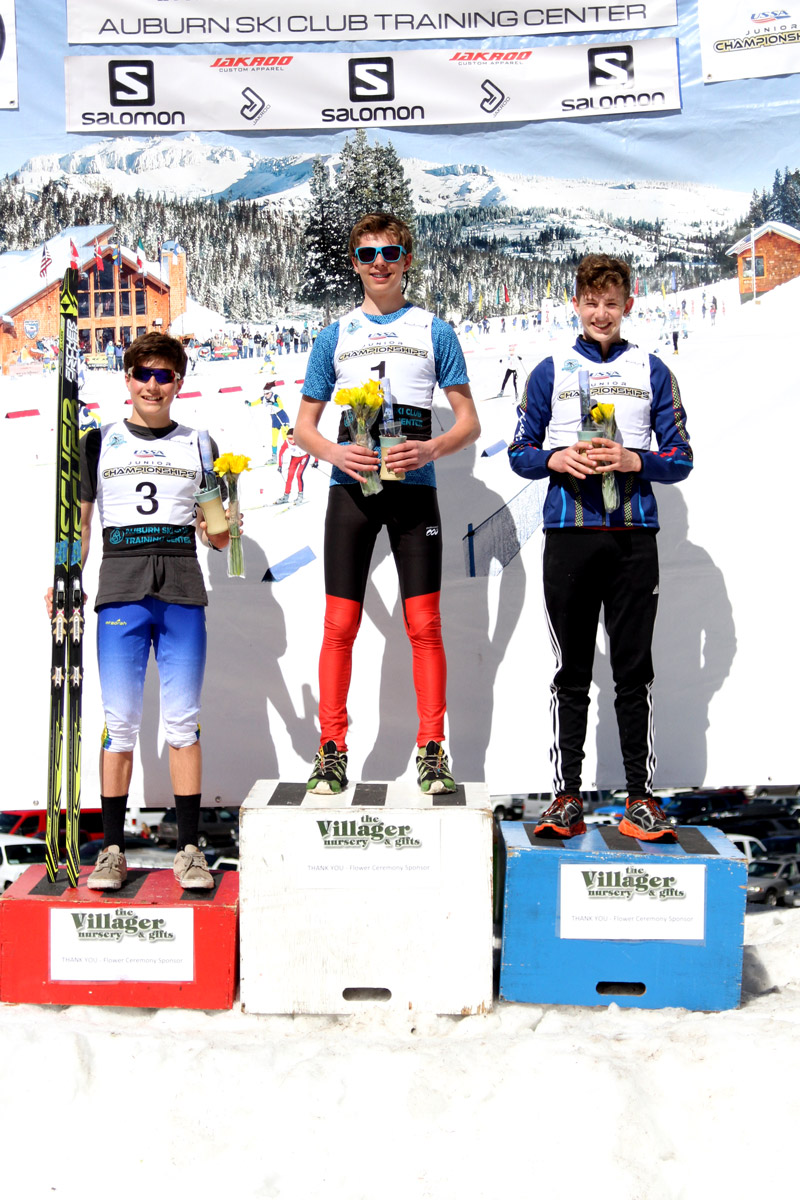
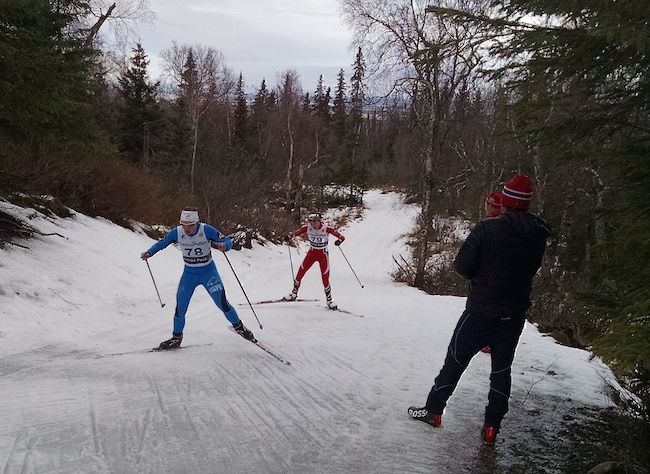
The U16 men’s podium from the 5 k Classic Mass Start at 2015 U.S. Junior Nationals at Auburn Ski Club in Soda Springs, Californial. JC Schoonmaker took home third place. (Photo: Mark Nadell/MacBeth Graphics)
Early Validation in Soldier Hollow and Truckee
It wasn’t until he traveled outside his region that Schoonmaker realized how he measured up. On a Far West trip to Soldier Hollow—his first time racing beyond his local bubble—he surprised himself. “I think I got third in the first race… then I won the second one,” he recalls. “I didn’t even really know it was a big deal, but all the older kids on the trip were… really excited for me.” Their reaction revealed something he hadn’t yet recognized: that his potential extended well beyond his local podiums.
A similar revelation arrived at Junior Nationals in Truckee, where home snow became a proving ground. He had hoped to earn All-American status, although the early races had gone poorly. “All the first races didn’t really go super well,” he says. “I had high expectations.” Yet in the final individual race before the relay, he stepped onto the podium. “Somehow onto the podium and got third,” he says. “That gave me a bunch of confidence… really helped me.” It was not just affirmation but a directional sign. Skiing was becoming more than an activity. It was becoming a path.
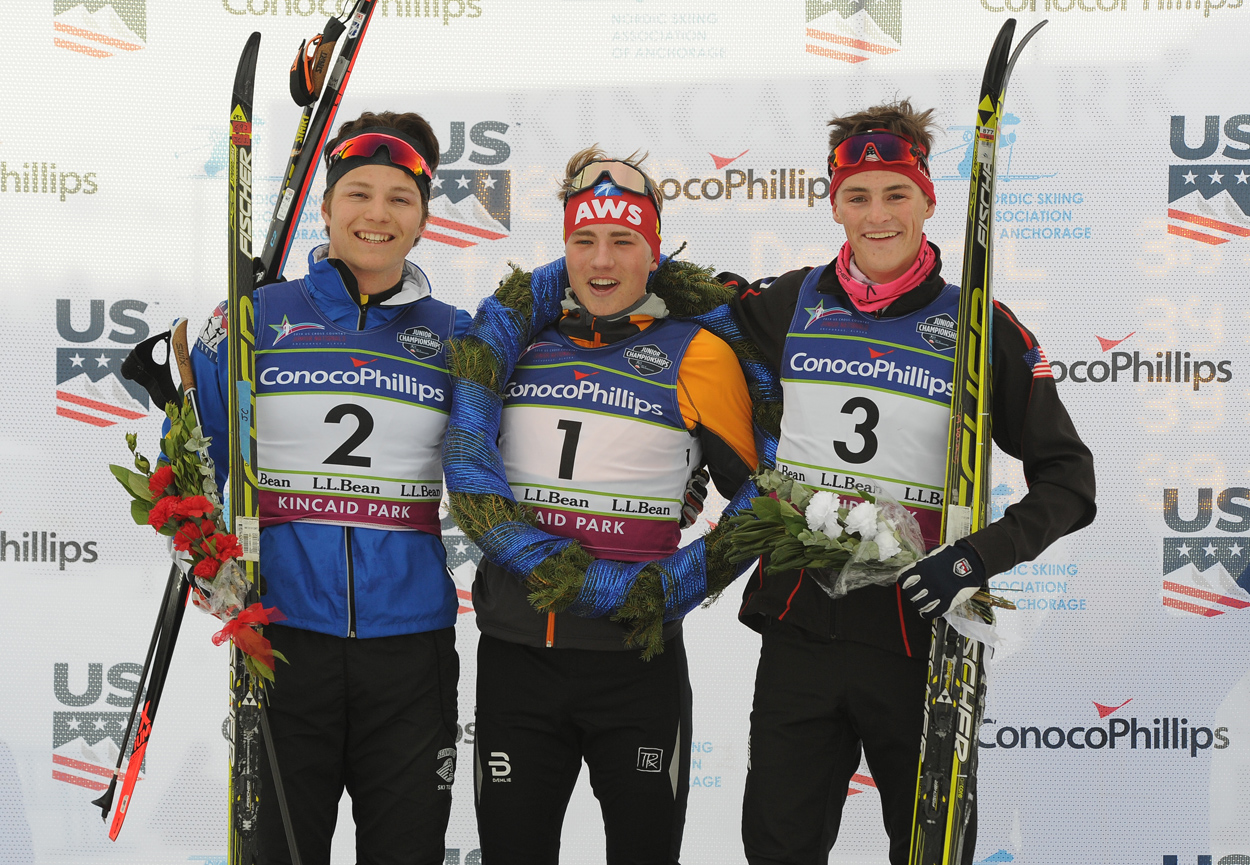
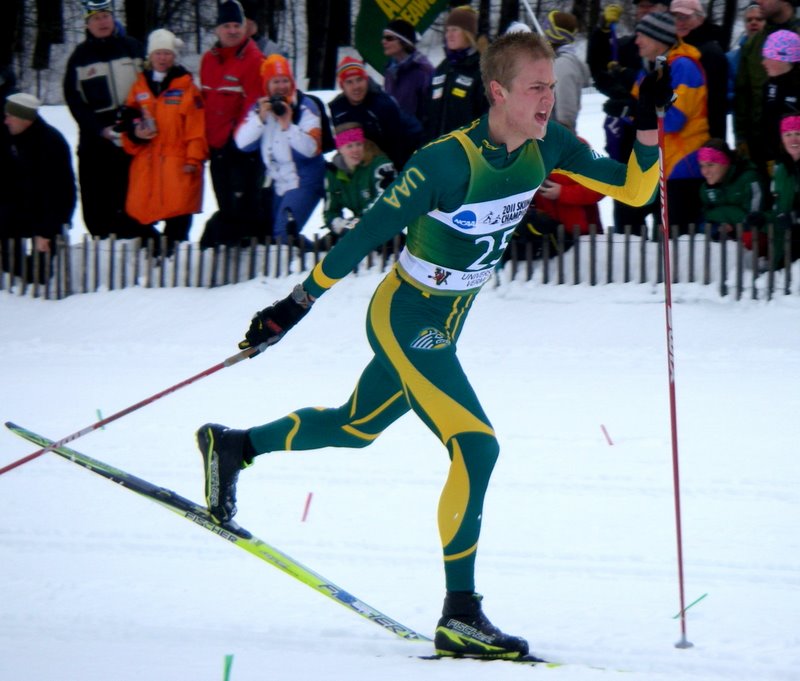
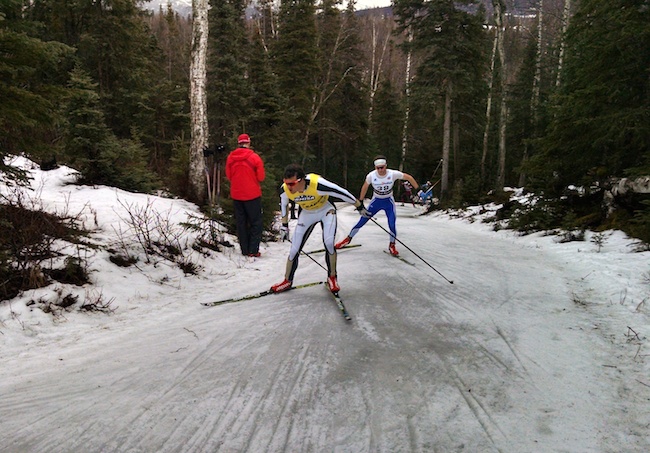
Gus Schumacher (Alaska Winter Stars/Team Alaska), center, won the U20 men’s 15K classic mass start race at the 2019 U.S. Ski & Snowboard Cross Country Junior National Championships at Kincaid Park. J.C. Schoonmaker (UAA-Auburn Ski Club/Far West), left, was second, followed by Cameron Wolfe (Ski and Snowboard Club Vail/Rocky Mountain), right. (Photo: Michael Dinneen)
Choosing Anchorage and the Power of the Right Environment
Despite his junior successes, Schoonmaker’s college recruiting process was sobering. His age cohort was stacked—Gus Schumacher, Luke Jager, Canyon Tobin—and their achievements overshadowed many strong skiers. “My top choice was UVM, and I just didn’t get a spot there,” he says. “I didn’t have a ton of options.” But an unexpected opportunity appeared when a Tahoe friend encouraged him to consider the University of Alaska Anchorage. He visited, and something clicked. “I’d say that’s the best decision I ever made,” he says. “I ended up coming to an excellent team… It’s an awesome place for skiing.”
Anchorage wasn’t glamorous, but it was grounding: clear air, big terrain, and a training culture built on consistency rather than spectacle. Under coach Trond Flagstad, Schoonmaker’s skiing matured—his engine, his technique, and his confidence—all while laying the foundation for a collaborative coaching story that would shape his rise.
A Uniquely Collaborative Coaching Path
Schoonmaker’s development is defined by the unusually harmonious network of coaches who supported him. In Tahoe, he trained with Will Sweetser, whose workout creativity brought nuance to his summer training. At UAA, Flagstad built his fall rhythm with threshold work and bounding. In the winter, U.S. Ski Team coaches—Matt Whitcomb, Kristen Bourne, and Chris Grover—stepped in with race-day craft and a national pipeline. And now, in Anchorage, he works with Eric Flora at APU, whose daily presence has brought structure and clarity.
“I feel like I didn’t even really have to do much in the way of balancing that,” he says. “Trond, Will, and Matt… kind of just took that on themselves.”
That kind of multi-coach collaboration is rare. Instead of conflicting philosophies, Schoonmaker received overlapping layers of expertise, each building on the others. He remembers one of Sweetser’s signature interval sets with particular fondness: “Twenty seconds L5… forty seconds rest… forty seconds L5… then six minutes of threshold. A cool blend… essential for getting you ready for doing sprints on the World Cup.” Flagstad brought heavy doses of fall bounding at L4. Whitcomb and Bourne added race sharpness. Flora, finally, aligned everything. “Having him at World Championships last year made it feel like just a practice in Anchorage,” Schoonmaker says.
JC Schoonmaker (bib #1) at the 2020 Senior Nationals in Houghton Michigan. (Photo: Reese Brown)
The Unexpected World Cup Start That Changed Everything
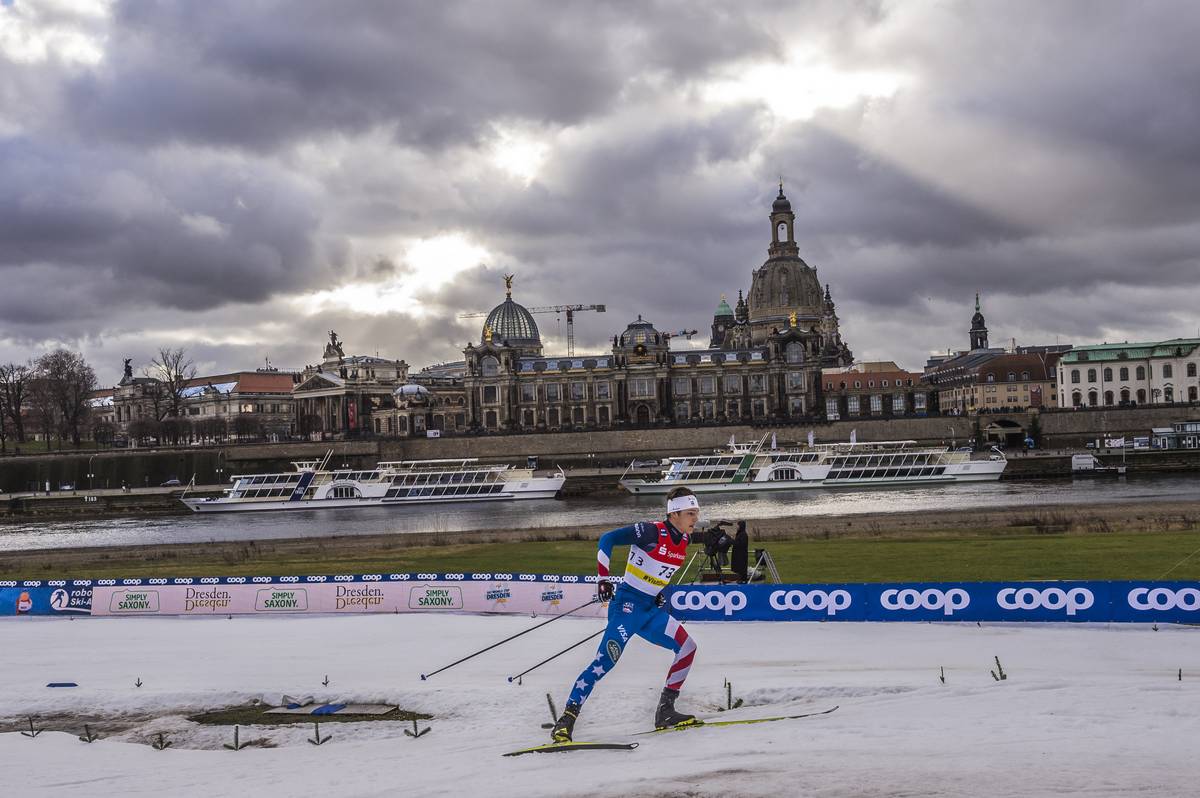
The first moment when Schoonmaker truly understood the trajectory he was on came suddenly. At U.S. Nationals in Houghton, Michigan, in 2020, he won the sprint qualifier. It was exciting, but he didn’t assume it meant anything beyond that day’s result. Then his assistant coach, Marine Dusser Bjornsen, approached him with unexpected news. “She was like, ‘Oh yeah, you’re gonna get World Cup starts from that,’” he recalls. “And I was like, ‘What? No way.’” His passport was expiring, his bags were unprepared, and within days, he was on a plane to Dresden.
Stepping into the World Cup for the first time felt surreal. “I wasn’t even really worried about those being my first World Cups,” he says. “I was mostly just hoping to get to go over there.” The qualifiers felt manageable; the heats were startling. “Racing against those dudes in the heats… was just a whole other level. A different beast.” Still, he never felt crushed by the moment. “We were just having fun,” he says. “It wasn’t crazy high expectations.” That experience didn’t instantly transform him, but it recalibrated his sense of where he belonged.
APU: A Training Collective That Became Home
When Schoonmaker finished college and committed to training full-time in Anchorage, it wasn’t only because of Flora’s coaching. It was because the environment felt like home. “Luke coming back… Gus joining… Zan and Michael… it was such a good team,” he says. “A lot played into it… but mostly that stuff.” APU is one of the few places in the country where the majority of the national team trains together throughout the year, creating a rare sense of continuity on the World Cup.
Yet even in a group that suits him so well, Schoonmaker knows he needs occasional solitude to stay balanced. “I definitely find times during the summer where I’m pretty excited to do an interval session by myself,” he says. “I grew up training alone in Tahoe.” Winter, of course, is different. “You’re living with this group of people for the entire winter,” he says. “Sometimes it is hard to find time to yourself.” But the team understands him. “Everyone knows whatever’s best for you is what’s best for the team.”
A New Kind of Training: Mindfulness and Sprint Awareness
This year, Schoonmaker added something he had never practiced formally: daily mindfulness training. “Some breath holds… super simple, just five minutes of mindfulness,” he says. “Focusing on my breath, trying not to let my thoughts wander.” The shift wasn’t driven by physical shortcomings, but by an honest assessment of where he needed to grow tactically. “In sprint heats… I’ve tended to have my head down, thinking about my technique… rather than, ‘I need to get this position around this corner.’”
Mindfulness gave him a way to sharpen his presence during races and training. During intervals, he began noticing moments when his focus drifted. “My mind starts thinking about what I’m gonna have for lunch,” he admits. “I’m getting better at bringing myself back… loosen up, ski relaxed.” The work is subtle, internal, and mostly invisible, yet deeply connected to the kind of racer he wants to become.
Passing It On: What He’d Tell the Next Generation
If Schoonmaker were speaking to a group of juniors in Tahoe today, he would know exactly what he would emphasize. “I love this puzzle of trying to get better every day,” he says. “Focus on the small things you can control… let the cards fall where they fall.” But he would also add a piece of training wisdom gained from experience. “I almost feel like I got a little too caught up in L1 and L3,” he says. “Walking up hills on classic skis isn’t getting you better at classic skiing. You have to ski fast to get better at skiing fast.” It is the kind of message that cuts through both trends and dogma.
Life on the Road: Davos, Oslo, and a Simpler Suitcase
Schoonmaker’s favorite destinations reflect a balance of beauty and familiarity. Davos stands out. “I’d love to go there when I’m not getting ready for the Tour de Ski… explore it a little more,” he says. He also holds a soft spot for Oslo. “That’s a special spot. I always feel like I’m having a really good time there.” On race mornings, he keeps things simple: “Probably a couple eggs and a few pieces of toast with jam.” And he no longer travels with the heaviest item from his early career. “I brought over an Xbox… took up, like, 12 pounds in my bag,” he laughs.
Schoonmaker and girlfriend, Emma Ribom (SWE). (Photo: Courtesy Photo)
Olympic Season: Ambition, Clarity, and the Calm Before the Heats
Despite the stakes of the Olympic year, Schoonmaker hasn’t reinvented his approach. “I honestly haven’t been doing anything different,” he says. “I’m more excited to be healthy and head into Period 1 feeling good.” But his goals are not small. “My goals would be to win a medal,” he says. “That’s what I’m shooting for.” A chance to race the relay again is just as meaningful. “The relay in Trondheim was super fun,” he says. “I would love to get another chance.”
As for the individual sprint, his ambition is both grounded and bold. “If I could make the final… that would be a solid day,” he says. “But I do feel like I can win a medal.” Few athletes can express that kind of aim with such composure. Schoonmaker delivers it as calmly as if he were describing a morning ski.
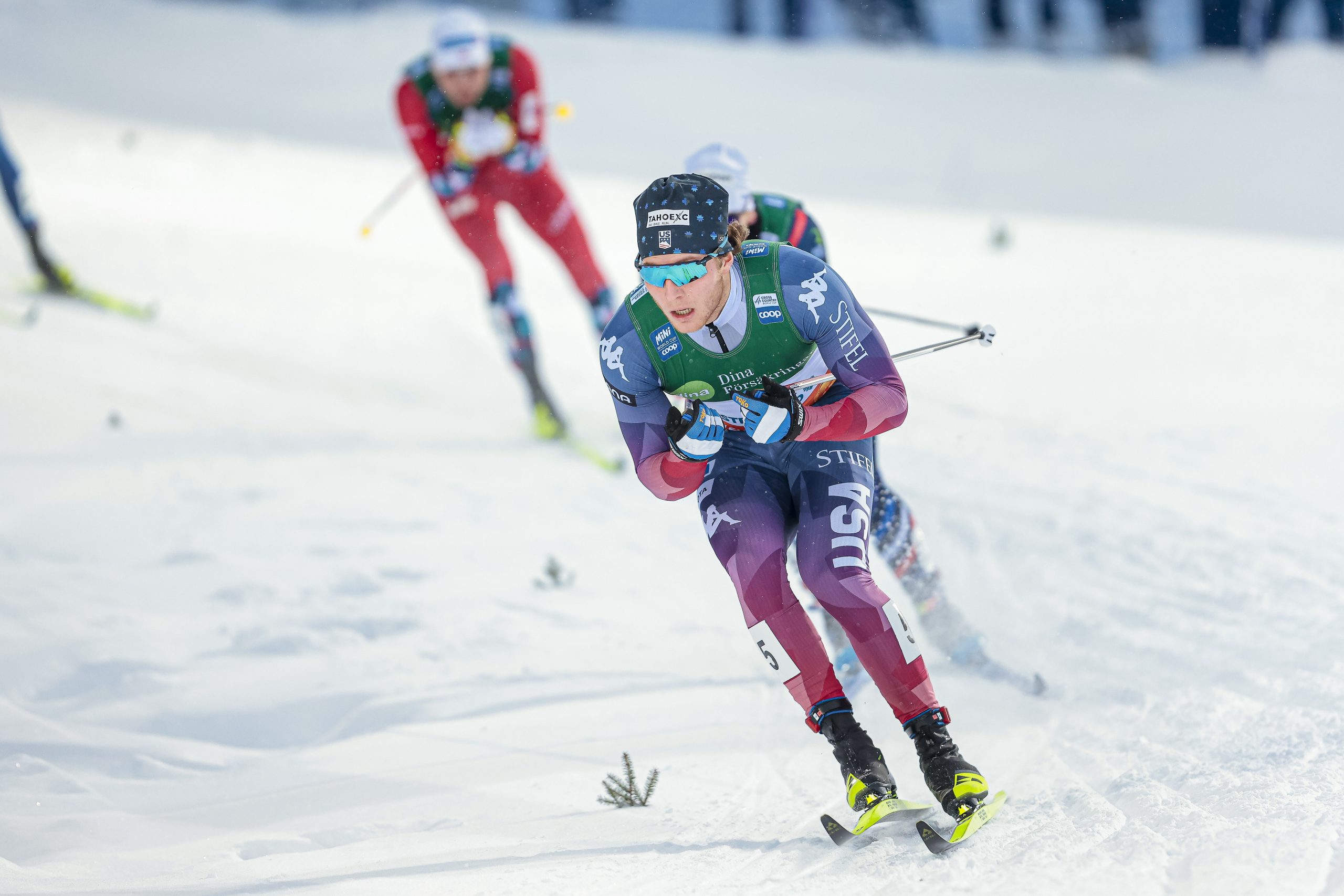
JC Schoonmaker (USA) had a breakout day in Oestersund (SWE) in 2023, reaching the podium for the first time. The American took third place. (Photo: NordicFocus)
Where He Stands Now
What stands out most about Schoonmaker at this moment is not bravado, but clarity. He is no longer the boy who raced for raffle prizes, nor the college skier unsure of his place, nor the rookie dragging an Xbox through European airports. He has become something steadier, more self-aware, and more intentional. A sprinter with composure. An athlete with perspective. A competitor capable of holding his ambition lightly without losing its sharpness.
Presence, for Schoonmaker, is not stillness. It is an ongoing process of tuning himself to the shifting rhythms of a sprint heat, listening to what his mind and body are telling him, and moving through the season with intention rather than urgency. If he keeps his head up—literally and figuratively—this may be the season when the skiing world begins to see not only what he has built, but why it was built this way.
Love Stories Like This? Help Keep Them Coming.
Feature interviews like this one take time, access, and care to produce. If you value thoughtful storytelling and independent ski journalism, please consider becoming a Voluntary Subscriber. Your support directly fuels the work we do to cover the people, places, and moments that make our sport special.
Precipitation was no longer a threat for the final day of racing in Soldier Hollow on Friday, a 1.5-kilometer classic sprint offered alongside the 2022 U.S. Cross Country Championships, yet classified as SuperTour only. However, athletes still faced unseasonably warm weather as blazing sun brought temperatures into the low 50’s on course during the midday heats.
Howling wind and rippling bibs could be heard as background noise as Adam Verrier called the event on the livestream, creating extra work for the athletes who would fight through degrading course conditions throughout the heats. This extra work showed in the times on course; with the combination of freestyle technique and significantly faster course conditions, Sunday’s sprint races featured times over a minute faster on average. A similar difference was seen even between the qualifier today at 9 a.m., when temperatures were still colder and tracks firmer, and the heats which began at 12:30 p.m.
Warm temperatures, degrading tracks, and loose granular spray set the stage for a challenging classic sprint in Soldier Hollow. (Photo: Tobias Albrigtsen / @untraceableg)
“Sprint” seemed to perhaps be a misnomer, as times in the women’s heats climbed over five minutes and were well above four minutes in the men’s heats. Combined with a qualifier, this meant athletes who raced through the final saw between 16 and 20 minutes of racing, testing their endurance and fitness differently from the average sprint event.
Women’s Race: Katharine Ogden on Top from Qualifier to Final
On the heels of a second place finish in yesterday’s 15k classic, Katharine Ogden (USST/SMS T2) set the bar in the qualifier, finishing in 3:51.79.
Julia Richter (U of Utah) was the second fastest qualifier (+0.77), ahead of Lauren Jortberg (BSF Pro) in third (+1.48). Both Ogden and Jortberg won their quarterfinal to advance comfortably into the semis, however, Richter took fifth in Heat 4 and did not advance.
In the first semifinal, two Craftsbury teammates Annika Landis and Caitlin Patterson led the way in the opening climb, with Ogden and Sydney Palmer-Leger (USST/U of Utah) sitting in third and fourth a few strides behind. Descending from the high point, a third Craftsbury racer, Michaela Keller-Miller, had pulled to the front, but was quickly overtaken by Patterson and Ogden as the pack headed into the final short herringbone climb before the long descent toward the stadium. Patterson and Ogden sat in low tucks, letting their fast skis glide as long as possible before transitioning to doublepole as they headed over the bridge and into the finish.
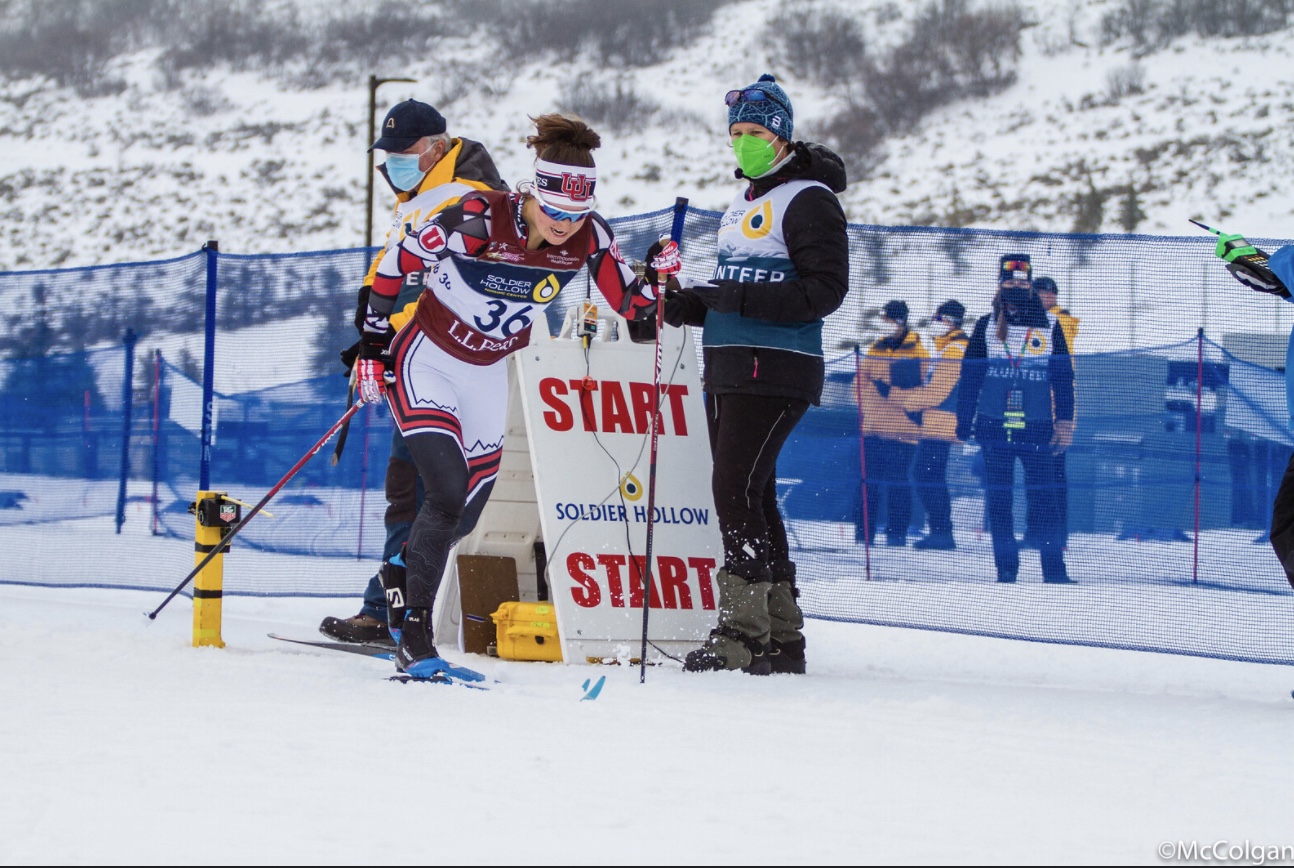
Sydney Palmer-Leger heads out for the 10k interval start classic race during the 2022 U.S. Cross Country Championships in Soldier Hollow. (Photo: John McColgan)
Upping the power in the final 200m, Palmer-Leger accelerated to make contact with Patterson as the women crossed over the bridge, but Patterson had better glide in the quick descent from the bridge’s exit, maintaining an advantage as they headed into the final stretch. Patterson tucked in on the tails of Ogden in the left-most track to go one-two in the heat, with Palmer-Leger not quite in the fight for an automatic qualifier spot finishing 1.5 seconds behind Patterson in third.
In the second semi, Bridger Ski Foundation (BSF) Pro Team members, Lauren Jortberg and Hannah Rudd lead the charging, looking as if their skis were gliding well as they pushed the downhills, perhaps with compromised kick as both showed signs of slipping in the final punchy climb.
In the long glideout, Lauren Jortberg moved from the far left side of the course outside of the track into the second track, losing some time on Rudd who had stuck with the second track from the start. Nevertheless, both held a significant gap over the remainder of the heat as they doublepoled over the bridge and into the finish lanes. Rudd took the win in 4:55.52, roughly +0.7 seconds ahead of Jortberg in second.
A few meters behind, Craftsbury teammates Margie Freed and Alexandra Lawson raced side by side to third and fourth, and as the heat proved to be seven seconds faster on average than the first, both advanced to the final.
As the women’s final headed out of the stadium and toward the first climb, Lauren Jortberg who was the first in a train of two BSF skiers, had her ski stepped on as she was switching from doublepole to a run outside the track. This caused Jortberg to stand up, spin sideways and crash in slow motion. Rudd, who was just behind, quickly moved around Jortberg without going down, soon taking the lead charging up to top of the first climb with Patterson, Freed, and Ogden close behind.
Patterson looked strong with solid kick as she chased a slipping Rudd up and over the final long climb, but it was Ogden on fast skis who quickly moved into second on the subsequent downhill.
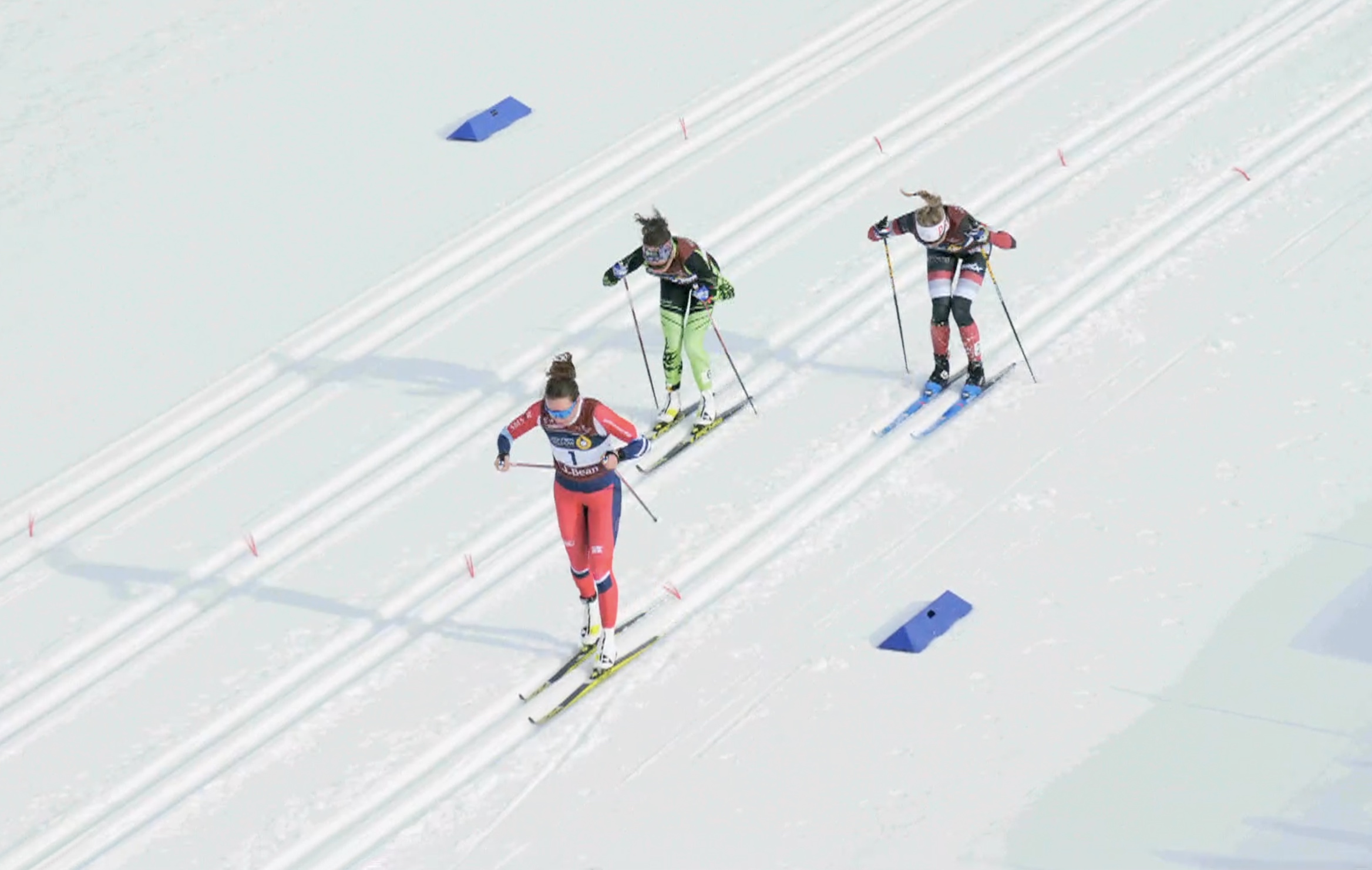
Over the last punchy climb the women ran. Heading into the long glideout, Ogden was off the front in the left-most track, but Rudd and Patterson remained within reach a few ski lengths behind. Descending off the bridge, the top three accordioned together, all choosing the same track with Ogden confidently leading the way to the finish. Patterson, who was in third, moved into her own lane to the right, slowly gaining ground on Rudd as they headed to the line.
Katharine Ogden leads Caitlin Patterson and Hannah Rudd to the line during the SuperTour classic sprints in Soldier Hollow. (Photo: Livestream Screenshot)
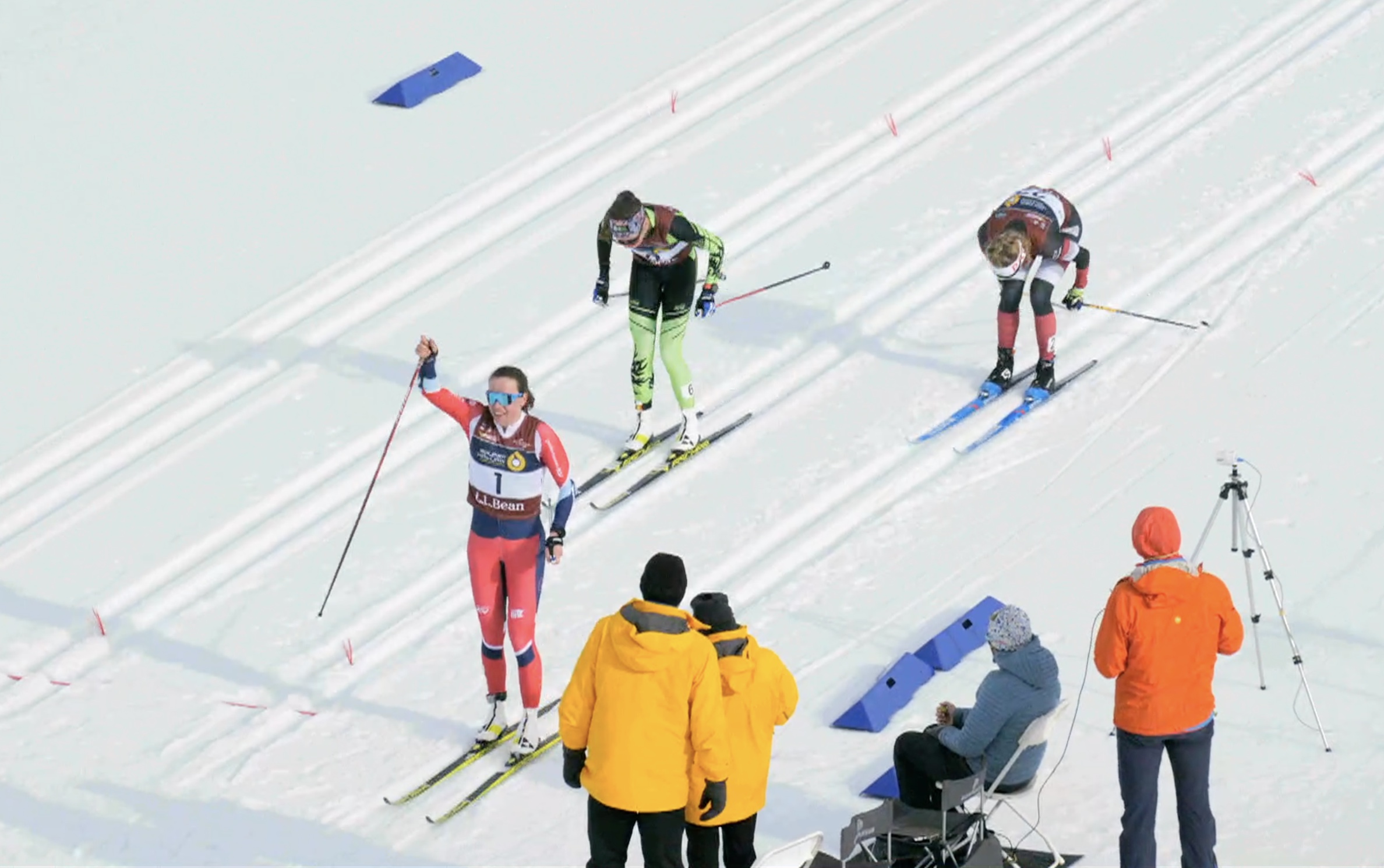
Ogden maintained her lead to stop the clock in 5:01.63, while Patterson edged out Rudd for second (+0.98) and third (+1.53), respectively. After regaining contact with the pack following her crash, Jortberg finished fourth (+6.64), with Lawson fifth (+7.11), and Freed sixth (+21.55).
“I was having a lot of fun out there today!” Ogden wrote to FasterSkier after the race. “The sprint was definitely on the long side, especially late in the day, but that did not significantly affect my strategy; I am confident in my endurance as well as my short duration power. I was really excited to have fast skis from Pat [O’Brien] and it was fun to experience the high level of sprinting in the U.S. currently. I also haven’t really done a full sprint day in a while so that was a lot of fun! It was also so impressive to see Caitlin get her fourth podium in as many races and to see Hannah Rudd have an incredible breakout performance today!”
Katharine Ogden celebrates her win in the classic sprint while Caitlin Patterson edges out Hannah Rudd for second and third. (Photo: Livestream Screenshot)
In a post-race email, Patterson reflected on her experience racing through the heats.
“My racing today went fairly well, and it was a beautiful day to be out skiing and spectating,” wrote Patterson. “The sun-warmed snow became quite wet and broken apart for the heats, and combined with the wind, it certainly made a long sprint with plenty of herringbone and some sloppy tracks. I tried not to really think about the time duration much, it was mostly about getting from start to finish, however long it would take. All of the heats required some scrappy skiing, moving around through the slush and timing the length of the tuck. Now I’m really looking forward to some recovery after a good week!”
Patterson also spoke to the week of racing in Soldier Hollow, where she finished on the podium four times in as many races, including wins in both the 10k individual classic and the skate sprint. But she was not the only person in a green suit putting together a successful week. Yesterday, she shared the distance classic podium with teammate Adam Martin. On Tuesday, Crafstbury went 3-4-5 in the 20k skate, with Lawson and Freed leading a chase group behind Frankowski and Patterson. And today, five CGRP women raced in the semis, with three advancing to the final.
“Everyone at Nationals is really feeling the fatigue, and myself and my team were no exception out there today. The race coughs are becoming quite terrible from so many days of racing at altitude, which is not the most fun to be coughing uncontrollably in this time of COVID. However, I was really proud of our whole team, with 5 women in the top 10! We have a really strong group, as evidenced by the performances in the distance races too; it came as no surprise to me that the women were awesome today, because training and doing intervals all summer and fall we’ve been neck-in-neck and pushing each other.”
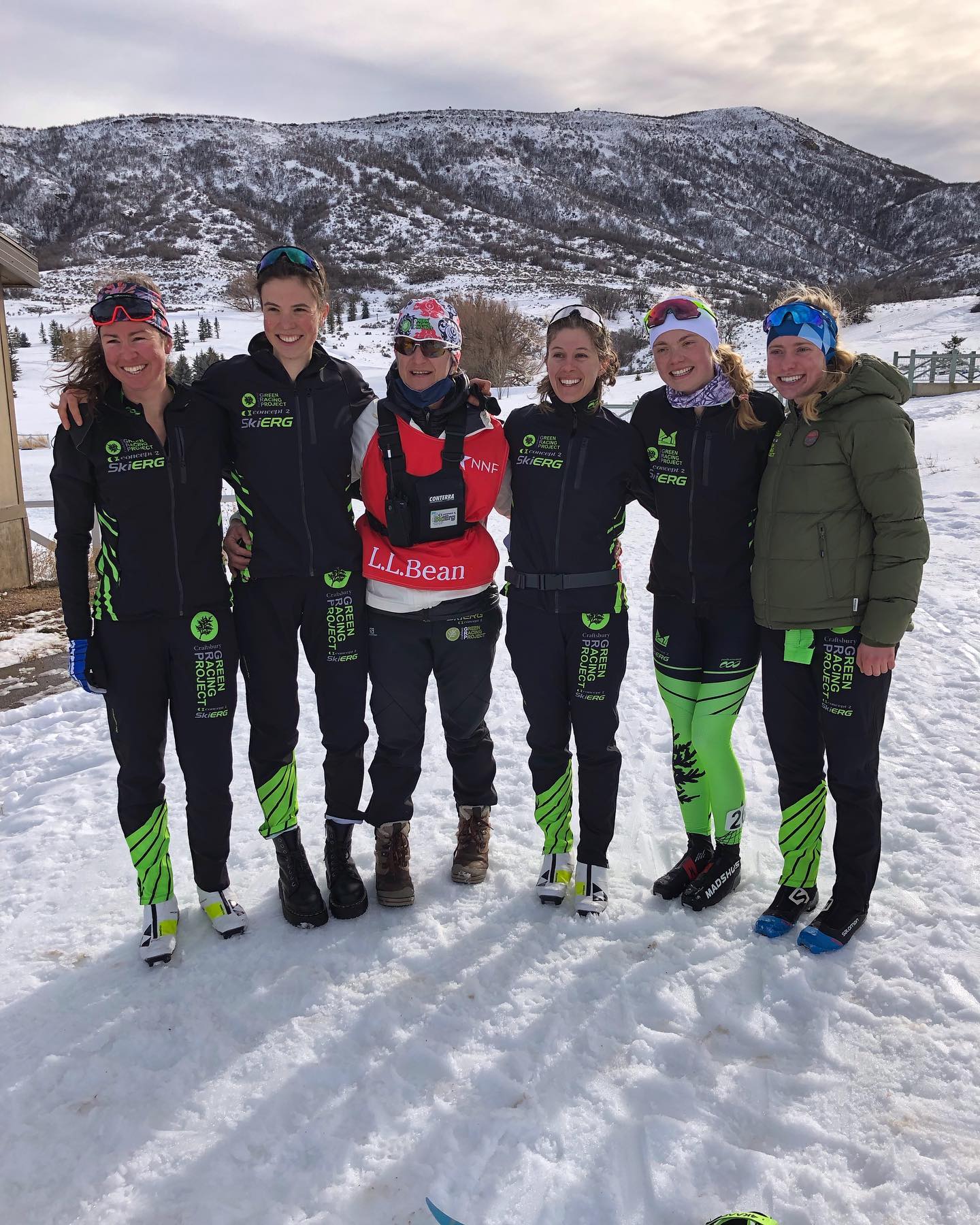
The women of Craftsbury with coach Pepa Miloucheva. CGRP put five women into the semifinal and three into the final of the SuperTour classic sprint in Soldier Hollow. (Photo: Facebook Crafsbury Green Racing Project)
For Rudd, this was her first career SuperTour podium. Originally from Plymouth, MN, she graduated from University of Alaska Anchorage (UAA) in May, 2020 before heading to Bozeman to join the newly minted BSF Pro Team. Placing in the top-10 in each of the three stages of the 2022 U.S. Cross Country Championships, Rudd has steadily worked her way up the results list, finishing 10th in Sunday’s freestyle sprint, 8th in the 20k mass start free, and 6th in the 10k interval start classic. She ends her week in Soldier Hollow on a podium high note.
Hannah Rudd is a member of the BSF Pro Team based in Bozeman, MT. (Photo: bridgerskifoundation.org)
“Yesterday was a pretty exciting day for me!,” Rudd wrote to FasterSkier after the race. “The sprint course at Soldier Hollow this year was very challenging as it included three solid climbs. During the qualifier, the course remained very firm and fast. However, the temperature quickly began to rise throughout the day, and by the time the quarterfinals began, the sun was baking the course, the wind was blowing, and temps were nearing 50 degrees. This made the snow begin to transform and slow down and turned the tracks into mashed potatoes in some sections.
“I woke up in the morning feeling quite tired from the past week of racing so I was not sure how the day was going to play out,” Rudd continued. “I ended up qualifying in 22nd, so it was clear that I had some work to do in the heats. I felt like I was able to gain momentum and energy throughout the day, and progressed through the quarters, and semis and onto the final. Going into the final, I knew that my team’s skis were running really well so I tried to ski big and relaxed and put myself in a good position for the last downhill. It was pretty neat to be in a final with my BSF teammate Lauren Jortberg, who is an incredible sprinter and someone that I have learned a lot about sprint racing from over the past few years. I was extremely excited to land myself a spot on the podium and think it will help me to continue building momentum and confidence for the rest of the season!”
The podium ceremony for the women’s final following the SuperTour classic sprint in Soldier Hollow. Katharine Ogden took the win ahead of Caitlin Patterson and Hannah Rudd, with Lauren Jortberg 4th, Alexandra Lawson 5th, and Margie Freed 6th. (Photo: Facebook Craftsbury Green Racing Project)
Men’s Race: Colorado’s Magnus Bøe Upsets Schoonmaker in the Final
In qualifying, JC Schoonmaker (USST/UAA) showed why he has been the U.S. Ski Team’s most reliable fixture of World Cup Classic heats this season, winning the qualifying with a time of 3:08.43, 6.42 seconds ahead of 2nd place Peter Holmes (Sun Valley SEF). Andreas Kirkeng (University of Denver) rounded out the top 3 (+6.57), in a field where the top 30 were all within 20 seconds of each other.
With a dominant performance in qualification, the racing throughout the day always seemed to have one eye on where Schoonmaker was in the field. In his quarterfinal, Schoonmaker looked to start conservatively from the back of the field, which led the whole heat to sit back as well. When he moved to the front at the beginning of the first climb, the race surged forward with him. No one could match him, however, and he finished with a comfortable lead, with Kjetil Bånerud (NMU) taking the 2nd semifinal spot (+1.02).
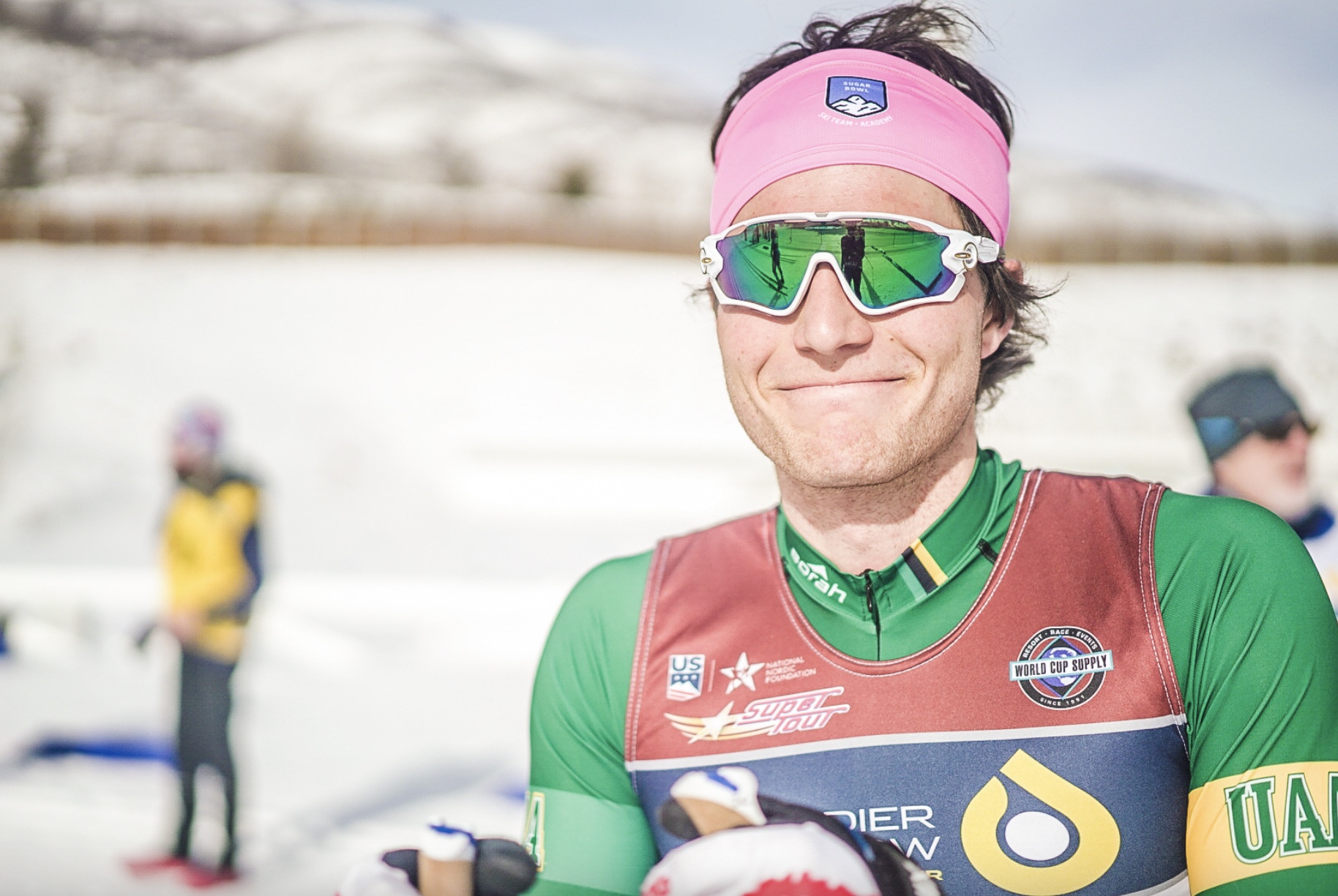
JC Schoonmaker prepares for a sunny and warm classic sprint in Soldier Hollow. (Photo: Tobias Albrigtsen / @untraceableg)
The following two quarterfinals also previewed the competitors, and their preferred way of attacking the course, that would define the semifinal and final racing later on.
The second heat set a stark contrast in pace to the previous heat, with Noel Keefe (U of Utah) and Bill Harmeyer (SMS T2) leading the field out hard from the gun. Hunter Wonders (APU) and Johnny Hagenbuch (SVSEF) were able to keep with the pair though, and ended up out-sprinting Keefe and Harmeyer going into the finish. Still, the duel between Keefe and Harmeyer led to a blistering pace for the heat overall, and they would claim the lucky loser spots for the semifinals.
Then came the 3rd quarterfinal, featuring winner of today’s most aggressive racer award (unofficially handed out here, by Fasterskier), Ian Torchia (SMS T2), who in every heat he was in today would hammer out to the front of the pack while others seemed content to let the field play out. He was joined in the heat by Magnus Bøe (U of Colo.), who made his move on the first climb, stayed out in front, and came through in first place. Torchia, meanwhile, held onto second to advance automatically to the semifinal.
The semifinals marked more an amalgamation of race strategies than anything unique. But it was an amalgamation – which requires multiple parts. And indeed, on a course known for rewarding smart-racing, and in conditions – above freezing, on man-made, wind-swept snow – that reward smart waxing as well.
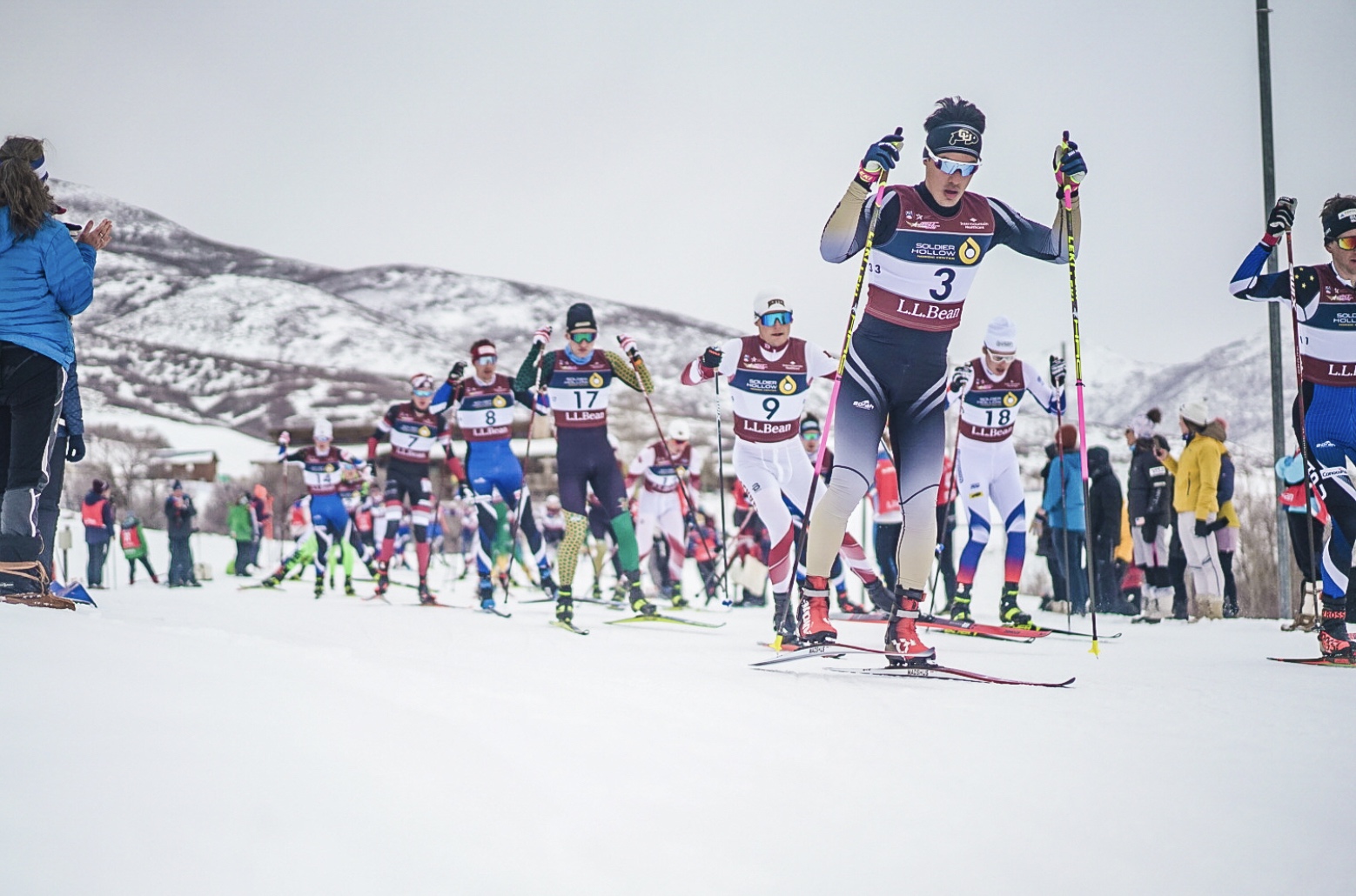
Magnus Bøe and JC Schoonmaker are off the line during the 2022 U.S. Cross Country Championships freestyle sprint stage. (Photo: Tobias Albrigtsen / @untraceableg)
The first semifinal featured Schoonmaker and Bøe, both of which stayed back in the back during the early part of the course. Going into the first climb, Bøe took a look back, saw Schoonmaker and Harmeyer were sitting in fifth and sixth place, respectively, and decided to attack. He led over the top, into the downhill, and up the final climb. Schoonmaker successfully did maneuver through the pack to counter the move, and on the final climb took the outside line up, cutting in to tuck behind Bøe going into the final downhill. When they came up, Schoonmaker had used the draft to put himself out front, while Bøe held off a late-surge from Hunter Wonders (APU) to take the second qualifying spot into the finals.
The second semifinal was again led out by Ian Torchia, who was then followed by former sprint National Champion Tyler Kornfield (APU). Kornfield seemed content to sit behind Torchia until the first climb, when he put in a burst of speed and broke open the field. The smartest racer, however, may have been Karl Schulz (SVSEF), who rode Kornfield’s attack, and then drafted, to go into the final climb with speed. By the time he hit the downhill, he had a gap which would remain unclosed. Kornfield, who had gone into the downhill in second, found himself joined by Noel Keefe and Ian Torchia into the final sprint for the second spot. As it would happen, all three would make it through to the finals, with Kornfield in second, and Keefe and Torchia being rewarded for their efforts early in the race by claiming the two lucky loser spots to the final.
The A-final then looked like this: JC Schoonmaker, Magnus Bøe, Karl Schulz, Tyler Kornfield, Noel Keefe, and Ian Torchia.
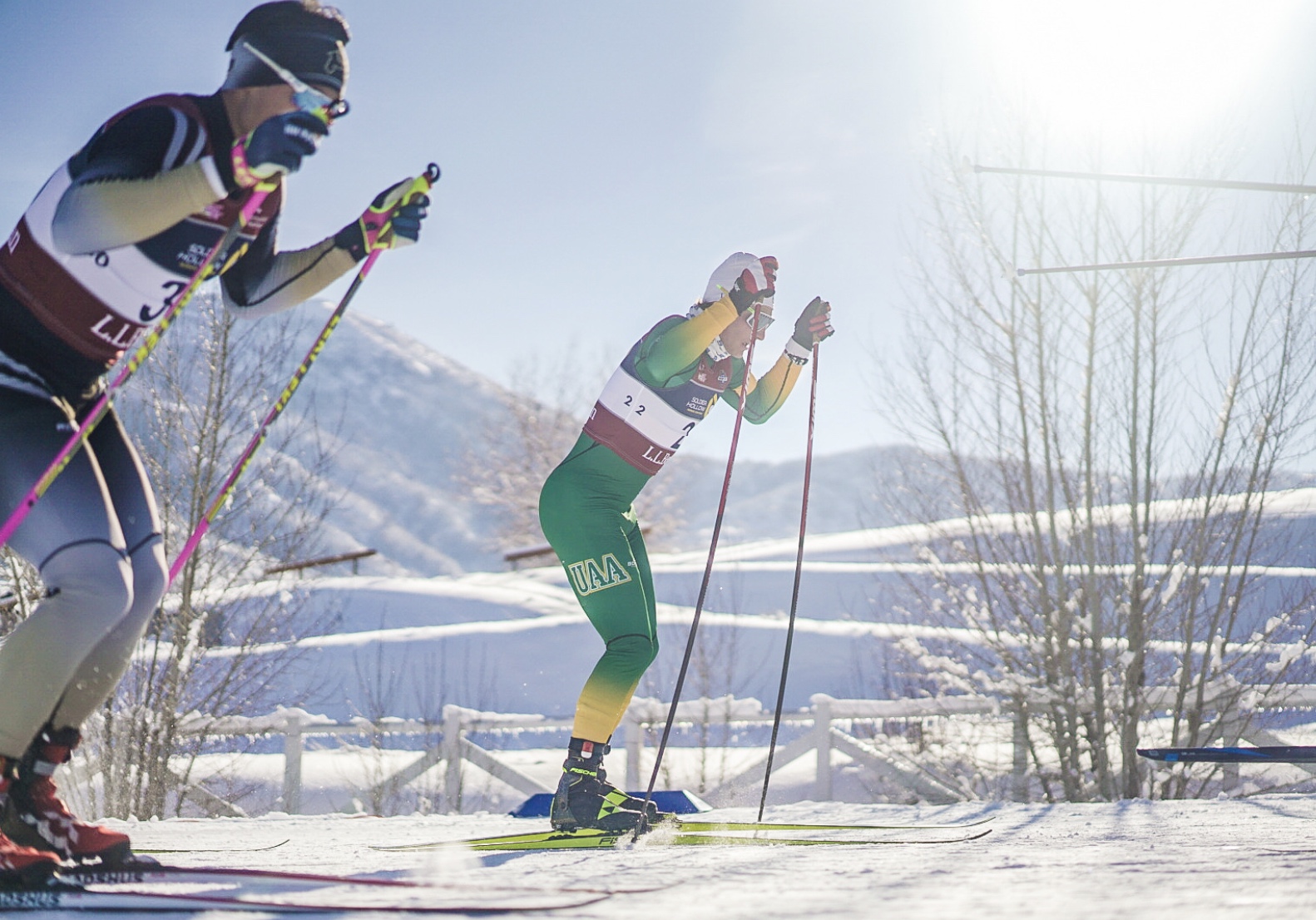
JC Schoonmaker races the qualifier during the SuperTour classic sprints in Soldier Hollow, UT. (Photo: Tobias Albrigtsen / @untraceableg)
With memories of Schoonmaker’s dominating qualifier in mind, it seemed like the field orbited around him off the line. Schulz found himself in front, but not going full bore to open the field up. Even Torchia, when he did make a move to the front, didn’t seem to do so with the same force that had marked his quarter and semifinal attacks. Schoonmaker waited until the first climb to move to the front, and then the final really was on. Schultz seized on the attack, and then put an extra-push into the downhill to try and open up an unclosable gap like he had in his semifinal. It was a good move, but one that didn’t prove to have the same force as his previous attack, and going into the final climb he was joined up with Bøe and Schoonmaker.
Then, Schoonmaker’s pace seemed to drop-off, with a few noticeable slips that progressed into a herringbone. Bøe, meanwhile, went for the herringbone from the get-go. He was the one that made contact with Schulz before the course gave way to a final downhill on the day. Schultz held a gap on the field through the glideout and over the bridge, but it proved not to be enough of a margin to feel comfortable in the final stretch. Meanwhile, Schoonmaker had fallen back to fifth.
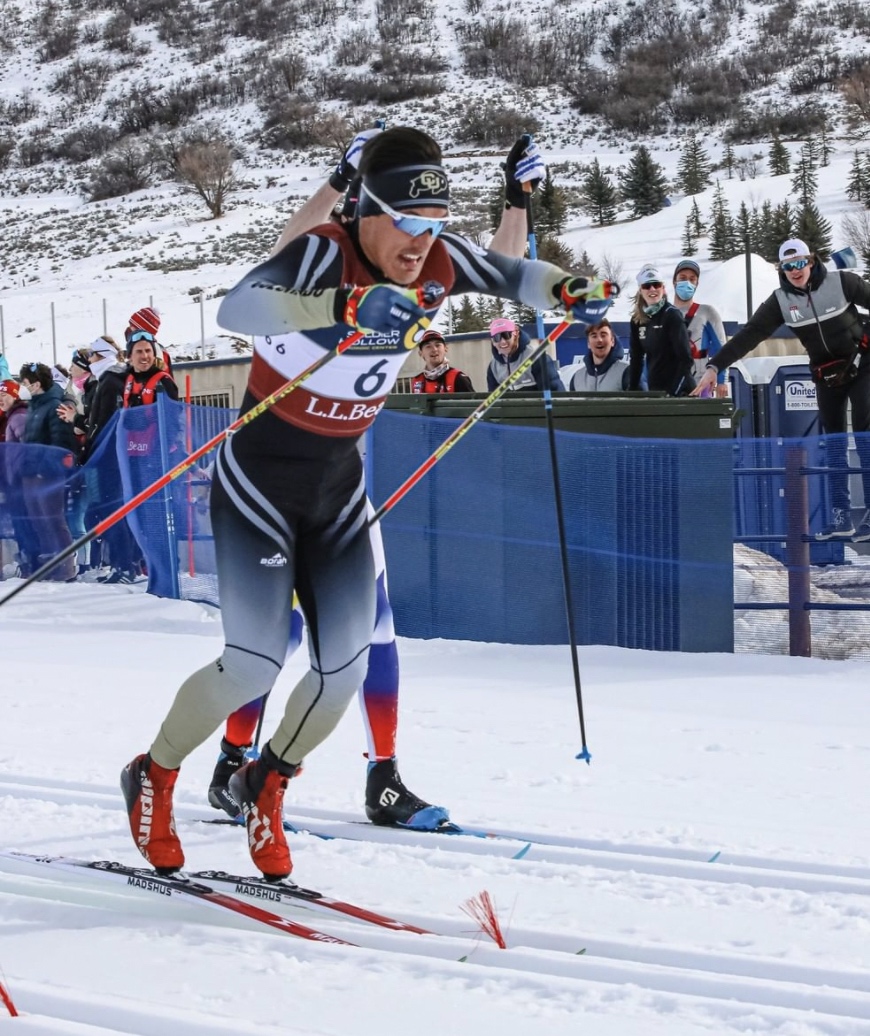
Utilizing his dominating doublepole sprint, when they hit the final 100m it was all Bøe, who closed a significant gap to catch Schulz in the final 50 meters. Looking as if he was leaping forward with each push, Bøe switched lanes, overtaking Schultz just before the line and letting out a fist pump as he realized a SuperTour – and collegiate – victory in a time of 4:08.28. Pushing to the line, Schulz was a close second (+0.35). (Video clip here.)
Magnus Bøe overtakes Karl Schultz just before the finish of the men’s classic sprint final. (Photo: Instagram @cubuffs)
After a gap, Schoonmaker, who was fighting for the final podium spot alongside Kornfield and Torchia, crossed the line outside of the track in third place (+4.53). Kornfield was a half second back from Schoonmaker for fourth (+5.10), with Torchia fifth (+5.64), and Keefe sixth (+11.02).
After the race Bøe explained that he changed his tactics in the heats relative to Sunday’s freestyle sprint, though he joked he thought it wise not to reveal everything.
“Today was a windy and slow-condition day,” Bøe wrote in an email. “There was headwind in the first half, and tailwind in the second half. Hence, pulling during the first half would be pointless. Furthermore, the second half, particularly for the last downhill there was very little to gain on the slipstream, due to the low speed and the ‘suctiony’ snow (cold conditions create better glide for the person coming behind on ‘heated tracks’). Therefore during all my heats I pretty much went all out from the top of the last uphill all the way to the finish, which on sunday would’ve been a suicide.”
Bøe walked through the final, including how he reacted to lead changes and adjusted his strategy when the race began to play out differently than anticipated.
“The final started off very slow, but then the positioning battle developed gradually from under the bridge. My main focus was to keep my eyes on JC, since he was clearly the favorite of the day, and I knew I would do well if I laid it up to beat him. Hence I never fell for the temptation of passing him, even though I had many chances of doing so. However, he did get tired during the last climb and tried to get others to pass him. This is when Karl took off and gained a massive gap that at first seemed too late to close. As soon as I realized that JC might not be able to catch up, I committed to catching Karl by myself. I made sure to put in a great push before the downhill straight, and did the ‘supertuck’ to gain every single inch I could. Once I started double poling towards the last bend it was just heads down and maximum effort. Was never certain I would catch Karl, I thought maybe he’d have something left at the very end. But lucky for me he didn’t and I had just enough to pull it off.”
University of Colorado’s Magnus Bøe heads out for the men’s 30k mass start free during the 2022 U.S. Cross Country Championships in Soldier Hollow. (Photo: Tobias Albrigtsen / @untraceableg)
A dual citizen of Korea and Norway, 23-year-old Bøe has already built a robust resume in international ski racing, including competing for Korea during the 2018 Olympics in Pyeongchang. Earlier this week, Bøe was fifth in Sunday’s freestyle sprints and finished 11th in the 15k classic. His only down race of the series happened in the 30k mass start freestyle, where he finished 43rd (+12:30.9).
“This week of racing has been up and down, from a miserable 30km where I got lapped, to today’s win. It’s been a lot of fun, and not least has been helpful for my shape. Next up is the Super Tour in Sun Valley, which I am looking forward to. Think I would be able to build on top of what I gained during this week.”
For Schultz, today also marked a career-first SuperTour podium. The 23-year-old Lake Placid, NY Native raced for the University of Vermont (UVM) until graduating in May, 2020, then heading to Sun Valley. Schultz had a podium just-miss earlier this year in a freestyle sprint where he finished fourth during the opening weekend of SuperTour racing in Duluth, MN.
“I was pretty fatigued from the three races prior,” Schultz wrote after the race. “I knew there was a decent headwind on that first climb, so I decided I’d tuck in behind up and over the first climb. I figured I’d need to save my strength for the final climb and long finishing straight, so I played my cards well and pushed where I needed to, and it just worked perfectly. I’ve learned sprinting is about preserving energy for critical parts of the course, it couldn’t have gone better.”
“And I won’t lie,” Schultz continued. “The spectators and everyone cheering allowed me to find another gear, especially up the last climb. I dug deeper than I have before.”
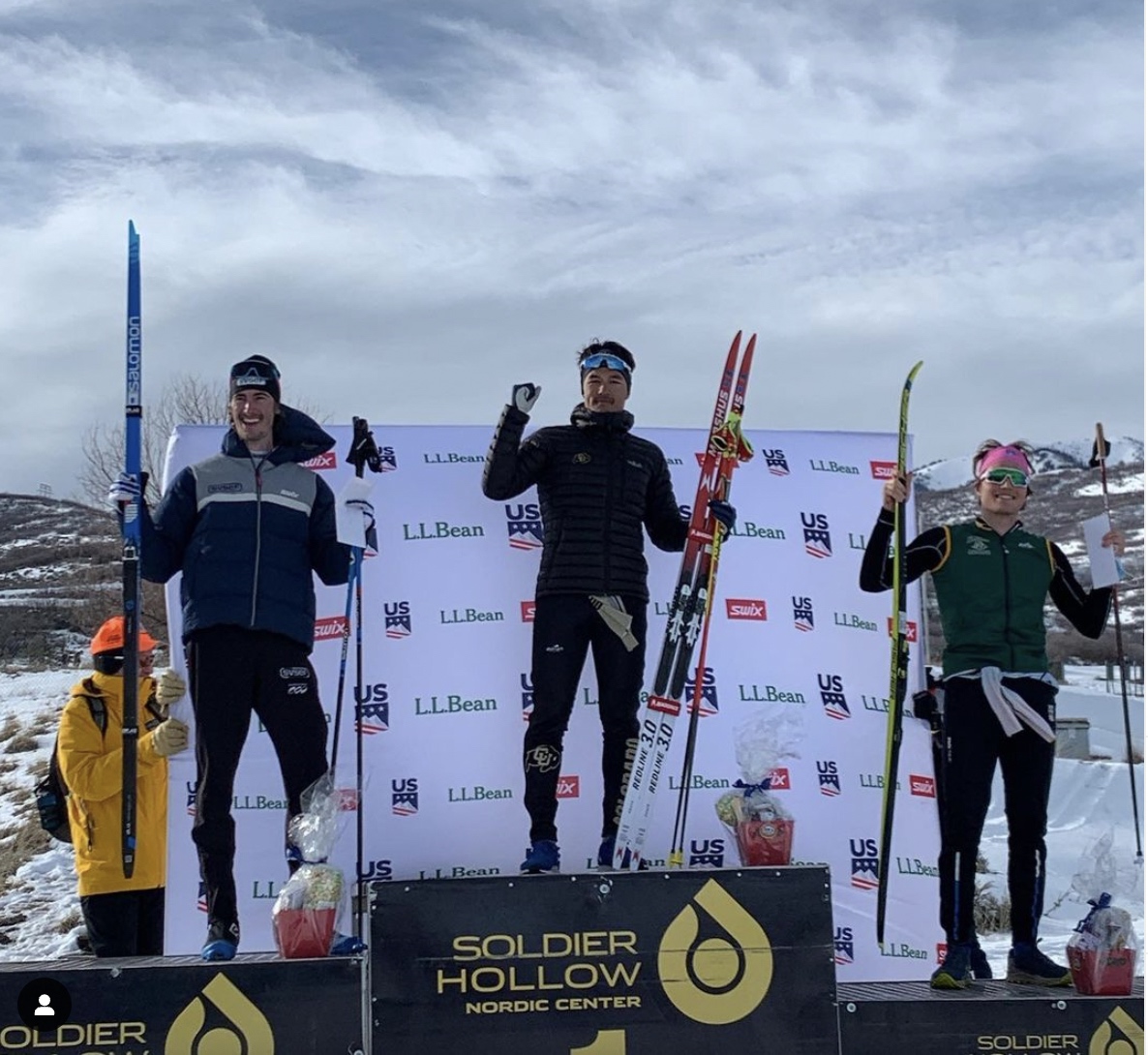
The men’s podium of the SuperTour 1.5k classic sprint in Soldier Hollow: Magnus Bøe took the win ahead of Karl Schultz and JC Schoonmaker. (Photo: Instagram @nysefnordic)
Writing to FasterSkier after the race, Schoonmaker explained how changing conditions forced athletes to make tough decisions about skis as well as tactics.
“It was a pretty crazy difference from this morning to the afternoon,” Schoonmaker explained. “The morning was icy and fast and the heats got really sloppy and slow. I had amazing skis in the morning and in the heats I struggled a bit with choosing whether to go for more kick or glide. I ended up asking for less kick to free the ski up a bit and I’m still not sure what was the right call. It was just really challenging conditions.”
Schoonmaker also explained that he had made fewer adjustments to the technique he had found such success with in Sunday’s skate sprint, however, the final proved to break the mold of what has historically proven to be the recipe for Soldier Hollow sprint racing.
“For this course I tried to take a somewhat similar approach as in the skate race by respecting the draft on the last downhill and trying to be careful about the guys behind me there. In the quarterfinal I felt I was able to ski away and create a big enough gap so that I couldn’t get sucked back in by the draft. In the semifinal, I tried to stay more in the pack and use the draft for myself. The final was tricky because I was going to try and use the draft again but Karl put in a really good move on the last hill that I couldn’t match. Then I was leading the rest of the pack and I decided to push over and try to catch Karl rather than go to the back to find the draft. It ended up not working out so great, but I’m happy with the day and the tough effort.”
We conclude a week of racing at Soldier Hollow, then, with a race that highlighted the strength and depth of the domestic circuit of U.S. skiing at present. Variable conditions on a technical course, which racers approached with tactics as diverse as the regions they hail from, indicated that this is a field that represents top-level racing. It was a testament to the development and growth of the sport in this country that a top-level racer like Schoonmaker can come off the World Cup and find a field where every heat is raced with closeness and intensity in his own country. That bodes well, and is a great place to leave the last national gathering of the US ski racing community before its best representatives look to take a crack at the Olympic Games in Beijing next month.
The spirit of the sport captured at the finish line as Alaska Winter Stars athlete Meredith Schwartz embraces her coach at the finish of the classic sprint in Soldier Hollow. (Photo: Tobias Albrigtsen / @untraceableg)
FasterSkier extends congratulations to all athletes who competed in Soldier Hollow this week, commending their efforts in a fiercely competitive field through a variety of race formats and course conditions. Also, a big thank you to Tobias Albrigtsen and John McColgan, who generously shared their photos with us throughout the week. Stayed tuned for an upcoming gallery highlighting many of the fantastic images that were not included in our reports.
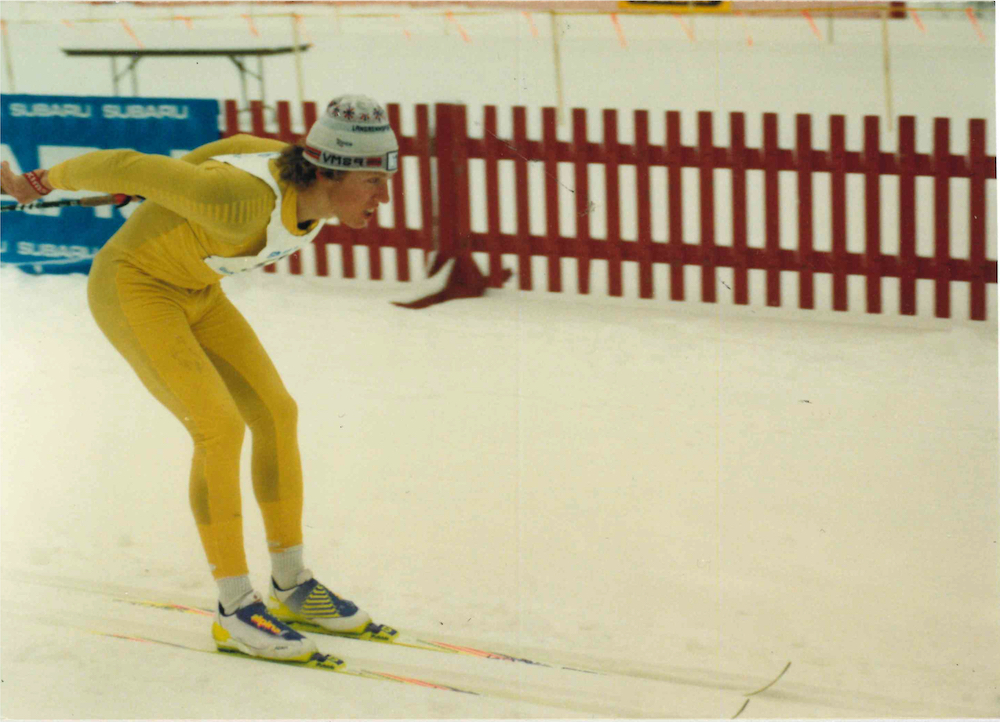
“1992. Senior year of college. Biwabik, Minnesota. Another cold day. Olympic trials. I was in the top ten in every race that week and came about as close as possible to making the Olympic Team without making it.” (courtesy photo)
Editor’s note: This is the second essay in our new series, “Letters to my younger self.” Lauren Fleshman provided the modern locus classicus for this genre; Adam Verrier ably takes up the mantle here. While the first two essays, from Adam now and John Wood before him, have set a high bar, the general theme of this series is clear: If you were writing a letter to your younger self, what would you want to tell them about skiing, life, or skiing and life? Additional contributions from our readers are respectfully requested and gratefully accepted; see the bottom of this article for our contact info.
Adam grew up in New Hampshire, as he discusses in this memoir. He skied collegiately for the University of Wyoming, when it had an NCAA ski team, and was a nordic ski Olympian at the 1994 Lillehammer Games. He began dominating Anchorage endurance sports soon after, with wins in the Crow Pass Crossing, Lost Lake Run, and Tour of Anchorage among many other items on his local race résumé. He has the all-time record for podium finishes in the Tour of Anchorage 50k skate, the unofficial Alaska citizens championship contested by dozens of Olympians over the years, with eight. At 53, Verrier recently qualified for the classic sprint heats in a loaded Anchorage JNQ field, only to bow out so that a junior could race instead. He has announced numerous prominent American ski races. He founded the iconic Oosik Classic ski race now held in Talkeetna, Alaska. And he is a very, very nice guy.
But “None of these things define who Adam Verrier is,” current University of Alaska Anchorage head coach title Sparky Anderson wrote in a recent blog post. “Adam is a musician, a connoisseur of experience, deeply interested in anyone lucky enough to engage him in conversation, a rural Alaska home appraiser, and an avid clothing-optional motorcycle operator.” As Anderson also notes, Verrier has been a volunteer assistant coach for the UAA ski team since 2001. Verrier keeps a delightful, sometimes idiosyncratic blog about the UAA nordic team here.
By Adam Verrier
Dear Seventeen-Year-Old Adam,
I’ve been asked by FasterSkier.com to write a letter to my “younger self.” So this is your future 53-year-old self, with some advice and some insights based on the intervening 36 years’ worth of life experience between you and me. (By the way, FasterSkier.com is a “website” on the “internet.” Since it’s 1985, you’ve probably never heard these terms before, but that’s a topic for another conversation.)
Under normal circumstances, I’d never write to you from the future and spoil your suspense. After all, isn’t life all about finding your own way forward, being ignorant but curious, charting your own course, trying to make good decisions, and hoping for a little luck, too? To write to you from the future with the answers seems like a great way to deprive you of most of the excitement and joy that a life has to offer. So ordinarily, I would never agree to this. But since I don’t believe in time travel, I’ve agreed to participate.
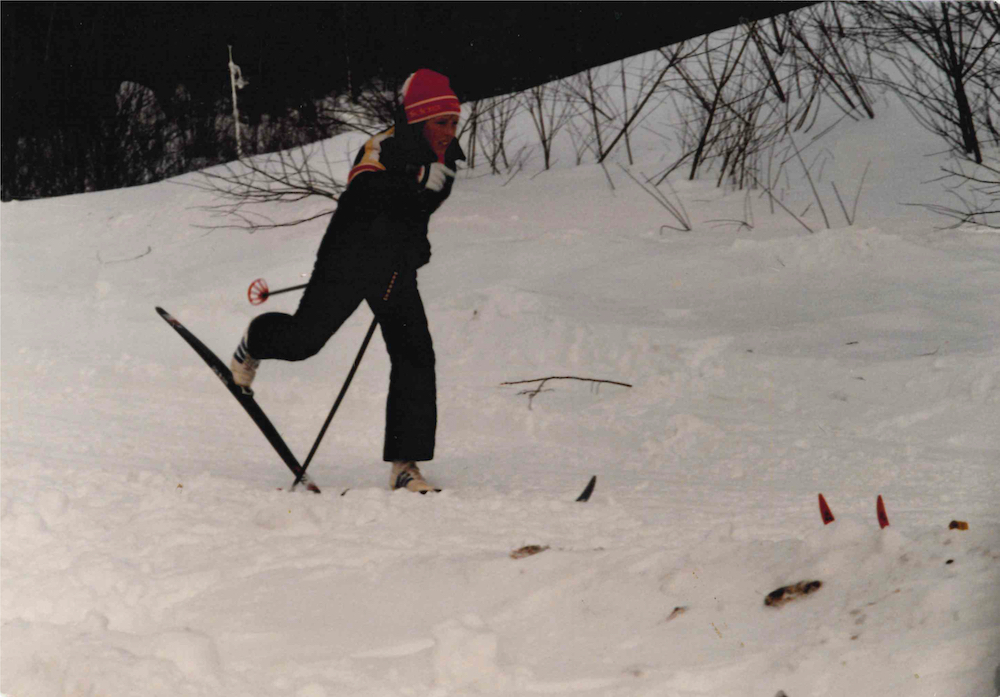
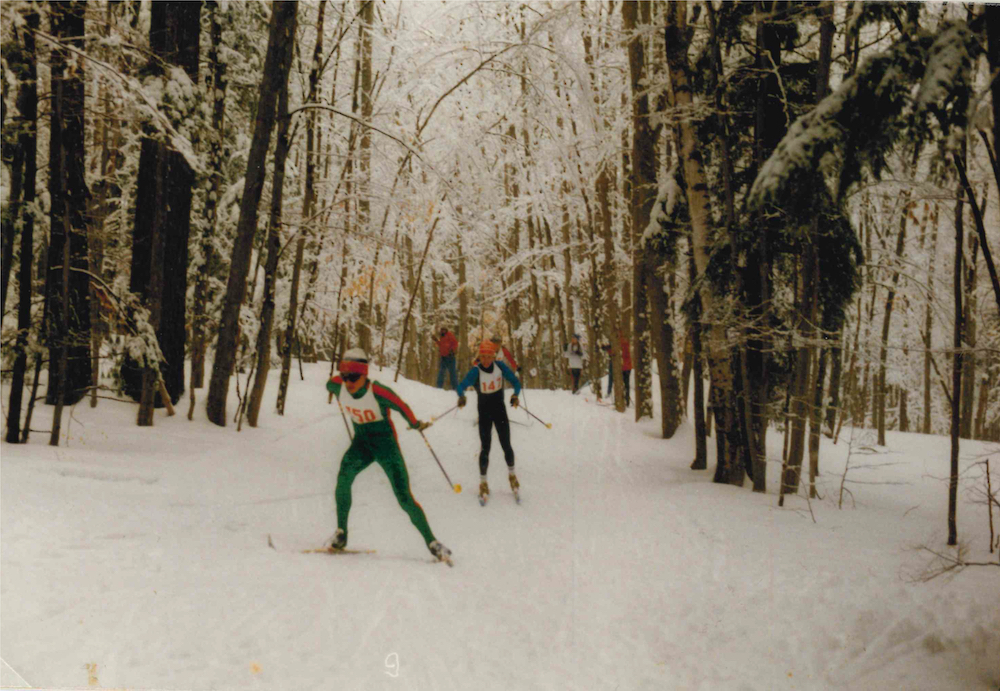
“Probably 1984. Bretton Woods, NH. I remember it was FREEZING cold that day!” (Courtesy photo)
As fate would have it, I had a conversation just last week about pretty much this same topic during ski practice with the women on the college team that I’ve been volunteer-assistant coaching for years. It was suggested, during our warm down after a set of intervals, that I use my little mobile recorder to tape conversations with them – our college skiers – about skiing, about life, about their hopes and dreams – and then we could listen to it 20 or 30 years in the future and see how differently things will turn out in reality, as compared with how we now think they will.
When I was their age, I had such a dramatically different set of goals and ambitions for myself from what has actually transpired over the years from then until now. I never would have imagined my life would follow the path that it has, and I’d have never imagined that I’d end up living in Alaska. And I expect they’ll feel the same way thirty years from now. Because, really, isn’t it that way for most people who are curious and open to new ideas and new experiences?
At this point in your young life, Adam, I know that things are looking and feeling pretty dark. High school is a struggle, and you hate it. It seems you’re spending all your time studying and doing homework, and trying so hard just to get C-minuses. No matter how hard you try to understand it, algebra doesn’t make any sense at all, chemistry is beyond your comprehension, and your English teacher thinks your writing sucks.
Cross-country skiing is your favorite sport, but you’ve never really been very good at it. I mean, yes, good locally against your friends, but you’re not remotely in the same league as the best skiers in the New England. You’ve been racing in all the New England qualifying races, trying to make Junior Nationals for years, but have never qualified. And you’ve never even been very close to making it. You want to go to college but there’s the question of how to pay for it. Joining the military and using the G.I. Bill to go to college like Uncle Tommy seems like the most likely route, but there’s also the chance that distance running could get you a Division 1 college athletic scholarship. Because running is the thing that you’re actually very good at. Problem is, while you love cross-country skiing, you dislike running. You find it jarring and uncomfortable, and you can’t imagine having to keep doing all that running, all the way through college. You feel like you’d probably rather join the military.
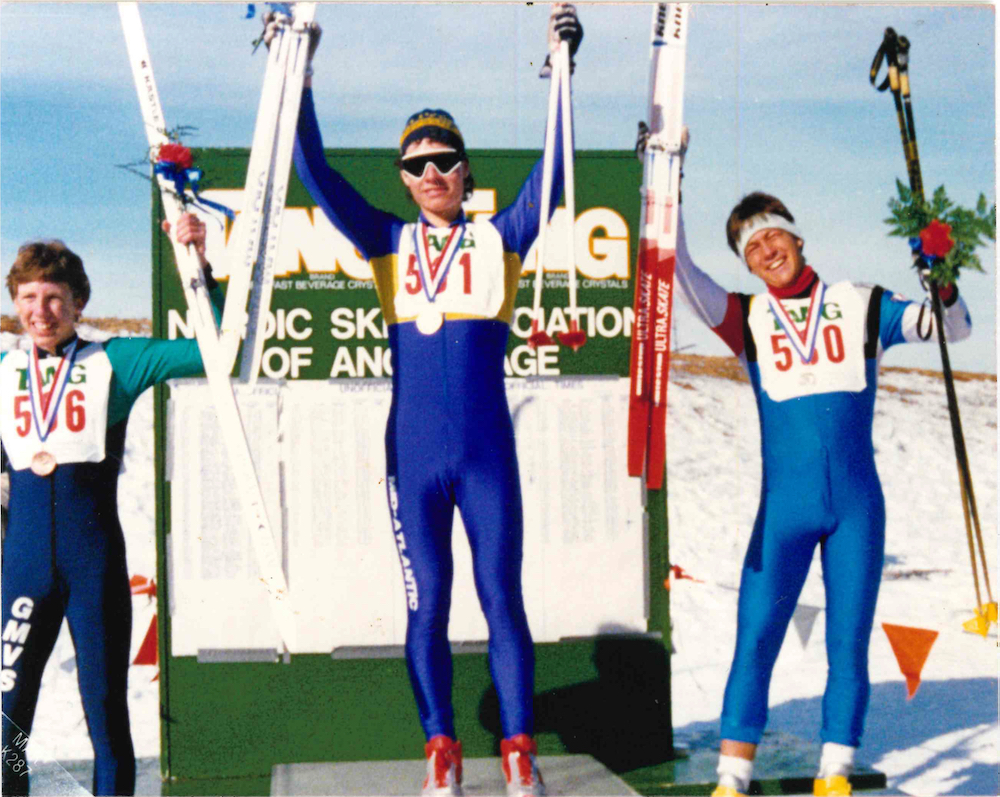
“Getting my first look at Alaska. Junior Nationals. 1987. I was third [far left]. That looks like Jeff Graves in second. And Ed Lynt in first.” (Courtesy photo)
As I said earlier, I’m now a volunteer assistant ski coach for an NCAA ski team. Yeah, seems hard to imagine now, doesn’t it? I get to be the “team uncle” to this group of kids (older than you, I know, but I call them kids) who are talented and smart and ambitious. When I think back to when I was seventeen, it seems unimaginable that I’d go from being a frustrated high-school athlete with a strong work ethic but dim prospects, to being someone that they’d let hang out with a group of elite athletes like we have here on this college team. But somehow I went from there to here. And I’m going to tell you how I think it happened. I will tell you what your future has in store for you, and how I think you could do a lot better, with less frustration and misery than what I’ve put myself through.
In the very near future, you’re going to have some luck in one particular ski race – the New Hampshire state high school championship. Due to some inclement weather conditions (heavy snow and rain on race day) and because you’ll have extraordinarily fast skis on that day (due to pure luck with the weather – maybe all those rocks you’ve hit gave your bases lots of anti-suction structure to handle the soggy snow) you’ll win a race against skiers who are usually a lot faster than you. This one lucky result will open a door, which will lead to other opportunities, and your goals and ambitions will change with each new result and new opportunity.
“New Hampshire State High School Championships. 1986. Carl Swenson in front, obviously knew how to skate. Me, in back, obviously kind of fumbling around with it. But I won that race, somehow. That turned out to be a very big day for me.” (Courtesy photo)
I know that becoming a member of a college ski team doesn’t seem realistic now. It seems like either distance running or the military are the options for getting tuition paid for. Because you’re definitely not going to do it with an academic scholarship, the way things are going! But because of this one lucky race, you’re going to take the opportunity that’ll be offered to spend your senior year of high school at a ski academy. There, you’ll find out that you really don’t have very good skiing technique, and that this lack of technique is likely the reason your running is so much better than your skiing. You’ll also find out that, even though you train more, and far harder, than all your high school teammates now, you’re really not training very much at all, compared to the best in your age group. Finding out about this thing called a “training log,” and having teammates who are surprised you don’t know how to “V2-skate”… a lot is going to change in the near future.
One thing that’s going to keep changing is your goals and ambitions. I know what your goal is now: to find a way – any way – to escape rural northern New Hampshire and go west – anywhere west of the great plains – like your uncle Ronnie who escaped New England and became a cook at a restaurant in Lake Tahoe. Uncle Ronnie’s accomplishment – his escape from rural life – has been your ambition for as long as you can remember.
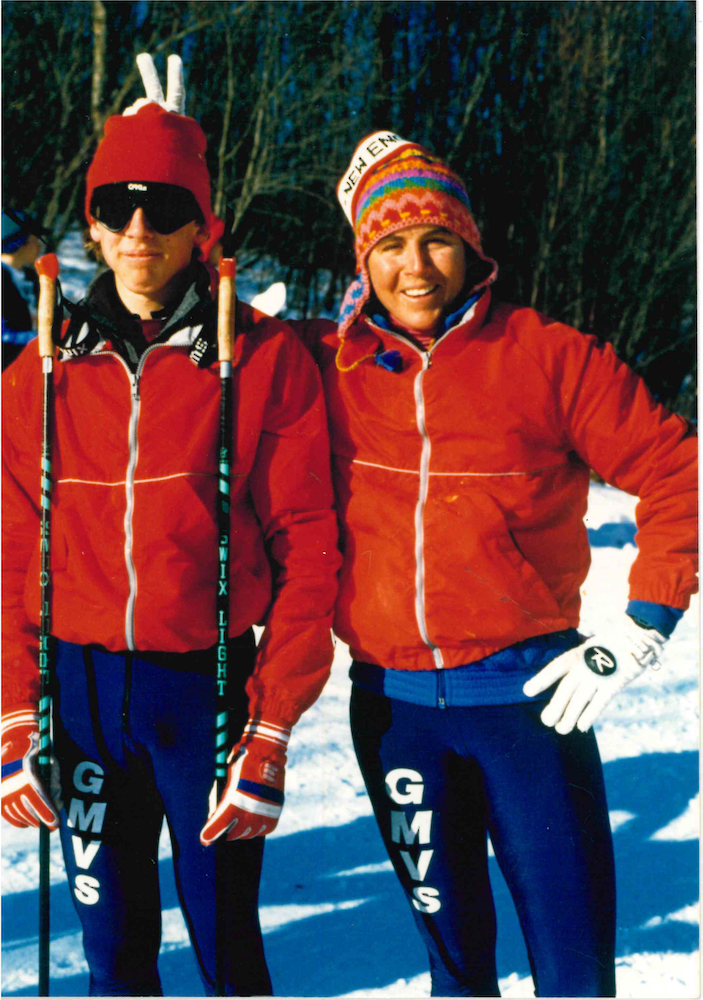
But you’ll find that just one year at the ski academy (Green Mountain Valley School), coached by one of most energetic and extraordinary women you’ll ever know, will change your thinking dramatically. Having never qualified for the New England Junior Nationals squad, you’ll finally qualify next year as an eighteen-year-old, and then actually win gold and silver at Junior Nationals, and it will seem very surreal and weird, like it’s not even you doing the skiing that week. Because everybody, especially you yourself, knows that you’ve never been fast enough to beat any of these other kids; they’ve always been much faster than you. But you’ll have to reconcile yourself with this new reality.
This result will provide the opportunity to be on a Division 1 college ski team. It will provide the opportunity to go west. To the University of Wyoming! As a high school senior, your goal will be, by the time you’re a senior in college, to get a few top-20 finishes in some western college races. If you can accomplish this, you’ll feel like you can legitimately call yourself an elite skier and a big success.
Summer 1994, Östersund, Sweden, US Ski Team training camp. Cart racing on our day off. Back row from left: Ben Husaby, Coach Sten Fjeldheim, Todd Boonstra, Justin Wadsworth, Verrier, Marcus Nash, Carl Swenson. Front row from left: Leslie Thompson, Suzanne King, Kerrin Petty, Nina Kemppel, Laura Wilson, Pete Vordenberg. (Courtesy photo)
I know this is going to sound utterly unbelievable to your 17-year-old self, but one thing is going to lead to another, and there are actually going to be some college wins in your future. There’s even going to be some World Cup racing and an Olympics. I know that this isn’t even remotely on your radar at this time in your life, but you’ll be shocked at how your future reality will differ from the way you imagine it now, when your only goal is to escape from this dark, rural life in this little town where it feels like nothing has ever happened, and it seems nothing ever will.
One thing that’s going to be of use to you as you move upward and onward in this sport is your inclination toward angst and melancholy. The discomfort that’s endemic to this sport will be an opportunity to explore your tendency to gravitate toward the dark and difficult, and toward isolation and self-reflection. Your most memorable, most rich, most intense workouts will be the ones done alone, in driving snow, in the dark, and half-lost. And your most successful races will be those rare occasions when you can manage to manipulate your own reality, to convince yourself that discomfort is no longer part of the equation, and that the ski race performance is more important than life or death. That the immediate moment is everything – is the only thing. It’s quite a stretch. You’ll learn some real mental gymnastics to manipulate your perception of reality for the purposes of a good race performance. For now, this penchant for despair and darkness mostly manifests itself as raw angst. But you’ll find, when you learn to work with it, that it can be a powerful tool in a sport like cross-country ski racing.
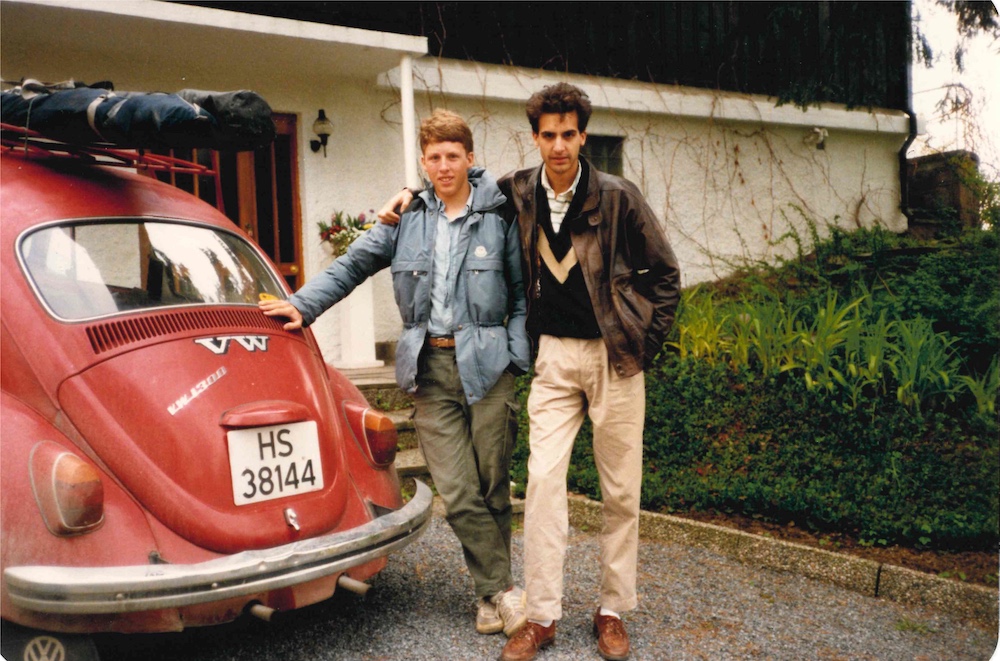
Verrier in Nesbru, Norway, outside of Oslo, in 1988. “With my 1962 VW Beetle and my friend Tariq Eik,” he writes. (Courtesy photo)
But the coin has two sides, and you’re going to see your friends and teammates struggle with some of the same feelings of futility and desperation that you have now. Many of your friends, teammates, and competitors are not going to survive their twenties. You’re going to be left shocked and speechless every time you hear about another friend.
You’ve heard it said that your brain is your most important muscle in sports, and I know you think that’s nonsense – everyone can see that it’s your heart, lungs and muscles that are most important in this sport. But you’re going to find out as you get older that it’s actually true; your brain really is your most important organ. Without focus, without willpower, without problem-solving, we’re not going to accomplish much. My friend Roy, who was an all-star Division I college basketball player and went on to play a decade in the pros, told me recently, “When I was younger, I wanted to explore the limits of what my body could do, but as I got older I gradually became a lot more interested in exploring the limits of my mind.”
Now I have some advice for you. If you want to do better at this sport than I did, spend less time thoughtlessly bashing yourself through workouts than I did. Instead, find ways to train smarter. Don’t just take all your coaches’ advice and grind through the training on the presumption that if you just do the workouts prescribed by whomever your coach happens to be, the success will automatically follow. That’s not a given. The most successful athletes in any sport have always been the creative ones who found their own way to do things nobody had done before. Among skiers, Bill Koch, Gunde Svan, Marit Bjørgen, Kikkan Randall, Petter Northug, Bode Miller… all of these skiers did things their own way, and in so doing became the best, or among the best, in the world. And the most successful skiers I’ve known here at UAA have been the ones who haven’t always agreed with what their coaches have told them. They’ve had their own opinions and they’ve been pretty stubborn. The best skiers I’ve known here at UAA… coaching them has not always been a picnic.
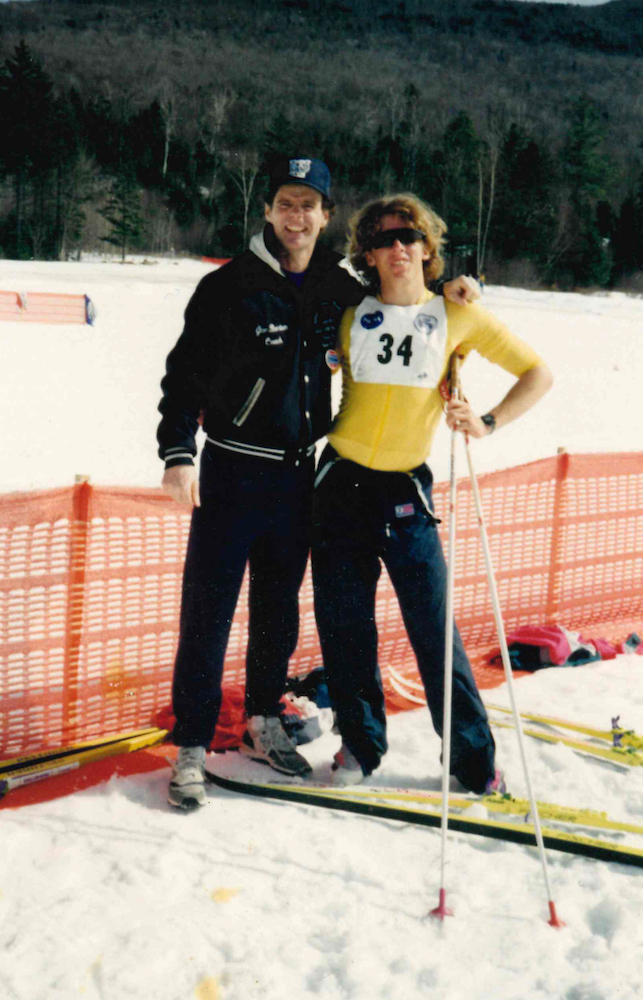
1992 NCAA Championships. Waterville Valley, NH. With my friend Joe Barton. (Courtesy photo)
The most important think that you should know, though, is that success in this sport is not going to turn you into something else; it’s not going to get you millions of dollars and a future in Hollywood. I know (because I remember) that you have this vague notion that there’s some kind of firm and defined dividing line between “success” and “not success” in this sport. I know that you have this foggy conceptualization that if you can achieve “success” by whatever criteria you’re defining it at the moment, then everything will be OK, you will have “made it” and you’ll be happy and satisfied and relaxed and proud of yourself. And I know that you don’t allow yourself to think about the consequences to your psyche if you don’t achieve “success,” whatever that means.
But I can tell you now, as your future 53-year-old self, that the reality is nothing like this. For example, my biggest regret in skiing is not quite ever winning an NCAA Championship. I came very close a couple of times, but never quite pulled it off. Nevertheless, the time I came closest was when I was beaten by my teammate in one of my best, most focused, and most excellent races ever. It was such a dramatic and fun day for me! Thus, as it turns out, my biggest regret in this sport is also one of my very favorite and most special moments.
You think that “success” and “not success” are defined by results, on paper. But I can tell you that, in hindsight, one of my proudest moments in this sport was a few years ago when my friend Ian told me that he used to call me “The Scrapper” because it was his impression that I would never give up, regardless of how well or how poorly I was doing. If there was going to be a battle for 467th place, I was going to fight hard to win that little battle. It made me feel so good to hear that from Ian, who is the same age as me but has always seemed to me like a role model, much more mature and a far better athlete than me, ever since we were young. Hearing Ian say that to me felt as much like “success” as I’ve ever felt.
“Success” and “not quite” are not nearly as defined and concrete as your young mind now conceives them to be. You’re going to find out, gradually over time, that your definition of success will morph and change in relation to, and in synch with, your goals. You’ll recalibrate to your successes and you’ll rationalize your failures. And you’ll also find out, because you’ll have friends with Olympic gold medals, that after the elite-level skiing is over, life goes on and these people do normal-people stuff just like you and me, with jobs and spouses and dinner parties and divorces and mortgages and everything else.
After the ski racing career is over, the most important and salient thing you’re going to be left with, contrary to this vague idea you have now, is not going to be a million dollars or a Hollywood acting career or free beers for life.
The most important and lasting thing you’re going to be left with is the memories of the good times you’ll have, and the friends you’re going to make.
As my friend Lucy, who was on another country’s national team, and about the same age as me, and whom I visited earlier this fall while on a motorcycle trip, said, “I can’t hardly remember what I had for breakfast this morning, but I remember all those crazy times racing in Europe like it was yesterday, and all the friends made along the way. And those good times and those good friends are the most special thing.”
1986, 18 years old, with Muffy Ritz, who had a big influence on me. (Courtesy photo)
So now, as I’m writing to you, they’re letting me be a volunteer assistant coach for a group of kids who are just a few years older than you are now. I hate to break it to you, but these kids seem much more mature and pleasant to be around than you will be when you go to college in a couple of years. Your college life will be a lot more pleasant for you and those around you if you could just dial down the intolerance and dismissal of your teammates’ goals which may be a little different or a little less all-consuming than your own. You could learn a thing or two from one of our current UAA kids, who is a lot better skier than you will be, who told me a few weeks ago that if he couldn’t be a personable and friendly guy for his friends and teammates to be around, he would quit the sport. Because it wouldn’t be worth compromising his humanity just to be a successful athlete. I found this statement shocking and profound, and I’ve been thinking about it a lot lately. It occurred to me that when I was his age, I had pretty much the opposite point of view. And it probably showed.
Seventeen-year-old Adam, you have a lot to learn in the years ahead. But even now, I’m finding out that I have so much to learn from the young people I’m around. This volunteer coaching gig gives as much to me as I give to it. The energy and curiosity of our skiers goes back with me to my “day-job” office after ski practice and influences how I handle the rest of my day. Their optimism and vigor inspire me to try new things and take chances for myself. Their search for purpose and meaning nudges me out of my own complacency, both physically and mentally.
“1987, Holderness, NH. First time I qualified for Junior Nationals. 18 years old.” (Courtesy photo)
Ultimately, my advice to you, seventeen-year-old Adam, is to tone it down with the obsessing and worrying about the future, and about achieving success. Connecting with the experiences and the people around you won’t prevent you from training hard or training smart. Enjoying the journey won’t preclude success. The fire and brimstone stuff is great as a race-day tool to help you achieve a transcendent performance, but it has no place in the team van.
And ultimately, none of this matters as much as you think it does.
* * *
If you are interested in submitting a letter to your younger self, or know of someone with a compelling story that might be a good fit, please contact us at info@fasterskier.com with questions or for more information. Don’t be put off by Adam’s credentials; we’d love to hear from you even if you’re not a former Olympian.
ANCHORAGE — The beleaguered ski team at the University of Alaska Anchorage, or UAA, once more finds itself fighting for its continued survival as a competitive program, following last month’s decision by the University of Alaska Board of Regents to tentatively eliminate the alpine portion of the men’s and women’s ski team.
As previously reported, the decision facially saves the UAA nordic team: USST national team member JC Schoonmaker and his nordic teammates will not be without a college ski team after this school year. But the decision, if it stands, would spell the end of UAA as a nationally competitive NCAA ski program. Because team scores in NCAA skiing competitions are based on the combined points scored by both alpine and nordic athletes, a college ski team fielding only nordic athletes will never be competitive at the overall level against other schools with twice as many athletes scoring points.
(This objective mathematical statement is not intended to denigrate nordic-only schools like University of Alaska Fairbanks or Northern Michigan University, both of which claim a history of multiple cross-country Olympians and national team members. But as UAA Head Ski Coach Sparky Anderson has stated, his concern is that the Board of Regents’s action would “keep a Nordic-only grouping that can never be competitive in its quest for a National Championship.” Anderson also calls UAA “the canary in the coal mine,” and expresses a fear that cuts to UAA could lead to the loss of “the entire Rocky Mountain Intercollegiate Ski Association. Once the RMISA is gone, the Eastern Intercollegiate Ski Association is soon to follow.”)
The Board’s decision left ski team supporters some reason for hope: If they can muster private funding for the next two years’ worth of operating expenses in the next few months, “The board will consider reestablishing men’s and women’s alpine (downhill) skiing … .” (It remains unclear whether the fundraising deadline is February 1, 2021, or the Board of Regents meeting at the end of that month, February 25–26. This site suggests a deadline of February 1, 2021.)
The UAA alpine skiing team has annual expenses of $314,000. Two years’ worth of operating expenses is therefore $628,000. Of the total amount required at least half must be raised in the form of cash in hand, according to the Board of Regents; the other half can be firm pledges.
Ski team supporters have been busy. They have a website, Friends of UAA Skiing, which is raising awareness and soliciting funds. Supporters have launched what they term “The 314 Initiative”: “We are asking for 314 individuals, groups, businesses, or interested parties, to invest $1000 or more this year, and pledge $1000 for the following year. This collection of distinguished parties will be The 314ers. A group of highly motivated ski racing backers who will not only save NCAA skiing at UAA, but save NCAA skiing across the country. We must demonstrate to college administrators across the country that an Olympic sport like Skiing has a place in collegiate athletics.”
Backers will receive “an authentic sweatshirt” if the fundraising campaign meets its goal. Donations will be returned, less online processing fees, if the full goal is not met.
As of Monday evening, ski team supporters had raised, in round numbers, $113,000 in cash for fiscal year 2022, and $86,000 in pledges toward fiscal year 2023. This is roughly one-third of the way towards the total amount required. The first $1,000 contribution came from Anderson’s 14-year-old daughter, the Anchorage Daily News reported.
Also Monday, Ski Racing Media announced a matching grant to support UAA skiing. Ski Racing Media, in partnership with Team America Foundation, will match donations to the UAA ski team up to $50,000. The fundraising page to obtain the matching donation may be found here. Donations are tax-deductible; Team America Foundation is a 501(c)(3) charitable organization.
(Translations for nordic readers: TA Foundation is essentially the alpine skiing version of NNF. Ski Racing Media is roughly the alpine version of FasterSkier, if FasterSkier had a whole lot more money, staff, and vertical branding integration.)
The role of “314” in the fundraising campaign has a significance that goes beyond the happy accident of a budgetary line item. If you’re a fan of Buffy the Vampire Slayer, the number connotes the 314 Project, which created Adam and other demonoids. If you’re a fan of the musical stylings of Nelly, the number evokes his St. Louis demesne, via metonymy from the city’s area code. And if you have any sense for geometry, it calls to mind the mathematical constant π, the ratio of a circle’s circumference to its diameter. Pi is an irrational number, and its decimal representation has no end, but its first three digits are, of course, 3.14.
The imagery of circles is appropriate for the UAA ski team, whose alpine skiers carve precise arcs between slalom gates. It is also sadly apposite in the sense of “history is circular,” as the UAA ski team once more finds itself fighting for its survival. Time will tell if, unlike π, their efforts are rational and eventually come to an end.
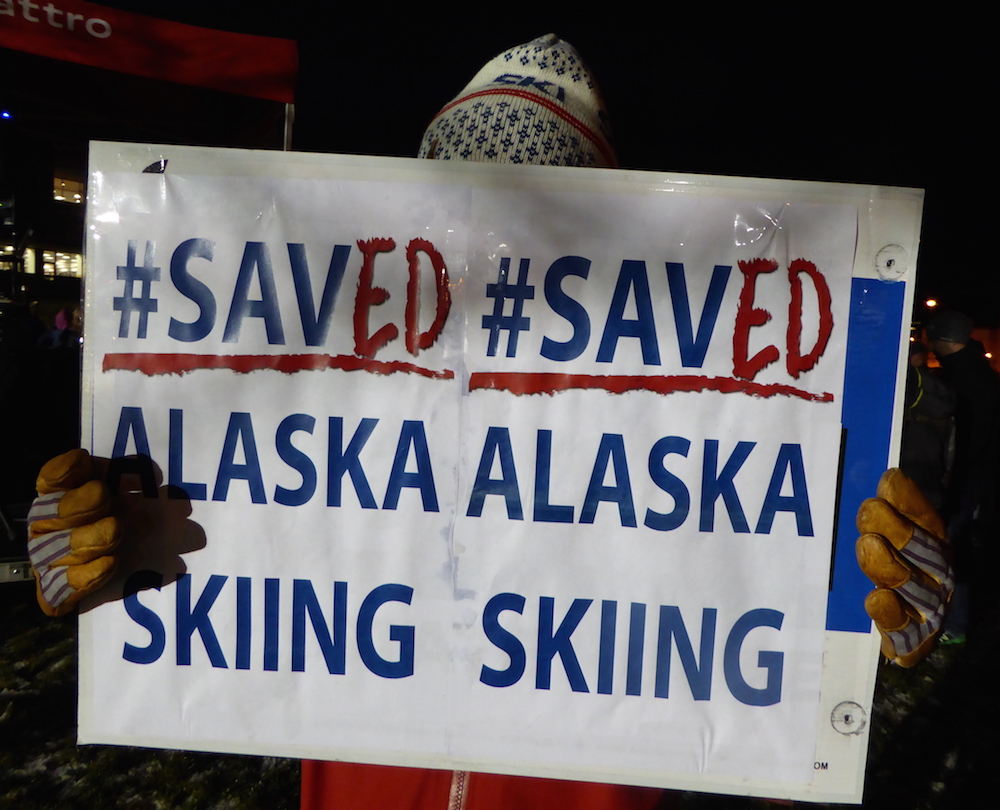
History repeats itself: A supporter holds an updated sign at the #savealaskaskiing rally in Anchorage, Alaska, on Nov. 10, 2016. (Photo: Gavin Kentch)
ANCHORAGE — For the second time in four years, nordic skiing has been saved at the University of Alaska Anchorage, following a serious proposal to eliminate the ski team entirely. This time around, the victory is somewhat more of a pyrrhic one, as the University of Alaska Board of Regents voted Thursday to eliminate the alpine portion of the men’s and women’s ski team, unless supporters can raise over a half million dollars in advance funding over the next few months from private sources.
The math is stark, and has multiple implications for supporters of collegiate skiing at one of Alaska’s two NCAA ski programs. (Alaska Pacific University does not have NCAA affiliation.) On the one hand, as far as the NCAA is concerned, a college ski team without an alpine team is just as much of a team as one with alpine athletes – two teams, in fact, “men’s skiing” and “women’s skiing.” Cutting alpine skiing therefore lets UAA continue counting skiing as two sports, at effectively half the price tag as before. When it comes to the 10-team minimum for NCAA Division II status, a college ski team with only nordic athletes is still a team in the eyes of the NCAA.
On the other hand, a college ski team with no alpine skiers is by definition not going to be very competitive at the NCAA Championships level. Team scores for skiing are based on total points scored by nordic and alpine skiers combined. Schools such as University of Alaska Fairbanks and Northern Michigan University show that it is possible to have a rich standalone nordic tradition; current American World Cup-level skiers who attended those schools include Tyler Kornfield, Logan Hanneman, Ian Torchia, and Rosie Frankowski. But those schools placed 16th and 12th at the 2020 NCAA Championships, and 15th and 7th in 2019, since they could only potentially score half as many points as a school that also fielded a full alpine team.
When this news was first announced last month, UAA Chancellor Cathy Sandeen was recommending the complete elimination of both men’s and women’s skiing, as well as men’s hockey and women’s gymnastics. By the time of today’s Board of Regents meeting, Sandeen instead presented an alternative plan that would cut only alpine skiing after the current season, as well as hockey and gymnastics.
The Anchorage Daily Newsquoted Sandeen as telling the board at today’s meeting, “We understand we are becoming a focal point for cross-country skiing (nationwide). We are part of that growing movement of cross-country skiing in Anchorage.”
The ADN also provided more details of Sandeen’s proposal, which was adopted by the board: The other three sports have from now till February 2021 to raise enough money through private donations to cover two years’ worth of operating expenses. If alpine skiing can come up with $628,000, gymnastics with $880,000, or hockey with $3 million, the Board of Regents will consider keeping each sport beyond the 2020/2021 school year.
JC Schoonmaker skis to 10th place in the 10-kilometer skate at the 2020 NCAA Championships. Earlier this year, Schoonmaker made the heats in his World Cup sprint debut. (Photo: Joan Darnell / UAA Ski Team Blog)
FasterSkier reached out to Head Ski Coach Sparky Anderson for comment. (UAA does not currently have a head nordic ski coach or an assistant nordic ski coach, though it is working through the hiring process to fill this position.)
In a Thursday email to FasterSkier, Anderson provided some perspective on this nordic/alpine solution, writing, “The NCAA defines skiing only in terms of gender. We are required to have five athletes in either gender to field a team. The makeup of that team by discipline is up to each program. We all know that to win an overall title, which we have been close to doing in the past, requires men and women on nordic and alpine skis. I hope to educate our administration that the best path forward is to only travel with our top scoring athletes of either discipline and fundraise for the opportunity to travel and train a larger group. We have all the infrastructure in place to be able to do just that.”
Anderson continued, “Today’s decision demonstrates the understanding that NCAA skiing is important to our community. I am grateful to the regents and to our chancellor for understanding that. My goal moving forward is to help our administrators understand the nuance of our sport, the fact that we can use the numbers we are given to have at a minimum what we need, and fundraise for what we want. Because what everyone on this UAA Ski Team wants is to hoist a big NCAA trophy in March, and that doesn’t happen unless we stick together as one team. I see a pathway forward where this is possible and I’m going to do everything in my power to make that happen.”
As laid out in magisterial detail last week on volunteer assistant coach Adam Verrier’s blog, cutting men’s hockey leaves UAA with only one men’s team sport, men’s basketball. (Notwithstanding the heavily team-centric nature of NCAA skiing competition, any sport that crowns individual champions – skiing, wrestling, etc. – is not classified as a team sport under NCAA bylaws.) Verrier explained a theory under which supporters of UAA skiing could seek a bylaw amendment to allow Alaska to count skiing as a team sport for NCAA purposes. At no point did Verrier, or anyone else associated with the ski team, advocate for cutting alpine skiing in the process.
Matthew Perry Johnson, shown here in an earlier position with Alaska Winter Stars, began working as the new head coach for the Montana State University Ski Team in August 2015. (Photo: Montana State University)
Multiple schools in the Rocky Mountain Intercollegiate Ski Association are experiencing flux with their nordic coaching staff going into the 2020/2021 ski season, according to representatives from each school. The schools in question are the University of Alaska Anchorage, University of Utah, and Montana State University, all of which have well-established nordic programs that placed highly at last year’s NCAA Championships. Neither Anchorage nor Montana State currently has anyone filling this position. Utah has two nordic coaches on staff, but they are both subject to furloughs of unknown length due to budget shortfalls.
University of Alaska Anchorage, or UAA, has multiple problems for the future: The Board of Regents is meeting today and tomorrow to vote on a proposal from the chancellor and athletic director to cut both the men’s and women’s ski teams after this academic year. But it appears to have a more immediate problem for the present: The school does not officially have anyone currently coaching the nordic team.
Marine Dusser was named RMISA Nordic Coach of the Year in her first year leading the UAA Seawolves. (Photo: Adam Verrier)
Trond Flagstad was announced as the new UAA head nordic coach in May 2019, and was set to “begin his duties on August 18th,” 2019. What appears to be his official UAA bio page is still available online (albeit at a site not hosted by UAA). Nonetheless, Flagstad does not seem to have publicly coached at UAA during the 2019/2020 ski season or academic year. He is not listed as a current UAA employee in the online directory.
“Our nordic ski position is currently vacant and we are working through the hiring process,” a UAA media relations representative wrote to FasterSkier on Thursday.
There is no ski coaching position currently listed on the UAA jobs site.
At the University of Utah, meanwhile, Athletic Director Mark Harlan announced last week that the school would furlough every employee in its athletic department, for periods ranging from 1 to 8 weeks. The news was widely reported by, among others, the Deseret News, Sports Illustrated, and local TV station KUTV.
In a September 5 tweet, Harlan wrote, “All staff and coaches will furlough a minimum of 1 week to a maximum of 8 weeks.Head coaches, myself and cabinet will furlough for 2 weeks. We are fully operational as we stagger the schedule through Jan 1. Sharing this sacrifice as a team allows us to emerge stronger than ever.”
Following the decision of the Pac-12 conference to postpone all fall sports – in particular, the main revenue sport of football – Harlan told the Deseret News in August that the decision could lead to the school losing $50 to $60 million in income against an annual budget of $91 million.
“Everyone in the athletic department is furloughed anywhere from 1-8 weeks,” wrote Utah media relations representative Joseph Feldman to FasterSkier on Thursday. “The priority on when those furloughs are happening is to make sure the student-athletes are still operating as normally as they can and still have all of the resources they need. The rest of the department will be fully functional as the furloughs are staggered until January 1.”
Utah media relations representative Paul Kirk did not directly answer specific questions about when Director of Skiing Fredrik Landstedt and Head Nordic Coach Miles Havlick will be or have been furloughed, or for how long the two men will be or have been furloughed. Kirk wrote to FasterSkier on Saturday, “We are unable to share specifics about when any staff member or coach is on furlough, but when an individual is on furlough his or her email out of office reply may reflect that.”
It appears from Harlan’s tweet and Feldman’s statement that both Landstedt and Havlick have been or will be furloughed for some period of between 1 to 8 weeks, at some point between last week and January 1, 2021. If either or both of them is treated as a “head coach” under Harlan’s standards, then his furlough is or will be for 2 weeks.
On Sunday, through a spokesman, Landstedt stated, “The ski coaches are staggering their furloughs during the fall, and one or more coaches will be working at all times during this period. The University of Utah Ski team has been practicing with coaches present since the second week of school.”
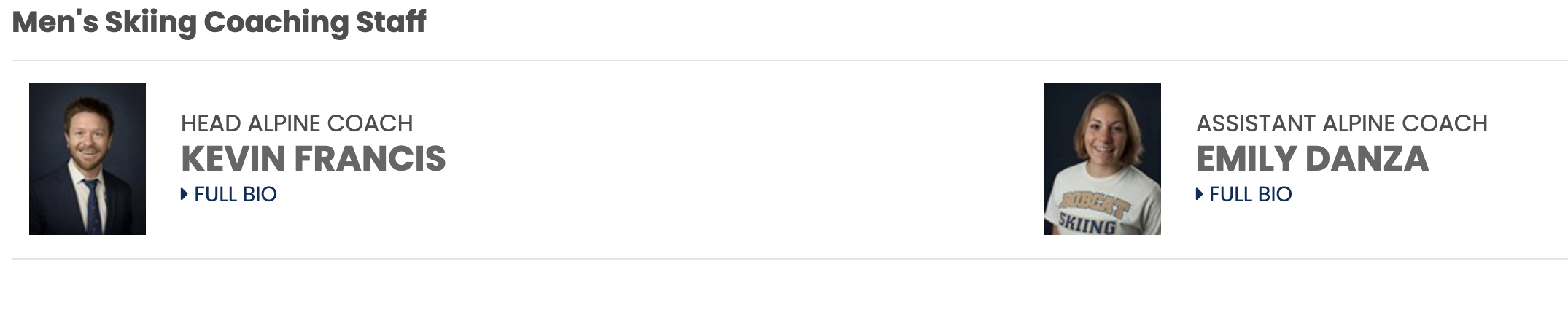
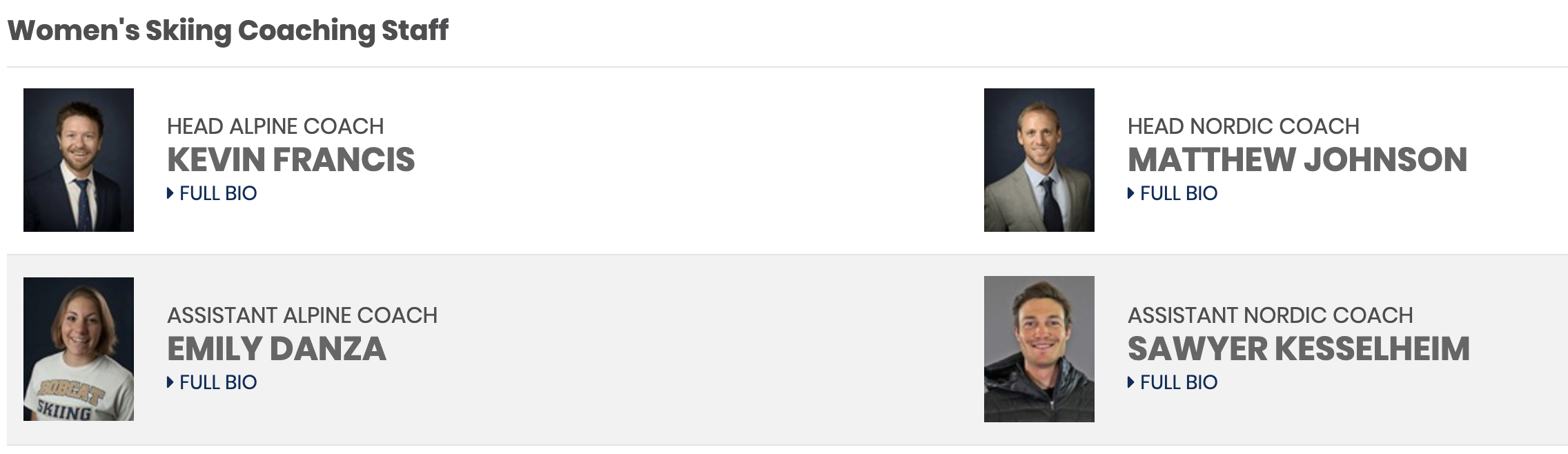
Counting alpine coaches and student assistant coaches, Utah has a healthy six coaches currently listed on its roster. 400 miles to the north, however, Montana State University only has two people listed as ski coaching staff: Kevin Francis, the head alpine coach, and Emily Danza, assistant alpine coach. (The “staff” section for the women’s skiing roster looks the same.)
That’s Matthew Johnson and Sawyer Kesselheim, both recently associated with the MSU nordic team but no longer there.
The Montana State athletic department confirmed in a Thursday email to FasterSkier that both men had moved on: “We received a letter of resignation from Matt Johnson last week. Montana State is currently working with its HR Department to search for a new head coach. Sawyer Kesselheim was not planning on returning this season.”
There is no ski coaching position currently listed on the MSU jobs site.
As of Thursday morning, Johnson was still listed as the head nordic coach in the MSU online directory:
He also still lists his current job as MSU head nordic coach on Facebook and LinkedIn.
Attempts to contact Johnson on Wednesday and Thursday for comment were not immediately successful.
Montana State placed seventh at this year’s NCAA Championships. UAA was sixth, and Utah was first. Of the six RMISA schools that scored points in the nordic race at this year’s NCAA Championships – UAA, University of Alaska Fairbanks, Colorado, Denver, MSU, and Utah – fully half of them are without an active nordic ski coach at this point in the season. It further appears that Denver (second at this year’s NCAAs), which last season employed Rogan Brown as an assistant nordic coach, only has head nordic coach Toni Roponen at present, with no assistant coach for the nordic team.
This story has been updated with additional information about the timing and nature of furloughs at the University of Utah.
The U.S. women (l-r Kikkan Randall, Holly Brooks, Jessie Diggins, and Liz Stephen) after their first ever World Cup relay podium in November 2012. (Photo: Fischer/NordicFocus)
ANCHORAGE — The U.S. women’s epochal third-place relay finish at the World Cup stop in Gällivare, Sweden, in November 2012 is justly hailed as an inflection point for American skiing: For the first time in American nordic history, this country had four athletes who were all strong enough on the same day to challenge the traditional Scandinavian powers at their own game. The race begins Peggy Shinn’s historical treatment, World Class: The Making of the U.S. Women’s Cross-Country Ski Team, and features prominently in Jessie Diggins’s recent memoir. Although American ski fans may have subsequently become somewhat inured to success, it was a really big deal at the time – contemporary headlines on this website included phrases like “U.S. Women Shock the World” and “Historic U.S. Performance.”
The first two legs that day in Gällivare were Holly Brooks on the scramble leg, then Kikkan Randall on the second classic leg. (Liz Stephen and Jessie Diggins, who had the skate legs, were obviously of equal importance, but this article is pursuing a selective focus on just three Alaskan athletes in order to introduce a specific op-ed.) When the team did it again a year later, taking third once more at the Lillehammer World Cup stop in December 2013, it was now Randall handing off to Sadie Bjornsen (then Stephen and Diggins once more for the skate legs).
Seven years later, those classic-leg skiers – longtime friends and teammates, for Alaska Pacific University domestically and the U.S. Ski Team internationally – are teaming up once more in support of the ski program at the University of Alaska Anchorage, or UAA.
Flyer for local rally in support of UAA Ski Team. (photo: screenshot from SkiAK email)
In a powerful opinion piece published in Wednesday’s Anchorage Daily News, the three athletes, who have a combined nine Winter Olympics between them, write “on behalf of all the young aspiring athletes in the Anchorage community and the state of Alaska, a place we are proud to hail from.” Brooks, Randall, and Maubet Bjornsen continue, “The [UAA ski] team is an important institution in our community and demonstrates everything that is good about hard work, healthy lifestyles and what you can achieve when you put your mind to it.”
There’s much more. The entire article is worth your time.
Other articles in today’s local paper include a eulogy for UAA hockey – which, like chivalry in the late Middle Ages, seems to have always been in decline – and an opposing opinion piece titled, “Restructuring UAA Athletics creates a foundation for stronger, more sustainable future.”
Next steps
Ski team supporters have launched a petition, which may be found here. Anchorage supporters are planning a short-notice, socially distanced rally for Thursday afternoon at Hilltop Ski Area (see flyer at right). Public comments may be submitted to the University of Alaska Board of Regents at ua-bor@alaska.edu, cc’ing uaa_feedback@alaska.edu.
The Board of Regents will hear public testimony from 4-5 p.m. next Monday, August 31, in advance of its upcoming Board meeting on September 10-11 at which it is scheduled to vote on the chancellor’s proposal to eliminate skiing, men’s hockey, and women’s gymnastics.
Erik Bjornsen on his way to second at 2011 NCAAs in Stowe, Vt., while a freshman at UAA.
ANCHORAGE — It’s déjà vu all over again for alumni and supporters of the University of Alaska Anchorage ski team, following the recent announcement that, for the second time in four years, university administration wishes to cut the team for budgetary reasons. A common theme in their current responses is their concern that this time, the cut may stick.
To start with, consider what Adam Verrier wrote on his blog four years ago, in November 2016. Verrier, who skied for the University of Wyoming in the late 1980s and early 1990s, was a member of the 1994 Olympic team for cross-country skiing. He’s also, by this point, the closest thing that the UAA nordic team has to institutional memory – since the last time the team was threatened to be cut, all athletes and both nordic coaches have completely rolled over.
Then, as now, Verrier wrote solely in his personal capacity. Verrier, who describes himself on his blog profile as “The UAA Nordic Team’s crazy uncle,” has never been on the UAA ski team staff; he has instead served as a volunteer assistant coach for many years. He has no official professional affiliation with the school.
All that said, here’s an excerpt from what Verrier wrote four years ago this fall:
Alaska is sometimes referred to as a “resource extraction state”. For centuries, people have been coming from other parts of the world to Alaska to get their paws on something valuable and bring it back “home” with them. The Russians came to fetch animal pelts and furs. Thousands showed up 120 years ago to dig a bunch of gold out of the ground and cart it back to the mainland. Folks came from the Pacific Northwest to catch salmon in Bristol Bay and cut down trees in Southeast. College students from around the USA come for summer jobs in the tourism industry. And Texans and Okies showed up in the ’70’s and ’80’s for oil, and they’re still here. None of these groups have been particularly concerned with building infrastructure and amenities here in Alaska – the things that enrich our lives, our culture, our cities and towns – because their goal has been to amass wealth and take it back “home”.
I see it all the time at my “day job”, flying around the state and appraising the homes of people who are getting their kit together for their migration back “home” after “putting in their time” in Alaska. I frequently sit next to people on airplanes who say things along the lines of, “I figure I’ve got just a few more years up here and then I should have enough saved and I’ll move the family back to ________. I’ve already bought a parcel of land down there. It’s been a good run, but of course there’s nothing to do up here during the miserable winters.” And I hear the same thing from people selling their homes to move “back home”. Do you think these people want to pay taxes in Alaska and invest in local amenities like libraries, city parks, elementary education, and the state university system? Of course not. They’re extracting resources. They’re extracting wealth. Their priorities lie elsewhere.
The full blog post may be found here. It’s worth your time (and shorter than this fine work, which makes similar points). Verrier’s observations on the historical relationship between Alaska and Outside, and on residents’ views of state spending in a state with no income tax and where residents are literally paid annually just for living here, remain trenchant and applicable today. (More on Verrier later in this article.)
Hailey Swirbul
University of Alaska Anchorage Seawolves skiers Hailey Swirbul (l) and Casey Wright (r), photographed on the UAA campus in Anchorage, Alaska, in October 2016. (Photo: Gavin Kentch)
Four years ago, Hailey Swirbul was 18, a college freshman, recently arrived at UAA from Colorado and living on her own for the first time. She spoke with FasterSkier in October 2016 about the recent announcement that University of Alaska administrators wanted to cut the ski team after the 2016/2017 season. Before the three World Juniors medals, before the three (and counting) national championships, before the four (and counting) World Cup top-30 finishes, Swirbul sat in the Alaska Airlines Center next to teammate Casey Wright and told this reporter, somewhat presciently:
I don’t think we were necessarily singled out. But I can’t understand why they would cut skiing in Alaska. I don’t understand that. And I don’t think they understand why they cut us. I don’t know. … Were we singled out? No. Are we some of the best academic and hard-working people at UAA? Yes. And I don’t think they would purposefully single out those types of people to remove.
…
I would never wish this upon anyone else, and I can’t say that I would rather have the gymnastics be cut, or the hockey be cut – because this sucks. And I don’t want anyone to go through this.
Fast forward to 2020, and Swirbul is now a professional skier with Alaska Pacific University, or APU, literally just down the street in midtown Anchorage. Over the weekend, she took a break from training to write to FasterSkier as follows:
Well, it sure is frustrating to say the least. I almost feel a preemptive sense of defeat after going through this process a few years back. I’m afraid that the board is going to do it “right” this time – in their eyes, at least.
To those trying to cut the ski team at UAA, only 20 or so lives would be impacted directly. But they aren’t seeing the bigger picture. Cutting teams that actually have a presence on the collegiate circuit, like UAA, opens a gateway to risk losing skiing as a collegiate sport entirely, in my opinion. Less participants, less viewers/fans, less income. I’ve heard rumors that cutting UAA Alpine and Nordic might make the current RMISA system fail due to too few teams competing.
We all know that skiing is already not the most lucrative of sports, but in my view, it is unmatched in non-monetary benefits. Endurance sport instills a work ethic and drive that you don’t find just anywhere. As far as I know, the UAA Ski Team has been one of, if not THE, top team at UAA academically for years!! These hard-working, involved, dedicated people are the kinds of people I want in my community, and those are the kinds of people that skiing brings to Anchorage. I’m bummed about this announcement, but I can’t say I’m surprised after the way it was left a few years ago. I figured this might happen, and I’m ready to do my part to keep skiing at UAA. I just hope it’s enough.
(As Swirbul accurately notes, members of the UAA ski team have historically been strong students as well as strong athletes. At the 2019 NCAA Championships, for example, Swirbul’s former teammate and 2018 Australian Olympian, Casey Wright, won the Elite 90 Award, presented to the skier at NCAAs with the highest grade point average. Following the 2019/2020 ski season, UAA tied for third nationwide in total selections to the National Collegiate All-Academic Ski Team.)
Sadie and Erik Bjornsen
Sadie Maubet Bjornsen is now known as a longtime member of the U.S. Ski Team, and as a student and athlete at APU. But before the national team nominations, the national championships, the two Olympic teams, the World Championships medal, and the 11 World Cup medals, Sadie was a freshman skier for UAA. (And a pretty good one, too; she finished in the top five in five out of eight races her freshman year on the RMISA circuit, including third overall in the classic race at NCAAs.)
Although she spent just one year at UAA before moving over to APU, Sadie continues to place great value on that year as a stepping stone on her path to the national team. Here’s Sadie (at the time just Sadie Bjornsen, no Maubet yet), in an email to FasterSkier from October 2016:
My year as a Seawolf was one of the most important “steps” of my life. I would have never been drawn to AK fresh out of high school, and discovered this incredible state. I see skiing as a big family with many functioning parts. By eliminating one integral part of the ski community, we are cutting off a strong piece of the family!
I have always considered Alaska to be the best training for a cross country skier in the US. We have the perfect environment for training, including early snow in the fall, and late snow in the spring. I now race professionally, and am a student at Alaska Pacific University while racing World Cup. I see APU as providing the very best opportunity in the world for myself, but, I know this level is not designed for everyone. It is important to have options, and varied levels so that skiers can choose where they want to go, and have a path to where they are looking to reach. I would never give back that year of racing NCAA at UAA, a year that taught me so many lessons! It saddens me to know that won’t be available for everyone anymore!
Erik Bjornsen followed a similar path as his older sister, Sadie: grow up in Mazama, Washington, skiing in the Methow; come to Anchorage to ski for UAA; make a national championship podium as a freshman (Erik was second at the 2011 NCAAs); move to APU to pursue professional skiing outside the NCAA context; become a longtime member of the U.S. Ski Team; marry an athletic French person. (Because American nordic skiing is often just one very small family, Erik’s wife, Marine Dusser-Bjornsen, was an athlete at UAA from 2012–2014, and was interim head coach there for the 2019/2020 season. She was named the RMISA Nordic Coach of the Year for last season before amiably moving on from UAA as she and Erik moved back to Washington.) Erik would go on to ski at two Olympics and log dozens of World Cup top-30s before retiring from professional skiing earlier this year.
Erik took time out from his first post-skiing job, working 12-hour days on construction sites in the Methow, to talk with FasterSkier by phone this weekend.
Much like Sadie, Erik talked about the significance of his time at UAA as the start of his adult life. “It’s not only been an important part of my ski career,” Erik said, “but also it’s where I went after high school; it was the first place I lived away from my parents. I definitely made some of my best friends there. Three of my groomsmen, my best man, were guys that I met at UAA. … It’ll always be a big part of my life, the year I spent there. I’m just thankful that I was able to have that opportunity with the team there, and I’m disappointed that other kids won’t have that same opportunity.”
Marine Dusser was named RMISA Nordic Coach of the Year in her first year leading the UAA Seawolves. (Photo: Adam Verrier)
As someone who raced both within the NCAA system, at UAA, and outside of it, at APU and internationally, Erik shared his perspective on the significance of college skiing to American nordic skiing as a whole: “It’s an important part of the whole system that we have here in the U.S. It’s a smaller part, maybe, but it’s an important part. Alaska is one of the strongest cross-country ski regions in the U.S., and having an NCAA program in that region is quite important. APU does a great job with more of the – in Alaska, I think people think of it as more of the elite, more professional team – but it’s important to have an NCAA program in town, that younger, high school athletes that maybe aren’t quite ready to race on the World Cup can go to UAA. The school just came off one of their best years in a while; they have the second-best, nearly the best men’s team in the U.S.”
(As Erik correctly noted, the UAA men were second among men’s nordic teams at the one-off nordic race that was the 2020 NCAA Championships. The UAA women were fourth in the women’s nordic standings.)
Erik continued, “I’ve always been a big supporter of NCAA skiing. I think it’s an important thing to have in the system. Although I didn’t use it for all five years like some others did, I was definitely able to benefit from UAA, and it was an important part of my development to have it there. I think the whole U.S., especially Alaska, is going to really miss having it.”
Finally, Erik noted, “It’s disappointing to see cross-country skiing going in that direction in Anchorage, when it just seems like, in the U.S., everything else is headed in the right direction for cross-country skiing in this nation. So to be losing one pretty important nordic team in the U.S. is disappointing to see, for sure. … I really thought we were kind of past the point of cutting the team. I hadn’t heard this most recent news, but before Marine had finished at UAA, it sounded like it was in a good position. So I was very shocked when I saw the news.”
Adam Verrier
And finally, back to Adam Verrier, the volunteer assistant coach who, though officially unaffiliated with the school, has unofficially been with the program longer than anyone currently on the nordic side of the UAA ski team. Here are Verrier’s thoughts on the current situation, from a recent email to FasterSkier, as drawn from over 30 years’ experience with NCAA skiing:
We went through this in 2016 here at UAA. And during my involvement with NCAA skiing over the past 33 years, I’ve seen this scenario play out at the University of Nevada-Reno, Western State College, Montana State and University of New Mexico. And twice on my own team when I was at University of Wyoming. We got cut at the end of my freshman year, in 1988, but were reinstated about a month later and survived four more years until finally being cut (for good this time) in 1992 at the end of my senior year. So I’m no stranger to this game. As a long-time observer of these kinds of things, it’s been interesting to see how often the team gets reinstated sooner or later. University of Denver got cut in 1984, but then was reinstated in 1992 when my University of Wyoming team got cut, so most of our team just moved a couple hours’ drive down the road to Denver, and they were immediately successful and have been so ever since. The Montana State team was cut in the mid-1980’s, but their program was reinstated 20 years later and lives on today.
The 2014 UAA alpine and nordic teams on the Kincaid sand dunes in Anchorage. (photo: Adam Verrier)
And many of the teams that didn’t get resurrected as NCAA programs have put together their own kind of ski team or university club racing program, like University of Wyoming and Western State College. It goes to show that there is a community desire for competitive college ski racing programs. These programs are often the anchor for these college-towns’ winter recreation programs, providing trail grooming and maintenance and local ski events for area residents.
I think the proposal to cut the Ski Team is shortsighted. Not only is Anchorage full of Olympic skiers past, present and (hopefully) future, but it’s also a city in which a significant number of residents regularly commute to work on skis during the winter months. With our interconnected ski trail networks and our groomed multiuse corridors connecting residential neighborhoods to commerce centers like the hospitals, University, and downtown and midtown business districts, this is one of the few places in the USA where skiing is a mode of transportation that residents regularly use for practical purposes like getting to the office in the morning.
Skiing is a practical sport here in Alaska, and a valuable skill to have. It’s important enough that organizations like NANA (Northwest Arctic Native Association) and Skiku have been putting lots of time, money and energy for many years to bring skis and ski instructors to remote villages to teach skiing as a practical skill and a way to get outdoors during the winter. Our Alaska high school ski races put hundreds of kids on the starting line every weekend, and several of our Anchorage high school ski teams have close to a hundred kids on the team. And if you want to sign your youngster up for Junior Nordic, you’d better be quick because the hundreds of available spots fill up super fast every year. Skiing is a really big deal in this state. And the University of Alaska Ski Team, along with APU, are the elite flagship programs. Many of America’s most successful World Cup skiers in recent years developed through the UAA program, with some of them moving from UAA directly across the street to APU to continue their post-collegiate ski racing.
I haven’t had a chance yet to look too closely at the details of the proposed cuts or the budget numbers that we’re talking about, but clearly this problem is rolling downhill from the legislature’s choices and decisions regarding the Alaska state budget. This is a state which has sixty-one billion dollars’ worth of savings in the bank, a state which levies no state income tax, not statewide sales tax, no broad-based personal taxes of any kind, and a state which mails a check of around a thousand dollars or so to every resident, every year, just for breathing. But yet, we claim to be “broke” and we claim to be “overtaxed”.
Marine Dusser (l) and Adam Verrier (r) prepare fast skis. (Photo: courtesy Adam Verrier)
The legislature’s decision to cut state funding for the University by $34 million seems to me like poor policy. And the proposed cut of the Ski Team also seems to me like poor policy. This team has consistently provided a place for Alaska-grown skiers to take their athletic ambitions to the next level, and at the same time has attracted a steady stream of high-achieving, smart people who come to Alaska from other places to be a Seawolf, but wind up getting hooked and staying here for life. And these athletes – both the Alaska-grown ones and the ones who come here from elsewhere – have contributed enormously to the talent pool in the Alaska workforce today. They’ve brought tremendous benefit in their roles as research economists, CFOs of the state’s largest Native-owned corporations, as oilfield geologists, just to name a few specific examples that come immediately to mind.
I would estimate that these high-achievers, who were lured to the state, or were enticed to stay in-state by the Ski Team have contributed far more value to the local economy in terms intellectual capital during their careers here than the cost of the athletic programs which brought them or kept them here in the first place. If one of the University’s goals is to foster intelligent dialogue between people of various experiences and viewpoints, and to provide a rich and fertile environment in which our best brains can develop, then it’s clear that our ski team serves that mission. To propose cutting the team seems to me to be diametrically opposed to this goal.
Next steps
Cathy Sandeen, the UAA Chancellor, will hear public comments at an online town hall from 5-6 p.m. Alaska time this Wednesday, August 26. Zoom information will be published here.
The University of Alaska Board of Regents will hear public testimony from 4-5 p.m. next Monday, August 31, in advance of its upcoming Board meeting on September 10-11 at which it is scheduled to vote on Sandeen’s proposal.
Finally, ski team supporters are encouraging advocates to submit written comments to the Board of Regents at ua-bor@alaska.edu, cc’ing uaa_feedback@alaska.edu.
* * *
This article has been edited to reflect the fact that Adam Verrier competed for the University of Wyoming only in nordic skiing, not in alpine skiing as well.
Marine Dusser was named RMISA Nordic Coach of the Year in her first year leading the UAA Seawolves, 2019/2020. (Photo: Adam Verrier)
This article has been updated with a link to additional information in an Anchorage Daily News story.
ANCHORAGE — The University of Alaska Anchorage announced Wednesday a planned “reconfiguration” of the UAA Athletics Department, which will involve cutting both the men’s and women’s ski teams after the 2020/2021 school year. School leaders will seek approval of their plan, which would also cut men’s hockey and women’s gymnastics, at the upcoming Board of Regents meeting on September 10-11.
By the numbers: Not enough money
FasterSkier previously reported on a version of this story in fall 2016, when the UAA ski team was slated for elimination but was ultimately reinstated following a strong outpouring of community support. As FasterSkier wrote in a story published in October 2016:
As FasterSkier previously reported, the State of Alaska is dependent upon funds from a single source, oil revenue, to an extent unparalleled in any other state. Falling oil prices over the last two years have led to widespread budget deficits, layoffs and reductions of both state and private-sector employees (particularly in the oil and gas industry), and political recriminations over the failure to pass a balanced budget.
When FasterSkier first reported on this story in May 2016, the price of oil was approximately $48 a barrel. At the close of trading on Thursday, oil was at $49.89 a barrel. At these prices, the State of Alaska faces a revenue shortfall equal to approximately two-thirds of its budget. Oil has not been over $100 a barrel in over two years.
Alaska residents have not paid a state income tax since 1980. Although some communities have instituted local sales taxes, there is no statewide sales tax.
Oil is currently $43 a barrel (up from negative numbers earlier this spring). The State of Alaska has not made meaningful longterm progress on its endemic fiscal challenges, stemming from the lack of a diversified economy, in the ensuing four years. Limitations on travel wrought by the Covid-19 pandemic have this year further decimated tourism, one of the state’s main other revenue sources.
There is still no state income tax. Payments from the state’s sovereign wealth fund, the Alaska Permanent Fund, were reduced to only $1,000 per person this year.
By the numbers: Inside the UAA budget
The budget for the entire University of Alaska system has been dramatically reduced over the last several years. After current Governor Mike Dunleavy was elected in 2018, “on a promise not only to restore the full dividend but to make it retroactive, which would amount to giving nearly seven thousand dollars to every Alaskan,” he announced a proposed budget that did not restore the full amount of a promised dividend, but which did reduce state funding to the University of Alaska system by over 40%.
Current UAA skier JC Schoonmaker scores points in his first World Cup start earlier this year, during the Dresden, Germany skate sprint. (Photo: NordicFocus)
While funding levels have not been reduced to quite those dramatic levels, following widespread pushback and a pending recall effort (disclosure: this reporter’s mother is leading the Recall Dunleavy legal team), the overall budget for the University of Alaska has been substantially cut. As the UAA press release notes, state funding for UAA has declined by $34 million since 2014.
The press release continues, “The university’s decision to discontinue these sports follows on the heels of the Board of Regents’ direction last fall to consolidate academic programs and services to meet budget reductions. In August 2019, University of Alaska leadership came to an agreement with Gov. Dunleavy on a $70 million reduction in state funds to the university system over the three-year period of fiscal years ’20, ’21 and ’22.”
Current figures for the overall UAA Athletics Department budget were not immediately available. As of the 2017 fiscal year, the total budget for UAA Athletics was $4.33 million. The men’s hockey team cost $1.35 million; men’s and women’s skiing cost $280,000 each.
UAA has said that cutting skiing, hockey, and gymnastics is “expected to save approximately $2.5 million per year” out of the 2021/22 budget.
By the numbers: Not enough sports teams
Other teams currently proposed for elimination are the men’s hockey team and women’s gymnastics team. The ski team counts as two teams for purposes of Title IX and NCAA affiliation, the men’s ski team and the women’s ski team. UAA currently has 13 varsity athletic teams total.
The proposed cancellation, therefore, takes UAA from 13 teams down to nine. But section 20.10.3(a)-(b) of the NCAA Division II Bylaws provides that “A member of Division II shall sponsor in Division II a minimum of” either five sports for each of men and women, or four sports for men and six for women. (Most of UAA’s teams are Division II teams. The four teams currently proposed to be cut all compete in Division I. If UAA were a full D-I program, it would need to field even more than 10 varsity teams.)
Former UAA skier Sadie Maubet Bjornsen races on the World Cup earlier this year in Trondheim, Norway. (Photo: NordicFocus)
300 miles to the north, Alaska’s other NCAA ski program, University of Alaska Fairbanks, issued a press release headlined, “Commitment to Alaska Nanooks Programs.” UAF Chancellor Dan White wrote, following Wednesday’s announcement from UAA, “I want to reassure our Alaska Nanooks student-athletes, parents, coaches, and the UAF and Fairbanks community that UAF’s athletics programs are not part of this recommendation. UAF has 10 Division I and II sports, the minimum number allowed by the NCAA, and has no plans to reduce them.”
The implicit safety net of already having an NCAA-minimum 10 sports teams was cited by UAF coaches and athletes four years ago when it previously appeared that ski programs at both UAA and UAF were potentially going to be cut. As then-UAF head nordic coach Nick Crawford wrote in an emailed statement to FasterSkier in October 2016:
“For UAF specifically, I don’t think skiing will be cut as I don’t think the NCAA will grant the waiver to the ‘10 sport minimum requirement.’ One of the NCAA’s core values is to provide sporting opportunities from athletes of many different sports and the 10 sport rule is in effect to protect small sports like skiing. It’s a slippery slope to allow Alaska to cut ‘less well known’ sports like skiing and indoor track to continue to fund their more popular sports, If the NCAA grants this waiver, it sets a precedent to eliminate non-revenue generating sports across the country with fewer and fewer sports offerings and that is not a direction I think the NCAA wants to go in.”
Ian Marks, UAA Assistant Athletic Director for Media Relations, was asked Wednesday about the significance of a proposal that took UAA to fewer than 10 sports teams. In an email to FasterSkier, Marks wrote, “UAA will need to add a men’s team sport in the future. UAA will be applying for a waiver with the NCAA to sponsor only nine sports in the short-term.”
“Between Aug. 19 and Sept. 9, the university community and public will have the opportunity to comment on the UAA Athletics decision during a virtual town hall meeting on Aug. 26 and Board of Regents public testimony on Aug. 31. Information about both events is available at uaa.alaska.edu/calendars/public. Feedback may also be sent to uaa_feedback@alaska.edu.”
The answer is, “What has occurred recently at other universities, such as the University of Alabama-Huntsville, was a beneficial outcome for their hockey program. But it is a short-term solution. After the coming season, their athletics department will need to resolve 2021-22 funding for the program because the money raised will not cover a full season of expenses. We are concerned about the long-term viability of UAA Athletics. Outside support would need to align with a plan for long-term sustainability in order to move forward.”
More information
The Anchorage Daily News published a story on this topic later Wednesday, reflecting a Wednesday-afternoon conference call with the UAA Athletic Director. For more information on overall budget numbers and a potential replacement men’s team sport – soccer, lacrosse, and volleyball among them – please see Beth Bragg’s story here.
The present faces of the 2016/2017 University of Alaska Anchorage Ski Team (both nordic and alpine) at Kincaid Park in Anchorage. (Photo: Adam Phillips/UAA Athletics)
College skiing in Alaska is on its deathbed. (Or perhaps on its deathbed in Anchorage, and at least in the sick bay in Fairbanks.) FasterSkier previously posted thoughts and reactions from some of the more prominent University of Alaska Anchorage (UAA) skiing alumni, including Olympians Brian Gregg and Sadie Bjornsen. But there are other people who stand to be even more immediately affected if the University of Alaska Board of Regents cuts college skiing after this season: the athletes who ski for UAA, and the people who coach them. Here we share some thoughts from those groups, in an attempt to understand the human cost of the proposed elimination of UAA skiing following the 2016/2017 season.
Two Athletes: Hailey Swirbul and Casey Wright
Hailey Swirbul, 18, is a true freshman at UAA. Born and raised in Colorado, she visited Anchorage for the first time on her official recruiting visit to UAA last fall. To her surprise, Anchorage was love at first sight (“I stepped off the plane and I saw those mountains glowing pink, and I was like, Whoa, this is magical. This is nothing like Fairbanks!”), and she happily committed to ski for UAA soon after. Swirbul competed and trained internationally prior to coming to UAA, including anchoring the U.S. women’s relay team at Junior World Championships in Almaty, Kazakhstan, in February 2015, and attending International Junior Camp in Norway that summer.
Casey Wright, 21, took a slightly more circuitous path to skiing for the UAA Seawolves (fondly referred to by the team as the “Skiwolves”). Wright, an Australian, was born in Melbourne, and is a member of the Australian National Ski Team. She has raced for her country at several international competitions, including world juniors in 2013 and 2014 and World Championships in Falun, Sweden, in 2015. Wright previously skied in the U.S. for the Sun Valley Ski Education Foundation (SVSEF) Gold Team in Sun Valley, Idaho. (She is one of at least three Australian national team skiers who currently live and train in Anchorage, including Alaska Pacific University athletes Jessica Yeaton and Paul (PK) Kovacs.)
UAA present: ‘Skiwolves’ Hailey Swirbul (l) and Casey Wright (r), on the UAA campus in Anchorage, Alaska, in October 2016. (Photo: Gavin Kentch)
Both athletes spoke with FasterSkier in an in-person interview on the UAA campus on Oct. 28, slightly more than 24 hours after news came out that their program was slated to be discontinued at the end of this season. Both Wright and Swirbul were surprised and disappointed, but nonetheless impressively buoyant given the circumstances.
And speaking of buoyant, it is not just an orthographic coincidence that you can’t spell “Seawolves” without “love.” Both athletes’ sincere love – for their sport, for each other, for their suddenly endangered ski program – was apparent throughout the interview, in which Wright and Swirbul at times literally finished each others’ sentences.
This particularly came through in each athlete’s overriding concern at this moment: for others and for their team.
“I’ve gone from initial, like, absolute being distraught to kind of angry, and now I’m trying to understand why, and trying to look in the future,” Wright said when asked how she was feeling. “For us at the moment, or for me anyway, it’s just, like, looking for out my team, looking out for my coaches, just trying to make sure everyone’s okay. I think that’s really my main concern at the moment – that everyone is coping as well as they could be.”
Swirbul expressed similar sentiments: “One of the hardest things … that each of us are going to face is breaking up this team, ’cause we have such a young team, and we have so much potential, and it is horrible to see that go right now.”
“We are really close,” Wright added. “I’ve never been on a team where I’ve had this connection with teammates, where it’s like – we’re just like a family, an extended family.”
Indeed, Wright called the Skiwolves “my second family.” “It takes me, like, over 30 hours to get home,” she observed, reflecting the distance between Alaska and the antipodes. “This team is my family,” Wright stated, her voice and syntax breaking, “and – the thought of not being able to see all these people every day – like, after this year – or not even a year, after, what is it, going to be five months, pretty much, six months, is just like – it’s devastating. I can’t even fathom… that’s just heartbreaking.”
Swirbul, discussing the Oct. 27 meeting at which they were told that their program was slated to be cut, continued with the familial theme. “One of our teammates actually paralleled it to a funeral, and it feels like our team is dying,” Swirbul said.
“It feels like a death in the family,” Wright concurred.
UAA present: Casey Wright carries the Seawolves’ team flag at the 2016 NCAA Skiing Championships last March at Howelsen Hill in Steamboat Springs, Colo. (Photo: Jamie Schwaberow/NCAA Photos)
While both athletes underscored that the team was quickly becoming tighter than it ever had been, they admitted that they had begun thinking about what might come next if their program – and college scholarships – come to an end.
(UAA Athletic Director Keith Hackett wrote in his public statement that “UAA will honor our commitment to those Student-Athletes who have been impacted by this decision by keeping them on scholarship through the spring of 2018.” But head nordic coach Andrew Kastning said that he was “a little surprised” to hear that his athletes only had two more years on scholarship (counting the 2016/2017 season), “because at one point when we thought that we were going to be – when the cuts were being talked about, [assistant nordic coach] Sara Studebaker had asked Keith what would happen to our athletes that are here. And he said, ‘Their scholarships will be honored until they graduate.’ But it didn’t sound like that was arranged, at least at this point.”)
“It’s impossible not to think about [next year],” Swirbul, 18, said. “I’ve been thinking about it for the past couple months, unfortunately, especially when [my] parents have been encouraging me to look into that in case that happened, and it did. First off, I need to clear up what this whole situation with the scholarship in the coming years is. And that’s a huge factor in my decision. If that’s the case, then my first option would be to attend school here still, and potentially ski for APU [Alaska Pacific University]. Otherwise, I need to start applying to colleges all over again.” (While athletes who transfer schools are typically required to sit out a year before playing again at their new school, the one-year waiting period is waived when the athlete’s sport was cut at the previous school.)
Swirbul reiterated that she yearned to stay in Anchorage: “I love it here. I don’t want to leave. Taking that away from me, taking that away from all of us, is just heartbreaking.”
Wright, who turns 22 next month, had similar goals, but was still working with the NCAA to gain some clear answers to something as simple as how many years of NCAA eligibility she had remaining before she began the process of seeking out other schools. “I’m in a bit more of a difficult situation, being an international student-athlete,” Wright said.
UAA past: Erik Bjornsen (then UAA, now APU and USST) races in the men’s 15 k classic race at 2011 U.S. Nationals in Rumford, Maine. (Photo: FlyingPointRoad.com)
“In order for me to achieve my goals,” she continued, “the best place for me to be, I believe, is in the U.S. It’s just, the calibre of skiing here is fantastic in order for me to develop and reach my goals. Although I don’t have as many years of eligibility left, so that would be a difficult one to try and convince another team to take me on.” Wright also hoped to stay in Anchorage if at all possible.
Wright recounted her self-initiated “recruitment” into the UAA program (she had been skiing with the SVSEF before she began reaching out to American NCAA ski teams), and how it led to the current team at UAA. “Andrew was the only one that responded to an Australian girl contacting him saying that I was a skier,” Wright said. “I don’t think anyone else believed me.”
UAA originally didn’t have scholarship space for her, but a space then opened up on short notice. “So I pretty much just jumped on a plane and came here. … It was the best decision I could have made. It’s just been incredible,” she said.
Wright recounted the process by which this year’s team – which, she pointed out, skews young and blonde – was assembled soon after she came on board. “Andrew was talking about all these freshman girls we’ve got coming in. He was like, ‘We’ve got a lot of 18-year-olds.’ It was like, ‘Oh boy, we’re going to have a lot of Justin Bieber [Swirbul cracks up], and teeny-bopping around’ – but it’s been nothing like that.”
Swirbul: “Wow, thank God.”
Wright: “He just kept signing girls.”
Swirbul: “And they’re all blonde and they’re all freshman.” (This is almost literally true.)
Wright: “Andrew has dubbed us The Blondetourage. That pretty much sums us up.”
On a more serious note, and discussing the process that led to the ski team being cut, both athletes were quick to reject a reporter’s suggestion that they might feel betrayed.
“I absolutely would not say betrayed,” Swirbul said. “And I think that’s how the coaches feel. They feel like they betrayed us – I think some of them are blaming themselves for this. And that’s the hardest thing for me to see, is thinking about my teammates and my coaches that might not have a clear path of where to go in the next few years. I think that I’ll figure something out, and a new door will open. I just worry – I feel so much for the people that don’t have that clear path.”
Swirbul also disagreed with the premise that skiing had been singled out in some manner. “I I don’t think we were necessarily singled out,” she said. “But I can’t understand why they would cut skiing in Alaska. I don’t understand that. And I don’t think they understand why they cut us. I don’t know. … Were we singled out? No. Are we some of the best academic and hard-working people at UAA? Yes. And I don’t think they would purposefully single out those types of people to remove.”
“Were we singled out? No. Are we some of the best academic and hard-working people at UAA? Yes. And I don’t think they would purposefully single out those types of people to remove.” — Hailey Swirbul, UAA freshman nordic skier
Finally, Swirbul graciously declined an invitation to compare the ski team’s record of success to the consistent mediocrity and decades-long trend of losing seasons that plague the UAA hockey team.
“I would never wish this upon anyone else, and I can’t say that I would rather have the gymnastics be cut, or the hockey be cut – because this sucks. And I don’t want anyone to go through this,” Swirbul said.
At the same time, Swirbul expressed some confusion as to whether it was really money or something else that was driving the decision to submit skiing for proposed elimination.
UAA past: Sadie Bjornsen (then UAA, now APU and USST) skis to a third place finish in the women’s 5 k classic race at the 2009 NCAA Championships in Rumford, Maine. (Photo: FlyingPointRoad.com)
“Actually, what the director [Hackett] ended up saying,” Swirbul recalled of the Oct. 27 meeting, “was that it doesn’t even come down to money at this point, it’s more NCAA rules. They’re cutting our teams from 13 to nine. And so they need a 10th team, potentially. And they said, ‘If we do need a 10th team, if that waiver goes through and we need to find a tenth team, they will find the money to do that somehow.’ However, they can’t let us find the money to fund ourselves. I don’t even know what they’re talking about. They said there’s money there if they need to have a 10th team.”
Wright expressed similar sentiments: “We want the opportunity to, if it is down to money, we want the opportunity to fundraise. We were told that Alaska wasn’t a giving state, that people here don’t want to give money, that’s what he told us, which, we don’t believe that’s true, considering that APU is able to fundraise six figures annually.”
The Alaska Dispatch News, or ADN, has reported that the annual budget of the APU program is “about the same amount” as that of the UAA ski team. “With APU always in financial straits,” the ADN wrote, “the team raises most of its own funds.”
While it is hard to quantify the generosity of a state, some indication of Alaskans’ attitudes toward charitable contributions may be gleaned from the success of Pick.Click.Give, a program that allows Alaskans to voluntarily choose to donate a portion of the Permanent Fund Dividend (PFD), the share of oil revenue that is annually given to most Alaskans. Last year 5.5 percent of Alaskans who filed for a PFD online made a donation through the program, donating an average of $108 per person from a revenue check that this year came out to $1,022 per person.
“If we were given the opportunity to raise funds,” Wright continued, “or to meet a target, or who knows what … we would have done it. We would have been knocking on doors, asking for people to donate, selling cookies like Girl Scouts. We would have had a bake sale. I think that’s what hurts the most, is that we couldn’t do anything, we weren’t given the opportunity to save ourselves; it was basically said, ‘This is out of your hands.’ … That kind of stings as well, when we’re told, ‘You just have to sit back and wait,’ which skiers aren’t good at doing. If there’s something that we can do, we want to do it.”
The Coach: Andrew Kastning
Head coach Kastning, 34, now in his sixth season at UAA, also yearns to take action and find a solution. He and his wife, former Whitman ski coach Calisa Kastning, have a new house in Anchorage and two young girls. “We got another kid on the way, coming in March,” Kastning noted. “So the stakes to figure something out are kinda high.”
Kastning spoke with FasterSkier by phone on Oct. 29, shortly before the lifelong Cubs fan watched Chicago lose Game 4 of the World Series 7-2 to the Cleveland Indians.
Coach Andrew Kastning teaching seventh-grade boys to V2 in Kiana, Alaska, on a Skiku ski outreach trip to rural Alaska. (Photo: Celia Kastning)
Beyond the obvious, there are several aspects of Kastning’s situation that are particularly poignant. The first is that, as he said, “I’ve got the team now that I’ve always wanted. And nothing against the teams I’ve coached before, but since I got to Alaska I’ve been trying to get kids – young, promising Americans combined with experienced international racers. And for the most part, it’s been experienced international racers that I had.”
Until, Kastning continued, “I turned the corner when Hailey signed a year ago. She signed early, and that opened the door, opened the eyes of other American recruits coming out of high school to look at Alaska. And this is the team that I’ve always wanted to coach. Because we have so much talent and they’re so young, and so moldable, and they’re getting along so well … it’s been awesome to do that. It makes the sting of it a little bit extra, because there are eight freshmen on my team and four sophomores. And so we’re set up well to be stronger and stronger.”
But this is cross-country skiing, a sport where your speed this season is largely determined by how much you were training the year before (and the year before that, etc.). And it appears that Kastning will only have one season in which to help his athletes achieve their best. “We’re just trying to get the best peak performance that they have within them,” Kastning said, “and I know they’ll ski their hearts out.”
Kastning remains clear-eyed about the artificial limitations of taking what should be a four-year progression and compressing it down into one season. “It would be a Disney story to win the NCAAs this year,” Kastning said. “However, looking ahead in the next two to four years, given this group of kids, I don’t think that’s out of the question. The way they’re working together, and the talent level that they have.”
“It would be a Disney story to win the NCAAs this year. However, looking ahead in the next two to four years, given this group of kids, I don’t think that’s out of the question.” — Andrew Kastning, UAA head nordic coach
The other reason this is especially poignant for the Kastning family is that together they’ve been through this drill before. Twice. Kastning was assistant nordic coach at the University of Nevada, Reno, in the late 2000s, until he saw the writing on the wall and left for a more secure coaching job elsewhere. A year later, the Nevada athletic director – a man named Keith Hackett – announced that skiing was going to be cut at Nevada.
UAF past: David Norris (now APU) racing at U.S. nationals in Rumford, Maine. (Photo: Kris Dobie)
(Hackett would take the same job at UAA in 2012. His official UAA bio notes, “UAA’s skiing, men’s basketball, women’s basketball and men’s cross country [running] teams have all produced top-four national finishes since 2008.”)
Kastning’s then-girlfriend, now-wife, Calisa (Schouweiler) Kastning, was coaching at Whitman at the time. Until, Andrew says, “Calisa called me at the conclusion of the 2009 NCAA mass start races – I was still in my ski boots – and she was in tears, telling me that her program had just ended. … And it was a shocking announcement. And they had no chance to fight it, and no ability to fundraise to keep it going, and even a few donors there came through with a big chunk of money that wanted to keep the team, but the athletic department stood their ground and said ‘no.’ ”
Andrew happened to visit Calisa in time to attend the final team gathering for the Whitman College Blues ski team (most famous skiing alumnae: Holly Brooks ’04 and Laura Valaas ’06).
“And it was heartbreaking.”
“I wasn’t even involved with that program at all,” Andrew said. “But then through my girlfriend at the time, to see those kids trying to cope with the last team gathering – which we’ll have to go through too if this decision stands – it was really hard. And I was just kind of a bystander in that situation. So I’ve already been through one final gathering for that team. And it was a little bit by happenstance, but I know what it’s like and I know what the emotional rollercoaster is that we’re going to have to go through until the end of the spring semester.”
Andrew continued, looking ahead to a year full of lasts: “We’ll have Athlete of the Year banquets, with the whole athletic department, and it’s going to weigh on everybody’s mind there. And we’ll have our final team barbecue gathering where we name our most valuable players and our most improved, and all that. And normally we give framed pictures to our seniors, and talk about each senior athlete and what they’ve contributed to the program and say goodbye to them. And now we’ll probably have to make framed pictures of everybody, and try and talk about everybody. Which will take all night, because they’re all such awesome kids.”
UAA breakfast present: Local skiers show their support for #savealaskaskiing. (Photo: Holly Brooks)
Despite Andrew’s shared history with Hackett and shuttered ski teams, he hesitates to blame Hackett for the current decision at UAA: “I wish the president [UA President Jim Johnsen] had been there [at the meeting to make the announcement], because he’s the one that’s really pulling all these micromanagement strings above, and unfortunately Keith is having to, for lack of a better word, be his puppet, and take orders from the top. Because even though Keith cut skiing once [before], I don’t – at least I don’t want to believe that that was his first choice. It seemed like it was just a fait accompli, like it was agreed upon on both campuses that the ski team was an easy target. And that was going to be the first tree to fall.”
(Many symbolic trees are falling on the UAA campus these days. A survey of faculty and staff released earlier this week showed that “more than half” of current staff members “feel that morale [at UAA] is the lowest they have ever seen.”)
As a small silver lining, Kastning appreciates that at least someone else had to give his athletes the bad news: “In a sense I was glad that Keith had to be the one to look them in the eye and tell them that their hopes and dreams were going to be crushed in Alaska.”
A final season to remember
It is clear from coach and athletes alike that, while news like this could potentially cleave some teams apart before the season even began, it is instead leading the 2016/2017 Skiwolves to cleave together even stronger than before. Here’s the final word from the athletes:
Swirbul: “It’s quite bizarre that they’re cutting out this part of Alaskan culture in Anchorage. … And we’re hosting nordic U.S. Nationals in two years – Anchorage is hosting that – and there won’t be a college team here. That’s ridiculous. That’s outrageous.”
Wright: “It’s almost comical to think that we won’t be there in green and gold on the start line. It’s really heartbreaking. It’s just sad.
“But we’re going to rally together, and we’re going to have a memorable season. And people are going to remember the Seawolves. It’s not that we’re just gonna hang our heads low, and walk out from our last race. We’re going to go out there, and people are going to know that we’re there. We’re going to be there loud and proud. And I think that’s going to be – that’s the thing I’m looking forward to most this season, is that we’re going to make it one that people are… next season they’re going to miss us, because we’re not on the start line with them.”
Swirbul: “Nice. That makes me hyped.”
Wright: “I think that makes everyone hyped right now. We’re going to make this season count.”
A University of Alaska Anchorage skier carries the Seawolves team flag at the 2016 NCAA Skiing Championships last March at Howelsen Hill in Steamboat Springs, Colo. (Photo: Jamie Schwaberow/NCAA photos)
The 2016/2017 season will be the final season of NCAA-sanctioned collegiate skiing in the state of Alaska. The Alaska Dispatch News reported late Thursday that University of Alaska (UA) President Jim Johnsen announced the eliminations in a Thursday afternoon press conference on the University of Alaska Anchorage conference.
As FasterSkier previously reported, the UA president and Board of Regents were pursuing a waiver with the NCAA, which would allow the UA system to operate with fewer than the 10 sports teams typically required for Division II membership.
Johnsen announced Thursday that “Skiing at [University of Alaska Anchorage] and [University of Alaska Fairbanks] and indoor track at UAA are the sports targeted for elimination in a waiver request submitted to the NCAA,” the Alaska Dispatch wrote.
The Alaska Dispatch quoted UAA head ski coach (nordic and alpine) Sparky Anderson as saying, “We were told it’s a fait accompli.”
The announcement precedes by approximately two weeks the next meeting of the UA Board of Regents, to be held on Nov. 10-11. The UAA and UAF ski teams begin their final season in a suddenly bittersweet dual meet to be held at Fairbanks’s Birch Hill ski area the following weekend.
Skiing was the first sport founded at UAA, in 1977.
FasterSkier will provide further coverage of this story soon.
The University of Alaska Anchorage nordic team talks technique with assistant coach Sara Studebaker-Hall (r) during a rollerski session last Tuesday in Kincaid Park. (Photo: UAA Nordic.blogspot.com)
ANCHORAGE, Alaska – The University of Alaska president has recommended two options that could preserve the future of intercollegiate skiing at one or both of Alaska’s NCAA member schools – but both options may be without precedent in modern NCAA history. The final decision will be made by the Board of Regents in mid-November.
The future of college skiing in Alaska has had a bumpy ride since this spring, with alternating suggestions first that there was little cause for concern for ski-team supporters, but then that skiing at either or both of the University of Alaska Anchorage (UAA) and University of Alaska Fairbanks (UAF) was under threat. The current status is that the teams are once more in limbo, and awaiting a final decision from the Board of Regents later this year.
At a University of Alaska (UA) Board of Regents meeting in Juneau, Alaska, last Thursday, UA President Jim Johnsen presented his initial directions regarding Phase I of Strategic Pathways, the campus-wide audit aimed at reducing costs in light of reduced oil prices, a decimated state budget, and declining financial support for all aspects of the UA system.
Regarding intercollegiate athletics, President Johnsen recommended:
Pursue with NCAA: (1) waiver of ten team rule, or (2) consortium; BOR [Board of Regents] action would be required
Increase private funding support
If waiver or consortium unsuccessful, consider modifying existing programs to reduce cost and/or elimination of 1 or both programs
The decision is in some ways a non-decision, to the extent that it directs further action but does not make a final decision at this time. (The Strategic Pathways site states, “President Johnsen will appoint teams to begin the implementation workability of each of the options presented.”)
The Alaska Dispatch News, or ADN, reported that the Board of Regents reacted to Johnsen’s Thursday recommendation by expressing that it hoped to avoid any option involving the elimination of an athletic program: “But regents said they were concerned that eliminating UA’s athletic programs would trigger community backlash and create instability for current student athletes, as well as issues with recruiting. They unanimously passed a motion directing university management to develop options to allow UA to avoid eliminating athletic programs.”
The ADN also quoted Alaska Governor Bill Walker as telling the Board, “I feel pretty strongly about athletics. … It would be hard to have a university without athletics as part of it. So I’m a strong supporter of athletics.”
How feasible are these options?
President Johnsen’s team investigating the feasibility of either option may face a tough go of it: it appears that both options are without precedent in modern NCAA history.
The Strategic Pathways team charged with analyzing intercollegiate athletics already recognized as much. As it wrote earlier this year when it first discussed the option of a consortium model, “This model would require an unprecedented exception from the NCAA to allow two athletic programs who are geographically isolated from one another to compete as one program while not duplicating sports in either location.”
The athletics review team added that cons of this approach include, “May be difficult to obtain NCAA approval due to unprecedented exception.” And, “Longest timeline to implementation.”
Christian Dennie, a Texas attorney who has previously worked for Division I athletics departments and whose current practice includes representing both student-athletes and athletic departments in disputes over NCAA waivers and conference rules, mirrored the review team’s skepticism regarding this proposal.
“As far as the consortium model,” Dennie wrote to FasterSkier after hearing the facts of the UA proposal, “it does not seem feasible due to the distance unless all of the athletes were on one campus, which would be more like a consolidation.”
As FasterSkier previously explained, typical examples of schools in a consortium model are much closer to each other than the 360 road miles that separate Anchorage and Fairbanks.
The NCAA Office of Public and Media Relations did not respond to multiple requests for comment regarding whether either proposed option had any precedent.
While examples exist of schools that successfully operate in some version of a consortium model, there may be no other coeducational college or university in existence that has successfully proceeded under President Johnsen’s first option, that is, obtaining a waiver of the 10-team rule.
The reference is to section 20.10.3(a)-(b) of the NCAA Division II Bylaws, which provides that “A member of Division II shall sponsor in Division II a minimum of” either five sports for each of men and women, or four sports for men and six for women. Section 20.10.3.3.11 provides for a probationary period and restricted membership status for a school’s failure to meet minimum sports sponsorship criteria.
While section 20.10.3.3.12.1 discusses the possibility of waivers for a failure to meet the “minimum contests or participants” standards – that is, a school failed to have a sufficient number of ski meets in a year, or to enter sufficient athletes in a meet – this rule envisions “situations beyond the control of the institution (e.g., weather conditions or disaster preventing completion of a scheduled competition, or verified injury or illness at the site of competition preventing the participation of the required minimum number of individuals).”
There does not appear to be any bylaw provision that would allow either UAA or UAF to consistently and purposefully operate an athletics program with fewer than the required number of sports teams, and still maintain its NCAA Division II status.
(Regarding a potential waiver to the 10-team requirement, Dennie wrote, “I know of at least one institution that has less than 10 sports at the D2 level. Texas Woman’s University in Denton, Texas has 5 sports. I am not sure if they received a waiver or not.” But this is likely kosher under bylaw section 20.10.3(c), “single-gender programs.” That section states, “Institutions that sponsor and conduct athletics programs for only one gender must sponsor a minimum of five varsity intercollegiate sports, including at least two team sports.” That is, it may, strictly speaking, be the five-team-per-gender rule that controls this situation, not the 10-team rule.)
The ADN reported that the university system has yet to make any sort of formal request to the NCAA, but quoted President Johnsen as saying, “We have engaged expert counsel to advise us and assist us with this.”
Town hall meetings throughout the state
President Johnsen’s recommendation follows a spate of public meetings and public outreach over the last several weeks.
In early September, a town hall meeting was held in Fairbanks to discuss the Strategic Pathways recommendations, which cover multiple areas within the University of Alaska system, and not just athletics. As the Fairbanks Daily News-Miner reported, meeting attendees “were nearly united in their mission to protect UAF’s athletics programs. Largely absent from the discussion was nonathlete students.”
University of Alaska Fairbanks nordic skiers rollerskiing on campus last fall. (Photo: UAF)
Reached by email shortly after the meeting, UAF Head Nordic Coach Nick Crawford wrote to FasterSkier, “I didn’t make it to the town hall unfortunately… I’ve been pretty swamped with the first few weeks of the athletes being back in town! Anyhow a few of the athletes went and said we had good support for athletics and the ski team specifically!”
A week later, and 300 miles to the south, a similar meeting was held in Anchorage. UAA Head Nordic Coach Andrew Kastning wrote to FasterSkier soon after that meeting, “It was encouraging to hear all the supporters of athletics speak up, but it was difficult to tell if President Johnsen was swayed at all from up in his podium. I will say that the outpouring of support for college skiing in Alaska from around the world has been tremendous and we very much feel the tight-knit ski community at work. I feel this is a battle we can still win and we as a coaching staff and community of skiers are doing everything we can to that end.”
Kastning added, “Regents meet Sept. 14th to discuss the options and hopefully return to the drawing board. Final decisions reached Nov. 10-11 and announcements made shortly after.”
UAA campus newspaper The Northern Light, mirroring the tone of the News-Miner, reported of this meeting that, “Although the forum was meant to be a place for students, staff, and community members to speak about all things with phase I of Strategic Pathways, the discussion was overwhelmingly focused on the possibility of cutting UAA athletics.”
The Northern Light quoted UAA student-body president Sam Erickson as saying, “I am most concerned with the preponderance of public backlash that has resulted from the athletics suggested cuts. I recognize it’s a highly visible program and that’s why those cuts are going to garner outrage. I’m concerned that that’s drowning other news, just as significant. Things that would significantly change the educational future for all students.”
Lobbying efforts and Winter Olympians
As UAF’s Crawford recently wrote to FasterSkier, “We’ve reached out to our supporters in Fairbanks and around the world in support of skiing both at UAA and UAF and have gotten a very positive response. There was a community forum with UA President [Jim Johnsen] recently and our UAF Skiing supporters had a strong presence in support of Nanook skiing and apparently the online commenting option has gotten some very good responses as well. It’s not too late to write in with your support so we would encourage anyone who hasn’t done so yet to do so!”
Meanwhile, in Anchorage, lobbying efforts were more ambitious. Earlier this month, the Nordic Skiing Association of Anchorage sent an email to all of its members, subject line: “Help Save Collegiate Skiing in Alaska.” The email, signed “The UAA Ski Team,” wrote, “Our program is facing a potential elimination from the University of Alaska-Anchorage Athletics Department. We are fighting for our kids and the future of our team.”
The ski team listed a number of potential talking points that supporters could use, and encouraged them to submit comments to the Strategic Pathways review team. “Bottom line,” the email concluded, “we desperately need your help.”
University of Alaska Anchorage Seawolves logo (GoSeawolves.com)
UAA Head Skiing Coach Sparky Anderson shared a similar message on his public Facebook page, writing to supporters, “Many of my friends are former athletes who I’ve had the privilege to work with from over a decade of coaching at UAA. You are all shining examples of what the ski team does for the state of Alaska. The UAA ski team attracts top minds such as yourself who graduate, excel, enrich Alaska’s community, work and provide employment for other Alaskans.”
Anderson added, “Now, we need your help. Please use and share this Strategic Pathways feedback link to comment about the UAA Ski Team’s mission of fostering a culture of education at UA. It’s imperative that UA President Jim Johnsen understands that our shoulders are up against the same wheel. With your help, I look forward to many more years working with outstanding individuals here at the UAA ski team.”
Finally, UAA brought out a bevy of boldface names in support of its cause. Last week, Holly Brooks, a two-time Winter Olympian recently retired from competitive skiing with Alaska Pacific University (APU) and the U.S. Ski Team, delivered a letter to the UA President, Board of Regents, and Athletic Directors. The full letter makes the case for the benefits of skiing in general, and its suitability to Alaska in particular.
Brooks wrote, “Nordic and alpine skiing are wildly popular recreational sports in Anchorage and the collegiate teams serve as examples or ‘pedestals’ of what many Anchorage citizens aspire to in their own athletics. Anchorage hosts the largest high school ski race in the entire country, the Lynx Loppet. Many youth in Anchorage including the Junior Nordic Program and the ASD high school programs look forward to seeing UAA skiers zip by them on the trails, serving as a ‘real-life’ example of fitness and/or technique. What other sports can recreational or developing athletes literally jump in behind collegiate athletes and hang on for the ride?”
In a follow-up email to FasterSkier, Brooks added, in reference to options for cross-country skiing in the Anchorage area, “choices are healthy and competition is healthy. We need UAA, APU, WinterStars, ANR.”
(The acronyms are references to the collegiate program at the University of Alaska Anchorage, the elite and community program at Alaska Pacific University Nordic Ski Center, the community program at Alaska Winter Stars, and the community program at Alaska Nordic Racing, respectively.)
The letter was co-signed by a dozen other Winter Olympians with strong local ties to Anchorage and/or UAA, including cross-country skiers Erik Bjornsen, Sadie Bjornsen, Lars Flora, Kikkan Randall, James Southam, and Adam Verrier; biathletes Rachel Steer and Sara Studebaker-Hall; Alpine skiers Anna Berecz, Megan Gerety, and Tommy Moe; and freestyle skier Alex Wilson. At least eight of the signers had attended, coached at, and/or skied for UAA. Between them, the signers boasted 24 Olympics appearances, two Olympic medals, and two FIS World Championships medals.
The dollar amounts involved
In 2015, the athletics program at UAA and UAF cost a combined $16 million for a total of 23 varsity sports teams. The ADN explained that $3 million of this came from “private sources, including ticket sales.” The remaining $13 million came from the UA general fund.
The ADN has suggested that the UAA ski team has a budget of “about $500,000.” But this number may be too high, or at least may somehow overstate the cost savings that would result from potentially cutting the team: FasterSkier previously quoted internal documents generated by the UA athletics review team as saying that suspending or eliminating the UAA ski team “would produce an immediate net savings of $272,981.00 based on FY 16 figures.”
But Anderson, the head ski team coach, confirms the higher figure, recently telling Anchorage radio station KSKA that the budget for the entire UAA ski team is “just north of $500,000.” That covers the men’s and women’s alpine and nordic programs, and includes what Anderson said is a total of 12 scholarships for a combined 23 athletes. (UAF has only a nordic program. In 2015/2016, the most recent year for which information is available, it had seven women and 11 men on its nordic team.)
Kastning, UAA’s nordic coach, said in the same radio program that he would far rather cut program costs by, for example, 10 or 20 percent than lose the entire ski program. He mentioned some money-saving steps that the nordic team has already taken for the 2016/2017 season, such as reducing the size of the travel team and eating out less while on the road.
Kastning also said that all schools in the Rocky Mountain Intercollegiate Ski Association (RMISA) will be instituting a ban on pure fluoro waxes for all races save championship meets, a move made as much for health reasons as for economics.
Finally, in a poignant nod to his personal history of job loss and displacement, Kastning noted that he left (former RMISA program) University of Nevada, Reno, shortly before it cut its nordic program, and he and his wife went to (former RMISA program) Whitman College, where she was coaching skiing, only to see Whitman cut its nordic program, also. Kastning said they thought they would be safe moving to a ski program in Alaska.
Reactions and next steps
Crawford, the UAF coach, wrote to FasterSkier last Friday following President Johnsen’s statement, “Seeking permission from the NCAA to form a consortium between athletics at UAA and UAF or pursuing an exemption to the 10 sport minimum rule seems to be bad for collegiate skiing at first glance. The 10 sport minimum rule is in place to promote smaller sports like skiing and cross-country so that collegiate athletic departments around the country sponsor more sports than just the big TV sports like football, basketball and to some extent hockey. I’m worried that if the NCAA accepts either the consortium or 10 sport minimum it will create a legal precedence that would be bad news for many of the non revenue generating sports across the country.”
Crawford added, “I was relieved to see that the UA Board of Regents is strongly in support of ‘preventing the elimination of intercollegiate athletics’ as shown by their 10-0-0 vote in favor of [a related motion on this issue]. This gives me confidence that skiing and cross country running will remain at UAF as they are very cost effective for the university and are strongly supported by our local community.”
Kastning did not respond to an email asking for a response to President Johnsen’s recommendation.
UAA Athletic Director Keith Hackett told the ADN last Thursday that he wasn’t yet ready to comment on the recent discussion at the Board of Regents meeting.
Final decisions are expected to be made at the UA Board of Regents meeting on Nov. 10-11. UAA and UAF begin their ski seasons with an informal dual meet at Birch Hill in Fairbanks the following weekend. The ADN recently reported that the UAA hockey team, which faces the same concerns about its future as all UAA sports teams, is still scouting potential recruits for the 2017/2018 season, but is not currently extending scholarship offers.
A University of Alaska Anchorage skier carries the team flag of the Seawolves at the 2016 NCAA Skiing Championships last March at Howelsen Hill in Steamboat Springs, Colo. (Photo: Jamie Schwaberow/NCAA Photos)An internal review group has set forth its options for the future of NCAA-sanctioned college sports in Alaska – and for fans of cross-country skiing, most of the options don’t look very good. That’s the current status of intercollegiate sports in the University of Alaska system heading into three months of meetings and recommendations that will attempt to trim the university budget to respond to failing state finances.
As FasterSkier previously reported, Alaska is a historically oil-rich state that is suddenly not all that rich. The effect on the state’s budget has been pronounced, with calls for drastic cuts to virtually all aspects of state finances. The University of Alaska system, which has flagship campuses in the University of Alaska Fairbanks (UAF) and University of Alaska Anchorage (UAA), has not been spared. Multiple working groups were convened earlier this summer to critically evaluate several portions of the University of Alaska system, including athletics.
Three options, from nuclear to consolidating
The preliminary report from the athletics review team presented three options for the future status and funding of intercollegiate athletics within the University of Alaska system, and therefore within the entire state of Alaska. (UAA and UAF are the state’s only two institutions with NCAA-sanctioned sports teams; most of UAA’s 13 varsity teams, and UAF’s 10, compete in Division II. The state’s best-known ski team, Alaska Pacific University, is associated with a school but does not have NCAA affiliation.) Each option has several subparts.
Option 1 is the most drastic. This option involves eliminating NCAA sports completely at either or both of UAA and UAF. Cutting NCAA sports entirely at one school would reduce the overall University of Alaska budget by 2 to 3 percent. Cutting them at both schools would reduce the overall budget by 5 percent. This is “the most controversial option with the most severe consequences,” the review team wrote. Option 1, as applied to both schools, would leave Alaska as the only state in the country with no intercollegiate sports teams.
Option 2 would be to combine the two campuses of Fairbanks and Anchorage – which at a distance of 360 road miles are an all-day drive or a one-hour flight away from each other – into a single consortium model, operated under the name of only one of the schools. The total sports teams operated between the two schools would be reduced from 23 teams down to 15; only one school would sponsor each sport. A narrative description of the proposed athletics consortium model suggests that men’s and women’s cross-country skiing would operate out of Fairbanks.
The preliminary report acknowledges that it would require “an unprecedented exception from the NCAA to allow two athletic programs who are geographically isolated from one another to compete as one program while not duplicating sports in either location.” Other NCAA schools that operate in an athletic consortium model are much closer to each other than Anchorage and Fairbanks; for example, Columbia University and Barnard College are located across the street from each other in New York City, while Southern Vermont College and Bennington College are separated by five miles in the greater Bennington area.
Option 3 is to keep both programs, but with some modifications, based on switching solely to those sports that are offered by the Great Northwest Athletic Conference, or GNAC. (Currently some of UAA and UAF’s sports have GNAC affiliation, but some do not.)
In one version of option 3, “Both UAA and UAF switch to the GNAC model to decrease funding levels after initial startup costs. Both programs would only have sports that compete at Div. II level in the GNAC conference versus their current model of having some Div. I sports” alongside mostly Division II sports. In another version of option 3, UAF would maintain the status quo, keeping its 10 teams in order to meet NCAA requirements, while only UAA would move to the GNAC model.
Skiing is not a GNAC sport. In order to become a fully GNAC school, UAA would, among other changes, eliminate men’s and women’s skiing as well as gymnastics. For UAF to become a GNAC school, it would eliminate men’s and women’s skiing, among other sports, replacing them with soccer, golf, and/or track.
The review team acknowledged that the drawbacks to option 3 include “Loss of skiing, strong local (Fairbanks) support.”
While the exact number of parts and subparts may be counted in different ways, and some version of both option 2 and option 3 preserve some version of college skiing in the state of Alaska, it is also true that several of the options presented would mean the end of college skiing at one or both of Alaska’s two NCAA schools.
In addition to the three options surveyed above, the review team also offered additional budget reduction options as part of a restructuring plan for fiscal year 2018. These options included the elimination of the UAA men’s ski program (both cross-country and alpine) at the end of the 2016/2017 season. “[Skiing] was the first sport to be introduced at UAA,” the review team acknowledged, “and has been very successful as a member of the NCAA.” But “that being said,” the review team continued, “it is a sport that has very limited external support from Alumni and community members and does not have the ability to generate significant revenue to assist in sustaining the program.”
A decision to cut the men’s ski program – which at this time is simply one of several ideas that have been suggested – “would produce an immediate net savings of $272,981.00 based on FY 16 figures,” the review team wrote.
All sports, at both UAA and UAF, are fully funded through the 2016/2017 academic year. Both schools will begin their race season in the 13th annual Alaska Nordic Cup, an informal meet between UAA and UAF, at Fairbanks’s Birch Hill ski area in mid-November.
Next steps: Public meetings and searching for support
So what’s next? Lots of meetings. As the Strategic Pathways site explains, there will be public forums held with the University of Alaska president during the first two weeks of September. The president will then share initial recommendations with the University of Alaska Board of Regents at its next meeting, on Sept. 15-16. The Board of Regents will then present “final outcomes” at its meeting of Nov. 10-11.
“The State of Alaska is going through a very tough period and there are some very tough decisions that will have to be made,” UAA Athletic Director Keith Hackett wrote in an email to FasterSkier. “That being said, there is still time to provide input before any decisions or final recommendations are made.”
UAA Head Nordic Ski Coach Andrew Kastning is working hard to ensure that the Strategic Pathways review team hears from the cross-country ski community regarding the value of the program that he coaches.
“Today I’m just doubling down on my community PR campaign,” Kastning said on the phone on Monday. “Because there is an online form that allows you to leave comments on the options presented, the pros and cons, and in fact we’ve been sending that link out to everyone we know. We’ve been rallying support from other institutions’ athletic directors and coaches to not just write in on that form, but also call [our athletic director], tell them what a value skiing is.”
University of Alaska Fairbanks women’s nordic-team skiers get together for a photo last season: (from left to right) Hannah Rowland, Anne-Tine Markset, Nichole Bathe, Martina Himma, Ann-Cathrin Uhl, and Sarissa Lammers. (Photo: Nick Crawford)Kastning’s counterpart in Fairbanks, UAF cross-country skiing and running head coach Nick Crawford, is doing the same.
“We’re optimistic that the UA President and Board of Regents will listen to the strong support of our community and will choose to continue funding both ski teams,” Crawford wrote in an email. “I encourage everyone to use the online feedback form to voice their support for UAF and UAA skiing.”
Crawford added, in a nod to the benefit of having two collegiate ski programs in the state, “The UAF and UAA ski teams have a long history of being friendly rivals but also mutually beneficial to one another. It would be a shame to lose either program as both would suffer.”
Back in Anchorage, Kastning speaks with evident pride of the virtues of his program and its athletes. “It seems pretty clear that President [Jim] Johnsen doesn’t understand what he would be losing if he were to decimate the athletic department,” Kastning told FasterSkier. “In regard to UAA skiing, we have perennially the highest GPA of all the sports teams. We have … the highest graduation rate. And we pull in people from out of state that stay and work here.”
Kastning mentioned plans to present his case at the upcoming public forum: “We’re going to be out there in force at the so-called town hall event [in September], asking questions and stating the fact – what I told you about graduation rates and high GPAs and what the community would stand to lose if it lost its collegiate ski team, as well as the loss of the ability to recruit kids from out of state. If they axe an athletic program, it would be so much harder just to get general students to come from out of state.”
“We have perennially the highest GPA of all [our] sports teams. We have … the highest graduation rate. And we pull in people from out of state that stay and work here.” — Andrew Kastning, University of Alaska Anchorage nordic ski team head coach
And speaking of students, what’s next for the student-athletes currently enrolled at and planning to ski for UAA and UAF? Under the NCAA Division II bylaws, Rule 14.5.5.1, a student-athlete transferring from one NCAA school to another must typically sit out his or her next year of competition before playing sports at the new school. But Rule 14.5.5.2.6 provides an exception: this requirement does not apply when the original school “dropped (or has publicly announced it will drop) the sport … from its intercollegiate program.” That is, an athlete currently skiing for an Alaska school that dropped skiing would be eligible to compete for another NCAA skiing program in the winter of 2017/2018, assuming that space and scholarships were available.
The view from inside the UAA and UAF ski programs
“The options from Strategic Pathways, as they’ve been presented so far, are pretty scary for skiing, collegiate skiing in the entire state of Alaska,” Kastning said.
He underscored that funding collegiate skiing at any level less than men’s and women’s cross-country and alpine teams means that “you’re completely out of contention for a national title, which is what we’re trying to do at UAA. We support alpine and nordic.”
Kastning addressed the inherent suitability of skiing for the state of Alaska, contrasting it with some other proposed sports that might seem less apposite for a state where UAF students famously celebrate their membership in the 40 Below Club by posing for bikini photos in front of a temperature sign on campus.
Addressing option 3, which would involve dropping skiing in favor of a move to solely those sports offered by the GNAC (including, for example, soccer and golf), Kastning observed, “It’s like, nobody thought through what it would be like to have a golf team in Alaska. Or if you were to close your eyes and think about Alaska, do you think about golf courses, or do you think about white, snowy mountains, and the possibility of going out to play on skis? And obviously 99 percent of the Lower 48 people will think of skiing and white, snowy mountains, so why wouldn’t you have a ski team in Alaska? Of any state in the entire United States, it fits the most with the Alaskan identity to go outside and go skiing.
“So that was a little bit frustrating,” he continued, “to see the language that wasn’t in there highlighting the great community of skiers we have, not just in Anchorage but in the surrounding area, as well as the option presented that they would take away our program and add a soccer team, or a golf team? It’s borderline ludicrous.”
Crawford, writing separately, expressed near-identical concerns. “The idea of replacing skiing in the University of Alaska system with other sports like golf or soccer that are more suited to warmer climates seems ludicrous to me,” he wrote.
Kastning ended his interview by expressing his concerns about a potential domino effect if skiing were to disappear from one or both of Alaska’s two NCAA programs: “If Alaska didn’t support college skiing, then NCAA might look at the sport as a whole and wonder, What’s the point? If Alaska doesn’t support it, then why should we?”
“It’s scary not just for us,” Kastning added, “but it can start to be scary for the rest of the college ski teams around the country.”
University of Alaska Anchorage skier Mackenzie Kanady at the 2015 University of Utah invite at Soldier Hollow in Midway, Utah. (Photo: UAA)
ANCHORAGE, Alaska – There will be a fully funded cross-country ski team at the University of Alaska Anchorage this school year, but all bets are off when it comes to evaluating priorities across the athletic department for next year. That’s the word from University of Alaska Anchorage (UAA) officials as the Alaska Legislature drags through its latest special session with no final budget yet approved.
As FasterSkier previously reported, this spring saw the UAA nordic ski team concerned for its future in light of a suddenly impoverished oil-dependent state budget. Its head coach reached out to local supporters, insisting that ski teams are “usually the first on the chopping block” when it comes to making budget decisions.
These fears were in large part driven by mathematical reality: the UAA Athletic Department had been instructed to institute cuts of $1.7 million to an overall department budget of $10.5 million. This amount represented roughly 16 percent of the overall budget, and as much as one third of the total general dollars that the department receives annually.
Last week, as the Alaska Legislature continued its tortuous progression toward passing a budget for the upcoming fiscal year that begins on July 1, UAA got the $1.7 million back.
As the Alaska Dispatch News recently reported, the University of Alaska Board of Regents last Friday approved a budget that saw decreases in state funding and would lead to hundreds of layoffs across the university system. But the budget also made less severe cuts than had been expected, reducing the university budget by $15 million rather than a feared $50 million. While the overall budget has still been reduced, the budget that was passed came as good news to university administrators who had been preparing for even more reductions.
A University of Alaska Anchorage skier carries the team flag of the Seawolves at the 2016 NCAA Skiing Championships last March at Howelsen Hill in Steamboat Springs, Colo. (Photo: Jamie Schwaberow/NCAA Photos)
Or as UAA Athletic Director Keith Hackett told FasterSkier in a phone interview Friday afternoon, a cut of “15 million is still a lot, but it’s less than 50 million.”
Hackett was pleased to say that, within the UAA athletic department, “nobody will be affected” for the upcoming school year. (The state budget the Alaska Legislature is currently finessing is for the 2017 fiscal year, which begins on July 1, 2017. UAA sports for the 2016/2017 school year, which occurs entirely within the 2017 fiscal year, resume in August 2017.)
Hackett emphasized that the return of the $1.7 million in athletic department funding was a short-term solution, and not a permanent reprieve. “I still believe that some time in the coming year we’re going to have to make some very tough decisions,” Hackett said. “We’re just postponing the challenging decisions we have to make.”
“I still believe that some time in the coming year we’re going to have to make some very tough decisions. We’re just postponing the challenging decisions we have to make.” — UAA Athletic Director Keith Hackett
The next step will be for the athletics department, like virtually all other components of the University of Alaska system, to go through the Strategic Pathways process, a budget analysis and restructuring program that aims to evaluate all programs within the University of Alaska system, cut some, and consolidate others. The increase in funding, Hackett explained, was “one-time money to cover what our reduction was going to be. … That would allow us to go through the Strategic Pathways process” during the coming school year.
The state’s other NCAA ski program, at the University of Alaska Fairbanks, previously told FasterSkier, “we’ve been assured that it’s business as usual through 2017.”
UAA Head Nordic Coach Andrew Kastning, in a Monday phone interview with FasterSkier, deferred to Hackett for an official statement on the budget process or its implications. But he did say he was relieved.
“I am quite relieved to have some stability moving into next year and a chance to work with some bright incoming and returning athletes that are on the ski team,” Kastning said. “We’re a very young team for next year … so perhaps having some stability moving forward, and to know that I’ll get to help develop that, is a great opportunity. … It’ll be a new experience for me – I’ve never had a team this young. I look forward to the places they can go.”
Aspen’s Hailey Swirbul anchoring the U.S. women to eighth in the 4 x 3.3 k relay at 2015 Junior World Championships in Almaty, Kazakhstan. She signed a letter of intent with the University of Alaska Anchorage and will make her freshman debut next season. (Photo: Logan Hannneman)
The UAA roster includes at least six incoming freshmen, with Hailey Swirbul being one of the most boldface additions. Swirbul, a junior skier from Aspen, Colo., who represented the U.S. at the 2015 Junior World Championships in Almaty, Kazakhstan, signed a national letter of intent with UAA in November 2015.
She is joined by freshman women Michaela Keller-Miller and Hannah Rudd of Loppet Nordic Racing, Canadian Natalie Hynes, Bjørk Hågensen of Bozeman, Mont., and Sweden’s Zacke Torreson for the men.
Swirbul and her teammates join a ski team that is fully funded for now, but which may be going through a similar funding exercise again during the upcoming school year, with an unknown outcome and uncertain future. The return of funding from the Alaska Legislature “gives us a little bit of a reprieve,” Hackett said. “But the time will come again, later in the year, that we have to make those decisions again.”
A University of Alaska Anchorage skier carries a Seawolves team flag at the 2016 NCAA Skiing Championships last March at Howelsen Hill in Steamboat Springs, Colo. (Photo: Jamie Schwaberow/NCAA Photos)
ANCHORAGE, Alaska – As the 2016 special session of the Alaska Legislature comes down to the wire, it’s clear that state funding for Alaska’s two National Collegiate Athletic Association (NCAA) cross-country ski programs is going to be substantially reduced as part of widespread cuts to the state university system.
But by exactly how much, and with what effects, and whether there will still be two NCAA ski programs in Alaska once the budget is finalized and the dust clears, are all still up in the air approaching the Wednesday deadline for the end of the session – and may not be resolved until several weeks after that.
That’s where things currently stand, according to representatives of the University of Alaska Anchorage and University of Alaska Fairbanks athletic departments and cross-country ski programs.
Background: Two NCAA programs, lots of oil money
The state of Alaska has two universities whose athletic programs have NCAA affiliation: the University of Alaska Anchorage (UAA) Seawolves and the University of Alaska Fairbanks (UAF) Nanooks. (The state’s other well-known cross-country ski program is affiliated with Alaska Pacific University, or APU, which is not an NCAA member school and does not receive direct state funding as controlled by the Alaska Legislature.)
UAA is a member of the Rocky Mountain Intercollegiate Ski Association (RMISA) along with eight other schools from the western half of the Lower 48.
UAF has historically been a member of the Midwest-based Central Collegiate Ski Association (CCSA), although it may be moving to the RMISA as early as next season, according to UAF Head Nordic Coach Nick Crawford. UAA has 13 varsity sports teams. UAF has 10.
Etienne Richard of the University of Alaska Anchorage at the 2016 NCAA Skiing Championships in Steamboat Springs, Colo. (Photo: UAA)
Historically, both programs have received funding from the University of Alaska system, and have produced successful skiers. UAA boasts six individual nordic championships in its history, and a steady string of All-American performances. UAF claims three individual championships. Both schools have sent skiers to NCAA Skiing Championships virtually every year since 1981.
The schools’ performances have not changed, but their state funding might. The State of Alaska has historically been flush with oil money. There has been no state income tax since 1980, there is no state sales tax, and the state famously – in the form of dividend payments from the state’s sovereign wealth fund, the Alaska Permanent Fund – pays people to live there. As recently as last fall, every qualifying citizen in the state received more than $2,000 dollars. The city of Valdez, Alaska, paid out $10,000 in total prize money for a January nordic ski race, drawing the money largely from taxes on the Trans-Alaska Pipeline, whose southern terminus is in Valdez.
But within the last two years, the price of Alaskan oil has plummeted, from (in round numbers) close to $100 per barrel to less than $50. Crude prices are now at a 12-year low. And 80 to 90 percent of state spending has historically come from oil revenues – with no state income tax or sales tax, and relatively few other industries in the state, there have been few other sources of funding. The result is that the state faces a yawning budget deficit, in an amount equal to at least two-thirds of its budget (maybe closer to three-fourths depending on the current price of oil), and few viable options for closing it.
The current session of the Alaska Legislature, which is set to close Wednesday, May 18, has been marked by several months’ worth of partisan dispute over the proper use of Permanent Fund revenue to help close the gap. And publications ranging from NPR to the Alaska Dispatch News (ADN) to The New York Times have documented Alaska’s extremely resource-dependent economy, and the resulting outsized effect of a fall in oil prices. “Oil money no longer pays the bills here,” one Times article began.
The effects of falling oil prices
In this economic climate, everything is on the table when it comes to balancing the state budget, including college sports. (For what it’s worth, it is fair to say that Alaska is hardly Alabama or Tennessee when it comes to college sports fandom. There are no college football teams in the state. College hockey has its fans, but UAA hockey often struggles to draw 3,000 fans in a 6,000-seat arena for its home games.)
The UAA athletic department has an annual budget of $10.5 million. As UAA Athletic Director Keith Hackett told a local television station earlier this year, “We could potentially have a reduction of $1.7 million and that would be about a third of our general dollars that we receive annually, so it’s a significant impact.”
A potential cut of $1.7 million to an overall budget of $10.5 million is a reduction of slightly more than 16 percent. This is the third consecutive year in which the UAA budget has been cut.
Manon Locatelli of the University of Alaska Anchorage double poles out of the start of the 2015 Seawolf Invite at Kincaid Park in Anchorage, Alaska. (Photo: Sam Wasson/Sam Wasson Photography)
As Hackett explained in a recent email to FasterSkier, “I was given my budget reduction amount on April 18 and it was confirmed to me on April 23.”
He stated that he and several athletic-department staff members have been working hard to implement cuts in the least painful manner possible.
“With a reduction of this size we have to look at vertical vs. horizontal reductions to minimize the impact on all teams and programs,” Hackett wrote. (He told the ADN that a “horizontal” cut is one that affects all sports to some extent, as opposed to a “vertical” cut, in which one sport is excised entirely.)
Hackett wrote to FasterSkier that he and his staff are “look[ing] at a wide range of criteria” in working out a reduced budget: “NCAA requirements, conference requirements, Title IX requirements, revenue and expense data, and how we can minimize the impact on all of our teams and Student-Athletes.”
The first three of these requirements, which are presumably non-negotiable if UAA would like to retain its NCAA status and/or its federal funding, are significant. As previously explained in the ADN, the school’s NCAA Division II membership requires a minimum of 10 sports, including at least two “team” sports per gender – that’s men’s and women’s basketball, women’s volleyball, and men’s hockey. And the school’s conference membership in the Great Northwest Athletic Conference means that UAA has to have five specific sports – basketball (men’s and women’s), cross-country running (men’s and women’s), and volleyball.
There’s some overlap there, but the math is clear: “That leaves seven UAA sports unprotected by NCAA and GNAC membership requirements,” the ADN reported. “Those sports are men’s and women’s skiing, men’s and women’s indoor track, men’s and women’s outdoor track, and gymnastics.”
Michael Friess coaches both men’s and women’s outdoor track, men’s and women’s indoor track, and men’s and women’s cross-country running. That’s an impressive six out of 13 NCAA varsity sports, and only one head coach salary. And two of those sports, men’s and women’s cross-country running, are “protected” by virtue of conference membership requirements.
No one is officially saying that this leaves UAA cross-country skiing particularly vulnerable – Hackett and his crew are still working on budget decisions, so there was no official statement on that matter. But UAA Head Nordic Ski Coach Andrew Kastning seems to have seen the writing on the wall.
In early April, Kastning wrote to several dozen members of the local ski community to help solicit support for his program. The email subject line was, “A chance to help the UAA Ski Team.” The recipients were a mix of local UAA ski alumni, club program directors, community supporters, and prominent local nordic Olympians. A copy of the email was shared with FasterSkier.
Kastning explained that falling oil prices had forced the state and university system to “look at making deep cuts to programs and services in order to balance the budget.” He continued: “I have been around long enough to know that this means bad news for ski teams, which are usually the first on the chopping block since we are not a mainstream sport, do not compete in the GNAC, and do not produce revenue.”
UAA’s Hanna Slotte racing at the 2015 Seawolf Invite in Anchorage. (Photo: Sam Wasson/Sam Wasson Photography)
In his email to potential supporters, Kastning requested, “please take a few minutes, and think of a short story, or experience as to why you are a better person thanks to your ski racing experiences in college, how being a part of our ski team helped you be where you are today,” and to write about this to the University president. He suggested that supporters communicate “that you sincerely hope he doesn’t narrow the opportunities of future student athlete ski racers from having the same experiences you did.”
On May 7, the ADN ran an article titled, ‘From Shootout to entire teams, UAA sports are under scrutiny as budget cuts loom.’ On May 9, Kastning again reached out to local supporters. “If you read [this article] then you already know that our ski team is not out of the woods yet,” he wrote, and again asked supporters to speak to university administration about “the value of Collegiate Skiing in Anchorage, Alaska.”
In an email exchange with FasterSkier, Kastning initially declined to comment: “I’m going to delay answering these questions until we know exactly what will happen,” he wrote, referring to the state budget situation and funding for the program.
Kastning later emailed a more detailed statement: “We have been given every indication from our Athletic Administration to move forward with plans for next year. I have six true freshman women and two freshman men arriving on campus next fall and am extremely excited to begin working diligently with them all to become the best college skiers in the country. Though the budget crisis in Alaska will certainly have its effect on all state programs, the future of the UAA Ski Team is strong provided we are given the resources to compete.”
Timeline for budget decisions
It is currently mid-May. The Alaska Legislature is required to finish its session by Wednesday. There will be no final budget set until that time, but it seems safe to assume that, whatever happens, funding for the state university system is not going to be increased in the final version of the budget, nor will new funding sources suddenly arrive to make up for the yawning gap in oil revenue.
Different parties have different understandings of the timeline for budget decisions and potential program reductions or cuts. As Hackett wrote, he had a confirmed budget reduction amount in hand as of April 23 (and has since been working on how to implement a reduction of that amount). For his part, Kastning wrote, “We have heard that a final answer will be given on or after May 20th.”
The next University of Alaska Board of Regents meeting, meanwhile, will be held June 2-3 in Anchorage. The Board of Regents has stated that it will hear an update from Strategic Pathways, a university-wide efficiency and cost-reduction study, and approve the 2017 Fiscal Year budget at that meeting.
Hackett also noted the “New fiscal year begins on July 1. Decisions need to be made in advance of the new FY [fiscal year].”
The 2017 conference schedule for RMISA member schools has not yet been posted.
Relative security in Fairbanks
University of Alaska Fairbanks women’s nordic-team skiers pose for a photo last season: (from left to right) Hannah Rowland, Anne-Tine Markset, Nichole Bathe, Martina Himma, Ann-Cathrin Uhl, and Sarissa Lammers. (Photo: Nick Crawford)
Three hundred miles to the north, Nick Crawford, coming off his first season as UAF’s cross-country skiing and running head coach, feels relatively secure about the safety of his program.
“Our team security might be a little stronger than UAA’s,” Crawford said in a recent phone interview with FasterSkier. Indeed, Crawford said, while UAF is hardly immune to the budget pressures that are squeezing the UAA athletic department, “we’ve been assured that it’s business as usual through 2017.”
The biggest reason for Crawford’s equanimity is simple math: a school must offer 10 varsity sports to have NCAA member status. (The rule is widely understood as preventing a school from offering solely the two revenue sports of football and basketball, and so requiring them to effectively subsidize a broader range of offerings across other, non-revenue sports.) UAA currently has 13, and so, in blunt mathematical terms, has some sports to spare. UAF only has 10 varsity sports. To cut any of them would be to deny NCAA status to the school’s Division I men’s hockey team (as well as all other teams).
As Crawford noted, “With the 10-sport minimum that we’re at, we’re in a fundamentally different place than they are [in Anchorage]. If we go, the whole athletic department goes.”
Crawford also pointed out that, of the school’s 10 sports, “I’m head coach for four of them,” that is, men’s and women’s cross-country running and cross-country skiing. Crawford further stated that UAF has already “been hit much harder by athletic department cuts than Anchorage has,” including a recent 30 percent reduction in ski scholarships, and he felt fortunate that the cut allocated for this year “is not terribly severe.” He said that UAF already receives much less state aid for athletics than UAA: “We’re already operating a lot more cost-effectively for the state, so to speak,” than UAA is.
Crawford cited an independent outside consultant’s report from January 2016, which concluded that “UAF athletics is already far exceeding peer group institutions in terms of generated revenues, and is realistically close to reaching capacity” (this is largely a reflection of the popularity of men’s hockey within the Fairbanks community).
The report also stated, with regard to UAF’s 10-sport minimum for NCAA status, “UAF currently is sponsoring the minimum number of sports. While it would be possible to modify UAF’s sports, realistically the current offerings make the most sense. Eliminating men’s ice hockey is a logical topic for debate given its cost, but as is discussed later there would be significant negative consequences as well.”
As the report’s executive summary concludes, “Given the financial climate in the state of Alaska, it is understandable that there is necessary budget impact for intercollegiate athletics at UAF. However, given the reductions that have already been executed, it is hard to identify additional sources of savings without severely incapacitating the athletics program.”
(A comparable outside consultant report does not seem to exist for the UAA athletic department. This does not necessarily mean that UAA likewise would not be hard pressed to “identify additional sources of savings without severely incapacitating the athletics program.” UAA has also experienced cuts to its athletic department budget in recent years.)
Premature eulogies?
It is important to emphasize that no final decisions have been made about the Fiscal Year 2017 budget, for either the University of Alaska system as a whole or the UAA athletics department specifically. But, as Kastning wrote to supporters, ski teams “are usually the first on the chopping block.” It seems fair to say that there is at least the potential that the UAA nordic ski team will not exist in a few years, or will perhaps exist in a greatly reduced form.
Crawford, the UAF coach, would not welcome such a development. It would be “really unfortunate” if the UAA program were cut, Crawford said. “One thing that’s really hard about these sort of things is, they take a long time to come back. It may be a short-sighted cost reduction … to make a cut like this, but it takes a long time to return to what we have now.”
The first words out of Crawford’s mouth in last week’s phone interview were, “We want UAA to have a team – it’s mutually beneficial to have both teams in Alaska.” Crawford cited the Alaska Nordic Cup, a low-key November weekend race series between the two schools held in Anchorage and Fairbanks in alternating years, as “a great example of why we value having another team in Alaska.” That’s “just a really healthy example of our collaboration between the two teams,” Crawford noted.
As Crawford noted, the “best case scenario for everyone is that athletics remains where it is right now, with the same state funding that it’s had.” Barring that, Crawford suggested that he would prefer to see a joint nordic program operating out of just one school before either school’s ski program got cut entirely, although he made clear that he thought the state of Alaska could support two NCAA programs.
The perennial question of the appropriate role of college skiing
Brian Gregg, a 2014 U.S Olympian and former University of Alaska Anchorage skier, at the Seeley Hills Classic last winter. (Photo: Once in a Blue Moon Studio/Kelly Randolph)
Brian Gregg, a 2014 Olympian and three-time SuperTour distance champion, is one of the more prominent alums of the UAA ski program. When asked whether he would like to answer some questions about what UAA skiing had meant to him, Gregg promptly responded with a 600-word email titled, “UAA Ski Team, a vital part in my pathway to the Olympics.”
Gregg states that UAA played an integral role in his own personal and athletic development. “When I was 15 years old I wrote down my dream of representing the USA as an Olympic ski racer,” Gregg wrote. “I loved skiing, I loved working hard, unfortunately I wasn’t super fast… yet. I transferred to UAA at the beginning of my Junior year and my ski career began to take off. Where I had thought that I was training hard, smart and consistent my coaches and teammates helped open my eyes to the actual work and preparation to become a great skier. I went from fighting my way from being one of the last three finishers at NCAA as a freshman to finishing in the lead pack my Senior year at UAA. UAA helped to teach me the tools and steps needed to turn my dream into a focused goal and an eventual reality.”
Gregg also praises the education he received at UAA, explaining that studying business management prepared him for his current job of managing the two-member Team Gregg.
“Although I am now based in Minneapolis, my bond with Alaska will never break,” he wrote. “I enjoy returning to the state for vacation, racing, and an annual trip to teach cross country skiing for a week in the villages” with the Skiku program.
Gregg believes that it is important to have an NCAA ski program in Anchorage alongside APU.
“Cross country skiing is one of the largest sports in Alaska. With winter arriving early and departing late, Alaska is an ideal place for cross country skiing,” he wrote. “It is important for their to be multiple high level programs in the state as it fosters a healthy competition. The strengths of the programs will ebb and flow. In the early 2000s the UAA team was actually stronger that the APU team and now the APU team is arguably the strongest program in the country. That being said, many of the athletes and staff were students at UAA and several were first exposed to Alaska through their decision to study at UAA.”
(The Bjornsen siblings are two of the more prominent athletes who initially skied for UAA before transferring to APU. Both are current members of the U.S. Ski Team.)
Perhaps unsurprisingly, in light of his personal background (not only did Gregg ski collegiately for UAA, his wife, Caitlin Compton Gregg, skied for Northern Michigan University), Brian believes in the importance of a vibrant NCAA ski program in this country.
“NCAA skiing is a huge opportunity that we have for the development of ski racing in the United States,” he wrote. “Some of the college programs have budgets that are greater than the National teams. Cross country skiing is a sport which requires time to develop. For many skiers, myself included, the path to success requires multiple years of training and commitment. The collegiate system is a way to build that training volume and the training years while also preparing yourself for a career beyond athletics.”
Finally, on the enduring question of the significance of American nordic roster spots often being filled by exchange students from Nordic countries, Gregg explains that he sees the benefit: “When I first began looking into US NCAA programs I found it frustrating the number of foreign athletes. My opinion on this changed quickly though when I realized the tremendous benefit of having different people, thoughts and cultures come together with a common goal. I learned so much about ski racing and life from my foreign teammates. One of the best parts about college is the gathering of many different views and thoughts.”
Back in Alaska, Crawford had similar sentiments.
“College skiing is a huge development pipeline,” he said. “The recent article on Ian Torchia made me smile — I really agree with this. … I think what we’re seeing is our World Cup skiers, more and more as a percentage, are going to college, doing NCAA skiing first.”
Alternate funding sources?
The many virtues of college skiing notwithstanding, it seems fair to say that it is not going to become a revenue sport like football or basketball any time soon. In that light, the fact that the USA Triathlon Foundation recently committed $2.6 million in seed money over several years to help develop triathlon as an NCAA sport came as some interest.
(There are currently eight schools with burgeoning NCAA-affiliated triathlon programs, currently all for women only; college triathlon was funded through the NCAA “emerging sports program … created to help schools provide more participation opportunities for female athletes”). If at least 40 schools sponsor triathlon within the next decade, it can become an NCAA championship sport.)
Luke Bodensteiner, the U.S. Ski and Snowboard Association (USSA) executive vice president for athletics, applauded these efforts of the USA Triathlon Foundation, but clarified that no comparable source of money exists for collegiate skiing under the USSA umbrella.
“There’s not a bucket or category of funds [within USSA] that would be allocated specifically for NCAA programs,” Bodensteiner told FasterSkier in a recent phone interview. “I would suspect that those are monies that are unrestricted, and that could be spent in any way.” And, Bodensteiner explained, USSA does not have a comparable source of funds.
“I suspect that triathlon undertook this [initiative] with an eye to developing a talent pipeline [for the pro ranks],” Bodensteiner added. He clarified that, “USSA has taken a pretty big interest in NCAA athletes in general.” For example, he said, it has “hired a new liaison, whose role is mostly in optimization of the NCAA athletes, to allow athletes to train and compete” more effectively.
Next steps
While the specifics remain up in the air, some things seem apparent at this time: Alaska Permanent Fund revenue will have to be used to make up much of the state-budget deficit; the UAA athletic department is going to see its budget reduced in some amount; cross-country skiing is generally more vulnerable at UAA than at UAF because UAF cannot cut any varsity sport without losing NCAA status for all sports.
FasterSkier will publish updates on this story as they become available.
***
Full disclosure: The author took math and science courses at UAA in the late 1990s; this was to bolster his high school curriculum, and he has never attended UAA as a full-time student. Also, the author skied in the November 2015 Alaska Nordic Cup Invite as a member of an open relay team not affiliated with either UAA or UAF.
University of Colorado’s Mads Stroem on his way to victory in the 7.5 k classic race at Kincaid Park, part of the University of Alaska Anchorage Invitational held last week. (Photo: Tim Whiton)
After a three-week break of racing after the University of New Mexico Invitational in Red River and the University of Colorado Invitational in Steamboat Springs, the Rocky Mountain Intercollegiate Ski Association (RMISA) shifted gears to sea level and the University of Alaska Invitational and this year’s RMISA Championships. The UAA Invite was originally scheduled to be held at Girdwood, but a lack of snow and an abundance of cold rain moved all four of the final RMISA races to Anchorage.
“Seven days ago at this time, we didn’t have hardly any snow on the ground and we were in the middle of three days of steady rain,” the UAA team wrote on their blog this weekend. “We’d scrapped our original plan to race our first two (of four) races on the new Girdwood racing trail because there was no snow at all in Girdwood. Not even a thin film of ice. Just brown dirt and gray rocks. Skis hardly glide on that kind of surface.”
Cambria McDermott of Montana State, who would eventually finish eighth, leading Emilie Cedervaern in the interval-start 5 k skate held at Hillside. (Photo: Tim Whiton)
Despite the wet weather that greeted most teams on Saturday’s arrival, races began on Monday, Feb. 23, at the Hillside Nordic trails with 5- and 10-kilometer skate races for women and men respectively. The course was fully saturated with some standing water, dirt, and icy uphills. Using the Spencer loop as the beginning of the course, racers faced a challenging climbing section for roughly two kilometers before a slow, grinding descent past the start, and two kilometers of short, steep uphills and downhills before the finish.
As much of the season has gone, the University of Colorado’s duo of Mads Strøm and Rune Ødegård paced the men’s field. Ødegård won the 10 k in 25:18.6, after starting slowly and speeding up on the second lap, with Strøm nipping University of Utah’s Niklas Persson by two-tenths of a second in 25:26.4. The rest of the men’s top ten was over thirty seconds back, but tightly bunched together despite the tough conditions and hilly course.
Race winner Rune Oedegaard of the University of Colorado leads Michael Fehrenbach of University of Alaska Fairbanks in the 10 k skate at Hillside. Fehrenbach placed 16th. (Photo: Tim Whiton)
In the women’s 5 k race, University of New Mexico’s Emilie Cedervärn led New Mexico to the team win over Utah. Cedervärn won in 14:46.9 to Utah’s Veronika Mayerhofer’s 14:58.9 and New Mexico’s Eva Severrus’ 15:11.5. Much of the women’s top ten was strung out, finishing less than a minute out of the lead.
After the first day of racing, the University of Utah led the University of Colorado by eight points.
With the skate races finished, it was obvious the Hillside courses would not allow for another day of racing. With a return of freezing temperatures Monday evening, the trails turned to a sheet of ice and Tuesday’s races were tentatively postponed to Wednesday with the prospect of shifting even to Thursday depending on how Kincaid park, the site of the weekend’s RMISA Championships looked in the morning.
Conditions at Kincaid Park were not always ideal, but organizers and racers made the best of things. (Photo: Tim Whiton)
Luckily, Kincaid did manage (mostly) to freeze over night. The traditional stadium remained under water so the courses focused on short 2.2 k loops starting and finishing in the biathlon stadium and racing resumed on Wednesday morning with five and seven and a half kilometer classic races. Despite aggressive grooming, the course was mostly chunked ice and sugar, resulting in fast times and challenging conditions.
In the women’s race, Cedervärn made it two wins in a row in a time of 15:50 by beating Mayerhofer, who had started wearing the yellow discipline leader bib. Mayerhofer’s 15:57.8 put her in front of teammate Sloan Storey’s 16:01.9 and UAA’s Manon Locatelli’s 16:06.1. The top four women were clearly in a league of their own, with a gap of 25 seconds between Locatelli and fifth-place Kathrin Schratt of UAA. However, after that it was again close racing for the women, with places five through nine separated by less than nine seconds.
Storey’s third place finish was the only time in four days of racing in Alaska that an American skier stood on the podium in an RMISA race.
Macjenzie Kanady of University of Alaska Anchorage, who finished seventh, and runner-up Veronika Mayerhofer of the University of Utah in the 5 k skate at Hillside. (Photo: Tim Whiton)
The men’s race saw the same top three from Monday’s race, but with a small shift. Strøm and Ødegård used some fine classic skiing to distance themselves, once again, from the men’s field. Strøm won in 20:22.2 and Ødegård finished second in 20:33.5. Persson finished third again in 20:57.4, just ahead of Clement Molliet of UAA. Places five through 18 were separated by only 35 seconds, making for some tight and exciting racing. Interestingly, four of the men’s top 10 raced the steep uphills on skate skis and double poling. Moritz Madlener of Denver University led the four in seventh place, while Montana State University’s threesome of Forest Mahlen, Erik Axelsson, and Martin Muan finished close together in 8th and tied for 10th respectively.
After the two races of the UAA Invitational, the University of Utah won the team competition on the nordic side with 351 points to the University of Colorado’s 319. University of New Mexico rounded out the top three teams with 299 points. Combined with alpine, Utah took overall top honors.
CU’s Rune Oedegaard racing to second place in the 10 k skate at Kincaid Park as part of RMISA Championships. (Photo: Tim Whiton)
After a training day at Kincaid on Thursday marked by late morning grooming that left the track soft and sugary, RMISA regional championships commenced on Friday with 5/10 k skate races. Thankfully, the Kincaid groomers did incredible work which, coupled with overnight lows around 15 degrees, made for a first and fast track. The extensive work allowed for an increase in track length to 3.7 k with several short, steep climbs and limited rest.
Strøm made quick work of the challenging three lap course and stormed to a nearly twenty second victory in 22:49.3 over his teammate Ødegård’s second place 23:08.1. One second behind was Denver University’s Dag Frode Trollebø. Just as in the classic race on Wednesday, places four through 17 were separated by 35 seconds. The women’s race saw domination by New Mexico’s Cedervärn and Severrus. Cedervärn won the lap and a half course in 13:40.5 ahead of Severrus in 13:49.3 and Colorado’s Petra Hyncicova’s 13:51.1.
Unfortunately, Anchorage, as it has much of the year, did not see very cold temperatures and come Saturday morning the track was soft and quickly turned into a loose mealy ice. Nevertheless, great racing occurred on the same courses at Kincaid with 15/20 k classic mass start races.
The women raced first on a slightly longer course and the lead pack of seven stayed tightly bunched through about halfway despite some aggressive skiing. Early on the third lap, Cedervärn made a hard push on the steep climbs, breaking apart the field, and dropping everyone except Utah’s Mayerhofer. Despite a gritty chase, Mayerhofer lost time on the final lap and Cedervärn won in 42:35.3 with Mayerhofer in 42:59. UAA’s Locatelli finished strong in third in 43:10.8.
Mads Stroem of the University of Colorado was the RMISA Champion in the 10 k skate at Kincaid Park in Anchorage. (Photo: Tim Whiton)
The men’s race, despite the end result, was quite different and more exciting than any other race this season.
A large pack 11 formed on the first of six laps and stayed bunched together through four laps. Several skiers made hard pushes to get off the front and ski away, but the fast conditions, lack of long uphills, and strong drafting made the chase pack very strong. Aku Nikander of New Mexcio was aggressive in covering many of the attacks and Ødegård of Colorado also brought the race back together several times.
Ultimately, the race came down to the last lap with Colorado’s Ødegård and Strøm attacking the uphills and creating some separation. Nikander continued to fight and managed to solidify a podium spot partway through the lap by closing down the gap several times. The three were together in the last climb, but the CU boys made a gap on the final downhill and rise into the stadium, distancing Nikander by two seconds at the finish.
In the last hundred meters, Ødegård, visibly tiring from pushing the pace hard for the last two laps, was overtaken at the line by Strøm by three tenths of a second. The men finished in a blistering 50:20 for the over-21 kilometers. The rest of the men’s top ten was within 45 seconds of the lead.
With final scores for RMISA Championships tabulated, Colorado won the nordic standings with 337 points to New Mexico’s 324 and Utah’s 295; CU also took the overall title, this time over New Mexico.
The Western schools are looking forward to heading east shortly for NCAA’s. After racing at sea-level for a week, the RMISA skiers are psyched for some fast skiing and ready to see how the other divisions are skiing. Mostly though, they are all hoping for some cold snow and extra blue skiing, something not seen out west yet this season!
UAA junior Mackenzie Kanady led the Seawolves on Day 1 with a individual win in the women’s 5 k freestyle mass start on Saturday. (Courtesy: Sam Wasson/UAA Athletics)
The University of Alaska Anchorage (UAA) nordic team pulled the interstate/intercollegiate upset of the last half a decade on the University of Alaska Fairbanks (UAF) on Sunday, winning the Alaska Nordic Cup — which belonged to UAF for the last two seasons.
The championship was held over a two-day span at Birch Hill Recreation Area, where UAA took a 25-second lead after Saturday’s 5- and 7.5-kilometer freestyle mass-start races. On Sunday, the Seawolves won the women’s sprint relay and took second in the men’s relay to extend the margin to 39 seconds for their first Nordic Cup win since 2011, according to the Fairbanks Daily News-Miner. It was UAA’s third time capturing the title. The Nanooks have won seven of the last 11 years.
Logan Hanneman (l) and Hallvard Evjestad partnered to win the men’s relay on Sunday at the 2014 Alaska Nordic Cup. (Photo: UAF Athletics/AlaskaNanooks.com)
“It was a very good day of racing by both teams today,” UAF Head Coach Scott Jerome said in a university press release. “Our team gave it our best shot and had a relay win today which was great. I’m really proud of our effort.”
The Seawolves combined for a winning two-day time of 3 hours, 5 minutes, 36.7 seconds, while the Nanooks finished in 3:06:15.7. UAF leads the all-time series with 7 wins, 3 losses and a tie.
UAF’s Hallvard Evjestad, a freshman from Norway, notched back-to-back wins in Saturday’s 7.5 k skate and with Logan Hanneman in Sunday’s 6 x1.4 k k relay. UAA’s top men’s relay, Clement Molliet and Mario Roncador, finished about 2 seconds back in second.
Mackenzie Kanady led the Seawolves to a win in Saturday’s skate race and teamed up with Kathrin Schratt to top the women’s relay on Sunday. UAF’s Anne-Tine Markset, who was second on Saturday, and Nichole Bathe placed second in the relay, about 7 seconds back.
Lukas Ebner (21) leads Mats Resaland of the University of New Mexico (11) and Kris Freeman (1) up Hermod’s Hill on the halfway through the 30 k freestyle mass start at the 2014 U.S. Cross Country Championships at Soldier Hollow in Midway, Utah. He went on to place 13th.
This ‘Pros of Tomorrow’ series, brought to you by the generous support of Fischer Sports, aims to highlight some of the most notable up-and-coming athletes around the world, not necessarily Fischer-sponsored skiers. If you have an idea for a top-notch skier you’d like to read more about, please email info@fasterskier.com with the subject line: Pros of Tomorrow. We’re also looking for stories about intriguing juniors, collegiate skiers, or lesser-known athletes; please email us with names — subject line: From the Pack.
***
When Lukas Ebner arrived in Anchorage, Alaska, in 2010, it was bound to be a shock. The German had never seen a moose and had only glimpsed his home of the next four years in photos.
Traveling almost 5,000 miles, Ebner arrived in the land of The Last Frontier to attend school at the University of Alaska-Anchorage (UAA).
Hailing from Furtwangen, Germany, a small town in the Black Forest, Ebner, now 24, began cross-country skiing at the age of seven. As he progressed through the ranks of German skiing, his inability to crack the ranks of the German National Team caused him to lose passion for sport. However, he wasn’t ready to end his skiing career and decided that a stint on the American college circuit was just what he needed.
Four-and-a-half years later, the university has treated him well. In addition to a diploma, Ebner graduated from UAA with four NCAA appearances, three All-American honors, and the 2014 Rocky Mountain Intercollegiate Ski Association’s MVP award.
Hoping to build upon the success of his college career, Ebner is returning to his home country with the goal of making the German National Team. Before plunging into the competitive German racing circuit, Ebner caught up with FasterSkier to discuss his beginnings in skiing, his future goals and what makes Alaska so special.
FasterSkier: Tell us about yourself. How did you get involved in skiing?
Lukas Ebner: I’m from a small place called the Black Forest in Germany. It’s well known amongst people in the ski community. It’s also known for its wildlife, which is not as exciting as it is here in Alaska, but that’s as good as it gets for us in Germany.
I started skiing when I was seven or eight years old. It was primarily because of my brother, who skied at that time. My parents dragged me along and they wanted me to check it out. I started liking it and I just kept skiing. Like other Germans, I had to make a decision to pursue skiing as a serious sport or pursue soccer, which is what everybody else does at that age. Rather than quitting soccer, I decided to do both simultaneously – but then I realized that soccer was not something that I’d have success in so I became a skier.
FS: What was your skiing career like in Germany?
LE: I was never really quite good enough to make the national team … Usually if you are not in the top five or six in your age group you don’t get to race internationally. I raced mostly on the national level, which is a lot like the SuperTour. There were also a few exceptions where I got to do some continental cups.
FS: What prompted you to come to the U.S. for school and skiing?
LE: After I graduated from high school, I gave myself a year where I would only pursue my skiing. I figured that I had to give it a shot at least once in my life – to be off all the duties at school and don’t have to worry about homework. I dedicated a full year during the 2009/2010 season and I trained pretty well and hoped to make the next step to the national team. Unfortunately pretty much the opposite happened. I was slower than ever and I didn’t enjoy skiing. The national team was not even in sight anymore.
At that time I wasn’t really willing to give up skiing, but it was hopeless to continue reaching for the National Team in Germany. I heard of the opportunity to come in the U.S. and pursue an education while skiing for a college ski team and that sounded like a nice setup. I applied to pretty much all the schools in the U.S. that have a ski team and I got feedback from a bunch and I called a few coaches. UAA had a German assistant coach, and she made sure that I would choose UAA over all other schools. It was really a coincidence because all the right people were in the right place at the right time.
FS: It seems that Alaska is pretty popular with German college skiers. Other than the assistant coach, what made UAA so appealing to you?
LE: I actually didn’t really know what to expect from Alaska. I heard friends of mine say it was a super-nice place. Now that I’ve been here for four-and-a-half years, it’s definitely a place like no other. There are the mountains on one side and the ocean on the other side. You have daily encounters with moose, and hopefully not daily encounters with bears. The training opportunities are really good, so it all adds up to be a super nice location for a nordic skier.
FS: What did you take away from your experience UAA?
LE: I’m definitely super happy that I made this step abroad and I gave it a shot.
At first I had a hard time dealing with the team aspect. Obviously nordic skiing is an individual sport so I was focused on my own training and my own results. Halfway through my freshman year I realized that college skiing is especially more than doing it for yourself. Rather, the team aspect is what counts. Looking back I definitely enjoyed being part of a team. You feel like you’re part of a little family, which is important because you’re so far away from home. You have the same people around, you have coaches that are super helpful, and you grow up and get more mature as an athlete and also as a person.
FS: Now that you’ve graduated from UAA, who are you training with?
LE: I’m mostly training by myself. I jump in with the UAA team every once and a while. I have a lot of friends in town that are either still skiing or used to ski. Peter Kling, who used to ski for APU, I meet up with him and we go for rollerskis and runs. I meet up for runs and hikes with all the other APU guys in town. That makes it a lot easier for me to pursue a relatively good training plan.
I’m currently interning at the Alaska Club, which is a fitness club in Alaska. I’m doing that part-time. It gives me plenty of time to work out twice a day. I’m trying to train as much as I can.
FS: What do you hope to accomplish in the coming year?
LE: My plan is to leave Alaska at the end of November — right around Thanksgiving. To make the German National Team, I need go to the national races, which are on Dec. 6 and 7. That is pretty much a qualifier to get nominated for the OPA Cups which take place in mid-December.
In the best case scenario, if everything goes according to plan, I might get a chance to race the first two or three stages of the Tour de Ski. If that doesn’t happen, there’s a chance I might go to China. There’s a Tour de Ski there, which is pretty much the same time as the World Cup one. There’s nothing decided yet.
Then the plan is to come back in January and race a few SuperTours depending on my financial situation. I will definitely do a few SuperTour races and I’m planning on doing the American Berkibeiner. Then I also hope to do the Tour of Anchorage and Spring Series in Sun Valley.
Lukas Ebner racing at the 2014 SuperTour Finals in Anchorage, Alaska (Photo: Anchorage Daily News)This series is brought to you by Fischer. Visit them online at fischersports.com
The UAA nordic and alpine teams go head to head in the sand-dune sprints at Kincaid Park in Anchorage, Alaska. (Photo: Adam B. Verrier/UAAnordic.blogspot.com)
The following workout comes from Andrew Kastning, head coach of the University of Alaska Anchorage (UAA) nordic team. Twice each fall, the university’s nordic and alpine teams converge on their favorite sandbox on their picturesque coast for a sufferfest of sand-dune sprinting. “The family that plays together stays together and the ski team that suffers together can win together,” Kastning explains.
Want to submit your favorite workout, or one of your team’s? Email info@fasterskier.com with the subject line: ‘Wednesday Workout’.
ANCHORAGE, Alaska — On the far southwestern edge of Kincaid Park in Anchorage, AK there is a large sand dune that is growing into the forest. When high winds sweep along Turnagain Arm they deposit soft sand and silt in a quarter square mile area that offers a fantastic place to do some running intervals. In collegiate skiing, teams that are fighting for an NCAA Championship offer both Alpine and Nordic skiing to men and women.
Other than the fact that we both slide on snow, Alpine athletes and Nordic athletes are a very different breed; from their physical shape to their mental obstacles, you cant find much in common across the two disciplines. Yet at the end of the day, our team scores are combined to one total in the final standings, so it’s important to know we all have the same goals. Once in a great while we can suffer together in workouts and the Kincaid Dunes offers the perfect venue!
Alpine athletes continually work in the anaerobic zone, and Nordic athletes need to tune up speed and quickness. What better way than with hard running in soft sand?
The UAA Ski Team does this workout twice each fall, with different formats. Last week we did the first one consisting of 12 x 20-30 second sprints. On the north side of the dune is much steeper and softer and gets the quad muscles flooded quickly as you try to be the first one to the top. The south side offers a little firmer surface and not as steep which can burn the legs and lungs as you try to be the first to the line drawn in the sand.
We did six sprints on each side and saw four people, three Alpine, one Nordic, lose their breakfast by the end! The Alpiners usually win the first few sprints but the endurance training of the Nordics kick in about halfway through the workout.
In two weeks we will conquer this dune again but with a pyramid-style format, 6 x 10 sec, 3 x 30 sec, 1 x 60 sec on the firmer side, then 3 x 30 sec up and over the softer side, finished off with 6 x 10 sec back on the firmer side. The family that plays together stays together and the ski team that suffers together can win together.
To review:
First competition: 12 x 20-30 second sprints (with six sprints on one side of dune, six sprints on the other for different terrain, surfaces and muscle sensations)
Two weeks later…
Second comp: Pyramid-style: 6 x 10 seconds, 3 x 30 seconds, 1 x 60 seconds on the firmer side of the dune. Then 3 x 30 seconds up and over softer side, and finally 6 x 10 seconds on the firmer side
Former UAA skier and APU ski coach Frode Lillefjell was selected as the Coach of the year in Norway. He received the honors from the Norwegian Ski Federation/Norwegian Coaches associations. The award was handed out at the annual Coaching seminar hosted by the Coaches Association last weekend in Trondheim.
Lillefjell has coached Team Trøndelag the past two seasons, an elite racing squad in the Trondheim area of Norway. The team includes Ole Marius Bach, Petter Eliassen, Marte Elden, Astrid Slind and Karianne Bjellånes among others. The group had numerous World Cup starts this year.
Lillefjell will not be returning as coach of Team Trøndelag after fulfilling his two year commitment.
The 41-year-old Lillefjell was a three-time All-American at UAA, winning a NCAA National Title in the 1997 10km classic. He went on to coach at APU, and in his last racing performance on American soil in 2008, he finished an impressive 3rd in the 50km classic at US Distance Nationals.
In a 2008 interview with FasterSkier, US Olympian James Southam, coached by Lillefjell at APU, credits the Norwegian as being “the one who really taught me how to race and got me to believe that I could ski with the Euros.”
Lillefjell coached at APU from 1999-2008 working with many top US athletes including Southam and Kikkan Randall.