Tag: UAF

  • A Side Quest to Broken Arrow Put Kendall Kramer on Another Team USA

    A Side Quest to Broken Arrow Put Kendall Kramer on Another Team USA

    This article was made possible through the generous support of our voluntary subscribers. If you value coverage like this, please support FasterSkier with a voluntary subscription.

    Cross-country skiers rarely travel light. For the Broken Arrow Skyrace, however, Kendall Kramer’s entire racing kit amounted to one pair of shoes and one outfit, both tucked into a carry-on. But after a winter ruled by equipment and logistics, simplicity was part of the point.

    The self-funded trip to California with her mother was supposed to be, in Kramer’s words, “a fun little side quest.” She had watched Jessie Diggins race at Broken Arrow in previous summers and submitted an elite application in February, when the event was already sold out. If the organizers accepted her, Kramer decided, she would take it as a sign to go. They did, and four months later the side quest sent her home with a place on another U.S. national team.

    Kramer completed the June 19 Ascent in 48 minutes, 14 seconds, finishing 11th among women in an international field and fourth in the separate USATF Uphill Mountain Running Championships. The latter result earned the 2026 Olympian one of four women’s spots on the U.S. team headed to the World Mountain Running Association (WMRA) World Cup Finale in Quebec this October.
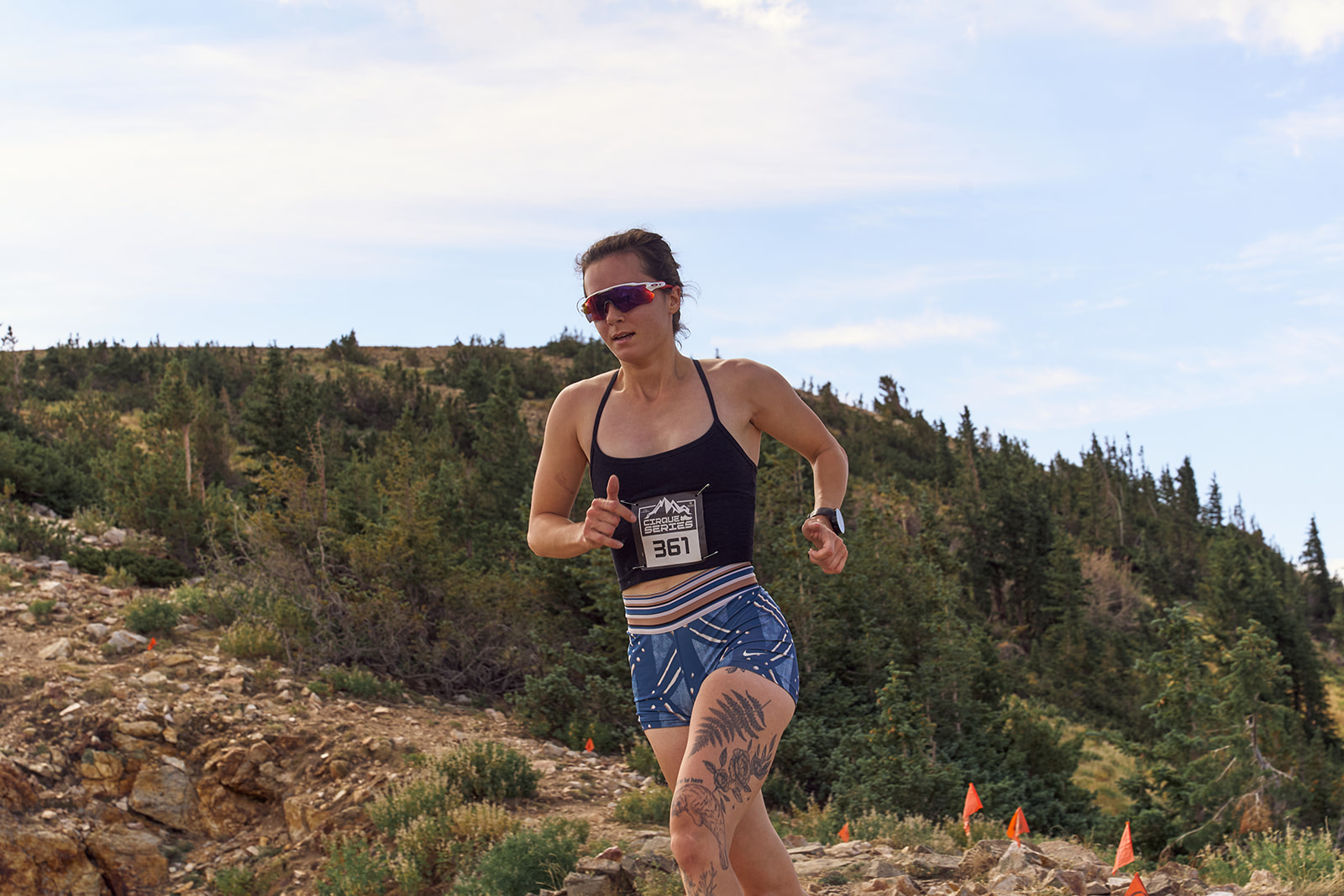
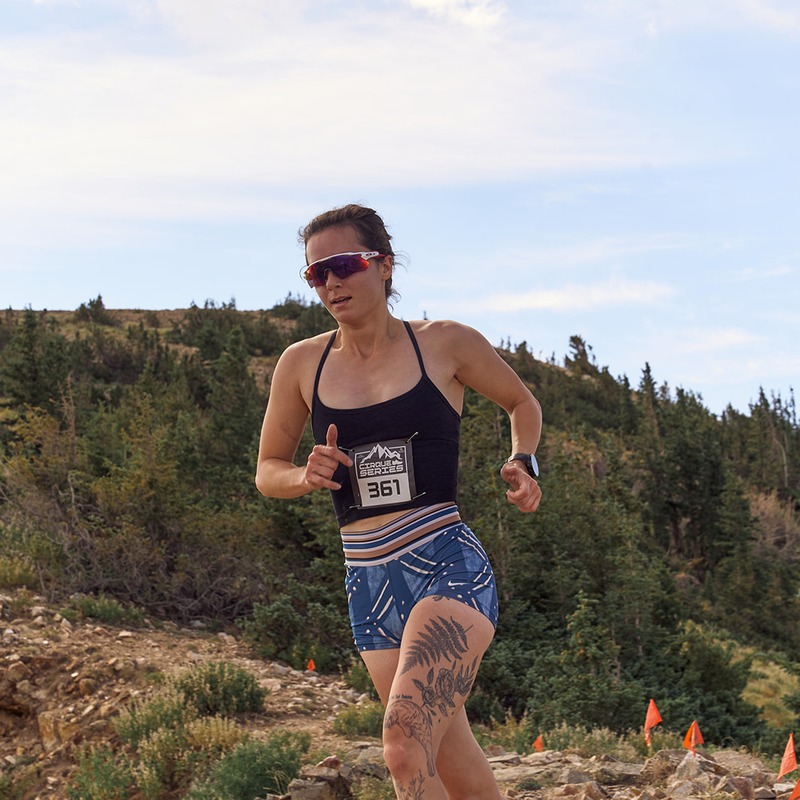
    Kendall Kramer running uphill on a rocky mountain course wearing race bib 361.
    Kramer climbing at the Cirque Series race at Alta, Utah, in 2025. Summer mountain races have been part of her calendar for years. (Photo: Austin Elliott Photography)

    A Race Within the Race

    The Broken Arrow Ascent rises 2,840 feet over 3.61 miles at Palisades Tahoe, ending near 9,000 feet on Washeshu Peak. The course offered Kramer a familiar kind of discomfort. Skiers spend plenty of summer training sessions running uphill, and she has raced mountains throughout her life in Alaska. She was also drawn to an uphill-only event, where she could attack the climb without risking the pounding, falls and injuries that can accompany a technical descent.

    The altitude complicated the effort. An ascent race can feel like a sprint, Kramer said, because its short length allows runners to push rather than settle into prolonged power hiking. Near 9,000 feet, that approach requires more restraint. Still, years of ski racing and training at elevation gave her a sense of how to manage those obstacles.

    Kramer had entered with a tangible goal: finish in the top 10 and earn prize money. The field was strong enough that doing so, she felt, would also establish her among other serious mountain runners.

    She started picking off competitors as the course climbed and found another surge near the end, when a cluster of women remained within reach. Kramer lost track of her exact position amid the passes but knew she was close. She crossed two seconds behind 10th place.

    “I was like, ‘Oh darn,’” Kramer said. “At least it was a good effort race.”

    Weeks earlier, the elite runners had been told that the Ascent would double as the USATF uphill championship and a qualifier for the World Cup Finale. Kramer bought a USATF membership and entered that competition, too, mostly because there was no reason not to. She skimmed the qualification information without giving it much thought.

    “This field is crazy,” she remembered thinking. “That’s not really going to be me.”

    After the race, Kramer and her mother began walking from the summit toward the tram. She checked the overall results first. Then she noticed a separate view for the USATF championship, which removed athletes who were not entered in the national race. Kramer had nearly forgotten about the competition within the competition.

    Her name was listed in fourth, and the top four qualified.

    “I totally didn’t factor myself into that,” Kramer said. “It was definitely a surprise. I was really proud that I could make a team like that.”

    Kramer may not have expected the qualification, but it drew on years spent building the aerobic engine and uphill strength that mountain racing rewards. She simply had not imagined that an ability maintained partly for balance and enjoyment would carry her onto another international team.

    A young Kendall Kramer running a road race alongside an adult runner wearing a race bib.
    Kramer came to athletics through running before she found skiing. Both of her parents are runners. (Courtesy photo)

    A Runner First

    Running has never felt like a secondary sport to Kramer, even as skiing became her profession.

    “Running was always my main sport, in the sense that that’s what I got into when I got into athletics,” she said.

    Both of her parents are runners, and running shaped the athletic culture of her family in Fairbanks. She tried soccer and baseball, but she liked the directness of a sport in which her work and her result felt closely connected. Skiing came later because, as she put it, it was “what all the cool kids did.”

    The two sports eventually became inseparable. At the University of Alaska Fairbanks, Kramer competed in both throughout college. She won three straight Great Northwest Athletic Conference cross-country titles and finished second at the 2024 NCAA Division II Cross-Country Championships. Four months later, in the final ski race of her collegiate career, she won the 20-kilometer freestyle at the NCAA Skiing Championships.

    Kramer’s skiing has since reached a new level. She made her Olympic debut in Italy in February and placed ninth in the World Cup skiathlon in Falun in March, her first top-10 World Cup result. Yet running still supplies something that skiing cannot.

    “If I didn’t have it, I wouldn’t be able to handle all of the skiing that I do,” Kramer said. “I like feeling like I have another athletic outlet to keep me happy, because skiing can be fleeting and have all sorts of disappointments with equipment and stuff. Running feels more in control.”

    That control is physical, but it is also logistical. A ski race can hinge on wax, snow, weather and the work of moving equipment from one place to another. Running asks much less before the gun goes off. On a running trip, Kramer said, there is more space to enjoy the people and the place around the competition.

    “It feels like it adds to your life,” she said. “It’s so manageable.”

    The harder question came when her college cross-country career ended. Kramer loved the sport’s courses, team culture and changing terrain, but there is no obvious post-collegiate version of NCAA cross-country. Track and road racing did not offer the same pull, and she was not ready to build her running life around marathons on pavement.

    Mountain racing offered another route. In Alaska, it had never felt like a separate niche so much as part of the local calendar. Races such as Mount Marathon and the Cirque Series became summer traditions, with familiar faces returning to familiar mountains each year. Two weeks after Broken Arrow, Kramer placed seventh at Mount Marathon in 52:53.

    “I loved running cross-country and being in the woods and going along a course that has different aspects,” Kramer said. “You have an uphill and downhill, and you have to change, just like skiing.”

    Mountain racing preserved the parts of running Kramer loved and opened a path to international competition she never expected to enter.

    Kendall Kramer racing the World Cup skiathlon at Falun, Sweden.
    Kramer on her way to a career-best ninth in the World Cup skiathlon in Falun, Sweden, in March. She argues that summer racing is part of what makes winter results like that possible. (Photo: Authamayou/NordicFocus)

    Keeping a Pulse on Racing

    For Kramer, racing in the summer is not a diversion from ski training. It is one of the ways she makes that training more useful.

    An occasional race does interrupt a perfectly planned week. She may back off for a few days beforehand, then need time to recover afterward. Some skiers see that as lost volume. Kramer believes the costs are outweighed by the chance to revisit sensations that ordinary training cannot reproduce.

    “Racing is very different from training,” she said. “At least I think so, and I think it should be different from training.”

    Kramer likes to race roughly once a month during the offseason. Each start provides a checkpoint on her fitness, pacing and ability to summon focus when a result matters. Those reminders make the first ski races of winter feel less abrupt; she arrives with recent evidence of how her body and mind respond in competition.

    Races also make weaknesses harder to ignore. A disappointing moment can become the direction for the next training block rather than a problem discovered after the ski season begins.

    “Sometimes you don’t get an idea of where you’re lacking and where your strengths are if you don’t tap into that throughout the summer,” Kramer said.

    At Broken Arrow, the crossover was all around her. Olympic ski mountaineer Anna Gibson won the Ascent and the U.S. uphill title in 43:15. Diggins completed all three races, a total of 75 kilometers with more than 16,000 feet of climbing, and finished fourth in the Triple Crown standings. Sophia Laukli has built an elite trail-running career alongside cross-country skiing, winning the 2023 Golden Trail World Series. In August, Gibson placed sixth among women at Switzerland’s Sierre-Zinal, while the recently retired Diggins finished 37th.

    Those examples helped Kramer recognize that mountain running can be more than incidental cross-training. The sport has international races, sponsors and prize money, particularly in Europe. Its U.S. elite pool remains relatively small, and a skier who already possesses a strong aerobic base can become competitive quickly. That does not make the crossover effortless.

    “I’m not going to act like I’m couch-to-mountain-running,” she said. “I’m definitely trying, and I’m also not downplaying the girls who do train for it. But I am saying that ski training works for it, and getting fit in general works for it.”

    The larger benefit may be less measurable than fitness. Elite skiers live by periodized plans: intervals on one day, over-distance training on another, each block designed to build toward winter. Kramer believes athletes can become so protective of that structure that they miss the value of occasionally disrupting it.

    “People are really scared to break away from that,” she said. “But I think you can be a really adaptable athlete and build skills that a regimented training plan can never get you.”

    Her confidence in that approach has been earned over years of combining running and skiing without sacrificing results in either. That history has also built trust with her coaches. An unplanned race or an imperfect training week does not look like recklessness when the larger pattern shows that she understands how to make the two sports work together.

    The mental return matters as much as the physiological one. A summer race provides the competitive charge that long weeks of training can lack and asks an athlete to solve problems in real time: exactly what winter racing eventually demands.

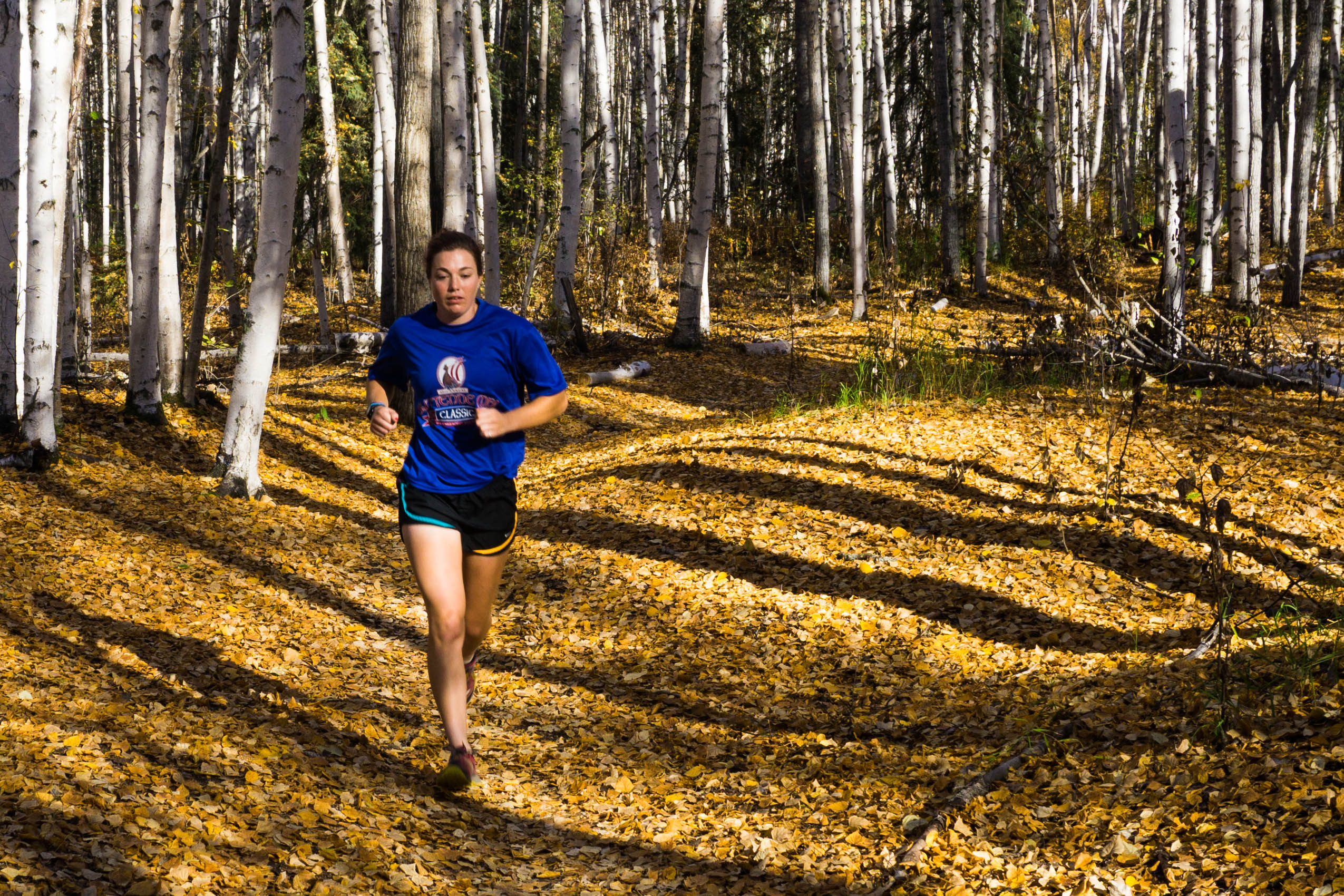
    Kendall Kramer in a running vest above an alpine lake in the Alaska mountains.
    Kramer on a run in the Alaska mountains. Her next start comes Oct. 10 at Mont-Sainte-Anne in Quebec. (Courtesy photo)

    The Next Side Quest

    Kramer’s next test comes Oct. 10 at Mont-Sainte-Anne in Quebec, where the circuit will make its first visit to Canada. The current course listing calls for five kilometers and roughly 800 meters of climbing. It will begin far below the altitude Kramer encountered at Broken Arrow, removing one variable while preserving a steep uphill challenge.

    She wants to finish in the top 10. Broken Arrow showed that she can stay close to that range in a deep international field, and the chance to race without a near-9,000-foot finish has left her curious about what more she can do.

    Beyond Quebec, Kramer would consider mountain races in Europe if a sponsor or U.S. team opportunity made the travel possible. She is not mapping out a second full professional calendar yet. The appeal lies partly in leaving room for opportunities to appear, then being fit and adaptable enough to take them.

    “I would love to look back and see that I took those opportunities,” Kramer said. “Running has never hurt me in the past. I’ve always been able to juggle both.”

    Kramer does not argue that every skier should copy her schedule. She wants more athletes to leave room for the experiences that may not fit perfectly into a training plan but help them handle everything racing asks of them.

    “It can make you a better skier in ways that maybe aren’t the best training on paper,” Kramer said. “But it makes you a good athlete, which comes in handy when you least expect it.”

    At Broken Arrow, that lesson was waiting in a second set of results she had nearly forgotten to check.

    Help Support Our Coverage!

    If you value the thoughtful work and access FasterSkier provides, please consider becoming a Voluntary Subscriber. Your support directly fuels our work to cover the people, places, and moments that make our sport special.

    Join the FasterSkier community!


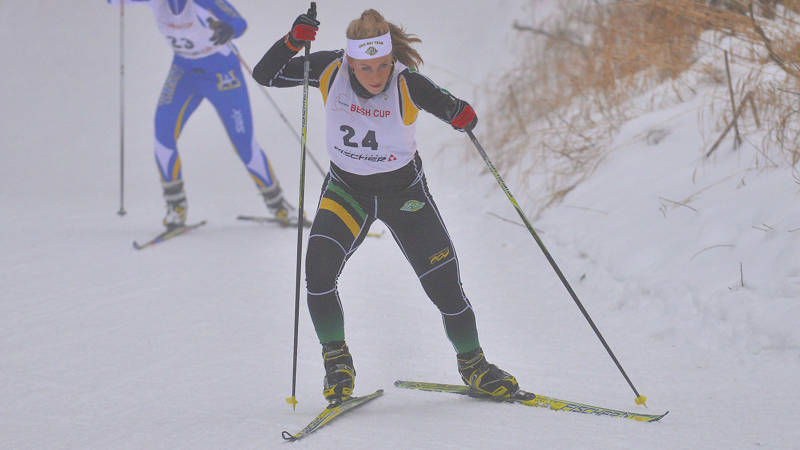
    Kendall Kramer racing cross-country in an Alaska Fairbanks singlet, number 24, past a course flag line.
    Kramer racing cross-country for Alaska Fairbanks. She won three straight GNAC titles and finished second at the 2024 NCAA Division II championships. (Courtesy photo)
  • UAF Seeks Assistant Nordic Ski Coach for Storied Collegiate Program

    UAF Seeks Assistant Nordic Ski Coach for Storied Collegiate Program

    Position: Assistant Men’s and Women’s Nordic Ski Coach
    Employer: University of Alaska Fairbanks
    Location: Fairbanks, Alaska
    Type: Full-time, 11-month, term-funded, exempt
    Priority Application Review: May 20, 2026 (open until filled)

    About the Position

    The Assistant Men’s and Women’s Nordic Ski Coach plays a key role in supporting one of the nation’s premier collegiate ski programs. Working alongside the Head Coach, this position helps foster a high-performance environment grounded in growth, development, and teamwork. As part of the UAF Athletics Department and the broader Fairbanks ski community, the assistant coach will mentor student-athletes both on and off the trails, helping them excel in competition while preparing for success beyond college.

    Success in this position comes from being an excellent communicator who inspires and guides college-aged athletes to reach their highest potential. The right candidate will mentor with patience and confidence while bringing out the best in both individuals and the team as a whole. On race days, the ability to stay calm, make quick decisions, and adapt under pressure will be essential. Creativity in problem-solving, flexibility in coaching approaches, and a balance of working effectively within a team while taking initiative independently will help the assistant coach excel in this role.

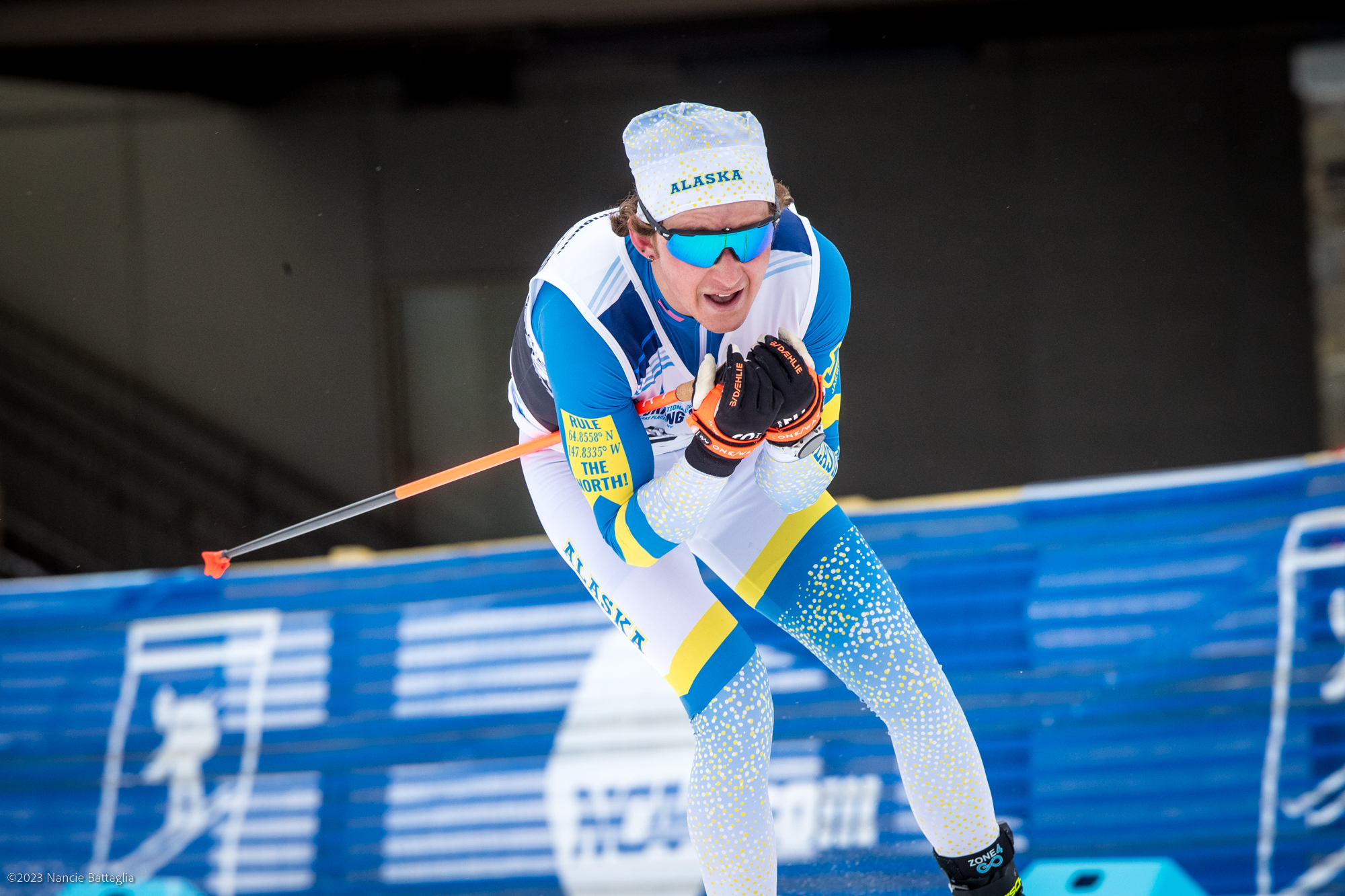
    Joe Davies (UAF) during his NCAA Championship-winning performance in the 10 k skate in Lake Placid, New York, in the 2023 championship. (Photo: (c) 2023 Nancie Battaglia)

    Minimum Qualifications

    • Bachelor’s degree in a related field and three years of relevant coaching experience at the collegiate level, or an equivalent combination of training and experience.
    • Cross-country ski racing experience.
    • A valid Alaska Driver’s License and a clean driving record in compliance with UA Safe Driving Criteria.

    Preferred:

    • Degree earned while participating as an athlete at the candidate’s institution.
    • B.A. or B.S. in Physiology, Biology, Physics, or similar — though other majors are not excluded.
    • USSS Coaches Education L-100 certification, or equivalent.

    Further ski- and NCAA-related education will be provided as part of the position.

    Position Details

    This is a full-time, 11-month, term-funded, exempt staff position with a competitive salary and a comprehensive benefits package. UA provides a generous compensation package that includes retirement options, annual leave, 12 paid holidays per year, tuition waivers for employees and family members, and affordable medical, dental, and vision care coverage. New hires will be placed on the UA Staff Salary Schedule, Grade 79, based on education and experience.

    The University of Alaska reserves the right to require employees to work on-site at UA facilities. Hybrid and remote work may be approved for employees based in Alaska at the University’s discretion. Remote work for employees based outside the State of Alaska may be approved only in exceptional circumstances or when required by the position’s job duties.

    This position is term-funded and is reviewed annually for contract renewal at the University’s discretion.

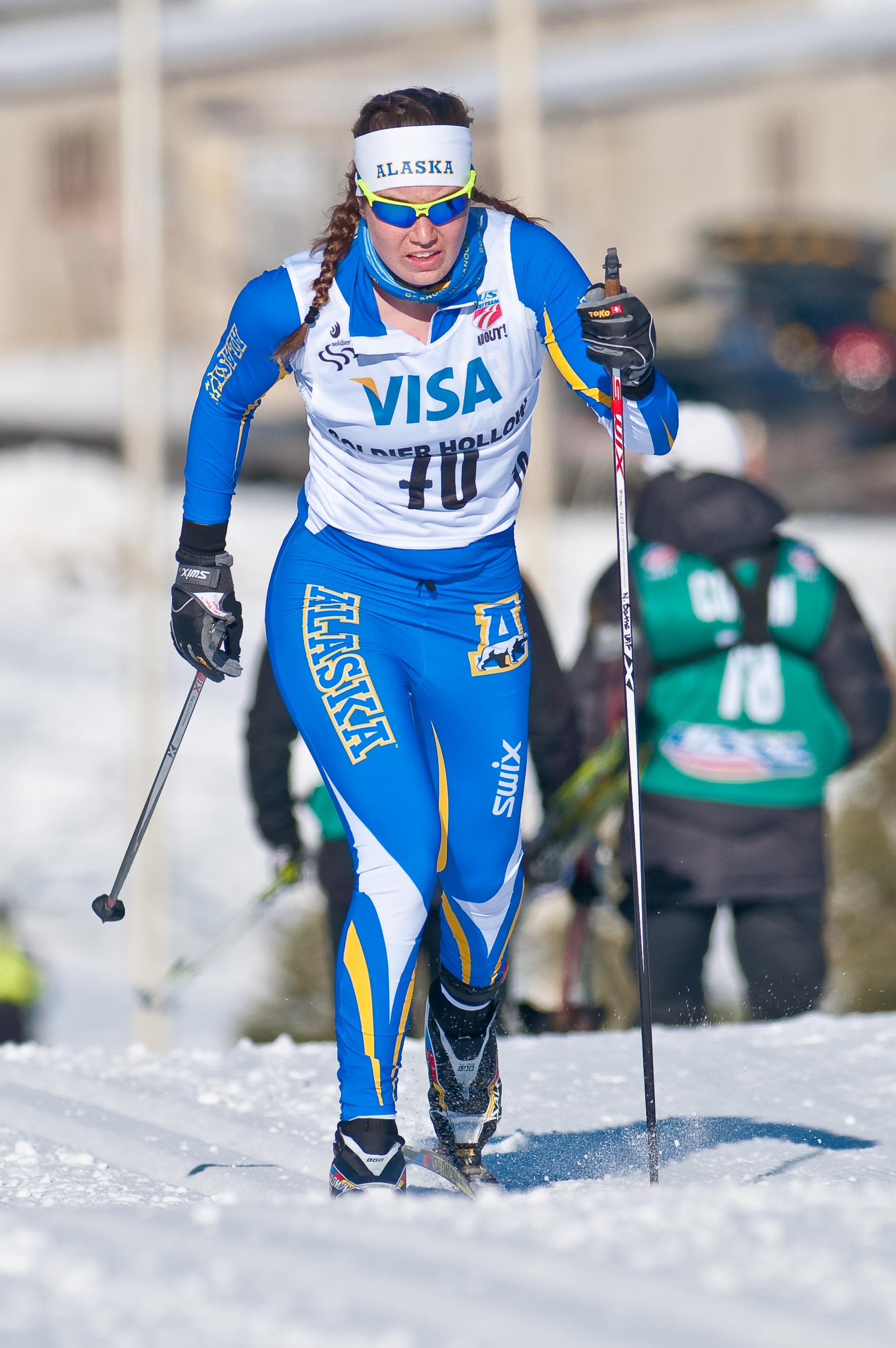
    Eventually, Kendall Kramer (UAF – right) skied to a 35-second victory for the individual Women’s 20 k Freestyle NCAA Championship in 2025. (Photo: Tobias Albrigtsen)

    Application Timeline

    Application review will begin on May 20, 2026. Applications received by this date will receive priority consideration; however, the recruitment will remain open until filled.

    How to Apply

    View the full list of job responsibilities.

    To apply, visit: https://apptrkr.com/7133551

    Questions

    For questions regarding this position, contact Brittany Tappa, Signers’ Business Office HR Coordinator:

    Rosie Fordham 2x NCAA Champion and Olympian this past season. (Photo: Lexi Pline)

    Additional Information

    To be eligible for this position, applicants must be legally authorized to work in the United States without restriction. Applicants who now or may in the future require visa sponsorship to work in the United States are not eligible.

    The University of Alaska is responsible for providing reasonable accommodations to individuals with disabilities throughout the applicant screening process. For assistance with this application or any phase of the interview process, contact the ADA team at ua-ada@alaska.edu.

    The University of Alaska is an Equal Opportunity/Equal Access Employer and Educational Institution. The University is committed to a policy of nondiscrimination against individuals on the basis of any legally protected status.

    The successful applicant is required to complete a background check. Any offer of employment is contingent on the background check. All employees at the University of Alaska are expected to uphold the highest standards of ethics and professionalism when conducting university business. Applications submitted to the University of Alaska are subject to public disclosure under the Alaska Public Records Act.

    Each university within the University of Alaska system publishes an Annual Security and Fire Safety Report containing campus safety information and crime statistics for the three most recent calendar years. Reports are available online: UAA | UAF | UAS. Paper copies are available upon request.

  • University of Alaska Fairbanks Seeks Head Men’s and Women’s Ski Coach

    University of Alaska Fairbanks Seeks Head Men’s and Women’s Ski Coach


    The Head Men’s and Women’s Skiing Coach provides comprehensive leadership and oversight for all aspects of UAF’s Nordic skiing programs within the Department of Athletics. This position is responsible for coaching and program development, student-athlete recruitment, supervision and mentorship of assistant coaches, and fostering a culture that promotes academic success, personal growth, and competitive excellence. The role supports student-athlete welfare, ensures compliance with NCAA, conference, and university policies, and contributes to the department through community engagement, fundraising, and responsible program administration. Working collaboratively with athletics staff and campus partners, the position advances the mission of the department by developing successful student-athletes and promoting the university through competitive achievement and community connection.

    To thrive in this role, the successful candidate will demonstrate strong leadership, organization, and communication skills while fostering a positive, inclusive, and high-performance team culture. The individual must be able to effectively balance coaching excellence with administrative responsibilities, recruiting strategy, and student-athlete academic support. Success requires the ability to mentor and supervise staff, build meaningful relationships with student-athletes, alumni, and community partners, and maintain strict compliance with NCAA, conference, and university policies. A proactive, collaborative mindset and a commitment to student-athlete development, competitive success, and community engagement are essential to advancing the mission of the athletics department.

    Kendall Kramer (University of Alaska-Fairbanks) leads the Women’s pack during the 20 k Skate Mass start at US Nationals. (Photo: Tobias Albrigsten/@UntraceableG)

    Minimum Qualifications:

    Bachelor’s degree in exercise science, exercise physiology, or kinesiology. Valid driver’s license required. Master’s degree in exercise science, exercise physiology, or kinesiology preferred.


    Position Details:

    This is a full-time, term-funded, exempt staff position complete with both a competitive salary and https://www.alaska.edu/hr/benefits/support/prospectiveemployees.php. UA provides a generous compensation package that includes retirement options, annual leave, 12 paid holidays per year, tuition waivers for employees and family members, and affordable medical, dental and vision care coverage. New hires will be placed on the https://www.alaska.edu/hr/benefits/compensation/salary.php, Grade 81, based on education and experience.


    Applicant review will begin on March 18, 2026.

    The University of Alaska (UA) reserves the right to require employees to work on-site at the UA facilities. Hybrid and remote work may be approved for employees based in Alaska at the University’s discretion. Remote work for employees based outside the State of Alaska may be approved only in exceptional circumstances or when required by the position’s job duties.


    Click here to view the full list of job responsibilities


    If you have any questions regarding this position, please contact Brittany Tappa, Signers’ Business Office HR Coordinator, at bjtappa@alaska.edu or 907-474-6353.


    *To be eligible for this position, applicants must be legally authorized to work in the United States without restriction. Applicants who now or may in the future require visa sponsorship to work in the United States are not eligible.

    This position is a term-funded position and is reviewed annually for contract renewal at the University’s discretion.

    The University of Alaska (UA) is responsible for providing reasonable accommodations to individuals with disabilities throughout the applicant screening process. If you need assistance in completing this application or during any phase of the interview process, please contact UA Human Resources by phone at 907-450-8200.

    The http://www.alaska.edu/  is an Equal Opportunity/Equal Access Employer and Educational Institution. The University is committed to a http://www.alaska.edu/nondiscrimination against individuals on the basis of any legally protected status.

    The successful applicant is required to complete a background check. Any offer of employment is contingent on the background check.

    Your application for employment with the University of Alaska is subject to public disclosure under the Alaska Public Records Act.

    All employees at the University of Alaska are expected to uphold the highest standards of ethics and professionalism when conducting or engaged in university business.


    *Each university within the University of Alaska system publishes an Annual Security and Fire Safety Report which contains information regarding campus safety and security including topics such as: campus law enforcement authority; crime reporting policies; campus alerts (Timely Warnings and Emergency Notifications); fire safety policies and procedures; programs to prevent dating violence, domestic violence, sexual assault and stalking; the procedures the University will follow when one of these crimes is reported; and other matters of importance related to security on campus. The report also contains information about crime statistics for the three most recent calendar years concerning reported crimes that occurred on campus; in On-Campus Student Housing Facilities; in Noncampus buildings or property owned or controlled by the University or a recognized student organization; and on public property within, or immediately adjacent to and accessible from, the campus. The report also contains fire statistics for any fires occurring in an On-Campus Student Housing Facility during the three most recent calendar years.


    Access to the reports is available at:

    UAA: (Addresses Anchorage campus, Aviation Technology Complex, JBER – Elmendorf Extension, JBER – Richardson Extension, Kenai Peninsula College – Kachemak Bay campus, Kenai Peninsula College – Kenai River campus, Kodiak College, Kodiak High School Extension, Matanuska-Susitna College, Prince William Sound College, and Prince William Sound College – Cordova Extension) Online: https://www.uaa.alaska.edu/students/safety. Request a paper copy in person: UAA Police Department Office at Room 114 of Eugene Short Hall on the Anchorage campus / UAA Dean of Students Office at Room 122 of Rasmuson Hall on the Anchorage campus. Request a paper copy by mail: 907-786-1120 or police@uaa.alaska.edu / 907-786-1214 or uaa_deanofstudents@alaska.edu.


    UAF: (Addresses Fairbanks Campus, Bristol Bay Campus, Chukchi Campus, Community and Technical College, Kasitsna Bay Campus, Seward Marine Center, Tok Campus, Kuskokwim Campus, and Northwest Campus) Online: https://www.uaf.edu/orca/files/ASFSR.pdf. Request a paper copy in person: UAF Office of Rights, Compliance and Accountability on the 3rd Floor of Constitution Hall. Request a paper copy by mail: 907-474-7300 or uaf-orca@alaska.edu.


    UAS: (Addresses the Juneau Auke Bay Campus, Juneau Technical Education Center, Sitka Campus, & Ketchikan Campus) Online: https://uas.alaska.edu/equity-and-compliance/docs/clery/UAS_ASFSR.pdf. Request a paper copy in person: Hendrickson Building, Suite 202 on the Juneau campus. Request a paper copy by mail: 907-796-6371 or emailing uas.clery@alaska.edu.


    To apply, please visit: https://apptrkr.com/6955777


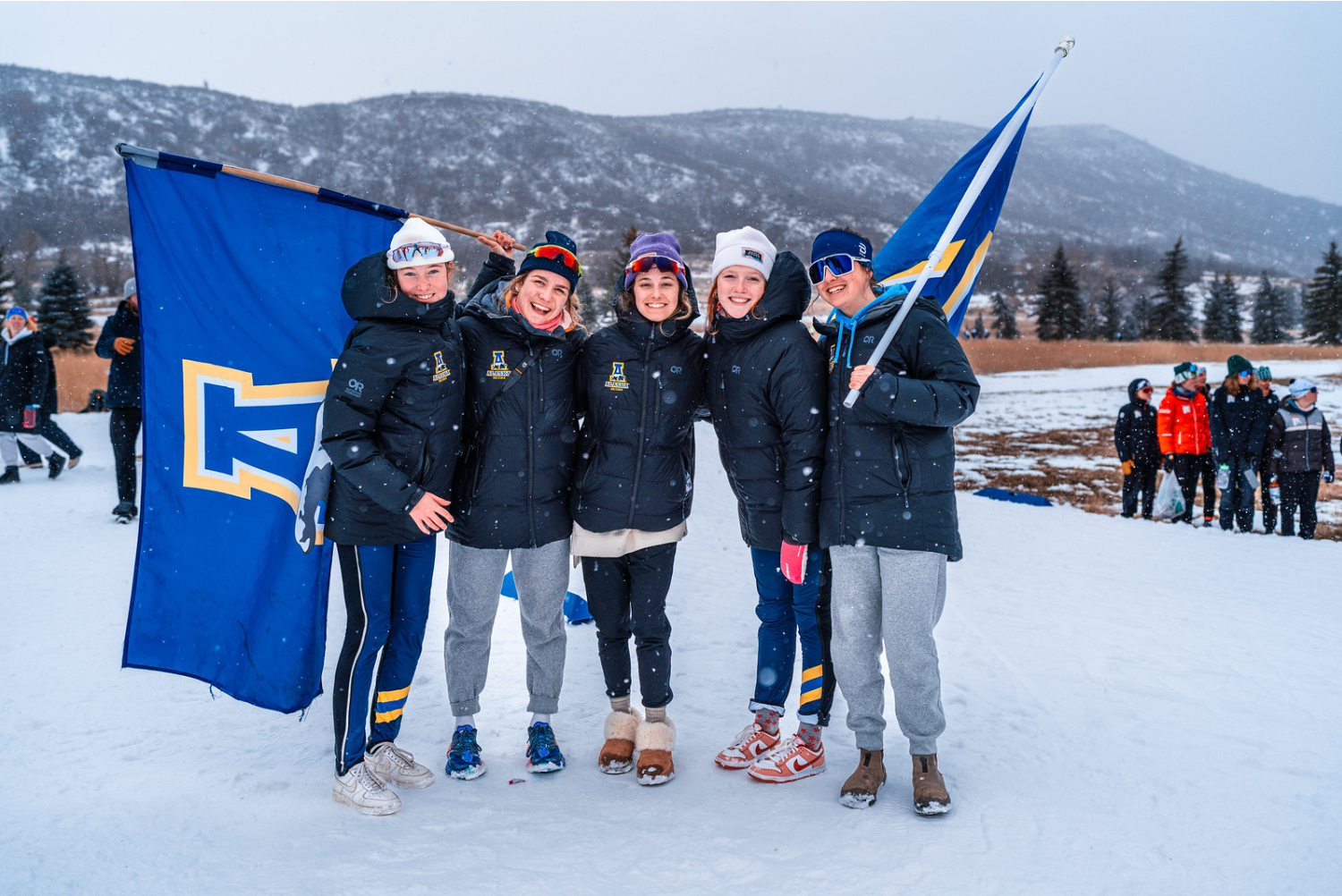
    The University of Alaska-Fairbanks team out to cheer the Men’s race in Soldier Hollow, Utah in 2024.
  • UAA Announces Plan to Cut Ski Team, Effective 2021/22

    UAA Announces Plan to Cut Ski Team, Effective 2021/22

    Marine Dusser was named RMISA Nordic Coach of the Year in her first year leading the UAA Seawolves, 2019/2020. (Photo: Adam Verrier)

    This article has been updated with a link to additional information in an Anchorage Daily News story.

    ANCHORAGE — The University of Alaska Anchorage announced Wednesday a planned “reconfiguration” of the UAA Athletics Department, which will involve cutting both the men’s and women’s ski teams after the 2020/2021 school year. School leaders will seek approval of their plan, which would also cut men’s hockey and women’s gymnastics, at the upcoming Board of Regents meeting on September 10-11.

    By the numbers: Not enough money

    FasterSkier previously reported on a version of this story in fall 2016, when the UAA ski team was slated for elimination but was ultimately reinstated following a strong outpouring of community support. As FasterSkier wrote in a story published in October 2016:

    As FasterSkier previously reported, the State of Alaska is dependent upon funds from a single source, oil revenue, to an extent unparalleled in any other state. Falling oil prices over the last two years have led to widespread budget deficits, layoffs and reductions of both state and private-sector employees (particularly in the oil and gas industry), and political recriminations over the failure to pass a balanced budget.

    When FasterSkier first reported on this story in May 2016, the price of oil was approximately $48 a barrel. At the close of trading on Thursday, oil was at $49.89 a barrel. At these prices, the State of Alaska faces a revenue shortfall equal to approximately two-thirds of its budget. Oil has not been over $100 a barrel in over two years.

    Alaska residents have not paid a state income tax since 1980. Although some communities have instituted local sales taxes, there is no statewide sales tax.

    Oil is currently $43 a barrel (up from negative numbers earlier this spring). The State of Alaska has not made meaningful longterm progress on its endemic fiscal challenges, stemming from the lack of a diversified economy, in the ensuing four years. Limitations on travel wrought by the Covid-19 pandemic have this year further decimated tourism, one of the state’s main other revenue sources.

    There is still no state income tax. Payments from the state’s sovereign wealth fund, the Alaska Permanent Fund, were reduced to only $1,000 per person this year. 

    By the numbers: Inside the UAA budget

    The budget for the entire University of Alaska system has been dramatically reduced over the last several years. After current Governor Mike Dunleavy was elected in 2018, “on a promise not only to restore the full dividend but to make it retroactive, which would amount to giving nearly seven thousand dollars to every Alaskan,” he announced a proposed budget that did not restore the full amount of a promised dividend, but which did reduce state funding to the University of Alaska system by over 40%.

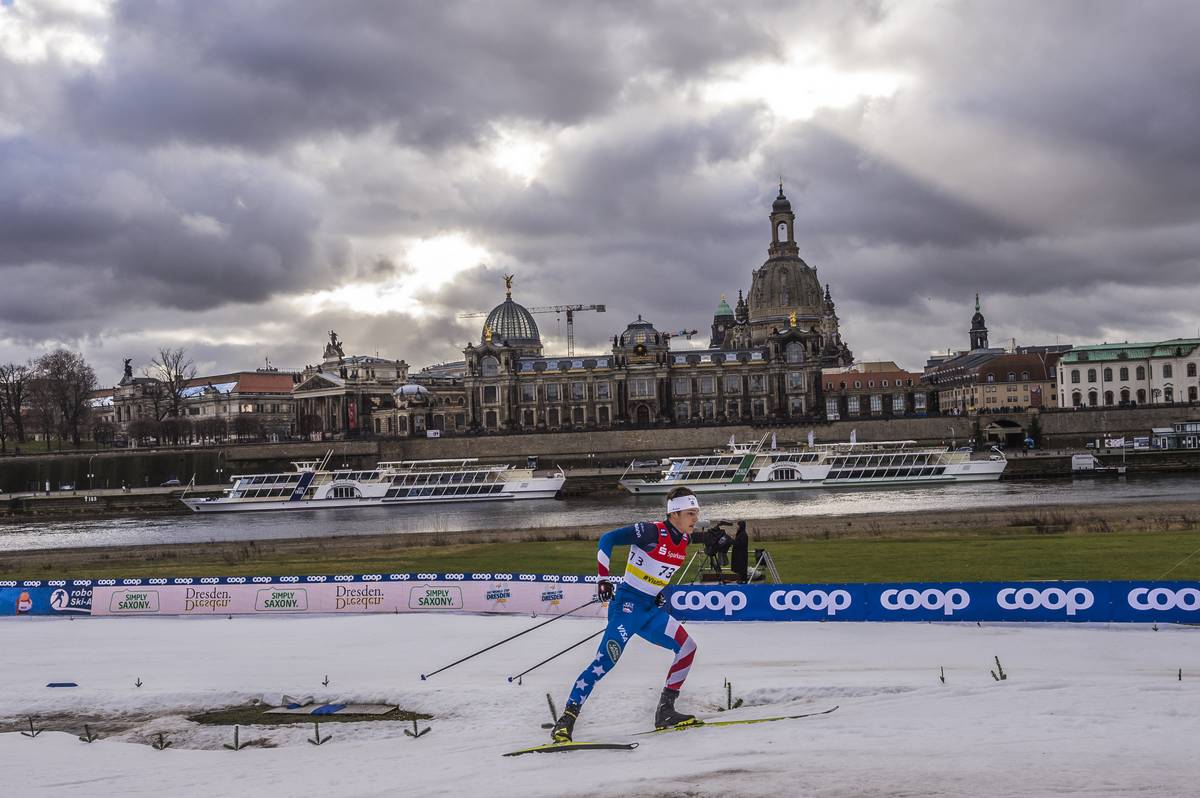
    Current UAA skier JC Schoonmaker scores points in his first World Cup start earlier this year, during the Dresden, Germany skate sprint. (Photo: NordicFocus)

    While funding levels have not been reduced to quite those dramatic levels, following widespread pushback and a pending recall effort (disclosure: this reporter’s mother is leading the Recall Dunleavy legal team), the overall budget for the University of Alaska has been substantially cut. As the UAA press release notes, state funding for UAA has declined by $34 million since 2014.

    The press release continues, “The university’s decision to discontinue these sports follows on the heels of the Board of Regents’ direction last fall to consolidate academic programs and services to meet budget reductions. In August 2019, University of Alaska leadership came to an agreement with Gov. Dunleavy on a $70 million reduction in state funds to the university system over the three-year period of fiscal years ’20, ’21 and ’22.”

    Current figures for the overall UAA Athletics Department budget were not immediately available. As of the 2017 fiscal year, the total budget for UAA Athletics was $4.33 million. The men’s hockey team cost $1.35 million; men’s and women’s skiing cost $280,000 each.

    UAA has said that cutting skiing, hockey, and gymnastics is “expected to save approximately $2.5 million per year” out of the 2021/22 budget.

    By the numbers: Not enough sports teams

    Other teams currently proposed for elimination are the men’s hockey team and women’s gymnastics team. The ski team counts as two teams for purposes of Title IX and NCAA affiliation, the men’s ski team and the women’s ski team. UAA currently has 13 varsity athletic teams total.

    The proposed cancellation, therefore, takes UAA from 13 teams down to nine. But section 20.10.3(a)-(b) of the NCAA Division II Bylaws provides that “A member of Division II shall sponsor in Division II a minimum of” either five sports for each of men and women, or four sports for men and six for women. (Most of UAA’s teams are Division II teams. The four teams currently proposed to be cut all compete in Division I. If UAA were a full D-I program, it would need to field even more than 10 varsity teams.)

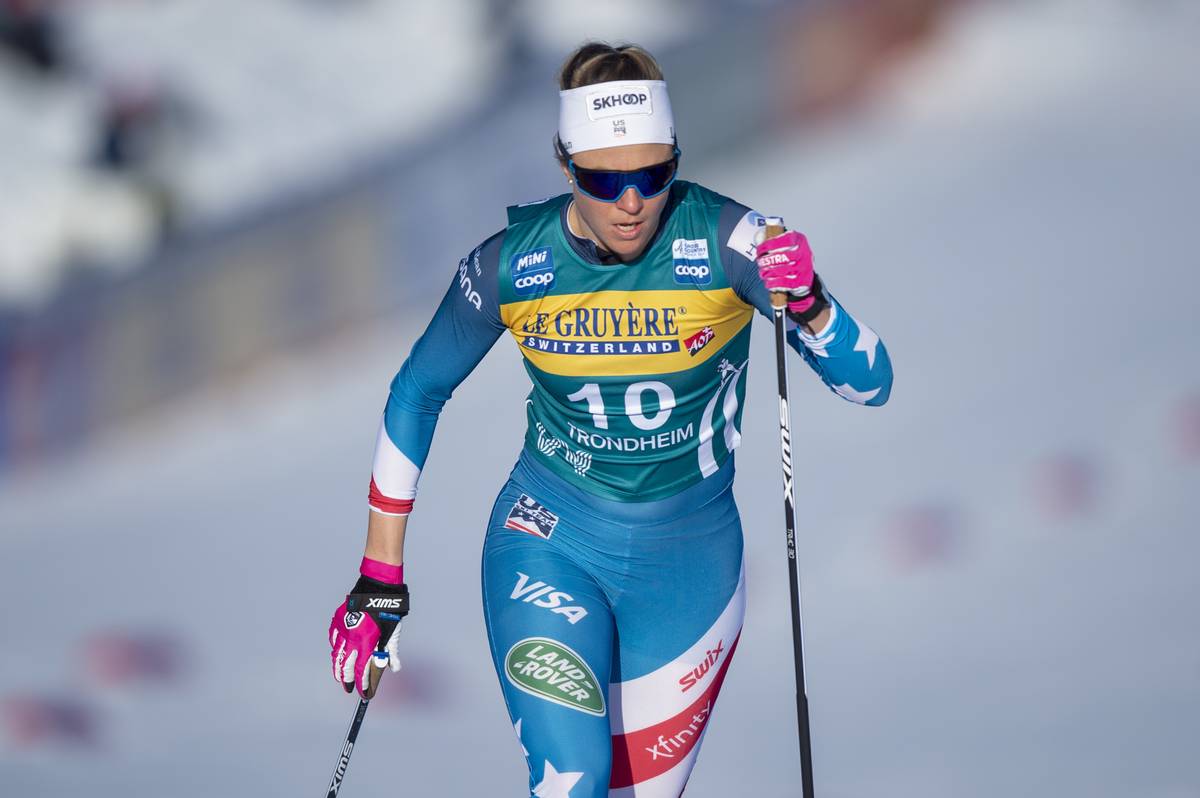
    Former UAA skier Sadie Maubet Bjornsen races on the World Cup earlier this year in Trondheim, Norway. (Photo: NordicFocus)

    300 miles to the north, Alaska’s other NCAA ski program, University of Alaska Fairbanks, issued a press release headlined, “Commitment to Alaska Nanooks Programs.” UAF Chancellor Dan White wrote, following Wednesday’s announcement from UAA, “I want to reassure our Alaska Nanooks student-athletes, parents, coaches, and the UAF and Fairbanks community that UAF’s athletics programs are not part of this recommendation. UAF has 10 Division I and II sports, the minimum number allowed by the NCAA, and has no plans to reduce them.”

    The implicit safety net of already having an NCAA-minimum 10 sports teams was cited by UAF coaches and athletes four years ago when it previously appeared that ski programs at both UAA and UAF were potentially going to be cut. As then-UAF head nordic coach Nick Crawford wrote in an emailed statement to FasterSkier in October 2016:

    “For UAF specifically, I don’t think skiing will be cut as I don’t think the NCAA will grant the waiver to the ‘10 sport minimum requirement.’ One of the NCAA’s core values is to provide sporting opportunities from athletes of many different sports and the 10 sport rule is in effect to protect small sports like skiing. It’s a slippery slope to allow Alaska to cut ‘less well known’ sports like skiing and indoor track to continue to fund their more popular sports,  If the NCAA grants this waiver, it sets a precedent to eliminate non-revenue generating sports across the country with fewer and fewer sports offerings and that is not a direction I think the NCAA wants to go in.”

    Ian Marks, UAA Assistant Athletic Director for Media Relations, was asked Wednesday about the significance of a proposal that took UAA to fewer than 10 sports teams. In an email to FasterSkier, Marks wrote, “UAA will need to add a men’s team sport in the future. UAA will be applying for a waiver with the NCAA to sponsor only nine sports in the short-term.”

    Next steps

    Here’s the final paragraph of today’s press release from UAA:

    Between Aug. 19 and Sept. 9, the university community and public will have the opportunity to comment on the UAA Athletics decision during a virtual town hall meeting on Aug. 26 and Board of Regents public testimony on Aug. 31. Information about both events is available at uaa.alaska.edu/calendars/public. Feedback may also be sent to uaa_feedback@alaska.edu.

    An FAQ through the same link provides additional information from UAA about the decision. The final question given is, “Other universities have saved their programs through an online appeal from their fan base. If that were to happen, would you consider reversing this decision?”

    The answer is, “What has occurred recently at other universities, such as the University of Alabama-Huntsville, was a beneficial outcome for their hockey program. But it is a short-term solution. After the coming season, their athletics department will need to resolve 2021-22 funding for the program because the money raised will not cover a full season of expenses. We are concerned about the long-term viability of UAA Athletics. Outside support would need to align with a plan for long-term sustainability in order to move forward.”

    More information

    The Anchorage Daily News published a story on this topic later Wednesday, reflecting a Wednesday-afternoon conference call with the UAA Athletic Director. For more information on overall budget numbers and a potential replacement men’s team sport – soccer, lacrosse, and volleyball among them – please see Beth Bragg’s story here.

  • UAF Seeks Assistant Men’s and Women’s Nordic Coach

    UAF Seeks Assistant Men’s and Women’s Nordic Coach

    (Job posting)

    The Department of Athletics at the University of Alaska Fairbanks is seeking applicants to fill the position for the Assistant Coach for the Men’s and Women’s Nordic Ski Teams. The Alaska Nanook Ski Team competes in the Rocky Mountain Intercollegiate Ski Association and frequently has all-American level performances at the NCAA Championships. UAF is the ideal place to be a nordic skiing enthusiast with groomed trails right outside the door on the UAF campus and a quick 15 minute drive to the world class Birch Hill Facility. There is consistently good groomed skiing from late October/early November to late March/early April each year.

    The position is a 9 month/year salaried position with excellent benefits. The minimum starting pay is $25.82/hour. To learn more about the position or to apply please go to http://careers.alaska.edu/cw/en-us/job/506177/assistant- mens-womens-xc-ski-coach
    The position is open until filled with the application review process beginning on June 10th 2018.

    buy voltaren online

    For questions about the position or UAF Ski Team please contact head coach Nick Crawford: ncrawford2@alaska.edu

  • Summer Training In.. Jilemnice, Czech Republic, with Jan Čech and Nick Lovett

    Summer Training In.. Jilemnice, Czech Republic, with Jan Čech and Nick Lovett

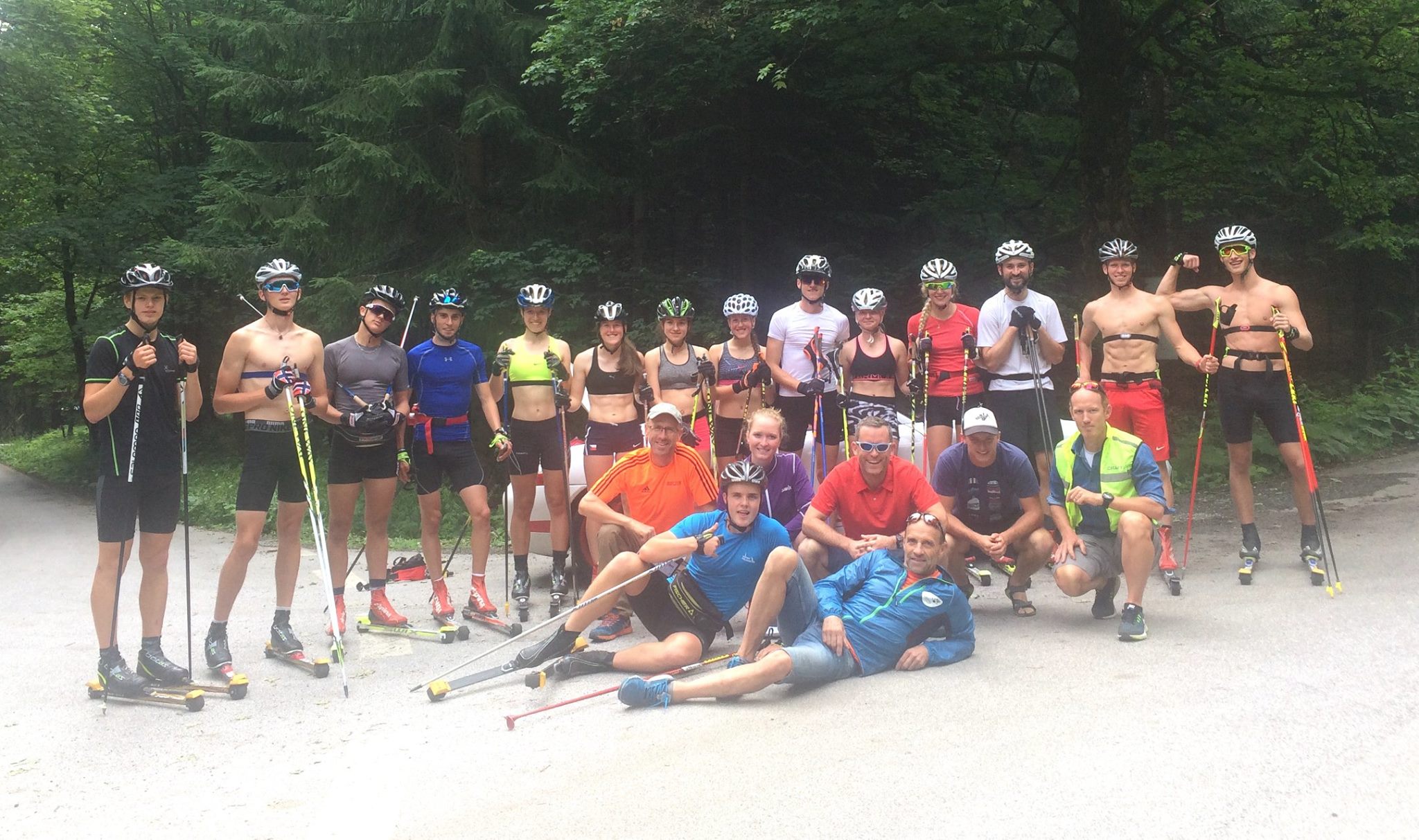
    Some things are the same everywhere: a mostly junior training group after a rollerski workout in the Czech Republic. (All photos courtesy of Jan Čech)

    For almost as long as Nick Lovett has been skiing at the University of Alaska Fairbanks (UAF), he has been thinking about how people train in other parts of the world.

    This summer, the Wyoming native went on a trip to find out, visiting teammate Jan Čech at his home in the Czech Republic.

    “I have been roommates with Jan for two years, and have been considering training with him in Czech for just as long,” Lovett wrote in an email. “I thought it would be a good experience to go somewhere new and see how training works somewhere else. I would say my decision was half for the training aspect, and half for the travel opportunity. I also traveled to Norway, Germany, and Scotland while away this summer.”

    https://www.instagram.com/p/BUbn9oIgLcL/

    That also included visiting teammate Ann-Cathrin Uhl in Germany, and UAF teammate Seiji Takagi joined part of the trip as well.

    So what did he find? Both Lovett and Čech, both 23 and seniors at UAF, answered some questions over email about summer training in the Czech Republic. The interviews have been edited and condensed.

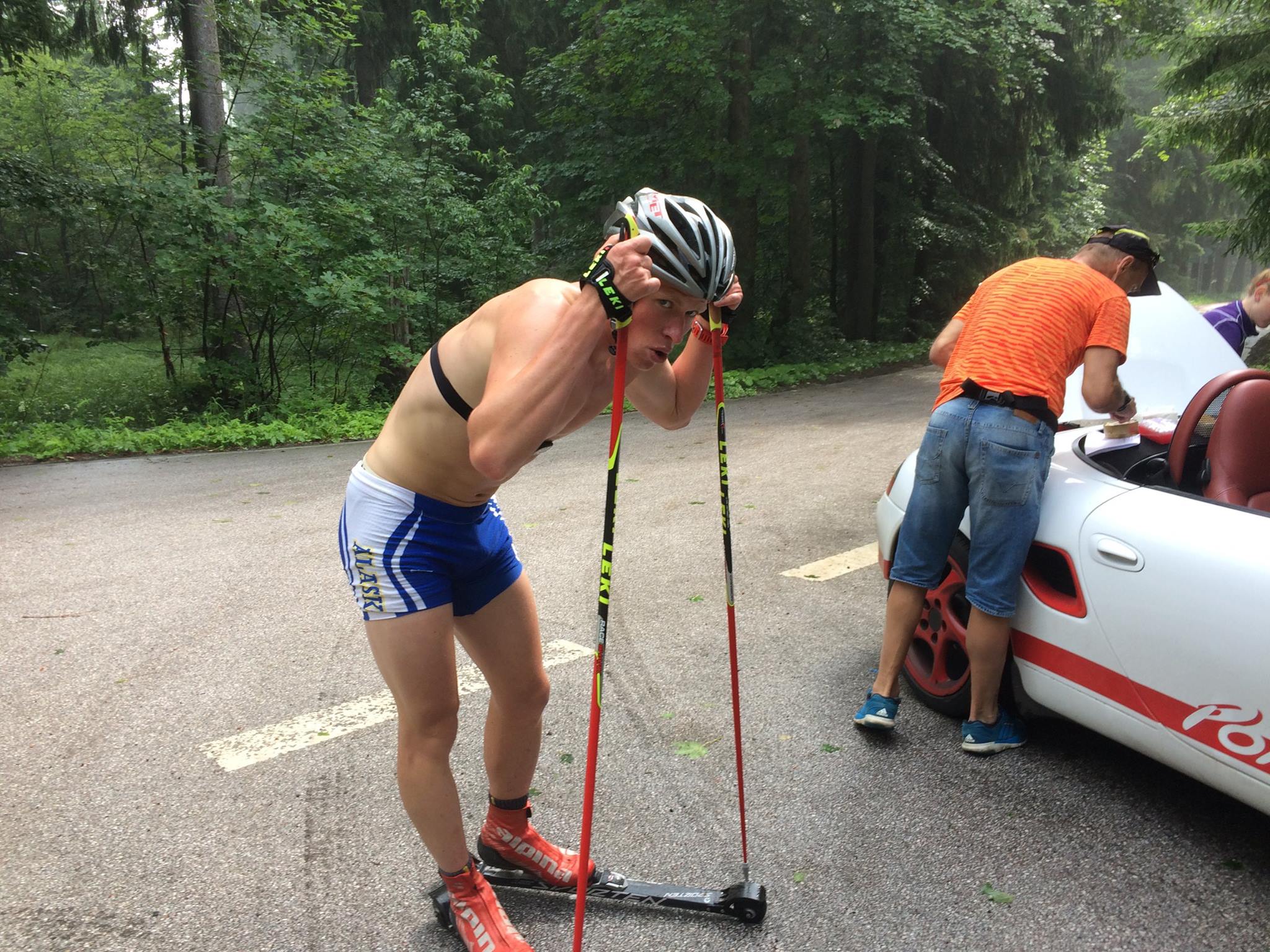
    Čech working hard in the Czech Republic. (Courtesy photo)

    FasterSkier: Jan, where are you based this summer, what part of the Czech Republic? Is this the same area you grew up in, or is your training base away from your family home?

    Jan ČechMy base camp is in Jilemnice, the northeast part of Czech Republic, close to Giant Mountains. I was born here and I went here for sport elementary school, and high school focused on sport education. Now I train with my brother’s group — he is coach at the high school above, as well as a coach of the Czech junior national team for cross country skiing.

    FS: What is that part of the Czech Republic like? How is the landscape, what do people do there?

    JC: Because are where I live is right under mountains, the landscape is rolling with numerous of tree-covered hills. It’s perfect for running and biking. People here are big fans of any sport and most of them spend weekends in the mountain, hiking, climbing, or biking in the countryside.

    FS: Do you have a team that you are training with, or are most of your training sessions alone? How well do you know the other athletes and are they at a similar level to you?

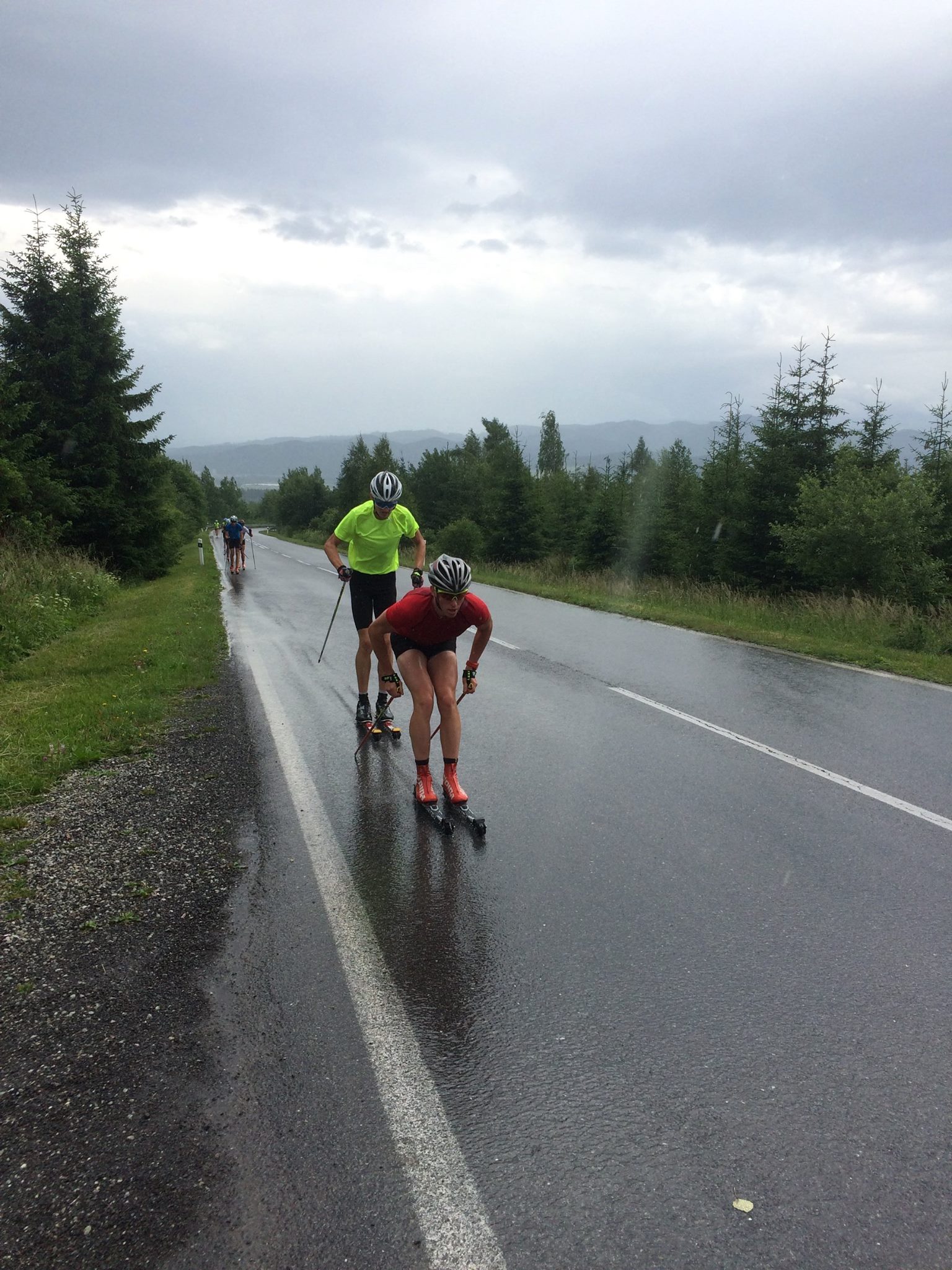
    A rainy rollerki in the Czech Republic. (Photo: Jan Čech)

    JC: Most of the time I train with my brother’s junior group. The guys are fast — some of them attended World Junior Championships in Soldier Hollow, Utah, last season. So they are good training partners. Also sometimes I drive to the rollerski track an hour away from town, and there I can train with men from the national B-team who are my friends. I competed against them before I came to Fairbanks.

    FS: Nick, did you spend some time training with this group, and how easy was it to join them?

    Nick Lovett: It was as easy as possible for me to integrate, but there were some challenges. Aside from Jan, there were very few other skiers or coaches who spoke fluent English. This was the most challenging part as we tried to communicate some complex technique ideas with less than ideal words to use. While the language barrier was a challenge, I still feel I was able to learn and accomplish enough to fit in well. 

    FS: How do you design your training? Is it based on a plan from Nick Crawford at UAF? Are you adapting it at all to be able to match with other people/groups you might have opportunities to join?

    JC: I train with the team in my hometown so I can have training partners, especially during interval sessions so I can push myself harder. Then I try match the intensity and volume hours from Nick’s plan. I also keep doing the UAF strength system whole summer as well.

    FS: What are some of the differences between Czech training and American training?

    NL: I would say there were some differences, but overall it was very similar to what I expected and what I have experienced here. The most notable difference was the emphasis that was put on general athleticism. While in the U.S. most workouts are all ski-oriented, some workouts there incorporated elements of gymnastics and track running.

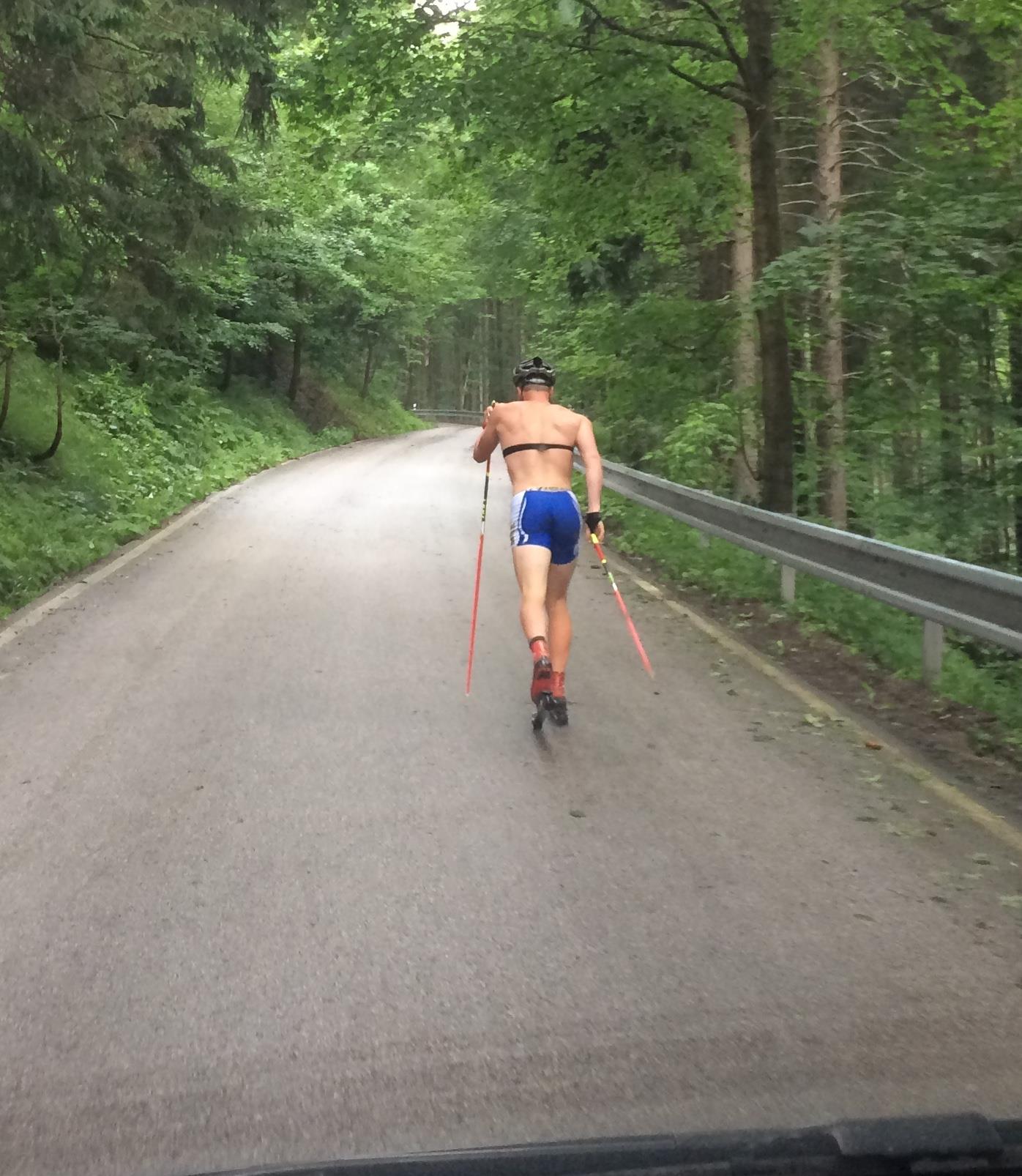
    Čech, seen from the dashboard of a coach’s car, has the road to himself. (Courtesy photo)

    FS: What’s the hardest workout you have done so far this summer? 

    JC: My hardest workout this summer so far was uphill run time trial, which I do every year since I was 13. So that’s the best way how to test my fitness level for me.

    FS: Are there any absolute favorite places to run or bike or rollerski? 

    JC: I believe my area is a great place to train. We have lots of opportunities to go mountain biking or road biking for up to four hours, which are amazing workouts and we bike as a group of 15 people. Also we have many country roads with new asphalt, which connect a hilly rolling loop of about 50 kilometers. That is great for classic OD’s [over-distance].

    NL: Jilemince was a beautiful place to train. There were ample trails to run on, and some very quiet roads where one could ski for 2.5+ hours and never repeat the same asphalt. There is also a rollerski track and biathlon stadium currently under construction in Jilemince which will be an incredible addition to the town as a training venue.

    FS: What is the best part of Czech summer, aside from training?

    JC: The best part of summer in Czech are my evening walks with my sister to the old town square, which has buildings over 700 years old and great chocolate factory near by.

    FS: Nick, where was your favorite place you visited?

    NL: My favorite place we went was the city of Prague. It is an incredibly beautiful old city, and I just loved being there. Also we did some long runs in the mountains on the Czech-Poland border. I am from Jackson, Wyoming, so I loved being in the mountains and it made me feel closer to home there.

    A workout in the mountains on the Polish border. (Photo courtesy of Jan Čech)
  • UAF Seeks Assistant Nordic Coach

    UAF Seeks Assistant Nordic Coach

    The Department of Athletics at the University of Alaska Fairbanks is seeking applicants to fill the position for the Assistant Coach for the Men’s and Women’s Nordic Ski Teams. The Alaska Nanook Ski Team competes in the Rocky Mountain Intercollegiate Ski Association and frequently has all-american level performances at the NCAA Championships. UAF is the ideal place to be a nordic skiing enthusiast with groomed trails right outside the door on the UAF campus and a quick 15 minute drive to the world class Birch Hill Facility. There is consistently good groomed skiing from late October/early November to late March/early April each year.

    The position is a 9 month/year salaried position with excellent benefits. The minimum starting pay is $25.82/hour. To learn more about the position or to apply please go to http://careers.alaska.edu/cw/en-us/job/506177/assistant-mens-womens-xc-ski-coach
    The position is open until filled with the application review process beginning on June 22nd.

    For questions about the position or UAF Ski Team please contact head coach Nick Crawford: ncrawford2@alaska.edu

  • NCAA Skiing Cut at Both Alaska Schools, UA President Announces

    NCAA Skiing Cut at Both Alaska Schools, UA President Announces

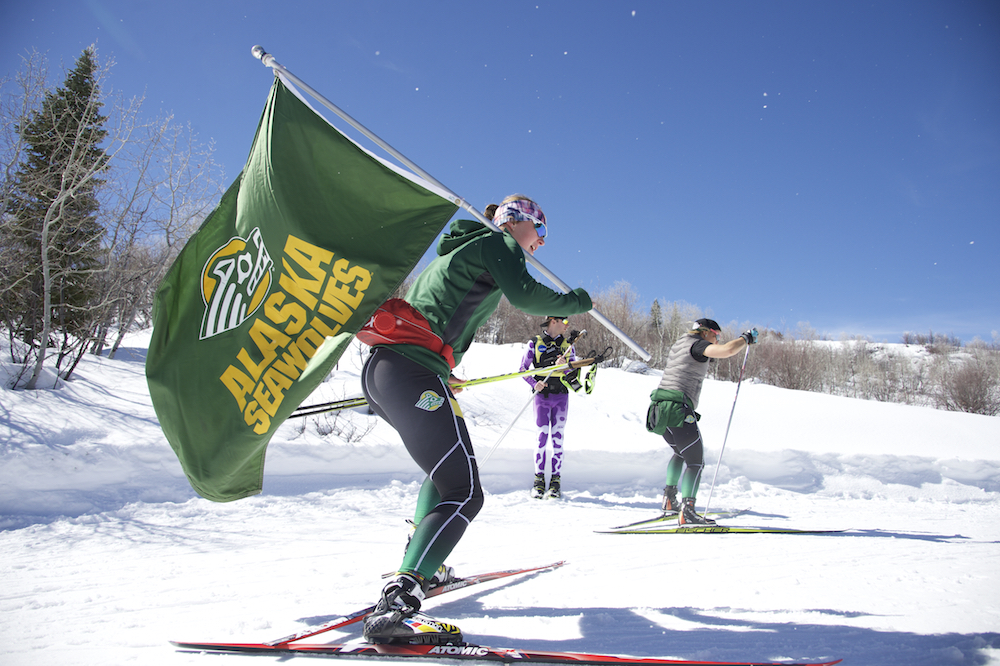
    A University of Alaska Anchorage skier carries the team flag of the Seawolves at the 2016 NCAA Skiing Championships last March at Howelsen Hill in Steamboat Springs, Colo. (Photo: Jamie Schwaberow/NCAA Photos)
    A University of Alaska Anchorage skier carries the Seawolves team flag at the 2016 NCAA Skiing Championships last March at Howelsen Hill in Steamboat Springs, Colo. (Photo: Jamie Schwaberow/NCAA photos)

    The 2016/2017 season will be the final season of NCAA-sanctioned collegiate skiing in the state of Alaska. The Alaska Dispatch News reported late Thursday that University of Alaska (UA) President Jim Johnsen announced the eliminations in a Thursday afternoon press conference on the University of Alaska Anchorage conference.

    As FasterSkier previously reported, the UA president and Board of Regents were pursuing a waiver with the NCAA, which would allow the UA system to operate with fewer than the 10 sports teams typically required for Division II membership.

    Johnsen announced Thursday that “Skiing at [University of Alaska Anchorage] and [University of Alaska Fairbanks] and indoor track at UAA are the sports targeted for elimination in a waiver request submitted to the NCAA,” the Alaska Dispatch wrote.

    The Alaska Dispatch quoted UAA head ski coach (nordic and alpine) Sparky Anderson as saying, “We were told it’s a fait accompli.”

    The announcement precedes by approximately two weeks the next meeting of the UA Board of Regents, to be held on Nov. 10-11. The UAA and UAF ski teams begin their final season in a suddenly bittersweet dual meet to be held at Fairbanks’s Birch Hill ski area the following weekend.

    Skiing was the first sport founded at UAA, in 1977.

    FasterSkier will provide further coverage of this story soon.

  • Alaska NCAA Skiing Remains in Limbo as Fall Approaches

    Alaska NCAA Skiing Remains in Limbo as Fall Approaches

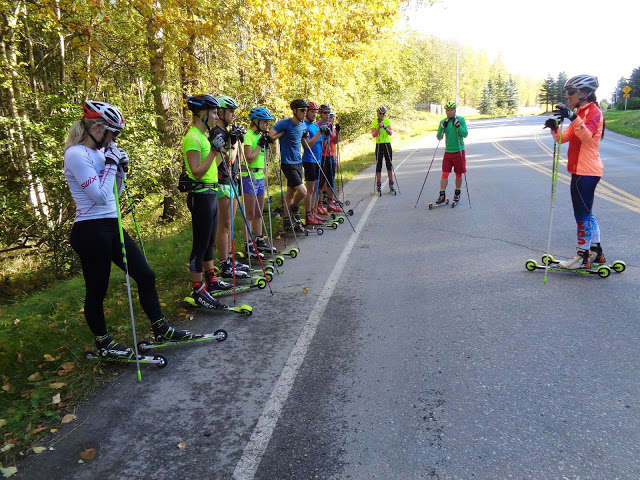
    The University of Alaska Anchorage nordic team talks technique with assistant coach Sara Studebaker-Hall during a rollerski session last Tuesday in Kincaid Park. (Photo: UAA Nordic)
    The University of Alaska Anchorage nordic team talks technique with assistant coach Sara Studebaker-Hall (r) during a rollerski session last Tuesday in Kincaid Park. (Photo: UAA Nordic.blogspot.com)

    ANCHORAGE, Alaska – The University of Alaska president has recommended two options that could preserve the future of intercollegiate skiing at one or both of Alaska’s NCAA member schools – but both options may be without precedent in modern NCAA history. The final decision will be made by the Board of Regents in mid-November.

    The future of college skiing in Alaska has had a bumpy ride since this spring, with alternating suggestions first that there was little cause for concern for ski-team supporters, but then that skiing at either or both of the University of Alaska Anchorage (UAA) and University of Alaska Fairbanks (UAF) was under threat. The current status is that the teams are once more in limbo, and awaiting a final decision from the Board of Regents later this year.

    At a University of Alaska (UA) Board of Regents meeting in Juneau, Alaska, last Thursday, UA President Jim Johnsen presented his initial directions regarding Phase I of Strategic Pathways, the campus-wide audit aimed at reducing costs in light of reduced oil prices, a decimated state budget, and declining financial support for all aspects of the UA system.

    Regarding intercollegiate athletics, President Johnsen recommended:

    1. Pursue with NCAA: (1) waiver of ten team rule, or (2) consortium; BOR [Board of Regents] action would be required
    2. Increase private funding support
    3. If waiver or consortium unsuccessful, consider modifying existing programs to reduce cost and/or elimination of 1 or both programs

    The decision is in some ways a non-decision, to the extent that it directs further action but does not make a final decision at this time. (The Strategic Pathways site states, “President Johnsen will appoint teams to begin the implementation workability of each of the options presented.”)

    The Alaska Dispatch News, or ADN, reported that the Board of Regents reacted to Johnsen’s Thursday recommendation by expressing that it hoped to avoid any option involving the elimination of an athletic program: “But regents said they were concerned that eliminating UA’s athletic programs would trigger community backlash and create instability for current student athletes, as well as issues with recruiting. They unanimously passed a motion directing university management to develop options to allow UA to avoid eliminating athletic programs.”

    The ADN also quoted Alaska Governor Bill Walker as telling the Board, “I feel pretty strongly about athletics. … It would be hard to have a university without athletics as part of it. So I’m a strong supporter of athletics.”

    How feasible are these options?

    President Johnsen’s team investigating the feasibility of either option may face a tough go of it: it appears that both options are without precedent in modern NCAA history.

    The Strategic Pathways team charged with analyzing intercollegiate athletics already recognized as much. As it wrote earlier this year when it first discussed the option of a consortium model, “This model would require an unprecedented exception from the NCAA to allow two athletic programs who are geographically isolated from one another to compete as one program while not duplicating sports in either location.”

    The athletics review team added that cons of this approach include, “May be difficult to obtain NCAA approval due to unprecedented exception.” And, “Longest timeline to implementation.”

    Christian Dennie, a Texas attorney who has previously worked for Division I athletics departments and whose current practice includes representing both student-athletes and athletic departments in disputes over NCAA waivers and conference rules, mirrored the review team’s skepticism regarding this proposal.

    “As far as the consortium model,” Dennie wrote to FasterSkier after hearing the facts of the UA proposal, “it does not seem feasible due to the distance unless all of the athletes were on one campus, which would be more like a consolidation.”

    As FasterSkier previously explained, typical examples of schools in a consortium model are much closer to each other than the 360 road miles that separate Anchorage and Fairbanks.

    The NCAA Office of Public and Media Relations did not respond to multiple requests for comment regarding whether either proposed option had any precedent.

    While examples exist of schools that successfully operate in some version of a consortium model, there may be no other coeducational college or university in existence that has successfully proceeded under President Johnsen’s first option, that is, obtaining a waiver of the 10-team rule.

    The reference is to section 20.10.3(a)-(b) of the NCAA Division II Bylaws, which provides that “A member of Division II shall sponsor in Division II a minimum of” either five sports for each of men and women, or four sports for men and six for women. Section 20.10.3.3.11 provides for a probationary period and restricted membership status for a school’s failure to meet minimum sports sponsorship criteria.

    While section 20.10.3.3.12.1 discusses the possibility of waivers for a failure to meet the “minimum contests or participants” standards – that is, a school failed to have a sufficient number of ski meets in a year, or to enter sufficient athletes in a meet – this rule envisions “situations beyond the control of the institution (e.g., weather conditions or disaster preventing completion of a scheduled competition, or verified injury or illness at the site of competition preventing the participation of the required minimum number of individuals).”

    There does not appear to be any bylaw provision that would allow either UAA or UAF to consistently and purposefully operate an athletics program with fewer than the required number of sports teams, and still maintain its NCAA Division II status.

    (Regarding a potential waiver to the 10-team requirement, Dennie wrote, “I know of at least one institution that has less than 10 sports at the D2 level. Texas Woman’s University in Denton, Texas has 5 sports. I am not sure if they received a waiver or not.” But this is likely kosher under bylaw section 20.10.3(c), “single-gender programs.” That section states, “Institutions that sponsor and conduct athletics programs for only one gender must sponsor a minimum of five varsity intercollegiate sports, including at least two team sports.” That is, it may, strictly speaking, be the five-team-per-gender rule that controls this situation, not the 10-team rule.)

    The ADN reported that the university system has yet to make any sort of formal request to the NCAA, but quoted President Johnsen as saying, “We have engaged expert counsel to advise us and assist us with this.”

    Town hall meetings throughout the state

    President Johnsen’s recommendation follows a spate of public meetings and public outreach over the last several weeks.

    In early September, a town hall meeting was held in Fairbanks to discuss the Strategic Pathways recommendations, which cover multiple areas within the University of Alaska system, and not just athletics. As the Fairbanks Daily News-Miner reported, meeting attendees “were nearly united in their mission to protect UAF’s athletics programs. Largely absent from the discussion was nonathlete students.”

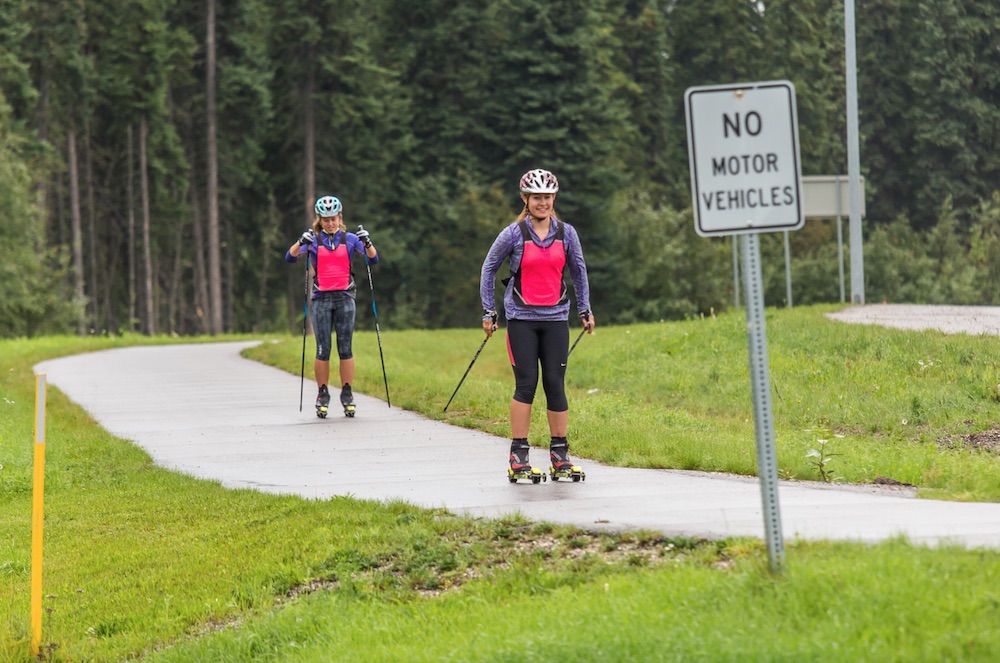
    University of Alaska Fairbanks nordic skiers rollerskiing on campus last fall. (Photo: UAF)
    University of Alaska Fairbanks nordic skiers rollerskiing on campus last fall. (Photo: UAF)

    Reached by email shortly after the meeting, UAF Head Nordic Coach Nick Crawford wrote to FasterSkier, “I didn’t make it to the town hall unfortunately… I’ve been pretty swamped with the first few weeks of the athletes being back in town! Anyhow a few of the athletes went and said we had good support for athletics and the ski team specifically!”
    A week later, and 300 miles to the south, a similar meeting was held in Anchorage. UAA Head Nordic Coach Andrew Kastning wrote to FasterSkier soon after that meeting, “It was encouraging to hear all the supporters of athletics speak up, but it was difficult to tell if President Johnsen was swayed at all from up in his podium. I will say that the outpouring of support for college skiing in Alaska from around the world has been tremendous and we very much feel the tight-knit ski community at work. I feel this is a battle we can still win and we as a coaching staff and community of skiers are doing everything we can to that end.”

    Kastning added, “Regents meet Sept. 14th to discuss the options and hopefully return to the drawing board. Final decisions reached Nov. 10-11 and announcements made shortly after.”

    UAA campus newspaper The Northern Light, mirroring the tone of the News-Miner, reported of this meeting that, “Although the forum was meant to be a place for students, staff, and community members to speak about all things with phase I of Strategic Pathways, the discussion was overwhelmingly focused on the possibility of cutting UAA athletics.”

    The Northern Light quoted UAA student-body president Sam Erickson as saying, “I am most concerned with the preponderance of public backlash that has resulted from the athletics suggested cuts. I recognize it’s a highly visible program and that’s why those cuts are going to garner outrage. I’m concerned that that’s drowning other news, just as significant. Things that would significantly change the educational future for all students.”

    Lobbying efforts and Winter Olympians

    As UAF’s Crawford recently wrote to FasterSkier, “We’ve reached out to our supporters in Fairbanks and around the world in support of skiing both at UAA and UAF and have gotten a very positive response. There was a community forum with UA President [Jim Johnsen] recently and our UAF Skiing supporters had a strong presence in support of Nanook skiing and apparently the online commenting option has gotten some very good responses as well. It’s not too late to write in with your support so we would encourage anyone who hasn’t done so yet to do so!”

    Meanwhile, in Anchorage, lobbying efforts were more ambitious. Earlier this month, the Nordic Skiing Association of Anchorage sent an email to all of its members, subject line: “Help Save Collegiate Skiing in Alaska.” The email, signed “The UAA Ski Team,” wrote, “Our program is facing a potential elimination from the University of Alaska-Anchorage Athletics Department. We are fighting for our kids and the future of our team.”

    The ski team listed a number of potential talking points that supporters could use, and encouraged them to submit comments to the Strategic Pathways review team. “Bottom line,” the email concluded, “we desperately need your help.”

    University of Alaska Anchorage Seawolves logo (Photo: GoSeawolves.com)
    University of Alaska Anchorage Seawolves logo (GoSeawolves.com)

    UAA Head Skiing Coach Sparky Anderson shared a similar message on his public Facebook page, writing to supporters, “Many of my friends are former athletes who I’ve had the privilege to work with from over a decade of coaching at UAA. You are all shining examples of what the ski team does for the state of Alaska. The UAA ski team attracts top minds such as yourself who graduate, excel, enrich Alaska’s community, work and provide employment for other Alaskans.”

    Anderson added, “Now, we need your help. Please use and share this Strategic Pathways feedback link to comment about the UAA Ski Team’s mission of fostering a culture of education at UA. It’s imperative that UA President Jim Johnsen understands that our shoulders are up against the same wheel. With your help, I look forward to many more years working with outstanding individuals here at the UAA ski team.”

    Finally, UAA brought out a bevy of boldface names in support of its cause. Last week, Holly Brooks, a two-time Winter Olympian recently retired from competitive skiing with Alaska Pacific University (APU) and the U.S. Ski Team, delivered a letter to the UA President, Board of Regents, and Athletic Directors. The full letter makes the case for the benefits of skiing in general, and its suitability to Alaska in particular.

    Brooks wrote, “Nordic and alpine skiing are wildly popular recreational sports in Anchorage and the collegiate teams serve as examples or ‘pedestals’ of what many Anchorage citizens aspire to in their own athletics. Anchorage hosts the largest high school ski race in the entire country, the Lynx Loppet. Many youth in Anchorage including the Junior Nordic Program and the ASD high school programs look forward to seeing UAA skiers zip by them on the trails, serving as a ‘real-life’ example of fitness and/or technique. What other sports can recreational or developing athletes literally jump in behind collegiate athletes and hang on for the ride?”

    In a follow-up email to FasterSkier, Brooks added, in reference to options for cross-country skiing in the Anchorage area, “choices are healthy and competition is healthy. We need UAA, APU, WinterStars, ANR.”

    (The acronyms are references to the collegiate program at the University of Alaska Anchorage, the elite and community program at Alaska Pacific University Nordic Ski Center, the community program at Alaska Winter Stars, and the community program at Alaska Nordic Racing, respectively.)

    The letter was co-signed by a dozen other Winter Olympians with strong local ties to Anchorage and/or UAA, including cross-country skiers Erik Bjornsen, Sadie Bjornsen, Lars Flora, Kikkan Randall, James Southam, and Adam Verrier; biathletes Rachel Steer and Sara Studebaker-Hall; Alpine skiers Anna Berecz, Megan Gerety, and Tommy Moe; and freestyle skier Alex Wilson. At least eight of the signers had attended, coached at, and/or skied for UAA. Between them, the signers boasted 24 Olympics appearances, two Olympic medals, and two FIS World Championships medals.

    The dollar amounts involved

    In 2015, the athletics program at UAA and UAF cost a combined $16 million for a total of 23 varsity sports teams. The ADN explained that $3 million of this came from “private sources, including ticket sales.” The remaining $13 million came from the UA general fund.

    The ADN has suggested that the UAA ski team has a budget of “about $500,000.” But this number may be too high, or at least may somehow overstate the cost savings that would result from potentially cutting the team: FasterSkier previously quoted internal documents generated by the UA athletics review team as saying that suspending or eliminating the UAA ski team “would produce an immediate net savings of $272,981.00 based on FY 16 figures.”

    But Anderson, the head ski team coach, confirms the higher figure, recently telling Anchorage radio station KSKA that the budget for the entire UAA ski team is “just north of $500,000.” That covers the men’s and women’s alpine and nordic programs, and includes what Anderson said is a total of 12 scholarships for a combined 23 athletes. (UAF has only a nordic program. In 2015/2016, the most recent year for which information is available, it had seven women and 11 men on its nordic team.)

    Kastning, UAA’s nordic coach, said in the same radio program that he would far rather cut program costs by, for example, 10 or 20 percent than lose the entire ski program. He mentioned some money-saving steps that the nordic team has already taken for the 2016/2017 season, such as reducing the size of the travel team and eating out less while on the road.

    Kastning also said that all schools in the Rocky Mountain Intercollegiate Ski Association (RMISA) will be instituting a ban on pure fluoro waxes for all races save championship meets, a move made as much for health reasons as for economics.

    Finally, in a poignant nod to his personal history of job loss and displacement, Kastning noted that he left (former RMISA program) University of Nevada, Reno, shortly before it cut its nordic program, and he and his wife went to (former RMISA program) Whitman College, where she was coaching skiing, only to see Whitman cut its nordic program, also. Kastning said they thought they would be safe moving to a ski program in Alaska.

    Reactions and next steps

    Crawford, the UAF coach, wrote to FasterSkier last Friday following President Johnsen’s statement, “Seeking permission from the NCAA to form a consortium between athletics at UAA and UAF or pursuing an exemption to the 10 sport minimum rule seems to be bad for collegiate skiing at first glance. The 10 sport minimum rule is in place to promote smaller sports like skiing and cross-country so that collegiate athletic departments around the country sponsor more sports than just the big TV sports like football, basketball and to some extent hockey. I’m worried that if the NCAA accepts either the consortium or 10 sport minimum it will create a legal precedence that would be bad news for many of the non revenue generating sports across the country.”

    University of Alaska Fairbanks Nanooks logo (AlaskanaNooks.com)
    University of Alaska Fairbanks Nanooks logo (AlaskaNanooks.com)

    Crawford added, “I was relieved to see that the UA Board of Regents is strongly in support of ‘preventing the elimination of intercollegiate athletics’ as shown by their 10-0-0 vote in favor of [a related motion on this issue]. This gives me confidence that skiing and cross country running will remain at UAF as they are very cost effective for the university and are strongly supported by our local community.”

    Kastning did not respond to an email asking for a response to President Johnsen’s recommendation.

    UAA Athletic Director Keith Hackett told the ADN last Thursday that he wasn’t yet ready to comment on the recent discussion at the Board of Regents meeting.

    Final decisions are expected to be made at the UA Board of Regents meeting on Nov. 10-11. UAA and UAF begin their ski seasons with an informal dual meet at Birch Hill in Fairbanks the following weekend. The ADN recently reported that the UAA hockey team, which faces the same concerns about its future as all UAA sports teams, is still scouting potential recruits for the 2017/2018 season, but is not currently extending scholarship offers.

  • Alaska NCAA Skiing Approaches Decision on Its Future

    Alaska NCAA Skiing Approaches Decision on Its Future

    A University of Alaska Anchorage skier carries the team flag of the Seawolves at the 2016 NCAA Skiing Championships last March at Howelsen Hill in Steamboat Springs, Colo. (Photo: Jamie Schwaberow/NCAA Photos)An internal review group has set forth its options for the future of NCAA-sanctioned college sports in Alaska – and for fans of cross-country skiing, most of the options don’t look very good. That’s the current status of intercollegiate sports in the University of Alaska system heading into three months of meetings and recommendations that will attempt to trim the university budget to respond to failing state finances.

    As FasterSkier previously reported, Alaska is a historically oil-rich state that is suddenly not all that rich. The effect on the state’s budget has been pronounced, with calls for drastic cuts to virtually all aspects of state finances. The University of Alaska system, which has flagship campuses in the University of Alaska Fairbanks (UAF) and University of Alaska Anchorage (UAA), has not been spared. Multiple working groups were convened earlier this summer to critically evaluate several portions of the University of Alaska system, including athletics.

    Three options, from nuclear to consolidating

    The preliminary report from the athletics review team presented three options for the future status and funding of intercollegiate athletics within the University of Alaska system, and therefore within the entire state of Alaska. (UAA and UAF are the state’s only two institutions with NCAA-sanctioned sports teams; most of UAA’s 13 varsity teams, and UAF’s 10, compete in Division II. The state’s best-known ski team, Alaska Pacific University, is associated with a school but does not have NCAA affiliation.) Each option has several subparts.

    Option 1 is the most drastic. This option involves eliminating NCAA sports completely at either or both of UAA and UAF. Cutting NCAA sports entirely at one school would reduce the overall University of Alaska budget by 2 to 3 percent. Cutting them at both schools would reduce the overall budget by 5 percent. This is “the most controversial option with the most severe consequences,” the review team wrote. Option 1, as applied to both schools, would leave Alaska as the only state in the country with no intercollegiate sports teams.

    Option 2 would be to combine the two campuses of Fairbanks and Anchorage – which at a distance of 360 road miles are an all-day drive or a one-hour flight away from each other – into a single consortium model, operated under the name of only one of the schools. The total sports teams operated between the two schools would be reduced from 23 teams down to 15; only one school would sponsor each sport. A narrative description of the proposed athletics consortium model suggests that men’s and women’s cross-country skiing would operate out of Fairbanks.

    The preliminary report acknowledges that it would require “an unprecedented exception from the NCAA to allow two athletic programs who are geographically isolated from one another to compete as one program while not duplicating sports in either location.” Other NCAA schools that operate in an athletic consortium model are much closer to each other than Anchorage and Fairbanks; for example, Columbia University and Barnard College are located across the street from each other in New York City, while Southern Vermont College and Bennington College are separated by five miles in the greater Bennington area.

    Option 3 is to keep both programs, but with some modifications, based on switching solely to those sports that are offered by the Great Northwest Athletic Conference, or GNAC. (Currently some of UAA and UAF’s sports have GNAC affiliation, but some do not.)

    In one version of option 3, “Both UAA and UAF switch to the GNAC model to decrease funding levels after initial startup costs. Both programs would only have sports that compete at Div. II level in the GNAC conference versus their current model of having some Div. I sports” alongside mostly Division II sports. In another version of option 3, UAF would maintain the status quo, keeping its 10 teams in order to meet NCAA requirements, while only UAA would move to the GNAC model.

    Skiing is not a GNAC sport. In order to become a fully GNAC school, UAA would, among other changes, eliminate men’s and women’s skiing as well as gymnastics. For UAF to become a GNAC school, it would eliminate men’s and women’s skiing, among other sports, replacing them with soccer, golf, and/or track.

    The review team acknowledged that the drawbacks to option 3 include “Loss of skiing, strong local (Fairbanks) support.”

    While the exact number of parts and subparts may be counted in different ways, and some version of both option 2 and option 3 preserve some version of college skiing in the state of Alaska, it is also true that several of the options presented would mean the end of college skiing at one or both of Alaska’s two NCAA schools.

    In addition to the three options surveyed above, the review team also offered additional budget reduction options as part of a restructuring plan for fiscal year 2018. These options included the elimination of the UAA men’s ski program (both cross-country and alpine) at the end of the 2016/2017 season. “[Skiing] was the first sport to be introduced at UAA,” the review team acknowledged, “and has been very successful as a member of the NCAA.” But “that being said,” the review team continued, “it is a sport that has very limited external support from Alumni and community members and does not have the ability to generate significant revenue to assist in sustaining the program.”

    A decision to cut the men’s ski program – which at this time is simply one of several ideas that have been suggested – “would produce an immediate net savings of $272,981.00 based on FY 16 figures,” the review team wrote.

    All sports, at both UAA and UAF, are fully funded through the 2016/2017 academic year. Both schools will begin their race season in the 13th annual Alaska Nordic Cup, an informal meet between UAA and UAF, at Fairbanks’s Birch Hill ski area in mid-November.

    Next steps: Public meetings and searching for support

    So what’s next? Lots of meetings. As the Strategic Pathways site explains, there will be public forums held with the University of Alaska president during the first two weeks of September. The president will then share initial recommendations with the University of Alaska Board of Regents at its next meeting, on Sept. 15-16. The Board of Regents will then present “final outcomes” at its meeting of Nov. 10-11.

    “The State of Alaska is going through a very tough period and there are some very tough decisions that will have to be made,” UAA Athletic Director Keith Hackett wrote in an email to FasterSkier. “That being said, there is still time to provide input before any decisions or final recommendations are made.”

    He recommended emailing ua-pathways@alaska.edu as a means of sharing those thoughts.

    UAA Head Nordic Ski Coach Andrew Kastning is working hard to ensure that the Strategic Pathways review team hears from the cross-country ski community regarding the value of the program that he coaches.

    “Today I’m just doubling down on my community PR campaign,” Kastning said on the phone on Monday. “Because there is an online form that allows you to leave comments on the options presented, the pros and cons, and in fact we’ve been sending that link out to everyone we know. We’ve been rallying support from other institutions’ athletic directors and coaches to not just write in on that form, but also call [our athletic director], tell them what a value skiing is.”

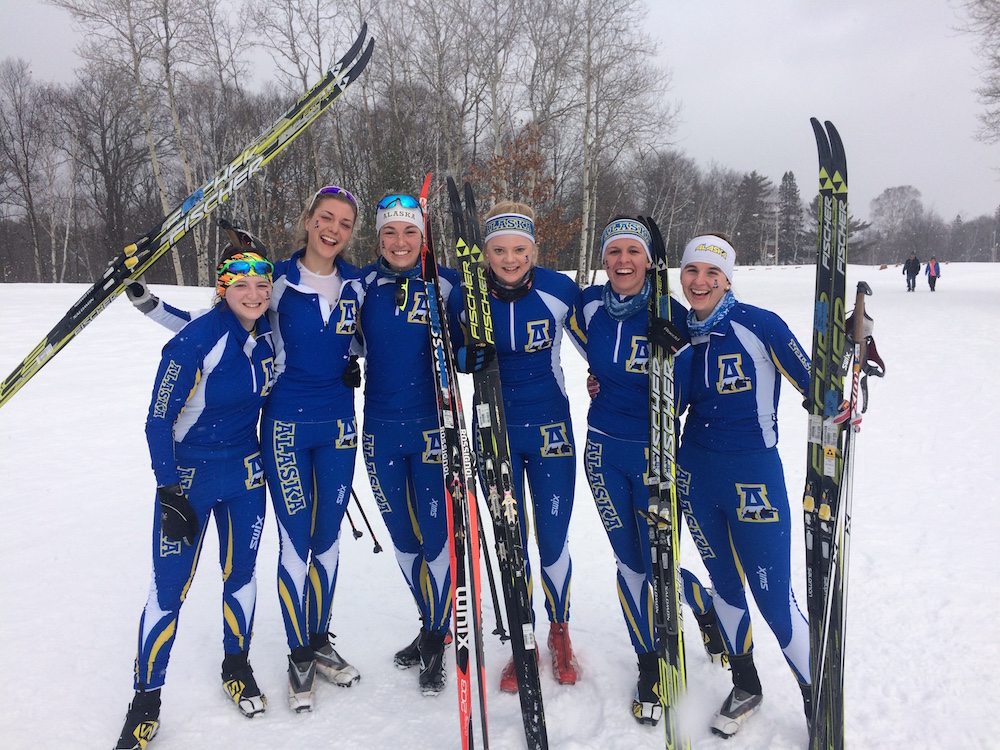
    University of Alaska Fairbanks women’s nordic-team skiers get together for a photo last season: (from left to right) Hannah Rowland, Anne-Tine Markset, Nichole Bathe, Martina Himma, Ann-Cathrin Uhl, and Sarissa Lammers. (Photo: Nick Crawford)Kastning’s counterpart in Fairbanks, UAF cross-country skiing and running head coach Nick Crawford, is doing the same.

    “We’re optimistic that the UA President and Board of Regents will listen to the strong support of our community and will choose to continue funding both ski teams,” Crawford wrote in an email. “I encourage everyone to use the online feedback form to voice their support for UAF and UAA skiing.”

    Crawford added, in a nod to the benefit of having two collegiate ski programs in the state, “The UAF and UAA ski teams have a long history of being friendly rivals but also mutually beneficial to one another. It would be a shame to lose either program as both would suffer.”

    Back in Anchorage, Kastning speaks with evident pride of the virtues of his program and its athletes. “It seems pretty clear that President [Jim] Johnsen doesn’t understand what he would be losing if he were to decimate the athletic department,” Kastning told FasterSkier. “In regard to UAA skiing, we have perennially the highest GPA of all the sports teams. We have … the highest graduation rate. And we pull in people from out of state that stay and work here.”

    Kastning mentioned plans to present his case at the upcoming public forum: “We’re going to be out there in force at the so-called town hall event [in September], asking questions and stating the fact – what I told you about graduation rates and high GPAs and what the community would stand to lose if it lost its collegiate ski team, as well as the loss of the ability to recruit kids from out of state. If they axe an athletic program, it would be so much harder just to get general students to come from out of state.”

    “We have perennially the highest GPA of all [our] sports teams. We have … the highest graduation rate. And we pull in people from out of state that stay and work here.” — Andrew Kastning, University of Alaska Anchorage nordic ski team head coach

    And speaking of students, what’s next for the student-athletes currently enrolled at and planning to ski for UAA and UAF? Under the NCAA Division II bylaws, Rule 14.5.5.1, a student-athlete transferring from one NCAA school to another must typically sit out his or her next year of competition before playing sports at the new school. But Rule 14.5.5.2.6 provides an exception: this requirement does not apply when the original school “dropped (or has publicly announced it will drop) the sport … from its intercollegiate program.” That is, an athlete currently skiing for an Alaska school that dropped skiing would be eligible to compete for another NCAA skiing program in the winter of 2017/2018, assuming that space and scholarships were available.

    The view from inside the UAA and UAF ski programs

    “The options from Strategic Pathways, as they’ve been presented so far, are pretty scary for skiing, collegiate skiing in the entire state of Alaska,” Kastning said.

    He underscored that funding collegiate skiing at any level less than men’s and women’s cross-country and alpine teams means that “you’re completely out of contention for a national title, which is what we’re trying to do at UAA. We support alpine and nordic.”

    Kastning addressed the inherent suitability of skiing for the state of Alaska, contrasting it with some other proposed sports that might seem less apposite for a state where UAF students famously celebrate their membership in the 40 Below Club by posing for bikini photos in front of a temperature sign on campus.

    Addressing option 3, which would involve dropping skiing in favor of a move to solely those sports offered by the GNAC (including, for example, soccer and golf), Kastning observed, “It’s like, nobody thought through what it would be like to have a golf team in Alaska. Or if you were to close your eyes and think about Alaska, do you think about golf courses, or do you think about white, snowy mountains, and the possibility of going out to play on skis? And obviously 99 percent of the Lower 48 people will think of skiing and white, snowy mountains, so why wouldn’t you have a ski team in Alaska? Of any state in the entire United States, it fits the most with the Alaskan identity to go outside and go skiing.

    “So that was a little bit frustrating,” he continued, “to see the language that wasn’t in there highlighting the great community of skiers we have, not just in Anchorage but in the surrounding area, as well as the option presented that they would take away our program and add a soccer team, or a golf team? It’s borderline ludicrous.”

    Crawford, writing separately, expressed near-identical concerns. “The idea of replacing skiing in the University of Alaska system with other sports like golf or soccer that are more suited to warmer climates seems ludicrous to me,” he wrote.

    Kastning ended his interview by expressing his concerns about a potential domino effect if skiing were to disappear from one or both of Alaska’s two NCAA programs: “If Alaska didn’t support college skiing, then NCAA might look at the sport as a whole and wonder, What’s the point? If Alaska doesn’t support it, then why should we?”

    “It’s scary not just for us,” Kastning added, “but it can start to be scary for the rest of the college ski teams around the country.”

  • Alaska’s NCAA Ski Teams Hope for Continued Funding as State Budget Uncertainty Enters Final Days

    Alaska’s NCAA Ski Teams Hope for Continued Funding as State Budget Uncertainty Enters Final Days

    A University of Alaska Anchorage skier carries the team flag of the Seawolves at the 2016 NCAA Skiing Championships last March at Howelsen Hill in Steamboat Springs, Colo. (Photo: Jamie Schwaberow/NCAA Photos)
    A University of Alaska Anchorage skier carries a Seawolves team flag at the 2016 NCAA Skiing Championships last March at Howelsen Hill in Steamboat Springs, Colo. (Photo: Jamie Schwaberow/NCAA Photos)

    ANCHORAGE, Alaska – As the 2016 special session of the Alaska Legislature comes down to the wire, it’s clear that state funding for Alaska’s two National Collegiate Athletic Association (NCAA) cross-country ski programs is going to be substantially reduced as part of widespread cuts to the state university system.

    But by exactly how much, and with what effects, and whether there will still be two NCAA ski programs in Alaska once the budget is finalized and the dust clears, are all still up in the air approaching the Wednesday deadline for the end of the session – and may not be resolved until several weeks after that.

     That’s where things currently stand, according to representatives of the University of Alaska Anchorage and University of Alaska Fairbanks athletic departments and cross-country ski programs.

    Background: Two NCAA programs, lots of oil money

    The state of Alaska has two universities whose athletic programs have NCAA affiliation: the University of Alaska Anchorage (UAA) Seawolves and the University of Alaska Fairbanks (UAF) Nanooks.  (The state’s other well-known cross-country ski program is affiliated with Alaska Pacific University, or APU, which is not an NCAA member school and does not receive direct state funding as controlled by the Alaska Legislature.)  

    UAA is a member of the Rocky Mountain Intercollegiate Ski Association (RMISA) along with eight other schools from the western half of the Lower 48.

    UAF has historically been a member of the Midwest-based Central Collegiate Ski Association (CCSA), although it may be moving to the RMISA as early as next season, according to UAF Head Nordic Coach Nick Crawford. UAA has 13 varsity sports teams. UAF has 10.

    Etienne Richard of the University of Alaska Anchorage at the 2016 NCAA Skiing Championships in Steamboat Springs, Colo. (Photo: UAA)
    Etienne Richard of the University of Alaska Anchorage at the 2016 NCAA Skiing Championships in Steamboat Springs, Colo. (Photo: UAA)

    Historically, both programs have received funding from the University of Alaska system, and have produced successful skiers. UAA boasts six individual nordic championships in its history, and a steady string of All-American performances. UAF claims three individual championships. Both schools have sent skiers to NCAA Skiing Championships virtually every year since 1981.

    The schools’ performances have not changed, but their state funding might. The State of Alaska has historically been flush with oil money. There has been no state income tax since 1980, there is no state sales tax, and the state famously – in the form of dividend payments from the state’s sovereign wealth fund, the Alaska Permanent Fund – pays people to live there. As recently as last fall, every qualifying citizen in the state received more than $2,000 dollars.  The city of Valdez, Alaska, paid out $10,000 in total prize money for a January nordic ski race, drawing the money largely from taxes on the Trans-Alaska Pipeline, whose southern terminus is in Valdez.

    But within the last two years, the price of Alaskan oil has plummeted, from (in round numbers) close to $100 per barrel to less than $50. Crude prices are now at a 12-year low. And 80 to 90 percent of state spending has historically come from oil revenues – with no state income tax or sales tax, and relatively few other industries in the state, there have been few other sources of funding. The result is that the state faces a yawning budget deficit, in an amount equal to at least two-thirds of its budget (maybe closer to three-fourths depending on the current price of oil), and few viable options for closing it.

    The current session of the Alaska Legislature, which is set to close Wednesday, May 18, has been marked by several months’ worth of partisan dispute over the proper use of Permanent Fund revenue to help close the gap.  And publications ranging from NPR to the Alaska Dispatch News (ADN) to The New York Times have documented Alaska’s extremely resource-dependent economy, and the resulting outsized effect of a fall in oil prices.  “Oil money no longer pays the bills here,” one Times article began.

    The effects of falling oil prices

    In this economic climate, everything is on the table when it comes to balancing the state budget, including college sports.  (For what it’s worth, it is fair to say that Alaska is hardly Alabama or Tennessee when it comes to college sports fandom. There are no college football teams in the state.  College hockey has its fans, but UAA hockey often struggles to draw 3,000 fans in a 6,000-seat arena for its home games.)

    The UAA athletic department has an annual budget of $10.5 million. As UAA Athletic Director Keith Hackett told a local television station earlier this year, “We could potentially have a reduction of $1.7 million and that would be about a third of our general dollars that we receive annually, so it’s a significant impact.”

    A potential cut of $1.7 million to an overall budget of $10.5 million is a reduction of slightly more than 16 percent. This is the third consecutive year in which the UAA budget has been cut.

    Manon Locatelli of the University of Alaska Anchorage double poles out of the start of the 2015 Seawolf Invite at Kincaid Park in Anchorage, Alaska. (Photo: Sam Wasson Photography / http://portfolio.samwassonphotography.com/about)
    Manon Locatelli of the University of Alaska Anchorage double poles out of the start of the 2015 Seawolf Invite at Kincaid Park in Anchorage, Alaska. (Photo: Sam Wasson/Sam Wasson Photography)

    As Hackett explained in a recent email to FasterSkier, “I was given my budget reduction amount on April 18 and it was confirmed to me on April 23.”

    He stated that he and several athletic-department staff members have been working hard to implement cuts in the least painful manner possible.

    “With a reduction of this size we have to look at vertical vs. horizontal reductions to minimize the impact on all teams and programs,” Hackett wrote. (He told the ADN that a “horizontal” cut is one that affects all sports to some extent, as opposed to a “vertical” cut, in which one sport is excised entirely.)

    Hackett wrote to FasterSkier that he and his staff are “look[ing] at a wide range of criteria” in working out a reduced budget: “NCAA requirements, conference requirements, Title IX requirements, revenue and expense data, and how we can minimize the impact on all of our teams and Student-Athletes.”

    The first three of these requirements, which are presumably non-negotiable if UAA would like to retain its NCAA status and/or its federal funding, are significant. As previously explained in the ADN, the school’s NCAA Division II membership requires a minimum of 10 sports, including at least two “team” sports per gender – that’s men’s and women’s basketball, women’s volleyball, and men’s hockey. And the school’s conference membership in the Great Northwest Athletic Conference means that UAA has to have five specific sports – basketball (men’s and women’s), cross-country running (men’s and women’s), and volleyball.

    There’s some overlap there, but the math is clear: “That leaves seven UAA sports unprotected by NCAA and GNAC membership requirements,” the ADN reported. “Those sports are men’s and women’s skiing, men’s and women’s indoor track, men’s and women’s outdoor track, and gymnastics.”

    Michael Friess coaches both men’s and women’s outdoor track, men’s and women’s indoor track, and men’s and women’s cross-country running.  That’s an impressive six out of 13 NCAA varsity sports, and only one head coach salary. And two of those sports, men’s and women’s cross-country running, are “protected” by virtue of conference membership requirements.

    No one is officially saying that this leaves UAA cross-country skiing particularly vulnerable – Hackett and his crew are still working on budget decisions, so there was no official statement on that matter. But UAA Head Nordic Ski Coach Andrew Kastning seems to have seen the writing on the wall.

    In early April, Kastning wrote to several dozen members of the local ski community to help solicit support for his program.  The email subject line was, “A chance to help the UAA Ski Team.”  The recipients were a mix of local UAA ski alumni, club program directors, community supporters, and prominent local nordic Olympians. A copy of the email was shared with FasterSkier.

    Kastning explained that falling oil prices had forced the state and university system to “look at making deep cuts to programs and services in order to balance the budget.”  He continued: “I have been around long enough to know that this means bad news for ski teams, which are usually the first on the chopping block since we are not a mainstream sport, do not compete in the GNAC, and do not produce revenue.”

    UAA's Hanna Slotte racing at the 2015 Seawolf Invite in Anchorage. (Photo: Sam Wasson/Sam Wasson Photography)
    UAA’s Hanna Slotte racing at the 2015 Seawolf Invite in Anchorage. (Photo: Sam Wasson/Sam Wasson Photography)

    In his email to potential supporters, Kastning requested, “please take a few minutes, and think of a short story, or experience as to why you are a better person thanks to your ski racing experiences in college, how being a part of our ski team helped you be where you are today,” and to write about this to the University president.  He suggested that supporters communicate “that you sincerely hope he doesn’t narrow the opportunities of future student athlete ski racers from having the same experiences you did.”

    On May 7, the ADN ran an article titled, ‘From Shootout to entire teams, UAA sports are under scrutiny as budget cuts loom.’ On May 9, Kastning again reached out to local supporters. “If you read [this article] then you already know that our ski team is not out of the woods yet,” he wrote, and again asked supporters to speak to university administration about “the value of Collegiate Skiing in Anchorage, Alaska.”

    In an email exchange with FasterSkier, Kastning initially declined to comment: “I’m going to delay answering these questions until we know exactly what will happen,” he wrote, referring to the state budget situation and funding for the program.

    Kastning later emailed a more detailed statement: “We have been given every indication from our Athletic Administration to move forward with plans for next year. I have six true freshman women and two freshman men arriving on campus next fall and am extremely excited to begin working diligently with them all to become the best college skiers in the country. Though the budget crisis in Alaska will certainly have its effect on all state programs, the future of the UAA Ski Team is strong provided we are given the resources to compete.”

    Timeline for budget decisions

    It is currently mid-May. The Alaska Legislature is required to finish its session by Wednesday. There will be no final budget set until that time, but it seems safe to assume that, whatever happens, funding for the state university system is not going to be increased in the final version of the budget, nor will new funding sources suddenly arrive to make up for the yawning gap in oil revenue.

    Different parties have different understandings of the timeline for budget decisions and potential program reductions or cuts. As Hackett wrote, he had a confirmed budget reduction amount in hand as of April 23 (and has since been working on how to implement a reduction of that amount). For his part, Kastning wrote, “We have heard that a final answer will be given on or after May 20th.”  

    The next University of Alaska Board of Regents meeting, meanwhile, will be held June 2-3 in Anchorage. The Board of Regents has stated that it will hear an update from Strategic Pathways, a university-wide efficiency and cost-reduction study, and approve the 2017 Fiscal Year budget at that meeting.

    Hackett also noted the “New fiscal year begins on July 1. Decisions need to be made in advance of the new FY [fiscal year].”

    The 2017 conference schedule for RMISA member schools has not yet been posted.

    Relative security in Fairbanks

    Members of the University of Alaska Fairbanks women's team get together for a photo last season. (Photo: Nick Crawford)
    University of Alaska Fairbanks women’s nordic-team skiers pose for a photo last season: (from left to right) Hannah Rowland, Anne-Tine Markset, Nichole Bathe, Martina Himma, Ann-Cathrin Uhl, and Sarissa Lammers. (Photo: Nick Crawford)

    Three hundred miles to the north, Nick Crawford, coming off his first season as UAF’s cross-country skiing and running head coach, feels relatively secure about the safety of his program.  

    “Our team security might be a little stronger than UAA’s,” Crawford said in a recent phone interview with FasterSkier.  Indeed, Crawford said, while UAF is hardly immune to the budget pressures that are squeezing the UAA athletic department, “we’ve been assured that it’s business as usual through 2017.”

    The biggest reason for Crawford’s equanimity is simple math: a school must offer 10 varsity sports to have NCAA member status.  (The rule is widely understood as preventing a school from offering solely the two revenue sports of football and basketball, and so requiring them to effectively subsidize a broader range of offerings across other, non-revenue sports.) UAA currently has 13, and so, in blunt mathematical terms, has some sports to spare. UAF only has 10 varsity sports. To cut any of them would be to deny NCAA status to the school’s Division I men’s hockey team (as well as all other teams).

    As Crawford noted, “With the 10-sport minimum that we’re at, we’re in a fundamentally different place than they are [in Anchorage]. If we go, the whole athletic department goes.”

    Crawford also pointed out that, of the school’s 10 sports, “I’m head coach for four of them,” that is, men’s and women’s cross-country running and cross-country skiing. Crawford further stated that UAF has already “been hit much harder by athletic department cuts than Anchorage has,” including a recent 30 percent reduction in ski scholarships, and he felt fortunate that the cut allocated for this year “is not terribly severe.” He said that UAF already receives much less state aid for athletics than UAA: “We’re already operating a lot more cost-effectively for the state, so to speak,” than UAA is.

    Crawford cited an independent outside consultant’s report from January 2016, which concluded that “UAF athletics is already far exceeding peer group institutions in terms of generated revenues, and is realistically close to reaching capacity” (this is largely a reflection of the popularity of men’s hockey within the Fairbanks community).

    The report also stated, with regard to UAF’s 10-sport minimum for NCAA status, “UAF currently is sponsoring the minimum number of sports. While it would be possible to modify UAF’s sports, realistically the current offerings make the most sense. Eliminating men’s ice hockey is a logical topic for debate given its cost, but as is discussed later there would be significant negative consequences as well.”

    As the report’s executive summary concludes, “Given the financial climate in the state of Alaska, it is understandable that there is necessary budget impact for intercollegiate athletics at UAF. However, given the reductions that have already been executed, it is hard to identify additional sources of savings without severely incapacitating the athletics program.”

    (A comparable outside consultant report does not seem to exist for the UAA athletic department.  This does not necessarily mean that UAA likewise would not be hard pressed to “identify additional sources of savings without severely incapacitating the athletics program.” UAA has also experienced cuts to its athletic department budget in recent years.)

    Premature eulogies?

    It is important to emphasize that no final decisions have been made about the Fiscal Year 2017 budget, for either the University of Alaska system as a whole or the UAA athletics department specifically. But, as Kastning wrote to supporters, ski teams “are usually the first on the chopping block.” It seems fair to say that there is at least the potential that the UAA nordic ski team will not exist in a few years, or will perhaps exist in a greatly reduced form.

    Crawford, the UAF coach, would not welcome such a development.  It would be “really unfortunate” if the UAA program were cut, Crawford said. “One thing that’s really hard about these sort of things is, they take a long time to come back. It may be a short-sighted cost reduction … to make a cut like this, but it takes a long time to return to what we have now.”

    The first words out of Crawford’s mouth in last week’s phone interview were, “We want UAA to have a team – it’s mutually beneficial to have both teams in Alaska.” Crawford cited the Alaska Nordic Cup, a low-key November weekend race series between the two schools held in Anchorage and Fairbanks in alternating years, as “a great example of why we value having another team in Alaska.”  That’s “just a really healthy example of our collaboration between the two teams,” Crawford noted.

    As Crawford noted, the “best case scenario for everyone is that athletics remains where it is right now, with the same state funding that it’s had.” Barring that, Crawford suggested that he would prefer to see a joint nordic program operating out of just one school before either school’s ski program got cut entirely, although he made clear that he thought the state of Alaska could support two NCAA programs.

    The perennial question of the appropriate role of college skiing

    Brian Gregg at the Seeley Hills Classic  (Photo credit:  Once in a Blue Moon Studio- Kelly Randolph)
    Brian Gregg, a 2014 U.S Olympian and former University of Alaska Anchorage skier, at the Seeley Hills Classic last winter. (Photo: Once in a Blue Moon Studio/Kelly Randolph)

    Brian Gregg, a 2014 Olympian and three-time SuperTour distance champion, is one of the more prominent alums of the UAA ski program. When asked whether he would like to answer some questions about what UAA skiing had meant to him, Gregg promptly responded with a 600-word email titled, “UAA Ski Team, a vital part in my pathway to the Olympics.”

    Gregg states that UAA played an integral role in his own personal and athletic development.  “When I was 15 years old I wrote down my dream of representing the USA as an Olympic ski racer,” Gregg wrote. “I loved skiing, I loved working hard, unfortunately I wasn’t super fast… yet.  I transferred to UAA at the beginning of my Junior year and my ski career began to take off.  Where I had thought that I was training hard, smart and consistent my coaches and teammates helped open my eyes to the actual work and preparation to become a great skier. I went from fighting my way from being one of the last three finishers at NCAA as a freshman to finishing in the lead pack my Senior year at UAA.  UAA helped to teach me the tools and steps needed to turn my dream into a focused goal and an eventual reality.”

    Gregg also praises the education he received at UAA, explaining that studying business management prepared him for his current job of managing the two-member Team Gregg.

    “Although I am now based in Minneapolis, my bond with Alaska will never break,” he wrote. “I enjoy returning to the state for vacation, racing, and an annual trip to teach cross country skiing for a week in the villages” with the Skiku program.

    Gregg believes that it is important to have an NCAA ski program in Anchorage alongside APU.

    “Cross country skiing is one of the largest sports in Alaska. With winter arriving early and departing late, Alaska is an ideal place for cross country skiing,” he wrote. “It is important for their to be multiple high level programs in the state as it fosters a healthy competition.  The strengths of the programs will ebb and flow. In the early 2000s the UAA team was actually stronger that the APU team and now the APU team is arguably the strongest program in the country. That being said, many of the athletes and staff were students at UAA and several were first exposed to Alaska through their decision to study at UAA.”

    (The Bjornsen siblings are two of the more prominent athletes who initially skied for UAA before transferring to APU. Both are current members of the U.S. Ski Team.)

    Perhaps unsurprisingly, in light of his personal background (not only did Gregg ski collegiately for UAA, his wife, Caitlin Compton Gregg, skied for Northern Michigan University), Brian believes in the importance of a vibrant NCAA ski program in this country.

    “NCAA skiing is a huge opportunity that we have for the development of ski racing in the United States,” he wrote.  “Some of the college programs have budgets that are greater than the National teams. Cross country skiing is a sport which requires time to develop. For many skiers, myself included, the path to success requires multiple years of training and commitment. The collegiate system is a way to build that training volume and the training years while also preparing yourself for a career beyond athletics.”

    Finally, on the enduring question of the significance of American nordic roster spots often being filled by exchange students from Nordic countries, Gregg explains that he sees the benefit: “When I first began looking into US NCAA programs I found it frustrating the number of foreign athletes. My opinion on this changed quickly though when I realized the tremendous benefit of having different people, thoughts and cultures come together with a common goal. I learned so much about ski racing and life from my foreign teammates. One of the best parts about college is the gathering of many different views and thoughts.”

    Back in Alaska, Crawford had similar sentiments.

    “College skiing is a huge development pipeline,” he said. “The recent article on Ian Torchia made me smile — I really agree with this. … I think what we’re seeing is our World Cup skiers, more and more as a percentage, are going to college, doing NCAA skiing first.”

    Alternate funding sources?

    The many virtues of college skiing notwithstanding, it seems fair to say that it is not going to become a revenue sport like football or basketball any time soon. In that light, the fact that the USA Triathlon Foundation recently committed $2.6 million in seed money over several years to help develop triathlon as an NCAA sport came as some interest.

    (There are currently eight schools with burgeoning NCAA-affiliated triathlon programs, currently all for women only; college triathlon was funded through the NCAA “emerging sports program … created to help schools provide more participation opportunities for female athletes”).  If at least 40 schools sponsor triathlon within the next decade, it can become an NCAA championship sport.)

    Luke Bodensteiner, the U.S. Ski and Snowboard Association (USSA) executive vice president for athletics, applauded these efforts of the USA Triathlon Foundation, but clarified that no comparable source of money exists for collegiate skiing under the USSA umbrella.

    “There’s not a bucket or category of funds [within USSA] that would be allocated specifically for NCAA programs,” Bodensteiner told FasterSkier in a recent phone interview. “I would suspect that those are monies that are unrestricted, and that could be spent in any way.” And, Bodensteiner explained, USSA does not have a comparable source of funds.

    “I suspect that triathlon undertook this [initiative] with an eye to developing a talent pipeline [for the pro ranks],” Bodensteiner added.  He clarified that, “USSA has taken a pretty big interest in NCAA athletes in general.” For example, he said, it has “hired a new liaison, whose role is mostly in optimization of the NCAA athletes, to allow athletes to train and compete” more effectively.

    Next steps

    While the specifics remain up in the air, some things seem apparent at this time: Alaska Permanent Fund revenue will have to be used to make up much of the state-budget deficit; the UAA athletic department is going to see its budget reduced in some amount; cross-country skiing is generally more vulnerable at UAA than at UAF because UAF cannot cut any varsity sport without losing NCAA status for all sports.

    FasterSkier will publish updates on this story as they become available.

    ***

    Full disclosure: The author took math and science courses at UAA in the late 1990s; this was to bolster his high school curriculum, and he has never attended UAA as a full-time student.  Also, the author skied in the November 2015 Alaska Nordic Cup Invite as a member of an open relay team not affiliated with either UAA or UAF.

  • Following Jerome’s Leave, UAF Taps Nick Crawford as Head Nordic and Running Coach

    Following Jerome’s Leave, UAF Taps Nick Crawford as Head Nordic and Running Coach

    Nick Crawford, 28, who headed the Bogus Basin Nordic program as well as the Lathrop High School ski team, will assume the role of head coach of the University of Alaska Fairbanks nordic and cross-country running teams in July. (Courtesy photo)
    Nick Crawford, 28, who headed the Bogus Basin Nordic program as well as the Lathrop High School ski team, will assume the role of head coach of the University of Alaska Fairbanks nordic and cross-country running teams in July. (Courtesy photo)

    After a four-year hiatus from Alaska, Nick Crawford is returning to Fairbanks to take over as the new head nordic and cross-country running coach at University of Alaska Fairbanks (UAF).

    Originally from Hawley, Mass., Crawford skied for Bowdoin College in Brunswick, Maine, and spent two years in Fairbanks from 2009 to 2011 as the assistant coach for Fairbanks Cross Country and head coach at Lathrop High School. While at Lathrop, he coached Logan Hanneman to the Alaska state Skimeister title in 2011. Hanneman swept the individual freestyle and classic races that year.

    Crawford, 28, recently finished a master’s degree in exercise science from Boise State University and applied for the opening at UAF in April. In addition to his studies, Crawford was head coach and program director of the Bogus Basin Nordic Team in Boise, and oversaw its youth ski programs.

    “This is really perfect timing for me to return to Fairbanks because it’s a place I really love to be a skier, an excellent community and a fantastic program with Alaska Nanooks,” Crawford said in a phone interview last week.

    The coaching position opened suddenly, as Scott Jerome, head coach of the Nanooks’ nordic and cross country teams for 10 1/2 seasons, was put on administrative leave shortly before the 2015 U.S. Cross Country Championships took place in January. His contract expires June 30 and will not be renewed.

    Citing confidentiality policies regarding personnel, UAF officials did not comment on the circumstances surrounding Jerome’s departure. In January, UAF spokeswoman Marmian Grimes told the Fairbanks Daily News-Miner that his leave was not a result of NCAA eligibility sanctions placed on UAF last November.

    “It’s not related to the past NCAA violations; it’s not new violations that prompted this issue,’’ Grimes said. “It was just us [UAF] needing to go in a different direction with coaching for these teams.”

    During his senior season on the team, Jonas Lӧffler told the Nanooks’ Sun Star in February that the skiers themselves vocalized a need for a leadership shift.

    “We athletes were involved in the whole process of Scott leaving. We were the initial people to say we needed change,” Lӧffler said.

    Scott Jerome, former head coach of the UAF cross-country running and nordic teams. (Photo: UAF/http://www.photos.uaf.edu/keyword/smiling/i-4sjsQSP/A)
    Scott Jerome, former head coach of the UAF cross-country running and nordic teams. (Photo: UAF.edu)

    Jerome was one of several switchups in the UAF athletics department. Also this past winter, volleyball head coach Mallory Larranaga was let go after two seasons “following the self-reporting of violations of NCAA rules on Jan. 13,” according to the Star.

    “There are many rumors swirling on why Larranaga was fired on Feb. 12, from the less than stellar record of 7-48, to the NCAA violations that happened with a recruit this past summer [of 2014], which included the filming of visits and practices,” the Star stated.

    As of mid-May, UAF was looking to fill the vacancies left by its outgoing women’s basketball assistant coach Greg Bruce, who retired in April after 30 years with the program, and sports information director Drew Desrosiers, who planned to step down when his contract ends June 30, the News-Miner reported.

    Jerome, 44, coached 17 All-Americans, including Marius Korthauer, who became the Nanooks’ first national champion at 2008 NCAA Skiing Championships in the men’s 20-kilometer classic race.

    More recently in 2014, senior Max Olex placed second in the 20 k freestyle at NCAAs and Nichole Bathe finished fourth as a freshman at the championships. Before joining UAF in 2004, Jerome spent four years heading the nordic and cross-country teams at Gustavus Adolphus College in St. Peter, Minn.

    In an email to FasterSkier, Jerome wrote that he was still in Fairbanks and had “begun a PhD program in biochemistry at UAF focusing on human performance, specifically overtraining syndrome.”

    Following his departure in January, assistant nordic coach Christina Turman took over as interim head coach, with support from Josh Eide, of Marquette, Mich. She will remain in the position until Crawford officially starts in July.

    Christina Turnman came on as UAF assistant nordic coach in 2013. (Photo: UAF)
    Christina Turnman came on as UAF assistant nordic coach in 2013. (Photo: UAF.edu)

    Turman, 27, did not apply for the head-coach position, but said she felt pressure from university’s administration, friends, family, and athletes to do so. She explained she preferred to remain an assistant, to work and learn under someone else to develop as a coach while preserving time for her family. She will remain assistant coach.

    “I’m delighted to have her stay on,” Crawford said. “I think the program has done really well under her tenure as interim head coach. I look forward to working with her. ”

    For Turman’s part, she’s excited for the future of the team.

    “I think the future is bright. I’m excited to be back with the program for a third season next year, we have some really solid returning athletes and some good ones coming in,” she said in an interview in her UAF office. “There’s no reason UAF shouldn’t have one of the most competitive teams in the nation. We have the resources, we have the trails, we have the climate for it, so I look forward to continuing to be with the program and watch it build and become more and more successful.”

    “There’s no reason UAF shouldn’t have one of the most competitive teams in the nation.” — Christina Turman, assistant coach entering her third season with the UAF nordic team

    UAF has a young team, with most of its returning women being either sophomores or juniors, and a lot of depth in the men’s team as well. This season, they picked up incoming freshmen Max Donaldson, three-time Alaska state Skimeister and 2015 Junior National champion. Turman coached him while head coach of West Valley High School before starting at UAF.

    As for Crawford, he said that he is joining a successful program and doesn’t want to change too much too soon. Both he and Turman said that they have already discussed working together on what to tweak and what to keep the same in order to continue to build on the Nanooks’ success.

    “You really want to make sure you have a good philosophical fit with the program,” UAF Athletics Director Gary Gray said in an interview at UAF, referring to Crawford. “It’s also important – this happens sometimes – we’ll hire someone from the lower 48, and in a year they’re homesick. And that’s not completely unusual. So it’s trying to find someone that is that right fit, of someone that we think is going to give that stability to the program.

    “Things that attracted us to Nick included his familiarity with this community,” Gray continued. “He has coached here, he has recruited here. He had some successful results with his club program in Boise. … The fact that Nick has been here before and was part of this community, that seems to speak well of his fit to Fairbanks.”

    “The fact that Nick has been here before and was part of this community, that seems to speak well of his fit to Fairbanks.” — UAF Athletics Director Gary Gray

    Crawford is also a close personal friend of FasterSkier’s former editor, Nat Herz, who also skied for Bowdoin.

    “Nick’s decision not to use me as a reference has clearly paid off again,” Herz wrote in an email. “I look forward to testing his mettle when we both race in next year’s Oosik Classic in Talkeetna. Also, his athletes should ask him about that time he tried — and failed — to complete the gallon challenge when we were in college together.”

  • Lickety-Splits Camp Connects Anchorage Kids, Top Athletes

    Kids excited to ski at the start of the day at the fourth-annual Lickety-Splits Ski Camp for Kids on Dec. 22 in Kincaid Park in Anchorage, Alaska. (Courtesy photo)
    Kids excited to ski at the start of the day at the fourth-annual Lickety-Splits Ski Camp for Kids on Dec. 22 in Kincaid Park in Anchorage, Alaska. (Courtesy photo)

    Last Monday, 150 bright-eyed kids got a chance to ski with 23 top US athletes at the 4th Annual Lickety-Splits Ski Camp for Kids.  The camp offered the opportunity for kids to spend the afternoon playing games and learning to ski from some of the best skiers in the country.

    Tyler Kornfield, the founder of Lickety-Splits, noted “This year’s camp was the best yet. Since the beginning, we have had between 100 and 140 kids [per year] and this year, we had a record of over 150.”

    The Lickety-Splits camp is a way for elite Alaskan athletes to give back to the community and get kids excited about skiing, Kornfield explained.  “Among the coaches, eight ski professionally, 19 skied or are skiing in college, and they represent many of the ski clubs in Alaska.” Kornfield himself is a two-time US National Champion and professional athlete with the Alaska Pacific University Nordic Ski Center.

    Konfield noted “The priority of the camp was to get the kids outside and having fun while having solid role models to look up to.”  The camp was free to attend, and open kids ages 7-13.

    Lickety-Splits focuses on a younger age range than Fast and Female, and unlike Fast and Female, is open to both boys and girls.

    “When I was planning and starting Lickety-Splits, I based a lot of it off of Fast and Female because they do an amazing job. The priority of my camp was to get the kids outside and having fun while having solid role models to look up to.”

    Caitlin Patterson (Craftsbury GRP) pulls a train of happy skiers at the mushing station  at the fourth-annual Lickety-Splits Ski Camp for Kids on Dec. 22 in Anchorage, Alaska. (Photo: Lickety-Splits)
    Caitlin Patterson (Craftsbury GRP) pulls a train of happy skiers at the mushing station at the Lickety-Splits Ski Camp for Kids on Dec. 22 at Kincaid Park in Anchorage, Alaska. (Photo: Lickety-Splits)

    At the camp, the kids practiced technique, played games, and even participated in a mini race.  Lex Treinen, also an athlete with APUNSC, was the coach of the uphill/downhill station where kids learn basic climbing technique and practiced slalom turns on the descents.

    “My favorite part of doing this is meeting all the kids, seeing their excitement for skiing, and helping inspire the next generation of athletes”

    Kornfield’s goal, ultimately, it to get more kids interested in skiing early on.   “This is a crucial age group for getting them excited to ski before moving on to middle school and high school.”

    Kornfield himself followed that path, skiing with Alaska Winter Stars, UAF, and ultimately APU.  “We designed the camp to connect kids with more athletes like me who came up the same pipeline.”

    The camp is slated to be held again next year in mid-December.

    Eric Packer and a group of kids enjoy some recovery food at the end of the ski at Lickety-Splits Ski Camp for Kids on Dec. 22 in Anchorage, Alaska. (Courtesy photo)
    Eric Packer and a group of kids enjoy some recovery food at the end of the ski at Lickety-Splits Ski Camp for Kids on Dec. 22 in Anchorage, Alaska. (Courtesy photo)
  • UAA Upsets Two-Time Champion Nanooks for Nordic Cup (with Videos)

    UAA Upsets Two-Time Champion Nanooks for Nordic Cup (with Videos)

    Junior Mackenzie Kanady led the Seawolves in Day 1 with a individual win in the women's 5K race on Saturday. (Courtesy: Sam Wasson/UAA Athletics)
    UAA junior Mackenzie Kanady led the Seawolves on Day 1 with a individual win in the women’s 5 k freestyle mass start on Saturday. (Courtesy: Sam Wasson/UAA Athletics)

    The University of Alaska Anchorage (UAA) nordic team pulled the interstate/intercollegiate upset of the last half a decade on the University of Alaska Fairbanks (UAF) on Sunday, winning the Alaska Nordic Cup — which belonged to UAF for the last two seasons.

    The championship was held over a two-day span at Birch Hill Recreation Area, where UAA took a 25-second lead after Saturday’s 5- and 7.5-kilometer freestyle mass-start races. On Sunday, the Seawolves won the women’s sprint relay and took second in the men’s relay to extend the margin to 39 seconds for their first Nordic Cup win since 2011, according to the Fairbanks Daily News-Miner. It was UAA’s third time capturing the title. The Nanooks have won seven of the last 11 years.

    Logan Hanneman and Hallvard Evjestad partnered to win the men's relay in the 2014 Alaska Nordic Cup. (Photo: UAF Athletics/AlaskaNanooks.com)
    Logan Hanneman (l) and Hallvard Evjestad partnered to win the men’s relay on Sunday at the 2014 Alaska Nordic Cup. (Photo: UAF Athletics/AlaskaNanooks.com)

    “It was a very good day of racing by both teams today,” UAF Head Coach Scott Jerome said in a university press release. “Our team gave it our best shot and had a relay win today which was great. I’m really proud of our effort.”

    The Seawolves combined for a winning two-day time of 3 hours, 5 minutes, 36.7 seconds, while the Nanooks finished in 3:06:15.7. UAF leads the all-time series with 7 wins, 3 losses and a tie.

    UAF’s Hallvard Evjestad, a freshman from Norway, notched back-to-back wins in Saturday’s 7.5 k skate and with Logan Hanneman in Sunday’s 6 x1.4 k k relay. UAA’s top men’s relay, Clement Molliet and Mario Roncador, finished about 2 seconds back in second.

    Mackenzie Kanady led the Seawolves to a win in Saturday’s skate race and teamed up with Kathrin Schratt to top the women’s relay on Sunday. UAF’s Anne-Tine Markset, who was second on Saturday, and Nichole Bathe placed second in the relay, about 7 seconds back.

    Videos: Men’s 7.5 k mass start | Women’s 5 k mass start


    Alaska Nordic Cup Mens 2014 from Robert W Arnold on Vimeo.


    Alaska Nordic Cup Women 2014 from Robert W Arnold on Vimeo.

  • Pros of Tomorrow Brought by Fischer: Nichole Bathe

    Pros of Tomorrow Brought by Fischer: Nichole Bathe

    Nichole Bathe on a training run at the UAF campus earlier this month.
    Nichole Bathe on a training run at the UAF campus earlier this month.

    This ‘Pros of Tomorrow’ series, brought to you by the generous support of Fischer Sports, aims to highlight some of the most notable up-and-coming athletes around the world, not necessarily Fischer-sponsored skiers. If you have an idea for a top-notch skier you’d like to read more about, please email info@fasterskier.com with the subject line: Pros of Tomorrow. We’re also looking for stories about intriguing juniors, collegiate skiers, or lesser-known athletes; please email us with names — subject line: From the Pack.

    ***

    FAIRBANKS, Alaska — Heads turned when the first American across the line in the women’s 5-kilometer classic race at the 2014 NCAA Skiing Championships in March was an 18-year-old freshmen from the University of Alaska Fairbanks (UAF).

    Nichole Bathe took fourth overall in the race, following her win at Midwest Conference Regionals, also in the 5 k classic. Earlier in the season in January, she placed third among seniors at U.S. Cross Country Championships (U.S. nationals) in the classic sprint for her first national podium. A classic specialist, she was 11th in the skate sprint at nationals and 12th in the 15 k skate at NCAAs.

    Now 19, Bathe is beginning her sophomore year at UAF. The Madison, Wisc., native chose to attend school at UAF because Alaska is so close, but yet oh-so-far away, from her hometown.

    “I was looking at a couple of different schools, but I liked the fact that UAF was in the Central Conference,” she explained at a coffee shop in Fairbanks. “And I knew [UAF Head Coach Scott Jerome] before I came up here and I liked him, and I liked his coaching style, so that was mainly why I came.

    “In the end I decided that I didn’t want to be that close to home, I wanted to try something new and get out, but I wanted to be a part of the Central Conference,” she added. “I think it’s a nice conference to be in just because there are lots of people and I get to go back to the Midwest when racing. So I get to see my parents on race weekends, which is always nice. I also get to ski on courses that I skied on as a junior, so I know the courses pretty well.”

    Growing up skiing under Central Cross Country (CXC), Bathe remains an athlete there as part of its regional elite group.

    Nichole Bathe sprinting to 3rd place at the 2014 U.S. Cross Country Championships at Soldier Hollow in Midway, Utah. (Photo: Bert Boyer - http://bertboyer.zenfolio.com/)
    Nichole Bathe sprinting to 3rd place at the 2014 U.S. Cross Country Championships at Soldier Hollow in Midway, Utah. (Photo: Bert Boyer/http://bertboyer.zenfolio.com/)

    “When we took Nichole on, we knew that she was good,” UAF Coach Scott Jerome said in his office. “We had seen her results at Junior Nationals, especially up close and personal [when Junior Nationals were] here in Fairbanks, where she got a top-five finish in the classic race – I think it was third place. And so we knew she was good.”

    He pointed to assistant coach Christina Turman, who was in the room for most of the interview.

    “I don’t think [either of us] would have predicted she would be top-5 at NCAAs her first year, but certainly we knew that she had the determination, training background and work ethic that we were looking for,” he said.

    With three seniors, UAF has a young team this year with a large influx of new skiers. Bathe in her second year will likely be one of a small group of experienced collegiate skiers that her teammates will look up to.

    Jerome sees lots of potential in Bathe, with some focus on her weaker areas.

    “Strength for Nichole was a big factor last year,” he said. “She was physically weak in some areas, and when she got in the weight room consistently results really took off.

    “Part of the problem is that when she gets tired her technique really falls apart,” he added. “I think the strength component is really important for her because she has to be strong enough that when she gets tired she has to hold it together — whether it’s the final climb or the final 2 k of a race, she has to hold it together.”

    Jerome touched on a couple technique issues that need smoothing over, some of which amount to the growing pains of moving into a higher level of competition.

    “Really working on glide is important,” he said. “When you’re a junior and you’re a little bigger than the others you can kinda fake it, but now everybody’s development has gotten to the same point and so you can’t fake it anymore.”

    Above all else, though, Jerome stressed that whatever they were doing with Bathe’s training appeared to be working.

    “We don’t want any big changes to the training plan — it’s been working, and you don’t want to change something that’s working,” he said. “Maybe tweak it here and there. Christina Turman has done a fantastic job working with Nichole and working with her on her technique. They’ve really formed a very strong coach/athlete relationship, it’s worked really well, and Christina has laid out a really good training program that Nichole has responded really well to.”

    “If it ain’t broke don’t fix it, and so far so good,” he added.

    “If it ain’t broke don’t fix it, and so far so good.” — Scott Jerome, University of Alaska Fairbanks Head Nordic Coach, on sophomore Nichole Bathe

    Bathe spent the summer training with CXC in the Midwest, mostly trying to build distance and focus on longer intervals. When she wasn’t training, she worked as a bartender at a beer and wine bar.

    “We don’t have many liquor laws in Wisconsin,” the 19 year old said with a smile. “I just poured tabs of wine.”

    In the winter, school and training keep her busy. She studying for a degree in social work with a minor in justice.

    “My goal with the whole thing is to work in the justice system with orphan and foster kids and replacing them into homes,” Bathe said.

    Every college skier knows that it is difficult to balance the time requirements of training — especially in Alaska where so much travel is required — with school. This is not lost on Bathe, and provides a rare insight into where she thinks skiing might take her after graduation.

    “I think Sophie Caldwell is a very important person to look up to if you’re a college skier because she did go through college,” she said of the U.S. Ski Team member and 2014 Olympian, who graduated from Dartmouth in 2013. “It shows that it is possible to go through four years of schooling and then come out at the end and still be able to race World Cups and race them well, like she does. I think she’s actually been really helpful for skiers who are in college currently and helping us to realize that we can still keep doing it out of college.”

    The U.S. women's classic sprint podium with Rosie Brennan (APU) as the top American (second overall), Nichole Bathe of the University of Alaska-Fairbanks (l) in second, and Becca Rorabaugh (APU) in third. (Photo: Tom Kelly/U.S. Ski Team)
    The U.S. women’s classic sprint podium with Rosie Brennan (APU) as the top American (second overall), Nichole Bathe of the University of Alaska-Fairbanks (l) in second, and Becca Rorabaugh (APU) in third. (Photo: Tom Kelly/U.S. Ski Team)

    Apart from hinting that Bathe considers a ski career after college to be a possibility, she limited her speculation to the upcoming season.

    “Doing better at NCAAs than I did last year is a goal, and [so is] making the World Juniors trip again,” she said.

    At last season’s Junior World Championships in Val di Fiemme, Italy, she had a personal-best 26th in the 5 k classic.

    “When I get there I’ll know what to expect, instead of going in like a newbie like I was last year,” she added. “So I’d definitely like to do better there than I did last year.”

    The 2015 World Junior Championships will be held in Almaty, Kazakhstan.

    “I haven’t really looked too far ahead of any of that,” Bathe shrugged. “I just like to play it year-by-year and see how it goes.”

    As for the transition to life in Alaska, Bathe has only glowing things to say.

    “I love Alaska. I mean, there’s no place like Alaska,” she said. “Even just driving through Alaska you get to see a lot of stuff. … We get to pick berries, and we have lots of fun in the spring … We go snow-machining and downhill skiing and it’s fun.”

    This series is brought to you by the generous support of Fischer.
    This series is brought to you by the generous support of Fischer. Visit them online at fischersports.com.
  • UAF Coach Wins Equinox Marathon

    UAF Coach Wins Equinox Marathon

    Matt Dunlap, Equinox Marathon winner
    Courtesy photo — Matt Dunlap in bib No. 4 after finishing the 49th annual Equinox Marathon in Fairbanks, Alaska, on Sept.17, 2011. The University of Alaska Fairbanks assistant coach won the race in 2:51.22.

    Not far from the University of Alaska Fairbanks campus lies a notorious climb – 2,000 feet in five kilometers – and every year, the college’s cross country and nordic ski team members test themselves on its terrain.

    For the last three years, Matt Dunlap, the assistant coach for both, clocked his athletes from the side of the steep trail as they forged ahead. A week after this year’s fall time trial, he found himself racing up the same hill on Sept. 17.

    A newcomer to the Equinox Marathon in Fairbanks, Dunlap harnessed his familiarity with the out-and-back, 26.2-mile course that started and ended outside the university’s ski room. He hit the long incline around mile nine and eventually overtook the race leader with two others.

    After climbing some 2,300 feet to the turnaround, the 25-year-old Dunlap accelerated on the downhill, leaving his competitors behind and winning the marathon in 2:51.22.

    “It’s completely different than any other race I’ve ever done,” he said, noting its 800-foot descent over half a mile.

    “The majority of it is on trails … two-way single track, which is kind of neat,” he said. “For the most part, there’s probably four miles of it that are on tar.”

    Dunlap had been told to add about 10-15 minutes to his road marathon time to estimate his Equinox finish. He had done two marathons before – one in 2008 in Portland, Maine, where we was second in 2:36.43, and the Boston Marathon in 2009.

    He had also heard the Fairbanks race was the second hardest trail marathon in the U.S. after Colorado’s Pikes Peak Marathon at some 12,000 feet above sea level.

    Considering all of that, the 5-foot-6, 135-pound Dunlap figured he did well.

    “I’ve heard about people going out too hard and dying,” he said. “I just didn’t want that to happen to me.”

    Originally from Farmington, Maine, Dunlap ran his first half marathon in August. At the Santa Claus Half in North Pole, Alaska, he finished second to his good friend Chris Eversman, who was third in this year’s Equinox.

    With that race behind him, Dunlap knew he could compete in the marathon a month later. He received bib No. 4 and anticipated finishing third or fourth.

    “Going into it, I knew it was a very competitive men’s field,” Dunlap said.

    Five to seven men aimed to finish in less than three hours. The second-place man, Stian Stensland of Norway, was last year’s runner up. Dunlap beat him by more than four minutes.

    “So it was a good day,” he said.

    A 2008 graduate of Bates College, Dunlap was a senior captain on his cross country and nordic ski teams, and also competed in track and field. Before moving to Alaska, he helped coach cross country at Greely High School in Maine and was head coach of North Yarmouth Academy ski team for a season.

    When he heard about an opening for an assistant coach at UAF, Dunlap was eager to apply.

    “I really wanted to coach and I didn’t know if I wanted to coach running or skiing,” he said. “I knew if I came here I’d have the opportunity to coach both.”

    As the assistant coach of the men’s and women’s cross country and nordic ski teams, he said it was a smooth transition, and he continued to balance his training with the teams’ needs.

    “I think there’s days when it’s good to be on the sidelines and there’s days that its good to jump on the track,” Dunlap said. “I was happy I was able to fit in the training for the marathon and get that in, and now I can focus on a good season with the team.”

    As for future race goals, Dunlap said he had nothing specific in mind, but would likely opt for marathons or shorter.

    “Right now, 26.2 is long enough for me,” he said.

  • University of Alaska Fairbanks: Ski Coaching Intern Position

    The University of Alaska Fairbanks is hiring a ski coaching intern for its ski team for the 2011-2012 ski season.  This is a full-time, six month position.  The University of Alaska Fairbanks is an NCAA D-II program.  The intern will assist the head coach and assistant coach. Main duties include daily supervision of practices; videography; technique demonstration; technique analysis and correction; strength training demonstration; strength-training supervision; equipment maintenance; waxing; van-driving; fundraising support; and other duties as assigned. Intern will also assist with home and away competitions in the following areas: transportation; wax selection & application; providing feeds during races; giving split times; and other duties as assigned.


    The complete description and application may be found at:

    www.uakjobs.com/applicants/Central?quickFind=73821


  • After Sprint Setback, Flora Fires Back in 15 K

    After Sprint Setback, Flora Fires Back in 15 K

    Lars Flora on his way to the win in Wednesday's classic distance race. Photo, Kris Dobie.

    Going into the 15 k classic race in Rumford, APU’s Lars Flora had a total of four national championships to his name. But to say that he had endured a dry spell would be an understatement: it had been 1098 days since his last title, which came in Houghton, MI in 2008.

    James Southam on course in Wednesday's 15 k. Photo, Kris Dobie.

    After two tough seasons, and a demoralizing defeat in Sunday’s sprint, the 32-year-old Flora finally broke through on Thursday to collect his fifth crown, besting his teammate James Southam by 18 seconds.

    “It’s good to see him skiing well again,” Southam said.

    Two skiers from the University of Alaska-Fairbanks (UAF) rounded out the top four, with David Norris completing the podium, 41 seconds back, and Lex Treinen in fourth.

    The men ran six laps of the same course used by the women in the morning race. While organizers were limited to a 2.5-kilometer loop due to poor snow conditions, many athletes said that the race didn’t lack for challenging terrain.

    Flora, however, said he still would have preferred more hills—and he opted for slick skis, which he used to stake himself to an early lead over Southam.

    “The first two laps, I think I blazed it. I was really worried I was going to blow up out there,” he said.

    Both Noah Hoffman (USST) and Torin Koos (Methow ODT) were within 10 seconds of Flora through five kilometers, but both lost significant time over the latter portion of the race.

    For Koos, it was just the second distance competition of the year, and while he tried to ease into the race, the course’s two big climbs began to take the punch out of his legs towards the end.

    “I thought I started conservative—I was really going to try to bring it home [in] the last two laps. But more, I think I just kind of skied it kind of consistent,” he said. “It was a tough course…I [could] hardly see the tracks the last two laps.”

    Hoffman had nearly cracked the top-30 on the World Cup earlier this season, and he said he was skiing to win on Wednesday, in hopes of securing a spot on the U.S. team for World Championships. He looked sharp and quick on the first few laps, but couldn’t hold on.
    “I just didn’t quite have what I was looking for,” he said.

    Southam ultimately overtook both men by the finish, though he didn’t have quite enough to match Flora. The two are good friends, and entering Thursday’s race, they owned the same number of national titles.

    “If I’m going to get beat by someone, it might as well be Lars. Although I hate to get beat by Lars,” Southam said.

    Meanwhile, the 20-year-old Norris put in a strong closing lap to pick off several places and move up to third.

    UAF's David Norris. Photo, Kris Dobie.

    It was an impressive performance, though not altogether unexpected—Norris was fourth in the national championships 30 k last year in Anchorage.

    Norris was actually sitting in third for most of that event, before bonking and missing out on the podium; he said that it was “awesome” to finally finish a race in the top three.

    Treinen, Norris’s roommate at UAF, was another nine seconds back in fourth, and their teammate Tyler Kornfield was ninth, marking the second time in as many years that the school has turned in strong results at nationals. In last year’s classic sprint in Anchorage, UAF put three of their skiers in the top five.

    According to Head Coach Scott Jerome, his team is a straightforward bunch. (Jerome included—informed of his athletes’ finishes over a walkie-talkie, the strongest language he could muster was a “holy smokes!”)

    “We don’t do any super crazy peaking thing—we don’t have any secrets,” he said. “I think it’s just a good, solid training plan.”

    Ultimately, though, not even UAF could touch Flora on Thursday.

    While the win was his first in Rumford, it was the third captured by APU this week; between men and women, they’ve captured 75 percent of the titles awarded.

    For Flora, the performance was especially gratifying after his struggles in Sunday’s classic sprint.  In that race, he set the fastest time in qualification and blazed through two heats, only to collapse in the finals and watch Koos take the victory.

    “I haven’t been that disappointed after a race in a long time…It wasn’t that I didn’t win or anything. It was just that I wanted a chance to go against Torin, because I was feeling so good, and I haven’t beat Torin in a sprint in forever,” he said. “I just wanted a head-to-head battle.”

    The result was disappointing for Flora, but he showed Thursday that he’s still at the same level he’s been all year—a step above the form he’s found in the last two seasons.

    An Olympian in 2002 and 2006, Flora missed the U.S. team for Vancouver last year, and was forced to skip a big chunk of the domestic calendar when he came down sick. But according to Koos, his occasional training partner, Flora still had the potential.

    “He hasn’t raced that well the last two years, but besides for [Kris] Freeman, I think he’s the most talented distance skier we’ve got in the U.S.,” said Koos.

    This year, Flora said, more rest and a few changes to his training plan left him in better shape for early-season races in West Yellowstone, where he captured three podium finishes.

    Since then, he said, “it’s just confidence.”

    “It’s a big difference once you start doing well—you get to relax a little bit, not second-guessing yourself,” he said. “The past few years, I’ve done so much of that.”

    For complete results.

    James Southam and APU Head Coach Erik Flora. Photo, flyingpointroad.com.
  • Alaska Skiing: Nanooks Claim Fourth Straight Nordic Cup

    Alaska Skiing: Nanooks Claim Fourth Straight Nordic Cup

    Alex Morris, UAF (photo: Urban Enkvist)
    Alex Morris, UAF (photo: Urban Enkvist)

    ANCHORAGE, AK – The Alaska Nanook men’s and women’s ski teams claimed their fourth consecutive Alaska Nordic Cup title, winning both relay races Sunday afternoon at Hilltop Park in the 6th annual series.

    With a one point lead entering the second day of competition (21.5-20.5), the Nanooks knew they needed to win at least one of the two relay races for the overall victory. However, they did one better and swept both races for a combined 28 points, while UAA got 14.

    The men took to the trails first in the 3-by-10k classical-classical-skate relay race. Alaska’s lead off guys, junior Einar Often (Tynset, Norway) and freshmen Tyler Kornfield (Anchorage, AK), set the tone from the get-go as they jumped out to the head of the pack after the mass start and opened up an early lead in the first 5k.

    Sophomores Erik Soderstrom (As, Sweden) and Henri Soom (Tartu, Estonia) widened the gap in the second leg setting up a powerful finish for the anchors, senior Ray Sabo (Whitehorse, Yukon) and sophomore Alex Morris (Anchorage, AK). The most exciting part of the race saw Morris catch and pass an Alaska Pacific University racer in the final 5k and skate his way across the finish line after Sabo to secure a 1-2 finish for the Alaska men.

    The Blue and Gold outraced UAA by over three minutes with a time of 1:31:21.0, while the Seawolves finished the relay in 1:34:31.4.

    Anna Coulter, UAF, races to first in the final leg the relay  (photo Urban Enkvist)
    Anna Coulter, UAF, races to first in the final leg the relay (photo Urban Enkvist)

    In the women’s 3-by-5k relay, the Nanooks posted a time of 50 minutes, 53.2 seconds over UAA’s 53:12.3. Freshman Marit Rjabov (Voru, Estonia) and sophomore Theresia Schnurr (Buhlertal, Germany) took off in similar fashion to the Nanook men, edging the UAA skiers for the front of the line. Midway through the first lap, Schnurr overtook APU’s entrant and while Rjabov was passed she stayed within reach.

    After being tagged, seniors Julia Pierson (Traverse City, MI) and Aurelia Korthauer (Bonndorf, Germany) went to work and quickly put the Nanooks back in the top two spots. A UAA woman shortened the gap in their second leg and moved into third place behind the Blue and Gold’s racers. Seniors Anna Coulter (Traverse City, MI) and Elisabeth Angeles (Soldotna, AK) attacked the final lap aggressively and Coulter crossed first to secure the sweep. Despite a solid race, Angeles was overtaken by UAA’s final racer in the final 3k and forced to settle for a third place finish.

    The Nanooks will rest up and study for finals before the holiday break and return to action after the New Year back in Anchorage, site of the U.S. National Championships to be held Jan. 2-8.