From the FasterSkier archive — posts syndicated from athletes’ and coaches’ own blogs between 2004 and 2012, kept online as published. Current coverage is at fasterskier.com.

Tag: Ulricehamn men’s relay

  • FasterSkier’s 2017 Performances of the Year

    FasterSkier’s 2017 Performances of the Year

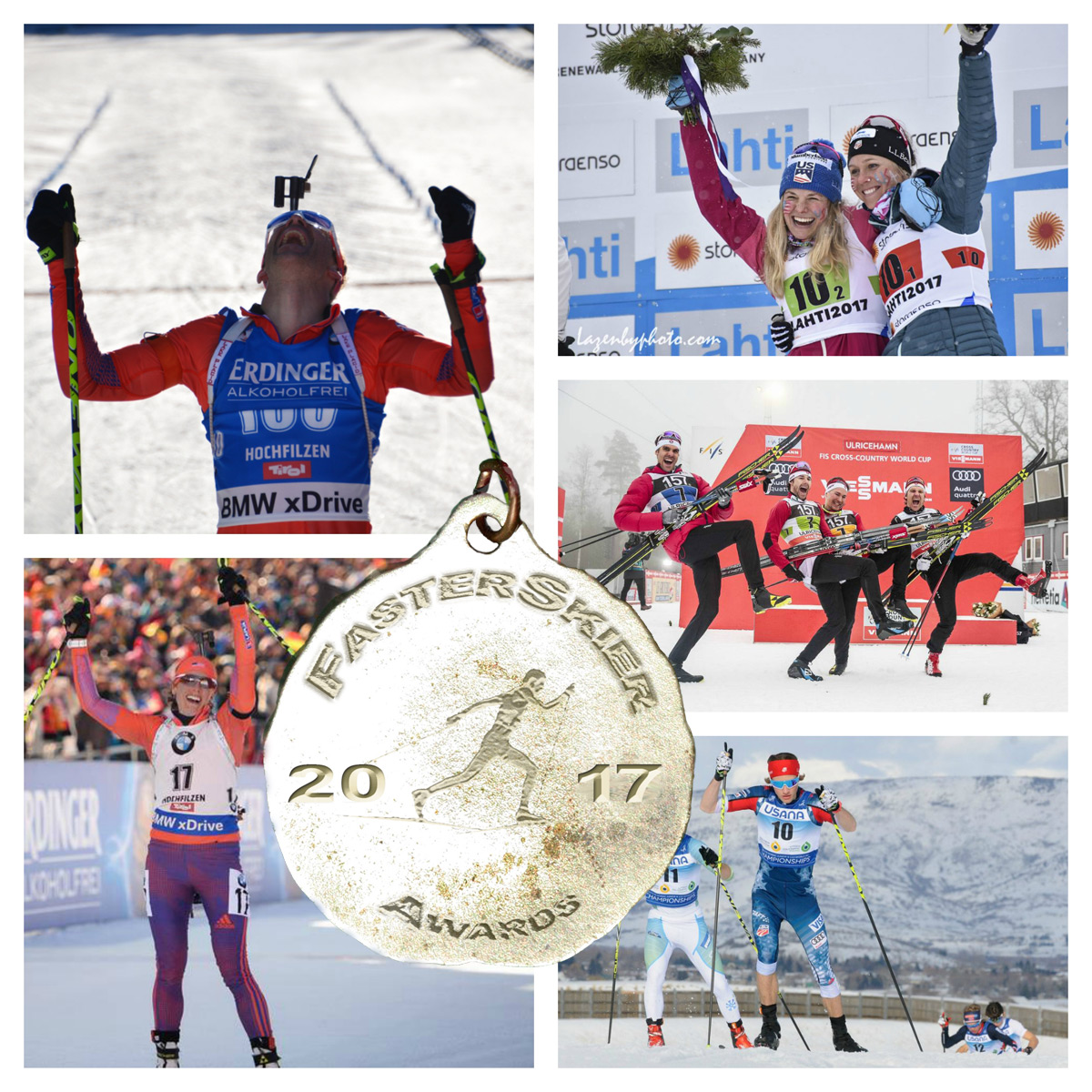
    FasterSkier’s Performances of the Year (clockwise, from upper right): Jessie Diggins and Sadie Bjornsen placing third in the FIS World Championships team sprint (Photo: John Lazenby/Lazenbyphoto.com), Canadian men’s relay placing third in Ulricehamn World Cup (Salomon/NordicFocus), Ben Loomis placing ninth at Junior World Championships (U.S. Ski Team/Tom Kelly), Susan Dunklee placing second at IBU World Championships (USBA/NordicFocus), and Lowell Bailey becoming the first American to win gold at IBU World Championships (Glen Crawford).

    This is it — the final award in our 2016/2017 awards series. Votes stemmed from the FS staff, scattered across the U.S., Canada, and Europe, and while not scientific, they’re intended to reflect a broader sense of the season in review. This honor goes to outstanding North American performances of the year across various nordic sports.

    Previous categories: Junior Skiers of the Year | Collegiate | Canadian Continental | U.S. Continental | Nordic Combined | Biathletes | Para-Nordic | Canadian Breakthroughs| U.S. Breakthroughs | Coach | International | Cross-Country 

    ***

    Lowell Bailey (US Biathlon): Individual gold at IBU World Championships 

    When Lowell Bailey won the 20-kilometer individual at 2017 IBU World Championships, it was by about a slim margin as he could get away with: 3.3 seconds in a 48-minute race.

    What made his performance legendary wasn’t just that Bailey became the first American biathlete to ever earn the title of world champion. It was the way he did it: perfect 20-for-20 shooting, digging deep on his skis, rising to the meet the pressure of a nailbiter of a competition, and sealing the win with aggressive skiing on the final downhill into the stadium.

    Lowell Bailey (US Biathlon) racing to gold in the men’s 20 k individual at 2017 IBU World Championships on Feb. 16 in Hochfilzen, Germany. (Photo: USBA/NordicFocus)

    “In my mind, that was where the race began, the second I left the mat,” Bailey said of cleaning his 20th target.

    Watching from the finish line was the Czech Republic’s Ondřej Moravec, who had started with an earlier bib, also cleaned all 20 targets, and held a 6.4-second lead as Bailey left the range. It also would have been the first world title for Moravec, who had a gold relay medal but never an individual of his very own. The Czech — a veteran journeyman just like Bailey — shook his head and laughed as he watched his fate hang in the balance on the big screen.

    The 20 k individual is often nobody’s favorite race. It’s hard to keep track of what’s happening, with each athlete going through four shooting bouts and a seemingly interminable amount of skiing. The individual-start affair takes nearly two hours from first start to last finish. There are only a few on the World Cup schedule each year and persistent rumors that the format will be eliminated.

    But Bailey, Moravec, and their competitors proved that the individual can be as exciting as anything in the sports world.

    With just about a kilometer to go, Bailey had a tenth of a second on Moravec’s time. The stadium announcer asked the fans to cheer him around the last bit of the race course and they responded with a deafening roar.

    “Every hundred meters it was a sprint,” Bailey said. “Every hundred meters was ‘go as hard as you can for this hundred meters, and then when you get to the end of that hundred meters, go as hard as you can and just keep doing that.’ I thought the finish line was never going to come. I was just like, I don’t know how much longer I can do this, because the finish line is just not showing up.”

    It did, and Bailey had done it. The first American world champion let out a scream. He was mobbed by the press afterwards and his performance became one of the defining moments of the World Championships.

    “I know how important it really is for biathlon,” World Cup overall champion Martin Fourcade said of Bailey’s gold medal. “To see some people outside of Europe winning. I think that is the most we can do to make our sport bigger. I cannot be more satisfied about the guy winning today.”

    Susan Dunklee (US Biathlon): Mass-start silver at IBU World Championships 

    A few days later, Bailey’s teammate Susan Dunklee matched his 20-for-20 shooting and left the shooting range in the 12.5 k mass start with the race lead.

    American Susan Dunklee leaving the range first after the final shooting stage of the women’s 12.5 k mass start at IBU World Championships in Hochfilzen, Austria. She went on to place second for her first World Championships medal and the best result of a U.S. female biathlete at World Championships. (Photo: USBA/NordicFocus)

    In the final kilometers, she was caught and passed by Germany’s Laura Dahlmeier, the most successful athlete of the Championships who took home five gold medals. But her fifth and last one did not come easily: the pair were among the only women to shoot perfectly, and Dahlmeier had to chase hard on the last loop. In the end, Dunklee crossed the line 4.6 seconds after the German and won a silver medal, the first individual medal ever by a U.S. woman at a World Championships.

    “I had a feeling that [Dahlmeier] would catch me, because it is a lot easier when you are hunting than being hunted,” Dunklee said of not being able to follow the German and thus missing out on gold. “Unfortunately I didn’t quite have that today, but I am pretty happy with the race and it gives me something to aim for in the future.”

    While Dahlmeier was faster on her skis, Dunklee was the fastest on the shooting range, and it wasn’t even close. From the first bout of the race, she knocked down her targets in blazing fashion. That allowed her to leave the range first time after time, and set out around the course at her own pace. By the time she came to the last shooting stage, it seemed almost impossible that she could miss; a totally electric performance.

    “You have to get to the point where you trust that speed is better than shooting slow,” she said of her shooting training. “That takes a long time… today it worked.”

    Jessie Diggins and Sadie Bjornsen (U.S. Ski Team): Classic team sprint bronze at FIS World Championships 

    Jessie Diggins and Sadie Bjornsen gave us all a glimpse of what was to come when they finished first and third, respectively, in the women’s 5 k freestyle during the Tour de Ski in Toblach, Italy. That was Bjornsen’s first individual podium and Diggins’s third. Less than two months later, they returned to the podium together, this time in a team event at World Championships nonetheless. Bjornsen started first for the two-woman squad in the 6 x 1.3 k classic team sprint in Lahti, Finland, and Diggins anchored, skiing from fifth to third on the final lap and overtaking Sweden’s Stina Nilsson in the finishing stretch.
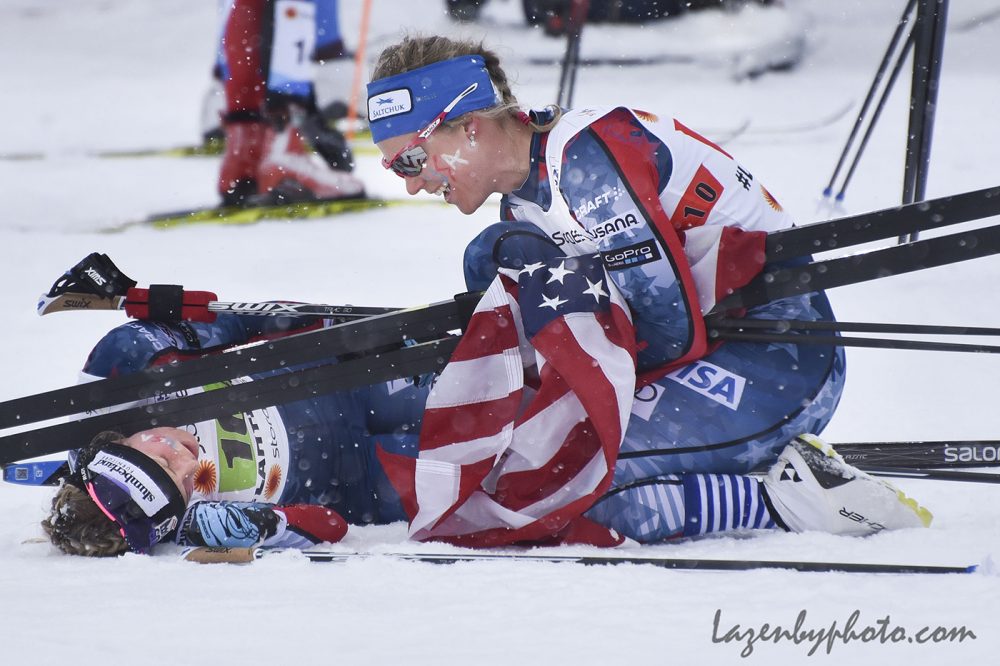
    Sadie Bjornsen (r) greets her U.S. teammate Jessie Diggins after Diggins outlunged Sweden’s Stina Nilsson (not shown) for the bronze medal in the women’s 6 x 1.3-kilometer classic team sprint at 2017 Nordic World Championships in Lahti, Finland. (Photo: John Lazenby/Lazenbyphoto.com)

    Diggins edged Nilsson by 0.19 seconds for the final spot on the podium. Following Diggins’s freestyle team sprint gold, which she won with Kikkan Randall at 2013 World Championships, bronze is the U.S. team’s next-best result. The medal was Diggins’s fourth at a World Championships (and second of the week in Lahti, Finland) and Bjornsen’s first.

    “I have been dreaming to be on a team sprint at World Championships or Olympics for a while now and it’s so cool to finally be here,” Bjornsen said afterward. “I think it’s finally sinking in, because I feel like I just wanna cry.”

    Out of all of the first-leg skiers in the final, Bjornsen posted the fastest splits on her first and second laps.

    While Diggins had previously taken silver earlier in the week in the 2017 World Championships skate sprint (and earned silver two years ago in the 2015 world champs 10 k skate), this was her first classic medal.

    “For me, this is one of the most exciting ones because, as Sadie said, it’s in classic,” Diggins said.

    In all, the U.S. team took home four medals from 2017 World Championships: two in the skate sprint (where Diggins placed second and Randall finished third), and technically two from the classic team sprint (one each for Diggins and Bjornsen).

    “This was an event that, in April, we talked about as an outside medal shot,” U.S. Ski Team Women’s Coach Matt Whitcomb said. “With that in mind, the team started brainstorming of a way of ‘coming from some sort of surprising attack’ when the time came in Lahti.”

    He explained that they didn’t select the team-sprint duo until about 12 hours before the race.

    “We had [Bjornsen] specifically skip the skiathlon because we thought with a little extra rest, she could be that much sharper,” Whitcomb said. Diggins ended up dropping out of the skiathlon to rest up for the team sprint the next day.

    “But we had four other women that were up for serious consideration for this spot and we didn’t make the call until yesterday afternoon at 2:25 p.m.,” he added. “[Bjornsen and Diggins] felt the pressure of being selected for this team and … they’ve awarded everybody that could have been on it.”

    Canadian men’s relay: Bronze at Ulricehamn World Cup

    On Jan. 15, Len Valjas returned to the World Cup podium for the first time in four years. He won the freestyle team sprint in Toblach with teammate Alex Harvey, marking Valjas’s first World Cup win and sixth career podium.
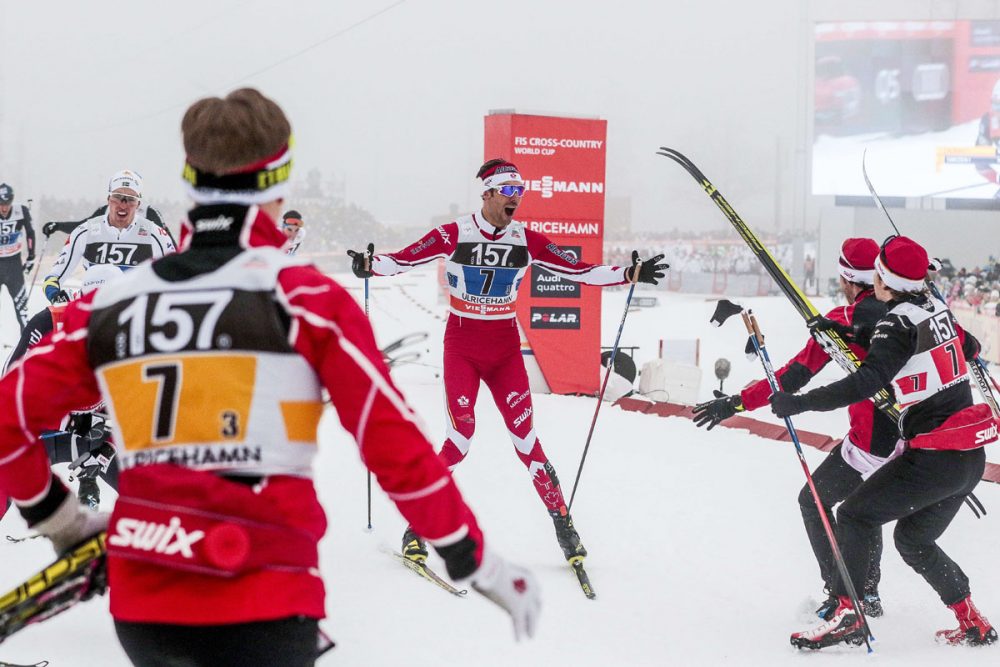
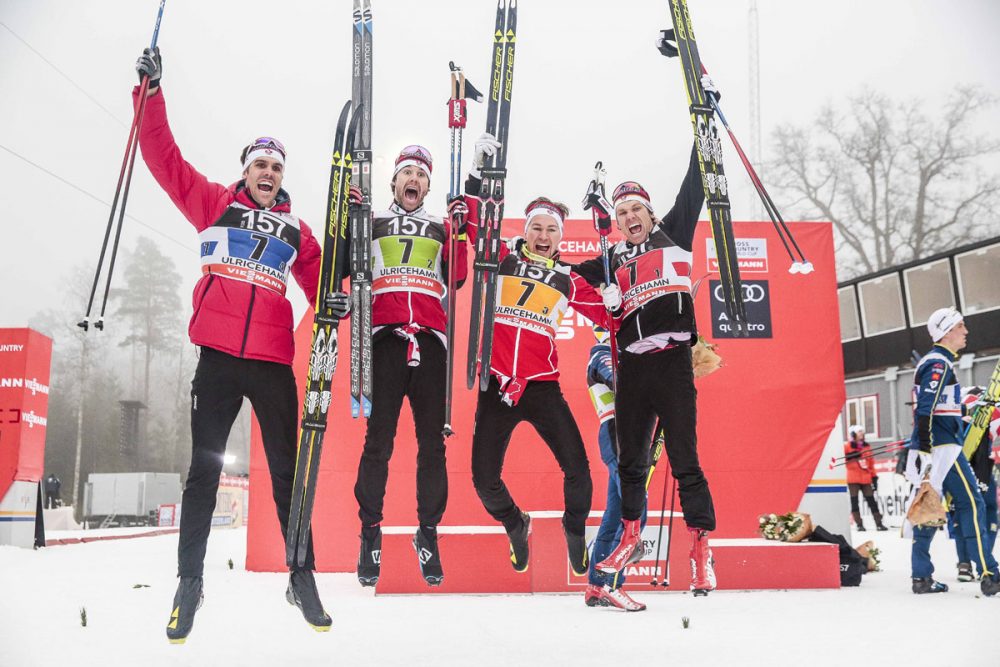
    Len Valjas (c) is greeted by his teammates Alex Harvey (far right), Knute Johnsgaard (far left) and Devon Kershaw after he anchored their team to third in the men’s 4 x 7.5-kilometer team relay for a team best in Ulricehamn, Sweden. (Photo: Fischer/NordicFocus)

    One week later, Valjas anchored his team’s 4 x 7.5 k relay to third at the World Cup in Ulricehamn, Sweden, for the best-ever Canadian men’s relay result. The program’s previous best was fifth in 2012.

    “We barely assembled one team, but that team made a miracle today, so we only needed one,” Canadian World Cup coach Ivan Babikov said after the Ulricehamn relay medal. Babikov competed on Canada’s 2012 relay team, retiring just last spring and transitioning to coaching.

    “I’ll never forget this day,” he added. “We’ve had individual podiums and individual medals, but the relay is special because it’s a show of strength for the whole team and the whole staff behind this team.”

    The four-man squad included veteran World Cup skiers Devon Kershaw and Harvey, as well as U25 national team member Knute Johnsgaard, who flew to Sweden just a few days before the event. By the first exchange, Kershaw put the Canadians in third, just 0.7 seconds out of first. Harvey went on to tag Johnsgaard 3.5 seconds back in fifth, and Johnsgaard as the third leg kept the team within striking distance in seventh, 5 seconds out of first.

    Over the final 7.5 k, Valjas raced his team into not just podium contention, but a threat for second place as well.

    “On the last lap, I was totally blocked on the hill, so I couldn’t actually empty the tank, which was probably a good thing for me,” Valjas recalled. “And then just after the hill I built up some speed, and passed five or six guys just double poling.”

    With about 300 meters to go, Valjas was up to second place behind Sweden’s Calle Halfvarsson in first. Norway’s Finn Hågen Krogh slipped past both of them on the final corner, leaving Valjas and Halfvarsson to duke it out for silver. The Swede took it and Valjas claimed third, 1.3 seconds ahead of Switzerland’s Curdin Perl in fourth, and the Canadian team was ecstatic.

    “I’ve never been the anchor in a relay,” Valjas explained. “I’ve been the second leg in some team sprints, but today was special, the best feeling I’ve ever had skiing, seeing my three teammates sprinting towards me at the finish line. I don’t think anything will ever top that, the first relay [podium] for Canada.”

    Harvey as the the team’s lone fully funded athlete explained that the relay medal could give the rest of his team a significant financial boost.

    “Because the results over the last couple of years internationally have been not stellar as a team, a lot of funding was cut for us,” Harvey explained after the race. “I think this result will really help those guys to be fully funded again.”

    Ben Loomis (U.S. Nordic Combined Team): Ninth at Junior World Championships
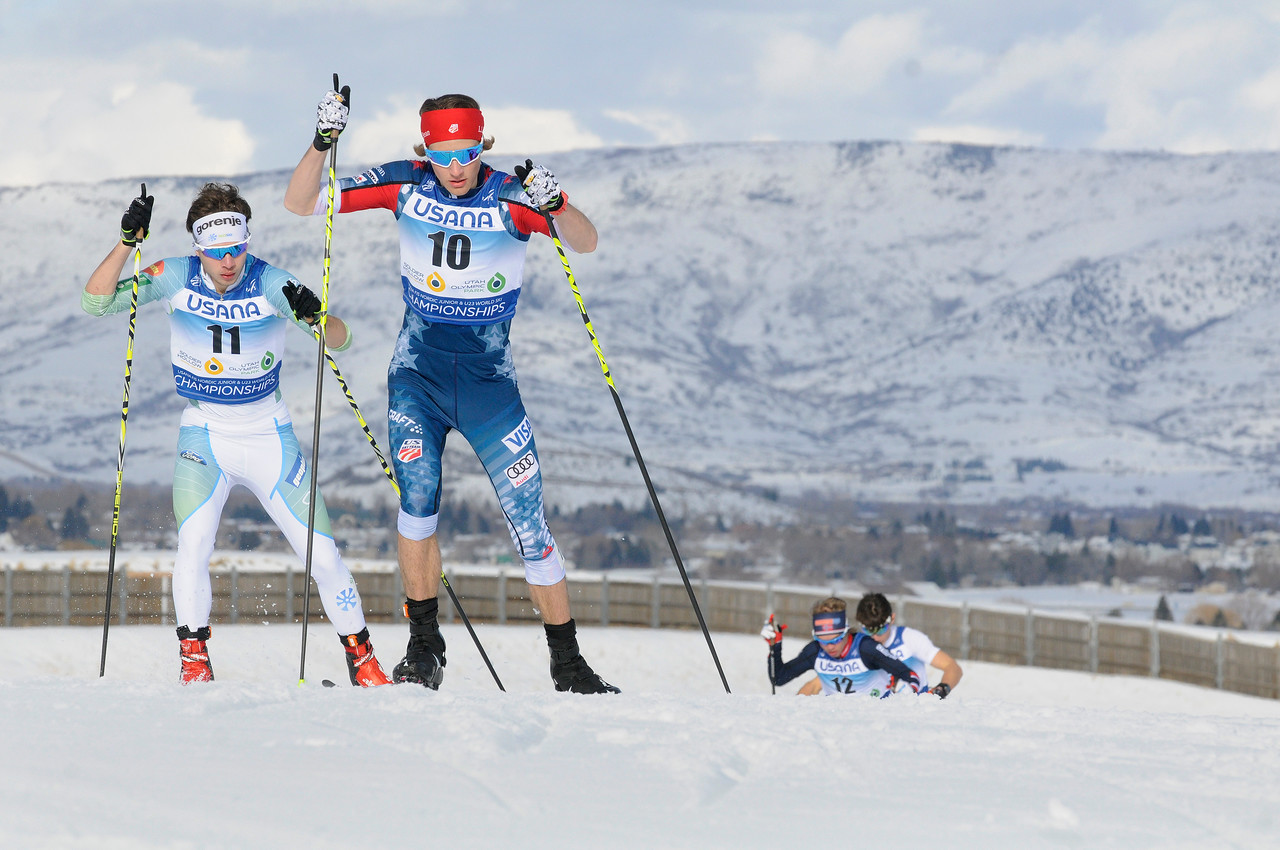
    American Ben Loomis (10) leading Slovenia’s Vid Vrhovnik (11) during the individual normal hill/5 k competition on Feb. 4 at Nordic Combined Junior World Championships at Soldier Hollow in Midway, Utah. Loomis finished ninth for a career best in his third Junior Worlds. (Photo: U.S. Ski Team/Tom Kelly)

    Out of the six U.S. nordic-combined skiers at 2017 Nordic Junior World Championships in Park City and Midway, Utah, came three top-10 results. Individually, 18-year-old Ben Loomis led the team in ninth after 16-year-old Stephen Schumann broke through earlier in the week in 10th in the normal hill/10 k.

    Together, the teammates raced to seventh in the 4 x 5 k relay, along with Elijah Vargas and Grant Andrews. Loomis moved the team from ninth to seventh on the third leg, and Schumann anchored them to seventh, 2:10 minutes behind Austria in first.

    Two days later, Loomis posted his first top 10 in his third Junior World Championships, finishing ninth in the individual normal-hill/5 k. He started the day by jumping to 10th out of nearly 50 competitors then picked off one place in the shorter-format race before the finish.

    “I was able to stay relaxed, focused and have my best competition jump of the week,” Loomis wrote in an email afterward. “The home hill advantage made a huge difference in my jumping. Prior to this week, I had little jumps on the hill this winter. Luckily, I know the hill well and was able to get in rhythm with the jump very quickly.”

    Loomis hails from Eau Claire, Wis., a town that actually does have ski-jumping facilities, he explained in an “Under 23 Questions” interview before the championships. He is currently based in Park City, where he trains with his older brother Adam.

    In the final competition of 2017 Junior Worlds, he was one of two U.S. men in the top 15. Schumann followed in 15th, racing up from his 20th-ranked jump.

    “Overall, I am very happy with my 9th place result,” Loomis wrote. “I was hoping for a little more, but to be 9th in the world is very special. I am already looking forward to next year’s competitions and approaching them with even more experience.”


  • A Maple-Leaf ‘Miracle’, Canada Races to Historic 3rd Place in Ulricehamn Relay

    A Maple-Leaf ‘Miracle’, Canada Races to Historic 3rd Place in Ulricehamn Relay

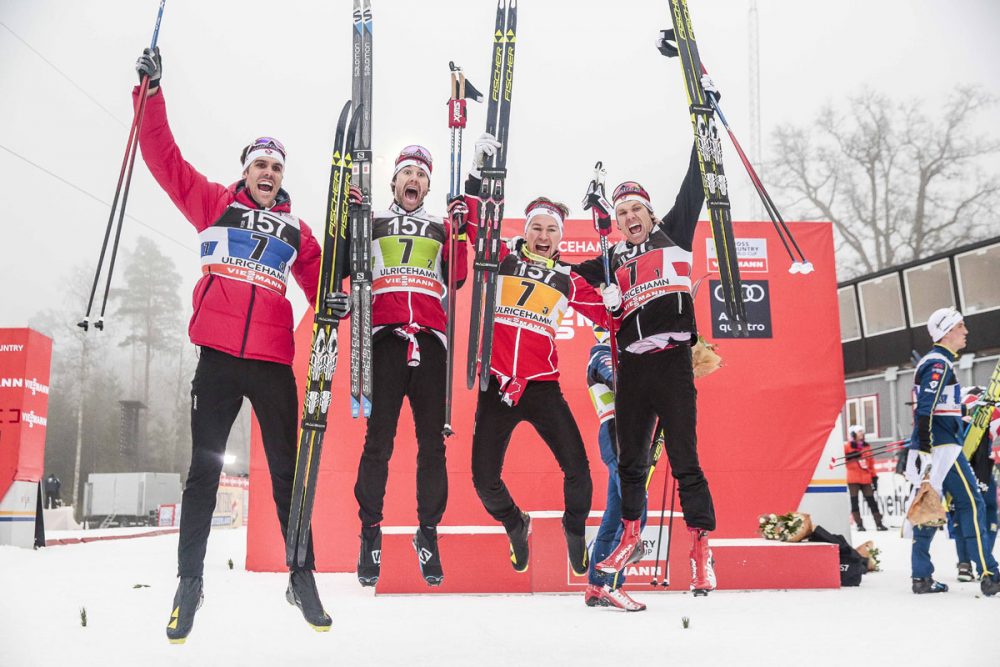
    Len Valjas (c) spreads his arms to greet his teammates Alex Harvey (far right), Knute Johnsgaard (far left) and Devon Kershaw after he crossed third in the men's 4 x 7.5-kilometer team relay on Sunday in Ulricehamn, Sweden. (Photo: Fischer/Nordic Focus)
    Len Valjas (c) greeting his teammates across the line, including Alex Harvey and Devon Kershaw (on the right), Knute Johnsgaard (left) after he finished third in the World Cup men’s 4 x 7.5-kilometer team relay on Sunday in Ulricehamn, Sweden, for a best-ever relay result for Canada. (Photo: Fischer/NordicFocus)

    Looking up from the finish line on Sunday, Canada’s Len Valjas saw something he would never forget. Amidst a sea of waving Swedish flags, a trio of men ran toward him. Their arms were outstretched and a chorus of cheers escaped all three as they charged toward their teammate.

    Just a week ago, Valjas had celebrated his first World Cup win in the men’s team sprint with teammate Alex Harvey. Seven days later, after anchoring the final leg of the Canadian men’s 4 x 7.5-kilometer relay team in Ulricehamn, Sweden, Valjas would celebrate another first.

    But this time, the first was not his alone. It was one for Canada as well.

    Left to right: Canada's Len Valjas, Alex Harvey, Knute Johnsgaard, and Alex Harvey after their historic third place finish in the men's 4 x 7.5-kilometer team relay on Sunday in Ulricehamn, Sweden. (Photo: Fischer/Nordic Focus)
    Left to right: Canada’s Len Valjas, Alex Harvey, Knute Johnsgaard, and Alex Harvey after their historic third-place finish in the men’s 4 x 7.5-kilometer relay on Sunday in Ulricehamn, Sweden. (Photo: Fischer/NordicFocus)

    Prior to Sunday, no other men’s team sporting the red maple leaf had reached the podium in a World Cup relay. The closest Canada had come to was fifth place in 2012 in Gällivare, Sweden, with Valjas, Harvey, Devon Kershaw, and Ivan Babikov.

    A little less than five years later, with Babikov as Canada’s new World Cup coach and Knute Johnsgaard having joined the relay-race crew, history was made.

    For the first time on a World Cup, four Canadian men — Kershaw, Harvey, Johnsgaard, and Valjas — would raise their arms in celebration while standing on the third podium step on Sunday, stealing the spotlight from Norway’s first place finishers and Sweden in second.

    “As a small cross-country skiing country, we don’t have two teams at the start line,” Babikov said on the phone afterward. “We barely assembled one team, but that team made a miracle today, so we only needed one.”

    Even if scraping together a squad did not take place until last week — Johnsgaard only flew into Sweden a few days ago and skipped Saturday’s 15 k freestyle to rest up for the relay — Canada has been aiming at a team podium for a while.

    For Babikov, especially, standing on the relay podium alongside his teammates had been a longtime dream. And though it wouldn’t occur while he was skier, watching his athletes (three of them former teammates) climb onto the third podium step was just as momentous for Babikov.

    “I’ll never forget this day,” Babikov said. “We’ve had individual podiums and individual medals, but the relay is special because it’s a show of strength for the whole team and the whole staff behind this team.”

    Just half of a second out of first — which went to Norway in a time of 1:06:47.5 — Canada’s third place finish is an indication not only of the team’s depth, but potential to place even higher.

    “I’ll never forget this day. We’ve had individual podiums and individual medals, but the relay is special because it’s a show of strength for the whole team and the whole staff behind this team.”– Ivan Babikov, Canadian World Cup coach, on the men’s relay’s historic third-place finish on Saturday

    Since distance relays are also one of the primary ways Own The Podium evaluates how much funding Cross Country Canada (CCC) receives, Sunday’s performance may also incentivize an increase in financial resources for the Canadian World Cup team.

    As Harvey explained, most his teammates are not currently getting financial support from CCC due to budget cuts from previous years. As a result of Sunday’s performance, that could change.

    “Because the results over the last couple of years internationally have been not stellar as a team, a lot of funding was cut for us,” Harvey said on the phone after Sunday’s race. “I think this result will really help those guys to be fully funded again.”

    Regardless of what exactly happens with the future funding, Canada’s relay members and coaches alike were smiling, speechless and simply stoked.

    “I felt honored to anchor such a hard working team,” Valjas said on the phone. “I didn’t want to let them down, so it was easy, there was only one thing to do, just get on the podium. They all did their work, and I wasn’t going to be the guy who lets it all go to shame.”

    Canada in Close Quarters, Krogh Out Sprints Halfvarsson for the Win

    In the words of Babikov, relay days are somewhat like the “lottery,” with decisions on which leg to designate to each athlete a gamble. With Sunday’s first two legs classic and the second two skate, Canada selected Kershaw and Harvey to start the team off, followed by Johnsgaard and Valjas.

    “Our strongest guys [were] on the first two legs, Devon and Alex, that’s where most of the damage was done,” Babikov said.

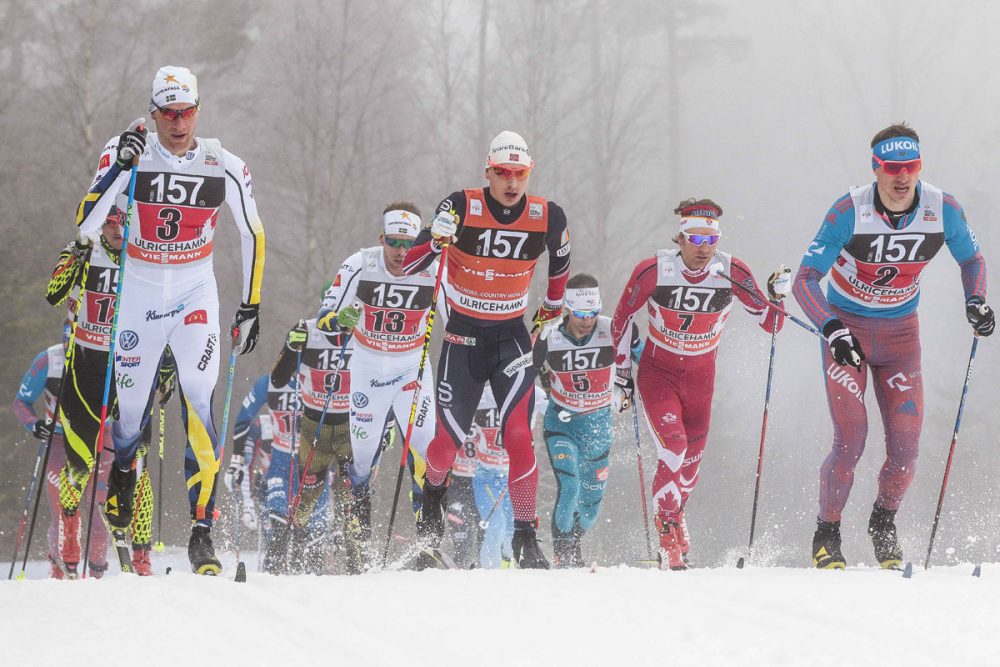
    Canada's Devon Kershaw (bib 7) during the first classic leg of the men's 4 x 7.5-kilometer team relay on Sunday in Ulricehamn, Sweden. (Photo: Fischer/Nordic Focus)
    Canada’s Devon Kershaw (second from r) during the first classic leg of the World Cup men’s 4 x 7.5-kilometer relay on Sunday in Ulricehamn, Sweden. (Photo: Fischer/NordicFocus)

    Kershaw started things off for the Canadians, skiing in bib 7 and positioned in 10th place until just before 2 k, when he made a move to the outside right of the tracks to the front. However, he didn’t lead for long. By 4 k, Russia’s Sergey Turyshev had overtaken him, followed by Sweden’s Daniel Rickardsson and Italy’s Dietmar Nöckler.

    Coming into the exchange zone, it was Kazakhstan’s Alexey Poltoranin in the lead, and Kershaw in fifth. Kershaw tagged off to Harvey for the second classic leg.

    Within the first half a kilometer, Harvey was at the helm of the leading pack of nine.

    “I knew that the heavy hitters were on my leg, but it was good,” Harvey said. “It was hard on the big hill, but then over the top I had really fast skis.”

    At 2.5 k Finland’s Iivo Niskanen and Russia’s Alexander Bessmertnykh traded off leads. Within another 4 k, Norway’s Martin Johnsrud Sundby moved to the front. The Norwegian maintained the lead through the exchange zone, while Harvey chased from five seconds back.

    Sundby passed off to Norway’s Anders Gløersen, and Harvey to Johnsgaard for the third leg and first freestyle portion. Despite considering himself a ‘World Cup rookie’, Johnsgaard, of Canada’s U25 Team, maintained his position within the middle of the lead pack.

    “Alex tagged me off in a good position, and my job was to hold that, and give Len the same opportunity I had to ski in the group in a  good position,” the 23-year-old Johnsgaard said.

    Johnsgaard did his job and tagged off to Valjas within five seconds of Gløersen’s tag to Norway’s Finn Hågen Krogh.

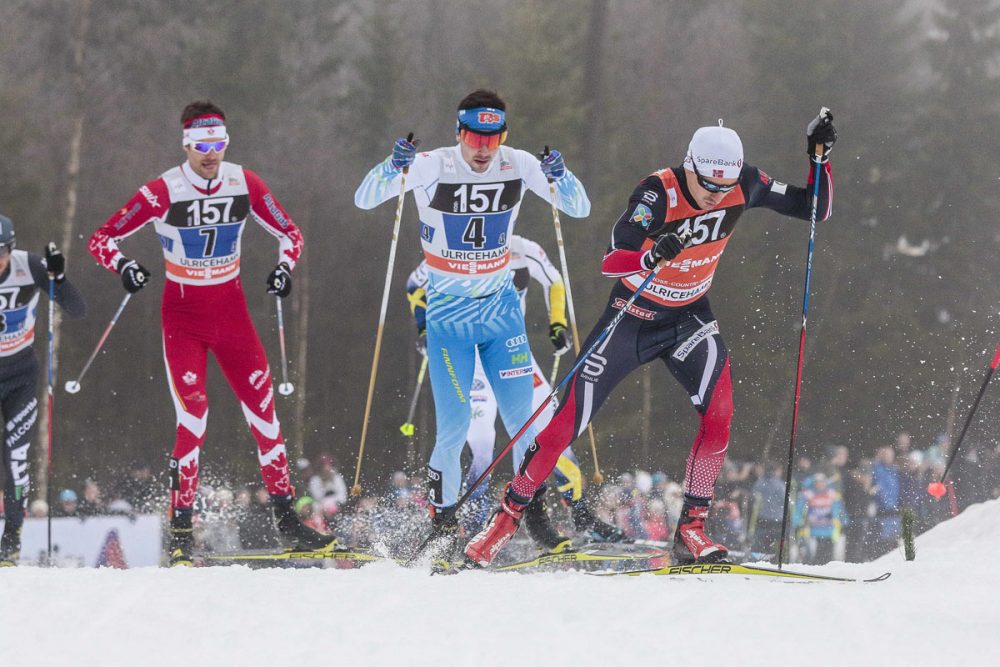
    Seven skiers still remained in the front pack with Krogh, Sweden’s Calle Halfvarsson and Italy’s Sebastiano Pellegrin in the lead. Valjas spent most of his first lap in fifth, following as close to the leaders as possible.

    “On the last lap, I was totally blocked on the hill, so I couldn’t actually empty the tank, which was probably a good thing for me, and then just after the hill I built up some speed, and passed five or six guys just double poling,” Valjas said.

    By the final 300 meters, the Canadian had moved up to second behind Halfvarsson in first. As the group rounded the final corner, however, Krogh moved around to the right of Halfvarsson and Valjas.

    “I gave him a meter in the final turn but I entered the final stretch in good speed” Krogh told NRK of his final maneuver.

    Left to right: Canada's Len Valjas follows Finland's and Norway's Finn Hågen Krogh during the men's 4 x 7.5-kilometer team relay on Sunday in Ulricehamn, Sweden. (Photo: Fischer/Nordic Focus)
    Left to right: Canada’s Len Valjas follows Finland’s and Norway’s Finn Hågen Krogh during the World Cup men’s 4 x 7.5-kilometer relay on Sunday in Ulricehamn, Sweden. (Photo: Fischer/NordicFocus)

    Krogh edged Halfvarsson and Valjas by half a second for the win in 1:06:47.5.

    “I would have like to have won but Finn Hågen is fast,” Halfvarsson told NRK of his final maneuver.

    In his first time anchoring a team relay, Valjas views the moment as one he’ll never forget.

    “I’ve never been the anchor in a relay. I’ve been the second leg in some team sprints, but today was special, the best feeling I’ve ever had skiing, seeing my three teammates sprinting towards me at the finish line,” Valjas said. “I don’t think anything will ever top that, the first relay [podium] for Canada.”

    The U.S. men fielded a team with Andy Newell handing off to Erik Bjornsen, followed by Noah Hoffman, and Simi Hamilton, who anchored them to 10th (+1:16.5).

    U.S. Ski Team Head Coach Chris Grover explained that while Newell maintained contact with the pack during his first lap, he lost it during his second time around.

    “The second time up the big climb he got stuck behind a Russian who was fading,” Grover said on the phone. “By the time he got around, he lost contact with the lead. Then coming down into the stadium he had a fall. And then after that, he was maybe 16 seconds behind the group in front of him. That really took us out of contention.”

    Newell tagged Bjornsen in 13th, 23.2 seconds out of first. From there, the U.S. men steadily picked off the places, with Bjornsen moving into 12th by the second exchange, Hoffman improving to 11th by the last exchange, and Hamilton finally finishing 10th.

    Results

    — Chelsea Little, Jake Ellis and Aleks Tangen contributed

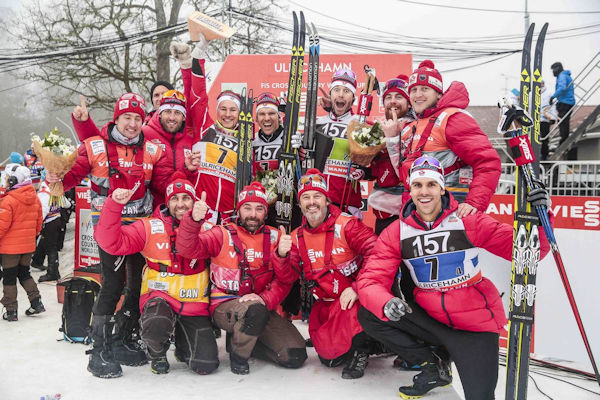
    Team Canada celebrates their first World Cup relay podium in the men's 4 x 7.5-kilometer team relay on Sunday in Ulricehamn, Sweden. (Photo: Cross Country Canada)
    Team Canada celebrates its first World Cup relay podium in the men’s 4 x 7.5-kilometer relay on Sunday in Ulricehamn, Sweden. (Photo: Cross Country Canada)