From the FasterSkier archive — posts syndicated from athletes’ and coaches’ own blogs between 2004 and 2012, kept online as published. Current coverage is at fasterskier.com.

Tag: Ulricehamn Sweden

  • Russian Teams Take the Top Two Spots in Ulricehamn; U.S. in 13th

    Russian Teams Take the Top Two Spots in Ulricehamn; U.S. in 13th


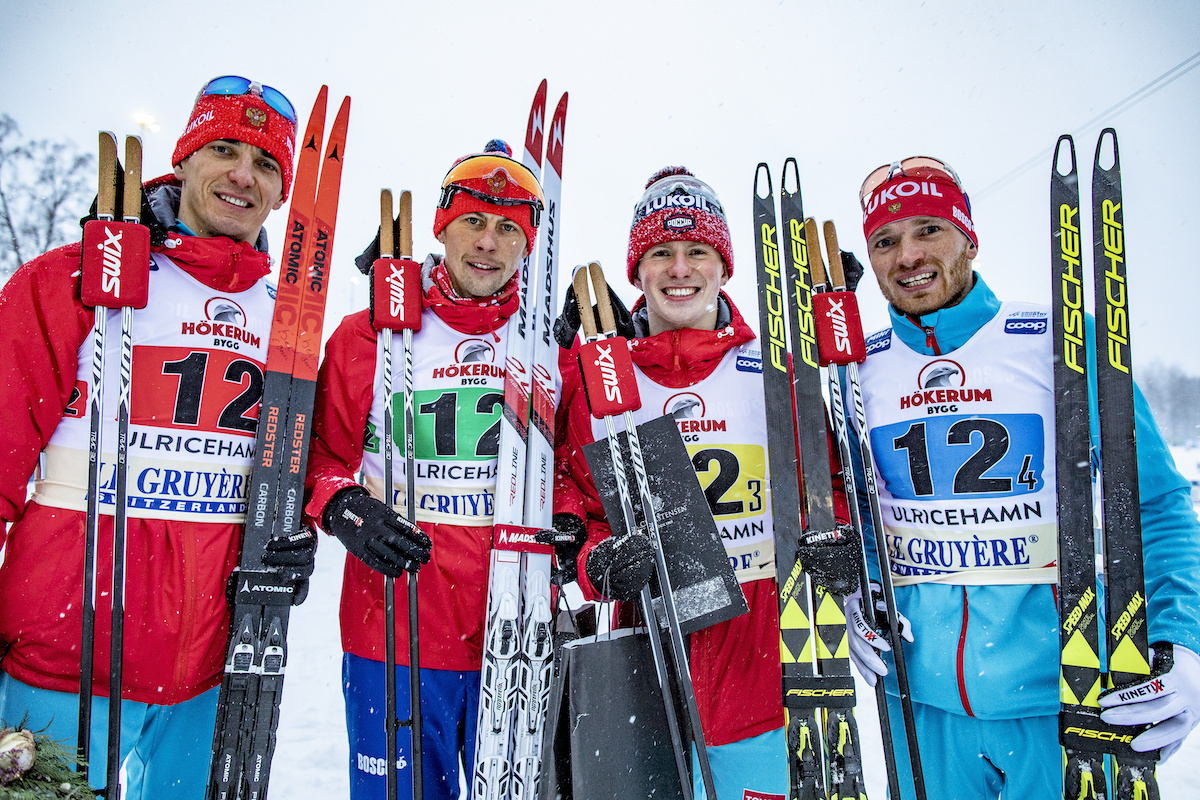
    The Winning 4 x 7.5 k Russian relay team at the Ulricehamn, Sweden World Cups: from left to right, Evgeniy Belov, Alexander Bessmertnykh, Denis Spitsov and Artem Maltsev. (Photo: Fischer/Nordic Focus)

    Today in Ulricehamn, Sweden, the men skied a 4 x 7.5- kilometer relay in unsettled conditions. Racers dealt with harsh conditions as the wind howled and heavy snow fell. With a softened course, it appeared most teams struggled with kick on the steeper climbs.

    Scott Patterson of the U.S. Ski Team (USST) commented on the conditions via email, “the race conditions were interesting with both falling snow and blasting wind. The organizers re-groomed the course in between the women’s and men’s races which did improve things, but the downhill corners were chopped up and soft.”

    Russia II took the victory today in a time of 1:17:53.2 minutes with Evgeniy Belov, Alexander Bessmertnykh, Denis Spitsov and Artem Maltsev.

    The winning team was followed closely by their teammates on Russia I; Andrey Larkov, Alexander Bolshunov, Andrey Melnichenko and Sergey Ustiugov.

    Atypically, Norway had a rough start to the day – more on this in a bit — but the entire team put in a massive effort to claim third place. The Norwegian team consisted of Hans Christer Holund, Didrik Tønseth, Sjur Røthe and Simen Hegstad Krueger.

    The Russian teams lead the entire race, flip-flopping between leaders. Russia I and II worked together throughout, but Russia II had superior fitness. With each Russia II surge, Russia I was unable to match the pace. In the closing k’s, Russia II charged for the finish. Russia I couldn’t hold on. Russia I finished 20.8 seconds behind.

    During the initial lap of the scramble leg, the entire field remained close-knit. Only at the start of the second lap did both Russian teams, along with Sweden I, begin to gap the field. The Russians were able to hold this lead throughout the race. As the race progressed, and the pacing screws turned, Sweden was unable to match the Russians as they faded to place fifth overall (+1:39.6).
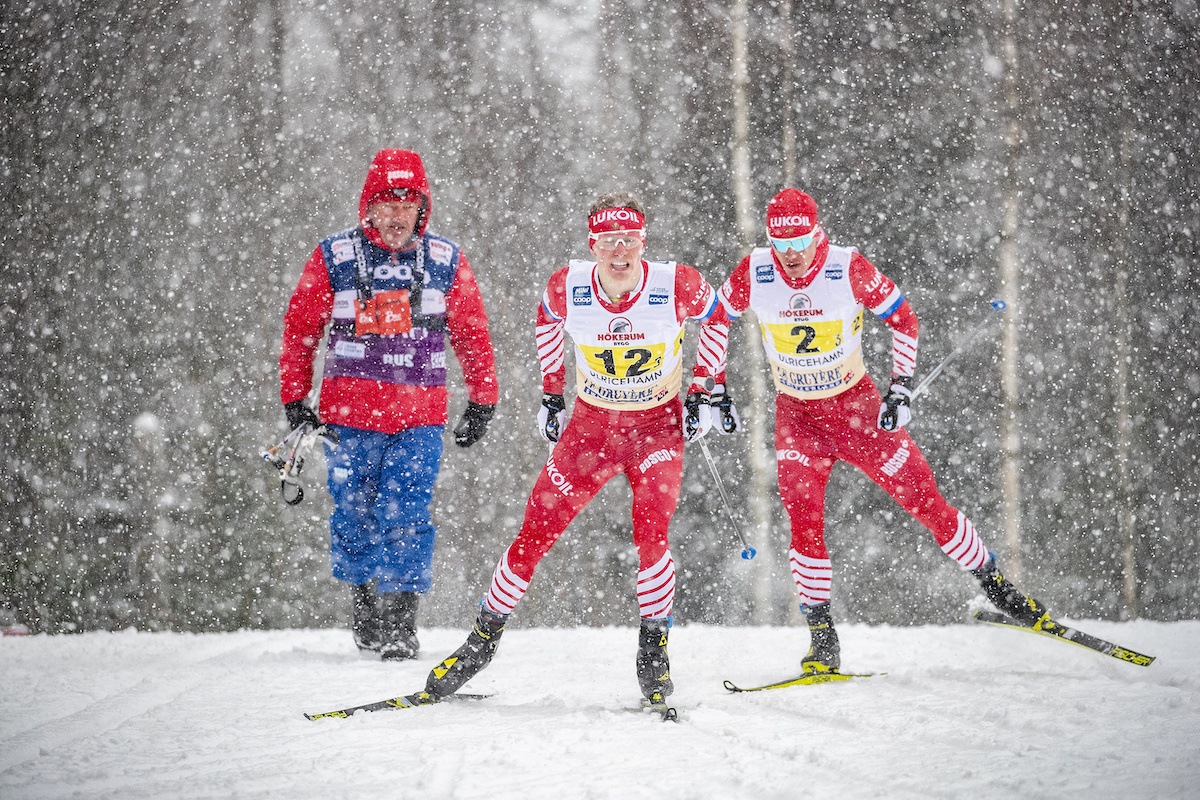
    Russia’s Denis Spitsov (bib 12) and Andrey Melnichenko (bib2) leading the men’s 4 x 7.5 k relay in Ulricehamn, Sweden. (Photo: Fischer/Nordic Focus)

    USST Head Coach Chris Grover commented on the Russian team’s performance this season. 

    “I mean they’ve been super strong all season, we certainly saw that up in Beitostolen and Lillehammer and the Tour,” Grover remarked over the phone. “It does seem like there are a lot of really good things going on with their program from a service perspective. They just had extraordinary skis race after race after race, especially in classic legs. It is very noticeable that they are doing a fantastic job on the service side and they obviously have a lot of depth and a lot of great athletes that have been coming up for a long time.”

    The Norwegian team, as strong as they were, fell back during the first classic leg. It was a gradual decline for Holund throughout his 7.5 k effort. Coming into the first exchange, Norway was sitting in 12th place.

    During Norway’s second leg, Tønseth made gains. He tagged Norway off in fourth place, giving his teammates a chance at the podium. Røthe, the third skier for Norway hammered to put his team within eyesight of third, which at the time was held by Lari Lehtonen of Finland.

    By the end of his leg, Roethe had caught, passed and dropped Lehtonen, putting Norway solidly in third place. Krueger, the Norwegian team’s anchor, was able to hold third place until the finish. According to FIS, Norway has been on the podium in every men’s distance relay for the last 12 years.

    The U.S. relay team, Erik Bjornsen, Scott Patterson, David Norris, and Benjamin Lustgarten finished 13th overall (+4.10.8). 

    During the first two legs, the U.S. team sat in the top-10. Bjornsen skied a strategically strong race, skiing smoothly towards the front of the pack. For the remainder of the race, the U.S. bounced bouncing between eighth and 13th place.

    The U.S. Ski Team’s Erik Bjornsen during December’s  4 x 7.5 k relay in Beitostølen, Norway. (Photo: Aleks Tangen)

    Bjornsen commented on the team’s strategy going into the race, “Our tactics were to try and stay with the group for as long as possible. We knew we weren’t going to be fighting for a podium spot today, just with where everyone is at right now. We also know this is good practice for World Champs so we used it as another opportunity to learn. We’ve set a goal as a men’s team to get a top 8. In a few years with some strong younger guys coming up, maybe that could be a top 5. Once you’re getting top 5’s then anything is possible when it all comes together.”

    Bjornsen chose to race only the relay this weekend in preparation for World Championships which begin in three weeks. His conservative approach to race stars this weekend left him feeling fresh for Sunday’s relay.

    “Erik did a great job, stayed in the fight for a long time there and it may be one of Scott’s better classic races. He did a really good job of holding steady with the group that he was in,” Grover commented.

    This was Norris’s first World Cup since the U.S. National Championships concluded in early January.

    “Coming off of Nationals I feel fit and healthy,” Norris told FasterSkier. “I got here Thursday night and I am glad I got two hard races in before a training camp in Davos. I am going to Davos tomorrow. This gives me plenty of time to adjust and prepare for the Cogne World Cup and World Championships.”

    The U.S. team has a distance and sprint training camp planned for the next two weeks until the World Cup in Lahti, Finland on Feb. 9. The Lahti races include a skate sprint and team sprint, with no distance races scheduled until Cogne’s races starting on Feb.16. These training camps are in preparation for the World Championships in Seefeld, Austria.

    Men’s Results

  • Manificat Gets his Win; Harvey Returns for Ninth

    Manificat Gets his Win; Harvey Returns for Ninth


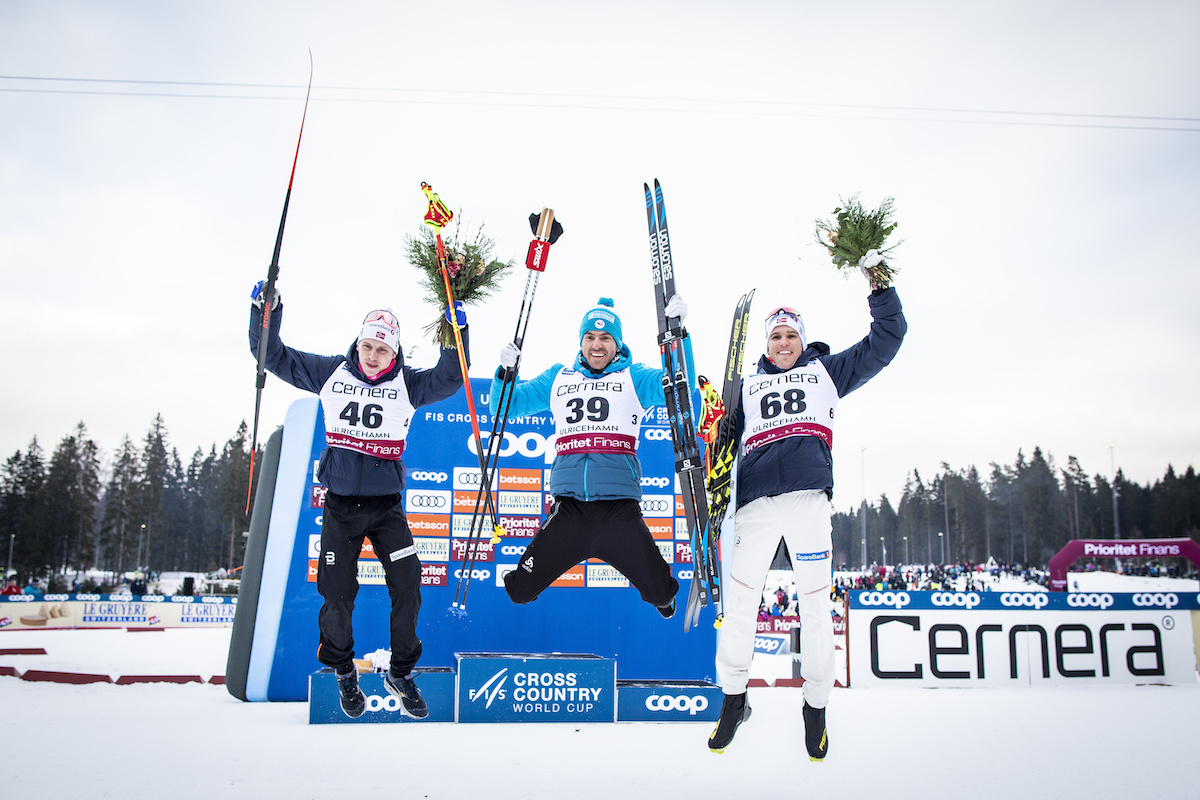
    The men’s podium from the World Cup 15 k skate in Ulricehamn, Sweden. From left to right, Norway’s Simen Hegstad Krüger placed second, France’s Maurice Manificat first, and Didrik Tønseth of Norway was third. (Photo: Fischer/Nordic Focus)

    The tension in the interval start race comes down to watching the clock.

    The seconds tick, the time checks pass, the squirm of the of the skier in the leader’s chair only quelled after the top-prospects slide past the finish — and there’s only a reference to time back.

    On Dec. 12, that was France’s Maurice Manificat, the thirty-two-year-old skate skiing star, residing where he often belongs, sitting in the leader’s chair in Davos, Switzerland during the 15-kilometer skate. In bib 39, Manificat set the fastest time of the earlier starters. As the other would-be-winners came in, Manificat’s lead held.

    Until Russia’s Evgeniy Belov bested Manificat’s time by 0.9 seconds. The Frenchman finished second in what was his first World Cup start of the season.

    Today in Ulricehamn, Sweden in the men’s 15 k skate, it was déjà vu all over again. Manificat in bib 39. Manificat in the leader’s chair waiting for the possible bigger guns on the day to cross the line.

    Manificat’s time of 34:55.4 minutes held, just barely, for the win. Simen Hegstad Krüger, the day’s 46th starter, stopped the clock 1.1 seconds back for second place. Didrik Tønseth, also of Norway, came in third (+8.7).

    “We were waiting to come back to Ulricehamn for 2 years. I was pushed with the atmosphere and the crowd!” Manificat told the International Ski Federation (FIS) after the race. 2017 was the last time the World Cup made a stop in Ulricehamn – a venue known for its boisterous spectators. (FIS reported an estimated 27,000 fans were on hand for today’s World Cup.)


    Maurice Manificat of France after his 15 k skate win in Ulricehamn, Sweden. (Photo: fis-ski.com screenshot)

    2017 in Ulricehamn was also a time when Alex Harvey reigned supreme in the 15 k skate. He won that day’s 15 k skate by six seconds over Norway’s Martin Johnsrud Sundby.

    At thirty-years-old Harvey has been near, but not at the top of his form this season.

    Harvey, who placed third last season in the Tour de Ski (TdS), pulled himself from this season’s TdS after placing 22nd in stage 5. He took an extended break from Europe to train and rest at his home in Quebec.

    Today saw a different Harvey return to the World Cup. He placed ninth in Saturday’s 15 k skate, 31.4 seconds back.

    Harvey explained in a post-race call that he feels rejuvenated and satisfied with the result, despite having flown to Europe on Wednesday.

    “I felt quite good, but I have been in Europe for two days only,” Harvey said. “I flew on Wednesday and arrived here Thursday midday. After the Tour, I felt I needed to go home and reset a little bit. I just wasn’t skiing the way I wanted to. I wasn’t feeling good and especially after races. Of course, you are tired after a ski race but it was like I was really really tired after the races and I didn’t feel like the body could handle the effort much. I needed a bit of a mental break at home. So I went back and was able to make the most of the great conditions we had there in Mont St Anne and I was able to put in a good block of training and just in a more relaxed environment being at home.” Each of Australia’s online pokies has its own payout percentage. The most well-known are Australian the best paying online pokies try this . Most gamers are aware that playing pokies with the greatest payout percentages increases your chances of winning. This is in contrast to casino games with smaller payoff percentages, such as craps, roulette, and video poker machines.

    In the past, Harvey said he had used the TdS as a “launching pad” for the latter part of the season. This year, Harvey sensed the expected performance bump during and after the Tour was in jeopardy.

    It was a feeling he said he had not experienced since 2012, a lifetime ago on the World Cup.

    “I struggled [in 2012] and I had some back issues back then too,” Harvey said. “It was my first season or maybe second spending the whole winter in Europe and that was quite hard for me. I think I was 23 years old. That was the only other time but I was still more of an underdog back then and I wasn’t too worried about it. It was a bit of a drought there for me in the middle of the season, that was the last time, that was 2012. Since then it hasn’t really happened … But this year I didn’t feel like the body was handling racing well enough to benefit from the Tour, from all those hard efforts. That is why I had to pull the plug near the end and go home and reset.”

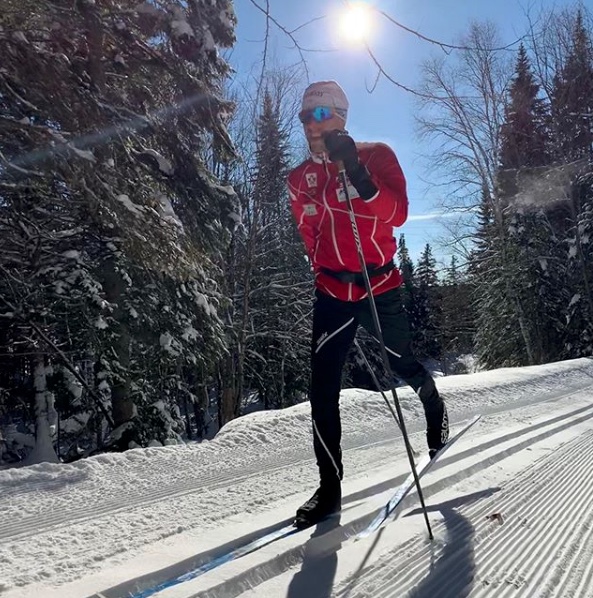
    Canada’s Alex Harvey during his R & R in Quebec. (Photo: Alexis Turgeon, @alx_rv Instagram screenshot)

    Harvey went on to explain his time in Quebec allowed him to focus on a lovely three letter word, “fun”. The chance to reset was also an opportunity to finetune the training.

    “I am the type of athlete, I cannot just rest my way into shape,” said Harvey. “That never worked for me. I was mentally resting but I was still actually skiing quite a bit back home. Just easy for the first week and then normal doing some intervals and strength and all that normal stuff the other week and a half. The last week at home, in intervals, the last two interval sessions were quite good and I was able to push the body and recover in a day or two. And get ready to push again three days later I knew that I was training up that is good for.”

    With low expectations, Harvey started strong in Ulricehamn on Saturday. At 5 k he was off Manificat’s mark by 10.6 seconds with the ninth fastest split. By 10 k, he ceded 30.7 seconds to the eventual winner. For the remainder of the race, he lost only an additional 0.7 seconds to Manificat’s winning mark.

    “I came here on short notice, so I am really happy with both the effort and the results but most importantly the feeling,” said Harvey. “That was the most important thing for me.”

    As he keeps his eye on Seefeld’s World Championships, starting about a month out, Harvey said he was optimistic.

    “Just about as long as the arrow is pointing in the right direction, which has to be uphill and upwards from now on, I think today is a good result for that,” Harvey expressed. “It is pointing up and so that is what I am just going to focus on and get better every day. And if I am able to do that, I  will be a challenger for top-five top positions in Seefeld. I have to keep believing in the plan and I think so far the last three weeks the adjustments we made were pretty good.”

    Also for Canada, Lenny Valjas skied to 57th (+2:32.1), and Bob Thompson 77th (+4:16.6).

    For the U.S., Scott Patterson finished 35th (+1:26.5), David Norris 53rd (+2:11.3), and Ben Lustgarten 64th (+3:04.7).

    Racing continues tomorrow for the men with a 4 x 7.5 k relay.

    Men’s Results


  • Wednesday Workout: Lung-Busting with Hanna Falk

    Wednesday Workout: Lung-Busting with Hanna Falk

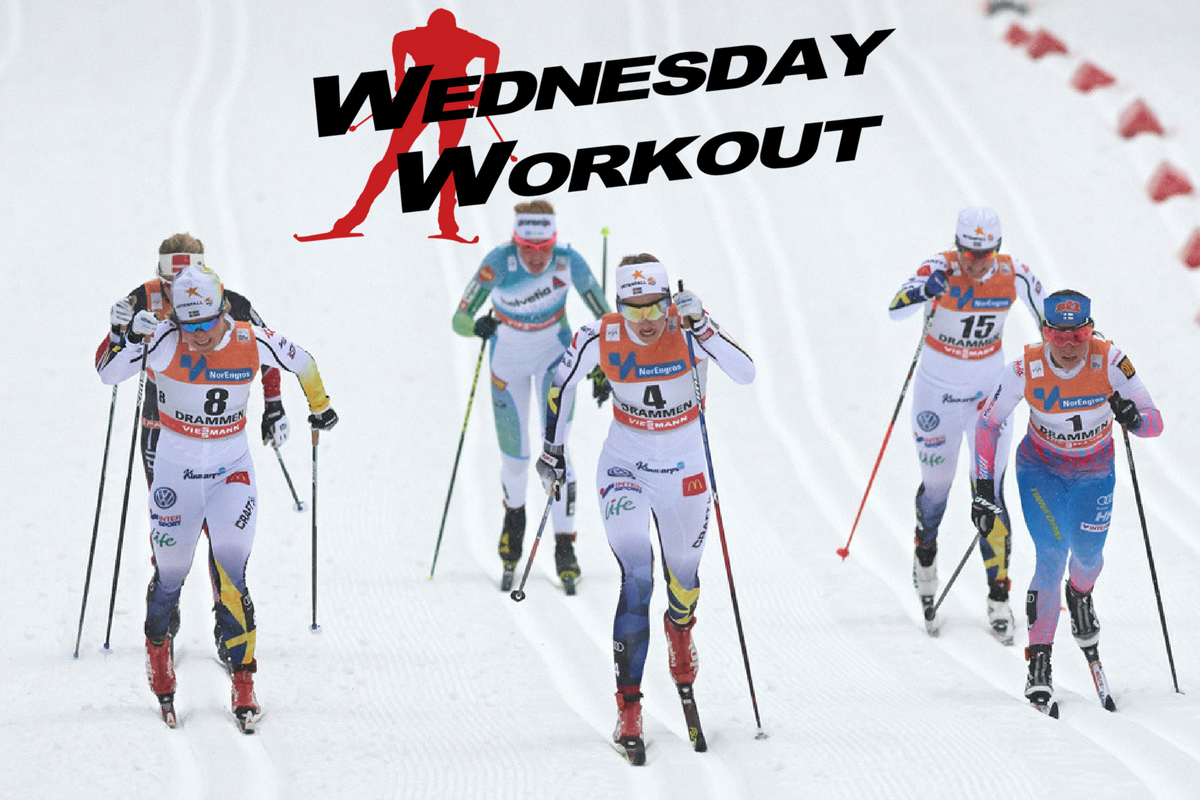
    Sweden’s Hanna Falk (8) going for it in a sprint finish in Drammen, Norway, with her teammate Stina Nilsson (4) and Finland’s Krista Parmakoski (1) on March 8, 2017. (Photo: Fischer/NordicFocus)

    “I have a workout that I like and usually do in the autumn when it’s time to shape up.”

    Those are the words of Swedish national-team member Hanna Falk. To take Falk’s words literally, it is that time of year: in the Northern Hemisphere, it’s officially autumn and “time to shape up”. In two months, the 2017/2018 World Cup will open with classic sprints on Nov. 26 in Kuusamo, Finland.

    For the figurative aspect of Falk’s comment, if you’ve been eschewing hard workouts and log six days a week of perfunctory OD, yes, “it’s time to shape up”. For World Cuppers, potential 2018 Olympians and those giving a Heisman to Father Time, it’s the season to think about priming for those moments when latching on to those skiers pushing the sharp-end pace is paramount.

    In group sprints or distance events, no one likes to be yo-yoed off the back of the pack.

    Last season on the World Cup, Falk finished third in the sprint rankings and 20th overall (a combination of both sprint and distance results.) Although certainly a sprinting force, Falk now considers herself an all-arounder. She placed eighth in the World Cup 10-kilometer freestyle race held in her birthplace of Ulricehamn, Sweden. After we interviewed Falk for FasterSkier’s Nordic Nation, we reached out for a Wednesday Workout, requesting something she uses this time of year to round herself into shape.

    The Workout: 6 x 5 minutes with 2 minutes rest

    “I usually do the workout on roller skis in variable/tough terrain,” she explained. “I also try to do a real sprint start in the start of each interval, just to practice that special moment. It means 10 seconds all out and then continuing the interval in the speed you can manage. You can also do a short sprint at the end of the interval if you want to practice the change of frequency in the finish. It’s a race-inspired workout that will get you tired!”

    How to pace it:

    “You should try to go hard, at high speed, without losing the technique — and with the same speed from the first to the last interval. It probably means Level 4. If you start off too hard and you are not able to have the same speed on the last interval, you are doing it wrong!”


  • A Maple-Leaf ‘Miracle’, Canada Races to Historic 3rd Place in Ulricehamn Relay

    A Maple-Leaf ‘Miracle’, Canada Races to Historic 3rd Place in Ulricehamn Relay

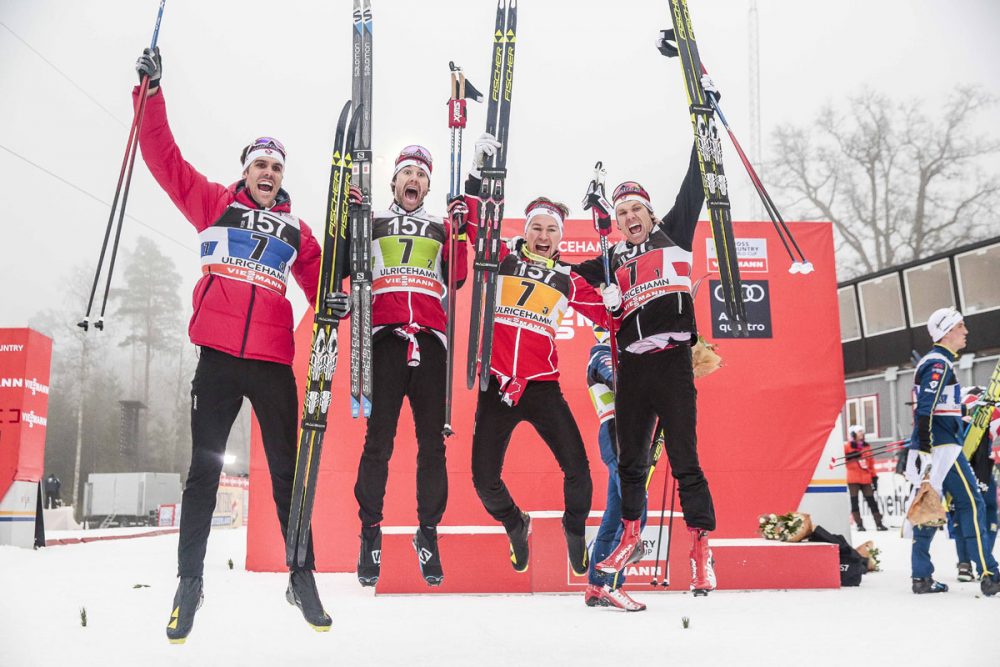
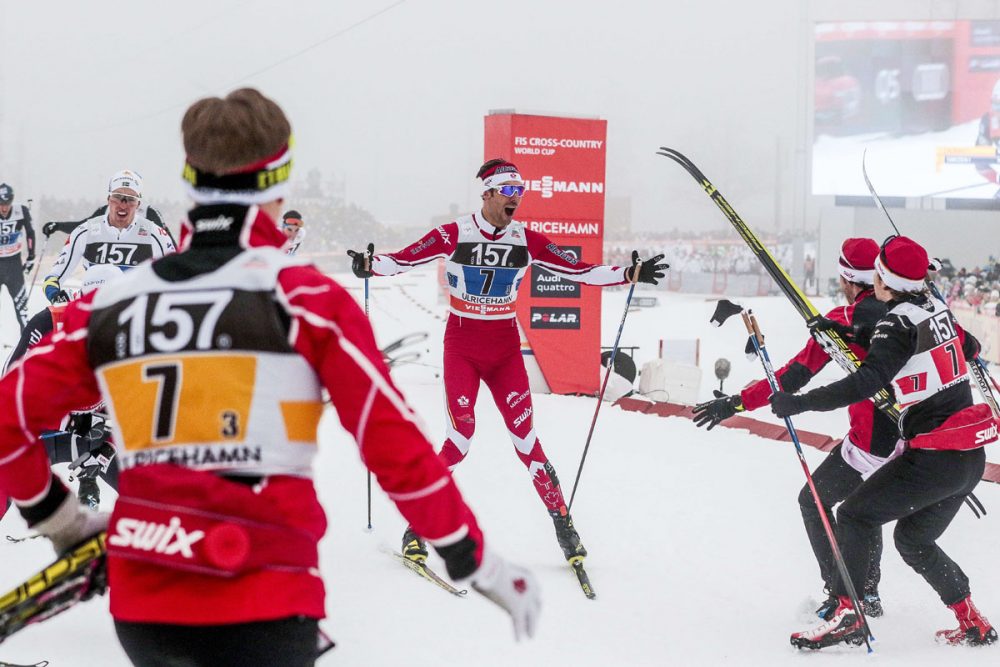
    Len Valjas (c) spreads his arms to greet his teammates Alex Harvey (far right), Knute Johnsgaard (far left) and Devon Kershaw after he crossed third in the men's 4 x 7.5-kilometer team relay on Sunday in Ulricehamn, Sweden. (Photo: Fischer/Nordic Focus)
    Len Valjas (c) greeting his teammates across the line, including Alex Harvey and Devon Kershaw (on the right), Knute Johnsgaard (left) after he finished third in the World Cup men’s 4 x 7.5-kilometer team relay on Sunday in Ulricehamn, Sweden, for a best-ever relay result for Canada. (Photo: Fischer/NordicFocus)

    Looking up from the finish line on Sunday, Canada’s Len Valjas saw something he would never forget. Amidst a sea of waving Swedish flags, a trio of men ran toward him. Their arms were outstretched and a chorus of cheers escaped all three as they charged toward their teammate.

    Just a week ago, Valjas had celebrated his first World Cup win in the men’s team sprint with teammate Alex Harvey. Seven days later, after anchoring the final leg of the Canadian men’s 4 x 7.5-kilometer relay team in Ulricehamn, Sweden, Valjas would celebrate another first.

    But this time, the first was not his alone. It was one for Canada as well.

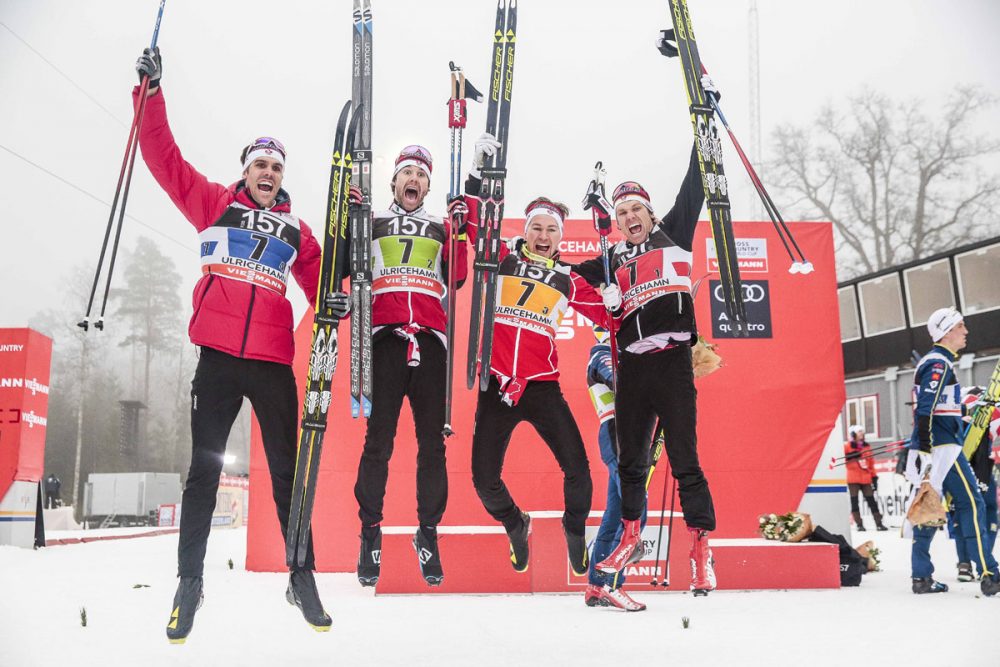
    Left to right: Canada's Len Valjas, Alex Harvey, Knute Johnsgaard, and Alex Harvey after their historic third place finish in the men's 4 x 7.5-kilometer team relay on Sunday in Ulricehamn, Sweden. (Photo: Fischer/Nordic Focus)
    Left to right: Canada’s Len Valjas, Alex Harvey, Knute Johnsgaard, and Alex Harvey after their historic third-place finish in the men’s 4 x 7.5-kilometer relay on Sunday in Ulricehamn, Sweden. (Photo: Fischer/NordicFocus)

    Prior to Sunday, no other men’s team sporting the red maple leaf had reached the podium in a World Cup relay. The closest Canada had come to was fifth place in 2012 in Gällivare, Sweden, with Valjas, Harvey, Devon Kershaw, and Ivan Babikov.

    A little less than five years later, with Babikov as Canada’s new World Cup coach and Knute Johnsgaard having joined the relay-race crew, history was made.

    For the first time on a World Cup, four Canadian men — Kershaw, Harvey, Johnsgaard, and Valjas — would raise their arms in celebration while standing on the third podium step on Sunday, stealing the spotlight from Norway’s first place finishers and Sweden in second.

    “As a small cross-country skiing country, we don’t have two teams at the start line,” Babikov said on the phone afterward. “We barely assembled one team, but that team made a miracle today, so we only needed one.”

    Even if scraping together a squad did not take place until last week — Johnsgaard only flew into Sweden a few days ago and skipped Saturday’s 15 k freestyle to rest up for the relay — Canada has been aiming at a team podium for a while.

    For Babikov, especially, standing on the relay podium alongside his teammates had been a longtime dream. And though it wouldn’t occur while he was skier, watching his athletes (three of them former teammates) climb onto the third podium step was just as momentous for Babikov.

    “I’ll never forget this day,” Babikov said. “We’ve had individual podiums and individual medals, but the relay is special because it’s a show of strength for the whole team and the whole staff behind this team.”

    Just half of a second out of first — which went to Norway in a time of 1:06:47.5 — Canada’s third place finish is an indication not only of the team’s depth, but potential to place even higher.

    “I’ll never forget this day. We’ve had individual podiums and individual medals, but the relay is special because it’s a show of strength for the whole team and the whole staff behind this team.”– Ivan Babikov, Canadian World Cup coach, on the men’s relay’s historic third-place finish on Saturday

    Since distance relays are also one of the primary ways Own The Podium evaluates how much funding Cross Country Canada (CCC) receives, Sunday’s performance may also incentivize an increase in financial resources for the Canadian World Cup team.

    As Harvey explained, most his teammates are not currently getting financial support from CCC due to budget cuts from previous years. As a result of Sunday’s performance, that could change.

    “Because the results over the last couple of years internationally have been not stellar as a team, a lot of funding was cut for us,” Harvey said on the phone after Sunday’s race. “I think this result will really help those guys to be fully funded again.”

    Regardless of what exactly happens with the future funding, Canada’s relay members and coaches alike were smiling, speechless and simply stoked.

    “I felt honored to anchor such a hard working team,” Valjas said on the phone. “I didn’t want to let them down, so it was easy, there was only one thing to do, just get on the podium. They all did their work, and I wasn’t going to be the guy who lets it all go to shame.”

    Canada in Close Quarters, Krogh Out Sprints Halfvarsson for the Win

    In the words of Babikov, relay days are somewhat like the “lottery,” with decisions on which leg to designate to each athlete a gamble. With Sunday’s first two legs classic and the second two skate, Canada selected Kershaw and Harvey to start the team off, followed by Johnsgaard and Valjas.

    “Our strongest guys [were] on the first two legs, Devon and Alex, that’s where most of the damage was done,” Babikov said.

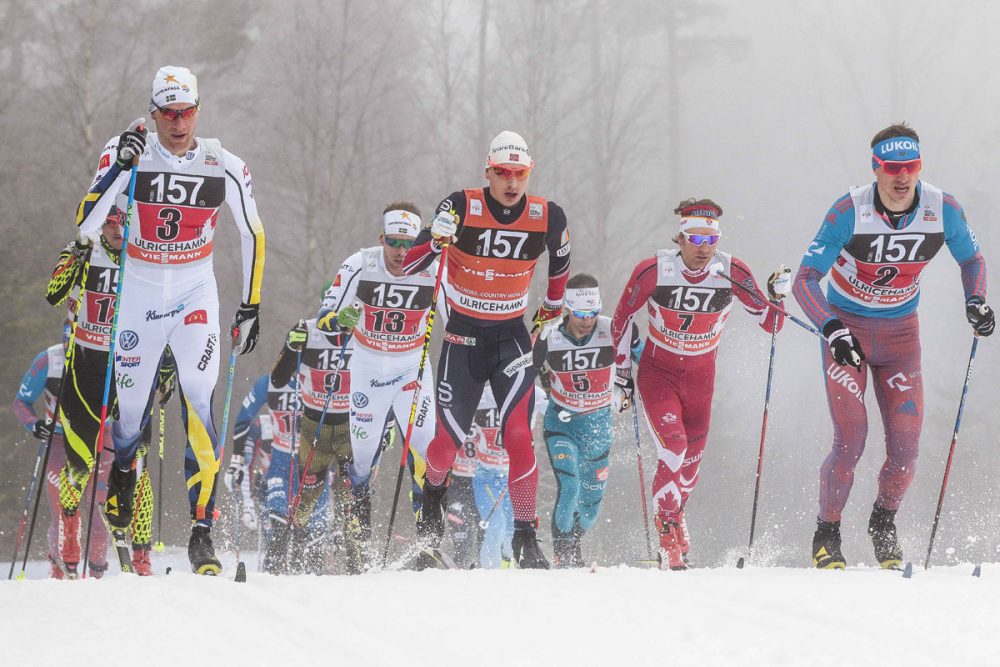
    Canada's Devon Kershaw (bib 7) during the first classic leg of the men's 4 x 7.5-kilometer team relay on Sunday in Ulricehamn, Sweden. (Photo: Fischer/Nordic Focus)
    Canada’s Devon Kershaw (second from r) during the first classic leg of the World Cup men’s 4 x 7.5-kilometer relay on Sunday in Ulricehamn, Sweden. (Photo: Fischer/NordicFocus)

    Kershaw started things off for the Canadians, skiing in bib 7 and positioned in 10th place until just before 2 k, when he made a move to the outside right of the tracks to the front. However, he didn’t lead for long. By 4 k, Russia’s Sergey Turyshev had overtaken him, followed by Sweden’s Daniel Rickardsson and Italy’s Dietmar Nöckler.

    Coming into the exchange zone, it was Kazakhstan’s Alexey Poltoranin in the lead, and Kershaw in fifth. Kershaw tagged off to Harvey for the second classic leg.

    Within the first half a kilometer, Harvey was at the helm of the leading pack of nine.

    “I knew that the heavy hitters were on my leg, but it was good,” Harvey said. “It was hard on the big hill, but then over the top I had really fast skis.”

    At 2.5 k Finland’s Iivo Niskanen and Russia’s Alexander Bessmertnykh traded off leads. Within another 4 k, Norway’s Martin Johnsrud Sundby moved to the front. The Norwegian maintained the lead through the exchange zone, while Harvey chased from five seconds back.

    Sundby passed off to Norway’s Anders Gløersen, and Harvey to Johnsgaard for the third leg and first freestyle portion. Despite considering himself a ‘World Cup rookie’, Johnsgaard, of Canada’s U25 Team, maintained his position within the middle of the lead pack.

    “Alex tagged me off in a good position, and my job was to hold that, and give Len the same opportunity I had to ski in the group in a  good position,” the 23-year-old Johnsgaard said.

    Johnsgaard did his job and tagged off to Valjas within five seconds of Gløersen’s tag to Norway’s Finn Hågen Krogh.

    Seven skiers still remained in the front pack with Krogh, Sweden’s Calle Halfvarsson and Italy’s Sebastiano Pellegrin in the lead. Valjas spent most of his first lap in fifth, following as close to the leaders as possible.

    “On the last lap, I was totally blocked on the hill, so I couldn’t actually empty the tank, which was probably a good thing for me, and then just after the hill I built up some speed, and passed five or six guys just double poling,” Valjas said.

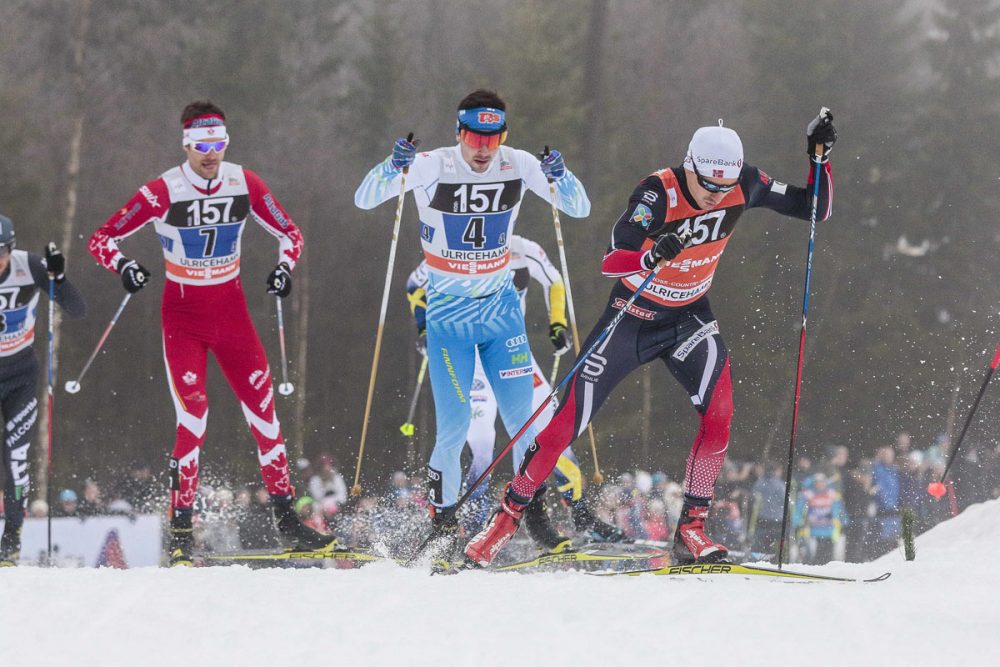
    By the final 300 meters, the Canadian had moved up to second behind Halfvarsson in first. As the group rounded the final corner, however, Krogh moved around to the right of Halfvarsson and Valjas.

    “I gave him a meter in the final turn but I entered the final stretch in good speed” Krogh told NRK of his final maneuver.

    Left to right: Canada's Len Valjas follows Finland's and Norway's Finn Hågen Krogh during the men's 4 x 7.5-kilometer team relay on Sunday in Ulricehamn, Sweden. (Photo: Fischer/Nordic Focus)
    Left to right: Canada’s Len Valjas follows Finland’s and Norway’s Finn Hågen Krogh during the World Cup men’s 4 x 7.5-kilometer relay on Sunday in Ulricehamn, Sweden. (Photo: Fischer/NordicFocus)

    Krogh edged Halfvarsson and Valjas by half a second for the win in 1:06:47.5.

    “I would have like to have won but Finn Hågen is fast,” Halfvarsson told NRK of his final maneuver.

    In his first time anchoring a team relay, Valjas views the moment as one he’ll never forget.

    “I’ve never been the anchor in a relay. I’ve been the second leg in some team sprints, but today was special, the best feeling I’ve ever had skiing, seeing my three teammates sprinting towards me at the finish line,” Valjas said. “I don’t think anything will ever top that, the first relay [podium] for Canada.”

    The U.S. men fielded a team with Andy Newell handing off to Erik Bjornsen, followed by Noah Hoffman, and Simi Hamilton, who anchored them to 10th (+1:16.5).

    U.S. Ski Team Head Coach Chris Grover explained that while Newell maintained contact with the pack during his first lap, he lost it during his second time around.

    “The second time up the big climb he got stuck behind a Russian who was fading,” Grover said on the phone. “By the time he got around, he lost contact with the lead. Then coming down into the stadium he had a fall. And then after that, he was maybe 16 seconds behind the group in front of him. That really took us out of contention.”

    Newell tagged Bjornsen in 13th, 23.2 seconds out of first. From there, the U.S. men steadily picked off the places, with Bjornsen moving into 12th by the second exchange, Hoffman improving to 11th by the last exchange, and Hamilton finally finishing 10th.

    Results

    — Chelsea Little, Jake Ellis and Aleks Tangen contributed

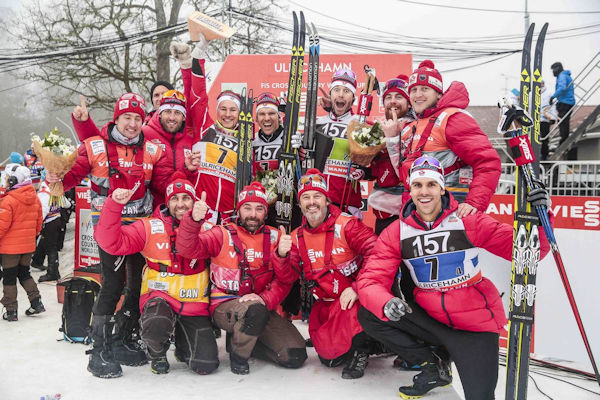
    Team Canada celebrates their first World Cup relay podium in the men's 4 x 7.5-kilometer team relay on Sunday in Ulricehamn, Sweden. (Photo: Cross Country Canada)
    Team Canada celebrates its first World Cup relay podium in the men’s 4 x 7.5-kilometer relay on Sunday in Ulricehamn, Sweden. (Photo: Cross Country Canada)
  • After Five Weeks Away, Bjørgen Back on Top in Ulricehamn; Four Americans in Top 25

    After Five Weeks Away, Bjørgen Back on Top in Ulricehamn; Four Americans in Top 25

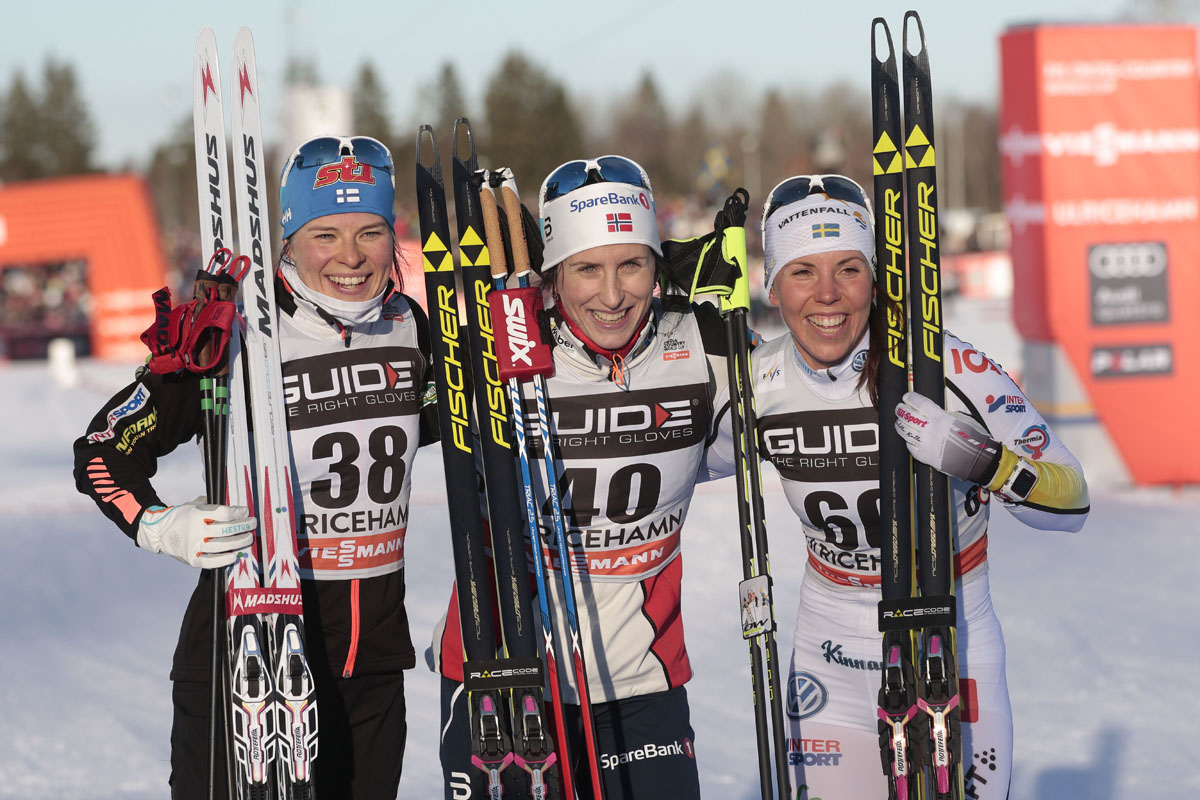
    Left to right: Finland's Krista Pärmäkoski, Norway's Marit Bjørgen and Sweden's Charlotte Kalla on the podium for the women's 10-kilometer freestyle race on Saturday in Ulricehamn, Sweden. (Photo: Fischer/Nordic Focus)
    Left to right: Finland’s Krista Pärmäkoski, Norway’s Marit Bjørgen and Sweden’s Charlotte Kalla on the podium at the World Cup women’s 10-kilometer freestyle on Saturday in Ulricehamn, Sweden. (Photo: Fischer/Nordic Focus)

    There are a lot of things Marit Bjørgen is not. She is not the only woman on Norway’s national team who knows how to win. She is not in the early stages of her cross-country career — her first World Cup debut came in December 1999. In comparison to many of her Norwegian teammates, she is not young. The average age of Norway’s women competing in Saturday’s 10-kilometer freestyle individual start in Ulricehamn, Sweden, (Bjørgen not included) was 25.

    At 36, Bjørgen’s age bests most of her teammates by close to a decade.

    But the new mom is also not letting any of that stop her from adding to her cache of cross-country wins. Saturday being the first opportunity she had since her last race in La Clusaz, France, to prove that winning is what she does.  

    “It’s so much fun to be back because I’ve been on my own for five weeks,” Bjørgen told NRK after Saturday’s race. “At least now I know that I’m on the right path.”

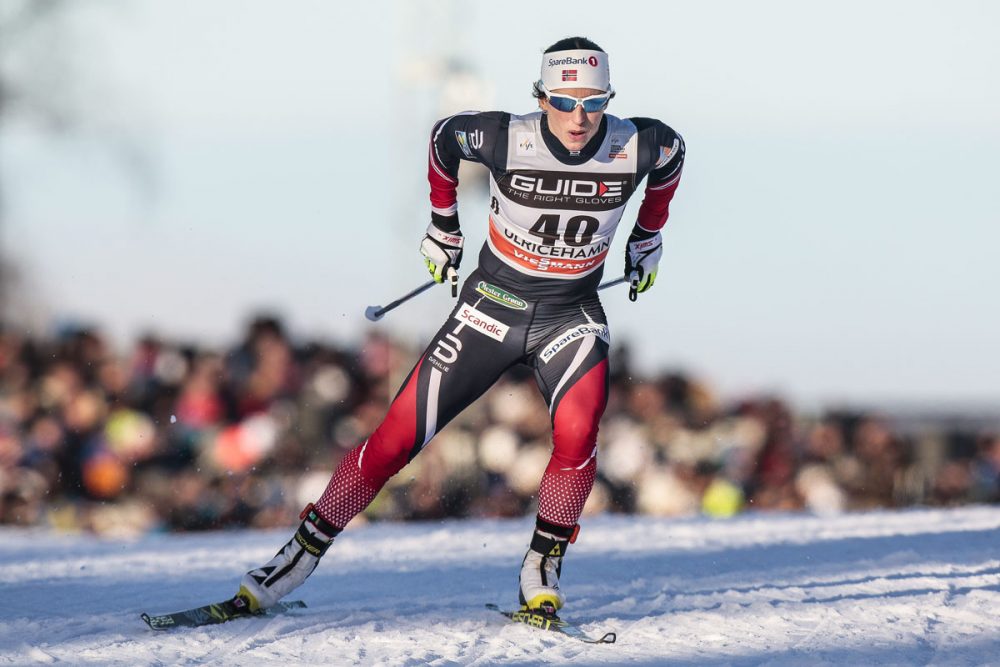
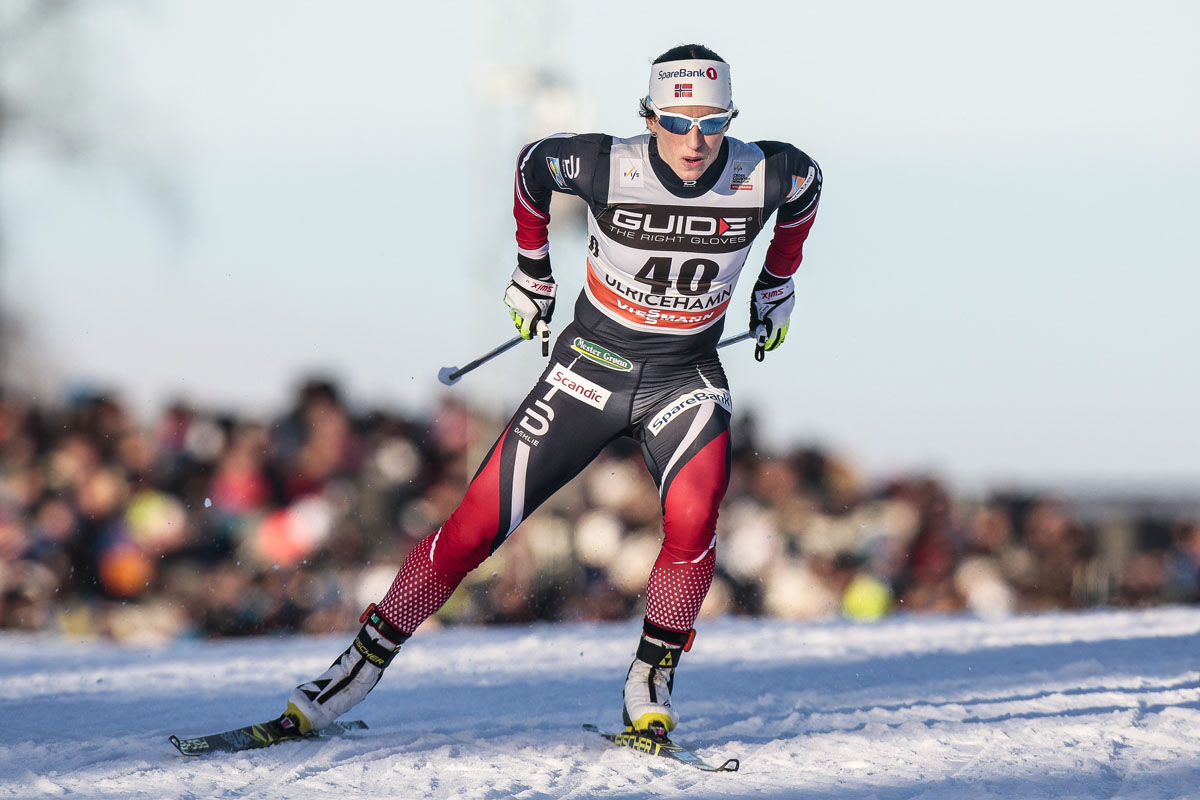
    Norway's Marit Bjørgen on her way to winning the women's 10-kilometer freestyle race on Saturday in Ulricehamn, Sweden. (Photo: Fischer/Nordic Focus)
    Norway’s Marit Bjørgen on her way to winning the World Cup women’s 10-kilometer freestyle on Saturday in Ulricehamn, Sweden. (Photo: Fischer/Nordic Focus)

    However, starting the Ulricehamn 10 k in bib 40, with 21 more racers still hungrily eyeing her back, Bjørgen would not know for sure if she made the right choice until the final starters behind her, including the likes of Sweden’s Charlotte Kalla, completed the course.

    Bjørgen’s Norwegian teammate Heidi Weng and Finland’s Krista Pärmäkoski — who both competed in this year’s Tour de Ski and finished first and second, respectively, in the overall — and started before Bjørgen, were also challenging her choice to forego five weeks of racing.

    Pärmäkoski was first to the front, leading both Weng and Bjørgen by exactly one second at the 1.5 k mark.

    Weng went next, this time Bjørgen and Pärmäkoski trailing behind by less than a second with 7 k still to go. Continually creeping up toward the top three was Kalla in fourth, less than four seconds back and American Jessie Diggins in fifth, within six seconds of the front.

    But with one 5 k lap down, Bjørgen began to break through.

    At 6.5 k, she had put close to three seconds into the Finn, now sitting in second place and more than 15 seconds into her teammate Weng, who had faded to fifth.

    With 2 k to go, Bjørgen continued to lead, while Kalla moved into third. The Swede, however, had no idea she was within 14 seconds of the front. The volume of a home crowd had her confused, thinking she was in 14th place instead.

    “It was all of the noise from the eager Swedish spectators that created the confusion, in addition to a sign with the number 14 on it,” Kalla told adressa.no. “It probably meant that I was 14 seconds behind, but I misunderstood.”

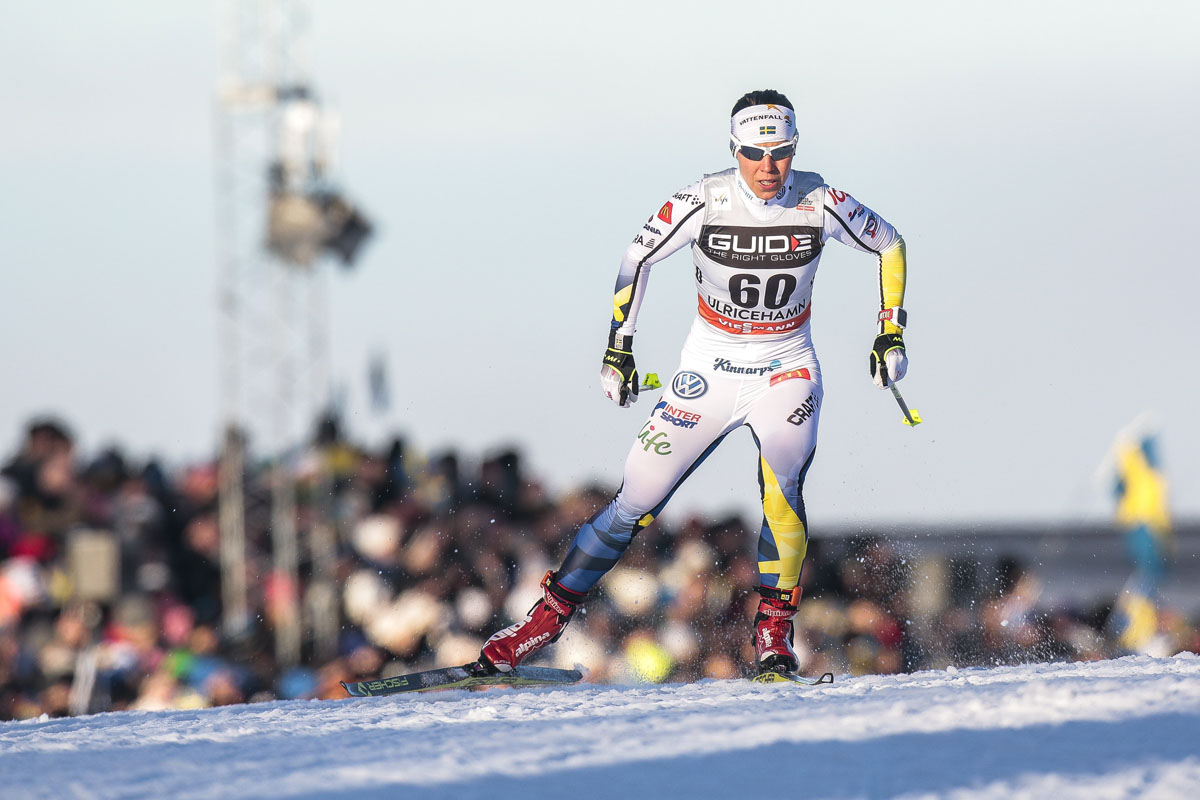
    Sweden's Charlotte Kalla racing to a third place finish in the women's 10-kilometer freestyle race on Saturday in Ulricehamn, Sweden. (Photo: Fischer/Nordic Focus)
    Sweden’s Charlotte Kalla racing to third place in the World Cup women’s 10-kilometer freestyle race on Saturday in Ulricehamn, Sweden. (Photo: Fischer/NordicFocus)

    With no intentional charge coming from Kalla, and Pärmäkoski pushing to the max of her 10 k skate pace, Bjørgen furthered her push for the win. She continued to put time into Pärmäkoski, ultimately finishing 10.7 seconds ahead of her in a time of 23:46.3 for her 104th individual World Cup title.

    When asked about the difference between her start and finishing speed, the Norwegian, who now also holds 22 individual wins on Swedish soil, responded with a bit of humor.

    “I’m starting to get old you know, it takes a while to get going,” Bjørgen told NRK.

    With a second place on Saturday, Pärmäkoski now has six individual podiums this season.

    “I had a great day,” Pärmäkoski said according to an International Ski Federation (FIS) press release. “I have proven to myself I can ski fast also in free technique.”

    Finishing 24.9 seconds behind Bjørgen, Kalla claimed the final podium spot in third, although unbeknownst to her until she received congratulations from Bjørgen and her Swedish teammate Hanna Falk, who finished eighth (+36.4).

    “I first realized that I had finished 3rd when Marit and Hanna gave a hug,” Kalla told adressa.no.

    “The audience [today] was world-class,” she added, according to a FIS press release.

    Four American Women in the Top 25

    Despite Saturday being an individual start, the two-lap 10 k course meant quite a few racers wound up skiing in company. For many of the American racers, that company came from their U.S. teammates.

    Though she started 30 seconds behind her fellow U.S. Ski Team (USST) member Kikkan Randall, Jessie Diggins in bib 32 soon managed to catch Randall in bib 31. The 25-year-old Diggins proceeded to pass her and lead Randall through the first of two laps.

    “I didn’t have the snappy good feelings I was hoping to have in my body today, but it was a solid race,” Diggins, who finished seventh (+34.9), wrote in an email to FasterSkier.

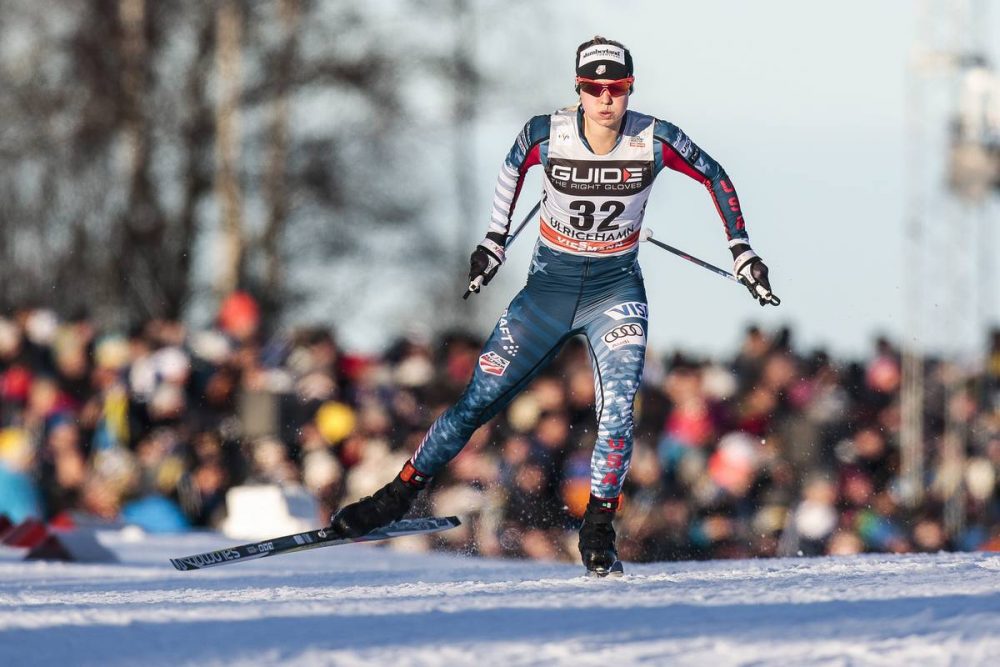
    American Jessie Diggins on her way to a seventh place finish in the women's 10-kilometer freestyle race on Saturday in Ulricehamn, Sweden. (Photo: Salomon/Nordic Focus)
    American Jessie Diggins on her way to a seventh place finish in the World Cup women’s 10-kilometer freestyle on Saturday in Ulricehamn, Sweden. (Photo: Salomon/NordicFocus)

    “It’s always hard when you know that on your best days you are capable of more, but at the same time we had great skis, and it was really fun for me to be able to ski with my teammates today!” she added.

    By the end of Diggins’s and Randall’s first lap together, their USST teammate Sadie Bjornsen cruised on course. For the next lap, Bjornsen led the trio of U.S. skiers.

    “Skating has been going well this year. I have a lot more confidence every time I start a race, so that is fun,” Bjornsen said on the phone after Saturday’s race.

    The U.S. trade-off train continued, with Bjornsen in bib 56 catching another USST member Rosie Brennan — who had start 30 seconds ahead of her in bib 55 — for their last lap.

    “It was an American line out there,” Bjornsen added, who ended the day as the second American in 12th (+1:00.5).

    The ‘American line,’ at least with Bjornsen, was something Brennan anticipated.

    “You never really want to get caught but … I love skiing with Sadie and so it was great to have her pull me into the finish,” Brennan said on the phone.

    Brennan further explained that having the comfort of a teammate, whose strengths and weakness could compliment her own, also made the pass more appreciated.

    “When some of these other fast girls come past you, [because] you’ve never skied with them before, it’s hard to truly believe you can keep up with them, but when it is someone you have spent so much time skiing with it was easy to convince myself like ‘oh of course I can stay with her’.” said Brennan, who ultimately finished 24th (+1:30.7).

    The one American who did not see any of her U.S. teammates during the race was Liz Stephen, who started 14th and finished the day in 16th (+1:07.30).

    Instead, Stephen found herself racing with another familiar face, Italy’s Virginia de Martin Topranin, who spent time training with Stephen on Eagle Glacier this summer.

    “We skied part of a lap together,” Stephen said on the phone. “But other than that I didn’t see anybody out there, which is good. That’s the point of an individual start … Mass starts you get to see plenty of people, sometimes it feels good just to be by yourself.”

    The fifth American woman to finish was Randall in 40th (+1:59.6) followed by Liz Guiney, the Period 1 SuperTour leader from the Craftsbury Green Racing Project, in 52nd (+2:33.2).

    “Competing in Ulricehamn was pretty awesome today,” Randall wrote in an email to several media outlets. “The course was packed with some of the most enthusiastic fans I’ve ever seen! It was a pretty cool course, too. Deceptively hard with a lot of gradual terrain and not many places to recover.

    “I had great skis today and a couple of really good opportunities to ski with my teammates,” she added. “But unfortunately I wasn’t able to fully capitalize on those rides and had a lackluster day. I had a decent race from about 2.5km to 7.5km but wasn’t able to keep the pedal down.”

    USST Head Coach Chris Grover noted that while there won’t be a 10 freestyle event at World Championships in a little over a month, the U.S. women’s team performance on Saturday was a good sign of where their training has taken them and where they are headed.

    “Of course you are always … hoping that we are going to have a podium but that’s not going to happen every day,” Grover said. “I think it is an excellent indication that we have a lot of women who are extremely fit and on the right day they can have some pretty extraordinary results.”

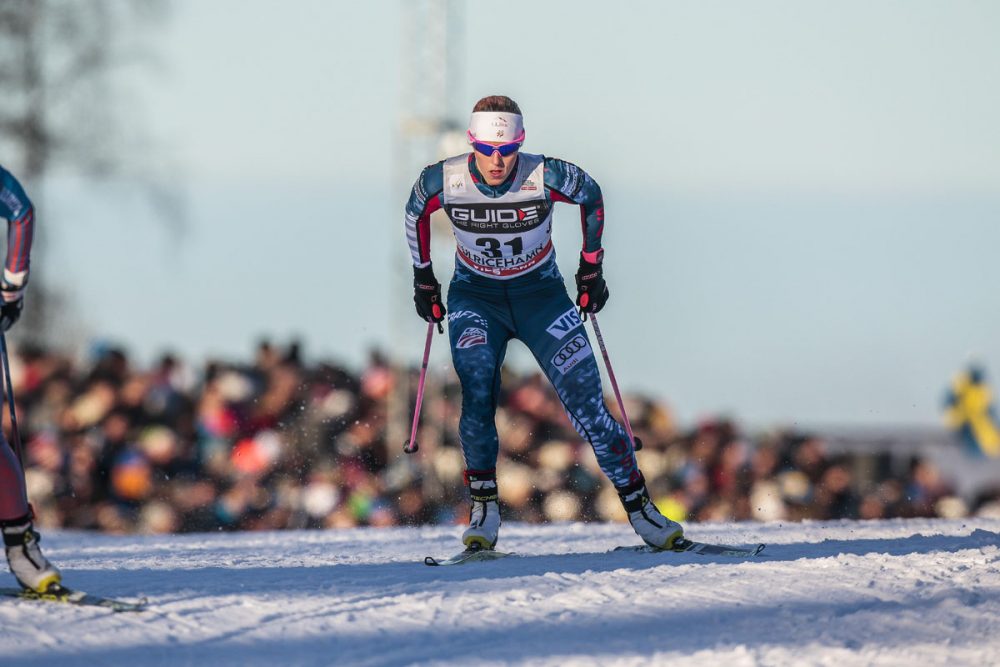
    American Kikkan Randall racing during the women's women's 10-kilometer freestyle race on Saturday in Ulricehamn, Sweden. (Photo: Fischer/Nordic Focus)
    American Kikkan Randall racing during the women’s women’s 10-kilometer freestyle race on Saturday in Ulricehamn, Sweden. (Photo: Fischer/Nordic Focus)

    The lone Canadian woman competing on Saturday in Ulricehamn, Cendrine Browne, of Canada’s national U25 Team, posted her career-best individual World Cup result in 35th (+1:52.0).

    “Along the race the coaches were telling me, ‘You’re five seconds away from top 30!’ ” Browne recalled on  the phone after. “So I was really trying to push harder. I was a little tired at the end, so next time I’d like to be less tired, but I guess you can’t really control that.”

    Browne explained that though most of her teammates remained in North America in order to prep for U23 or senior World Championships, she felt traveling to Europe and racing the World Cup was what she need to best prep for the upcoming Lahti cross-country events.

    “I had the choice to stay home, and train, and do races at home, but I also had the choice to come here and race instead, and I really love racing on the World Cup,” Browne explained.

    Athletes return tomorrow for the women’s 4 x 5 k relay. The U.S. women’s squad will field two teams, one with Brennan, Bjornsen, Stephen, and Diggins in bib 4, and the other with Randall, Sargent, Sophie Caldwell, and Guiney in bib 9.

    “I’m really looking forward to anchoring one of our TWO relay teams tomorrow!” Diggins wrote. “It’s really special for us to be able to field two teams and relays are my absolute favorite days. Time to break out the relay socks!”

    “So fun to see my teammates ski well today which has us all fired up for tomorrow’s relays!” Randall wrote. “Really pumped that we are fielding two women’s teams!”

    Results | Relay start list