From the FasterSkier archive — posts syndicated from athletes’ and coaches’ own blogs between 2004 and 2012, kept online as published. Current coverage is at fasterskier.com.
The International Ski and Snowboard Federation (FIS) unveiled its proposed 2026/2027 cross-country skiing World Cup calendar this week at the FIS Spring Meetings in Portorož, Slovenia.
The schedule — first shared publicly through FIS social media and still pending FIS Council approval — builds the season around the 2027 World Championships in Falun, Sweden, with three pre-Christmas stops, a nine-race Tour de Ski, a stretch of three weekends between the Tour and Worlds, and a Scandinavian closing kick that ends with the Finals in Ulricehamn.
For North American fans, the calendar is once again entirely European, with no scheduled stops in Canada or the United States.
Frida Karlsson (SWE) poses with Mr. and Mrs. Claus following the 10k Classic to start last season in Ruka (FIN). (Photo: Modica/NordicFocus)
Pre-Holiday: Ruka, Trondheim, Davos
The season opens where it almost always does — in Ruka, Finland, where the World Cup begins November 27. From there, the circuit moves to Trondheim, host of the 2025 World Championships, before the pre-Christmas block closes in Davos, Switzerland, with a team sprint.
November 27-29, 2026: Ruka, Finland
27/11: 10km Interval Start Classic
28/11: Sprint Classic
29/11: 20km Mass Start Freestyle
December 1-3, 2026: Trondheim, Norway
01/12: 10km Interval Start Classic
02/12: Sprint Freestyle
03/12: 20km Skiathlon
December 11-13, 2026: Davos, Switzerland
11/12: 5km Heat Mass Start Freestyle
12/12: Sprint Freestyle
13/12: Team Sprint Freestyle
With Jessie Diggins (USA) now retired, there will be a new FIS Overall Crystal Globe and Tour de Ski champion next season (Photo: Vanzetta/NordicFocus)
Tour de Ski 2026/2027
The Tour de Ski returns to a three-country format, opening in Les Rousses, France, on New Year’s Day, moving to Oberstdorf, Germany, and finishing with three races in Val di Fiemme, Italy — capped, as ever, by the Final Climb up Alpe Cermis.
January 1-3, 2027: Les Rousses, France
01/01: Sprint Classic
02/01: 20km Mass Start Classic
03/01: 15km Pursuit Freestyle
January 5-6, 2027: Oberstdorf, Germany
05/01: 15km Mass Start Classic
06/01: 5km Heat Mass Start Freestyle
January 8-10, 2027: Val di Fiemme, Italy
08/01: 15km Skiathlon
09/01: Sprint Freestyle
10/01: Final Climb
Gus Schumacher (USA) and the rest of the US team will hope to continue their success in Toblach (ITA). (Photo: Modica/NordicFocus)
After the Tour, Before Worlds: Engadin, Toblach, Lahti
Three weekends bridge the Tour de Ski and the World Championships. Engadin opens its weekend with a mixed relay — a format the FIS has been working into more World Cup weekends — and Lahti closes the pre-Worlds stretch with its classic 20km skiathlon and 10km interval start.
January 22-24, 2027: Engadin, Switzerland
22/01: Mixed Relay
23/01: Sprint Freestyle
24/01: 20km Mass Start Freestyle
January 29-31, 2027: Toblach, Italy
29/01: 10km Interval Start Freestyle
30/01: Sprint Freestyle
31/01: 20km Mass Start Classic
February 12-14, 2027: Lahti, Finland
12/02: Sprint Classic
13/02: 20km Skiathlon
14/02: 10km Interval Start Classic
Kendall Kramer (USA) had a breakout World Cup Skiathlon in Falun (SWE) last season. (Photo: Authamayou/NordicFocus)
2027 FIS Nordic World Ski Championships: Falun, Sweden
The 2027 FIS Nordic World Ski Championships run from February 22 through March 7 in Falun, Sweden, with all title formats on the program. Falun last hosted Worlds in 2015.
Final Period: Oslo, Drammen, Ulricehamn
The closing stretch is a Scandinavian one. Oslo’s Holmenkollen weekend features back-to-back 50km mass start classic races on March 13 and 14 — long a fixture of the late-season calendar — before a one-day sprint stop in Drammen and the World Cup Finals in Ulricehamn, Sweden.
March 13-14, 2027: Oslo, Norway
13/03: 50km Mass Start Classic
14/03: 50km Mass Start Classic
March 16, 2027: Drammen, Norway
16/03: Sprint Classic
March 19-21, 2027: Ulricehamn, Sweden (World Cup Finals)
19/03: 10km Interval Start Freestyle
20/03: Sprint Freestyle
21/03: 20km Mass Start Classic
The calendar remains subject to FIS Council approval.
In this episode, Devon and former Canadian National Team member Jess Cockney discuss the intricacies of Saturday’s skate sprint and Sunday’s team sprint in Ulricehamn, Sweden.
Jessie Diggins in yellow – continues to lead the overall World Cup. (Photo: NordicFocus)
The stage has been set, the first few acts are over, yet the curtain has not closed — Jessie Diggins with a third place in Saturday’s sprint brings her closer to securing the World Cup overall as the season enters it’s last month and a half of racing. No other way of putting it, Diggins looks in-form and formidable.
Oskar Svensson (SWE), and Gleb Retivykh (RUS), (l-r) closing down on a tight finish. (Photo: NordicFocus)
The men’s skate sprint saw a slimmed down Norwegian squad locked out of the final and Oskar Svensson of Sweden sweep in for another win. And Sunday, that was team sprint day – we’ll let Kershaw and Cockney drill down on the merits of that race. You’ll hear some Yin and Yang.
And as a bonus, we get a brief oral history of perhaps the most Canadian of things, the xc-ski air guitar. The origin myths you hold close to your heart may be dispelled.
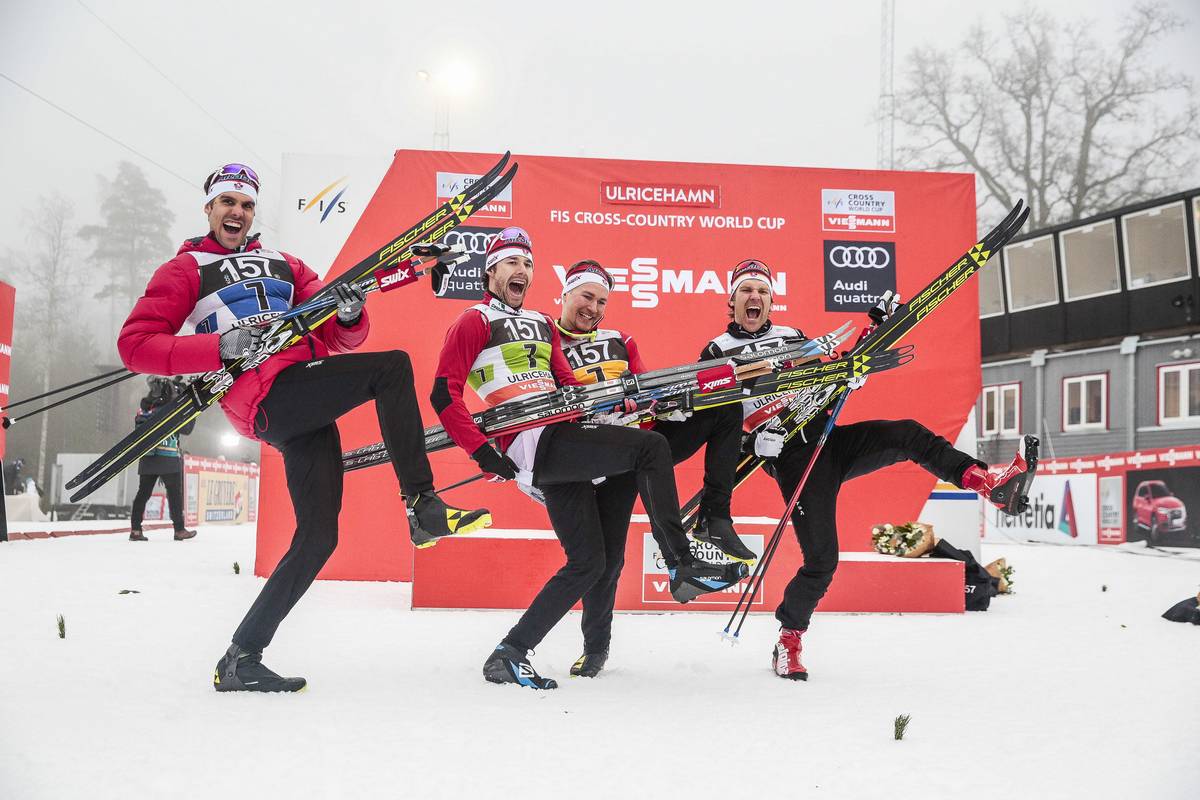
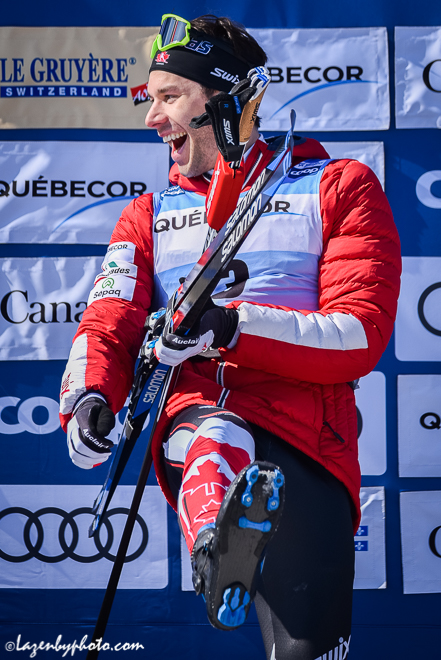
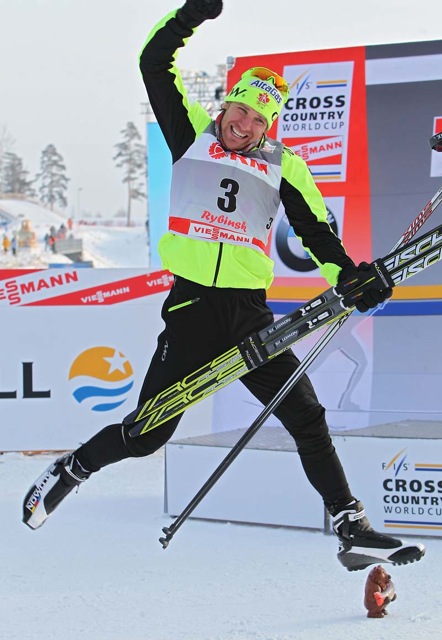
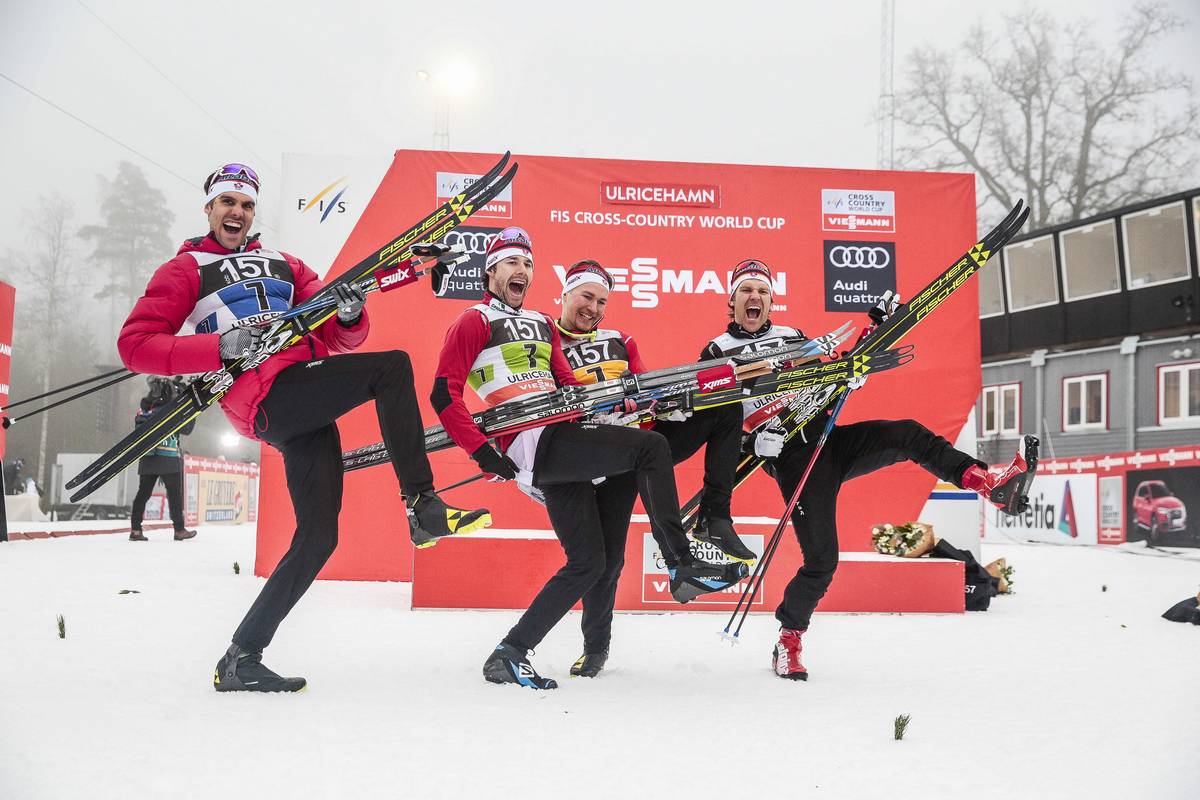
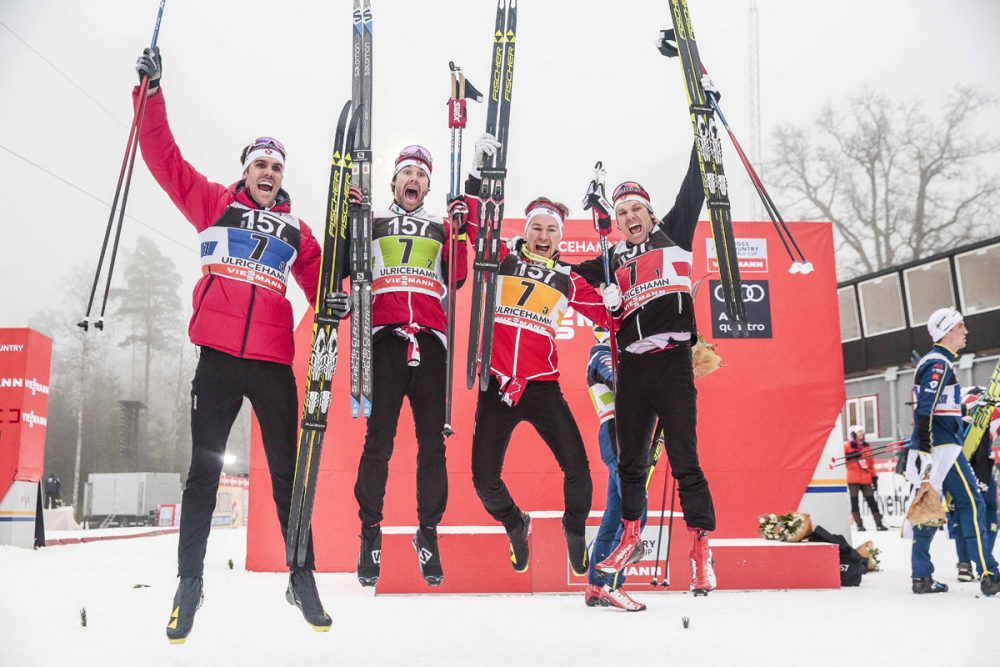
The Canadian men’s relay (hair band or boy band?… after placing third for Canada’s best World Cup result in the 4 x 7.5 k, with (from left to right), Lenny Valjas, Alex Harvey, Knute Johnsgaard, and Devon Kershaw. Guitar vintage- 2017. (Photo: Salomon/NordicFocus)One more riff: Harvey’s “air -guitar” remains in tune. (Photo: John Lazenby/lazenbyphoto.com)Kershaw celebrating and channeling Pete Townshend after winning a race in Russia in February 2012. Photo: Fischer/Nordic Focus.
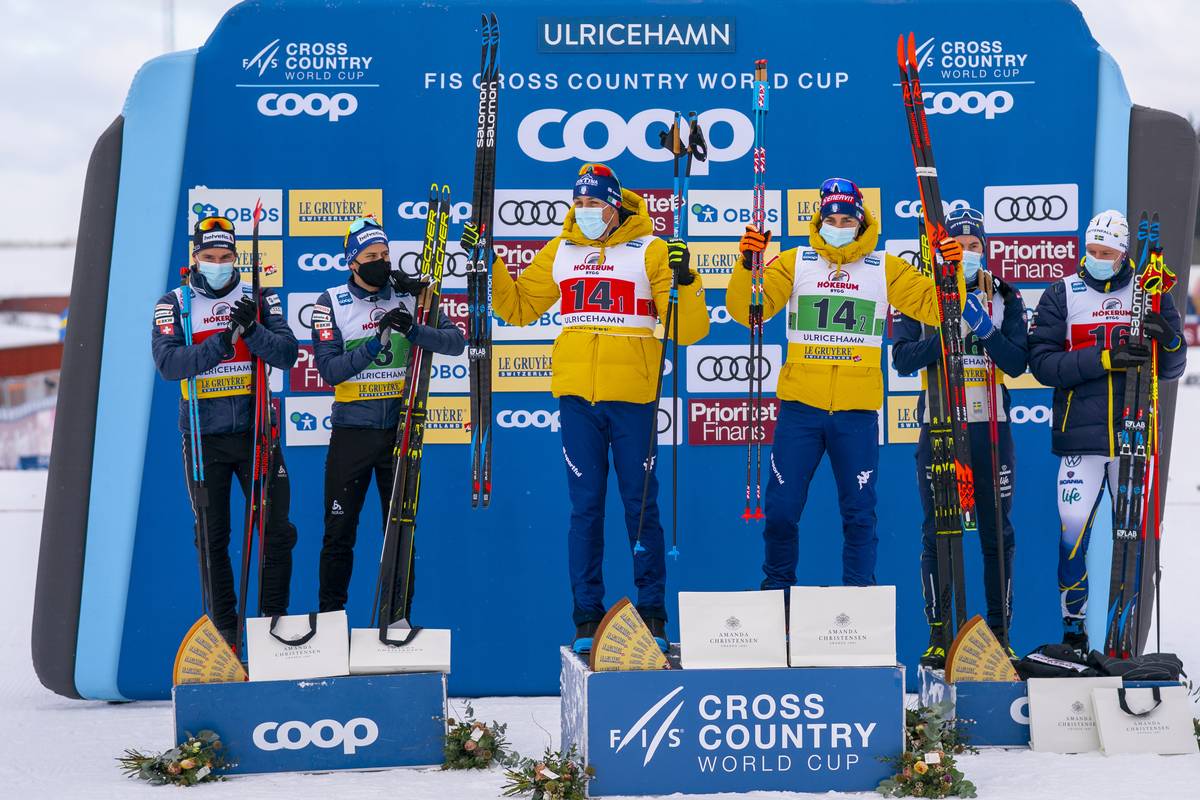
Men’s team sprint podium, Italy in first, Switzerland in second and Sweden in third. (Photo: Nordic Focus)
This World Cup coverage is made possible through the generous support of Marty and Kathy Hall and their A Hall Mark of Excellence Award. To learn more about A Hall Mark of Excellence Award or to learn how you can support FasterSkier’s coverage please contact info@fasterskier.com.
Ten teams toed the line Sunday morning, representing eight nations (Sweden and Switzerland both having two teams in the final) in the skate team sprint in Ulricehamn, Sweden. After advancing from the semi-final rounds earlier in the day, the men were geared up to race the relatively-flat 1.6 k loop completing three laps per athlete.
Heading out for another lap, Ludek Seller (CZE), Jovian Hediger (SUI), and Lucas Chanavat (FRA), (l-r)
Notably absent from the final was team Russia I, composed of powerhouse sprinters Sergey Ustiugov and Gleb Retivykh who finished 9th (+15.32) in semi-final B and did not advance. Both Russians were in Saturday’s skate sprint final with Retivykh second and Ustiugov sixth. Additionally, no Norwegians were present in the final lineup as both Norway I and II were eliminated in semi-final A.
Men’s semi-final B, team Russia I was eliminated although Italy (left) and USA I (bib 18) advanced to the final. (Photo: Nordic Focus)
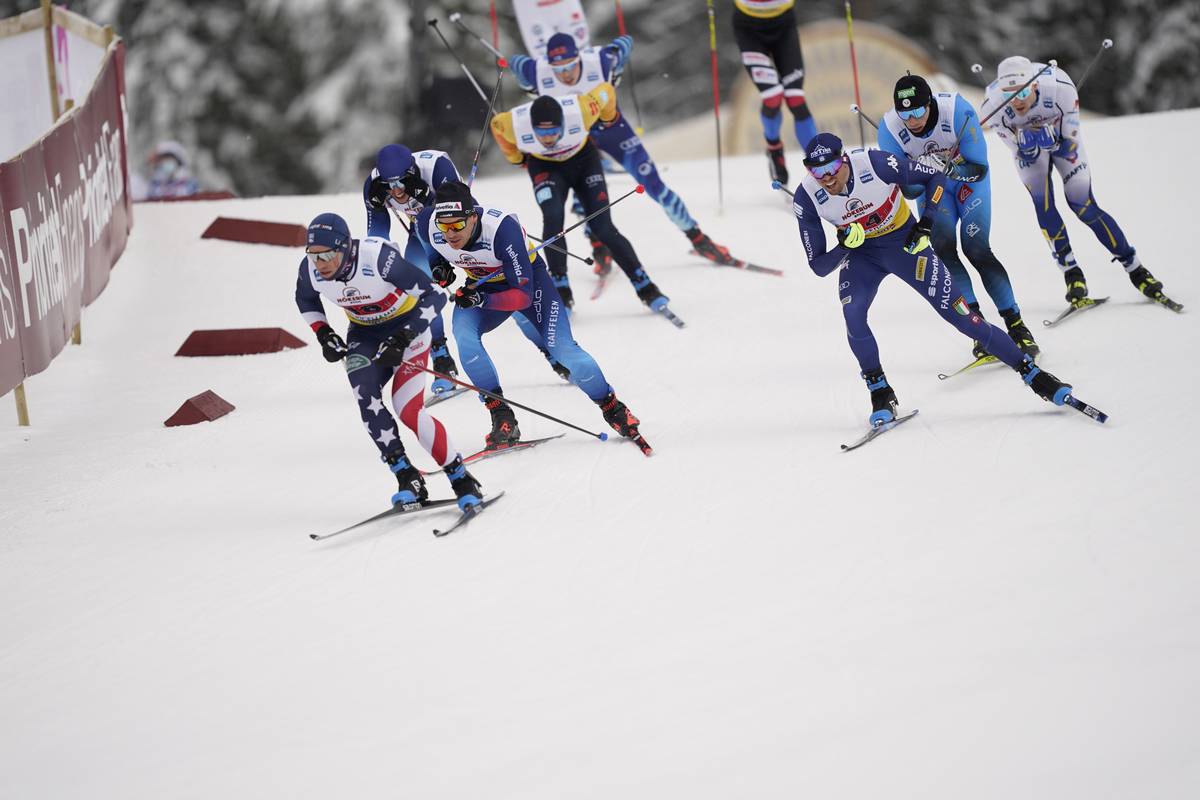
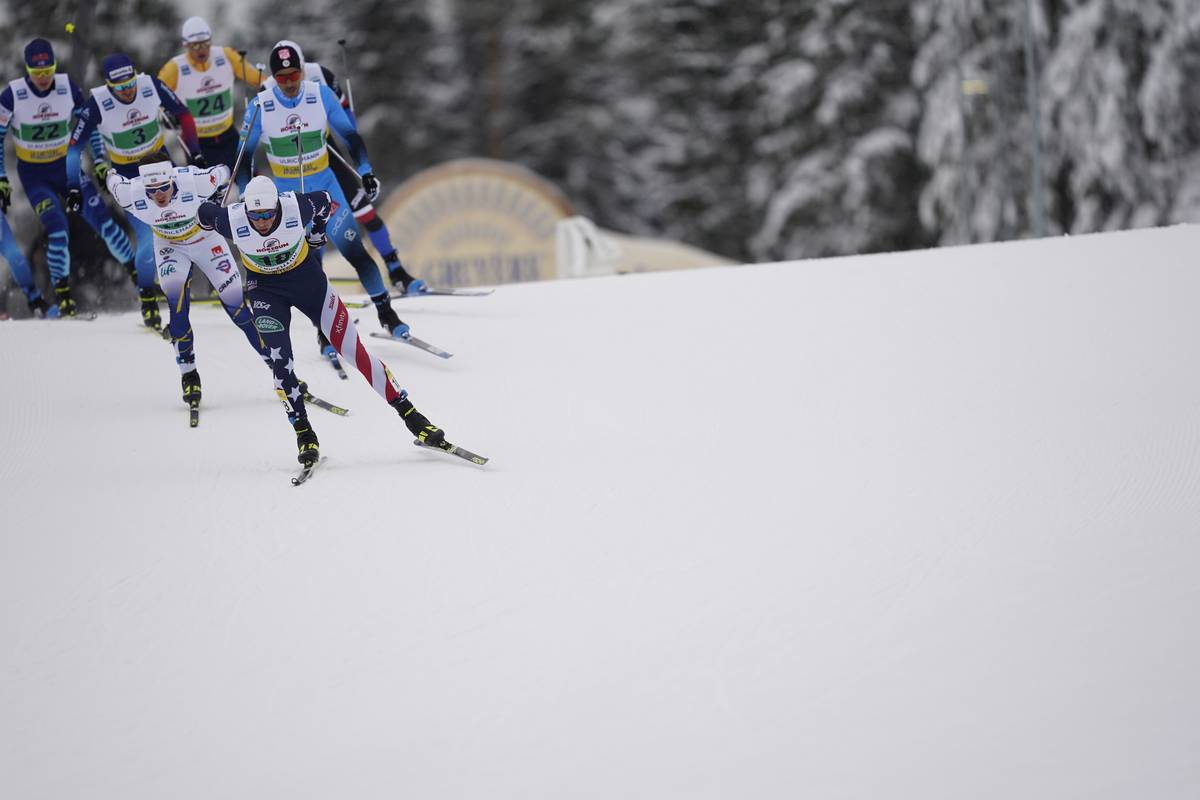
The race began slow and steady for the first laps, gradually ramping up in intensity. Much like the team sprint earlier this season in Dresden, Germany, the course layout in Ulricehamn featured no punchy climbs. Pack skiing, by default, was encouraged. Fliers off the front were not incentivized. Simi Hamilton and Kevin Bolger, representing team USA I, took on the lead for much of the second and third laps.
“Our main tactic for both the semis and the finals was to get to the front but if you found yourself off the front in the lead, just ski relaxed and fast, but ski relaxed,” said Hamilton after the race. Ideally, we wanted to be in second, third, or fourth so we could get a good draft on the gradual climb and coming back down from the top. But with such a high-speed course like this, and a few, I would not call them technical corners, but some fast corners and a lot of moving around, we did not want to be stuck in the back where there could be some crashes and some broken poles and you are also spending a lot more energy moving up through the pack.”
Simi Hamilton makes the descent into the stadium, followed in hot pursuit by Roman Jovian Hediger (SUI) and Francesco de Fabianai (ITA). (Photo: Nordic Focus)
Kevin Bolger (USA), Richard Jouve (FRA), (l-r). (Photo: NordicFocus)
Heading into the fifth and final exchange, the men jostled for position as they rounded the corner towards the stadium. Lucas Chanavat, who had held the advantage out front, clipped his skis and went down, effectively eliminating team France I from contention.
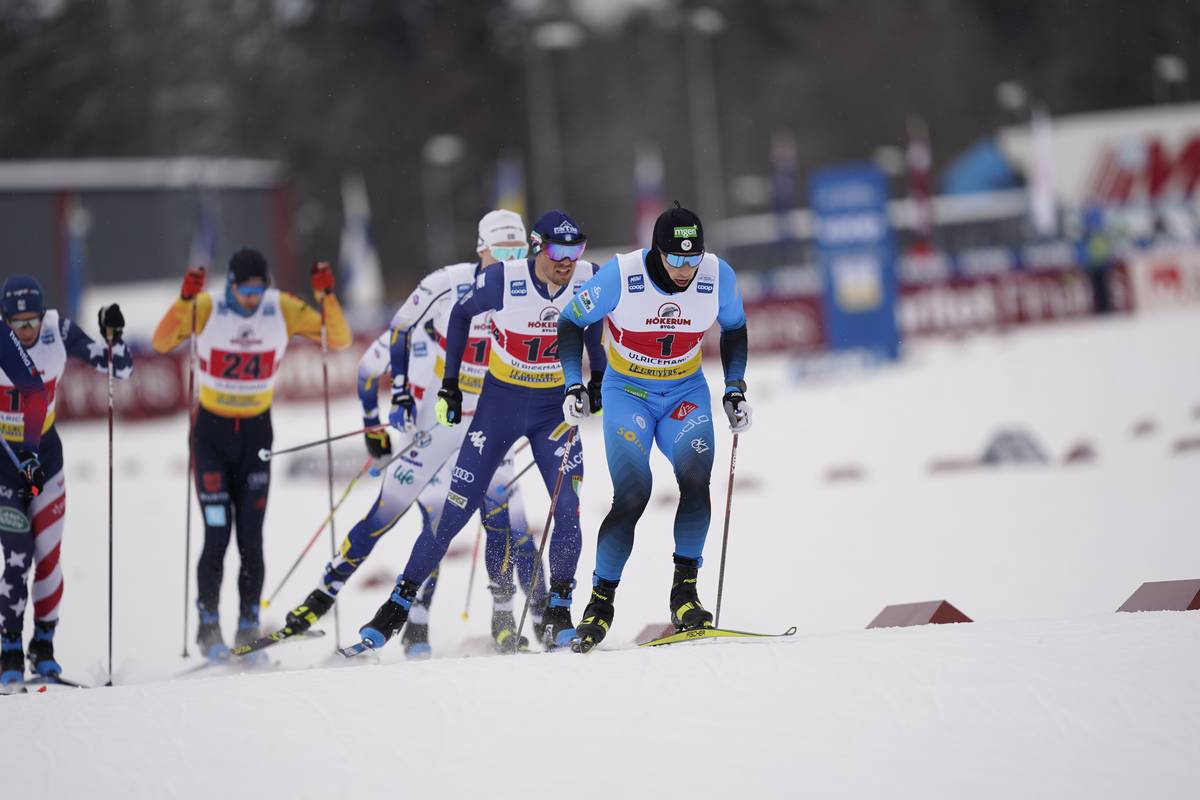
Lucas Chanavat (bib 1), Renaud Jay (bib5), and Sindre Bjørnestad Skar (bib 2), during their semi on Sunday. This image provides a good indication of the tight pack skiing with ten teams on course. (Photo: NordicFocus)Lucas Chanavat (FRA) with the lead before a fall took him out of contention (Photo: Nordic Focus)
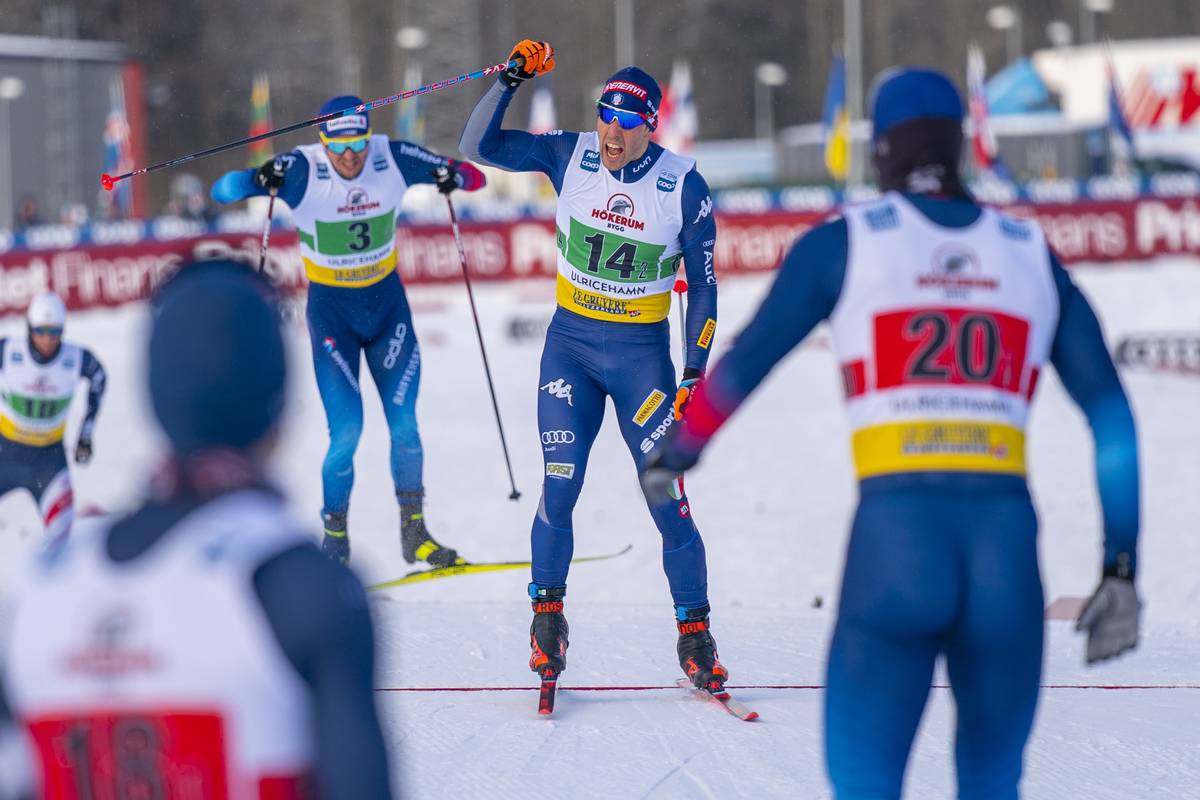
The workhorse of the Italian sprint team, and always a threat when skate sprinting for that matter, remains Federico Pellegrino. With his usual Norwegian foils absent this weekend in Ulricehamn, at least on paper, he could be considered a lock for Saturday’s individual skate sprint. He placed third – outhustled and outmaneuvered down the final straight by Oskar Svensson and Retivyk, to place third. Sunday, however, was another day. With speed and precision, Pellegrino took control at the front as the race got real leading into the stadium for the finish. He was closely followed by Roman Furger skiing for Switzerland I. In classic form, which means pulling away and displaying stoke, Pellegrino took the victory for himself and teammate Francesco de Fabiani in a time of 18:29.
Federico Pellegrino (ITA) celebrates the win. (Photo: Nordic Focus)
Securing second, with much enthusiastic cheering and shouting from his teammates, Furger and Jovian Hediger made it a double podium day for the Swiss (the Swiss women having finished third). Rounding out the podium in third was Sweden II, represented by Karl-Johan Westberg and Johan Häggström.
The Americans, Hamilton and Bolger, finished the day in sixth position, +3.11 back from the Italian victors.
Jovian Hediger (SUI) gets a boost from some happy teammates at the finish line. (Photo: Nordic Focus)
Logan Hanneman (USA) representing USA II in semi-final B. (Photo: Nordic Focus)
Competing in the first semi-final (A) team Canada placed 10th, +20.74 back from heat winners France I, and did not advance. Racing in semi-final B, team USA II (Logan Hanneman and Peter Holmes) finished 8th (+8.89).
Finals action with Maja Dahlqvist (SWE) leading Sadie Maubet Bjornsen (USA), (l-r). (Photo: NordicFocus)
This World Cup coverage is made possible through the generous support of Marty and Kathy Hall and their A Hall Mark of Excellence Award. To learn more about A Hall Mark of Excellence Award or to learn how you can support FasterSkier’s coverage please contact info@fasterskier.com.
It was a rather cloudy day as the athletes circled Ulricehamn’s sprint loop again and again for Sunday’s freestyle team sprint, urged forward by the cheering of recorded crowds piped through a trailside loudspeakers. After first contesting a semi-final round earlier in the morning, the ten quickest teams moved onto the final, each athlete racing three laps for a total of 7.2 k (each loop being 1.6 k).
Anamarija Lampic (SLO), Mathilde Myhrvold (NOR), Linn Svahn (SWE), (l-r). Svahn’s team placed second overall, while Lampic was part of the winning Slovenian team. (Photo: NordicFocus)
The pace was steady for the first few laps, as the women’s final progressed. Echoing her tactic from the semi-finals, Jessie Diggins skiing for USA I exited exchange three with a high tempo, pushing the pace to stretch out the pack. Diggins, who leads the overall World Cup and placed third in yesterday’s sprint, tagged her teammate, Sadie Maubet Bjornsen for her final lap with a lead of +0.3.
Sadie Maubet Bjornsen (USA) tucks tight into the stadium (Photo: Nordic Focus)
Maubet Bjornsen led out front, shadowed by two Swedes competing for Sweden I and Sweden II. This was Maubet Bjornsen’s first team sprint of the season. In her young 2020-2021 World Cup campaign, she was right in the mix with Sweden’s powerhouse sprinters. Maja Dahlqvist, representing Sweden I with teammate Linn Svahn, took the lead into the final exchange. With the rolling and working course, one that remained tough for athletes to break away on, the sharp end group of skiers tagged off in a dense pack.
Jessie Diggins (USA), Anamarija Lampic (SLO), Linn Svahn (SWE), (l-r) heading out for a final lap. (Photo: Nordic Focus)
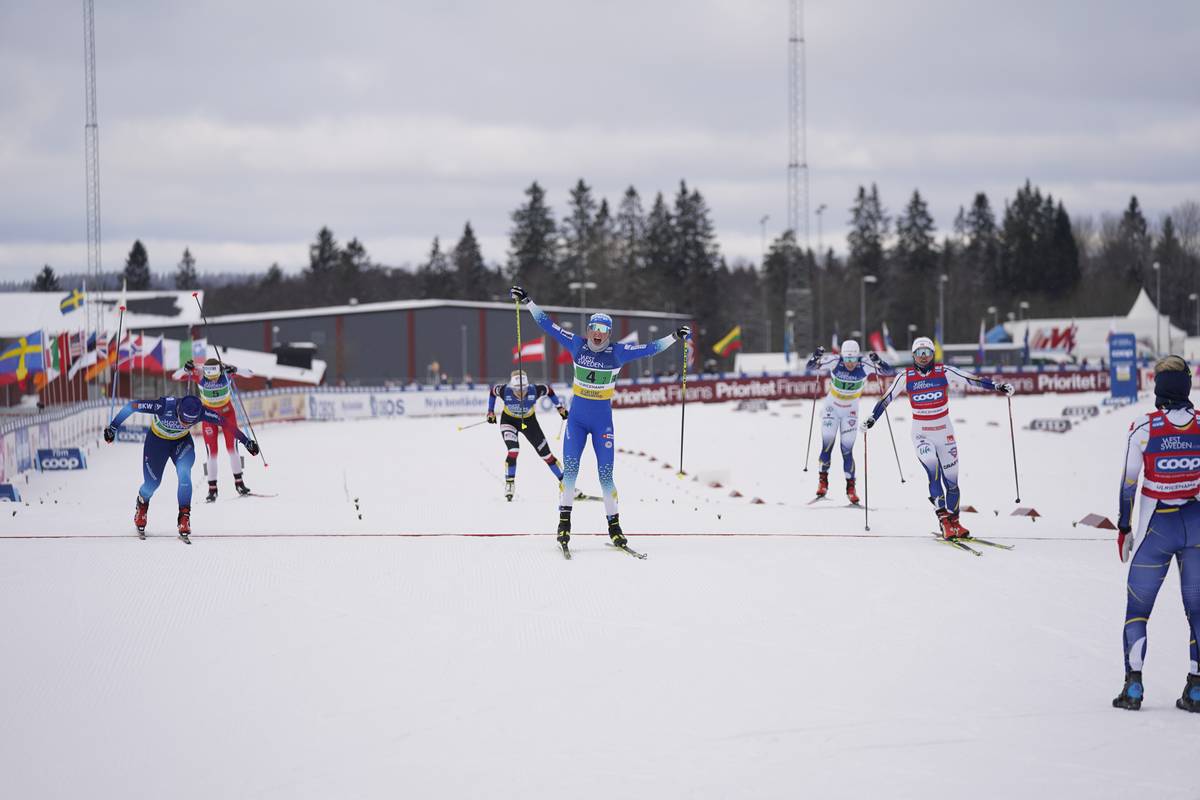
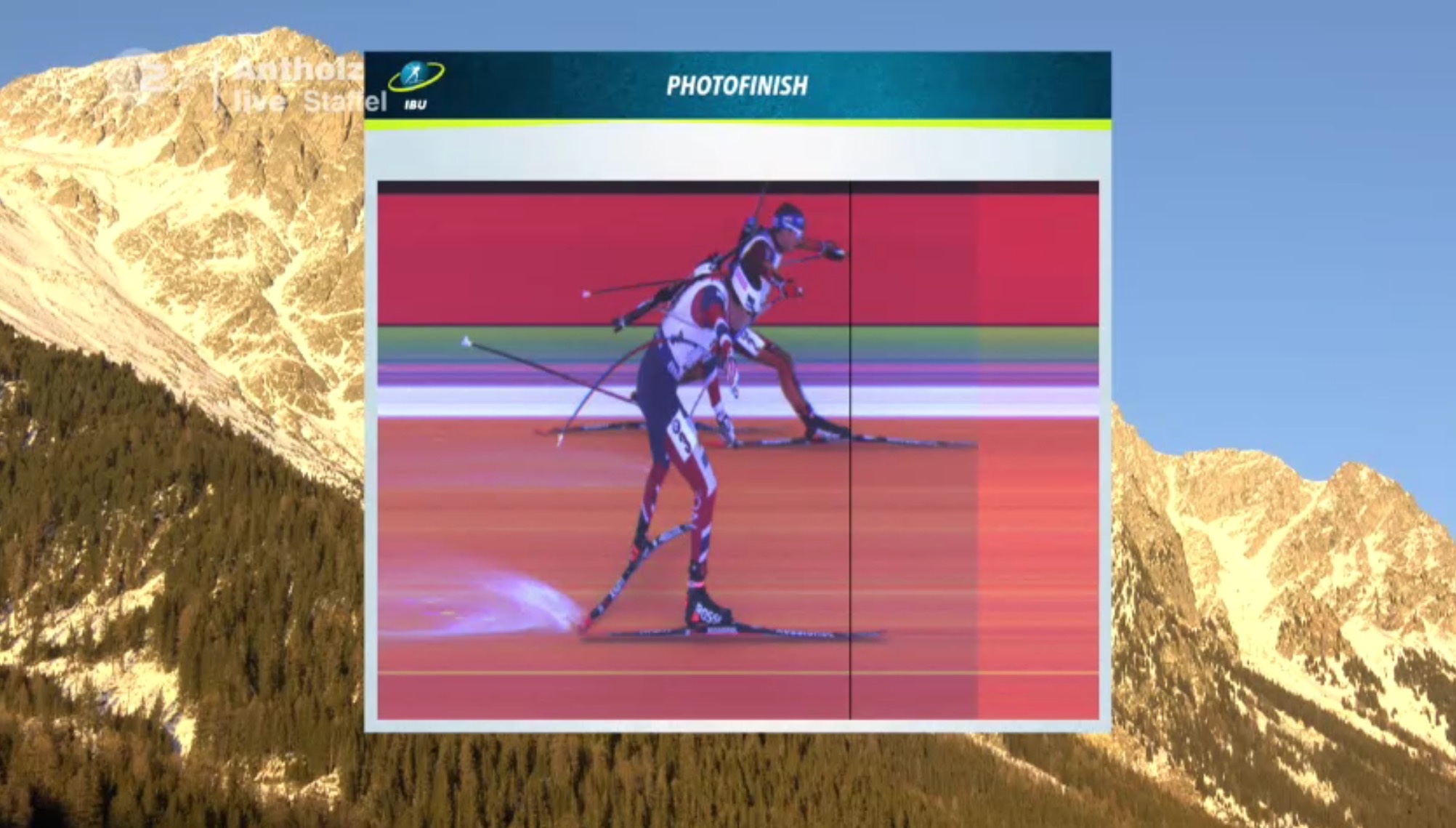
All out for the final lap, a group of eight athletes mostly stayed together. The podium was to be decided in the final few hundred meters. Navigating the corners as they descended into the stadium for the final time, Diggins was boxed out on the outside. With powerful no-pole skating, four athletes entered the finish straight in an all-out battle for the top position. Out lunging the others, Anamarija Lampic took the win for Slovenia. Svahn took second for team Sweden I and Nadine Faehndrich of Switzerland just nicked a boot in ahead of Diggins (USA) to claim third in a photo finish.
“I had a lot of fun being Sadie’s team sprint buddy today! This was a really hard course because it played to none of my strengths; it was windy, no big climbs, and pretty much impossible to drop people or even tire them out because the draft was so big,” Diggins wrote in an email. “So I played the cards I had and tried to push the pace, then tucked in to prepare for a sprint finish but ended up too boxed in. However, I was proud of how we skied a good hard race and left nothing on the table, and it was great practice for team sprints in the future! I was really stoked watching Sadie ski – with grace, power and confidence, and it inspired me to work my very hardest for her! ”
Diggins, along with the U.S. Ski Team will be in Davos, Switzerland preparing for World Championships which begin February 24.
Maubet Bjornsen expressed that World Cup sprints were something she’s reacquainting herself with.
“It was a wild and close team sprint out there today! After feeling a little shy getting back to the full contact world cup sprint racing yesterday, I was feeling extra lucky to have six more chances to ski that course smarter today.
“The semi finals were all about playing it smart, being in the right position, but saving energy for when it mattered most. We tried to learn as much as we could for the finals. That meant leading some laps, attempting some attacks, and sitting behind on some laps. We did a solid job of taking notes for the final. With such a strong head wind, it was a tough position to lead from the front. My mission was to stay in the front and out of trouble, and then attack on leg 3. On such a drafty, tactical course- Jessie and I had to get creative with our strengths. We would have loved to attempt to stretch people from the gun, but the wind was not in our favor.
“After finishing fourth by a photo finish, we both of course left wanting a bit more, but also felt like we did the best we could with our strengths. Even if I am 31 years old, I still feel like every race is a learning lesson, so there are no losses.”
Anamarija Lampic (SLO) celebrates her victory as the remaining athletes lunge for the line. (Photo: Nordic Focus)
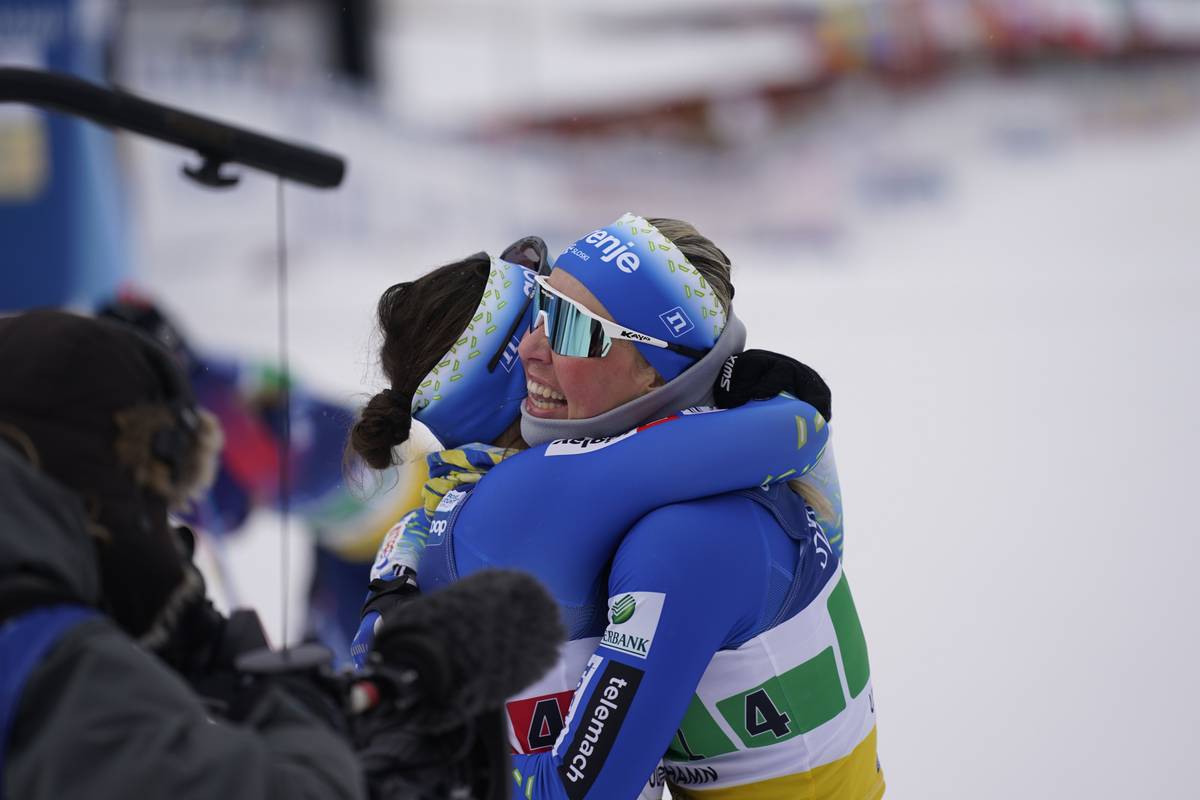
Lampic is currently leading the World Cup sprint standings with 377 points, 96 points ahead of Faehndrich who is in second. For Lampic’s teammate, Eva Urec, today’s victory represents her first career WorldCup win. “It was amazing, it’s my first victory so it feels amazing” said Urec in a post-race interview with FIS.
Happy Slovenians, Anamarija Lampic and Eva Urevc hug in the finish pen after placing first in Sunday’s team sprint. (Photo: Nordic Focus)
Also competing for the U.S. was team USA II, Sophie Caldwell Hamilton and Julia Kern, who dropped back in the final lap of semi-final B and finished 6th (+14.8), not quick enough to advance.
Sophie Caldwell Hamilton (USA), Coletta Rydzek (GER), (l-r) racing in the team sprint semifinals. (Photo: NordicFocus)
After being briefly obstructed during semi-final A when Victoria Carl, skiing for Germany I, lost a ski and went down, team Canada I (Cendrine Browne and Maya Macisaac-Jones) faded to finish seventh. In semi-final B, Canada II (Katherine Stewart-Jones and Dahria Beatty) finished 8th, +46.6 back from Sweden I (Linn Svahn and Maja Dahlqvist) who won the heat.
Racing continues on the World Cup in Nové Město, Czech Republic on February 20 with a classic sprint.
It’s certainly not all glory on the World Cup. With rare exceptions, the fields are always stacked. Yeah, maybe the Norwegians miss the wax with the frequency of a total solar eclipse over your zip code, or a freak storm of molasses-like snow falls just as the top end of the Red Group tips the wand for the 10-kilometer interval start race. Statistically speaking, it’s a rare day when an outlier stands atop a World Cup podium.
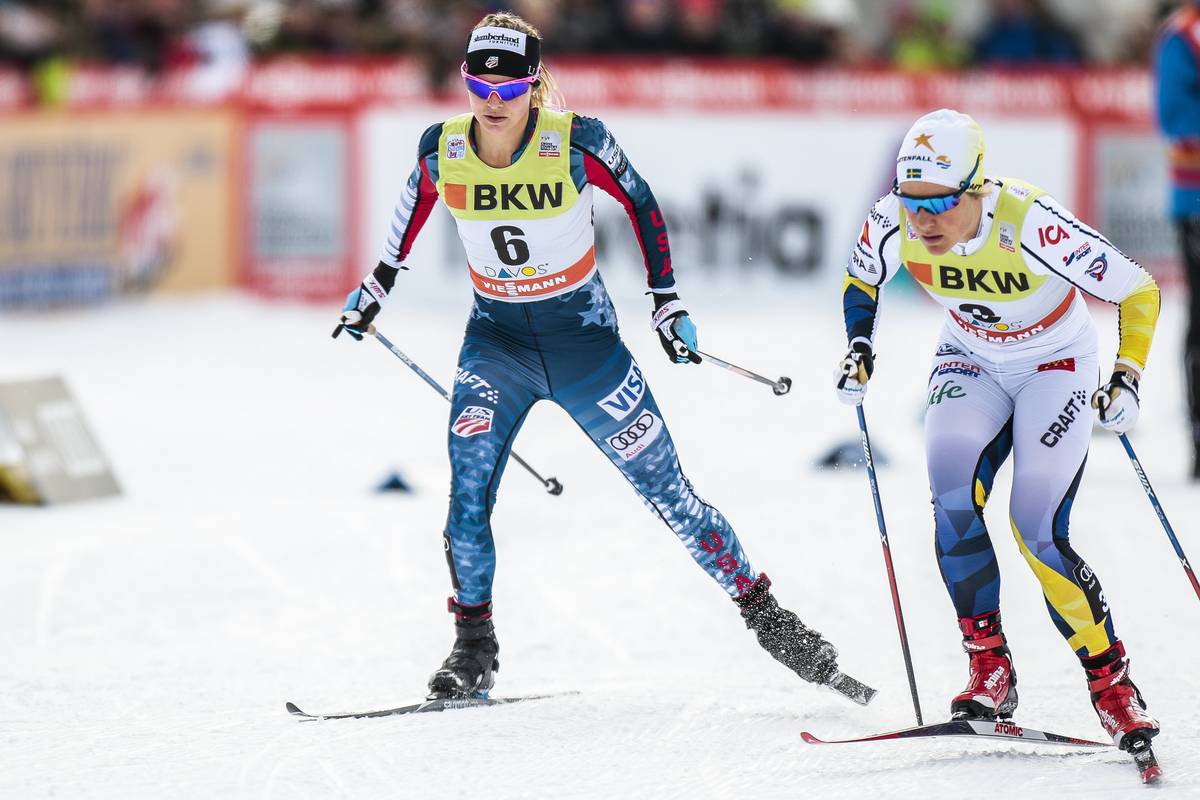
Sweden’s Hanna Falk (r) races with U.S. Ski Team member Jessie Diggins (6) during a World Cup freestyle sprint in Davos, Switzerland, last December. (Photo: Salomon/NordicFocus)
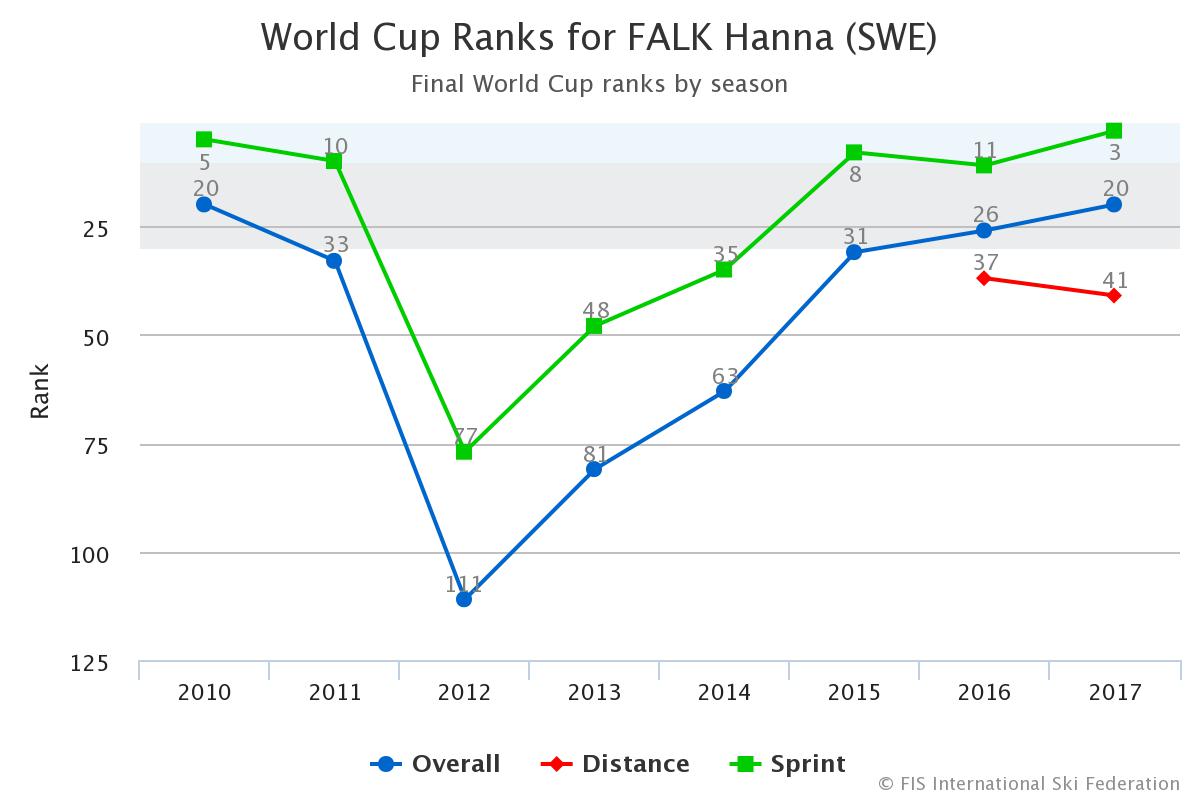
Swedish National Ski Team member Hanna Falk, 28, knows the top spots are tough to get and fleeting. In 2010, her first full year on the World Cup, she burst onto the scene and finished an astounding fifth overall in the final sprint rankings.
That early success was hindered by illness. By 2015, Falk rebounded, and this past season finished as the third-ranked sprinter on the World Cup and 20th overall. Falk stuck with it, even with a podium drought that lasted from Jan. 15, 2011 to Feb. 12, 2016.
World Cup rankings for Sweden’s Hanna Falk (Photo: FIS)
If you’ve ever had a doubt that the nosedive is terminal, give this episode of Nordic Nation a listen (found at the bottom of this article).
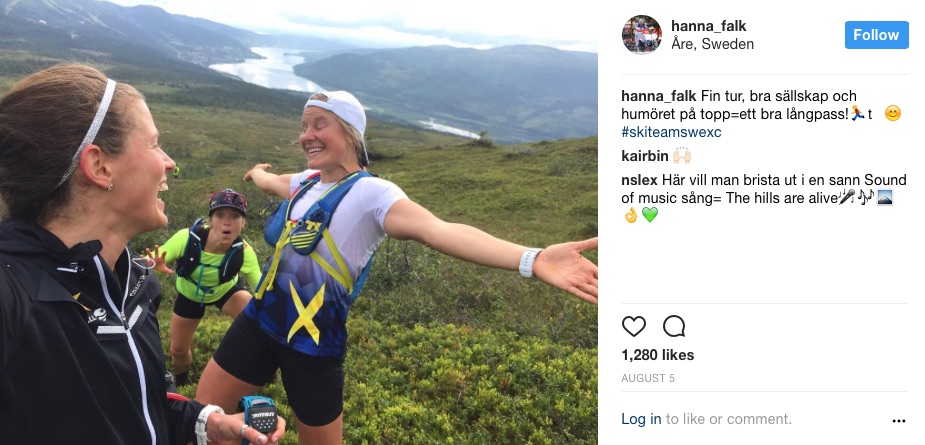
Hanna Falk is all grins on this run in Sweden. Yes, Liz Stephen (U.S. Ski Team), bombed the photo when she was recently in Sweden to train with the Swedish national team. (Photo: Hanna Falk/Instagram)
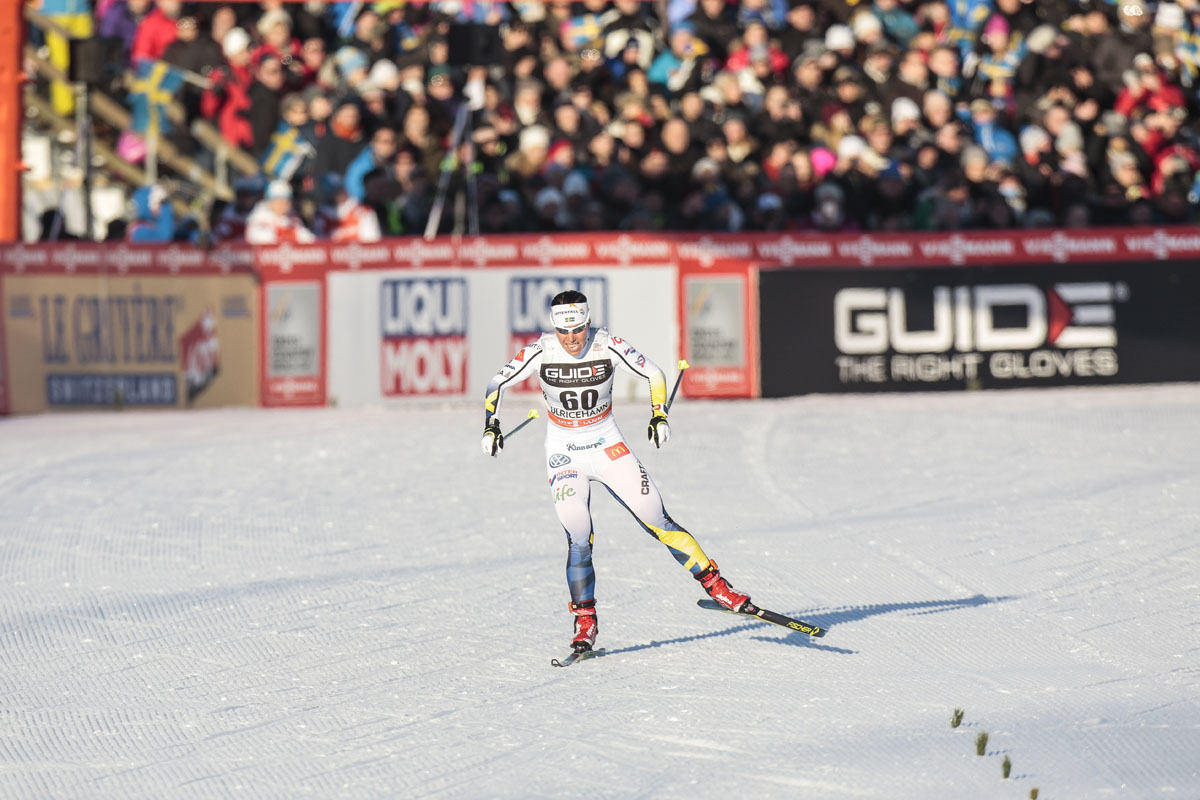
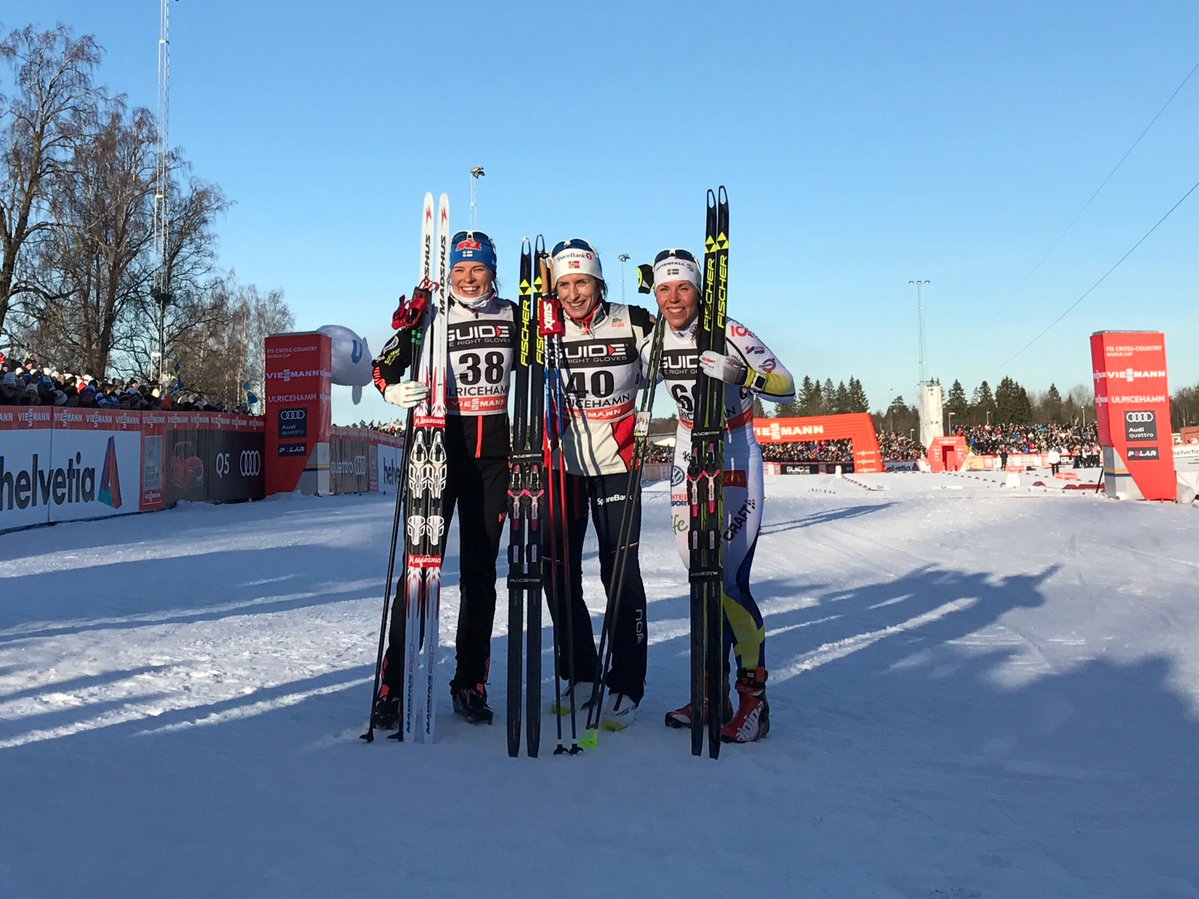
Charlotte Kalla racing to third place in the World Cup 10 k skate in front of a huge crowd in Ulricehamn, Sweden, on Saturday. (Photo: Fischer/NordicFocus)
Most of the time, the FIS Cross-Country World Cup visits towns and ski trails the racers already know well.
Some venues, like Norway’s Holmenkollen and Switzerland’s Davos, are visited every year. Others, like France’s La Clusaz, are on the schedule every few years but are still always popular.
“I’ve been on the World Cup for ten or eleven years, and we go to the same venues all the time,” the U.S. Ski Team’s Liz Stephen said.
But every once in a while, a new place is thrown into the mix. Last weekend it was Ulricehamn, a town of 10,000 people in southern Sweden.
The rave reviews from athletes, coaches and fans made it clear that Ulricehamn aced their World Cup hosting duties on the first try, giving other venues something to aspire to.
“This was the best World Cup venue of the year — by far,” Canadian skier Devon Kershaw wrote in an email. “The volunteers are so friendly and helpful and to have a five kilometer track with thousands and thousands of supporters lining the whole way was just so much fun. I’ve never raced in an atmosphere like this other than the legendary Holmenkollen.”
Teammate Alex Harvey – who won the 15 k and won bronze in the relay together with Kershaw, Knute Johnsgaard, and Len Valjas – put it this way: there were so many spectators that it was impossible to find a quite moment to oneself.
“On the warmup loop, there were people along the whole course,” Harvey said. “I couldn’t even take a piss in my warm up. Usually I take like six pisses in an hour, and I was like, ‘Man, I just can’t piss!’ There were people everywhere. It was fun. They were cheering my name the whole warmup, and the whole race too. In Scandinavia, they are always a well-educated crowd. This was like a championship crowd, like Falun or Oslo. It was awesome.”
The Ulricehamn organizing committee reported that there were about 30,000 people in attendance each day.
“If you go back and watch all the races (except maybe Lillehammer) this year, there have been like 1000-2000 spectators max,” Kershaw wrote. “Some venues had like 100 people, it seemed. So this was a big improvement… Bringing events to where people actually care and are passionate about the sport is always best, I feel. I mean, as an athlete to race in an atmosphere like this is really motivating. It looks way better on TV, and people are having a great time out there – which is what we want to promote as ski racing (I feel).”
King Carl XVI Gustaf even came to watch Sweden win bronze in the women’s relay and silver in the men’s relay.
“I watched the races on television yesterday and couldn’t help it [to come here],” he told the local newspaper. “I think I’ve had just as much fun as everyone else had here. It has been a fantastic day of skiing in Ulricehamn and extra fun to [hear] the athletes say they felt such powerful public support.”
Anchoring the women’s relay was Hanna Falk, who grew up in Ulricehamn. The King personally congratulated her.
https://www.instagram.com/p/BPkjYv8hUa0/
“It seems that all the skiers have been very pleased,” Falk told the Skövde Nyheter newspaper, according to a translation. “I’ve heard many good things from many different countries, so that makes me a bit extra proud.”
The venue’s success over the weekend is already being cited as a reason for other Swedish municipalities to invest into their ski infrastructure. For instance, some in Marcus Hellner’s hometown of Skövde, just over an hour north, would like to see a similar effort.
“It shows that hard work, persistence and courage pays off,” a commentator from Göteborg, the nearest major city, wrote. “That you do not have to be the biggest to be the best is also a nice reminder in these times of centralization … Among the city’s 10,000 residents, there were people who wanted to do something special, people who love their homeland, their sports and who love to show off their hidden treasure for the rest of the world. Talk about daring, talk about winning.”
Ulricehamn is already planning to host another World Cup weekend in 2019, and may continue getting awarded competitions if the success of their first event is any indication.
Meanwhile, the World Cup will return back to North America in March. World Cup Finals were awarded to Quebec after being moved from Tyumen, Russia, due to a doping scandal.
Some athletes felt that Canadian and U.S. ski fans could learn a thing or two about how to earn these rave reviews from athletes – the kinds of reviews that could eventually promote a venue to being a regular or semi-regular World Cup host.
“Of course the fans were wonderful in Quebec last year, but when you see the amount of people on the courses here in Sweden, it is an insane amount,” Stephen said. “I would like to put it our there as a challenge for fans who are close to Quebec to come out. Let’s try to be as big as Sweden there, because the more the athletes have fun… I heard everyone talking about the crowds, on every team, even the Norwegians. When that kind of talk happens, more World Cups are given to that city or host venue.
“All the fans who are thinking about maybe coming up, don’t think about it, just come,” she concluded. “It makes the atmosphere very appealing to the teams, and especially us athletes. It’s really fun.”
The Canadian men’s relay after placing third for Canada’s best World Cup result in the 4 x 7.5 k, with (from left to right), Lenny Valjas, Alex Harvey, Knute Johnsgaard, and Devon Kershaw. (Photo: Salomon/NordicFocus)
Last weekend’s first-ever World Cup in Ulricehamn, Sweden, was one Canada will remember for a long time, after Alex Harvey won Saturday’s 15-kilometer freestyle individual start for his second-straight World Cup victory (after winning the freestyle team sprint with Len Valjas the weekend before) then reached the podium again in the men’s 4 x 7.5 k relay on Sunday — which was a first for the Canadian men. Safe to say, Canada is riding some serious momentum, as are the U.S. women, which missed the podium by 0.2 seconds in the Ulricehamn 4 x 5 k.
“I love Sweden, so I kind of get into my happy place when I enter this country and the fans today really brought out the happy in me. It was really amazing out there.”
— Liz Stephen (U.S. Ski Team), 16th
“Competing in Ulricehamn was pretty awesome today. The course was packed with some of the most enthusiastic fans I’ve ever seen!”
— Kikkan Randall (U.S. Ski Team), 40th
“An awesome Swedish vibe.”
— Sadie Bjornsen (U.S. Ski Team), 12th
“I’ve been so impressed with the venue, the spectators and especially the enthusiasm and hard work from the organizers and volunteers here in Ulricehamn! We haven’t had a course this packed with energized fans all year long, so it was a really special atmosphere out there!”
— Jessie Diggins (U.S. Ski Team), 7th
On getting to know a new venue:
“We got here on Thursday … we went skiing Thursday afternoon, and that was the first time on the course. Then yesterday we skied again and did some race prep on it. Yesterday was actually quite different from today, it was slushy and really soft, but it was still a fast course. Even though the 5 k loop is longer than five kilometers, 5.1 k or something so at the end that makes it a 15.5 k … even though it was a longer loop, we thought with our race prep was pretty fast, covering the distance pretty fast, so we knew it was going to be a fast race. Then looking at the girls race this morning, it was 24 minutes for a 10 k, that’s really fast. Devon and I were like, ‘Yes! It’s going to hurt a little less longer than other 15 k’s.’ ”
— Alex Harvey (Canadian World Cup Team), 1st
“It was a pretty cool course too. Deceptively hard with a lot of gradual terrain and not many places to recover.”
— Randall
On pacing and ski style:
“In the team meeting, we said that we thought it was going to be hard to gain time in the last lap, so it was important to open hard, but still steady, not kill yourself, just be in it from the beginning. We thought it would be hard to come from behind.”
— Harvey
“For Alex, it is a really good course. There is that one big uphill but the rest of it is kind of rolling, super punchy, you have to be really proactive, really aggressive everywhere. Good speed, good glide, and with a good power. And that is exactly his technique, and today it just clicked together.”
— Ivan Babikov (Canadian World Cup coach)
“It was great to have [Sadie Bjornsen] pull me into the finish the last few kilometers, especially when they like flat like that are often challenging for me so it was great to like follow her and see how she races and have a strong finish.”
— Rosie Brennan (U.S. Ski Team), 24th
On not quite getting it right:
“Devon, it didn’t work out perfectly. He had a really good first split and then maybe had to take a break in the middle of the race. But he was still satisfied and he said that there was good moments and bad moments. It is really important in this kind of course, and this kind of race, that you have someone to ski with, and unfortunately he didn’t have anyone today and had to work by himself the whole time.”
— Babikov
On steady improvement:
“Fifteen k individual start has been my weak event for a long time, but over the last two seasons, it’s been coming along nicely. I was second in Kuusamo, and a few top tens in 15 ks, so I knew it was coming along.”
— Harvey
“I think the Tour left me in a good zone, mentally and physically, and I am just psyched. We have five weeks till World Champs, and four of those weeks I will be in Sweden and one week in Asia so I have a pretty fun situation coming up and I think it will leave me in a good mental state going to World Champs.”
— Stephen
“Skating has been going well this year. I have a lot more confidence every time I start a race, so that is fun.”
— Bjornsen
On team spirit:
“Alex is just lifting everyone’s spirits. Of course it’s Alex’s thing, he won it, but its not only for him. It’s for our whole team, our whole country, Team Canada and everyone. It’s just the best for everyone. Like, the waxers are super psyched, coaches, everybody, and other skiers back home, it’s just a big boost for all of us.”
— Babikov
“To witness a performance like that, it has really invigorated the whole team and staff … It was a beautiful performance to cement his legacy. Simply fantastic skiing.”
— Devon Kershaw (Canadian World Cup Team), 38th
“You actually had all the American ladies, all four of those, all really close to each other at the track if not skiing actually in a pack at times, so it was pretty fun.”
— Chris Grover (U.S. Ski Team head coach)
On a one-person women’s team:
“That was kind of last minute decision between Louis [Bouchard] and [Cendrine Browne]. There was opportunity, there were spots, and she was one that was kind of close to the points and showing good shape before [Christmas]. Today again, she proved that she is mature — she had a really good race. She started really aggressive, and maybe at the end it just wasn’t enough. This was more for training to get in shape as well for the World Champs.”
— Babikov
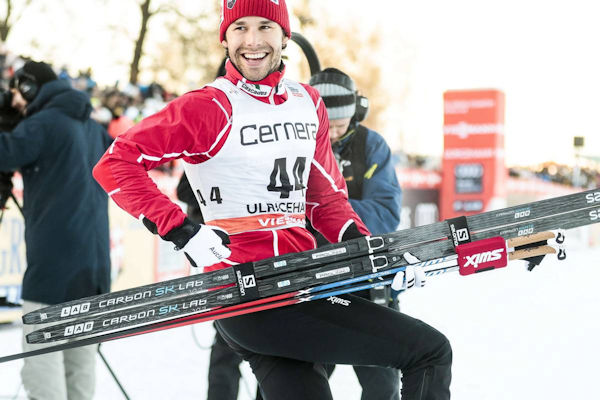
Canada’s Alex Harvey (44) racing to the win in the men’s 15 k freestyle on Jan. 21 at the World Cup in Ulricehamn, Sweden, followed by Japan’s Keishin (directly behind), American Noah Hoffman (in blue), and his Canadian teammate Lenny Valjas (back left). (Photo: Salomon/NordicFocus)
Canada’s Alex Harvey (44) racing to the win in the men’s 15 k freestyle on Jan. 21 at the World Cup in Ulricehamn, Sweden, followed by Japan’s Keishin (21), American Noah Hoffman (in blue), and his Canadian teammate Lenny Valjas (back left). (Photo: Salomon/NordicFocus)
Alex Harvey (Canadian World Cup Team) on his way to winning the World Cup men’s 15 k freestyle on Jan. 21 in Ulricehamn, Sweden. (Photo: Salomon/NordicFocus)
Alex Harvey (Canadian World Cup Team) on his way to winning the World Cup men’s 15 k freestyle on Jan. 21 in Ulricehamn, Sweden. (Photo: Salomon/NordicFocus)
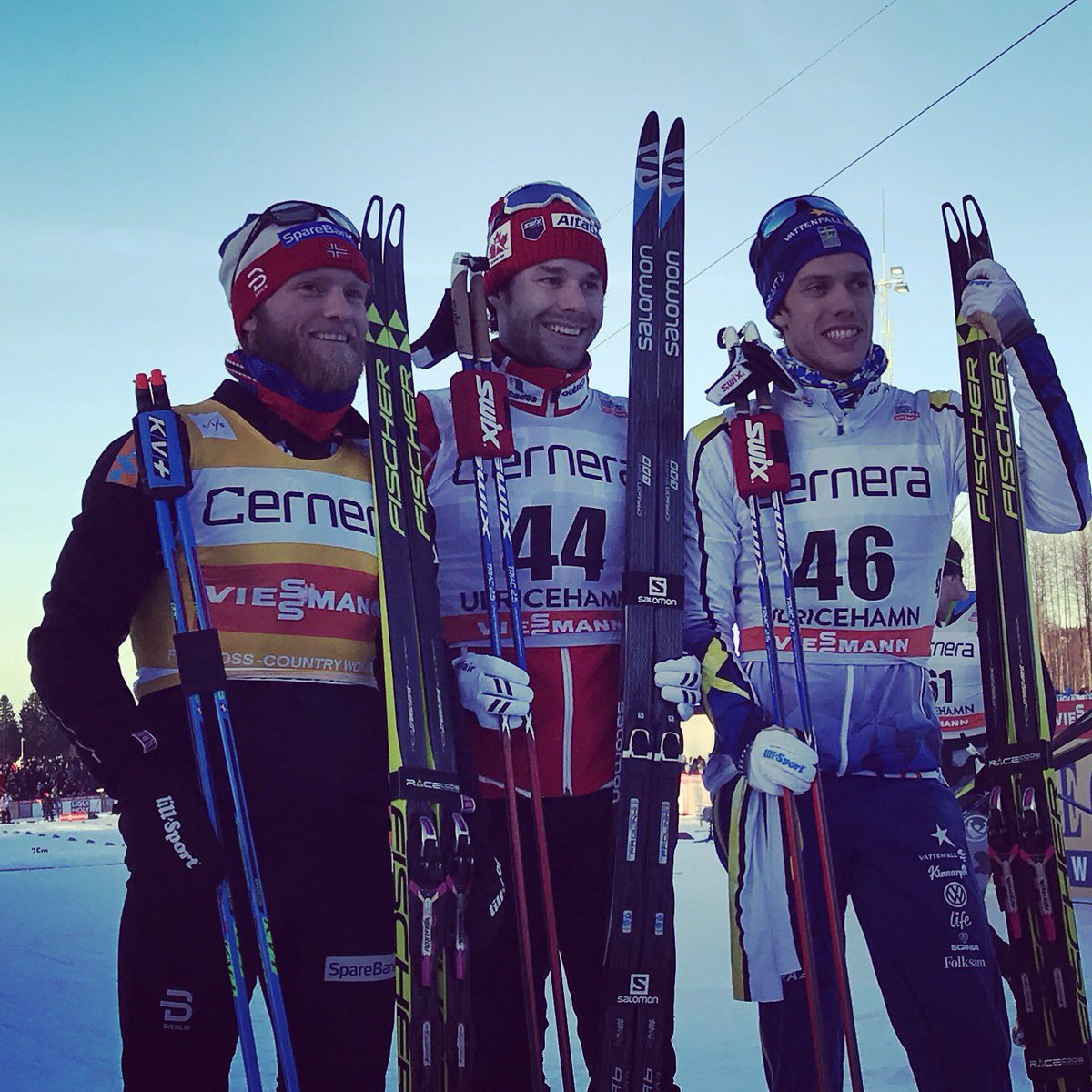
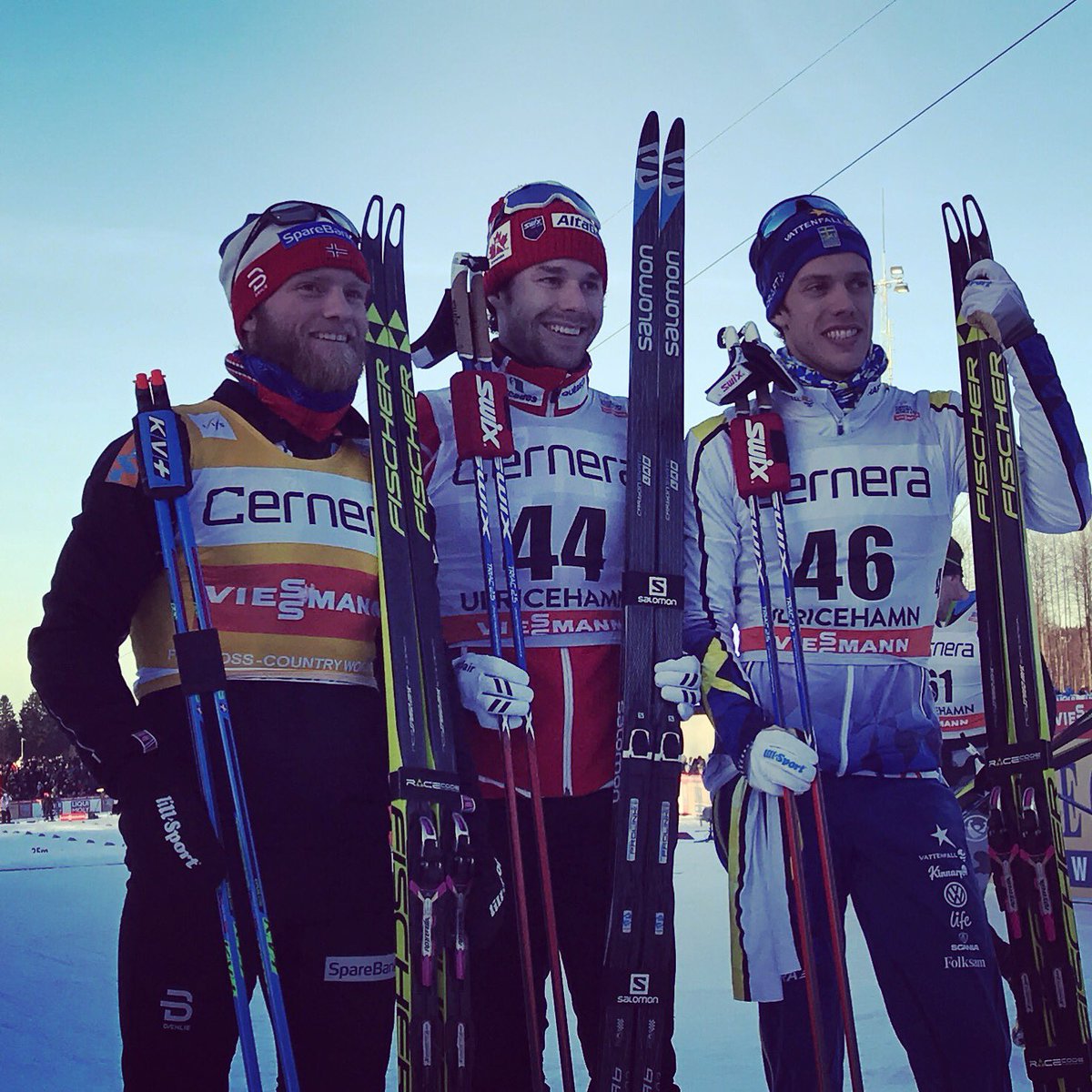
The men’s 15 k freestyle podium at Saturday’s World Cup in Ulricehamn, Sweden, with Canadian winner Alex Harvey (c), Norwegian runner-up Martin Johnsrud Sundby (l), and Sweden’s Marcus Hellner (r) in third. (Photo: Fischer/NordicFocus)
Alex Harvey (Canadian World Cup Team) after winning the World Cup men’s 15 k freestyle on Jan. 21 in Ulricehamn, Sweden. (Photo: Salomon/NordicFocus)
(Photo: Salomon/Nordic Focus)
Alex Harvey (Canadian World Cup Team) after winning the World Cup men’s 15 k freestyle on Jan. 21 in Ulricehamn, Sweden. (Photo: Salomon/NordicFocus)
Alex Harvey (Canadian World Cup Team) after winning the World Cup men’s 15 k freestyle on Jan. 21 in Ulricehamn, Sweden. (Photo: Salomon/NordicFocus)
Jessie Diggins (U.S. Ski Team) on her way to seventh in the World Cup women’s 10 k freestyle on Saturday in Ulricehamn, Sweden. (Photo: Salomon/NordicFocus)
Devon Kershaw (Canadian World Cup Team) racing to 38th in the World Cup men’s 15 k freestyle on Jan. 21 in Ulricehamn, Sweden. (Photo: Fischer/NordicFocus)
Sweden’s Charlotte Kalla racing to third in the World Cup women’s 10 k freestyle on Jan. 21 in Ulricehamn, Sweden. (Photo: Fischer/NordicFocus)
Sweden’s Marcus Hellner (46) on his way to third in the World Cup men’s 15 k freestyle on Jan. 21 in Ulricehamn, Sweden. (Photo: Fischer/Nordic Focus)
“It was a really special moment, [head wax technician] Yves [Bilodeau] was crying, Ivan was crying, too — he’s actually raced relays with us so many times, and we were fifth or seventh, which was not stellar, but he was still able to live it on the other side of the fence as a coach … it was great.”
— Harvey
“Today was a special day. It was my dream for a long time. When I was racing it was my number one priority of my career to be on the relay podium, so it is really emotional for all of us, especially me. We finally achieved it .”
— Babikov
“It was a career highlight for me, and one of the best days of my life.”
— Knute Johnsgaard (Canadian U25 Team)
“It means everything to us — and for me as well. We had NEVER hit the podium in arguably cross-country skiing’s marquee event on the men’s side. It’s incredible that it’s taken this long, but my whole career this was something I have dreamed of being involved in. I remember all the talk and dreams as a young senior with George, Stef, Drew, Chris, Gord, Dan, etc… and then again only five years ago when we had four guys (Len, Alex, myself, and Babs) skiing at an insanely high level together in individual races, but not being able to get it done together … So to break through and do it was just incredible. “
— Kershaw
On pre-race confidence:
“At the team meeting last night we were all saying that there is no expectation, no matter what we do, good day, or bad day, there’s no expectation, which is pretty nice, but then this morning, I’m rooming with Knute, the young guy, and we both woke up, and were like, ‘This is the day.’ We were both confident that neither of us would let the group go.”
— Len Valjas (Canadian World Cup Team)
“We knew we had a really good chance. I knew last week when I decided to come to Sweden, I knew that Len and Alex won the team sprint last weekend in Toblach, and I knew the guys were in really good shape.”
— Johnsgaard
On doing it against the odds:
“We have been in a tough situation with our budget lately, and I don’t just mean our operating budget. The burden on the individual athletes right now in Canadian skiing is extremely debilitating and the worst I have ever seen. All except Alex in the country are paying tens of thousands of dollars to do this, so to be at that kind of disadvantage compared to the rest of the world could obviously be just too much. Yet, despite the situation, to still break through and stand on the podium with the likes of Norway and Sweden is a testament to our team as a whole. It’s just incredible. I hope this is the beginning and that we can be fighting for relay medals for years to come now that we know we can do it.”
— Kershaw
On ski-community support:
“These four guys did this, they made it possible, but it’s also only because they have these amazing people behind them; all the wax techs, the people back home, the cross-country ski community, they care so much. You should have seen the amount of emails and texts I got from random people who care so much. It was very special, and amazing.”
— Babikov
On getting your mojo back:
“I wish we had some more skate races coming up this weekend, because I feel like I’m getting my skate legs under me again. It will be fun to see if I can get some classic legs under me, too.”
— Stephen
On Germany hitting the podium:
“Over the years we’ve become good friends with the German team, and if anybody was going to step onto the podium above us, it was fun to see them. Because similar to the the American team, they are not just dominating every weekend. It takes more of a really neat day to put everything together, and it was cool to see them do that. I think the last time they would have been on the podium was the Olympics, so it was fun to see how well they did.”
— Bjornsen
“I think all of us feel the same way, and even Norway, who wins a lot. It’s nice to see new people on the podium. We’re close with the Germans, as [our coach] Matt [Whitcomb] is dating one of them, and they’re really friendly, smiley, and it was really nice to see them on the podium. I was trying to think when the last time I saw the German team on a relay podium was, and so I asked Steffi Böhler — and she said, ‘I don’t know!’ … You always want it to be you up there, but it’s good to see people equally joyful and excited about being up there as you are.”
— Stephen
On keeping perspective:
“I got overwhelmed a few times with the whole World Cup scene, but just tried to focus on little things like testing skis, and getting in my warm-up and getting to the start, and just remembering that it’s still a ski race like any other one.”
— Liz Guiney (Craftsbury Green Racing Project)
“Those guys [the U.S. women’s team] raced great. They had something like the fifth, second, fourth, and then the fastest leg times. Of course it was all really close being so fast out there, especially on the skate side. In fact Jessie, Sandra Ringwald, and Hanna Falk were all within the same second for their ski times. And of course, Ringwald and Falk both raced incredibly well yesterday too, so they are clearly in good shape. Those were some daunting competitors for her at the end. So obviously, it’s super tight and they raced great.”
— Grover
On the men’s race:
“That was disappointing, just to lose contact. On a different day I think we could have been in contact for a lot longer. It was the kind of day where if you could keep the contact it was pretty easy to stay in it, but if you’re all by yourself, you’re just out by yourself. [We] definitely suffered from that.”
— Grover
On crazy pre-race logistics:
“Skis were great all day, which was really a testament to how good of a job the wax team did. Because it was a tough day. It did not freeze last night, and because of that they did not open the course on time as planned, they delayed it. The women were never allowed to skate on the course before the relay. The men maybe just for a little bit. We ended up trying to do all of our testing, kick and all of the glide testing, and work with athletes testing skis, all in about an hour before the start. And make all the skis, with two [women’s] relay teams. Which was incredibly crazy. And then there were only 25 minutes of open track between the women’s race and the men’s race. There’s no natural snow here, so they just had a really tiny 300 meter test track. It was a real challenging day for the wax team and they did an awesome job of being able to produce great skis for these guys and keep everybody in contention.”
— Grover
“The snow conditions held up really well for the skate legs. We were not allowed on the course, it was completely partitioned off, so being the fourth or fifth person on the course, I thought it was great! I’m sure it slowed down significantly for the men, and maybe even for the fourth-leg skiers, I don’t know, but it was pristine when I was out there.”
— Stephen
On future plans:
“The race I would have liked to target in Period II is next weekend in Falun (30km mass start classic), but with my wife Kristin expecting (the due date is next Saturday), I doubt I will toe the line there… Too much stress! I will put in some great training coming up here ahead of Otepaa and World Champs and Norwegian Nationals are actually only a 1:15h drive from Oslo — so I have signed up for two races there — but with the arrival of our first child, it’s all about ‘baby-watch’ now. Can’t make too many long-term plans with regards to a race schedule.”
— Kershaw
“I’m really excited — I love Falun! I love Sweden and I’m psyched to be staying in this country. And then I get to go to Asia for the first time ever after that, which will be very exciting as well, and then coming back to Sweden for the pre-World Championships camp, so I’m in a good mental spot right now. Sweden always brings out my happy, and the fans and the organizers did a phenomenal job and really made this weekend what it was.”
— Stephen
Marit Bjørgen crossing the finish line first for Norway in the World Cup women’s 4 x 5 k relay on Jan. 22 in Ulricehamn, Sweden. (Photo: Fischer/NordicFocus)
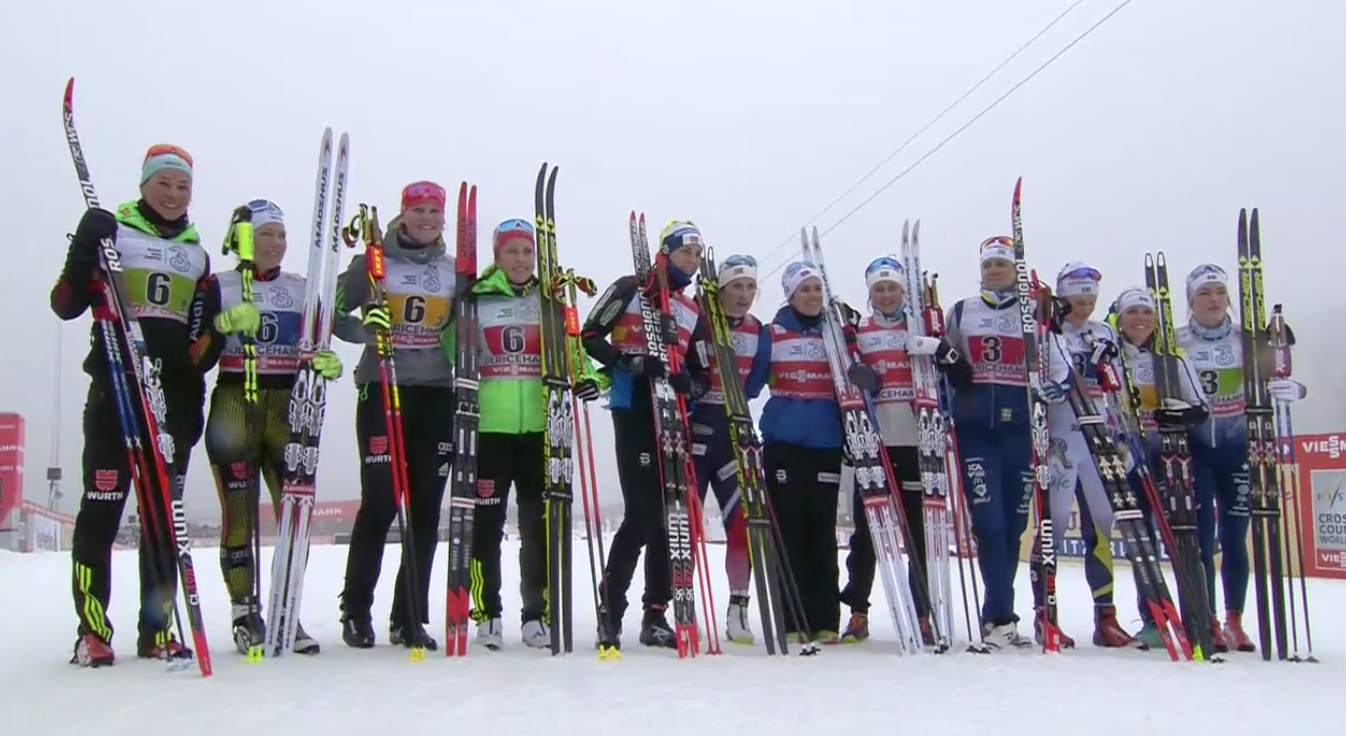
The World Cup women’s 4 x 5 k podium on Jan. 22 in Ulricehamn, Sweden, with (from left to right) Germany (Stefanie Boehler, Sandra Ringwald, Victoria Carl, Katharina Hennig) in second, Norway (Ingvild Flugstad Østberg, Heidi Weng, Astrid Uhrenholdt Jacobsen, Marit Bjørgen) in first, and Sweden in third (Ida Ingemarsdotter, Sofia Henriksson, Charlotte Kalla, Hanna Falk). (Photo: Fischer/Nordic Focus)
The World Cup men’s 4 x 7.5 k relay on Jan. 22 in Ulricehamn, Sweden, with (from left to right) Sweden in second (Daniel Rickardsson, Johan Olsson, Marcus Hellner, Calle Halfvarsson), Norway in first (Simen Hegstad Krueger, Martin Johnsrud Sundby, Anders Gløersen, Finn Haagen Krogh), and Canada in third (Len Valjas, Alex Harvey, Knute Johnsgaard, Devon Kershaw).
(Photo: Salomon/NordicFocus)
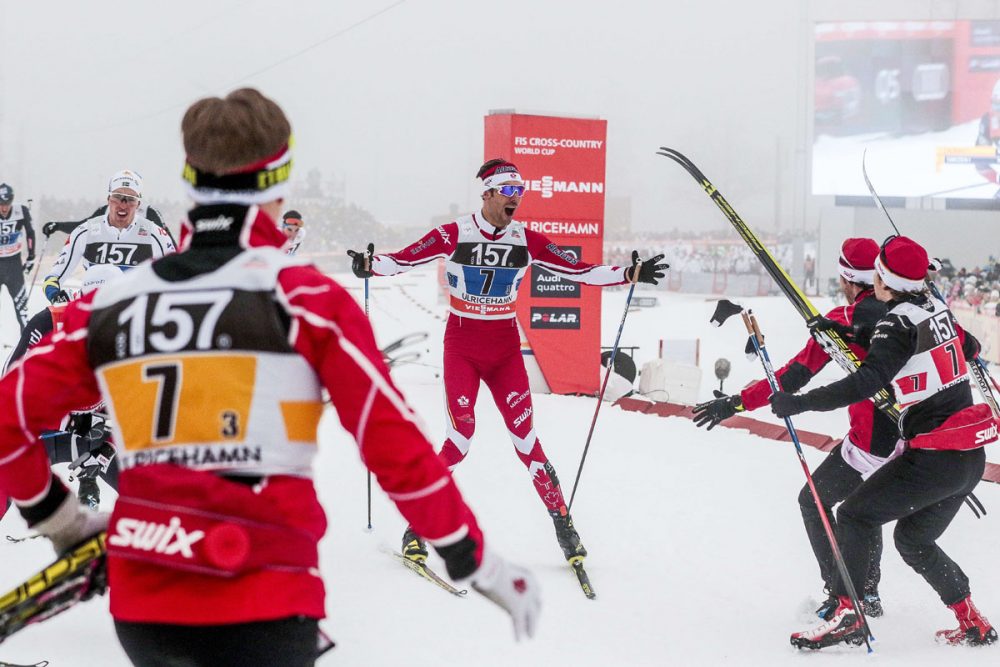
Len Valjas (c) greeting his teammates across the line, including Alex Harvey and Devon Kershaw (on the right), Knute Johnsgaard (left) after he finished third in the World Cup men’s 4 x 7.5-kilometer team relay on Sunday in Ulricehamn, Sweden, for a best-ever relay result for Canada. (Photo: Fischer/NordicFocus)
Looking up from the finish line on Sunday, Canada’s Len Valjas saw something he would never forget. Amidst a sea of waving Swedish flags, a trio of men ran toward him. Their arms were outstretched and a chorus of cheers escaped all three as they charged toward their teammate.
Just a week ago, Valjas had celebrated his first World Cup win in the men’s team sprint with teammate Alex Harvey. Seven days later, after anchoring the final leg of the Canadian men’s 4 x 7.5-kilometer relay team in Ulricehamn, Sweden, Valjas would celebrate another first.
But this time, the first was not his alone. It was one for Canada as well.
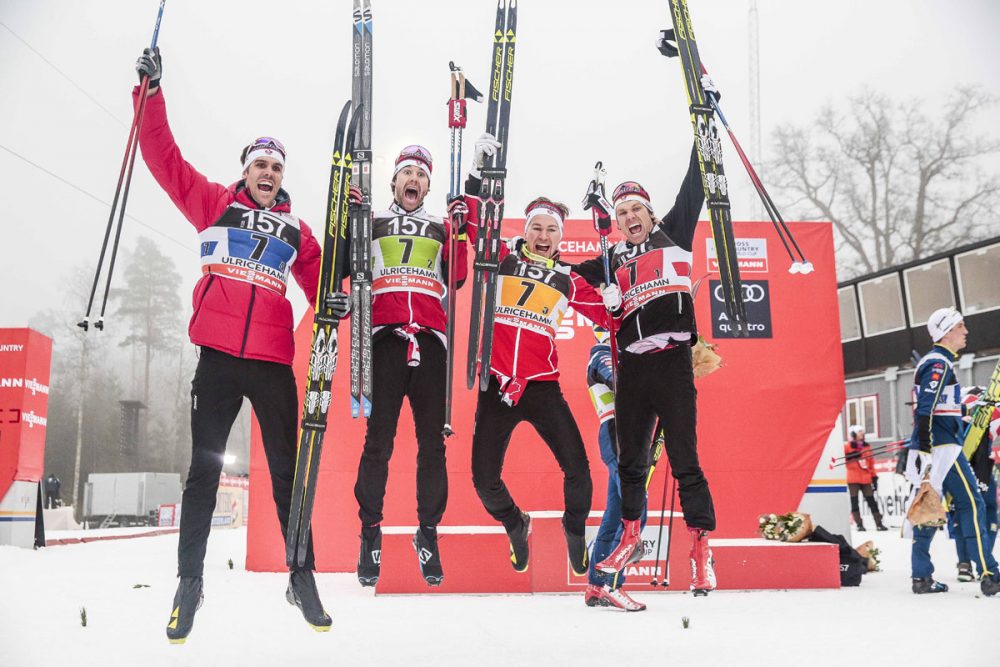
Left to right: Canada’s Len Valjas, Alex Harvey, Knute Johnsgaard, and Alex Harvey after their historic third-place finish in the men’s 4 x 7.5-kilometer relay on Sunday in Ulricehamn, Sweden. (Photo: Fischer/NordicFocus)
Prior to Sunday, no other men’s team sporting the red maple leaf had reached the podium in a World Cup relay. The closest Canada had come to was fifth place in 2012 in Gällivare, Sweden, with Valjas, Harvey, Devon Kershaw, and Ivan Babikov.
A little less than five years later, with Babikov as Canada’s new World Cup coach and Knute Johnsgaard having joined the relay-race crew, history was made.
For the first time on a World Cup, four Canadian men — Kershaw, Harvey, Johnsgaard, and Valjas — would raise their arms in celebration while standing on the third podium step on Sunday, stealing the spotlight from Norway’s first place finishers and Sweden in second.
“As a small cross-country skiing country, we don’t have two teams at the start line,” Babikov said on the phone afterward. “We barely assembled one team, but that team made a miracle today, so we only needed one.”
Even if scraping together a squad did not take place until last week — Johnsgaard only flew into Sweden a few days ago and skipped Saturday’s 15 k freestyle to rest up for the relay — Canada has been aiming at a team podium for a while.
For Babikov, especially, standing on the relay podium alongside his teammates had been a longtime dream. And though it wouldn’t occur while he was skier, watching his athletes (three of them former teammates) climb onto the third podium step was just as momentous for Babikov.
“I’ll never forget this day,” Babikov said. “We’ve had individual podiums and individual medals, but the relay is special because it’s a show of strength for the whole team and the whole staff behind this team.”
Just half of a second out of first — which went to Norway in a time of 1:06:47.5 — Canada’s third place finish is an indication not only of the team’s depth, but potential to place even higher.
“I’ll never forget this day. We’ve had individual podiums and individual medals, but the relay is special because it’s a show of strength for the whole team and the whole staff behind this team.”– Ivan Babikov, Canadian World Cup coach, on the men’s relay’s historic third-place finish on Saturday
Since distance relays are also one of the primary ways Own The Podium evaluates how much funding Cross Country Canada (CCC) receives, Sunday’s performance may also incentivize an increase in financial resources for the Canadian World Cup team.
As Harvey explained, most his teammates are not currently getting financial support from CCC due to budget cuts from previous years. As a result of Sunday’s performance, that could change.
“Because the results over the last couple of years internationally have been not stellar as a team, a lot of funding was cut for us,” Harvey said on the phone after Sunday’s race. “I think this result will really help those guys to be fully funded again.”
Regardless of what exactly happens with the future funding, Canada’s relay members and coaches alike were smiling, speechless and simply stoked.
“I felt honored to anchor such a hard working team,” Valjas said on the phone. “I didn’t want to let them down, so it was easy, there was only one thing to do, just get on the podium. They all did their work, and I wasn’t going to be the guy who lets it all go to shame.”
Canada in Close Quarters, Krogh Out Sprints Halfvarsson for the Win
In the words of Babikov, relay days are somewhat like the “lottery,” with decisions on which leg to designate to each athlete a gamble. With Sunday’s first two legs classic and the second two skate, Canada selected Kershaw and Harvey to start the team off, followed by Johnsgaard and Valjas.
“Our strongest guys [were] on the first two legs, Devon and Alex, that’s where most of the damage was done,” Babikov said.
Canada’s Devon Kershaw (second from r) during the first classic leg of the World Cup men’s 4 x 7.5-kilometer relay on Sunday in Ulricehamn, Sweden. (Photo: Fischer/NordicFocus)
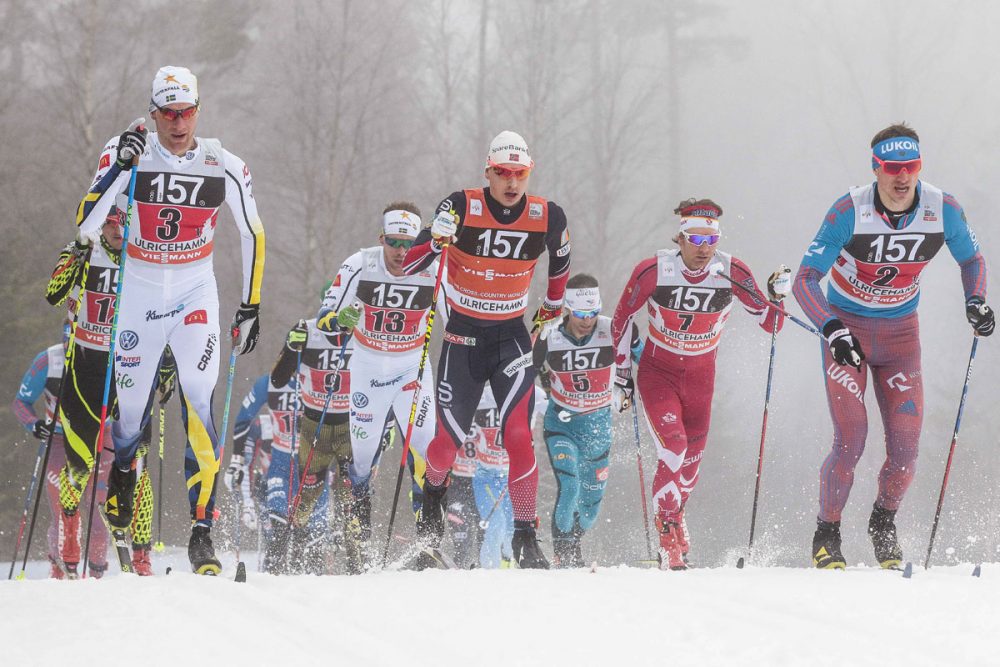
Kershaw started things off for the Canadians, skiing in bib 7 and positioned in 10th place until just before 2 k, when he made a move to the outside right of the tracks to the front. However, he didn’t lead for long. By 4 k, Russia’s Sergey Turyshev had overtaken him, followed by Sweden’s Daniel Rickardsson and Italy’s Dietmar Nöckler.
Coming into the exchange zone, it was Kazakhstan’s Alexey Poltoranin in the lead, and Kershaw in fifth. Kershaw tagged off to Harvey for the second classic leg.
Within the first half a kilometer, Harvey was at the helm of the leading pack of nine.
“I knew that the heavy hitters were on my leg, but it was good,” Harvey said. “It was hard on the big hill, but then over the top I had really fast skis.”
At 2.5 k Finland’s Iivo Niskanen and Russia’s Alexander Bessmertnykh traded off leads. Within another 4 k, Norway’s Martin Johnsrud Sundby moved to the front. The Norwegian maintained the lead through the exchange zone, while Harvey chased from five seconds back.
Sundby passed off to Norway’s Anders Gløersen, and Harvey to Johnsgaard for the third leg and first freestyle portion. Despite considering himself a ‘World Cup rookie’, Johnsgaard, of Canada’s U25 Team, maintained his position within the middle of the lead pack.
“Alex tagged me off in a good position, and my job was to hold that, and give Len the same opportunity I had to ski in the group in a good position,” the 23-year-old Johnsgaard said.
Johnsgaard did his job and tagged off to Valjas within five seconds of Gløersen’s tag to Norway’s Finn Hågen Krogh.
Seven skiers still remained in the front pack with Krogh, Sweden’s Calle Halfvarsson and Italy’s Sebastiano Pellegrin in the lead. Valjas spent most of his first lap in fifth, following as close to the leaders as possible.
“On the last lap, I was totally blocked on the hill, so I couldn’t actually empty the tank, which was probably a good thing for me, and then just after the hill I built up some speed, and passed five or six guys just double poling,” Valjas said.
By the final 300 meters, the Canadian had moved up to second behind Halfvarsson in first. As the group rounded the final corner, however, Krogh moved around to the right of Halfvarsson and Valjas.
“I gave him a meter in the final turn but I entered the final stretch in good speed” Krogh told NRK of his final maneuver.
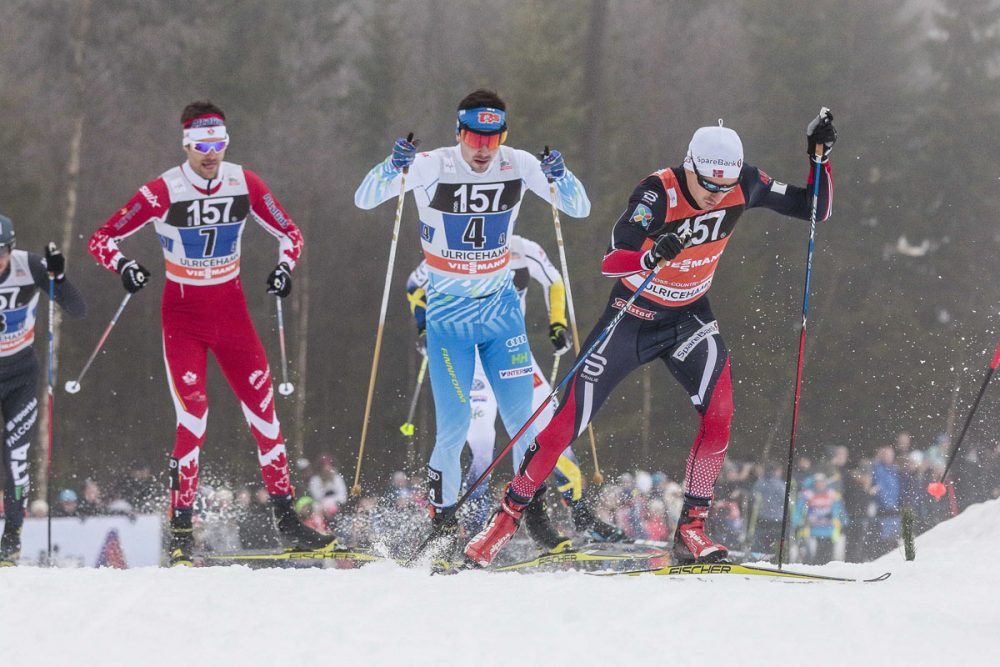
Left to right: Canada’s Len Valjas follows Finland’s and Norway’s Finn Hågen Krogh during the World Cup men’s 4 x 7.5-kilometer relay on Sunday in Ulricehamn, Sweden. (Photo: Fischer/NordicFocus)
Krogh edged Halfvarsson and Valjas by half a second for the win in 1:06:47.5.
“I would have like to have won but Finn Hågen is fast,” Halfvarsson told NRK of his final maneuver.
In his first time anchoring a team relay, Valjas views the moment as one he’ll never forget.
“I’ve never been the anchor in a relay. I’ve been the second leg in some team sprints, but today was special, the best feeling I’ve ever had skiing, seeing my three teammates sprinting towards me at the finish line,” Valjas said. “I don’t think anything will ever top that, the first relay [podium] for Canada.”
The U.S. men fielded a team with Andy Newell handing off to Erik Bjornsen, followed by Noah Hoffman, and Simi Hamilton, who anchored them to 10th (+1:16.5).
U.S. Ski Team Head Coach Chris Grover explained that while Newell maintained contact with the pack during his first lap, he lost it during his second time around.
“The second time up the big climb he got stuck behind a Russian who was fading,” Grover said on the phone. “By the time he got around, he lost contact with the lead. Then coming down into the stadium he had a fall. And then after that, he was maybe 16 seconds behind the group in front of him. That really took us out of contention.”
Newell tagged Bjornsen in 13th, 23.2 seconds out of first. From there, the U.S. men steadily picked off the places, with Bjornsen moving into 12th by the second exchange, Hoffman improving to 11th by the last exchange, and Hamilton finally finishing 10th.
— Chelsea Little, Jake Ellis and Aleks Tangen contributed
Team Canada celebrates its first World Cup relay podium in the men’s 4 x 7.5-kilometer relay on Sunday in Ulricehamn, Sweden. (Photo: Cross Country Canada)
Marit Bjørgen taking Norway home for a win in the 4 x 5 k relay in Ulricehamn, Sweden. (Photo: Fischer/Nordic Focus)
Another women’s 4 x 5 k World Cup relay, another Norwegian win.
Yawn? Not so fast. While the team of Ingvild Flugstad Østberg, Heidi Weng, Astrid Jacobsen, and Marit Bjørgen may have picked up the victory, the women’s race in Ulricehamn, Sweden, was anything but dull.
For one thing, it was the closest race in 23 months, going all the way back to the 2014 Olympics where Sweden took gold. The top four teams all finished within 10 seconds of one another – a far cry from the more recent Norwegian victories by 30 or 40 seconds or even well over a minute.
And for another thing, the race for second place was a nailbiter. After trailing the leaders by 11 seconds at the first exchange, the German and American teams had clawed their way back into the fight for the podium. So by the time 19 kilometers had gone by, it was Hanna Falk of Sweden, Sandra Ringwald of Germany, and Jessie Diggins of the United States flying into the stadium to the finish together.
All were highly motivated. It is Falk’s home course, and the very first time her club has hosted a World Cup.
“It was again a great experience,” Falk told FIS. “I was motivated by the audience.”
For Germany, being in that group of three meant the potential for the team’s best finish in three or even seven years.
And for the United States? Well, the U.S. women are always game for a relay, and Diggins is always game for a fight.
Jessie Diggins skiing the anchor leg for the United States. (Photo: Salomon/Nordic Focus)
In the end, though, Diggins was boxed at the back of the group coming into the finishing straight. She had to choose an outside lane and couldn’t quite catch Ringwald and Falk.
The German edged the hometown favorite for second place, earning Germany their best relay finish since 2010.
“It was in my head that I absolutely did not want to become fourth today,” Ringwald told German broadcaster ZDF. “And then I just thought: killer instinct for the end, just keep at it! When Hanna [Falk] started her first attack I tried to somehow fight, and then on the last meters I knew that finish stretch suits me pretty well. And I just gave it all I had, and then it worked out for a second place.”
She crossed the line 8.8 seconds behind Bjørgen and Norway. Falk took Sweden to third, +9.0, and Diggins and the United States were left in fourth, +9.2.
“Of course we were hoping to be on the podium,” U.S. Ski Team Head Coach Chris Grover said in an interview. “So it’s hard when you’re that close to the podium, within a few hundredths of a second, and then not able to be on the podium. But all the women skied really well.”
U.S. Women Strong, But Can’t Crush the Course
The consensus from the U.S. team was that all four members of the first squad – the U.S. also fielded a second team, which finished 12th – skied well, but that the course wasn’t especially suited to them.
The classic portion of the relay (the first and second skiers) did ascend a major climb that had featured in the individual 10 and 15 k freestyle races on Saturday. But the skate course skipped that hill, and instead was rolling and flatter.
Sadie Bjornsen bringing the U.S. back up toward the leaders on leg two. (Photo: Fischer/Nordic Focus)
Rosie Brennan kicked things off for the U.S. She lost contact with the lead group (both Norwegian teams, Ida Ingemarsdotter of Sweden, and Anamarija Lampic of Slovenia), but tagged in fifth place, just 11 seconds back.
“I didn’t have the best start, but found my groove about half way through and was able to pull back some time in the second half,” Brennan said in a USSA press release. “I will always want more when it’s a relay because I want to be the best for my teammates, but I am satisfied with today and now know exactly where I need to put in some work to be better next time.”
From there, Sadie Bjornsen took over.
“I knew I needed to be somewhat patient closing that gap,” Bjornsen said. “Thinking back to Lillehammer when a similar thing happened, I tried to close the gap in one kilometer and I exploded. I was trying to be a bit more conservative for the first part today, and it all worked out well.”
By partway around the loop, Bjornsen and Germany’s Steffi Boehler had bridged up to the chase group. Heidi Weng of Norway had taken off, putting 15 seconds on the rest of the field – Norway never faltered after that – but the American and German teams were now skiing with Sweden, Slovenia, and the second Norwegian team.
“Once we finally did catch the group it was a bit challenging because there really wasn’t anywhere you could pass,” Bjornsen said. “There were just two lanes.”
Coming into the stadium she took the lead, but it still wasn’t what she had hoped for – and she wasn’t able to drop the other skiers.
“I was double poling as hard as I could coming down that hill, while others were tucking,” Bjornsen said. “It was the only way to get around. It was impossible to pass, which I knew the classic legs were the only places to make a break, so for that reason I was wondering how it could be possible to go around those girls, but yeah. It was what it was.”
“The goal is always to be as close as possible after the classic leg, and to put our skaters in contention for the podium,” Grover said. “Rosie and Sadie did exactly that. They brought it in right in contact with the second-place team.”
The inability to create gaps was something that would come back to haunt the Americans on the next two legs, as the race transitioned to skating. Charlotte Kalla of Sweden tried to move and break up the chase group, but the U.S. racer Liz Stephen stayed right on her – and then the rest of the group caught up too.
Charlotte Kalla of Sweden and Liz Stephen of the United States trying to make a break for it. (Photo: Fischer/Nordic Focus)
“Kalla took it out hot — I tried to stay with her, and then Ragnhild [Haga, of Norway] and [Germany’s] Victoria Carl caught up,” Stephen said. “It was a really hard course to pass on because the draft was pretty amazing. There’s just no real long hill to showcase fitness, or to make any moves on, and I think you saw that in both the men’s and women’s races today. But it was a really fun race to do, and I feel like I skied really well, especially tactically well, which is not always my strong suit.”
Later, Stephen tried to up the pace herself, but similarly failed to get a gap. On the particularly fast course, the draft effect was just too strong.
“Today I had to think about the best way for me to ski the course,” she explained. “I skied the uphills really well, and as fast as I could. But we weren’t able to fully break the group, Charlotte and I. I led some of the downhill, flat stuff, and I felt like I was really moving,and speeding people out — but then there were three people right up on me again. Once you realize what’s going on, you have to play to your strengths, so I knew that I needed to just hang with the girls.”
By the time Stephen tagged off, Slovenia had dropped out of the group and it was a four-way race for second place, about 16 seconds behind the leading Norwegian team.
Diggins took the tag and the lead of the group. But she, too, was unable to ski away from her competitors, although Kari Øyre Slind of the second Norwegian team did drop back.
“For my leg, it felt like a chess match,” Diggins wrote in an email. “After watching Charlotte and Liz racing so well but seeing the drafters in their pack still clinging on, I knew my usual strategy of going all out was unlikely to work. I did the best I could with how it played out, but I feel like my fitness wasn’t reflected well in this particular race. It was a huge drafting course and it was exceedingly hard to drop people in the skate leg.”
Coming down the final downhill to the finish, Diggins was in back of Falk and Ringwald and trying to get past. She couldn’t, and dropping down to the finishing straight didn’t have an immediately obvious choice of finishing lanes. She eventually had to swing wide to the left. Despite a hard sprint to the finish, Ringwald and Falk got there first.
“In the sprint finish, we fell short by a quarter of a second,” U.S. Ski Team women’s coach Matt Whitcomb said in a USSA press release. “Jessie felt like she made a tactical mistake with her positioning, but she also did a lot right out there. She skied great. We’ll take a look at the footage to learn from the race for each athlete. I know she’d like to do it again, and the good news is that she will.”
While the U.S. didn’t make the podium – a goal which had been made easier by a disastrous start by Finland, almost always a podium contender – the women seemed philosophical about the day.
“We all had these little things that we wish we could have improved, but the thing about the U.S. relay team is that the harder the course is, the better for us,” Bjornsen said. “Today was a challenging course; it was really hard to make breaks on the skate legs. On the classic legs, I think if it would have been an even more challenging course it would have been better. Every course is different, and you want to be the best on every single course, but I think all four of us, all eight of us, really, finished the race today feeling… we wanted to be on the podium, of course, but feeling no crush of confidence out there. We all feel confident going into the next relay.”
A Second U.S. Team Toes the Line
It’s not often that the U.S. has two relay teams in a race, but that happened in Ulricehamn. Kikkan Randall, Ida Sargent, Sophie Caldwell, and SuperTour leader Liz Guiney finished 12th, +3:03.0, after losing a finishing-stretch battle with the Russia I team.
Sophie Caldwell skiing leg three for the second U.S. team. (Photo: Fischer/Nordic Focus)
“It was really cool,” Grover said. “We had eight women so we were really hoping to field two teams, but you’re always worried that somebody’s going to get sick or something. But we were lucky that everyone was healthy and ready to go. That was cool. I wish we could do that more often.”
Randall had been 10th at the first tag, just 29 seconds behind the leaders and 18 seconds behind fifth-place teammate Brennan.
Sargent then took over and skied the eighth-fastest time among second-leg skiers, losing only 24.6 more seconds on Weng.
“I was really happy with how I felt today and had a lot of fun racing,” Sargent wrote in an email. “I skied solo for the whole race except for when [Finland’s Anne] Kylloenen caught me around the 4km mark, so we skied the last kilometer together. It was a very tough course to ski by yourself because there was a lot of flat and some long gradual downhill sections that would have been a lot easier to be in the draft or working with someone else during those sections… Considering that I was skiing solo I was really happy with how close I stayed to the leaders. I haven’t done many distance races this year so I wasn’t sure what to expect.”
After that, Sophie Caldwell brought the team to 11th, and Guiney, in her first World Cup relay, to 12th.
“I think the travel and excitement of the weekend caught up to me a bit,” Guiney wrote in an email. “I was mostly excited to be able to start on a World Cup relay, so I didn’t have any expectations beyond getting to the finish as fast as I possibly could. Skiing alone in a relay is always tough, so I just tried to focus on skiing each section as well as I could. Of course, I was really hoping to stay in front of the Russian team, but their last leg caught me with around 1 k to go. While I was able to stick with her until the finish, I didn’t quite have the sprint to get around her in the lanes.”
“Being on a team with Liz Guiney in her first World Cup weekend was also a blast!” Sargent, a Craftsbury Green Racing Project teammate of Guiney’s, wrote.
The men’s 4 x 7.5 k relay podium at the World Cup in Ulricehamn, Sweden, with Norway (c) in first, Sweden (l) in second, and Canada (r) with with its best-ever men’s relay in third. (Photo: FIS Cross Country/Twitter)
FIS Cross-Country World Cup (Ulricehamn, Sweden): 4 x 5 k and 4 x 7.5 k Relays
Norway notched back-to-back team victories in the women’s and men’s relays on Sunday at the World Cup in Ulricehamn, Sweden, with Finn Hågen Krogh securing a win in themen’s 4 x 7.5 k relay by 0.5 seconds over Sweden’s Calle Halfvarsson and Canada’s Lenny Valjas. With two kilometers remaining, nine teams were within 3.8 seconds of first. Krogh outlasted both Halfvarsson and Valjas in the finishing stretch, as Sweden placed second and Canada third for its best-ever relay result, according to a Cross Country Canada press release, besting its fifth-place finish from 2012 (with then-anchor Ivan Babikov, now a Canadian World Cup coach).
Krogh teamed up with Simen Hegstad Krüger, Martin Johnsrud Sundby and Anders Gløersen and finished in 1:06:47.5, while Sweden placed second with Daniel Rickardsson, Johan Olsson, Marcus Hellner, and Halfvarsson.
For Canada, with Devon Kershaw, Alex Harvey, Knute Johnsgaard, and Valjas, it was Harvey’s third-straight World Cup podium, Valjas’s second-straight team-event podium, and national U25 Team member Johnsgaard’s first podium.
“I have been waiting my whole career for this,” Kershaw said, according to a FIS press release. “All the guys did a great job today.”
The U.S. placed 10th (+1:16.5) with Andy Newell, Erik Bjornsen, Noah Hoffman, and Simi Hamilton.
The Norwegian women’s team (center) won the 4 x 5 k World Cup cross-country relay in Ulricehamn, Sweden, by 8.8 seconds over Germany (left), with home team Sweden (right) edging the United States for third.
Earlier on Sunday, the women’s 4 x 5 k relay didn’t break apart until the second leg, but Norway still proved its dominance over the ski world with a win to start the day.
After the group of Ingvild Flugstad Østberg and Lotta Udnes Weng (Norway), Ida Ingemarsdotter (Sweden), and Anamarija Lampic (Slovenia) more or less stayed together on the first relay leg, Heidi Weng made a break for it, giving Norway a 16.8-second lead at the second tag. The Norwegian team never looked back and after the race Weng and teammates Østberg, Astrid Jacobsen, and Marit Bjørgen were able to climb to the top step of the podium.
The race for second place, though, wasn’t resolved until the finish line. Sweden, Slovenia, Norway’s second team, the United States, and Germany were all in contention at various points in the race.
On the last leg, Jessie Diggins of the U.S., Sandra Ringwald of Germany, and Hanna Falk of Sweden battled it out, dropping Kari Øyre Slind of Norway. The three shot to the finish line together, with Diggins stuck behind the other two. Ringwald eventually won the sprint finish by 0.2 seconds over Falk, with Diggins another 0.2 seconds back in fourth.
That gave Ringwald, Katharina Hennig, Stefanie Boehler, and Victoria Carl a second-place result, one of Germany’s best since taking silver at the 2010 Olympics. (The team won bronze at the 2014 Olympics.)
Ingemarsdotter, Falk, Charlotte Kalla, and Sofia Henriksson took the third step of the podium. Rosie Brennan, Sadie Bjornsen, Liz Stephen, and Diggins were left to settle for fourth.
The second U.S. team, of Kikkan Randall, Ida Sargent, Sophie Caldwell, and SuperTour leader Liz Guiney finished 12th after skiing in 8th and 9th earlier in the race.
NorAm Western Canadian Championships (Whistler, B.C.): Relays
[UPDATED] This season brought a changeup to the Western Canadian Championships with a three-person relay event in response to athletes’ request to add “fun” events to the NorAm series.
While 146 teams finished in 17 categories, it was Ontario winning the open men’s 3 x 7.5 k in 50:32.9 (Bob Thompson, Jack Carlyle and Andy Shields) and B.C. dominating the open women’s 3 x 5 k in 41:09.47 with three juniors (Katie Weaver, Anna Goodwin and Hannah Mehain).
The masters men and juvenile girls categories included the most teams, with 15 and 14, respectively.
FIS Nordic Combined World Cup (Chaux-Neuve, France): Individual large hill/10 k
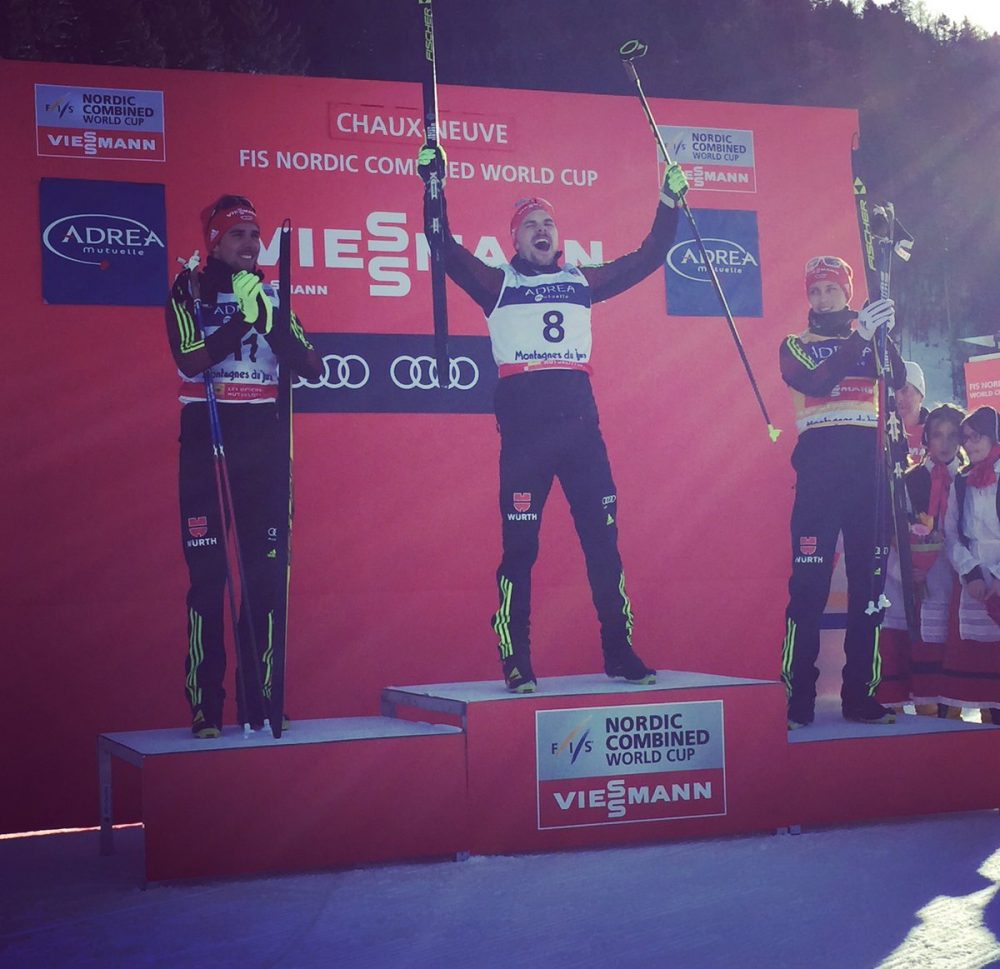
Sunday’s Nordic Combined World Cup podium in Chaux-Neuve, France, with German winner Fabian Rießle (c), German runner-up Johannes Rydzek (l), and Germany’s Eric Frenzel (r) in third. (Photo: FIS Nordic Combined/Twitter)
On Sunday, after the large hill jump and 10 k ski, Germany swept the podium in the second event of the NoCo World Cup in Chaux-Neuve, France. Fabian Rießle placed first in 22:44, and his German teammates Johannes Rydzek skied to second only 2.2 seconds back, and Saturday’s winner Eric Frenzel was third (+7.9).
(Frenzel leads the NoCo World Cup, Rydzek is second overall, Rießle is third.)
Norway’s Jarl Magnus Riiber flew the farthest with 139.8 points. Franz-Josef Rehrl from Austria jumped to second with 135.7 points while his teammate Bernhard Gruber jumped to third with 131.7 points.
Magnus faded to 23rd (+47.5) in the 10 k ski. Rehrl started 15 seconds back from Magnus and placed 17th overall (+31.5). Gruber maintained a top-ten, placing 9th (+13.5), after starting 32 seconds behind first place jumper Magnus.
While the top three jumpers all dropped back in the ski, it was a day of catch up for the German’s after the jumping portion.
Rießle ranked eigth after the jump and earned 128.7 points, he began the ski 0:44 back. Rydzek placed 11th in the jump with 126.9 points, while Frenzel jumped to fourth with 131.4 points.
The only U.S. skier entered in Sunday’s event was Ben Berend. The U.S. Nordic Combined skier jumped to 13th with 126.8 points — starting the ski 0:52 behind Magnus. Yet Berend couldn’t capitalize on his strong jump, he dropped to 37th (+2:06) after the ski.
The Nordic Combined World Cup continues next Friday in Seefeld, Austria.
Alex Harvey celebrates on his way to the top step of the podium in Ulricehamn, Sweden. The Canadian won the 15 k freestyle over Norway’s Martin Johnsrud Sundby and Sweden’s Marcus Hellner. (Photo: Cross Country Canada/NordicFocus.com)
But winning a long individual-start race? Yes, that’s something else. Harvey picked up his fifth individual win in Ulricehamn, Sweden, today, and the first in an individual-start race longer than a prologue.
“It’s for sure the win that gives me the most satisfaction,” Harvey said after besting every other skier in the 15 k freestyle. “In mass starts or sprints, in the tactical game sometimes I can play it pretty well. I can use the others a bit, and kind of wait for the last sprint. But today — I didn’t have a ride or anything. I had to make it on my own. That’s true skiing, pure skiing, more old school in a way. So it’s the win that gives the most satisfaction in my career, I think.”
It wasn’t just Harvey who saw the difference between his previous victories and today’s 15 k freestyle. Harvey’s whole team felt like it was a moment where Canada truly had arrived.
“Today was a legendary day for our team,” Harvey’s longtime teammate and friend Devon Kershaw wrote in an email. “I mean, when you win an individual start race in our sport – then in my opinion you have really written your name amongst the greats. I’m not saying winning sprints or mass starts are easy – but when it’s just you out there – having to do it totally alone – it’s something pretty special… All I can say is ‘chapeau mon gars’ to Alex… To win in the style he did it in too, and in front of such a wonderful crowd, that will be a memory we will all have for life. Simply fantastic skiing.”
Harvey started hard, and already laid down the fastest split of the field when he crossed the five kilometer mark.
A number of top competitors had later bib numbers. Dario Cologna of Switzerland, Martin Johnsrud Sundby of Norway, and Marcus Hellner of Sweden were all lurking behind him, hearing his splits and trying to pounce. But none could best his time.
The men’s 15 k freestyle podium at Saturday’s World Cup in Ulricehamn, Sweden, with Canadian winner Alex Harvey (c), Norwegian runner-up Martin Johnsrud Sundby (l), and Sweden’s Marcus Hellner (r) in third. (Photo: FIS Cross Country/Twitter)
Initially, that made Canadian coach Ivan Babikov nervous.
“When I saw the first split, I kind of got a bit scared,” he admitted. “Like maybe, I hope he didn’t start too fast. Leading by two seconds on the first split — there are some guys who start really fast and then blown up.”
But when he saw how Harvey was skiing, his fears slipped away.
“I was on the biggest hill,” Babikov explained. “He was just so confident, so powerful, one-skating the whole thing. And then did not slow down in the second lap, and got even more time on the second and third place. Then I thought, he is actually doing it. He has his game plan, he started fast, and he was able to keep his pace and speed all the way.”
Harvey agreed: he had things under control.
“I was trying to not put myself too much in the red on the big hill, but to really ski well and fast on everything else for the course,” he explained. “So for maybe 600 meters of the course, on the big hill, let my foot off the gas. Everything else I was able to attack, and recover well on the downhills. At the halfway point I was actually feeling pretty positive still… I was like, ‘Okay, it’s mine to lose now, and I’m not going to let it slip through my fingers.’ It was a good feeling.”
A few racers lost substantial time over the last several kilometers, or on the rolling sections of the course which require focus, momentum, and, as Harvey said, “punch”.
But this was a course well-suited to Harvey, and he took advantage.
“Short uphills that you can really punch it, and then recover quickly again,” he explained. “Skiing it the last two days, I thought it was a great course for me. I was looking for a good result and I know I’ve been feeling good since I took a few days off after the Tour. I was looking forward to the race, but winning… I did not think I could win until the midway point of the race.”
When all was done, Harvey landed a six-second victory over Sundby. Hellner was third, +14.3, and managed to hold off fourth-place Cologna by just 0.4 seconds.
Daniel Stock of Norway, who got the call to race within the last week, posted a huge career best in fifth place (+16.2). Britain’s Andrew Musgrave was sixth (+18.7).
“I don’t believe that I am this good, so I just go out there and do what I’m supposed to do,” Stock told NRK. “And then I finish fifth and that’s indescribable… I got a phone call from Tor-Arne [Hetland, the Norwegian men’s coach] Sunday night and I totally panicked. I had been training like crazy lately. So I just had to eat, lay down with legs elevated and find some extra energy. And I was able to do that.”
As for the winner, the Canadians were still high on the feeling hours later. Babikov, a former World Cup racer who once won the time-of-the-day on the Tour de Ski final climb, knows a thing or two about how hard it is to win a race on your own.
“It’s not a mass start,” Babikov said. “If you win by yourself, it you’re off the start leading the whole race, it shows great form… Individual start, it doesn’t show good tactics, or being more smart or lucky than other people, it’s all endurance and it’s all physical ability. Today [Harvey] showed that he is the best in the world, and to win like that with authority from the gun, leading most of the splits — oh it was impressive, it was really impressive. He is one of the best in the world and he is only getting better and better, and hopefully he can keep this shape for the World Championships.”
In taking the win, Harvey also became the first Canadian to ever win back-to-back World Cups on consecutive weekends.
“We’ve had a lot great champions in Canada,” he said in a Cross Country Canada press release. “It is nice to be able to own a statistic like that, but I do it for the result and to be the best I can be each race. If that means that I win back-to-back then that is a bonus.”
With Strong Performances, Canada Looks to Relay
While Harvey’s win certainly highlighted the day for Canada, the team was also pleased with some other results.
Canada’s Alex Harvey (l) and Len Valjas celebrate their World Cup freestyle team sprint win in Toblach, Italy, least weekend. (Photo: Salomon/NordicFocus)
Lenny Valjas finished 35th (+1:17.7), his best result in a distance race over 5 k since 2013. That season, he and Harvey shared the podium in a 15 k mass start stage of the Tour de Ski. But ever since, Valjas has been battling injuries and has primarily succeeded in sprinting.
“Len had a good starting position and he started well,” Babikov explained. “He kind of tried to pull Alex when Alex caught him, and maybe slowed up a bit on the second lap. But then he recovered and finished actually really, really, strong so I am really proud of him and just happy with it. It’s just kind of bittersweet that he is almost in the points [top 30]. But it’s his best distance race of the season so far… Len is a way that now it’s not about training, it’s about races. The more races he does, he is getting better in shape.”
Close behind Valjas was Kershaw. The veteran was on track to score points with a top-30 finish, but lagged in the course’s final kilometers and landed 38th (+1:22.2).
“The last 2km were just absolutely horrendous apparently (based on the splits),” Kershaw wrote in an email. “I was skiing alone – and of course I was tired – but I didn’t think I was SO tired. Very disappointed with the last few kilometres… The terrain was really gradual, undulating and turny – perhaps in my tired state I fell asleep through some of that terrain and I really, really paid for that on the results board… I may have opened a tad hot, but fortune favours the bold – or so they say – so I do not regret my strategy there.”
Despite an imperfect race, Kershaw was not too disappointed.
“I was not hoping for anything this weekend if I’m honest,” he wrote. “15km skate individual start is by far my least favourite race in skiing…. The race today had its moments. Both good moments and some tough moments.”
Canada’s fourth athlete, Knute Johnsgaard, did not end up starting, with Babikov saying that Johnsgaard was still suffering a bit after only recently arriving in Europe from North America.
Still, the gang will contest Sunday’s 4 x 7.5 k relay, and are particularly pumped after the results of the 15 k.
“I’m excited,” Harvey said. “The big hill is only in the classic part, so the classic will be harder. Maybe things will go down a bit earlier, because after that the skate is quite… there are no easy courses on the World Cup, but I think this is one that can be a big advantage to be able to follow in a group. Devon and I are going to go in the classic legs. We will try to lay down a good race and stay with the group, and if we’re still with the group after the classic, then we’re allowed to believe in a good result. Top eight would be good for us, after that you never know.”
Bjornsen 28th to lead Americans
Erik Bjornsen racing to 20th place in the World Cup in La Clusaz, France, earlier this season.
Erik Bjornsen was the top American finisher in 28th (+1:09.2), scoring World Cup points for the third time this season.
Bjornsen had to drop out of the Tour de Ski partway through, but seems to be back in top form.
“He obviously needed some time to go and get healthy, or recover from the Tour,” U.S. Ski Team Head Coach Chris Grover said. “He had a really good training block in France. Conditions were good he had a lot of skiing at his disposal, so he was able to recover and then he was able to build in some good training. It was great to see him out there have a good race today. He started I would say fairly conservatively and then he ended up getting behind the Lari Lehtonen of Finland and catch a ride with him for maybe ten kilometers. That really propelled him into another good skate race.”
Also for the United States, Noah Hoffman finished 41st (+1:28.8), Simi Hamilton 53rd (+1:56.2), and Matt Gelso 68th (+3:00.3).
Ben Lustgarten (Craftsbury Green Racing Project) with his $750-dollar check for winning the men’s SuperTour classic sprint on Saturday near Truckee, Calif. Stratton’s Ben Saxton (l) placed second and APU’s Reese Hanneman (r) was third.
Lustgarten, of the Craftsbury Green Racing Project, raced to a 1.58-second victory in the men’s A-final at the Auburn Ski Club in Soda Springs, Calif., finishing in 3:03.4. Ben Saxton, of the Stratton Mountain School (SMS) Elite Team, placed second, and Reese Hanneman, of Alaska Pacific University (APU), was third (+2.77).
Hannenman’s younger brother Logan also reached the final and placed fourth (+4.5), Dakota Blackhorse-von Jess (Bend Endurance Academy) was fifth (+5.86), and the third APU skier in the final, Tyler Kornfield sixth (+18.69).
Blackhorse-von Jess started the day off as the fastest qualifier in 2:58.8. Saxton qualified second, 4.1 seconds back, Logan Hanneman qualified third (+4.2), and Lustgarten fourth (+6.5). Blackhorse-von Jess went on to win his quarterfinal and place second in his semifinal, while Lustgarten and Saxton both won their quarterfinals and semifinals.
Jennie Bender (3) of the Bridger Ski Foundation leading Stratton’s Julia Kern (2) and Sun Valley’s Deedra Irwin (5) during the second women’s classic sprint semifinal at Saturday’s SuperTour near Truckee, Calif. Bender went on to win the semifinal, as well as the final.
In the women’s A-final, Jennie Bender of the Bridger Ski Foundation, coming off a classic sprint win at nationals, scored another victory in 3:29.07. She edged Craftsbury’s Kaitlynn Miller by just seven-hundredths of a second, and Stratton’s Julia Kern placed third (+3.42). Racing at home, Hannah Halvorsen (Sugar Bowl Academy) finished fourth (+3.88). Craftsbury had three in the women’s final with Caitlin Patterson in fifth (+3.93) and Heather Mooney in sixth (+27.35).
Miller proved to be the woman to beat throughout the day, winning the qualifier in 3:30.9, along with her quarterfinal and semifinal. Kern qualified second (+3.2) and Bender third (+4.6). Bender went on to win her quarterfinal and semifinal as well before facing off with Miller in the final.
NorAm Western Canadian Championships (Whistler, B.C.): 10/15 k classic
It was interval-starts day at Western Canadian Championships at Whistler Olympic Park and national-team veteran Emily Nishikawa completed the four laps of the women’s 10 k classic in 30:35.5 to win ahead of teammate Dahria Beatty, 16.5 seconds behind. Maya MacIsaac-Jones completed the national team and Alberta World Cup Academy (AWCA) sweep in third (+1:36.5).
Sovereign Lake’s Hannah Mehain, of the national junior team, was the top junior for the second-straight day in eighth overall (+3:22.1).
In the men’s 15 k, Lappe Nordic’s Andy Shields won the six-lap race in 40:34.2, showing some of the form that won him the NorAm overall last season. National-team member Jess Cockney collected his second-straight podium, finishing second, 4.3 seconds behind Shields. Evan Palmer-Charrette (NTDC Thunder Bay) completed the podium in third (+55.1).
FIS Cross-Country World Cup (Ulricehamn, Sweden): 10/15 k freestyle
The men’s 15 k freestyle podium at Saturday’s World Cup in Ulricehamn, Sweden, with Canadian winner Alex Harvey (c), Norwegian runner-up Martin Johnsrud Sundby (l), and Sweden’s Marcus Hellner (r) in third. (Photo: FIS Cross Country/Twitter)
First individual win of the season (second straight, after winning last weekend’s team sprint), fifth individual victory of his career. That’s the latest news on Canada’s Alex Harvey, who won the World Cup men’s 15-kilometer freestyle individual start on Sunday in Ulricehamn, Sweden, for his first victory in a 15 k skate race and fourth individual podium of 2016/2017.
To say Harvey is on a roll is an understatement. On Saturday, he beat Norway’s Martin Johnsrud Sundby by 6 seconds after starting a minute behind the Norwegian defending World Cup champion. Harvey’s fastest time across the line in 32:46.2 held up through 76 finishers, with Sweden’s Marcus Hellner coming somewhat within range after starting a minute behind him. Hellner ended up 14.3 seconds back from Harvey at the finish for third place, behind Sundby.
Switzerland’s Dario Cologna missed the podium by 0.5 seconds in fourth (+14.7), and Norway’s 24-year-old Daniel Stock broke through in fifth (+16.2) for his first World Cup top 20.
Great Britain’s Andrew Musgrave placed sixth (+18.7), Sweden’s Daniel Rickardsson was seventh (+25.0), Norway’s Finn Hågen Krogh eighth (+32.2), Russia’s Petr Sedov ninth (+33.9), and Japan’s Keishin Yoshida 10th (+34.2).
American Erik Bjornsen landed in the points as he tied Norway’s Simen Andreas Sveen for 28th (+1:09.2), leading fellow U.S. Ski Team members Noah Hoffman, who placed 41st (+1:28.8), and Simi Hamilton in 53rd (+1:56.2). Also for the U.S., Matt Gelso, the Period 1 SuperTour leader from the Sun Valley Ski Education Foundation (SVSEF) Gold Team, finished 68th (+3:00.3).
Harvey’s Canadian World Cup teammates Len Valjas finished 35th (+1:17.7) and Devon Kershaw 38th (+1:22.2). Knute Johnsgaard (Canadian U25 Team) did not start.
The women’s 10 k freestyle podium on Saturday in Ulricehamn, Sweden, with Norwegian winner Marit Bjørgen (c), Finland’s Krista Parmakoski (l) in second and Sweden’s Charlotte Kalla (r) in third. (Photo: FIS Cross Country/Twitter)
In her first World Cup race in over a month and at a brand-new World Cup venue, Norway’s 36-year-old Marit Bjørgen returned to her winning ways, topping the women’s 10 k freestyle on Saturday in Ulricehamn.
Bjørgen started 40th out of 61 finishers and took the lead from Finland’s Krista Parmakoski at the finish with a time of 23:46.3 minutes. Parmakoski, who started a minute ahead of her in bib 38, ended up second, 10.7 seconds back. Sweden’s Charlotte Kalla reached the podium for the second time this season in third (+24.9).
“It is always great to win,” Bjørgen said, according to an International Ski Federation (FIS) press release. “I stayed at home for five weeks and was training. It is great to come back with a victory. I know that the training I had done was good. It was an amazing atmosphere today by the course. There were people cheering everywhere.”
Norway swept fourth through sixth with Astrid Uhrenholdt Jacobsen in fourth (+25.7), Ragnhild Haga in fifth (+32.3) and Heidi Weng in sixth (+34.0).
American Jessie Diggins raced to seventh (+34.9), ahead of Sweden’s Hanna Falk, who recorded her best distance result in eighth (+36.4). Norway’s Ingvild Flugstad Østberg finished ninth (+44.8), and Germany’s Sandra Ringwald was 10th (+56.6).
“I didn’t have the snappy good feelings I was hoping to have in my body today, but it was a solid race,” Diggins wrote in a post-race email to FasterSkier. “It’s always hard when you know that on your best days you are capable of more, but at the same time we had great skis, and it was really fun for me to be able to ski with my teammates today!”
The U.S. had three in the top 20 and four in the top 30 with Sadie Bjornsen in 12th (+1:00.5), Liz Stephen in 16th (+1:07.3) and Rosie Brennan in 24th (+1:30.7).
Cendrine Browne as Canada’s lone woman in the race achieved 35th (+1:52.0) for her career best in an individual race. Also for the U.S., Kikkan Randall placed 40th (+1:59.6) and Liz Guiney of the Craftsbury Green Racing Project 52nd (+2:33.2).
The photo finish of the men’s 4 x 7.5 k relay on Saturday at the IBU World Cup in Antholz, Italy, with Germany’s Simon Schempp outlunging Norway’s Emil Hegle Svendsen. (Photo: ZDF broadcast screenshot)
For the U.S. men, top six was a target for the 4 x 7.5 k relay on Sunday in Antholz, Italy, according to US Biathlon Men’s Coach Jonas Johansson.
Mission accomplished. In the final team event before 2017 World Championships, Lowell Bailey, Leif Nordgren, Tim Burke, and Sean Doherty combined for sixth, finishing 1:04.9 minutes behind the German winners. The Americans used a total of 10 spares but avoided the penalty loop, as did the Germans who used seven spares to clean the eight-stage race and won it in 1:13.57.2.
Germany’s Simon Schempp narrowly outlasted Norway’s Emil Hegle Svendsen in the finishing stretch to secure the victory for Germany (with teammates Erik Lesser, Benedikt Doll and Arnd Peiffer) by one-tenth of a second. Norway finished second with nine spares and no penalties (with Lars Helge Birkeland, Henrik L’Abee-Lund, Johannes Thingnes Bø, and Svendsen), and Russia secured third (+33.6) with nine spares and zero penalties as well (with Maxim Tsvetkov, Evgeniy Garanichev, Dmitry Malyshko, and Anton Babikov).
Ukraine used a total of just five spares and had zero penalties for fourth (+46.7), and Austria took fifth (+49.2) with eight spares and no penalties, after Austria’s Dominik Landertinger skied away from Doherty on the final loop and finished 6.9 seconds ahead of him for fifth place.
For the U.S. men, sixth was close to their team-best fifth with the same lineup in last year’s World Cup relay in Presque Isle, Maine. The same group also took sixth in Ruhpolding, Germany, last year as well.
With all four making US Biathlon’s World Championships team, announced Saturday, they will likely be aiming for a best championships result early next month in Hochfilzen, Austria.
Canada (Christian Gow, Scott Gow, Macx Davies, and Brendan Green) finished 16th (+4:13.8) on Saturday with two penalties and 11 spares. Scott Gow skied them up to 15th by the second exchange but they dropped to 18th after Davies had two penalties on the third leg. With Green anchoring and using just one spare, they recouped two places before the finish.
In the women’s race, Germany’s Nadine Horchler achieved a lifetime dream with her first World Cup win, after starting in bib 30 and earning her start as a reserve athlete. Germany took first and second with Laura Dahlmeier in second, and the Czech Republic’s Gabriela Koukalova placed third. Susan Dunklee of the U.S. was the lone North American starter and finished 24th after leading at the start of the second loop.
FIS Nordic Combined World Cup (Chaux-Neuve, France): Individual large hill/10 k
Saturday’s Nordic Combined World Cup podium in Chaux-Neuve, France, with German winner Johannes Rydzek (c), German runner-up Fabian Rießle (l) and Japan’s Akito Watabe (r) in third. (Photo: FIS Nordic Combined/Twitter)
The first part of Saturday’s Nordic Combined World Cup individual large hill/10 k competition was a shining moment for U.S. Nordic Combined skier Ben Berend, who jumped to second for a total of 127.5 points, trailing only Norway’s Jarl Magnus Riiber with 139 points in Chaux-Neuve, France.
Berend flew farther than Germany’s Eric Frenzel, who jumped to third on the Chaux-Neuve large hill.
Later in the day, they started the 10 k Gundersen in that order, with Riiber heading out first, followed by Berend 46 seconds later, then Frenzel 53 seconds back in third.
Germany’s Johannes Rydzek started 1:15 minutes back in 12th and skied the fastest 10 k to take the victory at the finish (in 23:01.7). He held off his German teammate Fabian Rießle by 2.8 seconds for the win, after Rießle started sixth and 1:01 back. Japan’s Akito Watabe reached the podium in third (+5.7) after jumping to seventh and starting the race 1 second behind Rießle.
Frenzel ended up fourth (+8.3), and the fourth German in the top five, Björn Kircheisen improved to fifth (+22.6) after starting 11th.
Riiber dropped to 15th (+54.0), and Berend fell outside the top 30 to end up 32nd (+2:26.0) with the 39th-ranked course time.
Berend finished 12.2 seconds ahead of his U.S. teammate Taylor Fletcher, who placed 34th (+2:38.2) after the jump put him in 48th.
Bryan Fletcher was 49th after the jump but did not start the 10 k.
The Nordic Combined World Cup continues Sunday in Chaux-Neuve with another large hill/10 k.
Ski Classics #5: La Diagonela (Zuoz, Switzerland): 50 k classic
[UPDATED] Under “blue skies, no wind and perfect track conditions” in the Swiss Engadin Valley on Saturday, according to a Ski Classics press release, Russia’s Ilya Chernousov and the Czech Republic’s Kateřina Smutná won the men’s and women’s La Diagonela, respectively, in Zuoz, Switzerland.
Chernousov, of Team Pioneer Investments, and Tord Asle Gjerdalen (Team Santander) led a large pack of men into the final major climb on the 50 k course. There, Gjerdalen attacked and Chernousov matched him, accelerating away from his competitors up the last steep pitch to the finish, according to the press release. He finished in 2:03:39.6 hours, holding off Gjerdalen by 1.5 seconds, while Øystein Pettersen (Team BN Bank) finished third (+3.0).
In the women’s race, Smutná (Team Santander) pushed to break up the field around the halfway point, where the men caught the women. Britta Johansson Norgren (Lager 157 Ski Team) hung with Smutná, but lost contact over the last 5 k. After finishing second in the last two Ski Classics races, Smutná took the win by 1:03.2 minutes in 2:20:49.2. Nordgren finished second, ahead of Sara Lindborg (Team Serneke) in third, who finished more than three minutes later (+4:17.4).
The start of the men’s 4 x 10 relay at last year’s World Cup in Lillehammer, Norway. While Lillehammer will host the first mini tour of the season this year, there won’t be any relays there. (Photo: Fischer/NordicFocus)
The first mini tour of the 2016/2017 International Ski Federation (FIS) Cross-Country World Cup season will be held in Lillehammer, Norway, Dec. 2-4, but don’t fret, Ruka in Kuusamo, Finland, remains the season opener Nov. 26-27.
FIS recently approved its schedule for the upcoming World Cup season, with the usual classic openers in Ruka (two races as opposed to sometimes three), followed by a three-day mini tour in Lillehammer (classic sprint, 5/10-kilometer freestyle and 10/15 k classic pursuit).
The circuit then moves to Davos, Switzerland, another staple for December races, for its famous 15/30 k freestyle individual races followed by a freestyle sprint Dec. 10-11. La Clusaz, France, hosts the next World Cup Dec. 17-18 (skiathlon and a relay) to wrap up Period I.
Period II kicks off with the 11th annual Tour de Ski, starting in Dario Cologna’s hometown of Val Müstair, Switzerland (skate sprint and 5/10 k classic mass start Dec. 31-Jan. 1). Athletes have one travel day before the Tour resumes with two stages in Oberstdorf, Germany (10/20 k skiathlon, 10/15 k freestyle pursuit), followed by another rest day and the final three stages in Italy (Toblach 5/10 k freestyle and Val di Fiemme’s 10/15 k classic mass start and final climb).
After that, the regular World Cup season picks up again back in Toblach with two days of skate races (sprint and team sprint) Jan. 14-15. Then, it’s onto a brand-new venue on the World Cup as Ulricehamn (near Gothenburg), Sweden, hosts the 10/15 k classic and a relay Jan. 21-22. Skiers stay in Sweden for the next weekend of racing in Falun, with a skate sprint and 15/30 k freestyle mass start Jan. 28-29.
The first weekend of February marks the pre-Olympic World Cup (i.e. venue and course preview) in PyeongChang, South Korea, with three races Feb. 3-5 (classic sprint, skiathlon and freestyle team sprint).
By the Numbers: Race lineup for 2016/2017 World Cup season (excludes World Championships) – Classic sprints (5) – Freestyle sprints (5) – 10/15 k classic individual races (5) – Skiathlons (3) – Freestyle pursuit (3 including hill climb)
– Team sprint (2, both skate)
– Relays (2)
Period III entails just one World Cup before World Championships, and it’s being held in Otepää, Estonia, Feb. 18-19 (skate sprint and 10/15 k classic).
The 2017 World Championships will take place in Lahti, Finland, Feb. 21-March 5.
Period IV will be held entirely in Norway, with the Drammen classic city sprint on March 8 followed by the Holmenkollen men’s 50 k classic on March 11 and women’s 30 k classic on March 12.
World Cup Finals are being held in Tuymen, Russia, with four races March 16-19 (3/5 k freestyle prologue, classic sprint, 10/15 k classic mass start, and 10/15 k freestyle pursuit).
In addition to releasing its calendar, FIS Cross-Country outlined its most-important decisions made at its 50th Congress earlier this month in Cancun, Mexico.
For starters, juries across the sport may designate and mark zones where double poling is not allowed “in order to preserve the classic technique,” but “as a consensus, it was agreed that this rule will not be applied at the World Cup, World Ski Championships and Junior World Ski Championships level.” In other words, this is going to be tested at lower levels of racing.
There’s also a new age requirement for all FIS competitions: athletes must be at least 16 years old before the end of the calendar year (Jan. 1-Dec. 31).
FIS points will be doled out at all FIS long-distance events (i.e. marathons) spanning 50 k or more (or 42 k if they’re at an elevation of at least 1,500 meters, roughly 5,000 feet) to encourage higher levels of participation.
And an equal quota of eight men and eight women per nation at U23 World Championships has been approved (note that four of each gender are allowed to start per race).
On the World Cup, the start quota for competitions has been reined in, reducing the number of athletes each nation is allowed to enter per race to 15 (and 10 for the Tour de Ski). For team sprints and relays, all nations are allowed to enter up to two teams.
In addition to each nation’s calculated start quota (awarded based on team standing from the previous season; see below), the defending overall World Cup champions (Martin Johnsrud Sundby and Therese Johaug) don’t count toward their nation’s quota, and last year’s overall Continental Cup winners earn Period I World Cup start rights for this season. National group quota remains unchanged (i.e. when a nation hosts a World Cup) at 10 athletes.
The FIS Cross-Country World Cup’s basic start quota “nation quota,” which is calculated according to the Team Cup standing from the previous season
In terms of format, the heat selection tested in individual sprints (the 30 qualifying athletes per gender can choose their quarterfinal heat) has been approved and will be used at the World Cup, World Championships and Olympics.
In regular-season team sprints, the top-four teams from each semifinal will now automatically advance to the final, and the remaining seven teams can qualify based on time. But at World Championships, the qualifying system is as it was before — with two teams from each semifinal automatically advancing and the next six-fastest teams qualifying as well (putting the pressure on to finish first or second).
Interval starts will be mostly conducted the same, except in men’s races, 40 athletes will start in front of the seeded group (instead of 30) and the top-15 athletes can chose their start bib in that order (first to 15th).