From the FasterSkier archive — posts syndicated from athletes’ and coaches’ own blogs between 2004 and 2012, kept online as published. Current coverage is at fasterskier.com.
Position: Assistant Men’s and Women’s Nordic Ski Coach Employer: University of Alaska Fairbanks Location: Fairbanks, Alaska Type: Full-time, 11-month, term-funded, exempt Priority Application Review: May 20, 2026 (open until filled)
About the Position
The Assistant Men’s and Women’s Nordic Ski Coach plays a key role in supporting one of the nation’s premier collegiate ski programs. Working alongside the Head Coach, this position helps foster a high-performance environment grounded in growth, development, and teamwork. As part of the UAF Athletics Department and the broader Fairbanks ski community, the assistant coach will mentor student-athletes both on and off the trails, helping them excel in competition while preparing for success beyond college.
Success in this position comes from being an excellent communicator who inspires and guides college-aged athletes to reach their highest potential. The right candidate will mentor with patience and confidence while bringing out the best in both individuals and the team as a whole. On race days, the ability to stay calm, make quick decisions, and adapt under pressure will be essential. Creativity in problem-solving, flexibility in coaching approaches, and a balance of working effectively within a team while taking initiative independently will help the assistant coach excel in this role.
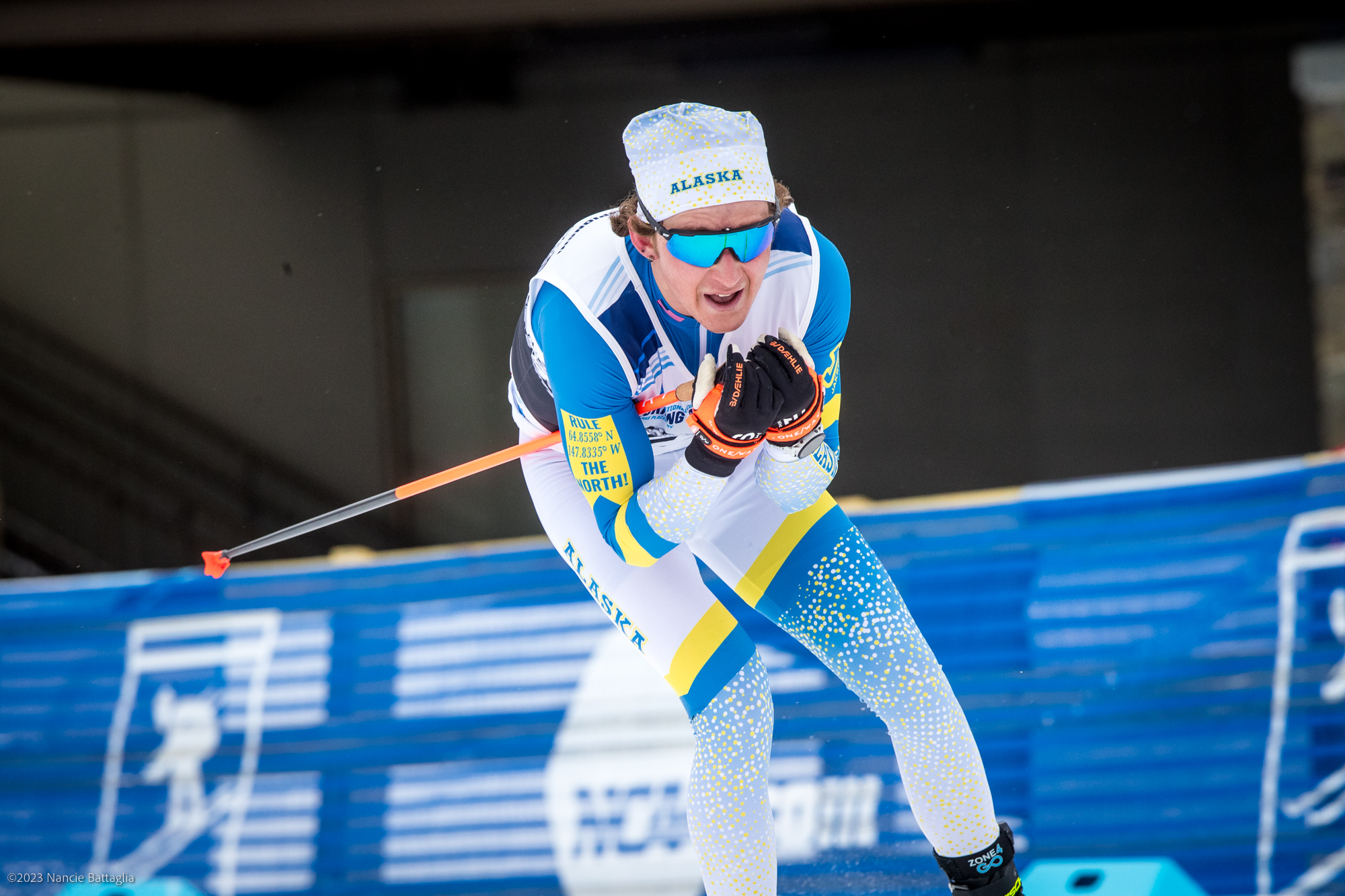
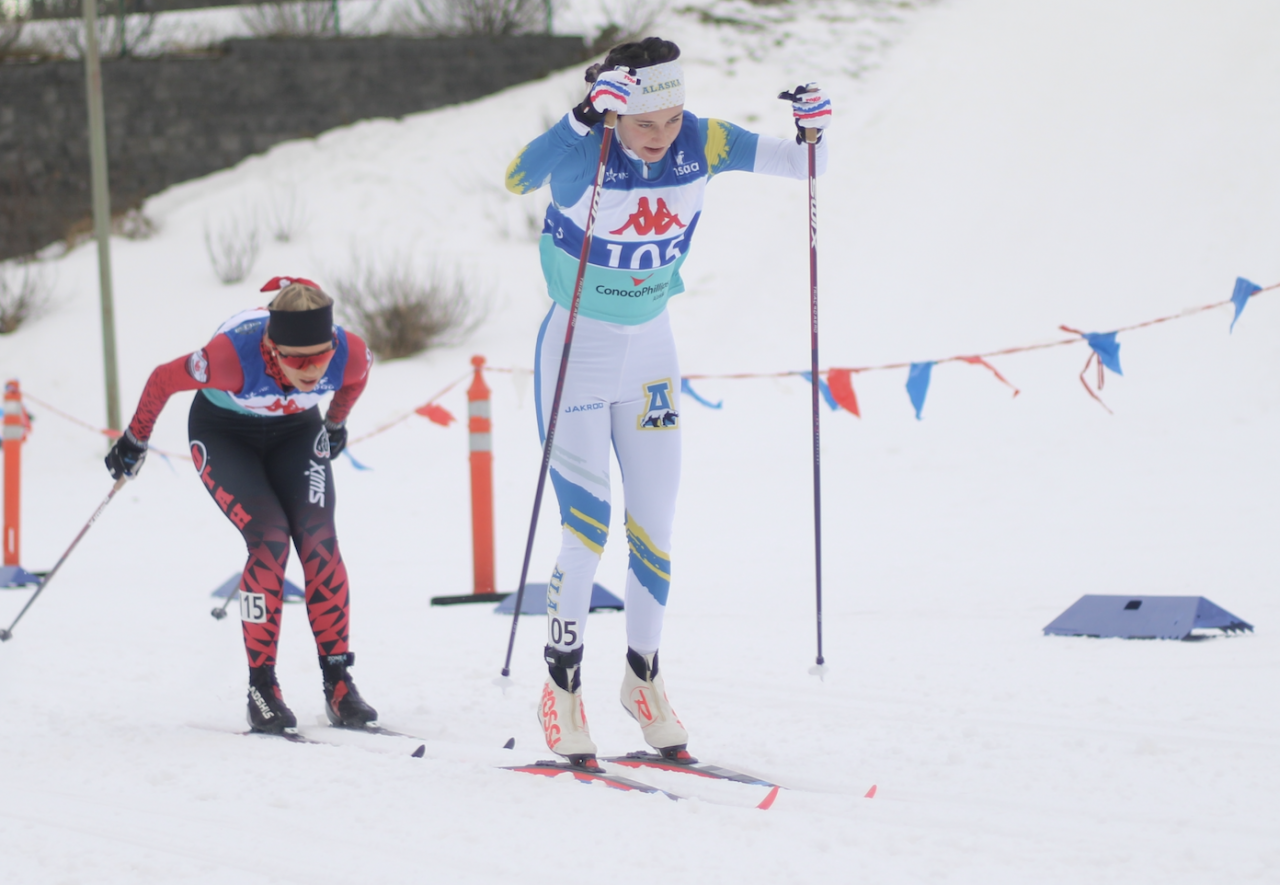
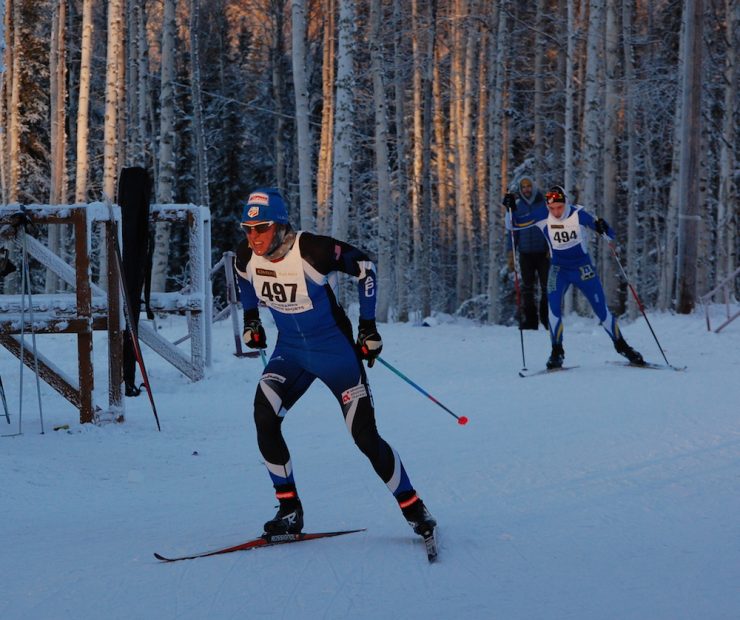
Joe Davies (UAF) during his NCAA Championship-winning performance in the 10 k skate in Lake Placid, New York, in the 2023 championship. (Photo: (c) 2023 Nancie Battaglia)
Minimum Qualifications
Bachelor’s degree in a related field and three years of relevant coaching experience at the collegiate level, or an equivalent combination of training and experience.
Cross-country ski racing experience.
A valid Alaska Driver’s License and a clean driving record in compliance with UA Safe Driving Criteria.
Preferred:
Degree earned while participating as an athlete at the candidate’s institution.
B.A. or B.S. in Physiology, Biology, Physics, or similar — though other majors are not excluded.
USSS Coaches Education L-100 certification, or equivalent.
Further ski- and NCAA-related education will be provided as part of the position.
Position Details
This is a full-time, 11-month, term-funded, exempt staff position with a competitive salary and a comprehensive benefits package. UA provides a generous compensation package that includes retirement options, annual leave, 12 paid holidays per year, tuition waivers for employees and family members, and affordable medical, dental, and vision care coverage. New hires will be placed on the UA Staff Salary Schedule, Grade 79, based on education and experience.
The University of Alaska reserves the right to require employees to work on-site at UA facilities. Hybrid and remote work may be approved for employees based in Alaska at the University’s discretion. Remote work for employees based outside the State of Alaska may be approved only in exceptional circumstances or when required by the position’s job duties.
This position is term-funded and is reviewed annually for contract renewal at the University’s discretion.
Eventually, Kendall Kramer (UAF – right) skied to a 35-second victory for the individual Women’s 20 k Freestyle NCAA Championship in 2025. (Photo: Tobias Albrigtsen)
Application Timeline
Application review will begin on May 20, 2026. Applications received by this date will receive priority consideration; however, the recruitment will remain open until filled.
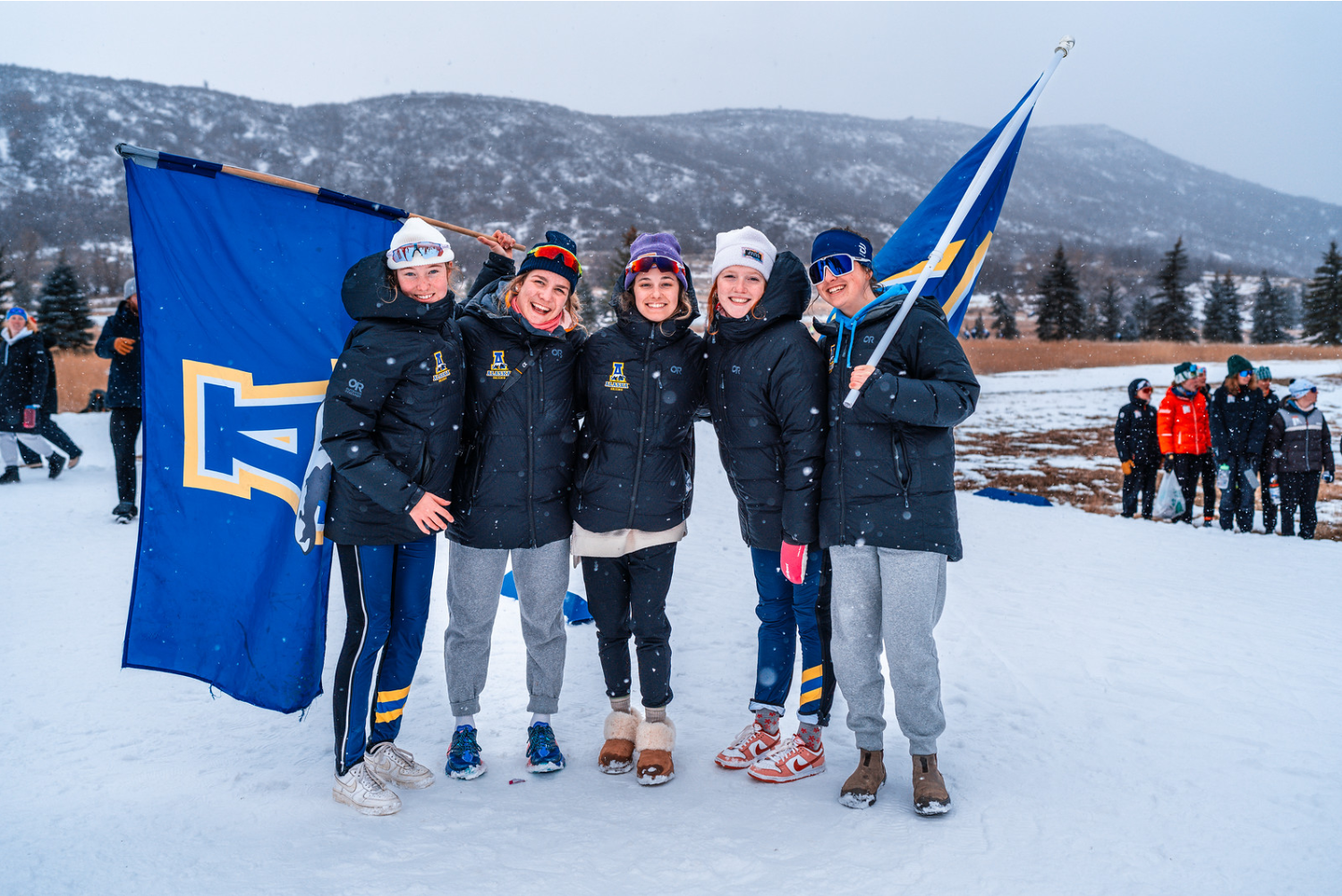
Rosie Fordham 2x NCAA Champion and Olympian this past season. (Photo: Lexi Pline)
Additional Information
To be eligible for this position, applicants must be legally authorized to work in the United States without restriction. Applicants who now or may in the future require visa sponsorship to work in the United States are not eligible.
The University of Alaska is responsible for providing reasonable accommodations to individuals with disabilities throughout the applicant screening process. For assistance with this application or any phase of the interview process, contact the ADA team at ua-ada@alaska.edu.
The University of Alaska is an Equal Opportunity/Equal Access Employer and Educational Institution. The University is committed to a policy of nondiscrimination against individuals on the basis of any legally protected status.
The successful applicant is required to complete a background check. Any offer of employment is contingent on the background check. All employees at the University of Alaska are expected to uphold the highest standards of ethics and professionalism when conducting university business. Applications submitted to the University of Alaska are subject to public disclosure under the Alaska Public Records Act.
Each university within the University of Alaska system publishes an Annual Security and Fire Safety Report containing campus safety information and crime statistics for the three most recent calendar years. Reports are available online: UAA | UAF | UAS. Paper copies are available upon request.
The Head Men’s and Women’s Skiing Coach provides comprehensive leadership and oversight for all aspects of UAF’s Nordic skiing programs within the Department of Athletics. This position is responsible for coaching and program development, student-athlete recruitment, supervision and mentorship of assistant coaches, and fostering a culture that promotes academic success, personal growth, and competitive excellence. The role supports student-athlete welfare, ensures compliance with NCAA, conference, and university policies, and contributes to the department through community engagement, fundraising, and responsible program administration. Working collaboratively with athletics staff and campus partners, the position advances the mission of the department by developing successful student-athletes and promoting the university through competitive achievement and community connection.
To thrive in this role, the successful candidate will demonstrate strong leadership, organization, and communication skills while fostering a positive, inclusive, and high-performance team culture. The individual must be able to effectively balance coaching excellence with administrative responsibilities, recruiting strategy, and student-athlete academic support. Success requires the ability to mentor and supervise staff, build meaningful relationships with student-athletes, alumni, and community partners, and maintain strict compliance with NCAA, conference, and university policies. A proactive, collaborative mindset and a commitment to student-athlete development, competitive success, and community engagement are essential to advancing the mission of the athletics department.
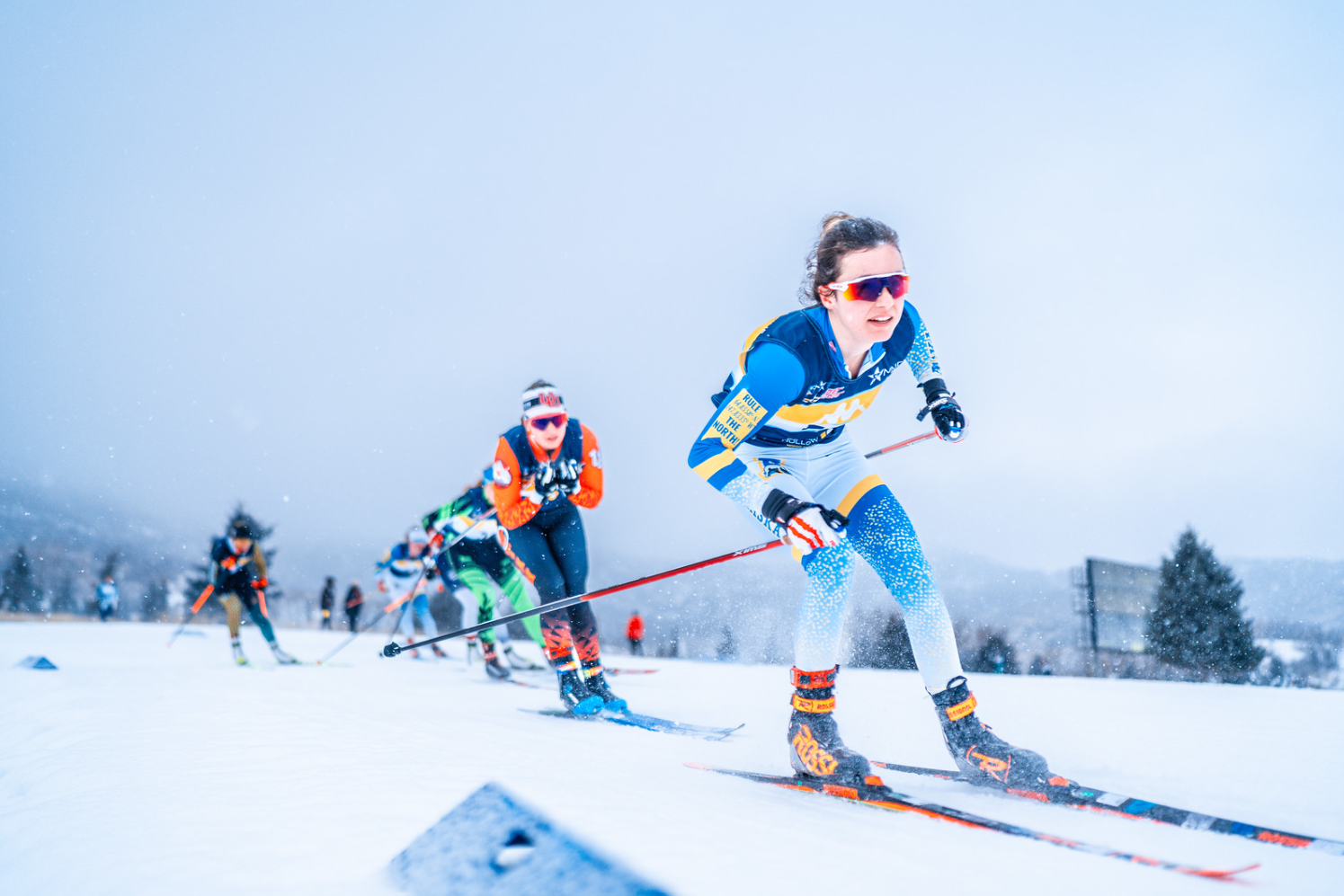
Kendall Kramer (University of Alaska-Fairbanks) leads the Women’s pack during the 20 k Skate Mass start at US Nationals. (Photo: Tobias Albrigsten/@UntraceableG)
Minimum Qualifications:
Bachelor’s degree in exercise science, exercise physiology, or kinesiology. Valid driver’s license required. Master’s degree in exercise science, exercise physiology, or kinesiology preferred.
Position Details:
This is a full-time, term-funded, exempt staff position complete with both a competitive salary and https://www.alaska.edu/hr/benefits/support/prospectiveemployees.php. UA provides a generous compensation package that includes retirement options, annual leave, 12 paid holidays per year, tuition waivers for employees and family members, and affordable medical, dental and vision care coverage. New hires will be placed on the https://www.alaska.edu/hr/benefits/compensation/salary.php, Grade 81, based on education and experience.
Applicant review will begin on March 18, 2026.
The University of Alaska (UA) reserves the right to require employees to work on-site at the UA facilities. Hybrid and remote work may be approved for employees based in Alaska at the University’s discretion. Remote work for employees based outside the State of Alaska may be approved only in exceptional circumstances or when required by the position’s job duties.
If you have any questions regarding this position, please contact Brittany Tappa, Signers’ Business Office HR Coordinator, at bjtappa@alaska.edu or 907-474-6353.
*To be eligible for this position, applicants must be legally authorized to work in the United States without restriction. Applicants who now or may in the future require visa sponsorship to work in the United States are not eligible.
This position is a term-funded position and is reviewed annually for contract renewal at the University’s discretion.
The University of Alaska (UA) is responsible for providing reasonable accommodations to individuals with disabilities throughout the applicant screening process. If you need assistance in completing this application or during any phase of the interview process, please contact UA Human Resources by phone at 907-450-8200.
The successful applicant is required to complete a background check. Any offer of employment is contingent on the background check.
Your application for employment with the University of Alaska is subject to public disclosure under the Alaska Public Records Act.
All employees at the University of Alaska are expected to uphold the highest standards of ethics and professionalism when conducting or engaged in university business.
*Each university within the University of Alaska system publishes an Annual Security and Fire Safety Report which contains information regarding campus safety and security including topics such as: campus law enforcement authority; crime reporting policies; campus alerts (Timely Warnings and Emergency Notifications); fire safety policies and procedures; programs to prevent dating violence, domestic violence, sexual assault and stalking; the procedures the University will follow when one of these crimes is reported; and other matters of importance related to security on campus. The report also contains information about crime statistics for the three most recent calendar years concerning reported crimes that occurred on campus; in On-Campus Student Housing Facilities; in Noncampus buildings or property owned or controlled by the University or a recognized student organization; and on public property within, or immediately adjacent to and accessible from, the campus. The report also contains fire statistics for any fires occurring in an On-Campus Student Housing Facility during the three most recent calendar years.
Access to the reports is available at:
UAA: (Addresses Anchorage campus, Aviation Technology Complex, JBER – Elmendorf Extension, JBER – Richardson Extension, Kenai Peninsula College – Kachemak Bay campus, Kenai Peninsula College – Kenai River campus, Kodiak College, Kodiak High School Extension, Matanuska-Susitna College, Prince William Sound College, and Prince William Sound College – Cordova Extension) Online: https://www.uaa.alaska.edu/students/safety. Request a paper copy in person: UAA Police Department Office at Room 114 of Eugene Short Hall on the Anchorage campus / UAA Dean of Students Office at Room 122 of Rasmuson Hall on the Anchorage campus. Request a paper copy by mail: 907-786-1120 or police@uaa.alaska.edu / 907-786-1214 or uaa_deanofstudents@alaska.edu.
UAF: (Addresses Fairbanks Campus, Bristol Bay Campus, Chukchi Campus, Community and Technical College, Kasitsna Bay Campus, Seward Marine Center, Tok Campus, Kuskokwim Campus, and Northwest Campus) Online: https://www.uaf.edu/orca/files/ASFSR.pdf. Request a paper copy in person: UAF Office of Rights, Compliance and Accountability on the 3rd Floor of Constitution Hall. Request a paper copy by mail: 907-474-7300 or uaf-orca@alaska.edu.
UAS: (Addresses the Juneau Auke Bay Campus, Juneau Technical Education Center, Sitka Campus, & Ketchikan Campus) Online: https://uas.alaska.edu/equity-and-compliance/docs/clery/UAS_ASFSR.pdf. Request a paper copy in person: Hendrickson Building, Suite 202 on the Juneau campus. Request a paper copy by mail: 907-796-6371 or emailing uas.clery@alaska.edu.
Joe Davies has notched multiple top-20 World Cup finishes representing Great Britain. The 24-year-old takes us through his compelling backstory, starting with his childhood in British Columbia through racing on the American college circuit.
The Olympic season is nearing, and we’ll hear from a few more athletes before it kicks off. Got anyone you want to hear from? Drop us a line with your requests and feedback: devon[at]fasterskier.com and nat[at]fasterskier.com. We’ll be back soon.
Kendall Kramer, racing Sunday at U.S. Nationals at Kincaid Park, is a multi-sport athlete at University of Alaska Fairbanks. She competes in both cross-country running and skiing. (Nathaniel Herz/FasterSkier)
ANCHORAGE — Alaskans like to think of their home state as the center of American cross-country skiing.
Minnesotans might quibble. But consider the more than 200 volunteers who turned out to help host the U.S. National Championships in Anchorage this week, and the dozens of local athletes who signed up to race.
There was just one problem: Through five of six of the championship events, athletes from Norway, Sweden, Colorado and Idaho had denied the Alaska crowd the pleasure of seeing one of their own cross the finish line first. (An Alaska man, Luke Jager, had technically claimed a U.S. championship Saturday, but crossed the finish line second to a Norwegian, who was ineligible to claim the title.)
Sunday’s 20-kilometer, classic-technique women’s race was the Alaskans’ last chance.
And Kendall Kramer came to the rescue.
The 22-year-old Fairbanks native won her first-ever national championship fashion in stirring fashion, breaking away from the pack early in the race with one other athlete and slipping away in the final meters before the finish.
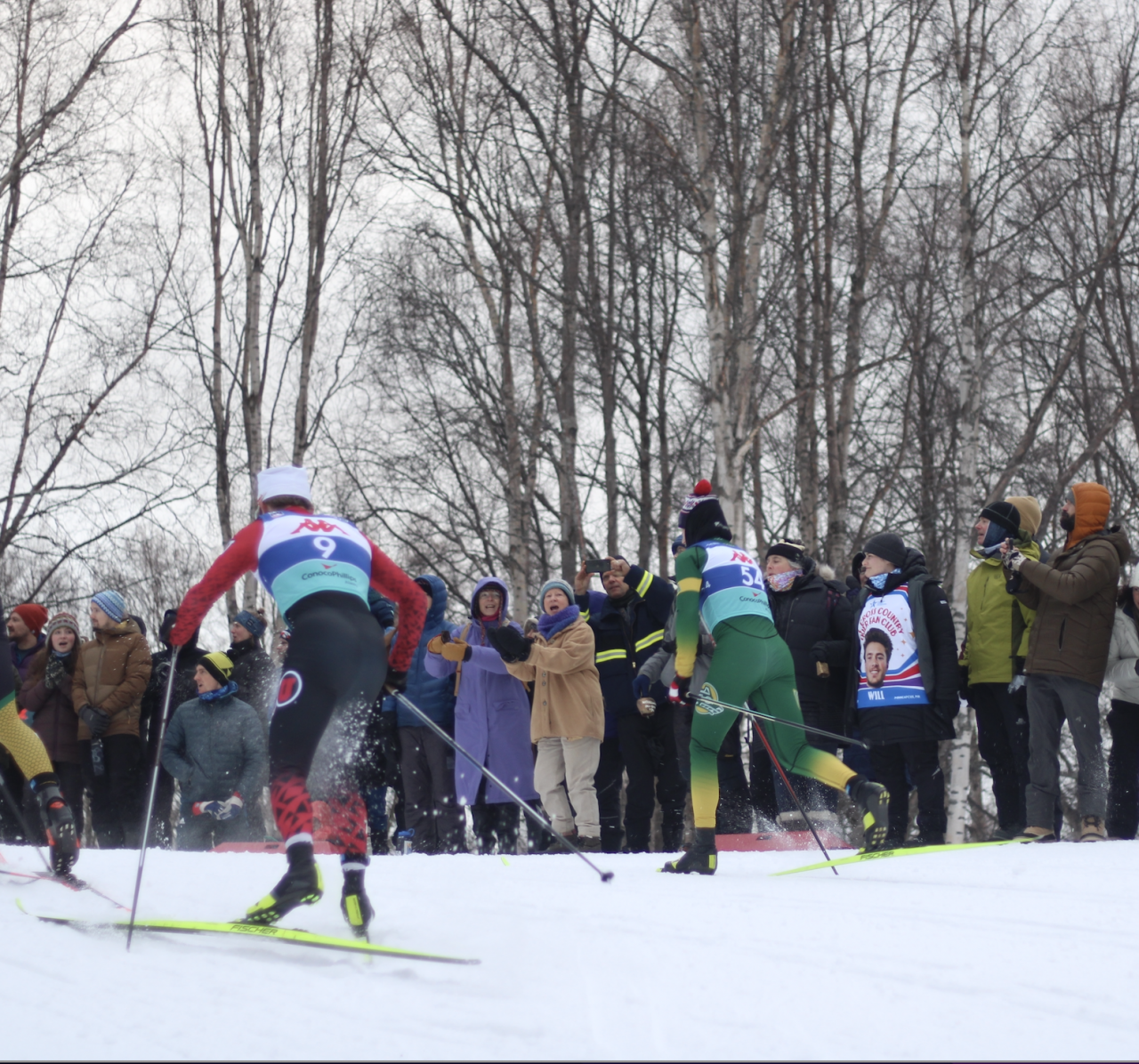
The crowd on one of the major hills cheers on U.S. Nationals competitors in Sunday’s men’s race. (Nathaniel Herz/FasterSkier)
“You can feel it in the energy,” said Kikkan Randall, the Olympic gold medalist who heads the Nordic Ski Association of Anchorage, which is co-hosting the event. “We have so many great volunteers out here, we really push to get spectators out here. And so when you see an Alaskan deliver, it’s just that sense of pride.”
Kramer’s final margin of victory was 2.4 seconds over Erica Laven, a Swedish skier competing for the University of Utah. The rest of the women’s pack crossed the finish line a minute-and-a-half later, led by Lauren Jortberg, who races for a Quebec club team.
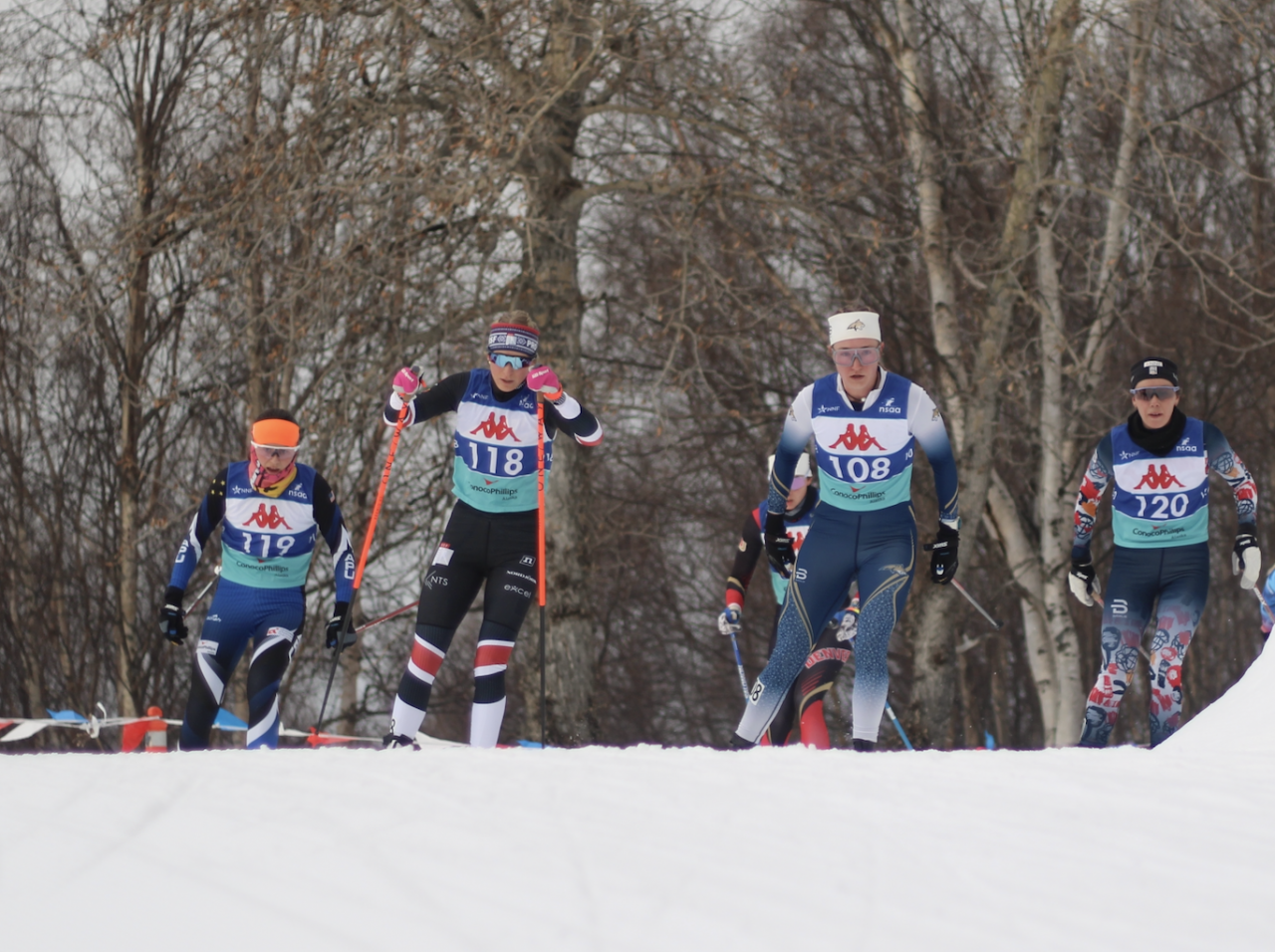
The women’s chase pack crests a hill in Sunday’s distance race. From left, Alaska Pacific University’s Renae Anderson, Bridger Ski Foundation Pro Team’s Erin Bianco, Montana State University’s Kate Oldham and CNEPH’s Lauren Jortberg. (Nathaniel Herz/FasterSkier)
Montana State University’s Kate Oldham was just behind Jortberg and rounded out the U.S. championship podium; Laven was ineligible due to her Swedish citizenship.
Kramer has been a standout since her years at West Valley High School in Fairbanks, where she won more than a dozen state titles between skiing, cross-country running and track and field. She was first named to the U.S. Ski Team while a junior in high school, then decided to stay in her home city for college, where she’s competed in both cross-country skiing and running.
She won a medal at the Youth Olympic Games in Switzerland in 2020, and has an array of junior national championships to her name. But two second places — including one Thursday to Oldham — were as close as Kramer had come to winning a U.S. title.
From the start of Sunday’s event, Kramer left little doubt about who would stand on the top of the American podium when she and Laven broke away from the pack on the first of four five-kilometer laps. The two skied the rest of the race together, with Kramer — who trains with Anchorage’s Alaska Pacific University club team during the summer — boosted by an energetic home crowd.
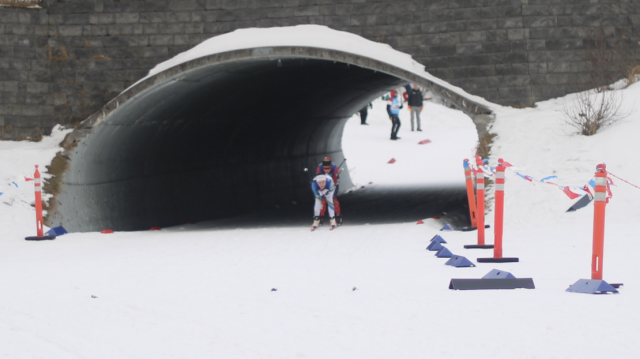
Kendall Kramer leads Erica Laven through the tunnel into the stadium at Kincaid Park. (Nathaniel Herz/FasterSkier)
“I really felt that — I was like, ‘This must be someone from here,’” Laven said, referring to Kramer. “Because it was a lot of people cheering for her.”
Among the fans at Kincaid were Kramer’s mother, Susan Schwartz, along with her grandmother, an aunt and innumerable teammates. Schwartz, who was working as a volunteer at the start line, described the race between Laven and her daughter as a “nail-biter.”
“They just kept on getting faster and faster and faster,” Schwartz said. “It was amazing to watch.”
Early on, Kramer said she realized that even if she lost the race to Laven, she’d still claim the U.S. title. But, she added, she didn’t necessarily want to settle for that. Laven was skiing stronger on uphills, but if Kramer could keep up in those segments, she said, she could “totally relax in the double pole.”
“She was expending a lot of energy on those. And I knew I had energy by the end,” Kramer said.
The closer Kramer got to the finish line, she said, the more confident she felt about her shot at winning the race outright. And on the home stretch, she pulled away.
Kramer elevates in her double pole to lead Laven toward the finish. (Nathaniel Herz/FasterSkier)
“She was really strong in the double pole today,” Laven said. “I really had to push hard.”
Kramer crossed the line without celebrating. But her mother, Schwartz, “could tell she was just thrilled” — particularly after Kramer finished a close second in Thursday’s race.
“I could tell she wanted it bad,” Schwartz said. “She was not going to let it get away from her today — that’s kind of the feeling I got watching her race.”
Kramer is in her last year competing for University of Alaska Fairbanks and expects to race professionally next season.
She said she doesn’t want to miss this spring’s collegiate championships. But she grimaced when a reporter pointed out that the event conflicts with the World Ski Championships in Norway, where finishes at the past week’s races in Anchorage are likely to inform which U.S. athletes are chosen for the team.
“I’m super grateful if I do get the spot, because I know how hard people work for it and how bad people want it,” she said. “But we’ll see.”
The second half of this year’s NCAA Championships took place Saturday in Lake Placid, New York, with a 20 k mass start classic which both the women’s and men’s field would race in true, dynamic, mass start style. Packs came, moves went and, in the end, one skier would come out the strongest on the day in both the women’s and men’s races.
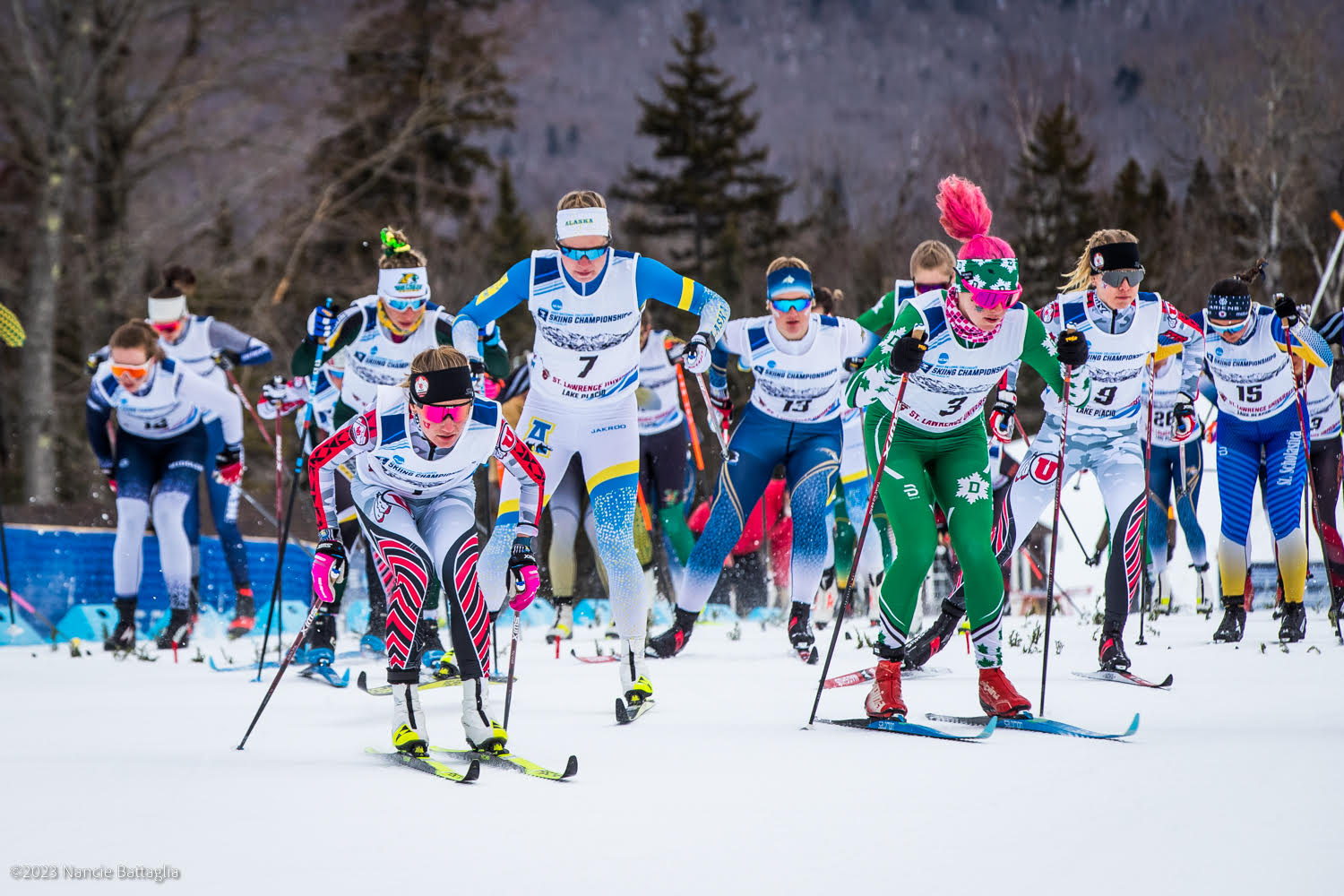
Novie McCabe controlled the pack for much of Saturday’s 20 k mass start. McCabe became just the fifth three-time NCAA Women’s Champion with her win. (Photo: (c) 2023 Nancie Battaglia)
Thursday’s results left open the possibility for plenty of history to be made. After dominant performances in Thursday’s 10 k/5 k skate race, Novie McCabe and Joe Davies opened the possibility to complete a “sweep” at this year’s Championship, winning both Skate and Classic races. Davies could have become only the second North American male to do so, after Ben Ogden completed the feat last year, and also the first British skier (Davies is half-Canadian, half-British, and competes for Team Great Britain). Novie McCabe, meanwhile, came into Saturday as the defending Classic champion, with a chance—after Thursday’s win—to become the fifth women to win at least three NCAA Championships, joining Laura Wilson (4), Katerina Hanusnova (4), and Antje Maempel (4), and Katharine Ogden (3).
And while there was the possibility of history being made by individuals, the entire women’s field was bound to make history by starting on the day. In a first move towards equal distance racing, the NCAA Championship mass start was a 20 k for both the men’s and women’s field.
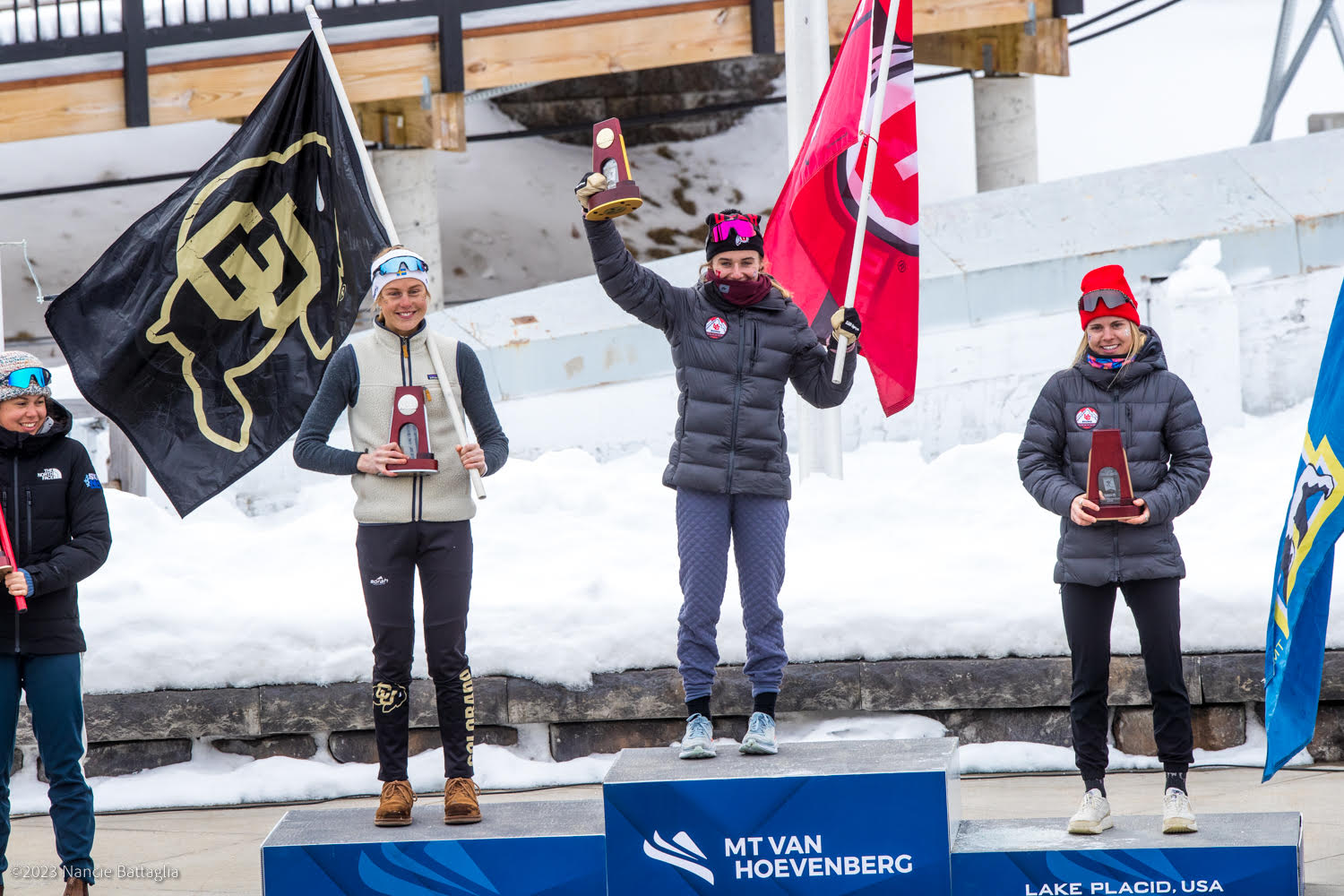
The team standings also added intrigue around some historical implications. The University of Utah (UU) and University of Colorado (CU) went into the final Nordic day of NCAA competition separated by just a 1.5 points, 358 for UU, and 356 for CU, at the top of the team standings. With Alpine skiers having completed their part of the combined scoring competition, it would come down to the Nordies out at Mt. Van Hoevenberg. UU had the chance to complete the first 4-peat in modern NCAA history (since ski jumping was dropped in 1977), and Colorado had a chance for its first NCAA Championship since 2015, the last time the Championship was held in Lake Placid.
Temperatures hovered right below the freezing mark on an overcast day in the Adirondacks, as the best collegiate skiers from the country looked to end the season in mass start, pack-style, fashion.
Women’s 20 k Classic Mass Start
The extra 5 k to the Women’s Mass Start this year only extended the tension. As the women’s field started to split mid-way through the race on Saturday, a trio of University of Utah skiers—all of them already NCAA Champions—started to push from the front. Novie McCabe, Sophia Laukli, and Sydney Palmer-Leger were joined by University of Alaska-Fairbanks’ (UAF) Mariel Pulles, and University of Colorado’s (CU) Hanna Abrahamsson. The five skiers traded some leads and pulls, but throughout the race, one skier appeared to control pack surges just a little more than the others, seeming to have an idea of when and where she wanted to make a move.
Novie McCabe controlled a pack that also contained her teammates Sophia Laukli and Sydney Palmer-Leger. The UU girls finished first, third, and fifth, propelling the Utes to their fourth consecutive NCAA Championship. (Photo: (c) Nancie Battaglia).
That was McCabe, and when the group started to wind around the Lake Placid course one last time, she decided to go. By the end of the lap, she was on her own. McCbe went on to complete her sweep, winning her third NCAA Championship. Her teammates Sophia and Palmer-Leger came through in third and fifth, with Abrahamsson in second and Pulles in fourth splitting the UU girls results. First, third, and fifth though, was enough to all but guarantee that the University of Utah Utes would make history by winning their fourth consecutive NCAA Championship. The trio of McCabe, Laukli, and Palmer-Leger scored the highest team score in an event of the entire NCAA Championships.
In post-race comments to FasterSkier, McCabe wrote that, “I am really excited that we managed to pull off the team win! The Alpiners had some crazy good performances which really helped us out and it was cool to be able to keep that lead today. My time at Utah has been really amazing and I feel so lucky to be part of the team, so being able to contribute to the win was a really great feeling!”
The University of Utah Utes became the first team in modern NCAA Championships history to win four consecutive titles, with their Nordic team leading the way. (Photo: (c) 2023 Nancie Battaglia)
UU Head Coach Miles Havlick wrote to FasterSkier about what distinguished this latest UU Championship: “This year was very much a team effort,” Havlick wrote. “Everyone both on the Alpine side and Nordic understood that their jobs were to score as many points as they could for the team, and it was very evident today. Both in the women’s race and men’s, each of our skiers left every ounce of energy out on the trails and I am super proud of that.”
Havlick also highlighted McCabe’s place not just in this year’s Championship, but in that whole string of Team Championships: “She was definitely on form this week,” he said. “And she will certainly go down as one of the best Ute skiers of all time.” Havlick recognized that the Utes dominance has been part of a feedback loop of determined skiers begetting more determination for each other, “Any one of them, Novie, Sophia, and Sydney, have the ability to take both titles. It has benefitted each of them to have the competition of each other in training day-in and day-out.”
For McCabe, there’s more ahead too, with Havlick being the first to say that after her NCAA sweep, “it will be fun to see how she stacks up she heads back over to Europe for the final World Cups of the season.”
Men’s 20 k Classic Mass Start
John Steel Hagenbuch has made the tough new course at Lake Placid a kind of home field this season. In January, he won the 30 k freestyle mass start at the World University Games, and was the bronze medalist in that Games’ pursuit as well. He swept this year’s St. Lawrence Carnival, and was runner-up in Thursday’s NCAA Championship race. Neon headband wrapped around his Big Green suit, the Dartmouth Junior was ready to light out for a win from the lead pack of three skiers that had formed mid-way through Saturday’s race.
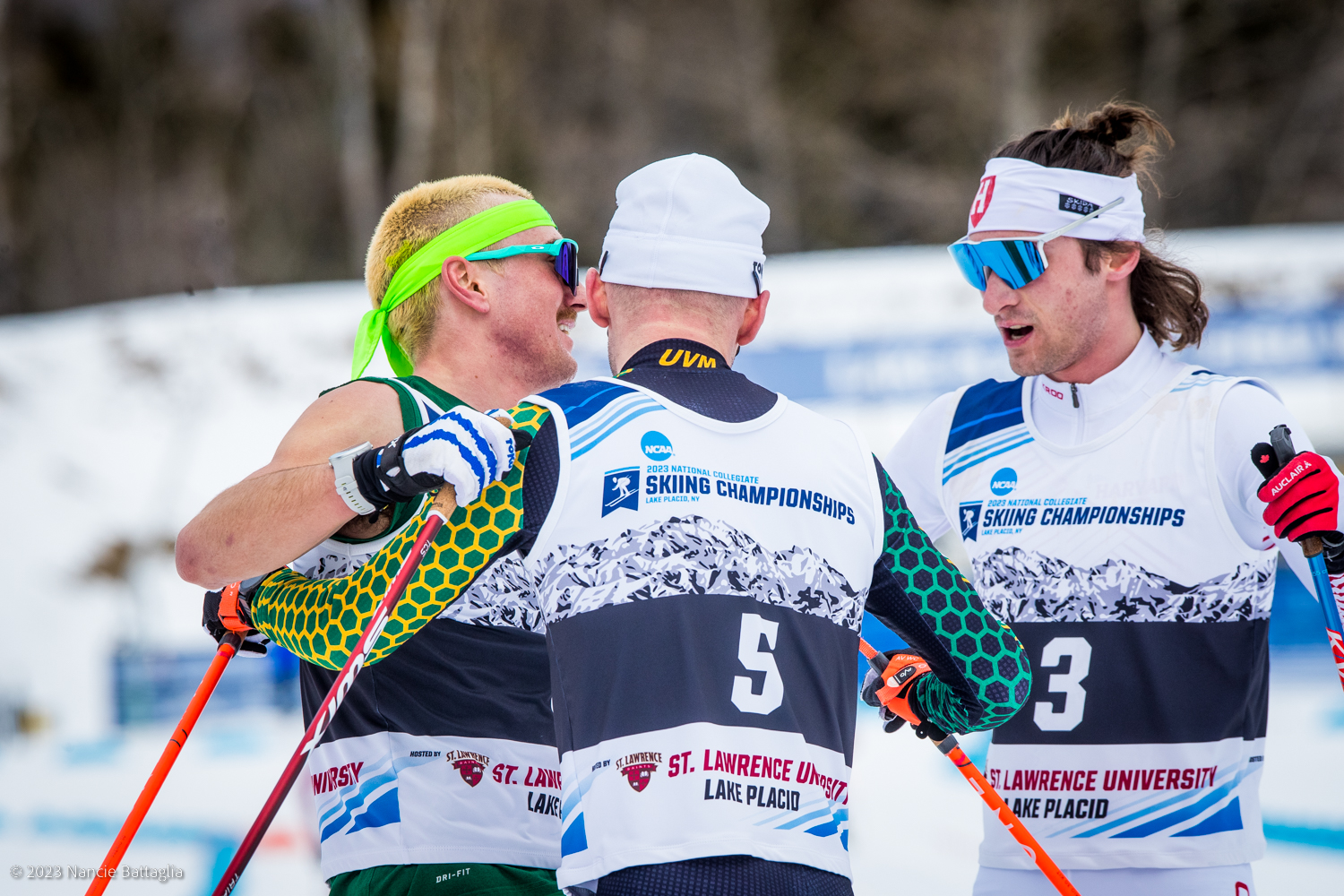
The men’s lead pack embraces after a 20 k pitched battle: (L-R) John Steel Hagenbuch (Dartmouth), Jacob Nystedt (UVM), and winner Remi Drolet (Harvard). (Photo: (c) 2023 Nancie Battaglia)
For a little bit, it seemed Hagenbuch had left it all behind. University of Vermont’s Jacob Nystedt was dropped. Harvard’s Remi Drolet though, was just out of the picture. Then, as the finish came into focus, so did Drolet. The Canadian National Team member steadily, and then suddenly, passed Hagenbuch; a final battle concluded before they hit the finishing straight. Remi Drolet crossed the finish line to win his first NCAA Championship, and the first for the Harvard Crimson Nordic Ski Team in its history.
“I tried to be aggressive throughout the race, and us top three eastern guys. [Hagenbuch and Nystedt] were able to pull away from the pack by pushing the uphill fairly hard every lap” wrote Remi Drolet in post-race comments to Fasterskier. “Apart from [the tactics], I think I just really wanted it. I wasn’t sure I had it in me going into the race, but I was able to dig really deep.”
Harvard Head Coach Chris City wrote to FasterSkier that there was an underlying confidence heading into today that helped boost Drolet and the Harvard team,:“[Remi] is such a strong classic skier and it’s a course that really asks a lot in terms of striding. His seventh place [Thursday]—a first All-American for our program—gave us a feeling that Remi was in a good place to compete in a classic.” Pre-race confidence translated to, “one of the most exciting collegiate races I’ve seen,” added City.
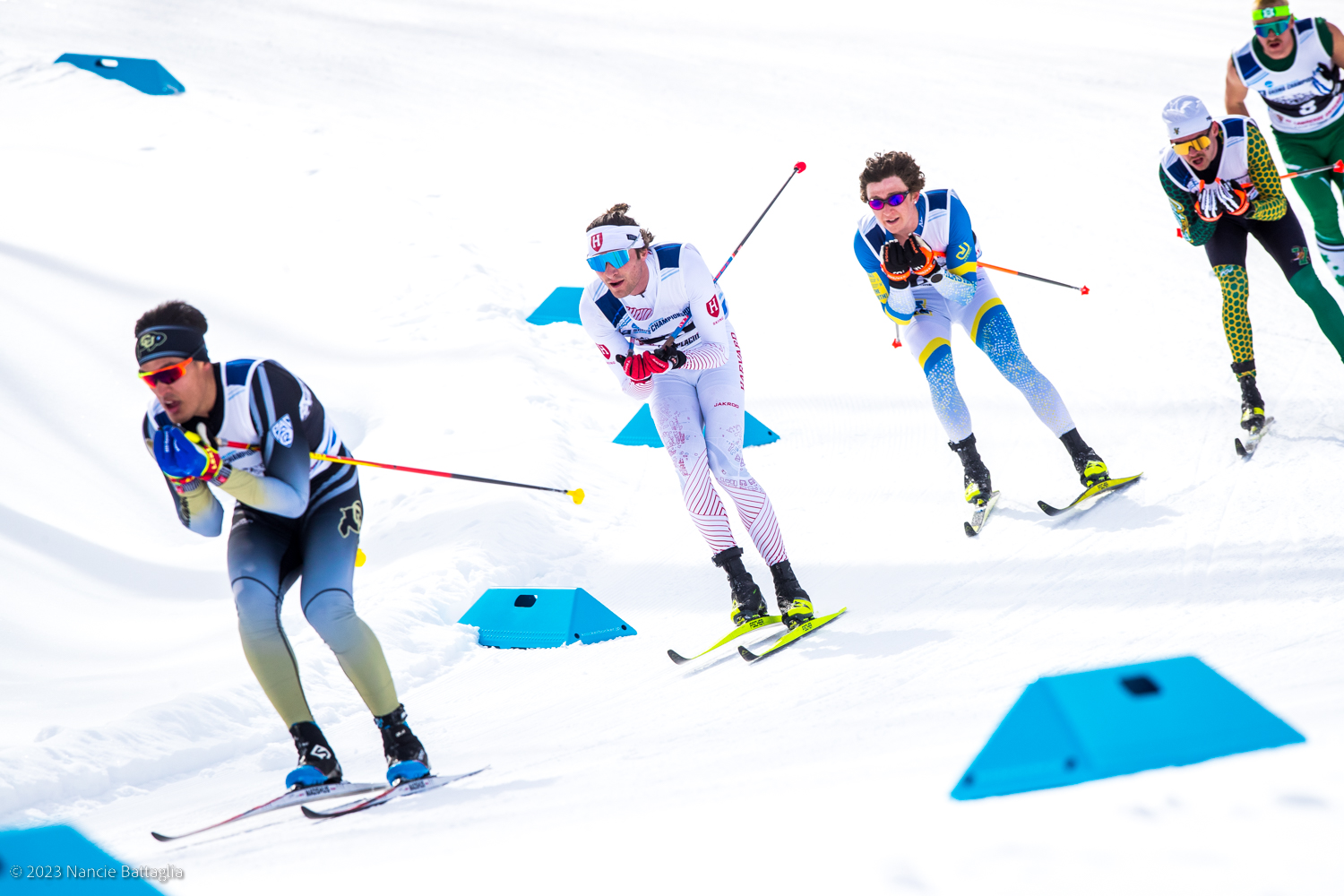
Remi Drolet became the first Harvard NCAA Champion in program history with his win in the 20 k classic Saturday. (Photo: (c) 2023 Nancie Battaglia)
Excitement during the race crescendoed afterward, as both coach and athlete recognized that the result of one race extended far beyond the finish line, “It feels really nice to know that I wrote this down as a goal with [the Harvard team] at the beginning of the season, and that we were able to come together to make an NCAA title happen wrote Drolet. “I’m so proud of him and of his teammates,” Coach City wrote, “and of the many other Harvard skiers who helped build the program to where we reached today.”
Collegiate Skiing Comes to a Close, with more to come
College skiing is a circuit uniquely attuned to constant transition; so, as the banners and barriers come down in Lake Placid, coaches and athletes are looking back, and beginning to look ahead.
For many programs, they will be looking not just at historic firsts at the top of the results, but the ranks of the All-American finishes that marked an individual achievement, powered by a whole program’s efforts. To be designated an All-American, skiers place in the top ten of an event.
NCAAs leave Lake Placid with many programs having achieved milestones. Harvard saw its first NCAA All-American and Champion with Remi Drolet, while University of Alaska-Fairbanks saw seven All-American finishes over two days of racing. (Photo: (c) 2023 Nancie Battaglia)
Remi Drolet’s history-making finishes for Harvard—a first All-American for the Crimson on Thursday, and a first NCAA Championship for the Crimson Saturday—is a stark and impressive example. Dartmouth College, the University of Colorado, and the University of Utah all showed impressive signs of sustained top performance, with four All-Americans between the Women’s and Men’s race on Saturday.
That was nearly matched by the University of Alaska-Fairbanks (UAF), which had three All-Americans today, and a total of seven in this Championships. For the Nanooks, that is a sign of something special growing. “We come away from these championships both proud of what we accomplished, and also hungry for more” wrote UAF Assistant Coach Benjamin Buck to FasterSkier. “We came closer to winning the overall nordic competition than I think anyone expected.”
After all the scores are tallied, honors awarded, and results sheets posted, the athletes and coaches leaving Lake Placid are looking at one aspect of the College circuit that doesn’t seem to change, even as the participants constantly do. Take it from this year’s winner, Novie McCabe: “The college ski community is just so great and everyone is supportive of each other,” she said. “It’s really just such a lovely group of people. Yes, winning was a goal of mine, but mainly, I’m just happy I got to experience racing in this insane atmosphere!”
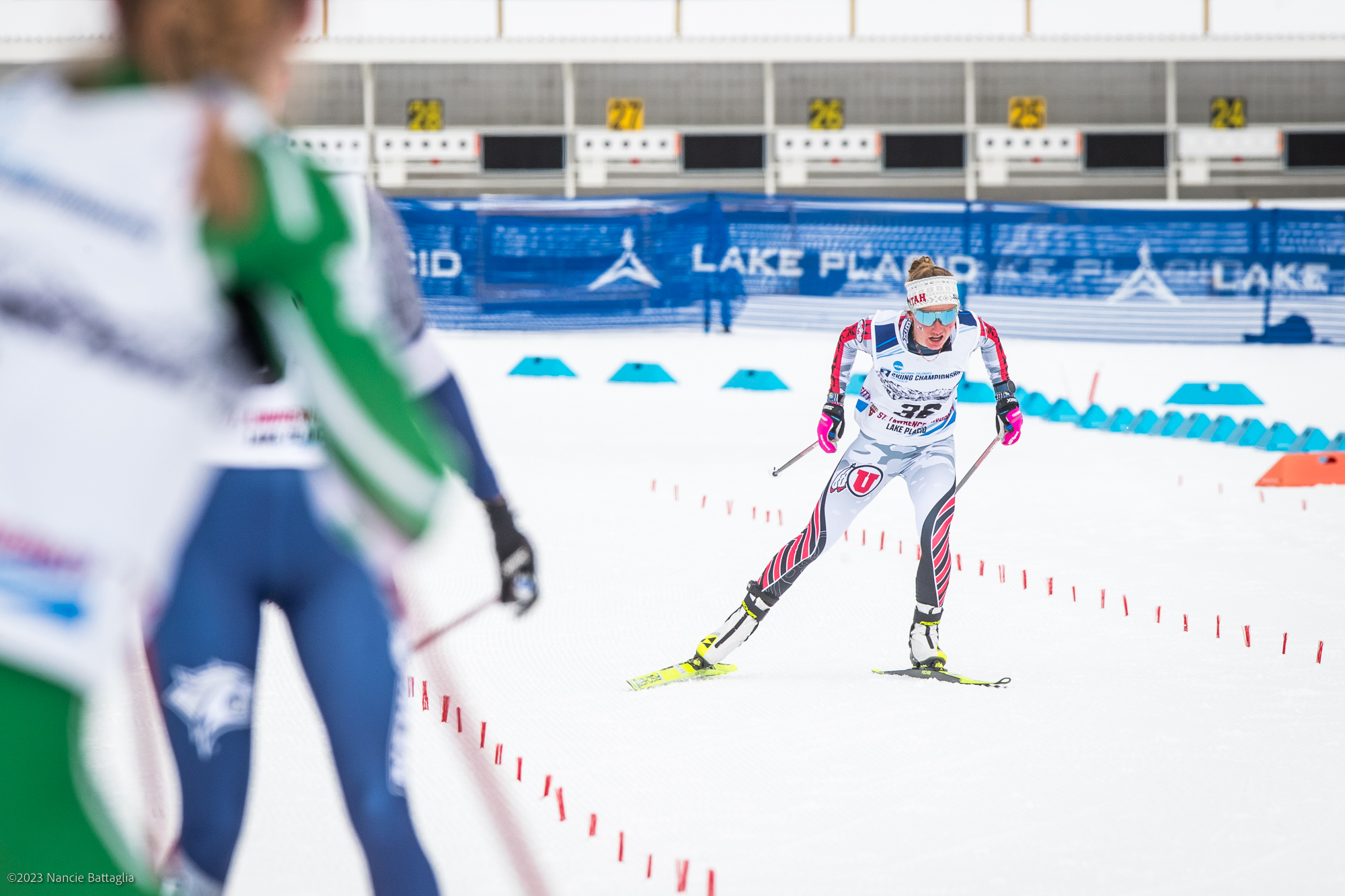
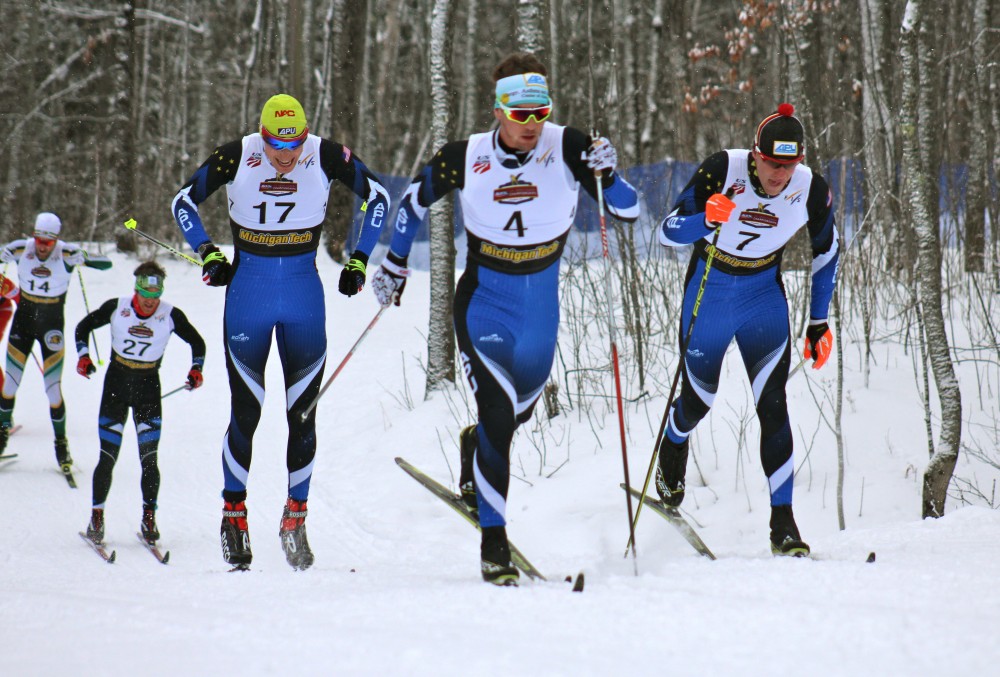
Joe Davie (UAF, bib 38) moves through the Men’s pack in Lake Placid Thursday, on his way to winning an NCAA Championship in the 10 k individual start skate. (Photo: (c) 2023 Nancie Battaglia)
The NCAA Ski Championships began in Lake Placid, New York Thursday, marking the culmination of America’s collegiate race season in one of America’s most storied ski venues.
This marked the fifth time that Lake Placid has hosted NCAA Championships, and the first time since 2015 when the Freestyle event that kicked off the event was won by Dartmouth Sophomore Patrick Caldwell on the Men’s side, and Austrian Freshman Veronkica Mayerhofer from the University of Utah on the Women’s.
Eight years on, Lake Placid had an all new course for the NCAA field in the country to tackle, with the Mt. Van Hoevenberg trails originally put in for the 1980 Olympics updated to reflect the modern world of homologation, mass starts, snow-making and a good ol’ fashioned urge for bigger hills and a bigger challenge.
The racing began with a Freestyle Individual Start, 10 kilometers for the Men and 5 Kilometers for the Women, with NCAA racing still following the practice of racing different distances between the genders in this event.
Collegiate Strength on Display in Pre-Race Favorites
The pre-race participants list at this year’s NCAA Championships pointed to the growing strength of the collegiate circuit, as the best young skiers across North America increasingly choose to pursue their athletic and academic development at once, joining up with the support and ready-made training groups found on college teams. With returning champions in both the men’s and women’s field who have been on the World Cup, at Senior World Championships, and U23 World Championships this season, talent abounded in Lake Placid.
In the men’s field, Ben Ogden, last year’s champion in both the skate and classic, was slated to return to NCAAs for the University of Vermont (UVM). However, considerations balancing performance with the logistics of traveling home from World Championships led the three-time NCAA champion to decide on staying in Europe to close out the season, and Ogden was absent from Lake Placid on Thursday.
Ogden’s absence left one other former NCAA champion in the field, with the University of Colorado’s (CU) Magnus Boee returning to the field after having swept the 2021’s Championship in Jackson, New Hampshire. Denver University’s (DU) Andreas Kirkeng, who won the 10 k Freestyle at Senior Nationals this season, headed up a strong DU squad that also included perennial top-performer Bernhard Flaschberger. Dartmouth College Sophomore John Steel Hagenbuch, who scored top Championship results at the World University Games that were held in Lake Placid in January, also looked like a strong favorite to put Dartmouth back on the top step of the podium in Lake Placid.
In the women’s field, the University of Utah (UU) trio of Sophia Laukli, Novie McCabe, and Sydney Palmer-Leger all returned after having traded NCAA titles among each other the past two years. Palmer-Leger swept NCAAs in 2021, while Laukli and McCabe split the Freestyle and Classic title, respectively, last year. All three Utes have traversed World Cup racing, World U23 Ski Championships, and the collegiate circuit this season. At the U23 World Championships 10 k Freestyle Individual start, the same line-up that started for UU today all finished in the top ten for the United States. Sophia Laukli came into this NCAA Championship as the first skier to have a World Cup podium already on her resume, after winning a bronze on the Alpe Cermis hill climb during this year’s Tour de Ski.
Outside of the UU squad, the University of New Hampshire’s (UNH) Jasmine Lyons returned from competing for Canada in Planica to make a run at a NCAA title. Medalists from January’s World University Games in Lake Placid also figured into the favorites, including the University of Alaska-Fairbanks (UAF) pairing of Marial Pulles and Kendall Kramer, and CU’s Anna-Maria Dietze.
Men’s 10 k Freestyle Individual Start
With defending champion Ben Ogden away, there was an open possibility that anyone could seize the opportunity to power through the cold conditions on the two 5 k laps that made up the 10 k course today. In the field of 40 starters, any bib could jump out.
Joe Davies (UAF) during his NCAA Championship winning performance Thursday. Davies put in a dominant performance, 25 seconds ahead of second place John Steel Hagenbuch (Dartmouth). (Photo: (c) 2023 Nancie Battaglia)
In the end, that bib was 38, and it wound its way through the field on the back of University of Alaska-Fairbanks Sophomore Joe Davies. A closely packed finish list ahead of Davies, with Dartmouth College’s John Steel Hagenbuch and Denver University’s Bernard Flaschberger separated by just five seconds, was re-written quickly as Davies came across the finish line around a minute after Hagenbuch (bib 25) and netted 25 seconds on the whole field in 22:33.2.
“I knew with the amount of climbing on course that there could be a lot of time to be gained by working well over the tops and along the flats,” wrote Davies on his winning 10 k performance to FasterSkier, “after getting splits around the 7 k mark that I was up by a fair margin I relaxed a bit and was able to ski calmly and composed to the finish.”
Davies hails from Pemberton, Canada, and competes internationally for Great Britain. For Team GB, he has had a season similar to other pre-race favorites, showing up on results sheets from Planica, where he was 30th in the 15 k at World Championships, to his home course in Whistler, where he was 13th in the 10 k at U23 World Championships. There was a lot of history to suggest that he was one of the finest skiers in the field Thursday, but a 25 second gap on the field marked a dominant performance that highlighted a strong progression for the skier this season.
“I’ve been racing abroad for quite some time now, so being able to return to the NCAA Championships and get a win feels incredible,” wrote Davies.
UAF Head Coach, Eliska Albrigtsen, also pointed to Davies international experience this season as a reason for his success today. “[Joe] got a taste for the highest level of competition at the World Cup,” she said. “And we feel that exposure really helped push him to new heights.” She added that his World Championship starts with Team Great Britain, “set him up very nicely for a good race here today. Over the past two years with our team, we’ve seen him realize his true potential as a skier, and we expect great things for him in the future.”
Davies became the third UAF skier to win an NCAA Championships, and the first since Marius Korthauer in 2008. His championship highlighted a performance for the Nanooks that sees them head to Saturday’s Classic race on top of the Team Standings in Nordic (NCAA team scoring is combined with Alpine, and UAF does not have an Alpine team), ahead of Denver University by one point.
The Men’s 10 k skate podium: 1st) Joe Davies (UAF), 2nd) John Steel Hagenbuch (Dartmouth, 3rd) Bernhard Flaschberger (DU), 4th) Andreas Kirkeng (DU), and 5th) Mike Ophoff (UAF). (Photo: (c) 2023 Nancie Battaglia).
Those team standings were the source of the race’s tension today. The Denver University pairing of Bernhard Flaschberger and Andreas Kirkeng started before the UAF pairing of Davies and Mike Ophoff. Flaschberger set the fastest time of day when he crossed the finishline with a 23:03.5, and while it was surpassed by John Steel Hagenbuch (22:58.2) quickly, Kirkeng’s crossing the finish line in third place before Davies had come in seemed to set the bar for the day, with a grouping of three of the most dominant skiers in the field all right around the 23:00 mark. Davies surpassing that opened up a possibility for UAF, and when Ophoff came in fifth place with a gap up to Kirkeng, it sent onlookers to the scoring sheet. The third scoring skier for DU was Elijah Weenig in 13th place, while the 3rd scorer for UAF was 16th place Christopher Kalev. When the math was done, UAF came out on top.
“This is a moment that has been in the making for five years,” wrote Eliska Albrigtsen to FasterSkier. “We’ve put in the hard work and we’ve seen our team rising to the top to be one of the best programs in the nation, and today’s results are the hard proof!” Assistant Coach Ben Buck added that “we knew [we were] in the mix for a podium sport, but the performance from the team today, from top to bottom, was so impressive.”
Women’s 5 k Freestyle Individual Start
With the University of Utah trio of Sydney Palmer-Leger, Novie McCabe, and Sophia Laukli in the last 10 starters of the 40 person field, the Women’s 5 k race was set to be a tense affair through the whole of the race today, with the championship eventually going to McCabe in a dominant performance.
In the early goings before that conclusion, there was a lot to watch. UNH Junior Jasmine Lyons, who was 36th in the 10 k at World Championships two weeks ago for Canada, set a high bar early. Lyons held an early advantage at 2.5 k all the way through, and crossed the finish line in a time of 12:59. A second half surge from the University of Colorado’s Anna-Maria Dietze, wearing bib 29, saw her cross the finish line just two seconds behind Lyons and set the grouping at the top of the field.
Behind them, the question to be answered was whether Palmer-Leger, (bib 33), McCabe (bib 36), or Laukli, (bib 37) would match or pass the standard set by Lyons and Dietze. Palmer-Leger was off the pace at 2.5 k, and crossed the line in what would eventually be a 14th place on the day. McCabe and Laukli, though, were right in the ballpark with Lyons and Dietze. McCabe bested Lyons checkpoint at 2.5 k. Laukli came through the same point in third behind Lyons though, which gave an indication that Lyons and Dietze hadn’t just set an early standard, but that they would be right in it at the top of the race when it was all settled today.
Novie McCabe sprints to her second Individual NCAA Championship on Thursday in Lake Placid. (Photo: (c) 2023 Nancie Battaglia)
Novie McCabe’s sprint into the Lake Placid stadium eliminated any doubts about who was the fastest skier on the day. She launched across the line, and the clock read that she had bested the whole field by 14 seconds, a time of 12:46. Laukli’s finish back from McCabe left a close race to be sorted in places 2-4, for which Laukli would end up fourth. Lyons and Dietze’s times had held, and they were in second and third, respectively.
In post-race comments Novie McCabe wrote to FasterSkier that she looked to “start pretty hard and then hold it if I could” on the tough Lake Placid 5 k course. “There’s a lot of uphill in the first half of the course here, so my goal was to be in a good place by the top of the course.”
McCabe’s joins a list of fifteen other women who have won an NCAA Championship in both techniques, including her teammate Palmer-Leger. In the five NCAA Championship races she has started, McCabe has never finished off the podium.
UU Head Coach Miles Havlick wrote to FasterSkier that, “Novie has been on fire for this second half of the season. She had trouble staying healthy and didn’t race to her expectations [earlier this year], and I think racing with Utah and the RMISA circuit has been really good for her. Right now, she is skiing as well as I have seen her ski since she has been at Utah.”
“This one meant a lot to me!” McCabe wrote of her Championship. “I was sure doubting my shape earlier in the season, and was pretty nervous today because I really wanted to be able to put a good one together for the team. I’m definitely happy with it and lucky to have so many great teammates to make it such a fun experience!”
The Utes scored top marks on the day in the team rankings, just ahead of a CU team that scored all three in the top ten with Dietze, Hanna Abrahamsson, and Weronika Kaleta. Combined with the UU Alpine Women, the University of Utah enters the second-half of NCAA Championships with a good chance to win their fourth straight NCAA Skiing Team Championship.
Coach Havlick is liking their chances. “Both [Sophia] and Sydney are a little tired from World Championships and recent travel,” he said. “But I am optimistic about their races on Saturday. These girls definitely feed off of one another, and will be looking to capitalize on the hilly 20 k course.”
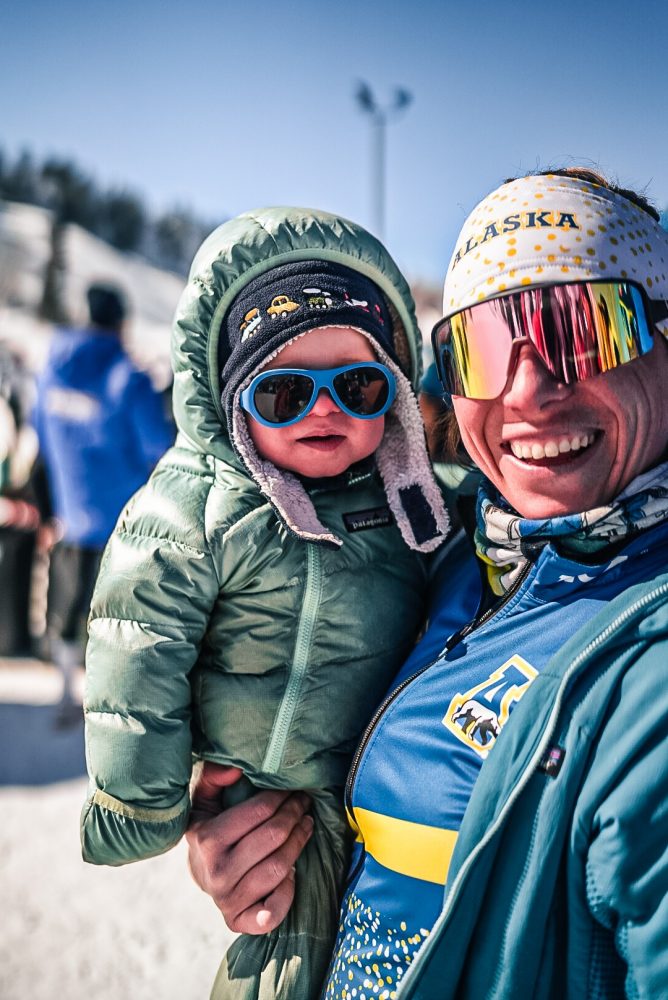
The journey into motherhood, though challenging, has also been rewarding for UAF head coach Eliška Albrigtsen. (Photo: Tobias Albrigtsen / @untraceableg)
Part 1 of this story details Eliška’s experience coaching through pregnancy and the birth of her son. Keep reading to learn about the challenges she, like many women, experienced during the postpartum recovery process, and what it took to navigate year one of life on the road with baby Viggo.
Expectation versus reality.
When preparing to interview Eliška Albrigtsen about her experience pairing NCAA coaching with new motherhood, I expected the challenges she faced during her transition to primarily be focused on the balancing act of managing a demanding job with frequent travel and a new baby. Maybe a few relatable stories of airport meltdowns, sleepless nights in hotels while on the road with the team, and inopportune timing of diaper blowouts. Or any number of other ways societal systems in the US seem to be structured in opposition to new moms in the workplace.
But Eliška’s passion for her job and dedication to her athletes were abundantly clear throughout the conversation; coaching is where she thrived. Her grit and energy allowed her to problem solve bringing baby Viggo on the road with the team – perhaps paired with the added fortune of a husband whose skill set includes waxing and ski testing and a well placed mother-in-law eager to help care for her grandson. And the team embraced its new member without hesitation.
In reality, the biggest challenges Eliška faced in returning to coaching postpartum were connected to the physiological impacts pregnancy and delivery had on her body. In short, it was a discussion on the shortcomings of our healthcare system and the myriad of ways the current standard of postpartum care falls short of what many women require to restore their body to full function.
Her story highlights a few key takeaways for programs looking to support women coaches surrounding pregnancy; in particular, there’s much more to the return to coaching than navigating who will care for your child while you’re out training with athletes and traveling to races. Respecting the timeline of a slow return, and perhaps offsetting the costs of postpartum physical therapy, may be an essential component of an improved and holistic support system.
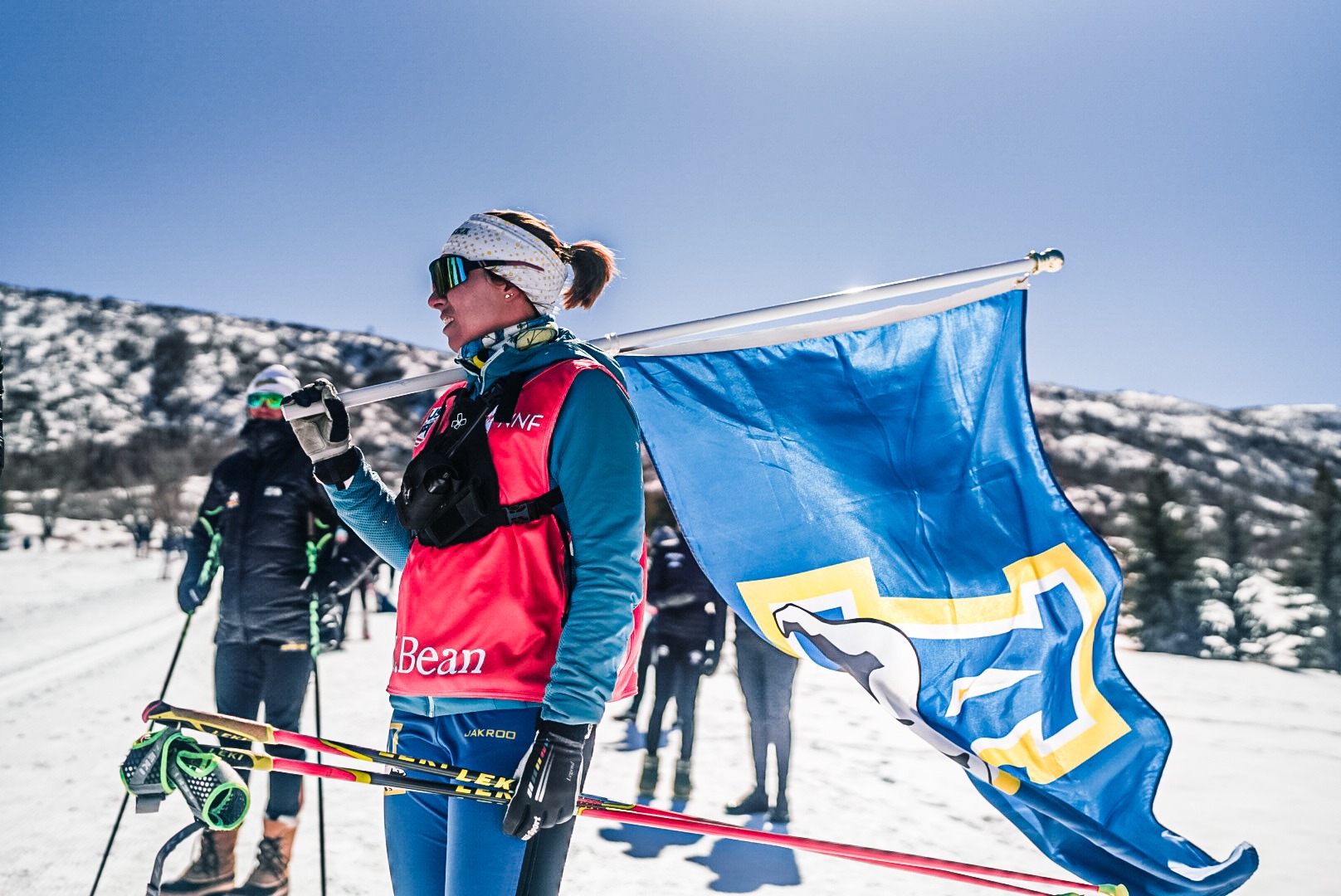
Eliška Albrigtsen in action at US Nationals in Soldier Hollow, UT. (Photo: Tobias Albrigtsen / @untraceableg)
Postpartum Recovery
A theme of Eliška’s narrative of her perinatal experience was the ways in which her “athlete mindset” served and hindered her ability to roll with the punches.
While women like Kikkan Randall, Marit Bjørgen, Aino-Kaisa Saarinen paved the way for women looking to begin their family before retiring from professional skiing in many ways, Eliška said that the ease with which they outwardly seemed to rebound beyond their previous levels of fitness was, in some ways, a disservice to women like herself who did not experience as smooth a return. In her mind, she had expected a comparable experience given her athleticism and good health, but quickly learned that women might be better served using caution when extrapolating from outliers.
“You see these professional skiers having babies and then coming back and winning gold medals at [the] Olympics,” she said. “And you’re like, ‘Oh, yeah, that’s gonna be me.’ But no one really sees the giant support team they have behind them.
“They have professional doctors, physical therapists, and strength and conditioning [specialists] to go through their pregnancy with them, monitoring everything, having them at the birth, and then jumping right into the recovery. As a coach, you don’t get that. You probably have the same amount of on-ski hours as professional skiers – not the same quality of course, but you can’t do your job without being there. So I think that’s how most of our ski community sees pregnancy – so easy and you are an even better athlete afterwards, because all these women did it…
“For me, it was the opposite. It was hell. I can’t wear the clothes that I wore when I was pregnant because I have extreme PTSD from that… it was such a, not just physically but painfully, impacting experience.”
Though expectation and reality could not have been more different, her drive to recover from the injuries sustained from pregnancy and birth, and the creativity required to adapt during the recovery process, mirrored her general approach as an athlete more broadly.
“I think the athlete mindset in me was, ‘Okay, I had this baby. Now I put myself through physical therapy, and I’m gonna recover’… Just like after having a shoulder dislocation or having a torn iliopsoas, all those pretty crazy injuries – I knew that eventually you get better, and you get back to yourself.”
What Eliška identified as the biggest physical challenge she faced after the birth of her son was the repair of a condition called diastasis recti (DR), which is a separation and consequential loss of function and strength of the rectus abdominis muscles.
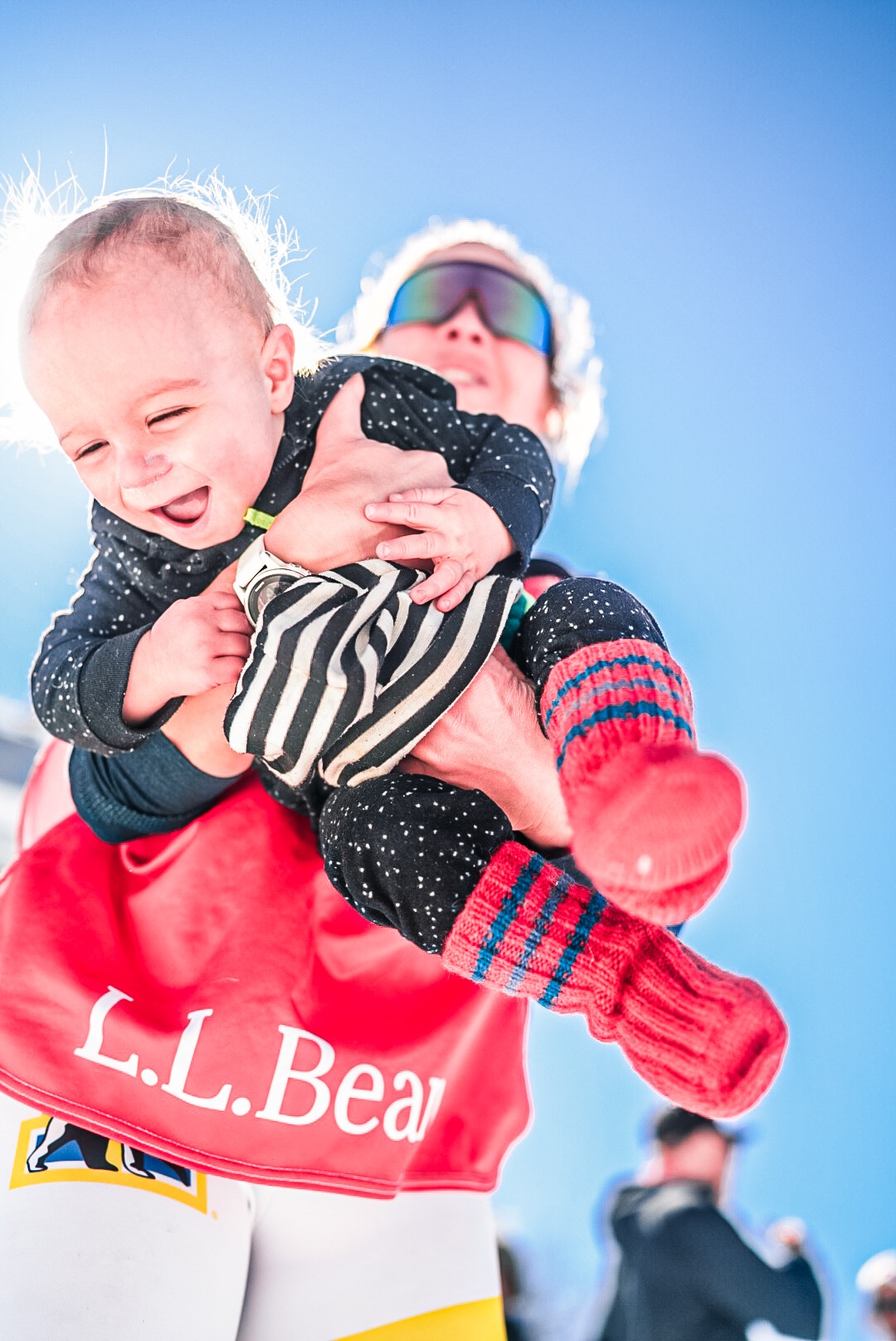
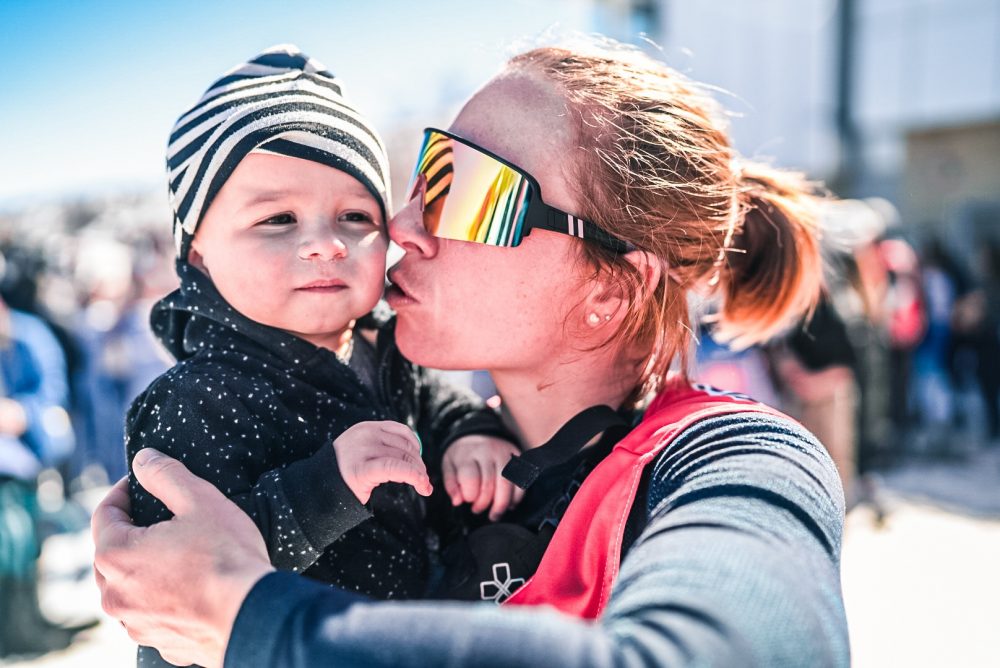
Happy baby and happy mom. (Photo: Tobias Albrigtsen / @untraceableg)
During pregnancy, as a woman’s belly expands to accommodate the growing baby, the muscles of the abdomen are forced to stretch. The deeper muscle layers, known as the transverse abdominis, are structured like a corset wrapping around the belly, giving them a greater capacity to expand. However, the rectus abdominis muscles, better known as the “six pack” muscles, run vertically while connected by fascia, and have significantly less ability to adapt to the expansion.
Instead, the outward pressure and growth of the belly causes the rectus abdominis muscles to separate, thinning and weakening the fascia as it stretches, or in extreme cases, tearing it.
“When I was the most pregnant, my six pack was under my armpits.”
This connective tissue cannot simply snap back to its original state after delivery. As fascia lacks the blood flow of muscle tissue, it is slow to heal, leaving many women with a gap between muscles known as a diastasis. All women experience some amount of ab separation during pregnancy, but if the gap of two or more finger widths between the muscles persists postpartum, she is diagnosed with DR.
Because of the combination of her stature, a short torso, and the size of her baby, Eliška found herself with an extreme separation.
“Basically, you could stick your whole fist into my stomach. That was the biggest problem for me because I basically lost my core. And my core was a big part of me as an athlete – not just as a skier, but as an athlete. So that was really hard.”
As she hopes for a second child down the road, any surgical repair options were contraindicated, and instead, Eliška dedicated herself to a physical therapy regimen. She felt lucky to have access to a Fairbanks-based Osteopathic medicine expert, Dr. Todd Capistrant, who specializes in the Fascial Distortion Model and was therefore primed to help Eliška improve her diastasis.
“I saw him basically on a weekly basis.”
She also met regularly with a pelvic floor physical therapist, both to work on the diastasis, and to restore appropriate function to the muscles of her pelvic floor. Her PT identified that her pelvic floor was hypertonic, meaning the muscles carried tension chronically, rather than contracting and relaxing in functional patterns. Like holding a flexed arm hang and then being asked to knock out a set of chin-ups, this chronic low-level tension leads to fatigue in the pelvic floor muscles, preventing them from outputting the strength and tension required to support the organs sitting inside the pelvic girdle and interact appropriately with surrounding musculature when recruited during activity.
With the guidance of the PT and a set of progressive exercises to relax and engage her muscles appropriately, Eliška saw progress, but it took time for her muscles to function in coordination subconsciously.
“It took me probably around eight months to incorporate the mental [and neuromuscular] connections back. I was able to [engage the muscles] when I wanted to, but all the muscles of the pelvic floor, everything that’s sitting in the pelvis, they were not working with the rest of my body.”
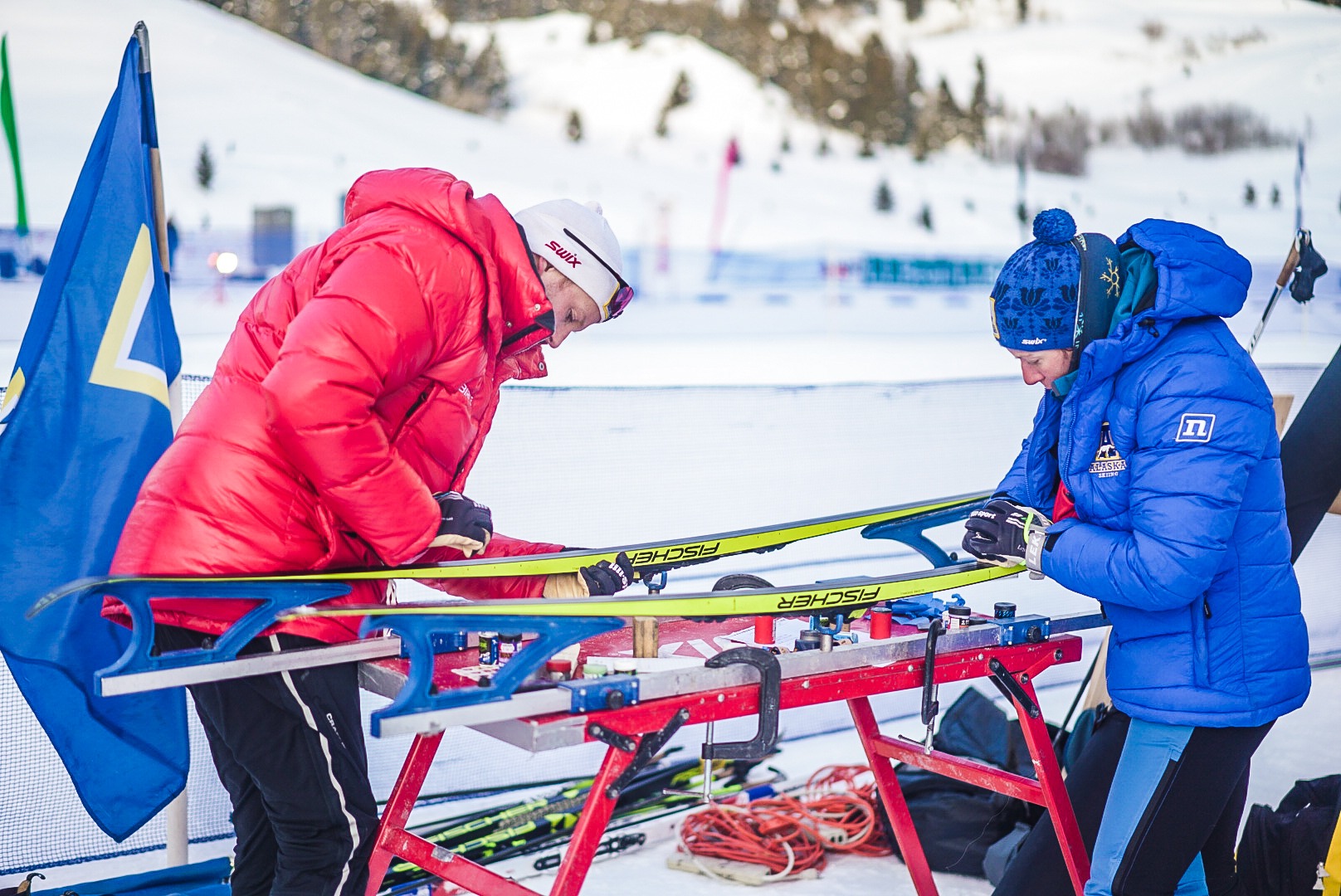
On the bench: Eliška Albrigtsen prepares skis for the UAF athletes. (Photo: Tobias Albrigtsen / @untraceableg)
She expressed feeling lucky to have access to high level care in Fairbanks, including her therapist who could incorporate a variety of techniques to help her recover, including deep tissue massage, cupping, electrical muscle stimulation, and biofeedback.
“I think biofeedback for athletes just works the best. Because we’re such strong willed people. Like, if we see it happening, we can really focus on making it happen more.”
An unexpected benefit of time and resources being placed into learning how to strengthen and reintegrate her deeper core musculature trickled down to her athletes. She recognized that several of her athletes, who had complained of back pain surrounding core workouts, were not sufficiently engaging their transverse abdominis muscles, instead relying too heavily on the outer rectus abdominis or other smaller core muscles. Teaching the techniques she learned through PT helped improve the form of her athletes, relieving the back pain they had experienced previously.
“It definitely deepened my understanding of how the core should work, and how we use it when we ski.”
As she navigated her own challenges, she became aware through talking with friends of how common these experiences are amongst mothers. Describing herself as “someone who says everything”, she felt it was important to both be open regarding the challenges she’s faced, and the resources and options available for women to make progress toward recovery, rather than accept the conditions as permanent.
Most women only receive one postpartum checkup, approximately six weeks after delivery. As my own pelvic floor PT described it, these visits typically only check to see that the tissues have healed and that there are no visible pelvic organ prolapses, but most midwives and OB/GYN practitioners do not have the depth of knowledge to assess muscle function, hence the need for an evaluation from a pelvic floor PT. However, quality pelvic floor physical therapy is not universally available, and as it is not always covered by insurance, making it cost-prohibitive for many women to continue care long enough to make sufficient progress.
“I think the most tragic experience post-pregnancy that I had was the realization that women are left being damaged from bringing life to the world.”
As she discussed her own experience with the women in her community, in turn, many of them shared that they continued to suffer from the impacts of ab separation or pelvic floor dysfunction from pregnancies, including friends who were more than ten years postpartum. Some of these women had given up activities they had enjoyed previously, like running, because they felt as though they were “spilling their guts” out of their bellies due to a lack of core function.
“How is this okay for women to live this way? That was just mind blowing to me.”
Imparting the knowledge she gained in the process, and advocating for women to find their own ways to make it work, she offered up suggestions.
“I was just like, ‘Hey, if you can’t go to physical therapy, this is how you tape your belly, so at least you can start hiking fast.”
At roughly 13 months postpartum at the time of the call, Eliška recognized the improvements she’s made, while still acknowledging she has not fully recovered.
“It’s [been] more than a year, and I feel functional. I still have pains and I would not go and enter a race, because my brain can push much harder than my body can, so I know I would hurt myself. But I’m so much better than most of my friends that, you know, [had to] just give it up…”
Eliška Albrigtsen lead the UAF Nanooks to an historic seventh place finish at 2022 NCAA Championships following the birth of her son in February 2021. (Photo: Tobias Albrigtsen / @untraceableg)
As she worked with athletes through the fall and winter, Eliška found ways to adapt her ski technique to avoid putting unnecessary strain on the musculature she was working to rehab, and work instead with the muscles that already had the necessary strength. In particular, she needed to change her doublepole technique.
By returning to the older style of doublepoling, which involved less of a crunch through the abdomen than modern technique, instead increasing the bend at the waist and relying more heavily on the arm and shoulder muscles.
“I don’t have the strength there anymore [to crunch]. My muscles are two three packs, they’re not connected. So I go into doublepole and I tighten my lower belly, but then I pull my butt up kind of like into downward dog instead, and work with my arms again.”
Multitasking: Eliška Albrigtsen feeds her son trailside while on the road for competition. (Photo: Tobias Albrigtsen / @untraceableg)
Another lingering problem she has experienced is a result of the endocrinological changes experienced surrounding pregnancy. To allow the body to grow during pregnancy and a widening of the hips for delivery, the body releases an aptly-named hormone called relaxin, which acts on cartilage and other soft tissues to allow expansion and increased joint mobility to occur. The production of relaxin typically declines after delivery, but remains higher than normal for the duration of breastfeeding.
While beneficial for pregnancy, it also puts perinatal women at a higher risk of joint instability and consequently injury.
Eliška shared that she seems to produce an above average amount of relaxin, which has continued to affect her postpartum as a nursing mom. She experienced joint pain, particularly in her pubic symphysis joint at the front of the pelvis, with unexpected movements – like slipping on ice or mud. “And it’s always slippery here. Like 10 months out of the year.”
“On skis, I don’t have a problem. Because everything’s gliding and I already have the natural anticipation of gliding. But walking and slipping – I try to catch myself and my muscles, my joints, my tendons are just too loose.”
Reflecting on her journey through the first year postpartum, the lack of care available to most women remained at the forefront of her mind. The impact of these types of conditions, which linger if left untreated, affects more than just the level of activity a woman can enjoy. As those who have experienced it (waves hand) can attest, the emotional toll affects quality of life more broadly.
“I would absolutely fight for every woman to be able to have a year of free PT [after pregnancy]. You just need your life back.”
Life on the Road
There’s a commonly used phrase when it comes to raising children: “It takes a village.” This resonated as Eliška shared insights into what support was necessary to allow baby Viggo to travel with the team through the competition season.
While children under two-years-old are typically able to fly for free on their parents’ laps, the travel of the person who would care for Viggo while Eliška was working is not. Fortunately, her husband Tobias was already incorporated as a volunteer assistant coach, and had both the skillset and the NCAA certifications to play a variety of roles during travel, which also got him on the payroll to offset travel costs.
“I’m lucky that my husband’s quite good tester and waxer as well. And traveling with a full team this year, six [women] and six [men], I knew that we will need more than two coaches to wax.”
And, conveniently, Tobias’ mother is based in Boulder, CO. “She was able to actually drive to all the races and babysit when we were ski waxing and racing.”
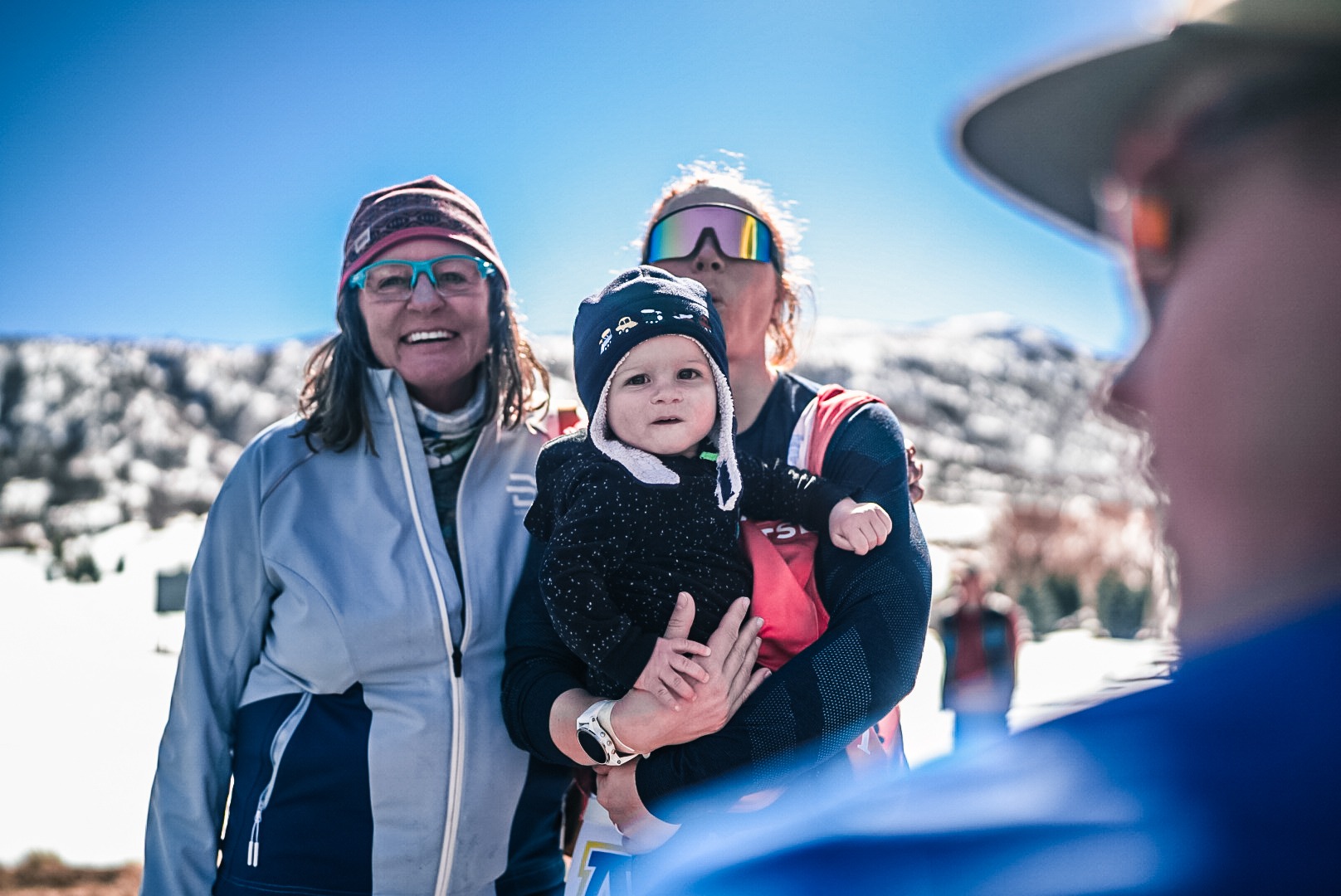
The village: Eliška Albrigtsen has help from her mother-in-law during the RMISA Championships in Steamboat Springs, CO. (Photo: Tobias Albrigtsen / @untraceableg)
For US Nationals, UAF collaborated with other Alaskan clubs to wax, but it was still useful to have an extra driver to bring athletes back and forth to the venue. Consequently, they paid out of pocket for the flight, but Tobias was able to get a per-diem salary as a driver. “So we got at least the food covered,” she laughed.
For other RMISA and SuperTour races where UAF was only waxing for their own athletes, Tobias could have his travel expenses fully covered in exchange for his work. It’s perhaps a model that’s hard to replicate for other mom-coaches, but still demonstrates that with some creativity and determination, bringing the family along for the ride is possible.
“We call it the primary. He’s the primary on the baby when we have training days, where me and my assistant go with athletes and train. And then when we were testing and race waxing, grandma was the primary. And oh my God, bless her heart — she paid for all of her gas and her accommodation and food. She would just come to the house where we were staying when we had to leave and just babysat for us… So that’s the way that we made it work, but it’s a very, I think, exceptional situation.”
Was traveling back and forth from Fairbanks to Colorado and Utah challenging with a toddler? Yes. But Eliška knew it was something they would need to navigate as a family regardless of her career.
“I know living in Alaska, he’s gonna fly anywhere he goes. That’s just what it is. So that was just like one thing that we were like, ‘Yeah, there’s no way around it.’ We did have to travel with more things. Because you have to have the car seat, we have to have the crib, we had to have a bunch of diapers with us.”
The system worked for the first year, but it will need to be modified for next season. The full RMISA calendar has not yet been set, however, the regional championships will be held in Anchorage, which will make at least one competition easier to travel to.
From there, it will be running the calculus on what makes sense financially. She laughed that Viggo is already a squirmy baby to keep on their laps on the plane and will need his own seat next year, but she is also not sure whether he will still be nursing, which may make it easier for her to leave him behind with Tobias.
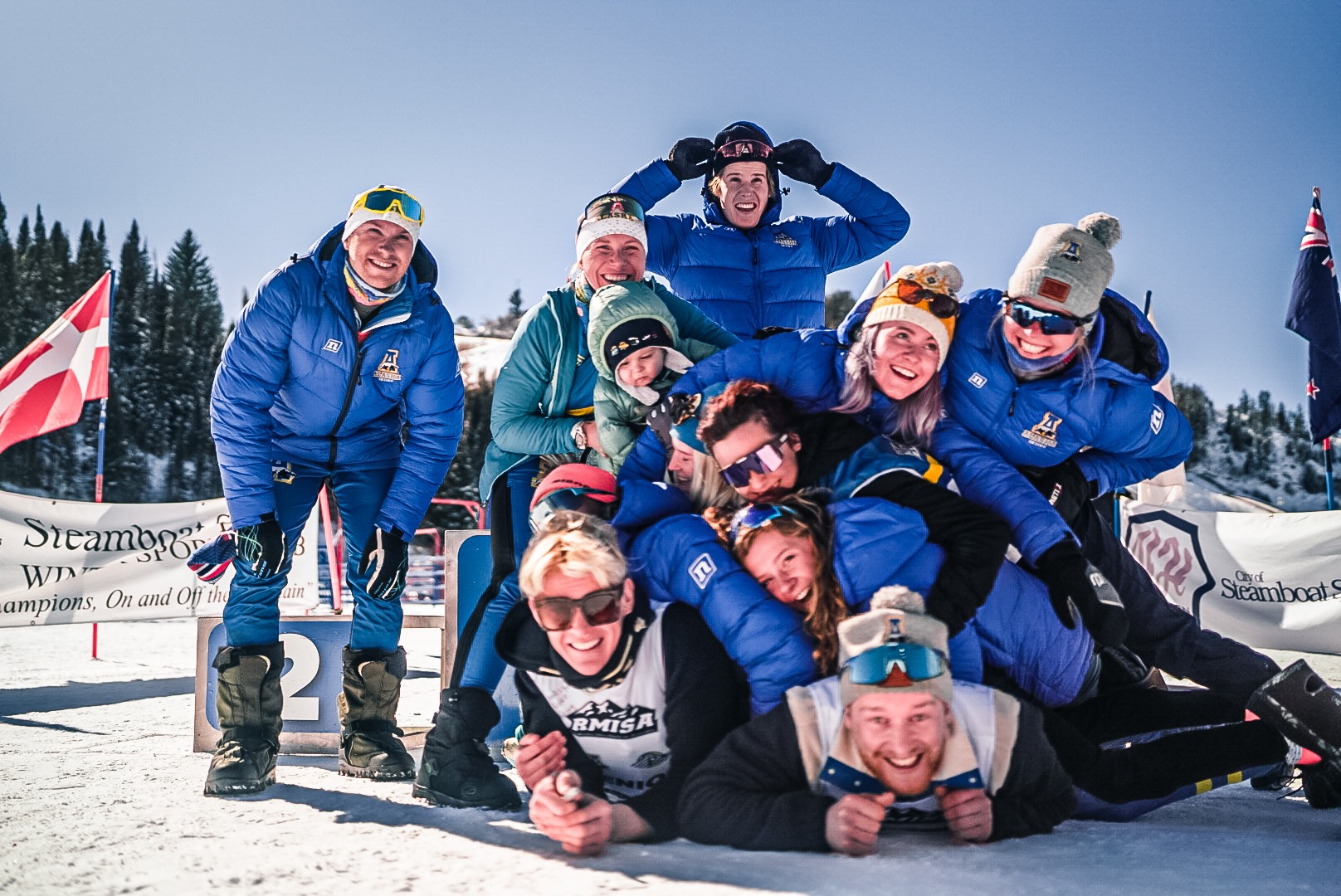
Just another member of the team: the UAF skiers pose with coach Eliška Albrigtsen and baby Viggo at the RMISA Championships in Steamboat Springs, CO. (Photo: Tobias Albrigtsen / @untraceableg)
In terms of the impact to the team, better worded as the lack thereof, Eliška felt Viggo’s presence on the road improved the atmosphere. Rather than lamenting their littlest teammate, they found humor and joy in his presence.
“When you’re stressed before the race, and you’re having breakfast and you’re barely putting the oatmeal into your mouth [because of nerves], and the baby in front of you is just like throwing the food and laughing… I think that it helped with the team atmosphere, for sure.”
In addition to helping distribute the weight of ski, wax, and baby gear when navigating through the airport, the athletes also served as an extra set of eyes in the team house.
“The team, in general, was super helpful as well. When we would be waxing in the garage, they were playing with Viggo, and he believes they’re all his brothers and sisters, I’m pretty sure.”
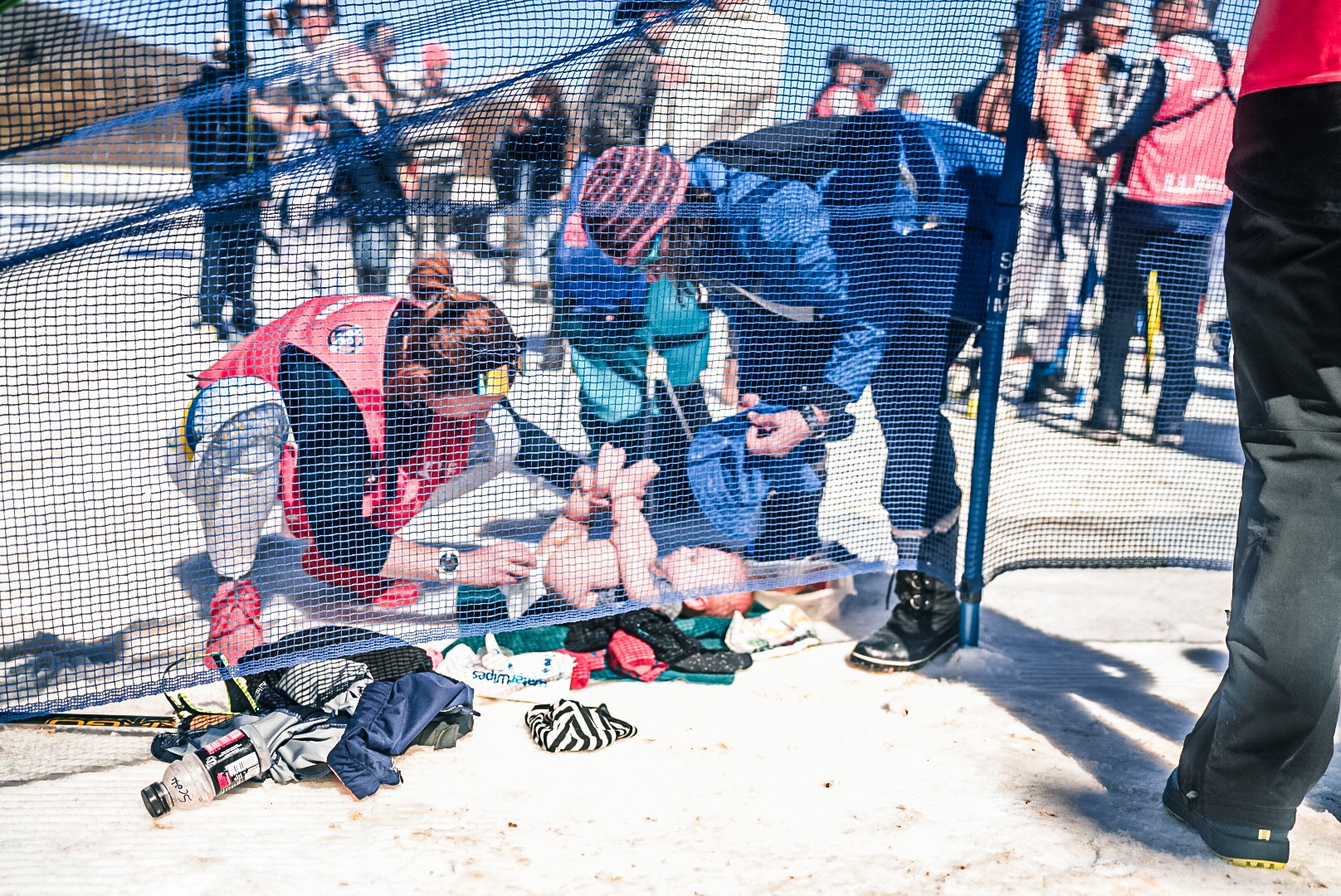
A relatable image: the al fresco diaper change during a competition weekend. (Photo: Tobias Albrigtsen / @untraceableg)
Reflections on the Experience Thus Far
Praising the community in Fairbanks, Eliška was grateful for the help and support she received through her perinatal journey, which allowed her to not only continue as head coach, but help the team to new heights this season. Rather than holding her back, becoming a mother enhanced her ability to lead the Nanooks program.
“I also feel like my season was so much more successful this year because I really wanted to go home to my baby. So I was really trying to work smarter and more efficiently, and I think the athletes probably had that push too.”
While some might fault a woman who shares that her priorities have shifted since having a child, Eliška explained the number of ways this desire to optimize practice time served her team.
“I was always driven for success – I love being successful. But now it’s more like, ‘Yes, I will be successful so then I can spend more time with my child.’”
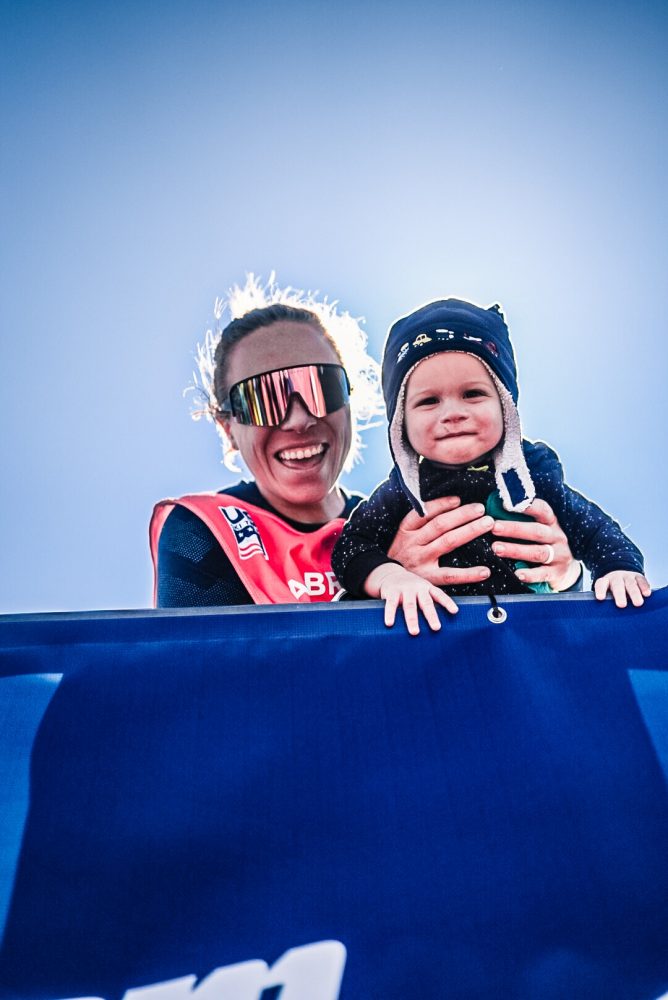
University of Alaska Fairbanks head coach Eliška Albrigtsen shares her experience with pregnancy, postpartum recovery, and life on the road with baby Viggo in tow. (Photo: Tobias Albrigtsen / @untraceableg)
As to whether there was anything she would have done differently, Eliška’s answer was more focused on reducing barriers to mom-coaches as a group surrounding pregnancy.
“I think the side that no one ever talks about is: how fit coaches should actually be able to do their job well.”
Because her insurance cycle was aligned with the school calendar, her deductible reset in July. Having maximized her out of pocket expenses with prenatal care and delivery, this meant the physical therapy treatments she needed were essentially free for the first four months. However, after the plan turned over for the new year, each pelvic floor PT visit cost $60–70, and she was looking to go twice per week to continue to make steady progress. This adds up quickly, particularly for a family relying on one salary, which happens to be a ski coaching salary.
While nationwide free postpartum PT for all women would be the ideal, Eliška proposed that these costs should, at minimum, be offset by the school or program.
“That is something I would definitely fight for women coaches. Talk to your boss, or whoever, and tell them, ‘If you want me to come back to the same level of coaching, you need to pay for occupational therapy for me to recover.”
University of Alaska Fairbanks head coach Eliška Albrigtsen shares her experience with pregnancy, postpartum recovery, and life on the road with baby in tow. (Photo: Tobias Albrigtsen / @untraceableg)
While skimming through the extensive photo albums shared by Tobias Albrigtsen during the U.S. Cross Country Ski Championships in Soldier Hollow this past January, one head coach caught my attention. University of Alaska Fairbanks (UAF) head coach Eliška Albrigtsen (Tobias’ wife) had an extra member of the team in tow: her then 11-month-old son, Viggo.
As most ski coaches know all too well, the demands of the job are multifactorial, and can make it challenging for women coaches who are looking to start a family. It’s a physically demanding job with frequent travel butting up against a physically demanding biological process that results in a tiny being that is, at least in the short term, still very dependent on its mother.
Yes, some women have a fairly smooth perinatal experience and (somehow?) enjoy the experience of pregnancy. And yes, a woman’s ability to grow a new life inside her body is a wonderful and sometimes mind-blowing feat, but the experience of pregnancy and childbirth can also undeniably leave behind a lasting impact. A woman’s uterus grows to be the size of a watermelon over the course of roughly 40 weeks, forcing supporting musculature to stretch well beyond its normal capacity, while other internal organs are forced to relocate elsewhere. And that’s just a small subset of what’s happening throughout the body.
The process of repairing this damage after birth is often nonlinear, leaving those who rely on their bodies for work, recreation, or both, in need of extensive postpartum physical therapy while making a careful progression back to activity.
And everyone’s experience is unique.
It’s the miracle of life, but it’s also a little bit like donating your body to science for at least 15 months. I can attest; as I write this, the daughter I’ve been growing for the last 30 weeks feels like she’s trying to claw her way out of my belly button, which remains herniated from growing her sister.
And, if you live in Fairbanks and spend weeks at a time traveling to races 3000 miles away (or more), it creates a logistical challenge. How do you bring the baby, who you continue to nurse, along with you while coaching your athletes to an historic seventh place at the NCAA Championships? In addition to benches, wax boxes, and heavy ski bags, you’ll need, at minimum, a cumbersome car seat, and plenty of spare clothes and diapers. And you’ll need someone to care for the child while you’re on the wax bench, testing skis, and otherwise supporting your athletes.
It turns out that the experience has been as challenging and rewarding as it sounds. Let’s start at the beginning.
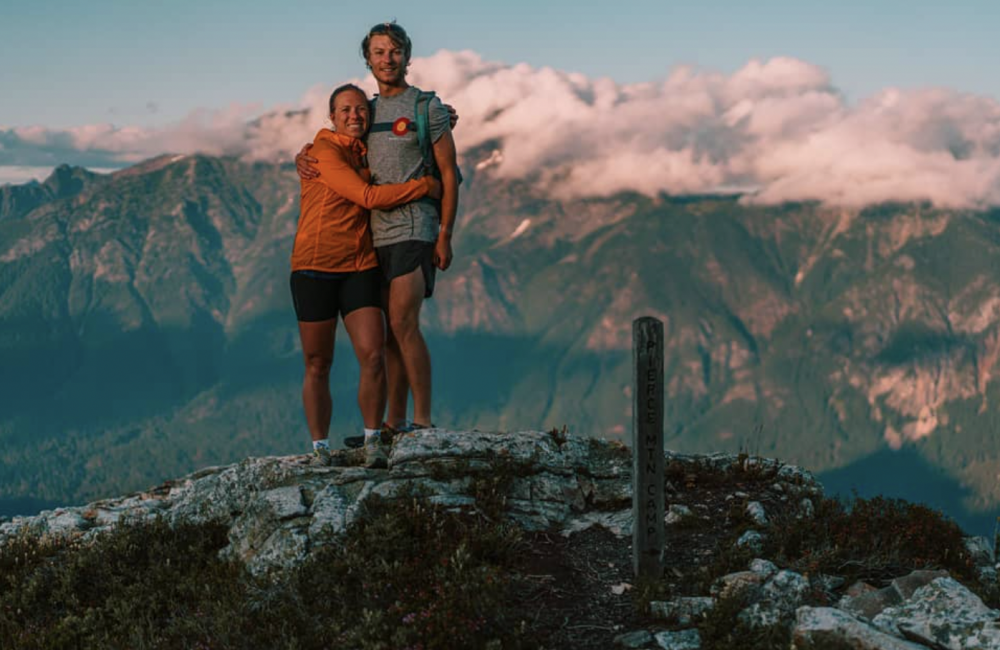
Eliška Albrigtsen and her husband, Tobias, on a trail run in the North Cascades. (Photo: Instagram @untraceableg)
Preparing for Baby
Though baby Albrigsten was conceived in the spring of 2020, he was not simply a “COVID baby”. The urge to begin a family came out of feelings of being “stupidly comfortable”.
“Our life started to be kind of plain, so we thought, ‘Okay, this is the time to do it’ – to go into another hardship, I guess,” Eliška said with a laugh.
With a few years under her belt, she felt efficient and dialed in her role with the UAF team, and she knew she could leave the program in good hands in her absence given the capability and coaching talents of her assistant coach, Jennie Bender. After her own NCAA racing career at the University of Vermont, where she became an All-American, Bender trained and raced professionally through 2017 in cross country, earning four national championship sprints, and standing on over 25 SuperTour podiums.
(Bender has since moved to Whitefish, MT where she is the executive director and head comp coach for the Glacier Nordic Club.)
While women coaches in the NCAA are already a minority, there are even fewer examples of women who have started families while in the head coaching role. However, Eliška was not without footsteps to follow. She explained that her friend, former UAF coach Christina Turman, had given birth to her first child while actively coaching, so she knew it was “somewhat possible”, and while racing at University of Colorado Boulder (CU) during her own collegiate career, then assistant coach Jana Weinberger had begun her family.
University of Alaska Fairbanks head coach Eliška Albrigtsen leads the Nanooks to an historic seventh place finish at the NCAA Championships with baby Viggo in tow. (Photo: Tobias Albrigtsen / @untraceableg)
Looking to be informed and prepared, Eliška applauded the time and energy she and Tobias put into learning about the process in terms of what would be available to her for maternity leave, the amount of perinatal care her insurance would cover, and more. As her job included benefits and had flexible hours, she and Tobias agreed in advance that it made more sense for him to leave his job and become the full-time caregiver for their child, keeping her in a coaching role she loved. And then, they began trying to conceive.
Nailing the timing, Eliška knew that her baby’s predicted arrival in February would allow her to take three months of maternity leave, with an additional month of leave per her usual 11-month contract. This would bring her to June, when athletes are typically away for summer, allowing her to ease back in while writing summer training plans and handling the many other non-coaching aspects of leading an NCAA program.
Coaching Through Pregnancy
As winter approached and the 2020-2021 race season loomed, Eliška began to step back from her usual involvement with team training, “which for me, is not standing on the side of the trail and watching the athletes. It’s to be there with them when they’re struggling, to see where they can improve in the highest point of their performance.”
Her knowledge and expertise as a coach are rooted in both her academic studies in physiology and her own accomplishments as an athlete. Growing up in the Czech Republic, she was named to the national team at 14. During her junior career, she earned a silver medal at the European Youth Olympic Festival in Switzerland in 2005, then went on to place in the top ten at three World Junior ski championships, and helped her relay team to a bronze medal.
Heading to CU for college with World Cup starts under her belt, she went on to become one of the most accomplished skiers in the school’s history, if not the NCAA more broadly. Of the 48 races she entered, she missed the top-10 only three times, and stood on 33 podiums. Eliška (then Hájková) was NCAA champion in classic in 2011, and contributed to two NCAA team titles for the Buffaloes.
In short, she is an incredible athlete and skier. And yet, perhaps both in spite of and because of that strength and athleticism, she was significantly challenged by the toll pregnancy took on her body.
Eliška identified that she has a very short torso relative to her height at roughly 5’5”. In the context of growing a human, this means that there is nowhere for the baby to go but out.
At 40 weeks, Eliška Albrigtsen snaps a shot of her large pregnant belly and swollen face. (Courtesy photo)
“It literally looked like I swallowed basketball,” she laughed as she described her body toward the end of pregnancy.
Even earlier in the process, she found herself regularly adjusting to her rapidly growing belly, and she had to be creative in ways to remain active for the sake of her health and maintaining her usual active lifestyle. She abandoned running early, and had to stop biking halfway through pregnancy “because my belly was just so big.” Because of the risk to the baby of a crash, she did not feel comfortable rollerskiing. “I did an insane amount of hiking with poles.” And, she enjoyed prenatal yoga throughout pregnancy.
***
Returning to the impacts on coaching, as she entered into the third trimester, the physical demands of pregnancy began to significantly impede her ability to work with athletes as she was accustomed.
“I was at the practices, but not really skiing. I skied until the end of the year, and then, my feet were so swollen, I couldn’t fit into my boots. But I was still walking to the practices, and [timed] some time trials until halfway through January. And then I was just too pregnant to move.”
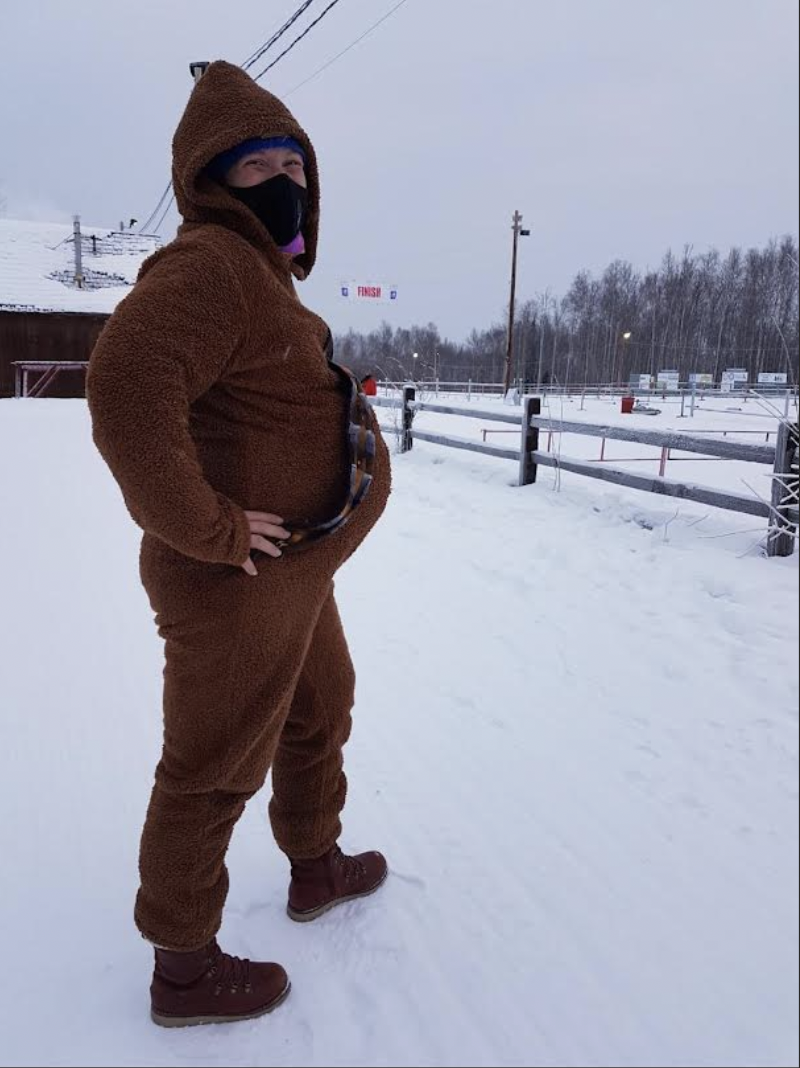
Outgrowing her ski clothes long before winter, she also had to be creative to stay warm for practices. She began wearing spare team jackets in a men’s extra-large to accommodate her belly, and could be sometimes found sporting a large fleecy Chewbacca onesie.
Having outgrown her clothes, Eliška Albrigtsen sports a Chewbacca onesie to stay warm at practice. (Courtesy photo)
As the competition season began, team leadership responsibilities began shifting to Bender, who would assume the role of interim head coach, giving her the authority to call the shots on the road while Eliška remained in Fairbanks.
Still shrouded in COVID precautions, the 2021 RMISA calendar was contained to Utah and Colorado, with most races happening in Soldier Hollow. This worked out well for Bender, who was able to rely on contacts from her racing career to fill in for wax support, primarily Josh Korn, who is the events coordinator in SoHo.
Had Bender not been available and able to fill in so seamlessly as head coach, the program might have been compromised during the season. While the skillset of a high level coach already narrows the pool able to cover a maternity leave, Eliška explained that the clearance process to become an NCAA coach adds another barrier.
“With all the college or university regulations, it’s quite hard to just hire a coach as an independent contractor… it’s so much easier to actually hire someone as a wax tech because they don’t have to [go through the whole process].”
Ever problem solving and adapting, with Bender at the helm, the race season rolled by. And on February 25th, midway through the RMISA championships, Eliška gave birth to her son.
Delivery Day: The Baby is Born
With her aforementioned background as an athlete, combined with participating in training with her athletes and fueling her own passion for outdoor recreation, Eliška explained that she came into pregnancy “quite fit”, which she believes was helpful as she adapted to the load of a growing and changing body. “Honestly, sometimes I was thinking ‘how do women who are not in [good] physical shape do this?’ Because when I was eight, nine months [along], I could barely walk and I was quite strong.”
However, it proved to be a double-edged sword that she felt complicated her delivery. “I had a lot of tightness in muscles, which we want for sport, but not for giving birth.” In particular, this applied to the muscles of her pelvic floor.
Like an extension of the core that line the pelvis, these muscles have a myriad of important roles. They’re responsible for the support and stability of the joints and organs surrounding the pelvis, including regulating the function of the bladder, bowels, and reproductive organs, and they interact with larger muscle groups of the hips, legs, and abdomen used for movement.
For Eliška, her pelvic floor was so strong and rigid that they were unable to sufficiently relax and stretch to allow the baby to pass through her birth canal.
Her due date had come and gone, and time began to run out for her to deliver at the local hospital.
“I was 41 weeks already. And in Fairbanks, they don’t have the NICU specialty, so they don’t let you go over 41 weeks because if something happens, they have to fly you to Anchorage.”
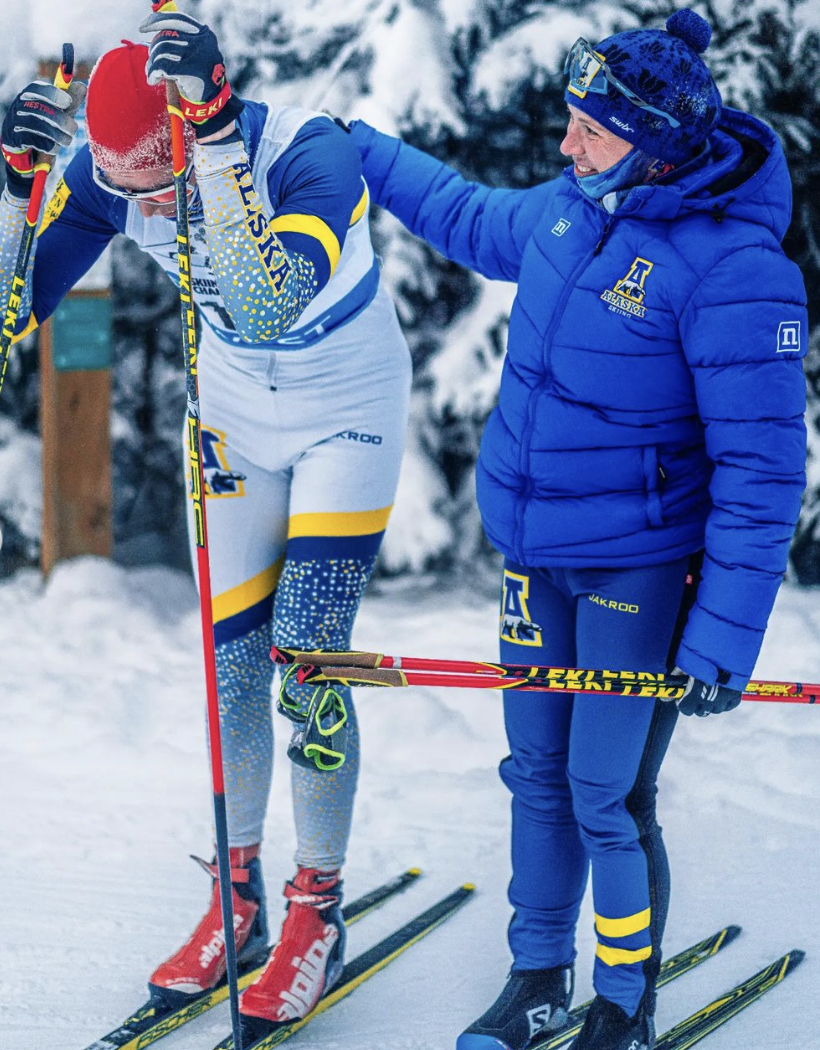
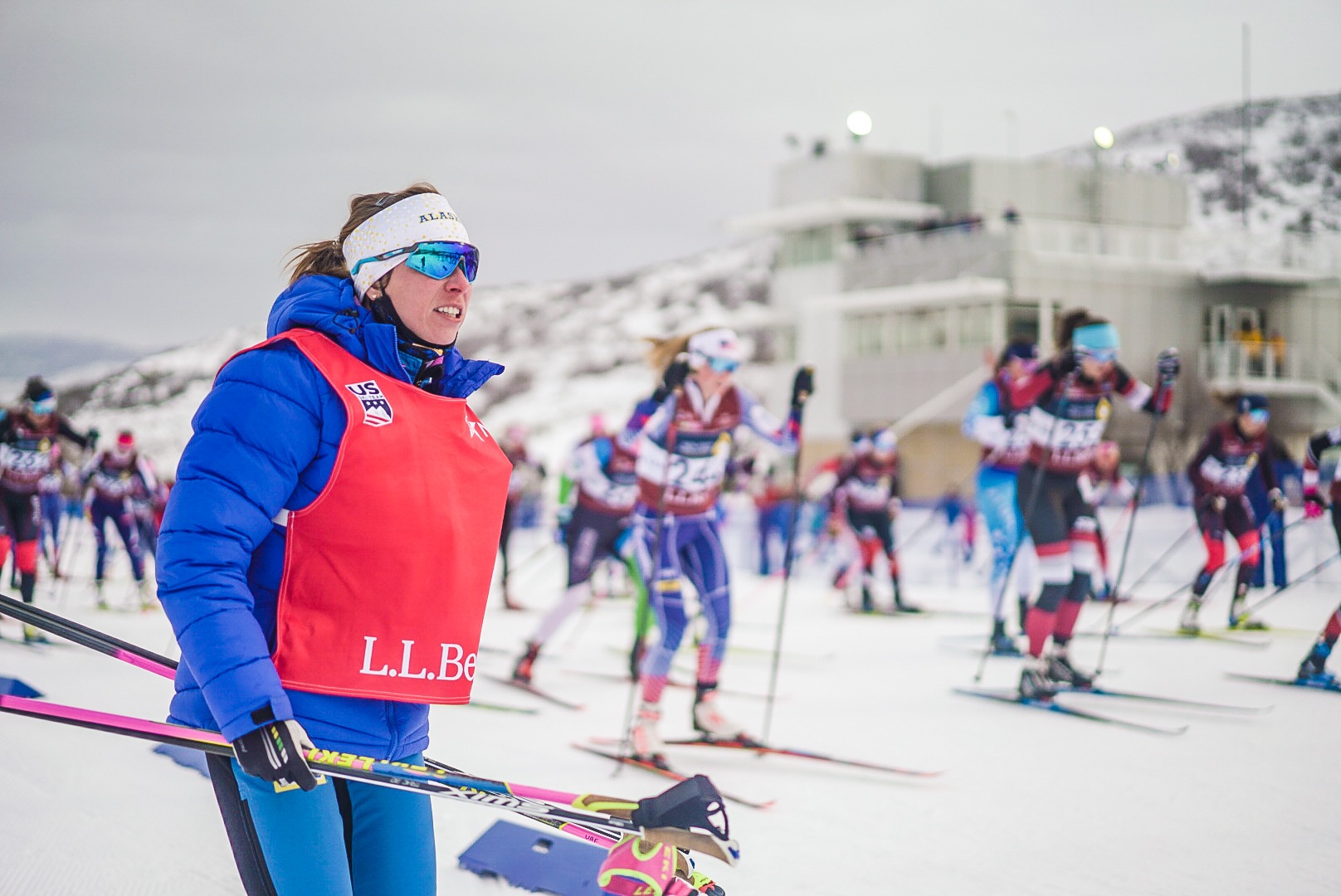
Eliška Albrigtsen provides trailside support for the UAF skiers. (Photo: Tobias Albrigtsen / @untraceableg)
With no signs of the onset of labor happening naturally, she awaited an induction, but Alaska was experiencing a surge in COVID cases in February 2021 and beds in the hospital were at a premium.
“I was just sitting at home with my cup on my belly just waiting for them to call me that they have a space, because the hospital was overwhelmed. They had so many emergency cases coming in that week.”
When she was finally called to come in, she and Tobias headed to the hospital, but her body was reluctant to respond to the Pitocin used to kickstart labor.
“For three days, they kept inducing. The second day, my water broke, and then suddenly, it was happening. Then I was in contractions for like 18 hours, every two and a half minutes a contraction, and it was just so painful that I started to throw up.”
Worn out from the previous 18 hours of labor, her body began to tighten in response to the pain, rather than relax to allow the baby to make progress. Her doctors recommended an epidural in hopes that pain relief would improve her ability to relax and allow her pelvic floor muscles to release.
“After the epidural, I was like, ‘Oh, this is hilarious. I don’t feel anything.’ But then the baby’s oxygen started to drop with every contraction. They put me on oxygen, and that helped, but when they took me off, [his oxygen] was dropping. And the heartbeats were dropping as well.”
The doctors felt it was no longer safe for her to continue trying for a vaginal birth, and instead prepared her for an emergency C-section.
“That was like 11:30 p.m. on the 25th. And he was born at 11:57. It was just so cool.”
Returning to the concept of “donating your body to science”, Eliška recounted a strange experience resulting from the inability to eat during the induction process. Most hospitals do not allow women to eat in case they need to be put under anesthesia for an emergency procedure.
“At that point, I was three days without food… they were giving me sugars through IV, but I was shaking like this,” she said as she demonstrated full body tremors. “They had to have extra nurses to hold me down during the C-section because my body was just trying to shake all the glycogen from my muscles out into the bloodstream… physiologically, I literally shook all the sugar that I had in my whole body out into the bloodstream to make this baby happen.”
Despite the complications, both Eliška and baby Viggo were fully healthy, and the remainder of their hospital stay went by without a hitch. She fondly remembered his perfectly round head, a mark of a baby delivered via C-section, and proudly showed a picture of her sweet newborn.
The journey into motherhood, though challenging, has also been rewarding for UAF head coach Eliška Albrigtsen. (Photo: Tobias Albrigtsen / @untraceableg)
Reflecting on the unexpected hurdles she faced, she voiced the opinion that, like her athletic body had been “detrimental to the birth” process, her athlete mindset stood in her way of entering the labor and delivery room with open-minded acceptance.
“I had a ‘perfect’ birth plan. I knew that I’m going to go there and I’m not going to push until I’m [dilated to] 10. And then I’m going to have the baby. But it does not work that way. No one told me that.”
As skiers, we’re accustomed to the notion that diligently following a training plan and putting in the work during the build up to a key race will lead to a somewhat predictable outcome: ideally, an optimal performance, or at minimum, an improvement from previous cycles. But for Eliška, this expectation proved to be crippling as she was faced with the realities of her birth experience, which differed greatly from her “plan”.
“That’s how I raced. I trained hard and I did a lot of technique, and then I was the best skier out there because I prepared… If I went there without any plan, I would be so much happier. When they came and said, ‘You have to get the epidural’, I cried. But at that point, I was throwing up every two and a half minutes with pain. When they came and said, ‘He has to come out, we have to do a C-section,’ I totally lost it.
“So that’s kind of what I would do differently next time. Now knowing that, you know, birth really messes people up. It’s not this perfect thing that just happens.”
Stay tuned for part 2, discussing Eliška’s postpartum recovery, return to coaching, and year one on the road to competitions with baby in tow.
Marine Dusser was named RMISA Nordic Coach of the Year in her first year leading the UAA Seawolves, 2019/2020. (Photo: Adam Verrier)
This article has been updated with a link to additional information in an Anchorage Daily News story.
ANCHORAGE — The University of Alaska Anchorage announced Wednesday a planned “reconfiguration” of the UAA Athletics Department, which will involve cutting both the men’s and women’s ski teams after the 2020/2021 school year. School leaders will seek approval of their plan, which would also cut men’s hockey and women’s gymnastics, at the upcoming Board of Regents meeting on September 10-11.
By the numbers: Not enough money
FasterSkier previously reported on a version of this story in fall 2016, when the UAA ski team was slated for elimination but was ultimately reinstated following a strong outpouring of community support. As FasterSkier wrote in a story published in October 2016:
As FasterSkier previously reported, the State of Alaska is dependent upon funds from a single source, oil revenue, to an extent unparalleled in any other state. Falling oil prices over the last two years have led to widespread budget deficits, layoffs and reductions of both state and private-sector employees (particularly in the oil and gas industry), and political recriminations over the failure to pass a balanced budget.
When FasterSkier first reported on this story in May 2016, the price of oil was approximately $48 a barrel. At the close of trading on Thursday, oil was at $49.89 a barrel. At these prices, the State of Alaska faces a revenue shortfall equal to approximately two-thirds of its budget. Oil has not been over $100 a barrel in over two years.
Alaska residents have not paid a state income tax since 1980. Although some communities have instituted local sales taxes, there is no statewide sales tax.
Oil is currently $43 a barrel (up from negative numbers earlier this spring). The State of Alaska has not made meaningful longterm progress on its endemic fiscal challenges, stemming from the lack of a diversified economy, in the ensuing four years. Limitations on travel wrought by the Covid-19 pandemic have this year further decimated tourism, one of the state’s main other revenue sources.
There is still no state income tax. Payments from the state’s sovereign wealth fund, the Alaska Permanent Fund, were reduced to only $1,000 per person this year.
By the numbers: Inside the UAA budget
The budget for the entire University of Alaska system has been dramatically reduced over the last several years. After current Governor Mike Dunleavy was elected in 2018, “on a promise not only to restore the full dividend but to make it retroactive, which would amount to giving nearly seven thousand dollars to every Alaskan,” he announced a proposed budget that did not restore the full amount of a promised dividend, but which did reduce state funding to the University of Alaska system by over 40%.
Current UAA skier JC Schoonmaker scores points in his first World Cup start earlier this year, during the Dresden, Germany skate sprint. (Photo: NordicFocus)
While funding levels have not been reduced to quite those dramatic levels, following widespread pushback and a pending recall effort (disclosure: this reporter’s mother is leading the Recall Dunleavy legal team), the overall budget for the University of Alaska has been substantially cut. As the UAA press release notes, state funding for UAA has declined by $34 million since 2014.
The press release continues, “The university’s decision to discontinue these sports follows on the heels of the Board of Regents’ direction last fall to consolidate academic programs and services to meet budget reductions. In August 2019, University of Alaska leadership came to an agreement with Gov. Dunleavy on a $70 million reduction in state funds to the university system over the three-year period of fiscal years ’20, ’21 and ’22.”
Current figures for the overall UAA Athletics Department budget were not immediately available. As of the 2017 fiscal year, the total budget for UAA Athletics was $4.33 million. The men’s hockey team cost $1.35 million; men’s and women’s skiing cost $280,000 each.
UAA has said that cutting skiing, hockey, and gymnastics is “expected to save approximately $2.5 million per year” out of the 2021/22 budget.
By the numbers: Not enough sports teams
Other teams currently proposed for elimination are the men’s hockey team and women’s gymnastics team. The ski team counts as two teams for purposes of Title IX and NCAA affiliation, the men’s ski team and the women’s ski team. UAA currently has 13 varsity athletic teams total.
The proposed cancellation, therefore, takes UAA from 13 teams down to nine. But section 20.10.3(a)-(b) of the NCAA Division II Bylaws provides that “A member of Division II shall sponsor in Division II a minimum of” either five sports for each of men and women, or four sports for men and six for women. (Most of UAA’s teams are Division II teams. The four teams currently proposed to be cut all compete in Division I. If UAA were a full D-I program, it would need to field even more than 10 varsity teams.)
Former UAA skier Sadie Maubet Bjornsen races on the World Cup earlier this year in Trondheim, Norway. (Photo: NordicFocus)
300 miles to the north, Alaska’s other NCAA ski program, University of Alaska Fairbanks, issued a press release headlined, “Commitment to Alaska Nanooks Programs.” UAF Chancellor Dan White wrote, following Wednesday’s announcement from UAA, “I want to reassure our Alaska Nanooks student-athletes, parents, coaches, and the UAF and Fairbanks community that UAF’s athletics programs are not part of this recommendation. UAF has 10 Division I and II sports, the minimum number allowed by the NCAA, and has no plans to reduce them.”
The implicit safety net of already having an NCAA-minimum 10 sports teams was cited by UAF coaches and athletes four years ago when it previously appeared that ski programs at both UAA and UAF were potentially going to be cut. As then-UAF head nordic coach Nick Crawford wrote in an emailed statement to FasterSkier in October 2016:
“For UAF specifically, I don’t think skiing will be cut as I don’t think the NCAA will grant the waiver to the ‘10 sport minimum requirement.’ One of the NCAA’s core values is to provide sporting opportunities from athletes of many different sports and the 10 sport rule is in effect to protect small sports like skiing. It’s a slippery slope to allow Alaska to cut ‘less well known’ sports like skiing and indoor track to continue to fund their more popular sports, If the NCAA grants this waiver, it sets a precedent to eliminate non-revenue generating sports across the country with fewer and fewer sports offerings and that is not a direction I think the NCAA wants to go in.”
Ian Marks, UAA Assistant Athletic Director for Media Relations, was asked Wednesday about the significance of a proposal that took UAA to fewer than 10 sports teams. In an email to FasterSkier, Marks wrote, “UAA will need to add a men’s team sport in the future. UAA will be applying for a waiver with the NCAA to sponsor only nine sports in the short-term.”
“Between Aug. 19 and Sept. 9, the university community and public will have the opportunity to comment on the UAA Athletics decision during a virtual town hall meeting on Aug. 26 and Board of Regents public testimony on Aug. 31. Information about both events is available at uaa.alaska.edu/calendars/public. Feedback may also be sent to uaa_feedback@alaska.edu.”
The answer is, “What has occurred recently at other universities, such as the University of Alabama-Huntsville, was a beneficial outcome for their hockey program. But it is a short-term solution. After the coming season, their athletics department will need to resolve 2021-22 funding for the program because the money raised will not cover a full season of expenses. We are concerned about the long-term viability of UAA Athletics. Outside support would need to align with a plan for long-term sustainability in order to move forward.”
More information
The Anchorage Daily News published a story on this topic later Wednesday, reflecting a Wednesday-afternoon conference call with the UAA Athletic Director. For more information on overall budget numbers and a potential replacement men’s team sport – soccer, lacrosse, and volleyball among them – please see Beth Bragg’s story here.
Martin Benes, who has coached at Sugar Bowl Academy for the last seven years, was recently hired as head coach of U.S. Paralympics Nordic. (Photo: U.S. Paralympics)
(Note: This article has been updated to include the hiring of Miles Havlick as the University of Utah’s head nordic coach, which was announced Monday afternoon.)
There have been several notable career changes in North American nordic skiing this summer. Here’s a quick look at who moved where:
Robert Lazzaroni, the nordic director at U.S. Ski & Snowboard, will soon begin his new role as Salomon’s nordic regional commercial manager for the Americas. (Photo: Salomon)
Robert Lazzaroni:from U.S. Ski & Snowboard to Salomon. Last week, Salomon announced via a press release that Lazzaroni, of Park City, Utah, will join its staff as nordic regional commercial manager for the Americas, starting Aug. 27. For the last three years, Lazzaroni served as nordic director at U.S. Ski & Snowboard in Park City. Before that, he was program manager at Utah Olympic Park, and before that, a nordic division manager for Rossignol and later One Way Sport. Asked about his new job at Salomon, Lazzaroni told FasterSkier he’d be willing to talk more in depth after he starts. Until then, he’s still employed at U.S. Ski & Snowboard.
According to U.S. Ski & Snowboard’s Chief of Sport Luke Bodensteiner, many of Lazzaroni’s duties as nordic manager “have been or will be distributed across existing staff, and we’re taking the opportunity to re-align our staffing positions to make sure that we have an efficient structure that supports our priorities of athlete development, coach education, and strong domestic competition,” he wrote in an email to FasterSkier. “This will likely require hiring an additional position, but the nature of that job is TBD based upon where we determine that we need the human resource to support those priorities.” Bodensteiner expected to know more about the shift in staff responsibilities later this month.
Martin Benes:from Sugar Bowl Academy to U.S. Paralympics Nordic. Also last week, the U.S. Olympic Committee announced the hiring of Martin Benes as its new head coach of U.S. Paralympics Nordic Skiing. He replaces Eileen Carey, who was promoted to program director following the departure of John Farra (to USA Triathlon) this spring. Benes began coaching as an assistant ski coach at Bates College, then spent the last seven years as head nordic coach and director at the Sugar Bowl Academy near Truckee, California, according to his LinkedIn profile. As head coach of the U.S. Paralympics program, he will “lead the development of annual and seasonal training plans for the national team, track athlete performances, workout data, sport science data and annual progress reports, contribute to the U.S. Paralympics athlete identification and development strategy, and assist in planning travel and logistics for the Nordic skiing program to competitions, camps and events,” according to the press release.
“It’s an incredibly exciting time to join the program following such a successful performance in front of the world at the Paralympic Winter Games PyeongChang 2018,” Benes stated in the press release. “I’m eager to get started in my role so we can continue to strengthen the program and win medals on the international stage.” He’s set to begin on Aug. 20.
Fredrik Landstedt:from the University of New Mexico to the University of Utah. Late last month, the University of Utah announced it had found a new director of skiing to replace Kevin Sweeney. Landstedt had been a staple on the University of New Mexico (UNM) Ski Team for the last 21 years, spending the last 11 years as head coach of both the nordic and alpine programs (and 10 years before that as head nordic coach). His decision to take the job at Utah came less than 24 hours after the UNM Board of regents unanimously approved a proposal to eliminate four sports starting in the 2019/2020 season, according to the Albuquerque Journal. Those sports are men’s and women’s skiing, men’s soccer, and women’s beach volleyball. The proposal would also significantly impact funding for cross country and men’s track and eliminate the women’s diving program. In the meantime, UNM announced assistant coach Joe Downing will assume the role of interim head skiing coach.
“I am honored to have the opportunity to lead a program with such a rich history,” Landstedt stated in the Utah press release. “Utah has a strong winning tradition and the support that the University provides its ski team is incredible. I look forward to bringing NCAA titles back to Utah!”
Miles Havlick in November 2015 in West Yellowstone, Montana.
Also at the University of Utah, Miles Havlick: new head nordic coach. In a press release on Monday, the university announced that Havlick, one of its former skiers and a two-time NCAA champion (2012 and 2013), was hired to head up its nordic team for the coming season. Havlick, 28, skied for the the Sun Valley Ski Education Foundation Gold Team after college and won the 42-kilometer Australian Hoppet Worldloppet last August. He delved into coaching last summer in Australia with the Birkebeiner Nordic Ski Club and Victorian Junior cross-country ski team, and last winter, was an assistant coach and wax technician for the Australian junior national team at Junior World Championships. Havlick also waxed for the Australian national team last March in China. He has also assisted the Utes ski team, most recently as an assistant coach at 2018 NCAA Championships.
Eliška Hájek Albrigtsen:from Central Cross Country to the University of Alaska Fairbanks. After spending the last year filling multiple roles with Central Cross Country (CXC) out of Madison, Wisconsin (including CXC Team head coach and junior development coach), Albrigtsen has accepted an assistant-coaching position with the University of Alaska Fairbanks Ski Team, replacing Josh Eide. Albrigtsen was a four-time All-American skier for the University of Colorado Boulder and an NCAA champion in 2011.
Cross Country Canada seeks senior national team coach: Two days ago, the CCC headquarters in Canmore, Alberta, put out an announcement for applications for a full-time senior national team coach. The position indicated it requires both domestic and international travel. “Reporting to the HPD [high-performance director], the Senior National Team Head Coach (NST Head Coach) is responsible for leading the technical delivery and alignment of Senior National Ski Team (Senior NST) programs in order to achieve podium performances at Olympic Games and FIS World Championships,” the job description stated. “The NST Head Coach will have the responsibility to plan, coordinate and monitor the training and competition of NST athletes in line with CCC’s collective goals.” CCC’s senior team includes 10 athletes, five of which are on the World Cup Team. The other five are on the U25 (under-25) Team. View the job posting here.
Nichole Bathe (l) and Annika Taylor, both American-born members of the British Nordic Ski Team, during a training session last fall in the Rhône-Alpes region of France. (Courtesy photo)
This week FasterSkier presents a workout from British national ski team members Nichole Bathe and Annika Taylor. Last season, both Bathe and Taylor competed overseas on Great Britain’s national nordic team. They were interviewed on the phone last fall and email this spring.
***
May. For some, it’s a month marked by caps and gowns and new beginnings. Last year, May was a month in question for Nichole Bathe. The Madison, Wisconsin, native had just graduated from the University of Alaska Fairbanks (UAF) with a degree in justice and social work. But immediately starting a nine-to-five job was not what she wanted to do.
During the school year, she had raced for UAF’s ski team, qualifying for three NCAA Championships and finishing as the top American in fourth place as a freshman. As a senior, she qualified for U23 World Championships in Midway, Utah. A few of Bathe’s coaches suggested that she continue her cross-country career after college.
“I had no idea what I was going to do at graduation in May,” said Bathe, now 23. “But I was always wondering what it would be like to focus on skiing as a whole, instead of having school in the way of that.”
Nichole Bathe of the University of Alaska Fairbanks (l) as the second American in the classic sprint at 2014 U.S. nationals at Soldier Hollow in Midway, Utah. Rosie Brennan (c) finished first and Becca Rorabaugh (APU) placed third. (Photo: Tom Kelly/U.S. Ski Team)
By June of last year, Bathe made a phone a call. The recipient was Annika Taylor.
Taylor presented a unique situation in nordic sport. After growing up in Truckee, California, and graduating from the University of New Hampshire (UNH) with a chemistry degree in 2015, Taylor — a dual citizen – moved to Europe to ski for Great Britain’s national team, which is based in Lillehammer, Norway. (Taylor holds one passport through the United Kingdom and one through the United States, thanks to her father who is originally from the U.K.)
Bathe contacted Taylor because she shared a similarly unique family background. Both of Bathe’s parents hail from Britain, and since she was born in the U.S., Bathe is an American citizen.
If Bathe wanted, she could apply for dual citizenship and follow Taylor’s path, moving to Norway to ski for Britain. (Bathe only needed one of her parents to hold a valid British passport order to apply. Not all countries permit individuals to become dual citizens; the Czech Republic and Estonia, for example, require individuals to rescind one).
In their conversation together, Bathe asked Taylor about the logistics of moving to Europe. Taylor was reflective in her advice. She encouraged Bathe take into consideration not just the training she hoped to receive, but also the lifestyle changes she would have to make.
“When you move to a new country, you get challenged as a person,” Taylor, 24, explained.
During her first full year abroad, Taylor trained predominantly with a professional Norwegian team. Her teammates at the time spoke little English, she explained. While she had a background in basic Spanish, Taylor’s exposure to Norwegian was minimal when she arrived in Lillehammer.
The process of learning the language came gradually, she said. After a few months, Taylor had picked up conversational phrases. A few months after that, she purchased a grammar book to better her understanding of sentence syntax. Meanwhile, her primary language instruction stemmed from training sessions and talking to her teammates in Norwegian.
“When you’re out training with people and you’re out for three hours, you’re practicing constantly, asking questions and trying to explain yourself,” she said.
Annika Taylor (back right, in blue tanktop) during an elghuffs workout with Norwegian Coop talent team in 2016. (Courtesy photo)
In the end, Taylor said the language barrier was worth breaking through. She recalled a strength session she did with Norway’s Heidi Weng (now the two-time reigning overall and distance World Cup champion) and the confidence it gave her. Most importantly for her, Taylor was able to train with athletes who are World Cup regulars.
“I needed women who had international experience and not just experience in the U.S.,” Taylor said of her decision to join the British team.
After speaking with Taylor, Bathe realized she felt similarly. She had skied for Central Cross Country (CXC) program for the past nine years, returning each summer to train with the CXC Team, while a student at UAF. By the end of her college career, she’d tallied a fourth place, seventh, 12th, and 13th in the NCCA Championship races she’d contested. She’d competed at five U.S. senior nationals, finishing on the podium in third (as the second American) in the classic sprint in 2014.
But Bathe wanted to test herself outside the U.S.
“I felt that I was going to get the most out of taking a year or two to ski if I went all in and moved to Europe and had the chance to train with high-caliber people all the time,” Bathe said.
Bathe sent her application to the U.K. last spring, was granted dual citizenship and moved to Lillehammer in the early fall. Her application included proof of her parents’ original U.K. citizenship documents and Bathe’s U.S. birth certificate information.
“It’s actually pretty streamlined once they have all the information,” she explained.
This winter, Bathe earned a spot on the British national team. Her focus for the season remained on U23 World Championships in Goms, Switzerland. There, her best result was 37th in the 10-kilometer classic.
“I was lucky to race in Europe all year and really learned a lot about racing and just training in general,” Bathe wrote in an email. “Even though it wasn’t the year I had hoped for results-wise, it was a really useful year for me and I know now what I need to do to race faster and to just ski better in general.”
Taylor, who came into the season prequalified for the 2018 Winter Olympics, explained that she came down with an illness that plagued her from October through February. At her first Olympics in PyeongChang, South Korea, she finished 60th in the 15 k skiathlon and 75th in the 10 k skate.
“My body just didn’t have anything left to give in races,” Taylor reflected in an email. “I had to deal with a lot of feelings of ‘failure’ and push on past the disappointment of last season, but I am glad to report that I’m out the other side, loving training, looking forward to giving my best another season, while setting my sights on achieving a Doctor in Physical Therapy in my future!
“Athletes have ‘off years’- we are only human!” Taylor continued. “I definitely learned how to control the things I could control this past season, and learned to let go of the uncontrollable. It was a humbling experience and gave me a new empathy for those athletes that suffer from injury and illness on a regular basis!
“There’s something quite unique about the community of people and the resilience and determination, but also finesse that cross country skiing demands, that seems to shape quite interesting and well-rounded human beings. I think every athlete can recall a story of when their sport treated them to a ‘mountain-top’ experience and plenty of times where they experienced the low-lows that result when you dedicate your energy, time and emotion to something you love. It’s always a gamble to give something your all: you either succeed spectacularly or fail spectacularly, and somehow we keep coming back for more! It’s a cross country skier, human condition!”
Annika Taylor of the British national team during a bounding workout.
For the upcoming season, both Taylor and Bathe plan to continue racing for Britain. Bathe spent some time in Wisconsin this spring before returning to Lillehammer for training. Taylor is currently spending some time in Truckee before returning to Scotland and eventually Norway. As of this spring, both women were fully funded by the team, leaving only housing and food as their primary expenses.
“The hardest part of this last season was just managing the disappointment in results,” Bathe explained. “Seeing your name at the bottom of a results page is a bit of a gut punch, at the beginning of the season that was tough but once I figured out how to handle that and understand that I wasn’t going to have the dream season I envisioned it became more of a learning season and a technique season.
“Looking to the future I’m excited to race again and am much better prepared for those slap-in-the-face races that happen when your newer to the World Cup,” Bathe added.
The two teammates recommended the following Norwegian “elghuffs” bounding workout:
The Workout: “Elghuffs” a.k.a. hard bounding/ski walking uphill intervals
Goal: Get a good Level 3-5 workout in “and not get dropped to hard by the Norwegians!”
When: Can be done 1-2 times a week through the fall
Where: Alpine hill
“We do it in a town called Hajfell which is just outside of Lillehammer at a downhill mountain bike and ski area,” Bathe wrote.
The set: 6 x 6 minutes Level 4
“Then we catch the gondola back down the mountain for free,” Taylor wrote. “Pretty sweet that Hafjell offers that to people who go on foot or bike up!”
Top tip: “Don’t start too hard; it will catch up to you by the top,” Bathe wrote.
The Department of Athletics at the University of Alaska Fairbanks is seeking applicants to fill the position for the Assistant Coach for the Men’s and Women’s Nordic Ski Teams. The Alaska Nanook Ski Team competes in the Rocky Mountain Intercollegiate Ski Association and frequently has all-American level performances at the NCAA Championships. UAF is the ideal place to be a nordic skiing enthusiast with groomed trails right outside the door on the UAF campus and a quick 15 minute drive to the world class Birch Hill Facility. There is consistently good groomed skiing from late October/early November to late March/early April each year.
The position is a 9 month/year salaried position with excellent benefits. The minimum starting pay is $25.82/hour. To learn more about the position or to apply please go to http://careers.alaska.edu/cw/en-us/job/506177/assistant- mens-womens-xc-ski-coach
The position is open until filled with the application review process beginning on June 10th 2018.
Logan Hanneman of Alaska Pacific University getting some early-season training in this past fall at Hatcher Pass above Palmer, Alaska. (Photo: Ophira Group)
Earlier this season, Logan Hanneman talked with FasterSkier about his laser-like focus on the 2018 Winter Olympics, which start on Feb. 10 in PyeongChang, South Korea. The 24-year-old Fairbanks native, who now lives and trains 300 miles south in Anchorage with Alaska Pacific University (APU), was specifically eyeing the men’s individual classic sprint on Feb. 13. Although first he has to qualify to get there.
Logan Hanneman (Alaska Pacific University) leads Canadian Evan Palmer-Charrette (13) en route to the victory in the men’s 1.6-kilometer freestyle sprint final at the 2017 SuperTour Finals in Fairbanks, Alaska. (Photo: Max Kaufman)
“That race was the absolute highlight so far of my career,” Hanneman said of the SuperTour Finals win during a phone interview in September. “Not just because it was a national title but because it was in my home town. It was very special to be able to win that at home.”
He ended last season ranked sixth in the men’s SuperTour sprint rankings and 24th overall. So far this season, an Olympic season, Hanneman is seventh in the sprint standings and 11th overall for SuperTour points through two weekends of racing (see 2017-18 SuperTour Points link on right side of page).
Perhaps more notably, he’s placed second and third in two SuperTour sprint qualifiers: he was second in the skate-sprint qualifier Dec. 2 in West Yellowstone and third in the classic-sprint qualifier Dec. 9 at Sovereign Lake in British Columbia.
Hanneman went on to finish seventh in the West Yellowstone sprint and ninth overall in the B-final at Sovereign Lake.
What’s the significance of fast qualifiers? Everything, if you’re a sprinter trying to make the U.S. Olympic team.
“Should there be any remaining positions after Selection Criteria 1 [World Cup results and standings] and 2 [discretion] have been applied, those positions may be filled by considering the athlete with the highest rank on the 2018 Olympic Winter Games Selection List,” the criteria states, “Which is an accumulation of SuperTour points scored during the selection period using the athlete’s best 2 finishes in a single discipline (sprint or distance) and using the OWG Selection List outlined in Attachment 1.”
“From a very literal view, I need to be one of the top (most likely The top), sprint qualifiers in the country after U.S. Nationals in January in order to make the 2018 Olympic Team,” Hanneman wrote in an email in September. “The qualification races are comprised of four sprints, where only the qualifier is scored for points towards the Olympic team (West Yellowstone SuperTour, Silver Star SuperTour, and U.S. Nationals (2 sprints)). On a more broadened view, I just need to improve my sprint qualification ability slightly. … I was close to qualifying for World Championships last year, which used the same qualification criteria. So that has been my focus this summer and will continue to be what I focus on in my training.”
Logan Hanneman on a trail run near Anchorage, Alaska, this past training season. (Photo: Reese Hanneman)
Heading into U.S. Cross Country Championships, which begin Wednesday in Anchorage (the first sprint is the skate sprint on Friday), Hanneman has put himself in “podium” contention for a top qualifying result (although no actual podiums exist for those results at the SuperTour or U.S. nationals level this season — only the finalists get to stand on an actual podium).
He’s joined by top male SuperTour sprinters Nick Michaud of the Bridger Ski Foundation (who won the West Yellowstone skate-sprint qualifier as well as the final early last month, and qualified second in the Sovereign classic sprint before placing 12th overall), Cole Morgan of the Sun Valley Ski Education Foundation (who won the Sovereign qualifier and placed third in the final, and was fifth in the West Yellowstone qualifier and sixth in the final), and Ben Saxton of the Stratton Mountain School Elite Team (who was third in the West Yellowstone qualifier and fifth in the final, and eighth in the Sovereign qualifier and second in the final). And there are several others who are contenders for the upcoming nationals classic-sprint qualifier in Anchorage on Monday, Jan. 8.
Hanneman’s older brother, Reese, made it to the finals in both West Yellowstone and Sovereign, placing third in West’s skate sprint and fifth in the Sovereign classic sprint, after qualifying in seventh in West and fifth at Sovereign.
Reese, who turned 28 on Christmas, has two sprint national titles to his name (he won the 2016 skate sprint in Houghton, Michigan, and the 2014 classic sprint at Soldier Hollow in Midway, Utah.) In all, Reese has seven U.S. nationals podiums, according to the International Ski Federation (FIS) database.
Logan qualified second in the skate sprint at 2015 nationals in Houghton.
Last winter was Logan’s first season as a senior athlete. After missing out on qualifying for 2017 World Championships, he focused mostly on the domestic SuperTour circuit, but also ventured to Seefeld, Austria, for three days of Alpen Cup racing. There he finished 15th in the 3.3-kilometer freestyle prologue, 40th in the 15 k classic, and 37th in the 15 k freestyle pursuit.
“They were great races to do because they’re very stiff competition,” Logan reflected. “There’s a lot of Europeans there that are on and off the World Cup circuit.”
Two seasons ago, he competed at 2016 U23 World Championships in Rasnov, Romania, where he finished 15th in the skate sprint and 55th in the 15 k classic. He followed that trip with Alpen Cup races in Germany and Italy, and notably placed seventh in the 3.3 k freestyle prologue in Toblach, Italy.
After graduating from the University of Alaska Fairbanks in 2015, Logan has yet to race at the World Cup level. But after transitioning to life as a professional ski racer, who balances two training sessions a day with an engineering job, that remains one of his big goals. That and the Olympics.
Alaska Airframes’s three-seater Piper PA-18 Super Cub outside company headquarters in Chugiak, Alaska. (Photo: Logan Hanneman)
“I do a lot of computer design work, and you get to watch what you design on the computer be made right downstairs in our machine shop,” he said of his part-time work with Airframes Alaska, a company that makes after-market upgrades for small aircraft, specializing in the Piper PA-18 Super Cub. “Working in the aircraft industry, there’s a lot of FAA compliance. I also help with facilities support projects. You never know what you’re going to be working on a week-to-week basis.
“They’ve been outrageously flexible with my skiing, which is unbelievably helpful for my first job as an engineer,” he continued. “I was able to set my work schedule around my training schedule. I train in the morning, drive out to work, then come home and do my second workout. When it comes into racing season, if I need to be gone, I’m able to leave for racing or training. It’s been a blessing. It’s awesome.”
Logan spoke with FasterSkier this fall as he was driving to work at an airstrip in Chugiak, about 20 miles northeast of Anchorage.
“I like being busy,” Logan said. “Work is not stressful at all because it’s outrageously fun. It’s what I really like doing. I never find myself too stressed with all this [work, training, life]. I think I’ve found a pretty good balance.”
Asked about what Logan brings to the APU program, Erik Flora, director of the APU Nordic Ski Center, wrote in an email: “We were excited to have Logan officially join our program [in 2015]. His skills and ability to move in a sprint make him one of the top developing sprinters in our country. He is extremely thoughtful about his training and his approach to skiing fast. He strengthens our team, both with results and as a strong teammate.
“His speed in the finish is one of the best I have ever seen,” Flora added.
The Hanneman brothers after placing first and second in the men’s SuperTour freestyle sprint in November 2015 in West Yellowstone, Montana. Younger brother Logan Hanneman (r) won the final for his first SuperTour victory and Reese (l) placed second. (Photo: Travis Jones)
Logan characterized himself as “one of a bunch of guys at APU that are pushing to try to make the 2018 Olympics this season. I tend to do better in sprints, so that’s going to be my primary focus.”
Late this summer, he experienced a back-pain flareup from an old injury. In 2013, Logan broke his back in a trampoline accident.
“I do a lot of core strength exercises to get stronger where I need it the most,” he explained. “For a few days I have to be really cautious until I get everything relaxed again.”
He added that swimming is a good alternative workout when his back bothers him. Other than the occasional back pain, he feels that he’s on track for this winter.
“My training’s been good. The group of guys here at APU are a pretty stellar training group,” he said. Logan is part of a training group of 14 men on the APU Elite Team, including U.S. Ski Team members Erik Bjornsen and Scott Patterson.
One of his teammates is his brother Reese.
“We’ve raced together for so many years, there’s not a whole lot of sibling rivalry,” Logan said of Reese. “In a race, he’s just another competitor. Sometimes it can be hard if things don’t go well for one of us. This year is gonna be tough because both of us are pushing for one of those sprint spots for the 2018 Olympics.”
“He’s really confident in his training plan, what it takes to do your best,” Reese said in a September interview. “It’s hard, there’s a lot of different ways to do it. Logan’s always very confident – he helps me in that way, too.
“He’s one of the best qualifiers,” Reese added.
— Alex Kochon contributed
Logan Hanneman unwinding after last year’s race season. (Photo: George Ferree)
Ann-Cathrin Uhl on a hike in Germany this summer. (Courtesy photo)
Ann-Cathrin Uhl will be a senior at the University of Anchorage Fairbanks (UAF) this year, but for the summer she was back in her native Germany as usual.
Uhl made her first trip to NCAA Skiing Championships last season, finishing 30th and 34th at the races in Jackson, N.H. But she has long been a contributor to the UAF Nanooks effort both on the ski trails and as a cross-country runner. This summer, a group of ski teammates came to visit her in Germany.
Uhl is probably also a familiar name to American competitors as well, because in both 2015 and 2016 she won the junior heats of the classic sprint at U.S. Cross-Country Championships.
University of Alaska Fairbanks women’s nordic-team skiers get together for a photo last season: (from left to right) Hannah Rowland, Anne-Tine Markset, Nichole Bathe, Martina Himma, Ann-Cathrin Uhl, and Sarissa Lammers. (Photo: Nick Crawford)
Uhl took some time over email to share what it’s like to train from her home base in Germany’s Black Forest region, a mountainous region in the southwest of the country.
FasterSkier: Where are you based this summer? What part of the Germany?
Ann-Cathrin Uhl: This summer my training base is mainly the Black Forest, that is the southwestern part of Germany. I am living with my family in Mühlenbach, which is the town I grew up in. During the week I train at home and on some weekends I drive to the Alps for altitude training.
FS: What is your part of the Germany like? How is the landscape? What do people do there?
ACU: I live close to a town called Schonach, where the annual Nordic Combined World Cup is hosted. Sandra Ringwald, the German Nordic World Cup skier is also from this town. The Black Forest is a mountainous region, bordering France and Switzerland. Its beautiful nature with mountains, valleys, gorges, lakes and rivers is reason for lots of tourism. People that live here like to be outside and active. Hiking and mountain biking are very popular.
Uhl competing at German Mountain Running Championships, where she finished 30th and helped her team to sixth place. (Courtesy photo)
FS: Do you have a team that you are training with, or are most of your training sessions alone?
ACU: I don’t have a ski team I can train with. I do all the rollerskiing and strength on my own. But I am training with a professional mountain running team in my area. I actually got to know my teammates pretty well, since we were travelling to competitions together.
FS: How do you design your training — is it based on a plan from Nick at UAF? Are you adapting it at all to be able to match with other people/groups you might have opportunities to join?
ACU: My training is based on the plan from coach Nick at UAF. I am training with the running team two to three times a week and other than that I try to follow Nick’s instructions for rollerskiing, strength, volume, and intensity. Sometimes, I adapt the plan to train with the team.
FS: Is your college training plan very different in terms of volume, types of workouts, or other focus compared to what you would be doing if you were on a German team at the same level?
ACU: My college training plan is pretty similar to what I would be doing on a German team. I believe that Germans do more running and less strength than we do at UAF. Germans highly value intensity running workouts, whereas most of our intensity is on rollerskis, but other than that the plans are similar.
Uhl heading uphill on a rollerski workout. (Courtesy photo)
FS: What’s the hardest workout you have done so far this summer?
ACU: This question is hard to answer. I would say the workouts I did in the Alps were the toughest ones. I did some hard uphill rollerskis and mountain running workouts. Apart from that, I raced at German Mountain Running Nationals with the running team, which was a very intense and tough race.
FS: Are there any absolute favorite places to run or bike or rollerski?
ACU: I love training in South Tyrol, which is in Northern Italy. It’s super fun to do uphill rollerskiing and running in the Italian Alps. Other than that, the Black Forest is perfect for summer training. The landscape is very diverse and therefore perfect for road biking, running, and rollerskiing.
FS: Is your area set up best for some parts of training?
ACU: I honestly thing that the Black Forest is ideal for summer skiing training. At my home we have many excellent hills for intensity, but also hilly and flat areas for longer workouts. We have a million of trails for running and biking, and good bike paths for rollerskiing. We only drive three hours to the Alps for training in bigger mountains. The only thing that is currently missing is more snow in the winters.
FS: What do you do when you are not training? Do you need to have a job?
ACU: I worked a summer job at the tax office for six weeks. In my free time I like to hang out with my friends from home or go swimming at lakes and the local swimming pool.
FS: What is the best part of German summer, aside from training?
ACU: I like being so close to Switzerland, Austria, France, and Italy, because it’s so easy to travel and do some roadtrips. I also like the climate, since it gets up to a 100 degrees.
Finding the cold: Ann-Cathrin Uhl in the mountains this summer. (Courtesy photo)
Some things are the same everywhere: a mostly junior training group after a rollerski workout in the Czech Republic. (All photos courtesy of Jan Čech)
For almost as long as Nick Lovett has been skiing at the University of Alaska Fairbanks (UAF), he has been thinking about how people train in other parts of the world.
This summer, the Wyoming native went on a trip to find out, visiting teammate Jan Čech at his home in the Czech Republic.
“I have been roommates with Jan for two years, and have been considering training with him in Czech for just as long,” Lovett wrote in an email. “I thought it would be a good experience to go somewhere new and see how training works somewhere else. I would say my decision was half for the training aspect, and half for the travel opportunity. I also traveled to Norway, Germany, and Scotland while away this summer.”
https://www.instagram.com/p/BUbn9oIgLcL/
That also included visiting teammate Ann-Cathrin Uhl in Germany, and UAF teammate Seiji Takagi joined part of the trip as well.
So what did he find? Both Lovett and Čech, both 23 and seniors at UAF, answered some questions over email about summer training in the Czech Republic. The interviews have been edited and condensed.
Čech working hard in the Czech Republic. (Courtesy photo)
FasterSkier:Jan, where are you based this summer, what part of the Czech Republic? Is this the same area you grew up in, or is your training base away from your family home?
Jan Čech: My base camp is in Jilemnice, the northeast part of Czech Republic, close to Giant Mountains. I was born here and I went here for sport elementary school, and high school focused on sport education. Now I train with my brother’s group — he is coach at the high school above, as well as a coach of the Czech junior national team for cross country skiing.
FS: What is that part of the Czech Republic like? How is the landscape, what do people do there?
JC: Because are where I live is right under mountains, the landscape is rolling with numerous of tree-covered hills. It’s perfect for running and biking. People here are big fans of any sport and most of them spend weekends in the mountain, hiking, climbing, or biking in the countryside.
FS:Do you have a team that you are training with, or are most of your training sessions alone? How well do you know the other athletes and are they at a similar level to you?
A rainy rollerki in the Czech Republic. (Photo: Jan Čech)
JC: Most of the time I train with my brother’s junior group. The guys are fast — some of them attended World Junior Championships in Soldier Hollow, Utah, last season. So they are good training partners. Also sometimes I drive to the rollerski track an hour away from town, and there I can train with men from the national B-team who are my friends. I competed against them before I came to Fairbanks.
FS: Nick, did you spend some time training with this group, and how easy was it to join them?
Nick Lovett: It was as easy as possible for me to integrate, but there were some challenges. Aside from Jan, there were very few other skiers or coaches who spoke fluent English. This was the most challenging part as we tried to communicate some complex technique ideas with less than ideal words to use. While the language barrier was a challenge, I still feel I was able to learn and accomplish enough to fit in well.
FS:How do you design your training? Is it based on a plan from Nick Crawford at UAF? Are you adapting it at all to be able to match with other people/groups you might have opportunities to join?
JC: I train with the team in my hometown so I can have training partners, especially during interval sessions so I can push myself harder. Then I try match the intensity and volume hours from Nick’s plan. I also keep doing the UAF strength system whole summer as well.
FS: What are some of the differences between Czech training and American training?
NL: I would say there were some differences, but overall it was very similar to what I expected and what I have experienced here. The most notable difference was the emphasis that was put on general athleticism. While in the U.S. most workouts are all ski-oriented, some workouts there incorporated elements of gymnastics and track running.
Čech, seen from the dashboard of a coach’s car, has the road to himself. (Courtesy photo)
FS:What’s the hardest workout you have done so far this summer?
JC: My hardest workout this summer so far was uphill run time trial, which I do every year since I was 13. So that’s the best way how to test my fitness level for me.
FS:Are there any absolute favorite places to run or bike or rollerski?
JC: I believe my area is a great place to train. We have lots of opportunities to go mountain biking or road biking for up to four hours, which are amazing workouts and we bike as a group of 15 people. Also we have many country roads with new asphalt, which connect a hilly rolling loop of about 50 kilometers. That is great for classic OD’s [over-distance].
NL: Jilemince was a beautiful place to train. There were ample trails to run on, and some very quiet roads where one could ski for 2.5+ hours and never repeat the same asphalt. There is also a rollerski track and biathlon stadium currently under construction in Jilemince which will be an incredible addition to the town as a training venue.
FS:What is the best part of Czech summer, aside from training?
JC: The best part of summer in Czech are my evening walks with my sister to the old town square, which has buildings over 700 years old and great chocolate factory near by.
FS: Nick, where was your favorite place you visited?
NL: My favorite place we went was the city of Prague. It is an incredibly beautiful old city, and I just loved being there. Also we did some long runs in the mountains on the Czech-Poland border. I am from Jackson, Wyoming, so I loved being in the mountains and it made me feel closer to home there.
A workout in the mountains on the Polish border. (Photo courtesy of Jan Čech)
The Department of Athletics at the University of Alaska Fairbanks is seeking applicants to fill the position for the Assistant Coach for the Men’s and Women’s Nordic Ski Teams. The Alaska Nanook Ski Team competes in the Rocky Mountain Intercollegiate Ski Association and frequently has all-american level performances at the NCAA Championships. UAF is the ideal place to be a nordic skiing enthusiast with groomed trails right outside the door on the UAF campus and a quick 15 minute drive to the world class Birch Hill Facility. There is consistently good groomed skiing from late October/early November to late March/early April each year.
The position is a 9 month/year salaried position with excellent benefits. The minimum starting pay is $25.82/hour. To learn more about the position or to apply please go to http://careers.alaska.edu/cw/en-us/job/506177/assistant-mens-womens-xc-ski-coach
The position is open until filled with the application review process beginning on June 22nd.
For questions about the position or UAF Ski Team please contact head coach Nick Crawford: ncrawford2@alaska.edu
2017 U23 World Championships teammates Nichole Bathe (l) and Jesse Knori, of the U.S., on Thursday at Soldier Hollow in Midway, Utah. (Photo: Bernie Nelson)
In an effort to showcase the North Americans competing at next week’s International Ski Federation (FIS) 2017 USANA Nordic Junior World Championships and U23 Cross Country World Championships at Soldier Hollow in Midway, Utah, we asked those qualifying athletes several questions about themselves — actually, we had them fill in the blanks. Here we have 21-year-old Nichole Bathe, of University of Alaska Fairbanks and CXC Team, who’s representing the U.S. at her first U23 World Championships after having raced at 2014 Junior Worlds.
***
“My full name is Nichole Bathe, but you can call me Nichole.
I was born in Madison, Wi, raised in Madison, and one thing you should know about my hometown is, go Badgers!! I started cross-country skiing when I was around 12, thanks to Yuriy Gusev and my dad.
I currently train in Fairbanks, Alaska, with University of Alaska Fairbanks and also the CXC Team.
If I’m not skiing, you might find me eating cheese and chocolate in a papasan chair. If I had to pick a favorite book, it would be ‘Bossypants’ by Tina Fey.
One of the things I’m most excited about for U23/Junior Worlds at Soldier Hollow is that it’s on home soil, and my coaches get to watch! One race I’m especially targeting there is the classic sprint.
The best advice anyone ever gave me about skiing or racing was ‘stay relaxed, stay tough’ –Christina Turman. One of the best race memories I have is the first time I beat my dad in a hometown race.
If I could meet one World Cup skier, it would be Heidi Weng.
If I don’t end up being a professional skier, I’ll probably be a social worker.
I’m missing 10 of school to be here, and my professors are probably thinking, ‘Good luck graduating this year, haha.’
University of Alaska Anchorage freshman Hailey Swirbul races through the stadium at Birch Hill Ski Area in Fairbanks, Alaska, in the Alaska Nordic Cup on Nov 19. (Photo: Zachary Hall/UAA Athletics)
FAIRBANKS, Alaska – Scott Patterson is on a roll. The Alaska Pacific University (APU) skier has now won all of the ski races he entered this year – and over half the ski races held in this country in the 2016/2017 winter to date– after picking up wins on both days of racing in the Alaska Nordic Cup at Birch Hill Ski Area in Fairbanks, Alaska, this past weekend, Nov. 19-20.
APU’s Jessica Yeaton was also a double winner on the weekend. And in the collegiate ranks, the University of Alaska Fairbanks (UAF) maintained its hold on the Alaska Nordic Cup against the University of Alaska Anchorage (UAA).
Skiers from both universities competed with a new lease on athletic life, after learning earlier this month that the ski programs would not be cut at either UAA or UAF.
The Alaska Nordic Cup is an early season, relatively low-key (but nonetheless International Ski Federation (FIS) sanctioned) competition between Alaska’s only two NCAA nordic programs. Prior to this season, in which UAF switched its conference affiliation from the Central Collegiate Ski Association to the Rocky Mountain Intercollegiate Ski Association (RMISA), it marked the only time outside U.S. nationals that Alaska’s college skiers might compete head to head until, potentially, NCAA Skiing Championships in March.
The Nordic Cup is held each year in November, alternating between the Fairbanks and Anchorage areas. 2016 marked the 13th annual Nordic Cup competition. The UAF Nanooks enjoy a healthy historical advantage over their southern rivals, the UAA Seawolves, entering the weekend with an 8-3-1 all-time record (eight wins, three losses, and one tie) in the first 12 years of the dual meet. Scoring is typically based on an individual race on Saturday plus a relay on Sunday. Lowest combined time wins.
But despite a strong team showing from UAF that carried the Nanooks to victory, and some standout individual performances from UAA, it was APU that owned the top steps of the podium throughout the weekend.
APU’s Becca Rorabaugh (l) and Jessica Yeaton (r) at U.S. SuperTour Spring Series in March 2016. (Photo: John Lazenby/Lazenbyphoto.com)
In the women’s race, Jessica Yeaton, an Australian national-team member who competes for Australia internationally but lives in Anchorage and trains with APU, finished Saturday’s 6 kilometer freestyle interval start in 16:52.1, skiing smoothly in relatively cold and slow conditions. APU’s other entrant, Fairbanks native Becca Rorabaugh, finished second, 34.1 seconds back. Third went to Hailey Swirbul, 1:27 back, in the UAA freshman’s college racing debut. UAF skiers swept the next four spots, led by senior Nichole Bathe, the day’s final starter, in fourth.
Yeaton appreciated the early season racing opportunity. “It was awesome to race up here on good snow,” she wrote to FasterSkier. Yeaton added, “The conditions were thin but still provided a really good opportunity for a race effort. We are lucky to have these early races to help prepare for the Supertour in a couple weeks – the [Nordic Ski Club of Fairbanks] did a great job making them happen despite the lack of snow!”
Swirbul, a Colorado native, echoed Yeaton’s praise for the venue and host club: “Thanks to Fairbanks for using their limited snow and delivering excellent (all things considered) courses and conditions for us to open our season this past weekend,” she wrote in a Sunday email to FasterSkier.
Swirbul added, reflecting on the sensation of putting on a race bib once more: “As usual, it’s an interesting feeling to return to an on-snow race scene after long summer months without one… nerves, waxing, morning jogs and stretching, race strategy, etc. I sure enjoyed being back at it this weekend! I was satisfied with my and my team’s skiing this weekend, considering it is only November, and think we have great things ahead of us. We are all revving our engines preparing for a long winter ahead, ready to establish a new name for our team with many young skiers, and meanwhile prove to the president of our university that we are more than worthy of being part of a long lasting ski team at UAA! I am very excited for what the season has to bring for UAA.”
Bathe, originally from Madison, Wis., was likewise pleased by the strong first-day showing of the UAF team. “I thought today went well especially for our whole women’s team,” she wrote in an email on Saturday. “To have four women right in there is always awesome and makes us excited for the season! It’s nice to see all the summer training pay off and start getting back into race mode again.”
On the men’s side, the top-seeded Patterson took advantage of his position as the final starter to ski to the victory over several of his APU teammates, including David Norris in second.
“Snow instead of ice made coming to Fairbanks [from Anchorage] for races an easy decision,” Patterson wrote. “Although I hadn’t raced here since high school, I have always enjoyed the Birch Hill trails. During the race, I had to remember how to race a little after getting some early splits that I was even with David and knowing his fitness through the summer and fall. Overall it was a great chance to chase out some early season rust and get ready for important races.”
APU teammates and brothers Logan Hanneman (7) and Reese Hanneman (4) lead teammate Tyler Kornfield (17) during their quarterfinal of the men’s 1.5 k classic sprint at 2016 U.S. nationals in Houghton, Mich.
Patterson completed the 8.25 k skate race in 19:36.3. Norris finished 16.7 seconds behind him. Tyler Kornfield rounded out the APU podium, finishing 1:03 back of Patterson.
Patterson and Kornfield grew up in Anchorage. Norris is a Fairbanks native. Their good-natured geographic rivalry stretches back a decade or more, to when they were all competing in Alaska high school skiing. (“We hated the Anchorage guys,” Fairbanks skier Reese Hanneman told the Alaska Dispatch News “with more amusement than venom” in a summer profile. “We were like the rednecks from Fairbanks, out skiing in the woods, going up against the city boys.”)
APU skiers took the top five spots on the day, with Anchorage skier Thomas O’Harra in fourth and Fairbanks local Logan Hanneman in fifth.
The top college skier was UAF junior Max Donaldson, another Fairbanks product, in sixth, 1:37 back of Patterson. The top UAA skier was sophomore Toomas Kollo, from Estonia, 2:35 back in ninth.
At the end of the first day of racing, the combined times of the top three UAA women put them just 23.5 seconds behind the top three UAF skiers. On the men’s side, UAF created a larger gap of 2:14.2 over UAA’s combined times, giving UAF an advantage of roughly 2:38 heading into Sunday’s relays.
Sunday saw more of the same: APU took the easy win, Swirbul shined for UAA, and UAF used its depth and balanced performances to take the overall victory.
APU entered only one team in the relay, but it included the top two finishers from each of Saturday’s individual races. Unsurprisingly, the team of Patterson, Rorabaugh, Norris, and Yeaton posted the fastest time in all four legs of the 4 x 4 k skate relay, finishing in 46:57.4.
UAA skiers Hailey Swirbul (l) and Casey Wright (r), on the UAA campus in October 2016. (Photo: Gavin Kentch)
The top college team was Nanooks A (Donaldson, Sarissa Lammers, Michael Fehrenbach, and Bathe), finishing just over three minutes behind APU in 50:10.1. Donaldson and Fehrenbach posted the fastest male collegiate times of the day in their legs. Seawolves ‘A’ (Kollo, Swirbul, Marcus Deuling, and Casey Wright) was less than eight seconds behind the Nanooks in 50:18. Swirbul was again the fastest collegiate woman on the day, while Wright similarly recorded the day’s fastest anchor leg.
Nanooks ‘B’ was next, followed by Seawolves ‘B’. Ultimately, the time gaps from day one grew, and UAF finished with a 4:08 cumulative advantage over UAA, taking home its ninth Nordic Cup overall and second in a row.
UAF nordic coach Nick Crawford said in a Sunday press release, “The Seawolves had a good day today and it was very exciting to watch the race unfold. The margin between our two teams was much smaller today, so it made it that every skier had to race hard which isn’t always the case in relays. The victory was for sure a team effort today with both the men and the women putting together good races. We really enjoy the collaboration we have with our Anchorage rivals.”
UAF skier Anna Darnell expressed similar sentiments, telling the Fairbanks Daily News-Miner, in light of the recent political rollercoaster of threatened cuts to both schools’ ski programs, “We feel a lot closer to the UAA team after this.”
Meanwhile, at the top of the results sheet, Patterson’s brace of victories on the weekend, combined with his easy victory at the Race to the Outhouse #1 outside Palmer, Alaska, earlier this month, meant that the APU skier has now won every single race he has entered this winter, as well as 60 percent of all the ski races held in this country this year. (The Mat-Su Ski Club held a pair of 5 k skate and classic races at Hatcher Pass on Nov. 19 and 20.)
“I’ll have to get a time turner for the coming weekends,” Patterson wrote in an email as he reflected on his current track record, “so I can continue to win every single race in the U.S.”
This particular race was slightly more competitive than the Race to the Outhouse. FasterSkier unofficially calculates the USSA race penalty (a measure of the strength of the field) for Saturday’s men’s race as an impressive 29.03, well below the USSA minimum penalty of 35 for a College Event or Regional Scored Event. (The penalty for the women’s race was unofficially a higher, but still respectable, 60.52.)
Reflecting the cosmopolitan nature of NCAA skiing, competitors in the 45-racer FIS/USSA field hailed from at least eight foreign countries, including Canada, Norway, Germany, Australia, Sweden, the Czech Republic, Italy, and Estonia. They were joined by roughly 200 more skiers in the day’s other races, ranging from kindergartners in snowsuits who skied a 500 meter course without poles to the 60- and 70-year-old age brackets in the community 4 k race.
The strong community support, and college athletes who had finished their race but stayed to cheer on their teammates, combined to make the atmosphere as electric as can be found for American cross-country skiing. Dozens of spectators lined a late-race climb back up to the stadium, where racers were met by an even larger, frenzied crowd cheering them on.
The University of Alaska Fairbanks ski team poses with the trophy for the Alaska Nordic Cup at Birch Hill Ski Area in Fairbanks, Alaska, on Nov. 20, 2016. (Photo: Nick Crawford/UAF Athletics)
Conditions were, as the athletes acknowledged, undeniably snow rather than ice (as on the Anchorage trails these days), but unfortunately not that much of it. Fairbanks has seen approximately five inches of total snowfall so far this winter. The impeccably maintained trails at Birch Hill meant that racers found a base of roughly two inches of compacted snow, with some leaves and sporadic dirt showing through, but no rocks. Most skiers in the FIS race competed on their prior-generation race skis.
Although the official high for the day at the Fairbanks airport was a barely FIS-legal 1° F (-17 degrees Celsius), temperatures at the relatively elevated Birch Hill were comparably temperate, hovering around 10° F (-12 C) throughout the afternoon.
At least in the sunlit stadium. Racing at Birch Hill on clear and cool winter days can be an oddly hellish experience. Not because it is unenjoyable – far from it; the trails are a delight to ski, and the snowy birch forest is sublimely beautiful– but because it evokes the sensation of voyaging into the underworld and back again. The stadium is in the sun, and elevated, and relatively warm; many trails drop down leaving the stadium, sending the skier into the realm of dark and cold. And so one goes from light to dark, sun to shade, warmth to cold, and back again with each new trail, the stadium become a modern-day Cumae (entrance to the underworld in classical mythology) and the skier Heracles or Odysseus, re-enacting the journey between worlds.
RMISA college racing resumes early next year with the Utah Invitational at Soldier Hollow on Jan. 7.
University of Alaska Anchorage skier Casey Wright skis in the Alaska Nordic Cup in Fairbanks, Alaska, on Nov. 20, 2016. (Photo: Max Kaufman)
Alaska Pacific University skier Jessica Yeaton skis the anchor leg of the winning relay team in the Alaska Nordic Cup in Fairbanks, Alaska, on Nov. 20, 2016. (Photo: Max Kaufman)
University of Alaska Fairbanks skier Alex Eckert skis in the Alaska Nordic Cup in Fairbanks, Alaska, on Nov. 20, 2016. (Photo: Max Kaufman)
University of Alaska Fairbanks skier Alex Eckert skis in the Alaska Nordic Cup in Fairbanks, Alaska, on Nov. 19, 2016. (Photo: Max Kaufman)
University of Alaska Fairbanks skiers Sarissa Lammers (464) and Hannah Rowland (462) ski in the Alaska Nordic Cup in Fairbanks, Alaska, on Nov. 19, 2016. (Photo: Max Kaufman)
Second-place finisher Alaska Pacific University skier Becca Rorabaugh approaches the finish line of the Alaska Nordic Cup in Fairbanks, Alaska, on Nov. 19, 2016. (Photo: Max Kaufman)
First-place finisher Alaska Pacific University skier Scott Patterson approaches the finish line of the Alaska Nordic Cup in Fairbanks, Alaska, on Nov. 19, 2016, ahead of UAF skier Max Donaldson (494). (Photo: Max Kaufman)
Alaska Pacific University skier David Norris skis the third leg of the winning relay team in the Alaska Nordic Cup in Fairbanks, Alaska, on Nov. 20, 2016. (Photo: Max Kaufman)
A supporter holds an updated sign at the #savealaskaskiing rally in Anchorage, Alaska, on Nov. 10. (Photo: Gavin Kentch)
ANCHORAGE, Alaska – Thursday morning, University of Alaska (UA) President Jim Johnsen announced that the NCAA had declined to reach the school’s waiver request that could have led to the end of NCAA skiing in both Anchorage and Fairbanks. Thursday afternoon, the UA Board of Regents officially voted to support the president’s recommendation to leave both schools’ athletics teams intact.
Thursday evening, it was time to celebrate. The previously scheduled #savealaskaskiing rally in Midtown Anchorage quickly became rebranded as something more jubilant. The food trucks were still there, the DJ was still there, and the supporters were still there, a cross section of the Alaska skiing community past and present. But the mood was suddenly upbeat rather than funereal.
The Alaska Dispatch News reported that a crowd of “about 250” gathered on the lawn outside the Anchorage public library. FasterSkier estimates the crowd size as closer to one third of that. But no matter their numbers, they were there, and they were happy.
“This is a huge relief for all of us [on the University of Alaska Anchorage (UAA) ski team],” said Charley Field, a junior alpine skier from Pemberton, B.C., addressing the rally. “I’ve never felt so relieved.”
Field recounted that she had applied to only a single school, UAA, when making a college choice, and was thrilled to be able to continue there. “I’ve always wanted to graduate as a Seawolf,” Field said.
UAA skiers Hailey Swirbul (l) and Casey Wright (r), photographed on the UAA campus in Anchorage, Alaska, in October 2016. (Photo: Gavin Kentch)
Another athlete, nordic skier Casey Wright, also spoke. The junior skier and Australian national had been defiant even in the face of adversity, telling FasterSkier two weeks ago – the day after news first broke of the ski team’s apparent demise – that “we’re going to rally together, and we’re going to have a memorable season.”
Wright was happier at the rally, but no less confident. “We’re all going to try our absolute best to kick some butt” this year, she told the crowd, “and show everyone what it means to be a Skiwolf.”
A common theme among all the speakers was heartfelt gratitude at the groundswell of support from across the state and around the world.
“I can’t say thank you enough to all the people who wrote letters and signed the petition,” Field said. “We’re so blessed.”
The UAA ski team released a video earlier Thursday thanking supporters for their help.
André Horton, an Anchorage native, former member of the U.S. Alpine Ski Team and one of the guiding forces behind the formal #savealaskaskiing movement, expressed similar sentiments.
“At one point yesterday,” Horton said, “the Board of Regents was getting one email [from #savealaskaskiing supporters] every two minutes. … I think if I were them, I would be uninstalling Outlook right now.”
Horton audibly choked up as he addressed the assembled crowd. “They say there’s a rivalry,” Horton said, in reference to perhaps exaggerated antagonism between Anchorage and Fairbanks, “but when someone threatens our sport, we all pull together.”
(A contemporaneous march in Fairbanks also featured strong turnout, including at least one marcher dressed as a polar bear in homage to the University of Alaska Fairbanks mascot, the Nanooks.)
Another speaker, Anchorage’s Holly Brooks, echoed Horton’s reaction to the rapid rise of #savealaskaskiing.
“It’s amazing how fast this community came together,” Brooks said from stage. The sheer numbers of people who signed the petition (over 5,000 as of Thursday evening) show “how amazing this small ski team is.”
Former Whitman College and USST skier Holly Brooks addresses the crowd at the #savealaskaskiing rally. (Photo: Gavin Kentch)
Brooks attended Whitman College in the early 2000s, and skied collegiately there. But the Whitman ski program was cut a few years after she graduated. “That pulled at my heartstrings,” Brooks recounted, “and I wanted that not to happen again.”
Brooks recounted that if she hadn’t skied in college, she wouldn’t have come to Alaska, wouldn’t have coached high school skiing, let alone for Alaska Pacific University, and never would have made two Olympic teams. NCAA skiing was very important to her in her journey to the Olympics, Brooks said, her relatively lackluster results as a college racer notwithstanding.
“It was a really important time for me, even though it was not my fastest time as a skier.”
Current UAA skier Hannah Rudd, a freshman from Plymouth, Minn., is working on becoming a faster skier right now.
“Right now, we’re just really focusing,” Rudd told FasterSkier in an in-person interview when asked about the current priorities of the nordic team. “We’re getting into a lot of intensity right now. For sure, we’re going to keep on fighting for the team, but we are really focusing on our skiing and trying to have the best year that we can possibly have, so we can really prove ourselves.”
Recounting recent events, Rudd said, “This whole last week has been quite, like, an emotional rollercoaster. But we woke up this morning, just thinking it was a regular day. We went to practice, and we could see, like, a big smile on our coach’s face, and he was like, ‘We have been saved!’ And it was one of the most exciting things that has happened.”
Rudd said that it had been “amazing” to see 5,000 people sign a petition and stand up for college skiing in Alaska. “I come from Minnesota,” Rudd said, “where it’s a pretty big ski community, but Alaska – the ski community is just phenomenal. It’s been just so good to hear everyone’s responses and support. It feels good to have someone behind us.”
Charlie Renfro, a lifelong Alaskan and former UAA skier, helped to organize the #savealaskaskiing movement and provide an avenue for that support. He was unapologetic about doing all this work even when college skiing – even in Alaska – typically suffers from a low profile within the American ski community.
“I think it’s just really important to this community to have skiing be really visible,” Renfro told FasterSkier in person. “We’re a winter city, Fairbanks is a winter city, we believe in skiing. I think as long as there’s snow on the ground here, and as long as people are recreating outside, I think skiing needs to be represented at the university.”
Renfro was optimistic about the next steps for this cause.
“I think just figuring out how to harness this momentum that we’ve got going [will be the next challenge],” Renfro said, “and to be able to really get this group of people that’s supporting skiing to be able to reach out and fund the cause monetarily. And we’re not totally sure how we’re going to do it yet, but we’re just really happy that we’ve been able to unify, and hopefully moving forward we’ll be able to mobilize monetarily like we have for this.”
Horton sounded similar notes, in an in-person interview before the rally, when asked what happens next year.
“That is a 50-million dollar question,” Horton said, referring to the total amount cut from UAA’s budget this year alone.
UAA assistant nordic coach Sara Studebaker-Hall (center, white hat) at the #savealaskaskiing rally. Former UAA skier and current USST member Sadie Bjornsen (pink jacket) is to her left. (Photo: Gavin Kentch)
“I think today’s success was very exciting for the community, yes, but I told everyone it should be a scaled success,” Horton said. “Meaning, we know cuts are going to be inevitable in the future. But what this has done is it’s galvanized very disparate communities of skiers all into one group. So I think, going into the future, we’re going to have a unified group of people able to make corrections in our spending, so that we can actually afford skiing the way we should.”
Horton also addressed the question he had occasionally received over the past few weeks – why did someone who didn’t even ski for UAA care about this program?
Horton’s answer was instantly relatable to any nordic skier who has ever pored over a USSA points list or sought out an event with a more favorable race penalty: “I’m very thankful, because I would have never made the national team [without UAA], because I utilized UAA’s points base,” Horton said. “Meaning like, without their rankings, I would not have been able to go to the Lower 48 and actually have a chance. So there are several races I know that were key, where I could ski fast enough against UAA guys that, by the time I got to the Lower 48, my rankings were there.”
From a less utilitarian perspective, Horton also addressed the importance of visible role models. “As a younger kid even,” Horton continued, “you look up to these, like, really fit ex-World Cuppers that are at UAA, and that was pretty cool. And to go further with that even, if UAA goes away, I feel for the younger base of athletes. They won’t have that base I did. And you can’t replace it. If you rebuild a program, it takes years.”
Horton’s views on the role of college skiing in developing American athletes were readily applicable to either nordic or alpine skiing. “I always told people this analogy,” Horton recounted: “For every one college athlete, you have 200 juniors. Just how the funnel works, how the pipeline works. So it’s like a pyramid, you know. You got your World Cuppers, your U.S. Ski Teamers, and your college skiers at the top. So every one of those you lose, you lose that junior base.”
In the rally itself, Adam Verrier, a local longtime volunteer assistant coach for the UAA nordic team, closed by acknowledging future budget cuts and the need for secure funding moving forward. “This isn’t over,” Verrier said.
The rally’s final speaker, Tlisa Northcutt, the development director for UAA Athletics, was glad to share the link to the Annual Fund to support UAA sports. The comparable site for UAF Athletics is here.
Soon after Northcutt finished speaking, the rally dispersed. Junior skiers from local training group Alaska Winter Stars flocked to the waffle truck. Happy Skiwolves danced in front of the stage. The next morning, they would wake up and go to training.
Happy skiers: University of Alaska Anchorage Seawolves skiers celebrate the news that their program will not be cut, on the UAA campus on Nov. 10, 2016. (Photo: UAA Athletics)
Note: This article has been updated to include comments from Andrew Kastning.
***
Supporters of #savealaskaskiing have won a tentative victory, as the NCAA’s decision not to take any action on the University of Alaska’s waiver request has significantly changed the university’s options heading into today’s Board of Regents meeting.
University of Alaska (UA) President Jim Johnsen said in a press release, “As a result of this nonresponse from the NCAA, I will recommend to the Board of Regents that we not reduce teams at this time. Similarly, given the complexity associated with the consortium option as discussed with the Regents, I will recommend against pursuing that option at this time as well.”
The NCAA Division II Membership Committee had met in Indianapolis on Tuesday and Wednesday of this week. In order to cut skiing at either Alaska university, the committee would have had to approve the UA waiver request, which sought to bring the number of teams at both the University of Alaska Anchorage (UAA) and University of Alaska Fairbanks (UAF) below the NCAA-required minimum threshold of 10 teams per school. The Board of Regents would then have to recommend eliminating skiing at either or both schools.
But the NCAA declined to reach the university’s waiver request, apparently because UA was making a request that was in some way hypothetical or too early. (In legal terms, the waiver request was not yet ripe for consideration.) The problem, in the NCAA’s eyes, was that UA was seeking permission to drop below 10 teams before it actually did so.
As Johnsen wrote in the press release, “the NCAA responded” to the waiver request by “saying that it was neither approving nor denying the university’s request. Rather it declined to take any action at all. The NCAA’s response indicated that it would consider a waiver request only after the university reduced the number of teams below the 10-team minimum. We know that such a step would risk a wide variety of financial and programmatic NCAA sanctions.”
As a result of these implications, Johnsen wrote, he would recommend to the Board of Regents that either team reduction or a consortium model not be pursued at this time.
Johnsen’s proposed alternative seemed to acknowledge the strength and volume of support from the recent #savealaskaskiing movement.
“Instead of those options” of team reduction or a consortium model, Johnsen continued, “I will suggest we tap into the large outpouring of support from our student athletes, our communities and our alumni. It is clear that the ski community strongly supports the programs at UAA and UAF. Of course, much depends on our future budget. But given the volume of voices of support for athletics and the passion of their arguments, we will recommend instead to engage with these supporters to invite and encourage their financial support for the athletic programs they value so much.”
“It is clear that the ski community strongly supports the programs at UAA and UAF. Of course, much depends on our future budget.” — University of Alaska President Jim Johnsen
Johnsen concluded, “I look forward to a full conversation about this approach with the Board of Regents today, and I am confident we will find an appropriate way forward.”
Happy skiers: University of Alaska Fairbanks women’s skiers get together for a photo last season: (from left to right) Hannah Rowland, Anne-Tine Markset, Nichole Bathe, Martina Himma, Ann-Cathrin Uhl, and Sarissa Lammers. (Photo: Nick Crawford)
The Board of Regents meeting began in Fairbanks on Thursday morning, and continues through Thursday and Friday.
The meeting began with the President’s Report first thing on Thursday morning. Skiing supporters currently attending the Board of Regents meeting told FasterSkier, in a paraphrase of Johnsen’s remarks, that the UA President had specifically mentioned the strong outpouring of support from the nordic skiing community, and had explicitly stated that he did not recommend dropping skiing at this time.
UAF head nordic coach Nick Crawford is pleased.
Crawford wrote to FasterSkier, “We received great news today that the University of Alaska administration is not pursuing elimination of sports teams at either UAF or UAA at this time. While the NCAA did not formerly deny the waiver request to drop below 10 sports as we had hoped, their non-action appears to have the same result of maintaining a full sports program here at UAF. If the athletic department drops below the 10 sport minimum the NCAA would likely issue sanctions that would harm all of our sports ranging from reduced scholarship limits, financial penalties and bans on postseason play. With the strong outcry of support from our ski community, it’s clear that the University administration now values collegiate skiing in Alaska much more than it previously did!”
Crawford continued, in reference to the groundswell of support for #savealaskaskiing, “I’ve been overwhelmed with the support for our teams from cross country ski enthusiasts from across the state, country and globe! We’ve always known collegiate skiing in Alaska has had a strong base of support but it’s been incredibly moving over the last two weeks to see everyone coming out to support us in so many different ways! I would like to personally thank the Alaskan and United States skiing community for all of their efforts thus far!”
UAA head nordic coach Andrew Kastning sounded similar notes of relief and gratitude.
As Kastning wrote to FasterSkier, “We are very happy with the announcement to reverse the decision made a few weeks ago and can begin to breathe life into the future of our ski team. We had over 5,000 people sign the petition and who knows how many call and write the Board of Regents. That kind of reaction was impossible to ignore the best possible outcome for the near future has been made. I’m sure we will be tasked with tapping into all the vocal support we’ve garnered to help fund our program which is something I believe we can do given the amazing response we’ve received from all over the skiing world. I can’t thank these people enough, today’s announcement wouldn’t be possible without them.”